Moral Naturalism (Stanford Encyclopedia of Philosophy)
Here’s the fuller map. I’ll go deeper on each layer: what the position actually commits to, the finer internal taxonomy, the programs and their signature moves, the historical arc, the positive case, and the full objection–reply battlefield.
Start by resolving the single “moral facts are natural facts” slogan into its three separable commitments — a naturalist can be more or less confident about each:
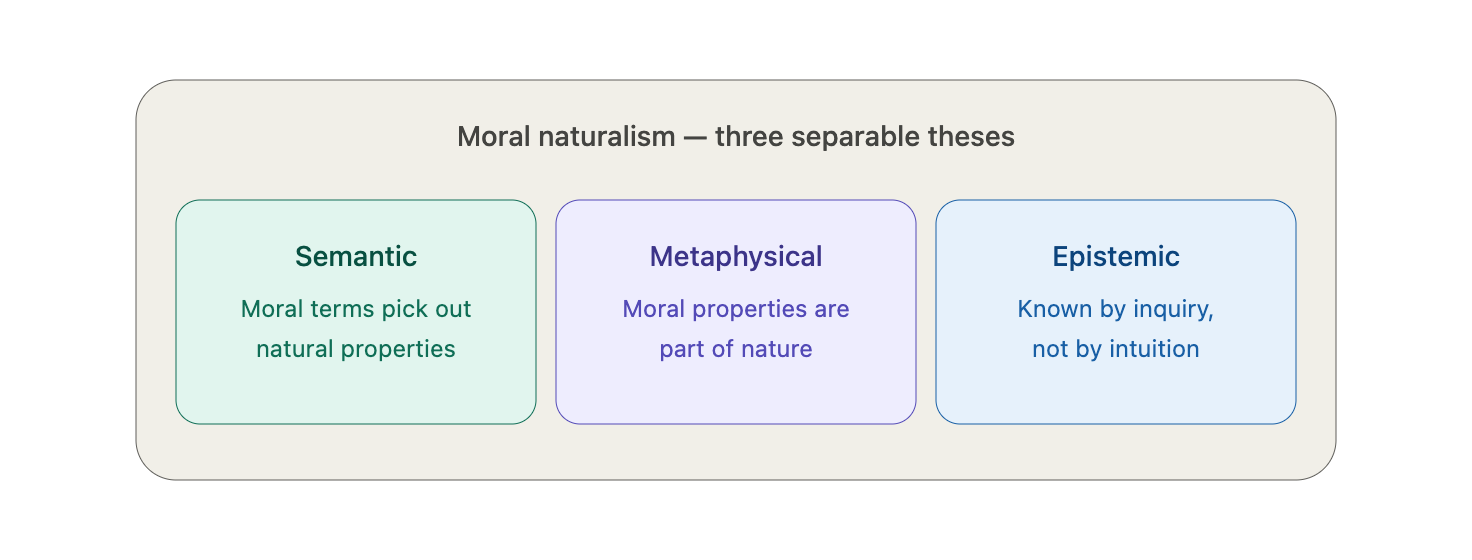
These come apart in practice. The epistemic thesis is the one most naturalists guard hardest, because it’s their comparative advantage over non-naturalism: if moral facts are ordinary natural facts, there’s no puzzle about how creatures like us could come to know them, and no need for Moore’s or Ross’s special faculty of intuition. The semantic thesis is the most contested internally — how moral words hook onto natural properties is exactly what separates the schools, and it’s where the strongest objection (Moore’s) lands.
That semantic question, crossed with the metaphysical one, produces the standard two-axis classification. Analytic vs. synthetic asks whether the moral–natural link is a matter of meaning or of a posteriori discovery; reductive vs. non-reductive asks whether moral properties collapse into non-moral ones or merely supervene on them:
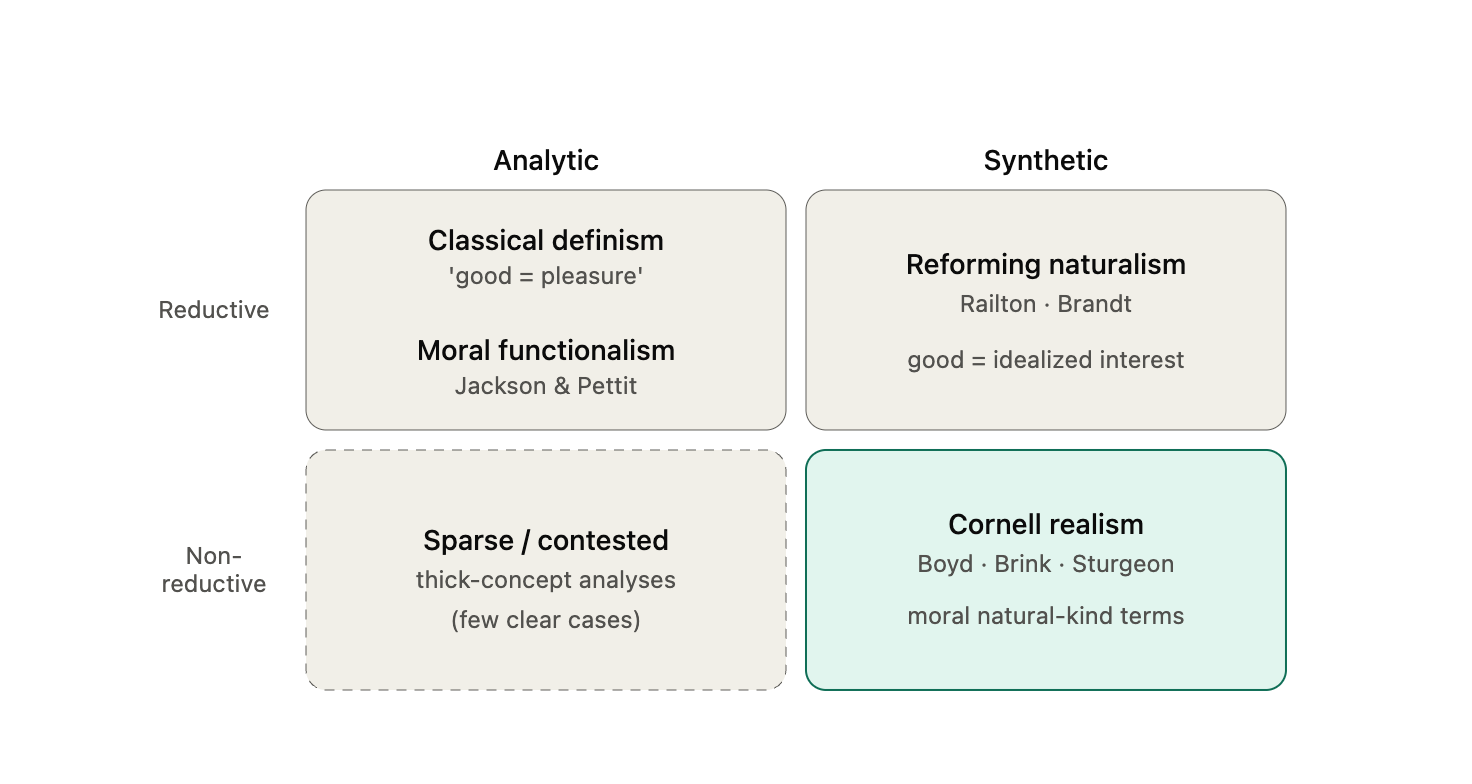
The bottom-right quadrant is where most serious contemporary naturalism lives, and for a structural reason: making the identity synthetic buys immunity to Moore’s open-question argument, while keeping it non-reductive lets moral properties be multiply realizable natural kinds rather than tidy definitions. The top-left is Moore’s original target and now mostly historical, except in Jackson and Pettit’s sophisticated revival. The top-right (analytic and non-reductive) is nearly empty because analyticity and irreducibility pull against each other. One important caveat the grid can’t hold: the neo-Aristotelian and second-nature programs don’t classify cleanly on the analytic/synthetic axis at all, because they reject the assumption that “good” names a property in the way “water” names a kind — for them goodness is attributive, always relative to a form of life.
Here are the live programs with their signature moves, including the two that escape the grid:
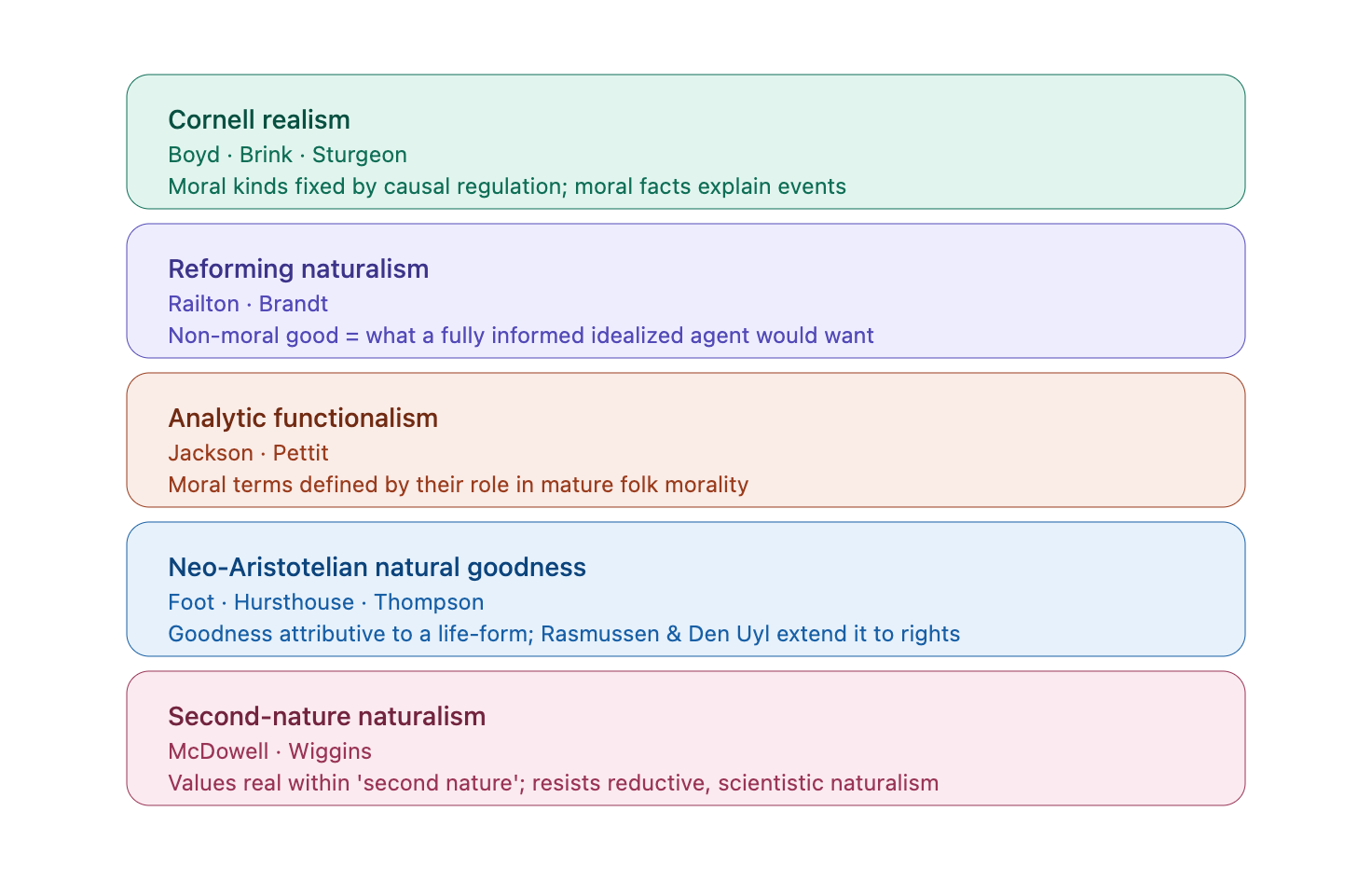
A few finer points that matter for your rights-grounding work. Boyd’s device is the homeostatic property cluster: goodness is a cluster of natural properties (needs, wants, capacities that mutually sustain human flourishing) held together by underlying mechanisms, which is why it resists definition but still refers. Sturgeon’s contribution is specifically the explanatory argument — the claim that we should believe in moral properties because they earn their keep in our best explanations of history and behavior. Railton is the cleanest genuine reduction: he builds moral rightness out of non-moral good, and non-moral good out of an agent’s “objectified” interests, all the way down to natural facts. McDowell and Wiggins sit at the opposite pole — they’re naturalists who explicitly attack “bald” or scientistic naturalism, insisting values are real features of the world as disclosed to a properly acculturated (“second nature”) sensibility. The Foot/Hursthouse line is the one that connects most directly to Rand and to Rasmussen and Den Uyl’s metanormative flourishing argument, since all of them try to derive normativity from the objective requirements of a kind of life.
The historical arc explains why the field has this shape — naturalism is old, was frozen for most of the 20th century by one argument, and thawed only recently:
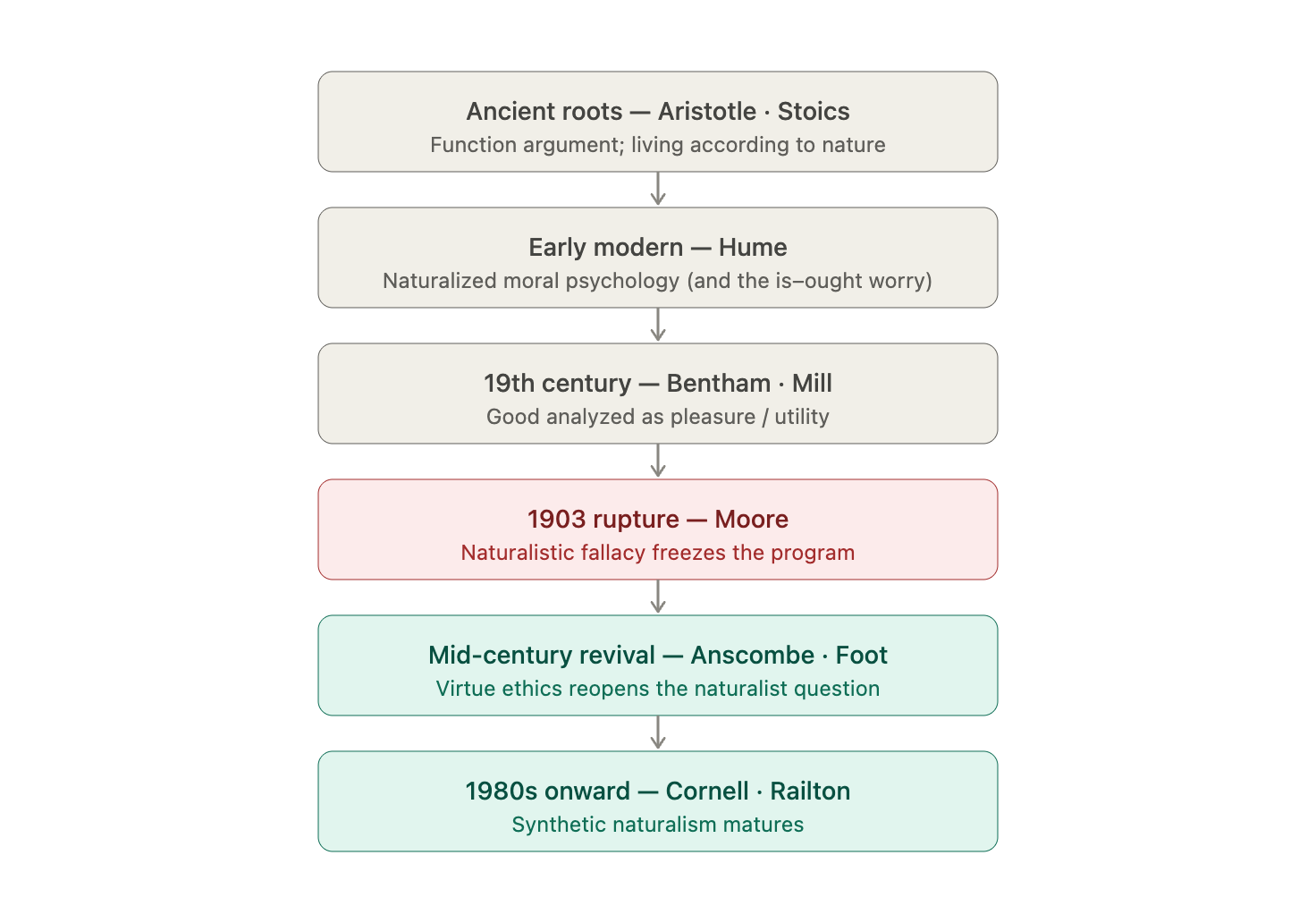
Two hinges deserve emphasis. Anscombe’s 1958 “Modern Moral Philosophy” is the pivot — it argued that modern “moral ought” talk was incoherent without its lost theological backing and urged a return to Aristotelian concepts of flourishing, which is what made Foot’s and Hursthouse’s naturalism possible. And the tool that rescued synthetic naturalism from Moore was imported from philosophy of language: Kripke’s and Putnam’s work on a posteriori necessity in the 1970s gave naturalists the “water = H₂O” template for a true identity that isn’t knowable by meaning alone. Without that borrowed apparatus, the open-question argument would still be decisive.
Now the positive case — the reasons to be a naturalist in the first place, not merely to survive objections:
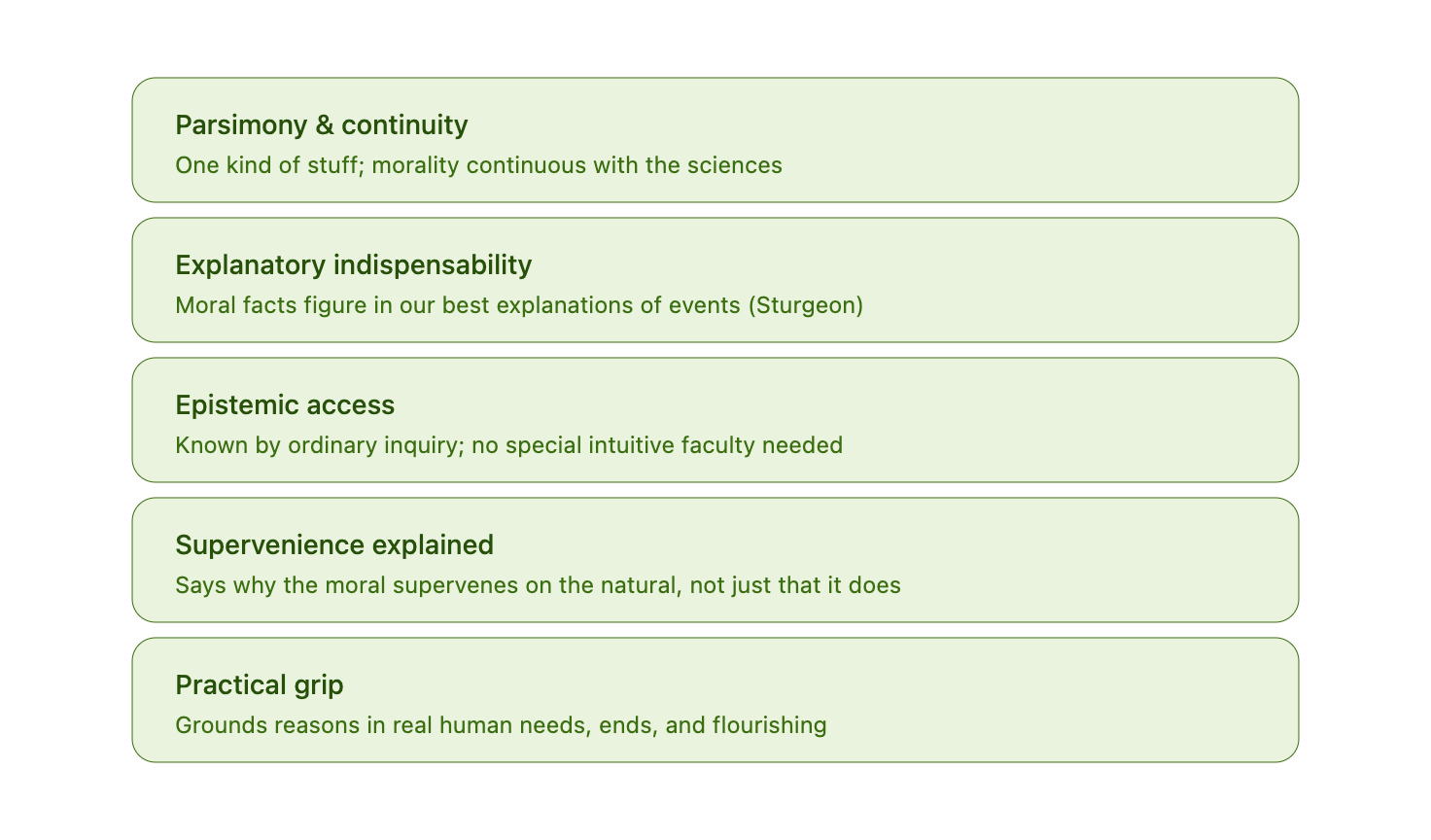
The supervenience argument is quietly the strongest, and it’s aimed straight at the non-naturalist: everyone agrees the moral supervenes on the natural (no two situations can differ morally without differing naturally), but only the naturalist has a clean explanation of why — because the moral just is a natural pattern. The non-naturalist has to treat that necessary connection as brute. This is also the flip side of Mackie’s famous “argument from queerness”: Mackie used the strangeness of non-natural values to reach error theory, but the naturalist turns it into a reason to naturalize rather than eliminate.
Finally, the full objection–reply battlefield, expanded past the four classics to the disagreement and placement worries that dominate current debate:
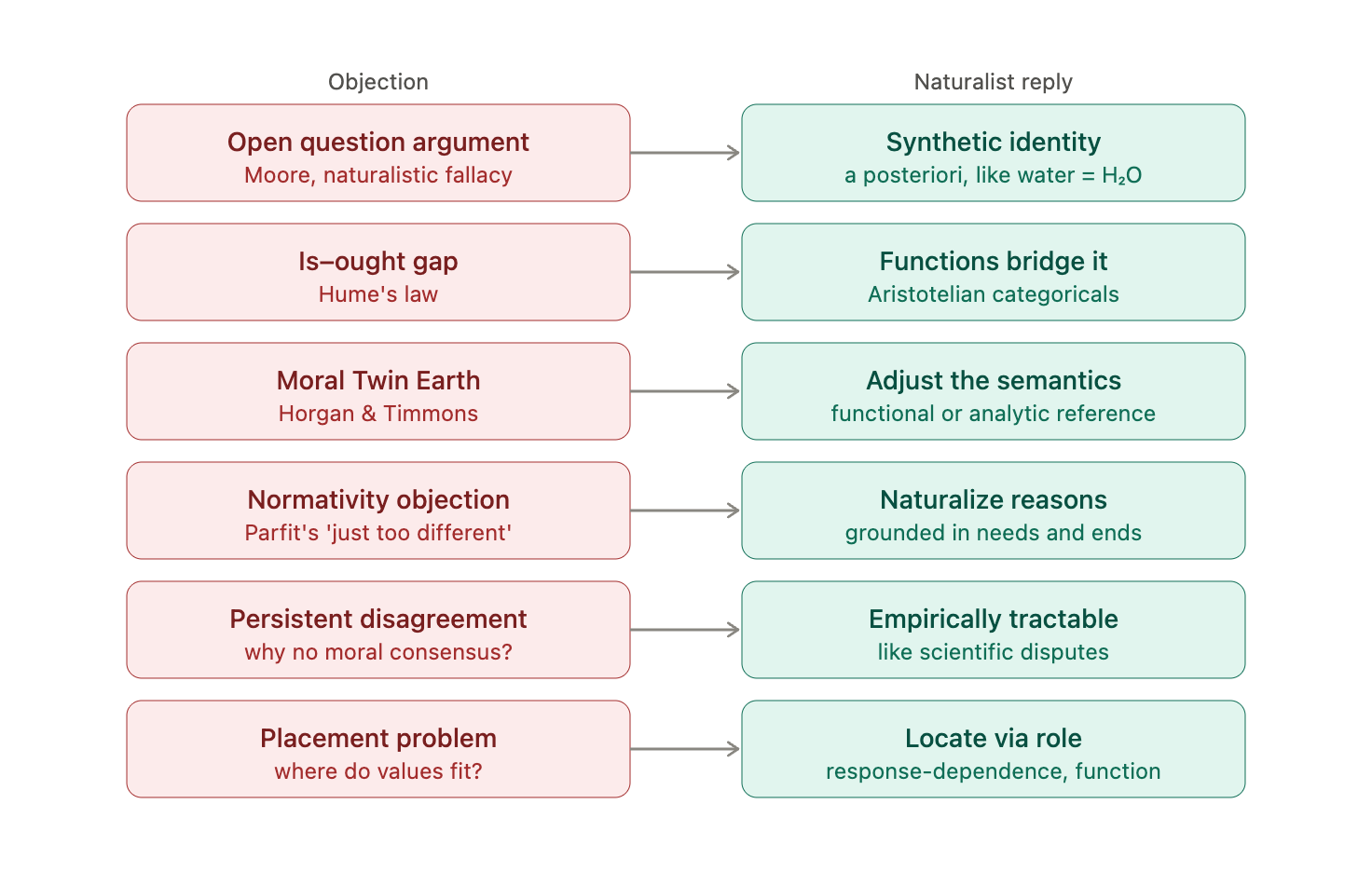
Two of these are genuinely unsettled rather than merely answered. Moral Twin Earth is the sharpest technical threat to Cornell realism specifically: if moral terms refer via causal regulation the way natural-kind terms do, then Twin Earthlings whose word “good” tracks a different natural property should count as talking about something other than goodness — yet intuitively they’re still disagreeing with us about the same subject, which suggests moral terms don’t work like “water” after all. And the normativity objection is the one that unites all the naturalism’s critics — Parfit, Enoch, FitzPatrick, and Scanlon all press the intuition that no purely natural fact, however elaborate, can be a reason with genuine authority. The neo-Aristotelian flourishing strand is the naturalist’s best answer to it, which is exactly why it matters for grounding rights.
For the opposing camps you’ll want stubs for: non-naturalist realism (Moore, Parfit’s On What Matters, Scanlon, Enoch, Shafer-Landau, FitzPatrick); error theory (Mackie, Joyce); expressivism and quasi-realism (Blackburn, Gibbard); and constructivism (Rawls, Korsgaard, Sharon Street). Naturalism competes with the first as a fellow realism, and with the rest over whether moral facts exist at all.
The honest headline is that naturalism doesn’t have one clean filling the way divine command theory does. DCT gets to say “wrong = whatever God forbids” because it locates the whole of morality in a single thing (a will). Naturalism locates it in the world — but which worldly facts is exactly what the internal taxonomy on your map is fighting about. So the blank gets filled differently by each program:
- Classical hedonism (Bentham/Mill, the view Moore attacked): good = pleasure, or what maximizes pleasure/well-being. This is the tidiest DCT-parallel, a flat definition.
- Railton’s reforming naturalism: two-tiered. A person’s non-moral good = what a fully informed, fully rational version of them would want them to want (their “objectified interest”); moral good = what’s rational from a social standpoint that weighs everyone’s objectified interests equally.
- Ideal-desire rationalism (Michael Smith): good = what we would desire ourselves to do if we were fully rational and informed.
- Neo-Aristotelian natural goodness (Foot, Hursthouse): good = flourishing — functioning well as the kind of living thing a human is. A good human has the traits (virtues) a human needs to thrive, in exactly the sense that a good oak has what oaks need to thrive. This is the filling closest to Rand and to Rasmussen and Den Uyl.
- Analytic functionalism (Jackson & Pettit): good = whatever natural property actually plays the “good” role laid down by the network of platitudes in mature folk morality.
- Cornell realism (Boyd): good = the homeostatic cluster of natural properties that answer to human needs and sustain flourishing.
Now the part that actually matters for your question. Two structural disanalogies separate all of these from the DCT biconditional.
First, DCT gives an analytic biconditional — it purports to tell you what “wrong” means. Most serious naturalists deliberately refuse that form, and refuse it for a specific reason: the analytic form is exactly what Moore’s open-question argument punishes. If “good” simply meant pleasure, then “but is pleasure good?” would be a closed, trivial question, and it plainly isn’t. So sophisticated naturalists retreat to one of two weaker forms. Railton offers a reforming definition (“I’m revising the concept to make it scientifically respectable, not reporting ordinary meaning”). Boyd offers a synthetic, a posteriori identity: good = that natural cluster the way water = H₂O — something we discover about the referent, not something we read off the word. That’s why Boyd would resist even writing “good = X” as a definition; for him it’s a natural kind we investigate, like “health,” not a meaning we stipulate.
Second, DCT roots the truthmaker in a will, which is what exposes it to the Euthyphro dilemma: is it wrong because God forbids it, or does God forbid it because it’s wrong? Naturalism roots goodness in mind-independent facts — needs, functioning, flourishing, what one would want under idealization — so nobody’s say-so makes it so, and the arbitrariness horn of Euthyphro doesn’t bite.
The clean way to hold the two side by side: DCT is to the Euthyphro dilemma as analytic naturalism is to the open-question argument. Same pincer — either you’ve made goodness trivial/arbitrary, or you’ve smuggled in a standard independent of your proposed definition. DCT and hedonism both feel that squeeze because both try to define good outright. The reason Cornell and the neo-Aristotelians are the live positions is that they don’t play the definitional game in that form: one makes the identity a discovery, the other makes “good” attributive to a form of life, so there’s no bare “good = X” for the argument to grab.
Hub for the metaethical claim that moral facts and properties are natural facts and properties, knowable by empirically continuous inquiry. Almost always a form of moral realism, defined in contrast to Non-naturalist realism. Parent: Metaethics MOC.
Orienting question
Does moral naturalism secure objective, action-guiding moral facts without leaving the natural order, and if so, which program grounds normativity most firmly: Cornell’s synthetic realism, Railton’s reduction, or the neo-Aristotelian flourishing line?
1. Core commitments — the three theses
Moral naturalism resolves into three separable claims; a naturalist can hold each with a different degree of confidence. The epistemic thesis is the usual comparative advantage over non-naturalism: if moral facts are ordinary natural facts, there is no puzzle about how we know them and no need for a special faculty of intuition.
- Semantic thesis (naturalism) — moral terms pick out natural properties.
- Metaphysical thesis (naturalism) — moral properties are part of the natural order.
- Epistemic thesis (naturalism) — moral facts are known by ordinary inquiry, not by intuition.
2. Internal classification — two axes
- Analytic vs synthetic naturalism — is the moral–natural link a matter of meaning, or an a posteriori discovery?
- Reductive vs non-reductive naturalism — do moral properties collapse into non-moral ones, or merely supervene on them?
Quadrant placements:
- Analytic + reductive — Classical definism, Analytic functionalism (Jackson and Pettit)
- Synthetic + reductive — Reforming naturalism (Railton)
- Synthetic + non-reductive — Cornell realism (the flagship)
- Analytic + non-reductive — sparse / contested (thick-concept analyses)
Why the flagship sits in the synthetic, non-reductive corner
A synthetic identity is immune to the Open question argument; a non-reductive one lets goodness be a multiply realizable natural kind rather than a definition. Note that the neo-Aristotelian and second-nature programs reject the grid’s premise that “good” names a property the way “water” names a kind — for them goodness is attributive, always relative to a form of life.
3. Programs
- Cornell realism — Boyd, Brink, Sturgeon. Moral kinds fixed by causal regulation; moral facts earn their place in the best explanations of events. Boyd’s device is the homeostatic property cluster.
- Reforming naturalism (Railton) — Railton, Brandt. Non-moral good = what a fully informed idealized agent would want the actual agent to want; the cleanest genuine reduction.
- Analytic functionalism (Jackson and Pettit) — moral terms defined by their role in mature folk morality (network analysis).
- Neo-Aristotelian natural goodness — Foot, Hursthouse, Thompson. Goodness attributive to a form of life. Connects directly to Rasmussen and Den Uyl — metanormativity and Objectivist rights-grounding.
- Second-nature naturalism — McDowell, Wiggins. Values real within “second nature”; explicitly resists reductive, scientistic (“bald”) naturalism.
4. Historical lineage
- Aristotle — function argument and Stoics — living according to nature — ancient roots.
- Hume — naturalized moral psychology — and the is–ought worry he also raised.
- Mill — hedonic naturalism — good analyzed as pleasure / utility.
- Moore — Principia Ethica (1903) — the rupture; the Open question argument freezes the program.
- Anscombe — Modern Moral Philosophy (1958) and Foot — Natural Goodness — the mid-century revival.
- Kripke–Putnam — a posteriori necessity — the tool borrowed from philosophy of language that rescued synthetic naturalism from Moore.
5. Arguments for
- Parsimony and continuity argument — one kind of stuff; morality continuous with the sciences.
- Explanatory indispensability (Sturgeon) — moral facts figure in our best explanations of history and behavior.
- Epistemic access argument — known by ordinary inquiry; no special intuitive faculty needed.
- Supervenience argument — naturalism explains why the moral supervenes on the natural, where non-naturalism must call the connection brute. Quietly the strongest, and the flip side of Mackie’s Argument from queerness.
- Practical grip argument — grounds reasons in real human needs, ends, and flourishing.
6. Objections and replies
- Open question argument (Moore) → Synthetic identity reply — a posteriori, like water = H2O.
- Is–ought gap (Hume’s law) → Function-based bridge — Aristotelian categoricals.
- Moral Twin Earth (Horgan and Timmons) → Semantic adjustment reply — functional or analytic reference.
- Normativity objection (Parfit’s “just too different”) → Naturalized reasons reply — reasons from needs and ends.
- Moral disagreement objection → Disagreement is empirically tractable — like scientific disputes.
- Placement problem (Jackson) → Location via functional role — response-dependence, function.
The two live threats
Moral Twin Earth is the sharpest technical challenge to Cornell’s causal semantics; the Normativity objection unites all the critics (Parfit, Enoch, FitzPatrick, Scanlon). The neo-Aristotelian flourishing strand is the naturalist’s best answer to the latter, which is exactly why it matters for grounding rights.
7. Opposing positions
- Non-naturalist realism — Moore, Parfit (On What Matters), Scanlon, Enoch, Shafer-Landau, FitzPatrick. Competes as a fellow realism.
- Error theory — Mackie, Joyce.
- Expressivism and quasi-realism — Blackburn, Gibbard.
- Constructivism — Rawls, Korsgaard, Street.
Working pipeline
- Moral naturalism — sources — primary and SEP-level reading to pull.
- Moral naturalism — claims — extracted claims per program.
- Moral naturalism — open contradictions — where the programs conflict (esp. reductive vs. non-reductive on normativity).
- Moral naturalism — essay outline
Stub template
Fill each linked note in the standard permanent-note format:
- Main claim
- Key concepts
- What it argues against
- Why it matters
Handwritten Notebook Pages
Source
- Open Moral naturalism notebook pages — start at notebook p. 85 (file not included in this release)
- Open Moral Naturalism notebook pages — start at notebook p. 93 (file not included in this release)