DESCRIPTION
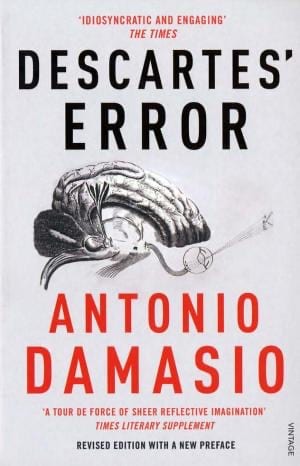
In the centuries since Descartes famously proclaimed, ‘I think, therefore I am,’ science has often overlooked emotions as the source of a person’s true being. Even modern neuroscience has tended until recently to concentrate on the cognitive aspects of brain function, disregarding emotions. This attitude began to change with the publication of Descartes’ Error. Antonio Damasio challenged traditional ideas about the connection between emotions and rationality. In this wonderfully engaging book, Damasio takes the reader on a journey of scientific discovery through a series of case studies, demonstrating what many of us have long suspected: emotions are not a luxury, they are essential to rational thinking and to normal social behaviour.
My Summary
Main Ideas, Takeaways & Similarities
Questions
I. What is the problem?
A. How is this problem formulated?
B. Why is this problem important?
C. What is the history of this problem?
D. Which prominent personalities have been interested in this problem?
II. What solutions to the problem are there?
A. What are the conclusions reached?
B. By what argument(s) is the conclusion reached?
C. What facts or assumptions serve as premises?
D. When a prominent personality offers a solution, does he also argue for or against other prominent personalities? Does he raise objections to alternative solutions? Does he consider objections to his own solutions?
III. Evaluation
A. What are the advantages and disadvantages of the alternative formulations to the problem?
B. Has the importance or history of the problem ever been misrepresented?
C. Are the solutions logically related to the premises?
D. Are the facts true? Are the assumptions acceptable? Are the objections answerable?
AI Summary
“Descartes’ Error: Emotion, Reason, and the Human Brain” is a book written by Antonio Damasio, published in 1994. The book explores the relationship between emotions and reason, challenging the traditional view that emotions and rational thought are separate and independent processes. Here is a comprehensive summary of the book in bullet points:
- The book centers on the idea that emotions are integral to human cognition and decision-making, rather than being disruptive or irrational forces that hinder rational thought.
- Antonio Damasio argues that emotions play a crucial role in guiding human behavior, shaping our choices, and informing our decision-making processes.
- He criticizes René Descartes’ famous philosophical dictum, “Cogito, ergo sum” (I think, therefore I am), suggesting that Descartes’ separation of mind and body, reason and emotion, is fundamentally flawed.
- Damasio introduces the concept of “somatic markers,” which are physiological and emotional signals that help individuals anticipate the consequences of their actions and make better decisions.
- He provides neurological evidence, drawing from studies of patients with brain injuries, to support his argument that the brain processes emotions and rational thought together.
- The book explores the role of the brain’s prefrontal cortex in the integration of emotional and rational processes, emphasizing its importance in decision-making.
- Damasio discusses the impact of brain lesions in the prefrontal cortex on individuals’ ability to make sound decisions and control their behavior.
- He also examines the role of emotions in social interactions, empathy, and moral reasoning, suggesting that emotions are critical for ethical decision-making.
- The book addresses the relationship between emotions and consciousness, highlighting the idea that emotions contribute to the development of self-awareness.
- Damasio argues that understanding the interconnectedness of emotions and reason can have practical applications in fields such as psychology, education, and ethics.
- He discusses the implications of his research for understanding and treating neurological and psychiatric disorders, including schizophrenia and autism.
- The book concludes by emphasizing the importance of integrating emotions and reason for a more comprehensive understanding of human cognition and behavior.
“Descartes’ Error” challenges the traditional Cartesian view of a separation between mind and body and argues for the integral role of emotions in human cognition and decision-making. Damasio’s work provides valuable insights into the neural basis of emotions and their interaction with rational thought, with implications for psychology, philosophy, and the understanding of human consciousness.