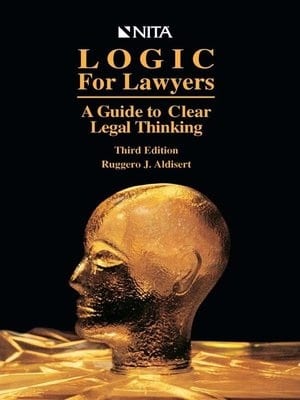
DESCRIPTION
This book tackles the basics of legal reasoning in twelve chapters, including the principles of classic logic, deductive and inductive reasoning, application of the Socratic method to legal reasoning, and formal and material fallacies.
My Summary
Main Ideas, Takeaways & Similarities
Questions
I. What is the problem?
A. How is this problem formulated?
B. Why is this problem important?
C. What is the history of this problem?
D. Which prominent personalities have been interested in this problem?
II. What solutions to the problem are there?
A. What are the conclusions reached?
B. By what argument(s) is the conclusion reached?
C. What facts or assumptions serve as premises?
D. When a prominent personality offers a solution, does he also argue for or against other prominent personalities? Does he raise objections to alternative solutions? Does he consider objections to his own solutions?
III. Evaluation
A. What are the advantages and disadvantages of the alternative formulations to the problem?
B. Has the importance or history of the problem ever been misrepresented?
C. Are the solutions logically related to the premises?
D. Are the facts true? Are the assumptions acceptable? Are the objections answerable?
AI Summary
Highlights
“Logic for Lawyers: A Guide to Clear Legal Thinking” is a book by Kenneth J. Chestek that focuses on the application of logic and critical thinking in the practice of law. It provides lawyers with essential tools to enhance their legal reasoning and communication skills. Here is a comprehensive summary in bullet points:
- Title: Logic for Lawyers: A Guide to Clear Legal Thinking
- Author: Kenneth J. Chestek
Introduction:
- Introduces the importance of clear legal thinking and effective communication in the legal profession.
- Emphasizes the role of logic in constructing persuasive legal arguments.
Chapter 1: Logic and the Law:
- Discusses the relationship between logic and law.
- Emphasizes that sound legal arguments are built on a foundation of logical reasoning.
Chapter 2: Deductive Logic:
- Explains the principles of deductive reasoning.
- Discusses the structure of syllogisms and their application in legal arguments.
Chapter 3: Inductive Logic:
- Introduces inductive reasoning and its relevance in law.
- Discusses generalizations, analogies, and the evaluation of evidence.
Chapter 4: The Language of Logic:
- Explores the language of logic, including statements, premises, and conclusions.
- Discusses the importance of precise and unambiguous communication in legal writing and argumentation.
Chapter 5: Analyzing Arguments:
- Provides tools for analyzing and evaluating legal arguments.
- Discusses common fallacies and errors in reasoning.
Chapter 6: Legal Reasoning:
- Examines the specific application of logic in legal reasoning.
- Discusses the structure of legal arguments, including issue identification, rule application, and conclusion.
Chapter 7: Persuasive Legal Writing:
- Addresses the art of persuasive legal writing.
- Discusses the structure of legal documents, including briefs and memoranda.
Chapter 8: Oral Advocacy:
- Explores the role of logic in oral advocacy, including courtroom presentations and arguments.
- Discusses effective techniques for presenting logical arguments verbally.
Chapter 9: Critical Thinking:
- Encourages lawyers to develop critical thinking skills.
- Discusses problem-solving, decision-making, and the importance of questioning assumptions.
Chapter 10: Ethical and Professional Considerations:
- Addresses the ethical and professional responsibilities of lawyers in using logic.
- Discusses the duty to present truthful and logically sound arguments.
Conclusion:
- Summarizes the key principles of logical thinking in the practice of law.
- Encourages lawyers to continually improve their logical reasoning and communication skills.
Legacy:
- “Logic for Lawyers” serves as a valuable resource for legal professionals seeking to enhance their critical thinking and argumentation skills.
- It emphasizes the importance of clear and logically sound legal writing and oral advocacy in the legal profession.
- The book provides practical guidance and examples to help lawyers construct more compelling and persuasive legal arguments.