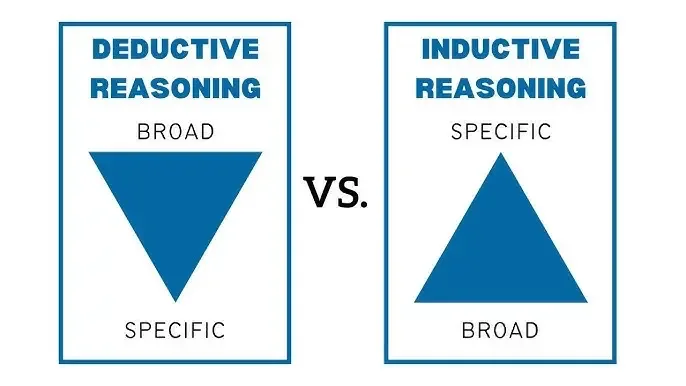
Think of deductive reasoning as “top-down” (general to specific), where you start with a general rule and apply it to a specific case, while inductive reasoning is “bottom-up” (specific to general), where you make a generalization based on specific observations.
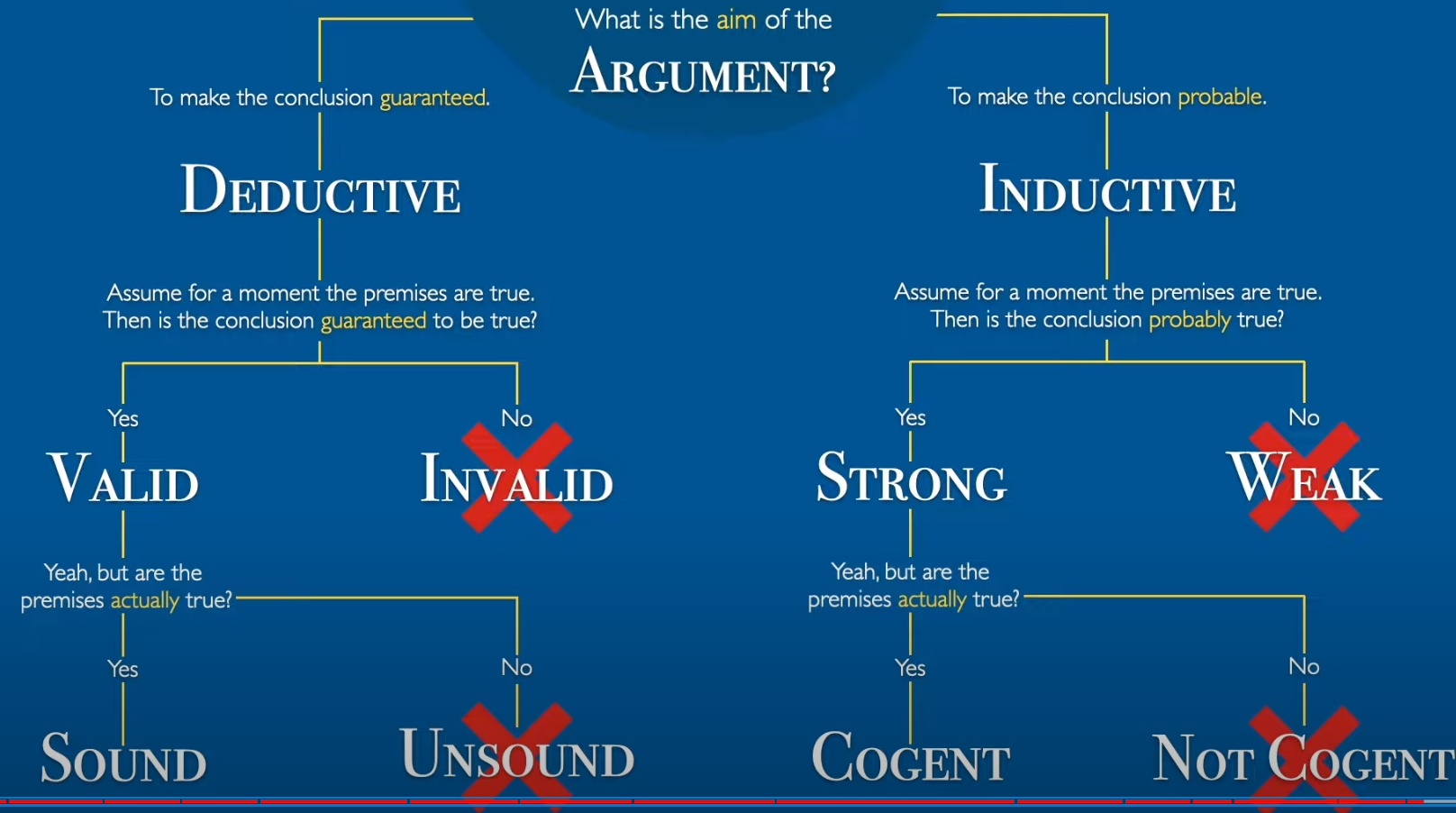
Deductive
Deductive reasoning is a logical process that involves drawing specific conclusions from general premises or principles. It is often referred to as “top-down” reasoning because it starts with a general statement or hypothesis and examines the possibilities to reach a specific, logical conclusion. Here is a detailed breakdown based on the search results:
- Premise + Premise = Conclusion
- General -> Specific
- Certainty
- “Deduce from the general”
Definition of Deductive Reasoning
- General to Specific: Deductive reasoning moves from general premises to specific conclusions. It contrasts with inductive reasoning, which moves from specific observations to general conclusions[1][2][6].
- Logical Validity: An argument is considered deductively valid if the conclusion logically follows from the premises. This means that if the premises are true, the conclusion must also be true[2].
- Soundness: A deductive argument is sound if it is both valid and its premises are true. Thus, a sound argument guarantees the truth of the conclusion[2].
Structure of Deductive Reasoning
- Premise-Premise-Conclusion: Deductive reasoning typically follows a structure where a conclusion is drawn from two or more premises. For example:
- Premise 1: All men are mortal.
- Premise 2: Socrates is a man.
- Conclusion: Therefore, Socrates is mortal[6][8].
Characteristics
- Logical Consequence: The conclusion is a logical consequence of the premises, meaning it is impossible for the premises to be true and the conclusion false[2].
- Formal and Necessary: Deductive reasoning is formal, relying on the logical form of the argument rather than its content, and necessary, meaning the truth of the premises necessitates the truth of the conclusion[2].
- A Priori: Deductive reasoning is knowable a priori, meaning it does not require empirical evidence to determine validity[2].
Applications
- Scientific Method: Deductive reasoning is used in the scientific method to test hypotheses and theories by predicting specific outcomes if the premises (theories) are correct[6].
- Problem Solving: It is a cognitive function used in decision-making and problem-solving, often applied in various fields such as mathematics, philosophy, and computer science[3][8]
Examples of Deductive Reasoning
- Classic Example:
- Premise 1: All humans are mortal.
- Premise 2: Socrates is a human.
- Conclusion: Therefore, Socrates is mortal[2][8].
- Everyday Example:
- Premise 1: All spiders have eight legs.
- Premise 2: Tarantulas are spiders.
- Conclusion: Therefore, tarantulas have eight legs[6].
Deductive reasoning is a foundational aspect of logical thinking, providing a reliable way to derive conclusions from established premises. It is essential for constructing valid arguments and is widely used in various disciplines to ensure the accuracy and reliability of conclusions.
Inductive
Inductive reasoning is a logical process that involves drawing general conclusions from specific observations or instances. It is often referred to as “bottom-up” reasoning because it starts with specific data points and moves towards broader generalizations and theories. Unlike deductive reasoning, where conclusions are necessarily true if the premises are true, inductive reasoning deals with probabilities and likelihoods rather than certainties.
- From Sir Francis Bacon
- Probability
Definition
Inductive reasoning involves making inferences based on observed patterns, specific instances, or empirical data. The process typically involves three stages:
- Specific Observation: Noticing particular instances or data points.
- Pattern Recognition: Identifying trends or regularities among the observations.
- General Conclusion: Forming a broader generalization or hypothesis based on the identified patterns.
Characteristics
- Bottom-Up Approach: Moves from specific observations to broader generalizations.
- Probabilistic: Conclusions are likely but not guaranteed to be true.
- Exploratory: Useful for generating hypotheses and exploring new phenomena.
- Pattern-Based: Relies on identifying patterns and trends in data.
Types of Inductive Reasoning
-
Inductive Generalization: Drawing a conclusion about an entire population based on a sample.
- Example: “All observed swans are white; therefore, all swans are white.”
-
Statistical Generalization: Using specific numerical data from a sample to make statements about a population.
- Example: “60% of surveyed students prefer online classes; therefore, 60% of all students likely prefer online classes.”
-
Causal Reasoning: Inferring cause-and-effect relationships between different events.
- Example: “I get a headache whenever I drink coffee; therefore, coffee causes my headaches.”
-
Sign Reasoning: Making conclusions based on correlational relationships.
- Example: “Dark clouds are a sign that it will rain soon.”
-
Analogical Reasoning: Drawing conclusions based on the similarities between two situations.
- Example: “Just as a car needs fuel to run, a human needs food to live.”
Examples of Inductive Reasoning
-
Scientific Example:
- Observation: Every time I water my plants, they grow.
- Pattern: Watering plants seems to promote growth.
- Conclusion: Watering is essential for plant growth.
-
Everyday Example:
- Observation: My friend was late to the meeting because of traffic.
- Pattern: Traffic often causes delays.
- Conclusion: Traffic is a common cause of being late.
Strengths and Weaknesses
-
Strengths:
- Useful for forming hypotheses and theories.
- Helps in identifying patterns and trends in data.
- Flexible and open-ended, encouraging exploration and discovery.
-
Weaknesses:
- Conclusions are not guaranteed to be true.
- Susceptible to biases and unrepresentative samples.
- Can lead to overgeneralization if based on insufficient data.
Comparison with Deductive Reasoning
| Aspect | Inductive Reasoning | Deductive Reasoning |
|---|---|---|
| Approach | Bottom-up (specific to general) | Top-down (general to specific) |
| Certainty | Probabilistic (conclusions are likely but not certain) | Certain (if premises are true, the conclusion must be true) |
| Use | Generating hypotheses, exploring new phenomena | Testing hypotheses, proving theories |
| Example | ”Every swan I have seen is white; therefore, all swans are white." | "All humans are mortal. Socrates is a human. Therefore, Socrates is mortal.” |
Applications of Inductive Reasoning
- Scientific Research: Forming hypotheses and theories based on empirical data.
- Everyday Decision-Making: Making predictions and inferences based on past experiences.
- Data Analysis: Identifying patterns and trends in data to draw general conclusions.
- Problem-Solving: Generating potential solutions based on observed patterns.
Inductive reasoning is a powerful cognitive tool that allows us to make educated guesses, form hypotheses, and uncover new insights based on specific observations. It is widely used in scientific research, data analysis, and everyday decision-making, making it an essential aspect of logical reasoning.
References
Reddit - What is a fool-proof way to remember the difference between deductive and inductive reasoning?
Deductive and Inductive Reasoning (Bacon vs Aristotle - Scientific Revolution) - YouTube