⬅️ Hub: Political Philosophy
DESCRIPTION
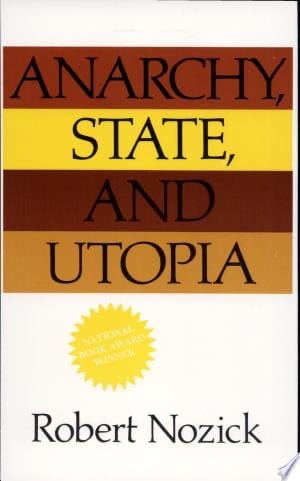
Winner of the 1975 National Book Award, this brilliant and widely acclaimed book is a powerful philosophical challenge to the most widely held political and social positions of our age—liberal, socialist, and conservative.
My Summary
Attachment (file not included in this release)
Main Ideas, Takeaways & Similarities
Questions
I. What is the problem?
A. How is this problem formulated?
B. Why is this problem important?
C. What is the history of this problem?
D. Which prominent personalities have been interested in this problem?
II. What solutions to the problem are there?
A. What are the conclusions reached?
B. By what argument(s) is the conclusion reached?
C. What facts or assumptions serve as premises?
D. When a prominent personality offers a solution, does he also argue for or against other prominent personalities? Does he raise objections to alternative solutions? Does he consider objections to his own solutions?
III. Evaluation
A. What are the advantages and disadvantages of the alternative formulations to the problem?
B. Has the importance or history of the problem ever been misrepresented?
C. Are the solutions logically related to the premises?
D. Are the facts true? Are the assumptions acceptable? Are the objections answerable?
AI Summary
Preface
Central Thesis and Concern
Nozick begins with the assertion that individuals have rights—rights so strong and far-reaching that they sharply limit what the state may legitimately do. The core question becomes: what is the legitimate scope of state power? His book explores the nature of the state, its justifications (if any), and the relationship between individual rights and state authority.
Minimal State as Justified
Nozick argues that only a minimal state—restricted to functions such as protection against force, theft, fraud, and enforcement of contracts—is justified. Any more expansive state violates individuals’ rights by coercively forcing them to do things they otherwise would not. Two implications follow:
- The state cannot coerce citizens into aiding others.
- The state cannot prohibit actions for a person’s own good or protection.
Personal Journey and Style
Nozick admits he once resisted libertarian conclusions, finding them harsh toward human suffering, but over time he became convinced of their truth. He now sees politics through a libertarian lens, though he acknowledges many whom he respects disagree with him. His method resembles that of analytic philosophy—dense with arguments, counterexamples, puzzles, and structural analysis.
Method and Purpose
- Nozick emphasizes that philosophy should not merely reaffirm commonly accepted views but challenge and strain them through rigorous argumentation.
- Even readers who disagree should leave with a deeper understanding of their own positions.
- He warns that confronting strong opposing arguments may change one’s beliefs, since refusing to listen is the only sure way to avoid being convinced.
Structure of the Book
- Part I: Justifies the minimal state, addressing the anarchist claim that any state necessarily violates rights. He argues a state can arise “invisible hand” style from a Lockean state of nature without intentional design or rights violations. Topics include: side constraints on morality, animal rights, risky actions, punishment, Hart’s principle of fairness, preventive detention, and legitimacy of preemptive attack.
- Part II: Argues no more extensive state can be justified. He critiques distributive justice theories (especially Rawls’s), defends his entitlement theory of justice, and addresses issues like equality, envy, and Marxist exploitation.
- Part III: Examines utopian thought, arguing the minimal state is the best framework for realizing diverse utopian experiments. He compares methods of shaping society (design vs. filter devices) and draws on economic models (the “core” of an economy).
Philosophical Approach
- Nozick stresses that this book is an exploration, not a final polished system. It includes unfinished thoughts, conjectures, open questions, and acknowledged weaknesses.
- He criticizes philosophers who conceal the weak points in their arguments, instead committing to highlight where his own reasoning feels strained.
- He admits the book does not provide precise, final theories of individual rights, punishment, or distributive justice, but rather sketches frameworks that he hopes will stimulate further work.
Acknowledgments
- Written largely during 1971–72 at the Center for Advanced Study in the Behavioral Sciences, Palo Alto, and rewritten in 1973.
- He thanks Barbara Nozick for objections and support, Michael Walzer for counterarguments, and several philosophers for detailed feedback, including W.V. Quine, Derek Parfit, Gilbert Harman, John Rawls, Frank Michelman, Alan Dershowitz, Ronald Dworkin, Burton Dreben, and the Society for Ethical and Legal Philosophy.
- A long conversation with Murray Rothbard sparked his interest in anarchism; earlier debates with Bruce Goldberg led him to take libertarianism seriously enough to try to refute it—eventually leading him toward it.
Side Constraints interpretation of Rights
PART I - State-of-Nature Theory, or How to Back into a State without Really Trying
Robert Nozick begins with the question of whether any state at all is justified. Against anarchists who see all states as immoral, he proposes to test whether a legitimate state could arise from a morally constrained state of nature, using Locke as a starting point. In this condition, people have rights to life, liberty, and property, and may enforce them. Yet the state of nature is plagued by “inconveniences”: bias in self-judgment, escalating retaliation, and weakness against aggressors. To overcome these, individuals form protective associations and, through invisible-hand processes, these evolve into more formal protective agencies.
From here, competition among agencies tends to produce a dominant protective association, which effectively holds a monopoly over the use of force in a given area. This resembles a state, though at first it is an “ultraminimal” state that protects only paying clients. The critical challenge is explaining how such an agency could legitimately forbid independents from enforcing their rights without itself violating rights. Nozick argues that risky, unreliable enforcement methods may be preempted under principles of self-defense and procedural rights, producing a de facto monopoly.
Because independents are thereby disadvantaged, justice requires compensation. The simplest form of compensation is to extend protection to them for free. This transforms the ultraminimal state into a minimal state—a “night-watchman” government that protects all without redistributing beyond that. Thus, Nozick traces a path by which the state can arise without violating rights and without requiring a social contract or collective design.
Underlying this argument is a broader moral framework. Rights, for Nozick, are not goals to be maximized but side constraints that prohibit using individuals as means without consent. They express the Kantian principle that persons are ends in themselves. This makes utilitarian justifications of the state unacceptable, since they allow sacrificing some for the greater good. The minimal state, by contrast, respects inviolable rights while providing the necessary framework for protection.
Finally, Nozick rejects broader justifications for preventive restraint or forced cooperation. While prohibiting risky enforcement is legitimate, forbidding mere competition or growth of rival agencies is not. The legitimacy of the minimal state rests on the fact that it emerges unintentionally through invisible-hand processes and owes its universal protection not to redistributive charity but to required compensation. Part I thus concludes that the minimal state is the most extensive state that can be morally justified, and any more expansive state necessarily violates rights.
CHAPTER 1 - Why State-of-Nature Theory?
Central Question: Why Not Anarchy?
Nozick begins political philosophy by asking a fundamental question: should there be any state at all? The existence of anarchist theory makes this question unavoidable, since if anarchism were tenable, political philosophy would collapse. The “state of nature” becomes the framework for testing whether the state is necessary or justified.
He considers several approaches:
- A purely pessimistic (Hobbesian) description of anarchy may make the state look preferable, but one must also compare it with the worst possible states, which might look even worse.
- An overly optimistic (Godwin-like) view of anarchy is equally unconvincing.
- Decision criteria like minimax (choosing the least bad option under uncertainty) or maximax (choosing the most hopeful scenario) fail to persuade.
Instead, Nozick proposes to consider the best possible version of anarchy—a state of nature where people generally respect moral constraints and behave as they ought, though not perfectly. If even this ideal form of anarchy has flaws and a state still proves superior, then a strong case exists for the necessity of the state.
Moral Background to Political Authority
The question of the state is not only political but deeply moral. Anarchists often argue not just that a state is unnecessary but that any state is intrinsically immoral because it violates rights. Thus, political philosophy must rest on moral philosophy:
- What people may and may not do to one another sets limits on what can legitimately be done through the state.
- The moral prohibitions it is permissible to enforce are the only possible source of the state’s legitimacy.
- Coercive power, unless grounded in rights, is illegitimate.
This framework implies that the justification for the state must demonstrate it does not violate rights in its formation or operation.
Explanatory Power of State-of-Nature Theory
Beyond political justification, Nozick sees the state-of-nateure approach as serving explanatory purposes:
- There are three possible ways to understand the political realm:
- Fully explaining it in terms of the nonpolitical (most desirable).
- Viewing it as emerging from but irreducible to the nonpolitical.
- Treating it as wholly autonomous.
- The first option is the richest and most illuminating. Thus, state-of-nature theory attempts to fundamentally explain the political in terms of the nonpolitical.
A fundamental potential explanation—even if factually false—can still provide great insight by showing how political structures could have arisen. Explanations may be: - Fact-defective: based on false assumptions.
- Law-defective: based on false general principles.
- Process-defective: describing a possible process that did not happen, but could have.
Even defective potential explanations have explanatory power because they clarify what is possible and highlight why actual history diverged.
Nozick’s Approach
Because of this explanatory and justificatory power, Nozick chooses to begin with Locke’s state of nature, or something very close to it. He acknowledges that Locke’s account is incomplete (particularly regarding the law of nature’s basis), but the framework remains fruitful. He will modify Locke’s version only when differences are philosophically important.
Thus, the investigation begins with individuals in a morally constrained state of nature and asks whether, without intentional design, a state could emerge without violating rights, and whether such a state would be morally preferable to continued anarchy.
CHAPTER 2 - The State of Nature
Locke’s State of Nature
- In Locke’s state of nature, individuals enjoy perfect freedom to act and dispose of their persons and property, constrained only by the law of nature, which forbids harming others in life, liberty, health, or possessions.
- People may defend themselves, recover compensation for harms, and punish wrongdoers proportionately.
- But the state of nature faces inconveniences:
- Biased self-judgment leads to excessive punishment and endless cycles of retaliation.
- Disputes are difficult to resolve conclusively, since parties doubt each other’s willingness to stop seeking retribution.
- Weaker individuals may be unable to enforce their rights against stronger adversaries.
Protective Associations
- To overcome these issues, people form mutual-protection associations, agreeing to defend each other against violations.
- Problems with simple associations:
- Members are always “on call.”
- Quarrels between members create instability.
- Opportunists may exploit multiple associations to shield themselves.
- Associations therefore develop procedures for judgment to determine who is in the right, eventually evolving into more formalized protective agencies offering services for payment.
- These agencies converge functions like detection, adjudication, enforcement, and punishment.
- Private arbitration and alternative judicial systems may arise, but ultimate enforcement depends on power. The state restricts enforcement to its own apparatus, leaving outsiders with no alternative when disputes remain unresolved.
Rise of Dominant Protective Associations
- With multiple agencies operating in the same territory, three outcomes are possible:
- Battles: one consistently wins; clients of losers defect, leaving a monopoly.
- Geographic division: each agency dominates a region, producing a patchwork of states.
- Peaceful cooperation: agencies create appeals systems and jurisdiction rules, forming a unified judicial framework.
- In all cases, a dominant protective association emerges, resembling a minimal state.
- Market dynamics push toward monopoly: protection is a relative good (its value depends on comparative strength), and rival agencies in violent conflict cannot stably coexist.
- Outlaw agencies (ignoring Locke’s law of nature) may arise, but lack legitimacy and voluntary cooperation, unlike states that command obedience through a belief in authority.
Invisible-Hand Explanations
- Nozick compares the rise of dominant protective associations to the emergence of money: not through explicit agreement but through convergent individual choices.
- Such invisible-hand processes produce complex structures (markets, norms, states) unintentionally, without central design.
- These explanations are more illuminating than attributing outcomes to intentional design, since they reveal how order can emerge spontaneously from individual actions.
- Examples: evolutionary biology, ecology, segregation models (Schelling), market equilibria, city safety (Jane Jacobs), and Hayek’s knowledge-based social cooperation.
- Nozick contrasts invisible-hand with hidden-hand (conspiracy) explanations, noting that both have appeal, but invisible-hand models better serve fundamental explanation.
Is the Dominant Protective Association a State?
- Some may argue protective associations are not states, since:
- They allow private enforcement of rights (whereas states claim a monopoly on force).
- They do not protect everyone in their territory (protection is purchased like a commodity).
- A state, by Weberian tradition, claims exclusive authority to decide when force may be used. Protective associations seem to lack this monopoly, and it may not be morally legitimate for them to assert it.
- Moreover, unlike even a minimal night-watchman state, private agencies provide protection only to paying clients, not universally. Thus, they appear to fall short of being states.
- But Nozick hints that this appearance is deceptive—suggesting he will argue that dominant protective associations can, in fact, evolve into states without violating rights.
CHAPTER 3 - Moral Constraints and the State
Minimal vs. Ultraminimal State
- The minimal state (night-watchman state) protects all citizens against violence, theft, and fraud, and enforces contracts. It appears redistributive, since it compels some to pay taxes that fund protection for all.
- The ultraminimal state is a weaker version: it monopolizes the use of force (except for immediate self-defense) but provides protection only to paying clients. Non-subscribers receive no protection.
- The minimal state can be seen as the ultraminimal state plus a voucher system (funded by taxation) to ensure everyone receives some protection.
- The challenge: If redistributive taxation is illegitimate in general, why should protection be a special exception? Supporters of the ultraminimal state must explain how it can be consistent with strict rights protection while denying some individuals protection.
Rights as Side Constraints
- A central issue: Are rights best understood as goals (minimizing violations overall) or as side constraints(prohibitions on certain actions, regardless of consequences)?
- If rights are treated as part of an end-state goal, then violations may be permitted when they minimize total rights violations—e.g., punishing an innocent man to stop a mob’s rampage.
- Nozick rejects this “utilitarianism of rights.” Instead, he places rights as side constraints:
- Individuals may not be used as means to others’ ends without consent.
- This is grounded in a Kantian principle: each person is an end-in-itself and inviolable.
- The separateness of persons means there is no “social good” that outweighs individual lives. Using someone for others’ benefit does not respect their individuality.
The Libertarian Side Constraint
- From the principle of separateness, Nozick derives a libertarian nonaggression constraint: no one may initiate force against another.
- This principle is stronger than utilitarian balancing and rejects sacrificing some for others.
- Complications arise with innocent threats (e.g., a person thrown at you who will kill you on impact) and innocent shields (hostages strapped to aggressors). These cases challenge absolute nonaggression and require more refined principles.
Animals and Moral Status
- Nozick examines whether moral side constraints apply to animals:
- Animals “count for something,” but likely not as much as humans.
- He critiques the argument that eating animals is justified because their existence benefits them. Once beings exist, they acquire claims that cannot be ignored.
- He sketches a position: “utilitarianism for animals, Kantianism for people.”
- People: inviolable side constraints.
- Animals: may be sacrificed if benefits outweigh harms.
- He challenges utilitarians: if only pleasure and pain matter, animals must be counted equally in the moral calculus. But utilitarianism’s problems (e.g., “utility monsters”) apply here too, showing utilitarianism is inadequate even for animals.
The Experience Machine
- Nozick introduces his famous experience machine thought experiment:
- Imagine a machine that could simulate any experience you desire, indistinguishable from reality. Would you plug in for life?
- Most people would refuse, showing that we value more than subjective experience.
- We care about:
- Actually doing things, not just experiencing them.
- Being a certain kind of person, not just feeling like one.
- Contact with reality, not merely manufactured illusions.
- This illustrates that values like autonomy, authenticity, and meaningful life matter beyond utility.
Foundations of Moral Constraints
- What traits of persons ground their special moral status? Candidates include: sentience, rationality, free will, moral agency, self-consciousness, or having a soul.
- Nozick argues these traits matter because they enable long-term planning and shaping of a meaningful life.
- He connects this to the idea that beings with the capacity to give their lives meaning should not be treated merely as means.
- The difficulty: Could higher beings (aliens, “superior” moral creatures) treat us as utilitarians treat animals? This raises the problem of whether humans are at status 1 (inviolable), status 2 (sacrificeable for higher beings), or status 3 (sacrificeable for any). Our views may be underdetermined, since we have never faced such beings.
The Anarchist’s Objection
- Individualist anarchists argue:
- A dominant protective agency is not a state since it lacks monopoly and universal protection.
- When it becomes a state, it violates rights:
- By forbidding private enforcement of justice (which individuals may be entitled to).
- By redistributing resources through taxation for universal protection.
- Thus, they claim the state is intrinsically immoral, violating moral side constraints.
- Nozick’s project: show that the transition from protective associations → ultraminimal state → minimal state can occur without violating rights, and that operators of the ultraminimal state are morally obligated to extend protection universally. This would justify the minimal state as legitimate.
CHAPTER 4 - Prohibition, Compensation, and Risk
Independents vs. Protective Agencies
- Nozick imagines independents—individuals who refuse to join a dominant protective agency and instead enforce their own rights.
- This creates conflict: independents may punish clients of the agency, claiming their own right of retaliation.
- Agencies, however, seek to protect clients in advance, preventing wrongful punishments. They may demand that no one can punish their clients without first proving wrongdoing through accepted procedures.
- This raises deep moral issues about procedural rights and whether risky actions (like unilateral punishment) can be legitimately stopped before harm occurs.
Prohibition vs. Compensation
- Central question: Should boundary crossings be outright prohibited, or allowed if victims are fully compensated?
- Full compensation means restoring the victim to the position they would have been in if the action hadn’t occurred, assuming reasonable precautions on their part.
- Nozick explores cases where compensation might not deter harmful acts (e.g., someone tries to “get away with it”), leading to the need for prohibitions in addition to compensation.
Punishment: Retribution vs. Deterrence
- Retributive theory: punishment should be proportional to the harm and responsibility of the offender (R = r × H). But this may fail to deter crimes if capture is unlikely.
- Deterrence theory: punishment should be set at the minimum level necessary to discourage crimes. But utilitarian deterrence struggles with how to balance happiness and suffering fairly.
- Nozick argues both theories face problems, but self-defense and punishment can be connected under a retributive framework (e.g., proportional defensive harm may reduce deserved punishment later).
Fear as a Reason for Prohibition
- Even if fully compensated, people may fear certain harms (e.g., assault, humiliation, serious injury).
- A system that allowed such acts with compensation would leave people anxious and insecure.
- Thus, fear provides grounds for prohibition: some acts are banned not only because of the direct harm but also because of the public fear they generate, which cannot be fully compensated.
Fairness in Exchange
- Allowing actions if compensation is paid can unfairly allocate benefits:
- The aggressor unilaterally takes and pays the minimum amount needed to make the victim “no worse off.”
- This bypasses the fairness of prior negotiation (where market value, not minimal compensation, might be paid).
- Example: if multiple people want a good, letting the first taker seize it and pay compensation to the original owner is unfair.
- Thus, compensation-only systems distort voluntary exchange, unfairly favoring aggressors.
Why Not Prohibit Everything?
- If every unconsented boundary crossing were prohibited, even accidents would be punishable, creating insecurity and unfairness.
- Instead, Nozick argues some actions may permissibly cross boundaries if prior consent is impossible or prohibitively costly to obtain, provided compensation is paid afterwards.
- Prohibition is strongest against fear-inducing acts and weakest against minor, hard-to-avoid risks.
Risk and Rights
- Risky actions complicate rights theory:
- Some risks are too small to cause fear individually, but large when aggregated (e.g., pollution, random accidents).
- Should risk itself count as a rights violation requiring compensation?
- Options:
- Prohibit risky actions altogether.
- Permit them with compensation only to those actually harmed.
- Permit them with compensation to all exposed to the risk.
- The third option (universal risk-compensation) is fairer but impractical due to high transaction costs. Alternatives include risk pools (Charles Fried’s idea) or insurance markets.
The Principle of Compensation
- Nozick proposes a principle of compensation:
- When risky activities are prohibited, those disadvantaged by the prohibition (e.g., epileptics forbidden to drive) must be compensated.
- This balances the security gained by others with the liberty lost by those restricted.
- Example: pollution should only be allowed if the benefits exceed costs and polluters compensate victims (e.g., airlines paying homeowners for noise damage).
- Mechanisms like class-action suits or public agents may help overcome transaction costs where many suffer small harms.
Productive vs. Unproductive Exchange
- Distinction:
- Productive exchange: makes both parties better off (e.g., buying goods or services).
- Unproductive exchange: one party pays merely to avoid being harmed (e.g., blackmail, racketeering).
- Protective services are productive because they provide real benefit. Protection rackets are unproductivebecause abstention from harm leaves victims no better than if the racketeers didn’t exist.
- This distinction underpins fairness in determining when compensation is legitimate and when prohibitions are necessary.
Core Takeaways
- Independents vs. states: agencies may legitimately stop independents from risky enforcement to protect clients.
- Fear matters: some acts must be prohibited outright because they generate fear even if compensated.
- Fairness requires prior consent: compensation alone unfairly favors aggressors.
- Risk complicates rights: small risks accumulate, raising the problem of pollution and systemic harms.
- Compensation principle: when risky actions are prohibited, those disadvantaged should be compensated.
- Productive vs. unproductive exchange: only the former is morally legitimate.
CHAPTER 5 - The State
Prohibiting Private Enforcement
- Independents may seek to enforce justice using unreliable or risky procedures (e.g., arbitrary or error-prone methods).
- Such acts create danger and fear, even if applied infrequently. Individuals and groups may therefore stop risky enforcement in self-defense.
- But no protective association, even a dominant one, has more rights than individuals in a state of nature. Its authority is limited to what clients transfer, and no new rights “emerge” from mere combination.
- This raises a difficulty: how can a protective agency legitimately prohibit private enforcement without exceeding individual rights?
The Principle of Fairness
- Herbert Hart’s principle of fairness (popularized by Rawls) claims: if people cooperate in a mutually beneficial venture, others who accept the benefits are obligated to reciprocate.
- This principle would justify compelling independents to limit risky enforcement if they benefit from others’ restraint.
- Nozick, however, rejects the principle:
- One cannot create obligations for others simply by conferring benefits without their consent (e.g., neighbors running a PA system or cleaning streets).
- Even if benefits outweigh costs, individuals cannot be forced into cooperation they did not choose.
- At best, the principle might apply under very strict conditions, but it cannot justify enforceable obligations.
- Thus, enforcement of cooperation requires another foundation.
Procedural Rights
- May people demand reliable procedures before punishment?
- Each individual arguably has the right to resist unreliable or unknown procedures. If a process is not shown to be fair and reliable, self-defense is justified.
- Yet, defining “reliable” is difficult: standards vary (e.g., ratios of false convictions vs. guilty going free). No universal agreement exists in a state of nature.
- The dominant protective agency may forbid unreliable procedures against its clients. But this is not a unique right—it is simply an extension of clients’ self-defense rights.
- Still, its superior power makes it the arbiter of procedural reliability, creating a de facto monopoly.
The De Facto Monopoly
- The dominant agency does not claim special rights but acts uniquely as the most powerful defender of fairness and reliability.
- By punishing those who use unreliable procedures, it becomes the sole effective enforcer of rules regarding justice.
- Though not a formal monopoly (others retain the right in principle), its power ensures it is the only one able to act consistently and effectively.
- This establishes a monopoly “in fact,” not by law, aligning with anthropological definitions of the state.
Protecting Independents
- Independents, once prohibited from using risky self-help enforcement, are disadvantaged.
- According to the principle of compensation (from Chapter 4), the protective agency must compensate them for this disadvantage.
- The cheapest form of compensation is to provide independents with protective services against the agency’s clients.
- This leads the agency to extend protection to all in its territory, effectively transforming it into a minimal state.
- Compensation is not redistribution: it is a requirement of justice, ensuring those disadvantaged by prohibitions are not left worse off.
The State as Legitimate
- Two anarchist objections addressed:
- Monopoly objection: The agency’s monopoly arises gradually, by permissible actions and invisible-hand processes, not by rights violations.
- Redistribution objection: Universal protection is not redistributive charity but morally required compensation.
- Thus, the transition from state of nature → ultraminimal state → minimal state occurs without violating rights.
- The minimal state is legitimate and overcomes anarchist objections.
Invisible-Hand Explanation of the State
- Nozick frames the rise of the state as an invisible-hand process:
- Each person acts to protect themselves.
- Protective agencies emerge naturally, one becomes dominant.
- Its prohibitions require compensation, leading to universal protection.
- At no stage do people intend to create a state. They simply seek protection and fair enforcement.
- The result: a minimal state arises unintentionally, without rights violations or explicit social contracts.
Core Takeaways
- The dominant protective agency prohibits unreliable private enforcement, creating a de facto monopoly.
- The principle of fairness fails as a justification for forced cooperation; obligations cannot be imposed merely by conferring benefits.
- Procedural rights require reliable, fair processes; the dominant agency enforces these, becoming the effective arbiter.
- Compensation principle ensures independents receive protection, extending coverage to all and legitimizing the minimal state.
- The state arises through invisible-hand processes, not contracts or rights violations, overcoming anarchist objections.
CHAPTER 6 - Further Considerations on the Argument for the State
1. Stopping the Process?
- Nozick addresses a potential objection: does the logic of self-defense that justifies a dominant protective agency “prove too much”?
- Could the dominant agency prohibit others from joining rival agencies, or prevent competitors from gaining strength, on grounds of self-defense?
- He analyzes this with game theory (prisoners’ dilemma matrices): rational individuals will join protective agencies even if mutual restraint (remaining in anarchy) might jointly be better.
- However, forbidding others to join agencies is not analogous to prohibiting unreliable enforcement. Joining an agency is not in itself a wrong act—it only facilitates potential future wrongs.
- Principle: You may prohibit only actions that are themselves wrongful or that immediately produce wrongful outcomes, not mere preparatory acts requiring future wrongful decisions.
- Thus, the argument justifying a de facto monopoly does not license forbidding competition.
2. Preemptive Attack and Preventive Prohibitions
- Nozick parallels this with international relations: preemptive strikes are justified only if an attack is imminent, not merely because another state is growing stronger.
- The distinction is not probability but causal structure: imminent attacks require no further decision to actualize harm, whereas armament still requires a wrongful choice later.
- Applied to protective agencies: forbidding rival growth is unjust because it relies on predicting future wrong choices, not preventing an immediate wrong.
3. Behavior in the Process
- Could people avoid the rise of the state by choosing not to join agencies?
- Rational self-interest undermines this strategy: since each individual benefits from joining, and one’s choice alone won’t prevent state formation, they will still join.
- Exceptions: pacifists, misanthropes, or religious objectors who refuse to use force. For such “special psychologies,” the invisible-hand process might not operate, but among rational actors willing to defend themselves, a state will emerge.
4. Relation to Locke’s Social Compact
- Locke defines civil society as people agreeing to unite under a government.
- Nozick’s invisible-hand account differs: the state arises from piecemeal, unintended actions, not unanimous compact.
- Stretching “compact” to cover all patterns of voluntary interaction (e.g., who shops where, traffic flows) robs it of distinctive meaning.
- Nozick distinguishes his view both from social contract theory and from “might makes right”: rights exist independently, and the state arises without anyone’s rights being violated.
5. Legitimacy of the State
- Does the dominant protective agency have legitimacy?
- It has no entitlement to be dominant, only to act for those who authorize it.
- Its greater legitimacy stems from accumulated authorizations: because many delegate rights to it, it preempts fewer entitlements than a small agency or lone individual.
- This explains why it is regarded as having a special legitimacy, even though its authority derives from the same rights everyone has.
- Coordination effects also matter: once people converge on a single agency, it becomes “the one to go to,” like a meeting place everyone uses.
6. Preventive Restraint
- Nozick applies the principle of compensation to laws restricting liberty to reduce risk (curfews, gun control, preventive detention).
- Preventive restraint parallels the logic of prohibiting unreliable enforcement: both impose restrictions to reduce risk before harm occurs.
- Justice requires that those restricted be compensated for disadvantages.
- Example: if dangerous individuals are preventively detained, they must be housed in conditions attractive enough to offset the disadvantage (Nozick imagines “resort detention centers”).
- Without such compensation, preventive restraint is illegitimate. Even with it, its scope is narrow, and practical obstacles make it unattractive.
- Thus, the principle both allows some preventive restraint in theory but sharply limits it in practice.
Core Takeaways
- Limits of self-defense: Justifying a de facto monopoly does not justify forbidding competition; only immediate wrongs can be prohibited.
- Invisible-hand inevitability: Rational individuals’ self-interest ensures the state arises, despite anarchist hopes.
- Different from Locke’s compact: The state forms unintentionally, without unanimous agreement, but still legitimately.
- Legitimacy: The dominant agency’s authority stems from aggregated delegations, not special rights.
- Preventive restraint: Possible only with compensation, but practically self-limiting.
- Conclusion of Part I: The minimal state arises legitimately from the state of nature and can be justified without violating rights.
PART II - Beyond the Minimal State?
Part II turns from justifying the minimal state to challenging arguments for more extensive states. Nozick begins with his entitlement theory of justice, which holds that a distribution is just if it arises from just acquisition, just transfer, and rectification of past injustice. Justice depends on history, not on whether holdings fit a favored pattern. He contrasts this with end-result or patterned principles (e.g., to each according to need or productivity), which require constant interference with people’s voluntary exchanges.
The famous Wilt Chamberlain example illustrates the point. Even if society begins with an equal distribution, voluntary transfers—like fans paying Chamberlain to watch him play—quickly upset the pattern. To restore equality, the state would need to continually intervene, violating people’s rights to dispose of their holdings. Thus, patterned principles are incompatible with liberty: they treat people as partially owned by others. The entitlement theory, by contrast, respects self-ownership and voluntary choice.
Nozick also revisits Locke’s idea of appropriation and the Lockean proviso. Appropriation is legitimate so long as it does not make others worse off than they would have been in a state of nature. This does not forbid inequality or innovation, but it rules out monopolizing essential resources, like the only water source. In practice, Nozick argues, market exchanges usually satisfy the proviso, since competition and innovation generally improve others’ situations.
He then critiques Rawls’ theory of justice. Rawls’ difference principle, which permits inequalities only if they benefit the least well-off, is a patterned principle and therefore unstable. Voluntary choices inevitably disrupt it, requiring constant redistribution. Moreover, Rawls treats society as a cooperative venture with a jointly produced surplus, while Nozick insists holdings are the result of individual decisions, not collective ownership. Rawls’ vision, then, implicitly denies full self-ownership.
Finally, Nozick explores related themes of equality, envy, and exploitation. He argues that envy drives much egalitarian thinking, but eliminating material inequality cannot secure equal self-esteem. Claims about “meaningful work” or “workers’ control” can be pursued voluntarily in markets, and Marx’s exploitation theory collapses once the labor theory of value is abandoned. Choices may be constrained, but so long as others act within their rights, they remain voluntary. Attempts to correct these conditions through redistribution or coercion violate rights and misunderstand the nature of free exchange.
CHAPTER 7 - Distributive Justice
Section I: The Entitlement Theory
Core Idea
- Justice in holdings rests on three principles:
- Justice in acquisition – how unowned resources can come to be owned.
- Justice in transfer – how holdings can move justly between people (voluntary exchange, gifts, etc.).
- Rectification of injustice – how to handle past violations (theft, fraud, slavery, etc.).
- If each step (acquisition, transfer, rectification) is just, then the overall distribution is just. Justice is historical, not about some ideal pattern of shares at a moment in time.
Historical vs. End-Result Principles
- End-result (time-slice) principles (e.g., utilitarianism, egalitarianism) judge justice only by how things look at a given moment, ignoring history.
- Historical principles (like entitlement) require knowing how holdings came about. Example: punishment for crimes depends on past acts, not current holdings.
Patterned vs. Unpatterned Principles
- Patterned principles demand distributions match some natural dimension (e.g., to each according to merit, need, productivity).
- The entitlement theory is unpatterned: results arise from voluntary choices and are unpredictable, yet intelligible.
The Wilt Chamberlain Example
- Suppose an equal distribution (D1) exists. If a million fans each pay Wilt Chamberlain 25 cents per ticket, he ends up with $250,000 (D2).
- This new inequality is just, because each fan voluntarily transferred part of their entitlement. To prevent such shifts, the state would have to constantly interfere with people’s choices.
Sen’s Argument & Rights
- Amartya Sen showed that patterned principles, when combined with strong individual rights, create contradictions (no consistent social ordering).
- Nozick responds: rights are not about rankings in social orderings; they constrain what can be done.
- Thus, enforcing patterns requires violating rights.
Redistribution & Property Rights
- Patterned theories ignore the giver’s right to dispose of holdings, focusing only on recipients.
- Redistribution (through taxation or forced labor equivalents) effectively makes people partially owned by others, since others gain enforceable claims over their labor.
- End-state principles turn self-ownership into shared ownership, which Nozick argues is morally impermissible.
Locke’s Theory of Acquisition & the Proviso
- Locke’s idea: mixing labor with unowned things creates ownership, but only if there is “enough and as good left for others.”
- Nozick interprets this as a proviso: appropriation is legitimate only if it doesn’t worsen others’ position relative to a baseline.
- Example: owning the only waterhole in a desert violates the proviso. But discovering a new medicine does not, since others weren’t worse off before.
- Later transfers also inherit this proviso: you can’t acquire all drinkable water by buying it up either.
- Overall, Nozick argues that in real markets, the proviso is rarely violated, since competition and substitution prevent monopolistic worsening of others’ positions.
Section II: Rawls’ Theory
Rawls on Social Cooperation
- Rawls views society as a cooperative venture for mutual advantage, raising a problem of justice: how to fairly divide the benefits of cooperation.
- He introduces principles to assign rights/duties and distribute benefits/burdens.
The Original Position
- Rawls’ thought experiment: people choose principles of justice behind a veil of ignorance (not knowing their place in society).
- They would adopt:
- Equal basic liberties for all.
- Social and economic inequalities only if they benefit the least advantaged (the difference principle).
Nozick’s Critique
- The difference principle is a patterned end-result principle. To maintain it, society must constantly interfere with voluntary exchanges.
- Voluntary acts (like fans paying Wilt Chamberlain) inevitably disrupt patterns. Preserving Rawls’ distribution requires redistributing repeatedly, violating self-ownership.
- Rawls’ focus on cooperation assumes people are sharing a joint product, but Nozick argues holdings arise from separate individual decisions, not collective ownership.
- Thus, patterned redistribution treats individuals as if they owe part of themselves to others, undermining autonomy.
Core Takeaways
- Entitlement theory: Just holdings result from just acquisition, transfer, and rectification, not from fitting a pattern.
- Against patterns: Attempts to enforce patterns (Rawls, egalitarians) require constant rights-violations and redistribution.
- Wilt Chamberlain argument: Voluntary exchanges inevitably upset any favored distribution.
- Lockean proviso: Appropriation is legitimate unless it worsens others’ baseline condition.
- Critique of Rawls: His difference principle is incompatible with liberty because it demands continuous interference with people’s voluntary choices.
CHAPTER 8 - Equality, Envy, Exploitation, Etc.
Section I: Equality & Equality of Opportunity
Equality
- Mere inequality of holdings is not proof of injustice. The entitlement theory insists that how holdings were acquired matters more than how they are distributed.
- Egalitarian theorists (e.g., Bernard Williams) argue that certain activities have “internal goals” (like medicine = healing) that should dictate distribution based on need.
- Nozick replies: even doctors, like barbers or gardeners, act for their own purposes; society cannot simply commandeer their labor. Williams’ case for equality reduces to the familiar claim that society should meet everyone’s important needs, but this ignores entitlements over resources and actions.
Equality of Opportunity
- Often treated as the minimal egalitarian demand. But achieving it usually means either:
- Worsening the better-off (impermissible), or
- Improving the worse-off by redistributing resources (violates entitlements).
- The “race for a prize” analogy is misleading: life is not a single race judged by fairness, but a web of voluntary exchanges.
- While we may feel it would be “fairer” if those with fewer opportunities had more, this cannot override existing entitlements. People may voluntarily improve others’ opportunities, but it cannot be coerced.
Section II: Self-Esteem, Envy, and Work
Self-Esteem and Envy
- Egalitarianism is often fueled by envy: people prefer others not have what they lack, even when it doesn’t improve their own position.
- Self-esteem is socially comparative: people judge themselves relative to others’ abilities. Eliminating one dimension of inequality (e.g., wealth) will only shift envy to another (e.g., intelligence, attractiveness).
- Trotsky’s vision of communism (everyone at the level of Aristotle or Goethe) would not eliminate feelings of inadequacy—envy is conserved.
- Therefore, attempts to equalize material conditions will not secure equal self-esteem; fragmentation of values and diversity of measures of worth is a more promising solution.
Meaningful Work
- Critics argue subordination in capitalist work lowers self-esteem. Nozick counters with counterexamples: orchestra musicians, soldiers, and organizational climbers take orders without losing worth.
- “Meaningful work” (self-direction, purpose, contribution) is valuable, but its provision depends on trade-offs:
- Workers may accept lower wages for more meaningful jobs.
- Consumers may pay higher prices to support firms that provide meaningful work.
- If neither group values it enough, forcing it through law unjustly overrides entitlements.
- Industrial society, not capitalism specifically, generates repetitive work. A market allows those who value meaningful work to express preferences voluntarily.
Workers’ Control
- Worker-run cooperatives are possible within capitalism: groups can buy factories and organize them democratically.
- Market efficiency will determine survival:
- If worker-control increases productivity, firms thrive.
- If it reduces efficiency, survival depends on workers accepting lower wages or consumers paying higher prices voluntarily.
- Unions already have resources to start such ventures; their rarity suggests lack of demand or entrepreneurial skill, not capitalist “exploitation.”
Section III: Exploitation, Voluntary Exchange, and Philanthropy
Marxian Exploitation
- Marx’s labor theory of value collapses: once value is tied to “socially necessary labor time,” it depends on market outcomes, undermining the theory.
- Exploitation, then, is reframed as workers’ lack of access to means of production. But in modern societies, unions and workers hold capital reserves, so they could start firms. Their reluctance reflects risk aversion, not capitalist domination.
- Capitalism allows specialization in risk-bearing, letting workers avoid losses if ventures fail. In socialism, everyone must share risks, reducing flexibility.
Voluntary Exchange
- Critics claim workers’ choices aren’t voluntary if alternatives are bad (work or starve). Nozick replies: voluntariness depends on whether others respect rights.
- If others act within rights, then even constrained choices (like marriage partners after others are taken) are still voluntary. The external environment is shaped by rights-based actions, not coercion.
Philanthropy
- People may prefer compulsory redistribution to voluntary charity due to coordination problems:
- Each person fears their contribution is a “drop in the bucket.”
- People don’t want to feel like “suckers” if others don’t give.
- Nozick notes, however, that individuals could voluntarily coordinate giving through associations, cooperatives, or reminders, without coercion.
- Compulsory redistribution cannot be justified simply by appealing to collective action problems.
Core Takeaways
- Equality: Distributions matter only if they result from injustice; equality has no built-in moral presumption.
- Opportunity: May be desirable but cannot override entitlements.
- Self-esteem & envy: Inequalities rankle because they affect comparative self-worth, but eliminating material inequality won’t remove envy.
- Meaningful work & workers’ control: Can be achieved voluntarily in markets if people value them enough.
- Exploitation: Modern conditions undercut Marx’s claim; risk-bearing and entrepreneurship explain profits better than labor-value theory.
- Voluntariness: Even constrained choices can be voluntary if others act within their rights.
- Philanthropy: Coordination problems explain why people want state redistribution, but they don’t justify coercion.
CHAPTER 9 - Demoktesis
Part I: From the Minimal State to a More-Than-Minimal State
Motivation
- Nozick has already defended the minimal state and dismissed arguments for more extensive states as unjust.
- Still, many readers feel the minimal state is “frail”—it lacks the robustness of modern states with broader powers.
- Question: Can one get to a more extensive state through only legitimate, rights-respecting steps? If so, what would such a state look like?
The Fable of Demoktesis
- Individuals begin with self-ownership but start selling shares in their rights (e.g., occupation, lifestyle, consumption choices).
- At first, it is a fad or novelty, but soon serious markets emerge: people buy rights to others’ drug use, taxation, marriage choices, etc.
- Some sell many rights, leading to domination by small groups, though not full slavery.
- Over time, stock ownership disperses (through inheritance, trade, and reform).
- Eventually, each person ends up owning one equal share in everyone, including themselves.
- Governance becomes a massive shareholders’ meeting, then consolidated into a representative system where only large share-vote holders attend.
- Children are integrated via a share-splitting system, incorporating them into the corporate order when they come of age.
- The result: everyone owns everyone, but equally. Decisions apply universally, creating a democratic corporate state.
- People say: “When everybody owns everybody, nobody owns anybody.” They see this as non-domination, because all are equally subject and equally empowered.
- The system is called demoktesis: ownership of the people, by the people, for the people—essentially a parable of the modern democratic state.
Intolerability and Legitimacy
- Though this state arises from voluntary exchanges and is not unjust, it becomes intolerable: people are dominated not by individuals but by “10,000-headed masters.”
- Nozick illustrates this with the Tale of the Slave:
- He lists cases from a brutal single master → benevolent master → partial autonomy → taxation of labor → group of masters → group plus limited participation → finally voting rights.
- He asks: at what point does the tale stop being the story of a slave?
- The implication: even democracy may not fully eliminate domination—it simply redistributes it.
Part II: Hypothetical Histories and Evaluating Institutions
The Boycott Model
- A more-than-minimal state might arise by boycott:
- People refuse to associate with nonparticipants, gradually forcing everyone into participation.
- This could yield an analogue of a more extensive state without overt coercion.
- But in practice, such boycotts are unlikely to succeed—dissenters could always find enclaves or defectors to cooperate with.
- Thus, while boycotts illustrate how states could expand voluntarily, they cannot replicate the universal coercionof actual states.
Evaluating Institutional Structures
- Nozick proposes criteria for judging states:
- Just actual history → just state.
- Unjust actual history + no just hypothetical history → unjust state.
- Unjust actual history + some just hypothetical history could have led here → depends on closeness.
- If a state could arise by hypothetical just processes, that may improve our evaluation of it—but only if it does not impose rights-violations now.
- A structure closer to respecting individual rights is more just than one that departs significantly from them, regardless of historical path.
- Thus, while modern democratic states (demoktesis) could be imagined to arise legitimately, their actual coercive practices (taxation, regulation, forced participation) remain suspect.
Core Takeaways
- Demoktesis fable: A metaphor for modern democracy—everyone owns everyone equally, creating universal domination masked as equality.
- Tale of the Slave: Step-by-step analogy showing democracy may still preserve domination, just in collective form.
- Boycott model: Hypothetical history showing voluntary expansion of state-like structures, but unlikely in practice.
- Evaluation principle: Institutional legitimacy depends not only on actual history but also on whether a just hypothetical history could have produced it.
- Conclusion: More-than-minimal states may be tolerable or even stable, but they cannot claim full moral legitimacy if they violate rights—even if one can imagine a hypothetical just path to them.
PART III - Utopia
Part III shifts from defending the minimal state against anarchism and egalitarianism to showing how it can serve as a framework for utopia. Nozick argues that traditional utopian schemes—single, rigid blueprints for the ideal society—are both unrealistic and oppressive, since people differ too much in values, talents, and goals. A true utopia must allow for many utopias, each reflecting different visions of the good life, so individuals can join the communities they prefer.
Nozick models utopia on a possible worlds framework: people form associations, and stability arises when no group would prefer to secede. Diversity ensures flourishing, since people’s complementary talents make different communities viable. When projected into the actual world, limits like costs of moving or restricted information complicate matters, but the principle remains: the best social arrangement is a framework in which people may freely form and exit voluntary communities.
This framework works best as a filter, not a design device. Instead of top-down imposition, it enables trial-and-error experimentation: communities form, evolve, or dissolve based on members’ choices. Some will prefer “total communities” with pervasive rules (e.g., religious orders), others will want liberal, permissive associations. As long as entry and exit are voluntary, the framework respects everyone’s rights. The only impermissible utopias are imperialistic ones that try to impose themselves universally.
The framework requires only a minimal central authority to enforce basic rules: preventing aggression between communities, adjudicating disputes, and guaranteeing rights of exit. Beyond that, each community can regulate its members as it sees fit, even imposing paternalistic or redistributive policies internally, since joining is voluntary. In this sense, the minimal state doubles as the meta-utopia—a structure that enables pluralism and experimentation without oppression.
In conclusion, Nozick ties together all three parts of his book. Part I showed how the minimal state arises legitimately without violating rights. Part II argued that more extensive states, grounded in patterned principles, inevitably violate rights and treat people as means. Part III elevates the minimal state from mere legitimacy to inspiration: it is not only the most extensive state that can be justified, but also the best framework for utopian aspirations, a meta-utopia where many visions of the good can coexist.
CHAPTER 10 - A Framework for Utopia
Section I: The Model of Utopia
The Problem of Utopia
- The minimal state, while morally justified, seems uninspiring compared to grand utopian visions. Nozick asks whether it can serve as a framework for utopia instead of being a utopia itself.
- Utopian ideals often prove inconsistent: not all desirable social goods can be realized together. The best world for one person may not be best for another.
The Possible Worlds Model
- Imagine each person constructing a possible world to live in; others may join or leave freely.
- A stable association forms when no subset of members would prefer to secede.
- Members will only accept new entrants if their presence benefits the group as much as it costs. This mirrors a competitive market: each receives their marginal contribution.
- Stability requires diversity of talents and excellences: people flourish best in associations where they complement, not replicate, one another.
Projection onto the Actual World
- Our real world differs from the model:
- We cannot create the people we wish; communities may lack viable populations.
- Communities interact (foreign relations, defense).
- Information and moving costs limit free choice.
- Some communities may restrict knowledge of alternatives, limiting emigration.
- Still, the model shows the value of a framework of communities where people freely join, leave, and experiment.
Section II: The Framework
Diversity of People and Communities
- People are too diverse for there to be one best life or one best community.
- Utopia will therefore consist of many utopias, each embodying a different vision of the good life.
- This “meta-utopia” allows people to pursue their own ideals voluntarily, without imposing them on others.
Design Devices vs. Filter Devices
- Design devices: top-down blueprints of the best society. Nozick dismisses these as unrealistic given human complexity.
- Filter devices: trial-and-error experiments in which communities are formed, tested, and either flourish or fail.
- The framework functions as a filter: people leave communities they dislike, improving both community design and individual satisfaction over time.
Utopian Common Ground
- The framework appeals to nearly all utopians:
- Imperialistic utopians (who want universal imposition) will resist.
- Missionary utopians (who seek persuasion, not force) can embrace it.
- Existential utopians (who want their vision to exist for those who choose it) fully support it.
- Thus, the framework serves as a common ground for divergent visions.
Section III: Community, Change, and Totality
Community vs. Nation
- Communities may impose restrictions (paternalism, censorship, redistribution) on members if they join voluntarily, even if a nation could not legitimately do so.
- Nations differ because individuals cannot easily opt out; communities can justify greater internal restrictions since people freely join them.
Changing Communities
- Hardship arises when communities change character after members have invested deeply.
- Solution: individuals can contract for compensation clauses if communities alter fundamental rules, protecting their expectations.
Total Communities
- Some seek “total communities” uniting all aspects of life under a shared goal (e.g., religious orders, communes).
- The framework allows such groups to form, but only voluntarily; no one may impose totality on all.
Section IV: Utopian Means and Ends
Critiques of Utopianism
- Traditional utopias are criticized for:
- Describing static, rigid, unchanging societies.
- Assuming away real-world problems and difficulties.
- Nozick’s framework avoids these by enabling dynamic experimentation and acknowledging inevitable conflict, imperfection, and complexity.
The Role of Central Authority
- Some central apparatus may be needed to:
- Enforce the framework.
- Prevent communities from invading others.
- Adjudicate disputes.
- Guarantee rights of exit.
- But its role must be minimal and carefully limited.
Permanence of the Voluntary Framework
- Should the framework allow nonvoluntary systems?
- Nozick argues: the framework must be fixed as voluntary. But individuals may freely contract into highly restrictive communities—even into arrangements resembling slavery—so long as it is voluntary.
Section V: Utopia and the Minimal State
- The framework for utopia = the minimal state.
- From three directions, Nozick converges on the same conclusion:
- Part I – The minimal state arises legitimately through invisible-hand processes.
- Part II – More extensive states violate rights.
- Part III – The minimal state best embodies the framework for utopia, enabling diverse communities to flourish.
- Thus, the minimal state is not only morally legitimate but also the best realization of utopian aspirations: it respects persons as inviolate rights-holders while opening space for voluntary visions of the good.
Core Takeaways
- Meta-utopia: Utopia is not a single society but a framework allowing many diverse, voluntary communities.
- Filter over design: Trial-and-error experimentation outperforms top-down planning.
- Voluntary restriction: Communities may impose limits if members join freely.
- Central authority: Minimal but necessary to enforce the framework and rights of exit.
- Minimal state: Morally legitimate, non-coercive, and inspiring precisely because it enables utopian diversity without oppression.
Complete Summary
Robert Nozick begins with the challenge of anarchism: is any state justified at all? Following Locke, he imagines a state of nature where individuals have rights to life, liberty, and property, and may enforce them. Yet this condition produces “inconveniences”: biased self-judgment, escalating retaliation, and weakness against aggressors. To remedy these, people form mutual protection associations, which evolve into private protective agencies. Through invisible-hand processes, competition among agencies leads to a dominant protective association, resembling a state.
This dominant agency initially forms an ultraminimal state, offering protection only to paying clients while prohibiting risky, unreliable private enforcement. But this prohibition disadvantages independents, who lose their ability to enforce their own rights. By Nozick’s principle of compensation, the agency must make them whole, and the cheapest way to do so is to extend protection universally. Thus, without violating rights, the ultraminimal state evolves into a minimal state—a “night-watchman” government protecting all citizens against force, theft, and fraud, and enforcing contracts.
Underlying this argument is Nozick’s moral framework. Rights are not goals to be maximized but side constraints on action, prohibiting the use of individuals as means without their consent. This Kantian view rejects utilitarian balancing, which permits sacrificing some for the greater good. Rights mark individuals as inviolable, grounding the legitimacy of the minimal state and ruling out any more extensive state. Preventive restraint or forced cooperation can only be justified when risks are immediate and compensation is provided, further constraining state power.
With the minimal state defended, Nozick turns in Part II to distributive justice. His entitlement theory holds that a distribution is just if it arises from just acquisition, just transfer, and rectification of past injustice. Justice is historical, not about fitting a favored pattern. In contrast, patterned theories (such as equality, need, or Rawls’ difference principle) require constant interference with voluntary exchanges. Nozick’s Wilt Chamberlain example shows how any pattern is quickly upset by free choices, and preserving it would demand continual rights violations.
Nozick also reinterprets Locke’s proviso on acquisition: appropriation is legitimate so long as it does not make others worse off than before. This rules out monopolizing essential resources but permits innovation and inequality that improve people’s options. Against Rawls, Nozick argues that society is not a collective venture producing a joint surplus to be divided, but a network of individual decisions. Redistributive taxation, therefore, amounts to partial ownership of some people by others, undermining self-ownership.
Extending his critique, Nozick addresses concerns about equality, envy, and exploitation. Envy motivates much egalitarianism, but material equalization cannot secure equal self-esteem, since comparisons shift to other traits. Demands for “meaningful work” or “workers’ control” can be pursued voluntarily within markets, if people value them enough to pay for them. Marxist claims of exploitation fail once the labor theory of value collapses, and constrained choices remain voluntary so long as others act within their rights. Redistribution to correct these conditions, Nozick concludes, is unjustified.
In Part III, Nozick reframes the minimal state as a framework for utopia. Traditional utopias, offering one perfect blueprint, ignore human diversity and invite tyranny. The true utopia is a meta-utopia: a framework within which many different communities can form, flourish, and dissolve, according to voluntary choice. Some groups may adopt totalistic lifestyles, others liberal ones; only imperialistic utopias that seek universal imposition are excluded. The minimal state is thus both the most extensive state that can be justified and the most inspiring: it secures inviolable rights while allowing for the widest range of utopian experiments.
Highlights
PHYSICAL BOOK