The concept of the “state of nature” is a philosophical idea used to explore human existence before the formation of societies and governments. Philosophers such as Thomas Hobbes, John Locke, and Jean-Jacques Rousseau have provided differing interpretations of this state, reflecting their views on human nature and the necessity of social contracts.
Thomas Hobbes
Hobbes portrayed the state of nature as a chaotic and violent condition where individuals act solely out of self-interest, leading to a “war of all against all.” In this state, life is “solitary, poor, nasty, brutish, and short” due to the absence of political authority to enforce laws and maintain order. Hobbes believed that to escape this anarchy, individuals consented to a social contract, surrendering some freedoms to a sovereign authority (the Leviathan) in exchange for protection and peace[1][2][5].
John Locke
In contrast, Locke had a more optimistic view of the state of nature. He believed it was a state of equality and freedom where individuals could coexist peacefully by adhering to natural laws, which dictated that no one should harm another in their life, health, liberty, or possessions. Locke saw the state of nature as generally peaceful but recognized potential conflicts over property, which justified the formation of governments to protect individual rights, especially property rights[1][2][5].
Jean-Jacques Rousseau
Rousseau offered a different perspective, viewing the state of nature as a peaceful and primitive existence where humans were inherently good and lived in harmony with nature. He argued that the development of private property led to social inequalities and conflicts, necessitating the formation of societies. Rousseau believed that the social contract should preserve individual freedom while promoting the common good through the “general will” of the people[1][2][5].
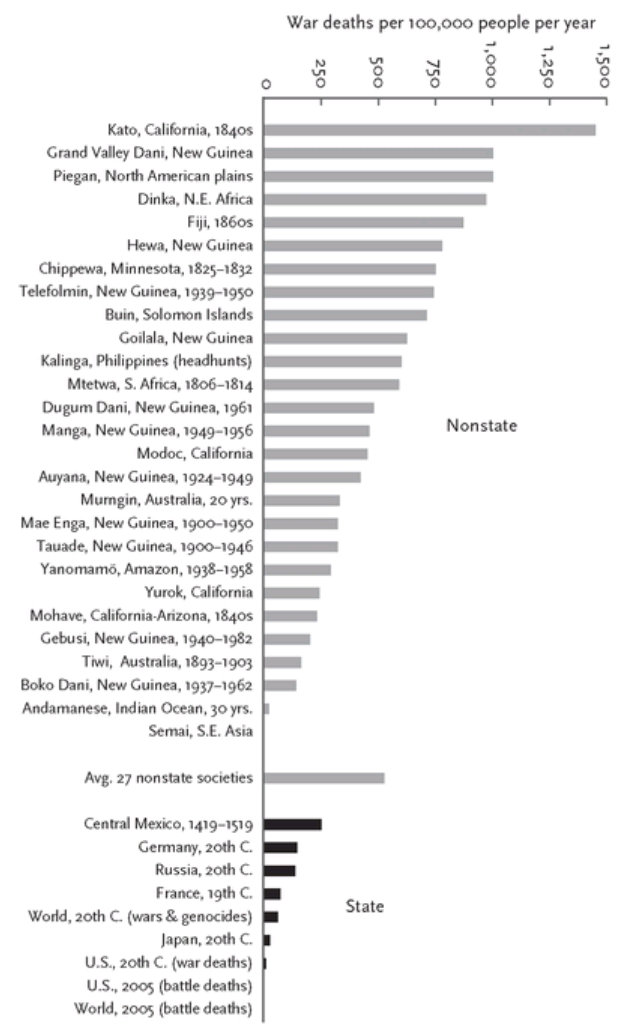
Figure 2-3 — Pinker’s empirical test of the Hobbes–Rousseau contrast
Pinker argues that neither Hobbes nor Rousseau possessed evidence about prehistoric life, so the dispute should be tested with rates rather than settled by moral intuition. In his 2011 synthesis, 27 nonstate societies averaged 524 deaths from war per 100,000 people per year; his selected state comparisons were lower, even when they covered unusually destructive centuries. He also reports two ethnographic surveys in which 65–70% of hunter-gatherer groups were at war at least every two years and 90% at least once in a generation. Yet he insists that Hobbes was only partly right: people without states cooperate extensively, and ordinary life contains long stretches of family life, work, ritual, care, and play rather than continuous war.
Evidence boundary: the chart and survey claims combine ethnography and historical estimates drawn from different populations, eras, and methods; they are sampling-sensitive rather than controlled experiments, and wide variation within both categories matters. They support Pinker’s probabilistic pacification thesis, not a claim that every nonstate society is violent, every state is peaceful, or conquest is justified. Chapter 2 synthesis · Attachment (file not included in this release) · Attachment (file not included in this release) · Attachment (file not included in this release) · Attachment (file not included in this release)
Scientific Perspective on Human Nature
From a scientific standpoint, evolutionary psychology suggests that human behavior is influenced by traits developed during the Stone Age, emphasizing both cooperative and competitive instincts. Studies indicate that humans may have an intuitive tendency towards cooperation, which is beneficial for social cohesion and survival. This view aligns more closely with Rousseau’s optimistic perspective on human nature, suggesting that cooperation might be a fundamental aspect of human behavior[6][8].
Overall, the philosophical and scientific discussions on the state of nature and human nature reveal a complex interplay between inherent instincts and the influence of societal structures. While philosophers provide theoretical frameworks, scientific studies offer empirical insights into the basic tendencies of human behavior.
Citations:
[1] https://study.com/academy/lesson/state-of-nature-definition-philosophy-examples.html
[2] https://www.worldhistory.org/State_of_Nature/
[3] https://www.mbbcollege.in/db/notes/629.docx
[4] https://plato.stanford.edu/entries/human-nature/
[5] https://www.britannica.com/topic/state-of-nature-political-theory
[6] https://hbr.org/1998/07/how-hardwired-is-human-behavior
[7] https://en.wikipedia.org/wiki/State_of_nature
[8] https://www.scientificamerican.com/article/scientists-probe-human-nature-and-discover-we-are-good-after-all/
Modern scientists approach the concept of the “state of nature” primarily through the lens of evolutionary psychology and empirical research into human behavior. Unlike the philosophical interpretations by Hobbes, Locke, and Rousseau, which are largely speculative and theoretical, scientific investigations aim to understand human nature based on evolutionary principles and observable behavior.
Evolutionary Psychology
Evolutionary psychology suggests that human behavior is shaped by evolutionary pressures that favored traits beneficial for survival and reproduction. This field posits that many human behaviors, including cooperation and competition, are influenced by adaptations that developed in response to the challenges faced by our ancestors. For example, humans have evolved both cooperative and competitive instincts, which can be seen as foundational aspects of human nature[5].
Empirical Studies on Human Nature
Recent studies have explored whether humans are inherently selfish or cooperative. Research indicates that humans may have an intuitive tendency towards cooperation, suggesting that cooperation could be a fundamental aspect of human nature. This aligns more closely with Rousseau’s view of humans as naturally good and cooperative, rather than Hobbes’ view of humans as inherently selfish and competitive[6].
The Concept of “Nature” in Science
The idea of “nature” itself is complex and multifaceted, often used in various contexts such as conservation science and environmental ethics. The term has evolved over time, acquiring different meanings across cultures and disciplines. In scientific discourse, “nature” is often seen as an abstract concept that requires careful definition and contextual understanding[3].
Overall, modern scientific perspectives on the state of nature focus on understanding human behavior through the lens of evolution and empirical research, rather than the hypothetical conditions proposed by classical philosophers. These scientific approaches provide a more nuanced view of human nature, emphasizing the interplay between innate predispositions and environmental influences.
Citations:
[1] https://www.nature.com/nathumbehav/
[2] https://www.britannica.com/topic/state-of-nature-political-theory
[3] https://www.nature.com/articles/s41599-020-0390-y
[4] https://www.nature.com/nathumbehav/journal-information
[5] https://www.britannica.com/science/evolutionary-psychology
[6] https://www.scientificamerican.com/article/scientists-probe-human-nature-and-discover-we-are-good-after-all/
[7] https://christopherwatkin.com/2021/08/20/the-state-of-nature-an-idea-that-shapes-us/
[8] https://www.jstor.org/stable/3234702
Based on the provided search results, science provides some insights into the philosophical concept of the “state of nature” as discussed by thinkers like Hobbes, Locke and Rousseau, but there is still much debate and uncertainty. A few key points emerge:
-
Evolutionary psychology suggests there are some universal ways humans think, feel and behave that exist beneath cultural variation, challenging the “blank slate” view of human nature[1]. However, the idea that this reveals humans’ “true nature” is questionable.
-
Studies indicate humans have some innate cooperative and altruistic tendencies, and are not purely selfish as Hobbes argued[6]. When forced to act quickly and intuitively, people tend to cooperate more than act selfishly. This suggests cooperation may be our first instinct.
-
However, humans also show capacities for violence, dehumanization of others, schadenfreude (taking pleasure in others’ misfortunes), and hypocrisy[3]. So human nature is not purely good either, contra Rousseau’s “noble savage” idea.
-
The human brain is shaped by both genes and environment in complex ways[4]. Separating “nature” from “nurture” is very difficult. Society and biology are deeply intertwined in making us who we are.
-
Ultimately, the “state of nature” is a thought experiment, not an empirical reality[5]. Humans are inherently social creatures and our behavior is context-dependent. Speculating about a pre-social “essence” of human nature is not very scientifically meaningful.
In summary, while science offers some clues, the question of what humans are really like “beneath it all” remains murky and up for debate. Our cooperative and competitive, kind and cruel tendencies likely co-evolved and are always entangled with social context. The “state of nature” is best understood as a philosophical tool for probing the origins of society and morality, not a clearly defined empirical state that science can definitively characterize. Human nature is a complex mix of biology, culture, and environment that defies simple essentialist explanations.
Citations:
[1] https://www.britannica.com/topic/state-of-nature-political-theory
[2] https://study.com/academy/lesson/state-of-nature-definition-philosophy-examples.html
[3] https://aeon.co/ideas/the-bad-news-on-human-nature-in-10-findings-from-psychology
[4] https://www.aei.org/articles/the-modern-denial-of-human-nature/
[5] https://christopherwatkin.com/2021/08/20/the-state-of-nature-an-idea-that-shapes-us/
[6] https://www.scientificamerican.com/article/scientists-probe-human-nature-and-discover-we-are-good-after-all/
[7] https://www.ncbi.nlm.nih.gov/pmc/articles/PMC10427299/
[8] https://www.ncbi.nlm.nih.gov/pmc/articles/PMC2527715/
Scientific studies have provided insights into the concept of the “state of nature” that philosophers such as Rousseau, Locke, and Hobbes have written about. According to recent research, humans are not inherently selfish but rather cooperative by nature[4]. This is contrary to the views of Hobbes, who believed that humans in the state of nature are primarily concerned with self-preservation and that life would be “solitary, poor, nasty, brutish, and short”[2][3].
Experiments conducted by researchers from Harvard and Yale have shown that when people are forced to make quick decisions, they tend to act more cooperatively, suggesting that cooperation is the intuitive response[4]. These findings suggest that humans are fundamentally “good” creatures, which aligns more closely with the views of Rousseau, who believed that humans in the state of nature are governed by their natural urges and that these urges are not entirely without compassion[1].
In contrast to Hobbes’ pessimistic view, Locke believed that humans in the state of nature are capable of working together by following the universal law that “no one ought to harm another in his life, health, liberty or possessions”[2]. The scientific evidence supports Locke’s view, indicating that humans are predisposed to good and that cooperation is a natural part of human nature.
Overall, the scientific perspective on the “state of nature” suggests that humans are inherently cooperative and that this cooperation is a fundamental aspect of human nature, rather than a product of societal influences.
Citations:
[1] https://study.com/academy/lesson/state-of-nature-definition-philosophy-examples.html
[2] https://www.worldhistory.org/State_of_Nature/
[3] https://en.wikipedia.org/wiki/State_of_nature
[4] https://www.scientificamerican.com/article/scientists-probe-human-nature-and-discover-we-are-good-after-all/
[5] https://www.britannica.com/topic/state-of-nature-political-theory
[6] https://www.britannica.com/topic/state-of-nature-political-theory/The-state-of-nature-in-Locke
[7] https://www.mbbcollege.in/db/notes/629.docx
[8] https://www.openculture.com/2021/09/hobbes-locke-rousseau-an-animated-introduction-to-their-political-theories.html