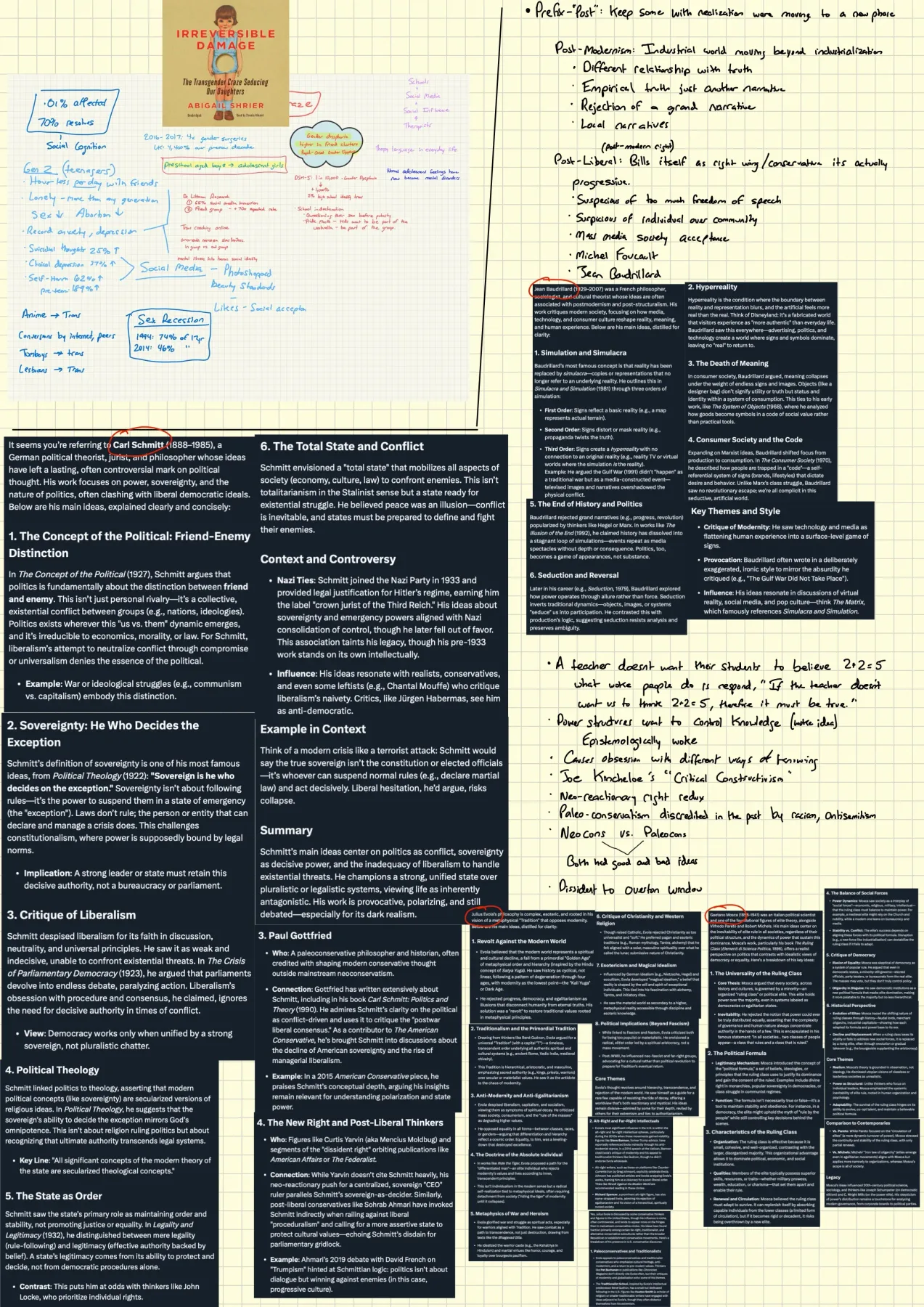
Here is a comprehensive breakdown of Julius Evola—an Italian philosopher, esotericist, and political theorist—with his main ideas, quotes, impact, and influences clearly structured:
🧠 Main Ideas
1. Traditionalism and the Revolt Against the Modern World
- Evola’s core project was a rejection of modernity and egalitarianism, which he saw as symptoms of spiritual decline.
- He proposed a return to a primordial Tradition—a metaphysical truth reflected in ancient hierarchies, warrior aristocracies, and sacred kingship.
- History, in Evola’s view, is a story of decline from higher spiritual civilizations into materialistic, profane ones.
“Modern man is a failed being, a product of a fall from a higher spiritual plane.”
2. Hierarchy and Spiritual Elitism
- Evola advocated for a society ruled by an inner aristocracy, composed of individuals who have achieved spiritual realization, detachment, and self-mastery.
- True authority should come not from mass consent or material power, but from transcendent authority.
“The caste system… represented the manifestation of a transcendent order within the social world.”
3. Race as Spiritual (not Biological)
- Evola spoke of “race of the spirit” as opposed to merely biological race.
- He believed in a metaphysical hierarchy among races and individuals, grounded in spiritual essence rather than genetics alone.
4. Warrior Ethos and the Heroic Ideal
- He idealized the Solar/heroic type (Roman, Aryan, Samurai, Kshatriya), who acts with detachment, courage, and transcendent purpose.
- Believed war, danger, and crisis were opportunities for the realization of higher manhood and transcendence.
5. Rejection of Democracy, Liberalism, and Equality
- Evola was vehemently anti-democratic, seeing mass politics as the ultimate degradation of sacred order.
- Liberalism, materialism, socialism, and feminism were seen as forces of decay, leveling, and inversion of the natural order.
“Democracy is a myth fabricated by demagogues to gain power by flattering the masses.”
6. Esotericism and Initiation
- Influenced by Hermeticism, Tantra, Eastern metaphysics, and occult traditions.
- Believed spiritual awakening was the true path to authority and liberation—through initiation, asceticism, and overcoming the ego.
- Central concern: the “realization of Being”.
7. Revolt Against the Modern World (1934)
- His magnum opus. Describes history as a degenerative process away from the divine, hierarchical, spiritual order of Tradition.
- Advocates for a “spiritual warrior” who resists modernity not through politics alone, but through inner transcendence and detachment.
🗣️ Important Quotes
“The world of Tradition is based on the idea that life has meaning only when it is connected to a transcendent reality.”
“Ride the tiger: when a cycle has exhausted itself, one must not oppose it directly, but learn to ride it with detachment and inner mastery.”
“A civilization begins to die when the common man assumes that he is entitled to decide the fate of his superiors.”
“True order is hierarchical, and arises from above—not from the mechanical equality of below.”
🌍 Impact
1. Influence on the Radical Right
- Evola is deeply influential in far-right, traditionalist, and neo-fascist circles in Europe and America.
- Admired by Italy’s CasaPound, France’s Nouvelle Droite, and elements of the alt-right.
- Steve Bannon reportedly referenced Evola’s idea of “The Fourth Turning” and the metaphysical struggle behind history.
2. Cultural Influence
- Influenced artists and thinkers interested in mysticism, Eastern philosophy, and the occult underground.
- Often discussed alongside René Guénon, though Evola was more politically radical and active.
3. Controversy and Fascism
- Evola collaborated with Italian Fascism and later sought to influence German National Socialism, though he criticized it for being too biologically based and insufficiently spiritual.
- After WWII, he advised postwar neo-fascists in Italy, but always insisted on a “spiritual” fascism, not merely political.
4. Postmodern Relevance
- Increasingly studied by scholars of reactionary modernism, esotericism, and the intellectual genealogy of the far right.
- His critique of nihilism, secularism, and modernity attracts attention even from non-fascist or critical theorists.
🧬 Influences
Influenced By:
- René Guénon (Traditionalism, metaphysics)
- Hinduism & Tantrism (especially Bhagavad Gita and Kshatriya ideal)
- Plato, Nietzsche, Schopenhauer (on hierarchy, asceticism, will)
- Hermeticism, Alchemy, and Western Esotericism
- Buddhism, Roman Stoicism, Samurai ethos
He Influenced:
- Alain de Benoist and the Nouvelle Droite
- Franco Freda, CasaPound, and other Italian post-fascists
- Elements of the Alt-Right and neoreactionary movements
- Esoteric thinkers and right-wing intellectuals drawn to Traditionalism
📚 Key Works
- Revolt Against the Modern World (1934) — his philosophical and metaphysical manifesto.
- Ride the Tiger (1961) — guide for surviving modernity with detachment and mastery.
- Men Among the Ruins (1953) — political reflections on the postwar order.
- The Metaphysics of Sex (1958) — sex, eros, and transcendence through tantric and traditional lenses.
- Doctrine of Awakening (1943) — Buddhist warrior path to enlightenment.
🏷️ Suggested Tag for Notes
Category: Traditionalist Reaction / Anti-Modern Political Metaphysics
Let me know if you’d like a comparative summary of Evola vs. Guénon, or a markdown note template ready for export.