Distilled Knowledge
Source contribution
Wolff organizes political philosophy around practical problems: why the state is needed, whether authority can be legitimate, what liberty and property require, how distributive justice should work, and whether democracy deserves allegiance.
- The state must answer both the anarchist challenge—why anyone may coerce—and the security challenge—how rights survive without enforceable rules.
- Liberty can mean non-interference, effective capacity, or protection from domination; these meanings can recommend different institutions.
- Property arguments must identify rules for acquisition, transfer, exclusion, and rectification. Saying “mine” does not settle their legitimacy.
- Distributive principles compete over equality, need, desert, entitlement, sufficiency, and incentives.
- Democracy can be defended instrumentally, intrinsically, or as public equality, yet majority rule alone cannot protect every right.
Routes into the permanent notes
- Political Philosophy Allocates Power and Goods is the reusable diagnostic extracted from Wolff’s problem-centered structure.
- Liberty, Equality, Authority, and the Common Good holds the strongest arguments and objections.
Evidence boundary
This note is unfinished and includes generated summary material. The Alexandria vignette and any quotation or historical claim should be checked against the book before reuse.
DESCRIPTION
The revised edition of this highly successful text provides a clear and accessible introduction to some of the most important questions of political philosophy. Organized around major issues, Wolff provides the structure that beginners need, while also introducing some distinctive ideas of his own.
Attachment (file not included in this release)
Attachment (file not included in this release)
Summary
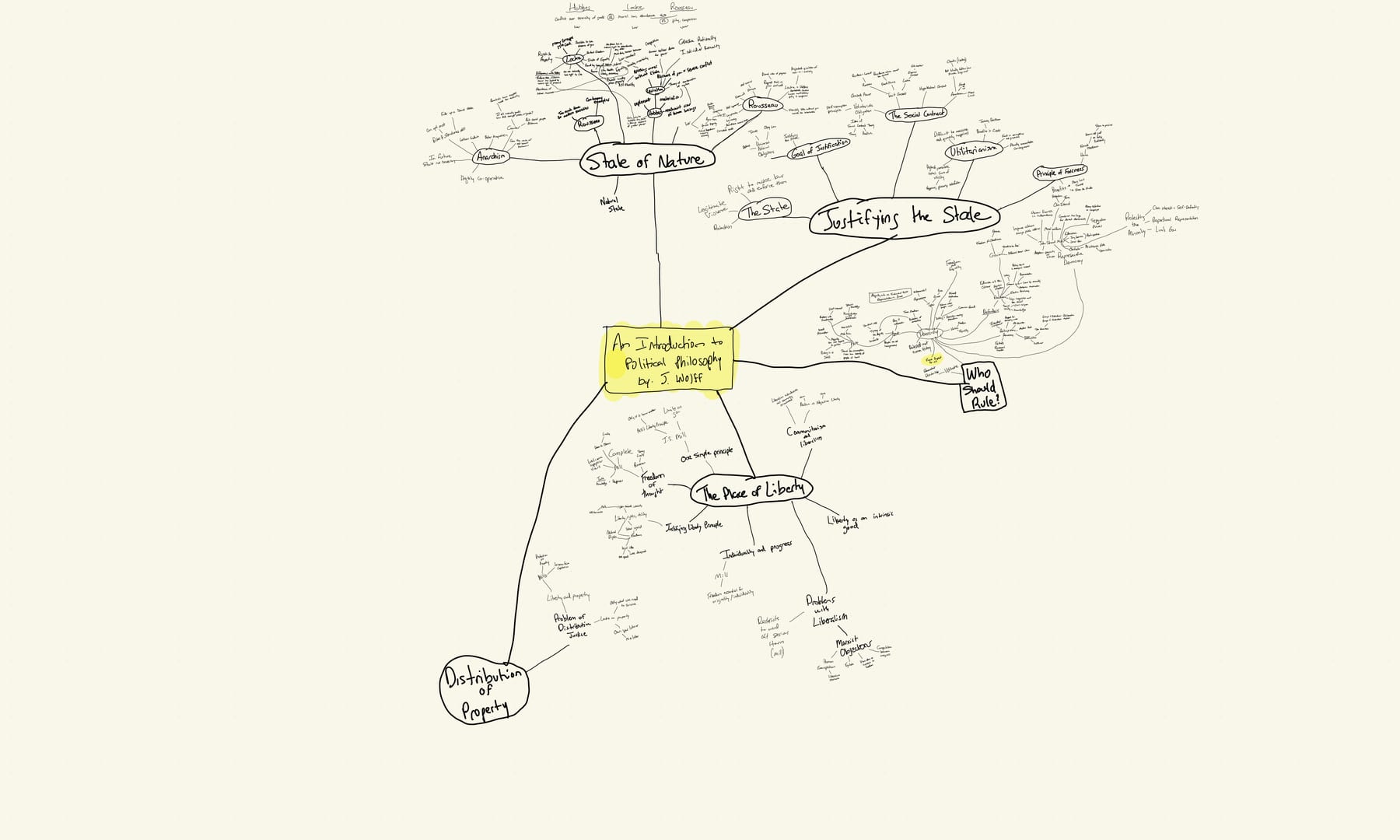
Here’s a summary of the main ideas from Jonathan Wolff’s An Introduction to Political Philosophy based on the first half of the book:
Core Themes of Political Philosophy
- Two central questions:
- Who gets what? (distribution of goods, rights, liberties)
- Who says who gets what? (distribution of political power)
- Political philosophy seeks to balance authority and autonomy.
The State of Nature
Wolff introduces different views of what life might be like without a state:
Thomas Hobbes
- Human nature leads to conflict—“a war of all against all.”
- Without a sovereign, life is “solitary, poor, nasty, brutish, and short.”
- Morality and justice don’t exist in the state of nature.
- Laws of Nature suggest peace, but people lack trust to follow them.
- Strong government is necessary to prevent chaos.
John Locke
- More optimistic than Hobbes.
- The state of nature is governed by a moral law (Law of Nature) derived from reason and/or God.
- All are equal and have rights to life, liberty, and property.
- Individuals can enforce the Law of Nature (including punishing offenders).
- Problems arise from the lack of impartial judges, leading to the creation of a government via social contract.
Jean-Jacques Rousseau
- Challenges both Hobbes and Locke.
- Believes they falsely project social traits (competition, greed) onto natural man.
- Humans in nature are compassionate and motivated by pity.
- Civilization corrupts humans, leading to inequality and the invention of private property and laws to protect the rich.
- Society becomes oppressive as it develops.
Anarchism
- Suggests that humans can self-organize without coercive government.
- Cooperation is natural and preferable.
- Yet, without enforcement mechanisms, anarchist societies often resemble minimal states in practice.
Justifying the State
Several theories are discussed:
Social Contract Theory
- Hobbes, Locke, and Rousseau all use versions of a social contract.
- Consent (explicit or tacit) is central but problematic—most people never actually consented.
- Hypothetical consent is also debated—would you agree to a government if starting from scratch?
Utilitarianism
- The state is justified if it promotes the greatest happiness for the greatest number.
- Critics argue this could justify grave injustices (e.g., scapegoating).
Fairness
- If you benefit from the state, you owe it loyalty and law-abiding behavior.
- Critics question whether people always benefit equally, and whether it’s fair to demand obedience just for living in society.
Who Should Rule?
Explores democracy, its alternatives, and its criticisms:
Democracy
- Raises issues like:
- Majority rule vs. rights of minorities.
- Direct vs. representative democracy.
- Risks of the “tyranny of the majority.”
- Voting expresses the general will or public interest—but motivations for voting are often mixed.
Plato
- Opposed democracy—saw it as mob rule.
- Advocated for rule by trained philosopher-kings.
Rousseau
- Advocated for democracy but emphasized education for civic virtue.
- Citizens should be molded to identify with the general will.
- Faces critiques for being too repressive or unrealistic.
Mill
- Defended representative democracy.
- Emphasized the role of participation (e.g. jury duty, local politics) in developing responsible citizens.
- Feared despotism leads to apathy; democracy promotes active, informed individuals.
Highlights
INTRODUCTION (Page 13)
We do not say that a man who shows no interest in politics is a man who minds his own business; we say that he has no business here at all. (Pericles’ funeral oration, in Thucydides, The Peloponnesian War, 147) (Page 13)
It has been said that there are only two questions in political philosophy; ‘who gets what?’, and ‘says who?’ Not quite true, but close enough to be a useful starting-point. (Page 13)
The first of these questions is about the distribution of material goods, and of rights and liberties. On what basis should people possess property? What rights and liberties should they enjoy? The second question concerns the distribution of another good: political power. (Page 13)
One task for the political philosopher, then, is to determine the correct balance between autonomy and authority, or, in other words, to determine the proper distribution of political power. (Page 14)
In political philosophy, unlike many other areas of philosophy, there is no hiding-place. In philosophy, agnosticism (‘the English translate their ignorance into Greek and call it agnosticism’, said Engels) is often a respectable position. Perhaps I cannot find a satisfactory position on the question of whether or not we have free will, so I profess no view. In a wider context this hardly matters. But in political philosophy agnosticism is self-defeating. It may not matter if a society has no official policy on the solution to the problem of free will, but in every society someone (or no one) holds political power, and property is distributed in some way or other. (Page 15)
Those who prefer not to participate will find their political decisions made for them, whether they like it or not. To say or do nothing is, in practice, to endorse the present situation, however repellent. (Page 16)
1 THE STATE OF NATURE (Page 18)
what would life be like in a ‘natural’ state, a world without government? (Page 18)
A natural starting-point for thinking about the state is to ask: what would things be like without it? (Page 19)
Hobbes (Page 20)
Hobbes’s greatest work, Leviathan (published in 1651), pursues a theme that had obsessed him for more than twenty years: the evils of civil war and the anarchy by which it would be accompanied. Nothing could be worse than life without the protection of the state, Hobbes argued, and therefore strong government is essential to ensure that we do not lapse into the war of all against all. (Page 20)
The essence of Hobbes’s view is that, in the absence of government, human nature will inevitably bring us into severe conflict. (Page 20)
For Hobbes, then, political philosophy begins with the study of human nature. (Page 21)
So the principle of the conservation of motion was used by Hobbes in developing a materialist, mechanist view of human beings. (Page 21)
The importance of the theory of the conservation of motion is that with it Hobbes paints a picture of human beings as always searching for (Page 21)
something, never at rest. (Page 22)
One clue can be found in Hobbes’s definition of power: one’s ‘present means to obtain some future apparent Good’ (Leviathan, 150). So to be assured of achieving felicity one must become powerful. (Page 22)
Sources of power, Hobbes claims, include riches, reputations, and friends, and human beings have ‘a restlesse desire of Power after power, that ceaseth onely in Death’ (Leviathan, 161). (Page 22)
For others will also seek to increase their power, and so the search for power, is by its nature, competitive. (Page 22)
Hobbes’s assumption that human beings are by nature ‘equal’. An assumption of natural equality is often used in political and moral philosophy as a basis for the argument that we should respect other people, treating one another with care and concern. But for Hobbes the assumption is put to a quite different use, as we might suspect when we see how he states the point: we are equal in that all humans possess roughly the same level of strength and skill, and so any human being has the capacity to kill any other. ‘The weakest has strength enough to kill the strongest, either by secret machination or by confederacy with others’ (Leviathan, 183). (Page 22)
From these assumptions of equality, scarcity, and uncertainty, it follows, thinks Hobbes, that the state of nature will be a state of war: (Page 23)
Hobbes sees three principal reasons for attack in the state of nature: for gain, for safety (to pre-empt invaders), and for glory or reputation. (Page 23)
Hobbes has told us an amusing story, he has overlooked one thing: morality. Although creatures with no moral sense might behave as Hobbes outlines, we are different. The great majority of us accept that we should not attack other people or take their property. Of course in a state of nature a minority would steal and kill, as they do now, but there would be enough people with a moral sense to stop the rot spreading and prevent the immoral minority from bringing us to a general war. (Page 24)
Hobbes seems to deny that there can be a morality in the state of nature: ‘To this warre of every man against every man … nothing can be Unjust. The notions of Right and Wrong, Justice and Injustice, have no place’ (Leviathan, 188). (Page 25)
In the state of nature there is no common power, so no law, so no breach of law, and so no injustice. (Page 25)
One of the consequences of this, claims Hobbes, is that ‘in such a condition every man has a Right to every thing; even to one anothers body’ (Leviathan, 190). Hobbes calls the liberty to act as you think fit to preserve yourself the ‘right of nature’: its consequence seems to be that, in the state of nature, you are permitted to do anything, even take another’s life, if you believe that this will help you survive. (Page 25)
In the state of nature there is no justice or injustice, no right or wrong. Moral notions have no application. This is what Hobbes calls the ‘Natural Right of Liberty’. (Page 25)
All these laws, Hobbes supposes, can be deduced from the fundamental law, although he realizes that few people would be able to carry out the deduction, for most people ‘are too busie getting food, and the rest too negligent to understand’ (Leviathan, 214). But the Laws of Nature can be ‘contracted into one easy sum … Do not that to another, which thou wouldest not have done to thy selfe’, a negative formulation of the biblical ‘golden rule’ (do unto others as you would have them do unto you). (Page 26)
have to distinguish between individual and collective rationality. Collective rationality is what is best for each individual, on the assumption that everyone else will act the same way. The Laws of Nature express what is collectively rational. (Page 26)
one way of thinking about Hobbes’s argument is that, in the state of nature, the individually rational behaviour is to attack others (for reasons we have already seen) and this will lead to the state of war. However, the Laws of Nature tell us that the state of war is not the inevitable situation for human beings because another level of behaviour—collective rationality—may also be available. If only we could somehow ascend to the level of collective rationality and obey the Laws of Nature we can live in peace, without fear. (Page 27)
We should only act morally when we can be assured that those around us are doing so too, but this is so rare in the state of nature that the Laws of Nature will, in effect, almost never come into play. (Page 28)
Locke (Page 29)
The State of Nature, and the State of War, which however some Men have confounded, are as far distant as a State of Peace, Good Will, Mutual Assistance, and Preservation, and a State of Enmity, Malice, Violence, and Mutual Destruction are from one another. (John Locke, Second Treatise of Civil Government, s. 19, p. 280) (Page 29)
Hobbes identified the state of nature with a state of war, Locke is keen to emphasize that this is a mistake. Locke supposed that it would generally be possible to live an acceptable life even in the absence of government. (Page 29)
The state of nature, says Locke, is first, a state of perfect freedom; second, a state of equality; and third, bound by a Law of Nature. Verbally, of course, this sounds just like Hobbes’s view, but each of these three elements is given quite a different interpretation by Locke. Hobbes’s principle of equality was a claim about the mental and physical capabilities of all people. For Locke it is a moral claim about rights: no person has a natural right to subordinate any (Page 29)
18 THE STATE OF NATURE other. (Page 30)
For Locke it is self-evident that no one naturally has a right to rule, in the sense that no one has been appointed by God for this purpose. Although Hobbes did not mean this by his assumption of equality, he would accept Locke’s position here. Hobbes thought that whoever did, in fact, exercise power over the community was, for that reason, to be recognized as its sovereign. (Page 30)
Locke, too, believes the Law of Nature to be discoverable by reason, but Locke’s Law has a theological aspect absent in Hobbes’s Laws. The Law, says Locke, is that no one ought to harm another in his life, health, liberty, or possessions. The reason for this, according to Locke, is that while we have no natural superiors on earth, we do have one in heaven. (Page 30)
‘Every one.. .is bound to preserve himself] and not to quit his station wilfully; so by the like reason when his own Preservation comes not in competition, ought he, as much as he can, to preserve the rest of Mankind’ (Second Treatise, s. 6, p. 271). (Page 30)
The Law of Nature, for Locke, is simply the idea that mankind is to be preserved as much as possible. So, Locke argues, we have a clear duty not to harm others in the state of nature (except for limited purposes of self-defence), and we even have a duty to help them if we can do so without damage to ourselves. (Page 30)
Thus natural liberty, on Locke’s view, is no more than the liberty to do what the Law of Nature allows. That is, we are given the liberty to do only what is morally permitted. So, for example, although Locke’s Law of Nature prevents me from invading the property of others, this is in no sense a limitation of my liberty. Locke would certainly disagree with Hobbes’s claim that in the state of nature everyone has a right to everything, even each others’ bodies (although he does accept that we have considerable rights of self-defence). (Page 31)
Clearly it is important for Locke that even in the state of nature we have a moral duty to restrict our behaviour. (Page 31)
Law of Nature, like all laws, needs a law-enforcer. Without such an enforcer it would be empty. (Page 31)
Hobbes is perfectly prepared to accept that in the state of nature his Laws of Nature are ineffective. Unlike Hobbes, however, Locke cannot accept that the Law of Nature could be in vain: it is, after all, in Locke’s view the law of God, who presumably does nothing in vain. Therefore there must be a way of enforcing the law: somebody who has the power to enforce it. But we are all equal in the state of nature, so if anyone has such power then everyone must have it. Therefore, Locke concludes, there must be a natural right, held by each person, to punish those who offend against the Law of Nature. Each of us has the right to punish those who harm another’s life, liberty, or property. (Page 32)
The right to punish is not the same thing as the right of self-defence. It is the right not simply to try to prevent or ward off a particular episode of harm or damage, but to make anyone who has overstepped the Law of Nature pay for their transgression. This ‘strange doctrine’ as Locke calls it, plays a very important role in the derivation of his view of the state of nature. If the Law of Nature can be enforced, then we have good reason to hope that life could be relatively peaceful. (Page 32)
Locke realizes that the claim that we all have a natural right to punish offenders may seem surprising. However, in support of his view he claims that, without it, it is hard to see how the sovereign of any state can have the right to punish an alien who has not consented to the laws. (Page 32)
the most important of these is the right to private property. (Page 33)
To the modern reader, Locke’s continual invocation of God and God’s purposes may seem an embarrassment. Surely it should be possible to consider questions of political philosophy outside a theological framework? However, Locke also appeals to ‘natural reason’ in establishing the premisses of his arguments, even if he gives it a lesser role. So, for example, he thinks it absurd, and against natural reason, to suppose that human beings may not make use of the earth without the permission of all others, for if this were the case we should starve. This alternative argument certainly seems plausible, and so some followers of Locke have been prepared to drop the theological underpinnings of his view in favour of this ‘natural reason’ approach. (Page 33)
According to Hobbes, the only way of subduing any power is through the exercise of a greater power. (Page 33)
So Hobbes would probably argue that even if people did have a natural right to punish offenders, this would rarely be used with any effect unless a single, stable, authority existed: (Page 34)
one seemingly vital difference between Hobbes and Locke that I have not yet mentioned. Remember that for Hobbes, one of the key factors that brought people into conflict was a natural scarcity of goods. Two people will often desire the same thing, and this will make them enemies. Locke, on the other hand, appears to make a very different assumption: nature has given things richly. There is a natural abundance of land, and plenty of room for everyone, particularly ‘in the first Ages of the World, when Men were more in danger to be lost, by wandering from their Company, in the then vast Wilderness of the Earth, than to be straitned for want of room to plant in’ (Second Treatise, s. 36, p. 293) (Page 34)
So the attempt to administer justice, even between the would-be law-abiding, is itself a powerful source of dispute. This Locke sees as the primary ‘inconvenience’ of the state of nature. The only thing that prevents serious trouble is the thought that, given initial abundance of land, disputes would be few. (Page 35)
Rousseau (Page 36)
The philosophers, who have inquired into the foundations of society, have all felt the necessity of going back to a state of nature; but not one of them has got there … . Every one of them, in short, constantly dwelling on wants, avidity, oppression, desires, and pride, has transferred to the state of nature ideas which were acquired in society; so that, in speaking of the savage, they described the social man. (Rousseau, Discourse on the Origin of Inequality, 50) (Page 36)
Suppose people naturally and spontaneously desire to help each other whenever they can. Perhaps, instead of competing in a struggle for existence, humans offer mutual aid, and act for the sake of each others’ comfort. If so, then the state of nature will look very different. (Page 36)
Although Rousseau does not make these optimistic assumptions about the natural goodness of human beings, his view takes a substantial step in this direction. (Page 36)
Hobbes and Locke overlooked a central aspect of human motivation—pity or compassion—and so overestimated the likelihood of conflict in the state of nature. (Page 36)
Rousseau believes that we have ‘an innate repugnance at seeing a fellow-creature suffer’ (Discourse on the Origin of Inequality, 73). (Page 36)
It is this compassion that hurries us without reflection to the relief of those who are in distress: it is this which in a state of nature supplies the place of laws, morals, and virtues, with the advantage that none are tempted to disobey its gentle voice: it is this which will always prevent a sturdy savage from robbing a weak child or a feeble old man of the sustenance they may have with pain and difficulty acquired, if he sees a possibility of providing for himself by other means. (Discourse on the Origin of Inequality, 76) (Page 37)
Rousseau does not doubt that if modern citizens, moulded and corrupted by society, were placed in a state of nature, they would act just as Hobbes depicted them. But both Hobbes and Locke have projected the qualities of man-in-society (or even man-in-bourgeois-society) on to savage man. That is, they have depicted socialized traits as if they were natural. (Page 37)
matter of regret that we have grown civilized. (Page 37)
extreme, and extremely dismal, view of human progress. (Page 37)
God makes all things good; man meddles with them and they become evil.’ (Page 37)
Consequently all of Hobbes’s drives to war—desires for gain, safety and reputation—are either defused or absent in Rousseau’s state of nature. (Page 39)
key is the thought that human beings, unlike brutes, have two special attributes: free will, and the capacity for self-improvement. As we shall see, this latter capacity, Rousseau supposes, is the source of all human progress and all human misfortune. (Page 39)
In this condition another novelty arises: leisure time. Co-operation and tool-making conquer scarcity sufficiently well to give the opportunity to create goods which go beyond bare survival needs. Thus the savage now starts to create convenience or luxury goods, unknown to former generations. However, ‘This was the first yoke he inadvertently imposed on himself, and the first source of the evils he prepared for his descendants’ (Discourse on the Origin of Inequality, 88). Why? Because man now develops what we could call ‘corrupted needs’. (Page 40)
From here a number of other negative elements are introduced: as societies develop, so do languages, and the opportunity for comparison of talents. This gives rise to pride, shame, and envy. For the first time an injury is treated as an affront, a sign of contempt rather than simply as damage, and those so injured begin to seek their revenge. (Page 40)
Though this is a stable period it cannot last for ever, and the real rot sets in with the long and difficult development of agriculture and metallurgy. From here it is a short step to claims of private property, and rules of justice. But private property leads to mutual dependence, jealousy, inequality, and the slavery of the poor. (Page 41)
Thus we arrive at war: not as part of the initial state of innocence but as a result of the creation of the first rudimentary societies. (Page 41)
And at this point: The rich man, thus urged by necessity, conceived at length the profoundest plan that ever entered the mind of man: this was to employ in his favour the forces of those who attacked him’ (Discourse on the Origin of Inequality, 98). This was a plan, of course, to institute social rules of justice to ensure peace: rules that bind all equally, but which are greatly advantageous to the rich, for they, after all, are the ones with property to secure. Thus the first civil societies—societies with laws and governments—are born. (Page 41)
Anarchism (Page 41)
Even Rousseau, who believed in man’s natural innocence, thought that ultimately life without government would be intolerable. (Page 41)
The fittest, suggests Kropotkin, are those species best able to achieve co-operation. (Page 42)
Kropotkin was able to marshal impressive evidence of co-operation within the animal kingdom, and other anarchists have argued—surely correctly—that there are endless examples of uncoerced co-operation among human beings. Many philosophers and social scientists have accepted that even highly selfish agents will tend to evolve patterns of co-operative behaviour, even for purely selfish reasons. In the long run co-operation is better for each one of us. If the state of war is damaging for all, then rational, self-interested creatures will eventually learn to co-operate. (Page 42)
Fear and suspicion will corrode and wear away a great deal of spontaneous or evolved co-operation. (Page 42)
Anarchists argue that we propose government as the remedy to anti-social behaviour, but, in general, governments are its cause. (Page 42)
In fact, the thesis appears to undermine itself. If we are all naturally good, why has such an oppressive and corrupting state come into existence? The most obvious answer is that a few greedy and cunning individuals, through (Page 42)
THE STATE OF NATURE 31 various disreputable means, have managed to seize power. But then, if such people existed before the state came into being, as they must have done on this theory, it cannot be the case that we are all naturally good. Therefore to rely on the natural goodness of human beings to such an extent seems utopian in the extreme. (Page 43)
Hence most thoughtful anarchists have made a different response. The absence of governments does not mean that there can be no forms of social control over individual behaviour. Social pressure, public opinion, fear of a poor reputation, even gossip, can all exert their effects on individual behaviour. Those who behave anti-socially will be ostracized. (Page 43)
Furthermore many anarchists have accepted the need for the authority of experts within society. (Page 43)
Such rules and structures are said not to amount to states as they allow the individual to opt out: hence they are voluntary in a way no state is. (Page 43)
existence of anti-social people who refuse to join in the voluntary society places the anarchist in a dilemma. (Page 43)
If the anarchist society refuses to attempt to restrain the behaviour of such people, then it is in danger of falling into severe conflict. But if it enforces social rules against such people, then, in effect, it has become indistinguishable from a state. (Page 43)
In sum, as the anarchist picture of society becomes increasingly realistic and less utopian, it also becomes increasingly difficult to tell it apart from a liberal, democratic, state. (Page 43)
Conclusion (Page 44)
I began this chapter with Hobbes’s famous depiction of the state of nature as a miserable state of war of all against all. The basic argument is that individuals, motivated by the drive for ‘felicity’ will inevitably come into conflict over scarce goods, and, in the absence of a sovereign, this conflict will escalate into full-scale war. A number of counter-arguments were made in response. Locke suggested that the state of nature is governed by a moral law which could be enforced by every individual. He supplements this with the claim that we are initially in a condition of abundance, not scarcity, and with an implicit assumption that people will often be directly motivated to follow the moral law. (Page 44)
While Rousseau agrees with Locke that Hobbes was wrong to suggest that our natural condition is one of extreme scarcity, he denies that ideas of morality and moral motivation have any place in a state of nature. Instead he proposes that natural pity or compassion will prevent war from breaking out, pointedly remarking that we cannot tell how ‘natural man’ would behave on the basis of our observations of ‘civilized man’. But whatever the force of these responses to Hobbes, both Locke and Rousseau admit that the counteracting causes to war they have identified can only serve to delay the onset of severe conflict, and will not avoid it for ever. (Page 44)
J U S T I F Y I N G T H E STATE (Page 46)
Introduction (Page 46)
All that makes existence valuable to any one depends on the enforcement of restraints upon the actions of other people. (John Stuart Mill, On Liberty, 130) (Page 46)
Locke concluded that the only way of coming under another person’s authority was to give that person your consent (except in the case of justified punishment). This holds, for Locke, whether the person claiming authority is another private individual or the sovereign. Thus the sovereign, who claims authority over you, has no right to that authority unless you have voluntarily put yourself in this position through your own consent. (Page 47)
The state (Page 48)
Locke defined political power as the right to make laws, with the right too to punish those who fail to obey them. States clearly possess, or at least claim to possess, political power. (Page 48)
The sociologist Max Weber (1864-1920) made a similar point, if in more startling language: states possess a monopoly of legitimate violence (Page 48)
All legitimate violence or coercion is undertaken or supervised by the state. (Page 48)
The other side to this is that the state accepts the responsibility of protecting everyone who resides within its borders from illegitimate violence. (Page 48)
Thus it is often claimed that the state possesses two essential features: it maintains a monopoly of legitimate coercion or violence and it offers to protect everyone within its territory. (Page 48)
The goal of justification (Page 49)
To say that someone has political obligations is to say, at least, that they have the duty, in normal circumstances, to obey the law of the land, including paying taxes where these are due. Other duties may also be implied: to fight, if called for, in defence of the (Page 49)
38 JUSTIFYING THE STATE state; perhaps to behave patriotically; even to seek out and expose the enemies of the state. But let us concentrate on the duty to obey the law. (Page 50)
Political obligation is the obligation to obey each law because it is the law, and not necessarily because we think it has some independent moral justification. (Page 50)
Justifying the state’ is normally thought to mean showing that there are universal obligations to obey the law. A ‘universal’ obligation, in this context, does not mean the duty to obey all laws at all times. (Page 50)
The social contract (Page 51)
Voluntaristic obligation (Page 51)
Another person can have political power over me only if I have granted them that power. (Page 51)
This view is sometimes expressed in terms of the so-called ‘self- assumption’ principle: that no one has any duties whatsoever unless they have ‘assumed’ those duties, that is, voluntarily undertaken them (Page 51)
The project of showing that individuals consent to the state lies behind the idea of social contract theory. (Page 52)
In the abstract, then, social contract theory is an obvious, elegant solution to the problem of political obligation. It satisfies the twin demands of universalism— every person must be obligated—and voluntarism—political obligations can come into existence only through consent. (Page 52)
We could hardly maintain that it explains the political obligations of existing citizens. After all, no reasonable legal system allows one generation to make a contract which binds succeeding generations. Yet this is exactly what the doctrine of the original contract seems to presume. (Page 52)
Tacit consent (Page 54)
So far we have not been able to see how to develop a plausible theory of explicit or express consent. We have already considered the idea that voting is a way of tacitly consenting, but perhaps the idea of tacit consent can be developed in a more promising form. In fact all the major social contract theorists—Hobbes, Locke, and Rousseau—rely in different ways on arguments based on tacit consent. (Page 54)
Can we seriously say, that a poor peasant or artizan has a free choice to leave his country, when he knows no foreign language or manners, and lives from day to day by the small wages he acquires? We may as well assert, that a man, (Page 54)
JUSTIFYING THE STATE 43 by remaining in a vessel, freely consents to the dominion of the master; though he was carried on board while asleep, and must leap into the ocean, and perish, the moment he leaves her. (‘Of The Original Contract’, 475) (Page 55)
Rousseau, for example, supposes that residence constitutes consent, but only within a ‘free’ state, ‘for elsewhere family, goods, lack of a refuge, necessity, or violence may detain a man in a country against his will; and then his dwelling there no longer by itself implies his consent to the contract’ (Social Contract, bk. IV, ch. 2, p. 277). (Page 55)
Hypothetical consent (Page 55)
perhaps the best way of getting clear about your relation to something is to imagine its absence. (Page 56)
So even this weakest form of consent theory cannot deliver what we are looking for: a universal ground of political obligation. And if we insist that political obligations must be undertaken voluntarily, this is a risk we always run. (Page 58)
Anarchism revisited (Page 58)
If we cannot find a way of justifying the state from acceptable premisses, then some sort of anarchy seems forced upon us, morally speaking at least. This critical strategy seems the anarchist’s strongest weapon. (Page 58)
In some respects this seems a highly enlightened picture. The responsible citizen should not blindly follow the law, but always use his or her private judgement about whether the law is justified. If it is not, then there is no moral reason to obey. (Page 59)
There must be some moral limit to the obligation to obey the law. However, it is not so easy to say what this moral limit should be. (Page 59)
The point is, if we accept the anarchist view just discussed, we have returned to the chaotic situation where people may follow their individual private judgement in all matters, even those of public concern. But it was for exactly this reason that Locke argued that we should move away from the state of nature. (Page 60)
Utilitarianism (Page 60)
Subjects should obey Kings … so long as the probable mischiefs of obedience are less than the probable mischiefs of resistance. (Jeremy Bentham, Fragment on Government, 56) (Page 60)
The fundamental idea of utilitarianism is that the morally correct action in any situation is that which brings about the highest possible total sum of utility. (Page 61)
Utility is variously understood as happiness, pleasure, or the satisfaction of desires or preferences. (Page 61)
Notice that if we are to take utilitarianism seriously, we need to be able to measure and quantify happiness, so that we can determine which of several possible actions creates the most. This is often thought to be a grave difficulty (Page 61)
The problem of finding a way of comparing happiness is known as the problem of ‘interpersonal comparisons of utility’. Strangely, none of the nineteenth-century founders of utilitarianism seemed to see the force of this problem, although in the last few decades a number of ingenious technical solutions have been proposed. (Page 61)
According to Jeremy Bentham, as we saw above, we should obey our rulers as long as the benefits of doing so outweigh the costs. (Page 62)
The best we can do is set ourselves other goals, or follow other rules, in the hope or expectation that happiness will follow as a consequence. The utilitarian political philosopher should recommend a system of law which each person must follow, at least under normal circumstances. It is not, then, for the individual to consider the effect of following the law on the level of happiness within society. (Page 63)
argument works very well in its own terms, but find fault with the argument’s assumptions or premisses. The argument itself is very simple. In essence, it has just three premisses: 1. The morally best society is the one in which happiness is maximized. 2. The state promotes happiness better than the state of nature. 3. The state and the state of nature are the only alternatives we have. (Page 64)
Therefore: 4. We have a moral duty to bring about and support the state. (Page 64)
Few philosophers are now prepared to accept utilitarian reasoning, for they think it has morally unacceptable consequences. In particular, it is often claimed that utilitarian morality permits, or even requires, grave injustices. A notorious difficulty, for example, is the ‘scapegoat’ objection: utilitarianism will permit enormous injustice in the pursuit of the general happiness. (Page 64)
The principle of fairness (Page 67)
Whether or not individuals consent to the state, it can seem unfair of them to enjoy its benefits without also accepting the necessary burdens that help produce those benefits. So, it has been argued, anyone who gains an advantage from the state has a duty of fairness to obey its laws, to contribute taxes, and so on. (Page 67)
the force of the argument is that it is unfair to reap the benefits of the state, unless one is prepared to shoulder one’s share of the burdens too. The benefits, of course, are the security and stability of living in a society (Page 67)
If we accept Hart’s principle, and concede that everyone receives benefits from the state, it would seem to follow that, in fairness to everyone else, each of us should obey the laws of our country. This relies on the plausible idea that if we benefit from the laws then it is unfair and exploitative to break them for our own convenience. (Page 68)
But is it really true that obedience to the law is in the interests of each of us? If so, then, as Hume himself points out, it seems extraordinary that we should need to be forced to obedience on pain of punishment. If it is in our interests to do what the law tells us, why do we not act in that way without the need for the law to force us to do it? Hume’s answer is, in effect, that human beings are not very good at acting rationally (Page 68)
Thus, in Hume’s view, even though it is in our interests to obey the law, this interest is very remote and far off, and so we are likely to prefer the short-term, lesser benefit which will flow from disobedience (Page 69)
Hume believes that although this is what our reason tells each of us, reason alone is insufficient to motivate us to act. Reason, Hume believes, is ‘the slave of the passions’. (Page 69)
we need to find a way of making observance of the laws of justice contribute to our immediate interest. This is the only way in which we will be able to follow them, and thereby also bring about our long-term interests. (Page 69)
We have looked at a number of defences of political obligation, but all seem wanting in one way or another. Voluntaristic defences within the contract tradition cannot explain the obligations of those who refuse to consent. Utilitarian arguments may well have unacceptable implications, as they seem to allow us—in principle at least—to sacrifice the innocent. The fairness argument can only succeed if everyone accepts the benefits of the state, and it is unlikely that this would be the case. (Page 71)
Therefore the existence of some independents does not mean we cannot use the state for protection against them. We can survive well enough in the presence of some independents. Consider the example of ambassadors, and others with diplomatic immunity. In one sense, the state in which they live has no authority over them. But this does not mean that the agents of the state must permit such diplomats to act however their whims take them. A diplomat swinging an axe in a shopping mall can rightfully be disarmed by the police, just as we can rightfully restrain each other. What we cannot do, in either case, is exercise legal punishment, or use force beyond what is needed for self-defence, at least not without further authority. (Page 73)
WHO SHOULD RULE? (Page 74)
What should this government be like? Who should rule? A common assumption is that only a democracy is ever fully justifiable. Anything else—a tyranny, an aristocracy, an absolute monarchy-—must fail. But what is a democracy? Is it really so attractive? (Page 74)
Voltaire argued in favour of ‘benevolent dictatorship’, where an enlightened despot, without the need to consult the people, would nevertheless govern in their interest. (Page 74)
But does democracy really deserve its contemporary reputation? After all, for most of human history democracy has been almost universally detested. It has greatly flourished in recent times, and had a brief life in Ancient Greece—albeit in a very limited form—but for the 2,000 years or so in between a democratic state was hardly seen. If democracy really is as attractive as it is often claimed to be, why should so many thinkers throughout history have rejected it? (Page 75)
It is not so much that they doubt its value as that they deny its coherence. ‘Democracy’, it is sometimes said, is not the name of a political system, but a term of praise. According to this view there is no single coherent theory of democracy. There is no political system that could be approved by all those who claim to be in favour of democracy. (Page 75)
De Tocqueville brought out the point well, in his expression ‘the tyranny of the majority’. Developing this idea, John Stuart Mill pointed out that before the large-scale establishment of democratic regimes, it was generally assumed that, if the people were ruling in their own interests, it would be impossible for political oppression to exist. (Page 76)
The point for the moment is simply that the theorist of democracy must decide whether democracy is essentially a rather crude principle of majority rule, or whether we should follow the ‘Madisonian’ view (after James Madison, 1751-1804 (Page 76)
A second debate concerns ‘representative’ and ‘direct’ models of democracy. In a direct democracy the electorate votes for or against laws or policies, rather than for candidates. Ideally, every major issue is put before the entire electorate, by way of referendum. A representative democracy, on the other hand, is the more familiar system in which the citizens vote to determine who will represent them at governmental level. It is these representatives who then go on to make laws. The former system, it seems, is truer to the pure spirit of democracy, yet it is virtually unknown in the modern world. (Page 77)
Modern democracies adhere to the representative model, in which elections are used to determine who will form the government, rather than to decide the particular issues of the day. But if this representative system is thought undemocratic, then almost no democracies have ever existed on any large scale. This conclusion is drawn by many critics of contemporary ‘liberal democracy’. Democracy would be a fine thing, they say, if only we had it. (Page 77)
These individual rule versus two debates—majority rights, and representative versus direct models—are fundamental to the formulation of a democratic theory (Page 77)
Plato against democracy (Page 78)
Just as ‘monarchy’ means ‘rule by the monarch’, ‘democracy’ means ‘rule by the demos’. But what is the demos? In classical Greek it can be understood both as ‘the people’, and as ‘the mob’. On the latter understanding, then, democracy is mob rule: the rule of the rabble, the vulgar, the unwashed, the unfit. (Page 79)
If you were ill, and wanted advice on your health, you would go to an expert—the doctor. In other words, you would want to consult someone who had been specially trained to do the job. The last thing you would do is assemble a crowd, and ask them to vote on the correct remedy. (Page 79)
Making political decisions—decisions in the interests of the state—requires judgement and skill. It should, Plato urges, be left to the experts. (Page 79)
He has a plan for an entire life of education for the ‘guardians’, involving in its early years not only skills of literacy, but also musical, mathematical, military, and physical education. Philosophy is not studied at all until the age of 30 (Page 79)
Ruling, like medicine, navigation, or even farming, is a skill. A special training is necessary, and not everyone is naturally capable even of acquiring the skill. (Page 80)
Problems with guardianship (Page 80)
This objection is an old one. What is to stop the guardian—the philosopher-king—from turning the situation to his or her own advantage? (Page 80)
Plato’s society contains no guarantees that the guardians will always be able to resist temptation. And it may well be that the people do not accept their rule. But these problems with Plato’s proposals hardly amount to a rousing defence of democracy. Perhaps another non-democratic system is the answer. Once more, if ruling is a skill, which can be possessed only by the few, then surely it is absurd to leave political decision-making to the rabble. (Page 82)
Knowledge and interests (Page 82)
Plato claims that rulers need expert knowledge. But is such knowledge really attainable? If there really is no such thing as an expert ruler then Plato’s opposition to democracy would seem to dissolve into thin air. (Page 82)
Remember one of the points made at the very beginning of this chapter: democratic governments rule for the people, that is, in the interests of the governed. Although Plato is opposed to democracy, he shares the assumption that the rulers should have the interests of the people at heart. (Page 83)
Plato advocates essentially a system of benevolent dictatorship. But even if the dictator wants to advance the interests of the people, how are those interests to be known? In a democracy people show their interests, it seems, by voting: they vote for what they want. Hence voting is more than a decision-making procedure. It is a way of revealing or expressing the very information that the decision needs to take into account: what the people want. Without some sort of voting procedure, how can this be discovered? (Page 83)
In view of this, it is unsafe to assume that democracy is a way of making individual interests or preferences known. Some people will vote for what they most want. Others put their own preferences or interests to one side, and vote the way they do on moral grounds. We can never be sure what is motivating the members of any given electorate: in fact they may not be sure themselves. (Page 85)
Mixed-motivation voting, in short, is a mess. And what is worse, in present-day conditions it seems to be the normal case. (Page 86)
Voting and the common good (Page 86)
If we allow people to vote according to their idea of the common good, and follow the majority decision, we surely have a very good chance of being right. The argument for democracy is that it now seems an excellent way of discovering the common good. (Page 86)
The values of democracy (Page 88)
Democracy is most commonly thought to be expressive of two values we hold dear: freedom and equality. (Page 89)
Rousseau and the general will (Page 89)
If children are brought up in common in the bosom of equality; if they are imbued with the laws of the state and the precepts of the general will; if they are taught to respect these above all things; if they are surrounded by examples and objects which constantly remind them of the tender mother who nourishes them, of the love she bears them, of the inestimable benefits they receive from her, and of the return they owe her, we cannot doubt that they will learn (Page 89)
78 WHO SHOULD RULE? to cherish one another mutually as brothers, to will nothing contrary to the will of society, to substitute the actions of men and citizens for the futile and vain babbling of sophists, and to become in time defenders and fathers of the country of which they will have been so long the children. (Rousseau, Discourse on Political Economy, 149) (Page 90)
Plato, we saw, argues that ruling requires a special training or education. Rousseau does not doubt this, but he denies that it is a training that ought to be given only to the few. Far better if everyone acquires the appropriate skills, and then takes an active—democratic—role as part of the ‘Sovereign’ (the term Rousseau uses for the body of citizens acting collectively, with authority over themselves). A democratic state should therefore place a high value on the education of the citizen. (Page 90)
The general will demands the policy which is equally in everyone’s interests. Thus we can think of the general will as the general interest. (Page 91)
So the key contrast between Plato’s philosopher-kings and Rousseau’s elective aristocracy is that Rousseau’s rulers do not have the power to make laws. (Page 92)
If we assume that people have a better than even chance, on average, of being right, then a majority decision is very likely to get to the right answer, at least in a reasonably large electorate. But, to re-emphasize the necessary conditions for this account to apply, we have first to be sure that people are voting on their idea of the right solution— and not simply for the outcome that most favours them—and that the people do indeed, on average, have a better than even chance of being right. (Page 93)
If his system is to be practicable, he asserts, then large inequalities must be absent. ‘No citizen shall ever be rich enough to buy another, and none poor enough to be forced to sell himself’ (Social Contract, bk. II, ch. 11, p. 225). (Page 93)
The greatest obstacle to the emergence of the general will that Rousseau sees is not individuals’ failure to perceive it, but their failure to be sufficiently motivated to act upon it. The difficulty is felt most keenly ‘when intrigues and partial associations are formed at the expense of the great association’ (Social Contract, bk. II, ch. 3, p. 203). (Page 94)
Rousseau’s main solution to this problem is that individuals must be made to identify very strongly with the group as a whole. He has a number of devices to ensure this. The most obvious of these devices we have already encountered: education for civic virtue. People need to be brought up the right way so that they learn to ‘cherish one another as brothers’. This cements the social bond and widens each person’s view so they take an interest in the state as a whole, and hence will naturally seek to advance the general will. (Page 95)
Rousseau’s main concern is with enforcing and discouraging types of behaviour. In essence, the job of the censor is to ridicule, and so discourage, certain forms of anti-social behaviour. (Page 95)
As a final device to ensure social unity, Rousseau proposes that each state should be regulated by what he calls a ‘civil religion’. (Page 96)
Freedom and equality (Page 96)
For the rich would seek a set of laws which particularly benefited them, and would have the money and influence to arrange things in their own favour. So, as we noted, Rousseau assumes that genuine democracy presupposes a classless society. (Page 97)
This inconsistency in Rousseau’s system was addressed by perhaps the first major advocate of women’s rights, Mary Wollstonecraft, in her Vindication of the Rights of Women, published in 1792. Wollstonecraft argued that there was no basis for the exclusion of women from the citizenry (Page 97)
The answer is that Rousseau holds what has been called a ‘positive’ notion of freedom. We will look at this idea in more detail in the next chapter, but the thought is that freedom is not simply a matter of being able to follow your desires, unconstrained by others (a ‘negative’ notion) but instead something which requires certain types of action. Typically, theorists of positive freedom define freedom in terms of ‘living the life that the rational person would choose to live’. In Rousseau’s case such a life—the rational life—is available only in civil society. The mere impulse of appetite is slavery, while obedience to a law we prescribe to ourselves is liberty’ (Social Contract, bk. IV, ch. 8, p. 196). (Page 99)
Opponents of Rousseau have pointed out that on this basis even highly repressive regimes can be defended on grounds of their support of freedom. So even though we can rescue Rousseau’s system from inequality, it is very unclear whether we can say—as Rousseau so wants us to say— that it advances the value of freedom. (Page 99)
Radical criticism of Rousseau (Page 99)
Economic class is not the only obstacle to the formation of a general will; we also belong to different religions, have different moral and philosophical ideas, and come from differing cultural, ethnic, and racial backgrounds. (Page 100)
Secondly, Rousseau’s treatment of those who hold a minority view is hard to admire. Dissenters are to be ‘forced to be free’ (Page 100)
Rousseau’s critics do not accept that freedom should be equated with obedience, even ‘obedience to a law one makes for oneself’. Or, to put this another way, within Rousseau’s system ‘making the law for oneself’ is simply a matter of having some say in the decisionmaking procedure (Page 100)
draw the bonds of social unity very tight. So tight, in fact, that the system becomes unacceptably repressive. So the same measures which, in Rousseau’s model, make democracy defensible in instrumental terms also make it intrinsically undesirable. In an amended form it may achieve equality, but not freedom as we recognize it, nor pluralism, nor diversity. The price we have to pay for the general will is too high. (Page 101)
Thus Rousseau’s critics have argued that extensive political debate is not a sign of decay, but vital to the functioning of democratic politics. Furthermore, outvoted minorities have no duty to change their mind about what is correct. In general we would expect them to obey the law, but they can continue to speak up, and, if they feel strongly enough, to agitate for change. Perhaps civil disobedience can also be justified on democratic grounds. (Page 101)
Participatory democracy (Page 102)
extends Rousseau’s model in three ways. (Page 102)
First, it claims that we must find more room for individual involvement in political discussion and decision-making than Rousseau allows, and more room and respect for dissenting voices. (Page 102)
Second, it supposes that Rousseau’s distinction between the Sovereign and the executive needs to be rethought. It may be that we cannot all join in every political decision for practical reasons. But, once we abandon the assumption that there is a general will, there is no reason why we should restrict individual decision-making to legislation. Perhaps all citizens should be involved in deciding the most important ‘particular acts’ of administration, especially when we remember that declaring war is considered by Rousseau to be an action of the executive, not the Sovereign. (Page 102)
Many of the practical difficulties recognized by Rousseau as standing in the way of more participatory politics could easily be overcome by modern technology. (Page 102)
Finally, advocates of the idea of participatory democracy have argued that political decision-making should, in effect, go ‘all the way down’. People should be consulted not only in the matter of legislation, but in all decisions which affect them. (Page 102)
The first difficulty is that fully participatory politics is barely conceivable, and, to the extent that it is conceivable, it is likely to be extraordinarily inefficient. (Page 103)
John Stuart Mill pointed out that, while groups of people are much better than a single individual at deliberation, individuals are much better than groups at action. Thus if a group wishes to have its decisions implemented, it must always delegate this to an individual. (Page 103)
Large groups create noise, digressions, and confusion. The best arguments might never be heard. So surely there is room for expert deliberators within a democracy, and a fully participatory politics might find it hard to give such people a proper role. (Page 104)
In sum, while the idea of participatory democracy is a very attractive one, it is very hard to see that it can be made to work in a way that is worth the effort. Even if a participatory society is best from the point of view of preserving freedom and equality, it seems to do less well from the point of view of advancing prosperity and allowing the fulfilment of life plans. Can we do better? (Page 105)
Representative democracy (Page 105)
The people elect representatives who then both make laws and put them into practice. This is the idea of representative democracy, as defended by Mill. (Page 105)
What are the purposes of governments? For Mill, they are twofold: to ‘improve’ the citizens, and to manage their public affairs. Thus governments are to be judged by their effects on individuals, whether they improve them morally and intellectually, and by their efficiency in dealing with matters of public concern. (Page 106)
One major theme of modern liberalism is that the moral welfare of the citizens is none of the government’s business. And so it is odd to find Mill—one of the founders of modern liberal theory—making the claim he does. But we will leave this to one side for now, as we shall return to it in far more depth in both the next and the final chapter. (Page 106)
Mill’s claim is that despotism leads to passivity and inaction, for it produces a people who have no need to inform or educate themselves in the business of the state. This affects not only the individuals themselves, but also the likely prosperity of the state. ‘Let a person have nothing to do for his country and he will not care for it’ {Representative Government, 204). (Page 106)
Or, if the subjects do inform and educate themselves, and take an active interest in the affairs of the state, then they will not for long be content with their subjection. (Page 106)
Mill’s key assumption is that human beings flourish only under conditions of independence. They need to be self-protecting and self- dependent if they are to avoid oppression and make their lives worthwhile. (Page 107)
One argument is that modern societies are simply too large to make direct democracy possible. (Page 107)
Is representative democracy any more than a sham, behind which lurks elective dictatorship? (Page 107)
In particular he emphasizes the importance of educating the citizens for citizenship. (Page 108)
Mill emphasizes the importance of jury service and participation in local government, for this requires citizens to acquire a range of skills not likely to be available to those ‘who have done nothing in their lives but drive a quill, or sell goods over a counter’ (Page 108)
Thus representative democracy must face the problem we saw with Plato’s guardianship: how to protect ourselves from unsavoury leaders who may obtain power. This problem was considered in detail in The Federalist Papers, written by James Madison, Alexander Hamilton (1757-1804), and John Jay (1745-1829), and published under the pseudonym ‘Publius’ over a series of ten months in 1787 and 1788 in a number of New York city newspapers. The papers were written with a view to convincing the New York state voters to ratify the new Constitution of the United States. The Federalists supported what they called a ‘republic’, by which they broadly meant what we have been calling a representative democracy. Certain anti-Federalists, on the other hand, instead favoured participatory styles of democracy, and presented the Federalists with the problem of showing how to safeguard representative democracy from falling into an elected tyranny. The Federalists’ main proposal on this score was to take over the idea of the ‘separation of powers’, found in John Locke and Charles-Louis de Secondat, Baron de Montesquieu (1689-1755), who had proposed that the legislative, executive, and judicial functions of government should be placed in (Page 108)
WHO SHOULD RULE? 97 independent hands. In theory this meant that the activities of any branch of government would be checked by the other two, and this would safeguard the people against the corruption of its rulers. (Page 109)
Mill accepts that power should be dispersed throughout the agencies of the state, to effect a system of ‘checks and balances’, so that the over- ambitious have little chance to exploit their power. (Page 109)
He proposes that there should be a limitation on the money people may spend on their election campaign. (Page 109)
The greatest obstacle to representative government, however, is the possible behaviour of the voters. For Mill it is vital that voters should vote in accordance with their ideas of the general interest; that is, they should vote for whichever candidates they feel most likely to improve the citizens and efficiently manage the affairs of the country in the interests of all. (Page 109)
Mill’s worry is that a voter may give a ‘base and mischievous vote … from the voter’s personal interest, or class interest, or some mean feeling in his own mind’ (Representative Government, 302). (Page 109)
One remedy Mill sees to the first of these problems is to have an open vote, rather than a secret ballot. (Page 109)
Mill argues that certain people who are especially well qualified to exercise their judgement should be given more than one vote. He feels that the particularly intelligent or well educated should be favoured with two or more votes (he doesn’t give final details). (Page 110)
Mill’s most pressing concern is that the uneducated poor—the numerical majority—will, out of a combination of ignorance and class interest, make a terrible mistake. They will elect a government which will attempt to improve the position of labourers by raising the taxes of the wealthy, protecting home industries from competition, reducing uncertainty of employment, and so on. Mill’s argument against this is that it will make everyone—including the workers—worse off by relaxing (Page 110)
WHO SHOULD RULE? 99 industry and economic activity, and discouraging saving and investment. Thus, Mill argues, the workers are mistaken about where their interests lie, and so, being in the majority, might tilt the country towards disaster. (Page 111)
The point is simply that Mill wants to ensure that representative democracy contains certain safeguards to prevent it from being dictated to by stupidity and class interest. (Page 111)
Protecting the minority (Page 112)
Mill claims, the ignorant majority will end up doing themselves harm by pursuing what they wrongly see as their own class interest, this type of example raises perhaps the main problem that troubled Mill about democracy: the place of the outvoted minority. (Page 112)
system of proportional representation (Page 112)
The only way of guaranteeing that this could not happen, within the democratic system, is by giving the morally highly enlightened very many votes. But this returns us close to Plato. (Page 112)
restrict the legitimate sphere of government activity. (Page 112)
Certain things are just not the business of the government or of the majority. Thus the government cannot interfere in certain areas of people’s lives, and people have certain rights and liberties, with which the government may not interfere. (Page 112)
One upshot of the discussion so far is that we are very unlikely to be able to find an instrumental defence of democracy which also builds the values of equality and freedom into a feasible system. And however we restrict freedom and equality, there is no reason to think that democracies necessarily make better decisions than other types of systems. Indeed, we can conceive of systems combining extensive market research and wise administrators which are almost bound to do better. Nevertheless, few people are prepared to abandon democracy on this basis. Why not? (Page 113)
It is one thing to say that all the holders of the franchise are to be respected as citizens. But need we also say that everyone is owed equal respect, or is to be respected as equals? We have just seen one proposal that, while all should, in principle, have a say, sometimes this should be denied for certain people, while others should have more than one vote: John Stuart Mill’s plural voting scheme. It is interesting to note that no major thinker seems to have agreed with Mill on this issue. Few have even felt it necessary to give arguments to support their opposition. Why not? Simply because Mill’s proposal violates the idea that democracy is a way of expressing equal respect for all. This, perhaps, is why we withdraw the vote from criminals: by their behaviour they forfeit the right to equal respect. (Page 114)
THE PLACE OF LIBERTY (Page 116)
One simple principle (Page 116)
Mill’s way out of this problem may seem surprising. After arguing for the virtues of representative democracy, the next thing he proposes is that we should severely limit its powers. (Page 116)
Mill argues that we should reserve considerable powers for the individual. There are limits to state intervention, and also limits to the proper use of public opinion as a way of moulding beliefs and behaviour. (Page 117)
How much power should the state have? We have seen that a range of views is possible. At one extreme, the anarchist claims that the state has no justified power at all. This seems equivalent to the view that there is no acceptable limit to the liberty of the individual, or, at least, not a limit that the state may impose. At the other extreme, defenders of absolute government, such as Hobbes, argue that the state has no obligation to pay any regard at all to the liberties of its subjects. It may enforce whatever rules and restrictions it wishes. (Page 117)
Mill’s Liberty Principle (cited at the start of this chapter) announces that you may justifiably limit a person’s freedom of action only if they threaten harm to another. (Page 118)
Children and ‘barbarians’ are excluded, for ‘Liberty, as a principle, has no application to any state of things anterior to the time when mankind have become capable of being improved through free and equal discussion’ (On Liberty, 136). (Page 118)
An illustration: freedom of thought (Page 119)
One of Mill’s most cherished beliefs was that there should be complete freedom of thought and discussion. He devotes almost a third of On Liberty to these vital freedoms, while accepting that there should sometimes be limits to what one is permitted to say in public. (Page 119)
If all mankind minus one were of one opinion, and only one person were of the contrary opinion, mankind would be no more justified in silencing that one person, than he, if he had the power, would be justified in silencing mankind’ (On Liberty, 142) (Page 119)
Mill argues, we have very good reason to welcome the advocacy even of unpopular views. (Page 119)
One further example may illustrate and extend Mill’s point. The ancient Alexandrian library, one of the treasures of the ancient world, was reputed, at its height, to contain over 700,000 volumes. But in the year AD 640 Alexandria was captured by the Arabs, under the leadership of ‘Amr, and this, according to the tale of the much later writer Abulfaragius (apparently a highly unreliable source) is what happened to the library: John the Grammarian, a famous Peripatetic philosopher, being in Alexandria at the time of its capture, and in high favour with ‘Amr begged that he would give him the royal library. ‘Amr told him that it was not in his power to grant such a request, but promised to write to the caliph for his consent. Omar, on hearing the request of his general, is said to have replied that if these books contained the same doctrine as the Koran, they could be of no use, since the Koran contained all necessary truths; but if they contained anything contrary to that book, they ought to be destroyed; and therefore, whatever their contents were, he ordered them to be burnt. Pursuant to this order, they were distributed among the public baths, of which there was a large number of the city, where, for six months, they served to supply the fires. (Quoted in Encyclopedia Britannica, Ilth edn., 1910-11, i-ii. 570) It is a pity that the Arabs did not have On Liberty available to them, for they would have done well to take pause, and heed Mill’s point that: ‘There is the greatest difference between presuming an opinion to be true, because, with every opportunity for contesting it, it has not been refuted, and assuming its truth for the purpose of not permitting its refutation’ (On Liberty, 145). (Page 120)
Beneath Rousseau’s rhetoric is a very serious objection to Mill’s project. Can it be right to assume that it is always better to know the truth than to remain in ignorance? (Page 121)
Harm to others (Page 123)