
DESCRIPTION
The Nicomachean Ethics is one of Aristotle’s most widely read and influential works. Ideas central to ethics—that happiness is the end of human endeavor, that moral virtue is formed through action and habituation, and that good action requires prudence—found their most powerful proponent in the person medieval scholars simply called “the Philosopher.” Drawing on their intimate knowledge of Aristotle’s thought, Robert C. Bartlett and Susan D. Collins have produced here an English-language translation of the Ethics that is as remarkably faithful to the original as it is graceful in its rendering. Aristotle is well known for the precision with which he chooses his words, and in this elegant translation his work has found its ideal match. Bartlett and Collins provide copious notes and a glossary providing context and further explanation for students, as well as an introduction and a substantial interpretive essay that sketch central arguments of the work and the seminal place of Aristotle’s Ethics in his political philosophy as a whole. The Nicomachean Ethics has engaged the serious interest of readers across centuries and civilizations—of peoples ancient, medieval, and modern; pagan, Christian, Muslim, and Jewish—and this new edition will take its place as the standard English-language translation.
Aristotle’s Nicomachean Ethics — Aristotle, Robert C_ Bartlett.pdf (file not included in this release)
Introduction
1. Biographical Context
The introduction establishes Aristotle’s place in the “chain of great thinkers” and the historical context of his work:
- Lineage: Aristotle was a student of Plato, who was a student of Socrates1. He spent twenty years at Plato’s Academy in Athens2.
- Role in Macedon: After leaving Athens, he reportedly became the tutor to Alexander the Great at the court of Philip II of Macedon, though this tradition is not entirely certain3.
- The Lyceum: Upon returning to Athens in 335–34 BCE, Aristotle founded his own school, the Lyceum4. His students were called “Peripatetics,” likely because Aristotle taught while walking (peripatein) or because of the school’s colonnades (peripatos)5.
- Exile: In 323 BCE, facing charges of impiety similar to those leveled against Socrates, Aristotle fled Athens to prevent the city from “erring against philosophy a second time”6666.
2. The Text and Its Place in the Corpus
The Nicomachean Ethics is presented as the primary text for understanding Aristotle’s views on human character:
- Primacy: Among the four ethical works attributed to Aristotle, the Nicomachean Ethics holds a privileged place7. The Eudemian Ethics is considered a less polished version, while the Magna Moralia and Virtues and Vices are often considered spurious or contested8888.
- Title: The title derives from “Nicomachus,” the name of both Aristotle’s father and son, though it is unclear which one the title honors or references9.
- Connection to Politics: The Ethics is the first part of a two-part “philosophy of human affairs,” which is completed by the Politics_10. The _Ethics studies the human good, while the Politics studies the community; Aristotle intended them to form a cohesive whole11111111.
3. The Core Question: Happiness (Eudaimonia)
The central inquiry of the book is the definition of the human good:
- Definition: The core question is “what is happiness?” (eudaimonia) 12.
- Nature of Happiness: For Aristotle, happiness is not merely a feeling or a series of satisfied desires13. It encompasses “virtue” (arete), which is the excellence specific to human beings, and is identified in relation to the activity and way of life best for humans14.
- The Goal: The inquiry aims to discover how to live well as a human being, which requires attaining the virtues that make the best activity possible15.
4. Addressing Relativism
The introduction explicitly addresses modern skepticism regarding moral truth:
- Modern View: Contemporary readers often believe the good is “subjective” or “relative” and that it is impossible to know what the good life is16161616.
- Aristotle’s Awareness: Aristotle was fully aware of radical relativism, specifically the Protagorean view that “human being is the measure” of all things, including justice and the good17.
- Persistence: Despite knowing the argument that moral convictions might be nothing more than transitory opinion, Aristotle proceeds with his inquiry because the question of human happiness is too weighty to ignore18.
5. The Political Community and Independent Inquiry
A major theme is the tension between political authority and philosophical investigation:
- Architectonic Art: Politics is the “architectonic” art that orders all other arts and sciences19.
- Communal Shaping: Every individual is shaped by their political community, which imposes an “authoritative” answer regarding what is good, noble, and just20202020.
- Philosophical Independence: Aristotle’s inquiry is “a sort of political inquiry,” but it refuses to simply accept the community’s authoritative opinion21. The text encourages readers to investigate the human good to discover the truth with the “greatest possible independence”22.
6. Structure of the Investigation
The introduction outlines the specific focus areas of the Nicomachean Ethics:
- Moral Virtue: Five of the ten books are devoted to moral virtue23.
- Specific Focuses: The text dedicates one book to justice but two full books to friendship, indicating the latter’s immense importance24.
- The Best Life: The investigation moves from common opinions about pleasure and honor to an argument regarding the “simply best life,” culminating in a discussion of intellectual or contemplative virtue25252525. The ultimate goal is to find a life “nobler and more divine” than what is commonly conceived26.
Book 1
Chapter 1: The Hierarchy of Ends
- The Aim of Good: Aristotle asserts that every art, inquiry, action, and choice aims at some good, leading to the declaration that “the good is that at which all things aim”1.
- Hierarchy: Ends follow a hierarchy; for instance, bridle making falls under horsemanship, which falls under generalship2. The ends of the master (“architectonic”) arts are more choiceworthy than the subordinate ends pursued for their sake3.
Chapter 2: The Political Art
- The Highest Good: If there is an end we wish for on its own account (and not for the sake of something else), this is the “best” good4.
- Politics: The science that studies this highest good is the “political art”5. It is the most authoritative because it ordains which sciences exist in cities and legislates what people must do6666.
- The City vs. Individual: While securing the good for an individual is desirable, securing it for a nation or city is “nobler and more divine”7.
Chapter 3: Methodology and the Student
- Precision: One should not seek the same precision in ethics as in mathematics; the subject matter (noble and just things) admits of dispute and variability8888. We must be satisfied with demonstrating the truth “roughly and in outline”9.
- The Student: A young person is not an appropriate student of politics because they lack experience in the actions of life and are led by passion10. For such people, knowledge is useless; however, for those who fashion their longings in accord with reason, this knowledge is of great profit11.
Chapter 4: Common Opinions and the Good
- Universal Agreement: Most people agree that the highest good is “happiness” (eudaimonia) and equate it with living and acting well12.
- Disagreement on Substance: People disagree on what constitutes happiness, viewing it variously as pleasure, wealth, or honor13.
- Method of Inquiry: Aristotle notes that we must begin from principles known to us (habituation), rather than principles known simply14141414.
Chapter 5: The Three Lives
- The Three Lives: Aristotle identifies three prominent ways of life: the life of enjoyment (slavish and suitable for cattle), the political life (aiming at honor), and the contemplative life15.
- Critique of Honor: Honor is too superficial to be the good, as it depends on those who bestow it rather than those who receive it16.
- Critique of Money: The moneymaking life is one of constraint; wealth is merely useful for the sake of something else, not an end in itself17.
Chapter 6: Critique of Plato’s Forms
- Universal Good: Aristotle critiques the “universal good” (the Forms) introduced by his friends (Plato)18.
- Categories: He argues that “good” is spoken of in as many ways as “being” (substance, quality, relation, time, place), so there cannot be a single, common universal19191919.
- Practicality: Even if a separate, isolated Good existed, it would not be achievable or possessable by a human being20.
Chapter 7: The Function Argument (Ergon)
- Completeness and Self-Sufficiency: The highest good must be “complete” (chosen always for itself, never for something else) and “self-sufficient” (making life choiceworthy and lacking nothing)21212121. Happiness fits this description22.
- The Human Function: Just as an eye or hand has a specific work, a human being must have a function23. This function is not nutrition (shared with plants) or sense perception (shared with animals)24.
- Rational Activity: The distinctive human work is “an activity of soul in accord with reason”25.
- Definition of the Good: The human good is an “activity of soul in accord with virtue,” and if there are several virtues, in accord with the best and most complete one, in a complete life26.
Chapter 8: Confirmation by Common Opinions
- Virtue in Action: Happiness lies in the activity or use of virtue, not just the possession of the characteristic, just as Olympic victory goes to those who compete, not just the strong27.
- Pleasure: A life of virtuous action is pleasant in itself; the lover of virtue delights in noble actions28282828.
- External Goods: Happiness requires “external prosperity” as equipment (friends, wealth, power)29. A person totally bereft of these (e.g., ugly, childless, solitary) is not easily called happy30.
Chapter 9: Acquisition of Happiness
- Source: Happiness is not a result of chance, but comes through virtue and learning31313131. To entrust the greatest thing to chance would be discordant.
- Priam: Great misfortunes, like those of Priam, can prevent one from being called blessed33.
Chapter 10: Solon’s Paradox and Stability
- Solon: Aristotle addresses Solon’s view that we must look to the end of life before calling someone happy34.
- Stability: Happiness is not a “chameleon” that changes with every fortune35. The virtuous person bears misfortunes “altogether nobly,” like a good general making the best use of the army he has36363636.
- Blessedness: We call living people blessed who possess the goods, but as “blessed human beings” (subject to mortality/change)37.
Chapter 11: Fortune of Descendants
- Posthumous Effect: The fortunes of descendants and friends have some influence on the dead, but it is faint and small, not enough to make the happy unhappy38383838.
Chapter 12: Praise vs. Honor
- Honor: Happiness is not merely “praised” (like justice or virtue) but “honored” as something divine and better39. It is a principle and cause of good things40.
Chapter 13: The Soul and Virtue
- Parts of the Soul:
- Nonrational (Vegetative): Responsible for nutrition/growth; it has no share in human virtue41414141.
- Nonrational (Desiderative): The part characterized by longing. It is nonrational but “shares somehow in reason” because it can heed and obey reason (like listening to a father)42.
- Rational: The part that possesses reason in the authoritative sense43.
- Division of Virtues: Corresponding to this division, virtues are divided into Intellectual (wisdom, prudence) and Moral (liberality, moderation)44.
Book 2
Chapter 1: The Acquisition of Moral Virtue
- Habit, Not Nature: Unlike intellectual virtue, which comes from teaching, moral virtue results from habit (ethos). None of the moral virtues arise in us by nature (just as a stone cannot be habituated to move upward), nor are they contrary to nature; rather, we are adapted by nature to receive them and are “completed through habit” .
- Learning by Doing: We acquire virtues by first exercising them, similar to learning an art like building or playing the cithara. By doing just acts, we become just; by doing courageous acts, we become courageous .
- The Role of Lawgivers: The aim of every lawgiver is to make citizens good by habituating them; the difference between a good and base regime lies in how well this is done .
- Destruction of Virtue: The same activities that produce virtue can also destroy it (e.g., bad cithara playing makes bad players). Similarly, excessive or deficient behaviors destroy moral characteristics .
Chapter 2: The Goal of Ethics and the Mean
- Practical Goal: The examination is not conducted to know what virtue is theoretically, but “so that we may become good”.
- Acting in Outline: Arguments about action lack precision and must be stated “in outline.” Matters of action have nothing stationary about them .
- Destruction by Excess and Deficiency: Virtue is naturally destroyed by excess and deficiency, just as health is destroyed by too much or too little food. It is preserved by the mean .
- Reinforcement: The activities that produce virtue also strengthen it: by abstaining from pleasures we become moderate, and once moderate, we are best able to abstain .
Chapter 3: Pleasure and Pain
- Sign of Character: The pleasure or pain that accompanies an action is a sign of a person’s characteristic. A moderate person enjoys abstaining from pleasure; a licentious person is pained by it .
- Moral Education: Moral virtue is concerned with pleasures and pains. Correct education (as Plato asserts) is being brought up from childhood to enjoy and be pained by the right things .
- Rule of Action: We take pleasure and pain as the rule of our actions. Virtue is the state that produces the best actions in relation to pleasure and pain.
- Difficulty: It is harder to battle pleasure than anger (Heraclitus), and virtue is concerned with what is more difficult.
Chapter 4: Virtuous Action vs. Virtuous Character
- The Paradox: How can we become just by doing just acts if we aren’t just yet? Aristotle answers that one can do a just act by chance or instruction without being a just person .
- Conditions for Virtue: To be virtuous, the agent must:
- Act knowingly.
- Choose the act for its own sake.
- Act from a steady and unwavering state .
- Action is Necessary: Most people avoid doing the actions and retreat to arguments, thinking they can philosophize their way to goodness. This is like a sick person listening to a doctor but doing nothing prescribed .
Chapter 5: The Genus of Virtue
- Passions, Capacities, Characteristics: Virtue must be one of these three things found in the soul.
- Passions: Feelings accompanied by pleasure/pain (anger, fear). We are not called good or bad based on passions alone.
- Capacities: The ability to feel passions. We are not praised/blamed for mere ability.
- Characteristics: The state of being well or badly disposed toward passions.
- Conclusion: Virtue is a characteristic (hexis).
Chapter 6: The Differentia and Definition of Virtue
- Function: Virtue brings a thing into good condition and makes it perform its work well (like the virtue of an eye makes it see well) .
- The Mean: Virtue aims at the “middle term” or mean.
- Arithmetic Mean: Equidistant from extremes in the object (e.g., 6 is between 2 and 10).
- Mean Relative to Us: Not a fixed amount, but what is neither too much nor too little for the individual (e.g., the right food for a wrestler vs. a beginner) .
- Definition: Virtue is “a characteristic marked by choice, residing in the mean relative to us, a characteristic defined by reason and as the prudent person would define it”.
- Exceptions: Not every action has a mean; some (spite, theft, murder) are simply base and always wrong .
Chapter 7: Specific Virtues
Aristotle applies the concept of the mean to specific spheres of action and feeling .
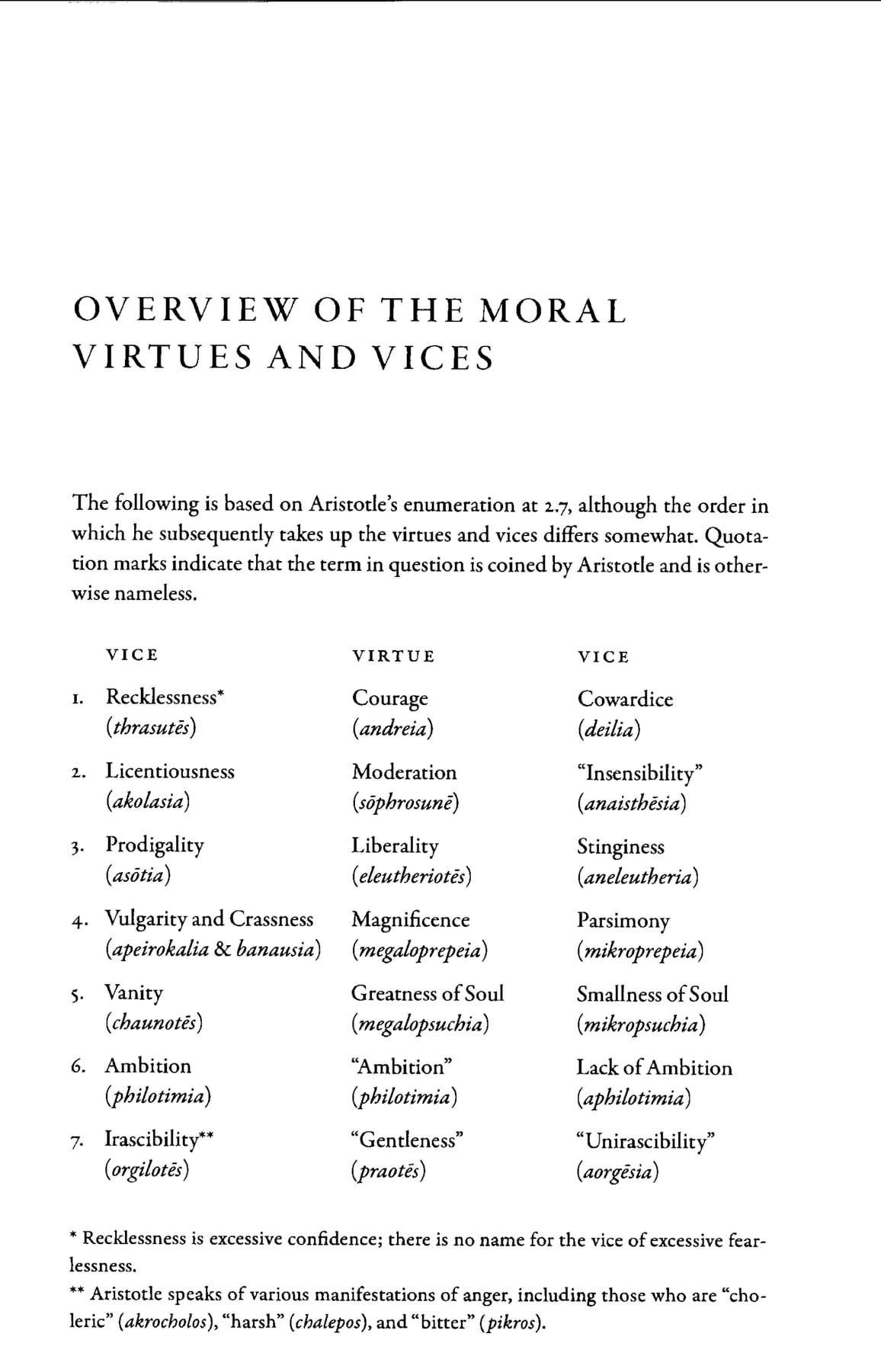
| Sphere | Deficiency | Mean | Excess |
|---|---|---|---|
| Fear/Confidence | Cowardice | Courage | Recklessness |
| Pleasure/Pain | ”Insensibility” | Moderation | Licentiousness |
| Money (Small) | Stinginess | Liberality | Prodigality |
| Money (Large) | Parsimony | Magnificence | Vulgarity |
| Honor (Great) | Smallness of Soul | Greatness of Soul | Vanity |
| Honor (Small) | Unambitious | (Nameless) | Ambitious |
| Anger | ”Unirascibility” | Gentleness | Irascibility |
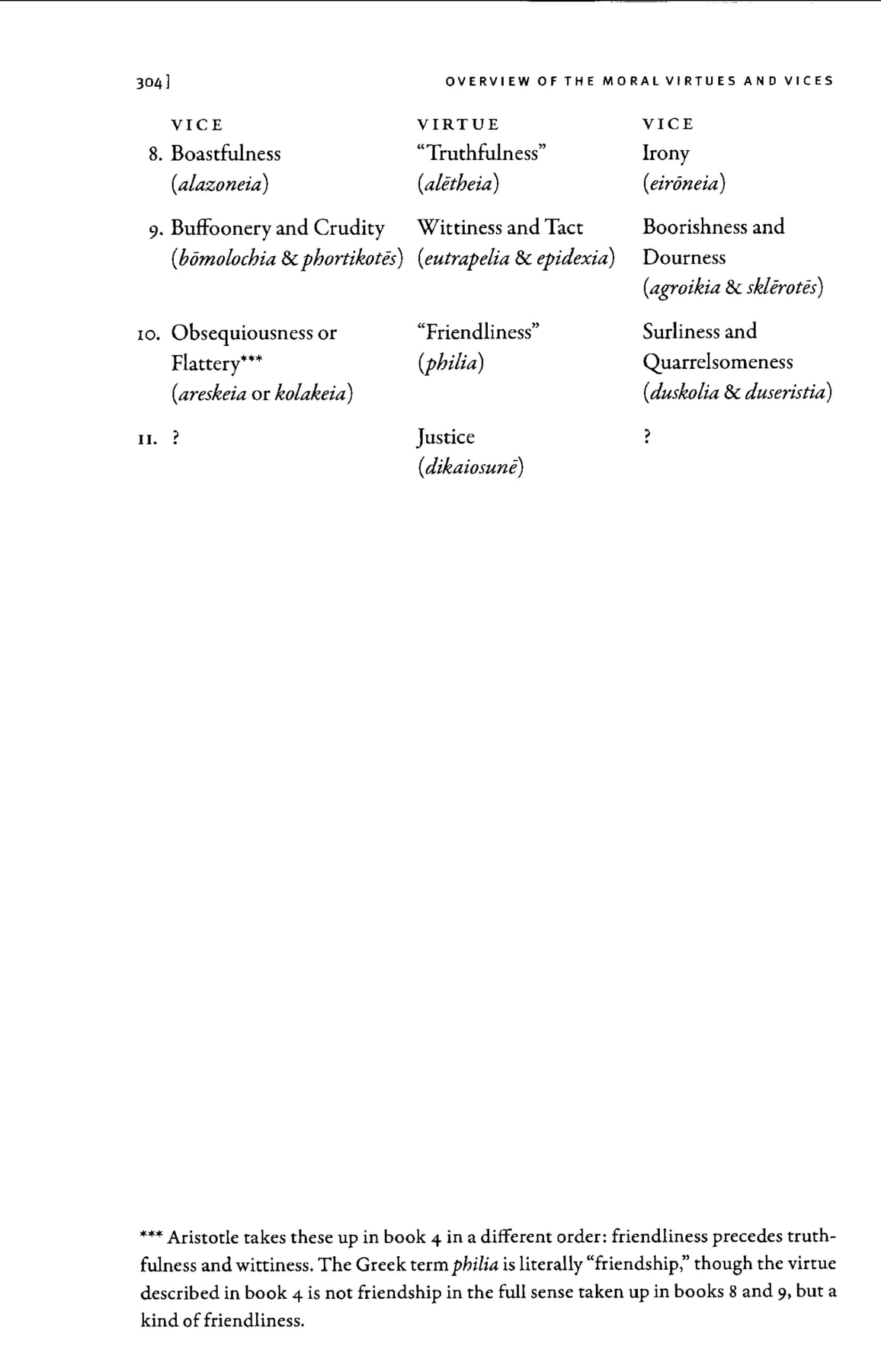
| Truth | Irony | Truthfulness | Boastfulness |
| Play/Humor | Boorishness | Wittiness | Buffoonery |
| Social Life | Surliness | Friendliness | Obsequiousness/Flattery |
| Shame | Shamelessness | Bashfulness | Shy/Excessive Shame |
| Fortune of Others | Spitefulness | Indignation | Envy |
Export to Sheets
Chapter 8: Opposition of Dispositions
- Opposition: Extremes are opposed to the mean and to each other. The mean is excessive compared to the deficiency and deficient compared to the excess (e.g., the brave man looks rash to the coward) .
- Greatest Contrariety: The extremes are more opposed to each other than to the mean (like “great” and “small” are further apart than either is from “equal”) .
- Closer Extreme: Sometimes one extreme is closer to the mean (e.g., rashness is closer to courage than cowardice is). This happens due to the nature of the thing or our own nature (we naturally incline toward pleasure, so licentiousness is more opposed to moderation) .
Chapter 9: Practical Advice for Hitting the Mean
- Difficulty: Being good is hard work (“a task”), like finding the center of a circle .
- Rules of Thumb:
- Depart from the worse extreme: Steer away from the error that is more contrary to the mean (like Calypso advising to keep the ship from the smoke and swell) .
- Know your bias: Drag yourself away from what you naturally incline toward (usually pleasure), like straightening warped lumber .
- Guard against pleasure: Be suspicious of pleasure because we do not judge it impartially.
- Flexibility: It is not easy to define exactly how to act in every case; the decision rests in perception . One should sometimes incline toward excess and sometimes toward deficiency to hit the mean.
Book 3
Chapter 1: The Voluntary and Involuntary
- Voluntary vs. Involuntary: Virtue concerns passions and actions, which are praised or blamed if voluntary, but pardoned or pitied if involuntary.
- Force: An act is forced if its origin is external and the agent contributes nothing (e.g., being carried by the wind) .
- Mixed Actions: Actions done from fear of greater evil (e.g., throwing cargo overboard in a storm) are “mixed.” They are voluntary at the moment of action (because the person chooses to move their limbs) but involuntary in the abstract (no one chooses to lose property for its own sake) .
- Ignorance: Acts done from ignorance are involuntary if they cause pain and regret. If they cause no regret, they are “nonvoluntary.”
- Specific Ignorance: Ignorance of particulars (who, what, with what instrument) makes an act involuntary. Ignorance of the universal (what is right/wrong) makes an act wicked, not involuntary .
Chapter 2: Choice (Proairesis)
- Definition: Choice is not desire, spirit, wish, or opinion. It is a “deliberative longing for things that are up to us”.
- Distinctions:
- Not Desire: Desire opposes choice (in the incontinent person), but choice does not oppose choice. Desire is for pleasure; choice is for the good.
- Not Wish: We can wish for impossibilities (immortality) or things not up to us (an athlete’s victory), but we only choose what we think we can bring about . Wish is for the end; choice is for the means .
- Not Opinion: Opinion is true/false; choice is good/bad.
Chapter 3: Deliberation (Bouleusis)
- Object of Deliberation: We deliberate about things that are “up to us” and subject to action, not about eternal truths, nature, or chance .
- Means, not Ends: We deliberate not about ends (e.g., a doctor doesn’t deliberate whether to heal), but about the means to achieve them .
- Process: Deliberation is a process of analysis, like solving a geometry problem. It stops when we reach the first cause, which is the last step in analysis and the first in action .
Chapter 4: Wish (Boulesis)
- The Object of Wish: Is it the Good or the Apparent Good?
- If it’s the Good, the person who chooses wrong doesn’t “wish” (which seems absurd).
- If it’s the Apparent Good, there is no natural object of wish.
- Solution: The object of wish unqualifiedly is the Good; for the individual, it is what appears good. The serious/virtuous person sees the truth in each case and is the standard; the base person is deceived by pleasure .
Chapter 5: Responsibility
- Virtue is Voluntary: Since the means are voluntary (chosen), the activities of virtue are voluntary. It is up to us to be good or bad .
- Character: We are “joint causes” of our characteristics (habits). Just as a sick person cannot simply wish to be well after living loosely, an unjust person cannot simply wish to be just once their character is formed-but they were initially free not to become that way .
- Punishing Ignorance: Lawgivers punish ignorance if the person is responsible for it (e.g., drunk offenders), because they had the power not to get drunk .
Chapter 6: Courage (Andreia) - Scope
- Definition: Courage is a mean regarding fear and confidence.
- Object: It is not concerned with all fears (e.g., poverty, sickness), but with the greatest fear: death. Specifically, death in the noblest circumstances, i.e., war .
- Confidence: The brave man is fearless in the face of a noble death. He fears things a human being should fear, but endures them as reason commands for the sake of the noble.
Chapter 7: Courage - Nature and Vices
- The End: The courageous man acts for the sake of the noble (to kalon).
- Vices:
- Excess of Fearlessness: (Nameless) - A madman who fears nothing (earthquakes, waves).
- Excess of Confidence: Reckless - A boaster who pretends courage but shrinks when danger arrives.
- Excess of Fear: Coward - Fears the wrong things, in the wrong way; lacks hope .
Chapter 8: Five Types of False Courage
- Political/Citizen Courage: Motivated by shame and fear of the law/reproach (closest to true courage) .
- Experience: Professional soldiers who seem brave because they know the dangers are false or know how to fight. They flee when the danger is real .
- Spiritedness (Thumos): Motivated by pain/anger (like a wounded beast). True courage is with spirit, but for the noble .
- Optimism/Hope: Confident because they have won often and think they are strongest. They flee when things go wrong .
- Ignorance: Confident simply because they don’t know the danger exists.
Chapter 9: Courage and Pain
- Painful: Courage involves enduring pain. It is harder to endure pain than to abstain from pleasure.
- The End is Pleasant: The end of courage is noble (and thus pleasant), but the physical reality (wounds, death) is painful and obscures that pleasure (like a boxer winning a crown but getting beaten up) .
Chapter 10: Moderation (Sophrosyne) - Scope
- Object: Concerned with pleasures, specifically bodily pleasures.
- Specific Senses: Not all bodily pleasures (not sight, hearing, or smell), but those shared with animals: touch and taste.
- Touch: The licentious person enjoys the sensation of contact (food, drink, sex).
Chapter 11: Moderation - Desires and Vices
- Natural Desires: (e.g., food) Error is usually only in quantity (gluttony) .
- Idiosyncratic Desires: Many people err by enjoying wrong things or enjoying them too much.
- Licentiousness: Excess in pleasure. The licentious person is pained by the absence of pleasure (which is absurd).
- Insensibility: Deficiency in pleasure. Rare and not human; even animals distinguish food.
- The Moderate Person: Desires the right things, in the right way, for the sake of the noble and health .
Chapter 12: Voluntariness of Licentiousness
- More Voluntary: Licentiousness is more voluntary than cowardice because it is driven by pleasure (which we choose), whereas cowardice is driven by pain (which unhinges us). Thus, it is more blameworthy .
- Children: We call children “uncheck” (akolastos) because they live by desire. The desiring element must be “chastised” and obedient to reason, just as a child must obey a tutor .
Book 4
Chapter 1: Liberality (Eleutheriotēs)
- Sphere: Liberality is a mean concerning money (giving and taking). It focuses more on giving correctly than taking correctly.
- The Liberal Man: He gives to the right people, the right amount, at the right time, with pleasure (or at least without pain) . He values money not for its own sake but as a tool for giving.
- Resources: Liberality depends on the giver’s characteristic, not the absolute amount. A poor person giving a little can be more liberal than a rich person giving a lot .
- Vices:
- Prodigality (Asōtia): Excess in giving, deficiency in taking. The prodigal man ruins himself but benefits others. He is curable because he has the impulse to give .
- Stinginess (Aneleutheria): Deficiency in giving, excess in taking. It is incurable, innate in most people (lovers of money), and worse than prodigality because it benefits no one .
Chapter 2: Magnificence (Megaloprepeia)
- Sphere: A virtue concerning money, but only large expenditures (unlike liberality, which covers all amounts).
- The Magnificent Man: He is like a knower who contemplates what is fitting. He spends large sums for noble, public objects (temples, choruses, warships) or great private occasions (weddings). He spends gladly and lavishly .
- Vices:
- Vulgarity/Crassness: Excess. Spending huge sums on small things to show off wealth (e.g., a wedding feast for a club dinner) .
- Parsimony: Deficiency. Trying to spend the least possible on a great work, ruining the effect for a trifle .
Chapter 3: Greatness of Soul (Megalopsychia)
- Sphere: Concerned with Great Honor. It is the “crown” or ornament of the virtues because it requires all other virtues to be present.
- The Great-Souled Man: He deems himself worthy of great things and is worthy of them.
- Attitude toward Honor: He accepts honor from serious people as his due (though still less than he deserves), but despises honor from random people or for small things .
- Characteristics: He is indifferent to good or bad fortune; he does not gossip, complain, or ask for help; he moves slowly and speaks with a deep voice . He is open in his hatreds and loves because he cares for truth more than opinion.
- Vices:
- Vanity: Deeming oneself worthy of great things when one is not worthy.
- Smallness of Soul: Deeming oneself worthy of less than one is worth. This is worse than vanity because it prevents the person from pursuing noble things they are actually capable of .
Chapter 4: Ambition (Philotimia)
- Sphere: Concerned with small/measured honors (similar to how liberality relates to magnificence).
- The Mean: There is no specific name for the mean. We praise the “ambitious” man for loving what is noble, and the “unambitious” man for being moderate .
- Vices:
- Ambition: Loving honor more than one ought.
- Lack of Ambition: Not choosing to be honored even for noble things.
Chapter 5: Gentleness (Praotēs)
- Sphere: Concerned with anger.
- The Gentle Man: He gets angry at the right things, with the right people, for the right time. He tends to err toward deficiency (forgiveness) .
- Vices:
- Irascibility: Getting angry too quickly, at wrong people, or for too long. Includes “choleric” (quick-tempered) and “bitter” (holds grudges) people.
- “Unirascibility”: Failing to get angry when one ought. This is slavish because one won’t defend oneself or friends .
Chapter 6: Friendliness (Social Association)
- Sphere: Concerned with pleasing/displeasing people in daily life.
- The Mean: (Nameless, resembles friendship). The person accepts or objects to things rightly to avoid causing pain or to give pleasure, guided by the noble .
- Vices:
- Obsequiousness/Flattery: Praising everything to cause pleasure (obsequious) or for personal gain (flatterer).
- Surliness/Quarrelsomeness: Opposing everything and not caring about causing pain.
Chapter 7: Truthfulness
- Sphere: Concerned with truth in speech/action regarding oneself (pretensions).
- The Truthful Man: A “plain dealer” who owns up to what he has, neither exaggerating nor diminishing it. He loves truth and avoids falsehood as base .
- Vices:
- Boastfulness: Claiming qualities one lacks or exaggerating them. Worse if done for money.
- Irony: Denying or belittling one’s qualities (like Socrates). This is more refined than boasting but can still be a vice .
Chapter 8: Wittiness
- Sphere: Concerned with play/amusement and rest.
- The Witty Man: He jokes in a tactful way, saying and listening only to what fits a liberal/decent person. He is “like a law unto himself”.
- Vices:
- Buffoonery: Slave to the joke; will hurt himself or others just to get a laugh.
- Boorishness: Refuses to joke and is offended by everything.
Chapter 9: Shame (Aidōs)
- Status: Not a virtue, but a passion (fear of disrepute).
- Role: Appropriate for youth (to check passion), but not for decent adults, because a decent person shouldn’t do anything shameful in the first place .
Book 5
Chapter 1: Justice and Injustice Defined
- Universal Justice: Justice is the characteristic disposing people to do just things. The just person is lawful and equal; the unjust is unlawful and unequal .
- Complete Virtue: Justice in the general sense (lawfulness) is complete virtue in relation to another. It sums up all virtues because the law commands acts of courage, moderation, etc., for the common good.
- The Best Man: The best person is not just good in himself but uses his virtue for another. Justice is thus “another’s good” .
Chapter 2: Particular Justice
- Distinction: There is a specific injustice (greed/grasping for more) distinct from general vice. For example, an adulterer who pays for sex is licentious but not unjust; one who does it for profit is unjust .
- Two Forms: Particular Justice is divided into:
- Distributive: Distribution of honor or money among citizens.
- Corrective: Rectifying transactions (voluntary like selling, involuntary like theft) .
Chapter 3: Distributive Justice
- Geometric Proportion: Distributive justice is a mean involving four terms (two persons, two shares). The ratio of persons must equal the ratio of shares (A:B::C:D).
- Merit: Justice requires distribution according to merit. Regimes disagree on merit: democrats say freedom, oligarchs wealth, aristocrats virtue .
- The Just: The just is the proportional; the unjust violates the proportion.
Chapter 4: Corrective Justice
- Arithmetic Proportion: Corrective justice deals with transactions where the law treats parties as equals. It focuses only on the harm done .
- The Judge: The judge restores equality by subtracting the “gain” from the offender and giving it to the victim. The judge is a “mediator” who finds the middle term .
Chapter 5: Reciprocity and Money
- Reciprocity: Simple reciprocity (eye for an eye) is not justice. Justice requires _proportional_reciprocity to hold the city together .
- Money: Money makes goods commensurable so exchange can happen. It acts as a guarantee for future exchange.
- Need: The true measure holding community together is need (chreia); money is its convention-based representative .
Chapter 6: Political Justice
- Political Justice: Exists only among free and equal people sharing a life to be self-sufficient, under law.
- Household Justice: Justice toward a wife, child, or slave is not political justice. One cannot be unjust to one’s own property (slave) or part of oneself (child) .
Chapter 7: Natural vs. Legal Justice
- Natural Justice: Has the same force everywhere and doesn’t depend on opinion (like fire burning here and in Persia).
- Legal Justice: Things that can be otherwise, but are fixed by law (e.g., ransom price).
- Changeability: Even natural justice is changeable among humans (unlike gods), but there is still a distinction between nature and convention .
Chapter 8: Voluntary Action and Responsibility
- Voluntariness: An act is only unjust if voluntary. Acts done from ignorance or force are not unjust acts, though they may be unjust things .
- Three Levels of Harm:
- Misfortune: Contrary to expectation.
- Error: Not contrary to expectation, but without vice (origin in agent).
- Unjust Act: Knowingly but not deliberate (e.g., anger).
- Unjust Person: Deliberate choice .
Chapter 9: Paradoxes of Justice
- Voluntary Suffering: One cannot be voluntarily treated unjust. No one wishes for what is not good.
- Difficulty: Being just is hard because it’s not just doing the act (which is easy), but doing it from a certain state of character .
Chapter 10: Equity (Epieikeia)
- Relation to Justice: Equity is just and superior to legal justice.
- Deficiency of Law: Law is universal, but human actions are particular. Equity corrects the law where it is defective due to universality .
- Analogy: Equity is like the leaden rule of Lesbos that bends to the stone’s shape .
Chapter 11: Injustice to Oneself
- Impossible: One cannot treat oneself unjust because injustice requires two parties and voluntariness (one cannot voluntarily suffer injustice).
- Suicide: Suicide is an injustice against the city, not oneself.
- Metaphor: Justice exists in the soul metaphorically between the rational and irrational parts .
Book 6
Chapter 1: The Soul and Correct Reason
- Context: Moral virtue is a mean, and the mean is determined by “correct reason”. This chapter aims to define what correct reason is .
- Soul Division: The soul is divided into the rational and the nonrational .
- Rational Division: The rational part is further divided based on its objects:
- Scientific Part (Epistēmonikon): Contemplates necessary, unchangeable truths (principles).
- Calculative Part (Logistikon): Contemplates contingent things (what can be otherwise). Calculation and deliberation are the same .
Chapter 2: Choice and Truth
- Three Factors: Sensation, intellect, and desire (longing) govern action and truth .
- Moral Virtue: Defined as a characteristic marked by choice. Choice is deliberative longing.
- Practical Truth: For choice to be good, reasoning must be true and longing must be correct. Practical thinking’s goal is truth in agreement with right desire .
- Origin of Action: The origin of action is choice; the origin of choice is desire + reasoning for an end. Thought itself moves nothing; only goal-oriented thought moves action .
Chapter 3: The Five Intellectual Virtues - Science
- Five States: The soul attains truth through Art, Science, Prudence, Wisdom, and Intellect .
- Science (Epistēmē): Concern things that cannot be otherwise (eternal, necessary). It is teachable and based on demonstration (syllogism) from first principles .
Chapter 4: Art (Technē)
- Making vs. Action: Making (poiesis) is different from action (praxis). Art concerns making .
- Definition: Art is a characteristic bound up with making involving true reason. It deals with contingent things (bringing things into being whose origin is in the maker) .
Chapter 5: Prudence (Phronēsis)
- Deliberation: The prudent person deliberates well about what is good for himself and living well in general (not just partial goods like health) .
- Definition: Prudence is a true characteristic bound up with action, accompanied by reason, concerning human goods. It is distinct from science (because action deals with variables) and art (because action is an end in itself, unlike making) .
- Example: Pericles is prudent because he sees what is good for himself and the city.
- Virtue: Prudence is a virtue (not just an art) of the opinion-forming part of the soul .
Chapter 6: Intellect (Nous)
- First Principles: Science demonstrates from principles, but cannot demonstrate the principles themselves. Therefore, Intellect is the state that grasps the first principles .
Chapter 7: Wisdom (Sophia)
- Definition: Wisdom is the most precise of the sciences. It is Intellect + Science directed at the most honorable things (the cosmos/divine), not just human affairs .
- Superiority: Wisdom is superior to prudence because “a human being is not the best of things in the cosmos” .
- Wise vs. Prudent: Men like Thales are wise but not prudent (they know useless divine things but not human advantage) . Prudence requires knowledge of particulars (experience), not just universals .
Chapter 8: Prudence and Politics
- Political Art: Prudence and the political art are the same state but have different definitions.
- Architectonic: Legislative art.
- Practical: “Political art” proper (decrees/action).
- Individual Prudence: Knowing one’s own good is usually called “prudence,” while interfering with others is “busybody” politics, though one cannot really do well without a household/regime .
- Experience: Young men can be mathematicians (abstract) but not prudent, because prudence requires experience of particulars which comes with time .
Chapter 9: Good Deliberation (Euboulia)
- Nature: Good deliberation is not science, guesswork, or opinion. It is a correctness of thinking .
- Definition: It is correctness regarding what is beneficial, about the right thing, in the right way, for the right time. A bad man can calculate correctly to get a bad end; good deliberation leads to a good end .
Chapter 10: Comprehension (Synesis)
- Critical Faculty: Comprehension is not prudence because it does not issue commands (what to do). It is judicial: it judges the opinions of others correctly about matters of doubt .
Chapter 11: Judgment (Gnōmē) and Intellect in Action
- Judgment: The correct decision regarding what is equitable. It involves sympathetic understanding.
- Unity: All these faculties (judgment, comprehension, prudence, intellect) tend toward the same thing: action in particular circumstances.
- Practical Intellect: In demonstrations, intellect grasps universal definitions. In action, intellect (perception) grasps the ultimate particular fact (the minor premise) .
Chapter 12: Utility of Intellectual Virtues
- The Puzzle: Wisdom contemplates nothing productive of happiness (no action). Prudence knows what is just, but knowing doesn’t make us better at doing it (if virtue is a habit) .
- The Answer:
- Intrinsic Value: Wisdom and prudence are virtues of the soul’s parts, so they are choiceworthy in themselves even if they produced nothing.
- Productive of Happiness: Wisdom produces happiness not as medicine produces health, but as health produces health (by being the active state of it).
- Function: Virtue makes the target (end) correct; Prudence makes the means correct .
Chapter 13: Prudence and Moral Virtue
- Cleverness (Deinotēs): The capacity to do what is needed to hit a target. If the aim is noble, it is praiseworthy; if base, it is cunning. Prudence is cleverness plus moral virtue.
- Natural Virtue: We have natural dispositions (like children), but without intellect, they can be harmful (like a strong blind body stumbling). Authoritative virtue requires prudence .
- Unity of Virtues: Socrates was wrong that virtues are knowledge, but right that they don’t exist _without_prudence. If one has prudence, one has all the virtues .
Book 7
Chapter 1: The Three Moral States
- The Spectrum: There are three moral states to avoid: Vice, Lack of Self-Restraint (Akrasia), and Brutishness. Their opposites are Virtue, Self-Restraint, and “Heroic/Divine Virtue” .
- Brutishness: A rare state exceeding ordinary vice (found in barbarians, disease, or madness). Its opposite is divine virtue (becoming like a god) .
- Method: Aristotle will proceed by setting out the “received opinions” (endoxa), raising puzzles (aporiai), and solving them to leave the truth standing .
Chapter 2: Puzzles about Akrasia
- Socrates’ Puzzle: Socrates argued akrasia doesn’t exist because no one knowingly acts against what is best; they act from ignorance. This conflicts with manifest experience .
- Knowledge vs. Opinion: Some suggest the incontinent person acts against opinion, not knowledge. But if the conviction is weak, we should pardon them (which we don’t for vice) .
- Prudence: A prudent person cannot be incontinent because prudence involves action, not just knowledge .
- Temperance: If a self-restrained person has strong, bad desires, they are not temperate (who has no bad desires). If they have good desires, “restraint” would be bad .
Chapter 3: Solution to the Problem of Knowledge
- Knowing in Two Ways: One can have knowledge but not use it (like a person asleep or drunk). The incontinent person “has” knowledge but is not exercising it .
- The Syllogism: Action comes from a syllogism: Universal Premise (e.g., “Sweet things are pleasant”) + Particular Premise (“This is sweet”) = Action.
- The Mechanism of Akrasia: Passion (desire) can disable the particular premise (knowledge of the immediate fact) or the right universal premise (“Avoid sweets”), leaving only the universal (“Sweets are pleasant”). The desire then drives the action .
- Conclusion: The incontinent person acts under the influence of passion, not strict knowledge. They are like actors reciting verses they don’t understand.
Chapter 4: Scope of Akrasia
- Unqualified Akrasia: Relates to the same pleasures as licentiousness (food, drink, sex) .
- Qualified Akrasia: Relates to things that are naturally good but pursued excessively (honor, gain, anger). We add a qualifier: “incontinent regarding money” .
- Comparison: Unqualified akrasia is worse and more like vice. Qualified akrasia (e.g., regarding anger) is less shameful.
Chapter 5: Brutishness and Morbidity
- Unnatural Pleasures: Some pleasures are not natural but arise from disease, madness, or habit (e.g., eating human flesh, plucking hair).
- Classification: Characteristics related to these are “brutish” or “morbid,” not simple incontinence. Brutishness is frightening but less “bad” than human vice because the best part (reason) isn’t corrupted; it was never there .
Chapter 6: Anger vs. Desire
- Anger (Thumos): Incontinence in anger is less shameful than in desire. Anger “hears” reason (that it was slighted) but misinterprets it (hastiness), like a servant running before hearing the whole order .
- Desire: Desire rushes blindly at pleasure without hearing reason at all. Therefore, it is more unjust and shameful.
- Plotting: Anger is open; desire is deceitful (like Aphrodite) and involves plotting .
Chapter 7: Types of Character
- Strength vs. Weakness:
- Softness: Inability to endure pain most people can resist.
- Steadfastness: Ability to endure pain.
- Self-Restraint: Overpowering bad desire.
- Incontinence: Being overpowered by bad desire .
- Two Types of Akrasia:
- Impetuosity (Propeteia): Acting quickly without deliberating (common in keen/melancholic types).
- Weakness (Astheneia): Deliberating correctly but being too weak to stick to the decision.
Chapter 8: Akrasia vs. Vice
- Regret: The incontinent person feels regret and is curable. The vicious person (licentious) has no regret (thinks they are right) and is incurable .
- Comparison: Vice is like a chronic disease (dropsy); akrasia is like a seizure (intermittent). The incontinent person is not bad acts only “half-wicked” because their choice is good .
Chapter 9: The Self-Restrained Person
- Obstinacy: Self-restraint isn’t just sticking to any opinion (which obstinate/stubborn people do), but sticking to the true opinion/reason against passion.
- Neoptolemus: Sticking to a good opinion for the sake of a noble pleasure (truth) is good, not incontinence .
Chapter 10: Prudence and Akrasia
- Incompatibility: A prudent person cannot be incontinent because prudence entails _acting_correctly, not just knowing. A “clever” person can be incontinent, but not a prudent one .
Chapter 11: Pleasure - Theories
- Views on Pleasure:
- No pleasure is a good (anti-hedonists).
- Some are good, most are bad.
- Pleasure is a good, but not the Best Good.
- Arguments Against: Pleasure is a “becoming” (process), hinders thinking, has no art, and is pursued by children/beasts .
Chapter 12: Defense of Pleasure
- Activity: Pleasure is not a “becoming” but an unimpeded activity of a natural state .
- The Good: Happiness is an unimpeded activity; therefore, it must include pleasure. Even if some pleasures are bad, the best thing (happiness) can still be a pleasure .
- Pain: Pain is bad and to be avoided; therefore, its contrary (pleasure) is good.
Chapter 13: Pleasure and Happiness
- Necessity: Happiness requires external goods (body, wealth) so activity isn’t impeded. It is absurd to say a man on the rack is happy .
- Universal Pursuit: All things (beasts and humans) pursue pleasure, which suggests it is the Good. They may all be pursuing a “divine” element unconsciously .
Chapter 14: Bodily Pleasures
- Why Popular? Bodily pleasures are intense and drive out pain (remedial). People pursue them because they can’t enjoy other pleasures .
- Excess: They are only bad in excess.
- God’s Pleasure: God enjoys a single, simple pleasure because His nature is immutable, unlike humans who need change because of our complex/perishable nature .
Book 8
Chapter 1: The Nature and Necessity of Friendship
- Virtue: Friendship (philia) is a virtue or accompanies virtue.
- Necessity: It is most necessary for life. No one would choose to live without friends, even with all other goods . It helps the young avoid error, the old with care, and those in their prime with noble actions .
- Nature: It is natural in parents for offspring and birds/animals.
- Political Importance: Friendship holds cities together (concord). Lawgivers care more about it than justice because friends have no need of justice, but just people still need friendship .
Chapter 2: The Objects of Love
- Lovable: Not everything is loved, only the lovable: the good, the pleasant, or the useful .
- Subjectivity: People love what appears good to them.
- Conditions of Friendship:
- Reciprocity: Love must be mutual.
- Goodwill: Wishing good to the other for their sake.
- Awareness: The goodwill must not go unnoticed.
Chapter 3: The Three Kinds of Friendship
- 1. Utility: Loving not the person, but the benefit they provide. Easily dissolved when utility ceases. Common among the old .
- 2. Pleasure: Loving because the person is pleasant (e.g., witty). Common among the young, who live by passion. Quickly formed and quickly dissolved .
- 3. Complete (Virtue): Friendship of those who are good and alike in virtue. They wish good to each other for the other’s sake. It is stable because virtue is stable. It includes utility and pleasure absolutely .
- Rarity: Such friendship is rare because good people are rare and it requires time and intimacy (eating salt together) .
Chapter 4: Comparisons
- Perfect: Virtue friendship is perfect. Utility and pleasure friendships are likenesses of it .
- Bad Men: Bad men can be friends for pleasure or utility, but only good men can be friends for themselves .
- Slander: Only friendship among the good is secure against slander .
Chapter 5: Activity and Disposition
- State vs. Activity: Friendship is a characteristic (state), but living together is the activity. Distance does not dissolve the friendship but the activity (though long absence causes forgetfulness) .
- Living Together: Nothing belongs to friends so much as living together. Even the blessed want company .
Chapter 6: Frequency
- Numbers: One cannot be a “complete” friend to many people (just as one cannot be in love with many).
- Utility/Pleasure: One can have many friends of these types because they require less time and intimacy .
- Authority: People in power have friends for utility (clever) or pleasure (witty), but rarely both (virtuous) .
Chapter 7: Inequality
- Superiority: Friendships involving a superior (father/son, ruler/ruled) are different.
- Proportion: The love must be proportional: the better/more useful person should be loved more than they love to establish equality .
- Distance: If the distance is too great (gods, kings), friendship is impossible .
Chapter 8: Loving vs. Being Loved
- The Many: Most people want to be loved (honor) rather than to love.
- Essence: Friendship consists more in loving than in being loved (e.g., mothers loving children without being known). Loving is the virtue of friends .
Chapter 9: Friendship and Justice
- Co-extensive: Justice and friendship involve the same persons and spheres. Every community has a form of justice and friendship .
- Degree: Injustice increases with closeness (it is worse to rob a comrade than a stranger).
- Political Community: All communities are parts of the political community, which aims at the common advantage .
Chapter 10: Regimes
- Three Good: Kingship (best), Aristocracy, Timocracy (Polity).
- Three Deviations: Tyranny (worst), Oligarchy, Democracy (least bad deviation) .
- Household Parallels:
- Father/Son: Kingship (father cares for children).
- Husband/Wife: Aristocracy (rule by merit).
- Brothers: Timocracy (equals).
- Master/Slave: Tyranny (master’s interest only) .
Chapter 11: Friendship in Regimes
- Kingship: Friendship is like a shepherd to sheep (superiority in benefaction) .
- Tyranny: Little or no friendship. No friendship with a slave as a slave (animate tool), but possible insofar as he is a human .
Chapter 12: Kinship
- Source: All kinship friendship derives from the paternal. Parents love children as part of themselves; children love parents as their source.
- Mothers: Love more because birth is painful and they are more certain the child is theirs.
- Coupling: Humans are naturally pairing beings (more than political). Husband and wife have utility and pleasure; if decent, they have virtue .
Chapter 13: Disputes (Utility)
- Complaints: Arise mostly in utility friendship because each wants more profit. Virtue friends compete to give; pleasure friends get what they want simultaneously .
- Types of Utility:
- Legal: Explicit terms (marketplace).
- Moral: Gift-giving but expecting a return. Disputes arise here .
- The Measure: The value should be measured by the recipient (who had the need), not the giver .
Chapter 14: Disputes (Superiority)
- Conflicting Claims: The superior person thinks they should get more (honor); the needy person thinks they should get more (profit).
- Solution: Distribute different things: honor to the superior (reward of virtue), money/gain to the needy .
- Impossibility: We can never fully repay gods or parents; we just do what we can.
Book 9
Chapter 1: Dissolution of Friendships
- Heterogeneous Friendships: In friendships where aims differ (one seeks pleasure, the other utility), proportional equality preserves the friendship.
- Dissolution: Accusations arise when friends don’t get what they want. If a lover loves for pleasure and the beloved for utility, the friendship ends when these cease .
- Disputes over Value: Who assesses the value? Protagoras let the learner assess. Aristotle argues the recipientshould assess the worth, not the giver .
- Virtue Friendship: No accusations arise here. Repayment should accord with choice/intention .
Chapter 2: Conflicting Obligations
- Dilemmas: Should one obey a father in everything? Trust a doctor or a friend? Repay a debt or ransom a father?
- General Rule: Repay debts first, unless the other act is overwhelmingly nobler or more necessary .
- Specifics: Different things are due to different people (honor to parents, frankness to comrades) .
Chapter 3: Breaking Off Friendships
- Change in Character: If a friend becomes wicked, should we break it off? Yes, if they are incurable. If curable, we should help their character (more than their property) .
- Change in Virtue: If one friend becomes far superior in virtue, they can’t remain friends (no shared pleasure/life), but the superior one should remember the past intimacy .
Chapter 4: Friendship and Self-Love
- Features of Friendship: Defining features (wishing good, sharing grief/joy) are found most perfectly in the decent person’s relation to himself .
- The Decent Man: Is “of like mind” with himself; desires the same things; wishes for his own preservation (especially his thinking part) .
- The Base Man: Is at war with himself (appetite vs. reason); hates himself; seeks company to escape himself. He cannot be a friend to himself or others .
Chapter 5: Goodwill (Eunoia)
- Nature: Goodwill is the beginning of friendship (like sight is the beginning of love), but not friendship itself because it lacks intensity and desire. It can be felt for strangers (e.g., competitors).
- Idle Friendship: Goodwill is “idle friendship”; with time and intimacy, it becomes true friendship.
Chapter 6: Concord (Homonoia)
- Definition: Concord is political friendship. It exists when citizens agree on interests, choose the same actions, and execute common resolutions (e.g., to make offices elective) .
- Base Men: Cannot be in concord because they aim at getting more for themselves (greed) and shirking duties.
Chapter 7: Benefactors vs. Recipients
- The Paradox: Benefactors love recipients more than recipients love benefactors.
- Explanation:
- Creditor/Debtor: Recipients feel like debtors (wish creditor away); benefactors want recipients to survive to pay. (Aristotle rejects this as too base/mercenary).
- Active/Passive: The benefactor is like an artisan/poet who loves his work. The recipient is the “work.” We love existence (which is activity); the work is the creator in activity .
- Nobility: The benefactor’s act is noble (lasting); the recipient’s utility passes away.
Chapter 8: True Self-Love
- Two Types:
- Reproachable (Base): Those who gratify their nonrational passions and take the biggest share of money/honor. This is what “the many” do .
- True Self-Love (Noble): The person who gratifies their most authoritative part (intellect/reason). By doing noble deeds, they “allot the greater good” to themselves .
- Sacrifice: The true self-lover will give up money, office, or even life for a friend/city, because he gains the noble(which is greater than money/life) .
Chapter 9: The Happy Man and Friends
- Self-Sufficiency: Does the happy man need friends? Yes.
- Why?
- Beneficence: He needs people to benefit.
- Nature: Humans are political/social.
- Contemplation: We can contemplate a friend’s actions (which are good and “our own”) better than our own.
- Sustaining Activity: Good friends help sustain the continuous activity of virtue .
- Perception of Existence: A friend is another self. Perceiving a friend’s existence (through living together) is choiceworthy, just as perceiving one’s own existence is .
Chapter 10: Number of Friends
- Limit: Not as many as possible. Only as many as one can live together with.
- Intimacy: Intense friendship is possible only with a few. One cannot be in love with many; similarly, one cannot have many “complete” friends.
Chapter 11: Friends in Fortune
- Misfortune: We need friends for aid. Their presence is comforting but also painful (we don’t want to cause them pain). Manly men hesitate to share grief .
- Good Fortune: We need friends to share our good (nobler). We should invite them eagerly but be slow to ask for help.
Chapter 12: Living Together
- Essence: Friendship is community. Living together (suzen) is the most choiceworthy thing for friends .
- Activities: Whatever friends define as “living” (drinking, hunting, philosophizing), they do it together.
- Effect: Bad friends corrupt each other; good friends improve each other (“noble things from noble people”) .
Book 10
Chapter 1: Dissolution of Friendships
- Heterogeneous Friendships: In friendships where aims differ (one seeks pleasure, the other utility), proportional equality preserves the friendship.
- Dissolution: Accusations arise when friends don’t get what they want. If a lover loves for pleasure and the beloved for utility, the friendship ends when these cease .
- Disputes over Value: Who assesses the value? Protagoras let the learner assess. Aristotle argues the recipientshould assess the worth, not the giver .
- Virtue Friendship: No accusations arise here. Repayment should accord with choice/intention .
Chapter 2: Conflicting Obligations
- Dilemmas: Should one obey a father in everything? Trust a doctor or a friend? Repay a debt or ransom a father?
- General Rule: Repay debts first, unless the other act is overwhelmingly nobler or more necessary .
- Specifics: Different things are due to different people (honor to parents, frankness to comrades) .
Chapter 3: Breaking Off Friendships
- Change in Character: If a friend becomes wicked, should we break it off? Yes, if they are incurable. If curable, we should help their character (more than their property) .
- Change in Virtue: If one friend becomes far superior in virtue, they can’t remain friends (no shared pleasure/life), but the superior one should remember the past intimacy .
Chapter 4: Friendship and Self-Love
- Features of Friendship: Defining features (wishing good, sharing grief/joy) are found most perfectly in the decent person’s relation to himself .
- The Decent Man: Is “of like mind” with himself; desires the same things; wishes for his own preservation (especially his thinking part) .
- The Base Man: Is at war with himself (appetite vs. reason); hates himself; seeks company to escape himself. He cannot be a friend to himself or others .
Chapter 5: Goodwill (Eunoia)
- Nature: Goodwill is the beginning of friendship (like sight is the beginning of love), but not friendship itself because it lacks intensity and desire. It can be felt for strangers (e.g., competitors).
- Idle Friendship: Goodwill is “idle friendship”; with time and intimacy, it becomes true friendship.
Chapter 6: Concord (Homonoia)
- Definition: Concord is political friendship. It exists when citizens agree on interests, choose the same actions, and execute common resolutions (e.g., to make offices elective) .
- Base Men: Cannot be in concord because they aim at getting more for themselves (greed) and shirking duties.
Chapter 7: Benefactors vs. Recipients
- The Paradox: Benefactors love recipients more than recipients love benefactors.
- Explanation:
- Creditor/Debtor: Recipients feel like debtors (wish creditor away); benefactors want recipients to survive to pay. (Aristotle rejects this as too base/mercenary).
- Active/Passive: The benefactor is like an artisan/poet who loves his work. The recipient is the “work.” We love existence (which is activity); the work is the creator in activity .
- Nobility: The benefactor’s act is noble (lasting); the recipient’s utility passes away.
Chapter 8: True Self-Love
- Two Types:
- Reproachable (Base): Those who gratify their nonrational passions and take the biggest share of money/honor. This is what “the many” do .
- True Self-Love (Noble): The person who gratifies their most authoritative part (intellect/reason). By doing noble deeds, they “allot the greater good” to themselves .
- Sacrifice: The true self-lover will give up money, office, or even life for a friend/city, because he gains the noble(which is greater than money/life) .
Chapter 9: The Happy Man and Friends
- Self-Sufficiency: Does the happy man need friends? Yes.
- Why?
- Beneficence: He needs people to benefit.
- Nature: Humans are political/social.
- Contemplation: We can contemplate a friend’s actions (which are good and “our own”) better than our own.
- Sustaining Activity: Good friends help sustain the continuous activity of virtue .
- Perception of Existence: A friend is another self. Perceiving a friend’s existence (through living together) is choiceworthy, just as perceiving one’s own existence is .
Chapter 10: Number of Friends
- Limit: Not as many as possible. Only as many as one can live together with.
- Intimacy: Intense friendship is possible only with a few. One cannot be in love with many; similarly, one cannot have many “complete” friends.
Chapter 11: Friends in Fortune
- Misfortune: We need friends for aid. Their presence is comforting but also painful (we don’t want to cause them pain). Manly men hesitate to share grief .
- Good Fortune: We need friends to share our good (nobler). We should invite them eagerly but be slow to ask for help.
Chapter 12: Living Together
- Essence: Friendship is community. Living together (suzen) is the most choiceworthy thing for friends .
- Activities: Whatever friends define as “living” (drinking, hunting, philosophizing), they do it together.
- Effect: Bad friends corrupt each other; good friends improve each other (“noble things from noble people”) .
Interpretive Essay
1. Aristotle vs. Modernity and Revelation
Bartlett situates the Ethics in contrast to two major alternatives:
- Biblical Revelation: Aristotle relies on unaided human reason to discover the highest good, declining to defer to divine authority. He omits “piety” and “humility” from his list of virtues 1. His best life (contemplation) ranks above the life of justice and kindness commanded by the Bible 2.
- Modern Philosophy (Hobbes): Hobbes attacked Aristotle, denying that humans are political by nature or that there is a “highest good” discoverable by reason. However, the modern loss of confidence in reason reopens the possibility that Aristotle was right 3.
2. The Elusive Definition of Happiness (Book 1)
Bartlett highlights the “tentative” and “political” nature of Book 1.
- Political Constraints: Aristotle defers to the political community, which claims authority over the human good. He cannot simply state the true good because it would conflict with the community’s authoritative opinions 4.
- The Problem of Chance: Aristotle exposes the fragility of happiness. Virtue alone cannot guarantee happiness against “priamic” misfortunes or premature death. This leads to the “strange” discussion of whether the dead can be happy, suggesting that a truly “complete” happiness would require an afterlife, a view Aristotle treats with both skepticism and politic deference 5555.
- “Blessed Human Beings”: Ultimately, Aristotle qualifies the happiness available to us as that of “blessed human beings”-meaning mortals who are always exposed to the uncertainty of the future 6.
3. The Ascent of Virtue (Books 2–4)
The essay traces an “ascent” from the lower virtues to the peak of “Greatness of Soul.”
- Courage: The courageous man acts for the “noble,” but his action involves a paradox: he sacrifices his greatest goods (life and happiness) for a noble end, yet that end is his own virtue. There is a tension between his happiness and his virtue 7.
- Moderation: In contrast to courage, moderation is more aligned with self-preservation and bodily well-being, though less obviously “noble” 8.
- Greatness of Soul: This is the “crown” of the virtues. The great-souled man claims the greatest external good (honor) because he deserves it, yet he simultaneously despises it as beneath his virtue. He is the most self-sufficient of the morally virtuous, yet he still needs external goods (wealth, power) to perform great deeds 9999.
4. The Tension in Justice (Book 5)
Bartlett identifies a conflict within justice between the good of the individual and the good of the community.
- General Justice: This is “complete virtue” directed toward another. It aligns with the law and the common good 10.
- Particular Justice: This is fairness regarding gain. It is defined by the regime’s principle of equality (e.g., democratic vs. oligarchic merit). This makes justice dependent on the regime, which may not align with the true human good 11.
- The Dilemma: The virtuous person is torn between the requirements of the common good (which may demand bad acts like deceit or surrender for survival) and the intrinsic nobility of virtue. This tension suggests that moral virtue and the common good are not perfectly identical 12.
5. Prudence and the Lack of Knowledge (Book 6)
Bartlett argues that Aristotle leaves the definition of “correct reason” (prudence) deliberately obscure.
- No Independent Standard: Prudence does not set the end; moral virtue does. Prudence only finds the means. This means the “knowledge” guiding moral action is actually opinion instilled by habituation, not scientific knowledge of the “why” 13.
- Dependence on Opinion: Prudence relies on the “undemonstrated assertions” of experienced elders, confirming that it is bound up with authoritative opinion rather than pure intellect 14.
6. Friendship and Self-Love (Books 8–9)
Friendship bridges the gap between moral virtue and happiness.
- Self-Love: Aristotle redefines self-love. The true self-lover gratifies his “authoritative part” (intellect) by doing noble deeds. Even in sacrificing his life for a friend, he “allots the greater good” (nobility) to himself 15151515.
- The Need for Friends: The virtuous person needs friends to contemplate his own good actions (since we see friends better than ourselves) and to sustain his activity. Friendship provides a kind of self-sufficiency that solitary virtue cannot 16.
7. The Superiority of Contemplation (Book 10)
The essay concludes by emphasizing the radical shift in Book 10.
- Demotion of Moral Virtue: Moral virtues are “characteristically human” (bound to the body and passions) and require “external equipment” (money, power). They are unleisurely (war and politics are for the sake of peace) 17171717.
- The Divine Life: Contemplation is the only activity that is loved for its own sake, leisure, and self-sufficient. It is the activity of the “divine” element in us (intellect).
- The Gods: Aristotle argues it is ridiculous to think of gods practicing moral virtues (making contracts, facing danger). Their life is contemplation; therefore, the human life most akin to this is the happiest 18.
- The Final Problem: Even the contemplative life is subject to chance and mortality. Aristotle’s closing remarks about “divine providence” caring for the wise may be a rhetorical concession to the human longing for security, or a politic nod to piety, rather than a strict philosophical doctrine 19191919.