
DESCRIPTION
Classical Philosophy is the first of a series of books in which Peter Adamson aims ultimately to present a complete history of philosophy, more thoroughly but also more enjoyably than ever before. In short, lively chapters, based on the popular History of Philosophy podcast, he offers an accessible, humorous, and detailed look at the emergence of philosophy with the Presocratics, the probing questions of Socrates, and the first full flowering of philosophy with the dialogues of Plato and the treatises of Aristotle. The story is told ‘without any gaps’, discussing not only such major figures but also less commonly discussed topics like the Hippocratic Corpus, the Platonic Academy, and the role of women in ancient philosophy. Within the thought of Plato and Aristotle, the reader will find in-depth introductions to major works, such as the Republic and the Nicomachean Ethics, which are treated in detail that is unusual in an introduction to ancient philosophy. Adamson looks at fascinating but less frequently read Platonic dialogues like the Charmides and Cratylus, and Aristotle’s ideas in zoology and poetics. This full coverage allows him to tackle ancient discussions in all areas of philosophy, including epistemology, metaphysics, philosophy of language, philosophy of science, ethics and politics. Attention is also given to the historical and literary context of classical philosophy, with exploration of how early Greek cosmology responded to the poets Homer and Hesiod, how Socrates was presented by the comic playwright Aristophanes and the historian Xenophon, and how events in Greek history may have influenced Plato’s thought. This is a new kind of history which will bring philosophy to life for all readers, including those coming to the subject for the first time.
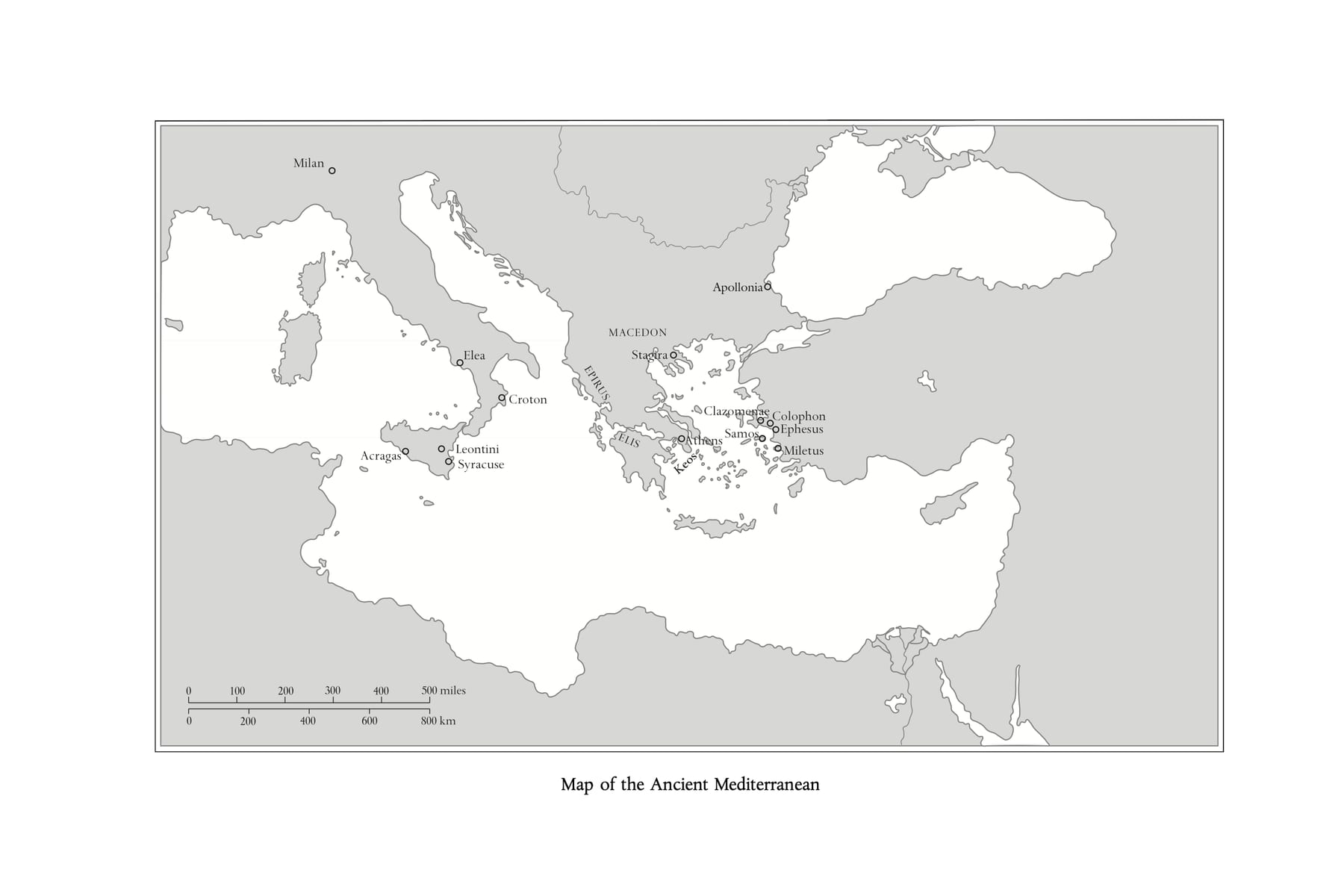
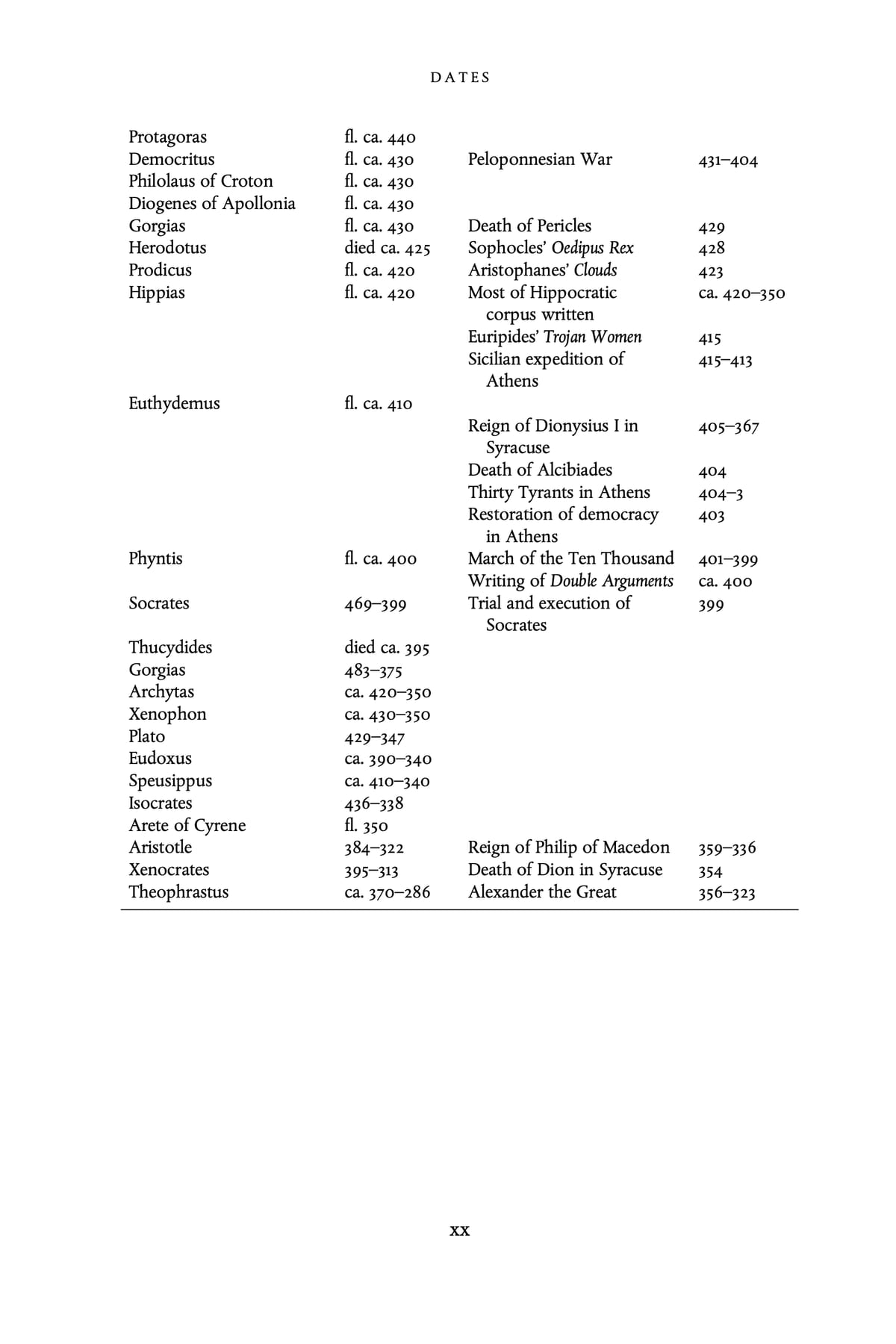
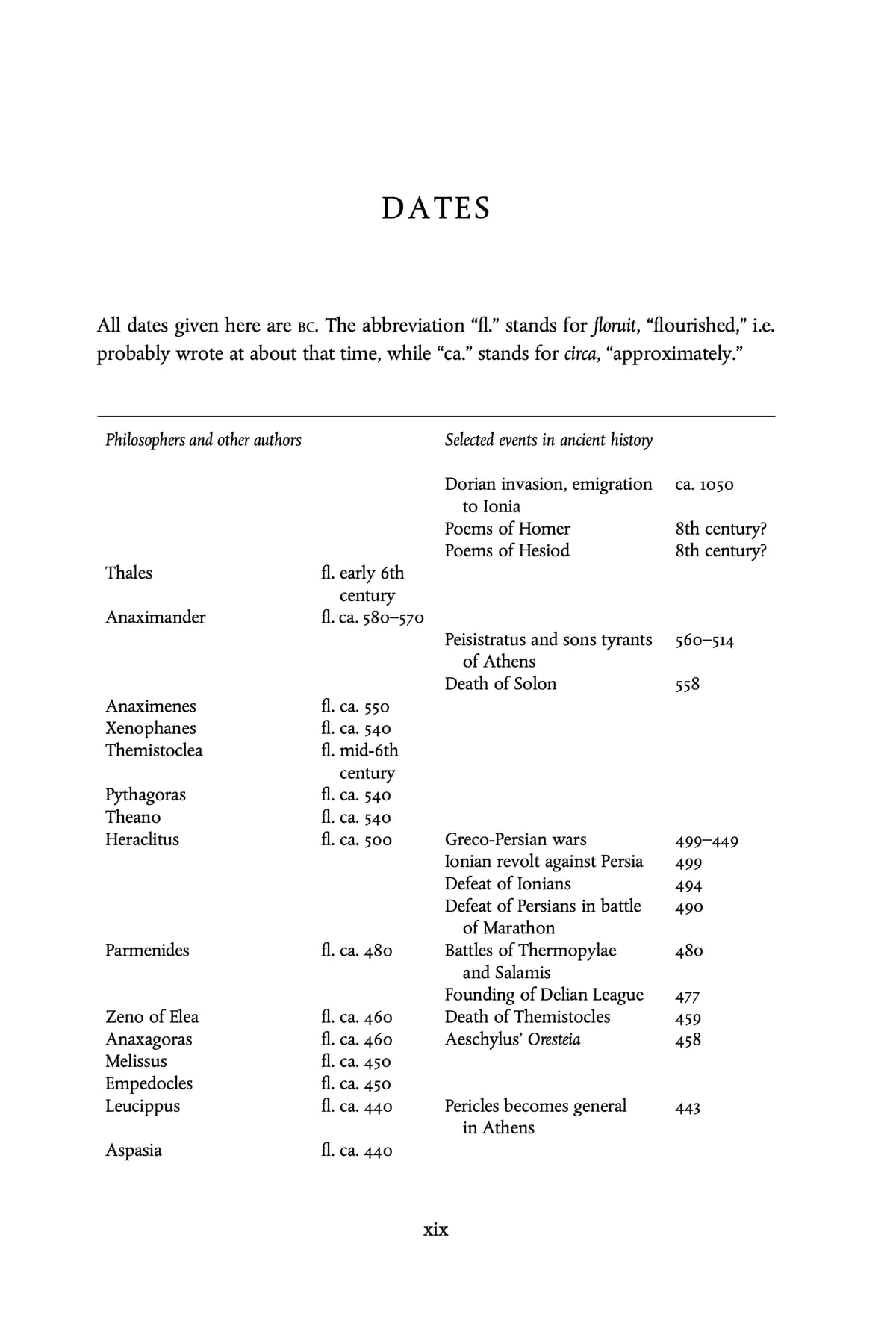
CLASSICAL PHILOSOPHY- a history of philosophy without any — Peter Adamson pages xix - xxi 1.pdf (file not included in this release)
Thales
1. Setting: Ionia, Miletus, and the world around Thales
Philosophy in Greek starts not in mainland Greece but in sixth-century BC Ionia, on the western coast of modern Turkey. After an invasion of mainland Greece by the Dorians (c. 1100 BC), Greek refugees crossed the Aegean and founded colonies there. The name “Ionia” is linked to the legendary leader Ion, and linguistic evidence (similarities between the Ionian and Attic dialects) supports the idea that Miletus was colonized from the region around Athens.
Miletus, Thales’ city, was wealthy and outward-looking. Its economy was built on wool exported across the Mediterranean, and it founded colonies as far as Italy and around the Black Sea. Its southern Ionian location and trading networks brought it into contact with inland Eastern regions and Egypt, making it plausible that Thales’ ideas drew on Eastern or Egyptian traditions. For example, his alleged prediction of a solar eclipse in 585 BC might have relied on Babylonian astronomical tables; there is also some evidence he visited Egypt.
2. Thales as “wise man,” not detached mystic
Miletus was not a place where one could simply contemplate all day; the later Greek ideal of pure contemplation had not yet developed. Aristotle much later defends philosophical contemplation as the highest human activity, but Thales himself appears more as a practical “wise man” than as a withdrawn theorist. He was counted among the “Seven Sages” of early Greece (alongside figures like Solon), known for political wisdom as well as general cleverness.
Thales is reported to have urged all the Ionian cities to form a political union to resist their eastern neighbors. Had this been adopted, it might have extended Ionian independence before these cities fell under Persian control a few decades after his time.
A famous anecdote displays his practical side: using his knowledge of weather, he predicted an unusually good olive harvest and secured exclusive rights to olive-presses in advance. When the bumper crop came, he made a fortune renting out presses, showing that philosophical understanding could, in principle, be turned into profit.
Plato, however, also tells an opposing anecdote: Thales, walking while gazing at the stars, falls into a well and is mocked by a servant girl for ignoring what is right at his feet. This story illustrates the stereotype that philosophers are impractical and distracted. The author suggests we should picture Thales instead as “well-rounded,” engaged both with practical affairs and with the nature of the world.
3. The “Pre-Socratics” and our fragmentary evidence
Thales and the earliest Greek thinkers are usually called “Pre-Socratics” (though some lived alongside Socrates), but the author prefers “Early Greek Philosophy,” since labeling them by reference to a later figure is a bit unfair.
Our knowledge of these thinkers is extremely limited. What we have are “fragments” and “testimonies”:
- Fragments: later authors quoting an early thinker, sometimes verbatim, sometimes in verse where meter helps identify genuine quotations.
- Testimonies: paraphrases or reports about what an early thinker believed, where it is not clear how close the wording or idea is to the original.
Aristotle is one of our richest sources, but he brings complications: he mixes reported doctrines with his own reconstructions of what earlier thinkers “must have” thought, and he reads them through the lens of his own system, making them look like precursors groping toward his views. Even stories like Thales falling into a well may be more like stock anecdotes attached to famous philosophers, comparable to how witty sayings get attributed to Oscar Wilde or Dorothy Parker whether or not they really said them.
With Thales, the uncertainty is especially severe; almost nothing can be said with complete confidence. Still, we can piece together a picture from these scraps.
4. Thales as proto-scientist
One major dimension of Thales’ importance is his scientific activity in a broad, ancient sense. He is closely associated with astronomy (e.g., the eclipse story) and with practical knowledge of physical processes, as in the olive-press anecdote. Other stories credit him with engineering know-how: for instance, he is said to have diverted a river into two branches so that it could be more easily crossed, since each branch would be shallower than the original single stream. Some sources even say he wrote a book on navigation at sea.
This blending of “science” and philosophy is typical for early Greek thinkers and, indeed, for much of philosophy up until the modern period. The sharp separation between philosophy and the natural sciences is a relatively recent development that ancient philosophers would not have recognized.
5. Rationality before and after Thales: Homer and Hesiod
It is traditional to describe Thales and the other Pre-Socratics as “rational,” in contrast to the supposedly “irrational” mythic culture that preceded them. The author argues this contrast is misleading. Our main pre-Thales texts are Homer and Hesiod, and neither is irrational.
- Homer: The Iliad and Odyssey were already cultural touchstones for the Pre-Socratics, comparable in status to the Bible in medieval Europe or Shakespeare in more recent Western culture. The Iliad is a serious reflection on cause and effect in human life—especially the consequences of Achilles’ wrath. Though Homer often explains events via divine intervention, this only appears irrational if belief in gods is deemed irrational in itself.
- Hesiod: His Theogony presents stories about the origins and natures of the gods, organizing and systematizing older material. It has a cosmological aspect that is not far from later Pre-Socratic cosmology. Hesiod’s gods often overlap with cosmological entities—e.g., Ouranos (Uranus) is both “heaven” and a god. This is a kind of rational theology, aiming at consistency and explanatory power.
Rather than seeing the Pre-Socratics as simply rational instead of mythic, the author suggests the real shift is that their views are, at least implicitly, grounded in arguments. That is what distinguishes early philosophy from earlier poetry and myth.
6. Thales’ doctrines: water as a cosmic principle
The chapter finally turns to Thales’ substantive philosophical claims. The best-known one is that water plays a fundamental role in the cosmos. Aristotle reports that Thales believed the world floats on water like a piece of wood, fitting into a wider picture in which the heavens form a dome over a disc-shaped world on a surrounding sea—a view compatible with religious or mythic traditions.
But Aristotle also says Thales treated water as a cosmic principle, suggesting more than a mythic picture. Thales may have anticipated later Pre-Socratic ideas in which diverse materials arise from transformations (condensation, rarefaction) of a more basic stuff. Observing:
- the crucial role of water in sustaining life in plants, animals, and humans,
- the earthy residue left when water evaporates into air,
he may have reasoned that all things ultimately originate from water. Whether he thought everything is literally composed of water (as Aristotle implies) is doubtful. That would require believing that obviously dry, solid materials like rock are in fact water in some transformed state, a more detailed theory later developed by another Milesian, Anaximenes.
7. Soul, motion, and “everything is full of gods”
Another set of doctrines ascribed to Thales concerns soul and divinity. Aristotle reports that Thales attributed soul to magnets and to amber because they can move or cause motion: rub amber and it attracts objects, just as a magnet draws iron. This suggests a principle: where there is the power to initiate motion, there is soul.
Aristotle also attributes to Thales the famous saying that “all things are full of gods.” Taken together, the magnet example and this slogan can be reconstructed into a proto-argument:
- Objects that can move or cause motion (like magnets) must have soul.
- Soul is divine in character.
- At least some seemingly lifeless objects (like magnets, amber) initiate motion.
- Therefore, such objects must contain soul; by extension, it becomes plausible that everything is pervaded by divine soul—“full of gods.”
Whether Thales actually argued this way is uncertain; we are combining separate fragments and filling in gaps. But the reconstruction shows how a seemingly cryptic slogan plus a physical example (the magnet) can be read as a genuine philosophical argument about the presence of soul and divinity in the natural world.
8. What Thales shows about early Greek philosophy
The chapter closes by emphasizing the interpretive challenge and appeal of the Pre-Socratics. Because the evidence is so thin, we must constantly reconstruct arguments from scraps—just as Aristotle did. With Thales, we glimpse:
- a politically and practically engaged “wise man,”
- a proto-scientist linking observation and theory,
- and a thinker proposing bold cosmological and theological claims (water as principle; all things full of gods) that can be understood as emerging from reasoned argument rather than mere myth.
This process of careful reconstruction—taking a handful of reports and turning them into plausible lines of reasoning—is presented as part of what makes studying the early Greek philosophers both difficult and intellectually rewarding.
Anaximander & Anaximenes
1. Sources and the problem of reconstruction
The chapter opens by stressing how astonishing it is that we know anything at all about the earliest Milesian philosophers (Thales, Anaximander, Anaximenes). They lived in the 6th century BC—so far back that even for Aristotle they were already “ancients,” hard to know in detail.
Our main channels of information are:
- Aristotle – especially Physics I, where he tries to classify earlier thinkers by “how many principles of nature” they recognized. But he systematically recasts their ideas in his own conceptual vocabulary.
- Theophrastus – Aristotle’s student, who collected and interpreted earlier philosophical doctrines. He largely follows Aristotle’s categories and way of framing the Pre-Socratics.
- Late antique “doxographies” – compilations that list doctrines of earlier thinkers, often drawing on Theophrastus and forcing these thinkers into neat, schematic systems.
- Other late sources – especially the Platonist commentator Simplicius (6th c. AD), who is unusually concerned to preserve accurate information, and Christian Church Fathers, who often have a hostile attitude toward pagan philosophers.
Because all these sources filter Anaximander and Anaximenes through multiple layers of systematization, polemic, and reinterpretation, reconstructing their thought is “daunting.” Still, we have more material about them than about Thales, and tradition even makes them a teacher-student chain (Thales → Anaximander → Anaximenes), though such neat lineages are probably partly artificial.
2. Anaximander: the apeiron (“the infinite / indefinite”)
Anaximander, slightly younger than Thales, is credited with:
- Scientific/technical achievements such as setting up a gnomon (a sundial-like device) in Sparta and producing an early map of the world showing both land and sea. This fits a Milesian from a major trading hub deeply interested in geography and measurement.
His main philosophical claim is that the principle (archē) of all things is the apeiron – “that which has no limit,” translated as “infinite,” “boundless,” “unlimited,” or “indefinite.”
Key features of the apeiron: - Spatially infinite – it stretches out indefinitely and surrounds our cosmos.
- Eternal – infinite in time as well as space.
- Indefinite in nature – unlike Thales’ water, it is “nothing in particular,” not air, fire, or any specific familiar stuff.
- Source of determinate things – definite natures like air or fire are “separated out” from the apeiron.
So Anaximander’s move is more abstract: instead of choosing one familiar stuff as fundamental, he posits an unlimited, qualitatively indeterminate source from which all determinate things emerge.
3. The famous fragment: justice, retribution, and cosmic cycles
We get our first substantial direct fragment of Pre-Socratic prose from Anaximander, preserved by Theophrastus via Simplicius:
Things come to be and are destroyed “according to necessity. For they mete out penalty and retribution to one another for injustice, according to the ordering of time.”
Although short and somewhat obscure, commentators usually connect it with the apeiron and the “separation off” of determinate stuffs:
- Different substances (hot, cold; fire, air, etc.) emerge from the apeiron.
- These opposites generate and destroy one another, overshooting and then being checked by contrary forces.
- Over long stretches of time, there is a balancing out of these processes—a restoration of “justice.”
- The phrase “according to the ordering of time” suggests some kind of cosmic cycle, an idea also found in Hesiod.
We then get a more concrete cosmology that fits this picture of separated opposites in tension.
4. Anaximander’s cosmology: fire, mist, and the heavens
Theophrastus, again via later reports, gives a mythically vivid but conceptually ambitious account of how the world is structured:
- From the apeiron, hot and cold are separated out.
- Around the air surrounding the earth, a ball of fire forms, enclosing the air like bark around a tree.
- This fiery shell breaks into rings or circles, each surrounded by mist or air.
- Holes in the encasing mist allow us to see portions of the underlying circles of fire—those visible sections are the heavenly bodies (sun, moon, stars).
- The moon’s waxing and waning are explained by the holes in its misty covering gradually opening and closing.
Here, hot vs. cold, fire vs. mist, appear as opposed forces in dynamic interaction: surrounding, enclosing, breaking, shrouding. These are the “opposites” that “pay retribution” to one another, while the apeiron itself remains characterless and inexhaustible in the background.
The theme that emerges:
- Underlying unity (apeiron)
- Endless emergence of opposites that struggle and balance
- Possibly many worlds or cycles – Theophrastus reports that not only stuffs but “worlds” are separated out from the infinite; this might mean multiple worlds scattered throughout the apeiron, or repeated cosmic cycles for our own world.
5. Cosmic drying, early “climate” and the origin of living things
Further testimonies attribute to Anaximander the idea that our cosmos passes through climatic phases:
- The world is currently drying out, with seas gradually retreating as the sun heats them and converts moisture into wind—something like a 6th-century BC version of global warming.
This fits the picture of shifting balances among hot vs. moist/cold, and it leads into his explanation of the origin of animals and humans: - First animals were gestated in moisture, enclosed by a covering which they eventually broke through, “like bark of a tree.”
- Humans, because of their helpless infancy, could not have appeared in their current form at the very beginning; the first humans were carried and nourished inside fish, and only once they reached adulthood did they emerge.
The author stresses: this is not a proto-Darwinian evolution theory (no gradual transformation of fish into humans). Rather, it’s an attempt to work out the consequences of the idea that everything originally comes from moisture, developing Thales’ suggestion that water is fundamental into a more detailed natural history.
6. Anaximander’s abstract, argumentative turn
Compared to Thales, Anaximander seems to take a more abstract and conceptual approach:
- The apeiron is a bold conceptual innovation, derived from argument rather than direct observation—an attempt to explain how the many and opposed can arise from an underlying unity.
- He also offers a rational explanation for why the earth stays where it is:
- The earth is a squat cylinder (like a drum); we live on the top.
- It remains motionless because it is exactly at the center of the cosmos, so there is no reason for it to move in one direction more than any other; the symmetry of possible directions itself explains its rest.
This demand for a good reason (a kind of proto-principle of sufficient reason: no movement without an asymmetry to justify it) is philosophically significant. It shows a move away from mythic narratives towards explicit, argument-driven explanation.
7. Anaximenes: air as infinite principle, with determinate processes
The next Milesian, Anaximenes, partly returns to a more concrete starting point while building on Anaximander’s insights:
- He agrees that the principle of everything is infinite, but he identifies it specifically as air.
- He doesn’t simply revert to Thales; instead, he introduces a systematic account of change via thickening and thinning.
Anaximenes’ generation of stuffs: - Start with air.
- If air is made thinner (more rarefied), it gets hotter and becomes fire.
- If air is made thicker (more condensed), it gets colder and becomes:
- wind, then
- cloud, then
- water, and finally
- earth and rocks.
Why air as the original? The text suggests three motivations:
- Fluidity and dynamism – air is constantly in motion; choosing it emphasizes the dynamic, changing character of nature.
- Middle position – unlike purely hot fire or purely cold earth, air can be transformed both ways (into hotter or colder states), so it can plausibly underlie both.
- Invisibility – if there is an infinite, unbounded substance surrounding us in all directions, it must be something we do not see; hence air is a natural candidate.
So Anaximenes retains the infinite character of the principle, but identifies it with a specific, familiar stuff governed by a simple quantitative process (rarefaction/condensation) that yields the variety of the world.
8. Anaximenes’ cosmology and the microcosm idea
Like the other Milesians, Anaximenes uses his principle to explain the structure of the cosmos:
- The earth is disc-shaped, formed from condensed air, and “rides” on air in its original state—like Thales’ earth floating on water. The author jokingly likens this earth to a frisbee, though ancient sources don’t use that metaphor.
- The heavenly bodies (stars, sun, moon) are made of fire, and he compares them to fiery leaves floating in the surrounding air.
- The heavens rotate around the earth like a felt hat spinning around someone’s head—a vivid image used to convey cosmic rotation.
On the soul, Anaximenes stays loyal to his preferred element: - The soul is air, specifically breath (pneuma).
- Since animals die when they stop breathing, breath seems essential to life.
- He draws a comparison between the human body and the cosmos: both are sustained by the fundamental substance, air. This anticipates the long-lasting idea of the human as microcosm—a small version of the universe.
The author notes that this parallel – cosmos and man sharing the same basic life-stuff – appears also in Heraclitus (fire) and perhaps already in Thales (soul in magnets suggesting pervasive soul in the cosmos). The microcosm theme is “in the air” from early on.
9. Divinity, first principles, and the transformation of religion
Both Anaximander’s apeiron and Anaximenes’ air are described as divine. Anaximander even says the infinite “steers” everything, though it’s unclear how—perhaps by enforcing the cosmic “justice” in the interplay of opposites that emerge from it.
Crucially, these thinkers are not abandoning the divine; rather, they are recasting it:
- Anaximenes reportedly says that there are gods, as traditional Greek religion claims, but adds that even these gods arise from air.
- The early Milesians thus retain a sense of religious awe before a dynamically changing cosmos, but they embed divinity in the fundamental principles and processes of nature, not only in anthropomorphic Olympian figures.
The chapter closes by foreshadowing Xenophanes, who will attack Homeric and Hesiodic conceptions of the gods much more directly. His critique begins a long rivalry between Greek religion and Greek philosophy that continues into Plato and Aristotle.
Concise wrap-up
- Anaximander advances beyond Thales by positing the apeiron—an infinite, eternal, qualitatively indeterminate principle from which determinate opposites separate out and struggle, restoring “justice” over time in cyclical processes. He proposes elaborate cosmological and biological accounts (fire-rings in the heavens, drying seas, animal origins from moisture and fish) and offers abstract arguments, like his symmetry-based explanation for the earth’s stability.
- Anaximenes retains the idea of an infinite principle but identifies it with air, explaining the variety of stuffs by a quantitative process of rarefaction and condensation. He constructs a full cosmology (disc-earth on air, fiery celestial leaves, rotating heavens) and treats air/breath as soul, suggesting a microcosm relation between humans and the universe.
- Both thinkers still treat their principles as divine, not in a mythic story-telling way, but as sacred, governing realities. Taken together, they show early Greek philosophy moving toward abstract, systematic, and argument-driven explanations of nature, while still wrestling with inherited religious ideas—a tension that will become explicit in Xenophanes.
Xenophanes
Xenophanes’ chapter is about a radical rethinking of the Greek gods: instead of human-like, quarrelsome deities from Homer and Hesiod, he proposes a single, wholly different God and adds a new skepticism about what humans can know about the divine.
1. Homer and Hesiod as the religious “background”
Adamson starts by reminding us how scandalous the traditional myths look if you take them seriously as theology:
- In the Iliad, Hera seduces Zeus (with help from Aphrodite and the personified god Sleep) to distract him so the Greeks can injure Hector. Afterward Zeus wakes up furious and threatens to whip Hera.
- In Hesiod’s Theogony, Kronos castrates his father Ouranos; Aphrodite is born from the foam around his severed genitals; Aphrodite and Ares are caught committing adultery, and so on.
Despite such lurid stories, the Greeks still worshipped these gods, sacrificed to them, and treated Homer and Hesiod almost like sacred texts. Philosophers cannot ignore them any more than medieval thinkers could ignore the Bible, but Greek philosophers are far more openly critical—none more so than Xenophanes.
Homer’s gods: humanlike agents behind everything
In the Iliad:
- The poem focuses on the “wrath of Achilles” and the events of the Trojan War, but the gods are deeply involved in every major action.
- They function as “explanations of last resort”: courage, cowardice, victory, and defeat are all attributed to divine influence—gods put courage into warriors’ hearts or drain it away.
- Humans can look like mere playthings of the gods, yet the gods themselves are very human: they get angry, deceive, seduce, quarrel.
So in Homer, the human realm is projected upward into the ultimate explanatory level: the gods behave like flawed super-humans.
Hesiod’s gods: cosmic genealogy and ritual explanations
Hesiod gives a more cosmogonic perspective:
- In the Theogony, he tells the story of Chaos (a primordial gap), Gaia (earth), Ouranos (heaven), and the birth of other gods like Kronos and Zeus through divine coupling.
- This looks a bit like the Milesians’ cosmology (everything from water, air, etc.), but done through divine genealogies rather than physical principles.
- Hesiod explains specific practices—e.g., Prometheus tricking Zeus into taking bones and skin rather than meat explains why humans can eat sacrificial meat.
Unlike the early philosophers, Hesiod is not arguing; he’s declaiming epic poetry meant to inspire awe, even though his gods lie, cheat, sleep around, and fight.
Importantly, all later philosophers know Homer and Hesiod intimately. Plato and Aristotle quote them constantly and even treat them as sources of proto-philosophical ideas, which is exactly why a clash between “poets” and “philosophers” is possible.
2. Xenophanes: the poet who attacks the poets
Xenophanes is a traveling poet from Colophon (on the coast of Asia Minor, north of Miletus) who likely lived through much of the 6th century BC, composing elegiac poetry performed at banquets. He may have visited Sicily and perhaps Elea in Italy. His philosophical fragments are verses.
Unlike the Milesians, who quietly replace gods with natural principles, Xenophanes explicitly attacks Homer and Hesiod:
- He condemns them for attributing adultery, theft, deception, and other disgraceful behaviors to the gods.
- For him, this is not just bad philosophy; it is impious and morally corrupting.
He is the first to openly challenge the poets’ authority on religious matters.
3. Projection theory: “created in our image”
Xenophanes introduces a powerful critique: humans make gods in their own image.
- Greeks imagine gods who are born of parents, wear clothes, speak their language, and share their culture.
- Different peoples imagine different gods: Ethiopians say the gods have black skin; Thracians think they have blue eyes and red hair.
- Xenophanes jokes that if cattle or horses could paint, they would depict gods that look like cattle or horses.
This looks like a very modern line: not “God created man in His image,” but humans create gods in theirs. Yet Xenophanes is not an atheist; he is offended because such anthropomorphic projection insults the genuine divine.
He also criticizes mythic themes themselves: in non-philosophical poems he says poets should sing pious hymns, not tales of wars between gods, giants, and Titans. It sends the wrong message, especially about moral behavior.
4. A radically different God
Instead of humanlike gods, Xenophanes sketches a radically transcendent deity by systematically reversing the poetic model:
- Not humanlike, but utterly unlike us: God shares nothing with humans except something like intellect.
- Needs nothing: sacrifice is unnecessary; God has no needs that offerings could meet.
- No movement or bodily activity: God does not travel or act physically; he may not have a body at all.
- Supreme power through thought: Xenophanes says God can “shake everything” by thinking—an echo, but a transformation, of Homer’s Zeus who shakes Olympus.
- Pure cognition: God “sees, thinks, and hears as a whole,” apparently doing nothing except think and perceive.
One famous line says: “God is one, among gods and men, greatest, and unlike mortals in body and thought.” This is ambiguous: - It might be monotheism: there is only one God.
- Or it might be a single supreme God above lesser deities.
Either way, Xenophanes is moving toward a single, perfect, non-anthropomorphic divine principle, analogous in some ways to the Milesians’ single basic principle (water, air, apeiron), but now moral and theological rather than physical.
5. Demythologizing nature: clouds and gathered fire
For the jobs the poets assign to their gods, Xenophanes offers physical explanations:
- The rainbow is not the goddess Iris; it is simply a cloud with colors.
- The sun is not the god Helios; it is a mass of gathered fire.
Here he extends the Milesian project: replace mythic explanations with naturalistic ones, while still keeping a sense of religious seriousness. It looks “scientific” in method (clouds, fire, etc.), but it is motivated by piety: a truly divine God must be perfect and not subject to petty emotional dramas.
God’s only “activity” is thinking; humans share this capacity, but God’s thought is incomparable to ours. Thinking is the one human capacity that is worthy to ascribe to the divine; everything else (movement, passions, bodily functions) is stripped away.
6. Epistemic humility: belief versus knowledge
Strikingly, Xenophanes combines bold theology with deep skepticism about human knowledge:
- He says no human has genuine knowledge about the gods or the things he is describing; even if someone happens to state the truth, they still do not know it.
- He distinguishes between believing and knowing: our best theories about the divine are at most “like the truth,” not demonstrably the truth.
- In another fragment, he says of his own teachings, “let these things be believed, as being like the truth.”
So he introduces a crucial philosophical distinction: even true belief is not the same as knowledge. This anticipates Plato’s and later thinkers’ systematic work on the difference between doxa (opinion/belief) and epistēmē (knowledge). ^dy75
Yet Xenophanes is not paralyzed by this skepticism: - He thinks we should aim at the most plausible, fitting beliefs about God.
- His own conception of a single, non-anthropomorphic God is, in his view, far more appropriate than the scandalous myths.
- We may not know that God merely thinks and shakes all things by thinking, but we are rationally obligated to prefer this over tales of divine adultery and violence.
7. Lasting impact
Adamson closes by highlighting how Xenophanes’ themes echo through later philosophy:
- The projection critique (gods as human self-images) will reappear in various forms throughout intellectual history.
- The distinction between belief and knowledge, especially about unseen realities like the divine, becomes central to later Pre-Socratics and to Plato and Aristotle.
- The rivalry with poets continues: Heraclitus later mocks both Hesiod and Xenophanes, saying that simply learning many things doesn’t make one intelligent.
Xenophanes thus marks a turning point: he is both a religious reformer and an early theorist of knowledge, using the tools of critical reflection to reshape the Greek understanding of the gods and to humble human claims about what can be known of the divine.
Heraclitus
Heraclitus’ chapter presents him as the “ultimate” Presocratic: a riddling, fragmentary thinker who tries to give a single, unified account (logos) of everything, centered on fire, change, and the unity of opposites.
1. Heraclitus the “riddler” and his book On Nature
- Heraclitus of Ephesus is grouped with the Milesians (Thales, Anaximander, Anaximenes) in wanting a single fundamental principle of reality; his is fire.
- Unlike them, he writes in one-liners and dense aphorisms – “the riddler” or “Heraclitus the obscure.”
- He did write a treatise called On Nature (Peri Physeōs), but the surviving fragments mostly look like short, stand-alone sayings rather than continuous prose.
- Topics covered include: the cosmos, politics, and the gods.
2. Logos: the hidden account that “always is”
- In the one substantial “book-like” fragment (likely his opening), Heraclitus says:
“Of the logos which is always, men prove not to understand.”
- The word logos is deliberately multivalent:
- “word,” “speech,”
- “account,” “explanation,”
- “reason,” “measure,” “proportion.”
- He plays on the ambiguity of “always” (aei): it can go with logos (“the logos always is”) or with human failure (“humans always fail to understand”).
- People live surrounded by evidence of the logos yet miss it; his project is to wake them up to this ever-present rational structure of reality.
- Another early fragment:
“Hearing not me, but the logos, it is wise to agree that all things are one.”
- We are not to believe him because he says it, but because the logos itself demands assent.
- This is a kind of monism, but not a flat denial of plurality; rather, all the many things form one unified reality.
3. Unity of opposites: seeing both sides at once
Heraclitus’ central idea is that reality is a unity of opposites. He uses riddling examples:
- Sea-water is healthy for fish but poisonous for humans – same stuff, opposite properties.
- The bow pun: its name is bios (“life”) but its function is death.
- Donkeys prefer garbage to gold – gold is precious to us but worthless to them; garbage is the reverse.
- “The road up and down is one and the same” – not just “depends on your perspective,” but literally:
- the same physical path really is both the upward road and the downward road at once.
Our problem: we only grasp one side of these opposites at a time (gold’s value, not its worthlessness; the uphill path, not the downhill). We fail to hear the logos because our vision is partial and narrow.
- the same physical path really is both the upward road and the downward road at once.
4. Change, conflict, and why stability is in motion
- Heraclitus insists that change and conflict are not threats to unity but its very mechanism.
- Example: a barley drink (or, for us, a salad vinaigrette) “stands still, but only when it moves.” It only keeps its proper nature while it is being stirred; its stability depends on ongoing motion.
- He speaks of the world as a constant “war” or “strife” in which opposites are in tension.
- The paradox he wants to express:
- stability in and through change,
- unity in and through opposition.
- His fragmentary, puzzle-like writing style mirrors this paradoxical content.
5. The “flux” misreading and the river fragments
Later tradition, especially Plato’s Theaetetus, sets up a neat contrast:
- Heraclitus: everything is always changing; no stability.
- Parmenides: no change at all; strict unity.
This is based on the famous line: - “You can’t step into the same river twice.”
A later self-styled Heraclitean, Cratylus, pushes this to an extreme – you can’t even step into the same river once; nothing can be named because it is always flowing away.
Adamson argues this is a misreading: - A more authentic Heraclitean formulation is:
“Different waters flow over those who step into the same rivers.”
- So:
- The river is the same across time,
- Yet its waters are continuously different.
- This again is unity of opposites: the river is both same and different, persisting and changing at once.
- Heraclitus can affirm pervasive change without denying the continuity of things; indeed, this is why “all things are one.”
6. Fire as fundamental element and cosmic currency
Heraclitus makes fire his basic element:
- “All things are exchanged for fire, and fire for all things; like gold for goods and goods for gold.”
- Fire consumes things, turning them into itself (forest into blaze), but can also be transformed into water and earth; there is a fundamental opposition and exchange between fire and water.
- This recalls Anaximander’s talk of things paying “retribution” to one another, but Heraclitus uses an economicanalogy instead of a legal one.
- He also gives a cosmology:
- Sun, moon, planets, and stars are bowls full of fire turned toward us.
- The moon’s waxing and waning: its fiery bowl slowly turns so we see more or less of the fire.
- The intense interest in heavenly fire continues a Presocratic fascination with the night sky as something demanding explanation.
7. Soul as fire and the “moist soul”
Heraclitus develops a fiery theory of the soul:
- The soul is made of fire (in a broad sense: dry, warm, fast-moving substance).
- Death occurs when the soul turns into water.
- The “driest” souls are the wisest; the moist soul is confused and impaired.
- He explains drunkenness by saying that a drunk person’s soul is moist – literally soaked by wine.
- He ties soul to breath: by breathing we take in fire from the cosmos along with air.
- This parallels his cosmology: both stars and souls are fiery, hinting that humans share a nature with the divine heavenly realm.
8. Law, politics, and divine order
Though famous as a loner and riddler, Heraclitus also has political fragments:
- He emphasizes obedience to the city’s laws, saying they should be guarded like the walls during a siege.
- He adds that human laws are nourished by the divine law – suggesting that civic justice should reflect a deeper cosmic order (perhaps the same logos that structures everything).
- A charming but probably fictional anecdote says that when asked to write laws for Ephesus, he refused and preferred to play with children.
These political remarks suggest a link between his metaphysical ideas (logos, divine order, unity of opposites) and norms of justice in human communities.
9. Death legend and thematic unity
A colorful legend ties together his themes:
- Heraclitus supposedly withdraws from society, lives on wild plants, develops dropsy (watery swelling).
- He riddlingly asks doctors if they can “make a drought out of a rainstorm.”
- When they fail, he tries to cure himself by burying his body in dung to sweat out the moisture through heat—then dies.
The story is almost certainly fictional but cleverly weaves: - his riddling style,
- his disdain for people,
- his heat vs. moisture theory of life and soul.
10. Heraclitus as early system-builder
The chapter ends by stressing that Heraclitus, despite the aphoristic style, is systematic:
- His sayings on logos, unity of opposites, fire, soul, law, and divine order belong together and illuminate each other.
- A fragment about the lyre and bow says people fail to see how things are “brought together” by being “pulled apart” – the instruments are held together by tension. This explicitly interprets his earlier bow pun as a model of unity through opposition.
- In this way, Heraclitus anticipates later philosophers like Plato and Aristotle, who connect metaphysics, psychology, ethics, and politics into unified systems.
- Parmenides will go even further, with two explicit “systems” (truth vs. opinion), marking the beginning of what Adamson calls the enduring era of metaphysics.
Short recap
- Logos: a rational account / measure that explains everything but is ignored by most people.
- All things are one: the world is a unified whole, but that unity consists in opposed aspects held in tension.
- Unity of opposites: same road up/down, same river same/different, same water healthy/poisonous; our mistake is to see only one side.
- Change and fire: reality is in constant change and “strife,” symbolized by fire, but that dynamism is exactly how unity is achieved.
- Soul and cosmos: both are fiery; the driest soul is wisest; human life is linked to the divine stars.
- Law and order: human laws should mirror a deeper divine law, perhaps the same logos.
Heraclitus thus stands as a bridge from early Presocratic speculation to later, more explicit metaphysical systems, using riddling fragments to articulate a deeply unified vision of a world where stability is found in ceaseless change.
Parmenides
1. Setting the stage: metaphysics and the 5th century shift
Adamson opens by situating Parmenides in the history of philosophy and in Greek history. He sketches the main branches of philosophy—ethics and political philosophy (from ethos and polis), and especially epistemology (epistēmē, knowledge) and metaphysics, “first philosophy,” the study of being as such: what exists and what its most fundamental features are. Aristotle later gives metaphysics its name and its explicit scope, but Parmenides is presented as the first thinker clearly doing this kind of inquiry.
Chronologically, Parmenides is the first fifth-century BC philosopher discussed so far. Plato even stages a meeting between an older Parmenides and a young Socrates. Historically, the 5th century is tumultuous: Persian invasions, the later Peloponnesian War between Athenian and Spartan alliances. Intellectually, it’s a boom time: mature Parmenides and Socrates, the rise of Pythagorean mathematics, advances in Greek medicine, and the cosmologies of Empedocles, Anaxagoras, and the atomists.
Because Ionia is under Persian-dominated client kings and mainland Greece is chaotic, philosophical activity shifts west to Italy and Sicily. Parmenides and his follower Zeno are from Elea in Italy, giving rise to the label “Eleatics.”Plato’s character the “Eleatic Stranger” in the Sophist later represents this school.
2. Parmenides’ shocking thesis and poem structure
Parmenides’ doctrine is more radical than anything so far:
- Reality is one: no genuine multiplicity of objects, colors, or events.
- Nothing ever changes or moves.
- All variety and temporal succession are illusion.
He presents this in a poem written in hexameter verse. The first half is a relentless rational argument—the “way of truth”—based purely on reasoning, not experience. The second half is the “way of opinion,” offering a cosmology similar to earlier Ionians.
This puts him in striking contrast to Heraclitus: both think everyone else is confused about reality, but where Heraclitus emphasizes observation (eyes and ears), Parmenides leans entirely on abstract argument.
3. The proem: divine revelation and two “ways”
Because his conclusions are so startling, Parmenides dramatizes his teaching as a revelation from a goddess. In the proem, he rides in a chariot with maidens up to the gates between Night and Day. The goddess Justice (Dikē) is persuaded to let him through and tells him he has found a road “that mortals do not travel.”
She promises he will learn two things:
- The truth – the unity of being (the way of truth).
- The opinions of mortals – an account of the world as they take it to be (the way of opinion).
This division is not just literary; it marks a major move in epistemology. Xenophanes had already distinguished belief from knowledge, but Parmenides builds his entire poem around that divide: one half for what is (known by reason), one half for the best “second-best” beliefs about the apparent world.
4. The “way of opinion”: second-best but still serious
Although Adamson focuses on the way of truth, he emphasizes that Parmenides takes the way of opinion seriously.
- The second part of the poem (not fully preserved) gave a cosmology and natural science—explanations of heavenly bodies, the human body, and more.
- In a transition fragment, Parmenides warns that this way “is not to be trusted” like the way of truth, but it is still the most plausible set of views available for those who cannot grasp the unity of being.
- In effect: If you insist on believing in the world of multiplicity and change, at least adopt my false-but-most-reasonable account of it.
So, Parmenides is not indifferent to empirical explanation; he just regards it as epistemically inferior to the pure metaphysical truth about being.
5. The core argument: “is” vs “is not”
The way of truth begins by contrasting possible “paths of inquiry”:
- “Is, and must be” – the path of being.
- “Is not, and cannot be” – the path of non-being.
- A third, worse path: both “is” and “is not.”
Parmenides excludes the second path because it requires thinking about what is not, and he claims non-being cannot be meaningfully thought or spoken of. The third path is even worse: it both tries to think non-being and falls into contradiction (“is” and “is not” together). This, he says, is the path most people take, hence their confusion and unrecognized self-contradiction.
A key difficulty: in Greek there’s no explicit subject for the verb “is.” So Parmenides just says “is” and “is not,” letting the verb “float.” Adamson illustrates with a giraffe:
- If the giraffe is, we can talk and think about it.
- If there is no giraffe, it’s hard to see how we can truly think or speak about it.
- Worst of all would be to say the giraffe both is and is not.
The correct path is therefore to allow only being and to avoid any reference to non-being.
6. Consequences: no coming-to-be, no passing-away, no change
Once we commit to thinking only of “is,” Parmenides infers several consequences:
- Being cannot begin to be: to “start being” it would have to come from non-being, which is unthinkable.
- Being cannot cease to be: destruction would mean becoming non-being, which is likewise impossible.
So: - There is no genuine coming-to-be or passing-away.
- More broadly, change is impossible. For any change, something must become what it previously was not, or cease to be what it was—each case involving non-being.
Adamson raises a tempting objection: what about mere alteration, like painting a giraffe blue? That doesn’t destroy the giraffe. Parmenides would still object: - The giraffe goes from “not-blue” to “blue”, or
- The “blue giraffe” comes to be after there was no blue giraffe.
Either way, we sneak in non-being (“no blue”, “no blue giraffe”), which is forbidden. So any change whatsoever is ruled out.
7. No plurality, no division: being is one and continuous
The same style of reasoning undermines difference and multiplicity:
- To contrast a blue giraffe with a non-blue one, we again invoke “not-blue.”
- Any difference between things presupposes that something is not something else, which requires non-being.
So: - Being is one over time (it cannot be one way at one time and another way later).
- Being is also one at a time—no internal differences.
Parmenides adds an argument against division: - If being were divided, there would have to be gaps or boundaries within being.
- Those gaps would themselves be non-being, different from being.
Therefore, being is undivided and continuous; every “part” is exactly like every other, in fact not really a distinct part at all.
8. The spherical perfection of being
At this point the “being” he is describing is almost impossible to picture, so Parmenides offers an image: being is like a sphere.
- The sphere analogy underscores that being is limited and determinate in some way (it has a “shape”).
- This is puzzling: if being is spherical, what’s “outside” the sphere? That would seem to be non-being, which we’re not allowed to think.
Adamson notes some interpreters take the sphere as metaphorical—meant only to indicate that being is determinate and complete. Others think Parmenides may mean it literally and see an influence of Pythagoreanism, where the sphere is the most perfect shape.
Parmenides also argues that being is perfect: - If it lacked anything it could have, that lack would be a kind of non-being within being.
- Since non-being within being is impossible, being must be complete and perfect.
9. Why this matters: deductive metaphysics and its legacy
The preserved fragments of the way of truth come to us largely thanks to the late antique commentator Simplicius, who copied long excerpts into his commentary on Aristotle because Parmenides’ poem was already rare.
Adamson underlines the breakthrough:
- Parmenides offers an explicit, complex deductive argument based on a simple starting point: “you can have ‘is’ but not ‘is not.’”
- He trusts reason over the senses, willing to deny the entire apparent world of change and plurality if argument demands it.
- This marks a “quantum leap” in philosophy: instead of explaining specific phenomena (like Milesian cosmology), Parmenides tackles the nature of being itself at the most abstract level.
Very few later philosophers accept his final conclusion that reality is a single unchanging sphere. But elements of his reasoning echo throughout later thought: - Medieval theology adapts his “perfection of being” style argument to discussions of God’s perfection.
- Plato and Aristotle wrestle extensively with his challenge: Aristotle in particular tries to show how change and plurality are possible without collapsing into Parmenidean problems about non-being.
- Parmenides’ immediate followers, the Eleatics, try to defend his astonishing doctrine more directly. Zeno of Elea develops famous paradoxes of motion and plurality (Achilles and the tortoise, the arrow, etc.) to show how belief in change and multiplicity leads to contradiction—exactly as Parmenides warned.
The chapter ends by flagging Zeno as the next topic: his paradoxes will be presented as a rigorous attempt to make good on Parmenides’ claim that no one can think non-being without ending in contradiction.
The Eleatics
1. Zeno, paradoxes, and the Eleatic project
Zeno of Elea (early 5th c. BC) is presented as Parmenides’ associate and disciple, using paradoxes to defend Eleatic doctrines: that motion and plurality are impossible and that being is one. “Paradox” (para doxa) means “against belief”—Zeno wants to show that our ordinary beliefs about movement and many things existing lead to contradiction.
Adamson starts with a tennis-court version of Zeno’s Dichotomy (Stadium) paradox: to walk across the court, you must first go halfway; to reach halfway, you must go halfway to halfway; and so on, generating an infinite sequence of halfway points. The thought: to get anywhere you must complete infinitely many tasks, which seems impossible—so motion is impossible, even though we constantly experience it.
This illustrates the general role of philosophical paradox: whether about ethics, time travel, or logic, paradoxes force us to rethink what we take for granted and demand some resolution, not easy relativism (“both possible and impossible”).
2. Zeno’s aim: not rescuing common sense but destroying it
Most modern readers assume the task is to “find the mistake” in Zeno and vindicate common sense. But Zeno’s actual aim is the opposite: as Plato’s Parmenides depicts, he is deliberately trying to show that belief in change and multiplicity is incoherent and self-contradictory.
We know Zeno wrote at least one book of arguments, possibly structured in pairs of paradoxes:
- One argument: if things are many, they must be finite.
- Another: if things are many, they must be infinite.
- Taken together, plurality implies being both finite and infinite—which is a contradiction, so there cannot genuinely be “many” things; being must be one, as Parmenides said.
Adamson focuses on a handful of the best-known paradoxes.
3. The Dichotomy paradox and Achilles vs. the tortoise
Dichotomy
Reformulated without the tennis court:
- To move from A to B, you must first reach the midpoint C.
- To reach C, you must first reach the midpoint D between A and C.
- And so on, with infinitely many midpoints.
Conclusion: moving from A to B requires either - contact with infinitely many points in finite time, or
- performing infinitely many distinct partial motions.
Either looks impossible; thus motion cannot occur.
Achilles and the tortoise
A similar structure underlies the Achilles paradox:
- Achilles gives a tortoise a head start.
- Each time Achilles reaches where the tortoise was, the tortoise has moved on a bit.
- This creates an infinite sequence of “catch-up” points; Achilles must reach each in turn, so he never actually overtakes the tortoise.
These arguments turn the ordinary idea of continuous motion into something that, when analyzed, seems to demand an impossible traversal of an actual infinity.
4. Can modern math or Aristotle “solve” Zeno?
Adamson addresses a popular answer: modern calculus lets us accept that the infinite series
1/2 + 1/4 + 1/8 + 1/16 + … = 1
so an infinite sequence of sub-intervals can add up to a finite distance and time. But this doesn’t defeat Zeno; it presupposes exactly what his paradox exploits: that the total is the sum of an infinite series. Zeno’s deeper question is not about the arithmetic but about how this mathematical model relates to real time, space, and motion.
Aristotle’s response in Physics:
- He says we can divide time along with distance.
- If going from A to B takes 20 seconds, halfway takes 10, a quarter 5, and so on.
- Thus, there is no need for infinite time to traverse infinitely many sub-segments; each is paired with a progressively shorter time.
Adamson notes this only addresses one version of the worry (infinite time). Zeno may instead be claiming that it is impossible to perform infinitely many distinct partial motions in any finite time, no matter how the durations are divided—Aristotle’s answer then doesn’t fully neutralize the paradox.
5. The Arrow paradox and instants of time
Zeno’s Arrow paradox goes at motion via time slices:
- Consider an arrow mid-flight.
- At any given instant, “freeze-framed,” the arrow is exactly at rest in the bit of space it occupies—“against something equal.”
- This is true at every instant during its “flight.”
- So, at every instant, the arrow is motionless; but the flight is just the sum of instants.
- Therefore, motion is impossible.
Aristotle’s reply: - Time is not made up of dimensionless instants (“nows”) but of intervals that have some duration.
- Even a tiny interval (e.g., a millionth of a second) allows the arrow to move a bit.
Zeno would push back: if nothing moves “now,” then it is unclear how motion can arise from any collection of “nows,” even if we treat them as durationless. The paradox again presses the question: what is the structure of time? Is it continuous? Composed of indivisible instants? Either way seems problematic.
6. Zeno on plurality: infinitely many things between any two
Not all of Zeno’s paradoxes target motion; some attack plurality itself. One argument tries to show that between any two distinct things, there must be infinitely many others:
- Take two objects, A and B. Because they are distinct, they must be separated by some third thing, C.
- But then C must be distinct from A and B, so there must be something separating A from C, and another separating C from B.
- Repeating this reasoning yields an infinite regress of separating things.
To avoid this, one needs a coherent account of how two distinct things can be in direct contact without forming one continuous object. Aristotle again takes this up seriously in Physics, developing a theory of contact partly as a response to Zeno.
The general moral: even if Zeno’s paradoxes don’t convince us to accept Eleatic monism, they force us to refine our concepts of motion, time, space, and contact. That’s why they remain philosophically fruitful.
7. Melissus of Samos: extending and revising Parmenides
The chapter then turns to Melissus of Samos, another Eleatic. He is “Eleatic” by doctrine, not by birthplace—Samos is an island off the Ionian coast (also associated with Pythagoras). Melissus was politically significant; Plutarch reports that he led a naval victory over the Athenians in the mid-5th century BC. Chronologically he is probably a generation younger than Parmenides, perhaps younger than Zeno as well.
Melissus follows Parmenides’ positive method rather than Zeno’s destructive one:
- He argues directly that being is ungenerated and eternal: it cannot have started to be, since that would require coming from non-being.
- He applies this not only to time but also to space.
Here he modifies Parmenides: - Parmenides likened being to a sphere, suggesting a kind of bounded completeness.
- Melissus insists being is unlimited / infinite (apeiron): if it had a limit, there would be non-being beyond that limit, which is impossible.
- In this sense, he brings back something like Anaximander’s apeiron inside the Eleatic framework.
Thus Eleatic philosophy is not a static dogma; it evolves as Melissus pushes its implications in new directions, even at the cost of contradicting Parmenides’ imagery.
8. Melissus on void and motion: setting up the atomists
Melissus also offers a famous argument against motion:
- Again, he bans non-being in any form.
- He now focuses on emptiness / void—literally places where there is nothing.
- If there is no such thing as “nothing,” then void is impossible.
- Without void, motion is impossible: there is no empty space into which anything can move.
- Being is like an overpacked train compartment with no room to budge.
This leaves future philosophers with two options if they want to save motion:
- Deny void but keep motion, as Aristotle does:
- Whenever something moves, something else is displaced—like people in a crowded train shuffling forward into each other’s places.
- Accept void, as later atomists do (Leucippus, Democritus):
- Reality consists of atoms moving in the void.
- There are genuine empty spaces with nothing in them, both in outer space and within bodies (modern physics’ picture of mostly empty atoms).
Adamson points out that the idea of atoms in the void—so familiar to us from modern science—was first formulated as a direct response to Eleatic arguments, especially Melissus’ denial of a void.
Compact recap
- Zeno uses paradoxes (Dichotomy, Achilles, Arrow, and plurality arguments) to show that taking motion and plurality seriously leads to contradiction, bolstering Parmenides’ claim that being is one and changeless.
- Attempts to solve Zeno—via modern calculus or Aristotle’s theories of time and contact—reveal the depth of the issues, not just a naive confusion. His paradoxes force careful reflection on infinity, continuity, time, space, and motion.
- Melissus develops Eleatic metaphysics positively: being is ungenerated, eternal, and infinite, and there can be no void, which would introduce non-being. From this he concludes motion is impossible.
- In resisting these Eleatic conclusions, later philosophers either refine a no-void / motion-without-emptinessview (Aristotle) or embrace void and atoms (Leucippus, Democritus), setting up the next major phase of Presocratic philosophy.
The Atomists
1. Atomism as the “true” Presocratic success story
Adamson opens by noting that if you asked a historian of philosophy for one Presocratic idea that actually turned out to be true, you’d probably be told: atomism.
Ancient atomism says:
- All bodies are composed of minuscule particles too small to see.
- These particles are called atoms (from a-toma, “uncuttable things”), because they cannot be divided any further by their very nature, not just because our tools are inadequate.
This immediately marks a difference from modern science: - Modern “atoms” can be split and have internal parts (protons, neutrons, electrons; those made of quarks, etc.).
- So modern atoms are not truly “uncuttable”; if anything, whatever our most fundamental particles turn out to be would be the real analogues of Greek atoms.
2. How the atomists arrived at the theory: pure reasoning, not experiments
Unlike modern physicists, Leucippus and Democritus (5th c. BC) did not get to atomism via lab work or anything like a periodic table. They used abstract reasoning, building on earlier Presocratic debates, especially Eleatic arguments and Zeno’s paradoxes.
Two main pressures push them to atomism:
- Zeno’s divisibility paradoxes
- Zeno argued that if distances and bodies are infinitely divisible (tennis court, giraffe, etc.), you quickly run into paradoxes and “actual infinities” embedded in ordinary things.
- The atomists respond: suppose division does not go on forever. At some point you hit bedrock: indivisible units (atoms). This blocks the infinite regress in division.
- Melissus’ no-void, no-motion argument
- Melissus argued: for something to move, there must be empty space to move into; but emptiness (“nothing”) does not exist; therefore motion is impossible.
- The atomists flip this:
- We plainly observe motion.
- So there must be void—a genuine “nothing” in which things move.
- They don’t treat void as “space” in our modern sense; they treat it as non-being, directly answering the Eleatics:
- Being = atoms.
- Non-being = void.
- Atoms move into void, “replacing” non-being with being within that region—exactly what Parmenides and Melissus forbid.
Tradition makes Leucippus a student or associate of Parmenides or Zeno; Adamson is skeptical of the literal teacher–student claim, but stresses that Leucippus clearly knew and was responding to the Eleatics. Democritus then takes over and extends Leucippus’s atomism.
3. Leucippus and Democritus: lives and relationship
- Both are 5th-century figures; Democritus is roughly an exact contemporary of Socrates, so calling him “Presocratic” is technically misleading.
- Leucippus’ birthplace is uncertain—reports say either Miletus or Elea, suspiciously the two most philosophically famous cities; this is probably guesswork.
- Democritus is from Abdera in Thrace (also the hometown of the sophist Protagoras).
- Ancient sources often do not distinguish cleanly between their doctrines; “the atomists” are treated as a joint position.
- Democritus, however, has wider interests, including ethics, and draws particularly skeptical conclusions from atomism (which Adamson explores later in the chapter).
4. What atoms are like: shapes, motions, and the soul
We tend to picture atoms as tiny smooth spheres, like ball bearings. The atomists do partly match this but then go further:
- Larger visible bodies consist of atoms that
- Collide, rebound, and
- Cluster together.
- Atoms do not all have the same shape:
- Some are smooth and round (ball-bearing-like).
- Others have hooks, curves, and irregularities, allowing them to tangle, lock together, or fit snugly with complementary atoms.
- Different kinds of macroscopic bodies correspond to different patterns of atomic shape and size.
Example: the soul - Aristotle reports that the atomists construe the soul as made of especially fine, smooth, round atoms that can easily flow throughout the body.
- These “ball-bearing” atoms compose the soul, but not necessarily the rest of the body.
5. Infinitely many atoms and the “principle of sufficient reason”
A key thesis: there are infinitely many atoms. This directly reshapes and opposes Eleatic metaphysics:
- For Melissus, being is one and infinite.
- For the atomists, being is many and infinite: infinitely many atoms. Void divides being into these many units.
Why must there be infinitely many? Adamson invokes something akin to a principle of sufficient reason: - There has to be a good reason for any particular feature of the universe.
- If there were some finite number of atoms (say exactly 10 billion), there would be no reason it’s that number rather than 10,000,000,001, etc.
- So the only “non-arbitrary” option is that the number of atoms is infinite.
The same style of reasoning is used to argue that atoms should have every possible shape: - Why only spheres, or only 3 or 10 kinds of shapes?
- There’s no principled reason to exclude any possible shape.
- Given infinitely many atoms, all possible atomic shapes will be realized.
On size, the sources are less clear: - Some say all atoms are too small to see.
- Others suggest there might be extremely large atoms, even visible-size atoms, though perhaps not in our part of the cosmos.
- Adamson thinks they probably assumed atoms are smaller than we can see, and notes they actually have the tools to explain this:
- Vision is explained through “films” or sheets of atoms shed from the surfaces of visible bodies, passing through the air and interacting with the soul’s atoms in our eyes.
- A single huge atom could not shed such a film, so we wouldn’t see it even if it existed—though we could be physically struck by it.
6. Cosmology: vortices, earth and heavens, and infinitely many worlds
Their cosmology:
- Atoms have always existed and have always been in motion, colliding and clustering.
- They tend to form vortices: whirlpool-like swirling masses where:
- Larger, heavier atoms cluster toward the center,
- Lighter, finer atoms move toward the outside.
- This explains:
- The earthly realm: dense, earthy, moist bodies formed by the heavy atoms packed in the center.
- The fiery heavens: lighter, finer atoms at the periphery, forming stars and celestial fire.
Crucially, there is not just one cosmos:
- Given infinite atoms, and given no reason for just one cosmos, there must be infinitely many worlds.
- Each world is some configuration of atoms; indeed, “every way the world could be” is realized somewhere:
- Some worlds very different from ours (Adamson jokes: maybe a world made entirely of cheese).
- Some nearly identical but with small variations (e.g., one where giraffes have wings, everything else the same).
In practice, many worlds may also feature similar vortices: earth-like bodies in the center with fiery shells around them. The atomists seemingly did not fully explore all the modal implications of “every possible combination,” but the idea itself is remarkably bold.
7. Relationship to Parmenides: each atom as a mini-Eleatic being
Despite their rejection of Eleatic monism, the atomists remain deeply Eleatic in one respect:
- Each atom:
- is indivisible,
- unchanging in its inner nature, and
- eternal.
In other words, each atom is like Parmenides’ “one being”, just many times over and allowed to move in void. So atomism:
- Keeps Eleatic indestructibility and permanence at the fundamental level,
- Introduces plurality and motion by combining many Eleatic-like units plus void.
8. Democritus’s skepticism: “by convention sweet… but really atoms and void”
One might expect Democritus to be a champion of common sense against Eleatic denial of the visible world: he can explain giraffes, tennis courts, etc., by breaking them down into atoms.
Instead, he goes skeptical:
- He stresses that the atomic reality is not accessible to the senses.
- The familiar world is phenomenal only—a world of appearance, not of ultimate reality.
- His famous aphorism:
“By convention sweet, by convention bitter, by convention hot, by convention cold, by convention color, but really atoms and void.”
- Another fragment says that no one knows anything; we “make do” with belief, echoing Xenophanes and Heraclitus.
So Democritus does something structurally similar to Parmenides: - Parmenides:
- Way of truth: one, unchanging being (hidden reality).
- Way of opinion: the world of change and plurality (mere appearance).
- Democritus:
- Real: atoms and void.
- Mere appearance: sweetness, color, warmth, coldness, the whole sensible world.
He takes the view that science replaces the everyday world rather than vindicating it.
9. Contrast with modern science: mind vs senses
Adamson uses this to reflect on a perennial philosophical issue: when scientific theories describe a hidden micro-world very unlike our ordinary experience, do they:
- Replace the ordinary world (giraffes “aren’t really real” – only atoms are), or
- Explain the ordinary world (giraffes are real as composites of atoms)?
Democritus chooses the first option: he “banishes” everyday reality in favor of the invisible atomic world.
He also embodies the rationalist, Eleatic-style attitude: - Mind (reason) tells us the atomic theory.
- What mind reveals overrides what the senses tell us, even though it is supposed to explain the sensible.
- This is part of a larger Greek pattern: Xenophanes’ divine mind, Aristotle’s later claim that mind is the divine element in us, and so on. But Democritus is especially extreme in subordinating the senses to the mind.
Adamson closes by pointing to the next figure, Anaxagoras, who will also try to preserve empirical reality against Parmenidean challenges, but with a different move: making Mind (Nous) the fundamental principle that orders the universe.
Short recap
- Leucippus & Democritus respond to Eleatic arguments by positing:
- Indivisible, eternal atoms (being),
- Moving through genuine void (non-being).
- Atoms have every possible shape, probably are all too small to see, and combine via collisions, hooks, and vortices to form worlds.
- There are infinitely many atoms and infinitely many worlds, yielding a radically pluralistic, multi-cosmic picture.
- Each atom is like a miniature Eleatic One: ungenerated, indestructible, and unchanging at its core.
- Democritus then draws a strong skeptical and rationalist conclusion: the visible, qualitative world (sweet, bitter, hot, cold, colored) is “by convention” only; what really exists is just atoms and void, known by mind, not by the senses.
Anaxagoras
Anaxagoras introduces two big ideas that hang together: Mind (Nous) as a special, quasi-divine principle, and universal mixture—the claim that “everything is in everything” except Mind.
1. Socrates’ disappointment and the “two sides” of Anaxagoras
Plato’s Phaedo has Socrates recall his early excitement on discovering Anaxagoras’ book in Athens. He was thrilled by the promise that Mind (Nous) orders the cosmos and expected a teleological explanation: the world is arranged “for the best.” But when he actually read the work, he found mostly physical explanations—the hot and cold, rarefied and dense—rather than arguments that everything is arranged optimally. Socrates, disappointed, turns instead to his own theory of Forms.
Adamson uses this to frame Anaxagoras’ “duality”:
- On one side, exalted Mind: pure, unmixed, controlling, seemingly divine.
- On the other, detailed physical theorizing, especially the radical doctrine of universal mixture.
The real task is to understand not just each side, but how Mind and mixture interact, rather than treating the text as a failed proto-theology.
2. Anaxagoras in Athens: Pericles, impiety, and the transfer of philosophy
Anaxagoras is the first major philosopher to live and work in Athens. He comes from Clazomenae on the Ionian coast and carries forward Ionian traditions (Milesian-style cosmology), but his philosophical career is tied to Athens and to Pericles, the leading statesman of mid-5th-century Athenian democracy. Under Pericles, Athens becomes the empire and cultural center that will later form the background for Socrates.
Like Socrates later, Anaxagoras is put on trial for impiety. He avoids hemlock by leaving the city instead of accepting death. The details are unclear—politics may have played a role—but his conception of cosmic Mind is clearly far from traditional religion, so the impiety charge is at least understandable. His Mind is divine in some sense—infinite and controlling everything that lives—but it is not a Homeric god.
3. What is Mind (Nous) for Anaxagoras?
Mind has a special status:
- It is infinite and unmixed with anything else.
- It controls everything that lives—humans, animals, and perhaps plants, but not rocks.
- It is distributed in different degrees: some beings have more Mind, others less (humans > dogs > insects, etc.; some humans may have more than others).
So Mind is not simply a transcendent Creator God in the later monotheistic sense. Rather: - It is like a special ingredient or power, unevenly distributed across living things.
- It explains why some entities can think, see, and act, while others (rocks) cannot.
Yet Mind is unlike all other ingredients because it alone is unmixed and stands outside the general physical mixture it will control. It is both within the world (as the power in living things) and also over the world as the principle that initiates cosmic organization.
4. The cosmological picture: Mind + primordial mixture + rotation
Before the cosmos is formed, there exists:
- Mind, unmixed.
- An infinite substance in which all other things are mixed together, containing “seeds” of later distinct stuffs like air, water, etc.
Mind’s key cosmological role:
- It initiates a cosmic rotation in the infinite mixture.
- As the mass spins, seeds of lighter things (air, fiery stuff) are sifted out toward the edges.
- Moist and dense seeds remain nearer the center.
- Large stones are flung outward, become visible heavenly bodies (sun, moon), and burn white-hot.
This echoes earlier Ionians (especially Anaximenes: dense bodies central, rarified air and fire above) but now with a distinctive role for Mind as the initiator of cosmic motion, reminiscent of Xenophanes’ God or Heraclitus’ fire, yet still embedded in a very physical process.
5. “Everything is in everything”: universal mixture
Anaxagoras’ signature thesis: “everything is in everything.”
- After the cosmic rotation separates “seeds” into more or less distinct regions, no body apart from Mind is ever completely separated from anything else.
- Every portion of matter contains all other kinds of matter, but in different proportions.
- The sea looks like only water, but it also contains air, fire, and all other stuff in trace amounts.
Adamson notes a likely motivation via Parmenides: - Parmenides denies genuine coming-to-be: nothing can arise from absolute non-being.
- Anaxagoras accepts this: nothing arises from or sinks into nothing. But instead of atoms, he proposes that everything is already present in everything else.
- So “change” is not absolute transformation but rearrangement and re-proportioning of ingredients that were always there.
He illustrates with food: - Bread and cheese nourish flesh, bone, and blood. There is nowhere else for flesh, bone, and blood to come from, so they must already be present (in trace form) in what we eat. Digestion just pulls together those trace elements to build our body.
Anaxagoras also accepts infinite divisibility of matter (unlike atomists). Any body can be divided without end, but each piece—however small—still contains all ingredients. Only Mind is ever truly unmixed.
6. Predominance and “trace elements”: why things differ
Obvious problem: if everything is in everything, why doesn’t the world look like a homogenous mush?
Anaxagoras’ answer:
- In any portion of matter, all ingredients are present, but some predominate over others.
- A lump of earth has all ingredients, but earth-stuff predominates, with other ingredients only as trace elements.
- Cheese contains trace elements of flesh, bone, and blood; digestion concentrates these into bodily tissues.
- The primordial mixture already contained “seeds” where certain ingredients (e.g. hot vs cold) predominated; Mind’s rotation exploits these pre-existing differences.
So differentiation is achieved by degrees of predominance, not by absolute presence/absence. Mixture is thorough, but proportion varies.
7. What exactly are the “ingredients”? Simple qualities or stuffs like bone and flesh?
There’s interpretive controversy about Anaxagoras’ list of basic ingredients:
- Short, qualitative list interpretation
- Perhaps the ingredients are just basic opposites: hot/cold, rare/dense, moist/dry.
- Then “everything is in everything” means: nothing is purely hot with no cold at all; there is a continuumof degree.
- This fits the Pre-Socratic habit of treating the hot/cold as quasi-material stuffs rather than mere measurable properties.
- Stuff-like interpretation (bone, flesh, etc.)
- Ancient authors (including Aristotle) speak of ingredients like bone and flesh as always present.
- This suggests that the ingredients include simple materials from which complex things are made: metal for the Eiffel Tower, bone/flesh/blood for a giraffe, etc., not fully formed animals or artifacts themselves.
Adamson suggests Anaxagoras could be relaxed about the precise list. His real innovation is the theory of universal mixture, which could accommodate many specific choices about basic constituents. He even notes a modern echo: cheese contains calcium, and bone is partly made of calcium—so “there is bone in cheese” is not entirely mad as a way of thinking.
8. The philosophical problem of mixture and Anaxagoras vs. atomists
Anaxagoras sharpens a problem that becomes central in later ancient philosophy: what is mixture?
Two broad answers:
- Atomist / “jumbling” answer
- Mixture is really just complex juxtaposition of particles: wine-particles and water-particles intermingled without fusing.
- This is essentially how we think today, and it’s what the atomists themselves would say.
- Fusion / thorough mixture answer
- One body can be completely suffused by another all the way down.
- Later Stoics claim a single drop of wine can mix with the whole ocean so that every tiny bit of the ocean contains some wine.
- This is the line Anaxagoras pioneers: in each portion of a mixture, all ingredients are present, with one predominating.
No one else goes as far as he does in saying everything is literally in everything, but his basic intuition—that mixture involves a genuine interpenetration and not just side-by-side particles—becomes influential (Aristotle, Stoics).
In the Stoic drop-of-wine-in-the-ocean example, water predominates but wine is everywhere, mirroring Anaxagoras’ idea.
9. Anaxagoras’ place: bridge figure and system-builder
Anaxagoras:
- Brings philosophy to Athens, connects with Pericles and the cultural world that will produce Socrates.
- Offers a distinctive response to Parmenides:
- Accepting “no coming from nothing”
- Rejecting Eleatic denial of change via the doctrine of universal mixture rather than atoms.
- Reuses Milesian and Xenophanean motifs (cosmic rotation, light vs heavy, a rational divine principle) in a new, integrated system.
- Forces later thinkers to confront the problem of mixture, a central issue in ancient theories of matter.
He stands alongside Eleatics and atomists as a system-builder of the 5th century BC, offering one more ambitious attempt to describe everything: from the structure of matter, to cosmic generation, to the distribution of Mind. The chapter ends by pointing forward to Empedocles, another major 5th-century figure who will systematize the four elements (earth, air, fire, water) and combine cosmology with a charismatic, quasi-prophetic persona.
Empedocles
1. Empedocles the charismatic “god” and poet
Adamson starts with a sidebar on ancient “books”: scrolls of papyrus or parchment, written in columns with no spaces or punctuation, copied by hand. That sets up the story of the Strasbourg papyrus—scraps of papyrus identified around the 1990s as containing verses of Empedocles, expanding our textual evidence. Ironically, more text has produced more scholarly disagreement, not less.
Empedocles himself is presented as a spectacular figure:
- He claims he is a god, crowned with wreaths and worshipped wherever he goes; people beg him for prophecy and healing.
- Diogenes Laertius reports miracles (raising a woman from the dead, curing a city of plague) and a theatrical appearance: long hair, purple robe, bronze-soled sandals.
- Famous legend: he throws himself into Mount Etna to vanish like a god, but his bronze sandal betrays him when it’s found at the crater. A more sober story says he just left for the Peloponnese and was never heard from.
- The Etna detail at least fits his real origin in Acragas (Agrigento) on Sicily’s south-west coast, close to Italy and Pythagorean circles, which helps explain the Pythagorean tone of his thought.
Like Pythagoras, Empedocles writes in hexameter verse and mixes religious teaching with cosmology.
2. Pythagorean side: reincarnation and vegetarianism
Empedocles adopts and dramatizes reincarnation:
- He claims to remember having been a boy, a girl, a bird, a fish, even a bush.
- He imagines a father lifting his “son” in prayer and then sacrificing him—because the “animal” on the altar is in fact the reincarnation of a previously dead human relative.
The moral: if souls migrate between humans and animals, eating meat risks eating your family. So, like Pythagoreans, he advocates abstaining from meat—but with an unusually vivid, almost horror-movie imagination.
This is one of the places where Empedocles’ poetic style (graphic images, pathos) makes his religious teaching unusually powerful.
3. Responding to Parmenides: four “roots” that never change
Like atomists and Anaxagoras, Empedocles faces the Parmenidean problem of change: nothing can come from sheer non-being, so how is change possible?
His solution:
- At a fundamental level, “nothing really changes”: the basic building blocks of the cosmos are eternal and unaltered.
- He calls these “roots,” later called elements: earth, air, fire, water.
- The world we see arises from different mixtures and separations of these four roots; they themselves never come into or go out of existence.
Famous details: - He sometimes names the elements with gods: e.g., water as Nestis, fire as Hephaestus.
- He gives a numerical recipe for bone: a specific proportion of fire, water, earth, etc., almost like a bartender listing parts in a drink.
- He uses an analogy with painting: all the rich variety of images can be made from just a few pigments, so an entire world can be made from a few elements.
The basic idea is close to modern intuitions: a small set of elementary stuffs generates a huge variety of compounds.
4. Love and Strife: two cosmic forces and an endless cycle
What brings the four roots together or pulls them apart? Instead of a single Nous (Mind), Empedocles posits two cosmic forces:
- Love (Philia) – unites and harmonizes.
- Strife (Neikos) – separates and opposes.
These forces: - Play a role analogous to Anaxagoras’ Mind, but there are two of them, not one.
- Drive a cosmic cycle as their power waxes and wanes:
- Love completely dominant: all four elements are perfectly mixed in a peaceful, unified sphere (explicitly evoking Parmenides’ spherical Being).
- Strife begins to grow: elements start to separate out.
- Strife totally dominant: each element is completely isolated (all fire together, all water elsewhere, etc.).
At the extremes (pure Love or pure Strife), there are no plants, animals, or structured worlds. A cosmos like ours arises only in intermediate phases—when separation has begun but is not complete, or when the separated elements are being drawn back together. In each full cycle, there are thus two windows where a structured world like ours can exist: once on the way out of the Love-sphere, once on the way back.
All particular things (apart from the elements themselves) are joint products of Love and Strife, appearing at the appropriate stages of this eternal cycle.
5. Horror-scene cosmology: dismembered limbs, monsters, and “suitable” animals
Empedocles also tackles how living creatures arise from the elements. His answer is as memorable as it is bizarre:
- Stage 1 – dismembered parts: at first only isolated limbs and organs appear: “faces without necks,” “arms wandering without shoulders,” “eyes straying alone in need of foreheads.”
- Stage 2 – random assemblies: limbs and organs come together in random combinations, producing creatures that look like beings from dreams (nightmarish hybrids).
- Stage 3 – monstrous wholes: complete but monstrous animals emerge, e.g., an ox with the face of a man. These monsters die out because they are “unsuitable.”
- Stage 4 – stable, reproductive animals: only later do we get animals like those we know—capable of reproduction and survival.
It is strikingly close in feel to a crude “evolutionary” story, and many have been tempted to see Empedocles as anticipating Darwin. Adamson stresses why this is not genuine evolution:
- There is no theory of inheritance—no mechanism by which traits are passed on and accumulated.
- For Empedocles, fitness for survival explains why some forms reproduce at all; it is not that selection through reproduction explains why they survive.
- He relies heavily on chance combinations and then simple elimination of “unsuitable” creatures, without an account of how successful traits are transmitted and refined.
So Empedocles has an imaginative “survival of the suitable” story, but lacks the key structural ideas that make Darwinian evolution work.
6. Reincarnation and cosmic cycle: two perspectives on one process
A long-running debate is how Empedocles’ Pythagorean reincarnation doctrine connects to his cosmic cycles.
He teaches that:
- He and other gods have been banished, becoming lower beings called daimones (spirits).
- These spirits become trapped in bodies, undergoing a cycle of rebirth.
- They can eventually rise back to divine status by becoming exemplary humans (prophets, doctors) and escaping the cycle.
The Strasbourg papyrus helps confirm that Empedocles likely intended a link: - The cosmic process (elements moving from unity to separation and back) and the spiritual process (souls falling into bodies and returning to divinity) are two descriptions of the same overarching pattern—loss of unity and eventual restoration.
- The cosmic story is the material side; the reincarnation story is the personal, experiential side.
So his religious myth and his cosmology are not independent add-ons, but coordinated narratives about fall and return.
7. Empedocles the proto-doctor and theorist of perception
Empedocles shows an intense interest in physical and medical detail, perhaps more than any other Presocratic (or at least more clearly, because we have more text):
- He gives an elaborate account of the eye:
- Fashioned by Aphrodite like a lantern shielding a flame.
- The fire of the eye is surrounded by water, kept separate by membranes.
- Tiny pores in the membranes allow fine material to pass, making the outer membrane a screen that both protects and transmits.
- He says colors are fiery, and only fire can be affected by something fiery, hence the need for fire within the eye. This expresses a general principle: in sensation, “like is affected by like.”
Adamson highlights: - Empedocles may have literally dissected eyes; the anatomical detail suggests observation, not pure speculation.
- He presents himself as a healer, and “doctors” appear among those closest to liberation from the reincarnation cycle.
- Other ancient sources corroborate his medical expertise, and he is part of the broader interaction between Greek philosophy and medicine.
- By the time of Hippocrates (near-contemporary of Plato), there is already a tradition of medical theorizing that draws on ideas like Empedocles’ element theory.
Empedocles thus exemplifies how early Greek philosophy, religion, natural science, and medicine are deeply interwoven, like his own four elements mixed by Love and Strife.
Compact wrap-up
- Empedocles blends Pythagorean religiosity (reincarnation, divine self-presentation) with Parmenidean-inspired cosmology: four eternal elements governed by Love and Strife in an endless cosmic cycle.
- The cosmos alternates between a unified Love-sphere and total separation under Strife, with worlds like ours appearing only in intermediate phases.
- His vivid account of organic generation (dismembered limbs, monstrous hybrids, then “suitable” animals) flirts with evolutionary themes but lacks the key notions of heredity and selection.
- His doctrine of reincarnation and his cosmic cycle seem to be two ways of describing a single fall-and-returnstructure.
- As a poet-prophet-doctor, Empedocles is both mystical and highly empirical, offering detailed theories of perception and anatomy while claiming divine status and healing powers.
The Hippocratic Corpus
1. Hippocrates and the Hippocratic Corpus
- The famous maxim “First, do no harm” is loosely traceable to a line in Epidemics: the physician should “help, or at least not harm.” This and the Oath are among more than sixty texts attributed in antiquity to Hippocrates of Kos, collectively called the Hippocratic corpus.
- Hippocrates certainly existed and became famous quickly—Plato and Aristotle already treat him as the pre-eminent doctor who taught students for fees—but, like Homer, we cannot tell which of the corpus he actually wrote, if any.
- The corpus is our earliest substantial Greek medical literature, covering:
- medical ethics (e.g., the Oath),
- theories of disease causation,
- diagnostic and therapeutic techniques,
- practical advice on prevention.
So Hippocrates is “Father of Medicine” in the sense that this body of texts inaugurates a systematic written medical tradition, even if the authorship is composite.
2. Why medicine in a history of philosophy?
Adamson stresses that philosophy and medicine are deeply intertwined in the Greek world:
- This continues a broader theme: ancient philosophy is tightly linked to what we’d now call science, not clearly separated from it.
- Medicine makes an especially good case because:
- many philosophical authors dabble in medical explanations,
- and we can see philosophical ideas directly shaping medical theory.
Geographically and culturally, medicine emerges from the same Ionian environment as early philosophy:
- Medical figures trace back to Homer’s Iliad, where Asclepius’ sons are both warriors and healers; Asclepius himself later becomes a god of medicine.
- Hippocrates is from Kos, off the Ionian coast—same region as Milesians and Heraclitus.
- The Hippocratic texts are written in Ionic dialect, even though Kos itself spoke Doric—another sign of intellectual continuity with Ionian science and philosophy.
3. Religion, epilepsy, and “the sacred disease”
The usual story is that Hippocratic medicine is more rational and less religious, but the reality is subtler:
- The treatise On the Sacred Disease attacks the idea that epilepsy (called the “sacred disease”) is a direct divine curse or blessing sent arbitrarily by the gods.
- The author derides those who assign particular types of seizures to particular gods and insists epilepsy has natural causes, like other diseases.
- Yet he does not de-sacralize entirely:
- Epilepsy is “no more sacred than any other disease” but also no less sacred.
- All diseases are “divine and human” because they arise from natural forces (winds, sun), which themselves are divine.
This stance echoes Xenophanes: true piety lies in recognizing the rational order of nature as divine, not in attributing random, anthropomorphic interventions to the gods.
At the same time, religious healing cults (especially of Asclepius) remain important:
- In Asclepius’ cult (e.g., in Athens, then in a major temple on Kos), patients sleep in or near the temple, hoping for a curative dream or instructions from the god.
- Priests in these sanctuaries are also effectively doctors. Hippocratic practitioners would likely accept such religious practices while also seeking rational understanding of disease.
- One Hippocratic writer captures the balance: “prayer is good, but in addition to calling on the gods, one should lend a hand.”
So Hippocratic medicine integrates rational, naturalistic explanations with ongoing religious frameworks rather than simply discarding them.
4. Pre-Socratic influences: Empedocles, Philistion, Diogenes of Apollonia
The intellectual background to Hippocratic medicine includes major Pre-Socratic theories of nature.
Empedocles and four elements
- Empedocles holds that everything (including bodies, blood, and flesh) is made of four elements: earth, air, fire, water.
- Blood and flesh are composed of nearly equal proportions of the four elements, making them ideal, balanced stuffs.
This yields an obvious medical idea: illness is imbalance in the elemental mixture.
Philistion of Locri: health as elemental balance
- Philistion (from Locri, in southern Italy near Empedocles’ Sicily) explicitly adopts Empedocles’ theory:
- Our bodies are made of the four elements.
- We fall ill when one element dominates: too hot, cold, dry, or wet.
- Treatment then aims to restore balance—a conceptual ancestor to centuries of therapy based on adjusting heat/cold/moist/dry, whether through drugs or diet.
Diogenes of Apollonia: air, pneuma, and life
Another Pre-Socratic, Diogenes of Apollonia, pushes a different line:
- He revives Anaximenes’ air as the basic principle but identifies it more directly with Anaxagoras’ Nous (Mind).
- Air becomes an intelligent, cosmic principle permeating everything.
- Evidence: all intelligent beings breathe; life depends on breath, and death is literally running out of it.
He extends this into proto-medical / anatomical ideas: - Humans and animals are intelligent because they take in and retain air; plants cannot think because they do not.
- Reproduction: male seed is “blood thinned and made foamy by mixing with air,” backed by observations of blood vessel networks.
These ideas seed a long tradition—later thinkers will identify the soul with a kind of breath (pneuma) circulating through the body, a view that becomes highly sophisticated in, for example, Galen’s multi-level pneuma theory.
5. Hippocratic pushback: On Ancient Medicine and skepticism about theory
Not all Hippocratic authors embrace grand physical theories:
- The treatise On Ancient Medicine criticizes newfangled medical frameworks that rely on simple opposites like hot/dry/cold/wet, explicitly mentioning Empedocles.
- This author defends traditional, empirical medicine, built on long and careful observation, against the temptation to reduce treatment to a few theoretical slogans.
- For him, medicine is a large and complex craft, especially in prescribing appropriate diet for each individual.
This tension foreshadows later controversies (e.g., Galen vs rival schools) over whether medicine can be learned from a small set of principles or requires deep, detailed experience. The famous Hippocratic saying captures it: “Life is short, but the art is long.”
6. Humors, elements, and temperament
Despite the skepticism of On Ancient Medicine, the corpus often does use theoretical principles, especially:
- Health as balance and proportion (same idea that preserves the cosmos).
- Bodily humors—various fluids whose proportional balance is crucial.
The familiar scheme of four humors is developing in this period: - Blood
- Phlegm
- Yellow bile
- Black bile (melaina cholē → “melancholy”)
These map onto elemental qualities (hot/cold, wet/dry) and are increasingly tied to both disease and personality: - Too much black bile → “melancholy”: in antiquity, a complicated syndrome, not just sadness.
- English words like “sanguine” (from blood) and “phlegmatic” (from phlegm) still reflect this humoral psychology.
Some infamous ancient and medieval practices—like bloodletting—are attempts to restore humoral balance by physically removing an excess humor.
7. Hippocratic practice: cautious intervention, prevention, and holism
The Hippocratic texts show a surprisingly nuanced and cautious clinical stance:
- They use bloodletting and cupping, but urge restraint.
- The Oath instructs doctors to avoid the knife—probably meaning that serious surgery should be left to specialists, while general practitioners focus on less invasive methods.
- Strong emphasis on:
- Preventative medicine, especially dietary and lifestyle advice.
- Recognizing that medical art has limits and interventions can easily do harm.
- Treating medicine as an art (technē) requiring judgment, not a checklist of rules.
Plato himself attributes to Hippocrates a commitment to holism: one should treat the whole body, not just the afflicted part.
This focus on individualization, prevention, and the whole person stands in interesting contrast to certain features of modern medicine.
8. Body as microcosm and philosophy’s wider cultural impact
Adamson closes by linking back to the Pre-Socratics:
- The Hippocratic material illustrates the idea that the human body is a microcosm: a small-scale version of the universe, governed by the same principles (balance, elements/humors, breath, etc.).
- Philosophical cosmology is applied directly to:
- respiration (breath and heat),
- composition of blood and bone,
- disease and cure.
More broadly:
- Pre-Socratic ideas do not remain in isolated treatises; they shape wider Greek culture, influencing doctors and other practitioners.
- Philosophy is not a cloistered specialty but a broad intellectual force, feeding into medicine, religion, and everyday practices.
This integration sets the stage for the next period: as the chapter ends, Adamson signals a turn to the Sophists, whom Plato will portray as foils to Socrates and to “true” philosophy, yet whose work contains seeds of central concepts like relativism.
The Sophists
1. From “wise man” to intellectual villain
- The Greek word sophistēs originally means something like “wise man”, from sophia (wisdom).
- Over time, especially thanks to Plato and Aristotle, “sophist” comes to mean someone who uses deceptive, specious arguments—persuasion without regard for truth. Aristotle even writes Sophistical Refutations to catalog and warn against sophistic tricks.
- Despite this bad reputation, the sophists were hugely important for philosophy:
- They were not “philosophers” in the strict sense, but their ideas and methods provoked Plato into some of his deepest work.
- Plato titles dialogues after several sophists (Protagoras, Gorgias, Hippias, Euthydemus) and even writes a dialogue called Sophist, showing how obsessed he was with defining and combating them.
To understand Plato (and Socrates), we need to understand the sophists.
2. Fifth-century Athens: empire, democracy, and the market for rhetoric
Adamson sets the sophists in the context of 5th-century Athens:
- Persian Wars (480–479 BC): Greeks repel Persian invasions; Athens emerges as leading power.
- Delian League: naval alliance led by Athens; the League treasury eventually moved to Athens, supporting its wealth and dominance.
- Peloponnesian War (431–404 BC): Sparta leads a coalition against Athens, ultimately breaking Athenian hegemony.
Political system: - Athens is a democracy (for male citizens), contrasted with oligarchic Sparta.
- Many offices, including membership in key assemblies, are assigned by lot, then the assembly selects some officials (e.g., generals).
- Naval power and democracy are linked: triremes need lots of rowers (ordinary citizens), whereas hoplite armies rely on wealthier men who can afford armor.
Why this matters for sophists: - In this system, persuasion is the route to power—both in the assembly and law courts.
- If you want to rise in Athenian public life, you must be able to speak effectively.
- Athens is rich and full of ambitious elites: a perfect market for professionals who teach public speaking and argumentative skill.
3. Pericles and the rise of the sophists
- Pericles effectively leads Athens through its golden age and into the Peloponnesian War.
- He is philosophically important as a bridge figure:
- Associated with Anaxagoras (philosopher), who may have been his mentor and who was tried for impiety (denying the divinity of heavenly bodies).
- Associated with Protagoras (sophist), whom he commissioned to draft laws for an Athenian colony in southern Italy.
The sophists are typically non-Athenians who flock to Athens:
- Protagoras comes from Abdera, also home of Democritus.
- Sophists arrive as visiting intellectuals and political envoys, but also as freelance educators charging high fees to teach rhetoric and “wisdom.”
4. What did sophists actually do?
Plato caricatures sophists as men who:
- Teach persuasive speaking on any subject,
- Charge hefty fees,
- Care about winning rather than truth.
There’s some truth in this, but Adamson emphasizes they were also part of the wider cultural flowering of the 5th century (with Herodotus, Thucydides, Phidias, Sophocles, Euripides, Aristophanes).
Contributions: - Rhetoric: training students for long speeches, quick debate, public and private argument.
- Literary criticism: interpretation of Homer and other poets.
- Language and semantics:
- Prodicus specializes in fine distinctions of meaning; Plato has him insisting on careful word choice (“debate” vs “argue,” “gratified” vs “pleased”).
- Socrates jokes he could only afford Prodicus’ cheap one-drachma lecture, not the expensive full course, but Socrates’ own habit of defining terms (virtue, courage, piety) can be seen as an extension of Prodicus’ linguistic precision.
Sophists could also be universal polymaths, like Hippias:
- Plato portrays Hippias proudly appearing at the Olympic games wearing clothes and jewelry he made himself, ready with speeches on any topic.
- Hippias presents himself as an expert in “all human wisdom,” not only rhetoric.
Still, philosophically the key point is: sophists are advocates and wordsmiths, more like spin-doctors or political consultants than neutral seekers of truth. At their most radical, they flirt with the idea that there is no absolute truth at all, only persuasion.
5. Protagoras: virtue, “man is the measure,” and relativism
Protagoras is the most famous sophist:
- Commands high fees.
- Claims to teach not just rhetoric but virtue—how to be a better citizen and leader.
Plato’s Protagoras (though dramatically embellished) preserves what may be authentic ideas:
a. Teaching virtue
- In the “Great Speech,” Protagoras tells a myth in which political virtue is a gift from the gods, distributed to all humans, unlike specialized skills (e.g., flute-playing).
- Because everyone has some share in virtue, we hold people responsible and punish them when they fail.
- Yet people differ in how virtuous they actually are; Protagoras offers to improve their virtue for a fee.
b. “Man is the measure”
His signature statement:
“Man is the measure of all things, of the things that are, that they are; of the things that are not, that they are not.”
Plato reads this as relativism:
- Truth is always truth-for-someone; there is no “view from nowhere.”
- Example: it may be true-for-me that the wind is cold and true-for-you that it is warm; there is no fact about “how the wind is in itself.”
- Reality is reduced to the way things seem to each individual.
Apparent tension: if everyone’s view is equally “true-for-them,” what’s left for Protagoras to teach? - Plato’s Socrates suggests a refinement: virtue is what is advantageous for a person.
- Protagoras doesn’t teach “absolute” virtue; he teaches how to make your life seem better and more advantageous to you—how to replace worse appearances with better ones.
6. Nature vs convention and “might makes right”
The sophists develop a crucial distinction:
- Nomos (custom, law, social convention) vs physis (nature).
Some sophists use this to argue: - By nature, the strong dominate the weak.
- By convention, the weak band together, create laws, and restrain the strong.
- Morality and justice, therefore, may be nothing but instruments of the weak to control the strong.
This line shows up in Plato’s dialogues: - In Gorgias, Socrates fights a view that “virtue is the advantage of the naturally stronger.”
- In Republic I, Thrasymachus asserts that justice is “the advantage of the stronger”: the ruling party defines justice to serve its own interests.
Combined with Protagorean relativism, this feeds a picture where: - There is no objective moral truth, only “what is advantageous” for individuals or ruling groups.
- The idea of “what should happen” is reduced to power dynamics and self-interest.
Protagoras himself likely drew more moderate, education-focused conclusions, but the radical edge of sophistic thought pushes toward a moral and epistemic skepticism anchored in advantage and power.
7. Double arguments and “making the weaker argument the stronger”
Another sophistic hallmark is the practice of arguing both sides of a question:
- We possess a later anonymous work, Double Arguments, which shows how to argue equally plausibly for and against various theses (e.g., whether justice and injustice differ).
- Disturbing implication:
- If you can always make equally strong arguments on both sides, then argument does not reliably track truth.
- We will be swayed by who argues more effectively, not by who is correct.
Hence the sophistic boast:
- They can “make the weaker argument the stronger.”
- In practical terms: you don’t need an expensive sophist when your case is obviously just; you hire one when you are probably guilty and need a clever defense.
This is exactly the sort of attitude that horrifies Plato.
8. Gorgias: rhetoric as neutral power and the collapse of being
Gorgias, another major sophist, comes from Sicily and is probably influenced by Empedocles.
a. Rhetoric and moral neutrality
Unlike Protagoras:
- Gorgias denies that he teaches virtue.
- In Plato’s Gorgias, he compares rhetoric to boxing:
- If a trainer teaches someone to box and they go beat people up, that’s the student’s fault, not the trainer’s.
- Likewise, Gorgias teaches an art (rhetoric) that can be used for good or evil; he is not responsible for how politicians use it.
He also claims rhetoric is extremely powerful:
- A good rhetorician can persuade patients to take medicine more effectively than a doctor can.
- He can speak persuasively on any topic, outranking specialists in influence over the audience.
b. Encomium of Helen: speech as drug
We have independent evidence of his views from his Encomium of Helen:
- Gorgias defends Helen of Troy by arguing that if she was persuaded, she is not responsible.
- Speech is like a drug: a skilled orator can overwhelm a listener’s resistance as surely as physical force.
- So persuasion is quasi-irresistible; the responsibility lies with the persuader, not the persuaded.
c. On Not-Being: parodying Eleatic metaphysics
Another surviving work, On Not-Being (or On Non-Being), seems a bizarre parody of Eleatic metaphysics:
- Gorgias offers convoluted arguments to show:
- Nothing exists.
- Even if something did exist, we couldn’t know it.
- Even if we could know it, we couldn’t communicate it to others.
While partly comical, it has a serious edge:
- If both being and non-being are off the table as knowable or sayable, then all that remains is appearance and persuasion.
- In that world, the sophist is in his element: there is no “truth” beyond how things seem and what can be made to seem plausible.
9. Why Plato is so alarmed—and the surprising role of Aristophanes
The sophist outlook is the polar opposite of what will become Platonism:
- Sophists: reality is appearances, truth is relative, persuasion rules.
- Plato: there is an objective reality (Forms); rhetoric without truth is dangerous; knowledge must guide persuasion.
Given this, it seems natural to cast Socrates as the sophists’ great adversary, and Plato indeed does so.
But Adamson ends with a twist: - The comic playwright Aristophanes, a contemporary who knew both Socrates and the sophists, does not draw a sharp line between them.
- In plays like Clouds (hinted at as the next topic), he lampoons Socrates as just another sophist, suggesting that to at least some contemporaries, the distinction was far less clear than Plato later made it.
Concise recap
- The sophists are professional educators in rhetoric and “wisdom”, thriving in democratic, imperial Athens where persuasion is political power.
- They contribute to cultural life (language, literary criticism, polymathy) but philosophically tend toward relativism, nature vs convention critiques, and the idea that advantage and persuasion, not truth, rule human affairs.
- Protagoras offers to teach virtue yet grounds it in what is advantageous and “true-for-me,” inaugurating a relativist tradition.
- Gorgias pushes the power of rhetoric to the limit, treating speech as a drug and parodying metaphysics in On Not-Being to leave only appearance and persuasion standing.
- Their stance makes them the ideal negative foil for Plato, but contemporaries like Aristophanes show that, at the time, Socrates himself could be seen as just another sophist—setting up the next chapter’s examination of how Socrates is portrayed outside Plato.
Socrates without Plato: The Portrayals of Aristophanes and Xenophon
This chapter contrasts two non-Platonic portraits of Socrates—Aristophanes’ hostile caricature and Xenophon’s defensive idealization—to show how much our image of Socrates is shaped by literary purposes, not just historical memory.
1. Why “Socrates without Plato”?
Socrates wrote nothing. His fame comes from the impact he had in person and from later authors who used him as a character, above all Plato. But Plato is not a neutral reporter; he bends Socrates to his own philosophical projects. Adamson therefore turns to two other Athenians who also “use” Socrates in their works:
- Aristophanes, the comic playwright, a younger contemporary.
- Xenophon, soldier, historian, and admirer of Socrates.
Adamson also reminds us of the familiar end of Socrates’ life: executed in 399 BC, after Athens’ defeat in the Peloponnesian War, possibly in part because of his association with controversial oligarchic figures like Critias (one of the Thirty Tyrants) and Alcibiades. Yet Socrates could also defy the oligarchs, refusing their order to arrest an innocent man. He is politically unaligned and independently troublesome.
A more typical image of Socrates, though, is not the prison scene but Socrates in the marketplace, surrounded by young men, asking razor-sharp questions about virtue, leadership, and justification until his interlocutors realize they don’t know what they’re talking about. He also served bravely as a hoplite, notably at Delium in 424 BC, where he earned a reputation for almost uncanny fearlessness.
2. Aristophanes’ Socrates: sophist, natural philosopher, and clown
a. The Clouds and Socrates “in the sky”
The earliest surviving portrayal of Socrates is Aristophanes’ comedy Clouds (performed 423 BC and coming in last place in the competition). Aristophanes was a brilliant, often biting satirist, combining political protest with crude humor.
In Clouds:
- Socrates is literally hoisted in on a crane usually reserved for gods—his head “in the clouds.”
- He explains to the protagonist Strepsiades that he studies meteorology (then: all “things in the sky,” not just weather).
- Strepsiades wants training in argument to avoid his debts. Socrates and his associates promise to teach him how to win arguments on any side, and along the way they get him to give up traditional gods and worship the Clouds instead (the chorus).
The play is full of toilet humor and sex jokes; philosophy and sophistry are sources of ridicule, not awe.
b. Socrates as sophist and Presocratic nature-theorist
For Aristophanes, Socrates is a sophist:
- He teaches rhetorical tricks to get people out of obligations.
- He dissolves traditional piety and replaces it with clever wordplay and odd new “divinities” (like the Clouds).
- He and the sophists both leave opponents “dazed” with arguments and obsess over fine points of language.
Aristophanes also uses Socrates as a stand-in for Presocratic natural philosophers: - Socrates is fascinated with things like meteorology and cosmic phenomena.
- The “worship of clouds” mocks thinkers (e.g., Diogenes of Apollonia) who treat air as a divine principle.
This directly contradicts what Plato and Xenophon later insist on—that Socrates did not concern himself with physical science but with virtue. Aristophanes simply collapses sophists + Presocratics + Socrates into one comic type: the impious intellectual.
He also plays up Socrates’ ugliness and poverty—protruding eyes, snub nose, ragged clothes, bare feet—as comic material (actors would wear masks exaggerating these features). Socrates becomes the grotesque face of Athens’ new intellectual class.
c. Preparing the ground for the trial
Knowing that Socrates will later be executed on charges of impiety and corrupting the youth, Aristophanes’ depiction becomes chilling. In Clouds, Socrates openly tells Strepsiades that the traditional gods do not exist and encourages worship of other powers. This portrayal, presumably unintentionally, helps furnish the cultural image of Socrates as an impious corrupter, making the eventual legal charges more plausible to the Athenian public.
3. Xenophon’s Socrates: pious, proud, and exemplary
a. Xenophon’s life and Socratic writings
Xenophon (ca. 430–350 BC) is roughly Plato’s contemporary and also knew Socrates personally. Like Alcibiades, he was exiled from Athens after serving abroad as a mercenary for Cyrus in a failed attempt to seize the Persian throne. He later led the famous “march of the Ten Thousand,” recounted in his Anabasis (“Going up/back” to Greece).
Xenophon wrote several works about Socrates:
- A Symposium, like Plato’s, with Socrates at a drinking party.
- The Memoirs of Socrates (Memorabilia): dialogues showing Socrates’ discussions with various people.
- An Apology: his version of Socrates’ trial speech.
Unlike Plato, Xenophon’s explicit aim is not to develop philosophy through Socrates but to defend him against the two charges that led to his death:
- Departing from traditional religion.
- Corrupting the youth.
b. Piety and the “divine sign”
Against Aristophanes’ impious Socrates, Xenophon presents a deeply pious version:
- Socrates praises divine providence, insisting that the gods have designed humans and the world for our good and deserve our gratitude.
- He frequently speaks about his “divine sign”—an inner warning from the gods that steers him away from certain actions.
This sign appears even in his trial: - He refrains from preparing a defense speech because, when he begins to write it, the divine sign tells him not to.
- Xenophon interprets this as meaning it is actually better for Socrates to die at that moment.
At trial, Socrates does nothing to placate the jury. In Xenophon’s version he is stunningly arrogant: - He boasts of his perfect virtue.
- He claims special favor from the gods (again, via the divine sign).
This enrages the jurors, who are offended or envious; but Socrates, Xenophon suggests, is deliberately refusing to compromise his ideals to save his life.
c. The youth, imitation, and Socratic “freedom”
On the charge of corrupting the youth, Xenophon has Socrates argue:
- How could a man of such exemplary virtue corrupt anyone?
- If fathers objected to their sons spending time with Socrates, it was due to jealousy that the young men preferred Socrates’ company.
Yet Xenophon also shows why the youth found Socrates so compelling: - Socrates offered a model of independence and self-sufficiency.
- He was poor by choice, free of ties to wealth and patronage.
- He scorned sophists as “whores” who sold supposed wisdom; he took no money and gained something higher—friendship.
- He obeyed no one but his divine sign, making him “his own man.”
Young aristocrats admired this radical freedom, even if they aimed to realize it via political careers rather than Socratic asceticism. Xenophon describes them imitating Socrates’ argumentative style, as when Alcibiades (in a surely fictional scene) uses Socratic techniques to refute Pericles—a vivid picture of how Socratic “corruption” could irritate powerful men.
d. Knowledge as virtue
Xenophon’s Socrates also teaches that knowledge is virtue:
- He plays on the ambitions of young men: wanting honor and political success, they must realize that only knowledge can secure these goods.
- Socrates uses this as bait, leading them toward his real goal—knowledge itself, not power.
Xenophon reports the core Socratic thesis that virtue just is knowledge: - To act virtuously is to act well.
- Acting well requires knowing what one is doing.
- Choosing an ignorant political leader is like choosing an ignorant doctor—dangerous to the “body politic.”
Here Xenophon aligns closely with the Socrates of Plato’s Republic.
4. Xenophon vs Plato: the confident sage vs the puzzled inquirer
Despite overlaps, Xenophon’s Socrates differs sharply from Plato’s:
- Plato’s Socrates famously professes ignorance (“I know that I know nothing”) and is bewildered when the Delphic oracle calls him the wisest man in Athens.
- Xenophon’s Socrates, by contrast, confidently accepts that he is the wisest and most virtuous of men; the oracle simply confirms what he already knows, though he notes the oracle stops short of calling him a god.
Xenophon’s Socrates also offers much more banal moral advice: - Put up with a nagging mother because she means well.
- Avoid spending time with beautiful women; it’s like somersaulting through knives.
- Don’t complain your water is too cold; slaves don’t, and you shouldn’t be more fussy than a slave.
These passages make Socrates sound less like a probing philosopher and more like a moral advice columnist, suggesting Xenophon often uses him as a mouthpiece for his own conventional ethic.
5. What these portraits contribute
Adamson concludes that both Aristophanes and Xenophon are shaping Socrates to their own literary ends:
- Aristophanes uses Socrates as the comic embodiment of Athens’ disturbing new intellectual trends—sophists, natural philosophers, and moral innovators all merged into one ugly, ridiculous figure.
- Xenophon uses Socrates to model a life of self-sufficiency, piety, and virtue, capturing themes (virtue as the only true good, independence from externals) that will later be central to Stoicism and Cynicism.
If Plato didn’t exist, Xenophon’s Socrates might have become the canonical philosophical version, just as West Side Story might be the classic doomed-lovers tale if Romeo and Juliet had never been written. But in reality, our Socrates is Plato’s Socrates, and the chapter sets the stage for turning next to that more influential, philosophically richer portrayal.
Method Man: Plato’s Socrates
Plato’s “Method Man” chapter presents Plato’s Socrates as a question-asking, self-professed ignoramus whose whole life is organized around the search for knowledge of virtue—and whose distinctive method, assumptions, and divine help make him both philosophically powerful and morally exemplary.
1. The Socratic method and why Socrates uses it
- The Socratic method is teaching by asking questions rather than simply stating answers.
- At its extreme, the teacher never says anything but questions.
- In practice, when used well, it forces students to figure things out themselves rather than passively absorbing information.
- Socrates is the classic practitioner of this method. But for Plato’s Socrates, there’s a deeper reason than pedagogy:
- He claims to have no wisdom of his own to hand over.
- He questions others because he himself doesn’t know what courage, piety, or virtue are and is hoping someone else does.
Examples from dialogues:
- In Laches, he asks generals to define courage.
- In Euthyphro, he asks a man prosecuting his own father to define piety—since someone doing that must be sure of his moral standards.
- In Meno, when asked if virtue can be taught, Socrates says he can’t answer because he doesn’t even know what virtue is; he asks Meno to help by defining virtue first.
In all these, interlocutors offer confident answers; Socrates then exposes contradictions and muddles, leaving them puzzled and (ideally) aware that they don’t know what they thought they knew.
2. “Socratic dialogues” and Plato’s use of Socrates as a character
- A set of relatively early dialogues are often called the “Socratic dialogues”—where Socrates is the central figure doing this question-and-answer work, and the topics are things like virtue, courage, piety, etc.
- Many interpreters once thought these early dialogues were historically accurate reports of the real Socrates.
- Adamson is skeptical: from the start, Plato is already using Socrates for Plato’s own philosophical purposes, shaping him as a literary character engaged with generals, poets, sophists, lovers, scoundrels, politicians, even Plato’s own brothers.
- For the historian of philosophy, the main thing is not reconstructing “the real Socrates” but seeing what Plato does with Socrates in dialogue after dialogue.
3. The Apology as the key to Plato’s Socrates
a. Trial setting and cluster of late-life dialogues
- The best starting point for understanding Plato’s Socrates is the Apology, Plato’s version of Socrates’ defense speech at his trial in 399 BC.
- Plato himself was about 28 at the time and has Socrates say that Plato is present in the courtroom—but this doesn’t guarantee a verbatim record.
- Plato also sets other dialogues around the same period:
- Euthyphro before the trial.
- Apology as the trial.
- Crito after the verdict (debate about escaping).
- Phaedo at the death.
- By clustering dialogues around Socrates’ trial and death, Plato emphasizes the high stakes: the question “how should one live?” is being pursued by someone who literally has only a little time left to live.
b. Socrates’ defense: not a sophist, not apologetic
- In the Apology, Socrates is not contrite.
- He cross-examines his accuser Meletus in typical fashion.
- He begins by downplaying his rhetorical skill, calling himself a poor speaker, which is a standard rhetorical move.
- Plato’s real aim:
- To show that Socrates is not a sophist.
- Socrates explicitly mentions Aristophanes’ Clouds as having misrepresented him as a sophist and natural philosopher—Plato seems to blame that play for contributing to Socrates’ lethal reputation.
Socrates, as in Xenophon, refutes the formal charges (impiety and corrupting the youth), but Plato gives more space to explaining how he became so unpopular in the first place.
4. The Delphic oracle and Socratic ignorance
- Story: Socrates’ friend Chaerephon asks the oracle at Delphi: Is anyone wiser than Socrates?
- The oracle answers: no one is wiser than Socrates.
- Socrates is shocked: he knows he is not wise, at least not in any divine sense.
- He distinguishes his limited “human wisdom” from genuine divine wisdom, which would be certain knowledge of the most important things (virtue, etc.).
- To test the oracle, he interrogates the obvious candidates:
- Politicians, poets, craftsmen.
- Result:
- They have some technical expertise (the carpenter really knows how to make tables).
- But they overrate their knowledge, imagining they also know about virtue and higher matters.
- Poets, in particular, can’t even explain their own poems.
- Socrates concludes that the oracle means:
- He is “wisest” only because he knows he is not wise, whereas others think they know when they don’t.
- This is Socratic ignorance: a paradoxical “knowledge” of one’s own lack of knowledge.
From here, his practice in other dialogues makes sense:
- He questions people to see if anyone really does know what courage, piety, virtue are.
- If they cannot give coherent accounts, he at least helps them reach Socratic ignorance—an improvement over false confidence.
- He likens himself to a gadfly stinging a sluggish horse (the Athenian state), annoying but beneficial.
This is why he can seriously suggest, after being found guilty, that his “punishment” should be free meals at public expense—he genuinely thinks he has served Athens, even if the suggestion is also provocative.
5. Socratic irony and the seriousness of inquiry
- Alongside professed ignorance, Socrates is known for Socratic irony:
- For example, asking Euthyphro (who is impiously prosecuting his own father) to define piety, when Socrates surely suspects Euthyphro has no real idea what piety is.
- Similarly with military men on courage, or Meno on virtue.
- It is easy—but dangerous—to treat everything he says as ironic.
- Adamson stresses that Socrates really does think there is something in this process for himself:
- He repeatedly insists we must never stop inquiring into questions like “What is virtue?”
- When accused of always saying the same things, he replies that he talks about the same subjects—an indication of his lifelong commitment to the inquiry.
So the method isn’t just a performance to humiliate others; it’s also Socrates’ own path toward the wisdom he lacks.
6. Virtue as knowledge and “no one does wrong willingly”
Socrates’ assumptions about virtue and knowledge explain why he cares so much about Definitions with a capital D.
- Virtue requires an account
- Experts in crafts (like carpenters) can explain what they do.
- So someone genuinely virtuous should be able to give an account of virtue.
- This is why giving a definition of virtue is, for Socrates, tied to actually being virtuous.
- Knowing the good means choosing it
- Socrates finds it incoherent that someone could know what is good and choose the bad instead.
- If something is “good,” that means it’s worth choosing; to think it’s good is already to see it as choice-worthy.
- So wrongdoing must arise from ignorance, not from a clear-eyed choice of evil.
- This is often summarized as: “No one does wrong willingly.”
- Vice = ignorance; virtue = knowledge
- If wrongdoing stems from mistaken belief about what is good, then vice is ignorance, and virtue must be knowledge/wisdom.
- Socrates argues that any apparently good thing (money, health, power, even medicine) is only truly good when used with knowledge.
- Without wisdom:
- Medicine can kill rather than heal.
- Money can ruin rather than benefit.
- A healthy tyrant is not “good,” because he uses his vigor for oppression.
- So what makes anything genuinely good is the wise use of it. Hence: virtue is knowledge.
Socrates himself admits he doesn’t have that kind of full knowledge—hence his continued search. In that sense, he isn’t yet fully virtuous. But his awareness of his ignorance is already an advantage over others who are confidently wrong.
7. True beliefs, the divine sign, and why Socrates doesn’t blunder
If virtue is knowledge and Socrates lacks knowledge, why does he so often act rightly (e.g., refusing to arrest an innocent man, fighting bravely at Delium)?
Adamson’s reconstruction:
- Socrates does have true beliefs about many particular cases (e.g., that betraying an innocent man is wrong), even if he lacks a fully worked-out, general theory of virtue.
- That may be what he calls his “human wisdom” in the Apology.
- He also has a crucial extra resource: the divine sign (daimonion) Plato confirms from Xenophon.
- This inner voice warns him against certain actions that would be wrong.
- It never tells him what to do, but tells him what not to do.
So:
- Socrates has a mix of:
- True moral beliefs,
- Socratic humility about their fallibility,
- And a special divine warning system steering him away from real mistakes.
In that way, he “cheats” his way toward virtue despite lacking the full knowledge he seeks. He is therefore not only the “wisest” man (in the sense of acknowledging his ignorance), but also “most blessed,” having supernatural help in living rightly.
This combination explains why Plato makes Socrates the hero and central speaker of most dialogues: a man devoted to conversation, aware of his ignorance, yet unusually reliable in action and guided by a mysterious divine sign—an ideal vehicle for Plato’s philosophical exploration.
One-paragraph recap
Adamson’s chapter on “Plato’s Socrates” presents a figure who teaches by questions because he believes he has no wisdom to hand down, only a mission to root out false confidence and search for true knowledge of virtue. In the Apology, the Delphic oracle’s claim that no one is wiser than Socrates leads him to the notion of Socratic ignorance—he is “wise” only in knowing he does not know. This fuels his relentless interrogations, stinging Athens like a gadfly. Socrates holds that no one does wrong willingly: all vice stems from ignorance about the good, so virtue must be knowledge, not just correct behavior. Yet he himself lacks such knowledge and instead lives by true beliefs, an honest awareness of his limits, and a divine sign that warns him away from wrong actions. For Plato, this makes Socrates both intellectually modest and morally exceptional—the perfect “method man” around whom to build a new kind of philosophical literature.
In Dialogue: The Life and Writings of Plato
Plato’s “In Dialogue: The Life and Writings of Plato” chapter does three main things:
(1) situates Plato as the turning point where philosophy “comes of age,”
(2) sketches his life and failed political experiments, and
(3) explains why he writes in dialogue form and how we should approach his works.
1. From Pre-Socratics and Socrates to Plato
Adamson opens by asking why Socrates is taken as “the pivot” of Greek philosophy when earlier thinkers like Xenophanes, Heraclitus, and Parmenides already made revolutionary moves: rational critique of religion, philosophy as a distinct activity, and pure metaphysics.
Socrates’ special contribution is shifting the center of philosophy to ethics—relentlessly questioning others about how they live and what they value—an approach all later ancient philosophers inherit. But the real historical watershed, Adamson says, is Plato:
- With Plato, philosophy “really gets going” and “comes of age.”
- Many core topics—nature of language, theory of Forms, immortality of the soul—are first explored in a systematic way in his dialogues.
- Plato is both a philosophical and a literary genius: suspense, humor, symbolism, character, parody (e.g., of Protagoras, Aristophanes) all appear in his work, and these portraits often become our default image of the historical figures (especially Socrates).
2. Plato the elusive author: present through dialogues, absent as a voice
Plato himself is curiously invisible:
- He never appears as a character in his own dialogues.
- He never writes straightforward treatises in his own voice—only dialogues.
- Even in Phaedo, we’re told “Plato was ill” and absent from Socrates’ death scene—symbolically, Plato is always the unseen arranger, never onstage.
This raises a fundamental interpretive problem: - When characters in the dialogues argue for something (like the Forms), we can’t simply assume, “that’s Plato’s doctrine.”
- Even the theory of Forms, his most famous idea, is rarely straightforwardly expounded; when it is, Plato often immediately follows it with serious objections that are not fully answered.
So we are forced to read Plato as a dramatic, exploratory writer, not a didactic lecturer.
3. Plato’s life: Athens, Socrates, travels, and the Academy
Key biography:
- Born 427 BC, died 347 BC, Athenian by birth.
- Supposedly descended from Solon, the legendary Athenian lawgiver.
- Central formative event: his encounter with Socrates as a young man; Socrates’ death in 399 BC happens when Plato is about 30. Socrates’ influence is evident in Plato making him the central character of most dialogues.
- After Socrates’ execution, Plato travels to southern Italy, where he likely encounters Pythagorean ideas, but he also draws heavily on Heraclitus, Parmenides, and other Presocratics. He is no mere successor of Pythagoras, but an integrator of many strands of Greek thought.
Founding the Academy: - Back in Athens, Plato founds a school in a grove outside the city: the Akademeia (named after the hero Hekademus), origin of our word “academy.”
- The Academy is not just a philosophy club:
- It cultivates dialectic, classification, division, and especially mathematics.
- Legend says a sign read “Let no one ignorant of geometry enter,” capturing Plato’s deep interest in math and the presence of serious mathematicians like Archytas.
- Contemporary figures:
- Isocrates, a star rhetorician continuing the sophistic tradition, is a kind of rival model of intellectual life.
- Aristotle, Plato’s most famous student, trains at the Academy before founding his own school later.
4. Nickname “Plato” and the Syracuse political adventures
Adamson then turns to Diogenes Laertius, a later biographer, for anecdotes:
- “Plato” is a nickname, probably from platus (“broad”): possibly his broad shoulders/body (he was a wrestler), or broad style, or broad forehead. His given name was Aristocles—which would’ve made “Aristocles and Aristotle” a very confusing pair of great philosophers.
The most important biographical episode: Plato’s three trips to Syracuse in Sicily, involving the tyrants Dionysius the Elder and Younger and Plato’s friend Dion:
- First trip (c. 380s BC, Plato ~40)
- Plato criticizes Dionysius the Elder’s tyrannical rule.
- Dionysius considers killing him but instead has him sold into slavery; Plato is eventually ransomed and returns to Athens.
- Second trip
- After Dionysius the Elder dies, Plato returns to educate the young Dionysius II, hoping to make him a philosopher-king.
- The attempt fails; Plato and Dion are expelled.
- Third trip
- Plato tries to reconcile Dion with Dionysius II.
- Again failure; Dion is later exiled, returns with an army, briefly seizes power, but is assassinated.
The saga becomes a vivid example of a philosopher trying and failing to influence real politics. Some readers mock Plato’s naïve idealism, but Adamson defends him: at least Plato tried to enact his political theory rather than staying safely in the Academy.
5. The Seventh Letter, distrust of writing, and philosophy as live dialogue
The Seventh Letter (a contested work, but possibly authentic) reflects on these Sicilian episodes and Plato’s view of philosophical writing:
- The letter denies that Dionysius II’s supposed philosophical works could have come from Plato’s teaching:
- True philosophy isn’t a set of doctrines handed over to a student and regurgitated in a book.
- Instead, it arises from live discussion between teacher and pupil; genuine insight can’t simply be written down like a recipe.
The letter advances a deeper argument:
- Words (especially written ones) are images or echoes of reality and inevitably fall short of capturing it exactly.
- Writing is worse than speech:
- Written words can’t defend or clarify themselves.
- They are at the mercy of any reader who interprets them, like “orphans” left defenseless.
- In Phaedrus, Plato has Socrates make a similar point: written texts are silent when questioned, unlike a living interlocutor.
This helps explain: - Why Plato never writes treatises in his own voice.
- Why he chooses the dialogue form: it best imitates the live dialectical context in which philosophy really happens.
6. Why dialogues are literary, difficult, and often end in aporia
Adamson then asks: what is it like to read a Platonic dialogue?
- The dialogues are entertaining but often frustrating:
- Interlocutors let Socrates get away with dubious moves.
- They don’t always push obvious objections.
- Many dialogues end in aporia (impasse)—no final definition or solution.
This links to Socratic ignorance (Socrates knows he does not know), but Plato is not telling us to be satisfied with permanent ignorance. Instead:
- Readers are supposed to notice the missing objections and unexplored alternatives.
- The dialogue invites us to become active participants, continuing the inquiry in our own minds.
- In this sense, the text is one party in a new dialogue between text and reader.
Plato’s strong literary features—metaphors, allusions, dramatic settings—are part of this strategy: - Stage-setting is philosophically meaningful (e.g., a dialogue about piety and law placed just before Socrates’ execution invites us to read it against that fate).
- Characters may embody or fail to embody the very virtue they’re discussing.
There may be no single simple reason Plato writes dialogues; he exploits the form in different ways in different works, from the compact Euthyphro to the sprawling Republic.
7. How many dialogues, and how to group them?
Historically:
- An editor named Thrasyllus (1st c. AD) produced an edition of 35 dialogues plus letters, grouping them into nine tetralogies (sets of four).
- Modern scholars accept only about 25–30 as authentic and have abandoned Thrasyllus’ grouping.
Instead, we usually speak of early, middle, and late dialogues: - Early (“Socratic”) dialogues:
- Written in the shadow of Socrates’ execution.
- Focus on Socratic questioning of particular virtues (piety, courage, etc.).
- Typically end in aporia with no agreed definition.
- Example: Euthyphro, where the proposal “the pious is what all the gods love” leads to the famous Euthyphro dilemma about whether the gods love things because they are pious or things are pious because the gods love them.
- This problem becomes central in philosophy of religion—but for Plato here, it’s also a general question about how explanations work.
- Middle dialogues:
- Longer, more ambitious works like the Republic.
- Socrates remains a character but in a more didactic role, expounding theories of Forms, knowledge, the soul, and politics.
- Late dialogues:
- More technical and less dramatically vivid.
- Often dominated by a single lead speaker facing a rather passive interlocutor.
- Sometimes Socrates is no longer the main figure; for example, the massive Laws (unfinished at Plato’s death) is late and notoriously demanding.
Dating these works:
- Clues include cross-references between dialogues and stylistic analysis of Plato’s Greek.
- These support the rough early/middle/late scheme, but exact chronology is uncertain and likely not linear in terms of Plato’s “development.”
- Plato revisits problems from multiple angles; his philosophical evolution is not a simple straight line.
8. How we should read Plato
Adamson’s final recommendation:
- Don’t over-invest in grand chronological narratives (“early Plato believed X, middle Plato believed Y…”).
- Instead, treat each dialogue as a world unto itself, to be understood on its own terms before relating it to others.
- This applies not just to the Republic, but also to short, often neglected dialogues; each can reveal distinct facets of Plato’s humor, rivalry with sophists, erotic psychology, and concern with knowledge.
The next step, Adamson says, is to demonstrate this by turning to two shorter, less commonly taught dialogues, which together showcase Plato’s literary skill and central philosophical themes.
Know Thyself: Two Unloved Platonic Dialogues
1. Why these two dialogues matter
Adamson opens with a “desert island” thought experiment: if you could only bring one book, the obvious choice (for him) is the collected dialogues of Plato—nearly 1,800 pages of material. Once you get past the “greatest hits” like Republic and Phaedo, you discover less-famous works that are still worth reading many times. This chapter focuses on two such “unloved” dialogues: Charmides and Euthydemus.
Both are narrated by Socrates, both center on a beautiful young man, and both end in perplexity (aporia) rather than clear answers—but in ways that raise deep questions about knowledge, self-knowledge, and the purpose of philosophical argument.
2. Charmides: temperance, self-knowledge, and “knowledge of knowledge”
a. Dramatic setting: beautiful youth, future tyrants
In Charmides, Socrates narrates how he first met the stunningly handsome youth Charmides after returning from military campaign. Everyone initially wants war news, but Socrates quickly redirects the conversation to his two favorite topics:
- How philosophy is doing in Athens.
- Whether there are any promising young men about.
An older man, Critias (Charmides’ cousin), announces that the most beautiful youth in Athens is approaching—Charmides himself. Charmides enters, surrounded by admirers; Plato plays this for slapstick: everyone jostles for a seat near him, and someone at the end of the bench falls off.
Socrates secures Charmides’ attention by pretending to have a remedy for Charmides’ headaches: a special leaf. But, he says, you can only cure the head by curing the whole body, and that in turn requires a healthy soul—a nod to Hippocratic holistic medicine. So he pivots to philosophy: does Charmides possess the soul-virtue called sōphrosynē(“temperance” or “moderation”)? If so, he should be able to say what it is. The rest of the dialogue is devoted to trying to define this virtue.
Crucially, both Critias and Charmides are historically notorious: they later become members of the Thirty Tyrantswho overthrow Athenian democracy. That’s like staging a present-day conversation on international law with George W. Bush and Tony Blair as your lead discussants. The dramatic irony is that, in the dialogue, Socrates doesn’t know what Charmides and Critias will become, but the reader does. That knowledge colors how we read questions like “Is Charmides as beautiful in soul as in body?”
So from the start, Plato is doing more than abstract ethics; he is probing how we can tell whether someone is genuinely virtuous—an especially pointed question when we know that this charming, witty youth will follow Critias the tyrant rather than Socrates the philosopher.
b. First attempts at defining temperance
Socrates asks Charmides directly whether he has temperance. Charmides cleverly dodges: saying “yes” would be boastful, saying “no” shameful. This quick-witted answer both charms the audience and avoids actually committing himself.
Charmides first suggests that temperance is “doing one’s own business.” Socrates pushes this:
- Does that mean everyone literally makes their own shoes, their own clothes, etc.?
- Charmides can’t fully explain what he means.
It turns out he got this definition from Critias, who is irritated to see “his” definition dismantled. He now takes over the dialectic.
Critias reinterprets “doing one’s own business” as “doing what one should,” i.e., doing good things. But Socrates asks whether this requires knowledge: if you help someone without knowing if it truly benefits him, is that temperance? Critias retreats again and connects his view to the famous Delphic inscription “Know thyself” (gnōthi seauton).
Now Critias offers a new definition:Temperance is self-knowledge.
c. Self-knowledge as “knowledge of knowledge”
Socrates asks: what exactly is this self-knowledge?
- Medicine is knowledge of health.
- House-building is knowledge of building.
- What is self-knowledge knowledge of?
Critias now makes a startling move:Temperance = self-knowledge = knowledge of knowledge.
Socrates is baffled: - We don’t have vision that sees vision or hearing that hears hearing.
- How could there be a knowledge that knows knowledge?
Plato gives a vivid image of contagious perplexity: Socrates notes that confusion spreads like yawning—one man’s perplexity infects others.
The discussion has now shifted from a moral question (“What is temperance?”) to a meta-epistemological one:What would it mean to know that we know something, or to have knowledge of knowledge?
d. The puzzle: is knowledge-of-knowledge essential or useless?
Socrates and Critias explore the apparent paradox:
- On one hand, if you know something (e.g., 2+2=4), you might think you also know that you know it—this could even be a test for genuine knowledge. If you’re not sure you know, maybe you don’t.
- On the other hand, what does this higher-order knowledge do for you in practice? If you know 2+2=4, that’s enough for adding small numbers. When would you ever need the extra fact that you know that you know?
The puzzle gets sharper when we consider evaluating others’ knowledge: - Suppose you need open-heart surgery and must decide whether a surgeon really knows what she’s doing.
- Ideally you’d like to be certain whether she has the requisite knowledge.
- But to be certain, you’d likely need to know medicine yourself—perhaps even be a surgeon.
- Otherwise you’re stuck relying on other people’s advice, which might be good or bad.
So: - From one angle, knowledge of knowledge seems crucial (you want to know who truly knows).
- From another angle, what you really need is first-order knowledge (e.g., medical knowledge), not some free-floating second-order “knowledge-about-knowledge.”
This makes knowledge-of-knowledge look both essential and useless at once.
e. The dialogue ends in stalemate—but not pointlessly
Eventually, Socrates and Critias reach no firm conclusion:
- They end in stalemate (aporia), without a clear account of temperance or of self-knowledge.
But we (and they) have not learned nothing: - We’ve been shown several avenues for further inquiry about knowledge and self-knowledge.
- Some proposals are “very Socratic”: the idea that virtues (including temperance) are kinds of knowledge, which matches Socrates’ view that virtue is knowledge.
- Plato pulls one of his favorite moves: using an ethical question as a springboard into a more general inquiry into knowledge itself.
This raises a bigger structural point:If virtue is knowledge, then talking about virtue is just another way of talking about knowledge. Ethics and epistemology are not separate domains but deeply intertwined.
The Charmides thus links “know thyself” with tough questions about whether we can know what we know—and whether we can truly judge the character of others and ourselves.
3. Euthydemus: sophistic tricks vs Socratic seriousness
Adamson then turns to another neglected dialogue, Euthydemus, which also explores knowledge—but this time by contrasting Socrates with sophists.
a. Dramatic frame: Crito, Clinias, and the theme of corrupting youth
As in Charmides, the Euthydemus is narrated by Socrates, but this time we know his audience: his friend Crito, who in the dialogue Crito later tries (unsuccessfully) to persuade Socrates to escape execution. This link invites us to think about Socrates’ trial and the charge that he “corrupts the youth.”
Again, we find Socrates trying to influence a beautiful young man, here named Clinias. And again he faces rivals for the youth’s soul—this time not Critias but two sophists: Euthydemus and Dionysodorus, who present a much sharper challenge.
b. The sophistic brothers: from martial arts to verbal combat
Euthydemus and Dionysodorus originally made their living as experts in martial arts:
- They taught fighting in armor, leading troops, and devising war strategies.
Now they’ve switched to verbal rather than physical violence: - They claim to teach wisdom and virtue, but in reality they bamboozle people with clever wordplay and paradoxical refutations.
Socrates asks them to demonstrate: could they use their wisdom to persuade Clinias to become a philosopher and seeker of virtue? They accept, and the sophistic performance begins.
They take turns grilling Clinias with questions designed so that any answer leads to a contradiction: - Example: “Who learns—wise people or ignorant people?”
- Clinias: “Wise people.”
- Sophists: But wise people already know, so they don’t need to learn. So it must be ignorant people.
- Clinias: “Ignorant people.”
- Sophists: But the ignorant are those who fail to learn; the students who actually learn cease to be ignorant, so the ignorant don’t learn either.
The point isn’t to clarify anything; it’s to produce bewilderment and show off their ability to entangle others.
c. Socrates’ contrast: leading toward the “virtue = knowledge” thesis
Socrates criticizes this as mere tomfoolery and offers his own demonstration of serious philosophical argument:
- He questions Clinias in a distinctively Socratic way.
- He leads Clinias to the conclusion we’ve seen elsewhere: things that look good (money, food, power, health) are only genuinely good if used with knowledge.
Without knowledge, these “goods” can harm you. So, once again, we get the core Socratic thesis that knowledge is the key:Anything is really good for you only if you use it with knowledge; therefore, virtue is a kind of knowledge.
Socrates hopes that his example will inspire the sophistic brothers to do likewise—to help Clinias toward wisdom rather than confusion. They don’t. They return to their tricks.
d. Sophistic fallacies: “if you know something, you know everything,” “your dog is your father”
The brothers roll out more absurd but cleverly structured arguments:
- Knowing anything ⇒ knowing everything
- Question: “Do you know anything?”
- If you say “yes,” they argue:
- Then you are “knowing,” which must mean you know all things.
- Otherwise you would be both knowing and not-knowing at the same time (know some things but not others), which they declare a contradiction.
- This deliberately ignores the obvious idea that you can know some things and not others.
- Dog argument
- If you have a dog, the dog is “yours.”
- If the dog has puppies, then he is a father.
- So if the dog is yours and he is a father, then he is your father.
These are transparently bad arguments, but Plato uses them partly to train readers to spot fallacies and to see how verbal tricks can masquerade as reasoning.
Some of their arguments, however, have deeper philosophical implications. For example, they claim contradiction is impossible:
- If you say “the horse is white” and I say “the horse is black,” we can’t be contradicting each other.
- Either we’re talking about two different horses (a white one and a black one),
- Or if only a white horse exists, then I’m talking about nothing, so I’m saying nothing at all.
- Without talking about anything real, I cannot contradict you.
This echoes Parmenides’ claim that you cannot speak or think about what does not exist. The sophists exploit this Eleatic idea in a destructive way to suggest that genuine disagreement is impossible.
So beneath the clowning, Euthydemus raises serious questions of metaphysics and epistemology: about reference, non-being, contradiction, and learning.
e. The deeper themes and the critique of sophistry
Adamson emphasizes that, like Charmides, Euthydemus is really about knowledge and the purpose of argument:
- Many puzzles in Euthydemus anticipate issues treated more seriously elsewhere (e.g., the “who learns: the wise or the ignorant?” puzzle resembles Meno’s paradox).
- At the same time, the dialogue explores how we should treat other people in argument:
- For the sophists, the goal is winning at all costs, like verbal boxing.
- For Socrates, the goal is seeking wisdom, helping others move toward understanding—even if that means exposing shared ignorance.
Thus the dialogue is another attempt to show Aristophanes was wrong to lump Socrates in with sophists:
- Socrates also leads young men into perplexity, but he aims at genuine philosophical progress.
- The sophists lead into confusion deliberately and take pride in it.
Yet Plato subtly raises a worry: in both Charmides and Euthydemus, Socrates fails to win over the youth—Charmides follows Critias, Clinias gets battered by sophists. The dialogues quietly ask:Can merely talking with Socrates really make a young man virtuous?
This question about the effectiveness and limits of Socratic philosophy will drive later dialogues like Gorgias and Meno.
One-paragraph wrap-up
The “Know Thyself” chapter uses Charmides and Euthydemus to show how Plato fuses drama and philosophy to probe self-knowledge, knowledge-of-knowledge, and the ethics of argument. In Charmides, a playful inquiry into temperance morphs into a deep puzzle about what it would mean to have knowledge of knowledge—a puzzle that makes ethics and epistemology inseparable if virtue really is knowledge. In Euthydemus, Socrates’ serious attempt to lead a youth toward this “virtue-as-knowledge” ideal is set against sophists whose verbal tricks parody Presocratic metaphysics and undermine the very possibility of contradiction, learning, and truth. Both dialogues raise doubts about whether Socratic conversation can truly make the young virtuous, setting up Plato’s further exploration of rhetoric, pedagogy, and moral transformation in the next dialogues.
Virtue Meets its Match: Plato’s Gorgias
This chapter uses Plato’s Gorgias to stage the hardest possible challenge to the idea that we should live virtuously: what if it’s actually better to be a powerful, successful wrongdoer than a just but powerless victim?
1. Setup: Archelaus and the question “why be virtuous?”
Adamson opens with Archelaus of Macedon, who killed relatives (including a 7-year-old half-brother he threw into a well) to seize the throne. That’s extreme, but it sharpens the underlying issue:
If injustice can secure lifelong power and gratification, why not go all in on injustice?
Plato’s Gorgias is where Socrates confronts this head-on, debating Gorgias, and then his followers Polus and Callicles—with Callicles as the most radical defender of immorality.
2. Socrates vs Gorgias: what is rhetoric really?
Socrates shows up after Gorgias has given a display speech and insists on a Q&A instead of a set-piece oration. Gorgias claims:
- Rhetoric is the art of speech about the “greatest human concerns”.
- A skilled rhetorician can persuade courts and assemblies of anything, even out-arguing real experts (doctors, builders) about their own domains.
As in Gorgias’ Encomium of Helen, speech is portrayed as almost irresistible, like compulsion. Rhetoric gives a person the ability to rule the city, sway verdicts, and even “get away with murder.”
Gorgias also repeats his classic defense: - The teacher of rhetoric is like a boxing coach: if students misuse the skill, blame the student, not the teacher.
Socrates presses a key point: - Does Gorgias teach virtue as well as rhetoric? Gorgias, unwilling to admit ignorance about good and evil, says yes—he can teach goodness too.
Plato is probably being historically unfair here (the real Gorgias seemed careful not to claim this), but dramatically it’s crucial: - If rhetoric is only skill in persuasion without knowledge, it’s just a way to get people to make bad decisions.
- If rhetoric is knowledge of justice and injustice, then it truly concerns “the greatest human things”—but that contradicts Gorgias’ own description of rhetoric as persuasion without knowledge.
Socrates develops the famous pastry chef vs dietician analogy: - The pastry chef (like the rhetorician) pleases the crowd with sweets.
- The dietician (like the true expert) tells them what’s actually good for them, even if it’s unpleasant.
- So rhetoric looks less like a genuine art (techne) and more like flattering knack that produces pleasure but not genuine benefit.
3. Polus: is it better to do injustice or suffer it?
Gorgias’ young associate Polus jumps in, outraged that Socrates is degrading rhetoric to pastry-making. He glorifies rhetoric as the route to tyrannical power:
- Great rhetoricians (like Pericles, Themistocles) effectively ruled Athens.
- They can kill enemies, confiscate property, do whatever they like whenever they like.
- That’s the real draw for ambitious young Athenians: untrammeled domination, like Archelaus.
Socrates’ response flips the whole value system: - True power is not “doing whatever you want,” but doing what is genuinely good for you.
- A tyrant who, out of ignorance, kills good advisers and commits injustices is harming himself most of all.
This leads to one of Socrates’ most shocking claims:It is better to suffer injustice than to commit it.
Better even to be unjustly tortured and killed than to torture and kill unjustly.
Argument structure:
- Polus concedes (out of shame) that justice is admirable and injustice shameful.
- Things are admirable either because they are pleasant or beneficial (good for you).
- Justice clearly isn’t always pleasant—being honest, repaying debts, etc., can be hard. So justice must be admirable because it is beneficial.
- Injustice, then, is shameful because it is harmful, even when it’s extremely pleasant (like a tyrant’s life).
- So the unjust tyrant harms himself more than a victim harms himself; great power just magnifies the self-destruction.
Adamson notes how intuitive this looks when we think of monstrous rulers or addicts: more resources simply mean they can do more damage to themselves along with others.
He also notes a potential worry: Socrates grounds virtue in self-interest (what truly benefits you). That’s a very egocentric defense of virtue and seems to say nothing about self-sacrifice or altruism. Maybe Socrates is simply tailoring his appeal to Polus’s self-centered mindset, but the tension remains.
4. Callicles: radical immoralism and hedonism
The third round brings in Callicles, who thinks Polus lost because he was still secretly ashamed of admiring injustice. Callicles says the quiet part out loud:
- By convention (nomos), the weak invent ideas of justice to restrain the strong.
- By nature (physis), the strong should dominate and take more.
- Justice is just a trick. The real good is power and pleasure for the naturally superior.
This sounds strikingly like Nietzsche avant la lettre, though Socrates focuses not on the power-morality critique but on Callicles’ hedonism:The good = pleasure; the best life = unrestrained satisfaction of desire.
Socrates answers with the “leaky jar” allegory: - The soul is like a jar.
- The hedonist with endless desires is like a man with a leaky jar—water constantly pours out, so he must always pour more in, in a restless, anxious cycle.
- The temperate person is like someone with a sound, sealed jar—contentment, stability, no frenzy of refilling.
Point: hedonism enslaves you to endless appetite; temperance gives freedom and peace.
Callicles, however, fully embraces the leaky jar: - He wants the life of insatiable appetite and continual replenishment.
- He rejects the calm, “sealed jar” life as lifeless—like being a stone.
- Even when Socrates shows that such a life contains as much pain as pleasure, Callicles doesn’t budge.
The conversation collapses: - Callicles keeps withdrawing concessions that Socrates could use.
- Eventually he refuses to play along at all.
- Socrates is forced to ask and answer his own questions, performing both sides of the dialogue while Callicles sulks in silence.
5. What the Gorgias shows about the limits of argument
Adamson’s closing point is subtle:
- Plato clearly wants us to side with Socrates—to see the tyrant’s life as self-destructive and the hedonist’s life as slavery to desire.
- But the dialogue also dramatizes the limits of Socratic refutation.
If someone like Callicles: - refuses to feel shame about admiring injustice,
- will not grant even minimal shared premises about justice being good or injustice being bad,
- and is willing to own the consequences of radical hedonism,
then Socratic method may simply hit a wall. There is no common ground from which to refute a fully consistent immoralist.
So the Gorgias does two things at once:
- Offers one of Plato’s most powerful defenses of the virtuous life: injustice is always self-harm, and it’s better to suffer wrong than do it.
- Exposes a troubling possibility: some people can’t be argued into virtue. Whether that’s a failure of Socrates’ art or a failure of the student (Callicles) is left as an open problem—one that leads straight into the next dialogue, the Meno, where Plato tackles the nature of learning and moral education itself.
We don’t need no education: Plato’s Meno
Here’s a structured summary of Adamson’s chapter on Plato’s Meno (“We Don’t Need No Education”).
1. The central problem: can virtue be taught?
Adamson opens with a playful address to the reader (“you’re obviously virtuous: kind, considerate, good-looking…”) and then asks the genuinely philosophical question underneath the flattery:
- How did you get this way?
- Were you born virtuous (by nature, like a dog circling before lying down)?
- Did you inherit it from your parents?
- Or did someone teach you virtue?
This is exactly the opening question of Plato’s Meno:Can virtue be taught? (Meno 70a)
The dialogue is short, funny, and hugely influential because it combines this ethical question with a vivid scene and a bold theory of learning:
- We never really “learn”; we recollect knowledge the soul had before birth.
Main players: - Socrates – as usual, claiming ignorance and questioning.
- Meno – a confident student of the sophist Gorgias, supplying bad answers.
- A slave boy – used in the famous recollection demonstration.
- Anytus – future prosecutor at Socrates’ trial, representing respectable Athenian opinion.
2. First part: failing to define virtue and what a good definition is
Meno begins by asking if virtue can be taught. Socrates responds with his standard move:
- He cannot say whether virtue is teachable, because he does not even know what virtue is.
- So first they must define virtue; only then can they ask whether it’s teachable.
a. Meno’s “list” definition
Meno, full of Gorgian confidence, offers his first answer:
- Each kind of person has their own virtue:
- A man’s virtue is political competence.
- A woman’s is running the household, etc. (very traditional, pre-feminist list).
Socrates objects:
- That’s not a definition, it’s a list of virtuous types.
- A real definition must say what all instances have in common. (Virtue as such, not just the virtues of different roles.)
b. Circular definition: virtue as getting good things “justly”
Meno later offers another attempt:
- Virtue is getting good things in a just way.
Socrates points out the circularity: - Justice is itself a virtue.
- So he is effectively saying: virtue is getting good things virtuously—empty and unilluminating.
Adamson generalizes: - These mistakes show what bad definitions look like:
- Just listing cases (ruminants = “giraffe, camel, sheep, goat” doesn’t tell you what makes them ruminants).
- Or defining by using the very idea you’re trying to explain (virtue via justice, ruminants via “they ruminate”).
Socrates even gives a model definition in a non-ethical domain—“shape” or geometrical figure—showing that the discussion is really about what it is to know something, not only about virtue.
3. Aporia and Meno’s paradox: how is inquiry even possible?
After several failures, Meno gives up and says he is numbed by Socrates:
- Before, he was confident about virtue; now he is paralyzed, like someone stung by a stingray.
- Socrates wryly accepts the image but says he too is numbed: he’s a stingray that also paralyzes itself.
This is aporia: perplexity or impasse.
a. Meno’s paradox / learner’s paradox
Meno now poses a deeper challenge, “Meno’s paradox”:
- Either you know what you’re inquiring about, or you don’t.
- If you already know it, inquiry is pointless.
- If you don’t know it at all, inquiry is impossible—how will you look for it or recognize it when you find it? (80d–e)
An obvious modern-sounding reply:
- Knowledge isn’t just “everything or nothing”: we can have partial knowledge.
- Adamson’s example: he knows a fair amount about Buster Keaton (silent-film star, “Great Stone Face”) but not everything (e.g., his shoe size).
But this doesn’t actually solve the paradox:
- Adamson’s example: he knows a fair amount about Buster Keaton (silent-film star, “Great Stone Face”) but not everything (e.g., his shoe size).
- At some point we apparently start from no knowledge.
- How do we get the initial foothold if we truly know nothing?
- The question becomes: how do we get started in acquiring knowledge at all?
4. Plato’s bold answer: the soul’s pre-existence and the theory of recollection
Socrates doesn’t take the “partial knowledge” route. Instead he offers a mythic, religious answer he attributes to “priests and priestesses”:
- The soul is immortal.
- It has always existed and will always exist.
- Before our present lives, the soul spent an endless time acquiring all knowledge.
- In this life, we have forgotten most of it.
- What looks like learning is really remembering (recollection) of what the soul already knows. (81a–e)
Thus: - We are never in pure ignorance; we always have latent knowledge to recollect.
- Inquiry is possible because we’re recovering what we “already” know.
b. The slave-boy demonstration
To make this less “zany” in appearance, Socrates performs a demonstration:
- He calls in a slave boy who knows only Greek—no education in geometry.
- He asks the boy a series of questions about a geometrical problem:
- Find the side-length of a square with area 8 (given a square of area 4).
- The boy guesses, gets it wrong (paralysis → aporia), and is then guided, by further questioning alone, to the right answer:
- The side of the 8-area square is the length of the diagonal of the 4-area square. (82d–85b)
Key points:
- The side of the 8-area square is the length of the diagonal of the 4-area square. (82d–85b)
- Socrates never tells the boy the answer; he only asks questions (though some are admittedly leading).
- He even leads the boy down wrong paths to make him think for himself.
- From the fact that the boy can arrive at the correct result without being taught, Socrates infers that:
- The knowledge was already in him,
- And Socratic questioning merely brought it out—recollection in action.
c. Is Plato really serious about recollection?
Adamson notes that recollection is one of Plato’s most famous doctrines (after the Forms), but:
- It appears clearly only in a few dialogues, especially Meno and Phaedo.
- Some interpreters want to deflate it into a metaphor for innate knowledge (like Chomskyan hard-wired linguistic structure).
Adamson pushes back: - In Phaedo, recollection is used to argue for the soul’s immortality:
- If we remember things we knew before birth, the soul must have existed before the body.
- That argument collapses if recollection is just a metaphor.
- So Plato probably means it literally: the soul pre-exists and really did know everything.
5. Beyond recollection: true belief vs knowledge
Adamson then looks for a less extravagant way to loosen Meno’s paradox:
- Maybe there is an intermediate state between ignorance and knowledge: belief, especially true belief.
- You can:
- Know nothing,
- Have true beliefs (better than ignorance),
- Or have knowledge (better still).
Meno himself partly fits this middle category:
- He can give examples of virtuous actions and say that justice is a virtue.
- So he clearly isn’t totally ignorant, even if he can’t define virtue.
Socrates hints at this distinction right after the slave-boy scene: - His questioning has produced true beliefs in the boy, but not yet knowledge.
- To have knowledge, the boy would need to be questioned many times and in different ways—to really understand the reasons. (85c)
a. Why isn’t true belief enough?
At first glance, true belief seems just as good as knowledge:
- If I truly believe which horse will win, that’s as good for winning a bet as knowing it.
- Confidence doesn’t settle it either: people can be extremely confident in mere beliefs.
Later in the dialogue (97a–d), Plato has Meno explicitly raise this puzzle. Socrates gives the example of knowing the way to Larissa: - A person with a true belief about the road gets there just as well as a person with knowledge.
So what’s missing?
Socrates’ answer: - True belief is less reliable because it isn’t grounded in a proper “account” (logos)—an explanation or understanding of why it is true.
- Someone with knowledge can give an account; someone with mere true belief cannot.
He illustrates with another famous image: - True beliefs are like enchanted statues which tend to run away unless tied down.
- The “tying down” is giving a reasoned account; that turns true belief into knowledge (97d–98a).
Further implication: - Those who have only true belief may not be able to teach others reliably—they lack the grounding that would make their guidance stable and transmissible.
6. Back to virtue: is it teachable, and who could teach it?
The dialogue then circles back to the original question: if virtue is knowledge, then:
- Virtue should be teachable. (87c)
- Yet we don’t see clear teachers of virtue around. This is a problem for Socrates’ own “virtue = knowledge” view.
Enter Anytus, the respectable politician who will later help prosecute Socrates.
a. Anytus vs the sophists
Socrates asks Anytus:
- Are there people who teach virtue?
Candidates: - The sophists—they claim to teach virtue for money.
Anytus despises the sophists; he says: - Anyone wanting to learn virtue should just ask any decent Athenian, not professional sophists (92e).
Socrates then challenges him with a list of famous statesmen, like Pericles: - They were clearly virtuous themselves, but had worthless sons.
- If virtuous men could teach virtue, why didn’t they successfully teach it to their own children? (94b)
This disrespect for the great men of Athens enrages Anytus: - He issues a veiled threat: Socrates should watch his step; the city might treat him badly if he keeps speaking this way (95a).
- We, knowing the historical outcome, recognize this as chilling foreshadowing of Socrates’ trial.
b. Virtue as true belief from divine dispensation
If virtue were knowledge, there should be clear teachers. Since there aren’t:
- Socrates suggests that perhaps virtuous people simply have true beliefs about what to do, not knowledge.
- These true beliefs might be given by divine dispensation, since the virtuous haven’t done the philosophical work needed to ground their beliefs with an account. (99c)
So: - Virtue may not be fully teachable because many “virtuous” people don’t know why their actions are right; they just happen to be right.
- They’re like inspired prophets or poets—right but unable to explain.
7. The lasting problem: what turns true belief into knowledge?
Adamson closes by stressing how modern this issue still is:
- Plato has clearly seen that:
- Knowledge implies true belief,
- But true belief is not the same as knowledge.
- Someone who believes every testimony they hear will acquire many true beliefs, but also many false ones—this doesn’t amount to knowledge.
The hard question:What needs to be added to true belief to make it knowledge?
Plato’s answer here is: an account (logos) that “ties down” the belief. But what exactly that entails is left under-specified in the Meno and becomes a central topic in later dialogues (and in modern epistemology).
So Meno doesn’t just toy with a wild theory of recollection; it: - Raises the enduring paradox of how inquiry is possible,
- Distinguishes knowledge from true belief,
- Links virtue to the nature and teachability of knowledge,
- And foreshadows major later discussions of epistemic justification and the structure of knowledge itself.
I know, Because the Caged Bird Sings: Plato’s Theaetetus
1. From “it feels cold to me” to relativism about truth
Adamson starts with a familiar parent–child fight:
- Parents insist it’s cold and the child needs a coat.
- The child insists, “I don’t feel cold—so for me it isn’t cold.”
That pushes a tempting thought: for some things (how cold it feels, whether a shirt is blue or green, whether some food tastes good), maybe there’s no fact “in itself” — only how it seems to each person.
From there comes a radical question:What if everything is like this—true only “for me” or “for you,” never simply true or false?
That’s relativism about truth, and Plato’s dialogue Theaetetus is the first work to treat this and other questions about knowledge (epistēmē) in a sustained, systematic way.
2. The dialogue and its main proposal: “knowledge is perception”
Characters:
- Socrates
- Theodorus, a mathematician
- Theaetetus, Theodorus’ student— mathematically talented, physically ugly like Socrates, and philosophically admirable because he keeps going despite repeated refutations.
The central question:What is knowledge?
Theaetetus first proposes:
Knowledge = perception (aisthēsis).
“Aisthēsis” can mean sense perception (seeing, hearing) or a broader “grasping” of something mentally. Taken broadly, it sounds plausible: - When you see or otherwise “take in” that something is the case, you know it.
But Socrates pushes a more radical reading: - If knowledge is nothing but perception, then whatever seems to you is true for you.
- Example: the wind feels warm to me and cold to you.
- I “perceive” warm; you “perceive” cold.
- So I know it is warm and you know it is cold.
- That only makes sense if there is no “how the wind really is,” only truth-for-me and truth-for-you.
So “knowledge = perception” collapses into relativism about truth.
3. Protagoras, Heraclitus, and the flux background
Socrates links Theaetetus’ idea to the sophist Protagoras and his slogan:
“Man is the measure of all things: of what is, that it is; of what is not, that it is not.”
Taken in Plato’s way, this means:
- There is no truth beyond how things appear to each person.
- If I am “the measure,” the wind’s being warm is nothing more than its being warm-for-me.
Plato also ties this to Heraclitus’ doctrine of flux: - Everything is always changing in every respect, with no stable natures.
- If all we have is changing appearances to different perceivers, then nothing is simply warm or cold; it’s always shifting, possibly even both warm and cold—which looks like a threat to the principle of non-contradiction.
That combination (Protagorean relativism + Heraclitean flux) has wild consequences and gives us reason to resist the “knowledge = perception” route.
4. Can we refute the relativist? Self-refutation and its limits
Naively, we might answer Protagoras by pointing at an objective thermometer reading. But he can reply:
- The reading itself is just another thing that appears a certain way to you.
- What it “really” says, and whether that’s “really” cold, is still relative to each perceiver.
So Socrates tries deeper moves:
- No need for experts
- If each person is as good a “measure” as any other, why consult a doctor?
- If it seems to me aspirin will cure my appendicitis, then “it’s true for me”—a recipe for disaster.
- Trouble with future predictions
- If I now believe “I will recover,” that’s true-for-me.
- Later, if I still seem to myself not to have recovered, then “I didn’t recover” is true-for-me.
- It’s hard to see how both can be true-for-me without confusion.
- Self-refutation maneuver
- Classic philosophical trick: check whether a theory is consistent with itself.
- If Protagoras says: “All truth is relative,” then Socrates, who rejects relativism, is one of those people.
- So it is true-for-Socrates that relativism is false.
- By Protagoras’ own principle, that must be acknowledged.
This looks like relativism making room for its own falsity. But Adamson notes the relativist still has an escape:
- He can say, “Fine, it’s false-for-Socrates, but there is no such thing as being simply false.”
- Since he denies absolute truth anyway, he’s not forced to call it “really false.”
So even this elegant self-refutation move isn’t decisive. The dialogue shows how hard it is to conclusively refute a sophisticated relativist.
5. Second proposal: “knowledge is true belief” and the puzzle of false belief
After abandoning “knowledge = perception,” Theaetetus suggests:
Knowledge = true belief.
That sounds natural:
- When I know, I believe something, and my belief is true, not false.
But to make this work, we need an account of how false belief is even possible. Plato here revisits a sophistic challenge: - Either you know something, or you don’t:
- If you know it, you won’t get it wrong.
- If you don’t know it at all, you can’t even think about it; you can’t be mistaken about someone you’ve never heard of.
- So how can there be mistakes?
As with Meno’s paradox, it looks like we need some middle state—you know something well enough to think about it, but not well enough to be infallible.
6. First model: the wax tablet (memory and misidentification)
Socrates’ first analogy:
- Your memory is like a wax tablet.
- Perceptions stamp impressions into the wax.
- People differ: some have hard or muddy wax (slow to imprint), others soft and leaky wax (fast to imprint, fast to blur), and some have the ideal wax.
False judgment: - Happens when you mis-match current perception with the stored impression.
- Example: you see a silent-film comic and think “Buster Keaton”—but it’s actually Charlie Chaplin.
- You have a real impression of Buster from past acquaintance, but you apply it to the wrong perceived person.
This nicely shows how you can know someone in one respect (have an impression) yet still misidentify them in a new case.
But the model only covers perceptual misidentification. It doesn’t explain purely intellectual errors like: - Adding 7 and 5 and getting 11 — there’s no new sense-impression being mismatched.
7. Second model: the caged birds (knowledge as “pieces” in the soul)
So Socrates offers a new picture:
- Your soul is like an aviary (birdcage) full of birds.
- Each bird = a piece of knowledge (e.g., “7,” “5,” “12,” “11”).
- “Learning” is like catching birds and putting them into your aviary.
Error in calculation: - When you add 7 and 5 and say 11, you are reaching into your aviary and pulling out the 11-bird instead of the 12-bird.
- Again, your ability to “get it wrong” presupposes you already have these birds/knowledges available.
But this yields a strange consequence: - It seems you make a mistake by virtue of knowing—your knowledge of 11 is what enables your false judgment about 7+5.
- That’s paradoxical: knowledge becomes the direct source of error.
Theaetetus tries a fix: - Suppose the aviary also contains ignorance-birds as well as knowledge-birds.
- Then error is grabbing an ignorance-bird instead of a knowledge-bird.
But that breaks the whole point of the model: we wanted a state where you know enough to err, but not enough to avoid error altogether. If you just “grab ignorance,” we’re back to a simple “you didn’t know it” story.
Result: neither the wax nor the birdcage model delivers a fully satisfying general theory of false belief.
8. Why true belief isn’t enough for knowledge
Even without a full account of error, Socrates pushes against “knowledge = true belief”:
- Consider a jury persuaded by a slick lawyer that the defendant is innocent.
- Suppose the defendant really is innocent, so the jurors’ belief is true.
- Still, we hesitate to say they know he is innocent, because:
- They believe it just because of the lawyer’s rhetoric, not because they themselves grasp the reasons or facts.
So:
- They believe it just because of the lawyer’s rhetoric, not because they themselves grasp the reasons or facts.
- They have true belief without knowledge.
This suggests:Knowledge = true belief + something more
— something that the jurors lack but an eyewitness might have. Plato hints that this “something more” is a properly grounded account (logos), but he doesn’t fully pin it down here.
Adamson ends by stressing how enduring this problem is: - Modern epistemology still wrestles with what must be added to true belief (justification? reliability? safety? etc.) to yield knowledge.
- That entire research program begins in the Theaetetus, with Plato’s exploration of relativism, false belief, and the gap between believing truly and really knowing.
Famous Last Words: Plato’s Phaedo
1. Framing the dialogue: Socrates’ “swan song” and the main topic
Adamson starts with Socrates’ comparison of himself to a swan of Apollo:
- Swans, belonging to Apollo and gifted with prophecy, sing most beautifully when they know they are about to die, rejoicing that they will soon join their divine master.
- Socrates, likewise devoted to Apollo, speaks calmly and hopefully about death in his last hours, portrayed in Plato’s Phaedo.
Philosophically, the dialogue is famous because: - It gives one of Plato’s most developed arguments for the immortality of the soul.
- It is also one of the first dialogues to set out the theory of Forms explicitly, though even here Forms are supporting players; the main issue is the soul’s immortality.
Plato notes (implicitly taking a jab at Aristophanes) that no comic poet could reasonably accuse Socrates of idle chatter at such a moment—discussing the soul’s fate at the point of death is entirely appropriate.
2. Dualism assumed: soul vs body and the basic problem
The dialogue assumes a basic soul–body dualism:
- Soul and body are distinct, but the early question is not “does the soul exist?”—that’s taken for granted.
- The live question is whether the soul can survive independently of the body after death.
Several possibilities are on the table: - The soul might be material but fine and diffuse (like smoke that disperses at death).
- Even if immaterial, it might depend on the body and perish with it.
- It might be like the harmony of a lyre: not itself a body, but destroyed when the instrument is destroyed.
Socrates must show not only that the soul is distinct from the body, but that it is: - Immaterial, invisible, indivisible, and
- Capable of existing and persisting without the body.
The rest of the chapter walks through how the theory of recollection and the theory of Forms are harnessed to that goal.
3. Recollection and the “affinity argument” for the soul’s immortality
a. Recollection proves pre-existence of the soul
Adamson reminds us of the Meno:
- There, Socrates argued that “learning” is really recollection of knowledge the soul had before birth.
- The characters in the Phaedo “recollect” this theory and see its implications:
- If we recollect things from before we were born, the soul must have existed before the body.
So:
- If we recollect things from before we were born, the soul must have existed before the body.
- The soul has already existed without the body in the past;
- Therefore it is at least possible for soul to exist independently of the body.
b. From what we recollect to what the soul is like: Forms and “affinity”
What does the soul recollect?
- Not just particular beautiful or equal things, but “the Beautiful itself,” “the Equal itself”—what later tradition calls the Forms.
- These Forms are non-physical natures in which particular things “partake.”
- Beautiful things partake in the Form of Beauty.
- Equal things partake in the Form of Equal (or Equality).
This leads to the affinity argument:
- The soul must be akin to what it knows.
- Since Forms are eternal, immaterial, and unchanging, the soul, as knower of Forms, must likewise be immaterial and eternal.
- So the soul is not just separable in principle; it is naturally closer in kind to Forms than to bodies.
Note: these moves assume Forms; they do not argue for them. Adamson notes the apparent worry: are Forms just being smuggled in as unargued premises, like the soul itself?
4. Forms as standards of judgment: compresence of opposites
To give the theory of Forms more substance, Plato invites us to think about how recollection actually works.
a. Two kinds of recollection and comparison
Example:
- You can be reminded of a friend by something unlike them (their coat) or by something that is like them (a portrait).
- In the second case, you naturally compare the portrait to the friend and judge whether it’s a good likeness.
Socrates applies this to knowledge of the Form of Equal: - You see two equal sticks and are reminded of the Equal itself.
- The sticks resemble the Form (they are equal to each other), but they also fail to resemble it, because in some contexts they show inequality.
Adamson’s reading: picture three sticks: - Stick 1 and Stick 2 are equal in length.
- Stick 3 is longer than both.
- So Stick 1 is equal to Stick 2, but unequal to Stick 3.
Thus each of the first two sticks is both equal and unequal in different respects.
By contrast, the Form of Equal is only equal, never unequal.
This illustrates a more general phenomenon Plato is tracking:
b. Compresence of opposites
Examples:
- Helen:
- Beautiful compared to other human women.
- Not beautiful compared to a goddess.
- So she is both beautiful and not beautiful, depending on the comparison.
- Repaying a debt:
- Generally good to return what you borrowed.
- But if your friend has gone insane and become an axe-murderer, returning the axe is no longer good but dangerous.
Modern label: “compresence of opposites”:
- The same object or act is, in different respects or relations, F and not-F (equal/unequal, beautiful/not, good/bad).
Plato’s claim: - Our knowledge of equality, beauty, goodness, etc., is not just about these messy, mixed cases.
- We must be measuring them against pure standards that do not exhibit compresence of opposites.
- Those standards are the Forms (Equality itself, Beauty itself, Good itself), which are unmixed:
- The Form of Equal is never unequal.
- The Form of Beauty is never ugly.
So Forms serve as standards of judgment, giving us a more robust reason to believe in them:We constantly compare changing, contradictory phenomena to stable, contradiction-free ideals—those are the Forms.
5. Forms as causes: Plato’s “safe” but strict account of causation
Adamson then shows how, in the Phaedo, Forms also play a key role in causal explanation.
a. Socrates’ autobiography and critique of Anaxagoras
Socrates recounts his disappointment with Anaxagoras:
- Anaxagoras posited Mind (Nous) as the ordering cause of the cosmos.
- Socrates expected a teleological explanation of why everything is arranged for the best.
- Instead, Anaxagoras reverted to physical-mechanical explanations.
Socrates’ example: - To say he is sitting in jail because of bones and muscles is inadequate.
- Those bones and muscles could just as well be used to run away.
- The real cause is his decision not to escape—his reason, not mere physiology.
Plato draws a general lesson: - A proper cause must be such that its presence necessitates the effect in question, or at least rules out contradictory outcomes.
- Causes that are compatible with opposite results aren’t really explanatory enough.
He uses another example: - Saying someone is taller “by a head” is a bad explanation:
- You can also be shorter by a head, so invoking the head doesn’t explain tallness specifically.
- Also, the head itself is small, so it’s absurd to say something small is the cause of tallness.
b. Strict causal requirement and Forms as ideal causes
Plato’s strict demand:
- The cause of F-ness must not itself be non-F, nor be able to cause non-F.
So: - The cause of largeness shouldn’t be small or capable of explaining smallness.
- The cause of equality shouldn’t be unequal or able to cause inequality.
Forms fit this requirement: - Form of Equal → cause of equal things being equal.
- The Form is not unequal, and doesn’t cause inequality.
- Form of Beauty → causes beautiful things to be beautiful.
- The Form is not ugly, doesn’t cause ugliness.
Ugliness or inequality can be explained either by:
- The Form is not ugly, doesn’t cause ugliness.
- Separate opposite Forms (Form of Ugly, Form of Unequal), or
- Failure to resemble the relevant Form (like a portrait failing to match the sitter perfectly).
Moreover, Plato seems to assume each Form exemplifies itself: - The Form of Equal is itself equal.
- The Form of Beauty is itself beautiful.
This seems natural but will later cause trouble (e.g., in the “Third Man” problem in other dialogues).
c. “Safe and simple-minded” causes vs “clever” causes
Socrates admits that invoking Forms is “safe” but “simple-minded”:
- Saying “Helen is beautiful because of the Form of Beauty” can look as uninformative as defining “ruminants” as “things that ruminate.”
Still, this kind of cause has strengths: - The Form is a universal cause—Beauty is involved whenever anything is beautiful.
- By contrast, any more specific cause (snow, fire, a particular potion, etc.) only explains some instances.
Socrates distinguishes: - Safe but simple-minded cause: e.g., the Form of Cold explains why something is cold.
- Clever cause: something particular that also meets the strict requirement (e.g., snow is always cold, never hot, and makes other things cold).
Snow is as good a cause as the Form in certain respects (it’s purely cold), but: - It’s not universally relevant—some cold things are cold because of ice, liquid nitrogen, or a stingy Valentine’s gift, not snow.
- The Form of Cold, by contrast, is implicated whenever anything is cold.
Thus Forms give a sort of highest-level explanation even if they are not the most detailed, “clever” causes in every case.
6. Turning this back to the soul: soul as the cause of life
Now the thread returns to immortality:
- What is the soul, if not the cause of being alive in a body?
Apply the causal criteria: - The soul, as the proper cause of life, must itself be only alive, never dead—just as snow must be only cold, never hot, to be a proper cause of cold.
- So the soul is by nature “permanently alive” and cannot admit death.
This undercuts a troubling analogy raised earlier: - Perhaps the soul is like a weaver who outlives several cloaks.
- The weaver survives multiple cloaks, but eventually dies wearing the last cloak.
- Similarly, the soul might survive multiple bodies, but finally perish after leaving the last one.
Socrates’ response: - That analogy fails if we grant that the soul, as proper cause of life, is essentially alive and thus deathless.
- The soul cannot “wear out” the way a weaver does; death is simply not a property it can ever acquire.
Again, note: - Socrates is not worried about materialism (“maybe I am nothing but my body”), which is what many moderns fear.
- He takes for granted he is something distinct from his body and worries instead that this non-bodily thingmight itself be mortal.
- Using Forms, recollection, and the “cause of life” argument, he reassures himself (and friends) that it is notmortal.
7. Eschatology and moral optimism: what awaits the soul?
Having argued the soul is immortal, Socrates considers the afterlife:
- He is optimistic: he expects to join good, divine masters and, if there are humans there, they too will be good.
- The real worry is reincarnating into worse bodies.
He suggests a pattern of moral retribution: - Violent people may become wolves.
- Orderly, well-organized people may become similarly organized insects like bees.
- People receive bodies appropriate to their character.
Socrates doesn’t predict his own next embodiment, but Adamson playfully imagines he might return as a swan—fitting the opening image.
8. The many jobs of Forms: knowledge, stability, language
Adamson recaps the multiple roles Forms play:
- Epistemology – Objects of knowledge and recollection
- When we recollect, it is Forms we recollect, not particular things.
- Avoiding compresence of opposites
- Sensible things often mix opposites (equal/unequal, beautiful/not).
- Forms (Equal itself, Beauty itself) are unmixed standards.
- Metaphysics / Causation
- Forms are proper, universal causes (Form of Equal causes equality, etc.).
And beyond:
- Forms are proper, universal causes (Form of Equal causes equality, etc.).
- In other dialogues, Forms provide unchanging entities in a world of constant change (against Heraclitean flux).
- They also help explain meaning: in Cratylus, Forms underlie what our words refer to.
Important methodological point: - It’s tempting to think Plato invented Forms first and then devised puzzles to justify them.
- Adamson argues it’s the other way: Plato faces many independent philosophical problems, repeatedly finds that Forms help solve them, and so is driven to the theory by its problem-solving power, not doctrinal dogmatism.
9. The soul as Socrates himself and the move toward the Republic
Finally, Adamson returns to the identity question:
- The soul under discussion is meant to be Socrates himself.
- At the end, when friends ask how to bury him, Socrates jokes they will have to catch him first—meaning: the “him” who matters is the soul, not the body that will be buried.
The Phaedo (especially the affinity argument) makes the soul sound very Form-like: - Immaterial, indivisible, immortal, simple.
But that raises a tension: - Our experience of ourselves seems messy and conflicted—full of clashing desires, thoughts, and impulses.
- The Phaedo does not really address this internal complexity.
Plato will: - Take that problem up in the Republic, arguing that the soul is tripartite, capable of internal conflict and harmony.
- There, justice becomes a kind of harmony in the soul—a theme announced at the end of this chapter and setting up the next.
Compressed recap
In this chapter on Plato’s Phaedo, Adamson shows how, in the setting of Socrates’ last day, Plato interweaves arguments for the immortality of the soul with his emerging theory of Forms. Recollection shows the soul existed before the body; the soul’s affinity with eternal, immaterial Forms suggests it is itself eternal and immaterial. Forms function as stable standards in a world of mixed, contradictory properties and as proper, universal causes that meet Plato’s stringent criteria for explanation. The soul, as cause of life, must itself be always alive, refuting the worry that it might eventually “wear out.” At the same time, Forms solve multiple problems across epistemology, metaphysics, and language, indicating that Plato developed them as a flexible toolkit rather than a single dogma. Finally, while the Phaedo presents the soul as simple and Form-like, Adamson notes that Plato will later complicate this picture in the Republic, where the soul is revealed to have internal parts whose harmony constitutes justice.
Soul and the City: Justice in Plato’s Republic
The chapter opens by invoking the famous Melian Dialogue from Thucydides’ History of the Peloponnesian War, where Athens tells the neutral island of Melos that justice plays no role in international politics—only power matters. The Athenians declare that “the strong do what they can and the weak suffer what they must.” The Melians refuse to yield, and Athens promptly annihilates them. Adamson uses this as a springboard into the Republic, where Plato grapples directly with the tension between justice and political realism.
The Republic, presented as a narrated story by Socrates, opens with a scene where Socrates and Glaucon are compelled—by literal force of numbers—to attend a gathering at Polemarchus’ house. This small moment mirrors the Melian dynamic: strength appears to dictate what happens. In the house are three critical figures:
- Thrasymachus, the sophist
- Glaucon and Adeimantus, Plato’s brothers, who become Socrates’ main conversational partners
Thrasymachus’ thesis mirrors the harsh political realism found in Thucydides: justice is nothing but “the advantage of the stronger.” Rulers legislate in their own interest; the bold tyrant willing to seize power is the paradigm of success. True justice—keeping one’s word, sacrificing advantage—is merely a tool for the weak.
Socrates rejects Thrasymachus’ premise by arguing that genuine rulers (like genuine experts in any craft) act not for their own benefit but for the benefit of those they govern. A good ruler, like a good doctor, serves others. He even suggests that good rulers would govern reluctantly, since ruling requires caring for others’ interests above their own.
When Book Two begins, Glaucon and Adeimantus argue that Socrates hasn’t truly proven justice superior to injustice. Glaucon reconstructs the strongest case for injustice: justice is merely a mutual non-aggression pact born of weakness. His myth of the Ring of Gyges suggests that if humans could act unjustly without consequence, they all would. Therefore, people value justice only because they fear punishment.
This sets Socrates’ task: prove that justice is inherently beneficial to the one who possesses it—better than any unjust life, even if injustice could be practiced with impunity.
To do this, Socrates proposes examining justice on a larger scale: in the city. Just as large letters help you read small letters, a just city may help reveal what justice is in the soul. He takes for granted that justice has a unified meaning in both contexts, and that a parallel structure can be uncovered.
Designing the Just City
Plato’s political analysis proceeds from scratch—unlike Thucydides’ empirical approach or Aristotle’s blended empirical-theoretical method. Socrates first sketches a simple, minimalist “healthy city”: small, cooperative, vegetarian, peaceful. Glaucon derides it as a “city of pigs,” pushing Socrates toward a more elaborate, luxury-seeking city. That shift introduces the need for a military, expansion, and ultimately a structured class system. This “luxurious” or “fevered” city is not the true ideal—merely necessary given human desires.
To maintain order and defend the city, Socrates proposes a guardian class, which later splits into:
- True Guardians – rulers, chosen for their wisdom and self-control
- Auxiliaries – soldiers and enforcers
- Craftsmen and farmers – the productive class
Achieving this rigid structure requires radical social engineering:
- Guardians have no private property.
- Children are raised communally.
- Sexual pairings are arranged via a rigged lottery.
- Citizens are taught a “noble lie” that their souls contain metals (gold, silver, bronze) corresponding to their proper class.
This is meant to instill acceptance of one’s role and prevent social disorder.
Modern readers find these proposals shocking—eugenics, indoctrination, total state control—and Adamson acknowledges why thinkers like Karl Popper see the Republic as a proto-totalitarian text. But he also stresses that Socrates explicitly labels this as an inferior, “fevered” city compared to the more natural, simpler ideal.
Furthermore, Plato’s inclusion of women as guardians is strikingly progressive by ancient standards: he argues that women can perform all the same civic roles as men.
Justice in the Soul
Socrates now parallels the city to the individual. The soul, like the city, has parts:
- Reason – seeks truth; should rule
- Spirit (thumos) – seeks honor; supports reason
- Appetite – desires food, sex, pleasure; should be ruled
Just as justice in the city is each class doing its proper function, justice in the soul is each part performing its proper role, with reason ruling, spirit assisting, and appetite obeying. Injustice is internal civil war.
Degeneration of Cities and Souls
Plato extends the analogy by describing decline in parallel steps:
- Timocracy – honor-loving, Spartan-like societies
- Oligarchy – rule of the wealthy
- Democracy – rule of the masses, characterized by excessive freedom
- Tyranny – rule of a single master dominated by unrestrained desires
These political systems correspond to psychological types: - timocratic man (honor-focused)
- oligarchic man (wealth-focused)
- democratic man (pleasure-focused)
- tyrannical man (power-focused and enslaved to passions)
Plato is harsh toward democracy, viewing it as chaotic and as a precursor to tyranny—an assessment shaped by his experience of Athenian democracy condemning Socrates and later succumbing to the Thirty Tyrants. Yet he acknowledges democracy’s appeal: it is “the most beautiful constitution,” colorful and free.
Plato ends this part by hinting at who is fit to be a true guardian, preparing the reader for his argument that only philosophers are qualified to rule.
Ain’t No Sunshine: The Cave Allegory of Plato’s Republic
Midway through the Republic, after constructing the ideal city—its three classes, radical institutions, communal family structure, and the equality of women in the guardian class—Socrates adds a final, extraordinary claim: such a city could only exist if philosophers became rulers. He expects ridicule, because philosophers are widely viewed as impractical, detached intellectuals rather than leaders. Yet he argues that only philosophers possess the knowledge necessary to govern justly.
To explain why philosophers should rule—and why they currently seem useless—Socrates develops a sequence of famous images:
- The Ship of State
- The Sun and the Form of the Good
- The Divided Line
- The Allegory of the Cave
Each is meant to show what knowledge is, what philosophers know, and why only they can grasp justice itself.
Knowledge vs. Belief
Socrates begins by distinguishing knowledge, belief, and ignorance through the kinds of things each “power” apprehends.
- Knowledge concerns “what is”—fully real and intelligible objects.
- Belief concerns things that “are and are not”—the shifting, unstable objects of ordinary experience.
- Ignorance concerns what is not.
Interpreters have long debated this. Traditional Platonists link knowledge to the Forms, and belief to changing physical objects (which “are and are not” because they are always in flux). Modern interpreters sometimes read this epistemically: knowledge is always true, belief may be true or false.
Regardless, philosophers differ from ordinary people in loving Beauty itself, not merely beautiful sights or sounds.
The Ship of State
Socrates introduces an analogy: a ship with
- a powerful but ignorant shipowner (the people),
- ambitious sailors (politicians) who manipulate the shipowner for control,
- and a true navigator (the philosopher), mocked as useless despite being the only one who understands navigation.
Just as only the trained navigator should steer the ship, only philosophers—who know justice, beauty, and ultimately the Good—should rule.
The Form of the Good and the Sun
Socrates then elevates his metaphysics: beyond familiar Forms such as Justice and Beauty, there is a supreme Form—the Good. It is:
- the source of the intelligibility of all Forms,
- the cause of their being,
- and “beyond being in dignity and power.”
He compares the Good to the sun: - Just as the sun gives visibility and life,
- the Good gives intelligibility and existence to the Forms.
Understanding the Good is the key qualification for rulership.
The Divided Line
To unpack the sun analogy further, Socrates describes a divided line representing degrees of clarity and reality. It has four segments:
- Eikasia (Imagination) – shadows, reflections, images
- Pistis (Belief) – ordinary physical objects
- Dianoia (Thought) – mathematical or hypothetical reasoning that uses assumptions
- Noesis (Understanding) – direct rational grasp of first principles, culminating in the Good
The top segment—grasping first principles—is what true philosophers achieve. Their knowledge is structured, demonstrative, and grounded, not mystical.
The Allegory of the Cave
Socrates then presents the most vivid image: prisoners chained in a cave who see only shadows cast on a wall by firelight and carried statues. These shadows are mistaken for reality; their social life consists of trivial “shadow games.”
This represents the human condition in ordinary political and cultural life—absorbed in appearances, illusions, and second-hand representations. True philosophers are like prisoners who break free and ascend painfully into the sunlight. At first blinded, they eventually perceive real objects and finally the sun itself—the Form of the Good.
Once enlightened, the philosopher sees the poverty of ordinary political life and has no desire to return. Yet justice requires that they do return, even reluctantly. Rule must be entrusted to those who least desire power.
The Political and Philosophical Implications
Socrates acknowledges that the ideal city is unlikely to emerge, but not impossible: perhaps a philosophically minded ruler might one day inherit power. This is enough for Plato—the regime must be possible in principle, even if rare in practice.
Philosophers must be compelled to rule because they naturally prefer contemplation. Their reluctance is an asset: power should belong to those who do not seek it.
Two Misconceptions Addressed
Adamson closes by correcting common misunderstandings:
1. Plato is not necessarily advocating a radically separate “two-worlds” metaphysics.
The cave suggests a continuum, not a chasm: shadows → statues → objects → sun. Plato may be emphasizing different modes of cognition, not ontologically alien worlds.
2. The cave does not promote mysticism.
Philosophical enlightenment is not an ineffable mystical flash but the result of a long, rigorous educational process grounded in dialectic. The philosopher’s inability to persuade cave-dwellers is due not to inexpressibility but to the prisoners’ ignorance and resistance.
Adamson concludes by previewing the Parmenides, where Plato himself subjects the Theory of Forms to devastating critique—showing that even Plato was not a “Platonist” in the later mystical sense.
Second Thoughts: Plato’s Parmenides and the Forms
Adamson begins by revisiting a major scholarly issue: the chronology of Plato’s dialogues. Most scholars divide them into early (Socratic), middle (the great doctrinal works like the Republic), and late (more technical, self-critical works). But there is dispute over how much Plato’s views actually changed. Ancient Platonists assumed the dialogues expressed a consistent system. Adamson—and many modern scholars—find this unlikely. The dialogues themselves suggest Plato revisited, tested, and refined his ideas over time.
The clearest expression of Plato’s self-critique is found in the beginning of the dialogue Parmenides. In this fictional scenario, an elderly Parmenides, accompanied by Zeno, visits Athens and encounters a young Socrates. Zeno’s paradoxes have just been read aloud, defending Parmenides’ claim that multiplicity is impossible because things would be both similar and dissimilar—implying contradictions.
Socrates rejects this Eleatic monism. The world is both one and many in different respects: e.g., a single man is made of many parts. But Socrates distinguishes this from the level of Forms, which are absolute and cannot contain opposites. Thus, there is Oneness itself, always one, and Manyness itself, always many. This conversation leads Socrates to provide one of the clearest statements of the Theory of Forms in the Platonic corpus.
Socrates’ Theory of Forms (as he explains it here)
- Forms are absolute, immune to having opposite qualities.
- Many things share a character by participating in a single Form (e.g., all large things are large by partaking in Largeness itself).
- Forms exist separately from the sensible things that participate in them.
- Forms explain why many things share a property.
This formulation resembles the one in the Phaedo, and Socrates even reuses examples from that dialogue.
But now Plato does something remarkable: he has Parmenides, with his superior philosophical experience, attack the Theory of Forms with a series of devastating objections that Socrates fails to answer. Adamson stresses the dramatic inversion: Parmenides does to Socrates what Socrates normally does to others.
The Objections Raised by Parmenides
1. Which things have Forms? (130b–d)
Parmenides presses Socrates to specify where Forms exist.
Socrates agrees there are Forms of Justice, Beauty, Goodness, Oneness, Similarity.
But when asked about Forms for:
- humans
- fire
- hair, mud, dirt
Socrates hesitates or refuses. Parmenides suggests Socrates’ selective embarrassment is youthful timidity. But this raises a fundamental problem: how do we determine which universals deserve Forms? Plato had elsewhere allowed Forms for artifacts (e.g., shuttle, bed), but here Socrates balks even at some natural kinds.
This is a conceptual challenge rather than a fatal one, but sets the stage for deeper difficulties.
2. The Participation Problem (“the sail problem”) (131a–c)
Socrates says particulars “participate” in Forms. Parmenides challenges this idea:
Is the Form divided among many participants (like splitting a large thing into pieces)?
- If so, the Form becomes many and small—contradicting its absoluteness.
Or is the entire Form wholly present in each participant? - If so, the Form must somehow be in many places at once—“separated from itself.”
Socrates suggests the Form is present “like a day,” which is wholly present in many places simultaneously. Parmenides switches the analogy to a “sail,” saying only parts of the sail cover each person—forcing the problem again. Socrates fails to insist on the “day” analogy, though Adamson notes that would have been the correct response.
Already, young Socrates is outmaneuvered.
3. The “Third Man Argument” (132a–c)
This is the most famous objection.
It proceeds as follows:
- All large things are large by participating in Largeness Itself.
- But the Form of Largeness is itself large.
- Therefore, there is now a new group of large things:
- the original large things
- plus the Form of Largeness
- To explain this group’s largeness, we must posit a second Form of Largeness.
- But that second Form will also be large…
- Generating a third Form of Largeness, and so on ad infinitum.
Thus, instead of explaining many by one, the Forms multiply endlessly—destroying their explanatory purpose.
Socrates cannot escape, because he himself insisted the Form cannot possess opposite qualities (i.e., cannot be small). If it is large, it triggers the regress.
Adamson notes: Socrates could reject the idea that the Form must itself possess the very property it instantiates—but Plato’s middle-period view tends to require this resemblance.
4. Forms as Thoughts? (132b–c)
Socrates tries a desperate escape: maybe Forms are just thoughts in the mind.
Parmenides pounces:
- A thought is always a thought of something.
- That something is what has the character shared among many things.
- Therefore the Form exists independently of our thoughts.
This attempt collapses instantly and Socrates retreats.
5. The Infinite Regress of Similarity (132d–e)
Parmenides presents a variant of the Third Man:
- Particulars are similar to the Form of Largeness.
- The Form of Largeness is also similar to them.
- Therefore, both Forms and particulars share in Similarity.
- So we must posit a Form of Similarity.
- But then the original Form of Similarity must also be similar…
- Leading to a second Form of Similarity, and so on.
Another infinite regress. This time, even the “meta-relationship” of similarity causes the regress.
This targets the core issue: no adequate account of the relation between Forms and particulars has been offered.
6. “The Greatest Difficulty”: Separation Makes Knowledge Impossible (133b–134b)
Parmenides’ final and most devastating objection:
If Forms are completely separate from particulars:
- The Form of Mastery is “master” only of the Form of Slavery, not of particular slaves.
- Human masters are masters only of human slaves, not of the Form.
- Similarly, knowledge is a relation—our knowledge could only relate us to Forms in our world, not the separate Forms themselves.
Thus:
If Forms are totally separate, we cannot know them at all.
The theory destroys its own stated purpose.
Socrates cannot counter this.
What Does This Mean for Plato?
Despite this brutal critique, Parmenides insists the Forms must exist, or else explanation becomes impossible: we could not even say two animals are both “large” or “white.” A world without Forms leaves us unable to speak or think meaningfully.
Parmenides says that a more experienced philosopher could eventually answer the objections. This suggests Plato is not abandoning the Forms but challenging readers to refine them. Adamson notes clues of this:
- Some objections hinge on slips or missed moves by Socrates, implying better answers are possible.
- The sequence of objections forms a road map of requirements for a viable theory:
- Forms must be one
- immaterial
- independent of minds
- similar enough to particulars to explain them
- but not so separate as to be unknowable.
This is why Gregory Vlastos called the dialogue a “record of honest perplexity.” Plato is not destroying Platonism but deepening it.
Untying the Not: Plato’s Sophist
1. Sequential “Deep Dive” Summary
Cited from Classical Philosophy: A History of Philosophy Without Any Gaps, pp. 167–174.
1. From Parmenides Sophist : Refining the Theory of Forms
Adamson opens by noting that some scholars think Plato already refines and repairs his theory of Forms in the Parmenides itself, especially in its notoriously difficult second half. He grants this might be true, but proposes to focus instead on another late dialogue, the Sophist, because it more clearly presents Plato’s reworked metaphysics.
The Sophist is part of a larger planned project: a threefold investigation of the sophist, the statesman, and the philosopher. The Sophist tackles the first, the Statesman (or Politicus) the second, and the missing third dialogue titled Philosopher is never written—partly because, Adamson suggests, the Sophist itself effectively reveals who the philosopher is.
The Sophist is also framed as a sequel to the Theaetetus: that earlier dialogue ends with Socrates promising to meet Theaetetus and Theodorus the next day, and the Sophist begins with that promise being fulfilled, now with the addition of a new figure: the Stranger from Elea, a member of Parmenides’ philosophical circle. Socrates jokingly speculates that the Stranger might be a “god of refutation” who has come to test their philosophical conversations.
2. Socrates Steps Aside: A New Voice and a New Method
A striking feature of the Sophist (and other late dialogues) is the deliberate sidelining of Socrates as principal interlocutor. Plato lets him speak at the beginning, then removes him from the main action. This continues a pattern seen in the Parmenides, where Socrates is presented as a young, relatively inexperienced thinker overshadowed by Parmenides, and then disappears in the second half.
In the Sophist, the Eleatic Stranger takes the lead. He offers to proceed either by giving a long speech or by question-and-answer, and explicitly requests a compliant interlocutor who will not obstruct him. Theaetetus is chosen for this subordinate role. Compared to Socrates’ earlier method—where he claimed ignorance, refused long speeches, and demanded vigorous opposition and frank opinions from his companions—the Stranger’s stance is notably un-Socratic.
Adamson raises the interpretive question: why is Plato pushing Socrates offstage? One possibility: Plato associates the original, more naïve version of the Theory of Forms with Socrates, and wants a new figure to voice his revised views. Adamson leans more toward a methodological explanation: Socratic elenchus (cross-examination and refutation) tends to end in aporia (impasse), whereas the Stranger’s method is explicitly designed to yield positive results. Both the Sophist and Statesman end with confident declarations of success, not aporia.
3. The Method of “Collection and Division”
The Stranger’s new method, briefly mentioned in the Phaedrus, is the method of “collection and division.” It proceeds in two steps:
- Collection: Group many things together under a single kind that they all share.
- Division: Progressively divide that kind into more specific sub-kinds by drawing distinctions.
Adamson illustrates this with Plato’s own example of Australian Rules Football as a target kind to be defined. “Games” is the initial collected class, including Australian Rules Football, basketball, poker, chess, etc. Then one divides:
- First division: games involving physical exertion vs those that do not.
- Within exertion-involving games: those with balls vs those without.
- Within ball games: oblong-ball vs non-oblong-ball.
- Within oblong-ball sports: those that forbid protective gear vs those that allow it.
- Within the “forbid protective gear” class: those with a scrum vs those without.
Eventually, the unique combination “physically exerting, ball-involving, oblong ball, no protective gear, no scrum” picks out Australian Rules Football.
Adamson notes that many alternative cuts are possible at each stage (e.g., grouping ball games by whether a hand-held instrument is used, or by whether they’re played at Wimbledon). Plato is acutely aware of this problem: in the Phaedrus he warns the inquirer not to “divide like a bad butcher,” but to cut at the “natural joints” of a kind; in the Statesman he mocks arbitrary divisions, such as dividing humanity into “Greeks and barbarians.”
Aristotle later criticizes this method in the Posterior Analytics: since no explanatory justification is supplied at each branching, the method does not yield demonstration in his technical sense—only a list of accumulated assumptions. Adamson replies that Aristotle is complaining that “the wrong game is being played”: Plato’s aim is not demonstrative proof but mapping the interrelations of kinds (and, by extension, Forms): which kinds fall under which, which combine with which, and which exclude which. This is Plato’s revised sense of dialectic: the art of correctly collecting and dividing kinds according to “natural joints.” The one who does this well is the dialectician—and thus the philosopher.
4. First Pass at the Sophist: Hunter, Flatterer, “Noble Sophist”
The Stranger now applies collection and division to define the sophist. His initial example, however, is not the sophist but the angler (fisherman using hook and line) as a demonstration of the method. Angling is classified by successively narrowing the broader class of “hunting” (living vs non-living prey, land vs water, etc.).
Then the Stranger turns to the sophist. In one line of division, the sophist is classified as a hunter too: he hunts rich young men by flattery in order to make money. The sophist’s expertise is a kind of acquisitive craft aimed at capturing pupils (and fees).
But this is only one “cut” through the conceptual space. The Stranger repeatedly offers alternative divisions and definitions, showing different aspects of the sophist. One particularly important version depicts a sophist who removes ignorance through refutation—a “noble sophist” clearly modeled on Socrates. This figure examines and refutes false beliefs in others, doing genuine good by eliminating ignorance, but still does not directly impart positive knowledge.
Adamson suggests this “noble sophist” is Plato’s way of inviting the reader to reflect critically on Socrates’ original method: it is powerful but limited. To go beyond merely exposing ignorance, a more constructive, systematic method (like collection and division) is required.
5. The Sophist’s Escape Trick: Falsehood and Non-Being
The inquiry takes a sharper turn when the Stranger and Theaetetus propose defining the sophist as a producer of appearances—someone who generates persuasive but deceptive images, making what is false look true.
This seems exactly right for the sophist. However, it opens a notorious philosophical problem:
- To deceive, the sophist must deal in false statements and false beliefs.
- But a false statement is one that says “what is not.”
- And “what is not” appears to be nothing at all.
Sophists (and earlier Eristic arguers) exploit this by claiming falsehood is impossible: you cannot literally “say what is not,” for that would be to speak about nothing. Plato has already dramatized this sophistic trick in dialogues like the Theaetetus and Euthydemus.
To deepen the problem, the Stranger explicitly links it to Parmenides’ Eleatic metaphysics. He twice quotes the famous injunction from Parmenides’ poem to avoid the path of “what is not.” Non-being, on that view, is unthinkable and unsayable—strictly excluded.
Thus, to pin down the sophist as a deceiver, Plato must solve the Eleatic problem of how non-being is possible: how we can speak and think of “what is not” without lapsing into nonsense.
6. Starting from Being: Against Eleatic Monism and Materialism
The Stranger proposes first to analyze being, since non-being must be defined in contrast to it. He reviews earlier Pre-Socratic theories:
- Those who reduce being to a small set of entities (e.g., hot and cold).
- Parmenides and his followers, who claim being is one, wholly unified.
He argues against these views: - If “the hot” and “the cold” are each “being,” then hot and cold would be identical (both simply “being”), which is absurd.
- Parmenidean monism faces serious difficulties:
- When Parmenides says “being is one,” he applies a name (“one”) to being, creating at least two things—being and its name—rather than a strict unity.
- Parmenides describes being as a sphere; but a sphere has middle and edges, introducing parts and thus plurality.
These considerations undermine a crude identification of being with one homogeneous, partless entity.
Next, the Stranger turns to two more positions, framed as a mythic battle between “giants” and “gods” (an image borrowed from Hesiod):
- Giants – Materialists who only admit what can be physically grasped and perceived.
- Gods / Friends of the Forms – Those who insist that only invisible, intelligible entities truly “are,” relegating sensible objects to a realm of mere “becoming.”
He pushes the giants to accept a causal criterion for being: what “is” must be able to act on or be acted upon by other things—enter into causal relations. But there are invisible, immaterial entities that clearly have causal powers, such as the soul, as well as non-material qualities in the soul like justice and knowledge. So, being cannot be restricted to the material and visible.
He then turns the same criterion against the “friends of the Forms.” If Forms are known by us, then they are acted upon (they become objects of our cognitive activity). Thus they undergo a minimal kind of change. The friends of the Forms wanted Forms to be entirely unchanging, but knowledge itself implies some change—however minimal—on the side of the object known.
This leads to a refined view:
- Forms are stable and unchanging in respect of their essential character,
- but they do “change” in the sense of being related to knowing subjects.
Paradoxically, Forms can thus be both unchanging and subject to a certain kind of change.
7. Weaving Together the “Greatest Kinds”: Being, Change, Rest, Same, Different
At this point, Adamson highlights a crucial move: Plato is now explicitly tackling the “greatest difficulty” from the Parmenides, namely how Forms can stand in relations to one another and to other things.
The Stranger shows that certain key Forms are mutually implicated:
- Being partakes of Change (since it can be known and related) and of Rest (since Forms retain their nature).
- Change itself is something that is (it partakes of Being).
- Rest is something that is (it also partakes of Being).
Yet Forms do not combine indiscriminately: - Change does not partake of Rest (they are mutually exclusive in some respects).
So the realm of Forms is structured by both blending and exclusion. Forms can “weave together” with some but not with others. The Stranger compares this to letters of the alphabet, which can be combined in some patterns to form meaningful words, but not in others.
He then adds two more Forms to the picture: - Sameness (the Same)
- Difference (the Different)
Every Form participates in both: - For example, Change is the same as itself but different from Rest.
The five “greatest kinds” are thus:
- Being
- Change
- Rest
- Sameness
- Difference
They “pervade all the other Forms.” This systematic “interweaving” is the metaphysical background that will explain non-being.
8. Non-Being as Difference; Language as Weaving; Final Capture of the Sophist
The key insight is now revealed: non-being is not absolute nothingness, but a matter of Difference.
- Being is pervaded by Difference.
- For one thing to “not be” another is just for it to be different from that other.
So, for example: - Australian Rules Football is (it partakes of Being),
- and American football is,
- yet Australian Rules Football “is not” American football, in the sense that it is different (e.g., no protective gear vs heavy padding).
Thus “is not” can be understood as “is different from”, not as “has no being whatsoever.” Non-being is reinterpreted as relative non-being: being-other-than.
This has two major consequences:
- It integrates non-being into the realm of Forms via the Form of Difference.
- It grounds a theory of falsehood and language.
False statements and beliefs:
- A false statement does not denote sheer nothingness.
- It combines terms (nouns and verbs) in a way that misrepresents how things are—“says something different from what is.”
- For example, “Theaetetus flies” or “Australian Rules Football players can do without health insurance” are false not because they attempt to refer to pure non-being, but because they attribute to Theaetetus or those players predicates that differ from reality.
Plato connects this to grammar: - Not every sequence of words can be true or false; a mere list of nouns has no “truth value.”
- To yield a proposition, and thus truth or falsehood, we minimally need a noun + verb combination.
- Words are “woven together” just as Forms are; speaking is a kind of weaving, and thinking is described as an inner dialogue where the soul “converses with itself.”
Having resolved the Eleatic paradox about non-being and falsehood, the Stranger and Theaetetus can return to the task of definition. The sophist is now finally defined as a producer of false images—someone who creates deceptive verbal and conceptual “copies” that imitate wisdom but lack the real thing. The sophist is an imitator of wisdom, a maker of false appearances rather than genuine knowledge.
Adamson notes that the dialogue closes on an unusually triumphant tone. Plato has: - given a powerful new dialectical method (collection and division),
- answered Parmenides’ challenge about non-being,
- revamped the theory of Forms to include structured interweaving of “greatest kinds,” and
- offered an early, influential account of truth, falsehood, and the structure of language.
Still, philosophical questions remain—especially about language. Later antiquity will quote these passages as if they were cutting-edge, but they only hint at the fuller philosophy of language Plato might have developed.
2. Key Terminology & Glossary
- Collection and Division
Method where one first groups entities under a single kind (“collects”) and then distinguishes subkinds by progressively dividing along “natural joints,” mapping the structure of kinds/Forms. - Dialectic (in the Sophist)
No longer just Socratic cross-examination; now the systematic skill of correctly collecting kinds and dividing them according to their natural articulations, thereby revealing how Forms interrelate. - Noble Sophist
A type of sophist who removes ignorance through refutation—clearly modeled on Socrates—who can expose false belief but does not introduce new positive knowledge. - Stranger from Elea
Anonymous Eleatic philosopher, associated with the circle of Parmenides and Zeno, who replaces Socrates as the main speaker and embodies Plato’s new method and revised metaphysics. - Giants
Philosophical “materialists” who accept as real only what is physically tangible and perceivable; they are metaphorically compared to earth-bound giants. - Gods / Friends of the Forms
Opponents of the giants who claim that only invisible, intelligible entities (Forms) truly “are,” and that sensible things belong merely to the realm of becoming. - Greatest Kinds
The five overarching Forms—Being, Change, Rest, Sameness, Difference—that pervade and structure all other Forms, and whose interweaving explains how Forms relate and how non-being is possible. - Weaving Together (of Forms)
The idea that Forms can combine or “partake” of each other in certain ways (Being with Change, Change with Being, etc.) while excluding other combinations, like letters forming valid or invalid words. - Non-Being as Difference
Reinterpretation of “what is not” as “what is different from” something else, making non-being a relational category within the realm of being, rather than sheer nothingness. - False Statement / False Belief
A linguistic or mental “weaving” (noun + verb) that presents something “different from what is,” rather than referring to absolute non-being. - Inward Speaking
Plato’s characterization of thinking as the soul’s inner conversation with itself, structured by the same noun–verb weaving as outward speech.
3. The Logical Skeleton (Argument Map)
Premises / Starting Points
- Socratic refutation (elenchus) tends to end in aporia and does not by itself provide positive doctrines.
- The earlier Theory of Forms faces serious difficulties (e.g., regress, separation) as shown in Parmenides.
- The sophist is a real and socially important figure who trades in persuasion, appearance, and deception.
- Parmenidean Eleaticism denies the possibility of non-being, hence of falsehood, which sophists and philosophers both exploit or confront.
Progression of Argument
- Methodological Shift
- Introduce the Eleatic Stranger to replace Socrates as main speaker.
- Present collection and division as a new, constructive method of dialectic.
- Pilot Application to the Sophist
- Use division to define angling; then apply the same method to sophistry.
- Arrive at several partial definitions (sophist as hunter, flatterer, money-maker, “noble sophist”).
- Problem of Falsehood and Non-Being
- Proposal: sophist as maker of appearances (producer of false images).
- Objection: falsehood is impossible if non-being is impossible (Eleatic challenge).
- Inquiry into Being
- Critique one-element and few-element theories of being.
- Critique Parmenides’ monism (being can’t be strictly one if it has a name or a “spherical” structure).
- Introduce “giants” (materialists) and “friends of the Forms” (Platonists) and test them using a causal criterion: what “is” must act or be acted upon.
- Refinement of the Realm of Forms
- Conclude that both material and immaterial entities can be, if they have causal powers.
- Show that even Forms “change” in being known, though they remain stable in their essence.
- Identify an interweaving among Being, Change, Rest, and then add Sameness and Difference as universal “greatest kinds.”
- Non-Being as Difference
- Non-being is not sheer nothing, but the Difference of one being from another.
- “A is not B” means “A is different from B,” not “A is absolutely nothing.”
- Language and Falsehood
- Apply the same “weaving” model to language: nouns and verbs combine to form meaningful statements; some of these match reality (true), others differ (false).
- Thinking is inward speaking; false belief is misweaving concepts so that what is said is “different from what is.”
- Final Capture of the Sophist
- With a coherent account of non-being and falsehood in hand, return to the sophist.
- Define him as a producer of deceptive appearances, a maker of imitative images and false statements, an imitator of wisdom rather than its possessor.
Conclusion
- Plato uses the Sophist to:
- replace purely Socratic elenchus with a positive, structural dialectic (collection and division);
- repair and refine the Theory of Forms by mapping the interweaving of “greatest kinds”;
- solve Eleatic puzzles about non-being and falsehood;
- and provide an early systematic account of linguistic truth and falsity, thereby giving a robust philosophical definition of the sophist.
4. Dissent & Preemption
1. Eleatic Denial of Non-Being (Parmenides)
- Position: Non-being is unsayable, unthinkable, and must be strictly excluded; to speak of “what is not” is to speak about nothing.
- Plato’s response:
- Non-being is reinterpreted as Difference: “what is not X” = “what is different from X.”
- This allows talk of non-being without positing literal nothingness, thereby answering Eleatic concerns while keeping falsehood and negation intelligible.
2. Materialist “Giants”
- Position: Only what can be physically grasped and perceived (material, visible things) truly “is.”
- Response:
- Being is whatever can act or be acted upon (causal criterion).
- Immaterial entities like the soul, and non-material properties like justice and knowledge, exert causal influence and therefore “are.”
3. “Friends of the Forms” (Extreme Platonists)
- Position: Only invisible, unchanging Forms belong to being; sensible things are mere becoming.
- Response:
- If Forms are known, they are in some way affected (however minimally) by that relation, so they undergo a kind of change.
- Attempts to make Forms utterly changeless and isolated fail; they must stand in relations (including being known) while remaining stable in essence.
4. Socratic Method / “Noble Sophist”
- Position: Socrates’ refutational method (modeled in the “noble sophist”) can remove ignorance but does not provide positive doctrine.
- Response:
- Plato implicitly acknowledges this limitation and supplements Socratic elenchus with the Stranger’s method of collection and division, which can yield systematic, positive results.
5. Aristotle’s Critique of Collection and Division
- Plato implicitly acknowledges this limitation and supplements Socratic elenchus with the Stranger’s method of collection and division, which can yield systematic, positive results.
- Position: The method does not provide demonstration, since it merely posits divisions without explaining why each cut is made; it cannot prove anything.
- Response (in Adamson’s framing):
- Plato’s aim is not Aristotelian proof but mapping the structure of kinds and their interrelations. The method should be judged as dialectical taxonomy, not as formal demonstration.
5. Actionable Takeaways & “Solutions”
Even though the chapter is historical and theoretical rather than prescriptive, several “actionable” intellectual moves emerge:
- Adopt Collection and Division as a Tool of Analysis
- When analyzing complex concepts (e.g., “sophist,” “game,” “justice”), first collect instances under a broad kind, then systematically divide into subkinds according to real “joints” in the phenomena rather than arbitrary labels.
- Reinterpret Negation and Non-Being as Difference
- Instead of treating “not” as invoking sheer nothing, understand “A is not B” as “A is different from B.”
- This clarifies how falsehood, error, and negation can be meaningful without implying talk of pure nothingness.
- Think in Terms of Interwoven Kinds
- Recognize that fundamental categories (Being, Change, Rest, Sameness, Difference) may not be isolated but mutually implicated.
- When building theories, ask explicitly which fundamental kinds your objects partake in and which combinations are impossible.
- Analyze Language as Structured Combination
- Regard sentences as “weavings” of basic elements (e.g., noun + verb) whose truth depends on matching reality rather than invoking or failing to invoke “nothing.”
- Treat thinking as inner speech and evaluate beliefs by examining how their components are combined.
- Distinguish Genuine Wisdom from Its Imitation
- Use Plato’s analysis of the sophist to differentiate between authentic expertise and persuasive imitation.
- Look for whether a speaker generates genuine understanding of kinds and their relations, or merely produces clever appearances that mimic wisdom.
6. Connection to the Broader Work
Within Adamson’s broader narrative of classical philosophy:
- This chapter follows directly on the treatment of Plato’s Parmenides, where the Theory of Forms faces severe internal criticism. The Sophist shows Plato’s second-stage response: not abandoning Forms, but reworking them via the “greatest kinds” and the interweaving model.
- It also extends the earlier chapters on the sophists, Protagoras, and Gorgias by offering a deeper, more technical account of what a sophist is and how his activity involves falsehood and appearance.
- Methodologically, it marks a shift from Socratic aporia to a more constructive dialectical taxonomy (collection and division), previewing the more systematic spirit of later Platonism and anticipating themes Aristotle will handle differently.
- Philosophically, it positions Plato as not just the originator but also the first critic and reviser of Platonism, constantly refining his own doctrines rather than presenting a static system.
7. Executive Summary
In this chapter, Adamson examines Plato’s late dialogue Sophist as a key stage in the refinement of the Theory of Forms and the resolution of Eleatic problems about non-being. Plato introduces the Eleatic Stranger as a new leading voice, pushing Socrates aside and showcasing a new method of collection and division, where kinds are systematically analyzed by collecting instances and dividing them along “natural joints.” This method is used to define the sophist, first as a hunter and flatterer of rich youths, then as a “noble sophist” reminiscent of Socrates, and finally as a producer of deceptive images.
The turning point comes when Plato confronts the sophist’s favorite escape tactic: denying the possibility of falsehood because it involves speaking of “what is not.” Drawing on and critiquing Parmenides, as well as materialists (“giants”) and extreme Platonists (“friends of the Forms”), the Stranger develops a refined ontology in which Being, Change, Rest, Sameness, and Difference are “greatest kinds” that can be woven together in specific ways. Non-being is reinterpreted as Difference—to say that A “is not” B is to say that A is different from B, not that A is sheer nothing. This allows a principled account of false belief and false statement as misweavings of words and concepts that differ from how things are.
By the end of the dialogue, Plato has not only pinned down the sophist as an imitator of wisdom who produces false appearances, but also offered a re-engineered Theory of Forms, an early semantics of truth and falsehood, and a new model of dialectic. The chapter presents the Sophist as Plato’s attempt to “untie the knot” left by the Parmenides, demonstrating that Forms can relate to one another and to us without collapsing into either Eleatic monism or complete separation.
What’s in the Name? Plato’s Cryatlus
1. Sequential “Deep Dive” Summary
(Organized in order of the chapter’s argument and narrative development)
1. Plato and the Philosophy of Language: Setting Up the Problem
Adamson opens by addressing a common suspicion among modern readers: that certain areas of contemporary philosophy—especially philosophy of language, which became central after Gottlob Frege—have no counterpart in Plato. Adamson argues this suspicion is wrong. Plato not only engages with language but actually writes the earliest surviving philosophical work dedicated specifically to language, the dialogue Cratylus.
The guiding question of Cratylus:
How do words have meaning?
Why does “philosophy” mean something while “gibbledobtankfurter” does not?
Modern theory often claims that meaning comes from stipulation—a kind of linguistic baptism. Parents naming a baby “Gottlob” is Adamson’s example. Plato considers this theory.
2. Two Opposing Theories of Meaning: Hermogenes vs. Cratylus
The dialogue features three characters:
- Socrates
- Hermogenes (advocate of conventionalism)
- Cratylus (advocate of naturalism, a radical Heraclitean)
Hermogenes’ view (384d): - Words mean whatever people agree they should mean.
- Meaning is a matter of usage, convention, social agreement.
Cratylus’ view (383a–b): - Words have meaning by nature.
- Each thing has a correct name.
- If you use the wrong word, you haven’t said anything at all (430a).
- Therefore falsehood is impossible—only correct naming counts as speech.
- This aligns with Heraclitean thought and Protagorean relativism, though for different reasons.
Cratylus’ radical claim (429b): - A string of sounds only counts as “a word” if it is the right word for the object.
- If not, you were not speaking at all.
Thus the central question:
Do words have their meaning by convention or by nature?
3. Socrates’ First Move: Words as Tools
Socrates refutes Hermogenes’ full conventionalism by comparing words to tools (387c–d):
- A tool has a function; a proper tool must fit its task.
- You cannot bang nails with tapioca pudding.
- Therefore, not any sound can naturally “fit” any meaning.
- Words must somehow be appropriate to their referents.
But what makes a sound appropriate? Socrates cites Homer (391d–391e): - Homer suggests the gods use true names for things, implying some names reveal essence.
4. Socrates’ Long Etymological Demonstration
Socrates launches into an extensive set of etymologies of Greek words—including gods’ names, natural phenomena, virtues, and heroes—to show that words reveal the nature of their referents. Examples:
- Hector from hektor = “one who holds,” reflecting his role holding/protecting Troy (393a).
- Theos (“god”) from thein (“to run”), because the heavens move swiftly (397d).
- Ouranos (“heaven”) from horo ta ano (“looking at things above”) (396c).
These etymologies are: - Clever
- Inventive
- Often wildly implausible
Adamson notes the scholarly debate on whether Plato intends parody. Indicators: - Socrates says he is under “divine inspiration.”
- Plato often contrasts divine inspiration with genuine knowledge.
- But Plato invests many pages in this activity and labels some etymologies “less serious,” implying others are meant seriously.
Adamson suggests a more plausible view: - Plato is competing with other authors who offered etymologies.
- He may believe there is a philosophical reason to do etymology.
The philosophical payoff:
If correct words reveal natures, then etymology could reveal essences.
5. Problems with the Naturalist / Etymological Approach
Adamson outlines several challenges:
A. Foreign loanwords (409e)
Some Greek words have no Greek roots to analyze.
B. Corruption of words
- Greek has changed over time; correct original names may be distorted.
- Socrates suggests removing letters or syllables to reconstruct “original” forms (399a–b, 414c).
- But this makes etymology even more speculative.
C. Infinite regress of meanings (421d–422b)
If “god” is explained by “run,” why is “run” the correct natural word?
Every meaning is grounded in another word’s meaning, etc.
To stop the regress, Socrates proposes:
Natural words must be likenesses of things—i.e., onomatopoeia (423b–e).
This means:
- Words literally sound like what they signify.
- Letters have symbolic value.
Examples: - Rho = rapid movement (tongue vibration) (401d, 439c).
- Lambda = flowing or gliding sound.
The “ancestors” who made original words used: - Sound symbolism
- Letter choice
- Etymological construction
To encode a Heraclitean theory of flux into the language.
Example: the Greek word for “flow” begins with rho (426d).
Language embeds philosophy.
6. Socrates Rejects Heraclitean Linguistic Naturalism
Do these Heraclitean ancestors prove Plato is a Heraclitean? Adamson: yes and no.
- Socrates acknowledges the encoded theory.
- But insists: discovering a theory in language does not prove it’s true (436c–e).
Then Socrates turns against Cratylus: - If naturalism were fully correct, only perfect natural words would function.
- But corrupted words still communicate (435b).
- Hence convention also plays a role.
Therefore: meaning arises from BOTH nature and convention.
7. Falsehood is Possible: Words as Representations
Socrates refutes Cratylus’ claim that falsehood is impossible:
- Words are likenesses of things, like paintings (430a–b).
- A painting of Buster Keaton can be mistakenly applied to Charlie Chaplin.
- Likewise, a word can be mistakenly applied.
- Falsehood = mismatch between representation and object (431a–b).
This returns to the earlier problem of the Theaetetus: - How can false belief exist?
- Here: words can misrepresent just as wax impressions can mismatch.
8. Socrates’ Middle Theory and the Return of Platonism
Language has a dual function:
- Communication of intentions: convention suffices.
- Revelation of natures: natural features of words may help, but imperfectly.
But even if language encodes Heraclitean flux, Plato ultimately rejects this theory.
At the end of Cratylus, Socrates reasserts a stable metaphysics (439c–440e):
- There must be Beauty Itself, Goodness Itself, etc.
- True knowledge requires stable essences.
- Therefore Heraclitean flux theory is false.
Thus the dialogue concludes by reaffirming a version of the Theory of Forms: - A correct philosophical worldview emphasizes stability, not flux.
- A truly correct language (not Greek) would express the Forms directly (180–181).
Plato hints at such a perfect language but never constructs one.
Instead, he moves to the Timaeus, where the world is crafted as an image of the Forms, introducing yet more new ideas—like the famous “triangles” of Timaean physics.
2. Key Terminology & Glossary
- Hermogenes’ Conventionalism
Meaning arises from social agreement; any sound can be a word if agreed upon. - Cratylus’ Naturalism
Words have correct meanings by nature; each thing has a true name; falsehood is impossible. - Onoma
Greek term for “word”; includes nouns and even verbs, not just proper names. - Onomatopoeia (423b–e)
Words originally crafted to sound like what they signify; language as natural mimicry. - Heraclitean Flux Theory
The doctrine that everything is in constant change; language’s roots allegedly express this via letters like rho and lambda. - Natural vs. Conventional Meaning
Natural: meaning derives from intrinsic fit between sound and object.
Conventional: meaning derives from usage and social agreement. - Falsehood as Misrepresentation
A mismatch between a word/representation and its intended object (430a–431b). - Linguistic Corruption
Natural words become altered through history; meaning persists via convention.
3. Logical Skeleton (Argument Map)
Premises
- Words must have meaning to function as language.
- Two competing theories: naturalism (Cratylus) vs conventionalism (Hermogenes).
- Etymology might reveal natural meaning.
Argument Progression
- Hermogenes claims all naming is arbitrary.
- Socrates argues words are tools with functions—so not purely arbitrary.
- Socrates attempts to show natural correctness via etymology.
- Problems arise: loanwords, corruption, regress.
- Socrates introduces onomatopoeia → original words imitate nature.
- Language encodes Heraclitean flux theory.
- Socrates separates linguistic theory from metaphysical truth.
- Language cannot be purely natural: corrupted words still communicate.
- Falsehood must be possible: words can misrepresent (painting analogy).
- Final position: meaning is partly natural, partly conventional.
- Plato reasserts the Theory of Forms: knowledge requires stability, not flux.
Conclusion
Plato rejects both extremes. Meaning is mixed. But the correct metaphysics is not flux but the stability of Forms, which language only imperfectly reflects.
4. Dissent & Preemption
Hermogenes’ View
- Meaning is arbitrary.
- Refuted by Socrates using “words as tools” analogy—tools must be fit to their task.
Cratylus’ View
- Meaning is entirely natural.
- Refuted because:
- Corrupted words still function.
- Onomatopoeia leads to regress.
- Falsehood must be possible.
- Representation analogy shows words can be misapplied.
Heracliteanism
- Language allegedly encodes flux.
- Plato rejects flux theory because knowledge requires unchanging objects (Forms).
5. Actionable Takeaways & Solutions
- Meaning derives from both nature and convention.
- Etymological analysis can give clues but not philosophical certainty.
- Falsehood is possible because words are representations that can misfit reality.
- True philosophy requires analyzing reality itself, not just language.
- A correct language would map onto the Forms, not flux—but no such language exists.
6. Connection to the Broader Work
- This chapter transitions from Plato’s linguistic reflections in the Sophist to a full dialogue on language.
- It reinforces one of Adamson’s central themes: Plato anticipates nearly every major philosophical debate, including philosophy of language.
- It prepares for the next chapter on the Timaeus, where Plato articulates a constructive metaphysical picture—combining Forms, craftsmanship, and mathematical structure.
7. Executive Summary
Plato’s Cratylus investigates whether words get their meanings by nature or by convention. Hermogenes defends conventionalism; Cratylus defends naturalism, claiming each thing has one correct name and that falsehood is therefore impossible. Socrates tests both positions. Through a massive, often fanciful series of etymologies, he explores the idea that words naturally reveal essences—but finds problems: linguistic corruption, foreign loanwords, and regress. He proposes onomatopoeia as a grounding for natural correctness, suggesting language was originally built by Heracliteans encoding flux theory into Greek.
In the end, Socrates rejects both extremes. Words function partly by nature (because they can resemble things) and partly by convention (because corrupted or arbitrary words still work). He denies Cratylus’ claim that falsehood is impossible, using the analogy of a painting misapplied to the wrong person. The dialogue concludes with a reassertion of the Theory of Forms: true knowledge requires stable essences such as Beauty Itself or Goodness Itself. Language may reflect earlier philosophical assumptions, but only philosophy—not etymology—can determine what is ultimately true.
A Likely Story: Plato’s Timaeus
1. Sequential “Deep Dive” Summary
(A faithful, high-granularity walkthrough of the chapter, in order)
1. The Medieval Scene: Why the Timaeus Was Plato to the Middle Ages
Adamson opens with a vivid thought experiment: imagine being an 11th-century monk in a Latin-speaking monastery.
- At this time, the only Platonic work available in Latin is an incomplete translation of the Timaeus—not the Republic, Phaedo, Meno, etc.
- The Greek East preserved the Platonic corpus, but it had not yet returned to Western Europe; its rediscovery would help launch the Renaissance.
Thus for medieval thinkers, Plato was essentially “the author of the Timaeus,” a work centrally about: - the creation of the world,
- divine providence,
- the structure of the universe,
- the nature of god(s).
This made Plato seem far more like a cosmological theologian than the political/moral philosopher we know today.
2. Plato’s God vs. the God of Abrahamic Religion
Plato’s divine figure in the Timaeus is the Demiurge, called a “craftsman” (demiourgos).
Adamson emphasizes two ways this god differs from the God of Christianity, Judaism, and Islam:
(1) The Demiurge uses plans
- Like a builder following architectural diagrams, the Demiurge works from the Forms (30a).
- The physical universe is an imitation of these Forms.
(2) The Demiurge does not create from nothing
- There is a receptacle (a sort of cosmic container or matrix) in which creation takes place.
- The Demiurge cooperates with two independent principles:
- The Forms (blueprints)
- The Receptacle (the space/matter-substrate)
- Thus Plato’s creation is not creatio ex nihilo but a working-with pre-existing metaphysical structures.
Plato even uses parental language: - Demiurge = father
- Receptacle = mother
This threefold architecture (Forms, Demiurge, Receptacle) is metaphysically unlike classical monotheism.
3. Framing the Dialogue: Numbers, the Republic, and Atlantis
The Timaeus begins with: “One, two, three…”
- Plato uses this numerical opening to foreshadow the dialogue’s mathematical orientation.
Socrates recounts a discussion from the previous day (17a–19b), which resembles the Republic’s ideal city. - The Timaeus expands the scope: from the order of a city → to the order of the entire cosmos.
- Critias narrates the myth of ancient Athens defeating Atlantis (21a–25d).
- This is continued in Plato’s companion dialogue the Critias.
- Medieval monks rarely read the Critias, but the Atlantis story became culturally famous after antiquity.
4. Timaeus Begins: A “Likely Story” About the Changing World
When Timaeus takes the stage, he delivers almost the entire rest of the dialogue as a monologue.
But he qualifies his mission:
He can only give an eikos logos—a “likely story” (29c).
Why?
- Because he is discussing the physical cosmos, the realm of change and becoming.
- True certainty belongs only to the Forms, the realm of “true being.”
Thus the Timaeus remains fully Platonist: - Knowledge = Forms
- Opinion = physical world
Even cosmology must be probabilistic.
5. Creation as Imitation: The Universe as a Living Animal
Timaeus explains:
- The Demiurge, because he is good, wants the best universe possible.
- Therefore, he makes the universe a living being with a soul, modeled after the Form of Living Being (30b–d).
- The universe is thus:
- ensouled
- ordered
- maximally beautiful
The universe’s shape: a sphere (33b)
- Because the sphere is the most perfect shape and resembles the divine.
6. The Four Elements: Fire, Air, Water, Earth
Why these four? Timaeus reasons:
- For visibility → need fire (31b).
- For tangibility → need earth.
- To create a proportion between these extremes, the Demiurge adds air and water (31c–32a).
Ancient physics assumed: - Elements arrange in layers:
- Earth → heavy, center
- Fire → light, outermost
- Water and air → intermediate
Heavenly bodies, though distant, are also made of elements (32c).
Their orderly motions generate time itself (37d–38e), like cosmic clocks.
7. The Universe as Divine, Mathematical, and Empirically Modeled
Adamson stresses the blend of empirical observation and Pythagorean mathematics:
Examples:
- Empirical: fire rises, earth sinks.
- Mathematical: harmony requires proportional relations among elements.
This intensifies when Timaeus describes the creation of the world-soul (35b–36b) using detailed harmonic and geometric ratios.
The soul is woven together with the body of the universe → creating a perfect cosmic animal.
8. Human Creation: Delegated to “Lesser Gods”
The Demiurge delegates creature-making to other gods (40d–e):
- These “helper gods” include the traditional Olympians: Kronos, Zeus, Hera, etc.
- Plato endorses the myths without proof—possibly ironically, possibly not.
These gods craft: - the human body,
- from the four elements (42e–43a),
- with the head as a sphere (like the universe) (44d).
Bodies exist so our heads don’t roll around into ditches—an example of Plato’s intentional oddities delivered in a straight tone.
9. Vision as Emission: The Ancient “Visual Ray” Theory
Plato explains sight:
- The eyes emit visual rays (45b–d).
- These rays merge with ambient light to form a medium of contact.
- Vision is a kind of touch at a distance.
- This theory explains:
- why we can see without touching objects,
- why we cannot see in darkness.
This model dominated ancient and medieval optics until Galen’s later discoveries.
The purpose of sight, according to Timaeus:
- To observe the heavens
- And thereby learn to imitate their ordered motions (47a).
10. The Receptacle: The Third Kind (48e–52d)
Timaeus now introduces a crucial metaphysical innovation:
The Receptacle
- The “place,” “matrix,” or “container” for all physical things.
- Not itself a physical object; rather, that in which objects appear.
- Cannot be perceived; can be known only through “bastard reasoning” (50e).
He describes the physical world as: - in constant flux, Heraclitean in character
- requiring a stable “background” (the receptacle) to make change intelligible.
Thus the receptacle = spacetime-like substrate + matter-like matrix, without qualities of its own.
Plato’s metaphysical ladder now becomes threefold:
- Forms (unchanging, intelligible)
- Particulars (changing, perceptible)
- Receptacle (the space/matter in which particulars exist)
11. Necessity: The Limits of Divine Craftsmanship
Timaeus distinguishes between:
- Intellect (nous) → Demiurge’s rational plan
- Necessity (anangke) → constraints inherent in matter and space (47e–48a)
Examples: - The human skull is a compromise (75a–c):
- Thinner skull → bigger brain → more intelligence
- Thicker skull → more protection
- Result: a middle option dictated by necessity.
Thus creation is a negotiation between divine will and physical constraints.
12. Triangles and the Platonic Solids: A Geometrical Physics
Timaeus asserts that the four elements are not ultimate. Their ultimate constituents are:
Triangles
- Earth → built from isosceles right-triangle units (90–45–45).
- Fire, air, water → built from half-equilateral triangles (53c–d).
These combine to form the five Platonic solids (56a–c): - Cube (earth)
- Pyramid/tetrahedron (fire)
- Octahedron (air)
- Icosahedron (water)
- Dodecahedron (used for the shape of the whole cosmos)
Consequences: - Fire’s sharp tetrahedral atoms explain its cutting, burning nature.
- Fire, air, water transform by breaking down into triangles and recombining (56e–57a).
- Earth’s triangles differ, so earth cannot transform into the other three (56d).
- Aristotle later rejects this.
13. Anatomy and Psychology: Soul in the Brain, Spirit in the Heart, Appetite in the Liver
Timaeus maps the three-part soul of the Republic onto the body (69c–71e):
| Soul Part | Bodily Location |
|---|---|
| Reason | Brain |
| Spirit | Heart |
| Appetite | Liver |
This sparks a centuries-long debate over whether cognition resides in the heart or brain.
- Plato → brain
- Aristotle & Stoics → heart
- Galen (2nd century AD) settles the issue experimentally by cutting nerves from the brain and observing paralysis.
14. The Big Picture: Plato’s Cosmological Synthesis
Adamson ends by situating the Timaeus within earlier Greek philosophy:
- Empedocles → four elements
- Anaxagoras → divine intellect (nous) ordering chaos
- Heraclitus → flux
- Pythagoreans → mathematics, geometry
Plato synthesizes these but transforms them into a unique cosmology: - A providential, but constrained, universe
- Built from mathematical structures
- Shaped by a Demiurge who is good but not omnipotent
- Operating within the boundaries of necessity and the receptacle
Finally Adamson notes a critical difference from monotheistic religion: - The God of Abrahamic faiths is personal, loving, wrathful, relational.
- The Demiurge cannot love:
- He is perfect and lacking in nothing.
- Love presupposes need, lack, aspiration, as Plato teaches elsewhere.
- Thus the Demiurge orders the world out of aesthetic preference, not affection.
2. Key Terminology & Glossary
- Demiurge
Divine craftsman who shapes the cosmos using Forms as blueprints. - Receptacle
The “third kind”: a formless matrix that receives all physical forms; the cosmic spatial substrate. - Eikos Logos
A “likely story”—a persuasive but non-certain account suited to the changing physical world. - Forms
Eternal, intelligible paradigms; objects of knowledge. - Necessity (Anangke)
The constraints of physical existence that limit what even the Demiurge can do. - Platonic Solids
The five regular polyhedra constituting the fundamental shapes of the elements. - Visual Ray Theory
Ancient model where sight occurs via rays emitted from the eyes that join with external light. - World-Soul
The cosmic soul produced through mathematical ratios that animate the universe.
3. Logical Skeleton (Argument Map)
Premises
- The physical world is changing; only a probabilistic account is possible.
- Creation requires both rational planning (Forms) and a substrate (receptacle).
- Mathematics structures the cosmos.
- Divine intention is limited by physical necessity.
Progression
- Medieval framing: Timaeus as Plato’s most influential work for centuries.
- Demiurge introduced as craftsman with Forms + receptacle.
- Dialogue ties back to Republic; expands moral/political order to cosmic order.
- Timaeus announces he gives a “likely story.”
- Universe made as living animal, spherical, with four elements.
- Observational + mathematical argument blended.
- Creation of world-soul through ratios.
- Lesser gods create human bodies.
- Vision explained via ray theory.
- Receptacle introduced as third metaphysical kind.
- Necessity limits divine craftsmanship (skull example).
- Elements reduced to triangles → Platonic solids.
- Anatomy aligns soul-parts with organs.
- Synthesis of Pre-Socratics; differences from monotheism highlighted.
Conclusion
The Timaeus provides a comprehensive cosmology: mathematically structured, divinely ordered, but constrained by necessity and built within a cosmic receptacle—not a creation from nothing.
4. Dissent & Preemption
Abrahamic Theism
- God creates ex nihilo, is personal, loving.
Plato’s response: Demiurge is impersonal, guided by rational goodness, non-loving due to perfection.
Pre-Socratics
- Empedocles: four elements
- Heraclitus: flux
- Anaxagoras: cosmic mind
- Pythagoreans: mathematics
Plato: integrates but transforms these into a unified system.
Aristotle’s Critiques (implied by Adamson)
- Will reject:
- Earth’s non-transformability
- Brain-centered psychology
- Triangular atomic theory
Skepticism about Mythology
- Plato endorses traditional gods (40d–41a).
- Could be sincere or ironic; Adamson notes ambiguity.
5. Actionable Takeaways
- Cosmology cannot be fully certain if it concerns the realm of change.
- Mathematics is the structural key to the natural world.
- Divine creation is constrained by necessity—not absolute freedom.
- Physical explanation blends empirical observation with geometrical theory.
- Human psychology is intimately linked to cosmic order.
- Philosophical myths serve explanatory, not literal, purposes.
6. Connection to the Broader Work
This chapter continues Adamson’s exploration of how Plato continually reworks metaphysics:
- After the Parmenides (criticizing Forms), Sophist (refining Forms), Cratylus (language), the Timaeus presents a grand cosmological system.
- It integrates Plato’s mature ideas about Forms, mathematics, soul, and metaphysical hierarchy.
- It also shapes centuries of scientific, theological, and cosmological thinking (especially medieval and Renaissance).
7. Executive Summary
Adamson presents the Timaeus as Plato’s most influential dialogue before the Renaissance, shaping medieval cosmology and theology. Through Timaeus’ “likely story,” Plato describes a universe crafted by a benevolent Demiurge using the Forms as blueprints and the receptacle as material substrate. The cosmos is a living, ensouled sphere structured through mathematical ratios and composed of elemental bodies built from two kinds of fundamental triangles forming the Platonic solids. Human bodies are crafted by lesser gods; souls are embedded according to the tripartite model; vision operates via ancient ray theory. The receptacle introduces a third metaphysical category alongside Forms and sensible things, and necessity limits what the Demiurge can accomplish. Plato synthesizes pre-Socratic ideas while offering a new, mathematically grounded cosmology distinct from Abrahamic creation. The Demiurge is rational and benevolent but not personal or loving, since divine perfection precludes need. The Timaeus stands as one of Plato’s most ambitious attempts to map the structure of the universe and integrate metaphysics with cosmology.
Wings of Desire: Plato’s Erotic Dialogues
1. Sequential “Deep Dive” Summary
A detailed walkthrough of the chapter, following Adamson’s exact order and preserving distinctions, arguments, examples, and tone.
1. Plato, Pederasty, and the Foreignness of Greek Culture
Adamson begins by emphasizing how alien ancient Greek cultural practices can feel—nowhere more so than in pederasty, a normalized civic institution in ancient Greece.
He outlines the basic structure:
- The lover (erastēs): an adult male who pursues and takes sexual pleasure.
- The beloved (erōmenos): a beardless adolescent boy, expected to resist as a sign of modesty.
- The attraction was not assumed to be mutual; the boy should not enjoy the physical element.
- The boy’s incentives:
- flattery during courtship,
- political connections,
- social education,
- an entrée into civic adulthood.
- To a cynical observer, the whole arrangement could resemble prostitution.
Plato, Adamson notes, was such a cynical observer. His dialogues often depict the transactional, comic, or morally dubious elements of pederasty (e.g., Charmides).
However, contrary to the modern idea of “Platonic love” as purely non-physical, Adamson insists Plato’s treatment of eros is complex, ambivalent, philosophical—not simply prudish. Many dialogues explore sexual themes implicitly or explicitly.
The two major works on eros: - Symposium
- Phaedrus
These contain Plato’s deepest reflections on erotic psychology, metaphysics, moral education, and the relation between love and philosophy.
2. Setting the Stage: The Symposium as a Drinking Party
The Symposium takes place at a somewhat restrained drinking party because attendees were already hungover (176a–e).
They decide to give speeches in praise of eros (177a–d). At the end, the atmosphere erupts when Alcibiades crashes in drunkenly.
Plato’s masterstroke:
- Multiple speakers = multiple theories of love.
- Allows Plato to showcase diverse voices, parody certain styles, and contrast philosophical vs. non-philosophical eros.
3. Early Speeches: From Phaedrus to Erixymachus
Phaedrus
(178a–180b)
- Calls love a god who bestows great blessings.
- Love inspires virtue, bravery, and noble acts.
Pausanias
(180c–185c)
- Introduces the famous distinction between:
- Common love: purely physical, indiscriminate, morally inferior.
- Heavenly love: loyal, focused on the soul, morally uplifting.
- The beloved benefits from the lover’s educational guidance.
- This duality anticipates the distinction later developed in Phaedrus between vulgar and noble eros.
Erixymachus
the doctor (186a–b)
- Gives a medicalized, cosmic account:
- love produces harmony in the body (186d–e).
- echoes Empedocles, treating love as a cosmological force.
4. Aristophanes’ Myth: Humans Once Had Two Bodies
Aristophanes provides the most famous comic myth in the dialogue (189d–193a):
- Original humans were spherical, double-bodied creatures:
- male–male
- female–female
- androgynous
- They rolled by somersaulting (190a).
- Their power threatened the gods, so Zeus split them in half (190c–e).
- Humans now search for their missing half (191a–b).
- This myth explains:
- erotic longing as a desire for reunion,
- homosexuality and heterosexuality as outcomes of one’s original form,
- the profound intimacy lovers seek.
Comic details include Zeus threatening to split us again (193a), sawing us “between the nostrils.”
Yet the myth contains serious philosophical points:
- Love is a longing for union at the deepest level.
- Human beings are fundamentally incomplete.
- Desire = seeking wholeness.
5. Socrates’ Diotima: Love Is Poverty, Not Possession
Socrates overturns previous accounts by citing a conversation with a female philosopher, Diotima.
Against Agathon
Agathon praises Eros as a beautiful, wondrous god (194e–197d).
Socrates demonstrates that beauty cannot belong to one who desires beauty.
Desire = lack.
Diotima on Love
- Eros is a daimon, not a god (202d–e).
- Eros is poor, rough, barefoot (203c–d).
- Love longs for beauty and wisdom because it does not possess them.
Love = desire for the good.
This directly contradicts Aristophanes’ theory that love aims at one’s “other half”: - Desire is directed toward the good, not toward oneself (205e).
- We amputate diseased limbs—showing that something is not desired just because it is part of us.
The Ascent (“Ladder of Love”)
Love’s aim is to “give birth in the beautiful” (206b–207a).
Humans seek immortality through:
- producing children (biological continuation) (207a–208b)
- producing laws or cultural works (208d–209e)
- ultimately grasping eternal truths.
The ascent proceeds:
- Beautiful body
- All beautiful bodies
- Beautiful souls
- Beautiful laws
- Beautiful sciences
- Beauty Itself—the Form (210e–211a)
At this highest rung:
- the lover becomes a philosopher;
- philosophy is revealed to be the truest form of love.
6. Alcibiades’ Entrance: Erotic Testimony About Socrates
The sublime ascent is interrupted by Alcibiades (212c):
- Drunk, garlanded, disruptive.
- Gives a speech praising Socrates rather than Eros.
- But the two blur together: Socrates embodies Diotima’s Eros—poor, barefoot, desiring wisdom.
Alcibiades recounts: - Socrates’ battlefield endurance (219e–220b).
- Socrates saving his life (220e).
- His own humiliation: Socrates exposes his vanity and political ambition (215d–216b).
- Alcibiades attempted to seduce Socrates—but Socrates remained chaste.
- Socrates desires souls, not bodies.
This speech is the most psychologically rich portrait of Socrates in the entire Platonic corpus.
7. Transition to the Phaedrus: Love as a Divinely-Mad Path to the Forms
Adamson then examines the Phaedrus, which parallels and expands the themes of the Symposium.
Framing
- Socrates is unusually outside the city walls.
- He and Phaedrus exchange speeches about whether a boy should gratify a lover or a non-lover.
First Speech: The Lover Harms the Beloved
Socrates argues:
- The lover seeks control and easy compliance (238e–239c).
- A beloved who is strong or independent is threatening.
- The lover will try to keep the boy weak and dependent (240a).
- The lover eventually abandons him (240e–241d).
Conclusion: - Better to gratify a non-lover motivated by goodwill.
The Recantation
Socrates’ divine sign warns him.
He retracts his speech and argues instead:
Second Speech: The Soul as Winged Charioteer
The soul = a charioteer with two winged horses (246a–b):
- Good Horse: noble, obedient → spirit (thumos)
- Bad Horse: unruly → appetite
- Charioteer: reason
The gods’ chariots ascend beyond the heavens, where they behold the Forms (247a–d).
Human souls fall when the bad horse drags them down (247b).
This links the erotic myth to: - the tripartite soul from the Republic
- the theory of recollection
Love = Recollection of Beauty
Seeing beauty on earth reminds the soul of heavenly Beauty (249c):
- inferior souls collapse into physical lust;
- superior souls grow their wings—painfully (251c–252b).
- If both lover and beloved manage desire properly, they share a philosophical union (256a–c).
- Physical consummation is inferior to shared intellectual ascent.
8. Is Plato’s Theory of Love “Too Impersonal”?
Some modern scholars (Adamson cites Gregory Vlastos) argue:
- Plato’s eros is purely intellectual, instrumentalizing lovers as “rungs on the ladder.”
- Any beautiful person will do; interpersonal individuality does not matter.
Adamson counters: - Symposium is not trying to give an interpersonal theory of love.
- But Plato does address friendship in the Lysis.
9. The Lysis and Personal Friendship (Philia)
In the Lysis, Socrates investigates philia, often translated “friendship.”
Core ideas:
- Friendship does not necessarily occur between similars or opposites (214a–b).
- The real basis: a shared orientation toward the good (216c–217a).
- Friendship is for the friend’s own sake (219b).
- This foreshadows Aristotle’s account of “virtue friendship” in the Nicomachean Ethics.
Even here, philosophy enters: - Philosophical pursuit = a form of philia toward wisdom.
- Philosophy is love—an expression of longing for the good.
10. Closing: Myth and Philosophy Joined
Adamson ends by emphasizing:
- Plato’s myths in the Symposium, Phaedrus, Gorgias, Phaedo, Republic, etc., are not decorative extras.
- They express deep philosophical insights through emotionally powerful imagery.
- Erotic desire, mythic ascent, recollection, divine madness—these are all vehicles for conveying the passionate dimension of the philosophical life.
2. Key Terminology & Glossary
- Eros – passionate, desiring love; source of longing for beauty and goodness.
- Pederasty – socially structured erotic relationship between adult male lover and adolescent beloved.
- Heavenly vs. Common Love (Pausanias) – noble love of the soul vs. base love of the body.
- Daimon – intermediary divine being; Diotima classifies Eros as such.
- Ladder of Love – Diotima’s ascending stages toward the Form of Beauty.
- Recollection – soul remembering Forms when encountering beauty.
- Charioteer Myth – Phaedrus’ image of soul composed of reason, spirit, and appetite.
- Philia – friendship or affection rooted in mutual orientation toward the good.
3. Logical Skeleton (Argument Map)
Premises
- Greek erotic culture is foreign and morally complicated.
- Love is a central human motivator with moral, metaphysical, and psychological dimensions.
- Plato uses speeches, myths, and dramatic contrasts to examine eros.
Progression
- Greek pederasty sets background; Plato critiques it but engages philosophically.
- Symposium: multiple speeches reveal different conceptions of love.
- Aristophanes → union myth; Agathon → beauty of Eros.
- Socrates (via Diotima) redefines love as desire for the good, culminating in the Form of Beauty.
- Alcibiades testifies to Socrates’ erotic charisma and moral power.
- Phaedrus: love can corrupt or uplift depending on soul’s structure.
- Myth of the charioteer explains erotic madness and recollection.
- Physical love is inferior to philosophical union.
- Lysis: interpersonal friendship based on goodness.
- Philosophy = love of wisdom; myths convey this passionately.
Conclusion
Plato offers a unified vision of eros: it begins in desire for beauty, becomes moral and educational, transforms into philosophical longing, and culminates in the pursuit of wisdom. Erotic relationships are metaphors and catalysts for ascent to the Forms.
4. Dissent & Preemption
Aristophanes’ Objection
Love = desire for one’s missing half.
Diotima’s rebuttal:
- Desire tracks the good, not what is originally part of oneself (205e).
Agathon’s Objection
Love = beautiful and divine.
Rebuttal:
- Desire implies lack; Eros is neither beautiful nor wise.
Critique of Pederasty
Plato acknowledges its exploitative elements; he redirects eros toward education and philosophy.
Vlastos’ Modern Critique
Plato ignores interpersonal individuality.
Adamson’s response:
- Plato’s goal in Symposium is metaphysical, not interpersonal;
- Lysis shows Plato does treat personal friendship seriously.
5. Actionable Takeaways & Solutions
- Redirect desire: treat erotic longing as a starting point for moral and intellectual development.
- Seek beauty in souls, not just bodies: prioritize education and character.
- Aim upward: use relationships as catalysts for pursuing truth, laws, and science.
- Recognize philosophical eros: the deepest love is love of wisdom.
- Practice self-control: emulate Socrates’ model of disciplined eros.
- Understand friendship as virtue-based: philia depends on goodness and goodwill for the friend’s own sake.
6. Connection to the Broader Work
This chapter highlights:
- Plato’s attempt to reinterpret a culturally problematic institution (pederasty) into a philosophical framework.
- The integration of metaphysics, psychology, pedagogy, and ethical life through the theme of eros.
- The use of myth and storytelling to convey philosophical ascent—connecting earlier dialogues (Phaedo, Republic) and foreshadowing later moral psychology in Aristotle.
7. Executive Summary
Adamson shows that Plato’s treatment of eros is rich, layered, and not reducible to sexual abstinence or moral condemnation. In Symposium, different speakers offer competing models of love—physical, moral, cosmic—culminating in Diotima’s ascent from bodily beauty to the eternal Form of Beauty. Alcibiades’ drunken tribute reveals Socrates himself as an embodiment of philosophical eros, desiring not bodies but souls and wisdom. In Phaedrus, love is a divine madness recalling the soul’s vision of the Forms; the charioteer myth dramatizes the struggle between reason, spirit, and appetite. Finally, the Lysis indicates that Plato also takes interpersonal friendship seriously, grounding it in shared love of the good. Across these works, Plato presents philosophy as the truest form of desire and eros as humanity’s path from physical attraction to intellectual and moral transcendence.
Last Judgements: Plato, Poetry, and Myth
1. Sequential “Deep Dive” Summary
A detailed, high-fidelity walkthrough of the chapter, following Adamson’s exact order and argumentation.
1. Introducing Plato’s Poetry Problem
Adamson opens by noting that throughout the book he has touched on three bodies of ancient Greek literature:
- Philosophy/science
- History (Xenophon, Thucydides)
- Poetry
The Pre-Socratics already engaged poetry—e.g., Xenophanes’ critique of Homer and Hesiod, Parmenides writing philosophy in verse, Aristophanes as a source for Socrates.
Yet, as Adamson points out, since reaching Plato he has hardly discussed poetry. This seems like a “gap,” because Plato is famous for attacking poetry, especially in the Republic.
- Plato not only criticizes Homer and Hesiod;
- He advocates censorship, banning specific verses (377e–398b; 595a–608a);
- He attacks tragic and comic poets;
- He threatens to expel them from the city unless they prove their usefulness (607d–608a).
Thus Plato appears deeply hostile to poetry.
But Adamson notes the irony: Plato constantly quotes and alludes to poets, and the dialogues themselves are literary masterpieces. There is even a full book-length study on Plato’s use of Hesiod. Plato disapproves selectively, approves sometimes, and frequently appropriates poetic material.
The biggest puzzle:
Why does Plato compose his own myths—including long, elaborate myths—in the very dialogues where he attacks mythic poetry?
Examples: - Phaedo final myth (107c–115a)
- Gorgias final myth (523a–527a)
- Republic Myth of Er (614b–621d)
- Winged chariot myth in Phaedrus (246a–256e)
- Timaeus as a muthos
Is Plato being hypocritical? Is he eliminating competition, replacing Homer with “Plato the myth-maker”?
Adamson acknowledges there is some competitive play (e.g., Aristophanes’ comic speech in Symposium), but insists there is much more going on.
2. Plato’s Attack on Poetry in the Republic: Part I (Books II–III)
Plato criticizes epic poetry (Homer and Hesiod) on educational grounds.
Imitative poetry (mimesis)
- Homeric poetry involves a poet “speaking in many voices”: Achilles, Agamemnon, Priam, Helen.
- This is “imitation” (597e).
Main objections
- The poets teach false theological doctrines
- Homer attributes unworthy actions to gods (lying, deception, quarreling).
- These corrupt the young—impressionable minds absorb bad models (378d–e).
- Poets depict heroes behaving badly
- Overly emotional, manipulative, cowardly.
- Young citizens will imitate them.
Censorship
Plato proposes censoring harmful myths. Modern readers often see totalitarianism here, but Plato sees it as education reform.
Poetry + music
Greek poetry was sung; thus Plato censors:
- Certain musical modes, rhythms, instruments (398d–e).
- Flutes, lamenting modes → encourage emotional excess.
3. Plato’s Attack on Poetry in the Republic: Part II (Book X)
Here Plato targets tragedy and comedy.
Emotional manipulation
- Tragedy encourages shameful displays of grief (605d–e).
- Comedy encourages undignified laughter.
These undermine rational self-control.
Poetry as imitation without knowledge
- Sophists persuade without knowledge; poets please without knowledge.
- Painters imitate beds but cannot build them; they imitate appearance, not essence (597d).
- Poetry is like mirror-images: easy, but superficial (596d–e).
Thus poetry is a third remove from truth, producing only semblances.
4. The Hypocrisy Problem: Isn’t Plato Doing the Same Thing?
Adamson now raises the central tension:
- Plato writes dialogues that are themselves imitative, with characters speaking in different voices.
- Plato depicts immoral characters (Callicles, Thrasymachus) just as poets depict ignoble heroes.
Why is Plato allowed to imitate when Homer isn’t?
Two solutions
- Plato’s audience is not the ideal city’s children
- He writes for adults already steeped in poetry.
- Since censorship is impossible in the real world, Plato “fights fire with fire”:
- He uses imitation to counteract imitation.
- Plato expects reflective reading
- Readers must evaluate characters.
- They are forced to ask whether they want to live like Socrates or like Callicles.
- The dialogues require active engagement, not passive emotional indulgence.
Plato writes literature that produces philosophical reflection, not unthinking imitation.
5. The Mythic Turn: Why Does Plato Use Myth?
Adamson shifts the question:
How can Plato condemn myths and then write them?
He notes that Plato’s three major afterlife myths—Phaedo, Gorgias, Republic—share a common structure:
Structure of Plato’s eschatological myths
- After death, souls are judged.
- Virtuous go upward to blessed realms.
- Vicious are punished—often severely—in Tartarus.
These myths dramatize cosmic justice.
But they raise another philosophical problem.
6. The Problem: Do These Myths Encourage the Wrong Motivation for Virtue?
In the Gorgias, Socrates argues:
- Virtue is its own reward.
- Vice is its own punishment.
- A tyrant is miserable because he is vicious—not because he will be tortured later.
Yet the Gorgias myth threatens terrible punishments in the afterlife (523a–527a).
Is Plato undermining his own rational ethics?
Similarly, in the Republic: - Socrates proves for nine books that justice is intrinsically good.
- Yet ends with the Myth of Er, full of afterlife rewards and torments (614c–621d).
This looks like a contradiction.
Ancient example: - Colotes, an Epicurean, accused Plato of hypocrisy—attacking poets for myths, then using myths himself to scare readers into virtue.
7. The Myth of Er: Summary and Point
Adamson gives a structured summary:
- Er dies in battle, revives on his funeral pyre, and recounts the afterlife.
- Two sets of gates lead upward (heaven) and downward (Tartarus).
- The worst sinners suffer eternally (615c–d).
- Most souls return after a thousand years.
- Souls then witness the cosmic spindle (616c–617d).
- They enter a lottery determining order of choosing next lives.
- Er sees dramatic choices:
- First soul chooses a tyrant’s life → will eat his children (619b–c).
- Odysseus, choosing last, picks a quiet life (620c–d).
- Souls return to be reborn; the gods are not responsible for their fate (617e).
- “Virtue has no master”—the good soul chooses well.
Adamson notes it is his favorite Platonic myth.
But again, why threaten people with horrific postmortem punishments after proving justice is intrinsically good?
8. Adamson’s Resolution: Why Plato Uses Myth Legitimately
Adamson responds with a two-part explanation:
(1) Myths do not replace arguments—they come after.
- The philosophical arguments establish that virtue is intrinsically good.
- The myths reassure readers that the universe is not unjust:
- Vice has consequences beyond this life.
- Virtue is recognized and rewarded.
Thus myths supplement, not supplant, philosophy.
(2) Plato attacks poets not for myth-making but for telling false myths.
- Homer and Hesiod promote false theology and corrupting stories.
- Plato’s myths aim at truth—proper theology and moral guidance.
Plato’s message to his poetic predecessors:
“This is how myth ought to be done.”
He is not rejecting myth as a genre, but false myth as pedagogy.
9. Myth in the Timaeus and the Broader Platonic Project
Adamson notes that Plato’s myths vary in purpose:
- Some integrate cosmology (Timaeus) and ethics (Republic).
- Some dramatize eschatology (Phaedo, Gorgias).
- Some (like the chariot in Phaedrus) explain psychology and moral struggle.
The overarching point:
Plato combines - philosophical argument,
- moral pedagogy,
- cosmological speculation,
- and literary myth
into a unified philosophical artform.
The chapter ends on the transition to Aristotle:
Plato’s synthesis is monumental, but a student—Aristotle—believes improvement is possible, initiating the next stage of philosophy.
2. Key Terminology & Glossary
- Mimesis
Imitation; poet’s act of speaking in many voices; central target of Plato’s criticism (597e). - Mythos (muthos)
Story, tale; often fictional but can convey moral or metaphysical truths. - Censorship
Plato’s educational program to remove corrupting poetry and music. - Eschatological Myth
Narrative about the afterlife illustrating cosmic justice (Phaedo, Gorgias, Republic). - Tartarus
Region of torment for vicious souls. - Isles of the Blessed
Realm for the virtuous dead. - Virtue as Harmony
Republic’s doctrine that virtue aligns the three parts of the soul, independently of external rewards. - “Virtue Has No Master”
Myth of Er’s claim that souls are responsible for their choices (617e).
3. Logical Skeleton (Argument Map)
Premises
- Poetry is powerful and formative.
- Imitative poetry promotes false beliefs and corrupt emotions.
- Plato criticizes poets for harmful myths but writes myths himself.
Progression
- Plato condemns Homer, Hesiod, tragedians, comedians.
- Reasons: false theology, bad moral models, emotional corruption, superficial imitation.
- Plato’s own dialogues use imitation; why is this allowed?
- Because his audience is adult, critical, already exposed to poetry; dialogues provoke reflection.
- Plato’s myths appear hypocritical—why afterlife threats?
- Myths supplement philosophical arguments, not replace them.
- Myths express cosmic justice; not meant as fear tactics but reassurance.
- Criticism is not of myth itself but of false myth.
- Plato’s own myths model “true myth.”
- Plato integrates myth + argument + cosmology.
Conclusion
Plato’s use of myth aligns with his philosophical project: he rejects corrupting, false poetry but uses myth as a truthful, pedagogical tool to reinforce philosophical doctrines and depict cosmic justice.
4. Dissent & Preemption
Hypocrisy Charge (Ancient + Modern)
- Colotes: Plato attacks poets for myths, then uses myths to manipulate.
Adamson’s response: Myths come after philosophical proof; they reassure, not frighten.
Emotional Influence Concern
- Critics argue myths appeal to fear/desire, not reason.
Plato’s reply (implied): Myths illustrate truths already established rationally.
Charge of Double Standard
- Plato imitates characters like Homer does.
Response:- Plato writes for adults, not children.
- His dialogue form forces rational evaluation, not passive emotional mimesis.
5. Actionable Takeaways
- Myth is not inherently harmful—bad myth is.
- Art and poetry require rational evaluation, not blind imitation.
- Use narrative to reinforce moral truths, not undermine them.
- Virtue is primarily its own reward, but a just universe supports it further.
- Philosophers must understand culture’s storytelling power and harness it responsibly.
6. Connection to the Broader Work
This chapter:
- Ties together Plato’s metaphysics, ethics, psychology, and literary theory.
- Summarizes Plato’s ambivalent but strategic use of poetry.
- Connects directly to earlier discussions of the soul, justice, myth, and the tripartite city.
- Sets the stage for Aristotle, who will critique Plato’s metaphysics and poetry theory while developing his own aesthetics (Poetics) and moral philosophy.
7. Executive Summary
Adamson examines a major paradox in Plato: although Plato fiercely attacks poetry in the Republic for corrupting the young, lying about the gods, stirring harmful emotions, and producing mere appearances, he also composes some of the most powerful myths in Greek literature. Adamson resolves this by distinguishing between false myth (Homer, Hesiod, tragedy) and true myth (Plato’s myths), and by noting that Plato’s audience is adult and reflective, not children in the ideal city. Plato uses imitation and myth to counteract harmful poetry and to reinforce philosophical truths, especially about virtue and cosmic justice. The afterlife myths in Phaedo, Gorgias, and Republic dramatize that the universe is fundamentally just—aligning with, not replacing, the philosophical arguments that virtue is inherently good. Myth becomes philosophy’s partner, not its enemy. The chapter closes by framing Plato as standing at the peak of philosophical ambition, before handing the torch to Aristotle.
Mr Know It All: Aristotle‘s Life and Works
1. Sequential “Deep Dive” Summary
Following the page order, preserving distinctions, examples, tone, and argument flow.
1. Aristotle’s Origins and Early Life
Adamson begins with Aristotle’s biography, emphasizing that he was born in Stagira in northern Greece in 384 BCE. This is important for two reasons:
- He was not Athenian, unlike Plato and Socrates.
- His birthplace would later earn him the nickname, “the Stagirite.”
His family background was medical:
- His father, Nicomachus, served as a court physician to the Macedonian king.
- This early exposure to medical thinking helps explain Aristotle’s later biological interests and empirical orientation.
At age 17, Aristotle traveled to Athens to join Plato’s Academy.
He stayed for 20 years—an extremely long period, showing deep immersion in Platonic thought.
2. Aristotle the Student: 20 Years at Plato’s Academy
Aristotle studied under Plato until Plato’s death in 348/347 BCE.
Key points highlighted by Adamson:
- Contrary to popular portrayals, Aristotle did not rebel early against Plato.
- There is little historical support for Aristotle as a young anti-Platonist.
- Ancient sources portray him as an extremely dedicated, model student.
- Plato reportedly called him “the Mind of the school.”
Adamson stresses that the dramatic “Plato vs. Aristotle” binary is misleading. Early in life, Aristotle was thoroughly shaped by Platonism.
However, after Plato’s death, when leadership of the Academy went to Speusippus, Plato’s nephew, Aristotle left Athens.
3. Aristotle’s Sojourn in Asia Minor
After departing Athens, Aristotle traveled to Assos, where he worked with former Academy members, especially Hermias, a tyrant who became Aristotle’s political protector.
Adamson notes the significant event:
- Aristotle married Pythias, Hermias’ niece or ward.
- Hermias was later captured and executed by the Persians.
- Aristotle honored him with a poem calling him a model of philosophical virtue.
Aristotle then moved to Lesbos, collaborating with Theophrastus, who became his closest student and eventual successor.
On Lesbos, Aristotle produced important biological research, especially about marine life. This early naturalistic work foreshadows the empirical bent of later treatises.
4. Tutor to a Future Conqueror: Aristotle and Alexander
Around 343 BCE, Aristotle was invited by King Philip II of Macedon to tutor his son, Alexander, who later became Alexander the Great.
Adamson clarifies:
- Aristotle’s role is often exaggerated in modern imagination.
- We do not have evidence that Aristotle shaped Alexander’s imperial ideology.
- The young prince was trained in rhetoric, literature, and perhaps ethics.
- But there is no influence detectable in Alexander’s later military career or policies.
However, the Macedonian connection remained politically significant for Aristotle’s life, especially at its end.
5. Return to Athens and Foundation of the Lyceum
After Alexander began his campaigns, Aristotle returned to Athens, but did not rejoin the Academy.
Instead, he founded a new school: the Lyceum.
Adamson notes key distinguishing features:
- The Lyceum was not as isolated or independent as the Academy; it served various public teaching roles.
- Aristotle’s followers became known as the Peripatetics, from peripatein (“to walk around”), referencing Aristotle’s habit of lecturing while walking.
Aristotle produced much of his surviving philosophical work during this period (335–323 BCE), including treatises on: - logic
- metaphysics
- ethics
- physics
- biology
- psychology
- rhetoric
- political theory
This body of work is vast, systematic, and highly technical.
6. Aristotle’s Final Exile and Death
In 323 BCE, Alexander died. Anti-Macedonian sentiment exploded in Athens.
Because of his Macedonian ties and his praise poem to Hermias (which some Athenians interpreted as impious), Aristotle was charged with impiety.
Adamson quotes Aristotle’s famous line indirectly:
He fled Athens saying he would not allow the Athenians to “sin twice against philosophy,” recalling Socrates’ execution.
He retreated to Chalcis, where he died in 322 BCE at age 62.
7. Aristotle’s Writings: Why They’re So Different from Plato’s
Adamson now turns to a crucial interpretive issue:
Why are Aristotle’s works so dry and technical compared to Plato’s dialogues?
The Surviving Corpus Is Not His “Published” Work
- What we have are lecture notes, not polished treatises.
- Aristotle wrote exoteric works intended for a broader audience—these are almost entirely lost.
- Ancient writers claimed they were excellent literature, even rivaling Plato’s.
Our surviving works are the “esoteric” material
- Collections of notes, outlines, and technical treatises.
- Likely not intended for public reading.
- This explains the fragmented structure, abrupt transitions, and lack of literary polish.
This is why reading Aristotle feels like reading a textbook rather than literature.
8. The Influence of Andronicus of Rhodes
The survival of Aristotle’s corpus depends almost entirely on Andronicus of Rhodes, a 1st-century BCE scholar who produced:
- The first major edition of Aristotle’s works
- The ordering and categorization (logic → physics → metaphysics → ethics → politics)
Adamson stresses: - This editorial arrangement shapes how Aristotle has been read for two millennia.
- The very term “Metaphysics” comes from Andronicus placing those books after the Physics (“ta meta ta physika”).
Thus Aristotle’s systemization owes as much to his later editors as to him.
9. The Problem of Authenticity
Adamson explains that some works in the Aristotelian corpus are spurious or of disputed authenticity, including:
- Magna Moralia (likely by a student summarizing Aristotle)
- On the Universe (pseudo-Aristotelian)
- Mechanica (possibly later Peripatetic)
Philologists must rely on style, vocabulary, and doctrinal consistency to authenticate works.
Aristotle’s corpus is therefore an “archaeological site” requiring careful reconstruction.
10. Aristotle’s Lost Dialogues: A Missing Plato-like Aristotle
Adamson laments that the exoteric writings are lost. Ancient reports suggest they were:
- dialogues
- polished
- literary
- widely admired
Cicero compared Aristotle’s style to “a river of gold.”
If these works survived, we might perceive Aristotle very differently—not merely as a dry system-builder but as a literary philosopher like Plato.
This loss means Aristotle is only partially visible to us, filtered through editorial selection and the survival of lecture drafts.
2. Key Terminology & Glossary
- Stagirite – Nickname for Aristotle, derived from his birthplace, Stagira.
- Exoteric Works – Aristotle’s polished, literary writings intended for the public; now almost entirely lost.
- Esoteric Works – Technical lecture notes or internal materials; the bulk of what survives.
- Peripatetic – Member of Aristotle’s school; derived from peripatein, “to walk around.”
- Andronicus of Rhodes – 1st-century BCE editor who organized and preserved the Aristotelian corpus.
- Magna Moralia / Mechanics – Works of doubtful authenticity.
- Hermias of Atarneus – Tyrant who sheltered Aristotle; honored by Aristotle in a poem.
3. Logical Skeleton (Argument Map)
Premises
- Aristotle’s biography shaped his philosophical career.
- His works survive in fragmentary, edited forms.
- He was deeply influenced by Plato but eventually diverged.
Progression
- Aristotle’s non-Athenian origins and medical family background.
- His 20 years as Plato’s dedicated student.
- His travels and biological research in Asia Minor.
- Tutor to Alexander—importance often overstated.
- Foundation of the Lyceum and production of major treatises.
- Anti-Macedonian backlash → exile → death.
- Explanation of why Aristotle’s surviving works differ from Plato’s dialogues.
- Andronicus’s editorial role.
- Authenticity problems in the corpus.
- Loss of Aristotle’s literary works creates an incomplete image of the philosopher.
Conclusion
Aristotle emerges not simply as a system-builder but as a complex figure—scientist, biologist, teacher, exile—whose surviving writings are distorted by historical accident.
4. Dissent & Preemption
Misconception: Aristotle was an early opponent of Plato
Adamson rejects this: Aristotle was a loyal student for 20 years; divergence came later.
Misconception: Aristotle shaped Alexander the Great
Little evidence; Adamson warns against romantic overstatement.
Criticism: Aristotle’s writings are dry, dense, unliterary
Adamson: This is due to survival of internal notes—not representative of his literary ability.
Criticism: The Aristotelian corpus is coherent
Adamson emphasizes editorial distortion and authenticity challenges.
5. Actionable Takeaways & Solutions
- Read Aristotle with awareness of textual history: treatises are lecture notes, not polished philosophy.
- Interpret Aristotle as deeply formed by Platonism, not as its immediate opponent.
- Recognize the Macedonian political context shaping his exile and reception.
- Be cautious about drawing conclusions from the extant corpus—missing works may have displayed a more literary, dialogical Aristotle.
- Distinguish genuine works from spurious ones when studying the corpus.
6. Connection to the Broader Work
This section serves as the launch point for Adamson’s transition from Plato to Aristotle.
It prepares readers by:
- situating Aristotle historically and biographically,
- explaining why his works function so differently from Plato’s,
- introducing the problem of textual transmission,
- framing Aristotle not as Plato’s antagonist but as his philosophical heir and later critic.
The next step in the book will explore Aristotle’s doctrines across logic, physics, metaphysics, ethics, psychology, and politics.
7. Executive Summary
Adamson presents Aristotle as a complex and historically grounded figure: born in Stagira, raised in a medical family, trained for two decades at Plato’s Academy, and later tutor to Alexander the Great. After travels in Asia Minor and biological research on Lesbos, Aristotle returned to Athens to found the Lyceum, where he composed most of his surviving works. Political upheaval following Alexander’s death forced him into exile, where he died in 322 BCE. Adamson stresses that the Aristotle we read today is shaped by textual accident: the polished, literary works admired in antiquity are lost, while rough lecture notes preserved and arranged by Andronicus of Rhodes form the basis of the Aristotelian corpus. Issues of authenticity further complicate interpretation. Aristotle should thus be read with historical sensitivity, recognizing both his Platonic background and the fragmentary nature of his surviving oeuvre.
The Philosopher’s Toolkit: Aristotle’s Logical Works
1. Sequential “Deep Dive” Summary
A thorough, ordered reconstruction of the chapter’s arguments, distinctions, examples, and historical framing.
1. Logic as the Beginning of Philosophy: The Late-Antique Curriculum
Adamson begins with an imaginative exercise: envision yourself as a 5th-century student in Alexandria, the intellectual center of late antiquity.
- The first philosophical author you encounter is Aristotle, not Plato.
- Even Platonists taught students Aristotle first.
- Your studies begin not with ethics or physics, but logic.
This reflects late antique pedagogy: - Logic is the instrument (organon) of philosophy, not a “part” of philosophy itself.
- The Stoics (whom Adamson jokingly calls “foolish”) classified logic as a branch of philosophy; Aristotelians denied this.
- Logic is a tool enabling proper reasoning in disciplines such as physics, ethics, and metaphysics.
Thus Aristotle’s logical writings were collectively titled the Organon (“instrument”).
Late-antique commentators included not six but eight works in the Organon:
- Categories
- On Interpretation
- Prior Analytics
- Posterior Analytics
- Topics
- Sophistical Refutations
- Rhetoric
- Poetics
Modern readers find the last two surprising.
- They were included only because ancient editors needed somewhere to put them and because they relate indirectly to reasoning.
2. What Counts as a “Logical” Work? The Wide Ancient Vs. Narrow Modern Conception
Most of these works are not “logic” in the modern symbolic-logical sense.
Topics
- Not formal logic.
- A method for dialectical debate, where participants argue using premises accepted “for the sake of argument.”
- Dialectical argumentation is contrasted with deduction from necessary truths.
Sophistical Refutations
- Exposes tricks, fallacies, and ambiguities used by sophists—“anti-logic,” Adamson says.
- Comparable to Plato’s Euthydemus.
By modern standards, only four works are truly logical: - Categories
- On Interpretation
- Prior Analytics
- Posterior Analytics
Yet, of these four, only the Prior Analytics presents logic in our contemporary sense, analyzing argument forms independent of their content.
3. The Categories: Predication, Essential vs. Accidental Features, and the Ten Classes
Ancient students began with Categories, whose topic is notoriously difficult to pin down.
Meaning of “Category”
From kategorein: to predicate, to say something of something.
The work seems to categorize the kinds of things that can be predicated of subjects.
Early Chapters: Linguistic Preliminaries
Aristotle discusses:
- Synonyms and homonyms.
- The fundamental distinction between things “said of” a subject and things “present in” a subject (Categories 1a–1b).
This corresponds to: - Essential features: “said of”—part of a thing’s nature.
- Accidental features: “present in”—can change without destroying the thing.
Adamson’s example: - A giraffe is essentially an animal and ruminant.
- Being painted blue, having a glossy coat, or erect posture are accidental.
Test: if a feature can change without destroying the substance, it is accidental.
The Ten Categories (1b–2a)
Aristotle lists ten fundamental types of predicates:
- Substance
- Quantity
- Quality
- Relation
- Place
- Time
- Position
- State
- Action
- Being-acted-on
Adamson illustrates using Buster Keaton:
- “Human” → substance.
- “Big feet” → quantity.
- “Silent” → quality.
- “Lived in California” → place.
- “Made films” → action.
- “Got smacked in the face in films” → being-acted-on.
Academic Context
The ten-category scheme may originate in Plato’s Academy. Adamson imagines a classification exercise, joking about Diogenes the Cynic’s famous retort: bringing a plucked chicken as “Plato’s man.”
Metaphysical Dimensions
Although part of the Organon, Categories contains metaphysical content—especially the discussion of substance and relation. Ancient commentators already struggled to classify it as “purely logical.”
Adamson defers deeper treatment until the metaphysics chapters.
4. On Interpretation: From Words to Propositions, Truth, Contradiction, and the Problem of the Future
On Interpretation (first lines at 16a) seems like philosophy of language:
Conventionalism About Meaning (16a)
Aristotle rejects Cratylus-style naturalism:
- Names are conventional symbols.
- Spoken words represent thoughts; thoughts represent things.
- Written words represent spoken words (a representational chain).
This view will later inspire medieval philosophy of language.
Shift to Assertions and Denials
Aristotle’s main concern is statements—affirmations or negations.
He distinguishes:
- Universal predications (“All humans are rational,” 17a).
- Particular predications (“Buster Keaton is rational”).
Contradictories
A contradictory is the exact negation of a statement (17b).
Example:
- Contradictory of “All humans are white” is “Some human is not white,” not “All humans are not white.”
Reason: - For any pair of contradictories, one and only one must be true.
Aristotle suspends worries like “What if there are no humans?”—Adamson notes this will be handled later.
5. The Famous Problem: Future Contingents (Chapter 9)
This is the most influential passage of On Interpretation.
Aristotle accepts:
- In pairs of contradictories, one must be true.
But what about statements about the future?
Example: - “There will be a sea battle tomorrow.”
- Contradictory: “There will not be a sea battle tomorrow.”
If one is already true now, then the future seems fixed, making deliberation pointless (18a–18b).
This creates the problem of fatalism: - If the true statement is already true, the event is inevitable.
- If false, the opposite event is inevitable.
Aristotle’s Proposed Solution (19a–b)
Adamson describes the scholarly consensus:
Traditional Interpretation:
- Aristotle suspends the principle of bivalence for future contingents.
- Statements about the future are neither true nor false until the event occurs.
However, Adamson highlights the counter-intuitive consequence: - If the sea battle occurs tomorrow, it feels wrong to say the earlier assertion was “not yet true.”
Thus, even Aristotle’s solution is ambiguous.
6. Prior Analytics: Aristotle Invents Formal Logic
This work is the first in history to analyze argument form abstracted from content.
Ancient commentators saw a progression:
- Categories: terms
- On Interpretation: statements
- Prior Analytics: arguments
Though this is an oversimplification, it captures the general structure.
Definition of a Syllogism (24b)
A syllogism = argument with:
- Two premises
- One conclusion
- Sharing at least one term
Example (Adamson’s paraphrase): - All mammals are animals
- Some mammals are giraffes
→ Some animals are giraffes
Aristotle’s Breakthrough: Use of Variables
Instead of concrete terms, Aristotle abstracts with letters:
- “All A is B”
- “Some A is C”
→ “Some B is C” (25b)
Adamson emphasizes the transformative significance: - Symbolic abstraction is what makes logic possible as a systematic science.
Premise Types
Four types:
- A is true of all B
- A is true of some B
- A is true of no B
- A is not true of some B
Complete vs. Incomplete Syllogisms
- Complete: immediately valid (24b).
- Incomplete: require further reasoning or reduction.
Figures of the Syllogism
Aristotle identifies three figures, each defined by positions of the middle term:
First Figure
Produces universal conclusions and is the most fundamental.
Examples (Adamson’s illustrations):
- Every animal is alive
- Every giraffe is an animal
→ Every giraffe is alive - No animal is blue
- Every giraffe is an animal
→ No giraffe is blue
Invalid example: - No animal is blue
- Some giraffe is an animal
→ Therefore every giraffe is blue
Second & Third Figures
Valid syllogisms exist but must be reduced to first-figure syllogisms to demonstrate validity.
Reduction is central to Aristotle’s logical method.
7. Beyond Categorical Form: Modal Logic in the Prior Analytics
Aristotle also analyzes necessity and possibility.
Example:
- “Giraffes are necessarily mammals”
- “All mammals nurse their young”
→ Do giraffes necessarily nurse their young?
Aristotle’s modal logic differs from modern logic: - He thinks “necessarily true” implies “always true.”
- He also holds the reverse:
- If something is always true, then it is necessarily true.
Adamson challenges this with an example:
- If something is always true, then it is necessarily true.
- “I do not have a sister.”
- It is always true (given his circumstances), but not necessarily true.
Modal logic requires further refinement, which Aristotle attempts in the sequel, the Posterior Analytics.
2. Key Terminology & Glossary
- Organon – “instrument”; collective name for Aristotle’s logical works.
- Category – type of predicate; fundamental classification of features that can be said of things.
- Essential vs. Accidental – essential = constitutive of a thing’s nature; accidental = changeable without destroying the thing.
- Contradictories – pair of statements where one must be true and the other false.
- Future Contingents – statements about the future that raise problems for fatalism.
- Syllogism (sullogismos) – argument with two premises and a conclusion sharing a common term.
- First Figure – fundamental syllogistic arrangement producing immediate validity.
- Reduction – method for proving incomplete syllogisms by deriving them from first-figure forms.
- Modal Logic – logic involving necessity and possibility; Aristotle’s version differs from the modern one.
3. Logical Skeleton (Argument Map)
Premises
- Logic is foundational for rational argument and philosophical method.
- Aristotle’s Organon provides tools, not doctrines.
- Predication and linguistic structure underlie logical form.
Progression
- Late-antique students begin philosophy with Aristotle’s logic.
- The Organon includes eight works, broadening ancient conceptions of logic.
- Categories: analyzes predication; distinguishes essential vs. accidental features; lists categories.
- On Interpretation: develops theory of meaning, propositions, contradiction, and future contingents.
- Prior Analytics: formalizes syllogistic reasoning with variables, figures, and reduction.
- Introduces modal considerations; acknowledges limitations.
- Points toward Posterior Analytics and deeper issues of necessity and demonstration.
Conclusion
Aristotle pioneers formal logic by systematizing predication, proposition, and argument structure. His innovations—particularly variable notation and syllogistic analysis—shape two millennia of logical theory until Frege.
4. Dissent & Preemption
- Stoics: Treated logic as a branch of philosophy.
- Aristotelians counter: logic is an instrument, not a part of philosophy.
- Fatalist interpretation of future contingents:
- Aristotle resists fatalism by altering rules governing truth-values of future statements.
- Modern critique of Aristotle’s modal logic:
- “Always true” does not entail “necessarily true.”
- Limits of syllogistic logic:
- Stoics later show that not all valid arguments reduce to categorical syllogisms.
5. Actionable Takeaways & Solutions
- Use essential/accidental distinctions to clarify conceptual analysis.
- Apply contradictory pairs to test truth-values rigorously.
- Recognize that logical form must be abstracted from content using variables.
- Understand that reasoning about the future requires careful handling of truth-values.
- Use Aristotle’s system as a historical foundation but recognize its limitations relative to modern logic.
6. Connection to the Broader Work
This chapter inaugurates Adamson’s detailed treatment of Aristotle’s philosophy, beginning with logic because:
- Aristotle himself saw logic as the tool enabling all philosophical inquiry.
- Late-antique education reflects Aristotle’s centrality.
- Understanding Aristotle’s method of argument lays the groundwork for upcoming chapters on metaphysics, psychology, physics, biology, ethics, and epistemology.
The Organon is not merely preliminary—it is the structural backbone of Aristotle’s systematic philosophy.
7. Executive Summary
Adamson introduces Aristotle’s logical works as the foundation of philosophical study in late antiquity, where students first mastered the Organon before turning to Plato. He surveys the wide ancient conception of “logic” that included rhetoric and poetics, then narrows to the four genuinely logical treatises: Categories, On Interpretation, Prior Analytics, and Posterior Analytics. He explains Aristotle’s essential/accidental distinction, the ten categories of predication, and the conventionalist theory of meaning. He highlights Aristotle’s treatment of propositions, contradictories, and the famous problem of future contingents. The chapter reaches its climax in the Prior Analytics, where Aristotle invents formal logic by introducing variables and systematically analyzing syllogism structure, validity, and modal variation. Adamson underscores both Aristotle’s brilliance and his limitations while noting the monumental influence of his logic up through the nineteenth century. This chapter prepares the reader for the transition to Aristotle’s epistemology in the Posterior Analytics.
A Principled Stand: Aristotle’s Epistemology
1. Sequential deep-dive summary
1. Opening: The human desire to know + the problem of defining knowledge
Adamson begins by quoting the first line of Aristotle’s Metaphysics:
“All men by nature desire to know.”
The desire for knowledge is universal, but actually achieving knowledge is far more restricted.
He then frames the central epistemological puzzle:
- Belief ≠ knowledge.
- Knowledge requires belief, but belief does not suffice.
- Truth also does not suffice, since one can have a true belief that is still not knowledge (e.g., Adamson’s example of believing Arsenal will win the league).
Plato sharply distinguished true belief from knowledge in the Meno, Theaetetus, etc. Yet Plato struggled to articulate what turns true belief into knowledge, wavering between: - A causal account (Meno).
- The idea that knowledge pertains to a different kind of object entirely—the Forms (certain readings of Republic).
Plato, as Adamson notes, seems to reserve knowledge for a philosophical elite, leaving the masses with mere belief.
Aristotle accepts much of this framework while resisting Plato’s elitist metaphysics. However, Aristotle still sees knowledge as a difficult, high-level achievement, not something everyone possesses.
This chapter will explain Aristotle’s answer to the central question: What conditions must be met for knowledge?
2. Posterior Analytics: Knowledge = Demonstration
Aristotle’s answer lives primarily in the Posterior Analytics.
Adamson’s two-sentence summary:
- Prior Analytics → gives rules of valid argument.
- Posterior Analytics → explains which valid arguments amount to knowledge. ^s3w5
Thus demonstrations (= knowledge-producing arguments) are a special kind of valid syllogism.
Aristotle offers a series of criteria—“boxes that need to be ticked”—for an argument to count as a demonstration (epistēmē).
3. Criterion 1: Demonstration must explain (explanatory syllogism)
A demonstration is not just valid—it must be explanatory.
Adamson uses the example of giraffes having long necks.
To explain this feature, a syllogism might be:
- Giraffes are land animals that eat leaves off tall trees.
- Land animals that eat leaves off tall trees have long necks.
→ Therefore giraffes have long necks.
Key point:
The middle term (“land animals that eat leaves off tall trees”) explains why giraffes have long necks.
A demonstration must reveal the cause or reason why something is the case.
4. Criterion 2: Demonstration must be universal (85a–86a, 88b)
Knowledge is of universals, not particulars.
Thus it is not enough to explain why Hiawatha the giraffe has a long neck.
One must explain why all giraffes do.
Aristotle ties this directly to his essential/accidental distinction:
- Essential features → shared by all members of a species.
- Accidental features → not shared universally, therefore not knowable in the scientific sense.
Thus:We cannot have scientific knowledge of accidental, exceptional, or unusual features.
Modern science studies anomalies.
Aristotle explicitly ignores exceptions as irrelevant to understanding nature scientifically.
Example:
A three-legged giraffe or one born without ossicones is not scientifically interesting for Aristotle.
5. Criterion 3: Demonstration must concern essential features (75a)
Demonstration proceeds from essential properties, not accidental ones.
Thus if Hiawatha has a broken toe, this is irrelevant because:
- It is accidental.
- It is not shared universally.
- Thus it cannot ground explanatory knowledge.
Adamson notes that modern science differs sharply: scientists prize anomalies because they might falsify hypotheses. Aristotle rejects this approach; his science aims at stable essences and generalities.
6. Criterion 4: Demonstration must involve necessary and eternal truths (88b–89a)
This is one of Aristotle’s most demanding requirements.
Aristotle reasons:
- You can only know what cannot be otherwise.
- Therefore demonstrative premises must be necessary.
- Necessary truths must hold always.
Thus a demonstration establishes: - Universal truths
- Essential truths
- Eternal truths
This has radical implications:
Aristotle must claim species are eternal
Because:
- If giraffes did not always exist, then “Giraffes have long necks” would not be always true.
- And therefore would not be necessary.
- And therefore could not be known.
Modern biology rejects this, of course, but Adamson stresses how central this assumption is for Aristotle.
Adamson offers a modern-friendly alternative: - “If anything is a giraffe, then it has a long neck”—this is timelessly true.
But Aristotle rejects this solution because he believes that “B is true of A” requires A to exist.
Thus “giraffes have long necks” would be false if no giraffes existed.
(This is the issue Adamson flagged in the previous chapter when discussing humans being white or not-white.)
7. The regress problem: If premises require demonstration, where does it stop? (71b–72b)
If every demonstrated conclusion requires demonstrated premises, then:
- The chain might regress infinitely
- Or form a circle
Both are unacceptable.
Aristotle demands that the chain must come to an end (73a).
This leads him to posit first principles.
8. First principles: foundationalism + certainty
Aristotle concludes:
- All demonstrative knowledge rests on first principles (archai).
- These principles must be better known than the conclusions derived from them.
- They cannot themselves be demonstrated.
Thus Aristotle is one of the earliest foundationalists.
9. How do we know the first principles? Sensation, induction (epagōgē), and experience (99b–100a)
Aristotle rejects Plato’s theory of recollection (alluded to at 99b).
We do not possess innate, forgotten knowledge.
Instead, we arrive at first principles through:
Sensation → memory → repeated experiences → grasp of the universal
Aristotle’s military metaphor:
- Soldiers retreat in disorder.
- One soldier turns to fight, then another, until the phalanx re-forms.
- Each “returning soldier” = an individual memory or experience.
- The restored phalanx = grasp of the universal.
This is Aristotle’s empiricist streak.
He even uses a term translated as “induction” (epagōgē).
But unlike modern empiricists (Hume, for example), Aristotle has: - No skepticism
- Great confidence in our natural capacity to recognize universals
We are built to form universals from experience.
10. Another source: reputable opinions (endoxa)
Aristotle’s empiricism is not pure.
He also accepts another route toward first principles:
- Start from what seems plausible.
- Work with commonly held, reputable beliefs (endoxa).
- Refine them through dialectic.
Thus knowledge begins from what is “prior to us,” even if such starting points are not metaphysically “prior in themselves.”
This sets up the transition to Aristotle’s metaphysics, and to the next major question:What is substance?
2. Key terminology & glossary
- Epistēmē – knowledge/understanding; a scientific grasp of universal, necessary truths.
- Demonstration – a special kind of syllogism that is explanatory, universal, essential, and necessary.
- Middle term – the term that explains the conclusion in a demonstrative syllogism.
- Essential vs. accidental – essential features belong to a thing by nature; accidental features do not.
- Epagōgē – induction; arriving at universals from repeated experiences.
- Endoxa – reputable or widely accepted opinions; starting points for inquiry.
- First principles (archai) – foundational truths known non-demonstratively.
- Foundationalism – view that knowledge rests on basic self-evident principles.
- Eternalism about species – Aristotle’s belief that species are eternal because scientific knowledge requires eternal truths.
3. Logical skeleton (argument map)
Premises
- Knowledge is distinct from belief and even from true belief.
- Knowledge must arise from explanation.
- Demonstration is the vehicle of scientific knowledge.
Progression
- A demonstration must be a valid syllogism.
- It must be explanatory (middle term gives the cause).
- It must concern universals.
- It must concern essential features.
- It must concern necessary and eternal truths.
- Demonstrations require demonstrated premises → regress problem.
- Regress resolved by first principles.
- First principles are known by sensation, repeated experience, and sometimes endoxa.
Conclusion
Knowledge (epistēmē) = demonstrative understanding derived from explanatory, universal, essential, necessary premises, ultimately grounded in first principles known through experience.
4. Dissent & preemption
Plato’s position:
- Knowledge may require grasping independent objects (Forms).
Aristotle rejects recollection and innate knowledge, grounding first principles in experience.
Modern scientific objection:
- Science studies anomalies, exceptions, mutations.
Aristotle excludes exceptions as scientifically irrelevant.
Modern biology objection:
- Species are not eternal.
Aristotle must claim they are eternal to preserve necessary truths.
Modern logic objection:
- Necessary truths need not require actual existence (“if anything is a giraffe…”).
Aristotle rejects this; predication requires existence.
Empiricist objection:
- Induction does not yield certainty (Hume).
Aristotle has no such skepticism: he trusts the mind’s ability to grasp universals.
5. Actionable takeaways & solutions
- To understand something scientifically, identify its essential features and causes.
- Treat anomalies as irrelevant (Aristotle’s view), focusing on stable universals.
- When constructing arguments, ask:
- Does the middle term explain the conclusion?
- Is the argument about all members of a kind?
- Does it identify what cannot be otherwise?
- Recognize that knowledge depends on foundational truths, not infinite chains of proofs.
- Begin inquiry from what is “prior to us”: experience and reputable beliefs.
6. Connection to the broader work
This chapter completes Adamson’s treatment of Aristotle’s logical apparatus by showing how logic transitions into epistemology and ultimately into science (in the Aristotelian sense). It prepares the reader for:
- Aristotle’s metaphysics
- His theory of substance
- His natural philosophy (physics, biology)
Logic → demonstration → epistemology → scientific explanation → metaphysical structure.
The next chapter will ask the most fundamental Aristotelian question:
What is substance?
7. Executive summary
Adamson presents Aristotle’s epistemology from the Posterior Analytics, where Aristotle argues that genuine knowledge (epistēmē) comes only through demonstration—a special kind of syllogism that is explanatory, universal, essential, and necessary. Knowledge is not of particular or accidental features but of universal and unchanging truths. This requires Aristotle to claim that species and their essential features are eternal. Demonstrations must avoid circularity or regress, so Aristotle posits first principles, foundational truths known not by innate recollection but through repeated experience (epagōgē) and sometimes reputable opinions (endoxa). Aristotle exhibits a unique combination of empiricism and rationalism, confident that human beings naturally abstract universals from experience. The chapter sets the stage for the next major inquiry: Aristotle’s metaphysical search for substance.
Down to Earth: Aristotle on Substance
1. Sequential Deep Dive Summary
Following the exact progression of the chapter, with high-fidelity detail, philosophical distinctions, and all argumentative steps made explicit.
1. Opening Anecdote: Raphael’s School of Athens and the Traditional Contrast
Adamson begins with a personal anecdote: he visited the Vatican hoping to see Raphael’s School of Athens but found it blocked off. This leads to a reflection on the famous depiction:
- Plato → pointing upward, signaling his metaphysics of Forms and transcendence.
- Aristotle → hand flat, gesturing to the ground, symbolizing orientation toward the sensible, empirical world.
This symbolism fuels the standard narrative:
Plato = otherworldliness; Aristotle = down-to-earth naturalism.
But Adamson immediately warns:
Like all simple contrasts, it oversimplifies.
He notes: - Plato, in the Timaeus, was intensely interested in explaining the natural world.
- Aristotle, in the Nicomachean Ethics, ultimately values contemplation above practical life.
Nevertheless, when it comes to substance, the traditional contrast holds more weight.
2. Plato vs. Aristotle: The Question of “Substance” (ousia)
Adamson introduces the term Aristotle uses: ousia → the most fundamental kind of “being.”
- Plato never uses “substance” as a technical term, preferring flexible language.
- Aristotle elevates substance to a core metaphysical category.
Plato’s view:
- Forms are “things that truly are.”
- Sensibles “both are and are not,” making them objects of opinion, not knowledge.
Aristotle’s rejection:
Two distinct objections:
- There are no Platonic Forms.
- Concrete sensible individuals are the most real things.
Thus Aristotle’s metaphysics is inverted relative to Plato’s:
- Plato: Universals (Forms) = primary reality.
- Aristotle: Particulars (Socrates, Hiawatha the giraffe) = primary reality.
Adamson notes that Aristotle expresses this anti-Platonic stance in many works (including Nicomachean Ethics where he rejects a Form of the Good).
The two key texts on substance are: - Categories
- Metaphysics
Their accounts differ—Categories is simpler; Metaphysics more complex and revises earlier views.
3. The Categories: Primary and Secondary Substances
Substance is the first and foundational category.
Predications like
- “Socrates is a man”
- “Hiawatha is a giraffe”
are substance-predications.
Aristotle’s reasoning:
- Predication requires something to which features are predicated.
- That thing is a primary substance—an individual entity.
- Before something can be tall, white, located somewhere, etc., it must be something (a man, giraffe).
Thus Aristotle sees the individual particulars as the fundamental beings.
This sharply opposes Plato:
- Plato: particulars depend on Forms.
- Aristotle: universals depend on particulars.
Plato’s possible pushback: compresence of opposites
Plato might say a particular is beautiful and ugly, tall and short (relative to others), therefore unstable and unfit to be primary.
Aristotle’s reply:
- Substances are the bearers of all such predicates.
- Relation itself is a category.
- More importantly, substances undergo change—which Plato saw as disqualifying, but Aristotle sees as evidence of their primacy.
Example: Hiawatha is short → Hiawatha becomes tall.
The underlying subject of change is the real being.
Primary vs. secondary substance (Categories 2a–2b)
- Primary substances: individual humans, giraffes, etc.
- Secondary substances: species (human, giraffe) and genera (animal).
Secondary substances = universals.
But they are dependent entities, whose being derives from the individuals that instantiate them.
Plato’s dependency relation is reversed.
Adamson emphasizes:
Particulars “do the metaphysical work.”
Without beautiful things, there is no such thing as Beauty; without individual humans, no humanity.
This yields a metaphysics closer to common sense than Plato, Parmenides, or Heraclitus.
4. Aristotle’s Arguments Against the Forms
Adamson stresses Aristotle’s strategic use of Plato’s own problems against him.
Examples:
- “Greatest difficulty” from Plato’s Parmenides:
If Forms are separate, how can they causally affect particulars?
Aristotle raises the same problem. - Universals vs particulars tension:
Are Forms universal (one over many) or particular (each Form is one)?
Aristotle exposes the inconsistency: a Form is treated as a particular and as a universal. - Form of the Good objection (NE 1096a–b):
“Good is said in many ways.”
There is no single universal Good corresponding to all good things.
Adamson notes this “said in many ways” doctrine becomes central in Metaphysics.
5. Transition to Metaphysics: Being Said in Many Ways
Aristotle’s Metaphysics is enormous, difficult, possibly not a single unified treatise.
But its unifying project is a science of being qua being (“first philosophy”).
“Being is said in many ways” means:
- There are different modalities or kinds of being.
- Substance is the primary kind; others are derivative.
Recall: - Primary substances (Socrates) outrank secondary substances (human).
- Substances outrank accidents (color, height, posture, etc.).
This provides the conceptual background for the next development: matter and form.
6. From Substance to Matter and Form: The Problem of Change
Aristotle must explain substantial change (birth, death) and accidental change (growing taller, becoming pale).
He accepts Parmenides’ principle:
- No coming from absolute nothing.
- No annihilation into nothing.
Yet he insists: - Things do change and come to be.
Aristotle’s solution:
Every change has two components
- Matter (hulē) → what undergoes change.
- Form → new property or nature acquired.
Example (artifacts): - Wood → receives form of table.
- Wood persists; form changes.
Example (living beings): - Material in womb → takes on form of giraffe when Hiawatha is born.
- Later, she takes on the form of tallness when she grows.
Adamson notes Aristotle’s term for matter literally means “wood,” because artifact examples were central.
Matter = substrate;
Form = actuality determining what the substance is.
7. New Problem: Given matter–form analysis, what is the primary substance?
In the Categories, primary substance = the individual composite (Socrates, Hiawatha).
But with the matter–form distinction introduced in the Metaphysics, Aristotle must reconsider:
Option 1: Composite as primary substance
- Independent existence.
- Bearer of predicates.
- Ground for universal truths (e.g., each man is an animal).
This matches the Categories.
Option 2: Matter as primary substance
Argument for matter:
- Within Socrates, human form is predicated of matter.
- This seems more fundamental than accidental predicates.
- Matter underlies all transformations.
Problem: matter by itself is indeterminate and unintelligible.
Option 3: Form as primary substance
Argument for form:
- Aristotle shares Plato’s intuition that being must be intelligible.
- Form is what makes a thing intelligible.
- The essence (to ti ēn einai) is found in the form.
- Form is the key to answering “What is it?”
Adamson shows how Aristotle moves closer to saying:Substance = form.
He notes that Aristotle even says in Metaphysics 1041b that form is the primary substance.
8. Final Development: Separate, Immaterial Substances (Metaphysics XII)
This is where Aristotle’s view surprisingly aligns with Plato:
- Aristotle accepts immaterial substances, but not Forms.
- Instead: separate intellects (unmoved movers) that govern the celestial spheres.
- The highest of these is God, the first unmoved mover.
These separate intellects are forms without matter, thus the purest and most primary substances.
This prepares the way for: - Aristotle’s cosmology,
- his theology,
- and the next chapter on change and the four causes.
2. Key Terminology & Glossary
- Ousia (substance) – the fundamental kind of being; what something is.
- Primary substance – an individual, concrete entity (Socrates, Hiawatha).
- Secondary substance – universals like species and genera (human, animal).
- Accidents – non-essential features predicated of substances (color, posture).
- Matter (hulē) – underlying stuff that receives form; substrate of change.
- Form (eidos / morphē) – determining principle; actuality; essence.
- Composite (synolon) – the union of matter and form (the ordinary substance).
- Essence (to ti ēn einai) – “what it was to be” for a thing; its definable nature.
- Separate intellects – immaterial substances responsible for cosmic motion.
- First philosophy – Aristotle’s term for metaphysics; study of being as being.
3. Logical Skeleton (Argument Map)
Premises
- Plato assigns primacy to Forms; sensible things have unstable being.
- Aristotle rejects Forms and seeks a grounded account of substance.
- Substances must be subjects of predication and bearers of change.
Progression
- Categories defines substance as the individual particular.
- Universals are secondary and dependent on particulars.
- Aristotle criticizes Forms using Plato’s own problems.
- Metaphysics expands the account: being is said in many ways.
- Matter–form distinction introduced to explain change.
- This creates a new question: which component is primary substance?
- Aristotle considers three options: composite, matter, or form.
- He moves toward identifying form with primary substance.
- In Metaphysics XII, he identifies immaterial intellects (including God) as the most primary substances.
Conclusion
Aristotle redefines substance not as Platonic Forms nor as bare particulars, but ultimately as form, culminating in the existence of immaterial, purely actual forms—the unmoved movers.
4. Dissent & Preemption
Plato’s objections answered:
- Causal inefficacy of Forms – Aristotle shows they cannot explain particulars.
- Universals vs particulars tension – Aristotle argues Forms incoherently straddle both roles.
- Form of Good – good has many meanings; no single Form captures them.
Heraclitean/Skeptical objections:
- Particulars are unstable.
Aristotle: they are stable enough to bear essential natures and undergo orderly change.
Materialist objection:
- Substance should be matter.
Aristotle: matter alone is unintelligible; form makes things knowable.
5. Actionable Takeaways & Solutions
- When analyzing metaphysical structure, identify the bearer of predication—this reveals the substance.
- Treat universals as dependent on particulars, not vice versa.
- Use the matter–form framework to explain both continuity and change.
- Recognize that essence is tied to form, not matter.
- Understand Aristotle’s system as hierarchical: individuals → forms → immaterial intellects → first mover.
6. Connection to the Broader Work
This chapter marks the transition from:
- Aristotle’s logic and epistemology
→ to his metaphysics,
→ leading toward natural philosophy,
→ then to psychology (soul),
→ and finally to ethics.
Adamson positions substance as the central question connecting all these domains.
Understanding substance is essential for Aristotle’s theories of: - change,
- causation,
- the soul,
- biology,
- cosmology,
- and divine causality.
7. Executive Summary
Adamson presents Aristotle as opposing Plato’s metaphysics by grounding reality in individual, sensible substances rather than immaterial Forms. In the Categories, Aristotle defines primary substances as individual beings like Socrates or Hiawatha, while universals (species, genera) are secondary and dependent. He uses Plato’s own arguments from the Parmenides against the separateness and causal efficacy of Forms.
The Metaphysics adds complexity: being is “said in many ways,” and Aristotle introduces the matter–form distinction to explain both accidental and substantial change. This raises a new problem—whether the composite, matter, or form is primary substance. Aristotle increasingly argues that form, as the essence and source of intelligibility, is the true primary substance. He extends this to immaterial, unmoved intellects in Metaphysics XII, culminating in the first mover (God). This prepares the way for Aristotle’s physics and his analysis of the four causes.
Form and Function: Aristotle’s Four Causes
1. Sequential Deep Dive Summary
A comprehensive, linear walkthrough of the chapter, preserving all arguments, distinctions, examples, and philosophical moves.
1. Opening Analogy: Computers and the Nature of Scientific Knowledge
Adamson opens with a contemporary analogy: computers. He personally finds them mysterious—capable of performing tasks that appear “magical” to the non-expert, such as displaying videos and accessing the internet. Yet experts (engineers, designers, computer scientists) can explain:
- What a computer is
- How it works
- Why it performs the functions it does
Aristotle, despite living centuries before computers, would agree that: - There is a science (epistēmē) of computers.
- Science entails being able to explain why things are the way they are.
Adamson ties this to Aristotle’s earlier epistemology:
To possess knowledge is to be able to give a demonstration—an explanation of why something holds.
Thus the chapter opens with the question Aristotle asks in Physics II 3 (194b–195a):How many kinds of answers are there to “why?” questions?
Or equivalently:
How many types of cause (aitia) are there?
2. The Four Causes Introduced (Physics 194b–195a)
Adamson gives the list quickly:
- Material cause – what something is made of.
- Formal cause – the form, structure, or defining organization.
- Efficient cause – what brings something about (“that which makes”).
- Final cause – the purpose or goal (“that for the sake of which”).
Latin vocabulary significantly shaped how these causes were named in English:
- Efficient ← efficio (“bring about”)
- Final ← finis (“end, goal”)
Aristotle often uses non-technical expressions, especially for final causes (“that for the sake of which”), showing the concept is not merely scholastic jargon but rooted in ordinary explanation.
3. Aristotle’s Own Examples (and Their Weaknesses)
Aristotle provides traditional illustrations:
- Material cause: a statue made of bronze.
- Formal cause: the 2:1 ratio defining the octave (a string half the length of another at equal tension produces an octave).
- Efficient cause: the father as cause of the child.
- Final cause: health as the purpose of exercise or medicine.
Adamson finds these examples poorly unified—they do not illustrate all four causes within a single object—so he offers a clearer demonstration.
4. A Modern Example: The Computer and Its Four Causes
Adamson applies the four causes to a computer:
Material Cause
- Plastic, silicon, metal circuitry—whatever composes the computer.
Formal Cause
- The structural arrangement that makes it a computer:
- Circuit layout
- Shape
- Arrangement required for information-processing
- Accidental features (e.g., placement of the “G” key) do not belong to the formal cause.
Only the essential structural features qualify.
Efficient Cause
- The builders, engineers, machines, or collective agents that produce the computer.
- Aristotle accepts group causes (e.g., soldiers pushing a boat into water).
Final Cause
- The computer’s purpose: processing and storing information (the cat videos remark is humorous, but the real purpose is informational).
Adamson highlights the interdependence: - The formal cause enables the final cause to be fulfilled.
- The efficient cause uses materials and imposes form to realize a purpose.
This four-cause synergy is illustrated through the example of a carpenter: - Material: wood
- Formal: structure of the table
- Efficient: the carpenter
- Final: having a surface to eat from
5. Are All Four Really “Causes”? Modern Skepticism Addressed
Adamson acknowledges that today we reserve “cause” for efficient causes—pushers, pullers, triggers, mechanisms.
He reconstructs an imagined objection:
- Matter and form seem useful in describing change but are not causes in the modern sense.
- Only efficient causes “do” anything.
Aristotle’s reply:
The project is not to catalogue what produces change, but to answer why questions.
Examples demonstrating material and formal explanations as legitimate answers: - “Why is this flammable?”
→ Because it’s made of wood (material cause). - “Why does this have right angles?”
→ Because its form is square (formal cause).
Thus material and formal causes meet Aristotle’s criterion of explanation.
6. Renewed Objection: Final Causes Are Not Real in Nature
A more forceful objection:
- Tables and computers have purposes only because humans impose them.
- Natural things (e.g., giraffes) do not have built-in purposes.
- Thus final causes are anthropocentric projections.
This is the strongest modern resistance to Aristotle’s four-cause schema.
7. Aristotle’s Teleology: Natural Final Causes in Animals
Aristotle rejects the anti-teleological objection outright.
His argument:
- Animal parts have functions (even if humans do not impose them).
- Functions explain why the parts exist and have the structure they do.
- These functions are ordered toward the flourishing and reproduction of the animal.
- Therefore final causes are intrinsic to nature.
Examples Adamson lists:
- Giraffe’s neck → reaching high leaves (or fighting; he jokes that “facts” won’t spoil his example).
- Frog’s eyes → permit observation while submerged.
- Lizard’s coloring → camouflage.
He concludes:Nature is teleological—full of ends, purposes, and functions.
Teleology = explanations in terms of telos (purpose).
8. Darwinian Challenge and the Empedoclean Precursor
Adamson introduces the major modern objection: evolution.
Evolution explains apparent purposiveness through:
- Mutation
- Natural selection
- Genetic inheritance
- Environmental pressures
No inherent final causes needed.
But Aristotle did know of a comparable theory: Empedocles’ proto-evolutionary account.
Empedocles’ view (as Aristotle reports, Physics 198b):
- Animal parts emerged independently and combined randomly.
- Only combinations that happened to work survived.
- This is a primitive version of selection.
Adamson notes: no modern reader can see this without thinking of Darwin.
9. Aristotle’s Rebuttal to Empedocles (Physics 196b–199a)
Aristotle argues Empedocles misunderstands chance.
Examples:
- Meeting someone by accident at the market—result mirrors intention but is not intended.
- Rock falling and killing an enemy—lucky coincidence.
Aristotle’s principle:Chance is exceptional, occurring against the background of regular, purpose-driven events.
Therefore: - If chance is definable only relative to purpose,
- And nature operates “for the most part” with regularity,
- Then nature cannot be explained by chance alone.
Adamson evaluates this argument: - Given Empedocles’ incomplete mechanism (no genetics, no full selection theory), Aristotle is reasonable in rejecting him.
- But evolution’s modern explanatory apparatus bypasses Aristotle’s critique.
10. Modern Rehabilitation Attempt: Final Causes as Heuristic, Not Ontological
Some scholars defend Aristotle by reinterpreting teleology:
- Final causes are not metaphysically real.
- They are heuristic—helpful for explaining biological function.
- We cannot eliminate phrases like “in order to” from scientific descriptions (“chameleons change color to avoid predation”).
This weaker reading aligns with: - Modern functional biology
- Evolutionary language of “function,” “adaptation,” “role,” etc.
Adamson thinks this is a clever defense but suspects Aristotle himself intended a stronger, metaphysical teleology.
The chapter ends by signaling a transition: - Final causes will matter for Aristotle’s biology.
- They also lead deeper into Aristotle’s Physics, beyond the introductory surface Adamson has addressed.
2. Key Terminology & Glossary
- Aitia (cause/explanation) – any legitimate answer to a “why?” question.
- Material Cause – what a thing is made of (wood, bronze, silicon).
- Formal Cause – structure, organization, or defining essence of a thing.
- Efficient Cause – that which brings something into being (builder, parent).
- Final Cause (telos) – purpose, end, or function (“that for the sake of which”).
- Teleology – the doctrine that natural beings have intrinsic purposes.
- Chance (tyche / automaton) – a deviation from regular, teleological processes; always exceptional.
- Empedoclean proto-evolution – the random assembly model of organism formation.
- Heuristic teleology – modern reinterpretation: final causes help us explain but are not ontologically real.
3. Logical Skeleton (Argument Map)
Premises
- To know something scientifically is to explain why it is so.
- Aristotle identifies four kinds of answers to “why?”
- Material and formal causes explain properties beyond efficient causation.
- Natural organisms display functional structures.
- Chance is exceptional and definable only against purposeful action.
Progression
- Introduce four causes.
- Illustrate them through artifacts and computers.
- Show that material and formal causes are explanatory.
- Confront skepticism toward final causes.
- Argue for intrinsic teleology in natural organisms.
- Present Empedocles as an anti-teleological challenger.
- Refute Empedocles via analysis of chance.
- Consider a weaker, heuristic reinterpretation.
Conclusion
Aristotle’s four-cause schema is a comprehensive explanatory model in which final causation is essential for understanding nature, though modern readers may adopt a non-metaphysical version of teleology.
4. Dissent & Preemption
Objection: Only efficient causes are real.
Aristotle: “Why?” questions often demand material and formal answers.
Objection: Final causes are merely human projections onto artifacts.
Aristotle: Biological structures exhibit intrinsic functions not imposed by humans.
Empedocles’ proto-evolution (chance-assemblage theory).
Aristotle’s rebuttal: Chance is exceptional; natural regularities cannot arise from pure randomness.
Darwinian objection (modern).
Adamson: Evolution provides mechanisms Aristotle did not know; therefore Aristotle’s teleology cannot stand as metaphysics, though it may survive heuristically.
5. Actionable Takeaways & Solutions
- Understand objects through all four causes, not just efficient ones.
- Identify the formal cause to determine what is essential vs accidental.
- Recognize biological explanations inevitably rely on function.
- Distinguish chance events from regular natural phenomena.
- When analyzing natural systems, consider both:
- Metaphysical teleology (Aristotelian)
- Heuristic teleology (modern evolutionary biology)
6. Connection to the Broader Work
This chapter deepens the metaphysical framework established in earlier chapters:
- From substance (last chapter) → to the principles of change (matter and form) → to causal explanation (four causes).
- The four causes are essential to Aristotle’s:
- Physics
- Biology
- Psychology (soul)
- Ethics (final causation is crucial for understanding human flourishing)
- Metaphysics (the unmoved mover is a final cause)
The next chapters will continue the exploration of nature and function, especially in animals.
7. Executive Summary
Adamson introduces Aristotle’s four causes—material, formal, efficient, and final—as the complete set of possible answers to “why?” questions. Using a computer as a modern analogy, he shows how each cause contributes to understanding what a thing is and why it functions as it does. Material and formal causes help explain features beyond mere production, while efficient causes address what brings things into being.
The major controversy concerns final causes. Modern readers doubt that natural organisms have intrinsic purposes, but Aristotle insists they do: the functional structures of animals require teleological explanation. He critiques earlier proto-evolutionary ideas (Empedocles’ chance-assemblage theory), arguing that chance is exceptional, whereas nature’s regularity points to purpose. Adamson acknowledges the force of Darwinian objections but notes that a non-metaphysical, heuristic version of teleology remains relevant: scientists still speak of purposes in biological explanation. The chapter closes by linking the four causes back to Aristotle’s broader quest for scientific explanation.
Let’s Get Physical: Aristotle’s Natural Philosophy
1. Sequential Deep Dive Summary
A complete linear reconstruction of the argument, preserving distinctions, examples, and Aristotle’s technical vocabulary.
1. Opening Frame: Is Simplicity Really a Virtue in Science?
Adamson begins with reflections on simplicity. Modern science tends to prefer:
- fewer principles,
- leaner explanations,
- unified theories (e.g., efforts to unify physics).
This instinct toward simplicity, Adamson notes, has ancient roots: - The Presocratics sought to reduce everything to one principle (water, air, the apeiron).
- These were “material monists.”
Parmenides used simplicity to an extreme: - Only one being exists.
- Change is an illusion.
Aristotle begins Physics by surveying these earlier thinkers.
This survey is not merely historical—it structures the debate so Aristotle’s own theory can emerge.
Adamson warns:
Aristotle distorts Presocratic positions by forcing them into a schema they did not share—namely, “How many principles are there?” But this schema exposes a real tendency in early Greek thought: the drive for simplification.
2. Aristotle’s Moderation: Avoiding Both Monism and Excessive Multiplicity
Aristotle agrees with the desire for simplicity but cautions against over-simplification.
Using his ethical principle of the “golden mean,” he argues:
- One principle is too simple (Parmenides: no change possible).
- Infinite principles are too chaotic (Anaxagoras’ “infinite seeds”).
- Two principles are unstable: opposing forces might cancel each other out (Empedocles’ Love & Strife).
Aristotle’s conclusion:Nature requires three principles.
-
The underlying subject (substrate).
-
The privation (absence of a form).
-
The form acquired.
He illustrates this through the example (Physics 189b–190a):
- A man becomes musical.
- The man = substrate.
- Not-musical = privation.
- Musical = form.
This triad allows Aristotle to affirm change without violating Parmenides’ ban on “coming-to-be from nothing.”
3. Potentiality (dunamis) and Actuality (entelecheia / energeia): Aristotle’s Master Tools
Adamson introduces Aristotle’s famous distinction:
- Potentiality (dunamis): capacity to be otherwise.
- Actuality (entelecheia or energeia): the completion, fulfillment of potential.
Examples: - A cold rock = potentially hot.
- Heating actualizes that potential.
- Becoming musical = moving from potential to actual musicality.
Aristotle uses this distinction to solve the Parmenidean puzzle:Change = the actualization of a pre-existing potential.
Nothing comes from sheer nothingness.
Adamson emphasizes: these concepts are foundational across Aristotle’s entire philosophy.
4. Why Start Physics With Change? Because Nature = Principle of Change
Aristotle defines nature (phusis) as an internal principle of motion and rest.
So the study of nature must begin with the study of change, because:
- Natural things change from within.
- Artificial objects change only from without.
Adamson uses his example:
Steel cube (man-made)
- Shape imposed externally.
- Only moves when moved by others.
- Lacks internal source of change.
Giraffe (natural)
- Develops from fetus to adult by internal processes.
- Moves itself.
- Grows, eats, metabolizes.
Thus:The essential difference between natural and artificial objects is internal causation.
Aristotle gives a vivid thought experiment (Physics 193a): - Bury a wooden bed.
- What grows? A sapling, not a bed.
- Because the nature belongs to the wood/tree, not the artifact.
5. Aristotle’s Physics vs Modern Physics: Similarities and Differences
Adamson identifies two major contrasts:
Similarity:
Both investigate motion.
Aristotle’s broader concept of motion includes:
- Spatial motion
- Heating/cooling
- Qualitative change
- Growth and diminution
Difference:
Modern physics explains motion via external forces, especially gravity.
Aristotle explains motion via natural tendencies:
- Fire and air → naturally move upward (away from center).
- Earth and water → naturally move downward (toward center).
He believes: - Rocks fall because of their internal earthy nature, not gravitational attraction.
- Even a man-made steel cube retains its elemental tendency to move downward.
This contrasts sharply with Newtonian mechanics.
6. Aristotle’s Cosmology (Preview)
Adamson gives the basic structure:
- Earth at the center of a spherical universe.
- Heavenly bodies move in perfect circles.
- The heavens are made of aether, a fifth element:
- Transparent, indestructible.
- Carries stars and planets on celestial spheres.
- Sub-lunar region (where we live):
- Four basic elements: fire, air, water, earth.
- Each moves naturally either up or down.
Thus:
- Rock falls because its natural place is at the center.
- Fire rises because its nature is to ascend.
Even artifacts inherit these tendencies because they are made from natural materials.
7. Motion as Actualization of Potentiality
Returning to potentiality/actuality:
- A spatial motion (London → Paris) = gradual actualization of potential to be in Paris.
- Heating (summer sun over Paris) = actualization of potential for heat.
The key insight:
Change is incomplete actuality.
- While in transit, one is “partially actualized.”
- Change ends when the potential is fully actualized.
This explains Aristotle’s choice of the term entelecheia: - Meaning both completion and resonant with telos (end/purpose).
- The end-state defines and completes the motion.
8. Aristotle’s Theory of Time (Physics 219b–221a)
Aristotle adopts a scientific strategy:
Reduce time to something less controversial—motion.
Plato had also linked time to celestial motion (Timaeus 37d–40d).
Aristotle’s definition:
Time = the measure of motion and rest.
Key implications:
- Time depends on change.
- If nothing changed, time would not exist.
- Time is continuous and infinitely divisible, just like motion.
This appears again in Aristotle’s reply to Zeno’s dichotomy paradox: - Zeno: motion requires infinitely many steps.
- Aristotle: both distance and time are divisible without implying an infinite amount of time.
- Motion occurs over a finite total duration.
9. Place (Physics 212a): Relative, Not Absolute
Aristotle rejects Newton’s later notion of absolute space.
Instead:
Place = the inner boundary of the containing body.
Examples:
- My place is where the air touches me.
- A rock’s place is defined by the surrounding medium.
Thus space, like time, is: - Relative to substances
- Dependent on natural bodies
- Physical, not mathematical or absolute
10. Transition to Living Beings: Physics → On the Soul (De Anima)
Adamson concludes by reframing:
- Aristotle’s natural philosophy is not limited to bodies in motion.
- It includes biology, psychology, and the study of living beings.
Aristotle even dissected animals.
Since everything alive has a soul (in Aristotle’s sense), Adamson announces the next step:The foundational text for natural philosophy of living beings is Aristotle’s On the Soul.
This will continue the trajectory from: - Matter and form
- Change and motion
- Internal principles of nature
→ to the principles of life itself
2. Key Terminology & Glossary
- Phusis (nature) – internal principle of motion and rest.
- Dunamis (potentiality) – capacity to be otherwise.
- Energeia / Entelecheia (actuality) – completion, fulfillment of potential.
- Substrate – underlying subject of change.
- Privation – absence of the form to be gained.
- Form – the actuality acquired in change.
- Natural motion – movement arising from an internal tendency of elements.
- Aether – fifth element composing celestial bodies.
- Time – measure of motion and rest.
- Place – inner boundary of the containing body.
3. Logical Skeleton (Argument Map)
Premises
- Science seeks simple explanations.
- Presocratics sought single principles.
- Too few principles cannot account for change.
- Natural things have internal principles of motion.
Progression
- Survey earlier theories of principles.
- Argue for three principles of change: substrate, privation, form.
- Introduce potentiality and actuality.
- Define nature as internal principle of change.
- Contrast natural vs artificial objects.
- Present Aristotelian cosmology and elemental motion.
- Analyze motion as actualization of potential.
- Define time as measure of motion.
- Define place relative to bodies.
- Transition to the study of life.
Conclusion
Natural philosophy studies internal causes of change. Nature is an intrinsic source of motion, explained through the triad of substrate-privation-form and the dynamic pair potentiality/actuality.
4. Dissent & Preemption
Parmenides’ denial of change
Aristotle: change is actualization of a pre-existing potential, not creation from nothing.
Monist theories (Milesians)
Aristotle: one principle cannot account for variety or interaction.
Two-principle theories (Empedocles)
Aristotle: opposing forces alone cannot explain stable order; they risk cancellation.
Modern physics objection
Aristotle’s natural tendencies conflict with gravity.
Adamson: Aristotle lacked Newtonian physics; must be judged within his framework.
Modern view of place and time
Aristotle opposes absolute space and time, using relational definitions.
5. Actionable Takeaways & Solutions
- Use the potentiality–actuality distinction to analyze all natural change.
- Distinguish natural vs artificial change by whether the principle is internal.
- Understand motion broadly: qualitative, quantitative, spatial.
- Ground time and place in physical bodies, not abstractions.
- Recognize Aristotle’s physics as a conceptual, explanatory system rather than empirical science.
6. Connection to the Broader Work
This chapter connects Aristotle’s metaphysics (substance, matter, form, potentiality, actuality) with his natural philosophy.
It prepares the reader for:
- His biology
- His psychology (On the Soul)
- His account of living processes
- His discussion of the soul’s powers (nutrition, perception, intellect)
The transition to On the Soul is the bridge from physics → biology → psychology.
7. Executive Summary
Adamson explains that Aristotle’s natural philosophy begins with a critique of Presocratic attempts to reduce the world to too few or too many principles. Aristotle proposes three principles of change—substrate, privation, form—and illuminates them through the powerful distinction between potentiality and actuality. Nature is defined as an internal principle of motion and rest, distinguishing natural from artificial objects. Aristotle’s cosmology posits natural upward and downward motions for elements and circular motion for heavenly bodies made of aether. Motion is the actualization of potentiality; time is the measure of motion; place is the boundary of a containing body. This relational, substance-dependent picture contrasts sharply with modern physics but forms the basis of Aristotle’s broader natural philosophy. The chapter closes by shifting from physics to biology and psychology through Aristotle’s foundational text, On the Soul.
Soul Power: Aristotle’s On the Soul
1. Sequential Deep Dive Summary
A full, linear reconstruction of Adamson’s chapter, preserving Aristotle’s distinctions, examples, and terminological precision.
1. Opening Frame: What “Psychology” Originally Meant
Adamson opens playfully—inviting the reader to “relax on the sofa”—before clarifying that the psychology discussed here is not modern psychotherapy but Aristotelian psychology, the original “study of the soul” (psyche).
He notes:
- Psyche = “soul,” hence psychology = “study of the soul.”
- Aristotle’s On the Soul (De Anima) is the first systematic treatise on psychology.
- Plato had treated the soul earlier (e.g., Phaedo), but not comprehensively; he presupposed the soul-body distinction and focused on immortality.
Aristotle does the opposite: - Mentions immortality only in passing.
- Instead gives a complete theory of what the soul is, what it does, and how it relates to the body.
As in the Physics, Aristotle begins with a survey of his predecessors to extract the key questions:
- What is soul?
- How does soul relate to body?
- What does soul explain?
- Why posit a soul at all?
2. Soul as the Principle of Life: Plants, Animals, and Humans
Aristotle identifies soul as that which explains life itself.
Therefore:
- Plants have souls (nutrition, growth, reproduction).
- Animals have souls (nutrition + perception + locomotion).
- Humans have souls (nutrition + perception + locomotion + thought).
Thus, all living things share something (being ensouled), but differ in capacities.
Examples: - Sunflowers: take in nutrition, grow, turn toward the sun—nothing more.
- Humans: all plant and animal capacities, plus rational thought.
This multi-level structure sets up Aristotle’s hierarchy of souls.
3. Predecessors on the Soul: Two Mistakes to Avoid
In surveying earlier views, Aristotle identifies two extreme positions that his theory must avoid:
A. Extreme Dualism (“soul as separate substance”)
Two varieties:
- Platonic dualism → soul is immaterial, independent from body.
- Atomist dualism → soul consists of special atoms (round, fast-moving) inside the body.
Problem:
- Dualism destroys unity: if soul is a separate entity, why should this soul belong to that body?
- Why not any soul in any body (407b)?
B. Extreme Materialism: “Soul = Harmony”
- Some earlier thinkers claimed the soul is merely a harmony or “arrangement” of bodily elements.
- Plato had already criticized this in Phaedo.
- Aristotle agrees: a harmony cannot cause motion or action.
- A tuning cannot make a guitar play itself.
Thus: - Dualism makes soul too separate.
- Harmony theory makes soul too reducible.
Aristotle aims for the middle ground.
4. Aristotle’s Middle Way: Actuality and Potentiality as the Key
To forge his middle path, Aristotle turns again to his core metaphysical tool:
- Potentiality (dunamis)
- Actuality (energeia or entelecheia)
But this is not enough; Aristotle adds a crucial refinement:
the distinction between first and second potentiality.
Illustration: James Brown
Adamson humorously explains using James Brown:
- First potentiality: as a child, Brown has the capacity to acquire the ability to dance.
- Second potentiality: as an adult, he has the ability (even when not using it).
- Second actuality: he is actively dancing.
Aristotle’s terms: - First potentiality = ability to gain an ability.
- Second potentiality / First actuality = possession of an ability (e.g., literacy while not reading).
- Second actuality = active use of that ability (reading now, or dancing on stage).
This distinction becomes the key to the nature of soul.
5. The Definition of Soul (On the Soul II)
Aristotle’s central definition:
Soul is the first actuality of a natural, potentially living body (412a).
i.e., the possession of life-functions as capacities.
Thus:
- A plant has the first actuality of nutrition/growth.
- An animal has the first actuality of perception/motion.
- A human has the first actuality of thought.
Soul = the package of capacities that make a living thing alive.
Soul is neither: - A separate substance, nor
- A mere physical arrangement.
It is the actual possession of life-functions, grounded in the body and inseparable from it.
6. Comparison to Contemporary Philosophy of Mind
Adamson notes parallels with modern debates:
- Modern philosophers reject both eliminativism (“no mental talk at all”) and Cartesian dualism.
- They prefer middle positions—just like Aristotle.
However: - Aristotle’s “soul” = principle of life, not principle of consciousness.
- Soul covers digestion, reproduction, and growth—functions modern philosophers do not call “mental.”
Thus Aristotle is both a proto-philosopher-of-mind and a biologist.
7. Next Task: Analyzing the Capacities of the Soul (Nutrition → Sensation → Thought)
Following Aristotle’s structure:
- Book II: nutrition and perception
- Book III: imagination and intellect (to be treated later)
Adamson now turns to the Pre-Socratic problem of interaction:
The puzzle: How can one thing affect another?
Two old answers:
- Interaction requires dissimilarity (cold must be changed by hot).
- Interaction requires similarity (Empedocles: sense organs contain all four elements so they can perceive them).
Aristotle’s solution uses the dunamis–energeia model:When fire heats rock, the fire is actually hot, the rock is potentially hot.
Therefore the rock is both like and unlike the fire.
This general solution explains:
- Nutrition
- Sensation
8. Nutrition Explained via Potentiality and Actuality
Against Anaxagoras (“flesh and bone must be in cheese”), Aristotle says:
- Cheese is not actually flesh and bone.
- But cheese is potentially flesh and bone.
- Nutrition is the actualization of that potential.
Thus: - Eating is the body actualizing the food’s potential to become part of us (416a–b).
The same explanatory pattern reappears in perception.
9. Sensation as the Actualization of a Capacity
When not perceiving (sleeping, eyes closed), you are:
- Potentially seeing (417a).
When an object presents itself: - The object’s actual color actualizes your sight’s potential color.
Example: - Seeing a red apple makes your vision go from potentially red → actually red (423b–424a).
Does the eye literally turn red?
Two interpretive camps:
- Literalists (e.g., Richard Sorabji)
- The eye’s physical medium takes on the color.
- The eye must itself be colorless to receive all colors.
- Spiritualists
- The eye does not physically change color; “becoming red” refers to the mental experience of redness.
- Connects Aristotle to contemporary identity theories (mental = physical event).
Whatever interpretation one adopts:Sensation = actualizing the soul’s perceptual capacity.
This coheres perfectly with Aristotle’s definition of soul as the first actuality.
10. Sleep and the Spectrum of Actualities
During sleep:
- Most capacities are not actualized.
- Some functions (breathing, heat regulation) are always actualized.
- Other capacities (movement, sensation, thought) lie dormant.
Thus sleeping humans resemble plants in activity-level but retain higher capacities in reserve.
11. Closing: On the Soul as the Foundation for Aristotelian Biology
Adamson concludes:
- On the Soul is the first step of a systematic biological science.
- Different organisms have different souls → different sets of capacities.
- Even within species, differences persist (sunflower vs. Venus flytrap; giraffe vs. gorilla).
Aristotle will build a full biological program explaining: - Purposes of organs
- Functional teleology
- Species differences
- Life-processes at every level
The next chapter will show Aristotle “absolutely” undertook this larger biological project.
2. Key Terminology & Glossary
- Psyche (soul) – principle of life; set of capacities enabling living functions.
- First potentiality – ability to acquire an ability.
- Second potentiality / First actuality – possession of a developed ability.
- Second actuality – active use of that ability.
- Nutrition – capacity to actualize food’s potential into the organism’s substance.
- Perception (aisthēsis) – actualization of a sensory capacity by an external object.
- Kinesis (motion/change) – internal principle of activity in living beings.
- Dualism – view that soul is a separate entity from body.
- Harmony theory – soul as arrangement of physical parts.
- Teleology – natural purposiveness; traits serve flourishing.
3. Logical Skeleton (Argument Map)
Premises
- Soul is whatever explains life.
- Living beings differ by the capacities their souls confer.
- Extreme dualism and extreme materialism fail to explain unity and causation.
- All change is actualization of potentiality.
- Perception and nutrition are types of actualization.
Progression
- Define psychology as study of the soul.
- Survey predecessors to identify key problems.
- Reject extreme theories of soul/body relation.
- Introduce the refined potentiality/actuality framework.
- Define soul as first actuality.
- Explain nutrition via potentiality.
- Explain sensation via actualization.
- Tie soul to a hierarchy of capacities.
- Trace implications for broader biological science.
Conclusion
Soul = the first actuality of a living body; psychology becomes the gateway to Aristotelian biology.
4. Dissent & Preemption
Dualistic Predecessors
- Problem: soul too separate from body → no unity or causal coupling.
Harmony Theorists
- Problem: harmony cannot initiate motion; merely descriptive.
Anaxagoras on Nutrition
- Mistake: food must contain actual flesh and bone.
- Aristotle: food is potentially what we are actually.
Empedocles on Perception (organs must contain all elements)
- Mistake: interaction requires similarity only.
- Aristotle: interaction requires both similarity (potentiality) and difference (actuality).
Modern Misreadings of Aristotle’s Psychology
- Mistake: equating Aristotle’s soul with “mind” or “consciousness.”
- Aristotle’s soul is broader: covers all life-functions.
5. Actionable Takeaways & Solutions
- Understand any living thing by identifying its set of capacities.
- Apply the potentiality/actuality distinction to every psychological function.
- Treat perception as a passive actualization initiated by objects.
- Treat nutrition as the conversion of potentiality to actuality.
- Reject reductionism: mental and vital functions cannot be fully reduced to matter-only or soul-only explanations.
6. Connection to the Broader Work
This chapter is the bridge between:
- Aristotle’s Physics (nature, change, causation)
and - Aristotle’s Biology (life-forms, teleology, organism structure).
The conceptual machinery developed in On the Soul—especially potentiality/actuality—is foundational for: - His theory of perception
- His biology of organs
- His account of desire and locomotion
- His theory of intellect (nous)
The rest of the book will expand into these biological applications.
7. Executive Summary
Adamson presents Aristotle’s On the Soul as the first systematic psychology, exploring what the soul is, what it does, and how it relates to the body. Aristotle rejects both extreme dualism and reductive materialism. Using his refined potentiality–actuality framework, Aristotle defines soul as the first actuality of a living body: the possession of life-capacities such as nutrition, perception, movement, and thought. Nutrition and sensation are explained as actualizations of potentialities—food becomes what the organism is, and perception occurs when external objects actualize the potential of the sensory organ. Adamson highlights interpretive debates about whether the eye literally changes color when seeing, but emphasizes the general Aristotelian principle that perception is the actualization of a capacity. The chapter concludes by situating On the Soul as the starting point for Aristotle’s much larger biological project, which classifies different organisms by their distinct capacities and purposes.
Classified Information: Aristotle’s Biology
1. Sequential Deep Dive Summary
A full, linear reconstruction of the chapter with precision, causal structure, and philosophical distinctions preserved.
1. Opening Frame: Borges’ Joke and the Problem of Classification
Adamson opens with Jorge Luis Borges’ humorous “Chinese encyclopedia,” The Celestial Emporium of Benevolent Knowledge, which lists categories of animals such as:
- “those that belong to the Emperor,”
- “those that tremble as if mad,”
- “those drawn with a very fine camel-hair brush,”
- “those that have just broken the flower vase,”
- “those that at a distance resemble flies,” etc.
The joke illustrates: - Classification can be arbitrary.
- There are infinitely many ways to divide animals.
Adamson suggests the humour could easily be at Aristotle’s expense, because: - Aristotle is the father of biological classification.
- Our use of genus and species is directly Aristotelian (genus ← Greek genos).
- He catalogued not only animals but political constitutions and philosophical doctrines.
Aristotle inherits his method from Plato’s division at “the natural joints” (Phaedrus 265e).
The Borges parody shows how many non-natural, nonsensical joints one could choose.
Aristotle and Plato, by contrast, believe classification has an objective structure, and correct division yields: - A map of kinds,
- A map of relationships,
- A foundation for definition (animal → rational animal, etc.).
Thus classification is both descriptive and explanatory.
2. Classification Is Not Enough: Causal (Especially Final) Explanation
Adamson stresses:
- True scientific understanding requires causal explanation, not mere sorting.
- For Aristotle, explaining animal differences usually involves final causes—purposes.
Examples: - Birds’ beaks: classification alone says “duck vs woodpecker”; explanation says:
- Duck beaks → strain pondwater.
- Woodpecker beaks → pluck insects from bark.
Formula:“Nature does nothing in vain” (On the Heavens 291b).
Thus:
- Every species’ distinctive features must serve its function.
- Scientific understanding means knowing what the feature is for.
This teleological approach shapes all of Aristotle’s zoological works.
3. The Three Zoological Treatises and Their Character
Aristotle’s major biological works:
- History of Animals (ten books)
- Parts of Animals
- Generation of Animals
Together these make up over one-quarter of Aristotle’s surviving corpus.
The
History of Animals
- A vast “inquiry” (historia = investigation, not narrative history).
- Includes both observation and hearsay.
- Contains quirky reports (hens predicting weather, tortoises detoxifying with marjoram, marten anatomy, etc.).
- Superficially chaotic but intended as raw data for classification.
Adamson explains Aristotle’s research background: - Conducted extensive field investigation, especially on Lesbos.
- Special focus on marine life.
- Made key empirical discoveries (e.g., whales and dolphins ≠ fish).
He also performed dissections, studying: - reproductive organs,
- digestive systems,
- internal morphology.
Aristotle urges readers to embrace hands-on empirical work, even when distasteful.
He compares: - Astronomy = noble but distant;
- Biology = less noble but accessible and richly informative (Parts of Animals 644b).
4. How the Three Treatises Interlock
History of Animals
- Provides observational foundation.
- Identifies distinctive traits within species.
Parts of Animals
- Gives explanatory understanding using final causes.
- Features are “hypothetically necessary” (639b):
- If a tortoise is to avoid viper poison → must eat marjoram.
- If a duck strains pondwater → must have sieve-like mouth parts.
Generation of Animals
- Explains reproduction, heredity, and species preservation.
- Uses material + efficient + formal + final causes.
- Shows how form is transmitted through the father’s seed, while the mother provides matter.
Classification → Explanation → Reproduction
= the full Aristotelian biological science.
5. Aristotle’s Hierarchy of Natural Things
Adamson outlines Aristotle’s natural hierarchy:
- Four elements (earth, water, air, fire)
- Mixtures and humors (blood, bodily fluids)
- Organs (liver, hand, eye)
- Animals and plants
Aristotle’s principle:
- Purposiveness begins at the level of organs, not elements.
- An organ is intelligible only in the context of a whole organism.
- Example: an eye detached from a body is “an eye in name only” (On the Soul 412b).
Thus biological structure is functional and holistic.
6. Aristotle’s Biological Errors (Vital Heat and Heart-Brain Theory)
Adamson discusses Aristotle’s mistaken physiological theories:
Aristotle believed:
- The heart is the central organ of sensation, motion, and vitality (Parts of Animals 670a).
- The brain cools the body—essentially a refrigeration system.
- Breathing regulates vital heat.
Modern view: - The brain performs the functions Aristotle assigns to the heart.
- But Adamson stresses:
- It was not obvious to ancient observers.
- Empirical cues (warmth of life, temperature drop at death) suggested heart-centered theory.
- The Stoics, too, believed the heart was the commanding organ.
This shows:
- Aristotle’s errors were reasonable given available evidence;
- They reflect the boldness of his empirical method rather than negligence.
7. Reproduction and the Preservation of Species
Species cannot be eternal individually (they die), so their eternity depends on reproduction (On the Soul 415b).
Aristotle’s basic reproductive model (Generation of Animals):
- Female → provides matter (menstrual fluid).
- Male → provides form (via seed containing “motions”).
- Seed’s heat catalyzes development.
But he recognizes complications: - Children resemble both parents.
- Idiosyncratic features (snub nose, eye color) must be transmitted.
- Therefore:
- Father must transmit more than generic form.
- Mother must contribute more than pure matter—her menstrual fluid contains specific potentialities (768a).
- Novel traits sometimes appear spontaneously.
Adamson highlights this as Aristotle revising his own theory under empirical pressure.
8. Why Aristotle Rejects Species Evolution
Adamson argues Aristotle could have allowed evolution:
- Traits arise that neither parent possessed.
- Variation across generations exists.
Yet Aristotle denies evolution. Why?
Most likely: - He believed reproductive mechanisms were not flexible enough to change form.
- Environmental and cosmic regularity (e.g., eternal celestial motions) enforce uniformity.
Thus evolutionary change is physically impossible in his system.
9. Spontaneous Generation: A Major Problem for Aristotle’s Theory
Aristotle believed many species are generated without parents:
- Worms, maggots, some insects (History of Animals 538b, Book V).
- Based on:
- Observations of maggots in decaying matter (without seeing eggs).
- Dissections that revealed no reproductive organs.
This seems to contradict his core doctrine:
- Natural things are not products of chance.
Aristotle’s reconciliation:
- The occurrence (time/place) of spontaneous generation is chance.
- The type of organism produced is not chance:
- Right sort of heated bubble → reliably produces a worm.
- Regular and predictable, though not intentional.
Thus:
- Accidental conditions trigger spontaneous generation.
- Essential form still governs what emerges.
Adamson praises Aristotle’s intellectual honesty:
He does not conceal anomalies to protect his theory.
10. When Nature Fails: Defects and Exceptions
Aristotle acknowledges that:
- Nature acts “for the most part”, not universally.
- Matter can thwart form.
- Defects occur in:
- individual births (deformities),
- congenital blindness,
- entire species (moles with vestigial eyes: History of Animals 491b, 533a).
However:
- He is particularly troubled by human defects, including moral ones.
- He views most humans as failing to achieve their natural telos:
- women,
- “natural slaves,”
- vicious men who fail to pursue knowledge or virtue.
This sets the stage for the Nicomachean Ethics and Politics.
2. Key Terminology & Glossary
- Genus / species – hierarchical classification categories; genus = broader kind, species = narrower and defined by differentia.
- Final cause – purpose or function explaining why a trait exists.
- Hypothetical necessity (639b) – conditional necessity: if X is to fulfill its function, it must have Y trait.
- Vital heat – Aristotle’s mistaken theory of the body’s physiological driver.
- Historia – inquiry or investigation, not narrative history.
- Spontaneous generation – belief that some organisms arise from non-parental matter through external heat.
- Eternal species – Aristotle’s belief that species persist eternally via reproduction (or spontaneous generation for some).
- Form–matter reproduction theory – father gives form; mother provides matter (modified later).
3. Logical Skeleton (Argument Map)
Premises
- Understanding requires classification and causal explanation.
- Nature does nothing in vain.
- Species must remain stable over time for scientific knowledge to be possible.
- Biological features serve functions.
- Observations and dissections provide data.
Progression
- Classification provides structure; explanation adds depth.
- Zoological works supply data → functions → reproduction theory.
- Internal hierarchy of natural substances grounds functions.
- Errors arise but reveal Aristotle’s method.
- Reproduction preserves species; exceptions require explanation.
- Spontaneous generation reconciled with teleology.
- Nature’s failures prompt moral/political reflections.
Conclusion
Aristotle’s biology is a combination of classification, teleology, empirical observation, and reproductive theory, unified by the goal of understanding species and their functions.
4. Dissent & Preemption
Borges-style skepticism: classification is arbitrary
Aristotle: real kinds have “natural joints”; correct division is objective.
Empirical anomalies (vital heat, brain function)
Adamson: Aristotle’s errors are reasonable given ancient physiology.
Possible evolution from variation
Aristotle: physical mechanisms preclude radical species change.
Problem of spontaneous generation
Aristotle: chance triggers it, but the generated species is determined by form.
Deformities challenge “nature does nothing in vain”
Aristotle: form generally prevails, but matter can thwart it.
5. Actionable Takeaways & Solutions
- Use classification as a prelude to causal explanation.
- Look for function to explain form.
- Treat biological organs as intelligible only within whole-organism systems.
- Allow data (even anomalous data) to pressure and refine theoretical models.
- Recognize that natural processes work “for the most part,” not universally.
6. Connection to the Broader Work
This chapter completes Aristotle’s natural-philosophical arc:
- From Physics (motion)
- To On the Soul (capacities)
- To Biology (organisms, classification, function, reproduction)
It prepares the transition to: - Ethics, where human nature and its failures become central, and
- Politics, which extends biological teleology to human social function.
7. Executive Summary
Adamson presents Aristotle as the founder of biological classification and one of the earliest empirical scientists. Through massive data collection, dissection, and systematic observation, Aristotle builds a teleological biology in which species are defined by their functions, and every anatomical feature serves a purpose. His major zoological works form a progression from observation (History of Animals) to functional explanation (Parts of Animals) to reproductive mechanics and heredity (Generation of Animals). Although Aristotle makes important errors—such as thinking the heart is the seat of sensation or that many animals are spontaneously generated—Adamson argues these errors reflect the limits of ancient knowledge rather than intellectual sloppiness. Aristotle’s biological project aims to show how species persist eternally, how form and matter interact in reproduction, and how nature acts for the sake of ends “for the most part.” The chapter closes by noting Aristotle’s concern that many humans fail to fulfill their natural purpose, setting up the transition to his ethical and political works.
The Goldilocks Theory: Aristotle’s Ethics
1. Sequential Deep Dive Summary
A linear reconstruction of the chapter’s argument, preserving Aristotle’s distinctions, examples, and Adamson’s explanatory structure.
1. Opening: Happiness Studies vs. Aristotelian Happiness
Adamson begins with contemporary “happiness studies.” Researchers ask people to rate happiness on a 1–10 scale and derive empirical findings:
- Lottery winners are not happier than others.
- Poverty does not necessarily make people unhappy, but inequality does.
- Governments are applying such research to policy.
Adamson asks: What would Aristotle think?
Aristotle would: - Agree that happiness is a central topic and relevant for political design.
- Disagree that happiness can be measured by simply asking people.
People misunderstand what makes them happy (lottery example).
Worse: people misunderstand whether they are happy.
Thus philosophy must clarify the nature of happiness.
This is Aristotle’s task in the Nicomachean Ethics.
2. Ethics and Politics: Happiness as a Political Concern (1094b)
Aristotle opens the Ethics saying we are entering political philosophy.
Reason:
- The goal of politics is the happiness of the community.
- To understand communal happiness, we must understand individual happiness.
The Greek word for happiness: eudaimonia.
Key connotations:
- relates to daimōn (a spirit or guardian figure),
- implies blessedness, not just pleasant feeling.
Thus:You can be wrong about whether you are happy.
Happiness isn’t subjective cheerfulness—it’s an objective state of human flourishing.
If someone thinks wealth or fame brings happiness, Aristotle says they are mistaken.
3. Wealth and Fame as False Conceptions of Happiness
Wealth (1096a)
Aristotle argues:
- Wealth is only a means, never an end.
- You must know how to use it; money alone does not yield the good life.
Lottery example again: wealth without wisdom yields no happiness.
Honor
Greeks favored honor (political success, battlefield glory, public admiration).
Aristotle’s critique:
- Honor depends on other people.
- One might be admired for the wrong reasons.
- Being honored falsely is worthless.
- What matters is the life that is worth honoring, not honor itself.
Thus fame/honor cannot be happiness.
Adamson links this insight to modern celebrity culture: “empty and absurd.”
4. The Function Argument (ergon): Discovering the Human Good (1097b–1098a)
Aristotle asks: What would a rightly admirable life look like?
For that, ask: What are humans for?
This reasoning parallels Book I of Plato’s Republic.
Step 1: Humans must have a function.
Aristotle: how can parts of a human (eyes, hands) have functions but the whole human does not? (1097b)
Everything in nature has a purpose:
- Plants → grow and reproduce.
- Stones → move toward the center of the universe.
- Animals → pursue survival and reproduction.
Thus humans, too, must have a function.
Step 2: The human function must be what is
unique
to humans.
- Not life (plants have that).
- Not sensation (animals have that).
- Only reason is uniquely human.
Step 3: Therefore, the human good =
excellent use of reason
.
This is the foundation of Aristotelian ethics.
Relation to the modern “is/ought gap”
David Hume later argued that “is” does not imply “ought.”
But Aristotle rejects the distinction:
- Nature is inherently normative.
- To describe a thing is to describe how it ought to be.
- “Saying what a giraffe is involves saying what a good giraffe would be like.”
- The same applies to humans.
Thus Aristotle’s ethics flows directly from his biology and teleology.
5. Happiness = Rational Activity in Accordance with Virtue
- Happiness is using reason well.
- People can be wrong about their happiness because they may misuse reason.
- Objective flourishing depends on fulfilling one’s rational capacities.
This frames the rest of the Ethics.
But now Aristotle must explain:
- What is virtue?
- How is virtue connected to reason?
- Why is vice a failure of rationality?
6. Two Kinds of Rational Excellence: Theoretical and Practical (1142b–1143a)
Aristotle distinguishes:
Theoretical rationality
- Contemplation, mathematics, inquiry.
- Will later be revealed as the highest form of happiness.
Practical rationality
- Choosing and acting well.
- Closely tied to ethics.
Virtue in ethics = the excellent use of practical reason.
But practical reason deals with particulars, not universals (1104a).
So ethics lacks the precision of mathematics.
7. Virtue as Practical Discernment in Particular Situations
To be virtuous is to:
- Form the right preferences,
- Choose the right actions,
- In the right circumstances,
- For the right reasons.
There are no universal formulas.
Virtue = cultivated ability to judge well in context.
8. The Doctrine of the Mean (“Goldilocks Theory”) (1104a)
Aristotle’s most famous ethical idea.
Virtue is a mean between two extremes:
- Excess
- Deficiency
Examples: - Temperance = mean between gluttony and being “overly abstemious.”
- Courage = mean between recklessness and cowardice.
- Generosity = mean between stinginess and prodigality.
But not everything should be moderated: - You cannot do “a moderate amount of incest” or “a moderate amount of murder.”
- Such acts are intrinsically wrong.
- Aristotle must treat them as excesses of some other capacity (e.g., excessive sexual misuse).
Adamson uses this to highlight Aristotle’s cultural distance.
9. Cultural Difference: Virtue vs. Judeo-Christian Morality
Christian saints aim at:
- perfect chastity,
- perfect humility,
- perfect faith.
These are not Aristotelian means: - Chastity = deficient sexuality in Aristotle’s structure.
- Humility ≠ virtue for Aristotle; the ideal man is proud.
Adamson gives a vivid example:
The
megalopsychos
(“great-souled man”) (1123a–1125a)
- Perfectly virtuous, knows his virtue, and acts with dignity.
- Sees himself as superior to others.
- Closer to Achilles than Mother Teresa.
Not arrogance: he has earned his esteem.
But an ordinary person acting like Achilles would be an “arrogant twerp.”
10. How Virtue Is Acquired: Habituation (ethos → ethics)
Virtue results from habituation, not intellectual knowledge.
- Word “ethics” from ethos = “habit” or “custom” (1103a).
- Children learn virtue from parents and society:
- punished for cowardice,
- rewarded for honesty.
Thus upbringing is crucial.
If raised badly, you have little chance of becoming virtuous.
This is why ethics is inseparable from political philosophy.
11. Aristotle vs. Socrates on Virtue
Socrates’ view:
- Virtue = knowledge.
- If you know the good, you do the good.
Aristotle’s critique:
- Too intellectualist.
- Ethical reasoning is not abstract theorizing.
- Virtue includes desires, feelings, and trained dispositions (1106b).
- A virtuous person:
- enjoys doing the right thing,
- chooses correctly out of habit,
- wants what is good.
A vicious person:
- enjoys the wrong things,
- has misguided habits,
- consistently chooses poorly.
Virtue = rational perception shaped by habit.
12. Ethical Athleticism: Is Virtue Self-Centered?
Aristotle compares virtue to sport:
- We admire people who perform well, not just those with potential (1099a).
- Virtue is excellence in human functioning.
But Adamson raises a critical question:Does Aristotle make virtue too self-regarding?
Are generosity, love, and friendship ultimately about my own excellence?
Aristotle sometimes sounds like other people are means for one’s perfection.
This problem becomes the topic of the next chapter: Aristotle’s theory of friendship.
2. Key Terminology & Glossary
- Eudaimonia – blessedness; objective flourishing, not subjective feeling.
- Ergon – function/purpose of a thing.
- Arete – virtue/excellence; fulfilling one’s function well.
- Doctrine of the Mean – virtue lies between excess and deficiency.
- Megalopsychos – the “great-souled man,” exemplar of Aristotelian virtue.
- Ethos – habit; root of “ethics.”
- Practical rationality (phronēsis) – excellence in deliberating and acting.
- Is/ought gap – modern distinction Aristotle rejects; nature is inherently normative.
3. Logical Skeleton (Argument Map)
Premises
- Happiness is the highest human end.
- People misunderstand happiness.
- Humans have a function (ergon).
- The human function is rational activity.
- Virtue is excellence in rational activity.
- Virtue is acquired through habituation.
Progression
- Happiness cannot be identified with wealth or honor.
- Happiness must be objective flourishing.
- Find the human function by identifying what is unique to humans.
- Reason is our unique capacity; hence happiness = rational excellence.
- Practical virtue arises from rational discernment in particular situations.
- Virtue is the mean between extremes.
- Virtue is achieved through habit, not mere knowledge.
- Raises problem: is Aristotelian virtue too self-centered?
Conclusion
Happiness consists in excellent rational activity made possible by virtues acquired through proper habituation and enacted as means between excess and deficiency.
4. Dissent & Preemption
Objection: “Happiness is subjective.”
Aristotle: No—objective flourishing matters, not self-reports.
Objection: “Wealth brings happiness.”
Aristotle: Wealth is only a means; happiness is an end.
Objection: “Honor is the highest good.”
Aristotle: Honor depends on others and must be deserved; the life worth honoring is primary.
Objection: “Humans don’t have a function.”
Aristotle: Everything in nature has a function; irrational to exclude humans.
Humean objection (is/ought gap)
Aristotle: Nature is inherently teleological; description and evaluation are inseparable.
Socratic objection (virtue = knowledge)
Aristotle: virtue is trained habit + reasoning in particulars, not abstract knowledge.
5. Actionable Takeaways & Solutions
- Evaluate happiness by function fulfillment, not emotional self-assessment.
- Identify virtues as means between two extremes of emotion or action.
- Practice habituation—repeated right actions shape moral perception.
- Recognize that proper upbringing and political structure are essential for virtue.
- Understand that ethical excellence includes both thinking well and feeling well.
6. Connection to the Broader Work
This chapter begins Adamson’s two-chapter treatment of the Nicomachean Ethics.
It follows naturally from:
- Aristotle’s biology (function, purpose, flourishing),
- Aristotle’s psychology (reason as highest capacity),
- Aristotle’s teleology (nature does nothing in vain).
From here, Adamson will transition to Aristotle’s views on: - friendship,
- pleasure,
- contemplation,
- political community.
7. Executive Summary
Adamson introduces Aristotle’s ethics by contrasting modern happiness research with Aristotle’s concept of eudaimonia. While empirical studies treat happiness as subjective feeling, Aristotle treats it as objective human flourishing. Wealth and honor fail as ends because they are merely means or dependent on others. To determine the human good, Aristotle uses his function argument: since all natural things have purposes, humans must too—and the uniquely human activity is rationality. Thus happiness is excellent rational activity.
Virtue, therefore, is the cultivated ability to exercise reason well in practice. Moral virtue lies in the mean between extremes, determined by rational discernment in particular contexts. Virtue is acquired by habituation, not mere intellectual knowledge. Aristotle’s ethical ideal, the great-souled man, reflects virtues shaped by culture and upbringing. The chapter ends by noting a tension: virtue seems oriented toward one’s own excellence rather than the good of others—an issue that leads naturally into Aristotle’s theory of friendship.
The Second Self: Aristotle on Pleasure and Friendship
1. Sequential Deep Dive Summary
A linear reconstruction of the chapter’s argument, preserving Aristotle’s distinctions, examples, and the interpretive problems Adamson raises.
Section 1 — Setting the Puzzle: Pleasure vs. the Life of Virtue
Adamson opens with familiar pleasures—food, wine, conversation—and then less “high-minded” pleasures: sex, fast cars, cash. He contrasts these with Aristotle’s stated view in the Nicomachean Ethics that the good life is the life of reason and virtue, prompting the question:
- Does Aristotle condemn pleasure?
Many modern readers infer he does, because Aristotle mockingly describes the pleasure-seeking life as “fit for cattle” (1095b). Yet Adamson notes this is misleading: ancient critics (Stoics, Platonists) thought Aristotle was actually too indulgent because he allowed pleasure and external goods into the good life.
These critics, taking a view closer to Socrates and Plato, believed: - Only virtue is intrinsically good.
- Wealth/power/family/pleasure are worthless unless joined to virtue.
- A virtuous person remains happy even under torture.
Aristotle rejects this rigorism. He takes a middle position: - He is not a hedonist.
- But he also rejects the Stoic/Platonic view that the virtuous tortured man is happy.
As he says: “we must honor truth above our friends.”
Section 2 — External Goods and the Fragility of Happiness
Aristotle argues:
- A person tortured to death after losing his family is not happy—no matter how virtuous.
- Happiness includes external goods: wealth, health, family, fortune.
This creates an important consequence:Happiness is partly beyond our control.
Aristotle even entertains whether misfortune suffered by one’s descendants after one’s death can diminish posthumous happiness (1101a–b). He concludes the effect is not total, but the possibility underscores that happiness for Aristotle is a state closer to being blessed than merely content.
A second reason external goods matter: - Virtue must be exercised.
- You cannot be generous with no wealth.
- You cannot be loyal without friends.
- Virtue is inert without opportunities.
Socrates might partially accept this—wealth/power used by the wise can be good—but Aristotle assigns external goods a positive role rather than a merely conditional one.
Section 3 — Pleasure as a Sign of Virtue (and the Kantian Challenge)
Aristotle claims:
- Virtue is pleasurable to the virtuous person.
- Because of habituation, virtuous acts feel natural and deviation feels painful.
Examples: - A courageous man fears shame more than death (1115a).
- A temperate man dislikes overeating; the moderate meal gives real pleasure.
Adamson notes that some readers expect moral excellence to involve struggle, not ease. This sets up the contrast with Immanuel Kant:
Kant:
- Morality has nothing to do with enjoyment.
- Acting rightly because it feels good is morally irrelevant.
- Only acting from duty counts as moral.
Kant’s challenge is that Aristotle’s reliance on habituated enjoyment makes virtue vulnerable to moral luck:If you had a bad upbringing, you may never enjoy the right things and thus cannot become virtuous.
Section 4 — Aristotle’s Response: Enkrateia (Self-Control)
Aristotle distinguishes:
- Virtuous person → enjoys doing what is right.
- Self-controlled (enkratic) person → does the right thing despite wanting the wrong thing (1145b).
Example: - Virtuous punctual person vs. the chronically late person who sets the clock ahead to compensate.
Both act rightly; only one has the corresponding feelings. Aristotle asks:Whom do we admire more?
Adamson notes this is ambiguous: - We may admire a self-controlled dieter or soldier who overcomes great inner resistance.
- But we prefer virtuous punctual people over those who struggle chronically with lateness.
Thus the intuitive superiority of virtue over mere self-control is not absolute; context matters.
Section 5 — Vice and Weakness of Will (Akrasia)
Aristotle adds two further character types:
- Vicious person (1145a)
- Does bad things with the same ease the virtuous person does good things.
- Operates from corrupt habituation.
- Useful only “as a bad example.”
- Weak-willed (akratic) person
- Knows the right action but fails to do it because desire overrides reason (1147a–1148a).
- E.g., cake-eater who “knows” it is unhealthy but yields to pleasure.
The Socratic Challenge
Socrates argued:
- No one does wrong willingly.
- Choosing the worse knowingly is contradictory.
Aristotle respects the force of this challenge but insists akrasia exists. His answer: - The akratic person suffers a temporary failure of reasoning (1147b).
- Knowledge is present but inoperative due to appetite.
Adamson raises the problem of “clear-eyed akrasia”: - Cases where people fully consciously choose the worse.
- Such cases exceed Aristotle’s explanatory model.
Section 6 — Why Aristotle Is Not a Hedonist
Given that:
- Virtue is pleasurable,
- External goods allow more pleasure,
- The virtuous life is described as quite pleasant,
Adamson poses the central question:Why isn’t Aristotle a hedonist?
Aristotle’s answer requires understanding the ontology of pleasure:
Pleasure = completion of an activity (1174b)
- Pleasure is always about something: eating, driving, contemplating, etc.
- Therefore pleasure is secondary, not fundamental.
This creates the anti-hedonist wedge: - The value of a pleasure depends on the value of the activity producing it.
- If mathematics is intrinsically better than gluttony, then mathematical pleasure is better.
- Pleasure cannot be the criterion because we must already evaluate the activity.
The hedonist might reply: compare pleasures directly. Aristotle denies this: - You cannot quantify pleasures across activities.
- Even if you could, worthwhile activities, not pleasure-amounts, determine choice.
Thus:Pleasure is good, but not the Good.
Section 7 — The Problem of Egoism: Is Virtue Self-Centered?
Adamson returns to the worry raised earlier:
- Aristotle’s ethics seems aimed at my flourishing, my excellence, my happiness.
- Friends and family seem necessary only because they enable my virtue.
This appears selfish. Aristotle’s answer is found in Books VIII–IX on friendship (philia).
Section 8 — Three Types of Friendship
Aristotle distinguishes three relationships commonly called “friendship”:
1. Friendship of utility
- Based on mutual benefit (business partners).
- Ends when usefulness ends.
2. Friendship of pleasure
- Based on shared enjoyments (drinking buddies).
- Ends when the pleasure-activity ends.
These are not “true” friendships but resemble it incidentally.
3. Friendship of virtue
- Each admires and values the character of the other.
- Only virtuous people can form such friendships.
- They must be roughly equal in virtue.
Aristotle adds two problematic claims: - Men cannot be perfect friends with women (1158b).
- Humans cannot be friends with God (1159a).
The justification: inequality undermines friendship.
Section 9 — The “Second Self” Doctrine
In ideal virtue-friendship:
The virtuous friend is a “second self.”
Implications:
- A friend’s actions become “effectively his own.”
- Loving a friend parallels loving oneself.
Adamson notes this threatens to collapse back into egoism: - If my friend is “another me,” am I really transcending self-interest?
- Or merely extending it?
This tension becomes sharper in light of the Ethics’ ending.
Section 10 — The Contemplative Turn and the Inclusivist vs. Exclusivist Debate
Aristotle ends the Ethics claiming:
- The best life is the life of philosophical contemplation (1177a–1178a).
- More political or active lives are second-best.
This raises interpretive questions: - Does contemplation merely cap a well-rounded life (inclusivism)?
- Or does it replace other forms of flourishing as the sole highest good (exclusivism/dominant view)?
Adamson notes this is one of the most heavily debated issues in Aristotle scholarship.
He postpones resolution to the next two chapters on:
- Aristotle’s theory of intellect,
- Aristotle’s political thought.
2. Key Terminology & Glossary
- Eudaimonia – objective flourishing; being blessed, not merely feeling happy.
- External goods – wealth, health, family, opportunity; prerequisites for virtuous action.
- Enkrateia – self-control; doing right despite contrary desire (1145b).
- Akrasia – weakness of will; knowing the good but failing to do it (1147a–1148a).
- Utility friendship – friendship based on mutual advantage (1156a).
- Pleasure friendship – friendship based on shared enjoyable activities (1156a–b).
- Virtue friendship – true friendship grounded in admirable character (1156b).
- Second self – Aristotelian term for a virtuous friend seen as another self (Book IX).
- Inclusivism – reading that contemplation is one component of the good life.
- Exclusivism (dominant view) – reading that contemplation alone is the best life.
3. Logical Skeleton (Argument Map)
Premises
- Happiness includes external conditions and opportunities.
- Virtue is pleasurable to the virtuous.
- Character types differ by harmony between reason and desire.
- Pleasure accompanies activities; its value derives from the activity.
- True friendship is grounded in virtue.
Progression
- Aristotle avoids both hedonism and Stoic/Platonic rigorism.
- Happiness requires external goods because virtue must be exercised.
- Virtuous action is pleasurable; Kantian objection introduces moral luck.
- Aristotle distinguishes virtue from self-control, vice, and akrasia.
- Pleasure cannot be the highest good because pleasure depends on activity value.
- Friendship resolves the charge of egoism by introducing the “second self.”
- The Ethics ends with the priority of contemplation, leading to interpretive division.
Conclusion
Aristotle integrates pleasure into the good life while rejecting hedonism, affirms the role of external goods, explains moral psychology through four character types, and grounds ethical other-regard in virtuous friendship—before ultimately elevating contemplation as the highest human activity.
4. Dissent & Preemption
Stoic/Platonist objection:
“Virtue alone guarantees happiness.”
Aristotle: Extreme misfortune destroys happiness; virtue requires exercise.
Kantian objection:
“Enjoyment of virtue is morally irrelevant; habituation creates moral luck.”
Aristotle: Self-controlled individuals demonstrate that reason can overcome bad habits.
Socratic objection:
“No one does wrong willingly.”
Aristotle: Akrasia exists; choice can collapse under appetite.
Hedonist objection:
“Pleasure is the highest good.”
Aristotle: Pleasure is a completion of activity; activity determines pleasure’s worth.
Egoism objection:
“Aristotle’s ethics is self-centered.”
Aristotle: Virtue friendship treats the friend as a ‘second self,’ grounding genuine concern for others.
5. Actionable Takeaways & Solutions
- Do not equate pleasure with happiness; evaluate pleasures by the worth of the activities they accompany.
- Cultivate virtue through repeated action until the right acts become pleasurable.
- Recognize self-control as a bridge for those whose habits are not yet virtuous.
- Treat friendships grounded in character—not utility or pleasure—as central to a flourishing life.
- Aim toward intellectual activity as an essential (and possibly supreme) component of human fulfillment.
6. Connection to the Broader Work
This chapter:
- Completes Aristotle’s account of moral psychology (pleasure, desire, akrasia).
- Clarifies the structure of ethical character types.
- Introduces friendship as the key to resolving ethical egoism.
- Prepares the way for the Ethics’ culmination in contemplation and for Adamson’s transition to Aristotle’s theory of intellect and politics.
7. Executive Summary
Adamson shows that Aristotle is neither a hedonist nor a Stoic rigorist. While he insists happiness depends on virtue, he also argues that external goods and pleasures contribute significantly to the good life. Virtue is pleasurable for the virtuous person, though Kant would reject this as morally irrelevant. Aristotle distinguishes virtue from self-control and vice from weakness of will, explaining akrasia as a temporary failure of reasoning overridden by desire. He rejects hedonism by arguing that pleasure depends on the value of the underlying activity. Friendship becomes Aristotle’s solution to the charge of egoism: true friendship is based on character and treats the friend as a “second self.” The chapter concludes by introducing the interpretive debate over contemplation as the highest good, which Aristotle discusses at the end of the Nicomachean Ethics.
God Only Knows: Aristotle on Mind and God
1. Sequential “Deep Dive” Summary
A linear, detailed reconstruction preserving Aristotle’s distinctions, Adamson’s interpretive framing, and all examples.
1. Opening Frame: Philosophers of Mind vs. Aristotle
Adamson opens with a humorous sketch of philosophers—argumentative, distracted, unkempt—and the professional question at parties: “What area of philosophy do you work in?” He notes:
- Contemporary “philosophy of mind” focuses on consciousness, mental states, brain science, and mind–body relations.
- Aristotle, by contrast, is a philosopher of everything, and inventor of multiple fields (logic, biology, psychology).
Adamson cautions: - When discussing On the Soul, one must not conflate soul with the modern notion of mind.
- For Aristotle, soul = principle of all vital functions:
- nutrition
- motion
- sensation
- thought
- Therefore, Aristotle’s psychology includes much that is biological.
But Book III of On the Soul does discuss something close to the modern topic of mind: nous (intellect), the capacity by which humans grasp universals and achieve knowledge.
2. Nous as a Divine Human Capacity
Aristotle regards intellect as:
- The highest human function.
- “Exalted, even divine.”
- That which distinguishes humans from lower animals.
In the Ethics, when Aristotle declares the contemplative life the happiest life, he means: - Happiness = fullest exercise of intellect.
But intellect is deeply connected to sensation and imagination: - In the Posterior Analytics, he claimed first principles of knowledge derive from sensation, and their possession is also called nous.
- In On the Soul, intellect parallels sensation in structure.
3. Intellect and Sensation: Parallel Structures
Aristotle’s model of sensation:
- Sensation = actualization of a potentiality.
- Even when not seeing, the eye is potentially seeing red.
- When a red apple appears, the eye becomes actually red—meaning, it sees red.
Intellect functions analogously: - It begins as potential to think all forms.
- Thinking = actualization of this capacity.
- But “thinking” here means grasping essences, not everyday mental chatter.
Example: - When you think giraffe, you truly grasp the nature of giraffe, just as the eye grasps color.
Thus:Intellect relates to natures as vision relates to colors.
4. The Distinction Between Sensation, Imagination, and Thought
Aristotle distinguishes three faculties:
1. Sensation
- Always “true” at the sensory level (428a).
- Mistakes arise only in judgment, not in raw perception.
2. Imagination (phantasia)
- Not sensation, not intellect, but connected to both.
- Always based on previous sensations (e.g., centaur = human + horse).
- Required for thinking (427b, 431a).
- Does not assert truth—only presents possibilities.
- Animals have imagination but not belief (427a).
3. Thought / Intellect (nous)
- Introduces belief and truth/falsity via combination of concepts (430b).
- Falsehood arises only at this level.
Thus imagination is neither true nor false—only thought can misrepresent reality.
5. Thinking Requires No Bodily Organ (429a)
Aristotle’s provocative claim:
Intellect has no bodily organ.
Reasons:
- Intellect can think anything.
- To think an object, the intellect must take on its form.
- If intellect resided in a bodily organ, the organ’s actual physical properties would constrain what it could think.
Example of the argument: - If a bodily organ was hot, it would always be actually hot.
- Intellect must be only potentially everything, not actually anything.
- Thus intellect cannot be identical with any bodily part.
This mirrors Aristotle’s theory of the eye: - The eye fluid must have no color; otherwise it would always see that color.
Adamson notes modern philosophers would not be convinced by this argument, but it reveals Aristotle’s deep commitment to: - The mind’s immateriality,
- And the idea that cognition is the form-identical relation between knower and known.
6. Why Intellect Is Divine
Because intellect:
- Is immaterial,
- Has no bodily organ,
- Is potentially all things,
- And is the highest human capacity,
Aristotle claims:The life of intellect is too good for humans, properly speaking—it is divine.
This connects the human mind to Aristotle’s theology, where God is also pure intellect.
Adamson now shifts to reconstruct Aristotle’s account of God through his cosmological writings.
7. Aristotle’s Cosmology: Nested Spheres and Eternal Heavenly Motion
Drawing from Physics and On the Heavens:
- Universe = spherical.
- Outermost sphere contains fixed stars.
- Beneath it: spheres of wandering stars (planets).
- Earth lies at the center, composed of the four elements.
Heavenly rotation: - The outermost sphere rotates daily.
- Planetary spheres rotate due to combinations of rotations (Eudoxus’s model).
- These celestial motions mix the four elements and cause all terrestrial change.
Thus:Every motion—including a giraffe running—traces back to the primal rotation of the outermost sphere.
But why does this motion occur eternally?
8. The Need for an Unmoved Mover (Physics 260a; 266a–b)
Aristotle argues:
- The heavens move eternally.
- A finite body cannot move itself eternally—finite power cannot sustain infinite motion (car-with-finite-fuel analogy).
- Therefore the heavens require a non-bodily (immaterial) mover.
But: - Each sphere (not just the outermost) requires its own mover (Metaphysics 1073a–1074a).
- This leads Aristotle to posit dozens of immaterial movers, each associated with a sphere.
The traditional gods hinted at multiplicity; Aristotle reinterprets them as:Bodiless, immaterial intellects causing celestial motion.
The prime mover is the first and most important of these.
9. How Immaterial Intellects Move Spheres: Final Causation (1072a)
Aristotle denies that God pushes the heavens. Instead:
- God moves as a final cause, not an efficient cause.
Analogy: - The beloved moves the lover without moving herself.
- In a dance hall, a beautiful girl makes boys approach her without acting.
Thus:The heavens imitate God’s eternal thinking through their eternal circular motion.
This is one of Aristotle’s most influential ideas, eagerly taken up by medieval Jewish, Christian, and Muslim thinkers.
10. Why God Thinks (and What God Thinks About)
Aristotle argues:
- God is immaterial.
- The only immaterial activity we know is thinking.
- Therefore God’s activity must be thinking.
Possible objections: - Why assume only one immaterial activity exists?
- Why must God think?
Adamson offers Aristotle’s possible defenses: - Parsimony: do not multiply immaterial activities without need.
- Definition: thinking just is immaterial activity—the possession of form without matter.
What does God think about?
Aristotle’s answer:
God thinks about the best possible object → Himself.
“Thought thinking thought” (1072b).
Interpretive difficulties:
- This seems narcissistic or empty.
- Does God think only about Himself?
- Some interpreters propose indirect omniscience: God knows all things through knowing His causal role.
- Aristotle does not explicitly affirm this.
Adamson suggests Aristotle might mean: - God is always self-aware,
- And whatever else God thinks, He thinks as a being eternally contemplating His own thinking.
11. The Prime Mover as the Universe’s Rational Order (1075b–1076a)
Aristotle closes his metaphysics of God with rhetoric unusual for him:
- The prime mover is the ultimate source of cosmic order.
- Quoting Homer: “The rule of many is not good; let there be one ruler.”
The prime mover: - Coordinates all celestial motions.
- Stands as an object of admiration and perhaps non-ritualistic “worship.”
- Provides a paradigm for humans.
12. Divine Imitation: Two Forms
Humans imitate God in two ways:
A.
Theoretical imitation
- Through philosophical contemplation, the highest human activity.
B.
Practical/political imitation
- By establishing order in human communities, paralleling cosmic order.
- Connects to Plato’s Republic and Timaeus.
This prepares Adamson’s transition to Aristotle’s Politics, which critiques Plato’s political designs as vigorously as Aristotle critiques Plato’s Forms.
2. Key Terminology & Glossary
- Nous – intellect; capacity to grasp essences.
- Phantasia – imagination; intermediary faculty between sensation and thought.
- Prime mover / unmoved mover – immaterial intellect that causes celestial motion as final cause.
- Final cause – explanatory cause by attraction or aspiration, not physical pushing.
- Thought thinking thought – God’s activity of self-thinking at its perfect form (1072b).
- Immaterial activity – action without bodily organ; for Aristotle, this is thinking.
- Celestial spheres – nested rotating spheres carrying planets and stars in Aristotle’s cosmology.
3. Logical Skeleton (Argument Map)
Premises
- Intellect is immaterial and potentially all things.
- Thought actualizes intellectual capacity by taking on form.
- Eternal heavenly motion requires an eternal cause.
- A finite body cannot produce infinite motion.
- Immaterial activity = thinking.
Progression
- Intellect parallels but surpasses sensation.
- Thought arises from an immaterial, organless faculty.
- Eternal motion of spheres cannot be self-caused.
- Therefore each sphere has an immaterial mover.
- The prime mover moves the heavens as a final cause.
- God’s sole activity = thinking, ultimately self-thinking.
- Human contemplation imitates divine activity.
- Political ordering also imitates cosmic order.
Conclusion
Aristotle unites psychology, cosmology, and theology through the concept of intellect, culminating in a divine, immaterial, self-thinking prime mover whose perfection humans imitate through philosophy and political organization.
4. Dissent & Preemption
Objection:
Intellect must use a bodily organ.
Aristotle: No—organs have determinate actualities; intellect must be pure potentiality.
Objection:
Why posit many immaterial movers?
Aristotle: Each celestial sphere requires its own unmoved cause.
Objection:
How can an immaterial being move a body?
Aristotle: As a final cause, by inspiring imitation, not by physical force.
Objection:
Why must God think?
Aristotle:
- Thinking is the only immaterial activity we know.
- God must perform immaterial activity exclusively.
Objection:
God thinking only Himself is empty or narcissistic.
Aristotle (as interpreted): God’s self-awareness is inherent to perfect intellect; scope of further thought unspecified.
5. Actionable Takeaways & Solutions
- Treat intellect as the key link between human nature and the divine.
- Understand cognition as a form-identity relation between mind and object.
- Recognize the explanatory role of final causation in Aristotle’s cosmology.
- See contemplation as the highest human practice because it best imitates divine activity.
- Understand political order as grounded in the same cosmic rationality.
6. Connection to the Broader Work
This chapter synthesizes Aristotle’s:
- Psychology (nous),
- Physics (motion),
- Metaphysics (immaterial substances),
- Ethics (contemplation),
- Political philosophy (rational order).
It provides the bridge from the Ethics to the Politics, showing why Aristotle believes rational organization—of both soul and city—imitates the divine structure of the cosmos.
7. Executive Summary
Adamson presents Aristotle as the founder of the philosophy of mind and the architect of a theologically infused cosmology. Intellect (nous) is the highest human function and operates analogously to sensation but without any bodily organ; it is immaterial and potentially all things. This immateriality also characterizes the divine, and from Aristotle’s cosmology emerges a system of unmoved movers—pure intellects responsible for the eternal motions of the celestial spheres. The prime mover is God, who moves the heavens as a final cause and whose sole activity is “thought thinking thought,” an eternal act of perfect self-contemplation. Humans imitate God through philosophical contemplation and, secondarily, through creating political order. This chapter prepares the ground for Aristotle’s political philosophy, just as the Metaphysics prepared the ground for his theology.
Constitutional Conventions: Aristotle’s Political Philosophy
1. Sequential “Deep Dive” Summary
A complete, linear reconstruction of the chapter’s arguments, with philosophical distinctions, political classifications, examples, and Adamson’s critical framing.
1. Introduction: “Man is a Political Animal” (1253a)
Adamson opens by contrasting Aristotle’s reputation (serious, sober, lacking Wildean wit) with the presence of memorable lines in his corpus. Among these, the most famous appears in the Politics: “Man is a political animal.”
At its simplest, this is an empirical observation:
- Humans naturally form groups: families → villages → city-states (poleis).
- “Politics” derives from polis, reinforcing Aristotle’s focus on city-state governance rather than large-scale empires or nation-states.
But the phrase is also normative, because Aristotle’s maxim “nature does nothing in vain” implies:If humans naturally form cities, they do so for a natural purpose.
Thus, the central question of the Politics becomes: - What is the city for?
- What structure best fulfills that natural purpose?
Aristotle links this directly to the Ethics: - The Ethics studied the individual’s proper end → happiness via reason and virtue.
- The Politics studies how a community can be structured to make such lives possible.
Thus, political philosophy is teleological: the city’s purpose is to promote the flourishing of its citizens.
2. The Purpose of Government and Political Constitutions (1279a–b)
Aristotle identifies three legitimate constitutions, each defined by who rules and whether they rule for the common good:
- Kingship – rule by one for the good of all.
- Aristocracy – rule by the best (virtue, wealth, nobility) for the good of all.
- Constitutional government (politeia) – rule by the many for the good of all.
A confusing point: Aristotle uses politeia both for the third type and as the generic word for “constitution.”
Each legitimate constitution has a deviant counterpart where rulers pursue their own advantage:
- Kingship → Tyranny
- Aristocracy → Oligarchy
- Constitutional gov’t → Democracy
Adamson stresses:
Aristotle’s use of democracy is not our modern notion of popular self-rule. For him:“Democracy” = the poor majority ruling in their own interest at the expense of others.
Thus, democracy is unjust in precisely the same way oligarchy and tyranny are unjust: one class dominates for selfish gain.
Aristotle is alert to class conflict (stasis), the struggle between rich and poor that repeatedly destabilized Greek cities.
3. Practical Political Philosophy: No Universal Laws, Only Principles
Aristotle repeatedly insists:
- Political science deals with particulars.
- No universal law works for all cities; geography, population, culture all vary widely.
Adamson notes that Aristotle intends the Politics to be useful to legislators, functioning as a handbook for real governance.
But before praising Aristotle as an ideal constitutional adviser, Adamson warns: some aspects of Aristotle’s politics are deeply troubling.
4. Who Counts as a Citizen? (1275a)
Citizenship is defined functionally, not universally:
- A citizen is one who participates in ruling—holding office, deliberating, or engaging in political process.
- In a tyranny, only the tyrant is truly a citizen.
Citizenship belongs only to those with: - Virtue
- Wealth
- Nobility
(depending on the constitution)
Crucially:Only men qualify as citizens in Aristotle’s state.
This leads into Aristotle’s problematic views on gender.
5. Aristotle on Women (1259b–1260a)
Aristotle asserts:
- Women possess reason, but it is “without authority.”
- Women are by nature incapable of regulating their own affairs.
- They must be ruled by men.
Adamson notes this continues the logic from the Ethics: women cannot achieve perfect friendship because their virtue is inferior.
This is not Aristotle at his best.
6. Aristotle on Slavery: “Natural Slaves” (1253b–1255a)
Slavery was universal in antiquity, but Aristotle’s role is not merely descriptive—he gives it philosophical justification.
He acknowledges the opposing view:
- “All slavery is conventional, not natural” (1253b).
But he rejects it, presenting his “moderate” position:Some people are “natural slaves”—those incapable of rational self-governance.
A natural slave is: - A “living tool.”
- Even less capable of self-direction than a free woman.
- Better off being owned by a rational master (1254a–b).
Adamson comments:
This is not a reluctant concession to social reality; Aristotle intentionally defends a hierarchical anthropology.
Limits on slavery:
- It is unjust to enslave those who are not natural slaves.
- Therefore enslaving whole Greek populations after war is wrong.
- But enslaving “barbarians” (non-Greeks) is acceptable, because:
- They are naturally slavish.
- Climate determines national character (1327b).
- Their communities are “cities of slaves” (1252b).
This climate theory echoes earlier Hippocratic writings.
7. The Ideal City (Books VII–VIII of the Politics)
Aristotle devotes the final books of the Politics to outlining a best-case city, paralleling Plato’s Republic in structure but contradicting it in detail.
His orientation remains practical:
- He imagines a lawgiver founding a colony or drafting a legal code.
Aristotle’s recommendations include: - The city should have access to the sea (1327a).
- It should build defensive walls (1330b).
- It should have a ruling class of excellent men (1328b).
- Citizens must enjoy leisure, including time for philosophy (1329a).
- Citizens may also serve as soldiers.
Just like Plato: - The ruling class requires support from laborers, farmers, and slaves.
- Women and slaves are excluded from political participation.
Thus, the ideal city is a city of excellent citizens, supported by a permanent underclass.
8. Aristotle the Realist: Constitutions in the Real World
Aristotle famously collected empirical data—158 constitutions of real Greek cities. Adamson notes:
- He frequently references Sparta, Carthage, and others.
- He infers the three basic constitutions and their corruptions from historical study.
- He insists the ideal is rarely attainable; most cities must adopt the best practicable arrangement.
This leads into Aristotle’s key recommendation for preventing class conflict.
9. The Mixed Constitution: Empowering the Middle Class (1295b–1296a)
Aristotle returns to his ethical theme: virtue is a mean between extremes.
The political analog:
- A good constitution avoids the extremes of oligarchy (rule of the rich) and democracy (rule of the poor).
Solution:The middle class should hold the most influence.
Rationale: - They share interests of both rich and poor.
- They moderate rather than exacerbate class conflict.
Adamson notes contemporary concerns (middle class could still oppress rich or poor), but Aristotle assumes their interests naturally compromise.
10. The Problem of Alexander the Great (1284a–b; 1288a)
Given Aristotle tutored Alexander, readers may expect discussion of such a figure.
Aristotle never mentions Alexander directly, but he includes a theoretical case:
- If a single individual surpasses all others in excellence,
- The proper response is for the city to submit to him.
- Resisting him is like resisting Zeus.
This is the only political model that aligns with a conqueror like Alexander.
Adamson comments: - This scenario is exceptional but reveals a deeper assumption:
Political power should belong to those naturally fit to wield it.
This combines: - Empirical observation (why democracies or oligarchies arise).
- Normative judgment (those with greater excellence or power ought to rule).
11. Justice as Reciprocation, Not Rights
Aristotle’s vision of justice differs starkly from modern conceptions:
- He does not believe in equal human rights.
- He believes in reciprocity:
- Those who contribute most to the city should have the greatest political authority.
- Those who cannot contribute (women, slaves, laborers) are excluded.
Thus:Excellence both justifies political power and is the fruit of good political order.
The goal of the city:
- To produce excellent men capable of virtuous, happy lives.
- Supported by an underclass unable to achieve excellence themselves, but improved through living under good rulers.
Aristotle the realist concludes by recognizing that persuasion, emotion, imperfect reasoning, and rhetoric are essential to political life—preparing the transition to Adamson’s next chapters on the Rhetoric and Poetics.
2. Key Terminology & Glossary
- Polis – the city-state; natural unit of political life.
- Stasis – civil strife; class conflict between rich and poor.
- Politeia – (1) general term for constitution; (2) one specific constitution (“constitutional government”).
- Natural slave – person lacking full rational capacity, fit by nature to be ruled (1254a–b).
- Mixed constitution – political arrangement balancing rich and poor by empowering the middle class.
- Citizenship – functional participation in ruling (1275a).
- Excellence (aretē) – justification for political authority; goal of the city.
3. Logical Skeleton (Argument Map)
Premises
- Humans naturally form cities; nature acts for ends.
- The city exists to promote the good life.
- Political constitutions differ based on who rules and whether they rule for the common good.
- Effective political order depends on rational, virtuous leadership.
- Not all humans possess equal rational capacity.
- Stability requires balancing class interests.
Progression
- Define political purpose via ethical teleology.
- Distinguish legitimate constitutions from corrupt ones.
- Establish functional citizenship.
- Argue for hierarchical gender and slave relations.
- Outline an ideal constitution with rational elites.
- Turn to empirical data to describe real constitutions.
- Identify mixed constitution as best practicable.
- Address exceptional rulers exceeding all others in excellence.
- Affirm justice as proportional reciprocity.
Conclusion
Aristotle’s political philosophy merges empirical observation, teleological ethics, and hierarchical anthropology to construct a political order aimed at producing virtuous citizens, with political authority proportioned to rational excellence and achieved through mixed constitutions that balance class interests.
4. Dissent & Preemption
Objection:
Democracy should not be considered corrupt.
Aristotle: When the poor rule solely for their advantage, this is unjust domination.
Objection:
Women and slaves are denied basic equality.
Aristotle: They lack full rational authority; justice is proportional, not universal.
Objection:
Slavery cannot be natural.
Aristotle: Some people are naturally incapable of self-governance; enslavement benefits them.
Objection:
A single man should not hold total power.
Aristotle: If someone surpasses all others in excellence, refusing his rule is like refusing Zeus.
Objection:
The middle class may not safeguard everyone’s interests.
Aristotle: Their interests naturally align between extremes.
5. Actionable Takeaways & Solutions
- Political structures should aim at citizen flourishing, not merely order or stability.
- Look for constitutions serving the common good, not narrow class interests.
- Avoid extremes of oligarchy or democracy by strengthening the middle class.
- Political authority must be tied to competence and virtue, not strict equality.
- Legislators should combine empirical study with teleological reasoning.
- Social structures require education, leisure, and virtue to function well.
6. Connection to the Broader Work
This chapter:
- Completes Aristotle’s teleological system: ethics → psychology → cosmology → politics.
- Shows how the polis is the necessary social structure that enables eudaimonia.
- Prepares the transition to Aristotle’s analysis of emotion and persuasion in the Rhetoric, and art, imitation, and catharsis in the Poetics.
7. Executive Summary
Adamson presents Aristotle’s political philosophy as the culmination of his ethical and teleological framework. The city exists by nature and aims at enabling its citizens to live virtuous, rational, flourishing lives. Aristotle classifies constitutions into legitimate (kingship, aristocracy, constitutional government) and corrupt (tyranny, oligarchy, democracy), depending on whether rulers pursue the common good or private advantage. Citizenship is defined by participation in ruling and is restricted to men of virtue, wealth, or nobility, while women and “natural slaves” are excluded because they supposedly lack full rational capacity.
Aristotle outlines both an ideal city—ruled by excellent men with leisure for philosophy—and a best practicable arrangement: a mixed constitution empowering the middle class to balance class conflict between rich and poor. He even allows for the extraordinary case of a single ruler of such exceptional excellence that resisting him would be as absurd as resisting Zeus. Justice for Aristotle is reciprocal, not egalitarian—those who contribute most to the city deserve the greatest authority. The chapter ends by connecting Aristotle’s realism in politics with his interest in persuasion and emotion, leading into the Rhetoric and Poetics.
Stage Directions: Aristotle’s Rhetoric and Poetics
1. Sequential Deep Dive Summary
A linear, detailed reconstruction of the chapter’s arguments, capturing Aristotle’s methods, distinctions, examples, and Adamson’s interpretive framing.
1. Aesop’s Fable and the Function of Rhetoric (Rhetoric 1393b–1394a)
Adamson opens with an anecdote Aristotle preserves about Aesop defending a corrupt Samian politician. Aesop uses a fable about a fox covered in blood-filled fleas who prefers not to replace them with new hungry fleas. The message:
- Better keep a corrupt official who has already enriched himself than replace him with someone who still has motivations to steal more.
Adamson uses this to illustrate: - What rhetoric is: persuasive speech aimed to sway an audience.
- How Aristotle classifies rhetorical materials: examples vs. arguments.
The anecdote is Aristotle’s earliest surviving mention of Aesop.
Rhetoric in Greek life: - Essential skill for public life in democratic Athens.
- Needed for political assemblies and legal trials.
- Many treatises existed before Aristotle.
Aristotle’s contribution: not pioneering rhetoric, but correcting predecessors.
2. Aristotle’s Complaint: Earlier Rhetoricians Focused Only on Emotion (1354a)
Aristotle criticizes prior rhetoricians for reducing rhetoric to emotional manipulation.
Their mistake:
- Focusing only on how to stir anger, pity, fear, etc.
- Neglecting the central tool of persuasion: enthymemes (1355a).
Scholarly worries about the Rhetoric: - Book I begins by criticizing emotional rhetoric.
- Book II contains detailed analysis of emotions.
- Book III abruptly adds a long section on style and metaphor.
Thus, some think the text is a compilation. Adamson rejects the claim that emotional discussion contradicts Book I:Aristotle objects not to using emotion but to treating emotion as the only tool of persuasion.
3. Enthymemes: Persuasive, Not Demonstrative Arguments
Aristotle places enthymemes at the center of rhetorical theory:
- They are arguments aimed at persuasion, not demonstration.
Comparison with other Aristotelian modes of reasoning:
Demonstration (scientific proof):
- Uses necessary, universal premises.
- Constrained by rules of the Posterior Analytics.
Dialectic:
- Uses reputable premises (endoxa).
- Tests arguments through agreed assumptions.
Enthymeme:
- Like dialectic, but tailored to a specific audience.
- Premises need only be compelling to that audience, not necessarily true.
Enthymemes deal with: - Particularities and practical matters (1356a).
- Arguments short and direct (1395b).
Aristotle warns: - Long chains of inference confuse audiences.
- Rhetoric must aim at likely belief, not certainty.
4. Examples vs. Enthymemes; Induction and Analogy (1393a)
Aristotle distinguishes:
- Examples (paradeigmata) – analogous cases, stories, fables, precedents.
- Enthymemes – compressed, audience-appropriate arguments.
Analogy: - Aesop’s fox = an example.
- Scientific induction (from pigeons and chickens to “birds”) parallels rhetorical use of examples.
Thus, rhetoric and science both use analogy and classification, but rhetoric uses them for persuasion, not discovery.
5. Topoi: “Places” of Argument (1358a)
Because rhetoric deals with innumerable specific cases, Aristotle cannot supply universal formulas. Instead he provides:
- Topoi – portable strategies/templates for generating arguments.
Origin of term: - Possibly linked to memory technique: associating argument types with imagined places in Athens (referenced in On Memory).
Examples of topoi: - Appealing to precedent.
- Listing all possible outcomes of an action to show they are undesirable.
- Wordplay involving names of litigants.
- Appealing to base desires if opponent appeals to noble ones (and vice versa).
These are practical tactical resources, not logical proofs.
Relation to the Topics: - Dialectic uses topoi for philosophical debate.
- Rhetoric adapts them to persuasion.
6. Three Genres of Rhetoric (1358b)
Aristotle identifies three contexts requiring rhetoric:
- Forensic (law courts) – accusation/defense.
- Deliberative (political assemblies) – exhortation/advice.
- Epideictic (praise/blame) – funerals, public encomia.
All three:
- Combine enthymemes, examples, narratives.
- Aim to show one view is more likely true than its rival.
Crucially: - No presumption of “innocent until proven guilty.”
- Standard is: probability suffices.
Example argument:“Would he start a fight? He is small; small men don’t usually start fights with bigger men.”
7. Ethos and Pathos: Credibility and Emotion
Two non-argumentative tools:
1. Ethos– speaker credibility (1377b–1378a)
- The audience must see the speaker as virtuous and trustworthy.
2. Pathos– emotional arousal
- Aristotle analyzes emotions like:
- anger (we get angrier when insulted by friends than enemies; 1379b),
- pity (we pity suffering we can imagine happening to us; 1385b).
Emotion is not merely manipulation:
- To use emotion well, one must understand psychological causes.
8. The Moral Question: Isn’t This Just Sophistry?
Aristotle teaches:
- How to argue on both sides of an issue.
- How to manipulate emotions.
- How to appear trustworthy.
This resembles the sophists—Gorgias, Protagoras.
Adamson imagines Plato watching, “tight-lipped with annoyance.”
Aristotle’s defense:
- Rhetoric is a technique, like boxing: morally neutral.
- Necessary in civic life.
- Should not be used with base strategies—there are rules.
- Fallacious enthymemes are forbidden (1400b–1402a).
- Truth is naturally more persuasive, other things being equal.
Rhetoric does not discover truth but helps communicate and defend it.
9. Transition to the Poetics
Adamson notes strong structural parallels:
- Both Rhetoric and Poetics classify forms of discourse.
- Both examine emotion.
- Both have political context (though less explicit in the Poetics).
Aristotle links poetry to education (Politics, Book VIII).
There he mentions katharsis (1449b), the famous “purging” of emotions.
In the Poetics, however, Aristotle says little about katharsis itself; he focuses on: - Purpose and structure of tragedy.
10. Aristotle’s Aesthetics: Purpose and Classification of Poetry (1448b–1449b)
Poetry includes:
- Epic
- Tragedy
- Comedy (missing from surviving text)
- Dithyrambic poetry
- Music (in Greek practice closely linked)
Aristotle’s two central concerns:
- Classification (his trademark intellectual move).
- Final causes – what is tragedy for?
11. What Makes Tragedy Good? Aristotle Has Firm Opinions
Aristotle expresses open admiration for:
- Euripides (for tragedy).
- Homer (for epic).
He defends both against critics.
Tragedy’s purpose:To generate pity and fear, producing katharsis (1453a).
Parallels with Rhetoric: - Pity in tragedy corresponds to the rhetorical analysis of pity (1385b).
- A pitiable event is one we can imagine happening to ourselves.
Aristotle’s prescriptions: - Do not depict:
- bad man rising in fortune,
- good man falling for no reason (audiences cannot relate; 1452b),
- bad man getting what he deserves (that belongs to comedy).
The tragic hero should be:
- Decent but flawed,
- Capable of dramatic reversal (peripeteia) or discovery (anagnorisis) (1453a).
This provokes pity and fear, producing pleasure via emotional purgation.
12. Plot as the Core of Tragedy (1451a–1452a)
Form serves final cause:
- Just as the biological form of a giraffe serves its natural ends,
- The form of tragedy must serve the production of pity and fear.
Aristotle elevates plot (mythos) above character, spectacle, or diction:
Key requirements: - Unity of action.
- Plausibility.
- Straightforward movement toward the critical reversal/discovery.
- All parts contributing to a unified whole.
Influence on later literature: - Early modern European dramatists expanded Aristotle’s ideas to enforce unities of:
- time,
- place,
- action.
This goes further than what Aristotle explicitly states, but is in the “spirit” of the Poetics.
13. Aristotle vs. Plato on Poetry
The Poetics is a sustained, though subtle, engagement with Plato’s Republic.
Differences:
- Plato: poetry is imitative (mimesis) and therefore epistemically inferior and morally dangerous.
- Aristotle: imitation is natural and pleasurable (1448b).
- Our appreciation of imitation is tied to our desire to learn.
Adamson compares this with Republic 475d–e: - Glaucon suggests theatergoers desire knowledge.
- Socrates denies it.
- Aristotle accepts it.
Thus:For Aristotle, tragedy educates, delights, and purges emotions—affectively and cognitively enriching.
14. Aristotle’s Subtle, Persistent Dialogue with Plato
Adamson ends by underscoring:
- Aristotle is not simply “anti-Platonist.”
- He is in constant, nuanced dialogue with Plato—often responding directly to specific passages.
Additionally: - Aristotle responds not only to Plato but to “Platonism” as a movement, especially as articulated by successors Speusippus and Xenocrates.
This transitions to Adamson’s next figures:
Theophrastus (Aristotle’s successor) and philosophers of the Academy.
2. Key Terminology & Glossary
- Enthymeme – persuasive argument using audience-compelling premises (1355a).
- Paradeigma (example) – illustrative case, fable, or precedent used for analogy.
- Topoi (“places”) – templates/strategies generating arguments (1358a).
- Forensic rhetoric – legal persuasion in courts.
- Deliberative rhetoric – political decision-making speeches.
- Epideictic rhetoric – praise/blame speeches.
- Ethos – speaker’s character and credibility (1377b–1378a).
- Pathos – emotional engagement of the audience (1379b).
- Katharsis – emotional purgation, the final cause of tragedy (1449b; 1453a).
- Peripeteia – reversal of fortune.
- Anagnorisis – recognition/discovery.
- Mimesis – imitation; the core of poetic art.
3. Logical Skeleton (Argument Map)
Premises
- Rhetoric is necessary in civic life.
- Persuasion relies on argument, example, ethos, and emotion.
- Enthymemes are central to persuasion.
- Poetry is an imitative art naturally pleasurable to humans.
- Tragedy’s final cause is katharsis.
Progression
- Aesop illustrates rhetorical use of analogy and fable.
- Aristotle critiques predecessors and elevates enthymemes.
- Rhetoric resembles logic and ethics in its reliance on reasoning adapted to particulars.
- Topoi provide practical argument templates.
- Three contexts generate three rhetorical genres.
- Emotion and character are crucial rhetorical tools.
- Rhetoric resembles sophistry but must obey rules and aim at truth.
- Transition to Poetics: structure mirrors Rhetoric.
- Poetry classified; tragedy analyzed through final causation.
- Plot is supreme; pity and fear are essential emotional outcomes.
- Aristotle corrects Plato’s critique of imitation.
- Aristotle continuously responds to Plato (explicitly and implicitly).
Conclusion
Aristotle elevates rhetoric and poetic theory into structured disciplines with identifiable causal aims, intellectual foundations, and moral limits. Both arts rely on emotion and imitation but are justified as natural human capacities serving cognitive and social functions.
4. Dissent & Preemption
Plato’s objection: rhetoric manipulates emotions and obscures truth.
Aristotle:
- Rhetoric is necessary; truth is naturally more persuasive.
- Rhetoric has rules; fallacies are prohibited.
Sophistic objection: rhetoric is purely strategic.
Aristotle:
- Rhetoric is an art (technē), not an “anything goes” contest.
- Enthymemes must be valid and appropriate.
Plato’s objection to poetry: imitation is epistemically inferior.
Aristotle:
- Imitation is natural and tied to learning; tragedy improves us via katharsis.
Modern confusion: why did Aristotle treat tragedy as education?
Aristotle:
- Because emotions have causes; understanding the right emotional structure aids moral development.
5. Actionable Takeaways & Solutions
- Use enthymemes: short, audience-centered arguments.
- Mix arguments with examples to make analogies vivid.
- Cultivate ethos: credibility is a rhetorical resource.
- Understand emotional causes to influence audiences responsibly.
- In analysis of art, identify its final cause to understand its form.
- Evaluate tragic plots by unity of action and capacity to evoke pity and fear.
- Recognize rhetoric and poetics as tools in political and moral education.
6. Connection to the Broader Work
This chapter connects Aristotle’s:
- Logic → enthymemes as non-demonstrative reasoning.
- Ethics → practical reasoning in variable contexts.
- Politics → rhetoric’s civic role.
- Psychology → analysis of emotion.
- Metaphysics → final causation applied to artistic form.
It prepares for Adamson’s discussion of: - The Lyceum under Theophrastus,
- The Academy under Speusippus and Xenocrates,
- Wider philosophical developments after Aristotle.
7. Executive Summary
Adamson presents Aristotle’s Rhetoric as a systematic improvement over sophistic manuals: rather than focusing exclusively on emotional manipulation, Aristotle identifies the enthymeme as the core of persuasive argument. Rhetoric resembles logic and ethics because it deals with practical reasoning adapted to specific audiences and contexts. Aristotle allows emotional appeal and credibility but insists rhetoric has norms and should avoid fallacies.
The chapter then transitions to the Poetics, where Aristotle again classifies artistic forms and analyzes tragedy through his theory of final causes. Tragedy aims to produce pity and fear, achieving katharsis; this requires a unified, plausible plot centered on a flawed but admirable tragic hero. Plot is paramount; spectacle and character are secondary. Against Plato’s critique of imitation, Aristotle argues imitation is natural and tied to learning. The chapter ends by showing Aristotle’s constant, often subtle engagement with Plato across rhetorical, poetic, ethical, and political domains.
Anything you can do: Women and Ancient Philosophy
1. Sequential “Deep Dive” Summary
A linear, detailed reconstruction of the chapter’s argument, capturing content, distinctions, examples, and interpretive nuances.
1. Opening Claim: Ancient Philosophy Was Not Exclusively Male
Adamson begins by challenging the default assumption that all ancient philosophers were men. The image we hold—bearded Greek in a toga—is historically misleading. Although all major canonical figures were men, women did participate in philosophy, even if the evidence is fragmentary.
Evidence types:
- Grave inscriptions naming women as philosophers.
- Second-hand reports from later male authors.
- Fragments or quotations attributed to women.
He warns: our surviving sources are sparse and mediated by male authors but nonetheless meaningful.
2. Theano: The First Woman Philosopher?
The earliest female figure is Theano, associated with Pythagoras—perhaps his student, wife, or both.
Reported philosophical claim:
- Corrects the misconception that Pythagoras derived all things from number.
- Argues instead that things come into being in accordance with number through sequence.
This is technical and metaphysical—unusual because most female-quoted material is moralistic.
More typical are anecdotes emphasizing modesty and sexual virtue: - When praised for her arm, she replies: “It’s not for the public.”
- When asked how soon after sex a woman may attend a religious festival:
- “Immediately, if with her husband; otherwise never.”
These stories say more about male expectations of female virtue than Theano’s philosophy.
- “Immediately, if with her husband; otherwise never.”
3. The Pattern of Quotation: Women As Moral Mouthpieces
Adamson identifies a clear pattern: male writers preserved women’s views primarily on “women’s issues”—marriage, sex, chastity, household management.
Examples:
Phyntis (another Pythagorean)
- Advocates philosophy for women because the soul aims at excellence.
- Defines female excellence as moderation, not courage or wisdom (male virtues).
- Presents traditional domestic virtues as philosophical achievement.
Adamson believes these positions are likely later paraphrases of Plato, not authentic Pythagorean doctrine.
4. “Perictione”: A Treatise Attributed to Plato’s Mother
A text called On the Harmony of Women is attributed to Perictione, Plato’s mother—but is almost certainly spurious.
Content:
- Strongly influenced by Plato’s tripartite soul.
- Emphasizes:
- Self-control over luxury.
- Preservation of marriage.
- Moderation toward wealth: welcome if it comes, but not necessary.
Takeaway:
- Even if authored by a woman, it endorses traditional female domestic roles.
- It displays philosophical competence, but supports a restricted feminine ideal.
Adamson notes: sometimes it’s almost less depressing if texts like these were written by men, because they reinforce restrictive norms.
5. Extreme Case: Theano #2 on Cheering Husband’s Adultery
A fragment by a second Theano encourages wives to accept husbands’ infidelity:
- “If he goes to a courtesan for pleasure, he goes to his wife for the beneficial.”
Adamson connects this to a speech ascribed to Demosthenes:“We have courtesans for pleasure, concubines for bodily service, and wives for lawful children and household duties.”
This represents the misogynistic cultural baseline against which women philosophers were filtered.
6. Why Most Surviving Material Is About Virtue, Marriage, and Sex
Adamson emphasizes:
- Women likely thought about broader philosophical topics.
- But male authors preserved only what aligned with existing gender norms.
- The category “woman philosopher” often meant “a woman who lived a life of high virtue,” not “a woman writing technical treatises.”
Thus: - Female philosophy = ethical exemplarity rather than doctrinal innovation.
- Similar patterns continue in late antiquity, especially among Christian ascetics.
7. Women Philosophers as Paragons and Practitioners
While many women were remembered mainly for virtue, some engaged in doctrinal philosophy.
Theano’s metaphysical remark
Shows engagement with Pythagorean number metaphysics.
Hypatia (later figure)
Not yet covered in this volume, but mentioned as the most famous case.
8. Arete of Cyrene: A Serious Philosopher
Arete, from the Cyrenaic school, is the strongest historical case of a doctrinally significant woman philosopher in this period.
Sources (mainly Diogenes Laertius) claim:
- She succeeded her father Aristippus as head of the Cyrenaic school.
- Taught more than 100 students.
- Authored 40 books on ethics and physics.
- Her son and successor Aristippus the Younger was nicknamed “mother-taught.”
Adamson acknowledges we should treat these claims with caution, but they show that a philosophical school could be led by a woman.
9. Aspasia: Philosopher, Rhetorician, Partner of Pericles
Aspasia, from Miletus, is the best-attested female intellectual before Aristotle.
Key points:
- Associated romantically and intellectually with Pericles.
- Credited (in Plato’s Menexenus) with writing Pericles’ famous funeral oration.
- Socrates claims Aspasia taught him rhetoric and that he memorized her speech for Menexenus.
The Menexenus contains:
- A patriotic history of Athens.
- Advice to citizens, framed around moderation (echoing the Delphic maxim).
- Reflections on civic duty and proper mourning.
Scholarly debates:
- Is Plato mocking or honoring Aspasia?
- The dialogue could be ironic or admiring.
Either way, Aspasia was important enough to be: - Mentioned by Xenophon.
- Featured in Socratic dialogues by Aeschines and Antisthenes.
- Portrayed as a “female Socrates”: model of wisdom, temperance, and moral exhortation.
10. Diotima of Mantinea: Fiction or Reality?
Diotima from Plato’s Symposium is another famous “woman philosopher.”
Adamson notes:
- We cannot determine historically whether she existed.
- Regardless, the Diotima of the dialogue is a literary construct, like Plato’s versions of Socrates, Protagoras, or Theaetetus.
- Her depiction fits Greek literary conventions:
- “Wise women” speak about childbirth, sex, desire.
- Religious authority (priestesses) fits Socrates’ theme of philosophical ascent.
The point:Whether fictional or real, Diotima functions as a philosophical voice Plato wished to use.
11. Hippocratics and Aristotle on Women’s Bodies
Adamson shifts to how major male philosophers conceptualized women.
Hippocratic authors:
- Women are wetter and hotter; menstruation expels excess moisture.
- Sex and childbirth are good; physical activity is bad.
- Women’s bodies require specialized medical attention.
- Women can make judgments about their own bodies (somewhat progressive).
But: - The model assumes the male body is the ideal.
- Proper female life is domestic, reproductive, and sedentary.
Aristotle:
- Women are wetter, but also colder (a departure from Hippocrates).
- Views women as naturally defective versions of men.
- Also thinks non-Greeks are naturally suited for slavery—compounding his hierarchy.
Adamson concludes bluntly: Aristotle is no feminist, even by ancient standards.
12. Other Ancient Schools Were Far More Inclusive
Before Aristotle, Pythagoreans included women (17 listed by Iamblichus).
But even more striking:
- Stoics: Cleanthes wrote That Virtue Is the Same in Man and Woman.
- Musonius Rufus: explicitly argued women should study philosophy.
- Epicureans: included women in the first generation; Leontium was a student and lover of Epicurus and engaged in philosophical polemics.
- Cynics: openly included women; Hipparchia was a major figure.
Thus Aristotle stands out for his exclusion of women from philosophical life.
13. Plato’s “Feminist” Moment in the Republic: Progressive or Not?
The famous argument that women can be Guardians is revisited.
Plato (through Socrates) acknowledges the proposal will provoke laughter (452a).
His argument:
- Men and women share natures across a spectrum (455c, 456a).
- Some are suited to philosophy, some to warfare.
- Women will always be inferior on average, but should still participate.
Adamson cites Julia Annas:It is hardly feminist to argue that women may do everything men do—just worse.
Key criticisms: - The reform serves the city’s interests, not women’s autonomy.
- Plato still sees women as generally inferior and useful only insofar as they resemble men.
- The idea that female nature is valuable because it is distinct is absent.
14. Feminist Reinterpretation: Irigaray on Aristotle’s Theory of Place
Adamson ends with a surprising modern example.
Luce Irigaray reinterprets Aristotle’s “place”:
- Aristotle defines place as the containing boundary of the body.
- Irigaray argues:
- Place in Aristotle is implicitly feminine.
- Woman is “place,” defined by containment (sex, pregnancy).
- Male is the agent that occupies place.
- The theory models woman as passive, man as active.
She uses this to propose an alternative:
- Bodies (especially fluids, mucous) show that boundaries are porous.
- Instead of containment, think mutual envelopment—both partners shaping one another.
- A framework for a new ethical relation between men and women.
Adamson notes: this is not standard history of philosophy, but is in the ancient tradition of reinterpreting Plato and Aristotle.
15. Closing Transition: Schools After Plato and Aristotle
Adamson closes by noting:
- Plato practiced inclusion: Axiothea and Lasthenia studied at the Academy.
- Aristotle remained exclusionary: no women students.
- Both schools continued after their founders’ deaths.
This sets up the transition to the next volume of the history, where female figures become more prominent.
2. Key Terminology & Glossary
- Pythagorean women – female adherents emphasizing virtue and philosophical lifestyle.
- Arete of Cyrene – Cyrenaic philosopher; head of her school; mother-teacher of Aristippus.
- Aspasia – intellectual, rhetorician, associated with Pericles; possibly author of the funeral oration.
- Diotima – literary or actual woman in Plato’s Symposium presenting the ladder of love.
- Philogynous/Philogynous quotation pattern – male authors attributing moralizing statements to women.
- Humoral theory – ancient medical system; women wetter/hotter (Hippocrates) or wetter/colder (Aristotle).
- Natural defectiveness (Aristotle) – claim that women are “mutilated” males in reproductive theory.
- Mutual envelopment (Irigaray) – feminist alternative to Aristotelian containment.
- Guardians (Republic) – ruling class; Plato permits women to serve in this role.
- “Mother-taught” – nickname for Aristippus the Younger, indicating Arete’s pedagogical authority.
3. Logical Skeleton (Argument Map)
Premises
- Women participated in philosophy more than the male-centered canon suggests.
- Surviving evidence is mediated by male authors.
- Ancient societies defined virtue for women differently than for men.
- Some women contributed doctrinally; others philosophized by exemplary life.
- Major male philosophers held strong views about female nature.
- Modern feminist theory can reinterpret ancient texts.
Argument Progression
- Challenge assumption that ancient philosophers were exclusively male.
- Present evidence of early women philosophers (Theano, Phyntis, Perictione).
- Highlight bias in male preservation of women’s writings.
- Identify genuine historical figures (Arete, Aspasia).
- Evaluate literary cases (Diotima).
- Compare medical-philosophical views of women (Hippocrates, Aristotle).
- Contrast Aristotle’s exclusion with inclusivity of Pythagoreans, Stoics, Epicureans, Cynics, and Plato.
- Present feminist reinterpretation (Irigaray).
- Conclude by situating female philosophers within broader school traditions.
Conclusion
Women were more active in ancient philosophy than widely believed, but their intellectual legacy is mediated and often distorted through male voices. Nevertheless, cases of genuine philosophical achievement existed, and modern feminist re-readings continue to draw meaningful insights from ancient texts.
4. Dissent & Preemption
Objection:
Women rarely engaged in philosophical reasoning.
Adamson’s response: They did—but male authors preserved only domestic/moral material.
Objection:
Texts attributed to women reflect low philosophical sophistication.
Response: Many are pseudonymous or filtered; actual contributions may be lost.
Objection:
Plato is an early feminist.
Response: Plato’s argument is pragmatic, not egalitarian; he still views women as inferior.
Objection:
Aristotle’s sexism is typical for his time.
Response: Other schools (Stoics, Epicureans, Cynics) explicitly included women; Aristotle stands out for exclusion.
Objection:
Modern feminist reinterpretations distort ancient texts.
Response: Reinterpretation is a traditional mode of philosophical engagement; Irigaray’s reading continues a long history of creative appropriation.
5. Actionable Takeaways & Solutions
- When studying ancient philosophy, include female figures and examine how their voices were transmitted.
- Distinguish between authentic philosophical contributions and male-curated exempla of female virtue.
- Reassess canonical male philosophers (Plato, Aristotle, Hippocrates) in light of their gender theories.
- Consider feminist reinterpretations (like Irigaray’s) as part of the ongoing philosophical tradition.
- Analyze how social structures influenced whose thought was preserved and how.
6. Connection to the Broader Work
This chapter:
- Closes the first volume of Adamson’s history by revealing the gendered boundaries of ancient philosophical practice.
- Demonstrates that ancient philosophy was not monolithically male, and that many philosophical communities (especially in the Hellenistic period to follow) were more inclusive.
- Sets up the next volume, where female figures—Hypatia, Macrina, and others—play more explicit roles.
- Shows how ancient philosophy becomes a living tradition that later thinkers reinterpret (Platonists, Aristotelians, feminist philosophers).
7. Executive Summary
Adamson dismantles the assumption that ancient philosophy was exclusively male. While surviving material is sparse and heavily mediated by male authors, several women did participate in philosophy—as Pythagoreans (Theano, Phyntis, Perictione), as leaders of schools (Arete of Cyrene), as rhetoricians and political thinkers (Aspasia), and as literary or mythic philosophical voices (Diotima). Much of what survives, however, reflects male interest in women’s virtue, sexuality, and domestic roles rather than doctrinal contributions.
Adamson contrasts this with the views of major male philosophers: Hippocratic authors and Aristotle framed women as biologically and intellectually inferior, while Plato allowed limited political participation but still subordinated women to male norms. Other ancient schools—the Pythagoreans, Stoics, Epicureans, and Cynics—were far more receptive to women’s participation. The chapter concludes with Luce Irigaray’s feminist reinterpretation of Aristotle’s theory of place, demonstrating how ancient texts continue to provoke philosophical creativity. Adamson ends by noting that both Plato and Aristotle left institutional legacies that shaped who could philosophize—Plato allowed women in the Academy; Aristotle did not—setting the stage for the next historical period.
The Next Generation: The Followers of Plato and Aristotle
1. Sequential “Deep Dive” Summary
A comprehensive, linear reconstruction of the chapter’s arguments, preserving distinctions, anecdotes, examples, and Adamson’s interpretive framing.
1. Introduction: Adamson’s Method and the Hidden Gap in Standard Histories
Adamson begins by reiterating the mission of this series: no gaps. Typically, philosophy curricula jump:
- from Aristotle straight to Descartes (skipping 2,000 years),
- or at best to Aquinas,
- or more enlightened: to Plotinus or Augustine.
But Adamson refuses this move. After finishing Aristotle, he shifts not yet to the Hellenistic schools (Stoics, Epicureans, Skeptics), but first to a largely neglected topic:The immediate successors of Plato and Aristotle and the institutional schools they founded.
These groups dominated the generation immediately after Plato and Aristotle, yet are often ignored entirely.
Adamson will therefore discuss: - The Old Academy: Plato’s successors Speusippus and Xenocrates.
- The Lyceum: Aristotle’s successors, especially Theophrastus.
2. The Old Academy: A Brief Flourishing of “Hard-Core” Platonism
The term Old Academy refers to the doctrinal Platonists immediately after Plato’s death.
Contrast:
- New Academy (later): skeptical, inspired by Socratic early dialogues.
- Old Academy: mathematical, metaphysical, technical Platonism inspired by dialogues like the Timaeus and Sophist.
This form of Platonism goes out of fashion until the Roman Empire, when it revives with force.
But Adamson stresses something crucial:The Old Academy developed ideas Plato seems to have taught orally, the so-called “unwritten doctrines.”
These ideas are not explicitly in the dialogues but are reported by: - Aristotle (primary but hostile source),
- Aristoxenus,
- later testimonies.
Aristotle is unreliable here (“imagine Donald Trump explaining Marxism”), but his testimony is all we have.
3. Plato’s Public Lecture on the Good: A Story of Puzzlement
A famous anecdote (from Aristoxenus, reporting Aristotle):
- Plato announces a lecture on the Good.
- Audience expects advice on acquiring happiness—wealth, health, etc.
- Plato delivers a long mathematical lecture.
- Audience leaves bewildered.
If true, the story indicates: - Plato conceived ethics mathematically,
- and his unwritten doctrines centered on mathematical metaphysics.
4. The Unwritten Doctrines: Unity, Multiplicity, and the Generation of Numbers
Aristotle mocks (but recounts) Plato’s theory as:
- Two first principles: Unity and Multiplicity.
- Multiplicity is called “the Great and the Small.”
From these, numbers are produced: - Analogy: a musical scale becomes numerical by imposing intervals on a continuous range of sound.
- Numbers arise when unity imposes limit on the indeterminate continuum.
In the Old Academy, this was sometimes described sexually: - Unity = male principle
- Multiplicity = female principle
- Their copulation gives birth to numbers.
This is partly inspired by Pythagorean number metaphysics.
5. Speusippus and Xenocrates Elaborate Plato’s System
(a) Speusippus
- Identifies the One/Monad with a fundamental generating principle.
- The Dyad (multiplicity) interacts with the Monad to produce:
- Numbers,
- Geometrical figures,
- World soul,
- Physical bodies.
Aristotle’s complaint:Speusippus’ system is “episodic”—each level stands apart, like a sandwich falling apart.
He portrays Speusippus as discarding Plato’s Forms for numbers—Adamson notes this is likely a distortion. Speusippus probably identified Forms with numbers or number-generating principles, not replaced them entirely.
Speusippus’ theology:
- The first principle (unity) is beyond goodness and being.
- Reason: because it is the source of these properties, it cannot possess them.
This will echo throughout Late Antique and medieval Platonism.
(b) Xenocrates
- Retains monad and dyad.
- Posits three levels:
- Forms
- Mathematical entities
- Physical bodies
Mathematical objects serve as intermediaries between Forms and sensible bodies.
View of the soul:Soul is a “moving number,” combining numerical structure with self-motion.
This is more systematic than Speusippus and anticipates later Platonic metaphysics.
6. Life in the Academy: Mathematics, Astronomy, and Comic Mockery
Adamson describes the Academy’s daily practice:
- Mathematics was central.
- Astronomy (Eudoxus’ celestial models) flourished.
- Logical methods of division and classification were key exercises.
Comic mockery followed: - Diogenes the Cynic mocks the definition “man = featherless biped” by producing a plucked chicken.
- Comic playwright Epicrates jokes about Academics debating whether pumpkins are vegetables, trees, or grass.
The Academy wrote treatises on division and classification, now lost. Speusippus reportedly said:Without enumerating all differences between things, you lack knowledge of them.
These reflect the school’s intense analytic tendencies.
7. Ethical Doctrines of the Old Academy
Xenocrates and Speusippus shared a moral outlook emphasizing:
- Disdain for worldly goods (Xenocrates leaves his gold wreath on a statue).
- Cultivation of the soul as guardian spirit (daimōn).
- A life “according to nature,” free from disturbance.
- Avoidance of both pleasure and pain.
This anticipates Hellenistic debates on the good life.
Eudoxus (Eudoxos), however, famously argued:Pleasure is the good, since pain is bad and pleasure is its opposite.
(reported by Aristotle in the Ethics)
Speusippus countered:
If the good is neutral tranquility, then both pain and pleasure are disturbances—and thus bad.
This shows ethical diversity within the Old Academy.
8. The Early Peripatetics: Theophrastus and the Lyceum After Aristotle
Aristotle’s successor, Theophrastus (from Lesbos), continues Aristotelian research programs.
His contributions:
Botany
- Author of influential botanical works, including Historia Plantarum.
- Classifies plants in Aristotelian fashion.
Mineralogy
- On Stones classifies and explains minerals.
Minor natural phenomena
- Writings on dizziness, sweat, fatigue, and other features Aristotle barely addressed.
Philosophical contributions
- Challenges Aristotle (e.g., on the definition of place).
- Writes a Metaphysics fusing Aristotelian physics and metaphysics, especially the causal influence of God via celestial motion.
- Raises questions about teleology:
- Why do men have nipples?
- Why do deer shed antlers?
This mixture of fidelity and innovation foreshadows how later Peripatetics handle Aristotle.
Other Peripatetics:
- Strato – more focused on physical theory.
- Eudemus – mathematics; possibly editor of Eudemian Ethics.
- Aristoxenus – music theorist; source of the “lecture on the Good.”
All these figures die by the early 3rd century BCE.
9. The Decline and Later Revival of Aristotelianism
Aristotelianism wanes after the early followers. Not until the late 1st century BCE (Cicero’s era) does it revive strongly.
Theophrastus’ importance persists because:
He is the most important conduit for early Greek philosophy after Aristotle—especially regarding Presocratic theories of sensation.
Much of what we know about earlier philosophers comes from lost works of Theophrastus quoted in later authors.
10. Final Assessment: Not a Highpoint, but a Necessary Bridge
Adamson concludes:
- The Old Academy and early Peripatetics were minor thinkers compared to Plato and Aristotle.
- Their texts mostly vanished; their ideas survive via hostile witnesses (Aristotle) and fragments.
- Yet they show what might have happened had philosophy immediately stabilized into the commentarial culture of Late Antiquity.
Indeed, later Platonists and Aristotelians will: - Write commentaries on each other,
- Become intellectually intertwined,
- Unite against common philosophical opponents.
But before that union could arise, they needed opponents, and the Hellenistic era supplies them: - Epicureans,
- Stoics,
- Skeptics,
- Cynics,
- And the scientists of Alexandria.
Adamson ends by previewing Volume 2.
2. Key Terminology & Glossary
- Old Academy – Plato’s first successors emphasizing mathematical-metaphysical Platonism.
- Unwritten doctrines – Plato’s orally transmitted teachings on unity, multiplicity, and number.
- Monad / Dyad – primal principles generating mathematical structure.
- Episodic – Aristotle’s critique of Speusippus’ system having disconnected layers.
- Moving number – Xenocrates’ definition of the soul.
- World soul – principle structuring the cosmos (inspired by Plato’s Timaeus).
- Peripatetics – followers of Aristotle at the Lyceum.
- Theophrastus – Aristotle’s successor; botanist, metaphysician.
- Teleology – doctrine that nature acts for ends.
- Hellenistic schools – Stoics, Epicureans, Skeptics, Cynics, Cyrenaics.
3. Logical Skeleton (Argument Map)
Premises
- The history of philosophy contains significant neglected periods.
- Plato and Aristotle left institutional schools.
- Their successors attempted to systematize and expand their teachings.
- Surviving evidence is fragmentary and mediated.
- Later Platonism and Aristotelianism depend partly on these early developments.
Argument Progression
- Standard histories skip the immediate successors; Adamson fills this gap.
- Old Academy philosophy built on Plato’s unwritten doctrines and Pythagorean mathematics.
- Speusippus and Xenocrates develop metaphysical systems centered on numbers.
- Old Academy ethics emphasize tranquility, avoidance of extremes.
- Lyceum under Theophrastus continues Aristotelian natural science and metaphysics.
- Later Peripatetics preserve Presocratic thought and commentarial methods.
- These early systems foreshadow later harmonization of Plato and Aristotle.
Conclusion
The immediate followers of Plato and Aristotle form a vital but often overlooked bridge between classical philosophy and the Hellenistic and Late Antique worlds.
4. Dissent & Preemption
Objection: The Old Academy was philosophically trivial.
Adamson: Though obscure and fragmentary, they developed metaphysical principles that reappear powerfully in Late Antique Platonism and Christian theology.
Objection: Aristotle’s testimony is unreliable.
Adamson: True, but it is the only substantial evidence we have.
Objection: These thinkers merely copied Plato and Aristotle.
Adamson: They modified, expanded, and systematized them, especially in metaphysics, mathematics, and ethics.
Objection: Why care about these minor figures?
Adamson: They show how philosophical traditions survive, adapt, and prepare the ground for later innovations.
5. Actionable Takeaways & Solutions
- When studying Platonism, consider unwritten doctrines and their later reception.
- Recognize Theophrastus as essential for understanding early Aristotelian science.
- Track how metaphysical principles (unity, multiplicity, number) evolve across centuries.
- Understand that philosophical traditions persist through institutions (Academy, Lyceum).
- Place later developments (Plotinus, Proclus, Church Fathers) in continuity with these early phases.
6. Connection to the Broader Work
This chapter serves as the bridge:
- From Classical Greek philosophy (Plato & Aristotle)
- To the Hellenistic Schools (Stoics, Epicureans, Skeptics, Cynics)
- And ultimately to Late Antique metaphysics (Plotinus, Proclus) and Christian thought (Augustine).
It concludes Volume 1 and sets up the thematic structure of Volume 2.
7. Executive Summary
Adamson closes the first volume by examining the rarely discussed successors of Plato and Aristotle. The Old Academy, led by Speusippus and Xenocrates, developed a mathematically infused metaphysics derived from Plato’s “unwritten doctrines,” exploring the generation of numbers, the nature of the One and the Dyad, and the structure of reality. Their ethical ideas stressed tranquility and avoidance of both pleasure and pain. Meanwhile, the Lyceum under Theophrastus expanded Aristotelian natural science—especially botany—and offered creative refinements to Aristotle’s metaphysics and teleology. Although their writings are largely lost and they are overshadowed by their founders, these thinkers established patterns of systematization, commentary, and metaphysical speculation that would shape later Platonism and Aristotelianism. Their work anticipates the major debates of the Hellenistic period and Late Antiquity, and prepares the reader for the next volume of Adamson’s “history without any gaps.”