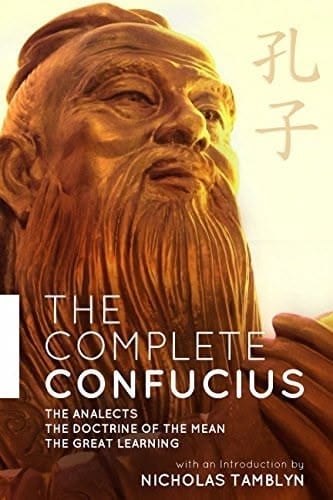

DESCRIPTION
Confucius is one of our very best thinkers, a model for living a self-aware and virtuous life. “The Complete Confucius: The Analects, The Doctrine Of The Mean, And The Great Learning,” brings together the most important Confucian texts with an introduction by Nicholas Tamblyn, and is part of The Essential Series by Golding Books. Confucius lived from 551-479 BC. The principles he espoused largely reflected the values and traditions in China at the time. Rather than create a formal theory, Confucius desired that his disciples study, learning and mastering the classic older texts, and affirmed that the superior person seeks and loves learning for the sake of learning, and righteousness for the sake of righteousness.
On Self-Cultivation and Character
- The Root of All Things: The cultivation of one’s own person is the root of everything, from regulating the family to governing the kingdom.
- Constant Improvement: One should seek daily renovation of character; if you can improve yourself one day, do so every day.
- The Superior Man vs. The Mean Man:
- The superior man seeks what is right and virtuous; the mean man seeks gain and comfort.
- The superior man is distressed by his own lack of ability, not by men failing to know him.
- The superior man seeks the cause of failure in himself (like an archer), whereas the mean man seeks it in others.
- Learning: Learning without thought is labor lost, while thought without learning is perilous. One should learn for self-improvement rather than for the approbation of others.
On Virtue (Ren) and Social Relations
- The Golden Rule (Reciprocity): Do not do to others what you would not wish done to yourself. This is considered a rule of practice for one’s whole life.
- Filial Piety: This is the root of all benevolent actions. It involves serving parents according to propriety while they are alive, burying them according to propriety when they die, and sacrificing to them according to propriety.
- Propriety (Li): Respectfulness without the rules of propriety becomes laborious bustle; boldness without them becomes insubordination; and straightforwardness without them becomes rudeness.
- Sincerity: Sincerity is the way of Heaven; attaining sincerity is the way of men. It is the end and beginning of things; without sincerity, there would be nothing.
On Government and Leadership
- Leading by Example: If a ruler is upright, his government is effective without issuing orders; if he is not upright, his orders will not be followed even if issued.
- The Pole Star Analogy: A ruler who governs by virtue is like the north polar star, which keeps its place while all other stars turn towards it.
- Rectification of Names: For a government to succeed, names must be correct. If names are incorrect, language is not in accordance with the truth of things, and affairs cannot be carried on to success.
- Confidence of the People: In governance, the confidence of the people is more important than military equipment or food. Without the people’s faith, a state cannot stand.
On The Mean (Balance)
- Avoiding Extremes: Perfect virtue is in accordance with the Mean (the middle path). The wise often go beyond it, while the foolish do not come up to it.
- Equilibrium and Harmony: When feelings (joy, anger, sorrow) are not stirred, the mind is in Equilibrium; when they act in their due degree, it is Harmony.
On Friendship
- Choosing Friends: Have no friends not equal to yourself.
- Types of Friendship: Friendship with the upright, the sincere, and the observant is advantageous. Friendship with men of specious airs, the insinuatingly soft, and the glib-tongued is injurious.
The Analects
Chapter 1
This chapter establishes the foundations of Confucian thought: self-cultivation and filial piety. It emphasizes that learning should be a pleasant and persevering pursuit. The “superior man” focuses on the roots of character, specifically filial piety and fraternal submission, which are described as the foundation of benevolent actions. The chapter also warns against “fine words” and an “insinuating appearance,” noting they are rarely associated with true virtue.
Chapter 2
Confucius discusses governance and his own intellectual development. He compares a ruler who governs by virtue to the “north polar star,” which remains in place while others turn toward it. He outlines his personal growth, stating that by age fifteen he was bent on learning, and by seventy he could follow his heart without transgressing what was right . Filial piety is further defined not just as support, but as maintaining reverence for one’s parents.
Chapter 3
The focus here is on proper ritual (Li) and music. Confucius criticizes the head of the Chi family for using eight rows of pantomimes, a privilege reserved for the emperor, asking “if he can bear to do this, what may he not bear to do?”. He asserts that without humanity (virtue), rites and music are meaningless. He also notes that in ceremonies, sorrow is better than minute attention to observances, and frugality is better than extravagance.
Chapter 4
This chapter centers on Virtue (Ren). Confucius states that a neighborhood is only excellent if it possesses virtuous manners. He contrasts the “superior man” (who thinks of virtue and law) with the “small man” (who thinks of comfort and favors). He also introduces the “all-pervading unity” of his doctrine, summarized by his disciple Tsang as faithfulness to oneself and benevolence toward others .
Chapter 5
Confucius evaluates the character of various historical figures and disciples. He describes himself as not having seen a truly “firm and unbending man”. When Tsze-kung claims he does not wish to do to others what he does not wish done to him, Confucius remarks that he has not yet attained that standard . He also expresses frustration with a disciple who slept during the day, comparing him to “rotten wood” that cannot be carved.
Chapter 6
The text discusses the balance between natural qualities and refinement. Confucius argues that when solid qualities exceed accomplishments, one is rustic; when accomplishments exceed solid qualities, one is a clerk; but when both are blended, one is a man of virtue . He praises his disciple Yen Hui for his love of learning and his ability not to transfer his anger or repeat faults.
Chapter 7
Confucius describes his role as a “transmitter and not a maker,” one who loves and believes in the ancients. He describes his teaching method as requiring eagerness from the student: if he lifts one corner of a subject and the student cannot discover the other three, he does not repeat the lesson. He also lists the four things he taught: letters, ethics, devotion of soul, and truthfulness.
Chapter 8
Focusing on the ancient sages, Confucius praises T’ai-po for attaining the highest virtue by declining the kingdom three times. He emphasizes that virtues like straightforwardness and boldness must be tempered by the rules of propriety to avoid becoming rudeness or insubordination. He also outlines the role of the arts: the mind is aroused by Odes, established by propriety, and finished by music .
Chapter 9
This chapter contains personal anecdotes and reflections on the Master’s life. He rarely spoke of profit, but focused on the appointments of Heaven and perfect virtue. He lists four things he was free from: foregone conclusions, arbitrary predeterminations, obstinacy, and egoism . He also remarks on the passage of time, comparing it to a flowing stream that ceases neither day nor night.
Chapter 10
A detailed record of Confucius’s behavior and etiquette in various settings. It describes his respectful uneasiness in court , his precise posture and gestures , and his specific preferences for food and clothing—for example, he would not eat meat that was not cut properly or served without its proper sauce. In his village, he appeared simple and sincere, while at court he spoke minutely but cautiously .
Chapter 11
Confucius discusses his disciples’ aptitudes: some were distinguished for virtue, others for speech, administrative talents, or literary acquirements . Much of the chapter deals with the death of his favorite disciple, Yen Hui, whom he mourned deeply, crying “Heaven is destroying me!”. He also critiques the disciple Chi Lu for asking about serving spirits before knowing how to serve men.
Chapter 12
Confucius defines perfect virtue as subduing one’s self and returning to propriety. When asked about government, he prioritizes the confidence of the people over food and military equipment, stating that without the people’s faith, a state cannot stand. He also asserts that if a ruler leads with correctness, the people will not dare to be incorrect.
Chapter 13
On government, Confucius emphasizes the “rectification of names”—if names are not correct, language is not in accordance with truth, and affairs cannot succeed . He argues that a ruler must correct his own conduct first; if he is upright, he need not issue orders for affairs to proceed. He also states that true government creates a state where those near are happy and those far off are attracted.
Chapter 14
Confucius discusses what is shameful: thinking only of salary regardless of whether the government is good or bad. He describes the “complete man” as one who thinks of righteousness in the face of gain and danger. He also notes that while there are superior men who are not virtuous, there has never been a “mean man” who is virtuous.
Chapter 15
Confucius introduces the principle of Reciprocity: “What you do not want done to yourself, do not do to others”. He advises that the superior man seeks truth rather than food, and is anxious about not getting the truth rather than about poverty . He also notes that he has never seen anyone who loves virtue as much as they love beauty.
Chapter 16
This chapter warns against civil strife and discusses friendship. Confucius lists three advantageous friendships (upright, sincere, observant) and three injurious ones (specious airs, insinuatingly soft, glib-tongued). He also outlines the “three awes” of the superior man: the ordinances of Heaven, great men, and the words of sages.
Chapter 17
Confucius discusses human nature, stating that men are alike by nature but separated by practice. He warns of “six becloudings” that occur when virtues (like benevolence or boldness) are practiced without the love of learning . He also comments that women and servants are difficult to treat: familiarity leads to loss of humility, while reserve leads to discontent.
Chapter 18
This chapter focuses on those who withdrew from society (recluses) to avoid political corruption. When a recluse criticizes Confucius for trying to change a disorderly world, Confucius sighs and says he cannot associate with birds and beasts; if the world were in order, he would not need to change it.
Chapter 19
The disciples of Confucius (Tsze-chang, Tsze-hsia) discuss learning and the superior man. Tsze-hsia notes that the superior man undergoes three changes: stern from a distance, mild when approached, and firm when speaking. Tsze-kung defends Confucius’s greatness, comparing him to the sun and moon which cannot be stepped over.
Chapter 20
This chapter contains historical extracts regarding the sage-kings Yao and Shun. It summarizes the principles of government, listing five excellent things (e.g., being beneficent without expenditure) and four bad things (e.g., cruelty and oppression) . It concludes that without knowing the ordinances of Heaven, one cannot be a superior man.
The Doctrine of the Mean
This text deals with the state of the mind and the cosmic principle of the “Mean.”
- Equilibrium and Harmony: “Equilibrium” is the state where feelings (pleasure, anger, sorrow) are not stirred; “Harmony” is when they act in due degree .
- The Path: The path of the Mean is difficult; the knowing go beyond it and the stupid do not reach it.
- Sincerity: Sincerity is described as the way of Heaven. He who possesses it hits what is right without effort . Sincerity allows one to complete themselves and others, affecting the transformation of things .
- The Superior Man: He is watchful over himself when alone and does what is proper to his station, not desiring to go beyond it.
The Great Learning
This text outlines the process of self-cultivation leading to peace in the state.
- Three Principles: To illustrate illustrious virtue, to renovate the people, and to rest in highest excellence .
- The Eight Steps: The ancient path to peace involves a specific sequence: investigating things → complete knowledge → sincere thoughts → rectified hearts → cultivated persons → regulated families → rightly governed states → tranquil kingdom .
- The Root: The cultivation of the person is the root of everything.
- Family and State: One cannot teach others while unable to teach their own family. A ruler must possess good qualities himself before requiring them of the people.
- Wealth and Virtue: Virtue is the root; wealth is the result. Accumulating wealth by improper ways leads to ruin .
The Analects
Chapter 1
Opens with the core posture of Confucian life: steady learning, warm friendship, and not being resentful when unrecognized. It frames virtue as rooted in filial piety and self-discipline (including daily self-examination), and it emphasizes sincerity, seriousness, and choosing worthy friends.
Chapter 2
Focuses on moral government: ruling by virtue and propriety rather than punishment, so people develop shame and self-correction. It includes famous reflections on Confucius’s own moral development (“at fifteen… at seventy…”) and drills into what filial piety really means (not merely providing for parents, but doing so with reverence).
Chapter 3
Centers on ritual and propriety (including criticism of elites who overstep ritual bounds), and the idea that rites and music are empty without humaneness. It also stresses substance over show: sparingness in celebration, genuine grief in mourning, and the principle that one should not offend Heaven while using ritual as a social performance.
Chapter 4
Develops a moral psychology of the “superior man”: choosing virtue over comfort and gain, being consistent under pressure, and using self-examination when encountering others’ flaws. It repeatedly treats virtue as something practiced continuously (not sporadically) and links moral character to social harmony and trustworthy relationships.
Chapter 5
Uses short portraits of disciples and political figures to clarify what counts as real virtue (and what doesn’t). A recurring lesson is that words are cheap: Confucius shifts from trusting speech to judging conduct, and he repeatedly distinguishes capability from complete virtue.
Chapter 6
Continues ranking and evaluating moral qualities (especially love of learning and steadiness of character), often using concrete cases to show why generosity, responsibility, and restraint matter. It reinforces that virtue isn’t just intention—it’s cultivated judgment applied to real duties and relationships.
Chapter 7
Presents Confucius more directly: his teaching stance, humility about sagehood, and emphasis on tireless self-cultivation and instruction. It underscores that moral seriousness outlasts status, and that ethical formation isn’t reducible to cleverness or reputation.
Chapter 8
Highlights exemplary figures and the disciplined “mean” between extremes (e.g., respect without propriety becomes mere bustle; boldness without propriety becomes insubordination). It also includes scenes and sayings associated with Tsang and the theme that one’s moral “burden” is heavy and long—virtue is sustained endurance.
Chapter 9
Emphasizes how hard it is to find genuine virtue and steadiness, and it continues separating moral reality from social gloss. It keeps returning to disciplined learning, restraint, and the rarity of people who truly live the standards they praise.
Chapter 10
Concentrates on conduct in action: the Master’s manners—how he moves, speaks, shows reverence, and performs rituals—so propriety becomes embodied habit rather than abstract advice.
Chapter 11
Focuses heavily on disciples and moral formation: how different temperaments handle duty, courage, learning, and restraint. It uses dialogues and comparisons to show that virtue requires both inner intention and fitting action.
Chapter 12
Treats humaneness (ren) as the central virtue and explores how it expresses itself through self-control, propriety, and care in relationships. It connects personal moral discipline to social trust and political legitimacy.
Chapter 13
Concentrates on government and administration: how to make people willing to follow, how to correct disorder, and how leaders should use upright people to set norms. It’s practical: who to employ, how to speak, how to avoid corruption of standards.
Chapter 14
Develops the ideal of the “superior man” through contrasts: integrity vs. opportunism, courage vs. recklessness, principle vs. reputation-management. Many lines function as short tests for whether someone is morally serious.
Chapter 15
Shows Confucius under stress (and how the superior man endures hardship without moral collapse). It includes key guidance on sincerity and careful action, and it stresses that Confucius seeks an “all-pervading unity,” not trivia accumulation.
Chapter 16
Targets political responsibility and moral blame: leaders and ministers rationalize aggression and self-interest, while Confucius insists on naming motives honestly and accepting accountability. It’s also about statecraft limits—how disorder spreads when duty is dodged.
Chapter 17
Stresses that moral difficulty is normal: people resist change, habits harden, and education must be persistent and realistic. It continues drawing sharp lines between moral talk and moral practice.
Chapter 18
Collects episodes of withdrawal, remonstration, and principled refusal—figures who leave corrupt courts, and critiques of chasing office when the Way is not being followed. It frames political disengagement as sometimes morally necessary, not cowardly.
Chapter 19
Largely features disciples (especially Tsze-chang and Tsze-hsia) giving applied moral counsel: righteousness over gain, enlarging virtue rather than merely “holding” it, and how to handle relationships—bearing with others, praising good, pitying the incompetent.
Chapter 20
A culminating set of governance and character teachings: what to hate (slander, crude valor, narrow determination) and what makes someone stuck in a bad moral trajectory. It reads like a closing practical checklist for personal conduct and political judgment.
The Doctrine of the Mean
Argues that the highest moral power is inner sincerity expressed without show: true virtue transforms others quietly and steadily, not through display, force, or emotional theater. It elevates sincerity as a cosmic principle (“the way of Heaven”) and a human achievement reached through study, inquiry, reflection, discrimination, and earnest practice; at its height, sincerity completes oneself and “completes” others and the world, aligning a person with Heaven and Earth.
The Great Learning
Lays out a famous moral-political sequence: personal cultivation is the root, and social order grows outward from it. The text defines its aim as illuminating virtue, renewing the people, and resting in “highest excellence,” then maps the chain from investigating things → completing knowledge → making thoughts sincere → rectifying the heart → cultivating the person → regulating the family → governing the state → bringing peace to the kingdom.
Commentary of the Philosopher Tsang
Gathers Tsang’s moral counsels and deathbed teachings: careful self-guarding, sincerity in demeanor and speech, humility despite ability, and the idea that the ethical life is a long, heavy burden carried to death. It also stresses compassion in judgment (pitying wrongdoers when investigating accusations) and the difference between genuine virtue and superficial correctness.
Note: I was able to pull clean, citable text for many chapters directly, but several mid-book Analects chapters (especially 9–14 and 17) didn’t surface as clearly in the excerpts I could retrieve from the PDF in this pass, so those summaries are necessarily more “standard Analects” thematic summaries than line-anchored ones. If you want, I can do a second pass that targets only Chapters 9–14 and 17 by pulling their exact pages and summarizing them from the chapter text line-by-line.