⬅️ Hub: China · Book: The Scientist and the Spy
China-linked economic espionage, IP theft, chip smuggling and state hacking against the United States, 2007–2025. Each case is labeled by how it ended, so proven cases stay separate from allegations.
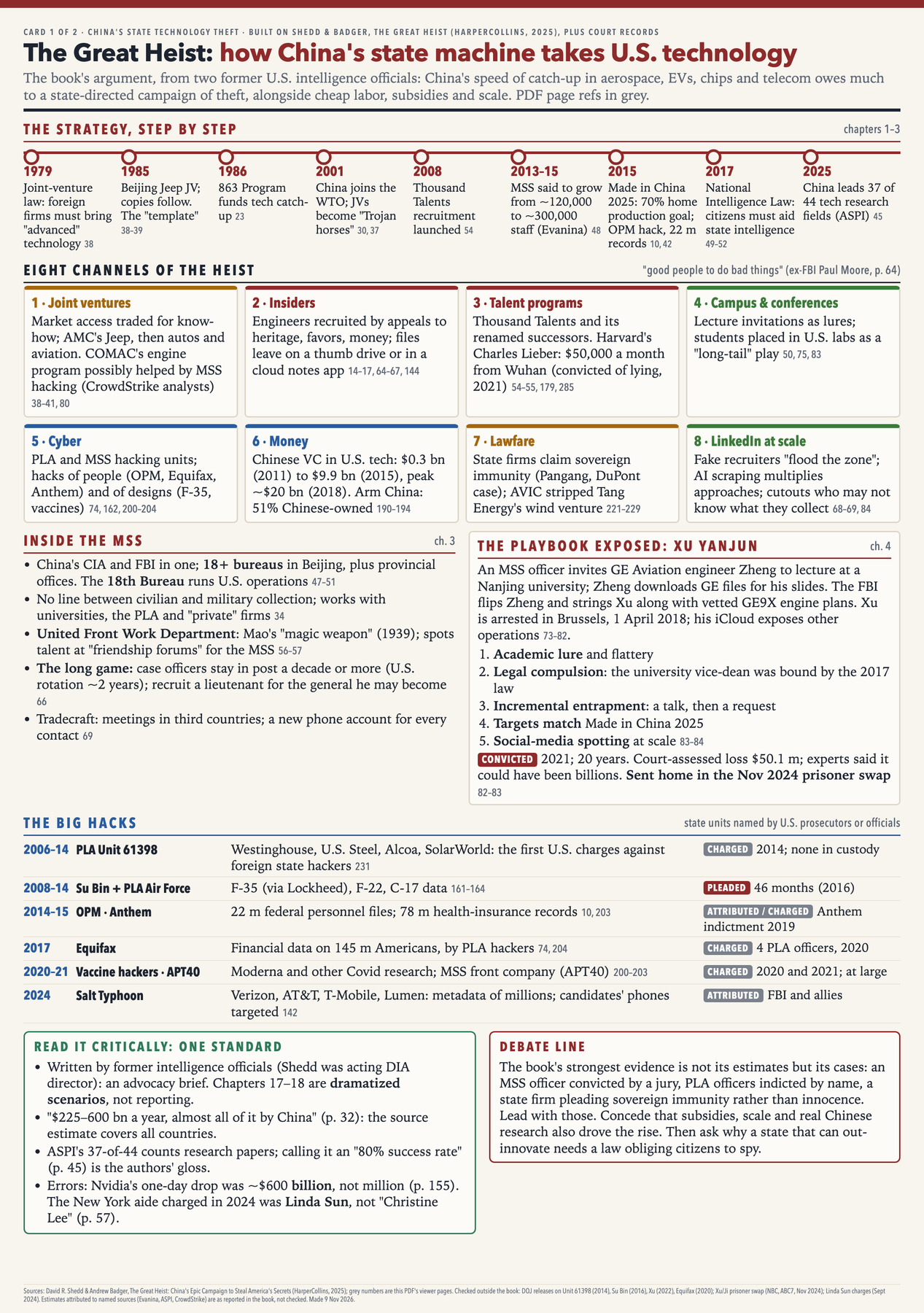
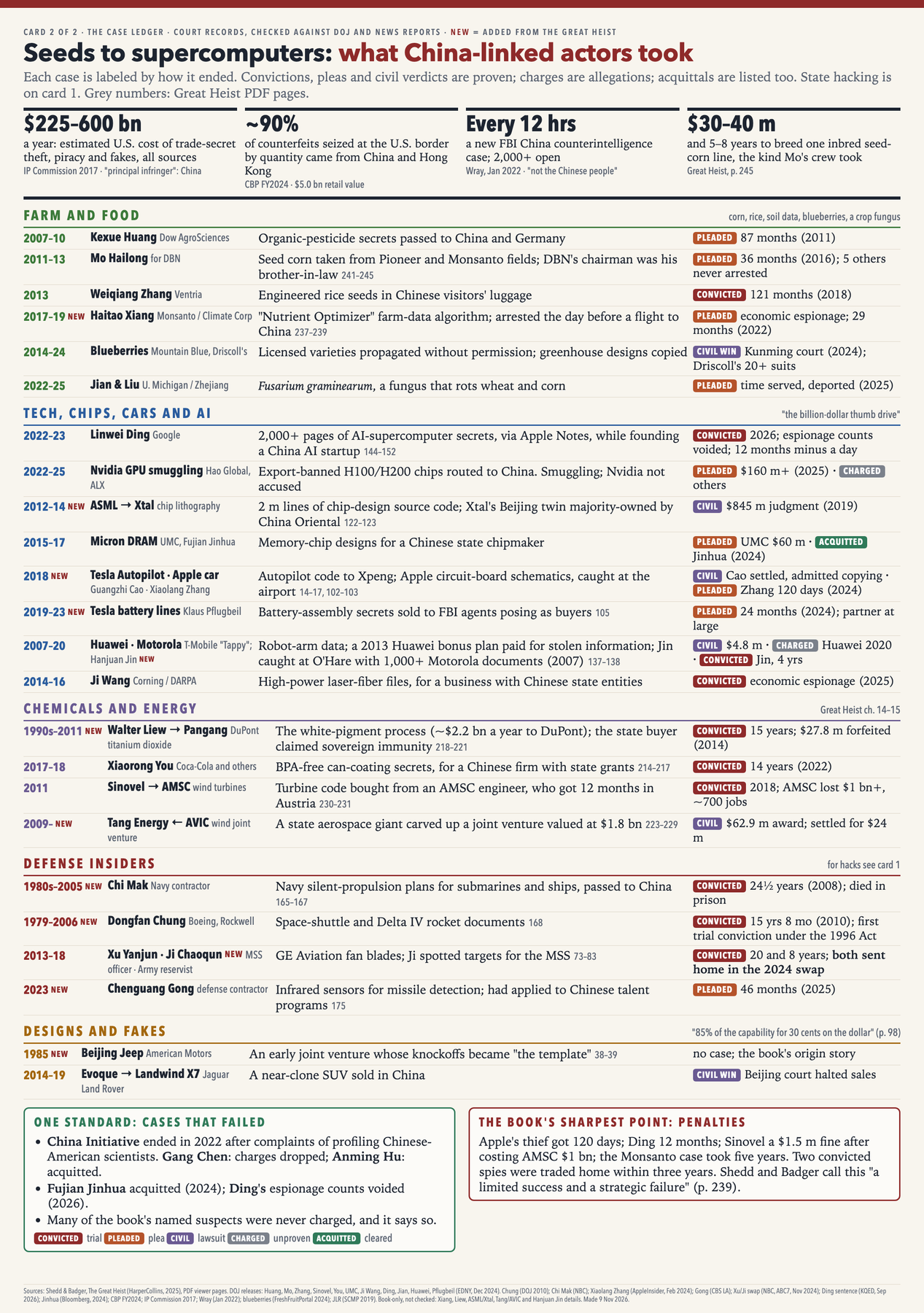
Two notebook pages (full B5), made 9 November 2026. They draw on The Great Heist (David R. Shedd and Andrew Badger, HarperCollins, 2025) and court records.
- Card 1 shows how the theft works: the strategy timeline, eight channels, the MSS, the Xu Yanjun playbook and the big hacks.
- Card 2 is the case list, labeled by outcome; cases added from the book are marked NEW.
Page numbers on the cards are the viewer pages of the NAS copy of the book. Card source files: card 1 HTML (file not included in this release) · card 2 HTML (file not included in this release). The earlier single-page card is in .trash/Misc/Generated/.
How to read the labels: Convicted means after a trial. Pleaded means a guilty plea. Civil means a lawsuit, not a crime. Charged and attributed are unproven. Acquitted means cleared.
Headline numbers
- $225–600 bn a year: the estimated cost to the U.S. of trade-secret theft, piracy and counterfeits from all sources. The report names China the “principal infringer.” IP Commission, Feb 2017
- About 90%: the share of counterfeit goods seized at the U.S. border in FY2024 that came from China and Hong Kong, by quantity. Their retail value was $4.15 bn from China and $0.87 bn from Hong Kong. CBP FY2024 seizure statistics
- A new case every 12 hours: the FBI’s pace of new China-related counterintelligence cases, with more than 2,000 open (Wray, January 2022). He said the threat is the Chinese government, not Chinese people or Chinese Americans. NBC News
Farm and food
- Kexue Huang (Dow AgroSciences), 2007–10: passed organic-pesticide trade secrets to people in China and Germany. Pleaded guilty to economic espionage benefiting a Chinese state body; sentenced to 87 months (2011). DOJ
- Mo Hailong (for Beijing Dabeinong), 2011–13: took inbred seed corn from DuPont Pioneer and Monsanto fields in Iowa. Pleaded guilty; sentenced to 36 months, and two farms were forfeited (2016). DOJ · see The Scientist and the Spy
- Weiqiang Zhang (Ventria Bioscience), 2013: kept hundreds of engineered rice seeds at home, and CBP found them in Chinese visitors’ luggage. Convicted; sentenced to 121 months (2018). DOJ
- Haitao Xiang (Monsanto / Climate Corporation), 2017–19: took the “Nutrient Optimizer” farm-data algorithm and was arrested the day before a flight to China. Pleaded guilty to economic espionage; 29 months (2022). The authors call the five-year case “a limited success and a strategic failure.” Great Heist, pp. 237–239; not checked outside the book.
- Blueberry varieties, 2014–24: Chinese nurseries propagated licensed varieties without permission. Civil: a Kunming court ruled for Mountain Blue Orchards (December 2024). Driscoll’s has reportedly filed more than 20 suits in China over copied plants and greenhouse designs. That count comes from WSJ reporting, which I only saw secondhand. FreshFruitPortal · Entrepreneur
- Yunqing Jian and Zunyong Liu, 2022–25: smuggled Fusarium graminearum, a fungus that attacks wheat, corn and barley. Pleaded: Jian was sentenced to time served and deported (November 2025). Liu was refused entry and returned to China. DOJ
Tech, chips and AI
- Linwei Ding (Google), 2022–23: took more than 2,000 pages on Google’s AI supercomputer hardware and software while building a China-based startup. Convicted on 14 counts (January 2026). In September 2026 the judge voided the economic-espionage counts for lack of proof that Ding meant to benefit the Chinese government. He was sentenced to 12 months minus a day. DOJ · KQED · Courthouse News
- Nvidia GPU smuggling, 2022–25: export-banned H100 and H200 chips were relabeled and routed to China. These are smuggling cases, not theft of Nvidia’s designs, and Nvidia is not accused. Pleaded: Hao Global, at least $160 m of chips (Operation Gatekeeper, December 2025). Charged: ALX Solutions and others (2025). Arnold & Porter · Bloomberg
- ASML and Xtal, 2012–14: about 2 million lines of chip-design source code. Xtal’s Beijing twin company was majority-owned by China Oriental. Civil: a $845 m judgment for ASML (2019). Great Heist, pp. 122–123; not checked outside the book.
- Tesla and Apple car programs, 2018:
- Guangzhi Cao took Autopilot code to Xpeng. Civil: the case was settled, and Cao admitted copying the code. Great Heist, pp. 14–17, 103.
- Xiaolang Zhang took Apple circuit-board schematics and was caught at the airport. Pleaded; 120 days (February 2024). AppleInsider
- Klaus Pflugbeil (Tesla battery lines), 2019–23: tried to sell battery-assembly secrets to FBI agents posing as buyers. Pleaded; 24 months (December 2024). His partner is at large. DOJ
- Hanjuan Jin (Motorola), 2007: caught at O’Hare with more than 1,000 Motorola documents. Convicted; 4 years. The book also cites a 2013 Huawei bonus plan that paid for stolen information. Great Heist, pp. 137–138.
- Ji Wang (Corning), 2014–16: took files from a DARPA-funded project on high-power laser fiber while negotiating a business with Chinese government entities. Convicted of economic espionage (November 2025). I couldn’t find the sentence. DOJ
- Sinovel and AMSC, 2011: Sinovel bought wind-turbine control source code from an AMSC engineer. Convicted (2018): the maximum $1.5 m fine plus $57.5 m restitution. AMSC lost more than $1 bn in equity and about 700 jobs. DOJ
- Xiaorong You (Coca-Cola and others), 2017–18: took BPA-free can-coating secrets worth about $120 m for a Chinese firm backed by government grants. Convicted; sentenced to 168 months (2022). DOJ
- Micron DRAM, 2015–17: Micron engineers took memory-chip designs to Taiwan’s UMC, which was working for Fujian Jinhua, a Chinese state-owned chipmaker. Pleaded: UMC was fined $60 m (2020), and Taiwanese courts convicted three engineers. Acquitted: Fujian Jinhua (bench trial, February 2024). DOJ · The Register
- Huawei, 2012–20:
- Hytera and Motorola, 2008–10: former Motorola engineers carried radio source code to Hytera. Civil: a jury awarded Motorola $764 m (February 2020). Motorola Solutions
Chemicals and energy
- Walter Liew and Pangang (DuPont titanium dioxide), 1990s–2011: sold the white-pigment process, worth about $2.2 bn a year to DuPont. The state-owned buyer, Pangang, claimed sovereign immunity. Convicted; 15 years and $27.8 m forfeited (2014). Great Heist, pp. 218–221; not checked outside the book.
- Tang Energy and AVIC, from 2009: the state aerospace company AVIC carved up a wind joint venture valued at $1.8 bn. Civil: a $62.9 m award, settled for $24 m. Great Heist, pp. 223–229; not checked outside the book.
- Xiaorong You and Sinovel: see above. The book adds that the AMSC engineer got 12 months in Austria (pp. 230–231).
State spies and military hackers
-
Chi Mak (Navy contractor), 1980s–2005: passed plans for the Navy’s silent ship and submarine propulsion to China. Convicted; 24½ years (2008). He died in prison. Great Heist, pp. 165–167 · NBC
-
Dongfan Chung (Boeing, Rockwell), 1979–2006: passed space-shuttle and Delta IV rocket documents. Convicted; 15 years 8 months (2010), the first trial conviction under the Economic Espionage Act. DOJ
-
Ji Chaoqun (Army reservist): spotted engineers as targets for the MSS officer Xu Yanjun. Convicted; 8 years (2023). He was sent home in the November 2024 prisoner swap. ABC7
-
Chenguang Gong (defense contractor), 2023: took infrared-sensor designs for missile detection and had applied to Chinese talent programs. Pleaded; 46 months (2025). CBS LA
-
OPM and Anthem, 2014–15: 22 m federal personnel files and 78 m health-insurance records taken. OPM is attributed to China; the Anthem hack was charged in 2019. Great Heist, pp. 10, 203.
-
Vaccine hackers and APT40, 2020–21: hackers went after Moderna and other Covid research; APT40 worked through an MSS front company in Hainan. Charged in 2020 and 2021; all are at large. Great Heist, pp. 200–203.
-
PLA Unit 61398, 2006–14: five Chinese military officers took Westinghouse reactor designs and data from U.S. Steel, Alcoa, SolarWorld and the Steelworkers union. Charged in 2014, the first such charges against state hackers. None is in custody. DOJ
-
Su Bin, 2008–14: worked with Chinese Air Force hackers to take Boeing C-17 files and data on the F-22 and F-35. Pleaded; sentenced to 46 months (2016). DOJ
-
Xu Yanjun (Ministry of State Security), 2013–18: went after GE Aviation’s composite fan-blade technology. Convicted; sentenced to 20 years (2022). He was the first Chinese intelligence officer extradited to the U.S. He was sent home in the November 2024 prisoner swap, as widely reported but not officially confirmed. The book uses his case as the model MSS playbook (pp. 73–84). DOJ
-
Equifax, 2017: four Chinese military officers took data on about 145 m Americans, plus company trade secrets. Charged in 2020; none is in custody. DOJ indictment
-
Salt Typhoon, 2024–25: got inside 9 U.S. telecom carriers, reaching call records and law-enforcement data, and hit about 80 countries. Attributed by the FBI and allies. Nextgov
Product designs and fakes
- Range Rover Evoque and the Landwind X7, 2014–19: Landwind sold a near-copy of the Evoque in China. Civil: in 2019 a Beijing court found five copied features and halted sales. SCMP
- Counterfeits at the U.S. border: see the CBP figures above.
One standard: cases that failed
- China Initiative: the Justice Department ran it from 2018 and ended it in February 2022 after complaints that it profiled Chinese-American scientists. Scientific American
- Two scientists cleared: charges against Gang Chen (MIT) were dropped in January 2022, and Anming Hu was acquitted in 2021. Both were disclosure cases, not theft. MIT Technology Review
- Corporate cases that failed: Fujian Jinhua was acquitted (2024), and Ding’s espionage counts were voided (2026).
- Hvistendahl’s point: the corn-seed investigation used FISA surveillance warrants to protect seed companies’ secrets. See The Scientist and the Spy.
Reading The Great Heist critically
- Who wrote it: two former intelligence officials (Shedd was acting director of the Defense Intelligence Agency). It is an advocacy brief, and chapters 17–18 are dramatized scenarios, not reporting.
- The $225–600 bn a year figure: the book says “almost all of it by China” (p. 32), but the source estimate covers all countries.
- The “80% success rate”: ASPI’s tracker counts research papers in 37 of 44 technologies; the success rate is the authors’ reading of it (p. 45).
- MSS size: the claim that it grew from ~120,000 to ~300,000 staff in 2013–15 is Evanina’s estimate (p. 48), not checked.
- Two errors:
- Nvidia’s one-day drop was about $600 billion, not million (p. 155).
- The New York aide charged in 2024 was Linda Sun, not “Christine Lee” (p. 57).
- Penalties: the book’s sharpest point is that penalties are weak. Apple’s thief got 120 days, Ding 12 months and Sinovel a $1.5 m fine, and two convicted spies were traded home.
Debate line: Argue from the convictions, the guilty pleas and the links to the Chinese state, such as MSS and PLA officers, state grants and state-owned buyers. Don’t argue from arrests or anyone’s ethnicity. U.S., Chinese and Taiwanese courts have ruled against copiers, but U.S. courts have also acquitted defendants and cut sentences.