⬅️ Hub: China · Surveillance: China - Surveillance State · Policing: China - Policing, Public Security and Political Control · Previous: Military Exercises · Next: China Misc
Domestic propaganda, surveillance, censorship, overseas influence, and U.S.-facing narrative operations.
Propaganda & Population Control
- To propagandize that a person’s family is the one that turned them into the government
- Unable for people to organize to counter Xi’s rule
Victor Gao
China’s Domestic Propaganda Apparatus and Global Influence Operations
Introduction
China has developed an extensive propaganda and surveillance apparatus at home while aggressively expanding its influence campaigns abroad. Domestically, the Chinese Communist Party (CCP) maintains an information monopoly through pervasive high-tech surveillance, strict internet controls, and heavy-handed censorship across media. Technologies like nationwide camera networks and the “Great Firewall” of internet filters enable the regime to monitor citizens and suppress unwanted speech on an unprecedented scale. Internationally, Beijing is investing billions of dollars annually in propaganda and influence operations to shape global opinion in its favorgmanetwork.com. These range from the overt – such as state-run media outlets and diplomatic messaging (often tied to the Belt and Road Initiative) – to covert tactics including disinformation on social media and the co-opting of foreign voices. This report synthesizes major findings from authoritative sources on how China’s domestic propaganda techniques and technologies work, and how the CCP projects power through information operations worldwide.
Mass Surveillance and Tech-Enabled Social Control
China’s rulers have built a sweeping high-tech surveillance state to preempt dissent and enforce CCP narratives. A backbone of this system is the nationwide network of CCTV cameras enhanced with facial recognition and AI, often dubbed “Skynet” and “Sharp Eyes.” The Skynet project (launched 2005) installed video monitoring equipment at intersections, roads, and public spaces, feeding into police databasesned.org. In 2015, the regime introduced the Sharp Eyes program to extend coverage to rural areas and link public and private surveillance feeds in real time. The goal – as stated in China’s 13th Five-Year Plan – was “100 percent coverage” of key public areas by 2020uscirf.gov. By 2021, China had an estimated 540–626 million surveillance cameras deployed domestically – more than half of all cameras in the worldchinascope.org. This amounts to roughly one camera for every two citizens, with over 200 million devices integrated into the police-run Skynet system alonechinascope.org. In regions like Xinjiang, authorities have pushed these methods to extremes: a “highly intrusive, high-tech surveillance system” blankets the population, featuring ubiquitous cameras (even inside mosques and homes), facial recognition checkpoints, mandatory GPS trackers on cars, spyware installed on smartphones, and mass collection of biometric data (DNA, iris scans, voice samples)uscirf.govuscirf.gov. Over a million officials and police in Xinjiang monitor residents in real time, creating a dystopian model that many fear could be extended nationwideuscirf.govuscirf.gov.
This surveillance web is paired with big-data analytics to flag “pre-criminal” behavior and enforce conformity. AI-powered platforms aggregate feeds from cameras and other sensors to enable what the CCP calls “social management.” Modern policing systems integrate facial and voice recognition, location data, and personal records, ostensibly to fight crime and “maintain stability,” but also to track perceived political or religious deviationuscirf.govuscirf.gov. Companies like Hikvision and others closely linked to the state have furnished authorities with advanced tools – from facial recognition that can target specific ethnic groups to “smart city” data platforms – that dramatically expand the regime’s capacity for real-time monitoringuscc.govuscc.gov. Notably, these systems have been used to punish and intimidate ethnic and religious minorities. Surveillance cameras watch not just public streets but even the interiors of churches and temples, and facial recognition software has been deployed to single out Uyghur Muslim or Tibetan faces in crowdsuscirf.govuscirf.gov. The Chinese government justifies pervasive monitoring as a public safety necessity, but in practice it creates an atmosphere of total control. Knowing they are constantly watched, citizens are pressured to self-censor and toe the Party line in their daily behavior. The CCP’s tech-enabled authoritarianism thus “augments the party’s longstanding methods” of control, making traditional repression far more efficientned.org.
The Great Firewall and Domestic Information Censorship
Beijing couples physical surveillance with draconian internet control, constructing what is commonly called the Great Firewall of China. This nationwide filtering system (part of the Golden Shield project) blocks access to thousands of foreign websites and services – from Google, YouTube, and Facebook to international news sites – thereby isolating China’s domestic internet from the global webuscc.gov. Content coming from outside China that the CCP finds undesirable is denied or selectively “throttled,” ensuring Chinese netizens predominantly see information vetted by the stateuscc.gov. The government tightly regulates tools to bypass the Firewall: technically, VPNs and circumvention software are illegal or restricted, and those that do exist are often slow or subject to shutdown, making it difficult for average users to reach uncensored content abroaduscc.govuscc.gov.
Inside China’s own cyberspace, a vast censorship apparatus scrubs and suppresses any material deemed politically sensitive or harmful to CCP interests. This apparatus is multi-layered, combining automated filtering technology with legions of human censors. All major Chinese tech platforms – social media, search engines, messaging apps, livestreaming services, etc. – are required by law to proactively monitor user content and delete prohibited speech. Even relatively small platforms maintain internal “content security” teams and AI-driven systems to enforce the rulesuscc.gov. For example, voice recognition algorithms listen in on audio streams or chats for blacklisted keywords, and image scanners flag forbidden symbols or memesuscc.gov. Posts containing banned phrases (such as references to the 1989 Tiananmen Square crackdown, mentions of “Taiwan independence,” or criticism of top leaders) are swiftly taken down. Companies that fail to censor rigorously face heavy fines or closure by the Cyberspace Administration of China (CAC), the powerful internet regulator. The CAC and the CCP’s Central Propaganda Department issue continual directives guiding what topics are off-limits or must be spun with a positive slantuscc.gov. Through campaigns like “Qinglang” (Clean and Bright Cyberspace), authorities purge everything from “politically harmful” news to celebrity gossip deemed frivolous or immoral, in the name of cultivating a “healthy” online environment.
Crucially, Chinese censorship does not only reactively silence criticism – it also floods the zone with regime propaganda and distractions. A famous Harvard study of leaked CCP documents revealed that around 448–488 million fake social media posts are fabricated by the government each year to influence public opinionnpr.orgnpr.org. This so-called “50 Cent Army” (named for the rumored pay per post) consists largely of government employees and Party members who, as part of their jobs, go online to post pro-CCP messages with fake personasnpr.org. Interestingly, these posts rarely engage in argumentative debate with critics; instead, they aim to drown out critical discussions with positive chatter and patriotic cheerleadingnpr.orgnpr.org. During sensitive moments – protests, scandals, or disasters – China’s internet fills with an orchestrated chorus of upbeat anecdotes, praise for the government, and other “distraction” content to shift attention away from the issue at handnpr.orgnpr.org. For example, amid ethnic riots in Xinjiang in 2013, leaked emails showed officials directed a burst of hundreds of posts touting local economic progress and the “Chinese Dream,” rather than allowing discussion of the unrestnpr.org. This strategy has been described as “public opinion guidance”, and is a core part of CCP propaganda technique: guiding online narratives by mixing censorship with strategic injection of regime-friendly content.
Beyond cyberspace, the CCP controls traditional media even more absolutely. All newspapers, television networks, and publishers are either state-owned or tightly supervised by Party censors. The Propaganda Department dictates editorial lines and “no-go topics,” ensuring that coverage of events inside China consistently reflects the official narrative. Independent journalism is effectively non-existent; reporters who expose wrongdoing without approval risk their careers and freedom. Instead, state media endlessly promote CCP achievements and the cult of leadership while downplaying or ignoring bad news. Under Xi Jinping, propaganda has taken an even more central role – state outlets are required to exude “positive energy” and reinforce loyalty to Xi’s personal ideological brand. According to official directives, propaganda cadres must “strengthen the Party’s position online” and “spread positive energy” across the internetuscc.gov, meaning they should amplify content that praises the government and boosts nationalism. Even entertainment and pop culture are co-opted: movie studios and influencers are encouraged to produce patriotic content, and those who step out of line (celebrity critics, liberal professors, etc.) are swiftly silenced. The CCP also bankrolls armies of online influencers and content creators who appear as ordinary bloggers or livestreamers but quietly toe the Party lineuscc.gov. These covert propagandists seed platforms with appealing content – travel vlogs, pop songs, funny memes – that subtly incorporate pro-CCP messaging while avoiding any hint of their state sponsorshipuscc.gov. By blending censorship with propaganda in all arenas of information, the regime effectively controls the narrative within China’s borders. The result is a heavily filtered reality: most Chinese citizens receive a steady diet of CCP-approved news and patriotic messaging, with few glimpses of dissenting voices or inconvenient truths.
Expanding Propaganda Abroad: State Media and the Belt and Road
In tandem with its domestic controls, Beijing has massively expanded its propaganda efforts overseas to shape how China is perceived around the world. The CCP has built an international media empire, pouring hundreds of millions of dollars into state-run outlets that target foreign audiences. Television networks like CGTN (China Global Television Network) and radio services like China Radio International now broadcast in numerous languages, while the Xinhua News Agency and China Daily have set up bureaus across the globe. These outlets disseminate Beijing’s viewpoints on global affairs, often framing China as a benevolent rising power and casting its policies in a positive light. In many countries, Chinese state media content is widely distributed through local partners. For example, local TV providers in Latin America and Africa carry CGTN programs, and newspapers on every continent publish paid “China Watch” inserts or syndicated Xinhua articlesfreedomhouse.orgfreedomhouse.org. Such content is sometimes labeled as coming from Chinese sources, but not always prominentlyfreedomhouse.org. This lack of transparency means Beijing’s messaging can blend into foreign information ecosystems, reaching unwary audiences who may not realize the origin of the narrativesfreedomhouse.org.
Chinese diplomats and officials complement the media push with active public diplomacy and messaging campaigns. Ambassadors pen op-eds in foreign newspapers and appear on talk shows to promote China’s policies. They emphasize themes like win-win economic cooperation, China’s contributions to global development, and the harmless nature of its rise. A key vehicle for this is the Belt and Road Initiative (BRI) – China’s global infrastructure and investment program, which is as much a public-relations effort as an economic one. In countries that join BRI projects, Chinese embassies relentlessly tout the benefits of partnership. Embassy communications and state media narratives “frequently promoted strong trade links under the BRI as well as growing overall cooperation”, portraying China as a generous partner helping to build local prosperityfreedomhouse.org. For instance, in Peru, Chinese outlets and officials highlighted the Sino-Peruvian “strategic partnership” and the promise of BRI investments, even as public skepticism about some Chinese business practices grewfreedomhouse.org. This messaging often leverages local voices: Chinese diplomats cultivate relationships with foreign business leaders, politicians, academics, and journalists who can echo Beijing’s talking points, lending them a veneer of domestic credibilityfreedomhouse.orgfreedomhouse.org. In some cases, pro-China sentiment is amplified by members of sizeable ethnic Chinese diaspora communities abroad, whom the CCP seeks to enlist as “natural partners” in promoting a positive image of China.
As part of its outreach, Beijing sponsors journalist tours, training seminars, and media cooperation forums around the world. These often fall under the Belt and Road umbrella. Dozens of foreign journalists are invited to China each year on all-expenses-paid trips or to attend workshops, with the understanding (sometimes explicit, sometimes implied) that they will publish favorable stories afterwardsfreedomhouse.orgfreedomhouse.org. Chinese officials also host annual media forums – for example, a Belt and Road News Network – where state media executives meet with overseas media partners to sign content-sharing agreements and discuss “constructive journalism.” The aim of “constructive journalism” (a term used at these events) is to encourage reporting that focuses on positive outcomes and avoids critical investigation, essentially privileging “positive messaging” about Chinafreedomhouse.org. In practice, this means BRI projects and Chinese investments are to be reported as unalloyed goods. Many developing countries’ media, hungry for content and advertising, welcome such partnerships. As a result, audiences in those countries are increasingly exposed to Chinese-official narratives – for example, that China’s investments bring mutual gain, that its governance model is effective, and that its stance on contentious issues (South China Sea, Xinjiang, etc.) is legitimate.
Alongside these overt efforts, Beijing has made inroads into foreign Chinese-language media and diaspora channels. In communities from Southeast Asia to North America with large Chinese populations, independent media outlets have dwindled as pro-Beijing owners buy them out or pressure them into line. Freedom House found that in many countries, “there is essentially no independent Chinese-language media” left; local outlets serving diaspora audiences often reprint content from Chinese state media and avoid topics sensitive to the CCPfreedomhouse.orgfreedomhouse.org. This means Chinese immigrants and expats abroad frequently receive news about China that mirrors the heavily censored version inside the mainland. The CCP’s United Front Work Department – an organ tasked with influencing overseas Chinese communities – actively guides this process, financing Chinese cultural associations, business groups, and Chinese-language publications that can act as conduits for propaganda. By dominating the informational environment of the diaspora, Beijing not only burnishes its image but also stifles potential dissent among overseas Chinese (who might otherwise be sources of uncensored information about the regime). In sum, through a mix of state-run media expansion, diplomatic narrative management, content sharing deals, and united front activities, China has dramatically extended its “global megaphone”freedomhouse.org. It pushes a consistent message of China as a benign power, while subtly undermining critical coverage and democratic perspectives abroad.
Covert Influence: United Front and Online Information Warfare
Beyond open propaganda, China also conducts covert influence operations and information warfare to manipulate opinion overseas. These efforts often blur the line between traditional statecraft and subversive espionage, and they involve a broad array of actors coordinated under CCP guidance. A central player is the CCP’s United Front Work Department (UFWD), which leads work on influencing and neutralizing potential opponents outside the Party. The UFWD’s external mandate includes cultivating sympathetic voices abroad and infiltrating foreign institutions in subtle ways. For example, Chinese Students and Scholars Associations (CSSAs) on Western campuses often receive guidance or funding from China’s embassies and have reportedly monitored Chinese students who participate in protests or express “incorrect” views, reporting them to authoritiesuscc.gov. Confucius Institutes (CIs) – Chinese government-funded language and culture centers established at hundreds of foreign universities – have also been controversial. While billed as cultural exchanges, they have been accused of promoting a one-sided positive image of China and censoring discussion of sensitive topics on campuses that host themsandia.govsandia.gov. Teachers at Confucius Institutes must follow CCP content guidelines, avoiding subjects like Taiwan or Falun Gong, and some Institutes have allegedly been used to spy on academic communitiessandia.govsandia.gov. In recent years, several countries (the U.S., Canada, Australia, many EU states) shut down Confucius Institutes or imposed closer scrutiny due to concerns they were vehicles of Chinese influence and intelligence.
Chinese influence actors also target foreign politics and media through more clandestine means. There have been cases of CCP-linked businessmen funding foreign politicians or media outlets to tilt them toward pro-China positions – a tactic sometimes called “elite capture.” Beijing-backed companies have bought stakes in foreign media (especially in Africa and Latin America), quietly shaping editorial stances. Meanwhile, foreign experts and scholars are courtedwith lucrative consulting deals or positions on China-sponsored think tanks, to encourage narratives that align with Beijing’s interests. These activities are typically covert or opaquely funded, making them hard to trace. They form part of what analysts term China’s “sharp power” – influence that penetrates and disrupts open societies through manipulation and opaque pressurened.org. Unlike “soft power” attraction, sharp power seeks to “pierce, penetrate, or perforate” target societies by limiting free expression and distorting political environmentsned.org. The CCP’s sharp power campaigns are often tailored to each country’s vulnerabilities, but a unifying goal is to silence criticism of China (for instance, pressuring foreign publishers not to print books on Xinjiang or Hong Kong) and to garner support for China’s geopolitical aims (such as isolating Taiwan or securing allies in international forums).
Perhaps the most visible aspect of China’s covert influence is its activity on global social media platforms – the ironic twist being that these platforms (Twitter, Facebook, YouTube, etc.) are blocked for ordinary Chinese inside China, yet the CCP exploits them to reach audiences abroad. In recent years, investigators have uncovered large-scale disinformation networks linked to China. These typically involve bot accounts and fake personas operating across Twitter, Facebook, YouTube, Reddit, and other sites, posting in multiple languages. Early Chinese disinformation campaigns were somewhat crude – often spamming content in broken English – but they are rapidly growing more sophisticatedfreedomhouse.org. In Taiwan, which has been a key testing ground (given its Mandarin-speaking population and critical elections), Chinese-origin misinformation on social media became highly coordinated and harder to detect, even masquerading as local Taiwanese voices using traditional Chinese charactersfreedomhouse.org. Themes of these covert campaigns vary: some spread conspiracy theories or false narratives (for instance, disinformation during the COVID-19 pandemic that suggested the virus originated in the US Army, or posts denigrating Hong Kong’s 2019 protests as violent riots instigated by the West). Other efforts focus on harassment and intimidation: when Houston Rockets GM Daryl Morey tweeted support for Hong Kong protesters, a swarm of nearly 170,000 tweets from apparent China-based accounts barraged him in an organized campaign to punish the expression of supportfreedomhouse.org. In another example, during a 2021 controversy, fake Twitter accounts (later traced to China) pushed hashtags defending Chinese policies in Xinjiang, in an attempt to drown out criticism of human rights abuses.
China’s cyber “troll army” – sometimes nicknamed “Zombie 50 Cent” for its automated nature – is also suspected of manipulating online discourse in more subtle ways. U.S. and European observers have noted attempts to game algorithms on Western platforms: there were instances of pro-China networks trying to boost certain YouTube videos, Reddit posts, or search engine results to prominencefreedomhouse.org. By upvoting content favorable to Beijing or downvoting critical content, these operations seek to distort what unwitting users see as popular or credible. While Western tech companies periodically announce takedowns of Chinese-linked fake accounts (Twitter and Facebook have removed thousands of accounts tied to Chinese information ops in 2019–2022), new networks continually crop up. Beijing adapts by using obfuscated routes and third-party cutouts – for example, hiring marketing firms or foreign influencers to push its messages, which makes attribution more difficult. Indeed, one emerging tactic is the use of seemingly independent influencers to launder state propaganda. A 2022 Australian Strategic Policy Institute report exposed a cadre of China-based YouTube vloggers – often young, female members of ethnic minorities like Uyghurs and Tibetans – who post glossy videos depicting happy life in Xinjiang or Tibetad-aspi.s3.ap-southeast-2.amazonaws.comad-aspi.s3.ap-southeast-2.amazonaws.com. These videos directly counter Western reports of oppression in those regions. Although the influencers appear organic, they were in fact “carefully vetted and considered politically reliable,” working under influencer management agencies that coordinate with state mediaad-aspi.s3.ap-southeast-2.amazonaws.comad-aspi.s3.ap-southeast-2.amazonaws.com. In some cases their content was even commissioned by Chinese authorities while being presented as personal vlogsad-aspi.s3.ap-southeast-2.amazonaws.comad-aspi.s3.ap-southeast-2.amazonaws.com. This strategy of using personable social media figures – dubbed “frontier influencers” – is seen by CCP strategists as a way to win foreign hearts and minds with relatable voices, supplementing the more official (and often rigid) messaging from state mediaad-aspi.s3.ap-southeast-2.amazonaws.comad-aspi.s3.ap-southeast-2.amazonaws.com.
Multiple government and think tank reports have concluded that China’s global information operations are accelerating and expanding. A U.S. State Department special report in 2023 warned that Beijing is “expanding efforts to spread false or biased information” to promote positive views of the CCP and “suppressing information”that contradicts its narratives on issues like Taiwan, human rights, the South China Sea, and China’s economygmanetwork.com. It outlined how the PRC’s approach integrates propaganda and censorship with other elements: promoting a new model of digital authoritarianism internationally, exploiting international organizations and bilateral partnerships to legitimize its narratives, co-opting foreign elites through economic leverage, and controlling Chinese-language media globallygmanetwork.com. These five elements, taken together, could allow Beijing to “reshape the global information environment” by constraining freedom of expression and dominating discourse in ways favorable to Chinagmanetwork.com. The report estimates China is spending billions of dollars each year on these influence efforts, a scale rivaled only by Russia but with even greater long-term implicationsgmanetwork.com. If left unchecked, analysts caution that Beijing’s information manipulation could result in a future where authoritarian values crowd out democratic voices. As the State Department assessment put it, the world could see a sharp contraction of free expression, with technology exported by China and fear of its retaliation causing many governments and companies to amplify Beijing’s preferred narratives or silence criticismgmanetwork.com. Already, there are signs of this chilling effect – from Hollywood self-censoring movie scripts to avoid angering Chinese censors, to international companies hesitating to speak on Xinjiang forced labor due to PRC backlash.
Conclusion
China’s domestic propaganda tactics and global influence operations form a comprehensive strategy to control information in the 21st century. At home, the CCP marries Orwellian surveillance technology with strict censorship and relentless propaganda to secure its rule and shape public perception. The Chinese people live under a digital dome where Big Brother is always watching and only the Party’s voice is clearly heard. Abroad, Beijing is leveraging its economic clout and technological prowess to systematically project that model outward – attempting to rewrite the rules of the international information order in line with authoritarian preferences. Through state media expansion, diplomatic pressure, united front work, and covert cyber campaigns, the PRC is aggressively pushing its narratives into global discourse while trying to mute criticism and unfavorable news. These efforts raise profound challenges for democracies: they exploit open information systems to advance an agenda that is fundamentally hostile to press freedom and open debate.
Yet awareness of China’s tactics has grown, and governments, civil society, and media organizations around the world are beginning to push back. Exposés of covert operations and stricter scrutiny of Chinese state activities have started to blunt some of Beijing’s influence. Ultimately, China’s bid to dominate the “discourse power” globally is meeting resistance from those who uphold transparency and truth. The CCP’s propaganda machine is formidable and well-resourced, but a vigilant free press and informed public can be its strongest antidote. In summary, China’s use of surveillance, censorship, and propaganda – both domestically and overseas – represents an unprecedented convergence of technology and authoritarianism. How the world responds will determine whether the future information landscape is one of pluralism and openness, or one increasingly constrained by the preferences of the Chinese Communist Party.
Sources (PDF reports and analyses):
- U.S.-China Economic and Security Review Commission (2024). Censorship Practices of the People’s Republic of Chinauscc.gov. (Comprehensive report on China’s censorship apparatus, including legal frameworks, key agencies like the CAC and Propaganda Department, and tech platforms’ compliance measures.)
- U.S. Department of State, Global Engagement Center (2023). How the People’s Republic of China Seeks to Reshape the Global Information Environmentgmanetwork.comgmanetwork.com. (Special report detailing China’s global information manipulation strategies, spending, and the potential threat to free expression worldwide.)
- Freedom House (2022). Beijing’s Global Media Influence: Authoritarian Expansion and the Power of Democratic Resiliencefreedomhouse.orgfreedomhouse.org. (Study of Chinese state media and influence efforts in 30 countries, including content-sharing deals, press trips, and local media responses; includes country case studies like Perufreedomhouse.orgfreedomhouse.org.)
- Freedom House (2020). Beijing’s Global Megaphonefreedomhouse.orgfreedomhouse.org. (Report on the expansion of CCP media influence since 2017, discussing tactics such as covert social media manipulation, advertising supplements, and control of diaspora media.)
- Australian Strategic Policy Institute – ICPC (2022). Frontier Influencers: The New Face of China’s Propagandaad-aspi.s3.ap-southeast-2.amazonaws.comad-aspi.s3.ap-southeast-2.amazonaws.com. (Investigation into Beijing’s use of YouTube and social media influencers – especially ethnic minority vloggers – as a tool of external propaganda to counter criticism on Xinjiang, Tibet, etc.)
- Australian Strategic Policy Institute – ICPC (2024). Truth and Reality with Chinese Characteristics: The Building Blocks of the Propaganda Systemad-aspi.s3.ap-southeast-2.amazonaws.comad-aspi.s3.ap-southeast-2.amazonaws.com. (Examines how the CCP is integrating big data and emerging technologies into its propaganda system, including the global expansion of its media tech and data collection for narrative control.)
- National Endowment for Democracy (2021). Double-Edged Sword: China’s Sharp Power Exploitation of Emerging Technologiesned.orgned.org. (Analysis of how China’s use of surveillance and information technology – “tech-enhanced authoritarianism” – reinforces CCP power domestically and projects influence abroad under the concept of “sharp power.”)
- U.S. Commission on International Religious Freedom (2019). China: Religious Freedom in China’s High-Tech Surveillance Stateuscirf.govuscirf.gov. (Highlights the deployment of surveillance technology against religious and ethnic minorities, e.g. the Sharp Eyes program’s 100% coverage goal and intrusive monitoring in Xinjiang.)
- Belfer Center for Science and International Affairs, Harvard (2021). Combating and Defeating Chinese Propaganda and Disinformationbelfercenter.orgbelfercenter.org. (Uses Taiwan’s experience to outline China’s motives, tactics, and actors in foreign information warfare, including United Front, cyber “50-cent army,” content farms, and tactics like exploiting social divisions and controlling media.)
- Sandia National Laboratories (2022). China’s Influence Operations in Academia: Confucius Institutes and Overseas Student Organizationssandia.govsandia.gov. (Reviews how tools like Confucius Institutes and Chinese student associations are used to export propaganda, restrict academic discussions on China, and influence educational institutions abroad.)
Chinese Propaganda within U.S.
Leftist China Network.canvas (file not included in this release)
AI
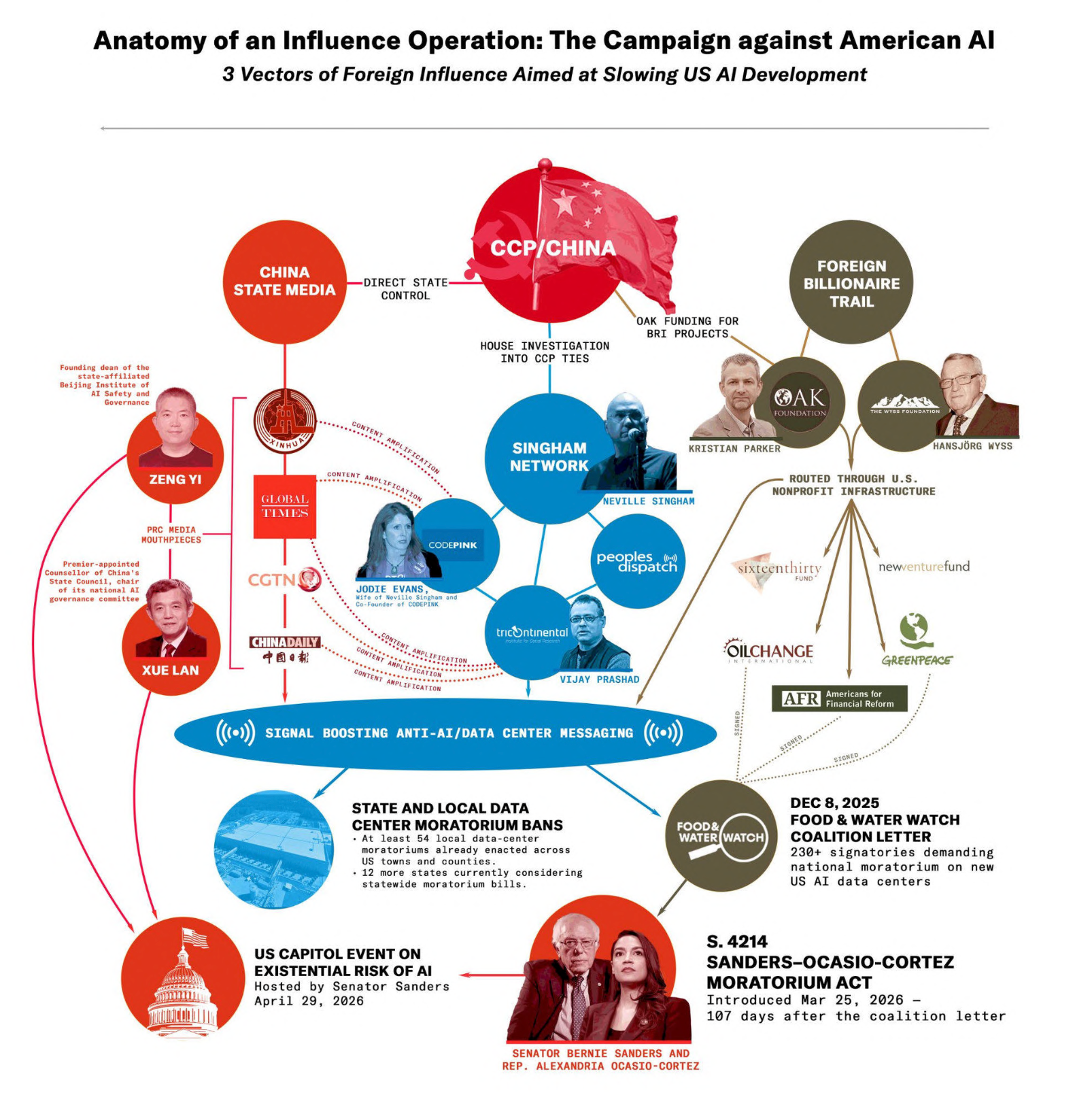
Foreign Influence in the Campaign against American AI | Bitcoin Policy Institute
Foreign Influence in the Campaign against American AI.pdf (file not included in this release)