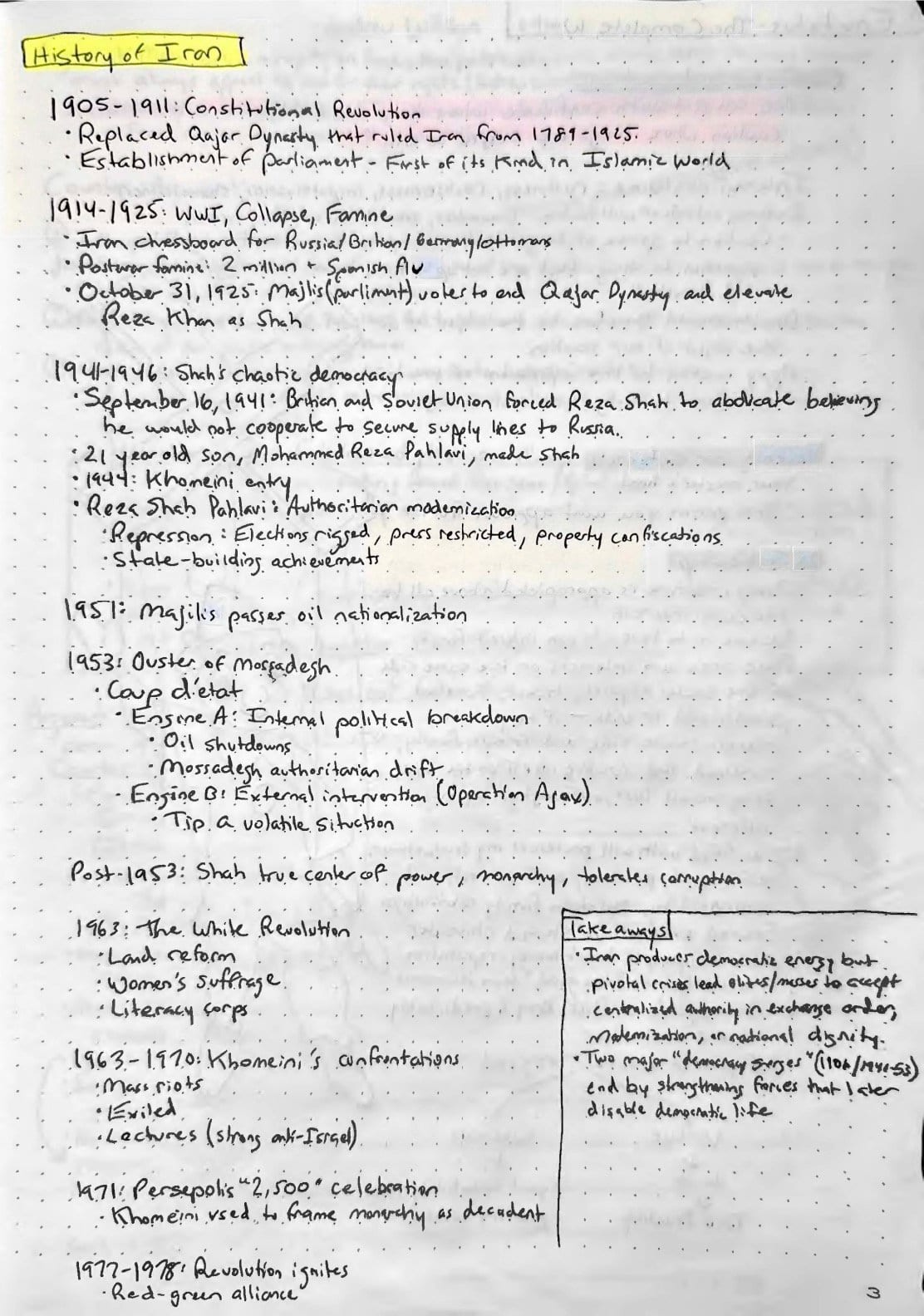
Feb – March 21 2026, pp. 3 — History of Iran → open PDF p8 (file not included in this release)
Index: Personal Journal
Basic Facts
Population & Ethnic Diversity
Population snapshot (mid-2025)
Source
Mid-2025 estimate
Method/notes
UN DESA (via Macrotrends)
≈ 90.4 million
Annual revision based on vital-statistics & migration models (macrotrends.net)
World Population Review live clock
≈ 92.2 million (June 2025 reading)
Real-time counter extrapolating monthly UN data & Iranian vital-records feeds (worldpopulationreview.com)
The difference of about 1–2 million stems from the World Population Review clock adding intra-year growth in real time, whereas the UN figure is a July-1 “standing start” projection. Both place Iran 17th worldwide in total population.
Ethnic make-up (latest CIA World Factbook update, June 2025)
Ethnic group
Share of population
Principal regions
Persian (Fars)
≈ 61 %
Nationwide majority; central plateau & major cities
Iran does not ask about ethnicity in its national census; the percentages above are compiled from linguistic surveys, academic fieldwork, and security-service registries.
“Persian” describes an ethno-linguistic heritage rather than a strict lineage; centuries of inter-marriage mean many urban Iranians have mixed backgrounds yet identify culturally as Persian.
Azerbaijanis, while Turkic-speaking, are overwhelmingly Shiʿa and deeply embedded in state institutions (several Supreme Leaders and presidents have had Azeri roots).
Minority regions (Kurdish west, Baloch southeast) have seen intermittent unrest tied to autonomy and economic grievances, but demographic proportions have remained broadly stable since the 1960s.
In short, modern Iran is home to about 90–92 million people, roughly three-fifths Persian and two-fifths minority nationalities, with the largest blocks being Azeris and Kurds.
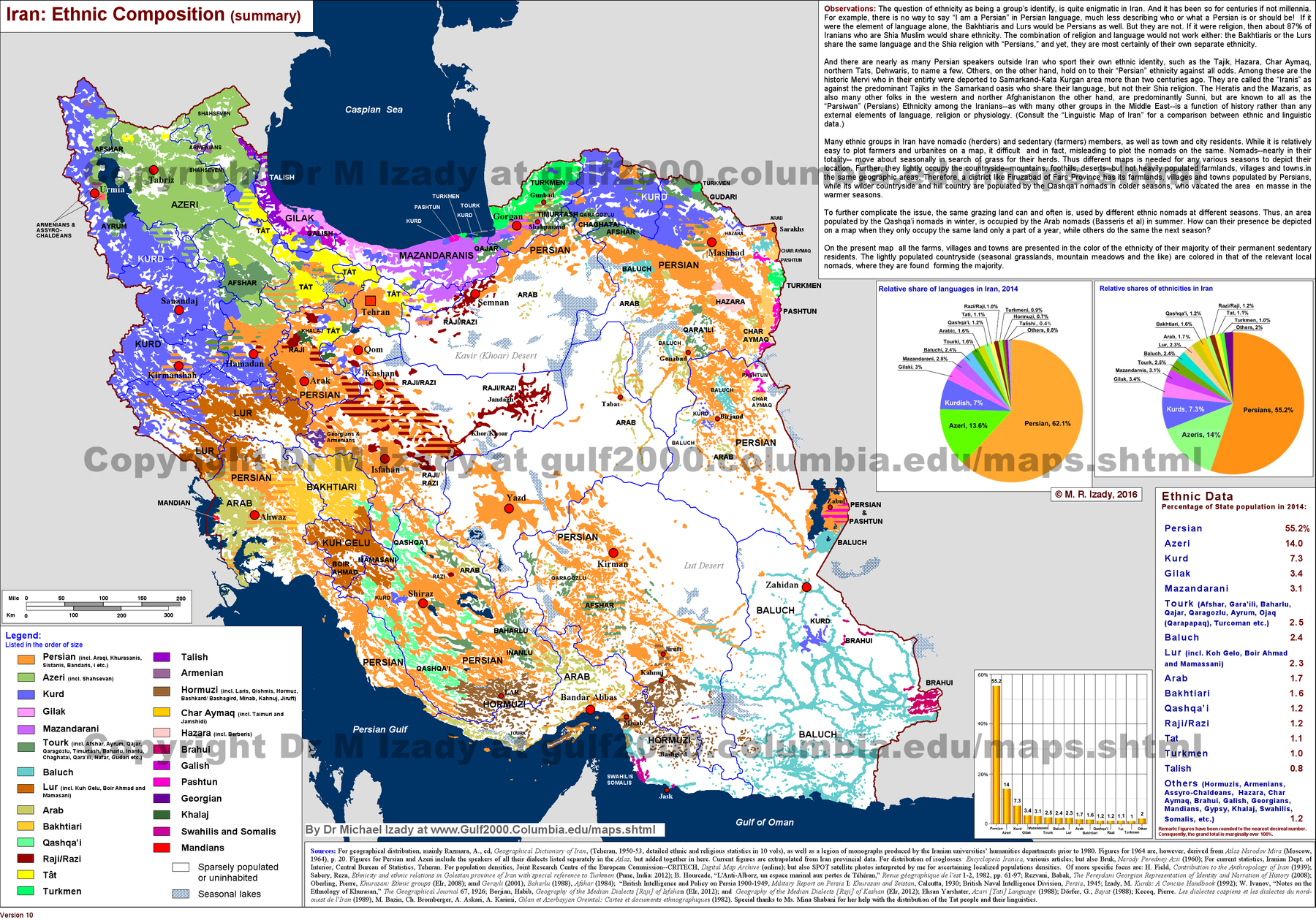
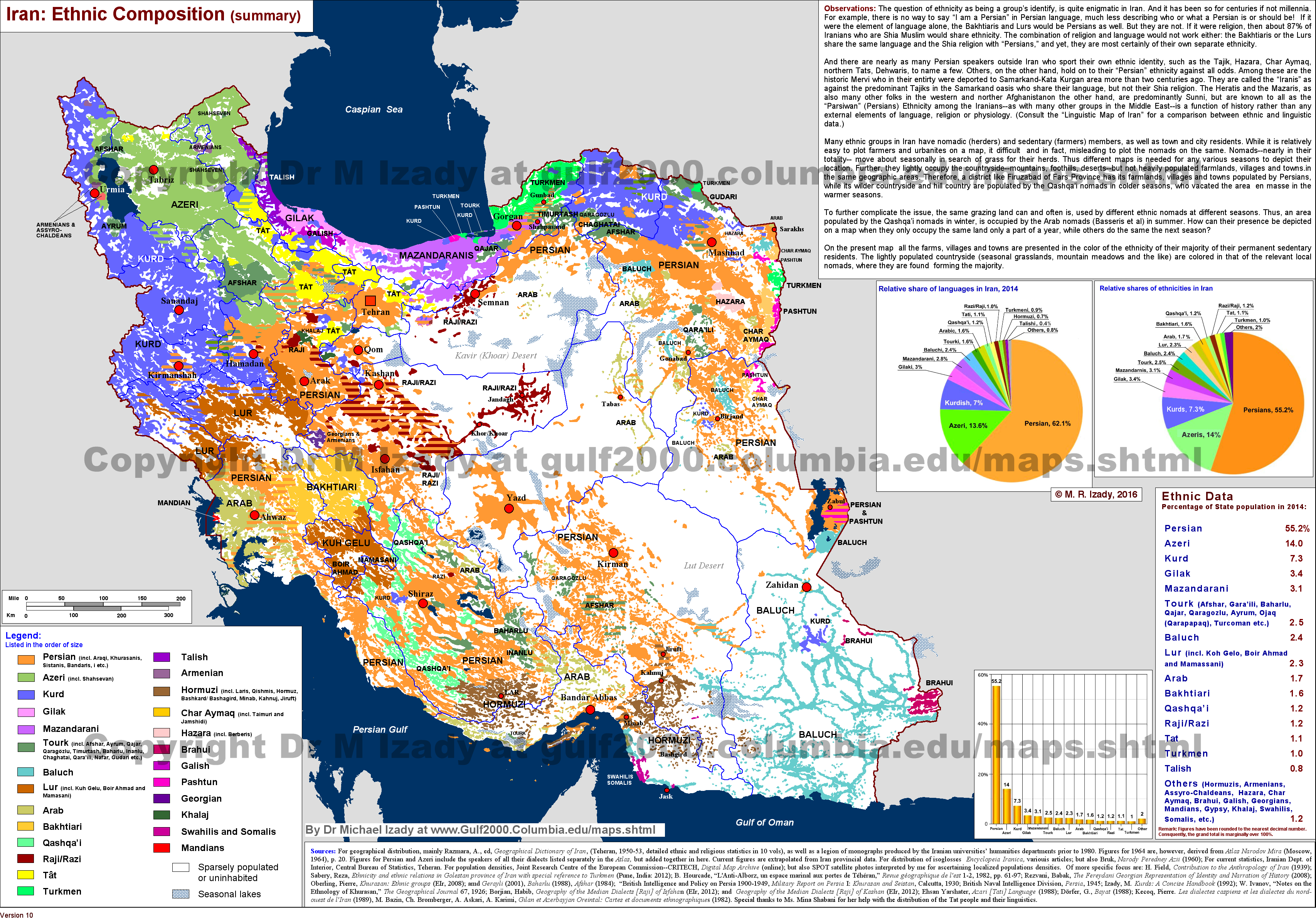
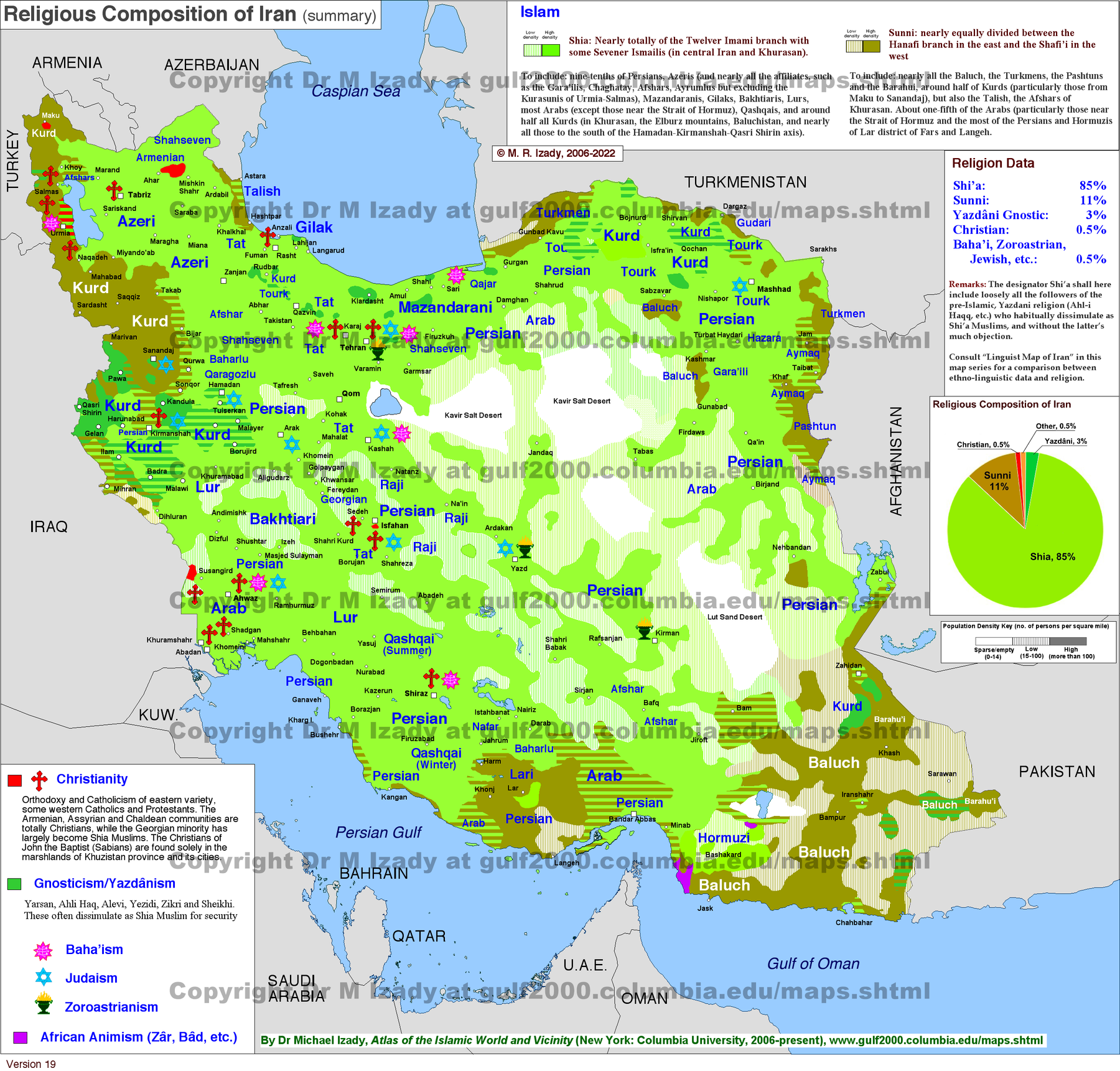
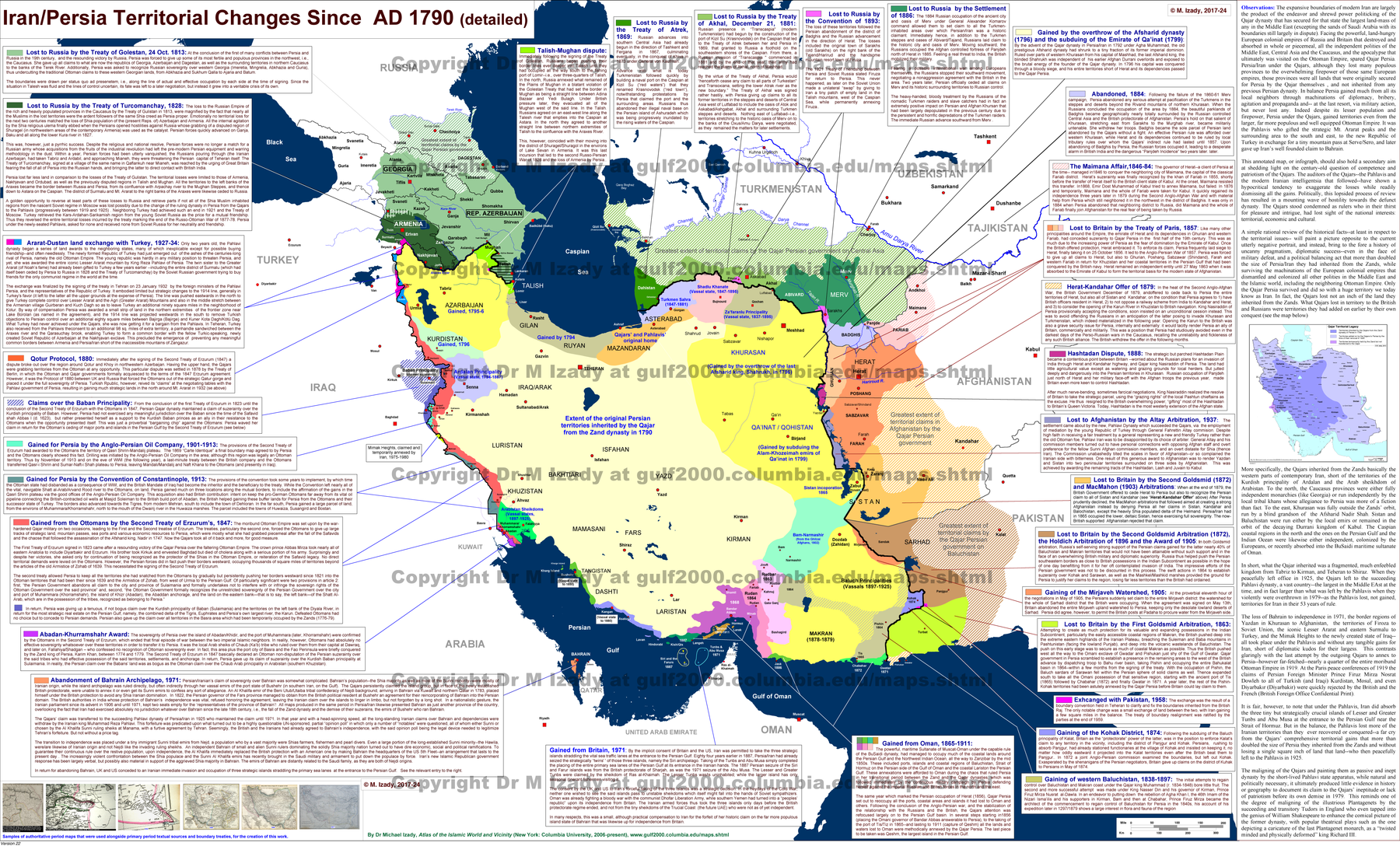
Maps for ethnic diversity, religion, and territorial history
These are Izady’s geographic reconstructions and estimates, not a uniform census series or maps of political allegiance. Dates and classifications belong to each image; religious affiliation does not establish support for a government or armed group.
Ethnic distribution in Iran
Use this to locate the communities named in the existing population discussion. Its percentage estimates differ from some figures already in the note; the two sources have not been reconciled, and neither should be presented as a census count of ethnicity.
Map source: Dr. Michael Izady, Gulf/2000, Columbia University. Original map · Collection. Personal reference use; copyright remains with the author.
Religious distribution in Iran
Compare religious and ethnic geography without assuming that all members of an ethnic group share the same faith or political position. The legend and demographic estimates are the author’s classification.
Map source: Dr. Michael Izady, Gulf/2000, Columbia University. Original map · Collection. Personal reference use; copyright remains with the author.
Territorial changes since the 1790s
A detailed historical reconstruction for the Qajar-era losses and border changes discussed in the timeline. Separate dated territorial changes from the author’s interpretive commentary and from current sovereignty claims.
Map source: Dr. Michael Izady, Gulf/2000, Columbia University. Original map · Collection. Personal reference use; copyright remains with the author.
Authoritarian rule. 1941–1979 – Mohammad Reza Shah Pahlavi
Takes power after Allied forces oust Reza Shah during WWII.
Pro-Western modernization, White Revolution reforms (1963).
Increasing authoritarianism and secret police (SAVAK) create unrest. 1953 – CIA-MI6 backed coup overthrows Prime Minister Mohammad Mossadegh, who had nationalized oil. 1979 – Islamic Revolution
Led by Ayatollah Ruhollah Khomeini.
Overthrows monarchy and establishes Islamic Republic.
U.S. embassy hostage crisis (1979–1981). 1980–1988 – Iran–Iraq War
Saddam Hussein invades; war results in massive casualties and economic devastation. 1989–2022 – Islamic Republic under Khamenei
Ayatollah Ali Khamenei becomes Supreme Leader after Khomeini’s death.
Reformist vs hardliner struggles continue.
Nuclear program tensions rise in the 2000s. 2009 – Green Movement protests contested election results.
Crushed by state, but signals generational discontent. 2015 – Iran Nuclear Deal (JCPOA) signed with U.S. and other world powers.
Sanctions eased in exchange for limits on nuclear program. 2018 – U.S. under Trump withdraws from JCPOA. Sanctions reimposed. 2022 – Mahsa Amini protests
Sparked by death of a woman detained for violating hijab laws.
Nationwide unrest led by women and youth. 2024–2025 – Iran continues facing internal dissent, economic crisis, regional tensions, and strained relations with the West and Israel.
1953 Revolution
1. “Mossadegh was non-democratically selected by the Iranian Parliament.”
What happened: On 28 April 1951 the elected 16th Majlis voted 79-12 to recommend Mohammad Mossadegh as prime minister, and the Shah duly appointed him. This was the normal constitutional procedure; Iran had no provision for a popular vote on the premiership. (3)
Assessment: True that Mossadegh was not popularly elected, but within Iran’s 1906 constitution his selection was formally legal and parliamentary, not arbitrary.
2. “He proceeded to rip up the constitution to overthrow the monarchy.”
Emergency powers: In July 1952 the Majlis granted Mossadegh six-month emergency powers to pass laws by decree. He renewed them once.
Referendum: On 1–4 August 1953 Mossadegh held a nationwide yes/no referendum to dissolve the very Majlis that had empowered him, bypassing constitutional safeguards. Even some allies deemed the move unconstitutional. (2)
Assessment: “Rip up” is rhetorical, but he did push the constitution beyond its wording and sidelined the Shah’s prerogatives, provoking monarchists, clergy, merchants, and much of the officer corps.
3. “CIA involvement was not the defining factor; the coup would have happened anyway.”
Internal opposition: Clerical figures such as Ayatollah Kashani, many urban bazaaris, most senior officers, and conservative landowners opposed Mossadegh. (4)
External coordination: Declassified CIA history The Battle for Iran describes Operation TP-AJAX: funding street mobs, bribing MPs and newspaper editors, and directing military plotters. (1)
Scholarly consensus: Even revisionist historians who emphasize Iranian agency still conclude that U.S./U.K. money, logistics, and the psychological campaign were crucial in turning scattered discontent into a successful coup on 19 August 1953. (5)(6)
Assessment: Without indigenous support the CIA could not have succeeded, but without the CIA many scholars judge the anti-Mossadegh forces too divided to prevail in August 1953. The operation was therefore a _decisive_accelerant, not an irrelevant sideshow.
4. “You did not install the Shah; he had ruled since 1941 and was exiled only briefly.”
Timeline: Mohammad-Reza Shah assumed the throne in September 1941 after his father’s forced abdication. He fled to Rome on 16 August 1953 during the first failed coup attempt and returned on 22 August once the second attempt succeeded. (6)
Assessment: Accurate. The coup re-empowered a monarch who already existed; it did not create a new one. Nonetheless, toppling an elected prime minister and expanding the Shah’s authority is widely regarded—inside and outside Iran—as foreign-assisted regime change, even if the dynasty itself pre-dated the event.
5. “The only real U.S. regime change was Carter ‘stabbing the Shah in the back’ in 1979.”
Diplomatic cables: Newly declassified documents show that in early 1979 the Carter administration opened back-channel talks with Ayatollah Khomeini and urged senior Iranian officers not to launch a coup that would keep the Shah’s last prime minister (Bakhtiar) in power. (7)(8)
Reality check: The administration was split; National Security Adviser Brzezinski quietly favored a military option while Secretary of State Vance opposed it. The U.S. never issued a formal “stand-down” order to the army—it lacked that authority—but Washington’s mixed signals and human-rights rhetoric certainly undermined the Shah’s position. (9)
Assessment: Carter’s policy contributed to the Shah’s fall, but evidence for an explicit U.S. directive ordering Iran’s army to stand down is thin. The revolution’s momentum was overwhelmingly domestic.
6. “1953 was not even a major grievance in 1979 and is weaponised only later.”
Revolutionary rhetoric: Early revolutionary communiqués focused on the Shah’s repression, Western cultural influence, and economic grievances; 1953 was mentioned but not always foregrounded. Over the decades, the Islamic Republic has indeed used the coup as a touchstone to justify anti-U.S. narratives.
Assessment: Partly correct: the coup became more prominent in official propaganda after 1979, but it was cited by radicals in 1960s–70s Iran and by the hostage-takers in 1979 as proof of American perfidy. Its political salience grew over time, not out of nowhere.
Truman Pressured Soviet Union to Leave Iran in 1946
Yes, President Harry S. Truman did pressure Joseph Stalin to withdraw Soviet troops from Iran in 1946, marking one of the first major confrontations of the Cold War between the United States and the Soviet Union.
Historical Context: Soviet Occupation of Northern Iran (1941–1946)
In August 1941, during World War II, British and Soviet forces jointly invaded Iran to secure supply lines (the “Persian Corridor”) and prevent Nazi influence.
Under the Tripartite Treaty of 1942, all Allied forces agreed to withdraw from Iran within six months after the war ended (i.e., by March 2, 1946).
The British did so on time, but the Soviets refused to leave. Instead, they supported separatist movements in Azerbaijan and Kurdistan, and backed the establishment of the Azerbaijan People’s Government and the Republic of Mahabad, both client states.
Truman’s Pressure
Truman responded with diplomatic firmness and strategic pressure, including:
Public and private diplomatic protests demanding Soviet withdrawal.
Taking the issue to the newly formed United Nations Security Council, making it one of its first cases.
Military signaling—increasing U.S. naval presence in the Mediterranean and publicly supporting Iran’s sovereignty.
Backing Iran’s protests and threats to escalate the matter internationally.
Truman wrote in his memoirs that this was a test of Soviet intentions. If Stalin succeeded in Iran, it could encourage further Soviet expansion into Turkey, Greece, and beyond.
Outcome
By May 1946, under mounting international pressure and Iranian resistance, Stalin ordered Soviet forces to withdraw.
The Soviet-backed puppet states in Azerbaijan and Mahabad quickly collapsed as Iranian forces regained control.
This episode is widely considered the first U.S. Cold War diplomatic victory, and a formative moment in the Truman Doctrine’s evolution.
Conclusion
Yes, Truman directly and successfully pressured Stalin to leave Iran in 1946, using a mix of diplomacy, international forums, and strategic signaling. The confrontation over Iran is a key moment in early U.S.–Soviet Cold War rivalry and a signal of America’s postwar commitment to containing Soviet expansionism.
Below is a substantially expanded chronology of the diplomatic moves, coercive steps, and military escalations that have shaped the Iran-nuclear file over the past quarter-century. Each entry highlights what Tehran did (or what was done to Tehran), how major actors responded, and the practical effect on Iran’s ability to produce or deliver a bomb.
Date / Period
Iranian Actions & Milestones
International / Israeli / U.S. Response
Impact on Nuclear Trajectory
Aug 2002
Exiled NCRI reveals covert enrichment plant at Natanz and heavy-water project at Arak
IAEA begins inspections; crisis internationalised
World learns Iran already possesses fuel-cycle technology (theguardian.com)
Oct 2003 – Nov 2004
Facing referral to the UN, Tehran signs the EU-3 “Tehran & Paris Agreements,” pledging to suspend enrichment
Britain, France, Germany negotiate; U.S. stays aloof
Suspension proves temporary; Iran keeps building centrifuges (en.wikipedia.org)
Second Israeli wave hits Fordow shafts, missile bases, leadership targets
Iran warns U.S. against intervention; seeks Russian-Chinese backing
Program set back “years,” per IAEA; regional oil markets roil (axios.com, reuters.com)
Jun 2025 (ongoing)
Iran resumes low-volume missile fire; economy in free-fall; quiet contacts via Oman/Qatar
U.S.–E3 present “zero-enrichment, full-dismantlement” opening bid; Congress signals sanctions snap-back
Tehran faces choice: negotiate from weakness or race covertly
Key Patterns
Every major nuclear concession Tehran has offered followed acute pressure—either sanctions (2003-06, 2012-13), covert attacks (2010, 2021) or kinetic strikes (2025).
Sunset clauses in the JCPOA incentivised Iran to wait out restrictions while perfecting advanced centrifuges off-line.
Domestic unrest (2009, 2022) consistently coincides with peaks in regime nuclear brinkmanship, as leaders seek nationalist rallying effects.
Israeli covert action repeatedly imposed multi-year delays (Stuxnet, Natanz explosions, 2025 air campaign) without triggering full-scale war.
Oscillating U.S. policy—from engagement (Obama), to pressure (Trump), to partial de-escalation (Biden)—produced windows that Tehran exploited; consistency appears decisive.
This richer timeline should give you a granular view of how each diplomatic initiative or coercive step immediately fed into the next round of escalation—or produced temporary pauses—shaping where the crisis stands as of mid-2025.
Groups Supported by Iran (Pre-1993)
1. Hezbollah (Lebanon)
Founded: 1982, during the Israeli invasion of Lebanon.
Support: Iran’s most prominent proxy; received funding, weapons, training, and ideological guidance via the Islamic Revolutionary Guard Corps (IRGC), especially its Quds Force.
Nature: Shi’a Islamist militia and political party.
Operations: Suicide bombings, assassinations, and kidnappings—including the 1983 U.S. Marine barracks bombing in Beirut and hostage-taking of Westerners.
Designation: Labeled a terrorist organization by the U.S. and several other states.
2. Islamic Jihad Organization (Lebanon)
Timeframe: Active mostly in the early to mid-1980s.
Overlap: Believed by many analysts to be either a front group for Hezbollah or heavily overlapping with it.
Operations: Linked to high-profile attacks, including the 1983 U.S. Embassy bombing in Beirut.
3. Various Iraqi Shi’a Islamist Groups
Notable example:Supreme Council for the Islamic Revolution in Iraq (SCIRI), founded in 1982 and later renamed ISCI.
Support: Based in Iran and backed as part of Iran’s opposition to Saddam Hussein’s Sunni-dominated regime in Iraq.
Goal: To overthrow Saddam and establish an Islamic regime in Iraq.
4. Afghan Shi’a Militias
During the Soviet-Afghan War (1979–1989):
Iran supported Shi’a groups, particularly the Hezb-e Wahdat, in contrast to the U.S. and Saudi backing of Sunni mujahideen.
Goal: Ensure Shi’a political representation and counter Sunni Islamist groups.
Iran’s Declared and Practical Enemies (Pre-1993)
1. United States
Dubbed the “Great Satan” since the 1979 revolution.
Enmity driven by:
The U.S. backing of the Shah.
The 1953 CIA coup (Operation Ajax).
U.S. support for Israel and later Iraq during the Iran-Iraq War.
U.S. military presence in the Persian Gulf.
2. Israel
Called the “Little Satan.”
Criticized for:
Zionism and occupation of Palestinian lands.
Alliance with the U.S.
Iran did not support Palestinian factions like Hamas or Islamic Jihad early on, but began outreach to Sunni Palestinian groups only in the 1990s, particularly after the Oslo Accords.
3. Iraq (under Saddam Hussein)
Iran’s most direct military enemy during the Iran–Iraq War (1980–1988).
Saddam’s secular Ba’athist regime and Sunni dominance were seen as hostile to Shi’a Islam and revolutionary Iran.
4. Saudi Arabia and Gulf States
Iran’s revolutionary rhetoric often targeted the monarchies of the Gulf, accusing them of being corrupt, Western-aligned, and anti-Islamic.
Sectarian tension (Sunni vs. Shi’a) played a role in this rivalry, though it was less intense than in later decades.
Iran supported Shi’a dissidents in Saudi Arabia’s Eastern Province and Bahrain.
Key Notes
Before 1993, Iran largely avoided alliances with Sunni Islamist movements like Hamas or the Muslim Brotherhood.
Its foreign policy focus was more ideological and sectarian, promoting Shi’a revolution and undermining secular or pro-Western Arab regimes.
The Oslo process and the PLO’s turn toward diplomacy created an opportunity for Iran to co-opt Sunni groups opposed to peace with Israel—thus Iran’s support for Hamas and Palestinian Islamic Jihad accelerated after 1993.
Hamas Support
Treacherous alliance - the secret dealings of Israel, Iran, — Trita Parsi, p.230 (file not included in this release)
Clearly, Iran’s rhetoric still conveyed a sense of Iranian obligation toward the Pales- tinians. Iran’s supreme leader told the head of Hamas that “the holy war for Palestine is for the honor of Islam and Muslims, and we will continue our firm support for the Palestinian people despite all the political and eco- nomic pressure, and that the issue of Jerusalem was “not a Palestinian prob- lem, but one for all Moslems.”
Iran’s support for Hamas has evolved significantly over time, with a clear turning point after the 1993 Oslo Accords. Prior to that, the relationship was limited and ideologically mismatched. Below is a detailed history of Iran’s support for Hamas, including before and after 1993:
I. Background: Iran’s Early Priorities (1979–Early 1990s)
Islamic Revolution Context
After the 1979 Islamic Revolution, Iran’s foreign policy focused on exporting Shi’a revolutionary ideology, supporting Shi’a Islamist movements (e.g., Hezbollah, Iraqi Shi’a groups), and opposing the U.S., Israel, and Saddam Hussein’s Iraq.
Sunni Islamist groups like the Muslim Brotherhood and its offshoots (including Hamas) were viewed with ideological skepticism. Iran preferred working with groups sharing its Shi’a theocratic model.
II. Hamas Before 1993: Limited and Informal Contact
Hamas Founded: 1987
Hamas was established during the First Intifada in 1987 as the Palestinian branch of the Muslim Brotherhood.
Its early agenda was Palestinian nationalist and Sunni-Islamist, not revolutionary Shi’a, which created ideological distance from Tehran.
Iran may have expressed verbal support for the broader Palestinian cause but did not provide substantial aid to Hamas in its early years.
Iran’s main Palestinian ally during this time was the PFLP-GC and elements within the Palestinian Islamic Jihad (PIJ)—groups with stronger resistance credentials and less ideological friction.
III. Turning Point: Post-Oslo Period (1993 Onward)
Oslo Accords (1993–1995)
The PLO under Yasser Arafat signed the Oslo Accords with Israel, moving toward a two-state framework and diplomatic recognition.
This outraged rejectionist groups, including Hamas and PIJ, who viewed Oslo as a betrayal.
Iran saw a strategic opening to support these rejectionist actors and undermine the peace process.
Iran’s Strategic Shift
According to Trita Parsi in Treacherous Alliance, post-Oslo Iran began to see Hamas as a useful Sunni proxy in the resistance against Israel and U.S.-backed diplomacy.
Iran opened up lines of funding, training, and arms transfers to Hamas, despite sectarian and ideological differences.
Hamas leaders, including Khaled Meshaal, began to make regular visits to Tehran and Damascus (where Iranian influence was strong via Syria and Hezbollah).
IV. Nature and Scale of Support (Mid-1990s–2000s)
Types of Support
Financial: Iran reportedly provided tens of millions of dollars annually to Hamas, especially after Hamas’s political isolation.
Military: Training for Hamas operatives, particularly in bomb-making and guerrilla tactics, often conducted by the IRGC Quds Force or via Hezbollah.
Political: Iran helped elevate Hamas’s international profile in the “Axis of Resistance.”
Early Attacks and Iranian Influence
Hamas suicide bombings in Israel in the mid-to-late 1990s coincided with increased Iranian aid, suggesting growing operational cooperation.
2001–2006: Support intensified during the Second Intifada, with Iran backing Hamas against both Israel and the Palestinian Authority.
V. 2006–2011: Hamas in Power and Heightened Iran Ties
2006 Elections
Hamas won the Palestinian legislative elections, leading to international sanctions and isolation.
Iran stepped in as a primary patron, increasing financial and military assistance.
Gaza Takeover (2007)
After violently expelling Fatah from Gaza in 2007, Hamas faced a blockade.
Iran became even more critical for weapons smuggling, tunnels, and missile technology—sometimes via Sudan, Egypt, or Syria.
VI. Post-2011: Strained Ties and Rebuilding
2011 Syrian Civil War
Iran’s staunch support for Bashar al-Assad (Alawite regime) angered Sunni Hamas, which sided with Sunni rebels.
Hamas’s leadership left Damascus, and Iranian funding dropped sharply between 2012–2015.
Tensions also grew due to ideological gaps and Hamas’s overtures to the Muslim Brotherhood and Qatar.
Reconciliation Efforts
Around 2017, Hamas and Iran began to rebuild ties, aided by shared hostility toward Israel and the U.S., and Hamas’s political isolation.
Iran resumed significant funding and military support, especially for rocket development and tunnel infrastructure.
Summary Timeline
Period
Key Events
Pre-1993
Iran supports mostly Shi’a groups; limited contact with Hamas
1987
Hamas founded; no direct Iranian support yet
1993–1995
Oslo Accords; Iran begins serious outreach to Hamas
Late 1990s
Suicide bombings and operational coordination increase
2006–2007
Hamas wins elections, takes over Gaza; Iran becomes main supporter
2011–2015
Syrian war strains ties; Iran-Hamas relationship cools
2017–Present
Strategic reconciliation; Iran resumes robust aid to Hamas
Conclusion
Before 1993, Iran did not materially support Hamas, focusing instead on Shi’a Islamist movements. The Oslo Accords marked a strategic turning point, after which Iran began supporting Hamas as a Sunni rejectionist force aligned against Israel, U.S. influence, and the peace process. This relationship has fluctuated due to regional politics, especially the Syrian war, but has remained fundamentally driven by shared geopolitical goals rather than ideological harmony.
Let me know if you want a visual timeline or a breakdown by category (military, financial, political).
Yes, the United States supported Iran diplomatically and strategically during the 1969 crisis between Iran and Iraq, but it did not involve direct military aid or intervention. The conflict was centered on a dispute over the Shatt al-Arab waterway, and it marked a turning point in U.S.–Iran–Iraq relations during the Cold War.
Background: The 1969 Shatt al-Arab Dispute
The Shatt al-Arab (known in Iran as the Arvand Rud) is a vital waterway formed by the confluence of the Tigris and Euphrates rivers, forming the boundary between Iran and Iraq near the Persian Gulf.
Under the 1937 treaty, Iraq had control over much of the waterway, which Iran increasingly resented as it modernized its navy and sought more maritime autonomy.
In April 1969, the Shah of Iran challenged Iraq’s control by sending an Iranian commercial ship, the Ebn-e-Sina, through the waterway without paying tolls to Iraq. Iran accompanied the ship with naval escorts and threatened retaliation if attacked.
Iraq responded by:
Withdrawing from the 1937 treaty
Expelling thousands of Iranian residents from Iraq
Threatening military confrontation
Iran escalated by:
Bolstering military support for Kurdish rebels in northern Iraq (e.g., Mustafa Barzani’s Peshmerga)
Demonstrating superior air and naval power
U.S. Support for Iran
While the U.S. did not publicly take sides, its Cold War alliance with Iran made its position clear:
Iran was a central U.S. ally in the region under the Shah, part of the U.S.-backed “Twin Pillars” policy (with Saudi Arabia).
The U.S. viewed Iraq’s Ba’athist regime, which came to power in 1968, as pro-Soviet and a potential destabilizer.
The U.S. supported Iran’s military modernization, including:
Advanced weapons sales
Training of Iranian forces
Intelligence coordination
While the U.S. did not directly intervene in the 1969 standoff, it implicitly backed Iran’s position, and saw Iran as a stabilizing force against Soviet-aligned regimes like Iraq.
Aftermath
No full-scale war broke out, but tensions simmered for years.
The crisis ultimately contributed to the 1975 Algiers Agreement, where Iraq recognized Iranian navigation rights and Iran ceased support for Kurdish rebels.
The U.S. continued to arm Iran heavily throughout the 1970s as a bulwark against Soviet influence.
Conclusion
Yes, the U.S. supported Iran strategically and politically during the 1969 crisis with Iraq, largely due to Cold War dynamics. However, this support was indirect, through alliance structures, arms sales, and shared opposition to Soviet-aligned regimes—not through direct military intervention.
Biden Era
(All points below are drawn only from Coleman Hughes’s conversation with Mark Dubowitz; no extra material has been added.)
Phase
Main Actions & Posture (per Dubowitz)
Iranian / Regional Response
Dubowitz’s Assessment
Transition Signals (Dec 2020 → Jan 2021)
• Biden campaign promises to “return to the JCPOA” and unwind Trump’s maximum-pressure sanctions. • Early personnel signals (Jake Sullivan, Bill Burns, Rob Malley) reinforce intent to re-engage.
Tehran immediately accelerates: announces plan to enrich to 20 % and produce uranium metal.
Public commitment to re-enter deal telegraphs predictability → erodes Trump-era deterrence before inauguration.
Re-Engagement Effort (Spring–Summer 2021)
• Indirect Vienna talks begin; U.S. offers sanctions relief for JCPOA compliance. • Biden team adopts “de-escalate by de-escalating” mindset—minimises new penalties, soft-pedals oil sanctions enforcement.
Iran responds to Natanz sabotage by enriching to 60 %—a first in its history—while negotiating. • Israel warns enrichment is “strategic blackmail.”
Approach seen as rewarding brinkmanship: “confidence-building” without leverage invites further nuclear steps.
• Talks stall after hard-liner Ebrahim Raisi becomes president. • Washington continues partial sanctions waivers; focuses on Ukraine crisis and domestic agenda.
Iran installs cascades of IR-6 centrifuges; stockpile of 60 % HEU grows. Proxy attacks on U.S. bases in Iraq/Syria persist; Houthis strike UAE/Saudi targets with Iranian drones.
Dubowitz: U.S. enforcing sanctions “with the lightest possible touch,” losing the economic choke-hold Trump built.
“Woman – Life – Freedom” Protests (Sept 2022 – Mar 2023)
• Biden issues human-rights sanctions, but avoids dramatic economic or diplomatic rupture to keep nuclear door open.
Regime cracks down violently yet still advances program; IAEA detects 84 % particles at Fordow in Feb 2023.
Focus on protest optics substitutes for strategy: no linkage between supporting Iranians and halting enrichment.
Final Vienna Draft & Collapse (Aug 2022 – Sept 2023)
• EU circulates “take-it-or-leave-it” text; Biden team willing to drop IRGC terrorism-designation issue. • Iran demands closure of IAEA investigations; talks die.
Tehran uses stalemate to perfect centrifuge R-&-D, builds underground halls at Natanz & Fordow.
Dubowitz: lost leverage—sanctions relief dangled, never delivered; Iran keeps both cash (through illicit oil sales) and nuclear gains.
Hamas 7 Oct 2024 Attack & Regional War
• Biden sends two carrier groups to deter wider war, but urges Israel to show “restraint.” • Continues back-channel with Tehran (via Oman/Qatar) on prisoner swaps and “understandings.”
Iran’s proxies—Hezbollah, Houthis, Iraqi militias—open multiple fronts; >100 attacks on U.S. troops (no fatal U.S. responses until Jan 2025).
Doctrine clash: Israel’s “escalate to de-escalate” vs. Biden’s “don’t widen the war.” Dubowitz says disconnect emboldens Tehran.
Israeli Deep Strikes (Apr & June 2025)
• U.S. privately urges caution; publicly re-affirms Israel’s right to self-defence but with “proportionality.” • Biden worries about oil shock & escalation to U.S. forces.
Israel destroys large parts of Iran’s missile production & air-defence grid; Iran fires 400+ missiles/drones—95 % intercepted.
Israeli action shows how far deterrence fell under Biden: physical rollback now required to replace absent economic-diplomatic pressure.
Current Negotiating Position (June 2025)
• Under congressional and Israeli pressure, Biden aligns with E3 on a “zero-enrichment, full-dismantlement” opening bid—effectively the pre-2013 stance.
Iran’s program crippled by Israeli raids; economy in free-fall; regime weighing talks vs. covert rebuild.
Dubowitz: Proposal is sound but leverage must be rebuilt; Biden’s earlier leniency means sanctions architecture is rusty and political unity fragile.
Overarching Themes Highlighted in the Interview
Predictability vs. Deterrence
Biden’s clear intent to restore JCPOA made U.S. behaviour forecastable; Tehran exploited the window to leap from 3.67 % to 60 % enrichment and accumulate a 120 kg stockpile of near-bomb-grade fuel.
“De-Escalate by De-Escalating” Doctrine
Dubowitz characterises the administration’s mantra as offering financial and diplomatic concessions first, hoping Iran would reciprocate. Result: inverse correlation—each concession was met with a new nuclear or proxy provocation.
Sanctions Underenforcement
Oil exports (mostly to China) climbed back above 1.5 m bbl/day by 2023. Treasury issued waivers or slow-walked designations, weakening bargaining power.
Missed Linkage with Popular Unrest
Administration voiced solidarity with Iranian protesters but did not fuse that stance to nuclear or terror leverage—missing an opportunity to pressure the regime on two fronts simultaneously.
Doctrine Clash with Israel Post-Oct 7
Biden sought to localise the Gaza war; Israel viewed Iran as the head of the octopus. The resulting divergence forced Jerusalem to act unilaterally against Iran’s strategic infrastructure.
Return to Pre-JCPOA Maximalism (2025)
Ironically, after four years of incremental accommodation efforts, the White House now supports exactly what UN resolutions demanded in 2006-10: zero enrichment and dismantlement—because sunsets loom and Israeli strikes have reset the battlefield.
Dubowitz’s Bottom Line on Biden (as voiced in the interview)
“When adversaries know exactly what you’ll give them to calm down, they simply raise the price. Predictability is not a virtue in revolutionary bargaining.”
Short-Term Outcome: Relative quiet on the nuclear track during diplomacy.
Long-Term Price: Iran emerged by late 2024 with unprecedented technical capability and emboldened proxies, forcing kinetic rollback by Israel and a negotiating position harsher than the one Biden inherited.
Key Insights the Interview Draws
Red-Line Enforcement Matters
Soleimani’s death showed Tehran that U.S. warnings could be literal, not performative.
Personality as Deterrence Asset
“Unreadable” leaders (Dubowitz cites Nixon and Trump) gain leverage in bargaining—at least temporarily.
Deterrence vs. Sustainment
Military shock buys time but must be followed by a consistent policy; otherwise adversaries wait for the next, more predictable administration.
Nuclear–Terror Linkage
Iranian decision-makers paused nuclear escalation not from technical incapacity, but after recognising a direct personal-risk threshold they had mis-judged.
Bottom line:
The transcript frames the Soleimani strike as the hinge that validated Trump’s maximum-pressure doctrine: a vivid proof-of-resolve that froze Iran’s nuclear advances for almost a year. But the same episode underlines how deterrence anchored in a single leader’s unpredictability can dissipate swiftly when the political clock turns over.
IAEA - Verification and monitoring in the Islamic Republic of Iran in light of United NationsSecurity Council resolution 2231 (2015) (file not included in this release)
Everything You Need to Know About Iran’s Nuclear Program
Iranian Officials’ Views on Nuclear Weapons (1979 – 2025)
Introduction
Since the 1979 Islamic Revolution, Iran’s political-religious leadership has repeatedly declared that nuclear weapons are immoral, strategically unnecessary, and forbidden by Islam (1). Nevertheless, insider accounts and intelligence findings show that Tehran has periodically explored the option or kept the capability “on the shelf” (2). This survey traces official statements, fatwas, leaked insights, and intelligence assessments from 1979 to mid-2025, focusing strictly on weapons rather than peaceful nuclear energy.
1979 – 1988 | Revolution & Iran-Iraq War
Khomeini’s prohibition. During the Iran-Iraq War, IRGC logistics chief Mohsen Rafighdoost twice asked Ayatollah Ruhollah Khomeini to authorize chemical or nuclear weapons; Khomeini rejected both requests as haram (forbidden) and declared that Iran must never produce weapons of mass destruction (3).
The Supreme Leader asked, “If we produce chemical weapons, what is the difference between me and Saddam?” (4). Iran therefore refrained from retaliating with WMD despite extensive Iraqi chemical attacks (5).
1989 – 2001 | Post-War Revival, First Fatwa by Ali Khamenei
Ayatollah Ali Khamenei (Supreme Leader since 1989) reaffirmed the Islamic ban and reportedly issued an initial fatwa against WMD in the mid-1990s (6).
Former President Akbar Hashemi Rafsanjani later revealed that Iran “kept the option in mind” during the war but never weaponized it (7).
Exceptionally provocative remark. In a Quds-Day sermon (Dec 14 2001) Rafsanjani mused that a single Muslim nuclear bomb could obliterate Israel, whereas Israel could only inflict limited harm on the Islamic world (8). Tehran insisted this was rhetorical, not an admission of an Iranian bomb program.
2002 – 2005 | Exposure, EU-3 Talks & the Public Fatwa
Despite fiery rhetoric, President Mahmoud Ahmadinejad insisted that Iran opposed nuclear arms on Islamic grounds (13).
April 2010 – At Tehran’s “Nuclear Energy for All, Nuclear Weapons for None” conference, Khamenei called the use of WMD “a grave sin” (14).
Feb 2012 – In a major Friday sermon, he reiterated, “The production and use of nuclear weapons is forbidden. We will never pursue them.” (15).
U.S. National Intelligence Estimate 2007 assessed that Iran halted its structured weapons program in 2003 and had not decided to build a bomb (16).
2013 – 2015 | Rouhani & the JCPOA
President Hassan Rouhani repeatedly cited the fatwa in interviews with Western media: “Iran will never develop nuclear weapons, period.” (17).
July 14 2015 – JCPOA signed. Supreme Leader Khamenei stated, “We do not need nuclear weapons today, tomorrow, or ever… this is our religious and rational fatwa.” (18).
2016 – 2020 | Deal Under Duress, Trump Withdrawal
After the 2018 U.S. exit from the JCPOA, Iran breached some limits but Khamenei again stated on state TV: “Building and stockpiling nuclear bombs is wrong, and using them is haram.” (19).
Intelligence Minister Mahmoud Alavi warned in Feb 2021 that a “cornered cat may behave differently” if Iran’s survival is threatened (20).
July 2022 – Khamenei adviser Kamal Kharrazi: “Iran has the technical ability to build a bomb, but no decision to do so.” (21).
State newspaper Iran, Apr 7 2025 – argued Khamenei’s fatwa bans use of nukes, not necessarily possession, and that deterrent stockpiling might therefore be permissible (22).
Ali Larijani, senior adviser, Apr 1 2025: “If you attack us, you will force Iran to seek nuclear weapons to defend itself.” (23).
IRGC General Ahmad Hajtalab, Apr 18 2025: Iran may “revise its nuclear doctrine” if Israeli threats persist (24).
May 2025 – Kharrazi to Al Jazeera: “Should Iran’s existence be threatened, we will have no choice but to change our doctrine.” (25).
Conclusion
For over four decades Iranian leaders—especially the two Supreme Leaders—have publicly condemned nuclear weapons on Islamic and strategic grounds (1, 6, 14). Yet Tehran has also hedged: it acquired know-how, carried out clandestine weapons work pre-2003, and now openly boasts that capability exists even though a “political-religious decision” has not been taken (16, 21). Since 2023 a growing chorus of officials warns that existential threat could override the longstanding prohibition (20, 22, 23, 24, 25). Thus, while Iran has not yet crossed the nuclear-weapons threshold, the leadership has deliberately moved from absolute rejection toward conditional ambiguity.
References
Khamenei.ir, “Message to Disarmament Conference,” 17 Apr 2010.
IAEA, Implementation of the NPT Safeguards Agreement in the Islamic Republic of Iran, GOV/2003/40, 6 Jun 2003.
MEMRI TV Clip #2590, “Rafighdoost recalls Khomeini’s ban on WMD,” 27 Jan 2010.
M. Rafighdoost interview, Jam-e Jam (Persian), 30 Apr 2007.
UN Security Council Report S/16433, 26 Mar 1986 (UN investigation of Iraqi CW).
A. Ehteshami, Iran and the Rise of its Neoconservatives, I.B. Tauris 2007, p. 157.
Rafsanjani memoir interview, Donya-ye Eqtesad (Tehran), 24 Oct 2008.
MEMRI Special Dispatch #325, “Rafsanjani Jerusalem Day Speech,” 3 Jan 2002.
NCRI Press Conf., Washington DC, 14 Aug 2002 (Natanz & Arak revelations).
Tehran Times, “President Khatami Says Islam Forbids Nuclear Weapons,” 11 Feb 2003.
Khamenei Friday Sermon, 21 Mar 2003 (Nowruz).
Hassan Rouhani, National Interest interview, “Beyond the Bomb,” 23 Oct 2004.
UNGA Plenary 65th Session, Ahmadinejad speech transcript, 23 Sep 2010.
Khamenei message to “Nuclear Energy for All” conf., Tehran, 17 Apr 2010.
Islamic Republic News Agency (IRNA), “Supreme Leader: Nuclear weapons a great sin,” 3 Feb 2012.
U.S. National Intelligence Estimate, “Iran: Nuclear Intentions and Capabilities,” Nov 2007.
Fresh fuel supplied by Russia; all spent fuel shipped back—eliminates any domestic plutonium stream
History in brief
1975-79 – Siemens KWU (Germany) starts two 1 300 MW units under the Shah; work stops with the 1979 Revolution and the site is later bomb-damaged during the Iran-Iraq war. (world-nuclear.org)
1995 – Iran signs a “finish & convert” contract with Russia’s Minatom/Atomstroyexport to complete Unit 1 as a VVER-1000, using the partly built German shell. Work is hampered by sanctions and financing issues. (world-nuclear.org, world-nuclear.org)
2010-13 – First Russian fuel delivered (2007); core loaded Aug 2010, first criticality May 2011, grid connection September, commercial operation declared in 2013. (en.wikipedia.org)
2021-25 – Routine annual refuelling outages; reactor resumed full-power operation on 10 June 2025 after spring maintenance, producing ~7 TWh in the preceding Persian-calendar year. (presstv.ir)
June 2025 strikes – Israel’s recent attacks deliberately avoided Bushehr to minimise radiological risk; IAEA confirms no damage. (armscontrol.org)
How the plant is used
Electricity – Dispatches baseload power to the southern grid; output offsets ~11 million barrels of oil-equivalent per year.
Desalination & process heat – Two linked desalination units (commissioned 2014 +) supply up to 20 % of Bushehr city’s potable water. (world-nuclear.org)
No weapons value – International safeguards, Russian take-back of spent fuel, and lack of on-site reprocessing mean Bushehr contributes nothing to Iran’s weapon pathway.
2. Expansion plans at Bushehr
Bushehr-2 & Bushehr-3 – Two upgraded VVER-1000/V-466 B units (≈1 050 MW each) broke ground in 2019 & 2020. Rosatom estimates commercial start-up in 2026-27, though sanctions and the 2025 strikes may slip that schedule. (enerdata.net)
Fuel assurance – Like Unit 1, both new reactors are to run on Russian-supplied LEU with take-back, a condition written into Iran–Russia agreements and noted in IAEA correspondence.
*3. Other civilian reactors in Iran (research-scale)**
Site
Power
Role
Status
Tehran Research Reactor (TRR)
5 MW-thermal
Medical-isotope production, neutron physics, training
Supplied by the U.S. in 1967; converted from 93 % HEU to 19.75 % LEU fuel in 1993; operates under IAEA safeguards and currently consumes 20 % fuel fabricated in Iran. (nti.org)
IR-10 (Esfahan)
10 MW-thermal (planned)
Successor isotope reactor
Announced 2022; site prep under way at Esfahan Nuclear Technology Center. (isis-online.org)
IR-40 / Khondab Heavy-Water Reactor (Arak)
40 MW-thermal design, now being down-rated to ~20 MW-th
Intended isotope & materials-test reactor
Original core (plutonium-yielding) was removed and destroyed under the JCPOA; China/UK redesign team working to start a lower-power, LEU-fueled version later in the decade. (world-nuclear.org)
*None of these facilities produces electricity; they are dedicated to research, radio-isotope manufacture, and engineering tests.
4. Why only one power reactor so far?
Revolution & war interruptions wiped out the 1970s Western build programme.
Financing & sanctions forced dependence on a single Russian turnkey project; every additional megawatt of nuclear capacity requires external capital, waivers, and supply lines.
Grid composition – Iran still relies on abundant domestic gas (≈ 80 %) and oil for power; nuclear remains a strategic hedge rather than an economic mainstay. (world-nuclear.org)
Key take-aways
Bushehr-1 is a classic “peaceful-use” reactor: foreign fuel, IAEA cameras, and no plutonium pathway.
Civilian output is modest—roughly a large gas-turbine’s worth of electricity—but symbolically vital for Iran’s claim to nuclear modernity.
Future growth hinges on Bushehr-2/3; delays would keep nuclear below 3 % of Iran’s generation mix well into the 2030s.
Research reactors matter politically: TRR’s isotope needs justified Iran’s move to 20 % enrichment, and the Arak redesign remains a litmus test of Tehran’s willingness to honour non-proliferation commitments.
2015 Obama-Era Iran Nuclear Deal (JCPOA)
Why Iran's Nuclear Program Must Be Stopped - YouTube
1. Why Negotiations Began
Trigger
Details from the Interview
2002–10 revelations & sanctions spiral
Covert sites at Natanz/Fordow discovered → five UN Security Council resolutions (2006-10) mandate zero enrichment.
2009 Green Movement & Obama outreach
Massive protests against Ahmadinejad. Obama writes Supreme Leader Khamenei seeking talks, signalling preference for diplomacy over public regime-change rhetoric.
Secret Oman channel (2013)
Jake Sullivan & William Burns meet Iranian envoys in Muscat. Iran sets a “red-line”: permanent right to enrich. U.S. concedes limited enrichment to keep talks alive, leading to the 2013 Joint Plan of Action (JPOA).
2. What JCPOA Actually Contained (as described)
Domain
Stated Terms / Numbers
Centrifuges
Iran keeps 5,060 first-generation (IR-1) machines running at Natanz; Fordow repurposed for R&D/medical isotopes.
Enrichment Level & Stockpile
Capped at 3.67 % U-235; stockpile limited to 300 kg for 15 years.
Advanced R&D
Iran permitted to design and test IR-2m, IR-4, IR-6, IR-8 centrifuges on a graduated timetable.
Verification
Expanded IAEA access (including Additional Protocol) but no “anytime/anywhere” snap inspections of military sites.
Sunsets
Major restrictions taper: centrifuge numbers, stockpile, and level sunsets begin 2025; by 2030 virtually all limits expire.
Sanctions Relief
Immediate release of ≈ $50 bn frozen funds, phased lifting of oil, banking, shipping sanctions; arms-embargo removal after 5 yrs, missile-embargo after 8.
Snap-Back
UN sanctions theoretically re-imposed if U.S. or E3 cites “significant non-performance,” but mechanism politically cumbersome.
Dubowitz’s shorthand: “JCPOA = enrichment legitimised + a trillion dollars over 15 years + sunset to an industrial program.”
Coleman’s Reflection: Obama and Trump each supplied short-term deterrents (deal vs. madman pressure) but left successors two unpalatable choices: capitulate to sunsets or reignite confrontation.
10. Representative Phrases from the Transcript
Speaker
Paraphrased Quote
Dubowitz
“The Supreme Leader gets more than 100 k centrifuges—he just has to wait.”
Dubowitz on sun-sets
“By 2030 Iran legally operates an industrial program, with cash to spare.”
Coleman
“Obama’s deal looked like a decent short-term fix—until you saw the long-term liabilities.”
Dubowitz on leverage
“We spent our sanctions chips on day one; rebuilding that pile is excruciating.”
11. Key Take-Aways Consolidated
JCPOA traded permanent fuel-cycle legitimacy for a temporary cap.
Economic-integration theory drove Obama’s acceptance of concessions; Dubowitz deems that empirically false for revolutionary regimes.
Sunset design baked in today’s brinkmanship: the nearer 2025-30 approached, the more Iran accelerated.
U.S. policy swing (deal → exit → re-entry attempts) created strategic whiplash that Tehran exploited.
Current U.S.–E3 demand (“zero enrichment”) is effectively a return to the pre-2013 UN consensus—underscoring how far policy has come full circle.
COUNTER: CIA and U.S. Intelligence said Iran no active program
2025 Annual Threat Assessment
ATA-2025-Unclassified-Report.pdf (file not included in this release)
ATA-2025-Unclassified-Report, p.22 (file not included in this release)
Tehran will try to leverage its robust missile capability and expanded nuclear program, and its diplomatic outreach to regional states and U.S. rivals to bolster its regional influence and ensure regime survival.
ATA-2025-Unclassified-Report, p.23 (file not included in this release)
Iran also will continue to directly threaten U.S. persons globally and remains committed to its decade-long effort to develop surrogate networks inside the United States. Iran seeks to target former and current U.S. officials it believes were involved in the killing of Islamic Revolutionary Guard Corps (IRGC)-Qods Force Commander Qasem Soleimani in January 2020 and previously has tried to conduct lethal operations in the United States.
ATA-2025-Unclassified-Report, p.26 (file not included in this release)
We continue to assess Iran is not building a nuclear weapon and that Khamenei has not reauthorized the nuclear weapons program he suspended in 2003, though pressure has probably built on him to do so. In the past year, there has been an erosion of a decades-long taboo on discussing nuclear weapons in public that has emboldened nuclear weapons advocates within Iran’s decisionmaking apparatus. Khamenei remains the final decisionmaker over Iran’s nuclear program, to include any decision to develop nuclear weapons.
2024 Annual Threat Assessment
ATA-2024-Unclassified-Report.pdf (file not included in this release)
ATA-2024-Unclassified-Report, p.18 (file not included in this release)
Decades of cultivating ties, providing support, funding, weapons, and training to its partners and proxies around the Middle East, including Lebanese Hizballah, the Huthis, and Iranianbacked militias in Iraq and Syria, will enable Tehran to continue to demonstrate the efficacy of leveraging these members of the “Axis of Resistance”, a loose consortium of like-minded terrorist and militant actors. Tehran was able to flex the network’s military capabilities in the aftermath of HAMAS’ attack on 7 October, orchestrating anti-Israel and anti-U.S. attacks from Lebanon to the Bab al-Mandeb Strait while shielding Iranian leaders from significant consequences.
ATA-2024-Unclassified-Report, p.19 (file not included in this release)
Iran is not currently undertaking the key nuclear weapons-development activities necessary to produce a testable nuclear device. Since 2020, however, Tehran has stated that it is no longer constrained by any JCPOA limits, and Iran has greatly expanded its nuclear program, reduced IAEA monitoring, and undertaken activities that better position it to produce a nuclear device, if it chooses to do so.
ATA-2024-Unclassified-Report, p.19 (file not included in this release)
Iran continues to increase the size and enrichment level of its uranium stockpile, and develop, manufacture, and operate advanced centrifuges. Tehran has the infrastructure and experience to quickly produce weapons-grade uranium, if it chooses to do so.
2022 Annual Threat Assessment
ATA-2022-Unclassified-Report.pdf (file not included in this release)
ATA-2022-Unclassified-Report, p.14 (file not included in this release)
ran will continue to threaten U.S. interests as it tries to erode U.S. influence in the Middle East, entrench its influence and project power in neighboring states, and minimize threats to regime stability. Tehran will try to leverage its expanding nuclear program, proxy and partner forces, diplomacy, and military sales and acquisitions to advance its goals. The Iranian regime sees itself as locked in an existential struggle with the United States and its regional allies, while it pursues its longstanding ambitions for regional leadership.
ATA-2022-Unclassified-Report, p.14 (file not included in this release)
We assess that Iran will threaten U.S. persons directly and via proxy attacks, particularly in the Middle East. Iran also remains committed to developing networks inside the United States—an objective it has pursued for more than a decade. Iranian-supported proxies will launch attacks against U.S. forces and persons in Iraq and Syria, and perhaps on other countries and regions
ATA-2022-Unclassified-Report, p.15 (file not included in this release)
We continue to assess that Iran is not currently undertaking the key nuclear weapons-development activities that we judge would be necessary to produce a nuclear device. In July 2019, following the U.S. withdrawal from the JCPOA in May 2018, Iran began resuming some activities that exceed JCPOA limits. If Tehran does not receive sanctions relief, Iranian officials probably will consider further enriching uranium up to 90 percent.
ATA-2022-Unclassified-Report, p.15 (file not included in this release)
Iran continues to increase the size and enrichment level of its uranium stockpile beyond JCPOA limits. Iran continues to ignore restrictions on advanced centrifuge research and development and continues uranium enrichment operations at the deeply buried Fordow facility. Iran has been enriching uranium hexafluoride (UF6) up to 60 percent U-235 since April 2021, and continues to accumulate UF6 enriched up to 20 percent. The IAEA has verified that Iran is conducting uranium metal research and development, including producing laboratory-scale quantities of uranium metal enriched up to 20 percent U-235
US Intelligence Officials Quotes
Under Secretary of Defense for Policy Colin Kahl (2023)
“Because Iran’s nuclear progress since we left the JCPOA has been remarkable. Back in 2018, when the previous administration decided to leave the JCPOA it would have taken Iran about 12 months to produce one bomb’s worth of fissile material. Now it would take about 12 days,” Kahl, the third ranking Defense Department official, told lawmakers. Reuters
CIA director William Burns (2023)
Iran’s nuclear enrichment program is more advanced than previously known and “if they chose to cross that line,” Tehran would only need a “matter of weeks” to enrich uranium capable of powering a nuclear weapon, CIA director William Burns told CBS News in an exclusive interview with “Face the Nation” that aired Sunday.
“To the best of our knowledge, we don’t believe that the Supreme Leader in Iran has yet made a decision to resume the weaponization program that we judge that they suspended or stopped at the end of 2003,” Burns told “Face the Nation” moderator Margaret Brennan. “But the other two legs of the stool, meaning enrichment programs, they’ve obviously advanced very far.”
IC view (2025 Annual Threat Assessment): “We continue to assess Iran is not building a nuclear weapon …” (baseline Dave quoted).
Pentagon view: Under-Secretary of Defense for Policy Colin Kahl told the House Armed Services Committee that Iran could make enough fissile material for one bomb “in about 12 days.”
CIA view: Director William Burns said on CBS’s Face the Nation that, if Tehran chose, it would need only “a matter of weeks” to reach that same threshold.
These two latter statements—by the Pentagon’s chief policy official and by the CIA Director—appear in the public record but were omitted in Smith’s presentation, even though they sit alongside the intelligence community’s assessment that Iran has not yet decided to weaponise.
Iran could make enough fissile for one nuclear bomb in “about 12 days,” a top U.S. Defense Department official said on Tuesday, down from the estimated one year it would have taken while the 2015 Iran nuclear deal was in effect.
From the time of a national decision, Iran could produce enough fissile material
for a nuclear weapon in approximately 10-15 days and it would only take several months to
produce an actual nuclear weapon.
https://www.reuters.com/world/middle-east/explainer-how-close-is-iran-having-nuclear-weapons-2024-04-18/
Iran is now enriching uranium to up to 60% purity and has enough material enriched to that level, if enriched further, for two nuclear weapons, according to the International Atomic Energy Agency’s theoretical definition.
That means Iran’s so-called “breakout time” - the time it would need to produce enough weapons-grade uranium for a nuclear bomb - is close to zero, likely a matter of weeks or days.
Despite questions about the source of the information, the dissidents’ claim that Iran had a covert nuclear program proved to be true. The hidden sites — a uranium enrichment plant in Natanz and a heavy-water plant in Arak — were later confirmed by a U.N. monitoring group and the Iranian government, though the Iranians insisted that they were intended only to generate peaceful nuclear energy. https://www.pbs.org/frontlineworld/stories/iran403/background.html
Terrorism
The Axis of Evil_ Iran, Hizballah, and the - Shaul Shay, p.106 (file not included in this release)
During the years 1980–1999, Shiite terror organizations and Iranian entities perpetrated 260 international terror attacks (this number does not include terror acts performed by the Hizballah against1DF forces in Lebanon and terror attacks perpetrated against Iraq during the Iran-Iraq war) Shiite terror attacks warranted publicity and international acclaim due mainly to two moth operandi that they utilized
The Axis of Evil_ Iran, Hizballah, and the - Shaul Shay, p.106 (file not included in this release)
Suicide Attacks—The Shiite organizations were the first to perpetrate suicide attacks against Western targets in Lebanon and Kuwait. Despite the fact that the Shiite organizations carried out a total of only five suicide attacks against Western targets, the impact of these attacks was tremendous—they brought about the evacuation of American and French forces from Lebanon and became the “trademark” of Shiite terror
The Axis of Evil_ Iran, Hizballah, and the - Shaul Shay, p.110 (file not included in this release)
The countries that constituted central targets for the Iranian Shiite terror were as follows (see Figure 3.3): United States: 40 attacks were perpetrated against American targets. France: 27 attacks were perpetrated against French targets. Kuwait: 21 attacks were perpetrated against Kuwaiti targets. Saudi Arabia: 20 attacks were perpetrated against Saudi targets.
The Axis of Evil_ Iran, Hizballah, and the - Shaul Shay, p.114 (file not included in this release)
Khomeini regarded “revolutionary violence” as a central tool for the resolution of the problems plaguing Muslim society as well as a solution for the individual’s plight. The struggle concentrated primarily on the purification of Islamic society from within, starting with the Shiite community and subsequently moving on to the wider Islamic circle. The struggle was not meant to end in the Islamic arena, but rather was designated to destroy the “root of evil”—the superpowers that corrupt the world. Therefore, Khomeini’s revolutionary message wasis universal, and the Shiites represented the depressed on earth.
The Axis of Evil_ Iran, Hizballah, and the - Shaul Shay, p.114 (file not included in this release)
Khomeini presented the religious/ideological and rational justifications for the use of violence to promote the goals of Islam, and cited the Jihad and “self sacrifice” at the ideological forefront of his philosophy. This fact gave the Shia the reputation worldwide of being a fanatical faith that demanded self-sacrifice of its followers. One of the prominent innovations of Khomeini’s theory was the granting of permission to sacrifice the life of the individual in order to realize the goals of Islamic society, in contradiction to accepted Islamic law, which bans individual suicide Khomeini justified his ruling in this matter through the use of several arguments: First of all, he maintained that the individual lives in a corrupt society whose main role is to meet material needs. When the individual sacrifices himself, he sacrifices something physical for a lofty spiritual goal (sacrifice of the “material me” in favor of the “spiritual me”). Khomeini regarded the incident of the Imam Hussein’s death as the main argument justifying self-sacrifice in the service of Islam. When Hussein set forth on his long journey from Hájaz to Carbala, according to this interpretation he already knew that he would not return and that he would die a horrible death; however, his sacrifice was vital for the Shiite community’s claim to Islam’s crown of leadership. Hussein’s death is reconstructed every year at the Ashura rituals; however, Khomeini argued that this was insufficient, and that it was important to relive Hussein’s selfsacrifice in practical terms through daily self-sacrifice on behalf of Islam
The Axis of Evil_ Iran, Hizballah, and the - Shaul Shay, p.125 (file not included in this release)
In the beginning of the 1990s, the Hizballah, with Iranian assistance, perpetrated two suicide attacks in Buenos Aires against Israeli and Jewish targets. On March 17, 1992, a suicide attack was perpetrated against the Israeli Embassy in Buenos Aires. On July 18, 1994, a suicide attack was perpetrated against the Jewish cultural center (AMIA) in Buenos Aires.
Attacks against Aviation - The Axis of Evil_ Iran, Hizballah, and the - Shaul Shay, p.133 (file not included in this release)
A list of sabotage attacks - The Axis of Evil_ Iran, Hizballah, and the - Shaul Shay, p.148 (file not included in this release)
Kidnapping Hostages - The Axis of Evil_ Iran, Hizballah, and the - Shaul Shay, p.154 (file not included in this release)
Attacks against Americans
Sen. Tom Cotton asks General Kurilla how many times Iran’s proxies have attacked Americans in Iraq and Syria. It was over 170 times compared to U.S. responding 8 times.
Iran’s proxies have attacked Americans in Iraq and Syria over 170 times. We have responded 8 times. Iran and its terror groups know Joe Biden and Lloyd Austin won’t stand up to them..mp4 (file not included in this release)
Below is a chronological (1979–present) list of major, well-documented cases where Iran (state actors like the IRGC / MOIS) or Iran-backed proxies (especially Hezbollah and Iran-aligned Iraqi militias) attacked Americans or had plots disrupted targeting Americans. I’m prioritizing incidents where the U.S. government (DoJ/DoD/FBI/State) or major reporting explicitly ties the act/plot to Iran or Iran-backed groups.
1979–1982
Nov 4, 1979 – Jan 20, 1981: U.S. Embassy hostage crisis (Tehran)
Iranian students seized the U.S. Embassy and held 52 U.S. citizens for 444 days.
July 22, 1980: Assassination of Ali Akbar Tabatabaei (Bethesda, Maryland)
Iranian dissident/former diplomat killed at his U.S. home by Dawud Salahuddin (David Belfield), who later fled to Iran; widely treated as an Iran-linked assassination on U.S. soil.
1983–1984: Beirut bombings targeting Americans
Apr 18, 1983: U.S. Embassy bombing (Beirut)
Suicide bombing killed 63, including 17 Americans. This attack is widely attributed to Hezbollah under a cover name; U.S. government commemorations and major research summaries treat it as part of the Iran/Hezbollah campaign.
Oct 23, 1983: U.S. Marine barracks bombing (Beirut)
Suicide truck bombing killed 241 U.S. military personnel (plus others). U.S. reporting and multiple analyses link Hezbollah/Iran to the operation.
Sept 20, 1984: U.S. Embassy annex bombing (Beirut)
Suicide car bomb at the embassy annex killed 23 (including 2 Americans) and injured many more; widely described as a Hezbollah attack with Iranian backing/direction.
1984–1989: Kidnappings and killings of Americans in Lebanon (Hezbollah/Iran-backed milieu)
Mar 1984–June 1985: Kidnapping and death of CIA station chief William F. Buckley (Beirut)
Buckley was abducted in Beirut and later died after prolonged captivity; U.S. intelligence/history materials treat this as part of Hezbollah’s war on the U.S.
June 14–30, 1985: Hijacking of TWA Flight 847; murder of U.S. Navy diver Robert Stethem
FBI history recounts the hijacking and Stethem’s execution during the Beirut stop. (Hezbollah is widely identified as responsible in mainstream histories of the incident.)
Feb 17, 1988: Kidnapping of U.S. Marine Lt. Col. William R. Higgins (UN mission, Lebanon)
Higgins was abducted in southern Lebanon; widely described as an Iran-backed Hezbollah-linked kidnapping.
July 31, 1989: Higgins’ execution announced (video released) (same case).
1996: Major mass-casualty attack on Americans
June 25, 1996: Khobar Towers bombing (Dhahran, Saudi Arabia)
Truck bomb killed 19 Americans and wounded hundreds. The FBI/DoJ case charged members of Saudi Hezbollah (“Party of God”), described as pro-Iran.
Additional background summaries note U.S. court findings tying planning/funding/sponsorship to senior Iranian leadership (often cited in policy research).
2003–2011: Iraq War period (Iran-backed attacks killing Americans)
2003–2011: Iran-backed militias’ attacks on U.S. forces in Iraq (EFPs/rockets/IED networks)
The Pentagon/DoD assessed 600+ U.S. deaths in Iraq were caused by Iran-backed militants (multiple attacks and weapons types, including EFPs).
Jan 20, 2007: Karbala raid (Provincial Joint Coordination Center)
Attackers infiltrated a U.S. site, killing 5 U.S. soldiers (including capture/execution). U.S. Army reporting at the time described links to Iran-connected networks.
2020: Direct Iranian strike injuring Americans
Jan 8, 2020: Iran ballistic-missile attack on Ain al-Asad & Erbil (Iraq)
Iran launched ballistic missiles at bases hosting U.S. forces; the U.S. ultimately reported 110 U.S. service members diagnosed/treated for traumatic brain injuries.
2021–2026: Foiled plots and attempted/organized attacks targeting Americans (many on U.S. soil)
Targeting a U.S.-based journalist (Masih Alinejad) — disrupted multiple times
July 2021: Foiled kidnapping plot (New York)
U.S. prosecutors charged Iranian nationals described as Iranian intelligence operatives with plotting to kidnap a New York-based journalist/activist.
July 2022: Armed surveillance/approach near her home (Brooklyn)
A man was arrested near her home with a weapon; widely reported as tied to the broader threat stream against her.
Jan 27, 2023: Murder-for-hire charges connected to the same target
U.S. authorities announced charges describing an Iran-directed assassination effort tied to the victim previously targeted for kidnapping.
Mar 21, 2025: Convictions for murder-for-hire targeting her (on behalf of Iranian government)
DoJ: two organized-crime figures convicted; DoJ explicitly states the Iranian Government hired them to kill the U.S.-based journalist.
Oct 30, 2025: Sentencings (25 years) for organizers
DoJ again described the murder-for-hire as commissioned by the Iranian government.
Jan 28, 2026: Sentencing of a U.S.-based participant (15 years)
DoJ sentencing announcement recaps the 2020–2021 kidnapping plot and subsequent threats against her.
Targeting senior U.S. officials — alleged IRGC-directed plots
Aug 10, 2022: DoJ charge—plot to murder former National Security Advisor John Bolton (U.S.)
DoJ alleged an IRGC-QF member attempted to arrange Bolton’s murder, offering $300,000 to individuals in the U.S.
Nov 8, 2024: DoJ announcement—IRGC-linked murder-for-hire and related charges
DoJ described an IRGC asset employing associates in the U.S. to surveil and murder a U.S. citizen of Iranian origin; it also referenced tasking connected to targeting high-profile U.S. figures.
Iran-backed militia campaign against U.S. forces (Syria/Iraq/Jordan) and a lethal strike
Oct 2023–2024: Sustained Iran-backed militia attacks on U.S. bases in Iraq/Syria (drones/rockets)
Reporting and trackers describe hundreds of attacks and U.S. injuries over this period.
Jan 28, 2024: Drone attack on Tower 22 (Jordan) kills Americans
A drone hit a U.S. outpost in Jordan, killing 3 U.S. soldiers and wounding 40+; described as conducted by Iran-backed militia networks.
Notes on “how exhaustive” this is
For periods like Iraq (2003–2011) and the 2023–2024 base-attack campaign, there are many dozens/hundreds of discrete strikes. I included the major, high-confidence, publicly documented items plus an official DoD aggregate fatality assessment for Iraq, rather than listing every rocket/IED incident individually.
If you want, I can also produce a separate “foiled plots only” list (U.S./Europe/Canada/etc.) versus a “successful attacks” list, so you can cite them cleanly in writing.
Plots to Assassinate Trump
Yes—there have been credible U.S. intelligence warnings and criminal charges alleging Iran-linked assassination plotting involving Donald Trump, but it’s important to separate three different things:
1) The July 2024 shooting attempt was not attributed to Iran
After the Pennsylvania assassination attempt (July 13, 2024), U.S. officials publicly indicated no evidence that the shooter had foreign accomplices. Separately, reporting said the Secret Service had recently increased security based on intelligence about an Iranian threat stream, but that was not presented as the cause of the Pennsylvania attack itself. Source: Reuters (July 16, 2024) — https://www.reuters.com/world/us/us-received-intel-iranian-plot-assassinate-trump-cnn-reports-2024-07-16/
2) U.S. intelligence briefings warned of alleged Iranian assassination threats
There is not a public U.S. attribution that the July 2024 shooter was acting for Iran.
But there were (a) U.S. intelligence warnings about Iranian assassination threats and (b) DOJ charges describing an IRGC-linked plot involving Trump, which Iran denies.
If you want, I can fold this into your earlier “1979–present” list as a clean Trump-only subsection with dates and the specific case names/charge summaries.
Here’s an organized, date-ordered list of major terrorist attacks, assassination/terror plots, and foiled operations in Western Europe that were financed, directed, or credibly attributed to Iranian state organs (MOIS/IRGC-QF) or Iran-backed Hezbollah. I’m separating (A) proven/court-validated or government-attributed cases from (B) allegations/ongoing investigations, and I’ll flag what kind of sourcing supports each entry.
A) High-confidence cases (court findings, convictions, or formal government attribution)
1985–1986 — France: Paris bombing campaign (attacks carried out)
What happened: A wave of bombings in Paris (shopping areas, trains, public sites) killed 20 and injured 255.
Iran link: Investigations/trials later attributed the network to Hezbollah operatives and described the campaign as sponsored/ordered by Iran in the context of France’s Iran–Iraq War policy.
Source: https://en.wikipedia.org/wiki/1985%E2%80%9386_Paris_attacks
June 2018 — France/Belgium/Germany: Bombing plot against Iranian opposition rally near Paris (foiled; convictions)
What happened: A plot to bomb a large Iranian opposition gathering in Villepinte (near Paris) was disrupted; an Iranian diplomat and accomplices were later convicted in Belgium.
2015 & 2017 — Netherlands: Two political assassinations attributed by Dutch government to Iran (attacks carried out; state attribution/sanctions)
What happened: Two killings of Iranian/Dutch-Iranian dissidents (2015 in Almere; 2017 in The Hague area) later became the basis for diplomatic retaliation and EU-level sanctions actions.
B) Credible reporting / intelligence or police cases (often still alleged, under investigation, or partially sourced)
2015 — United Kingdom: Hezbollah explosives stockpile near London (discovered; debated framing as “plot”)
What happened: Reporting (notably The Telegraph and follow-on coverage) described authorities discovering a large Hezbollah-linked explosives cache (ammonium nitrate) in the UK.
2023–2024 — Spain/Netherlands/France: Attempted assassination of Alejo Vidal-Quadras (attack carried out; investigation suggests possible Iran shadow)
What happened: Spanish politician Vidal-Quadras was shot in Madrid (Nov 2023) and survived; investigations reportedly explored possible Iranian involvement via criminal intermediaries.
Syria (2011–present): From political backing to a multi-layer expeditionary network
Why Syria mattered to Iran
Syria has long been Iran’s key Arab state partner and (critically) the main geographic corridor connecting Iran to Hezbollah in Lebanon. Once the Assad government faced an uprising in 2011, Iran treated regime survival as a core strategic interest.
Phase 1 — Early crisis support (2011–2012)
What Iran did
Advisory, intelligence, and security assistance to help the Syrian state manage unrest and repression, including support linked by the U.S. Treasury to the IRGC-Quds Force.
Early material support that was still relatively deniable: advisors, coordination, and help rebuilding/strengthening pro-regime security capacity (before the later, more overt foreign-militia model). What was changing on the ground
The conflict militarized; Syrian state capacity degraded; the regime increasingly needed outside manpower and operational help.
Phase 2 — Hezbollah enters major combat; Iran scales the model (2012–2014)
What Iran did
Helped enable and coordinate Hezbollah’s expanding battlefield role in Syria, which became a major turning point in multiple fights (Iran’s support for Hezbollah is part of the longstanding Iran–Hezbollah relationship, and Syria became a central arena for it).
Supported pro-regime offensives where Hezbollah was decisive (one frequently analyzed example is Qusayr in 2013, often treated as a watershed in Hezbollah’s Syria campaign). Strategic logic
Iran’s problem was not only “keep Assad,” but also “keep a friendly Syrian state structure that keeps Iran’s regional lines open,” especially the Syria–Lebanon link.
Phase 3 — Peak expeditionary effort + Russia partnership (2015–2017)
What Iran did
Built out a layered force structure:
IRGC/Quds Force advisors and commanders
Hezbollah
Iraqi and other aligned militias
Recruited foreign Shi’a fighters (notably Afghan and Pakistani formations often discussed in security literature as part of Iran’s non-state actor strategy).
Deepened operational alignment with Russia after Russia’s September 2015 intervention, which provided decisive air power alongside Syrian/Iran-aligned ground forces. What this achieved
The Assad side avoided collapse and recovered key territory over time (especially once Russian airpower and Iranian/partner ground forces synchronized).
Phase 4 — Entrenchment, “axis” consolidation, and Israel conflict dynamics (2018–present)
What Iran did
Shifted toward institutionalizing influence: local militia embedding, religious/social networks, and durable security presence designed to survive beyond major combat operations.
Continued using Syria as part of a broader “axis of resistance” architecture—linking state and non-state partners across the region. Constraints
Israel has repeatedly targeted Iranian-linked infrastructure in Syria (not detailed here), which has pushed Iran to adapt its footprint and methods rather than simply “leave.”
Yemen (2014–present): A partner-proxy relationship that grows with the war
Why Yemen mattered to Iran
Yemen offered Iran an asymmetric way to pressure Saudi Arabia and its partners and, increasingly, to gain leverage near major maritime routes (Red Sea / Bab al-Mandab). Iran’s involvement is widely assessed as smaller in scale than Syria, but strategically high-impact because relatively limited support can create outsized costs for opponents.
Phase 1 — Houthi rise and state collapse (2014–early 2015)
The Houthis took Sanaa in 2014; Yemen slid into full civil war dynamics.
Iran’s relationship with the Houthis existed before the Saudi-led intervention, but the war created incentives to intensify external support and smuggling networks.
Phase 2 — Saudi-led intervention and accelerated smuggling/tech transfer claims (2015–2019)
What Iran is widely accused of doing (and what many UN-linked and government sources focus on)
Arms smuggling and supply-chain support—including interdicted maritime shipments and components that enable missile/drone programs.
Support that is often described as involving training/technical assistance via Iranian networks (IRGC-QF) and partner organizations (e.g., Hezbollah-linked expertise), with the effect of steadily improving Houthi strike capabilities. How the Houthi arsenal evolved
Over time the Houthis demonstrated longer-range and more sophisticated missile/drone attacks—an evolution many analysts and UN-report coverage attribute at least partly to outside sourcing of systems/components and know-how.
Phase 3 — From Yemen war to regional theater (2020–present, especially 2023–2024)
What changed
The Israel–Hamas war period saw the Houthis escalate regional maritime attacks (Red Sea/Gulf of Aden), and UN-report coverage and major-wire reporting framed this as intertwined with Iran’s broader regional network dynamics. What Iran gained
A way to apply pressure far beyond Yemen’s borders—shipping disruption, increased global costs, and a new bargaining chip in regional diplomacy—without deploying large conventional forces.
The big picture difference between Syria and Yemen
Syria: Iran fought for a state ally’s survival and built a large, multi-layer expeditionary model with extensive ground involvement and deep coordination with partners (including Russia after 2015).
Yemen: Iran backed a non-state partner in a way designed to be cheaper, deniable, and high-leverage—especially through weapons components, training/technical help, and enabling long-range strike and maritime pressure.
Iran’s role in Death’s or Fleeing Civilians in Yemen & Syria
Iran’s role in civilian deaths and mass flight from the Syria and Yemen wars is best understood as a mix of:
Direct participation (Iran-linked forces operating on the ground, enforcing sieges, supporting coercive “surrender” deals, etc.), and
Enabling participation (weapons, training, money, advisors, and political backing that increased one side’s capacity to fight—often prolonging wars and raising civilian costs).
It’s also important to keep proportionality in view: in Syria, the largest share of mass-casualty firepower came from the Assad state (and later Russia); in Yemen, major civilian harm has been strongly associated with Saudi-led coalition airstrikes as well as Houthi abuses.
Syria: how Iran contributed to deaths and displacement
A) Sieges and “surrender or starve” dynamics that pushed civilians to flee
Two mechanisms matter here: 1) Enforcing sieges that produced civilian deaths from starvation/medical deprivation
PAX’s Siege Watch reporting describes how “growing Iranian intervention” coincided with the start of long-term sieges, stating that Iranian advisors helped shape the strategy and Iran-backed militias played an important role in enforcing sieges from the start. It also notes documented civilian deaths in besieged areas from non-military causes like malnutrition and lack of medical care. 2) Coercive “local agreements” that resulted in mass population transfers
Amnesty documents “reconciliation” agreements typically following prolonged unlawful sieges and bombardment and then producing mass displacement of civilians. Crucially for your question, Amnesty states that three of the examined agreements were negotiated and implemented under the auspices of international sponsors such as Russia and Iran, and that these deals displaced thousands from places like Daraya, eastern Aleppo, al-Waer, Madaya, Zabadani, Kefraya, and Foua.
Net effect: When a community faces siege-driven deprivation plus heavy bombardment, “choice” often collapses into “leave or die,” producing flight both during fighting and via organized evacuations/busing.
B) Iran-aligned forces and the violence that drove local fear and exit
Iran’s Syria model relied heavily on allied non-state forces (notably Hezbollah and other Iran-aligned militias). Amnesty includes testimony describing Hezbollah’s role in siege contexts (for example, accounts connected to agricultural destruction and pressure on besieged communities).
Separately, UN human-rights reporting emphasizes that the conflict produced “unprecedented levels” of displacement through patterns of violations by multiple parties.
Even when the Syrian state carried out much of the bombardment, Iran’s contribution mattered in two ways:
Operational: adding manpower, command support, and partner forces that helped the regime hold territory and conduct long campaigns (including siege-and-assault sequences).
Political/strategic: backing that reduced regime incentives to compromise early, which can extend wars and the total number of displaced people.
Yemen: how Iran contributed to deaths and displacement
A) Enabling the Houthis’ growing strike and coercion capacity
A consistent theme in UN-report-based media coverage is that Iranian support (often framed as IRGC/Quds Force support, plus Hezbollah-linked expertise) helped transform Houthi capability over time—especially missiles and drones.
How that connects to civilian harm and flight:
More capable weapons can increase the intensity and geographic reach of the conflict (including attacks on infrastructure and population centers), which tends to raise displacement pressure.
It also internationalized the conflict (e.g., maritime attacks) in ways that triggered additional rounds of strikes and retaliation, worsening humanitarian conditions.
Iran’s relationship to these harms is typically described as enabling rather than Iran itself doing the majority of direct killing in Yemen.
B) Landmines and explosive remnants: persistent civilian deaths and blocked returns
One of the clearest displacement mechanisms in Yemen is mine contamination:
Human Rights Watch reports that landmines laid by Houthi forces and others continue to kill and seriously injure civilians and prevent people from safely accessing land and livelihoods.
UN OCHA’s Humanitarian Needs Overview highlights mine contamination as endangering civilians and obstructing durable solutions for IDPs.
A UN Panel of Experts summary (via ReliefWeb) explicitly notes that widespread use of landmines by Houthis contributes to displacement.
Where Iran fits: to the extent Iranian support strengthened the Houthis’ ability to sustain the war, it indirectly helped sustain conditions (including mined areas) that keep people displaced. Reports do not typically claim “Iran laid the mines,” but they do connect Iran to the broader capability growth of the Houthi movement.
C) Keeping the war going in a way that multiplies flight pressures
Yemen’s civilian catastrophe has multiple drivers—airstrikes, ground fighting, blockade/economic collapse, and abuses by several armed actors. A UK-based dataset summarizing civilian deaths by direct military action emphasizes the heavy civilian toll associated with coalition air strikes.
Iran’s role in displacement is therefore best stated as: it helped one side remain militarily viable and escalate, contributing to the war’s duration and reach, even if it was not the principal source of air-delivered mass casualties.
Bottom line
Syria: Iran’s most documentable link to civilian flight is through Iran-backed enforcement of sieges and participation in coercive surrender/evacuation deals that produced mass population transfers, alongside broader military support that helped sustain long campaigns.
Yemen: Iran’s clearest link is capability-building for the Houthis (weapons/technical support described in UN-report-based coverage), which helped intensify and prolong the war; displacement is then driven by a mix of violence, economic collapse, and particularly mine contamination that kills civilians and blocks safe return.
Here are the best widely used death and displacement (fled) figures for the two wars, with the key caveat that both conflicts have no single universally agreed “final” death toll (data gaps, missing persons, indirect deaths, and ongoing violence).
Syria (civil war since 2011)
How many died
At least ~306,887 civilians killed (minimum estimate) between 1 March 2011 and 31 March 2021, based on a UN Human Rights Office statistical assessment.
~656,493 total deaths (verified by a major war monitor) reported by the Syrian Observatory for Human Rights (SOHR) as of March 2025 (includes civilians and combatants; SOHR distinguishes “documented by name” vs. overall verified). How to read this: the UN figure is a rigorously estimated civilian death count for 2011–2021; SOHR provides a broader total death toll extending later, but it’s a monitor estimate rather than an official census.
How many fled
There are two main categories: internally displaced (IDPs) inside Syria and refugees outside Syria.
Over 7.4 million internally displaced (still inside Syria).
About 5.6 million registered Syrian refugees (in asylum countries tracked via UNHCR’s regional response).
A common top-line framing is around 11 million Syrians still displaced overall (IDPs + refugees), depending on definitions and the specific reporting system used.
Yemen (civil war since 2014/2015)
How many died
~377,000 total deaths (direct + indirect) estimated for 2015 to early 2022 (with a majority attributed to indirect causes such as hunger, disease, and lack of health services), based on the UNDP assessment widely cited by UN/analyst summaries. Important caveat: I did not find a newer single all-in updated “total deaths since 2015” estimate in the sources above; many organizations report annual or incident-based fatalities, but the “377,000 through early 2022” remains the most-cited comprehensive total.
How many fled
In Yemen, “fled” is overwhelmingly internal displacement (IDPs), not refugees leaving the region.
About 4.7 million internally displaced (UN-coordinated humanitarian planning figure).
More than 4.8 million internally displaced (IOM statement, January 2026).
Quick side-by-side (most used headline figures)
Syria: ~656k total deaths (monitor), ~307k civilian deaths (UN estimate, 2011–2021); ~7.4m IDPs; ~5.6m registered refugees.
Yemen: ~377k total deaths (direct+indirect, 2015–early 2022); ~4.7–4.8m IDPs.
If you mean “directed by Iran” in the strictest sense, the strongest Western Europe examples are: Mykonos (Germany, court finding), Villepinte bomb plot (France/Belgium, convictions), Denmark ASMLA plot (PET attribution + prosecution), and the Netherlands assassinations (Dutch state attribution + sanctions blowback).
If you also include “Iran-backed Hezbollah activity,” then France 1985–86 and UK Hezbollah explosives cache reporting become relevant additions for Western Europe.
If you want this to be truly “extensive” in the way your earlier U.S. request was, I can also compile a second pass that includes:
all known Hezbollah-Europe surveillance/logistics cases (not only “attack plots”), and
every post-2018 Iran-linked “criminal proxy” incident discussed by European security reporting—while clearly labeling what’s “charged/convicted” vs “intelligence assessment” vs “press investigation.”
While forced marriage is prohibited under Iranian law, child marriage – that is marriage of a girl under 18, with or without her consent – is justified in Iran on religious, cultural, economic and political grounds. Girls can legally be married in Iran from the age of 13, or as young as 8 years and 9 months (9 lunar years) with paternal or judicial permission.
In 2023, the Statistical Centre of Iran reported an annual average of 135,000 registered marriages involving brides under the age of 18, though figures are likely to be considerably higher.
Khomeini Pedo
Instances
Trump, Iran, and the Qassem Soleimani Strike
Phase
Timeline & Facts (per Dubowitz)
Trump-era Logic & Signalling
Immediate Iranian Reaction
Strategic Consequence (Dubowitz’s reading)
Escalatory Prelude
Mid-2019 – Iran shoots down a U.S. Global Hawk drone over the Gulf; Sept 2019 – mass-drone/cruise-missile strike knocks out 5–10 % of Saudi Aramco output; Dec 2019 – Kata’ib Hezbollah (IRGC-backed) rocket attack in Iraq kills an American contractor.
Trump does nothing after first two incidents—feeding Tehran’s view that he is risk-averse.
Khamenei/IRGC conclude the U.S. will not retaliate kinetically.
Tehran ramps up planning for a Benghazi-style takeover of the U.S. embassy in Baghdad.
Catalyst
Late Dec 2019: Soleimani flies to Baghdad to synchronise militias for the embassy assault.
Trump issues a clear private warning: “Kill another American and I’ll hit back.”
Warning is dismissed; attack preparations continue.
Decision threshold crossed.
3 Jan 2020 – “Snap Decapitation”
MQ-9 Reaper fires Hellfire missiles at Soleimani’s convoy outside Baghdad Airport; Abu Mahdi al-Muhandis (Iraqi militia chief) also killed.
Madman Theory in action: strike is designed to be shocking, personal, unpredictable—something previous U.S. presidents refused to do.
Iranian leadership “stunned” (Dubowitz); national mourning but no immediate proxy revenge beyond highly telegraphed ballistic-missile volley.
Deterrence reset: Tehran pauses all major nuclear escalations for ~11 months; no U.S. deaths in Iran’s retaliatory missile salvo; IRGC loses its master field-commander.
Aftermath (2020)
Iran fires 15 SRBMs at two Iraqi bases housing US troops; casualties limited by early warning.
Trump tweets “All is well!” and refrains from further escalation—signalling the U.S. can hit hard yet step back.
Regime avoids directly confronting U.S. assets thereafter; focuses instead on propaganda and symbolic steps.
Break-out pace at Natanz/Fordow remains below 5 % enrichment until post-U.S. election (Nov 2020).
Dubowitz’s Analytical Points
• Soleimani was the IRGC’s “indispensable man,” equivalent to the Pentagon + CIA operations chief combined. • Strike shattered Iran’s confidence that Trump was a “paper tiger.”
• Credibility delta: When adversaries believe a leader might be “irrational,” conventional deterrence gets a free boost. • Democrats/GOP hawks had long lists of intel on Soleimani; only Trump pulled the trigger.
• Tehran filed at UN, issued arrest warrants, but took no symmetrical action—evidence shock was genuine.
• Nuclear diplomacy froze; enrichment race only resumed once Biden—campaigning on a JCPOA return—won election. Dubowitz calls this “proof that coercive clarity works, but predictability invites adventure.”
2) Decentralization makes negotiation and war termination harder
With units acting on standing orders and selecting targets independently, Richard argues it becomes difficult to find a negotiating counterpart who can actually stop attacks.
He frames this as an intentional “autopilot” or “dead man switch” meant to prolong conflict after the leader’s death.
5) Regional public sentiment: hostility to the Iranian regime
Aean asserts there were celebrations at news of the Ayatollah’s death not only inside Iran but also in Syria and Yemen, and that Gulf publics broadly view the regime as a destabilizing “tumor.”
He contrasts this with what he calls a “rosy” Western/leftist depiction of Iran, arguing the regime’s legacy in the region is “extremely bloody,” citing large death/displacement figures from Syria/Yemen as part of that legacy.
7) Why Reza Pahlavi looks unlikely in their telling
Richard argues Pahlavi lacks strong external backers: Trump’s circle allegedly distrusts him; Gulf governments are described as alienated by requests for money; Europeans (except France) are said to be cool toward him.
He notes a countervailing factor: younger Iranians may like Pahlavi (idealistic rather than nostalgic), so if mass popular support surged, outside preferences might matter less.
9) The Gulf states’ logic (Aean): from containment to confrontation
Aean explains a Saudi/UAE perspective focused on strategic encirclement (Iraq in the north, Iran to the east, Yemen/Houthis in the south) and vulnerabilities around maritime chokepoints and infrastructure.
He emphasizes “water security” as existential for Saudi Arabia (heavy dependence on desalination), making missile/drone threats uniquely terrifying.
He argues U.S. policy shifts under Biden (re: the Iran nuclear deal and support to Saudi defenses) convinced the Saudis they couldn’t rely on the U.S., driving them toward a China-brokered détente with Iran (March 2023).
In his telling, Trump’s return plus U.S. strikes on nuclear facilities (June 24 of the prior year, in their timeline) restored Saudi confidence that Washington might again pursue hard containment/deterrence—making this “now or never.”
10) How unstable is post-regime Iran?
Aean downplays the likelihood of a Syria-style fragmentation because (he claims) neighbors broadly prefer a unified Iran to avoid region-wide ethnic/sectarian spillover.
He gives a simplified internal sociology: roughly 25% violently anti-regime, 25% violently pro-regime, and 50% pragmatic middle trying to survive.
He argues the regime’s economic collapse is the true Achilles heel: currency depreciation and inflation thresholds signal mass-protest and even civil-war territory.
He claims huge opportunity costs: trillions in lost GDP and hundreds of billions spent on proxies and foreign adventures, culminating in public rage when nuclear ambitions were crushed militarily.
11) The IRGC as the decisive obstacle
Aean insists no pragmatic successor is possible without dismantling the IRGC, which he describes as:
A military-ideological elite with multiple factions
Controller of a massive share of the economy (he claims ~40–45%)
The backbone of proxy financing/training
Religiously zealous in a way that enables mass internal violence to preserve the regime
His bottom line: without uprooting the IRGC as an institution and fighting force, “there is no future” for a reformed Iran.
13) Geopolitics: Iran as a piece in a larger anti-Russia/anti-China strategy
Aean argues it’s primarily about Iran as a self-contained destabilizer (terror networks, money laundering, energy security threats), not chiefly about Russia/China.
Richard argues the opposite emphasis: changing Iran’s regime/behavior would:
Disrupt Iranian drone support to Russia (affecting Ukraine)
Reduce China’s access to discounted Iranian oil
Fit into a broader chessboard strategy to weaken Russia and China, potentially turning them against each other
He criticizes “episode-by-episode” thinking and claims there’s an overarching pattern visible only when viewing global moves together.
The speaker argues there are two different conflicts overlapping:
Regional chessboard: Israel, Iran, Saudi, UAE, Qatar, etc.
Global chessboard: U.S. vs China (with Russia/EU as secondary players).
Israel is said to be operating primarily on the regional board; the U.S. on the global one. The same strikes intersect both, but the objectives differ.
Bottom-line thesis
This is not “America riding shotgun on Israel’s war.” It is an American war for American interests, with Israel exploiting an opportunity created by U.S. grand strategy.
The speaker claims U.S. timing and strategy were driven more by U.S. intelligence/state planning (e.g., CIA) than by Israeli preference.
Why Iran matters on the global board: China
The speaker’s central argument: China was investing in turning Iran into a forward strategic asset that could disrupt U.S. forces and the global oil system in a future U.S.–China confrontation.
Iran is framed as a potential “second front” against the U.S., designed to threaten chokepoints (Hormuz; via proxies also Bab al-Mandab), spike oil prices, and divert U.S. naval power away from the Pacific.
Iran allegedly sought Chinese supersonic anti-ship missiles to threaten U.S. carrier defenses.
Iran is described as financially dependent on China: roughly 90% of Iran’s crude exports going to China, sold cheaply due to sanctions.
China is depicted as shifting to “non-kinetic” support (cyber/tech systems, GPS replacement, closed Chinese systems) to reduce Mossad/CIA penetration and harden Iran’s infrastructure.
Energy-security logic
China’s dependence on imported oil is portrayed as a strategic vulnerability; Iranian discounted oil helps diversification and strategic reserves.
The U.S. is said to exploit leverage over sanctions/markets to pressure China (tariff threats), mirroring a Venezuela playbook.
The Malacca Strait vulnerability is used to argue why China seeks overland routes and forward positions—Iran included.
Russia as a supporting pillar, but also a weak ally
Iran–Russia ties are framed as significant for Russia’s war in Ukraine (drones/missiles).
The speaker highlights Russia’s reluctance to defend Iran against Israel/U.S. strikes, arguing it shows the “alliance” is shallow and opportunistic.
A key claimed effect: the war exposes to the world that Russia/China won’t actually protect partners—undermining anti-U.S. coalition credibility.
What the U.S. is targeting (speaker’s interpretation)
U.S. targets are framed as the assets that make Iran valuable to China:
Naval and coastal anti-ship capability (Hormuz denial tools)
Missile/coastal defense networks
Missile and drone production capacity “from the ground up”
The speaker insists this targeting profile is about China-containment, not primarily Israel’s security.
Role of Israel in U.S. strategy
Israel is described as a highly capable local partner willing to absorb risk and inflict damage, enabling a lower-cost U.S. campaign.
The speaker flips the common framing: Israel is “riding shotgun” on the American operation, not vice versa.
Regime change—without nation-building
The speaker argues the goal is regime change but not democratic nation-building (contrasting Trump with George W. Bush).
Reason given: the regime is “foundationally anti-American” ideologically; long-term compromise is framed as impossible.