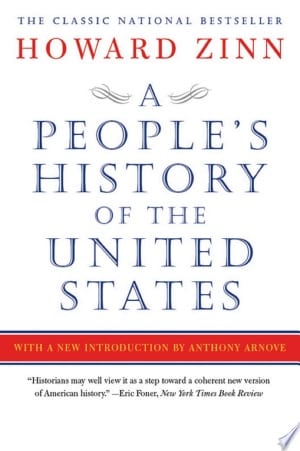
DESCRIPTION
THE CLASSIC NATIONAL BESTSELLER “A wonderful, splendid book—a book that should be read by every American, student or otherwise, who wants to understand his country, its true history, and its hope for the future.” –Howard Fast Historian Howard Zinn’s A People’s History of the United States chronicles American history from the bottom up, throwing out the official narrative taught in schools—with its emphasis on great men in high places—to focus on the street, the home, and the workplace. Known for its lively, clear prose as well as its scholarly research, it is the only volume to tell America’s story from the point of view of—and in the words of—America’s women, factory workers, African-Americans, Native Americans, the working poor, and immigrant laborers. As Zinn shows, many of our country’s greatest battles—the fights for a fair wage, an eight-hour workday, child-labor laws, health and safety standards, universal suffrage, women’s rights, racial equality—were carried out at the grassroots level, against bloody resistance. Covering Christopher Columbus’s arrival through President Clinton’s first term, A People’s History of the United States features insightful analysis of the most important events in our history. This edition also includes an introduction by Anthony Arnove, who wrote, directed, and produced The People Speak with Zinn and who coauthored, with Zinn, Voices of a People’s History of the United States.
My Summary
Main Ideas, Takeaways & Similarities
Questions
I. What is the problem?
A. How is this problem formulated?
B. Why is this problem important?
C. What is the history of this problem?
D. Which prominent personalities have been interested in this problem?
II. What solutions to the problem are there?
A. What are the conclusions reached?
B. By what argument(s) is the conclusion reached?
C. What facts or assumptions serve as premises?
D. When a prominent personality offers a solution, does he also argue for or against other prominent personalities? Does he raise objections to alternative solutions? Does he consider objections to his own solutions?
III. Evaluation
A. What are the advantages and disadvantages of the alternative formulations to the problem?
B. Has the importance or history of the problem ever been misrepresented?
C. Are the solutions logically related to the premises?
D. Are the facts true? Are the assumptions acceptable? Are the objections answerable?
AI Summary
Highlights
“A People’s History of the United States: 1492-Present” by Howard Zinn is a comprehensive and critical look at the history of the United States from its early colonization to the late 20th century. Here’s a thorough summary in bullet points:
- Title: A People’s History of the United States: 1492-Present
- Author: Howard Zinn
Introduction:
- Offers an alternative perspective on American history, focusing on the experiences of ordinary people rather than political elites.
Chapter 1: Columbus, the Indians, and Human Progress
- Critically examines Christopher Columbus’s arrival in the Americas.
- Discusses the devastating impact of European colonization on Native American populations.
Chapter 2: Drawing the Color Line
- Explores the origins of race-based slavery in America.
- Discusses the harsh conditions and resistance of enslaved Africans.
Chapter 3: Persons of Mean and Vile Condition
- Examines the economic disparities and social tensions in colonial America.
- Highlights uprisings and rebellions by indentured servants and the poor.
Chapter 4: Tyranny is Tyranny
- Analyzes the American Revolution from the perspective of ordinary colonists.
- Discusses class struggles and the motivations of various groups during the Revolution.
Chapter 5: A Kind of Revolution
- Examines the limitations of the American Revolution in achieving true equality.
- Discusses the impact of the Revolution on marginalized groups like women and Native Americans.
Chapter 6: The Intimately Oppressed
- Focuses on the struggles for women’s rights and gender equality in early America.
- Highlights the roles of women in various social and political movements.
Chapter 7: As Long as Grass Grows or Water Runs
- Addresses the oppression and displacement of Native American tribes during westward expansion.
- Discusses resistance efforts and broken treaties.
Chapter 8: We Take Nothing by Conquest, Thank God
- Explores the Mexican-American War and its consequences.
- Discusses the motivations behind territorial expansion and the impact on Mexican Americans.
Chapter 9: Slavery Without Submission, Emancipation Without Freedom
- Analyzes the complex legacy of slavery, the Civil War, and emancipation.
- Highlights the struggles of African Americans during the Reconstruction era.
Chapter 10: The Other Civil War
- Examines the labor struggles and class conflicts during the late 19th century.
- Discusses the rise of labor unions and the challenges they faced.
Chapter 11: Robber Barons and Rebels
- Critically assesses the rise of industrialization and corporate power.
- Discusses the efforts of workers and activists to combat exploitation.
Chapter 12: The Empire and the People
- Explores the expansion of American imperialism in the late 19th and early 20th centuries.
- Discusses foreign interventions and the consequences of empire-building.
Chapter 13: The Socialist Challenge
- Examines the rise of socialist movements and political dissent in America.
- Highlights the influence of socialist thinkers and activists.
Chapter 14: War is the Health of the State
- Discusses the role of the United States in World War I and the impact on civil liberties.
- Examines the suppression of dissent during wartime.
Chapter 15: Self-Help in Hard Times
- Analyzes the Great Depression and its social and economic consequences.
- Discusses the grassroots movements and government interventions of the era.
Chapter 16: A People’s War?
- Examines World War II and its effects on American society.
- Discusses the contributions of various groups to the war effort and the challenges of wartime propaganda.
Chapter 17: “Or Does It Explode?”
- Focuses on the civil rights movement and struggles for racial equality.
- Discusses key events, leaders, and the persistence of racism.
Chapter 18: The Impossible Victory
- Analyzes the Vietnam War and the anti-war movement.
- Highlights the resistance efforts and the war’s impact on American society.
Chapter 19: Surprises
- Discusses the social and political changes of the 1960s and 1970s.
- Explores the feminist movement, environmental activism, and counterculture.
Chapter 20: The Seventies: Under Control?
- Examines the conservative backlash of the 1970s and the rise of Ronald Reagan.
- Discusses economic policies, deregulation, and the consequences for ordinary Americans.
Chapter 21: Carter-Reagan-Bush: The Bipartisan Consensus
- Analyzes the presidencies of Jimmy Carter, Ronald Reagan, and George H.W. Bush.
- Discusses foreign policy, corporate influence, and economic inequality.
Chapter 22: The Unreported Resistance
- Highlights the grassroots movements and activism of the late 20th century.
- Discusses the struggles for social justice, peace, and economic equality.
Chapter 23: The Clinton Presidency
- Analyzes the presidency of Bill Clinton and his policies.
- Discusses issues such as welfare reform, healthcare, and the economy.
Chapter 24: The Coming Revolt of the Guards
- Examines the increasing militarization of American society and foreign policy.
- Discusses the implications of the 9/11 attacks and the War on Terror.
Chapter 25: The 2000 Election and the “War on Terrorism”
- Analyzes the controversial 2000 presidential election.
- Discusses the events of September 11, 2001, and the subsequent U.S. response.
Chapter 26: Three Holy Wars
- Examines the wars in Afghanistan, Iraq, and the broader War on Terror.
- Discusses the consequences of U.S. military interventions.
Chapter 27: The “Impossible Victory” in Iraq
- Analyzes the Iraq War and the challenges of occupation.
- Discusses the Iraq War’s impact on the Middle East and American society.
Chapter 28: Progressive Reforms: A Democratic Revolution?
- Examines the progressive movements and political changes of the 21st century.
- Discusses issues such as healthcare reform and LGBTQ+ rights.
Chapter 29: War and Empire
- Explores the challenges of U.S. foreign policy in the 21st century.
- Discusses the conflicts in Afghanistan, Iraq, and the Middle East.
Chapter 30: The Era of Social Change
- Highlights contemporary social movements and activism.
- Discusses issues like racial justice, climate change, and economic inequality.
Conclusion:
- Summarizes the overarching themes and perspectives presented in the book.
- Emphasizes the importance of understanding history from the perspective of ordinary people.
“A People’s History of the United States: 1492-Present” by Howard Zinn provides an alternative narrative of American history, focusing on the experiences of marginalized groups, social movements, and the struggles for justice and equality. It critically examines the role of power, politics, and oppression throughout U.S. history.