DESCRIPTION
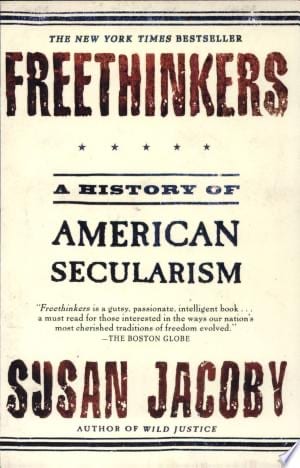
An authoritative history of the vital role of secularist thinkers and activists in the United States, from a writer of “fierce intelligence and nimble, unfettered imagination” (The New York Times) At a time when the separation of church and state is under attack as never before, Freethinkers offers a powerful defense of the secularist heritage that gave Americans the first government in the world founded not on the authority of religion but on the bedrock of human reason. In impassioned, elegant prose, celebrated author Susan Jacoby paints a striking portrait of more than two hundred years of secularist activism, beginning with the fierce debate over the omission of God from the Constitution. Moving from nineteenth-century abolitionism and suffragism through the twentieth century’s civil liberties, civil rights, and feminist movements, Freethinkers illuminates the neglected accomplishments of secularists who, allied with liberal and tolerant religious believers, have stood at the forefront of the battle for reforms opposed by reactionary forces in the past and today. Rich with such iconic figures as Thomas Jefferson, Abraham Lincoln, Elizabeth Cady Stanton, and Clarence Darrow—as well as once-famous secularists such as Robert Green Ingersoll, “the Great Agnostic”—Freethinkers restores to history generations of dedicated humanists. It is they, Jacoby shows, who have led the struggle to uphold the combination of secular government and religious liberty that is the glory of the American system.
My Summary
Main Ideas, Takeaways & Similarities
Questions
I. What is the problem?
A. How is this problem formulated?
B. Why is this problem important?
C. What is the history of this problem?
D. Which prominent personalities have been interested in this problem?
II. What solutions to the problem are there?
A. What are the conclusions reached?
B. By what argument(s) is the conclusion reached?
C. What facts or assumptions serve as premises?
D. When a prominent personality offers a solution, does he also argue for or against other prominent personalities? Does he raise objections to alternative solutions? Does he consider objections to his own solutions?
III. Evaluation
A. What are the advantages and disadvantages of the alternative formulations to the problem?
B. Has the importance or history of the problem ever been misrepresented?
C. Are the solutions logically related to the premises?
D. Are the facts true? Are the assumptions acceptable? Are the objections answerable?
AI Summary
Highlights
“Freethinkers: A History of American Secularism” by Susan Jacoby is a book that explores the history and influence of secularism in American society. Here is a comprehensive summary in bullet points:
- Title: Freethinkers: A History of American Secularism
- Author: Susan Jacoby
Introduction:
- Explores the history of secularism in the United States, highlighting the contributions of individuals and movements.
- Defines secularism as the separation of church and state and the promotion of reason and skepticism in matters of religion.
Chapter 1: The Secular Mind:
- Discusses the importance of reason and intellectual inquiry in challenging religious dogma.
- Highlights the early American thinkers who advocated for secularism and freedom of thought.
Chapter 2: The Radicalism of Reason:
- Examines the Enlightenment era and its impact on American secularism.
- Discusses the influence of Enlightenment thinkers like Thomas Paine and Thomas Jefferson.
- Explores the role of Enlightenment ideas in the American Revolution.
Chapter 3: The Separation of Church and State:
- Discusses the founding principles of the United States and the First Amendment.
- Highlights key figures like James Madison and their commitment to religious freedom.
- Explores the early battles over the separation of church and state.
Chapter 4: Freethought and Reform:
- Examines the role of freethought in promoting social reform movements, including abolitionism and women’s rights.
- Discusses the contributions of freethinkers like Robert G. Ingersoll.
- Emphasizes the connections between secularism and progressive causes.
Chapter 5: The Golden Age of Freethought:
- Chronicles the “Golden Age of Freethought” in the late 19th century.
- Discusses the rise of secularist publications and organizations.
- Highlights the challenges faced by freethinkers in a predominantly religious society.
Chapter 6: The Twentieth Century:
- Examines the challenges and setbacks faced by American secularists in the 20th century.
- Discusses the impact of religious revivals and conservative movements.
- Highlights the efforts to maintain the separation of church and state in the face of opposition.
Chapter 7: The New Atheism:
- Explores the resurgence of secularism and atheism in the 21st century.
- Discusses the “New Atheist” movement and its prominent figures like Richard Dawkins and Christopher Hitchens.
- Highlights the role of the internet and social media in spreading secularist ideas.
Chapter 8: The Future of American Secularism:
- Discusses the ongoing challenges and opportunities for secularism in contemporary America.
- Explores the growing diversity within the secularist movement.
- Encourages continued advocacy for reason, science, and the separation of church and state.
Conclusion:
- Summarizes the central themes and historical developments in American secularism.
- Emphasizes the contributions of freethinkers to the nation’s intellectual and social progress.
- Encourages the promotion of secular values and the protection of secularism in American society.