⬅️ Luke Thomas · Subject: Hasan Piker · Debate hub: Key Arguments (MOC) · Media index: Sources, Books & Media (MOC)
Bottom line
Hasan Piker’s passage is not an explicit threat, incitement, or endorsement of violence against Jews. It is nevertheless more than a neutral prediction of vague political “blowback.” “Take action … against American Jews” naturally includes threats or violence, and “if Jews in America keep…” / “you’re making antisemitism worse” assigns some causal contribution to the prospective victims or to a loosely defined Jewish collective. Luke Thomas is right to distinguish prediction from moral approval, but wrong to treat that distinction as a complete defense. The strongest criticism does not have to claim that Piker wants violence or believes Jews deserve it: it objects to the transfer from particular organizations and political advocacy to “Jews in America,” and to wording that makes minority conduct part of the explanation for violence directed at the minority.
Research question
What does Piker’s statement most reasonably mean, does “blowback” accurately describe it, and does Luke Thomas successfully answer the charge that Piker was blaming American Jews for prospective antisemitic violence?
This note separates five questions that are frequently collapsed:
- Is Piker himself threatening Jews?
- Is he predicting that Jews will face hostility or violence?
- Is he claiming that Jewish identification with Israel increases that risk?
- Is he claiming that Jews would therefore deserve, invite, or bear moral responsibility for the response?
- Is “blowback” the right international-relations concept for the relationship he describes?
Source and evidence status
Materials analyzed
- Primary commentary: Luke Thomas, “Ok, Let’s Finally Talk About Hasan Piker”, August 26, 2026, together with the user-supplied transcript titled Let’s Talk HASAN PIKER | Luke Thomas Gets Political.
- Piker quotation: the extended passage reproduced in the transcript and independently reported by the Associated Press. The supplied transcript appears machine-generated, so punctuation has been normalized but disputed words have not been silently repaired.
- On-screen sources: a supplied screenshot of an Ezra Klein column and a supplied screenshot containing two excerpts from Hannah Arendt’s Zionism Reconsidered.
- Conceptual sources: the CIA’s Spy Speak Glossary for the intelligence usage of “blowback”; Chalmers Johnson’s foreign-policy usage; work on individual and collective responsibility; historical substitution cases.
Evidence limits
This is an interpretation of the quoted language and Thomas’s defense, not a diagnosis of Piker’s private motives. It distinguishes what the passage entails, what it plausibly implies, and what critics infer. Thomas’s broad electoral claims and percentages are evaluated only to the extent the transcript supplies evidence for them. The note does not treat either a provisional court order or a political slogan as a final legal judgment on genocide.
Executive verdict
What the language supports
| Claim | Verdict | Why |
|---|---|---|
| Piker rejects the idea that all Jews are responsible for Israel | Supported | He explicitly criticizes treating Jews as monolithic and distinguishes American Jews from the Israeli state. |
| Piker warns of hostile action against American Jews | Explicit | He says someone may “take action … against American Jews.” |
| The warning plausibly includes threats or physical violence | Strong implication, not semantic certainty | The phrase is unspecified, but the surrounding language calls the situation dangerous; Thomas himself repeatedly discusses hate crimes, terrorism, and people being killed when explaining the passage. |
| Piker says Jewish conduct or institutional messaging increases the risk | Explicit | The conditional subject is “if Jews in America keep…” and the conclusion is “you’re making antisemitism worse.” |
| Piker says Jews morally deserve to be attacked | Not established | He describes antisemitism as dangerous and presents himself as warning against it. Causal attribution is not automatically moral approval. |
| Piker personally threatens or incites an attack | Not established | He predicts an action by an unspecified future actor and does not command, promise, or celebrate it. |
| Thomas proves that criticism of the wording is a lie or reading failure | Unsupported | A critic can reject the threat/incitement interpretation while still objecting to the generalized, victim-directed causal grammar. |
Calibrated conclusion
“Piker threatened Jews” is too strong if it means that he promised or encouraged an attack. “Piker merely described neutral blowback” is too weak. He predicted potentially violent retaliation and told an overbroad Jewish subject that its Israel-related messaging was helping to produce the danger.
The disputed passage
Piker first argues that it is antisemitic to hold all Jews responsible for Israel and that American Jews are politically diverse. He then says, in substance:
If Jews in America keep presenting themselves as singularly invested in Israel, eventually someone will “take action”—not against Israel, but “against American Jews.” He later tells the people he is addressing that by tying their identity to a country widely condemned for its conduct, “you’re making antisemitism worse.”
The wider context helps Piker in one respect and hurts him in another:
- It helps because he clearly describes antisemitism as dangerous, rejects Jewish monolithism, and frames the statement as a warning.
- It hurts because “take action” is not an isolated clipped phrase. The causal chain is repeated through “if Jews … keep,” “you’re tying your entire identity,” and “you’re making antisemitism worse.”
The most natural reconstruction is:
Some Jewish institutions identify Jewish interests with Israel
        ↓
Observers increasingly collapse “Jew,” “Zionist,” and “Israel”
        ↓
Anger at Israel is redirected toward American Jews
        ↓
Antisemitism, threats, or attacks become more likely
The controversial step is not the observation that spillover occurs. It is how agency is assigned in the first and final sentences: the passage moves from particular Jewish institutions to “Jews in America” and then addresses a collective “you.”
Luke Thomas’s argument map
Thomas advances six connected claims:
- Bad-faith-or-incompetence claim: anyone reading Piker as threatening or blaming Jews is either lying or unable to comprehend the passage.
- Blowback claim: Piker is describing a familiar causal phenomenon in which an action produces unintended harm for people who did not deserve it.
- Anti-conflation claim: tying Jewish religious or ethnic identity to a state and its policies is strategically dangerous for Jews.
- Precedent claim: Ezra Klein, Hannah Arendt, and Chalmers Johnson make the same or equivalent arguments.
- Political-distraction claim: Democratic leaders focus on Piker while neglecting material crises and larger threats.
- Coalitional claim: the controversy is a coordinated effort by a pro-Israel Democratic establishment to discredit Piker and the insurgent left he represents.
These claims do not rise or fall together. Thomas is strongest on claims 2 and 3 in their narrow form. He is weaker on 1 and 4, and the transcript does not establish the coordination and electoral claims in 5 and 6.
Where Thomas is right
1. Prediction is not endorsement
Thomas’s most important correction is conceptually valid. Saying that a policy or message is likely to provoke a bad response does not entail that the speaker approves of the response. A terrorism scholar can explain recruitment without endorsing terrorism; a criminologist can identify risk factors without excusing offenders.
The passage therefore does not by itself prove that Piker:
- wants Jews to be harmed;
- is promising that he or his audience will harm them;
- believes such harm would be just;
- is commanding anyone to act.
That is why “Piker threatened American Jews” is rhetorically vivid but analytically imprecise. A more exact description is that Piker described a prospective threat against American Jews.
2. The anti-conflation mechanism is real
It is neither absurd nor antisemitic to warn that collapsing Judaism, Jewish peoplehood, Zionism, Israel, and a particular Israeli government can expose diaspora Jews to misplaced retaliation. The same analytical boundary should be maintained in both directions:
- Criticism of Israeli policy is not automatically hostility to Jews.
- Jewish identity does not make a person responsible for Israeli policy.
Conflict in Israel and Palestine can coincide with increased antisemitic and Islamophobic incidents far from the conflict. The existence of spillover supports the descriptive mechanism Thomas invokes. It does not decide how responsibility for that spillover should be apportioned.
3. Prudential warnings can be morally permissible
There is no general prohibition on telling an individual or organization that its rhetoric has foreseeable risks. Particular institutions can be criticized for statements that erase distinctions or invite overgeneralization. A Jewish organization does not become immune from strategic criticism because antisemitism exists.
The crucial condition is precision: identify which organization, which statement, which causal pathway, and which avoidable risk. Piker’s movement from “many of these institutions” to “Jews in America” abandons that precision.
Where Thomas’s defense fails
1. He answers an inflated accusation, not the strongest criticism
Thomas treats the controversy as if there were only two readings:
- Piker is an antisemite issuing a threat; or
- Piker is innocently explaining blowback.
That is a false dichotomy. The strongest criticism is intermediate:
Piker may sincerely oppose antisemitism and still use a formulation that assigns causal contribution to an overbroad Jewish collective for hostility or violence directed at Jews.
This criticism does not depend on mind-reading. It follows from the grammar of “if Jews in America keep…” and “you’re making antisemitism worse.”
2. “Inviting violence” is contestable but not invented from nothing
Hakeem Jeffries summarized the statement as a “malicious claim that American Jews are inviting violence against themselves.” “Inviting” can imply consent or moral desert, which Piker did not state. In that sense, the paraphrase can overreach.
But Thomas’s claim that it bears “no resemblance” to what Piker said is also excessive. The original contains:
- a conditional keyed to Jewish conduct;
- a predicted action against American Jews;
- an accusation that “you” are worsening antisemitism.
Jeffries compresses causal contribution into the morally loaded word “inviting.” That is an arguable interpretation, not a fabricated subject.
3. Thomas’s own explanation confirms the violent implication
Thomas insists that Piker means “blowback” and then explains blowback with examples involving hate crimes, terrorism, and people being killed. This weakens any attempt to treat “take action” as merely electoral, reputational, or rhetorical.
The careful conclusion is therefore:
- Violence is within the ordinary implication.
- Violence is not the only linguistically possible meaning.
- Prediction of violence is not the same as a threat by the speaker.
4. He does not police the shift in the unit of analysis
Piker begins with “Jewish institutions” and then says “if Jews in America keep….” Thomas defends the narrower institutional proposition but does not adequately address the broader categorical wording.
This matters because the moral and empirical propositions differ:
| Precise claim | Overbroad claim |
|---|---|
| Organization X’s message may reinforce a conflation | Jews are putting this idea out there |
| Donor or advocate Y can be criticized for a policy position | American Jews are making antisemitism worse |
| Antisemites exploit Israel-related messaging | Jewish identification produces antisemitic action |
The left column permits accountable political criticism. The right column risks collective attribution.
Is “blowback” being used correctly?
The conventional concept
The CIA glossary defines blowback as unintended consequences, side effects, or repercussions from an activity that negatively affect U.S. national-security interests. In intelligence and international-relations usage, the term classically refers to harmful, often delayed consequences of a state’s covert action or foreign policy that return against the state, its citizens, or interests.
Chalmers Johnson broadened and popularized the term in his critique of American empire: foreign interventions generate consequences that ordinary Americans may neither anticipate nor deserve. Thomas is therefore right about one point: blowback does not mean that its victims morally deserve the consequences.
What Thomas means by “that has nothing to do with blowback” (7:20–8:33)
Thomas’s wording can sound self-contradictory because two different questions run together. From approximately 7:26 to 7:42, he describes the narrow picture of blowback: a government commits a harmful act abroad and the response returns directly to that government. He then invokes Johnson at 7:49–7:58 to widen the possible target of the consequences: unintended harm can fall on the civilian population “on the receiving end,” including people who neither chose nor deserved the initiating policy.
At 8:20–8:33 Thomas stresses that people harmed by antisemitic hate crimes remain innocent victims and says, “That has nothing to do with blowback.” Here, “that” refers to the victims’ guilt, desert, or moral innocence—not to the causal classification of the harm. His intended distinction is:
| Question | Thomas’s answer |
|---|---|
| Can an unintended consequence that harms innocent civilians count as blowback? | Yes. Johnson’s broader usage is introduced to establish exactly this. |
| Does calling the harm “blowback” mean the civilians deserved it, caused the attack in a morally culpable sense, or cease to be victims? | No. Moral innocence is separate from the causal chain. |
The clearest charitable paraphrase is:
Whether the victims deserve the consequences is irrelevant to whether those consequences count as blowback. Innocent people can suffer blowback from policies they did not personally choose.
Thomas therefore thinks critics make an invalid inference: “Piker calls it blowback; therefore Piker believes American Jews deserve antisemitic violence.” His point is conceptually coherent. Causal explanation does not entail moral justification. An overseas intervention may contribute to a terrorist attack on civilians while the terrorists remain fully responsible and the civilians remain innocent.
Applied to Piker, Thomas’s intended chain is that Israeli conduct, combined with rhetoric identifying Jewish interests with Israel, produces hostility that antisemites redirect toward American Jews. In Thomas’s account, the Jews harmed by that reaction are still innocent; the antisemites are still bad actors; and the causal sequence may nevertheless be called blowback.
This clarification helps Thomas rebut the accusation that Piker must be endorsing or justifying an attack. It does not settle the narrower objection to Piker’s wording. Johnson’s point shows that innocent populations can receive blowback; it does not prove that American Jews are the relevant initiating actor, or justify moving from particular institutions to “if Jews in America keep…” and “you’re making antisemitism worse.” That further attribution is the disputed step.
What Thomas gets wrong about scope
The concept still requires an originating activity and an intelligible relation between actor, policy, and consequence. Its core form is:
State or institution performs policy P
        ↓
P produces unintended reaction R
        ↓
R harms the originating state's interests or population
Piker’s formulation is different:
Foreign state performs policy P
Some members or institutions of diaspora group G identify with that state
        ↓
Hostile actor transfers anger from the state to group G as a category
The transfer in the final step is precisely the prejudice under examination. Calling it blowback can describe the sequence of consequences, but it does not settle who authored the initiating policy or who is morally responsible. American Jews as a class are not the Israeli state; many are not Israeli citizens; they do not collectively direct Israel’s military or government.
Scope versus agency
Thomas uses Johnson to show that innocent civilians can receive blowback. That establishes the scope of possible victims, not that those civilians or their ethnic group are the relevant initiating actor. It does not validate “if Jews in America keep…” as the proper causal subject.
Better terminology
Depending on the claim, the more precise concepts are:
- conflict spillover — events abroad increase hostility at home;
- diaspora scapegoating — a diaspora is blamed for a foreign state’s conduct;
- collective attribution — responsibility is transferred from actors to a group;
- retaliatory hate crime — an attacker selects a local minority as a proxy target;
- identity-policy conflation — a people, ideology, state, and government are collapsed.
“Blowback” is not wholly wrong as a loose metaphor. It becomes misleading when it hides the prejudicial inference that turns a foreign policy grievance into liability for an ethno-religious category.
Audit of the three authorities shown or cited
Ezra Klein: supports the anti-conflation point, not the full Piker formulation
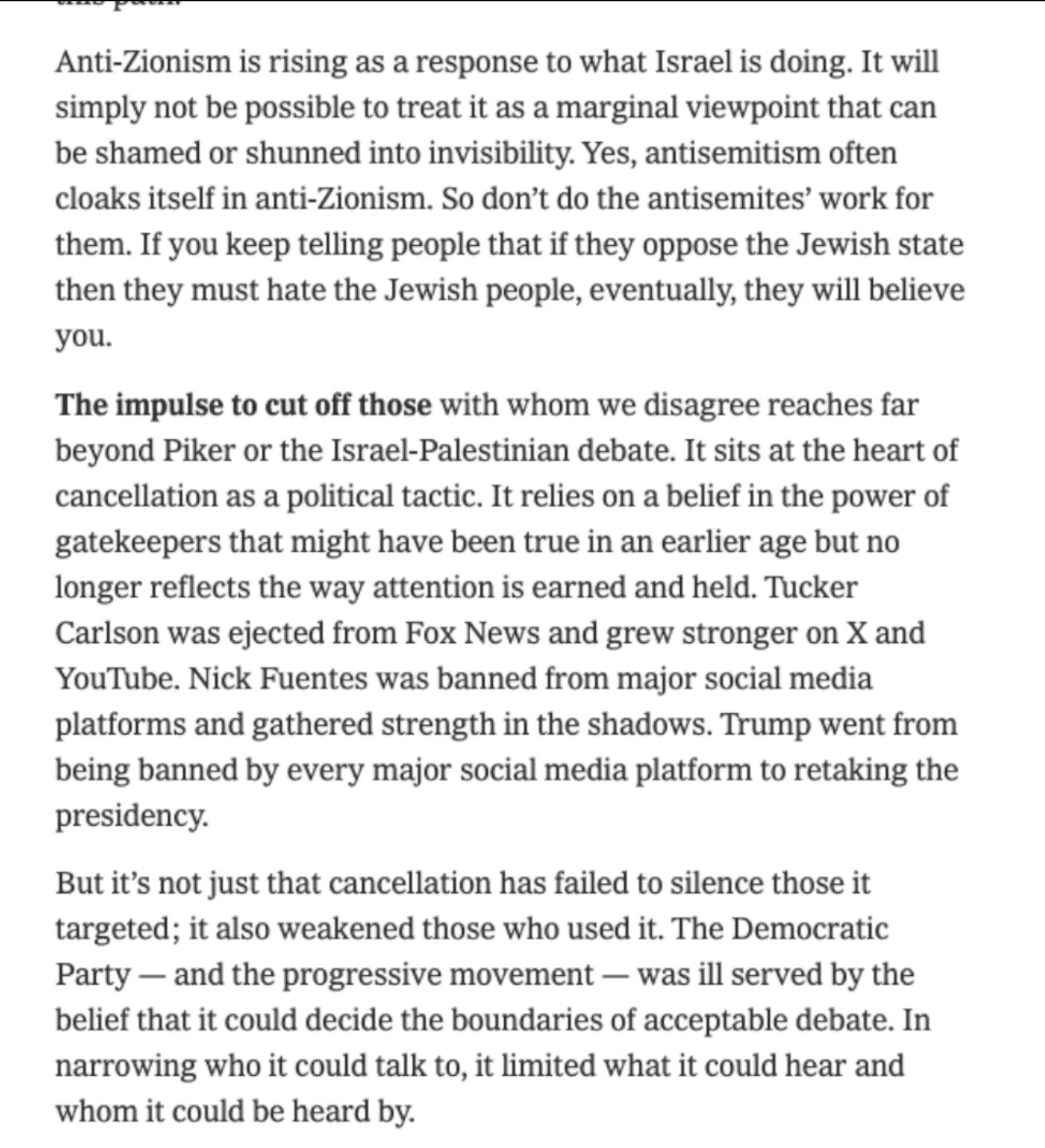
The screenshot says that anti-Zionism is rising in response to Israel; that antisemitism can cloak itself in anti-Zionism; and that people should not tell opponents of a Jewish state that they must hate Jewish people, lest the opponents eventually accept the conflation.
This supports:
- distinguishing Jews from a state;
- recognizing that some antisemitism appears in anti-Zionist form;
- warning pro-Israel advocates not to erase the distinction themselves.
It does not say:
- someone will “take action” against American Jews;
- Jewish conduct makes violence more likely;
- “Jews in America” are worsening antisemitism.
Klein is therefore a partial precedent for Piker’s mechanism, not a precedent for his most controversial wording.
Hannah Arendt: analogous warning, materially different context
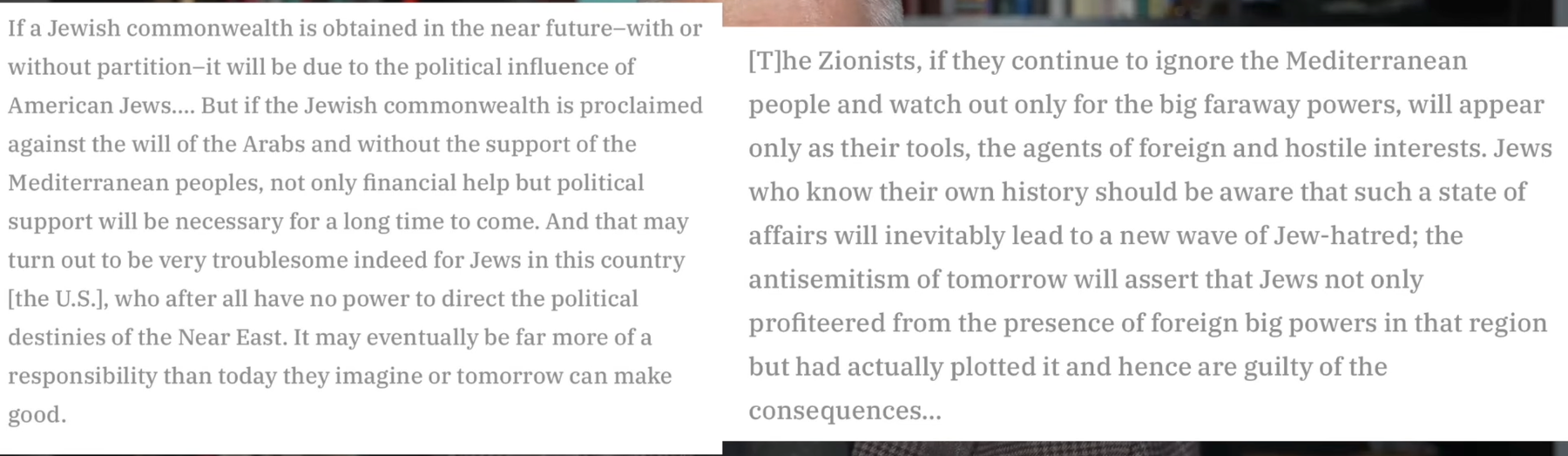
Both halves of the supplied image are from the same essay, Hannah Arendt’s Zionism Reconsidered, written in 1944 and published in the mid-1940s (catalog records commonly identify 1945; later reprints also exist). This matters because the screen presentation can look like two independent historical authorities when it is one sustained argument.
Arendt warns that:
- a Jewish commonwealth imposed without regional support would remain dependent on outside political and financial power;
- American Jewish political influence could create burdens or “responsibility” for American Jews who do not control Near Eastern events;
- Zionists could come to appear as instruments of distant powers;
- future antisemites would claim that Jews plotted foreign intervention and were “guilty of the consequences.”
The parallel to Piker is real: political strategy and foreign-power dependence can feed a dangerous antisemitic narrative. But Thomas’s phrase “the exact same argument” is too strong.
Key differences:
- Arendt’s target is a specific Zionist strategy during a pre-state political crisis, not a generalized claim about contemporary American Jews.
- She explicitly describes the conclusion that Jews plotted events and are guilty as the claim of the “antisemitism of tomorrow.”
- Her causal argument concerns great-power sponsorship, Arab opposition, and a proposed commonwealth—not only public identity or speech.
- Her use of “responsibility” is morally and politically ambiguous and should not be treated as a settled theory of guilt.
Arendt strengthens the case that political choices can create predictable dangers. She does not erase the distinction between criticizing those choices and transferring guilt to Jews as a people. Her later writing on collective responsibility is, if anything, a warning to keep guilt tied to persons and actions.
Chalmers Johnson: supports undeserved consequences, not diaspora attribution
Johnson supports Thomas’s contention that blowback can harm civilians who did not choose or understand the underlying policy. But the analogy is incomplete. In Johnson’s paradigm, the originating activity is American state power; Americans suffer consequences linked to what their state did. In the Piker controversy, the contested move assigns an Israeli policy to American Jews through identity, association, or advocacy.
Even Karl Jaspers’s comparatively expansive idea of political responsibility for citizens of a state would not automatically bridge this gap: American Jews are not collectively citizens of Israel. A person may be answerable for lobbying for a policy; Jewishness itself does not make that policy theirs.
The substitution test
The test is not meant to prove that Israel, ISIS, Russia, Palestine, and Imperial Japan are morally identical. They are not. It tests whether the proposed rule of attribution survives when the group changes.
| Case | Parallel warning | What the test reveals | Important limit |
|---|---|---|---|
| American Muslims after 9/11 or ISIS attacks | “If Muslims keep tying their identity to Muslim causes, someone will act against American Muslims; you’re making Islamophobia worse.” | Most people recognize that the attacker, not “Muslims,” makes the illicit transfer from terrorists to a religious category. | ISIS is not to Muslims what Israel is to Jews; this analogy tests collective attribution, not institutional similarity. |
| Russian Americans after Russia’s invasion of Ukraine | “If Russian Americans maintain strong attachment to Russia, anti-Russian attacks are blowback they helped create.” | Cultural affinity or even bad political opinions do not turn ethnicity into liability for violence. | Russia is a state, making this structurally closer, but Russian-American and Jewish-Israeli histories differ. |
| Palestinian or Arab Americans after Hamas attacks | “If Palestinians make Palestine central to identity, eventual attacks on Arab Americans are a foreseeable response they worsen.” | Criticism of particular advocacy must not become ethnic proxy punishment. | Palestinian national identification and Jewish peoplehood have distinct histories; the moral rule remains personal liability. |
| Japanese Americans after Pearl Harbor | “Visible ethnic attachment makes collective preventive action understandable.” | The historical record shows how quickly foreign-state conduct, ancestry, and imagined disloyalty can be collapsed. | Wartime incarceration was state coercion, much more extreme than rhetoric; it is a warning about the inference, not an equation of outcomes. |
The U.S. Department of Justice describes post-9/11 violence as people wrongly blaming Muslim, Arab, Sikh, and South Asian communities for the attacks. The National Archives records the incarceration of Japanese Americans under a logic later condemned as race prejudice, war hysteria, and failure of political leadership. In both cases, the moral error is the same: a real geopolitical event becomes a warrant for categorical suspicion.
The strongest form of the test
Do not ask whether the foreign actors are equivalent. Ask: Does visible affinity, advocacy, or identity make unrelated members of an ethnic or religious category partly responsible for another person’s decision to threaten them? If not, the rule should fail consistently.
Moral and philosophical analysis
Causal responsibility is not moral responsibility
Separate three claims:
A. Causal prediction
Publicly identifying Judaism with Israel may increase the probability that antisemites redirect anger at Israel toward Jews.
B. Prudential advice
An organization may therefore decide that distinguishing Jewish identity from Israeli government policy is strategically wise.
C. Moral responsibility
Jews who fail to make that separation are partly blameworthy for antisemitism or violence directed at them.
A can be true while C is false. B can be reasonable without C following. The controversy exists because Piker explicitly states A, plausibly offers B, and uses language that edges toward C without clearly affirming desert or justification.
The familiar crime-risk analogy clarifies the distinction but should be used carefully. Carrying an expensive watch may affect the probability of robbery and justify prudential advice. It does not transfer the robber’s moral agency to the wearer. Political speech is even more strongly protected as an exercise of conscience and citizenship: a minority member should not have to purchase safety through political conformity.
Individual responsibility
A person can be responsible for:
- advocating a policy;
- funding an organization;
- using misleading rhetoric;
- defending wrongdoing;
- falsely accusing critics of prejudice.
The same person is not thereby responsible for another actor’s independent decision to select Jews as proxy targets. The antisemite contributes the indispensable wrongful inference: Israel did X; therefore Jews here may be punished.
This is also the strongest part of the political criticism. Jon Ossoff’s formulation centers the right to advocate and petition government without fear of reprisal; Cory Booker rejects making Jewish Americans responsible for hatred or violence directed at them. These statements should not be taken as proof that Piker endorses violence, but their governing principle is sound: the freedom to hold even a mistaken or objectionable foreign-policy position is not conditional on accepting collective exposure to violence.
Collective responsibility and guilt
Philosophers distinguish several ideas often called “collective responsibility”:
- responsibility of an organized group that can act through decision procedures;
- shared responsibility among participants in a joint action;
- political responsibility attached to membership in a polity;
- undifferentiated guilt imposed on persons because of identity.
Only the first three can sometimes be defensible, and only with conditions. The fourth is the classic danger. Hannah Arendt’s later distinction is useful: responsibility can be political and relational, while guilt must not become an indiscriminate identity label that dissolves the difference between perpetrators, participants, bystanders, and opponents.
Kantian objection
Attacking American Jews to punish Israel or pressure Jewish political opinion would use people as instruments for influencing a government they may not control. It denies their status as agents with their own beliefs and treats their bodies or safety as leverage against someone else.
Collective-punishment norm
Article 33 of the Fourth Geneva Convention legally governs protected persons in armed conflict, not podcast rhetoric or domestic political disagreement. It is relevant here only as a moral analogy: punishment should track what a person did, not offenses imputed through group identity. Using it outside its legal setting requires that disclaimer.
Historical warning: the Lindbergh structure
Jonathan Chait compares Piker’s rhetoric to Charles Lindbergh’s 1941 “War Agitators” speech. The comparison should be stated with precision.
Lindbergh condemned Nazi persecution in one breath and warned that American Jewish advocacy for war endangered both the country and Jews themselves in the next. The U.S. Holocaust Memorial Museum identifies the speech as invoking antisemitic ideas.
The analogy is structural, not a claim of identical ideology or intent:
I oppose persecution of your group
        +
your group's political activity is generating resentment
        +
continuing may endanger your group
Piker is not thereby proven to be Lindbergh-like in motive, politics, or degree. The comparison identifies a historically dangerous form of conditional safety: your rights are affirmed, but your group’s continued safety is described as partly dependent on changing its politics.
Strongest defense of Piker and Thomas
Steelman
Piker is warning Jews about an antisemitic mechanism, not endorsing it. Some pro-Israel institutions themselves insist that opposition to Israel or Zionism is hostility to Jews; doing so erases Jewish political diversity and teaches outsiders the same conflation antisemites exploit. Because conflict abroad demonstrably spills over into hate incidents at home, it is responsible—not hateful—to warn that this strategy can make Jews less safe. Calling that warning a threat reverses its moral meaning.
This defense succeeds in rebutting the strongest allegation of personal threat or incitement. It also establishes that warnings about conflation and spillover are legitimate subjects of debate.
Best reply to the defense
The defense does not require Piker’s overbroad subject or second-person accusation. He could have said:
Some organizations collapse Judaism, Zionism, and every policy of the Israeli government. Antisemites exploit that conflation to redirect anger at Israel toward Jews. Those organizations should change their messaging, but the antisemitic inference and any violence remain entirely the responsibility of the people who choose them.
That version preserves every defensible empirical and strategic point:
- Israel-related rhetoric can be criticized;
- organizations can increase foreseeable risk;
- Jews are not Israel;
- antisemites exploit conflation;
- victims do not deserve or own the crime.
The fact that the argument can be stated this way shows why criticism of Piker’s wording is not necessarily a smear.
Ranking the strongest criticisms
- Individual moral agency: political advocacy never converts another person’s antisemitic violence into the victim’s moral responsibility.
- Category error: the passage moves from named institutions or advocates to “Jews in America.”
- Substitution consistency: parallel warnings addressed to Muslims, Russian Americans, Palestinians, or Japanese Americans expose the collective-attribution rule.
- Blowback scope error: a concept about consequences of state or institutional action does not itself make a diaspora the author of a foreign state’s policy.
- Rhetorical normalization: victim-directed causal grammar can make the attacker’s inference sound natural even when the speaker condemns the attack.
- Historical conditional-safety pattern: the Lindbergh analogy identifies a recurring structure, though it can be abused if presented as an equation of intent.
Transcript-wide audit beyond the central quote
Strong or defensible claims
- Critics sometimes collapse prediction into endorsement. Correct and important.
- Democratic leaders can condemn antisemitism while also addressing material crises. True as a general priority claim, though one example does not prove systematic neglect.
- Piker matters because he has a large audience and electoral relationships. Plausible and independently visible in the controversy.
- Israel and Palestine are a serious intraparty fault line. Plausible; the transcript still needs current polling and electoral evidence to quantify it.
Claims that outrun the supplied evidence
| Transcript claim | Assessment |
|---|---|
| Critics are lying or lack reading comprehension | False dichotomy / ad hominem framing. The intermediate reading is coherent. |
| The denunciations prove a coordinated campaign | Not established by convergence alone. Similar statements may reflect coordination, shared incentives, sincere agreement, or some mixture. Thomas links coverage but does not demonstrate command, planning, or common authorship in the transcript. |
| None of the nine officials who denounced Piker had publicly addressed the Gary, Indiana outage by Thomas’s recording | Supported by the discoverable record, not conclusively provable. Searches of official newsrooms and publicly indexed social/web material through August 26 found no relevant statement from any of the nine. Deleted, unindexed, or purely oral remarks cannot be ruled out. |
| Attention to Piker rather than Gary, Indiana proves bad priorities or an AIPAC-directed campaign | Agenda comparison, not causal proof. The contrast can support a critique of national political salience, but none of the nine represents Indiana, Thomas selected the comparison group because they commented on Piker, and silence does not identify the motive for commenting on one issue rather than another. |
| Committee assignments prove preservation of an entrenched pro-Israel order | Suggestive but incomplete. Personnel choices can reveal priorities but do not by themselves prove the full causal story. |
| Public opinion is “80/20” or “90/10” | Unusable as stated. No population, survey, date, wording, or policy question is given. Approval of Israeli conduct, ceasefire support, arms restrictions, and support for Israel are different measures. |
| The 2028 nominee will need to oppose Israel or the right will capture the issue | Forecast, not established fact. It should be tracked with explicit indicators and falsifiers. |
| “Genocide” is a legally settled description | Overstated if presented as adjudicated fact. The ICJ has issued provisional-measures orders protecting plausible rights and the merits litigation has proceeded; those orders were not a final merits judgment that genocide had occurred. Moral, political, and scholarly uses of the term remain contested and should be attributed. |
| “If you sound like MAGA, you’re MAGA” | Guilt by rhetorical resemblance. Shared language can reveal influence, but it does not establish identical ideology or motivation. |
Fact-check: Gary, Indiana blackout comparison (8:35–9:25)
Thomas’s exact claim
Thomas displays nine politicians who criticized Piker—Elissa Slotkin, Hakeem Jeffries, Jacky Rosen, Ritchie Torres, Hillary Scholten, Susie Lee, Jake Auchincloss, Josh Gottheimer, and Cory Booker—and asks how many had issued “a statement, a tweet, anything” about “two weeks where Gary, Indiana has no power.” He answers: “None of them. None of them. Not one of them.” He then calls the outage a national issue involving a majority-Black city and argues that their focus on Piker reveals an “absurd fixation.”
Verdict
The narrow “none of these nine” claim is probably true as a searchable-public-record claim as of the August 26 recording. The surrounding presentation is partly misleading. There was a real, extraordinary, nearly two-week outage for some Gary residents, but the entire city was not continuously without electricity for two full weeks. And “no one caring” is false if read literally: Gary officials, Indiana agencies and officials, the state’s congressional delegation, FEMA, and the White House were publicly involved.
What happened in Gary
- A severe storm struck on August 11, 2026, producing widespread damage and outages. Gary’s August 18 update reported 301,000 initially affected NIPSCO customers across the service territory and 75,000 still without power at that point.
- Local reporting found that the storm initially knocked out electricity to about 38,000 Gary customers—most of the city. On August 20, approximately 25,000 Gary customers remained without power.
- NIPSCO targeted full Gary restoration by 11:59 p.m. on August 25. For some households, that meant nearly two weeks without electricity. Other residents regained power earlier.
- At 7:00 a.m. on August 26, NIPSCO said broad restoration was “substantially complete,” while crews continued dealing with a limited number of individual cases.
Thomas therefore had a serious material crisis to point to. His phrase “Gary, Indiana has no power for two weeks” compresses a staggered restoration into a citywide continuous blackout. A precise version would be: most of Gary lost power on August 11, tens of thousands remained without it more than a week later, and some residents waited nearly two weeks.
Sources: City of Gary, August 18 recovery update · Capital B Gary, August 20 · WFYI/Free Press Indiana, August 22 · NIPSCO restoration update
Did the nine politicians mention it?
This review searched each politician’s name and official account/site with Gary, Gary, Indiana, NIPSCO, power outage, blackout, and storm, restricted to the August 11–26 period where possible. It checked official congressional newsrooms and publicly indexed social/web results. No relevant statement was found for any of the nine:
| Politician shown by Thomas | State / office shown | Discoverable Gary-outage statement by August 26 |
|---|---|---|
| Elissa Slotkin | Michigan senator | None found |
| Hakeem Jeffries | New York representative / House Democratic leader | None found |
| Jacky Rosen | Nevada senator | None found |
| Ritchie Torres | New York representative | None found |
| Hillary Scholten | Michigan representative | None found |
| Susie Lee | Nevada representative | None found |
| Jake Auchincloss | Massachusetts representative | None found |
| Josh Gottheimer | New Jersey representative | None found |
| Cory Booker | New Jersey senator | None found |
Limit of a negative search
This supports Thomas’s statement but cannot make it certain. X’s direct historical search was gated behind sign-in during this review, public search engines do not index every post, and a deleted post, newsletter, local interview, or floor/cable remark may be absent. The defensible formulation is “no relevant public statement was found,” not “it is mathematically certain none existed.”
“No one caring” is not factual
Thomas’s broader line—“a majority black city, going without power and no one caring”—works as moral rhetoric about national attention, not as a literal description of the response.
- Gary Mayor Eddie Melton and city officials issued public updates and organized recovery resources.
- Indiana agencies reported that the National Guard, transportation, natural-resources, correctional, homeland-security, and utility crews were working on route clearance, shelter, and restoration.
- Governor Mike Braun requested federal assistance; an emergency declaration had been approved on August 15 and a major-disaster declaration on August 25.
- Indiana Senator Jim Banks publicly addressed the disaster before Thomas’s video, spoke with Mayor Melton and President Trump about Gary on August 24, and supported federal relief. This does not excuse any other official’s silence; it disproves “no one cared” if the sentence is read literally.
Sources: Indiana Department of Homeland Security disaster hub · Indiana August 20 status update · Senator Banks on the August 24 Gary call
What the comparison does—and does not—show
The comparison has a legitimate agenda-setting point: national politicians found time to intervene in a controversy about a streamer while apparently saying nothing about a prolonged infrastructure emergency in a poor, majority-Black American city. That can reveal how donor, media, party, and culture-war incentives shape attention. The point is strongest against national party leaders or senators who present themselves as national voices.
It does not, by itself, prove Thomas’s larger causal story:
- Jurisdiction: none of the nine politicians in the graphic represents Gary or Indiana. Their formal responsibility was much weaker than that of Gary, Indiana, and federal emergency officials.
- Selected comparison group: Thomas chose people because they criticized Piker. That can illustrate their priorities, but it is not a representative sample of congressional concern about Gary.
- Different action thresholds: a politician may quickly condemn speech while leaving disaster response to officials with operational jurisdiction. Whether that is wise or morally proportionate is debatable, but the acts are not mutually exclusive.
- Motive is underdetermined: silence is consistent with misplaced priorities, media agenda-following, donor incentives, lack of awareness, limited staff attention, geographic triage, or ordinary selectivity. It does not identify which explanation is true.
- Coordination is not established: a cluster of similar denunciations plus shared pro-Israel support may justify investigation, but it does not prove AIPAC directed the statements or that funding caused them.
Best calibrated use
“All nine publicly entered the Piker controversy, and no Gary-outage statement from any of them was found by the recording date. That is fair evidence of a striking attention disparity. It is not proof that they ignored a constituent duty, that nobody responded to Gary, or that AIPAC caused their priorities.”
Debate-ready formulations
Thirty-second verdict
Piker did not explicitly threaten or endorse violence. He did, however, predict action against American Jews—plausibly including violence—and phrase the causal warning as “if Jews in America keep…” and “you’re making antisemitism worse.” Thomas is right that prediction is not approval, but wrong that this ends the argument. The strongest objection is collective attribution: criticize a named institution’s messaging, but do not make Jews as a category the causal subject of antisemitic retaliation.
One-sentence blowback reply
“Blowback” can describe unintended harm reaching innocent people, but it does not erase the prejudicial step by which an attacker transfers responsibility from Israel to American Jews, who are not collectively the Israeli state.
One-sentence concession
It is legitimate to argue that organizations which conflate Judaism with every Israeli policy can inadvertently strengthen the same conflation antisemites use.
One-sentence boundary
The antisemite remains responsible for converting political anger into categorical hostility or violence, and a Jewish person’s beliefs do not make that conversion theirs.
Cross-examination questions
- Who exactly is the subject of “if Jews in America keep”—named institutions, Zionists, donors, Israeli citizens, or all American Jews?
- What forms of “take action” did Piker intend to include, and why does Thomas explain the phrase with hate crimes and deaths?
- If “you’re making antisemitism worse” is only causal, what wording prevents listeners from hearing moral blame?
- Would the same formulation be acceptable if addressed to American Muslims after an Islamist attack?
- What is the initiating policy in the blowback analogy: Israeli state conduct, U.S. support for Israel, lobbying by specific organizations, or Jewish identity?
- How does Johnson’s state-policy model make American Jews the relevant originating actor?
- Does Ezra Klein predict violence, or only warn that a conceptual conflation will be believed?
- Why call Arendt’s argument “exactly the same” when she labels collective Jewish guilt the claim of future antisemites?
- What evidence establishes coordination among the politicians Thomas names, rather than shared judgment or incentives?
- What survey question produces the claimed 80/20 or 90/10 split?
Timestamped map of the supplied transcript
| Time | Content | Analytical note |
|---|---|---|
| 0:00–2:50 | Introduction; critics are framed as smear operators or poor readers | False dichotomy sets an unnecessarily absolute burden. |
| 2:54–4:24 | Extended Piker quotation | Central evidence; distinguishes institutions from Jews, then shifts back to generalized “Jews in America.” |
| 4:40–5:25 | Hakeem Jeffries criticism; Thomas rejects “inviting violence” | Both sides overstate: “inviting” adds moral coloration, while “no resemblance” ignores the causal grammar. |
| 5:25–6:55 | Blowback defense | Strong distinction between consequence and desert; weak fit between state-policy concept and diaspora category. |
| 6:55–8:35 | Ezra Klein, Hannah Arendt, Chalmers Johnson | Authorities support parts of the mechanism, not an exact identity of arguments. |
| 8:35–9:25 | Gary, Indiana and issue priorities | Salience comparison; does not resolve meaning of Piker’s statement. |
| 9:25–13:15 | Piker as left insurgency; establishment and Israel | Political hypothesis requiring independent evidence; convergence is not proof of coordination. |
| 13:15–18:40 | Trump, war, committee leadership, 2028 forecast | Mixes relevant agenda critique with unsourced ratios and speculative prediction. |
| 18:43–20:05 | Coalition and electoral conclusion | Coherent strategic thesis, not demonstrated by the central quotation. |
Claim ledger
| Claim | Status | Basis |
|---|---|---|
| The quote came from Piker’s livestream and concerned Jewish institutions, Israel, and American Jews | Verified | Transcript and AP reporting |
| Piker said “take action … against American Jews” | Verified | Transcript and AP reporting |
| The passage explicitly endorses attacks | Not supported | No command, celebration, or statement of justification |
| The passage assigns causal contribution to Jewish conduct | Verified in the language | Conditional and “making antisemitism worse” |
| “Take action” definitely means physical violence only | Not provable | Phrase is underspecified, though violent action is strongly implicated |
| Ezra Klein made the same argument in every material respect | Overstated | Klein supports anti-conflation but does not predict action against Jews |
| Both Arendt screenshots are from Zionism Reconsidered | Verified | Text comparison and Library of Congress catalog |
| Arendt endorsed antisemitic collective guilt | Misleading | She predicts and labels the claim as future antisemitism while criticizing Zionist strategy |
| Blowback means victims deserve consequences | False | Neither the CIA definition nor Johnson’s usage entails desert |
| Blowback cleanly makes American Jews the originating actor | Unsupported | Requires an additional and contested diaspora-attribution step |
| None of Thomas’s nine named politicians had publicly addressed the Gary outage by August 26 | Supported, with archive caveat | No relevant official release or publicly indexed post was found; negative searches cannot exclude deleted, unindexed, or oral remarks |
| All of Gary was without power continuously for two weeks | False / overstated | Most of the city lost power; restoration was staggered; some residents remained out nearly two weeks |
| Nobody cared about or responded to Gary | False if literal | City, state, utility, Indiana congressional, FEMA, and presidential actions were public before or by the recording date |
| The ICJ has finally adjudged that Israel committed genocide | False as of this review | The public docket shows provisional orders and ongoing merits procedure, not a final merits judgment |
Sources
Primary and contemporaneous
- Luke Thomas, “Ok, Let’s Finally Talk About Hasan Piker”, August 26, 2026.
- Jesse Bedayn, Associated Press, “El-Sayed distances himself from popular streamer’s comments on Israel and Jewish Americans”, August 24, 2026.
- Branko Marcetic, Jacobin, “Centrists Despise Hasan Piker More Than They Want to Win”, August 25, 2026. Useful for the extended context; interpretive, not neutral reporting.
- Jonathan Chait, The Atlantic, “The Crisis for Democrats in Michigan”, August 28, 2026. Strong critical case and Lindbergh analogy; opinion essay.
- Ezra Klein, The New York Times, “Hasan Piker Is Not the Enemy”, April 12, 2026 (original headline; the supplied image preserves the relevant excerpt).
- Jewish Insider, “Ossoff ‘unreservedly rejects’ Piker’s comments on Jewish support for Israel”, August 2026. Useful for the advocacy-without-reprisal principle; advocacy reporting rather than neutral analysis.
- Associated Press, “Michigan Democrats want to fight Trump. First they have to stop fighting each other”, August 2026. Includes Booker’s criticism and Piker’s direct defense by analogy to anti-Muslim collective attribution.
- Hannah Arendt, Zionism Reconsidered manuscript record, Library of Congress.
- City of Gary, “Mayor Melton Provides Storm Recovery Update; NIPSCO Shares Power Restoration Information”, August 18, 2026.
- Calvin Davis, Capital B Gary, “After 8 Days Without Power, Thousands in Gary Could Face Another Week in the Dark”, August 20, 2026.
- Carson Gerber, WFYI / Free Press Indiana, “Parts of Gary are still without power. Residents blame NIPSCO”, August 22, 2026.
- Indiana Department of Homeland Security, August 2026 disaster hub and August 20 status update.
- NIPSCO, August 26 storm-restoration update.
- Office of Senator Jim Banks, Gary storm-recovery call with Mayor Eddie Melton and President Trump, August 24, 2026.
Concepts and historical checks
- Central Intelligence Agency, “Spy Speak Glossary” — conventional intelligence definition of blowback.
- Chalmers Johnson, Blowback: The Costs and Consequences of American Empire (2000; later editions) — broad foreign-policy application.
- Stanford Encyclopedia of Philosophy, “Collective Responsibility”.
- Hannah Arendt, “Collective Responsibility”.
- U.S. Department of Justice, “Combating Post-9/11 Discriminatory Backlash”.
- U.S. National Archives, “Japanese-American Internment During World War II”.
- U.S. Holocaust Memorial Museum, “Charles Lindbergh and the ‘War Agitators’ Speech”.
- International Committee of the Red Cross, Fourth Geneva Convention, Article 33 — cited only for the personal-liability norm, not as law governing speech.
- International Court of Justice, South Africa v. Israel, Case 192 and April 14, 2025 procedural order — distinguishes provisional measures and merits procedure from a final genocide judgment.
Further research
- Preserve the original livestream URL and exact start/end timestamps if the VOD remains available; the extended transcript and independent reporting are enough for the present semantic analysis, but the original audiovisual record would improve tone and editing verification.
- Preserve the full text surrounding Ezra Klein’s screenshot in a source dossier if durable access is obtained; the screenshot is legible and the original article is identified, but the New York Times page may be paywalled.
- Track Thomas’s 2028 electoral forecast with explicit indicators: party polling by question wording, donor/endorsement behavior, primary vote shares, and whether Republican candidates actually adopt an anti-Israel position.
Falsification checkpoint
This analysis should be revised if the full original clip shows that “take action” was expressly limited to nonviolent political conduct, or if surrounding language clearly assigns all causal and moral responsibility to antisemites. It should also be revised in the opposite direction if omitted context celebrates, invites, or strategically recommends attacks. On the evidence reviewed here, neither stronger conclusion is warranted.