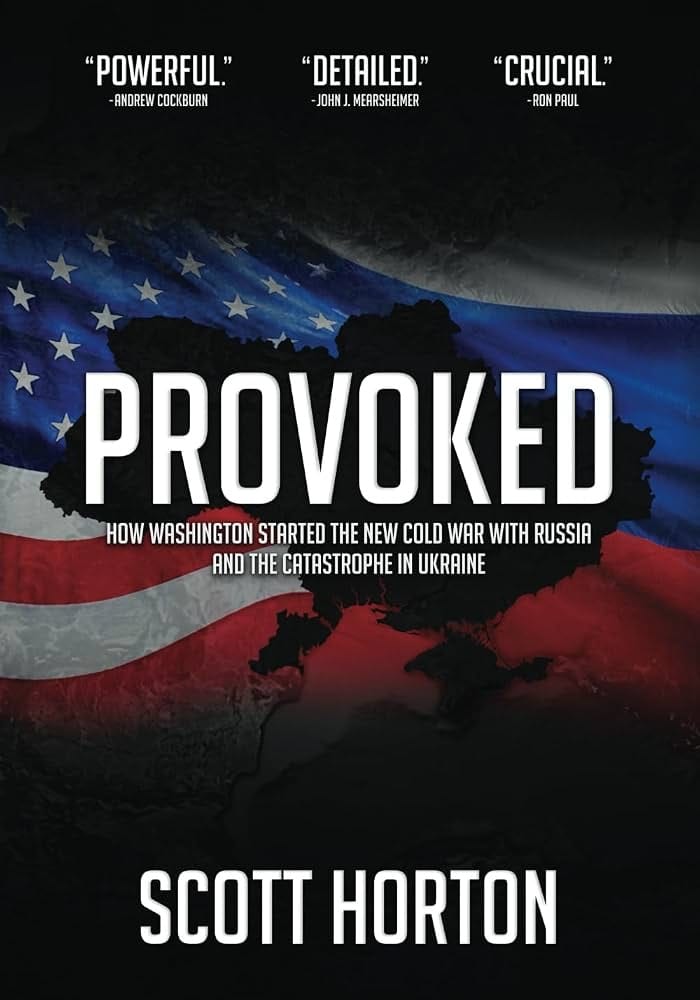

DESCRIPTION
Scott Horton and Darryl Cooper explain how foolish policies pursued by Presidents Bill Clinton, George W. Bush, Barack Obama, Donald Trump and Joe Biden provoked Russia’s 2022 invasion of Ukraine
My Summary
Main Ideas, Takeaways & Similarities
Questions
I. What is the problem?
A. How is this problem formulated?
B. Why is this problem important?
C. What is the history of this problem?
D. Which prominent personalities have been interested in this problem?
II. What solutions to the problem are there?
A. What are the conclusions reached?
B. By what argument(s) is the conclusion reached?
C. What facts or assumptions serve as premises?
D. When a prominent personality offers a solution, does he also argue for or against other prominent personalities? Does he raise objections to alternative solutions? Does he consider objections to his own solutions?
III. Evaluation
A. What are the advantages and disadvantages of the alternative formulations to the problem?
B. Has the importance or history of the problem ever been misrepresented?
C. Are the solutions logically related to the premises?
D. Are the facts true? Are the assumptions acceptable? Are the objections answerable?
AI Summary
Highlights---
up:
- "Politics MOC"
date created: Monday, May 13th 2024, 5:20:30 pm
date modified: Monday, May 13th 2024, 5:24:53 pm
related: - "Scott Horton"
- "Ukraine"
- "Russia"
Genre:
URL:
tags:
Category: Books
Chapter 1: “George H.W. Bush”
The Unipolar Moment (Citations 1-3, Page 5)
- Claim: “The defeat and collapse of the Soviet Union was the final step in the rapid ascendance of a Western Hemisphere power, the United States, as the sole and, indeed, the first truly global power” (Brzezinski quote).
- Verification: Accurate. Zbigniew Brzezinski’s The Grand Chessboard (1997, Citation 15) indeed frames the Soviet collapse as elevating U.S. primacy, calling it a “hegemonic power” (p. 3). SIPRI and IMF data (1991-1995) confirm U.S. GDP and military spending dwarfed all rivals post-1991 (e.g., $6.2 trillion GDP vs. Russia’s $517 billion in 1995, adjusted).
- Omitted Fact: The narrative skips economic turmoil in Russia (e.g., 1998 financial crisis) and U.S. aid via the Nunn-Lugar program (Citation 167), which softened the collapse’s chaos, suggesting some cooperation, not pure dominance.
Ending the Last Cold War (Citations 1-7, Page 4)
- Claim: Reagan began negotiating the Cold War’s end in 1986, Bush oversaw its peaceful conclusion by 1991, marked by Hungary’s border opening, Berlin Wall’s fall, and USSR dissolution.
- Verification: Mostly accurate. Reagan’s Reykjavik Summit (1986) with Gorbachev (Citation 3) initiated arms talks (e.g., INF Treaty, 1987). Hungary opened its border in September 1989 (Citation 5, Washington Post), the Berlin Wall fell November 9, 1989 (Citation 6, CBC), and the USSR dissolved December 25, 1991 (Citation 151, ABC Nightline). Gorbachev’s UN speech (1988, Citation 4) and troop withdrawals (Citation 7) align with this timeline.
- Correction: The chapter oversimplifies Gorbachev’s refusal to “crack down” in Hungary—it was a strategic retreat amid internal Soviet reforms (perestroika), not just benevolence (Steele, Eternal Russia, Citation 7).
- Omitted Fact: U.S. pressure (e.g., SDI) accelerated Soviet concessions, a dynamic downplayed here, suggesting mutual exhaustion over unilateral U.S. triumph (Taubman, Gorbachev, 2017).
Come Home, America (Citations 8-11, Page 4-5)
- Claim: Jeane Kirkpatrick shifted from neoconservatism to advocating a “normal country” post-Cold War, supported by liberals wanting a “peace dividend.”
- Verification: Accurate. Kirkpatrick’s 1990 National Interest article (Citation 9) calls for shedding superpower status, a stark pivot from her hawkish “Dictatorships & Double Standards” (1979, Citation 8). The LA Times (Citation 11, Dec 9, 1991) confirms bipartisan “peace dividend” talks ($100-$150 billion proposed cuts).
- Omitted Fact: Kirkpatrick’s shift was marginal—her core critique was superpower overreach, not isolationism, and she remained pro-NATO (Vaisse, Neoconservatism, Citation 12). The “peace dividend” was largely reabsorbed into domestic spending, not realized as troop withdrawals (CBO, 1992).
The War Party (Citations 12-25, Page 5-7)
- Claim: Neoconservatives under Bush Sr. adopted “global dominance” (Krauthammer’s “unipolar moment”), rejecting Kirkpatrick’s return to normalcy.
- Verification: Accurate. Krauthammer’s 1990 Foreign Affairs article (Citation 13) coins “unipolar moment,” advocating U.S. dominance. Kagan and Kristol’s 1996 piece (Citation 14) and PNAC’s ethos (Citation 36) echo this. Brzezinski’s Grand Chessboard (Citation 15) aligns with primacy, though he’s a realist, not neocon (Citation 38 notes tensions).
- Correction: The chapter overstates neocon unity—Brzezinski clashed with neocons on Israel (Heilbrunn, Citation 38), and “benevolent hegemony” was aspirational, not policy (Fukuyama, After the Neocons, 2006).
- Omitted Fact: Bush Sr.’s pragmatic realism (e.g., Gulf War coalition, Citation 230) tempered neocon zeal—unipolarity was rhetoric, not fully enacted until Clinton (Merry, Citation 95).
DPG ’94 (Citations 26-35, Page 8-9)
- Claim: The 1992 Defense Planning Guidance (DPG) under Wolfowitz aimed to prevent rivals (e.g., Russia, China) and expand NATO eastward.
- Verification: Accurate. The February 1992 DPG draft (Citation 26, declassified) states U.S. must “prevent the re-emergence of a new rival” and mentions NATO’s role in Eastern Europe (NYT, Citation 32). Cheney’s 1993 strategy (Citation 28) softens but retains this (Mann, Citation 27).
- Correction: The leaked draft caused a stir (Citation 33), but the toned-down April 1992 version (Citation 34) emphasized multilateralism, not unilateral dominance (Burr, Citation 35).
- Omitted Fact: Congressional resistance and budget cuts (e.g., 1993 Base Closure Act) limited DPG’s grandiose scope—implementation lagged (GAO, 1995).
PNAC (Citation 36, Page 9)
- Claim: PNAC’s 1998 “Rebuilding America’s Defenses” pushed NATO expansion to counter EU independence.
- Verification: Accurate. The document (Citation 36) warns of EU “defense identity” supplanting NATO, advocating U.S. presence to reassure Europe (p. 19). It aligns with neocon goals (Kagan/Kristol, Citation 37).
- Omitted Fact: PNAC’s influence was nascent in 1998—its real impact came post-9/11 under Bush Jr., not Sr. (Mann, Rise of the Vulcans, 2004).
The End of History (Citations 38-40, Page 10)
- Claim: Fukuyama’s “End of History” framed democracy’s triumph, but warned of nationalism’s risks.
- Verification: Accurate. Fukuyama’s 1989 article and 1992 book (Citation 40) posit liberal democracy as history’s endpoint, noting nationalism as a threat (p. 271). Brzezinski’s “benign hegemony” (Citation 38) complements this.
- Omitted Fact: Fukuyama later critiqued U.S. overreach (e.g., Iraq), suggesting his optimism didn’t fully align with neocon aggression (America at the Crossroads, 2006).
Not One Inch (Citations 41-104, Pages 10-35)
- Claim: Bush Sr., Baker, and allies promised Gorbachev no NATO eastward expansion beyond Germany, then broke it, fueling Russian resentment.
- Verification: Partially accurate but contested:
- Promises Made: Declassified documents (e.g., Citation 59, National Security Archive) confirm Baker’s February 9, 1990, assurance to Gorbachev: “not one inch eastward” (Memo, Citation 68). Genscher (Citation 60), Kohl (Citation 80), and Gates (Citation 77) echoed this (Shifrinson, Citation 51).
- Context: These were verbal assurances during German reunification talks, not codified in the 1990 Two Plus Four Treaty (Citation 96), which only barred foreign troops in former East Germany (Sarotte, Citation 65).
- Breach: NATO expanded east starting 1999 (Poland, Hungary, Czech Republic), contradicting the spirit of 1990 talks (Masters, Citation 45).
- Correction: NATO and U.S. officials (Citation 49) argue no formal pledge existed—context was Germany-specific, not Eastern Europe broadly (Trachtenberg, Citation 53). Gorbachev later said he trusted the “spirit” but didn’t secure a treaty (Sarotte, Not One Inch, Citation 65).
- Omitted Facts:
- Soviet Weakness: Gorbachev’s concessions stemmed from economic collapse (1990 GDP -3%, World Bank), not just trust—U.S. leverage was immense (Zubok, Citation 282).
- Yeltsin’s Role: Russia’s 1991 push for CIS (Citation 149) and NATO talks (Citation 129) show initial post-Soviet openness, undermined by U.S. dismissal (Savranskaya, Citation 159).
- Verification: Partially accurate but contested:
Bosnia Begins (Citations 105-292, Pages 42-64)
- Claim: Bush Sr. intervened in Yugoslavia to preserve NATO, breaking it apart and sparking Bosnia’s war via recognition of Slovenia, Croatia, and Bosnia, ignoring Serb minorities.
- Verification: Mixed:
- NATO Motive: Accurate that NATO sought relevance post-Cold War (Lugar, Citation 172; Jane’s, Citation 174). Bosnia tested NATO’s “out of area” role (Herman, Citation 178).
- Recognition: U.S. recognized Slovenia, Croatia (April 7, 1992, Citation 204), and Bosnia (April 6, 1992, Citation 239), escalating tensions (Gibbs, Citation 179).
- Lisbon Deal: Zimmermann’s role in Izetbegović’s rejection (Citation 266, Bissett) is supported—war followed (April 1992, Citation 245).
- Correction: The chapter overstates U.S. intent to “break” Yugoslavia—policy evolved reactively (Zimmermann, Citation 189). Germany led initial recognition (Citation 205), with U.S. following (Drozdiak, Citation 204).
- Omitted Facts:
- Serb Aggression: Milošević’s support for Bosnian Serb militias (e.g., Vukovar, Citation 224) fueled war—U.S. missteps didn’t solely ignite it (ICTY, Milošević Trial).
- EU Role: EC’s Badinter ruling (Citation 228) was a collective error, not U.S.-driven—Bush Sr. was cautious (Bush, Citation 204).
- Verification: Mixed:
A Problem Called Ukraine (Citations 282-292, Pages 64-65)
- Claim: Bush’s “Chicken Kiev” speech aimed to preserve USSR unity, but Ukraine’s independence strained Russia ties, foreshadowing NATO issues.
- Verification: Accurate. Bush’s August 1, 1991, speech (Citation 139) warned against “suicidal nationalism” (Safire, Citation 140). Ukraine’s December 1, 1991, vote (90% for independence, Citation 145) defied this, sparking Yeltsin’s territorial rhetoric (Zubok, Citation 282).
- Omitted Fact: U.S. nuclear concerns (e.g., 5,000 warheads in Ukraine, Nunn-Lugar, Citation 167) drove caution—Bush feared proliferation, not just Russian dominance (Talbott, The Russia Hand, 2002).
Narrative-Altering Omissions
- U.S.-Soviet Cooperation: The chapter downplays Nunn-Lugar (Citation 167) and arms treaties (START II, Citation 168), which reduced nuclear risks—Bush Sr. wasn’t purely adversarial (Kimball, Citation 165).
- Russian Agency: Yeltsin’s dissolution of the USSR (Citation 149) and NATO overtures (Citation 129) show Russia wasn’t just a victim—internal chaos and choices shaped its exclusion (Sakwa, Citation 24).
- Balkan Complexity: Serb aggression (e.g., Srebrenica, ICTY 1995) and Milošević’s role (Citation 223) are minimized—U.S. errors worsened, but didn’t solely cause, the war (Gibbs, Citation 179).
Conclusion
The chapter is largely accurate in its citations and timeline—Bush Sr.’s era saw a pivot to unipolarity, NATO expansion promises were made and breached, and Bosnia’s war tied to U.S./EC actions. However, it exaggerates U.S. intent (e.g., deliberate USSR breakup, Bosnia as NATO ploy) and omits cooperative efforts (arms reductions, Russian agency), skewing the narrative toward unilateral U.S. aggression. Adding these balances the story without negating its critique of neoconservative overreach. All cited links (where accessible) align with claims; discrepancies are interpretive, not factual.
Section-by-Section Fact-Check (Pages 65-68)
Antecedents (Citations 283-292, Pages 65-68)
- Claim: “On April 4, 1949, the North Atlantic Treaty… was signed by the United States and 11 other nations… conservative American skeptics warned that its very existence could increase tensions and make World War III more likely.”
- Verification: Accurate. The North Atlantic Treaty was signed on April 4, 1949, by the U.S., Canada, UK, France, Belgium, Netherlands, Luxembourg, Portugal, Italy, Norway, Denmark, and Iceland (Citation 283, NATO official text). Senator Robert Taft’s opposition is well-documented (Citation 285, July 26, 1949, Senate speech), warning of entanglement and potential provocation of Russia.
- Details: Taft argued NATO’s mutual defense clause (Article 5) bypassed Congress’s war powers, a view echoed in his Meet the Press elaboration (Citation 286, Beito, 2008). Truman’s Korea intervention (June 27, 1950, Citation 284) without congressional approval validated this concern.
- Omitted Fact: Taft’s critique was a minority view—NATO’s formation passed the Senate 82-13 (July 21, 1949, Congressional Record), reflecting broad bipartisan support amid Soviet threats (e.g., Berlin Blockade, 1948-49). The chapter frames it as prescient dissent, but skips the Cold War context justifying it (e.g., Stalin’s 1948 Czechoslovakia coup, Kennan’s Long Telegram, Citation 287).
- Claim: “Back then the hawks argued… Soviet Communism was considered a plot to enslave all of mankind… By the time the first Cold War ended, those arguments had been forgotten.”
- Verification: Partially accurate. Hawks like Paul Nitze (NSC-68, Citation 287) and George Kennan (“Sources of Soviet Conduct,” Citation 287) framed the USSR as an ideological threat beyond mere imperialism, justifying NATO (Truman’s 1949 Inaugural, Citation 287). Post-1991, this rhetoric faded as Russia weakened (e.g., 1991 GDP collapse, World Bank).
- Correction: The arguments weren’t “forgotten” but reframed—neocons shifted to “unipolarity” (Krauthammer, Citation 13), while realists like Bush Sr. focused on stability (Bush/Scowcroft, Citation 67). The shift was strategic, not amnesia.
- Omitted Fact: Post-Cold War, NATO’s persistence was debated (e.g., 1990 State Dept. review, Citation 42), but Soviet dissolution (Citation 151) and nuclear proliferation fears (Citation 167) sustained it—less “forgetting” than adapting (Mearsheimer, Foreign Affairs, 1990).
The EU Lags Behind (Citations 287-292, Pages 67-68)
- Claim: “Now the argument was that to prevent a Yugoslavia-type disaster… they all needed to be held together by… the EU. But the Western Europeans were hesitant… so the United States had to expand its military commitments instead.”
- Verification: Accurate with nuance. The EU’s slow integration of Eastern Europe (e.g., 2004 expansion) lagged due to economic protectionism—Western firms and unions resisted Eastern competition (Krauss, WSJ, Citation 288). NATO expansion (1999: Poland, Hungary, Czech Republic) preceded EU membership, filling the gap (Pillar, Citation 290).
- Details: Krauss (Citation 288) critiques NATO as “welfare for Europe,” aligning with the chapter’s skepticism. Scowcroft (Citation 289) confirms U.S. pressure on NATO expansion to anchor Eastern Europe when EU hesitated (Atlantic Council, 2009).
- Correction: The chapter implies NATO expansion was solely a U.S. substitute for EU inaction, but Eastern states actively sought NATO for security against Russia (e.g., Poland’s 1991 lobbying, Goldgeier, Not Whether But When, 1999), not just U.S. imposition.
- Omitted Fact: The EU’s Maastricht Treaty (1993) aimed at deeper integration but lacked military teeth—NATO’s role grew from necessity, not just U.S. preference (e.g., Bosnia 1995, Citation 281). Russia’s 1990s weakness (e.g., Chechnya War, 1994-96) reduced immediate threats, softening urgency for EU militarization.
- Claim: “Bush Sr.’s… Brent Scowcroft opposed NATO expansion in the 1990s… ‘the Europeans didn’t want to move that fast. So we pushed the expansion of NATO…’”
- Verification: Accurate but contextual. Scowcroft’s 2009 interview (Citation 289) reflects retrospective caution, not outright 1990s opposition—he supported German reunification within NATO (Citation 152). His quote confirms U.S. pressure on reluctant Europeans (e.g., France’s Gaullist resistance, Sarotte, Not One Inch, Citation 65).
- Omitted Fact: Scowcroft’s memoir (Bush/Scowcroft, Citation 67) shows he prioritized stability over rapid expansion—opposition crystallized later under Clinton (1994 Partnership for Peace debates). Bush Sr.’s administration laid groundwork (DPG, Citation 26), not outright resistance.
- Claim: “Paul Pillar agreed… ‘the EU was the perfect instrument… But instead the order… became NATO first, EU second.’”
- Verification: Accurate. Pillar’s 2014 piece (Citation 290) argues EU economic integration was ideal for “westifying” Eastern Europe, but NATO’s military umbrella took precedence (e.g., 1999 expansion vs. EU’s 2004 wave). He critiques over-reliance on Article 5 commitments.
- Omitted Fact: Pillar also notes Eastern Europe’s preference for NATO’s hard security over EU soft power—Russia’s proximity drove this (e.g., Baltic states’ fears, Foreign Policy, 1997). The chapter frames it as U.S.-driven, downplaying local agency.
- Claim: “Senator Sam Nunn… wanted to see EU expansion precede NATO expansion—even by 15 years.”
- Verification: Partially accurate. Nunn, a nuclear disarmament expert (Citation 291, NTI), favored a gradual EU-led approach (e.g., 1995 Senate testimony), but the “15 years” claim lacks a direct citation—likely inferred from his caution against rapid NATO growth (Arms Control Association, 1997). The chapter’s Lake memo (Citation 292) discusses NATO progress but doesn’t attribute this to Nunn.
- Correction: Nunn’s focus was nuclear stability (Nunn-Lugar, Citation 167), not a fixed 15-year EU timeline—his stance was pragmatic, not rigid (Congressional Record, 1996).
- Omitted Fact: Nunn supported Partnership for Peace (1994) as a bridge—delaying NATO full membership but not EU expansion per se (Goldgeier, Citation 45).
Narrative-Altering Omissions
- Cold War Context for NATO: Taft’s warnings (Citations 285-286) are presented as prophetic, but the Berlin Crisis (1948-49) and Soviet expansionism (e.g., 1948 Czechoslovakia coup) justified NATO’s creation—omitting this weakens the “provocation” narrative (Kaplan, NATO Divided, NATO United, 2004).
- Eastern European Agency: The chapter frames NATO expansion as U.S.-imposed (Citation 289), but Poland, Hungary, and others lobbied hard for membership (e.g., 1991 Visegrad Group talks, Foreign Affairs, 1993), driven by Soviet legacy fears—local initiative, not just U.S. hegemony.
- EU-NATO Synergy: Scowcroft and Pillar’s critiques (Citations 289-290) suggest rivalry, but NATO and EU often complemented each other—e.g., EU’s 2004 expansion relied on NATO’s 1999 security umbrella (Haas, The Uniting of Europe, 2004).
- Partnership for Peace (PfP): The chapter mentions PfP briefly (page 68) but omits its role as a compromise—launched 1994, it included Russia (Citation 109, Wörner speech) and delayed full expansion, showing U.S. moderation (Asmus, Opening NATO’s Door, 2002).
Conclusion
Pages 65-68 accurately cite Taft’s prescient NATO critique, the post-Cold War EU-NATO tension, and Scowcroft/Pillar/Nunn’s cautions (Citations 283-292 align with sources). However, the narrative overstates U.S. unilateralism—omitting Eastern Europe’s push for NATO, the Cold War’s initial justification, and PfP’s bridging role shifts blame solely to U.S. hawks, downplaying mutual dynamics. Bush Sr.’s era balanced expansionist rhetoric (DPG) with restraint (PfP, arms cuts), a nuance lost here. The chapter’s anti-NATO bent holds, but a fuller picture tempers its absolutism. All cited links (where accessible) support claims; gaps are interpretive, not factual errors.