-
If U.S. wasn’t supporting Israel, they wouldn’t have influence on them.
- Examples:
- US having Israel give back the Senai
- US stopping Israel from using 5 battalions (300,000k) troops going into Gaza
- Examples:
-
Doesn’t have a mutual defense pact, not a member of NATO
Israel Helping U.S.
- 2005-2021: Israel voted with U.S. at the UN more than any other nation
- No country has supplied U.S. with more intelligence
- No country has supplied U.S. with more arms innovation
- Tech innovation
“Modern Israel has given us the mobile phone, the drip irrigation system, the USB thumb drive, many of the most effective cancer killing drugs in use, voice mail, video on demand, and cherry tomatoes. But Israel’s real contribution to America has nothing to do with life-saving or life-improving products.
America’s relationship with Israel is not merely organizational, it’s organic. Israel is a mirror image of America in its commitment to religious liberty, education, women’s rights, free speech, democratic governance and free-market capitalism. Women have equal access to education and workplace opportunities. While a Jewish state, Israel also protects all religious shrines and provides Christians, Muslims and Jews universal access to all religious sites. (How many churches or synagogues are equally protected by the Syrians or the Iranians?)”
Why Israel matters to America - Washington Examiner
Aid
Aid, domestic spending, and the grocery-price argument
The defensible claim
Regular aid to Israel is too small to finance American universal health care on its own, and an opportunity-cost argument does not establish that it caused grocery inflation. The merits of particular weapons transfers require a separate strategic, legal, and moral argument. Source and calculations: Yes, We Have No Bananas - David Frum. Debate card: Arguments notes > Aid to Israel, domestic priorities, and economic scapegoating.
- Regular framework: the FY2019–FY2028 MOU provides for $3.3 billion in annual FMF plus $500 million in missile-defense support, $3.8 billion combined, subject to congressional appropriation. It is not a ceiling on emergency assistance. CRS, RL33222, May 2025 version.
- Wartime comparison: CRS lists $12.5 billion for FY2024 in its bilateral military-assistance and missile-defense series. Specify the year and category; do not present $3.8 billion as the whole wartime total or treat all Israel-related U.S. regional expenditure as bilateral aid. CRS, Tables 1–2.
- Budget scale: against CBO’s $6.752 trillion in FY2024 outlays, $3.8 billion is 0.0563%, and $12.5 billion is 0.1851%. These are scale ratios, not a claim that obligations and cash outlays occur at the same moment. CBO, FY2024 summary, Table 1.
- Groceries: using Frum’s $1.1 trillion annual spending assumption, regular aid equals 30.3 hours, or 0.35%, of that spending. This illustrates relative size; it does not forecast grocery-price changes or free groceries.
- Housing: NYCHA reports $78.0 billion in 20-year capital needs, updated with January 2026 data, equal to about 20.5 annual baseline-aid amounts. This includes future needs; calling it all overdue maintenance overstates what the assessment measures. NYCHA FAQ.
- Health care: Frum’s $32 trillion over ten years comparison implies that one average month equals about 70 years of regular aid. Treat the cost as a scenario, not the settled price of every universal-coverage proposal. Additional federal spending also replaces substantial existing private and state spending. → Yes, We Have No Bananas - David Frum > Health care: the 70-year comparison is scenario-dependent.
- Procurement and fungibility: FMF primarily buys defense goods and services, with an Israeli procurement exception scheduled to end in FY2028. It does not directly appropriate civilian health-care funding, but defense subsidies can free domestic Israeli resources. U.S. contractor revenue and technology cooperation are potential benefits, not proof of zero cost or automatic net savings. CRS, MOU, FMF, and Iron Dome sections.
Debate formulation: “Aid has an opportunity cost. Show how this appropriation caused grocery prices to rise, then show that your proposed cut can fund the domestic program you promise. Those are different claims.” This is a newly written formulation, not a Frum quotation. Compact script: 60.1 Israel-Palestine TP > United States Funding Israel.
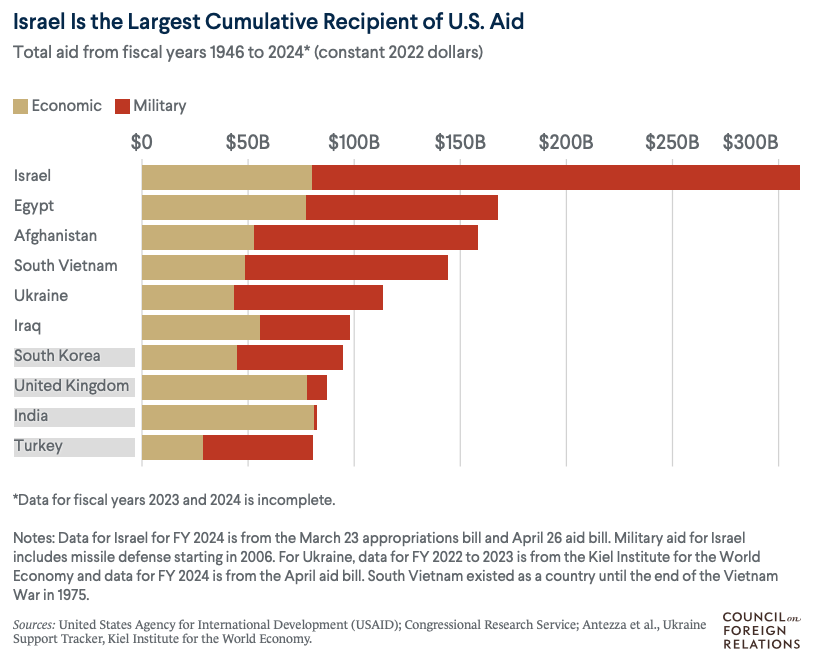
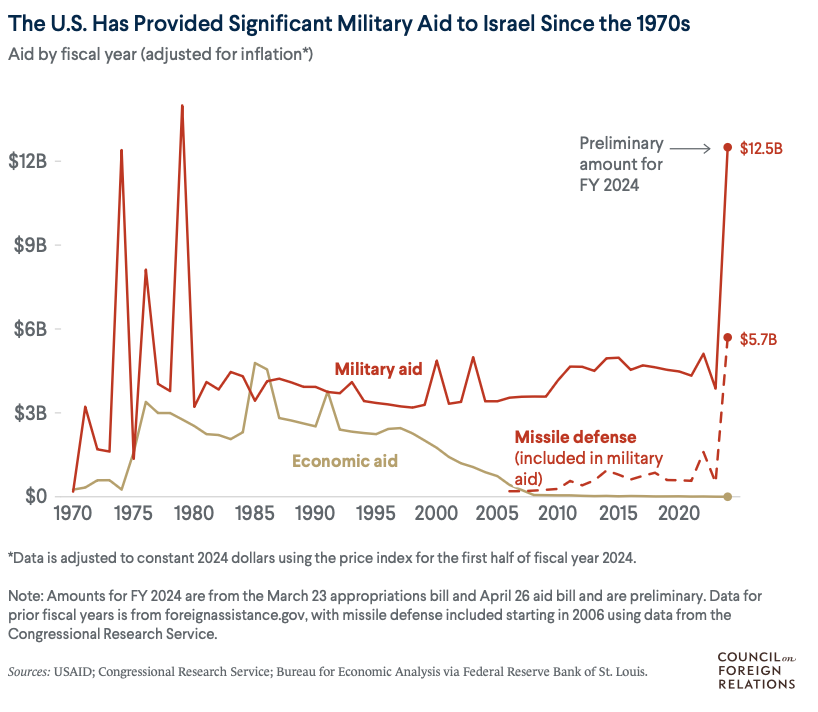
- Most of the aid—approximately $3.3 billion a year—is provided as grants under the Foreign Military Financing (FMF) program, funds that Israel must use to purchase U.S. military equipment and services. In October, the Joe Biden administration said Israel had nearly six hundred active FMF cases, totalling around $24 billion. Israel has also historically been permitted to use a portion of its FMF aid to buy equipment from Israeli defense firms—a benefit not granted to other recipients of U.S. military aid—but this domestic procurement is to be phased out in the next few years. U.S. aid reportedly accounts for some 15 percent of Israel’s defense budget. Israel, like many other countries, also buys U.S. military products outside of the FMF program.
- Some experts argue that U.S. aid actually weakens Israel’s defense industrial base while serving primarily as a guaranteed revenue stream for U.S. defense contractors.
Superseded calculation, preserved for provenance
Original note; the percentage below is incorrect, and its “annual” and “last year” labels lack a fixed reference year:
- it’s important to know that America’s annual support for Israel – $12.5 billion – represents less than 0.00001% of U.S. federal spending. Last year, assistance to Israel accounted for just five percent of America’s foreign aid spending.
Correction, 29 October 2026: CRS’s $12.5 billion FY2024 subtotal divided by $6.752 trillion in FY2024 federal outlays is 0.1851%, not less than 0.00001%. The separate five-percent foreign-aid claim is not verified here. Use the dated figures in Aid, domestic spending, and the grocery-price argument.
References
U.S. Aid to Israel in Four Charts | Council on Foreign Relations