Homeland Double Standard — Mandate Palestine and U.S. Immigration
Notebook pages (B5, 2 pages)
Page 1: the argument map.
Page 2: objections and replies.
HTML sources: Attachment (file not included in this release) · Attachment (file not included in this release)
Polemic — said to an opponent
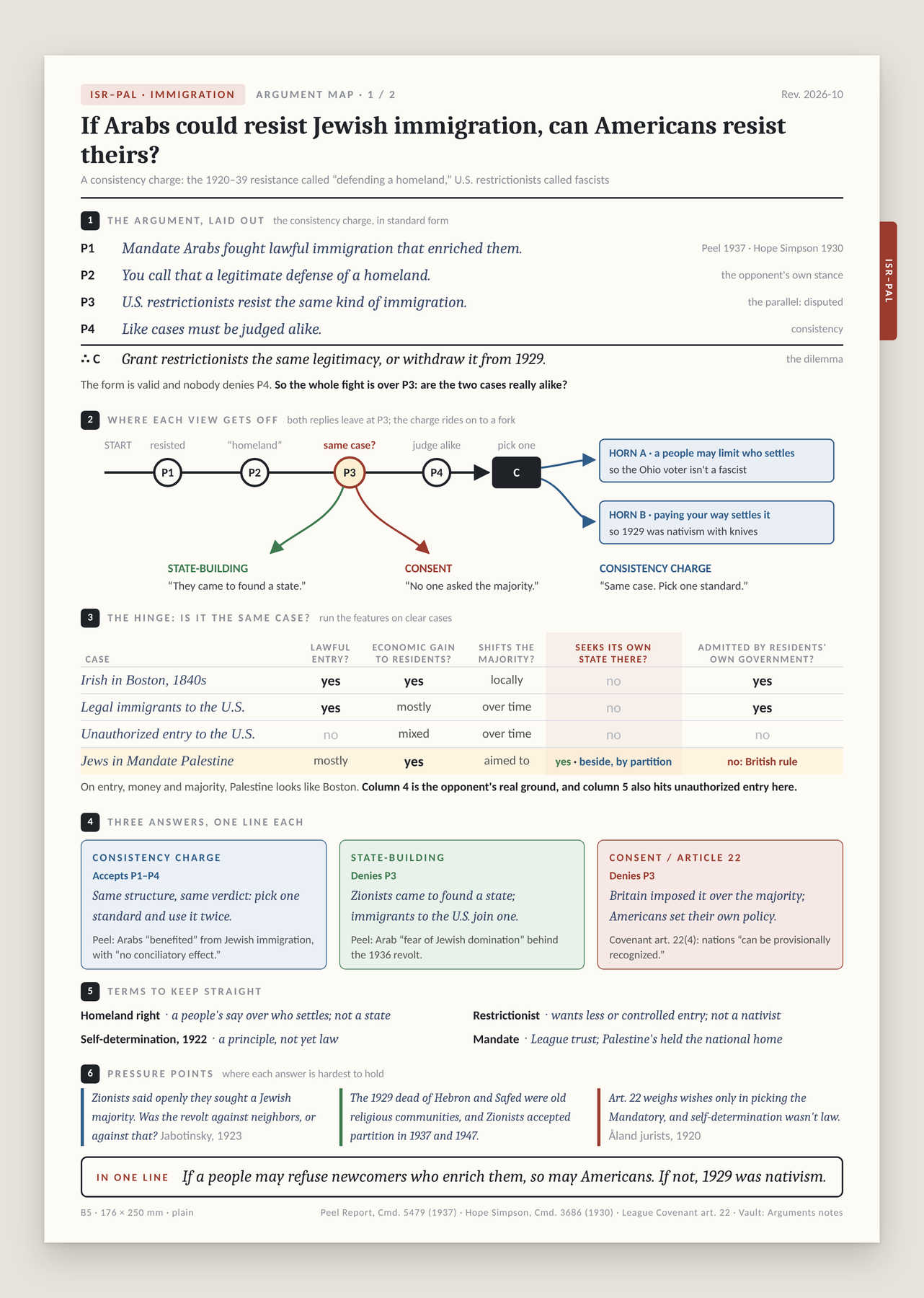
You defend the Palestinians’ right to their homeland, so walk through what happened there before 1948. Jews came to Palestine and bought land, legally, mostly from Arab landlords in Beirut and Damascus who had never farmed it. They overpaid. In 1930 the British found they had “paid high prices for the land” and on top of that paid the tenants money “which they were not legally bound to pay.” They drained swamps, built industry and raised wages, and Arabs moved into the areas around Jewish settlement for the work. Even the Peel Commission admitted it in 1937: “the Arabs have benefited by the development of the country owing to Jewish immigration.” The very next words say it had “no conciliatory effect.” The answer was riots in 1920, 1921 and 1929, and a three-year revolt starting in 1936, all with one demand: stop the immigration, stop the land sales, these people are changing our country. You call that defending a homeland. Now an American says, “I think we should control who comes in, because this is changing my country,” and you call him a racist, a fascist, a moron. Then you tell him immigrants grow the economy, which is the exact argument the Arabs of Palestine heard and rejected, and you call their rejection resistance.
So which is it? If people have the right to say “this is our land and we decide who settles here,” then the man in Ohio has that right too, and he’s not a fascist for using it. If they don’t, and paying your way and growing the economy is what earns you a place, then the Jews of Palestine were model immigrants and the people who killed them in Hebron were nativists with knives. You can pick either standard. What you can’t do is pick both, one for the Arab of 1929 and the other for the American of today. Notice which one you’re harsher on. The American is asking for a vote and a border. The rebel in 1936 was shooting at buses. If your contempt is aimed at the voter and your sympathy at the rioter, then your principle isn’t about immigration at all. It’s about who’s asking.
Comebacks to expect
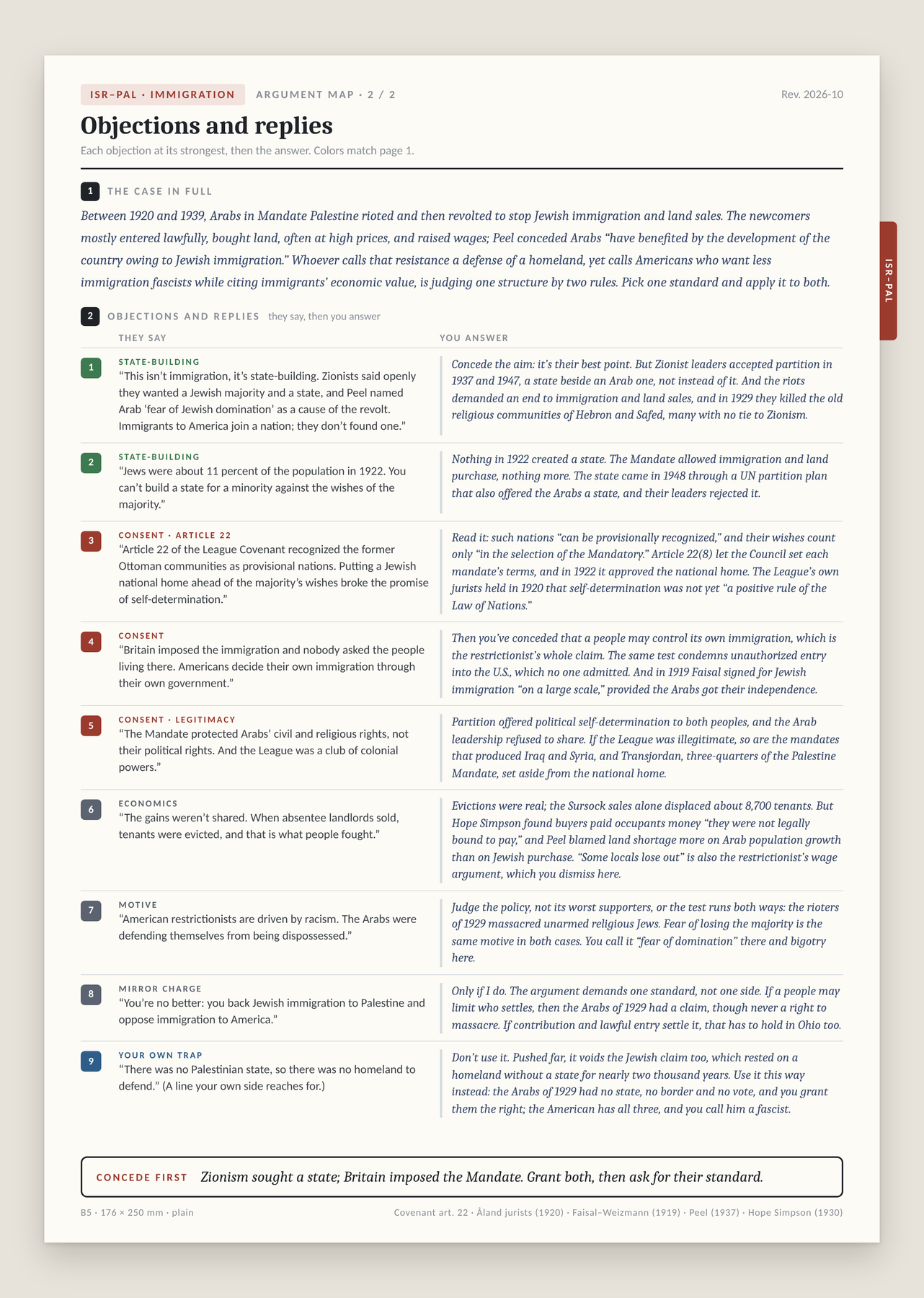
- “Zionists wanted a state, not a place in someone else’s.” True, and their best point. Peel named Arab “fear of Jewish domination” as a cause of the revolt, and Jabotinsky said openly that the goal was a Jewish majority (The Iron Wall). Immigrants to the U.S. join an existing nation; they don’t found a new one. Concede it, then ask whether the riots of 1929 were aimed at a state or at the old religious communities of Hebron and Safed.
- “Britain imposed immigration on the Arabs; Americans set their own policy.” This concedes the premise: a people controlling its own immigration is legitimate. That is the restrictionist’s whole claim.
- The mirror charge. Anyone who backs Zionist immigration but calls U.S. immigration an “invasion” is open to the same argument in reverse. Use it as a demand for one consistent standard, not as proof that only one side is hypocritical.
- Violence against civilians is wrong whichever standard you pick. The argument is about consistency, not about excusing anyone.
Does “there was no Palestinian state” help?
Not against the “Zionists wanted a state” objection. That objection isn’t that Zionists replaced an existing state. It’s that they aimed to build a new one, with a Jewish majority, where most people were Arabs. The 1922 British census counted 589,177 Muslims, 71,464 Christians and 83,790 Jews, so Jews were about 11 percent. “There was no state” doesn’t touch that.
Pushed too far, it backfires. The polemic rests on a homeland right that belongs to a people, not a government, and that is also the core of the Zionist case: Jews had no state for nearly two thousand years and still had a homeland. If statelessness voids a homeland claim, the Jewish claim before 1948 fails by the same test.
Where it works:
- It sharpens the double standard. The American restrictionist has a sovereign state, legal borders and an elected Congress that sets immigration law. The Arabs of Mandate Palestine had none of these; sovereignty sat with the Ottomans and then with Britain under a League mandate. The opponent grants the weaker claim and condemns the stronger one. Line: “The Arabs of 1929 had no state, no border and no vote on immigration, and you say they had the right to stop it. The American has all three, and you say he’s a fascist for asking.”
- It shows the immigration was lawful. The 1922 Mandate wrote in Balfour’s “national home for the Jewish people” and recognized “the historical connection of the Jewish people with Palestine.” Jewish immigration overrode no sovereign’s law; violence to stop it did.
Better answer to “Zionists wanted a state”: they accepted partition in 1937 and 1947, so they wanted a state beside another, not instead of one; the 1929 dead in Hebron and Safed were mostly old religious communities, many not Zionist; and pre-1948 immigration was legal under the Mandate.
Answering Article 22 of the League Covenant
Their claim: Article 22 promised the former Ottoman communities provisional recognition as independent nations, so the Mandate broke the promise of self-determination by putting a Jewish national home ahead of the majority’s wishes.
- The text doesn’t say it. Article 22(4): “Certain communities formerly belonging to the Turkish Empire have reached a stage of development where their existence as independent nations can be provisionally recognized subject to the rendering of administrative advice and assistance by a Mandatory until such time as they are able to stand alone. The wishes of these communities must be a principal consideration in the selection of the Mandatory.” “Can be” is permission, “certain communities” doesn’t name Palestine, and the wishes clause covers only the choice of Mandatory. Article 22(8) lets the Council define each mandate’s terms, and in July 1922 the Council approved the Palestine Mandate, national home included.
- Self-determination wasn’t yet law. The League’s Commission of Jurists on the Åland Islands (1920): “Although the principle of self-determination of peoples plays an important part in modern political thought, especially since the Great War, it must be pointed out that there is no mention of it in the covenant of the League of Nations.” Its recognition in some treaties “cannot be considered as sufficient to put it upon the same footing as a positive rule of the Law of Nations.”
- The Arabs got self-determination on a vast scale. Iraq, Syria, Lebanon and Transjordan came out of the same settlement. Transjordan, roughly three-quarters of the Mandate territory, was excluded from the national home under Mandate Article 25.
- Faisal signed for Jewish immigration. Faisal–Weizmann Agreement (1919), Article IV: “All necessary measures will be taken to encourage and stimulate immigration of Jews into Palestine on a large scale.” His consent was conditional on Arab independence, which failed when France took Syria in 1920, so use it to show the two goals weren’t seen as incompatible, not as a binding commitment.
- Turn it back. Stripped down, their case is that a majority’s wishes should override lawful immigration. That is the restrictionist principle they condemn in America.
Spoken: “Read Article 22. It says those communities can be provisionally recognized, and that their wishes count in picking the Mandatory. That’s all. The same League, under the same Covenant, approved the Mandate with the Jewish national home in it. Their own jurists said in 1920 that self-determination wasn’t even law yet. And the Arabs got Iraq, Syria, Lebanon, and Transjordan, which was three-quarters of the Palestine Mandate itself. Faisal signed for Jewish immigration ‘on a large scale.’ So the complaint isn’t that Arabs were denied self-determination. It’s that they got almost everything, and the Jews got the right to buy land in what was left.”
Their reply Your answer ”The Mandate only protected civil and religious rights, not political rights.” True, and their best follow-up. Answer with partition: Zionist leaders accepted political self-determination for both peoples in 1937 and 1947; the Arab leadership refused to share. ”Covenant Article 20 voids obligations inconsistent with the Covenant, so Balfour was void.” Only if Article 22 required a majority veto, and it didn’t. The Council, the body charged with applying it, approved the Mandate. ”The League was a club of colonial powers.” Then the mandates that produced Iraq and Syria are illegitimate too. The League can’t be legitimate for Arab states and illegitimate for the Jewish home. ”Jews were 11 percent; you can’t build a state for a minority.” Nothing in 1922 created a state. It allowed immigration and land purchase. The state came in 1948 through a UN partition plan that also offered the Arabs a state.
Sources
- John Hope Simpson, Palestine: Report on Immigration, Land Settlement and Development, Cmd. 3686 (London: HMSO, October 1930). Quote: “They [Jews] paid high prices for the land, and in addition they paid to certain of the occupants of those lands a considerable amount of money which they were not legally bound to pay.” Also in 1800-1899.
- Palestine Royal Commission Report (Peel Commission), Cmd. 5479 (London: HMSO, July 1937), conclusions. Quote: “Though the Arabs have benefited by the development of the country owing to Jewish immigration, this had no conciliatory effect.” Continues: “improvement in the economic situation in Palestine has meant the deterioration of the political situation.” Wording as given in https://en.wikipedia.org/wiki/Peel_Commission; check against the report before publishing, since some editions read “this has had.”
- Riots and revolt: Violence Against Jews Before 1948 (Jaffa 1921, Hebron and Safed 1929, Tiberias 1938).
- Land purchase record (about 6.6% Jewish-owned by 1947, mostly bought from absentee owners): Jewish Land Purchases in Palestine (1880–1947).
- Covenant of the League of Nations (1919), Article 22, paragraphs 4 and 8; Article 20.
- Mandate for Palestine, approved by the League Council, July 24, 1922: preamble (“the historical connection of the Jewish people with Palestine”), Article 25 (Transjordan). See Mandate & Legal Basis (Balfour, San Remo, League of Nations).
- Report of the International Committee of Jurists on the Åland Islands question, League of Nations Official Journal, Special Supplement No. 3 (October 1920). https://www.lagtinget.ax/sites/www.lagtinget.ax/files/juristkommissionen_1920.pdf ; quotes as given in https://pesd.princeton.edu/node/511
- Faisal–Weizmann Agreement, January 3, 1919, Article IV and Faisal’s handwritten reservation (“Provided the Arabs obtain their independence as demanded in my Memorandum dated the 4th of January, 1919…”). https://jewishvirtuallibrary.org/the-weizmann-faisal-agreement-january-1919
- J. B. Barron, Palestine: Report and General Abstracts of the Census of 1922 (Jerusalem, 1923): 589,177 Muslims, 83,790 Jews, 71,464 Christians, 7,617 others.