Focused debate practice — morality and religion
Morality and Religion - Andrew Wilson Challenge selects the strongest relevant grounding challenge from the existing source maps, qualifies older replies, and links to Does Morality Require Religion - Master for the learning plan and reusable prompt.
Direct transcript studies — morality and religion
SRC - Andrew Wilson vs Naima Round 2 - Morality, Rights and Force · SRC - Andrew Wilson vs 5 - Unchanging Moral Standards · SRC - Andrew Wilson with Bryan Callen - Morality Without God preserve the supplied transcripts and separate Wilson’s positive claims, conditional critiques, and proposed replies. Use Morality and Religion - Andrew Wilson Challenge for the shared opposition card.
🧠 Course background
Intro to Metaphysics & Epistemology - Peterson Academy covers the metaphysical/epistemological sense of ‘objective’ — written up from your handwritten notes (March notebook pp. 58–71).
📓 Handwritten journal
Journal connection: The pages track Wilson’s objective/subjective ethics argument, a “core issue” outline, and a later set of rhetorical and metaethical criticisms.
Source boundary: These are personal debate notes and paraphrases; confirm speaker wording and philosophical attributions against the underlying recordings.
PDF++ pages: Feb–Mar p. 10 (file not included in this release) · Mar–Jun p. 78 (file not included in this release) · p. 158 (file not included in this release) · p. 159 (file not included in this release)
Embedded preview:
March 21-June 9 2026.pdf (file not included in this release)
Open the journal index
Political ideology
Andrew Wilson - Political Ideology, Philosophical Foundations, and Program reconstructs Wilson’s Christian moral nationalism, patriarchal pronatalism, theory of rights and force, Republican strategy, relationship to the dissident right, and the institutional questions his program leaves unresolved. It is based on the full supplied Dangerous Liberty transcript and distinguishes explicit claims from inference and independent checks.
Doesn’t understand WWII History
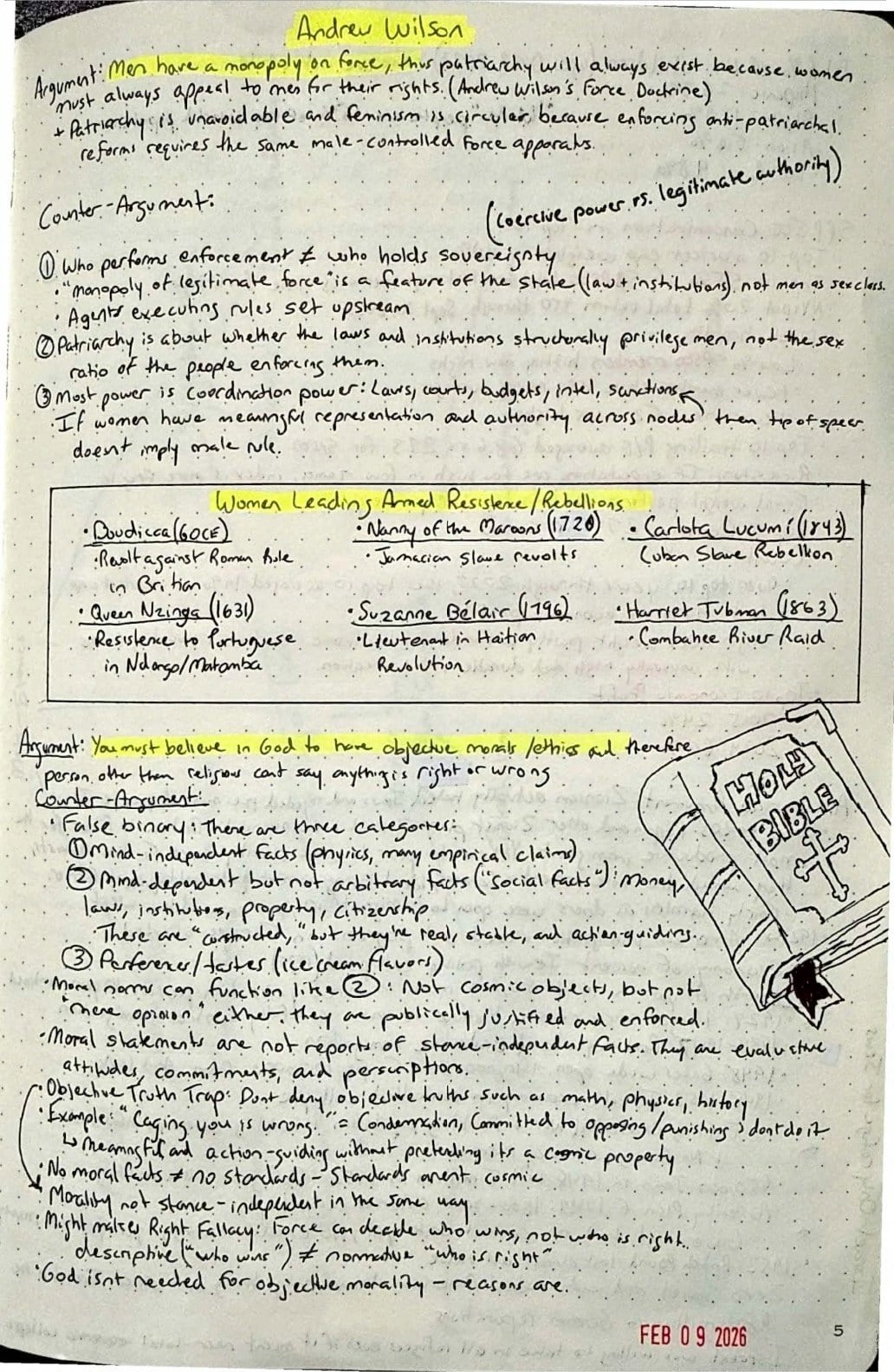
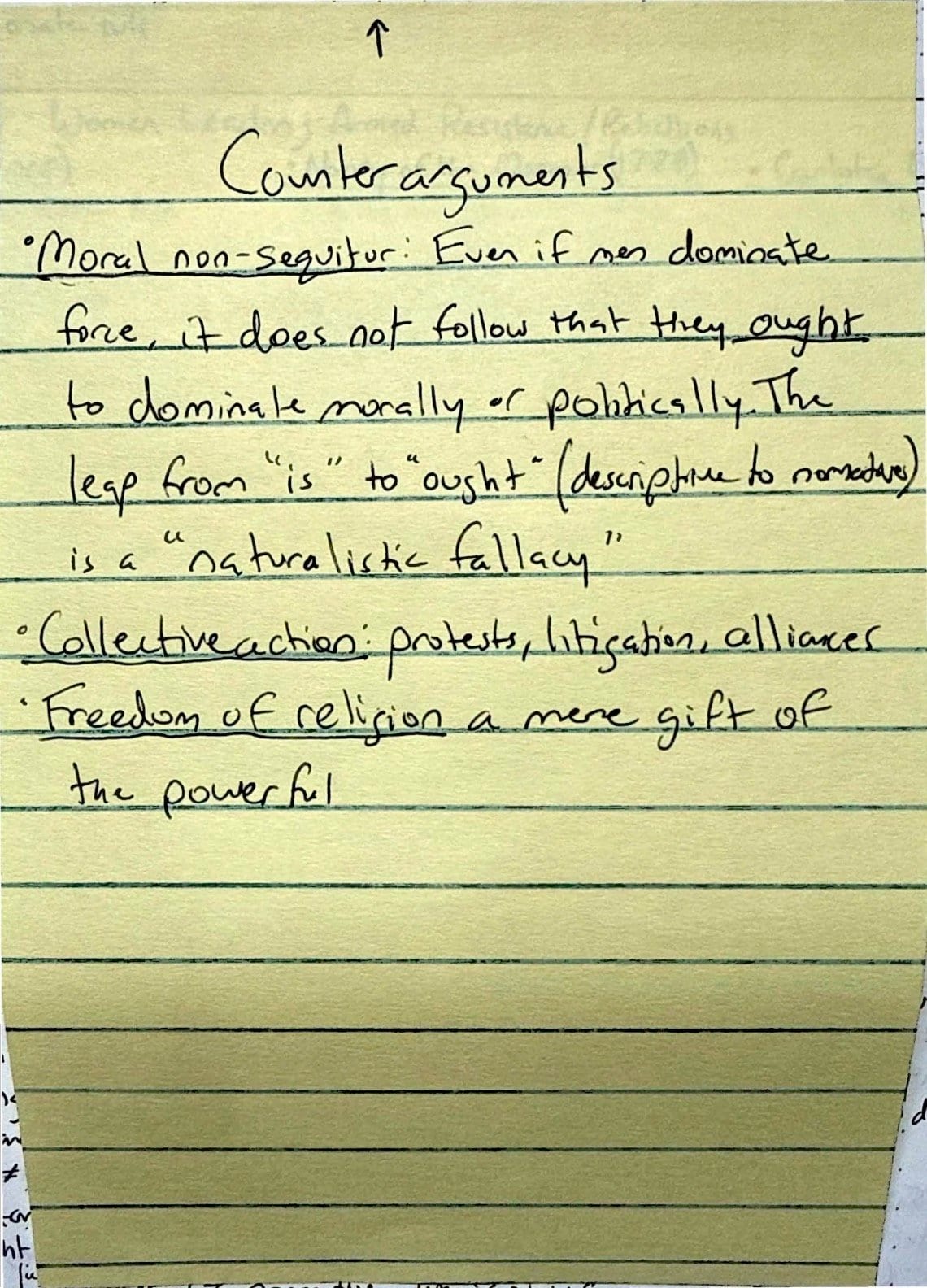
Handwritten journal source
Consolidated source: PDF pp. 172–174 (file not included in this release)
Source boundary: These are handwritten source pages. Use the scan for exact wording; verify quotations and factual claims before reuse.
Embedded preview:
March 21-June 9 2026.pdf (file not included in this release)
Open the journal routing table
Counter Logic from Reddit
He’s a presuppositionalist and I personally find his arguments weak.
He argues against atheism from the transcendence of logic. Logical laws are not invented, they’re discovered, and yet they’re not reducible to physical processes or events. If the materialist claims all that exists is matter and energy, how does he account for these undeniable laws? By falling back on self-refuting nominalism? Wilson believes he has a straightforward solution: logical laws exist as thoughts in the mind of an immaterial, spaceless, timeless God.
Ignoring the fact that Wilson is blatantly conflating atheism with naive physicalism, there are other problems:
The notion that logic has ontological dependence on God is completely incoherent. If God established the laws of logic, that establishment would already presuppose the existence of logic. In which case there is no establishment. Before God established the law of identity for example, could we say that God was who he was and not who he wasn’t? If we can, then the law of identity existed before it was brought into existence, which is incoherent. But if logic is co-eternal with God, then we don’t need God to explain logic.
Wilson Vs 5: Rights Don’t Actually Exist, Only Force | DEBATE - YouTube
Rights Presuppositional apologetics
Introduction
The history of human political thought can be understood as a long and arduous contest between two fundamentally opposed conceptions of social order. The first is a doctrine of cynical realism, a philosophy as ancient as it is brutally simple, which asserts that power is its own justification. In this view, concepts like “justice,” “morality,” and “rights” are ephemeral illusions, rhetorical masks worn by the powerful to legitimize their dominance. The only true currency in human affairs is force, and the only meaningful rule is that the strong do what they can and the weak suffer what they must. This position finds its most famous and forceful ancient articulation in the words of the Sophist Thrasymachus in Plato’s Republic, who declared that justice is nothing more than “the advantage of the stronger”.1
Against this stark vision stands the normative tradition of philosophy. This second conception argues that human society can and should be organized according to principles that transcend mere physical coercion. It posits that concepts like justice, fairness, and rights, while not tangible objects, can possess a form of reality and power that is both independent of and superior to brute force. This tradition insists that a legitimate social order is one founded not on domination, but on a shared understanding of mutual obligations and entitlements—a system of rights.
This report will argue that the “might makes right” doctrine is a philosophically unsophisticated and scientifically outdated view of human society. It will demonstrate that rights, while not physical objects, are functionally real, structurally coherent, and powerful social constructs. Their existence is justified by robust philosophical reasoning and is deeply rooted in the evolutionary and neurological realities of human nature as a cooperative, social species. Consequently, a social order based on a shared system of rights is not only morally defensible but is also more stable, efficient, and ultimately more powerful than one based on brute force alone.
The argument will proceed in four parts. Part I will deconstruct the ancient “might makes right” fallacy by analyzing its archetypal presentation and refutation in the dialogue between Thrasymachus and Socrates. Part II will move from refutation to construction, explaining the ontological architecture of rights—how they can be real without being physical—drawing on modern philosophy of language and social theory. Part III will survey the primary philosophical justifications for why a system of rights is morally necessary, examining the convergent conclusions of contractarian, deontological, and utilitarian ethics. Finally, Part IV will ground these philosophical concepts in the firm bedrock of contemporary science, presenting evidence from evolutionary biology, primatology, and neuroscience that the foundations of a rights-based order are integral to our evolved human nature.
Part I: Deconstructing the “Might Makes Right” Fallacy
To build a robust defense of rights, one must first confront and dismantle the most enduring argument against them. The “might makes right” doctrine, or cynical realism, is not a modern invention but an ancient challenge that was given its most formidable philosophical voice over two millennia ago. By examining this foundational debate, we can expose the inherent weaknesses of this worldview and lay the groundwork for a more sophisticated understanding of power, justice, and social order.
The Ancient Challenge of Thrasymachus
In the first book of Plato’s Republic, the philosopher Socrates and his companions are aggressively interrupted by the Sophist Thrasymachus. Impatient with what he perceives as Socratic naivete, Thrasymachus offers a definition of justice that seeks to strip away all moral pretense and reveal the raw political reality underneath.3 His position can be distilled into three core claims that together form the classic statement of cynical realism.
First, Thrasymachus declares that justice is nothing but the advantage of the stronger.2 He argues that in any state, the ruling party—whether a tyranny, a democracy, or an aristocracy—enacts laws that serve its own interests. Since justice, for the common person, is defined as obedience to these laws, the act of being just is simply the act of serving the interests of the powerful.1 The entire moral language of justice is thus a tool of social control, a means by which the ruling class secures its position and exploits the ruled.
Second, and as a direct consequence of the first claim, Thrasymachus argues that injustice is superior to justice. He contends that a life of injustice, if practiced on a sufficiently grand scale, is “stronger, freer, and more masterly than justice”.2 In every transaction, the just person willingly accepts less than their fair share, while the unjust person skillfully manipulates the rules to their own benefit. The ultimate exemplar of this is the tyrant, who through perfect injustice seizes the property and liberty of his subjects and is lauded not as a criminal but as happy and blessed. Justice, in this view, is a form of weakness, a self-imposed handicap that benefits others at one’s own expense.
Third, Thrasymachus’s philosophy is rooted in a thoroughgoing ethical egoism and immoralism. He believes that all individuals are, by nature, driven by self-interest and the desire to “outdo” or have more than others (pleon echein).1 From this perspective, justice is a “sucker’s game,” a convention adhered to only by “naïve simpletons” who lack the strength or cunning to act unjustly with impunity.4 He goes so far as to claim that injustice is a form of wisdom and virtue, while justice is a contemptible form of foolishness or “high-minded simplicity”.5
Thrasymachus is not a mere straw man. His arguments represent a profound and persistent challenge to any moral or political theory. His cynical realism foreshadows the political analyses of thinkers like Machiavelli and the moral critiques of Nietzsche, and it captures a worldview that sees all social arrangements as the product of a naked struggle for power.2 To defend the existence of rights, one must first answer the Thrasymachean charge that they are nothing but words used by the strong to control the weak.
Socrates’ Refutation and Its Enduring Relevance
Socrates’ response to Thrasymachus in the Republic is not a single argument but a series of dialectical maneuvers designed to expose the contradictions and instabilities within the Sophist’s worldview. These arguments, while ancient, remain profoundly relevant as they establish the foundational template for refuting cynical realism.
Socrates’ first move is the Error Argument. He seizes on Thrasymachus’s claim that justice is obedience to laws made by the stronger for their own advantage. Socrates points out that rulers are human and therefore fallible; they can make mistakes and enact laws that are, contrary to their intentions, not to their own advantage.6 If a subject then obeys such a flawed law, they would be acting justly (obeying the law) but would simultaneously be acting contrary to the advantage of the stronger. This initial probe forces Thrasymachus to retreat from a simple empirical claim to a more idealized one: a “true” ruler, insofar as he is a ruler, is like a perfect craftsman (technitēs) and does not make errors in his craft.5
This refinement leads directly to Socrates’ central counter-attack: the Craft Analogy (Techne Argument). Having forced Thrasymachus onto the ground of ideal crafts, Socrates turns the analogy against him. He proceeds to establish that every genuine craft—medicine, horse-breeding, ship-captaining—has a specific object and purpose. A doctor’s craft is concerned with the health of the body; a captain’s craft is concerned with the safety of the ship and its crew. In every case, Socrates argues, the craft seeks to benefit its subject (the weaker element), not the practitioner (the stronger element).4 A doctor, qua doctor, seeks to heal the patient, not to enrich himself. If he does enrich himself, it is through an auxiliary craft of wage-earning, not the craft of medicine itself.8 Having secured Thrasymachus’s agreement on this point, Socrates delivers the final blow: if ruling is a craft, then the true ruler, qua ruler, must seek the advantage of the subjects being ruled, not their own advantage.7 This argument inverts Thrasymachus’s definition entirely. If justice is the craft of ruling, it must be for the benefit of the weaker, not the stronger. While this analogy has been criticized for its own flaws—justice may not be a craft, which is morally neutral, and some crafts like wage-earning are self-regarding—it serves a crucial dialectical purpose: it separates the concept of competent rule from that of selfish exploitation.6
Next, Socrates employs the Common Purpose Argument to attack Thrasymachus’s claim that injustice is a source of strength. Socrates contends that injustice is inherently divisive. An unjust group, whether a city, an army, or even a band of robbers, will be plagued by internal hatred, factionalism, and an inability to act in concert. To achieve any common goal, even a criminal one, the members of the group must observe some form of justice among themselves.4 Injustice, therefore, is not a source of strength but of chaos and impotence. This logic extends to the individual: an unjust soul is at war with itself, torn by conflicting desires, and ultimately weaker and less effective than a harmonious, just soul.
Finally, Socrates offers the Function (Ergon) Argument. He posits that everything has a characteristic function or work (ergon), and that a virtue (aretē) is the quality that enables it to perform its function well. The function of an eye is to see, and its virtue is good vision. The function of the soul, he argues, is “taking care and ruling and deliberating,” in short, living.9 The virtue of the soul is justice. Therefore, a just soul will perform its function well, leading to a good and happy life, while an unjust soul will live badly and be wretched.
Insights and Implications from the Ancient Debate
The Socratic refutation of Thrasymachus does more than simply win a debating point; it fundamentally reframes the relationship between power, justice, and social order, revealing the inherent instability of the “might makes right” philosophy.
First, the debate forces a crucial distinction between two types of power. Thrasymachus operates with a primitive definition of power as the ability to compel others through force and command. Socrates, through the Craft Analogy, introduces a more sophisticated concept of power as competence, expertise, and the ability to bring about an ordered and beneficial outcome. The power of a doctor lies in their ability to produce health, not in their ability to exploit the patient’s vulnerability. This separates brute force, which is often chaotic and destructive, from legitimate authority, which is constructive and ordering. The “might makes right” position conflates these two, failing to see that the ability to maintain a stable, functioning society—the true mark of a powerful ruler—depends on principles that look beyond mere self-aggrandizement. A system of rights is the ultimate expression of this Socratic, competence-based power, as it creates a predictable and beneficial order for its subjects.
Second, the arguments expose the self-defeating nature of pure egoism. Thrasymachus champions the life of the perfectly unjust individual who pursues their own advantage without constraint. Yet, as the Common Purpose Argument reveals, to be maximally effective in a social context, even a gang of thieves must adhere to some internal principles of fairness and trust—a form of justice.4 The purely unjust individual cannot form stable alliances, cannot lead a group effectively, and is ultimately at war even with themselves. The “might makes right” philosophy is therefore parasitic on the very social trust and order that it disdains. A tyrant requires a functioning, reasonably just society from which to extract wealth and power; a society composed entirely of such tyrants would instantly collapse into a war of all against all. This demonstrates that justice and the rights that codify it are not merely protections for the weak; they are necessary preconditions for the stable and effective exercise of any form of collective power. The strong do not just grant rights out of magnanimity; they rely on a system of rights to maintain the very social structure that makes their strength meaningful.
Part II: The Architecture of Rights - How We Construct a Moral World
Having deconstructed the classical argument for “might makes right,” the task now turns to constructing the positive case for rights. The most immediate challenge is ontological: if rights are not physical objects and cannot be wielded like a sword, in what sense do they exist? How can something seemingly so abstract exert real power in the world? The answer lies in the uniquely human capacity to create and sustain a reality that is layered on top of the physical world—a social reality built from language, belief, and agreement.
The Reality of the Non-Physical - Social Ontology
To understand how rights can be real, we must turn to the field of social ontology, which investigates the nature and existence of social entities. The work of philosophers John Searle and Yuval Noah Harari provides a powerful framework for explaining this phenomenon.
Searle, in books like The Construction of Social Reality, distinguishes between two kinds of facts about the world.10
Brute facts are those that exist independently of any human mind or institution. That a mountain is composed of rock or that water is a molecule of hydrogen and oxygen are brute facts.10 In contrast, institutional facts are facts that exist only because we humans agree that they exist. They depend on human institutions for their very existence. The fact that a certain piece of paper is money, that two people are married, or that a person is the President of the United States are all institutional facts.10
Searle provides a simple but profound logical formula that serves as the fundamental building block of all institutional reality: “X counts as Y in C”.10
- X is a brute fact or a previously constituted institutional fact.
- Y is a new status or function that is imposed on X.
- C is the context or institution within which this imposition of function is recognized and accepted.
This formula elegantly explains the existence of things like money and, crucially, rights. A rectangular piece of paper with specific inks (the X term) counts as a 20-dollar bill (the Y status-function) in the context of the U.S. economic system (the C term). The paper itself has no intrinsic value; its value is a status we have collectively imposed on it. This status confers new powers—the power to be exchanged for goods and services. This power, Searle notes, “cannot be achieved solely in virtue of physics and chemistry but requires continued human cooperation”.10
Rights are constructed in precisely the same way. A human being, a biological organism (X), counts as a “citizen” or a “rights-holder” (Y) in the context of a legal and political system (C). This status of “rights-holder” is not a physical property. You cannot find it by examining the person’s DNA. Yet, this status confers upon the person real powers, claims, and immunities—the right to vote, the right to a fair trial, the right to be free from torture. These rights exist and have power because of our collective acceptance of the institutional framework in which they are defined. The power of the President to veto a bill does not reside in the physical person of Joe Biden; it resides in the status-function of “The President” (Y), which Joe Biden (X) currently holds within the context of the U.S. government (C).10
Historian Yuval Noah Harari complements Searle’s logical analysis with a broader evolutionary perspective. Harari argues that what distinguishes Homo sapiens is our ability to create and believe in intersubjective realities.12 Unlike objective realities (like trees) or subjective realities (like a personal feeling), intersubjective realities exist in the shared communication and imagination of large numbers of people.13 Gods, nations, corporations, laws, and human rights are all powerful intersubjective realities.15 They are, in a sense, “fictions” or “stories,” but they are fictions that have immense power to shape the objective world. The power of the US dollar, the legitimacy of a government, and the force of human rights law all depend on millions of people believing in the same story.15 This collective belief is what enables the large-scale, flexible cooperation that is the hallmark of our species.16 To argue that only physical force matters is to ignore the most powerful force in human history: the power of a shared story.
The Logic of Rights - Correlativity and Structure
The world of rights is not merely a collection of arbitrary stories. It is a highly structured, coherent system with an internal logic. The American legal theorist Wesley Hohfeld, in the early 20th century, undertook a project to dismantle the ambiguous and often-confused term “right” and reveal its fundamental components. His analysis demonstrates that the social reality of rights is not a chaotic mess but a predictable and logically interconnected framework.17
Hohfeld argued that what we casually call a “right” can refer to one of four distinct legal concepts. He further showed that each of these concepts has a precise logical relationship with another concept, which he termed its “correlative,” and a relationship of negation with another, its “opposite”.19 This creates a scheme of eight fundamental legal relations that form the “lowest common denominators of the law”.20
The four primary legal entitlements are:
- Right (or Claim-Right): This is a right in the strictest sense. It is a claim that Person A has against Person B, which imposes a corresponding duty on Person B. If A has a right to be paid $100 by B, then B has a duty to pay A $100. The right and the duty are two sides of the same coin; they are jural correlatives.22
- Privilege (or Liberty): This is the freedom one has to act without being under a duty to another. If A has the privilege to paint their own house, it means A has no duty to B not to paint it. The correlative of a privilege is a no-right. If A has a privilege to paint, B has no-right to demand that A stop.21
- Power: This is the legal ability to change the legal relations of oneself or others. Making a contract, transferring property, and writing a will are all exercises of legal power. The correlative of a power is a liability. If A has the power to make B an offer for a contract, B is under a liability to have their legal status changed if they accept the offer.22
- Immunity: This is the freedom from having one’s legal relations changed by another. It is the opposite of liability. The correlative of an immunity is a disability. If the state is constitutionally barred from passing a law that abridges A’s freedom of speech, A has an immunity, and the state has a corresponding disability (a lack of power) in that area.20
These relationships can be visualized systematically, demonstrating the logical coherence of the system of rights.
Table 1: Hohfeld’s Jural Correlatives and Opposites
| Jural Correlatives (If A has the top, B has the bottom) | Jural Opposites (A cannot have both at once) | ||
| Right (Claim) | Duty | Right (Claim) ↔ No-Right | |
| Privilege | No-Right | Privilege ↔ Duty | |
| Power | Liability | Power ↔ Disability | |
| Immunity | Disability | Immunity ↔ Liability |
Source: Adapted from analysis in 20
This analytical framework provides a powerful counter-argument to the cynical realist. The claim that rights are meaningless is challenged by the demonstration that they form a precise, interlocking system. A right is not a vague aspiration; it is a specific legal concept that logically entails a correlative duty in another party.17 This structure creates predictable patterns of behavior and clear lines of obligation, which are essential for any complex society.
Insights on the Nature of Constructed Reality
Understanding rights as structured institutional facts reveals deeper truths about the nature of power and social organization. It shows not only that rights can be real, but that a society based on them is fundamentally more advanced and powerful than one based on brute force.
First, a system of rights is vastly more efficient than a system of brute force. To maintain order through physical coercion requires the constant, costly expenditure of energy. Every rule must be enforced with a direct threat or application of violence. A system of rights, once established as an institutional fact and internalized by a population, operates with far less friction. It functions on the basis of collective acceptance and legitimacy. As Searle points out, these social structures predate the individuals born into them and exert a powerful influence over their lives without the need for a soldier on every corner.10 The power of a judge to sentence a criminal, or of a legislature to pass a law, does not derive from their personal physical strength, but from the collective recognition of the status-function they hold within an accepted institutional system. This allows for an economy of power that brute force can never achieve.
Second, this analysis reveals that rights are the very operating system of human cooperation. Harari emphasizes that intersubjective stories are what allow for large-scale, flexible cooperation.16 Hohfeld’s framework provides the “source code” for this operating system. The eight jural relations are the basic commands that regulate social interactions with precision. A right is not just a fuzzy feeling; it is a specific command that imposes a correlative duty on another, creating a predictable and enforceable pattern of behavior.26 Powers and immunities define who can change the rules and under what conditions. This system creates the stable, reliable, and scalable platform upon which complex social institutions—economies, legal systems, scientific enterprises, governments—can be built. To argue that “only force matters” is analogous to arguing that only the electricity flowing into a computer matters, while ignoring the complex software that makes the hardware useful. Rights are the sophisticated social software that allows human groups to move beyond the limited cooperation seen in other species and build civilizations. The “might makes right” advocate, focused on the hardware of force, is blind to the power of the software that truly runs the world.
Part III: The Philosophical Justification of Rights
Having established how rights can exist as powerful and structured social realities, the inquiry must turn to why they ought to exist. Is the system of rights merely one possible social construction among many, or is there a compelling moral reason to prefer it over a system of pure coercive force? The history of modern political philosophy provides not one, but three powerful and distinct lines of justification for the establishment and protection of rights, which converge to form an overwhelming case against the Thrasymachean worldview.
Rights by Agreement - The Social Contract Tradition
The first major justification for rights is rooted in the idea of rational agreement. Social contract theory, in its various forms, argues that a system of rights is not imposed by a divine being or discovered in nature, but is the product of a hypothetical contract that rational individuals would agree to in order to escape a perilous or unproductive state of nature and form a mutually beneficial society.27
The English philosopher John Locke provides one of the most influential accounts. For Locke, the “State of Nature” is not a war of all against all, but a state of perfect freedom governed by a Law of Nature, which dictates that all persons, being equal and independent, ought not to harm one another in their “life, health, liberty, or possessions”.28 These are our natural rights. However, the State of Nature is fraught with “inconveniences,” chiefly the lack of an impartial judge and a common power to enforce the Law of Nature, leading to insecurity, especially regarding property.29 To remedy this, individuals rationally consent to form a civil government, surrendering their individual right to punish transgressors in exchange for the collective protection of their fundamental rights. For Locke, the entire legitimacy of government rests on this contract; its sole purpose is the preservation of rights, and if it systematically violates those rights, it breaks the contract, and the people have the right to revolution.27
The Swiss philosopher Jean-Jacques Rousseau offers a different vision. He argues that the invention of private property corrupted humanity’s naturally peaceful state, creating inequality and conflict.29 The solution is a new, normative social contract in which individuals do not surrender their rights to a single sovereign but to the community as a whole, forming a collective body governed by the “general will”.27 The general will aims not at private interest but at the common good. By obeying the laws created by the general will, individuals are in fact obeying themselves as members of the collective, thus achieving a higher form of freedom. In this framework, rights are those claims and protections guaranteed by the community to all its members, ensuring that no one is subject to the arbitrary will of another, but only to the impartial will of the whole.
In the 20th century, the American philosopher John Rawls revitalized social contract theory with his masterpiece, A Theory of Justice. Rawls asks us to imagine rational, self-interested individuals choosing the basic principles of their society from a hypothetical “Original Position”.28 To ensure impartiality, these individuals are placed behind a “Veil of Ignorance,” which prevents them from knowing their own race, gender, talents, social class, or conception of the good life.29 Rawls argues that from this fair position, individuals would not gamble on a “might makes right” society, as they might end up among the weak. Instead, they would choose two principles of justice. The first and most important principle guarantees each person “an equal right to the most extensive scheme of equal basic liberties compatible with a similar scheme of liberties for others”.28 These basic liberties—freedom of conscience, of speech, of assembly—are the fundamental rights that any just society must protect. Rights, for Rawls, are justified because they are the non-negotiable terms of social cooperation that any rational person would agree to under conditions of perfect fairness.
Rights as a Moral Imperative - Kantian Deontology
The second major justification for rights comes from a completely different philosophical tradition: the deontological ethics of the German philosopher Immanuel Kant. Unlike social contract theorists or utilitarians, Kant argues that the basis of morality is not agreement or consequences, but pure reason and duty. His framework provides arguably the most absolute prohibition against the “might makes right” doctrine.30
At the heart of Kant’s ethics is the Categorical Imperative, a supreme principle of morality that all rational beings must follow unconditionally. Kant offers several formulations of this principle, two of which are central to the justification of rights. The first is the Formula of Universal Law: “Act only according to that maxim whereby you can at the same time will that it should become a universal law”.31 This demands that our moral principles be consistent and applicable to everyone. A maxim such as “I will use force to get what I want” cannot be universalized without contradiction, because to will it as a universal law would be to will a state of chaos where one’s own security and property are constantly under threat, undermining the very ability to pursue one’s ends.
Even more powerful is the second formulation, the Formula of Humanity: “So act that you treat humanity, whether in your own person or in the person of any other, always at the same time as an end, never merely as a means”.30 Kant argues that all rational beings possess an intrinsic worth, or dignity, because they are capable of autonomy—of setting their own goals and governing their own actions according to reason. To treat someone as a “mere means” is to use them as a tool for your own purposes, without regard for their own goals and rationality. This is precisely what the “might makes right” philosophy prescribes: it reduces other people to objects to be manipulated or obstacles to be overcome by force. Kantian deontology declares this to be the fundamental moral transgression.
From this perspective, rights are the political expression of this absolute duty to respect the dignity of persons. A right to be free from torture, a right to liberty of conscience, or a right to be free from arbitrary coercion are not granted because they are useful or because we agreed to them; they are required because to violate them is to treat a person as a mere object, a means to an end, thereby violating their inherent status as an end in themselves.33 Rights are the necessary social and political conditions for respecting the dignity of every individual.
Rights by Utility - A Consequentialist Defense
The third line of justification comes from a tradition often seen as hostile to rights: utilitarianism. Classical utilitarianism holds that the morally right action is the one that produces the greatest amount of good or happiness for the greatest number of people.34 Critics have long argued that this principle could justify gross violations of individual rights if doing so would benefit the majority—for example, sacrificing an innocent person to quell a riot.36 However, the most sophisticated utilitarian thinker,
John Stuart Mill, mounted a powerful defense of rights on utilitarian grounds.
Mill argued that this simplistic critique overlooks the long-term consequences. In his seminal works On Liberty and Utilitarianism, he develops a form of rule utilitarianism that justifies a robust system of rights as the most reliable means of promoting human happiness in the long run.38 Mill’s core argument rests on his famous
Harm Principle, which asserts that “the only purpose for which power can be rightfully exercised over any member of a civilized community, against his will, is to prevent harm to others”.40 This principle carves out a protected sphere of individual liberty—encompassing freedom of thought and expression, and freedom of “tastes and pursuits”—where society has no right to interfere, even for the individual’s “own good”.40
The utilitarian justification for this is multifaceted. Mill argues that allowing individuals the liberty to think, speak, and live as they choose is the engine of human progress. Free and open debate in the “marketplace of ideas” is the best way to discover truth and discard error.41 Allowing “experiments in living” enables people to discover new and better ways of flourishing, which benefits all of society.40 Coercing people into conformity, even if it seems to produce short-term stability, leads to stagnation, resentment, and a society of “apes” who merely imitate rather than innovate.43
Furthermore, Mill recognized that the primary threat to liberty in a modern democracy is not a single tyrant but the “tyranny of the majority”—the power of prevailing public opinion to impose its customs and morality on dissenting minorities.41 Rights, for Mill, are the essential bulwark against this social pressure. They protect the eccentric, the unpopular, and the innovator, who are often the sources of new knowledge and social progress. Therefore, from a far-sighted utilitarian perspective, a society that rigorously protects individual rights will be a happier, more innovative, and more progressive society in the long run.44 Rights are not an obstacle to maximizing utility; they are the proven institutional strategy for achieving it.
Insights from the Convergence of Justifications
The existence of these three distinct and powerful lines of argument in favor of rights reveals something profound about the concept’s place in human thought. Each framework—rational agreement, moral duty, and collective well-being—approaches the problem from a different angle, yet all converge on the same conclusion: a just and stable society must be founded on a system of rights.
This convergence lends the concept of rights an extraordinary robustness. A cynical realist might find ways to dismiss one line of reasoning—perhaps by denying the premises of the social contract or rejecting Kant’s metaphysics—but it is far more difficult to dismiss three independent justifications that reinforce one another. This suggests that the demand for rights is not the idiosyncratic product of a single philosophical school but a necessary conclusion for any comprehensive theory of political morality.
Furthermore, this convergence illuminates the role of rights as a solution to the fundamental problem of social life: how to enable peaceful coexistence and cooperation among individuals who hold different values and conceptions of the good life. The Thrasymachean world is inherently monolithic; it imposes a single value—the advantage of the stronger—on everyone. A society of rights, in contrast, is a meta-solution. It does not dictate what the good life is for each individual. Instead, it establishes the fair ground rules and protected sphere of liberty within which a plurality of values can flourish. It allows the Kantian to pursue a life of duty, the Millian to pursue happiness, and the Rawlsian to pursue their rational life plan, all within a framework of mutual respect and non-interference. In this sense, a rights-based order is a more complex, adaptive, and resilient social technology than the brutal simplicity of “might makes right.”
Part IV: The Scientific Bedrock of Rights - Our Evolved Moral Nature
While philosophy provides the logical and moral justification for rights, contemporary science offers compelling empirical evidence that the building blocks of a rights-based society are not alien to our nature but are deeply embedded in our evolutionary history and neural architecture. This scientific perspective provides a powerful rebuttal to the Thrasymachean assumption that humans are, at their core, purely selfish and that morality is merely an artificial “veneer”.45 The foundations of rights are not just constructed; they are also evolved.
The Deep Roots of Cooperation and Fairness
The idea that morality is a recent cultural invention is increasingly challenged by findings from evolutionary biology and primatology. Far from being fundamentally brutish, humans and their primate relatives show clear evidence of evolved predispositions for cooperation, reciprocity, and fairness.
The theory of Morality-as-Cooperation (MAC), developed by Oliver Scott Curry and his colleagues, uses evolutionary game theory to argue that morality is a collection of biological and cultural solutions to the recurring problems of cooperation that social species face.47 A comprehensive survey of the ethnographic records of 60 societies from around the world found that seven specific types of cooperative behavior are universally considered morally good: (1) helping your family (kin selection), (2) helping your group (group loyalty), (3) returning favors (reciprocity), (4) being brave (hawkish displays), (5) deferring to superiors (dovish displays), (6) dividing resources fairly, and (7) respecting others’ property.48 The universality of these moral rules strongly suggests they are not arbitrary impositions of the powerful but are part of a shared, evolved human moral grammar designed to facilitate social life.
====
Perhaps the most vivid evidence for the evolved roots of fairness comes from the field of primatology, particularly the work of Frans de Waal.45 His famous 2003 experiment with brown capuchin monkeys provides a stunning demonstration of “inequity aversion,” a foundational element of the sense of fairness.51 In the experiment, two monkeys are placed in adjacent cages and are trained to exchange a token with a researcher for a food reward. Initially, both monkeys receive a piece of cucumber for the task and perform it reliably. The experiment’s crucial turn comes when the reward structure is made unequal: one monkey continues to receive cucumber, while its partner receives a highly-prized grape for the exact same task.53
The reaction of the monkey receiving the lesser reward is dramatic. Upon seeing its partner receive a grape, the monkey who receives the cucumber becomes visibly agitated. It may throw the cucumber back at the researcher, bang on the floor of its cage, or refuse to participate in the exchange altogether.51 This is not simply about frustration over a better food being available; control experiments showed the monkeys were far less likely to reject the cucumber if the grape was merely visible but not given to a partner.51 The protest is a social phenomenon, a powerful negative reaction to unfair treatment. This demonstrates that a basic sense of fairness—or at least a protest against its violation—is not a high-minded concept invented during the French Revolution, as one philosopher suggested to de Waal, but an evolved, emotional response deeply rooted in our primate heritage.54
Further research has shown that some primates, like chimpanzees, exhibit an even more advanced form of fairness. In some experiments, a chimpanzee who receives the better reward (the grape) will refuse to accept it until its partner also receives a grape.55 This “second-order inequity aversion” suggests an understanding that unequal outcomes can damage a cooperative relationship, and a willingness to sacrifice an immediate personal gain to maintain social harmony and future cooperation.51 These findings powerfully contradict the Thrasymachean view of nature as a purely selfish struggle, showing instead that the building blocks of morality—empathy, reciprocity, and a sense of fairness—are part of our evolutionary inheritance.
The Neuroscience of Moral Cognition
If morality is an evolved feature of our species, we should expect to find its mechanisms instantiated in the physical structure of the human brain. The field of moral neuroscience has done just that, revealing that our capacity for moral judgment is not the work of some ethereal soul but the product of complex and interacting neural networks.57
Research using functional neuroimaging (fMRI) and studies of patients with brain lesions have identified a distributed “moral brain.” This is not a single location but a network of regions that coordinate to solve moral problems. Key nodes in this network include:
- The ventromedial prefrontal cortex (VMPFC), which is crucial for integrating emotion into decision-making and representing value.59
- The dorsolateral prefrontal cortex (DLPFC), which is involved in more deliberative cognitive control and reasoning.59
- The temporoparietal junction (TPJ) and posterior superior temporal sulcus (pSTS), which are central to Theory of Mind, or the ability to understand the beliefs, desires, and intentions of other people.60
- The amygdala and insula, which are involved in processing core emotions like fear, disgust, and empathy.59
The importance of these emotional centers provides a strong rebuttal to philosophies that attempt to base morality on pure, dispassionate reason. Studies of individuals with psychopathy, who represent the closest real-world analogue to the purely self-interested agent imagined by Thrasymachus, consistently show abnormal structure and function in these brain regions, particularly the VMPFC and amygdala.58 Their characteristic lack of empathy, guilt, and genuine remorse is linked to a failure of these emotional systems. This suggests that emotion is not an impediment to morality but an essential component of it. A person without the proper emotional responses is not a hyper-rational moral agent, but a morally dysfunctional one.
A key neural mechanism underlying our social and moral nature is the mirror neuron system.62 First discovered in monkeys, mirror neurons are brain cells that fire both when an individual performs an action and when they observe another individual performing the same action.64 This system appears to be the neurobiological foundation for empathy. When we see someone in pain, our mirror system can activate parts of our own pain matrix, allowing us to “feel” their pain in a direct, simulative way.65 When we see someone smile, our brain can mirror that expression, facilitating emotional contagion.67 This system provides a direct, non-inferential route to understanding the internal states of others, bridging the gap between self and other and forming the basis for empathy, compassion, and social connection.65
Insights from the Science of Morality
The convergence of evidence from evolutionary biology and neuroscience provides a powerful empirical foundation for a rights-based social order and a definitive refutation of the “might makes right” worldview.
First, this scientific evidence reframes the “might makes right” advocate not as a clear-eyed realist, but as a biological and neurological outlier. The Thrasymachean philosophy assumes a world of atomistic, non-empathetic, purely self-interested agents. Science reveals that this is not the human norm. Our evolutionary history has shaped us for intense cooperation, equipping us with innate intuitions about fairness and reciprocity.45 Our brains are wired for empathy, with dedicated neural systems for understanding and sharing the emotional states of others.62 The psychopathic individual, who most closely embodies the Thrasymachean ideal, is understood in neuroscience not as a superior being, but as someone with a developmental disorder characterized by abnormal brain function.58 Therefore, to build a society on the principle of “might makes right” would be to model our social order on the psychology of its most antisocial and dysfunctional members. A society of rights, in contrast, is one that aligns with the pro-social, empathetic, and cooperative nature of the neurologically typical human being.
Second, this perspective illuminates the co-evolution of rights and human nature. This is not to commit the naturalistic fallacy by claiming that what is the case in our biology dictates what ought to be the case in our morality. Rather, the point is that our evolved biology provides the fertile ground upon which the complex cultural institution of rights is built. Our innate sense of fairness, visible in the protests of a capuchin monkey, is the raw material. Our capacity for empathy, grounded in our mirror neuron system, allows us to extend this concern beyond ourselves and our immediate kin. Our unique human capacity for language and abstract thought—what Searle and Harari describe—allows us to take these raw feelings and intuitions and formalize them into abstract principles, laws, and declarations of rights. We use our cognitive abilities to create the institutional fact that “a person (X) counts as having a right to be treated fairly (Y) within our society (C).”
In this light, rights are not an artificial cultural constraint fighting against a brutish and selfish human nature. They are a sophisticated cultural technology that extends, refines, and scales up our deepest and most fundamental social instincts. They are the complex software that our evolved biological hardware was primed to run. The “might makes right” doctrine, therefore, is not just philosophically weak and socially unstable; it represents a profound and scientifically demonstrable misunderstanding of human nature itself.
Conclusion: The Synthesis - Why Rights Outweigh Might
The assertion that “might makes right”—that rights are fictions and only force truly matters—is a philosophy of alluring simplicity. It purports to strip away hypocrisy and reveal the unvarnished truth of human interaction. Yet, as this analysis has demonstrated, this cynical realism is ultimately a hollow doctrine. It is philosophically incoherent, socially self-defeating, and profoundly at odds with the scientific understanding of our species. A robust and multi-layered defense of rights can be constructed from the convergent insights of philosophy and science, revealing that a rights-based order is not a utopian fantasy but a practical, stable, and ultimately more powerful form of human organization.
The “might makes right” fallacy was exposed at its inception. Socrates’ refutation of Thrasymachus revealed that the doctrine is built on a primitive understanding of power and a paradoxical egoism. True power lies not in brute force but in the competence to create a stable and beneficial order, and pure injustice is a source of internal chaos, not strength. The cynical realist’s worldview is not a viable strategy for social organization but a recipe for its collapse.
In place of this fallacy, modern philosophy has shown how rights can be profoundly real without being physical. Drawing on the work of thinkers like John Searle and Yuval Noah Harari, we can understand rights as powerful institutional facts or intersubjective realities. They are constructed through the uniquely human capacity for language and collective agreement. These shared stories, codified in the precise, logical language of jural relations as analyzed by Wesley Hohfeld, form the very operating system of large-scale cooperation. They are a social technology that is vastly more efficient and scalable than the constant, costly application of physical force.
This constructed reality of rights is not an arbitrary one. It is anchored by a remarkable convergence of justification from the major traditions of Western political philosophy. Whether viewed as the product of a rational social contract for mutual protection (Locke, Rawls), a moral imperative stemming from the inherent dignity of every person (Kant), or the most effective long-term strategy for promoting human happiness and progress (Mill), a system of rights emerges as a necessary component of any just, stable, and flourishing society.
Finally, this philosophical consensus is grounded in the empirical bedrock of modern science. The evidence from evolutionary biology and primatology demonstrates that our moral sentiments—our sense of fairness, our capacity for empathy, our drive for cooperation—are not a thin cultural veneer but a deep part of our primate heritage. Neuroscience reveals the intricate brain networks that instantiate these moral capacities, showing that the Thrasymachean ideal of the purely selfish agent is a model of neurological dysfunction, not human potential. Rights are not a system built in opposition to our nature; they are a cultural institution that co-evolved with and amplifies our most fundamental social instincts.
In conclusion, the contest between might and right is not a contest between reality and illusion. It is a contest between two forms of power: the brittle, inefficient, and self-defeating power of brute force, and the resilient, efficient, and creative power of a cooperative social order maintained by a shared belief in justice. A durable, prosperous, and successful human society depends on the shared, functional reality of rights. This reality—constructed by our unique cognitive abilities, justified by rigorous philosophy, and rooted in our evolved nature—is ultimately a more potent and enduring source of order and strength than brute force could ever be.
Works cited
- Thrasymachus’s Philosophy - PHILO-notes, accessed July 19, 2025, https://philonotes.com/2023/04/thrasymachuss-philosophy
- Thrasymachus | Internet Encyclopedia of Philosophy, accessed July 19, 2025, https://iep.utm.edu/thrasymachus/
- Thrasymachus - Wikipedia, accessed July 19, 2025, https://en.wikipedia.org/wiki/Thrasymachus
- Plato’s Republic - 2. Taming the Beast: Socrates versus …, accessed July 19, 2025, https://books.openedition.org/obp/15894
- Download - PhilArchive, accessed July 19, 2025, https://philarchive.org/archive/BAISTA-2
- Plato’s Refutation of Thrasymachus: The Craft Argument - The Open Repository @ Binghamton (The ORB), accessed July 19, 2025, https://orb.binghamton.edu/cgi/viewcontent.cgi?article=1123&context=sagp
- What is the substance of Socrates’ counterargument to Thrasymachus’ definition of “justice” in The Republic? : r/askphilosophy - Reddit, accessed July 19, 2025, https://www.reddit.com/r/askphilosophy/comments/1chshs8/what_is_the_substance_of_socrates_counterargument/
- socrates - How applicable is the craft analogy for discussing the virtues, like justice?, accessed July 19, 2025, https://philosophy.stackexchange.com/questions/38572/how-applicable-is-the-craft-analogy-for-discussing-the-virtues-like-justice
- What’s the argument of Socrates in addressing Thrasymachus’ argument that the pursuit of self-interest or injustice pays better than that of justice? - Philosophy Stack Exchange, accessed July 19, 2025, https://philosophy.stackexchange.com/questions/53278/whats-the-argument-of-socrates-in-addressing-thrasymachus-argument-that-the-pu
- Understanding John Searle’s Construction of Social Reality …, accessed July 19, 2025, https://www.thecollector.com/john-searle-construction-social-reality/
- Searle on the Ontology of Social Reality - Ruminations, accessed July 19, 2025, https://ruminations.blog/2017/09/12/searle-on-the-ontology-of-social-reality/
- Intersubjective Reality: Yuval Noah Harari on Collective Belief …, accessed July 19, 2025, https://www.shortform.com/blog/intersubjective-reality/
- Yuval Noah Harari on Reality and Fiction - Anna Abraham, accessed July 19, 2025, http://www.anna-abraham.com/blog/yuval-noah-harari-on-reality-and-fiction
- Three Levels of Reality: Yuval Noah Harari Explains - YouTube, accessed July 19, 2025, https://www.youtube.com/watch?v=X1ZaFCqizp0&pp=0gcJCdgAo7VqN5tD
- Quote by Yuval Noah Harari: “It is relatively easy to accept that money is a…” - Goodreads, accessed July 19, 2025, https://www.goodreads.com/quotes/9498628-it-is-relatively-easy-to-accept-that-money-is-an
- Intersubjectivity - The Limits of Knowledge and the Power of Bullshit, accessed July 19, 2025, https://hci.iwr.uni-heidelberg.de/system/files/private/downloads/1751703613/claire-sun_report_intersubjectivity.pdf
- Corelative - Wikipedia, accessed July 19, 2025, https://en.wikipedia.org/wiki/Corelative
- Theories of rights : an overview of Hohfeld’s analysis of rights - iPleaders, accessed July 19, 2025, https://blog.ipleaders.in/theories-of-rights-an-overview-of-hohfelds-analysis-of-rights/
- Hohfeld’s Legal Relations, accessed July 19, 2025, https://www.ics.uci.edu/~alspaugh/cls/shr/hohfeld.html
- HOHFELD Theory OF RIGHTS AND DUTIES ANALYSIS - Laws Forum, accessed July 19, 2025, https://lawsforum.com/du-llb/semester-1/jurisprudence/hohfeld-theory-of-rights-and-duties-analysis/
- 1 Wesley Hohfeld “Some Fundamental Legal Conceptions as … - IPX, accessed July 19, 2025, https://ipxcourses.org/Property/Hohfeld_1913.pdf
- Hohfeld.pdf - Harvard Law School, accessed July 19, 2025, http://www.law.harvard.edu/faculty/cdonahue/courses/prop/mat/Hohfeld.pdf
- Hohfeld’s Analysis of Rights | The Lawyers & Jurists, accessed July 19, 2025, https://www.lawyersnjurists.com/article/hohfeld%E2%80%99s-analysis-of-rights/
- Understanding Hohfeldian Rights - Number Analytics, accessed July 19, 2025, https://www.numberanalytics.com/blog/ultimate-guide-hohfeldian-rights-law-morality
- www.researchgate.net, accessed July 19, 2025, https://www.researchgate.net/profile/Speline-Kemuma/publication/279146144_correlative_relationship_between_rights_and_duties/links/558a70a008ae273b287702ef/correlative-relationship-between-rights-and-duties
- Correlative Duties in Law Explained - Number Analytics, accessed July 19, 2025, https://www.numberanalytics.com/blog/correlative-duties-in-law-explained
- Social Contract Theory | John Locke, accessed July 19, 2025, https://www.structural-learning.com/post/social-contract-theory
- Social Contract Theory | Internet Encyclopedia of Philosophy, accessed July 19, 2025, https://iep.utm.edu/soc-cont/
- All about the Social Contract Theory - LawBhoomi, accessed July 19, 2025, https://lawbhoomi.com/comparative-analysis-of-rawl-s-social-contract-theory-with-locke-s-hobbes-rousseau/
- Deontology - StatPearls - NCBI Bookshelf, accessed July 19, 2025, https://www.ncbi.nlm.nih.gov/books/NBK459296/
- Consequentialism | Utilitarianism, Morality, Hedonism - Britannica, accessed July 19, 2025, https://www.britannica.com/topic/consequentialism
- Kantian ethics - Wikipedia, accessed July 19, 2025, https://en.wikipedia.org/wiki/Kantian_ethics
- pmc.ncbi.nlm.nih.gov, accessed July 19, 2025, https://pmc.ncbi.nlm.nih.gov/articles/PMC3609464/#:~:text=To%20Kant%2C%20all%20humans%20must,pain%20or%20pleasure%20are%20irrelevant.
- 3.4.1 Consequentialism: Utilitarianism – PPSC PHI 1011: The Philosopher’s Quest, accessed July 19, 2025, https://pressbooks.ccconline.org/introtophilosophy/chapter/3-4-1-consequentialism-utilitarianism-2/
- Consequentialism and Utilitarianism | Internet Encyclopedia of …, accessed July 19, 2025, https://iep.utm.edu/consequentialism-utilitarianism/
- Can a utilitarian respect rights - The Philosophical Society, accessed July 19, 2025, https://www.oxfordphilsoc.org/Documents/TalbotPrize/2016_T1a.pdf
- The Challenge of Utilitarianism and Relativism to Human Rights, accessed July 19, 2025, https://www.sfu.ca/~aheard/417/util.html
- Utilitarianism and Human Rights* | Social Philosophy and Policy …, accessed July 19, 2025, https://www.cambridge.org/core/journals/social-philosophy-and-policy/article/utilitarianism-and-human-rights/43E078A253358D7ABECD7B07C7F94089
- Utilitarianism by John Stuart Mill | EBSCO Research Starters, accessed July 19, 2025, https://www.ebsco.com/research-starters/literature-and-writing/utilitarianism-john-stuart-mill
- Harm principle - Wikipedia, accessed July 19, 2025, https://en.wikipedia.org/wiki/Harm_principle
- Mill’s concept of liberty and the harm principle | Political Philosophy Class Notes - Fiveable, accessed July 19, 2025, https://library.fiveable.me/political-philosophy/unit-7/mills-concept-liberty-harm-principle/study-guide/2l7XxDN1IiLAnVVy
- Harm Principle - Ethics Unwrapped, accessed July 19, 2025, https://ethicsunwrapped.utexas.edu/glossary/harm-principle
- Harm.pdf - Philosophy - Northwestern, accessed July 19, 2025, https://philosophy.northwestern.edu/community/nustep/07/Harm.pdf
- John Stuart Mill as conceived by ChatGPT - Utilitarianism, accessed July 19, 2025, https://www.utilitarianism.com/chatgpt/jsmill.html
- Morality and the Social Instincts: Continuity with the Other Primates - The Tanner Lectures, accessed July 19, 2025, https://tannerlectures.org/wp-content/uploads/sites/105/2024/06/deWaal_2005.pdf
- MORALLY EVOLVED Frans de Waal - Victor Kumar, accessed July 19, 2025, http://www.victorkumar.org/uploads/6/1/5/2/61526489/dewaal-primates_and_philosophers__excerpt.pdf
- Morality as Cooperation - LSE, accessed July 19, 2025, https://www.lse.ac.uk/cpnss/research/research-projects/philosophy-archive/research/previous-research/morality-as-cooperation
- Is It Good to Cooperate? : Testing the Theory of Morality-as-Cooperation in 60 Societies | Current Anthropology: Vol 60, No 1, accessed July 19, 2025, https://www.journals.uchicago.edu/doi/10.1086/701478
- Seven moral rules found all around the world - ScienceDaily, accessed July 19, 2025, https://www.sciencedaily.com/releases/2019/03/190304134216.htm
- Frans de Waal: Moral behavior in animals | TED Talk, accessed July 19, 2025, https://www.ted.com/talks/frans_de_waal_moral_behavior_in_animals
- Evolution of responses to (un)fairness - PMC, accessed July 19, 2025, https://pmc.ncbi.nlm.nih.gov/articles/PMC4451566/
- Revisiting Brosnan and de Waal 2003 – Reflections on Papers Past, accessed July 19, 2025, https://reflectionsonpaperspast.wordpress.com/2020/02/14/revisiting-brosnan-and-de-waal-2003/
- Two Monkeys Were Paid Unequally: Excerpt from Frans de Waal’s TED Talk - YouTube, accessed July 19, 2025, https://www.youtube.com/watch?v=meiU6TxysCg&pp=0gcJCfwAo7VqN5tD
- Monkeys for equal pay (and every cat for itself) - Berkeley News, accessed July 19, 2025, https://news.berkeley.edu/2015/03/11/frans-de-waal-greater-good/
- When 2 monkeys were paid unequally for the same task they revolted against their ‘boss’, accessed July 19, 2025, https://www.good.is/Business/when-2-monkeys-were-paid-unequally-for-the-same-task-they-revolted-against-their-boss
- Moral behavior in animals | Frans de Waal - YouTube, accessed July 19, 2025, https://www.youtube.com/watch?v=GcJxRqTs5nk
- pmc.ncbi.nlm.nih.gov, accessed July 19, 2025, https://pmc.ncbi.nlm.nih.gov/articles/PMC6372234/#:~:text=Current%20neuroscience%20work%20demonstrates%20that,taking%2C%20reasoning%2C%20and%20valuation.
- 88 The Cognitive Neuroscience of Moral Judgment and Decision- Making, accessed July 19, 2025, https://moralitylab.bc.edu/wp-content/uploads/sites/192/2020/11/Greene-Young-CogNeuro-Moral-JDM-20.pdf
- The Neuroscience of Moral Reasoning - Number Analytics, accessed July 19, 2025, https://www.numberanalytics.com/blog/neuroscience-moral-reasoning
- The neuroscience of morality and social decision-making - PMC, accessed July 19, 2025, https://pmc.ncbi.nlm.nih.gov/articles/PMC6372234/
- The Cognitive Neuroscience of Moral Judgment - Le Demenze in Medicina Generale, accessed July 19, 2025, https://www.demenzemedicinagenerale.net/images/pdf/Greene-Moral_Judgment.pdf
- Mirroring others’ emotions relates to empathy and interpersonal competence in children - PMC - PubMed Central, accessed July 19, 2025, https://pmc.ncbi.nlm.nih.gov/articles/PMC3840169/
- The Role of Mirror Neurons in Understanding Social Cognition and Empathy - SciTechnol, accessed July 19, 2025, https://www.scitechnol.com/peer-review-pdfs/the-role-of-mirror-neurons-in-understanding-social-cognition-and-empathy-Adzt.pdf
- The Role of Mirror Neurons in Understanding Social Cognition and Empathy | SciTechnol, accessed July 19, 2025, https://www.scitechnol.com/peer-review/the-role-of-mirror-neurons-in-understanding-social-cognition-and-empathy-pvEA.php?article_id=25974
- ‘I Feel Your Pain’: The Neuroscience of Empathy – Association for …, accessed July 19, 2025, https://www.psychologicalscience.org/observer/neuroscience-empathy
- I Feel Your Pain : Mirror Neurons, Empathy, and Moral Motivation - ResearchGate, accessed July 19, 2025, https://www.researchgate.net/publication/242266788_I_Feel_Your_Pain_Mirror_Neurons_Empathy_and_Moral_Motivation
- Mirror Neurons and the Neuroscience of Empathy - Positive Psychology, accessed July 19, 2025, https://positivepsychology.com/mirror-neurons/
- pmc.ncbi.nlm.nih.gov, accessed July 19, 2025, https://pmc.ncbi.nlm.nih.gov/articles/PMC3840169/#:~:text=The%20mirror%20neuron%20system%20(MNS,and%20emotions%20can%20be%20understood.
Counter Questions on Definition
-
Andrew uses this defense himself when people over ask for definitions
-
Say “No meta” on the argument—not going meta to talk about how the debate is being done