Henrich, Chapters 5–6 — historical kinship context, not genetic or religious proof
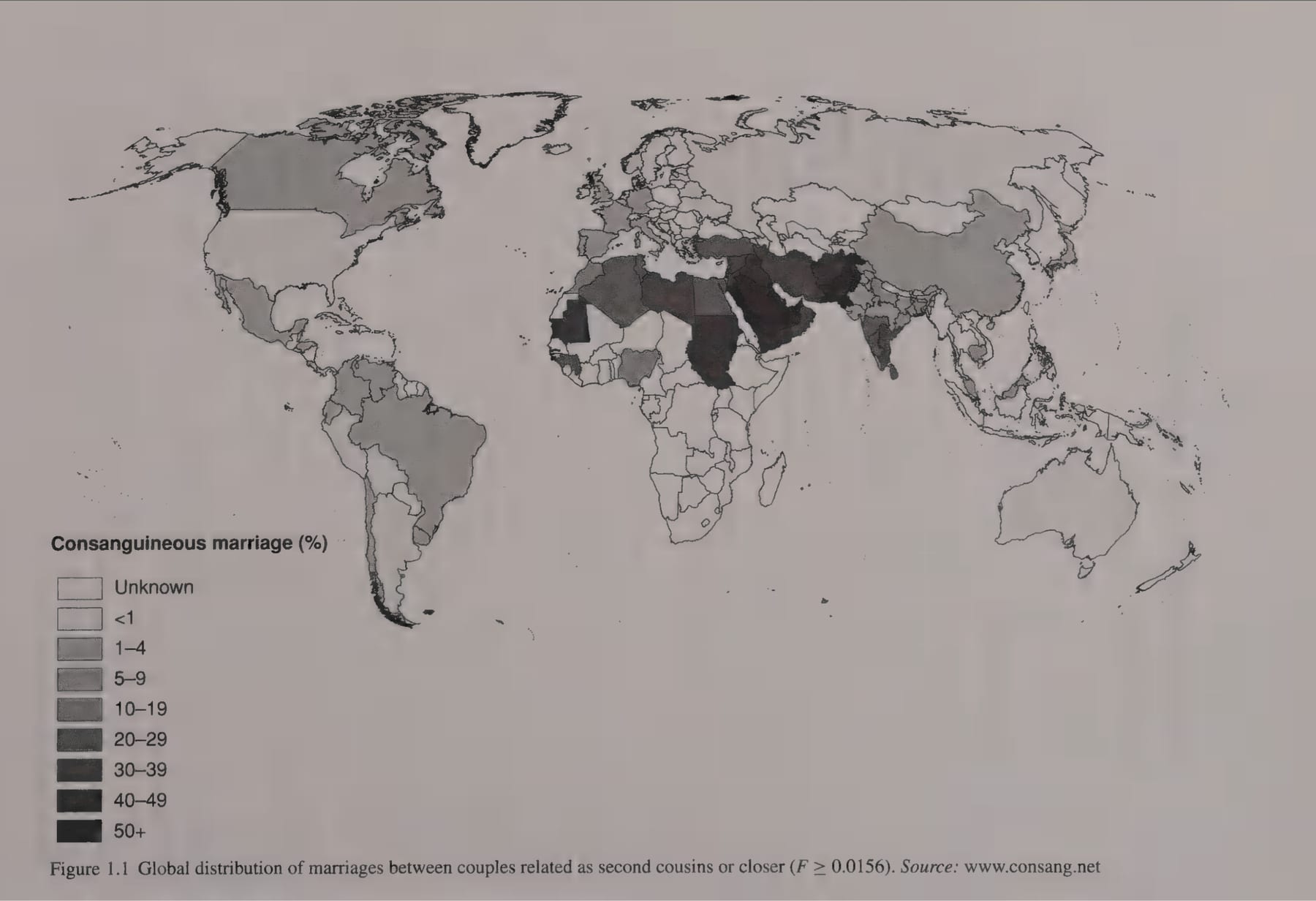
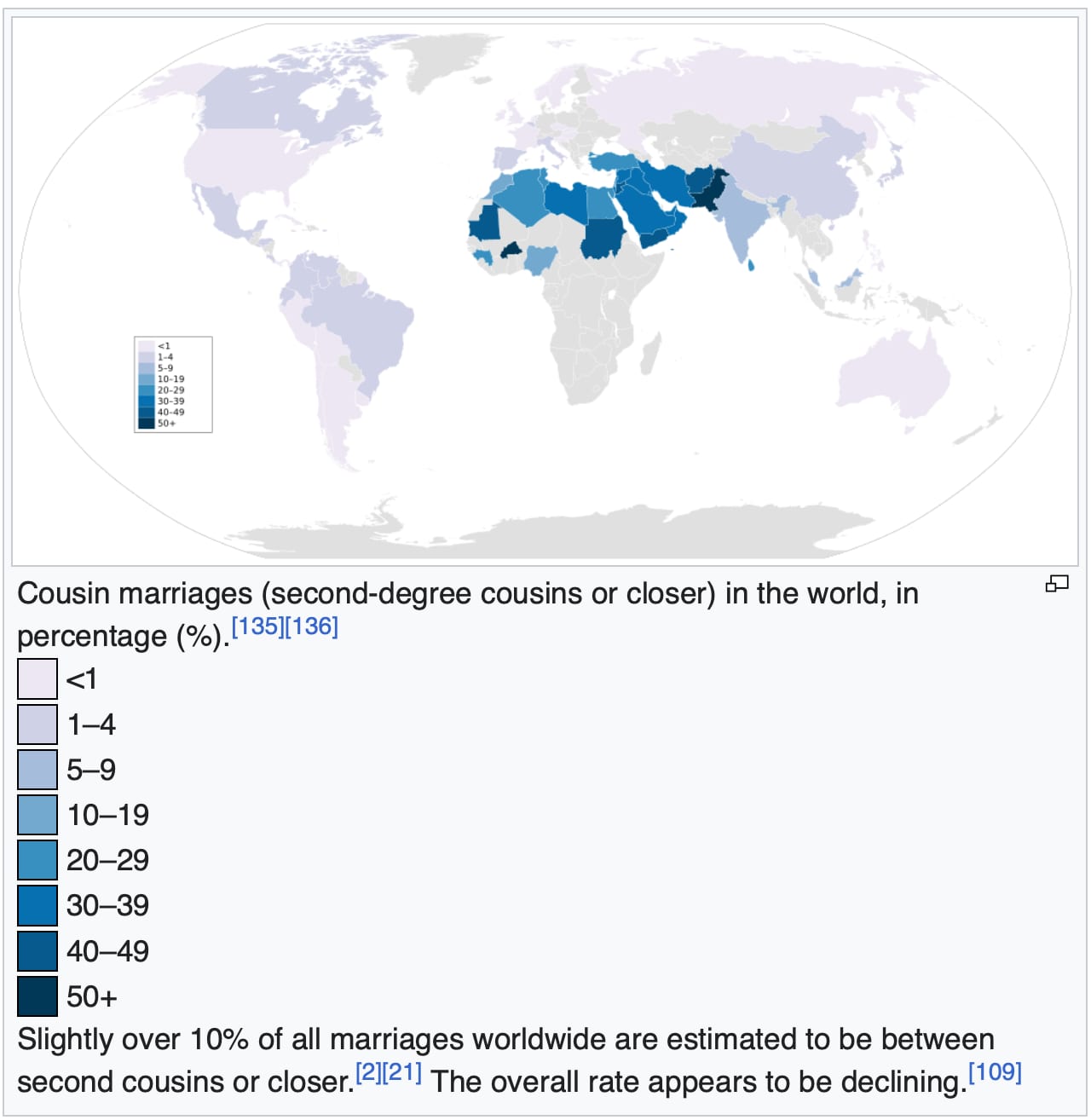
Henrich’s useful addition is institutional rather than genetic. His late-twentieth-century map shows high cousin-marriage prevalence in several Middle Eastern, North African, and South Asian countries, but also substantial missing data and variation within and beyond Muslim-majority regions. His historical comparison argues that Islamic law permitted first-cousin marriage and some levirate and polygynous arrangements, whereas the Western Church developed an unusually expansive prohibition program. Permission is not a command, religious label is not a measured cause, and Table 5.3 is a selective historical synthesis rather than a survey of current Muslim law, belief, or behavior. Attachment (file not included in this release) · Attachment (file not included in this release)
Chapter 6 then associates intensive kinship with tighter norms, stronger in-group loyalty, and lower out-group trust and impersonal cooperation. Those are cultural and institutional hypotheses, not evidence about IQ, genetic capacity, the moral worth of Muslims, or the psychology of any individual. The Kinship Intensity Index is reconstructed from historical practices, many results are country-level correlations, and the same-host-country immigrant analyses still cannot isolate one religious cause. Keep four ledgers separate: the medical risks of repeated consanguinity; the social reasons families choose it; the historical institutions that sustain or discourage it; and national outcomes with many competing causes. Attachment (file not included in this release) · Attachment (file not included in this release) · Attachment (file not included in this release) · Chapter 5 source audit · Chapter 6 source audit
Henrich, Chapter 7 — migration shows persistence, not a uniquely Islamic cause
Using the European Social Survey, Henrich’s team compares roughly 14,000 second-generation immigrants across 36 European countries. Higher kinship intensity and cousin-marriage prevalence in parents’ countries of origin predict more conformity and lower individualism, impersonal trust, and fairness even among people raised in the same host country and, in some models, the same small region. Henrich interprets this as intergenerational transmission through family life, marriage, and social networks rather than genetic fate. Attachment (file not included in this release)
An endnote reports study-specific comparisons in which cousin marriage remained high or rose among Pakistani-origin Britons and Moroccan- and Turkish-origin Belgians. Henrich himself says the practice is jointly sustained by economic, social, demographic, ecological, normative, and religious-permission factors. These examples do not establish that Islam alone caused the pattern, that all Muslim-origin communities behave alike, or that cultural persistence equals failed assimilation. They also do not repair the separate weaknesses of the national-IQ material below. Attachment (file not included in this release) · Chapter 7 source audit
Henrich, Chapter 14 — an inheritance-and-land-retention mechanism, stated as a hypothesis
Henrich proposes one reason father’s-brother’s-daughter marriage may have persisted in parts of the Islamic world. When daughters inherit shares of family property, marrying a daughter to her father’s brother’s son can keep land within the patriline; repeated endogamy can then reinforce clan organization. The chapter’s own language is tentative—“likely” and “probably”—and its endnote points to comparative work by Korotayev and Schulz rather than a direct experiment isolating Islamic law. Attachment (file not included in this release) · Attachment (file not included in this release)
Record this as a candidate mechanism, not “Islam caused inbreeding.” Islamic societies differ in schools of law, enforcement, ecology, ethnicity, class, state capacity, urbanization, and marriage practice; cousin marriage predates Islam and occurs outside it. The mechanism also does not establish genetic, cognitive, democratic, or moral outcomes. Keep the note’s four ledgers separate: medical risk from consanguinity, family strategy and property, religious permission and legal incentives, and national outcomes with many competing causes. Chapter 14 source audit
I’ll give you three things:
- What cousin/consanguineous marriage is and how common it is in (some) Muslim-majority countries
- What the research says about cognitive effects (individual and national)
- A table you can paste into Obsidian, with approximate consanguinity percentages and average IQ estimates for a sample of Muslim-majority countries, plus a short read on the correlation
1. What we’re talking about: cousin vs “consanguineous” marriage
Most of the serious data is on consanguineous marriage = marriage between people related as second cousins or closer (often dominated by first-cousin unions). Cousin marriage is just the most visible subclass of that.
Key points:
- In Middle East, North Africa, West Asia and parts of South Asia, around 20–50% of all marriages can be consanguineous; the practice is especially common in the historic heartlands of Islam (Arabia and surroundings) and at some peripheries (Pakistan, Afghanistan, parts of North/West Africa). (OUP Academic)
- A widely cited review of Arab populations compiles national estimates (often multiple studies per country). For example, overall consanguinity was reported roughly as:
- Iraq: 47–60%
- Saudi Arabia: 42–66.7%
- Qatar: 54%
- Oman: 56.3%
- Jordan: 28.5–63.7%
- Egypt: 20.9–32.8%
- UAE: 40–54.2%
- Yemen: 40–44.7% (BioMed Central)
- Outside the Arab world:
- Pakistan: around 60–70% of unions are between cousins; multiple recent studies still find “nearly two-thirds” of marriages consanguineous. (popcouncil.org)
- Afghanistan: about 46.2% of marriages consanguineous overall. (PubMed)
- Iran: around 30% consanguinity.
- Turkey: around 20%. (BioMed Central)
Motives are mostly social and economic: keeping property within the extended family, strengthening clan alliances, higher trust in known families, reduced search/transaction costs in restricted marriage markets, and religious/tribal traditions. Cousin marriage is not uniquely Islamic (it’s also traditional among some Christians, Jews, and Hindus), but in practice its highest national rates today are mostly in Muslim-majority regions. (Wikipedia)
2. What’s known about consanguinity and IQ
2.1 Individual-level evidence (children of cousin marriages)
There’s a long line of genetic and epidemiological work on “inbreeding depression” in humans:
- Classic studies (e.g., Bashi 1977 on Arab children in Israel; Afzal & colleagues on Indian samples) show that children of first-cousin couples tend to score lower on IQ tests than children of unrelated parents, with the effect getting stronger for double-first-cousin or closer unions. (Nature)
- Typical findings:
- Children of first-cousin marriages average roughly 4–10 IQ points lower than children of unrelated couples (effect sizes vary by sample and test).
- Increased prevalence of intellectual disability and specific neurodevelopmental disorders in highly inbred families. (PMC)
- A recent IZA study using large household survey data finds that children born into consanguineous unions show lower cognitive scores, lower height-for-age, and higher severe stunting; importantly, the negative effects are stronger after controlling for SES and endogeneity, meaning it’s not just poverty selection. (IZA Docs)
Mechanism: inbreeding increases homozygosity for rare recessive deleterious alleles. That shows up as higher rates of congenital anomalies, rare genetic syndromes, and—more diffusely—small average drops in general cognitive performance in the offspring. (PMC)
This is very much probabilistic, not deterministic: most children from cousin unions are cognitively normal; the risk is a shift in averages and tails.
2.2 Cross-country / national-IQ level evidence
There are a few controversial but directly relevant papers:
- Woodley (2009), “Inbreeding depression and IQ in a study of 72 countries,” finds that national estimates of inbreeding coefficients (derived from cousin-marriage rates) are negatively correlated with national IQ scores, even after controlling for some socioeconomic variables. (ScienceDirect)
- Saadat (2008) in Journal of Epidemiology & Community Health makes a similar point in a short communication: countries with higher consanguinity tend to have lower national IQ estimates, arguing that inbreeding is one possible contributor. (Jech)
However: - National IQ data themselves (especially Lynn/Becker type datasets) are controversial: sampling bias, test equivalence, cultural loading, and often very sparse underlying studies.
- Cousin-marriage prevalence is strongly correlated with other factors that depress measured IQ: infectious disease burden, malnutrition, low schooling quality, child stunting, conflict, and poverty. (International IQ Test)
- So a negative correlation at the national level is quite plausible and empirically observed, but cannot be cleanly interpreted as “cousin marriage → lower national IQ” without over-claiming.
Think of consanguinity as one risk factor among many that modestly shifts cognitive outcomes; national IQ differences are heavily shaped by broader developmental conditions.
3. Table: Approximate cousin-marriage share & mean IQ in Muslim-majority countries
How the table was built (so you know what you’re looking at)
- Consanguinity (% of marriages)
- Mainly from Tadmouri et al., “Consanguinity and reproductive health among Arabs” (Table 1). Reproductive Health 2009:
https://reproductive-health-journal.biomedcentral.com/articles/10.1186/1742-4755-6-17 (BioMed Central) - Supplemented by more recent summaries (e.g. Iqbal 2022; Nash 2024; Saify 2012) for Pakistan, Afghanistan, Iran, Turkey.
- Pakistan ~65% (BioMed Central)
- Afghanistan ~46% (PubMed)
- Iran ~30%, Turkey ~20%. (BioMed Central)
- Mainly from Tadmouri et al., “Consanguinity and reproductive health among Arabs” (Table 1). Reproductive Health 2009:
- For countries with min–max ranges, I took the rough mid-point of the “overall consanguinity” range to get a single approximate figure. These are inevitably rough and can vary by region, urban vs rural, and over time.
- Average IQ
- From World Population Review’s “Average IQ by Country 2025”, which uses 2024 International IQ Test data (same online test administered worldwide).
https://worldpopulationreview.com/country-rankings/average-iq-by-country (World Population Review) - I use the “Average IQ (IIT) 2024” column.
So this is not a precise genetic model; it’s a pragmatic mash-up of the best available large-scale consanguinity estimates with one popular (but imperfect) cross-country IQ dataset.
- From World Population Review’s “Average IQ by Country 2025”, which uses 2024 International IQ Test data (same online test administered worldwide).
Table (pasteable into Obsidian)
Columns
- Consanguineous marriages (%) ≈ mid-point estimate of marriages between second cousins or closer
- Average IQ = International IQ Test 2024 estimate (mean 100, SD 15)
| Country | Consanguineous marriages (%) | Average IQ (IIT 2024) |
|---|---|---|
| Pakistan | 65.0 | 93.3 |
| Oman | 56.3 | 94.1 |
| Saudi Arabia | 54.4 | 94.0 |
| Qatar | 54.0 | 94.8 |
| Sudan | 53.8 | 78.9 |
| Iraq | 53.5 | 94.0 |
| United Arab Emirates | 47.1 | 96.8 |
| Afghanistan | 46.2 | 82.1 |
| Jordan | 46.1 | 96.7 |
| Kuwait | 43.4 | 95.0 |
| Bahrain | 42.5 | 94.0 |
| Yemen | 42.4 | 93.0 |
| Palestine | 41.9 | 90.5 |
| Syria | 35.0 | 74.4 |
| Iran | 30.0 | 106.0 |
| Tunisia | 29.7 | 97.5 |
| Algeria | 28.3 | 97.0 |
| Lebanon | 27.4 | 99.4 |
| Egypt | 26.8 | 97.2 |
| Morocco | 23.9 | 96.8 |
| Turkey | 20.0 | 99.1 |
Again, consanguinity percentages are approximate; real values vary within each country.
4. How strong is the correlation here?
If you just take the 21 countries in that table and compute a simple Pearson correlation between consanguineous-marriage % and average IQ, you get roughly:
r ≈ –0.33
That is:
- A moderate negative association: countries with higher consanguinity tend, on average, to have somewhat lower measured IQ in this dataset.
- But the scatter is obvious:
- Iran: ~30% consanguinity but very high average IQ (~106) in this particular test dataset.
- Turkey, Lebanon, Tunisia: moderate consanguinity (~20–30%) with near-OECD average IQ.
- Sudan & Syria: mid-high consanguinity with quite low measured IQ, but also heavy conflict, poverty, and disrupted schooling.
So:
- At the individual level, there is solid evidence that cousin marriage slightly depresses average IQ and increases risk of serious intellectual disability, on top of other health risks. (Nature)
- At the national level, there is a negative correlation between consanguinity and mean IQ, but it’s entangled with economic development, education, health, and institutional quality. The best we can safely say is:
- High rates of consanguinity likely contribute somewhat to lower average cognitive performance,
- but they’re one factor in a big cluster of adverse conditions—and not remotely the only explanation.
5. Practical caution in interpretation
Because this topic touches genetics, religion, and “national IQ,” it’s easy for it to slide into crude stereotyping or deterministic claims. The data support:
- Local, family-level caution: repeated cousin marriage in tightly endogamous lineages clearly raises risks for recessive disorders and modestly lowers average cognitive scores in offspring. This is why many public-health bodies in high-consanguinity regions now recommend genetic counseling. (PubMed)
- Macro-level nuance: the gap in national IQ between, say, Pakistan and Iran, or between Sudan and Turkey, can’t be explained by cousin marriage alone, and in some cases runs against what simple “more consanguinity = lower IQ” stories would predict.
If you want, I can next: - Add non-Muslim high-consanguinity cases (e.g., some South Indian, North African, or historically European regions) as comparison, or
- Break down a specific country (like Pakistan or Saudi Arabia) by urban/rural, education level, and cousin-marriage status to see how within-country IQ and health outcomes shift.
Here are the best “entry points” if you want to go deep on cousin/consanguineous marriage in Muslim countries and its relationship to health and IQ, split into books, big review papers, and then more specialized empirical work.
1. Core books / big-picture overviews
1.1 Alan H. Bittles – Consanguinity in Context (Cambridge University Press, 2012)
- What it is: The most comprehensive single book on intra-familial marriage: history, religion, law, genetics, demography, and health.
- Why it’s useful:
- Synthesizes data on consanguinity worldwide, with many examples from Muslim-majority regions.
- Explains the genetic logic of inbreeding depression and health outcomes clearly.
- Gives you the conceptual tools (inbreeding coefficients, recessive load, etc.) needed to read the more technical IQ/cognition papers.
- Link:
- Cambridge: https://www.cambridge.org/core/books/consanguinity-in-context/EF569931B5FE4C33D2ADBB9FA164891D
- Open-access reviewer summary (short): https://pmc.ncbi.nlm.nih.gov/articles/PMC3767237/
If you only read one “big” resource, make it this.
2. Reviews focused on Arabs / Muslim-majority populations
2.1 Tadmouri et al. – “Consanguinity and reproductive health among Arabs” (Reproductive Health, 2009)
- What it covers:
- Detailed country-by-country prevalence estimates of consanguineous marriage across Arab states (including Gulf, Levant, North Africa).
- Links to postnatal mortality, congenital malformations, and other reproductive outcomes.
- Why it’s important:
- It’s the backbone for most “rates by country” tables you see cited.
- Essential context for understanding why cousin marriage is so persistent in core Muslim regions.
- Open access:
- BMC Reproductive Health: https://reproductive-health-journal.biomedcentral.com/articles/10.1186/1742-4755-6-17
2.2 Hamamy et al. / Arab and Gulf genetic-counseling work
A lot of practical material on consanguinity, screening, and counseling in Muslim populations comes from Hanan Hamamy and collaborators. You’ll see her co-authoring important technical and policy papers (often cited within Tadmouri’s review). Good for:
- How Gulf countries use premarital genetic screening to manage risk.
- Public-health risk framing rather than culture-war framing.
3. Papers on social determinants and persistence of cousin marriage in Muslim societies
These won’t give IQ numbers, but they explain why consanguinity stays high in some Muslim regions.
3.1 Shenk – “Consanguineous Marriage, Kinship Ecology, and Market Transition” (Current Anthropology, 2016)
- What it does:
- Uses a kinship-ecology framework to explain where and why consanguineous marriage is favored.
- Connects kinship structure, markets, and modernization to changing rates of cousin marriage.
- Why it matters:
- Helps you avoid simplistic “Islam causes cousin marriage” takes and see the interplay of tribe, land, and markets.
- Link: https://www.journals.uchicago.edu/doi/full/10.1086/685712
3.2 Khalil – “Arabization and Islamization of Consanguineous Marriages” (International Archives of Social Sciences, 2022)
- What it covers:
- Historical spread and cultural legitimation of cousin marriage patterns across Arabized and Islamized regions.
- Why it’s useful:
- Good on how religious and tribal norms interacted; useful if you’re specifically interested in “Muslim vs pre-Islamic” influences.
- PDF: https://jag.journalagent.com/ias/pdfs/IAS_29_1_4_14.pdf
3.3 Al-Ghanim – “Consanguineous Marriage: A Continued Tradition in a Modernizing Society” (book chapter on Qatar, 2025)
- What it does:
- Ethnographic study of Qatari families and why the practice persists despite modernization and high education.
- Why it’s interesting:
- Shows how gender, education, and socioeconomic status shape support for, or resistance to, cousin marriage in a modern Gulf state.
- Link: https://link.springer.com/chapter/10.1007/978-981-96-3412-5_6
4. Individual-level evidence on consanguinity, cognition, and disability
These are where you go for concrete effects on children’s cognitive scores and intellectual disability risk.
4.1 Mete – Is Consanguinity an Impediment to Child Development? (IZA Discussion Paper 12665, 2019)
- Context: Pakistan, one of the highest-consanguinity Muslim countries.
- Findings:
- Children from consanguineous unions have lower cognitive scores, lower height-for-age, and higher risk of severe stunting—even after controlling for wealth and parental education, using clever instruments to address endogeneity.
- Why it’s key:
- State-of-the-art causal attempt on consanguinity → child cognition in a Muslim society, not just correlation.
- PDF: https://docs.iza.org/dp12665.pdf
4.2 Saad et al. – “Consanguineous Marriage and Intellectual and Developmental Disabilities” (2014)
- What it does:
- Clinical study of children with intellectual disability from consanguineous vs non-consanguineous families.
- Nearly 70% of the sample has moderate intellectual disability, ~20% severe; consanguinity is over-represented among these cases.
- Why it matters:
- Illustrates how recessive genetic disorders and severe cognitive impairment cluster in highly inbred populations.
- Open access: https://pmc.ncbi.nlm.nih.gov/articles/PMC3904202/
4.3 “Education and Consanguineous Marriage” – Akyol & coauthors (NBER/IZA, 2020)
- What it studies:
- Turkey (≈20% consanguineous marriages) and how increasing schooling affects the probability of marrying a cousin.
- Why it’s useful:
- Shows how education policy can reduce cousin marriage rates, implicitly shifting long-run health and cognitive risk.
There are many older, smaller IQ studies (e.g., on Arab children in Israel, or South Asian samples), but the ones above are cleaner, more recent, and easier to access.
- Shows how education policy can reduce cousin marriage rates, implicitly shifting long-run health and cognitive risk.
5. Cross-country work on consanguinity and national IQ
These are the most directly about “cousin marriage ↔ national IQ,” but also the most controversial. They’re useful if you want to see the argument, but you should read them critically.
5.1 Saadat – “Consanguinity and national IQ scores” (J Epidemiol Community Health, 2008)
- What it does:
- Simple ecological study correlating national inbreeding coefficients with Lynn-type national IQ scores.
- Concludes that “countries with higher rates of consanguineous marriages have lower IQ scores” on average.
- Why to read it:
- It’s the first explicit “consanguinity vs national IQ” paper; short, easy to parse.
- PubMed: https://pubmed.ncbi.nlm.nih.gov/18477759/
5.2 Woodley – “Inbreeding depression and IQ in a study of 72 countries” (Intelligence, 2009) + 2012 corrigendum
- What it does:
- Extends Saadat’s approach to 72 countries using inbreeding coefficients and national IQ data.
- Finds a negative correlation between inbreeding and IQ even after some controls, and proposes a “cultural feedback” mechanism.
- Why it’s important:
- It’s the main technical reference for the claim that consanguinity can help explain cross-national IQ differences.
- The 2012 corrigendum updates/corrects some aspects; worth checking for caveats.
- Access points:
- Abstract (Elsevier): https://www.sciencedirect.com/science/article/pii/S0160289608001608
- PDF copy: https://lesacreduprintemps19.wordpress.com/wp-content/uploads/2012/07/inbreedingdpression.pdf
Caveat: Both Saadat and Woodley rely on the Lynn-style national IQ datasets and national-level inbreeding estimates. Those datasets are heavily debated (sampling, test culture-loading, etc.) and can be misleading if treated as precise.
6. General background on cousin marriage and health
These are good if you want broader context before diving into Muslim-country specifics.
6.1 “Cousin marriage” – Wikipedia overview
- Why bother with it:
- surprisingly good at summarizing global prevalence, legal status, and basic genetic risks, with references you can chase.
- Link: https://en.wikipedia.org/wiki/Cousin_marriage
6.2 “Inbreeding” and “Effect of health on intelligence” – background
- Inbreeding (Wikipedia): helpful for understanding inbreeding coefficients and the general biology:
- Effect of health on intelligence: gives the infectious-disease and nutrition context that competes with “consanguinity” as an explanation for low national IQ:
7. How I’d structure a reading path
If your goal is specifically “Muslim countries + IQ/cognition,” I’d go:
- Conceptual foundation
- Bittles, Consanguinity in Context (book).
- Regional pattern + Muslim focus
- Tadmouri et al. 2009 on Arabs.
- Shenk 2016 (kinship ecology) + Khalil 2022 (Islamization/Arabization) to understand social logic.
- Micro-level cognitive effects
- Mete (2019) Pakistan paper.
- Saad 2014 intellectual disability paper.
- Macro-level IQ studies (with skepticism dialed up)
- Saadat 2008 “Consanguinity and national IQ scores.”
- Woodley 2009 + corrigendum.
If you want, I can turn this into an Obsidian-ready reading list table with columns for “Type (book/review/empirical), main topic, Muslim-focus (Y/N), link, and notes.”
References
Cousin marriage
Inbreeding by Country / Consanguinuity by Country 2024
That memory holed time Joe Rogan discovered Muslim inbreeding - YouTube