
⬅️ Hub: Western Civilization
Full source and chapter-audit status
Attachment (file not included in this release) · supplied edition: 752 PDF pages
Audited against the PDF across the completed chapter passes: Prelude (PDF pp. 17–32) and Chapters 1–14 (pp. 34–481), with the corresponding endnotes (pp. 500–616). Chapter 14 is the book’s final numbered chapter; the appendices follow. The summaries below remain paraphrases of Henrich’s argument. Cross-vault uses preserve the difference between his synthesis, the underlying studies he cites, independent current consensus, and normative judgment.
Haidt, Chapter 5 — the moral-psychology use of the WEIRD thesis
Haidt uses Henrich, Heine, and Norenzayan’s 2010 review as a sampling warning and a bridge to moral pluralism. In his summary, WEIRD participants more often describe themselves through internal traits, excel at the absolute version of the framed-line task, and reason analytically about focal objects; East Asian comparison groups more often name roles and relationships, excel at the relative framed-line task, and encode context more holistically. Haidt then connects an independent self to autonomy-centered moral language and a relational self to role-specific duties.
Keep the books’ explanatory levels distinct. Chapter 5 uses the WEIRD literature to challenge universal claims made from elite Western samples and to interpret moral disagreement. Henrich’s later book offers a much larger historical-causal account of kinship, churches, markets, law, literacy, and institutions. Haidt’s moral application does not prove Henrich’s genealogy, and Henrich’s genealogy does not establish that autonomy, community, or divinity norms are justified. Attachment (file not included in this release) · Attachment (file not included in this release) · Chapter 5 source audit · Three-ethics model

DESCRIPTION
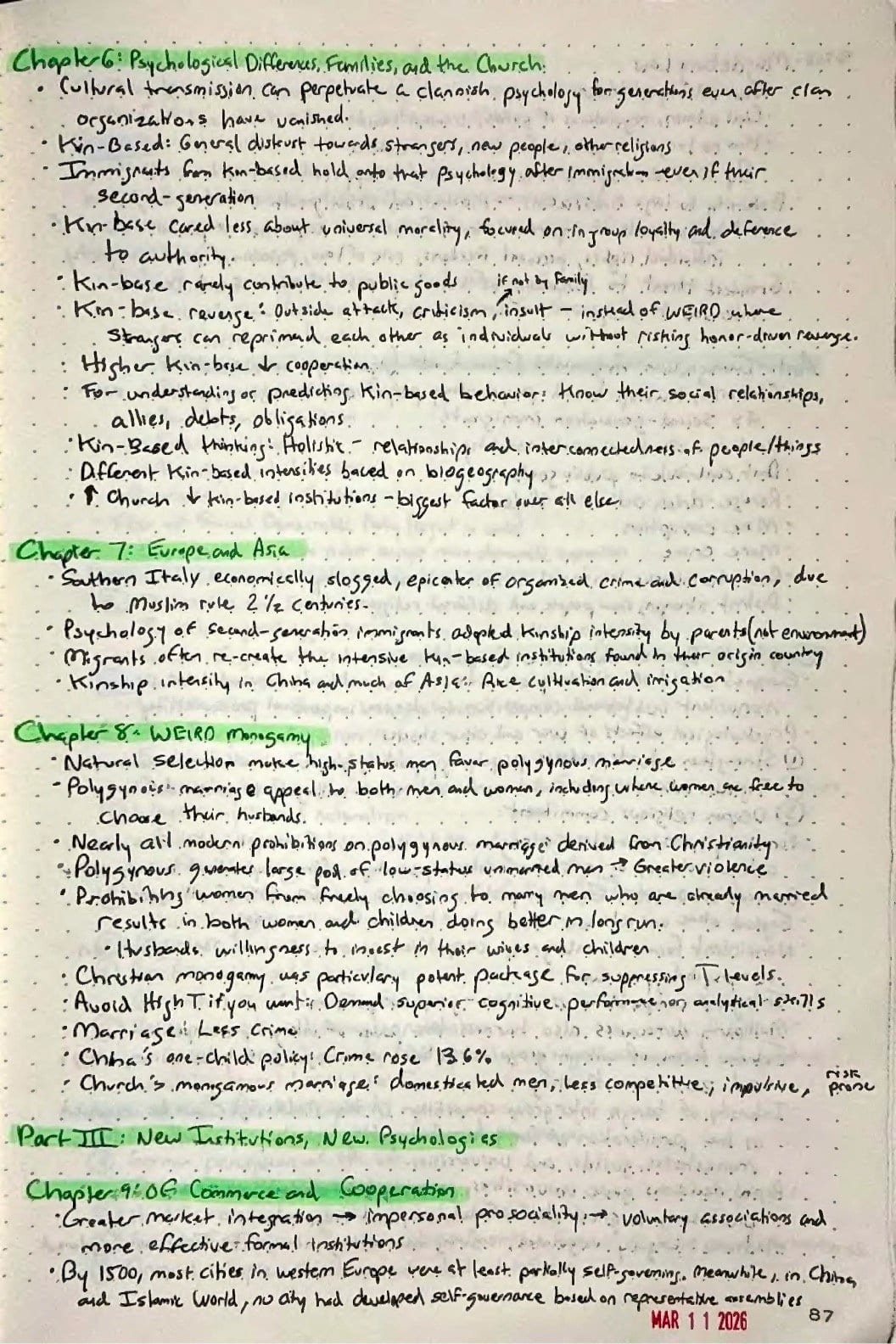
A New York Times Notable Book of 2020 A Bloomberg Best Non-Fiction Book of 2020 A Behavioral Scientist Notable Book of 2020 A Human Behavior & Evolution Society Must-Read Popular Evolution Book of 2020 A bold, epic account of how the co-evolution of psychology and culture created the peculiar Western mind that has profoundly shaped the modern world. Perhaps you are WEIRD: raised in a society that is Western, Educated, Industrialized, Rich, and Democratic. If so, you’re rather psychologically peculiar. Unlike much of the world today, and most people who have ever lived, WEIRD people are highly individualistic, self-obsessed, control-oriented, nonconformist, and analytical. They focus on themselves—their attributes, accomplishments, and aspirations—over their relationships and social roles. How did WEIRD populations become so psychologically distinct? What role did these psychological differences play in the industrial revolution and the global expansion of Europe during the last few centuries? In The WEIRDest People in the World, Joseph Henrich draws on cutting-edge research in anthropology, psychology, economics, and evolutionary biology to explore these questions and more. He illuminates the origins and evolution of family structures, marriage, and religion, and the profound impact these cultural transformations had on human psychology. Mapping these shifts through ancient history and late antiquity, Henrich reveals that the most fundamental institutions of kinship and marriage changed dramatically under pressure from the Roman Catholic Church. It was these changes that gave rise to the WEIRD psychology that would coevolve with impersonal markets, occupational specialization, and free competition—laying the foundation for the modern world. Provocative and engaging in both its broad scope and its surprising details, The WEIRDest People in the World explores how culture, institutions, and psychology shape one another, and explains what this means for both our most personal sense of who we are as individuals and also the large-scale social, political, and economic forces that drive human history. Includes black-and-white illustrations.
Attachment (file not included in this release)



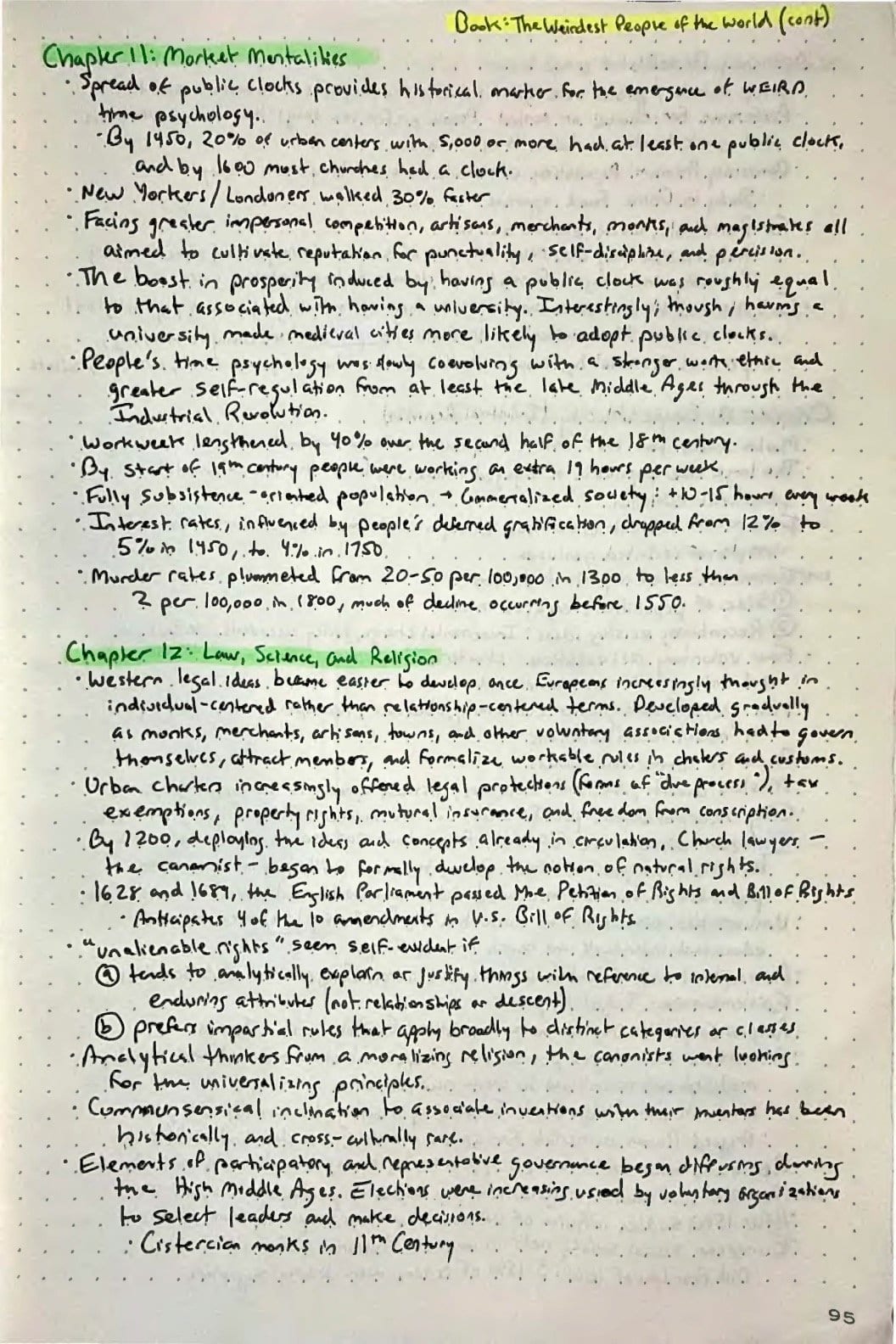
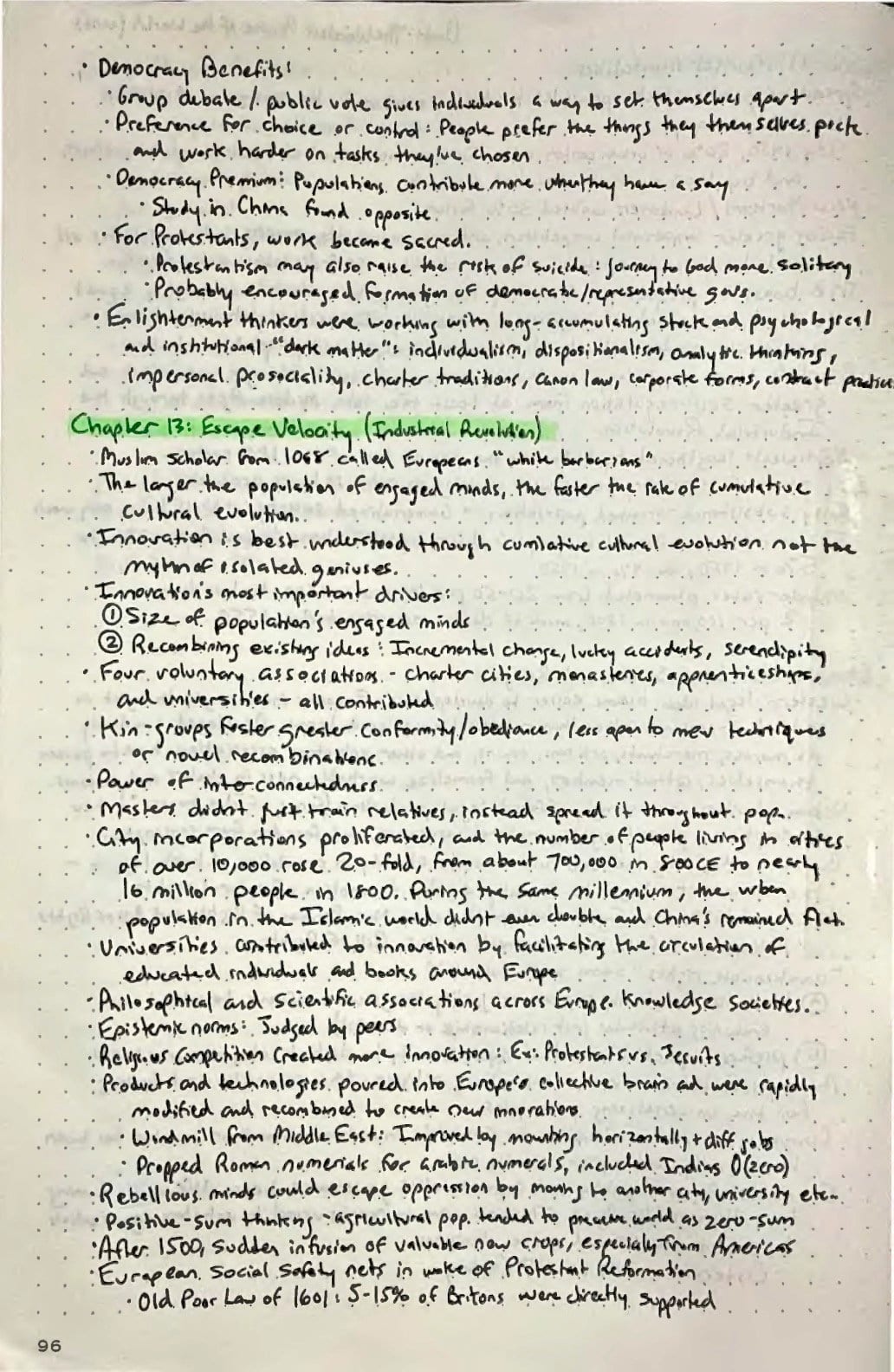
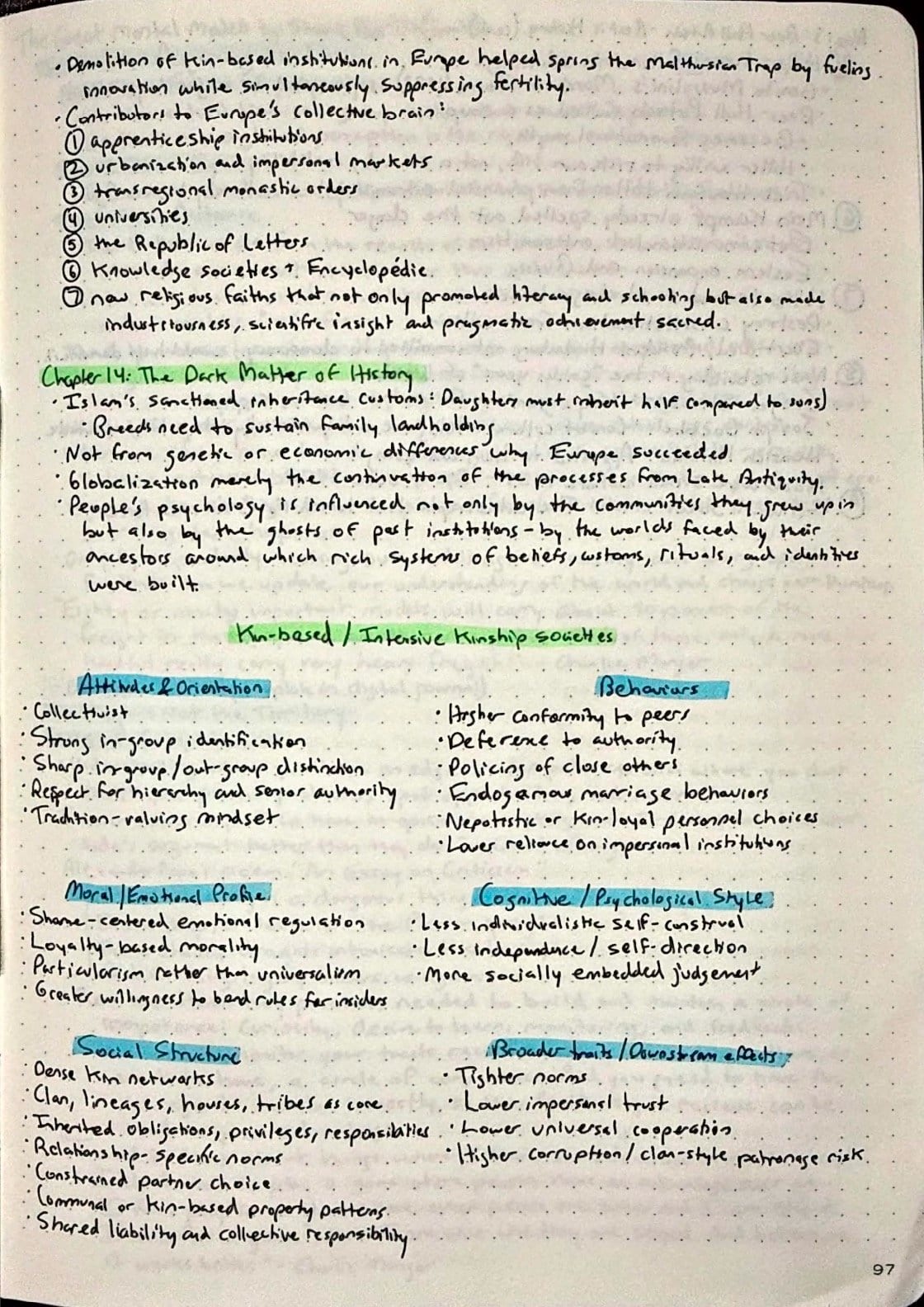
WEIRD People Attributes
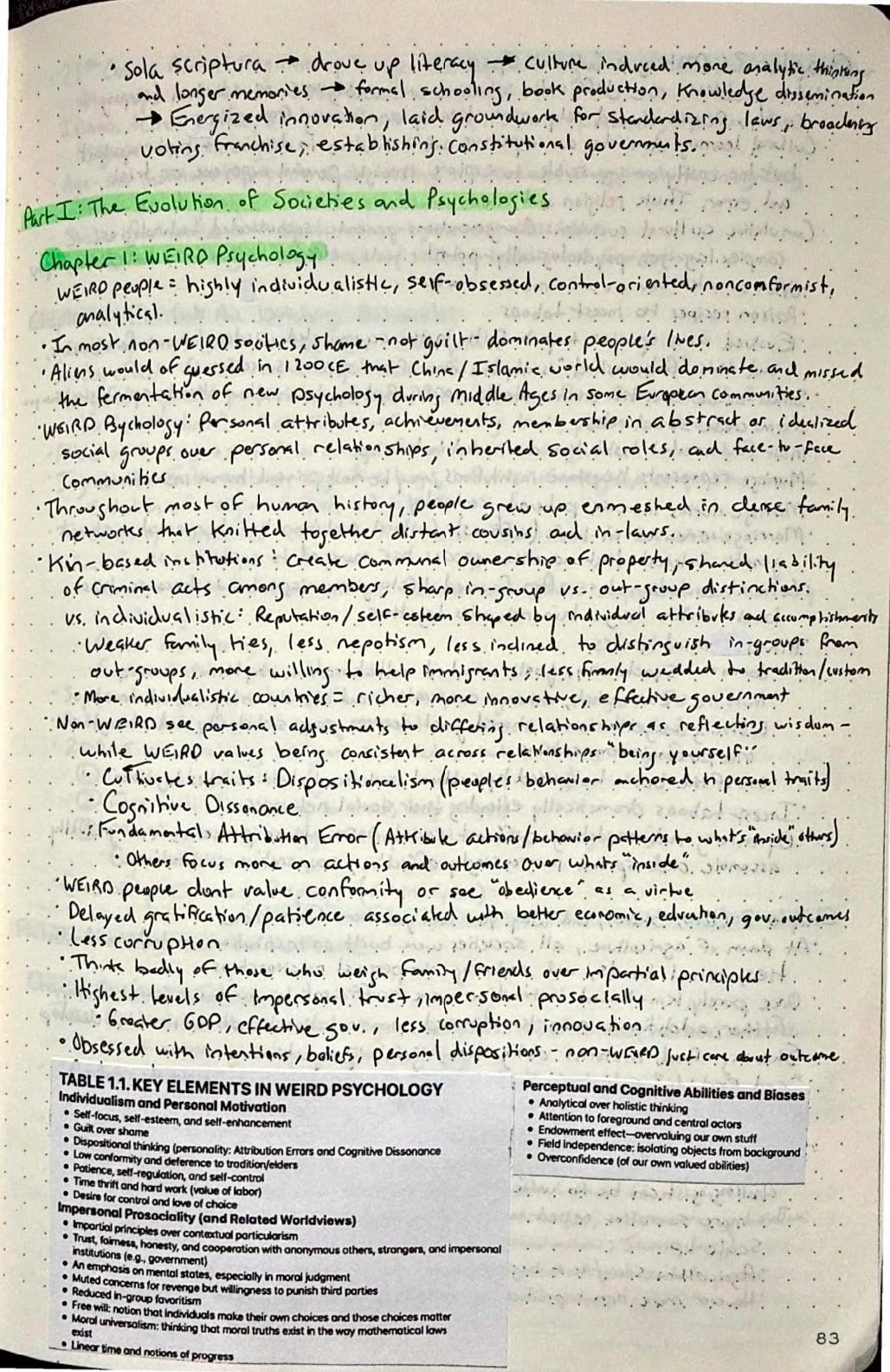
Attributes of WEIRD People
- See themselves primarily as independent individuals rather than as embedded members of a kin group
- Define identity more by personal traits, goals, values, and achievements than by lineage, family role, or inherited obligations
- Tend to be more individualistic, self-focused, nonconformist, patient, and future-oriented
- Put greater weight on self-esteem, personal consistency, and authenticity
- Show a more analytic style of thought, focusing on categories, rules, and abstract principles
Behaviors of WEIRD People
- Prefer choice, agency, and personal control
- Form more relationships through voluntary association rather than kin obligation
- Show more willingness to trust, cooperate with, and behave fairly toward strangers
- Are less likely to favor relatives through nepotism or strong in-group bias
- Rely more on formal rules and general principles than on custom or personal relationship
- Tend to behave more consistently across settings because they see themselves as having stable inner traits
Beliefs and Cognitive Style
- Explain behavior more in terms of internal dispositions like character, intention, laziness, or conscientiousness
- Think more in terms of universal categories, abstract rights, and impersonal law
- Are more likely to regard persons as independent agents with rights and responsibilities
- Judge actions more by principle than by family loyalty or local social expectation
Moral and Emotional Profile
- More guilt-oriented than shame-oriented
- More likely to evaluate wrongdoing through internal conscience than through public dishonor or loss of face
- More likely to see impartial fairness as morally important
- More likely to condemn favoritism and nepotism as unjust
Social Structure of WEIRD Societies
- Built less around clans, lineages, and extended kin networks
- Built more around impersonal institutions such as markets, courts, states, schools, churches, universities, and firms
- Depend more on formal law than on kin-based custom
- Have weaker family intensity and a reduced distinction between close kin and outsiders
- Push people toward building lives through contracts, associations, and institutions rather than inherited family structures
Broader Traits of WEIRD Societies
- Lower kinship intensity
- Less nepotism and weaker in-group favoritism
- Greater trust toward non-kin
- More openness to outsiders
- Stronger markets and more urban life
- Greater support for constitutional rule, democratic participation, innovation, and scientific institutions
One-Line Summary
WEIRD people are typically individualistic, analytic, guilt-oriented, principle-driven, and more trusting of strangers, while WEIRD societies are organized more through impersonal institutions and voluntary association than through dense kinship networks.
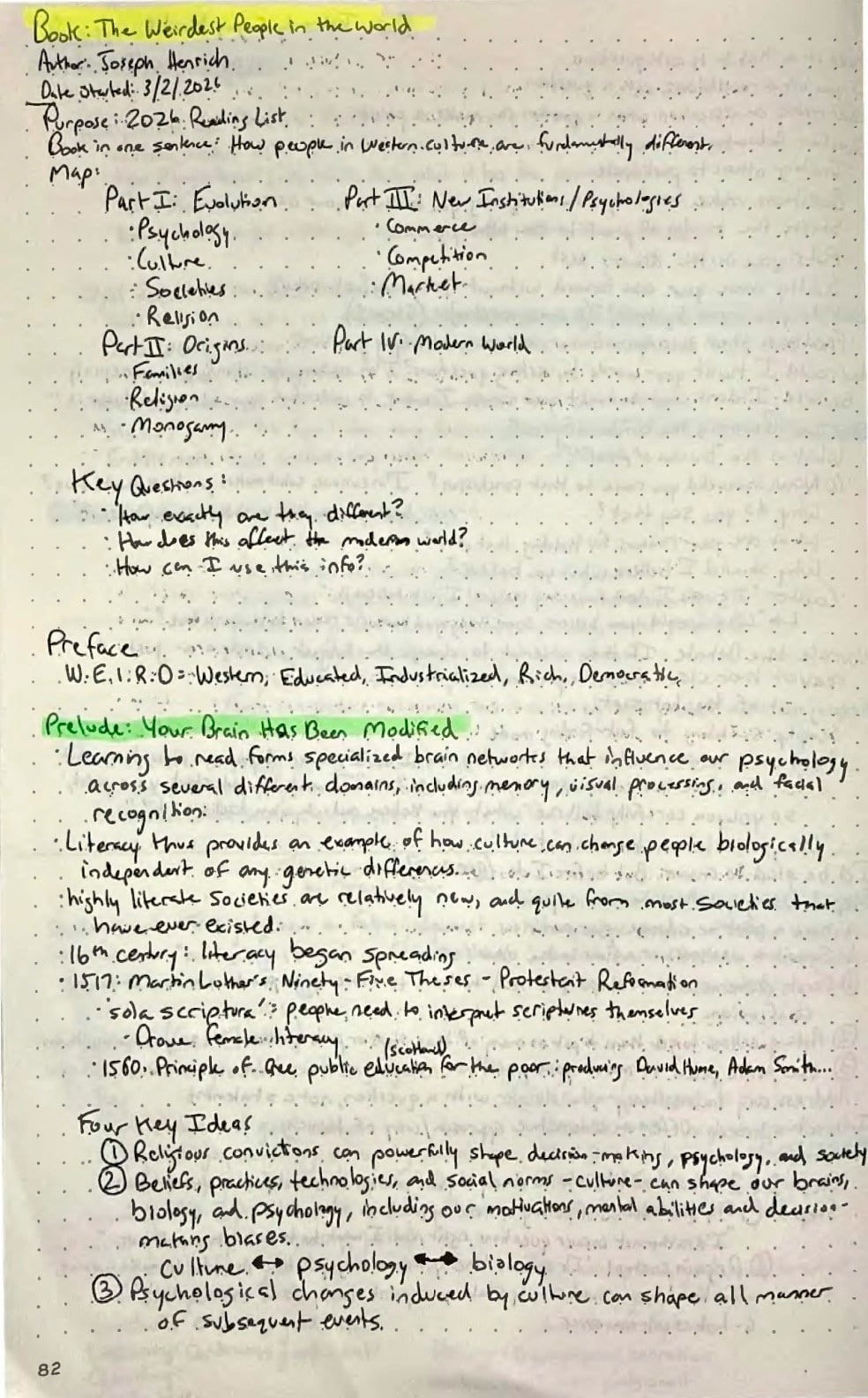
Prelude: Your Brain Has Been Modified
Chapter objective
This prelude introduces one of the book’s central claims: culture does not merely influence what people believe; it can physically and psychologically reshape human beings. Henrich uses literacy as his opening case study to show how a culturally transmitted skill can alter the brain, cognition, and even downstream social development. He then connects the rise of mass literacy in western Europe to Protestantism, especially the doctrine of sola scriptura, to illustrate how religious beliefs can trigger large-scale psychological and institutional change. This sets up the broader argument of the book: Western populations became historically unusual through long cultural processes, not because of innate biological differences.
Prelude source map, figures, and evidence boundary
Attachment (file not included in this release) · Attachment (file not included in this release) · Attachment (file not included in this release) · Attachment (file not included in this release)
Figures: Attachment (file not included in this release) · Attachment (file not included in this release)
Henrich’s causal chain contains links of different strength. The literacy-neuroplasticity section synthesizes the cited neuroscience; the Prussian analysis is an instrumental-variable argument, stronger than a simple correlation but dependent on assumptions about distance from Wittenberg. Henrich’s own notes recognize earlier Catholic and Jewish literacy, the printing press and religious competition, a relatively modest 3–5 percent Protestant effect on girls’ share of Prussian enrollment, possible genetic and persistence confounds in mother-literacy research, and uncertainty about fiction causing empathy. Claims about later innovation, democracy, and prosperity are therefore plausible extensions rather than results established by the Prelude alone.
Reading as a culturally acquired brain modification
- Henrich opens by arguing that reading is not a natural, universal human capacity in the way people often assume. It is a relatively recent cultural skill that rewires the brain.
- He lists several neurological effects associated with literacy:
- specialization in the left ventral occipito-temporal region
- a thicker corpus callosum
- changes in Broca’s area
- improved verbal memory
- a shift in facial recognition toward the right hemisphere
- weaker face-identification ability
- a move away from holistic visual processing toward more analytic processing
- He then identifies the “exotic mental ability” as reading and explains that literacy develops a brain system he calls the Letterbox, specialized for processing written symbols. Damage to this region can produce illiteracy while leaving other capacities, like arithmetic, intact.
- A simple example is used to demonstrate how automatic reading becomes: literate English readers cannot easily look at the words “White Horse” without reading them, while Chinese characters can remain mere shapes to non-Chinese readers. The point is that reading becomes fast, involuntary, and partly unconscious.
Why literacy matters for psychology and biology
- Henrich’s larger point is that culture can alter biology without changing genes. A highly literate society would, on average, differ biologically and psychologically from a mostly illiterate one, even if both populations were genetically identical.
- Literacy is therefore presented not as an isolated skill but as part of a cultural package that includes:
- values such as formal education
- institutions such as schools
- technologies such as writing systems and the printing press
- This leads to a critique of modern psychology and neuroscience: researchers often study literate university students and then mistakenly generalize their findings as universal features of human cognition. Henrich argues that some of these findings may actually be artifacts of deep literacy, not human nature as such.
What God Wants
- Henrich next asks a historical question: if writing systems had existed for thousands of years, why did mass literacy emerge so late and so unevenly?
- He notes that for most of history, even literate civilizations still had very low literacy rates, usually below 10 percent. Then, beginning in the 16th century, literacy spread rapidly across western Europe. By around 1750, countries such as the Netherlands, Britain, Sweden, and Germany had become some of the most literate societies in the world.
- Attachment (file not included in this release) reinforces this visually: literacy rises much earlier and more sharply in Protestant countries than in many Catholic ones, with the Netherlands, Sweden, and Great Britain pulling far ahead over time.
- Henrich stresses that this initial literacy takeoff cannot be fully explained by:
- industrialization
- constitutional government
- state-funded mass schooling
- Those developments came later. So the real question becomes: what caused the first major literacy surge?
Martin Luther and the Protestant Reformation
- Henrich locates the turning point in Wittenberg in 1517, when Martin Luther published the Ninety-Five Theses, beginning the Protestant Reformation.
- The key doctrine here is sola scriptura: the idea that ordinary believers should read and interpret scripture for themselves rather than rely primarily on priests or Church authority. That principle implied two practical necessities:
- people had to learn to read
- the Bible had to be translated into vernacular languages
- Luther did both. He translated the Bible into German and also urged rulers and parents to create schools so children could read scripture. Since literacy in German-speaking lands may have been only about 1 percent, this was a radical program.
- Henrich emphasizes that in Germany formal schooling first became a sacred duty of secular rulers, which helped literacy and schooling spread together with Protestantism.
Evidence that Protestantism drove literacy
- Henrich first presents broad cross-national evidence: countries with higher Protestant populations had much higher literacy rates, and by 1900 Britain, Sweden, and the Netherlands were nearly fully literate while Catholic countries such as Spain and Italy lagged far behind. He says Protestant share explains about half of the cross-national variation in literacy around the start of the 20th century.
- But he does not stop at correlation. He raises the obvious objection: maybe literacy caused Protestantism, or maybe both were caused by other factors like economic growth or the printing press.
The Prussian natural experiment
- To strengthen the causal argument, Henrich summarizes research on Prussia.
- Prussia is useful because:
- it had relatively early religious freedom
- it had similar governing institutions across regions, which reduces some confounding explanations
- Census evidence showed that counties with more Protestants had:
- higher literacy
- more schools
- shorter travel distances to schools
- These patterns existed even before industrialization, which weakens the claim that economic modernization caused literacy first.
- The crucial move is methodological: distance from Wittenberg is used as a kind of quasi-experimental measure. Because Protestantism spread outward from Luther’s base, counties closer to Wittenberg tended to have more Protestants. Henrich notes that every 100 km from Wittenberg corresponded to about a 10 percent drop in Protestant share.
- Using this setup, researchers infer that Protestantism itself caused greater literacy and more schooling. Counties that were entirely Protestant had literacy rates almost 20 percentile points higher than entirely Catholic counties. Attachment (file not included in this release) shows the higher Protestant concentrations clustered around the Reformation’s epicenter.
Similar patterns beyond Prussia
- Henrich says similar findings appear in 19th-century Switzerland, where Protestant districts produced stronger performance not only in reading but also in math, writing, and history. Communities closer to Zurich or Geneva, the centers of the Swiss Reformation, had more Protestants and better literacy-related outcomes.
- His interpretation is that religious conviction, not immediate material self-interest, drove this early literacy expansion. Protestants sought literacy because they believed it was necessary for salvation, moral development, and personal access to God. Only later did those literacy gains generate economic payoffs by producing a more educated workforce.
Global missionary effects and competition
- Henrich extends the argument beyond Europe. In Africa, regions with more historical Christian missions had higher later literacy, but Protestant missions outperformed Catholic ones. Areas shaped by Protestant missions showed literacy rates about 16 percentile points higher and about 1.6 more years of schooling on average.
- He also argues that competition among missions mattered. Catholic missionaries appear to have invested more in literacy when competing directly with Protestants. This suggests Protestantism reshaped not only its own followers but also its religious rivals.
Schooling, the state, and female literacy
- Another major claim is that Luther’s program helped lay the groundwork for universal, state-funded schoolingby making rulers responsible for education. Henrich presents this as an unintended but historically important consequence of a religious movement.
- He also argues that sola scriptura specifically advanced female literacy:
- in 16th-century Brandenburg, girls’ schools rose from 4 to 45, while boys’ schools merely doubled
- in Protestant regions, girls’ school enrollment rose relative to boys’
- similar patterns later appeared in Africa and India under Protestant missions
- Henrich treats this as especially important because literate mothers tend to have children who are fewer, healthier, smarter, and wealthier as adults.
Scotland as an example of long-run effects
- Scotland serves as a compact historical example of the broader process.
- After the Reformation, Scotland embraced free public education for the poor, created the world’s first local school tax, and later became home to major Enlightenment figures such as David Hume and Adam Smith. Henrich suggests that this educational culture helped midwife the Scottish Enlightenment.
The broader causal chain
- Henrich closes the main historical argument by laying out a causal chain:
- a religious belief that everyone should read scripture
- produced mass literacy for men and women
- which altered brains and cognitive tendencies
- which likely affected family life, child development, innovation, institutions, and eventually economic prosperity
- He is careful to say Protestantism did more than promote literacy, but literacy is the first clear example of how Western populations became psychologically unusual.
The Histories of Religions, Biologies, and Psychologies
- In the final subsection, Henrich zooms back out to the book’s wider scope.
- He says the book is not mainly about Protestantism or literacy. Instead, these serve as a microcosm of four larger claims:
- religious beliefs can transform society
- culture can reshape brains, biology, and psychology
- culturally induced psychological shifts can change institutions and history
- literacy is one early illustration of why Westerners became historically peculiar
- He then previews the deeper explanation to come: western Europe’s unusual path was rooted further back in transformations of kinship, family structure, and social life, not just in the Reformation itself. Protestantism was closer to the end of that longer process than the beginning.
Key Concepts
- Literacy as cultural rewiring
Reading is treated not as a simple educational achievement but as a culturally transmitted skill that physically restructures the brain and changes cognition. - The Letterbox
Henrich’s term for the specialized neural circuitry in the left ventral occipito-temporal region that supports reading and becomes tuned to particular writing systems. - Sola scriptura
The Protestant doctrine that believers should read and interpret scripture for themselves, which created a strong religious demand for literacy, vernacular translation, and schooling. - Culture–biology feedback
A central framework in the chapter: beliefs, institutions, and practices reshape cognition and biology, and those psychological changes then influence future institutions, innovation, and development. - Natural experiment / quasi-experimental inference
Henrich uses the spread of Protestantism outward from Wittenberg as a way to infer causation rather than mere correlation, especially in the Prussian case. - WEIRDness as historical construction
The chapter’s larger implication is that Western psychological traits are not timeless human norms; they are historically produced outcomes of specific cultural pathways.
Questions for Reflection
- How does Henrich use literacy to challenge the assumption that human psychology is basically the same across all societies?
- Why is Protestantism, and especially sola scriptura, so important for explaining the rise of mass literacy in western Europe?
- What is the significance of the Prussian natural experiment for Henrich’s argument about causation?
- In what ways does the chapter suggest that a religious idea aimed at salvation produced large unintended effects in education, cognition, and economic development?
- Why does Henrich think literacy is only the first layer of a much deeper story about how Westerners became psychologically unusual?
Chapter 1: WEIRD Psychology
Chapter objective
- This chapter introduces Henrich’s central claim that WEIRD people—those from Western, Educated, Industrialized, Rich, and Democratic societies—are not psychologically normal in any global or historical sense, but rather unusually individualistic, analytical, nonconforming, guilt-prone, patient, trusting of strangers, and attached to impartial rules.
- It fits into the broader argument of the book by establishing the psychological “iceberg” that later chapters will explain historically. Henrich argues that understanding how Europe became psychologically unusual helps explain both the rise of the West and the development of modern institutions like markets, democratic government, and science.
Chapter 1 source map, figures, and evidence boundary
Attachment (file not included in this release) · Attachment (file not included in this release)
Figures: Attachment (file not included in this release) · Attachment (file not included in this release) · Attachment (file not included in this release) · Attachment (file not included in this release) · Attachment (file not included in this release) · Attachment (file not included in this release) · Attachment (file not included in this release) · Attachment (file not included in this release) · Attachment (file not included in this release) · Attachment (file not included in this release)
These are overlapping population distributions, not a moral ranking or a fixed taxonomy of persons. Henrich explicitly rejects a WEIRD/non-WEIRD binary and immutable national or ethnic essences. His endnotes also identify uneven geographic coverage, heavy reliance in places on university samples, a nonrepresentative YourMorals sample for Figure 1.9, and ambiguous causal direction between psychology and institutional performance. Use the chapter to generate mechanisms and comparisons, not to infer an individual’s character from nationality.
Really, Who Are You?
- Henrich begins with a simple identity exercise: complete the sentence “I am ____.”
- His point is that WEIRD people tend to describe themselves through personal traits, aspirations, and achievements, while many non-WEIRD populations define themselves more through roles, relationships, and inherited social positions.
- He supports this with cross-cultural evidence:
- American undergraduates focus heavily on individual attributes.
- Maasai and Samburu in rural Kenya mostly answer in terms of roles and relationships.
- Nairobi laborers fall in between.
- University of Nairobi students, shaped by a more urban and European-style setting, look more like Americans.
- A similar pattern appears in the Cook Islands / New Zealand comparison:
- villagers in traditional hereditary settings give many social-relational responses,
- urbanized and immigrant-connected populations give fewer,
- and American undergraduates are at the most individualistic end. Attachment (file not included in this release) visually shows this gradient.
- Henrich calls this cluster the individualism complex: a package of perceptions, emotions, and judgments suited to a social world where people must define and market themselves as individuals.
Mapping the Individualism Complex
- Henrich contrasts two social worlds.
- In regulated-relational societies, people live within dense kin networks shaped by clans, lineages, and inherited obligations. Survival and honor depend on managing these ties well. People conform more, defer more to elders, distinguish sharply between in-group and out-group, and are often avoidance-oriented, trying not to shame themselves or their kin.
- In individualistic societies, by contrast, people have fewer permanent inherited ties and must attract and maintain friends, spouses, and collaborators through their own traits, abilities, and principles. Reputation depends more on personal accomplishment than on maintaining inherited relational networks.
- Henrich then uses Hofstede’s global individualism scale to show that the highest-scoring populations are overwhelmingly Northwestern European or British-descended societies, with Americans, Australians, and Britons near the top. Attachment (file not included in this release) visualizes this distribution.
- More individualistic countries also tend to have:
- weaker family ties
- less nepotism
- less attachment to tradition
- more help toward outsiders
- and stronger links with wealth, innovation, and effective government.
- Henrich’s important move here is causal: he argues that psychology may not just result from prosperity and liberal institutions; a shift toward individualistic psychology may itself help generate those outcomes.
- He also adds four cautions:
- do not treat this as a moral ranking,
- do not think in a simple WEIRD/non-WEIRD binary,
- variation exists within countries too,
- and these differences are historically produced, not fixed essences.
Cultivating the WEIRD Self
- In WEIRD societies, success depends on developing a self that appears stable across contexts. That is why Americans often value “being yourself” no matter who you are with.
- Henrich contrasts this with societies like Korea and Japan, where adjusting one’s behavior to the relational context is not hypocrisy but often seen as maturity and social skill.
- One key study found:
- Americans who reported greater consistency across relationships were judged by both parents and friends as more socially skilled and more likable.
- In Korea, the same consistency brought no comparable social reward.
- Henrich uses this to argue that concepts so central to modern psychology—especially self-esteem and the idea of a true self—are likely WEIRD phenomena, not universal human facts. In many places, what matters is not self-esteem but “face” or others’ regard.
- This social world fosters dispositionalism:
- a tendency to explain behavior through stable inner traits,
- to suffer more from cognitive dissonance when acting inconsistently,
- and to commit what psychologists call the fundamental attribution error by overemphasizing character or intention instead of circumstance.
Guilt-Ridden but Shameless
- Henrich argues that WEIRD emotional life is unusually dominated by guilt, while many regulated-relational societies are more structured by shame.
- He defines shame as a public, socially triggered emotion:
- it arises when one is devalued in the eyes of others,
- has a recognizable bodily display,
- and can spread through kin networks, since one person’s offense can disgrace relatives too.
- He defines guilt differently:
- it is an internalized guidance system,
- rooted in one’s own standards,
- and can occur even when no one is watching.
- His examples are intentionally ordinary: feeling guilty for eating an entire pizza alone or for not helping a homeless person, even in total privacy.
- Shame dominates regulated-relational societies because:
- there are more closely monitored norms,
- more social roles to fail at,
- and more interdependence, so others’ actions can shame you too.
- Guilt rises in individualistic societies because people must regulate themselves according to personal standards. The vegetarian who feels guilty for eating bacon in a city full of strangers is Henrich’s example of this kind of internally policed morality.
Look at Me!
- Henrich next turns to conformity using Solomon Asch’s line-judgment experiment.
- In that setup, a participant must answer after several confederates have all given the same wrong answer. The question is whether the participant will override their own perception to match the group.
- WEIRD people do conform, but less than every other population studied. Attachment (file not included in this release) shows conformity increasing sharply as one moves away from WEIRD societies, with Zimbabwe at the high end of the distribution.
- Henrich draws two conclusions:
- less individualistic societies are more conformist,
- and Americans today are even less conformist than Americans in the 1950s.
- He broadens the point: WEIRD people are not just less likely to conform to peers, but also less likely to defer to elders, tradition, and ancient sages. He poses this as a historical question: if people became less obedient and more willing to resist inherited authority, what might that do to institutions and innovation?
Marshmallows Come to Those Who Wait
- This subsection introduces patience or delay discounting: how much people value future rewards compared to immediate ones. Henrich explains the method through choices like $100 today vs. a larger amount a year from now.
- Using evidence from 80,000 people in 76 countries, he shows that patience varies widely:
- countries like Sweden, the Netherlands, the United States, Canada, Switzerland, Australia, Germany, Austria, and Finland rank among the most patient.
- Rwanda is given as a contrasting example of a population requiring a much larger delayed payoff before forgoing immediate cash. Attachment (file not included in this release) visualizes this spread.
- More patient societies tend to have:
- higher incomes,
- more innovation,
- more education,
- stronger cognitive skills,
- more stable democracies,
- clearer property rights,
- and more effective governments.
- Henrich then links this to the famous marshmallow test:
- children who waited longer tended later to do better in school, save more, earn more, exercise more, and commit fewer crimes.
- These effects persist even when comparing siblings within the same family.
- His broader argument is that self-control is not simply innate. It is calibrated by institutions, norms, and cultural practices, and these can create the psychological foundation for economic and political development.
UN Diplomats Get Parking Tickets
- Henrich now shifts from self-control to impersonal rule-following.
- He uses a natural experiment from New York City, where UN diplomats once enjoyed immunity from parking fines. Since diplomats from different countries faced the same streets and conditions, their ticket patterns could be compared.
- The pattern was stark:
- diplomats from places like the UK, Sweden, Canada, and Australia accumulated no tickets,
- while diplomats from countries with higher corruption scores accumulated many more.
- Even after enforcement increased in 2002, diplomats from more corrupt countries still violated rules more often.
- Henrich treats this as suggestive evidence that people carry certain psychological tendencies toward rules and impartiality with them from home, though he is careful to note that this is not a perfect laboratory experiment.
- He then turns to the Impersonal Honesty Game, where participants could secretly misreport die rolls for money. In WEIRD countries like Sweden, Germany, and the UK, cheating existed but stayed much closer to the honest benchmark than in places such as Tanzania.
- The key interpretive point is that this task itself is quintessentially WEIRD:
- it assumes that an arbitrary impersonal rule deserves obedience,
- even when cheating harms no visible person,
- and even when the extra money could benefit one’s family. In some societies, cheating here could be seen as morally reasonable or even responsible.
WEIRD People Are Bad Friends
- Henrich illustrates the same contrast with the Passenger’s Dilemma:
- would you lie under oath to protect a close friend who was speeding when he hit a pedestrian?
- In Canada, Switzerland, and the United States, over 90 percent choose the universalistic response: they would not lie and do not think a friend has the right to expect it.
- In places like Nepal, Venezuela, and South Korea, many choose the particularistic response: helping a close friend is the morally right thing to do.
- Henrich stresses that this is not just about one odd scenario. In more relational settings, people also say they would:
- give insider company information to friends,
- lie to reduce a friend’s insurance rate,
- or exaggerate a friend’s restaurant quality in a review.
- The real moral divide is whether loyalty to kin and friends should override abstract impartial principles. WEIRD people often judge such favoritism negatively; many others see it as basic decency.
Trusting Strangers
- Henrich next examines impersonal trust using the Generalized Trust Question: can most people be trusted, or should one be careful?
- WEIRD populations tend to have high levels of this kind of trust, though internal regional variation matters:
- across countries, Norway is very high while Trinidad and Tobago is very low,
- within the U.S., North Dakota and New Hampshire are much more trusting than Alabama and Mississippi,
- and in Europe, northern regions such as Trento are more trusting than places like Sicily. Attachment (file not included in this release) illustrates this.
- Henrich notes that survey trust tracks reasonably well with experimental measures involving real monetary decisions with strangers.
- But he adds an important qualification: in places with dense relational networks, people may trust those around them without actually trusting strangers. He gives China as an example of this distinction.
- Henrich calls the broader package here impersonal prosociality:
- fairness toward strangers,
- honesty toward anonymous others,
- cooperation with impersonal institutions,
- and willingness to punish violations of impartial norms even when one is not personally harmed.
- Countries with more impersonal prosociality tend to have higher incomes, less corruption, more effective government, and more innovation. Again, Henrich raises the same causal question: what if a psychology favorable to impersonal cooperation came first and helped create those institutions?
Obsessed with Intentions
- Henrich’s final major example concerns moral judgment.
- He compares two cases:
- Bob intentionally steals Andy’s bag,
- Rob accidentally picks up Andy’s bag by mistake.
- Americans generally judge Bob more harshly because his intention was worse, even though the outcome is the same.
- Henrich and colleagues tested this across 10 diverse societies, including small-scale traditional communities in Amazonia, Oceania, Africa, and Southeast Asia, plus Los Angeles.
- The result is that WEIRD people put unusually heavy weight on inner mental states when judging wrongdoing. In some societies, such as Yasawa Island in Fiji, intention mattered very little; people judged mostly by action and outcome.
- Henrich says the same pattern appears not only in theft but in battery, poisoning, and taboo violations. He also notes that even societies with modern legal institutions, such as Japan, may still use intentionality differently in everyday moral and legal judgment because the underlying psychology differs.
- His larger point is that the WEIRD focus on beliefs, intentions, and inner dispositions feels intuitive to us only because it is part of a historically specific psychological package.
The Rest of the Iceberg
- Henrich closes by saying that the chapter has only shown the tip of WEIRD psychology.
- Beyond the traits already discussed, WEIRD people also show:
- self-enhancement
- overconfidence
- love of choice
- endowment effects
- analytic over holistic thinking
- and a tendency to foreground objects rather than contexts.
- He warns that much of psychology and economics has mistakenly treated findings from WEIRD populations, especially college students, as if they described humanity as such.
- This chapter therefore prepares the reader for the book’s deeper historical question: how did this peculiar package form, and why especially in Europe?
Key Concepts for Chapter 1: WEIRD Psychology
- WEIRD
- Populations shaped by societies that are Western, Educated, Industrialized, Rich, and Democratic.
- Henrich’s core claim is that these populations are psychological outliers, not the human norm.
- Individualism Complex
- A cluster of traits that includes self-focus, personal identity, weaker inherited ties, and emphasis on individual achievement and autonomy.
- It is not just a value but a package of perceptions, emotions, and judgments suited to WEIRD institutions.
- Regulated-Relational vs. Individualistic Social Worlds
- Regulated-relational worlds are structured by kinship, inherited obligations, and context-specific norms.
- Individualistic worlds rely more on self-definition, voluntary relationships, and general principles.
- Dispositionalism
- The WEIRD tendency to explain behavior through inner traits, personality, beliefs, and intentions rather than context or relationships.
- This underlies cognitive dissonance and the fundamental attribution error.
- Guilt vs. Shame
- Shame is public, relational, and tied to social devaluation.
- Guilt is internal, personal, and tied to self-imposed standards.
- Henrich argues WEIRD societies elevate guilt while many other societies rely more heavily on shame.
- Impersonal Prosociality
- A WEIRD-style orientation toward fairness, honesty, cooperation, and trust with strangers, anonymous others, and impersonal institutions.
- It includes reduced nepotism and willingness to enforce impartial norms.
- Universalism vs. Particularism
- Universalism prioritizes general principles and equal rules.
- Particularism prioritizes obligations to kin, friends, and close networks.
- Henrich uses this contrast to explain why WEIRD people often seem like “bad friends” in cross-cultural comparison.
- Psychology as Historical Product
- None of these traits are treated as fixed racial or national essences.
- Henrich insists they are culturally and historically produced adaptations to social institutions.
Questions for Reflection for Chapter 1: WEIRD Psychology
- Why does Henrich think the WEIRD focus on personal identity and self-definition is historically unusual rather than universal?
- How does the contrast between guilt and shame reveal deeper differences in social structure and moral life?
- Why might a society that values impartial rules produce stronger institutions, but also weaker obligations to kin and friends?
- In what ways does the WEIRD emphasis on intentions, inner traits, and consistency shape law, relationships, and public morality?
- If WEIRD psychology helped enable modern markets, science, and democracy, what might have been gained—and what might have been lost—in that transformation?
Chapter 2: Making a Cultural Species
Chapter objective
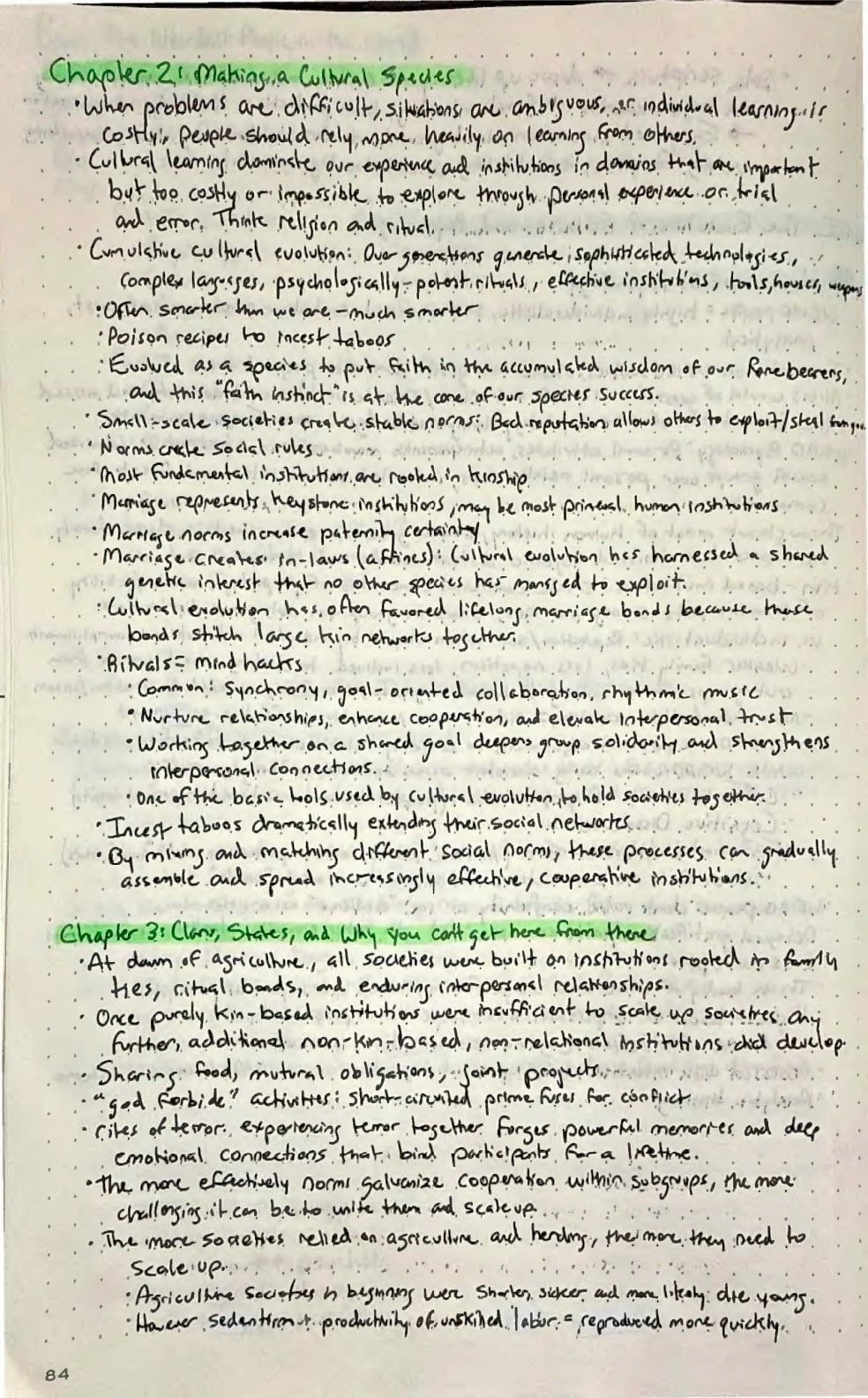
- This chapter explains why humans are a cultural species and how that fact changes the way we should understand human psychology, institutions, and history. Henrich’s aim is to show that humans did not evolve mainly to survive through individual intelligence alone, but through cultural learning, social norms, and institutions that accumulate across generations.
- In the broader argument of the book, this chapter provides the evolutionary and anthropological foundation for later chapters. Before Henrich can explain how Europe became psychologically unusual, he first has to explain how institutions shape minds and how minds help sustain institutions.
Chapter 2 source map and evidence boundary
Attachment (file not included in this release) · Attachment (file not included in this release) · Attachment (file not included in this release) · Attachment (file not included in this release) · Attachment (file not included in this release)
Cultural evolution can explain how a practice accumulates functional knowledge without conscious design; it does not imply that every inherited norm is adaptive, true, or morally acceptable. Henrich explicitly says arbitrary, elite-serving, and maladaptive norms also evolve. His reconstruction uses modern forager evidence alongside archaeology, ecology, linguistics, and genetics; the endnotes reject treating any living population as a static “primitive” fossil. Experimental work on ritual’s active ingredients was still incomplete at publication, and the gene-culture extensions are broader evolutionary hypotheses, not direct demonstrations for every institution discussed.
Evolved to Learn
- Henrich opens with the story of William Buckley, an escaped convict in Australia who survived only because an Aboriginal group took him in and mistakenly integrated him into their kinship world.
- Story adaptation → William Buckley Survives by Becoming Someone’s Dead Relative
- The story serves two purposes:
- it shows that humans are not naturally equipped to survive on their own even in an environment inhabited by hunter-gatherers for thousands of years,
- and it shows that human life is structured by social norms, kinship systems, marriage rules, rituals, and intergroup conflict, not just by raw subsistence.
- Buckley and the other escapees failed to hunt, gather, make fire, build shelters, or produce the tools necessary for survival. Henrich’s point is that humans do not thrive because each individual independently figures everything out. They thrive because they inherit a vast stock of cultural know-how.
- Henrich argues that humans evolved to rely on social learning:
- we learn who to copy by tracking cues like success, prestige, health, age, sex, and reliability,
- we learn what to pay attention to through evolved attention biases,
- and we learn when to trust others rather than our own direct experience, especially when problems are hard or costly.
- He uses examples to show that these learning systems are adaptive:
- children across very different societies preferentially remember information about dangerous animals,
- people rely more on others’ judgments when tasks become difficult or when more reward is at stake.
- Henrich stresses that culture does not merely fill an empty mind. It rewires brains and biology. Observing and copying others changes neural pathways, preferences, and perception.
- This leads into the idea of cumulative cultural evolution:
- useful practices are gradually assembled over generations,
- no single individual needs to understand why they work,
- and cultural products can become more sophisticated than the minds of the people who use them.
- His strongest example is the elaborate Congo Basin arrow poison recipe, which combines many plants, insects, animal materials, and processing steps. The point is not just that the recipe is complex, but that a learner would be foolish to casually alter it because its effectiveness likely depends on a long history of cumulative refinement.
- The main takeaway of this section is that humans became successful not by being lone rational problem-solvers, but by becoming obligate cultural learners who depend on inherited communal knowledge.
Evolving Societies
- Henrich then shifts from tools and survival knowledge to the social world.
- He argues that human societies are held together by social norms, which cluster into institutions.
- Institutions here do not mean only formal laws or states. They first mean packages of norms governing things like:
- marriage,
- kinship,
- food sharing,
- obligations,
- punishment,
- and cooperation.
- Social norms emerge through cultural evolution. People learn not just behaviors, but standards for judging behaviors. Once a community shares expectations and punishes violations, stable norms can form.
- Henrich gives a simple example:
- if someone steals from a well-regarded person, the thief acquires a bad reputation,
- once someone has a bad reputation, others can exploit or steal from them without social penalty,
- this creates incentives both to obey norms and to punish violators.
- He then applies the same logic to food sharing in hunter-gatherer groups:
- taboos may forbid hunters from eating parts of their own kills,
- violations may trigger fears of contamination or poor hunting luck,
- these beliefs motivate monitoring and punishment,
- and the result is a cooperative food-sharing system that helps the whole group survive.
- Henrich’s point is that norms often include beliefs that may seem odd or irrational, but those beliefs can help sustain social cooperation.
- He also emphasizes that similar cooperative outcomes can be maintained through different combinations of norms, showing that cultural evolution is flexible and can mix and match elements to produce workable institutions.
Innate Anchors and Core Institutions
- This subsection explains why some institutions are especially stable and widespread.
- Henrich argues that although cultural evolution can create many arbitrary norms, the most durable institutions are usually anchored in evolved aspects of human psychology.
- The most important anchors are:
- kin altruism
- pair-bonding
- incest aversion
- Because humans already have innate tendencies to care for close kin, norms built around kinship gain powerful psychological support. This is why family and kinship become the most fundamental institutions.
- Henrich shows how kinship systems can extend these instincts outward:
- calling more distant relatives “mother,” “brother,” or “sister” stretches expectations of care and obligation,
- this helps create broad kin networks beyond the nuclear family.
- He gives the example of the Ju/’hoansi naming system in the Kalahari:
- if someone shares the name of one of your close relatives, they can be socially incorporated into that kin role,
- this creates obligations and closeness even with distant kin or strangers.
- Henrich then explains marriage as a core institution built on pair-bonding.
- Marriage norms do several things:
- they increase paternity certainty,
- they encourage paternal investment,
- they link children to their father’s kin,
- and they create affinal ties between otherwise unrelated families.
- This is a major point in the chapter: marriage does not just regulate sex. It expands the social network, creates in-laws, and helps build broader cooperative communities.
- Henrich notes that in hunter-gatherer bands, many relatives are actually affines, not blood kin, so marriage is crucial to making these groups socially coherent.
- He also explains how cultural evolution uses incest aversion to construct broader incest taboos.
- Humans are naturally averse to sex with close kin, especially people they grew up with, but many societies extend those taboos far beyond close relatives.
- The Ju/’hoansi, for example, prohibit marriage with first, second, and third cousins. Henrich highlights this because it contrasts with many agricultural societies and foreshadows the later importance of cousin-marriage prohibitions in Europe.
- The larger argument is that kin-based institutions are powerful because they are culturally elaborated systems built on top of evolved psychological anchors.
Communal Rituals
- Henrich next explains how institutions also create social bonds among non-kin, and communal ritual is one of the main tools for doing so.
- Using anthropological descriptions of Ju/’hoansi trance dances, he argues that rituals help:
- forge enduring interpersonal ties,
- mend damaged relationships,
- and strengthen group solidarity.
- He breaks rituals down into some of their most important active elements:
- synchrony
- goal-oriented collaboration
- rhythmic music
- Synchrony matters because moving in step with others blurs the distinction between self and other and creates a feeling of interconnectedness.
- It also floods the mind with cues of mimicry and affiliation, making participants feel that others like them and want connection.
- Joint action matters because cooperating on a shared goal deepens solidarity and trust.
- Rhythmic music matters because it:
- helps synchronize action,
- can itself be the joint task,
- and shapes mood and emotional intensity.
- Henrich suggests these elements work synergistically, producing what he calls an orchestrated teamwork effect.
- The anthropological observation is that rituals are not decorative extras. They are social technologies that help hold groups together.
- He even notes that these practices may seem strange only from a WEIRD perspective; in much of human history, incest taboos and communal rituals are ordinary.
Intergroup Competition and Coevolved Social Psychology
- This section explains how institutions become more effective over time.
- Henrich argues that while norms can be arbitrary, selfish, or maladaptive, they are tested through intergroup competition.
- Groups with more effective combinations of norms and institutions tend to:
- win conflicts,
- grow faster,
- attract imitators,
- or replace less successful groups.
- This is a major mechanism in the chapter. Cooperative institutions do not need to be consciously designed. They can spread because groups possessing them outperform other groups.
- Henrich gives the example of Inuit-Inupiaq expansion across the Canadian Arctic after around 1000 CE, where groups with stronger cooperative institutions and rituals gradually displaced others.
- He then argues that long-term culture-gene coevolution likely shaped at least three features of human social psychology.
Norm psychology
- Humans evolved to:
- detect the existence of social rules,
- infer what those rules are,
- judge whether others comply,
- and internalize local norms as practical guides.
- This makes sense because norm violations in small-scale societies could cost people mates, allies, food, and even their lives.
Interdependence psychology
- Social norms often tie individuals’ welfare together.
- Henrich uses a food-sharing example:
- if hunters share meat, everyone’s survival becomes linked,
- if one hunter dies, the risks for others rise sharply,
- this creates real fitness interdependence across the group.
- Over time, humans evolved psychological systems that track such interdependence and generate concern, affiliation, and support for those on whom one’s own welfare depends.
- Cues like eating together, shared labor, and co-experienced hardship activate this psychology.
Tribal psychology
- Because cultural learning often creates distinct ethnolinguistic groups, natural selection also favored a psychology that:
- detects ethnic markers,
- prefers one’s own group,
- and uses those markers to guide trust, learning, and marriage.
- This tribal psychology helps explain why many societies prohibit marriage across certain group boundaries and why identities become tied to shared customs, dress, and language.
Avenues into Your Mind
- Henrich then reverses the direction of explanation.
- So far he has shown how psychology helps shape institutions. Now he explains how institutions shape psychology.
- He identifies three main pathways.
1. Facultative effects
- Institutions can influence behavior in the moment by changing the cues people respond to.
- Example: reminders that God is watching can make believers more cooperative and fair.
2. Cultural learning and direct experience
- People learn motivations, attention patterns, heuristics, and habits from others and from being rewarded or punished inside institutions.
- Example: institutions can shape patience by training people to value delayed rewards.
3. Developmental impact
- Institutions shape childhood and adolescence, which can produce lasting changes in:
- stress responses,
- self-control,
- risk-taking,
- relationships,
- and norm internalization.
- Henrich suggests that cultural evolution can also assemble training regimens such as stories, games, rituals, sports, and other practices that prepare children for success in a given cultural environment.
- His example is that practices like reading bedtime stories may help tune children for school and work in WEIRD societies.
- He then makes an important forward-looking claim: changes in psychology can alter which ideas and institutions later become thinkable or attractive.
- His example is rights-based law:
- the idea of assigning rights to individuals depends on a population already disposed to think of persons as independent agents.
- This is one of the key bridges from the chapter’s anthropological foundation to the later argument about WEIRDness.
Institutions Change and Psychology Adapts
- Henrich closes by criticizing common assumptions about human nature.
- He rejects both:
- the idea that humans are simply rational self-interested agents,
- and the idea that humans are mere blank slates shaped by culture.
- He also rejects the assumption of near-complete psychic unity, the belief that all human populations are basically psychologically identical.
- Instead, he summarizes the chapter around three core claims:
- humans are a cultural species whose minds are designed for socially learned adaptation,
- social norms are assembled into institutions through cultural evolution and often anchor on evolved psychology,
- and institutions are usually opaque to the people who live inside them, who often misunderstand how and why they work.
- This conclusion matters because the rest of the book will explain how changes in kinship, marriage, religion, markets, and associations gradually reshaped psychology in ways that later made modern Western institutions possible.
Key Concepts for Chapter 2: Making a Cultural Species
- Humans as a cultural species
- Humans evolved to rely on learning from others for survival, reproduction, and social life.
- Culture is not a supplement to biology; it is part of how human biology functions.
- Cumulative cultural evolution
- The process by which practices, techniques, norms, and beliefs are gradually improved and accumulated across generations.
- These cultural products often contain more adaptive knowledge than any one individual understands.
- Social norms
- Stable, self-reinforcing, culturally learned expectations backed by community judgment, reward, and punishment.
- Norms prescribe, prohibit, or endorse behaviors and often include motivational beliefs that support compliance.
- Institutions
- Clusters or packages of social norms organized around domains like marriage, kinship, food sharing, and cooperation.
- Henrich treats institutions first as culturally evolved rule systems before formal law or state structures.
- Innate anchors
- Evolved psychological tendencies that make some institutions more stable and easier to sustain, especially kin altruism, pair-bonding, and incest aversion.
- Kin-based institutions
- Institutions built from and extending family psychology, especially those involving kinship, marriage, paternity, in-laws, and incest rules.
- Interdependence psychology
- A coevolved psychological system that tracks how much one’s welfare depends on others and motivates affiliation, support, and concern accordingly.
- Tribal psychology
- Mental capacities and motivations for recognizing group markers, preferring one’s own ethnolinguistic community, and navigating intergroup boundaries.
- Institution-to-psychology feedback
- The idea that institutions reshape minds through facultative effects, cultural learning/direct experience, and developmental impact.
- Institutional opacity
- People usually do not understand how their institutions work or why they persist; their explicit explanations are often post hoc and mistaken.
Questions for Reflection for Chapter 2: Making a Cultural Species
- Why does Henrich think the failure of Buckley and the other escapees is evidence that humans survive through culture rather than through raw individual intelligence?
- How does cumulative cultural evolution challenge the idea that useful practices must be consciously designed or fully understood by their users?
- Why are kinship and marriage so central to the formation of early human institutions?
- How do rituals function as social technologies rather than merely symbolic or expressive acts?
- In what ways does Henrich’s account of institutional feedback into psychology prepare the ground for his later explanation of WEIRD psychology?
Chapter 3: Clans, States, and Why You Can’t Get Here from There
Chapter objective
- This chapter explains how human societies scaled up from small kin-based groups to larger political formations such as clans, segmentary lineages, age-set systems, chiefdoms, and premodern states. Henrich’s larger point is that this process was path-dependent: new institutions did not replace older kin-based ones from scratch, but were built on top of them. That matters for the broader argument of the book because it shows why most societies followed a fairly narrow route toward larger-scale cooperation, while Europe later took a more unusual path that broke with these inherited kin structures in a distinctive way.
Chapter 3 source map, figures, and evidence boundary
Attachment (file not included in this release) · Attachment (file not included in this release) · Attachment (file not included in this release) · Attachment (file not included in this release) · Attachment (file not included in this release) · Attachment (file not included in this release)
Figures: Attachment (file not included in this release) · Attachment (file not included in this release) · Attachment (file not included in this release)
Henrich explicitly rejects a unilineal or inevitable stages theory: institutional “next moves” depend on ecology, competition, inherited norms, and fit, and complex systems can collapse. Ilahita is an intensive ethnographic case, not a universal template. The chapter’s links from segmentary lineages to contemporary violence, the U.S. South, or “Islamic terrorism” are secondary causal syntheses and should not be generalized to a religion, ethnicity, or present conflict without separate actor-specific evidence. Henrich’s own endnote concedes that the trust analysis cannot cleanly isolate full segmentary lineages from clan organization more generally.
How Ilahita Got Big
- Henrich begins with the anthropological puzzle of the Sepik region of New Guinea, where villages usually topped out at roughly 300 people and then fractured along clan lines. This was strange because warfare and raiding made large communities advantageous, yet most groups still could not sustain cooperation at larger scale.
- Story adaptation → Ilahita Builds a Village Larger Than Its Clans
- The major exception was Ilahita, an Arapesh settlement of more than 2,500 people across 39 clans. Since its ecology and technology were similar to nearby villages, its size could not be explained by better tools or environment. The real difference was institutional.
- Donald Tuzin’s study showed that Ilahita succeeded because of its version of the Tambaran ritual system. Unlike nearby villages, Ilahita’s clans were crosscut by multiple ritual groupings, so people had obligations that ran across clan lines rather than only within them. Ritual groups exchanged pigs, administered each other’s initiations, and collaborated on major communal projects like the large spirit house shown in Attachment (file not included in this release). The effect was to create artificial interdependence across the village.
- Henrich emphasizes the psychological role of ritual. The Tambaran involved joint music, synchronized dancing, and especially rites of terror for boys and young men. These painful and frightening initiations created strong emotional memories and enduring bonds, much like the “band of brothers” effect among soldiers. Ilahita’s version was especially intense, with five initiation levels, including isolation, food restrictions, genital cutting, and eventually participation in enemy killing.
- The system was also stabilized by supernatural beliefs. Ilahita’s Tambaran gods were not just clan gods but village-level gods, believed to reward proper ritual performance with prosperity and punish ritual neglect. These beliefs kept people committed to the rituals and also helped redirect blame for unexpected deaths away from sorcery accusations against fellow villagers and toward divine anger, thereby reducing revenge cycles that might otherwise tear the community apart.
- Henrich’s key conclusion is that Ilahita’s success was not consciously designed. Even the elders did not understand the full social logic of the system. The Tambaran evolved gradually through diffusion and modification, and Ilahita happened to land on an especially effective version.
How Ilahita’s Tambaran Emerged
- Ilahita’s Tambaran spread through cultural copying under pressure. In the 19th century, the expanding Abelamwere militarily successful, and other groups assumed this success came from powerful rituals. Ilahita copied the Tambaran in order to defend itself.
- The important twist is that Ilahita copied it with several consequential “errors.”
- The ritual groups were misfit to Ilahita’s clan structure, which created more crosscutting ties than in the Abelam version.
- Ilahita accidentally created larger village-level gods by superimposing Tambaran gods over existing clan gods.
- It also added the Abelam’s four initiation rites onto its own existing initiation, yielding five levels and keeping elders in the system longer.
- These mistakes turned out to be productive. With this reconstructed Tambaran, Ilahita halted Abelam expansion, expanded its own territory, and later absorbed refugees who could be integrated through the ritual structure even without prior kinship ties.
Scaling Up
- From Ilahita, Henrich extracts two main drivers of larger-scale cooperation:
- intergroup competition
- the fit between new norms and existing institutions.
- He lists five mechanisms by which intergroup competition spreads institutions:
- war and raiding, where more cooperative groups defeat others
- differential migration, where people move into safer or more prosperous communities
- prestige-biased transmission, where groups copy successful neighbors
- differential group survival under ecological stress
- differential reproduction, where norms that increase fertility spread through more descendants.
- But competition alone is not enough. New norms must also fit the institutional materials already present. Ilahita could adopt the Abelam initiation package because it already had one initiation rite and flexible adoption norms. In other societies, the same imported package might have failed because it would not mesh with local kinship rules. This is the chapter’s recurring idea of path dependence: societies do not have unlimited institutional options; they have constrained “next moves.”
True Individualists
- Henrich then shifts to the Matsigenka of the Peruvian Amazon to show that humans are not naturally “ultrasocial” in one uniform way. At a village meeting about building a school, everyone verbally agreed, but almost no one actually showed up to work. The anecdote illustrates a society where people are cooperative with close kin but not organized for sustained village-level collective action.
- Matsigenka life is built around economically independent nuclear families. They are highly egalitarian, track kin bilaterally, lack clans and chiefs, and have no communal rituals or higher-order decision-making institutions. Families can choose their mates relatively freely, own most things personally, and live in small hamlets that split apart when conflicts arise.
- Henrich explains that this lifeway is an adaptation both to forest ecology and to predation by more organized outsiders, including slave raiders. By remaining scattered and hard to find, Matsigenka groups reduced the payoff to being raided or dominated.
- Psychologically, the Matsigenka are independent, self-reliant, industrious, and difficult to shame. Like WEIRD people in some respects, they explain behavior through individual dispositions and think personal action matters. But unlike WEIRD societies, their trust falls off sharply outside the intimate family circle, and they are uneasy around strangers and large gatherings. Henrich uses them to challenge the assumption that all humans are naturally inclined toward broad cooperation.
When, How, and Why Did Societies Scale Up?
- Henrich next places the story in long historical perspective. During much of prehistory, unstable climate and low atmospheric CO2 made farming difficult and favored mobile hunter-gatherer networks spread over wide territory. Those extensive kin networks helped people survive environmental shocks.
- Around 20,000 years ago, warming, seasonal stability, and rising CO2 made agriculture more feasible. Once farming and herding became possible, defending territory and stored resources became more important, which increased the value of large, cohesive groups. This created a coevolutionary feedback: the more people relied on food production, the more they needed institutions that could scale up cooperation.
- Henrich stresses that people did not adopt farming because it was individually more pleasant or healthier. Early farmers were often shorter, sicker, and more likely to die young than foragers. Farming spread because communities with the right institutions reproduced faster and outcompeted or absorbed hunter-gatherers.
- As societies settled, kinship systems were retrofitted into denser forms. One common shift was from bilateral descent to unilineal descent—that is, to more strongly patrilineal or matrilineal systems that Henrich groups under the label clans.
Forging Clans
- Henrich argues that clans culturally evolved to reduce internal conflict and increase solidarity for defense, production, and cooperation. He illustrates the problem through a hypothetical war party full of uneven kinship ties, where people have competing loyalties to sons, nephews, brothers-in-law, and affines. Bilateral systems can produce messy and unstable coalitions.
- Clans solve this by privileging one line of descent and reorganizing how relatedness is reckoned. In patrilineal systems, a father’s brother may also be called “father,” and his children may count as “brothers” and “sisters.”This expands solidarity outward from the nuclear family and creates a more unified corporate group.
- Henrich then lists a cluster of norms that typically reinforce clans:
- patrilocal residence, which raises children among paternal kin
- shared inheritance, which ties members to common resources
- corporate responsibility, where clans avenge and compensate as units
- incest taboos, which suppress internal sexual rivalry and push marriage outward
- arranged marriages, which build alliances
- command and control norms, often organized by age and genealogy
- ancestor gods and rituals, which sacralize land and kin obligations.
- These institutions allow tighter cooperation, but they also create a ceiling. Clans can coordinate internally, yet the same rivalries reappear when multiple clans must unite into something larger.
Uniting the Clans
- To move beyond the clan ceiling, cultural evolution generated higher-order institutions. Henrich focuses on two:
- segmentary lineages
- age-sets.
- Segmentary lineages scale up from clans by creating agreed genealogical relationships among many clans. Closer lineages ally against more distant ones, and all can unite against outsiders. Attachment (file not included in this release) diagrams this structure, culminating in a maximal lineage that may encompass an entire ethnolinguistic group. The system is psychologically grounded in honor: one man’s conduct affects the reputation and security of the larger lineage, so relatives monitor and punish one another in order to preserve standing.
- Henrich uses the Nuer as an example. In 19th-century Sudan, their segmentary lineage institutions allowed them to assemble very large military forces and expand against the Dinka. He also argues these institutions still have consequences today, including higher violence, lower trust in outsiders, and persistent honor-based conflict in places like South Sudan and even the U.S. South through Scottish and Scotch-Irish cultural descendants.
- Age-sets provide a different solution. Through shared initiations, males from different kin groups enter the same cohort, take on common duties, move through age grades together, and eventually form councils of elders. This produces a kind of centralized authority that can transcend clan loyalties while preserving some internal egalitarianism. Henrich emphasizes the psychological force of shared ritual, military training, and long-term joint action in creating this broader corporate identity.
- Even so, both segmentary lineages and age-sets remain limited. They scale up egalitarian societies, but they do not yet create the stable, centralized hierarchy needed for more enduring political control and expansion.
Getting to Premodern States
- Henrich argues that premodern states first emerged from chiefdoms, not from modern-style rational design. A chiefdom is typically a cluster of clans in which one clan gains recognized authority over the others. That authority is not initially based on naked coercion but on legitimate, sacred power embedded in kinship and ritual. His Fijian example shows how chiefly clans are treated as descended from elder ancestral lines, with associated respect and ritual prerogatives.
- The main question becomes: how does one clan rise above others? Henrich answers this through the case of Avatip in New Guinea.
Stealing the Ancestors’ Names
- In Avatip, different clans controlled different ritual powers connected to fertility, weather, fishing, harvests, and initiation. Over time, one large clan consolidated these powers by winning public debates over who really owned a ritual and its ancestral source. Access to secret ancestral names was crucial, and these could be acquired through marriage, bribery, extortion, or manipulation.
- Larger clans had advantages because they possessed more expert speakers, more marriage ties, and greater economic strength. As they accumulated ritual powers, they also gradually rewrote the local cosmology in ways that justified their superiority. This is Henrich’s example of a chiefly clan forming through ritual inequality, not through a one-time constitutional agreement.
- Henrich generalizes from Avatip to argue that the accumulation of ritual offices and sacred privileges has often been one of the main ways elite clans emerge. Sometimes power sits in a hereditary chief; other times in a council of elite lineage heads. What endures is not necessarily a single ruler, but the elevated status of the chiefly clanitself.
A Narrow Pathway
- Chiefdoms gain an advantage because they can make and enforce community-level decisions, coordinate warfare more effectively, and produce public goods such as walls, temples, and defensive works. This lets them expand by conquest, assimilation, or imitation and often leads to paramount systems in which many communities fall under a hierarchy of chiefs.
- At first, however, even these larger chiefdoms remain family affairs. Most people can still trace kin or marital ties to the chief. True social stratification emerges only when elites stop intermarrying with everyone else and begin presenting themselves as fundamentally distinct, superior, or divine.
- Under the right conditions, stratified chiefdoms become premodern states by placing bureaucratic institutions between ruling elites and the kin-based groups below them. These institutions collect taxes, adjudicate clan disputes, organize long-distance trade, conduct public rites, and mobilize armies. Yet even here, Henrich insists, the state remains built on top of intensive kin-based institutions, not free from them. Attachment (file not included in this release) makes this point visually by showing bureaucratic institutions sandwiched between elite and lower strata that are both still kin-embedded.
- Elites preferred to trust kin, but effective rule required promoting some competent non-elites into administrative positions. This helped states function and also protected rulers from rival elite families who might otherwise monopolize institutions and stage takeovers.
- Henrich’s broader conclusion is that even strong premodern states rarely treated individuals as basic legal units. Most people still had standing primarily through their clans, tribes, or other kin organizations. Premodern states could weaken kin institutions, redirect land and tribute, or create standing armies—as in the case of Shaka’s Zulu state—but they remained deeply rooted in kin-based social structure rather than replacing it outright.
Key Concepts for Chapter 3: Clans, States, and Why You Can’t Get Here from There
- Path dependence
- New institutions develop on top of older kin-based institutions rather than replacing them wholesale.
- Because older institutions constrain what can come next, societies have only a limited range of likely developmental pathways.
- Kin-based institutions
- Social systems rooted in family, marriage, descent, ritual, and interpersonal obligation.
- Henrich treats them as the foundational layer of all early large-scale societies.
- Artificial interdependence
- A culturally constructed form of dependence in which rituals and norms force otherwise self-sufficient groups to rely on one another.
- Ilahita’s Tambaran is the key example.
- Intergroup competition
- The main engine driving institutional spread and social scaling.
- It operates through war, migration, imitation of prestigious groups, ecological survival, and differential reproduction.
- Clans
- Unilineal descent institutions that intensify solidarity, clarify authority, regulate marriage, and organize corporate responsibility.
- Their function is to create tighter, more cooperative units for defense and production.
- Segmentary lineages
- Multi-tier descent systems that align many clans into nested alliances.
- They enable large-scale mobilization but also intensify honor dynamics and long-running conflict.
- Age-sets
- Cross-kin ritual cohorts that move through graded responsibilities together.
- They create broader solidarity and partial political centralization beyond clan loyalties.
- Chiefdoms
- Political systems in which one clan is elevated above others through sacred legitimacy, ritual prerogatives, and inherited authority.
- They are an intermediate stage between egalitarian clan societies and premodern states.
- Premodern states
- Kingdom-like systems that add bureaucratic institutions such as tax collection, military organization, trade management, and adjudication.
- Even so, they remain fundamentally rooted in kin-based institutions above and below.
Questions for Reflection for Chapter 3: Clans, States, and Why You Can’t Get Here from There
- Why does Henrich think Ilahita’s Tambaran worked not because it was rationally designed, but because it accidentally created stronger cross-clan integration?
- How does the Matsigenka case challenge the assumption that humans are naturally and uniformly “ultrasocial”?
- Why did the rise of agriculture intensify pressure for larger and more tightly integrated social institutions?
- In what ways do segmentary lineages and age-sets solve the problem of uniting clans, and why do they still fall short of full state formation?
- Why does Henrich argue that even premodern states cannot simply erase kin-based institutions, and how does that help explain the unusualness of Europe’s later trajectory?
Chapter 4: The Gods Are Watching. Behave!
Chapter objective
- This chapter explains how religious beliefs and rituals evolved into social technologies that helped human groups scale up beyond face-to-face communities.
- Henrich’s main claim is that belief in morally concerned, monitoring, and punishing supernatural agents can expand cooperation, reduce cheating, increase fairness toward strangers, and help sustain larger communities and institutions.
- In the book’s broader argument, this chapter provides a key bridge: before Henrich can explain how the Western Church reshaped marriage, family, and psychology, he first shows why religion had the power to reshape social life at all.
Source map and evidentiary limits
Attachment (file not included in this release) · Attachment (file not included in this release)
Figures: Attachment (file not included in this release) · Attachment (file not included in this release)
Evidence boundary: The God-prime samples behind Figure 4.1 were small, and Henrich’s endnotes describe the wider cross-cultural priming record as inconsistent. Figure 4.2 is an association across 15 populations, not a definitive causal estimate; fair-minded people may prefer punishing gods, even though the analyses address some competing community and demographic explanations. Local supernatural monitoring can also intensify clan favoritism, and religious solidarity can support intergroup hostility or violence. Treat the chapter as a mechanism-and-selection argument, not proof that religion is true, necessary, or morally benign. Henrich’s historical ordering of moralizing gods and social scale is also contested in the literature he discusses.
Moralizing Gods and Contingent Afterlives
- Henrich opens with modern psychological experiments showing that religious reminders can alter behavior in measurable ways.
- In a Canadian lab, participants exposed to God-related word primes became much more generous in a Dictator Game:
- without God reminders, they gave strangers about $2.60 on average,
- with God reminders, they gave about $4.60,
- and the share giving nothing dropped sharply.
- This effect did not appear among atheists, which matters because it suggests the mechanism is not just vague association with kindness or charity. Instead, the effect depends on actual supernatural commitment.
- Secular primes such as “police,” “court,” and “jury” affected both believers and atheists, showing that both supernatural monitoring and institutional monitoring can push people toward fairness. Attachment (file not included in this release) visualizes this contrast: God-primes raise generosity mainly for believers, while secular primes raise it for both groups.
- Henrich then shows that religions build these reminders into daily life:
- clothing,
- crosses,
- holy days,
- daily devotions,
- temples and mosques,
- and routine calls to prayer.
- His example from Marrakesh is striking: Muslim shopkeepers were much more likely to give all the money to charity during the call to prayer than between calls.
- He also describes the Sunday effect among Christians:
- charitable impulses rise on Sundays,
- and online pornography purchases dip in more religious U.S. states on Sundays before rebounding later in the week; Henrich notes that the data record purchases, while viewing is an inference.
- The point is that religion works not only through doctrine but through constant embedded cues that shape everyday decisions.
- Henrich then steps back and says modern people often assume religion naturally means moralizing gods, but historically that is not true.
- To explain how religions changed, he identifies three ingredients:
- humans’ willingness to trust what others teach them in uncertain, high-stakes situations,
- the existence of cognitive by-products or “bugs” in human psychology,
- and intergroup competition, which selects for belief systems that help groups survive and expand.
- One important cognitive by-product is mentalizing:
- humans are good at representing other minds,
- but that also makes us able to imagine the minds of invisible beings such as gods, spirits, ghosts, and ancestors.
- Henrich also points to dualism:
- people easily imagine minds existing apart from bodies,
- which helps explain the widespread appeal of souls, ghosts, and afterlives.
- These features make humans receptive to supernatural ideas, but they do not by themselves explain why religions came to emphasize morality.
- Early small-scale societies, Henrich argues, usually had weak, whimsical, and morally limited gods:
- gods could be bribed, tricked, or threatened,
- their concerns were often arbitrary,
- and afterlife beliefs were usually not tied to moral conduct.
- His examples include:
- Japanese Aboriginal groups bribing gods with millet beer,
- Andaman islanders worrying about divine anger over melting beeswax,
- and Ju/’hoansi beliefs in a creator god who punishes for idiosyncratic reasons rather than enforcing general morality.
- The key historical question then becomes: how did these weak supernatural beings become powerful moralizing gods?
- Henrich’s answer is intergroup competition.
- Groups whose gods punished things like:
- theft,
- cheating,
- oath-breaking,
- cowardice,
- adultery,
- or refusal to share,
could become more cooperative, internally harmonious, and externally competitive.
- Over time, this process favored gods with:
- broader moral concerns,
- better monitoring abilities,
- and stronger powers of punishment and reward.
What Gods Want, and Why
- Henrich then specifies what cultural evolution should favor in successful gods.
- First, gods should increasingly care about behaviors that improve internal cooperation and expand the sphere of trust:
- stealing,
- lying,
- cheating,
- murder,
- adultery,
- and betrayal.
- Adultery matters especially because it creates:
- violence and jealousy,
- and uncertainty over paternity, which weakens fatherly investment in children.
- Gods should also care about ritual obligations, food taboos, sacrifices, and devotional practices, because these help reinforce group commitment and coordination.
- Second, gods should become better at monitoring.
- Henrich contrasts local gods in Fiji, who watch from “dark places” but have limited reach, with the Christian God, who can supposedly see everywhere and know even inner thoughts.
- Third, gods should acquire stronger sticks and carrots:
- illness,
- injury,
- death,
- blessing,
- salvation,
- and eventually eternal punishment or reward in the afterlife.
The Active Ingredients
- Henrich next asks whether belief in more punitive gods actually changes how people treat strangers.
- To test this, he describes a large comparative research project across 15 populations around the world, including hunter-gatherers, farmers, herders, and wage laborers from places such as Siberia, Mauritius, Vanuatu, and Fiji.
- Researchers identified in each society:
- a Big God: the largest, most powerful, most morally concerned deity available,
- and a Local God: an important but smaller and less powerful supernatural being.
- Participants then played the Random Allocation Game (RAG):
- they privately rolled a die to distribute coins between cups,
- one cup went to a distant coreligionist,
- the other to either themselves or a local coreligionist.
- Since the die procedure made cheating undetectable, the game measured how much people would bias outcomes toward themselves or their local community.
- The results were central to the chapter:
- people who believed in a more punishing Big God treated distant coreligionists more fairly,
- people with weaker or no belief in such punishment were much more biased toward themselves and nearby people.
- The graph on page 15 (Figure 4.2) shows this clearly: as belief in divine punishment rises, allocations to distant coreligionists move closer to the fair split of 15 coins.
- This mattered even after accounting for:
- wealth,
- education,
- age,
- and gender.
- Equally important, beliefs about Local Gods did not predict the same fairness toward strangers.
- That distinction helps Henrich argue that what matters is not generic supernatural anxiety, but belief in a large-scale moralizing god capable of extending cooperation beyond the local group.
- He also cautions that rulers did not simply invent religions at will.
- Two examples make this point:
- Maya rulers still had to mutilate themselves in painful rituals, which suggests they were constrained by religion rather than fully controlling it.
- Akbar the Great tried to engineer a syncretic imperial religion in India, but it gained almost no traction and quickly disappeared.
- Henrich’s conclusion is that rulers often needed religions more than religions needed rulers.
The Evolution of Gods and Rituals
- Henrich now turns from experiments to long-run history.
- He argues that as societies scaled up, especially after agriculture, cultural evolution gradually reshaped both godsand rituals.
- In kin-based societies, ancestors often became deified founders, but these ancestor gods mainly cared about:
- proper rites,
- clan obligations,
- and offenses within their own lineage.
- They were not yet universal moralizers.
- Henrich revisits a theme from earlier chapters: larger gods could emerge when clan gods were reinterpreted or absorbed into wider systems.
- To study this historically, he looks at the Pacific, where Austronesian societies ranged from small egalitarian communities to complex chiefdoms and a few states at the time of European contact.
- A comparative study of 96 Pacific societies found that when beliefs in broad supernatural punishment were already present, societies were much more likely to scale up into more complex political formations.
- Without such beliefs, the chance of scaling up was close to zero; with them, the probability rose sharply over time.
- Henrich uses this as evidence that moralizing supernatural punishment was not just a byproduct of complexity but likely part of what enabled greater complexity.
- In places such as Tonga and Samoa, gods came to punish theft and adultery, though still within kin-structured societies.
- Divine punishment could also take a collective form:
- in Samoa, illness, injury, or death might be traced to the wrongdoing of one’s kin.
- This still differs from later universal religions because divine power remained limited and often escapable.
- Henrich also shows how religious and political authority became increasingly intertwined:
- gods legitimized chiefs,
- chiefs organized temples, warfare, canals, and sacrifices,
- and religious institutions helped support larger political hierarchies.
- Yet these gods remained somewhat human:
- they liked food, drink, and sex,
- they could be bribed,
- and enemies might even sacrifice to one another’s gods for favor.
- Afterlife beliefs in Polynesia were still mostly non-contingent:
- one’s afterlife depended more on status, cause of death, or birth than on universal moral conduct.
- Still, Henrich points to beliefs such as the brave warriors of Mangaia rising to heavenly delight as examples of building blocks from which stronger moralized afterlife systems could develop.
The Gods Make History
- Once written records appear in Sumer, Henrich argues, we can observe these processes more directly.
- Early Mesopotamian gods were still highly anthropomorphic:
- Enki could get drunk,
- Inanna/Ishtar was linked to sex, prostitution, war, and adulterous intrigue,
- Enlil sent floods because humans were noisy, not because they were immoral.
- Even so, intergroup and intercity competition gradually made gods more useful for politics and trade.
- Hammurabi is Henrich’s major example:
- his legal code begins by grounding royal power in divine mandate,
- and presents rule itself as authorized by the gods for the welfare of humankind.
- Mesopotamian gods, especially Shamash, increasingly became patrons of:
- truth,
- justice,
- commercial oaths,
- legal testimony,
- and treaty enforcement.
- Statues of gods in marketplaces likely acted as a kind of ancient religious monitoring technology, encouraging honest exchange.
- Henrich argues that similar dynamics continued in Greece and Rome:
- gods legitimized rulers,
- inspired armies,
- enforced sacred oaths,
- and policed violations tied to religion, family, or public life.
- In Athens, the gods were especially important for:
- oaths in commerce,
- testimony,
- and collective purity concerns.
- In Rome, sacred oaths were used in:
- sales,
- contracts,
- legal testimony,
- and commercial quality assurance.
- The example of Delos is especially vivid:
- merchants traded amid altars and divine presences,
- and Pausanias could say that the presence of the god made business safe.
- Henrich’s underlying point is that gods became embedded in the infrastructure of trust, exchange, and public order.
Hell, Free Will, and Moral Universalism
- Henrich argues that after about 500 BCE, a new kind of religion began to emerge more clearly:
- Buddhism,
- Christianity,
- Hinduism,
- and later Islam,
along with other universalizing faiths.
- He highlights three psychological game changers:
- contingent afterlives
- free will
- moral universalism.
- Contingent afterlives mean that what happens after death depends on how one lived.
- This creates a much stronger long-run incentive structure than older systems in which afterlife status was tied mainly to birth, clan, or circumstance.
- Henrich cites cross-national evidence suggesting that countries with stronger belief in both heaven and hell later show:
- faster economic growth,
- and lower crime, especially murder.
- Importantly, belief in heaven alone does not have the same effect and is even associated with higher murder rates in his cited analysis.
- Henrich’s interpretation is blunt: adding hell seems to do more behavioral work than merely believing in reward.
- Free will matters because universal religions often place responsibility on the individual’s choices, even against local custom or authority.
- Henrich cites research suggesting that stronger belief in free will is associated with:
- less cheating,
- less conformity,
- more helping,
- more self-control,
- and more creativity.
- Moral universalism matters because it treats moral law as applying across peoples rather than only within one clan, tribe, or ethnic group.
- Experimental work suggests that priming people with universalist moral frames can:
- reduce cheating,
- and increase charitable giving.
- Together, these three features help explain why universalizing religions could form larger moral communities than older kin- and tribe-based belief systems.
Persuasive Martyrs and Boring Rituals
- Henrich then asks how these religions sustained themselves psychologically across large populations.
- His answer is that they increasingly relied not on intense one-time tribal rites alone, but on doctrinal rituals:
- frequent,
- repetitive,
- standardized,
- and content-rich practices such as prayers, hymns, creeds, stories, and parables.
- These rituals:
- help transmit belief accurately,
- exploit memory and attention,
- and create shared commitment at scale.
- Henrich introduces an important concept here: Credibility-Enhancing Displays (CREDs).
- These are costly actions that make a person’s professed belief seem genuine.
- The clearest example is martyrdom:
- dying for a belief strongly signals authentic commitment,
- which makes observers more likely to adopt or deepen that belief.
- But CREDs also include many subtler practices:
- fasting,
- food taboos,
- celibacy,
- scarification,
- sacrifice,
- charity,
- and vows of poverty.
- Religions evolved to incorporate such costly displays because humans are psychologically designed to be wary of manipulation; we trust beliefs more when we see others pay real costs for them.
- Henrich also argues that doctrinal rituals help produce self-regulation.
- Unlike dramatic imagistic rituals, doctrinal rituals are often repetitive and tedious:
- daily prayers,
- grace before meals,
- routine attendance,
- fasting,
- repeated small sacrifices.
- Performing them over time can train patience, discipline, and delay of gratification.
- He suggests these rituals may therefore contribute not only to religious transmission but also to broader behavioral tendencies relevant to social and economic life.
- Finally, these religions also become “super-tribes.”
- Through:
- dress,
- symbols,
- ornamentation,
- special languages,
- food rules,
- and common ritual life,
they activate human tribal instincts while allowing imagined communities much larger than face-to-face clans.
- In principle, anyone can join, which makes them more scalable than older ethnic or lineage cults.
The Launchpad
- Henrich closes the chapter by summarizing religion’s historical role:
- it expands the social circle,
- suppresses impulsivity and cheating,
- increases prosociality toward unfamiliar coreligionists,
- and supports larger political and economic institutions.
- At the group level, these religious packages can produce:
- lower crime,
- greater trust,
- and faster growth.
- But this chapter is not yet about WEIRDness itself.
- Henrich’s concluding move is to say that universalizing religions spread widely across the world, so religion alone cannot explain why Westerners became especially unusual.
- The real turning point comes next: what happens when one of these religions begins to transform marriage, family, lineage, inheritance, and kinship itself?
- That question becomes the launchpad for the specifically European story that follows.
Key Concepts for Chapter 4: The Gods Are Watching. Behave!
- Moralizing gods
- Supernatural beings who care about human moral behavior, especially actions that affect cooperation, trust, and social harmony.
- Henrich argues they evolved culturally because groups with such gods often functioned better at larger scale.
- Divine monitoring and punishment
- The idea that gods can see human behavior and impose costs for norm violations.
- This reduces cheating and favoritism when earthly enforcement is weak or absent.
- Contingent afterlife
- A belief that one’s postmortem fate depends on moral conduct during life.
- Henrich treats this as one of the major innovations of universalizing religions.
- Moral universalism
- The idea that moral laws apply broadly across peoples rather than only within one clan, tribe, or ethnic group.
- This helps create larger imagined communities and impersonal cooperation.
- Free will
- A religiously and psychologically important belief that individuals can choose moral action even against custom or pressure.
- Henrich argues this can strengthen self-control, accountability, and resistance to group pressure.
- Big Gods vs. Local Gods
- Big Gods are more powerful, morally concerned, and punishment-capable deities.
- Local Gods are narrower, weaker, and more tied to place or kin group.
- Henrich argues Big Gods are more effective in expanding fairness toward strangers.
- Doctrinal rituals
- Frequent, repetitive, content-heavy rituals that transmit shared beliefs across large populations.
- These differ from more intense, imagistic rites typical of smaller-scale societies.
- Credibility-Enhancing Displays (CREDs)
- Costly actions that make stated beliefs seem sincere and trustworthy.
- Martyrdom is the extreme case, but fasting, celibacy, charity, and sacrifice can function similarly.
- Religion as social technology
- Henrich’s broader framework for understanding religion: not mainly as false or true doctrine, but as a culturally evolved package of beliefs and practices that can organize behavior, enlarge trust, and support institutions.
Questions for Reflection for Chapter 4: The Gods Are Watching. Behave!
- Why does Henrich think belief in monitoring and punishing gods could expand cooperation beyond kin and close neighbors?
- How does the distinction between Big Gods and Local Gods sharpen the argument that not all religion has the same social effects?
- Why were contingent afterlives, free will, and moral universalism such important developments for scaling up human societies?
- How do doctrinal rituals and CREDs help explain the durability and expansion of universalizing religions?
- If religion can function as a powerful social technology, what does that imply about the relationship between belief, institutions, and long-run historical development?
Chapter 5: Weird Families
Chapter Objective
- This chapter argues that WEIRD family structure is historically rare and did not arise mainly from industrialization or modern prosperity.
- Henrich’s core claim is that the Western Church gradually dismantled Europe’s older intensive kin-based institutions through its Marriage and Family Program (MFP), and that this long transformation helped create the social foundations for later WEIRD psychology, voluntary associations, mobility, and impersonal institutions.
Source map and evidentiary limits
Attachment (file not included in this release) · Attachment (file not included in this release)
Tables and figures: Attachment (file not included in this release) · Attachment (file not included in this release) · Attachment (file not included in this release) · Attachment (file not included in this release) · Attachment (file not included in this release)
Evidence boundary: The Ethnographic Atlas is coarse and contested; missionary contact could alter kinship before ethnographers recorded it, and some society-level codings simplify class and regional variation. For roughly 500–1200, direct statistics on cousin marriage do not exist, so Henrich reconstructs change from law, language, correspondence, narrative sources, and later demographic patterns; formal prohibitions were unevenly enforced. His MFP is not a single designed conspiracy: theological commitments, ruler–Church bargaining, institutional advantage, and cultural selection all matter, while the long-run psychological consequences were unforeseen. Table 5.3 is Henrich’s historical synthesis of selected traditions, not a comprehensive account of present belief, law, or practice.
Dissolving the Traditional Family
- Henrich begins by defining what makes WEIRD families unusual:
- bilateral descent
- little or no cousin marriage
- strict monogamy
- nuclear families
- neolocal residence
In global-historical perspective, this package is extremely rare. Over half of societies in the Ethnographic Atlas possess none of these traits, and only 0.7% possess all five.
- He also notes that cousin marriage is not a marginal practice globally. About 1 in 10 marriages worldwide is to a cousin or other relative, with much higher rates in parts of the Middle East and Africa than in countries like the United States, Britain, and the Netherlands.
- The chapter’s main historical claim is that in Europe the order was reversed:
- first, the Western Church degraded and dismantled kin-based institutions,
- then people increasingly formed voluntary associations based on shared belief or interest rather than clan ties.
- Henrich presents this as the “pebble that started the avalanche” toward the modern West: the Church’s policies reshaped family life long before industrialization.
- He argues that the Western Church’s success over rival religions and rival Christian branches lay importantly in its unusually forceful package of marriage and family prohibitions, which slowly altered everyday social life and weakened traditional kin obligations.
Up to the Starting Line
- Before the Church’s intervention, European tribal societies looked much more like other kin-intensive societies around the world than like modern Western ones. Henrich reconstructs this from:
- law codes,
- Church correspondence,
- travelers’ reports,
- saints’ lives,
- sagas,
- ancient DNA,
- and preserved kin terminologies.
- Broadly, pre-Christian Europe was marked by:
- extended kin-based organizations such as clans, houses, and lineages,
- patrilineal inheritance and residence,
- collective control or heavy kin claims over land,
- legal and social identity rooted in kin groups,
- kin-based protection and welfare,
- arranged marriages, often to relatives,
- and polygyny among high-status men.
- Even the Roman world, often imagined as already “modern,” remained deeply kin-structured:
- adult men remained under paternal authority while fathers lived,
- marriages were arranged,
- residence was typically patrilocal,
- and cousin marriage was socially acceptable in some forms.
The Monkey Wrenches
- Henrich uses the Anglo-Saxon mission as a concrete example of how the Church’s family rules collided with existing customs.
- In 597 CE, Pope Gregory I sent missionaries to Kent. Soon Augustine of Canterbury wrote back asking basic marriage questions, including:
- how distant kin must be for marriage to be lawful,
- whether a man could marry his stepmother or brother’s wife,
- and whether two brothers could marry two sisters.
- Gregory’s answer made the conflict clear:
- first cousins were forbidden,
- a man could not marry his stepmother,
- and he could not marry his dead brother’s wife.
- Nearly two centuries later, Church investigators still found Anglo-Saxons struggling with:
- cousin marriage
- and polygyny.
To attack these practices, the Church promoted the category of “illegitimate children,” stripping inheritance rights from children outside approved Christian marriages. That gave the Church a powerful lever over succession and marriage strategy.
- Enforcement was difficult and slow, but by about 1000 CE the Church had largely reshaped English kinship.
- Henrich then broadens this into the Marriage and Family Program (MFP), a package that gradually came to include:
- banning marriage to blood kin,
- banning marriage to affinal kin,
- banning polygyny, sex slaves, and brothels,
- banning marriage to non-Christians,
- creating spiritual kinship through godparents,
- discouraging adoption,
- requiring public consent by bride and groom,
- encouraging neolocal residence,
- and encouraging individual ownership and testamentary inheritance.
Expanding the Incest Taboos
- Henrich stresses that in many kin-based societies, marriage is a social technology for building alliances between kin groups. Arranged marriages allow patriarchs to use daughters, sisters, and nieces to reinforce trade, cooperation, and security ties.
- The Church attacked this system by banning:
- arranged marriage,
- polygynous unions,
- and especially marriages among blood kin and affinal kin.
- Henrich highlights levirate and sororate marriage to show why this mattered:
- under levirate, a widow marries her husband’s brother,
- under sororate, a widower marries his dead wife’s sister.
These customs preserve alliances between kin groups after death. The Church banned them early, thereby breaking those alliance-repair mechanisms.
- Over time, the circle of forbidden kin widened dramatically:
- first to cousins and in-laws,
- then eventually as far as sixth cousins, including affinal and spiritual kin,
- before later being narrowed back to third cousins and closer at the Fourth Lateran Council in 1215.
- Punishments also intensified:
- from suspension from Communion,
- to excommunication,
- to anathema, which formally consigned the sinner to Satan and exposed them to social and supernatural danger.
- Henrich argues these rules were not mere codifications of what people were already doing. Evidence for real resistance includes:
- tribes lobbying for looser cousin-marriage rules,
- payments for dispensations to marry relatives,
- and powerful nobles like the future William the Conqueror being excommunicated for marrying prohibited kin.
- He also uses language change as indirect evidence that kinship itself was being restructured:
- Western European kin terms gradually shifted away from intensive-kinship systems,
- and modern terms like “sister-in-law” preserve the Church’s logic, since “in-law” means in canon law she became like a sister.
The fact that Yiddish preserved older Germanic in-law terminology strengthens the case that the Church drove the change.
Why These Taboos?
- Henrich says the answer has layers.
- At one level, Church leaders and believers genuinely came to see sex and marriage with relatives as contrary to God’s will. For example, plague could be interpreted as divine punishment for incestuous marriage.
- At a broader level, however, the Western Church should be seen within a competitive religious marketplace. It was one tradition among many experimenting with different packages of customs, beliefs, and prohibitions.
- Henrich compares rival traditions:
- Zoroastrianism favored close-kin marriage, even extremely close forms,
- Judaism allowed cousin marriage and some levirate and uncle-niece marriage,
- Islam allowed cousin marriage and limited polygyny,
- the Orthodox Church followed a much lighter version of the Western Church’s program.
- His point is not that Church leaders scientifically deduced the genetic or social benefits of these bans. Rather, the Western Church happened to adopt an unusually extreme package whose downstream effects were enormous.
- One especially important downstream effect was that in medieval Europe these bans forced people to search much farther afield for spouses. In small villages and scattered farms, excluding thousands of relatives meant marrying Christian strangers from other communities, tribes, or ethnic groups.
Ending Lineages: Adoption, Polygamy, and Remarriage
- Henrich next explains that lineages survive only if they produce heirs. Many societies solve heirship problems through:
- adoption,
- polygyny,
- or divorce and remarriage.
- The Church attacked all three.
- It discouraged or eliminated legal adoption, tying inheritance more strictly to biological descent. Henrich notes that legal adoption disappears from English law until 1926.
- It weakened polygyny by recognizing only children of a legal Church marriage as legitimate heirs, shutting off a major route for preserving lineages through secondary wives.
- It also prohibited remarriage even after divorce in many cases. Henrich’s example of the king of Lothringia, and later Henry VIII, shows how even rulers could be forced into long struggles with papal authority over marriage.
- The broader point is that the Church’s restrictions caused lineages to die out, which further weakened kin-based society and redirected wealth and dependence. Henrich explicitly says these extinctions benefited the Church and often generated revenue through things like annulments.
Individual Ownership and Personal Testaments
- Henrich then turns to land and inheritance.
- In intensive kin-based societies, land is often corporately owned, and sale or transfer requires wide kin consent because territory is tied to ancestry, ritual, and group identity.
- The Church had strong incentives to push in the opposite direction:
- individual ownership
- stricter lineal inheritance
- and greater freedom to make personal bequests by testament.
- Henrich connects this to Christian teaching on wealth and salvation. Wealthy Christians were encouraged to give property to the poor via the Church, especially at death, in exchange for “treasure in heaven.” Priests at deathbeds made this especially effective.
- The result was a slow transfer of wealth from kin groups to the Church:
- ancestral and clan lands became Church lands,
- kin groups lost resources,
- and the Church gained both money and institutional reach.
The Carolingians, Manorialism, and the European Marriage Pattern
- Henrich argues that the MFP became especially powerful when the Church allied with Frankish rulers.
- Frankish kings, like the Church, had reasons to weaken aristocratic families and rural clans, so incest rules and marriage regulation gained secular enforcement and military backing. Childebert II, Pepin, and Charlemagneare key examples.
- Under this alliance, the Church and Carolingian state grew together, and the MFP was imposed especially strongly in areas inside the Carolingian sphere.
- Henrich also emphasizes the role of manorialism:
- Frankish manors were unusual in their reliance on unrelated household helpers,
- their weaker kin ties made it easier for people to move,
- and by around 1000 CE censuses show many peasant families already living in small, monogamous nuclear households.
- By the late medieval and early modern periods, historians can identify a distinct European Marriage Pattern, marked by:
- monogamous nuclear families with neolocal residence,
- late marriage, often into the mid-20s,
- a substantial share of women never marrying,
- smaller families and lower fertility,
- and a period of premarital labor service in other households.
- Henrich also notes important regional exceptions:
- Ireland was Christianized too early under the Celtic Church,
- southern Spain was under Muslim rule for centuries,
- southern Italy was not fully shaped by the Carolingian system,
- and eastern Europe received the MFP later.
Downstream Transformations
- As intensive kinship dissolved, medieval Europeans became freer in both relational and residential terms.
- Individuals increasingly chose:
- friends,
- spouses,
- business partners,
- and patrons,
rather than inheriting these ties mainly through clan structure.
- This mobility fed into broader historical developments that Henrich links to later WEIRD society:
- urban growth,
- voluntary associations,
- and institutions built around non-kin cooperation rather than lineage.
The chapter does not yet fully unpack all of that, but it clearly positions the family transformation as the social groundwork for those later developments.
Key Concepts for Chapter 5: Weird Families
- WEIRD kinship traits
- The cluster of features that make Western families unusual: bilateral descent, low cousin marriage, monogamy, nuclear households, and neolocal residence.
- Intensive kin-based institutions
- Social systems built around clans, lineages, extended families, and strong kin obligations in property, marriage, law, welfare, and identity.
- Marriage and Family Program (MFP)
- Henrich’s term for the Western Church’s long-developing package of marriage and family rules that prohibited cousin marriage, affinal marriage, polygyny, adoption, and more, while promoting public consent, neolocal residence, and personal testament.
- Affinal kin
- Kin created by marriage rather than blood, such as in-laws. The Church treated many of these relationships as incestuous for marriage purposes.
- Spiritual kinship
- Kin-like ties created through Christian institutions such as godparenthood, which also became marriage prohibitions.
- Levirate and sororate marriage
- Marriage customs that preserve alliances between kin groups after a spouse dies by marrying a brother-in-law or sister-in-law. The Church banned these early.
- European Marriage Pattern
- A later demographic pattern associated with northwestern Europe: late marriage, many never marrying, neolocal nuclear households, lower fertility, and premarital labor service.
Questions for Reflection for Chapter 5: Weird Families
- Why does Henrich think the Western Church’s marriage rules, rather than industrialization alone, were decisive in making Western families historically unusual?
- How did banning cousin marriage, affinal marriage, adoption, polygyny, and remarriage weaken clans and lineages over time?
- Why was forcing people to marry farther outside their kin network such a major structural change in medieval Europe?
- In what ways did the Church’s rules both undermine kin-based institutions and strengthen the Church itself?
- How does the rise of the European Marriage Pattern help explain the later growth of mobility, voluntary associations, and more individualistic social life?
Chapter 6: Psychological Differences, Families, and the Church
Chapter Objective
- This chapter aims to show that major cross-cultural psychological differences are partly produced by differences in kin-based institutions, especially the contrast between intensive kinship and weaker, more individual-centered family structures.
- Henrich’s broader argument is that the Western Church’s Marriage and Family Program (MFP) gradually weakened Europe’s intensive kinship systems, and that this long historical shift helped produce a more WEIRD psychology: more individualistic, more trusting of strangers, more universalistic, more analytic, and more attentive to intentions in moral judgment.
Source map and evidentiary limits
Attachment (file not included in this release) · Attachment (file not included in this release)
Figures: Attachment (file not included in this release) · Attachment (file not included in this release) · Attachment (file not included in this release) · Attachment (file not included in this release) · Attachment (file not included in this release) · Attachment (file not included in this release) · Attachment (file not included in this release) · Attachment (file not included in this release) · Attachment (file not included in this release) · Attachment (file not included in this release) · Attachment (file not included in this release) · Attachment (file not included in this release) · Attachment (file not included in this release) · Attachment (file not included in this release) · Attachment (file not included in this release)
Evidence boundary: The KII reconstructs roughly 1900-era institutions from a small set of Ethnographic Atlas variables and extends coverage to about 7,000 ethnolinguistic groups partly through linguistic relatives. Most figures are cross-country associations: controls and same-host-country immigrant comparisons reduce some alternatives but do not identify a unique causal path. Several inputs are narrow or nonrepresentative—Asch student samples cover 16 or 11 countries, shame/guilt measures use student self-reports and Google searches, MFQ data are online and self-selected, and blood donation also reflects health infrastructure. Henrich calls the global Church-exposure analysis crude; exposure from 500–1500 and later migration is modeled, not randomized, and Figure 6.15 is not evidence that every extra century mechanically changes every population by the plotted amount. Chapter 7 supplies the stronger within-Europe test.
Kinship Intensity and Psychology
- Henrich begins by explaining how he measures kinship intensity in two ways:
- the Kinship Intensity Index (KII), built from anthropological data on cousin marriage, clans, endogamy, nuclear families, bilateral inheritance, neolocal residence, and monogamy
- the actual prevalence of cousin marriage, meaning marriages to relatives who are second cousins or closer.
- The KII is meant to capture historical or traditional kinship intensity rather than only present-day practices. Henrich argues this matters because old institutions can continue shaping minds even after the institutions themselves weaken.
- He gives the example of China: even after clans were legally suppressed in the 1950s, the values and habits associated with clannish life could still persist through cultural transmission across generations.
- He also defends the KII by noting that populations with higher KII values also show greater genetic relatedness, which suggests these kinship norms shaped real marriage behavior over long periods, not just abstract customs.
- A recurring point in the chapter is that cousin marriage is especially important because it sharply distinguishes the Western Church from the Orthodox Church, which was less aggressive and less effective in suppressing it.
Individualism, Conformity, and Guilt
- Henrich argues that intensive kin-based institutions place people inside dense, inherited social webs. In such environments, success depends on:
- conformity
- deference to authority and elders
- sensitivity to shame
- prioritizing the collective over the self.
- By contrast, in societies with weaker kin ties, people must build beneficial relationships with more distant others and strangers. That pushes them toward:
- greater independence
- lower deference to authority
- stronger guilt
- more emphasis on personal achievement.
- To support this, Henrich uses Michele Gelfand’s measure of normative tightness. Societies with higher KII values or more cousin marriage are experienced as tighter: they have more rules, and violations are more strongly sanctioned. Venezuela is used as a “looser” example, Pakistan as a “tighter” one.
- He then turns to the Asch Conformity Experiment. Students from societies with weaker kinship are less willing to publicly go along with obviously wrong answers just to fit in. Conformity rises from roughly 20% in low-kinship settings to around 40–50% in high-kinship settings.
- World Values Survey data point in the same direction:
- stronger kinship is associated with greater respect for tradition
- stronger kinship is also associated with more emphasis on obedience in children.
Henrich illustrates this with Jordan versus the United States: where cousin marriage is high, more respondents emphasize obedience as essential.
- On the emotional side, the chapter argues that intensive kinship environments rely more on shame, while weak-kinship societies rely more on guilt.
- Henrich reports that as kinship intensity rises, people report more shame-like experiences relative to guilt-like ones. In weak-kinship societies, guilt becomes the main inner control mechanism.
- He adds an unusual piece of evidence: Google search behavior. Across 56 countries, populations with stronger kin-based institutions searched relatively more for “shame” than “guilt,” while weak-family societies looked more guilt-centered.
- Henrich closes this section with Hofstede’s individualism measure. Countries with weaker kinship are more individualistic. He notes that reducing cousin marriage from about 40% to zero is associated with about a 40-point rise in individualism.
- Still, he adds an important qualification: weak kinship opens the door to individualism, but does not automatically produce it. He points to Latin America as a region where kinship may be relatively weak without producing the full WEIRD individualism package.
Impersonal Prosociality
- This section asks whether weaker kinship also makes people better able to trust and cooperate with strangers.
- Henrich first notes that even after universalizing religions emerged, their ability to shape behavior was limited where people remained deeply embedded in kin networks.
- His example is Wali Khan, the Pashtun politician, who said: “I have been a Pashtun for six thousand years, a Muslim for thirteen hundred years, and a Pakistani for twenty-five.” The quote dramatizes the idea that lineage loyalty can outrank both religion and nation.
- Henrich argues that intensive kinship fosters:
- strong in-group solidarity
- dependence on personal ties
- sharper boundaries between in-group and out-group
- lower trust in strangers.
- To measure this, he constructs Out-In-Group Trust, using survey questions about trust in:
- family, neighbors, and known people
- versus first-time acquaintances, foreigners, and people of other religions.
- The result is clear: the stronger a country’s kinship intensity or cousin marriage rate, the less people trust out-group members relative to in-group members.
- Henrich notes that moving from the low to high end of cousin marriage roughly takes you from U.S.-likeimpersonal trust to something closer to Kuwait or Iraq.
- He strengthens the argument with immigrant evidence: first-generation immigrants living in the same countrystill differ in their out-group trust depending on the kinship intensity of their population of origin. That makes it less likely that the whole pattern is just about present institutions in the country of residence.
Universalism vs. In-Group Loyalty
- Henrich next argues that intensive kinship shapes not just trust, but moral judgment itself.
- In strong kinship systems, morality is more rooted in loyalty to one’s own people than in universal principles like fairness or impartial justice.
- His first example is the Passenger’s Dilemma, where corporate managers were asked whether they would lie in court to protect a reckless friend from prison.
- A universalistic response refuses to lie.
- A more particularistic or relational response favors the friend.
Henrich finds that higher cousin marriage is associated with greater willingness to protect the friend by lying.
- He then adds evidence on nepotism. Executives in strong-kinship countries are more likely to hire relatives into senior management. Henrich notes that what WEIRD societies condemn as nepotism may be seen elsewhere as family loyalty and prudent trust.
- The largest body of evidence comes from the Moral Foundations Questionnaire:
- people from stronger-kinship countries score higher on in-group loyalty
- they also tilt away from universal moral concerns like fairness and care/harm
- and toward loyalty and respect for authority.
- Once again, immigrant analyses replicate the same pattern within the same host country: people from stronger-kinship origins remain more loyalist and less universalistic in their moral outlook.
Money, Blood, and Parking Spots
- Henrich now tries to move beyond survey answers and show that these psychological differences matter in real behavior.
- He starts with the Public Goods Game (PGG), where people can either keep money or contribute it to a common project that benefits the group.
- In the first round of the game, stronger kin-based societies contribute less to the common pool when the beneficiaries are anonymous strangers. Contributions fall from about 57% of endowments in weak-kinship settings to nearly 40% in strong-kinship ones.
- He then turns to voluntary blood donation, a real-world public good that is anonymous, costly, and benefits strangers.
- Countries with weak family ties donate around 25 per 1,000 people per year.
- Countries with the highest KII donate almost none.
- Countries with low cousin marriage donate around 40 per 1,000, while high-cousin-marriage countries donate very little.
- Henrich draws an important distinction here:
- weak kinship can make impersonal prosociality possible
- but weak kinship alone does not guarantee high cooperation.
- He then uses the Impersonal Honesty Game, where students roll a die privately and report the result for money. Stronger-kinship populations report suspiciously more high rolls, suggesting more willingness to bend impartial rules for personal advantage. The average share of high claims rises from about 65% to nearly 80% as kinship intensity increases.
- Finally, Henrich brings in one of the chapter’s most vivid real-world examples: UN diplomats in New York. Because diplomatic immunity protects them from local parking penalties, their behavior reveals willingness to violate impersonal public rules.
- Diplomats from weak-family countries average about 2.5 unpaid tickets per delegate, while those from strong-kinship countries average around 10 to 20.
Impersonal Punishment and Revenge
- Henrich next explores how different societies think about punishment.
- In strong kin-based systems, punishment is usually internal to the family or clan. If outsiders criticize or sanction one of your people, that can be taken as an insult to the whole group and provoke retaliation.
- In weaker-kinship societies, by contrast, strangers are more willing to engage in third-party norm enforcement:
- correcting wrongdoers
- intervening on behalf of victims
- calling police
- punishing violations even when the victim is not kin.
- Henrich then revisits the Public Goods Game, this time with punishment options.
- Among WEIRD populations, punishment tends to work as economists hoped:
- free riders are sanctioned
- they then contribute more
- cooperation rises over repeated rounds.
- But in many Middle Eastern and eastern European populations, punishment often triggers revenge instead.
- low contributors retaliate against those they think punished them
- anonymous punishment spirals into vengeful counter-punishment
- cooperation can actually get worse.
- Henrich concludes that the more intense the kinship in a country, the more punishment is shaped by revenge motives rather than impersonal third-party enforcement.
- Over ten rounds, these differences become dramatic:
- strong-kinship societies end with average cooperation around 40%
- weak-family societies reach 70–90%.
- His takeaway is broader than the experiment itself: institutions and policy tools only work when they fit the cultural psychology of the people using them.
Intentionality in Moral Judgment
- Henrich argues that in societies shaped by intensive kinship, moral and legal judgment places less weight on intentions and more weight on outcomes, relationships, and collective responsibility.
- He explains the logic this way:
- in tightly woven kin worlds, people are embedded in webs of shared identity, corporate responsibility, and collective shame
- under those conditions, trying to isolate a person’s inner intention may matter less than identifying the relationship network involved.
- The broader implication is that weak-kinship societies are more likely to make moral judgment hinge on what a person meant to do, while intensive kinship systems focus more on what happened and who is socially tied to whom.
- This fits the chapter’s larger argument: when kinship weakens, moral thought becomes more individualized, more mental-state-focused, and more compatible with impersonal legal systems.
Analytic Thinking
- Henrich then shifts from morality to cognition.
- He argues that intensive kinship fosters a more holistic style of thinking:
- attention to relationships
- attention to broader context
- more tendency to group things functionally or relationally.
- Weak kinship, by contrast, encourages a more analytic mode:
- classifying by properties or categories
- isolating objects from their context
- attributing stable dispositions or essences.
- Henrich uses the Triad Task to illustrate this:
- analytic thinkers pair the glove with the hat because both are categories of winter clothing
- holistic thinkers pair the glove with the hand because the two are functionally related.
- His main result is that higher rates of cousin marriage are associated with more holistic thinking. Moving from populations with substantial relative marriage to populations with almost none shifts people from mostly holistic toward mostly analytic responses.
- This matters because Henrich is trying to show that family structure does not only affect social behavior. It also influences how people sort, classify, and perceive the world.
The Church Altered Kinship and Changed Psychology
- After establishing the psychological effects of kinship intensity, Henrich turns to the historical question: why does kinship intensity vary so much?
- He acknowledges that part of the answer lies in ecology, agriculture, disease, geography, and the historical development of states. Premodern states were usually built atop intensive kinship systems.
- But his main focus is on the Church.
- To measure the Church’s influence, he constructs a historical MFP dosage:
- he maps the expansion of the Church across Europe from about 500 to 1500
- uses the founding of bishoprics and associated conversions
- calculates exposure to both the Western Church and the Orthodox Church
- then extends this globally by using a migration matrix that tracks where modern populations’ ancestors lived in 1500.
- The results are central to the chapter:
- longer Church exposure predicts weaker kin-based institutions
- Western + Orthodox Church dosage explains about 40% of global variation in KII
- and about 62% of global variation in cousin marriage.
- Henrich says this makes Church exposure the single biggest factor his team found in explaining global variation in kinship intensity, even though it is not the only factor.
- The distinction between Western and Orthodox Christianity matters:
- the Western Church has somewhat stronger effects overall
- but most importantly, the Orthodox Church had no effect on cousin marriage
- thus the Western Church is doing the decisive work on that trait.
Henrich even estimates that each century of Western Church exposure cut cousin marriage by nearly 60%.
- This is one of the chapter’s strongest historical claims: the differences are not caused by “Christianity” in a vague sense, nor by Roman institutions alone, but specifically by the marriage and family rules of the Western Church.
Opening the Floodgates
- Henrich ends by summarizing the chapter’s causal pathway:
- stronger Church exposure
- weaker kin-based institutions
- more WEIRD psychology.
- He admits the evidence is imperfect and warns that global country comparisons alone cannot prove causation with absolute certainty.
- Still, he emphasizes that the relationships survive many supplementary controls:
- agricultural fertility
- ruggedness
- religiosity
- distance from the equator
- navigable waterways
- parasite stress
- malaria
- irrigation
- European colonization
- and within-continent and within-religion comparisons.
- His conclusion is that there is no obvious “lightning-bolt” alternative explanation that wipes out the pathway he has described.
- By the High Middle Ages, some European communities had already experienced nearly five centuries of the MFP; by 1500, some had experienced nearly a millennium. So the Church’s family reforms had a very long period in which to reshape both kinship and psychology.
Key Concepts for Chapter 6: Psychological Differences, Families, and the Church
- Kinship Intensity Index (KII)
- A composite historical measure of how intensive a population’s kin-based institutions are, combining cousin marriage, clans, endogamy, family form, inheritance, residence, and marriage practices.
- Prevalence of Cousin Marriage
- The share of marriages to blood relatives who are second cousins or closer; Henrich treats this as an especially powerful behavioral marker of kinship intensity.
- Normative Tightness
- A measure of how rule-bound and sanction-heavy a society feels. Stronger kinship is associated with tighter norms.
- Out-In-Group Trust
- A survey-based measure of impersonal trust, comparing trust in strangers and outsiders to trust in family and known people.
- Universalism vs. In-Group Loyalty
- The contrast between moral reasoning based on impartial principles and moral reasoning based on loyalty to one’s own group. Henrich argues that intensive kinship tilts morality toward the latter.
- Third-Party Norm Enforcement
- Punishing wrongdoing as an outsider, even when neither victim nor offender is kin. Henrich treats this as more characteristic of weak-kinship societies.
- Revenge-Driven Punishment
- Punishment motivated by retaliation or honor-defense rather than impersonal rule enforcement. Henrich links this more strongly to intensive kinship.
- Analytic vs. Holistic Thinking
- Analytic thinking sorts by categories and attributes; holistic thinking prioritizes relationships and context. Henrich argues kinship intensity helps shape this cognitive difference.
- Marriage and Family Program (MFP) Dosage
- Henrich’s measure of how long a population was historically exposed to the Church’s marriage and family rules, especially those that weakened intensive kinship.
Questions for Reflection for Chapter 6: Psychological Differences, Families, and the Church
- Why does Henrich think family structure is a more powerful shaper of psychology than many people assume?
- How does the shift from shame to guilt help explain broader differences between kin-based and WEIRD societies?
- Why might societies with strong kinship produce more in-group loyalty but less impersonal trust?
- What does the chapter suggest about the limits of exporting institutions or policy tools without regard for cultural psychology?
- How persuasive is Henrich’s claim that the Western Church’s marriage rules were a major driver of later Western psychological differences?
Chapter 7: Europe and Asia
Chapter Objective
- This chapter aims to test Henrich’s argument more rigorously within Europe itself and then compare it to patterns found in Asia, especially China and India.
- The main question is whether regions with longer exposure to the Western Church’s Marriage and Family Program (MFP) show more WEIRD psychology today: more individualism, less conformity, and greater impersonal trust and fairness.
- In the broader argument of the book, this chapter serves as a confirmatory bridge:
- it narrows the analysis from global cross-country comparisons to within-Europe regional variation
- it shows the persistence of these effects in the children of immigrants
- and it demonstrates that similar psychological patterns can arise outside Europe through different historical causes, especially ecology-driven kinship intensity.
Chapter 7 source map, figures, and evidence boundary
Attachment (file not included in this release) · Attachment (file not included in this release) · Attachment (file not included in this release) · Attachment (file not included in this release)
Figures: Attachment (file not included in this release) · Attachment (file not included in this release) · Attachment (file not included in this release) · Attachment (file not included in this release) · Attachment (file not included in this release) · Attachment (file not included in this release)
The within-Europe design narrows many country-level confounds, but it does not eliminate historical selection or omitted variables: bishopric exposure is a proxy for MFP enforcement, not a direct record of family practice. The cousin-marriage analysis uses 68 regions in four countries and sparse historical records; Henrich’s endnote says only three of the four psychological dimensions hold well in the within-country comparisons. In Italy, high cousin marriage consistently accompanies low blood donation, but low cousin marriage is not sufficient to produce high donation. The second-generation results support cultural persistence, not fixed group traits or an individual verdict. Talhelm’s China sample consisted of Han university students from 27 provinces, while the India sample was recruited online; rice suitability and border comparisons improve the causal case without making rice a complete explanation or “Chinese” and “Indian” psychology timeless essences.
The Church’s Footprints
- Henrich begins by asking whether the effects of the MFP can still be detected within Europe, where many country-level differences can be held constant.
- Using data from the European Social Survey, he builds four regional psychological measures:
- Conformity and obedience
- Individualism and independence
- Impersonal fairness
- Impersonal trust
- To estimate local Church influence, Henrich’s team tracks the spread of 896 papally controlled bishoprics across 442 European regions and calculates each region’s MFP dosage from 500 to 1500 CE. Attachment (file not included in this release) maps the result: darker regions had longer bishopric exposure and thus stronger MFP dosage. The highlighted Carolingian Empire line is important because those regions received especially strong Church-family intervention.
- The results are straightforward:
- regions with longer MFP exposure are today less conformity-oriented
- more individualistic and independent
- and higher in impersonal fairness and trust.
- Henrich emphasizes that these relationships remain even after controlling for:
- income
- education
- religiosity
- denomination
- geography
- climate
- terrain
- Roman roads
- monasteries
- medieval universities
- and early population density.
- His key conclusion is that European communities with deeper MFP exposure are psychologically WEIRDer today, even when comparing regions inside the same countries.
The Last Remnants of Intensive Kinship
- Henrich then asks whether those same European regions also retain different levels of kinship intensity.
- Because good kinship data for Europe are scarce, he uses papal dispensations for first-cousin marriage as a proxy. These records from France, Spain, and Italy, supplemented with Turkey, allow him to track where close-kin marriage persisted into the 20th century.
- The pattern matches his theory:
- regions with less medieval MFP exposure show higher rates of cousin marriage much later
- regions with greater exposure show much lower rates.
- Henrich’s fitted models say MFP dosage explains:
- nearly 75% of the regional variation in cousin marriage across Italy, France, Spain, and Turkey
- and still nearly 40% even if Turkey is excluded.
He also reports that every century of MFP exposure was associated with a cousin-marriage rate nearly a quarter lower.
- He adds a Carolingian comparison:
- regions once inside the Carolingian Empire had almost no cousin marriage in the 20th century
- regions outside it, such as southern Italy, southern Spain, and Brittany, retained more.
- Sicily is Henrich’s vivid example:
- requests for cousin-marriage dispensations were so numerous in the 20th century that special authority had to be delegated locally rather than handled only through Rome.
- Henrich then links cousin marriage directly to psychology.
- Across 68 regions in four countries, areas with higher cousin marriage show:
- more conformity-obedience
- less individualism-independence
- lower impersonal trust
- lower impersonal fairness.
- Attachment (file not included in this release) summarizes this clearly:
- as cousin marriage rises, individualism, trust, and fairness fall
- while conformity-obedience rises.
The Italian Enigma
- Henrich then zooms into Italy, asking why southern Italy historically lagged behind the north in prosperity and became more associated with organized crime and corruption.
- His explanation is historical:
- northern Italy spent much longer under the Western Church and MFP
- southern Italy was incorporated later, after long periods of Muslim and Eastern/Orthodox control.
- This history still appears in 20th-century cousin marriage:
- in northern Italy, rates are often below 0.4% and sometimes zero
- in the far south and much of Sicily, they rise above 4%.
- Attachment (file not included in this release) compares:
- Panel A: first-cousin marriage across 93 Italian provinces
- Panel B: voluntary blood donations per 1,000 people in 1995.
The visual pattern is striking: provinces with less cousin marriage donate much more blood to strangers.
- Henrich treats blood donation as a measure of impersonal prosociality because it is anonymous, voluntary, and benefits strangers. He says knowing cousin-marriage rates alone explains about one-third of the variation in blood donations across Italian provinces.
- He extends this to other real-world trust measures:
- provinces with more cousin marriage use fewer checks
- keep more wealth in cash
- and rely more on loans from family and friends rather than banks.
- Attachment (file not included in this release) shows:
- check use falling sharply as cousin marriage rises
- cash holdings increasing as cousin marriage rises.
- Henrich also says provinces with more cousin marriage have:
- more corruption
- more Mafia activity.
His interpretation is that the same psychology that strengthens in-group loyalty and nepotism can also support clan-like criminal structures.
The Children of Immigrants
- Henrich next examines about 14,000 second-generation immigrants across 36 European countries. These are people born and raised in Europe whose parents came from different countries.
- He assigns each person kinship values based on:
- the Kinship Intensity Index (KII) of their parents’ countries of origin
- and the prevalence of cousin marriage in those origins.
- The result is important:
- children of parents from higher-kinship backgrounds are still more conformist-obedient
- less individualistic-independent
- and lower in impersonal trust and fairness.
- These results remain even after accounting for:
- income
- education
- denomination
- religiosity
- discrimination
- and even when comparing people living in the same small European regions.
- Henrich’s interpretation is that kinship-linked psychology is culturally persistent:
- it is transmitted through family life, marriage practices, and social networks
- and can outlast the original institutions that helped create it.
- He also finds the same pattern when using the Church exposure of parents’ home countries:
- more ancestral exposure to the Western Church predicts more WEIRD psychology in their children.
Psychological Differences Within China and India
- Henrich then asks whether similar patterns can arise outside Europe without the Church.
- His answer is yes: in places like China and India, ecological conditions helped create stronger kin-based institutions, which in turn shaped psychology.
- In China, the key factor is paddy rice agriculture.
- Wet-rice farming was highly productive but required:
- irrigation systems
- coordinated labor
- maintenance of canals, terraces, and dikes
- and more top-down cooperation than wheat or millet farming.
- Henrich argues that this ecological setting favored the development of stronger patrilineal clans.
- Attachment (file not included in this release) shows how paddy rice is concentrated especially in southern and southeastern China, including Guangdong and the Pearl River Delta.
- He then summarizes Thomas Talhelm’s experiments with Han Chinese participants from 27 provinces and six universities.
- Three tasks were used:
- In-group favoritism toward friends vs. strangers
- Self-focus using circle-size sociograms
- Analytic thinking using the Triad Task.
- The results converge:
- people from more rice-intensive provinces show greater friend favoritism
- less self-focus
- and more holistic rather than analytic thinking.
- For example:
- participants from provinces with less than half their land in rice paddies made themselves about 1.5 mm larger than friends in the self-circle task
- participants from provinces with more than half their land in rice paddies showed almost no self-inflation.
- On the Triad Task, people from low-rice provinces were much more analytic, while those from heavy-rice provinces were more holistic. Henrich says rice reliance explains about half the provincial variation in this cognitive style. Attachment (file not included in this release) shows the negative relationship between rice cultivation and analytic thinking in both China and India.
- Talhelm’s team strengthens the causal case in two ways:
- by using ecological rice suitability rather than just actual cultivation
- and by comparing adjacent counties along the rice-wheat border, reducing broad north-south confounds.
- Henrich then turns to India, where the rice gradient runs more east-west instead of north-south.
- The same pattern appears:
- lower-rice states show more analytic thinking
- and less friend favoritism/nepotism.
This makes it less likely that the China results are just a quirk of Chinese history.
- He adds a broader global finding: populations whose ancestors relied more on irrigation agriculture tend to be:
- less individualistic
- more norm-sensitive
- and more committed to teaching obedience to children.
- Henrich’s conclusion is that, outside Europe, ecology can also produce stronger kinship and the corresponding psychological package, even without Church influence.
Fertile Ground
- Henrich ends by summarizing three major conclusions.
- First:
- within Europe, regions with longer Western Church exposure have weaker kinship and WEIRDer psychology
- and these results are harder to dismiss than country-level comparisons because they operate within countries.
- Second:
- the psychological effects of kinship are culturally persistent
- they remain visible in the adult children of immigrants raised entirely in Europe.
- Third:
- similar psychological differences appear in places like China and India
- but there they come not from the Church, but from ecological conditions that favored more intensive agriculture and stronger kin institutions.
- Henrich then draws the broader implication:
- by weakening intensive kinship over centuries, the MFP helped create populations more willing and able to:
- relocate
- engage strangers
- form voluntary associations
- and live under rules addressed to individuals rather than clans.
- by weakening intensive kinship over centuries, the MFP helped create populations more willing and able to:
- He suggests that this emerging proto-WEIRD psychology then helped support:
- towns and cities
- commercial laws
- written contracts
- accounting systems
- and new formal institutions for cooperation among strangers.
- He closes by signaling the next step in the book: a closer look at monogamous marriage and how it may have contributed to WEIRD psychology and democratic institutions.
Key Concepts for Chapter 7: Europe and Asia
- MFP dosage
- The degree of historical exposure a region had to the Western Church’s Marriage and Family Program, measured here through papally controlled bishoprics over time.
- Regional psychological variation
- Henrich’s idea that major differences in individualism, conformity, trust, and fairness can be detected not only across nations, but within countries and even within subnational regions.
- Cousin marriage as kinship proxy
- First-cousin marriage rates serve as a practical marker for the lingering strength of intensive kin-based institutions.
- Cultural persistence
- The claim that psychologically relevant features of kinship systems can survive through intergenerational transmission, even when people move or formal institutions change.
- Impersonal prosociality
- Helping, trusting, and cooperating with strangers or impersonal institutions rather than only with kin and close associates. Henrich uses measures like blood donation, check use, and bank reliance as concrete indicators.
- Ecology-to-kinship pathway
- Outside Europe, strong kinship can emerge from ecological conditions, especially those favoring irrigationand wet-rice agriculture, which demand larger, coordinated, top-down cooperation.
- Rice theory of psychology
- The idea, drawn from Talhelm’s work, that historical dependence on paddy rice helps produce more holistic, relational, and in-group-oriented psychology, while non-rice ecologies support more analytic and self-focused patterns.
- Proto-WEIRD psychology
- A developing package of traits—greater mobility, relational freedom, individualism, analytic thinking, and nonrelational morality—that emerged as kinship weakened in medieval Europe.
Questions for Reflection for Chapter 7: Europe and Asia
- Why does Henrich think within-Europe regional evidence strengthens his case more than broad country-level comparisons alone?
- How does the persistence of these patterns among the children of immigrants support the argument that kinship affects psychology through cultural transmission?
- Why is cousin marriage such a useful indicator for the lingering strength of kin-based institutions?
- What does the comparison with China and India show about the possibility of producing similar psychologies through very different historical causes?
- How does this chapter help explain the link between weakened kinship and the later emergence of impersonal institutions, markets, and voluntary associations?
Chapter 8: WEIRD Monogamy
Chapter Objective
- This chapter argues that monogamous marriage is not a natural default or a globally common institution, but a historically unusual social arrangement that became central to WEIRD societies. Henrich’s main claim is that Christian monogamy, as part of the Church’s broader Marriage and Family Program, helped reshape male incentives, family structure, psychology, and even physiology in ways that reduced zero-sum male competition and supported broader cooperation.
- In the broader argument of the book, this chapter zooms in on one specific component of the MFP—monogamous marriage—to show how it could contribute to the rise of WEIRD psychology, impersonal trust, lower violence, and institutions more compatible with democratic and voluntary social life.
Chapter 8 source map, figures, and evidence boundary
Attachment (file not included in this release) · Attachment (file not included in this release) · Attachment (file not included in this release) · Attachment (file not included in this release) · Attachment (file not included in this release)
Figures: Attachment (file not included in this release) · Attachment (file not included in this release) · Attachment (file not included in this release) · Attachment (file not included in this release)
Figure 8.1 is a mathematical illustration, not an estimate of every polygynous population; actual marriage systems vary, and some ecologically egalitarian societies are monogamous in practice without prohibiting plural marriage. Testosterone is a context-sensitive status-calibration system, not a simple aggression or crime hormone. The Cebu result is longitudinal, but Figure 8.4 comes from a 60-person experiment, and several hormone and risk findings are small or mixed. The reform-school desistance study compares men across life phases and addresses selection better than a cross-section, yet marriage quality and selection still matter. Provincial timing under China’s one-child policy is a suggestive natural experiment, not a randomized test. Henrich’s institutional argument does not by itself justify coercive marriage rules or settle the rights, welfare, and preferences of adults.
A Peculiar Institution
- Henrich opens by comparing 16th-century Spaniards and Aztecs. Both were complex empires, but one important difference was marriage. A Franciscan observer, Toribio de Benavente Motolinía, described how many Aztec men, especially elites, had multiple wives and how missionaries struggled to force a transition to one-spouse marriage. This example introduces monogamy as a major civilizational difference, not a trivial custom.
- He then adds a modern comparison from a polygynous fundamentalist Mormon community on the Utah-Arizona border. The same structural pattern appears:
- elite men accumulate wives
- lower-status young men are pushed out of the marriage market
- tension builds between married and unmarried males.
- Henrich’s larger point is that WEIRD monogamy is the strange case, not polygyny.
- Among primates, there are no group-living species with a noncultural equivalent of human monogamous marriage.
- Human pair-bonding psychology exists, but its natural bias tends toward polygyny, especially for high-status men.
- He explains this through basic reproductive asymmetries:
- men can potentially increase reproductive success by adding mates
- women often benefit by securing access to high-status, resource-rich men, even as additional wives rather than exclusive spouses.
- This is why polygyny has been so common historically:
- about 90% of hunter-gatherer societies allowed some degree of polygyny
- about 85% of agricultural societies did as well
- only 15% of societies in the Ethnographic Atlas are described as monogamous.
- Henrich reinforces the point with historical examples of elite harems:
- Tongan chiefs, Ashante and Zulu kings, Zande rulers, Khmer kings, Western Zhou kings, and Han emperors all had many wives or concubines.
- The broad argument is that when elite men are not constrained by norms, laws, or religious prohibitions, polygyny tends to intensify as societies scale up.
- He then notes that most modern legal bans on polygyny derive from WEIRD, ultimately Christian, foundations, and that in places like Japan, China, Turkey, and India, monogamous marriage was often adopted relatively late by copying Western legal institutions.
Polygyny’s Math Problem
- Henrich’s core analytical move is what he calls polygyny’s math problem.
- Even moderate polygyny creates a pool of unmarried, low-status men with little stake in the future.
- In his stylized example:
- only the top 20% of men marry polygynously
- no man has more than four wives
- yet 40% of men end up as involuntary lifelong bachelors. Attachment (file not included in this release) visualizes this stylized result by comparing a fully monogamous community with a moderately polygynous one.
- Henrich illustrates the psychology through Samu, a low-status man in the polygynous community. Since ordinary hard work will not raise him high enough to marry, risky strategies such as robbing a merchant become, in evolutionary terms, more attractive than playing it safe. The argument is not that men consciously calculate this, but that selection would favor riskier male psychology under these conditions.
- By contrast, in a monogamous society, even low-status men are more likely to marry, have children, and gain a stake in the future. That changes the incentives:
- crime becomes costlier
- patience becomes more rational
- risky status-jumping becomes less necessary.
- Henrich also argues that monogamy changes the incentives of higher-status married men. In a polygynous society, men like Attila remain in the marriage market and may redirect effort away from current wives and children toward securing additional wives. In a monogamous society, the payoff to that strategy is blocked, so more effort is channeled toward the existing household.
- He adds an important qualification: this logic assumes women may, under many conditions, rationally prefer becoming the second or third wife of a high-status man. Henrich’s claim is that restricting this choice through monogamous norms can nevertheless improve long-run outcomes for women and children on average because of the broader social effects of monogamy.
- The broader takeaway is that monogamy suppresses male-male reproductive competition, reduces the pool of excluded men, and gradually recalibrates male psychology.
A Testosterone Suppression System
- Henrich next moves from social structure to biology.
- He compares humans to birds because many bird species show a pattern where testosterone rises during mate competition and territorial struggle, then falls when males settle into pair-bonding and paternal care.
- Attachment (file not included in this release) is Henrich’s illustrative rooster—not quantitative evidence—used to introduce testosterone-linked ornamentation and mating competition.
- His argument is that humans possess a similar physiological system:
- testosterone rises with mating competition and status striving
- and tends to decline with stable marriage and fatherhood.
- The clearest example comes from Cebu in the Philippines:
- researchers measured the testosterone of young single men,
- followed them for four years,
- and found the biggest decline among those who both married and had children,
- while men who stayed single declined the least. Attachment (file not included in this release) summarizes this pattern.
- Henrich then draws the institutional implication:
- monogamy prevents high-status men from monopolizing wives
- allows more low-status men to marry and father children
- and thereby increases the share of men who experience the lower-testosterone profile associated with paternal investment.
- He argues that looking only at low-status men understates the effect, because in polygynous societies even married men remain active in the marriage market. Their testosterone declines are weaker or absent because seeking more wives remains advantageous.
- Henrich uses comparative examples to make this point:
- on Lamu Island in Kenya, taking a second wife is associated with somewhat higher testosterone
- among the Datoga of Tanzania, fatherhood does not reduce testosterone in the way it does in more monogamous settings
- among the Hadza, where polygyny is rare and father care is expected, testosterone drops somewhat with fatherhood and more so with increased childcare.
- He then argues that Christian monogamy was especially potent because it did more than cap wives at one. It also:
- restricted sex outside marriage
- attacked prostitution and sexual slavery
- made divorce difficult
- made remarriage difficult or impossible
- and tied sex to legitimate marriage and procreation.
- This mattered because other “monogamous” societies, such as Athens or pre-Christian Rome, still gave men easy access to concubines, brothels, sex slaves, and easy divorce, so they did not suppress male competition as strongly.
- Henrich’s larger claim is that WEIRD monogamy generates a distinctive endocrinology alongside its distinctive psychology. He calls testosterone only one example of the biological pathways institutions can exploit.
Trust, Teamwork, and Crime
- Henrich next asks how this hormonal and social recalibration affects behavior.
- He argues that higher testosterone tends to prepare men for status competition, and this can heighten:
- competitive motivation
- aggression
- vigilance for threats
- reward-seeking
- reduced sensitivity to punishment
- and sex drive.
- In one experiment, men given testosterone became more willing to hurt a partner’s payoff in order to improve their own relative standing, even when doing so reduced total earnings. Henrich uses this to show how testosterone can foster zero-sum competitive thinking.
- In another study involving GRE-style competition:
- high-testosterone individuals did better when competing against their teammate
- low-testosterone individuals did better when cooperating with a teammate against another team.
- Attachment (file not included in this release) captures this crossover pattern. Henrich uses it to suggest that high testosterone favors within-group rivalry, while lower testosterone is better for between-group teamwork.
- Testosterone also affects trust. In a study where participants judged strangers’ faces:
- after receiving testosterone, they rated the same faces as less trustworthy than when given a placebo.
- Henrich interprets this to mean that monogamous marriage may support:
- greater impersonal trust
- stronger self-regulation
- and less hair-trigger response to challenge, revenge, or suspicion.
- He is careful not to oversimplify. Testosterone is not a simple “crime hormone.” Rather, it biases people toward the actions most effective for status climbing under local conditions. Problems arise when the route to status involves lying, cheating, stealing, or violence.
- Henrich then links this to male perceptions of sex ratios. Experiments suggest that when men perceive more men than women in the local environment, they become:
- less patient
- more impulsive
- more willing to favor immediate payoffs over delayed ones.
- The chapter’s logic is that monogamy, by redistributing mating opportunities more evenly, changes men’s psychology toward:
- more patience
- more long-term planning
- more trust and teamwork
- and less risky, zero-sum competition.
Monogamous Marriage Reduces Crime
- Henrich next moves from lab studies to real-world outcomes.
- Many studies show that unmarried men are more likely than married men to:
- commit robbery, murder, and rape
- gamble
- abuse drugs
- and drink heavily.
- To get closer to causality, he highlights a long-term study of 500 boys from a Massachusetts reform schoolfollowed from adolescence into retirement.
- Comparing the same men across different phases of life, the study found:
- getting married cut the likelihood of crime substantially
- property and violent crime each fell sharply
- across all crimes, marriage reduced offending by about 35%
- and “good” marriages reduced it even further.
- A strong piece of evidence is that crime rates went back up after divorce or widowhood, which suggests the effect is not just about “growing up” into a calmer life stage.
- Henrich’s broader inference is that in polygynous societies, the large pool of unmarried low-status men never receives this marital prophylaxis. They remain overrepresented among the men most vulnerable to crime, violence, and social disorder.
- He then uses China’s one-child policy as a natural experiment.
- Because son preference and selective abortion created millions of surplus men, China developed a large male-heavy cohort.
- As those cohorts reached adulthood:
- arrest rates nearly doubled
- crime rates surged
- and the timing varied by province in line with when the policy had been implemented there.
- The point is that although China’s surplus men were not created by polygyny, they reveal the same underlying mechanism:
- a large pool of unmarried, low-prospect men
- shifts in risk and status competition
- and rising crime.
- Henrich concludes that the Church’s centuries-long enforcement of monogamous marriage unintentionally helped domesticate men, making them less competitive, less impulsive, less risky, and more willing to cooperate with strangers.
Putting the Pieces Together
- Henrich closes by drawing together the chapter’s main chain of reasoning:
- monogamous marriage is historically unusual
- it runs against the interests of high-status men
- but it can give societies a competitive advantage by reducing internal conflict and increasing cooperation.
- Its broader social effects include:
- less crime and violence
- less zero-sum status competition
- more long-term investment
- more trust
- and greater capacity for teams and voluntary organizations.
- Henrich then cites historian David Herlihy, who argues that early medieval Europe achieved something socially important by applying the same sexual and domestic rules to rich and poor alike. Poor men’s marriage chances improved, and this likely helped reduce abduction, rape, and violence more generally.
- The chapter ends by widening the implications:
- if people build their model of society partly from the family structure they grow up in,
- then monogamous nuclear families may have encouraged more egalitarian, less authoritarianexpectations than patriarchal clans or lineages.
- Henrich suggests this may have influenced the later design of:
- towns
- guilds
- religious institutions
- laws
- and eventually more democratic forms of social organization.
Key Concepts for Chapter 8: WEIRD Monogamy
- WEIRD monogamy
- A historically unusual form of marriage rooted in Christian norms that restricts people to one spouse at a time and also constrains divorce, prostitution, concubinage, and serial monogamy.
- Henrich argues it is much stricter and more socially consequential than many other societies’ nominal monogamy.
- Polygyny bias
- The evolved tendency, rooted in human reproductive asymmetries, that makes men—and under some conditions women as well—psychologically receptive to polygynous arrangements.
- Polygyny’s math problem
- Henrich’s idea that even moderate polygyny creates a large pool of unmarried low-status men, intensifying male competition, risk-taking, and potential violence.
- Stake in the future
- A condition monogamy helps create for lower-status men by making marriage and fatherhood more attainable, thereby encouraging patience, stability, and investment rather than risky status gambles.
- Testosterone suppression system
- Henrich’s term for the way monogamous marriage and fatherhood can lower male testosterone, shifting men away from mating competition and toward paternal care, self-regulation, and cooperation.
- Christian monogamy as institutional package
- The idea that the Church did not just ban multiple wives; it also attacked prostitution, concubinage, divorce, remarriage, and other channels that allowed elite men to bypass one-wife rules.
- Marriage as crime suppression
- The argument that monogamy reduces crime not only by changing formal rules but by altering the incentives and psychology of men, especially low-status men who would otherwise remain outside family life.
- Family-to-institutions pathway
- The suggestion that living in monogamous nuclear families may shape intuitions about equality, authority, and cooperation, influencing the later emergence of voluntary associations and more democratic institutions.
Questions for Reflection for Chapter 8: WEIRD Monogamy
- Why does Henrich argue that monogamous marriage is historically unusual rather than normal, and why does that matter for understanding Western development?
- How does polygyny’s math problem help explain the relationship between marriage structure, male competition, and crime?
- Why does Henrich think Christian monogamy had stronger psychological and social effects than other societies that were technically monogamous?
- In what ways does the chapter suggest that institutions like marriage can reach deeply into biology, not just norms or beliefs?
- How plausible is Henrich’s final claim that growing up in monogamous nuclear families may have influenced later European preferences for more egalitarian and impersonal institutions?
Chapter 9: Of Commerce and Cooperation
Chapter Objective
- This chapter argues that commerce does not simply emerge from human self-interest, nor is it naturally impersonal. Instead, markets reshape psychology by cultivating norms of fairness, honesty, trust, and conditional cooperation with strangers.
- In the broader argument of the book, Henrich uses commerce to show how the Church’s earlier weakening of intensive kinship created the social conditions for urbanization, voluntary associations, market norms, merchant law, and representative institutions in medieval Europe. The chapter is about how proto-WEIRD psychology and impersonal institutions coevolved.
Chapter 9 source map, figures, and evidence boundary
Attachment (file not included in this release) · Attachment (file not included in this release) · Attachment (file not included in this release) · Attachment (file not included in this release) · Attachment (file not included in this release)
Figures: Attachment (file not included in this release) · Attachment (file not included in this release) · Attachment (file not included in this release) · Attachment (file not included in this release) · Attachment (file not included in this release) · Attachment (file not included in this release) · Attachment (file not included in this release)
Economic games operationalize particular norms; they do not rank peoples’ moral worth. In Figure 9.2, the displayed regression omits two New Guinea populations because Henrich judged their play to reflect local community norms, though the published analyses included them. The Oromo proximity design is suggestive rather than randomized, and Henrich’s endnote records contrary evidence: a randomized market-access intervention in two African countries produced no increase in impersonal trust after two years. Markets can strengthen impersonal, conditional cooperation while weakening interpersonal warmth or enabling commodification and exploitation. European urbanization estimates are disputed; Church exposure, city growth, and representative government are historically selected and coevolving, not a single proven causal chain. Assur and Hui commerce were sophisticated kin-network solutions, not failed markets, and the economic impact of guild monopolies remains contested.
Market Integration and Impersonal Prosociality
- Henrich opens with his Matsigenka Ultimatum Game findings to show that what WEIRD people treat as obvious fairness is not universal.
- In WEIRD societies:
- people usually offer about half in the Ultimatum Game,
- and offers below about 40% are often rejected.
- Among the Matsigenka:
- proposers typically offered much less,
- receivers almost always accepted,
- and low offers were not seen as insulting or unfair.
- Henrich’s interpretation is that Matsigenka psychology is calibrated to family-level cooperation, not to impersonal norms governing strangers. Their behavior reflects their social world, not a deficiency.
- He then broadens the evidence across 27 societies using the Ultimatum Game, Dictator Game, and Third-Party Punishment Game; Attachment (file not included in this release) maps the populations in the research program.
- The key pattern is that the more market-integrated a community is, the more likely people are to make higher and fairer offers:
- communities with little market integration offer around a quarter of the stake,
- fully market-integrated communities offer substantially more, often closer to 50%.
- Attachment (file not included in this release) illustrates this clearly: as the percentage of calories purchased in markets rises, average Dictator Game offers also rise.
- Henrich also notes one other consistent correlate of higher offers: adherence to a world religion with a punishing Big God, which links the chapter back to Chapter 4.
- His conceptual point is that functioning markets require market norms:
- fair dealing,
- honesty,
- trust,
- cooperation with non-kin,
- and willingness to sanction violations.
- These norms are not altruistic in a soft sense. They are conditional and tied to mutually beneficial exchange. Markets reward those who can win while still appearing impartial, reliable, and trustworthy.
The Oromo, Markets, and Voluntary Associations
- Henrich then turns to Devesh Rustagi’s Oromo research in Ethiopia to push beyond correlation and get closer to causation.
- Oromo participants played a one-shot cooperation game with anonymous partners, allowing researchers to measure conditional cooperation:
- how much someone is willing to cooperate if their partner also cooperates.
- Market integration was measured by distance to market towns.
- The result:
- communities within about two hours of market centers had much higher conditional cooperation,
- communities four or more hours away had much lower scores,
- and each hour closer to the market raised conditional cooperation by about 15 points.
- Attachment (file not included in this release) shows this downward slope visually: more distance from market, less conditional cooperation.
- Henrich treats this as evidence that growing up near markets helps internalize market norms, rather than simply attracting already prosocial people. He argues this because:
- land location was historically fixed by clan-based inheritance,
- and town locations were shaped by geographic and military factors, not by sorting on personality.
- The next step is crucial. These same Oromo communities were later invited to form voluntary forest-management cooperatives.
- Communities with higher conditional cooperation were:
- much more likely to form such organizations,
- more likely to create explicit rules,
- and more successful at managing shared forests.
- Henrich notes that increasing a community’s cooperation score by 20 points raised the likelihood of forming a cooperative by roughly 30–40 percentile points.
- The forests were objectively healthier where cooperation and norm enforcement were stronger, because people monitored and punished free riders more.
- Attachment (file not included in this release) summarizes Henrich’s proposed causal chain:
- market integration
- leads to impersonal prosociality
- which supports voluntary associations
- which create formal institutions
- that help provide public goods.
- Henrich then clarifies a seeming paradox:
- small-scale societies often have rich interpersonal prosociality toward kin and familiar people,
- while markets cultivate impersonal prosociality toward strangers and anonymous partners.
- This distinction matters a great deal for the whole book. Markets do not simply make people nicer; they shift the sphere in which prosociality operates.
“No Hui, No Market Towns”
- Henrich next uses his fieldwork among the Mapuche in Chile to show why commerce can remain relational rather than impersonal.
- In the town of Chol-Chol, stores sold the same goods at different prices, yet residents did not shop rationally for the cheapest options. The reason was that buying and selling were embedded in long-running webs of:
- kinship,
- friendship,
- grudges,
- envy,
- and political memory.
- His larger point is that interpersonal relationships both enable and constrain exchange:
- some trust is necessary for exchange to begin,
- but when social networks are too dense, they suppress competition and keep trade personal and embedded.
- Impersonal markets therefore require two things at once:
- weaker interpersonal entanglement among buyers and sellers,
- and stronger market norms that allow fair dealing with non-kin.
- Henrich then steps back historically.
- He argues that WEIRD people often underestimate how difficult trade is in a world without either:
- interpersonal ties,
- or impersonal trust.
His example is hunter-gatherer Australia, where strangers might be killed on sight, making casual barter highly dangerous.
- Trade did occur, but usually along chains of relationships reinforced by kinship and ritual. When such ties were absent, groups sometimes used silent trade, like the famous Carthaginian example from Herodotus, where goods and gold were exchanged without direct contact.
- Even this kind of trade was fragile:
- little bargaining,
- no credit,
- no guarantees,
- no long-term contracts,
- high risk of theft.
- Henrich then explains why credence goods make trust even more necessary. A merchant buying a sword cannot easily judge the quality of the metallurgy, so trade without reliable norms sharply limits:
- credit,
- insurance,
- delayed exchange,
- and large shipments.
- Outside Europe, many complex societies solved this through kin-based commercial networks rather than impersonal law.
- His examples are:
- Assur in Mesopotamia, where large families ran long-distance trade through kin dispersed across cities,
- and the Hui merchant “guilds” in China, which were really super-clans of patrilineages coordinating credit, property, staffing, and public goods.
- The phrase “no Hui, no market towns” captures Henrich’s point: in China, commercialization often advanced through stronger lineage organization, not weaker kinship.
- Courts in these systems also tended to adjudicate disputes relationally:
- not simply buyer vs. seller,
- but clan vs. clan,
- with an emphasis on restoring harmony rather than applying abstract, impartial justice.
- Henrich’s central contrast is that medieval Europe could not easily follow this route because the Church had already undermined the kin-based tools that sustained such networks elsewhere. This pushed Europeans toward voluntary associations, merchant guilds, and impersonal institutions instead.
The Commercial and Urban Revolutions
- Henrich now turns directly to Europe.
- By around 900 CE, the Church had already:
- entrenched itself across much of western Europe,
- displaced rival religious systems,
- and weakened older kin-based institutions.
- As kinship weakened, people increasingly joined voluntary associations:
- religious groups,
- guilds,
- monasteries,
- confraternities,
- neighborhood associations,
- universities.
- These growing towns and cities competed to attract productive members by offering:
- privileges,
- security,
- membership rights,
- and opportunities for prosperity.
Serfs could often become full citizens after a year of residence.
- Henrich insists that these towns were not just smaller copies of Chinese or Islamic cities. They were a different kind of social organization, growing out of:
- smaller families,
- greater relational and residential mobility,
- more individualism,
- less devotion to tradition,
- and stronger equality motives.
- Attachment (file not included in this release) shows western Europe’s estimated urbanization climbing dramatically:
- below 3% in 800 CE,
- then rising rapidly,
- surpassing China during the High Middle Ages,
- and exceeding 13% by 1600.
Some areas like the Netherlands and Belgium rose above 30% by 1400.
- Urbanization was accompanied by town councils and administrative assemblies, often with representatives from guilds and other associations. In northern and central Italy, early governing councils formed around groups of citizens who swore sacred oaths before bishops.
- North of the Alps, charters and town privileges spread widely. These typically granted:
- rights to hold markets,
- stronger property rights,
- some degree of self-government,
- and exemptions from tolls and taxes.
By 1500, most western European cities were at least partly self-governing, unlike cities in China or the Islamic world.
- Henrich then gives two important examples:
- Magdeburg, whose law was copied by many daughter cities,
- and London, whose charter granted elections, local courts, and protections against older kin-based burdens.
- A revealing detail from Magdeburg Law is that fathers were no longer automatically liable for murders or assaults by sons if witnesses testified they had not participated. Henrich interprets this as a law that begins to separate individual liability from family liability.
- London’s charter similarly weakened older kin-based practices by:
- loosening traditional inheritance restrictions on land sales,
- exempting citizens from paying blood money to other families,
- and reducing reliance on trial-by-combat.
- Henrich stresses that rulers did not grant these privileges because they loved liberty. They did so because freer cities:
- generated prosperity,
- strengthened defense,
- helped colonize and secure territory,
- and operated in a world where military and merchant associations already had real power.
- The deeper causal claim is that urban laws and institutions fit the emerging psychology of the time:
- analytic thinking supported abstract rules,
- individualism supported rights and personal responsibility,
- weaker tribalism supported more equal treatment of foreigners,
- and intention-sensitive judgment helped phase out older ordeal-based legal methods.
- Intergroup competition among cities then selected for successful institutional packages. Cities copied the practices of prosperous rivals such as Bruges, Antwerp, and Amsterdam.
- Henrich adds one more quantitative link to the Church:
- each additional century of Church exposure around a city predicted faster urban growth,
- and roughly 1,900 more urban inhabitants per century,
- while the probability of adopting representative government rose from effectively zero before Church arrival to very high levels centuries afterward.
Attachment (file not included in this release) illustrates this steep modeled post-Church rise in representative governance.
Market Integration Rises
- Henrich then links urbanization to the spread of markets themselves.
- In medieval Europe, merchants and artisans increasingly depended on reputations for:
- impartial honesty,
- fairness,
- industriousness,
- precision,
- punctuality.
- These reputational systems helped cultivate the psychology suitable for impersonal transactions, including the use of credit, which became increasingly important to the commercial revolution.
- Henrich says these market-oriented norms gradually produced lex mercatoria, or Merchant Law:
- rules that increasingly stripped exchange away from tribe, kin, class, and personal relationship,
- and treated participants more as individual contracting parties.
- He emphasizes that this was a slow process, but its direction was clear:
- sons could buy from the cheapest seller even if their parents hated that seller’s family,
- strangers could extend credit and make written contracts across cities,
- and exchange became increasingly framed by rules rather than relationships.
- Attachment (file not included in this release) shows one institutional side of this shift in the German lands:
- a sharp rise in city incorporations
- followed by growing numbers of market grants from 1100 to 1500,
indicating both expanding urbanization and expanding market integration.
- Henrich makes a concrete comparison to the Oromo:
- most 14th-century English people would have lived close enough to markets to fall into the highly cooperative end of the Oromo graph,
- which suggests they were psychologically prepared for voluntary associations and contracts with strangers.
- He also argues that Europe had a geographic advantage once market norms existed:
- many natural ports,
- many navigable rivers,
- inland seas in both north and south.
These waterways helped market norms spread quickly through ports and urban corridors.
- The chapter closes by synthesizing the pathway:
- breakdown of intensive kinship
- urbanization and charter towns
- rising self-governance
- growing market integration
- stronger impersonal trust, fairness, and cooperation
- and then new ideas about rights, law, property, and freedom that fit this emerging psychology.
- Henrich notes that the transformation proceeded from the middle outward:
- remote subsistence farmers changed later,
- and the highest aristocracy also retained intensive kin practices longer than the urban middle layers.
Key Concepts for Chapter 9: Of Commerce and Cooperation
- Market Integration
- The degree to which a population depends on markets for daily life and exchange.
- Henrich treats this as a major driver of impersonal prosociality.
- Market Norms
- Social norms governing exchange among strangers or anonymous others, including fairness, honesty, trust, and conditional cooperation.
- These norms make impersonal markets workable.
- Impersonal Prosociality
- Fairness and cooperation directed toward strangers, acquaintances, and anonymous partners, rather than just kin or known people.
- Economic games in the chapter are meant to measure this.
- Interpersonal vs. Impersonal Prosociality
- Interpersonal prosociality is warm, relational, embedded, and directed toward in-groups.
- Impersonal prosociality is rule-based, conditional, and suitable for anonymous exchange and public institutions.
- Conditional Cooperation
- A willingness to cooperate if others do so as well.
- Henrich uses this as a psychological foundation for voluntary associations and public-goods institutions.
- Voluntary Associations
- Organizations people join by choice rather than through kinship, such as guilds, confraternities, monasteries, towns, and cooperatives.
- Henrich sees these as a crucial bridge between weakened kinship and modern institutions.
- Lex Mercatoria / Merchant Law
- Emerging legal and normative frameworks for commerce that increasingly abstracted away from kin, class, and tribe, and treated individuals as contracting parties.
- Psychological Fit
- Henrich’s idea that institutions spread not because they are universally best, but because they fit the psychology of the populations using them.
- Doux Commerce Thesis
- The old idea, invoked by Montesquieu and Paine, that commerce tends to soften manners and reduce destructive prejudice.
- Henrich partially rehabilitates this idea by grounding it in cultural evolution and psychology.
Questions for Reflection for Chapter 9: Of Commerce and Cooperation
- Why does Henrich think fairness in market exchange is not simply innate, but historically cultivated through specific institutions and repeated interaction?
- How does the distinction between interpersonal and impersonal prosociality change the way we think about whether markets make people more or less cooperative?
- Why were markets outside Europe often built on kinship networks, while Europe increasingly moved toward voluntary associations and impersonal law?
- In what ways do Magdeburg Law, London’s charter, and lex mercatoria reflect a deeper shift from family-based to individual-based social organization?
- How persuasive is Henrich’s argument that the Church’s weakening of kinship helped make Europe especially fertile ground for urban growth, commercial exchange, and representative government?
Chapter 10: Domesticating the Competition
Chapter Objective
- Henrich’s main goal in this chapter is to show that competition among groups does not only produce conflict or selfishness. Under the right cultural conditions, it can also increase trust, fairness, and cooperation toward strangers. In the broader argument of the book, this chapter explains how Europe’s world of voluntary associations—created in part by the weakening of intensive kinship—combined with war and later with nonviolent institutional competition to deepen impersonal prosociality, a core part of becoming WEIRD.
Chapter 10 source map, figures, and evidence boundary
Attachment (file not included in this release) · Attachment (file not included in this release) · Attachment (file not included in this release) · Attachment (file not included in this release) · Attachment (file not included in this release) · Attachment (file not included in this release)
Figures: Attachment (file not included in this release) · Attachment (file not included in this release) · Attachment (file not included in this release) · Attachment (file not included in this release) · Attachment (file not included in this release) · Attachment (file not included in this release)
War strengthens salient groups, not universal morality: Sierra Leone exposure is treated as quasi-random, but Henrich concedes hidden selection is possible and the soccer study alone does not identify causation; Tajikistan shows the same pressure reinforcing clans. European battles, sieges, Crusader participation, and urban growth are observational historical relationships, with elite mobilization standing in for wider involvement. U.S. banking deregulation is a quasi-natural experiment; the German evidence follows people across industries, while the lab result comes from French undergraduates. Competition can also reward fraud, sabotage, exploitation, environmental damage, or kin-based exclusion unless entry, enforcement, and external costs are constrained. Henrich’s madrassa comparison should not erase his endnote that medieval Europeans acquired and recombined important university ingredients from Islamic and Central Asian societies.
War, Religion, and Psychology
- Henrich begins with Sierra Leone’s civil war to show that war changes psychology in patterned ways. In village experiments, people who had been more affected by war became more egalitarian toward their own villagers but not toward distant villagers; Attachment (file not included in this release) compares the Sharing and Envy games. In a soccer-tournament study, the same pattern appeared: those more affected by war were fairer toward teammates and more competitive toward outsiders. The point is not that war makes people universally nicer; it makes them more cooperative along group lines.
- These psychological changes also appeared in civic life. More war-affected people in Sierra Leone were more likely to attend meetings, vote, join associations, and participate in local public-good activities. Henrich then broadens the evidence with research from places such as Nepal, Uganda, and Central Asia, arguing that war often stimulates the formation of voluntary organizations and greater local cooperation.
- Henrich explains this through three recurring psychological effects of war and other shocks. First, shocks strengthen interdependence psychology, pushing people to invest more in the communities they rely on. Second, shocks tighten adherence to social norms and increase willingness to punish defectors. Third, shocks often deepen religious commitment. Religious groups are especially advantaged because they offer a “trifecta”: mutual aid networks, sacred norms, and rituals or beliefs that help people cope with fear and uncertainty.
- He adds evidence that war and disasters increase ritual participation and likely also deepen beliefs in God, heaven, hell, sin, and the devil, sometimes for years after the conflict ends. But the downstream effect depends on the society’s existing structure. In Tajikistan, for example, war reinforced clan solidarity, trust in clan leaders, support for arranged marriage, and preference for personal over impersonal commerce. So war does not automatically create universal cooperation; it strengthens whatever social identities and norms are already most salient.
Europeans Made War, and War Made Them WEIRDer
- Henrich next argues that Europe’s case was unusual because war struck societies already transformed by the Church’s Marriage and Family Program (MFP). After the Carolingian collapse, Europe fragmented into many small polities and experienced centuries of near-constant warfare. In most human settings, war strengthens kin groups. But in Europe, because clans and lineages had already been weakened, war instead helped consolidate towns, cities, and other voluntary associations.
- This is the key contrast with places such as ancient China. There, war helped scale up states, but within a world still organized around lineages, patrilineal hierarchy, elite families, and relational morality. That social structure made institutions like autonomous cities, individual rights, and representative assemblies far less thinkable. Europe, by contrast, had populations more likely to join guilds, confraternities, charter towns, universities, and military-religious orders, and war therefore reinforced impersonal norms and institution-building rather than kin solidarity.
- Henrich uses historical evidence to support this claim. Attachment (file not included in this release) maps European battles and sieges from 1000 to 1800; cities exposed to nearby conflict grew faster afterward. Places more heavily involved in the Crusades later showed more representative assemblies, urban autonomy, and urban growth. He also suggests that wars like the Hundred Years’ War helped produce stronger national identities, making people more “English” or more “French,” just as the American Revolution helped turn colonists into “Americans.” The broader point is that war mattered not only through fiscal and military necessity, but through the psychology it activated in a population already primed for impersonal institutions.
Taming Intergroup Conflict
- Henrich then asks whether societies can preserve some of war’s cooperative side effects without the violence. His answer is that modern societies have partially domesticated intergroup competition by embedding it inside markets and other institutions. His main example is U.S. banking deregulation beginning in the late 1970s. Deregulation increased access to credit, which increased firm entry and exit, and thus intensified competition among firms. Henrich’s claim is that firms under greater competition must become better at eliciting cooperation, and this spills outward into higher impersonal trust among ordinary people.
- The evidence he presents is layered. Attachment (file not included in this release) links U.S. deregulation, firm entry and exit, and rising generalized trust. In Germany, people who moved into more competitive industries became more trusting, while those moving into less competitive industries became less trusting. In laboratory Public Goods Games, Attachment (file not included in this release) shows participants exposed to intergroup competition contributing more to the public good and becoming more likely afterward to say that “most people can be trusted.” Henrich treats these results as strong evidence that nonviolent competition can increase impersonal prosociality.
- Still, he warns that this effect is not universal. In populations still organized around intensive kinship or relational morality, competition may strengthen clans, family firms, or mafia-like networks rather than impartial trust. He also distinguishes intergroup competition from within-group competition. Intergroup competition tends to reward practices that help the whole group succeed; within-group competition rewards individuals trying to outmaneuver one another inside the organization. The first can increase cooperation; the second, if unchecked, can produce corruption, collusion, and self-dealing.
In Politics, Society, and Religion
- Henrich extends this logic beyond firms. In politics, multiparty democracy works partly because parties must compete for members and votes, which helps check the long-run slide toward corruption or despotism. In religion, churches and denominations also compete for members. He suggests that America’s unusually high religiosity is tied to the long-running competition among religious groups in a setting without an official state church.
- In social life, he points to team sports as a major site where nonviolent intergroup competition becomes psychologically formative. Sports teach people to cooperate in ad hoc teams, often with non-kin and even strangers. Henrich uses examples like Eton, Notre Dame football, and the English origins of sports such as cricket, rugby, soccer, baseball, and American football to show how deeply modern societies have embedded group competition into everyday leisure and identity.
When and Why?
- Henrich then steps back historically and asks why Europe developed so many enduring forms of benign intergroup competition. His answer is that once the Church weakened intensive kinship, people became more individualistic, mobile, and willing to sort themselves into voluntary associations. Cities, monasteries, guilds, universities, churches, and later states had to compete for members, talent, and loyalty. This created a long-run environment in which successful institutional forms could be copied, recombined, and spread.
- He illustrates this with monasteries. The Cluniac reforms created a successful model that spread widely, but later reformers like Robert of Molesme and the Cistercians broke away and built a more austere and disciplined alternative. Their new order spread across Europe through a structure of mother and daughter houses; Attachment (file not included in this release) maps the wider monastic expansion. The broader lesson is that even religious life in medieval Europe became a field of organizational competition and innovation.
- Guilds spread rapidly as well. They did more than organize trades; they provided mutual aid, dispute resolution, discipline, and religious support. Henrich’s favorite example is how guilds used beliefs about purgatory: membership brought communal prayer for one’s soul, while expulsion threatened spiritual disadvantage. This is one of his clearest examples of institutions creatively blending economic regulation, social solidarity, and supernatural motivation.
- Universities followed a similar pattern. Bologna emerged from student organization, Paris from professors acting collectively, and later universities were often born through splits, protest, imitation, and migration. Attachment (file not included in this release) places the spread of European universities beside British guild creation. Their autonomy, self-governance, and competition for scholars and students distinguished them from institutions like madrassas in the Islamic world, which Henrich portrays as more tightly bound to founder control and legal-religious constraints. His endnote also says Europeans acquired and recombined important constituents of the university from Islamic and ultimately Central Asian societies. He notes that guilds and universities grew even during the Black Death, suggesting that social shocks could strengthen demand for Europe’s voluntary associations.
Different Psychology, Different Effects
- Henrich emphasizes that benign competition does not produce the same result everywhere. In societies where people remain anchored in kin-based networks, competition can intensify divisions rather than expand impersonal trust. His example is rural China after the dismantling of collective farms in the 1980s. Clans quickly reconstituted themselves, repaired ancestral shrines, revived genealogies, and competed over land and opportunity. Smaller-clan households sometimes returned to ancestral villages where their own lineage was stronger.
- These clan-based arrangements could be highly effective: dominant-clan villages had more businesses, larger workforces, and better provision of some public goods. But the mechanism was not the European one. It relied on strong ties, lineage loyalty, and relational embeddedness, not on open-ended voluntary associations of strangers. So the same underlying force—intergroup competition—can either raise or lower impersonal trust, depending on the cultural psychology it works through.
Harnessing the Power of Competition
- The chapter closes by arguing that Europe’s long political competition eventually favored states and societies that learned to harness competition without letting it become destructive. In economics, this meant the transition from guilds to partnerships, joint-stock companies, and stock exchanges. Henrich’s coffeehouse example—London stockbrokers developing norms and standards outside the Royal Exchange—shows his broader theme that modern institutions often emerged from many rounds of unplanned experimentation rather than from top-down design.
- In politics, the rise of political parties is another case where actual institutional development outran the formal intentions of constitutional designers. In society, sports embedded nonviolent competition into ordinary life. Henrich’s final point is that modern WEIRD institutions work in part because they continuously push back against the tendencies of within-group cultural evolution—nepotism, collusion, zero-sum thinking, and self-interest—by forcing organizations to compete for success in a wider field.
Key Concepts for Domesticating the Competition
- Intergroup competition: Competition between groups rather than individuals. In Henrich’s argument, this can favor norms and institutions that make groups more successful, including cooperation and trust.
- Impersonal prosociality: Fairness, cooperation, and trust extended beyond kin and close relational networks to strangers. This is one of the chapter’s central outcomes.
- Domesticated intergroup competition: Nonviolent, institutionalized competition—especially among firms, parties, churches, and teams—that reproduces some of war’s cooperative effects without its destruction.
- Within-group competition: Competition among individuals or coalitions inside the same organization. Left unchecked, it often produces selfishness, collusion, and corruption rather than shared success.
- Voluntary associations: Self-governing groups people can choose to join or leave—such as guilds, monasteries, universities, charter towns, churches, and firms. Henrich treats them as a defining feature of Europe’s unusual development.
- Different psychology, different effects: The same competitive pressures can generate very different social outcomes depending on whether a society is organized around kinship or around more impersonal, voluntary, and mobile forms of social life.
Questions for Reflection for Domesticating the Competition
- Why does Henrich think war can increase cooperation without making people universally more moral?
- What is the strongest part of Henrich’s argument that Europe’s response to war differed from China’s because of prior kinship change?
- Does the evidence from banking deregulation, Germany, and lab experiments really show that competition increases trust, or only that it does so under certain modern conditions?
- Are team sports, political parties, and churches genuinely comparable to firms as examples of “domesticated” intergroup competition?
- What would it take for a kin-based society to shift from competition that strengthens clans to competition that strengthens trust among strangers?
Chapter 11: Market Mentalities
Chapter Objective
- This chapter argues that markets, urban life, and weak kinship ties did not just change institutions in Europe; they gradually reshaped people’s psychology. Henrich’s aim is to show how a more individualistic and commercial social world fostered new habits of time thrift, punctuality, hard work, patience, self-regulation, and personality formation, along with a stronger sense of the unitary self. In the book’s broader argument, this chapter explains another layer of how European institutions helped produce WEIRD minds rather than merely WEIRD economies.
- Before the first labeled subsection, Henrich opens with the spread of mechanical clocks in late medieval Europe. He treats public clocks as a visible marker of a deeper change already underway: people were learning to value precision, punctuality, and efficiency. In more individualistic societies, people even walk faster and complete routine transactions more quickly; Attachment (file not included in this release) plots the city-level walking-speed association that he interprets as evidence of time thrift.
- Henrich argues that Europe’s shift was not caused by clocks alone. Rather, clocks catalyzed a preexisting cultural shift in towns, monasteries, and markets where people needed to build personal reputations for self-discipline and punctuality. Fixed hours, hourly wages, piece rates, penalties for lateness, and time-specific contracts all helped people begin treating time as something measurable, scarce, and economically significant.
- He contrasts this with other time psychologies. In the Islamic world, clocks were often treated more as curiosities than as tools for organizing daily life, while among the Kabyle of Algeria, time was embedded in ritual and relationships rather than strict schedules. Henrich uses Ben Franklin’s “time is money” as a vivid example of how deeply WEIRD societies came to link time, labor, and value.
Chapter 11 source map, figures, and evidence boundary
Attachment (file not included in this release) · Attachment (file not included in this release) · Attachment (file not included in this release) · Attachment (file not included in this release) · Attachment (file not included in this release) · Attachment (file not included in this release)
Figures: Attachment (file not included in this release) · Attachment (file not included in this release) · Attachment (file not included in this release) · Attachment (file not included in this release)
Henrich explicitly calls this chapter more speculative than those before it: the evidence is patchy and some claims rest on one study or population. Figure 11.1 is a 28-city ecological correlation, and time thrift also tracks norm “tightness.” Old Bailey work-hour estimates may reflect which witnesses appeared; the cross-cultural commercial-work result applied to men, not women; and rising threshing output may partly reflect nutrition and new crops. Cistercian density is a controlled historical association, while interest and murder rates are indirect proxies with many determinants. The BaYaka comparison covers 164 people in three communities and cannot exclude migration or town differences. WEIRD-5 country samples are mostly urban undergraduates, the Tsimane’ are one population facing translation problems, and Henrich says Figure 11.4’s medieval projection should not be taken literally. The Hadza result is one observational population comparison, and his market-to-endowment mechanism remains a proposal.
How Work Became Virtuous
- Henrich’s main point here is that as clock-time psychology spread, Europeans did not simply work more because factories later demanded it. Instead, a longer-term change made hard work itself seem morally valuable. He links this to the Industrious Revolution, arguing that a stronger work ethic and greater self-regulation were already developing from the late Middle Ages onward.
- One of his key pieces of evidence comes from the Old Bailey court records in London. Because witnesses often described what they were doing when crimes occurred, the records provide “spot-checks” of daily life. Henrich says these suggest the workweek grew by about 40 percent in the late 18th century: people worked longer days, gave up “Saint Mondays,” and increasingly worked some holy days too. By the early 19th century, this amounted to roughly 1,000 extra hours per year.
- He strengthens this with cross-cultural evidence from more than 45,000 observational records across traditional societies. Men engaged in more commercial labor, especially wage labor, spent more of their day working. Henrich estimates that moving from a subsistence setting to a commercialized one could add 10–15 hours of work per week.
- Henrich argues that people were not only working to survive. Many were working longer in order to buy expanding streams of consumer goods such as tea, sugar, coffee, pepper, pocket watches, and printed material. In a more individualistic world, purchases also signaled who a person was, what they valued, and what they could afford. Consumption, then, reinforced industriousness.
- To show that people were likely working harder, not just longer, Henrich points to historical data on grain threshing. Since threshing technology changed little over centuries, the large rise in output suggests greater work intensity rather than better tools. He adds that the Cistercians may have helped moralize labor by spreading ideals of manual work, discipline, and self-denial into surrounding communities.
- The chapter’s most important example here is the long shadow of the Cistercian monasteries shown in Attachment (file not included in this release). Henrich notes that regions with higher medieval Cistercian density are still more likely today to say that “hard work” is an important trait for children, and those regions also show higher productivity and lower unemployment.
WAITING FOR PAYDAY
- In this subsection, Henrich argues that impersonal markets and individualism favor greater self-control and a stronger willingness to delay gratification. In open markets for workers, spouses, and partners, people increasingly prefer others who can plan ahead, resist temptation, and show up on time. In kin-based worlds, by contrast, people rely more on embedded relationships than on personal traits like patience.
- His main example is a study of the BaYaka in the Congo Basin. People were offered either one soup cube nowor five tomorrow. Market-town BaYaka were far more willing to wait than BaYaka in remote foraging camps. Henrich interprets this partly through wage labor, which trains people to work now for rewards later.
- But he also emphasizes that institutions shape whether patience pays. In traditional BaYaka camps, food sharing means that waiting for five cubes does not really benefit the individual chooser very much, because the extra cubes must be shared. So the social environment itself discourages the cultivation of delayed gratification.
- Henrich is careful not to overclaim. He admits the BaYaka study alone cannot prove that markets caused patience, since more patient people may have moved toward town life. Still, he argues that both cultural learning and repeated exposure to markets and schools can ratchet patience upward over time.
PATIENCE AND SELF-REGULATION IN HISTORY
- Henrich now tries to anchor these psychological changes historically. Since medieval records do not directly measure patience, he uses two indirect indicators: interest rates and murder rates. His claim is that both point toward rising self-control in Europe over the long run.
- On interest rates, his logic is straightforward: more patient people are willing to wait for future gains even at lower returns, so societies with greater patience should show lower interest rates. He notes that in England rates fell from around 10–12 percent in earlier centuries to below 5 percent by 1450, and below 4 percent by 1750; Attachment (file not included in this release) pairs this reconstruction with declining murder rates. He argues this long decline is hard to explain by risk or growth alone.
- Henrich strengthens the comparison by showing that preindustrial rates in places like the Yangtze delta, Korea, Osaka, and Istanbul were generally much higher than those in England and Holland. For him, this suggests that Europe’s drop in interest rates reflected a real psychological shift toward greater patience.
- He then links this to modern psychological research: people who delay gratification more successfully tend to save more, invest more, stay in school longer, and avoid crime. But he also stresses that patience only pays under the right institutions. In Liberia, men trained to become more patient saved more in the short term, but the gains often vanished because corrupt police stole their money. In Fiji, kin obligations can similarly drain personal savings.
- Henrich’s second historical measure is murder rates. Across several European regions, homicide fell dramatically from roughly 20–50 per 100,000 in 1300 to under 2 per 100,000 by 1800. He emphasizes that many medieval killings were not calculated murders but impulsive, honor-based fights—often tavern quarrels. So declining murder rates suggest rising ability to control anger and walk away.
- His broader argument is that in a world increasingly shaped by shops, commerce, and stranger interaction, being a hothead stopped paying. A person known for sudden violence became a bad choice for marriage, employment, and exchange. Henrich reinforces this with Samuel Ricard’s 1781 description of commerce as teaching people to become honest, prudent, deliberate, and restrained.
- A striking detail is that as overall murder declined, the share of victims who were family members rose. Henrich treats this as indirect evidence that violence against strangers and acquaintances became less acceptable even while kin relations retained their own tensions. He also suggests that patience and self-control spread outward from the urban middle class before diffusing more broadly.
Be Yourself: The Origins of WEIRD Personalities
- Here Henrich challenges the assumption that the familiar modern personality structure is simply human nature. He argues instead that personality traits and trait structures adapt to a society’s social niches, institutions, and opportunities. In subsistence societies with few roles, people must be generalists; in more commercial, mobile, and specialized worlds, people can sort themselves into niches that fit their dispositions.
- He begins with a long historical comparison. In most agrarian societies, occupation was heavily constrained by clan, caste, family, or inherited status. People generally had to fill the niche they were bw2orn into. Europe during the Middle Ages changed this by expanding towns, markets, guilds, apprenticeships, and occupations, while weaker kinship and greater mobility gave individuals more room to choose.
- This meant that people increasingly had to “sell themselves” through their own attributes rather than mainly through lineage or family alliances. A person could become a salesman, craftsman, scribe, or priest based partly on temperament and then further sharpen the traits that fit that role. Henrich also notes that women, though still heavily constrained, had somewhat more room than in many other societies because they often married later, could sometimes choose husbands, worked before marriage, or entered Church life.
- Henrich then critiques the Big Five, which he renames the WEIRD-5, arguing that psychologists too often mistake a WEIRD pattern for a universal one. Much cross-cultural work, he says, relies too heavily on urban university students, who are unusually mobile and unrepresentative.
- His strongest example is the Tsimane’ of Bolivia. After detailed testing, researchers found not five major personality dimensions but only two, roughly corresponding to interpersonal prosociality and industriousness. Henrich’s interpretation is that in a society with very few occupational niches, there is less room for the many independent trait combinations common in WEIRD settings.
- He then connects this to cross-national data from nearly 17,000 people in 55 countries. In more urbanized and occupationally diverse societies, the WEIRD-5 dimensions are more independent of one another. In more rural settings, those dimensions become more correlated, suggesting fewer available personality niches. Attachment (file not included in this release) illustrates the association and a deliberately conjectural medieval projection. He uses this to argue that medieval Europe was already moving in a WEIRD direction as urbanization and specialization expanded.
- Henrich ends this subsection with a subtler claim: WEIRD societies foster dispositionalism. Because people are expected to behave consistently across contexts, they increasingly value being their “true selves.” This helps explain the stronger WEIRD tendency toward the Fundamental Attribution Error and discomfort with inconsistency, or cognitive dissonance.
THE ENDOWMENT EFFECT
- Henrich uses the Hadza to show how market exposure may shape even basic economic psychology. The endowment effect is the tendency to value something more once it is one’s own. In WEIRD populations, people often irrationally keep an object they were randomly given rather than trade it for an equally good alternative.
- Coren Apicella’s experiments found that remote Hadza, with little market integration, behaved much more like rational traders: they traded lighters about half the time. But market-integrated Hadza, who increasingly sold goods to tourists, kept their initial lighters 74 percent of the time. The same pattern appeared with biscuits: market-integrated Hadza kept their initial endowment 76 percent of the time, while remote Hadza kept it only 45 percent of the time.
- Henrich’s explanation is that impersonal markets encourage people to think more in terms of personal ownership, self-expression, and identity signaling. Goods become extensions of the self: my mug, my lighter, my biscuit. That is why market exposure may strengthen the endowment effect. He also notes that North Americans show a stronger endowment effect than East Asians, which supports the link between markets and stronger individual-centered norms.
- At the same time, he warns against treating nonmarket Hadza as representing humanity’s “natural” condition. Hadza sharing norms strongly discourage attachment to possessions. He gives the example of a gambling game in which accumulated goods are redistributed and social pressure forces winners to keep sharing. In such a setting, becoming too attached to personal property would not make much sense.
- Henrich ends the subsection with an important caution: this part of the chapter is more speculative than some earlier chapters. The evidence is suggestive and often high quality, but some of the conclusions rely on single studies and should therefore be held with less confidence.
It’s Big, but How Big?
- Henrich closes by restating the chapter’s big idea: human minds adapt over centuries to the institutional and technological worlds they inhabit. In this chapter, he focused on two linked clusters: one involving time, labor, punctuality, patience, and self-control, and another involving personality, dispositions, and the centrality of the self.
- His final synthesis is that as kinship weakened and markets, cities, and voluntary organizations expanded, Europeans increasingly had to cultivate reputations for hard work, punctuality, patience, and discipline. Guilds, monasteries, and towns then reinforced these traits through incentives and socialization, and people came to see them not just as useful, but as morally important, even as possible signs of divine favor.
- At the same time, greater specialization let people sort into roles that fit their talents and dispositions, which helped reshape the very structure of personality and made personal dispositions more central than social context. Henrich ends by reminding the reader that this is probably only a small part of global psychological diversity; the “psychological iceberg” is much larger than what the book has mapped so far.
Key Concepts for Market Mentalities
- Time thrift
- The WEIRD tendency to treat time as scarce, measurable, and something to be saved, spent, wasted, or bought. Henrich presents it as deeply tied to individualism and the spread of clock-time institutions.
- Clock-time psychology
- A way of organizing life through fixed hours, precision, punctuality, and scheduling, rather than primarily through seasonal, ritual, or task-based rhythms.
- Industrious Revolution
- The historical increase in work time, work intensity, and work ethic before and during the Industrial Revolution, driven not only by necessity but also by consumer demand and changing values.
- Delay gratification / patience
- The capacity to give up a smaller reward now for a larger reward later. Henrich argues that markets and schools can help cultivate it, but only where institutions allow it to pay off.
- WEIRD-5
- Henrich’s term for the familiar Big Five personality model, used to stress that what psychologists often treat as universal may instead reflect the personality ecology of WEIRD societies.
- Dispositionalism
- A stronger tendency to explain behavior in terms of stable personal traits rather than contexts and relationships, tied to the WEIRD emphasis on consistency and the “true self.”
- Endowment effect
- The tendency to value possessions more once one owns them. Henrich suggests this is not a fixed human universal but is shaped by market exposure and norms of individual ownership.
Questions for Reflection for Market Mentalities
- Why does Henrich think mechanical clocks are better understood as a marker and accelerator of psychological change rather than its original cause?
- Does the evidence on work hours, threshing, and Cistercian influence convincingly show that Europeans came to see hard work as a virtue, or could other explanations still fit?
- How persuasive is Henrich’s use of interest rates and murder rates as indirect measures of patience and self-control?
- What does the Tsimane’ example suggest about the limits of applying modern Western personality theories to all human societies?
- Does the Hadza evidence show that market integration changes basic cognition, or only that it changes how existing norms interact with ownership and exchange?
Chapter 12: Law, Science, and Religion
Chapter Objective
- Henrich’s central aim in this chapter is to argue that Western law, science, representative government, and Protestant religion did not arise simply because Europeans suddenly became more “rational.” Instead, they emerged because earlier cultural changes—especially the weakening of kin-based institutions, the spread of impersonal markets, the rise of voluntary associations, and growing WEIRD psychology—made certain kinds of ideas newly intuitive, persuasive, and institutionally viable. In the broader argument of the book, this chapter shows how changes in psychology helped generate some of the West’s most influential formal institutions.
- Before the first formal subsection, Henrich identifies four aspects of proto-WEIRD psychology that shaped later institutions:
- Analytic thinking: explaining the world by categories, properties, and principles rather than relationships.
- Internal attributions: focusing on intentions, beliefs, traits, and other inner states.
- Independence and nonconformity: greater willingness to break with tradition and assert one’s own judgment.
- Impersonal prosociality: preference for impartial rules that apply beyond kin, tribe, or status.
Chapter 12 source map, figure, and evidence boundary
Attachment (file not included in this release) · Attachment (file not included in this release) · Attachment (file not included in this release) · Attachment (file not included in this release) · Attachment (file not included in this release) · Attachment (file not included in this release)
Figure: Attachment (file not included in this release)
The legal and scientific genealogy is an interpretive synthesis, not direct measurement of psychological causes; the comparative culpability study covers 10 populations, and Copernicus is an illustrative case with no direct psychological data on the scientists. Figure 12.1 is a country-level association, not proof that cousin marriage causes weak democracy, while immigrant and Italian results are observational. The Swiss study uses 262 participants from 174 communities and an instrumental natural-experiment strategy whose causal force depends on assumptions about Duke Berthold’s heirless death and its later pathways. Henrich also reports no universal “democracy premium”: rural Chinese and Mongolian experiments were null or reversed. Protestant results mix cross-sections and natural experiments; denomination averages are not moral ranks, the Peace of Augsburg design requires identifying assumptions, and the guilt-and-work experiment is explicitly preliminary. Mission, suicide, and Enlightenment claims are historical associations or genealogy, not proof that religion alone caused democracy, Protestantism simply causes suicide, or intellectual reasoning was causally unimportant.
Universal Laws, Conflicting Principles, and Individual Rights
- Henrich argues that Western legal ideas became easier to develop once Europeans increasingly thought in individual-centered rather than relationship-centered terms. Law did not begin with abstract philosophers discovering democracy or human rights. It developed gradually as monks, merchants, artisans, towns, and other voluntary associations had to govern themselves, attract members, and formalize workable rules in charters and customs. Out of this slow competitive process came institutions like commercial law and eventually ideas that look to us like rights.
- He uses the growth of urban charters as a concrete example. Medieval cities competed for residents by offering legal protections, tax exemptions, property rights, mutual insurance, and freedom from conscription. These practical privileges were copied, revised, and expanded over time. By around 1200, canon lawyers began formalizing the notion of natural rights, and over centuries these ideas moved upward into state institutions such as the Petition of Right and the English Bill of Rights.
- Henrich’s deeper claim is psychological: once people were more residentially mobile, less embedded in kin, and more active in markets, they increasingly explained law by referring to people’s intentions, attributes, and abstract standing rather than lineage or inherited relationships. That is why concepts like “rights” became plausible in Europe. He contrasts this with premodern Chinese law, where penalties depended heavily on the relationship between offender and victim. Crimes against kin were often treated differently from crimes against nonrelatives, and authority within the family could override the egalitarian instincts that now feel intuitive to WEIRD minds.
- Henrich then shows that Western law increasingly emphasized mental states. Canon lawyers dissected intention, consent, negligence, and diminished responsibility in a way that exceeded earlier Roman practice. His example of the blacksmith who kills his assistant illustrates this: medieval jurists asked not only what happened, but what the blacksmith intended, believed, and understood at the time. This same orientation appears in cross-cultural research: all societies recognize some mitigating factors like self-defense, but societies with weaker kin-based institutions attend more closely to nuanced mental states such as mistake, insanity, or conflicting moral commitments.
- Henrich also argues that medieval canonists misread Roman law in a productive way. Following Harold Berman, he says Roman law was more a collection of practical case solutions than a unified philosophical system. But canon lawyers, shaped by analytic thinking and Christian universalism, assumed there must be underlying general principles behind the cases. This pushed Western law toward the search for universal rules, the resolution of contradictions, and the belief that rulers themselves were subject to a law higher than kings or emperors. That move helped lay foundations for constitutional government and the rule of law.
- Henrich then extends the same logic to science. Natural philosophers, like canon lawyers, came to assume that hidden universal laws governed the world and could be discovered. His example is Copernicus. Islamic astronomers had already developed highly sophisticated models and in some respects better predictions, but Copernicus made the conceptual leap of placing the sun at the center and treating Earth as just another planet. Henrich treats this as a product not just of intellect, but of a social world more open to nonconformity, independence, and challenges to old authority. This same psychological environment helped create new ideas of discovery, intellectual ownership, and plagiarism, all of which gave more weight to individual creators and inventions.
Representative Governments and Democracy
- In this section, Henrich argues that representative government spread in medieval Europe because social structure and psychology increasingly favored it. Elections and representative procedures first diffused inside voluntary organizations such as monasteries, guilds, and cities. Canon law helped by asserting that leaders of corporate bodies needed the consent of members before taking important actions. Over time, this principle fed into later constitutional developments.
- Socially, Henrich says democracy works badly when society remains organized by dense kinship blocs. His Afghanistan example makes the point vividly: a villager explains that formal voting procedures were irrelevant because everyone already knew “our man” through kin ties. In such settings, elections become contests between clans, tribes, or ethnic blocs, not contests among freely persuadable individuals. Medieval Europe, having weakened intensive kinship, gave participatory institutions a much better chance of functioning.
- Psychologically, participatory government also fits WEIRD tendencies better. More individualistic people want choice, like expressing opinions, and are less inclined to defer automatically to elders or authorities. Henrich links this to the democracy premium: in some populations, people contribute more and follow rules better when they have voted on them. But this effect is not universal. In places like rural China, externally imposed rules sometimes produce more cooperation than voted-on ones, because authority deference remains stronger there.
- Henrich then offers three lines of evidence tying weak kinship to stronger democratic participation:
- Children of immigrants in Europe whose cultural origins involve less intensive kinship are more politically engaged.
- Cities more exposed to the Church’s Marriage and Family Program were more likely to develop representative institutions.
- At the national level, countries with stronger histories of cousin marriage tend to have weaker democracies. Attachment (file not included in this release) shows the country-level negative relationship between cousin marriage prevalence and democratic quality.
- Henrich emphasizes that causation runs both ways. Psychology can help create democratic institutions, and democratic institutions can then push psychology further in a WEIRD direction. His strongest example is Switzerland. Communities with longer histories of participatory governance show more conditional cooperation with strangers today. The effect remains even when researchers exploit the quasi-random political shock created by the sudden death of Duke Berthold in 1218, which freed some communities to develop more participatory institutions earlier than others. The result supports Henrich’s feedback-loop view: democracy both depends on and deepens certain psychological traits.
The WEIRDest Religion
- Henrich presents Protestantism as the religion most fully aligned with WEIRD psychology. It centers spiritual life on the individual’s direct relationship with God, personal faith, scripture reading, and inner belief. It minimizes ritual hierarchy, priestly mediation, and inherited authority. Salvation depends more on mental states, and one’s calling becomes a personally fitted vocation pursued with diligence and self-discipline.
- His main argument is that Protestantism did not create this psychological package from scratch. Rather, it sacralized tendencies already developing in Europe: individualism, nonrelational morality, impersonal fairness, nonconformity, guilt, work discipline, and emphasis on intentions. That is why Protestantism spread so fast. It resonated with populations already shaped by nuclear families, impersonal markets, and voluntary associations. Luther’s own position as an Augustinian monk working in a university town captures Henrich’s larger point: Protestantism grew out of a world already moving in a proto-WEIRD direction.
- Henrich also stresses that the Reformation should not be understood as a single bolt from the blue. It was part of a longer cultural evolution. Earlier movements such as the Cistercians and John Wycliffe’s reform efforts already displayed Protestant-like traits: emphasis on scripture, critique of hierarchy, hostility to indulgences, and greater spiritual individualism. By contrast, the Roman Church remained structurally more like a patriarchal family system, with vertical authority, privileged elders, and mediated access to divine grace.
BOOSTER SHOTS
- In this subsection, Henrich argues that Protestantism functioned as a booster shot for already-existing WEIRD tendencies. Even after accounting for the older effects of the Western Church and kinship intensity, Protestant-majority countries score higher on individualism, impersonal trust, and creativity. Protestants also show more anonymous prosociality in behaviors like blood donation and even fewer unpaid diplomatic parking tickets.
- Comparing Protestants and Catholics within the same broader societies, Henrich says Protestants tend to be:
- Less family-bound
- Less tolerant of fraud
- More trusting of strangers
- Less willing to lie to protect a friend
He interprets this as stronger nonrelational morality and impersonal prosociality.
- Henrich then highlights research showing Protestants place more emphasis on inner mental states than Catholics or Jews. In the “Mr. K.” example, Protestants judged a man harshly not mainly because of his behavior toward his parents, but because he inwardly felt the wrong way about them. The same pattern appears in judgments about lust and adultery: Protestants are more likely to condemn sinful thoughts even when sinful actions never occur. Henrich links this to Protestant theology, which leaves the believer more alone before God and therefore more focused on the condition of the soul itself.
SACRED WORK, FORBIDDEN SEX, AND SUICIDE
- Henrich turns here to Max Weber’s question: does Protestantism foster a stronger work ethic, greater patience, and behaviors associated with capitalism? He begins cautiously. Establishing causation is difficult because older movements like the Cistercians already encouraged hard work, Catholic orders like the Jesuits later absorbed some similar traits, and non-Protestant groups can also develop strong work ethics. Still, he argues that the evidence overall supports a real Protestant effect.
- One important piece of evidence is the Peace of Augsburg natural experiment. After 1555, rulers in the Holy Roman Empire chose whether their territories would be Catholic or Protestant. Centuries later, those historically Protestant-treated regions still show different outcomes. Henrich reports that Protestantism appears to induce Germans to work about three to four more hours per week on average. Protestants do not necessarily earn higher wages once education is accounted for, but they often make more because they work longer and choose occupations that permit more work.
- Henrich then adds a striking laboratory example. Because Catholics can relieve guilt through confession and penance, while Protestants lack that same clear sacramental release, Protestant guilt may get redirected into more work. In experiments by Emily Kim and colleagues, Protestant men induced to think about sibling incest then worked harder and more creatively, especially when reminded of salvation. Henrich interprets this as evidence that some Protestant forms channel guilt into productive labor.
- He also points to real-world political behavior. In Swiss referendums, populations shaped by Protestant history were more likely to vote against measures that would reduce work time, such as more vacation, shorter workweeks, or earlier retirement. Henrich’s conclusion is blunt: for Protestants, work becomes sacred.
- Henrich then broadens the story. Protestantism likely mattered for Europe’s later economic takeoff because it promoted literacy, thrift, patience, schooling, and internalized discipline. He even suggests that if Luther had been eliminated early, something like Protestantism would probably still have emerged because the underlying psychological terrain had already been prepared. Movements like the Brethren of the Common Life illustrate that these tendencies were already appearing before Luther. Protestantism also encouraged democratic habits through self-governing congregations, literacy, and stronger middle-class organization.
- Finally, Henrich notes a darker consequence: Protestantism may also raise the risk of suicide. Because it makes the journey to God a more solitary act, it can generate loneliness and psychological isolation. Using 19th-century Prussian data, Becker and Woessmann found that more Protestant counties had substantially higher suicide rates, and counties closer to Wittenberg—thus more heavily treated by the Reformation—also had higher suicide rates centuries later. Henrich’s point is not simply theological but psychological: Protestantism both intensified WEIRD traits and carried some painful side effects.
Dark Matter or Enlightenment?
- Henrich closes by challenging the standard story that the Enlightenment suddenly unleashed reason and produced the modern world. He argues instead that Enlightenment thinkers such as Locke, Hume, Voltaire, Montesquieu, Paine, and Adam Smith were working with a long-accumulating stock of psychological and institutional “dark matter”: individualism, dispositionalism, analytic thinking, impersonal prosociality, charter traditions, canon law, corporate forms, and contract practices.
- He uses Locke and Rousseau to illustrate this. Their ideas of society as a social contract among individualswere not pure inventions from nowhere. They were drawing on earlier corporate ideas from canon law, where leaders needed the consent of members, and on the norms of lex mercatoria, which presupposed a world in which individuals could make agreements outside dense kin structures. In the same way, Enlightenment theories of natural rights built on already-existing legal and philosophical moves that assigned abstract properties to individuals.
- The chapter’s final claim is that Enlightenment thinkers were not creators ex nihilo of modern rationality. They were the intellectuals who appeared after centuries of cultural evolution had already changed how Europeans thought, reasoned, judged, and organized social life. In Henrich’s view, the Enlightenment was not the starting point of WEIRD institutions; it was one late expression of them.
Key Concepts for Law, Science, and Religion
- Proto-WEIRD psychology
- The emerging psychological package in medieval Europe that included analytic thought, internal attributions, independence, and impersonal prosociality, making certain institutions easier to imagine and sustain.
- Natural rights
- Abstract, individual-centered properties attached to persons rather than to relationships, lineage, or status. Henrich treats them as culturally intuitive to WEIRD minds, not self-evident to all societies.
- Mental-state morality / mental-state law
- The growing Western emphasis on intentions, beliefs, motives, and responsibility in judging guilt, morality, and legal culpability.
- Democracy premium
- The tendency in some populations for people to cooperate more when they have had a say in making the rules. Henrich argues this depends on a particular cultural psychology and is not universal.
- Feedback loop between psychology and institutions
- Henrich’s claim that psychological patterns help create institutions, and those institutions then further reshape psychology over time.
- Protestantism as a booster shot
- The idea that Protestantism intensified already-developing WEIRD traits such as individualism, inner-directed morality, literacy, impersonal trust, and disciplined work.
- Psychological dark matter
- Henrich’s metaphor for the largely unseen but powerful underlying shifts in psychology that made Enlightenment ideas and modern Western institutions possible long before intellectuals named them explicitly.
Questions for Reflection for Law, Science, and Religion
- Why does Henrich think rights, constitutional government, and rule of law became plausible in Europe only after deep changes in kinship and psychology?
- How convincing is Henrich’s argument that medieval canon lawyers and early scientists were not simply more rational, but were thinking with a different psychological toolkit?
- Does the Afghanistan example show that democracy depends less on formal voting procedures than on the prior weakening of kin-based loyalties?
- In what sense is Protestantism both a result of proto-WEIRD psychology and a force that pushed WEIRD psychology even further?
- Is Henrich right that the Enlightenment was more the culmination of a long cultural evolution than a sudden triumph of abstract reason?
Chapter 13: Escape Velocity
Chapter Objective
- This chapter aims to explain why the Industrial Revolution happened in Europe, and especially why it produced such a sustained explosion of innovation-driven growth there rather than in places like China, India, or the Islamic world. Henrich’s core claim is that standard explanations—such as coal, commerce, representative government, imperial expansion, or Enlightenment thought—are incomplete unless they are grounded in deeper psychological changes that emerged after the Western Church weakened Europe’s older kin-based institutions. In the broader argument of the book, this chapter shows how earlier shifts in family structure, trust, literacy, mobility, and voluntary association gradually created a European collective brain capable of unusually fast cumulative innovation.
- Henrich opens by stressing how surprising Europe’s rise would have looked to earlier observers. Around 1000 CE, Europe was widely seen as a relative backwater, and even by 1500 it was not the obvious candidate to dominate the modern world. In 1068, the Toledo scholar Said ibn Ahmad placed northern Europeans among the ignorant “barbarians”; by 1377, Ibn Khaldun was already remarking that philosophy and science were reviving among the Franks. The reversal sets up the chapter’s main question: what changed? Attachment (file not included in this release)
- Before the first named subsection, Henrich argues that innovation is best understood through cumulative cultural evolution, not through the myth of isolated geniuses. The two most important drivers are:
- the size of the population of engaged minds
- the interconnectedness among those minds across space and generations
He argues that innovation usually comes from recombining existing ideas, often with a large role for incremental change, lucky accidents, and serendipity rather than pure invention from scratch.
- To make that point concrete, he uses several famous inventions:
- the printing press as a recombination of existing presses, printing methods, and movable type
- the steam engine as a chain of incremental improvements and accidental discoveries
- the spinning mule as a hybrid of earlier textile machines
- vulcanized rubber as the result of an accident involving sulfur-treated latex
- the incandescent light bulb as the culmination of decades of cumulative work by many inventors
These examples support his argument that innovation depends on institutions that let ideas circulate, meet, and combine.
- Henrich also places the Industrial Revolution inside a much longer trajectory. He argues that the dramatic acceleration after the 18th century rested on earlier centuries of rising commerce, growing impersonal trust, expanding urbanization, and earlier technological improvements in agriculture, manufacturing, clocks, and printing. Europe’s eventual “escape velocity” was therefore not a sudden miracle but the culmination of a long developmental arc. Attachment (file not included in this release) juxtaposes the modern rise in GDP per person and life expectancy across eight Western countries; it establishes the scale and timing of the escape, not its cause.
Chapter 13 source map, figures, and evidence boundary
Attachment (file not included in this release) · Attachment (file not included in this release) · Attachment (file not included in this release) · Attachment (file not included in this release) · Attachment (file not included in this release) · Attachment (file not included in this release)
Figures: Attachment (file not included in this release) · Attachment (file not included in this release) · Attachment (file not included in this release) · Attachment (file not included in this release) · Attachment (file not included in this release)
The chapter combines evidence with different ceilings. The five-to-one transmission-chain result is a laboratory analogy for recombination, not a direct test of European history; Henrich’s own endnote notes that highly connected networks can sometimes reduce useful independent variation. Figures 13.2 and 13.5 are city- and country-level correlations, respectively; Figure 13.3 is a model built from city size and estimated travel costs; and Figure 13.4 is a descriptive count. The knowledge-society, Encyclopédie, Unitarian, and Huguenot analyses add controls and temporal comparisons but remain observational. Henrich explicitly says the patent–individualism analysis cannot prove causation. His Malthusian escape is a many-link synthesis involving fertility, mortality, production, institutions, and psychology—not one estimated Church-to-industry effect.
Wiring Up the Collective Brain
- Henrich’s central idea in this section is that Europe’s innovation engine grew out of the coevolution of psychological changes and institutional changes. As Europeans became more independent, literate, less conformist, and more trusting toward non-kin, ideas could move more easily across communities. At the same time, expanding voluntary associations and urban life brought diverse people into closer and more productive contact.
- He begins with the Church’s weakening of intensive kinship. Large kin groups have one big advantage: they provide many built-in teachers. But they also encourage conformity, obedience, and tighter attachment to tradition. By contrast, nuclear families are smaller learning units, yet they can become part of much larger learning networks when individuals are free to connect with skilled outsiders and join voluntary groups. That makes it possible to learn not just from one’s uncle or mother, but from the best person in town, then recombine that knowledge with what one already knows.
- To illustrate the power of network structure, Henrich describes an experiment with transmission chains. Participants had to solve a difficult image-editing task over ten “generations.” Those who could learn from up to five prior people improved dramatically, while those who could learn from only one prior person showed little progress. The key point is that learners did not just copy the single best model; they combined useful bits from multiple teachers, effectively producing new solutions through recombination. Henrich uses this as a model for how Europe’s broader social networks made populations appear “smarter” without requiring higher raw intelligence.
- He then connects this to a specifically European institution: life-cycle service. Many young Europeans worked for a time in other, often wealthier, households before marrying. This exposed them to superior routines, techniques, and habits that they could later apply in their own homes. Because newly married couples often formed independent households, young adults also became decision-makers earlier, and younger adults are generally less tied to tradition and more open to experimentation. Henrich argues that this helped speed up innovation at the household level.
Monks and Journeymen
- In this section, Henrich argues that several medieval institutions accelerated innovation by widening the flow of useful knowledge. The most important were monasteries, apprenticeships, and later the journeyman system. These were not just religious or vocational institutions; they were channels for moving techniques, practices, and know-how across regions.
- Monasteries acted as early transregional hubs of technical transmission. They spread crops, agricultural methods, and production techniques across Christendom. Henrich gives examples such as monks developing salmon fisheries in Ireland, cheese-making in Parma, and irrigation in Lombardy. The Cistercians are especially important in his account because they built a wide network of monastery-factories that shared best practices in milling, iron production, tanning, cloth-making, and viticulture. Their annual meetings functioned like information exchanges that pulsed knowledge across Europe.
- Apprenticeship institutions widened the transmission of craft skills far beyond kin lines. Unlike in places where specialized knowledge stayed mostly within families, European masters often trained nonrelatives. Henrich notes that in one medieval Dutch dataset, about four out of five apprentices were not sons of their masters, and in 17th-century London the share trained by nonrelatives ranged from 72 to 93 percent. This broader diffusion made recombination easier and weakened the bottleneck created by hereditary craft lineages.
- The journeyman stage made this system even more dynamic. After apprenticeship, workers often moved to another master, often in another town. That meant they could compare techniques, combine methods from multiple shops, and eventually develop their own distinctive approaches. Henrich even notes that Gutenberg may have encountered the idea of movable type through a traveling apprentice. The larger point is that movement between masters turned local craft traditions into a more connected innovation system.
- Intercity competition also mattered. Skilled masters could be recruited from one city to another, and many were mobile because they were not rigidly bound by kin obligations. Henrich notes that in 1742 Vienna, more than three-quarters of the city’s masters had been born elsewhere. He also emphasizes how artisans clustered in towns and on the same streets, which created more opportunities for imitation, competition, and collaboration than in societies where craft specialists remained tied to dispersed rural kin groups.
- Although secrecy always tempted craftsmen and cities, Europe’s social structure pushed against it. Mobility, competition, and weak kin ties made it hard to lock knowledge down. Henrich points to industrial espionage and to guild-level sharing norms, such as Dutch master shipbuilders exchanging techniques at annual meetings. His argument is that Europe’s institutions repeatedly favored openness over enclosure, which strengthened the collective brain.
Bigger Cities, Better Brains
- Henrich’s main claim here is that the growth of cities enlarged and intensified Europe’s collective brain. Cities brought more people, skills, and ideas into contact, making it easier for complementary forms of expertise to meet. They also increased the chances that useful ideas would recombine into new technologies and practices.
- He notes that Europe’s urban population grew dramatically. The number of people living in cities of more than 10,000 rose twentyfold, from about 700,000 in 800 CE to nearly 16 million in 1800. Over the same broad period, urban populations in the Islamic world and China did not expand in the same way. For Henrich, this matters because city size is not just a demographic fact; it changes how much knowledge people can, in principle, access.
- Henrich illustrates the logic with James Watt. A new steam engine design requiring a precision-bored cylinder only becomes feasible if one lives in a place where such expertise exists and can actually be found. Cities raise the odds that a problem in one domain can be solved by knowledge from another.
- He supports this with quantitative evidence. In modern U.S. data, city population explains a large share of variation in patenting, and a tenfold increase in population corresponds to roughly thirteen times more innovation. Attachment (file not included in this release) plots the association across 800 U.S. urban areas. Henrich argues that this kind of urban synergy also characterized preindustrial England and was probably even more important before modern communications technologies made distance easier to overcome.
- He also emphasizes urban interconnectedness, not just size. Europe’s cities became more tightly linked over time, despite temporary setbacks like the Black Death. Henrich highlights that the Netherlands accelerated early and Britain especially after 1600, suggesting that some regions became more densely connected than others. Attachment (file not included in this release) is a modeled reconstruction based on city populations and estimated travel costs, not a direct measurement of historical idea flows.
- As evidence that this mattered economically, Henrich points to gains in productivity: the spinning wheel doubled or tripled wool-spinning productivity, weaving efficiency rose by 300 percent between about 1300 and 1600, productivity in gilded-book manufacture rose by 750 percent in the 16th century, and watch prices in London fell by about 75 percent between 1685 and 1810. He interprets these as signs that a larger, more connected collective brain translated into real improvements in output and technique.
- He closes the section by tying these developments back to psychology. The dissolution of intensive kinship produced urban populations with more individualism, impersonal trust, relational mobility, and a greater willingness to form non-kin relationships under shared norms and contracts. Those traits helped cities become better learning environments and, in turn, more innovative ones.
Knowledge Societies and Protestants
- This section argues that Europe’s collective brain was further strengthened by universities, the Republic of Letters, and later knowledge societies that connected scholars, artisans, entrepreneurs, and experimenters. These institutions turned intellectual life into a more mobile, cooperative, and cumulative process.
- Universities helped by circulating educated, literate, and mobile individuals across Europe. They also created institutional homes for thinkers and contributed to the spread of technologies like mechanical clocks and the printing press. Henrich presents them as major infrastructure for a more connected intellectual world.
- The Republic of Letters extended this network across political boundaries. Thinkers exchanged handwritten letters, copied and redistributed important ideas, and built long-distance intellectual ties. Henrich uses examples such as Marino Ghetaldi in Croatia and Jan Brożek in Krakow, both connected to the wider European network through university links, and he stresses that such exchanges often continued even during wars between states. Attachment (file not included in this release) tracks the descriptive rise in European knowledge societies from 1600 to 1800.
- He then shows how printing, paper, literacy, and Protestantism amplified this process by flooding Europe with books, pamphlets, manuals, journals, and libraries. Locally, this wider intellectual ecosystem produced knowledge societies meeting in salons and coffeehouses. Henrich’s example is the Birmingham Lunar Society, where figures like Benjamin Franklin, Joseph Black, James Watt, Matthew Boulton, and John Roebuck interacted across scientific, technical, and commercial lines. This kind of mixed social setting made it easier for theory, tinkering, and business to reinforce one another.
- Henrich also emphasizes the rise of new norms. Knowledge societies rewarded people for making discoveries public, claiming credit quickly, responding to criticism, and submitting their ideas to the judgment of peers. These norms discouraged secrecy, fabrication, and idea theft. In his account, this is a key reason Europe developed a self-reinforcing culture of open-ended inquiry rather than one dominated by private hoarding of knowledge.
- Alongside these social norms came new epistemic norms. Henrich contrasts societies where dreams, elders, or ancient authorities still counted heavily as evidence with a European world increasingly willing to question the ancients. He uses Copernicus as an example of a broader shift toward standards that valued better arguments and better evidence over inherited authority.
- These developments hardened into formal institutions like the Royal Society and its journal, the Philosophical Transactions, which used peer review and date-stamping to establish priority and credibility. Henrich treats this as the institutionalization of “WEIRD science.”
- He then points to evidence that knowledge societies directly increased innovation. In Britain, regions with more such societies generated more patents over the following decade, even controlling for urbanization, literacy, density, and prior knowledge stocks. Using data from the Great Exhibition of 1851, Henrich reports that every additional 750 society members in a region was associated with nearly a 50 percent increase in exhibits and prizes.
- He also links some of this institutional growth to particular Protestant currents. In Britain, regions with Unitarian influence were far more likely to develop knowledge societies, and they tended to do so much earlier. In France, cities with stronger connections to Europe’s intellectual networks—as measured in part through subscriptions to Diderot’s Encyclopédie—were more innovative and grew faster after 1750. Henrich also points to Huguenots as a group widely associated with literacy, industriousness, thrift, and openness to new ideas.
- More broadly, Henrich argues that Europe benefited from combining political disunity with cultural connectedness. Because there were many competing cities, states, universities, and religious communities, innovators could often escape repression by moving elsewhere. He adds that Europe readily absorbed ideas from abroad—such as windmills, Arabic numerals, zero, and later imported goods and techniques from global trade—and often recombined them rapidly. Openness to outside ideas and to migrants is presented as another major strength of the European collective brain.
More Inventive?
- In this section, Henrich shifts from institutions to the psychological traits of individuals themselves. His argument is that Europe’s social evolution did not just connect more minds; it also gradually produced people who were, on average, better prepared to innovate. He points especially to traits such as patience, hard work, time thrift, analytic thinking, and positive-sum thinking. These did not arise all at once, but became more common through centuries of social and institutional change.
- Henrich suggests that some of these qualities were reinforced by improvements in nutrition, health, and social insurance. In England, early public relief institutions such as the Old Poor Law of 1601 provided support for a significant share of the population, and he argues that stronger safety nets may have improved cognitive and social development while also giving individuals greater independence from family and church structures.
- He also emphasizes the role of schooling and literacy, especially after the Reformation. Protestant pressure for Bible reading helped spread education, encouraged governments to take schooling more seriously, and extended literacy to girls as well as boys. Henrich treats this as important because more literate parents—especially mothers—could transmit stronger cognitive and developmental advantages to children.
Psychology and Innovation in the Modern World
- Henrich concludes by arguing that the same psychological package that mattered in preindustrial Europe still matters today. He identifies the crucial mix as individualism, analytic orientation, positive-sum thinking, and impersonal prosociality. In his view, these traits were the hidden ingredient in Europe’s innovation engine, and they continue to correlate with inventive output in the modern world.
- Using patent data, he reports that more individualistic countries are generally more innovative, and that this relationship remains even after controlling for factors such as schooling, latitude, legal protections, religion, European ancestry, or continent. Attachment (file not included in this release) displays the country-level relationship. The larger implication is that innovation cannot be explained only by material incentives or formal institutions. Psychological dispositions may shape how effectively societies generate, share, and apply new knowledge, but this figure does not isolate that causal effect.
Escaping the Trap
- Henrich adds a demographic half to the innovation story. Earlier societies could experience bursts of growth that raised fertility and population until income per person fell back toward subsistence—the Malthusian Trap. Europe escaped only when innovation-driven output began to rise faster than population over a sustained period.
- He argues that Europe’s marriage and family pattern helped hold fertility down while the collective brain accelerated. Monogamy and the decline of arranged marriage could raise women’s age and bargaining power at marriage; neolocal residence and mobility reduced pronatalist pressure and childcare support from kin; substantial numbers of women did not marry or entered convents; and schooling—especially for girls—delayed marriage. European populations still grew after 1500, but Henrich’s claim is that these institutions made growth less fecund than it otherwise would have been. Attachment (file not included in this release)
- His closing “Post-it” names seven channels into the collective brain: apprenticeship, urbanization and impersonal markets, transregional monastic orders, universities, the Republic of Letters, knowledge societies, and new religious faiths that promoted literacy and made work or discovery sacred. The chapter’s full thesis is joint: those networks and psychological changes increased innovation while the family system constrained fertility. It is a synthesis of mechanisms with different evidence bases, not a single causal estimate.
Key Concepts for Escape Velocity
- Collective brain
- Henrich’s term for the way societies store and generate knowledge collectively rather than inside isolated individuals. Innovation rises when more minds are connected and can learn from one another.
- Cumulative cultural evolution
- The long-run process by which tools, techniques, ideas, and norms accumulate and improve over generations through social learning, recombination, and selective transmission.
- Myth of the heroic inventor
- The mistaken belief that innovation is mainly the result of isolated genius. Henrich argues that major inventions are usually cumulative, recombinant, and partly accidental.
- Interconnectedness
- The density of connections among people, cities, and institutions that allows knowledge to circulate, combine, and improve. For Henrich, this is one of the two major drivers of innovation.
- Knowledge societies
- Voluntary associations that linked scholars, tinkerers, entrepreneurs, and artisans, helping to spread ideas, establish norms of open sharing, and stimulate innovation.
- Epistemic norms
- Shared cultural standards for what counts as good evidence and sound argument. Henrich argues that Europe gradually shifted away from deference to sages and toward criticism, evidence, and peer evaluation.
- Positive-sum thinking
- A mindset that sees exchange, cooperation, and interaction as capable of making multiple parties better off. In this chapter, it is part of the broader psychological package that helped Europeans build more innovative systems.
Questions for Reflection for Escape Velocity
- Why does Henrich think that population size and interconnectedness matter more for innovation than individual genius?
- How persuasive is the argument that Europe’s breakthrough depended on the weakening of kin-based institutions rather than on material factors alone?
- In what ways did institutions like monasteries, apprenticeships, cities, and knowledge societies function as channels for recombination rather than simple preservation?
- Does Henrich’s evidence suggest that openness to foreign ideas, migrants, and dissenters is more important for innovation than protecting local traditions or secrets?
- If Henrich is right, can modern societies increase innovation mainly by changing incentives, or do they also need the deeper psychological and cultural traits he identifies?
Chapter 14: The Dark Matter of History
Chapter Objective
- This chapter serves as Henrich’s conclusion and synthesis. Its purpose is to gather the book’s main causal chain into one argument: human psychology is not fixed across societies, but is shaped over time by cultural evolution, especially by institutions related to kinship, religion, markets, voluntary associations, and urban life. In the broader argument of the book, this chapter explains that the distinctive institutions of the modern West were not simply the product of abstract reason, wealth, or genes, but of a long historical process in which the Church’s Marriage and Family Program helped dismantle intensive kinship and set off a cascade of social and psychological change.
- Henrich’s central metaphor is “the dark matter of history”: the largely unseen but powerful evolution of psychology across generations. He argues that to understand why societies differ in law, science, religion, government, and economic performance, we must account for how people’s minds are shaped by the institutional worlds they inherit.
Chapter 14 source map, figure, and evidence boundary
Attachment (file not included in this release) · Attachment (file not included in this release) · Attachment (file not included in this release) · Attachment (file not included in this release) · Attachment (file not included in this release)
Figure: Attachment (file not included in this release)
Figure 14.1 is an authorial causal model, not a single estimated graph: its arrows synthesize historical cases, country-level associations, quasi-experiments, field and laboratory experiments, and interpretation with unequal inferential strength. Henrich’s handoff from Diamond-style biogeography to institution–psychology coevolution after about 1000–1200 is a proposed division of explanatory labor, not a settled exclusion of geography, energy, empire, state capacity, or contingency. His East Asian and globalization comparisons are interpretive and should not become population essences. The proposed Islam → inheritance incentives → father’s-brother’s-daughter marriage mechanism is explicitly tentative in the text and notes, not proof that Islam alone produced present kinship patterns or political outcomes. The urban-graveyard argument weighs against a simple recent-genetic account but does not show that genes never contribute; educational polygenic results are source-era associations, not fixed group capacities.
The Dark Matter of History
- Henrich begins by restating a foundational claim of the book: humans are an intensely cultural species whose minds develop in response to inherited norms, institutions, technologies, rituals, and languages. Because people adapt developmentally and culturally to the worlds around them, different societies should be expected to produce different psychologies, not just different customs.
- He then revisits the book’s starting point: kinship and religion. In early human societies, kin-based institutions were the main way groups organized cooperation. After the rise of agriculture and the need to defend territory, these institutions intensified into systems involving clans, cousin marriage, corporate ownership, patrilineality, and ancestor-focused social organization. Even when states emerged, these kin-based structures remained deeply influential.
- Alongside kinship, religions also evolved to scale cooperation. Henrich emphasizes that in the competitive religious environment of the late Roman world, one branch of Christianity developed a striking package of marital and family restrictions that eventually became the Marriage and Family Program (MFP). Over centuries, these policies weakened Europe’s intensive kinship system.
- Henrich argues that this institutional shift reshaped both social life and psychology. As intensive kinship weakened, Europeans became more:
- individualistic
- analytically oriented
- guilt-prone
- focused on intentions
And less: - bound by elder authority
- bound by tradition
- driven by general conformity
- driven by zero-sum status competition
- These changes then opened the way for:
- urbanization
- impersonal markets
- voluntary associations such as towns, guilds, monasteries, and universities
- greater impersonal prosociality
- more patience, time thrift, and positive-sum thinking
- Henrich summarizes this causal chain visually in Attachment (file not included in this release), which lays out the book’s overall model: the Marriage and Family Program weakens intensive kinship, which alters social structure and psychology, which then supports the rise of impersonal markets, voluntary associations, and finally institutions such as representative government, individual-centered law, Protestantism, and innovation-driven growth. The figure is effectively the book’s one-page map of Henrich’s proposed causation, not a causal estimate by itself.
- Henrich then explicitly returns to the book’s three major questions:
- Why does psychology vary globally? Because minds coevolve with different institutions, especially kinship, markets, competition, and labor structures.
- Why are WEIRD societies so unusual? Because the Western Church’s family program pushed Europe onto an unusual developmental path.
- What role did this play in Europe’s later rise? It created the psychological conditions favorable to rights, accountability, abstract principles, law, science, representative government, and innovation.
Guns, Germs, and Other Factors
- In this section, Henrich situates his argument against broader explanations of global inequality, especially Jared Diamond’s account in Guns, Germs, and Steel. He agrees that biogeography mattered a great deal in explaining why complex societies first emerged in Eurasia, especially in the Middle East, India, China, and the Mediterranean. Productive crops, domesticable animals, and Eurasia’s east-west axis gave those regions major early advantages.
- Henrich accepts that these factors explain much of the world as it looked around 1000 CE. But he argues that they do not explain why, after about 1200, late-developing parts of Europe such as England, Scotland, and the Netherlands surged ahead economically. His claim is that Diamond’s framework explains the early head start of Eurasia, but not the later European takeoff.
- This is where Henrich places his own explanation: once Diamond’s account “falls off,” the key variable becomes the coevolution of institutions and psychology. For Henrich, Europe’s later path cannot be understood without the Church’s reorganization of family life and the resulting long-run transformation of social structure and mentality.
- He also uses this framework to explain why some East Asian societies adapted relatively rapidly to modern economic life. Japan, South Korea, and China already had long histories of agriculture, state organization, education, industriousness, and deferment of gratification. In addition, these societies later adopted many WEIRD-style civil institutions from the top down, including restrictions on polygyny, inheritance reforms, and limits on close-kin marriage. Because working modern institutions were already available “off the shelf,” these societies could import them more quickly than medieval Europe had created them.
- By contrast, Henrich argues that places such as Egypt, Iran, and Iraq have had more difficulty fully integrating with WEIRD political and economic institutions because more intensive kinship systems remained in place. He proposes that Islamic inheritance rules may have created incentives for father’s-brother’s-daughter marriage and land retention within the patriline, helping sustain some clan-based structures. The wording in the chapter is tentative, and the mechanism does not establish that Islam alone produced contemporary kinship patterns or that Muslim-majority societies share one psychology. In Henrich’s framework, intensive kinship can create friction with some impersonal democratic and legal systems, but that is a comparative institutional hypothesis rather than a verdict on people or a universal forecast.
Affluence and Psychology
- Here Henrich addresses a common modern assumption: that differences in psychology mainly come from differences in wealth, income, or material security. He grants that affluence can have some effects. Sudden scarcity, childhood material conditions, and learned adaptation to richer or poorer environments can all influence motivation and behavior.
- But he argues that affluence was not the first mover in the historical changes he has described. His reasoning is fourfold.
- First, the historical sequence runs the other way: changes in kinship and the earliest shifts in individualism and independence appear before major increases in wealth. So rising prosperity follows institutional and psychological change rather than causing it at the start.
- Second, many of the analyses throughout the book already control for wealth and material security, and the effects of affluence are usually either small or inconsistent compared with the effects of:
- religion
- kinship intensity
- market integration
- intergroup competition
- Third, Henrich notes that the same psychological variation appears among both rich elites and poor populations. Wealthy elites across countries differ greatly in things like impersonal honesty, universal morality, and nepotism, and those differences are better predicted by kinship intensity and Church exposure than by affluence.
- He makes the same point using the Industrial Revolution: if affluence were the driver of WEIRD psychology, Europe’s aristocrats should have led the entrepreneurial transformation. Instead, Henrich argues, it was the more urban, mobile, middle-class world of artisans, clergy, and commercial actors that drove investment and invention, while elites often used their wealth for display and luxury.
- Fourth, poor populations also show substantial psychological variation. Henrich points back to cross-cultural evidence among hunter-gatherers, herders, and subsistence farmers, where differences in treatment of strangers were better explained by market integration and religion than by income.
- His bottom line is that affluence matters some, but it neither sparked nor primarily explains the large psychological shifts of the last 1,500 years.
Do Genes Contribute to Global Psychological Diversity?
- Henrich next addresses the possibility that global psychological differences are substantially genetic. He does not deny that culture can shape genes over long periods; in fact, he explicitly notes that cultural evolution has influenced genetic evolution throughout human history, including in domains like lactose tolerance.
- However, his main argument is that for the historical period covered in the book, cultural and developmental processes are the dominant explanation, not genetic selection. Cultural evolution works much faster than natural selection, especially across the span of mere centuries.
- He strengthens this point with a modern analogy from educational attainment. In recent European-descent populations, some genes associated with schooling outcomes may actually have been selected against, yet cultural forces still increased educational attainment massively. His point is that cultural evolution can overwhelm weak genetic tendencies when institutions and incentives move strongly in the opposite direction.
- The chapter’s strongest historical example is the urban graveyard effect. Before the modern era, European cities were demographic death traps: urban residents died at higher rates and had lower life expectancy than rural populations. If certain genes had predisposed people toward a more urban, trusting, or analytically oriented lifestyle, those genes should have been selected against, not favored.
- Yet cities still grew, because they were continually replenished by rural migrants. Henrich argues that this dynamic fits cultural evolution much better than genetic evolution:
- migrants entered cities
- they were socialized into urban institutions such as guilds and associations
- they learned from successful survivors
- cultural traits spread even though biological reproduction in cities was weak
- He extends the same logic to monasteries, which were also “genetic graveyards” because monks typically did not reproduce. Yet monasteries played a major role in transmitting practices, values, and knowledge. This again suggests that culture, not genes, was driving the relevant historical changes.
- Henrich’s conclusion is careful but firm: genes may contribute a little, but they probably explain little of the contemporary psychological variation discussed in the book. If anything, some selection pressures may even have run against a more WEIRD psychology, while culture pushed strongly in that direction.
Globalization and Its Discontents
- In the final section, Henrich turns from explanation to implications. He argues that psychological diversity matters enormously because many of the institutions modern people admire—human rights, liberty, representative democracy, science—did not emerge from pure reason alone. They are the cumulative products of a particular cultural psychology, one that itself grew out of Europe’s distinctive historical path.
- He sharply rejects the idea that the Enlightenment suddenly made people rational and then produced the modern world. Instead, these institutions were the late products of long chains of cultural evolution involving wars, markets, monks, and marriage rules. In that sense, Western Christianity’s family regulations had vast unintended consequences.
- Henrich then connects this to globalization. As European institutions spread across the world, they were often transplanted into populations whose cultural psychology had been shaped by very different kinship and religious systems. Where those imported institutions fit poorly with local psychology, the result was often weak governance, corruption, conflict, and institutional failure.
- His key point is that many analysts miss these failures because they assume a basic psychological unity across populations. But in Henrich’s view, people do not instantly adapt to new formal systems. Where older kin-based institutions remain strong, individuals can be pulled between competing logics:
- loyalty to kin
- loyalty to impersonal rules
- favoritism toward relatives
- merit-based selection
- clan justice versus impartial justice
- He argues that this helps explain why “development” has been more difficult in some places than others. Participation in modern impersonal institutions often dissolves older social webs that once gave people protection, identity, and meaning. So even where modernization brings opportunities, it can also create deep experiences of loss, dislocation, and mismatch.
- Henrich is careful to note that this does not erase the realities of slavery, racism, genocide, plunder, and colonial domination. His point is narrower: even apart from these horrors, large-scale institutional change creates profound psychological mismatches that social science and policy often fail to understand.
- He criticizes both psychology and economics for generally ignoring how much minds are shaped by cultural evolution. Psychologists too often treat WEIRD minds as normal, culture-free baselines. Economists often assume fixed preferences and fail to investigate powerful culturally evolved beliefs, including supernatural beliefs that shape real-world behavior. Henrich uses examples such as witchcraft beliefs in Africa, ghost beliefs in America, and elves in Iceland to argue that such beliefs are not trivial curiosities but culturally consequential facts.
- The chapter closes with a forward-looking point. Human psychology will keep changing. New technologies, online life, artificial intelligence, new family patterns, higher education, and gender change are already reshaping memory, cognition, trust, work, and relationships. Henrich’s final warning is that people in the future will likely think and moralize differently from us, just as we often fail to understand people from earlier centuries.
Key Concepts for The Dark Matter of History
- Dark matter of history
- Henrich’s metaphor for the largely unseen role of psychological evolution in shaping historical outcomes. Institutions and events are visible, but the changing psychology beneath them often goes unnoticed.
- Marriage and Family Program (MFP)
- The Western Church’s package of prohibitions and prescriptions regarding marriage, kinship, inheritance, and household structure that weakened intensive kin-based institutions in Europe and triggered major downstream changes.
- Institution-psychology coevolution
- The idea that institutions reshape psychology over time, and changed psychology then makes new institutions more viable, creating a long-run feedback loop.
- Urban graveyard effect
- The fact that premodern European cities had such high mortality that they could only survive through constant in-migration. Henrich uses this to argue against genetic explanations for WEIRD psychology and in favor of cultural transmission.
- Institutional-psychological mismatch
- The tension that arises when formal institutions imported from one historical setting do not fit the cultural psychology produced by another. Henrich uses this idea to explain why development and globalization often produce friction and failure.
- Off-the-shelf institutions
- Modern institutions such as legal codes, universities, representative governments, and business organizations that later societies could import without having to generate them from scratch, though their performance still depends on local psychology.
- WEIRD psychology
- The unusual cluster of traits common in Western, Educated, Industrialized, Rich, and Democratic societies, including individualism, analytic thinking, guilt, impersonal prosociality, patience, and rule-based reasoning. This chapter treats those traits as historically produced rather than universal.
Questions for Reflection for The Dark Matter of History
- Why does Henrich believe that psychological evolution, rather than wealth or abstract ideas alone, is necessary to explain the rise of modern Western institutions?
- How convincing is his claim that Diamond’s biogeographic explanation helps explain the world up to about 1000–1200, but not Europe’s later takeoff?
- Does the urban graveyard effect decisively weaken genetic explanations for WEIRD psychology, or could genes still matter more than Henrich allows?
- What are the strongest examples in the chapter of institutional-psychological mismatch under globalization?
- If Henrich is right, what kinds of modern changes—especially involving technology, family structure, and AI—might most deeply reshape human psychology over the next century?