Zibaldone 2024–2025 journal
Journal connection: Book-page notes related to The Righteous Mind.
Source boundary: These are captured journal materials; the integration does not independently verify every clipped claim, quotation, or figure.
PDF++ pages: p. 302 (file not included in this release)
Embedded preview:
Zibaldone 2024-2025.pdf (file not included in this release)
Open the complete Zibaldone page index
Distilled Knowledge
Source contribution
Haidt offers three linked claims: moral judgment is commonly intuition-first; human moral concern extends beyond harm and fairness; and group-binding morality enables cooperation while also producing blindness. The book is most useful as moral psychology and political interpretation, not as a complete normative or metaethical theory.
- Social intuitionism: rapid evaluations typically precede explicit reasons, while reasoning often serves persuasion and reputation.
- Moral pluralism: care, fairness, loyalty, authority, sanctity, and liberty name recurring kinds of moral concern.
- Groupishness: humans can form cooperative moral communities whose solidarity increases both sacrifice and exclusion.
- Constructive disagreement: persuasion works better when it recognizes the concern the other person is protecting instead of assuming moral emptiness.
Routes into permanent notes
- The Social Intuitionist Model of Moral Judgment preserves the six-link causal model, its evidence limits, and its implications for disagreement.
- The Ethics of Autonomy, Community, and Divinity turns Chapter 5’s three moral languages into a permanent comparison tool without treating descriptive pluralism as normative relativism.
- The WEIRDest People in the World connects Haidt’s moral-psychology use of WEIRD sampling to Henrich’s later historical and institutional account.
- Affective Primacy in Moral and Political Judgment connects Chapter 3’s six evidence routes to political judgment, bias control, reflective revision, and replication discipline.
- Social Incentives Dictate Beliefs uses Chapter 4 to distinguish accountability that improves inquiry from accountability that merely rewards conformity.
- Cognitive Biases and Information Evaluation turns confirmation, my-side, motivated, and partisan reasoning into practical evidence-audit procedures.
- Political Visions and Institutional Humility carries the chapter’s institutional lesson: design for fallible advocates whose errors can be challenged, not for imaginary impartial rulers.
- Intuition Is Evidence, Not a Verdict retains intuition’s importance without granting it final authority.
- Moral Psychology Does Not Settle Metaethics blocks the move from psychological genealogy to a conclusion about moral truth.
- Moral Pluralism Is Not Moral Relativism separates Haidt’s plural moral psychology from Berlin’s normative value pluralism and from metaethical relativism.
- Moral Judgment Argument Map places Haidt’s descriptive model beside normative checks.
Evidence boundary
The note mixes highlights and generated synthesis. Specific experimental claims, political-group comparisons, and the completeness of the foundations taxonomy require current replication and measurement review. Description of a moral foundation does not endorse conduct justified in its name.
The Righteous Mind_ Why Good People Are Di - Haidt, Jonathan (Annotated).pdf (file not included in this release)
DESCRIPTION
NEW YORK TIMES BESTSELLER • The #1 bestselling author of The Anxious Generation and acclaimed social psychologist challenges conventional thinking about morality, politics, and religion in a way that speaks to conservatives and liberals alike—a “landmark contribution to humanity’s understanding of itself” (The New York Times Book Review). Drawing on his twenty-five years of groundbreaking research on moral psychology, Jonathan Haidt shows how moral judgments arise not from reason but from gut feelings. He shows why liberals, conservatives, and libertarians have such different intuitions about right and wrong, and he shows why each side is actually right about many of its central concerns. In this subtle yet accessible book, Haidt gives you the key to understanding the miracle of human cooperation, as well as the curse of our eternal divisions and conflicts. If you’re ready to trade in anger for understanding, read The Righteous Mind.
Canvas (file not included in this release)
My Summary
Main Ideas, Takeaways & Similarities
Questions
I. What is the problem?
A. How is this problem formulated?
B. Why is this problem important?
C. What is the history of this problem?
D. Which prominent personalities have been interested in this problem?
II. What solutions to the problem are there?
A. What are the conclusions reached?
B. By what argument(s) is the conclusion reached?
C. What facts or assumptions serve as premises?
D. When a prominent personality offers a solution, does he also argue for or against other prominent personalities? Does he raise objections to alternative solutions? Does he consider objections to his own solutions?
III. Evaluation
A. What are the advantages and disadvantages of the alternative formulations to the problem?
B. Has the importance or history of the problem ever been misrepresented?
C. Are the solutions logically related to the premises?
D. Are the facts true? Are the assumptions acceptable? Are the objections answerable?
AI Summary
Chapter Summaries:
Chapter 1: Where Does Morality Come From?
- Haidt contrasts nativist, empiricist, and rationalist accounts of moral development, then argues that harm-centered rationalism describes educated individualistic populations better than humanity as a whole.
- His cross-cultural work suggests that disgust, disrespect, cultural learning, and rapid evaluation can shape condemnation before people can supply a coherent harm-based reason. See the detailed source audit below.
Chapter 2: The Intuitive Dog and Its Rational Tail
- Haidt replaces an emotion-versus-reason contest with a social model: rapid intuitions usually initiate moral judgment, while explicit reasoning often explains, defends, or communicates the verdict afterward.
- Reason is not powerless. Other people’s arguments and perspectives can change what a person intuitively sees, while private reflection and independently reasoned judgment remain possible but unmeasured routes. See the detailed source audit below.
Chapter 3: Elephants Rule
- Haidt assembles six proposed routes to intuitive primacy: rapid affect, social and political cueing, bodily influence, psychopathy, infant social evaluation, and the timing of moral-neural responses.
- The rider is neither sovereign nor powerless. Friendly disagreement, competing intuitions, and a forced period of reflection can sometimes let reasons reshape the first response. See the detailed source and evidence audit below.
Chapter 4: Vote for Me (Here’s Why)
- Haidt completes his first principle by arguing that conscious reasoning often functions socially—as a press secretary, advocate, and reputation manager—rather than as a neutral judge of the rider’s own intuitions.
- The corrective is institutional rather than anti-rational: exploratory thought becomes more likely when accountability is known in advance, the audience’s position is unknown, accuracy is valued, and diverse reasoners can challenge one another. See the detailed source and evidence audit below.
Chapter 5: Beyond WEIRD Morality
- Haidt treats Western, educated, industrialized, rich, and democratic populations as psychological outliers whose independent self-concepts and analytic style make autonomy, harm, rights, and fairness especially salient.
- Shweder’s ethics of autonomy, community, and divinity reveal several coherent moral languages. Haidt’s immersion in India makes their attractions and dangers emotionally intelligible while preserving the difference between descriptive pluralism and moral endorsement. See the detailed source and evidence audit below.
Chapter 6: Taste Buds of the Righteous Mind
- Haidt turns the taste metaphor into a research program: shared predispositions make some social patterns morally salient, while cultures construct different moral cuisines by teaching people what should trigger those predispositions.
- The chapter introduces Moral Foundations Theory’s first draft—care, fairness, loyalty, authority, and sanctity—while distinguishing original from current triggers and treating the taxonomy as a testable, revisable theory rather than a moral verdict. See the detailed source and figure audit below.
Chapter 7: The Moral Foundations of Politics
- Haidt develops the five first-draft foundations into distinct evolutionary-developmental hypotheses and shows how political actors can retarget care, fairness, loyalty, authority, and sanctity toward contemporary causes.
- His claim that the left relies mainly on Care and Fairness while the right uses all five is a source-era hypothesis introduced here and tested more directly in Chapter 8—not a timeless map of every voter or proof that one coalition is morally superior. See the detailed source, figure, and evidence audit below.
Chapter 8: The Conservative Advantage
- Haidt moves from Chapter 7’s political hypothesis to source-era survey evidence: self-identified liberals in two voluntary online samples separated Care and Fairness from Loyalty, Authority, and Sanctity more sharply than self-identified conservatives did, while libertarians emphasized Liberty most strongly.
- Reader criticism forces the theory to change. Haidt adds Liberty/oppression as a provisional sixth foundation, recasts Fairness mainly as proportionality rather than equality, and contrasts Millian rights-and-contract societies with Durkheimian goods of membership and obligation. These are group-average interpretations and ideal types—not a moral ranking, a timeless partisan map, or a complete causal theory of voting. See the detailed source, figure, and evidence audit below.
Chapter 9: Why Are We So Groupish?
- Haidt argues that an individual-selection account of morality is incomplete: humans are often self-interested, yet can also promote a group’s interests at personal cost when identities, norms, and common purposes become salient.
- He reopens—rather than settles—the disputed case for multilevel selection through four exhibits: major evolutionary transitions, uniquely human shared intentionality, gene–culture coevolution, and evidence that selection can act quickly. The practical conclusion is conditional: solidarity can support extraordinary cooperation or moral blindness, and group competition need not take the form of war. See the detailed source, figure, and evidence audit below.
Chapter 10: The Hive Switch
- Haidt argues that humans are conditional hive creatures: under special conditions, synchrony, awe, ritual, altered states, common identity, and shared competition can temporarily quiet self-concern and make a group feel like a larger whole.
- The switch is not a universal-love mechanism. Haidt’s source-era evidence emphasizes parochial attachment, conditional empathy, and the difference between plural, cross-cutting small groups that build social capital and a nation-scale hive organized around leader worship. See the detailed source, figure, endnote, and application audit below.
Chapter 11: Religion Is a Team Sport
- Haidt argues that religion cannot be understood by supernatural belief alone. Believing, ritual practice, and belonging form a reciprocal system that can create trust, commitment, sacrifice, and durable moral communities.
- The same binding machinery is morally conditional: it can generate civic generosity or parochial blindness, and Haidt’s functional definition of morality still requires an independent normative standard. See the detailed source, figure, endnote, and application audit below.
Chapter 12: Can’t We All Disagree More Constructively?
- Haidt traces ideology from predispositions through environments and self-authored life narratives, then argues that liberal, libertarian, and social-conservative matrices each notice real dangers the others can miss.
- Constructive disagreement requires more than civility pledges: follow what each coalition treats as sacred, preserve friendly cross-group contact, and redesign political incentives and institutions that reward Manichaean conflict. See the detailed source, figure, endnote, and application audit below.
Conclusion: Three Principles, Pluralism, and Groupish Righteousness
- Haidt compresses the book into three images: the rider on the elephant, a moral tongue with several receptors, and the hive switch. Together they explain intuitive judgment, plural moral salience, and the human capacity for self-transcending cooperation.
- His final philosophical move is Berlin-style pluralism without relativism: more than one human value can be real, intelligible, and sometimes conflicting without making every claim or practice equally valid. Trust can make another matrix hearable; evidence and moral judgment remain necessary. See the detailed conclusion, figure, endnote, and application audit below.
Important Quotes:
- “Reasoning can take us to almost any conclusion we want to reach.”
- “Morality is like taste in many ways—an analogy made long ago by Hume and Mencius.”
- “There’s more to morality than harm and fairness.”
- “Long-standing ideological struggles involve people pursuing a moral vision passionately and sincerely”.
Summary Table of Morals, Definitions, and Political Affiliations:
| Moral Foundation | Definition | Political Affiliation |
|---|---|---|
| Care/Harm | Sensitivity to suffering and a desire to alleviate harm | Strongly liberal, universal |
| Fairness | Reciprocity, justice, rights, proportionality | Universal; liberals emphasize equality, conservatives emphasize proportionality |
| Loyalty | Allegiance to one’s group, family, or nation; patriotism | Conservative |
| Authority | Respect for tradition, leadership, hierarchy, and social order | Conservative |
| Sanctity | Purity, cleanliness, disgust towards contamination or immorality | Conservative |
| Liberty | Resistance to oppression, valuing autonomy and freedom | Emphasized differently: Liberals (freedom from oppression); Libertarians (minimal restrictions) |
Chapter 1: Where Does Morality Come From?
Chapter Objective and Through Line
Haidt begins with a dispute about the scope and origin of morality. Developmental psychology had often treated moral knowledge as something children construct by recognizing harm, fairness, rights, and justice. Haidt argues that this model captures an important part of morality but mistakes the comparatively narrow moral world of educated, individualistic Westerners for a universal endpoint. Disgust, disrespect, hierarchy, purity, duty, and communal order can also be moralized, and people may condemn an act before they can identify a victim or articulate a principle. Chapter opening, PDF p. 18 (file not included in this release)
The chapter does not yet establish the book’s full nativist or Moral Foundations account. Its narrower achievement is to challenge a harm-only rationalism and reopen the field to a combination of intuition, cultural learning, and possible innate predispositions. Chapter conclusion, PDF p. 44 (file not included in this release)
Chapter Structure at a Glance
- Use harmless but offensive stories to expose disagreement over what counts as moral wrongdoing.
- Contrast nativist, empiricist, and rationalist explanations of moral development.
- Trace the rationalist tradition from Piaget through Kohlberg’s stage theory.
- Explain Turiel’s distinction between universal moral rules and alterable social conventions.
- Introduce anthropological evidence that food, sex, purity, hierarchy, and duty can carry moral force.
- Reconstruct the Shweder-Turiel debate over whether apparent cultural differences reduce to hidden beliefs about harm.
- Use Haidt’s Brazil-United States study and the phenomenon of moral dumbfounding to argue that judgment can precede justification.
Section-by-Section Argument
Harmless offense and the limits of a harm-only test
The dog-eating and chicken-carcass stories are deliberately constructed vignettes, not reports of behavior. They hold overt harm constant while varying disgust and degradation. Haidt uses the resulting hesitation to separate two questions: What causes a judgment? and What reason can a person publicly give for it? Educated liberal Westerners often distinguish personal disgust from moral prohibition; many other respondents moralize the action itself. The contrast frames the chapter’s central problem without proving which judgment is normatively correct. Dog and chicken vignettes, PDF pp. 18-19 (file not included in this release)
Three proposed origins of morality
- Nativism: some moral capacities or dispositions arrive as part of human nature, whether understood religiously or evolutionarily.
- Empiricism: moral content is learned from experience and social instruction.
- Rationalism or constructivism: children actively build moral knowledge as their cognitive capacities mature and they encounter cooperation, conflict, rules, and harm.
Piaget’s conservation experiments and studies of children’s games supplied the developmental analogy: children do not merely absorb rules but reorganize their understanding in stages. Kohlberg extended this approach with moral dilemmas and a six-stage progression from punishment-sensitive reasoning through conventional conformity to post-conventional reflection about justice and law. What mattered in Kohlberg’s scoring was not the verdict but the sophistication of the reason offered. Nature, nurture, and rationalism, PDF pp. 20-23 (file not included in this release)
The liberal consensus embedded in the research program
Haidt argues that Kohlberg’s framework joined a developmental theory to a substantive liberal ideal. Role-taking among equals was treated as morally developmental, while hierarchy, parental authority, tradition, and religious instruction appeared as obstacles to autonomous reasoning. Haidt explicitly says much of the research was careful rather than politically contrived; his criticism is that defining advanced morality primarily through justice and autonomous reasoning made a secular egalitarian worldview look like the scientific summit of development. This is Haidt’s intellectual history of the field, not by itself evidence that liberal principles are false. The liberal consensus, PDF pp. 24-25 (file not included in this release)
Turiel’s moral-conventional distinction
Elliot Turiel reduced the verbal demands of Kohlberg’s dilemmas. Children heard short rule-breaking stories and were asked whether an act would remain wrong if an authority permitted it or another school lacked the rule. Even young children generally treated uniforms as contingent conventions but pushing someone from a swing as wrong across authorities and locations. Turiel interpreted this as early recognition that harm-related moral rules are more universal and less alterable than conventions. Haidt accepts the empirical distinction among the populations studied but disputes its use as a complete, culture-general map of morality. Turiel’s test, PDF pp. 26-28 (file not included in this release)
Anthropological morality is thicker than harm and fairness
Ethnographies of Azande witchcraft, Ilongot headhunting, Hua food taboos, and biblical purity rules led Haidt to see morality as an organizer of relationships, bodies, duties, honor, pollution, and group life. His point is not that each practice is defensible. It is that participants can experience these domains as moral rather than as optional etiquette. Western secular societies also moralize food, sex, nature, identity, and symbolic respect; they simply do so through different concepts and institutions. Ethnographies and purity, PDF pp. 28-31 (file not included in this release)
Shweder versus Turiel: culture or hidden harm?
Richard Shweder, Manamohan Mahapatra, and Joan Miller compared judgments in Hyde Park, Chicago, and Bhubaneswar, Orissa. Haidt reports 600 interviews across children and adults, Brahmin and lower-caste participants; each person evaluated thirteen of thirty-nine scenarios. Some scenarios produced agreement, while others exposed opposed assumptions about hierarchy, gender, food, duty, and autonomy. Shweder interpreted the Orissa responses as evidence that in a sociocentric setting “the social order is a moral order.” Shweder study, PDF pp. 31-34 (file not included in this release) · Chapter 1 endnotes 24-28, PDF p. 364 (file not included in this release)
Turiel replied that several apparent convention violations carried different factual meanings in Orissa. A widow’s eating fish, for example, could be understood as affecting sexuality, a deceased husband, and reincarnation. On that account, the respondents might still be applying a harm-based morality to victims Americans could not perceive. Haidt regarded this “informational assumptions” objection as serious and designed his next study to ask respondents directly whether anyone was harmed. Turiel’s rebuttal, PDF pp. 34-36 (file not included in this release)
Haidt’s three-city test
Haidt, Silvia Koller, and Maria Dias compared Philadelphia, Porto Alegre, and Recife across two social classes and two age groups. With thirty participants in each of twelve cells, the design produced 360 interviews. Haidt reports separate effects of city, social class, and age: moralization of harmless taboos increased from Philadelphia to Porto Alegre to Recife, was greater in lower-class groups, and was greater among children. The class difference was larger than the city difference, so educated participants across countries resembled one another more than they resembled less-educated neighbors nearby. Study design, PDF pp. 36-39 (file not included in this release)
The study included a direct harm question. Haidt reports that the group differences became larger rather than disappearing after respondents who perceived harm were removed. He therefore concluded that the moral domain can extend beyond conscious judgments about harm. This supports a descriptive pluralism about moral concern; it does not establish that every culturally moralized prohibition is justified. Results and harm control, PDF pp. 39-41 (file not included in this release)
Inventing victims and moral dumbfounding
Across 1,620 presentations of harmless-offense stories, respondents claimed someone was harmed in 38 percent of judgments. Haidt says many proposed victims appeared only after an immediate condemnation and disappeared under the interviewer’s clarification, while the condemnation remained. He interprets this sequence as post hoc reasoning: the judgment generated a search for a defensible victim rather than the victim generating the judgment. Some respondents eventually retained the verdict while conceding that they could not explain it, a pattern Daniel Wegner named moral dumbfounding. Inventing victims, PDF pp. 42-43 (file not included in this release)
The evidence establishes neither that reasons never guide judgment nor that every speechless reaction tracks moral truth. It shows that at least some reasoning episodes function as advocacy for an antecedent reaction. Intuition Is Evidence, Not a Verdict retains the signal without granting the reaction final authority.
Figure
Figure 1.1 - Selected scenarios from Shweder, Mahapatra, and Miller (1987)
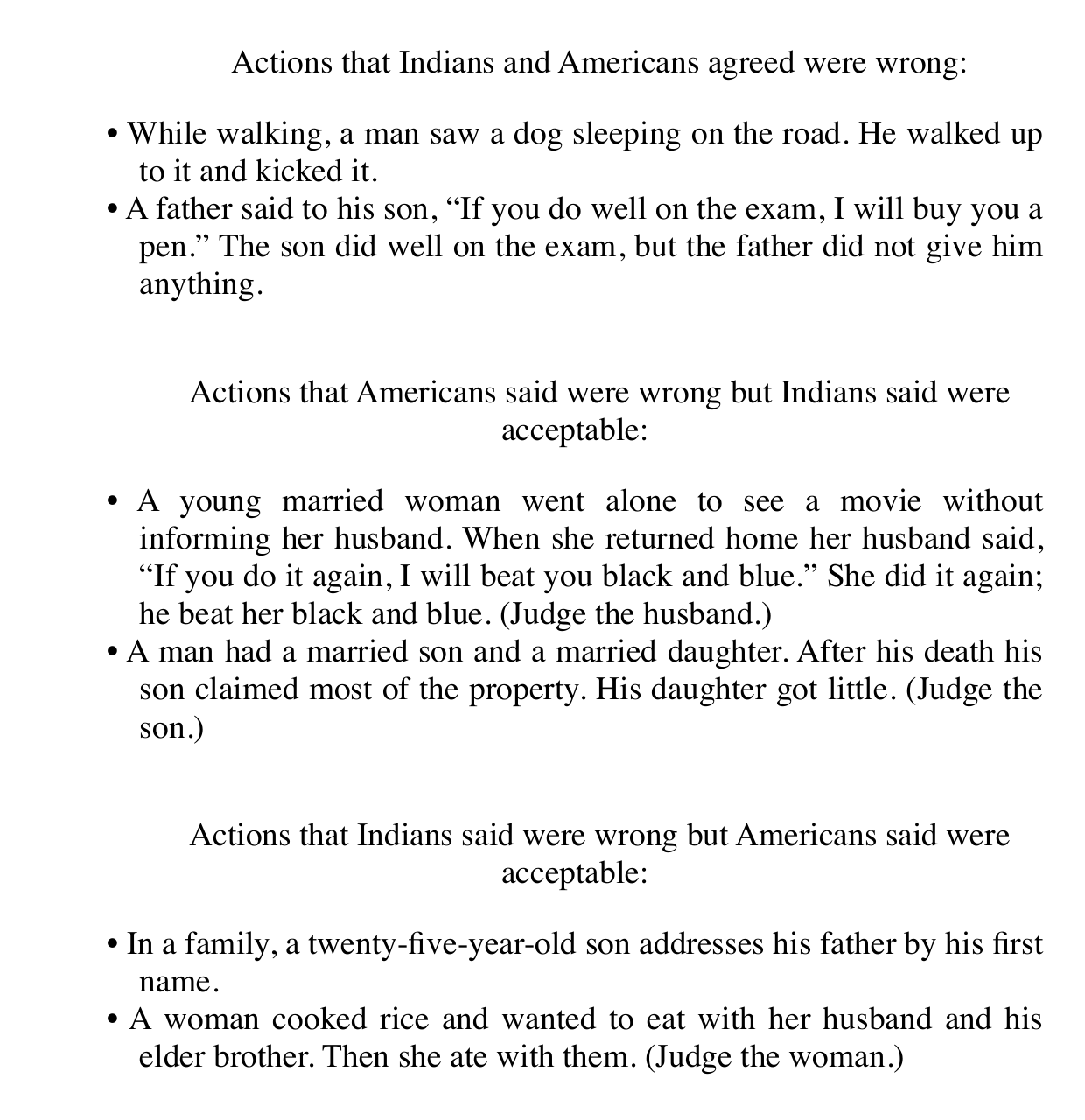
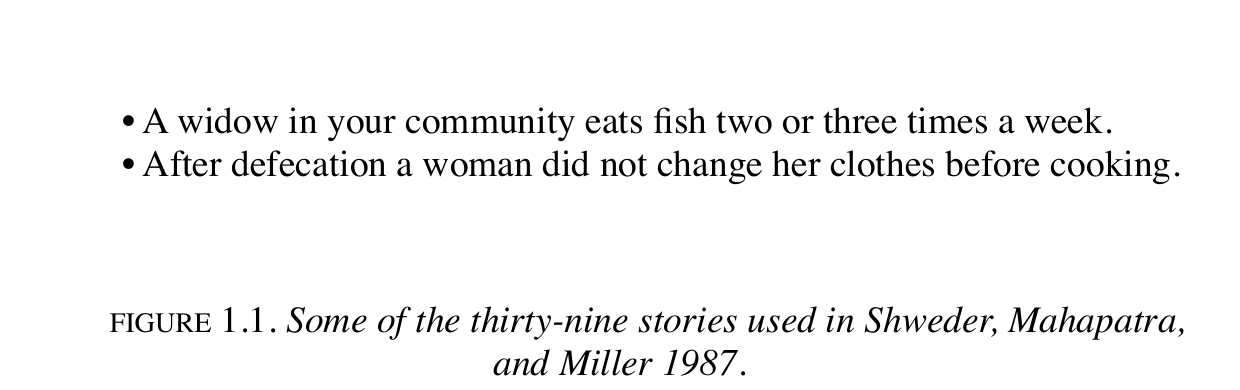
The figure spans two source pages. It contrasts agreed wrongs with cases judged differently by the American and Indian samples; it illustrates moral disagreement but does not by itself identify whether culture, factual assumptions, power, or other mechanisms caused it. Figure 1.1, part 1, PDF p. 33 (file not included in this release) · Figure 1.1, part 2, PDF p. 34 (file not included in this release)
Key Concepts and Distinctions
- Moral domain: the set of actions and concerns a person treats as morally regulated rather than merely personal or conventional.
- Moral-conventional distinction: the proposed difference between rules that remain valid across authorities and places and rules contingent on a social system.
- Individualistic moral order: a moral system centered on protecting persons, rights, welfare, and freedom from interference.
- Sociocentric moral order: a moral system in which roles, relationships, institutions, and group continuity can take priority over individual preference.
- Informational assumptions: factual or metaphysical beliefs that can make an apparently harmless act appear harmful within another worldview.
- Harmless taboo violation: an artificial scenario designed to elicit disgust or disrespect while stipulating away obvious victims.
- Moral dumbfounding: continued condemnation after a person’s offered reasons have been answered or withdrawn.
- Causal priority versus normative authority: an intuition may occur first without thereby becoming correct, justified, or unrevisable.
Essential Evidence and What It Supports
- Turiel’s child interviews: support an early distinction between some harm violations and alterable conventions among the populations studied; they do not show that all morality reduces to harm. PDF pp. 26-28 (file not included in this release)
- Shweder et al.’s 600 interviews: support substantial cross-cultural differences in the scope of moralization; the hidden-harm objection remains material. PDF pp. 31-35 (file not included in this release)
- Haidt et al.’s 360 interviews: support city, class, and age variation in responses to harmless taboos, including differences that survived Haidt’s direct harm probe. PDF pp. 38-41 (file not included in this release)
- Invented-victim responses: support Haidt’s claim that justification can follow condemnation, but the book presents his qualitative reading of interview timing rather than a general measure of how all moral reasoning works. PDF pp. 42-43 (file not included in this release)
Chapter 1 Stories and Vignettes
- The dog and the chicken. Two deliberately victimless stories make readers notice the distance between disgust, degradation, and a harm-based public justification. They are experimental prompts, not descriptions of ordinary conduct. PDF pp. 18-19 (file not included in this release)
- The four-year-old interviews his father. In a McDonald’s bathroom, a child repeatedly removes the authority who might punish defecating in a sink until he asks what would happen if the whole family did it. The father still concludes that everyone would somehow get in trouble. Haidt uses the exchange to show an adult transmitting disgust and fear more than demonstrating a reasoned theory of wrongdoing. Preserved in 40 Stories. PDF pp. 40-41 (file not included in this release)
- The variation five thousand miles away was also a few blocks away. Haidt traveled to Brazil expecting national culture to dominate. In his results, social class produced a larger difference than city, and educated participants across the three cities resembled one another. The episode cautions against treating nations as internally uniform moral cultures. Preserved in 40 Stories. PDF pp. 38-40 (file not included in this release)
- Respondents invent victims for judgments already made. Participants supplied illness, offended neighbors, guilt, or even clogged plumbing after condemning stipulated-harmless acts, then kept the condemnation when those victims were removed. This research vignette is preserved in 40 Stories. PDF pp. 42-43 (file not included in this release)
Evidence and Interpretation Boundaries
- Descriptive breadth is not moral validity. Showing that a concern is moralized does not show that its rule is just, true, or worthy of enforcement.
- Variation is not a proof of relativism. Different judgments can reflect culture, factual assumptions, power, development, framing, or error; psychology alone does not settle metaethics. See Moral Psychology Does Not Settle Metaethics.
- Individualism is not moral emptiness. Haidt’s Chicago respondents also universalized a moral order: one organized around individual freedom and protection from harm.
- Reason is not eliminated. The chapter shows that reasoning sometimes rationalizes; it does not show that evidence, comparison, dialogue, or reflection can never revise an intuition.
- The categories are historical research constructs. The Brazilian and American interviews date from the late 1980s and early 1990s. Their city, class, caste, and age comparisons should not be treated as timeless profiles of whole populations.
- Artificial vignettes trade realism for control. Stipulating away harm helps isolate disgust and disrespect, but respondents may reasonably suspect omitted consequences or reject the premise as socially unreal.
Chapter Conclusion and Significance
Chapter 1 replaces a simple choice among nature, nurture, and reason with a developmental interaction: human beings may begin with evaluative predispositions, cultures teach what those reactions mean and where they apply, and conscious reasoning often explains or defends judgments already felt. The chapter’s lasting contribution is not “trust the gut.” It is the warning that a theory of morality built from one educated subculture can confuse its own moral vocabulary with the structure of the human mind.
Questions for Reflection
- When a respondent invents a victim, what evidence would distinguish rationalization from a sincere but initially inarticulate perception of indirect harm?
- Does a broader moral domain enrich ethical perception, or does it enlarge the range of conduct that groups can coercively regulate?
- Which parts of an individualistic moral order should be treated as culture-specific commitments, and which can be defended as universal protections?
Chapter 2: The Intuitive Dog and Its Rational Tail
Chapter Objective and Through Line
Chapter 2 asks what normally happens first in moral judgment. Haidt contrasts Plato’s ideal of reason governing passion, Hume’s claim that reason serves the passions, and Jefferson’s picture of head and heart as co-rulers. He then argues for a social-intuitionist account: automatic appraisal usually produces the judgment, conscious reasoning often arrives afterward to justify or communicate it, and interaction with other people is a major route by which judgments change. Chapter opening, PDF pp. 45-48 (file not included in this release) · Chapter conclusion, PDF pp. 70-71 (file not included in this release)
The claim is intuitive primacy, not intuitive dictatorship. Haidt retains pathways for reasoned judgment, private reflection, and interpersonal persuasion. His own endnote concedes that the book supplied no frequency data for the two private reasoning pathways. Endnote 44, PDF p. 369 (file not included in this release)
Chapter Structure at a Glance
- Stage the rationalist-sentimentalist dispute through Plato, Hume, and Jefferson.
- Recast E. O. Wilson’s sociobiology as a challenge to moral theories detached from evolved human nature.
- Use Damasio’s lesion cases to argue that affective valuation is necessary for practical decision-making.
- Follow Haidt’s failed dual-process experiments and thirty student interviews from separate head-and-heart routes toward intuition-first judgment.
- Distinguish Howard Margolis’s “seeing-that” from “reasoning-why” through perceptual illusion and the Wason task.
- Add social influence and interpersonal reason-giving to form the social-intuitionist model.
- Derive a practical claim about persuasion: relational openness and perspective-taking often determine whether reasons reach the judgment at all.
Section-by-Section Argument
Plato, Hume, and Jefferson offer three models of the divided mind
Haidt begins with Ovid’s conflict between seeing the right and following desire, then uses Plato’s Timaeus to represent a long Western tendency to treat passion as a disorder reason should master. Hume reverses that hierarchy by making reason the servant of the passions. Jefferson’s 1786 letter to Maria Cosway supplies a third picture: his “head” calculates future pain, while his “heart” claims jurisdiction over sympathy, gratitude, friendship, and morals. Haidt calls this a Jeffersonian division of labor, while noting in the endnotes that Plato’s actual psychology was tripartite and Jefferson himself gave sentiment priority in morals. The divided mind and Plato, PDF pp. 45-46 (file not included in this release) · Jefferson’s head and heart, PDF pp. 47-48 (file not included in this release) · Endnotes 5 and 9, PDF p. 365 (file not included in this release)
Wilson’s “biologicized” ethics is an intellectual-history claim
Haidt presents Charles Darwin’s sympathy, shame, pride, and reputation as precursors to an evolved moral psychology. He then describes twentieth-century opposition to biological accounts of human nature, focusing on the controversy around E. O. Wilson’s Sociobiology. Wilson argued that philosophers may be constructing sophisticated accounts around moral intuitions produced by evolved emotional systems, and predicted a synthesis among ethics, biology, and psychology. Haidt treats Wilson as prophetic, but the section remains Haidt’s polemical history of a scientific controversy; it does not by itself show that any particular evolutionary explanation or political accusation was correct. Darwin, sociobiology, and moralism, PDF pp. 49-51 (file not included in this release)
Damasio: removing emotion does not free practical reason
Haidt summarizes Antonio Damasio’s reports of patients with ventromedial prefrontal damage. They could retain IQ, moral knowledge, and verbal reasoning while losing much emotional responsiveness and becoming unable to make sound, timely decisions in work and personal life. Haidt’s point is not merely that feelings sometimes interfere less than expected; it is that value-laden bodily and affective signals help narrow options and make reasons action-guiding. The broader evidence is more interactive than the book’s master-servant metaphor: valuation, executive control, memory, learning, and explicit knowledge all contribute. Damasio discussion, PDF pp. 52-53 (file not included in this release) · Current evidence audit
Failed tests weaken Haidt’s early dual-process model
At UVA, Haidt initially treated emotion and reasoning as independent routes to moral judgment. He tried to weaken deliberate reasoning with a seven-digit memory load instead of one digit and with forced speed instead of a ten-second delay. He reports no judgment difference across those conditions and says he obtained the same result with different stories. These failures moved him away from a Jeffersonian co-ruler model, but the endnote says the null results were never published; they should be treated as a narrated research reversal, not a general effect estimate. Cognitive-load design, PDF pp. 54-55 (file not included in this release) · Endnote 26, PDF p. 367 (file not included in this release)

Figure 2.1 — Haidt’s early Jeffersonian model gives emotion and reasoning separate routes into moral judgment, with a possible return path from judgment to reasoning. Figure 2.1, PDF pp. 54-55 (file not included in this release)
Thirty interviews distinguish preference from moral dumbfounding
Scott Murphy interviewed thirty UVA students about five scenarios. The Heinz dilemma produced defensible reasons on both sides. A sterilized-roach drink and a plainly nonbinding $2 soul-sale produced strong refusals, including among some atheists, but participants could treat those refusals as personal preference. The Julie-and-Mark incest vignette and Jennifer’s cadaver-eating vignette instead elicited moral condemnation that often survived the loss of each offered reason. Only 20% accepted the incest case and 13% accepted the cadaver case. Haidt reports that, compared with Heinz, participants in the taboo interviews were almost twice as likely to say “I don’t know,” ten times as likely to say they could not explain themselves, and 70% more likely to abandon an argument midstream. Five scenarios and initial refusals, PDF pp. 55-56 (file not included in this release) · Taboo cases and interview transcript, PDF pp. 57-59 (file not included in this release) · Endnotes 28-30, PDF pp. 367-368 (file not included in this release)
The numerical result is narrow: a small, artificial, unpublished interview study supports the existence of some verdict-first reasoning episodes. It does not show that all moral judgments are intuitive, that the taboo verdicts were correct, or that better reasons could never change them. The experimenter also stopped willing participants before anyone actually drank the roach-touched juice. Moral dumbfounding source note
“Seeing-that” and “reasoning-why” replace emotion versus cognition
Howard Margolis distinguished rapid pattern recognition from conscious explanation. The Müller-Lyer illusion shows an appearance persisting after a person learns the lines are equal. The Wason four-card task shows the pull of matching a vowel to an even number even though falsifying the conditional requires checking E and 7, not E and 4. Haidt uses these examples to argue that a judgment and its later justification can be separate processes. He then sharpens the terminology: emotion is itself information processing, many intuitions are not full emotions, and the more useful contrast is automatic intuition versus conscious reasoning. Margolis and pattern matching, PDF pp. 60-62 (file not included in this release) · Emotion, cognition, intuition, and reasoning, PDF pp. 64-65 (file not included in this release)
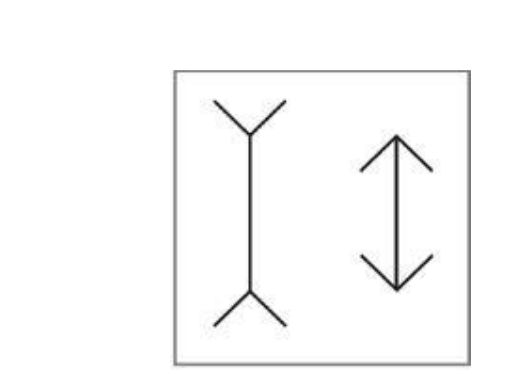
Figure 2.2 — The Müller-Lyer illusion: knowing the two lines are equal does not erase the visual appearance. Figure 2.2, PDF p. 61 (file not included in this release)
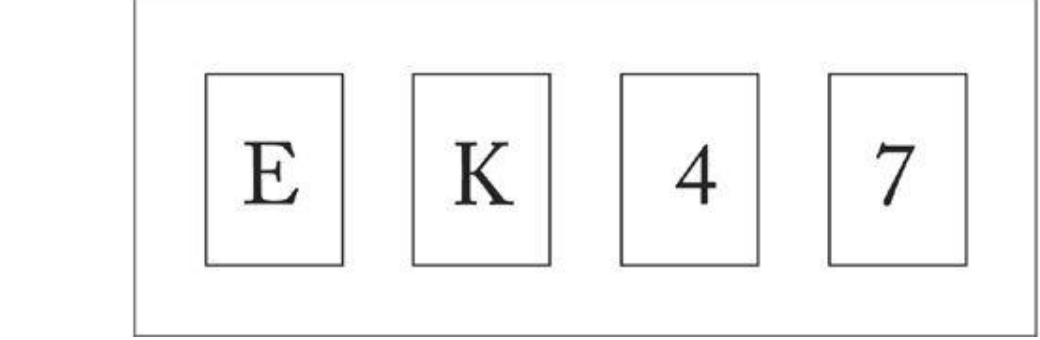
Figure 2.3 — The Wason task: testing the conditional requires turning over E and 7; 4 can confirm but cannot falsify it. Figure 2.3, PDF p. 61 (file not included in this release)
The rider is a planner and spokesperson, not a useless passenger
Haidt’s elephant comprises automatic processes, including emotion, intuition, and “seeing-that”; the rider comprises controlled, language-based reasoning. The elephant normally sets direction, but the rider can anticipate futures, learn skills, use technology, formulate explanations, and represent the person socially. The metaphor therefore warns against equating eloquent reasons with causal origins without reducing reasoning to epiphenomenal noise. Rider and elephant, PDF pp. 64-66 (file not included in this release)
The social-intuitionist model adds correction through other minds
Figure 2.4 gives the chapter its durable model. A triggering event produces A’s intuition; intuition produces judgment (link 1); judgment prompts reasoning (link 2). A’s reasons can alter B’s intuition (link 3), while A’s expressed judgment and social stance can influence B without an explicit argument (link 4). Independently reasoned judgment (link 5) and private reflection generating a new intuition (link 6) are retained as dotted pathways. Haidt’s strongest practical implication is that people often supply one another with the disconfirming reasons they are poor at generating for themselves. The six-link model, PDF pp. 66-67 (file not included in this release)
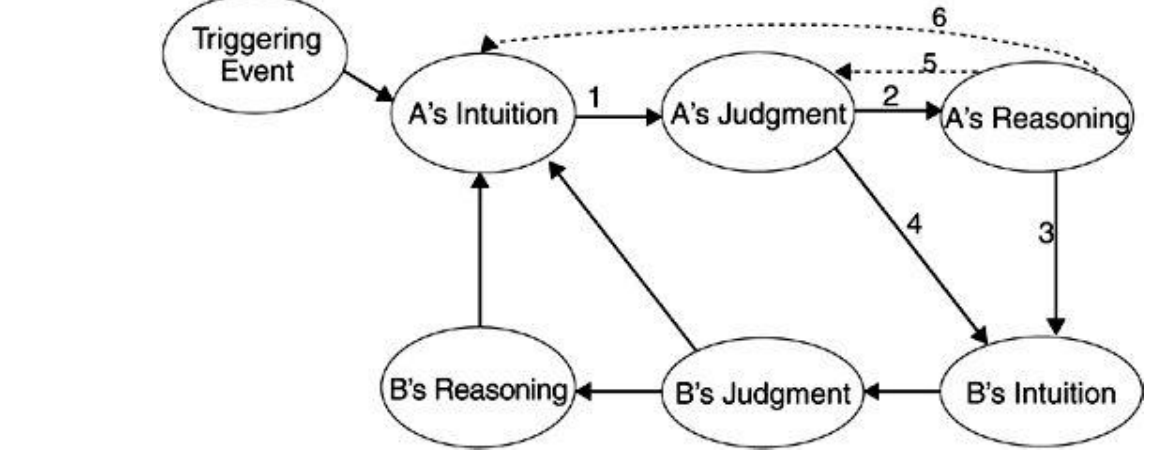
Figure 2.4 — The social-intuitionist model: judgment and justification are usually intuition-led, but social exchange and occasional private reflection can produce revision. Figure 2.4, PDF p. 66 (file not included in this release)
The source contains a small labeling inconsistency. The figure and the preceding prose map link 3 to reasoned persuasion and link 4 to social persuasion. The later Dale Carnegie paragraph reverses those names. The arrows and initial definitions provide the consistent interpretation used here. Later reversed labels, PDF p. 68 (file not included in this release)
“Talk to the elephant” means establish access for reasons
Haidt argues that direct refutation often leaves the intuitive verdict intact and merely destroys one defense. He uses Dale Carnegie’s advice—begin warmly, listen, avoid opening with “you’re wrong”—to emphasize social access. Perspective-taking can change what the other person’s case looks like, and sincere empathy can also open the persuader to revision. The defensible lesson is not to replace evidence with emotional manipulation. It is to combine respect, accurate understanding, and reasons that make a neglected feature salient. Argument and relational access, PDF pp. 68-69 (file not included in this release)
Key Concepts and Distinctions
- Rationalist delusion: Haidt’s name for treating conscious reason as the sovereign and normally sufficient source of moral judgment.
- Seeing-that: rapid, automatic pattern recognition whose product becomes conscious without the generating process becoming transparent.
- Reasoning-why: language-based explanation and justification, especially for oneself or another person.
- Intuition: an effortless evaluative output; it can include emotion but need not become a full emotional episode.
- Post hoc reasoning: reasons generated after judgment, potentially to defend, explain, or persuade rather than reconstruct the judgment’s cause.
- Social persuasion: another person’s stance, relationship, or approval changes an intuition without an explicit argument.
- Reasoned persuasion: another person’s reasons make the case appear differently and thereby alter intuition or judgment.
- Intuitive primacy, not dictatorship: intuition is commonly first, but reasons, reflection, evidence, and other minds can still change the verdict.
Essential Evidence and What It Supports
- Damasio’s lesion cases: support the importance of affective valuation for practical decision-making; they do not prove that emotion alone decides or that verbal reason never changes action. PDF pp. 52-53 (file not included in this release)
- Haidt’s cognitive-load and timing studies: are reported null results that helped change his model; the book says they were unpublished, so they are not a secure general estimate. PDF pp. 54-55 (file not included in this release) · Endnote 26, PDF p. 367 (file not included in this release)
- Thirty extended interviews: support the occurrence of moral dumbfounding under contrived taboo conditions; small size, artificiality, and unpublished status limit generalization. PDF pp. 55-59 (file not included in this release)
- Müller-Lyer and Wason examples: clarify the conceptual separation between appearance or judgment and later explanation; they are analogies and evidence from nonmoral cognition, not direct proof of every moral sequence. PDF pp. 60-63 (file not included in this release)
- Figure 2.4: states a causal model of moral exchange; the chapter provides mechanisms and illustrations but no frequency estimates for all six pathways. PDF pp. 66-67 (file not included in this release) · Endnote 44, PDF p. 369 (file not included in this release)
Chapter 2 Stories and Vignettes
- Jefferson’s head and heart debate after Maria Cosway leaves. A love letter turns personal conflict into a dialogue between calculation and sentiment. Preserved in 40 Stories. PDF pp. 47-48 (file not included in this release)
- Damasio’s patients retain reasons but lose practical judgment. Preserved in 40 Stories. PDF pp. 52-53 (file not included in this release)
- Failed experiments dismantle Haidt’s preferred model. Memory load and response delay repeatedly failed to produce the expected change, pushing him toward a new account despite tenure pressure. Preserved in 40 Stories. PDF pp. 54-55 (file not included in this release)
- Thirty students face a sterile cockroach, a soul-sale, and taboo judgments. Their behavior separates unexplained personal refusal from condemnation that demands a public reason. Preserved in 40 Stories. PDF pp. 55-59 (file not included in this release)
Evidence and Interpretation Boundaries
- Causal order is not normative authority. A judgment’s arriving first does not make it true, justified, or unrevisable.
- The chapter’s strongest original experiments are limited. The cognitive-load findings and thirty-person interview study were unpublished; later evidence would be needed to estimate prevalence and effect size.
- Metaphors simplify interacting systems. “Rider and elephant,” “head and heart,” and “servant and master” illuminate asymmetry but can hide recurrent interaction among valuation, memory, control, language, and social cognition.
- Private reasoning is disputed, not deleted. Haidt drew links 5 and 6 as uncommon, then acknowledged he had no daily-life frequency evidence for that claim.
- Analogy is not identity. A taboo reaction can persist like an optical illusion, but moral judgment includes concepts, facts, relationships, learned norms, and claims over other people that visual perception does not.
- Persuasion can be ethical or manipulative. Relational warmth should create fair hearing for evidence, not substitute affiliation or pressure for truth.
Cross-Vault Integration
- The Social Intuitionist Model of Moral Judgment is the permanent model note, including the six links, source inconsistency, evidence limits, and practical use.
- Intuition Is Evidence, Not a Verdict converts intuitive primacy into an audit rather than a command.
- Moral Psychology Does Not Settle Metaethics blocks the inference from causal genealogy to moral truth or falsity.
- Moral Judgment Argument Map uses other minds as an adversarial check within reflective judgment.
- Social Incentives Dictate Beliefs and Persuasion apply the model to reputation, defensive reasoning, listening, and perspective-taking.
Chapter Conclusion and Significance
Chapter 2’s lasting contribution is a network model of moral revision. The isolated thinker is poor at distinguishing discovery from advocacy, but people can expose one another’s blind spots and offer reasons that change the perceived shape of a problem. That supports neither blind trust in intuition nor a counsel of despair about reason. It supports institutional and conversational practices that diversify evidence, reduce identity threat, force reciprocal comparison, and make revision socially possible.
Questions for Reflection
- What evidence would distinguish a reason that merely defends an intuition from a reason that accurately articulates an initially tacit moral perception?
- Which relationships, procedures, or institutions make interpersonal correction more likely without turning consensus into a proxy for truth?
- If private reflection is more common than Haidt suspected, which parts of the social-intuitionist model change, and which remain intact?
Chapter 3: Elephants Rule
Chapter Objective and Through Line
Chapter 3 supplies the evidence Haidt thinks supports the first half of his first principle: intuitions come first. He moves from a domestic episode of instant self-justification to six research programs involving affect, political perception, bodily state, psychopathy, infancy, and moral neuroscience. The common claim is causal and temporal: evaluation often begins before conscious, language-based reasoning has finished—or even started—its work. Chapter opening, PDF pp. 72-74 (file not included in this release) · Chapter summary, PDF pp. 92-93 (file not included in this release)
The chapter also states an essential limit: intuitive primacy is not intuitive dictatorship. The rider can reject an impossible defense, another person’s reasons can change what the case looks like, conflicting intuitions can alternate, and delayed reflection can sometimes make a strong argument matter. Chapter 3 therefore strengthens the asymmetric model from Chapter 2 without reducing reason to decorative narration. Reason and social revision, PDF pp. 89-91 (file not included in this release)
Chapter Structure at a Glance
- Catch the inner lawyer fabricating a defense and induce condemnation with a hypnotic disgust cue.
- Define affective primacy through Wundt, Zajonc, and the mere-exposure effect.
- Apply rapid evaluation to implicit associations, partisan cues, faces, and elections.
- Ask whether odors, tastes, and cleanliness can leak into moral judgment.
- Contrast intact strategic reasoning with impaired moral emotion in Haidt’s account of psychopathy.
- Use infant helper-hinderer studies as evidence of early social evaluation.
- Use trolley-dilemma neuroimaging to connect affective timing with later judgment.
- Restore reason’s limited but real role through friendly discussion, competing intuitions, and delayed reflection.
Section-by-Section Argument
A dirty counter exposes the inner lawyer
Haidt recounts answering his wife’s polite request about dirty dishes before she had finished speaking. He fused breakfast, childcare, and walking the dog—events that had occurred at different times—into one exculpatory story. Because he happened to be writing about post hoc justification, he noticed the sequence: aversion to criticism arrived first, a defense formed next, and the resulting account felt true to both speakers. The anecdote illustrates introspective opacity; it does not establish how often every person’s reasoning works this way. Dirty-dishes episode, PDF pp. 72-74 (file not included in this release)
The paired Wheatley-Haidt experiment used highly hypnotizable introductory-psychology students. Participants were conditioned to feel disgust when encountering “take” or “often,” then judged six moral-violation stories and a neutral story about student-council president Dan. The trigger increased condemnation across the moral stories; about one-third of triggered participants also condemned Dan and supplied explanations despite the absence of a stipulated violation. Haidt treats the invented reasons as a controlled demonstration of judgment recruiting justification, but the selected sample and unusual hypnosis procedure limit generalization. Hypnosis study, PDF pp. 72-74 (file not included in this release) · Endnotes 3-4, PDF p. 370 (file not included in this release)
Affective primacy narrows what later thought considers
Haidt revives Wilhelm Wundt’s term affective primacy for rapid positive or negative evaluations that prepare approach or avoidance. Robert Zajonc’s mere-exposure experiments are the central example: repeated exposure could increase liking even when participants could not consciously identify the earlier stimulus. Haidt’s interpretation is that affect arrives as part of perception, motivates behavior, and narrows the alternatives later thought takes seriously. “Affect” here is broader than a full emotion; it includes brief valenced reactions too small to become anger, happiness, or disgust. Affective primacy, PDF pp. 75-76 (file not included in this release) · Mere-exposure endnotes, PDF p. 371 (file not included in this release)
Political judgment begins before explicit argument
Affective-priming tasks exploit the fraction of a second in which one stimulus facilitates or obstructs evaluation of the next. Haidt connects this work to the Implicit Association Test and to brain-wave studies in which partisan terms rapidly produced affective congruence or conflict. The defensible conclusion is that learned group and political associations can shape processing very quickly—not that a reaction-time score reveals a person’s essence, proves conscious prejudice, or determines a later choice. Affective and partisan priming, PDF pp. 77-78 (file not included in this release) · Endnotes 12-15, PDF p. 371 (file not included in this release)
Alexander Todorov’s work sharpened the political application. Participants shown paired photographs of U.S. congressional candidates, without party information, picked the eventual winner as more competent about two-thirds of the time; a follow-up reported similar prediction after a tenth-second exposure. Haidt uses this to show the speed of social evaluation. It does not show that faces reveal actual competence or that the snap judgment caused the election outcome. The source says recognizable candidates were excluded and the follow-up addressed incumbency, but other campaign and appearance variables can still matter. Candidate-face studies, PDF p. 79 (file not included in this release) · Endnotes 18-19, PDF p. 372 (file not included in this release)
Bodily states can be mistaken for information about the case
Haidt links the insula’s roles in taste, disgust, and responses to unfairness to experiments in which irrelevant bodily cues allegedly changed moral evaluation. In Alex Jordan and Simone Schnall’s field study, passersby standing near a trash can made harsher judgments when the bag had been sprayed with a foul odor. The endnote reports that all four comparisons moved in the predicted direction but not every individual comparison was statistically significant; the combined effect was reported as p < .001. Haidt also cites bitter-versus-sweet drinks, handwashing, transgression-induced cleansing, and proximity to hand sanitizer as evidence that “affect as information” can misattribute a bodily state to the target under judgment. Odor and bodily influence, PDF pp. 80-81 (file not included in this release) · Endnotes 21-27, PDF pp. 372-373 (file not included in this release)
These embodied and cleanliness-priming studies are source-dated claims from literature available to Haidt before the book’s publication. They belong in a current replication audit, not in the vault as settled general laws. Their durable conceptual lesson is narrower: before treating a strong feeling as evidence about an act or person, ask whether the feeling has an irrelevant environmental or bodily source.
Psychopathy and infancy separate reasoning from moral evaluation
Haidt uses Robert Hare’s clinical portrait of psychopathy to argue that strategic reasoning can remain effective while guilt, compassion, shame, and responsiveness to another person’s distress are impaired. Ted Bundy’s crisis-hotline work supplies the disturbing narrative example: social understanding can be used instrumentally rather than morally. The section supports Haidt’s claim that propositional reasoning is not sufficient for ordinary moral competence, but its prevalence, heritability, neural, and causal statements are broad, source-dated clinical claims that require current specialist evidence before reuse as present consensus. Psychopathy discussion, PDF pp. 82-83 (file not included in this release) · Endnotes 28-32, PDF p. 373 (file not included in this release)
Kiley Hamlin, Karen Wynn, and Paul Bloom showed six- and ten-month-old infants a “climber” helped uphill by one shape and pushed down by another. Infants later tended to reach for the helper. Haidt interprets this as social evaluation before language and explicit moral reasoning. The endnote is more precise than the chapter’s shorthand: longer looking at the climber’s approach to the hinderer was found in the ten-month-olds but not the six-month-olds, while the reaching preference appeared in both groups. Preference for a helper is evidence of early social evaluation, not a complete innate moral theory. Helper-hinderer study, PDF pp. 84-85 (file not included in this release) · Endnotes 35-38, PDF p. 373 (file not included in this release)
Moral neuroscience locates a response but cannot validate it
Joshua Greene and Jonathan Cohen presented eighteen participants with personal- and impersonal-harm dilemmas while recording fMRI activity. Haidt reports greater activity in emotion-associated regions for direct personal harms such as pushing a person from a footbridge, with the relative strength of affective response associated with judgments across the scenarios. This supports a descriptive claim about different processing profiles; it does not prove that deontology is mere feeling, that utilitarianism is pure reason, or that neural activation settles which action is right. Trolley study and design, PDF pp. 86-88 (file not included in this release)
The chapter’s endnote records a material correction: the original report that utilitarian answers took longer, as if reason were overcoming emotion, was later argued to be an artifact of the chosen stories rather than a general principle. Haidt cites both the challenge and Greene’s response. This is precisely why reaction time, activation, and philosophical justification must remain separate evidentiary levels. Endnote 41, PDF p. 374 (file not included in this release)
Elephants can listen when conditions change
Haidt replaces Hume’s slave metaphor with a lawyer-client relationship. The rider usually serves the first evaluation, yet can refuse an impossible or self-destructive instruction. Friendly interlocutors matter because affection, admiration, or trust reduces defensive counterargument and makes another person’s evidence easier to consider. Solitary revision is also possible when a case supports incompatible intuitions, much as the same Necker cube can be seen in two orientations. Revision through people and reflection, PDF pp. 89-90 (file not included in this release)
Joe Paxton, Leo Ungar, and Joshua Greene supplied Harvard students with either a weak or stronger defense of the Julie-and-Mark case. When participants answered immediately, argument quality made no difference. When a computer required a two-minute delay, the weak argument still failed but the stronger argument produced substantially more tolerant judgments. Haidt takes this as rare experimental evidence that reflection can reverse an initial response. The book cites the paper as “forthcoming,” so the chapter establishes how Haidt interpreted the result at publication—not its current evidentiary status. Delayed-reflection study, PDF pp. 90-91 (file not included in this release) · Endnotes 47-48, PDF p. 374 (file not included in this release)
Figure
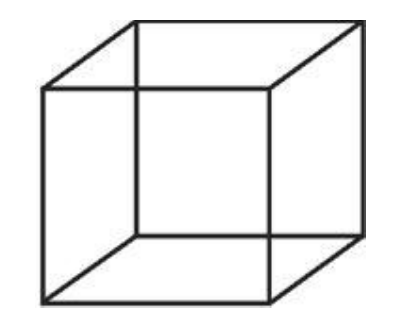
Figure 3.1 — A Necker cube can alternate between two coherent orientations, illustrating how a moral case may support competing intuitions that are difficult to experience simultaneously. The analogy shows reversible framing, not that moral disagreement is merely visual illusion. Figure 3.1, PDF p. 90 (file not included in this release)
Key Concepts and Distinctions
- Affective primacy: rapid positive or negative evaluation is integrated with perception and can guide what receives attention before explicit reasoning is complete.
- Affect versus emotion: affect includes brief valenced signals; a full emotion is a larger, named response such as disgust, anger, or compassion.
- Mere-exposure effect: repeated contact can increase liking even without a conscious reason for the preference.
- Affective priming: one cue temporarily facilitates congruent evaluations and slows conflicting ones.
- Affect as information: a person may treat a feeling as evidence about the target even when an irrelevant odor, taste, or bodily state helped cause it.
- Descriptive neuroscience versus normative ethics: neural location and timing can illuminate how a judgment forms but cannot decide whether the judgment is justified.
- Intuitive primacy, not dictatorship: the first response has causal leverage, yet social exchange, competing intuitions, and deliberate delay can enable revision.
Essential Evidence and What It Supports
- Hypnotically induced disgust: supports the possibility that an extraneous negative cue can intensify condemnation and recruit reasons; highly hypnotizable students and an unusual procedure limit generalization. PDF pp. 72-74 (file not included in this release) · Endnote 4, PDF p. 370 (file not included in this release)
- Mere exposure and affective priming: support rapid evaluation and carryover from a prior cue; they do not show that every later belief is fixed by the cue. PDF pp. 75-78 (file not included in this release)
- Todorov’s candidate faces: support fast impressions that predicted winners above chance in the studied races; prediction is not actual competence or proof of a causal voting mechanism. PDF p. 79 (file not included in this release)
- Odor and cleanliness studies: supply source-era evidence that irrelevant bodily states can move judgment; the claims require a contemporary replication review before being treated as robust effects. PDF pp. 80-81 (file not included in this release) · Endnotes 22-27, PDF pp. 372-373 (file not included in this release)
- Helper-hinderer infants: support early social evaluation, with different age results for looking time and reaching; they do not establish a mature moral faculty. PDF pp. 84-85 (file not included in this release) · Endnote 36, PDF p. 373 (file not included in this release)
- Greene’s eighteen-person fMRI study: supports differing affective engagement across personal- and impersonal-harm dilemmas; its original reaction-time inference was later challenged, and activation cannot arbitrate ethical truth. PDF pp. 86-88 (file not included in this release) · Endnote 41, PDF p. 374 (file not included in this release)
- Two-minute reflection: supports the conditional possibility of reasoned revision when delay outlasts the first affective lean and the argument is substantive; the source cites the paper as forthcoming. PDF pp. 90-91 (file not included in this release)
Chapter 3 Stories and Vignettes
- Haidt catches his inner lawyer inventing an alibi. The ordinary dish-counter dispute becomes an unusually well-timed act of introspection. Preserved in 40 Stories. PDF pp. 72-74 (file not included in this release)
- A hypnotic word makes innocent Dan seem wrong. An induced flash of disgust elicits condemnation and invented explanations in part of a selected sample. Preserved in 40 Stories. PDF pp. 72-73 (file not included in this release)
- A perfumed trash can makes judgments harsher. A foul odor at a pedestrian intersection becomes a research test of affect misattribution. Preserved in 40 Stories. PDF pp. 80-81 (file not included in this release)
- Babies prefer the helper to the hinderer. Puppet events reveal early social evaluation while the endnote preserves different looking-time and reaching results by age. Preserved in 40 Stories. PDF pp. 84-85 (file not included in this release)
- Two minutes of reflection let a strong argument through. Immediate respondents treat strong and weak defenses alike; a delay creates room for the better argument to change some judgments. Preserved in 40 Stories. PDF pp. 90-91 (file not included in this release)
Evidence and Interpretation Boundaries
- Chronology is not authority. A fast response may register expertise, bias, learned value, threat, disgust, or framing; arriving first does not make it correct.
- Several examples are source-dated single studies. The bodily and cleanliness-priming claims especially need present-day replication review before publication or policy use.
- Selected and small samples matter. The hypnosis study selected highly hypnotizable students; Greene’s original fMRI study used eighteen participants.
- The endnotes materially qualify the prose. Infant results differed by measure and age; not every odor-study comparison was individually significant; the original trolley reaction-time result was later challenged.
- Clinical shorthand is not a diagnosis. Haidt’s psychopathy discussion cannot be used to identify a person, explain every antisocial act, or substitute for current clinical criteria and evidence.
- Brain activity does not decide ethics. Describing correlates of a deontological or utilitarian response neither validates nor debunks the associated moral theory.
- Reflection works conditionally. The chapter’s strongest correction example required a substantive argument and a forced delay; weak reasoning did not improve merely because more time passed.
Cross-Vault Integration
- Affective Primacy in Moral and Political Judgment is the permanent concept note connecting the six evidence routes, correction conditions, and replication cautions.
- The Social Intuitionist Model of Moral Judgment now carries Chapter 3’s empirical test map and the delayed-reflection exception.
- Intuition Is Evidence, Not a Verdict converts affective primacy into an audit for source, framing, and bodily contamination.
- Cognitive Biases and Information Evaluation applies the chapter to evidence architecture and cooling-off procedures.
- Replication Crisis records the chapter’s own qualifications and routes older priming claims into a current evidence audit.
- The Political Brain receives the partisan-cue and candidate-face evidence with its causal limits.
- Utilitarianism and Moral Psychology Does Not Settle Metaethics preserve the boundary between trolley neuroscience and normative conclusions.
- Your Moral Intuitions Need a Constitution now has both a rationalization case and a reasoned-revision case for the article’s central objection.
Chapter Conclusion and Significance
Chapter 3’s strongest contribution is not the slogan that emotion defeats reason. It is an evidence-and-correction model: evaluation begins early, shapes attention, and can recruit a defense, so disciplined judgment should identify the first lean, test whether its source belongs to the case, and create conditions in which strong counterevidence can survive long enough to be considered. The reason-friendly ending is indispensable. A person can be moved by another mind, can alternate between competing construals, and can sometimes revise after deliberate delay. The elephant usually moves first; the practical task is to improve what it encounters and how the rider reviews the route.
Questions for Reflection
- Which features of an initial reaction are evidence about the case, and which indicate only the judge’s bodily state, familiarity, identity, or framing?
- What conversational or institutional conditions let a strong counterargument outlast defensive affect without turning delay itself into a ritual of rationalization?
- How should confidence change when a memorable psychological claim comes from a selected sample, a small neuroimaging study, or a source-dated priming literature whose current replication status has not been checked?
Chapter 4: Vote for Me (Here’s Why)
Chapter Objective and Through Line
Chapter 4 completes Haidt’s first principle by explaining what strategic reasoning second means. Plato’s Republic supplies the dispute. Socrates tries to show that being just is better than merely seeming just; Glaucon’s Ring of Gyges asks whether justice survives when reputation and punishment disappear. Haidt sides with Glaucon’s psychological suspicion: people are profoundly sensitive to how they appear, and explicit reasoning often helps a person justify an intuitive position to allies, audiences, and the self. Glaucon, Plato, and the chapter thesis, PDF pp. 94–97 (file not included in this release)
The chapter is not a case for abandoning reason. Its practical conclusion is social and institutional. A lone reasoner is skilled at defending a favored position; a well-designed group can make those one-sided skills collide, correct, and aggregate into better judgment. Accountability helps only under particular conditions, and reputational pressure can otherwise intensify conformity. Haidt therefore moves from a psychology of rationalization to a design problem: arrange incentives, audiences, diversity, and review so that people must answer serious criticism before error becomes power. Intuitive politicians and accountability, PDF pp. 97–100 (file not included in this release) · Social correction and institutional design, PDF pp. 113–116 (file not included in this release)
Chapter Structure at a Glance
- Recast Plato’s dispute as a conflict between reason-governed virtue and Glauconian reputation management.
- Use Tetlock’s “intuitive politician” to explain reasoning inside webs of accountability.
- Distinguish exploratory from confirmatory thought and identify the three conditions under which accountability can improve inquiry.
- Treat self-esteem as a partly unconscious “sociometer” tracking relational value.
- Develop the rider-as-press-secretary model through confirmation bias, evidence selection, and my-side reasoning.
- Show how invisibility and plausible deniability can permit cheating without surrendering a self-image of honesty.
- Explain motivated reasoning through the asymmetry between desired and undesired conclusions.
- Move from individual desire to group identity, attitude polarization, and partisan defense.
- Reject individual rationalism as a sufficient moral technology and propose diverse, accountable institutions and path design instead.
Section-by-Section Argument
Glaucon turns virtue into an accountability problem
The opening coin flip separates reality from reputation: would a person prefer genuine virtue accompanied by universal suspicion, or concealed corruption accompanied by universal praise? Haidt presents Plato as choosing the first and Glaucon as insisting that the harder psychological question is whether people value justice itself or its social rewards. The Ring of Gyges removes observation and punishment so that knowledge of the right cannot be confused with an incentive to do it. Ring of Gyges and Plato’s response, PDF pp. 94–96 (file not included in this release)
Haidt then applies William James’s functionalist question: what does moral reasoning do in the larger social system? His answer is an evolutionary interpretation, not a direct experimental result: reasoning was shaped substantially for justification, persuasion, alliance, and reputation management. The durable insight does not require accepting the strongest adaptation claim. Even if multiple functions coexist, a reason can serve both truth and social strategy, so its validity must be assessed independently of the speaker’s sincerity. Functionalism and Haidt’s Glauconian hypothesis, PDF pp. 96–97 (file not included in this release) · Endnotes 5–7, PDF p. 375 (file not included in this release)
Accountability can produce inquiry or better rationalization
Phil Tetlock defines accountability as the expectation that one will have to justify beliefs, feelings, or actions to others who can reward or punish the justification. In Haidt’s summary, knowing in advance that an explanation will be required can reduce premature closure and increase attention to evidence. But “more careful thought” divides into two kinds: exploratory thought, which considers rival views evenhandedly, and confirmatory thought, which builds the strongest defense of a preferred view. Accountability and intuitive politicians, PDF pp. 97–99 (file not included in this release)
Accountability increases exploratory thought only when three conditions coincide:
- the person learns before forming an opinion that an account will be required;
- the audience’s own position is unknown;
- the audience is believed to be informed and accuracy-seeking.
If the audience’s desired answer is visible, reputational pressure can make the press secretary work harder for that answer. The implication is sharper than “hold people accountable”: design an audience and procedure that reward accurate updating, disclose conflicts, and prevent the decision-maker from simply anticipating the tribe’s applause. Exploratory versus confirmatory accountability, PDF pp. 99–100 (file not included in this release) · Endnotes 8–14, PDF p. 376 (file not included in this release)
The sociometer registers judgment before the self-description does
Mark Leary’s sociometer theory treats self-esteem as an internal gauge of relational value rather than a self-contained need to admire oneself. Haidt recounts a study that selected students who repeatedly denied caring what others thought. While they spoke into a microphone, rigged listener ratings rose or fell on a screen. Declining ratings lowered the self-esteem of both confessed approval-seekers and self-described mavericks. Haidt uses the result to argue that reputation sensitivity can operate outside accurate introspection. Sociometer setup, PDF p. 100 (file not included in this release) · Rigged ratings and result, PDF p. 101 (file not included in this release)
The chapter does not report the selected groups’ sizes or effect estimates, and the claim that psychopaths are the only people without a sociometer is far broader than this experiment establishes. The defensible conclusion is narrower: self-report may understate a person’s sensitivity to acceptance, rejection, shame, and status. Endnotes 15–17, PDF p. 376 (file not included in this release)
The press secretary confirms; intelligence expands the brief
Haidt’s central metaphor is the in-house press secretary. The elephant supplies a position, and the rider looks for evidence and language that will make it defensible. Peter Wason’s 2–4–6 task supplies the cleanest example. Participants repeatedly proposed sequences compatible with their first rule and rarely tested a sequence designed to prove that rule wrong. Deanna Kuhn’s food-and-illness cards extend the pattern: children and adults privileged a few chocolate-cake cases that supported their hunch even when the larger pattern implicated carrot cake. Press secretary and 2–4–6 task, PDF pp. 102–103 (file not included in this release) · Kuhn’s evidence cards, PDF pp. 103–104 (file not included in this release)
David Perkins asked participants to generate reasons on both sides of social issues. More educated and higher-IQ participants produced more arguments, but IQ principally predicted my-side arguments, not more reasons for the opposing case. Haidt takes this to mean that cognitive ability can increase advocacy without increasing evenhandedness. Because the schooling comparison described here is cross-sectional, it cannot by itself prove that education never improves reasoning; it does undermine the assumption that intelligence or years of schooling automatically create active disconfirmation. Perkins and my-side reasoning, PDF pp. 104–105 (file not included in this release) · Endnotes 18–21, PDF p. 376 (file not included in this release) · Endnote 22, PDF p. 377 (file not included in this release)
Plausible deniability lets dishonesty coexist with an honest self-image
The 2009 British parliamentary-expenses leak functions as a political Ring of Gyges: hidden claims and permissive approval created room for lavish renovations and property “flipping.” Haidt then turns to ordinary participants. In one payment study, only 20 percent corrected an unnoticed overpayment; when the cashier directly asked whether the amount was correct, 60 percent returned the excess. A direct question did not make dishonesty impossible, but it removed the excuse that the person had simply failed to notice. MP expenses and cashier overpayment, PDF p. 105 (file not included in this release) · Endnotes 23–25, PDF p. 377 (file not included in this release)
Dan Ariely’s cheating studies add the self-image constraint. Haidt reports that many participants overstated their math performance, but usually by a modest amount rather than the maximum possible. His interpretation is that people cheat up to the point where an inner lawyer can still preserve “I am honest.” The studies support conditional behavior under designed opportunities, not the universal conclusion that everyone cheats or that self-justification is the only mechanism. Ariely’s cheating paradigm, PDF p. 106 (file not included in this release) · Endnotes 26–27, PDF p. 377 (file not included in this release)
Desired and undesired claims face different burdens
Haidt’s story about his three-year-old son Max turns a wording change into a model of motivated cognition. “Must” made even ice cream feel like a constraint; “can” immediately made it desirable. Tom Gilovich’s more general formulation is that desired conclusions invite the question “Can I believe it?”, for which one supporting consideration can grant permission, while unwelcome conclusions face “Must I believe it?”, for which one objection can permit dismissal. Max and asymmetric standards, PDF p. 107 (file not included in this release)
The cited examples vary the threatened interest: a low intelligence-test score, a caffeine-and-cancer claim relevant to heavy coffee drinkers, a supposed enzyme-deficiency test, and an ambiguous image seen as a letter or number depending on the promised reward. The general lesson is not that evidence never persuades, but that ambiguity gives preference room to control stopping rules. Search engines expand the supply of supportive material, so “I found a study” is weak evidence unless the search method, comparison set, and reasons for stopping were specified before the result was known. Motivated-reasoning examples, PDF pp. 107–108 (file not included in this release) · Endnotes 28–34, PDF p. 377 (file not included in this release)
Unnumbered Visual

An ambiguous glyph can be seen as a letter B or the number 13. Haidt uses it to illustrate a modest but important claim: when the stimulus permits more than one reading, reward and expectation can influence which interpretation becomes salient. It does not show that desire can make people perceive anything whatsoever. Ambiguous B/13 image and motivated perception, PDF p. 108 (file not included in this release) · Endnote 33, PDF p. 377 (file not included in this release)
Political judgment protects groups more reliably than material self-interest
Haidt cites reviews in which immediate material self-interest was often a weak predictor of policy preference, with an endnote exception for benefits that are substantial, imminent, and highly visible. Group identity—racial, regional, religious, or political—better explains many opinions because a position can function as a badge of membership. This is a probabilistic account, not a denial that interests, principles, information, and institutions also shape political views. Group identity and public opinion, PDF p. 109 (file not included in this release) · Endnotes 35–37, PDF p. 377 (file not included in this release)
The chapter then turns to attitude polarization: some studies found that partisans given the same contested evidence moved farther apart because they scrutinized hostile evidence more aggressively and accepted friendly evidence more readily. Haidt’s own endnote acknowledges that polarization did not appear in every study and attributes some null results to cooler stimuli. The safe conclusion is conditional: identity-laden evidence can polarize; exposure to the same information does not guarantee convergence. Attitude-polarization studies, PDF p. 109 (file not included in this release) · Endnotes 38–39, PDF p. 377 (file not included in this release)
Drew Westen’s 2004 study placed fifteen highly partisan Democrats and fifteen highly partisan Republicans in an fMRI scanner while they saw their candidate apparently contradict himself and then receive an exculpatory explanation. Haidt reports threat-associated activity during the contradiction and reward-associated activity after the escape, and he speculates that extreme partisanship may be addictive. The study is vivid but small and selected; activation in a region is not a unique readout of a mental state, and a reward-related response does not establish clinical addiction. The defensible lesson is that identity-protective reinterpretation can feel relieving and therefore reinforce itself. Westen study setup, PDF pp. 109–110 (file not included in this release) · Reported activation and Haidt’s interpretation, PDF p. 111 (file not included in this release) · Endnotes 40–44, PDF p. 378 (file not included in this release)
Better reasoning is an emergent property of a social system
Haidt calls faith in individual reason’s natural sovereignty the “rationalist delusion.” Eric Schwitzgebel’s early behavioral studies provide a provocative test: Haidt reports no consistent advantage for moral philosophers on charity, voting, blood or organ donation, conference cleanup, family contact, or responses to apparent students; ethics books were also more likely to be missing from libraries than other philosophy books. These source-dated group findings do not identify individual wrongdoers, prove that studying ethics worsens behavior, or settle the value of moral education. They do separate moral expertise from demonstrated moral conduct. Moral-philosopher behavior and missing books, PDF p. 112 (file not included in this release) · Endnotes 45–49, PDF p. 378 (file not included in this release)
Drawing on Hugo Mercier and Dan Sperber, Haidt proposes that argument works better between people than within an isolated reasoner: individuals generate supporting arguments efficiently, while opponents detect weaknesses the advocate overlooks. A group becomes epistemically useful only if disagreement remains civil enough to continue, diverse enough to supply genuine disconfirmation, and bound by enough shared purpose to care about correction. Diversity alone can produce faction; cohesion alone can produce conformity. Argumentative reasoning and group correction, PDF pp. 113–114 (file not included in this release) · Endnotes 50–51, PDF p. 378 (file not included in this release)
For conduct, Haidt recommends changing the path as well as teaching the rider. Small procedural changes can alter plausible deniability, salience, and reputational cost. His endnote gives Ariely’s example of signing an expense report at the beginning rather than the end. The wider principle is to place honesty prompts, independent review, transparency, and consequences before the tempting decision, while preserving channels for challenge and appeal. Change the elephant’s path, PDF pp. 114–115 (file not included in this release) · Endnote 55, PDF p. 379 (file not included in this release)
Key Concepts and Distinctions
- Glauconian psychology: an account in which reputation, alliance, and accountability are central to moral conduct and justification.
- Intuitive politician: a person navigating multiple constituencies and trying to preserve an acceptable moral identity before them.
- Exploratory versus confirmatory thought: evenhanded testing of alternatives versus one-sided construction of a defensible case.
- Sociometer: Leary’s proposed largely nonconscious gauge of acceptance and relational value.
- Press secretary / inner lawyer: conscious reasoning recruited to explain, excuse, or defend a position supplied by prior intuition and motivation.
- Confirmation bias: preferential search for and interpretation of evidence compatible with an existing view.
- My-side bias: asymmetric generation and scrutiny of arguments favoring one’s current position; intelligence can increase its sophistication.
- Plausible deniability: ambiguity that permits a person to benefit from wrongdoing without making an explicit admission or direct lie.
- Motivated reasoning: desired and undesired conclusions receive different evidentiary standards and stopping rules.
- Attitude polarization: under some identity-laden conditions, shared evidence moves opposing groups farther apart rather than toward agreement.
- Institutional epistemology: the quality of reasoning depends on audience, incentives, timing, diversity, review, and shared norms—not only on individual intelligence.
Essential Evidence and What It Supports
- Tetlock’s accountability research: supports the distinction between exploratory and confirmatory accountability; Haidt reports a conditional literature, not a guarantee that scrutiny always improves accuracy. PDF pp. 97–100 (file not included in this release)
- Leary’s rigged ratings: supports the possibility that reputation sensitivity exceeds self-reported concern; the book omits the selected group sizes and effect estimates. PDF pp. 100–101 (file not included in this release)
- Wason, Kuhn, and Perkins: support confirmatory testing, selective evidence use, and intelligence-linked argument production; the education comparison does not independently identify a causal schooling effect. PDF pp. 102–105 (file not included in this release)
- Cashier overpayment and Ariely’s math tasks: support cheating under ambiguity and constrained self-image maintenance in the studied settings; they do not show that all participants or contexts behave alike. PDF pp. 105–106 (file not included in this release)
- Desired versus undesired test results: support asymmetric scrutiny and stopping rules; the individual studies differ in topic, procedure, and evidentiary strength. PDF pp. 107–108 (file not included in this release)
- Attitude polarization: supports conditional divergence in response to contested evidence; Haidt’s endnote explicitly says the effect was not universal across studies. PDF p. 109 (file not included in this release) · Endnote 39, PDF pp. 377–378 (file not included in this release)
- Westen’s thirty-partisan fMRI study: supports Haidt’s account of emotion- and reward-associated responses in that selected sample; it cannot establish a universal brain signature or addiction. PDF pp. 109–111 (file not included in this release)
- Schwitzgebel’s early moral-philosopher studies: support the absence of an obvious behavioral advantage in the reported measures; they are source-dated and do not prove that ethics instruction has no effect. PDF p. 112 (file not included in this release)
Chapter 4 Stories and Vignettes
- The Ring of Gyges removes every witness. Glaucon’s thought experiment separates justice from its reputational rewards. The existing vault story is now linked to Haidt’s institutional reading in 40 Stories. PDF pp. 94–96 (file not included in this release)
- Self-proclaimed mavericks watch their ratings fall. Participants who denied caring about public opinion still reacted to rigged social rejection. Preserved in 40 Stories. PDF pp. 100–101 (file not included in this release)
- The 2–4–6 testers never try to prove themselves wrong. Repeated confirming tests conceal a broader rule. Preserved in 40 Stories. PDF pp. 102–103 (file not included in this release)
- Three partial Rings of Gyges create honest cheaters. Hidden expenses, an unnoticed overpayment, and modest math-task cheating show how ambiguity protects both gain and self-image. Preserved in 40 Stories. PDF pp. 105–106 (file not included in this release)
- Max rejects ice cream when it becomes a command. A four-second wording reversal becomes Haidt’s miniature of motivated reasoning. Preserved in 40 Stories. PDF p. 107 (file not included in this release)
- Partisans escape their candidate’s contradiction. A small fMRI study makes identity-protective relief visible without proving Haidt’s addiction metaphor. Preserved in 40 Stories. PDF pp. 109–111 (file not included in this release)
- Ethics books go missing from philosophy libraries. A source-dated behavioral research program tests whether moral expertise predicts conduct. Preserved in 40 Stories. PDF p. 112 (file not included in this release)
Evidence and Interpretation Boundaries
- A function claim is not a monopoly claim. Showing that reasoning serves persuasion or reputation does not establish that it never discovers truth or that every stated reason is insincere.
- Accountability has direction. Scrutiny improves inquiry only when it rewards accuracy and genuine uncertainty; a known partisan audience can reward more elaborate confirmation.
- Cross-sectional education evidence is limited. Argument quantity and schooling level cannot by themselves establish what education caused or failed to cause.
- The experimental evidence is heterogeneous. Number sequences, food cards, overpayments, fake diagnoses, political identity, and library records should not be treated as one interchangeable effect.
- Partisan neuroimaging is not a diagnosis. The thirty-person Westen study does not show that partisanship is literally an addiction or that a brain region uniquely identifies motivated reasoning.
- Self-interest is not absent. Haidt’s own endnote preserves an exception when benefits are substantial, imminent, and widely known; group identity is an additional predictor, not a replacement for every material explanation.
- Ethical expertise and ethical behavior are different outcomes. The reported absence of a behavioral advantage does not prove that philosophical study has no educational value or makes people worse.
- The institutional remedy has a tension. Shared purpose makes civil correction possible, but too much homogeneity makes challenge costly; diversity supplies counterargument, but unmanaged faction can destroy the common forum.
Cross-Vault Integration
- The Social Intuitionist Model of Moral Judgment now distinguishes strategic reasoning from truth-seeking and records the conditions under which social accountability becomes corrective.
- Humans Are Not Truth-Seeking Machines gains Haidt’s important nonfatalistic qualification: truth-seeking can emerge from well-arranged interaction among biased individuals.
- Social Incentives Dictate Beliefs now separates accuracy accountability from audience conformity.
- Cognitive Biases and Information Evaluation applies 2–4–6, my-side bias, “can/must,” and attitude polarization to evidence-audit design.
- Why Smart People Get Things Wrong now connects intelligence to better advocacy without assuming better disconfirmation.
- Written Debate incorporates Tetlock’s accountability conditions into debate-protocol design.
- Political Visions and Institutional Humility connects fallible reasoners to dispersed criticism, reversible procedures, and reputation-aware institutions.
- Conspiracy Theory Thinking gains the asymmetric stopping-rule test and a warning that search engines can manufacture the appearance of evidentiary support.
Chapter Conclusion and Significance
Chapter 4’s best contribution is not the cynical slogan that reasons are fake. It is a model of motivated advocacy embedded in social systems. People monitor audiences, accept and reject evidence asymmetrically, exploit ambiguity without always recognizing themselves as dishonest, and use intelligence to strengthen the case they already favor. The same capacities can nevertheless contribute to truth when other people are free and motivated to attack weak arguments, the audience rewards accuracy rather than loyalty, and procedures expose decisions to challenge before reputational commitment hardens.
That makes moral and political improvement less a search for perfectly impartial individuals than a problem of institutional composition: preserve viewpoint diversity, shared purpose, transparent evidence, symmetrical burdens, precommitment, independent review, and consequences for evasion. The rider is often a press secretary. The practical answer is to build a forum in which every press secretary must face a competent opposition and where changing position does not require social self-destruction.
Questions for Reflection
- Which audiences in my own life reward exploratory thought, and which make a predetermined answer the safest reputational choice?
- For a belief I want to accept or reject, what evidence would reverse my preferred conclusion—and did I define that standard before searching?
- What procedure would let one person’s my-side reasoning become another person’s disconfirmation without destroying the shared purpose needed for honest exchange?
Chapter 5: Beyond WEIRD Morality
Chapter Objective and Through Line
Chapter 5 opens Part II and introduces Haidt’s second principle: there is more to morality than harm and fairness. The chapter does not yet present Moral Foundations Theory. It first argues that the harm-and-rights-centered morality familiar to educated Western readers is a culturally unusual moral configuration, not a neutral map of the entire human moral domain. The immediate task is descriptive: understand what other moral systems are trying to protect before asking whether their norms are good or justified. Chapter opening and Penn comparison, PDF pp. 118–121 (file not included in this release)
The argument proceeds through three levels. Haidt uses his West Philadelphia interviews and the WEIRD literature to challenge psychological generalization from elite university samples. He then uses Richard Shweder’s ethics of autonomy, community, and divinity to classify competing moral languages. Finally, he recounts his immersion in Bhubaneswar, India, to show how relationships and gratitude can make an initially alien moral world emotionally intelligible. His conclusion is pluralist but not simply relativist: cultures moralize different concerns, yet understanding a moral matrix does not establish that its hierarchy, purity rule, or political program is normatively acceptable. Three ethics, PDF pp. 122–124 (file not included in this release) · India and moral perspective, PDF pp. 125–130 (file not included in this release) · Moral matrices and political awakening, PDF pp. 131–135 (file not included in this release)
Chapter Structure at a Glance
- Return to the twelve-group dissertation study and identify Penn students’ harm-principle reasoning as the unusual case.
- Introduce WEIRD sampling, independent versus relational selves, and analytic versus holistic cognition.
- Distinguish an empirical claim about moral diversity from a judgment that every morality is equally good.
- Present cultural psychology as the study of how culture and psyche mutually constitute one another.
- Define Shweder’s ethics of autonomy, community, and divinity.
- Use Haidt’s Indian fieldwork to move from abstract classification to felt understanding.
- Connect moral disgust to elevation, degradation, purity, pollution, and a vertical moral dimension.
- Apply the three ethics to sacrilege, materialism, sexuality, and American culture-war disputes.
- Recast ideologies as moral matrices that bind evidence and emotion into coherent worlds.
- End with descriptive moral pluralism, latent moral capacities, and a warning against reducing opponents to ulterior motives.
Section-by-Section Argument
A few blocks in Philadelphia reveal an unusually narrow moral language
Haidt begins outside a McDonald’s in working-class West Philadelphia, where some interviewees found his requests for justification more puzzling than the taboo stories themselves. Penn students, by contrast, readily translated their reactions into John Stuart Mill’s harm principle. They were bothered by the harmless taboo violations, but they were uniquely willing among the twelve groups to separate disgust from permissibility; 73 percent tolerated the chicken story. Haidt’s point is not that working-class respondents lacked reasons or that Penn students lacked disgust. It is that one group had been trained to treat harm, consent, privacy, and rights as the proper vocabulary of moral justification. McDonald’s interviews, PDF pp. 118–119 (file not included in this release)
The chapter connects that result to Joe Henrich, Steve Heine, and Ara Norenzayan’s 2010 review of WEIRD research populations. Haidt reports their claim that Western, educated, industrialized, rich, and democratic participants are statistical outliers, with Americans more unusual than Europeans and educated upper-middle-class Americans especially unusual. This is a sampling warning, not a binary taxonomy in which all Westerners think alike and everyone else shares one psychology. WEIRD samples and nested outliers, PDF p. 119 (file not included in this release) · Endnotes 1–5, PDF p. 380 (file not included in this release)
Separate objects and embedded relationships support different moral emphases
Haidt summarizes several linked contrasts. Americans asked to complete “I am” statements tend to name traits and preferences, whereas East Asian participants more often name roles and relationships. In the framed-line task, Westerners are described as stronger at reproducing a line’s absolute length while East Asians are stronger at reproducing its proportion relative to the surrounding frame. Haidt joins these findings to analytic cognition, which isolates and categorizes focal objects, and holistic cognition, which more readily encodes contexts and relationships. Independent and relational selves, PDF pp. 119–120 (file not included in this release)
He then makes an interpretive bridge from cognitive style to moral philosophy. A world of autonomous individuals fits abstract, universal, rule-based theories such as those associated with Kant and Mill; a relational world fits the role-specific duties and virtues of Confucian ethics. The cited perceptual and self-description findings do not by themselves prove that a cognitive style caused a philosophical tradition. They make Haidt’s contrast plausible while leaving historical causation and within-culture diversity open. Analytic thought, Confucius, and sociocentric morality, PDF pp. 120–121 (file not included in this release) · Endnote 6, PDF p. 380 (file not included in this release)
Shweder’s three ethics begin with three conceptions of the person
For Shweder’s cultural psychology, “culture and psyche make each other up.” Minds develop inside meanings, practices, and institutions, while recurring psychological dispositions help make some cultural forms possible. Reanalysis of the 600 interview transcripts from the Orissa-Chicago study yielded three clusters of moral concern, each grounded in a different answer to what a person fundamentally is. Cultural psychology and the 600 interviews, PDF p. 122 (file not included in this release) · Endnotes 8–10, PDF p. 380 (file not included in this release)
- Autonomy: the person is primarily an individual with wants and projects. Its characteristic concepts are harm, welfare, rights, liberty, justice, consent, and noninterference.
- Community: the person is primarily a member of families, teams, institutions, and peoples. Its characteristic concepts are duty, role, hierarchy, respect, reputation, loyalty, and patriotism.
- Divinity: the person is an elevated or spiritually significant being whose embodied life can be ennobled or degraded. Its characteristic concepts are sanctity, sin, purity, pollution, self-control, elevation, and debasement.
These ethics are descriptive ideal types, not mutually exclusive boxes. Individuals and traditions can invoke all three, and the same language can justify humane discipline or domination. Haidt’s Penn participants spoke mostly in autonomy terms, while working-class groups used more community language and somewhat more divinity language. Definitions of the three ethics, PDF pp. 123–124 (file not included in this release) · Endnotes 11–14, PDF pp. 380–381 (file not included in this release)
India turns an analytic classification into felt moral understanding
Haidt arrived in Bhubaneswar as a twenty-nine-year-old liberal atheist and aspiring cultural psychologist. Sex segregation, servant relations, hierarchy, and sacred-but-visibly-polluted water initially produced shock and dissonance. Friendship, gratitude, and dependence on his hosts then changed the direction of his intuitions: his “elephant” leaned toward them, and his “rider” became better able to articulate the values of interdependent family life, duties to elders and guests, protection of subordinates, and restraint of individual desire. Arrival and dissonance in Bhubaneswar, PDF p. 125 (file not included in this release) · Community felt from within, PDF p. 126 (file not included in this release)
He does not erase the hierarchy’s costs. He still sees pomposity, abuse, and constraints imposed on women and subordinates. The methodological lesson is perspective-taking without romanticization: a practice can perform recognizable moral functions and still violate defensible rights. When an American passenger on his return flight loudly claimed a right to an overhead compartment, Haidt heard the ethic of autonomy as a local accent rather than the transparent voice of morality itself. Beauty, abuse, and the overhead-compartment claim, PDF p. 126 (file not included in this release)
Purity maps a vertical moral space, but disgust can become cruelty
Haidt, Paul Rozin, and Clark McCauley proposed that moral disgust draws on a widely recurring vertical metaphor: high, pure, and godlike versus low, dirty, animal, and demonic. In India, rules about shoes, temple spaces, kitchens, food, hands, bodies, and contact gradually became intuitive to Haidt rather than merely legible. On returning home, he found himself treating some books, corpses, funerals, and sacred objects as bearing a significance not reducible to the preferences of a currently conscious victim. Moral disgust and vertical space, PDF p. 127 (file not included in this release) · Purity topography and sacred objects, PDF p. 128 (file not included in this release)
The chapter uses flag burning, Piss Christ, The Holy Virgin Mary, and a politically reversed sacrilege test to show that sacred-value reasoning is not confined to religious conservatives. But it also states the danger plainly: majorities can project disgust onto minorities and use divinity language to ostracize homosexuals, obese people, and others. The ethic can criticize crass materialism and trivialized sexuality while remaining in tension with compassion, equality, and basic rights. Sacrilege and sacred objects, PDF pp. 128–129 (file not included in this release) · Beauty and danger in the ethic of divinity, PDF pp. 129–130 (file not included in this release) · Endnotes 16–20, PDF p. 381 (file not included in this release) · Endnotes 21–24, PDF p. 382 (file not included in this release)
Moral matrices make rival visions coherent from within
Borrowing the red-pill image from The Matrix, Haidt calls Shweder’s work an escape from his inherited liberal matrix. His Jewish family history, Yale and Penn environments, and political commitments had made liberalism seem transparently moral and conservatism explicable mainly through selfishness, racism, or irrationality. India allowed him to hear conservative appeals to family structure, restraint, authority, and moral formation as expressions of a competing good society—even when he continued to reject particular policies or predictions. The matrix metaphor and political inheritance, PDF pp. 131–132 (file not included in this release) · Conservative arguments and release from partisan anger, PDF p. 133 (file not included in this release)
A moral matrix is not merely a false belief imposed from outside. It is a network of intuitions, narratives, examples, relationships, and institutions that makes a world emotionally and evidentially coherent. Shweder’s claim that “we are multiple from the start” supplies the hopeful implication: moral capacities left underdeveloped in childhood can become salient through travel, parenthood, literature, discrimination, friendship, or serious contact with another tradition. The chapter’s method is therefore understand before judging, not suspend judgment forever. Latent moral possibilities, PDF pp. 133–134 (file not included in this release) · Chapter summary, PDF p. 135 (file not included in this release)
Figure and Visual Audit
Chapter 5 contains no numbered figures and no standalone illustration to extract. The framed-line task on PDF pp. 119–120 is described in prose but is not printed as a diagram in this edition. The chapter’s Part II tongue metaphor is also textual here; its numbered visual development begins in Chapter 6.
Key Concepts and Distinctions
- WEIRD: Western, educated, industrialized, rich, and democratic; a warning about the representativeness of common psychology samples, not a claim that every member shares one psychology.
- Independent versus relational self: identity understood primarily through internal traits and projects versus roles and relationships.
- Analytic versus holistic cognition: isolating and categorizing focal objects versus encoding contexts and relations.
- Individualistic versus sociocentric morality: prioritizing individuals and their rights versus prioritizing groups, institutions, roles, and continuity.
- Three ethics: autonomy, community, and divinity as recurring moral languages organized around different conceptions of personhood.
- Moral matrix: a socially sustained worldview in which intuitions, explanations, examples, and loyalties mutually reinforce one another.
- Descriptive pluralism versus normative relativism: cultures demonstrably moralize different concerns; that fact alone does not show that every norm is equally good or immune from criticism.
- Understanding versus endorsement: reconstructing what a practice protects is a prerequisite for fair judgment, not an agreement to preserve it.
Essential Evidence and Examples
- Penn as the outlier: students were the only one of twelve groups in which a majority—73 percent—accepted the harmless chicken case. The comparison supports within-society variation as well as a class-and-education effect in Haidt’s sample. PDF p. 119 (file not included in this release)
- WEIRD review: Haidt relies on Henrich, Heine, and Norenzayan’s review of dozens of studies to challenge generalization from elite Western samples. This is a broad source-era synthesis, not one experiment with a single pooled effect. PDF pp. 119–120 (file not included in this release)
- Framed-line task: the Western absolute-task and East Asian relative-task contrast illustrates context sensitivity; it does not establish that individuals use one style in every domain. PDF pp. 119–120 (file not included in this release)
- Six hundred interviews: Shweder’s three ethics came from a thematic analysis of the Orissa-Chicago transcripts already introduced in Chapter 1. A useful taxonomy is not automatically an exhaustive ontology of morality. PDF pp. 122–124 (file not included in this release)
- India: Haidt’s conversion to pluralist understanding is autobiographical field experience, not a controlled test that hierarchy or purity improves welfare. PDF pp. 125–130 (file not included in this release)
- Disgust and the insula: the endnote says reported moral-violation activation largely involved cheating rather than the distinct category Haidt and colleagues call moral disgust. The neural citation therefore does not independently validate the chapter’s complete vertical-space theory. Endnotes 17–20, PDF p. 381 (file not included in this release)
- Political sincerity: Haidt explicitly denies that all ideologies are equally humane or effective. His narrower warning is that long-standing ideological conflicts usually include people sincerely pursuing rival moral visions rather than only disguising material motives. Endnotes 27–30, PDF pp. 382–383 (file not included in this release)
Chapter 5 Stories and Vignettes
- Haidt gets his Ph.D. at McDonald’s. A few blocks separate fluent harm-principle justification from bafflement that the taboo requires explanation. Preserved in 40 Stories. PDF pp. 118–119 (file not included in this release)
- Three months in India make another moral world felt. Dependence, gratitude, and immersion turn community and divinity from analytic categories into intuitions while leaving domination visible. Preserved in 40 Stories. PDF pp. 125–130 (file not included in this release)
- Shweder’s red pill makes conservatives legible. Haidt reconstructs rival policies as sincere visions of social order and finds partisan anger loosening without pretending the policies are correct. Preserved in 40 Stories. PDF pp. 131–134 (file not included in this release)
Evidence and Interpretation Boundaries
- WEIRD is a distributional claim, not a civilizational essence. Group averages do not classify every person, and “non-WEIRD” is not one homogeneous comparison population.
- Sampling criticism does not reverse the fallacy. Discovering that elite Western samples are unusual does not make every non-Western norm older, wiser, or more authentically human.
- The philosophy bridge is interpretive. Analytic cognition and independent self-construal do not by themselves prove why Kant, Mill, or Confucius developed particular doctrines.
- The three ethics are a map, not a verdict. Community can sustain care and duty or authorize hierarchy and abuse; divinity can sustain self-command and reverence or convert disgust into exclusion.
- Immersion changes salience, not truth conditions. Haidt’s gratitude and relationships help him perceive goods he previously missed, but sympathy can also recruit a rider to defend hosts. Perspective-taking requires subsequent normative and factual review.
- Disgust is not revelation. A feeling of pollution can identify a culturally important boundary without establishing that a person or practice is genuinely degrading.
- Pluralism is bounded. Haidt’s endnote rejects the inference that all moral visions are equally good or equally capable of building humane societies.
- Political sincerity does not entail political accuracy. Understanding an opponent’s moral purpose should replace lazy motive attribution, not evidence about consequences, rights, power, or feasibility.
Cross-Vault Integration
- The Ethics of Autonomy, Community, and Divinity now serves as the permanent comparative model and keeps its descriptive, normative, and institutional levels separate.
- Moral Foundations Theory distinguishes Chapter 5’s precursor taxonomy from the later foundations theory.
- Morality gains a pluralist pressure test for its virtue-and-flourishing position without treating inherited norms as self-validating.
- The Psychology of Morality now connects the course’s MFT table to its cultural-psychology precursor and the WEIRD sampling problem.
- The WEIRDest People in the World links Henrich’s fuller institutional history to Haidt’s earlier moral application.
- Do Liberalism, Capitalism, and the Enlightenment Cause Atomization? uses the three ethics to sharpen the postliberal diagnosis while blocking a causal leap from moral language to social decline.
- The Social Intuitionist Model of Moral Judgment adds cultural formation to the account of what supplies the elephant’s intuitions.
- Political Visions and Institutional Humility now treats political visions as moral matrices without immunizing them from consequence and rights tests.
- Liberalism's Cultural Dependencies & Correctives gains a stronger explanation of why autonomy-only rhetoric misses community and divinity concerns.
- Politics Begins Where Moral Agreement Ends receives a source-backed framework for reconstructing rival moral worlds before institutional judgment.
- A Plural Moral Ecology uses the three ethics to explain why plural institutions matter while retaining rights of voice and exit as the constitutional floor.
Chapter Conclusion and Significance
Chapter 5’s strongest contribution is methodological. It turns “people have different values” into a disciplined comparison of moral attention. An autonomy-centered observer readily perceives coercion, injury, exclusion, and unfairness; a community-centered observer more readily perceives dereliction, disloyalty, status disorder, and institutional decay; a divinity-centered observer more readily perceives desecration, debasement, temptation, and loss of self-command. Each can notice a real human good while remaining selectively blind to the harms authorized in its name.
The practical lesson is neither to flatten every disagreement into harm nor to romanticize every thick tradition. First reconstruct the person, relationship, institution, or sacred boundary the other morality is trying to protect. Then ask the questions understanding cannot answer by itself: Who is coerced? Who may exit or dissent? Which consequences follow? Is the rule reciprocal? What evidence would show that the protected institution is functioning rather than merely preserving power? Moral matrices make rival positions intelligible; constitutional and ethical judgment must still decide what may be imposed.
Questions for Reflection
- Which moral language—autonomy, community, or divinity—do I hear most fluently, and which kinds of goods become difficult for me to perceive as a result?
- When a practice appears oppressive, disloyal, or degrading, what would it mean to reconstruct its intended moral function without excusing its harms?
- What institutions can preserve community and moral formation while protecting dissenters, subordinates, converts, and people who need to leave?
Chapter 6: Taste Buds of the Righteous Mind
Chapter Objective and Through Line
Chapter 6 turns Chapter 5’s descriptive pluralism into a proposed evolutionary-cultural architecture. Haidt’s governing analogy is that the righteous mind resembles a tongue: human beings share a limited set of receptors, but cultures build radically different cuisines by combining ingredients, suppressing some tastes, and intensifying others. The chapter therefore tries to explain both moral commonality and moral variation without treating the mind as a blank slate or every cultural norm as equally good. The True Taste metaphor, PDF pp. 136–138 (file not included in this release)
The argument has two distinct parts. First, Haidt contrasts Hume’s pluralist, sentimentalist, observational moral science with attempts to reduce morality to a single master principle, especially Benthamite utility and Kantian universal law. Second, he and Craig Joseph combine cross-cultural virtue research with an evolutionary account of modular cognition to propose the first draft of Moral Foundations Theory: Care/harm, Fairness/cheating, Loyalty/betrayal, Authority/subversion, and Sanctity/degradation. Liberty/oppression is not yet in the model presented here; Haidt says it will be added in Chapter 8. Hume and moral science, PDF pp. 139–140 (file not included in this release) · Moral Foundations Theory, PDF pp. 150–153 (file not included in this release)
Chapter Structure at a Glance
- Use the fictional True Taste restaurant to show what is lost when a rich domain is reduced to one receptor.
- Compare universal taste capacities with culturally variable cuisines and moral matrices.
- Recover Hume’s observational, sentimentalist, and pluralist program for a natural science of morality.
- Use Baron-Cohen’s empathizing/systemizing dimensions to criticize oversystemized moral psychology.
- Present Bentham’s felicific calculus and Kant’s categorical imperative as powerful but “one-receptor” theories.
- Separate a psychological description of how morality works from a normative judgment about which theory is correct.
- Join cross-cultural virtue lists to cautious evolutionary hypotheses rather than free-form adaptive stories.
- Introduce cognitive modules and distinguish their original triggers from culturally mutable current triggers.
- Show how one shared architecture can support conflicting moral matrices, using corporal punishment as an example.
- Present the first five foundations as linked sets of adaptive challenges, triggers, emotions, and virtues.
- Use the anesthetized-child vignette to contrast outcome, duty, and a Humean appreciation of cultivated caring.
Section-by-Section Argument
The True Taste restaurant exposes one-receptor morality
Haidt begins with a fictional restaurant that serves nothing but sweeteners from thirty-two countries. Its biologist-owner has discovered that sweetness produces the strongest pleasure signal and therefore tries to maximize pleasure per calorie by excluding sour, salty, bitter, and savory food. Business is terrible. The restaurant is a parable about reduction: identifying one genuine good does not show that a satisfying cuisine—or moral world—can be constructed from that good alone. The True Taste restaurant, PDF pp. 136–137 (file not included in this release)
Haidt assigns welfare-centered utilitarianism to the “Utilitarian Grill” and rights- or rule-centered deontology to the “Deontological Diner.” His charge is not that welfare and rights are unreal. It is that moral monism can become inhumane when one principle erases loyalty, authority, sanctity, character, relationship, or another morally salient good. That is a philosophical criticism advanced through metaphor, not an empirical demonstration that every utilitarian or deontological society will fail. Haidt and Shweder also reject the converse inference that pluralism means “anything goes.” Moral monism and the nonrelativist limit, PDF p. 137 (file not included in this release) · Endnotes 1–5, PDF p. 384 (file not included in this release)
The taste analogy explains the chapter’s joint universalism and variability. Shared receptors do not determine whether a person prefers Thai or Mexican food; environment, history, and childhood shape the cuisine. Likewise, a shared moral architecture would not determine a person’s verdict on hunting, poverty, punishment, sexuality, or patriotism. Haidt invokes Mencius’s ancient comparison between moral principles and pleasing food, then proposes that moral matrices must engage a limited human repertoire even though their recipes vary. Taste, culture, and development, PDF pp. 137–138 (file not included in this release)
Hume makes morality an object of observation
Haidt presents the Enlightenment dispute as three-sided. Revelation grounded morality in sacred authority; rationalists such as Plato and Kant sought principles discoverable through reason; naturalists such as Hume treated morality as a feature of human nature to be studied through history, observation, and experience. Hume’s subtitle for A Treatise of Human Nature announced an attempt to bring experimental reasoning into moral subjects. In Haidt’s reading, sentiments or intuitions supply moral perception, while reason frequently serves passions already in motion. Three routes to moral knowledge and Hume’s program, PDF pp. 139–140 (file not included in this release)
Hume’s taste language is methodological as well as metaphorical. One cannot deduce the tongue’s receptors from pure reason or scripture; one must examine tongues. Likewise, a descriptive moral psychology should investigate the range of human approvals, aversions, virtues, and social judgments before reducing them to one law. This does not by itself prove Hume’s metaethics or show that felt approval creates moral truth. It identifies the empirical starting point for explaining how moral judgment actually operates. Moral perception and the taste analogy, PDF p. 140 (file not included in this release) · Hume endnotes 6–11, PDF pp. 384–385 (file not included in this release)
The systemizer argument is a critique of explanatory narrowness, not a diagnosis
Haidt borrows Simon Baron-Cohen’s two-dimensional distinction between empathizing, the motivation and ability to identify and appropriately answer another person’s mental state, and systemizing, the drive to identify variables and rules in a system. Figure 6.1 places high systemizing and low empathizing in the lower-right quadrant, labels part of it “the autism zone,” and then places Bentham and Kant there as intellectual portraits. Empathizing and systemizing, PDF pp. 141–142 (file not included in this release)
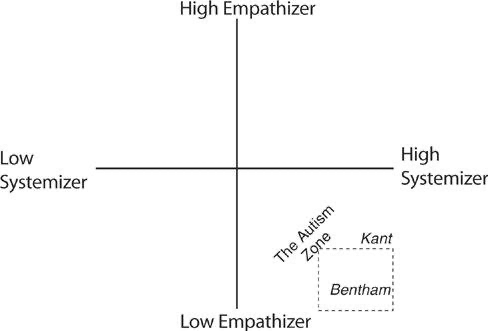
Figure 6.1 — Haidt’s source-era adaptation of Baron-Cohen’s empathizing/systemizing map. It visualizes the chapter’s claim that moral theory can become highly systematic while underrepresenting lived motives and relationships. It is not clinical evidence about Bentham or Kant, a current diagnostic map of autism, or evidence that autistic people share one moral philosophy. Haidt’s placement of the philosophers is interpretive and partly based on retrospective biography. Figure 6.1, PDF p. 142 (file not included in this release) · Endnotes 12–24, PDF pp. 385–386 (file not included in this release)
Bentham’s principle of utility asks whether a law or action increases or diminishes happiness. His felicific calculus tries to compare pleasures and pains by intensity, duration, certainty, and other dimensions. Haidt treats this as a remarkable achievement of systemization and then relies on Philip Lucas and Anne Sheeran’s retrospective case that Bentham might now receive an Asperger’s diagnosis. The endnote itself calls postmortem diagnosis “a difficult game” and says Haidt’s real point is that Bentham’s understanding of human nature was unusually narrow. That source boundary is decisive: neither a biography nor a psychiatric label establishes whether utilitarian arguments are valid. Bentham and the felicific calculus, PDF pp. 143–144 (file not included in this release) · Endnotes 16–20, PDF p. 385 (file not included in this release)
Kant sought an a priori moral law valid for every rational being regardless of culture or temperament. Haidt presents the categorical imperative’s universal-law formulation as the deontological counterpart to Bentham’s arithmetic: logic replaces calculation, but one formula still claims jurisdiction over all morality. He calls Kant an extraordinary systemizer and comparatively low empathizer while conceding that the biographical case for autism is unclear. Again, this is psychological interpretation, not a refutation of universalization, dignity, autonomy, or duty. Kant and universal law, PDF pp. 145–146 (file not included in this release) · Endnotes 21–24, PDF pp. 385–386 (file not included in this release)
Haidt explicitly rejects the ad hominem inference that a theory is false because of its founder’s psychology. His narrower methodological claim is that descriptive moral psychology cannot be produced by logic alone; it needs observation and enough perspective-taking to recognize motives unlike the researcher’s own. His historical suggestion that industrialization and WEIRD cognition made systematic theories more appealing is an interpretive hypothesis, not a demonstrated causal history. Descriptive psychology and psychological realism, PDF p. 147 (file not included in this release) · Endnotes 25–27, PDF p. 386 (file not included in this release)
Evolution must meet culture without becoming a just-so story
Shweder’s three ethics widened the descriptive map, but Haidt wanted an evolutionary account of why recurring moral concerns are easy for human minds to acquire. He rejects two shortcuts: cultural reductionism, which treats shared meanings as irrelevant surface decoration, and naive functionalism, which invents an adaptive purpose for every observed practice. Similar virtues across societies are clues, not proof of innateness. Even compassion is expressed differently by Buddha, Christ, and Muhammad. Evolution, culture, and virtue lists, PDF pp. 148–149 (file not included in this release) · Endnotes 28–29, PDF p. 386 (file not included in this release)
His methodological rule is to begin with well-developed evolutionary problems and then ask whether widely recurring virtues plausibly connect to them. Beginning with a favored trait and inventing a story about its adaptive usefulness is too easy because motivated reasoning can generate a plausible account for almost anything. The resulting foundations are therefore hypotheses about evolved preparedness interacting with cultural learning, not observations of ancestral modules or demonstrations that a modern norm is adaptive. Against evolutionary just-so stories, PDF p. 149 (file not included in this release)
Original and current triggers explain cultural retargeting
Working with Craig Joseph, Haidt adopts a broad form of cognitive modularity from Dan Sperber and Lawrence Hirschfeld. A module is defined by a specialized information-processing function, not necessarily by one isolated brain location. The analogy is a snake detector: recurrent ancestral threats could favor rapid preparedness to notice and learn fear of snake-like patterns before general reasoning finishes the problem. Modules and snake detection, PDF p. 150 (file not included in this release) · Endnotes 30–31, PDF pp. 386–387 (file not included in this release)
The crucial distinction is between original triggers, the recurrent social patterns a system was selected or prepared to process, and current triggers, everything that now activates it. A curved stick can startle a snake-sensitive animal; a hover fly’s yellow-and-black stripes can exploit a bird’s wasp avoidance. Moral cultures can likewise expand, contract, and redirect triggers in a generation. Haidt’s examples are expanding concern for animal suffering and shrinking disgust toward some sexual activity. Original and current triggers, PDF pp. 150–151 (file not included in this release) · Endnotes 32–33, PDF p. 387 (file not included in this release)
This produces a useful account of moral disagreement. People can share broad capacities yet map the same act onto different foundations. Corporal punishment may activate Care/harm as cruelty and oppression for one observer, while another interprets it through Authority/subversion as enforcement of legitimate parental or teacher authority. The theory explains the competing salience assignments; it does not decide whether spanking works, whether the authority is legitimate, or which rights constrain it. Cultural retargeting and the spanking example, PDF p. 151 (file not included in this release)
The first-draft foundations link adaptive problems, emotions, and virtues
Haidt and Joseph generated candidate foundations by connecting recurrent problems in social life to virtues that appear in varied cultural forms. Figure 6.2 presents their first five-foundation draft as a layered model:
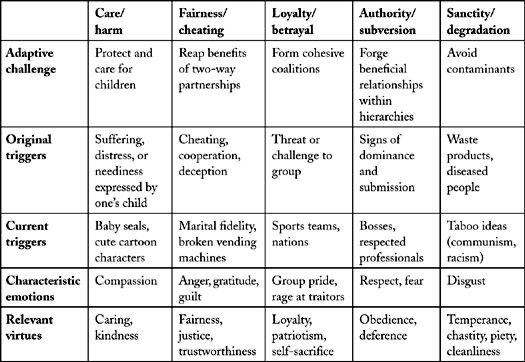
Figure 6.2 — The five foundations of morality, first draft. The rows move from proposed adaptive challenge to original trigger, culturally available current triggers, characteristic emotions, and relevant virtues. The table is a theory diagram, not a direct measurement result. Figure 6.2, PDF p. 152 (file not included in this release)
| Foundation | Proposed adaptive challenge | Original-trigger examples | Current-trigger examples in Haidt’s table | Characteristic emotions and virtues |
|---|---|---|---|---|
| Care/harm | protect vulnerable children | a child’s suffering, distress, or need | baby seals, cute cartoon characters | compassion; caring and kindness |
| Fairness/cheating | reap benefits from two-way partnerships | cooperation, deception, or cheating | marital fidelity, broken vending machines | anger, gratitude, guilt; fairness, justice, trustworthiness |
| Loyalty/betrayal | form cohesive coalitions | threat or challenge to the group | sports teams and nations | group pride and rage at traitors; loyalty, patriotism, self-sacrifice |
| Authority/subversion | forge beneficial relations within hierarchies | signs of dominance and submission | bosses and respected professionals | respect and fear; obedience and deference |
| Sanctity/degradation | avoid contaminants | waste products and diseased people | taboo ideas, including communism and racism in the source table | disgust; temperance, chastity, piety, cleanliness |
The endnotes show that the taxonomy changed during development. The 2004 article began with four foundations and mentioned group loyalty as a candidate; names changed from 2005 to 2009; the book uses 2010 names and defers Liberty/oppression to Chapter 8. A “foundation” is also a coordinated set of possible modules, not one organ or one emotion. Moral Foundations Theory should therefore be read as a revisable research program whose categories and measures require testing, comparison with rival models, and current evidence review. Five adaptive problems and the missing sixth foundation, PDF pp. 152–153 (file not included in this release) · Theory history and module sets, endnotes 34–37, PDF pp. 387–388 (file not included in this release)
The nurse vignette distinguishes caring virtue from calculated effect
To demonstrate the Care foundation, Haidt asks the reader to imagine watching an anesthetized child undergo necessary surgery. Knowledge that the incision is beneficial and unfelt may not suppress a parent’s distress; like a perceptual illusion, the care system can respond to the visible sign of injury despite conscious correction. He then adds two equally competent nurses. One occasionally strokes the unconscious child’s head; the other remains all business. If the gesture changes neither experience nor outcome, Haidt says a strict utilitarian or Kantian should award no extra credit, whereas a Humean can admire caring that has become effortless character. Surgery and the two nurses, PDF p. 153 (file not included in this release)
The vignette makes the chapter’s virtue-psychology point vivid, but its philosophical contrast is compressed. Consequentialists can value reliable caring dispositions and rules for their broader effects; Kantians can value humane attention consistent with respect for persons. The secure inference is narrower: people often praise a trait as beautiful or excellent even when one instance produces no additional measurable benefit and was not consciously derived from a rule.
Figures and Visual Audit
- Figure 6.1, PDF p. 142, is the chapter’s source-era empathizing/systemizing map. It supports Haidt’s critique of explanatory narrowness but not retrospective diagnosis or a moral generalization about autistic people.
- Figure 6.2, PDF p. 152, is the first-draft five-foundation table. It organizes proposed challenges, triggers, emotions, and virtues; it is a theoretical synthesis rather than a study result.
- A PDF object audit found exactly these two embedded images in Chapter 6. Both were extracted directly from the source and placed next to the relevant discussion above; no decorative image or reconstructed chart was substituted.
Key Concepts and Distinctions
- Moral monism: explaining or grounding all morality through one master good, rule, or metric.
- Descriptive pluralism: recognizing multiple recurring moral concerns without inferring that every norm or culture is equally justified.
- Moral taste / cuisine: shared psychological receptivity combined with culturally constructed moral practices and judgments.
- Naturalist moral science: studying how moral cognition actually works through observation, history, comparison, and experience.
- Transcendental or a priori moral theory: attempting to establish moral principles independently of empirical observation; Haidt contrasts this method with descriptive psychology.
- Empathizing and systemizing: Baron-Cohen’s source-era dimensions for attending to mental states versus rules and regularities; Haidt uses them interpretively, not diagnostically.
- Psychological realism: evaluating whether a normative theory assumes capacities and motivations human beings can actually sustain.
- Moral module: a functionally specialized preparedness or learning system responsive to recurrent social patterns; not necessarily a single brain region.
- Original trigger: the kind of recurrent ancestral pattern proposed to have shaped a module.
- Current trigger: anything that presently activates the system, including culturally learned, expanded, contracted, or mistaken targets.
- Moral foundation: a coordinated family of proposed modules connecting an adaptive problem to attention, intuition, emotion, and culturally taught virtue.
Essential Evidence and Examples
- Taste analogy: explains how universal capacities and cultural variation can coexist; it is a generative analogy, not evidence for exactly five or six foundations. PDF pp. 137–138 (file not included in this release)
- Humean moral science: supplies the chapter’s observational method and pluralist orientation; it does not establish Hume’s metaethical conclusions. PDF pp. 139–140 (file not included in this release)
- Figure 6.1 and retrospective biography: illustrate Haidt’s systemizing critique but cannot diagnose historical figures, characterize autistic morality, or adjudicate ethical arguments. PDF pp. 142–147 (file not included in this release)
- Cross-cultural virtue lists: motivate a search for recurrent predispositions, but recurrence alone does not prove an innate module or one evolutionary function. PDF pp. 148–149 (file not included in this release)
- Original/current trigger distinction: explains fast cultural change without requiring fast genetic change; the evolutionary history and module boundaries remain hypotheses. PDF pp. 150–151 (file not included in this release)
- Figure 6.2: makes the first-draft architecture inspectable and records that the theory was already changing; it does not provide effect sizes, measurement validation, or a comparison with rival taxonomies. PDF pp. 152–153 (file not included in this release)
Chapter 6 Stories and Vignettes
- The True Taste restaurant serves only sweeteners. Haidt’s explicitly fictional opening turns moral monism into an unsatisfying one-receptor cuisine. Preserved in 40 Stories. PDF pp. 136–138 (file not included in this release)
- A hover fly borrows a wasp’s warning stripes. A real mimic exploits a bird’s detector, showing why the current trigger of a prepared system can extend beyond its original target. Preserved in 40 Stories. PDF pp. 150–151 (file not included in this release)
- A nurse comforts a child who cannot feel it. Haidt’s hypothetical scene asks whether cultivated caring merits admiration even when it changes neither experience nor outcome. Preserved in 40 Stories. PDF p. 153 (file not included in this release)
Evidence and Interpretation Boundaries
- The taste analogy does not determine receptor count. It helps frame the theory but cannot establish that morality has exactly five or six foundations.
- Psychological plurality does not settle normative pluralism. Multiple recurring concerns may exist even if one normative theory ultimately explains, ranks, or constrains them.
- Founder psychology does not adjudicate philosophy. Haidt expressly rejects an ad hominem argument; retrospective diagnostic claims about Bentham and Kant are uncertain and ethically unsuitable for clinical inference.
- Autism is not a moral theory. Figure 6.1 is a historical depiction in the source, not a license to equate autism with low care, moral deficiency, utilitarianism, or deontology.
- Evolutionary plausibility is not observation. Adaptive challenges, original triggers, and module histories are proposed reconstructions; cross-cultural recurrence alone does not prove them.
- Innateness need not mean a fixed behavior or brain spot. Haidt’s broad modularity includes prepared learning systems that cultural development fills out in different ways.
- Current triggers are revisable but not arbitrary. Culture can retarget concern rapidly, yet not every possible norm will recruit every foundation equally well.
- A foundation explains salience, not correctness. Classifying spanking as Care or Authority does not decide effectiveness, legitimacy, proportionality, rights, or harm.
- The first draft is not the final theory. The names, number, and interpretation of foundations changed before publication and require later and current evidence review.
- The nurse contrast caricatures sophisticated theories. Rule and indirect consequentialists, Kantians, and virtue theorists have resources beyond the simplified alternatives in the vignette.
Cross-Vault Integration
- Moral Foundations Theory is now the permanent architecture note for the first-draft table, trigger distinction, theory history, and evidentiary limits.
- David Hume gains Haidt’s reconstruction of sentimentalist moral science as an observational alternative to both revelation and pure rational deduction.
- Utilitarianism and Deontology receive the “one-receptor” objection together with the warning that a psychological critique does not refute a normative theory.
- Hume vs. Kant on the Human Mind records why the chapter favors Hume descriptively without treating science as a verdict on Kantian normativity.
- Moral Psychology Does Not Settle Metaethics blocks inferences from foundation plurality, evolution, or founder biography to moral truth.
- The Ethics of Autonomy, Community, and Divinity now maps Shweder’s precursor ethics to the five-foundation first draft without treating the taxonomies as identical.
- The Psychology of Morality gains the original/current-trigger distinction and the first-draft status missing from its course table.
- The Social Intuitionist Model of Moral Judgment now distinguishes the model of judgment sequence from the proposed content systems that supply intuitions.
- Objective Moral Systems separates empirical moral plurality from objective value pluralism and from the truth of moral monism.
- Morality uses the nurse vignette to sharpen its virtue account while preserving consequence, rights, and reciprocity checks.
- Your Moral Intuitions Need a Constitution gains the retargetable-trigger model and a stronger argument against allowing any single foundation to govern unchecked.
Chapter Conclusion and Significance
Chapter 6’s lasting contribution is not the finality of its five-item list. It is a layered explanation of moral experience. Human beings may be prepared to notice recurrent social patterns; cultures decide which contemporary objects and actions will carry those patterns; intuitions and emotions make the mapping feel immediate; and virtue vocabularies turn the response into a picture of admirable or contemptible character. The model can therefore explain why moral disagreement is simultaneously constrained, culturally variable, and sincerely experienced.
The theory’s practical use is diagnostic rather than dispositive. When a controversy becomes morally charged, ask which adaptive problem or social pattern the participants believe they see, what original-to-current-trigger mapping produces that perception, and which other foundations the mapping hides. Then move to questions the foundation cannot answer alone: Is the factual premise true? Is the response proportional? Are the rules reciprocal? What happens to dissenters and minorities? Can the same good be protected with less coercion or harm? Moral taste identifies salience; it does not provide a complete constitution for judgment.
Questions for Reflection
- Which of my moral reactions depend on a plausible original problem, and which depend mainly on a culturally learned current trigger that could be remapped?
- When I call a theory “too narrow,” am I identifying a real omitted good or merely resisting the discipline of a principle that constrains my preferred intuition?
- How can institutions preserve the information carried by care, fairness, loyalty, authority, and sanctity while preventing any one foundation from becoming an unreviewable source of coercion?
Chapter 7: The Moral Foundations of Politics
Chapter Objective and Through Line
Chapter 7 gives the five-foundation first draft a concrete political psychology. Haidt begins by asking what kinds of conduct people would refuse even when the act imposed no direct cost on them. He then defines an innate trait as organized in advance of experience, not as a fixed, universal, fully specified behavior. With that developmental definition in place, he gives each foundation an origin hypothesis, a set of present-day triggers, characteristic emotions, and political uses. Chapter opening and five-foundation price exercise, PDF pp. 155–157 (file not included in this release)
The chapter’s strongest contribution is a set of distinctions: narrow self-interest versus moral aversion; original versus current trigger; equality versus proportionality; legitimate authority versus coercive power; and physical disgust versus sacralized value. Its most ambitious conclusion is that the political left relies principally on Care and Fairness while the right speaks through all five foundations. That conclusion is announced at the chapter’s end and motivates Chapter 8. The photographs and anecdotes in Chapter 7 make the model vivid, but they are not representative samples of voters or a complete empirical test of partisan differences. Five-foundation recap and political hypothesis, PDF pp. 183–184 (file not included in this release)
Chapter Structure at a Glance
- Use a five-row “What’s your price?” exercise to show that many aversions cannot be reduced to personal cost.
- Define innateness through Gary Marcus’s “first draft” model: prepared organization that experience revises.
- Derive Care from the demands of prolonged childcare, then show how cuteness and perceived victimhood broaden its triggers.
- Derive Fairness from reciprocal cooperation and distinguish equality from proportionality.
- Derive Loyalty from coalition maintenance, using the Robbers Cave camp to show how quickly teams, norms, and traitor categories form.
- Distinguish Authority from raw power by emphasizing reciprocal role duties and legitimate asymmetry.
- Derive Sanctity from food and pathogen avoidance, then trace its expansion into purity, sacred objects, bodily meaning, and taboo.
- Show how parties and movements try to turn their causes into current triggers of one or more foundations.
- Contrast liberal and conservative rhetoric through source-era bumper stickers, protest signs, advertisements, and sacred-body imagery.
- End with a provisional political asymmetry that Chapter 8 will try to test more systematically.
Section-by-Section Argument
The price exercise identifies moral concern beyond narrow self-interest
Haidt opens against the simplified Homo economicus model in which people maximize personal benefits and minimize personal costs. Figure 7.1 asks readers to price paired actions involving a needle, an undeserved gain, criticism of one’s country, disrespect toward one’s father, and degrading performance. Each B-column act is designed to intensify one of the five foundations even when the reader bears no material loss. A higher refusal price is evidence that something besides narrow self-interest has become salient. It is not evidence that every aversion is correct or that the exercise measures foundation strength in a representative population. Homo economicus and the price exercise, PDF pp. 155–156 (file not included in this release)
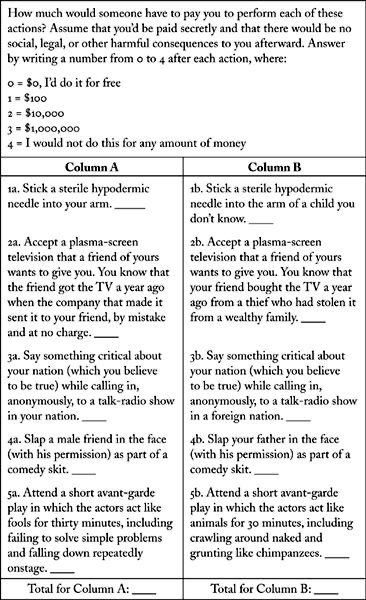
Figure 7.1 — “What’s your price?” The paired prompts are constructed demonstrations of Care, Fairness, Loyalty, Authority, and Sanctity, not survey results. Figure 7.1, PDF p. 156 (file not included in this release)
Haidt then clarifies what “innate” means in his account. Drawing on Gary Marcus, he rejects both a blank page and a rigid wiring diagram. Genes help organize a developmental first draft; experience, culture, and learning revise it. The book’s concise definition—“organized in advance of experience”—allows a trait to be malleable and unevenly expressed. The endnote says Haidt stitched the formulation together from two pages of Marcus, so it should be attributed as Haidt’s synthesis of Marcus rather than treated as one continuous quotation. The first-draft account of innateness, PDF pp. 157–158 (file not included in this release) · Marcus attribution, endnotes 2–3, PDF p. 389 (file not included in this release)
Care begins with vulnerable children and expands through resemblance
The proposed adaptive problem for Care is unusually prolonged mammalian and especially human childcare. Human infants require protection, provisioning, and coordinated support for years. Haidt treats sensitivity to distress, need, crying, and injury as prepared components of a broader care system, then grounds the developmental account in attachment theory rather than presenting it as a free-standing evolutionary story. His own endnote nevertheless marks a reconstruction: it acknowledges that hunter-gatherer groups were less genetically homogeneous than anthropologists once assumed and states an assumption about when that change occurred. Care’s proposed adaptive challenge, PDF pp. 158–160 (file not included in this release) · Kinship and attachment qualifications, endnotes 4–7, PDF p. 389 (file not included in this release)
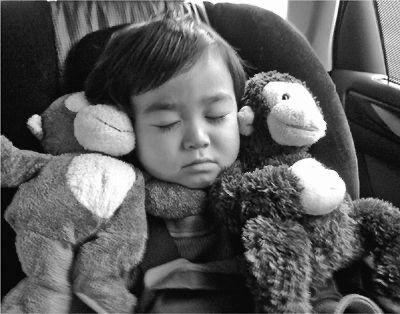
Figure 7.2 — Max, Gogo, and Baby Gogo. Haidt uses his son’s attachment to toy monkeys to illustrate four expansions of Care: cuteness, concern for an unrelated child, toys engineered to elicit nurture, and a child’s developing caregiving script. Figure 7.2 and expanded care triggers, PDF pp. 159–160 (file not included in this release)
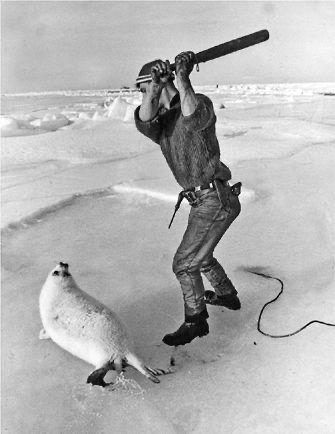
Figure 7.3 — A threatened baby seal as a current Care trigger. The image shows how victimhood and infantile features can recruit a response far beyond one’s own offspring. It does not by itself establish a policy judgment about hunting or animal rights. Figure 7.3, PDF p. 160 (file not included in this release)
Political rhetoric works by making a person, animal, or constituency feel like a victim who requires protection. Figure 7.4 contrasts universalist humanitarian and animal-welfare appeals with care for wounded members of the national group. Haidt interprets the first car as liberal and the second as conservative care blended with loyalty. This is a useful hypothesis about framing, but two selected cars cannot establish the prevalence or exclusivity of either pattern. His endnote’s characterization of conservative foreign charity as generally missionary and parochial likewise requires evidence beyond the chapter. Political retargeting of Care, PDF pp. 161–163 (file not included in this release) · Political-care endnotes 9–12, PDF pp. 389–390 (file not included in this release)

Figure 7.4 — Liberal and conservative caring in Haidt’s source-era interpretation. The images illustrate different proposed targets of care; they are not a partisan survey. Figure 7.4, PDF p. 163 (file not included in this release)
Fairness begins with reciprocity, then divides into equality and proportionality
Fairness is not introduced as equal outcomes. Haidt begins with reciprocal altruism: organisms capable of remembering partners can cooperate selectively, reward reliable partners, and avoid being exploited. Gratitude, guilt, anger, contempt, and distrust help regulate those exchanges. The chapter presents tit-for-tat as the classic model, while its endnote adds an important qualification: under error and misperception, “Win-Stay, Lose-Shift” can outperform it. The secure point is that fairness tracks cooperation and cheating; no single game strategy exhausts the foundation. Reciprocity and selective cooperation, PDF pp. 162–164 (file not included in this release) · Reciprocity qualifications, endnotes 13–16, PDF p. 390 (file not included in this release)
The political split comes from mapping different distributive principles onto the same fairness vocabulary. Haidt presents Occupy Wall Street as emphasizing equality and exploitation: powerful groups take too much and fail to pay their share. He presents Tea Party rhetoric as emphasizing proportionality: benefits should track effort and contribution, and redistribution can look like cheating. The distinction is analytically useful because both sides can sincerely say “fair” while answering different questions. Figure 7.5 is a stylized 2011 contrast, not proof that all left-wing fairness is egalitarian or all right-wing fairness is meritocratic. Equality and proportionality, PDF pp. 164–165 (file not included in this release)
Figure 7.5 — Two claims to tax fairness. Occupy stresses unequal burden; the Tea Party sign stresses reward in proportion to work. The photographs illustrate rival interpretations, not the justice of either claim. Figure 7.5, PDF p. 165 (file not included in this release)
Loyalty makes coalitions meaningful—and betrayal morally explosive
Haidt uses Muzafer Sherif’s 1954 Robbers Cave study to show coalition formation before direct conflict. Twenty-two twelve-year-old boys arrived in two groups of eleven and, while believing themselves alone, created the Rattlers and Eagles, claimed territory, selected leaders, and developed norms and rituals. Once the groups met in structured competition, they destroyed flags, raided cabins, fashioned weapons, and nearly fought. The sequence supports the idea that group identity can form quickly and competition can intensify it. It does not establish that tribalism is uniquely male, biologically fixed, or inevitable in every social setting; the sample was small, male, class-bounded, and historically specific, and this chapter does not audit later methodological or ethical debate about the study. Robbers Cave group formation, PDF pp. 166–168 (file not included in this release)
The proposed original triggers are cues to who is a team player and who is a traitor, especially during intergroup conflict. Sports can harmlessly retarget those systems toward trophies. Politics can also convert disagreement into betrayal, making an internal dissenter seem worse than an external opponent. Haidt illustrates that logic with Dante’s treatment of treachery and selected Qur’anic and hadith passages concerning apostasy. Those passages document the examples he chose; they do not establish one uncontested interpretation of Islamic law, describe ordinary Muslim attitudes, or license generalization from apostasy rules to Muslims as a population. Team players, traitors, sport, and apostasy examples, PDF pp. 168–169 (file not included in this release) · Loyalty endnotes 19–27, PDF pp. 390–391 (file not included in this release)
Figure 7.6 — Affirming and rejecting national loyalty. Haidt contrasts an “OGLORY” car with an altered stop sign during the Iraq and Afghanistan wars. The political coding is his interpretation of two selected displays, not population evidence. Figure 7.6, PDF p. 169 (file not included in this release)
Authority is legitimate asymmetry with reciprocal obligations, not mere domination
An anonymous Jordanian taxi driver tells Haidt that he plans to return home because he never wants his son to curse at him. The vignette introduces large cultural differences in the expected deference owed to parents, teachers, elders, and officeholders. It is a single remembered conversation, not evidence about Jordanian, Arab, or Muslim parenting as a whole. Language can nevertheless make status expectations visible: honorifics, titles, and pronouns force speakers to place a relationship before a proposition is even discussed. Taxi conversation and respect encoded in language, PDF p. 170 (file not included in this release)
Haidt’s central correction is that authority is not identical to power. Drawing on Frans de Waal, Hammurabi, and Alan Fiske’s Authority Ranking model, he treats legitimate hierarchy as two-directional: subordinates defer, while superiors owe order, protection, justice, and “pastoral” responsibility. Authority becomes morally intelligible when rank carries obligations downward as well as privileges upward. But the chapter also concedes that authorities exploit subordinates while believing themselves just. Its endnote explicitly points to system-justification theory as an alternative account of why people lower in a hierarchy may support it. Function and legitimacy therefore have to be demonstrated, not read off from survival or obedience. Authority, order, and Hammurabi, PDF pp. 171–172 (file not included in this release) · Fiske’s reciprocal hierarchy, PDF pp. 172–174 (file not included in this release) · Authority qualifications, endnotes 28–35, PDF p. 391 (file not included in this release)

Figure 7.7 — Two valuations of subversion and obedience. A Nation advertisement celebrates insubordination; a church sign demands submission to God. These are rhetorically selected examples, not measures of liberal or religious populations. Figure 7.7, PDF p. 174 (file not included in this release)
Sanctity turns contamination avoidance into sacred value
The chapter’s most extreme test is the case of Armin Meiwes and Bernd Brandes. Brandes consented to be killed and consumed, and the first court convicted Meiwes of manslaughter rather than murder. Haidt uses the case to ask whether a harm-and-consent morality can explain the judgment that the act was not merely revolting but desecrating. His endnote supplies an essential legal correction: the prosecution won a retrial, and Meiwes was ultimately convicted of murder and sentenced to life imprisonment. Meiwes and Brandes case, PDF pp. 175–177 (file not included in this release) · Retrial and murder conviction, endnote 36, PDF p. 391 (file not included in this release)
Haidt’s philosophical framing should not be accepted without qualification. Calling the act harmless “in a direct, material, or utilitarian way” assumes away contested issues: death is a profound harm even when requested; capacity and the conditions of consent matter; homicide law protects public as well as private goods; and family, witnesses, institutions, and community may bear effects. The case shows that many people invoke bodily dignity, sacred life, and degradation in addition to welfare. It does not prove that disgust supplies the right verdict or that Mill’s principle has no resources for voluntary death, exploitation, capacity, or public harm.
The evolutionary-developmental story begins with Paul Rozin’s omnivore’s dilemma: flexible eaters benefit from trying new foods but risk toxins, microbes, and parasites. Neophilia and neophobia pull in opposite directions; disgust and a proposed “behavioral immune system” steer avoidance. Haidt then argues that cultures can expand contamination cues toward outsiders and symbolic threats, and that sacredness can mark something as untouchable in two opposite senses: polluted and avoided, or hallowed and protected. The pathogen-to-prejudice association and disease-image priming studies are source-era findings that need current replication review before being treated as settled causal mechanisms. They are especially dangerous when used to naturalize xenophobia. Omnivore’s dilemma and disgust, PDF pp. 177–179 (file not included in this release) · Pathogens, out-groups, and sacred value, PDF pp. 179–180 (file not included in this release) · Disgust and pathogen endnotes 37–43, PDF p. 392 (file not included in this release)

Figure 7.8 — Chastity as a guarded treasure versus the body as amusement park. Haidt uses the juxtaposition to illustrate rival current triggers of Sanctity; the second car’s partisan sticker is anecdotal political coding. Figure 7.8, PDF p. 180 (file not included in this release)
Sanctity is not confined to the religious right. Haidt points to purity and “toxin” language in New Age consumer culture and to some environmental rhetoric that treats industrialization as symbolic defilement of nature. He then applies the foundation to abortion, assisted suicide, stem-cell research, chastity, and cloning. Leon Kass’s “wisdom of repugnance” gives the chapter its strongest defense of disgust as a warning that human beings may be crossing a boundary before they can articulate the danger. The appropriate conclusion is cautious: repugnance can flag a value or risk worth examining, but it is evidence of an appraisal, not proof of wrongdoing. Disgust has also served racism, caste, homophobia, disability stigma, and exclusion. Religious and spiritual-left sanctity, PDF pp. 181–182 (file not included in this release) · Biomedical controversies and Kass, PDF pp. 182–183 (file not included in this release)
The partisan asymmetry is a hypothesis, not the chapter’s demonstrated result
Haidt closes by restating the five adaptive hypotheses and proposing that the left relies primarily on Care and Fairness while the right uses all five. Chapter 7 has supplied conceptual reconstructions, source-era studies, personal photographs, anecdotes, and political examples. It has not yet presented the survey distributions needed to estimate how much each coalition endorses each foundation, whether measurement works equivalently across groups, or whether the pattern generalizes across nations and eras. Those are Chapter 8 questions. “Uses more foundations” also does not mean “is more moral”: breadth can help a coalition communicate, while loyalty, authority, and sanctity can protect cooperation or rationalize persecution. Chapter summary and political transition, PDF pp. 183–184 (file not included in this release)
Figures and Visual Audit
- Figure 7.1, PDF p. 156, is a constructed reader exercise. It demonstrates five kinds of moral aversion but supplies no population estimate or validation result.
- Figures 7.2 and 7.3, PDF pp. 159–160, illustrate expanded Care triggers through Haidt’s child, toys, cuteness, and a threatened baby seal.
- Figure 7.4, PDF p. 163, contrasts universalist and group-linked care through two selected vehicles; it is source-era political illustration, not representative evidence.
- Figure 7.5, PDF p. 165, contrasts equality and proportionality through Occupy and Tea Party signs from 2011.
- Figure 7.6, PDF p. 169, juxtaposes affirmation and rejection of national loyalty during the Bush-era wars.
- Figure 7.7, PDF p. 174, contrasts rhetoric celebrating insubordination with rhetoric demanding divine obedience.
- Figure 7.8, PDF p. 180, contrasts chastity as elevated sacred value with the body as a site of autonomous pleasure.
- A PDF object audit found twelve embedded image objects corresponding to the eight numbered figures: 7.1–7.3 and 7.6 are single objects; 7.4, 7.5, 7.7, and 7.8 contain two objects each. All twelve were extracted directly and placed beside their relevant discussions; no chart or photograph was reconstructed.
Key Concepts and Distinctions
- Homo economicus: a simplified agent who chooses only through personal cost and benefit; the price exercise challenges its descriptive sufficiency.
- Innate as organized in advance: a developmental preparedness that experience revises, not an immutable behavior shared identically by every person and culture.
- Care expansion: mechanisms prepared around vulnerable children can be activated by unrelated children, cute animals, representations, and politically framed victims.
- Reciprocal fairness: sensitivity to trustworthy cooperation, contribution, cheating, and exploitation.
- Equality versus proportionality: rival principles that can both be experienced and described as fair.
- Coalitional loyalty: attention to team membership, sacrifice, solidarity, defection, and betrayal.
- Legitimate authority: asymmetric rank joined to reciprocal role obligations, distinguishable in principle from coercion or domination.
- Omnivore’s dilemma: the need to balance exploration of new resources against avoidance of contamination.
- Behavioral immune system: a proposed set of avoidance mechanisms activated by cues of disease; symbolic and social extension remains an empirical question.
- Sacralization: investing an object, person, place, body, or principle with value resistant to ordinary tradeoff.
- Political retargeting: rhetoric that makes a cause, constituency, or opponent activate a preexisting moral concern.
Essential Evidence and Examples
- Figure 7.1: supports the limited claim that a reader can experience aversion beyond direct personal cost; it is neither a representative survey nor a validity test. PDF p. 156 (file not included in this release)
- Attachment account: supplies the strongest established framework behind Care, while the deeper evolutionary sequence remains reconstructed. PDF pp. 159–160 (file not included in this release)
- Reciprocal altruism: explains why cooperation can coexist with selective exclusion and punishment; tit-for-tat is an illustrative model rather than the final strategy. PDF pp. 163–164 (file not included in this release)
- Robbers Cave: demonstrates rapid identity formation and conflict under structured conditions in twenty-two boys; generalization and later methodological debate remain open. PDF pp. 166–168 (file not included in this release)
- Authority Ranking: identifies reciprocal expectations within legitimate hierarchy, but does not show that an existing hierarchy is legitimate or beneficial. PDF pp. 172–174 (file not included in this release)
- Meiwes and Brandes: exposes the philosophical pressure placed on harm-and-consent accounts while raising unresolved questions about capacity, public harm, law, and bodily dignity. PDF pp. 175–177 (file not included in this release)
- Pathogen and priming studies: motivate the behavioral-immune hypothesis but are historical source claims, not a current replication audit or warrant for prejudice. PDF pp. 179–180 (file not included in this release)
- Political images: show how causes can be framed through foundations; selected bumper stickers and signs cannot estimate partisan psychology. PDF pp. 161–165 (file not included in this release)
Chapter 7 Stories and Vignettes
- Max becomes Gogo’s mommy. Haidt’s son treats his stuffed monkey as a dependent, illustrating how attachment and care expand beyond literal offspring. Preserved in 40 Stories. PDF pp. 159–160 (file not included in this release)
- The Rattlers and Eagles invent tribes before they meet. Robbers Cave shows boys creating names, territory, rules, and leaders before intergroup competition converts identity into raids and near-violence. Haidt’s early-phase emphasis has been added to the existing Robbers Cave story. PDF pp. 166–168 (file not included in this release)
- A Jordanian father chooses a culture of filial respect. An anonymous taxi driver tells Haidt why he plans to raise his son in Jordan. The vignette illustrates a moral expectation; it cannot represent a culture. Preserved in 40 Stories. PDF p. 170 (file not included in this release)
- Armin Meiwes turns consent into a moral stress test. The case forces harm, consent, law, dignity, and sanctity into conflict; the source endnote records the later murder conviction. Preserved in 40 Stories. PDF pp. 175–177 (file not included in this release) · Endnote 36, PDF p. 391 (file not included in this release)
Evidence and Interpretation Boundaries
- Constructed prompts are not measurement validation. Figure 7.1 shows that the five categories can be evoked; it does not establish their completeness, independence, or psychometric reliability.
- Innateness is developmental in this argument. “Organized in advance” excludes both genetic determinism and a completely unconstrained blank slate.
- Origin stories remain hypotheses. Care’s attachment evidence is stronger than the chapter’s deeper evolutionary chronology; every proposed adaptive challenge requires independent testing.
- Political photographs are illustrations. Bumper stickers, protest signs, advertisements, and church signs were selected by Haidt and cannot establish population distributions.
- Partisan averages do not identify individuals. Universalist versus local care, equality versus proportionality, and openness versus neophobia are source-era group claims with overlap, context sensitivity, and possible measurement drift.
- Sex difference is not destiny. Robbers Cave studied boys, and the cited studies do not warrant a universal essence of male or female loyalty.
- Selected religious texts are not a population survey. Haidt’s apostasy example must not be converted into a claim about all Muslims, Islamic traditions, or present political attitudes.
- Authority’s function does not confer legitimacy. Order and protection can be real goods, while a hierarchy’s rules, burdens, voice, accountability, and right of exit still fail moral review.
- Disgust does not prove degradation. It can reveal an appraisal or possible risk, but it can also transmit prejudice, stigma, and irrelevant contamination cues.
- Consent does not end the Meiwes analysis. Capacity, coercion, death, homicide law, third-party effects, and public goods remain contested even within autonomy-centered ethics.
- Sacredness is politically ambivalent. It can protect human life, constitutions, and common goods or make compromise, dissent, and out-groups appear contaminating.
- Breadth is not moral superiority. A coalition that recruits more foundations may communicate more widely while also opening more routes to exclusion and coercion.
- The final partisan claim is provisional here. Chapter 7 motivates rather than completes the empirical comparison developed in Chapter 8.
Cross-Vault Integration
- Moral Foundations Theory now serves as the permanent five-foundation field guide, including equality versus proportionality, reciprocal authority, sacralization, and the main evidence limits.
- The Psychology of Morality gains a source-audited correction to the course’s political shorthand and a bridge from the five-row table to original/current triggers.
- Secure Attachment and Growing Autonomy Are Complements connects Care to Bowlby’s secure-base model without turning an evolutionary proposal into parenting advice.
- Liberty, Equality, Authority, and the Common Good incorporates equality/proportionality and authority/power distinctions into its institutional design test.
- Parties, Partisanship, and Polarization uses Loyalty and Robbers Cave to explain why regulated rivalry can become betrayal politics.
- Conservatism — Position Card distinguishes a broader rhetorical palette from a normative vindication of conservative policy.
- Moral Psychology Does Not Settle Metaethics uses Meiwes and Kass to show why felt degradation neither proves nor disproves a moral claim.
- The Ethics of Autonomy, Community, and Divinity gains the detailed Sanctity bridge from Chapter 7.
- Your Moral Intuitions Need a Constitution turns the five foundations into separate inputs that must answer evidence, rights, reciprocity, consequence, and legitimacy checks.
- Abortion records sanctity as one real source of the dispute without treating it as a verdict on fetal status, bodily autonomy, law, or policy.
- Moral Hierarchy applies the five-foundation lens to Israel–Palestine while refusing collective diagnosis or the substitution of moral psychology for facts, rights, international humanitarian law, and actor-specific responsibility.
- Israel–Palestine arguments receives the bounded debate application and links back to the fuller framework.
Chapter Conclusion and Significance
Chapter 7 makes moral pluralism operational. Care attends to vulnerability; Fairness to cooperation and cheating; Loyalty to solidarity and betrayal; Authority to rank and role; Sanctity to pollution, elevation, and the nonfungible. Politics succeeds rhetorically when it persuades people that a present issue instantiates one or more of those patterns. The model explains why two sides can examine the same policy and experience different moral emergencies.
That explanatory gain needs a firewall. A foundation can direct attention to a neglected good, but it can also misclassify a target. Care can become paternalism, fairness can ignore unequal starting points or personal agency, loyalty can turn dissent into treason, authority can sacralize domination, and sanctity can make people into contaminants. The responsible sequence is: identify the foundation and its current trigger, verify the facts linking them, reconstruct the good being protected, then test reciprocity, proportionality, rights, consequences, voice, exit, and less coercive alternatives. Foundations broaden moral perception; they do not rank persons, settle law, or replace judgment.
Questions for Reflection
- When two people call the same outcome “unfair,” are they protecting equality, proportionality, reciprocity, desert, or something else?
- What evidence would distinguish legitimate authority with reciprocal obligations from power that has taught subordinates to call domination order?
- Which sacred values in my own politics do I treat as exempt from tradeoff, and what constitutional safeguards should constrain action taken in their name?
Chapter 8: The Conservative Advantage
Chapter Objective and Through Line
Chapter 8 tests the political asymmetry proposed at the end of Chapter 7 and then changes the theory in response to criticism. Haidt begins with a 2005 talk in which he told Charlottesville Democrats that Republicans spoke more directly to moral intuition and to a broader range of foundations. At that point, he admits, the claim was speculation. The chapter’s evidentiary center is the Moral Foundations Questionnaire: an initial Project Implicit sample of about 1,600 respondents and a later YourMorals sample of about 132,000 voluntary visitors showed different average profiles across self-described ideology. Haidt interprets liberals as emphasizing Care and equality-inflected Fairness, conservatives as drawing more evenly on the original five foundations, and libertarians as making Liberty dominant. Chapter opening and initial conjecture, PDF pp. 185–188 (file not included in this release) · First MFQ evidence, PDF pp. 189–193 (file not included in this release)
The chapter’s deeper contribution is revision rather than partisan scoring. Economic conservatives objected that the original Fairness items measured equality while neglecting desert, contribution, and free riding. Haidt accepts much of the criticism, moves equality toward Care plus Liberty/oppression, and narrows Fairness toward proportionality in reciprocal cooperation. He then adds Liberty/oppression as a provisional sixth foundation: sensitivity to domination and the coordination of subordinates against would-be tyrants. The resulting “three versus six” shorthand is a source-era model of group averages and political rhetoric—not proof that one coalition is more moral, more coherent, or causally destined to win. Reader criticism and the revision of Fairness, PDF pp. 201–204 (file not included in this release) · Three versus six, PDF pp. 217–218 (file not included in this release)
Chapter Structure at a Glance
- Revisit Haidt’s 2005 Democratic Party talk and distinguish persuasive speculation from evidence.
- Build the first Moral Foundations Questionnaire with Jesse Graham and Brian Nosek.
- Compare the first Project Implicit pattern with the much larger, still self-selected YourMorals sample.
- Seek convergence through dog preferences, sermon language, and one source-era EEG study.
- Use Barack Obama’s 2008 rhetoric to ask whether Democrats can speak through a wider moral palette.
- Contrast a Millian society of individuals, contracts, rights, and voluntary association with a Durkheimian society of nested groups, duties, restraint, and belonging.
- Let critical readers expose the original Fairness scale’s equality bias.
- Add Liberty/oppression through the hypothesis that humans resist domination and coordinate against tyrants.
- Recast Fairness around proportionality, free riding, punishment, and conditional cooperation.
- End with a six-foundation political map whose practical value is translation, not partisan moral ranking.
Section-by-Section Argument
Political rhetoric first reaches the elephant
Haidt opens with an unusually candid research autobiography. While walking his dog during the 2004 presidential campaign, he mentally rewrote John Kerry’s speeches. Instead of Kerry’s “America can do better” and “Help is on the way,” Haidt imagined a refrain asking George W. Bush who would pay for tax cuts, programs, and wars. The proposed line was designed to make fiscal policy feel like cheating rather than to add another policy memorandum. In his Charlottesville talk, he argued that Republican campaigns had long appealed through fear, patriotism, respect for authority, family values, sanctity, and resentment of free riders, while many Democratic appeals remained policy-heavy and rider-directed. Kerry rewrite and Charlottesville talk, PDF pp. 185–188 (file not included in this release)
This opening explains the title’s advantage: a coalition able to translate its platform into more moral languages may have more routes into intuitive judgment. It does not show that every Republican campaign uses every foundation, that Democratic appeals lack emotion, or that moral breadth caused a particular election result. Haidt’s cases—Willie Horton, Bush’s opponents, Bill Clinton’s emotional skill, Reagan Democrats, and “family values”—are interpretive political examples. He explicitly marks the argument as untested at the time he delivered it.
The first Moral Foundations Questionnaire turns the claim into a measurable pattern
Jesse Graham, then a new UVA graduate student, worked with Haidt and Brian Nosek to create a fifteen-item Moral Foundations Questionnaire. Respondents rated how relevant considerations such as cruelty or disrespect for authority were when deciding right and wrong. ProjectImplicit.org recruited about 1,600 respondents in one week. Figure 8.1 orders them by self-described ideology. Care and Fairness remained relatively high across the spectrum but declined modestly toward the conservative end; Loyalty, Authority, and Sanctity began much lower among very liberal respondents and rose toward conservatives. Haidt calls “two-foundation” and “five-foundation” morality shorthand for this separation, not a literal absence of the other concerns. Questionnaire construction and sample, PDF pp. 188–190 (file not included in this release)
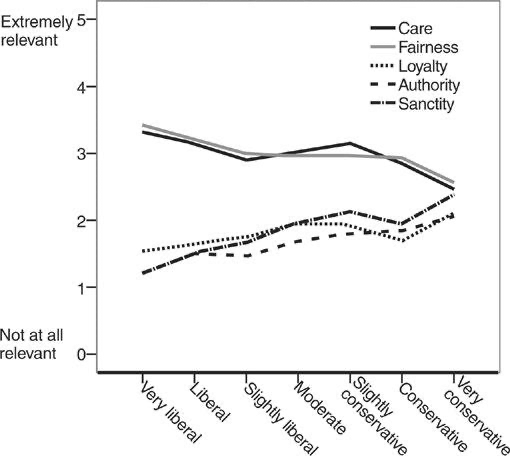
Figure 8.1 — the first MFQ partisan pattern. About 1,600 voluntary Project Implicit respondents produced the predicted source-era average slopes. The graph does not show a probability sample, causal direction, or the distribution of individuals within each category. Figure 8.1, PDF p. 189 (file not included in this release)
The team then revised the questionnaire by adding agreement items and testing it through a new collaboration. Ravi Iyer, Sena Koleva, Pete Ditto, Graham, and Haidt—all liberals—met at a 2007 conference and discussed both the hostility toward conservatives in their field and the scientific risk of researching an out-group one is motivated to diagnose. Iyer proposed an online laboratory that would return individualized feedback and connect each visitor’s responses across studies. Their conversation became YourMorals.org. A later New York Times mention sent roughly 26,000 new visitors to the site in one week. YourMorals collaboration, PDF pp. 190–193 (file not included in this release)
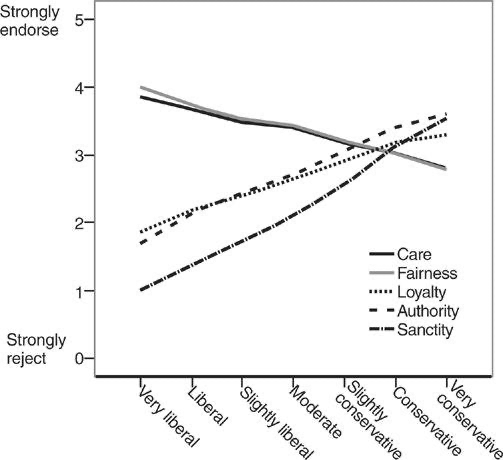
Figure 8.2 — five foundations among 132,000 YourMorals visitors in 2011. The much larger voluntary sample reproduces the broad crossing pattern with a revised MFQ. Its means should not be numerically compared with Figure 8.1 as though the instrument and recruitment were unchanged. Figure 8.2 and sample description, PDF pp. 192–193 (file not included in this release)
The larger sample makes the descriptive pattern harder to dismiss as a one-week accident, but it does not make it representative. People who choose Project Implicit or YourMorals, identify on a left–right scale, and complete moral questionnaires may differ systematically from people who do not. The chapter reports broadly similar regional aggregations outside the United States; it does not establish measurement invariance across languages, parties, nations, or eras. The American equation of Democrat with liberal and Republican with conservative is itself historically contingent, especially before the later twentieth-century sorting of the parties. Political sorting and sampling qualifications, Chapter 8 endnotes, PDF pp. 393–395 (file not included in this release)
Converging probes broaden the claim without closing the case
Haidt next looks for the pattern in measures other than direct foundation ratings. Liberals in one survey preferred dogs described as gentle and disposed toward equality; conservatives placed more weight on loyalty and obedience. A clean dog showed no partisan difference, a useful negative case against treating every desirable trait as ideologically sorted. A comparison of Unitarian Universalist and Southern Baptist sermons also found the predicted contrasts after contextual coding. The endnote matters: a simple word-count method initially failed for Loyalty, and researchers reclassified words by how they functioned in context. Dog preferences and sermon language, PDF pp. 193–195 (file not included in this release) · Sermon-coding qualification, Chapter 8 endnotes, PDF p. 394 (file not included in this release)
The chapter also reports an EEG sentence study: morally congruent or incongruent words produced different early electrical responses among liberals and conservatives, interpreted through N400 and later positive potential patterns. The chapter does not provide the sample size or enough methodological detail for an independent appraisal, and an electrical correlate is not proof of a fixed partisan brain. Together these probes offer source-era convergence—self-report, preference, discourse, and neural timing—not a timeless biological partition.
Obama shows the promise and risk of a broader Democratic palette
Haidt viewed Barack Obama’s 2008 campaign as an attempt to recover loyalty, authority, and a civic sacred alongside care and justice. He praises rhetoric about common purpose, personal responsibility, faith, family, and national membership, but worries that some speeches reverted to a narrower language of social justice and corporate greed. He also uses the “citizen of the world” speech and the flag-pin dispute to illustrate how universalist language can be heard as weak national attachment. An endnote corrects a selective conservative quotation: Obama had paired world citizenship with being a proud citizen of the United States. The case therefore demonstrates both moral framing and the danger of diagnosing a speaker through an adversary’s excerpt. Obama and the wider palette, PDF pp. 195–198 (file not included in this release) · Full citizenship quotation, Chapter 8 endnotes, PDF p. 395 (file not included in this release)
Millian and Durkheimian societies protect different kinds of goods
The chapter then moves from campaign technique to social ontology. A Millian society begins with individuals, treats relationships as consensual, protects rights against interference, and lets adults form or leave associations so long as they do not harm others. A Durkheimian society begins with persons embedded in families and other nested groups, asks institutions to form self-command and duty, and fears the anomie produced when norms and bonds lose authority. Haidt argues that social conservatives more readily perceive family stability, institutional continuity, loyalty, restraint, and civil religion as goods in themselves, while liberal psychology is more likely to ask whether a practice harms or oppresses individuals. Millian and Durkheimian societies, PDF pp. 197–201 (file not included in this release)
These are ideal types, not mutually exclusive constitutions. Rights and voluntary exit can protect people inside thick communities; inherited institutions can provide care, meaning, trust, and cooperation that contracts alone do not manufacture. The same Durkheimian language can also romanticize hierarchy, suppress dissent, or treat conformity as health. Haidt’s endnote limits the label mainly to social conservatives, not libertarians or all classical liberals. His discussion of American civil religion, E pluribus unum, and the president as a kind of high priest is an interpretation of symbolic integration, not evidence that national ritual is benign or causally necessary. Social-conservative and civil-religion qualifications, Chapter 8 endnotes, PDF pp. 395–396 (file not included in this release)
Angry readers expose an equality bias in the original model
Haidt describes receiving sharply worded messages from economic conservatives who recognized themselves in neither his account of Fairness nor a survey item that effectively treated equality as the moral ideal. One email’s subject line was “Head up ass.” The tone did not invalidate the criticism. His original scale had been better at measuring concern for equal treatment and equal outcomes than concern that reward should track contribution or that benefits should not go to free riders. Instead of defending the questionnaire as neutral, Haidt redraws the theory. Reader criticism and Fairness revision, PDF pp. 201–204 (file not included in this release)
He now treats proportionality as the core of Fairness in cooperative exchange and associates much egalitarian concern with two other intuitions: Care for people who are suffering and Liberty/oppression when inequality is understood as domination. This is a theoretical reallocation, not a settled empirical discovery. The endnotes preserve a live alternative: Alan Fiske and Tage Rai argue that equality may itself be a basic relational motive. The episode is methodologically valuable precisely because categories and instruments can encode the researcher’s moral vocabulary.
Liberty/oppression begins with resistance to domination
Haidt’s proposed sixth foundation does not simply duplicate Isaiah Berlin’s negative and positive liberty. Its hypothesized core is anti-domination: humans notice the signs of bullying, arbitrary control, and would-be tyranny, feel reactance when choice is constrained, and sometimes coordinate to cut a dominant individual down to size. Drawing on Christopher Boehm, Haidt proposes that weapons, language, gossip, reputation, and coalition made it possible for human subordinates to create “reverse dominance hierarchies.” Equality and hierarchy are therefore not simple evolutionary opposites: a group can maintain authority and rank while collectively denying any one member unchecked domination. Reverse dominance and Liberty/oppression, PDF pp. 203–206 (file not included in this release)
His stark illustration is the !Kung killing of Twi, described through Richard Lee and Boehm. After Twi had killed two men and then another, the community killed him; Haidt emphasizes that every adult symbolically participated so no single executioner became the next revenge target or monopolized coercive power. The episode illustrates collective action against a repeat killer in the cited ethnographic account. It is not an endorsement of extrajudicial killing, a portrait of all !Kung life, or independent authentication of every reported detail. Haidt extends the argument into a self-domestication hypothesis in which humans selected against would-be alphas; the endnotes retain uncertainty about ancestral hierarchy, timing, and the last common ancestor. Twi and self-domestication, PDF pp. 204–206 (file not included in this release) · Evolutionary qualifications, Chapter 8 endnotes, PDF pp. 397–398 (file not included in this release)

Figure 8.3 — Virginia’s “Sic semper tyrannis” seal. Haidt uses Liberty standing over Tyranny to show anti-domination as an American moral symbol. A state emblem illustrates a public grammar; it does not measure how citizens apply it. Figure 8.3, PDF p. 205 (file not included in this release)
The same foundation can be expanded in different political directions. The left tends to notice domination exercised by powerful groups over vulnerable people and joins Liberty to Care and equality. The right, especially its libertarian strand, tends to notice government, taxation, regulation, or bureaucratic direction as domination. Both speak the language of liberation, but they identify different oppressors, victims, and legitimate constraints.
Figure 8.4 — a liberal use of Liberty/oppression in a New Paltz coffee shop. The display connects liberty to protection from group-based domination; it is a selected illustration of rhetoric, not a sample of liberals. Figure 8.4, PDF p. 207 (file not included in this release)
Figure 8.5 — a conservative-libertarian use of Liberty/oppression at Liberty University. Haidt reads the car’s messages as resistance to government coercion. The photograph cannot establish prevalence, sincerity, or policy consequences. Figure 8.5, PDF p. 209 (file not included in this release)
The foundation remains explicitly provisional in this edition. Haidt names honesty, property or ownership, and aversion to waste or inefficiency among other candidates and says future evidence may reorganize the model. Liberty/oppression should therefore be used as a hypothesis about moral attention, not treated as a discovered organ or a complete theory of freedom. Provisional sixth foundation and alternatives, Chapter 8 endnote 25, PDF p. 398 (file not included in this release)
Proportionality and free riding become the center of Fairness
Haidt uses Rick Santelli’s February 2009 CNBC outburst against mortgage relief to show how a policy can be framed as forcing prudent contributors to subsidize irresponsible free riders. The emerging Tea Party moralized proportionality and anti-coercion together. Haidt then asks why punishment is so central to human cooperation. Reciprocal altruism outside humans is rare or difficult to demonstrate cleanly; the chapter’s endnotes qualify familiar vampire-bat and capuchin-monkey claims. The comparatively secure point is not that other animals never cooperate, but that humans build unusually elaborate, norm-governed systems of contribution, monitoring, and sanction. Santelli, free riding, and reciprocity, PDF pp. 210–213 (file not included in this release) · Animal-cooperation qualifications, Chapter 8 endnotes, PDF pp. 398–399 (file not included in this release)
Ernst Fehr and Simon Gächter’s public-goods experiment supplies the chapter’s clearest mechanism. Four anonymous players each received twenty tokens and could place any number into a common pot. The experimenter multiplied the pot by 1.6 and divided it equally, so the group did best when all contributed but each individual could do better by keeping tokens while others paid. Average contributions began around ten and fell to about six by round six. In later rounds, participants could spend one token to remove three from another player. Eighty-four percent punished at least once; contributions jumped and reached roughly fifteen by round twelve. A reverse sequence—in which punishment was available first and then removed—produced the complementary collapse. Public-goods design and results, PDF pp. 212–215 (file not included in this release)
Figure 8.6 — a Conservative Party appeal against free riding. The poster recruits Fairness as proportional contribution and Liberty as resistance to being made another person’s “mug.” It is political rhetoric, not evidence that a particular benefits claimant cheated. Figure 8.6, PDF p. 214 (file not included in this release)
The experiment shows one laboratory mechanism by which costly punishment can sustain contribution among anonymous players. It does not prove that every perceived free rider is guilty, that punishment is proportionate, that unequal starting points are irrelevant, or that welfare policy is structurally equivalent to a token game. A separate PET study reported reward-area activity when people punished defectors, but the endnote notes that revenge may feel worse in experience than people predict. Moral satisfaction and social function are not the same as justice. Punishment, reward, and cooperation, PDF pp. 215–216 (file not included in this release) · Punishment and revenge qualifications, Chapter 8 endnotes, PDF pp. 399–400 (file not included in this release)
Figure 8.7 — compassion and proportionality on one bumper. Haidt uses the Gandhi slogan and the demand that offenders face consequences to show that Care and proportional Fairness can coexist in one moral repertoire. The pairing does not determine which punishment is deserved. Figure 8.7, PDF p. 216 (file not included in this release)
“Three versus six” is a translation map, not a league table
Haidt’s revised summary gives liberals three especially salient foundations—Care, Liberty, and Fairness—while arguing that they often trade proportionality against compassion or anti-oppression. Conservatives, in his account, distribute attention more evenly across all six and are therefore better positioned to understand and address a wider range of ordinary moral concerns. Libertarians score differently from both: Liberty dominates, while binding foundations tend to be low. Haidt uses the pattern to reinterpret working-class and rural Republican voting as possibly expressing moral and social interests rather than simple ignorance of economic self-interest. Three, six, and libertarian profiles, PDF pp. 216–218 (file not included in this release)
That is an interpretive hypothesis, not a complete voting model. Economic interests are contested and multidimensional; voters respond to identity, institutions, candidates, media, religion, place, coalition history, threat, and policy as well as foundation salience. Most people are moderates, the endnotes say the chapter concentrates on stronger partisans, and group averages overlap. “Uses more foundations” cannot be converted into “is more moral,” “understands every opponent,” or “has better policies.” Breadth may increase rhetorical reach while also supplying more routes to exclusion, purity policing, hierarchy defense, collective blame, and coercion.
Key Terms and Distinctions
- Moral Foundations Questionnaire (MFQ): a self-report instrument intended to measure the relevance or endorsement of proposed moral concerns; its items and versions changed during the work described here.
- Two-foundation/five-foundation morality: Haidt’s shorthand for relative separation among average scores in the first five-foundation model, not the literal absence or presence of moral capacities.
- Millian society: an ideal type centered on individuals, rights, voluntary association, contract, and protection from harm or interference.
- Durkheimian society: an ideal type centered on nested groups, formative institutions, duty, restraint, solidarity, and the prevention of anomie.
- Liberty/oppression: a provisional foundation concerned with domination, bullying, reactance, tyranny, and collective resistance to arbitrary power.
- Reverse dominance hierarchy: Boehm’s hypothesis that subordinates use coalitions, reputation, ridicule, exile, or force to constrain would-be alphas.
- Equality: equal standing, treatment, shares, or outcomes; in this revision Haidt associates much of its moral force with Care and anti-oppression.
- Proportionality: the idea that rewards, burdens, and sanctions should track contribution, merit, responsibility, or conduct; Haidt moves it to the center of Fairness.
- Conditional cooperation: willingness to contribute when others contribute and rules against free riding appear credible.
- Moral repertoire: the range of moral grammars a person or coalition can recognize and deploy; repertoire breadth is not moral truth.
Essential Evidence and Examples
- Figure 8.1: roughly 1,600 voluntary Project Implicit respondents supplied the first predicted ideological slopes; recruitment and self-identification limit population inference. PDF p. 189 (file not included in this release)
- Figure 8.2: about 132,000 YourMorals visitors reproduced the broad pattern using a revised instrument; scale version and self-selection prevent direct numerical comparison or representative prevalence claims. PDF pp. 192–193 (file not included in this release)
- Dog and sermon measures: provide source-era converging evidence while also revealing a negative case and the interpretive choices required by contextual coding. PDF pp. 193–195 (file not included in this release)
- EEG sentence study: suggests different early surprise responses to moral violations; the chapter does not provide enough detail to treat it as neurological proof of ideology.
- Critical reader feedback: identifies construct contamination in the original Fairness scale and produces a substantive theoretical revision rather than a cosmetic wording change. PDF pp. 201–204 (file not included in this release)
- Boehm’s reverse-dominance account: motivates Liberty/oppression and self-domestication as evolutionary hypotheses; chronology and ancestral social structure remain uncertain. PDF pp. 203–206 (file not included in this release)
- Fehr–Gächter public-goods game: costly punishment raised anonymous contribution in one experimental structure; it establishes neither guilt nor justice outside that design. PDF pp. 212–215 (file not included in this release)
- Political images: Figures 8.3–8.7 illustrate how Liberty, Care, and proportionality can be framed; selected emblems, posters, cars, and bumper stickers are not population evidence.
Chapter 8 Stories and Vignettes
- Haidt rewrites Kerry while walking the dog. A frustrated academic discovers that policy content and moral framing are different communication problems. Preserved in 40 Stories. PDF pp. 185–188 (file not included in this release)
- Five liberal researchers build YourMorals to test their own field. A late-night conference conversation converts discomfort with partisan bias into a shared research platform. Preserved in 40 Stories. PDF pp. 190–193 (file not included in this release)
- Angry emails make Haidt redraw Fairness. Hostile criticism still exposes a real measurement blind spot and changes the theory. Preserved in 40 Stories. PDF pp. 201–204 (file not included in this release)
- The !Kung make every adult share the killing of Twi. In Haidt’s secondhand ethnographic account, collective responsibility prevents one avenger from monopolizing force or becoming the next target. Preserved with its evidence and ethical boundary in 40 Stories. PDF pp. 204–206 (file not included in this release)
- Swiss students pay to punish strangers—and cooperation climbs. The public-goods experiment turns an abstract dilemma into a visible sequence of contribution, decline, sanction, and recovery. Preserved in 40 Stories. PDF pp. 212–215 (file not included in this release)
Evidence and Interpretation Boundaries
- The samples are voluntary. Project Implicit and YourMorals provide large, useful source-era datasets but not representative probability samples.
- Instrument versions differ. Figures 8.1 and 8.2 came from different versions of the MFQ, so their exact means are not a longitudinal trend.
- Ideological labels are historical. Liberal, conservative, Democrat, and Republican are not interchangeable across every country or period; American party sorting changed over time.
- Group averages do not classify persons. Most people are moderates, category distributions overlap, and one person’s foundation profile cannot be inferred from a vote or label.
- Self-report is not causal origin. Correlation between ideology and questionnaire response does not show whether foundations cause ideology, ideology trains responses, or other variables shape both.
- Cross-national recurrence is not universality. Regional similarity does not by itself establish equivalent measurement, meaning, or political use across cultures.
- Contextual coding involves judgment. The sermon result improved after words were classified in context; that may be appropriate, but it makes coder rules and reliability part of the evidence.
- EEG is not mind reading. A source-era electrical response can support a timing hypothesis without identifying a unique mental content, fixed trait, or normative conclusion.
- Mill and Durkheim are ideal types. Rights-centered orders still depend on families, norms, and trust; thick communities can form character or entrench domination.
- Liberty/oppression is provisional. Haidt presents it as a candidate foundation and explicitly leaves space for alternative or additional foundations.
- Evolutionary chronology is reconstructed. Reverse dominance and self-domestication organize evidence into a hypothesis; they do not directly observe ancestral selection.
- Punishment can cooperate with injustice. A sanction may stabilize contribution while misidentifying a cheater, protecting an unequal baseline, or becoming disproportionate.
- Political images are illustrations. A seal, poster, car, or bumper sticker shows available rhetoric, not prevalence, effect size, or policy quality.
- Breadth is not virtue. A larger moral repertoire may help translation and coalition-building while giving prejudice and coercion additional sacred or binding justifications.
- Voting has multiple causes. Moral interests may matter without displacing economics, identity, institutions, media, candidates, history, or strategic calculation.
Cross-Vault Integration
- Moral Foundations Theory now records both source-era MFQ patterns and the theory’s substantive revision from five foundations to a provisional six.
- The Psychology of Morality gains the survey methods, Liberty/oppression, proportionality revision, and limits missing from the course shorthand.
- Conservative vs Liberal Visions links constrained and unconstrained visions to Haidt’s moral repertoires without turning either typology into a deterministic left–right personality map.
- Political Visions and Institutional Humility uses the Millian–Durkheimian contrast to preserve both rights and institutional social ecology.
- Émile Durkheim gains Haidt’s contemporary interpretation and an explicit warning about functionalism, power, dissent, and empirical verification.
- Do Liberalism, Capitalism, and the Enlightenment Cause Atomization? treats the two ideal types as a conceptual bridge rather than proof that liberalism caused social isolation.
- Positive and Negative Liberty distinguishes Berlin’s two concepts from Haidt’s psychological hypothesis about anti-domination and reactance.
- Liberty, Equality, Authority, and the Common Good adds the equality/proportionality dispute and a reciprocal anti-domination test.
- Elinor Ostrom — Beyond Markets and States places the public-goods punishment mechanism beside institutional evidence on monitoring, legitimacy, graduated sanctions, and local rule design.
- Conservatism — Position Card separates the survey-supported rhetorical advantage from any vindication of conservative policy.
- My Political Beliefs connects the existing Burkean-liberal formulation to Millian rights, Durkheimian social goods, and anti-domination without inferring any new personal commitment.
- Moral Hierarchy now uses all six moral languages in Israel–Palestine analysis and separates equality from proportionality more explicitly.
- Israel–Palestine arguments gains Liberty/oppression, the revised Fairness model, and Chapter 8’s sampling and application limits.
- The Conservative Advantage story collection preserves five reusable Chapter 8 episodes with direct PDF navigation.
Chapter Conclusion and Significance
Chapter 8 earns its importance by allowing evidence and criticism to alter the map. The first survey results support Haidt’s earlier intuition that political coalitions weight moral concerns differently on average. The correspondence from economic conservatives then shows that the instrument itself reflected its creators’ assumptions. Adding Liberty/oppression and recentering Fairness on proportionality turns Moral Foundations Theory from a static taxonomy into a revisable research program.
The practical lesson is not that conservatives possess six moral virtues while liberals possess three. It is that political argument fails when it mistakes one moral vocabulary for the whole domain. A rights-based reformer should ask what bonds, roles, and cooperative functions a practice sustains; a defender of community should ask whether membership is voluntary enough, whether authority is reciprocal, and who is silenced; an equality claim should state whether it concerns standing, need, shares, power, or outcome; a proportionality claim should identify contribution, responsibility, baseline, and evidence; and every liberty claim should name the alleged dominator and the safeguards against domination by the proposed remedy. Translation widens perception. Facts, rights, reciprocity, proportionality, consequences, voice, exit, and institutional accountability still decide what ought to be done.
Questions for Reflection
- When I say a policy is “unfair,” am I protecting equality, proportionality, reciprocity, desert, need, or freedom from domination—and have I made the baseline explicit?
- Which social goods would be missed by a purely Millian analysis, and which people would be endangered by a purely Durkheimian one?
- Does my political coalition understand the foundations it criticizes well enough to distinguish their cooperative function from their coercive failure mode?
Chapter 9: Why Are We So Groupish?
Chapter Objective and Through Line
Chapter 9 begins Part III by correcting an intentionally incomplete portrait of human nature. Kin selection, reciprocity, reputation, and strategic cooperation explain much moral behavior, but Haidt argues that they do not fully explain why people sometimes promote a group’s interests at real personal cost. He calls this stronger disposition groupishness: not merely living in a herd or enjoying membership, but caring about a team, institution, nation, or moral community enough to subordinate some individual advantage. His opening memory—wanting an American flag after September 11 while adding a United Nations flag to preserve a universal identity—shows both the sudden force of group attachment and the possibility of layered loyalties. Two flags and the chapter’s problem, PDF pp. 220–222 (file not included in this release)
Haidt’s explanatory proposal is multilevel selection: individuals compete within groups while groups can also compete, persist, split, or disappear in ways that favor cooperation and the suppression of free riding. He does not claim to prove that human nature was shaped by group selection. He presents an appellate brief for reopening a disputed case, organized around four exhibits: major evolutionary transitions, shared intentionality, gene–culture coevolution, and fast selection. The chapter’s durable insight is therefore narrower than “tribes win.” Institutions, norms, and identities can make cooperation possible at a larger scale, but the same binding capacities can turn dissent into betrayal, outsiders into abstractions, and threat into permission for leaders. Multilevel selection and four exhibits, PDF pp. 222–230 (file not included in this release) · Haidt’s expertise and uncertainty, Chapter 9 endnotes 91–93, PDF p. 414 (file not included in this release)
Chapter Structure at a Glance
- Use Haidt’s post-9/11 flag impulse to distinguish self-interest from groupishness and introduce “morality binds and blinds.”
- Recover Darwin’s “victorious tribes” argument while taking the free-rider objection seriously.
- Explain why George Williams and Richard Dawkins rejected loose claims about behavior “for the good of the group.”
- Exhibit A: show how suppressing lower-level competition can produce higher-level cooperative units or “major transitions.”
- Exhibit B: use Michael Tomasello’s chimpanzee–toddler comparisons to make shared intentionality the proposed human Rubicon.
- Exhibit C: trace cumulative culture, symbolic group markers, norms, shame, guilt, and self-domestication through gene–culture coevolution.
- Exhibit D: use Belyaev’s foxes, Muir’s hens, and source-era genomic studies to argue that selection need not require geological time.
- Correct a war-centered presentation: groups can outcompete others through resource use, child-rearing, coordination, and survival without fighting them.
- Conclude with the deliberately metaphorical formula that humans are “90 percent chimp and 10 percent bee.”
Section-by-Section Argument
Two flags reveal a conditional groupish overlay
After the September 11 attacks, Haidt felt a previously unknown urge to display the American flag, give blood, donate money, help strangers, and support national action. Because patriotic display conflicted with his academic and universalist identity, he put an American flag and a United Nations flag in opposite corners of his rear windshield. The episode is evidence about one person’s experience, not a population study, but it illustrates a useful mechanism: external threat can make a latent group identity suddenly motivational. Haidt’s endnote adds an essential political boundary. He supported the initial response in Afghanistan but notes that leaders can exploit rally-round-the-flag solidarity, as critics argued happened before the invasion of Iraq. Haidt’s two flags, PDF pp. 220–221 (file not included in this release) · Rally effect and leader exploitation, Chapter 9 endnotes 31–32, PDF pp. 404–405 (file not included in this release)
“Groupish” in this chapter is stronger than sociable, conformist, or herd-like. It means that people sometimes treat a group’s welfare, norms, or honor as an end rather than merely a route to private reward. Haidt still expects much public loyalty to be reputational or strategic. His claim is only that the remainder may be real enough to require explanation. He accordingly distinguishes mutually beneficial cooperation from the harder cases in which someone cooperates despite an available private advantage from cheating, slacking, or leaving. Self-interest and the groupish overlay, PDF pp. 221–222 (file not included in this release) · Definitions and cooperation boundary, Chapter 9 endnotes 4–8, PDF pp. 401–402 (file not included in this release)
Darwin sees both victorious tribes and the coward’s advantage
Haidt reconstructs Darwin’s argument in two movements. A tribe rich in courage, sympathy, fidelity, discipline, and mutual defense can defeat a less cohesive tribe. Yet within the successful tribe, the person who hangs back may survive, reproduce, and share the victory without paying its costs. Selection between groups can favor solidarity while selection within each group favors free riders. The brave army can win even as its few cowards gain an individual survival advantage. This is the central tension multilevel selection must quantify rather than explain away. Darwin’s tribe and free-rider problem, PDF pp. 223–225 (file not included in this release)
Darwin’s proposed bridge begins with gregariousness and reciprocity, then adds reputation, praise and blame, glory and shame, sacred duties, instruction, and habit. Effective groups change the balance by making defection costly and loyalty honorable. That mechanism is analytically more important than the romantic language of noble tribes: anything that reliably suppresses free riding makes higher-level cooperation more viable. The suppression can be humane and accountable, or coercive and abusive. Explaining its group function does not establish its justice. Darwin’s proposed steps, PDF pp. 224–226 (file not included in this release)
Williams’s fast herd supplies the necessary skeptical discipline
George Williams reacted against claims that old age, restrained breeding, or other animal traits existed simply for the good of a species. His deer example draws the key inference rule. A herd can run fast because slow individuals were eaten; no group-level design is needed. A fast herd may be nothing more than a herd of fast deer. Group selection becomes explanatory only when a genuinely group-related adaptation—division of labor, coordinated sentinels, costly defense, or another mechanism directed toward group performance—cannot be reduced to ordinary individual or kin selection. Williams and the fast herd, PDF pp. 227–228 (file not included in this release)
Haidt accepts the correction but rejects its conversion into a universal presumption that every apparent form of altruism must be selfishness or error. Humans repeatedly create coordinated groups of unrelated people with differentiated roles, common plans, reputational enforcement, and shared standards. That pattern makes group-related adaptation a live hypothesis, not a demonstrated conclusion. The chapter’s debate is compatible with selfish genes: the dispute concerns the level at which selection shapes the vehicles those genes build, not whether genes literally possess motives. The individualist turn and Haidt’s objection, PDF pp. 228–230 (file not included in this release) · Genes, traits, and levels of selection, Chapter 9 endnotes 12–14, PDF pp. 402–403 (file not included in this release)
Exhibit A: major transitions require a solution to free riding
Haidt’s boat race begins with single rowers, then allows two people to share a boat, coordinated siblings to lash several boats together, and twenty-four sisters to arrive in a motorboat. The changing vehicles represent major transitions: once lower-level units suppress internal competition and coordinate reproduction or labor, a higher-level unit can become the object of selection. Eukaryotic cells combine formerly independent organisms; multicellular bodies coordinate genetically identical cells; some insect colonies divide reproduction and labor so thoroughly that the colony functions as a superorganism. The boat race and major transitions, PDF pp. 231–233 (file not included in this release)
The analogy has limits preserved in the endnotes. Earlier units do not simply lose—prokaryotes remain enormously successful. Species differ in how completely self-interest is suppressed. “Superorganism” is contested terminology, and selection among stable reproducing groups is not identical to temporary selection among shifting teams. Nor does multilevel selection imply an inevitable march toward complexity. Its defensible contribution is conditional: when boundaries, alignment, monitoring, shared fate, or relatedness mute free riding, cooperation and division of labor can become more important at a higher level. Major-transition qualifications, Chapter 9 endnotes 35–40, PDF pp. 405–407 (file not included in this release)
Haidt applies the pattern to humans through the idea of ultrasociality: very large, internally structured societies able to divide labor. Shared, defensible resources, prolonged care of dependent offspring, and pressure from other groups may all have rewarded greater coordination. Agriculture later intensified the pattern by creating stores, homes, fields, and settlements that had to be managed and defended. Human cities are not literal hives—the ruler is not biologically equivalent to a queen bee—but the comparison asks whether mechanisms that suppress internal predation can let a society act more coherently. Ultrasociality, nests, and cities, PDF pp. 233–235 (file not included in this release)
Exhibit B: shared intentionality makes moral communities portable
Michael Tomasello’s comparative tasks separate physical problem-solving from social understanding. Across ten physical tasks, the source reports that chimpanzees and two-year-old children both succeeded about 68 percent of the time. In tasks requiring them to recognize a demonstration, point, gaze, or communicative intention, children succeeded 74 percent of the time while chimpanzees succeeded 35 percent, near chance on many tasks. Haidt treats the difference as evidence for shared intentionality: representing a common goal, representing that partners share it, assigning complementary roles, and evaluating conduct against the shared plan. Tomasello’s comparative tasks, PDF pp. 236–237 (file not included in this release)
The proposed Rubicon is not language alone. Words work because speakers already share attention, reference, and conventions. Once partners can pursue a genuinely joint task, they can notice obstruction, credit contribution, divide spoils, teach a technique, and form expectations about how “we” do things. Haidt calls those expectations an early moral matrix. Scaling shared intentionality from a pair to hundreds or thousands then requires norms, institutions, sanctions, symbols, and stories. These are “portable nests”: not physical hives, but shared representations that coordinate strangers. Shared goals, norms, and moral matrices, PDF pp. 237–238 (file not included in this release)
The evidence is comparative rather than absolute. Chimpanzees can recruit collaborators, form coalitions, show building blocks of culture and norm enforcement, and sometimes benefit partners. Haidt’s stronger claim is about degree, integration, and cumulative elaboration—not that other primates have no social cognition or prosocial behavior. The endnotes also caution that the chimpanzee videos accompanying the cited study showed successful trials even though social-task success was uncommon. Chimp, toddler, and task qualifications, Chapter 9 endnotes 52–58, PDF pp. 408–409 (file not included in this release)
Exhibit C: culture changes the environment in which humans evolve
The chapter uses the archaeological record to locate a possible transition from isolated tool use to cumulative culture. Early Homo appears with Oldowan tools around 2.4 million years ago; Acheulean hand axes appear around 1.8 million years ago. Haidt emphasizes the strange stability of Acheulean form across more than a million years and a huge territory, which he takes—following Richerson and Boyd—as a reason to question how much innovation was culturally transmitted. By roughly 600,000–700,000 years ago, camps attributed to Homo heidelbergensis include hearths, spears, large-animal hunting, butchery, cooking, and sharing. Haidt nominates this species as the likely shared-intentionality Rubicon crosser while explicitly calling the chronology speculative. Early tools and cumulative culture, PDF pp. 239–241 (file not included in this release) · Speculative chronology and cultural evolution, Chapter 9 endnotes 62–65, PDF p. 410 (file not included in this release)
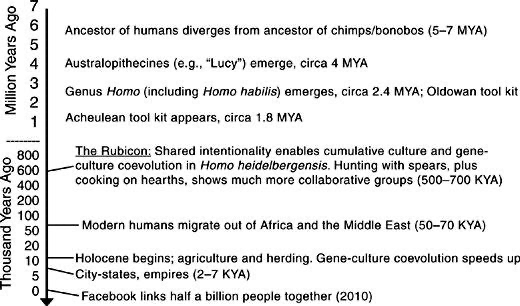
Figure 9.1 — Haidt’s source-era timeline of human evolution. The diagram locates a proposed shared-intentionality Rubicon at roughly 500,000–700,000 years ago and later cumulative cultural scaling. The fossil dates are a synthesis; the Rubicon placement is Haidt’s acknowledged inference, not a directly observed event. Figure 9.1, PDF p. 240 (file not included in this release)

Figure 9.2 — an Acheulean hand axe. Haidt uses its crafted symmetry to mark a cognitive change, while the extraordinary stability of the form complicates a simple story of rapidly cumulative culture. Figure 9.2 and the archaeological argument, PDF pp. 240–241 (file not included in this release)
Gene–culture coevolution means that cultural practices alter selection pressures while biological changes can enable further cultural practice. Lactase persistence is the chapter’s clearest established illustration: cattle keeping created a new nutritional opportunity, and different mutations supporting adult milk digestion spread in parts of Europe and Africa. Haidt then extends the logic more speculatively to social life. Symbolic markers, language and accent, shame and guilt, punishment, partner choice, and shared norms may have made larger non-kin groups more coherent while imposing costs on people who could not or would not conform. Lactase persistence and gene–culture coevolution, PDF pp. 241–243 (file not included in this release)
That extension must not be read as a genetic ranking of peoples. Haidt’s endnote says continent-wide “races” are not the relevant units for the local ecological and cultural pressures he describes; it also argues that culture can reverse behavioral patterns far faster than any speculative genetic contribution. The chapter supplies no gene for loyalty, shame, nationalism, or a particular moral norm. Haidt himself notes that simple “genes for traits” language fared poorly in the genomic era. Limits of “genes for” language, Chapter 9 endnote 12, PDF p. 402 (file not included in this release) · Group difference and cultural reversal boundary, Chapter 9 endnote 86, PDF p. 413 (file not included in this release)
The related self-domestication hypothesis holds that humans selected friends, partners, and mates who could live within a moral community while ostracizing or punishing the persistently violent. Reduced aggression, smaller teeth and bodies, extended playfulness, and other juvenile traits are compared with domesticated animals. This is an evolutionary reconstruction with disputed mechanisms and chronology, not proof that conformity is always adaptive or that a community’s exclusions were justified. Tribal instincts and self-domestication, PDF pp. 243–244 (file not included in this release) · Self-domestication qualifications, Chapter 9 endnotes 71–75, PDF pp. 411–412 (file not included in this release)
Exhibit D: fast selection is possible, but the human inference remains indirect
Dmitri Belyaev selected Siberian foxes only for reduced fear of humans. Tameness increased within a few generations; after nine generations, some pups began showing doglike traits such as white patches, smaller jaws and teeth, and curled tails. After thirty generations, the line could be kept as pets. The experiment shows that strong artificial selection on one behavioral criterion can rapidly reorganize correlated traits. It does not show that human moral psychology changed through the same mechanism or on the same timetable. Belyaev’s fox experiment, PDF pp. 245–246 (file not included in this release)
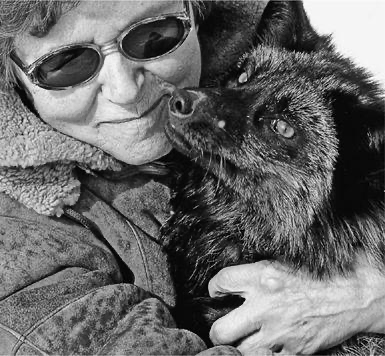
Figure 9.3 — Lyudmila Trut with Pavlik, a forty-second-generation descendant of Belyaev’s fox line. The photograph illustrates the breeding experiment; it does not independently demonstrate the chapter’s broader hypothesis about human group selection. Figure 9.3 and Belyaev experiment, PDF p. 246 (file not included in this release)
William Muir’s chicken experiment makes the level of selection visible. Breeding the individually most productive hens favored dominant, aggressive birds and lowered total output in crowded cages. Muir instead selected whole twelve-hen cages by combined egg production. Haidt reports that within three generations aggression fell; by generation six mortality fell from 67 percent to 8 percent, and eggs per hen rose from 91 to 237. The selected unit changed which traits prospered. As with the foxes, this is a controlled breeding result, not a ready-made policy for human organizations; people have rights, reasons, multiple goals, and the capacity to contest the criteria by which a group is judged. Muir’s group-selected hens, PDF pp. 246–247 (file not included in this release)
Haidt also cites source-era genomic work arguing that recent human selection accelerated during the last 50,000 years and the Holocene. Lactase persistence and high-altitude adaptation show that recent selection can occur; they do not directly establish recent genetic selection for any moral foundation or political behavior. The further bottleneck scenario—climatic instability, possible effects of the Toba eruption, and unusually cooperative survivors—is explicitly imaginative. It identifies a possible selection environment, not a recovered causal history. Recent-selection argument, PDF pp. 247–249 (file not included in this release) · Genomic and timing qualifications, Chapter 9 endnotes 81–90, PDF pp. 412–414 (file not included in this release)
Group success is not synonymous with war
The chapter corrects its own war-heavy language near the end. Lesley Newson reminds Haidt that groups can outcompete others by turning resources into surviving offspring more effectively; women and children are indispensable to that process. Coordination in foraging, care, learning, trade, sanitation, defense, conflict resolution, and production can improve in-group welfare without attacking an out-group. Groupishness therefore does not logically entail hatred. It does, however, create a boundary across which care, trust, and accountability may weaken. Group selection without war, PDF p. 250 (file not included in this release)
Key Terms and Distinctions
- Groupishness: willingness to promote a group’s interests, sometimes at personal cost; stronger than simple sociability, conformity, or herd behavior.
- Strategic cooperation / mutualism: cooperation from which every participant expects an individual benefit; not the hardest case for evolutionary explanation.
- Free rider: someone who shares a group’s gains while withholding a contribution; the central obstacle to higher-level cooperation.
- Multilevel selection: simultaneous selection pressures at different nested levels, especially individuals within groups and groups in competition with other groups.
- Group-related adaptation: a mechanism plausibly organized around group performance, such as coordinated division of labor or costly defense; not merely an aggregate of individually advantageous traits.
- Major transition: a shift in which formerly independent units suppress enough internal competition to become parts of a higher-level cooperative unit.
- Ultrasociality: life in very large, internally structured groups with extensive division of labor; broader than insect-specific definitions of eusociality.
- Shared intentionality: the ability to represent a joint goal, recognize that partners share it, coordinate complementary roles, and evaluate action against the common plan.
- Moral matrix: shared expectations, norms, institutions, and sacred representations through which a group interprets and judges conduct.
- Gene–culture coevolution: reciprocal change in which practices alter biological selection pressures and biological capacities alter cultural possibilities.
- Self-domestication: the hypothesis that social partner choice, punishment, exclusion, and mating gradually selected for reduced reactive aggression and greater social tolerance.
- Rally-round-the-flag effect: increased solidarity and support for leadership under perceived external threat; it need not involve a literal flag and can be exploited.
- “90 percent chimp, 10 percent bee”: a metaphor for a mostly individually selected nature with a smaller groupish overlay, not a measured ratio or a claim that human and bee minds share mechanisms.
Essential Evidence and Examples
- Post-9/11 flags: a personal case of threat activating national identity while a second flag preserves a wider identification; autobiographical, not representative. PDF pp. 220–221 (file not included in this release)
- Darwin’s nested conflict: cohesive groups can beat fragmented groups while free riders do better inside a successful group; the theory needs mechanisms that alter that balance. PDF pp. 223–226 (file not included in this release)
- Major transitions: eukaryotic cells, multicellular organisms, and colonies show that free-rider suppression can generate higher-level cooperative units; the analogy does not prove the disputed human case. PDF pp. 231–235 (file not included in this release)
- Tomasello tasks: toddlers and chimpanzees performed similarly on physical tasks but diverged sharply on social-communicative tasks in the cited study; later and broader primate evidence requires separate review. PDF pp. 236–238 (file not included in this release)
- Figures 9.1–9.2: the timeline and hand axe locate a speculative transition from stable tool form to cumulative culture, coordinated hunting, hearths, and shared camps. PDF pp. 240–241 (file not included in this release)
- Lactase persistence: cultural cattle keeping created a new selection pressure, with distinct mutations spreading in European and African populations; this establishes coevolution in a metabolic case, not a gene for morality. PDF pp. 241–243 (file not included in this release)
- Belyaev’s foxes: strong selection for tameness rapidly produced behavioral and correlated physical changes; relevance to human moral evolution is analogical. PDF pp. 245–246 (file not included in this release)
- Muir’s hens: selecting productive cages rather than productive individuals lowered mortality and raised egg output in six generations; the experiment shows that the selected unit matters. PDF pp. 246–247 (file not included in this release)
- Nonviolent group competition: cooperation can improve survival, production, and child-rearing without an out-group being attacked. PDF p. 250 (file not included in this release)
Chapter 9 Stories and Vignettes
- Haidt balances an American flag with a United Nations flag. A sudden national identification collides with a universalist self-conception, and two symbols preserve both. Preserved in 40 Stories. PDF pp. 220–221 (file not included in this release)
- Twenty-four sisters bring a motorboat to evolution’s boat race. A thought experiment makes major transitions visible by changing the unit that competes. Preserved in 40 Stories. PDF pp. 231–233 (file not included in this release)
- Toddlers follow a point that chimpanzees miss. Similar physical problem-solving separates sharply when the task depends on shared communicative intention. Preserved in 40 Stories. PDF pp. 236–238 (file not included in this release)
- Belyaev selects the tamest foxes—and doglike traits appear. A simple selection rule transforms behavior and correlated physical traits within a few dozen generations. Preserved in 40 Stories. PDF pp. 245–246 (file not included in this release)
- William Muir breeds the cage, not the champion hen. Selecting whole groups reverses the destructive result of rewarding individual output alone. Preserved in 40 Stories. PDF pp. 246–247 (file not included in this release)
Evidence and Interpretation Boundaries
- The case is contested. Haidt respects scientists on both sides, calls himself a nonexpert in the four literatures, and asks for a retrial rather than announcing a verdict.
- Levels must not be conflated. A cohesive outcome can arise from individually selected traits; a fast herd is not automatically a group adaptation.
- “Gene for” is shorthand. Complex psychological traits are highly polygenic and developmentally constructed; the chapter supplies no single gene or simple genetic program for loyalty or cooperation.
- Major transitions are analogies plus mechanisms. Cells, insect colonies, temporary teams, tribes, and states do not reproduce, maintain boundaries, or suppress conflict in the same way.
- Shared intentionality is comparative, not uniquely all-or-none. Other primates show coalition, collaboration, culture, and prosocial building blocks; the proposed human difference is one of scale and integration.
- The archaeological Rubicon is speculative. Hearths, spears, tools, and camps can support an inference about coordination but cannot directly reveal a shared mental representation.
- Metabolic coevolution does not prove moral coevolution. Lactase persistence is direct evidence for a gene–culture process; extending it to norms and moral foundations is a further hypothesis.
- Fast artificial selection is not human social history. Fox and hen experiments impose clear breeding rules and extreme selection pressures absent from most human environments.
- Recent-selection claims are source-era. Identified adaptations show that human evolution continued; the chapter’s broader pace and moral-psychology implications require current genomic review.
- Population bottlenecks do not identify the survivors’ psychology. Haidt’s starvation and Toba scenarios are plausibility arguments, not observations of why particular ancestors survived.
- Group benefit is not moral legitimacy. Loyalty, punishment, exclusion, hierarchy, propaganda, racism, genocide, and suicide terrorism can all serve or claim to serve groups. Function does not justify means or erase individual rights.
- Group competition need not be violent. Survival, care, learning, production, and resource use can make one group more successful without war; out-group harm is possible, not definitional.
- Layered identity remains available. The American and United Nations flags show that national, civic, religious, professional, and human identities can coexist rather than collapse into a single moral boundary.
- The 90/10 formula is metaphorical. It is not a measurement, species comparison, or claim that ten percent of behavior comes from a bee-like module.
Cross-Vault Integration
- Groupishness, Shared Intentionality, and Multilevel Selection is the permanent concept note for the chapter’s four exhibits, practical audit, and evidence boundaries.
- Psychology now routes moral and political group behavior through the new concept note.
- Moral Foundations Theory adds the proposed evolutionary bridge from shared plans to binding foundations without treating it as a settled origin story.
- The Psychology of Morality gains the shared-intentionality evidence and a cleaner separation among mutualism, cooperation, and group-level hypotheses.
- Nationalism distinguishes the cooperative scaling of a national “we” from threat-amplified exclusion and domination.
- Patriotism uses Haidt’s paired flags to preserve civic attachment, universal constraint, and vigilance about leader exploitation.
- Elinor Ostrom — Beyond Markets and States connects free-rider suppression and Muir’s group-selection experiment to institutional voice, monitoring, legitimacy, and rights.
- Parties, Partisanship, and Polarization adds threat-activated groupishness and layered identity to its social-sorting model.
- Moral Hierarchy and Israel–Palestine arguments use the chapter to audit identity boundaries and collective blame without diagnosing either people as a homogeneous group.
- Why Are We So Groupish? story collection preserves five reusable Chapter 9 episodes with direct PDF navigation.
Chapter Conclusion and Significance
Chapter 9’s best contribution is not a triumphalist theory of group selection. It is a layered account of cooperation. Individual incentives never disappear, yet common plans, reputations, symbols, sanctions, role differentiation, shared fate, and institutions can make a group more than a statistical collection of individuals. Humans can build moral communities that travel in language and memory, recruit strangers, suppress predation, and coordinate work no solitary person could complete.
The cost is built into the same machinery. A portable moral community carries boundaries; praise and blame can discipline a free rider or silence a dissenter; identity can distribute care or justify collective punishment; threat can produce mutual aid or make scrutiny of leaders feel disloyal. The practical question is therefore not whether to abolish groupishness. It is how to build nested identities and accountable institutions in which local loyalty serves wider rules, dissent remains legitimate, sanctions require evidence and appeal, cooperative benefits reach weaker members, and the humanity of outsiders never depends on their membership.
Questions for Reflection
- Which norms in a group I value suppress genuine free riding, and which merely suppress inconvenient dissent?
- What larger identity or institution can keep an activated “we” from turning everyone outside it into a morally lesser “they”?
- When a team performs well, what evidence would distinguish a group-level mechanism from an aggregate of individually rewarded behavior?
Chapter 10: The Hive Switch
Chapter Objective and Through Line
Chapter 10 asks how the groupish capacity defended in Chapter 9 becomes a lived psychological state. Haidt’s answer is the hive switch: human beings are usually separate, status-conscious individuals, yet under special conditions can temporarily experience themselves as parts of a larger whole. The switch is proposed as a group-related adaptation that promotes cohesion; the existence of self-transcendent states is a different claim from Haidt’s disputed evolutionary explanation of them. His endnote also makes “should” explicitly pragmatic rather than normative: knowing how a mechanism works helps someone pursue a chosen end, but does not decide which end is good. Chapter opening and muscular bonding, PDF pp. 253–255 (file not included in this release) · Evolutionary and normative qualifications, Chapter 10 endnotes 4–6, PDF p. 415 (file not included in this release)
The chapter’s strongest practical distinction is between binding and moral enlargement. Synchrony, awe, ritual, common identity, and competition can produce trust, joy, sacrifice, and social capital. They do not automatically extend concern to outsiders, make the group’s purpose just, or make its leader trustworthy. The same capacities can support a choir, platoon, sports club, congregation, company, protest movement, or fascist spectacle. Haidt therefore ends not with a demand for one permanent national hive, but with a defense of many smaller, cross-cutting groups whose loyalties are nested inside a plural democratic order. Political hives and their dangers, PDF pp. 272–275 (file not included in this release)
Chapter Structure at a Glance
- Begin with William McNeill’s experience of synchronous military drill and his theory of “muscular bonding.”
- State the hive hypothesis: people are conditional, not permanent or unconditional, hive creatures.
- Use Durkheim’s Homo duplex and collective effervescence to distinguish ordinary individual life from temporary absorption in a sacred whole.
- Examine three routes to self-transcendence: awe in nature, psychedelic “Durkheimogens,” and raves.
- Propose source-era biological candidates—oxytocin and mirror-neuron systems—while showing that attachment and empathy are selective.
- Apply hive psychology to organizations through common identity, synchrony, team-level competition, and transformational leadership.
- Contrast small-scale plural hives with nation-scale leader worship, festivals with spectacles, and horizontal bonding with hierarchical mobilization.
- Conclude that happiness often comes “from between”: relationships to people, work, and something larger than the self.
Section-by-Section Argument
McNeill marches until separate bodies become a unit
Drafted into the U.S. Army in 1941, historian William McNeill initially saw close-order drill as empty time-filling. After weeks of synchronized marching, he reported a pervasive well-being and “personal enlargement” produced by moving in unison. He later called the mechanism muscular bonding: coordinated movement can reduce self-consciousness, raise trust, and let people act as a temporary superorganism. In his reading of combat memoirs, soldiers risked themselves less for abstract country or doctrine than for comrades whose fate had become their own. This is a powerful account of bonding under danger, not evidence that military cohesion makes a war or order just. McNeill’s drill experience, PDF pp. 253–254 (file not included in this release) · Gray quotation provenance, Chapter 10 endnote 2, PDF p. 415 (file not included in this release)
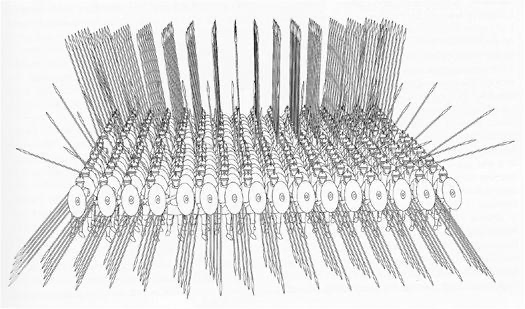
Figure 10.1 — The Macedonian phalanx as coordinated bodies functioning as one tactical unit. The image illustrates the chapter’s superorganism metaphor; it does not by itself establish McNeill’s historical or evolutionary explanation. Figure 10.1 and comrades-in-arms, PDF p. 254 (file not included in this release)
Homo duplex turns a capacity into a state
Haidt restates Chapter 9’s “90 percent chimp, 10 percent bee” language as a metaphor, then sharpens it. People remain strategic, status-aware competitors most of the time. Under the right conditions, however, they can enter a “one for all, all for one” state in which the group is not merely a route to private gain. Conditional matters: the hypothesis does not say that people are mindless team players, that self-interest disappears permanently, or that every collective feeling is authentic rather than performed. The hive hypothesis, PDF p. 255 (file not included in this release)
Durkheim supplies the conceptual frame. Homo duplex lives on two levels: ordinary relations among persons, and a higher social level in which one can feel “simply a part of a whole.” Collective effervescence is the passion and elevation generated when people gather, move, sing, dance, worship, mourn, celebrate, or struggle together. The profane/sacred distinction names psychological modes, not proof of a supernatural realm. Haidt treats gods, spirits, moral orders, and sacred objects partly as social facts generated and stabilized by collective life. That functional account can illuminate religious experience without exhausting its truth claims or meaning for believers. Ecstatic dancing and muscular bonding, PDF pp. 256–257 (file not included in this release) · Durkheim, Homo duplex, and collective effervescence, PDF pp. 258–259 (file not included in this release)
Barbara Ehrenreich’s historical interpretation adds a cultural claim: Europeans encountered nearly universal ecstatic dancing with disgust, and the rise of a more bounded, individualistic self made such collective joy harder to understand. Haidt links this to WEIRD cognition. The chapter does not demonstrate that the Enlightenment, industrialization, or individual rights independently caused the decline of communal dance; it presents Ehrenreich’s synthesis as an explanation and uses it to expose a possible blind spot in individual-level psychology. Ehrenreich’s account and WEIRD individualism, PDF pp. 256–257 (file not included in this release)
Awe, altered states, and raves provide different entrances
Awe in nature. Emerson’s “transparent eye-ball” and Darwin’s feeling in a Brazilian forest show that a switch proposed for groups can also be triggered in solitude. Haidt and Keltner define awe through vastness and a need for accommodation: an experience overwhelms the current mental frame and requires it to change. Awe can reduce petty self-focus and open new values or possibilities. It can also make a person suggestible or overconfident that a felt revelation is true; phenomenological force is not independent verification. Emerson and Darwin in nature, PDF pp. 259–260 (file not included in this release) · Awe definition source, Chapter 10 endnote 17, PDF p. 416 (file not included in this release)
“Durkheimogens.” Haidt surveys psilocybin mushrooms in Aztec practice, peyote, ayahuasca, initiation rites, and a controlled experiment with twenty divinity students. Ten received psilocybin and ten niacin in a Boston church. The active group reported unity, sacredness, loss of self, altered time and space, and lasting value; nineteen participants were located twenty-five years later, and all available psilocybin subjects still described genuinely mystical elements. The endnotes make the limits essential: claims about mushrooms and human history require caution, drug reports include terrifying experiences, most psilocybin subjects experienced fear or negativity during the session, and the study was tiny. A lasting interpretation by participants does not establish the metaphysical truth of what they felt. Aztec mushroom practice and initiation rites, PDF pp. 260–262 (file not included in this release) · Divinity-student experiment and follow-up, PDF pp. 262–263 (file not included in this release) · Drug, initiation, and study qualifications, Chapter 10 endnotes 18–24, PDF pp. 416–417 (file not included in this release)
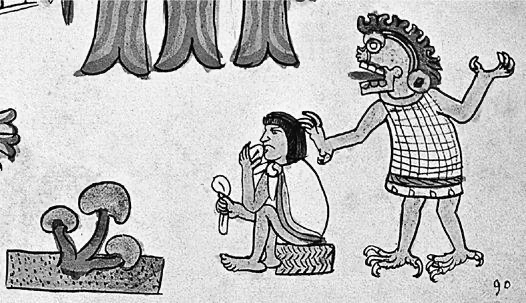
Figure 10.2 — Sixteenth-century Aztec mushroom eater, from the Codex Magliabechiano. Haidt uses the image to illustrate ritualized passage from profane to sacred; the figure does not establish the frequency, meaning, or social effects of the practice by itself. Figure 10.2, PDF p. 261 (file not included in this release)
Raves. Tony Hsieh describes entering a large rave and feeling self-consciousness disappear into a “united tribe” synchronized by the DJ’s wordless beat. Haidt presents the experience as a modern form of muscular bonding and as a turning point in Hsieh’s effort to build a more communal company. It is an autobiographical interpretation, not evidence that raves reliably improve leadership, that drug use was necessary, or that a strong corporate culture is always humane. The chapter then widens the list: choirs, marching bands, sermons, meditation, political rallies, sports, volunteering, and common projects can all move the psychological slider. Hsieh at a rave, PDF pp. 263–264 (file not included in this release) · Other routes and students’ search for calling, PDF p. 264 (file not included in this release)
Biology supports selective attachment, not a universal-love story
Haidt treats oxytocin and mirror-neuron systems as candidate materials from which a hive-related functional system could be assembled, not as a localized brain switch or a complete neurobiology. The oxytocin discussion deliberately reverses the “cuddle hormone” story. In the cited Dutch economic-game studies, intranasal oxytocin reduced selfishness toward teammates and increased preference for Dutch names and lives, but did not increase concern for other groups. Researchers repeatedly looked for greater hostility toward Muslims and did not find it. Haidt’s narrower formulation is parochial altruism: stronger in-group attachment without demonstrated universal benevolence or necessary out-group hate. Oxytocin as candidate glue, PDF pp. 265–266 (file not included in this release) · Parochial altruism and Dutch studies, PDF pp. 266–267 (file not included in this release) · Neurobiology and oxytocin qualifications, Chapter 10 endnotes 26–34, PDF pp. 417–418 (file not included in this release)
The mirror-neuron discussion follows the same conditional pattern. Haidt moves from macaques’ action-and-intention mirroring to a Tania Singer experiment in which subjects saw a previously fair or selfish player receive shocks. Neural responses tracked the fair player’s pain more closely; for men in the cited sample, the selfish player’s shock also activated reward-related circuitry on average. The endnotes narrow the claim: the game partner had directly cheated the subject, the sex difference was partly nonsignificant, and Haidt’s proposed test involving merely observed cheating had not been done. The chapter therefore supports the hypothesis that empathy is morally gated, not a claim that mirror neurons explain empathy in full or that every group predictably enjoys an enemy’s pain. Mirror neurons and intention, PDF pp. 267–268 (file not included in this release) · Conditional empathy experiment, PDF pp. 268–269 (file not included in this release) · Singer-study qualifications, Chapter 10 endnotes 38–40, PDF pp. 418–419 (file not included in this release)
Organizations can cultivate membership without demanding self-erasure
The corporation is legally treated as one body with continuity beyond any member. Haidt contrasts transactional leadership, which aligns self-interest through incentives and monitoring, with transformational leadership, which makes people see themselves as members of a shared project. He argues that leadership is inseparable from followership: people are willing to follow when a real common task exists, authority feels legitimate, and a leader does not trigger domination alarms. Healthy authority therefore requires Loyalty, Authority, and Liberty together—common commitment, legitimate coordination, and protection against bullying. Corporations and transactional leadership, PDF pp. 269–270 (file not included in this release) · Leadership and followership, PDF pp. 270–271 (file not included in this release)
Haidt recommends three levers:
- Increase salient similarity. Build a common identity, shared values, goals, and mutual dependence that can make demographic categories less predictive of coalition. This is not a warrant for exclusion, forced homogeneity, or suppressing disagreement. The claim is that cross-cutting similarity can make race or ethnicity less relevant—not that diversity itself is a defect.
- Exploit synchrony. Singing, marching, chanting, rowing, dancing, or tapping in time can increase trust and willingness to help. The cited research includes small experiments and synchronous rowing; it does not show that coerced ritual creates durable virtue.
- Create healthy competition among teams, not scarcity contests among individuals. Friendly intergroup competition can increase in-group care more than out-group dislike, while winner-take-all individual incentives can destroy trust. The intended unit and external costs still require audit.
Three organizational levers, PDF pp. 271–272 (file not included in this release) · Similarity, synchrony, and competition sources, Chapter 10 endnotes 49–55, PDF p. 419 (file not included in this release)
Political hives separate horizontal solidarity from vertical spectacle
Haidt places Kennedy’s “Ask not” appeal beside a passage attributed to Mussolini’s Doctrine of Fascism. Both call people beyond selfish pleasure toward duty and sacrifice; only the second makes the nation a superorganism in which the individual loses independent importance. The rhetorical similarity is the warning: felt elevation cannot certify the political object demanding sacrifice. Haidt’s endnote further notes that Giovanni Gentile may have written most or all of the fascist essay, though it appeared under Mussolini’s name. Kennedy and fascist self-transcendence, PDF pp. 272–273 (file not included in this release) · Attribution qualification, Chapter 10 endnote 56, PDF p. 419 (file not included in this release)
Ehrenreich’s distinction clarifies the institutional form. A festival is participatory and often levels or mocks hierarchy; a fascist spectacle arranges passive observers before synchronized force and a godlike leader. Basic training bonds soldiers horizontally to comrades more than to the drill sergeant; a mass rally can redirect awe upward. This contrast is useful but not absolute—festivals can exclude or intimidate, and formal ceremonies can serve constitutional ends. The audit question is who participates, who performs, where attention points, whether leaders can be mocked or replaced, and whether dissent remains membership-compatible. Festivals versus fascist spectacles, PDF pp. 273–274 (file not included in this release) · Horizontal-bonding distinction, Chapter 10 endnotes 57–58, PDF p. 419 (file not included in this release)
Haidt’s preferred political ecology is a country filled with multiple, cross-cutting, small-scale hives—workplaces, congregations, clubs, teams, fraternities, associations, parties—rather than one national hive. The plurality supplies meaning and social capital while making total capture by a demagogue more difficult. Haidt openly calls this a value judgment and a Durkheimian utilitarian argument. His use of Madison is analogical: factions are rarely cohesive enough to be hives, but multiplying interests can still obstruct a tyrannical majority. Putnam supplies the social-capital route, not proof that every group is beneficial. Two imagined nations and plural hives, PDF pp. 274–275 (file not included in this release) · Normative, Madison, and Putnam qualifications, Chapter 10 endnotes 59–61, PDF p. 419 (file not included in this release)
Key Terms and Distinctions
- Hive switch: Haidt’s name for a temporary state in which self-concern recedes and identification with a larger whole intensifies; a functional hypothesis, not a literal neural switch.
- Conditional hive creature: a person capable of group self-transcendence under some conditions while remaining individually strategic under others.
- Homo duplex: Durkheim’s person who lives both as an individual and as a member of a larger social entity.
- Collective effervescence: heightened emotion, energy, and felt unity generated by gathering and ritual.
- Muscular bonding: trust and solidarity fostered by moving in time with others.
- Sacred / profane: contrasting modes of experience—higher collective meaning versus ordinary practical life—not by themselves a verdict about metaphysical truth.
- Awe: an emotion elicited by perceived vastness plus a need to revise one’s interpretive frame.
- Durkheimogen: Haidt’s provocative label for a psychedelic that can, unreliably, reduce the sense of self and produce a religious or transformative interpretation.
- Parochial altruism: care and sacrifice concentrated within a bounded group; analytically distinct from both universal altruism and out-group hatred.
- Transactional leadership: coordination through incentives, monitoring, and self-interest.
- Transformational leadership: leadership that changes followers’ self-conception from isolated individuals to members of a shared project.
- Festival versus spectacle: horizontal, participatory bonding versus vertical awe organized around a leader or display of force.
- Cross-cutting hives: multiple memberships whose boundaries overlap rather than stacking into one total identity.
Essential Evidence and Examples
- McNeill’s marching: autobiographical evidence that prolonged synchrony can feel like personal enlargement; it motivates the mechanism but is not a controlled test. PDF pp. 253–254 (file not included in this release)
- Ecstatic dance: Ehrenreich’s cross-cultural and historical synthesis portrays dance as a widespread bonding technology; causal claims about its European decline remain interpretive. PDF pp. 256–257 (file not included in this release)
- Awe: Emerson and Darwin supply first-person cases; vastness and accommodation supply the proposed psychological structure. PDF pp. 259–260 (file not included in this release)
- Divinity-student experiment: a tiny controlled study plus long-term follow-up found enduring mystical interpretations among psilocybin recipients, alongside fear and negative phases omitted from the original report. PDF pp. 262–263 (file not included in this release) · Endnotes 23–24, PDF pp. 416–417 (file not included in this release)
- Hsieh’s rave: a personal conversion narrative linking synchronized collective joy to a later organizational ambition; not causal evidence about business performance. PDF pp. 263–264 (file not included in this release)
- Oxytocin games: source-era experiments support stronger in-group preference without the predicted increase in hostility toward Muslims. PDF pp. 266–267 (file not included in this release)
- Conditional empathy: a previously selfish game partner elicited less neural empathic response than a fair partner; direct cheating and unresolved sex differences limit generalization. PDF pp. 268–269 (file not included in this release) · Endnotes 38–40, PDF pp. 418–419 (file not included in this release)
- Synchrony studies: singing, tapping, marching, and rowing in time are cited as increasing trust, helping, and pain tolerance in small experimental settings. PDF p. 271 (file not included in this release) · Endnote 52, PDF p. 419 (file not included in this release)
- Festival/spectacle distinction: the direction of attention and the treatment of hierarchy distinguish reciprocal communal bonding from leader-centered mobilization. PDF pp. 273–274 (file not included in this release)
Chapter 10 Stories and Vignettes
- William McNeill marches until the “I” becomes “we.” Empty drill becomes a felt enlargement and later a theory of muscular bonding. Preserved in 40 Stories. PDF pp. 253–254 (file not included in this release)
- Emerson and Darwin find the sacred in nature. Two solitary encounters show how vastness can quiet the self without a crowd. Preserved in 40 Stories. PDF pp. 259–260 (file not included in this release)
- Ten divinity students take psilocybin in a chapel. A small blinded comparison becomes a decades-long argument about mystical experience and its interpretation. Preserved in 40 Stories. PDF pp. 262–263 (file not included in this release)
- Tony Hsieh walks into a rave and finds a tribe. A founder’s ecstatic night becomes part of his story about building a communal company. Preserved in 40 Stories. PDF pp. 263–264 (file not included in this release)
- Oxytocin makes Dutch men more loyal, not more universal. The “cuddle hormone” story narrows into parochial attachment without detected out-group hate. Preserved in 40 Stories. PDF pp. 266–267 (file not included in this release)
- Fair play determines whose shock hurts. Prior conduct changes the empathic response to another person’s pain. Preserved in 40 Stories. PDF pp. 268–269 (file not included in this release)
- Kennedy’s “Ask not” and Mussolini’s counterfeit transcendence. Similar appeals beyond the self lead toward sharply different political objects and constraints. Preserved in 40 Stories. PDF pp. 272–274 (file not included in this release)
Evidence and Interpretation Boundaries
- State and origin are separate claims. People can experience self-transcendence even if Haidt’s group-selection explanation of that capacity is wrong.
- The “switch” is a metaphor. Haidt explicitly expects a distributed functional system, not a single brain location or binary module.
- First-person intensity is not causal proof. McNeill, Emerson, Darwin, Hsieh, and psychedelic participants report powerful states; retrospective meaning does not validate every mechanism or belief attached to them.
- Psychedelic evidence is small and source-era. The chapter’s twenty-student study cannot establish typical effects, clinical benefit, safety, or metaphysical truth; Haidt’s endnotes preserve fear, negative episodes, and bad trips.
- Oxytocin is not moral goodness. The cited findings concern context-sensitive attachment, and intranasal results do not justify claims about everyday behavior, populations, or conflict.
- Mirror-neuron language is incomplete. The chapter offers convergence, not a complete theory of empathy; one cited experiment involved direct cheating and an unperformed follow-up prediction.
- Similarity is not demographic exclusion. Haidt’s own example is to make racial difference less coalitionally relevant through shared goals and interdependence. Common identity must not become compelled sameness or a device for silencing minorities.
- Synchrony can be coerced or staged. Trust generated by coordinated action says nothing by itself about informed consent, truthful leadership, or the justice of the mission.
- In-group love and out-group hate are distinct. Haidt repeatedly emphasizes that stronger internal care need not increase hostility, though it can reduce attention to outsiders.
- Small hives and national superorganisms differ. A club, team, congregation, company, military unit, movement, and state have different powers, exit costs, and capacities for coercion.
- Haidt makes a normative move. The claim that plural hiving improves well-being and democracy is openly presented as Durkheimian utilitarianism, not derived solely from descriptive psychology.
- Democratic plurality is the safeguard. Cross-cutting memberships, replaceable leaders, rights, dissent, and universal constraints prevent a meaningful “we” from becoming the only morally permitted identity.
Cross-Vault Integration
- Collective Effervescence, Synchrony, and the Hive Switch is the permanent concept note for activation routes, organizational design, political dangers, and a practical audit.
- Groupishness, Shared Intentionality, and Multilevel Selection now distinguishes Chapter 9’s capacity-and-origin question from Chapter 10’s state-and-trigger question.
- Psychology routes readers to the new concept note beside the Chapter 9 foundation.
- The Neuroscience of Human Nature adds the source-era oxytocin and conditional-empathy claims without turning them into a “love hormone” or mirror-neuron master theory.
- Leadership applies transactional versus transformational leadership, synchrony, shared identity, and team competition with consent and dissent safeguards.
- Loss of Connection adds embodied ritual and collective joy to its account of the social infrastructure lost when common time and space disappear.
- Do Liberalism, Capitalism, and the Enlightenment Cause Atomization? uses Ehrenreich’s thesis as a bounded cultural hypothesis rather than proof that one philosophy caused modern atomization.
- Nationalism distinguishes plural local hives from a nation-as-single-hive and horizontal solidarity from leader-centered spectacle.
- Moral Hierarchy and Israel–Palestine arguments apply the chapter to rallies, funerals, worship, protest, military cohesion, and sacred identity without diagnosing whole peoples or relaxing equal civilian standing.
- The Hive Switch story collection preserves seven reusable Chapter 10 episodes with direct PDF navigation.
Chapter Conclusion and Significance
Chapter 10’s deepest claim is that a good human life cannot be reduced to private preference satisfaction. People often find their greatest joy in relationships among self, others, work, place, ritual, and a purpose that outlasts the moment. “Happiness comes from between” names that relational structure. It also explains why removing every source of collective demand would not necessarily liberate people; it could leave them hungry for meaning and vulnerable to the first demagogue who offers total belonging.
The corrective is neither permanent self-loss nor permanent atomization. Build many voluntary, cross-cutting groups that let people sing, serve, train, worship, create, compete, mourn, celebrate, and accomplish difficult tasks together. Keep their leaders replaceable, their rituals noncoercive, their missions open to moral scrutiny, their members free to dissent and exit, and their loyalties nested inside equal rights and wider human concern. The hive switch is a capacity to steward, not an oracle to obey.
Questions for Reflection
- Which of my strongest collective experiences enlarged care and responsibility, and which merely made conformity feel meaningful?
- In an organization I value, do rituals and shared identity bind members horizontally to one another or vertically to a leader who becomes difficult to question?
- What cross-cutting membership, right, or wider moral identity prevents an energized “we” from making outsiders—or internal dissenters—morally invisible?
Chapter 11: Religion Is a Team Sport
Chapter Objective and Through Line
Chapter 11 asks what religion is for without treating function as proof of truth or goodness. Haidt’s answer is Durkheimian: religion is not merely a private belief in supernatural agents but an interlocking system of believing, doing, and belonging that marks sacred things and unites people into a moral community. The chapter continues Chapters 9–10: shared intentionality makes moral communities possible, ritual can activate the hive switch, and religion supplies durable symbols, practices, sanctions, relationships, and institutions through which a community regulates selfishness. UVA ritual and Durkheim’s definition, PDF pp. 277–280 (file not included in this release)
The argument is functional, not devotional. Haidt does not infer that supernatural claims are true, that religious communities are morally superior, or that every costly practice benefits its members. He argues that a belief-only account misses causal feedback: people may believe because they belong, interpret experience through what they repeatedly do, and sustain cooperation through relationships that cannot be reduced to doctrine. The same machinery can create charity, irrigation systems, trust, and civic service—or conformity, exploitation, parochialism, and moralized violence. The lone-believer problem, PDF pp. 280–282 (file not included in this release) · Chapter synthesis, PDF pp. 306–307 (file not included in this release)
Chapter Structure at a Glance
- Open with University of Virginia football as a secular analogue of religious ritual: costume, synchrony, song, sacred identity, and a community larger than the event on the field.
- Contrast the New Atheist belief-to-action model with a Durkheimian feedback model joining belief, practice, and belonging.
- Accept several by-product accounts of supernatural belief—agency detection, social learning, love circuitry, and intuitive dualism—while rejecting the inference that religion is only a parasite.
- Present Atran and Henrich’s cultural-group-selection account: religious systems spread when they help groups suppress free riding and coordinate non-kin.
- Extend the claim through Wilson’s Darwin-plus-Durkheim account, Balinese water temples, maypoles, and !Kung healing dances.
- Ask whether religion makes people good or evil by separating stranger-directed altruism from in-group trust, civic spillover, and parochial violence.
- Define moral systems functionally, then insist that functional cooperation cannot by itself determine what is normatively right.
Believing, Doing, and Belonging
Haidt uses post-9/11 New Atheism to isolate a methodological disagreement. Sam Harris, Richard Dawkins, and Daniel Dennett often begin with propositions about supernatural agents and then ask what conduct follows from accepting them. Haidt agrees that false or sacred beliefs can authorize grave harm. His objection is explanatory reduction: a private proposition does not explain why a tradition persists, why ritual transforms emotion, why believers incur costs, or why communities reproduce particular interpretations. His endnote about the political left’s reaction to Islam is his own interpretation of a public argument, not a measurement of liberals, Muslims, or terrorism. 9/11 and the New Atheists, PDF pp. 280–281 (file not included in this release) · Political and Buddhism qualifications, Chapter 11 endnotes 4–5, PDF p. 420 (file not included in this release)

Figure 11.1 — the New Atheist model: believing drives doing. It is Haidt’s schematic reconstruction of the view he criticizes, not an empirical estimate of causal strength or a claim that the authors deny every social influence. Figure 11.1, PDF p. 281 (file not included in this release)
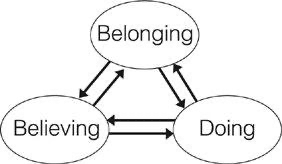
Figure 11.2 — the Durkheimian model: believing, doing, and belonging reciprocally reinforce one another. The arrows express a causal hypothesis. They do not show that all three components are equally strong in every person, tradition, or historical setting. Figure 11.2, PDF p. 282 (file not included in this release)
The two figures also separate questions that public argument often collapses:
- Truth: Is a theological proposition warranted?
- Psychology: What makes a person find it intuitive, sacred, or identity-defining?
- Sociology: Which relationships, rituals, sanctions, and institutions reproduce it?
- Ethics: What conduct does the resulting moral community protect, demand, or prohibit?
- Politics: Which powers, if any, should the state grant to that community?
Evidence that religion performs a social function does not establish its truth or political authority. Evidence against a supernatural claim does not establish that the associated community has no social function or that its functions can be removed without replacement.
Four Evolutionary Accounts Must Be Kept Distinct
| Account | Proposed sequence | What Haidt accepts | Main unresolved issue |
|---|---|---|---|
| Cognitive by-product | Adaptations for agency detection, learning, attachment, and mind–body inference incidentally make gods intuitive | The early by-product mechanisms are plausible and important | Explaining why costly, organized traditions persist and vary in group effects |
| Parasitic meme | Supernatural concepts compete for minds and spread even when harmful to hosts | Cultural variants can propagate through attention and transmission advantages | The analogy can ignore benefits to practitioners and groups; the endnotes note Susan Blackmore’s retreat from a virus-only account after evidence on happiness, generosity, and fertility |
| Cultural group selection | Religious packages spread when they make groups more cohesive and cooperative | Atran and Henrich explain moralizing gods, commitment signals, and cultural diffusion without requiring genetic change | Historical observation does not show that every religious demand is adaptive, humane, or caused by group competition |
| Gene–culture coevolution | Repeated religious environments also fine-tune inherited psychology over many generations | Haidt and D. S. Wilson argue this is plausible and perhaps likely | This is the chapter’s most speculative step; timing, selection pressure, trait definition, and alternative cultural explanations remain disputed |
Agency detection and by-products, PDF pp. 283–285 (file not included in this release) · Parasite and virus models, PDF pp. 285–287 (file not included in this release) · Cultural group selection, PDF pp. 287–291 (file not included in this release) · Conversion, Blackmore, and evolutionary sources, Chapter 11 endnotes 18–25, PDF pp. 420–421 (file not included in this release)
The by-product account begins with an asymmetric error problem. Missing a real agent in a dark forest can be costlier than inferring an agent from wind or noise, so a hypersensitive detector can be adaptive even when it generates false positives. Shared stories can then turn repeated inferences into a pantheon. Haidt adds gullible childhood learning, attachment circuitry, and intuitive dualism. Yet an endnote notes that adolescent conversion complicates a purely childhood-transmission story. A plausible origin of god concepts is not yet a complete theory of organized religion. Agency detection through dualism, PDF pp. 283–285 (file not included in this release) · Adolescent-conversion and by-product qualifications, endnotes 18–20, PDF pp. 420–421 (file not included in this release)
How Sacred Systems Suppress Free Riding
In Atran and Henrich’s account, gods become more moralistic as agricultural groups grow. Supernatural monitoring, oath enforcement, shame, gossip, and collective punishment make murder, adultery, false witness, cheating, and promise-breaking matters of communal survival. Haidt cites dim-light, watching-eyes, and God-priming studies as source-era evidence that perceived observation can affect conduct. These experiments should remain historical claims from a 2012 synthesis; Chapter 11 is not a current replication review. Moralistic gods and supernatural monitoring, PDF pp. 287–289 (file not included in this release)
Richard Sosis’s comparison of two hundred nineteenth-century U.S. communes supplies the chapter’s clearest historical pattern. Haidt reports that 6 percent of secular communes and 39 percent of religious communes still operated twenty years after founding. Among religious communes, more costly requirements—fasting, giving up alcohol or tobacco, dress rules, distinctive hair, or reduced outsider ties—predicted longer survival; the same relationship did not appear for secular communes, most of which failed within eight years. Haidt interprets sacrifice as a commitment screen and a way of sacralizing otherwise contestable conventions. Sosis’s commune comparison, PDF pp. 289–291 (file not included in this release) · Commune and commitment sources, endnotes 30–33, PDF p. 421 (file not included in this release)
The inference needs several limits. The archive is observational, communities self-selected, survival is not human flourishing, and a practice can deter free riders while empowering abusive leaders or trapping vulnerable members. Cost can signal commitment only if members and observers know what the sacrifice signifies; the same cost can also waste resources, screen for obedience, or make exit psychologically expensive. The relevant institutional tests remain consent, distribution of burdens, transparency, voice, appeal, safe exit, treatment of children and dissenters, and costs imposed on outsiders.
Water Temples, Maypoles, and Cooperative Infrastructure
D. S. Wilson joins Darwin’s multilevel selection to Durkheim’s moral community. His most concrete example, drawn through anthropologist Stephen Lansing, is the Balinese irrigation system. Extended-family groups called subaks managed terraced rice fields democratically. Temples placed at forks in the water system joined downstream subaks under a shared deity, creating a forum for dispute resolution and norms for distributing water. Haidt reports that thousands of farmers across hundreds of square kilometers coordinated without a centralized inspectorate or court system and that Dutch hydrologists found little to improve. This is a secondhand functional account through Wilson and Lansing, not an audit of all Balinese hierarchy, colonial encounter, or later scholarship. Wilson’s Darwin–Durkheim synthesis, PDF pp. 291–292 (file not included in this release) · Balinese water temples, PDF pp. 292–293 (file not included in this release) · Lansing source, endnote 41, PDF p. 422 (file not included in this release)
Figure 11.3 — a maypole dance from the Illustrated London News, August 14, 1858. One dancer’s path appears pointless in isolation; coordinated opposing circles weave one fabric. Haidt uses the scene as a metaphor for a sacred center that organizes joint action, not as evidence that every deity or ritual has the same function. Figure 11.3 and the maypole metaphor, PDF pp. 293–295 (file not included in this release)
The !Kung healing dance carries the same idea without a moralizing high god. In Haidt’s ethnographic source, participants who may like or dislike one another sing, clap, stamp, and move together against illness and misfortune. Capricious supernatural agents can therefore organize cohesion even when they do not reward virtue. The passage is an attributed ethnographic case, not a timeless description of !Kung people or proof that its supernatural explanation is true. !Kung healing dance, PDF pp. 295–296 (file not included in this release)
Does Religion Make People Good or Evil?
Haidt reframes the question around the unit and recipient of cooperation:
- Anonymous strangers: older laboratory studies often found little or no religious advantage in spontaneous helping.
- Committed communities: participation can strengthen reputation, mutual monitoring, trust, charity, volunteering, and enforceable promises.
- Wider civic life: religious networks may generate surplus social capital that spills beyond the congregation.
- Out-groups: internal cooperation can coexist with indifference, domination, or violence toward outsiders.
The U.S. charitable-giving figure is striking but narrow. Haidt reports that the least religious fifth gave about 1.5 percent of income to charity and the most religious fifth—classified by attendance rather than belief—gave about 7 percent, much of it to religious organizations. A German trust game found that participants transferred more to trustees disclosed as religious and that religious trustees returned more even though they knew nothing about the truster. The endnotes add an Israeli-kibbutz field experiment in which men who prayed communally most often were the least selfish in a one-shot cooperation game. These findings concern participation, reputation, networks, and selected settings; they do not establish a universal religious character advantage. Charity and parochial altruism, PDF pp. 298–299 (file not included in this release) · German trust game and trade, PDF pp. 299–300 (file not included in this release) · Israeli-kibbutz experiment, endnote 54, PDF p. 423 (file not included in this release)
Putnam and Campbell’s American Grace provides Haidt’s most important U.S. distinction. Frequent attenders appeared more generous to both religious and secular causes and more active in neighborhood and civic associations. Yet denomination, belief in hell, prayer, and scripture reading did not explain the association nearly as well as friendships and group activity with co-religionists. Haidt summarizes the result as belonging rather than belief predicting neighborliness. The endnote says the authors were careful about causality and used panel changes as evidence most consistent with a causal contribution. It remains an observational, U.S.-specific, source-era result in which selection, personality, family, locality, and institution can be entangled. American Grace and belongingness, PDF pp. 300–301 (file not included in this release) · Causal qualification, endnote 58, PDF p. 423 (file not included in this release)
Parochialism, Atrocity, and the Israel–Palestine Boundary
Haidt argues that religion often produces parochial altruism rather than unconditional benevolence. He then summarizes Robert Pape’s claim that suicide bombing is primarily a nationalist response to prolonged military occupation by a culturally alien democracy: ideology organizes martyrdom, but the ideology can be secular, as with the Tamil Tigers, or religious, as with Shiite militants in Lebanon. On this account religion is often an accessory to atrocity—a binding and legitimating system—rather than the sole driver. Religion, occupation, and suicide bombing, PDF pp. 301–302 (file not included in this release) · Pape source and democracy mechanism, endnote 62, PDF p. 424 (file not included in this release)
That passage should not be used as a settled causal law. Pape’s occupation-centered thesis is one influential source-era account; the vault’s existing clipping records Assaf Moghadam’s challenge that organizational dynamics and ideological framing are also indispensable. Haidt himself says most occupations do not produce suicide bombing and that an ideology capable of glorifying martyrdom must be present. For Israel–Palestine, the defensible use is multi-causal and actor-specific: examine occupation and territorial control, organizational strategy, recruitment, sacred framing, competition among factions, target selection, public support, and available alternatives. Do not infer one motive from Muslim or Palestinian identity, and do not use explanation to excuse attacks on civilians or collective punishment. → debate-ready application
Moral Exoskeletons and Anomie
Haidt calls religions moral exoskeletons: norms, relationships, institutions, and sacred practices external to any one person but capable of guiding the intuitive “elephant.” Someone in a loose secular matrix may depend more on an internal compass and conscious self-regulation. He connects loss of shared order to Durkheim’s anomie, then warns secular societies to consider how they will reproduce trust, obligation, belonging, and meaning across generations. Moral exoskeletons and anomie, PDF pp. 302–303 (file not included in this release)
This is a hypothesis and design problem, not a warrant for saying atheism causes suicide or that secular societies are failing. Haidt moves from Durkheim’s historical claim to source-era U.S. evidence and a speculative fertility comparison. The endnotes also acknowledge that looser matrices can be lifesaving for people excluded or condemned by conservative Christian or Muslim communities, including gay people. Fertility is an evolutionary output, not a complete measure of freedom, welfare, truth, equality, or a life worth living. A secular alternative may need deliberate civic association, service, ritual, common institutions, and reliable care; it does not follow that the state should establish a creed. Exclusion, anomie, and suicide qualifications, endnotes 63–64, PDF p. 424 (file not included in this release)
The Functional Definition of Morality—and Its Limit
Haidt finally defines moral systems as interlocking values, virtues, norms, practices, identities, institutions, technologies, and evolved mechanisms that regulate self-interest and make cooperation possible. The definition is intentionally descriptive and functional: it asks what a system does, not which moral content is true. It therefore captures rights-centered and duty-centered societies, religions, legal systems, families, professions, markets, and political ideologies within one analytic frame. Durkheim and the definition of moral systems, PDF pp. 303–304 (file not included in this release)
Its limit is decisive. Fascist states, communist regimes, mafias, and cults can suppress internal selfishness and achieve cooperation. Functional integration is not normative legitimacy. A full judgment still needs standards for individual standing, welfare, rights, domination, truth, consent, equality, due process, treatment of dissenters, and external costs. Haidt favors a Durkheimian utilitarianism for public policy: aggregate welfare matters, but social order and embeddedness are among the goods policy must count; rule utilitarianism is more plausible than evaluating each act in isolation. He presents this as a normative commitment, not a scientific result of Moral Foundations Theory. Descriptive versus normative morality, PDF pp. 304–306 (file not included in this release) · Virtue ethics and Durkheimian utilitarianism, endnotes 68–71, PDF p. 425 (file not included in this release)
Key Terms and Distinctions
- Believing / doing / belonging: theological propositions, embodied or repeated practices, and relationships or identities; mutually causal rather than a one-way chain.
- Hypersensitive agency detection: a proposed bias toward inferring agents when uncertain because false negatives can be more costly than false positives.
- Cognitive by-product: a consequence of a system selected for another function; not synonymous with uselessness once culture repurposes it.
- Parasitic meme: a cultural item that propagates by exploiting human cognition even when costly to hosts; an analogy, not a demonstrated diagnosis of every religion.
- Cultural group selection: diffusion of practices and institutions because groups using them persist, attract members, or are imitated more successfully.
- Costly commitment signal: a burden that helps distinguish members willing to contribute from people seeking benefits without paying costs.
- Supernatural monitoring: belief that conduct is visible to agents capable of punishment or reward, potentially extending reputation beyond human observation.
- Maypole: Haidt’s metaphor for a sacred focus around which separate people coordinate and become a working whole.
- Moral exoskeleton: external norms, relationships, and institutions that help regulate conduct before explicit reasoning.
- Anomie: normlessness or weakened integration; a sociological hypothesis with contested measures and causal pathways.
- Functional morality: a system’s capacity to restrain self-interest and sustain cooperation; analytically distinct from moral rightness.
- Durkheimian utilitarianism: Haidt’s public-policy view that welfare calculations must include social order, embeddedness, and institutions that sustain cooperation.
Essential Evidence and Examples
- UVA football ritual: an analogy showing how costume, synchrony, song, emotion, and a sacred institution create community around more than the visible contest. PDF pp. 277–280 (file not included in this release)
- Agency detector: a plausible error-management account of supernatural intuitions, not a complete history of religion. PDF pp. 283–285 (file not included in this release)
- Two hundred communes: a historical association between religion, costly sacrifice, and survival whose causal and welfare interpretations remain limited. PDF pp. 289–291 (file not included in this release)
- Balinese water temples: an institutional case in which shared sacred structure is reported to coordinate a common-pool resource across many local groups. PDF pp. 292–293 (file not included in this release)
- !Kung healing dance: an ethnographic illustration of synchrony and unity without a moralizing god. PDF pp. 295–296 (file not included in this release)
- German trust game: religious disclosure increased trust, and religious trustees returned more in the cited study; generalization beyond the setting is unresolved. PDF p. 299 (file not included in this release)
- American Grace: attendance and religious friendship networks, more than doctrine or denomination, tracked civic generosity in the reported U.S. evidence. PDF pp. 300–301 (file not included in this release)
- Pape’s suicide-bombing thesis: a contested occupation-centered explanation that Haidt already qualifies by requiring an organizing ideology. PDF pp. 301–302 (file not included in this release)
Chapter 11 Stories and Vignettes
- Fifty thousand Cavaliers turn a football game into a church. Costume, synchrony, song, and collective emotion create a community whose function extends beyond winning. Preserved in 40 Stories. PDF pp. 277–280 (file not included in this release)
- A parasite sends an ant to the top of a blade of grass. Dennett’s biological story becomes a powerful but incomplete analogy for religion as a mind-hijacking meme. Preserved in 40 Stories. PDF pp. 285–287 (file not included in this release)
- Costly sacrifices help religious communes outlast secular ones. Sosis’s historical comparison turns apparently irrational burdens into a test of commitment—with substantial causal and ethical limits. Preserved in 40 Stories. PDF pp. 289–291 (file not included in this release)
- Balinese water temples coordinate thousands of rice farmers. Sacred institutions are reported to turn a branching irrigation network into a cooperative governance system. Preserved in 40 Stories. PDF pp. 292–293 (file not included in this release)
- Twelve dancers weave one fabric around a maypole. Individual motion that looks pointless becomes intelligible at the level of the coordinated whole. Preserved in 40 Stories. PDF pp. 293–295 (file not included in this release)
- A !Kung healing dance unites people who do not like one another. Rhythm and concerted action temporarily override strained relationships. Preserved in 40 Stories. PDF pp. 295–296 (file not included in this release)
- Religious trustees return more in a German trust game. A disclosed identity changes expectations, and the trustees’ conduct partly vindicates them in the reported experiment. Preserved in 40 Stories. PDF p. 299 (file not included in this release)
Evidence and Interpretation Boundaries
- Function is not truth. A tradition can sustain cooperation even if a supernatural proposition is false; a true belief would not make every institution built around it just.
- Function is not welfare. Longevity, fertility, obedience, and group success can coexist with domination, fear, exclusion, or harm to outsiders.
- Belief and belonging are not rivals. The model is reciprocal; showing network effects does not show that doctrine never matters.
- Historical survival is not a randomized trial. The commune result may reflect selection, founding conditions, leadership, demographics, records, and exit costs.
- Small studies and priming findings are source-era. The chapter predates later replication debates and does not provide a current meta-analysis.
- Ethnographic examples are attributed cases. Bali and !Kung passages should not be generalized into simple portraits of whole cultures or romanticized as power-free orders.
- Gene–culture coevolution is the speculative extension. Cultural selection can operate even if Haidt’s proposed genetic fine-tuning is wrong.
- Religious generosity is context-dependent. U.S. attendance data and selected trust games do not rank believers over nonbelievers in moral worth.
- Parochial altruism has two margins. In-group care does not automatically produce out-group hate, but a highly cooperative group can still ignore or harm nonmembers.
- Pape is not the last word. Occupation, ideology, organizational strategy, competition, and opportunity should be tested together in any terrorism case.
- Anomie is not an atheism diagnosis. Social disconnection, suicide, and fertility require independent measurement and causal analysis; secular societies can deliberately build nonreligious forms of moral community.
- Description does not settle normativity. Haidt’s moral-system definition must be paired with rights, welfare, truth, reciprocity, consent, anti-domination, and treatment of outsiders.
Cross-Vault Integration
- Religion as a Cooperative Technology and Moral Community is the permanent concept note for the believing–doing–belonging model, cooperation mechanisms, evidence ladder, and institutional audit.
- Do Individuals Need Religion? Does Society? now separates individual well-being, social function, theological truth, and legal establishment.
- What is the best basis for society? and Liberalism's cultural dependencies use Chapter 11 to defend a plural associational ecology without inferring theocracy.
- Religious-government evidence audit separates measurable goods of voluntary participation from the unproved benefits of establishment or clerical power.
- Bowling Alone connects American Grace to social capital, while preserving bonding/bridging and causality limits.
- Liberalism and atomization treats moral exoskeletons as a design challenge rather than a monocausal indictment of modernity.
- Émile Durkheim gains the religion-as-moral-community link with explicit functionalist and suicide-evidence qualifications.
- Groupishness and the hive switch now route into the institutional systems that stabilize shared identity over time.
- Israel–Palestine arguments, Moral Hierarchy, and Suicide Bombing as a Strategic Weapon retain the Pape claim as contested and reject both religion-only and grievance-only explanations.
- Religion Is a Team Sport story collection preserves seven reusable Chapter 11 episodes with direct PDF navigation.
Chapter Conclusion and Significance
Chapter 11’s strongest contribution is a category correction. Criticizing a creed’s truth claims, explaining the psychology of belief, measuring a community’s social function, judging its morality, and deciding its legal authority are different tasks. A society can reject supernatural propositions yet still need institutions that generate repeated contact, obligation, trust, ritual, meaning, service, and intergenerational continuity. A religious community can provide those goods while also demanding safeguards against coercion, domination, epistemic closure, and harm to outsiders.
The practical synthesis is neither “religion poisons everything” nor “society needs an established religion.” Protect voluntary religious and secular communities; measure the goods they actually produce; distinguish bonding from bridging capital; preserve voice, criticism, safe exit, and equal citizenship; and build substitutes for any social function that secularization weakens. The maypole matters because people can accomplish together what they cannot accomplish alone. The moral verdict depends on what they build around it, who may refuse to dance, and who pays the cost outside the circle.
Questions for Reflection
- Which of my beliefs are sustained mainly by evidence, which by repeated practice, and which by relationships I would risk losing if I changed my mind?
- Which costly demands in a community I value genuinely screen for contribution, and which merely train obedience or raise the price of exit?
- If a religious or secular institution disappeared, which functions—trust, care, ritual, service, meaning, discipline, or intergenerational memory—would need deliberate replacement?
- Does a community’s cooperation spill outward through civic service and wider loyalties, or does it depend on outsiders, apostates, and dissenters remaining morally suspect?
- What independent normative standard prevents “it makes the group work” from becoming an excuse for domination?
Chapter 12: Can’t We All Disagree More Constructively?
Chapter Objective and Through Line
Chapter 12 asks how people who inhabit opposed moral matrices can disagree without treating one another as stupid, corrupt, or evil. Haidt’s answer has three layers. First, ideology is developmentally assembled: inherited dispositions bias attention, environments invite different adaptations, and people construct life narratives that make one political story feel like their story. Second, each major coalition protects a real class of goods while becoming selectively blind: liberals notice victims and externalities, libertarians notice coercion and decentralized coordination, and social conservatives notice the moral capital embedded in institutions and groups. Third, polarization is sustained by relationships and incentives as well as arguments, so appeals to niceness will fail unless political environments change. Opening problem and civility, PDF pp. 308–311 (file not included in this release) · Chapter synthesis, PDF pp. 350–351 (file not included in this release)
The chapter is an interpretive synthesis, not a current map of every voter or a proof that the three coalitions are equally right. Its genetic, candidate-gene, personality, YourMorals, lead–crime, health-care, diversity, and polarization claims are all source-era. Some are observational, disputed, or framed more confidently than their designs warrant. The durable method is narrower: reconstruct the good and danger a worldview perceives, identify its sacred commitments and blind spots, then return to actor-specific facts, causal evidence, rights, distribution, externalities, institutional feedback, dissent, and consequences.
Chapter Structure at a Glance
- Diagnose the source-era collapse of civility among political elites and explain why a one-dimensional left–right axis remains useful but incomplete.
- Trace a three-step developmental route from dispositional traits to characteristic adaptations and self-authored life narratives.
- Compare liberal and conservative grand narratives, then test how accurately voluntary YourMorals participants could imitate the other side.
- Distinguish conservatism from religious orthodoxy and introduce moral capital as the external ecology that sustains cooperation.
- Use a yin–yang frame to identify liberal, libertarian, and social-conservative insights and characteristic overreach.
- Replace civility pledges with indirect interventions: cross-party relationships, electoral incentives, less geographic sorting, and attention to sacred values.
Civility Cannot Be Ordered by Poster
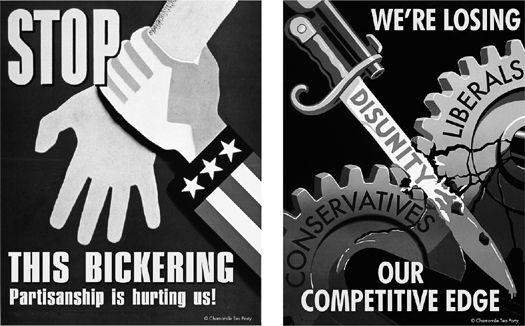
Figure 12.1 — Jeff Gates’s “Civility Now” posters for the Chamomile Tea Party. Haidt uses their visual contrast—Founding-era figures joined to contemporary partisan slogans—to open a chapter about moralized political combat. The image diagnoses rhetoric; it does not measure polarization or show that incivility is evenly distributed. Figure 12.1, PDF p. 309 (file not included in this release)
Haidt begins with source-era U.S. polarization. From 2000 to 2011, he reports that self-identified moderates declined from 40 to 36 percent, conservatives rose from 38 to 41 percent, and liberals rose from 19 to 21 percent. His larger concern is the political class: ideologically sorted parties, diminished social contact, and policy disputes interpreted as battles between good and evil. The 2011 debt-ceiling confrontation is his immediate example. These numbers and institutional descriptions belong to the book’s period; they are not current estimates. Source-era electorate and political class, PDF pp. 308–311 (file not included in this release)
The left–right axis compresses six or more moral dimensions and cannot classify every person. Haidt nevertheless retains it because people commonly locate themselves on it and because it organized source-era U.S. congressional voting and culture-war coalitions. Use the axis as a coarse orientation, not an identity diagnosis or substitute for issue-level evidence. Political diversity and the left–right axis, PDF pp. 311–312 (file not included in this release)
From Genes to Moral Matrices
Haidt defines ideology as a set of beliefs about the proper social order and how to achieve it. He rejects a simple material-interest model: income and class do not reliably determine modern political allegiance, and people within the same household can diverge. Twin studies lead him to estimate that genetic differences explained roughly one-third to one-half of variation in political attitudes in the cited research. The claim is about population variation under particular environments, not an “ideology gene,” a fixed fate, or the share of any individual’s politics caused by DNA. His own endnote emphasizes environmental contribution. Ideology, self-interest, and twin studies, PDF pp. 312–314 (file not included in this release) · Environmental qualification, Chapter 12 endnote 13, PDF p. 426 (file not included in this release)
The developmental sequence is more useful than a deterministic reading:
| Level | Haidt’s proposed mechanism | What it does not establish |
|---|---|---|
| 1. Dispositional traits | Genes help organize neural systems related to threat sensitivity, novelty, openness, and order | A single gene for liberalism or conservatism; immutability; moral superiority |
| 2. Characteristic adaptations | Traits influence which settings, peers, conflicts, vocations, and communities people seek or evoke | That a childhood trait mechanically fixes an adult vote; that shared environments have no effect |
| 3. Life narratives | People selectively reconstruct experience into a morally saturated story about who they are and what they oppose | That the story is historically complete, consciously invented, or immune to revision |
Traits and source-era genetics, PDF pp. 314–315 (file not included in this release) · Characteristic adaptations and the fictional twins, PDF pp. 315–317 (file not included in this release) · Life narratives, PDF pp. 318–320 (file not included in this release)
The candidate-gene discussion is especially dated. Haidt cites specific neurotransmitter-related variants and studies of danger response, disgust, novelty, and openness, but his endnote already says any single-gene effects are tiny and context-dependent. The chapter predates the later collapse of many candidate-gene findings and should not be used as current genomic consensus without a fresh review. The nursery-school evidence is also less clean than popular summaries imply: Haidt’s endnote says the cited children displayed mixed attractive and difficult traits rather than a simple childhood portrait of future liberals. Candidate genes and threat or openness, PDF pp. 314–315 (file not included in this release) · Single-gene and nursery-study qualifications, endnotes 19 and 22, PDF p. 427 (file not included in this release)
Keith Richards supplies the narrative hinge. A choir master used Richards and his friends for competitions, then abandoned them when puberty changed their voices and the missed classes threatened an extra school year. Richards later made the betrayal an origin story for his rebellion against authority. Haidt’s point is not that the event objectively caused a political identity; the same experience could be remembered differently. A selective narrative can nevertheless organize later conduct by joining temperament, grievance, villain, and calling. The endnotes add that narrative correlations alone do not establish causation, though experimental expressive-writing research suggests that changing a story can sometimes change outcomes. Keith Richards and the rebel narrative, PDF pp. 318–320 (file not included in this release) · Narrative-causation qualification, endnote 24, PDF p. 427 (file not included in this release)
Grand Narratives Make a Moral World Legible
Drawing on Christian Smith, Haidt treats a grand narrative as a moral plot with a valued beginning, a threat or fall, and a resolution that names today’s duties. His liberal progress narrative moves from hierarchy, exploitation, and irrational tradition toward autonomy, equality, prosperity, and liberation, activating Care and Liberty with some equality-oriented Fairness. Drew Westen’s reconstruction of Ronald Reagan’s narrative moves from a virtuous and confident America through bureaucratic expansion, welfare dependency, cultural permissiveness, crime, and geopolitical weakness toward national restoration, activating Liberty, proportional Fairness, Loyalty, Authority, and Sanctity. These are stylized rhetorical ideal types, not neutral histories or the beliefs of every liberal and conservative. Grand narratives and liberal progress, PDF pp. 320–322 (file not included in this release) · Reagan narrative and moral breadth, PDF pp. 322–323 (file not included in this release)
Haidt, Jesse Graham, and Brian Nosek then asked more than 2,000 YourMorals visitors to answer the Moral Foundations Questionnaire as themselves, as a “typical liberal,” or as a “typical conservative.” Moderates and conservatives were more accurate on average; very liberal participants were least accurate, with their largest errors occurring when estimating conservative Care and Fairness responses. This is evidence about voluntary source-era participants, stereotypes of “typical” groups, and a particular instrument. It does not show that conservatives are generally more empathic, epistemically superior, or accurate about every policy dispute. Haidt’s endnote notes several comparison baselines, but representativeness and current validity remain open. Partisan-imitation study, PDF pp. 323–324 (file not included in this release) · Study baselines and source, endnote 32, PDF p. 428 (file not included in this release)
The operational lesson is not “split every difference.” Before rebutting a position, reconstruct the sacred good, feared catastrophe, causal story, and standards of fairness its advocates perceive. Then test the reconstruction with the advocate and examine its facts, omissions, rights, trade-offs, and victims. Understanding a matrix is a prerequisite for precise criticism, not a promise to validate it.
Moral Capital: Conservatism Is Not the Same as Orthodoxy
Haidt’s second intellectual turning point occurs on the floor of a used-book store, where Jerry Muller’s introduction to Conservatism breaks an equation Haidt had carried for years: conservatism = religious orthodoxy = rejection of science. Muller distinguishes orthodoxy, which seeks to conform society to a transcendent order and may demand radical change, from an Enlightenment conservatism associated with Hume and Burke that criticizes rationalist redesign on pragmatic, welfare-oriented grounds. Haidt explicitly says he is praising conservative intellectuals, not the Republican Party. Bookstore encounter and orthodoxy distinction, PDF pp. 325–327 (file not included in this release) · Party distinction, endnote 36, PDF p. 429 (file not included in this release)
Social capital consists of ties and the trust and reciprocity they support. Moral capital widens the frame to the environment that keeps cooperative expectations functioning:
the interlocking values, virtues, norms, practices, identities, institutions, and technologies that fit human psychology well enough to regulate selfishness and sustain cooperation.
This is a community- or system-level concept, not a virtue stored inside one person. A norm may contribute to moral capital by making promises credible, roles legible, sanctions predictable, and free riding costly. But the content and distribution of that order remain open to judgment. Social capital and outside-the-mind constraints, PDF pp. 327–329 (file not included in this release) · Definition and commune thought experiment, PDF pp. 329–330 (file not included in this release) · System-level qualification, endnote 42, PDF p. 429 (file not included in this release)
Moral capital is not moral legitimacy. A cult or fascist state can suppress internal free riding, generate sacrifice, and coordinate efficiently. High cohesion does not guarantee equality, opportunity, truth, consent, non-domination, humane ends, or concern for outsiders. Haidt’s criticism therefore cuts both ways: rapid reform can destroy useful trust and role structure, while conservatism can protect predation, miss victims, and resist necessary institutional repair. Mill’s party of progress and party of order, and Russell’s dangers of dissolution and ossification, supply the yin–yang frame. Moral capital’s limits and partisan blind spots, PDF pp. 330–331 (file not included in this release) · Mill, Russell, and complementary dangers, PDF pp. 331–333 (file not included in this release)
Three Moral Matrices—and What Each Notices
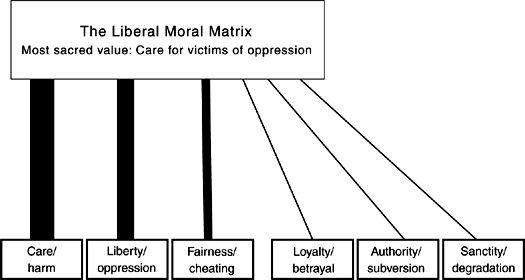
Figure 12.2 — Haidt’s schematic moral matrix of American liberals. The thickest line joins liberal identity to Care for victims of oppression; Liberty and equality-oriented Fairness also carry weight. This is Haidt’s source-era interpretive diagram, not a measured effect size or a portrait of every liberal. Figure 12.2, PDF p. 334 (file not included in this release)
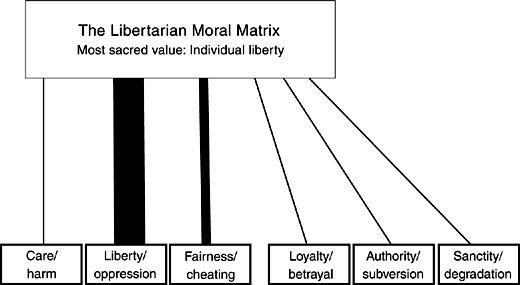
Figure 12.3 — Haidt’s schematic moral matrix of American libertarians. Liberty is sacred; Care and the binding foundations are comparatively weak in the reported YourMorals averages. The underlying comparison used about 12,000 self-selected libertarians and tens of thousands of other voluntary visitors. It is not a representative estimate or individual classifier. Figure 12.3 and libertarian profile, PDF pp. 338–340 (file not included in this release)
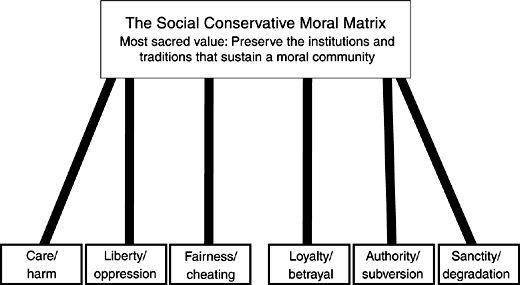
Figure 12.4 — Haidt’s schematic moral matrix of American social conservatives. All six foundations connect relatively strongly, while institutions and traditions that sustain a moral community occupy the sacred center. Breadth is not moral superiority: more routes to concern are also more routes to sanctify domination, exclusion, or a failed institution. Figure 12.4, PDF pp. 343–344 (file not included in this release)
| Matrix in Haidt’s account | Insight it makes salient | Characteristic blind spot | Better institutional question |
|---|---|---|---|
| Liberal | suffering, excluded victims, domination, concentrated corporate power, externalized costs, reformable injustice | useful functions of inherited institutions; second-order effects of rapid redesign; business and market discovery | Which vulnerable parties and third-party costs are missing, and what intervention corrects them with the least new domination? |
| Libertarian | coercion, choice, dispersed knowledge, prices, experimentation, spontaneous order | unequal bargaining power, public goods, hidden externalities, dependence, people unable to participate as informed consumers | Which feedback and choice mechanisms are absent, and which market failure or rights problem blocks them? |
| Social conservative | formation, loyalty, role obligation, continuity, trust, family and civic institutions, moral capital | entrenched victims, inherited rent, unjust exclusion, silenced dissent, changed conditions | What cooperative function does the institution perform, for whom, and can it be preserved while rights, voice, and correction improve? |
The table is a steelmanning device, not an apportionment of truth. A policy may require all three questions, and a coalition may violate the value it claims to protect.
Liberal Wisdom: Externalities and the Leaded-Gasoline Case
Haidt treats corporations as coordinated superorganisms capable of innovation and value creation but also secrecy, regulatory capture, and shifting costs to third parties. Because no voluntary transaction represents the poisoned river, injured animal, deceived consumer, or politically weak neighbor, a competitive market can remain efficient for the transacting parties while being socially destructive. He therefore gives government a legitimate role in enforcing transparency, competition, liability, public goods, and limits on externalized harm, while warning that reflexive antibusiness politics can destroy production and discovery. Corporate power and externalities, PDF pp. 334–336 (file not included in this release)
Leaded gasoline is his strongest case. Haidt reports that U.S. vehicles emitted about 200,000 tons of lead per year by 1973; industry resisted restriction; the Carter administration began a phaseout; bipartisan action preserved it; and childhood blood-lead levels fell as lead disappeared from gasoline. He then cites source-era studies suggesting the phaseout may explain up to half of the 1990s crime decline and an endnote estimate that its crime-reduction benefits were roughly twenty times its costs, before counting other health gains. The exposure reduction is a major public-health success. The exact share of IQ or crime change caused by lead is a contested causal estimate, not a settled fact to repeat without current review. Leaded gasoline, public health, and crime hypothesis, PDF pp. 336–337 (file not included in this release) · Lead sources and cost-benefit claim, endnotes 54–59, PDF p. 430 (file not included in this release)
Libertarian Wisdom: Markets as Discovery Systems
Haidt’s libertarian counterpoint is not that markets are sacred or self-justifying. It is that a price system joins dispersed information, responsibility for trade-offs, rivalry, and permission to try something new. A can of peas embodies countless adjustments no administrator designed. Removing prices and having insurers or government pay routine purchases can weaken comparison and innovation while rewarding providers for mastering reimbursement rather than serving the user. The analogy clarifies one mechanism; it does not establish that ordinary groceries and emergency medicine have the same information, choice, risk, or equity conditions. Goldhill and the can-of-peas analogy, PDF pp. 340–342 (file not included in this release)
David Goldhill enters the chapter after his father died from an infection acquired in a hospital in 2007. Haidt reports source-era estimates of about 100,000 annual deaths from hospital-acquired infections and a two-thirds reduction with a sanitation checklist, then uses Goldhill’s investigation to criticize routine third-party payment and the weak feedback patients face. He also repeats a claim that competitive LASIK prices fell nearly 80 percent. These figures should remain attributed and dated; they are not current health statistics or a complete comparison of health systems. Haidt’s endnote also notes that Goldhill still assigns government roles in safety, competition, catastrophic pooling, and subsidy for people unable to buy care. Goldhill’s father and hospital incentives, PDF pp. 340–342 (file not included in this release) · Government roles in Goldhill’s proposal, endnote 65, PDF p. 431 (file not included in this release)
Social-Conservative Wisdom: Preserve the Hive, Audit the Hive
Haidt argues that families, congregations, clubs, schools, neighborhoods, professions, and nations can act as moral exoskeletons: repeated relationships and roles make responsibility easier to enact than an isolated act of will. Burke’s “little platoons” and Adam Smith’s local affections express a practical scale of care. The inference should be conditional. A boundary can support trust and action without requiring hatred of outsiders, and Haidt’s endnote says in-group love usually does not increase out-group hate; Burke’s stronger claim that local attachment necessarily expands into universal benevolence is too strong. Institutions, exclusion, and little platoons, PDF pp. 343–346 (file not included in this release) · In-group-love qualification, endnote 70, PDF p. 431 (file not included in this release)
Putnam’s 2007 “E Pluribus Unum” study is the chapter’s difficult empirical case. In hundreds of U.S. communities, ethnic diversity correlated with lower bonding trust within groups and lower bridging trust between groups—a generalized “hunkering down,” not simply increased hostility toward outsiders. Haidt presents the relationship causally and uses it against reforms that emphasize difference while neglecting common identity. The study was observational and source-era; selection, context, time horizon, institutions, inequality, neighborhood conditions, later scholarship, and the distinction between short-run disruption and long-run integration all matter. It cannot support a universal claim that immigration or diversity destroys cooperation. Putnam, bonding, bridging, and hunkering, PDF pp. 346–347 (file not included in this release)
Haidt’s claims that 1960s welfare, school litigation, and multicultural education weakened the people they were meant to help are his contentious normative and causal applications, not findings generated by Moral Foundations Theory. They rely on selected sources and require issue-specific audits. The conservative insight survives without accepting each example: before removing a norm or institution, identify its real functions, who benefits and suffers, whether conditions changed, and what substitute will carry coordination, care, authority, trust, and correction afterward. Haidt’s reform examples, PDF pp. 346–347 (file not included in this release) · Source-era school and multiculturalism notes, endnotes 72–74, PDF pp. 431–432 (file not included in this release)
Toward More Civil Politics: Change the Environment of the Elephant
Manichaean politics treats public life as a war between absolute good and absolute evil. Under that frame, compromise is betrayal. Haidt doubts that civility pledges can override intuitions while parties, districts, primaries, fundraising, social networks, and media reward combat. He traces some sorting to the post–Civil Rights Act partisan realignment, while his endnote rejects fatalism: historical sorting does not make institutional reform pointless because incivility still responds to incentives. Manichaeism and partisan realignment, PDF pp. 347–348 (file not included in this release) · Realignment and incentives qualification, endnote 75, PDF p. 432 (file not included in this release)
Former representative Jim Leach gives Haidt a concrete social mechanism. After Newt Gingrich became speaker in 1995, incoming Republican members were encouraged to leave their families in their home districts. Legislators increasingly flew in for a compressed workweek, met mainly with teammates, and returned home. Spouses and children no longer formed the cross-party friendships that had made opponents socially familiar. Haidt does not establish that this one change caused congressional polarization. It illustrates an indirect intervention: recurring friendly contact can change intuitions before the rider generates political reasons. Jim Leach and disappearing cross-party contact, PDF pp. 348–349 (file not included in this release)
Residential and consumer sorting compound the problem. Haidt reports that 27 percent of Americans lived in counties won by twenty points or more in 1976, compared with 48 percent in 2008. He adds source-era correlations between Whole Foods or Cracker Barrel locations and county vote. These are ecological patterns, not evidence that a shopper’s brand predicts an individual’s beliefs or that geographic sorting has one cause. Their value is diagnostic: when work, worship, leisure, media, and neighborhood all repeat the same narrative, disagreement arrives as an encounter with a caricature rather than a person. Landslide counties and lifestyle enclaves, PDF p. 349 (file not included in this release)
Haidt’s final advice is compact: follow the sacredness. Ask which foundation, institution, identity, victim, liberty, or boundary has become nonnegotiable. Then open the heart before demanding that the mind open: one friendly encounter can make accurate listening psychologically possible. The goal is not agreement or false symmetry. It is movement from “the other side is evil” to a yin–yang disagreement in which a rival may identify a genuine cost while still being wrong about facts, causes, proportionality, or remedy. Follow the sacredness and friendly contact, PDF pp. 349–350 (file not included in this release)
Key Terms and Distinctions
- Dispositional trait: a relatively broad, persistent tendency such as threat sensitivity or openness; a probabilistic input, not a political destiny.
- Characteristic adaptation: a goal, habit, role, coping style, or relational pattern developed within a particular environment.
- Life narrative: a selective reconstruction that gives a life continuity, moral meaning, villains, turning points, and a possible future.
- Grand narrative: a coalition’s beginning–threat–resolution story that identifies sacred goods, virtues, enemies, and present duties.
- Orthodoxy: in Muller’s distinction, politics ordered toward conformity with a transcendent moral law; it can be radically revisionary.
- Conservatism: in the Muller–Haidt account, a pragmatic critique of rationalist redesign grounded in human limits, tacit knowledge, and institutional function.
- Social capital: relationships plus norms of trust and reciprocity.
- Moral capital: the wider ecology of norms, identities, institutions, and technologies that keeps a moral community cooperative.
- Externality: a cost or benefit imposed on someone outside the transaction.
- Bonding / bridging capital: trust and reciprocity within a group / across different groups.
- Manichaeism: a good-versus-evil political frame in which compromise becomes contamination or sin.
- Follow the sacredness: identify the value or institution placed beyond ordinary trade-off before attempting persuasion.
Essential Evidence and Examples
- Twin and personality evidence: used to argue for predisposition without predestination; candidate-gene details are dated and tiny-effect. PDF pp. 312–317 (file not included in this release)
- Keith Richards’s choir betrayal: a remembered turning point that becomes an anti-authority identity narrative. PDF pp. 318–320 (file not included in this release)
- Partisan-imitation study: more than 2,000 voluntary participants estimated typical liberal and conservative MFQ answers; useful for stereotype error, not general epistemic ranking. PDF pp. 323–324 (file not included in this release)
- Bookstore-floor reversal: Muller’s distinction lets Haidt encounter a welfare-oriented conservatism distinct from orthodoxy and party loyalty. PDF pp. 325–327 (file not included in this release)
- Leaded gasoline: a strong externality and exposure-reduction case joined to a much more contestable estimate of its contribution to falling crime. PDF pp. 336–337 (file not included in this release)
- Goldhill’s father: a preventable hospital death launches an argument about prices, insurance, competition, and feedback; source-era figures require updating. PDF pp. 340–342 (file not included in this release)
- Putnam’s hunkering: diversity correlated with lower bonding and bridging trust in a source-era observational study; not a universal causal law. PDF pp. 346–347 (file not included in this release)
- Jim Leach’s Congress: disappearing family and social contact illustrates how institutions can make opponents feel like enemies before debate begins. PDF pp. 348–349 (file not included in this release)
Chapter 12 Stories and Vignettes
- The choir master abandons Keith Richards—and lights a rebel fuse. A betrayal becomes the turning point in an anti-authority life narrative. Preserved in 40 Stories. PDF pp. 318–320 (file not included in this release)
- Haidt sits down on a bookstore floor and rethinks conservatism. Jerry Muller’s distinction between orthodoxy and pragmatic conservatism breaks an inherited caricature. Preserved in 40 Stories. PDF pp. 325–327 (file not included in this release)
- Partisans try to answer as the other side—and reveal their blind spots. A source-era imitation task turns moral misunderstanding into a measurable prediction error. Preserved in 40 Stories. PDF pp. 323–324 (file not included in this release)
- Removing lead from gasoline becomes a test of public-health regulation. A visible exposure decline anchors a broader, disputed claim about crime and institutional foresight. Preserved in 40 Stories. PDF pp. 336–337 (file not included in this release)
- His father’s hospital infection sends David Goldhill into the health-care system. Personal loss begins an inquiry into incentives, prices, and feedback. Preserved in 40 Stories. PDF pp. 340–342 (file not included in this release)
- Congressional families stop moving to Washington—and cross-party friendships fade. Jim Leach connects a logistical norm to the loss of recurring contact across party lines. Preserved in 40 Stories. PDF pp. 348–349 (file not included in this release)
Evidence and Interpretation Boundaries
- Heritability is not fate or essence. Population variation depends on sampled environments; it does not assign an ideology to a person or make disagreement biologically unchangeable.
- Candidate-gene claims are dated. The specific variants in a 2012 synthesis should not be presented as present genomic consensus.
- A life narrative is causally plausible but selectively reconstructed. A compelling turning point can organize conduct without being a complete or independently verified history.
- Political stories are ideal types. Liberal-progress and Reagan narratives illuminate emphasis; they do not exhaust either coalition or establish the history they narrate.
- YourMorals is self-selected. Sample size does not make the imitation task nationally representative, timeless, or a general intelligence test.
- Moral capital is function, not legitimacy. Cohesion can support democracy, a cult, a criminal organization, or fascism.
- Three matrices are not three verdicts. Liberal, libertarian, and conservative insights may conflict; facts and explicit normative standards must arbitrate.
- Leaded-gasoline exposure and lead–crime attribution differ in certainty. The phaseout’s public-health importance does not fix the percentage of crime decline it caused.
- Health-care figures are historical. The infection, checklist, and LASIK estimates are not current statistics or a full systems comparison.
- Putnam’s diversity result is observational and contextual. It should not be generalized to every place, time horizon, immigrant group, institution, or policy.
- Haidt’s welfare, school, and multiculturalism examples are contested. They are attributed applications, not results of the moral-foundations questionnaire.
- Civility is not symmetry. Understanding another matrix does not equalize power, conduct, evidence, or responsibility and does not require compromise with an unlawful act.
- Institutional change is the chapter’s final mechanism. Friendly contact helps, but durable civility also depends on primaries, districts, money, schedules, party incentives, and settings in which opponents repeatedly cooperate.
Cross-Vault Integration
- Political Visions and Institutional Humility is the permanent conceptual home for moral capital, reform–tradition symmetry, and the institutional audit.
- Moral Foundations Theory now preserves Figures 12.2–12.4 and distinguishes coalition rhetoric, group averages, and individual judgment.
- Constellation of Beliefs and Humans are not Truth-Seeking Machines connect life narratives, grand narratives, sacred values, friendly contact, and incentive design to belief revision.
- Debate — Liberalism vs Conservatism, Conservative, and Libertarianism separate pragmatic conservatism from orthodoxy and compare the three matrices without turning them into moral league tables.
- Hayek — Knowledge Problem, Corporate Moral Obligations, and Regulations carry the spontaneous-order, corporate-power, externality, and lead-phaseout cases with explicit limits.
- Bowling Alone, The Big Sort, and Diversity Really Is Our Strength distinguish moral capital, bonding versus bridging trust, observational hunkering, and geographic sorting.
- Israel–Palestine arguments applies “follow the sacredness” without inferring collective psychology, equalizing conduct, or substituting understanding for law and evidence.
- Chapter 12 story collection preserves six reusable episodes with direct PDF navigation.
Chapter Conclusion and Significance
Chapter 12 completes the book’s political argument by turning plural moral psychology into an institutional ethic. People do not arrive at politics as detached reasoners. Temperament, experience, relationships, narrative, sacred values, and group membership shape what feels obvious before explicit argument begins. That is why a refutation delivered from outside a matrix often strengthens the matrix: it sounds like proof that the threatened good was never understood.
The answer is neither relativism nor centrism. Begin with accurate moral translation; distinguish orthodoxy, conservatism, liberalism, and libertarianism rather than collapsing them into teams; treat cohesion and markets as mechanisms rather than sacred ends; protect victims and outsiders; and build institutions in which rival insights can expose one another’s blind spots. Preserve what works, repair what dominates, regulate genuine externalities, retain experimentation and feedback, and create recurring relationships across political boundaries. Constructive disagreement is not the absence of moral conviction. It is conviction placed inside a system that keeps opponents human and error corrigible.
Questions for Reflection
- What event or inherited story functions as the moral turning point in my political life narrative, and what relevant facts does that story omit?
- Which sacred good—care, liberty, fairness, loyalty, authority, sanctity, or institutional continuity—am I treating as exempt from trade-offs and evidence?
- When I propose reform, which cooperative function must be replaced; when I defend tradition, which victim, rent, or changed condition might I be ignoring?
- Can I state the strongest liberal, libertarian, and social-conservative concern in a way each side would recognize before deciding among them?
- Which relationship, incentive, primary rule, district, funding mechanism, or work routine is rewarding Manichaean conflict, and what indirect change could make revision easier?
Conclusion: Three Principles, Pluralism, and Groupish Righteousness
Conclusion Objective and Through Line
The four-page Conclusion does not add another research program. It compresses the book into three psychological principles and asks what intellectual and interpersonal posture should follow. Intuitions commonly lead reasoning; moral life draws on more than harm and fairness; and group-binding morality enables both self-transcendence and blindness. Haidt’s final answer to division is neither rationalist victory nor moral relativism. It is a finite pluralism in which rival values can become intelligible across matrices, followed by a practical discipline: establish commonality and trust before moral confrontation, then continue judging facts, means, and consequences. Three-part recap, PDF pp. 352–354 (file not included in this release) · Groupish righteousness and final advice, PDF p. 355 (file not included in this release)
The source boundary is important. The Conclusion is primarily Haidt’s synthesis and prescription. Its claims about intuition, foundations, multilevel selection, religion, and partisan matrices inherit the evidence and disputes audited in Chapters 1–12; four pages of recap do not independently strengthen them. Isaiah Berlin supplies the philosophical vocabulary of pluralism, while the final communication protocol is a practical inference from Haidt’s model rather than a controlled test presented here.
Conclusion Structure at a Glance
- Recap Part I through the rider-and-elephant image: intuitions commonly come first and reasoning is often strategic.
- Recap Part II through the moral-taste image: human societies draw from several moral concerns, so beware one-foundation theories of every place and era.
- Use Isaiah Berlin to distinguish finite moral pluralism from relativism.
- Recap Part III through the hive switch: humans are self-interested and capable of becoming part of a larger whole.
- Diagnose division as groupish righteousness, illustrate it with Figure 13.1, and end with a trust-first protocol for disagreement.
Three Souvenirs from the Book
| Part | Principle | Haidt’s image | Durable lesson | Necessary limit |
|---|---|---|---|---|
| I | Intuitions come first; strategic reasoning second | A small rider on a large elephant | Refuting a person’s stated reason may not reach the judgment or identity that produced it | Intuition is not dictatorship; reflection, other people, institutions, and evidence can sometimes revise it |
| II | There is more to morality than harm and fairness | A tongue with several moral receptors | A theory or coalition can miss real human concerns when it treats one foundation as the whole of morality | Descriptive variety does not validate every foundation, trigger, hierarchy, taboo, or policy |
| III | Morality binds and blinds | A hive switch that can make the self part of a whole | Humans can transcend narrow self-interest through shared identity, ritual, sacrifice, and common purpose | Self-transcendence can serve care, domination, rescue, fanaticism, democracy, or war; intensity does not establish legitimacy |
Rider and moral-taste recaps, PDF pp. 352–353 (file not included in this release) · Hive switch and self-transcendence, PDF p. 354 (file not included in this release)
The table is a retrieval map, not three new findings. “Rider,” “taste receptor,” and “hive switch” are explanatory metaphors. Their value lies in organizing questions about causal sequence, moral salience, and group attachment; none should be mistaken for a literal brain structure, a complete foundation count, or a normative verdict.
Moral Pluralism Without Relativism
Haidt warns against moral monists who insist that one morality, especially one built on a single foundation, should govern all persons, organizations, societies, and eras. Complex communities face variable challenges and may need different configurations of care, liberty, fairness, loyalty, authority, and sanctity. That warning targets explanatory and political overreach. It does not show that every society needs all six foundations, that six is the correct final number, or that no higher principle can order competing concerns. Moral monism and the moral toolbox, PDF p. 353 (file not included in this release)
Isaiah Berlin gives Haidt the crucial distinction. Relativism would leave each person or culture with its own values and no shared basis for understanding or criticism. Value pluralism instead holds that the human moral horizon contains a finite range of recognizable values. Another person’s pursuit of loyalty, liberty, equality, holiness, mercy, or order can therefore be intelligible even when one rejects the person’s factual story, ranking, means, or treatment of others. Pluralism permits genuine conflict and moral remainder; it does not say that kindness and a concentration camp are alternative preferences of equal standing. Berlin on pluralism and human understanding, PDF p. 353 (file not included in this release) · Berlin sources, Conclusion endnotes 1–2, PDF p. 433 (file not included in this release)
Haidt’s psychology does not prove Berlin’s philosophy. Multiple observed concerns are compatible with moral realism, constructivism, relativism, pluralism, or a monistic theory that treats the concerns as derivative. The defensible sequence is: use moral psychology to identify what people perceive; use evidence to test their description and causal claims; use normative argument to rank values and constrain means. → permanent pluralism distinction · descriptive–normative firewall
Groupish Righteousness Is the Diagnosis, Not an Acquittal
Haidt rejects a Manichaean explanation of political and religious division in which good people occupy one side and evil people the other. His alternative is groupish righteousness: intuitive judgments arise within moral matrices, strategic reasoning defends them, and group membership turns a contested value into an identity-bearing sacred object. People then perceive confirmation everywhere and experience an outside critique as blindness, corruption, or attack. Groupish righteousness and rival matrices, PDF pp. 354–355 (file not included in this release)
That explanation has strict limits. It does not establish that all actors are good, all ideologies equally humane, all factual narratives equally supported, or all conduct morally symmetrical. A person can sincerely inhabit a matrix and still lie, dominate, dehumanize, commit a crime, or defend an institution that fails its stated purpose. Understanding why a claim feels righteous should improve the accuracy of criticism; it should not dissolve responsibility.
Figure 13.1: When Disagreement Becomes Moral Emptiness
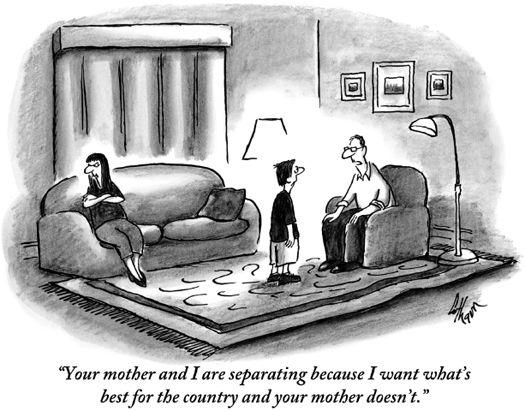
Figure 13.1 — Frank Cotham’s cartoon of a father telling his child that the parents are separating because he wants what is best for the country and the mother does not. Haidt uses the scene to expose a Manichaean inference: the rival position is not another judgment about the good but proof that the rival lacks good purpose. The cartoon is rhetorical illustration, not evidence that politics causes separation or that opposing claims are equally valid. Figure 13.1 and closing advice, PDF p. 355 (file not included in this release)
Trust Before Moral Disagreement
Haidt’s closing protocol is deliberately indirect:
- Do not begin with the most identity-laden moral claim.
- Find genuine commonality or otherwise establish a minimum of trust.
- Introduce the contested issue with sincere interest or deserved praise.
- Listen for the value, threat, and narrative configuration that make the claim intuitive.
- Only then test evidence, consistency, rights, causes, means, and consequences.
This is not a manipulation script. Manufactured praise violates the trust the method depends on. Nor is relational warmth a substitute for proof, a demand that a victim befriend an aggressor, or a reason to continue an unsafe or bad-faith exchange. Some disputes require adjudication, enforcement, distance, or urgent action rather than interpersonal persuasion. The modest claim is that where deliberation is possible, moral understanding often requires access to the elephant before reasons can do social work. Haidt closes: “We’re all stuck here for a while, so let’s try to work it out.” Trust, praise, interest, and final line, PDF p. 355 (file not included in this release)
Emergency Communication: Name the Situation and the Action
The Conclusion briefly mentions advice that a person facing rape should shout “fire” because selfish bystanders would respond only to danger to themselves. Haidt calls that advice wrong. His endnote invokes Latané and Darley’s work on ambiguity and inaction, then recommends an explicit emergency message that identifies the assault, calls for emergency services, and directs nearby people to help. The reusable point is about clarity and action assignment, not a guarantee of response or a complete safety protocol. This is a serious scenario, not evidence for the broader claim that humans are predominantly altruistic; current emergency guidance should be checked before operational use. The “shout fire” claim, PDF p. 354 (file not included in this release) · Haidt’s correction, Conclusion endnote 3, PDF p. 433 (file not included in this release)
Key Terms and Distinctions
- Moral monism: the view that one ultimate moral value or principle organizes all valid moral reasons; not the same as caring about only one everyday good.
- Value pluralism: the view that several genuine values may be irreducible and sometimes conflict without a single complete ranking.
- Moral relativism: the view that moral truth or authority is indexed to an individual, culture, or framework rather than holding independently of it.
- Moral matrix: a socially sustained pattern of intuitions, narratives, virtues, practices, and sacred objects that makes a moral world feel self-evident.
- Groupish righteousness: the fusion of intuitive moral certainty with group identity and strategic reasoning.
- Manichaean disagreement: a good-versus-evil frame that interprets compromise as contamination and rival judgment as moral corruption.
- Human understanding: in Berlin’s pluralist sense, the capacity to grasp why another human being could pursue a value without thereby endorsing the pursuit or its means.
Essential Evidence and Source Status
- Three-part recap: a summary of claims argued earlier in the book, not an independent replication or new data set. PDF pp. 352–354 (file not included in this release)
- Berlin passages: philosophical testimony quoted from Berlin’s 2001 “My Intellectual Path”; Haidt’s endnotes identify the source and related pluralist work. PDF p. 353 (file not included in this release) · endnotes 1–2 (file not included in this release)
- Figure 13.1: a Frank Cotham cartoon from The New Yorker collection used as rhetorical diagnosis, not empirical evidence. PDF p. 355 (file not included in this release)
- Trust-first protocol: Haidt’s practical recommendation derived from his social-intuitionist framework; the Conclusion presents no new outcome study of the sequence. PDF p. 355 (file not included in this release)
- Emergency-direction endnote: Haidt’s interpretation of ambiguity and helping research, not a comprehensive or current personal-safety guideline. endnote 3 (file not included in this release)
Conclusion Story and Visual Vignette
- A child hears that political disagreement is why his parents are separating. Cotham’s cartoon turns groupish righteousness into a domestic scene in which one parent cannot represent the other as sincerely seeking the good. Preserved in 40 Stories. PDF p. 355 (file not included in this release)
Evidence and Interpretation Boundaries
- The Conclusion synthesizes; it does not retest. Earlier chapters carry the empirical burden and their source-era limitations remain.
- Plural moral psychology does not prove normative value pluralism. The move from recurring concerns to genuine irreducible values is philosophical.
- Pluralism is not relativism. Understanding another value does not suspend criticism or make every practice equally valid.
- Anti-Manichaeism is not false symmetry. Actors can differ in evidence, power, conduct, intention, legality, and responsibility.
- Self-transcendence is morally conditional. Becoming part of a whole can enable rescue or atrocity; intensity and sacrifice do not verify the cause.
- Trust is not evidence. Commonality and praise can open attention, but claims still require testing.
- Trust-first advice has scope conditions. It may be unsafe, manipulative, impossible, or inappropriate under coercion, abuse, emergency, or persistent bad faith.
- The emergency example is not a full safety protocol. Its narrow lesson is to reduce ambiguity and assign action clearly.
Cross-Vault Integration
- Moral Pluralism Is Not Moral Relativism is the permanent home for Berlin’s distinction, the five-claim taxonomy, and the pluralist case audit.
- Moral Psychology Does Not Settle Metaethics identifies Haidt’s endorsement of pluralism as a philosophical conclusion rather than a questionnaire result.
- Relativism now distinguishes framework-dependence from the recognition of several genuine values.
- Moral Foundations Theory carries the toolbox metaphor and Figure 13.1 while preserving the description–justification boundary.
- Persuasion converts the closing advice into a scoped commonality–trust–interest–evidence sequence.
- Political Visions and Institutional Humility connects plural values to institutions that expose error without pretending every side is equally right.
- Israel–Palestine arguments applies pluralism without converting understanding into equivalence or compromise into the default answer.
- Conclusion story collection preserves the final visual vignette with its source and limits.
Whole-Book Conclusion and Significance
Haidt’s finished architecture is diagnostic rather than legislative. It explains why reasons so often arrive after judgment, why moral disagreement is wider than harm and fairness, and why the same group capacities that create trust and sacrifice also create sacred blindness. The answer to division is not to eliminate intuition, abolish groups, or declare every matrix valid. It is to build habits and institutions that let rival intuitions become visible, expose motivated reasoning to correction, preserve multiple human goods, and keep cohesion answerable to outsiders, dissenters, facts, and rights.
The final ethical posture is understanding before verdict, not understanding instead of verdict. Open enough relational space to hear the value and story from inside another matrix; then judge the claim with evidence and reciprocal standards. A pluralist society does not avoid hard choices. It makes them while refusing two simplifications: that one moral vocabulary exhausts the human good, or that the existence of several vocabularies makes judgment impossible.
Questions for Reflection
- Which of my commitments is functioning as a master value that converts every other concern into an instrument or obstacle?
- Can I distinguish a value I understand from a factual story I accept, a means I permit, and an institution I regard as legitimate?
- When two genuine values conflict, what reciprocal constraint decides the case, and which moral remainder should be acknowledged or mitigated?
- Which relationship would benefit from commonality and trust before argument, and where would that advice be unsafe or inappropriate?
- What institution in my life helps rival perspectives correct one another without pretending that every claim or action is equally sound?
Highlights
Introduction (Page 9)
“Please, we can get along here. We all can get along. I mean, we’re all stuck here for a while. Let’s try to work it out.” (Page 9)
I’m going to make the case that morality is the extraordinary human capacity that made civilization possible. (Page 10)
I hope to have given you a new way to think about two of the most important, vexing, and divisive topics in human life: politics and religion. (Page 10)
Politics and religion are both expressions of our underlying moral psychology, and an understanding of that psychology can help to bring people together. (Page 10)
awe, wonder, and curiosity (Page 10)
BORN TO BE RIGHTEOUS (Page 11)
chose the title The Righteous Mind to convey the sense that human nature is not just intrinsically moral, it’s also intrinsically moralistic, critical, and judgmental. (Page 11)
obsession with righteousness (leading inevitably to self-righteousness) is the normal human condition. (Page 11)
Some degree of conflict among groups may even be necessary for the health and development of any society. (Page 11)
WHAT LIES AHEAD (Page 13)
Intuitions come first, strategic reasoning second Moral intuitions arise automatically and almost instantaneously, long before moral reasoning has a chance to get started, and those first intuitions tend to drive our later reasoning. If you think that moral reasoning is something we do to figure out the truth, you’ll be constantly frustrated by how foolish, biased, and illogical people become when they disagree with you. (Page 13)
But if you think about moral reasoning as a skill we humans evolved to further our social agendas—to justify our own actions and to defend the teams we belong to—then things will make a lot more sense. (Page 13)
don’t take people’s moral arguments at face value. They’re mostly post hoc constructions made up on the fly, crafted to advance one or more strategic objectives. (Page 13)
The central metaphor of these four chapters is that the mind is divided, like a rider on an elephant, and the rider’s job is to serve the elephant. (Page 13)
there’s more to morality than harm and fairness. (Page 13)
the righteous mind is like a tongue with six taste (Page 13)
receptors. Secular Western moralities are like cuisines that try to activate just one or two of these receptors—either concerns about harm and suffering, or concerns about fairness and injustice. But people have so many other powerful moral intuitions, such as those related to liberty, loyalty, authority, and sanctity. (Page 14)
Morality binds and blinds. (Page 14)
human beings are 90 percent chimp and 10 percent bee. (Page 14)
Darwin said long ago, the most cohesive and cooperative groups generally beat the groups of selfish individualists. Darwin’s ideas about group selection fell out of favor in the 1960s, but recent discoveries are putting his ideas back into play, and the implications are profound. We’re not always selfish hypocrites. We also have the ability, under special circumstances, to shut down our petty selves and become like cells in a larger body, or like bees in a hive, working for the good of the group. These experiences are often among the most cherished of our lives, although our hivishness can blind us to other moral concerns. Our bee-like nature facilitates altruism, heroism, war, and genocide. (Page 14)
Once you see our righteous minds as primate minds with a hivish overlay, you get a whole new perspective on morality, politics, and religion. (Page 14)
our “higher nature” allows us to be profoundly altruistic, but that altruism is mostly aimed at members of our own groups. (Page 14)
religion is (probably) an evolutionary adaptation for binding groups together and helping them to create communities with a shared morality. (Page 14)
People bind themselves into political teams that share moral narratives. Once they accept a particular narrative, they become blind to alternative moral worlds. (Page 15)
realization that we are all selfrighteous hypocrites: (Page 15)
As the eighth-century Chinese Zen master Sen-ts’an wrote: The Perfect Way is only difficult for those who pick and choose; Do not like, do not dislike; all will then be clear. Make a hairbreadth difference, and Heaven and Earth are set apart; If you want the truth to stand clear before you, never be for or against. The struggle between “for” and “against” is the mind’s worst disease. (Page 15)
world without moralism, gossip, and judgment would quickly decay into chaos. (Page 16)
PART I Intuitions Come First, Strategic Reasoning Second (Page 17)
The mind is divided, like a rider on an elephant, and the rider’s job is to serve the elephant. (Page 17)
ONE Where Does Morality Come From? (Page 18)
A family’s dog was killed by a car in front of their house. They had heard that dog meat was delicious, so they cut up the dog’s body and cooked it and ate it for dinner. Nobody saw them do this. (Page 18)
A man goes to the supermarket once a week and buys a chicken. But before cooking the chicken, he has sexual intercourse with it. Then he cooks it and eats it. (Page 18)
For you, as for most people on the planet, morality is broad. Some actions are wrong even though they don’t hurt anyone. Understanding the simple fact that morality differs around the world, and even within societies, is the first step toward understanding your righteous mind. The next step is to understand where these many moralities came from in the first place. (Page 19)
THE ORIGIN OF MORALITY (TAKE 1) (Page 20)
Where does morality come from? There are two obvious answers to this question: nature or nurture. If you pick nature, then you’re a nativist. You believe that moral knowledge is native in our minds. It comes preloaded, perhaps in our God-inscribed hearts (as the Bible says), or in our evolved moral emotions (as Darwin argued) (Page 20)
But if you believe that moral knowledge comes from nurture, then you are an empiricist You believe that children are more or less blank slates at birth (as John Locke said) If morality varies around the world and across the centuries, then how could it be innate? Whatever morals we have as adults must have been learned during childhood from our own experience, which includes adults telling us what’s right and wrong. (Empirical means “from observation or experience.”) (Page 21)
for themselves. But this is a false choice, and in 1987 moral psychology was mostly focused on a third answer: rationalism, which says that kids figure out morality (Page 21)
understanding of the conservation of volume wasn’t innate, and it wasn’t learned from adults. Kids figure it out for themselves, but only when their minds are ready and they are given the right kinds of experiences. (Page 21)
Piaget argued that children’s understanding of morality is like their understanding of those water glasses: we can’t say that it is innate, and we can’t say that kids learn it directly from adults It is, rather, self-constructed as kids play with other kids. (Page 22)
No matter how often you do it with threeyear-olds, they’re just not ready to get the concept of fairness any more than they can understand the conservation of volume. (Page 22)
once they’ve reached the age of five or six, then playing games, having arguments, and working things out together will help them learn about fairness far more effectively than any sermon from adults. (Page 22)
essence of psychological rationalism: We grow into our rationality as caterpillars grow into butterflies. (Page 22)
And if the child gets enough experiences of turn taking, sharing, and playground justice, it will (eventually) become a moral creature, able to use its rational capacities to solve ever harder problems. Rationality is our nature, and good moral reasoning is the end point of development. (Page 22)
rationalist to describe anyone who believes that reasoning is the most important and reliable way to obtain moral knowledge (Page 22)
Lawrence Kohlberg, who revolutionized the study of morality in the 1960s with two key innovations First, he developed a way to quantify Piaget’s observation that children’s moral reasoning changed over time. He created a set of moral dilemmas that he presented to children of various ages, and he recorded and coded their responses. (Page 22)
Young children (Page 22)
judged right and wrong by very superficial features, such as whether a person was punished for an action. (If an adult punished the act, then the act must have been wrong.) (Page 23)
“preconventional” level (Page 23)
elementary school, most children move on to the two “conventional” stages, becoming adept at understanding and even manipulating rules and social conventions. (Page 23)
“conventional” stages (Page 23)
After puberty, right when Piaget said that children become capable of abstract thought, Kohlberg found that some children begin to think for themselves about the nature of authority, the meaning of justice, and the reasons behind rules and laws. (Page 23)
“post-conventional” stages (Page 23)
sometimes justify dishonesty or law-breaking in pursuit of still higher goods, particularly justice. (Page 23)
THE LIBERAL CONSENSUS (Page 24)
deeper reason so many young psychologists began to study morality from a rationalist perspective, and this was Kohlberg’s second great innovation: he used his research to build a scientific justification for a secular liberal moral order. (Page 24)
Kohlberg’s most influential finding was that the most morally advanced kids (according to his scoring technique) were those who had frequent opportunities for role taking—for putting themselves into another person’s shoes and looking at a problem from that person’s perspective. Egalitarian relationships (such as with peers) invite role taking, but hierarchical relationships (such as with teachers and parents) do not. (Page 24)
Piaget and Kohlberg both thought that parents and other authorities were obstacles to moral development. If you want your kids to learn about the physical world, let them play with cups and water; don’t lecture them about the conservation of volume. And if you want your kids to learn about the social world, let them play with other kids and resolve disputes; don’t lecture them about the Ten Commandments. And, for heaven’s sake, don’t force them to obey God or their teachers or you. That will only freeze them at the conventional level. (Page 24)
But by using a framework that predefined morality as justice while denigrating authority, hierarchy, and (Page 24)
tradition, it was inevitable that the research would support worldviews that were secular, questioning, and egalitarian. (Page 25)
AN EASIER TEST (Page 26)
as young as five (Page 26)
Children recognize that rules about clothing, food, and many other aspects of life are social conventions, which are arbitrary and changeable to some extent. (Page 26)
Children recognize that rules that prevent harm are moral rules, which Turiel defined as rules related to “justice, rights, and welfare pertaining to how people ought to relate to each other.” (Page 26)
young children don’t treat all rules the same (Page 27)
They seem to grasp early on that rules that prevent harm are special, important, unalterable, and universal. And this realization, Turiel said, was the foundation of all moral development. Children construct their moral understanding on the bedrock of the absolute moral truth that harm is wrong. Specific rules may vary across cultures, but in all of the cultures Turiel examined, children still made a distinction between moral rules and conventional rules. (Page 27)
Turiel’s account of moral development differed in many ways from Kohlberg’s, but the political implications were similar: morality is about treating individuals well. It’s about harm and fairness (not loyalty, respect, duty, piety, patriotism, or tradition). Hierarchy and authority are generally bad things (so it’s best to let kids figure things out for themselves). Schools and families should therefore embody progressive principles of equality and autonomy (not authoritarian principles that enable elders to train and constrain children). (Page 27)
Schools and families should therefore embody progressive principles of equality and autonomy (not authoritarian principles that enable elders to train and constrain children). (Page 27)
MEANWHILE, IN THE REST OF THE WORLD … (Page 28)
The Azande believed that witches were just as likely to be men as women, and the fear of being called a witch made the Azande careful not to make their neighbors angry or envious. That was my first hint that groups create supernatural beings not to explain the universe but to order their societies. (Page 28)
groups create supernatural beings not to explain the universe but to order their societies (Page 28)
This was my first hint that morality often involves tension within the group linked to competition between different groups. (Page 29)
United States and Western Europe as extraordinary historical exceptions—new societies that had found a way to strip down and thin out the thick, all-encompassing moral orders that the anthropologists wrote about. (Page 29)
lack of rules about what the anthropologists call “purity” and “pollution.” (Page 29)
Hua of New Guinea, who have developed elaborate networks of food taboos that govern what men and women may eat. In order for their boys to become men, they have to avoid foods that in any way resemble vaginas, including anything that is red, wet, slimy, comes from a hole, or has hair. (Page 29)
If Turiel was right that morality is really about harm, then why do most non-Western cultures moralize so many practices that seem to have nothing to do with harm? (Page 30)
There must be more to moral development than kids constructing rules as they take the perspectives of other people and feel their pain. There must be something beyond rationalism. (Page 30)
THE GREAT DEBATE (Page 31)
Shweder quoted the anthropologist Clifford Geertz on how unusual Westerners are in thinking about people as discrete individuals: The Western conception of the person as a bounded, unique, more or less integrated motivational and cognitive universe, a dynamic center of awareness, emotion, judgment, and action organized into a distinctive whole and set contrastively both against other such wholes and against its social and natural background, is, however incorrigible it may seem to us, a rather peculiar idea within the context of the world’s cultures (Page 31)
self differs so much across cultures: all societies must resolve a small set of questions about how to order society, the most important being how to balance the needs of individuals and groups. (Page 31)
self differs so much across cultures (Page 31)
Most societies have chosen the sociocentric answer, placing the needs of groups and institutions first, and subordinating the needs of individuals. In contrast, the individualistic answer places individuals at the center and makes society a servant of the individual. (Page 31)
sociocentric (Page 31)
individualistic (Page 31)
The sociocentric answer dominated most of the ancient world, but the individualistic answer became a powerful rival during the Enlightenment. (Page 31)
ultrasociocentric fascist and communist empires (Page 32)
moral rules (preventing harm) (Page 32)
social conventions (regulating behaviors not linked directly to harm). (Page 32)
Indian practices related to food, sex, clothing, and gender relations were almost always judged to be moral issues, not social (Page 32)
conventions, and there were few differences between the adults and children within each city. (Page 33)
“the social order is a moral order.” (Page 33)
Even in the United States the social order is a moral order, but it’s an individualistic order built up around the protection of individuals and their freedom. The distinction between morals and mere conventions is not a tool that children everywhere use to self-construct their moral knowledge. Rather, the distinction turns out to be a cultural artifact, a necessary by-product of the individualistic answer to the question of how individuals and groups relate. When you put individuals first, before society, then any rule or social practice that limits personal freedom can be questioned. If it doesn’t protect somebody from harm, then it can’t be morally justified. It’s just a social convention. (Page 34)
When you put individuals first, before society, then any rule or social practice that limits personal freedom can be questioned. If it doesn’t protect somebody from harm, then it can’t be morally justified. It’s just a social convention. (Page 34)
DISGUST AND DISRESPECT (Page 36)
stories “harmless taboo violations,” (Page 36)
If you want to give people a quick flash of revulsion but deprive them of any victim they can use to justify moral condemnation, ask them about people who do disgusting or disrespectful things, but make sure the actions are done in private so that nobody else is offended. (Page 36)
My idea was to give adults and children stories that pitted gut feelings about important cultural norms against reasoning about harmlessness, and then see which force was stronger. (Page 37)
pitted gut feelings about important cultural norms against reasoning about harmlessness, and then see which force was stronger. (Page 37)
Shweder won the debate. (Page 39)
The moral domain varied across (Page 39)
nations and social classes. For most of the people in my study, the moral domain extended well beyond issues of harm and fairness. (Page 40)
It was hard to see how a rationalist could explain these results. How could children self-construct their moral knowledge about disgust and disrespect from their private analyses of harmfulness? There must be other sources of moral knowledge, including cultural learning (as Shweder argued), or innate moral intuitions about disgust and disrespect (as I began to argue years later). (Page 40)
INVENTING VICTIMS (Page 42)
The biggest surprise was that so many subjects tried to invent victims. I had written the stories carefully to remove all conceivable harm to other people, yet in 38 percent of the 1,620 times that people heard a harmless-offensive story, they claimed that somebody was harmed. (Page 42)
post hoc fabrications. (Page 42)
These subjects were reasoning. They were working quite hard at reasoning. But it was not reasoning in search of truth; it was reasoning in support of their emotional reactions. It was reasoning as described by the philosopher David Hume, who wrote in 1739 that “reason is, and ought only to be the slave of the passions, and can never pretend to any other office than to serve and obey them.” (Page 43)
I had found that moral reasoning was often a servant of moral emotions, and this was a challenge to the rationalist approach that dominated moral psychology. (Page 43)
psychology itself was about to change and become a lot more emotional. (Page 43)
IN SUM (Page 44)
Where does morality come from? The two most common answers have long been that it is innate (the nativist answer) or that it comes from childhood learning (the empiricist answer). In this chapter I considered a third possibility, the rationalist answer, which dominated moral psychology when I entered the field: that morality is self-constructed by children on the basis of their experiences with harm. Kids know that harm is wrong because they hate to be harmed, and they gradually come to see that it is therefore wrong to harm others, which leads them to understand fairness and eventually justice. I explained why I came to reject this answer after conducting research in Brazil and the United States. I concluded instead that: (Page 44)
The moral domain varies by culture. It is unusually narrow in Western, educated, and individualistic cultures. Sociocentric cultures broaden the moral domain to encompass and regulate more aspects of life. • People sometimes have gut feelings—particularly about disgust and disrespect—that can drive their reasoning. Moral reasoning is sometimes a post hoc fabrication. • Morality can’t be entirely self-constructed by children based on their growing understanding of harm. Cultural learning or guidance must play a larger role than rationalist theories had given it. (Page 44)
If morality doesn’t come primarily from reasoning, then that leaves some combination of innateness and social learning as the most likely candidates. In the rest of this book I’ll try to explain how morality can be innate (as a set of evolved intuitions) and learned (as children learn to apply those intuitions within a particular culture). We’re born to be righteous, but we have to learn what, exactly, people like us should be righteous about. (Page 44)
We’re born to be righteous, but we have to learn what, exactly, people like us should be righteous about. (Page 44)
TWO The Intuitive Dog and Its Rational Tail (Page 45)
One of the greatest truths in psychology is that the mind is divided into parts that sometimes conflict. (Page 45)
Desire and reason are pulling in different directions. (Page 45)
Ancient thinkers gave us many metaphors to understand this conflict, but few are more colorful than the one in Plato’s dialogue Timaeus. The narrator, Timaeus, explains how the gods created the universe, including us. Timaeus says that a creator god who was perfect and created only perfect things was filling his new universe with souls—and what could be more perfect in a soul than perfect rationality? So after making a large number of perfect, rational souls, the creator god decided to take a break, delegating the last bits of creation to some lesser deities, who did their best to design vessels for these souls. (Page 45)
Western philosophy has been worshipping reason and distrusting the passions for thousands of years There’s a direct line running from Plato through Immanuel Kant to Lawrence Kohlberg. I’ll refer to this worshipful attitude throughout this book as the rationalist delusion. I call it a delusion because when a group of people make something sacred, the members of the cult lose the ability to think clearly about it. Morality binds and blinds. The true believers produce pious fantasies that don’t match reality, and at some point somebody comes along to knock the idol off its pedestal. That was Hume’s project, with his philosophically sacrilegious claim that reason was nothing but the servant of the passions. (Page 46)
Thomas Jefferson offered a more balanced model of the relationship between reason and emotion. In 1786, while serving as the American (Page 46)
minister to France, Jefferson fell in love. Maria Cosway was a beautiful twenty-seven-year-old English artist who was introduced to Jefferson by a mutual friend. Jefferson and Cosway then spent the next few hours doing exactly what people should do to fall madly in love. They strolled around Paris on a perfect sunny day, two foreigners sharing each other’s aesthetic appreciations of a grand city. Jefferson sent messengers bearing lies to cancel his evening meetings so that he could extend the day into night. Cosway was married, although the marriage seems to have been an open marriage of convenience, and historians do not know how far the romance progressed in the weeks that followed But Cosway’s husband soon insisted on taking his wife back to England, leaving Jefferson in pain. (Page 47)
To ease that pain, Jefferson wrote Cosway a love letter using a literary trick to cloak the impropriety of writing about love to a married woman. Jefferson wrote the letter as a dialogue between his head and his heart debating the wisdom of having pursued a “friendship” even while he knew it would have to end. Jefferson’s head is the Platonic ideal of reason, scolding the heart for having dragged them both into yet another fine mess. The heart asks the head for pity, but the head responds with a stern lecture: Everything in this world is a matter of calculation. Advance then with caution, the balance in your hand. Put into one scale the pleasures which any object may offer; but put fairly into the other the pains which are to follow, & see which preponderates (Page 47)
After taking round after round of abuse rather passively, the heart finally rises to defend itself, and to put the head in its proper place—which is to handle problems that don’t involve people: When nature assigned us the same habitation, she gave us over it a divided empire. To you she allotted the field of science; to me that of morals. When the circle is to be squared, or the orbit of a comet to be traced; when the arch of greatest strength, or the solid of least resistance is to be investigated, take up the problem; it is yours; nature has given me no cognizance of it. In like manner, in denying to you the feelings of sympathy, of benevolence, of gratitude, of justice, of love, of friendship, she has excluded you from their control. To these she has adapted the mechanism of the heart. Morals were too essential to the (Page 47)
happiness of man to be risked on the incertain combinations of the head. She laid their foundation therefore in sentiment, not in science. (Page 48)
So now we have three models of the mind. Plato said that reason ought to be the master, even if philosophers are the only ones who can reach a high level of mastery Hume said that reason is and ought to be the servant of the passions. And Jefferson gives us a third option, in which reason and sentiment are (and ought to be) independent co-rulers, like the emperors of Rome, who divided the empire into eastern and western halves. Who is right? (Page 48)
WILSON’S PROPHECY (Page 49)
But as the social sciences advanced in the twentieth century, their course was altered by two waves of moralism that turned nativism into a moral offense. The first was the horror among anthropologists and others at “social Darwinism”—the idea (raised but not endorsed by Darwin) that the richest and most successful nations, races, and individuals are the fittest. Therefore, giving charity to the poor interferes with the natural progress of evolution: it allows the poor to breed The claim that some races were innately superior to others was later championed by Hitler, and so if Hitler was a nativist, then all nativists were Nazis. (That conclusion is illogical, but it makes sense emotionally if you dislike nativism.) (Page 49)
Nowhere was the betrayal of science more evident than in the attacks on Edward O. Wilson, a lifelong student of ants and ecosystems. In 1975 Wilson published Sociobiology: The New Synthesis. The book explored how natural selection, which indisputably shaped animal bodies, also shaped animal behavior. That wasn’t controversial, but Wilson had the audacity to suggest in his final chapter that natural selection also influenced human behavior. Wilson believed that there is such a thing as human nature, and that human nature constrains the range of what we can achieve when raising our children or designing new social institutions. (Page 50)
It seemed clear to Wilson that what the rationalists were really doing was generating clever justifications for moral intuitions that were best explained by evolution. Do people believe in human rights because such rights actually exist, like mathematical truths, sitting on a cosmic shelf next to the Pythagorean theorem just waiting to be discovered by Platonic reasoners? Or do people feel revulsion and sympathy when they read accounts of torture, and then invent a story about universal rights to help justify their feelings? (Page 50)
He predicted that the study of ethics would soon be taken out of the hands of philosophers and “biologicized,” or made to fit with the emerging science of human nature. (Page 50)
Wilson therefore deserves to be called a prophet of moral psychology. (Page 51)
THE EMOTIONAL NINETIES (Page 52)
Damasio’s interpretation was that gut feelings and bodily reactions were necessary to think rationally, and that one job of the vmPFC was to integrate those gut feelings into a person’s conscious deliberations. (Page 52)
Just imagine what your life would be like if at every moment, in every social situation, picking the right thing to do or say became like picking the best washing machine among ten options, minute after minute, day after day. You’d make foolish decisions too. (Page 53)
Damasio’s findings were as anti-Platonic as could be. Here were people in whom brain damage had essentially shut down communication between the rational soul and the seething passions of the body (which, unbeknownst to Plato, were not based in the heart and stomach but in the emotion areas of the brain). (Page 53)
If Jefferson’s model were correct, however, then Damasio’s patients should still have fared well in the half of life that was always ruled by the head. (Page 53)
WHY ATHEISTS WON’T SELL THEIR SOULS (Page 54)
moral emotions and moral reasoning were separate processes Each process could make moral judgments on its own, and they sometimes fought it out for the right to do so (Page 54)
These results supported Hume, not Jefferson or Plato. People made moral judgments quickly and emotionally. Moral reasoning was mostly just a post hoc search for reasons to justify the judgments people had already made. (Page 59)
“SEEING-THAT” VERSUS “REASONING-WHY” (Page 60)
Patterns, Thinking, and Cognition, by Howard Margolis (Page 60)
Margolis was trying to understand why people’s beliefs about political issues are often so poorly connected to objective facts, and he hoped that cognitive science could solve the puzzle. (Page 60)
Margolis proposed that there are two very different kinds of cognitive processes at work when we make judgments and solve problems: “seeingthat” and “reasoning-why.” (Page 61)
“Reasoning-why” can occur only for creatures that have language and a need to explain themselves to other creatures. “Reasoning-why” is not automatic; it’s conscious, it sometimes feels like work, and it’s easily disrupted by cognitive load. (Page 62)
We do moral reasoning not to reconstruct the actual reasons why we ourselves came to a judgment; we reason to find the best possible reasons why somebody else ought to join us in our judgment (Page 63)
We do moral reasoning not to reconstruct the actual reasons why we ourselves came to a judgment; we reason to find the best possible reasons why somebody else ought to join us in our judgment. (Page 63)
THE RIDER AND THE ELEPHANT (Page 64)
Emotions are not dumb. Damasio’s patients made terrible decisions because they were deprived of emotional input into their decision making. Emotions are a kind of information processing Contrasting emotion with cognition is therefore as pointless as contrasting rain with weather, or cars with vehicles. (Page 64)
moral judgment is a cognitive process, as are all forms of judgment. The crucial distinction is really between two different kinds of cognition: intuition and reasoning. Moral emotions are one type of moral intuition, but most moral intuitions are more subtle; they don’t rise to the level of emotions. (Page 64)
Intuition is the best word to describe the dozens or hundreds of rapid, effortless moral judgments and decisions that we all make every day. Only a few of these intuitions come to us embedded in full-blown emotions. (Page 65)
once I stopped thinking about emotion versus cognition and started thinking about intuition versus reasoning, everything fell into place. (Page 65)
We make our first judgments rapidly, and we are dreadful at seeking out evidence that might disconfirm those initial judgments. (Page 66)
friends can do for us what we cannot do for ourselves: they can challenge us, giving us reasons and arguments (link 3) that sometimes trigger new intuitions, thereby making it possible for us to change our minds. (Page 66)
occasionally do this when mulling a problem by ourselves, suddenly seeing things in a new (Page 66)
light or from a new perspective (to use two visual metaphors). (Page 67)
Far more common than such private mind changing is social influence. (Page 67)
Many of us believe that we follow an inner moral compass, but the history of social psychology richly demonstrates that other people exert a powerful force, able to make cruelty seem acceptable45 and altruism seem embarrassing without giving us any reasons or arguments. (Page 67)
HOW TO WIN AN ARGUMENT (Page 68)
The social intuitionist model offers an explanation of why moral and political arguments are so frustrating: because moral reasons are the tail wagged by the intuitive dog. A dog’s tail wags to communicate. You can’t make a dog happy by forcibly wagging its tail. And you can’t change people’s minds by utterly refuting their arguments. Hume diagnosed the problem long ago: And as reasoning is not the source, whence either disputant derives his tenets; it is in vain to expect, that any logic, which speaks not to the affections, will ever engage him to embrace sounder principles. (Page 68)
If you want to change people’s minds, you’ve got to talk to their elephants. (Page 68)
The persuader’s goal should be to convey respect, warmth, and an openness to dialogue before stating one’s own case. (Page 68)
our righteous minds so readily shift into combat mode. (Page 68)
If you really want to change someone’s mind on a moral or political matter, you’ll need to see things from that person’s angle as well as your own. And if you do truly see it the other person’s way—deeply and intuitively—you might even find your own mind opening in response. Empathy is an antidote to righteousness, although it’s very difficult to empathize across a moral divide. (Page 69)
The social intuitionist model starts with Hume’s model and makes it more social. Moral reasoning is part of our lifelong struggle to win friends and influence people. That’s why I say that “intuitions come first, strategic reasoning second.” You’ll misunderstand moral reasoning if you think about it as something people do by themselves in order to figure out the truth. (Page 70)
Therefore, if you want to change someone’s mind about a moral or political issue, talk to the elephant first. If you ask people to believe something that violates their intuitions, they will devote their efforts to finding an escape hatch—a reason to doubt your argument or conclusion. They will almost always succeed. (Page 70)
THREE Elephants Rule (Page 72)
Even before I knew why she was criticizing me, I knew I disagreed with her (because intuitions come first). (Page 74)
Intuitions Come First. (Page 74)
Intuitions Come First (Page 74)
- BRAINS EVALUATE INSTANTLY AND CONSTANTLY (Page 75)
The brain tags familiar things as good things. Zajonc called this the “mere exposure effect,” and it is a basic principle of advertising. (Page 76)
thinking is the rider; affect is the elephant. The thinking system is not equipped to lead—it simply doesn’t have the power to make things happen—but it can be a useful advisor. (Page 76)
- SOCIAL AND POLITICAL JUDGMENTS ARE PARTICULARLY INTUITIVE (Page 77)
“affective priming” because the first word triggers a flash of affect that primes the mind to go one way or the other. (Page 77)
Most people turn out to have negative implicit associations with many social groups, such as black people, immigrants, obese people, and the elderly. (Page 78)
And if the elephant tends to lean away from groups such as the elderly (whom few would condemn morally), then we should certainly expect some leaning (prejudging) when people think about their political enemies. (Page 78)
When he began his work, there was already a lot of research showing that we judge attractive people to be smarter and more virtuous, and we are more likely to give a pretty face the benefit of any doubt Juries are more likely to acquit attractive defendants, and when beautiful people are convicted, judges give them lighter sentences, on average. (Page 78)
The bottom line is that human minds, like animal minds, are constantly reacting intuitively to everything they perceive, and basing their responses on those reactions. Within the first second of seeing, hearing, or meeting another person, the elephant has already begun to lean toward or away, and that lean influences what you think and do next. Intuitions come first. (Page 79)
Within the first second of seeing, hearing, or meeting another person, the elephant has already begun to lean toward or away, and that lean influences what you think and do next. Intuitions come first. (Page 79)
- OUR BODIES GUIDE OUR JUDGMENTS (Page 80)
people made harsher judgments when they were breathing in foul air. (Page 80)
we use “affect as information.” (Page 80)
If I’m feeling good, I must like it, and if I’m feeling anything unpleasant, that must mean I don’t like it. (Page 81)
subjects who are asked to wash their hands with soap before filling out questionnaires become more moralistic about issues related to moral purity (such as pornography and drug use) Once you’re clean, you want to keep dirty things far away. (Page 81)
immorality makes people want to get clean. People who are asked to recall their own moral transgressions, or merely to copy by hand an account of someone else’s moral transgression, find themselves thinking about cleanliness more often, and wanting more strongly to cleanse themselves. (Page 81)
In one of the most bizarre demonstrations of this effect, Eric Helzer and David Pizarro asked students at Cornell University to fill out surveys about their political attitudes while standing near (or far from) a hand sanitizer dispenser. Those told to stand near the sanitizer became temporarily more conservative. (Page 81)
Moral judgment is not a purely cerebral affair in which we weigh concerns about harm, rights, and justice. It’s a kind of rapid, automatic process more akin to the judgments animals make as they move through the world, feeling themselves drawn toward or away from various things. Moral judgment is mostly done by the elephant. (Page 81)
- PSYCHOPATHS REASON BUT DON’T FEEL (Page 82)
- BABIES FEEL BUT DON’T REASON (Page 84)
infant’s mind comes already wired to interpret events in certain ways, then infants can be surprised when the world violates their expectations. (Page 84)
The researchers concluded that “the capacity to evaluate individuals on the basis of their social interactions is universal and unlearned.” (Page 85)
It makes sense that infants can easily learn who is nice to them. Puppies can do that too. But these findings suggest that by six months of age, infants are watching how people behave toward other people, and they are developing a preference for those who are nice rather than those who are mean. In other words, the elephant begins making something like moral judgments during infancy, long before language and reasoning arrive. (Page 85)
Looking at the discoveries from infants and psychopaths at the same time, it’s clear that moral intuitions emerge very early and are necessary for moral development The ability to reason emerges much later, and when moral reasoning is not accompanied by moral intuition, the results are ugly. (Page 85)
- AFFECTIVE REACTIONS ARE IN THE RIGHT PLACE AT THE RIGHT TIME IN THE BRAIN (Page 86)
“trolley dilemma,” (Page 86)
Utilitarianism (Page 86)
deontology (Page 86)
Deontologists talk about high moral principles derived and justified by careful reasoning; they would never agree that these principles are merely post hoc rationalizations of gut feelings. (Page 86)
Greene had a hunch that gut feelings were what often drove people to make deontological judgments, whereas utilitarian judgments were more cool and calculating. (Page 86)
the areas of the brain involved in emotional processing activate almost immediately, and high activity in these areas correlates with the kinds of moral judgments or decisions that people ultimately make. (Page 87)
Greene did not know what E. O. Wilson had said about philosophers consulting their “emotive centers” when he wrote the article, but his conclusion was the same as Wilson’s: We have strong feelings that tell us in clear and uncertain terms that some things simply cannot be done and that other things simply must be done. But it’s not obvious how to make sense of these feelings, and (Page 87)
so we, with the help of some especially creative philosophers, make up a rationally appealing story [about rights]. (Page 88)
ELEPHANTS ARE SOMETIMES OPEN TO REASON (Page 89)
But when Hume said that reason is the “slave” of the passions, I think he went too far. (Page 89)
The elephant is far more powerful than the rider, but it is not an absolute dictator. (Page 89)
When does the elephant listen to reason? The main way that we change our minds on moral issues is by interacting with other people. We are terrible at seeking evidence that challenges our own beliefs, but other people do us this favor, just as we are quite good at finding errors in other people’s beliefs. When discussions are hostile, the odds of change are slight. The elephant leans away from the opponent, and the rider works frantically to rebut the opponent’s charges. (Page 89)
But if there is affection, admiration, or a desire to please the other person, then the elephant leans toward that person and the rider tries to find the truth in the other person’s arguments. (Page 89)
The delay allowed the rider to think for himself and to decide upon a judgment that for many subjects was contrary to the elephant’s initial inclination. (Page 91)
IN SUM (Page 92)
The first principle of moral psychology is Intuitions come first, strategic reasoning second. In support of this principle, I reviewed six areas of experimental research demonstrating that: • Brains evaluate instantly and constantly (as Wundt and Zajonc said). • Social and political judgments depend heavily on quick intuitive flashes (as Todorov and work with the IAT have shown). • Our bodily states sometimes influence our moral judgments. Bad smells and tastes can make people more judgmental (as can anything that makes people think about purity and cleanliness). • Psychopaths reason but don’t feel (and are severely deficient morally). • Babies feel but don’t reason (and have the beginnings of morality). • Affective reactions are in the right place at the right time in the brain (as shown by Damasio, Greene, and a wave of more recent studies). (Page 92)
FOUR Vote for Me (Here’s Why) (Page 94)
Plato’s Republic—one of the most influential works in the Western canon—is an extended argument that you should pick heads, for your own good. It is better to be than to seem virtuous. (Page 94)
Early in The Republic, Glaucon (Plato’s brother) challenges Socrates to prove that justice itself—and not merely the reputation for justice—leads to happiness. (Page 94)
Glaucon’s thought experiment implies that people are only virtuous because they fear the consequences of getting caught—especially the damage to their reputations. Glaucon says he will not be satisfied until Socrates can prove that a just man with a bad reputation is happier than an unjust man who is widely thought to be good. (Page 95)
Plato (who had been a student of Socrates) had a coherent set of beliefs about human nature, and at the core of these beliefs was his faith in the perfectibility of reason. Reason is our original nature, he thought; it was given to us by the gods and installed in our spherical heads. Passions often corrupt reason, but if we can learn to control those passions, our God-given rationality will shine forth and guide us to do the right thing, not the popular thing. (Page 95)
As is often the case in moral philosophy, arguments about what we ought to do depend upon assumptions—often unstated—about human nature and human psychology And for Plato, the assumed psychology is just plain wrong. (Page 95)
reason is not fit to rule; it was designed to seek justification, not truth. (Page 95)
Glaucon was right: people care a great deal more about appearance and reputation than about reality. (Page 95)
realized that the most important principle for designing an (Page 95)
ethical society is to make sure that everyone’s reputation is on the line all the time, so that bad behavior will always bring bad consequences. (Page 96)
What, then, is the function of moral reasoning? Does it seem to have been shaped, tuned, and crafted (by natural selection) to help us find the truth, so that we can know the right way to behave and condemn those who behave wrongly? If you believe that, then you are a rationalist, like Plato, Socrates, and Kohlberg Or does moral reasoning seem to have been shaped, tuned, and crafted to help us pursue socially strategic goals, such as guarding our reputations and convincing other people to support us, or our team, in disputes? If you believe that, then you are a Glauconian. (Page 96)
WE ARE ALL INTUITIVE POLITICIANS (Page 97)
Tetlock found two very different kinds of careful reasoning. Exploratory thought is an “evenhanded consideration of alternative points of view.” Confirmatory thought is “a one-sided attempt to rationalize a particular point of view.” (Page 98)
Accountability increases exploratory thought only when three conditions apply: (1) decision makers learn before forming any opinion that they will be accountable to an audience, (2) the audience’s views are unknown, and (3) they believe the audience is well informed and interested in accuracy. (Page 98)
People are trying harder to look right than to be right. (Page 98)
Tetlock summarizes it like this: A central function of thought is making sure that one acts in ways that can be persuasively justified or excused to others. Indeed, the process of considering the justifiability of one’s choices may be so prevalent that decision makers not only search for convincing reasons to make a choice when they must explain that choice to others, they search for reasons to convince themselves that they have made the “right” choice. (Page 98)
Tetlock concludes that conscious reasoning is carried out largely for the purpose of persuasion, rather than discovery. (Page 98)
- WE ARE OBSESSED WITH POLLS (Page 100)
Leary’s conclusion was that “the sociometer operates at a nonconscious and preattentive level to scan the social environment for any and all indications that one’s relational value is low or declining.”16 The sociometer is part of the elephant. Because appearing concerned about other people’s opinions makes us look weak, we (like politicians) often deny that we care about public opinion polls. But the fact is that we care a lot about what others think of us. The only people known to have no sociometer are psychopaths (Page 101)
- OUR IN-HOUSE PRESS SECRETARY AUTOMATICALLY JUSTIFIES EVERYTHING (Page 102)
Schools don’t teach people to reason thoroughly; they select the applicants with higher IQs, and people with higher IQs are able to generate more reasons. (Page 104)
Perkins found that IQ was by far the biggest predictor of how well people argued, but it predicted only the number of my-side arguments. Smart people make really good lawyers and press secretaries, but they are no better than others at finding reasons on the other side. Perkins concluded that “people invest their IQ in buttressing their own case rather than in exploring the entire issue more fully and evenhandedly.” (Page 104)
- WE LIE, CHEAT, AND JUSTIFY SO WELL THAT WE HONESTLY BELIEVE WE ARE HONEST (Page 105)
In his book Predictably Irrational, Dan Ariely describes a brilliant series of studies in which participants had the opportunity to earn more money by claiming to have solved more math problems than they really did. Ariely summarizes his findings from many variations of the paradigm like this: When given the opportunity, many honest people will cheat. In fact, rather than finding that a few bad apples weighted the averages, we discovered that the majority of people cheated, and that they cheated just a little bit. (Page 106)
The bottom line is that in lab experiments that give people invisibility combined with plausible deniability, most people cheat. The press secretary (also known as the inner lawyer)27 is so good at finding justifications that most of these cheaters leave the experiment as convinced of their own virtue as they were when they walked in. (Page 106)
- REASONING (AND GOOGLE) CAN TAKE YOU WHEREVER YOU WANT TO GO (Page 107)
The difference between can and must is the key to understanding the profound effects of self-interest on reasoning. It’s also the key to understanding many of the strangest beliefs—in UFO abductions, quack medical treatments, and conspiracy theories. (Page 107)
conspiracy theories (Page 107)
The social psychologist Tom Gilovich studies the cognitive mechanisms of strange beliefs. His simple formulation is that when we want to believe something, we ask ourselves, “Can I believe it?”28 Then (as Kuhn and Perkins found), we search for supporting evidence, and if we find even a single piece of pseudo-evidence, we can stop thinking. We now have permission to believe. We have a justification, in case anyone asks. (Page 107)
In contrast, when we don’t want to believe something, we ask ourselves, “Must I believe it?” Then we search for contrary evidence, and if we find a single reason to doubt the claim, we can dismiss it. You only need one key to unlock the handcuffs of must. (Page 107)
The difference between a mind asking “Must I believe it?” versus “Can I believe it?” is so profound that it even influences visual perception. (Page 108)
It’s always possible to question the methods, find an alternative interpretation of the data, or, if all else fails, question the honesty or ideology of the researchers. (Page 108)
And now that we all have access to search engines on our cell phones, we can call up a team of supportive scientists for almost any conclusion twenty-four hours a day. Whatever you want to believe about the causes of global warming or whether a fetus can feel pain, just Google your belief. You’ll find partisan websites summarizing and sometimes distorting relevant scientific studies. Science is a smorgasbord, and Google will guide you to the study that’s right for you. (Page 108)
- WE CAN BELIEVE ALMOST ANYTHING THAT SUPPORTS OUR TEAM (Page 109)
self-interest is a weak predictor of policy preferences. (Page 109)
Rather, people care about their groups, whether those be racial, regional, religious, or political. The political scientist Don Kinder summarizes the findings like this: “In matters of public opinion, citizens seem to be asking themselves not ‘What’s in it for me?’ but rather ‘What’s in it for my group?’ ”36 Political opinions function as “badges of social membership.” (Page 109)
Our politics is groupish, not selfish. (Page 109)
Liberals and conservatives actually move further apart when they read about research on whether the death penalty deters crime, or when they rate the quality of arguments made by candidates in a presidential debate, or when they evaluate arguments about affirmative action or gun control (Page 109)
Westen found that partisans escaping from handcuffs (by thinking about the final slide, which restored their confidence in their candidate) got a little hit of that dopamine. And if this is true, then it would explain why extreme partisans are so stubborn, closed-minded, and committed to beliefs that often seem bizarre or paranoid. Like rats that cannot stop pressing a button, partisans may be simply unable to stop believing weird things. The partisan brain has been reinforced so many times for performing mental contortions that free it from unwanted beliefs. Extreme partisanship may be literally addictive. (Page 111)
THE RATIONALIST DELUSION (Page 112)
As an intuitionist, I’d say that the worship of reason is itself an illustration of one of the most long-lived delusions in Western history: the rationalist delusion. It’s the idea that reasoning is our most noble attribute, one that makes us like the gods (for Plato) or that brings us beyond the “delusion” of believing in gods (for the New Atheists) The rationalist delusion is not just a claim about human nature. It’s also a claim that the rational caste (philosophers or scientists) should have more power, and it usually comes along with a utopian program for raising more rational children. (Page 112)
expertise in moral reasoning does not seem to improve moral behavior, and it might even make it worse (perhaps by making the rider more skilled at post hoc justification). (Page 112)
Anyone who values truth should stop worshipping reason. We all need to take a cold hard look at the evidence and see reasoning for what it is. (Page 113)
They concluded that most of the bizarre and depressing research findings make perfect sense once you see reasoning as having evolved not to help us find truth but to help us engage in arguments, persuasion, and manipulation in the context of discussions with other people. (Page 113)
“skilled arguers … are not after the truth but after arguments supporting their views.” (Page 113)
confirmation bias is so powerful, and so ineradicable. How hard could it be to teach students to look on the other side, to look for evidence against their favored view? Yet, in fact, it’s very hard, and nobody has yet found a way to do it It’s hard because the confirmation bias is a built-in feature (of an argumentative mind), not a bug that can be removed (from a platonic mind). (Page 113)
Gut feelings are sometimes better guides than reasoning for making consumer choices and interpersonal judgments but they are often disastrous as a basis for public policy, science, and law. (Page 113)
each individual reasoner is really good at one thing: finding evidence to support the position he or she already holds, usually for intuitive reasons. (Page 113)
truth-seeking We should not expect individuals to produce good, openminded, reasoning, particularly when self-interest or reputational concerns are in play. (Page 113)
But if you put individuals together in the right way, such that some individuals can use their reasoning powers to disconfirm the claims of others, and all individuals feel some common bond or shared fate that allows them to interact civilly, you can create a group that ends up producing good reasoning as an emergent property of the social system. This is why it’s so important to have intellectual and ideological (Page 113)
diversity within any group or institution whose goal is to find truth (such as an intelligence agency or a community of scientists) or to produce good public policy (such as a legislature or advisory board). (Page 114)
If you want to make people behave more ethically, there are two ways you can go. You can change the elephant, which takes a long time and is hard to do. Or, to borrow an idea from the book Switch, by Chip Heath and Dan Heath you can change the path that the elephant and rider find themselves traveling on. You can make minor and inexpensive tweaks to the environment, which can produce big increases in ethical behavior. (Page 114)
you can change the path that the elephant and rider find themselves traveling on. You can make minor and inexpensive tweaks to the environment, which can produce big increases in ethical behavior. (Page 114)
IN SUM (Page 115)
first principle of moral psychology is Intuitions come first, strategic reasoning second. (Page 115)
We are obsessively concerned about what others think of us, although much of the concern is unconscious and invisible to us. • Conscious reasoning functions like a press secretary who automatically justifies any position taken by the president. • With the help of our press secretary, we are able to lie and cheat often, and then cover it up so effectively that we convince even ourselves. • Reasoning can take us to almost any conclusion we want to reach, because we ask “Can I believe it?” when we want to believe something, but “Must I believe it?” when we don’t want to believe. The answer is almost always yes to the first question and no to the second. • In moral and political matters we are often groupish, rather than selfish. We deploy our reasoning skills to support our team, and to demonstrate commitment to our team. (Page 115)
I concluded by warning that the worship of reason, which is sometimes found in philosophical and scientific circles, is a delusion. It is an example of faith in something that does not exist. I urged instead a more intuitionist approach to morality and moral education, one that is more humble about the abilities of individuals, and more attuned to the contexts and social systems that enable people to think and act well. (Page 115)
PART II There’s More to Morality than Harm and Fairness (Page 117)
FIVE Beyond WEIRD Morality (Page 118)
In 2010, the cultural psychologists Joe Henrich, Steve Heine, and Ara Norenzayan published a profoundly important article titled “The Weirdest People in the World?”2 The authors pointed out that nearly all research in psychology is conducted on a very small subset of the human population: people from cultures that are Western, educated, industrialized, rich, and democratic (forming the acronym WEIRD). They then reviewed dozens of studies showing that WEIRD people are statistical outliers; they are the least typical, least representative people you could study if you want to make generalizations about human nature. Even within the West, Americans are more extreme outliers than Europeans, and within the United States, the educated upper middle class (like my Penn sample) is the most unusual of all. (Page 119)
Several of the peculiarities of WEIRD culture can be captured in this simple generalization: The WEIRDer you are, the more you see a world full of separate objects, rather than relationships. It has long been reported that Westerners have a more independent and autonomous concept of the self than do East Asians For example, when asked to write twenty statements beginning with the words “I am …,” Americans are likely to list their own internal psychological characteristics (happy, outgoing, interested in jazz), whereas East Asians are more likely to list their roles and relationships (a son, a husband, an employee of Fujitsu). (Page 119)
The differences run deep; even visual perception is affected. (Page 119)
Related to this difference in perception is a difference in thinking style. Most people think holistically (seeing the whole context and the relationships among parts), but WEIRD people think more analytically (detaching the focal object from its context, assigning it to a category, and then assuming that what’s true about the category is true about the object) Putting this all together, it makes sense that WEIRD philosophers since Kant and Mill have mostly generated moral systems that are individualistic, rule-based, and universalist. That’s the morality you need to govern a society of autonomous individuals. (Page 120)
WEIRD people think more analytically (detaching the focal object from its context, assigning it to a category, and then assuming that what’s true about the category is true about the object) Putting this all together, it makes sense that WEIRD philosophers since Kant and Mill have mostly generated moral systems that are individualistic, rule-based, and universalist. That’s the morality you need to govern a society of autonomous individuals. (Page 120)
when holistic thinkers in a non-WEIRD culture write about morality, we get something more like the Analects of Confucius, a collection of aphorisms and anecdotes that can’t be reduced to a single rule Confucius talks about a variety of relationship-specific duties and virtues (such as filial piety and the proper treatment of one’s subordinates). (Page 120)
Confucius (Page 120)
non-WEIRD society (Page 120)
sociocentric morality (Page 120)
needs of groups and institutions first, often ahead of the needs of individuals. (Page 120)
THREE ETHICS ARE MORE DESCRIPTIVE THAN ONE (Page 122)
The ethic of autonomy is based on the idea that people are, first and foremost, autonomous individuals with wants, needs, and preferences. (Page 122)
People should be free to satisfy these wants, needs, and preferences as they see fit, and so societies develop moral concepts such as rights, liberty, and justice, which allow people to coexist peacefully without interfering too much in each other’s projects. This is the dominant ethic in individualistic societies. (Page 123)
utilitarians such as John Stuart Mill and Peter Singer (Page 123)
deontologists such as Kant and Kohlberg (Page 123)
But as soon as you step outside of Western secular society, you hear people talking in two additional moral languages. (Page 123)
ethic of community (Page 123)
People have an obligation to play their assigned roles in these entities. Many societies therefore develop moral concepts such as duty, hierarchy, respect, reputation, and patriotism. (Page 123)
Western insistence that people should design their own lives and pursue their own goals seems selfish and dangerous—a sure way to weaken the social fabric and destroy the institutions and collective entities upon which everyone depends. (Page 123)
ethic of divinity (Page 123)
HOW I BECAME A PLURALIST (Page 125)
I liked these people who were hosting me, helping me, and teaching me. (Page 125)
My elephant leaned toward them, which made my rider search for moral arguments in their defense. (Page 125)
If you can’t see anything wrong here, try reversing the politics. Imagine that a conservative artist had created these works using images of Martin Luther King Jr. and Nelson Mandela instead of Jesus and Mary. Imagine that his intent was to mock the quasi-deification by the left of so many black leaders. Could such works be displayed in museums in New York or Paris without triggering angry demonstrations? Might some on the left feel that the museum itself had been polluted by racism, even after the paintings were removed? (Page 129)
I could see beauty in a moral code that emphasized self-control, resistance to temptation, cultivation of one’s higher, nobler self, and negation of the self’s desires. I could see the dark side of this ethic too: once you allow visceral feelings of disgust to guide your conception of what God wants, then minorities who trigger even a hint of disgust in the majority (such as homosexuals or obese people) can be ostracized and treated cruelly. The ethic of divinity is sometimes incompatible with compassion, egalitarianism, and basic human rights. (Page 129)
For example, why are many of us bothered by rampant materialism? If some people want to work hard in order to earn money in order to buy luxury goods in order to impress others, how can we criticize them using the ethic of autonomy? (Page 129)
STEPPING OUT OF THE MATRIX (Page 131)
It wasn’t quite as dramatic for me, but Shweder’s writings were my red pill. I began to see that many moral matrices coexist within each nation. Each matrix provides a complete, unified, and emotionally compelling worldview, easily justified by observable evidence and nearly impregnable to attack by arguments from outsiders. (Page 131)
IN SUM (Page 135)
second principle of moral psychology is: There’s more to morality than harm and fairness. (Page 135)
The WEIRDer you are, the more you perceive a world full of separate objects, rather than relationships. • Moral pluralism is true descriptively. As a simple matter of anthropological fact, the moral domain varies across cultures. • The moral domain is unusually narrow in WEIRD cultures, where it is largely limited to the ethic of autonomy (i.e., moral concerns about individuals harming, oppressing, or cheating other individuals). It is broader—including the ethics of community and divinity—in most other societies, and within religious and conservative moral matrices within WEIRD societies. • Moral matrices bind people together and blind them to the coherence, or even existence, of other matrices. This makes it very difficult for people to consider the possibility that there might really be more than one form of moral truth, or more than one valid framework for judging people or running a society. (Page 135)
SIX Taste Buds of the Righteous Mind (Page 136)
Pluralists such as Shweder rise to the challenge, offering theories that can explain moral diversity within and across cultures. Yet many authors reduce morality to a single principle, usually some variant of welfare maximization (basically, help people, don’t hurt them) Or sometimes it’s justice or related notions of fairness, rights, or respect for individuals and their autonomy There’s The Utilitarian Grill, serving only sweeteners (welfare), and The Deontological Diner, serving only salts (rights). Those are your options. (Page 137)
Neither Shweder nor I am saying that “anything goes,” or that all societies or all cuisines are equally good. But we believe that moral monism —the attempt to ground all of morality on a single principle—leads to societies that are unsatisfying to most people and at high risk of becoming inhumane because they ignore so many other moral principles. (Page 137)
morality is like cuisine: it’s a cultural construction, influenced by accidents of environment and history, but it’s not so flexible that anything goes. You can’t have a cuisine based on tree bark, nor can you have one based primarily on bitter tastes. Cuisines vary, but they all must please tongues equipped with the same five taste receptors Moral matrices vary, but they all must please righteous minds equipped with the same six social receptors. (Page 138)
THE BIRTH OF MORAL SCIENCE (Page 139)
secular people often see the Enlightenment as a battle between two mortal enemies: on one side was science, with its principal weapon, reason, and on the other was religion, with its ancient shield of superstition. Reason defeated superstition, light replaced darkness. But when David Hume was alive, he was fighting a three-way battle. Enlightenment thinkers were united in rejecting divine revelation as the source of moral knowledge, but they were divided as to whether morality transcended human nature— that is, it emerged from the very nature of rationality and could therefore be deduced by reasoning, as Plato believed—or whether morality was a part of human nature, like language or taste, which had to be studied by observation Given Hume’s concerns about the limits of reasoning, he believed that philosophers who tried to reason their way to moral truth without looking at human nature were no better than theologians who thought they could find moral truth revealed in sacred texts. Both were transcendentalists. (Page 139)
Given Hume’s concerns about the limits of reasoning, he believed that philosophers who tried to reason their way to moral truth without looking at human nature were no better than theologians who thought they could find moral truth revealed in sacred texts. Both were transcendentalists. (Page 139)
Hume believed that “moral science” had to begin with careful inquiry into what humans are really like. And when he examined human nature—in history, in political affairs, and among his fellow philosophers—he saw that “sentiment” (intuition) is the driving force of our moral lives, whereas reasoning is biased and impotent, fit primarily to be a servant of the passions. (Page 139)
Hume got it right. When he died in 1776, he and other sentimentalists10 had laid a superb foundation for “moral science,” one that has, in my view, been largely vindicated by modern research You would think, then, that in the decades after his death, the moral sciences progressed rapidly. But you would be wrong. In the decades after Hume’s death the rationalists claimed victory over religion and took the moral sciences off on a twohundred-year tangent. (Page 140)
ATTACK OF THE SYSTEMIZERS (Page 141)
According to one of the leading autism researchers, Simon Baron-Cohen, there are in fact two spectra, two dimensions on which we can place each person: empathizing and systemizing. Empathizing is “the drive to identify another person’s emotions and thoughts, and to respond to these with an appropriate emotion.”13 If you prefer fiction to nonfiction, or if you often enjoy conversations about people you don’t know, you are probably above average on empathizing. Systemizing is “the drive to analyse the variables in a system, to derive the underlying rules that govern the behaviour of the system.”14 If you are good at reading maps and instruction manuals, or if you enjoy figuring out how machines work, you are probably above average on systemizing. (Page 141)
The two leading ethical theories in Western philosophy were founded by men who were as high as could be on systemizing, and were rather low on empathizing. (Page 141)
BENTHAM AND THE UTILITARIAN GRILL (Page 143)
principle of utility, which he defined as “the principle which approves or disapproves of every action whatsoever, according to the tendency which it appears to have to augment or diminish the happiness of the party whose interest is in question.” (Page 143)
Philip Lucas and Anne Sheeran collect accounts of Bentham’s personal life and compare them to the diagnostic criteria for Asperger’s syndrome They find a close match on the main diagnostic criteria, low empathy and poor social relationships. Bentham had few friends as a child, and he left a string of angry ex-friends as an adult. He never married, referred to himself as a hermit, and seemed to care little about other people. One contemporary said of him: “He regards the people about him no more than the flies of a summer.”18 involving including those (Page 143)
In his philosophy as in his personal behavior, Bentham offended many of his contemporaries by his inability to perceive variety and subtlety in human motives. (Page 144)
John Stuart Mill—a decidedly non-autistic utilitarian—came to despise Bentham. He wrote that Bentham’s personality disqualified him as a philosopher because of the “incompleteness” of his mind: In many of the most natural and strongest feelings of human nature he had no sympathy; from many of its graver experiences he was altogether cut off; and the faculty by which one mind understands a mind different from itself, and throws itself into the feelings of that other mind, was denied him by his deficiency of Imagination. (Page 144)
Lucas and Sheeran conclude that had Bentham been alive today, “it is likely he would have received the diagnosis of Asperger’s syndrome.” (Page 144)
KANT AND THE DEONTOLOGICAL DINER (Page 145)
although he granted that sentiments such as sympathy are crucial for a description of why people in fact behave morally, he was disturbed by the subjectivity that such an account implied for ethics. If one person has different moral sentiments from another, does she have different moral obligations? And what if people in one culture have different sentiments from people in another? (Page 145)
Kant, like Plato, wanted to discover the timeless, changeless form of the Good. He believed that morality had to be the same for all rational creatures, regardless of their cultural or individual proclivities. (Page 145)
moral law could only be established by the process of a priori (prior to experience) philosophizing (Page 145)
principle: noncontradiction. (Page 145)
categorical (or unconditional) imperative: “Act only according to that maxim whereby you can at the same time will that it should become a universal law.” (Page 145)
Bentham told us to use arithmetic to figure out the right course of action, but Kant told us to use logic. Both men accomplished miracles of systemization, boiling all of morality down to a single sentence, a single formula. (Page 145)
GETTING BACK ON TRACK (Page 147)
philosophy began retreating from observation and empathy in the nineteenth century, placing ever more emphasis on reasoning and thought. As Western societies became more educated, systematic industrialized, rich, and democratic, the minds of its intellectuals changed. They became more analytic and less holistic Utilitarianism and deontology became far more appealing to ethicists than Hume’s messy, pluralist, sentimentalist approach. (Page 147)
BROADENING THE PALATE (Page 148)
Shweder had taught me to be careful about evolutionary explanations, which are sometimes reductionist (because they ignore the shared meanings that are the focus of cultural anthropology) and naively functionalist (because they are too quick to assume that every behavior evolved to serve a function). (Page 148)
Virtues are social constructions. The virtues taught to children in a warrior culture are different from those taught in a farming culture or a modern industrialized culture. There’s always some overlap among lists, but even then there are different shades of meaning. Buddha, Christ, and Muhammad all talked about compassion, but in rather different ways. (Page 148)
Anyone with access to an armchair can sit down and generate what Rudyard Kipling called “just-so stories”—fantastical accounts of how the camel got a hump and the elephant got a trunk. (Page 149)
MORAL FOUNDATIONS THEORY (Page 150)
This was a perfect description of what universal moral “taste receptors” would look like. They would be adaptations to long-standing threats and opportunities in social life. They would draw people’s attention to certain kinds of events (such as cruelty or disrespect), and trigger instant intuitive reactions, perhaps even specific emotions (such as sympathy or anger). (Page 150)
Sperber and Hirschfeld distinguished between the original triggers of a module and its current triggers The original triggers are the set of objects for which the module was designed33 (that is, the set of all snakes is the original trigger for a snake-detector module). The current triggers are all the things in the world that happen to trigger it (including real snakes, as well as toy snakes, curved sticks, and thick ropes, any of (Page 150)
original triggers (Page 150)
current triggers (Page 150)
which might give you a scare if you see them in the grass). (Page 151)
Cultural variation in morality can be explained in part by noting that cultures can shrink or expand the current triggers of any module. For example, in the past fifty years people in many Western societies have come to feel compassion in response to many more kinds of animal suffering, and they’ve come to feel disgust in response to many fewer kinds of sexual activity. The current triggers can change in a single generation, even though it would take many generations for genetic evolution to alter the design of the module and its original triggers. (Page 151)
IN SUM (Page 154)
Morality is like taste in many ways—an analogy made long ago by Hume and Mencius. • Deontology and utilitarianism are “one-receptor” moralities that are likely to appeal most strongly to people who are high on systemizing and low on empathizing. • Hume’s pluralist, sentimentalist, and naturalist approach to ethics is more promising than utilitarianism or deontology for modern moral psychology. As a first step in resuming Hume’s project, we should try to identify the taste receptors of the righteous mind. • Modularity can help us think about innate receptors, and how they produce a variety of initial perceptions that get developed in culturally variable ways. • Five good candidates for being taste receptors of the righteous mind are care, fairness, loyalty, authority, and sanctity. (Page 154)
SEVEN The Moral Foundations of Politics (Page 155)
A NOTE ON INNATENESS (Page 157)
We’ve advanced a lot since the 1970s in our understanding of the brain, and now we know that traits can be innate without being either hardwired or universal. As the neuroscientist Gary Marcus explains, “Nature bestows upon the newborn a considerably complex brain, but one that is best seen as prewired—flexible and subject to change—rather than hardwired, fixed, and immutable.” (Page 157)
The brain is like a book, the first draft of which is written by the genes during fetal development. No chapters are complete at birth, and some are just rough outlines waiting to be filled in during childhood. But not a single chapter— be it on sexuality, language, food preferences, or morality—consists of blank pages on which a society can inscribe any conceivable set of words. (Page 157)
Marcus’s analogy leads to the best definition of innateness I have ever seen: Nature provides a first draft, which experience then revises.… “Builtin” does not mean unmalleable; it means “organized in advance of experience.” (Page 157)
Nature provides a first draft, which experience then revises.… “Builtin” does not mean unmalleable; it means “organized in advance of experience.” (Page 157)
Moral Foundations Theory also tries to explain how that first draft gets revised during childhood to produce the diversity of moralities that we find across cultures—and across the political spectrum. (Page 157)
- THE CARE/HARM FOUNDATION (Page 158)
The suffering of your own children is the original trigger of one of the key modules of the Care foundation. (Page 159)
The set of current triggers for any module is often much larger than the set of original triggers. The photo in figure 7.2 illustrates this expansion in four ways. First, you might find it cute. If you do, it’s because your mind is automatically responsive to certain proportions and patterns that distinguish human children from adults. Cuteness primes us to care, nurture, protect, and interact It gets the elephant leaning. (Page 159)
It makes no evolutionary sense for you to care about what happens to my son Max, or a hungry child in a faraway country, or a baby seal. But Darwin doesn’t have to explain why you shed any particular tear. He just has to explain why you have tear ducts in the first place, and why those ducts can sometimes be activated by suffering that is not your own Darwin must explain the original triggers of each module. The current triggers can change rapidly. We care about violence toward many more classes of victims today than our grandparents did in their time. (Page 160)
The moral matrix of liberals, in America and elsewhere, rests more heavily on the Care foundation than do the matrices of conservatives, and this driver has selected three bumper stickers urging people to protect innocent victims. (Page 161)
It was harder to find bumper stickers related to compassion for conservatives, but the “wounded warrior” car is an example. This driver is also trying to get you to care, but conservative caring is somewhat different —it is aimed not at animals or at people in other countries but at those who’ve sacrificed for the group It is not universalist; it is more local, and blended with loyalty. (Page 161)
- THE FAIRNESS/CHEATING FOUNDATION (Page 162)
But one of the most important insights into the origins of morality is that “selfish” genes can give rise to generous creatures, as long as those creatures are selective in their generosity. Altruism toward kin is not a puzzle at all. Altruism toward non-kin, on the other hand, has presented one of the longest-running puzzles in the history of evolutionary thinking A big step toward its solution came in 1971 when Robert Trivers published his theory of reciprocal altruism (Page 163)
reciprocal altruism (Page 163)
limit their current niceness to those who were likely to repay the favor. (Page 163)
we cooperate with those who have been nice to us, and we shun those who took advantage of us. (Page 163)
Human life is a series of opportunities for mutually beneficial cooperation. If we play our cards right, we can work with others to enlarge the pie that we ultimately share. (Page 163)
Those whose moral emotions compelled them to play “tit for tat” reaped more of these benefits than those who played any other strategy, such as “help anyone who needs it” (which invites exploitation), or “take but don’t give” (which can work just once with each person; pretty soon nobody’s willing to share pie with you). (Page 163)
We feel pleasure, liking, and friendship when people show signs that they can be trusted to reciprocate. We feel anger, contempt, and even sometimes disgust when people try to cheat us or take advantage of us. (Page 164)
trusted to reciprocate (Page 164)
Everyone cares about fairness, but there are two major kinds. On the left, fairness often implies equality, but on the right it means proportionality— people should be rewarded in proportion to what they contribute, even if that guarantees unequal outcomes. (Page 165)
- THE LOYALTY/BETRAYAL FOUNDATION (Page 166)
We all recognize this portrait of boyhood. The male mind appears to be innately tribal—that is, structured in advance of experience so that boys and men enjoy doing the sorts of things that lead to group cohesion and success in conflicts between groups (including warfare) The virtue of loyalty matters a great deal to both sexes, though the objects of loyalty tend to be teams and coalitions for boys, in contrast to two-person relationships for girls (Page 167)
warfare has been a constant feature of human life since long before agriculture and private property For millions of years, therefore, our ancestors faced the adaptive challenge of forming and maintaining coalitions that could fend off challenges and attacks from rival groups. We are the descendants of successful tribalists, not their more individualistic cousins. (Page 167)
Much of the psychology of sports is about expanding the current triggers of the Loyalty foundation so that people can have the pleasures of binding themselves together to pursue harmless (Page 167)
trophies. (A trophy is evidence of victory. The urge to take trophies— including body parts from slain foes—is widespread in warfare, occurring even during modern times.) (Page 168)
The love of loyal teammates is matched by a corresponding hatred of traitors, who are usually considered to be far worse than enemies. The Koran, for example, is full of warnings about the duplicity of out-group members, particularly Jews, yet the Koran does not command Muslims to kill Jews. Far worse than a Jew is an apostate—a Muslim who has betrayed or simply abandoned the faith. The Koran commands Muslims to kill apostates, and Allah himself promises that he “shall certainly roast them at a Fire; as often as their skins are wholly burned, We shall give them in exchange other skins, that they may taste the chastisement. Surely God is All-mighty, All-wise.”25 Similarly, in The Inferno, Dante reserves the innermost circle of hell—and the most excruciating suffering—for the crime of treachery. Far worse than lust, gluttony, violence, or even heresy is the betrayal of one’s family, team, or nation. (Page 168)
The left tends toward universalism and away from nationalism so it often has trouble connecting to voters who rely on the Loyalty foundation. Indeed, because of its strong reliance upon the Care foundation, American liberals are often hostile to American foreign policy. (Page 169)
- THE AUTHORITY/SUBVERSION FOUNDATION (Page 170)
“We will return to Jordan because I never want to hear my son say ‘fuck you’ to me.” (Page 170)
Cultures vary enormously in the degree to which they demand that respect be shown to parents, teachers, and others in positions of authority. (Page 170)
The urge to respect hierarchical relationships is so deep that many languages encode it directly. (Page 170)
The displays made by low-ranking individuals are often similar across species because their function is always the same—to appear submissive, which means small and nonthreatening. (Page 170)
So far this doesn’t sound like a promising origin story for a “moral” foundation; it sounds like the origin of oppression of the weak by the powerful. But authority should not be confused with power Even among (Page 170)
chimpanzees, where dominance hierarchies are indeed about raw power and the ability to inflict violence, the alpha male performs some socially beneficial functions, such as taking on the “control role.”29 He resolves some disputes and suppresses much of the violent conflict that erupts when there is no clear alpha male. As the primatologist Frans de Waal puts it: “Without agreement on rank and a certain respect for authority there can be no great sensitivity to social rules, as anyone who has tried to teach simple house rules to a cat will agree.” (Page 171)
But if we want to understand how human civilizations burst forth and covered the Earth in just a few thousand years, we’ll have to look closely at the role of authority in creating moral order. (Page 171)
common liberal belief that hierarchy = power = exploitation = evil. (Page 171)
Authority Ranking relationships are based on perceptions of legitimate asymmetries, not coercive power; they are not inherently exploitative. (Page 172)
It is more complex than the other foundations because its modules must look in two directions—up toward superiors and down toward subordinates. These modules work together to help individuals meet the adaptive challenge of forging beneficial relationships within hierarchies. We are the descendants of the individuals who were best able to play the game —to rise in status while cultivating the protection of superiors and the allegiance of subordinates. (Page 172)
If authority is in part about protecting order and fending off chaos, then everyone has a stake in supporting the existing order and in holding people accountable for fulfilling the obligations of their station. (Page 172)
As with the Loyalty foundation, it is much easier for the political right to build on this foundation than it is for the left, which often defines itself in part by its opposition to hierarchy, inequality, and power. (Page 172)
- THE SANCTITY/DEGRADATION FOUNDATION (Page 175)
In early 2001, Armin Meiwes, a German computer technician, posted an unusual advertisement on the Web: “Looking for a well-built 21-to-30-yearold to be slaughtered and then consumed.” Hundreds of men responded by email, and Meiwes interviewed a few of them at his farmhouse. Bernd Brandes, a forty-three-year-old computer engineer, was the first respondent who didn’t change his mind when he realized that Meiwes was not engaging in mere fantasy. (Page 175)
On the evening of March 9, the two men made a video to prove that Brandes fully consented to what was about to happen. Brandes then took some sleeping pills and alcohol, but he was still alert when Meiwes cut off Brandes’s penis, after being unable to bite it off (as Brandes had requested). Meiwes then sautéed the penis in a frying pan with wine and garlic. Brandes took a bite of it, then went off to a bathtub to bleed to death. A few hours later Brandes was not yet dead, so Meiwes kissed him, stabbed him in the throat, and then hung the body on a meat hook to strip off the flesh. Meiwes stored the flesh in his freezer and ate it gradually over the next ten months. Meiwes was ultimately caught, arrested, and tried, but because Brandes’s participation was fully voluntary, Meiwes was convicted only of manslaughter, not murder, the first time the case went to trial. (Page 175)
Omnivores therefore go through life with two competing motives: neophilia (an attraction to new things) and neophobia (a fear of new things). People vary in terms of which motive is stronger, and this variation will come back to help us in later chapters: Liberals score higher on measures of (Page 176)
neophobia (Page 176)
neophilia (Page 176)
neophilia (also known as “openness to experience”), not just for new foods but also for new people, music, and ideas. Conservatives are higher on neophobia; they prefer to stick with what’s tried and true, and they care a lot more about guarding borders, boundaries, and traditions. (Page 177)
The original adaptive challenge that drove the evolution of the Sanctity foundation, therefore, was the need to avoid pathogens, parasites, and other threats that spread by physical touch or proximity. The original triggers of the key modules that compose this foundation include smells, sights, or other sensory patterns that predict the presence of dangerous pathogens in objects or people. (Examples include human corpses, excrement, scavengers such as vultures, and people with visible lesions or sores.) (Page 177)
A common and direct expansion is to out-group members. Cultures differ in their attitudes toward immigrants, and there is some evidence that liberal and welcoming attitudes are more common in times and places where disease risks are lower Plagues, epidemics, and new diseases are usually brought in by foreigners—as are many new ideas, goods, and technologies—so societies face an analogue of the omnivore’s dilemma, balancing xenophobia and xenophilia. (Page 177)
Cultures differ in their attitudes toward immigrants, and there is some evidence that liberal and welcoming attitudes are more common in times and places where disease risks are lower. (Page 177)
If we had no sense of disgust, I believe we would also have no sense of the sacred. (Page 178)
psychology of sacredness helps bind individuals into moral communities (Page 178)
The Sanctity foundation is used most heavily by the religious right, but it is also used on the spiritual left. You can see the foundation’s original (Page 180)
impurity-avoidance function in New Age grocery stores, where you’ll find a variety of products that promise to cleanse you of “toxins.” And you’ll find the Sanctity foundation underlying some of the moral passions of the environmental movement. Many environmentalists revile industrialism, capitalism, and automobiles not just for the physical pollution they create but also for a more symbolic kind of pollution—a degradation of nature, and of humanity’s original nature, before it was corrupted by industrial capitalism. (Page 181)
In an essay titled “The Wisdom of Repugnance,” Kass argued that our feelings of disgust can sometimes provide us with a valuable warning that we are going too far, even when we are morally dumbfounded and can’t justify those feelings by pointing to victims: Repugnance, here as elsewhere, revolts against the excesses of human willfulness, warning us not to transgress what is unspeakably profound. Indeed, in this age in which everything is held to be permissible so long as it is freely done, in which our given human nature no longer commands respect, in which our bodies are regarded as mere instruments of our autonomous rational wills, repugnance may (Page 181)
be the only voice left that speaks up to defend the central core of our humanity. Shallow are the souls that have forgotten how to shudder. (Page 182)
IN SUM (Page 183)
if you look for links between evolutionary theory and anthropological observations, you can take some educated guesses about what was in the universal first draft of human nature. (Page 183)
The Care/harm foundation evolved in response to the adaptive challenge of caring for vulnerable children. It makes us sensitive to signs of suffering and need; it makes us despise cruelty and want to care for those who are suffering. • The Fairness/cheating foundation evolved in response to the adaptive challenge of reaping the rewards of cooperation without getting exploited. It makes us sensitive to indications that another person is likely to be a good (or bad) partner for collaboration and reciprocal altruism. It makes us want to shun or punish cheaters. • The Loyalty/betrayal foundation evolved in response to the adaptive challenge of forming and maintaining coalitions. It makes us sensitive to signs that another person is (or is not) a team player. It makes us trust and reward such people, and it makes us want to hurt, ostracize, or even kill those who betray us or our group. • The Authority/subversion foundation evolved in response to the adaptive challenge of forging relationships that will benefit us within social hierarchies. It makes us sensitive to signs of rank or status, and to signs that other people are (or are not) behaving properly, given their position. (Page 183)
The Sanctity/degradation foundation evolved initially in response to the adaptive challenge of the omnivore’s dilemma, and then to the broader challenge of living in a world of pathogens and parasites. It includes the behavioral immune system, which can make us wary of a diverse array of symbolic objects and threats. It makes it possible for people to invest objects with irrational and extreme values—both positive and negative—which are important for binding groups together. (Page 184)
It appears that the left relies primarily on the Care and Fairness foundations, whereas the right uses all five. If this is true, then is the morality of the left like the food served in The True Taste restaurant? Does left-wing morality activate just one or two taste receptors, whereas right-wing morality engages a broader palate, including loyalty, authority, and sanctity? And if so, does that give conservative politicians a broader variety of ways to connect with voters? (Page 184)
EIGHT The Conservative Advantage (Page 185)
Republicans understand moral psychology. Democrats don’t. Republicans have long understood that the elephant is in charge of political behavior, not the rider, and they know how elephants work. (Page 185)
Republicans don’t just aim to cause fear, as some Democrats charge. They trigger the full range of intuitions described by Moral Foundations Theory. Like Democrats, they can talk about innocent victims (of harmful Democratic policies) and about fairness (particularly the unfairness of taking tax money from hardworking and prudent people to support cheaters, slackers, and irresponsible fools). But Republicans since Nixon have had a near-monopoly on appeals to loyalty (particularly patriotism and military virtues) and authority (including respect for parents, teachers, elders, and the police, as well as for traditions). And after they embraced Christian conservatives during Ronald Reagan’s 1980 campaign and became the party of “family values,” Republicans inherited a powerful network of Christian ideas about sanctity and sexuality that allowed them to portray Democrats as the party of Sodom and Gomorrah. Set against the rising crime and chaos of the 1960s and 1970s, this five-foundation morality had wide appeal, even to many Democrats (the so-called Reagan Democrats). The moral vision offered by the Democrats since the 1960s, in contrast, seemed narrow, too focused on helping victims and fighting for the rights of the oppressed. The Democrats offered just sugar (Care) and salt (Fairness as equality), whereas Republican morality appealed to all five taste receptors. (Page 186)
MEASURING MORALS (Page 188)
But when we look at the Loyalty, Authority, and Sanctity foundations, the story is quite different. Liberals largely reject these considerations. They show such a large gap between these foundations versus the Care and Fairness foundations that we might say, as shorthand, that liberals have a two-foundation morality. (Page 189)
We found that people want dogs that fit their own moral matrices. Liberals want dogs that are gentle (i.e., that fit with the values of the Care foundation) and relate to their owners as equals (Fairness as equality). Conservatives, on the other hand, want dogs that are loyal (Loyalty) and obedient (Authority). (The Sanctity item showed no partisan tilt; both sides prefer clean dogs.) (Page 193)
WHAT MAKES PEOPLE VOTE REPUBLICAN? (Page 195)
A Durkheimian world is usually hierarchical, punitive, and religious. It places limits on people’s autonomy and it endorses traditions, often including traditional gender roles. For liberals, such a vision must be combated, not respected. (Page 197)
In the remainder of the essay I advised Democrats to stop dismissing conservatism as a pathology and start thinking about morality beyond care and fairness. I urged them to close the sacredness gap between the two parties by making greater use of the Loyalty, Authority, and Sanctity foundations, not just in their “messaging,” but in how they think about public policy and the best interests of the nation. (Page 198)
WHAT I HAD MISSED (Page 199)
It was the fairness of the Protestant work ethic and the Hindu law of karma: People should reap what they sow. People who work hard should get to keep the fruits of their labor. People who are lazy and irresponsible should suffer the consequences. (Page 200)
proportionality, not equality (Page 200)
It’s easy to explain why people care about proportionality and are so keen to catch cheaters. That follows directly from Trivers’s analysis of how we gain by exchanging favors with reliable partners. But what about equality? Are liberal concerns about political and economic equality really related to reciprocal altruism? Is the passionate anger people feel toward bullies and oppressors the same as the anger they feel toward cheaters? (Page 201)
The desire for equality seems to be more closely related to the psychology of liberty and oppression than to the psychology of reciprocity and exchange. (Page 201)
THE LIBERTY/OPPRESSION FOUNDATION (Page 202)
Hierarchy only becomes widespread around the time that groups take up agriculture or domesticate animals and become more sedentary. (Page 202)
In his book Hierarchy in the Forest, Boehm concluded that human beings are innately hierarchical, but that at some point during the last million years our ancestors underwent a “political transition” that allowed them to live as egalitarians by banding together to rein in, punish, or kill any would-be alpha males who tried to dominate the group. (Page 202)
Imagine early hominid life as a tense balance of power between the alpha (and an ally or two) and the larger set of males who are shut out of power. Then arm everyone with spears. The balance of power is likely to shift when physical strength no longer decides the outcome of every fight. That’s essentially what happened, Boehm suggests, as our ancestors developed better weapons for hunting and butchering beginning around five hundred thousand years ago, when the archaeological record begins to show a flowering of tool and weapon types. (Page 203)
Once early humans had developed spears, anyone could kill a bullying alpha male. And if you add the ability to communicate with language, and note that every human society uses language to gossip about moral violations,31 then it becomes easy to see how early humans developed the ability to unite in order to shame, ostracize, or kill anyone whose behavior threatened or simply annoyed the rest of the group. (Page 203)
Rather, people armed with weapons and gossip created what Boehm calls “reverse dominance hierarchies” in which the rank and file band together to (Page 203)
“reverse dominance hierarchies” (Page 203)
dominate and restrain would-be alpha males. (It’s uncannily similar to Marx’s dream of the “dictatorship of the proletariat.”) (Page 204)
For groups that made this political transition to egalitarianism, there was a quantum leap in the development of moral matrices. People now lived in much denser webs of norms, informal sanctions, and occasionally violent punishments. Those who could navigate this new world skillfully and maintain good reputations were rewarded by gaining the trust, cooperation, and political support of others. Those who could not respect group norms, or who acted like bullies, were removed from the gene pool by being shunned, expelled, or killed. Genes and cultural practices (such as the collective killing of deviants) coevolved. (Page 204)
The end result, says Boehm, was a process sometimes called “selfdomestication.” Just as animal breeders can create tamer, gentler creatures by selectively breeding for those traits, our ancestors began to selectively breed themselves (unintentionally) for the ability to construct shared moral matrices and then live cooperatively within them. (Page 204)
The Liberty/oppression foundation, I propose, evolved in response to the adaptive challenge of living in small groups with individuals who would, if given the chance, dominate, bully, and constrain others. The original triggers therefore include signs of attempted domination. Anything that suggests the aggressive, controlling behavior of an alpha male (or female) can trigger this form of righteous anger, which is sometimes called reactance. (That’s the feeling you get when an authority tells you you can’t do something and you feel yourself wanting to do it even more strongly.)35 But people don’t suffer oppression in private; the rise of a would-be dominator triggers a motivation to unite as equals with other oppressed individuals to resist, restrain, and in extreme cases kill the oppressor. Individuals who failed to detect signs of domination and respond to them with righteous and group-unifying anger faced the prospect of reduced access to food, mates, and all the other things that make individuals (and their genes) successful in the Darwinian sense. (Page 204)
The Liberty foundation obviously operates in tension with the Authority foundation. We all recognize some kinds of authority as legitimate in some contexts, but we are also wary of those who claim to be leaders unless they have first earned our trust. We’re vigilant for signs that they’ve crossed the line into self-aggrandizement and tyranny. (Page 205)
But despite these manifestations on the right, the urge to band together to oppose oppression and replace it with political equality seems to be at least as prevalent on the left. (Page 206)
It’s not just the accumulation and abuse of political power that activates the anger of the Liberty/oppression foundation; the current triggers can expand to encompass the accumulation of wealth, which helps to explain the pervasive dislike of capitalism on the far left. (Page 206)
The hatred of oppression is found on both sides of the political spectrum. The difference seems to be that for liberals—who are more universalistic and who rely more heavily upon the Care/harm foundation—the Liberty/oppression foundation is employed in the service of underdogs, victims, and powerless groups everywhere. It leads liberals (but not others) to sacralize equality, which is then pursued by fighting for civil rights and human rights. Liberals sometimes go beyond equality of rights to pursue equality of outcomes, which cannot be obtained in a capitalist system. This may be why the left usually favors higher taxes on the rich, high levels of services provided to the poor, and sometimes a guaranteed minimum income for everyone. (Page 207)
Conservatives, in contrast, are more parochial—concerned about their groups, rather than all of humanity. For them, the Liberty/oppression foundation and the hatred of tyranny supports many of the tenets of economic conservatism: don’t tread on me (with your liberal nanny state and its high taxes), don’t tread on my business (with your oppressive regulations), and don’t tread on my nation (with your United Nations and your sovereignty-reducing international treaties). (Page 207)
American conservatives, therefore, sacralize the word liberty, not the word equality. This unites libertarians. them politically with (Page 207)
FAIRNESS AS PROPORTIONALITY (Page 209)
It took me a long time to understand fairness because, like many people who study morality, I had thought of fairness as a form of enlightened selfinterest, based on Trivers’s theory of reciprocal altruism. Genes for fairness evolved, said Trivers, because people who had those genes outcompeted people who didn’t. We don’t have to abandon the idea of Homo economicus; we just have to give him emotional reactions that compel him to play tit for tat. (Page 210)
Genes for fairness evolved, said Trivers, because people who had those genes outcompeted people who didn’t. We don’t have to abandon the idea of Homo economicus; we just have to give him emotional reactions that compel him to play tit for tat. (Page 210)
It seems to take more than just a high level of social intelligence to get reciprocal altruism going. It takes the sort of gossiping, punitive, moralistic community that emerged only when language and weaponry made it possible for early humans to take down bullies and then keep them down with a shared moral matrix. (Page 210)
Reciprocal altruism also fails to explain why people cooperate in group activities. Reciprocity works great for pairs of people, who can play tit for tat, but in groups it’s usually not in an individual’s self-interest to be the enforcer—the one who punishes slackers. Yet punish we do, and our propensity to punish turns out to be one of the keys to large-scale (Page 210)
cooperation. (Page 211)
Punishing bad behavior promotes virtue and benefits the group. And just as Glaucon argued in his ring of Gyges example, when the threat of punishment is removed, people behave selfishly. (Page 212)
Why did most players pay to punish? In part, because it felt good to do so.47 We hate to see people take without giving. We want to see cheaters and slackers “get what’s coming to them.” We want the law of karma to run its course, and we’re willing to help enforce it. (Page 212)
When people trade favors, both parties end up equal, more or less, and so it is easy to think (as I had) that reciprocal altruism was the source of moral intuitions about equality. But egalitarianism seems to be rooted more in the hatred of domination than in the love of equality per se.48 The feeling of being dominated or oppressed by a bully is very different from the feeling of being cheated in an exchange of goods or favors. (Page 212)
When people work together on a task, they generally want to see the hardest workers get the largest gains.50 People often want equality of outcomes, but that is because it is so often the case that people’s inputs were equal. When people divide up money, or any other kind of reward, equality is just a special case of the broader principle of proportionality. When a few members of a group contributed far more than the others—or, even more powerfully, when a few contributed nothing—most adults do not want to see the benefits distributed equally. (Page 212)
response to the adaptive challenge of reaping the rewards of cooperation without getting exploited by free riders. (Page 212)
THREE VERSUS SIX (Page 214)
left tend The various moralities found on the the Care/harm and to rest most strongly on political Liberty/oppression foundations. These two foundations support ideals of social justice, which emphasize compassion for the poor and a struggle for political equality among the subgroups that comprise society. Social justice movements emphasize solidarity—they call for people to come together to fight the oppression of bullying, domineering elites. (This is why there is no separate equality foundation. People don’t crave equality for its own sake; they fight for equality when they perceive that they are being bullied or dominated, as during the American and French revolutions, and the cultural revolutions of the 1960s.) (Page 214)
Everyone—left, right, and center—cares about Care/harm, but liberals care more. Across many scales, surveys, and political controversies, liberals (Page 214)
Care/harm (Page 214)
turn out to be more disturbed by signs of violence and suffering, compared to conservatives and especially to libertarians. (Page 215)
Everyone—left, right, and center—cares about Liberty/oppression, but each political faction cares in a different way. (Page 215)
Liberty/oppression (Page 215)
Libertarians care about liberty almost to the exclusion of all other concerns, (Page 215)
The Fairness/cheating foundation is about proportionality and the law of karma. It is about making sure that people get what they deserve, and do not get things they do not deserve. (Page 215)
Fairness/cheating (Page 215)
conservatives care more, and they rely on the Fairness foundation more heavily—once fairness is restricted to proportionality. (Page 215)
liberals are (Page 215)
often uncomfortable with the negative side of karma—retribution—as shown on the bumper sticker in figure 8.7. After all, retribution causes harm, and harm activates the Care/harm foundation. A recent study even found that liberal professors give out a narrower range of grades than do conservative professors. Conservative professors are more willing to reward the best students and punish the worst. (Page 216)
Loyalty/betrayal, Authority/subversion, and Sanctity/degradation—show the biggest and most consistent partisan differences. Liberals are ambivalent about these foundations at best, whereas social conservatives embrace them. (Libertarians have little use for them, which is why they tend to support liberal positions on social issues such as gay marriage, drug use, and laws to “protect” the American flag.) (Page 216)
Liberal moral matrices rest on the Care/harm, Liberty/oppression, and Fairness/cheating foundations, although liberals are often willing to trade away fairness (as proportionality) when it conflicts with compassion or with their desire to fight oppression. Conservative morality rests on all six foundations, although conservatives are more willing than liberals to sacrifice Care and let some people get hurt in order to achieve their many other moral objectives. (Page 216)
IN SUM (Page 217)
Democrats often say that Republicans have duped these people into voting against their economic self-interest. (That was the thesis of the popular 2004 book What’s the Matter with Kansas?.)61 But from the perspective of Moral Foundations Theory, rural and working-class voters were in fact voting for their moral interests. They don’t want to eat at The True Taste restaurant, and they don’t want their nation to devote itself primarily to the care of victims and the pursuit of social justice. Until Democrats understand the Durkheimian vision of society and the difference between a six-foundation morality and a three-foundation morality, they will not understand what makes people vote Republican. (Page 218)
PART III Morality Binds and Blinds (Page 219)
NINE Why Are We So Groupish? (Page 220)
Our righteous minds were shaped by kin selection plus reciprocal altruism augmented by gossip and reputation management. That’s the message of nearly every book on the evolutionary origins of morality, and nothing I’ve said so far contradicts that message. (Page 221)
Our righteous minds were shaped by kin selection plus reciprocal altruism augmented by gossip and reputation management. (Page 221)
But it’s also true that people are groupish. (Page 221)
I don’t think we can understand morality, politics, or religion until we have a good picture of human groupishness and its origins. We cannot understand conservative morality and the Durkheimian societies I described in the last chapter. Neither can we understand socialism, communism, and the communalism of the left. (Page 221)
When I say that human nature is also groupish, I mean that our minds contain a variety of mental mechanisms that make us adept at promoting our group’s (Page 221)
interests, in competition with other groups.4 We are not saints, but we are sometimes good team players. (Page 222)
third and final principle of moral psychology: Morality binds and blinds. (Page 222)
third and final principle of moral psychology: Morality binds and blinds. I (Page 222)
human nature is mostly selfish, but with a groupish overlay that resulted from the fact that natural selection works at multiple levels simultaneously. (Page 222)
VICTORIOUS TRIBES? (Page 223)
Darwin grasped the basic logic of what is now known as multilevel selection.11 Life is a hierarchy of nested levels, like Russian dolls: genes within chromosomes within cells within individual organisms within hives, societies, and other groups. There can be competition at any level of the hierarchy, but for our purposes (studying morality) the only two levels that matter are those of the individual organism and the group. When groups compete, the cohesive, cooperative group usually wins. But within each group, selfish individuals (free riders) come out ahead. They share in the group’s gains while contributing little to its efforts. The bravest army wins, but within the bravest army, the few cowards who hang back are the most likely of all to survive the fight, go home alive, and become fathers. (Page 224)
Bees (and ants and termites) are the ultimate team players: one for all, all for one, all the time, even if that means dying to protect the hive from invaders. (Page 224)
Once human groups had some minimal ability to band together and compete with other groups, then group-level selection came into play and the most groupish groups had an advantage over groups of selfish individualists. (Page 224)
A FAST HERD OF DEER? (Page 227)
Williams said that group selection was possible in theory. But then he devoted most of the book to proving his thesis that “group-related adaptations do not in fact exist.”24 He gave examples from across the animal kingdom, showing in every case that what looks like altruism or self-sacrifice to a naive biologist (such as that termite specialist) turns out to be either individual selfishness or kin selection (whereby costly actions make sense because they benefit other copies of the same genes in closely related individuals, as happens with termites). Richard Dawkins did the same thing in his 1976 best seller The Selfish Gene, granting that group selection is possible but then debunking apparent cases of group-related adaptations. By the late 1970s there was a strong consensus that anyone who said that a behavior occurred “for the good of the group” was a fool who could be safely ignored. (Page 228)
We sometimes look back on the 1970s as the “me decade.” That term was first applied to the growing individualism of American society, but it describes a broad set of changes in the social sciences as well. The idea of people as Homo economicus spread far and wide. In social psychology, for example, the leading explanation of fairness (known as “equity theory”) was based on four axioms, the first of which was “Individuals will try to maximize their outcomes.” The authors then noted that “even the most contentious scientist would find it difficult to challenge our first proposition. Theories in a wide variety of disciplines rest on the assumption that ‘man is selfish.’ ”25 All acts of apparent altruism, cooperation, and even simple fairness had to be explained, ultimately, as covert forms of self-interest. (Page 228)
Human beings are the giraffes of altruism. We’re one-of-akind freaks of nature who occasionally—even if rarely—can be as selfless and team-spirited as bees.30 If your moral ideal is the person who devotes her life to helping strangers, well then, OK—such people are so rare that we send film crews out to record them for the evening news. But if you focus, as Darwin did, on behavior in groups of people who know each other and share goals and values, then our ability to work together, divide labor, help each other, and function as a team is so all-pervasive that we don’t even notice it. You’ll never see the headline “Forty-five Unrelated College Students Work Together Cooperatively, and for No Pay, to Prepare for Opening Night of Romeo and Juliet.” (Page 229)
My goal is to show you that morality is the key to understanding humanity. I’ll take you on a brief tour of humanity’s origins in which we’ll see how groupishness helped us transcend selfishness. I’ll show that our groupishness—despite all of the ugly and tribal things it makes us do—is one of the magic ingredients that made it possible for civilizations to burst forth, cover the Earth, and live ever more peacefully in just a few thousand years. (Page 230)
we’ll see how groupishness helped us transcend selfishness. I’ll show that our groupishness—despite all of the ugly and tribal things it makes us do—is one of the magic ingredients that made it possible for civilizations to burst forth, cover the Earth, and live ever more peacefully in just a few thousand years. (Page 230)
EXHIBIT A: MAJOR TRANSITIONS IN EVOLUTION (Page 231)
2 billion years ago, two bacteria somehow joined together inside a single membrane, which explains why mitochondria have their own DNA, unrelated to the DNA in the nucleus.35 These are the twoperson rowboats in my example. Cells that had internal organelles could reap the benefits of cooperation and the division of labor (see Adam Smith). There was no longer any competition between these organelles, for they could reproduce only when the entire cell reproduced, so it was “one for all, all for one.” Life on Earth underwent what biologists call a “major transition.”36 Natural selection went on as it always had, but now there was a radically new kind of creature to be selected. There was a new kind of vehicle by which selfish genes could replicate themselves. Single-celled eukaryotes were wildly successful and spread throughout the oceans. (Page 231)
A few hundred million years later, some of these eukaryotes developed a novel adaptation: they stayed together after cell division to form multicellular organisms in which every cell had exactly the same genes. These are the three-boat septuplets in my example. Once again, competition is suppressed (because each cell can only reproduce if the organism reproduces, via its sperm or egg cells). A group of cells becomes an individual, able to divide labor among the cells (which specialize into limbs and organs). A powerful new kind of vehicle appears, and in a short span of time the world is covered with plants, animals, and fungi.37 It’s another major transition. (Page 232)
Major transitions are rare. The biologists John Maynard Smith and Eörs Szathmáry count just eight clear examples over the last 4 billion years (the last of which is human societies).38 But these transitions are among the most important events in biological history, and they are examples of multilevel selection at work. It’s the same story over and over again: Whenever a way is found to suppress free riding so that individual units can cooperate, work as a team, and divide labor, selection at the lower level becomes less important, selection at the higher level becomes more powerful, and that higher-level selection favors the most cohesive superorganisms.39 (A superorganism is an organism made out of smaller organisms.) As these superorganisms proliferate, they begin to compete with each other, and to evolve for greater success in that competition. This competition among superorganisms is one form of group selection.40 There is variation among the groups, and the fittest groups pass on their traits to future generations of groups. (Page 232)
The colonial insects represent just 2 percent of all insect species, but in a short period of time they claimed the best feeding and breeding sites for themselves, pushed their competitors to marginal grounds, and changed most of the Earth’s terrestrial ecosystems (for example, by enabling the evolution of flowering plants, which need pollinators).43 Now they’re the majority, by weight, of all insects on Earth. (Page 233)
we simply ask whether humans went through the same evolutionary process as bees—a major transition from selfish individualism to groupish hives that prosper when they find a way to suppress free riding—then the analogy gets much tighter. (Page 233)
Many animals are social: they live in groups, flocks, or herds. But only a few animals have crossed the threshold and become ultrasocial, which means that they live in very large groups that have some internal structure, enabling them to reap the benefits of the division of labor.44 Beehives and ant nests, with their separate castes of soldiers, scouts, and nursery attendants, are examples of ultrasociality, and so are human societies. (Page 233)
Like bees, our ancestors were (1) territorial creatures with a fondness for defensible nests (such as caves) who (2) gave birth to needy offspring that required enormous amounts of care, which had to be given while (3) the group was under threat from neighboring groups. For hundreds of thousands of years, therefore, conditions were in place that pulled for the evolution of ultrasociality, and as a result, we are the only ultrasocial primate. The human lineage may have started off acting very much like chimps,48 but by the time our ancestors started walking out of Africa, they had become at least a little bit like bees. (Page 234)
And much later, when some groups began planting crops and orchards, and then building granaries, storage sheds, fenced pastures, and permanent homes, they had an even steadier food supply that had to be defended even more vigorously. Like bees, humans began building ever more elaborate nests, and in just a few thousand years, a new kind of vehicle appeared on Earth—the city-state, able to raise walls and armies.49 City-states and, later, empires spread rapidly across Eurasia, North Africa, and Mesoamerica, changing many of the Earth’s ecosystems and allowing the total tonnage of human beings to shoot up from insignificance at the start of the Holocene (around twelve thousand years ago) to world domination today.50 As the colonial insects did to the other insects, we have pushed all other mammals to the margins, to extinction, or to servitude. The analogy to bees is not shallow or loose. Despite their many differences, human civilizations and (Page 234)
beehives are both products of major transitions in evolutionary history. (Page 235)
Group selection may or may not be common among other animals, but it happens whenever individuals find ways to suppress selfishness and work as a team, in competition with other teams.51 Group selection creates group-related adaptations. It is not far-fetched, and it should not be a heresy to suggest that this is how we got the groupish overlay that makes up a crucial part of our righteous minds. (Page 235)
EXHIBIT B: SHARED INTENTIONALITY (Page 236)
In 49 BCE, Gaius Julius made the momentous decision to cross the Rubicon, a shallow river in northern Italy. He broke Roman law (which forbade generals to approach Rome with their armies), started a civil war, and became Julius Caesar, the absolute ruler of Rome. He also gave us a metaphor for any small action that sets in motion an unstoppable train of events with momentous consequences. (Page 236)
Michael Tomasello, one of the world’s foremost experts on chimpanzee cognition, utter this sentence: “It is inconceivable that you would ever see two chimpanzees carrying a log together.” (Page 236)
According to Tomasello, human cognition veered away from that of other primates when our ancestors developed shared intentionality (Page 237)
human cognition veered away from that of other primates when our ancestors developed shared intentionality. (Page 237)
At some point in the last million years, a small group of our ancestors developed the ability to share mental representations of tasks that two or more of them were pursuing together. For example, while foraging, one person pulls down a branch while the other plucks the fruit, and they both share the meal. (Page 237)
raid their neighbors raise children, and when early humans began to share intentions, their ability to hunt, gather, increased exponentially. (Page 237)
second step: Natural selection favored increasing levels of what Tomasello calls “group-mindedness”—the ability to learn and conform to social norms, feel and share group-related emotions, and, ultimately, to create and obey social institutions, including religion. (Page 238)
Many people assume that language was our Rubicon, but language became possible only after our ancestors got shared intentionality. (Page 238)
Tomasello notes that a word is not a relationship between a sound and an object. It is an agreement among people who share a joint representation of the things in their world, and who share a set of conventions for communicating with each other about those things. (Page 238)
EXHIBIT C: GENES AND CULTURES COEVOLVE (Page 239)
Our ancestors first began to diverge from the common ancestor we share with chimps and bonobos between 5 million and 7 million years ago. For the next few million years, there were many species of hominids walking around on two legs in Africa. But judging from their brain size and their limited use of tools, these creatures (including australopithecines such as “Lucy”) are better thought of as bipedal apes than as early humans. (Page 239)
Then, beginning around 2.4 million years ago, hominids with larger brains begin to appear in the fossil record. These were the first members of the genus Homo, including Homo habilis, so named because these creatures were “handy men” compared to their ancestors. They left behind a profusion of simple stone tools known as the Oldowan tool kit. These tools, mostly just sharp flakes they had knocked off larger stones, helped Homo habilis to cut and scrape meat off carcasses killed by other animals. Homo habilis was not much of a hunter. (Page 239)
Then, beginning around 1.8 million years ago, some hominids in East Africa began making new and more finely crafted tools, known as the Acheulean tool kit.61 The main tool was a teardrop-shaped hand axe, and its symmetry and careful crafting jump out at us as something new under the sun, something made by minds like ours (see figure 9.2). This seems like a promising place to start talking about cumulative culture. But here’s the weird thing: Acheulean tools are nearly identical everywhere, from Africa to Europe to Asia, for more than a million years. There’s hardly any variation, which suggests that the knowledge of how to make these tools may not have been passed on culturally. Rather, the knowledge of how to make these tools may have become innate, just as the “knowledge” of how to build a dam is innate in beavers. (Page 240)
It’s only around 600,000 or 700,000 years ago that we begin to see creatures who may have crossed over. The first hominids with brains as large as ours begin appearing in Africa and then Europe. (Page 240)
Homo heidelbergensis is therefore our best candidate for Rubicon crosser.64 These people had cumulative culture, teamwork, and a division of labor. They must have had shared intentionality, including at least some rudimentary moral matrix that helped them work together and then share the fruits of their labor. By crossing over, they transformed not just the course of human evolution but the very nature of the evolutionary process. From that point onward, people lived in an environment that was increasingly of their own making. (Page 241)
Any individual whose mutated genes delayed the shutdown of lactase production had an advantage. Over time, such people left more milk-drinking descendants than did their lactose-intolerant cousins. (The gene itself has been identified.)66 Genetic changes then drove cultural innovations as well: groups with the new lactase gene then kept even larger herds, and found more ways to use and process milk, such as turning it into cheese. These cultural innovations then drove further genetic changes, and on and on it went. (Page 242)
If cultural innovations (such as keeping cattle) can lead to genetic responses (such as adult lactose tolerance), then might cultural innovations related to morality have led to genetic responses as well? Yes. Richerson and Boyd argue that gene-culture coevolution helped to move humanity up from the small-group sociability of other primates to the tribal ultrasociality that is found today in all human societies. (Page 242)
Among the most important such innovations is the human love of using symbolic markers to show our group memberships. From the tattoos and face piercings used among Amazonian tribes through the male circumcision required of Jews to the tattoos and facial piercings used by punks in the United Kingdom, human beings take extraordinary, costly, and sometimes painful steps to make their bodies advertise their group memberships. (Page 242)
We trust and cooperate more readily with people who look and sound like us.69 We expect them to share our values and norms. (Page 242)
And once some groups developed innovation of prototribalism, they changed the environment within which genetic evolution took place. the cultural (Page 242)
As Richerson and Boyd explain: Such environments favored the evolution of a suite of new social instincts suited to life in such groups, including a psychology which (Page 242)
“expects” life to be structured by moral norms and is designed to learn and internalize such norms; new emotions such as shame and guilt, which increase the chance that the norms are followed, and a psychology which “expects” the social world to be divided into symbolically marked groups. (Page 243)
This process has been described as “self-domestication.”71 The ancestors of dogs, cats, and pigs got less aggressive as they were domesticated and shaped for partnership with human beings. Only the friendliest ones approached human settlements in the first place; they volunteered to become the ancestors of today’s pets and farm animals. (Page 243)
“self-domestication.” (Page 243)
In a similar way, early humans domesticated themselves when they began to select friends and partners based on their ability to live within the tribe’s moral matrix. In fact, our brains, bodies, and behavior show many of the same signs of domestication that are found in our domestic animals: smaller teeth, smaller body, reduced aggression, and greater playfulness, carried on even into adulthood.72 The reason is that domestication generally takes traits that disappear at the end of childhood and keeps them turned on for life. Domesticated animals (including humans) are more childlike, sociable, and gentle than their wild ancestors. (Page 243)
It may sound depressing to think that our righteous minds are basically tribal minds, but consider the alternative. Our tribal minds make it easy to divide us, but without our long period of tribal living there’d be nothing to divide in the first place. There’d be only small families of foragers—not nearly as sociable as today’s hunter-gatherers—eking out a living and losing most of their members to starvation during every prolonged drought. The coevolution of tribal minds and tribal cultures didn’t just prepare us for war; it also prepared us for far more peaceful (Page 243)
coexistence within our groups, and, in modern times, for cooperation on a vast scale as well. (Page 244)
EXHIBIT D: EVOLUTION CAN BE FAST (Page 245)
Humans everywhere are so groupish that most of the genetic changes must have been in place before our ancestors spread out from Africa and the Middle East around 50,000 years ago. (Page 245)
After just thirty generations the foxes had become so tame that they could be kept as pets. (Page 246)
If you want to increase egg output, common sense tells you to breed only the hens that lay the most eggs. But the reality of the egg industry is that hens live crammed together into cages, and the best laying hens tend to be the more aggressive, dominant hens. Therefore, if you use individual selection (breeding only the most productive hens), total productivity actually goes down because aggressive behavior—including killing and cannibalism—goes up. (Page 246)
Humans were probably never subjected to such a strong and consistent selection pressure as were those foxes and hens, so it would take more than six or ten generations to produce novel traits. But how much longer? Can the human genome respond to new selection pressures in, say, thirty generations (six hundred years)? Or would it take more than five hundred generations (ten thousand years) for a new selection pressure to produce any genetic adaptation? (Page 247)
genetic evolution greatly accelerated during the last 50,000 years. The rate at which genes changed in response to selection pressures began rising around 40,000 years ago, and the curve got steeper and steeper after 20,000 years ago. Genetic change reached a crescendo during the Holocene era, in Africa as well as in Eurasia. (Page 247)
Genes are constantly turning on and off in response to conditions such as stress, starvation, or sickness. (Page 247)
Cultural change would happen very rapidly—the moral matrix constructed upon the six foundations can change radically within a few generations. But if that new moral matrix then stays somewhat steady for a few dozen generations, new selection pressures will apply and there could be some additional gene-culture coevolution. (Page 248)
For example, the climate in Africa fluctuated wildly between 70,000 and 140,000 years ago.87 With each swing from warmer to cooler, or from wetter to drier, food sources changed and widespread starvation was probably common. A catastrophic volcanic eruption 74,000 years ago from the Toba volcano in Indonesia may have dramatically changed the Earth’s climate within a single year.88 Whatever the cause, we know that almost all (Page 248)
Whatever the cause, we know that almost all (Page 248)
humans were killed off at some point during this time period. Every person alive today is descended from just a few thousand people who made it through one or more population bottlenecks (Page 249)
humans were killed off at some point during this time period. Every person alive today is descended from just a few thousand people who made it through one or more population bottlenecks. (Page 249)
let’s imagine that 95 percent of the food on Earth magically disappears tonight, guaranteeing that almost all of us will starve to death within two months. Law and order collapse. Chaos and mayhem ensue. Who among us will still be alive a year from now? Will it be the biggest, strongest, and most violent individuals in each town? Or will it be the people who manage to work together in groups to monopolize, hide, and share the remaining food supplies among themselves? (Page 249)
IT’S NOT ALL ABOUT WAR (Page 250)
Group selection does not require war or violence. Whatever traits make a group more efficient at procuring food and turning it into children makes that group more fit than its neighbors. Group selection pulls for cooperation, for the ability to suppress antisocial behavior and spur individuals to act in ways that benefit their groups. Group-serving behaviors sometimes impose a terrible cost on outsiders (as in warfare). But in general, groupishness is focused on improving the welfare of the in-group, not on harming an out-group. (Page 250)
IN SUM (Page 251)
Exhibit A: Major transitions produce superorganisms. The history of life on Earth shows repeated examples of “major transitions.” When the free rider problem is muted at one level of the biological hierarchy, larger and more powerful vehicles (superorganisms) arise at the next level up in the hierarchy, with new properties such as a division of labor, cooperation, and altruism within the group. Exhibit B: Shared intentionality generates moral matrices. The Rubicon crossing that let our ancestors function so well in their groups was the emergence of the uniquely human ability to share intentions and other mental representations. This ability enabled early humans to (Page 251)
collaborate, divide labor, and develop shared norms for judging each other’s behavior. These shared norms were the beginning of the moral matrices that govern our social lives today. Exhibit C: Genes and cultures coevolve. Once our ancestors crossed the Rubicon and began to share intentions, our evolution became a two-stranded affair. People created new customs, norms, and institutions that altered the degree to which many groupish traits were adaptive. In particular, gene-culture coevolution gave us a set of tribal instincts: we love to mark group membership, and then we cooperate preferentially with members of our group. Exhibit D: Evolution can be fast. Human evolution did not stop or slow down 50,000 years ago. It sped up. Gene-culture coevolution reached a fever pitch during the last 12,000 years. We can’t just examine modern-day hunter-gatherers and assume that they represent universal human nature as it was locked into place 50,000 years ago. Periods of massive environmental change (as occurred between 70,000 and 140,000 years ago) and cultural change (as occurred during the Holocene era) should figure more prominently in our attempts to understand who we are, and how we got our righteous minds. (Page 252)
TEN The Hive Switch (Page 253)
Muscular bonding enabled people to forget themselves, trust each other, function as a unit, and then crush less cohesive groups. (Page 253)
McNeill studied accounts of men in battle and found that men risk their lives not so much for their country or their ideals as for their comrades-inarms. (Page 254)
THE HIVE HYPOTHESIS (Page 255)
We are descended from earlier humans whose groupish minds helped them cohere, cooperate, and outcompete other groups. That doesn’t mean that our ancestors were mindless or unconditional team players; it means they were selective. Under the right conditions, they were able to enter a mind-set of “one for all, all for one” in which they were truly working for the good of the group, and not just for their own advancement within the group. (Page 255)
human beings are conditional hive creatures. (Page 255)
We have the ability (under special conditions) to transcend selfinterest and lose ourselves (temporarily and ecstatically) in something larger than ourselves. (Page 255)
COLLECTIVE EMOTIONS (Page 256)
The Europeans were unprepared to understand what they were seeing. As Ehrenreich argues, collective and ecstatic dancing is a nearly universal “biotechnology” for binding groups together.7 She agrees with McNeill that it is a form of muscular bonding. It fosters love, trust, and equality. It was common in ancient Greece (think of Dionysus and his cult) and in early Christianity (which she says was a “danced” religion until dancing in church was suppressed in the Middle Ages). (Page 256)
But if ecstatic dancing is so beneficial and so widespread, then why did Europeans give it up? Ehrenreich’s historical explanation is too nuanced to summarize here, but the last part of the story is the rise of individualism and more refined notions of the self in Europe, beginning in the sixteenth century. These cultural changes accelerated during the Enlightenment and the Industrial Revolution. It is the same historical process that gave rise to WEIRD culture in the nineteenth century (that is, Western, educated, industrialized, rich, and democratic).8 As I said in chapter 5, the WEIRDer you are, the more you perceive a world full of separate objects, rather than relationships. The WEIRDer you are, the harder it is to understand what those “savages” were doing. (Page 256)
The most important of these Durkheimian higher-level sentiments is “collective effervescence,” which describes the passion and ecstasy that group rituals can generate. As Durkheim put it: The very act of congregating is an exceptionally powerful stimulant. Once the individuals are gathered together, a sort of electricity is generated from their closeness and quickly launches them to an extraordinary height of exaltation. (Page 258)
“collective effervescence,” (Page 258)
SO MANY WAYS TO FLIP THE SWITCH (Page 259)
- Awe in Nature (Page 259)
Emerson argued that the deepest truths must be known by intuition, not reason, and that experiences of awe in nature were among the best ways to trigger such intuitions. (Page 259)
The emotion of awe is most often triggered when we face situations with two features: vastness (something overwhelms us and makes us feel small) and a need for accommodation (that is, our experience is not easily assimilated into our existing mental structures; we must “accommodate” the experience by changing those structures) (Page 260)
- Durkheimogens (Page 260)
drugs could just as well be called Durkheimogens, given their unique (though unreliable) ability to shut down the self and give people experiences they later describe as “religious” or “transformative.” (Page 261)
- Raves (Page 263)
I’ve heard reports of people getting “turned on” by singing in choruses, performing in marching bands, listening to sermons, attending political rallies, and meditating. Most of my students have experienced the switch at least once, although only a few had a life-changing experience. More commonly, the effects fade away within a few hours or days. (Page 264)
THE BIOLOGY OF THE HIVE SWITCH (Page 265)
If evolution chanced upon a way to bind people together into large groups, the most obvious glue is oxytocin, a hormone and neurotransmitter produced by the hypothalamus. Oxytocin is widely used among vertebrates to prepare females for motherhood. In mammals it causes uterine contractions and milk letdown, as well as a powerful motivation to touch and care for one’s children. Evolution has often reused oxytocin to forge other kinds of bonds. In species in which males stick by their mates or protect their own offspring, it’s because male brains were slightly modified to be more responsive to oxytocin. (Page 265)
If you squirt oxytocin spray into a person’s nose, he or she will be more trusting in a game that involves transferring money temporarily to an anonymous partner.29 Conversely, people who behave trustingly cause oxytocin levels to increase in the partner they trusted. Oxytocin levels also rise when people watch videos about other people suffering—at least among those who report feelings of empathy and a desire to help.30 Your brain secretes more oxytocin when you have intimate contact with another person, even if that contact is just a back rub from a stranger. (Page 265)
If the hive switch is a product of group selection, then it should show the signature feature of group selection: parochial altruism.32 Oxytocin should bond us to our partners and our groups, so that we can more effectively compete with other groups. It should not bond us to humanity in general. (Page 266)
The men who received oxytocin made less selfish decisions—they cared more about helping their group, but they showed no concern at all for improving the outcomes of men in the other groups. In one of these studies, oxytocin made men more willing to hurt other teams (in a prisoner’s dilemma game) because doing so was the best way to protect their own group. (Page 266)
The second candidate for sustaining within-group coordination is the mirror neuron system. (Page 266)
In humans the mirror neuron system is found in brain regions that correspond directly to those studied in macaques. But in humans the mirror neurons have a much stronger connection to emotion-related areas of the brain—first to the insular cortex, and from there to the amygdala and other limbic areas.37 People feel each other’s pain and joy to a much greater degree than do any other primates. Just seeing someone else smile activates some of the same neurons as when you smile. The other person is effectively smiling in your brain, which makes you happy and likely to smile, which in turn passes the smile into someone else’s brain. (Page 267)
people don’t just blindly empathize; they don’t sync up with everyone they see. We are conditional hive creatures. We are more likely to mirror and then empathize with others when they have conformed to our moral matrix than when they have violated it. (Page 268)
HIVES AT WORK (Page 269)
Corporations and corporate law helped England pull out ahead of the rest of the world in the early days of the industrial revolution. As with the transition to beehives and city-states, it took a while for the new superorganisms to work out the kinks, perfect the form, and develop effective defenses against external attacks and internal subversion. But once those problems were addressed, there was explosive growth. During the twentieth century, small businesses got pushed to the margins or to lucrative markets. extinction as corporations dominated Corporations are now so powerful that only national governments can restrain the largest of them (and even then it’s only some governments, and some of the time). the most (Page 269)
Self-interested employees are Glauconians, far more interested in looking good and getting promoted than in helping the company. (Page 270)
In contrast, an organization that takes advantage of our hivish nature can activate pride, loyalty, and enthusiasm among its employees and then monitor them less closely. This approach to leadership (sometimes called transformational leadership)44 generates more social capital—the bonds of trust that help employees get more work done at a lower cost than employees at other firms. Hivish employees work harder, have more fun, and are less likely to quit or to sue the company. Unlike Homo economicus, they are truly team players. (Page 270)
What can leaders do to create more hivish organizations? The first step is to stop thinking so much about leadership. (Page 270)
leadership can only be understood as the complement of followership.45 Focusing on leadership alone is like trying to understand clapping by studying only the left hand. They point out that leadership is not even the more interesting hand; it’s no puzzle to understand why people want to lead. The real puzzle is why people are willing to follow. (Page 270)
People are happy to follow when they see that their group needs to get something done, and when the person who emerges as the leader doesn’t activate their hypersensitive oppression detectors. A leader must construct a moral matrix based in some way on the Authority foundation (to legitimize the authority of the leader), the Liberty foundation (to make sure that subordinates don’t feel oppressed, and don’t want to band together to oppose a bullying alpha male), and (Page 270)
above all, the Loyalty foundation (which I defined in chapter 7 as a response to the challenge of forming cohesive coalitions). (Page 271)
Increase similarity, not diversity. To make a human hive, you want to make everyone feel like a family. So don’t call attention to racial and ethnic differences; make them less relevant by ramping up similarity and celebrating the group’s shared values and common identity.49 A great deal of research in social psychology shows that people are warmer and more trusting toward people who look like them, dress like them, talk like them, or even just share their first name or birthday.50 There’s nothing special about race. You can make people care less about race by drowning race differences in a sea of similarities, shared goals, and mutual interdependencies.51 (Page 271)
Exploit synchrony. People who move together are saying, “We are one, we are a team; just look how perfectly we are able to do that Tomasello shared-intention thing.” Japanese corporations such as Toyota begin their days with synchronous companywide exercises. Groups prepare for battle—in war and sports—with group chants and ritualized movements. (If you want to see an impressive one in rugby, Google “All Blacks Haka.”) If you ask people to sing a song together, or to march in step, or just to tap out some beats together on a table, it makes them trust each other more and be more willing to help each other out, in part because it makes people feel more similar to each other.52 If it’s too creepy to ask your employees or fellow group members to do synchronized calisthenics, perhaps you can just try to have more parties with dancing or karaoke. Synchrony builds trust. (Page 271)
Create healthy competition among teams, not individuals. As McNeill said, soldiers don’t risk their lives for their country or for the army; they do so for their buddies in the same squad or platoon. (Page 271)
Studies show that intergroup competition increases love of the ingroup far more than it increases dislike of the out-group.53 Intergroup competitions, such as friendly rivalries between corporate divisions, or intramural sports competitions, should have a net positive effect on hivishness and social capital. But pitting individuals against each other in a competition for scarce resources (such as bonuses) will destroy hivishness, trust, and morale. (Page 272)
Much more could be said about leading a hivish organization.54Kaiser and Hogan offer this summary of the research literature: isolated leadership appeals to followers’ self-interest, but Transactional transformational leadership changes the way followers see themselves —from larger group. Transformational leaders do this by modeling collective commitment (e.g., through self-sacrifice and the use of “we” rather than “I”), emphasizing the similarity of group members, and reinforcing collective goals, shared values, and common interests to members of a individuals (Page 272)
isolated transformational leadership changes the way followers see themselves —from larger group. to members of a individuals (Page 272)
POLITICAL HIVES (Page 273)
The yearning to serve something larger than the self has been the basis of so many modern political movements. (Page 273)
Here’s another brilliantly Durkheimian appeal: [Our movement rejects the view of man] as an individual, standing by himself, self-centered, subject to natural law, which instinctively urges him toward a life of selfish momentary pleasure; it sees not only the individual but the nation and the country; individuals and generations bound together by a moral law, with common traditions and a mission which, suppressing the instinct for life closed in a brief circle of pleasure, builds up a higher life, founded on duty, a life free from the limitations of time and space, in which the individual, by self-sacrifice, the renunciation of self-interest … can achieve that purely spiritual existence in which his value as a man consists. Inspiring stuff, until you learn that it’s from The Doctrine of Fascism, by Benito Mussolini (Page 273)
Fascism is hive psychology scaled up to grotesque heights. (Page 273)
Ecstatic dancing, festivals, and carnivals invariably erase or invert the hierarchies of everyday life. Men dress as women, peasants pretend to be nobles, and leaders can be safely mocked. When it’s all over and people have returned to their normal social stations, those stations are a bit less rigid, and the connections among people in different stations are a bit warmer. (Page 274)
Hiving comes naturally, easily, and joyfully to us. Its normal function is to bond dozens or at most hundreds of people together into communities of trust, cooperation, and even love. Those bonded groups may care less about outsiders than they did before their bonding—the nature of group selection is to suppress selfishness within groups to make them more effective at competing with other groups. But is that really such a bad thing overall, given how shallow our care for strangers is in the first place? Might the world be a better place if we could greatly increase the care people get within their existing groups and nations while slightly decreasing the care they get from strangers in other groups and nations? (Page 274)
a nation that is full of hives is a nation of happy and satisfied people. It’s not a very promising target for takeover by a demagogue offering people meaning in exchange for their souls. Creating a nation of multiple competing groups and parties was, in fact, seen by America’s founding fathers as a way of preventing tyranny. (Page 275)
More recently, research on social capital has demonstrated that bowling leagues, churches, and other kinds of groups, teams, and clubs are crucial for the health of individuals and of a nation. As political scientist Robert Putnam put it, the social capital that is generated by such local groups “makes us smarter, healthier, safer, richer, and better able to govern a just and stable democracy.” (Page 275)
If people can’t satisfy their need for deep connection in other ways, they’ll be more receptive to a smooth-talking leader who urges them to renounce their lives of “selfish momentary pleasure” and follow him onward to “that purely spiritual existence” in which their value as human beings consists. (Page 275)
IN SUM (Page 276)
When I began writing The Happiness Hypothesis, I believed that happiness came from within, as Buddha and the Stoic philosophers said thousands of years ago. You’ll never make the world conform to your wishes, so focus on changing yourself and your desires. But by the time I finished writing, I had changed my mind: Happiness comes from between. It comes from getting the right relationships between yourself and others, yourself and your work, and yourself and something larger than yourself. (Page 276)
ELEVEN Religion Is a Team Sport (Page 277)
To Dennett and Dawkins, religions are sets of memes that have undergone Darwinian selection.22 Like biological traits, religions are heritable, they mutate, and there is selection among these mutations. The selection occurs not on the basis of the benefits religions confer upon individuals or groups but on the basis of their ability to survive and reproduce themselves. Some religions are better than others at hijacking the human mind, burrowing in deeply, and then getting themselves transmitted to the next generation of host minds. Dennett opens Breaking the Spell with the story of a tiny parasite that commandeers the brains of ants, causing them to climb to the tops of blades of grass, where they can more easily be eaten by grazing animals. The behavior is suicide for the ant, but it’s adaptive for the parasite, which requires the digestive system of a ruminant to reproduce itself. Dennett proposes that religions survive because, like those parasites, they make their hosts do things that are bad for themselves (e.g., suicide bombing) but good for the parasite (e.g., Islam). Dawkins similarly describes religions as viruses. Just as a cold virus makes its host sneeze to spread itself, successful religions make their hosts expend precious resources to spread the “infection.” (Page 285)
Putnam and Campbell put their findings bluntly: By many different measures religiously observant Americans are better neighbors and better citizens than secular Americans—they are more generous with their time and money, especially in helping the needy, and they are more active in community life. (Page 300)
The only thing that was reliably and powerfully associated with the moral benefits of religion was how enmeshed people were in relationships with their co-religionists. It’s the friendships and group activities, carried out within a moral matrix that emphasizes selflessness. That’s what brings out the best in people. (Page 300)
“It is religious belongingness that matters for neighborliness, not religious believing.” (Page 300)
THE DEFINITION OF MORALITY (AT LAST) (Page 303)
“What is moral is everything that is a source of solidarity, everything that forces man to … regulate his actions by something other than … his own egoism.” (Page 303)
Examples of such social facts include religions, families, laws, and the shared networks of meaning that I have called moral matrices. Because I’m a psychologist, I’m going to insist that we include inside-the-mind stuff too, such as the moral emotions, the inner lawyer (or press secretary), the six moral foundations, the hive switch, and all the other evolved psychological mechanisms I’ve described in this book. (Page 303)
My definition puts these two sets of puzzle pieces together to define moral systems: Moral systems are interlocking sets of values, virtues, norms, evolved practices, psychological mechanisms that work together to suppress or regulate self-interest and make cooperative societies possible. technologies, institutions, identities, and (Page 303)
Philosophers typically distinguish between descriptive definitions of morality (which simply describe what people happen to think is moral) and normative definitions (which specify what is really and truly right, regardless of what anyone thinks) (Page 304)
My definition of morality was designed to be a descriptive definition; it cannot stand alone as a normative definition. (As a normative definition, it would give high marks to fascist and communist societies as well as to cults, so long as they achieved high levels of cooperation by creating a shared moral order.) But I think my definition works well as an adjunct to other normative theories, particularly those that have often had difficulty (Page 304)
My definition of morality was designed to be a descriptive definition; it cannot stand alone as a normative definition. (Page 304)
seeing groups and social facts. Utilitarians since Jeremy Bentham have focused intently on individuals. They try to improve the welfare of society by giving individuals what they want. But a Durkheimian version of utilitarianism would recognize that human flourishing requires social order and embeddedness. It would begin with the premise that social order is to achieve. A Durkheimian extraordinarily precious and difficult utilitarianism would be open to the possibility that the binding foundations —Loyalty, Authority, and Sanctity—have a crucial role to play in a good society. (Page 305)
talk about making lives.68 But when we I don’t know what the best normative ethical theory is for individuals in their private laws and implementing public policies in Western democracies that contain some degree of ethnic and moral diversity, then I think there is no compelling alternative to utilitarianism.69 I think Jeremy Bentham was right that laws and public policies should aim, as a first approximation, to produce the greatest total good.70 I just want Bentham to read Durkheim and recognize that we are Homo duplex before he tells any of us, or our legislators, how to go about maximizing that total good. (Page 305)
talk about making But when we laws and implementing public policies in Western democracies that contain some degree of ethnic and moral diversity, then I think there is no compelling alternative to utilitarianism. (Page 305)
IN SUM (Page 306)
if you take a Durkheimian approach to religion (focusing on belonging) and a Darwinian approach to morality (involving multilevel selection), you get a very different picture. You see that religious practices have been binding our ancestors into groups for tens of thousands of years. That binding usually involves some blinding—once any person, book, or principle is declared sacred, then devotees can no longer question it or think clearly about it. (Page 306)
Religions and righteous minds had been coevolving, culturally and genetically, for tens of thousands of years before the Holocene era, and both kinds of evolution sped up when agriculture presented new challenges and opportunities. Only groups whose gods promoted cooperation, and whose individual minds responded to those gods, were ready to rise to these challenges and reap the rewards. (Page 306)
We humans have an extraordinary ability to care about things beyond ourselves, to circle around those things with other people, and in the process to bind ourselves into teams that can pursue larger projects. That’s what religion is all about. (Page 306)
TWELVE Can’t We All Disagree More Constructively? (Page 308)
At the French Assembly of 1789, the delegates who favored preservation sat on the right side of the chamber, while those who favored change sat on the left. The terms right and left have stood for conservatism and liberalism ever since. (Page 312)
Political theorists since Marx had long assumed that people chose ideologies to further their self-interest. (Page 312)
So for most of the late twentieth century, political scientists embraced blank-slate theories in which people soaked up the ideology of their parents or the TV programs they watched. (Page 312)
But then came the studies of twins (Page 312)
Whether you end up on the right or the left of the political spectrum turns out to be just as heritable as most other traits: genetics explains between a third and a half of the variability among people on their political attitudes.14 Being raised in a liberal or conservative household accounts for much less. (Page 313)
Step 1: Genes Make Brains (Page 314)
After analyzing the DNA of 13,000 Australians, scientists recently found several genes that differed between liberals and conservatives (Page 314)
studies showing that conservatives react more strongly than liberals to signs of danger, including the threat of germs and contamination, and even low-level threats such as sudden blasts of white noise. (Page 314)
As the Renaissance writer Michel de Montaigne said: “The only things I find rewarding … are variety and the enjoyment of diversity.” (Page 314)
These are two of the main personality factors that have consistently been found to distinguish liberals and conservatives. A major review paper by political psychologist John Jost found a few other traits, but nearly all of them are conceptually related to threat sensitivity (e.g., conservatives react more strongly to reminders of death) or openness to experience (e.g., liberals have less need for order, structure, and closure). (Page 314)
Step 2: Traits Guide Children Along Different Paths (Page 315)
Step 3: People Construct Life Narratives (Page 318)
The human mind is a story processor, not a logic processor. Everyone loves a good story; every culture bathes its children in stories. (Page 318)
Life narratives provide a bridge between a developing adolescent self and an adult political identity. (Page 318)
THE GRAND NARRATIVES OF LIBERALISM AND CONSERVATISM (Page 320)
Moral, Believing Animals, the sociologist Christian Smith writes about the moral matrices within which human life takes place (Page 320)
One such narrative, which Smith calls the “liberal progress narrative,” organizes much of the moral matrix of the American academic left. It goes like this: their deep-rooted inequality, exploitation, and Once upon a time, the vast majority of human persons suffered in societies and social institutions that were unjust, unhealthy, repressive, and oppressive. These traditional societies were reprehensible because irrational of traditionalism.… But the noble human aspiration for autonomy, equality, and prosperity struggled mightily against the forces of misery and oppression, and eventually succeeded in establishing modern, liberal, democratic, capitalist, welfare societies. While modern social conditions hold the potential to maximize the individual freedom and pleasure of all, there is much work to be done to dismantle the powerful vestiges of inequality, exploitation, and repression. This struggle for the good society in which individuals are equal and free to pursue their self-defined happiness is the one mission truly worth dedicating one’s life to achieving. (Page 320)
Smith wrote this narrative before Moral Foundations Theory existed, but you can see that the narrative derives its moral force primarily from the Care/harm foundation (concern for the suffering of victims) and the Liberty/oppression foundation (a celebration of liberty as freedom from oppression, as well as freedom to pursue self-defined happiness). In this narrative, Fairness is political equality (which is part of opposing oppression); there are only oblique hints of Fairness as proportionality.29 Authority is mentioned only as an evil, and there is no mention of Loyalty or Sanctity. (Page 321)
Contrast that narrative to one for modern conservatism. The clinical psychologist Drew Westen is another master of narrative analysis, and in his book The Political Brain he extracts the master narrative that was implicit, and sometimes explicit, in the major speeches of Ronald Reagan. (Page 321)
The Reagan narrative goes like this: Once upon a time, America was a shining beacon. Then liberals came along and erected an enormous federal bureaucracy that handcuffed the invisible hand of the free market. They subverted our traditional American values and opposed God and faith at every step of the way.… Instead of requiring that people work for a living, they siphoned money from hardworking Americans and gave it to Cadillacdriving drug addicts and welfare queens. Instead of punishing criminals, they tried to “understand” them. Instead of worrying about the victims of crime, they worried about the rights of criminals.… Instead of adhering to traditional American values of family, fidelity, and personal responsibility, they preached promiscuity, premarital sex, and the gay lifestyle … and they encouraged a feminist agenda that (Page 321)
undermined traditional family roles.… Instead of projecting strength to those who would do evil around the world, they cut military budgets, disrespected our soldiers in uniform, burned our flag, and chose negotiation and multilateralism.… Then Americans decided to take their country back from those who sought to undermine it. (Page 322)
The Reagan narrative is also visibly conservative in that it relies for its moral force on at least five of the six moral foundations. There’s only a hint of Care (for the victims of crime), but there are very clear references to (as Liberty proportionality: taking money from those who work hard and giving it to welfare queens), Loyalty (soldiers and the flag), Authority (subversion of the family and of traditions), and Sanctity (replacing God with the celebration of promiscuity). from government constraint), Fairness freedom (as (Page 322)
But when liberals try to understand the Reagan narrative, they have a harder time. When I speak to liberal audiences about the three “binding” foundations—Loyalty, Authority, and Sanctity—I find that many in the audience don’t just fail to resonate; they actively reject these concerns as (Page 322)
immoral. Loyalty to a group shrinks the moral circle; it is the basis of racism and exclusion, they say. Authority is oppression. Sanctity is religious mumbo-jumbo whose only function is to suppress female sexuality and justify homophobia. (Page 323)
The results were clear and consistent. Moderates and conservatives were most accurate in their predictions, whether they were pretending to be liberals or conservatives. Liberals were the least accurate, especially those who described themselves as “very liberal.” The biggest errors in the whole study came when liberals answered the Care and Fairness questions while pretending to be conservatives. When faced with questions such as “One of the worst things a person could do is hurt a defenseless animal” or “Justice is the most important requirement for a society,” liberals assumed that conservatives would disagree. If you have a moral matrix built primarily on intuitions about care and fairness (as equality), and you listen to the Reagan think? Reagan seems completely narrative, what else could you unconcerned about the welfare of drug addicts, poor people, and gay people. He’s more interested in fighting wars and telling people how to run their sex lives. (Page 323)
THE LEFT’S BLIND SPOT: MORAL CAPITAL (Page 325)
Conservatism. It was a volume of readings edited by the historian Jerry Muller. (Page 325)
But modern conservatism, Muller asserts, finds its origins within the main currents of Enlightenment thinking, when men such as David Hume and Edmund Burke tried to develop a reasoned, pragmatic, and essentially utilitarian critique of the Enlightenment project. (Page 326)
What makes social and political arguments conservative as opposed to orthodox is that the critique of liberal or progressive arguments takes place on the enlightened grounds of the search for human happiness based on the use of reason. (Page 326)
But Muller asserted that modern conservatism is really about creating the best possible society, the one that brings about the greatest happiness given local circumstances. Could it be? Was there a kind of conservatism that could compete against (Page 326)
Muller went through a series of claims about human nature and institutions, which he said are the core beliefs of conservatism. Conservatives believe that people are inherently imperfect and are prone to act badly when all constraints and accountability are removed (yes, I thought; see Glaucon, Tetlock, and Ariely in chapter 4). Our reasoning is flawed and prone to overconfidence, so it’s dangerous to construct theories based on pure reason, unconstrained by intuition and historical experience (yes; see Hume in chapter 2 and Baron-Cohen on systemizing in chapter 6). Institutions emerge gradually as social facts, which we then respect and even sacralize, but if we strip these institutions of authority and treat them as arbitrary contrivances that exist only for our benefit, we render them less effective. We then expose ourselves to increased anomie and social disorder (yes; see Durkheim in chapters 8 and 11). (Page 326)
They understood the importance of what I’ll call moral capital. (Page 327)
moral capital. (Page 327)
Social capital refers to a kind of capital that economists had largely overlooked: the social ties among individuals and the norms of reciprocity and trustworthiness that arise from those ties.38 When everything else is equal, a firm with more social capital will outcompete its less cohesive and less internally trusting competitors (which makes sense given that human beings were shaped by multilevel selection to be contingent cooperators). In fact, discussions of social capital sometimes use the example of ultraOrthodox Jewish diamond merchants, which I mentioned in the previous chapter.39 This tightly knit ethnic group has been able to create the most efficient market because their transaction and monitoring costs are so low— there’s less overhead on every deal. And their costs are so low because they trust each other. If a rival market were to open up across town composed of ethnically and religiously diverse merchants, they’d have to spend a lot more money on lawyers and security guards, given how easy it is to commit fraud or theft when sending diamonds out for inspection by other merchants. Like the nonreligious communes studied by Richard Sosis, they’d have a much harder time getting individuals to follow the moral norms of the community. (Page 327)
If you believe that people are inherently good, and that they flourish when constraints and divisions are removed, then yes, that may be sufficient. But conservatives generally take a very different view of human nature. They believe that people need external structures or constraints in order to behave well, cooperate, and thrive. These external constraints include laws, institutions, customs, traditions, nations, and religions. People who hold this “constrained”41 view are therefore very concerned about the health and integrity of these “outside-the-mind” coordination devices. Without them, they believe, people will begin to cheat and behave selfishly. Without them, social capital will rapidly decay. (Page 328)
To understand the miracle of moral communities that grow beyond the bounds of kinship we must look not just at people, and not just at the relationships among people, but at the complete environment within which those relationships are embedded, and which makes those people more virtuous (however they themselves define that term). It takes a great deal of outside-the-mind stuff to support a moral community. (Page 328)
moral capital refers to the degree to which a community possesses interlocking sets of values, virtues, norms, practices, identities, institutions, and technologies that mesh well with evolved psychological mechanisms and thereby enable to suppress or regulate selfishness and make the community cooperation possible. (Page 329)
belief in gods and costly religious rituals turned out to be crucial ingredients of success. (Page 329)
Moral communities are fragile things, hard to build and easy to destroy. When we think about very large communities such as nations, the challenge is extraordinary and the threat of moral entropy is intense. There is not a big margin for error; many nations are failures as moral communities, (Page 329)
particularly corrupt nations where dictators and elites run the country for their own benefit. If you don’t value moral capital, then you won’t foster values, virtues, norms, practices, identities, institutions, and technologies that increase it. (Page 330)
Let me state clearly that moral capital is not always an unalloyed good. Moral capital leads automatically to the suppression of free riders, but it does not lead automatically to other forms of fairness such as equality of opportunity. And while high moral capital helps a community to function efficiently, the community can use that efficiency to inflict harm on other communities. High moral capital can be obtained within a cult or a fascist nation, as long as most people truly accept the prevailing moral matrix. (Page 330)
if you are trying to change an organization or a society and you do not consider the effects of your changes on moral capital, you’re asking for trouble. (Page 330)
while conservatives do a better job of preserving moral capital, they often fail to notice certain classes of victims, fail to limit the predations of certain powerful interests, and fail to see the need to change or update institutions as times change (Page 330)
A YIN AND TWO YANGS (Page 331)
John Stuart Mill said that liberals and conservatives are like this: “A party of order or stability, and a party of progress or reform, are both necessary elements of a healthy state of political life.” (Page 331)
The philosopher Bertrand Russell saw this same dynamic at work throughout Western intellectual history: “From 600 BC to the present day, philosophers have been divided into those who wished to tighten social bonds and those who wished to relax them.”45 Russell then explained why both sides are partially right, using terms that are about as close a match to moral capital as I could ever hope to find: It is clear that each party to this dispute—as to all that persist through long periods of time—is partly right and partly wrong. Social cohesion is a necessity, and mankind has never yet succeeded in enforcing cohesion by merely rational arguments. Every community is exposed to two opposite dangers: ossification through too much discipline and reverence for tradition, on the one hand; on the other hand, dissolution, or subjection to foreign conquest, through the growth of an individualism and personal independence that makes cooperation impossible. (Page 331)
YIN: LIBERAL WISDOM (Page 333)
Point #1: Governments Can and Should Restrain Corporate Superorganisms (Page 334)
I am not anticorporate, I am simply a Glauconian. When corporations operate in full view of the public, with a free press that is willing and able to report on the externalities being foisted on the public, they are likely to behave well, as most corporations do. But many corporations operate with a high degree of secrecy and public invisibility (for example, America’s giant food processors and factory farms).51 And many corporations have the ability to “capture” or otherwise influence the politicians and federal agencies whose job it is to regulate them (especially now that the U.S. Supreme Court has given corporations and unions the “right” to make unlimited donations to political causes).52 When corporations are given the ring of Gyges, we can expect catastrophic results (for the ecosystem, the banking system, public health, etc.). (Page 335)
I think liberals are right that a major function of government is to stand up for the public interest against corporations and their tendency to distort markets and impose externalities on others, particularly on those least able to stand up for themselves in court (such as the poor, or immigrants, or farm animals). Efficient markets require government regulation. Liberals go too far sometimes—indeed, they are often reflexively antibusiness,53 which is a huge mistake from a utilitarian point of view. But it is healthy for a nation to have a constant tug-of-war, a constant debate between yin and yang over how and when to limit and regulate corporate behavior. (Page 335)
Point #2: Some Problems Really Can Be Solved by Regulation (Page 335)
As automobile ownership skyrocketed in the 1950s and 1960s, so did the tonnage of lead being blown out of American tailpipes and into the atmosphere—200,000 tons of lead a year by 1973 (Page 336)
retarding the neural development of millions of children (Page 336)
The Carter administration began a partial phaseout of leaded gasoline, but it was nearly reversed when Ronald Reagan crippled the Environmental Protection Agency’s ability to draft new regulations or enforce old ones. A bipartisan group of congressmen stood up for children and against the chemical industry, and by the 1990s lead had been completely removed from gasoline.55 This simple public health intervention worked miracles: lead levels in children’s blood dropped in lockstep with declining levels of lead in gasoline, and the decline has been credited with some of the rise in IQ that has been measured in recent decades. (Page 336)
may have been responsible for up to half of the extraordinary and otherwise unexplained drop in crime that occurred in the 1990s (Page 336)
From a Durkheimian utilitarian perspective, it is hard to imagine a better case for government intervention to solve a national health problem. This one regulation saved vast quantities of lives, IQ points, money, and moral capital all at the same time. (Page 336)
YANG #1: LIBERTARIAN WISDOM (Page 338)
Libertarians are sometimes said to be socially liberal (favoring individual freedom in private matters such as sex and drug use) and economically conservative (favoring free markets), but those labels reveal how confused these terms have become in the United States. (Page 338)
Liberals who continued to fear government as the chief threat to liberty became known as “classical liberals,” “right liberals” (in some countries), or libertarians (in the United States). (Page 338)
libertarian writer Will Wilkinson has recently suggested that libertarians are basically liberals who love markets and lack bleeding hearts. (Page 339)
In a project led by Ravi Iyer and Sena Koleva, we analyzed dozens of surveys completed by 12,000 libertarians and we compared their responses to those of tens of thousands of liberals and conservatives. We found that libertarians look more like liberals than like conservatives on most measures of personality (for example, both groups score higher than conservatives on openness to experience, and lower than conservatives on disgust sensitivity and conscientiousness). On the Moral Foundations Questionnaire, libertarians join liberals in scoring very low on the Loyalty, Authority, and Sanctity foundations. Where they diverge from liberals most sharply is on two measures: the Care foundation, where they score very low (even lower than conservatives), and on some new questions we added about economic liberty, where they score extremely high (a little higher than conservatives, a lot higher than liberals). (Page 339)
do you agree that “the government should do more to advance the common good, even if that means limiting the freedom and choices of individuals”? If so, then you are probably a liberal. If not, then you could be either a libertarian or a conservative. The split between liberals (progressives) and libertarians (classical liberals) occurred over exactly this question more than a hundred years ago, and it shows up clearly in our data today. (Page 339)
Counterpoint #1: Markets Are Miraculous (Page 340)
Goldhill began to read about the American health care system, which kills about 100,000 people annually by such accidental infections. He learned that the death rate can be cut by two-thirds when hospitals follow a simple checklist of sanitary procedures, but most hospitals don’t adopt the checklist. (Page 340)
One of his main points was the absurdity of using insurance to pay for routine purchases. Normally we buy insurance to cover the risk of a catastrophic loss. We enter an (Page 340)
insurance pool with other people to spread the risk around, and we hope never to collect a penny. We handle routine expenses ourselves, seeking out the highest quality for the lowest price. We would never file a claim on our car insurance to pay for an oil change. (Page 341)
As long as consumers are spared from taking price into account—that is, as long as someone else is always paying for your choices—things will get worse. We can’t fix the problem by convening panels of experts to set the maximum allowable price for a can of peas. Only a working market65 can bring supply, demand, and ingenuity together to provide health care at the lowest possible price. (Page 342)
When libertarians talk about the miracle of “spontaneous order” that emerges when people are allowed to make their own choices (and take on the costs and benefits of those choices), the rest of us should listen. (Page 342)
I find it ironic that liberals generally embrace Darwin and reject “intelligent design” as the explanation for design and adaptation in the natural world, but they don’t embrace Adam Smith as the explanation for design and adaptation in the economic world. They sometimes prefer the “intelligent design” of socialist economies, which often ends in disaster from a utilitarian point of view (Page 342)
YANG #2: SOCIAL CONSERVATIVE WISDOM (Page 343)
A more positive way to describe conservatives is to say that their broader moral matrix allows them to detect threats to moral capital that liberals cannot perceive. They do not oppose change of all kinds (such as the Internet), but they fight back ferociously when they believe that change will damage the institutions and traditions that provide our moral exoskeletons (such as the family). Preserving those institutions and traditions is their most sacred value. (Page 343)
the historian Samuel Huntington noted that conservatism can’t be defined by the particular institutions it sacralizes (which could be monarchy in eighteenth-century France, or the Constitution in twenty-firstcentury America). Rather, he said, “when the foundations of society are threatened, the conservative ideology reminds men of the necessity of some institutions and the desirability of the existing ones.” (Page 343)
Counterpoint #2: You Can’t Help the Bees by Destroying the Hive (Page 344)
If you destroy all groups and dissolve all internal structure, you destroy your moral capital. (Page 345)
Conservatives understand this point. Edmund Burke said it in 1790: To be attached to the subdivision, to love the little platoon we belong to in society, is the first principle (the germ as it were) of public affections. It is the first link in the series by which we proceed towards a love to our country, and to mankind (Page 345)
Adam Smith argued similarly that patriotism and parochialism are good things because they lead people to exert themselves to improve the things they can improve: contrived That wisdom which human affections … seems to have judged that the interest of the great society of mankind would be best promoted by directing the principal attention of each individual to that particular portion of it, which was most within the sphere both of his abilities and of his understanding system the of (Page 345)
that’s Durkheimian utilitarianism. It’s utilitarianism done by Now somebody who understands human groupishness. (Page 345)
Putnam found that ethnic diversity had the opposite effect. In a paper revealingly titled “E Pluribus Unum,” Putnam examined the level of social capital in hundreds of American communities and discovered that high levels of immigration and ethnic diversity seem to cause a reduction in social capital. That may not surprise you; people are (Page 345)
racist, you might think, and so they don’t trust people who don’t look like themselves. But that’s not quite right. Putnam’s survey was able to distinguish two different kinds of social capital: bridging capital refers to trust between groups, between people who have different values and identities, while bonding capital refers to trust within groups. Putnam found that diversity reduced both kinds of social capital. Here’s his conclusion: Diversity seems to trigger not in-group/out-group division, but anomie or social isolation. In colloquial language, people living in ethnically diverse settings appear to “hunker down”—that is, to pull in like a turtle. (Page 346)
Putnam uses Durkheim’s ideas (such as anomie) to explain why diversity makes people turn inward and become more selfish, less interested in contributing to their communities. What Putnam calls turtling is the exact opposite of what I have called hiving. (Page 346)
Liberals stand up for victims of oppression and exclusion. They fight to break down arbitrary barriers (such as those based on race, and more recently on sexual orientation). But their zeal to help victims, combined with their low scores on the Loyalty, Authority, and Sanctity foundations, often lead them to push for changes that weaken groups, traditions, institutions, and moral capital. For example, the urge to help the inner-city poor led to welfare programs in the 1960s that reduced the value of marriage, increased out-of-wedlock births, and weakened African American families. (Page 346)
On issue after issue, it’s as though liberals are trying to help a subset of bees (which really does need help) even if doing so damages the hive. Such “reforms” may lower the overall welfare of a society, and sometimes they even hurt the very victims liberals were trying to help. (Page 346)
TOWARD MORE CIVIL POLITICS (Page 347)
Intuitions come first, so anything we can do to cultivate more positive social connections will alter intuitions and, thus, downstream reasoning and behavior. Other structural changes that might reduce Manichaeism include changing the ways that primary elections are run, the ways that electoral districts are drawn, and the ways that candidates raise money for their campaigns. (See a full list of potential remedies at www.CivilPolitics.org.) (Page 348)
Morality binds and blinds. This is not just something that happens to people on the other side. We all get sucked into tribal moral communities. We circle around sacred values and then share post hoc arguments about why we are so right and they are so wrong. We think the other side is blind to truth, reason, science, and common sense, but in fact everyone goes blind when talking about their sacred objects. (Page 349)
If you want to understand another group, follow the sacredness. As a first step, think about the six moral foundations, and try to figure out which one or two are carrying the most weight in a particular controversy. And if you really want to open your mind, open your heart first. If you can have at least one friendly interaction with a member of the “other” group, you’ll find it far easier to listen to what they’re saying, and maybe even see a controversial issue in a new light. You may not agree, but you’ll probably shift from Manichaean disagreement to a more respectful and constructive yin-yang disagreement. (Page 349)
IN SUM (Page 350)
People don’t adopt their ideologies at random, or by soaking up whatever ideas are around them. People whose genes gave them brains that get a special pleasure from novelty, variety, and diversity, while simultaneously being less sensitive to signs of threat, are predisposed (but not predestined) to become liberals. They tend to develop certain “characteristic adaptations” and “life narratives” them resonate—unconsciously and intuitively—with the grand narratives told by political movements on the left (such as the liberal progress narrative). People whose genes give them brains with the opposite settings are predisposed, for the same reasons, to resonate with the grand narratives of the right (such as the Reagan narrative). that make (Page 350)
Once people join a political team, they get ensnared in its moral matrix. They see confirmation of their grand narrative everywhere, and it’s difficult —perhaps impossible—to convince them that they are wrong if you argue with them from outside of their matrix. I suggested that liberals might have even more difficulty understanding conservatives than the other way around, because liberals often have difficulty understanding how the Loyalty, Authority, and Sanctity foundations have anything to do with morality. In particular, liberals often have difficulty seeing moral capital, which I defined as the resources that sustain a moral community. (Page 350)
I suggested that liberals and conservatives are like yin and yang—both are “necessary elements of a healthy state of political life,” as John Stuart Mill put it. Liberals are experts in care; they are better able to see the victims of existing social arrangements, and they continually push us to update those arrangements and invent new ones. (Page 350)
moral matrix leads liberals to make two points that are (in my opinion) profoundly important for the health of a society: (1) governments can and should restrain corporate superorganisms, and (2) some big problems really can be solved by regulation. (Page 350)
libertarians are right that markets are miraculous (at least when their externalities and other failures can be addressed), and I said that social conservatives are right that you don’t usually help the bees by destroying the hive. (Page 351)
Morality binds and blinds. It binds us into ideological teams that fight each other as though the fate of the world depended on our side winning each battle. It blinds us to the fact that each team is composed of good people who have something important to say. (Page 351)
CONCLUSION
The heroes of this part were David Hume (for helping us escape from rationalism and into intuitionism) and Glaucon (for showing us the overriding importance of reputation and other external constraints for creating moral order). (Page 352)
If you bring one thing home from this part of the trip, may I suggest that it be the image of yourself—and everyone else around you—as being a small rider on a very large elephant. Thinking in this way can make you more patient with other people. When you catch yourself making up ridiculous post hoc arguments, you might be slower to dismiss other people just because you can so easily refute their arguments. The action in moral psychology is not really in the pronouncements of the rider. (Page 352)
If you take home one souvenir from this part of the tour, may I suggest that it be a suspicion of moral monists. Beware of anyone who insists that there is one true morality for all people, times, and places—particularly if that morality is founded upon a single moral foundation. Human societies are complex; their needs and challenges are variable. Our minds contain a toolbox of psychological systems, including the six moral foundations, which can be used to meet those challenges and construct effective moral communities. You don’t need to use all six, and there may be certain organizations or subcultures that can thrive with just one. But anyone who tells you that all societies, in all eras, should be using one particular moral matrix, resting on one particular configuration of moral foundations, is a fundamentalist of one sort or another. (Page 353)
The philosopher Isaiah Berlin wrestled throughout his career with the problem of the world’s moral diversity and what to make of it. He firmly rejected moral relativism: I am not a relativist; I do not say “I like my coffee with milk and you like it without; I am in favor of kindness and you prefer concentration camps”—each of us with his own values, which cannot be overcome or integrated. This I believe to be false.1 He endorsed pluralism instead, and justified it in this way: I came to the conclusion that there is a plurality of ideals, as there is a plurality of cultures and of temperaments.… There is not an infinity of [values]: the number of human values, of values which I can pursue while maintaining my human semblance, my human character, is finite —let us say 74, or perhaps 122, or 27, but finite, whatever it may be. And the difference this makes is that if a man pursues one of these values, I, who do not, am able to understand why he pursues it or what it would be like, in his circumstances, for me to be induced to pursue it. Hence the possibility of human understanding. (Page 353)
We may spend most of our waking hours advancing our own interests, but we all have the capacity to transcend self-interest and become simply a part of a whole. It’s not just a capacity; it’s the portal to many of life’s most cherished experiences. (Page 354)
So the next time you find yourself seated beside someone from another matrix, give it a try. Don’t just jump right in. Don’t bring up morality until you’ve found a few points of commonality or in some other way established a bit of trust. And when you do bring up issues of morality, try to start with some praise, or with a sincere expression of interest. (Page 355)