Vault cross-reference
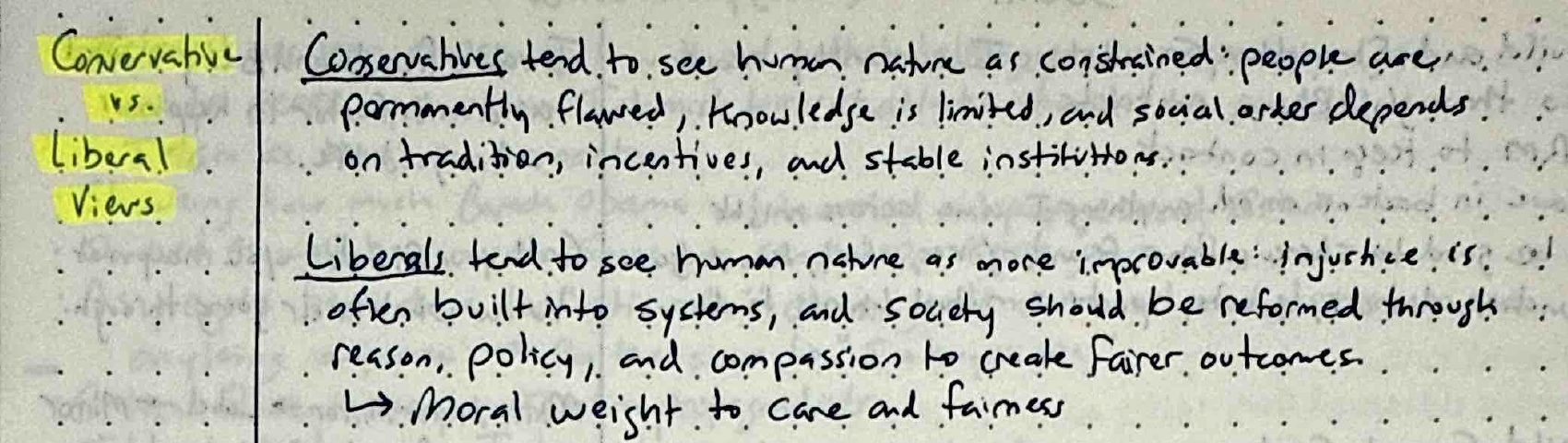
This note is essentially Thomas Sowell’s constrained/unconstrained framework worked out issue by issue — and you own the source: A Conflict of Visions - Thomas Sowell. Sowell’s claim is that the recurring left–right disagreements aren’t a list of separate policy fights but one prior disagreement about human nature: whether human capacity is fixed and tragic (so institutions, tradition and incentives must do the work) or malleable and perfectible (so the right people with the right knowledge can solve problems directly).
Two useful complements:
- Moral Politics - How Liberals and Conservatives Think (Lakoff) — the same divide derived from competing family models rather than views of human nature. Where Sowell says “what can people be?”, Lakoff says “what is authority for?”
- Nietzsche and internalization of domination — for why the unconstrained vision so readily becomes a theory of who is blocking perfectibility, which is the hinge into Woke MOC.
Test worth running: take any position in the table below and ask whether it follows from the vision or is merely correlated with it. The ones that don’t follow are where coalitions, not principles, are doing the work.
Haidt, Chapter 8 — moral repertoires overlap with visions but do not determine them
Haidt’s source-era MFQ evidence offers a psychological complement to Sowell’s ideological ideal types. In two voluntary online samples, self-described liberals weighted Care and equality-inflected Fairness more heavily, while self-described conservatives distributed relevance more evenly across Care, Fairness, Loyalty, Authority, and Sanctity. Reader criticism then led Haidt to add Liberty/oppression and recenter Fairness on proportionality, contribution, and free riding. A constrained vision can therefore recruit proportionality, institutional loyalty, legitimate authority, inherited sacred value, and resistance to government domination; an unconstrained vision can recruit care, equality, and resistance to domination by powerful groups.
The overlap is explanatory, not deterministic. The MFQ samples were self-selected, the instrument changed, most people are moderates, and neither framework proves that a policy follows from a moral score or a vision. Millian rights can be defended by conservatives; Durkheimian belonging can be defended by the left; every foundation can protect a real good or rationalize coercion. Keep the note’s own test: ask whether the position follows from the principle, whether the factual mechanism works, who carries the costs, and what limits power. MFQ evidence, PDF pp. 188–193 (file not included in this release) · Millian and Durkheimian ideal types, PDF pp. 197–201 (file not included in this release) · Fairness and Liberty revision, PDF pp. 201–209 (file not included in this release) · Chapter 8 source and figure audit
1) Human nature, moral psychology, and the core social problem
| Dimension | Constrained Vision | Unconstrained Vision |
|---|---|---|
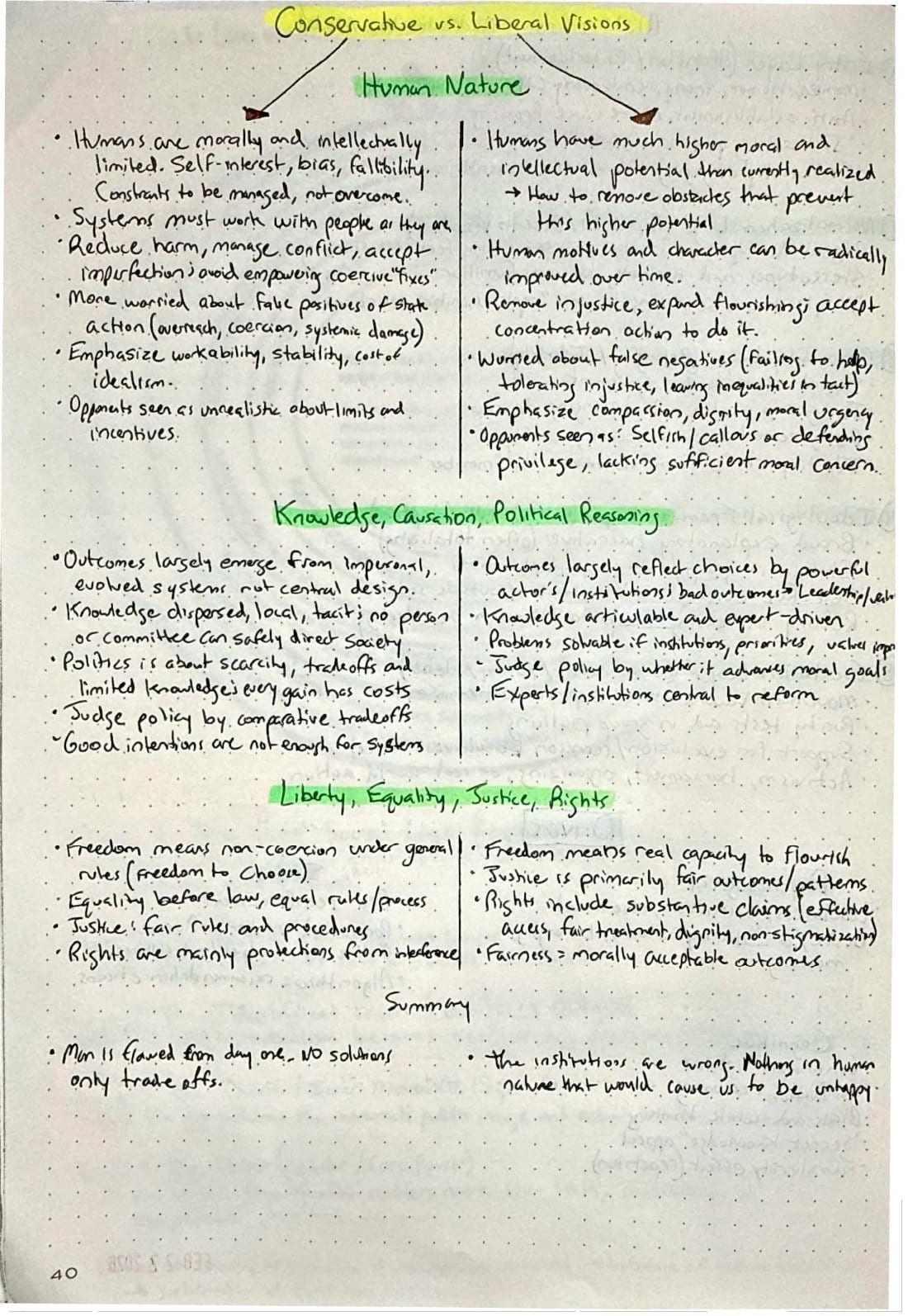
| View of human nature | Humans are morally and intellectually limited in ways that are deep and permanent. Self-interest, bias, and fallibility are constants to be managed, not overcome. | Humans have much higher moral and intellectual potential than currently realized. With the right conditions, education, and institutions, people can become far more rational and benevolent. |
| Core problem of social life | How to contain and channel flawed human nature so society doesn’t collapse into predation and chaos. | How to remove obstacles (ignorance, bad institutions, privilege, prejudice) that prevent humans from living up to their higher potential. |
| Moral improvement | Human character can improve at the margins, but no large, reliable transformation of mankind’s motives can be presumed. Systems must work with people as they are. | Human motives and character can be radically improved over time. Education, enlightenment, and better institutions can align personal and general interest. |
| War & crime (human motives) | War and crime are predictable expressions of human motives given incentives and opportunities. | War and crime are aberrations from what people could be under better conditions. |
| Preferred moral method | A “tragic” ethic: reduce harm, manage conflict, accept imperfection; avoid empowering coercive “fixes.” | A “redemptive” ethic: remove injustice, expand flourishing; accept concentrated action to do it. |
| Error-cost sensitivity | More worried about false positives of state action (overreach, coercion, systemic damage). | More worried about false negatives (failing to help, tolerating injustice, leaving inequities intact). |
| Moral language about policy | More likely to emphasize workability, stability, and the costs of idealism. | More likely to emphasize compassion, dignity, and moral urgency. |
| Moral tone toward opponents | Opponents are more often seen as sincere but mistaken—unrealistic about limits and incentives. | Opponents are more often seen as selfish/callous or defending privilege, or lacking sufficient moral concern. |
2) Knowledge, reason, causation, and how society “works”
| Dimension | Constrained Vision | Unconstrained Vision |
|---|---|---|
| Causation in society | Outcomes come largely from impersonal, evolved systemic processes (tradition, markets, law) that no one fully controls or designs. | Outcomes come primarily from deliberate decisions by powerful people and institutions; bad outcomes reflect misuse or failure of power. |
| Knowledge | Knowledge is fragmented and dispersed in habits, prices, traditions, and institutions. No one mind (or committee) can safely “run” society. | Knowledge is primarily articulated, intellectual, and expert. Those with superior knowledge and insight can and should guide social decisions. |
| Central constraint in politics | Scarcity, tradeoffs, and limited knowledge are permanent. Politics is choosing which costs to pay. | Many problems are solvable; obstacles are often bad priorities, bad institutions, or bad values. |
| Tradeoffs vs “solutions” | Judge policies by comparative tradeoffs among real alternatives; every gain has a cost. | Judge policies by achieving moral ends; costs are often treated as contingent or fixable later. |
| Incentives vs intentions | Intentions are insufficient; systems must work even when people are biased or self-interested. | Intentions matter greatly; better values and leadership can drive better outcomes. |
| Unintended consequences | Interventions routinely create secondary effects that can overwhelm intended benefits. | Secondary effects exist but are often treated as manageable through further reform and refinement. |
| Accountability / feedback loops | Prefer tight feedback mechanisms (markets, competition, local governance, checks and balances). | More comfort with mission-driven institutions where feedback is slower/indirect (agencies, courts, expert bodies). |
| View of expertise (more precise than “elites”) | Experts are useful, but their reach must be limited; knowledge is contextual and incentives distort. | Experts are crucial; knowledge is articulable and can be used to redesign systems. |
3) Institutions, discretion, elites, and power
| Dimension | Constrained Vision | Unconstrained Vision |
|---|---|---|
| Role of elites | Elites are not morally/cognitively superior enough to be society’s guardians. Their discretion must be checked by rules, markets, and dispersed power. | Intellectual and moral elites are pioneers who should lead, guide, and sometimes override ordinary opinion through planning, activism, and technocratic authority. |
| Locus of discretion | Discretion is dispersed: individuals and organizations decide within a framework of law/tradition; outcomes emerge from interactions. | Discretion is concentrated in surrogate decision-makers (planners, judges, commissions, enlightened leaders) tasked with pursuing the common good directly. |
| Power (definition) | Power is the ability to reduce others’ existing options (coercion). Wealth that adds options via trade/production isn’t “power” in that sense. Political power is especially dangerous. | Power is the ability to shape behavior by threats or rewards; economic, social, and cultural dominance count as power needing constraint/redirection. |
| What institutions are “for” | Institutions primarily constrain behavior and coordinate dispersed knowledge, often beyond anyone’s comprehension. | Institutions should realize moral purposes and can be redesigned to pursue justice directly. |
| View of constraints themselves | Constraints are often the solution (rules, norms, constitutional limits). | Constraints are often the problem (barriers to justice, progress, authentic freedom). |
| Legitimating principle | Legitimacy comes from procedural restraint: limited powers, general rules, and institutional consent. | Legitimacy comes from substantive justice: using power to secure morally required outcomes. |
4) Liberty, equality, justice, rights, and “fairness”
| Dimension | Constrained Vision | Unconstrained Vision |
|---|---|---|
| Freedom (definition) | Freedom is a process characteristic: choices aren’t interfered with by coercion under general rules; emphasis on freedom to choose, not on one’s menu of options. | Freedom is a result characteristic: the ability to actually realize desires and potentials; lack of resources/status/recognition can be lack of “real” freedom. |
| Equality (definition) | Equality = equality before the law and equality of process (same rules, formal opportunities). Outcome inequalities are often tragic but unavoidable side effects. | Equality = equality of results or chances of results (material conditions, life chances, status). Formal equality is often dismissed as merely paper equality. |
| Justice (definition) | Justice is adherence to fair, general rules and procedures (rule of law). Crucial instrumentally for order, but not absolute over all tradeoffs. | Justice is about fair patterns of outcomes (distributions of wealth/status/burdens), often treated as categorical even at efficiency cost. |
| Social justice | “Social justice” as a demanded pattern of outcomes is seen as meaningless or dangerous; engineering distributions requires powers that erode rule of law and liberty. | Social justice is central; people are morally entitled to a just share; large inequalities call for systemic correction, not just charity. |
| Rights | Rights are mainly zones of immunity from state interference (speech, property, contract), justified by beneficial processes. Can be limited for survival-level public necessity. | Rights are inherent moral claims, often treated as trumps; emphasis extends to substantive outcomes (effective speech, fair shares, non-stigmatization). |
| What “fairness” means in practice | Fairness = impartial rules and predictable treatment. | Fairness = morally acceptable outcomes; equal rules can still be unfair if they preserve inequity. |
| View of inequality | Inequality is often structurally inevitable in workable systems; the key question is whether the process generating it is fair and productive. | Inequality is morally central and often evidence of exploitation/exclusion/structural injustice; correction is a primary task of policy. |
5) Markets, planning, reform style, and typical policy implications
| Dimension | Constrained Vision | Unconstrained Vision |
|---|---|---|
| Markets vs planning | Markets are indispensable systemic mechanisms that coordinate dispersed knowledge and align incentives. Planning is limited by ignorance and prone to abuse/failure. | Markets are subordinate tools that often produce unjust outcomes; expert planning/regulation is possible and necessary for justice and welfare. |
| Typical policy stance (economy) | Favor laissez-faire/limited government; stress unintended benefits of voluntary exchange; skeptical of redistribution and detailed regulation. | Favor active intervention, redistribution, planning, and regulation to correct unfair outcomes and protect the vulnerable. |
| Typical policy stance (crime) | Emphasize deterrence, punishment, and moral norms; rehabilitation is secondary/uncertain; removing all root causes is unrealistic. | Emphasize root causes, social conditions, and rehabilitation; harsh punishment seen as barbaric/counterproductive or a symptom of social failure. |
| Baseline stance toward reform (burden of proof) | Presumption against sweeping change; reformers must show net gains relative to real alternatives. | Presumption for change when outcomes look unjust; defenders of the status quo must justify it. |
| View of social change | Change should be incremental, cautious, tested; beware unintended consequences and loss of hard-won systemic knowledge. | Change can be sweeping and purposeful, especially when led by enlightened elites; justice may demand rapid transformation. |
6) Law, courts, rules, and discretion
| Dimension | Constrained Vision | Unconstrained Vision |
|---|---|---|
| Law & courts | Law should be stable, general, precedent-based; courts enforce rules/procedures and avoid reinventing morality from the bench; restraint is a virtue. | Law should embody/enforce moral principles (equality, dignity, social justice); courts should supply fresh moral insight and correct unjust outcomes. |
| Typical policy stance (courts) | Prefer restraint, textualism/originalism, clear rules, deference to legislatures and evolved practices even when outcomes are imperfect. | Prefer activism/substantive review, reading moral values and evolving standards into constitutions and laws to secure just outcomes. |
7) Tradition and inherited social knowledge
| Dimension | Constrained Vision | Unconstrained Vision |
|---|---|---|
| View of tradition | Tradition is a repository of distributed, evolved wisdom; deserves a strong presumption in its favor, though not blind worship. | Tradition is often a repository of prejudice, privilege, and outdated power; it has no inherent claim and must justify itself to reason and justice. |
8) Representative thinkers (as you listed)
| Dimension | Constrained Vision | Unconstrained Vision |
|---|---|---|
| Representative thinkers (in Sowell’s mapping) | Adam Smith, Edmund Burke, Alexander Hamilton, James Madison, F. A. Hayek, Milton Friedman, Oliver Wendell Holmes Jr. | Jean-Jacques Rousseau, William Godwin, the early Condorcet, John Stuart Mill (partly), John Rawls, many modern egalitarian and “social justice” theorists. |
Compact
2) Knowledge, Causation, and Political Reasoning
| Dimension | Constrained Vision | Unconstrained Vision |
|---|---|---|
| How society works (causation) | Outcomes largely emerge from impersonal, evolved systems (markets, norms, law, tradition), not central design. | Outcomes largely reflect choices by powerful actors/institutions; bad outcomes are often failures of leadership or values. |
| Knowledge | Knowledge is dispersed, local, and tacit; no person or committee can safely direct society as a whole. | Knowledge is more articulable and expert-driven; informed actors can diagnose and improve social systems. |
| Politics under limits | Politics is about scarcity, tradeoffs, and limited knowledge; every gain has costs. | Many problems are solvable if institutions, priorities, and values are improved. |
| Tradeoffs vs solutions | Judge policy by comparative tradeoffs among real alternatives. | Judge policy by whether it advances moral goals, with costs often seen as manageable. |
| Intentions, incentives, consequences | Good intentions are not enough; systems must work under bias/self-interest and avoid harmful side effects. | Better intentions, leadership, and design can improve outcomes; side effects are real but often manageable. |
| Expertise & feedback | Experts are useful but must be constrained by feedback (markets, competition, local knowledge, checks). | Experts and institutions are central to reform, even when feedback is slower or indirect. |
3) Institutions, Power, and Legitimacy
| Dimension | Constrained Vision | Unconstrained Vision |
|---|---|---|
| Role of institutions | Institutions mainly constrain behavior and coordinate dispersed knowledge. | Institutions should pursue moral purposes directly and be redesigned for justice. |
| Discretion & elites | Discretion should be limited and dispersed; elites are not reliable guardians. | Discretion can be concentrated in planners/judges/experts to pursue the common good. |
| Power | Political power is especially dangerous because it coerces; constraints on power are essential. | Power includes political, economic, social, and cultural dominance; all may need redirection/constraint. |
| Legitimacy | Legitimacy comes from procedures: rules, limits, consent, restraint. | Legitimacy comes from substantive justice: whether institutions produce morally right outcomes. |
| Constraints (rules/norms) | Constraints are often the solution (constitutional limits, norms, rules). | Constraints are often the obstacle when they block justice or reform. |
4) Liberty, Equality, Justice, and Rights
| Dimension | Constrained Vision | Unconstrained Vision |
|---|---|---|
| Freedom | Freedom means non-coercion under general rules (freedom to choose). | Freedom means real capacity to flourish (resources/status/opportunity matter). |
| Equality | Emphasis on equality before the law and equal rules/process. | Emphasis on equal life chances / outcomes / status, not just formal equality. |
| Justice | Justice is primarily fair rules and procedures (rule of law). | Justice is primarily fair outcomes/patterns, even if rules alone permit inequality. |
| Social justice | Skeptical of engineered outcome-patterns; sees risks to liberty/rule of law. | Central moral aim; systemic inequality calls for correction, not only charity. |
| Rights | Rights are mainly protections from interference (speech, property, contract). | Rights include substantive claims (effective access, fair treatment, dignity, non-stigmatization). |
| Fairness in practice | Fairness = impartial rules and predictable treatment. | Fairness = morally acceptable outcomes, even if equal rules are formally followed. |
5) Markets, Reform, and Policy Style
| Dimension | Constrained Vision | Unconstrained Vision |
|---|---|---|
| Markets vs planning | Markets are essential for coordinating knowledge/incentives; planning is limited and error-prone. | Markets are useful but often unjust; planning/regulation is necessary for welfare and justice. |
| Reform style | Prefer incremental, cautious, tested reform; burden of proof is on reformers. | More open to sweeping, directed reform when existing outcomes seem unjust. |
| Policy instinct (economy) | Skeptical of redistribution and detailed regulation; favors limited government. | Supports stronger intervention, redistribution, and regulation to correct inequity. |
| Policy instinct (crime/social disorder) | Emphasizes deterrence, norms, and accountability; skeptical of root-cause-only solutions. | Emphasizes root causes, rehabilitation, and social conditions; punitive models seen as limited/harmful. |
| View of social change | Change should preserve hard-won institutional knowledge and avoid unintended harms. | Change can be rapid and purposive when justice requires it. |
6) Law, Courts, and Tradition
| Dimension | Constrained Vision | Unconstrained Vision |
|---|---|---|
| Law & courts | Law should be stable, general, precedent-based; judicial restraint is a virtue. | Law should reflect moral progress; courts may actively correct unjust outcomes. |
| Judicial method | Prefers restraint, clear rules, textualism/originalism, deference to legislatures. | Prefers substantive review, moral interpretation, evolving standards, judicial activism. |
| Tradition | Tradition stores evolved social knowledge; deserves a presumption of respect. | Tradition often preserves prejudice/power; must justify itself to reason and justice. |
7) Representative Thinkers (Sowell’s Mapping)
| Constrained Vision | Unconstrained Vision |
|---|---|
| Adam Smith, Edmund Burke, Alexander Hamilton, James Madison, F. A. Hayek, Milton Friedman, Oliver Wendell Holmes Jr. | Jean-Jacques Rousseau, William Godwin, early Condorcet, John Stuart Mill (partly), John Rawls, many modern egalitarian/social-justice theorists |
Even more concise (if you want fewer topics)
You can collapse the whole thing into just 4 sections:
- Human nature & knowledge
- Institutions & power
- Justice, rights & equality
- Markets, law & reform style
If you want, I can also produce a one-page version (very compact) for Obsidian with only the highest-signal rows.