Filed with Political Philosophy (MOC) · Related: Ideology & Foundations · Ethics & Metaethics (MOC)
Haidt, Chapter 12 — liberal, libertarian, and conservative insights in one audit
Haidt’s most useful distinction is not “left versus right” but three recurring error detectors. Liberals notice victims, domination, concentrated corporate power, and costs shifted to outsiders. Libertarians notice coercion, dispersed knowledge, price signals, experimentation, and the damage caused when users are insulated from trade-offs. Social conservatives notice moral capital: the norms, roles, identities, relationships, and institutions that make trust and cooperation possible before a policy is written. Each insight becomes dangerous when it claims completeness—reform can dissolve useful functions, markets can externalize harm and exclude those without effective choice, and inherited orders can protect rent, domination, and outsiders’ suffering.
Jerry Muller’s distinction also corrects the debate’s categories. Orthodoxy seeks conformity with a transcendent order and can demand radical change; the Hume–Burke conservatism Haidt discovers is an Enlightenment, pragmatic critique of rationalist redesign. It asks whether an institution embodies tacit knowledge or a cooperative function, not simply whether scripture commands it. Conversely, cohesion is not legitimacy: cults and fascist systems can have high moral capital. A defensible synthesis asks of every reform and tradition: what good does it protect, which people bear its burdens, what feedback reveals failure, what can be revised, and whether rights, voice, appeal, and exit survive. Haidt’s particular welfare, school, diversity, health-care, and lead–crime examples are source-era claims to audit, not conclusions supplied by the framework. Attachment (file not included in this release) · Attachment (file not included in this release) · Attachment (file not included in this release) · Chapter 12 source and figure audit
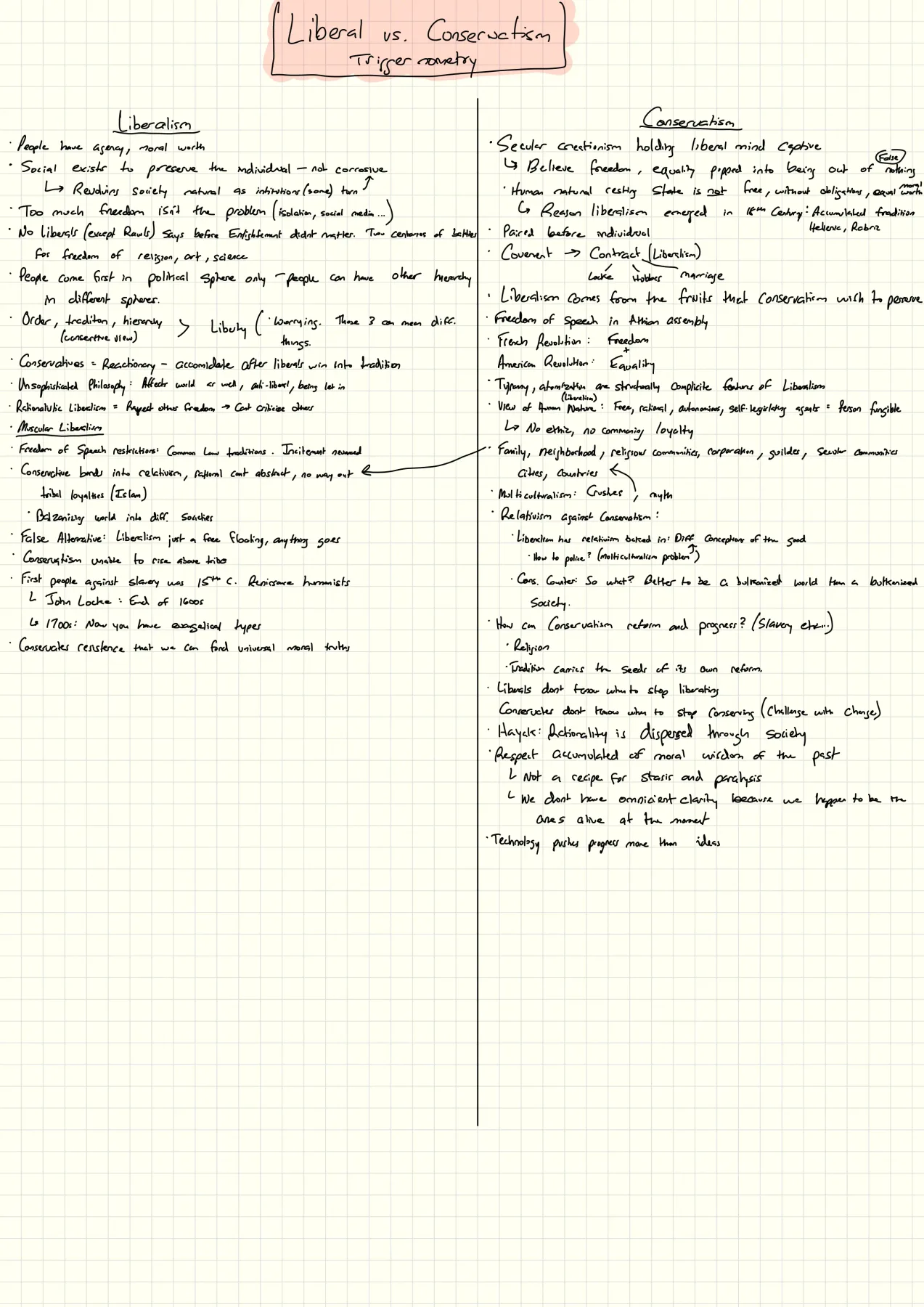
Charting Arguments
1. High-Level Map of the Debate
| Section | Core Question | Liberal Argument (Steven Hicks) | Conservative Argument (James O.) | Counterpoints Exchanged |
|---|---|---|---|---|
| A. Human Nature & Moral Starting-Point | Are human beings first and foremost individual agents or members of inherited communities? | • Individuals are moral ends in themselves (Locke, Kant, Mill). • Agency and equal moral worth anchor all institutions; families, markets and states exist for individuals. • Tradition is valuable only if it serves rights. | • We enter the world attached to others (Aristotle on zoon politikon). • Obligations precede choice (family, faith, nation). • Liberal “secular creationism” forgets the Hebraic-Hellenic soil that made liberty possible. | —Liberal retort: atomism is not freedom’s fault; mobs and bad sub-cultures cause isolation. —Conservative retort: treating persons as fungible agents undermines the loyalties that stop mobs arising. |
| B. Civic Peace & Tolerance | Does unrestricted liberty fracture society? | • “Muscular liberalism” tolerates peaceful, voluntary diversity but uses force against coercers (Mill’s harm principle). • Common-law line between speech and incitement already exists. | • The liberal state imports groups that reject liberal norms, then lacks a moral core to assimilate them (R. Scruton, Huntington). • “Paradox of tolerance” shows liberty alone cannot set limits. | —Liberal: the threat comes from illiberal ideologies, not liberty itself. —Conservative: open borders + moral neutrality is structurally liberal; it inevitably empowers the illiberal. |
| C. Change, Reform & Revolution | Who drives moral progress? | • Abolition, religious liberty, science, women’s rights were secured by liberals who fought conservative establishments (Galileo, Wilberforce after Lockean ideas, suffragettes). | • Reform came from within tradition—the Evangelical abolitionists, Christian feminism—showing conservatism contains seeds of self-correction (Burke, Coleridge). | —Each side claims the same episodes; dispute is over which underlying principle (individual rights vs. sacred dignity) did the heavy lifting. |
| D. Epistemology & Relativism | Can universal moral truths be known apart from tradition? | • Yes. Reason and evidence allow us to rise above parochial starting points; slavery is wrong everywhere (Enlightenment rationalism). | • Universal moral order exists, but is carried by concrete traditions and religion; purely abstract “rights talk” collapses into competing private goods (MacIntyre, O’Donovan). | —Liberal worry: Burkean caution can excuse lingering injustice. —Conservative worry: Rationalist certainty breeds hubristic social engineering. |
| E. Technology vs. Ideas | Are cultural shifts mainly technological? | • Liberty lets inventors act; new tech (printing-press, pill, internet) accelerates freedom’s benefits. | • Tech is catalytic, but without moral guard-rails (from tradition) it destabilises family, sex roles (Mary Harrington, Louise Perry). | —Common ground: tech changes context; disagreement is whether liberty or inherited norms better absorb the shock. |
| F. Endgame Fears | What happens if each view over-extends? | • Liberal nightmare: hyper-rationalist “blank-slate” progressivism (Rousseau → Rawls → woke radicalism) denies reality and requires state compulsion. | • Conservative nightmare: ossified hierarchies defend injustice; rigid nationalism breeds tribal war. | Both agree a third force—illiberal collectivism (ethno-religious fanaticism or revolutionary utopianism)—is the real enemy, but differ on how to resist it. |
2. Detailed Deconstruction by Claim
| # | Liberal Claim (Hicks) | Conservative Reply (James O.) | Philosophical Lineage |
|---|---|---|---|
| 1 | Society exists to serve individuals; dissolve institutions that cease to protect agency. | Institutions are not mere contrivances but embodiments of hard-won wisdom; you dismantle them at your peril (Chesterton’s Fence). | Locke, Mill vs. Burke, Tocqueville |
| 2 | Freedom doesn’t cause atomisation; echo-chamber mob psychology does. | Atomisation follows when liberty is detached from thick social bonds; liberal universalism can’t cultivate those bonds. | J. S. Mill, Hayek vs. Robert Nisbet, Patrick Deneen |
| 3 | State force must be limited to protecting life, liberty, property. | “Muscular” enforcement still presupposes a shared creed about the good; liberal neutrality is illusory (Taylor’s critique of “procedural” liberalism). | Nozick, classical liberals vs. Communitarian critics |
| 4 | Liberalism won every key freedom; conservatives merely accommodated after losing. | Early abolitionists and reformers were traditional Christians; conservatives changed from within, not because of abstract rights. | Whig interpretation of history vs. Revisionist evangelical scholarship (B. Hilton, M. Noll) |
| 5 | Universal rights prevent moral relativism. | Rights documents arose from specific Judeo-Christian metaphysics; absent that substrate, “rights” become rival preferences (Alasdair MacIntyre). | Kant, Rawls vs. MacIntyre, Oakeshott |
| 6 | Individuals can transcend birth circumstances by reason. | Reason is real, but embedded; identities grounded in kin, place and faith supply meaning and limit conflict (Herder, Eliot). | Enlightenment universalism vs. Romantic particularism |
| 7 | Transgender excesses show need for empirical liberalism, not its rejection. | They expose liberalism’s blank-slate view of the body; ignoring natural limits leads to self-contradiction. | Moderate empiricism (Hume) vs. Natural-law realism (Aquinas, Scruton) |
3. Synoptic Comparison Chart
| Dimension | Muscular Liberalism | Burkean / Theistic Conservatism |
|---|---|---|
| Anthropology | Autonomous, rational, equal individuals (Kantian dignity) | Relational, historically situated persons with given obligations (Aristotelian zoon politikon) |
| Moral Source | Secular natural rights; discoverable by reason → universal | Transcendent order (often theistic) mediated by tradition; partly universal, partly particular |
| View of Tradition | Instrumental: keep if it protects rights; discard if not | Presumptive authority: inherited practices embody distributed knowledge |
| Role of State | Minimal but forceful guardian of negative liberty | Guardian of moral ecology; law reflects communal goods |
| Change Mechanism | Reform via rational critique; revolution acceptable if rights denied | Organic evolution; abrupt change dangerous unless anchored in precedent |
| Limits on Diversity | Tolerate any peaceful practice; ban coercion | Integrate newcomers under host norms; emphasize cultural assimilation |
| Greatest Vice | Over-confidence → abstract utopianism, managerial tyranny | Complacency → defence of unjust hierarchies, ethnic tribalism |
| Historical Heroes | Locke, Madison, Mill, Douglass, Jefferson, Wollstonecraft | Burke, Tocqueville, Disraeli, Chesterton, Wilberforce, Kirk |
| Modern Pathologies | “Woke” hyper-individualism, identity-politics relativism | Ethno-nationalism, authoritarian populism |
| Shared Ground | (i) Human dignity is real. (ii) Illiberal coercion is an enemy. (iii) Technology accelerates moral risk and opportunity. |
4. Additional Context & Reading
| Theme | Liberal-leaning Sources | Conservative-leaning Sources |
|---|---|---|
| Atomisation vs. Community | Robert Putnam Bowling Alone; Deirdre McCloskey on bourgeois virtues | Patrick Deneen Why Liberalism Failed; Yuval Levin The Fractured Republic |
| Tolerance & Free Speech | J. S. Mill On Liberty; Jonathan Rauch Kindly Inquisitors | Roger Scruton How to be a Conservative; Mary Harrington Feminism Against Progress |
| Slavery & Reform | David Brion Davis The Problem of Slavery…; Philip Morgan | Eric Metaxas Amazing Grace (Wilberforce); Richard Reeves John Stuart Mill (balanced) |
| Tech & Morals | Neil Postman Technopoly; Nick Bostrom | Louise Perry The Case Against the Sexual Revolution; Mary Harrington |
| Epistemology of Tradition | Michael Polanyi Tacit Dimension; Hayek Fatal Conceit | Alasdair MacIntyre After Virtue; Edmund Burke Reflections… |
5. Take-Away Synthesis
-
Human Flourishing Requires Both Agency and Anchoring.
Liberalism rightly prizes the moral sovereignty of persons; conservatism rightly reminds us that persons become selves only within pre-political bonds. -
Institutions Should Be Judged Teleologically.
Hicks: dissolve when rights fail. O.: conserve when they still serve. A common metric—do they cultivate virtuous, responsible citizens?—could arbitrate. -
Universal Rights Need a Moral Imagination; Traditions Need Self-Critique.
Each philosophy contains the seeds of its own pathology unless tempered by the other: abstract rights without loyalties become brittle; loyalties without rights petrify. -
Technological Shocks Expose the Balance.
The pill, social media, biotech and AI demand both liberal openness to innovation and conservative prudence about unintended consequences. -
A Coalitional Future?
The debate hints at a possible synthesis: a muscular, bounded liberalism (liberty within a shared civilizational story) or a self-correcting conservatism (tradition that institutionalises individual rights). Whether such a fusion can hold against illiberal extremes is the central political question of the 21st century.
6. Philosophers & Concepts Mentioned
- Classical Liberals: John Locke (natural rights, consent), Adam Smith (spontaneous order), J. S. Mill (harm principle).
- Progressive / Rationalist Liberals: Rousseau (general will), Rawls (veil of ignorance).
- Burkean Conservatives: Edmund Burke (prejudice as stored reason), Lord Acton (liberty as tradition), Michael Oakeshott (politics of skepticism).
- Religious Conservatives: Augustine & Aquinas (imago Dei), C. S. Lewis (natural law).
- Synthesis Figures: Alexis de Tocqueville (soft despotism), F. A. Hayek (knowledge problem), G. K. Chesterton (democracy of the dead).
Summary
I. Overview: Competing Visions of the Good Society
At its core, this debate centers on two contrasting views of human nature and the moral architecture of society. Liberalism, as articulated by Stephen Hicks, emphasizes the primacy of the individual—free, rational, and morally autonomous. Conservatism, as argued by James Orr, stresses the embeddedness of human beings in historical, familial, religious, and national traditions. Both thinkers agree that each worldview has degenerate variants that must be resisted, and they tentatively gesture toward a possible alliance against truly illiberal threats. However, their disagreement lies in what constitutes the basis of legitimacy for moral norms, political order, and personal identity.
II. Human Nature and Moral Starting Points
Liberal View: Individual Primacy
Hicks argues that liberalism begins with the individual as a moral and rational agent, capable of choosing freely and forming voluntary associations. Institutions such as family, religion, and government are justified only insofar as they promote the flourishing of individuals.
- The individual is not a passive product of forces but an agent of self-development.
- Institutions should be judged teleologically: do they serve individual liberty and dignity?
- When they fail, they may be justly reformed or dismantled.
This view draws heavily from Enlightenment figures like John Locke and Immanuel Kant, who stress autonomy and the inviolability of the human person.
Conservative View: Embedded Identity
James Orr pushes back forcefully, arguing that the liberal image of the solitary, self-creating individual is a myth—what he calls “secular creationism.” Humans are born into unchosen obligations: to family, place, and history.
- We are not born “free”; we are born connected—literally by an umbilical cord.
- Obligations precede rights, and meaning is found in relational embeddedness.
- Aristotle: humans are political and paired animals before being individual moral agents.
He argues that liberalism forgets the soil from which it sprang—classical virtue and Hebraic theology—and thus risks cutting off the very roots that made its freedoms possible.
III. Liberalism, Civic Peace, and the Paradox of Tolerance
Liberal Response: Muscular Liberty
Hicks concedes that liberal societies have allowed illiberal actors into their midst, but he rejects the claim that this is an inevitable feature of liberalism. Instead, he defends what he calls “muscular liberalism”:
- The state must defend liberty forcefully against coercive ideologies.
- Tolerance ends where incitement or violence begins.
- Legal tradition (e.g., common law) has long drawn a line between protected speech and incitement.
He emphasizes that the liberal tradition has robust tools for managing conflict, provided it is not captured by naïve relativists who confuse tolerance with self-annihilation.
Conservative Critique: Liberalism’s Blind Spot
Orr argues that liberalism lacks the normative resources to define its boundaries effectively. Because it treats all individuals as morally equivalent, it cannot distinguish between guests who integrate and ideologies that aim to destroy the host culture.
- Liberalism, especially in its multicultural form, makes no demands on entrants to share its moral vision.
- The result is a society of parallel moral communities with no shared sense of “us.”
- Civic peace collapses without shared identity, story, or loyalty.
This critique echoes Roger Scruton and Patrick Deneen’s arguments that liberal neutrality is not sustainable; it either dissolves into relativism or mutates into authoritarian progressivism.
IV. History, Moral Progress, and the Role of Reform
Liberal Claim: Rights-Based Progress
Hicks defends liberalism as the engine of moral progress in the West. From the Renaissance through the Enlightenment, it was liberals—scientists, artists, dissidents, reformers—who fought for:
- Religious freedom (vs. church orthodoxy)
- Scientific truth (vs. ecclesiastical censorship)
- Women’s rights and abolition (vs. entrenched hierarchies)
He views conservatives as either opponents of these reforms or slow adopters who eventually accommodate liberal victories. Thus, conservatism at best preserves the gains that liberalism initiates.
Conservative Rebuttal: Reform from Within
Orr challenges this triumphalist narrative by emphasizing the religious and traditional roots of liberal achievements. The abolitionist movement, for instance, did not arise from secular rationalism but from Evangelical Christian theology:
- Wilberforce, Clarkson, and other early abolitionists were motivated by biblical anthropology, not Locke.
- Christian teachings on the imago Dei (image of God) grounded their universal human dignity arguments.
- Conservatives do not reject reform; they seek reform grounded in metaphysical and theological continuity.
He claims liberalism often radicalizes reforms by detaching them from the traditions that gave them coherence.
V. Epistemology: How Do We Know What’s Right?
This exchange revealed a key philosophical fault line: the role of epistemology in political and moral reasoning.
Hicks: Moral Universalism Is Discoverable
- Humans have the rational power to rise above local contexts.
- We can recognize and act upon universal truths—e.g., slavery is wrong everywhere.
- Waiting for tradition to evolve slowly can excuse great moral evils.
This reflects Enlightenment confidence in reason, shared with Kant and Mill.
Orr: Rationalism Begets Hubris
- Conservatives are wary of revolutions launched by “small gaggles” of intellectuals.
- Traditions contain distributed knowledge—the “democracy of the dead.”
- Even if we don’t understand every tradition, we should hesitate to discard them (Chesterton’s Fence).
He emphasizes that rationality is often local, embedded, and cumulative, aligning with Edmund Burke, Michael Oakeshott, and Hayek.
VI. Relativism: Which Side Is More Vulnerable?
Liberal Dilemma: Pluralism vs. Meaning
Orr argues that liberalism’s commitment to moral pluralism inevitably produces relativism:
- By affirming everyone’s right to define their own good, it denies any shared vision of the good.
- Liberal societies therefore need an 800-lb. gorilla (state) to mediate endless conflict.
- The result is atomization, which invites technocracy or tyranny to restore order.
Conservative Reply: Tradition Anchors Objectivity
Orr suggests that conservatism avoids relativism through:
- Transcendent metaphysical beliefs (often theistic)
- A narrative identity (nation, religion, history)
- A framework of inherited obligations
Hicks agrees that rationalist liberalism can become untethered and concedes the need for grounding—but he insists reason can provide that anchor, especially in empirically grounded forms.
VII. Technology and Law: Catalysts of Change
Both speakers acknowledge that major shifts in society are often not the result of pure ideas but of:
- Technological changes: e.g., the pill, washing machines, media
- Legal innovations: e.g., Civil Rights Act, Human Rights Act, Equality Acts
Orr argues that liberal frameworks often claim credit for changes enabled by these forces but cannot restrain their unintended consequences. Hicks responds that liberal societies uniquely enable such innovations, while illiberal regimes often suppress them.
VIII. Endgame Risks and Convergence
Liberal Risk
- Too much abstraction → identity dissolution → tyranny of management
- “Blank slate” views of human nature (seen in radical gender ideology) disconnect liberty from reality
Conservative Risk
- Over-attached to unjust traditions
- Slow to recognize moral urgency (e.g., abolition, suffrage)
- Risk of becoming defensive tribalism
Tentative Convergence
Both agree that:
- A purely abstract liberalism is dangerous.
- A purely static conservatism is morally insufficient.
- A healthy society must both preserve and reform.
There’s room for a “muscular liberalism” grounded in tradition or a “conservatism” open to morally justified change—echoing hybrid figures like Tocqueville or Hayek.
IX. Key Philosophical Figures Referenced
| Tradition | Figures |
|---|---|
| Classical Liberalism | John Locke, Immanuel Kant, J. S. Mill, Adam Smith |
| Conservative Philosophy | Edmund Burke, Aristotle, Michael Oakeshott, Roger Scruton |
| Hybrid Thinkers | Tocqueville, Hayek, Alasdair MacIntyre |
| Radical/Rationalist Liberalism | Jean-Jacques Rousseau, John Rawls |
| Religious Reformers | Wilberforce, Thomas Clarkson, Augustine, Aquinas |
X. Conclusion
This debate elegantly captured the enduring tension between liberty and order, autonomy and inheritance. Hicks offers a vision of moral self-authorship constrained only by rights and reason; Orr counters with a richer tapestry of duties, stories, and transcendent meanings.
Both agree that we are at a civilizational crossroads—facing illiberal threats within and without—and that neither ideology, in isolation, is sufficient to meet the challenge. The real question is whether these two traditions can offer a fusion robust enough to preserve dignity without disorder and liberty without license.
Let me know if you’d like a Substack-ready version or a downloadable version formatted for Obsidian or PDF.
1. Framing the Contest: Two Moral “Starting Lines”
Liberal theorist Steven Hicks opens by asserting that agency and equal moral worth are the first facts of political life. Individuals come with intrinsic dignity; families, churches, firms, and states are legitimate only insofar as they protect those agents and their rights.
Conservative interlocutor James O. counters that the real first fact is relational dependence: every newborn is literally tethered by an umbilical cord, immediately embedded in inherited obligations—family, faith, village, nation. Freedom, he insists, does not arise ex nihilo in 1776; it is a fruit of centuries of Hebraic-Hellenic moral formation.
Key tension: Is “personhood” primary (Locke, Kant, Mill) or are “people-hoods” primary (Aristotle, Burke, MacIntyre)? Everything else unfolds from that fork.
2. Civic Peace, Tolerance and the “Paradox of Liberal Neutrality”
Liberal Position (Hicks)
- “Muscular liberalism” can and should tolerate any peaceful practice—but must bring the hammer down on coercion, violence or incitement.
- The common-law tradition already draws fine lines between speech and incitement; no need for new authoritarian tools.
- Recent disorder in Western cities is not due to “too much freedom” but to illiberal sub-cultures that refuse reciprocal liberty.
Conservative Reply (James O.)
- Liberalism’s claim of moral neutrality leaves it unable to demand deep loyalty from new arrivals; it therefore imports groups that often reject liberal norms.
- The “Paradox of Tolerance” is not a mere edge-case; it is an inherent structural weakness: without a substantive moral core, the liberal state must either watch its own dissolution or become authoritarian.
- A conservative polity would define the moral community—“this is who we are”—and expect assimilation on its terms, reducing the need for police power in the first place.
Take-away: The dispute is not really over free speech codes; it is over whether a morally thick or thin public identity is necessary for social peace.
3. Who Really Conquered Slavery and Secured Women’s Rights?
-
Liberal narrative (Hicks).
- Every epochal liberation—Galileo’s scientific freedom, the Abolitionist victories, suffrage—was led by people citing universal principles against entrenched hierarchies.
- Conservatives either resisted outright or “accommodated” once defeat was inevitable.
-
Conservative rejoinder (James O.).
- The anti-slavery vanguard in Britain (Clarkson, Wilberforce) were Evangelicals, reading Paul and Genesis, not Rawls or Rousseau.
- Christian metaphysics—imago Dei—supplied the non-fungible dignity that abstract rights theory eventually secularised.
- Traditions often contain the seeds of their own reform; therefore “conserving” can also mean “conserving the capacity to repent”.
Philosophical fault-line
- Liberals spotlight Lockean natural rights and Enlightenment reason.
- Conservatives spotlight transcendent theism and embedded reform (Burke’s “re-pair of the state”).
4. Epistemology: Certainty, Humility and Chesterton’s Fence
Liberal Confidence
- Human reason can reach universal moral verdicts (“slavery is always wrong”) and should implement them quickly.
- Burkean hesitation easily becomes an alibi for injustice.
Conservative Humility
- Chesterton’s Fence: if you find a fence in a field and don’t see its purpose, don’t knock it down until you know why it was built.
- Rationality is “distributed” (Hayek); living traditions embody tacit knowledge that no committee of reformers fully grasps.
- Faster-than-wisdom revolutions turn into tyranny (the French Terror, Soviet Year Zero, contemporary technocracy).
Synthesis possibility: Rapid moral certainty on clear evils (slavery) + slow experimentalism on novel, ambiguous issues (gene editing, AI governance).
5. Atomisation, Identity and the Blank-Slate Temptation
| Liberal diagnosis | Conservative diagnosis |
|---|---|
| Atomisation happens when illiberal mobs or algorithmic echo-chambers trap the self in tribal feedback loops. | Atomisation is baked in once society treats individuals as interchangeable utility-maximisers; without thick loyalties only state or market power remains. |
| Solution: Re-assert muscular defence of rights; keep the civic sphere “thin”, let sub-cultures flourish voluntarily. | Solution: Re-invest in family, faith, nation; define public identity so that multiculturalism is an ethos of guests joining a house, not occupants negotiating a hotel lobby. |
6. Technology as Catalyst, Not Cause
Both admit that ideas don’t shift history alone:
-
Technological shocks
- Printing press → Reformation & scientific inquiry.
- Oral contraceptive pill → sexual revolution (Louise Perry, Mary Harrington).
- Social media → acceleration of identity politics and disinformation.
-
Interpretive dispute
- Liberal: technology extends individual choice; institutions must adapt by protecting new freedoms.
- Conservative: technology is morally ambiguous; without inherited norms it destabilises foundational relationships (marriage, child-rearing, local economies).
7. When Each Side Over-extends
Liberal Over-reach
- Hyper-rationalist “blank-slate” egalitarianism (from Rousseau to Radical Gender Theory) collides with biology and common sense, requiring authoritarian enforcement to survive.
Conservative Over-reach
- Sanctifying every inherited hierarchy morphs into reactionary tribalism or ethno-nationalism; injustices linger because “that’s how our fathers did it”.
Both agree the worst scenario is an illiberal collectivism (religious or ideological) that hijacks state power. They part ways on which internal guardrails best prevent that outcome.
8. A Working Concordat? Toward “Bounded Liberty” or “Self-Correcting Tradition”
- Bounded (muscular) liberalism would embrace a thicker narrative of national identity—Western constitutionalism, Judeo-Christian inheritance—while keeping state power limited to guarding negative rights.
- Self-correcting conservatism would openly incorporate the rights language forged by liberal victories, embedding it as permanent moral capital inside its oldest institutions.
Whether such a synthesis can out-compete rising illiberalisms is, the debaters conclude, the central political problem of the twenty-first century.
9. Further Reading & Listening Pointers
For the Liberal Case
- John Locke, Second Treatise & Letter on Toleration
- J. S. Mill, On Liberty
- Jonathan Rauch, Kindly Inquisitors (muscular defence of free speech)
For the Conservative Case
- Edmund Burke, Reflections on the Revolution in France
- Roger Scruton, How to be a Conservative
- Alasdair MacIntyre, After Virtue (tradition-constituted reasoning)
Bridging Works
- Alexis de Tocqueville, Democracy in America (liberal institutions + moral religion)
- F. A. Hayek, The Fatal Conceit (knowledge problem echoes Burkean humility)
- Mary Harrington, Feminism Against Progress (tech, sex, and embodied limits)
10. Quick-Reference Bullet Recap (copy-friendly)
- Human starting-point: individual agency (liberal) vs. inherited obligation (conservative).
- Civic peace: thin procedural neutrality (lib) vs. thick moral membership (cons).
- Heroic victories: credit universal rights activism (lib) vs. reformist tradition (cons).
- Epistemic stance: confidence in rational universals (lib) vs. caution/humility (cons).
- Technology: liberates choice (lib) vs. disrupts bonds (cons).
- Pathologies: woke managerialism (lib excess) vs. ethnocentric stasis (cons excess).
- Potential fusion: “bounded liberty” or “self-correcting tradition.”
Key Arguments:
-
Liberalism:
- Individualism and Agency: Stephen Hicks argues that liberalism values individuals as agents with moral worth, capable of forming social institutions that benefit them. Institutions should be preserved or dissolved based on their effectiveness in protecting individual rights.
- Freedom and Atomization: Hicks counters the claim that too much freedom causes societal atomization, suggesting instead that unhealthy social environments, like echo chambers and mob psychology, lead to isolation.
- Evolution of Social Institutions: Liberalism supports the evolution and sometimes the dissolution of social institutions to better serve individual freedoms.
- Muscular Liberalism: Hicks emphasizes the need for a strong government to protect individual rights against threats, advocating for a muscular form of liberalism that actively defends liberties.
- Universal Principles: Liberalism aims to establish universal principles, such as religious and intellectual freedom, stemming from historical battles and evolving over centuries.
-
Conservatism:
- Tradition and Order: James O. emphasizes the importance of tradition and order in shaping human society, arguing that liberalism overlooks the accumulated wisdom of historical and cultural traditions.
- Natural State of Humans: O. contends that humans are not naturally free and equal but are shaped by their family, community, and historical context. He argues that liberalism’s assumption of humans as autonomous agents is flawed.
- Religious and Philosophical Foundations: O. highlights the role of religious and philosophical traditions, particularly from the Hellenic and Hebraic traditions, in shaping modern values and societal structures.
- Community and Loyalty: O. asserts that meaningful human connections and loyalties arise from family, neighborhood, and religious communities, not from abstract liberal principles.
- Challenges to Liberalism: O. criticizes liberalism for failing to establish a cohesive moral community, leading to societal fragmentation and lack of civic peace.
Historical References:
-
Enlightenment and Liberalism:
- Hicks and O. discuss the Enlightenment as a period that crystallized liberal values of freedom and equality, building on centuries of intellectual and social evolution.
- Influential Figures: Hicks mentions John Locke and the Founding Fathers of the United States as key figures who integrated ancient Greek and Roman political traditions with modern principles of religious and intellectual freedom.
-
Religious and Philosophical Traditions:
- O. references Aristotle’s concept of humans as “political animals” who naturally form communities, arguing that liberalism ignores this foundational aspect of human nature.
- Evangelicals and Abolitionism: O. credits evangelical Christians with initiating the abolitionist movement based on theological arguments, while Hicks attributes the movement to a broader Enlightenment context that included Renaissance humanism and modernized Christianity.
Points of Contention:
-
Freedom vs. Order:
- Hicks argues that freedom is fundamental and that social institutions should serve individuals, while O. emphasizes the necessity of order and tradition for a stable society.
- Impact of Technology: Both acknowledge the role of technology in societal changes, with O. highlighting that technological advancements like the pill and washing machine facilitated shifts in gender roles and social structures.
-
Civic Peace and Integration:
- O. criticizes liberalism for leading to societal fragmentation and lack of civic peace, citing recent events and multiculturalism as examples of liberal failures.
- Muscular Liberalism: Hicks counters that liberalism needs to be more assertive in protecting individual rights and maintaining order.
-
Epistemology and Moral Certainty:
- Hicks argues for the ability of individuals to rise above their circumstances through rational thought and education, while O. emphasizes the conservative skepticism towards rapid changes and untested ideas.
- Relativism vs. Universalism: O. raises concerns about liberalism’s tendency towards relativism and the lack of a unifying moral framework, while Hicks defends the potential for universal moral principles within a liberal context.
Metaphysicals Debate expansion
Introduction – Why Metaphysics Matters
Political quarrels often look “practical,” but every coherent worldview rests on answers to metaphysical questions:
- What is ultimately real? (substances, relations, God, chance…)
- What is a human being? (rational animal, imago Dei, bundle of desires…)
- How do entities acquire their identity and worth? (essence, function, choice…)
- What teleology, if any, orders nature and history?
Liberalism and conservatism reach different political prescriptions because they diverge—sometimes tacitly, sometimes explicitly—on all four axes.
1. Liberal Metaphysics in Outline
-
Ontological Individualism
-
The basic unit of reality for politics is the discrete person, not the tribe, nation, or church.
-
Individuals possess an intrinsic dignity or “moral status” prior to any social role.
-
Expressions:
- Locke’s natural rights “independent of any earthly superior.”
- Kant’s categorical imperative: treat every rational being as an end in itself.
-
-
Moral Rationalism & Universalism
- Practical reason can abstract from local customs to grasp universally valid norms (e.g., the wrongness of slavery everywhere).
- These norms are discoverable, not created, by culture.
- Human nature is the same in kind across times and places; differences are accidental.
-
Weak Teleology
- There is no thick, predetermined human telos imposed by God, nature, or history.
- Instead, telos = self-chosen projects pursued under non-coercion (Mill’s “experiments in living”).
- Freedom is thus the meta-good that permits each person to define their own good.
-
Nominalist or Proceduralist Account of Groups
- Families, congregations, nations, even “traditions” are secondary groupings—useful if they serve individuals, contingent if they do not.
- Binding power flows upward: contract → institution, never the reverse.
-
Metaphysical Minimalism of the State
- The polity has no sacred aura; it is a device to secure rights.
- Its legitimacy derives solely from consent (explicit or tacit).
Philosophical Lineage: Late-medieval nominalism → Renaissance humanism → Descartes’ cogito → Locke, Grotius → Kant/Mill → Rawls (if rationalist) or Hayek (if empiricist).
2. Conservative Metaphysics in Outline
-
Ontological Embeddedness
- The human person is constituted by relationships—familial, linguistic, liturgical, territorial.
- “I” presupposes “we”; the biological cord becomes a cultural cord (Aristotle, Augustine, MacIntyre).
-
Thick Moral Realism
- There exists a robust order of natural or divine law that assigns objective ends to human capacities (reason ordered to truth, sexuality to procreation and union…).
- Freedom is the capacity to realize those ends, not to redefine them.
-
Teleology of Tradition
- Traditions are not random accretions; they embody the slow discovery of how best to live within those objective ends.
- Each generation inherits a normative debt to the dead and the unborn (Chesterton’s “democracy of the dead”).
-
Substantive Communitarianism
- Groups are more than contractual clusters; they are organic wholes with their own common goods (polis, church, family).
- These wholes can impose non-chosen duties (filial piety, civic service).
-
Hierarchical but Reformable Order
-
Because functions differ, offices differ; hierarchy is natural.
-
Yet hierarchy is judged by service to the common good. Hence:
- Medieval critique of unjust kings (Aquinas).
- Christian abolitionists invoking imago Dei to abolish chattel slavery.
-
Philosophical Lineage: Plato/Aristotle → Stoics/Church Fathers → Aquinas → Hooker/Burke → Tocqueville/Oakeshott/Scruton.
3. Four Focal Metaphysical Disputes
A. Substance vs. Relation
- Liberals: Substance first (the atomized subject); relations are optional predicates.
- Conservatives: Relation is co-constitutive; you cannot specify “Tom” apart from son-of, citizen-of, creature-of-God.
- Implication: Liberal rights are negative shields; conservative duties are positive bonds.
B. Human Nature: Essentialist or Plastic?
- Liberals (rationalist wing): Nature is malleable; rational agency + consent suffice.
- Conservatives: Certain ends are “fixed” in our nature—e.g., the telos of the body, permanence of sex-difference—which politics must respect.
- Contemporary flash-point: Gender ideology. To conservatives it illustrates liberalism’s denial of natural form; to liberals it tests the scope of self-authorship.
C. Universals vs. Particulars
- Liberals: Universals (rights) have priority; particulars (cultures) that violate them are illegitimate.
- Conservatives: Universals are mediated by particulars; you cannot eat an “abstract meal.”
- Middle path: Natural-law Thomists who argue universals express through culturally varied but convergent “basic goods.”
D. Time and Moral Knowledge
- Liberals: Reason can grasp eternal truths ahistorically; therefore injustice should be corrected now (abolition).
- Conservatives: Moral knowledge is diachronic—embedded in practice, refined by trial and error; too-swift change risks hubris (French Revolution).
- Hybrid stance: Tocqueville—see realities, reform cautiously, but reform.
4. Epistemological Consequences
| Liberal Epistemology | Conservative Epistemology |
|---|---|
| Cartesian / Kantian confidence in deduction or reflective equilibrium. | Fallibilism: knowledge is tacit, dispersed; common law & custom are “stored reason.” |
| Universal propositions justify de-legitimating unjust orders. | Particular experience warns against ideological abstraction. |
| Relativism arises only if reason is denied (post-modernism). | Relativism arises if tradition is cut off (rootless rationalism). |
5. Political Pay-Offs of Metaphysical Premises
-
On Rights:
- Liberalism → absolute negative rights (speech, property, worship).
- Conservatism → rights indexed to responsibilities (speech ordered to truth, property to stewardship).
-
On the State:
- Liberalism → referee whose violence is legitimate only for rights-protection.
- Conservatism → paternal or covenantal guardian of a moral ecology, free to legislate the common good (Sunday trading laws, marriage policy).
-
On Immigration:
- Liberalism → presumptive openness, restricted by harm.
- Conservatism → prudential openness, restricted by cultural capacity to integrate newcomers into a shared story.
-
On Education:
- Liberalism → formation of autonomous choosers.
- Conservatism → transmission of civilizational memory and virtue.
6. Synthesis Attempts
-
Natural-Law Liberalism (Jacques Maritain, John Finnis)
- Marries personal dignity + objective human goods; rights derive from telos.
-
Tocquevillian Balance
- Local associations & religion supply the “habits of the heart” that make democratic freedom sustainable.
-
Ordered Liberty Conservatives (Hayek, Kirk)
- Accept market and speech freedoms but insist they rest on pre-liberal institutions that must be preserved (family, religion).
These syntheses concede liberal insights into dignity and innovation while embracing conservative insights about moral anthropology and institutional memory.
7. Suggested Reading Path for Deeper Metaphysics
-
Classical Roots: Aristotle, Politics Bk. I; Aquinas, Summa Theologiae I-II q (natural law).
-
Liberal Foundation: Locke, Second Treatise §§4–15; Kant, Groundwork §1.
-
Conservative Counter: Edmund Burke, Reflections on the Revolution in France (on metaphysical arrogance).
-
Modern Cross-Examinations:
- Alasdair MacIntyre, After Virtue (tradition-constituted rationality).
- Patrick Deneen, Why Liberalism Failed (liberal metaphysics exhausts itself).
- R. S. Downie & T. Telfer, Respect for Persons (bridging Kant and natural law).
Concluding Reflection
The liberal–conservative clash is irreducibly metaphysical because it asks whether freedom creates order or order creates freedom. Liberals fear that inherited forms stifle the soul’s self-making; conservatives fear that self-making detached from form dissolves the soul altogether. Each side defends part of the truth. The enduring task is to articulate a metaphysics robust enough to honor the individual’s dignity and the communal, transcendent goods without which dignity withers into an empty, anxious autonomy.
Transcript
Intro
0:00
[Music] the liberal aim to try and Achieve Civic peace is a good aim I would challenge
0:06
you particularly given the last few weekends we’ve seen since October the 7th to say that we have Civic peace but
0:13
my my response to that from within the liberal tend is to say that liberalism needs to be muscular so what we then
0:19
have to say is the healthy form of conservatism the healthy form of liberalism we Face a common enemy
0:26
sometimes in order to preserve and conserve change is necessary and that’s the big challenge that conservatism
0:32
faces just as the liberal faces the challenge when do you stop liberating and start becoming a
0:41
conservative hello everybody and welcome to the first what will be many debates here on trigonometry I’ll be hosting
0:47
some Francis will be hosting others I cannot tell you how delighted I am to be joined by two of our favorite ever
0:53
guests on the show Dr James o and Professor Steven Hicks welcome both thanks we’re going to have a debate
0:58
about conservatism versus liberalism uh you’ve both written a couple of pieces for my substack and there’ll be more
1:04
coming um I want Stephen you you you had to go second in the written debate so I’ll go to you first um one of the I
Is Liberalism Destructive to Society?
1:12
thought more persuasive criticism of liberalism and we heard it a lot of it at ARK where we all were a few days ago
1:19
uh was that limits are liberating and the pursuit of unending freedom is
1:25
actually destructive to society what do you say to those people well uh I think gift is start with a moral conception of
1:31
what Society is uh uh we start with individuals who are both the agents uh
1:39
individuals have agency you don’t see them as pwns pushed around by forces beyond their control so there is a
1:45
conception of human nature at work and that’s a that’s a philosophical starting point not only of Agents but of moral
1:52
worth that whatever we’re doing in society that we’re forming various kinds of social institutions businesses
1:59
religion families governments and so forth it is with respect to the value of
2:05
the individuals involved so we come together to do business as individuals we form families it’s two individuals
2:12
who come together uh making a voluntary choice and they then bring into the world another individual right that
2:19
needs to develop his capacities for agency and and moral self- responsibility so it’s not that uh uh
2:27
freedom and individualism is corrosive of the social it’s rather that the
2:33
social exists to preserve the individuals and enable individuals
2:39
better uh uh by you division of labor being coordinated achieve the values of
2:44
the individuals when those social institutions are no longer serving that function they should properly be
2:50
dissolved and this is and new ones created and this is partly why we’re going to have an evolving and in some
2:57
case revolving Society so it is making clear what your ultimate moral standard
3:04
is some social institutions should be dissolved uh uh uh but that requires uh
3:11
uh that you’ve made clear what your moral standard is and you should have no problem with some social institutions
3:17
going by the bu uh and you should be actively preserving other social institutions because they’ve proved
3:24
their worth at uh uh protecting the rights and values of the individuals involved but I suppose what people mean
3:30
is when we look at the real world out there right now is the dissolution of certain institutions uh has led to
3:37
increasing atomization of people people feeling disconnected from each other from society um and that’s why I think a
3:44
lot of people are now starting to talk about um I would say it’s not Freedom that is causing people the atomism right
3:51
that people are worrying about so then we have to get to say what do we mean by an atomized individual or an isolated
3:58
individual or an individual who come to be in an adversarial relationship to what we think of as a healthy social
4:04
institution and I think when you drill down and start looking at cases it’s not going to be too much Freedom that’s the
4:10
problem what is the problem well it depends on when you drill down which kind of atomism you are worried about so
4:17
if you uh uh uh wanted to say for example you have uh individuals on
4:23
social media who are feeling isolated uh from the world and it’s a
4:29
teenager who are considering suicide now you might then say well we shouldn’t have given these powerful liberating
4:35
devices to them in the first place because they don’t know how to do it but I think uh uh what’s actually happening
4:41
in that particular subcase is you’ve got young people who are trying to develop a self and they are going into in most
4:49
cases what are Echo Chambers uh and instead of developing a self what they
4:54
are doing is just echoing and reflecting what’s going on there and you have a certain amount of mob action with
5:01
respect to those individuals the mob action is not anything that is respectful of the individual so you have
5:08
uh a a social environment right which is not conducive to healthy development of
5:14
individuals uh inste you’ve got a kind of I would say Collective mob psychology that’s destructive that’s going on there
5:21
so you do end up with isolated individuals but it’s not too much Freedom it’s mob
5:26
psychology very interesting and James I want to put some of the Steven critiques of conservatism to you in the second but
5:33
uh did you pick up anything there you wanted to come back on yeah thanks well and thanks for putting this together it’s a great honor to be part of the
Are We Supposed to Be Free?
5:39
first trigonometry debate and it’s been great to exchange views um in writing with with Stephen thanks for uh thanks
5:46
for orchestrating it Vick canstein says at one point that a picture held us captive and I think a picture holds the
5:53
liberal mind captive I think it’s a myth it’s a very attractive myth but it’s a false myth and you might call that myth
5:59
something like a kind of secular creationism a secular creationist believes that freedom and equality kind
6:05
of pop into being from nothing round about
6:11
1776 Sunday afternoon in April about tea time I think this is false I do not
6:16
think that the natural resting state of human beings is to be free to exist without any unchosen obligations to be
6:23
simply primarily an individual and to take it as self-evident that every individual has an equal moral worth that
6:31
there is some readily available moral standard that all individuals left at their own devices will exercising their
6:37
rationality discern track and live out I think there’s a reason that liberalism
6:42
emerges in the 18th century it’s not because it starts EXO from nothing but because it is the fruit of a long
6:48
centuries an accumulated wisdom and tradition beginning with the helenic tradition fusing with the hebraic
6:55
tradition and resulting in the end yes through fits and stance as we it’s a it’s it’s an process of evolution
7:01
there’s some Revolution too and when there is Revolution that’s when things get ugly um so there a big difference
7:07
between I think the American Revolution and the French Revolution so that just to sort of you know set the scene for my
7:12
um for sort of my position I don’t think it’s true that we are born into the
7:17
world as individuals freely just deciding what obligations to undertake we’re literally born attached to a cord
7:26
to our mom that that’s how that I think is is the is the more plausible account
7:33
of how we start as human beings Aristotle makes this point in the opening of the politics we are before we
7:39
are creatures of the poce before we are Political Animals politicon Z on we are
7:45
paired animals that is to say we pair ourselves male and female we then
7:50
naturally express ourselves through new human beings new life that itself is an
7:56
unstable setup we need to form ourselves into a village Villages are vulnerable
8:01
as we learned kibutz is are vulnerable we need to expand and we need to form together and now for Aristotle the best
8:08
unit for a moral Community a stable social moral order was the poce that may
8:13
vary from era to era it may been city state it may be a nation state it may be a relatively stable
8:20
Empire so that I think is a is a much more um empirically aligned and accurate
8:26
account of what it is to be human now of course it’s not to say that freedom doesn’t matter and it’s not to say that
8:32
we don’t freely take on obligations further down the line we choose our spouses we may not choose our parents or
8:37
our siblings uh we may not easily choose our nation uh you’ve chosen Britain um
8:44
but not everyone most people rest with the with with with the the moral community in which they find themselves
8:50
we might say well we freely enter into uh a marriage now historically that’s
8:55
been seen as a CO a covenant a lifelong promise liberalism changes that turns it
9:01
into a contract why it has to be a contract Jam just explain the difference for people what is the difference between a covenant and contract well
9:07
there’s a lot of literature on this but let’s say roughly that a covenant is a unilateral promise and commitment that
9:13
is not that that expects reciprocity but doesn’t require it a contract is um and
9:19
it’s a and it’s has some sort of public um public features it’s something that you make before others that is known
9:25
about is publicly known it’s not a kind of private arrangement I think that’s an important element too it’s not a
9:30
contract the contract is the sort of dominant metaphor for the whole for the liberal Universe social contract could
9:36
be a vertical contract with the state as as Hobs stresses in Leviathan or I think more plausibly it’s a lockin contract
9:43
with that we you know we enter into so the language of consent individual rights I’m free to enter the contract
9:49
and I’m free to breach it if I do breach it then there are certain maybe obligations I might have to comp um um
9:56
make up for and so on and so forth now again I think that um abstracts and uh
10:01
sort of legalizes and removes uh human Arrangements away from our natural
10:09
stage very quickly just the final point this question of moral worth that the that the sort of the liberal uh mind
10:16
assumes that moral worth and objective moral standards are not only available
10:21
but universally available the liberal project is a universal project conservative projects tend not to be
10:26
though I’ll when we come to talk about conservatism and I’ll say a little bit more about that cuz I think there’s some
10:32
criticisms that can be made of the conservative position on that front so the liberal Paradigm is a universal
10:37
Universal universalizing Paradigm that is to say human rights is universally applicable that is the sort of standard
10:44
yard stick that’s the standard Manifesto for Liberal morality And yet when we are
10:50
when we press the liberal on what what what is this moral standard and we and the liberal says well we all agree on
10:56
this we all have to agree on this you realize that it’s possible without surrendering freedom of thought without
11:02
surrendering the freedom to choose RI what will always be rival and conflicting concepts of conceptions of
11:09
the good John rolls the by far in a way the most influential liberal political liberal of the last 50 years devises
11:16
this thought experiment Liberals are always devising thought experiments because precisely because they want to abstract away from particular contingent
11:24
concrete circumstances to imagine this kind of universal Timeless Utopia that’s applicable to all times and to all
11:30
places and in this thought experiment he says well in order to pull this off in order to imagine a maximally just
11:36
Society we have to bracket quote our comprehensive metaphysical commitments
11:43
now what lies within that phrase everything not just the god stuff
11:48
what it what we are as human beings conceptions of human nature what makes us free what our worth consists in these
11:55
are inevitably contentious moral contentious philosophical questions that are not never going to command Universal
12:01
agreement the only reason there’s an illusion of agreement that emerges at the 18th century is precisely because
12:06
there’s being a settled intellectual social and cultural pattern from Plato and Aristotle all the way through late
12:13
Antiquity the high Middle Ages and emerging into fruition yes with big
12:19
political breaks like the Reformation in the 16th century and the French Revolution in the 18th century but those
12:24
are kind of optical illusions those revolutions lead us to believe and especially the way history is taught in
12:31
the textbooks you’ve got the enlightenment well what comes before the enlightenment Darkness what comes before
12:37
Renaissance death and so there’s this sort of as I said there’s a kind of myth
12:42
there’s a mythology to liberalism that thinks that it all starts with a break
12:47
and it I say it’s not it’s the fruits of the very order that conservatives seek to preserve thank I want to come back to
Liberalism’s Impact on Important Traditions
12:55
conservatism a second but still the flurry of punches there so come back on this particularly the the the idea that
13:01
liberalism uh is interfering in things like marriage and and changing the way that we do things so beautifully said
13:08
but three huge right topics right uh put out there and I’m going to take just the first one well yes I started yeah that’s
13:16
right okay so let’s take this first one about the the liberal Mythos right uh
13:21
that somehow in the enlightenment there’s this radical break with the past and suddenly liberalism we’re all free autonomous self right that is a
13:29
conservative myth about liberalism there are no liberals now John rolls is a
13:35
disaster we’ll come back to him in a moment he’s your guy he is not he is the opposite of my
13:43
guy this that’s the third topic that you that you are putting out there every single uh important liberal in the
13:50
tradition right liberalism does have its tradition we say look by the time we get to the enlightenment you are exactly
13:55
right uh the you know the founding fathers of the United States are no we have to go back to Greece we have to go
14:01
back to Rome there are certain long political Traditions at the same time they are very well aware if we are
14:08
interested in religious freedom for example the First Amendment uh I we’re
14:14
in Britain but I’m going to use the this American example in the in the Bill of Rights in the First Amendment the very
14:19
first thing is freedom of religion and it’s very clear that this comes out of already two centuries of battles over
14:28
religious Freedom religious toleration and so forth uh the more broad ranging
14:33
intellectual freedoms in The Sciences for example it’s already two to three centuries of debates over whether we
14:40
should be intellectually free in The Sciences or not to extend to Artistic Freedom are we going to censor the
14:46
theaters or are we going to allow uh literary people to do whatever already going back to the Renaissance we have
14:52
now more than two centuries we have three to four centuries of debates and
14:57
hard-fought battles so what we have have then is a multi-front battle with respect to the Arts with respect to the
15:03
Sciences with respect to religion with respect to all of the Civil freedoms and so yes absolutely the enlightenment is a
15:11
Capstone and there’s a kind of aha moment that many intellectuals are reaching in the 1700s after we fought
15:17
all of these particular battles now we are in a position to generalize and say it’s not just artistic Freedom or
15:24
religious freedom or scientific Freedom or freedom to go into whatever kind of business you want yes we are going to
15:30
generalize to these Universal principles so the myth is and this is often a
15:35
conservative reading that somehow uh we’re springing denovo into existence I don’t think that’s a proper reading of
15:42
liberal the Liberals are proud of their history now to turn the tables a little
15:47
bit if we then say the Liberals want to say in the social order uh there are going to be lots of values that are are
15:53
contested on and there’s going to be a great deal of uh of evolution that goes on where the Liberals are in insisting
15:59
that Liberty comes first is in one area and one area only that is in the
16:06
political area when we are talking about families when we are talking about other institutions people might have different
16:12
orders of uh what their values are and we might have contending values in those social but when we are talking about
16:18
politics specifically when we are talking about government we have to be very very clear because government is a
16:26
in every single Society a a an instrument of compulsion it makes its
16:32
rules all other social institutions of course have rules but those are rules that are flexible do you can opt in and
16:38
out of business opt in and out of a church uh uh uh opt in and out of playing this or that sport so they all
16:44
have their rules but those are particular rules for those institutions and people voluntarily sign on to them
16:50
when we’re talking about governments we are talking about a different kind of animal right and it’s an 800 lb gorilla
16:56
animal that says our rules are going to apply to everybody in the society and our rules if you break one of these
17:03
rules the police are going to come to you we will put you in jail if we find that you are wrong and we have these
17:09
rules with respect to foreign people protecting our people you come here we will use our military so when we are
17:16
talking about um uh uh the moral order right uh uh the Liberals are insistent
17:22
the purpose of government all of the universal rules and the willingness to use Force against anybody it has to be
17:29
only with reference to the protection of individual liberties that’s where the insistence comes in that’s where the uh
17:37
the uh the enforcement comes in now now against that what I read from Professor
17:43
or and other conservatives now conservatism of course is a big tent so I’m going to try to tailor it as much as
17:49
possible to yours as to say well we can’t do that because we have to have a prior kind of order right within which
17:55
individuals come into existence and that order has hierarchical elements uh uh and it has traditions and so we have
18:02
order tradition hierarchy and those are going to be values that Trump Liberty in
18:08
many cases including in political cases and that’s where the liberal gets
18:13
worried right because then we want to say well there are good orders and there are bad orders there are good hierarchies and there are bad
18:20
hierarchies how are we going to sort those out you do need a principle before you a moral principle to sort out all of
18:27
those values you can’t just start with all of those and if we then go back to the history and this is why I think the
18:33
the myth the conservative myth about the liberal history is important we say in you know over the course of the
18:39
centuries when all of these hot hardfought battles are being won they
18:44
are being won by the Liberals they are not being won by the conservatives in
18:49
every single generation we go to the late 1400s and we say we need you know this is a generation of Michelangelo
18:55
Leonardo a little earlier and so on the artists are saying we need artistic freedom and it is precisely
19:02
conservatives right of that era that are saying no order and tradition that is stifling the liberal developments there
19:10
in the next century when we’re talking about religious freedom it’s uh uh the
19:15
Liberals of that generation saying no individuals need to take charge of their own conscience get the state out of it
19:23
uh and so forth and it is precisely the people of order tradition and hierarchy who are s sing that development of
19:30
individual liberty in the case of science when the scientists like Galileo are saying you know stop torturing
19:36
scientists are using intimidation uh we need to be freethinking and and and
19:41
liberal in this intellectual zone is precisely the conservatives of that era
19:47
saying no order and tradition and hierarchy and so forth so what I think
19:52
the right way to read this history is that what has happened is that Liberals are in all of these areas the ones who
19:57
are fighting the battle making the progress It’s the conservatives who are
20:02
reactionary in varying degrees some of them are just saying no and using Force
20:08
compulsion to stop the advance of those ones but then the more reasonable conservatives typically once the battle
20:15
has been won by the Liberals they accommodate and they say okay now we will fold this into the tradition uh but
20:22
it is now a uh a liberal conservatism right where the Liberals one that did
20:28
all the work the conservatives accommodate that after and then uh you get to what I think of as more
20:34
reasonable conservatives in the later modern world J yes of course I’m conscious that we’re we’re sort of we’re
20:40
firing a lot of rounds at each other we should really take them one by one but that’s just the first issue on the table
20:46
let me just let’s try and I’ll try and impose we only have like an hour and a half total so if maybe we’ll maybe
Challenging the Fruits of Liberalism
20:51
you’ll let us do a sequel but so let me just let me take respond to to to your responses so is the first question of
20:57
the the narrating of the history and and and the conservative myth that liberalism pops into being out of nothing the kind of the secular
21:03
creationism line that I started off with there’s also this question about government and the state that it’s only
21:09
in the political Arena that the liberalism values freedom and then questions about artistic freedom and
21:16
science let’s just let’s just go with those four there I know there are lots of other points that you um that that you made then I’m sorry if I don’t
21:23
address them look the historic the sort of periodization question that you know it is The Enlightenment I you know that
21:30
is how it’s t that I think you know I’m I think there’s a lot to your reading or
21:35
your renarration but I think it is a renarration I think it is a sort of heter heterodox take I wish there were more liberals who were running this I
21:42
think it I think when conservatives say that there is this Enlightenment moment uh that is talked
21:48
about that’s the metaphor that’s used that we talk about the Dark Ages the Middle Ages why are the Middle Ages
21:54
between what between the high noon of classical Antiquity and The Rebirth of
22:01
uh humanism leading to Enlightenment I just think that is the way things are told just look at the labels they don’t
22:08
they don’t lie I mean I don’t I think they do lie I think and I’m glad that you agree with me that they lie but that I think is the standard School
22:15
University textbook story and I don’t think it’s I think it is a myth but I don’t think it’s a myth that
22:20
conservatives think that it’s a myth if you see what I mean we can keep talking about that and but I think it takes us
22:25
on to a point that is will be helpful for our discussion which is is that we we’re probably the way that this is set
22:31
up we’re probably being a little bit too binary uh we’ve been Constantine you know be very upset with this this is we
22:38
we got to seek to be a little bit non-binary the there’s a sort of pendulum swing so the idea is that you know the liberal is is doesn’t care at
22:45
all about the sort of order that might constrain us and and provide the enabling conditions of freedom for virtue as opposed to Raw anarchic
22:51
freedom and conversely the conservative can can ignore the fact that freedom actually has been you know part of
22:59
our history as a as in western civilization way way way back to democratic Athens paresi I think of the
23:06
importance of freedom of speech within the Athenian assembly or Isom I think equality before the law these are clearly liberal ideas I completely
23:12
accept that what I say is that there’s a kind of crystallization of of kind of constellated themes around Freedom the
23:18
two engine rooms of liberalism from the early modern period onward freedom and equality that’s the French Revolution
23:25
that’s the American Revolution that’s what gets going in in in the late 18th century okay so that that’s the first
23:31
point this second point about how liberalism is only worried about freedom in the political
23:38
space now I think if that’s true it actually confirms my worries
23:45
that the liberal has this another myth that there is a kind of secular neutral
23:52
Public Square in which we’re all free because we’ve bracketed any contentious commitments that might lead to more last
23:58
year religious wars or Civil Wars or whatever that might be now I think that’s that’s true that it’s and it’s
24:04
and it’s praiseworthy the liberal aim to try and Achieve Civic peace is a good
24:10
aim we all want Civic peace I deny if we look around the cities of the West right
24:16
now if we look at the fruits of the liberal project as it as they currently exist I would challenge you particularly
24:24
given the last few weekends we’ve seen since October the 7th to say that we have Civic peace James I know you have
24:30
so much more to say but I feel like on that particular issue that is a very good one to hone in on do you mind if we
24:36
do let’s do yeah Fus what do you say to that because I think a lot of people will feel like you know the Paradox of
24:42
Tolerance the fact that we uh have allowed people uh into this country who
24:47
don’t share our values because we are so welcoming and tolerant and liberal has created a society where because of the
24:54
freedom we provide to people it is the the most intolerant people who are now in the Public Square shouting things
25:00
what what say you to that well I think then we need to bring in a at least one more player onto the social and
25:07
intellectual scene aside from liberalism and conservatism and that third or
25:12
fourth player is going to be the problem case so we’re talking about a hopefully
25:17
sophisticated version of liberalism a sophisticated version of conservatism but there are lots of
25:24
unsophisticated philosophies ideologies and worldviews out there there how
25:29
conservatism will handle them how liberalism will handle them that of course is a is a big project uh but I
25:36
think it would be faulty to say that somehow conservatism is responsible for that uh uh and I’m not going to make
25:43
that argument uh but I think it also doesn’t work the other way that to say that liberal going to make that right no
25:49
no no but I right I understand so uh right there is then another uh and there
25:55
is of course a grain of truth to this that you know liberalism again is big tent just like there’s you know very hidebound versions of conservativism and
26:02
then there are more flexible evolving versions of conservatism as well there are versions of liberalism that start to
26:10
sound very Namby pambi uh and these are going to be the more free floating rationalistic versions of liberalism
26:17
that you are worried about and I also worry about and uh you know they are so concern with saying we need to respect
26:24
other people’s freedoms that I can never uh even criticize other people and so
26:31
from that intellectual context then you’re going to get into a paradox of Tolerance but my my response to that
26:37
from within the liberal tent is to say that liberalism needs to be muscular if I can use that metaphor once you have
26:44
said individuals matter individuals have rights and we do have to come back to this universalism versus particulars and
26:51
localism issue for sure uh um uh and that even if you want to elevate that
26:57
and to say we are are certain about that and that these rights are absolute then
27:02
you Empower government to protect those rights then that government needs to be
27:08
muscular in the protection of those rights so just as we say for example uh
27:13
you know you know any sort of murdering is wrong it violates the right to life
27:18
kidnapping and enslaving are wrong uh uh theft is wrong so life liberty and
27:24
property the government should be empowered to ever degree necessary to uh
27:31
use Force effectively in the service of those three rights so the the point of
27:38
uh the so-called parabox of Tolerance is to say pretty much anything that is voluntary and peaceful is going to be
27:45
tolerated and so it is going to be a largely contentious messy society and there’s going to be a lot of value
27:51
conflicts and so on and we’re going to try to resolve those as much as we possibly can through voluntary
27:56
mechanisms but when we are clearly dealing with someone who is not interested in doing that they are
28:03
inserting Force into the equation then the police come down hard on those not what’s happening and that is not so
28:10
that’s the second part of it why is that not happening and it’s not because liberalism is not saying we should no we
28:16
shouldn’t protect uh people’s Liberty rights or we should allow assassination and killing and kidnapping and so forth
28:22
it’s the third contenders who are both anti- liberal in their core in their
28:28
their origin and they’re significantly now part of the society and you we have
28:34
let a lot of them in and uh significant number of the more intellectually sophisticated have captured certain
28:40
institutions so what we then have to say is the healthy form of conservatism the healthy form of liberalism we Face a
28:48
common enemy which is the illiberal versions of various other let me you’re
28:54
most welcome to let me just get into a slightly more nuanced Edge case because
29:00
let’s say that the you are for muscular liberalism and you will crack down on
Can Free Speech Go Too Far?
29:05
anybody who commits acts of violence I think that’s a minimum standard for a healthy Society absolutely what about
29:11
the fact that for example we all have freedom of speech in the liberal conception and yet I don’t think the
29:17
conservative would support and I not necessarily being conservative would support the idea that someone should be
29:23
able to walk into the Public Square and publicly chant gas the Jews for example
29:28
as people did in Australia or shout pramas slogans but the liberal conception taken to its logical
29:34
conclusion is well they’re not hurting anybody physically yeah they have freedom of speech why should they not be
29:42
allowed to do that well my first answer would be what should sound like a good conservative answer which is to say on
29:48
all of these edge cases right we have now many centuries of common law
29:54
discussions about precisely those and in the North American tradition right we have a shorter right tradition of
30:01
exactly those sorts of things and so to get as nuan as possible then you have to go into all of those common law cases
30:07
and say what has Law worked out when they are attending to all of the variables there so no and then I would
30:14
say uh who is responsible for that public space and if it’s a public space
30:19
then the way we have worked things out right now is the government is responsible for it and they are
30:25
responsible for the administration of that public space including if it’s like a hides Corner kind of place uh in a
30:31
place where at a minimum still people’s lives Liberty and property is going to be respected any speech that goes in the
30:40
direction of incitement right and where the line is drawn between uh speech that
30:46
should be tolerated and when it becomes incitement that has to be very nuanced but once that line is crossed then I
30:53
would say yeah muscular liberalism you shut that speaker down all right well I can see a raring so just just a few
30:59
things to say I mean this this idea that conservatism and liberalism have have got uh these sort of mutant siblings and
31:05
that that we we all we’re both in a position where we need to deal with the problem that that this third Challenger
31:10
presents us with I I I think that the
31:15
the what we’re seeing the chaos The Tyranny the atomization to go back to your early Point constant and we can
31:21
talk about this later I think the an the atomization and the Tyranny are structurally complicit features of
31:27
liberalism and I’ll explain why later on if we if we’ve got a moment but um the
31:34
if you start with the a view of human nature of human beings as basically free
31:40
rational autonomous self- legislating agents who freely enter into obligations
31:45
and ties you just do think of human beings as basically fungible it’s hard
31:51
to think of therefore it’s it’s impossible to come up with a moral objection to large numbers of people
31:57
coming into your country entering your moral community on no not on terms that you
32:03
set for them Beyond barely minimal ones of you know don’t celebrate Terror and don’t kill people right there’s no
32:08
there’s no sort of there’s no sort of ethic there there’s nothing within that those abstract Universal liberal
32:14
principles that’s actually going to command the concrete loyalties of flesh and blood human beings what commands the
32:20
Loyalty of flesh and blood human beings is family neighborhood uh Corporation
32:25
religious communities guilds maybe secular communities and I think Nations
32:30
I mean I think nation states are the is the outermost limit of those concentric circles of political affections and
32:36
loyalties Beyond which they become abstract nobody nobody’s going to sort
32:41
of get up and nobody’s going to die for the European Union no nobody’s going to get up and and put their hands on their
32:46
heart and sing Oh to Joy with when the EU flag I mean maybe some will in Brussels but you know it’s not so and is
32:53
lon so so so the conservative parent is to say look we are what we are it would be wonderful maybe if we were these
32:59
perfect liberal rational uh autonomous uh beings but that’s just not what we are and one of I mean if you look for
33:07
example at the doctrine of multiculturalism that is a paradigm liberal Doctrine what it says is we are
33:14
not going to make any demands on you even when you enter into our moral Community as to how you understand uh
33:21
the the fundament fundamental moral questions we’re going to say we’re not one culture we’re many cultures so we
33:26
can have as many Sil as we want and because of the sort of doctrinaire a priori commitment to the idea that it
33:33
doesn’t matter because whoever’s in the silos they’re all liberal rational self- legislating selves who will left to
33:39
their own devices uh just see that um uh
33:45
equality goodness and the United Nations Declaration of Human Rights is the only moral code worth living by and uh more
33:53
primary superseding political loyalties to one’s origin country uh will just magically fall away as you pass through
34:00
the passport gates at heo there just a sort of magic wand and you just you know forget all of those loyalties forget all
34:05
those conrete attachments to Kin and to family to ethnicity to tribe to religion to origin country and we just become a
34:11
British Citizen and I just think that’s that’s another myth I think it’s plainly false and I think it’s why what we’re
34:17
seeing on the streets of our liberal Western cap capital cities all over at the moment is a fruit of liberalism and
34:26
it those fruits those effects those consequences would not have Arisen on a truly cons in in a truly conservative
34:33
poity that is to say a polity that says this is not just any random collection
34:38
of H of of of individual agents these are a people they are they are French
34:43
they are from papun guini they are from Australia they’ve got this story and not any other this is these are the people
34:50
we we’ve over the years as you say the common law that is something this is the moral code that has slowly evolved in
34:56
over the long history of our people that is the settled wisdom of our people the Paradigm for liberals is not the common
35:03
law it’s rights-based regimes it’s rights documents it’s the Declaration of Rights it’s the European human it’s
35:08
European Court of Human Rights it’s the very conventions and documents that is making that is paralyzing today’s
35:14
conservative government in the UK from deporting these people who are celebrating the terrorist attacks on October the 7th uh Stephen uh come back
35:21
quickly because we’ve spent uh almost all the entire time interrogating the liberal position I want to come to
35:27
interrogating the conserv position but come back on this so very good then I think we’re in if we take that line uh
Liberalism Allows People to Rise Above Their Circumstances
35:34
and say there is this myth of the free rational autonomous atomized individual and we want to put the blame on
35:40
liberalism for where we are then I think the argument is they’re going to be liberalism has not been tough enough on
35:47
people who are not going to adopt that position and now then you add to that an understanding of human nature what
35:53
commands our loyalties and so forth that you think uh liberalism uh is not in keeping with and so it’s just it’s going
36:00
to be a failed project we don’t die for documents well sometimes we do but then
36:07
to go to the other side of what I think would be a false dichotomy here then would be to say what conservatism then
36:13
is to say is we start in a particular context and we are bound to a particular
36:19
religion a particular family a particular language in a whole bunch of particular things and if you then that’s
36:26
not just a metaphor if we are bound and constituted and our identities and our
36:31
value structure comes to be formed in that particular context then you are uh
36:38
uh going to be very close to a kind of relativism because then you’re going to point out that obviously people are born
36:45
into all sorts of different local contexts all over the world and they’re
36:50
going to be very different in various ways and If you deny the capacity of us as rational people to abstract from
36:56
those differences to see a common Humanity excuse me a common Humanity then you’re going to say all we have is
37:02
contentious groups but from this conservative position you’re going to see no way out of it because what really
37:08
binds us what commands us and notice how strong that language is is these particular tribal loyalties and if you
37:15
are then worried about the people who are doing terrible things out on the streets of London and various other
37:21
places it’s precisely those people those are the people the conservatives are describing and valorizing because those
37:27
people are tribalists who were born into a certain tradition a certain language a certain family structure and they are
37:35
bound and commanded by it the conservative AR presumably would be we don’t L people from a different
37:40
conservative culture into that’s right so then you want to balize the world into the different trib baniz your own
37:47
Society okay quite well okay so but notice what I said that that I think is a false alternative okay so somehow what
37:55
we need to do with the healthy conservative the healthy liberalism is to say we are not culture-bound
38:01
relativists and all the best that we can do is relativize versus we are some sort
38:06
of free floating individual right rational agents and just anything goes
38:11
right that’s the false alternative we need to get past to get to the next stage of the discussion and how do we
38:17
but I I I I’m very keen to to understand but I don’t yet Steph right so this is I
38:22
think where the epistemological issues come in is it possible for IND individuals to uh whatever their
38:30
particular circumstances they are born into to rise above those say I was born
38:35
into this religion but I’m not bound to this religion I am going to think it through as an adult do some comparative
38:41
religions and as a rational individual with good education and free exploration
38:47
I can make my own decision I was born into this family but I don’t just uncritically accept this family cuz some
38:53
families are dysfunctional some families are functional and I am going to learn learn the lessons of my family structure
39:00
and I’m probably going to do better in the next time so we have the cognitive power to rise above our circumstan no
39:07
denying that Noy the conserv let me come back to this yeah well constant you you you take there’s a
39:13
lot of directions we could get I I’m just wary that I I don’t want it to be all one way because can I just say I
39:19
think this pivots very neatly to a criticism of conservatism that I think is very powerful if not the most
39:24
powerful this is the relativism charge maybe we can maybe there’s a good point to which we can sort of turn to to to to
39:31
to criticize my my position um but just just as as we’re going at the
39:38
relativism problem I think is baked in even more so I don’t think it is baked
39:43
into conservatism and I’ll explain why but I think it is structurally baked into liberalism remember liberalism is
39:51
the view that we are free to choose our conceptions of the good we are free when
39:57
nobody’s going to tell us what our metaphysical conception of human nature is and that just is going to lead to
40:04
conflict we’re going to just have rival conceptions of the good that’s why the adjective plural is often attached to
40:11
Liberal plural democracies the liberal in attaching the word plural basically
40:17
concedes that the Canan project the Canan idea that left to our own devices we’re all going to come up with a
40:22
singular conception of what a flourishing society looks like was never going to work at all so liberal plural
40:28
societies how do we then cope with that well what happens is we have plural conceptions of the good how do we police
40:35
and navigate and manage and integrate these how do we hold a Multicultural Society together stepen you’re
40:40
absolutely right you need an 800 gorilla the conservative says you don’t need the
40:46
gorilla or at least you can keep the gorilla in the cage and you know bring him out only in exceptional circumstances if you have a moral
40:53
community that has a clear self- understanding of itself it a clear a
40:58
pride in itself a pride that it can confer as it welcomes new guests to join its moral community on the terms that it
41:04
sets for themselves both with the gifts that it offers but also the duties that it expects and because this this is us
41:12
this is this is distinctive this is the kind of community we are so I think you
41:18
know the relativism problem does emerge naturally from the liberal tradition but let’s turn to conservatism because I
41:24
think you you’re absolutely right Stephen say this is this is also this is not not a problem that conservatism is
41:29
free on free from if we’re all conserving our own particular Traditions isn’t that itself a recipe of a
41:35
relativism I mean how are we going to how are we going to cope with that well my first response preliminary response would be to say um so what it better to
41:45
be a bulcan ised world than a bulcan ised society we can at least navigate
41:50
international relations not easy there Wars but much better to have uh division
41:57
conducted along through diplomacy and War among nation states than within a
42:03
nation get let me put a different criticism I the most persuasive one that I thought you put in the written part of
42:09
this debate which is that if conservatism is about the preservation of order and
Impact of Ideology on the Abolition of Slavery
42:14
traditions without the universal vision of what human beings are supposed to be able to do and how they’re supposed to
42:20
be able to live we would still have slavery women would still be second class citizens and so on and so so for
42:27
what say you to that good well I mean I think it’s I mean notice what happens when uh let’s let’s just take the
42:35
Abolitionist Movement uh in this country this the first Abolitionist Movement leads to the abolition slavery in 1807
42:41
and the slave trade in 1833 how does it start it starts with a criticism that
42:48
comes from evangelicals Thomas Clarkson St John’s College Cambridge William
42:54
wildforce St John’s College Cambridge they start making theological arguments
42:59
about that say there is there can be no debate there can be no rival conceptions
43:05
of the view that human beings are not Canan selves but Divine beings made in
43:11
the image of God with an irreducible dignity and preciousness and for that reason this is Clarkson’s it was an
43:17
undergraduate essay the essay on the Commerce on on the Commerce of the human species which became the manifesto for
43:23
the Abolitionist Movement I think conservatism preserves and inherits
43:28
Traditions that carry within it the seeds of its own reform we see this with the Abolitionist Movement we see it too
43:35
with the logic of extending the franchise to women who which which
43:41
tradition is the first to lift up women I say it’s Christianity look at the way
43:47
in which women feature in the gospels now look I don’t want to get into a theological AR by the way Christianity
43:53
really conservative religion I I don’t that’s a whole other a whole other debate but let’s simply say that the the
43:59
Christendom and the inherited moral traditions of Christendom are what broadly speaking conservatives in the
44:05
west are are seeking to preserve and I think what what we’re tiptoeing around here I don’t want to get down into the
44:11
religion sort of down a religion rabbit hole but I do just want to say that this is my deeper answer to your worries
44:16
about relativism there are many conservatives who are secular uh I think
44:21
that part of what the conservative is preserving is a set Transcendent
44:28
metaphysical commitments and obligations and uh what that means is
44:33
that it’s not just uh uh it’s not just relativism it’s not just everything’s up for grabs there is a subtle way of
44:41
understanding what who what human beings are it’s not the conception of human nature that emerges very rapidly in the
44:47
18th century who who are the big thinkers of the French Revolution um he
44:52
writes L machine in the 1760s I think that is say man is mechanism look at um the DAR Darwin the sort of
45:00
great developments and reductive conceptions of human nature in the 19th century we’re basically just animals we’re in you we’re out for ourselves and
45:07
look at how that gets Allied to Liberal doctrines of capitalism in the in the 20th century so I think we’ve got you’ve
45:13
got a very clear Transcendent sort of theological undercurrent that I think the best conservatism does it does in
45:20
fact preserve that’s the that’s why it’s not ultimately relativist there are Timeless Eternal transcendent truths
45:27
that yes have particular expressions and that will vary from time to place human beings evolve over time human culture
45:34
evolves over time um but but there is a kind of anchor if you like in a set of
45:41
uh uh basic Traditions that are both revealed and rational Stephen make some of your arguments because I thought that
45:47
was one of the strongest among others no I think James is absolutely right ultimately we are going to have to get
45:52
back to metaphysics right uh everything done metaphysics metaphysics and the systemical issues about abstraction
45:59
there are people watching this I want them to stay watching simp we’re not going to do but I will make the history
46:04
point just to start with the uh the the abolition of slavery you are exactly right that by the time we get to the
46:10
1700s it’s evangelicals who are uh front and center and a significant uh member
46:16
but I think that’s the wrong reading of the abolition story and it’s not going to be something internal to
46:23
Christianity uh that is uh getting the credit for for the Abolitionist Movement
46:29
and its successes and the point is going to be that Christianity was the dominant intellectual framework from
46:36
300s right and it had a monopoly basically for 700 800 900 years not a
46:45
whisper against anything being wrong with slavery or well I can give you
46:50
maybe AER cury the institution of slavery the
46:56
institution of the subordination of women for well over a millennium when
47:01
you get to the 1700s and you have some evangelicals and others this is already three centuries after the Renaissance
47:08
the first people to start significantly see saying there’s something wrong with slavery are in the 1500s and they are
47:16
Renaissance humanist educated individuals who are starting to say there is something wrong here with uh
47:22
with this as an institution and that picks up in the 1600s as we go through
47:28
the religious battles uh over religious toleration separation of CHA church and state it what you find then is a new
47:35
form of Christianity and I would say John locks is probably the best version here where you have a combination right
47:42
early Enlightenment right uh uh uh philosophy combined with uh trying to
47:47
make Christianity as reasonable as possible with its certain understanding of individuals Toleration freedom and so
47:54
forth once that is put in place and this is by by the end of the 1600s then in the 1700s you’ve got a whole bunch of
48:00
people who are now Renaissance humanist types including you know Benjamin Franklin and the Thomas Jeffersons and
48:07
so forth and a whole bunch of evangelicals who are now coming out of this new form of modernized Christianity
48:15
then and only then does slavery uh get go on the defense of inoya and then the same story would be told with respect to
48:22
women now that’s just the first half of the history story okay well look let’s we we can can have a sort of History War
48:27
here and I just I just think that I just think it’s a mistaken way of understanding the history uh the
48:33
evangelicals are not reading Lock’s reasonableness of Christianity they’re reading the New Testament and and but
48:39
they’re reading it through a lcky j would it not be fair to say though that the people who are most opposed to the emancipation of women and the uh the
48:47
lifting of the enslavement of uh Africans are also conservatives and
48:52
Christians I think it’s I think it’s an century when the word conservatism
48:58
doesn’t even emerge people who believe in the preservation of the existing so so yes you’re you’re absolutely right
49:03
the conservatives do put a Primacy they think that the the default presumption
49:10
uh when faced with any kind of radical change should be uh stay with what you’ve got now if
49:17
you like that’s the converse problem of the the liberal has the liberal has doesn’t know when to stop liberating and
49:23
has to stop at some point before if it does if the liberal doesn’t stop Liber ating you end up with a tyranny you just
49:28
have individual conceptions of the good an atomized society that can only be held together by a tyranny and and that
49:34
I think is where we’re get it now now but just just to say the conservativism a conservative position suffers from you
49:41
know a similar a similar kind of problem um you what you what you’ve got in um in
49:48
the well late late 18th century is the emerg is the idea that we’ve got a
49:55
settled a sort of settled hierarchy we’ve got a hierarchy that works hierarchies are functional flat uh uh uh
50:03
flat sort of societies with no sort of distinctions of sort of office and function are dysfunctional societies and
50:10
so and we recognize this and I think conservatives have sometime have often
50:15
been guilty and no doubt they were guilty in the 18th century of conflating value and dignity with function that is
50:20
to say um that is to say if you have high office somehow you’re invested with greater moral worth I think that does
50:26
emerge in the 18th and 19th century but only because the theological conceptions of of a full blooded metaphysical human
50:34
equality before uh before God priest and paa kneel together at the at the alar
50:40
rail that starts to dissipate and as that starts to dissipate it becomes very difficult for hierarchies to seem
50:47
morally okay it because there it just seems it just seems random the only way you can understand equality is really in
50:53
material terms the asate the allocation of offices and also increasingly salary salary and
51:00
wealth but that is what human weth consists in it’s a kind of secularizing and a materializing of of of human worth
51:06
so yes I mean the conserva the cons conservatives have to understand that
51:12
sometimes in order to preserve and conserve change is necessary and that’s the big challenge that conservatism
51:18
faces just as the liberal faces the challenge when do you start stop liberating and start becoming a
51:24
conservative Stephen anything you want to say on that well again we have number of issues
51:31
here in part I think this comes down to partly a temperamental issue right where
51:37
the conservatives is a little more backwards looking not not any prora of sense we look backwards to look forwards
51:43
yeah what what what we have accomplished and the the liberal is forward-looking how can we how can we improve from
51:49
Ground Zero the conservative wants to change slowly the liberal is more willing to say we we got this great new
51:56
IDE and let’s let’s go for it uh and that in part uh for the intellectuals I
52:02
think does turn on the epistemological issues this is about knowledge when do we know and the thing that I think most
52:10
liberals will find temperamentally objectionable is this conservative resistance
52:16
to uh the idea that we can in fact discover truths moral truths that are
52:24
universalizable and to act on them quickly now this is partly then an epistemological confidence in the power
52:31
of the human mind and I think that one requires another discussion of its own
52:37
so I would you know in history philosophy terms my sense is you are much more Burke conservative and I’m
52:42
going to be much more lock liberal this where I think it becomes
52:48
morally important that if you are in these 1800s and you find someone saying given
52:53
everything that we have discovered right now are you not certain with moral
52:59
certainty that slavery is an Abomination yeah it is disgusting right and that we know this
53:06
that slaves are human beings with full dignity capacity for
53:12
freedom and I am ready to generalize on that uh and if if someone
53:18
temperamentally says well I’m not sure yeah right uh you know my tradition blah blah blah that that’s going to be the
53:24
moral objection to conservatism that it builds of course but it’s going to build
53:29
into itself a resistance to something that is and then to say well we could change slowly say no this is wrong we
53:35
should change quickly on this and then the same thing that if there’s any sort of resistance once we recognize that
53:41
women are capable of self-governance rationality running their own lives free
53:47
agency that well you know our tradition we’re not so sure about the generalization all women are you sure
53:54
right and so forth no that is morally objectionable so I think that it’s going to be an epistemological issue that is
54:01
partly a temperamental issue but it’s going to come into a a moral conflict about okay I think it’s very helpful
54:08
actually Stephen to frame it that way I think I think you’re right it’s an epistemological question and I think you’re also right that it that it bleeds
54:13
very quickly into a moral question and I and I think the conservative comeback would be to say yes we are indeed very
54:21
nervous when a set of traditions that been running for centuries and centuries are being Challen and completely
54:27
subverted and started again from ground we’re starting again from Ground Zero by a small gaggle of people who just have
54:34
uh read lots of books and written lots of sort of uh Furious tracks about how we we must change everything right now
54:40
yes there’s a nervousness there why because the conservative puts uh uh takes very seriously the idea that the
54:47
tradition is the Democracy of the Dead that there is an accumulated wisdom in Tradition and even if we don’t fully
54:53
understand that is say even if we don’t have epistemological clarity of why it is that that fence is up in
54:59
the field we know that somebody at some point put it up there we don’t know if there’s an angry bull somewhere hiding
55:05
behind a a tree about about to attack us but we’re not going to P it down that is
55:11
to say we’re going to understand that rationality is not always does not is not always contained within a single
55:18
head uh or a single sort of little group of heads that is to say rationality this is a point that Hayek makes even though
55:24
he doesn’t say it he denies he’s a conservative nationality is dispersed it’s dispersed in all sorts of ways it’s
55:29
dispersed in the price mechanism it’s also dispersed in the common law as you said earlier that is to say what is the common law the common law represents a
55:37
tradition of epistemological humility the rights-based documents declarations
55:43
day noo are represent the liberal epistemology that is say we’ve got it right we’ve got the universal
55:49
application we’re going to write this document and it’s going to be applicable from here on in at all times in all
55:54
places we might put in a few amendments if you’re lucky that the conservative approach is it no
55:59
these we must respect the accumulated the the sedimentation of moral wisdom
56:05
over the past yes that’s going to mean we’re going to have to Creek and change as new technologies emerge as new as new
56:11
Wars and conflicts emerge it’s not it’s not a recipe for stasis and and paralysis but it’s an Adaptive method
56:18
and it recognizes that we’re not just going we don’t have some sort of omnicient clarity just because we happen
56:25
to be the ones walking around alive at the moment James uh and Stephen we have a few minutes left and there’s one thing
56:31
I want to bring up that you mentioned there briefly that I think actually has doesn’t get talked about enough because
Is Technology a Greater Catalyst For Change Than Liberalism?
56:38
people who think for a living like the two of you and to a lesser extent me we sometimes want to believe that changes
56:46
in society and progress whatever we call that is primarily driven by ideas and by
56:51
culture whereas I think it’s fair to say to a large extent it’s driven by technology I think that’s such a great
56:58
point if I could just follow then just uh well and you know our good friend Luis Perry for example makes this point
57:04
about the sexual Revolution we can talk all we want about the emancipation of women because we’re so Progressive but
57:10
actually it happens because we finally have the technology for it to be possible can if I could just pick up on that point and marry it to Louise’s
57:15
wonderful work and and the work of of the other um British feminists new reactionary feminists you know if it
57:23
it’s true that that the sort of liberal impulse has been a recipe for moral
57:29
progress I don’t want to deny that but there’s a big difference when when it comes to thinking about what is it that
57:34
what’s the sort of understanding of human beings that’s motivating that moral progress Steven and I differed on what motivated the Abolitionist Movement
57:41
I say it was evangelicals what is what are evangelicals are the ones who go back to they’re always banging on about the Bible they’re not reading John log
57:48
they’re reading Paul and they’re and they’re seeing that that that what what unfolds there is the sort of the logic of all human beings being equal in in in
57:55
the of God now that’s different from the liberal conception which sees human beings as
58:01
fungible that there’s no ultimate difference between human between men and women that that we’re just units and I
58:08
think that is why transgenderism emerges that ideology for example emerges that
58:13
confusion between men and women emerges within from naturally Downstream of the
58:18
liberal conception of human nature as a kind of basically Blank Slate empty vessel so but back to your point um
58:25
Constantin your right that what catalyzes these changes is not just ideas and and Steven and I you know
58:30
we’ve been talking about ideas and the history of ideas and so on it is true that we academics often you know think
58:37
that idea put a lot more uh um attribute a lot more to ideas as factors in of
58:44
historical change than we ought to technology matters uh as Louise argues the the pill in the 1960s has an a
58:52
massively transformative effect the invention of the washing machine as Mary hington points out has a radical trans
58:58
Etc not just technology though law uh many have argued uh Christ Christopher
59:03
cwell recent most and Richard hania recently in in the origins of wokeness the Civil Rights Act 1964 has an
59:09
enormous change in how we understand uh uh on the sort of the moral Universe of society I’d say in the UK context I
59:16
would add human right the equivalent would be the Human Rights Act 1998 and the equality act 2010 this has become
59:22
our new liberal Constitution and it’s been a disaster because it cuts absolutely against the accumulated
59:27
wisdom of of previous centuries Stephen probably what will be a final word to address that and also uh I think that
59:35
yes the Liberals relationship with technology and also just that point that James made which I think a lot of people
59:41
will find persuasive which is if human beings are free to blah blah blah now
59:47
that we have the technology for people to change their sex easily quote unquote I’m free to be whatever I want why can’t
59:53
you know isn’t that what liberalism is created well I think we are uh at the gates of an equivocation here how we use
1:00:01
the word free so when we are talking about liberalism we are talking about a political Doctrine it’s in a social
1:00:07
context what things are we going to do with compulsion and what things are we going to do uh voluntarily and then the
1:00:15
liberal has a way of dividing what is done voluntarily and what is done in
1:00:21
compulsion now when we say that people should be free politically and social
1:00:26
we don’t generalize that to all of reality to say therefore you are free to make up your own physics right or to
1:00:33
have your own version of the law of gravity right or to uh to make up your own biology right and so forth all of
1:00:39
those metaphysically given features of they’re not political features exactly
1:00:45
why can’t right that’s right no but the point is that the freedom the concept of freedom is a social and political
1:00:51
concept it’s not a physics concept it’s not a biology concept so again if we are talking about
1:00:59
people who are uh in the transgender cons movement this is another complicated territory issue that we’re
1:01:06
putting out here but the the clearly Disturbed right individuals there who say I can be free from biology I can be
1:01:14
free from physics well then we are talking about people who are not rational right in any liberal sense
1:01:21
instead theyve become unhinged for whatever reason but that’s not the debate that we are having between Lial
1:01:27
that’s a very sensible point and there’s not much I have to disagree with there so I think we could probably end on on a note of consensus and I just qualify it
1:01:34
to say if you’ve got freedom as the highest value and just and let’s just assume you can sequester it within a
1:01:42
political domain that’s only going to work if you’ve got outside the political domain
1:01:49
a sense of what makes life meaningful that is shared at least to some degree
1:01:55
and I think that the stress on liberal neutrality the programmatic neutrality that liberalism
1:02:01
I think for all sorts of good reasons wants us to have in order to bring about Civic peace turns very quickly into a
1:02:08
programmatic neutral uh uh neutrality which forces deep convictions about who
1:02:13
we are deep metaphysical religious con convictions about who we are what what we ought to be and what we ought to do
1:02:19
um pushes them into the private sphere so that some those are questions simply to be settled behind closed doors
1:02:25
between consenting adults and so it’s hardly surprising if those questions are then bracketed that the sequestered political
1:02:32
Freedom becomes the dominant the only kind of Freedom at least the only kind of Freedom that has any currency in the
1:02:39
Public Square and so it’s no surprise that the liberalism then mutates into progressivism with its great doctrine
1:02:45
that the personal is political everything becomes political all right gentlemen well first of all thank you so
Each Other’s Strongest Argument Join our exclusive TRIGGERnometry community on Substack!
1:02:50
much I thank our friends here are unheard and uh before we started this actually we were talking about the fact
1:02:56
that modeling good conversation uh is what we’re trying to do so in the spitter of that I’m going to add a
1:03:01
little flourishing flourish at the end there and ask you what did you think was Steven’s strongest
1:03:07
argument uh I think Steven had a number of strong arguments so it’s difficult to choose um I think by far the strongest
1:03:14
one though was this worry which I think conservatives do not um take seriously
1:03:20
enough that by prizing the particular
1:03:26
uh conservatism don’t have a story to tell uh conservatives don’t have a story to tell about about human nature and its
1:03:32
broader uh broader conceptions of of human significance and morality that’s why I happen to think that the that
1:03:39
particularity must be an exempli exemplification and instantiation of some broader broader set of transcendent
1:03:47
commitments this is why I think you know a Rel the religious impulse is a feature of conservatism not a bug and that’s
1:03:53
what rescues it from relativism but Steven is right to call out to to to to to object because many conservatives
1:03:59
wouldn’t disagree with me on that Stephen same question to you I that within liberalism there is again as a
1:04:07
big tent that you’re quite right to say there is the cont version and in our
1:04:12
generation the RS version and I think both of those are disaster versions of
1:04:17
liberalism so there is a tendency in liberalism to want to generalize to want to go to the abstract and if that is not
1:04:25
anchor then that is going to be a disaster now this though does come to another philosophical issue the
1:04:30
distinction between the empiricists and the rationalists my version of liberalism is going to be much more
1:04:37
empirically rooted so I think you are exactly right to to say that the more free floating rationalistic versions uh
1:04:44
need to be reigned in or need to be uh put on a better philosophical foundation and they are problematic gentlemen thank
1:04:50
you for being here and thank you for watching and listening we’ll see you soon with another brilliant episode