The Righteous Mind, Chapter 6 — psychological plurality is not yet objective value pluralism
Haidt’s first-draft foundations propose that human moral life recruits several recurring concerns rather than one psychological receptor. That is an empirical architecture claim. Objective value pluralism is a normative or metaethical claim that more than one irreducible value is genuinely authoritative. The former can motivate the latter, but it cannot prove it.
Nor does plural psychology refute moral monism. A utilitarian, Kantian, natural-law theorist, or constructivist might accept that people experience Care, Fairness, Loyalty, Authority, and Sanctity while arguing that one higher standard should rank or constrain them. Keep separate the number of psychological concerns, the number of objective values, and the number of principles needed for justification. Moral monism and the taste analogy, PDF pp. 136–140 (file not included in this release) · The first-draft foundations, PDF pp. 152–153 (file not included in this release) · Chapter 6 source audit
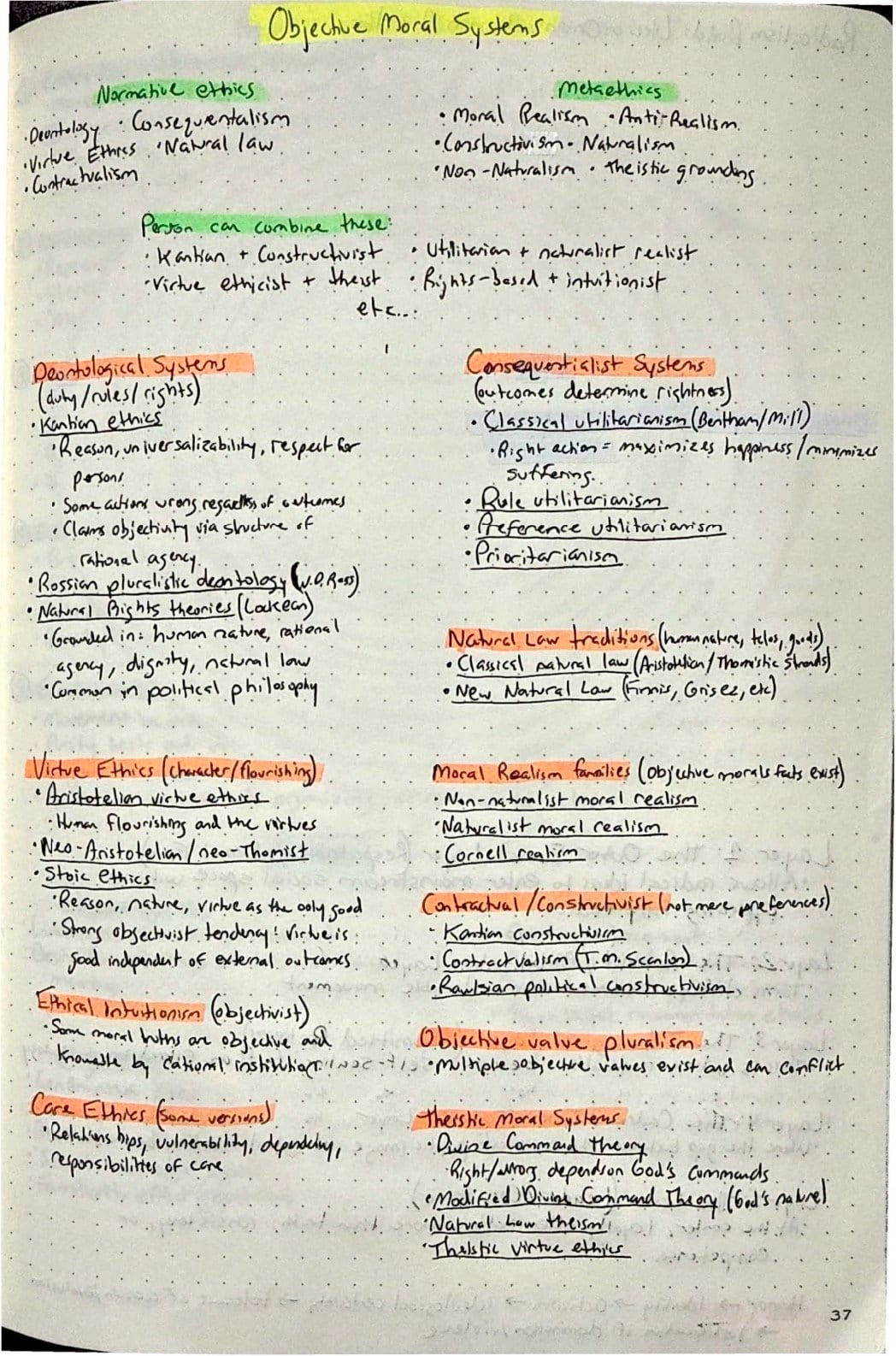
Common Objective Moral Systems (Quick Map)
First distinction (important)
When someone asks “What objective moral system do you believe in?”, separate:
-
Normative ethics (what makes actions right/wrong?)
- deontology
- consequentialism
- virtue ethics
- natural law
- contractualism (sometimes placed here / sometimes bridging to metaethics)
-
Metaethics (what kind of moral truth/objectivity exists?)
- moral realism
- anti-realism
- constructivism
- naturalism
- non-naturalism
- theistic grounding
A person can combine these:
- Kantian + constructivist
- Utilitarian + naturalist realist
- Virtue ethicist + theist
- Rights-based + intuitionist
- etc.
1) Deontological systems (duty / rules / rights)
Kantian ethics
- Grounds morality in reason, universalizability, and respect for persons
- Some actions are wrong regardless of outcomes
- Claims objectivity via the structure of rational agency
Rossian pluralistic deontology (W.D. Ross)
- Multiple prima facie duties (fidelity, justice, beneficence, nonmaleficence, etc.)
- Duties are objective, but conflicts require judgment
- More flexible than single-rule deontology
Natural rights theories (Lockean / rights-based)
- Objective rights grounded in:
- human nature
- rational agency
- dignity
- natural law
- Common in political philosophy (life, liberty, property, consent)
2) Consequentialist systems (outcomes determine rightness)
Classical utilitarianism (Bentham / Mill)
- Right action = maximizes happiness / minimizes suffering
- Objective claim: welfare outcomes are morally relevant in a non-arbitrary way
- Main criticism: can threaten rights/justice in edge cases
Rule utilitarianism
- Focuses on rules that generally produce the best outcomes
- Tries to avoid some problems of act utilitarianism
- Still objectivist if welfare claims are treated as truth-apt and comparable
Preference utilitarianism
- Focuses on preference/interests satisfaction rather than pleasure alone
- Can still be objective if preferences are handled within a principled framework
Prioritarianism
- Consequentialist family view that gives extra moral weight to helping the worse off
- Often used in distributive justice debates
3) Virtue ethics (character / flourishing)
Aristotelian virtue ethics
- Grounds morality in human flourishing (eudaimonia) and the virtues
- Objective insofar as flourishing is tied to human nature and function
- Focuses on character, habits, and practical wisdom
Neo-Aristotelian / neo-Thomist virtue ethics
- Modern developments of virtue ethics
- Often richer on teleology, human goods, and moral psychology
- Can be secular or religious depending on the thinker
Stoic ethics (objectivist versions)
- Grounds morality in reason, nature, and virtue as the only true good
- Strong objectivist tendency: virtue is good independent of external outcomes
4) Natural law traditions (human nature / telos / goods)
Classical natural law (Aristotelian/Thomistic strands)
- Morality grounded in human nature, natural ends, and proper functioning
- Objective because norms track what fulfills humans as the kind of beings they are
New Natural Law (Finnis, Grisez, etc.)
- Grounds morality in basic human goods (life, knowledge, friendship, etc.)
- Moral norms come from rational participation in those goods
5) Moral realism families (objective moral facts exist)
Non-naturalist moral realism
- Moral facts/properties are objective and irreducible to natural/scientific facts
- Example idea: wrongness is a real normative property
Naturalist moral realism
- Moral facts are objective and grounded in natural facts
- Often linked to flourishing, reasons, social facts, or human nature
Cornell realism (naturalist realism subtype)
- Moral properties are objective and supervene on natural/social facts
- Useful against the claim that objectivity requires theism
6) Contractual / constructivist approaches (not mere preference)
Kantian constructivism
- Moral norms arise from the structure of rational agency or rational procedure
- Objectivity comes from what rational agents must/could endorse under fair conditions
Contractualism (T.M. Scanlon)
- Wrongness tied to principles that no one could reasonably reject
- Strong basis for moral criticism without relying on theism or utility-maximization alone
Rawlsian political constructivism
- Focuses on principles of justice for plural societies
- Objectivity is often “public/political” rather than metaphysically robust moral realism
7) Ethical intuitionism (objectivist)
- Some moral truths are objective and knowable by rational intuition
- Often paired with plural duties (e.g., Ross)
- “Intuition” here does not mean mere emotion or impulse
8) Objective value pluralism
- Multiple objective values exist (liberty, justice, loyalty, mercy, etc.)
- Values can conflict genuinely (tragic conflicts)
- Objective morality without a single master metric
9) Care ethics (some versions)
- Emphasizes relationships, vulnerability, dependency, and responsibilities of care
- Some versions are contextual yet still objectivist (not just personal preference)
- Important caveat: not all care ethics is objectivist
10) Theistic moral systems (multiple versions)
Divine Command Theory (DCT)
- Right/wrong depends on God’s commands
Modified Divine Command Theory
- Morality grounded in God’s nature (e.g., loving nature), commands express that nature
Natural law theism
- Morality grounded in created human nature and teleology, not only commands
Theistic virtue ethics
- Virtue/flourishing integrated with God and spiritual ends
Debate-useful clarification
“Objective morality” does not automatically mean:
- one single rule
- one single metric
- easy proof
- universal agreement
It usually means:
- moral claims are not merely personal preference
- moral judgments can be rationally evaluated
- some moral standards hold independently of individual whim
Agrippa connection (quick note)
Agrippa’s trilemma does not uniquely disqualify any one of these systems. It pressures the ultimate justification of foundational claims (regress / circularity / stopping point), but a system can still function as a rationally defensible objective framework depending on its epistemic model (foundationalist, coherentist, infinitist, etc.).