⬅️ Hubs: 60.9 Philosophy · 60.16 Enlightenment · Capitalism · Critique ledger: Liberalism is self-consuming · Evidence: Loss of Connection · Bowling Alone - Robert D Putnam
Short answer
You are substantially correct about the texts. Stoics and many Enlightenment thinkers do not teach isolation; they treat human beings as social, morally interdependent, and often naturally sociable. The serious postliberal critique is instead a claim about unintended institutional effects: a rights-centered liberal order and a market-centered economy may praise community while gradually making inherited obligations optional, encouraging mobility and exit, and transferring functions from families, churches, guilds, and neighborhoods to markets and the state. That is a real argument with a long pedigree—but it is not the same as proving that “the Enlightenment caused atomization,” and the monocausal version is too sweeping.
Haidt’s Chapter 1 distinction — individualism can narrow the moral domain without erasing morality
Haidt contrasts an individualistic moral order, centered on protecting persons from harm and interference, with a sociocentric moral order, in which roles, duties, institutions, hierarchy, and collective continuity can carry moral force. His account helps explain why liberal individualism may make inherited obligations feel optional or merely conventional to some people while they remain morally binding to others.
That is a conceptual bridge to the atomization critique, not causal proof of it. Haidt’s interviews show variation in what people moralize; they do not demonstrate that liberalism caused loneliness, institutional decline, or social isolation, and they do not establish that sociocentric restrictions are just. Individualistic and sociocentric orders, PDF pp. 31–35 (file not included in this release) · Chapter conclusion, PDF p. 44 (file not included in this release) · Chapter 1 source audit
Haidt’s Chapter 5 refinement — the atomization dispute crosses three moral languages
Shweder’s ethics clarify why the two sides can talk past each other. Liberal arguments are often fluent in autonomy: coercion, rights, consent, equal standing, and freedom to revise one’s life. The postliberal critique is often fluent in community and divinity: inherited duty, institutions that outlive their members, limits on appetite, reverence, and the fear that treating every bond as optional will dissolve the conditions of a good life.
This is a translation tool, not a causal result. The three-ethics model does not show that liberalism produced loneliness, that older communities were humane, or that hierarchy and sacred authority should govern dissenters. It improves the argument by forcing both questions into view: what real goods do thick institutions provide, and what rights prevent those institutions from converting formation into domination? Autonomy, community, and divinity, PDF pp. 122–124 (file not included in this release) · Community’s beauty and danger, PDF pp. 125–130 (file not included in this release) · Chapter 5 source audit · Permanent comparison
Haidt’s Chapter 8 bridge — Millian rights and Durkheimian social ecology
Haidt sharpens the dispute with two ideal types. A Millian society begins with individuals, rights, voluntary association, contract, and protection from harm or interference. A Durkheimian society begins with persons embedded in families and other nested groups, asks institutions to cultivate restraint and reciprocal duty, and fears anomie when shared norms and attachments lose authority. This clarifies the strongest atomization claim: an order can enlarge choice while consuming social goods—formation, trust, belonging, obligation—that choice alone does not automatically reproduce.
It still does not establish causation. The contrast supplies no time series for loneliness, family stability, civic participation, or institutional decline; it does not isolate liberal law from markets, technology, mobility, urbanization, secularization, state capacity, or demographic change. Nor does a social function legitimate the coercion used to preserve it. The best synthesis is to ask what bonds an institution sustains and whether that function survives when members retain equal rights, criticism, appeal, and meaningful exit. Millian and Durkheimian societies, PDF pp. 197–201 (file not included in this release) · Liberty/oppression and domination, PDF pp. 203–209 (file not included in this release) · Chapter 8 source and figure audit
Haidt’s Chapter 11 mechanism — a moral exoskeleton is a design problem, not a verdict on modernity
Chapter 11 names the external supports that an atomization thesis fears losing: repeated relationships, ritual, shared obligation, reputation, sacred commitments, care institutions, and intergenerational memory. Haidt calls this a moral exoskeleton and warns that removing one without replacing its functions may increase anomie. The commune, water-temple, trust-game, and American Grace examples show plausible routes from institution to cooperation.
They do not show that liberalism caused institutional decline, that secular societies cannot build equivalent supports, or that inherited communities should be preserved regardless of coercion. Haidt’s own endnote recognizes that looser matrices can protect people excluded by conservative religious communities. The constructive response is to specify the missing function and rebuild it through plural, voluntary, accountable institutions—rather than treating “community” as a single good or state establishment as the default remedy. → full institutional audit · moral exoskeleton and anomie, PDF pp. 302–303 (file not included in this release) · exclusion and evidence qualifications, endnotes 63–64, PDF p. 424 (file not included in this release)
Pinker’s Chapter 3 constraint — modernization did not produce a simple rise in interpersonal violence
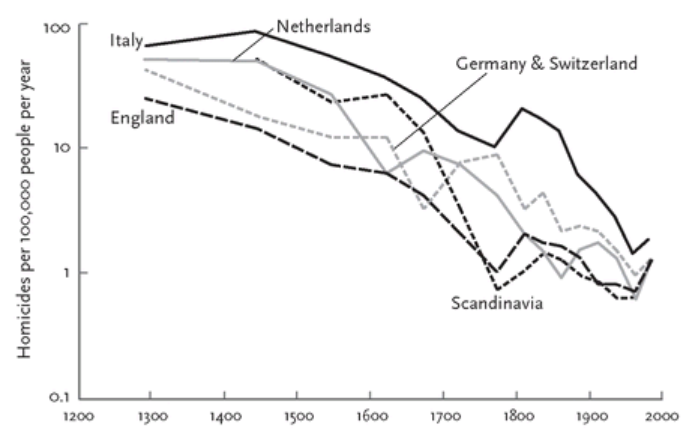
Pinker highlights a historical pattern that any broad degeneration thesis must explain: as Western Europe became more urban, commercial, industrial, cosmopolitan, and secular, reconstructed homicide rates fell by one to two orders of magnitude. In Eisner’s compilation, different regions moved at different times, but by the twentieth century the Western European series clustered near one homicide per 100,000 people per year.
Figure 3-3 — homicide estimates for five Western European regions, 1300–2000. This does not prove that liberalism, capitalism, secularization, or city life caused the decline, and it does not measure loneliness, civic participation, family obligation, or alienation. It does rule out a simple story in which modernization uniformly dissolved restraint and made everyday life more murderous. The postliberal atomization critique remains testable at the level of particular institutions and outcomes; it cannot use “modernity” as one undifferentiated causal package. Chapter 3 synthesis · Construction and scale of the homicide estimates, PDF pp. 103–105 (file not included in this release) · Figure 3-3, PDF p. 105 (file not included in this release) · Pinker’s modernization comparison, PDF p. 107 (file not included in this release)
Pinker’s Chapter 10 counterweight — nostalgia cannot use violence as a blanket indictment of modernity
Pinker closes by comparing romantic accounts of premodern community with the ordinary burdens of earlier life: shorter lives, child mortality, physical drudgery, restricted travel and knowledge, and much higher exposure to homicide, war, torture, slavery, cruel punishment, and legally tolerated abuse. Statistical and historical comparison therefore removes one common refuge for a generalized decline story—the idea that older societies were at least more peaceful.
This does not answer the serious atomization thesis in this note. Pinker explicitly says that reason, science, technology, and rights do not move steadily toward utopia, and his violence evidence does not measure loneliness, meaning, local authority, family obligation, civic participation, or environmental cost. It supplies a constraint instead: modernity must be decomposed into mechanisms and outcomes, and any net-loss argument has to count safety, health, knowledge, and connection alongside the communities or meanings it may have weakened. Chapter 10 synthesis · Modernity and nostalgia, PDF pp. 946–948 (file not included in this release) · Violence and the comparative record, PDF pp. 948–949 (file not included in this release)
Henrich, Chapter 9 — markets can widen cooperation while thinning relationships
Henrich resolves part of the atomization dispute by separating interpersonal prosociality from impersonal prosociality. Kin- and village-centered life can contain deep generosity, care, and mutual dependence toward known people while offering little portable trust to strangers. Market-integrated settings can produce the reverse shift: fairer treatment of anonymous partners, conditional cooperation, contracts, mobility, and voluntary associations—without necessarily producing warmth, loyalty, or uncalculated help. In this framing, “markets make people more cooperative” and “markets make relationships calculating” can both be true because they refer to different social distances and kinds of cooperation. markets and anonymous fairness, Figure 9.2, PDF pp. 296–298 (file not included in this release) · interpersonal versus impersonal prosociality, PDF pp. 302–304 (file not included in this release)
This is a mechanism, not a net-welfare score. Economic games do not measure loneliness, love, family care, domination, commodification, or meaning; market integration also coevolves with towns, education, law, religion, and state capacity. The Oromo evidence is observational, and an endnoted randomized market-access intervention found no trust increase after two years. The chapter therefore supports the note’s two-sided conclusion: markets can dissolve some inherited ties and make large-scale cooperation among non-kin easier. The practical question is which institutions preserve care and belonging without making ancestry the gatekeeper to rights and opportunity. market-causality counterevidence, PDF pp. 572–573 (file not included in this release) · Chapter 9 source audit
Henrich, Chapter 14 — modernization can remove kin constraint and kin security at the same time
Henrich’s final chapter makes the atomization tradeoff explicit. Imported markets, schools, law, and bureaucracies can weaken kin webs that once supplied identity, insurance, marriage ties, work, protection, and meaning. That can enlarge individual choice and impartial access while also producing dislocation and leaving people between two moral systems: family loyalty and impersonal rule. His larger history therefore does not say that thinner kinship is an unqualified welfare gain; it says that some liberal and market institutions became easier to sustain after inherited clans lost authority. globalization, institutional mismatch, and dissolving kin webs, PDF pp. 478–480 (file not included in this release)
This is a theory of cultural fit with illustrative comparative evidence, not proof that liberalism alone caused modern loneliness or that dense kinship should be restored by coercion. Intensive kin networks can supply care while also enforcing nepotism, elder domination, restricted marriage, unequal exit, and exclusion of outsiders. Conversely, formal rights and markets do not automatically replace belonging. The constructive implication matches this note’s strongest synthesis: preserve equal rights and meaningful exit while deliberately rebuilding plural, accountable associations that supply care, identity, and reciprocal obligation. book-level causal model, Figure 14.1, PDF p. 466 (file not included in this release) · Chapter 14 source audit
The confusion: four different claims are being collapsed
| Question | Best answer |
|---|---|
| Did Stoics teach that people should be socially isolated? | No. Stoicism joins inner moral independence to natural social duties and cosmopolitan concern. |
| Did Enlightenment thinkers regard human beings as nonsocial atoms? | Usually no. Hume, Smith, Montesquieu, and many others made sympathy, sociability, manners, commerce, and association central. Kant even described humanity through “unsocial sociability”: an enduring mixture of social need and rivalry. |
| Can liberal institutions unintentionally weaken some communities? | Yes, plausibly. Rights of exit, religious disestablishment, mobility, centralized administration, and the treatment of commitments as revisable can weaken particular inherited bodies even while enabling voluntary associations. |
| Can capitalist development weaken social bonds? | Yes, under some conditions. Labor mobility, commodification, time pressure, firm concentration, suburban form, and consumer technology can displace reciprocal or local relationships. Markets also create cooperation, prosperity, cities, clubs, and new associations, so the effect is not one-directional. |
The key distinction is therefore:
A doctrine’s account of the good life is not identical to the social effects of institutions partly justified in its name.
What the philosophers actually say
Stoicism: inner independence is not social independence
The modern self-help version of Stoicism can sound like “need nobody and feel nothing.” Classical Stoicism is different. Its theory of oikeiōsis expands concern outward from self-preservation to family and other human beings; Stoics describe people as naturally cooperative and develop one of antiquity’s strongest forms of cosmopolitanism. The standard scholarly overview explicitly identifies this social dimension and natural human cooperation. (Stanford Encyclopedia of Philosophy, “Stoicism”)
Marcus Aurelius repeatedly describes humans as parts of one body, “born to work together,” and made for the common good. His exercises in detachment aim to prevent anger, fear, status, and misfortune from corrupting one’s conduct toward others—not to make relationships dispensable. → Marcus Aurelius on rational, social duty
Hume and Smith: the self is formed through other people
Hume’s moral and political theory begins from human weakness outside society: isolated labor is too feeble, while society supplies force, ability, and security. Justice is a human convention required to make social cooperation stable. (Hume, Treatise of Human Nature, III.ii.2) His broader moral psychology makes sympathy—not solitary reason—the mechanism through which other people’s experiences matter to us. → David Hume
Adam Smith likewise opens The Theory of Moral Sentiments with sympathy and explains conscience through the imagined “impartial spectator”: we learn to judge ourselves by taking up other people’s standpoint. The University of Glasgow’s Smith project summarizes sympathy as central to how people connect in society. (University of Glasgow, The Theory of Moral Sentiments) The popular picture of Smith as teaching pure selfishness comes from reading a few lines of The Wealth of Nations without his moral psychology. → Adam Smith
This does not make Smith an uncritical celebrant of commercial society. He warned that extreme division of labor could narrow workers’ minds and supported public education as a remedy. The founding economist of commercial liberalism therefore contained both the social theory and part of the later critique.
Robertson, PDF p. 54 (file not included in this release)
“…solitary sage but a sociable being.”
Robertson’s formulation captures the textual point: Enlightenment reason was commonly imagined as dialogue directed toward human happiness, not withdrawal into a self-sufficient consciousness. His later discussion of Hume makes sympathy the expression of human sociability and company the ordinary corrective to solitary philosophical melancholy. → Robertson on Hume’s return to company, PDF p. 322 (file not included in this release) · Robertson on sympathy and sociable nature, PDF p. 343 (file not included in this release)
Kant: social conflict inside social dependence
Kant’s “unsocial sociability” does not say that humans are simply isolated. It says we are pulled in two directions: we enter society because our capacities develop there, yet we resist and compete with one another. (Kant, “Idea for a Universal History,” Fourth Proposition) This is not a warm communitarian psychology, but neither is it a fantasy of self-sufficient atoms. → Immanuel Kant
Tocqueville: an internal liberal warning
Tocqueville supplies a crucial bridge. He called individualism a democratic tendency to withdraw into family and friends and abandon the wider public, leaving citizens vulnerable to centralized tutelage. But his remedy was not simply a return to hierarchy: he celebrated Americans’ habit of forming voluntary associations and urged people “to associate freely in everything.” (Tocqueville on the spirit of association)
That matters because the atomization critique is not only an external religious attack on liberalism. A liberal-democratic tradition diagnosed the danger early and saw freedom of association, local government, religion, and civic practice as liberal correctives.
Where the critique actually comes from
The critique is a confluence of several traditions rather than one postliberal discovery:
-
Counter-Revolutionary and conservative criticism. Burke, Bonald, and later conservative thinkers argued that abstract “man” and abstract rights ignore the inherited institutions, loyalties, and practices that make real persons. Rights severed from history can delegitimize every unchosen bond. → The abstract-universalism critique
-
Liberalism’s own Tocquevillian criticism. Equality can tempt people into private life; isolated individuals are then too weak to resist central administration. Associations are the school of self-government and the counterweight to both atomization and despotism.
-
Socialist and sociological criticism of capitalism. Marx argued that capitalist social relations alienate workers and make relations among people appear as relations among commodities; importantly, his target was capitalist social relations rather than technology by itself. (Stanford Encyclopedia of Philosophy, “Karl Marx”) Tönnies contrasted intimate Gemeinschaft with impersonal Gesellschaft; Durkheim studied anomie; Weber analyzed rationalization and disenchantment. The “modernity dissolves community” diagnosis has always belonged to parts of the left as well as the religious right.
-
Polanyi’s market-society criticism. Polanyi distinguished an economy embedded in social relations from a “market society” in which social relations become subordinated to the economic system. His point was not “all exchange is antisocial,” but that organizing land, labor, and money as if society were a self-regulating market provokes social dislocation and protective countermovements. (Polanyi, The Great Transformation, ch. 4; overview of the embeddedness claim)
Polanyi, PDF p. 63 (file not included in this release)
“Instead of economy being embedded in social relations, social relations are embedded in the economic system.”
This is the precise market-society mechanism: the problem is not exchange as such, but the institutional reversal in which society must be reshaped to serve a self-regulating market. Polanyi first contrasts this with economies “submerged” in social relationships and later grounds the danger in treating labor, land, and money as commodities. → economy within social relations, PDF p. 52 (file not included in this release) · labor, land, and money are not ordinary commodities, PDF p. 78 (file not included in this release). This supports a specific institutional critique of market society, not the claim that every market transaction atomizes.
- Twentieth-century communitarianism. MacIntyre, Sandel, Taylor, and Walzer objected to pictures of persons as prior to or detachable from their ends and memberships. Taylor’s “atomism” critique targeted the idea that people are self-sufficient outside society; Sandel attacked the “unencumbered self”; MacIntyre argued that practices, traditions, and narrative roles are conditions of moral reasoning. (Stanford Encyclopedia of Philosophy, “Communitarianism”)
MacIntyre, PDF p. 239 (file not included in this release)
“…the self has to find its moral identity…”
The sentence continues through membership in family, neighborhood, city, and tribe. MacIntyre’s point is constitutive, not merely causal: social inheritance is part of what a moral self is, although rebellion and criticism remain possible. → the good cannot be sought merely “qua individual,” PDF p. 238 (file not included in this release) · bureaucracy and individualism as partners, PDF p. 53 (file not included in this release). These passages explain the communitarian anthropology; they do not by themselves establish when or why association declined.
- Mid-century sociology of community and power. Robert Nisbet located atomization in the weakening of functionally meaningful intermediate associations and the transfer of their authority to centralized territorial states. That makes his genealogy narrower than “the Enlightenment did it” and helps explain why individualism and centralization can advance together.
Nisbet, PDF p. 122 (file not included in this release)
“…the single most decisive influence upon Western social organization…[was] the centralized territorial State.”
Nisbet’s proposed mechanism is functional dispossession: communities weaken when external power relieves them of consequential self-government, while intermediate associations are the places where larger values become meaningful in personal life. → centralized power and community self-help, PDF p. 15 (file not included in this release) · the role of intermediate associations, PDF p. 94 (file not included in this release). This is Nisbet’s thesis, not a settled ranking of causes.
- Religious postliberalism. Patrick Deneen combines these lines into the thesis that liberalism “failed because it succeeded.” Liberalism treats autonomy—freedom from unchosen constraint—as its operative anthropology; state and market then liberate individuals from local dependence while expanding to supply what those weakened institutions once supplied. Yale’s summary captures his linked charge of privatism, diminished civic commitment, individual autonomy, and an enlarged state. (Deneen, Why Liberalism Failed) → The strongest version already in the vault
Deneen, PDF p. 136 (file not included in this release)
“Liberalism has failed because liberalism has succeeded.”
The book’s mechanism is more specific than the slogan. Deneen argues that state and market jointly replace personal obligation with abstract systems, leaving formally autonomous people increasingly dependent on both. → disembedded selves and the state-market “pincer,” PDF p. 34 (file not included in this release) · individualism and statism, PDF p. 35 (file not included in this release) · preliberal social resources, PDF p. 43 (file not included in this release). These passages establish Deneen’s causal model, not its empirical sufficiency; Putnam’s evidence below is a test of that stronger claim. → debate synthesis
The strongest causal mechanism
The serious argument is not “Smith praised self-interest, so people became lonely.” It is a feedback loop:
- Liberal law protects the person’s right to revise or leave memberships. This is morally vital when the group is abusive, oppressive, or simply not chosen.
- Exit can become easier than voice, duty, or repair. Marriage, congregation, town, employer, and friendship can be approached as arrangements retained only while they satisfy current preferences.
- Mobile labor and national markets reward interchangeability. People move for work; local skills and loyalties lose economic value; care and mutual aid become purchasable services.
- State and market replace functions once performed by intermediate bodies. As local bodies do less, dependence on them falls; because dependence falls, their authority, membership, and capacity decline further.
- Consumer technologies privatize leisure. Television, cars, smartphones, delivery, and algorithmic entertainment let people satisfy more desires without negotiating common time and space.
- The result can confirm the original anthropology. People who experience commitments as thin and revisable come to look more like the “unencumbered individuals” the theory presupposed.
This is a coherent mechanism. It is still a causal hypothesis, not a demonstrated single-cause history.
Haidt and Ehrenreich — a lost practice is not a monocausal history
In Chapter 10 of The Righteous Mind, Haidt uses Barbara Ehrenreich’s history of ecstatic dance to add a psychological layer to atomization. Repeated synchronized dancing once supplied a widespread “biotechnology” for trust, equality, and collective joy; she argues that a more bounded European self, developing from the sixteenth century through the Enlightenment and Industrial Revolution, made such practices less intelligible and easier to suppress. Haidt connects the shift to WEIRD cognition and Durkheim’s concern that individual-level psychology lacks a language for love of a collective.
What this adds: atomization can mean the loss not only of associations and duties but of embodied practices that periodically quiet the self. What it does not prove: the chapter does not isolate the Enlightenment, liberal law, capitalism, Protestantism, industrial work, church discipline, or state formation as the cause of that loss. Ehrenreich’s synthesis is a bounded cultural hypothesis, not a demonstrated single-cause history. A liberal correction should rebuild voluntary, plural, cross-cutting practices of common life without restoring coerced membership or turning the nation into one permanent hive. → full concept note · Chapter 10 source audit · Ehrenreich, dance, and individualism, PDF pp. 256–259 (file not included in this release)
What the critique gets right
- Community is not produced by announcing that community matters. Durable associations require time, repeated interaction, duties, shared practices, authority, material stability, and sometimes costly limits on exit.
- Law and markets shape character indirectly. A legal right need not command selfishness to normalize a view of commitments as optional and revisable.
- State and market can grow together. Atomized people may be more dependent on centralized welfare, regulation, corporate services, and mass platforms, not less.
- Some measurable outcomes are real. American civic and associational participation declined across many measures in the late twentieth century. Putnam’s work documents the loss, even though its causal story is multivariable. (Putnam, “Bowling Alone: America’s Declining Social Capital”) → Loss of Connection
- Liberals sometimes rely on moral capital they do not explain well. Trust, restraint, family stability, willingness to serve, and public spirit cannot be generated merely by protecting choice.
Bellah et al., PDF p. 204 (file not included in this release)
“…the radically separate self does not seem adequate.”
Habits of the Heart adds qualitative evidence about moral language. Americans often speak the “first language” of independence and self-reliance, yet still draw on “second languages” of tradition, commitment, and communities of memory when radical separateness cannot explain their lives. → individualism as Americans’ first language, PDF p. 10 (file not included in this release) · the fear that individualism has grown “cancerous,” PDF p. 44 (file not included in this release). This supports a cultural diagnosis without implying that actual people are ever completely unencumbered atoms.
Where the critique overreaches
1. It attacks “liberalism” as a single mind
Liberalism is a family of competing traditions, not one deduction from Locke. The current Stanford Encyclopedia entry begins by stressing that it fractures into several visions. (“Liberalism”) Jacob Levy maps a permanent tension inside liberalism between a rationalist strand suspicious of local and inherited powers and a pluralist strand that sees churches, associations, universities, families, and localities as sites of freedom and defenses against the central state. (Levy, Rationalism, Pluralism, and Freedom)
The pluralist strand is not an illiberal foreign body. Freedom of religion is exercised in churches; speech in journals and movements; thought in universities; political liberty in parties and associations. Individual rights frequently protect communal action.
Rosenblatt, PDF p. 19 (file not included in this release)
“Their liberalism had nothing to do with the atomistic individualism we hear of today.”
Rosenblatt argues that most historical liberals joined rights to duties, generosity, civic virtue, moral development, and the public good; she dates the now-dominant individual-rights-centered definition much later. → rights, duties, and moral self-development, PDF p. 248 (file not included in this release). This is strong evidence against a timeless definition of liberalism as atomism. It is intellectual history, however, and does not prove that every institution created by liberals preserved community.
Koyama’s review of Levy, PDF p. 2 (file not included in this release)
“Social groups provide organizational and political resources by which persons protect…”
The sentence continues “their freedom against the state,” before adding the opposite danger: insiders can use the same resources to enhance in-group power. That double edge is Levy’s core pluralist problem—associations protect liberty and can dominate members. → pluralist liberalism and constrained exit, review PDF p. 1 (file not included in this release) · Tocqueville’s centralization worry versus Mill’s local-domination worry, review PDF p. 3 (file not included in this release). Source boundary: the supplied file is Mark Koyama’s four-page review, not Levy’s book; it is used only as a secondary précis.
2. It substitutes genealogy for causation
Showing that Locke described individuals before political society does not prove that Locke caused smartphones, suburban zoning, two-hour commutes, the decline of unions, or corporate consolidation. The timing matters: much of the sharp American decline in civic life occurred after the mid-twentieth century, long after liberalism and commercial society were established.
Putnam investigated time pressure, suburbanization and commuting, electronic entertainment, and generational change rather than treating “the Enlightenment” as a sufficient explanation. Liberal individualism may be part of the permissive culture surrounding these mechanisms; that is different from being their sole or primary cause. → Bowling Alone - Robert D Putnam
Putnam, PDF p. 331 (file not included in this release)
“…can’t explain a variable.”
Putnam applies this directly to generic capitalism: American capitalism persisted while social capital rose and fell, so it cannot by itself explain the timing. His deliberately rough causal allocation gives time and money pressures no more than about 10 percent, sprawl and commuting about 10 percent, privatized electronic entertainment about 25 percent, and generational replacement roughly half—with overlap and a remaining unexplained share. → causal summary, PDF p. 332 (file not included in this release) · generation, overlap, and uncertainty, PDF p. 333 (file not included in this release). The revised preface further reframes the history as an inverted U rather than a continuous decline. → revised causal perspective, PDF p. 14 (file not included in this release)
3. It treats commercial society as ethically one-directional
Critics often move too quickly from “markets can commodify relationships” to “commercial life can express only greed.” That does not follow. Commerce can reward trust, promise-keeping, prudence, cooperation among strangers, and peaceful bargaining, even while particular market structures corrode local obligations.
McCloskey, PDF p. 22 (file not included in this release)
“…commercial, liberal and capitalist, democratic and rich…”
McCloskey’s counter-thesis is that capitalism need not mean “modern greed” and can support lives containing the classical and Christian virtues, not prudence alone. → capitalism can be virtuous but needs moral completion, PDF p. 20 (file not included in this release) · the claim that markets nourish non-self-interested virtue, PDF p. 23 (file not included in this release). This rebuts ethical reductionism; it does not show that labor mobility, commodification, or concentrated corporate power never damage association.
4. It confuses freedom from bad community with hostility to community
Preliberal “thick community” included mutual aid and belonging, but also inherited rank, coverture, serfdom, religious coercion, racial exclusion, intimate surveillance, and few exit rights. Some bonds were durable because leaving was economically, legally, or physically impossible.
A fair comparison asks not “community or atomization?” but:
- Which bonds should be voluntary?
- Which duties may be enforced, by whom, and with what exit rights?
- How do we preserve association without trapping people inside domination?
- Which lost forms of belonging are worth restoring, and which costs are we unwilling to restore with them?
5. It undercounts the associations liberalism enabled
The Enlightenment era saw expanding learned societies, clubs, correspondence networks, reading publics, salons, and reform associations. Later liberal societies generated unions, mutual-aid societies, churches independent of the state, parties, charities, professional bodies, hobby groups, and social movements. Voluntary association can be thinner than kinship, but it is still genuine social organization.
Robertson, PDF p. 444 (file not included in this release)
“…eighteenth century was indeed ‘the sociable century’.”
Robertson documents coffeehouses, salons, clubs, learned societies, proprietary libraries, correspondence, journals, and newspapers, while resisting the romantic claim that every sociable venue automatically produced rational enlightenment. → institutions of the public sphere, PDF p. 436 (file not included in this release) · clubs, libraries, and intellectual sociability, PDF p. 445 (file not included in this release) · face-to-face and virtual publics, PDF p. 454 (file not included in this release)
6. It conflates liberalism, capitalism, democracy, secularization, state centralization, and technology
These processes interact but are not synonyms. Capitalism can dissolve a village while liberal rights protect its church; the state can centralize education while markets fund new associations; secularization can reduce congregation membership while a smartphone privatizes leisure. A useful explanation identifies the mechanism and evidence for each instead of making “liberalism” the name for modernity as a whole.
Henrich, Chapters 5–6 — a rival genealogy begins before liberalism
Henrich’s full case extends the appendix chronology. The Western Church’s Marriage and Family Program progressively restricted close-kin and affinal marriage, polygyny, levirate and sororate unions, remarriage, and adoption while encouraging monogamy, consent, spiritual kinship, wills, and households less embedded in clans. He argues that this did not simply turn thick community into isolated individuals: as inherited kin groups weakened, guilds, monasteries, towns, universities, confraternities, and other voluntary associations expanded. The result was a change in the basis of belonging—from fixed lineage toward more chosen, cross-cutting, and impersonal relationships—centuries before Locke, industrial capitalism, or modern liberal rights. MFP chronology, Table 5.2, PDF pp. 174–185 (file not included in this release) · voluntary associations and the European Marriage Pattern, PDF pp. 197–199 (file not included in this release)
That history complicates both sides of the atomization debate. Liberalism did not invent the less clan-bound individual, but weak kinship is not the same as loneliness, privatism, or twentieth-century civic decline. Henrich’s Chapter 6 associates weaker historical kinship with individualism, out-group trust, universalism, impersonal cooperation, and analytic thought; these are country-level and immigrant-pattern correlations built from reconstructed historical measures, not proof that the Church caused every outcome or that weaker family ties are an unqualified good. His argument identifies an older recomposition of social ties, while Putnam and the modern evidence in this note address a later decline in some associations. Those are related but different explananda. kinship and psychology, PDF pp. 200–232 (file not included in this release) · modeled Church exposure, Figure 6.15, PDF pp. 237–239 (file not included in this release) · measurement and causal qualifications, PDF pp. 553–558 (file not included in this release) · Chapter 5 source audit · Chapter 6 source audit
Verdict
The most defensible conclusion
You are right to reject the claim that Enlightenment or Stoic philosophers simply taught atomization. Many explicitly taught the opposite. The postliberal critique becomes serious only when reformulated as an institutional argument: liberal rights, centralized states, and capitalist markets can unintentionally erode particular forms of durable, inherited community, even while protecting individuals and creating new voluntary associations.
The evidence supports “modern liberal-capitalist societies contain atomizing mechanisms” much better than “Enlightenment philosophy caused atomization.” The former is a plausible, partly evidenced diagnosis; the latter usually bundles too many causes, ignores liberalism’s associational traditions, and romanticizes the coercive side of preliberal community.
A quick test for future claims
When someone says “liberalism causes atomization,” ask:
- Which liberalism? Hobbes, Locke, Smith, Mill, Tocqueville, Rawls, libertarianism, progressive administration, or consumer culture?
- Which mechanism? Rights of exit, labor mobility, markets, welfare administration, zoning, cars, television, smartphones, or secularization?
- Compared with what counterfactual? A liberal society with stronger associations, or a confessional/preindustrial order with fewer exit rights?
- What evidence distinguishes the cause from the timing?
- Does the proposed cure rebuild association, or merely transfer power to the state or church?
That turns a civilizational slogan into a testable argument.
Source PDFs added to the vault
Primary argument library
- After Virtue — Alasdair MacIntyre (file not included in this release) — practices, traditions, narrative identity, and the socially constituted moral self
- The Lost History of Liberalism — Helena Rosenblatt (file not included in this release) — historical liberalism as duties, generosity, civic virtue, and moral improvement
- The Bourgeois Virtues — Deirdre McCloskey (file not included in this release) — the case that commercial society can sustain more than prudence and greed
- The Great Transformation — Karl Polanyi (file not included in this release) — embedded economies, market society, and fictitious commodities
- Community and Power — Robert Nisbet (file not included in this release) — centralized power and the loss of intermediate association
- Habits of the Heart — Bellah et al. (file not included in this release) — American individualism, commitment, and communities of memory
- Koyama’s review of Levy’s Rationalism, Pluralism, and Freedom (file not included in this release) — four-page secondary review, not Levy’s book
Vault connections and further reading
- Counter-Enlightenment - The Right's Case Against the Enlightenment — the full conservative and religious claim ledger, with steelmen and replies
- The Enlightenment — Ritchie Robertson — especially the chapter on sociability and the public sphere
- Enlightenment Curriculum — MacIntyre and Deneen placed after primary Enlightenment material
- Capitalism — the vault’s positive case; this note supplies an additional communitarian/atomization stress test
- JD Vance Communion - Faith Political Economy and the Postliberal Right — a contemporary religious-political expression of the critique
- Secular Liberal Democracy vs. Religious Theocracy · 12 - Liberalism Cultural Dependencies and Correctives · 20 - Vermeule Deneen and the Postliberal Challenge — the institutional and debate-level implications
- Loss of Connection · Bowling Alone - Robert D Putnam — the empirical social-disconnection question, which should be kept separate from its philosophical genealogy
- The WEIRDest People in the World - Joseph Henrich — an alternative genealogy in which Church marriage policy weakens intensive kinship before liberalism and capitalism