⚔️ Read against: The Right's Case Against the Enlightenment — a claim-by-claim ledger of the conservative and Christian critique, cross-walked to every chapter below. Open the relevant claim cards before each chapter; fill in your verdicts as you go. · Hub: 60.16 Enlightenment
DESCRIPTION
A magisterial work of intellectual history that recasts the Enlightenment as a period not solely consumed with rationale and reason, but rather as a pursuit of practical means to achieve greater human happiness. One of the formative periods of European and world history, the Enlightenment is the fountainhead of modern secular Western values: religious tolerance, freedom of thought, speech and the press, of rationality and evidence-based argument. Yet why, over three hundred years after it began, is the Enlightenment so profoundly misunderstood as controversial, the expression of soulless calculation? The answer may be that, to an extraordinary extent, we have accepted the account of the Enlightenment given by its conservative enemies: that enlightenment necessarily implied hostility to religion or support for an unfettered free market, or that this was “the best of all possible worlds”. Ritchie Robertson goes back into the “long eighteenth century,” from approximately 1680 to 1790, to reveal what this much-debated period of European history was really about. Robertson returns to the era’s original texts to show that above all, the Enlightenment was really about increasing human happiness – in this world rather than the next – by promoting scientific inquiry and reasoned argument. In so doing Robertson chronicles the campaigns mounted by some Enlightened figures against evils like capital punishment, judicial torture, serfdom and witchcraft trials, featuring the experiences of major figures like Voltaire and Diderot alongside ordinary people who lived through this extraordinary moment. In answering the question ‘What is Enlightenment?’ in 1784, Kant famously urged men and women above all to “have the courage to use your own intellect”. Robertson shows how the thinkers of the Enlightenment did just that, seeking a well-rounded understanding of humanity in which reason was balanced with emotion and sensibility. Drawing on philosophy, theology, historiography and literature across the major western European languages, The Enlightenment is a master-class in big picture history about the foundational epoch of modern times. Go beyond the myths of the so-called Age of Reason to discover the real Enlightenment: A Pursuit of Happiness: Discover why the period’s great thinkers were more concerned with human well-being in this life than in the next. Reason and Emotion: Explore how the era’s philosophy sought a well-rounded humanity, balancing intellect with sensibility. Voices of the Enlightenment: Follow the campaigns of Voltaire, Diderot, and Kant as they challenged judicial torture, serfdom, and persecution. A Foundation for Modern Values: Understand the origins of religious tolerance, freedom of thought, and evidence-based argument that shape our world today.
The Enlightenment_ The Pursuit of Happines - Ritchie Robertson.pdf (file not included in this release)
Handwritten Notebook Pages
Source
- Open The Enlightenment notebook pages — start at notebook p. 116 (file not included in this release)
- Open The Enlightenment, continued notebook pages — start at notebook p. 132 (file not included in this release)
- Open The Enlightenment, continued notebook pages — start at notebook p. 149 (file not included in this release)
Review
Handwrite First
Use this section with the book and notes closed. The goal is retrieval, not polish.
1. Before Reading
Prime your mind before reading.
- Prediction:
- Question I want answered:
- What I already think about this topic:
- What I expect to disagree with:
2. Closed-Book Recall Dump
Close the book and notes. Reconstruct what you read from memory.
-
Main points I remember:
-
Key examples, evidence, stories, or cases I remember:
-
Terms, people, dates, or concepts I remember:
-
What feels fuzzy or incomplete:
3. Core Argument From Memory
- The book/section in one sentence:
- Main claim:
- Problem the author is responding to:
- Why the author thinks this is true:
- Best evidence/example I remember:
- Conclusion the author wants the reader to accept:
4. Argument Map From Memory
5. Feynman Check
Explain the idea simply, as if teaching it to someone unfamiliar with the topic.
- Simple explanation:
- Analogy or concrete example:
- Where someone might misunderstand this:
6. Pushback From Memory
- Strongest objection or weakness:
- What evidence would weaken the author’s argument?
- What a rival thinker/book might say:
- My current judgment:
7. Personal Takeaway
- What changed, clarified, or challenged my thinking?
- What am I less certain about now?
- One way I could apply this:
- One question I need to keep investigating:
Type Into Obsidian
Use this section after handwriting. The goal is long-term storage, search, linking, and spaced review.
1. Correction After Checking Notes
Reopen the book/notes. Compare them against your handwritten recall.
- I forgot:
- I misunderstood:
- I overemphasized:
- I underemphasized:
- This needs review:
2. Clean Core Argument
- The book/section in one sentence:
- Main claim:
- Problem the author is responding to:
- Why the author thinks this is true:
- Best evidence/example:
- Conclusion the author wants the reader to accept:
3. What Actually Matters?
- Most important idea:
- Best quote or passage:
- Term/concept worth remembering:
- Most useful example:
- Most surprising point:
- One sentence I want to remember:
4. Connections
- Connects to:
- [[]]
- [[]]
- [[]]
- Supports:
- [[]]
- Challenges:
- [[]]
- Reminds me of:
- [[]]
- Possible future note:
- [[]]
5. Clean Pushback
- Strongest objection or weakness:
- What evidence would weaken the author’s argument?
- What the author might say in response:
- What a rival thinker/book would say:
- My current judgment:
Retrieval Questions
Answer these without looking during future reviews.
Basic Recall
- What is the author’s main thesis?
- What problem is the author responding to?
- What are the 3–5 main claims?
- What are the key terms or concepts?
- What is the best example or piece of evidence?
Argument Reconstruction
- How does the author move from evidence to conclusion?
- What assumptions does the argument depend on?
- What would the argument look like in premise-conclusion form?
- What does the author want the reader to reject?
Comparison
- How does this book/section compare with [[]]?
- How does this support or challenge [[]]?
- Which thinker would agree with this?
- Which thinker would disagree with this?
Criticism
- What is the strongest objection?
- What evidence would weaken the argument?
- What does the author ignore, minimize, or assume?
- Is the author’s conclusion stronger than the evidence allows?
Synthesis
- How does this change my larger framework?
- Where does this fit in the broader historical/philosophical debate?
- What question should I ask next?
- What would I write about using this idea?
Flashcards / Atomic Recall
Use only for facts, definitions, distinctions, names, dates, and compact claims.
- Q:
- A:
- Q:
- A:
- Q:
- A:
Retention Check
24 Hours Later
- I can explain the main argument without notes.
- I remember the best example or evidence.
- I can define the key concept.
- I can state one objection.
24-hour recall notes:
- What I remembered:
- What I forgot:
- What needs another review:
1 Week Later
- I can summarize this in 5 sentences.
- I can reconstruct the argument.
- I can connect it to another book, thinker, or historical period.
- I can state whether I agree, disagree, or remain undecided.
1-week recall notes:
- What I remembered:
- What I forgot:
- New connection:
- Revised judgment:
1 Month Later
- I still remember the core argument.
- I can explain why this matters.
- I know whether this changed my larger framework.
- I know whether this is worth rereading, citing, or building into a permanent note.
1-month recall notes:
- What endured:
- What disappeared:
- What this changed:
- Next action:
Scratchpad
Unfiltered thoughts, questions, comparisons, argument trees, future writing ideas, or possible links.
Simplified rule
Handwrite
Use handwriting for:
- Before-reading predictions
- Closed-book recall dump
- Core argument from memory
- Argument map from memory
- Feynman explanation
- Initial pushback
- Personal takeaway
- Confusion list
These are the sections where the benefit comes from struggling to reconstruct the idea.
Type in Obsidian
Use Obsidian for:
- Corrections after checking notes
- Clean one-sentence thesis
- Clean argument summary
- Important quotes
- Key concepts
- Links to other notes
- Retrieval questions
- Flashcards
- Retention checks
- Review logs
- Scratchpad for future essays or synthesis
These are the sections where the benefit comes from searchability, linking, spaced review, and long-term organization.
Best workflow
Use this order:
1. Handwrite from memory.
2. Check the book/notes.
3. Type only the corrected, useful version into Obsidian.
4. Create retrieval questions.
5. Review those questions later without looking.
Do not type all your handwritten notes into Obsidian. That turns the system into transcription work. Only transfer what is worth preserving, linking, or reviewing.
Notes
Preface
Chapter Objective and Through Line
Robertson uses the preface to define the Enlightenment as both a historical period, approximately 1680–1790, and a broader process of enlightenment: the effort to free human beings from false beliefs, challenge institutions that sustain ignorance, develop more accurate accounts of human nature and society, and improve human well-being through empirical inquiry and reason. Although reason is indispensable to this project, Robertson argues that the Enlightenment’s governing purpose was not abstract rationality but the pursuit of happiness in this world.
The preface also establishes the book as a correction to both hostile caricatures and overly celebratory modern appropriations. Critics portray the Enlightenment as rationalistic, imperialist, technocratic, and complicit in racial and gender hierarchies. Robertson acknowledges that some criticisms contain truth but argues that they are often exaggerated by inadequate knowledge and presentism—the projection of modern categories and expectations onto a fundamentally different eighteenth-century world.
His revision proceeds through several linked distinctions. The Enlightenment was an age of feeling as well as reason, contained rational religion rather than simply attacking religion, developed internationally rather than exclusively in Paris, and included substantial internal disagreement. Nor should it be treated retrospectively as a straightforward prelude to the French Revolution, nineteenth-century imperialism, or modern secular liberalism. Robertson’s broader project is therefore historical but not antiquarian: he intends to recover Enlightenment controversies in their original contexts while showing that their questions about reliable knowledge, common humanity, institutional authority, and attainable happiness remain unresolved.
Chapter Structure at a Glance
- Define the Enlightenment by its practical purpose: clearing away error and increasing human happiness through reason and empirical knowledge.
- Confront modern defenses and indictments: recognize the Enlightenment’s continuing importance while resisting both idealization and wholesale condemnation.
- Restore historical distance: reconstruct the assumptions of eighteenth-century Enlighteners rather than treating them as incomplete versions of modern liberals.
- Replace the “age of reason” cliché: show that reason meant critical good sense and was integrated with sympathy, emotion, religion, and humanitarian concern.
- Establish geographical and intellectual plurality: defend a unified Enlightenment while recognizing distinct national forms and internal disagreements.
- Reject retrospective determinism: separate Enlightenment thought from later revolutions, imperial systems, and supposedly inevitable narratives of progress.
- State the book’s method and contemporary purpose: return to primary texts, interpret them historically, and allow their unresolved arguments to challenge the present.
Section-by-Section Argument
The preface contains no formal internal subsections. The headings below are analytical divisions based on shifts in Robertson’s argument.
1. Enlightenment as the Organized Pursuit of Human Happiness
Robertson begins by distinguishing “the Enlightenment”, the historical era, from “enlightenment”, the activity undertaken within it. Enlighteners sought to identify beliefs and institutions that prevented people from understanding their own interests. Their positive program combined criticism of inherited authority with investigation into human nature, political society, economic life, and the material conditions of well-being.
The central premise was that earthly life need not be accepted as an unavoidable “vale of tears.” Human beings could make the world more habitable and happiness more attainable.
- Empirical facts and rational inquiry were instruments for improving life, not ends detached from moral purposes.
- Organized Churches were major targets because they frequently claimed unchallengeable authority and maintained beliefs that Enlighteners considered false or socially harmful.
- The movement nevertheless included rationally religious thinkers; disbelief in God remained a minority position.
- Robertson accepts familiar descriptions emphasizing reason, science, freedom, and progress, but gives happiness priority as the aim that organizes these values.
This definition provides the standard by which the rest of the book will assess Enlightenment thought and practice: not simply by what Enlighteners believed, but by how they attempted to enlarge human well-being.
2. Between Celebration and Condemnation
The Enlightenment remains controversial because many modern political and moral ideals claim descent from it, while critics associate it with some of modernity’s worst features. Robertson presents these opposing assessments as a historiographical problem requiring discrimination rather than allegiance to one camp.
Critics accuse Enlighteners of imposing a narrow Western rationality, treating nature as an object of domination, supporting industrial capitalism, reducing human beings to manageable classifications, reinforcing racial and gender hierarchies, and legitimating empire. Robertson does not claim that every charge is wholly invented. His contention is that such accusations often become generalized judgments unsupported by the diversity of eighteenth-century evidence.
Two errors produce these distortions:
- Insufficient historical knowledge: general claims are frequently made without close attention to what Enlighteners actually wrote or did.
- Presentism: modern terms, values, and controversies are projected backward, obscuring the foreign assumptions under which Enlighteners operated.
Robertson therefore positions the book neither as a simple defense nor as an indictment. It is intended as a historically grounded reconstruction capable of acknowledging limitations without converting those limitations into the movement’s entire meaning.
3. The Enlighteners’ Different Intellectual World
Avoiding presentism requires recognizing that even radical Enlighteners inhabited a conceptual world unlike the modern one. Most believed in a creator who had designed a law-governed universe. They possessed no modern account of geological time, biological evolution, or species extinction. Monarchy remained the normal form of government, direct democracy was widely associated with demagoguery and tyranny, and women’s political exclusion was largely assumed.
These limitations mean that the Enlightenment should not be described as an early, fully formed version of contemporary liberalism. Its importance lies instead in being a seedbed from which later values developed.
This distinction permits Robertson to make two claims simultaneously:
- Enlighteners remained embedded in inherited assumptions that modern readers may reject.
- Their criticism of authority, attention to evidence, and concern for human well-being opened intellectual possibilities that exceeded those assumptions.
The Enlightenment’s historical significance therefore cannot be measured only by whether its thinkers already held twenty-first-century positions.
4. Reason, Common Sense, Feeling, and Religion
Robertson’s major revision is directed against the cliché that the Enlightenment was simply “the age of reason.” Enlighteners certainly used philosophical and historical criticism against unsupported religious authority and irrational customary practices. Yet their reason was often closer to good sense than to formal, geometrical deduction. It asked whether an inherited institution actually accomplished its declared purpose.
Enlightenment was consequently not the replacement of one dogmatic authority with another. Its aim was to teach people how to think, expressed in Kant’s injunction to have the courage to use one’s own intellect.
Reason also operated alongside emotional capacities:
- Enlighteners increasingly treated sympathy and fellow feeling as foundations of social cohesion.
- Society was understood not merely as a collection of isolated individuals but as a network of emotional and commercial relationships.
- Adam Smith’s economic analysis presupposed his earlier theory of moral sentiments: commercial society depended on forms of human sociability.
- Eighteenth-century fiction educated readers in empathy, making the suffering of oppressed or socially marginal people emotionally intelligible.
The same correction applies to religion. Enlighteners opposed ecclesiastical tyranny, superstition, and unsupported historical claims, but many sought a rational religion emphasizing morality while reducing Christianity’s supernatural content. The relevant conflict was therefore not simply reason against faith, but critical inquiry against claims to unquestionable authority.
5. One International Enlightenment, Many Local Forms
Robertson next challenges the identification of the Enlightenment exclusively with Parisian philosophes such as Voltaire and Diderot. Paris had exceptional importance, but Enlightenment activity extended from Philadelphia to St Petersburg, with major centers in Scotland, Germany, and elsewhere.
National settings shaped how enlightenment was pursued:
- In France, writers and philosophes occupied a prominent role.
- In the German states, reforming administrators were especially important.
- Scotland contributed major analyses of morality, society, history, and political economy.
Robertson accepts the need to study these local differences but resists dissolving the Enlightenment into entirely separate national movements. The very category of “national Enlightenments” presupposes a broader phenomenon of which they were variations.
The eighteenth century’s own vocabulary supports this unity. Contemporaries spoke of the spread of reason, philosophy, lumières, and Aufklärung. They understood themselves as participating in a movement away from religious conflict and inherited ignorance, even though they did not employ Robertson’s precise modern periodization.
6. Science, Diversity, and the Rejection of Historical Teleology
The Scientific Revolution supplied Enlighteners with a model of reliable knowledge: claims grounded in observation and corrigible when better evidence appeared. Scientific authority was therefore provisional, unlike the absolute authority claimed by Churches. This method was extended from nature to the “science of man,” law, government, and political economy.
A shared commitment to inquiry did not make the Enlightenment homogeneous. Enlighteners disagreed about capital punishment, human rights, political institutions, religion, and progress. Most did not believe that improvement was inevitable or irreversible; they remained conscious that civilizations could decline.
Robertson particularly rejects interpretations produced by hindsight:
- The Enlightenment was not a coordinated intellectual preparation for the French Revolution.
- Reform-minded Enlighteners generally expected change to be implemented from above by enlightened rulers.
- Initial approval of the Revolution’s reforms did not imply foresight of the Terror or Napoleon.
- Eighteenth-century engagement with the non-European world should not simply be equated with nineteenth-century imperial ideology.
- European commercial exploitation was real, but it was also forcefully criticized by Enlightenment writers.
These distinctions prevent later outcomes from being treated as the necessary meaning of earlier ideas.
7. Robertson’s Historical Method and Present-Day Purpose
Robertson intends to rely extensively on primary texts, allowing Enlightenment authors to speak in their own conceptual languages. He will summarize major works, assess their arguments, and at times dispute their conclusions.
His method balances two dangers. Presentism distorts the past by forcing it into current categories, but excessive historicism can neutralize past thought by treating it as relevant only to its original circumstances. Enlightenment writers must be understood historically without denying that their ideas continue to affect contemporary arguments.
The book is therefore both a reconstruction of a period and an intervention in living controversies. Robertson regards the Enlightenment as a body of arguments whose potential and failures remain open to judgment rather than a completed inheritance to be either worshipped or rejected.
Key Concepts and Distinctions
- The Enlightenment / enlightenment: “The Enlightenment” names the period and movement; “enlightenment” names the process of freeing people from error through critical inquiry.
- Significance: This distinction shifts attention from a fixed canon of thinkers to a practical effort aimed at human improvement.
- Pursuit of happiness: The attempt to make earthly life more materially secure, humane, and fulfilling.
- Significance: Robertson treats happiness, rather than reason alone, as the Enlightenment’s governing purpose.
- Presentism: Interpreting the past principally through present-day categories, expectations, and moral disputes.
- Significance: It produces both anachronistic celebrations and anachronistic condemnations of Enlightenment thinkers.
- Reason as good sense: Critical examination of whether authoritative claims and inherited practices are supported by evidence or achieve their stated aims.
- Significance: This is more flexible and practical than the stereotype of reason as cold calculation or deductive system-building.
- Sensibility and sympathy: The emotional capacities through which people recognize their connection to others and respond to suffering.
- Significance: They ground Robertson’s argument that the Enlightenment was simultaneously intellectual and humanitarian.
- Rational religion: A form of religious belief that deemphasizes supernatural doctrine and stresses moral teaching compatible with reason.
- Significance: It complicates the claim that Enlightenment necessarily meant atheism or hostility to all religion.
- Provisional knowledge: Knowledge grounded in empirical evidence but subject to correction.
- Significance: It distinguishes scientific authority from institutions claiming final and unquestionable truth.
Essential Evidence and Examples
- Adam Smith’s two major works: The Theory of Moral Sentiments preceded The Wealth of Nations, illustrating that Smith’s account of commercial society depended on an account of sympathy and sociability rather than isolated self-interest alone.
- Eighteenth-century novels: The emotionally powerful fiction of Richardson, Rousseau, and Goethe trained readers to identify with other people’s suffering, supporting Robertson’s description of the Enlightenment as a transformation in sensibility as well as ideas.
- Enlightened rulers: Reformers looked to administrative changes in Prussia, Russia, Austria, and smaller states, showing that most expected improvement through government-led reform rather than popular revolution.
- Criticism of colonial companies: The Histoire des deux Indes attacked the depredations of European East India Companies, demonstrating that Enlightenment engagement with overseas expansion included substantial internal criticism rather than uniform justification of empire.
- Gibbon’s history of Rome: The prominence of The Decline and Fall of the Roman Empire undermines the claim that Enlighteners universally believed progress was automatic, permanent, or guaranteed.
Chapter Conclusion and Significance
Robertson concludes that the Enlightenment should be understood as a diverse, international, and internally contested movement organized around the possibility of improving human happiness through critical thought, empirical knowledge, sympathy, and institutional reform. Reason mattered because it enabled people to question authority and test practices against their consequences, but it functioned alongside emotion, moral sentiment, literature, and forms of rational religious belief.
The preface establishes the interpretive framework for the book: Enlightenment thought must be recovered from its eighteenth-century setting without being confined there. Its participants were neither modern liberals in powdered wigs nor the unified architects of every later injustice attributed to modernity. Their controversies remain significant because contemporary societies still confront unreliable information, credulity, xenophobia, demagoguery, and the problem of sustaining a shared commitment to human flourishing.
Questions for Reflection
- Does defining the Enlightenment primarily through the pursuit of happiness produce a more accurate historical account, or does it risk imposing greater unity on a movement Robertson acknowledges was deeply diverse?
- How successfully can historians avoid presentism while still judging Enlightenment ideas whose consequences and exclusions became clearer only later?
- If sympathy and sensibility were as important as reason, how should this alter conventional accounts that connect the Enlightenment primarily with individualism, secularization, scientific rationality, and bureaucratic control?
Chapter 1: Happiness, Reason and Passion
Chapter Objective and Through Line
Robertson argues that the Enlightenment was held together less by a single doctrine than by a common commitment to improving human happiness in this world. Enlighteners investigated nature, society, government, economics, education, religion, and punishment because they believed that better knowledge could improve the conditions of human life. Happiness did not mean a momentary subjective feeling. It depended on material sufficiency, domestic affection, personal freedom, security, and relief from avoidable suffering. This earthly orientation marked a major departure from Christian traditions that treated life as a vale of tears and located true happiness primarily after death.
The chapter complicates this apparent confidence. Enlighteners disagreed about whether happiness was fully attainable, how private happiness related to public welfare, and whether reason could actually secure either. Their expectations ranged from modest Epicurean contentment to programs for measuring and administering public happiness. Kant challenged the entire eudaemonist tradition by subordinating happiness to moral duty and denying that humanity would ever reach a final state of satisfaction.
Robertson then broadens the argument. Enlightenment involved the reduction of fear, especially fears produced by religion, superstition, and misunderstanding of natural phenomena. The decline of witchcraft belief exemplifies this change in mentality, although Robertson insists that the Enlightenment did not single-handedly cause it. He similarly revises the description of the period as an “age of reason.” Enlightenment reason was increasingly empirical, provisional, conversational, and practical rather than purely deductive. At the same time, thinkers progressively rehabilitated the passions as indispensable motives of action and foundations of morality and social sympathy. The chapter therefore establishes the book’s governing interpretation: the Enlightenment was a deliberate project of human betterment interacting with a deeper cultural transformation in how Europeans understood knowledge, emotion, authority, nature, and human possibility.
Chapter Structure at a Glance
- Earthly happiness becomes a legitimate human objective, displacing the assumption that genuine felicity belongs principally to the afterlife.
- The pursuit of happiness expands from the individual to society, making public welfare a central obligation of government and administration.
- The difficulty of attaining happiness limits Enlightenment optimism, producing modest theories of contentment and Kant’s elevation of duty over felicity.
- Human betterment requires freedom from fear, including greater security against real dangers and intellectual liberation from imaginary terrors.
- The end of the witch craze reveals a wider change in mentality, driven by evidentiary scepticism and the gradual collapse of a magical worldview.
- Reason is transformed from rationalist system-building into empirical and public judgement, culminating in Kant’s demand for intellectual independence.
- The passions are rehabilitated as necessary sources of motivation and morality, undermining the conventional opposition between rational Enlightenment and emotional Romanticism.
Section-by-Section Argument
Is Happiness Possible?
The chapter begins by presenting eudaemonism—the belief that happiness is the final purpose of human life—as the Enlightenment’s unifying orientation. From Leibniz and Locke to Jefferson and the Romanian Enlightener Iosipos Moisiodax, thinkers across different countries defined philosophy and politics by their contribution to earthly well-being. This orientation supplied intellectual coherence to projects as varied as scientific inquiry, agricultural improvement, educational reform, humane punishment, political economy, and criticism of ecclesiastical authority.
Yet eudaemonism did not specify what happiness was or guarantee its attainability.
- The Enlightenment recovered the classical possibility of earthly happiness against the Augustinian view that true felicity could not be achieved in mortal life.
- Epicurus offered an especially influential model: happiness meant freedom from unnecessary fear, moderate pleasure, friendship, good health, and the minimization of pain rather than continuous ecstasy.
- Addison and Hume lowered expectations still further. Given illness, bereavement, and misfortune, prudent people should seek contentment, moderation, or consolation rather than “supreme” happiness.
- Some Christian Enlighteners attributed the human desire for happiness to divine benevolence; others, such as Turgot, claimed that nature had equipped humanity with needs, passions, and reason for the same purpose.
Because individual happiness was precarious, Enlighteners developed the idea of public happiness. Government should create the social conditions within which individuals could flourish. The enlightened ruler’s legitimacy rested not on magnificence, conquest, or dynastic glory but on the welfare of the population.
This raised a conceptual problem: did public happiness create private happiness, as Christian Wolff argued, or was public happiness merely the aggregate of individual well-being, as Lessing maintained? Justi treated the two as inseparable because human happiness was inherently social and involved fulfilling duties toward others.
Some thinkers attempted to quantify welfare. Francis Hutcheson formulated the principle that the best action produces the greatest happiness for the greatest number, while Chastellux proposed measuring public happiness through the relationship between productive capacity, subsistence labour, and burdens imposed by government. These attempts show how the prestige of Newtonian science encouraged Enlighteners to seek measurable laws of social improvement.
The chapter nevertheless ends this discussion with two major qualifications:
- Pietro Verri defined happiness negatively as the reduction of pain. Since unhappiness resulted when desires exceeded the power to satisfy them, reason should manage desires without extinguishing affection or reducing life to ascetic inactivity.
- Kant denied that reason’s primary purpose was happiness. Happiness could belong to a wicked person and was therefore not an unconditional good; only a good will acting from moral duty had absolute value. Seeking personal happiness remained a secondary duty because misery could tempt people into wrongdoing, but morality might require sacrificing happiness. Kant thus redirected Enlightenment reason away from felicity and toward autonomous obedience to universal moral law.
Freedom from Fear
Robertson describes one Enlightenment mission as the “slow vanquishing of fear.” Early modern life contained abundant rational causes for terror: epidemics, malnutrition, high childhood mortality, agonizing medical treatment, famine, war, crime, and sudden economic ruin. Enlightenment optimism must therefore be understood against conditions that made happiness objectively difficult.
Improving knowledge could not immediately eliminate these dangers. Enlightened administrators could, however, promote security, justice, public order, and economic prosperity. Adam Smith’s commercial society depended on confidence that government would protect property, enforce contracts, and administer justice reliably.
Enlighteners also attacked fears that compounded unavoidable suffering:
- Traditional religion frequently represented God through judgement, predestination, damnation, and supernatural punishment. Hume and Shaftesbury argued that a perfectly good divinity should inspire love rather than indiscriminate terror.
- Popular superstition transformed ordinary occurrences—spilled salt, crossed utensils, owls, eclipses, meteors, storms—into threatening omens.
- Natural philosophy recategorized frightening events as intelligible phenomena rather than interventions of divine wrath.
Benjamin Franklin’s experiments with electricity and the lightning rod became the symbolic model of this liberation. Lightning changed from the “artillery of God” into a natural force that could be understood and redirected. The larger shift was epistemological and emotional: what appeared extraordinary no longer had to be treated as a supernatural message.
The Witch Craze and Its End
The witch craze illustrates the pre-Enlightenment dominion of fear, but Robertson rejects the triumphalist claim that Enlighteners defeated witchcraft. Large-scale persecution was already declining when the Enlightenment gathered momentum. The weakening of witch belief was therefore partly a precondition of enlightenment, although later criticism accelerated and consolidated the change.
The persecutions were not simply eruptions of popular ignorance. Learned demonologists and judicial authorities constructed the elaborate theory of witches’ sabbats, diabolical conspiracies, and inverted Christian rituals. Torture and sleep deprivation compelled suspects to reproduce the interrogators’ expectations and implicate neighbours, making the theory appear self-confirming.
- The system was unfalsifiable: confession proved guilt, while refusal to confess demonstrated diabolical obstinacy.
- Educated inquisitors transformed fragments of popular superstition into a systematic intellectual fantasy.
- Climatic disruption during the Little Ice Age intensified the search for explanations and scapegoats. Crop failures, hailstorms, and food shortages coincided with major persecution waves.
- The persecutors consequently produced the social destruction they attributed to witches.
Robertson identifies two stages in the decline of witch belief. First, judges and intellectuals could retain a theoretical belief in witchcraft while rejecting prosecutions because the evidence was unreliable and torture generated false confessions. Critics such as Friedrich Spee and Christian Thomasius undermined the legal and evidentiary foundations of persecution.
Second, the magical universe itself became implausible. This was not a simple consequence of the Scientific Revolution: scientifically engaged individuals could remain credulous, and new philosophy spread slowly. Instead, disbelief emerged unevenly through changing standards of probability, greater suspicion of testimony, the legal abandonment of prosecutions, and the increasing social acceptability of scepticism. Robertson even suggests that private disbelief may have been widespread before people could safely express it. The historical change may therefore have involved not only conversion from belief to disbelief but the liberation of previously inadmissible doubts.
Reason
Robertson next examines the diverse meanings concealed by the phrase “age of reason.” Earlier traditions often defined reason as mastery over emotion, certainty derived from first principles, or strategic calculation.
Stoicism taught that a rational person should accept necessity, govern the passions, and cultivate steadfastness. Its emphasis on emotional discipline suited periods of political disorder and absolute monarchy, but literature repeatedly exposed its psychological implausibility: grief, pain, affection, and bodily weakness overturned philosophical performances of invulnerability.
Seventeenth-century rationalists such as Descartes pursued certainty through a geometrical method in which propositions were deduced from indubitable premises. Political theorists developed an analogous reason of state, treating government as an autonomous technique in which efficient means could be selected without ordinary moral restraints. Enlighteners such as Hume, Gibbon, and Kant rejected this reduction of reason to amoral calculation. Genuine political reason had to remain answerable to humanity, moral principle, and universalizable rules.
The decisive Enlightenment shift was from rationalism toward Lockean empiricism:
- The mind begins without innate ideas and acquires its contents through experience.
- Human beings know the world indirectly through the ideas produced by perception.
- Knowledge of external reality is therefore probabilistic rather than absolutely certain.
- Inquiry should proceed inductively from observation toward provisional generalizations.
D’Alembert distinguished the rigid esprit de système, which forces experience into a predetermined structure, from the esprit systématique, which organizes knowledge while remaining open to correction. The Encyclopédie embodied the latter method by bringing practical information and theoretical principles into a revisable system.
Reason consequently came to mean good sense, sound judgement, and reasonableness more often than formal deduction. It was exercised socially through conversation, reading, argument, and the testing of claims against experience. The philosophe was not an isolated metaphysician but a sociable intellectual who applied critical judgement to ordinary life and public affairs.
Kant’s 1784 essay “What Is Enlightenment?” provided the culminating formulation. Enlightenment was humanity’s emergence from self-incurred immaturity through the courage to use one’s own understanding. Kant distinguished the restricted use of reason within an official role from the public use of reason exercised by a scholar or citizen addressing the reading public. A clergyman might have to teach official doctrine while performing his office, yet remain free to criticize that doctrine in print.
This arrangement allowed criticism without immediate institutional disobedience. Kant did not claim that his society was enlightened, only that it lived in an age of enlightenment in which the gradual expansion of independent thought had become possible. His key innovation was to define enlightenment not as possession of a doctrine but as a continuing intellectual practice.
The Passions
The chapter then overturns the conventional narrative in which Enlightenment reason suppresses emotion until Romanticism restores it. Classical, Stoic, and Christian traditions often portrayed reason and passion as opposing forces, with bodily desire threatening rational or spiritual self-command. Enlightenment thinkers increasingly weakened this opposition.
- Descartes argued that passions were naturally good and useful. Fear, for example, could accelerate escape from danger. Wisdom consisted in managing passions, countering one emotion with another, and avoiding excess rather than attempting complete suppression.
- Shaftesbury located morality in natural affections such as parental care, sociability, compassion, and concern for posterity. Reason’s limited role was to direct these affections properly and prevent benevolent impulses from becoming fanaticism or cruelty.
- Pope described reason as a navigational chart and passion as the wind that moves the ship. Reason supplies direction but cannot provide motive force.
- Hume radicalized this argument by claiming that reason alone cannot motivate action or oppose desire. Reason identifies causal relations and the likely consequences of conduct, but pleasure, pain, and desire make people act. His statement that reason is the “slave of the passions” depended on an unusually broad definition of passion that included ordinary motivations as well as violent emotion.
By the late eighteenth century, intellectual enlightenment without emotional cultivation appeared morally insufficient. Verri argued that reason could make people correct and cautious, but sentiment produced generosity and benevolence. Schiller warned that an educated intellect could merely supply sophisticated rationalizations for corrupt conduct.
This rehabilitation of emotion prepares the book’s later treatment of sympathy, sensibility, aesthetics, luxury, and humanitarian reform. Novels taught readers to participate emotionally in other people’s suffering, while sympathy became a philosophical explanation of social cohesion. The Enlightenment was therefore increasingly an age of feeling as well as reason.
⚖️ CROSS-CHECK — Robertson’s Stoics vs. Graver, *Stoicism and Emotion*
The passage under test: “Passions of the soul are potentially valuable. Unlike the Stoics, Descartes thinks they should not be suppressed, but put to good use… Descartes concludes that the passions ‘are all good of their nature’, and that we are to avoid only ‘their misuse or their excess’.”
Verdict: the contrast is real, but Robertson has located it in the wrong place. He inherits the standard modern reading — Stoics = suppression — which is the exact commonplace Graver’s book was written to dismantle. Her opening move: “‘Stoicism’ in today’s English means ‘absence of emotion,’ and this usage takes for granted that the Stoics… advocated an across-the-board suppression of feeling.” Her correction: “The founders of the Stoic school did not set out to suppress or deny our natural feelings; rather, it was their endeavor… to determine what the natural feelings of humans really are.” (Scope note: this checks Robertson’s account of the Stoics, not of Descartes.)
Three points where the passage misfires
- “Suppression” is the one method the Stoics explicitly deny is possible. Chrysippus’s runner analogy: once an impulse has momentum, a later impulse to stop it cannot take effect. Graver: “In contrast to that assumption by which ‘stoical’ in modern English has come to mean ‘self-controlled,’ Chrysippus actually holds that our resources for controlling emotions after they begin are extremely limited.” Seneca: the mind, once moving, “is not permitted to check its impulse. Its own weight must carry it to the bottom.” Stoic therapy is therefore prophylactic — revise the standing evaluative beliefs so the emotion never forms — never suppressive. On willpower the Stoics are more pessimistic than Descartes, not less.
- The Stoics already hold Descartes’s “good of their nature / avoid misuse or excess” position. Their teleology forbids condemning a natural capacity: to do so would mean nature equipped us uselessly — “People would have something like a foot in the middle of their foreheads.” Cicero, reporting Chrysippus: “nature itself urges him to reach out after it.” Zeno’s actual definition of a pathos is hormē pleonazousa — an exceeding impulse: the fault named in the definition is excess and disobedience to reason, not affectivity. And the corrected responses (eupatheiai — joy, wish, caution) are, in Graver’s phrase, “corrected versions of human feelings, not diminished versions… like the easy movements of a powerful athlete, forceful but without strain.”
- Robertson’s own bull example is, in Stoic terms, a case where the two agree. “The passion of fear enables me to run all the faster” describes what the Stoics called a propatheia or pre-emotion — the involuntary pallor, trembling, and pounding heart that occur before assent. Seneca: the bravest man goes pale putting on his armour; the general’s heart pounds before the lines meet; the orator’s scalp tightens. These occur “through some requirement of the human condition” and happen even in the sage, blamelessly. Only if I go on to endorse the impression — that being gored is a genuine evil — do I have fear in the Stoic sense.
A separate error in the section’s framing (¶ “The Passions”, and cf. “Reason” above)
- The note reports that “Classical, Stoic, and Christian traditions often portrayed reason and passion as opposing forces.” For Chrysippan Stoicism this is precisely backwards — it assigns them the position they were most famous for attacking. Stoic psychology is monist: one directive faculty, no separate irrational part. Graver: “The emotive faculty simply is the reasoning faculty, taking on a different role: in episodes of strong emotion, the ‘head,’ as it were, actually becomes the ‘heart.’” Mental conflict is logical contradiction between successive assents, not a battle between parts. The reason-vs-passion picture is the Platonic one (Galen, Plutarch), and Galen wrote at length attacking Chrysippus for refusing it.
Where Robertson is right — the genuine disagreements he understates
- Moderation vs. elimination. Descartes’s programme — managing passions, countering one with another, keeping balance — is metriopatheia, and this the Stoics flatly reject. Seneca argues at length in On Anger against “the (loosely) Aristotelian view upheld by some Hellenistic thinkers, that anger can be moderated and made useful.” Anger is a cliff, a besieging army let through the gate, a sword stuck in the wound. So the contrast holds — it is moderation vs. elimination, not use vs. suppression.
- Apatheia is a real doctrine. Graver never denies the pathē are to be eliminated; she denies that this means becoming unfeeling.
- The actual gap is the theory of value, which the passage never mentions. The Stoics deny that externals — life, limb, wealth, the lives of those we love — are goods or evils at all: “in a rational being, external objects never merit uncompromising evaluation but integral objects always do.” Descartes’s passions remain directed at bodily and worldly goods. That, not an attitude toward feeling, is what separates them.
The irony worth keeping
- Descartes’s own mechanism, as Robertson describes it, is close to Stoic: the strong soul does not conquer fear “by a mere act of will,” and it forms “firm and definite judgements concerning the difference between good and evil, according to which it has resolved to conduct the actions of its life.” That is the Stoic move — govern emotion by revising standing judgments of value — and even the vocabulary tracks: “strength” is the Stoic term for the tensile coherence (tonos) of a belief set, where “a tight internal structure, with many correct beliefs linked to each other in coherent logical relations, is proof against the most plausible-seeming falsehood.” Descartes’s claim that strength of soul “can be cultivated and become habitual” restates the Stoic account of trait formation, where each unchecked episode “calluses” the mind until reason can no longer intervene.
- Charitable reading: Robertson is accurate as reception history. “Stoicism = suppression” is how the early moderns read Cicero and Seneca, and it is very likely how Descartes understood the school he was distancing himself from. The claim fails as a description of Hellenistic doctrine; it may well succeed as a description of what Descartes thought he was rejecting. Robertson does not mark the difference, and states it in his own voice — cf. the “Reason” section above, where Stoicism is glossed as governing the passions and cultivating steadfastness, and where “literature repeatedly exposed its psychological implausibility.” Graver’s reply: the tears, tremblings, and bodily weakness that literature exposes were conceded by the Stoics themselves, and given a technical name.
📚 RECEPTION CHECK — Has Robertson’s Stoic contrast been explicitly criticized?
Short answer: mostly indirectly rather than as a controversy specifically about Ritchie Robertson. Reviews of The Enlightenment do not appear to have produced a prominent argument that “Robertson fundamentally misunderstands Stoicism.” Reviewers generally praise or accept his emphasis on feeling, sympathy, and sensibility, while criticisms of the book tend to focus elsewhere—notably on religion, selection, and partiality. The stronger challenge comes from specialist work on ancient Stoic emotion and on Adam Smith’s intellectual debts.
What Robertson gets right
- Ancient Stoicism rejects pity understood as a disturbing passion.
- It aims at apatheia—freedom from the mistaken and excessive pathē.
- Enlightenment sentimentalists assign emotion and fellow-feeling a larger constitutive role in moral judgment.
- Smith treats sympathy as indispensable and explicitly criticizes Stoic emotional austerity in some contexts.
These claims have solid historical grounding. The problem arises when they suggest a further inference:
rejection of co-suffering ≠ rejection of compassion, sociability, or obligation to help
Stoics can reject pity as the spectator’s own distress while affirming consolation, benevolent action, cosmopolitan duty, rational “good emotions” (eupatheiai), and concern for another person’s welfare. A 2025 Oxford University Press treatment of Roman Stoicism revisits accusations of “inhumane detachment” and argues that the eupatheiai and Stoic obligations to others reveal a richer conception of fellowship than the cold-Stoic stereotype allows. This is evidence of a current specialist challenge to the stereotype, not evidence that the author is directly criticizing Robertson.
This matches the evidence assembled in Stoic Compassion and Adam Smith's Sympathy: Epictetus permits outward sympathy while warning against adopting the sufferer’s disturbed valuation, and Seneca rejects pity while insisting that the wise person help, protect, console, and preserve dignity. The Stoic position is therefore better stated as compassion without destabilizing co-suffering, not absence of concern.
Adam Smith makes Robertson’s contrast less binary
Smith is not simply the sentimentalist who displaces Stoicism. A substantial scholarly literature treats him as a critical inheritor of Stoicism:
- sympathy and the impartial spectator give shared feeling a foundational moral role;
- self-command disciplines both the sufferer and the spectator;
- impartiality requires distance from immediate passion;
- justice, duty, universal concern, and the spectator standpoint retain recognizably Stoic elements;
- Smith nonetheless rejects the Stoic downgrading of family affection and objects to treating the actual objects and outcomes of concern as mere “indifferents.”
Recent Cambridge scholarship situates Smith’s ethics among both Stoic and Epicurean sources, while the specialist bibliography includes studies titled “Stoicism in Adam Smith’s Model of Human Behavior,” “The Foundations of Adam Smith’s Moral Philosophy,” and “Adam Smith as an Eclectic Stoic.” This is a genealogy claim, not an assertion that Smith was simply or exclusively Stoic. Work on propriety and self-command further confirms that Smith’s sentimentalism retains an unmistakably Stoic discipline of affect, although he gives sympathetic fellow-feeling a larger role than ancient Stoicism does.
The intellectual genealogy is therefore not:
Stoicism → emotional detachment
Enlightenment and Smith → sympathy and human feelingIt is closer to:
Stoicism → self-command + rational social obligation + cosmopolitan concern
↓
Shaftesbury, Hutcheson, Hume, and Smith transform those inheritances
↓
Smith → sympathy + impartial spectator + self-commandSmith criticizes Stoicism from within a partly Stoic framework. His objection is not merely that Stoics feel too little. It is that their theory of value can make the real people and outcomes we love seem morally secondary. Cambridge’s Kant and Stoic Ethics discusses this objection to treating externals as indifferents. Smith’s criticism targets the Stoic valuation of externals and particular attachments, not merely a preference for displaying more emotion.
Assessment of possible implications
Possible implication in Robertson’s presentation Assessment Stoics distrusted the pathē Correct Stoics rejected pity as a passion Correct Stoics sought apatheia Correct, with qualifications Enlightenment sentimentalists gave emotion greater moral importance Correct Smith made sympathy essential to moral psychology Correct Smith criticized Stoic austerity Correct Stoics wanted people to be emotionally numb Misleading Stoics lacked concern for other people Wrong Stoicism is opposed to sociability Wrong Stoicism lacks anything analogous to compassionate concern Too strong Smith simply replaced Stoicism with sympathy Historically misleading Why Robertson’s framing remains historically useful
Robertson is partly reconstructing an eighteenth-century polemic rather than offering an independent treatise on Hellenistic Stoicism. Enlightenment thinkers really did attack Stoic apatheia as excessively austere, and Stoicism was repeatedly reinterpreted during the period. Work on the German Enlightenment shows the Stoics being recast in sharply different roles—as atheists, providentialists, rationalists, empiricists, and moral exemplars. Reception history establishes how Enlightenment authors construed Stoicism; it does not by itself settle what the ancient doctrine meant.
The most charitable final judgment is therefore:
Robertson is strongest as a historian of how Enlightenment thinkers reacted against inherited images of Stoicism. He is less reliable when that reception history passes without warning into a definitive description of ancient Stoic psychology. For the latter, specialists such as Margaret Graver, Brad Inwood, A. A. Long, Tad Brennan, John Sellars, and Katja Vogt are safer guides.
The crucial distinction is exactly the one raised by Sympathy vs Empathy and Stoic Compassion and Adam Smith's Sympathy: “Stoics do not want you to adopt another person’s grief as a disturbed judgment” is much better supported than “Stoics do not care about another person’s grief.”
Sources and reception evidence
- Book Marks review roundup for Robertson’s The Enlightenment — reviews emphasize sympathy and sensibility; major criticism is not organized around Stoicism.
- Ancient, Medieval and Renaissance Theories of the Emotions, Stanford Encyclopedia of Philosophy — background on Stoic emotion and apatheia.
- “Between Inhumane Detachment and the Darker Sides of Human Fellowship”, Oxford University Press, 2025 — Roman Stoicism, eupatheiai, fellowship, and obligations to others.
- Adam Smith chapter in Interpreting Modern Philosophy — Stoic and Epicurean sources in Smith.
- Bibliography to Adam Smith and the Circles of Sympathy — dedicated scholarship on Smith and Stoicism.
- “The Relevance of Propriety and Self-Command in Adam Smith’s Theory of Moral Sentiments” — Smithian self-command.
- “Life as a Game of Skill?” in Kant and Stoic Ethics — Smith’s criticism of the Stoic treatment of externals.
- “From Atheists to Empiricists: Reinterpreting the Stoics in the German Enlightenment” — contested eighteenth-century receptions of Stoicism.
Interpreting the Enlightenment
Robertson concludes by explaining how the book will interpret the Enlightenment. It was a conscious project in which intellectuals and administrators tried to understand humanity and improve living conditions. But it was also the continuation of larger transformations in collective assumptions or mentality.
The Reformation weakened the authority of a single Church, encouraged lay theological debate, and contributed to the disenchantment of reality. The Scientific Revolution rendered nature more available to investigation. Neither development mechanically destroyed superstition: belief in comets as portents and confidence in witchcraft were already weakening before scientific demonstrations supposedly refuted them.
The best interpretation therefore treats the Enlightenment as an interaction:
- Intellectual arguments reinforced cultural changes already in progress.
- Changes in mentality made rational and empirical arguments more persuasive.
- Print culture transmitted elite debates to wider publics.
- Literature, diaries, and travel accounts record emotional changes not captured by formal philosophy.
Robertson dates the movement approximately from the 1680s to 1790 and presents it as international. France and Paris were central, but important developments occurred in Britain, Scotland, the Netherlands, Germany, Eastern Europe, and the Americas. National variations should be studied without dissolving the movement into unrelated “Enlightenments.” Its unity lay in a shared transnational commitment to human betterment, not uniformity of doctrine.
Finally, the Enlightenment requires a double optic. Historians must reconstruct it without projecting present-day commitments to democracy, equality, or environmentalism onto the eighteenth century. Yet excessive detachment would suppress the movement’s continuing capacity to challenge superstition, prejudice, and arbitrary authority.
Key Concepts and Distinctions
- Eudaemonism: The belief that happiness is the final purpose of human life.
- Significance: It identifies the common objective connecting Enlightenment philosophy, science, political reform, and social administration without implying agreement about what happiness consists in.
- Private and public happiness: Private happiness concerns individual flourishing; public happiness concerns the political and material conditions supporting the welfare of a population.
- Significance: The distinction transformed happiness from a personal ethical concern into a criterion of legitimate government.
- Real and imaginary fear: Real fears arose from disease, war, hunger, and insecurity; imaginary fears were generated by superstition, religious terror, and false interpretations of nature.
- Significance: Enlightenment sought both practical security and liberation from avoidable psychological suffering.
- Rationalism and empiricism: Rationalism pursued certainty through deduction from first principles; empiricism grounded knowledge in experience, induction, probability, and revisability.
- Significance: Their contrast explains why Enlightenment reason was generally more provisional and practical than the geometric rationalism of the seventeenth century.
- Right reason or good sense: The common human capacity to judge evidence, assess plausibility, debate with others, and oppose prejudice or unsupported authority.
- Significance: Reason becomes a public and sociable practice rather than an esoteric intellectual technique.
- Passions and affections: The emotions, desires, and motivations that move people to act and connect them with others.
- Significance: Their rehabilitation undermines the claim that Enlightenment morality was founded on cold rationality alone.
- Project and mentality: Enlightenment was both a deliberate campaign by identifiable reformers and a broader, less conscious transformation in assumptions about reality.
- Significance: This dual account avoids attributing every cultural change to philosophers while still recognizing their agency.
Essential Evidence and Examples
- Fénelon’s The Adventures of Telemachus: Its fictional reform of Salente contrasted a ruler devoted to popular welfare with Louis XIV’s costly wars and magnificence. It demonstrates that public happiness had become a criterion for judging monarchy well before the French Revolution.
- The destruction of Altona in 1713: Refugees were expelled from their burning town and then denied entry into Hamburg, where many died outside the walls. The episode shows the extreme insecurity against which Enlightenment hopes for order and happiness must be measured.
- Anna Göldi’s execution in 1782: The prosecution claimed that “empirical evidence” overcame enlightened scepticism about witchcraft. The case shows that Enlightenment terminology could be appropriated to defend older prejudices and that changes in mentality remained incomplete.
- Kant’s “two hats” doctrine: A person might obey the requirements of an official role while publicly criticizing the institution’s doctrines. This illustrates both the expansion of public reason and the political limits under which Enlightenment criticism operated.
- Schiller’s criticism of intellectual enlightenment: His warning that cultivated reason could strengthen depravity unless feeling was also educated demonstrates how late Enlighteners internalized a critique of reason detached from moral sentiment.
Chapter Conclusion and Significance
Robertson concludes that the Enlightenment’s coherence lies in its attempt to understand and improve the conditions of human life, not in uniform confidence that reason would automatically produce happiness. Enlighteners inherited classical, Christian, rationalist, and scientific traditions but substantially rearranged them: earthly happiness became legitimate, government became responsible for public welfare, empirical probability displaced claims to certainty, and passions became central to motivation and morality.
The chapter supplies the conceptual framework for the rest of the book. It rejects the isolated formulas of an “age of reason,” a purely secular revolt against religion, or a straightforward march toward modern liberalism. The Enlightenment emerged from the interaction of deliberate criticism with deeper changes in mentality, and it remained plural, unfinished, and internally self-critical. Its enduring significance lies not in providing ready-made answers to every modern problem but in its commitment to empirical inquiry, independent judgement, humane feeling, and the possibility—never the guarantee—of reducing suffering and enlarging human happiness.
Questions for Reflection
- Does Robertson’s definition of the Enlightenment through human betterment provide sufficient unity, or is the concept broad enough to include thinkers whose views of happiness, morality, and government were fundamentally incompatible?
- How does Robertson’s account of the witch craze complicate histories that portray intellectual change as a direct victory of scientific reason over superstition?
- If passions supply motivation and sympathy while reason supplies direction and correction, does the chapter ultimately establish a stable partnership between them, or merely replace the supremacy of reason with a new dependence on emotion?
Chapter 2: The Scientific Revolution
Chapter Objective and Through Line
Robertson argues that the Scientific Revolution supplied the Enlightenment with both a new understanding of nature and a model of reliable knowledge. Medieval and Renaissance natural philosophy had largely begun from authoritative texts, especially Aristotle, and interpreted the natural world through teleology, symbolic correspondences, and inherited first principles. Seventeenthand eighteenth-century investigators increasingly reversed this procedure: they began with observable phenomena, used instruments and experiments to test claims, expressed regularities mathematically where possible, and treated conclusions as provisional rather than certain. Nature ceased to be primarily a symbolic text containing hidden spiritual meanings and became an intelligible system whose operations could be investigated. This change did not initially remove God from nature; most scientists understood regular natural laws as evidence of divine wisdom and benevolence.
The transition was neither a single event nor a straightforward triumph of modern science over ignorance. Baconian empiricism, Cartesian rationalism, mechanical philosophy, natural history, Newtonian mathematics, chemistry, astronomy, and geology developed through competing methods and assumptions. Older ideas persisted within new institutions, while major scientists such as Newton combined experimental brilliance with alchemy, biblical chronology, and heterodox theology. Scientific progress therefore occurred through mixtures of continuity and rupture, error and correction.
The chapter’s deeper argument concerns epistemic modesty. The most productive natural philosophers abandoned the search for the hidden essences or ultimate causes of things. They concentrated instead on observable properties, reproducible effects, mathematical relations, and explanations adequate for practical purposes. Precisely because science limited its claims, it developed firmer standards for resolving disagreements than theology or metaphysics. Through academies, journals, public demonstrations, popular books, and international expeditions, this method entered Enlightenment public culture. Science promised greater control over nature, freedom from unnecessary fear, and improved human happiness. The chapter thus explains why empirical science became the intellectual exemplar for later Enlightenment inquiries into humanity and society.
Chapter Structure at a Glance
- Natural philosophy detaches itself from textual and symbolic authority as observation, literal description, and legitimate curiosity replace Aristotelian deduction and religious correspondences.
- Baconian empiricism and Cartesian rationalism offer competing routes to knowledge, while mechanical philosophy presents nature as matter governed by intelligible motion.
- The Scientific Revolution develops a distinctive epistemology based on facts, mathematics, experiment, collective verification, and provisional conclusions.
- Newtonianism unifies mathematical theory with observation, providing both a new account of the universe and a methodological model for Enlightenment thought.
- Experimental philosophy transforms individual sciences, especially chemistry, physics, electricity, astronomy, and geology, while exposing the inadequacy of inherited categories.
- Scientific knowledge becomes public and international through academies, print, lectures, instruments, expeditions, and popular education.
- Science and religion initially coexist rather than wage war, although scientific methods gradually restrict the explanatory authority of theology and prepare the way for deism and unbelief.
Section-by-Section Argument
From a Symbolic Cosmos to an Empirical Nature
Analytical division based on the chapter’s opening argument.
Robertson begins with the conceptual world that the Scientific Revolution displaced. Aristotelian natural philosophy proceeded deductively from first principles and explained phenomena through their supposedly intrinsic purposes or qualities. Such explanations could become circular: stones fell because falling belonged to the nature of stones, just as opium supposedly caused sleep because it possessed a “sleep-inducing” quality.
Nature was also understood as a second divine book. Animals, plants, celestial events, and physical correspondences revealed spiritual meanings connecting humanity, the cosmos, and Scripture. During the sixteenth and seventeenth centuries, however, both biblical interpretation and natural inquiry became more literal. Investigators increasingly asked how phenomena originated, functioned, and interacted rather than what they symbolized.
- This empirical shift did not necessarily secularize nature. Linnaeus’s “economy of nature” remained a divinely designed system in which each part served reciprocal purposes.
- A necessary cultural precondition was the rehabilitation of curiosity. Previously condemned as sinful intrusion into divine secrets, curiosity became an intellectual virtue.
- Natural history’s collections and classifications could appear trivial beside mathematical natural philosophy, but they created organized bodies of evidence and eventually supplied the foundations of museums and scientific taxonomy.
The problem was now methodological: once investigators were permitted to study nature directly, how should observation and reason be combined?
Bacon or Descartes?
Francis Bacon rejected both scholastic deduction detached from experience and the Renaissance pursuit of magical or occult knowledge. Inquiry should begin with the material world, but the mere accumulation of observations was insufficient. Bacon proposed a marriage of experience and theory, conducted through communities of researchers whose findings became shared public knowledge rather than the private secrets of a learned magus.
The mechanical philosophy supplied a new picture of nature. Matter was inert, homogeneous, and explicable through the size, shape, position, and movement of particles. This demystified the universe and could also protect religion by separating the supernatural Creator from material creation.
Descartes developed the most influential mechanical system. He sought certain knowledge by deducting conclusions from clear and distinct ideas guaranteed by a non-deceptive God. Matter consisted entirely of extension, and physical changes resulted from particles moving through a universe without empty space.
- Cartesianism challenged Aristotle’s four elements and the idea that material objects possessed mysterious intrinsic qualities.
- Its insistence on clarity encouraged criticism of supernatural claims. Balthasar Bekker argued that immaterial spirits could not enter into physical pacts or sexual relations with witches.
- Its weakness was that theoretical elegance outran evidence. Descartes’s vortices, his account of the pineal gland, and the treatment of animals as insensible machines were constructions insufficiently constrained by observation.
Robertson therefore gives Descartes an ambivalent role. He cleared away inherited obscurities and exemplified intellectual independence, but Cartesian rationalism contributed less to positive empirical knowledge than Bacon’s program.
The Emergence of Scientific Method and Institutions
The Scientific Revolution consisted of many developments rather than a single discovery: heliocentrism, telescopic astronomy, the circulation of the blood, microscopic life, pendulum mechanics, and universal gravitation. Its central innovation was not experimentation alone but the willingness to perform physical tests without knowing the result in advance.
Tycho Brahe’s observation of a new star in 1572 represents the change clearly. Aristotle had declared the heavens immutable; an observed supernova showed that experience could overturn even the most authoritative first principle.
The dispute between the ancients and moderns made scientific advancement historically conscious. Defenders of modernity argued that instruments such as telescopes, microscopes, thermometers, barometers, air-pumps, and precision clocks revealed phenomena unavailable to antiquity. William Wotton summarized the new method through four requirements:
- terms must be clear and intelligible;
- facts must take precedence over authority;
- nature should be expressed mathematically where possible;
- generalizations require numerous observations and remain valid only as far as the evidence warrants.
Scientific knowledge was therefore provisional. It could achieve extremely high probability but never the absolute certainty once expected from geometry.
The Royal Society institutionalized Bacon’s program through collective experimentation, open discussion, written records, international correspondence, and the Philosophical Transactions. Its ideal was the laboratory rather than the school: no single teacher dictated truth, and experiments were witnessed and debated. Plain language was preferred to learned rhetoric so that reports would clearly identify what had happened.
Yet the Society also reveals the gradual character of change. Its members were mainly professionals, scholars, aristocrats, and landowners rather than a socially inclusive public. Reports occasionally preserved older credulities, such as belief that barnacle geese grew from barnacles. New institutions did not instantly erase inherited assumptions.
Robertson consequently rejects two extremes in modern interpretations. The Scientific Revolution was not a perfectly unified break with the medieval world, but neither was scientific truth merely the product of a community’s power relations or “language game.” Science is socially organized and frequently mistaken, yet error presupposes a reality against which claims can be corrected. Later scientists did not enter an entirely different universe; they learned more about the same one.
Newton and Newtonianism
Newton’s achievement lay in combining mathematical reasoning with experiment and observation. He explained both terrestrial and celestial motion through universal gravitation, a single quantifiable force operating between every particle of matter. Planetary orbits, falling bodies, and tides could now be understood through common laws rather than separate physical systems.
Newton also exemplified methodological restraint. He described what gravity did without inventing an unverifiable account of what gravity was in itself. His declaration that he did not “feign hypotheses” rejected theoretical entities, such as Cartesian vortices, that lacked experimental support. Natural philosophy should infer properties from phenomena rather than claim access to the ultimate substances of reality.
This did not make Newton’s universe secular or fully self-regulating. He believed God had created the system and might periodically correct irregularities in it. He also concealed anti-Trinitarian beliefs and devoted immense effort to alchemy, prophecy, biblical criticism, and ancient chronology.
Robertson uses these activities to resist retrospective ridicule:
- Newton’s scriptural research employed strict textual methods and exposed passages inserted into later biblical manuscripts.
- Chronology was then a reputable branch of scholarship rather than an eccentric pastime.
- Alchemy was mistaken, but the possibility that matter could undergo transformative processes was not inherently irrational before modern chemistry existed.
The public Newton differed from this complex private figure. His fame rested on the Principia and Opticks, which spread unevenly across Europe. Cartesian resistance remained strong in France, Leibnizian philosophy complicated reception in Germany, and ecclesiastical authority obstructed Newtonianism in parts of Italy and the Orthodox world. Popularizers such as Voltaire and experimental demonstrators such as Desaguliers and ’sGravesande helped translate Newton’s mathematics into accessible principles.
Newtonianism then expanded beyond physics. Its system of forces, balances, laws, and regulated liberty provided analogies for constitutional government, commerce, international relations, and political economy. More importantly, its combination of ambitious discovery with epistemic restraint made natural science the model for Enlightenment knowledge.
Experimental Philosophy
“Experimental philosophy” meant more than laboratory experimentation. It referred broadly to reliance on careful and potentially verifiable observation rather than inherited authority. Its effectiveness appears most clearly in chemistry.
Early chemists inherited Aristotle’s elements, alchemical aspirations, medical purposes, and mechanical accounts of matter. New instruments made previously invisible processes measurable:
- Boyle’s air-pump revealed that air exerted pressure and possessed elasticity.
- Joseph Black’s experiments identified carbon dioxide and demonstrated that atmospheric air was a mixture rather than a single element.
- Rutherford, Cavendish, Priestley, Scheele, and Volta isolated additional gases.
- Lavoisier showed that combustion involved the absorption of oxygen, refuted phlogiston theory, demonstrated that water was a compound, and offered a new classification of elements.
Chemistry illustrates progress not as the accumulation of facts but as the revision of its own assumptions. It separated from medicine and alchemy, abandoned the classical elements, and discarded mechanical philosophy when that model could not explain qualitative properties such as acidity, fermentation, and combustion.
Physics likewise became more clearly defined around quantifiable properties of the inorganic world. Hypothetical “subtle fluids” were not always formally disproved; they disappeared when scientists learned to calculate heat, charge, and other phenomena without them.
Electricity exemplified the exploratory character of experimental science. Researchers identified conductivity, stored electricity in Leyden jars, distinguished positive and negative charge, and demonstrated that lightning was electrical. Public experiments sometimes resembled theatrical entertainment, but they also produced real knowledge. Volta’s battery created a controllable current whose eventual industrial importance could not yet be anticipated.
The Heavens and the Earth
Astronomy and geology could not ordinarily manipulate their objects in laboratories, so they depended on precise observation, calculation, instruments, and comparison across locations.
Astronomical research became institutional and international. Observatories catalogued stars, identified planets and satellites, and established the periodicity of comets. Government support reflected both intellectual and practical interests, especially navigation, commerce, and imperial competition.
The controversy over the earth’s shape shows empirical science correcting established expertise. Newton predicted that rotation would flatten the earth at the poles, while Cartesian calculations suggested elongation. French expeditions to Lapland and South America used triangulation and astronomical measurements to confirm Newton’s prediction, despite resistance from Cassini.
The international observations of the transits of Venus in 1761 and 1769 were intended to determine the distance between the earth and sun. Expeditions extended from Tahiti and California to Siberia and northern Norway. Their measurements were not fully conclusive, but they narrowed the possibilities and generated additional knowledge in natural history, geography, and linguistics. Science interacted here with state power and colonization: Cook’s voyage combined astronomical research with the search for commercial opportunities and a southern continent.
Geology produced an even greater conceptual disturbance. Fossils and stratified rocks strained the biblical chronology that dated creation only a few thousand years earlier.
- Steno identified fossils as the remains of organisms embedded in sequential layers of sediment.
- Leibniz imagined an originally incandescent earth that cooled over time.
- Buffon experimentally estimated the earth’s age at approximately 75,000 years and allowed that it might be far older.
- Cuvier demonstrated that mammoths and other fossil animals were extinct species occupying older strata.
The resulting concept of deep time undermined the image of a stable earth created specifically as humanity’s permanent home. A planet repeatedly transformed by catastrophes placed human beings on an ancient and unstable surface.
Science and the Enlightenment Public
Scientific inquiry became an important element of public culture rather than remaining confined to isolated specialists. Academies organized and financed research, published proceedings, offered prizes, recruited internationally, and connected scientists with governments and patrons. They complemented universities, which generally concentrated on teaching established knowledge.
Science reached wider audiences through:
- journals such as the Philosophical Transactions and Gentleman’s Magazine;
- public experiments in academies, coffeehouses, resorts, and provincial societies;
- lectures connecting natural philosophy to navigation, mining, engineering, and commerce;
- popular books presenting Cartesian or Newtonian astronomy through dialogue;
- educational works directed toward women and children.
Fontenelle’s career represents the ideal of making reason common rather than preserving scientific knowledge as a priestly mystery. Public demonstrations converted eclipses and electricity from marvels into intelligible phenomena. Demonstrators were nevertheless conscious that spectacular machinery could make them resemble magicians or charlatans. Nollet therefore insisted that every effect should be explained: the object was to enlighten the audience, not leave it astonished.
Popular science was socially broad but not necessarily intellectually simplified. Periodicals printed technical observations and mathematical details, while books marketed to women could demand serious engagement. The category “science for ladies” reflected restricted educational opportunities but also acknowledged a substantial female readership. Émilie du Châtelet’s translation of Newton’s Principia demonstrates that women could participate as scholars as well as consumers.
The Harmony of Science and Religion
Robertson concludes by rejecting the retrospective picture of an inevitable war between science and religion. For most Enlighteners, science attacked superstition and untenable theological claims, not religious belief itself. Natural laws could inspire confidence in the wisdom of their Creator, reduce fear of comets or lightning, and allow humanity to feel more at home in the universe.
The lightning rod captures the relationship. It replaced terror of divine punishment with an intelligible form of protection, yet some of its leading advocates were Catholic priests. Enlightened clergy saw no contradiction between investigating regular natural laws and believing that God had established them.
The sharper conflict between science and organized religion developed mainly in the nineteenth century, when evangelical Protestantism hardened biblical literalism and the Catholic hierarchy reasserted papal authority. During the Enlightenment, cooperation and limited tension were more typical.
This harmony nevertheless contained an unresolved tendency. Once natural events could be explained without direct divine intervention, God increasingly receded into the background. Enlighteners first pursued religious toleration, then attempted to reform Christianity around moral teaching and pastoral care, and finally subjected theology itself to historical and rational criticism. Science did not automatically produce atheism, but it narrowed the domain in which ecclesiastical authority could claim factual knowledge.
Key Concepts and Distinctions
- Natural philosophy: The premodern and early modern study of nature, encompassing subjects later separated into physics, chemistry, astronomy, biology, and geology.
- Significance: Its transformation shows that the Scientific Revolution involved a new method and organization of knowledge, not simply additional discoveries.
- Baconian empiricism: The combination of systematic observation, experiment, theory, and collective research directed toward useful knowledge.
- Significance: It provided the institutional and methodological program later embodied by scientific academies.
- Cartesian rationalism: The attempt to derive certain knowledge from clear first principles using a geometrical method.
- Significance: It demystified nature and challenged inherited authority, but its speculative systems were often insufficiently controlled by evidence.
- Mechanical philosophy: The explanation of physical reality through matter, motion, particles, and quantifiable relations.
- Significance: It replaced occult qualities with intelligible processes but proved inadequate for some organic and chemical phenomena.
- Experimental philosophy: Reliance on observable, testable, and potentially repeatable evidence, including disciplined observation where controlled experiments were impossible.
- Significance: It united diverse sciences under a shared evidentiary standard.
- Provisional knowledge: Conclusions accepted only to the degree supported by existing observations and always open to correction.
- Significance: Scientific authority became strong precisely because it did not claim metaphysical certainty.
- Deep time: The conception of the earth as vastly older and more geologically unstable than biblical chronology allowed.
- Significance: It displaced humanity from a young, fixed world apparently designed as its permanent home.
Essential Evidence and Examples
- Tycho Brahe’s supernova: The appearance of a new star contradicted Aristotle’s supposedly immutable heavens. It demonstrates the new principle that observed fact could overturn canonical authority.
- The Royal Society’s barnacle goose report: A serious experimental institution could preserve medieval beliefs alongside new methods. The example prevents the Scientific Revolution from being imagined as an instantaneous intellectual rupture.
- Newton’s hidden studies: His alchemy, anti-Trinitarian theology, and biblical chronology show that categories such as “modern scientist” and “premodern believer” still overlapped. Scientific innovation did not require a wholly modern worldview.
- The French geodesic expeditions: Years of dangerous measurement in Lapland and South America confirmed Newton’s account of the earth’s shape. They show the scale of institutional, international, and state-supported cooperation required to test abstract theories.
- The transit-of-Venus expeditions: Although they failed to produce a definitive measurement, the expeditions narrowed astronomical estimates and generated discoveries in other disciplines. Scientific progress could result from partially unsuccessful projects.
Chapter Conclusion and Significance
Robertson concludes that the Scientific Revolution was a genuine transformation, though neither a single event nor a clean rejection of everything that preceded it. Its decisive achievement was the construction of a method and culture in which authority yielded to observation, theories answered to evidence, knowledge remained corrigible, and research became collective and public. Scientific progress involved errors, abandoned models, institutional limitations, and persistent older beliefs, but those qualifications do not reduce truth to social consensus or eliminate cumulative discovery.
The chapter establishes why science became foundational to the Enlightenment. It offered reliable knowledge without pretending to reveal ultimate reality, practical power without requiring magical secrets, and intellectual confidence without absolute certainty. Its regular laws made the world more predictable and diminished avoidable fear, while its institutions demonstrated how cooperative inquiry could enlarge human welfare. Yet its success also placed increasing pressure on biblical chronology, supernatural explanations, and theological authority—a tension that the following chapters will develop through the Enlightenment’s attempts to reform, rationalize, or abandon traditional religion.
Questions for Reflection
- Does Robertson successfully reconcile the claim that the Scientific Revolution produced genuine progress with his evidence that older beliefs, theological assumptions, and mistaken theories remained embedded within it?
- Why did methodological modesty—restricting science to observable properties and probable explanations—make natural philosophy more authoritative rather than less?
- To what extent did the public dissemination of science genuinely democratize knowledge, and to what extent did it remain dependent on elite institutions, state patronage, imperial expeditions, and restricted access to education?
Chapter 3: Toleration
Chapter Objective and Through Line
Robertson argues that religious toleration was one of the Enlightenment’s major achievements, but its development was neither linear nor simply the triumph of reason over superstition. Late-seventeenth-century Europeans retained vivid collective memories of religious warfare, massacre, displacement, and persecution. Yet the political settlements that reduced such conflict rarely began from a modern belief in equal religious freedom. They were usually pragmatic arrangements designed to restore order, secure loyalty, strengthen the economy, or protect the state. Even societies celebrated for tolerance continued to exclude Catholics, Jews, anti-Trinitarians, atheists, or politically powerless sects.
The chapter traces a gradual conceptual transformation. At first, toleration meant reluctantly permitting an error that authorities still possessed the right to suppress. Persecution could appear charitable if religious error endangered eternal salvation; confessional uniformity could appear necessary for political stability. Practical coexistence, however, weakened the assumption that only one religion could sustain society. Philosophers then developed stronger arguments: belief cannot be compelled, civil government has no authority over salvation, persecution creates the sedition it claims to prevent, and people of different faiths—or none—can live morally and contribute to public prosperity.
Robertson follows this development through France, the Dutch Republic, Britain, the Holy Roman Empire, and Pennsylvania, then through Bayle, Voltaire, Lessing, and Goethe. The movement culminates when Kant, Paine, Jefferson, and others reject the language of toleration itself. Religious liberty should not be a discretionary concession bestowed by a ruler; it follows from the autonomy and natural rights of the person. By the late Enlightenment, toleration could therefore develop into recognition, equal civil status, and freedom of inquiry. Yet Robertson preserves an unresolved tension: respecting persons and their liberty does not require shielding religious doctrines from criticism. The Enlightenment sought freedom for believers while retaining the right to test religious claims by evidence, reason, and historical inquiry.
Chapter Structure at a Glance
- The memory of religious violence creates a practical demand for coexistence, although traditional theology and theories of political unity continue to justify persecution.
- European states establish limited and unequal forms of toleration, usually because repression has become costly or politically destabilizing.
- Religious pluralism becomes self-reinforcing, weakening monopolistic Churches and demonstrating that diverse communities can coexist.
- Political experience generates philosophical arguments, especially the impossibility of compelling belief and the need to separate civil government from salvation.
- Bayle and Voltaire expose the moral contradictions of persecution, extending toleration toward atheists and turning public opinion against clerical injustice.
- Lessing and Goethe shift from reluctant toleration toward ethical recognition, treating shared humanity as more important than confessional identity.
- Late Enlightenment thinkers redefine religious freedom as a right, denying that rulers possess authority either to grant or withhold liberty of conscience.
Section-by-Section Argument
Against Toleration
The movement toward toleration began in a culture where intolerance had long seemed morally responsible. Augustine interpreted Christ’s command to “compel them to come in” as authorization for Christian rulers to coerce heretics. If error led to eternal damnation, temporary suffering could be portrayed as an act of charity intended to save the victim’s soul. Sincere belief was insufficient: belief had to be true, and ecclesiastical authorities claimed to know the truth.
The Reformation initially strengthened rather than weakened this logic. Catholicism and Protestantism each claimed exclusive access to salvation, while governments feared that religious division would produce political rebellion. One Church under state supervision appeared essential to social unity.
- Toleration seemed to imply indifference toward divine truth.
- Separate congregations were suspected of encouraging pride, faction, and sedition.
- Even persecuted groups often demanded freedom only for themselves, not for rival sects.
- Religious difference possessed an intensity comparable to ideological allegiance in a modern geopolitical conflict.
The most effective long-term challenge was pluralism in practice. Once rival Churches survived and coexisted, it became harder to maintain that one alone was indispensable to public order. Adam Smith later described religious pluralism as a competitive market: numerous small sects would moderate one another, whereas one monopolistic Church—or two large antagonistic Churches—could mobilize dangerous collective power.
Persecution in France
The Edict of Nantes of 1598 was a pragmatic peace settlement rather than a declaration of religious equality. It granted Huguenots freedom of conscience and limited worship while preserving Catholicism as the official religion. Protestants remained subject to Catholic laws, restrictions on publication, and geographically limited worship.
Under Louis XIV, these protections were progressively dismantled. Protestants were excluded from occupations, mixed marriages were invalidated, places of worship were demolished, and soldiers were quartered in Protestant homes through the dragonnades to force conversion. The Edict of Fontainebleau revoked the Edict of Nantes in 1685, outlawed Protestant worship, required Protestant children to be raised as Catholics, and punished attempted emigration. Approximately 200,000 Huguenots nevertheless escaped, strengthening France’s Protestant rivals with their skills and capital.
The episode reveals several recurring features of intolerance:
- Forced conformity produced insincere conversion rather than conviction.
- Suspicion that Huguenots were politically unreliable became self-fulfilling once persecution drove them into resistance and exile.
- Religious uniformity damaged France economically and intellectually.
- Limited toleration later returned piecemeal, but Protestants did not receive complete legal equality until the Revolution.
Jews received de facto toleration primarily because of their economic usefulness, again demonstrating that early toleration depended more often on state interest than universal principle.
Toleration in the Dutch Republic
The Dutch Republic became Europe’s most celebrated example of religious coexistence, but Robertson characterizes its system as ambivalent semi-tolerance. Calvinism was established, while Catholics, Jews, Mennonites, Remonstrants, and numerous smaller sects were permitted varying degrees of private or inconspicuous worship.
This arrangement often operated through connivance: authorities knowingly ignored technically illegal worship. Such non-enforcement could protect minorities from direct supervision, but Catholics understandably experienced the requirement to worship secretly as discrimination rather than liberty.
Dutch toleration resulted from a combination of circumstances:
- No single confession could eliminate all its competitors.
- Peaceful minorities contributed to commerce and civic life.
- Distinctions were drawn between politically dangerous movements and loyal religious dissenters.
- Stadholders, especially William of Orange and William III, restrained hard-line Calvinists for domestic and international reasons.
- Intellectuals such as Simon Episcopius argued that coercion denied each individual’s capacity to investigate divine truth.
Nevertheless, boundaries remained. Socinians and anti-Trinitarians faced severe restrictions; the radical writer Adriaan Koerbagh was imprisoned, tortured, and died in custody. Toleration therefore remained politically managed and socially contested rather than universally accepted.
Britain: “A Persecuting Society”
Restoration Britain imposed extensive disabilities on religious Dissenters. The Test and Conventicle Acts excluded non-Anglicans from public life and punished unauthorized worship. Scottish Presbyterians suffered especially brutal repression, which helped produce rebellion and violent resistance.
James II presents a central paradox. As a Catholic ruler, he issued a Declaration of Indulgence granting broad freedom from religious penal laws and worked with William Penn to secure support for toleration. Dissenters, merchants, and manufacturers had principled and economic reasons to welcome the policy.
Yet James undermined confidence in his intentions by:
- enlarging the standing army and promoting Catholic officers;
- ruling without Parliament;
- placing Catholics and Jesuits in influential positions;
- supporting Catholic missionary expansion;
- expressing approval of Louis XIV’s suppression of French Protestantism.
Consequently, many subjects interpreted toleration as an instrument for establishing Catholic absolutism rather than religious liberty. The Glorious Revolution that removed James was therefore simultaneously a defense of Protestantism, a Dutch military intervention, a geopolitical move against France, and an event that produced limited toleration.
The Toleration Act of 1689 permitted licensed worship by many Protestant Nonconformists but excluded Catholics, anti-Trinitarians, and atheists. The Test Acts remained, and religious minorities still paid tithes to the established Church. Ireland received even less protection, while the execution of Thomas Aikenhead for blasphemy in 1697 demonstrated the narrow limits of intellectual liberty. The Revolution’s contribution to toleration was thus real but indirect and deeply qualified: toleration emerged as a fortunate by-product of political struggle.
Toleration in the Holy Roman Empire
The Holy Roman Empire treated religious coexistence primarily as a legal and territorial problem. The Peace of Augsburg established the ruler’s religion as the religion of each territory, allowing dissenting subjects to emigrate. The Treaty of Westphalia later recognized Catholicism, Lutheranism, and Calvinism and created institutions intended to preserve parity among them.
These settlements ended major confessional war but did not create religious equality:
- Smaller Protestant sects and Jews remained outside the settlement.
- The supposed right to emigrate could become forced expulsion, as with Salzburg’s Protestants.
- Distinct Catholic and Protestant territories developed separate cultures, limiting social integration.
- Dynastic conversions continually complicated the expectation of confessional uniformity.
Prussia developed a more pragmatic toleration. Its rulers welcomed useful immigrants, including Huguenots and Salzburg Protestants, in order to populate and enrich the state. Frederick the Great treated most religious distinctions as politically irrelevant so long as believers were good citizens, yet his tolerance did not extend equally to Jews. Moses Mendelssohn observed that freedom of thought flourished in Prussia while Jewish civil freedom remained sharply restricted.
Joseph II of Austria moved further. His Patents of Toleration allowed Protestants and Orthodox Christians to worship, own property, enter professions, attend universities, and participate in government. Jews received expanded educational and economic opportunities. Joseph’s motives combined enlightened Catholicism with state utility: coercion could not create conviction, while the state should employ the talents of all its subjects.
William Penn’s Holy Experiment
William Penn connected principled advocacy with political power. His conversion to Quakerism placed a socially privileged man among a highly visible and persecuted minority. Penn argued that government could not compel religious propositions against conscience and that liberty of conscience belonged to England’s constitutional inheritance.
Penn’s cooperation with James II arose from their shared position as members of persecuted minorities, despite their different faiths. Both sought to weaken Anglican monopoly, though each may have expected his own religious group to benefit.
Pennsylvania provided an opportunity to create a new social order. Its charter protected all peaceful worshippers who acknowledged one God from coercion or compulsory support of religion. This included Catholics but excluded atheists, while non-Christians were barred from government. It was therefore extraordinarily broad for its time without being universal.
Penn also attempted fair dealings with the Lenni Lenape by learning their language and obtaining consent for land transfers. Yet the colony’s growing population ultimately displaced them. The “Holy Experiment” therefore illustrates both the genuine possibilities and structural limitations of enlightened toleration.
Arguments for Toleration
The foundational argument was that belief cannot be compelled. A person cannot change a conviction by command any more than change physical features. Force may produce conformity but cannot save a soul because conduct against conscience has no spiritual value.
This practical argument gradually developed into several stronger claims:
- Separation of Church and state: Locke argued that civil magistrates possessed authority over worldly interests, not salvation.
- Oppression causes sedition: religious assemblies become politically dangerous when persecution drives their members into secrecy and resentment.
- Inviolability of thought: Spinoza held that government becomes tyrannical when it attempts to dictate what citizens must accept as true.
- Integrity of conscience: Bayle argued that a person who remains sincerely convinced after serious reflection cannot justly be punished for obstinacy.
- Religious essentials: doctrines and ceremonies could be reduced to adiaphora, or matters indifferent, leaving a common ethical or “natural” religion.
- Epistemic uncertainty: since no confession could demonstrate absolute possession of truth, persecution was presumptuous.
- Consequential benefits: tolerant states enjoyed greater peace, population, commerce, and prosperity.
Locke’s position remained limited: he excluded Catholics because of their supposed foreign allegiance and atheists because he thought disbelief made promises unreliable. Spinoza and Bayle moved closer to a rights-based defense by treating the mind and conscience as domains no authority could legitimately possess.
Bayle
Pierre Bayle transformed the case for toleration by systematically exposing the inconsistency of persecutors. A Huguenot refugee, he found that persecuted Protestants could be as intolerant as Catholics when they believed themselves guardians of truth. His conflict with Pierre Jurieu demonstrated that victimhood did not automatically produce liberal principles.
In Miscellaneous Thoughts on the Comet, Bayle challenged the assumption that religion was necessary for morality. Believers regularly violated their professed principles because passions, habits, fear of law, and desire for social approval influenced conduct more directly than doctrine. A society of atheists could therefore remain orderly, while atheists such as Spinoza might live virtuous lives.
This argument severed several traditional connections:
- religious belief did not guarantee morality;
- atheism did not cause wickedness;
- civil order did not require theological uniformity;
- conscience deserved protection regardless of whether its conclusions were true.
Bayle’s Historical and Critical Dictionary undermined intellectual systems through erudition, humour, scepticism, and internal contradiction. His treatment of Augustine exposed the inconsistency of Protestants who condemned Catholic persecution while accepting Augustine’s principle that magistrates could punish heresy.
Bayle’s own position remains deliberately ambiguous. He may have been a sceptical Christian, a fideist, or an unbeliever writing under protective irony. His discussions of evil made divine providence appear morally indefensible, while his recommendation that reason submit to faith may itself have been ironic. What matters historically is the effect: his writings weakened confidence in theological certainty and made scepticism a foundation for toleration. By judging Scripture’s ethical content through reason, Bayle also gave moral philosophy authority over traditional exegesis.
Voltaire
Voltaire converted the intellectual case for tolerance into public campaigning. The decisive episode was the Calas affair. Jean Calas, a Protestant, was convicted without adequate evidence of murdering his son to prevent conversion to Catholicism. He was tortured and executed while maintaining his innocence. Voltaire mobilized public opinion, investigated the case, distributed the family’s account, and helped secure Calas’s posthumous rehabilitation.
Voltaire’s argument was deliberately simple. Human fallibility requires forbearance; the Golden Rule requires reciprocal treatment; and citizens should be free to follow reason provided they do not disturb public order. A multiplicity of sects reduces danger by preventing any one from acquiring overwhelming power.
His practical demands remained modest: French Protestants should receive basic civil protection, though he did not necessarily insist on complete political equality or unrestricted public worship. His importance lay in making persecution visible as a concrete human injustice rather than an abstract theological controversy.
Voltaire also attacked the historical claims by which Churches justified intolerance. He contrasted the humanity of Jesus with later clerical coercion and maintained that reason would gradually displace superstition. Tolerance thus became part of his broader campaign against ecclesiastical power.
Lessing
Lessing represented toleration through literary inquiry rather than a systematic doctrine. He preferred the active search for truth to its supposedly final possession and repeatedly defended intellectual and religious outsiders. His friendship with Moses Mendelssohn deepened his opposition to anti-Jewish prejudice.
Nathan the Wise stages relations among Jews, Christians, and Muslims during the Crusades. Religious identities initially divide the characters, but their actions reveal a shared humanity. Nathan’s parable of the rings provides the central argument: three indistinguishable rings represent the three religions, and no theoretical proof can identify the authentic one. Each possessor must demonstrate his ring’s value by living virtuously and becoming beloved of God and humanity.
The parable makes moral conduct the practical test of religious truth. Yet Robertson identifies a qualification. Lessing may go beyond toleration by reducing doctrinal difference to irrelevance. Christianity, Judaism, and Islam appear to share a hidden religion of agnostic humanism. If all substantive differences disappear, the characters no longer tolerate difference; they discover that beneath appearances they believe the same ethical truth.
Goethe
Goethe’s outlook combined biblical knowledge, scepticism, natural religion, Spinozist influence, and sympathy for heterodox believers. Gottfried Arnold’s history of heretics taught him to view official Church history from the perspective of persecuted outsiders rather than victorious institutions.
In Egmont, Goethe dramatized the political imprudence of suppressing a religion that had spread across social classes. The secretary Machiavell argues that moderate Protestants should receive lawful places of worship, separating them from violent extremists and incorporating them into civil society. Suppression, by contrast, unites the population against the state.
Goethe’s Letter from the Pastor moves beyond such pragmatism. Its tolerant clergyman bases religion on divine love, rejects narrow doctrines of damnation, and expects Jews, Muslims, Christians, and pagans to meet as brothers in heaven. Every person, he suggests, possesses an individual religion.
Here the reluctance inherent in toleration disappears. Difference is not merely endured for peace; it is accepted as a natural expression of human individuality.
Beyond Toleration
By the late eighteenth century, critics attacked the concept of toleration from two directions.
First, toleration could imply contempt. Burke argued that genuine tolerance required recognizing religious beliefs as matters of value rather than merely despising them without persecution. Goethe stated the objection more sharply: “To tolerate is to insult.” Toleration should develop into acknowledgement.
Second, the ruler who claimed to tolerate others assumed a power he did not possess. Kant argued that an enlightened prince should refuse the presumptuous title of “tolerant” and simply permit complete religious freedom. Paine likewise called toleration and intolerance two forms of despotism: one claimed the authority to withhold liberty, the other to grant it.
The First Amendment and Jefferson’s Virginia statute gave this principle institutional form. Government possessed authority only over actions injurious to others, not over belief. Religious establishments therefore lost the right to privileged influence over public policy.
Robertson ends by distinguishing respect for persons from immunity for doctrines. Jeffersonian liberty permits a neighbour to believe in many gods or none because belief itself causes no civil injury. But religious claims remain subject to evidence and criticism. A society committed to religious freedom should protect believers from coercion without restoring blasphemy laws or allowing offence to become a veto over inquiry.
Key Concepts and Distinctions
- Toleration: The permission of a belief or practice that the authority granting permission still considers erroneous.
- Significance: Its hierarchical structure explains why late Enlighteners sought to replace toleration with equal liberty and recognition.
- Liberty of conscience: The freedom to form and follow religious convictions without coercion.
- Significance: It shifts attention from the practical management of sects to the integrity and autonomy of the individual mind.
- Pragmatic or politique toleration: Coexistence adopted to prevent war, secure loyalty, increase population, or promote commerce.
- Significance: It often produced real freedom but remained unstable because protection could disappear when minorities lost political usefulness.
- Religious pluralism: The coexistence of numerous independent religious communities.
- Significance: It weakened ecclesiastical monopoly and demonstrated that social order did not require confessional uniformity.
- Natural religion: A minimal religion grounded in reason, belief in God, and moral duties rather than contested revelation or doctrine.
- Significance: It supplied common ground for toleration but could also erase genuine religious differences.
- Toleration versus recognition: Toleration reluctantly permits difference; recognition accepts the equal standing of persons and may positively value difference.
- Significance: This marks the chapter’s central conceptual development.
- Respect for persons versus beliefs: Individuals possess civil and moral rights, but their doctrines remain open to criticism.
- Significance: It preserves both religious liberty and the Enlightenment commitment to free inquiry.
Essential Evidence and Examples
- The revocation of the Edict of Nantes: Coercion produced emigration, economic loss, secret worship, and revolt rather than genuine religious unity.
- The Glorious Revolution: A movement opposing Catholic intolerance produced only limited Protestant toleration, demonstrating that political events can advance liberty through motives that are themselves partly intolerant.
- Pennsylvania’s charter: Penn established unusually broad protection for peaceful worship but excluded atheists and restricted non-Christian political participation, capturing both the advance and limits of early toleration.
- The Calas affair: Voltaire showed how confessional prejudice, secret judicial procedures, and weak evidence could turn persecution into state-sponsored murder.
- The parable of the rings: Lessing transformed the question “Which religion is true?” into “Which religion produces humane conduct?”, shifting authority from inherited doctrine to practical morality.
- Paine’s critique: By describing toleration as the counterfeit of intolerance, Paine exposed the despotism implicit in assuming that government owns liberty of conscience and may distribute it selectively.
Chapter Conclusion and Significance
Robertson concludes that religious liberty emerged through an interaction between political necessity, social pluralism, philosophical criticism, and moral revulsion against persecution. Ideas did not simply cause legislation, nor did political settlements make ideas irrelevant. Practical coexistence weakened claims of exclusive authority; arguments then explained why coexistence should become a durable principle rather than a temporary compromise.
The chapter adds a crucial qualification to the Enlightenment’s reputation for tolerance. Most Enlighteners did not begin with modern equality, and many excluded groups whose beliefs seemed politically or morally dangerous. The decisive advance came when conscience ceased to be the ruler’s property and religious freedom became part of human autonomy. Even then, Robertson resists equating respect with silence: the Enlightenment protected the right to believe while insisting that religious assertions, like other claims about reality and history, remain answerable to reason and evidence.
Questions for Reflection
- Did principled arguments produce religious toleration, or did thinkers mainly formulate moral justifications for political arrangements that practical necessity had already made unavoidable?
- Does Lessing’s reduction of religious truth to moral conduct provide the strongest basis for coexistence, or does it achieve harmony only by dismissing the doctrines that make religions genuinely different?
- How can a society respect religious persons and communities without treating criticism, satire, or historical investigation of their beliefs as illegitimate injury?
Chapter 4: The Religious Enlightenment
Chapter Objective and Through Line
Robertson challenges the familiar interpretation of the Enlightenment as an essentially secular assault on Christianity. Enlighteners certainly opposed ecclesiastical coercion, superstition, implausible miracles, and claims that the Bible or clergy possessed unquestionable authority. Yet much of the Enlightenment occurred within Christianity and Judaism, led by theologians, clergy, and believing intellectuals who hoped to preserve religion by reforming it. Their recurring strategy was to distinguish an ethically and spiritually valuable core from doctrines, practices, and institutions that had become intellectually indefensible or morally offensive. Revelation could contain truths above reason, but it could not legitimately contradict reason.
The chapter follows the mounting difficulty of maintaining this “middle way.” The religious Enlightenment initially presented nature as a divinely ordered system, defended God’s goodness through theodicy, and treated scientific discoveries as evidence of intelligent design. But suffering, natural catastrophe, and predation strained optimistic accounts of providence. Kant eventually concluded that neither theodicy nor physico-theology could rationally prove God’s goodness or existence.
Parallel reforms took place within Anglicanism, Scottish Presbyterianism, German Lutheranism, Catholicism, Eastern Orthodoxy, and Judaism. Reformers emphasized morality, benevolence, education, inward devotion, pastoral care, and critical inquiry while reducing the importance of inherited dogma and ritual. The most consequential development was the historical and textual study of the Bible. Scholars began by trying to establish a more reliable sacred text, but their methods revealed multiple authors, conflicting narratives, interpolations, mistranslations, moral difficulties, and thousands of manuscript variants. The Bible increasingly appeared as a collection of human documents rather than a single, verbally inspired revelation.
The chapter’s central tension is therefore that the religious Enlightenment sought to save religion through reason, but reason progressively transferred authority away from Churches, creeds, and Scripture to individual moral judgement. Religion survived, but in altered form: more ethical, inward, historically conscious, and culturally significant, yet less able to claim exclusive possession of supernatural truth.
Chapter Structure at a Glance
- Religious Enlighteners seek a middle way between dogmatic orthodoxy, emotional fanaticism, deism, and atheism.
- Optimistic theology interprets nature as a providential system, but suffering and injustice make theodicy increasingly untenable.
- Physico-theology reconciles Christianity with science, although scientific laws gradually render divine intervention—and eventually the divine designer—unnecessary.
- Reformers within European Churches subordinate doctrine to morality, emphasizing reason, benevolence, education, and practical pastoral work.
- Catholic, Orthodox, and Jewish reform movements adapt Enlightenment methods while struggling against institutional authority and popular tradition.
- Historical and philological scholarship transforms the Bible into a human text, weakening verbal inspiration and clerical interpretive monopoly.
- Moral reason becomes the ultimate standard of revelation, producing the “Enlightenment Bible” and a religion increasingly independent of traditional Scripture.
Section-by-Section Argument
Optimism
Religious Enlighteners commonly understood the universe as a continuous and hierarchical great chain of being. Every possible form of existence occupied an appropriate place between the lowest organisms and the highest spiritual beings. The associated principle of plenitude held that divine goodness required God to realize every possible form of life.
Linnaeus’s economy of nature translated this hierarchy into an interdependent ecological system. Predators prevented overpopulation, decay generated new life, and every species fulfilled a function. Apparent local evils could therefore contribute to the good of the whole.
- Predation, disease, famine, and even war were interpreted as mechanisms regulating populations.
- Individual suffering was justified by its role within the larger system.
- The existence of any creature, however precarious or painful, was considered preferable to non-existence.
This reasoning easily became morally grotesque. Writers such as John Bruckner treated universal carnage as evidence of providential wisdom, while Soame Jenyns suggested that superior beings might exploit humanity just as humans exploited animals.
Leibniz offered the most sophisticated theodicy. Because an omnipotent and perfectly good God could choose among infinitely many possible worlds, the world he created must be the best possible one. This did not mean that suffering was unreal. Rather, evils could be necessary conditions of greater goods: virtue required the possibility of wrongdoing, moral achievement required resistance to temptation, and Christ’s redemption required humanity’s Fall.
Voltaire’s Candide attacked the way such arguments could become unfalsifiable. Pangloss interprets every catastrophe as part of universal harmony, even when experience repeatedly contradicts him. Voltaire’s target was not only Leibnizian optimism but speculative philosophy that protected itself from empirical correction through abstract terminology.
Kant delivered the more systematic critique. Theodicy had to explain moral evil, physical suffering, and the evident mismatch between virtue and reward. Arguments that God merely permitted evil, that suffering served a higher purpose, or that heavenly compensation would correct earthly injustice all failed. If God’s reasons were beyond human comprehension, then theodicy had not explained anything. Robertson’s point is not that all Enlighteners were optimists, but that religious optimism generated a powerful internal critique of providence.
Physico-Theology
Physico-theology used scientific knowledge and natural history to demonstrate divine wisdom. Works such as William Derham’s Physico-Theology surveyed the earth, animals, plants, and human anatomy as systems perfectly fitted to their functions. Scientific explanation and religious devotion appeared mutually reinforcing.
This literature made science accessible to a broad public. Naturalists, clergy, and poets described everything from planetary systems to insects, fish, grass, snow, thunder, and earthquakes as evidence of God’s design. Linnaeus’s classifications expressed a supposedly fixed natural order established by the Creator.
The difficulty was that physico-theology had to explain destructive nature as well as harmonious nature:
- Volcanoes and earthquakes were described as necessary vents for subterranean forces.
- Poisonous animals became consequences of the Fall or instruments of divine justice.
- Predation and extinction were absorbed into a universal economy.
- Natural catastrophes could be simultaneously explained through physical causes and interpreted as expressions of providence.
The Lisbon earthquake of 1755 did not destroy Enlightenment optimism as decisively as later accounts suggest. Voltaire demanded to know why innocent children had been crushed, but many contemporaries continued to regard earthquakes as useful natural processes or reminders of divine power. Early Kant similarly argued that subterranean forces produced both destructive earthquakes and beneficial hot springs.
Yet scientific explanation introduced an increasingly serious problem. If the universe developed through stable laws implanted in matter, God no longer needed to intervene. Kant’s early cosmology professed belief in a divine lawgiver, but his account implied that matter, once governed by necessary laws, would organize itself. Nature could push God so far into the background that the designer became superfluous.
Kant’s mature philosophy rejected the design argument altogether. Natural order may suggest an architect who arranged existing material, but it cannot prove a transcendent creator. Purposes are not empirically observed qualities; human beings project them onto nature. Physico-theology therefore offered an emotionally powerful reason for belief, but not a valid demonstration of God’s existence.
Religious Moderation in England and Scotland
Moderate Anglican theologians sought a middle way between conservative High Church authority and Protestant Dissent. They emphasized natural religion, ethical conduct, and doctrines that could withstand rational scrutiny.
John Tillotson argued that reason already disclosed most essential religious truths: love of God, goodwill toward humanity, and the morality of the Sermon on the Mount. He retained the Incarnation and atonement, but explained them through practical moral purposes rather than theological mystery.
Locke’s Reasonableness of Christianity similarly rejected both severe doctrines of Original Sin and the claim that natural religion made revelation unnecessary. Human beings could discover morality through reason, but unaided reason spread slowly and lacked the force of Jesus’ clear, accessible teaching. Christianity’s essential requirements were belief that Jesus was the Messiah, repentance, and moral conduct.
Other examples demonstrate how unstable religious rationalization could be:
- John Wesley defended heartfelt conversion and private judgement as compatible with reason.
- Samuel Clarke applied Newtonian demonstration to God’s existence but destabilized Trinitarian doctrine by subordinating the Son and Holy Spirit to the Father.
- William Whiston combined serious astronomy with the claim that sinners would spend eternity travelling on a comet.
- Anglican enlightenment therefore remained uneven, combining rational reform with inherited supernatural assumptions.
Scottish Presbyterianism presented stronger institutional resistance. The Kirk supervised doctrine, worship, education, and private morality through local sessions. Calvinist spirituality offered an emotionally intense drama of sin, election, and uncertain salvation, leaving little room for optimistic accounts of human nature.
Enlightenment nevertheless entered through universities, patronage, philosophy, and the Moderate Party. William Robertson and allied clergy treated revelation as gradual and progressive, combined theology with polite learning, and resisted strict clerical controls over literature and theatre. The Scottish case shows that Enlightenment did not simply replace religion; opposing parties appropriated reason for different ends. Even Jonathan Edwards used philosophical argument and Newtonian knowledge to defend Calvinist predestination.
Theological Enlightenment in Germany
German Lutheran orthodoxy regarded theology as superior to philosophy, but Christian Wolff demanded that religious claims meet rigorous rational standards. He formally separated truths of reason from revealed truths while denying theologians the right to invoke authority on behalf of doctrines that made no rational sense.
Wolff’s optimistic account of human nature rejected Original Sin. People sought the good by nature; wrongdoing resulted from intellectual confusion rather than innate depravity. Atheists and non-Christians could therefore be virtuous, as Chinese moral philosophy supposedly demonstrated. Orthodox theologians treated this position as fatalism or Spinozism, and Wolff was expelled from Prussia before being recalled by Frederick the Great.
The later Neologians went further. They understood reason as intellectual and moral good sense rather than Wolffian deduction. They commonly rejected:
- Christ’s divinity and substitutionary atonement;
- the Trinity;
- inherited guilt through Original Sin;
- eternal punishment, since punishment should reform rather than avenge.
They retained Christianity by presenting Jesus as a moral teacher who advanced humanity toward perfection. Revelation supplied rational truths earlier than humanity might otherwise have discovered them.
This compromise was vulnerable. David Friedländer asked whether Jews could enter Christianity without affirming its irrational dogmas, since enlightened Judaism and Protestantism increasingly shared the same natural religion. The Neologian Wilhelm Teller refused, showing that reformers were unwilling to reduce Christianity completely to universal morality.
Lessing judged Neology intellectually evasive. In The Education of the Human Race, he described revelation as a temporary educational instrument. The Old Testament instructed humanity in its childhood; Christ brought a more advanced stage; eventually humanity would no longer require revealed religion because reason could independently discover its truths.
The Bible could also be preserved aesthetically rather than doctrinally. Robert Lowth studied Hebrew poetry through parallelism, imagery, and the sublime. Herder read Genesis as ancient poetry expressing the emotional world of early peoples, not as science, systematic theology, or literal history. This interpretive move respected the Bible precisely by abandoning many of its traditional truth claims.
The Catholic Enlightenment
The Catholic Enlightenment attempted to distinguish an immutable religious core from historical accretions. Lodovico Antonio Muratori advocated sound judgement, independent inquiry, historical scholarship, inward devotion, and practical morality. He attacked popular piety built around relics, miracles, indulgences, pilgrimages, processions, and excessive feast-days.
Enlightened Catholicism did not necessarily deny all miracles. Benedict XIV submitted alleged supernatural events to expert investigation and rejected implausible relics, yet still accepted some reported miracles when testimony appeared sufficient. Reform therefore meant disciplined examination rather than automatic disbelief.
Pastoral care and useful social activity increasingly took precedence over contemplative monasticism. Reformers criticized monasteries for:
- removing productive citizens from economic and civic life;
- allowing aristocratic luxury and idleness;
- confining people without genuine vocation;
- creating conditions for psychological, physical, and sexual abuse.
Governments responded by closing hundreds of religious houses and redirecting their wealth toward parishes, education, and the secular state. These reforms combined humanitarian concerns with administrative utility and fiscal self-interest. The discovery of monks imprisoned for decades in a Viennese monastery exemplified the abuses used to justify intervention.
Catholic reformers also sought to reduce papal authority through Gallicanism, episcopal councils, and national Churches. This could free local Churches from Rome, but it also placed them more directly under state control.
The Jesuits occupied an ambiguous position. Their education was often scholastic and resistant to modern science, but individual Jesuits such as Boscovich and Maximilian Hell were distinguished Newtonian scientists. Robertson therefore rejects the simple identification of the order with anti-Enlightenment reaction.
The Catholic Enlightenment was curtailed by the Revolution, Napoleonic secularization, and nineteenth-century papal centralization. The reaction reasserted doctrines and authority against liberal modernity, though Robertson sees the Second Vatican Council as a much later revival of some enlightened reforming impulses.
Enlightenment in the Orthodox World
The Orthodox Enlightenment developed within Greek-speaking and wider Balkan communities under both Ottoman government and the conservative authority of the patriarchate. Because Orthodoxy had not undergone a Reformation, it possessed exceptional institutional and cultural authority.
Most Orthodox Enlighteners avoided direct theological confrontation. Eugenios Voulgaris maintained a separation between philosophy and Orthodoxy, while clerics trained in Italy or Germany introduced Copernican, Cartesian, and Newtonian science.
- Nikephoros Theotokis advocated reason and experience against authority while cautiously describing Newtonianism as a hypothesis.
- Iosipos Moisiodax praised Newtonian science and attacked Aristotelian curricula and popular superstition.
- Enlightenment was especially vigorous in academies away from Constantinople and became pan-Balkan rather than narrowly Greek.
Christodoulos Pamplekis represented the exceptional radical wing. He attacked ecclesiastical power, revelation, and clerical celibacy while developing a pantheistic philosophy reminiscent of Spinoza. Other Greek Enlighteners regarded his confrontation as counterproductive because it threatened their effort to introduce new learning among ordinary believers.
The Jewish Enlightenment
The Haskalah was both an internal reform of Judaism and an attempt to bring Jewish intellectual life into engagement with European culture. Maskilim criticized pilpul, the elaborate Talmudic disputation they regarded as sterile hair-splitting, and promoted Hebrew grammar, literal biblical interpretation, philosophy, mathematics, science, and European languages.
Naphtali Herz Wessely distinguished the “teaching of God,” received through revelation, from the indispensable “teaching of man,” consisting of secular knowledge required for social life. The aim was modernization without abandonment of Judaism.
Moses Mendelssohn offered the most important synthesis. He participated fully in the Berlin Enlightenment while maintaining Jewish observance. In Jerusalem, he explained ceremonial law as a “living script”: daily practices preserved doctrines by repeatedly embodying them. Judaism was therefore not irrational ritual but a system connecting belief, memory, and conduct.
The synthesis remained unstable. Enlightenment integration encouraged assimilation into non-Jewish society, while universal ethical religion reduced the apparent necessity of specifically Jewish forms. Most of Mendelssohn’s children converted to Christianity, and later Reform Judaism subordinated ceremonial law to ethical principles. The Haskalah thus enabled Jewish emancipation and intellectual achievement, but it also weakened the structures through which traditional Judaism reproduced itself.
The Study of the Bible
Biblical criticism began largely as an attempt to establish what Scripture actually said. Scholars confronted uncertain ancient languages, numerous manuscripts, copyists’ errors, variant readings, competing canons, and incompatible translations. The discovery that no single wholly reliable text existed was especially threatening to Protestant reliance on sola scriptura.
Spinoza’s Theologico-Political Treatise made the decisive methodological move. Scripture should be studied like nature: begin with the available evidence, examine language and historical circumstances, and infer what human authors intended. Inspiration was not a substitute for philology.
Spinoza argued that:
- prophets possessed powerful imaginations rather than supernatural knowledge;
- revelation was adapted to their education, temperament, and historical situation;
- miracles were natural events imperfectly understood;
- Mosaic law was designed for a specific ancient society, not as a permanent model for government;
- the Pentateuch could not have been written entirely by Moses.
The Bible thereby became a collection of human texts, subject to ordinary historical explanation. Its lasting religious value lay in its ethical teaching of charity and justice.
The Catholic scholar Richard Simon adopted many critical conclusions while defending inspiration. Multiple authors, duplicate narratives, and stylistic inconsistencies affected secondary details rather than essential truths. His attempt to use criticism against Protestant literalism alarmed Catholic authorities because his empirical method also diminished the privileged status of Church tradition.
Later scholars distinguished sources within the Pentateuch and treated biblical stories as myths, symbols, or stages in humanity’s spiritual development. Reimarus subjected the Old Testament to moral and logistical scrutiny. His calculations made the Exodus narrative physically impossible, while the violence of Abraham, Jacob, Moses, David, and other biblical heroes contradicted their exemplary status.
The deepest issue was moral authority. Could an act become right merely because God commanded it? Kant answered no. Abraham should have rejected the order to sacrifice Isaac because a command contrary to morality could not reliably come from God. Moral reason, not alleged revelation, became the test of divine authenticity.
The New Testament
The New Testament eventually received the same treatment. Critics examined incompatible genealogies, implausible miracles, the absence of Trinitarian doctrine, and divergent Resurrection accounts.
Thomas Woolston argued that Gospel miracles were too absurd to be understood literally and should instead be interpreted as allegories. His ridicule attracted a large readership partly because it expressed doubts readers already possessed but hesitated to acknowledge.
Debate increasingly adopted secular evidentiary standards. Thomas Sherlock defended the Resurrection through the model of a courtroom, but Peter Annet replied that contradictory, interested, and ancient testimony would not establish even a trivial legal claim. The regularity of nature rested on humanity’s accumulated experience, whereas the Resurrection depended on inaccessible and conflicting reports.
Hume’s “Of Miracles” generalized the argument. A miracle is a violation of natural law. Testimony is always fallible and becomes especially unreliable when transmitted across centuries or shaped by religious enthusiasm. A miracle might not be logically impossible, but no testimony could be strong enough to make it more probable than the uniform experience supporting natural law.
Reimarus attempted to reconstruct a historical Jesus beneath Christian theology. Jesus was an admirable Jewish moral teacher who expected an imminent political-messianic kingdom. After his execution, the disciples allegedly removed his body and transformed his failed mission into the doctrine of a suffering redeemer who would return from heaven. Robertson considers this fraud theory overly simple and psychologically inadequate, but recognizes Reimarus as a foundational investigator of the historical Jesus.
Textual scholars produced a quieter but more durable transformation. John Mill’s edition identified 30,000 New Testament variants; Bengel’s manuscript genealogies clarified textual transmission while confirming that no uniquely authoritative text survived. Other scholars demonstrated that passages supporting the Trinity, Incarnation, Virgin Birth, papal authority, penance, and other doctrines depended on interpolations, mistranslations, or contested readings.
Semler drew the final implication: the Bible and the Word of God were not identical. Readers must judge passages according to their moral and religious value. Lessing similarly declared that “the letter is not the spirit, and the Bible is not religion.” Authority had moved from the text to the morally informed reader.
Key Concepts and Distinctions
- Religious Enlightenment: Reform conducted by believing theologians, clergy, and intellectuals within established religious traditions.
- Significance: It corrects the assumption that Enlightenment and religion were inherently opposed.
- Natural religion: Belief in God and morality derived from reason, conscience, and observation of nature rather than special revelation.
- Significance: It offered common ground between faith and reason but threatened to make revelation unnecessary.
- Theodicy: The rational attempt to reconcile the existence of evil with God’s goodness, justice, and power.
- Significance: Its failure exposed the limits of rational theology and the moral problems created by providential explanations of suffering.
- Physico-theology: The inference of divine intelligence and benevolence from the apparent order and purposiveness of nature.
- Significance: It reconciled science and religion temporarily but weakened when natural laws appeared capable of explaining order without a designer.
- Neology: German Protestant reform that retained Christianity while discarding doctrines judged irrational or morally objectionable.
- Significance: It exemplifies the unstable middle ground between orthodox revelation and natural religion.
- Haskalah: The Jewish Enlightenment’s program of religious reform, secular education, linguistic renewal, and engagement with European knowledge.
- Significance: It expanded Jewish intellectual and civil possibilities while accelerating assimilation and challenges to ritual authority.
- Enlightenment Bible: The Bible reconceived as a historically produced collection of human texts, valued for ethics, literature, cultural memory, and selective religious insight.
- Significance: It survived criticism by changing from an infallible authority into an object of individual interpretation and general culture.
Essential Evidence and Examples
- The Lisbon earthquake: Voltaire’s description of innocent children crushed in the disaster exposed the moral inadequacy of explaining suffering as divine punishment or a necessary contribution to universal harmony.
- Mendelssohn’s descendants: The conversion of most of his children illustrates the instability of an enlightened Judaism that preserved ritual in theory while encouraging integration into a society where particular religious forms appeared secondary.
- Thirty thousand New Testament variants: John Mill intended his critical edition to purify Scripture, but the enormous number of readings instead demonstrated that no final and indisputable biblical text existed.
- The Johannine comma: Textual study showed that the principal biblical statement supporting the Trinity had been inserted into later manuscripts. The example demonstrates how philology could destabilize doctrines central to institutional Christianity.
Chapter Conclusion and Significance
Robertson concludes that the Enlightenment did not simply destroy religion. It produced a wide-ranging effort to reconstruct religion around reason, morality, inward conviction, historical knowledge, and human welfare. Reformers attacked superstition and institutional abuse, made theology more humane, widened education, modernized religious communities, and sought to reconcile belief with science.
Yet the reforming method altered the basis of religious authority. Once doctrines had to satisfy reason, Scripture had to withstand historical criticism, and revelation had to conform to independent morality, Churches and sacred texts could no longer serve as final arbiters. The religious Enlightenment preserved religion by transforming it, but the transformation continually pointed beyond revealed religion toward deism, ethical humanism, or individual spirituality. The Bible likewise survived not only as Scripture but as history, literature, moral reflection, and cultural inheritance—moved beyond the exclusive control of religious institutions and made available to the general reading public.
Questions for Reflection
- Could the religious Enlightenment genuinely preserve revealed religion once it accepted that reason and moral conscience must judge the contents of revelation?
- Did physico-theology create a durable reconciliation between science and faith, or did its emphasis on autonomous natural laws inevitably make God explanatorily unnecessary?
- When biblical criticism separates the Bible’s ethical and literary value from its historical or supernatural claims, does it preserve the text’s religious significance or transform it into something fundamentally different?
Chapter 5: Unbelief and Speculation
Chapter Objective and Through Line
Robertson examines whether the religious Enlightenment’s compromise between Christianity and reason could remain stable. Reformers had preserved religion by shifting emphasis away from supernatural claims, biblical inerrancy, and inherited doctrine toward morality, benevolence, and inward conviction. Yet this strategy raised a fundamental problem: once reason and moral judgement were authorized to decide which parts of religion were acceptable, why retain revelation at all? The chapter therefore moves from reformed religion toward disenchantment, deism, atheism, and alternative forms of spirituality.
Robertson rejects a simple narrative in which science and Enlightenment steadily eliminate religion. The Reformation removed many sacred objects and rituals but intensified personal dependence on God, providential interpretation, and anxiety about salvation. Later medical and psychological explanations reclassified possession, mysticism, and religious enthusiasm as disorders of the imagination. Public institutions and explanations became more secular, but religion survived as ritual, community, emotional consolation, and practical trust rather than merely as a set of factual propositions.
The chapter’s deeper through line is the Enlightenment effort to secure happiness by reducing religious fear, especially fear of hell, divine vengeance, and death. Natural religion offered a benevolent creator without ecclesiastical dogma; atheism promised liberation from illusions and priestly power; speculative theories imagined universal salvation, progressive immortality, or continued existence through humanity. Rousseau and Spalding instead grounded religion in conscience and feeling. The chapter ends with death because it provides the most demanding test of these positions. Hume’s calm, unbelieving death appeared to demonstrate that a person could face annihilation without supernatural consolation. Yet Robertson does not present rational unbelief as a complete psychological solution: Hume himself needed sociability to escape philosophical melancholy, while Boswell remained trapped by religious terror. Enlightenment could criticize inherited fears, but the human mind’s emotional complexity continued to frustrate the pursuit of happiness.
Chapter Structure at a Glance
- The traditional sacred world begins to fragment, but the Reformation transforms enchantment rather than abolishing it.
- Supernatural experiences are naturalized, as possession, visions, asceticism, and enthusiasm receive medical or psychological explanations.
- Secularization is qualified, because declining ecclesiastical authority and supernatural explanation do not necessarily eliminate religious practice.
- The fear-based structure of Christianity is challenged, especially eternal punishment, predestination, and the terrifying preparation for death.
- Natural religion replaces revelation with reason and morality, but its minimal God becomes difficult to distinguish from agnosticism or instrumental belief.
- Criticism advances from deism to atheism, exposing priestcraft, biblical violence, the problem of evil, and the incoherence of divine attributes.
- New spiritual possibilities emerge, including universal salvation, progressive immortality, emotional religion, and an enlightened acceptance of death.
Section-by-Section Argument
The Disenchantment of the World
Robertson begins by qualifying Max Weber’s claim that the Protestant Reformation “disenchanted” the world by eliminating magic. Medieval Christianity certainly placed supernatural power throughout ordinary life: the Mass transformed bread and wine into Christ’s body and blood; saints mediated miracles; sacred objects protected crops, homes, and bodies; and prayers, indulgences, and special Masses were believed to alter the fate of souls in purgatory.
Yet medieval religion was not principally a collection of propositions that believers intellectually affirmed. It was a way of life that organized the seasons, marked birth, marriage, illness, and death, offered consolation, and embedded individuals within a sacred community.
- Knowledge of formal theology was often limited, while popular religion combined Christian practices with older customs, material hopes, local saints, charms, and practical petitions.
- Scepticism also existed before the Reformation. Clerical corruption, indulgence sales, purgatory, and transubstantiation prompted criticism because institutional claims conflicted with experience, Scripture, or common sense.
- The Reformation destroyed many images, rituals, saints’ cults, and the sacramental authority of priests, but it did not remove supernatural meaning. Protestants now encountered God directly through Scripture and interpreted ordinary events as signs of salvation or damnation.
The result was not an empty or mechanized cosmos but a moralized universe in which every experience could possess eternal significance. Protestant individualism could therefore intensify anxiety, self-examination, and fear of one’s own corruption. Disenchantment was real as a long-term decline in the dominance of supernatural explanation, but it was incomplete, irregular, and psychologically complex.
The supernatural increasingly migrated from daily explanation into art and entertainment. Ghosts, devils, miracles, and magical worlds survived in literature, Gothic fiction, and later cinema, where they produced imaginative excitement rather than commanding ordinary belief.
Medicalization
A major mechanism of disenchantment was the medicalization of supernatural experience. Physicians and sceptical observers increasingly explained witchcraft, possession, mystical visions, and extreme devotion through melancholy, imagination, sexuality, nervous disorder, or collective excitement.
Johann Weyer still believed in demons but argued that alleged witches were psychologically weak and deluded. Later writers moved further:
- Possessed nuns were interpreted as expressing repressed desires that they attributed to Satan.
- Ascetic saints once admired for heroic self-denial appeared to Enlighteners as mentally ill people engaging in self-harm.
- Visions produced by fasting, isolation, caves, and devotional concentration were treated as effects of bodily deprivation and imagination.
- Public possession could function as a theatrical means by which socially marginal individuals expressed otherwise forbidden emotions or gained attention.
Terms such as superstition, enthusiasm, and the German Schwärmerei recategorized extraordinary religious states as irrational. “Enthusiasts” claimed direct contact with God, rejected ordinary mediation and restraint, and sometimes exhibited convulsions, prophecy, glossolalia, or defiance of law.
The Camisards and the Paris convulsionaries show why Enlighteners regarded enthusiasm as both psychological and political. Persecuted groups acted out religious conflict through bodily seizures, prophecies, self-inflicted violence, and collective ecstasy. Contemporary medical explanations were often reductive, especially in attributing the behaviour simply to sexual disorder or diseased brains. Nevertheless, the crucial change was that supernatural claims no longer controlled the interpretation of unusual behaviour. They had to compete with natural explanations.
Secularization?
Robertson distinguishes the secularization of public institutions and discourse from the disappearance of religion. Modern societies increasingly rely on science, technology, economic calculation, professional expertise, and individual citizenship. Clergy lose general authority and become one specialized profession among others. Religion becomes voluntary rather than the foundation of political membership.
This development supports part of the secularization thesis, but religion is more than assent to doctrines:
- It provides ritual recognition of marriage, childbirth, and death.
- It creates communal belonging, historical identity, charitable institutions, and social solidarity.
- It offers emotional trust, consolation, and a sense that life contains value beyond immediate desire.
- A person may doubt biblical history and theology while continuing to find meaning in worship and religious practice.
Religion therefore survives more easily when understood as a practice than when presented as an intellectual system. The conflict between “faith and fact” arose partly because Churches—and especially Protestant reformers—redefined religion as assent to propositions that could supposedly be proved through evidence. Once religious and scientific claims were treated as comparable factual assertions, religious apologetics became vulnerable to historical and empirical criticism.
The United States provided Tocqueville with evidence that political modernization and private religiosity could coexist. What has declined more decisively, Robertson argues, is not necessarily religion but confidence in supernatural intervention. Comparatively few modern believers interpret earthquakes as divine punishment, and even people who reject evolution rely routinely on medicine and technology. In practical affairs, scientific explanation has prevailed.
This does not make Enlightenment criticism irrelevant. In the eighteenth century, Churches still used political power and coercion to enforce contested factual and historical claims. Opposing such authority was therefore both an intellectual and moral duty.
The Fear of Hell
The fear of hell was among the most damaging features of pre-Enlightenment Christianity. Preachers represented the world as a battlefield between God and the Devil, emphasized the tiny number of the elect, and described eternal punishment through sadistic images derived from contemporary torture.
This theology produced several moral and logical difficulties:
- An infinite punishment appeared wildly disproportionate to finite wrongdoing.
- Predestination made God condemn people whom he had never enabled to be saved.
- If every sin incurred eternal suffering, divine justice ignored differences between minor and grave wrongdoing.
- The idea that the blessed would rejoice while observing the damned encouraged emotional callousness rather than compassion.
- Fear-induced conduct could hardly count as genuine morality.
The doctrine caused real psychological suffering. Children and adults experienced nightmares, depression, madness, and terror that they might already be excluded from salvation. Rousseau’s childhood attempt to determine his fate by throwing a stone at a tree illustrates the arbitrary means through which sufferers tried to escape such anxiety.
Moderate believers gradually softened divine punishment. Tillotson interpreted threats of hell as deterrents God hoped never to carry out. Others denied that hell was a physical place and treated fire as a metaphor for exclusion from God. Universal experience also suggested that fear of future punishment did little to restrain present temptation: as Diderot observed, temptation was near while hell was distant.
Robertson’s larger point is that the image of God changed. The avenging judge increasingly gave way to a benevolent and indulgent father. Once divine goodness became emotionally central, eternal punishment appeared not merely frightening but theologically self-contradictory.
Natural Religion
Thinkers who rejected biblical authority could retain natural religion or deism: belief in God, providence, and morality without reliance on revealed doctrine. The deists were not a unified movement. Some called themselves Christians, while others reduced Christianity so thoroughly that revelation became superfluous.
John Toland argued that Christianity contained no genuine mysteries and that Scripture should be interpreted like any other book. Matthew Tindal held that reason disclosed God and moral duty. Shaftesbury treated morality as prior to religion: atheists could be virtuous, while corrupt religion could authorize otherwise unthinkable cruelty.
This priority of morality had radical implications. If an action became right solely because God commanded it, then sacrifice, collective punishment, or vicarious suffering could be justified arbitrarily. Shaftesbury’s rejection of punishing one person for another’s fault quietly undermined the Christian doctrine of atonement. Diderot similarly argued that natural religion already supplied all humanity required, while revelation merely added incomprehensible doctrines.
Christian apologists increasingly met sceptics on this ground:
- Some used the order of nature to infer God.
- Some argued that God and immortality were probable rather than certain.
- Others defended Christianity instrumentally as necessary for morality and political order.
But instrumental belief was already attenuated faith. It recommended religion because it was socially useful, not because it was demonstrably true.
The theory of priestcraft explained religious corruption through clerical self-interest. Priests allegedly manipulated fear, ritual, miracles, and popular credulity to acquire authority. Robertson notes that this theory possessed the satisfying simplicity of a conspiracy narrative, but it was powerful because institutional religion had repeatedly supplied supporting evidence.
Voltaire and the Bible
Voltaire’s personal beliefs resist precise classification. He sometimes defended a supreme intelligence on Newtonian or design grounds, sometimes treated God as merely probable, and sometimes expressed agnosticism about divine attributes and immortality. His statements changed with his audience and polemical purpose.
His consistent commitment was opposition to clerical tyranny, fanaticism, and superstition. Biblical criticism became a major weapon. Applying literal, historical, and textual methods, Voltaire argued that:
- Moses did not write the Pentateuch.
- Hebrew monotheism developed gradually rather than existing from the beginning.
- biblical law contained trivial, mistaken, or irrational prohibitions;
- the patriarchs and kings repeatedly committed deception, mass killing, and cruelty;
- the Bible’s national history could not plausibly serve as the providential centre of world history.
Voltaire’s attacks on biblical Jews were harsh and sometimes plainly unjust. Robertson distinguishes them from later racial antisemitism: Voltaire’s animus was primarily religious, cultural, and historiographical. Jews functioned in his writings mainly as textual figures whose demotion allowed him to challenge the Christian universal history built upon the Hebrew Bible. His alternative history gave greater prominence to China, India, Islam, and other civilizations.
The result remains morally ambiguous. Voltaire contributed to hostile rhetoric about Jews, yet Jewish advocates could also credit his broader campaign against fanaticism with improving their civil position.
Voltaire’s deism was additionally constrained by his social conservatism. He considered belief in divine punishment useful for deterring rulers and common people. His assertion that God would have to be invented if he did not exist therefore reveals less a confession of faith than an argument for religion’s political utility.
Atheism
Hume’s Dialogues concerning Natural Religion systematically undermined deism. The analogy between the world and a designed machine could not establish one perfect creator. By analogy, the universe might have been produced by several gods, an incompetent deity, or a declining divine artisan. The imperfections of the world also weakened any inference to supreme goodness.
The problem of evil remained decisive: if God wished to prevent evil but could not, he was powerless; if he could but would not, he was malevolent. The cosmological argument likewise failed because one could imagine either God or the world as necessarily existent.
Open atheism remained difficult to measure because disbelief was dangerous and usually concealed. “Atheist” was often an insult applied indiscriminately, yet laws, prosecutions, private manuscripts, and cautious testimony indicate that genuine unbelievers existed before the eighteenth century. Diderot concealed his views through irony and obscurity, while Hume treated limited hypocrisy as necessary for social life.
D’Holbach and Naigeon articulated the clearest Enlightenment atheism:
- Only matter exists.
- Sensation and thought are properties of material organization.
- Knowledge comes through the senses.
- Abstract or supernatural entities have no independent reality.
- God and metaphysical consolation are therefore unnecessary.
This atheism served the Enlightenment’s pursuit of happiness. Religion directed people toward imaginary future felicity while making them miserable in the present; liberation from religious illusion was a precondition of earthly improvement. The system nevertheless contained a serious tension: its determinism appeared to deprive reformers of meaningful agency. If all conduct followed necessity, condemning priests and tyrants seemed as futile as asking one species of tree to become another.
Classical atomism supplied a prestigious precedent. Epicurus and Lucretius presented nature as matter in motion and religion as a product of fear. Knowledge of natural causes liberated humanity from anxiety about gods, punishment, and death.
Atheists radicalized the theory of priestcraft by arguing that religion itself—not merely its later corruption—had been invented to control populations. The clandestine Treatise of the Three Impostors presented Moses, Jesus, and Muhammad as fraudulent founders.
Jean Meslier joined atheism to political egalitarianism. After serving secretly as an unbelieving priest, he denounced Christianity, monarchy, clerical privilege, monastic idleness, and extreme social inequality. Voltaire later published a sanitized version that transformed Meslier into a deist, partly because Meslier’s atheism and social radicalism exceeded Voltaire’s own position.
An Evil God?
The darkest alternative to atheism was the possibility that God existed but was evil. Bayle explored this through imaginary Manichaean arguments. A dualist system containing both good and evil powers seemed better able to explain illness, suffering, criminal inclination, and divine foreknowledge than belief in one omnipotent and benevolent creator.
Literature allowed the problem to be examined indirectly through pagan mythology. Stories of Agamemnon sacrificing Iphigenia and Abraham preparing to sacrifice Isaac exposed the cruelty of gods who demanded violations of natural parental affection.
Goethe’s Prometheus became a figure of Enlightenment autonomy. The gods depended on frightened worshippers and offered nothing in return; human creativity, warmth, and moral value came from the human heart. In Iphigenia in Tauris, inherited curses and sacrificial commands are overcome through Iphigenia’s honesty and moral courage. The divine oracle is fulfilled through a human sister rather than a goddess, symbolically transferring authority from supernatural powers to autonomous humanity.
Yet projection works both ways. Cruel people may imagine cruel gods, but humane believers may similarly project their benevolence onto God. Goethe’s natural religion arose from an emotional encounter with nature, not from revealed miracles or demonstrative argument. He rejected Christian claims that contradicted natural regularity while retaining a felt divine presence.
New Religious Speculations
Once ecclesiastical authorities lost control over permissible belief, Enlighteners developed alternative theories of immortality. The desire for human perfectibility supplied one argument: a single life was too short for individuals to realize their potential, so progress might continue after death.
Several models emerged:
- Palingenesis: continued development in a renewed or higher form of existence.
- Metempsychosis: repeated reincarnation through which individuals might acquire new knowledge and virtue.
- Swedenborgian heaven: a recognizable social world in which relationships, work, marriage, and moral development continued.
- Collective immortality: survival through the effects one’s actions, teaching, friendship, and parenthood have on later people.
- Universal salvation: temporary and corrective punishment ultimately followed by the redemption of every rational creature.
These theories transformed the afterlife from eternal contemplation of God into an extension of Enlightenment progress. But each generated difficulties. An individual perfected beyond recognition might no longer be the same person; reincarnation without memory could not educate; and indefinite existence might become intolerable.
Herder offered the most secular alternative. Immortality consisted not in an individual ego continuing after death but in the transmission of thoughts, feelings, and actions through humanity. Universalists similarly replaced eternal vengeance with reform. If God’s love was unlimited, punishment had to be temporary and might ultimately redeem even Satan.
The Power of Feeling
Late Enlightenment religion increasingly treated emotional intuition not merely as support for doctrine but as its judge. Rousseau’s Savoyard Vicar expressed an emotional deism grounded in the felt order of nature and the authority of conscience.
The vicar did not reject reason, but denied that isolated reasoning could guide the whole person. Conscience functioned as an inner instinct distinguishing right from wrong, while genuine rational conviction required the assent of intellect and feeling together. Religious experience therefore became personal, morally generous, and largely independent of Scripture. That very independence caused both Catholic and Protestant authorities to condemn Émile.
Johann Joachim Spalding similarly grounded religion in human nature. Through self-examination, the individual moves from physical need and sensual pleasure toward sociability, justice, gratitude, love, and concern for others. An inward moral law reveals the purpose of life without external commands.
Spalding then attempted to recover Christianity by inferring a benevolent providence and future harmony. The transition was logically uncertain, but emotionally attractive: it allowed readers to retain confidence in God without original sin, doctrinal severity, or dependence on disputed revelation.
Schleiermacher extended this approach beyond the Enlightenment. Religion became a distinct faculty of feeling—an awareness of union with the universe and absolute dependence. In rejecting Promethean autonomy for childlike receptivity, he preserved religion by departing from the Enlightenment ideal of self-governing reason.
Enlightened Dying
Death tested whether Enlightenment freedom from religious terror was psychologically sustainable. Suicide, traditionally treated as sinful self-murder, increasingly became an object of legal reform and compassion.
Montesquieu, Voltaire, Hume, and Beccaria questioned whether people should be forced to endure intolerable suffering or punished after death through confiscation and dishonour. Adam Smith interpreted suicide mainly as the result of melancholy. Coroners increasingly returned verdicts of insanity, converting suicide from a religious crime into a medical and emotional tragedy. Kant dissented, arguing that self-destruction violated a duty to humanity in one’s own person.
Ordinary death remained surrounded by Christian ritual and fear. Clergy described it as entry into an uncertain eternity, while memento mori traditions instructed believers to spend life preparing for judgement. Enlighteners sought instead to normalize mortality:
- Lucretius argued that non-existence after death should trouble us no more than non-existence before birth.
- Materialists treated death as the reorganization of matter.
- Physicians and encyclopedists maintained that most deaths were gentler than frightened imaginations supposed.
- Rousseau, Lessing, Gray, and Goethe replaced skeletons, damnation, and bodily horror with peaceful, humane, or classical imagery.
The decisive example is Hume. Despite prolonged pain, he approached death without anxiety, continued reading and joking, and expected personal extinction. His composure contradicted the belief that unbelievers would die in terror. Boswell, shaped by Presbyterian fear, found Hume’s serenity horrifying because it challenged the religious psychology through which he understood mortality.
Robertson nevertheless closes with a qualification. Hume had experienced philosophical melancholy and relied on sociability to restore emotional balance. Boswell, by contrast, repeatedly intensified his inherited terrors. Neither reason nor religion operated independently of temperament, habit, social life, and unconscious impulse.
Key Concepts and Distinctions
- Disenchantment: The declining dominance of magical and supernatural explanations of nature and ordinary life.
- Significance: Robertson treats it as a gradual and incomplete redistribution of the sacred, not a single Reformation or Enlightenment rupture.
- Secularization: The transfer of political, intellectual, and professional authority away from Churches and theological standards.
- Significance: Public institutions may become secular even while private belief, ritual, and religious community remain strong.
- Medicalization: The reinterpretation of alleged supernatural phenomena as products of bodily, nervous, psychological, or social conditions.
- Significance: It deprived ecclesiastical authorities of exclusive control over possession, visions, enthusiasm, and unusual behaviour.
- Natural religion or deism: Belief in a creator, providence, and morality derived from reason and nature without dependence on special revelation.
- Significance: It preserved a minimal God but repeatedly made Scripture, doctrine, and institutional Christianity superfluous.
- Priestcraft: The theory that clerical elites invented or corrupted religion to exploit fear and credulity.
- Significance: It connected intellectual criticism of religion with political criticism of domination, though it could oversimplify religious history into conspiracy.
- Emotional religion: Faith grounded in conscience, feeling, moral intuition, and experienced connection with nature rather than doctrine.
- Significance: It preserved religion after historical criticism weakened revelation, but shifted authority decisively to the individual subject.
- Enlightened death: The attempt to face mortality without religious terror, degrading punishment, or morbid imagery.
- Significance: It became a practical demonstration of whether Enlightenment reason could actually increase human happiness.
Essential Evidence and Examples
- The Paris convulsionaries: Their seizures, self-inflicted violence, and ecstatic performances show supernatural interpretation giving way to medical and psychological explanation, while also revealing how persecution could be expressed through collective bodily behaviour.
- Voltaire’s instrumental God: His claim that God would need to be invented illustrates the weakening of doctrinal faith into a political calculation about social discipline.
- Meslier’s secret Testament: A working priest’s posthumous denunciation of Christianity, monarchy, and inequality demonstrates that radical atheism could exist beneath compulsory outward conformity.
- Goethe’s Iphigenia: Human honesty and moral courage break a divinely imposed cycle of violence, symbolizing the displacement of supernatural authority by autonomous ethical judgement.
- Universal salvation: The willingness to imagine even Satan’s eventual redemption demonstrates how late-Enlightenment confidence in divine benevolence displaced the older theology of eternal vengeance.
Chapter Conclusion and Significance
Robertson concludes that Enlightenment unbelief cannot be reduced to a straightforward march from faith to atheism. Religious authority weakened through biblical criticism, natural science, moral revulsion, medical explanation, and social modernization, but religion survived by changing function. It became less able to dictate cosmology or history, yet remained powerful as ritual, trust, community, aesthetic experience, and emotional orientation.
The chapter’s contribution to the book’s pursuit-of-happiness theme lies in its analysis of freedom from religious terror. Enlighteners rejected the exploitation of fear, the cruelty of eternal punishment, and the morbid cultivation of death. Deists, atheists, universalists, and emotional believers offered competing alternatives, but none fully resolved the relationship between rational understanding and emotional need. Hume’s serenity shows that unbelief could sustain an humane and courageous life; Boswell’s distress shows that inherited fears could persist despite intellectual doubt. The problem therefore passes naturally into the next chapter: understanding happiness requires not only criticizing religion but developing a deeper “science of man” capable of explaining the divided and often self-defeating human mind.
Questions for Reflection
- Does Robertson’s distinction between secularized public discourse and persistent private religious practice weaken the secularization thesis, or merely define secularization more precisely?
- Once conscience and moral feeling become the standards by which revelation is judged, is emotional religion still a form of revealed Christianity or effectively a new human-centered religion?
- Does Hume’s calm death demonstrate the superiority of Enlightenment unbelief, or does Robertson’s emphasis on temperament and sociability prevent any general conclusion from being drawn?
Chapter 6: Science and Sensibility
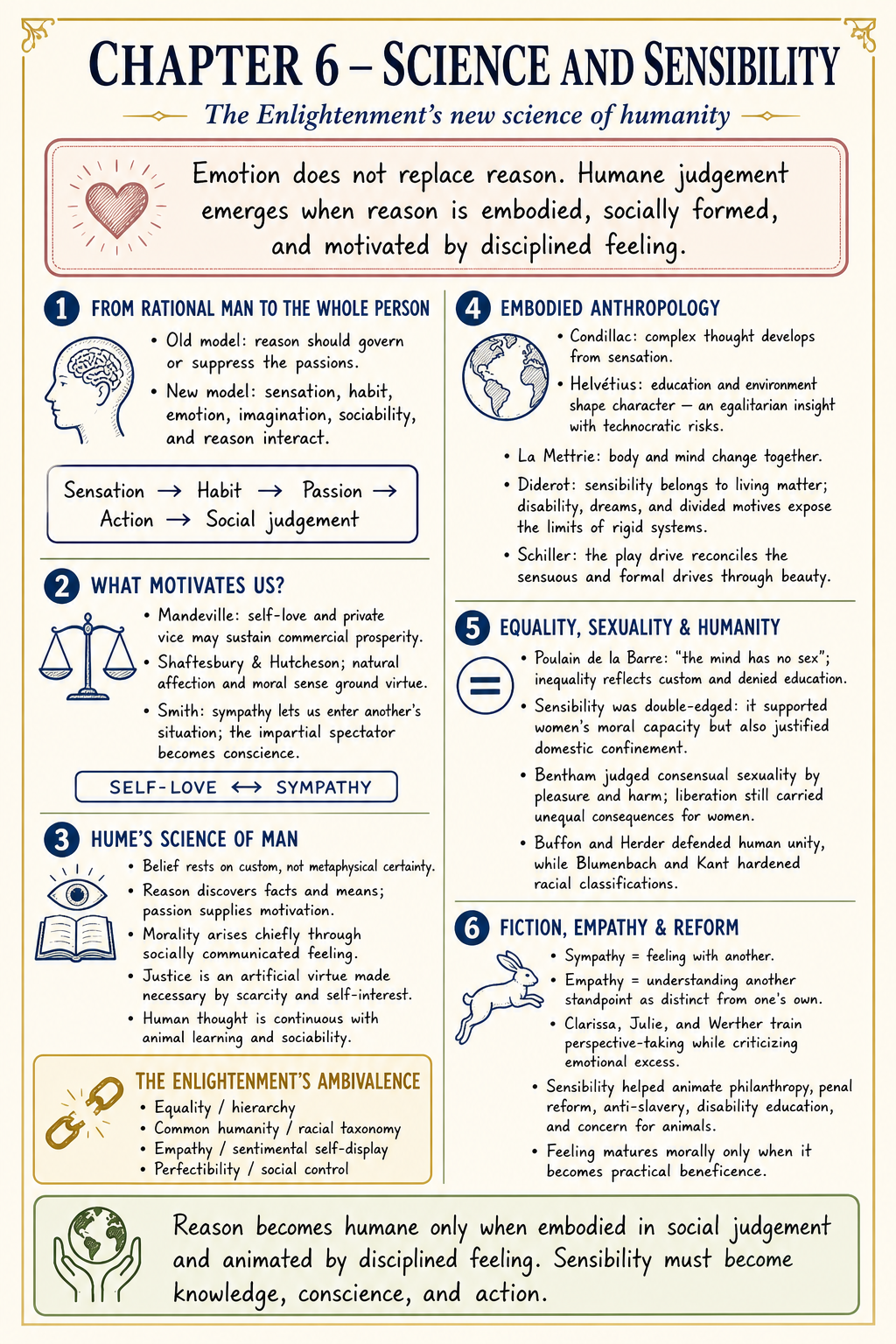
Chapter Objective and Through Line
Robertson argues that the Enlightenment replaced the inherited image of humanity as essentially rational with a more integrated account in which reason, bodily sensation, emotion, imagination, sociability, and moral feeling interact. Seventeenth-century Stoicism and Cartesianism had encouraged people to regard reason as humanity’s defining faculty and to treat passions as forces requiring strict control. Eighteenth-century thinkers increasingly found this psychologically implausible. Human beings were active and social creatures, not disembodied minds; their beliefs arose partly through habit, their actions required motivation, and their morality depended on their capacity to respond to others. The central problem was therefore not how reason could suppress emotion, but how different human faculties could be understood and educated together.
The chapter traces several competing versions of this new science of humanity. Mandeville reduced social conduct to self-love and showed how private vice could sustain commercial prosperity. Shaftesbury and Hutcheson answered that sociability, affection, and moral judgement were natural. Adam Smith and Hume developed more complex models in which sympathy enabled people to enter imaginatively into others’ perspectives, internalize social judgement, and form moral distinctions. French sensationalists and materialists then tried to explain thought, character, and morality through physical organization, sensory experience, education, and environment. Their theories opened radical possibilities—human perfectibility, sexual freedom, women’s intellectual equality, and the unity of humankind—but also encouraged reductive schemes for classifying and managing people.
Literature completes the inquiry where abstract psychology proves inadequate. Diderot, Richardson, Rousseau, Goethe, and others explore disability, dreams, self-deception, sexual desire, divided motivation, and emotional excess in ways philosophical systems cannot. Fiction trains readers in perspective-taking, while the culture of sensibility contributes to philanthropy, penal reform, anti-slavery activism, and concern for animals. Yet sensibility can also become theatrical self-indulgence, and scientific classifications can harden prejudice. The chapter’s governing conclusion is therefore qualified: emotion does not replace reason, but the Enlightenment’s pursuit of happiness requires a socially embedded reason educated and motivated by sensibility.
Chapter Structure at a Glance
- The debate begins with rival accounts of motivation: self-love may generate both vice and social order, while sympathy and moral sense may reveal a natural basis for virtue.
- Hume reconstructs knowledge and morality from human experience: belief rests on custom, action on passion, and moral judgement principally on sympathy.
- Anthropology expands from philosophy into physiology, materialism, psychology, and literature, seeking an account of the whole embodied person.
- The same science of humanity unsettles inherited social hierarchies, especially the subordination of women and religious regulation of sexuality.
- Natural history attempts to classify the human species, producing both arguments for common humanity and early racial taxonomies.
- Diderot investigates exceptional and resistant cases—disability, dreams, and contradictory personalities—to expose the limits of systematic explanation.
- The culture of sensibility turns emotional knowledge into social practice, especially through empathetic fiction, humanitarian reform, and widening sympathy.
Section-by-Section Argument
Self-Love and Sympathy
Robertson begins with theories that challenged the assumption that virtue proceeds from rational recognition of the good. La Rochefoucauld’s psychological maxims interpreted generosity, loyalty, and friendship as forms of self-love or mutually beneficial exchange. Bernard Mandeville radicalized this analysis by arguing that a prosperous commercial society may depend on dispositions traditionally condemned as vicious.
In The Fable of the Bees, the hive flourishes because its inhabitants are proud, acquisitive, dishonest, and eager for luxury. When the bees are made wholly virtuous, consumption and employment collapse, leaving them honest but impoverished. Mandeville’s economic point is serious: modern prosperity cannot be preserved while eliminating the appetites that sustain demand. Yet his defence of harmful industries such as the gin trade pushes the argument toward moral absurdity and may itself be satirical.
Mandeville’s psychology explains sociability through pride. Human beings desire esteem and fear shame; honour turns selfish passion into outwardly disciplined behaviour. Society therefore depends not on natural goodness but on the skilful management of human frailty.
Shaftesbury offers the opposing account:
- Human beings possess natural affections toward partners, children, families, and communities.
- Pleasure is inherently social; eating, conversation, sexuality, and other enjoyments are diminished when not shared.
- A moral sense allows people to approve or condemn conduct independently of revelation or fear of punishment.
- Reason remains necessary, but chiefly to regulate and apply affections wisely rather than to suppress them.
Hutcheson further develops moral sense theory. Moral approval resembles aesthetic perception: we immediately recognize benevolence as good even when it offers us no advantage. His theory, however, has difficulty explaining persistent wickedness. If virtue is naturally pleasurable and vice miserable, why does selfishness so frequently defeat benevolence?
Adam Smith avoids both Mandeville’s egoism and Hutcheson’s excessive optimism. His central principle is sympathy, meaning the imaginative ability to enter another person’s situation and assess whether their response is proportionate. We also observe ourselves from the standpoint of an impartial spectator, gradually internalizing the judgement of others as conscience.
Smith does not deny self-interest. Prudence, industry, economy, and the desire to deserve esteem can be virtuous. Nor does he assume strong emotional concern for distant strangers. Moral conduct depends less on passive pity than on conscience, justice, and the wish to be worthy of approval. His synthesis preserves Stoic self-command while rejecting Stoic insensibility: properly moderated affection is an essential part of human flourishing.
The Science of Man: Hume’s Treatise
Hume attempts to apply the empirical and experimental method to human nature. Since every field of knowledge depends on human understanding, a science of man must precede metaphysics, natural philosophy, morality, and religion. Its evidence comes from introspection, thought experiments, and careful observation of social life.
Hume’s scepticism is not intended to destroy ordinary knowledge. He attacks claims to metaphysical certainty while explaining why human beings possess adequate working beliefs:
- All mental contents originate in experience as vivid impressions or weaker ideas.
- Ideas become connected through resemblance, proximity, and causation.
- We never perceive a necessary causal force; repeated conjunction creates a habit of expecting one event to follow another.
- Belief is not a logical demonstration but the special vividness or firmness with which an idea is experienced.
- The continuing external world and stable personal identity cannot be rationally proved, but human nature compels belief in them.
- The self is not an independently observable substance but a changing bundle of perceptions linked by memory.
Custom is therefore more fundamental to ordinary cognition than deductive reason. If every judgement required rational validation of its own reliability, the regress would dissolve all confidence. Nature prevents such paralysis by giving beliefs emotional force.
Hume then integrates cognition with the passions. Sympathy is the human propensity to receive and share the inclinations of others. It explains why sociable beings care about approval, why solitude is painful, and why the emotions of nearby people affect us more strongly than those of remote strangers.
His famous subordination of reason to passion is frequently misunderstood. Hume does not celebrate irrationality. Reason discovers facts, relations, and effective means, but it cannot supply motivation. A person acts only because some desire makes an outcome attractive or painful. Passions are not themselves rational or irrational; reason can correct false beliefs or identify ineffective means, but cannot generate the underlying end.
Morality follows the same structure:
- Moral approval is a distinctive feeling of satisfaction in contemplating a character or action.
- Human beings possess neither universal benevolence nor unlimited selfishness.
- Justice is an artificial virtue required because limited resources and powerful self-interest make social rules necessary.
- Reason identifies the advantages of justice, but sympathy motivates approval of conduct beneficial to society.
- Moral distinctions ultimately arise from emotional responses communicated through social life.
Hume also reduces the gulf between humans and animals. Both learn from experience, form expectations through custom, seek praise, display passions, and live sociably. Human reason is not a supernatural faculty but an enlarged form of instinctive inference combined with judgement and prudence.
Robertson therefore rejects the interpretation of Hume as an enemy of reason. Hume opposes a narrowly deductive conception that seeks certainty independently of experience. He replaces it with social and passionate reason: fallible judgement operating within ordinary human life. Philosophy becomes psychologically sustainable only when balanced by conversation, friendship, amusement, and bodily experience.
Anthropologies
French followers of Locke pursued empiricism toward sensationalism and materialism. Condillac imagined a statue gradually acquiring its senses. From smell alone arise attention, pleasure, pain, memory, comparison, and judgement; with additional senses and social imitation, a developed mind emerges. His thought experiment denies that the mind requires innate ideas or pre-existing intellectual faculties.
Helvétius drew political consequences from the blank slate. If differences in intelligence and character are products of education and environment, people begin with approximately equal potential. Legislators can therefore construct citizens by aligning self-interest with the common good. This egalitarianism contains a technocratic danger: people become raw material to be moulded without requiring genuine moral character.
Materialist physiology similarly treated the human being as an organized body:
- La Mettrie argued that body and mind change together under sleep, drugs, disease, food, and stimulation; an immaterial soul is unnecessary.
- Living matter possesses its own movement, responsiveness, reproduction, and possibly thought.
- Diderot’s D’Alembert’s Dream proposed that all matter contains latent or active sensibility, dissolving the Cartesian division between body and mind.
- Species, organs, and individual bodies become temporary arrangements within a fluid and creative nature rather than sharply separated essences.
Diderot’s universal sensibility provides a unified basis for physiology, psychology, morality, and aesthetics. Human beings do not merely represent the world intellectually; they encounter it through hopes, fears, pain, desire, and bodily responsiveness.
German anthropology similarly attempted to understand the whole person. Wieland’s Agathon sets idealism and materialism against one another without making either sufficient. Experience, error, desire, and changing circumstances shape character more convincingly than any rigid doctrine.
Schiller’s Aesthetic Education of Man responds to the French Revolution’s failure. Political freedom became possible, but citizens lacked the moral formation required to sustain it. Modern specialization divides intellectual from practical life and fragments the individual.
Schiller proposes three drives:
- The sensuous drive engages bodily experience and immediate particulars.
- The formal drive seeks reason, order, and timeless principles.
- The play drive reconciles them through aesthetic activity.
Beauty allows sensuous people to approach form and abstract thinkers to return to embodied experience. Aesthetic education temporarily restores wholeness and cultivates the harmony required for sociable freedom.
Kant moves in the opposite direction. He divides the moral, rational self from the empirical, desiring self and gives actions full moral worth only when performed from duty rather than inclination. Robertson finds this austere morality difficult to integrate with the chapter’s main tradition, which treats sympathy as both naturally human and morally productive.
The Science of Woman
Enlightenment theories of human nature opened a powerful case for women’s equality, yet they also generated a new ideology of sexual difference. Women remained legally subordinate to fathers and husbands, excluded from formal education and professions, and treated in marriage largely as bearers of property and children.
François Poulain de la Barre used Cartesian dualism to argue that “the mind has no sex.” Bodies differ for reproductive purposes, but rational minds are neither male nor female. Women’s apparent intellectual disadvantages therefore result from force, custom, religion, and lack of education rather than nature. Lockean empiricism could support the same conclusion: without sexually differentiated innate ideas, different outcomes must be explained by experience.
The existence of distinguished scholars such as Laura Bassi demonstrated female capacity, but exceptional examples could be dismissed as prodigies. A stronger argument required showing that ordinary women would display comparable abilities under equal conditions.
The culture of sensibility proved double-edged. Women were praised as emotionally refined, socially perceptive, and civilizing. Medical writers then attributed these qualities to their delicate nerves and reproductive physiology. The result was a theory of complementary sexes:
- Men were rational, energetic, creative, and suited to public action.
- Women were sensitive, nurturing, passive, and suited to marriage and motherhood.
- Sensibility became a justification for domestic confinement rather than public equality.
Women were then caught in a self-reinforcing structure. They received superficial training in accomplishments rather than systematic education, were denied universities and professions, and were subsequently declared naturally unfit for intellectual responsibility.
Wollstonecraft exposed this circularity and demanded a revolution in women’s education and self-understanding. Condorcet similarly traced inequality to the abuse of superior physical strength rather than differences in intellect or moral sensibility. Most revolutionary men, however, followed Rousseau’s account of active masculinity and passive femininity. The French Revolution declared universal rights while refusing women citizenship, political office, and organized participation. Olympe de Gouges’s extension of equal rights to women was ignored before her execution in 1793.
Sexual Relations Without Sin
The Enlightenment gradually transferred sexuality from Church discipline toward private judgement, civil law, medicine, and assessments of social consequence. The conceptual connection to religious toleration was direct: if government should not dictate private belief, why should it regulate consensual sexual conduct that caused no injury?
Appeals to “nature” produced contrary conclusions. Protestants increasingly defined heterosexual monogamy as natural, whereas critics argued that Christian chastity violated natural appetite. Others judged conduct by whether it promoted happiness or harmed society. Sexual pleasure could thus become a legitimate part of earthly felicity rather than evidence of fallen humanity.
Erotic fiction asserted that women shared men’s sexual desires, but sexual liberation remained unequal. Upper-class men could practise libertinism with relatively limited consequences; women faced pregnancy, abandonment, prostitution, and social ruin. Chastity remained an “artificial virtue” sustained partly because husbands demanded certainty of paternity and children required prolonged parental care.
Diderot’s imaginary Tahiti attacks European sexual rules by depicting temporary marriage, permissive relations, and conduct regulated by consent, procreation, and utility. Yet its contradictions reveal the limits of abstract liberation:
- Women are valued mainly for fertility and remain continually occupied with pregnancy and childcare.
- Sterility becomes a fault.
- Population growth would eventually exceed resources.
- Family affection is replaced by self-interest.
- A supposedly natural utopia reproduces elements of conservative reproductive policy.
The strongest late-Enlightenment defence of sexual liberty came from Bentham, who maintained that consensual acts—including same-sex relations—should be assessed by the pleasure they produced and the harm they caused. By contrast, Kant confined legitimate sexuality to marriage, where contractual reciprocity supposedly prevented the reduction of another person to an object. His severe attacks on masturbation show how rational argument could be used to justify inherited moral panic rather than to challenge it.
Classifying Humanity
Natural history placed humanity within the wider continuum of living beings. Fixed species were challenged by intermediate creatures, plant hybridization, anthropoid apes, and the Lockean view that classifications are human constructions imposed upon individual organisms.
Feral children and apes appeared to offer evidence about the border between nature and culture, but reports were unreliable and the individuals studied often could not supply the hoped-for philosophical answers. The larger comparative project relied on a rapidly expanding body of travel literature from missionaries, diplomats, sailors, and scientists.
Most Enlighteners defended the unity of humankind. Buffon argued that humanity constituted one species whose physical differences resulted from climate, diet, disease, intermarriage, and ways of life. Herder similarly treated skin colours as continuous shades within one human picture rather than discrete racial divisions.
This universalism remained value-laden. Buffon associated bodily beauty and full humanity with civilized comfort, commerce, good government, and temperate climates. Peoples living under harsh conditions were described through the language of ugliness, savagery, or “degeneration.” Cultural hierarchy could therefore enter anthropology even without fixed biological race.
Herder resisted ranking peoples. Different groups possessed distinct abilities and historical forms, but their overall human potential was equivalent. Diversity should be understood as plurality within humanity rather than a ladder ascending toward Europe.
The emerging concept of race threatened this flexibility:
- Blumenbach classified humanity into five groups and coined “Caucasian” partly from European aesthetic preference for Georgian features.
- Kant treated racial characteristics as hereditary and permanent realizations of original biological predispositions.
- Hume and Kant made openly prejudiced assertions about African intellectual inferiority.
- Their claims were contradicted by contemporaries such as James Beattie and by the visible achievements of Francis Williams, Phillis Wheatley, Wilhelm Amo, Abram Hannibal, and other Africans.
Robertson neither excuses these passages nor treats them as the essence of Enlightenment anthropology. Hume and Kant’s prejudices were indefensible even by contemporary evidence, but the broader Enlightenment contained strong doctrines of common humanity, perfectibility, anti-slavery, and cultural plurality. Reading later scientific racism backward into the entire movement obscures these internal conflicts.
Diderot and the Grey Areas of Humanity
Diderot refutes the image of Enlightenment thought as obsessed only with rigid categories. He is drawn to the anomalous experiences that resist comprehensive theory: sensory disability, dreams, contradictory motives, and socially disruptive passions.
His Letter on the Blind investigates how people deprived of sight construct knowledge. Molyneux’s problem asked whether a newly sighted person could visually recognize shapes previously known by touch. Evidence suggested that perception requires learned coordination between senses, complicating strict sensationalism.
Diderot’s blind subjects possess capacities overlooked by sighted observers:
- The blind man of Puiseaux judges distance, space, and physical surroundings through heat, sound, air movement, and touch.
- The mathematician Nicholas Saunderson develops tactile methods for calculation and evaluates instruments more accurately by touch than others do by sight.
- Disability therefore produces a different organization of experience, not simply absence or inferiority.
These reflections contributed indirectly to educational efforts for blind people. They also challenged physico-theology: a blind person might regard blindness not as evidence of divine design but as evidence against the perfection of creation.
Diderot also recognizes that dreams and the unconscious imagination expose dimensions of mind unavailable to waking introspection. Enlightenment physiology often reduced dreams to nervous disturbance or indigestion, but Diderot uses the dream state to release ideas too unsettling for conventional dialogue.
Rameau’s Nephew presents a still more serious limit. The nephew is cynical, opportunistic, self-aware, and incapable of consistently serving even his own interest. He accepts society’s corruption and attempts to profit from it, yet repeatedly sabotages himself. Neither moral rationalism nor enlightened self-interest explains him. His contradictions suggest that a complete science of humanity may remain impossible.
Empathetic Fiction
The eighteenth-century reading revolution expanded access to fiction and altered how readers engaged with it. First-person narration brought readers nearer to individual experience, while the epistolary novel presented feelings in letters written before outcomes were known. Multiple correspondents allowed readers to inhabit several perspectives simultaneously.
Robertson distinguishes:
- Sympathy: an emotional response to another person.
- Empathy: the cognitive ability to understand another’s standpoint as distinct from one’s own.
Fiction could promote both. By placing another consciousness before the reader, novels made servants, women, prisoners, victims of sexual violence, and other socially distant figures appear as complete centres of experience. This did not automatically produce humanitarian reform, but it supplied habits of perspective-taking essential to it.
Three novels dominate Robertson’s account:
- Richardson’s Clarissa: The letters expose both Clarissa’s moral strength and Lovelace’s self-deceptive construction of rape as gallant conquest. Readers experience the victim’s confinement, uncertainty, violation, and dignified preparation for death.
- Rousseau’s Julie: Passion is intense but must be integrated with duty, domestic responsibility, nature, and social order. Julie’s strength contrasts with Saint-Preux’s repeated indulgence in emotional display.
- Goethe’s Werther: The single-correspondent form draws readers into Werther’s passionate subjectivity while gradually revealing his insensitivity, obsessive self-involvement, and suicide as an injury inflicted upon Lotte and Albert.
The novels do not simply glorify feeling. Their strongest women possess deep emotion combined with practical judgement; the men who surrender entirely to passion become destructive. They therefore educate and criticize sensibility simultaneously.
Readers responded with tears, letters, pilgrimages, imitation, and intense identification. These reactions demonstrate fiction’s unprecedented emotional authority, but also its risks. Simplified sentimental novels replaced complex psychology with repeated scenes of virtuous suffering, callous persecution, charity, and abundant tears.
Sade parodied sentimental conventions through systematic cruelty, but Robertson rejects the claim that Sade represents Enlightenment reason’s logical culmination. Sade eliminates sympathy, whereas the chapter presents sympathy as central to Enlightenment morality. More plausible warnings appear in Laclos and Schiller: cultivated intelligence without fellow feeling produces manipulators who treat people as objects, but their suppressed emotions and consciences eventually disrupt their calculations.
Sterne’s Uncle Toby offers the corrective. Toby does not merely enjoy compassionate feeling; he pays to educate the dying Le Fever’s son. Sensibility reaches moral maturity when aesthetic response becomes practical beneficence rather than self-admiring tears.
Sentiment and Society
Robertson asks whether the culture of feeling changed emotions or merely changed the language used to express them. The concept of an emotive dissolves the simple distinction. Expressions of feeling can help create and strengthen the emotion they name. Sentimental letters and novels taught people to recognize, articulate, and share experiences that might otherwise remain indistinct.
The late eighteenth century shows evidence that this emotional culture affected conduct:
- Charities assisted debtors, chimney sweeps, impoverished writers, prisoners, hospital patients, and victims of drowning.
- John Howard investigated prison and hospital conditions across Europe.
- Opposition to slavery increasingly asked readers to imagine themselves in the captive’s position.
- Anti-slavery narratives replaced abstract populations with named individuals, separated couples, violated families, and recognizable suffering.
- Wedgwood’s chained African—“Am I not a man and a brother?”—combined common humanity with an appeal to fellow feeling.
Sensibility also transformed attitudes toward punishment. People became less willing to witness executions, although this might reflect squeamishness rather than concern for the condemned. Stronger empathy appeared when thinkers imagined the reasoning of criminals, the desperation of unmarried women driven to infanticide, or the social circumstances producing dishonour and crime.
The moral circle widened further toward animals. Animal cruelty remained commonplace in hunting, festivals, sport, and daily life. Burns’s poems treat the hare and mouse as fellow creatures with families, vulnerability, and claims upon human consideration. His phrase “Nature’s social union” extends the chapter’s concept of sociability beyond the human species.
John Oswald’s vegetarianism carried this logic further. European dominion over animals reflected acquired insensibility rather than natural feeling; pity and fellow feeling supplied a moral case against killing them. Robertson closes the chapter here because animal sympathy reveals how far the culture of sensibility could enlarge the definition of moral community.
Key Concepts and Distinctions
- Self-love: The pursuit of personal pleasure, esteem, security, or advantage that may disguise itself as virtue.
- Significance: It explains both Mandeville’s pessimistic psychology and later attempts to align private interest with public welfare.
- Moral sense: An immediate human capacity to approve virtue and condemn vice independently of revealed commands.
- Significance: It grounds morality in human nature but raises the problem of why naturally moral beings act viciously.
- Sympathy: The socially communicated capacity to enter or respond to another person’s passions.
- Significance: In Smith and Hume it connects individual psychology to conscience, morality, justice, and social cohesion.
- Sensibility: The bodily and emotional capacity to receive impressions, feel pleasure and pain, and respond to other beings.
- Significance: It becomes a unifying principle linking physiology, psychology, ethics, aesthetics, and sociability.
- Science of man: The empirical investigation of cognition, emotion, character, bodily organization, and social conduct.
- Significance: It applies Enlightenment methods to the human subject on whom every other form of knowledge depends.
- Empathy: Imaginative understanding of another person as a separate centre of experience rather than emotional identification with them.
- Significance: Fiction develops perspective-taking across social boundaries and contributes to humanitarian awareness.
- Emotive: An expression of feeling that helps evoke, organize, and strengthen the emotion expressed.
- Significance: It explains how sentimental language and literature could alter experience rather than merely describe it.
Chapter Conclusion and Significance
Robertson concludes that the Enlightenment’s science of humanity did not discover one agreed human essence. It produced a field of tension between self-interest and sociability, body and mind, reason and motivation, universal humanity and social classification, emotional responsiveness and emotional excess. The strongest thinkers resisted one-sided answers. Smith and Hume acknowledged self-love without reducing all virtue to egoism; Diderot embraced materialism without treating people as mechanically predictable; Schiller sought harmony rather than victory for either sensation or reason.
The chapter also exposes the Enlightenment’s moral ambivalence. Its theories supported women’s equality, sexual toleration, common humanity, disability education, anti-slavery, penal reform, and compassion for animals. The same era developed separate-spheres ideology, coercive schemes of social formation, racial classifications, and sentimental self-display. Its lasting achievement was therefore not a completed humanitarian doctrine but the recognition that reason becomes humane only when embodied in social judgement and animated by disciplined feeling. Sensibility can widen the circle of concern, but it must become knowledge, conscience, and action rather than remain an enjoyable spectacle of one’s own virtue.
Questions for Reflection
- Does Hume successfully preserve a meaningful role for reason after making belief dependent on custom and action dependent on passion, or does his “social and passionate” reason remain too weak to judge moral ends?
- Why did Enlightenment theories of sensibility generate both arguments for women’s equality and a new ideology confining women to domestic life?
- To what extent can fiction genuinely enlarge moral concern, and what distinguishes practical empathy from sentimental enjoyment of another person’s suffering?
Chapter 7: Sociability
Chapter Objective and Through Line
Robertson argues that sociability was not merely one Enlightenment value among others; it was the practical condition that made enlightenment possible. Human beings were understood as dependent creatures whose language, judgement, knowledge, and happiness developed through interaction. Thinkers disagreed over whether sociability arose from natural affection or rational self-interest, but they broadly rejected the image of the self-sufficient individual. Language itself was reconceived as a socially created medium through which thought and emotion were formed, not simply a tool for expressing ideas already complete in the solitary mind.
The chapter then asks where Enlightenment sociability actually occurred. Polite conversation, coffeehouses, salons, clubs, academies, reading societies, Masonic lodges, correspondence networks, libraries, newspapers, and journals all brought people into contact. Robertson resists the tendency—especially associated with Jürgen Habermas’s concept of the public sphere—to assume that these institutions automatically produced rational, egalitarian debate. Politeness could suppress disagreement; coffeehouses were socially and sexually exclusive; salons were private aristocratic entertainments; Freemasonry was often conservative or esoteric; newspapers could spread propaganda and hysteria as readily as knowledge. Institutions provided opportunities for enlightenment only when participants deliberately used them for serious inquiry.
The strongest infrastructure for enlightenment was therefore not any single physical venue but the larger Republic of Letters and the virtual public sphere it sustained. Correspondence, journals, libraries, publishing, and international scholarly norms created a transnational community committed—imperfectly—to merit, civility, criticism, and the circulation of knowledge. Yet this sphere depended on patronage, commerce, political toleration, and negotiated forms of censorship. The concluding quarrel between Hume and Rousseau reveals the psychological stakes beneath these institutions: sociability can protect people from isolation and self-absorption, but it also demands restraint, reciprocity, humour, and compromise. Enlightenment sociability was thus both an intellectual network and a difficult personal discipline.
Chapter Structure at a Glance
- Human dependence establishes sociability as a necessity: language, memory, happiness, and self-preservation all require interaction with others.
- Politeness supplies rules for social intercourse: it reduces conflict and permits broader participation, but also preserves class distinctions and inhibits candour.
- The public sphere provides venues, not guarantees: coffeehouses and salons spread information and connections without necessarily producing serious debate.
- Purpose-built societies more effectively combine sociability with inquiry: clubs, academies, libraries, reading groups, and some lodges organize sustained intellectual activity.
- The Republic of Letters creates a transnational scholarly community: correspondence, journals, libraries, and shared norms integrate otherwise isolated thinkers.
- Print enlarges sociability into a virtual public sphere: newspapers and periodicals disseminate information while also enabling manipulation, factionalism, and political excitement.
- Censorship and solitude expose sociability’s limits: public reasoning must negotiate political control, while the Hume–Rousseau conflict shows the personal costs of rejecting social accommodation.
Section-by-Section Argument
Sociability and Language
The chapter opens from the broadly shared Enlightenment conviction that isolation deforms human beings. Diderot’s attack on monasticism makes the point dramatically: a person removed from society becomes intellectually incoherent, psychologically eccentric, and potentially wild. Sociability could be treated as either a natural instinct, as in Shaftesbury, or an accommodation demanded by human vulnerability and self-interest.
Pufendorf and d’Holbach represent the second approach. Individuals discover that they cannot secure preservation, assistance, or happiness alone. They therefore submit to political order and practise reciprocal respect because society is useful. Adam Smith similarly describes commercial society as a system of strangers held together by restrained friendship, shared interests, and mutual accommodation.
Language confirms this social dependence. Against the Cartesian model, in which an individual first forms an idea and then expresses it, Enlightenment theories make communication primary:
- Language is a socially established system of signs whose meanings depend on convention and interpretation.
- Without language, memory and reflective thought remain severely restricted; Condillac’s feral child cannot narrate his earlier life because he possessed no linguistic structure in which to preserve it.
- Early language was expressive, rhythmic, gestural, and metaphorical before gradually developing into abstract prose.
- Exact philosophical exposition is therefore a specialized use of language. Its ordinary function is to communicate the mixture of thoughts and feelings that constitutes social existence.
This establishes the chapter’s basic premise: intellectual life cannot be separated from the social practices through which people learn to speak, remember, interpret, and respond.
Politeness
Civility and politeness regulated interaction. Civility restrained barbarity and established minimum standards of respectful conduct. Politeness went further by making intercourse positively agreeable through consideration, graceful manners, aesthetic refinement, and accommodation to one’s company.
Conversation manuals advised people not to dominate, interrupt, boast, make indecent jokes, display pedantry, or raise subjects beyond the company’s understanding. Such practices could create a provisional equality among participants: a person who mastered the code could enter polite society regardless of some inherited distinctions.
Yet politeness was never socially neutral:
- It required education and leisure, placing it beyond much of the working population.
- Accent, grammar, vocabulary, bodily references, dress, and manner became tests of status.
- Socially mobile people studied conduct manuals to imitate the classes above them, revealing how politeness converted hierarchy into supposedly aesthetic distinctions of taste.
- Bourgeois prosperity did not eliminate aristocratic prestige. Wealthy commoners often copied noble manners, while nobles retained an ease supposedly unavailable to people formed by commerce and professional work.
- Governments could impose refinement from above, as Catherine the Great attempted through education, translated conduct books, and satires of provincial vulgarity.
The strongest objection was that politeness could become hypocrisy. Swift mocked conversation composed entirely of harmless clichés; Rousseau praised Molière’s Alceste as a model of rough sincerity opposing fashionable deceit. Lord Chesterfield inadvertently exposed the problem by insisting that pleasing manners could advance a man who possessed neither knowledge nor ability. If appearance could substitute for substance, refinement might reward performance rather than merit.
Politeness therefore had an ambiguous relationship to enlightenment. It gave diverse people a common social grammar, but it could also forbid strong argument. The fear of seeming vulgar, earnest, or pedantic encouraged “agreeable nothings.” Julie de Lespinasse’s offended response to Buffon’s colloquial explanation of his writing style shows refinement obstructing precisely the frank intellectual exchange enlightenment required.
The Public Sphere
Robertson scrutinizes the claim that coffeehouses and salons constituted an emancipatory public sphere of open rational debate. They certainly expanded sociability and the circulation of information, but their existence alone did not determine what occurred within them.
Coffeehouses offered newspapers, political news, business contacts, recreation, and conversation. Some became associated with parties, professions, religious communities, literary circles, or commercial transactions. They helped form public opinion by making printed information available for collective reading and discussion.
Their limitations were substantial:
- Many were specialized or factional rather than open forums.
- Conversation commonly concerned ordinary matters rather than intellectual or political controversy.
- The clientele was primarily educated, professional, middleor upper-class, and male.
- Women were generally employees rather than equal participants; in some German cities they were formally prohibited from entering.
- Club membership and business relationships could determine who participated.
The Parisian salon has been still more romanticized. Aristocratic women such as Marie-Thérèse Geoffrin and Julie de Lespinasse exercised genuine cultural agency, introduced writers to patrons, and sometimes encouraged literary or philosophical discussion. Yet what are now called salons were private gatherings within aristocratic households, not public institutions established for intellectual work.
Conversation remained governed by leisure, entertainment, gossip, patronage, and politeness. Writers supplied prestige and amusement; aristocrats supplied meals, gifts, posts, and recommendations. Intellectuals remained socially subordinate, and sustained disagreement could be stopped by the hostess. Robertson’s conclusion is deliberately deflationary: salons aided cultural diffusion and individual careers, but their contribution to Enlightenment thought has been exaggerated, and their private, selective character makes their classification as a public sphere doubtful.
D’Holbach’s dinners offer a more persuasive model. They combined serious argument with convivial enjoyment and welcomed major thinkers and foreign visitors. The company could move freely among literature, political economy, religion, science, and speculative cosmology without turning disagreement into hostility. Their importance also shows that pleasure, amusement, food, and friendship were not distractions from Enlightenment sociability but part of what sustained it.
Societies
Formal and informal societies made a more direct contribution because they were created for specific intellectual or practical purposes. Britain’s clubs, proprietary libraries, provincial scientific organizations, political groups, and improvement societies combined discussion with sociability. Their objectives ranged from natural history and antiquities to commerce, agricultural improvement, science, music, and militia policy.
The typical successful society joined disciplined activity to conviviality. Members might debate science and politics before supper, then continue in freer conversation afterward. Adam Smith’s participation in numerous Glasgow and Edinburgh clubs illustrates how associational life linked moral philosophy, political economy, scientific inquiry, and practical improvement.
Comparable organizations appeared across Europe:
- French provincial academies held essay competitions and addressed practical problems such as drainage, begging, and infant care, though social rank sometimes mattered more than intellectual distinction.
- Commercial towns established reading clubs that supplied newspapers, books, heated rooms, and places for conversation.
- Milan’s Accademia dei Pugni rejected the hierarchy of traditional academies and published Il caffè, presenting knowledge as a Europe-wide exchange.
- German and Dutch reading societies consciously sought to spread useful knowledge through books, journals, travel narratives, and lectures.
- The British Bluestocking network allowed educated women to exchange ideas, defend women’s rational agency, and host more substantial literary conversation than many Parisian gatherings.
Secret or semi-secret organizations were more ambiguous. Berlin’s Wednesday Society provided officials and intellectuals with a protected forum for discussion that may have influenced legal reform, but secrecy reflected the political danger of free exchange.
Freemasonry advertised humanity, liberty, benevolence, and the overcoming of prejudice, but its actual record varied:
- High costs and elaborate rituals often reproduced class exclusion.
- Many lodges were socially conservative or more interested in networking and esoteric mythology than reform.
- Vienna’s True Harmony lodge was an important exception, joining science, literature, anti-clerical criticism, religious reform, and unusually diverse membership.
- The Illuminati were genuinely radical but small and unsuccessful. Their chief historical effect was to provoke conspiracy theories portraying the Enlightenment as a coordinated assault on Christianity and government.
Mozart’s The Magic Flute expresses Masonic aspirations toward education, wisdom, and progress from delusion to truth. Yet its slavery, racial caricature, patriarchy, and authoritarian Sarastro reveal contradictions within supposedly enlightened benevolence. The opera becomes a warning that institutions proclaiming universal humanity may retain inherited hierarchies and prejudices.
The Republic of Letters
The Republic of Letters supplied the durable infrastructure lacking in coffeehouses and salons. It was a transnational scholarly community formed through correspondence, book exchange, journals, libraries, travel, and shared intellectual practices. It originated in Renaissance humanism but reached its greatest extent between approximately 1650 and 1750, remaining substantial through the end of the eighteenth century.
Correspondence allowed scholars to:
- Request manuscripts and information unavailable locally.
- Announce discoveries and exchange books.
- Arrange publication and patronage.
- Maintain collaborative networks across political and confessional borders.
- Share letters with secondary readers, extending communication beyond the named correspondents.
The immense networks of Leibniz, Haller, Franklin, and others show that European and Atlantic intellectual life was already highly interconnected. Learned journals then supplemented private correspondence by reviewing new books, reporting discoveries, summarizing controversies, and commemorating scholars. Bayle’s Nouvelles de la République des Lettres gave dispersed readers the experience of belonging to one intellectual community.
Universal libraries were equally necessary. Unlike confessional collections designed to defend one religious tradition, they sought to represent every major field of knowledge. Leibniz imagined the library as an encyclopaedia from which practical and theoretical information could be retrieved. Librarians, catalogues, collectors, and travelling scholars therefore functioned as essential mediators of knowledge. The Republic of Letters gave the Enlightenment its transnational cohesion before the later expansion of newspapers and popular periodicals.
The Ethos of Scholarship
The Republic of Letters claimed to disregard national, religious, and hereditary divisions. Bayle asked scholars to treat one another as brothers united by learning. Status was supposed to depend on intellectual achievement, making the republic a meritocracy, though distinguished scholars still received elaborate deference.
Its governing norm was scholarly civility. Argument should be frank but directed against propositions rather than persons. Boyle’s dialogic style demonstrated that one could defend truth vigorously without railing at opponents. This was not merely etiquette: collaborative inquiry required enough trust for criticism, correction, and exchange.
Practice repeatedly violated the ideal. Priority disputes, religious accusations, jealousy, gossip, and personal abuse pervaded scholarly life. The quarrel between Newton and Leibniz over calculus exemplified how competition for recognition could overwhelm republican fraternity.
The intellectual identity of the republic also changed. Earlier scholars celebrated the polymath who attempted to master an integrated body of knowledge. Leibniz’s varied activities were unified by an encyclopaedic ambition to identify the primitive concepts from which other knowledge might be generated. Increasing specialization made that model appear outdated.
By the mid-eighteenth century, several intellectual types competed:
- The érudit studied texts, antiquities, languages, and the past.
- The natural scientist pursued increasingly specialized empirical research.
- The fashionable man of letters moved between literature, philosophy, criticism, and polite society.
- Commercial writers or “hacks” supported themselves through publishing outside elite patronage.
Philosophes often disparaged erudition as pedantry, but Robertson argues that humanist scholarship had prepared the Enlightenment. Textual criticism developed methods later applied to the Bible; antiquarian collection shifted attention from authoritative words to material evidence; libraries and bibliographies organized knowledge. The Enlightenment did not simply replace the Republic of Letters—it inherited and transformed its methods.
The Virtual Public Sphere
The expansion of newspapers and periodicals allowed sociability to operate at a distance and on a much larger scale. Britain’s lapse of the Licensing Act in 1695 encouraged rapid newspaper growth in London and provincial towns. Readers encountered metropolitan and foreign news, advertisements, public controversies, and reports of parliamentary activity. Letters to editors allowed private persons to intervene anonymously in public affairs.
Press freedom nevertheless remained incomplete. Seditious libel was ill-defined, exposing writers to prosecution and physical punishment. Governments secretly subsidized newspapers, while opposition politicians funded partisan alternatives. The Wilkes controversy advanced legal protections but also showed how journalism could turn a political dispute into celebrity and mass agitation.
Robertson refuses to equate greater political information with better judgement. Newspapers could produce shallow expertise, patriotic excitement, rumour, and demagoguery. Cultural and scientific journals may have promoted enlightenment more reliably by reviewing books, reporting discoveries, and connecting readers with academies and international knowledge.
The Spectator was especially influential because it combined virtual sociability with moral education. Its fictive author and recurring characters created the feeling of joining a circle of acquaintances. Readers’ letters made the publication dialogic. Its essays taught conversational restraint, openness, good nature, and practical reflection on everyday conduct without embracing excessively artificial delicacy.
Continental imitations carried this model into the “middling ranks.” German moral weeklies promoted industry, honesty, moderation, religious toleration, usefulness, and earthly happiness. Their politics were generally conservative, but their readers were asked to examine conduct consciously and ground virtue in rational principles rather than inherited habit. Enlightenment here meant reflective participation in ordinary social life, not necessarily radical opposition to existing institutions.
Censorship
The virtual public sphere depended on what governments permitted to circulate. Britain abolished prior licensing for print but retained theatrical censorship and prosecuted seditious, irreligious, or obscene works. France maintained a comprehensive system of royal approval, though Robertson portrays it less as a uniform machinery of repression than as a flexible process of evaluation and co-optation.
French censors were often writers themselves. They assessed style, accuracy, reliability, and the author’s relationship to authority as well as religious and political content. Personal connections, patronage, tacit permission, false publication locations, and printing abroad created room for negotiation.
The Helvétius controversy shows the system’s instability. A tolerant censor approved On the Mind without adequately grasping its materialism. The resulting condemnations damaged both the author and the administration, contributed to suppression of the Encyclopédie, and made censorship more restrictive. Malesherbes nevertheless protected Diderot’s papers and repeatedly assisted Rousseau, showing how enlightened officials could work within the system to undermine its harsher effects.
Political fragmentation offered additional routes around censorship. A work prohibited in one German or Italian state could be printed in another. Austria alternated between restriction and controlled liberalization. Joseph II permitted criticism and publication not because he accepted an absolute freedom of the press, but because he wanted to promote useful enlightenment, gather information, and strengthen publishing.
Kant and Voltaire nevertheless identified written public reasoning as indispensable. The pen allowed people without official power to challenge judgements and seek public support. But Voltaire’s polemical excesses also demonstrate why authorities feared abuse. Robertson concludes that pre-censorship was a bad solution to a real and continuing problem: how to preserve public argument while restraining defamation, manipulation, and destructive media practices.
Unsociability: Hume vs Rousseau
The final section transforms the chapter’s institutional analysis into a psychological drama. Sociability protected individuals from melancholy, distorted introspection, and possible madness. Conversation and companionship restored perspective by confronting the mind with other rational beings.
Rousseau represented the opposing attraction of solitude. Isolation enabled introspection and creative originality, but his depression, paranoia, sensitivity, persecution, and physical discomfort made social relations increasingly difficult. His quarrel with Hume in 1766–67 stages a conflict between two models of life.
Hume embodied accommodation, conversation, humour, and sociable reason. He helped Rousseau travel to England, find accommodation, and secure a royal pension. Rousseau interpreted ambiguous incidents—including a mocking letter written by Horace Walpole—as evidence of a conspiracy in which Hume participated. His enormous accusatory letter appealed not to demonstrable facts but to the “innate conviction of the heart.”
Hume initially judged Rousseau mad, then surrendered his own moderation by publishing their correspondence against his friends’ advice. The dispute therefore exposes weaknesses on both sides:
- Rousseau rejected the compromises, role-playing, gratitude, and reciprocal restraint that ordinary social life requires.
- He valued absolute sincerity but expected others to receive his emotional disclosures without equivalent obligations on his part.
- Hume became attached to Rousseau with uncharacteristic speed, then reversed admiration into extreme denunciation.
- Rousseau fascinated Hume partly because he embodied a visionary solitude that Hume had himself approached during periods of psychological crisis.
The contrast is consequently not simple. Hume’s sociability was partly a defence against the abyss of isolated scepticism; ordinary company restored him to common life when philosophy threatened meaninglessness. Rousseau appeared able to inhabit solitude and derive genius from it, though at immense personal cost. The chapter ends by presenting sociability not as superficial conviviality but as a condition of psychological stability and epistemic proportion.
Key Concepts and Distinctions
- Sociability: The human disposition or practical necessity to live, communicate, and cooperate with others.
- Significance: It provides the anthropological basis for language, morality, knowledge, political order, and happiness.
- Politeness: A refined code intended not merely to prevent conflict but to make interaction pleasing through manners, accommodation, and taste.
- Significance: It enables intercourse across some social differences while simultaneously disguising hierarchy and restricting forthright debate.
- Public sphere: The network of spaces and media through which private individuals encounter information and discuss matters of common concern.
- Significance: Robertson treats it as a potential infrastructure for enlightenment, not as an automatically rational or emancipatory institution.
- Republic of Letters: The transnational scholarly community connected by correspondence, journals, libraries, books, and shared intellectual norms.
- Significance: It created the communications infrastructure and common identity that allowed Enlightenment ideas to circulate across political and confessional boundaries.
- Scholarly civility: The norm that criticism should address claims and evidence without turning disagreement into personal hostility.
- Significance: Cooperative inquiry depends on intellectual freedom moderated by enough restraint to preserve communication.
- Virtual public sphere: Sociability conducted at a distance through print and correspondence rather than face-to-face institutions.
- Significance: It vastly enlarged participation but also widened the reach of propaganda, factionalism, misinformation, and censorship.
Chapter Conclusion and Significance
Robertson concludes that Enlightenment thought was produced through networks of social exchange, not by isolated geniuses reasoning independently. Language, conversation, clubs, correspondence, libraries, and periodicals formed the material and psychological environment in which arguments could be tested and knowledge circulated. The Republic of Letters and later virtual public sphere linked local communities into a European and Atlantic intellectual culture.
Yet no social form was inherently enlightened. Politeness could silence truth, salons could subordinate writers to aristocratic patronage, coffeehouses could exclude women and workers, lodges could promote superstition, newspapers could spread hysteria, and censorship could be practised by Enlighteners themselves. Sociability promoted enlightenment only when joined to intellectual purpose, openness, evidence, civility, and willingness to accept criticism. The Hume–Rousseau quarrel supplies the personal corollary: productive social life requires neither theatrical conformity nor uncompromising self-expression, but reciprocity, humour, proportion, and compromise.
Questions for Reflection
- Does Robertson’s criticism of Habermas weaken the concept of the public sphere itself, or does it merely show that a public sphere must be evaluated by how participants use it?
- When does politeness make honest disagreement possible, and when does it become a mechanism for protecting hierarchy or suppressing serious thought?
- Does the Hume–Rousseau quarrel ultimately vindicate sociability, or does Rousseau’s creative solitude reveal capacities that sociable Enlightenment culture could not accommodate?
Chapter 8: Practical Enlightenment
Chapter Objective and Through Line
Robertson argues that the Enlightenment must be understood not only as a philosophical movement but as a practical campaign to improve human life. Its participants included administrators, clergy, physicians, engineers, teachers, agricultural reformers, philanthropists, manufacturers, and legal campaigners, many of whom are less famous than the canonical philosophes. They sought public happiness through better government, infrastructure, agriculture, industry, medicine, education, and criminal justice. In this practical tradition, producing more food, preventing disease, teaching children effectively, or reducing judicial cruelty could matter more than constructing an elegant philosophical system.
The chapter is organized around a persistent tension between improvement and control. Reformers believed that rational knowledge could identify inefficient customs and reorganize society for the common good. Yet the people being “improved” often appeared to administrators as productive resources rather than autonomous individuals. Statistical classification could obscure lived experience; agricultural modernization could dispossess communities; industrial discipline could transform workers into machine-like bodies; educational reform could become manipulation; and utilitarian punishment could reproduce cruelty under the language of efficiency.
Robertson therefore rejects both triumphalist and wholly Foucauldian interpretations. Practical Enlightenment delivered genuine benefits: roads, canals, hospitals, inoculation, agricultural productivity, child-centred education, university reform, the abolition of torture, and improved prisons. But reform was uneven, frequently ineffective, and often imposed from above without sufficient regard for custom, emotion, freedom, or human individuality. The chapter culminates in Bentham’s Panopticon, where the pursuit of public happiness nearly collapses into a system for producing obedient and economically useful subjects. Practical Enlightenment’s central problem was not whether improvement was desirable, but whether human beings could be improved without being reduced to objects of administration.
Chapter Structure at a Glance
- Administrators redefine government as the organized production of public welfare, using bureaucracy, statistics, infrastructure, and economic regulation.
- The dissemination of useful knowledge becomes itself a reform project, represented most ambitiously by Diderot’s Encyclopédie.
- Agricultural innovation increases productivity but transforms property, labour, communities, and landscapes, often at considerable human cost.
- Medical reform improves institutions and public health more than treatment itself, because inherited theories continue to obstruct empirical discovery.
- Child-rearing becomes more humane and developmentally sensitive, especially through Locke and Rousseau, while retaining deep gender and class inequalities.
- Schools and universities begin moving from classical repetition toward practical, empirical, and research-based education, though access remains restricted.
- Penal reform replaces spectacular cruelty with deterrence, confinement, and rehabilitation, but prisons create new forms of discipline, surveillance, and dehumanization.
Section-by-Section Argument
Police
The eighteenth-century concept of police or Polizei meant the entire administrative infrastructure of a civilized and prosperous society, not merely criminal law enforcement. Its goals included safety, economic abundance, cleanliness, public order, communication, education, welfare, and population growth. The underlying assumption was that government should actively create the material conditions of public happiness.
France entrusted these tasks to provincial intendants. Turgot’s administration of impoverished Limoges illustrates both their possibilities and constraints. He replaced unpaid road labour with taxation-funded wages, improved military recruitment, promoted sheep-breeding and potatoes, and attempted fairer taxation. His failure to produce a comprehensive property register, however, shows that enlightened intentions frequently exceeded administrative capacity.
German cameralism developed a more systematic ideal of state management. University-trained officials studied population, resources, production, finance, and administrative science. Statistics originally meant information useful to the state; its purpose was to make society visible enough to govern and improve.
- Graunt’s analysis of mortality records demonstrated how aggregated data could reveal population patterns unavailable through anecdotal observation.
- Petty’s “political arithmetic” used quantitative evidence to challenge pessimistic assessments of England, though Diderot noted that patriotic assumptions could shape apparently objective calculations.
- Justi’s police science attempted to coordinate family welfare with the common good across virtually every area of life, from agriculture and drainage to religion, censorship, poor relief, and criminal justice.
This comprehensive ideal easily became coercive. Officials regulated festivals, feast-days, food consumed at ceremonies, guild membership, mobility, begging, and labour. Vagrants were expelled, confined, or forced into workhouses; Romani people could be declared outlaws; institutions combined the poor, sick, mentally ill, and socially unwanted. These measures support criticisms of Enlightenment “social discipline,” but Robertson qualifies that interpretation. Regulations often represented administrative aspirations rather than enforceable reality, and bureaucrats frequently had to negotiate with resistant populations.
The more fundamental problem was administrative distance. Educated officials could see the population as a collection of interchangeable units while ignoring emotional attachments to religious ceremonies, customary rights, communal festivals, and burial practices. Enlightened administration provided real improvements but carried a “shadow side” whenever quantitative rationality displaced the perspective of the people governed.
Robertson contrasts coercive administration with local reform by persuasion:
- Jean-Frédéric Oberlin, a Lutheran pastor in the Vosges, combined religious ministry with roads, agricultural improvement, craft training, early-childhood education, and economic development. He performed the work of an enlightened ruler on a small scale but joined his parishioners in physical labour and adapted reform to local needs.
- Anders Chydenius, a Finnish-Swedish pastor, promoted agricultural improvement, medicine, inoculation, free trade, religious toleration, press freedom, and public access to government records. He argued that servants required freedom to choose employers and negotiate wages before they could become morally responsible citizens.
Britain relied more heavily on private associations and enterprise. The Lunar Society connected scientific investigation with manufacturing through figures such as Boulton, Watt, Wedgwood, Darwin, and Priestley. Turnpike trusts and joint-stock companies built roads and canals, integrating markets and accelerating travel. France achieved similar infrastructure through state engineering and compulsory labour.
The contrast between British private enterprise and continental administration should not obscure their common disciplinary effects. Wedgwood’s pottery imposed punctuality, specialization, surveillance, fines, and early clocking-in practices. He intended to make workers into “machines” incapable of error. Yet employees received cleaner housing and access to schools, hospitals, and libraries. Practical improvement therefore rarely offered a simple choice between freedom and oppression; discipline and welfare were often delivered together.
The Encyclopédie
Diderot and d’Alembert’s Encyclopédie embodied practical Enlightenment by reorganizing and disseminating useful knowledge. The rapid expansion of science had made universal mastery impossible, while technical knowledge remained fragmented among guilds and transmitted through guarded oral traditions. An alphabetical, cross-referenced encyclopaedia promised to make this knowledge public.
Its organization was itself philosophical. Adapting Bacon’s classification, it derived knowledge from the faculties of memory, reason, and imagination. Theology occupied a small and intellectually diminished position, while the studies of humanity, nature, mechanical trades, and practical arts received extensive treatment. Revealed theology was effectively subordinated to reason rather than treated as the sovereign discipline.
The project’s intellectual lineage—Bacon, Descartes, Newton, and Locke—combined rebellion against scholastic authority with empiricism:
- Descartes represented courage in overturning inherited intellectual power.
- Bacon rejected closed speculative systems.
- Newton subjected natural philosophy to mathematics and experience.
- Locke turned metaphysics toward empirical investigation of the mind.
The Encyclopédie contained roughly 72,000 articles and eleven volumes of detailed plates. Its treatment of manufacturing challenged the hierarchy that placed liberal arts above mechanical arts and intellectuals above artisans. Technical experts and some practising craftsmen described clock-making, metalworking, bridges, machinery, and processes such as pin production. Knowledge previously monopolized by guilds became available, at least in principle, to a broader public.
The work was also a vehicle for religious and political criticism. Some attacks were indirect, hidden in cross-references or seemingly unrelated entries. Authorities recognized the danger. The project was condemned, formally suppressed, continued under false publication information, and internally censored by its own publisher. Diderot persisted after many prominent collaborators withdrew.
Its importance lies less in any unified doctrine than in its redefinition of valuable knowledge. It marginalized theology and classical erudition in favour of nature, humanity, production, and the capacity to transform the material world. Its diffusion remained socially limited because early editions were expensive and purchasers were concentrated in established administrative and academic centres rather than new industrial districts. Even so, it became a landmark in the demystification and public circulation of practical knowledge.
Agriculture
Agricultural reform was indispensable because most Europeans depended directly on the land, while rising populations required greater food production. The traditional open-field system divided land into scattered strips, required communal coordination, and left part of the soil fallow. Enclosure concentrated land into independently managed holdings and gave farmers greater freedom to introduce crop rotation, improved implements, and commercial production.
England became the model of “rational agriculture” through innovations such as:
- Four-course rotation involving wheat, clover, grain, and turnips, which eliminated the need for fallow land.
- New fodder crops that supported more livestock through winter.
- The replacement of the sickle by the more productive scythe.
- Lighter iron ploughs adapted to different soils.
- Agricultural tours, experiments, publications, and international exchange represented by Arthur Young.
Higher productivity helped feed growing cities and supported industrialization. But enclosure was also a transfer from communal to individual control. Common grazing rights were overridden, smallholders lost supplementary subsistence, and a class of landless agricultural labourers emerged. Robertson describes this as a recurring dilemma: broadly distributed land may support independence but prevent capital-intensive improvement, while consolidated commercial farming raises output at the cost of displacement.
Agricultural knowledge also had to reach actual farmers. Improvement societies often consisted of educated landowners who talked among themselves while excluding those who tilled the soil. Arthur Young mocked societies that published recommendations for peasants unable to read them. Reform therefore depended not simply on discovering better methods but on overcoming illiteracy, custom, scepticism, and distrust.
Across central and eastern Europe, modernization required changes in legal status. Serfs owed labour to landlords, lacked freedom of movement, and could in some regions be sold. Maria Theresa regulated obligations, Joseph II expanded peasant rights, and reformers condemned labour systems that treated people like animals. Nevertheless, landowners repeatedly blocked or delayed emancipation.
Population policy could involve deliberate colonization. Prussia, Russia, and Spain recruited foreign farmers to cultivate underpopulated or newly reclaimed land. The Highland Clearances reveal the darker side of economic restructuring. Scottish landlords converted land toward cattle, sheep, fishing, kelp, and commercial production, while tenants clung to subsistence holdings and inherited communal loyalties. Forced displacement was brutal, but Robertson notes that unchecked subdivision and population growth might instead have produced famine and mass emigration. Economic improvement offered no painless solution.
Reform transformed the physical environment as well as society. Wetlands were drained, forests managed, predators exterminated, and geometric enclosed landscapes replaced older communal fields. Frederick the Great described the drainage of the Oderbruch as conquering a province in peace.
Enlighteners also began to recognize human influence on climate and ecological systems. Deforestation was associated—sometimes inaccurately—with reduced rainfall and temperature change, while colonial governments attempted reforestation. Botanical gardens such as Kew organized the global transfer of useful plants. This produced an unresolved tension: nature could be conceived as a balanced system worthy of conservation, yet also as raw material that human ingenuity should improve.
Medicine
Robertson gives a qualified assessment of Enlightenment medicine. It achieved important institutional and public-health reforms, but clinical treatment remained constrained by ancient humoral theory and speculative models. Medicine did not experience a revolution comparable to physics or chemistry until nineteenth-century germ theory and antiseptic surgery.
Doctors continued to explain health through the balance of blood, phlegm, yellow bile, and black bile and treated patients through bleeding, purging, and vomiting. Microscopy had revealed microorganisms, and Leeuwenhoek had even speculated that invisible organisms might transmit disease. Yet physicians largely ignored this possibility. Existing paradigms were powerful enough to absorb or dismiss anomalous evidence.
Several advances nevertheless mattered:
- Smallpox inoculation, learned from Ottoman practice and promoted in Britain by Lady Mary Wortley Montagu, greatly reduced mortality but could spread infection and remained medically and theologically controversial. Jenner’s safer cowpox vaccination followed in the 1790s.
- Scurvy prevention advanced when Cook used fresh vegetables and Gilbert Blane eventually demonstrated the effectiveness of citrus juice, though physicians initially credited ineffective remedies.
- Surgical techniques improved for bladder stones and cataracts, even though operations remained agonizing and dangerous without anaesthesia or antisepsis.
- Quarantine and environmental sanitation sometimes controlled epidemics despite incomplete understanding of transmission.
The century’s most visible medical achievement was hospital building. British hospitals emerged through philanthropy, continental hospitals through state initiative. New institutions provided purpose-built spaces, ventilation, gardens, specialized staff, and increasingly medical rather than custodial functions. Yet hospitals could also concentrate infection. Filth, overcrowding, poor nutrition, closed windows, and “hospital diseases” produced high mortality, while charitable subscribers sometimes profited from supplying patients.
Treatment of mental illness underwent a comparable partial humanization. Traditional madhouses restrained or terrorized patients, and institutions such as Bedlam exposed them to brutality and public spectacle. Late-century “moral care” treated the mentally ill as persons capable of relationships rather than as animals to be subdued.
The York Retreat, established by Quakers, provided a domestic environment, gardens, work, supervised walks, and gentle conversation. Many patients returned to ordinary life. This approach embodied Enlightenment sympathy, although it still aimed to distract patients from their inner worlds rather than understand those worlds fully. It was an important but limited beginning.
Bringing Up Children
Enlightenment reformers did not invent parental affection or the concept of childhood, but they criticized practices that ignored children’s physical and developmental needs. Infants were immobilized by swaddling, separated from mothers and sent to wet-nurses, exposed to disease, or abandoned. Institutions such as London’s Foundling Hospital represented an important humanitarian response, though mortality remained high.
Locke’s educational theory treated character as formed through experience. Children should acquire fortitude, self-reliance, and virtue without either indulgence or frequent corporal punishment. Teaching should follow their natural activity and make study resemble play. Practical skills mattered more than prestigious but largely forgotten accomplishments such as Latin verse composition.
Rousseau’s Émile offered the century’s most influential developmental theory. Civilization corrupts children by imposing artificial values, verbal instruction, social hierarchy, and premature morality. Education should instead allow natural faculties to emerge in their proper sequence.
Its major principles include:
- Infants should not be swaddled, and mothers should breastfeed their children.
- Children learn through bodily movement, sensory experience, curiosity, and contact with consequences.
- Childhood has its own forms of thought and feeling; adult reason and moral duties should not be imposed prematurely.
- Early “negative education” should protect the child from vice and error rather than teach abstract virtue.
- Punishment should be replaced by natural consequences.
- Books and words should remain secondary to objects, experiments, practical problems, and trades.
- Passions should be directed rather than suppressed. Self-love can expand into sympathy and social feeling when properly educated.
Rousseau’s tutor, however, secretly manipulates circumstances so that the supposedly free child reaches predetermined conclusions. Émile is also unrealistically isolated from parents, siblings, and peers despite the importance of social development.
The deepest contradiction concerns gender. Émile is educated for independence, while Sophie is trained for motherhood, domesticity, submission, and dependence on male judgement. Rousseau denies women the abstract reasoning and freedom he treats as essential to male development. His educational naturalism thus becomes a justification for patriarchy.
His personal conduct compounds the difficulty. Rousseau sent all five of his children to the Paris foundling hospital, where they probably died, while later presenting himself as an authority on maternal care and family life. Yet the hypocrisy does not erase his influence. Émile encouraged breastfeeding, reduced swaddling, child-centred teaching, outdoor activity, and learning through experience.
Louise d’Épinay’s Conversations of Émilie supplied an important corrective. A girl’s intellectual development is taken seriously alongside play, observation, good manners, kindness, and sympathy. Education is directed toward the child’s intelligence and moral agency rather than preparation for passive obedience.
Schools and Universities
Traditional schools concentrated on Latin, rhetoric, scholastic logic, and metaphysics. Students learned languages they did not understand, repeated formal exercises, and often received little preparation for adult life. D’Alembert described this sequence as six years of Latin, training in saying nothing at great length, and instruction in refuting modern science without understanding it.
Educational reformers attempted to implement Rousseau’s emphasis on observation and practical activity. Pestalozzi taught natural processes through direct experience, although his own son remained neglected and poorly educated. Basedow’s Elementarwerk addressed children directly through accessible language and illustrations, while his Philanthropinum taught in German, combined rich and poor pupils, incorporated physical exercise, gardening, crafts, and comfortable clothing, and reduced confessional division.
The Enlightenment’s commitment to educational equality remained inconsistent. Voltaire and Rousseau opposed broad instruction for labourers on the assumption that education would make them dissatisfied without altering their social position. Adam Smith defended elementary education as protection against superstition and political manipulation; Diderot argued that excluding the poor was cruel and wasteful because talent was not confined to palaces.
Women faced similar limits. August Ludwig Schlözer demonstrated his daughter Dorothea’s intellectual capacity through a broad education in languages, mathematics, history, mineralogy, travel, and practical observation. She became the first German woman to receive a humanities doctorate, but had no professional path through which to use it. Exceptional achievement exposed exclusion without necessarily overcoming it.
Universities remained conservative, dominated by Aristotle, Latin instruction, formal disputation, and professional preparation for clergy, lawyers, doctors, and officials. Scotland reformed earlier by replacing generalist regents with specialized professors and establishing chairs in law, natural science, and medicine, helping create the institutional basis of the Scottish Enlightenment.
Göttingen foreshadowed the modern research university through specialist seminars, a major library, scholarly journals, and integration of teaching with original investigation. The later University of Berlin would make this model internationally influential. Educational Enlightenment thus shifted authority from repetition of inherited texts toward vernacular instruction, observation, specialized expertise, and research.
Punishment
Robertson distinguishes three principles:
- Retributive punishment inflicts deserved suffering proportionate to wrongdoing.
- Utilitarian punishment prevents future crime through deterrence.
- Reformatory punishment attempts to restore the offender as a responsible citizen.
Early modern justice was primarily retributive and theatrical. Public executions demonstrated divine and political authority through processions, confession, hanging, mutilation, breaking on the wheel, quartering, branding, and posthumous display. English law multiplied capital offences, especially for property crimes, while continental legal procedure used torture to obtain confessions.
Beccaria’s On Crimes and Punishments reorganized criminal law around public happiness and human psychology. Laws should be clear, predictable, and no more restrictive than necessary for security. Punishment should be proportional, prompt, certain, and only severe enough to deter.
His arguments against capital punishment were practical and moral:
- Execution is a brief spectacle and therefore a weak deterrent.
- Frequent killing by the state reproduces the savagery law is meant to suppress.
- Individuals entering society do not surrender an unlimited right over their lives.
- Prolonged but moderate punishment creates a more durable association between crime and consequence.
He attacked torture because it punishes an unconvicted person, rewards physical strength rather than truth, and compels innocent as well as guilty people to confess. The certainty of mild punishment, he argued, influences behaviour more effectively than an extreme penalty that offenders expect to escape.
Robertson qualifies Beccaria’s scheme. Fixed penalties can create injustice when judges cannot consider circumstances. Near-certain apprehension would require intrusive surveillance. Forced labour, presented as a humane alternative to death, could become a prolonged form of torture. Joseph II’s prisoners hauling barges on the Danube died in enormous numbers, showing how utilitarian language could conceal retributive cruelty.
Judicial torture was already declining before Beccaria, but his work supplied a compelling synthesis and helped accelerate abolition. Capital punishment presented a harder case because Smith and others could defend retribution through sympathy with victims rather than religious vengeance. Acknowledging deserved punishment can also recognize the criminal as a morally responsible person, whereas pure utilitarianism risks treating the offender as material to be manipulated for social benefit.
The movement toward imprisonment joined utility and reform. John Howard’s investigations revealed gaols where debtors and felons, adults and children, men and women were confined together amid disease, starvation, extortion, chains, and idleness. He advocated clean, ventilated buildings, fresh water, exercise, infirmaries, separation of categories of prisoners, and salaried gaolers without financial incentives to exploit inmates.
Prison reform then divided into two tendencies:
- A religious and moral approach treated prisoners as responsible persons capable of repentance and redemption.
- A materialist and behaviourist approach sought to reshape them through routine, isolation, surveillance, and habit.
Both endorsed solitary confinement, believing that separation from corrupting company would promote reflection. Yet isolation could instead cause depression and psychological disintegration. New purpose-built prisons removed inmates from communities, stripped them of clothing and personal identity, regulated every movement, and transformed confinement into a total institutional experience.
Bentham’s proposed Panopticon represents the extreme. A central observer could supervise prisoners without being seen; prisoners would therefore behave as though constantly watched. Bentham imagined the structure as a self-financing enterprise in which unpaid convict labour generated profit. He proposed adapting the inspection principle to factories, hospitals, asylums, and schools.
The project reveals practical Enlightenment’s central danger. Bentham acknowledged that surveillance might replace the energy of free citizens with the discipline of soldiers, monks, or machines, but replied that it did not matter if the resulting machines were happy. Robertson argues that happiness is largely absent from the scheme; efficiency has silently replaced it. Human beings can be reconciled with perfect administrative order only by suppressing the individuality, spontaneity, and freedom that make happiness meaningful.
Key Concepts and Distinctions
- Practical Enlightenment: The application of knowledge and reform to agriculture, administration, health, education, infrastructure, industry, and law.
- Significance: It expands the Enlightenment beyond famous philosophical texts to include institutions, technologies, policies, and local actors.
- Police or Polizei: The comprehensive administration of social order, economic welfare, sanitation, infrastructure, population, and public morality.
- Significance: It expresses the belief that government is responsible for public happiness but also creates the possibility of intrusive regulation.
- Useful knowledge: Knowledge valued for its capacity to improve production, material conditions, health, or social organization.
- Significance: It elevates mechanical arts and practical expertise over theological abstraction, inherited erudition, and guild secrecy.
- Improvement versus custom: The conflict between reforms justified by productivity or rationality and communities’ inherited rights, practices, and emotional attachments.
- Significance: It explains why apparently beneficial reforms could provoke legitimate resistance and impose heavy social costs.
- Retributive, utilitarian, and reformatory punishment: Punishment justified respectively by desert, deterrence, or moral rehabilitation.
- Significance: Their competition structures Enlightenment penal reform and reveals different conceptions of the offender.
- Moral treatment: Humane engagement with the mentally ill as persons capable of social and emotional relationships.
- Significance: It marks an early movement away from confinement and coercion toward psychiatric care.
- Inspection principle: Bentham’s proposal that continuous or apparently continuous surveillance could produce disciplined behaviour.
- Significance: It represents the point at which rational administration threatens to reduce persons to efficient, manipulable objects.
Essential Evidence and Examples
- Turgot in Limoges: His reforms demonstrate the ambition and practical achievements of enlightened administration, while his failed tax survey shows the limits imposed by inadequate information and institutional capacity.
- The Encyclopédie’s technical plates: Their detailed presentation of crafts and machinery elevated artisans’ knowledge, weakened guild secrecy, and redefined intellectual value around the material transformation of the world.
- The Highland Clearances: They show that agricultural improvement could increase commercial productivity while destroying communal expectations, displacing populations, and making people experience modernization as betrayal.
- Smallpox inoculation: Its successful transfer from Ottoman practice illustrates practical international learning, but its risks and resistance also show how empirical innovation could remain medically and morally contested.
- Rousseau’s children: His abandonment of five infants to a lethal foundling system exposes the distance that can separate humanitarian theory, personal self-image, and conduct.
- The Panopticon: Its promise of efficient surveillance, reform, and profitable labour condenses the chapter’s warning that the pursuit of happiness can become a project for manufacturing obedience.
Chapter Conclusion and Significance
Robertson concludes that the practical Enlightenment substantially altered European life. It expanded government responsibility, disseminated technical knowledge, increased agricultural production, improved transportation, encouraged public health, reconceived childhood, modernized education, attacked torture, and subjected prisons and hospitals to systematic scrutiny. These changes cannot be dismissed as mere ideological camouflage for domination.
Yet their value must be judged by more than efficiency or declared benevolence. Reformers repeatedly underestimated the importance of customary rights, emotional attachments, local knowledge, judicial discretion, human variety, and personal autonomy. The same methods that enabled improvement—statistics, classification, specialization, institutionalization, surveillance, and behavioural discipline—could also depersonalize those being helped. Practical Enlightenment remains most faithful to its pursuit of happiness when it works through persuasion, sympathy, empirical correction, and recognition of persons; it betrays that purpose when human beings become machines adjusted to administrative or industrial requirements.
Questions for Reflection
- What criteria can distinguish legitimate public improvement from paternalistic or coercive interference when the same reform produces both material benefits and losses of autonomy?
- Does Robertson’s treatment of prisons, factories, schools, and administration support Foucault’s interpretation of Enlightenment reform as discipline, or does the evidence require a sharper distinction between humane and coercive projects?
- Why did practical knowledge produce rapid progress in agriculture and infrastructure but comparatively little improvement in medical treatment, despite the Enlightenment’s professed commitment to empiricism?
Chapter 9: Aesthetics
Chapter Objective and Through Line
Robertson argues that the Enlightenment did not merely produce new theories about existing works of art; it helped create the modern conceptual field in which literature, painting, sculpture, music, architecture, and related practices could be grouped together as “art” and studied philosophically through “aesthetics.” Earlier cultures had spoken of separate arts or crafts, not of a unified sphere of fine art. Eighteenth-century thinkers such as Batteux and Baumgarten supplied the decisive concepts: Batteux united the fine arts through imitation, while Baumgarten defined aesthetics as the study of sensory knowledge and made the perceiving subject central to beauty.
The chapter traces a broad transition from neoclassical aesthetics, which sought objective and timeless standards grounded in reason, nature, genre, and rules, toward an empirical and psychological aesthetics concerned with what artworks actually do to readers, spectators, and listeners. This transition unsettled inherited assumptions. Taste appeared both subjective and potentially universal; genius challenged rules through originality; historical and national differences undermined claims that French or classical standards applied everywhere; and different artistic media proved to possess different capacities. Art could no longer be explained simply as imitation of ideal nature.
A second through line concerns art’s place in the Enlightenment pursuit of happiness. Art gives pleasure, but its pleasures are rarely simple. It may instruct, improve morals, enlarge sympathy, create emotional agitation, or confront audiences with suffering and terror. Tragedy produces pleasure from anguish; the sublime combines fear with elevation; genius creates order from passionate imagination. Robertson therefore presents Enlightenment aesthetics as a sustained attempt to reconcile reason and sensibility, pleasure and morality, truth and fiction, universal judgement and individual response. The chapter ends with Kant’s sublime, where aesthetic pleasure becomes moral self-overcoming. This resolution is powerful but austere: it begins to turn away from the Enlightenment hope that the mind’s rational, sensory, emotional, and social dimensions might be harmonized.
Chapter Structure at a Glance
- The Enlightenment creates the categories of art and aesthetics, unifying previously separate practices and treating sensory perception as a form of knowledge.
- Neoclassicism grounds beauty in universal reason and ideal nature, translating these principles into rules governing genres, decorum, and verisimilitude.
- Taste shifts attention from artistic production to reception, raising the problem of whether aesthetic judgement is objective, socially learned, nationally variable, or individually subjective.
- Genius and originality challenge rule-governed imitation, presenting the artist as a natural creator whose imagination produces an organic whole.
- Art’s moral function becomes disputed: some thinkers expect emotional experience to improve character, while Rousseau argues that theatrical feeling may be self-indulgent or corrupting.
- Theories of imitation become media-specific and increasingly expressive, especially through Lessing’s distinction between spatial visual art and temporal verbal art.
- Tragedy and the sublime explain difficult aesthetic pleasures, showing how suffering, fear, vastness, and danger can become sources of sympathy, elevation, and moral reflection.
Section-by-Section Argument
Arts, Art, Aesthetics
Ancient and medieval thought possessed no unified concept corresponding to modern “art.” Greek technē and Latin ars meant skill or craft and could apply equally to poetry, cooking, shoemaking, or juggling. Painting and sculpture were manual occupations, whereas poetry, rhetoric, and music belonged to different intellectual and social categories.
The gradual construction of “the fine arts” required several stages:
- The medieval liberal arts grouped grammar, rhetoric, dialectic, arithmetic, geometry, astronomy, and music, but omitted painting and sculpture.
- Renaissance academies elevated painters, sculptors, and architects from guild craftsmen toward recognized intellectual creators.
- Batteux’s The Fine Arts Reduced to a Single Principle grouped poetry, music, painting, sculpture, and dance through their shared purpose of producing pleasure by imitating nature.
Batteux did not advocate photographic copying. Art selects, combines, and idealizes its materials, imitating beautiful nature—reality not as it happens to exist, but as the mind judges it ought to be. Different arts employ different signs: painting uses colour, sculpture uses bodily form, dance uses movement, music uses sound, and poetry uses rhythmic language.
Baumgarten supplied the philosophical discipline of aesthetics. Building on Leibniz’s hierarchy between obscure sensation and distinct abstract thought, he argued that complex sensory perception constitutes a genuine form of cognition. Aesthetic experience is neither raw sensation nor conceptual reasoning but a mode of “beautiful thinking” that apprehends harmony, coherence, and meaningful particulars.
This reorientation has several consequences:
- Beauty becomes relational and partly subjective. Its explanation must begin with the perceiving mind, not merely with properties supposedly contained in an object.
- Aesthetic truth differs from demonstrative truth. A dramatic character’s advice, for example, may disclose that character rather than function as an abstract philosophical proposition.
- Fiction can therefore convey knowledge through the harmonious organization of sensory, emotional, and imaginative material.
The creation of aesthetics elevates sensibility without simply abandoning reason. It establishes an intermediate domain in which the mind organizes experience before reducing it to concepts.
Cartesian Aesthetics: Neoclassicism
Neoclassical criticism resembles Cartesian rationalism because it seeks stable first principles from which valid artistic rules can be derived. Its central terms—reason, nature, truth, rules, genre, decorum, and probability—were treated as universally authoritative.
“Nature” did not primarily mean the observable variety of the material world. It meant the rational order or permanent essence of things. In representing humanity, artists should therefore portray general types rather than historically formed individuals. Molière’s Harpagon embodies the miser as a type; unlike a later psychologically developed character, he cannot substantially change.
Art similarly pursues ideal rather than factual truth. Batteux’s example of Zeuxis, who combined the finest features of several women to produce an ideal beauty, illustrates the principle. The artist removes accidental defects and local peculiarities in order to reveal the perfected form implicit in nature.
This universalism supported fixed genres:
- Tragedy, comedy, epic, and lyric possessed distinct purposes and appropriate materials.
- Mixing genres appeared as unnatural as creating biological hybrids.
- Shakespeare’s combination of comic and tragic elements therefore seemed irregular or even monstrous to Voltaire and other neoclassical critics.
- The rules could guide genius but could not manufacture it; purely mechanical obedience produced lifeless art.
Many supposedly timeless rules were historically contingent. The theatrical unities of action, time, and place arose from a Renaissance misreading of Aristotle. Decorum often reproduced the manners of Louis XIV’s court rather than universal humanity. Verisimilitude similarly meant what refined audiences considered believable, even when historical events contradicted their expectations.
Robertson nevertheless resists caricaturing neoclassicism. Formal concentration, homogeneous style, and disciplined construction enabled Racine’s dramatic intensity and supplied lesser writers with productive constraints. Genres were not only prohibitions; they preserved an understanding that different literary forms possess different expressive capacities.
Winckelmann renewed neoclassicism by presenting Greek sculpture as the embodiment of “noble simplicity and quiet grandeur.” Greek figures reveal composed souls beneath outward passion. Modern artists should imitate the Greeks not by copying their objects but by returning to their ideal conception of beauty.
Winckelmann also introduced historical development into art history. Greek art passed through early, high, beautiful, and imitative stages; its achievement depended partly on climate, bodily culture, artistic prestige, and political freedom. His encounter with monumental temples at Paestum encouraged viewers to understand ancient works within the sensibility of their own age rather than judge them solely by later classical conventions. Neoclassicism thus contained the beginnings of the historical thinking that would eventually undermine timeless rules.
Taste
The concept of taste shifts attention from the properties and production of art toward the response of the observer. Neoclassical writers often treated good taste as universal: failure to appreciate Homer or Racine indicated a defect in the viewer rather than a limitation in the work.
Such claims concealed social hierarchy. Refined taste supposedly required association with cultivated elites, making aristocratic access appear to be aesthetic superiority. European writers also universalized their own standards by describing non-European poetry, visual art, and metaphor as excessive, primitive, or tasteless.
Taste could nevertheless be educated. Critics trained readers by identifying beauties and defects, encouraging repeated acquaintance with exemplary works, and resisting transient fashion. Consensus across generations offered a possible standard: works that continued to please a broad public appeared to possess enduring merit.
Hume attempts to reconcile subjectivity with standards:
- Aesthetic judgement arises from sentiment, and no individual can be logically mistaken about what he feels.
- Yet human nature contains broadly shared dispositions that make some responses more stable and authoritative than others.
- Competent critics require practice, comparison, delicacy of perception, freedom from prejudice, and sound judgement.
- Long-term agreement among such critics may identify works that express human passions and nature with lasting force.
Robertson emphasizes the fragility of Hume’s solution. Hume’s own predictions about literary survival were unreliable, and canonical reputation may reflect changing institutions and readerships rather than timeless merit. Voltaire’s question—why Homer has so many admirers but comparatively few enthusiastic readers—exposes the gap between declared standards and empirical response.
National differences further weaken universalism. Corneille’s rhetoric might impress French audiences and bore English ones; poetic devices admired in Italy could appear artificial elsewhere. Voltaire acknowledged national taste while continuing to treat seventeenth-century French refinement as a superior standard.
Kant offers the chapter’s most ambitious account. He distinguishes:
- The agreeable: private sensory enjoyment, such as liking a wine or musical instrument.
- The good: what is useful or morally required and can be judged through reason.
- The beautiful: an object of disinterested pleasure, enjoyed without desire to possess, use, or imitate it.
A judgement of beauty is subjective because it depends on feeling, yet it implicitly asks others to agree. When someone calls a painting beautiful, he does not merely report a private preference. Kant grounds this claim in a shared sensus communis, a preconceptual capacity through which human minds organize sensory experience. Taste is thus “universally subjective”: rooted in common mental faculties without being deduced from explicit concepts or rules.
Kant’s theory emancipates art from political, religious, and didactic control. If aesthetic pleasure is disinterested, an artwork need not justify itself by moral instruction or practical utility. But the concept inadequately captures the appetite, desire, enthusiasm, grief, and bodily excitement that artworks frequently produce. It risks insulating art from the intellectual and emotional life that gives it significance.
Genius
Genius names the creative capacity that rules and learned taste cannot explain. Earlier criticism allowed that exceptional artists might occasionally exceed formal laws, but eighteenth-century thinkers increasingly made creative imagination central to artistic value.
Shaftesbury conceived the poet as a “second maker,” analogous on a smaller scale to divine creation. The genuine artist produces an internally proportioned whole whose order arises organically from the creative process rather than being mechanically imposed.
Addison redirected criticism toward imagination and emotional effect. Great, unusual, or beautiful objects fill the mind with “pleasing astonishment.” Diderot similarly described artistic creation as a concentrated experience in which understanding, imagination, sensation, and emotion act together.
The emerging theory distinguishes genius from taste:
- Taste develops through education, comparison, restraint, and knowledge of conventions.
- Genius is a natural gift characterized by force of imagination, vivid memory, emotional immediacy, and creative energy.
- Taste may polish works; genius creates the unprecedented materials to which later critics apply rules.
- Genius therefore breaks established laws in order to reach the sublime, moving, or great.
Lessing connects genius to organic unity. The artist rearranges the world’s fragments into a self-contained whole in which each part is explained by its relation to the others. The artwork resembles a miniature cosmos: coherent not because it follows external prescriptions, but because imagination has shaped it from within.
Edward Young adds originality. Genuine creation imitates nature directly rather than imitating earlier authors. An original grows from the “vital root” of genius; a derivative work reproduces another person’s already completed vision. His argument responds to a modern anxiety: reverence for an immense literary inheritance may paralyse living creativity.
Schiller’s distinction between naïve and sentimental poetry develops the same issue. The naïve poet appears immediately united with nature; the sentimental poet is self-conscious, reflective, and aware of separation. Goethe becomes Schiller’s modern example of apparently natural creation despite highly developed civilization.
Shakespeare becomes the exemplary genius because his irregularities appear to prove independence from rules. Lessing and Herder reject the attempt to measure him by French neoclassical standards:
- Greek and Shakespearean drama arose from different historical traditions and should not be judged by one universal structure.
- Greek tragedy developed from chorus and limited actors, explaining its unity and concentration.
- Shakespeare inherited national historical drama and therefore produced broad actions, numerous social types, varied language, and changing locations.
- Each dramatic form is appropriate to the society and history that produced it.
Herder thereby converts aesthetic judgement into historical understanding. Shakespeare is more “natural” not because he conforms to abstract laws, but because his form grows organically from national circumstances. The rules that French dramatists copied externally arose among the Greeks from concrete necessities.
The Enlightenment concept of genius already contains many later Romantic ideas: originality, national spirit, organic form, natural creativity, and freedom from convention. Romanticism intensifies rather than invents them by transferring religious reverence to the artist, who becomes prophet, saint, martyr, or mediator of a higher reality.
Art and Morality
Most Enlightenment critics assumed a connection among beauty, truth, and goodness. The theatre carried particular responsibility because it publicly represented conduct and passions. Johnson therefore faulted Shakespeare for failing to make moral justice sufficiently clear.
Diderot and Lessing proposed that art improves people not through explicit instruction but through emotional transformation. A play is not a sermon. By making virtue visible and involving spectators in characters’ experiences, drama can strengthen social duties and expand the capacity for compassion.
Lessing’s claim is especially strong: tragedy makes us habitually responsive to suffering, and the most compassionate person is best prepared for generosity and social virtue. Art educates sensibility rather than merely communicating moral propositions.
Robertson introduces two important qualifications. First, theatre operates within a commercial institution. Goethe’s Wilhelm Meister discovers that performers and managers care less about national education than salaries, popular success, and profitable productions. High-minded aesthetic programs must compete with audience preference and economic survival.
Second, Rousseau denies that theatrical feeling improves conduct:
- Virtue is already attractive and needs no theatrical ornament.
- Tragedy excites passions rather than purifying them through reason.
- The pity felt in a theatre is brief and self-congratulatory; a cruel person may weep at fictional suffering without changing his behaviour.
- Comedy may be still more corrupting because it encourages audiences to ridicule honest but socially awkward characters and admire charming vice.
- Acting itself cultivates pretence and weakens the integrity of the self.
- The theatre introduces luxury, display, social inequality, and metropolitan corruption into simpler communities.
Rousseau’s attack exposes the unsupported assumption that reading literature or attending plays automatically makes people morally better. Emotional stimulation can remain a form of consumption.
Robertson nevertheless rejects Rousseau’s narrow account of moral benefit. Literature enlarges experience by placing readers within lives, motives, and circumstances they have never encountered. Empathy does not mechanically cause virtue, but it can complicate moral judgement. Richardson allows readers to understand Lovelace’s attraction while gradually recognizing his cruelty and to comprehend Clarissa’s vulnerability without reducing her to passive innocence.
The connection between art and morality is therefore indirect. Art’s moral significance lies less in attaching rewards to virtue and punishments to vice than in cultivating imaginative understanding, emotional discrimination, and more flexible conceptions of human conduct.
Imitation
The traditional claim that art imitates nature contained two distinct theories.
In the Platonic account, art copies material objects that are themselves imperfect copies of ideal forms. Representation is therefore distant from truth. Neoplatonism reverses the hierarchy: the artist may imitate the ordering creativity through which divine beauty gives form to reality. Shaftesbury adopts this model, treating material beauty as an expression of a higher formative power.
Artists working from the empirical world could also idealize it:
- Batteux’s artist selects the finest features of actual objects.
- Reynolds removes accidental defects in order to reveal a central or average ideal form.
- The literary artist represents general human properties rather than enumerating every physical particular.
Lessing’s Laocoön challenges the casual equivalence of poetry and painting. Different media possess different signs and therefore different proper objects:
- Painting and sculpture use spatially arranged, naturally resembling signs. They represent bodies existing beside one another and must select a single, durable moment.
- Poetry uses arbitrary linguistic signs unfolding in time. It represents actions in sequence.
- The sculpture of Laocoön cannot depict an ugly open-mouthed scream without damaging visual beauty, whereas Virgil can narrate screaming because the reader is not forced to contemplate a fixed grotesque image.
- A visual description can present a flower immediately; verbal description requires successive interpretation and may remain indistinct.
- Conversely, poetry can narrate movement, development, and causation more effectively than static visual art.
Lessing’s theory is a decisive move away from universal rules toward the analysis of each medium’s actual capacities. It also carries a possible Protestant bias toward word and narrative over Catholic visual representation.
The novel created new expectations of verisimilitude. Richardson and Fielding replaced imaginary kingdoms, miraculous adventures, and flawless heroes with recognizable settings, dated letters, mapped journeys, ordinary dwellings, mixed characters, and detailed daily experience. Circumstantial detail made unusual events credible by embedding them within a familiar world.
Defoe even uses numerical probability to domesticate wonder. Crusoe’s extraordinary survival remains providential, but the events are described as statistically unlikely possibilities rather than violations of nature. Enlightenment fiction preserves wonder within a law-governed universe.
Painting likewise moved toward empirical probability. Dubos objected to allegorical gods and nymphs inserted into historical scenes because they weakened the appearance of truth. Goethe praised Dürer and Dutch painting for “truth, life and power.”
Imitation became increasingly difficult to apply to poetry and especially music. Sir William Jones and Herder developed expressive theories in which poetry originates as rhythmic, embodied language produced by strong emotion. Poetry does not merely depict objects; it enacts passionate speech.
Music strained imitation theory to breaking point. Writers claimed that it “painted” streams, deserts, fire, or emotional states by producing analogous movements in the soul. Yet music’s value clearly did not depend on representing an external object or translating a separately existing emotion. The Enlightenment never fully resolved music’s autonomy and generally ranked it below literature and the visual arts—a judgement Romantic aesthetics would reverse.
Tragedy
Robertson rejects the charge that Enlightenment optimism made tragedy impossible. Eighteenth-century thinkers recognized tragedy’s central problem: how can representations of grief, terror, injustice, and irreversible suffering produce pleasure?
One answer was moral justice. Rymer and Johnson expected tragedy to punish vice and reward virtue. Johnson consequently preferred Nahum Tate’s revised King Lear, in which Cordelia survives, marries Edgar, and prepares to rule. Shakespeare’s original could appear morally intolerable because goodness is destroyed without compensation.
Addison objected that guaranteed justice weakens tragic interest and emotional power. The original Lear produces a “pleasing anguish” precisely because innocence may fail and spectators cannot rely on a predictable moral conclusion.
Several theories attempt to explain this pleasure:
- Pleasure in representation: artistry, language, rhythm, invention, and imitation remain enjoyable even when the represented objects are painful.
- Emotional occupation: Dubos argues that intense artificial passions relieve boredom and animate the mind.
- Safety: spectators experience fear while remaining conscious that they face no real danger.
- Curiosity about calamity: Burke argues that humans possess a disturbing attraction to real suffering, provided it remains sufficiently distant.
- Moral transformation: Diderot treats emotional intensity as a means of strengthening sympathy and virtue.
Lessing places sympathy at the centre. He interprets tragic fear as compassion directed toward oneself: we recognize that the sufferer is human like us and that similar misfortune might become ours. This removes the need for kings and heroes. The fate of an ordinary person may penetrate more deeply because the spectator recognizes comparable circumstances.
Diderot and Lessing consequently develop bourgeois tragedy, centring households, merchants, daughters, lovers, apprentices, and private citizens. Tragic dignity ceases to depend on rank. The protagonist should be neither flawless nor saintly, but morally mixed enough to invite recognition.
This is the Enlightenment’s decisive contribution to tragedy. By joining tragic feeling to common humanity, it expands the genre toward figures previously considered socially insignificant. Later tragedies such as Woyzeck and Death of a Salesman become possible because any life may contain conflicts worthy of serious representation.
Kant offers a more austere alternative. Uncontrolled compassion may dissolve into sentimental passivity. Tragedy should awaken magnanimity, courage, fidelity, sacrifice, and awareness of human dignity. Feeling remains necessary, but reason must govern it.
The period’s most enduring tragedy was not a stage play but Richardson’s Clarissa. Its flawed but virtuous protagonist confronts extreme good and evil without receiving earthly poetical justice. The novel absorbed energies once concentrated in theatrical tragedy and demonstrates that the Enlightenment could represent irremediable suffering without simply denying or sentimentalizing it.
The Sublime
The sublime explains pleasure derived from objects too vast, irregular, threatening, or overwhelming to be called beautiful. Its meaning shifts from a rhetorical style of grandeur, associated with the ancient treatise attributed to Longinus, toward a psychological and eventually ethical experience.
Longinus found sublimity in literary expressions of enormous divine or natural power, including Homer and the Genesis command “Let there be light.” The sublime overwhelms ordinary measure through grandeur, compression, and elevation.
Addison extended the category to great natural objects: mountains, precipices, oceans, and immense prospects. Their appeal could not be explained through classical beauty as symmetry and proportion. Their irregularity and apparent boundlessness were sources of pleasure.
Burke constructs an empirical psychology of the sublime:
- The beautiful is small, smooth, delicate, gentle, and simply pleasing.
- The sublime originates in objects associated with danger, pain, power, vastness, obscurity, darkness, or apparent infinity.
- Actual terror is painful, but terror viewed from safety produces delight, a relief or “tranquillity tinged with terror.”
- Obscurity intensifies sublimity because the imagination is more affected by confused and indefinite possibilities than by clear images.
- Words can therefore produce sublimity more effectively than visual art: Milton’s vague, crowded images of hell overwhelm the mind, whereas paintings of hell may look merely ridiculous.
Burke grounds the experience physiologically. Terror and mental exertion tense the body like strenuous exercise. Harmless fear stimulates the nervous system and becomes a healthy exertion of the imagination. His aesthetics participates in the Enlightenment science of humanity by integrating body, emotion, and mind.
Kant transforms the sublime from psychological response into moral self-recognition. No physical object is literally sublime because every object is finite. Sublimity arises in the mind’s two-stage response:
- Vast or powerful nature initially overwhelms perception and makes human physical resistance appear insignificant.
- Reason reasserts itself, revealing that the human moral and rational capacity is not measurable by material force.
The safe spectator confronting storms, volcanoes, waterfalls, or oceans discovers an inner power superior in kind to nature. Mary Wollstonecraft’s response to a Norwegian waterfall illustrates this movement: violent sensation initially unsettles her, then elevates her thoughts beyond personal misery toward dignity and immortality.
Kant also makes sublimity an ethical category. Courage, sacrifice, obedience to moral law, and self-command are sublime because they require overcoming inclination. Beauty invites affection and harmonious play; sublimity demands respect and effort.
The chapter ends by questioning this development. Kant’s moral sublime and Wordsworth’s later “Ode to Duty” revive Stoic self-mastery and division between bodily inclination and rational law. Aesthetics has moved from the Enlightenment pursuit of pleasure toward an ethic of renunciation. The attempt to harmonize reason and sensibility gives way to a model in which dignity requires the mind to conquer its own desires.
Key Concepts and Distinctions
- Aesthetics: Baumgarten’s science of sensory knowledge, later developed into the philosophy of art and beauty.
- Significance: It recognizes sensibility, imagination, and perception as cognitively meaningful rather than inferior residues beneath abstract reason.
- Neoclassicism: An aesthetic system grounded in universal reason, ideal nature, stable genres, decorum, rules, and verisimilitude.
- Significance: It supplies disciplined artistic standards but repeatedly mistakes historically local conventions for timeless laws.
- Taste: The capacity to perceive and judge aesthetic value.
- Significance: It introduces the spectator into aesthetic theory and creates the unresolved problem of how subjective feeling can claim wider validity.
- Genius: An original, naturally endowed creative power whose imagination produces internally coherent works beyond established rules.
- Significance: It shifts authority from inherited models toward individuality, originality, organic form, and national-historical expression.
- Imitation: The representation either of empirical objects, idealized nature, or nature’s formative creative activity.
- Significance: Its competing meanings organize neoclassical aesthetics but become inadequate once media-specific and expressive theories emerge.
- Verisimilitude: The appearance of truth created through probability, historical or cultural plausibility, and convincing circumstantial detail.
- Significance: It allows fiction to represent unusual events while remaining intelligible within a natural and recognizable world.
- Sublime: A complex aesthetic experience in which vastness, obscurity, danger, or apparent infinity produces fear combined with pleasure or elevation.
- Significance: It expands aesthetics beyond harmonious beauty and eventually connects aesthetic experience to moral dignity and self-command.
Essential Evidence and Examples
- Winckelmann’s historical Greek art: By dividing Greek art into developmental periods and connecting it with freedom, climate, and social status, Winckelmann combines classical idealism with the historical approach that would weaken timeless neoclassical rules.
- Hume’s judgement of Bunyan and Addison: His confidence that Addison would permanently outrank Bunyan demonstrates the difficulty of grounding universal taste in the supposedly enduring consensus of expert critics.
- Shakespeare against the unities: Herder’s explanation of Greek and Shakespearean drama through their different historical origins shows why artistic forms cannot be judged fairly through rules detached from the circumstances that produced them.
- Lessing’s Laocoön: The contrast between a sculpture’s restrained facial expression and Virgil’s narrated scream demonstrates that visual art represents bodies in space, while poetry represents actions unfolding in time.
- Tate’s revised King Lear: Its rescue of Cordelia and restoration of moral justice exposes the conflict between satisfying ethical expectations and representing the possibility that goodness may be destroyed without earthly compensation.
- Burke and Kant on overwhelming nature: Burke explains the sublime through safe physiological terror; Kant reinterprets the same experience as the rational mind’s discovery of its superiority to material power.
Chapter Conclusion and Significance
Robertson concludes that Enlightenment aesthetics transformed both the classification of art and the understanding of human experience. It created a unified field of fine art, established sensory perception as a legitimate form of knowledge, shifted criticism toward the recipient’s psychology, historicized artistic standards, elevated originality and genius, distinguished the capacities of different media, and widened tragedy to include ordinary lives.
The chapter also reveals persistent contradictions. Art was expected to give pleasure, tell truth, improve morals, remain disinterested, express individuality, and invite universal assent. No single theory could satisfy all these demands. The Enlightenment’s most productive achievement was therefore not a settled aesthetic doctrine but its recognition that artistic experience arises from the interaction of form, imagination, emotion, embodied perception, historical context, and social judgement. By the end, Kant’s sublime points beyond harmonious Enlightenment sensibility toward a more divided moral psychology, in which dignity is achieved through self-mastery rather than pleasure.
Questions for Reflection
- Does the historical explanation of artistic forms developed by Herder make universal standards of beauty impossible, or can historically different works still be judged through shared human capacities?
- Is literature morally valuable because it increases sympathy, or can emotional identification remain a pleasurable substitute for moral conduct, as Rousseau argues?
- Does Kant’s sublime complete the Enlightenment project by reconciling sensibility with moral reason, or does it abandon that project by requiring reason to overcome sensibility?
Chapter 10: The Science of Society
Chapter Objective and Through Line
Robertson argues that the Enlightenment made society itself into an object of systematic investigation. Earlier political thought had concentrated on rulers, constitutions, law, or the “body politic.” By the late seventeenth and eighteenth centuries, “society” increasingly meant a broader field of human relationships—economic, cultural, domestic, religious, and political—that possessed an internal structure independent of any single ruler. The Newtonian image of a law-governed universe encouraged thinkers to search for comparable regularities in social life: balances, feedback mechanisms, opposing forces, and unintended forms of coordination.
The chapter develops this science of society through Montesquieu, theories of commerce, the emergence of political economy, Adam Smith, and the luxury debate. Montesquieu explains laws and governments through their relation to climate, religion, manners, commerce, institutions, and a nation’s general spirit. Commercial thinkers then argue that exchange civilizes manners, creates interdependence, rewards industry, and may promote peace. Political economists attempt to identify the mechanisms through which private desire can produce public wealth and happiness.
Robertson nevertheless resists presenting commercial society as a smoothly self-regulating harmony. Commerce also generates rivalry, colonial exploitation, monopoly, unemployment, inequality, and cyclical instability. Smith’s “natural” market is an analytical ideal rather than an existing order, and Smith repeatedly distrusts merchants who seek privileges at the public’s expense. The debate over luxury exposes the larger moral question: does material refinement corrupt civic virtue, or does it enlarge pleasure, sociability, industry, knowledge, and freedom? Robertson’s answer is qualified. Enlightenment social science provided powerful tools for understanding and potentially improving modern commercial society, but its models could conceal the human costs of economic adjustment and the institutional power required to keep self-interest compatible with public happiness.
Chapter Structure at a Glance
- Society becomes a distinct explanatory category, imagined as a system whose parts interact according to discoverable regularities.
- Montesquieu replaces universal legislative formulas with comparative sociology, arguing that laws must correspond to forms of government, institutions, manners, commerce, and national character.
- Commerce is interpreted as a civilizing network, joining distant peoples, weakening feudal violence, rewarding disciplined conduct, and potentially encouraging peace.
- The contradictions of commerce become visible, as states pursue monopolies, colonial advantage, cheap labour, and economic warfare rather than mutual benefit.
- Political economy emerges as the science of directing economic forces toward public happiness, challenging mercantilism while debating agriculture, manufacturing, free trade, and government intervention.
- Adam Smith explains commercial interdependence through labour, exchange, prices, and self-interest, while exposing monopolies, worker degradation, and the limits of laissez-faire.
- The luxury controversy tests commercial civilization morally, opposing republican simplicity to the claim that refinement increases happiness, humanity, sociability, and liberty.
Section-by-Section Argument
Society as a Self-Regulating System (analytical division)
The Enlightenment’s science of society depended first on recognizing society as something broader than government. Locke distinguished the household from civil or political society, while French usage increasingly treated société as the general network of human existence rather than a sphere dependent entirely upon king or Church. Society contained hierarchy, but it was not reducible to one constitution or sovereign authority.
Newtonian science provided a suggestive model. Social thinkers searched for mechanisms comparable to physical attraction, repulsion, equilibrium, and feedback:
- Hume described the international movement of money as a self-correcting balance.
- Smith explained market prices as gravitating toward a natural centre.
- Montesquieu compared political honour to forces that simultaneously move and bind the parts of a system.
- Constitutional checks and balances were designed to make competing powers restrain one another without requiring exceptional virtue.
This did not mean that society was understood as literally mechanical. Many writers also compared it to an organism, an ecological economy, or a providential order. What united these analogies was the conviction that complex social outcomes could emerge from the interaction of many parts without being consciously designed by one person.
Montesquieu: The Spirit of the Laws
Montesquieu’s foundational claim is that laws cannot be assessed independently of the society in which they operate. Climate, religion, historical example, government, manners, and customs combine to produce a nation’s general spirit. Legislation succeeds only when it is adapted to this larger configuration rather than imposed as an abstract formula.
He distinguishes three forms of government, each sustained by a characteristic psychological principle:
- Republic: governed by the people directly or through an aristocracy and animated by civic virtue—the willingness to subordinate private ambition to the public good.
- Monarchy: governed by a prince through established laws and intermediate ranks; animated by honour, the desire to distinguish oneself within a hierarchy.
- Despotism: governed by the unrestricted will of one ruler and animated by fear.
A republic requires relative equality, modest manners, and public spirit. Luxury is dangerous because it encourages private distinction, yet radical equality is also dangerous when it destroys respect for lawful authority. Small republics remain vulnerable to external enemies and internal ambition; Montesquieu therefore proposes federal unions as a means of preserving republican liberty over larger territories.
Monarchy does not require the exceptional virtue demanded by republics. Honour redirects ambition, vanity, and competition toward socially useful service. The system remains lawful only if intermediate institutions—nobility, courts, provincial bodies, and other corporate authorities—stand between monarch and population. Their independence prevents monarchy from collapsing into despotism.
Britain supplies Montesquieu’s principal example of political liberty. Legislative, executive, and judicial functions must be separated so that no authority can make, execute, and judge laws entirely on its own. Representative government adapts republican participation to a large modern state, while an aristocratic chamber restrains popular legislation. Montesquieu accepts productive institutional conflict rather than demanding perfect political unity.
Commerce reinforces this constitutional moderation. It encourages toleration, regular law, secure property, and gentler manners. Harsh punishment becomes less necessary where honour, civic virtue, and social opinion already regulate conduct.
The weakest part of Montesquieu’s sociology is his climate theory. He associates northern climates with energy and freedom and hot climates with passivity, sensuality, and despotism. These claims rest on faulty geography, stereotypes, unreliable travel accounts, and speculative physiology. Hume and Herder object that cultures occupying the same climate change dramatically over time and that nearby societies may differ despite similar physical environments.
Yet the broader concept of a general spirit survives the failure of climatic determinism. Political institutions cannot simply be transplanted into any society by legislative will. Reform must consider habits, expectations, economic relations, and historical experience. Montesquieu therefore combines Enlightenment universalism with an early recognition of cultural difference—without resolving the tension between respecting local cultures and upholding universal standards of liberty.
Commerce
“Commerce” referred not only to buying and selling but also to social intercourse. Economic exchange seemed to embody a broader human interdependence: distant peoples with different customs, religions, and products could satisfy one another’s needs through peaceful reciprocal relations.
Commerce was credited with several civilizing effects:
- It replaced feudal violence and aristocratic display with calculation, punctuality, reliability, and restrained self-interest.
- Commercial towns weakened the political dominance of hereditary landowners.
- Merchants required secure property, enforceable contracts, toleration, and predictable government.
- Exchange created awareness of belonging to an international network rather than an isolated locality.
- Deferred gratification, economy, sobriety, and occupational discipline became characteristic commercial virtues.
Montesquieu reasoned that trading nations become mutually dependent: one needs to sell what the other needs to buy. Free trade might therefore establish peace more securely than diplomacy or conquest. Commercial writers contrasted the productive merchant with the courtier or warrior, whose prestige rested on consumption, violence, or inherited rank.
These commercial virtues were not culturally neutral. Protestant Northern Europeans condemned Catholic festivals, leisure, generosity to beggars, and public enjoyment as idleness or waste. Commercial morality gradually redefined industriousness, saving, and continuous productivity as universal virtues, although agrarian societies had operated according to different material requirements and ideals of generosity.
More seriously, actual commerce contradicted its peaceful image. States treated trade as an extension of geopolitical conflict:
- Governments protected domestic producers, restricted colonial manufacturing, and fought to preserve monopolies.
- Commercial expansion could create dependency through alcohol, opium, debt, or unequal exchange.
- Traders depleted animal populations and destabilized Indigenous communities.
- Nations sought to capture markets rather than benefit from the prosperity of competitors.
- Wealth shifted among countries as wages and prices rose in successful economies and production moved toward cheaper labour elsewhere.
Smith acknowledged that commerce ought to unite nations but had become a leading source of animosity. Hume answered the “jealousy of trade” by arguing that impoverishing a neighbour also destroys a market for one’s own products. A nation should therefore desire the prosperity of its trading partners rather than treat global wealth as a fixed quantity.
Commercial development was also unstable within nations. Machinery displaced some occupations; competition pushed producers toward low wages; prosperity increased prices; industries moved; and workers were expected to retrain or relocate. Hume placed greater emphasis than many contemporaries on human capacity: education, skills, adaptability, and diversified industry mattered more than mere quantities of money or labour.
Political Economy
Political economy emerged as a branch of the wider science of the legislator. Its purpose was not merely to enrich merchants but to increase population, production, security, state power, and the material conditions of happiness. Economic activity remained embedded in moral psychology, politics, history, and social organization.
The dominant inherited system was later labelled mercantilism. It treated international commerce competitively and generally favoured:
- national economic self-sufficiency;
- protected domestic manufacturing;
- colonial sources of raw materials and captive markets;
- restrictions on imports and incentives for exports;
- accumulation of gold and silver as measures of wealth.
Hume and Smith attacked the identification of wealth with money. Money is a means of circulation, not the substance of prosperity. Real wealth lies in land, goods, productive capacities, skills, and the availability of useful commodities. Hoarding precious metals is no more rational than accumulating enormous quantities of unused household hardware.
The French physiocrats offered one alternative. Quesnay’s Tableau Économique represented the economy as a circulating system analogous to a body or natural order. Agriculture alone supposedly created a renewable net surplus; manufacturing merely transformed and consumed existing products. Government should tax agricultural surplus, encourage large farms, permit free trade in grain, and otherwise allow the natural economic order to operate.
Physiocracy combined economic analysis with natural theology. Social laws supposedly formed part of the physical order established by the Creator, making economic intervention both inefficient and contrary to nature. The state receded into the background like the God of deism.
The practical weakness of this abstraction appeared during Turgot’s deregulation of the French grain trade. A poor harvest and sharply rising bread prices produced the Flour War. Peasants stopped grain shipments, attacked merchants, and sold supplies at what they considered a just price. Turgot answered with repression, undermining physiocracy’s reputation.
Galiani’s response was methodological as well as economic. General principles cannot be applied without considering the structure of particular societies. An agriculture-dominated country remains vulnerable to harvest failure, famine, servitude, and instability; manufacturing provides steadier income and additional work during agricultural seasons. His criticism repeats Montesquieu’s central lesson: social science must remain comparative and attentive to circumstances rather than elevating one model into a universal law.
The Neapolitan economist Antonio Genovesi attempted to reconcile natural economic forces with ethics. Self-love resembles physical attraction, but it must be balanced by love of humanity. Rationally moderated self-interest becomes virtuous when individuals recognize their dependence on society. Political economy should therefore seek a balance among agriculture, manufacture, competition, public spirit, national strength, and human happiness.
Adam Smith and The Wealth of Nations
Robertson rejects the caricature of Smith as the simple founder of unrestricted laissez-faire. Smith describes free trade as a natural but unrealized ideal and explicitly doubts that entrenched interests would ever permit its full establishment.
Smith begins from specialization and interdependence. Division of labour enormously increases productivity, but it also divides society into occupations and ranks that obscure the underlying similarity of human beings. Exchange reconnects specialized individuals: each depends on the work of innumerable strangers.
The familiar appeal to the butcher’s, brewer’s, and baker’s self-interest does not celebrate predatory selfishness. Exchange requires the reconciliation of interests. A seller succeeds only by offering the buyer an advantage; self-love becomes a foundation of cooperation within a system of mutual dependence.
Smith’s economic system includes several interacting mechanisms:
- Labour is the real cost underlying commodities; money is their nominal price.
- Commodity prices include wages, profit, and rent.
- Capital can be consumed or productively reinvested.
- Market price fluctuates with supply and effective demand.
- Natural price acts as a centre toward which market prices gravitate.
- Individual investment may unintentionally increase society’s total wealth—the mechanism described through the invisible hand.
The invisible hand does not establish that every selfish action benefits society. It applies only under conditions in which competition and exchange constrain private interest. Smith is acutely aware that these conditions rarely exist.
His account of labour contains serious tensions. Smith suggests that difficult, dangerous, irregular, or highly skilled work receives compensating wages, but this ignores women’s low pay and the coercive status of workers such as Scottish miners. He recognizes that a society cannot be flourishing when most of its members are poor, yet leaves unclear how workers are to receive an equitable share of what they produce.
Smith also defends grain merchants who charge high prices during shortages, reasoning that prices ration limited supplies and prevent premature exhaustion. His confidence that markets prevent famine leads him to minimize the immediate suffering of those unable to pay. Robertson uses this example to expose the human costs hidden by an equilibrium model.
Most importantly, Smith repeatedly condemns merchants and manufacturers:
- Employers secretly combine to suppress wages.
- Members of the same trade seek arrangements that raise prices.
- Businesses demand monopolies and protection from competition.
- Colonial merchants distort policy toward privileges that harm the wider nation.
- Commercial interests exercise political pressure to preserve profitable restrictions.
Smith’s natural market is therefore threatened by tendencies that are themselves natural to economic actors. Self-interest benefits society only when public institutions prevent merchants from converting economic power into monopoly and political privilege.
Smith’s state has more than the minimal functions frequently attributed to it. It must provide defence, justice, and public works that private actors cannot profitably supply. It must also curb commercial privileges and support elementary education.
Education is essential because repetitive labour can make workers intellectually passive and socially vulnerable. An educated public is less susceptible to superstition, religious enthusiasm, factional manipulation, and demagoguery. Smith therefore treats public instruction as a remedy for damage caused by the division of labour itself.
Luxury
The luxury debate asks whether the material success produced by commerce undermines the virtues that created it. Industry and frugality accumulate wealth, but wealth encourages comfort, display, leisure, and imitation of higher social ranks.
During the eighteenth century, roads, lighting, urbanization, manufacturing, and expanded trade increased access to furniture, mirrors, carpets, porcelain, clocks, tea, coffee, sugar, tobacco, fashionable clothing, and other consumer goods. Objects once confined to courts entered middle-class and some popular households. This consumer revolution made ordinary life more comfortable, varied, and sensuously pleasurable.
Criticism of luxury combined several distinct anxieties:
- Republican anxiety: comfort and private pleasure weaken military courage, sacrifice, and public spirit.
- Economic anxiety: extravagant consumption bankrupts families and eventually nations.
- Hierarchical anxiety: workers and tradespeople imitate social superiors and blur established ranks.
- Gender anxiety: luxury supposedly feminizes men, frees women from domestic discipline, and encourages sexual independence.
- Moral anxiety: fashion creates artificial desires that can never be permanently satisfied.
Much anti-luxury rhetoric was therefore directed less against elite extravagance than against comfort enjoyed by workers, women, and socially mobile families. Calls for sumptuary laws sought to restore visible distinctions of sex, occupation, and rank.
Rousseau presents the strongest alternative to commercial society. His estate at Clarens minimizes money, surplus, fashion, outside trade, and mobility. Production serves local needs; each person accepts an assigned social place; simplicity protects the community from competition and artificial desire.
Robertson notes the fragility of this arrangement. Clarens achieves harmony by insulating its inhabitants from alternatives rather than preparing them to exercise freedom within a complex society. Its transparency and stability depend on paternalistic direction and economic isolation.
Voltaire answers Rousseau by celebrating earthly pleasure. Modern people need not imitate Adam and Eve’s dirt, hardship, and primitive diet. Art, cleanliness, comfortable transport, theatre, food, wine, and sociability make the present more desirable than an imaginary simple past. Spending by the wealthy may also employ workers and circulate wealth.
Hume offers the most systematic defence by redefining luxury as refinement in the arts. Comfort is not vice unless its pursuit directly harms others or destroys prudence. Mechanical refinement develops skill and useful production; intellectual refinement produces philosophy, literature, and science. These forms of cultivation reinforce one another.
Refinement also promotes sociability. People gather in cities, converse, exchange knowledge, establish clubs, and learn to contribute to one another’s enjoyment. Habitual social intercourse cultivates humanity and polished manners. Commerce enriches private citizens, enabling them to resist landed or royal domination and thereby supporting political liberty.
Hume rejects the claim that refinement necessarily causes military or moral decline. Rome fell because of defective government and excessive conquest, not because its people acquired comfortable goods. Ancient and “simple” societies were often poor, violent, hierarchical, and perpetually at war. To praise poverty as the source of virtue is therefore a sentimental evasion of what material deprivation actually entails.
Key Concepts and Distinctions
- Society: The broad network of economic, cultural, domestic, religious, and political relations extending beyond household and state.
- Significance: Its emergence made social structures and processes available for independent scientific explanation.
- General spirit: Montesquieu’s term for the combined influence of government, history, religion, climate, customs, manners, and social practices on a people.
- Significance: It explains why legislation must be adapted to societies rather than imposed through universal formulas alone.
- Commercial society: A complex order characterized by specialization, exchange, interdependence, mobility, and the employment of capital.
- Significance: Enlighteners treated it as a possible foundation of peace, liberty, prosperity, and civilized manners while recognizing its inequalities and instability.
- Political economy: The Enlightenment science of production, exchange, population, government, social organization, and public happiness.
- Significance: It was broader than modern economics and remained part of moral and political inquiry.
- Mercantilism and free trade: Mercantilism protects national production, accumulates money, and controls colonial trade; free trade treats exchange and competition as naturally self-regulating.
- Significance: Their conflict concerns whether wealth grows through state-managed advantage or through open, mutually beneficial exchange.
- Natural price and market price: Natural price covers ordinary wages, profits, and rent; market price fluctuates according to supply and effective demand.
- Significance: Their gravitational relationship exemplifies Smith’s attempt to identify self-regulating economic mechanisms.
- Luxury or refinement: Luxury can mean corrupting extravagance or the cultivation of comfort, technical skill, art, sociability, and intellectual life.
- Significance: The dispute tests whether material and moral progress reinforce or undermine one another.
Essential Evidence and Examples
- Bills of exchange: By making wealth portable and less vulnerable to confiscation, commercial instruments reduced rulers’ ability to profit by persecuting Jewish merchants. The example links economic modernization with greater security and toleration.
- The pin manufactory: Ten specialized workers could manufacture approximately 48,000 pins in a day, whereas one unspecialized worker might produce only one. The example demonstrates the extraordinary productivity and simultaneous human fragmentation produced by division of labour.
- The Flour War: Turgot’s deregulation coincided with a bad harvest and soaring bread prices, provoking popular resistance and government repression. It shows how an elegant model of natural economic order could fail when applied without sufficient attention to subsistence and political legitimacy.
- Merchants’ combinations: Smith’s observation that meetings among members of the same trade tend toward arrangements to raise prices contradicts the assumption that self-interest automatically serves society. Competition must be institutionally preserved rather than merely presumed.
- The spread of street lighting: Artificial illumination extended daily activity beyond natural daylight, permitting later work, coffeehouse sociability, theatre, and urban leisure. It exemplifies how material improvement altered social rhythms as well as consumption.
- Hume’s defence of refinement: Hume connects skilled manufacture, intellectual cultivation, urban sociability, humane manners, and constitutional liberty. His argument represents the chapter’s strongest case that material and moral development can advance together.
Chapter Conclusion and Significance
Robertson concludes that the Enlightenment’s science of society gave Europeans a new vocabulary for understanding the complex systems in which they lived. Montesquieu explained political institutions comparatively; commercial thinkers traced international interdependence; political economists investigated production and exchange; Smith analysed specialization, prices, capital, monopoly, and public education; and the luxury debate confronted the moral meaning of material improvement.
The resulting picture was neither a celebration of unregulated capitalism nor a rejection of commercial modernity. Markets could coordinate dispersed activity and turn moderated self-interest toward public benefit, but only where law, competition, education, public institutions, and moral restraint prevented powerful actors from capturing the system. Commercial refinement could increase comfort, sociability, knowledge, and liberty, but it could also intensify inequality, exploitation, rivalry, and dependence. The chapter’s contribution to the book’s broader pursuit-of-happiness argument is therefore conditional: material prosperity supports human happiness when economic mechanisms remain subordinate to public welfare rather than becoming ends in themselves.
Questions for Reflection
- Does Montesquieu’s concept of the general spirit provide a necessary safeguard against abstract political engineering, or can it become an excuse for treating oppressive institutions as culturally appropriate?
- Can Smith’s invisible-hand mechanism remain coherent once his own analysis shows that merchants naturally seek monopoly, political influence, and suppression of wages?
- Does Hume successfully show that refinement promotes virtue and liberty, or does his argument underestimate the colonial exploitation, labour discipline, and inequality that made consumer abundance possible?
Chapter 11: Philosophical History
Chapter Objective and Through Line
Robertson argues that the Enlightenment transformed history from a providential narrative centred on Creation, Christianity, and the approaching Apocalypse into a secular, comparative, evidence-based science of social development. Earlier Christian historians treated the rise and fall of empires as stages in God’s plan and assigned secular events a subordinate role within sacred history. Enlightenment historians increasingly bracketed providence and explained events through “secondary causes”: institutions, economic conditions, manners, religion, political interests, forms of subsistence, and collective mentalities.
This secularization changed both the geographical scope and the method of history. Voltaire displaced Christian Europe from the centre of universal history by including China, India, Islam, commerce, technology, domestic life, and the arts. Historians rejected legends, tested witnesses, compared chronicles with coins and inscriptions, and treated historical knowledge as probable rather than absolutely certain. They also moved beyond chronicles of rulers and battles toward philosophical history: the attempt to identify general causes beneath particular events and explain how societies develop.
The chapter then examines the opportunities and dangers created by this approach. Göttingen historians professionalized source criticism, while Scottish historians developed conjectural or stadial history, relating social institutions to successive modes of subsistence. Hume and Catharine Macaulay used English history to defend rival understandings of liberty; Gibbon combined erudition, sociological analysis, literary narrative, and religious scepticism in his history of Rome. Yet Robertson rejects the claim that Enlightenment history was uniformly optimistic. The past could support narratives of material and moral progress, but it also displayed recurring fanaticism, despotism, luxury, corruption, and civilizational collapse. The chapter culminates in competing visions of the future: Condorcet’s confident march of reason, Mercier’s satirical rational utopia, and Kant’s more cautious account of progress through conflict. Philosophical history thus supplied the Enlightenment with a way to understand social change without proving that change was necessarily improvement.
Chapter Structure at a Glance
- Sacred history is displaced by secular causation: historians cease treating providence as a sufficient explanation and investigate human institutions, motives, and circumstances.
- Historical knowledge becomes empirical and probabilistic: legends and partisan chronicles are tested through source criticism, corroboration, material evidence, and assessments of plausibility.
- Narrative history becomes philosophical history: historians seek general causes and patterns beneath unique events rather than treating the past as a storehouse of examples.
- Comparative and stadial history explains social development: modes of subsistence are connected with property, law, government, manners, gender relations, and commerce.
- Political history becomes an argument about liberty: Hume and Macaulay reconstruct the English past through contrasting assessments of monarchy, Parliament, revolution, and popular politics.
- Gibbon makes decline central to Enlightenment historical consciousness: Rome demonstrates that wealth, knowledge, and civilization offer no permanent protection against corruption and collapse.
- The future remains contested: Turgot and Condorcet make progress nearly inevitable, while Mercier exposes rational utopia’s authoritarian implications and Kant grounds hope in productive conflict rather than unanimity.
Section-by-Section Argument
Writing Secular History
Traditional Christian universal history began with Creation, moved through the four empires supposedly foretold in Daniel, reached its decisive turning point in Christ, and anticipated the Apocalypse. The Roman Empire mattered principally because providence had used it to spread Christianity; Church history was the true history of humanity.
Paradoxically, separating sacred from secular history helped free secular inquiry. Once theologians claimed God’s plan as their special subject, other historians could investigate the human and natural causes through which events occurred without continually invoking providence.
Voltaire radicalized this opening in the Essai sur les mœurs. He reversed Bossuet’s Christian perspective and constructed a geographically broader history in which:
- China, India, Persia, and the Islamic world possessed civilizations older or more cultivated than Christian Europe.
- Christianity ceased to be the universal measure of historical importance.
- Charlemagne, the Crusades, Protestant reformers, and other traditional Christian heroes were judged through violence, intolerance, and their consequences rather than sacred prestige.
- Commerce, housing, inventions, arts, family life, and manners became legitimate historical subjects.
Voltaire’s larger narrative described European civilization as emerging gradually from feudal violence through commercial cities, liberty, prosperity, and intellectual cultivation. Italy’s free cities fostered the Renaissance because wealth and freedom released human abilities.
This enlarged history required new evidentiary standards. Ancient and medieval chronicles contained prodigies, fabricated genealogies, patriotic myths, and impossible population figures. Enlightenment historians increasingly adopted methods resembling empirical science:
- Testimony was assessed according to the witness’s proximity, knowledge, interest, and possible bias.
- Independent sources were compared for corroboration or contradiction.
- Written records were preferred to unstable oral transmission.
- Coins, charters, inscriptions, languages, manuscripts, and material remains supplied independent evidence.
- Absence could be significant when an alleged event should have appeared in otherwise detailed sources.
- Footnotes made the evidentiary basis of historical claims visible.
Historical knowledge could not reach mathematical certainty. It rested on moral certainty or high probability, remaining corrigible when new evidence appeared. Monastic scholars such as Jean Mabillon helped establish diplomatics and other auxiliary sciences; Göttingen scholars later systematized palaeography, numismatics, linguistics, and source criticism. History became rigorous not by eliminating uncertainty but by disciplining judgement.
The deeper problem was how facts acquired meaning. The ancient conception of history as examples for imitation became inadequate because circumstances change. Alexander’s conduct may reveal little about situations later readers will actually confront. Philosophical historians instead sought underlying principles—an ambition Robertson compares to explaining humanity as Newton had explained nature.
This required some conception of a common human nature. Hume did not claim that all cultures were identical. He argued that dramatically different customs develop from shared passions, needs, capacities, and social tendencies operating under different circumstances. Uniform humanity therefore made cultural difference intelligible rather than denying it: different societies could resemble rivers flowing in opposite directions under the same law of gravity.
History consequently became analytical. Montesquieu explained Rome’s rise and fall through structural causes rather than providence or isolated personalities. Voltaire wanted changes in population, commerce, knowledge, morality, and social conditions rather than anecdotes about courts and battles. Hume’s demographic critique of ancient population claims further suggested that modern societies might be more populous, secure, and habitable than the celebrated ancient world.
Two Centres of History: Göttingen and Edinburgh
Göttingen and Edinburgh represented two complementary forms of Enlightenment historiography. Göttingen developed history as a specialized academic discipline; Edinburgh produced polished narrative histories integrated with moral philosophy, jurisprudence, political economy, and sociology.
At Göttingen, history permeated the study of classics, law, theology, languages, politics, and biblical scholarship. Scholars placed texts and institutions within historical contexts rather than treating them as timeless authorities. August Ludwig Schlözer combined teaching, periodical publication, political criticism, and research across European and global subjects. His denunciation of Anna Göldi’s witchcraft trial as a judicial murder exemplified the historian acting as public critic.
Schlözer envisioned a universal history that would:
- Rest on authenticated evidence rather than Voltairean licence.
- Exclude trivial successions of rulers and sensational “stories of murder.”
- Compare civilizations and religious institutions across cultures.
- Address humanity rather than merely Europeans or members of one nation.
- Reconstruct the immense historical development embodied in ordinary objects such as bread, printing, clocks, maps, and bills of exchange.
He never completed this history, possibly because his concept of human progress lacked a sufficiently precise organizing principle.
Scottish philosophical history possessed such a principle in the four stages theory. Smith, Millar, Kames, Ferguson, Robertson, and related thinkers organized social development according to dominant modes of subsistence:
- Hunting and gathering
- Pastoral herding
- Agriculture
- Commerce
Each stage encouraged characteristic forms of property, government, law, family life, labour, warfare, rank, and social feeling. The framework allowed historians to connect institutions that otherwise appeared unrelated.
Because societies without writing had left few conventional records, the Scots employed conjectural history. This did not mean unconstrained speculation. Historians combined fragmentary evidence, ancient poetry, travel accounts, comparative anthropology, and cautious inference. Homer, for example, was unreliable as a record of particular events but valuable as evidence of the assumptions and sentiments of the culture that produced the epics.
The model had several strengths:
- It explained social institutions as interconnected responses to material circumstances.
- It avoided treating differences as evidence of permanent racial inferiority.
- It reminded Europeans that their own ancestors had once lived under conditions resembling those of contemporary Indigenous societies.
- It made improvement possible: people regarded as “savage” had undeveloped rather than inherently defective capacities.
Yet the framework also carried serious limitations. Travel reports were uneven and frequently prejudiced. Broad stages compressed societies with substantial internal differences into common types. The historians repeatedly associated hunter-gathering with idleness, emotional insensibility, cruelty, and degradation of women. Though they rejected biological inferiority, they ranked cultures against a commercial European standard.
The stages describe increasing social complexity:
- Hunting communities possess little property or centralized government and remain small because their food supply is dispersed.
- Herding introduces transferable property, inheritance, inequality, clans, chieftains, warfare, and stronger domestic attachments.
- Agriculture requires settlement, specialized crafts, magistrates, stable law, stronger property rights, and complex mutual dependence.
- Commerce weakens personal subordination by allowing craftsmen and merchants to depend on impersonal markets rather than feudal superiors.
Feudalism occupies a transitional role. It offers unstable protection through personal hierarchy, then yields to centralized monarchy and commercial cities. Commerce softens national hostility, encourages refinement, transfers wealth through industry, and provides social groups with interests in peace and lawful government.
The Scots did not treat commercial society as historical perfection. Millar warned that wealth creates dissipation; Kames feared that luxury destroys affection and returns polished societies to primitive selfishness; Ferguson argued that commercial comfort can extinguish civic virtue and prepare the way for despotism. Their historical model therefore described development without guaranteeing permanent progress.
Two Histories of England: David Hume and Catharine Macaulay
Hume and Macaulay offered rival but more complex histories than the conventional labels “Tory” and “Whig” suggest. Both addressed England’s emergence from medieval disorder, the seventeenth-century conflict between Crown and Parliament, and the meaning of the Revolution of 1688.
Hume rejected the Whig myth of an ancient constitution preserving English liberty continuously from Anglo-Saxon times. Medieval government was aristocratic, insecure, violent, and dominated by barons and clergy. Magna Carta primarily protected aristocratic interests, and Tudor government was effectively despotic.
English liberty emerged only gradually from conflicts whose participants rarely understood their later significance. Hume’s account is structured by irony:
- Henry VIII’s personal tyranny helped free England from papal authority.
- Ridiculous and fanatical Puritans preserved the “spark” of constitutional liberty.
- Parliament’s exploitation of anti-Catholic hysteria helped establish protections against arbitrary imprisonment.
- Political actors seeking power often unintentionally created institutions beneficial to later generations.
Hume valued Britain’s mixed constitution, but regarded it as precarious. Liberty had to be balanced by authority, obedience, tradition, and institutional restraint. Parliament and the popular cause were capable of demagoguery, factionalism, religious fanaticism, and violence. The Civil War’s advocates of liberty helped produce Cromwell’s military despotism.
Religion appears largely as a historical and political force rather than providential truth. Reformation leaders, Puritans, sectarians, monarchs, and persecutors may have been sincere, but their conduct was also shaped by ambition, power, fear, and enthusiasm.
Hume’s common human nature does not flatten historical difference. He repeatedly enters the distinctive genius of an age: Crusading fervour, medieval superstition, Tudor submission, Puritan enthusiasm, and royal assumptions of divine authority. Individual characters likewise combine apparently contradictory qualities. Historical explanation requires understanding how shared human capacities operate within mental worlds foreign to the historian.
Macaulay’s history is more explicitly republican. Liberty consists in government derived from the people and exercised primarily through the elected Commons. Absolute monarchy contradicts civil society because government exists to secure natural rights rather than destroy them.
Her treatment of Charles I refuses Hume’s sentimental emphasis. His dignified death may elicit pity, but emotional response should not conceal his efforts to establish arbitrary power. Yet Macaulay does not simply glorify Parliament:
- She condemns Cromwell more severely than Charles because Cromwell successfully established tyranny.
- She praises the Levellers’ resistance to military dictatorship.
- She recounts Cromwell’s violence at Drogheda and suppression of parliamentary government.
- She criticizes the settlement of 1688 for failing to establish annual parliaments and allowing power to remain concentrated in a corrupt minority.
Macaulay’s archival practice was especially strong. She used state papers, manuscripts, pamphlets, and private letters in addition to printed histories. Her historical judgement remained openly partisan, but she made the evidence and political reasoning supporting it available to readers. Her insistence that “a historian is of no sex” rejected the assumption that women required protection from difficult, politically sensitive, or indecent sources.
The contrast between Hume and Macaulay reveals two uses of philosophical history. Hume emphasizes unintended consequences, historical circumstances, mixed motives, and the dangers of zeal. Macaulay judges institutions through principles of popular sovereignty and natural rights. One protects liberty through moderation and inherited balances; the other insists that unjust authority must remain open to fundamental reform.
Gibbon’s Decline and Fall
Gibbon combines the Enlightenment’s strongest forms of history: critical scholarship, sociological explanation, comparative analysis, narrative art, psychological insight, and religious criticism. His guiding distinction is between surface events and general causes—the slow influence of manners, beliefs, institutions, and opinions beneath visible political change.
The Decline and Fall begins at Rome’s apparent zenith under the Antonines. Yet Gibbon’s description already contains the sources of decay:
- Augustus had preserved republican forms while destroying republican liberty.
- The Senate became ceremonial, while emperors exercised effective absolute power.
- Citizens lost the independence, public courage, and military responsibility associated with the Republic.
- Wealth and luxury supported civilization but weakened discipline and encouraged reliance on mercenaries.
- The Empire’s vastness required elaborate administration, oppression, rapid communication, and permanent military force.
- Political succession lacked a stable constitutional principle, leaving emperors dependent on armies and inviting recurring civil war.
Gibbon’s treatment of luxury is ambivalent. Consumption circulates wealth, supports art and learning, and partly corrects inequality. But repeated historical cycles show military peoples becoming prosperous, losing their hardness and solidarity, hiring outsiders to fight, and eventually succumbing to those forces.
Empire creates a related danger. Its homogeneity eliminates the competition that encourages innovation among independent states. Its size makes it cumbersome, politically stagnant, and dependent on centralized coercion. Gibbon’s Rome also serves as an implicit warning to modern powers seeking universal monarchy or colonial dominion.
The later volumes do not provide a smooth narrative from Rome’s fall to modern commercial Europe. Gibbon turns toward Byzantium, Islam, nomadic peoples, the Crusades, and the fragmented forces that repeatedly affected Constantinople. The result can appear discontinuous, but analytical chapters restore coherence through sociological portraits of Germanic hunters, Central Asian pastoralists, Arabs, legal systems, and religious communities.
Gibbon’s integration of ecclesiastical history into civil history was especially innovative. He brackets divine truth and investigates the secondary causes of Christianity’s spread. Christian discipline, community, moral seriousness, promises of immortality, supernatural claims, and exclusivity all contributed to its success.
His treatment constitutes a major Enlightenment critique:
- Early Christians withdrew attention from public welfare because they expected the imminent end of the world.
- Doctrinal controversies consumed civic energies and encouraged persecution.
- Asceticism could destroy sympathy for oneself and others.
- Saints, relics, images, and monasticism restored tangible forms of devotion after polytheism’s disappearance.
- Christianity encouraged humility and passive suffering at the expense of civic and military responsibility.
- Traditional accounts greatly exaggerated Roman persecution and the number of martyrs.
Gibbon’s irony can appear flippant, but Robertson argues that he sometimes reconstructs past mentalities more imaginatively than Hume. Gibbon recognizes that ancient Christians experienced immortality, martyrdom, revelation, and providence with an emotional intensity unavailable even to many modern believers. Constantine’s conversion likewise cannot be reduced to either sincere faith or cynical calculation; political interest and religious enthusiasm could coexist.
The history rests on extensive erudition. Gibbon compares Catholic, Protestant, Jansenist, and other scholars; identifies their confessional biases; uses maps, medals, chronicles, and legal sources; and supports his narrative through elaborate footnotes. His literary irony permits multiple levels of meaning while forcing readers to notice contradictions concealed by pious or political language.
Most importantly, the Decline and Fall is not a straightforward celebration of modern progress. Gibbon briefly suggests that knowledge and material civilization have become too widely distributed to disappear. His actual narrative undermines this confidence. Rome’s ruins reveal a civilization destroyed partly by its own inhabitants, while intellectual and cultural achievements prove reversible. The history becomes a memento mori for civilizations: Britain’s liberty and refinement offer no exemption from the cycles that destroyed Rome.
The Future
Enlightenment thinkers agreed more readily on material and scientific advancement than on moral progress. Printing, navigation, astronomy, instruments, and Newtonian physics marked undeniable gains. Human conduct remained dominated by war, oppression, fanaticism, and crime. Philosophical history therefore oscillated between confidence in cumulative improvement and awareness of recurrent decline.
Turgot described humanity as a collective organism passing from childhood toward maturity. Wars and political upheavals were temporary disturbances—or even necessary agents—within an irreversible movement toward perfection. Robertson identifies the weakness of this analogy: organisms also age and die, while historical destruction frequently produces no discernible improvement. A theory immune to Rome’s millennium of decline risks becoming an article of faith.
Condorcet’s Sketch for a Historical Picture of the Progress of the Human Mind offers the clearest progressive history. Human development consists of a conflict between priestcraft and philosophy, with mathematics, science, printing, rights, and reason gradually overcoming superstition and despotism. His ten epochs culminate in a future inhabited only by free and rational people.
The structure is circular. Condorcet assumes a rational future, views the past from that imagined standpoint, and then treats the resulting narrative as proof that history necessarily leads toward the future he assumed. Actual persons and institutions become abstract representatives of reason or oppression.
Mercier’s The Year 2440 appears to present a similar rational utopia: hereditary privilege, warfare, oppressive religion, classical schooling, and excessive taxation have disappeared. Education is scientific and moral; rulers serve public utility; religious ministers perform charity; and slavery has been overthrown.
Its satire exposes the coercion hidden inside rational unanimity:
- Disagreement is treated as evidence of irrationality.
- Public disapproval substitutes for formal censorship.
- Unbelievers receive compulsory instruction and eventual banishment.
- History disappears from education because it records crimes and follies.
- Most inherited books are burned as useless, false, immoral, or dangerous.
By abolishing the past and the sources from which dissent might arise, Mercier’s future reproduces despotism through the language of enlightened consensus.
Kant offers a more complex conception of progress. Statistics show that numerous actions arising from individual choice can form collective patterns. History may therefore possess an order no individual intended.
Reason cannot fully develop within one human life; its possibilities emerge across generations. The motor of this development is unsocial sociability: the simultaneous desire to associate with others and to resist, compete, distinguish oneself, and pursue independent purposes.
Conflict is morally unattractive but historically productive. Without ambition, rivalry, and resistance, humanity would remain passive. The task is not to abolish conflict through unanimity but to construct civil and international institutions that channel it without destructive consequences.
Kant therefore interprets history as nature’s movement toward:
- A lawful civil society allowing individual capacities to develop.
- Constitutional relations that restrain power while preserving productive competition.
- An international order limiting war.
- A cosmopolitan system made increasingly necessary by commerce and the rising costs of conflict.
Progress is neither automatic nor a licence for passivity. Once philosophy identifies a possible historical direction, that knowledge can encourage conduct that helps realize it—a feedback mechanism between historical interpretation and political action. Kant offers hope without Condorcet’s certainty: the cosmopolitan future remains distant and dependent on human effort.
Key Concepts and Distinctions
- Sacred versus secular history: Sacred history explains events through providence and revelation; secular history investigates natural, social, political, and psychological causes.
- Significance: This distinction made the past available for independent historical inquiry without requiring direct denial of God.
- Philosophical history: History that identifies general causes, structural relationships, and patterns beneath particular events.
- Significance: It transforms history from chronicle and moral anecdote into an analytical science of humanity and society.
- Moral certainty: A high degree of probability produced by trustworthy testimony, corroboration, and critical evaluation rather than mathematical proof.
- Significance: It permits reliable historical knowledge while preserving openness to correction.
- Common human nature and cultural variation: Shared passions and capacities operate differently under distinct institutions, environments, customs, and historical circumstances.
- Significance: The distinction makes cross-cultural comparison possible without assuming that all peoples think or behave alike.
- Conjectural or theoretical history: The cautious reconstruction of undocumented social development through comparative evidence, general principles, surviving customs, literature, and travel accounts.
- Significance: It allowed historians to study early societies but could convert limited evidence and European assumptions into universal stages.
- Four stages theory: The model in which societies develop through hunting, herding, agriculture, and commerce.
- Significance: It connects economic subsistence with government, property, law, manners, family relations, and social hierarchy.
- Unsocial sociability: Kant’s term for humanity’s opposing impulses toward association and competitive independence.
- Significance: It provides a mechanism of progress that preserves disagreement and conflict rather than relying on universal rational consensus.
Essential Evidence and Examples
- Hume’s test of William the Conqueror’s wealth: Chroniclers called William enormously rich, but also reported his difficulty raising a comparatively modest sum. Internal contradiction allowed Hume to expose exaggeration without direct access to the original event.
- Hume’s fictional country of Fourli: Practices that appear incomprehensibly immoral are revealed as customs of ancient Athens, while modern French conduct appears equally strange when defamiliarized. The exercise supports common humanity without erasing cultural difference.
- Hume’s demographic analysis of antiquity: By comparing warfare, slavery, cultivation, and contradictory ancient figures, Hume challenged the assumption that the classical world had been more populous and flourishing than modern Europe.
- Macaulay’s manuscript evidence: Her use of Charles I’s private letters and other state papers demonstrates the movement from party history based on inherited narratives toward archive-based argument.
- The Gospel darkness and Pliny’s silence: Gibbon notes that a three-hour darkness supposedly covering the earth at the Crucifixion went unmentioned by a writer who carefully recorded astronomical anomalies. The absence tests a supernatural claim against the record where confirmation should appear.
- Mercier’s destruction of the old library: A rational future burns vast quantities of inherited literature judged useless or dangerous. The episode reveals how confidence in final enlightenment can eliminate historical memory and intellectual alternatives.
Chapter Conclusion and Significance
Robertson concludes that Enlightenment historians created many foundations of modern historical inquiry: critical examination of sources, evidentiary footnotes, comparative analysis, social and cultural history, global perspective, reconstruction of collective mentalities, and investigation of long-term structural causes. History became a way to explain how institutions and ways of life emerge rather than merely celebrate rulers or identify divine intervention.
The chapter also dismantles the claim that the Enlightenment possessed a simple doctrine of inevitable progress. Voltaire, the Scottish historians, Hume, Macaulay, Gibbon, Condorcet, and Kant constructed sharply different relations between past and future. Commerce, liberty, science, and knowledge could improve human life, but prosperity could produce corruption, reform could culminate in tyranny, and civilizations could lose what they had achieved. Philosophical history’s enduring contribution was therefore not faith in progress but a disciplined recognition that human development is intelligible, contingent, reversible, and shaped by the interaction of material conditions, institutions, beliefs, passions, and deliberate action.
Questions for Reflection
- Does the four stages theory successfully explain social development through material conditions, or does it organize cultural difference into a hierarchy that assumes commercial Europe is the natural endpoint?
- Between Hume’s contextual moderation and Macaulay’s principled republicanism, which approach offers a stronger basis for judging historical conflicts over authority and liberty?
- Can Kant’s unsocial sociability provide meaningful grounds for historical hope without turning observed social patterns into another secular version of providence?
Chapter 12: Cosmopolitanism
Chapter Objective and Through Line
Robertson argues that cosmopolitanism—the aspiration to regard all human beings as members of one moral and intellectual community—was a central Enlightenment ideal, but one riddled with practical and conceptual tensions. Eighteenth-century intellectuals called themselves citizens of the world, participated in transnational scholarly networks, learned foreign languages, read translated literature, travelled, and attempted to view Europe from non-European perspectives. Cosmopolitanism challenged the moral authority of national prejudice, religious exclusivity, and the assumption that Europe possessed a monopoly on civilization or truth.
The chapter asks whether Europeans could actually understand other societies rather than merely project fantasies onto them. Travel and exploration increased knowledge, but they were entangled with commerce, geopolitical rivalry, colonial conquest, missionary activity, and unequal power. Some travellers generalized from brief encounters, misunderstood unfamiliar languages, or judged other peoples by Protestant standards of labour and restraint. Yet Robertson rejects the claim that all European representation was necessarily ethnocentric or imperialist. Accounts differed in accuracy and sympathy. The best travellers—especially Lady Mary Wortley Montagu and Georg Forster—made their own assumptions visible, allowed experience to correct them, and recognized unfamiliar peoples as culturally distinct but humanly intelligible.
The argument then broadens from travel to empire, Asian civilizations, “primitive” peoples, and global culture. Enlighteners often condemned conquest, monopoly, slavery, and colonial government, while still reproducing European hierarchies or interpreting contact as part of historical progress. Herder, Forster, and Kant offer competing resolutions. Herder values each culture as a distinctive contribution to Humanität; Forster imagines a reciprocal exchange in which European reason and world literature transform one another; Kant grounds cosmopolitanism in universal rights and international law. None eliminates the central contradiction: global connection was often produced through violence. Cosmopolitanism’s most defensible form therefore combines common humanity with cultural particularity, universal moral judgement with self-criticism, and global concern with obligations to actual persons and communities.
Chapter Structure at a Glance
- The cosmopolitan ideal expands moral identity beyond nation and confession, drawing on Stoicism and the international Republic of Letters.
- Foreign perspectives become instruments of self-criticism, allowing Europeans to recognize the contingency and possible injustice of their own customs.
- Travel converts cosmopolitanism from abstraction into empirical inquiry, while exposing the problems of language, prejudice, selective observation, and imperial purpose.
- European images of China reveal the danger of projection, oscillating between an enlightened philosophical state and a stagnant despotism.
- Colonial experience tests cosmopolitan morality most severely, as commerce repeatedly becomes conquest, monopoly, famine, enslavement, and administrative domination.
- Asian and supposedly primitive cultures are recovered as historical and cultural achievements, challenging the exclusive authority of classical and Christian Europe.
- Herder, Forster, and Kant attempt to reconcile universality with diversity, but disagree over progress, cultural exchange, political authority, and whether violence can ever contribute to cosmopolitan development.
Section-by-Section Argument
Citizens of the World
The Enlightenment cosmopolitan sought to replace exclusive loyalty to birthplace, nation, or religious community with membership in humanity as a whole. The ideal drew on Diogenes’ description of himself as a citizen of the universe, Stoic concern for all humankind, and Cicero’s image of concentric obligations extending from family to the entire species.
Wieland defined nations as branches of one family and the world as a state whose rational citizens promote both their own welfare and that of the whole. Cosmopolitanism did not necessarily demand the abolition of particular communities. It enlarged the circle of moral concern so that national identity no longer justified indifference toward outsiders.
The Republic of Letters supplied a practical model:
- Scholars communicated across political and confessional boundaries.
- Latin initially served as an international language, though French increasingly displaced it.
- The decline of Latin encouraged scholars to learn several living European languages.
- Translation enabled national literatures, scientific discoveries, and philosophical arguments to circulate beyond their places of origin.
This exchange did not produce a culturally neutral Europe. French remained prestigious, while English gained status through Bacon, Newton, Locke, constitutional liberty, and a literature perceived as emotionally natural and relatively unconstrained by classical rules. Continental admiration for England frequently simplified Britain, ignored Scotland, and converted another culture into a collection of desirable symbols.
Montesquieu’s Persian Letters demonstrates a more demanding cosmopolitan method. Persian visitors observe Parisian manners, religion, politics, suicide, and marriage from outside French assumptions. Their perspective makes ordinary European practices appear strange rather than self-evidently rational.
The novel also refuses a simple contrast between enlightened Europe and despotic Asia:
- Usbek criticizes European absurdities while remaining blind to his tyranny over the women and eunuchs in his harem.
- The harem resembles European convents, while celibate priests are compared to eunuchs.
- Louis XIV’s admiration for Ottoman and Persian government suggests that the danger of despotism is European as well as Asian.
- Roxane’s final rejection of Usbek turns the revolt against the harem into a broader assertion of personal and political liberty.
The foreign observer is therefore not automatically wiser. Cosmopolitan understanding requires reciprocal criticism: Europeans see themselves from Persian eyes, but the Persian philosopher must also confront the oppression hidden within his own household.
Travel and Travel Writers
Travel promised first-hand knowledge, but its material conditions were severe. Journeys involved robbery, shipwreck, disease, hunger, scurvy, extreme climates, and long distances without reliable transport. Scientific expeditions could be lethal, as shown by the Danish Arabia expedition, whose only survivor was Carsten Niebuhr.
Exploration also rarely possessed a purely intellectual purpose. Expeditions mapped imperial frontiers, searched for trade routes, evaluated natural resources, claimed territory, and pursued strategic advantage. Scientific observation and imperial expansion were often inseparable:
- Russian expeditions investigated Siberian geography and economic potential.
- Spanish expeditions catalogued the natural products of American possessions.
- Cook’s Pacific voyages pursued astronomy and geography while searching for commercially and strategically valuable territories.
- Negative findings, such as the absence of a great southern continent or northwest passage, still enlarged geographical knowledge.
Travel became more systematic through instructions, questionnaires, statistics, maps, measuring devices, and organized categories of observation. The traveller was increasingly expected to collect evidence rather than produce marvels or personal adventures. Yet systematic form did not guarantee truth. Observations remained vulnerable to fraud, linguistic misunderstanding, short visits, inherited theories, and selective attention.
Robertson rejects two opposite positions. Travel accounts cannot be accepted uncritically, but neither can they be dismissed merely because Europeans produced them. All cultural knowledge is perspectival; there is no position entirely free from prior assumptions. The meaningful distinction lies between writers who conceal their prejudice and those who struggle against it through linguistic effort, comparison, qualification, and correction.
Several recurring errors obstructed understanding:
- Language: Cook acknowledged that his crew could communicate reliably about visible objects but not necessarily about religion, government, or tradition.
- Overgeneralization: A traveller might infer an entire people’s diet, character, or happiness from a brief seasonal encounter.
- Ethnocentric standards: Protestant observers frequently treated unfamiliar attitudes toward labour, saving, exercise, or leisure as evidence of laziness.
- Colonial interest: Europeans could describe Indigenous peoples as idle because they refused the plantation labour, domestic service, or commercial occupations colonizers wanted them to perform.
- Exoticism: Foreign societies could become radically alien spectacles rather than communities containing ordinary variation, disagreement, and recognizable motives.
Niebuhr exemplifies corrective self-discipline. After encountering one drunken and offensive Arab, he explicitly compares him to a drunken European and records that he met no other person of that kind during his travels. The individual is not turned into a national type.
Lady Mary Wortley Montagu offers a still richer model. Her access to Ottoman women allowed her to test male travellers’ fantasies about harems, baths, dress, sexuality, and domestic life. Rather than interpreting Turkish women as passive victims or erotic objects, she presents them as differentiated individuals engaged in sociability, gossip, friendship, devotion, and self-presentation.
Her visit to the women’s baths reverses European assumptions:
- Turkish women respond to her unfamiliar clothing with courtesy rather than ridicule.
- Their nudity lacks the obscenity European readers might expect.
- They interpret her restrictive stays as a machine imposed by her husband.
- The baths function as a female coffeehouse, whereas European coffeehouses generally exclude women.
- Ottoman clothing sometimes gives women anonymity and freedom of movement unavailable in Europe.
Montagu does not idealize Ottoman life consistently. She acknowledges compulsory marriage and childbearing, slavery, political spying, arbitrary punishment, and the absence of secure law. Her account remains limited—especially in its defence of slavery—but it corrects inherited stereotypes by examining practices from several perspectives. Her introduction of Ottoman smallpox inoculation to Europe also demonstrates cosmopolitanism as practical learning rather than mere appreciation.
Georg Forster’s account of Tahiti develops the method of self-correction still further. Influenced by Rousseau, he hopes to discover a naturally happy and egalitarian society. Tahiti’s landscape, fertility, hospitality, and emotional warmth initially support this expectation. Experience then reveals commerce, prostitution, theft, class hierarchy, restricted diets, aristocratic idleness, warfare, and priestly authority.
Forster’s importance lies not in avoiding prejudice but in exposing its collision with evidence:
- He reports the social hierarchy that contradicts his egalitarian hopes.
- He recognizes that lower-class Tahitians perform labour while chiefs monopolize valued foods.
- He notices European coercion, including the whipping of people whose rules of exchange may not match those of the sailors.
- He admits that a fertile environment has not eliminated ambition, exploitation, or war.
- He predicts that accumulated inequality may produce a revolution grounded in general human rights.
His final account remains Eurocentric in places, but its visible disappointment makes it intellectually valuable. The traveller’s theory does not dictate the conclusion. Montagu and Forster show that cross-cultural knowledge becomes possible when the writer treats foreign peoples as neither ideal innocents nor absolute others.
Myths of China
China was unusually vulnerable to projection because direct European access remained limited. Jesuit missionaries supplied most information, and their religious strategy shaped what they reported. Matteo Ricci and his successors learned Chinese, entered scholarly society, translated Confucian texts, and interpreted Chinese practices through the Christian concept of an ancient natural theology.
The Jesuits argued that:
- Chinese terms such as Shangdi and Tian referred to a supreme being.
- Confucian ethics preserved elements of natural religion.
- Ancestor rites were civil ceremonies rather than idolatry.
- Christianity could be adapted to Chinese culture rather than imposed through wholesale rejection of existing practice.
The Roman prohibition of the Chinese rites effectively ended this accommodationist mission. The controversy illustrates a cosmopolitan conflict within Christianity: whether conversion required cultural replacement or could proceed through recognition of truths already present in another civilization.
Leibniz represented the most generous European response. Europe possessed revealed theology and some advanced sciences, but China surpassed it in practical ethics and politics. Knowledge should move in both directions. His enthusiasm, however, also encouraged speculative claims linking the I Ching with biblical sages, binary mathematics, and a universal symbolic language.
Du Halde’s vast compilation created the dominant eighteenth-century portrait. China appeared as:
- Intensively cultivated and economically organized.
- Governed by a paternal emperor.
- Administered by educated mandarins selected through examinations.
- Guided by Confucian morality and natural religion.
- Peaceful, orderly, industrious, and largely free from religious persecution.
Voltaire and Quesnay converted this account into an Enlightenment ideal. China seemed to prove that an ancient civilization could prosper through meritocratic government, agriculture, moral philosophy, and religion without priestcraft. It provided an external standard by which to condemn European intolerance and aristocratic privilege.
The image provoked an inverse myth. Diderot, Mably, Herder, Condorcet, and others described China as paternal and political tyranny, governed by beatings, rote examinations, corruption, overpopulation, and intellectual stagnation. Its technical discoveries appeared to have produced no continuing scientific progress.
Robertson treats both extremes critically. The positive image depended on Jesuit selectivity and modification of sources; the negative image could turn limited knowledge into a theory of permanent civilizational immobility. Some criticisms nevertheless addressed real questions:
- Classical examinations could reward repetition rather than innovation.
- The agricultural system supported a huge population but left little surplus for investment.
- The lack of nearby rival states may have reduced competitive pressure toward technical development.
- China had adopted some European instruments while becoming increasingly resistant to foreign diplomatic demands.
The China debate reveals cosmopolitanism’s epistemic danger. Foreign societies become models in domestic European controversies. Admirers find a philosophical monarchy; critics find despotism and stagnation. In both cases China risks disappearing beneath the political needs of European observers.
Empire
European overseas expansion supplied the chapter’s sharpest conflict between cosmopolitan ideals and historical practice. Enlighteners inherited a powerful memory of Spanish devastation in America, including warfare, forced labour, destruction of Indigenous societies, and catastrophic population decline.
Robertson preserves a distinction between intention and consequence. Spanish authorities sometimes issued humane regulations, and mass deaths resulted principally from diseases rather than a centrally planned extermination. Yet royal instructions were frequently ignored, conquest was initiated by ambitious colonists, forced labour aggravated destruction, and the resulting collapse remained catastrophic for Indigenous populations.
The later commercial empires did not provide a humane alternative. Chartered companies began as trading enterprises but acquired armies, fortifications, territory, taxation, judicial power, and political influence. Commerce became conquest through several mechanisms:
- European companies entered local political conflicts and backed compliant rulers.
- Wars required revenue, and the search for revenue encouraged new territorial expansion.
- Company employees operated far from metropolitan supervision and accumulated private fortunes.
- Commercial monopoly became governmental authority without normal obligations toward subjects.
- Colonized populations bore the risks while distant shareholders pursued dividends.
The British East India Company became the exemplary case. Its intervention in Bengal combined military power, revenue collection, commercial monopolies, corruption, and inadequate administrative knowledge. During the famine of 1769–70, drought and disease were intensified by continued taxation and the prohibition of rice stockpiling.
Adam Smith saw the Company as evidence that commercial corporations were exceptionally unfit to rule. Shareholders separated by great distance from their subjects had no direct concern for those subjects’ welfare, the long-term condition of the territory, or the honour of government. A company claiming commercial expertise also became financially dependent on the state.
Enlightenment criticism was not limited to Spain or rival empires. Smith, Kant, Diderot, Raynal, and others condemned British, Dutch, and French conduct as well. Smith described European contact with the East and West Indies as momentous for world commerce but disastrous for the Indigenous peoples who received none of its supposed benefits. Kant argued that Europeans entered Asia under the language of trade but brought soldiers, wars, famine, treachery, and oppression.
Colonial empire could also damage the metropolitan society:
- Military commitments might exhaust the home economy.
- Colonial wealth might encourage luxury, monopoly, corruption, and despotism.
- Dependence on coerced labour weakened productive incentives.
- Conquered peoples could acquire European knowledge and eventually use it to resist domination.
- Oppression could generate rebellion where passivity had previously existed.
This critique complicates claims that Enlightenment thought simply legitimized imperial expansion. Cosmopolitan knowledge and empire were historically entangled, but many Enlighteners used the knowledge produced by empire to expose conquest’s moral and economic irrationality.
The Histoire des deux Indes
Raynal’s collaborative Histoire philosophique et politique des établissements et du commerce des Européens dans les deux Indes is the chapter’s central cosmopolitan text. With major contributions from Diderot, it combined statistical information, natural history, economic analysis, moral argument, sentimental appeal, and political prophecy.
Its form reflects the Enlightenment’s attempt to join knowledge with judgement:
- Detailed information covers Asian and American colonies, Indigenous societies, crops, animals, commerce, conquest, slavery, and administration.
- Successive editions incorporate current events and improved information.
- Diderot’s impassioned interventions interrupt factual description to condemn oppression.
- Dialogical passages present colonial arguments before dismantling them.
- The work continually asks whether European violence serves even the conquerors’ own interests.
The Histoire supports commerce in principle. Peaceful exchange connects nations, stimulates industry, expands needs, and establishes mutual dependence. Had Europeans pursued equitable trade rather than conquest, the products of different regions might have circulated without destroying societies.
Actual colonial commerce becomes its opposite:
- Spanish pursuit of precious metals devastates productive agriculture and population.
- The East India Company converts arbitrary local authority into methodical monopoly and systematic extraction.
- European goods encourage African rulers to widen enslavement and kidnapping.
- The Atlantic crossing and plantation system consume human lives on a vast scale.
- Slavery produces resistance, sabotage, escape, suicide, and low productivity rather than stable prosperity.
The Histoire neither idealizes colonized peoples nor excuses Europeans by pointing to Indigenous injustice. It criticizes oppression of women and internal violence while explaining some Indigenous hostility as retaliation against colonial abuse. Its moral asymmetry remains clear: Europeans claiming civilization repeatedly behave as the principal barbarians.
Conquest is also self-defeating. Portugal overextends itself; Spain ruins its domestic economy; slave labour weakens production; monopolies destroy confidence and public welfare. The master becomes brutalized alongside the victim.
Two hopes remain. The first is that rulers will recognize commerce and international balance as more useful than religious war or territorial conquest. The second is rebellion. The Histoire anticipates a Black liberator of enslaved people and celebrates the American revolt as a precedent capable of making every tyrant less secure. Its cosmopolitan history therefore becomes an intervention intended to help create the future it predicts.
The Discovery of Asia
Improved Oriental scholarship challenged inherited Christian hostility toward Islam and European simplifications of Asia. Dictionaries, translations, histories, and knowledge of Arabic and Persian made more differentiated assessments possible.
Muhammad remained controversial. Gibbon treats him neither as a pure impostor nor an unquestioned prophet, but as a religious genius whose sincere monotheistic enthusiasm gradually authorized deception, force, and personal exemption from ordinary morality. Islam’s insistence on divine unity could appeal to rational theists, while Muslim devotion and medieval learning compared favourably with Christian theological conflict.
Enlighteners increasingly acknowledged that medieval Islamic civilization had cultivated:
- Algebra, astronomy, chemistry, medicine, and machinery.
- Extensive commerce and urban society.
- Philosophy and poetry.
- Forms of toleration sometimes superior to European Christianity.
The concept of Oriental despotism nevertheless imposed a rigid political contrast. Montesquieu’s ideal type imagined Asian rulers unconstrained by law, property, nobility, or institutions and populations governed entirely through fear.
Robertson shows that the evidence did not sustain this model:
- Bernier’s account of Mughal absolute power conflicts with his reports of trade, regional rulers, and political resistance.
- Chardin described several forms of Persian property and legal protections.
- Muslim law and the ulema constrained rulers.
- Hereditary governors and religious castes could function as intermediate institutions.
- European torture and tax farming often resembled or exceeded practices attributed to Asia.
- Despotic emperors had existed in Rome, making the category less geographically distinctive.
“Oriental despotism” was partly a rhetorical device through which critics warned France about domestic absolutism. It could also justify colonial intervention: if Asian peoples possessed no law or property, Europeans could claim to replace tyranny rather than conquer functioning societies.
Eighteenth-century responses to India were frequently more respectful than nineteenth-century imperial doctrine. Burke and Hastings both regarded India as an ancient civilization with law, priesthood, cities, scholarship, manufacturing, agriculture, and social institutions that required historically appropriate government.
Orientalist scholarship broadened the literary canon:
- Wilkins translated the Bhagavad-Gita.
- William Jones founded the Asiatic Society, studied Sanskrit, and treated Indian literature as comparable to Greek literature.
- Śakuntalā circulated across Europe and influenced Goethe.
- William Robertson compared Indian law and philosophy favourably with ancient European traditions.
This discovery was cosmopolitan because it recognized that major intellectual, literary, legal, and religious traditions had developed independently of Europe. Robertson contrasts it with later imperial policy, which more confidently dismissed Indian civilization and treated English education and Protestant Christianity as instruments for remaking its population.
The Primitive
Cosmopolitan travel also moved through time. Present-day hunter-gatherers, pastoralists, Highland clans, Balkan peoples, and ancient poetry seemed to preserve social stages Europe itself had once inhabited.
The initial comparison could reinforce hierarchy. Stadial historians often described primitive societies as violent, emotionally limited, idle, or oppressive toward women. Yet comparison with Homeric Greece destabilized this condescension:
- Indigenous warfare resembled the violence of Greek heroes.
- Native Americans’ endurance under torture could be described as heroic.
- Clan loyalty, hospitality, courage, and emotional intensity appeared as virtues diminished in commercial society.
- Ancient Greek culture itself became the product of a rough warrior society rather than timeless refinement.
Homer was accordingly reinterpreted as a primitive bard expressing the sentiments of his age. His value lay not in learned conformity to later rules but in emotional truth and natural representation.
The same interest transformed European perceptions of marginal cultures. Highlanders and Morlaks had been condemned as lazy, superstitious, undisciplined, and economically backward because their pastoral and clan-based lives resisted administrative modernization.
Fortis’s account of the Morlaks presents a more balanced picture:
- Their simplicity appears as honesty rather than stupidity.
- They display hospitality, friendship, generosity, and strong communal feeling.
- Their feuds, superstition, improvidence, and hostility to agricultural discipline remain genuine limitations.
- Their oral heroic poetry preserves expressive forms associated with the age of Homer.
Macpherson’s “Ossian” supplied the most influential supposed example of primitive literature. The works were not authentic ancient epics, but neither were they wholly invented; Macpherson reorganized surviving Gaelic ballads and legends into the national epic he believed Scotland ought to possess.
The episode contains several ironies:
- European readers celebrated a supposed Gaelic antiquity while the British state suppressed living Gaelic culture.
- Educated contemporary Gaelic poets remained unknown.
- A reconstructed tradition became more influential than the genuine culture from which it drew.
- Emotional intensity, parallelism, lamentation, and rhythmic prose shaped European literary taste despite the works’ disputed authenticity.
Interest in ballads, oral poetry, national songs, and the “people” therefore emerged from the Enlightenment before becoming associated with Romantic nationalism. Herder’s international anthology extended the process beyond one nation, collecting voices from across Europe and beyond. Primitive culture became not merely an earlier stage to overcome but a source of emotional and artistic knowledge modern refinement had lost.
Cultural Cosmopolitanism: Forster and Herder
Robertson defines cultural cosmopolitanism as open engagement with the distinctive value of other cultures grounded in common humanity. It rejects both ethnocentrism and complete relativism. Other cultures deserve understanding on their own terms, but practices may still be evaluated through standards arising from shared human capacities.
Herder provides its most systematic philosophical expression. Humanity belongs to one organic natural order, without absolute divisions between body and mind, humans and animals, or individuals and historical communities.
His concept of Humanität has both descriptive and normative meanings. It names basic human capacities—peacefulness, sexuality, sympathy, parental attachment, fairness, bodily dignity, and religious hope—and the goal of developing them fully.
Humanity exists only through particular individuals and cultures:
- Each person is formed within family, language, place, and people.
- Reason is not an abstract timeless faculty but accumulated cultural experience transmitted across generations.
- Every people develops a distinctive form of life and contributes something to humanity.
- Cultural diversity is valuable because it realizes different human possibilities.
- Happiness must be achieved by actual persons in particular places, not by an abstract collective humanity.
Herder is not a relativist. Humanität provides standards for judging cultures. He can praise Egyptian peacefulness, Greek creativity, Phoenician industry, Islamic monotheism, and medieval cities while condemning Roman imperial destruction, despotism, persecution, and suppression of inquiry. Cultural distinctiveness does not make cruelty acceptable.
Progress remains possible but irregular. Humanity advances like a person maintaining balance through alternating steps, not like a smooth mechanical movement. Violence, passion, and conflict may stimulate development, but Herder refuses to treat suffering as retrospectively justified by a providential outcome.
Forster confronts the historical relation between cosmopolitanism and European expansion more directly. Europe’s navigation, commerce, printing, resistance to political and clerical power, and empirical inquiry have intensified global intellectual exchange. He provocatively suggests that Europe has acquired a universal culture capable of representing the species.
This claim risks converting European civilization into humanity’s normative endpoint. Forster partly corrects it by insisting that European reason is itself incomplete:
- Abstract intellect can become mechanical and emotionally sterile.
- Moral duty detached from feeling reduces people to machines.
- Human consciousness requires reason, emotion, and imagination together.
- European culture needs renewal through the literatures of Greece, India, Persia, the Hebrew Bible, Gaelic and Scandinavian traditions, Shakespeare, and Goethe.
- Cross-cultural exchange must therefore transform Europe as well as the societies Europe encounters.
Forster imagines a reciprocal cosmopolitanism. Comparing cultural particularities allows humanity to distinguish local features from universal capacities and form a richer account of itself. European knowledge does not simply instruct the world; world culture corrects and enlarges European reason.
Kant supplies two qualifications. First, abstract devotion to “humanity” can neglect nearby persons and concrete obligations. Cosmopolitanism should coexist with local patriotism: one serves one’s community while directing that service toward the welfare of the world.
Second, cosmopolitanism requires law. Colonized peoples are legal persons, not representatives of inferior races or stages. Settlement is permissible only where it does not violate existing inhabitants’ rights. Pastoralists and hunter-gatherers require extensive territories; Europeans cannot treat apparently uncultivated land as vacant or exploit unfamiliarity with contracts. Treaties must be genuine rather than instruments of deception.
The chapter ends with an unresolved argument over happiness and historical development. Kant doubts that humanity fulfils its capacities through passive contentment. Tahitians left in an imagined Arcadian ease would remain outside history’s demanding project of reason, freedom, and political organization. The true end may be participation in a worldwide republic based on human rights rather than immediate pleasure.
This position preserves the cosmopolitan goal but risks authorizing interference with societies judged insufficiently developed. Herder protects cultural particularity more strongly; Forster seeks reciprocal cultural transformation; Kant emphasizes universal law, authority, and political freedom. All three recognize that global connection was produced through injustice, and none can make the original violence morally disappear.
Key Concepts and Distinctions
- Cosmopolitanism: Identification with humanity as a whole rather than exclusive loyalty to one nation, confession, or local community.
- Significance: It supplies the chapter’s moral standard for evaluating prejudice, conquest, cultural exchange, and international relations.
- Perspectival knowledge: The principle that every observer approaches another society from a historically and culturally situated viewpoint.
- Significance: It rejects impossible neutrality without concluding that all descriptions are equally distorted or worthless.
- Exoticism: The reduction of foreign peoples to radically strange, picturesque, erotic, primitive, or despotic types.
- Significance: It prevents recognition of ordinary human variety and allows European fantasies to replace empirical understanding.
- Oriental despotism: The theory that Asian states are governed by rulers unconstrained by law, property, intermediate institutions, or public support.
- Significance: It helped Europeans criticize domestic absolutism but distorted Asian societies and could legitimize colonial replacement of their institutions.
- Cultural cosmopolitanism: Sympathetic engagement with cultural difference, combined with evaluation through standards grounded in common humanity.
- Significance: It offers a middle path between ethnocentrism and complete moral relativism.
- Humanität: Herder’s name for humanity’s shared capacities and for their fullest moral, social, cultural, and individual development.
- Significance: It permits cultures to be valued as distinctive contributions without placing them beyond moral criticism.
- Reciprocal cultural exchange: The idea that contact should transform the observer as well as the observed.
- Significance: It distinguishes cosmopolitan learning from the one-way imposition of supposedly universal European norms.
Essential Evidence and Examples
- Montagu in the Ottoman baths: Turkish women treat her unfamiliar appearance with courtesy and interpret European stays as an instrument of confinement. The episode reverses the assumption that Europeans are automatically more refined or liberated.
- Forster’s Tahiti: His Rousseauian expectation of natural equality gives way to evidence of social rank, unequal labour, prostitution, and warfare. The example shows honest observation correcting an attractive theory.
- The competing myths of China: Voltaire and Quesnay find philosophical government and natural religion; Diderot and others find immobility and paternal tyranny. China’s contradictory representations show how foreign societies can become screens for European political arguments.
- The Bengal famine: Company monopoly, continued revenue demands, and restrictions on stockpiling intensify environmental scarcity. The catastrophe demonstrates how commercial empire can combine private indifference with sovereign power.
- The Histoire des deux Indes: Its combination of statistical detail, emotional protest, economic criticism, and support for colonial rebellion makes it the chapter’s fullest expression of militant Enlightenment cosmopolitanism.
- “Ossian”: A partly reconstructed Gaelic tradition acquires international authority while living Gaelic culture is being suppressed. It illustrates both the discovery of non-classical culture and the danger of appreciating aesthetic artifacts while disregarding their actual communities.
Chapter Conclusion and Significance
Robertson concludes that Enlightenment cosmopolitanism was neither an empty slogan nor a consistent doctrine. It created genuine practices of linguistic exchange, travel, comparative inquiry, translation, criticism of national prejudice, appreciation of Asian and popular literatures, opposition to conquest, and reflection on universal rights. The strongest cosmopolitans did not merely collect foreign curiosities; they allowed encounters with other cultures to expose the limitations of their own societies and concepts.
The chapter nevertheless denies cosmopolitanism any innocent historical foundation. Travel was organized through imperial rivalry, knowledge served commerce and administration, cultural admiration could coexist with political domination, and universal progress could become a rationale for interfering with supposedly backward peoples. Cosmopolitanism remains defensible only when it preserves the moral equality of persons, recognizes particular cultures as more than imperfect versions of Europe, subjects its own standpoint to correction, and refuses to treat future progress as absolution for present injustice.
Questions for Reflection
- Does Robertson successfully distinguish culturally situated but corrigible knowledge from imperial representation, or does unequal power inevitably compromise Europeans’ accounts of other societies?
- Can Herder’s commitment to cultural particularity and Kant’s commitment to universal rights be fully reconciled when a culture contains practices judged incompatible with Humanität or individual freedom?
- Is Forster’s hope for reciprocal cultural transformation sufficient to separate cosmopolitanism from empire, or does his belief in Europe’s universal historical role preserve the hierarchy he is trying to overcome?
Chapter 13: Forms of Government
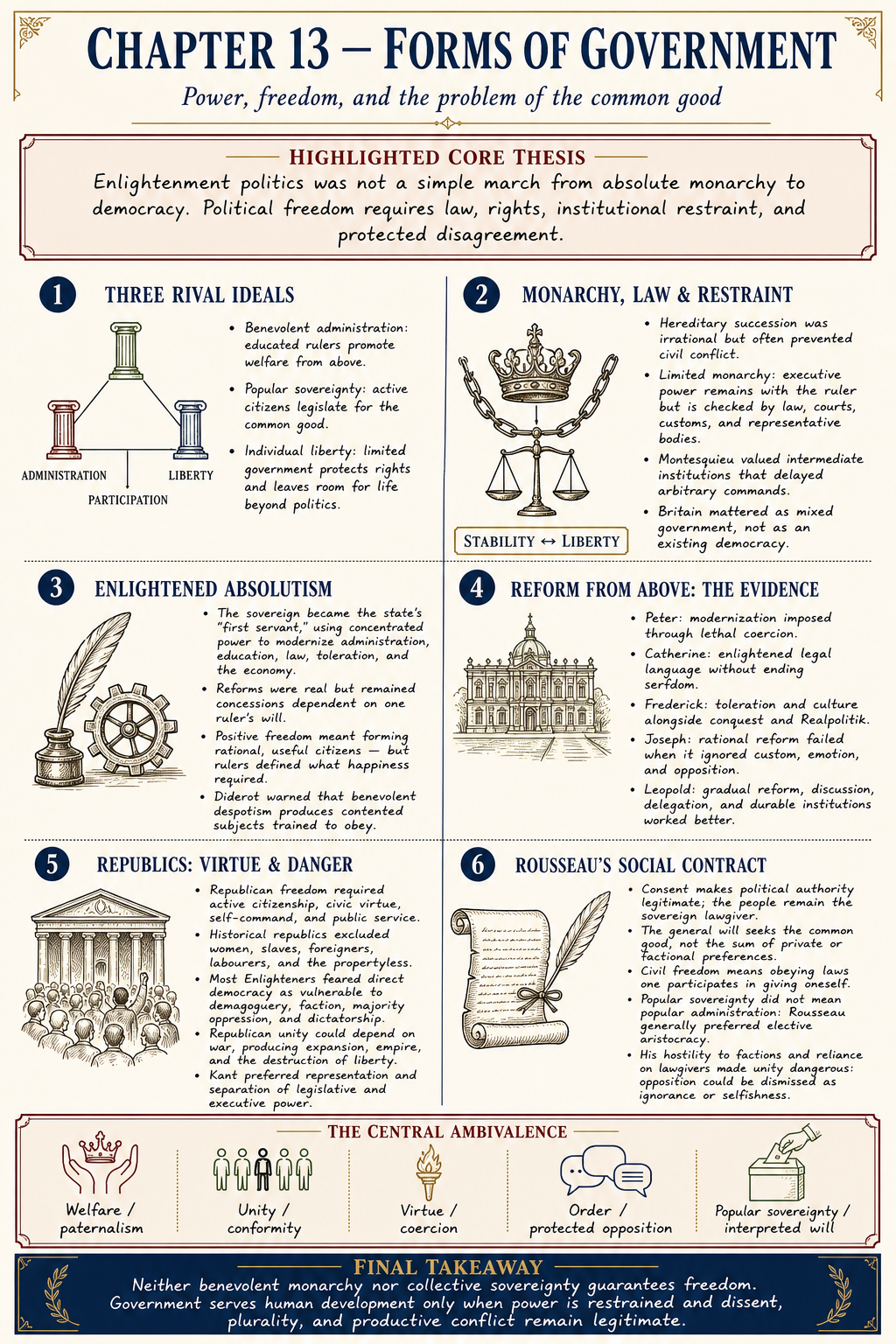
Chapter Objective and Through Line
Robertson argues that Enlightenment political thought was not a straightforward progression from absolute monarchy toward modern democracy. Most eighteenth-century thinkers began from a Europe dominated by monarchies and judged political systems primarily by their ability to secure law, property, order, prosperity, and public happiness. The chapter opens by distinguishing three competing ideals: benevolent government by an educated administrative elite; participatory republican government grounded in popular sovereignty; and a more individualist conception in which government protects rights but otherwise leaves citizens free to develop outside politics. These alternatives reveal that the dispute concerned not merely who should govern, but what freedom, citizenship, and political happiness meant.
The argument proceeds from monarchy to enlightened absolutism, then to republicanism and Rousseau’s social contract. Limited monarchy initially appeared attractive because it combined stability with administration and could theoretically be restrained by law and intermediate institutions. Enlightened rulers then attempted to use concentrated power to modernize states, curb churches and aristocracies, improve education, rationalize law, and increase material welfare. Their reforms were often real, but they remained dependent on the ruler’s personality, could not be securely institutionalized, and treated people as resources whose happiness was defined for them from above.
Republicanism offered the counter-ideal of active citizenship, public virtue, and government by consent. Yet ancient and modern republics appeared exclusionary, factional, unstable, and frequently dependent on war. Rousseau sought to preserve popular sovereignty without accepting direct democratic administration: the people would legislate through the general will, while elected magistrates governed. His model nevertheless reproduced enlightened absolutism’s central danger—the assumption that the common good is singular, knowable, and entitled to suppress resistance. Robertson’s deeper conclusion is that political freedom requires more than benevolent government or collective unity. It requires institutions that preserve disagreement, opposition, and debate rather than treating them as obstacles to rational administration.
Chapter Structure at a Glance
- The chapter establishes three rival political ideals: benevolent administration, participatory popular sovereignty, and individual liberty protected by a limited state.
- Monarchy is secularized and constitutionalized: hereditary rule is defended for stability, but divine right gives way to law, institutional restraint, and administrative competence.
- Enlightened absolutists attempt reform from above: rulers use concentrated power to modernize states and promote welfare, education, toleration, and legal reform.
- The experience of reform reveals absolutism’s structural weakness: its achievements depend on one ruler’s will and its concept of the common good easily becomes paternalistic and coercive.
- Republicanism supplies an ideal of active citizenship and civic virtue, but historical republics appear exclusionary, factional, militarized, and vulnerable to oligarchy or dictatorship.
- Rousseau reconstructs republican freedom around popular sovereignty and the general will, yet his demand for unity makes the free republic resemble the benevolent monarchy it was meant to replace.
Section-by-Section Argument
Monarchy
Monarchy was the normal political form of eighteenth-century Europe, ranging from Britain’s constitutional monarchy to France’s absolutism, Poland’s elective monarchy, Russia’s tsardom, and the numerous principalities of the Holy Roman Empire. Republics existed, but they were small and exceptional. Political thinkers therefore generally asked how monarchy might be improved and restrained rather than assuming that it should be abolished.
Hereditary succession was both monarchy’s chief strength and its obvious irrationality. It could place an infant, incompetent, or mentally ill person on the throne, but it also supplied an accepted rule of succession. Gibbon’s Roman history suggested that where no legitimate successor existed, government might instead be determined by military intervention, civil war, assassination, or even the sale of the imperial office. Hume therefore regarded popular attachment to the rightful heir as a politically useful prejudice: irrational in itself, but conducive to stability.
The eighteenth century increasingly rejected the divine right of kings. Bossuet had portrayed the monarch as God’s representative, possessing authority beyond constitutional restraint. Locke’s attack on Filmer dismantled the claim that royal authority descended from Adam’s paternal power. Hume observed that describing a king as God’s vicegerent would by his time provoke laughter rather than reverence.
Kingship was consequently redefined in secular and practical terms. Even Louis XIV’s private instructions emphasized administration, finance, diligence, state interest, and glory more than divine charisma. A king’s legitimacy increasingly depended upon performance: protecting law, securing the state, and promoting the welfare of the population.
Monarchical power nevertheless had to be limited. Enlighteners distinguished between:
- Absolute monarchy: the ruler possesses supreme authority but is restrained by law, custom, institutions, and established interests.
- Despotism: power is arbitrary and acknowledges no durable legal or institutional restraints.
- Limited or constitutional monarchy: executive power belongs to the monarch, but legislation, taxation, and justice are divided among other institutions.
Montesquieu regarded monarchy as a political system sustained by honour. The ambitions of the ruler would be counterbalanced by the pride and independence of nobles, magistrates, courts, and corporate institutions. Legal bodies served the public precisely by delaying royal commands and forcing hurried rulers to confront established law. Gibbon likewise thought liberty required armed nobles, property-owning commons, and representative assemblies capable of resisting an ambitious prince.
Britain appeared to embody this balance. The Crown exercised executive authority; the Lords represented aristocratic power; and the Commons represented the people. Voltaire and Montesquieu praised a system in which the monarch could act effectively but was supposedly prevented from doing harm.
The reality was less admirable:
- Parliamentary seats were controlled by aristocratic patrons.
- Bribery and election expenditure were routine.
- Depopulated “rotten boroughs” retained representation, while large new cities had none.
- Members of Parliament did not necessarily reside among or answer to their nominal constituents.
- Only a small property-owning minority participated in elections.
Britain was therefore important less as an existing democracy than as an example of mixed government, separation of powers, and political authority restrained by rival institutions.
Enlighteners were particularly suspicious of empires. Large territories required military force and centralized authority to retain distant provinces, making despotism structurally likely. Tyranny also corrupted subjects morally. Fear and dependency replaced frankness with secrecy, flattery, duplicity, and coded resentment.
Yet the possibility of a benevolent despot remained attractive. A virtuous sovereign might overcome privileged interests and enact reforms that representative institutions would obstruct. Admirers cited the Antonine emperors as evidence that concentrated authority could produce peace and prosperity.
Gibbon supplied the essential qualification. Roman subjects may have been happy under the Antonines, but they purchased security by surrendering liberty. Since Rome controlled nearly the entire known world, a person dissatisfied with its government had nowhere else to go. Good administration under an absolute ruler therefore remained vulnerable to succession: the system that empowered a Marcus Aurelius also empowered a Commodus.
Enlightened Absolutism
Enlightened absolutism describes rulers and ministers who retained supreme power while claiming to use it rationally for the welfare of the state and its subjects. Its characteristic formula was Frederick II’s statement that the sovereign was not the people’s master but the state’s “first servant.”
These rulers generally sought practical rather than philosophical enlightenment. Their recurrent objectives included:
- Modernizing administration and taxation.
- Strengthening armies and state finances.
- Limiting ecclesiastical independence.
- Reforming education and training officials.
- Promoting agriculture, industry, and infrastructure.
- Reducing torture and arbitrary legal procedures.
- Expanding limited religious toleration.
- Disciplining populations into productive and obedient subjects.
Their reforms demonstrate that Enlightenment ideas could operate through states rather than solely against them. But they also expose the tension between human improvement and administrative control.
Peter the Great modernized Russia through direct coercion. He constructed a navy, reorganized the nobility into a service hierarchy, subordinated the Orthodox Church, established technical schools, standardized administration, encouraged manufacturing, and adopted Western calendars, dress, and titles. St Petersburg symbolized Russia’s new orientation toward Europe.
The costs were extreme. Tens of thousands of conscripted workers built St Petersburg in lethal conditions; nobles were compelled to relocate there; opponents were tortured or executed; and Peter’s own son died after interrogation. Peter could therefore appear simultaneously as a legislator and an executioner. His project embodied a persistent problem: could people meaningfully be said to have been enlightened when they were forced into civilization?
Catherine II engaged more directly with Enlightenment thought. Her Instruction for a new Russian legal code drew extensively on Montesquieu and Beccaria. It affirmed equality before the law, opposed torture, condemned monopoly, and proposed legal institutions capable of mediating absolute power.
The limits were equally clear:
- Catherine did not abolish serfdom.
- The number of serfs increased during her reign.
- Serfs were forbidden to petition the government against their owners.
- Most legal reforms were obstructed by the aristocracy.
- Her power politics in Poland and against the Ottoman Empire contradicted the image of a purely civilizing monarch.
Her correspondence with Voltaire illustrates the danger of philosophers attaching themselves to rulers. Voltaire repeatedly interpreted Russian expansion as a campaign for toleration and enlightenment, even describing Russian forces in Poland as ministers of peace. He eventually recognized that rulers had used intellectuals to legitimize policies whose real purposes were strategic.
Frederick II most clearly dramatized the conflict between enlightened principle and Realpolitik. His Anti-Machiavel condemned conquest, deceit, personal ambition, and government through fear. The ruler should love his country, keep promises, and sacrifice his passions to public duty.
Frederick’s conduct repeatedly contradicted this programme. Soon after taking power, he invaded Silesia despite Prussia’s prior commitment to respect Maria Theresa’s inheritance. He later launched a pre-emptive invasion of Saxony and fought the Seven Years’ War, in which approximately 400,000 Prussian subjects died while European territorial boundaries remained effectively unchanged.
Frederick could defend these actions through reason of state: international politics resembled a hostile arena in which failure to strike first might invite encirclement or conquest. But that argument made his repudiation of Machiavelli largely rhetorical. Rousseau and Herder concluded that he had refuted Machiavelli in theory only to follow him in practice.
Frederick encouraged art, philosophy, science, religious toleration, and the Berlin Academy. Yet he controlled administration personally and delegated little. His government therefore illustrates enlightened absolutism’s institutional defect: reforms and freedoms remained concessions granted by one ruler rather than rights protected against future rulers. After his death, the system could not carry his administrative burden or permanently secure his achievements.
Joseph II carried reforming absolutism furthest. He sought to convert the multilingual and institutionally fragmented Habsburg territories into a rational, centralized state. His measures included:
- Toleration for Protestants, Orthodox Christians, and Jews.
- Restrictions on papal authority and state control of clerical appointments.
- Dissolution of contemplative monasteries and redirection of their property toward public uses.
- Reform of clerical education.
- Increased mobility and occupational freedom for peasants.
- Limits on landlords’ punitive authority.
- Liberalized censorship.
- Compulsory education and administrative reorganization.
Joseph believed these reforms expressed an objectively discoverable common good. He therefore required ministers to adopt his principles rather than deliberate over them. His virtues—energy, accessibility, personal austerity, and devotion to public service—became sources of failure because they encouraged haste and micromanagement.
His burial decree exemplifies the problem. To conserve timber, he ordered bodies to be sewn into reusable sacks rather than buried in coffins. He understood the material logic but dismissed emotional, religious, and customary attachments as irrational. Public fury forced him to withdraw the order.
His toleration was similarly conditional. Bohemian deists who refused to register under one of the recognized churches were conscripted, deported, or separated from their children because they did not fit the state’s administrative categories. Joseph’s state tolerated only beliefs it could classify.
He gradually restricted the press he had liberalized, alienated the Church, civil servants, provincial elites, Hungarians, and inhabitants of the Austrian Netherlands, and provoked rebellion. He died convinced that his reforms had failed. Robertson’s explanation is political rather than merely administrative: Joseph assumed that truth and reason would command assent and therefore failed to build coalitions, negotiate with opposition, or respect the social meanings attached to inherited practices.
Joseph’s brother Leopold of Tuscany provides the contrast. Leopold ruled a smaller and more homogeneous territory, but he also proceeded gradually, relied on capable advisers, encouraged public discussion, delegated locally, and contemplated a constitution that would restrict his own power. His example suggests that enlightened reform worked better when it created durable institutions and enlisted participation rather than depending upon personal command.
The careers of Pombal in Portugal and Struensee in Denmark reveal another weakness. Powerful ministers could reform universities, law, administration, censorship, and social policy, but their authority depended entirely upon royal favour. Once the ruler died, changed allegiance, or ceased protecting them, they possessed no independent political base. Reform from above was therefore both rapid and precarious.
Across these regimes, education was promoted less as intellectual emancipation than as state formation. Schools supplied officials, soldiers, technicians, disciplined workers, and socially useful citizens. Frederick doubted that ordinary people could become enlightened and therefore preferred to reinforce “useful prejudices.” Joseph limited higher education to practical administrative requirements. Public debate was welcomed only when it offered constructive criticism of policies already established by the ruler.
The crucial concept was the common good. Enlightened monarchs described themselves as servants or delegates of the people. Their decrees were issued not as expressions of personal will but as requirements of general welfare. Yet the welfare of individuals was frequently subordinated to the strength and productivity of the state. Subjects mattered as population, labour, revenue, military personnel, and administrative resources.
This represented what would later be called positive freedom: freedom to become the rational, useful, and happy person one ought to be. Its danger was that another person—the ruler or administrator—claimed superior knowledge of what that fulfilled life required.
Diderot therefore argued that even the government of a just and enlightened prince remained bad. Benevolence trained subjects to obey and made them vulnerable to a foolish or wicked successor. The right to resist remained sacred even when resistance appeared unreasonable. Otherwise, prosperous subjects were merely contented sheep led through rich pastures.
Enlightened absolutism’s fundamental mistake was its expectation of unanimity. Once superstition and ignorance had been removed, the common good supposedly became self-evident. This left no legitimate role for opposition. But Kant’s unsociable sociability suggested that disagreement is not merely a residue of error. Human beings possess conflicting interests and perspectives, and societies develop through argument and contestation. A system that abolishes conflict in the name of reason may abolish an essential mechanism of improvement.
Republics
Republicanism offered a different conception of human fulfilment. A fully developed person was not merely a secure and prosperous subject but an active citizen who participated in collective decisions, defended the polity, and subordinated private interest to the common good.
Classical Athens and Rome supplied the principal models. Pericles’ Athens regarded political disengagement not as private independence but as failure to perform one’s human and civic function. Republican liberty therefore required civic virtue: public spirit, military courage, self-discipline, and willingness to serve.
The historical record was discouraging. Athens became imperial, succumbed to demagoguery, and was defeated. Sparta preserved discipline through militarization and suppression of individuality. Rome’s expansion generated factional conflict and military power until Augustus replaced the republic with empire.
Modern republics were no more reassuring:
- Sweden’s Age of Liberty severely restricted the monarchy, but power shifted to oligarchic committees, social groups remained unrepresented, factions paralysed government, and the Diet persecuted critics. Gustav III’s monarchical coup was welcomed by some Enlighteners because it abolished torture and restored legal security.
- Venice appeared stable but excluded most inhabitants and maintained rule through secrecy, informers, arbitrary imprisonment, and the Council of Ten.
- The Dutch Republic declined into an oligarchy in which offices were controlled or sold by a narrow circle of families.
These examples separated republican language from republican freedom. A government could call itself a republic while concentrating power in an oligarchy or suppressing civil liberties.
Ancient democracy was also radically exclusionary. Women, slaves, foreigners, and labourers were outside the citizen body. Hume calculated that no Athenian law was approved by more than a small fraction of those required to obey it. Political participation depended upon the labour of excluded populations.
The scale of ancient republics posed another obstacle. Direct democracy seemed possible only where a few thousand citizens knew one another and possessed approximately similar economic circumstances. In large societies, inequality and competing interests would weaken civic unity.
Most Enlighteners consequently distrusted democracy, understood as direct rule by the people. They associated it with:
- Demagoguery and manipulation.
- Disorder and unstable assemblies.
- Factional hatred.
- Inadequate knowledge of complex affairs.
- Majority oppression of dissenters.
- Eventual dictatorship.
Kant even distinguished democracy from republicanism. Democracy was potentially despotic because a temporary majority claimed to speak for the entire people, including those who disagreed. A genuine republic instead required representation and separation between legislative and executive powers.
Even radical critics of hierarchy such as d’Holbach did not advocate popular government. He believed society should serve working people but should be governed by educated and prudent representatives capable of understanding interests that the people themselves might misidentify.
Representation generally presupposed property. Property owners were viewed as politically independent, invested in social stability, and capable of responsible judgement. Political rights were not yet thought to follow automatically from adulthood or personhood.
The Enlightenment position on equality was correspondingly limited:
- Human beings shared a common nature and equal moral rights.
- Rank and education exaggerated differences that were not wholly natural.
- People were nevertheless unequal in abilities, talents, property, and social influence.
- Attempts to impose substantive equality threatened property and social order.
- Equality before the law was essential; equality of condition was not.
Diderot could therefore reject factual equality as dangerous while defending legal equality. This apparent contradiction reflected a widespread belief that equal rights were compatible with hierarchical society and unequal political participation.
Republican thinkers were preoccupied with faction. Parties appeared to divide the polity into hostile camps whose members valued sectional victories above national welfare. Religious and civil factions could hate one another more intensely than foreign enemies.
A minority tradition, running from Machiavelli through Montesquieu, reached the opposite conclusion. Rome’s conflicts between nobles and people had preserved liberty by preventing either side from becoming dominant. A tranquil republic might actually be an unfree one in which opposition had been silenced. Modern constitutional politics would eventually adopt this minority view by recognizing parties and organized interests as legitimate components of government.
Classical republicans tried to suppress faction by cultivating equality, simplicity, agrarian independence, and military service. Luxury and commerce appeared dangerous because they encouraged private ambition, dependency, and attachment to wealth.
Harrington’s Oceana offered an elaborate agrarian republic:
- Landownership would be widely distributed.
- Primogeniture would be restricted.
- Independent landowners would bear arms and hold office.
- Offices would rotate to prevent oligarchy.
- A large representative chamber would coexist with a smaller senate.
The system was unsuitable for commercial modernity. Constant rotation prevented political expertise, restrictions on property could be evaded, and distrust of movable wealth ignored the realities of trade. More fundamentally, Harrington sought to design an unchanging constitution. His ideal polity achieved stability by preventing innovation, making the republic an end in itself rather than an institution serving continued human development.
The republican preference for militias presented a related problem. Citizen-soldiers seemed safer than standing armies, which monarchs could use against their populations. Yet republican solidarity often depended on external danger. Rome remained united through warfare and deteriorated after eliminating Carthage.
This generated a destructive logic:
- Republican virtue requires unity and sacrifice.
- Unity is strengthened by fear of external enemies.
- The republic therefore benefits politically from war.
- Successful war produces territorial expansion.
- Expansion requires permanent military power and centralized administration.
- The republic becomes an empire and destroys its own liberty.
The historical republic was therefore not a simple alternative to monarchical despotism. Its pursuit of virtue could produce militarism, conformity, factional persecution, and imperial domination.
Rousseau and the Social Contract
Rousseau emerged from the Enlightenment while attacking several of its central assumptions. His first Discourse denied that the progress of arts and sciences produced moral improvement. Refinement, politeness, learning, and luxury concealed insincerity, vanity, dependence, and loss of civic courage.
His positive standard was a simple society in which citizens valued virtue, freedom, and defence of the fatherland more than wealth or artistic distinction. The argument directly challenged the claim that material progress and moral progress naturally reinforced one another.
The Discourse on Inequality extended the critique into a conjectural history of humanity. Natural human beings were solitary, peaceful, healthy, and governed by self-preservation and pity. Rousseau did not finally idealize this presocial condition as a practical alternative. His more attractive primitive stage arose when families and neighbouring communities formed through affection and freedom.
Social development simultaneously enlarged human capacities and produced corruption:
- Family and community created love and cooperation.
- Dancing, singing, and comparison generated vanity, envy, and shame.
- Metallurgy and agriculture required specialized labour.
- Cultivated land became private property.
- Property intensified inequality and domination.
- Laws preserved unequal relations without morally improving the people.
- Social appearance separated from reality, making individuals dependent on others’ opinions.
Civilization therefore made the individual more sophisticated while making the species less happy and less authentic.
Rousseau’s later political solution emerged from the natural-law and social-contract tradition. Pufendorf had described political society as a sequence of agreements through which fearful and vulnerable people established government. Locke argued that naturally equal individuals entered civil society to protect life, liberty, and property.
Locke’s theory made consent the source of political legitimacy. Government existed because the governed had authorized it; when it attacked their liberty or property, they could resist and ultimately replace it. Taxation likewise required consent through representatives.
The weakness was tacit consent. Locke treated continued residence as evidence that a person accepted a government. Adam Smith objected that this resembled claiming that someone carried aboard a ship while asleep had consented to remain because the surrounding ocean left no practical means of departure.
Rousseau transformed the contract. It was not an agreement between rulers and ruled but an agreement through which isolated individuals reconstituted themselves as a collective sovereign. Each person submitted to the general will and became part of a body politic.
The exchange involved two forms of freedom:
- Natural freedom meant acting according to immediate desire but remaining exposed to insecurity and physical necessity.
- Civil or positive freedom meant obeying laws one had participated in giving oneself and thereby developing into a rational and responsible person.
The social contract therefore transformed the individual from an isolated animal into a human citizen. Freedom became self-government and disciplined participation in a moral community.
The famous statement that a citizen may be “forced to be free” follows from this conception. An individual may wish to enjoy the benefits of citizenship while refusing its obligations. The political community may compel compliance because the individual has already joined a system of reciprocal rights and duties. Rousseau does not mean that any private preference can be suppressed at will, but he does make personal freedom subordinate to the conditions of collective citizenship.
The general will is directed toward the good of the community as a whole. It differs from:
- The will of one ruler.
- The sum of private desires.
- The majority preference of a faction.
- The interests of a particular class or association.
Because it represents the community’s rational best interest, Rousseau treats it as incapable of willing injustice toward the political body. Laws created by the sovereign people are therefore acts of collective self-legislation. Obeying them is compatible with freedom because citizens obey rules they have given themselves.
Rousseau nevertheless opposed factions. Organized groups substitute their corporate positions for citizens’ independent judgements and distort the process through which the general will emerges. Every citizen should therefore express an individual opinion rather than vote as a member of a party.
Popular sovereignty did not mean popular administration. Rousseau distinguished the sovereign, which legislates, from the government, which executes the laws. He considered three governmental forms:
- Democracy might function in an exceptionally small, equal, simple state but would remain vulnerable to civil conflict.
- Monarchy might administer a large territory efficiently but risked subordinating public welfare to royal interest.
- Elective aristocracy—government by citizens selected for wisdom and integrity—was generally best.
Rousseau’s declared principles were therefore that sovereignty belonged permanently to the people while elective aristocracy supplied the best practical government.
He rejected representative sovereignty. The people could elect temporary magistrates to administer policy, but they could not transfer their sovereign lawmaking authority. Regular popular assemblies would scrutinize officials, prevent usurpation, reaffirm the social contract, and allow the people to recognize themselves as a collective body.
Citizenship demanded extensive participation. Public service should be a principal activity rather than a function purchased through taxation. Rousseau even preferred personal labour obligations to taxes because citizens should directly perform work for the community rather than pay others to discharge their duties.
His model responded to Geneva’s oligarchic politics. Genevan patricians argued that the people had contracted away active political liberty in return for private security. Rousseau answered that freedom could not be alienated. A person remained free only by participating in the sovereign body and obeying self-imposed law.
Robertson cautions against treating The Social Contract as a simple blueprint for totalitarianism:
- Rousseau did not give the sovereign unlimited authority over private life.
- Natural law continued to impose moral limits.
- His economy could retain commercial exchange.
- He wanted to prevent extreme inequality rather than abolish private property.
- His model applied to particular social conditions, not every state.
Serious problems nevertheless remain. Rousseau introduces a quasi-mythical Lawgiver, an extraordinary intelligence capable of understanding a people and designing institutions that reshape its character. His preferred example was Lycurgus, whose Spartan constitution enforced equality, austerity, military discipline, and hostility to innovation.
Schiller’s comparison of Lycurgus with Solon reveals the danger. Lycurgus made patriotism the sole virtue, suppressed arts, travel, commerce, change, and individual development, and treated the state as an end. Solon left Athens open to future development. Schiller’s principle was that the state exists only as a condition for the cultivation of human capacities; it must never become humanity’s final purpose.
Rousseau’s system similarly values unity over contestation:
- Factions are forbidden.
- Differences are expected to cancel out rather than remain organized.
- Assemblies reaffirm solidarity more than they deliberate.
- The people may not know what is good for them.
- Magistrates and lawgivers therefore interpret the general will.
- The ultimate political objective is unity and unanimity.
The result is a disturbing convergence. The enlightened monarch claims to know the common good and gives it administrative form. Rousseau’s general will also knows the common good, but cannot speak directly, so wise magistrates articulate it. In both systems, opposition can be dismissed as ignorance, selfishness, or irrationality.
Rousseau’s free republic thus becomes a mirror image of enlightened absolutism. Both promise to transform individuals into rational and virtuous citizens; both depend on exceptional leaders; and both struggle to recognize disagreement as legitimate. A few years later, the French Revolution would test whether popular sovereignty could avoid reproducing the coercion of the monarchy it displaced.
Key Concepts and Distinctions
- Limited monarchy: A monarchy in which the ruler retains executive authority but is restrained by laws, courts, representative bodies, customs, and intermediate institutions.
- Significance: It allowed Enlighteners to preserve monarchical stability without accepting divine right or arbitrary government.
- Enlightened absolutism: Reforming government by a sovereign who retains supreme power while claiming to act as the state’s first servant and promote the common good.
- Significance: It demonstrates both the practical achievements of Enlightenment government and the fragility of reforms dependent on one ruler’s will.
- Common good: The welfare, security, prosperity, and strength of the political community as a whole.
- Significance: It justified reform but often subordinated individual preferences and rights to administrative definitions of collective welfare.
- Positive freedom: Freedom understood as becoming one’s rational or morally developed self through participation in a lawful community.
- Significance: It underlies both enlightened paternalism and Rousseau’s citizenship, while creating the danger that others may decide what a person ought to become.
- Republican virtue: The willingness to participate in government, defend the polity, restrain private interests, and act for the public good.
- Significance: It supplied republicanism’s moral ideal but was difficult to sustain without equality, discipline, exclusion, or external conflict.
- Popular sovereignty: The principle that ultimate legislative authority belongs to the people and cannot permanently be transferred to a ruler or representative body.
- Significance: Rousseau separates it from government, allowing the people to remain sovereign while elected magistrates administer the state.
- General will: The rational will directed toward the good of the political community rather than the aggregate of private or factional preferences.
- Significance: It connects law with collective self-government but risks allowing magistrates to suppress opposition while claiming to represent the people’s true interest.
Essential Evidence and Examples
- Peter’s St Petersburg: The new capital symbolized Russia’s modernization and European orientation, but its construction through conscripted labour and mass death shows how practical enlightenment could be imposed through extreme coercion.
- Frederick’s Anti-Machiavel and the invasion of Silesia: His contrast between moral political theory and aggressive Realpolitik demonstrates that a philosopher-king could redefine conquest as rational state necessity without abandoning enlightened rhetoric.
- Joseph’s burial decree: The attempt to save timber by replacing coffins with reusable sacks shows how administratively rational reform could fail when it ignored religious, emotional, and customary meanings.
- Sweden’s Age of Liberty: A constitution praised as exceptionally free became oligarchic, factional, and legally oppressive, while an absolutist coup abolished torture. The case disrupts any simple equation between republican form and actual liberty.
- Diderot’s contented sheep: His argument that even benevolent absolutism habituates people to submission identifies why welfare without a protected right of opposition remains politically dangerous.
- Lycurgus and Solon: Lycurgus creates a unified but static military state; Solon leaves society open to development. Their contrast clarifies whether the state should manufacture virtue or provide the conditions in which diverse human capacities can grow.
Chapter Conclusion and Significance
Robertson concludes that Enlightenment political thought cannot be reduced either to defence of enlightened monarchy or to the birth of democratic republicanism. Monarchy offered stability and administrative capacity but required institutional restraints. Enlightened absolutism produced toleration, legal reform, education, and modernization, yet its achievements remained discretionary and its pursuit of welfare often treated people as instruments of state power. Republics celebrated active citizenship but historically excluded most inhabitants, encouraged factional persecution, depended on military virtue, and repeatedly became oligarchies, dictatorships, or empires.
Rousseau’s achievement was to make consent and popular sovereignty central to political legitimacy while distinguishing sovereignty from day-to-day administration. His weakness was the same one that afflicted enlightened absolutism: insufficient recognition of legitimate plurality. Whether embodied in a ruler or the general will, a political authority claiming exclusive knowledge of the common good may interpret opposition as error and unity as freedom. The chapter’s contribution to the book’s broader argument is therefore cautionary: government promotes human happiness not simply by administering well or embodying collective sovereignty, but by preserving law, rights, institutional restraints, dissent, and the productive conflict through which individuals and societies continue to develop.
Questions for Reflection
- Are the achievements of enlightened absolutists evidence that concentrated power can sometimes advance human welfare more effectively than representative government, or do their failures show that reforms without institutionalized opposition are inherently unstable?
- Can Rousseau’s distinction between the general will and the aggregate preferences of citizens protect a community from factional selfishness without giving magistrates unlimited power to define the people’s “true” interests?
- Is political participation necessary for full human development, as classical republicans and Rousseau maintain, or is freedom better protected when citizens can pursue worthwhile lives largely outside politics?
Chapter 14: Revolutions
Chapter Objective and Through Line
Robertson examines the American and French Revolutions as possible climaxes of the Enlightenment’s pursuit of human happiness. Both revolutions invoked universal ideals: the American Declaration identified life, liberty, and the pursuit of happiness as unalienable rights, while the French Constitution of 1793 declared common happiness the goal of society. Yet Robertson rejects any simple account in which a coherent “radical Enlightenment” produced an international democratic revolution. The two events differed fundamentally in origins, ambitions, political environments, and outcomes. More importantly, ideas do not translate directly into political action. They supply language, principles, and possible institutional designs, but political crises generate their own momentum through conflicts over power, war, fear, economic hardship, faction, and institutional collapse.
The American Revolution began largely as a defence of inherited British liberties against parliamentary encroachment. It became an experiment in written constitutional design, representative government, divided powers, and the management of conflicting interests. Its framers did not assume exceptional civic virtue; they tried to construct institutions in which ambition would check ambition. The resulting republic became an influential, though severely compromised, model of Enlightenment government because it reconciled popular sovereignty with institutional restraints while preserving slavery and limited political participation.
The French Revolution sought not merely independence or constitutional repair but the regeneration of an entire society. Fiscal breakdown, hunger, institutional paralysis, royal betrayal, popular mobilization, civil war, foreign invasion, and factional fear radicalized the Revolution faster than any intellectual programme could control. Rousseau’s language of virtue, popular sovereignty, and the indivisible general will proved more congenial to Jacobin politics than the gradualism of mainstream philosophes. The chapter then traces the Revolution’s effects on the late English Enlightenment and identifies four enduring legacies: competing liberalisms, the unstable boundary between patriotism and nationalism, proposals for international peace, and the universal ideal of human rights. The central question is whether Enlightenment ideals can guide political improvement without becoming instruments of coercive unanimity or utopian violence.
Chapter Structure at a Glance
- Robertson separates the American and French Revolutions from a single revolutionary narrative, arguing that political events must be explained through power and circumstance as well as ideas.
- The American colonists transform a defence of traditional British liberties into a constitutional republic, combining natural rights, popular sovereignty, representation, and institutional restraints.
- The American Constitution manages rather than abolishes self-interest and faction, but its universal language remains compromised by slavery, restricted suffrage, and elite government.
- The French Revolution moves rapidly from constitutional reform to social transformation, as economic crisis, institutional breakdown, royal resistance, popular activism, and war destroy the possibility of stable moderation.
- The Terror emerges from escalating fear and factional politics, not from a philosophical blueprint, although Rousseauian concepts of virtue and the general will help revolutionaries justify unity and repression.
- The Revolution stimulates a late English Enlightenment, generating arguments among Burke, Wollstonecraft, Paine, and Godwin over inheritance, rights, reason, reform, and political authority.
- The chapter concludes with unresolved Enlightenment legacies: individual versus social liberalism, patriotism versus nationalism, realism versus idealism in international relations, and natural rights versus legally enforceable rights.
Section-by-Section Argument
The American Revolution
Robertson presents the American Revolution as both an Enlightenment event and a distinctly British struggle. Educated colonial elites read Locke, Hume, Montesquieu, natural-law theorists, and other European authors. Nevertheless, the colonists initially understood themselves not as inventors of a wholly new society but as defenders of English liberties violated by an overreaching Parliament.
Their historical imagination reached back to struggles against the Stuart monarchy. Unapproved taxation, an established Church, standing armies, and executive encroachment recalled the conflicts surrounding Charles I. The Stamp Act, Tea Act, commercial restrictions, and Parliament’s claim to bind the colonies without direct representation therefore appeared as parts of a familiar pattern of arbitrary government.
- The colonists’ material burdens were not exceptionally severe by European standards. What mattered was their growing conviction that they were politically mature communities entitled to govern themselves.
- Local assemblies had accustomed Americans to political participation and administration.
- Parliament’s doctrine of “virtual representation” was unconvincing to colonists who had no representatives they could select or hold accountable.
- British coercion transformed what might have remained a constitutional dispute into a movement for separation.
The Revolution combined several intellectual traditions rather than following a single doctrine. Historians have alternately emphasized Lockean liberalism—natural rights, property, and limited government—or classical republicanism—civic virtue, active citizenship, and resistance to corruption. Robertson gives greater weight to the broader radical Whig and natural-law traditions. Classical examples supplied rhetoric, but no serious founder intended to recreate Athens, Sparta, or Rome.
The founders accepted the importance of virtue but did not believe government could depend upon it. A successful constitution had to work with ordinary human motives, including ambition and self-interest. Political design would channel these motives so that citizens and officeholders pursuing their own interests also protected the public order.
The Declaration of Independence marked the transition from resistance to sovereignty. Its immediate function was probably to declare the colonies independent and enumerate George III’s violations. Its subsequent authority as a charter of universal rights arose from the claim that all people possessed equal and unalienable rights to life, liberty, and the pursuit of happiness.
Robertson emphasizes several ambiguities:
- “Self-evident” truths rested on the Enlightenment concept of generally accessible right reason or common sense, not on a detailed philosophical demonstration.
- “All men” could mean male citizens or humanity generally.
- The universal assertion conflicted immediately with the exclusion of women and the enslavement of Africans.
- Colonists who described British policy as an attempt to “enslave” them often owned actual slaves.
The contradiction was visible from the beginning. Abolitionists used the Declaration’s own logic against slavery. Lemuel Haynes argued that an African possessed the same right to liberty as an Englishman. Jefferson and others admitted slavery’s injustice while failing to free those they owned or to establish general emancipation. Universal language therefore exceeded the intentions and practices of many who formulated it.
After independence, the central problem was how to establish a durable republic through “reflection and choice” rather than historical accident. The Articles of Confederation created an executive too weak to tax effectively, finance the army, or coordinate the states. Meanwhile, state constitutions often concentrated power in annually elected, single-chamber legislatures. To Jefferson, this risked replacing monarchical despotism with elective despotism.
The Constitution of 1787 addressed two symmetrical dangers:
- Popular power might be abused: temporary majorities could act impulsively, persecute minorities, follow demagogues, or destroy democratic government.
- Elite power might be abused: representatives, judges, and executives could become a self-perpetuating class detached from the population.
The institutional response included:
- Separation of legislative, executive, and judicial powers.
- A bicameral Congress elected through different mechanisms.
- A president selected indirectly through an electoral college.
- A federal division between national and state authority.
- Periodic elections and a later Bill of Rights.
- Checks allowing each institution’s interests to restrain the others.
Paine imagined that equality and representation might remove most temptations to corruption. Hamilton and Madison were less optimistic. Human beings were neither universally virtuous nor universally corrupt. A constitution should therefore compensate for imperfect motives by arranging rival interests so that “ambition must be made to counteract ambition.”
The same realism governed the treatment of factions. Traditional republican thought regarded factions as mortal dangers to the common good. Madison accepted that abolishing them would require abolishing liberty. A large federal republic could instead multiply interests, preventing any single faction from easily dominating the whole. Local representatives would remain connected to constituents, while national representatives could consider broader interests.
The American settlement thus rejected both direct democracy and the Rousseauian hope for an undivided popular will. It presumed that society contained durable disagreements requiring negotiation and institutional balance. Virtue would become partly the product of a well-designed constitution rather than the moral prerequisite for establishing one.
Robertson nevertheless stresses the republic’s limitations:
- Political rights remained tied to sex, race, and often property.
- Women lacked constitutional voting rights.
- The Constitution preserved slavery.
- Enslaved people were counted as three-fifths of persons when allocating representation, increasing the political power of slaveholding states.
- The compromise necessary to establish the Union embedded a contradiction that later constitutional procedures could not peacefully resolve.
The United States became the first important modern example of a republic founded upon human rights, representation, equality, and reasoned constitutional construction. But it was an imperfect model rather than the full realization of its principles.
The French Revolution
The French Revolution began under conditions fundamentally different from those in America. France faced fiscal insolvency after expensive wars financed by borrowing, an unequal tax system that protected privileged orders, widespread poverty, a disastrous harvest, rising bread prices, unemployment, and fears intensified by rumour. Institutional paralysis made reform nearly impossible: the parlements resisted new taxation, while the Estates General retained an antiquated division into clergy, nobility, and commons.
Once the Third Estate declared itself the National Assembly, reform accelerated:
- Feudal dues and personal servitude were abolished.
- Access to office was formally opened without distinction of birth.
- Tithes and clerical privileges were curtailed.
- The Declaration of the Rights of Man and the Citizen proclaimed legal freedom and equality.
- Church property was nationalized.
- Historic provinces were replaced with rationalized departments.
- Hereditary nobility and titles were abolished.
- Clergy became elected public officials required to swear loyalty to the state.
Each measure weakened another inherited institution and made the next reform possible. This generated a self-reinforcing political dynamic. Moderation became increasingly difficult because any attempt to stop reform disappointed radicals while failing to reconcile those whose status and property had been overturned.
The constitutional monarchy also lost its indispensable element: trust in the monarch. Louis XVI accepted limitations while secretly exploring counter-revolution. His attempted flight in June 1791 and correspondence with émigrés confirmed fears that he intended to reverse the Revolution with foreign assistance. Austrian and Prussian intervention then made royal authority appear inseparable from external invasion.
Political participation broadened through clubs, newspapers, pamphlets, municipal sections, public galleries, demonstrations, and food protests. The sans-culottes became a significant force in Paris, while women participated in marches and riots. Robertson refuses to classify these actors simply as either the sovereign people or an irrational mob.
Popular action arose from:
- Genuine hunger and economic insecurity.
- Experience of governmental secrecy and elite privilege.
- Fear of military repression and foreign invasion.
- A culture familiar with harsh public violence.
- Rumours of aristocratic, clerical, and foreign conspiracies.
- Deliberate agitation by journalists and political leaders.
Crowd violence could be purposeful and politically manipulated at the same time. The September Massacres, for example, reflected panic about prisoners joining advancing enemy armies. The attackers created makeshift tribunals and released many prisoners, but killed the rest brutally. Such procedures neither excuse the violence nor reduce it to random savagery.
The revolutionary claim to embody “the people” was itself misleading. Parisian activists did not represent overwhelmingly rural France. Peasants and provincial communities frequently resisted the revolutionary government, especially its attack on religious customs, the Civil Constitution of the Clergy, royal executions, and military conscription. The Vendée became a large-scale civil war, and revolutionary forces answered resistance with mass killing.
War was the decisive radicalizing force. Brissot, Condorcet, and other leaders imagined that war would unify France, strengthen the Revolution, and spread liberty abroad. Robespierre initially warned that foreign peoples would not welcome “armed missionaries.” His warning proved justified. French armies described territorial expansion as liberation, but occupied peoples soon encountered requisition, plunder, and coercion.
War produced several connected consequences:
- Military setbacks encouraged suspicion of treason.
- Internal disagreement became evidence of conspiracy.
- Emergency institutions concentrated power.
- Political survival depended on denouncing rivals first.
- Moderate and radical factions destroyed one another successively.
- Violence became increasingly detached from identifiable acts of opposition.
The Committee of Public Safety, Law of Suspects, revolutionary tribunals, and Law of 22 Prairial created the machinery of the Terror. Vaguely defined offences such as weakening revolutionary energy or circulating false news became capital crimes. The Girondins, Hébertists, Dantonists, and finally Robespierre’s own faction fell in sequence.
The Terror’s significance did not lie only in execution totals. Hundreds of thousands experienced arrest, imprisonment, uncertainty, and the continual danger of denunciation. Fear entered everyday life. The distinction between loyal citizen and enemy became impossible to establish because even conspicuous patriotism could be interpreted as a disguise.
Robertson suggests that Louis XVI’s execution may have breached an important political and psychological taboo. The king had recently been constitutionally declared sacred and inviolable. Trying and killing him as “Louis Capet” desacralized monarchy through public violence. Each subsequent execution then made the next easier, while the accumulation of deaths intensified the perceived need to continue. The Terror became a ratchet process that no single leader, including Robespierre, fully controlled.
The Revolution and Enlightenment Ideas
Robertson rejects the claim that the Terror was the direct implementation of Enlightenment philosophy. Mainstream Enlighteners generally favoured gradual reform through education, changing opinion, legal improvement, and cooperation with existing institutions. Even d’Holbach opposed violent revolution, regicide, and political convulsion as likely routes to renewed tyranny.
The revolutionaries nevertheless drew on themes developed in Enlightenment debate:
- Government existed to promote public happiness.
- Citizens should be equal before the law.
- Noble and ecclesiastical privilege required reform.
- Sovereignty could not rest solely on dynastic inheritance.
- Political institutions should be justified through public reason rather than mystery or tradition.
But the Jacobins frequently rejected the Encyclopedists as materialists, atheists, elitists, and dependants of monarchs. Rousseau exercised far greater emotional and political authority. Robespierre admired him as a model of persecuted virtue and drew especially on the general will and civic festivals.
The danger arose when the general will was treated as necessarily indivisible and correct. Empirical citizens who disagreed could be interpreted as mistaken about their own good or as enemies acting against the people. Sincere commitment to virtue did not restrain violence; it made compromise resemble corruption and opponents resemble moral contaminants.
Other revolutionary practices were not characteristically enlightened:
- Dechristianization violated the Enlightenment commitment to religious toleration.
- The cult of Reason conflicted with Robespierre’s deistic cult of the Supreme Being.
- Revolutionary discourse emphasized sensibility, fraternity, emotional regeneration, and patriotic tears as much as calculation.
- Classical republicanism supplied heroic models and a vocabulary of virtue, conspiracy, and tyrannicide rather than an actual institutional blueprint.
It is therefore misleading to interpret decimal time, administrative reorganization, and the guillotine as the inevitable products of Enlightenment rationalism. The Revolution combined reason, sentiment, classical imagery, popular religion, conspiracy thinking, and political necessity.
Robertson similarly rejects conspiracy theories claiming that philosophes or Freemasons planned the Revolution. The event was largely unforeseen. Enlightenment ideas circulated widely, but so did libels, rumours, political pamphlets, historical memories, and emotional literature.
A purely intellectual explanation is no more adequate than a purely economic one. The missing category is politics, understood as a struggle over power that increasingly organizes society into friends and enemies. Economic crisis created instability; ideas supplied goals and language; political conflict selected and radicalized those ideas.
Why America and France Diverged
The American example demonstrated that a modern republic was possible, and the Declaration of Independence influenced the Declaration of the Rights of Man. Franklin, Paine, Lafayette, and Jefferson connected the two revolutionary worlds. Yet the French Revolution was not simply a second American Revolution.
Several differences shaped their outcomes:
- America was geographically separated from Britain. George III remained thousands of miles away rather than becoming a physically vulnerable symbolic enemy.
- America lacked a dominant capital whose politicized population could pressure national institutions.
- The colonies contained no hereditary aristocracy or Church comparable in power and privilege to those of France.
- Colonists already possessed extensive experience of self-government.
- American independence aimed primarily to recover inherited liberties; French revolutionaries attempted social regeneration.
- American federalism accepted persistent differences among states and interests.
- French revolutionaries tended to imagine the national will as unified.
- The United States accepted bicameralism and checks upon the popular chamber; the French Assembly rejected a second chamber as a recreation of aristocracy.
- America fought a largely defensive war of separation; France combined defence with ideological and territorial expansion.
Robertson identifies two conditions especially conducive to the Terror that were largely absent in America: the opportunity to wage aggressive war against neighbouring states and the pressure of a concentrated, politicized, fearful urban population. American loyalists suffered confiscation, imprisonment, violence, and exile, but political execution never became a systematic governing practice.
The American constitutional system was based on the expectation that citizens and groups would disagree. The French model more often identified democracy with the united will of the people. This distinction between managed pluralism and asserted unanimity helps explain why the former established stable constitutional opposition while the latter repeatedly treated opposition as treason.
Kant nevertheless found hope in the French Revolution. Its actual course was catastrophic, but the enthusiasm it aroused among distant observers revealed a moral commitment to the people’s right to choose their constitution. The Revolution therefore mattered as an imperfect manifestation of an ideal that future generations might pursue more successfully.
At Long Last, an English Enlightenment
Robertson identifies a late English Enlightenment among Dissenters and radicals active from the 1770s through the 1790s. Richard Price, Joseph Priestley, Jeremy Bentham, Mary Wollstonecraft, William Godwin, and related figures formed networks through Dissenting academies, Unitarian congregations, scientific societies, provincial reform circles, and London publishing.
Their common concerns included:
- Religious disabilities imposed on Dissenters.
- Parliamentary corruption and rotten boroughs.
- Restrictions on press freedom.
- The slave trade and slavery.
- Scientific and educational reform.
- Political representation.
- The relation between individual conscience and state authority.
Joseph Johnson’s publishing house and dinner circle provided a major centre. Johnson published theology, science, feminist writing, abolitionist works, political reform literature, and Equiano’s autobiography. This English Enlightenment combined intellectual inquiry with campaigns conducted through publishers, associations, sermons, pamphlets, lectures, and political societies.
The French Revolution initially intensified reformist hopes but soon strengthened conservative reaction. Priestley’s home, laboratory, and library were destroyed by a politically encouraged mob. Reformers were prosecuted for treason, while their Scottish counterparts were transported. Parliamentary reform, which had previously attracted broad support, became associated with regicide, social collapse, and Jacobin conspiracy.
Burke, Wollstonecraft, and Paine
Burke’s Reflections on the Revolution in France defended inherited political institutions against abstract reconstruction. He argued that the Glorious Revolution had preserved traditional liberties rather than establishing a general right to replace rulers. Political order accumulated through history like inherited property and embodied collective wisdom unavailable to isolated reason.
Burke’s strongest claims were:
- Government requires stability and legitimacy.
- Human beings need restraints upon their passions.
- Political institutions are too complex to reconstruct from abstract principles.
- Prejudice can preserve practical wisdom without requiring continual justification.
- Property and established rank encourage long-term responsibility.
- Rights detached from actual institutions may provide little practical protection.
His argument did not rely on divine right. Government was a human arrangement, but one that had to be embedded in historical habits and reverence.
Wollstonecraft answered that Burke’s inherited wisdom concealed corruption. The British Parliament was not a venerable organic order but an unrepresentative system sustained by patronage, drunken elections, aristocratic privilege, and ecclesiastical power. Reverence for antiquity sanctified institutions originating in violence and barbarism.
Her deeper argument was methodological: political claims should be exposed to reasoned examination. Emotional language, tradition, and aesthetic admiration could not substitute for evidence and principles. “Political knowledge” meant opening government to public argument rather than leaving it as an elite mystery.
Experience in France later moderated Wollstonecraft’s revolutionary expectations. After seeing Girondin friends executed, she concluded that durable reform must grow from a society’s historical conditions and maturing understanding rather than be forced prematurely.
Paine’s Rights of Man rejected Burke’s submission of the living to the dead. No generation could bind all its successors. Hereditary legislators were no more rational than hereditary mathematicians; established Churches violated freedom of conscience; and Britain’s electoral system was visibly arbitrary.
Paine’s weakness was excessive confidence. He assumed enlightenment could not be reversed, that republics would be peaceful because rulers and nations would share the same interests, and that representation followed self-evidently from reason. He paid insufficient attention to institutional conflict, counter-revolution, competing economic interests, and the stabilizing role constitutional monarchy might perform.
Godwin’s Political Justice
Godwin developed the most radical English account of Enlightenment reason. He began with private judgement: individuals should decide moral and political questions through conscience and rational inquiry, with government interfering as little as possible.
Reason revealed moral equality and impartial obligation. Personal relationships did not automatically justify preference. In Godwin’s famous example, one should rescue Fénelon rather than his chambermaid from a fire if preserving Fénelon would produce greater benefit for humanity. Likewise, wealth and talent were trusts held for the human race. Everything beyond one’s genuine needs should be directed toward relieving others.
Government perpetuated inequality through force, property arrangements, war, monarchy, and aristocracy. Yet Godwin opposed violent revolution. Error should be overcome through argument and persuasion. As reason spread, criminality, punishment, national conflict, and government itself would progressively disappear.
Godwin’s political vision combined:
- Moral impartiality.
- Radical redistribution through individual duty.
- Minimal government.
- Distrust of majority voting.
- Opposition to bicameralism because truth should be uniform.
- Eventual philosophical anarchism.
His theory exposed difficult moral questions about luxury and global poverty. But it underestimated selfishness, cruelty, attachment, diversity, and disagreement. Like enlightened absolutism and Rousseau’s general will, it assumed that rational people would eventually converge on one truth. Its abolition of political conflict therefore risked producing a colourless unanimity.
Some Enlightenment Legacies
Liberalism
Robertson distinguishes two broad liberal inheritances.
Classical liberalism emphasizes individual self-direction, private property, free exchange, personal responsibility, and a state limited to law, security, and defence. Locke, Smith, Hume, Montesquieu, Paine, and Humboldt contributed different versions.
Its pragmatic form defines liberty as security under impartial law rather than universal political participation. Representative institutions matter because they protect liberty, not because participation is intrinsically fulfilling. Commerce should generally remain free from regulation, although this creates the unresolved problem that merchants left alone may form monopolies.
Humboldt carried individualist liberalism furthest. The purpose of life was the harmonious development of individual capacities. Government should not impose education, religion, morality, marriage rules, or welfare arrangements because these encourage uniformity and dependence. Citizens should create private institutions themselves.
Robertson identifies the central weakness: extreme individualism leaves no clear basis for shared citizenship, public responsibility, universal services, or protection against market inequalities. A society of autonomous individuals may lose the community required to sustain their freedom.
Social or welfare liberalism descends partly from the administrative state’s responsibility for public happiness. It accepts taxation, redistribution, public services, and assistance intended not merely to prevent death but to protect people from degrading poverty and enable personal development.
The tension between the two liberalisms concerns the conditions of freedom:
- Classical liberals fear that public provision creates dependency and coercive uniformity.
- Social liberals argue that formal liberty is hollow where poverty, illness, and lack of education prevent meaningful choice.
- One treats society chiefly as an aggregation of responsible individuals.
- The other believes freedom requires institutions that sustain a community and provide minimum capabilities to its members.
Patriotism and Nationalism
Enlightenment patriotism meant active concern for one’s country’s long-term welfare. It was not necessarily obedience to government. Patriots frequently criticized rulers, provincial divisions, corruption, and short-term interests in the name of a more disinterested national good.
Critical patriotism could be understood as an extension of humanity. A person improved his country without treating foreigners as enemies. It was often oppositional: Hampden, Sidney, Wallace, Dutch Patriots, and critics of royal favourites claimed loyalty to the country rather than to a dynasty or ministry.
Patriotism nevertheless carried several dangers:
- Politicians could disguise ambition as public spirit.
- National loyalty could demand military sacrifice and death.
- War intensified emotional identification with the fatherland.
- The nation could be presented as a timeless natural community rather than a political construction.
- National identity often formed through hostility toward internal and external others.
Revolutionary France illustrates the transition. “Patriot” first meant a citizen opposing despotism, then a supporter of the Revolution, and finally a person whose loyalty had to be continually proven. Foreign cosmopolitans such as Cloots and Paine became suspect. Defensive war developed into expansion toward France’s alleged natural frontiers, while mass conscription fused citizenship, revolution, and military service.
British and French national identities were also shaped through opposition. English nationalism contrasted sincere, blunt John Bull with artificial French refinement and invoked myths of Saxon liberty destroyed by the Norman Conquest. French attitudes increasingly defined Britain as an enduring national enemy. German nationalism later intensified under Napoleonic occupation, but it did not originate the broader European pattern.
The enduring distinction is between:
- Patriotism: critical commitment to improving one’s political community.
- Nationalism: construction and exaltation of a nation through myths, exclusion, emotional mobilization, and rivalry.
World Peace
Enlighteners rejected the traditional celebration of conquerors. Military heroes destroyed provinces; genuinely great people enlarged knowledge, improved government, created prosperity, and established toleration.
Projects for perpetual peace attempted to replace war with international institutions. Saint-Pierre proposed a permanent federation of states, a Senate for arbitration, mutual disarmament, and collective enforcement against aggressors.
Rousseau admired the goal but considered the plan naïve. Princes used war to extend external power, strengthen internal authority, justify armies and taxation, and preserve ministerial influence. International politics did not operate according to states’ rational long-term interests. States, unlike individuals, possessed no natural limit to their ambitions and felt insecure whenever stronger neighbours existed.
Kant answered this realism by distinguishing:
- The political moralist, who adjusts morality to existing conduct and treats present selfishness as permanent human nature.
- The moral politician, who applies universal moral principles while recognizing humanity’s capacity to develop.
Kant’s conditions for peace included:
- No secret reservations in treaties.
- No standing armies or military debts.
- No interference intended to overthrow another government.
- No acquisition of states as dynastic property.
- Representative republican government.
- A federation of free states.
- Eventually, enforceable international law.
Representative republics should be more cautious about war because citizens bear its financial and human costs. A universal monarchy would be a despotism; peace required a federation preserving distinct states.
Kant did not base peace on human goodness. Even a “nation of devils” could recognize that constitutional obedience served mutual survival. Competition and war might, through painful historical experience, push states toward institutions that reason could have recommended without catastrophe. International cooperation therefore emerged from both moral ideals and self-interest.
Robertson regards later international institutions and the declining legitimacy of territorial conquest as partial vindications of Kant. War remains possible through civil conflict, failed states, resources, terrorism, nuclear accident, and unresolved borders. Perpetual peace is not an accomplished condition but a distant regulatory ideal.
Human Rights
Human rights are among the Enlightenment’s most powerful legacies. Their defining qualities are that they are:
- Natural: inherent in human beings rather than granted by rulers.
- Equal: possessed to the same degree by everyone.
- Universal: applicable across governments and societies.
Natural rights differ from traditional liberties. Earlier protesters invoked charters, privileges, and historic immunities. Natural-rights theories claimed moral authority above positive law.
Locke derived rights to liberty, self-preservation, and property from natural law. Property arose when labour was joined to the natural world, but Locke initially limited legitimate acquisition to what a person could use without waste. Burlamaqui connected right reason to humanity’s ultimate goal of happiness and likely contributed to the Declaration’s substitution of the pursuit of happiness for a direct affirmation of property.
The concept nevertheless faces philosophical difficulties:
- Human beings are not empirically born independent; infants are radically dependent.
- Statements about natural freedom seem normative rather than descriptive.
- Different theorists identify different lists of rights.
- Some rights, such as property or employment, presuppose particular stages of social organization.
- Historically changing rights appear difficult to classify as timelessly natural.
Bentham therefore argued that real rights must be created and enforced by law. Natural and imprescriptible rights were “nonsense upon stilts”: either empty declarations or invitations to continual resistance against established legislation. Godwin similarly emphasized duties rather than rights.
The strongest test was slavery. Enlighteners exposed the contradiction between natural equality and an economic system based on human property. Their writings connected European consumption with mutilation, forced labour, and death. But practical emancipation required legal cases, political campaigns, religious activism, and resistance by enslaved people themselves.
The Haitian Revolution gave universal principles an application many European authors had not controlled or anticipated. Enslaved people learned of the Declaration of the Rights of Man, revolted, defeated several imperial armies, forced the French Convention to abolish colonial slavery, and established a state whose constitution prohibited slavery. The language of universal humanity became politically effective when those excluded from its original formulation claimed it for themselves.
Kant’s concept of dignity deepened the basis of human rights. Every rational person possesses unconditional worth because each is capable of moral autonomy. A human being must be treated as an end, not merely as an instrument. Dignity therefore supplies a moral status that does not depend on talent, property, sex, nationality, usefulness, or political recognition.
The late Enlightenment did not yet apply universality consistently. Women, enslaved people, Jews, non-Europeans, and children remained excluded or subordinated. But the universal form of the principle allowed later reformers to expose those exclusions as contradictions rather than permanent exceptions.
Rights that exist only on paper may appear useless in societies marked by trafficking, war, ethnic cleansing, or imprisonment without trial. Burke’s objection therefore remains serious: abstract perfection can conceal practical impotence. Robertson’s Kantian response is that ideals guide action even when unrealized. The existence of human rights as a recognized moral standard enables people to identify injustice, challenge law, organize reform, and direct politics toward a future that does not yet exist.
Key Concepts and Distinctions
- Political dynamism: Political events acquire momentum through struggles for power, institutional decisions, war, fear, and faction rather than simply implementing prior ideas.
- Significance: It prevents the American and French Revolutions from being explained as direct products of Enlightenment philosophy.
- Restorative versus regenerative revolution: The American Revolution initially sought to recover liberties believed to have been violated; the French Revolution attempted to reconstruct institutions, social hierarchy, religion, citizenship, and humanity itself.
- Significance: The distinction explains why French reform became more expansive and destabilizing.
- Constitutional pluralism: A political system that assumes enduring disagreement and divides power among offices, chambers, levels of government, and organized interests.
- Significance: American constitutionalism managed factions rather than attempting to abolish them.
- General will and empirical will: The general will represents the community’s supposedly rational common interest; actual citizens may hold divergent preferences.
- Significance: The distinction can defend public welfare against factional selfishness, but it can also permit rulers to dismiss dissenters as ignorant or treacherous.
- Gradual reform versus revolutionary rupture: Gradualists seek to transform opinions and institutions while preserving continuity; revolutionaries attempt rapid reconstruction when existing structures appear irredeemable.
- Significance: The chapter repeatedly shows that abrupt reform can release political forces no theorist controls, while gradualism may preserve entrenched injustice.
- Patriotism versus nationalism: Patriotism seeks the improvement of one’s country and may remain self-critical; nationalism constructs an exalted national identity through exclusion, historical myth, and rivalry.
- Significance: Revolutionary solidarity can shift from civic commitment to aggression and persecution.
- Natural rights and legal rights: Natural rights claim moral authority independent of government; legal rights exist through enforceable institutions.
- Significance: The former supply standards for condemning unjust laws, while the latter address whether rights possess practical force.
Essential Evidence and Examples
- The constitutional treatment of slavery: The United States proclaimed natural equality while allowing slaveholding states to count enslaved people toward representation. The compromise shows that constitutional stability can preserve an injustice directly opposed to the system’s declared principles.
- America’s bicameralism and France’s rejection of it: American framers assumed that popular and elite bodies might both abuse power and therefore constructed competing checks. French deputies regarded a second chamber as an aristocratic obstruction to the unified national will. The contrast captures the chapter’s distinction between constitutional plurality and revolutionary unanimity.
- The war-driven radicalization of France: Leaders expected war to unify the country and export liberty; instead, invasion, military reversals, economic instability, and conspiracy fears made dissent appear treasonous. The example supports Robertson’s claim that political circumstances—not ideas alone—propelled the Terror.
- The execution of Louis XVI: Killing a monarch recently declared sacred and inviolable removed a major symbolic restraint on political violence. The episode supports the chapter’s account of the Terror as a ratchet process in which each death made subsequent deaths easier.
- Priestley’s destroyed home and the treason trials: Conservative reaction in Britain associated parliamentary reform and religious Dissent with Jacobin revolution. The cases show how the French Revolution narrowed reformist possibilities outside France as well as transforming politics within it.
- The Haitian Revolution: Enslaved people applied universal-rights language more consistently than many European and American revolutionaries. Their success demonstrates how Enlightenment ideals could escape their authors’ limitations and become instruments of emancipation.
Chapter Conclusion and Significance
Robertson concludes that the Enlightenment neither caused the Atlantic revolutions through a direct chain of intellectual influence nor remained separate from them. It supplied indispensable languages of rights, happiness, consent, equality, constitutionalism, public reason, and reform. But political conditions determined which concepts gained authority and how they were used. The American founders institutionalized suspicion of both rulers and majorities, creating a durable but exclusionary republic. French revolutionaries sought social regeneration, but war, fear, faction, and the belief in an indivisible national will transformed liberation into coercion and finally dictatorship.
The revolutions also clarified the Enlightenment’s enduring political tensions. Freedom may require limiting government or enabling it to provide the conditions of independence. Patriotism may improve a community or construct enemies. Peace may demand ideals that political realists dismiss as impractical. Human rights may lack philosophical certainty and institutional enforcement, yet remain indispensable standards against which slavery, oppression, and exclusion can be condemned. The chapter’s contribution to the book’s pursuit-of-happiness argument is therefore double-edged: political ideals can enlarge humanity’s conception of possible happiness, but attempts to impose a single form of collective happiness can destroy the liberty and plurality that make human flourishing possible.
Questions for Reflection
- Does the American Constitution successfully transform ambition and faction into protections for liberty, or does its accommodation of slavery show that checks and balances can stabilize injustice as readily as restrain power?
- How much explanatory weight should be assigned to Rousseau’s general will in the emergence of the Terror compared with war, food scarcity, institutional collapse, and political fear?
- Can human rights remain politically authoritative when their philosophical basis is disputed and their enforcement depends upon states that frequently violate them?
Conclusion: The Battle over the Enlightenment
Chapter Objective and Through Line
Robertson concludes by defending the historical Enlightenment against a long tradition of criticism that treats it as the source of modern domination, cultural uniformity, environmental destruction, capitalism, Communism, racism, and even the Holocaust. His central argument is not that Enlightenment thinkers were free of serious errors. Some promoted paternalism, surveillance, cultural homogenization, racial hierarchy, or utopian social engineering. Rather, “the Enlightenment project” is too reductive a category to explain such contradictory outcomes. It collapses a diverse historical movement into a single doctrine and then attributes to that doctrine nearly every major pathology of modernity. In doing so, critics reproduce the very homogenization they accuse the Enlightenment of imposing on humanity.
The chapter reconstructs how this hostile image developed. Eighteenth-century conservatives portrayed the philosophes as conspirators against Church and monarchy. Romantic and nineteenth-century critics accused them of mechanizing nature, suppressing imagination, and trusting abstract reason over historical experience. In the twentieth century, Horkheimer and Adorno interpreted enlightenment as an instrumental drive to dominate nature and humanity, while Isaiah Berlin depicted the Enlightenment as a monistic faith in universal reason opposed by a pluralistic Counter-Enlightenment. Robertson argues that both accounts mistake selected strands—calculation, materialism, utopianism, or French rationalism—for the whole.
Against these portrayals, Robertson restates the book’s interpretation. Enlightenment reason was primarily argument, criticism, sociability, good sense, and public exchange, not cold mathematical calculation; it operated alongside sympathy, sentiment, passion, imagination, and moral concern. The proper Enlightenment legacy is therefore not a completed system or predetermined model of happiness. It is an open-ended process of experimentation and self-correction. It rejects both naïve faith in inevitable progress and fashionable despair. Its survival depends on an open society, liberal education, accessible public argument, and a “democracy of ideas” in which even attacks on Enlightenment values can contribute to enlightenment by exposing weaknesses and provoking better arguments.
Chapter Structure at a Glance
- Robertson presents the modern indictment: the Enlightenment is accused of producing instrumental reason, environmental destruction, market individualism, totalitarian planning, cultural homogenization, racism, and genocide.
- He rejects the idea of a single “Enlightenment project”: the historical movement was too internally diverse to serve as the unified cause of contradictory modern ideologies.
- He traces anti-Enlightenment narratives historically: conservative conspiracy theories gave way to Romantic attacks on disenchantment, abstraction, and the suppression of organic culture.
- He examines the two most influential twentieth-century critics: Horkheimer and Adorno associated enlightenment with domination, while Berlin contrasted Enlightenment monism with Counter-Enlightenment pluralism.
- He argues that both critiques distort the evidence: they elevate selected thinkers and tendencies while neglecting scepticism, sensibility, sympathy, cultural diversity, and internal disagreement.
- He redefines enlightenment as a continuing process: human betterment depends on criticism, empirical evidence, experimentation, and the willingness to revise even cherished ideals.
- He identifies the political condition of enlightenment: an open society and democracy of ideas are necessary because neither happiness nor progress can be prescribed conclusively in advance.
Section-by-Section Argument
Analytical Division: The Modern Indictment and Its Limits
Critics have charged the Enlightenment with two apparently opposite forms of instrumental rationality. In one, it pursues predetermined ends without moral concern for the means. In the other, it perfects efficient means without asking whether the ends are worthwhile. Science and technology then become tools for exploiting nature, organizing populations, and increasing administrative control.
The resulting indictment is exceptionally broad:
- Liberal capitalism allegedly reduces life to market exchange and isolated individual choice.
- Communism subordinates individuals to centralized planning.
- Universal citizenship supposedly erases cultural difference.
- Racial classifications allegedly establish permanent human inequalities.
- Modern bureaucracy and technology make mass murder possible.
Robertson does not deny the existence of these phenomena or modernity’s role in them. Modern bureaucratic and technological systems did make atrocities such as the Holocaust administratively possible. But capacity does not establish intellectual causation or historical inevitability. Liberalism, Communism, and Fascist racial nationalism are mutually antagonistic political systems. Explaining all three as products of one coherent Enlightenment programme makes the explanation too elastic to be useful.
The category of modernity better captures the immense and tangled changes that produced industrialization, bureaucracy, mass politics, nationalism, imperialism, capitalism, socialism, science, and technological power. Even then, “modernity” names a problem rather than explaining it. Blaming the Enlightenment provides an intellectually convenient scapegoat for developments whose causes are multiple and difficult to separate.
Robertson concedes that examples supporting the critics can be found. Bentham’s Panopticon imagined intrusive surveillance in the name of reform; some utopias portrayed humanity as culturally uniform; and administrators sometimes treated people as objects to be organized for their own supposed welfare. But these were strands within a much wider movement, not the movement’s single essence.
The chapter’s methodological principle follows: historical interpretation must preserve internal diversity. A concept that explains everything by eliminating distinctions ultimately explains very little.
Analytical Division: From Conservative Conspiracy to Romantic Reaction
Hostility to enlightenment began before historians had defined “the Enlightenment” as a period. Conservative defenders of throne and altar accused the French philosophes of forming an organized conspiracy to destroy Christianity and political authority.
The accusation was implausible:
- The philosophes disagreed and quarrelled frequently.
- Voltaire was a deist rather than an atheist.
- Most sought reform through rulers rather than revolution from below.
- Their political preferences ranged from limited monarchy to republicanism.
The existence of Freemasonry, semi-secret associations, and the Bavarian Illuminati nevertheless made conspiracy narratives emotionally persuasive. After 1789, the French Revolution seemed to confirm that philosophers had deliberately prepared the destruction of the old order. Burke, Barruel, and others interpreted revolution as the culmination of an international intellectual plot.
Romantic criticism changed the emphasis from conspiracy to spiritual impoverishment. Novalis portrayed Enlightenment as the final stage in the world’s disenchantment: religion, imagination, art, enthusiasm, and organic unity had been replaced by a mechanical universe governed by impersonal laws. Nature became a machine rather than a spiritually animated whole.
Robertson recognizes the emotional force of this critique but reverses its interpretation. Demystifying nature did not necessarily make the world empty. It could direct attention toward earthly existence as humanity’s actual home and reveal nature itself as a rich source of wonder, emotion, and imagination.
Nineteenth-century British writers similarly characterized the French philosophes as sterile sceptics. Wordsworth attacked Voltaire’s irreverence; Carlyle accused the Encyclopedists of creating nothing positive. In France, the relation was more complicated because republican institutions claimed the heritage of 1789 and appropriated Voltaire as an anti-clerical precursor. Yet Tocqueville and Taine still charged philosophes with abstract theorizing detached from practical government and historical experience.
In Germany, intellectual historians constructed an opposition between a shallow, rationalistic French Enlightenment and a deeper German movement based on genius, history, emotion, creativity, and cultural particularity. This national contrast later shaped both Berlin’s Counter-Enlightenment and anglophone interpretations of the eighteenth century.
The significance of this history is that later critics often inherited earlier polemical categories without recognizing their origins. “Enlightenment rationalism” was partly produced by Romanticism, nationalism, confessional conflict, and retrospective interpretation rather than discovered as an uncontested historical fact.
Analytical Division: Horkheimer, Adorno, and the Dialectic of Domination
Horkheimer and Adorno’s Dialectic of Enlightenment offered the most influential left-wing attack. Their subject was not primarily the eighteenth-century movement but the broader process by which humanity seeks liberation from fear through reason and mastery over nature.
Their argument proceeds dialectically:
- Humanity separates itself from nature to gain security.
- Nature becomes an object to classify, quantify, manipulate, and exploit.
- Instrumental reason values knowledge chiefly as a means of control.
- Because human beings are also natural, domination extends inward through repression of instinct and emotion.
- Repressed nature returns as fear, aggression, and irrationality.
- Enlightenment’s attempt to abolish myth culminates in new forms of mythology, conformity, and domination.
Mathematics symbolizes the problem because it reduces qualitative difference to abstract equivalence. The same logic supposedly underlies applied science, bureaucratic administration, capitalism, mass production, the culture industry, and Fascist totalitarianism.
Robertson argues that this is a philosophical critique of modernity rather than a credible history of the Enlightenment. Its eighteenth-century representatives are highly selective: Mandeville, Kant, Bentham, and even Sade become emblematic, while Voltaire’s scepticism, Diderot’s imagination, Hume’s moderation, and the era’s extensive moral psychology of sympathy and sentiment disappear.
Horkheimer and Adorno therefore elevate one strand—egotism and instrumental calculation—into the whole. Their “enlightenment” becomes an unhistorical compound of nearly everything they oppose: positivism, science, capitalism, liberalism, mass culture, and Fascism.
Their analysis is also incomplete politically. It identifies Nazi totalitarianism and liberal capitalism as outcomes of enlightenment but gives inadequate attention to Soviet Communism, where a declared project of human improvement produced terror, famine, forced labour, rigid planning, and ecological destruction.
Robertson nevertheless acknowledges the critique’s historical importance. It gained influence when environmental damage, industrial exploitation, and mass consumer culture became increasingly visible. Horkheimer and Adorno intended, at least partly, to rescue enlightenment from its destructive tendencies. Their error was to portray science and technology as containing an inherent movement toward domination. Technologies provide capacities; institutions, authorities, moral purposes, and political choices determine how those capacities are used.
By presenting regression as inherent and perhaps unavoidable, the argument also weakens human agency. Criticism that makes catastrophe inevitable encourages despair rather than reform.
Analytical Division: Isaiah Berlin and the Myth of Enlightenment Monism
Isaiah Berlin’s account differs politically from Horkheimer and Adorno’s but resembles it structurally. Berlin defended liberty and pluralism against Soviet totalitarianism, yet portrayed the Enlightenment as committed to monism: the belief that all genuine questions have one true answer, all truths are compatible, and reason can eventually construct a harmonious social order valid for everyone.
In Berlin’s reconstruction, the philosophes believed that human beings were naturally good or perfectible, while ignorance, poverty, tyranny, and priestcraft prevented happiness. Once reason discovered the laws governing nature and society, rational institutions could remove those obstacles.
Robertson argues that Berlin homogenized very different thinkers:
- Voltaire’s scepticism is absorbed into optimistic rationalism.
- Rousseau is grouped with philosophes he frequently opposed.
- Diderot’s exploratory and dialogical thought disappears.
- Condorcet’s confident progressivism becomes representative of the entire movement.
- British epistemologists are acknowledged separately but do not substantially modify Berlin’s general thesis.
Berlin’s Enlightenment becomes the ancestor of socialist and technocratic utopias that claim to possess the final solution to human problems. His Counter-Enlightenment then appears as the defence of feeling, cultural particularity, historical difference, creativity, and plural values.
The major figures in this counter-tradition include Vico, Hamann, and Herder. Yet Robertson argues that Herder in particular cannot be cleanly separated from the Enlightenment. His defence of cultural diversity, historical understanding, common humanity, and Humanität developed within Enlightenment debates rather than outside them.
Berlin’s dichotomy reproduces an older German intellectual narrative inherited through Dilthey and Meinecke: an abstract, universalizing Anglo-French reason opposed to a historically sensitive German understanding of culture. Through Berlin, this nineteenth-century construction became influential in the English-speaking world.
The irony is decisive. Berlin accused Enlightenment thinkers of monism, but his own depiction imposed a monistic interpretation on a movement characterized by disagreement over religion, government, morality, commerce, sensibility, progress, cultural diversity, and human nature.
Analytical Division: Enlightenment as Self-Critical Experiment
Robertson’s positive reconstruction begins by acknowledging that “the Enlightenment” is itself a retrospective category. The word originally described a process; only later was it attached to a historical period. Its present transnational scope emerged gradually through twentieth-century scholarship.
Historical construction does not make the category invalid. Robertson accepts that the Enlightenment was both diverse and sufficiently connected to constitute a meaningful phenomenon. Its unity lies not in a uniform philosophical creed but in overlapping practices and aspirations:
- Improving human life.
- Challenging inherited authority.
- Extending knowledge through argument and evidence.
- Making inquiry public and accessible.
- Comparing institutions and cultures.
- Reforming law, education, religion, economics, and government.
- Expanding sympathy and moral concern.
- Correcting error through criticism.
Its goals cannot be narrowly predetermined. Any system that claims to know in advance the final form of human happiness becomes oppressive because it excludes novelty, disagreement, and future development. Lycurgus’s static Sparta, behaviourist utopias, paternalistic states, and homogeneous future societies share this defect.
The proper process of enlightenment is therefore continuous experimentation and self-correction. It applies criticism to its own assumptions as rigorously as it applies criticism to tradition.
This position rejects two symmetrical errors:
- Naïve progressivism: the assumption that humanity necessarily becomes more rational, peaceful, prosperous, or moral.
- Facile pessimism: the conviction that modern history is simply decline and that every apparent improvement conceals domination.
Robertson maintains that long-term evidence supports real, though incomplete and reversible, progress in areas such as material security and human rights. Statistical evidence is preferable to impressions dominated by the media’s focus on immediate catastrophe. Numbers require source criticism, but they can test narratives that survive only through repetition and selective anecdotes.
Climate change remains the gravest current threat and an example of technological power used without adequate moral or political restraint. Yet recognizing danger should encourage corrective action rather than prove that destruction was encoded in Enlightenment science from the outset.
The necessary political environment is an open society. Enlightenment depends on liberal education, public accessibility, freedom of inquiry, and a democracy of ideas. The essays of Voltaire, Hume, and Lessing exemplify an intellectual culture that addresses a wide public rather than restricting knowledge to technical elites.
Criticism of Enlightenment ideals is therefore not merely tolerated but necessary. Critics sometimes expose actual failures; at other times, their exaggerations force defenders to clarify evidence and refine their arguments. Even an inaccurate attack can become enlightening when it enters a process of open critical reasoning.
Key Concepts and Distinctions
- “The Enlightenment project”: A polemical abstraction that treats the Enlightenment as a single unified programme responsible for modern social and political developments.
- Significance: Robertson argues that the phrase erases historical diversity and makes contradictory outcomes appear to share one intellectual cause.
- Instrumental reason: Reason reduced to selecting efficient means for controlling nature, institutions, or people, without evaluating the moral worth of the ends.
- Significance: It is central to Horkheimer and Adorno’s critique but represents only one possible use of reason, not Enlightenment reason as a whole.
- Reason as argument: Public, social, revisable reasoning conducted among people who may disagree, closely related to good sense rather than abstract calculation.
- Significance: This is Robertson’s principal correction to the idea of the Enlightenment as a cult of mathematical rationality.
- Disenchantment: The replacement of supernatural or spiritually animated interpretations of nature with causal, scientific explanation.
- Significance: Romantic critics view it as cultural impoverishment; Robertson argues it can also deepen appreciation of the natural and earthly world.
- Enlightenment monism: The alleged belief that one universal reason can produce a single harmonious answer to all moral, political, and cultural problems.
- Significance: Berlin’s criticism depends on this model, but Robertson argues that it misrepresents the movement’s internal pluralism.
- Counter-Enlightenment: Berlin’s category for thinkers emphasizing feeling, history, cultural particularity, creativity, and value pluralism against universal reason.
- Significance: The category identifies genuine later developments but falsely removes figures such as Herder from the Enlightenment debates that formed them.
- Self-correcting enlightenment: An open-ended process that tests evidence, criticizes assumptions, learns from failure, and refuses to define the final form of human happiness.
- Significance: It is Robertson’s ultimate defence of the Enlightenment and the book’s central normative conclusion.
Essential Evidence and Examples
- Bentham’s Panopticon: The design demonstrates that Enlightenment reform could treat people mechanically and justify surveillance through promised welfare. Its unbuilt status also shows the danger of treating a notorious proposal as representative of an entire era.
- The philosophes conspiracy theory: Conservative claims that Voltaire, Diderot, Freemasons, and Illuminati deliberately organized the French Revolution illustrate how political fear first manufactured the image of a unified and subversive Enlightenment.
- Horkheimer and Adorno’s use of Sade: Treating Sadean emotional detachment as parallel to scientific objectivity shows how their argument selects extreme examples while ignoring sympathy, moral sentiment, and sociability.
- Berlin’s placement of Herder in the Counter-Enlightenment: Herder’s cultural pluralism appears to refute Enlightenment universalism, yet his Humanität and comparative history also express Enlightenment commitments to common humanity and critical inquiry.
- Long-term statistical evidence of progress: Robertson uses quantitative evidence as a corrective to both automatic optimism and impressionistic pessimism. The example supports his claim that progress must be investigated empirically rather than asserted or denied as a doctrine.
Chapter Conclusion and Significance
Robertson concludes that the Enlightenment should be neither canonized as an infallible foundation of modernity nor blamed as the single source of modern oppression. Its thinkers made grave errors and sometimes imagined coercive, homogeneous, or paternalistic futures. But they also developed powerful practices of criticism, sympathy, public reasoning, empirical inquiry, cultural comparison, toleration, and reform. The historical Enlightenment is best understood as a diverse field of argument united by the attempt to improve human life.
Its continuing value lies precisely in its incompleteness. Enlightenment is not a destination at which reason has solved politics and prescribed happiness. It is the continuing effort to enlarge human agency through knowledge while correcting the misuse of knowledge through criticism. It requires confidence that improvement is possible, scepticism toward claims of inevitability, and institutions that preserve disagreement. The battle over the Enlightenment is therefore itself part of enlightenment: its critics compel renewed examination, while its defenders must remain willing to revise the tradition they defend.
Questions for Reflection
- Does Robertson’s emphasis on the diversity of Enlightenment thought adequately answer structural critiques of modern instrumental rationality, or does it risk treating recurring patterns as isolated exceptions?
- Can a movement be meaningfully described as a single Enlightenment if its participants disagreed fundamentally about reason, religion, culture, government, morality, and progress?
- How can societies preserve confidence in empirical and moral progress without converting that confidence into either technological triumphalism or a predetermined model of human happiness?
Distilled Knowledge
What this source contributes
Robertson provides the cluster’s broadest reconstruction of the eighteenth century: one connected but internally contested Enlightenment, organized less by abstract reason than by the practical pursuit of human happiness through criticism, evidence, sympathy, sociability, and reform.
Reusable concepts
- Plural Enlightenments — reconciles Robertson’s international field with real national, confessional, and institutional variation.
- Enlightenment as Practical Reform — turns the book’s chapters on toleration, religion, sensibility, sociability, government, law, health, poverty, and political economy into a reusable mechanism.
- Institutions of Intellectual Openness — captures Robertson’s concluding dependence on public argument, liberal education, corrigibility, and a democracy of ideas.
Claims and disputes
- The phrase “the Enlightenment project” often treats a diverse historical field as one doctrine and then assigns contradictory modern outcomes to it.
- Diversity does not erase culpable strands: paternalism, surveillance, racial hierarchy, cultural homogenization, imperial participation, and social engineering require direct assessment.
- The best defense of enlightenment is self-correcting experiment, not inevitability, perfected rational administration, or a predetermined model of happiness.
- Reason should be distinguished as public argument and good sense from instrumental calculation that optimizes means without judging ends.
Use the existing Counter-Enlightenment claim ledger for claim-by-claim testing, the Christianity fact-check for the religious genealogy, and the rupture-or-development map for the cross-source synthesis.
Position and writing route
- My Assessment of the Enlightenment
- The West Did Not Simply Replace Faith with Reason