Zibaldone 2024–2025 journal
Journal connection: Conspiracy-thinking frameworks and A Conflict of Visions connections.
Source boundary: These are captured journal materials; the integration does not independently verify every clipped claim, quotation, or figure.
PDF++ pages: p. 264 (file not included in this release) · p. 349 (file not included in this release)
Embedded previews:
Zibaldone 2024-2025.pdf (file not included in this release)
Zibaldone 2024-2025.pdf (file not included in this release)
Open the complete Zibaldone page index
Psychology
1) The core psychological “needs” conspiracy beliefs often serve
- Sense-making under fear and uncertainty: when people feel threatened or unsure, they become more vigilant and search harder for explanations; conspiracies offer a coherent story with clear causes and culprits. (PMC)
- Restoring control: uncertainty/lack of control increases the urge to find meaning and causal structure; conspiracies can feel like regaining grip on a chaotic world (even if the explanation is wrong). (PMC)
- Social/identity needs (“in the know”): conspiracies can provide belonging (to a community of believers) and status (“I see what others don’t”). (PMC)
2) Cognitive mechanisms that make conspiracies feel compelling
- Overactive pattern perception: people sometimes see patterns in randomness; under fear/uncertainty, that tendency is more likely to “overfire,” producing meaning where there is coincidence.
- Overactive agency detection (“someone did this on purpose”): humans are built to detect intentional agents; conspiracies intensify this into “a hidden group planned it,” often assuming sophisticated intent rather than error or incompetence.
- Intuition over analysis: conspiracy susceptibility tends to rise when people rely more on intuitive “feels true” judgments (especially in fast, emotional, online contexts). (American Psychological Association)
- Illusory truth from repetition: repeated claims feel more familiar and therefore more believable; conspiracy slogans and talking points exploit this by circulating constantly across channels. (Annual Reviews)
- Narrative preference: conspiracies deliver a tidy story (motive → villains → plot → cover-up) that can feel more “complete” than complex, probabilistic real-world explanations. (PMC)
Haidt, Chapter 4 — desired beliefs get permission; hostile evidence faces prosecution
Haidt uses Tom Gilovich’s distinction between asking “Can I believe it?” and “Must I believe it?” Desired claims need only one usable support; unwelcome claims can be dismissed after one objection. Search engines magnify the asymmetry because a user can search the conclusion, find a congenial expert or study, and mistake successful retrieval for a representative evidence review.
For conspiracy claims, record the proposition and search protocol before browsing: What result would count against the theory? Are the same methodological flaws disqualifying when they appear in friendly evidence? Did the search include the strongest nonconspiratorial explanation and sources outside the identity group? Haidt’s examples illustrate motivated stopping rules; they do not show that every heterodox claim is false or that criticism of institutions is itself pathological. Motivated reasoning and unequal burdens, PDF pp. 107–108 (file not included in this release) · Group identity and attitude polarization, PDF p. 109 (file not included in this release) · Chapter 4 source audit
3) Social and group dynamics that drive conspiratorial thinking
- Perceived intergroup conflict: conspiracies thrive when “us vs. them” feelings are strong; suspicion rises toward powerful, dissimilar, or distrusted outgroups.
- Distrust of institutions: deep distrust in authorities and rapid social/technological change can create a “default suspicion” mindset where official accounts are discounted. (PMC)
- Polarization + echo chambers: social feeds and group sorting can amplify perceived consensus (“everyone I see agrees”), normalize extreme interpretations, and reward conspiratorial content with attention and engagement. (World Health Organization)
4) Why conspiracy beliefs persist even after correction
- Self-sealing logic: “lack of evidence” becomes evidence of cover-up; contradictory facts get reframed as deception, making beliefs resilient. (PMC)
- Continued influence effect: once a causal story is learned, it can keep shaping judgments even after debunking—unless a correction supplies a clear alternative explanation. (Center for Climate Change Communication)
5) Common “manipulation tactics” that frequently package conspiracy content
- In Foolproof, misinformation is taught as a set of repeatable techniques (DEPICT): Discrediting, Emotion, Polarization, Impersonation, Conspiracy, Trolling—useful as a checklist when you’re diagnosing content.
- Emotion is a force multiplier: outrage/fear accelerates sharing and reduces careful evaluation; conspiracy content is often engineered to provoke. (World Health Organization)
DEPICT
DEPICT is a handy way to remember six common “building blocks” of misinformation/disinformation campaigns—techniques meant to make claims feel true, spread faster, and weaken people’s ability to judge evidence. Van der Linden describes these as a taxonomy of manipulation techniques (including polarization, emotional manipulation, conspiracy, impersonation, and trolling).
Discrediting
What it is: Attacking trust rather than addressing the claim. The target can be a person (a journalist, scientist, whistleblower), a process (elections, peer review), or an institution (courts, “the media,” universities).
How it works (psychologically):
- Shifts the debate from “Is the claim true?” to “Can I trust anyone?”
- Creates permission to dismiss inconvenient evidence without engaging it (“they’re all corrupt anyway”).
- Leans on motivated reasoning: people accept negative “explaining-away” stories about sources they already dislike.
Common moves / telltale patterns: - Ad hominem: “She’s paid off,” “He’s a grifter.”
- Vague corruption claims with no specifics (“everyone knows…”).
- “Fact-checkers are biased” (pre-emptive inoculation against correction).
- Cherry-picking minor errors to imply total unreliability.
Counters (practical): - Separate source trust from claim verification: ask “What would count as evidence either way?”
- Look for primary documents/data and independent corroboration.
- Watch for “global dismissal” language (“nothing they say can be trusted”).
Emotion
What it is: Using anger, fear, disgust, outrage, or moral shock to drive attention and sharing—often via vivid stories, loaded language, and urgency.
How it works:
- Emotional arousal increases impulsive sharing and reduces careful evaluation.
- Emotion can become a substitute for evidence (“If it upsets me, it must be real/important.”)
Common moves / signals: - Rage-bait framing (“You won’t believe what they did…”)
- Catastrophic certainty (“This proves society is collapsing.”)
- Urgency (“Share before it’s deleted.”)
- Graphic anecdotes standing in for base rates or broader data.
Counters: - Pause and label the emotion: “This is designed to make me angry/scared.”
- Ask: “What’s the strongest verifiable evidence here?”
- Prefer boring, checkable specifics (dates, documents, full quotes, raw footage context).
Polarization
What it is: Pushing an us-versus-them worldview; turning disagreements into identity battles; framing opponents as evil, stupid, or dangerous.
How it works:
- Polarization increases tribal sorting (“my side” vs “their side”) and makes people judge claims by who says it.
- It pressures people to share/endorse content as a loyalty signal, not because it’s accurate. Van der Linden explicitly lists “polarizing groups in society” as a core technique.
Common moves / signals: - False dilemmas: “Either you support X or you hate Y.”
- Dehumanizing labels, sweeping generalizations (“they always…”).
- “Your enemies are laughing at you”—status/shame triggers.
- Framing compromise as betrayal.
Counters: - Translate identity claims into concrete, testable propositions.
- Seek “cross-cutting” confirmation: can you find support from sources outside the tribe?
- Steelman the opposing view before judging it (forces you back into evidence mode).
Impersonation
What it is: Pretending to be an expert, a public authority, a reputable organization, or a legitimate grassroots account—sometimes with forged branding, fake credentials, or manipulated media.
How it works:
- Exploits authority cues (titles, logos, professional tone).
- Piggybacks on the credibility of institutions people rely on. Van der Linden describes “impersonating fake experts and official organisations” as one of the core techniques.
Common moves / signals: - “Expert” accounts with no traceable affiliations.
- Slightly-off URLs/handles (extra letters, swapped characters).
- Screenshots of “official statements” with no source link.
- Deepfakes or clipped video that removes critical context.
Counters: - Verify identity via official websites and trusted directories (not the viral post itself).
- Check account history (creation date, prior content, engagement patterns).
- When it’s a document/screenshot: look for the original publication.
Conspiracy
What it is: Explaining events as the product of secret plots by powerful actors; casting mainstream explanations as deliberate cover-ups; offering a “hidden truth” narrative.
How it works:
- Gives people a feeling of insider insight and moral clarity.
- Often becomes self-sealing: lack of evidence is treated as evidence of the cover-up.
- Shifts burden of proof (“If you can’t disprove it, it’s true.”)
Van der Linden gives an example headline that uses the conspiracy technique—blaming “a small group of rich bankers” manipulating bitcoin—to cast doubt on mainstream narratives via a secret cabal story.
Common moves / signals: - Unfalsifiable claims (“They control everything.”)
- Pattern-matching coincidences into intent.
- Moving goalposts; endless “questions” without standards of proof.
- Overuse of “they,” “elites,” “globalists,” “cabal,” etc., without specifics.
Counters: - Ask for a clear claim with falsifiability: “What observation would change your mind?”
- Compare with simpler explanations that fit known incentives and constraints.
- Demand evidence quality (documents, verifiable witnesses, chain of custody).
Trolling
What it is: Provocation and disruption—baiting emotional reactions, derailing discussions, flooding platforms, and turning conversation into spectacle. Van der Linden lists “trolling people and online conversations” as a core technique.
How it works:
- Forces opponents into reactive mode, wasting attention and creating the impression of chaos.
- Rewards outrage with visibility (“engagement”).
- Can make falsehoods feel “everywhere,” even when they’re fringe.
Common moves / signals: - “Just asking questions” paired with refusal to accept any answer.
- Whataboutism and constant topic shifts.
- Insults framed as “humor,” ironic detachment, meme warfare.
- Coordinated swarming/dogpiling.
Counters: - Don’t debate the troll’s frame; respond once (if needed) with a concise correction + source, then disengage.
- Enforce boundaries (mute/block/moderate).
- Move the discussion to settings that reward good faith (long-form, slower pace, clear rules).
6) What actually helps reduce susceptibility (without “making people gullible”)
- Prebunking / psychological inoculation: expose people to weakened examples of manipulation + explain the technique, so they build resistance before encountering real conspiracy content. (NCBI)
- Debunking best practices: lead with the fact, warn about the misleading claim, explain what’s wrong, and give an alternative explanation (don’t just repeat the myth). (Center for Climate Change Communication)
- Reduce uncertainty and increase agency where possible: environments that reduce insecurity and increase voice/fairness can reduce suspicion dynamics.
- Use technique-based “spot the trick” literacy: training people to recognize manipulation patterns generalizes better than arguing each individual claim. (NCBI)
Ben Shapiro’s QED Framework
- Not skepticism: Skepticism would be you and look for the evidence. This is questioning and not looking for any evidence before you throw out a theory.
- Intellectual cowardice dressed up as critical thinking.
- In order to have a functioning polity you have to have a common set of facts
From Book ‘Lions and Scavengers’
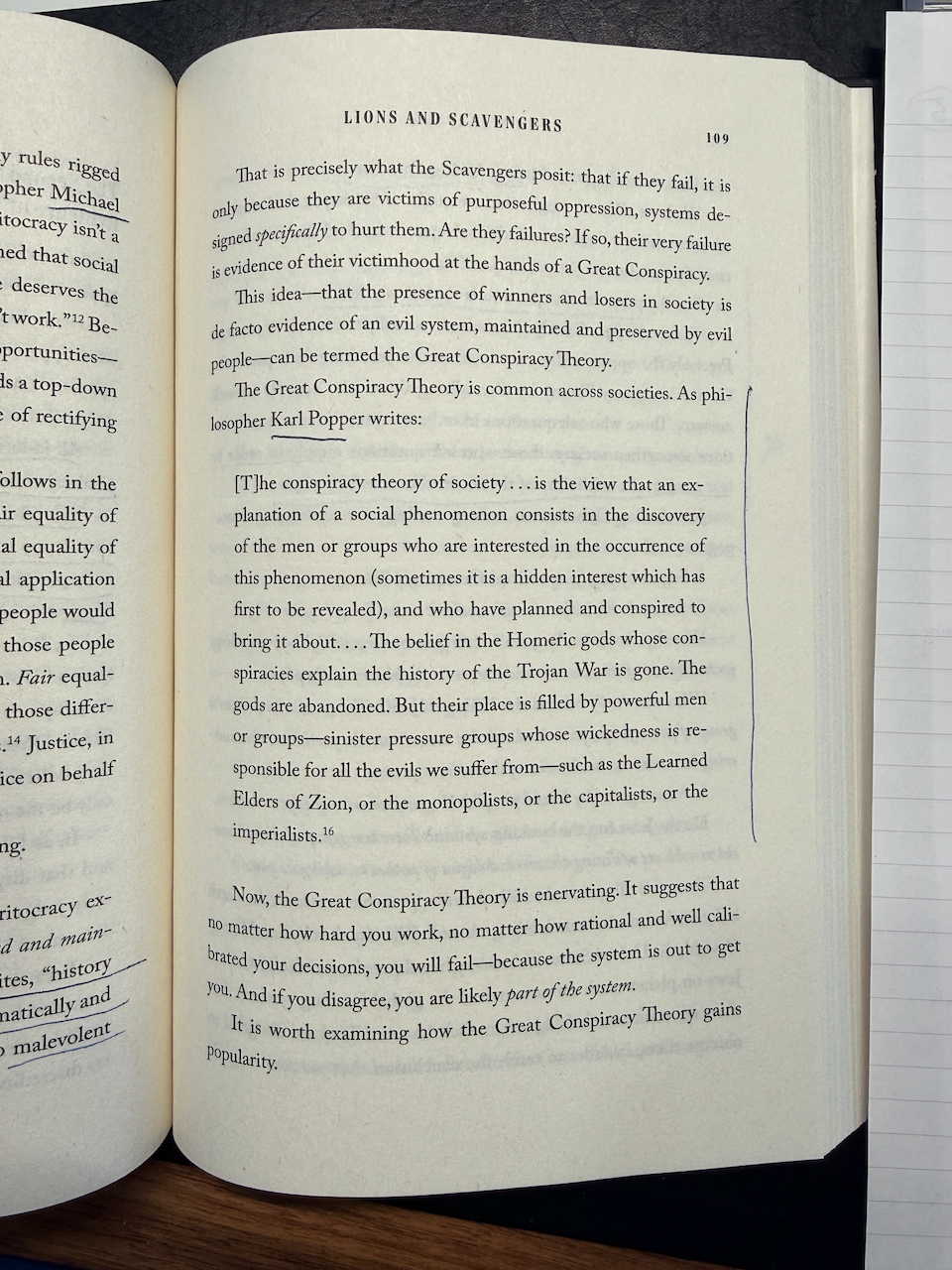
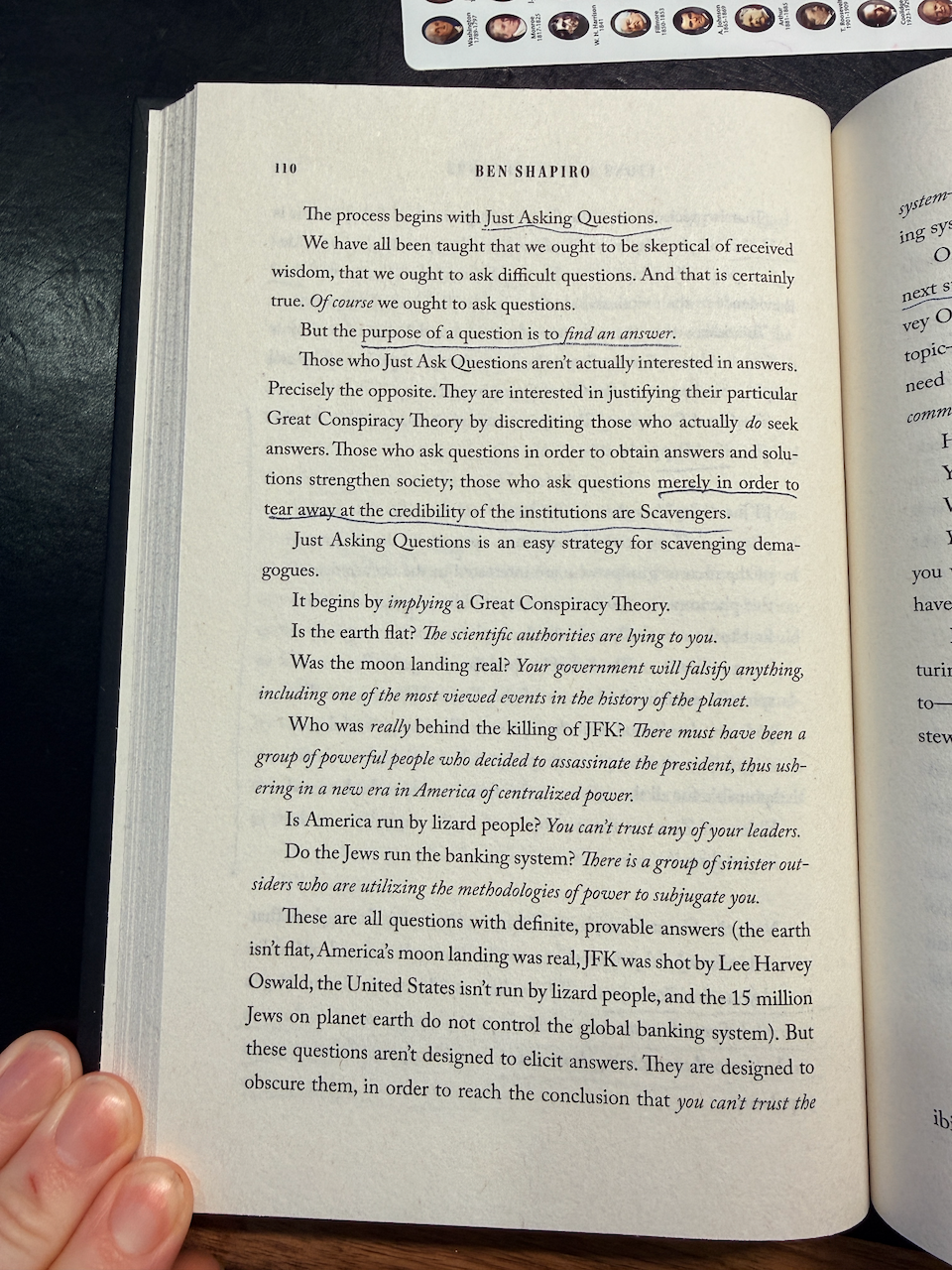
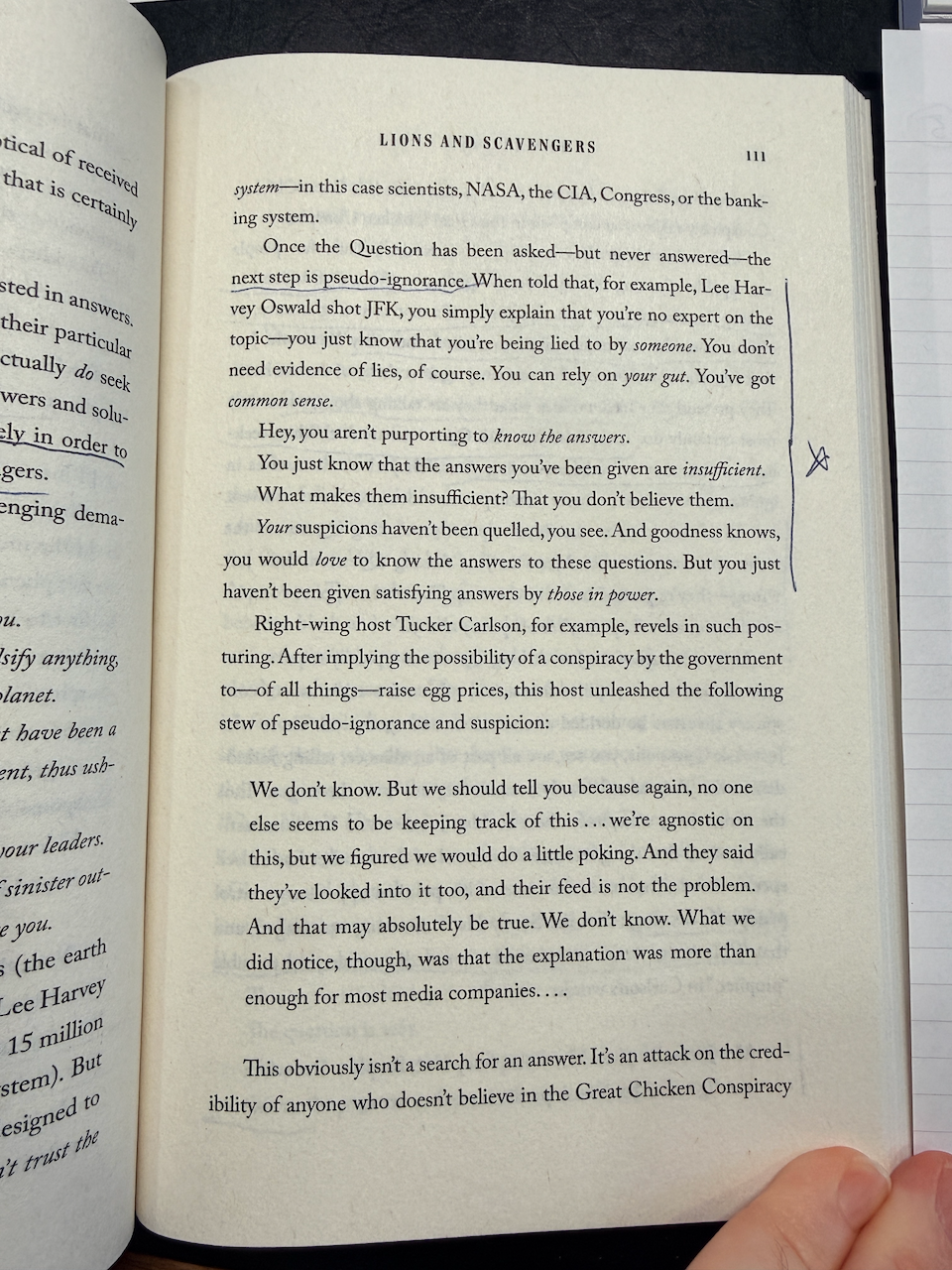
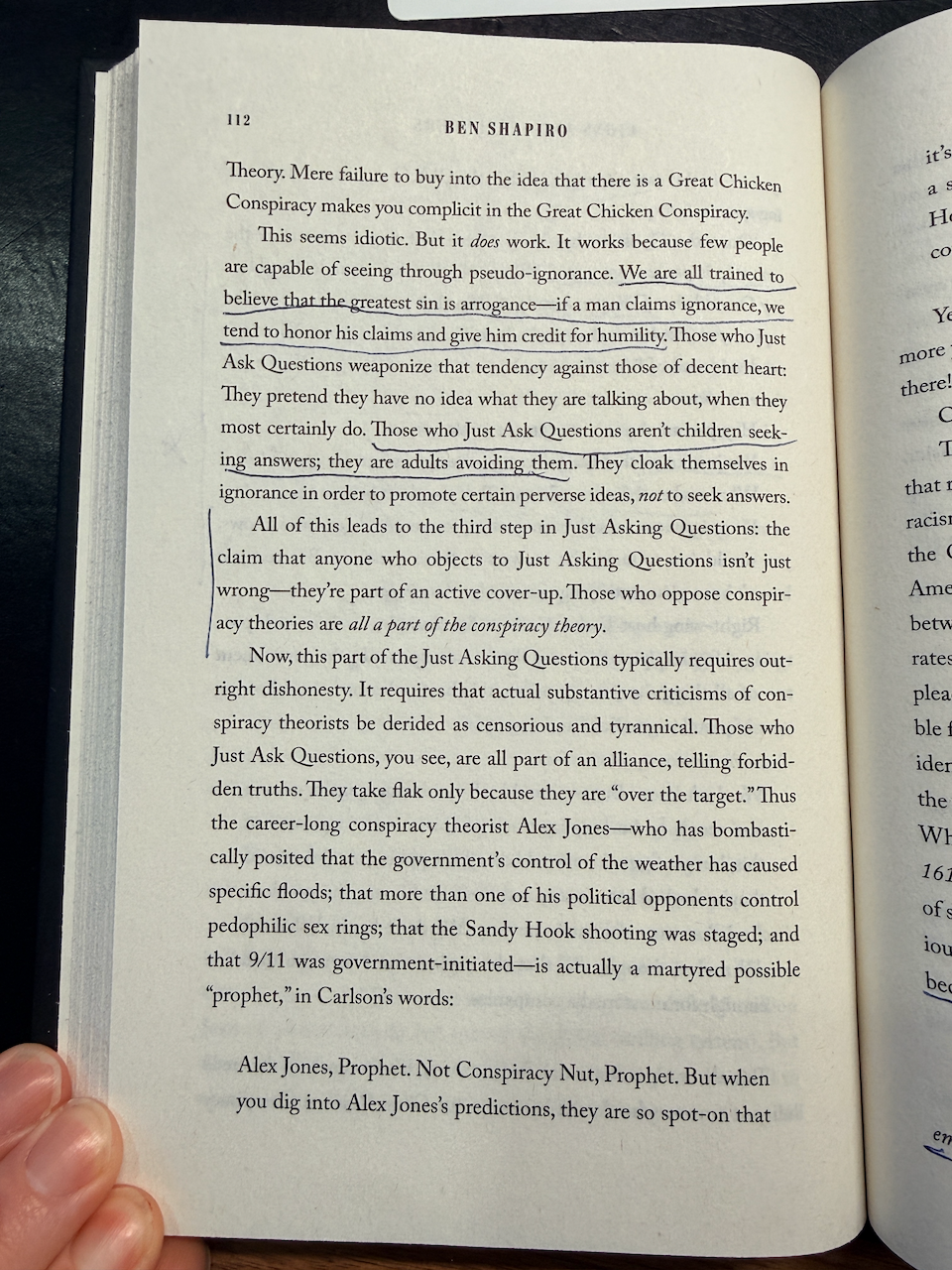
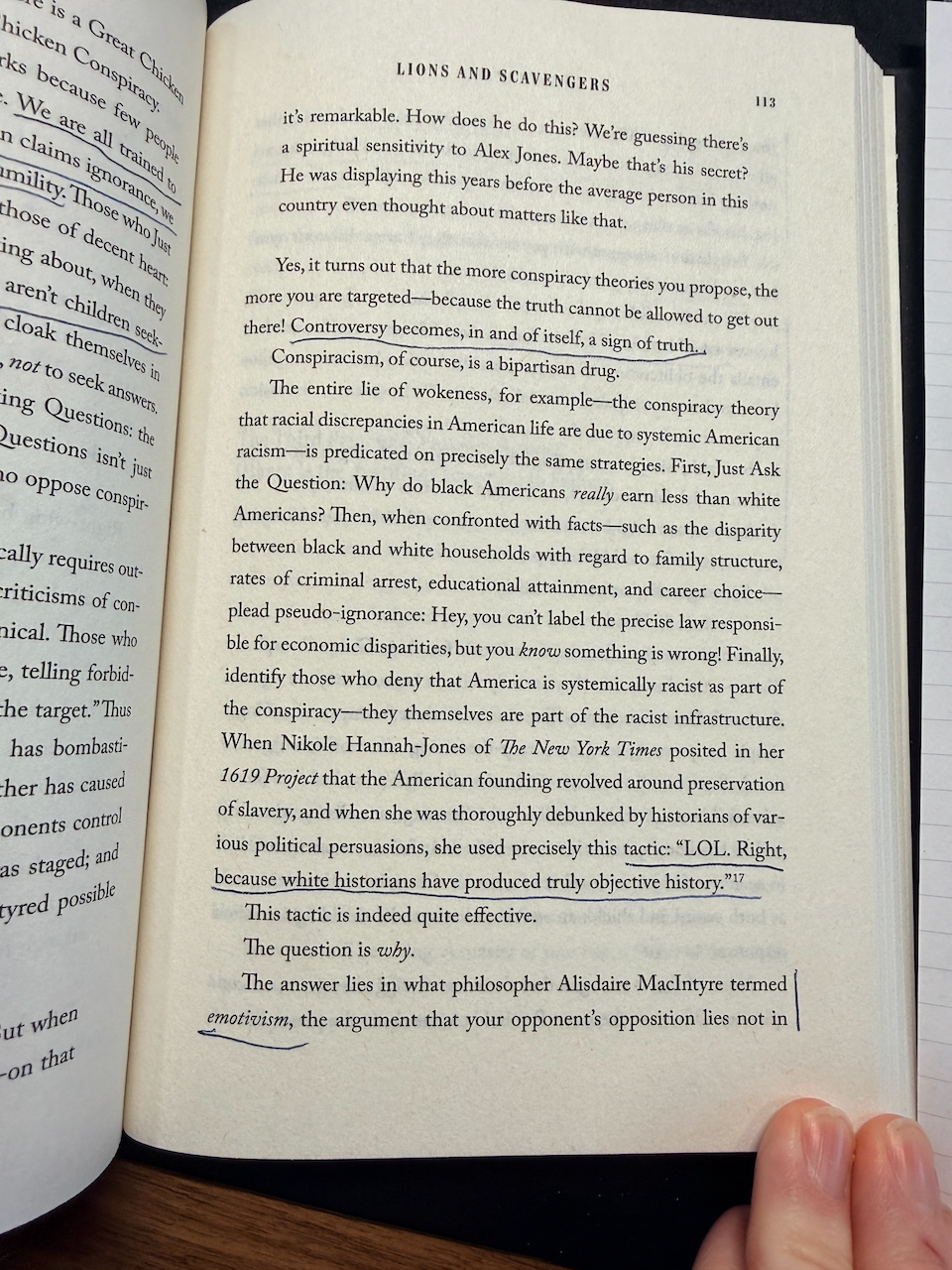
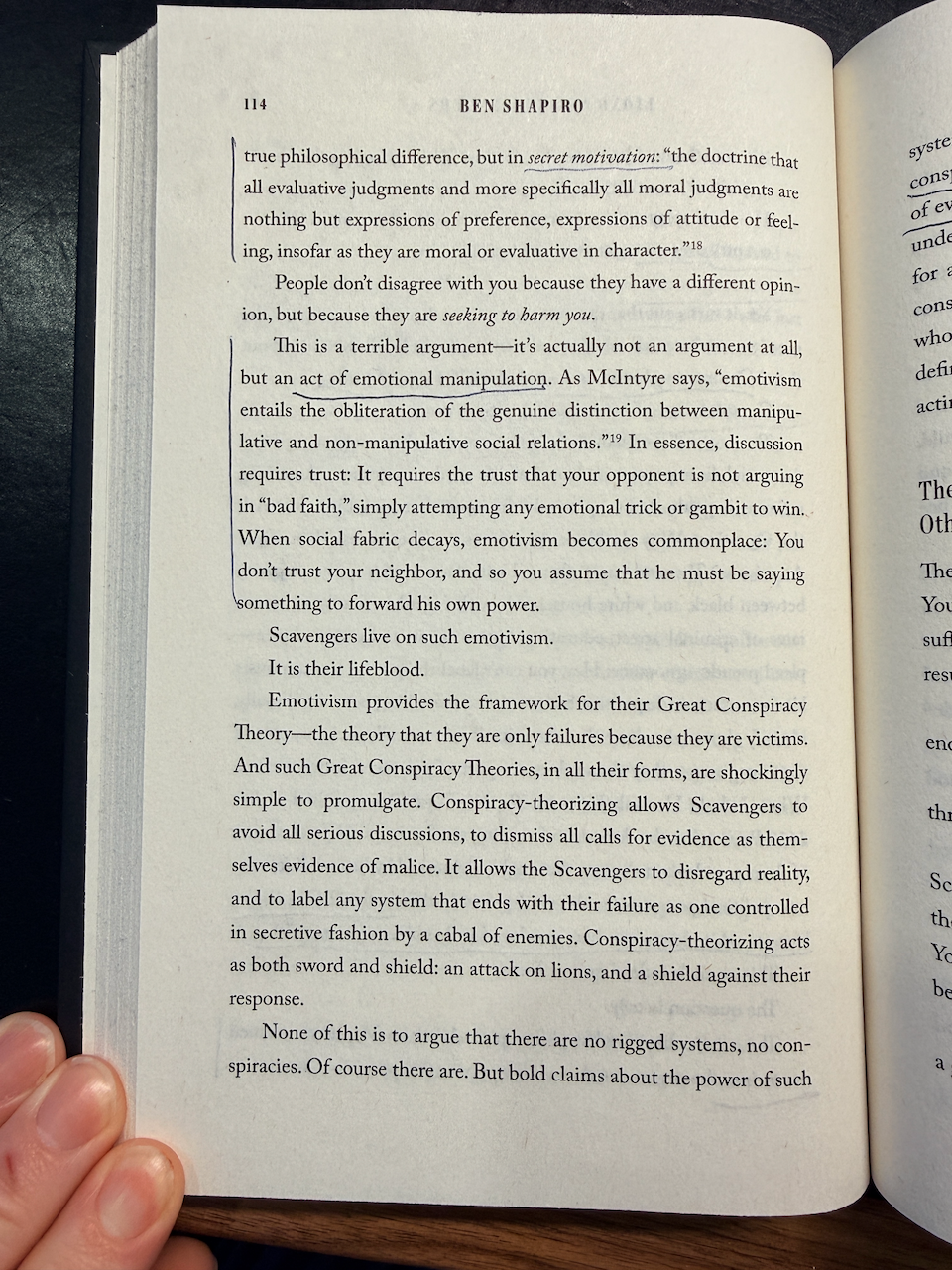
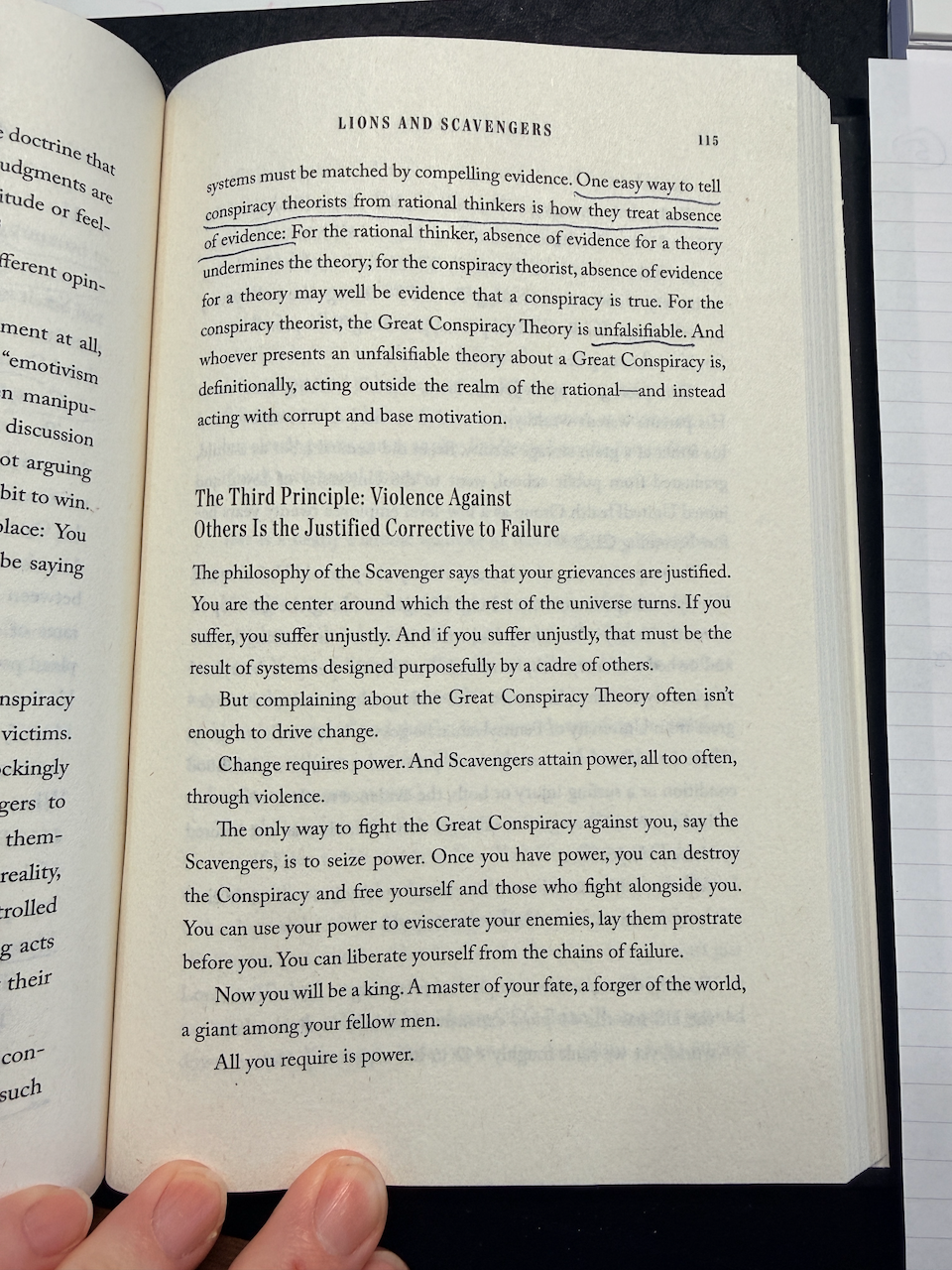
Q: Fake Questions
- Foundation
- Not genuine questions seeking facts or evidence.
- Rhetorical devices to design create doubt.
TACTICS
- ”Just asking questions”
- Pretending to be neutral.
- Premises (Presupposes):
- Somebody is trying to hide the truth from you.
- Trying to silence you.
- They’ll accuse you of trying to silence them if you ask for evidence.
- Tactic puts the burden of proof on the wrong side.
- In typical logical discourse if you make a contention, you have to provide evidence for my claim. You can’t just ask someone else to disprove it.
Motive Over Evidence
- Suggests because someone benefits from an outcome or could benefit they’re therefore responsible for the outcome.
- Show no actual connection
- ”Lyndon Johnson because President after JFK so he must of killed him.”
Appeal to Ignorance
- Something has to be true because it hasn’t been definitively disproven.
- Example: Dawkin’s “There’s a spagehetti monster controlling all of human activity.” Disprove it!
- The absence of evidence is not evidence of absence but neither is it evidence of presence.
- Burden of proof lies with the person making the extraordinary claim.
You Don’t Know The Whole Story
- Implies there’s hidden knowledge only the initiates can access
- Effective because sometimes someone isn’t tell your everything and you should do your own research.
- Nobody knows everything about a complex event
- Exploits the gap to insert a preferred narrative
E: Fake Evidence
- How you structure a conspiracy theory
- Attempts to build a case but doesn’t stand up to scrutiny at all.
Cherry Picking
- Focuses on a single data point, ignoring a mountain of counter evidence.
- Common when attempting to credit group with outsize power.
Secret Sources
- I know a friend
- Unfalsifiable
- Need multiple sources in journalism
- Anonymous sources
False Cause
- Take two correlative events that are not causative.
- Ex: US conducted a training event exercise near NY on 9/11, therefore US did 9/11.
- Fallacy: Post hoc, ergo propter hoc
Appeal to Authority
- Since COVID and the lost of trust in authorities, now anyone can be determined to be an expert on a topic.
- Evidence is MORE important if you don’t trust authority.
Overestimating Coordination
- Where conspiracy theories usually fall apart
- Compose a vast and complex secret conspiracy that would require thousands of people to be involved and keep it secret.
- Ex: Moon landing was faked.
- Counter: Have you ever planned a surprise party?
US vs. Them
- Alienating everything that calls for evidence
- If they ask for evidence then they must be part of the conspiracy.
Confirmation Bias
- Everything because evidence for the conspiracy.
- Any contradicting evidence is part of the cover-up.
Apophenia
- Seeing meaningful patterns in random data.
D: Defense
No-falsifiability
- If you have a claim about the world itself you should have a falsifiable theory. (Carl Popper)
- Good theory makes claims that could be disproven.
- ”Is there any evidence that can change your mind about this?”
- Well that isn’t a rational inquiry.
- Designed to be immune to evidence
Moving to Goal Posts
- Simply revise the prediction
Circular Reasoning
- ”When know you’re corrupt because you won’t report on this conspiracy theory.”
- Closed logical loop
- ”You’re lying because the conspiracy theory is true -> the conspiracy theory is true because you’re lying”
Kafka Trap
- Denial of guilt is taken as evidence of guilt
- Denial, silence and confirmation are all the same
Information Overload
- Bunch of unrelated gobblely gook of facts stacked on top of each other super fast.
- Difficult to combat
- Takes way too much time to counter effectively
Weaponizing Doubt
- Find a minor inconsistency and expand it to attempt to falsify the entire thing
False Equivalence
- Defense Mechanism
- All sources are equally biased
No True Scotsman
- ”No true conspiracy researching would deny the moon landing was faked.”
- Ideological purity: Exclude to censor
Deep Play
- Every debunking because evidence of a deeper conspiracy.
- ”Fact the media is focusing intensely on this means they’re hiding something.”
Motte and Bailey
- Make a totally implausible claim (bailey) and when that’s overrun, they’ll just say backtrack that their saying a more neutral position.
- https://en.wikipedia.org/wiki/Motte-and-bailey_fallacy
Breakdown
Key Points
- Research suggests conspiratorial thinking involves believing in secret plots, often by powerful groups, especially during uncertainty.
- It seems likely that common logical fallacies include circular reasoning, ad hominem, bandwagon effect, and conjunction fallacy.
- The evidence leans toward psychological drivers like needing to understand, feel safe, and maintain social superiority, with studies showing traits like intuition and perceived threats matter.
Definition and Characteristics
Conspiratorial thinking is the belief in secret, often malevolent plots by powerful groups, such as governments or organizations, especially during times of anxiety or uncertainty. It’s driven by a desire to make sense of complex events, with characteristics like resistance to falsification and circular logic, where lack of evidence is seen as proof of a cover-up. Examples include theories about the moon landing being faked or COVID-19 being a government plot.
Logical Fallacies
Conspiracy theories often rely on flawed reasoning, such as:
- Circular reasoning: Claiming lack of evidence proves the conspiracy, like saying no proof of a cover-up means it’s hidden.
- Ad hominem: Attacking non-believers as part of the conspiracy, like calling skeptics government agents.
- Bandwagon effect: Believing something because many people do, like saying “30% of Americans doubt the official story, so it must be true.”
- Conjunction fallacy: Thinking multiple events are more likely together, like believing a virus and 5G towers are linked to spread disease.
In-Depth Research
Studies, like one with 158,000 participants from the US, UK, and Poland, show motivations include epistemic (understanding the environment), existential (feeling safe), and social (maintaining group superiority). Personality traits like relying on intuition and perceiving threats also play a role, with research suggesting conspiracy beliefs may offer short-term psychological benefits, like ego defense, but aren’t ultimately satisfying.
Survey Note: Detailed Analysis of Conspiratorial Thinking, Logical Fallacies, and Research
This note provides a comprehensive examination of conspiratorial thinking, its associated logical fallacies, and the extensive research conducted on the topic, particularly in psychology and social sciences. The analysis aims to offer a detailed, professional perspective, building on the key points and expanding with additional insights for a thorough understanding.
Definition and Characteristics of Conspiratorial Thinking
Conspiratorial thinking is defined as the belief in secret, often malevolent plots carried out by powerful groups, such as governments, organizations, or elites, with sinister goals that typically do not align with public interest. This belief system is particularly prevalent during periods of widespread anxiety, uncertainty, or hardship, such as wars, economic depressions, or pandemics, as evidenced by the surge in theories following the September 11 attacks in 2001 and the COVID-19 pandemic (Conspiracy theory | Definition, Examples, & Facts | Britannica).
Key characteristics include:
- Speculative nature: Positing hidden actions not subject to public scrutiny, making verification difficult.
- Resistance to falsification: Claims that evidence against the theory is part of the cover-up, rendering it unfalsifiable.
- Circular logic: Both the absence of evidence and evidence against the theory are reinterpreted as supporting it, turning belief into a matter of faith rather than provable fact (Conspiracy theory - Wikipedia).
- Emotional appeal: Theories are emotionally laden, offering gratification through the perceived discovery of hidden truths, often simplifying complex social issues (People Drawn to Conspiracy Theories Share a Cluster of Psychological Features | Scientific American).
Examples include the belief that the Apollo moon landing was a hoax by the American government, chemtrail theories, or claims that COVID-19 was engineered for control. These theories cut across partisan lines, with a 2016 study finding 10% of Americans believing chemtrail theories are “completely true” and 20–30% “somewhat true” (Conspiracy theory - Wikipedia).
Logical Fallacies in Conspiratorial Thinking
Conspiracy theories often rely on logical fallacies, which are errors in reasoning that undermine their validity. Below is a detailed table of common fallacies, with descriptions and examples:
| Fallacy | Description | Example in Conspiracy Theories |
|---|---|---|
| Circular Reasoning | Using the conclusion to support the premise, making it self-reinforcing. | “There’s no evidence of a cover-up, which proves they’re hiding it well.” |
| Ad Hominem | Attacking the person rather than the argument, often demonizing skeptics. | Calling non-believers “government shills” to dismiss their views. |
| Bandwagon Effect | Believing something because many people do, also known as argumentum ad populum. | “30% of Americans doubt the official story, so it must be true.” |
| Conjunction Fallacy | Overestimating the likelihood of multiple events occurring together. | Believing COVID-19 and 5G towers are linked to spread the virus. |
| Special Pleading | Making exceptions to rules for the conspiracy, like claiming evidence was lost. | Saying documents proving a plot were destroyed by conspirators. |
| False Dilemma | Presenting only two options when more exist, forcing alignment or suspicion. | “You either believe in the conspiracy or you’re part of it.” |
These fallacies contribute to the “self-sealing” nature of conspiracy theories, where challenges are seen as further evidence, making them resistant to questioning (Conspiracy Theory & Conspiracism - TIP Sheet - Butte College). For instance, the conjunction fallacy is particularly noted in studies showing conspiracy believers perceive conjunct events (e.g., virus + 5G) as more probable, a finding linked to anti-vaccination attitudes (The association between the belief in coronavirus conspiracy theories, miracles, and the susceptibility to conjunction fallacy - Wabnegger - …).
In-Depth Research on Conspiratorial Thinking
Extensive academic research, particularly in psychology, has explored why people engage in conspiratorial thinking and its impacts. A systematic review from 2018 to 2021, published in PMC, highlighted the growing interest, intensified by the COVID-19 pandemic, with studies showing conspiracy beliefs are consequential, universal, emotional, and social (Contemporary trends in psychological research on conspiracy beliefs. A systematic review - PMC).
Key findings include:
- Motivations: Research suggests three main drivers:
- Epistemic: The need to understand one’s environment, reducing uncertainty when information is conflicting (The Psychology of Conspiracy Theories - PMC).
- Existential: The desire to feel safe and in control, with conspiracy theories offering a sense of order (Why some people are willing to believe conspiracy theories - APA).
- Social: Maintaining a positive image of oneself and one’s group, with studies showing believers often perceive social threats, linking to intergroup conflict (Belief in conspiracy theories: Basic principles of an emerging research domain - PMC).
- Personality Traits: A 2023 study analyzing data from 170 studies and over 158,000 participants (mainly from the US, UK, and Poland) found traits like relying strongly on intuition, feeling antagonism and superiority, and perceiving environmental threats are significant (Why some people are willing to believe conspiracy theories - APA). This study, led by Shauna Bowes, painted a nuanced picture, challenging the stereotype of conspiracy theorists as simply mentally unwell.
- Psychological Benefits and Consequences: Research indicates conspiracy theories offer short-term benefits, such as defending a fragile ego by perceiving oneself as important, rationalizing beliefs, and providing entertainment through mystery (Psychological benefits of believing conspiracy theories - ScienceDirect). However, these beliefs may not fulfill long-term motivations, potentially harming health, relationships, and safety, as seen in anti-vaccination movements during pandemics.
An unexpected detail is the role of cognitive styles, with studies showing a negative relationship between analytic thinking (slow, deliberate processing) and conspiracy beliefs, while critical thinking and scientific reasoning are less studied but emerging as relevant (Frontiers | Conspiratorial Beliefs and Cognitive Styles: An Integrated Look on Analytic Thinking, Critical Thinking, and Scientific Reasoning …). This suggests educational interventions promoting analytical thinking could reduce belief, an area with potential for future policy.
Conclusion
Conspiratorial thinking is a complex phenomenon, driven by psychological needs and prone to logical fallacies, with significant research highlighting its impacts. This analysis underscores the importance of understanding these beliefs to address their societal consequences, particularly in an era of social media amplification.
Key Citations
- Conspiracy theory definition and examples - Wikipedia
- Psychological features of conspiracy believers - Scientific American
- Psychology of conspiracy theories review - PMC
- Logical fallacies in conspiracy theories - Butte College
- Motivations for conspiracy beliefs research - APA
- Conspiracy theory characteristics - Britannica
- Conspiracy beliefs systematic review 2018-2021 - PMC
- Conjunction fallacy in conspiracy theories - Wiley
- Psychological benefits of conspiracy theories - ScienceDirect
- Cognitive styles and conspiracy beliefs - Frontiers
- Basic principles of conspiracy belief research - PMC
How They Attack Facts
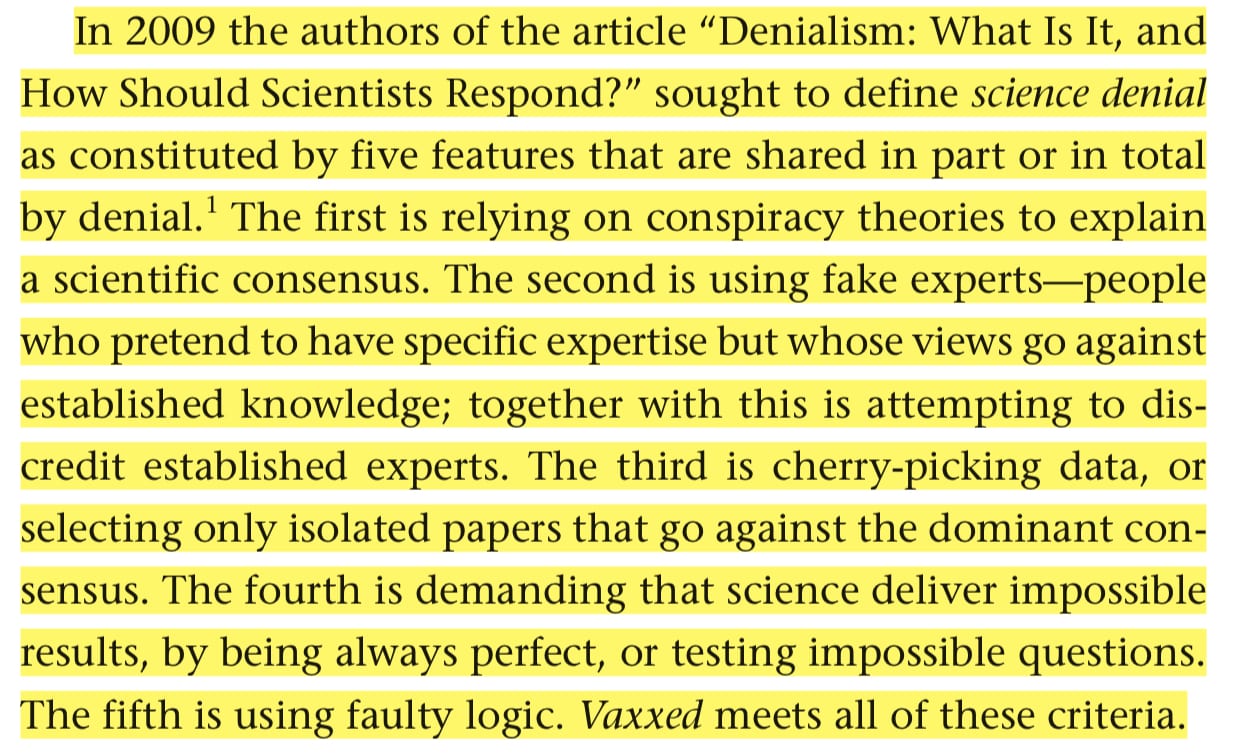
Info
Why We Believe Conspiracies
Conspiracy Theory Thinking
In this sixth lecture, Michael Shermer explores the world of conspiracies and conspiracy theories. He moves beyond the stereotype of the “tinfoil hat” and treats conspiracism as a rational problem of signal detection: how do we tell the difference between real secret plots and paranoid fantasies?
1. Defining the Terms
To study the subject scientifically, Shermer first destigmatizes the language:
- Conspiracy: Two or more people plotting in secret to gain an advantage or harm others illegally or immorally.
- Conspiracy Theory: A structured belief about a conspiracy.
- Conspiracist: Someone who holds a conspiracy theory.
Shermer argues that because real conspiracies exist (e.g., Watergate, Lincoln’s assassination), being a “conspiracy theorist” is actually a rational starting point for investigating the world.
2. Who Believes and Why?
Conspiracism is not a marginal phenomenon. Shermer provides concrete data to show its prevalence:
Belief Statistics (U.S. Data)
Claim % of Population (Approx.) Government is concealing the truth about 9/11 54% Government is concealing the truth about the JFK assassination ~50% Government is concealing the truth about Aliens 42% A one-world government is secretly being plotted 32% Birther conspiracy (Obama was born outside the U.S.) 30% The Moon Landing was faked 24% The Educational Gap
Education serves as a significant (though not perfect) filter for conspiratorial thinking:
- No High School Diploma: 42% score high on conspiracism scales.
- Postgraduate Degree: 22% score high on conspiracism scales.
3. The Psychology of Conspiracism
Shermer identifies several cognitive “traps” that make us prone to believing in plots:
- Monological Belief System: If you believe one massive conspiracy (like a UFO cover-up), you are statistically more likely to believe others (like 9/11 truthers).
- Proportionality Bias: The belief that a “big” event (like the death of a Princess or President) must have a “big” cause We struggle to accept that a “lone nut” could kill a world leader.
- Patternicity & Agenticity: We evolved to find meaningful patterns in noise (patternicity) and to assume those patterns are caused by an intentional agent (agenticity).
- Hindsight Bias: Looking at intercepted intelligence memos after an event like Pearl Harbor and saying, “Why didn’t they see it?” while ignoring the thousands of other “noise” memos that led nowhere.
4. The Three Primary Drivers
Shermer categorizes why people hold onto these theories even when evidence is thin:
- Proxy Conspiracism: The theory is a “stand-in” for a deeper truth. (e.g., Anti-vaxxers might not be right about the specific science, but their belief is a proxy for the very real phenomenon of “regulatory capture” by Big Pharma).
- Tribal Conspiracism: Beliefs serve as a “virtue signal” for group loyalty. You believe it because your “tribe” (political or social) believes it.
- Constructive Conspiracism: An evolutionary “better safe than sorry” approach. Because some conspiracies are real and deadly, our brains prefer the cost of a False Positive (believing a fake plot) over the cost of a Miss (being killed by a real one).
5. The Conspiracy Detection Kit
To help separate fact from fiction, Shermer offers a “Baloney Detection Kit” for conspiracies:2
- The Scale: How many people would need to be involved to pull this off? The more people required, the more likely someone would have talked (whistleblowers).
- The Complexity: How many things have to go exactly right? (e.g., 9/11 “controlled demolition” theories require thousands of variables to align perfectly).
- Whistleblowers: In the age of WikiLeaks and Snowden, why hasn’t a single person come forward with physical proof (memos, pay stubs, blueprints)?
Shermer’s Rule: “Before you say something is out of this world, first make sure it’s not in this world.”
6. Real Conspiracies in History
Shermer validates the skeptic’s caution by listing confirmed conspiracies:
- Operation Northwoods: A proposed (but rejected) CIA plan to stage fake terrorist attacks on U.S. soil to justify invading Cuba
- COINTELPRO: Confirmed FBI program to spy on and blackmail domestic activists like Martin Luther King Jr
- MKUltra: A CIA program exploring mind control and chemical interrogation (LSD dosing)
- Operation Paperclip: Secretly bringing Nazi scientists to work for the U.S. government after WWII
Link to original