Zibaldone 2024–2025 journal
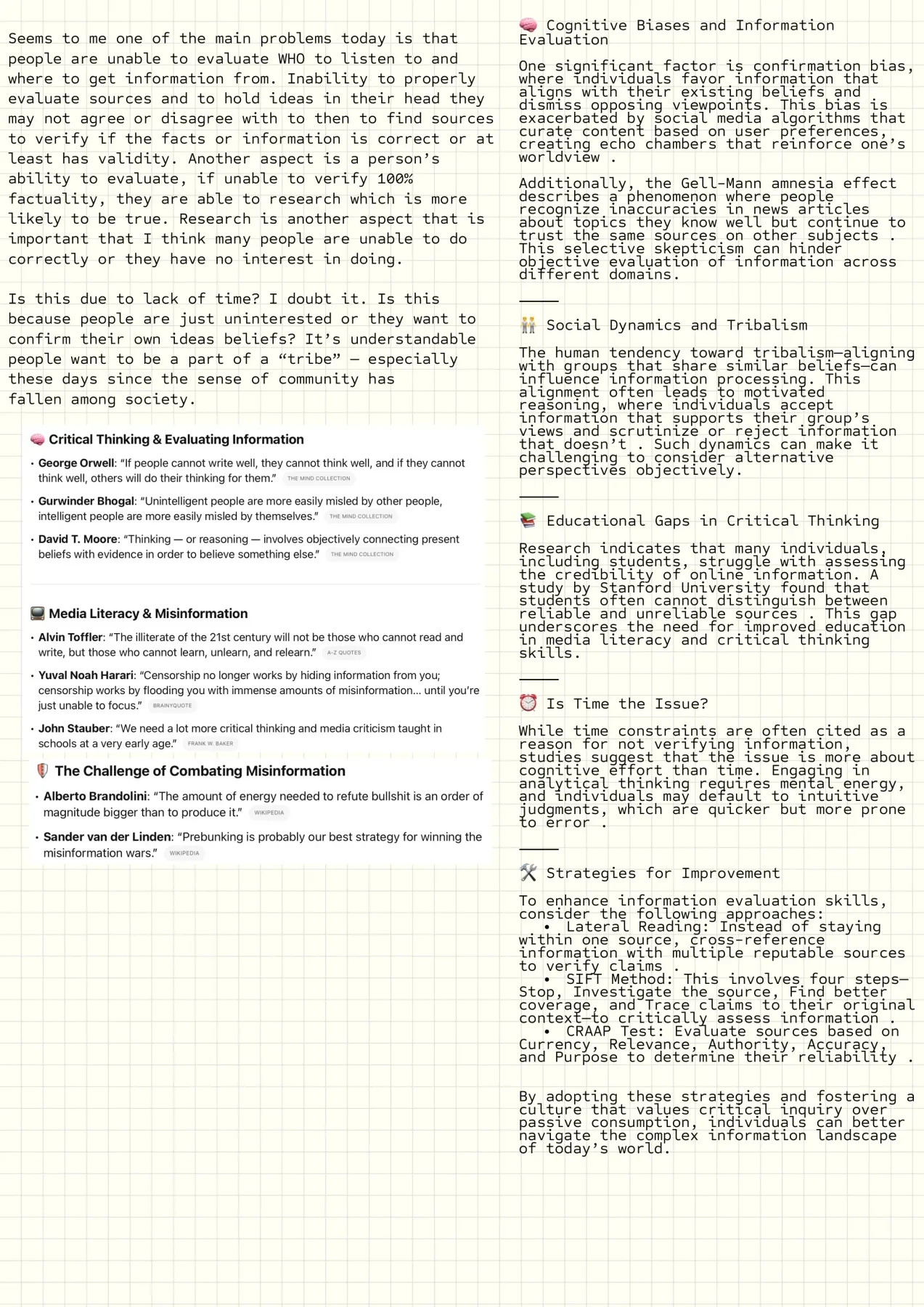
Journal connection: Cognitive-bias and information-evaluation diagrams, including conspiracy-thinking cues.
Source boundary: These are captured journal materials; the integration does not independently verify every clipped claim, quotation, or figure.
PDF++ pages: p. 104 (file not included in this release) · p. 264 (file not included in this release) · p. 272 (file not included in this release)
Embedded previews:
Zibaldone 2024-2025.pdf (file not included in this release)
Zibaldone 2024-2025.pdf (file not included in this release)
Zibaldone 2024-2025.pdf (file not included in this release)
Open the complete Zibaldone page index
Haidt, Chapter 2 — outsource the search for disconfirmation
Haidt describes first judgments as rapid and people as poor at seeking evidence that would disconfirm them. The social-intuitionist model makes the corrective concrete: another person can challenge a rationale, supply a counterexample, or introduce a perspective that triggers a new intuition. Bias control is therefore partly architectural—use adversarial review, identity reversal, independent evidence collection, and interlocutors who are allowed to disagree.
The claim should not be inflated into “reflection never works.” Haidt drew private reflection and directly reasoned judgment as dotted pathways but acknowledged that he had no evidence for their frequency. The practical lesson is redundancy: combine self-audit with external challenge. Confirmation bias and social correction, PDF pp. 66–67 (file not included in this release) · Endnote 44, PDF p. 369 (file not included in this release) · Permanent model note
Haidt, Chapter 3 — bias control begins before the explicit reason
Chapter 3’s “affective primacy” adds an earlier checkpoint to information evaluation. Mere familiarity, group and partisan labels, a candidate’s face, and even an irrelevant bodily cue can produce a lean before the evaluator can state a claim. The first audit question is therefore not only “Is this reason sound?” but also “What made this interpretation feel attractive or repellent before I examined the evidence?” Remove names, images, party cues, and vivid but nonprobative details; reverse identities; then compare the strongest rival account.
Haidt’s delayed-reflection experiment also suggests why a cooling-off period needs content. Two minutes reportedly helped a stronger argument change some judgments, while a weak argument remained unpersuasive. Delay is useful when it creates room for disconfirming evidence, not when it gives the inner lawyer more time to rehearse. The odor, washing, and sanitizer findings are older priming claims and should remain provisional pending a current replication audit. Affect and political cueing, PDF pp. 75-81 (file not included in this release) · Delayed reflection, PDF pp. 90-91 (file not included in this release) · Permanent concept note
Haidt, Chapter 4 — audit the search rule, not just the evidence found
Chapter 4 shows four ways an evidence review can be one-sided before any false sentence is written. Wason’s subjects tested sequences likely to confirm their rule; Kuhn’s participants privileged the few cases that fit an initial hunch; Perkins found that greater cognitive ability predicted more my-side arguments without a matching increase in other-side reasons; and motivated reasoners asked whether they could accept a desired claim but whether they must accept an unwelcome one.
A stronger audit therefore records the claim, rival hypotheses, disconfirming test, search terms, inclusion rule, and stopping rule before looking at results. Obtain independent estimates before discussion; require the strongest other-side argument; and apply the same defect threshold to congenial and hostile evidence. Haidt’s attitude-polarization discussion is explicitly conditional, and the cited education comparison is not a causal test of schooling, so use these studies as a design warning rather than a universal effect-size claim. Confirmation and my-side evidence, PDF pp. 102–105 (file not included in this release) · “Can” versus “must” and search, PDF pp. 107–108 (file not included in this release) · Conditional attitude polarization, PDF p. 109 (file not included in this release) · Chapter 4 source audit