What survives the evidence check
A substantial Muslim population does not by itself establish a threshold at which radicals take over. The cited 2011 “10%” study models committed, unchanging advocates within a particular opinion network; it does not measure the Muslim share of a country. Organized minorities can nevertheless gain disproportionate power through coercion, funding, institutions and coordination. That narrower concern deserves investigation without substituting religious identity for demonstrated conduct. See The 10 percent claim — three different propositions.
Ghana and Mauritius have entirely non-Muslim chief executives over the declared periods audited below; Suriname exceeds a majority using a conservative lower bound, and Malawi is a qualified additional case. These are time-in-office calculations, not counts of convenient examples. Civil constitutional pluralism and competitive government coexist with religious entanglements and democratic shortcomings; strict church–state separation and uninterrupted high-quality liberal democracy are not certified for all four cases.
Purpose, provenance and scope
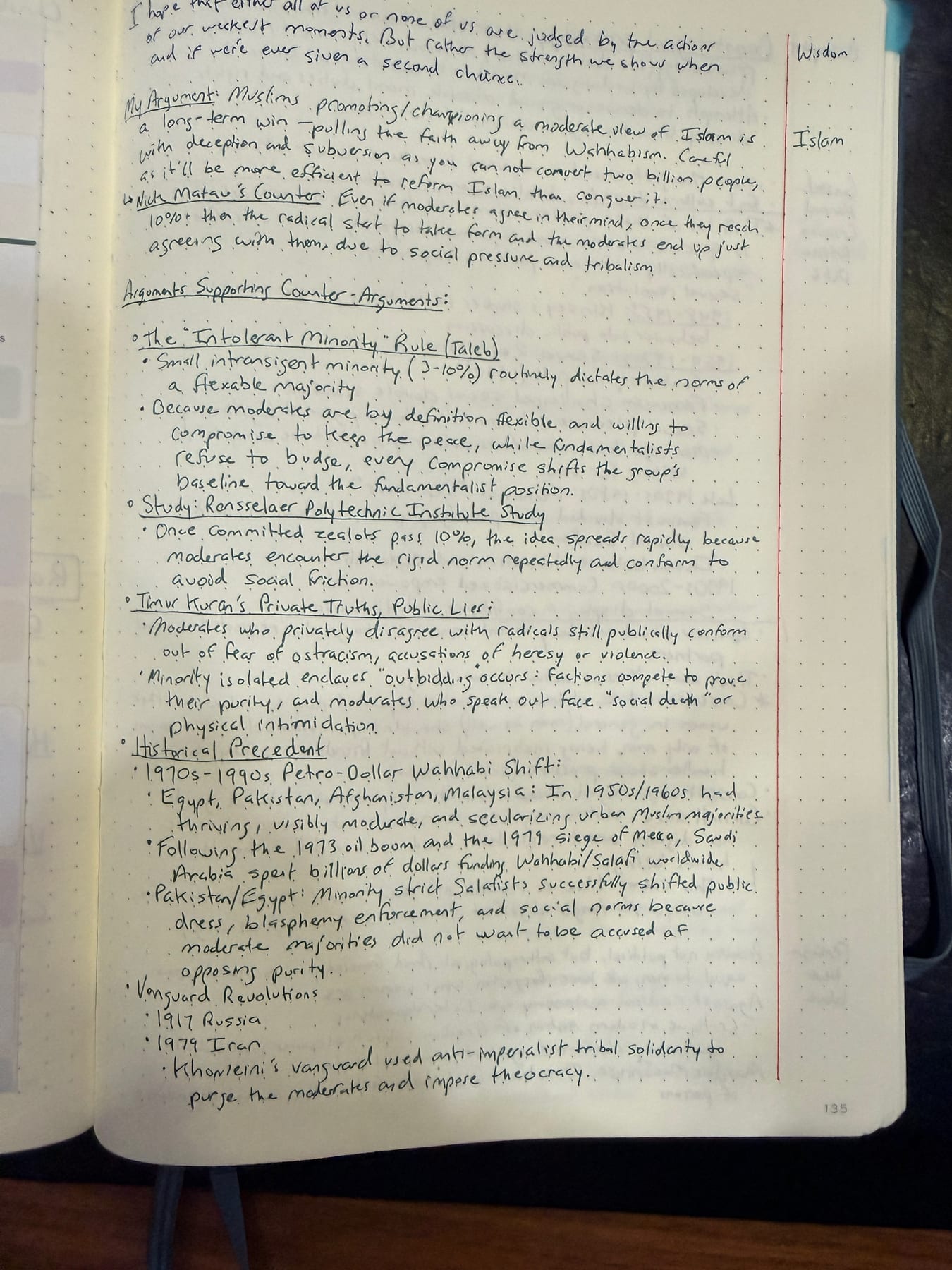
This is Anthony’s working dossier for his discussion with Nick Matau, created from two supplied notebook photographs and an initial source check, expanded with country-by-country executive histories on November 8, 2026, America/New_York. It reconstructs the arguments without treating either side’s notebook assertions as established findings.
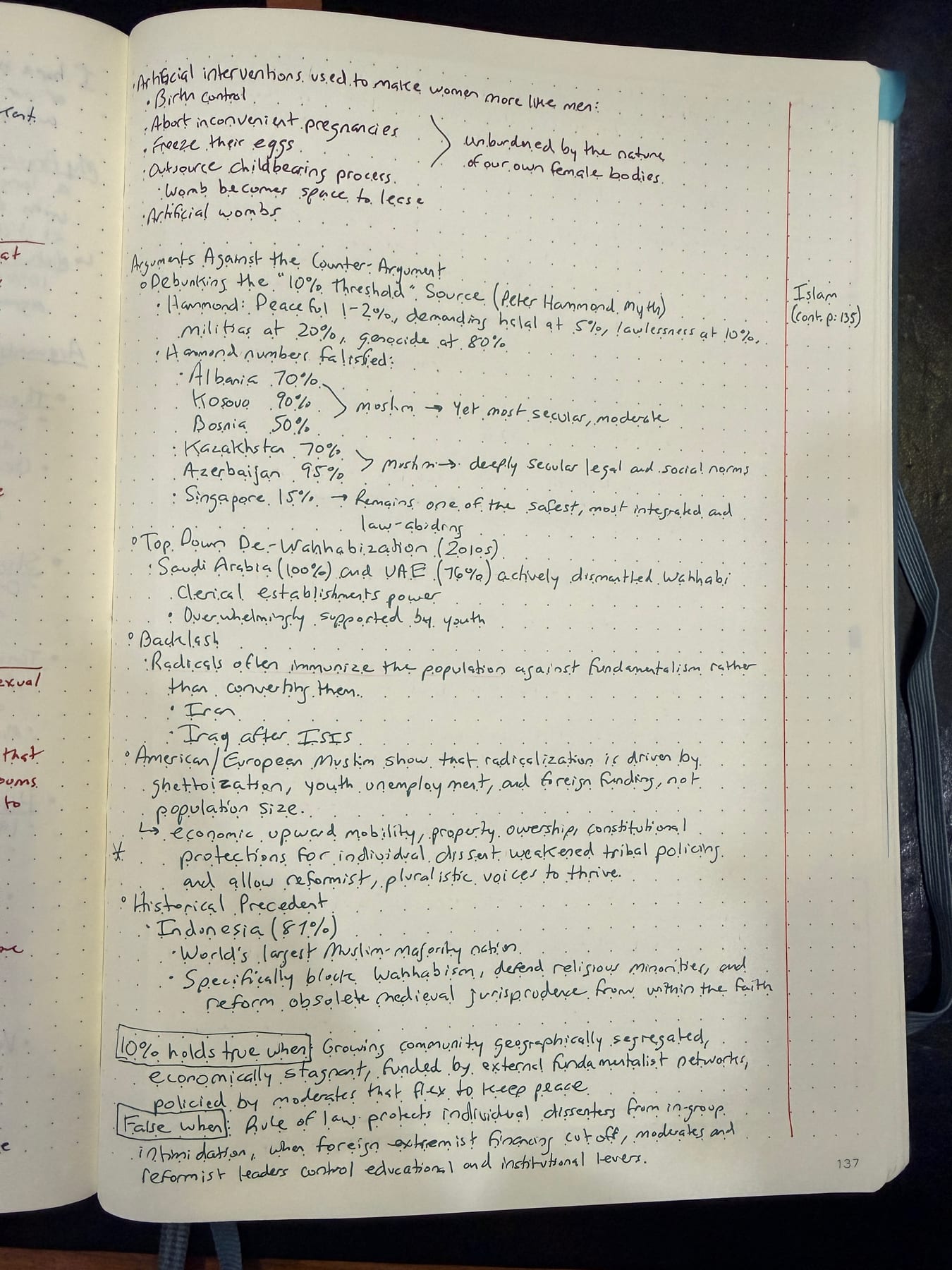
- Supplied sources: IMG_0774.jpeg, printed notebook p. 135; IMG_0775.jpeg, printed p. 137. Originals are preserved below. The notebook’s date and the missing p. 136 were not supplied.
- Attribution boundary: “Nick’s counterargument” means Anthony’s handwritten account of Nick’s position. No recording or verbatim message of that exchange was located. Do not quote this as Nick’s independently authenticated wording.
- Text boundary: The transcription regularizes spelling, punctuation and layout. It preserves claims rather than silently correcting them; the assessment follows separately. Brackets identify uncertainty. Peripheral text is retained in a separate appendix.
- Research boundary: This is a private working synthesis with sequential source and counterargument checks. Independent-agent review and blind replication were unavailable; it is not a replicated public fact-check. Book recommendations reflect verified bibliographic descriptions and contents, not full-book reviews.
The original disagreement, rewritten clearly
Anthony’s proposed strategy: Encourage Muslims who advocate pluralistic or moderate interpretations, because reform within a religion of roughly two billion adherents is more workable than expecting universal conversion or treating an entire population as an enemy. Guard against deceptive or coercive political movements while distinguishing them from ordinary believers.
The counterargument recorded under Nick’s name: Even if many Muslims privately favor moderation, once the community reaches a sufficiently large share of the population, organized radicals may pressure moderates into public conformity. Tribal solidarity, reputational sanctions and intimidation could allow a militant minority to control the wider community.
These contain different kinds of claims. A reform strategy is a practical and normative proposal. A coercive-minority mechanism is a causal hypothesis. A universal 10% population threshold is a much stronger quantitative prediction. Evidence for one does not automatically establish the others.
Argument map
flowchart TD
    A[Anthony: support pluralistic reform within Islam] --> B[Reform may be more feasible than mass conversion]
    N[Counterargument as recorded by Anthony] --> C[Organized radicals can pressure moderates]
    C --> D[Possible mechanisms: coercion, money, networks, institutional control]
    N --> E[Stronger claim: takeover follows 10 percent Muslim population]
    X[2011 committed-minority model] --> F[Conditional tipping in a specified network model]
    F -. denominator does not match .-> E
    G[Non-Muslim leadership and competitive elections above 10 percent] --> H[Universal demographic claim has counterexamples]
    D --> I[Test institutions and observable behavior in specific cases]
    H --> I
    I --> J[Defend equal citizenship and dissent; assess reformers by conduct]
The 10 percent claim — three different propositions
C01 — A model of committed opinion advocates
Xie and colleagues’ 2011 paper, Social consensus through the influence of committed minorities, examines an opinion-dynamics model. A minority remains committed to one opinion while other participants update their opinions under specified interaction rules. Around a critical committed fraction of 10%, the model’s expected time to consensus changes sharply. This is a result about that model and its assumptions—not a measurement of religious demographics, not an estimate of how many Muslims are radicals, and not a general law of political conquest.1
The denominator error matters. Ten percent committed, unchanging advocates within an interacting network is not ten percent people who identify with a religion, many of whom disagree with one another or are politically inactive. Applying the number to a national census requires additional evidence about commitment, network structure, institutions and the outcome being predicted.
A later human experiment by Centola and colleagues found a tipping point around 25% in an artificial social-convention task. Its setting also does not reproduce religious politics. Together, the studies support studying conditional minority influence; they do not supply a universal percentage transferable to every society.2
C02 — Minority influence, preference falsification and coercion
The notebook invokes Taleb’s “intolerant minority” idea and Kuran’s Private Truths, Public Lies. The useful questions are whether preferences are asymmetric, whether a minority can impose costs, and whether people conceal dissent. A person may accept a shared menu without changing religion; another may obey a coercive rule without believing it. Those outcomes must not be collapsed into conversion, electoral victory or theocracy.
Kuran’s book concerns preference falsification and its social consequences. It supplies a conceptual route for private and public preferences to diverge; it does not establish that the concealed preference is always moderation or that religious radicals inevitably win. The exact Taleb passage behind the notebook’s “3–10%” range has not been authenticated here. Retain that number as a notebook claim, not a verified universal coefficient.3
Strongest surviving concern: A disciplined organization can acquire leverage disproportionate to its numbers when opponents are fragmented, dissent is costly and institutions fail to protect it. A valid case study would identify the organization, its resources, the threatened sanctions and the actual decisions it controlled. Merely counting Muslims does none of that.
C03 — A demographic ladder attributed to Peter Hammond
The notebook describes a progression from peaceful behavior at 1–2% Muslim to food demands, lawlessness, militias and genocide at larger percentages. A document preserved in a Montana legislative exhibit reproduces a circulating version and identifies it as adapted from Peter Hammond’s book. That establishes a traceable circulation route, not legislative endorsement, original-author quotation fidelity, peer review or scientific validation.4
No controlled cross-national design establishing that ladder was located in this bounded search. The wording and exact breakpoints in the notebook should not be treated as authenticated quotations from the original book. The defensible verdict is unsupported as a universal demographic law, with counterexamples to the simpler claim that crossing 10% necessarily produces Muslim political rule. That is more precise than alleging every source number was deliberately falsified.
Countries above 10% Muslim — what the examples establish
Deeper check — November 8, 2026
Ghana and Mauritius clearly satisfy “mostly non-Muslim executive leadership” over the periods audited below. Suriname also clears a majority using only positively verified non-Muslim tenures. Malawi is a further, more qualified example. All four have civil constitutional government and religious-freedom protections. None should be described as a society from which religion is absent, or as having an immaculate democratic record.
The stronger supported statement is that substantial Muslim minorities can coexist for decades with elected, predominantly non-Muslim executive leadership. This does not establish that religious minorities lack influence, that every Muslim voter accepts every non-Muslim candidate, or that demographic composition causes democratic success.
What “mostly,” “secular” and “democratic” mean in this check
- Office: Count the chief national executive—president in Ghana, Suriname and Malawi; prime minister in parliamentary Mauritius. Do not pool prime ministers, ceremonial presidents, vice presidents and religious leaders into one denominator. This also explains why a Muslim Mauritian president does not contradict a non-Muslim prime-minister history.
- Mostly: More than 50% of the elapsed period in office, rather than a majority of names. Dates use start-inclusive/end-exclusive intervals, ending at November 8, 2026, 12:00 AM America/New_York. Day counts use civil dates and do not imply knowledge of inauguration hours.
- Religion: Documented public affiliation or explicit religious-community identification. This is not a measurement of private conviction or an annual conversion-history survey. Names, ethnicity, religious schooling and attending another faith’s ceremony are not sufficient on their own. Unresolved tenures remain unresolved and stay in the denominator.
- Population: The cited census reference is country-specific and dated. It establishes eligibility at that reference date, not a new 2026 census or an assumption that the percentage was constant throughout the leadership period. Ghana’s 2000/2010/2021 references show that its substantial minority predates the latest count.5
- Secular: Civil political authority, religious liberty and no Muslim qualification for the chief executive. Also test whether the state subsidizes religious organizations, recognizes religious personal law or entrenches communal categories. Those features make strict institutional separation a different and more demanding test.
- Democratic: Look for competitive elections, possible removal of incumbents, civilian constitutional government and civil liberties. Freedom House 2026 assesses the preceding year’s conditions; it is not a continuous observation of every day through November 2026. Its “Free” label and BTI’s democracy classifications are explicit evaluative frameworks, not interchangeable definitions or proof of perfection.
This is an expanded selected-country audit, not a complete census of every country with at least 10% Muslims. The aim is to establish defensible cases and boundaries, not estimate the worldwide frequency of a regime type.
Comparison at a glance
| Country and Muslim population reference | Executive period audited | Positively classified non-Muslim tenure | Democratic and secular assessment |
|---|---|---|---|
| Ghana — 19.9%, census 2021 | President, Jan. 7, 1993–Nov. 8, 2026 | 100% under the documented public-affiliation classification; all five people in six continuous stints are Christian | Strong example of competitive civilian democracy and constitutional religious pluralism; substantial public Christianity and rights deficits qualify a strict-separation claim. |
| Mauritius — about 18.2%, census 2022 | Prime minister, Mar. 12, 1992–Nov. 8, 2026 | 100%; all four people are publicly identified with Hindu or Christian affiliation/community | Strong parliamentary example. Religious subsidies, communal representation and personal-law arrangements prevent calling it a clean French-style separation model. |
| Suriname — about 13.9%, census 2012, an old reference | President, Sept. 16, 1991–Nov. 8, 2026 | At least 56.90%: Venetiaan and Santokhi alone. Remaining tenures unclassified here | A verified majority even without assigning every leader a religion; elected constitutional government with serious rule-of-law and corruption qualifications. Religious-school subsidies qualify separation. |
| Malawi — 13.8%, census 2018 | President, May 24, 1994–Nov. 8, 2026 | About 69.17% Christian; Muluzi’s ten years were Muslim; two succession days left unclassified | Qualified example of sustained multiparty constitutional politics, not uninterrupted high-quality liberal democracy. Freedom House upgraded it from Partly Free to Free in its 2026 edition. |
Population sources: Ghana and Mauritius census references already listed below; Suriname’s Central Bank reproduces the 2012 census counts: 75,053 Muslims out of 541,638 people (13.8567%); Malawi National Statistical Office, Table 2.7(a). Ratings and historical governance assessments are independent of these demographic sources.67891011
C13 — Ghana: a complete Fourth Republic executive list
The period begins with the Fourth Republic rather than including earlier military rule merely because its rulers were non-Muslim. The presidency combines the chief executive and head-of-state roles. Office chronology was cross-checked against the official Fourth Republic roster and individual office records; the religion evidence is separately identified.12
| President | Continuous tenure within the audit period | Public religion evidence |
|---|---|---|
| Jerry John Rawlings | Jan. 7, 1993–Jan. 7, 2001 | Christian. His reported Catholic membership is supported by a public-broadcaster report of his own discussion of his church; this is stronger than baptism alone. |
| John Agyekum Kufuor | Jan. 7, 2001–Jan. 7, 2009 | Christian/Catholic; his biographical site explicitly identifies him as Catholic. |
| John Evans Atta Mills | Jan. 7, 2009–July 24, 2012 | Christian, with Methodist association. Contemporary memorial reporting records the vice president’s description of his Christian life; his published biography corroborates the affiliation. |
| John Dramani Mahama | July 24, 2012–Jan. 7, 2017; Jan. 7, 2025–cutoff | Christian; the presidency’s own biography explicitly states Christian values. The two stints are counted separately in elapsed time. |
| Nana Akufo-Addo | Jan. 7, 2017–Jan. 7, 2025 | Christian; a published 2018 speech contains his explicit self-identification. |
Religion locators: Rawlings’s December 2018 church statement; Kufuor biography “Personal Life”; the August 2012 Mills memorial account and biography; Mahama presidency profile; Akufo-Addo’s August 9, 2018 synod speech.1314151617
Tenure result: The complete selected period contains 12,358 civil days, all classified as non-Muslim under those public affiliations: 12,358 / 12,358 = 100%. Even leaving Mills’s entire stint unresolved rather than accepting its less direct affiliation evidence would still leave a decisive majority. “All five presidents in this period were publicly Christian” does not mean every vice president, minister or voter was Christian.
Law: Constitution Articles 17 and 21 protect equality and religious freedom; Article 62 imposes citizenship/age/eligibility requirements without a Muslim test. Article 55 requires nationally based political parties and disallows religiously based membership. These rules directly rebut a legal requirement of Muslim executive rule.1819
Practice: Freedom House describes competitive multiparty elections and peaceful alternation since 1992, while documenting discrimination, corruption and judicial weaknesses. Its 2026 score is 80/100, Free. The evidence supports a durable democratic counterexample, not a claim that every liberty is equally protected.10
Strict-separation limit: Akufo-Addo’s speech also advocates church–government cooperation and discusses a national cathedral. That is credible contrary evidence to a description of Ghana as keeping religion entirely outside public authority. Constitutional pluralism is the appropriate claim; political and cultural Christianity remain powerful.17
C14 — Mauritius: distinguish the government from the presidency
The audit starts with the republic in 1992. It therefore avoids silently treating every part of the earlier independence era as equally democratic. The head of government is the prime minister. Four people cover the period; their repeated premierships must not be confused with the number of unique leaders.2021
| Prime minister | Premierships intersecting the audit period, rounded to years for display | Public affiliation/community evidence |
|---|---|---|
| Anerood Jugnauth | 1992–1995; 2000–2003; 2014–2017 | Hindu, explicitly identified in biographical and electoral-community records. |
| Navin Ramgoolam | 1995–2000; 2005–2014; 2024–cutoff | Hindu community in the official 2024 elected-candidate return, not inferred from his name. |
| Paul Bérenger | 2003–2005 | Christian. The contemporary US religious-freedom report specifically identifies him as the first Christian prime minister. |
| Pravind Jugnauth | 2017–2024 | Hindu community in published candidate records; the original nomination gazette is the primary provenance, though its full fetch failed in this run. |
The office roster is official; affiliation verification is mixed-quality and visible: official election return for Navin, contemporary government reporting for Bérenger, and corroborated biographical/candidate records for the Jugnauths.22
Tenure result: All 12,659 civil days in the republic-period denominator belong to these four non-Muslim prime ministers: 100% under the stated classification. This conclusion does not depend on resolving the few day-level discrepancies between lists of prime ministers and lists of parliamentary Leaders of the House. The displayed year ranges are not offered as precise transfer dates.
Democracy: Competitive parliamentary government and alternation are well established. Freedom House 2026 gives 87/100, Free; BTI 2026 calls it a defective democracy rather than an idealized liberal model. The latter documents erosion of liberties before the 2024 election and warns about executive dominance. The meaningful conclusion is persistence of electoral-constitutional government alongside deterioration and recovery pressures, not an unbroken history of flawless rights protection.1023
Secularity: Constitutional conscience/religious-freedom protections and parliamentary eligibility coexist with religious subsidies and communal political arrangements. The first schedule’s representation mechanism uses religious-community categories; BTI also notes religious personal-law lobbying. These are substantive limits on strict institutional separation, not merely cosmetic religiosity.212423
Do not say every top leader was non-Muslim: Ameenah Gurib-Fakim, president from 2015 to 2018, explicitly describes herself as Muslim. That is compatible with all the audited prime ministers being non-Muslim and is evidence that minority officeholding was possible. Presidential and prime-ministerial denominators must stay separate.25
C15 — Suriname: a majority proven with a lower bound
The period starts with Venetiaan’s 1991 accession after the 1990 military intervention. Independence in 1975 is an unsuitable starting point for a claim about uninterrupted democratic rule because the subsequent military era must not be erased. The government’s historical page supplies most transition dates but is stale in calling Santokhi current; the National Assembly’s July 16, 2025 installation record supplies the missing endpoint and successor.26
| President/stint | Dates used | Classification for this calculation |
|---|---|---|
| Ronald Venetiaan, first stint | Sept. 16, 1991–Sept. 15, 1996 | Positively non-Muslim: Catholic |
| Jules Wijdenbosch | Sept. 15, 1996–Aug. 12, 2000 | Unclassified; not assumed Muslim or Christian |
| Ronald Venetiaan, second stint | Aug. 12, 2000–Aug. 12, 2010 | Positively non-Muslim: Catholic |
| Dési Bouterse | Aug. 12, 2010–July 16, 2020 | Unclassified here; election and earlier military dictatorship are distinct periods |
| Chandrikapersad Santokhi | July 16, 2020–July 16, 2025 | Positively non-Muslim: Hindu |
| Jennifer Geerlings-Simons | July 16, 2025–cutoff | Unclassified here; no religious identity inferred from her name |
Venetiaan’s own published account explicitly identifies him as Roman Catholic; Catholic broadcaster KRO-NCRV independently describes his lifelong church affiliation. Santokhi is explicitly identified as Hindu in contemporary reporting; his own interview connects his spiritual upbringing to the use of Hindu verses. His separate published interfaith statements stress respect and prayer across religions. The affiliation classification therefore rests on an explicit reported identity plus first-person context, not the oath or ancestry alone; it is less direct than Venetiaan’s unambiguous self-identification.272829
Calculation: Venetiaan I = 1,826 days; Venetiaan II = 3,652; Santokhi = 1,826. Positively classified non-Muslim total = 7,304 days. Entire Sept. 16, 1991–Nov. 8, 2026 period = 12,837 days. Minimum share = 7,304 / 12,837 × 100 = 56.8980%, rounded to at least 56.90%. The other 5,533 days remain in the denominator. They are not a 43.10% estimate of Muslim rule: they are unclassified for this calculation. One-day disagreements in historical handover listings cannot overturn the majority.
Law and democracy: Constitution Articles 3, 8 and 18 protect non-discriminatory access to office and religious freedom; Article 92’s presidential qualifications contain no Muslim test. Freedom House 2026 classifies the state as a constitutional democracy with generally free and fair elections, 81/100, Free, while warning about corruption/clientelism. Bouterse’s interference with proceedings over earlier killings is a serious rule-of-law qualification; being elected in 2010 did not erase his earlier dictatorship or make later interference benign.301031
Separation: The religious-freedom report describes subsidies for religious schools and religious organizations. This is pluralist civil government, not proof of zero state-religion entanglement.8
C16 — Malawi: mostly Christian executives, including a Muslim predecessor
Malawi adds an important comparison: a Muslim president was elected by a mainly Christian electorate and was followed by Christian executives. A Muslim leader need not mean theocracy, just as a non-Muslim leader need not mean freedom. The period starts with the 1994 multiparty transition, excluding Hastings Banda’s earlier one-party rule.32
| President | Tenure used | Public affiliation |
|---|---|---|
| Bakili Muluzi | May 24, 1994–May 24, 2004 | Muslim; directly identified in the US 2004 religious-freedom report |
| Bingu wa Mutharika | May 24, 2004–Apr. 5, 2012 | Christian/Catholic in that same contemporary government report |
| Succession interval | Apr. 5–7, 2012 | Two days left unclassified rather than silently assigned |
| Joyce Banda | Apr. 7, 2012–May 31, 2014 | Christian; contemporary reporting of her own Christian framing and explicit biographical reporting |
| Peter Mutharika | May 31, 2014–June 28, 2020; Oct. 4, 2025–cutoff | Christian/Presbyterian; contemporary 2014 biography and later faith reporting |
| Lazarus Chakwera | June 28, 2020–Oct. 4, 2025 | Christian, formerly an Assemblies of God leader; BTI’s review discusses his Pentecostal background |
Religion and date sources are separate: official government chronology and contemporary inauguration reporting for officeholding; the US report, reported speeches and biographical accounts for religious identity.3332
Calculation: Total selected period = 11,856 days; Muluzi’s Muslim presidency = 3,653 days; positively classified Christian time = 8,201 days; unclassified succession = 2 days. Christian share = 8,201 / 11,856 × 100 = 69.1717%, about 69.17%. The broad “mostly” conclusion is insensitive to small boundary-date discrepancies. The older Office of President and Cabinet history contains erroneous/stale dates; it is not accepted uncritically over contemporaneous inauguration reporting.
Qualified democracy and secularism: BTI describes formal democracy since 1994 and no state religion, while noting religion’s influence on politics. The civil constitution protects conscience and equality, and eligibility is not conditioned on Islam. Freedom House 2026 gives 68/100, Free, an upgrade from Partly Free after the 2025 transfer of power. That recent upgrade means it would be misleading to describe the whole period as continuously meeting the same high civil-liberties standard. The annulled 2019 election, corrected through the courts and a 2020 rerun, demonstrates both serious electoral failure and institutional correction.343511
Does “always or mostly” hold historically?
Yes, for the specifically defined executive histories above: Ghana and Mauritius are complete positive classifications over their audited periods; Suriname exceeds 50% on a lower bound; Malawi is mostly Christian over its multiparty period. “Always” must remain attached to the specified office, period and public-affiliation method. It is not an assertion about all institutions, all independence-era rulers or every country’s entire history.
The strongest conjunction supported here is substantial Muslim minority + decades of predominantly non-Muslim executive leadership + continuing civil/electoral constitutional institutions. If “staying secular and democratic” instead means never experiencing rights deterioration, never subsidizing religion, and continuously meeting every liberal-democratic standard, the evidence does not certify that stronger description for these cases. That stricter result should not be manufactured by quietly changing the definition of secularism or democracy.
Why not use every superficially similar example?
Secular constitutions or low support for sharia alone are not enough: the earlier Kazakhstan/Azerbaijan examples did not establish democracy. Singapore’s parliamentary elections and religious pluralism require separate scrutiny of competitive rights. Montenegro and Liberia have competitive politics but are rated Partly Free in the 2026 Freedom House records checked; they are not presented as equally strong matches. This is a boundary screen, not a completed executive-faith audit of those countries.36
The same caution applies to converting the result into a theory about Muslim voters: tenure data cannot reveal whether supporters chose a leader because of religion, despite it, or chiefly for economic and party reasons. None of these cases measures the prevalence of radicals, proves that religious coercion never occurs, or supplies the causal effect of changing a population share.
Secular government is not necessarily strict separation
Separate at least four tests:
- Is there an established religion or religious qualification for the relevant office?
- Does civil law govern citizenship and political eligibility, with freedom of conscience and equal protection?
- Does the state fund religious institutions, recognize religious personal law or use communal representation rules?
- Do institutions actually protect dissenters, converts, minorities and the peaceful removal of rulers?
The country records support substantial pluralism with varying religious entanglements. A secular constitution and a religiously devout executive can coexist; a civil-liberties rating and a constitutional text answer different questions. This distinction is the limit on the conjunction, not a reason to discard the verified leadership result.
Do all such countries demand Muslim rule, even when secular?
No as a constitutional necessity: the eligibility rules and executive histories directly contradict that generalization. As a claim about public opinion, it still requires representative country-specific polling about accepting a non-Muslim leader. An election result or the leader’s religion does not estimate every Muslim’s preferences.
Pew’s 2013 survey documents large cross-country differences in support for official sharia, including 10% among surveyed Muslims in Kazakhstan and 8% in Azerbaijan. Those are old survey results and a different question from requiring a Muslim president. Interpretations and desired scope of sharia vary; do not substitute one response for the other.37
Corrections to the notebook’s supporting examples
| Claim ID | Notebook formulation | Assessment and replacement |
|---|---|---|
| C04 | Albania 70%; Kosovo 90%; Bosnia 50% therefore secular/moderate | Keep the source numbers in the transcription, not as current demographic estimates or attitude measurements. Albania’s 2023 census separately lists 1,101,718 Muslim and 115,644 Bektashi residents out of 2,402,113 total: 45.86% and 4.81%, or 50.68% combined if that explicit grouping is chosen. Census affiliation does not measure political moderation. Kosovo/Bosnia figures were not refreshed for this note. |
| C05 | Kazakhstan and Azerbaijan are deeply secular, therefore good democracy examples | Secular legal structures or low support for official sharia do not establish democratic government. They answer a different question from free political competition; do not count them as the democratic counterexamples above. |
| C06 | Singapore 15% proves broad integration and safety | Its 2020 census reports 15.6% Muslim among residents aged 15 and over, not all people present or all ages. It is useful against crude demographic inevitability, but neither its democracy classification nor a causal explanation of safety follows from that statistic. |
| C07 | Saudi Arabia and UAE dismantled Wahhabi power with overwhelming youth support | Separate the two states, particular policy changes, religious institutions and survey evidence. State-directed social liberalization does not itself establish religious freedom or democracy. The magnitude, youth-support and causal claims remain unverified here. |
| C08 | Radicals immunize the population against fundamentalism: Iran and post-ISIS Iraq | Possible backlash is a hypothesis, not a universal law. It needs representative before/after evidence and alternative explanations. Neither a selected anecdote nor an unrepresentative online poll settles the population claim. |
| C09 | Radicalization is driven by segregation, unemployment and foreign funding, not population size | These are possible factors, not a sufficient or exclusive explanation. Krueger and Malečková’s evidence challenges a simple poverty/low-education account in the settings studied. That does not prove deprivation never matters, or that their findings describe every Islamist movement. |
| C10 | Indonesia specifically reforms Islam, protects minorities and defeats Wahhabism | Distinguish state policy from particular organizations and scholars. A pluralistic reform program can be important without representing every Indonesian or eliminating discriminatory practices. Specific institutional claims require their own evidence. |
| C11 | The 10% rule holds under segregation and fails under good institutions | Replace with: institutions, threats, networks and resources may affect minority influence. The notebook’s conditions do not validate the numeric threshold. Test the mechanism without presuming the percentage. |
| C12 | Petro-dollar funding and vanguard revolutions prove the same mechanism | Each example needs a dated causal history. Saudi funding, domestic rulers, wars, parties, clerical networks and coercion are distinct candidate causes. Russia 1917 and Iran 1979 are analogies, not controls establishing a Muslim-population threshold. |
Albania’s official count supports C04’s arithmetic. Singapore’s own statistical release supplies C06’s age/residency denominator. The economic evidence is narrower than C09’s original generalization.383940
A stronger next conversation with Nick
Ask what observation would change the conclusion. Does “10%” refer to Muslim residents, fundamentalist believers, members of a disciplined organization or people willing to intimidate opponents? Does “take over” mean electoral office, community norms, censorship, terrorism or theocracy? Over what period, and compared with which counterfactual?
Then assess particular institutions: protection for leaving a religion, freedom to criticize doctrine, women and minorities’ equal civil rights, transparency of funding, enforcement against threats, and ability to remove rulers peacefully. Apply the same standards to Muslim and non-Muslim movements. This makes the claim testable and avoids treating an entire religious population as a single actor.
Anthony’s strategy still needs a selection rule. “Moderate” should identify observable commitments—nonviolence, equal citizenship, freedom of conscience and peaceful political competition—rather than a reassuring label. Supporting an organization because it calls itself moderate is insufficient; rejecting every reformer because some radicals exploit tolerance is also insufficient.
Books on reform, moderation and secular politics within Islam
These are proposed resources for this dossier, not changes to the active Now/Next reading sequence. “Moderating Islam” includes different projects: theological reinterpretation, institutional reform, freedom of conscience and historical explanation. No single author represents all Muslims.
| Book | Best use here | Boundary |
|---|---|---|
| Abdullahi Ahmed An-Na’im, Islam and the Secular State: Negotiating the Future of Shari’a (Harvard, 2008) | Start here for a Muslim scholar’s argument that a religiously neutral state can protect sincere religious conviction and equal citizenship. | A normative proposal, not evidence that most Muslims already endorse it. |
| Mustafa Akyol, Reopening Muslim Minds: A Return to Reason, Freedom, and Tolerance (St. Martin’s, 2021) | An accessible entry into an internal argument for reason, liberty and tolerance. | A reformist position to evaluate, not a census of existing beliefs. |
| Abdullah Saeed, Reading the Qur’an in the Twenty-First Century: A Contextualist Approach (Routledge, 2014) | Examine how contextual interpretation is argued, including its implications for modern ethical and political questions. | An interpretive method; its adoption and limits need separate investigation. |
| Ahmet T. Kuru, Islam, Authoritarianism, and Underdevelopment: A Global and Historical Comparison (Cambridge, 2019) | Study institutional explanations, especially relations between religious scholars and political power. | A historical causal argument, not a theological reform manual or a conclusive single explanation. |
Publisher/author records verify these identities and scopes.41424344 The vault also already contains . Its local catalog record has incomplete author/year fields; its presence does not establish that Anthony has read it. Preserve its ZotFlow-managed record rather than silently supplying metadata.
Suggested sequence for this question, if later chosen: An-Na’im on secular citizenship; Akyol on the reform argument; Saeed on interpretive method; Kuru on institutions. Read a serious critique beside each position and keep theological coherence, empirical adoption and political effects as separate tests.
Notebook transcription — p. 135
Normalized source text, not verified findings
Original: Misc/Documents/Nick Matau - Islam notebook - page 135.jpeg. Headings, attribution and assertions below follow Anthony’s page. Grammar and spelling have been lightly regularized. This is not a verbatim transcript of a recorded conversation.
My argument
Muslims promoting/championing a moderate view of Islam is a long-term win—pulling the faith away from Wahhabism. Careful with deception and subversion, as you cannot convert two billion people. It will be more efficient to reform Islam than conquer it.
Nick Matau’s counter, as recorded in the notebook
Even if moderates agree in their mind, once they reach 10%+, then the radicals start to take form and the moderates end up just agreeing with them, due to social pressure and tribalism.
Arguments supporting the counterargument
- The “Intolerant Minority” rule (Taleb). A small, intransigent minority (3–10% [handwritten range]) routinely dictates the norms of a flexible majority. Moderates are, by definition, flexible and willing to compromise to keep the peace, while fundamentalists refuse to budge. Every compromise shifts the group’s baseline toward the fundamentalist position.
- Rensselaer Polytechnic Institute study. Once committed zealots pass 10%, the idea spreads rapidly because moderates encounter the rigid norm repeatedly and conform to avoid social friction.
- Timur Kuran’s Private Truths, Public Lies. Moderates who privately disagree with radicals still publicly conform out of fear of ostracism, accusations of heresy or violence. In isolated minority enclaves, “outbidding” occurs: factions compete to prove their purity, and moderates who speak out face “social death” or physical intimidation.
- Historical precedent: 1970s–1990s petrodollar Wahhabi shift. Egypt, Pakistan, Afghanistan and Malaysia in the 1950s/1960s had thriving, visibly moderate and secularizing urban Muslim majorities. Following the 1973 oil boom and the 1979 siege of Mecca, Saudi Arabia spent billions of dollars funding Wahhabi/Salafi movements worldwide. In Pakistan/Egypt, minority strict Salafists successfully shifted public dress, blasphemy enforcement and social norms because moderate majorities did not want to be accused of opposing piety.
- Vanguard revolutions. 1917 Russia; 1979 Iran. Khomeini’s vanguard used anti-imperialist tribal solidarity to purge the moderates and impose theocracy.
Notebook transcription — p. 137
Normalized source text, not verified findings
Original: Misc/Documents/Nick Matau - Islam notebook - page 137.jpeg. Margin: “Islam (cont. p: 135).” Percentages are the notebook’s original figures, not refreshed statistics.
Arguments against the counterargument
- Debunking the “10% threshold” source: Peter Hammond myth. Hammond: peaceful at 1–2%, demanding halal at 5%, lawlessness at 10%, militias at 20%, genocide at 80%.
- “Hammond’s numbers falsified.” Albania 70%, Kosovo 90%, Bosnia 50% Muslim, yet most secular/moderate. Kazakhstan 70% and Azerbaijan 95% Muslim, yet deeply secular legal and social norms. Singapore 15% remains one of the safest, most integrated and law-abiding.
- Top-down de-Wahhabization (2010s). Saudi Arabia (100%) and UAE (76%) actively dismantled Wahhabi clerical establishments’ power; overwhelmingly supported by youth.
- Backlash. Radicals often immunize the population against fundamentalism rather than converting them. Iran; Iraq after ISIS.
- American/European Muslims. Radicalization is driven by ghettoization, youth unemployment and foreign funding, not population size. Economic upward mobility, property ownership and constitutional protections for individual dissent weaken tribal policing and allow reformist, pluralistic voices to thrive.
- Historical precedent: Indonesia (87%). World’s largest Muslim-majority nation. Specifically battles Wahhabism, defends religious minorities and reforms obsolete medieval jurisprudence from within the faith.
- “10% holds true when”: A growing community is geographically segregated, economically stagnant, funded by external fundamentalist networks and policed by moderates who fail to keep peace [final phrase slightly unclear].
- “False when”: Rule of law protects individual dissenters from in-group intimidation; foreign extremist financing is cut off; moderate and reformist leaders control educational and institutional levers.
Peripheral visible text — preserved separately
These passages share the supplied pages but are not evidence about the Islam discussion.
P. 135, top, under “Wisdom”: “I hope that either all of us or none of us are judged by the actions of our weakest moments. But rather the strength we show when and if we’re ever given a second chance.” The opening is at the photograph’s edge and the sentence is grammatically incomplete; author/source unknown.
P. 137, top: “Artificial interventions used to make women more like men”: birth control; abort inconvenient pregnancies; freeze their eggs; outsource the childbearing process; womb becomes space to lease; artificial wombs. Bracketed phrase: “unburdened by the nature of our own female bodies.” This is preserved notebook wording, not a conclusion of this research or an authenticated quotation from a named person.
Source images
Prior material located and integration limits
- 60 Knowledge/60.11 Religion/60.11.1 Islam/Polling already contains a link titled “Minority Rules: Why 10 Percent Is All You Need.” Treat that as a route to the old popular account, not additional independent evidence beyond the underlying study.
- contains useful polling/diversity material; its source dates and survey questions must travel with any reuse.
- preserves earlier categorical criticism and later qualifying material. This dossier links to it without presenting every old assertion there as verified.
- Islam - Working Notes and Islamism supply background routes; religious identity, political Islam and a specific organization remain distinct.
- A bounded search of available recent Work-chat listings and a plausibly relevant “Integrated Debate Notes” chat did not recover the original Nick/Islam exchange. That is an access/search limit, not proof it never occurred. No missing chat text has been invented or attributed to Nick.
Research and audit receipt
Protocol 1.2; version 2, November 8, 2026, America/New_York. Coordinator-only sequential fallback; exposed model/provider version unavailable. Available capabilities used: live vault search/read, supplied image inspection, one relevant older notebook-page render, connected chat lookup and web source retrieval. No independent-agent or blind-replication claim.
| Pass | Status | Evidence and limit |
|---|---|---|
| Source intake and transcription | PASS WITH LIMITS | Two complete supplied photo pages retained; normalized transcription includes peripheral text. Original exchange and missing page unavailable. |
| Attribution and quotation | PENDING for Nick’s exact words | Anthony’s handwritten account is usable as his account, not an authenticated Nick quotation. Original Taleb/Hammond wording not independently authenticated. |
| Citation entailment | Scoped check completed | C01 uses the model’s abstract; country comparison separates census, constitutional, leadership and rating sources. Unresolved historical/causal assertions remain marked C07–C12 rather than promoted to facts. |
| Arithmetic and denominator | PASS for displayed calculations | Albania combined = 50.678798%, rounded once to 50.68%; Singapore denominator is residents 15+. C13–C16 explicitly define chief-executive civil-day periods. Ghana 12,358/12,358; Mauritius 12,659/12,659; Suriname minimum 7,304/12,837 = 56.8980%; Malawi 8,201/11,856 = 69.1717%. Suriname unclassified days remain in the denominator. No global prevalence estimate. |
| Strongest contrary case | Addressed with explicit limits | Coercive capture remains possible. Religious subsidies/communal rules qualify strict separation; backsliding and Malawi’s earlier Partly Free classification qualify democratic continuity. Santokhi’s multi-faith prayer cannot by itself establish affiliation; explicit contemporary identification is separately cited. |
| Independent replication | PENDING | Unavailable in this permission mode. This private note does not claim team consensus or publication-ready replication. |
Compact retrieval log: C01—original Xie abstract retained over press-release generalizations; C02—Kuran publisher record retained, Taleb numerical attribution left open; C03—archived Hammond adaptation retained for provenance only; C04/C06—official census material retained with explicit denominators; country cases—constitutional records, census sources and leadership descriptions paired with external democracy ratings; books—publisher/author records retained for identity/scope only. Failed/limited access: some government PDF lookups timed out, the Suriname report was accessible through search excerpts but not a full page fetch, the Malawi census PDF exceeded the web size limit, and the Mauritius nomination gazette was blocked. Version 2 enumerates the four selected executive histories, uses mixed-quality but disclosed affiliation records, leaves unresolved Suriname tenures unclassified, and checks the day arithmetic separately. Independent research replication remains unavailable. These limitations restrict the claims above.
Correction history: Version 1 preserves the notebook wording, replaces universal threshold language with conditional claims, updates Albania’s count (including final-check correction of premature rounding from 50.67% to 50.68%), corrects Singapore’s denominator, and prevents secular-but-authoritarian examples from being counted as democracies. Existing source notes and other chats were not rewritten. Version 2 replaces the earlier uncomputed “mostly” status with C13–C16, adds Malawi, distinguishes executive from ceremonial offices, records source-access and affiliation-quality limits, and preserves the notebook transcription, photos and earlier argument analysis.
Sources and locators
Footnotes
-
J. Xie et al., “Social consensus through the influence of committed minorities,” Physical Review E 84, 011130 (2011), DOI 10.1103/PhysRevE.84.011130. Original abstract and manuscript record. Locator: abstract; definition of committed agents, interaction model and critical fraction. RPI’s publicity is a derivative of this research, not independent corroboration. ↩
-
Damon Centola et al., “Experimental evidence for tipping points in social convention,” Science 360 (2018), 1116–1119, DOI 10.1126/science.aas8827. PubMed record · author-hosted paper. Locator: experimental social-convention task and approximately 25% committed-minority result; not a religious-demographic study. ↩
-
Timur Kuran, Private Truths, Public Lies: The Social Consequences of Preference Falsification (Harvard, 1995). Publisher-hosted JSTOR record. Used for conceptual identity and scope, not an authenticated quotation of the notebook’s Islam-specific applications. ↩
-
Archived Montana legislative exhibit, circulated text marked received August 13, 2008 and adapted from Peter Hammond’s book. Provenance evidence for a circulating claim; not an official scientific finding or proof of exact original-book wording. ↩
-
Ghana Statistical Service, 2010 National Analytical Report, religious affiliation comparison of the 2000 and 2010 censuses: Muslim shares 15.9% and 17.6%. The full PDF fetch timed out; the indexed official report and Pew’s 2009 country-source inventory, Ghana, Census 2000, provide the historical reference. This is not annual interpolation back to 1993. ↩
-
Ghana Statistical Service, 2021 Population and Housing Census, General Report Volume 3C, Background Characteristics, religion section. Official report · official religion variable. Used for the 19.9% percentage; the microdata frequency count is not represented as the national headcount. ↩
-
Statistics Mauritius, 2022 Housing and Population Census, Volume II: Demographic and Fertility Characteristics (May 2024). Official PDF, Tables D5–D6 on religion; figure rounded here to about 18.2% rather than asserting unneeded decimal precision. ↩
-
US 2023 International Religious Freedom report, executive summary, demography and legal framework; full State Department fetch remains blocked but indexed passages were accessible. Independent domestic population cross-check: Central Bank of Suriname, Country Profile, May 2017, printed p. 14 / PDF p. 14, “Religion and Population (2012),” Islam 75,053 out of 541,638 across the displayed categories, source ABS/Census Office: 13.8567%, about 13.9%. ABS original census volume is an additional primary route. This is 2012 data, not a current population estimate. ↩ ↩2
-
National Statistical Office of Malawi, Statistical Year Book 2023, Table 2.7(a), printed p. 11, population by religious denomination in 2018: Muslim 2,426,754 / total 17,563,749, published as 13.8%. Full fetch exceeded the web tool’s size limit; the indexed official table was accessible. US 2019 religious-freedom report corroborates the census percentage in indexed text; full archive fetch was blocked. ↩
-
Freedom House, Freedom in the World 2026: Ghana, Mauritius, Suriname. An NGO’s explicit evaluative framework; ratings do not erase corruption, discrimination or other deficits described in the reports. ↩ ↩2 ↩3 ↩4
-
Freedom House, Freedom in the World 2026: Malawi, Status Change, Overview and electoral-process scores: 68/100, Free, up from Partly Free, following the 2025 transfer. “Free” is not a claim that the whole 1994–2026 period had the same rating. ↩ ↩2
-
Ghana National Development Planning Commission, official historical publication, “Presidents of the Fourth Republic”; Kufuor office biography for Jan. 7, 2001–Jan. 7, 2009; Mahama presidency profile for separate terms, with contemporary succession reporting for his accession on Mills’s death. Civil dates rather than inauguration-hour precision are used. ↩
-
Ghana Broadcasting Corporation, December 29, 2018, “JJ Rawlings to support Catholic Church on National Cathedral”, opening paragraphs: Rawlings refers his position to the Catholic Church and the account identifies his membership. Ghana News Agency’s biographical account also documents Catholic baptism, which alone would be insufficient to establish adult affiliation. ↩
-
John Agyekum Kufuor biographical site, explicit Catholic identification. A first-party presentation of public identity, not a neutral assessment of his policies. A reported interview describes his movement between Christian denominations; it does not imply conversion from Islam. ↩
-
Ghana News Agency report republished by Ghana Business News, August 13, 2012, Mills thanksgiving service, vice president’s description of his Christian life at Wesley Methodist Cathedral. Published biography, Personal life, is corroborating secondary evidence for Methodist background. This is less direct than an authenticated self-identification, so the note also tests the conclusion with his stint unclassified. ↩
-
Presidency of Ghana, John Dramani Mahama biography, paragraphs on presidential terms and Christian values; checked November 8, 2026. It supports the identified leader, not every Ghanaian president’s religion. ↩
-
Nana Akufo-Addo, August 9, 2018 synod speech, final paragraphs: explicit Christian self-identification. The same speech’s church–government cooperation and cathedral discussion limit a strict-separation claim. Self-identification establishes public affiliation, not the truth of his religious or political arguments. ↩ ↩2
-
Ghana, Constitution of 1992 as amended to 1996. Official hosted text, Articles 17 (discrimination), 21 (religion) and 62 (presidential eligibility). Judiciary rights chapter. Constitutional text is evidence of legal rules, not proof of perfect compliance. ↩
-
Ghana Constitution Article 55, Judiciary’s representation-of-the-people chapter, especially 55(4) and 55(7)(c). Executive chapter, Article 62. Religious neutrality of eligibility is distinguished from cultural neutrality or identical treatment in practice. ↩
-
Mauritius National Assembly, official FAQs and Leaders of the House history. Version 2 adds the complete republic-period prime-minister classification at C14, with separate affiliation evidence and date limitations in the Mauritius faith source record. An official office list alone does not establish religion. ↩
-
Official National Assembly Constitution PDF, Sections 3 and 11 (rights/conscience), 59 (prime minister and ministers), and First Schedule (community representation). Full fetch timed out in this run; official government constitutional overview and the dated US religious-freedom report support the institutional description. This is not advice about an individual’s legal rights. ↩ ↩2
-
Office sequence: Mauritius National Assembly FAQs, Leaders of the House, cross-checked against premiership records; a parliamentary-house transfer date is not automatically an inauguration date. Navin Ramgoolam: official 2024 elected-candidate return, constituency 5, “Community: Hindu.” Anerood Jugnauth: candidate-community record and biographical record, explicitly Hindu; these are secondary, not the Electoral Commission’s own site. Pravind Jugnauth: 2019 candidate record and 2019 nomination gazette; full gazette fetch was blocked. Paul Bérenger: US 2003 religious-freedom report, archived by DOJ, PDF p. 2, explicitly Christian. Religious community is a legal/public category, not a claim about personal observance. ↩
-
Bertelsmann Stiftung, BTI 2026 Mauritius report, “History and Characteristics,” “No interference of religious dogmas” and “Separation of powers”; dashboard, classification “defective democracy.” Used for the identified limits on secularism and democratic quality, not a claim that all indexes make identical classifications. ↩ ↩2
-
US Department of State, 2022 Report on International Religious Freedom: Mauritius, legal framework and government practices. A dated government assessment, not a November 2026 field audit. ↩
-
Ameenah Gurib-Fakim, interview on her upbringing, schooling and presidency, explicit first-person Muslim identification; InterAction Council profile for the 2015 presidential appointment. Do not repeat a “first Muslim president” claim: that would erase earlier Muslim presidents. The presidency is distinct from the prime minister’s office. ↩
-
Official Suriname presidency history, office table for 1991–2020; stale in describing Santokhi as current. National Assembly record of Simons and Rusland’s installation, July 16, 2025, supplies the later transition. Historical roster cross-check has a one-day discrepancy for 1991; the explicit calculation follows the official civil-date convention and tests sensitivity. ↩
-
Ronald Venetiaan’s published interview, Pro Humaniteit, June 11, 2024, “Rooms katholiek,” explicitly identifies his own faith. KRO-NCRV, November 7, 2025, reports lifelong Catholic affiliation. His interview is identity evidence; its political commentary is not adopted as an independent factual verdict. ↩
-
Government of India, Press Information Bureau, July 2020 account of Santokhi’s inauguration, passage on Vedic hymns/Sanskrit. Santokhi interview provides his own discussion of the ceremony. Supports a historical presidency, not a claim about his successor. ↩
-
Armand Snijders, Reformatorisch Dagblad, March 31, 2025, section “Hindoe,” explicitly describes Santokhi as Hindu; its critical assessment of his political sincerity is not adopted as fact. First-person context: the India Empire interview above and Ashwin Ramcharan, CHAN, 2020 e-book, printed p. 63 / PDF p. 69, interview on religion and prayer across faiths. The book is openly supportive of Santokhi, not an independent political evaluation. The identity classification uses the explicit reported affiliation; multi-faith ceremony attendance alone would not suffice. ↩
-
Constitution of Suriname, 1987 with 1992 reforms, Articles 3(4), 8, 18, 90–92; OAS-hosted translation. The text gives civil eligibility requirements without a Muslim test; legal rules are not proof of perfect enforcement. ↩
-
Associated Press, December 2023 verdict report, differentiates Bouterse’s dictatorship from his elected 2010–2020 presidency and describes attempted interference with proceedings. Limited use here: a concrete qualification on rule-of-law continuity, not a general verdict on every Surinamese institution. ↩
-
Malawi government’s current Executive history, transition sequence and Peter Mutharika’s October 4, 2025 inauguration. The older OPC history is stale and contains discrepant dates, including the 2014 transition. Contemporary May 31, 2014 reporting supports the May 31 accession; AP’s 2025 inauguration report corroborates his return. Two days between Bingu’s death and Joyce Banda’s accession remain explicitly unclassified. Small boundary discrepancies do not affect “mostly.” ↩ ↩2
-
US Department of State, 2004 religious-freedom report, Malawi section, paragraph beginning “In May Bingu wa Mutharika, a Catholic”: explicitly identifies both Bingu as Catholic and Muluzi as Muslim. Joyce Banda: reported January 2013 speech and contemporary report identifying her as Christian. Peter Mutharika: 2014 biography explicitly CCAP Christian, 2025 Christian-news report corroborates later affiliation. Chakwera’s Pentecostal leadership background: BTI review cited next. Neither state reporting nor church reporting is treated as neutral praise of a leader’s policies. ↩
-
Bertelsmann Stiftung, BTI 2026 Malawi report, Executive Summary and “No interference of religious dogmas.” It describes formal democracy since 1994 and no state religion, alongside religious influence and the annulled election. Its references to an incumbent Pentecostal theologian concern the Chakwera review period, not an assertion that he remained president in November 2026. ↩
-
Ministry of Justice constitutional text, Sections 20, 33 and 80, read with the religious-freedom/BTI reports. WIPO Lex record provides a historical version; it is not treated as proof that no later amendment exists. ↩
-
Freedom House 2026 profiles for Montenegro and Liberia, Partly Free in the records checked. These are screening examples, not completed religion-by-tenure audits; no conclusion that Partly Free automatically means no electoral competition is intended. ↩
-
Pew Research Center, April 30, 2013, “Beliefs About Sharia”, sections “Sharia as the Official Law of the Land” and “Should Sharia Apply to All Citizens?” Distinguish the base of all surveyed Muslims from conditional questions asked only of sharia supporters. ↩
-
INSTAT, Albania Population and Housing Census 2023, religion categories and total resident population; official Albanian news agency’s release of census results, June 28, 2024. Combined Muslim+Bektashi share is an explicitly labeled calculation, not a replacement of separate census categories. ↩
-
Singapore Department of Statistics, Census of Population 2020, Statistical Release 1, religion findings: residents aged 15 years and over. This is a dated reference, not a claim that 2020 is the newest available survey. ↩
-
Alan B. Krueger and Jitka Malečková, “Education, Poverty, Political Violence and Terrorism: Is There a Causal Connection?”, NBER Working Paper 9074 (2002), subsequently Journal of Economic Perspectives 17(4), 2003. Scope: evidence about poverty, education and participation/support in the settings examined; not every contemporary Muslim community. ↩
-
An-Na’im, Islam and the Secular State, Harvard University Press, 2008. Publisher description, contents and opening chapter excerpt “Why Muslims Need a Secular State.” Full book access was not available through this record. ↩
-
Mustafa Akyol, Reopening Muslim Minds, author-affiliated book page, April 2021; St. Martin’s Press. Used for bibliographic identity and declared reform argument. ↩
-
Abdullah Saeed, Reading the Qur’an in the Twenty-First Century, Routledge, 2014; publisher description and contents. ↩
-
Ahmet T. Kuru, Islam, Authoritarianism, and Underdevelopment, Cambridge University Press, 2019; publisher description and contents, especially the institutional argument about the ulema–state alliance. ↩