
Attachment (file not included in this release)
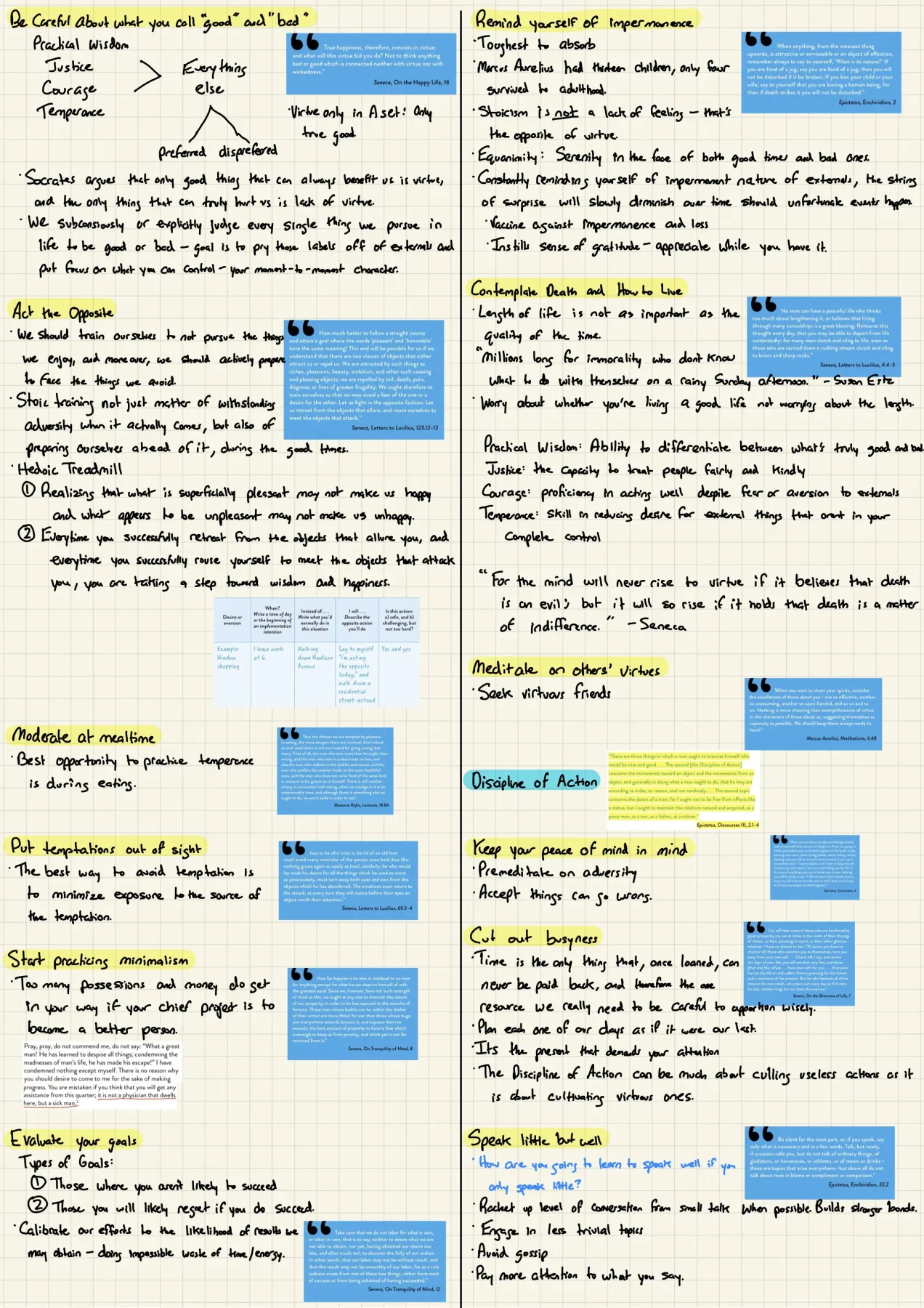
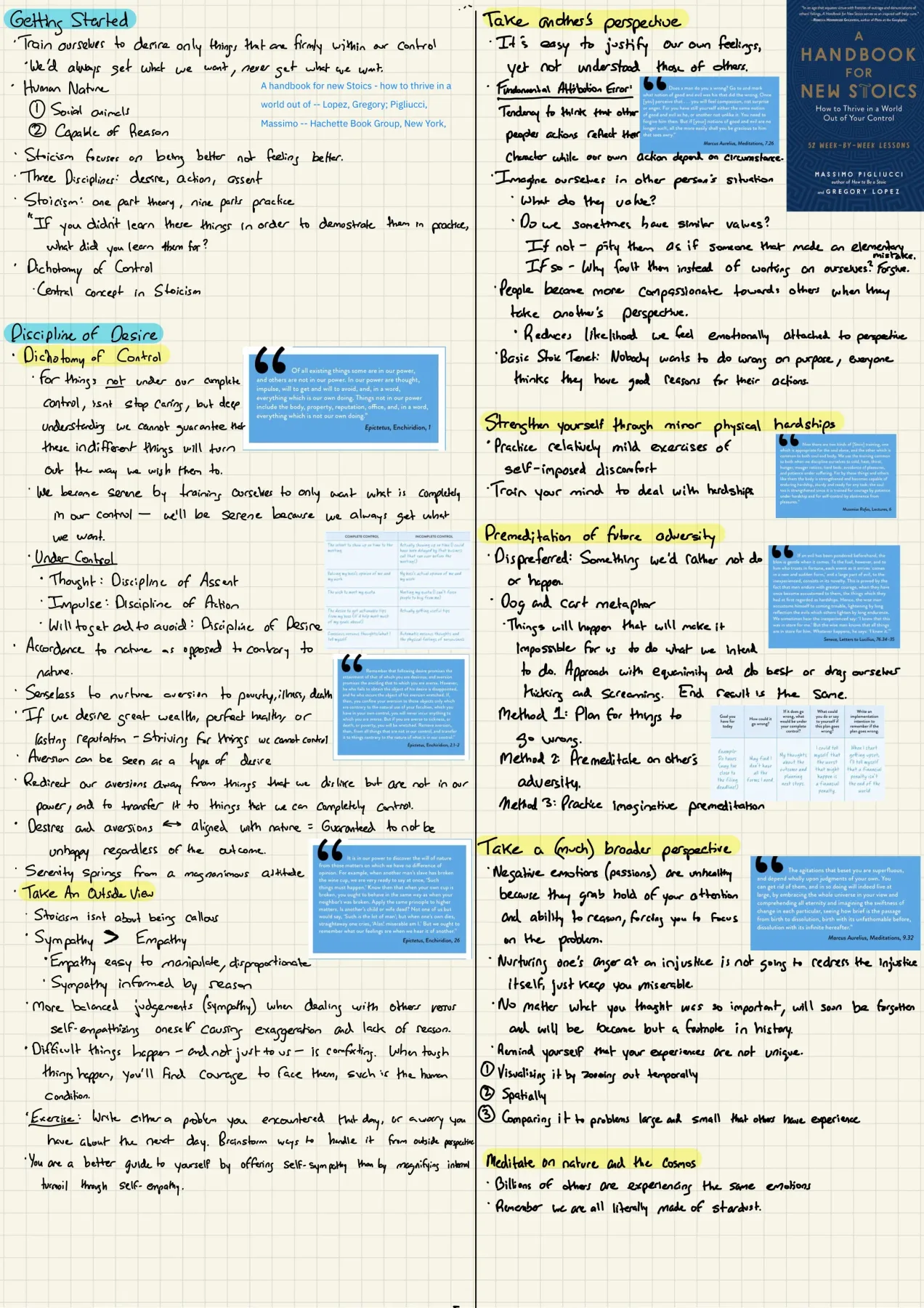
Description
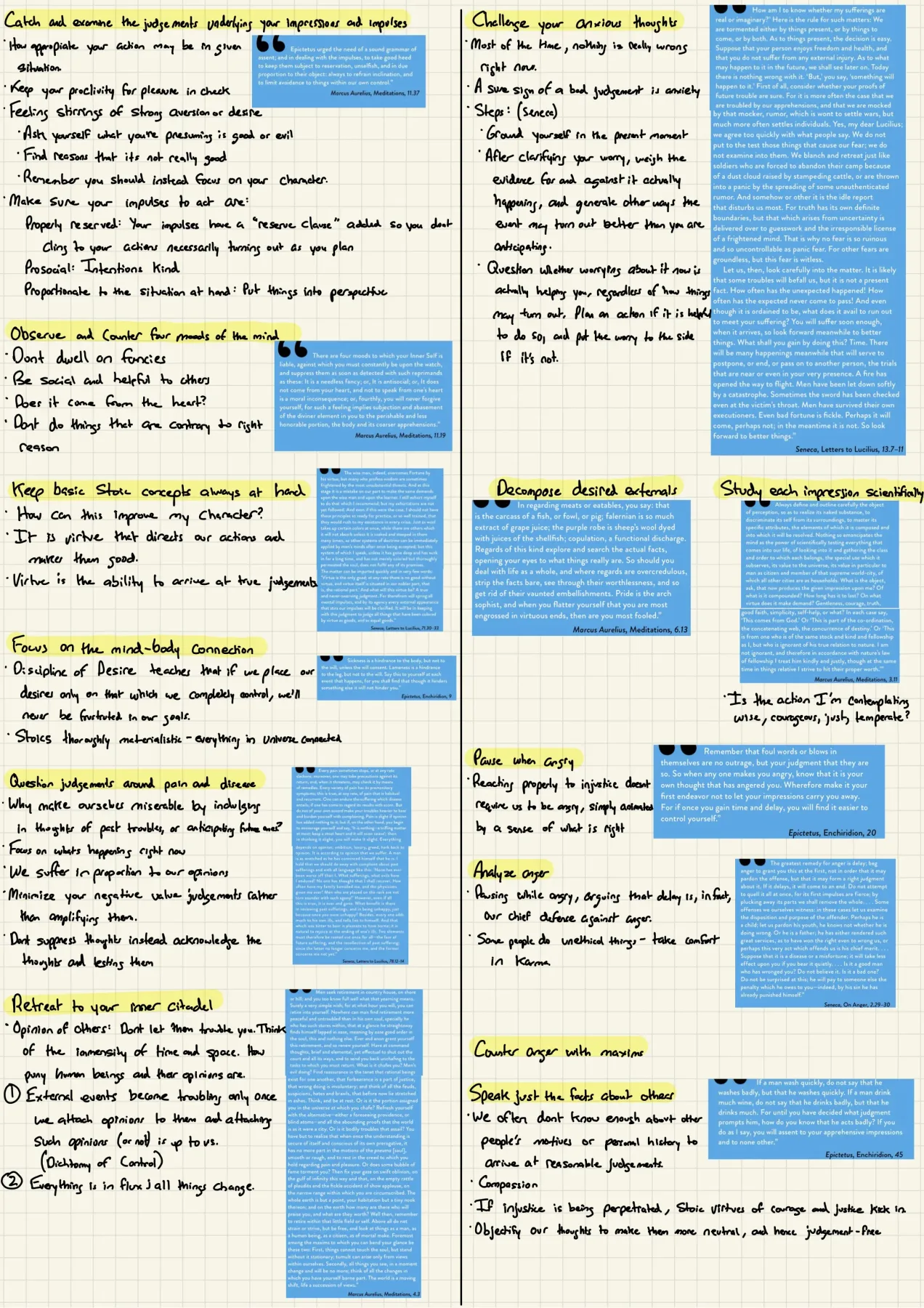
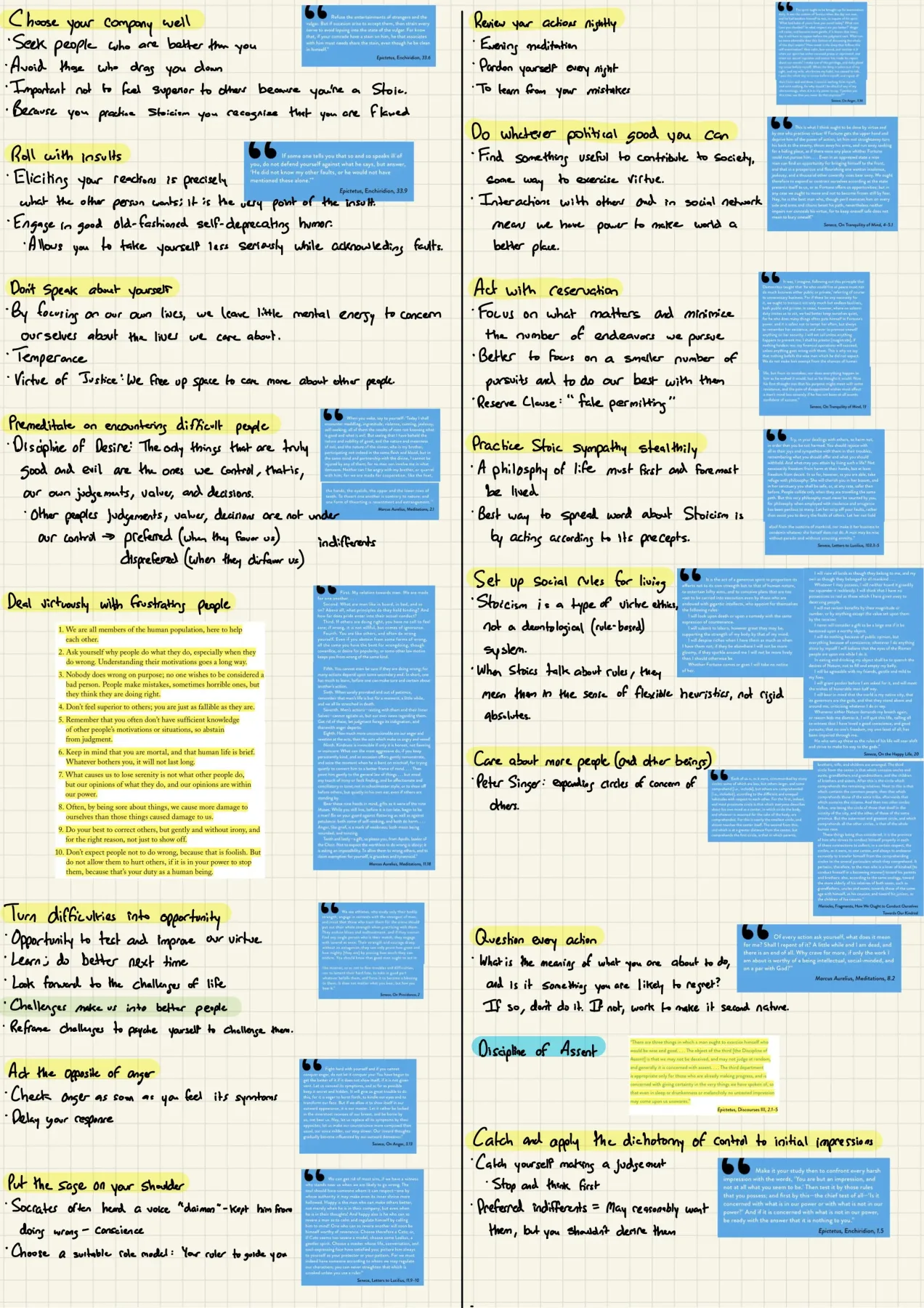
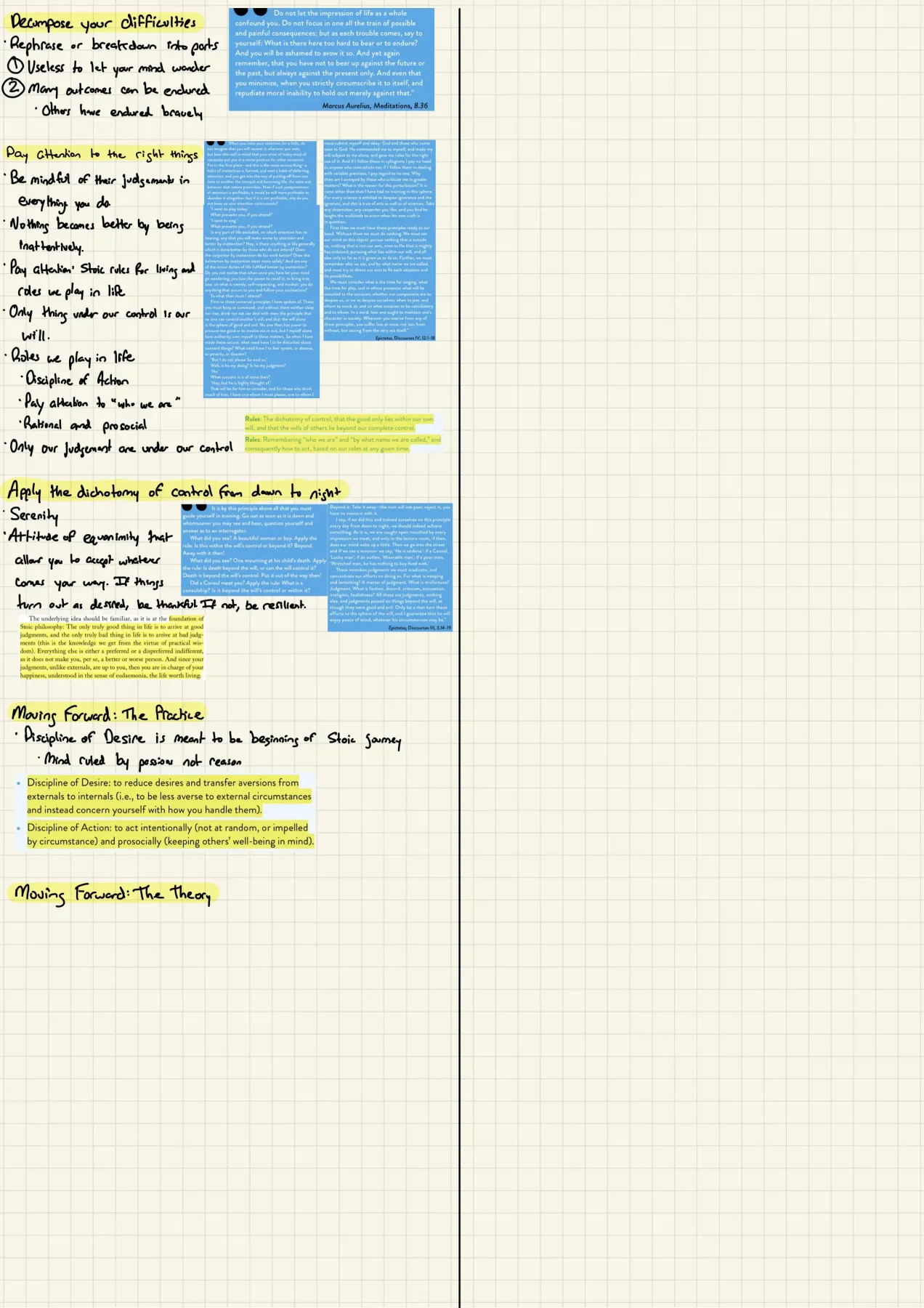
Massimo Pigliucci and Gregory Lopez turn ancient Stoicism into a year-long training program, arguing that the only reliable bet for a good life is one’s own character, since externals such as wealth, health, reputation, and other people’s behavior are never fully in our control. The book is organized around Epictetus’ three disciplines: Desire (wanting and avoiding only what is up to us), Action (acting intentionally and prosocially toward others), and Assent (catching and testing impressions before they become passions or impulses). Each of its fifty-two weekly lessons pairs a modern scenario with a passage from Seneca, Epictetus, Musonius Rufus, Marcus Aurelius, or Hierocles, an explanation that often cites modern psychology, and a graded daily exercise with a weekly review. The sequence is cumulative: Assent revisits the material of the first two disciplines at the moment of judgment, and the last lesson returns to the dichotomy of control with which the first began. An epilogue shows readers how to build a personal curriculum and where to go for Stoic theory.
Vault PDF and source boundary
Attachment (file not included in this release)
Page links use the PDF viewer’s page count (printed page 1 of the Introduction is viewer page 8). The fifty-two weekly lessons are grouped below into analytical runs within the book’s three parts; the groupings are this note’s, while week titles and section headings are the authors’.
Evidence boundary: these notes reconstruct the authors’ argument from the supplied book. Distinctive claims, including the psychological studies the authors cite, are attributed to the authors; they have not been independently fact-checked.
Chapter-by-Chapter Overview
Linked reading map
Use the entries below to jump to the full argument, analytical divisions, essential evidence, concepts, conclusion, and reflection questions for each part of the book. The fifty-two weeks are grouped into coherent runs inside the authors’ three parts.
- Introduction: Staking happiness on externals is a losing bet; character is the one sure bet, and Stoicism trains it through three disciplines and the dichotomy of control, practiced weekly for a year. Attachment (file not included in this release)
Part I: The Discipline of Desire (Weeks 1-17)
- Weeks 1-5. Control and perspective: Sort what is fully in your power from what is not, desire only your own contribution, correct self-pity with an outside view and anger with an inside view, and toughen the will through graded discomfort. Attachment (file not included in this release)
- Weeks 6-9. Adversity and value: Rehearse misfortune, shrink problems with the view from above, place yourself in nature under either providence or atoms, and relabel externals as preferred indifferents ranked below virtue. Attachment (file not included in this release)
- Weeks 10-14. Temperance: Retrain desire by acting the opposite, moderating meals, removing temptations, owning less, and auditing goals for being vain or in vain. Attachment (file not included in this release)
- Weeks 15-17. Loss, death, and virtue: Rehearse the impermanence of what you love and the fact of death without suppressing grief, then redirect desire toward the virtues you admire in others. Attachment (file not included in this release)
Part II: The Discipline of Action (Weeks 18-35)
- Weeks 18-23. Everyday conduct: Keep calm as a second goal of every task, cut busyness, speak little and without gossip, choose company carefully, roll with insults, and stop talking about yourself. Attachment (file not included in this release)
- Weeks 24-29. Difficult people: Expect difficult people, interpret wrongdoing as ignorance, treat hardship as training, act the opposite of anger, consult an imagined sage, and review each day with self-compassion. Attachment (file not included in this release)
- Weeks 30-35. Widening concern: Do what political good you can with a reserve clause, practice Stoicism stealthily, adopt a few flexible rules, collect the circles of concern toward all humanity, and question every desire-driven act. Attachment (file not included in this release)
Part III: The Discipline of Assent (Weeks 36-52)
- Weeks 36-41. Impressions and assent: Pause on harsh impressions, learn the impression-assent-impulse model and the three Ps, watch four moods, soak the mind in principles, and apply all of it to disability and pain. Attachment (file not included in this release)
- Weeks 42-45. Replacing judgments: Retreat to the inner citadel with comforting maxims, test anxious thoughts against evidence, strip desired things of value language, and study each impression in terms of its parts, the whole, and the virtue it demands. Attachment (file not included in this release)
- Weeks 46-49. Anger and judging others: Pause at the first sign of anger, analyze its object, counter it with rehearsed maxims, and describe other people’s conduct in neutral, factual terms. Attachment (file not included in this release)
- Weeks 50-52. Attention and the final rule: Confine difficulties to the present and break them into parts, attend continuously to rules and roles, and test every impression with the dichotomy of control from dawn to night. Attachment (file not included in this release)
Epilogue
- Moving Forward: The Practice: Build a small personal curriculum from the exercises that worked, starting with Desire, mixing set-time and occasional practices, and progressing by the goals of each discipline. Attachment (file not included in this release)
- Moving Forward: The Theory: Practice without theory becomes a bag of tricks; an annotated list of translations, scholarship, modern books, and communities points the way. Attachment (file not included in this release)
Review
Handwrite First
Use this section with the book and notes closed. Retrieval matters more than polished prose.
1. Before Reading
- Prediction:
- Question I want answered:
- What I already think about Stoic practice and control:
- What I expect to disagree with:
2. Closed-Book Recall Dump
-
Main claims I remember:
-
Key exercises, texts, or contrasts:
-
People, cases, and concepts:
-
What feels fuzzy or incomplete:
3. Core Argument From Memory
- The book in one sentence:
- The problem Pigliucci and Lopez are correcting:
-
The causal chain:
- Best evidence I remember:
- Most important qualification:
4. Feynman Check
Explain the program in plain language to an intelligent reader who thinks Stoicism means suppressing emotion and not caring. Circle any term (the dichotomy of control, preferred and dispreferred indifferents, lexicographic ordering, premeditatio malorum, the view from above, the reserve clause, oikeiosis and the circles of Hierocles, impression, assent, and impulse, the three Ps, proficiens, prohairesis, or implementation intention) that you cannot define without looking.
5. Pushback From Memory
- Strongest alternative explanation:
- Claim the authors may overstate:
- Evidence that would change my mind:
- What follows from the ancient texts, and what is the authors’ modern reading:
Type Into Obsidian
After checking the chapter notes, correct the handwritten reconstruction.
1. Correction After Checking
- What I remembered accurately:
- What I distorted or omitted:
- Week or passage that corrected me:
2. Clean Core Argument
- Thesis:
- Reasoning:
- Essential evidence:
- Qualification:
- Connection to the book:
3. Connections
- Dichotomy of Control — does the authors’ split of every goal into a controllable effort and an uncontrollable outcome (Week 2) match the version of the dichotomy already in the vault, or does it soften Epictetus?
- Stoicism and Emotion - Margaret R Graver — the authors lean on Graver for the three phases of anger and the theory of impulse; does her account of preliminary emotions support their claim that only assent is fully up to us?
- Sympathy vs Empathy — is the authors’ preference for reasoned sympathy over empathy (Week 3, Week 32) the same distinction drawn there, and does it survive Week 4’s instruction to take another’s perspective?
- Lessons in Stoicism - John Sellars — how does a theory-first introduction compare with this practice-first handbook, and which Stoic doctrines does each leave out?
- New connection:
4. Flashcards / Atomic Recall
- Q: What are Epictetus’ three disciplines, and which of the three controllable items does each train? A: Desire trains the will to get and to avoid; Action trains impulse; Assent trains thought or judgment.
- Q: How do the authors answer the objection that many things are partly in our control? A: Any influenceable outcome splits into an uncontrollable result and a controllable contribution; one should desire only the contribution, which also tends to improve the odds of the result.
- Q: What is a lexicographic preference, and how do the Stoics use it? A: A ranking in which every item in a higher class outranks every item in a lower one with no trade-offs; virtue alone is in the top class, and all externals are preferred or dispreferred indifferents below it.
- Q: What are the three Ps for checking an impulse to act? A: It should be properly reserved (with a reserve clause), prosocial, and proportionate to the situation.
- Q: What are Seneca’s three phases of anger, and where can we intervene? A: An involuntary prereflective surge, a brief cognitive phase of recognition and judgment, and anger proper after assent; the window is at the start of the second phase.
Retention Check
24 Hours Later
- Reconstruct the three disciplines, what each targets, and one exercise from each.
- Name one claim, one exercise, and one qualification from the book.
1 Week Later
- Apply the dichotomy of control and the three Ps to one real situation, noting which judgment you assented to and which you could have suspended.
- Explain why the authors put the Discipline of Desire first and the Discipline of Assent last.
1 Month Later
- Rebuild the book’s arc from “the sure bet” in the Introduction to “the dichotomy of control from dawn to night” in Week 52 without opening the note.
- Identify the strongest claim you accept, the strongest you resist, and the evidence needed to decide between them.
Notes
Book Argument and Reading Map
The book’s governing claim is a wager. Most people stake their happiness on things that may never arrive and rarely satisfy when they do: money, health, status, other people’s approval. The authors argue that the one sure bet is our own character, because “shaping your character is ultimately the only thing under your control” (Attachment (file not included in this release)). If we train ourselves to desire only what is fully in our power, we cannot be disappointed, and good character is in any case what makes good use of whatever externals luck provides. Stoicism, they say, is “roughly one part theory and nine parts practice,” and the gap between understanding the dichotomy of control and internalizing it is the reason the book is a year of exercises rather than a treatise (Attachment (file not included in this release)).
The structure follows Epictetus’ three disciplines, which map onto the three things he says are in our power. Desire (Weeks 1-17) trains the will to get and to avoid: sort what is up to us, rehearse adversity, revalue externals as preferred indifferents below virtue, practice temperance, and face loss and death. Action (Weeks 18-35) trains impulse: act deliberately rather than carelessly, then prosocially, from managing one’s speech and company to dealing with difficult people, doing political good, and widening concern to all humanity. Assent (Weeks 36-52) trains judgment: catch impressions, refuse assent to false ones, and replace or dissolve them. Each lesson combines a modern scenario, an ancient text, an explanation that frequently cites cognitive behavioral therapy and other psychological research, and a graded exercise with a weekly review. Because the book has fifty-two short units, these notes group them into eleven coherent runs within the authors’ three parts (Weeks 1-5, 6-9, 10-14, 15-17; 18-23, 24-29, 30-35; 36-41, 42-45, 46-49, 50-52), plus the Introduction and the two-chapter Epilogue.
The through-line is a single psychological model applied with increasing precision. Disturbance comes not from events but from our judgments about them; the dichotomy of control is first a classification exercise (Week 1), then a rule for goals (Week 2), then a test applied to every impression from dawn to night (Week 52). The authors stress that the Discipline of Assent “doesn’t really cover new ground” but cements the first two by working at the moment of judgment, using the model of impression (involuntary), assent (voluntary), and impulse (the urge to act that follows assent). The same targets, especially anger, desire for externals, and aversion to pain and loss, are attacked three times: by perspective and value theory in Part I, by behavior in Part II, and by the analysis of judgments in Part III.
The book’s second argument is about sociability. Stoicism, the authors insist, aims to make the practitioner and the world better, not only calmer. We are rational social animals “made for cooperation,” so the Discipline of Action moves from self-restraint to justice: charitable interpretation of wrongdoers, political good within one’s reach, Hierocles’ circles of concern, and stealthy, non-judgmental practice. Equanimity is repeatedly distinguished from passivity; Marcus’ duty to stop people from harming others, and the claim that one can oppose injustice from a sense of what is right rather than from anger, keep the program from collapsing into withdrawal.
Interpretive guardrails
- This is a practical handbook by two modern Stoics, not a scholarly reconstruction. The authors openly modernize: they reject ancient pantheism and providence in favor of a scientific cosmology, read Epictetus’ harsher sayings through Seneca’s gentler ones, and add elements such as concern for animals and Buddhist-style metta meditation.
- Many claims are supported by citations to psychology (implementation intentions, the hedonic treadmill, the fundamental attribution error, CBT, mindfulness, pain-coping research). These are offered as convergent support for the exercises, not as tests of Stoic doctrine; each exercise is framed as a personal experiment to be evaluated at week’s end.
- “Indifferent” is a technical term: preferred indifferents (health, wealth, relationships) may be reasonably pursued and enjoyed; they simply do not make one better or worse as a person. The book repeatedly rejects the stiff-upper-lip reading of Stoicism and endorses grief, joy in virtue, and sympathy.
- The opening scenarios (Alice, Mike, Tekanyo and others) are illustrative vignettes, not case evidence.
- The groupings of weeks in these notes are analytical; the authors present the fifty-two weeks as a continuous sequence within three parts.
Introduction: Getting Started
Chapter Objective and Through Line
The introduction makes a wager argument for Stoicism. Most of what people stake their happiness on (weight, money, promotions, other people’s approval, freedom from illness and traffic) is not reliably obtainable, and even when it is obtained it rarely satisfies. The authors’ alternative is to bet on the one thing that is fully in our power: our own character. “Shaping your character is ultimately the only thing under your control” (Attachment (file not included in this release)), so training oneself to want only what is up to us turns life into a game we cannot lose: “we’d always get what we want, and never get what we don’t want.”
From that motivating claim the chapter moves to orientation. It gives a short history of the school, distills Stoicism into three linked ideas (live according to nature, the three disciplines, and the dichotomy of control), and then explains how the book is built: fifty-two weekly lessons, each pairing an ancient text with a modern scenario, an explanation, and a daily exercise. The introduction thus sets the book’s governing assumption, that Stoicism is “roughly one part theory and nine parts practice” (Attachment (file not included in this release)), and that understanding an idea is different from internalizing it through repetition.
Chapter Structure at a Glance
- The bad bet: staking happiness on externals leaves us frustrated whether we fail or succeed.
- The sure bet: character is the only thing fully under our control, and good character is what makes any external advantage useful.
- Who the Stoics were: from Zeno’s founding of the Stoa to the four Roman authors the book draws on, and Stoicism’s modern influence through CBT.
- Three basic tenets: living according to nature (reason applied to social life), the three disciplines, and the dichotomy of control.
- Practice over theory: the book’s weekly format and annual cycle exist because internalization requires repetition.
Section-by-Section Argument
The Best Bet for Happiness and Betting on Character (author’s headings, grouped)
The chapter opens with Mike at his college reunion, convinced he is unhappy because his life is bad compared with his classmates’. The authors use him to show the logic of the “bad bet”: we want things that may never arrive, and things we do not want happen anyway. Their proposed escape is to train desire itself so that it attaches only to what is in our power.
- Even success does not solve the problem: pleasures fade, possessions wear out, status leaves us wanting more, and a new business brings new worries. Mike would likely have found something to complain about even as a fit, married executive.
- Character determines the use of externals. People of poor character misuse money or fame; people of good character use whatever they have well and persevere when luck turns. Hence improving oneself is “a guaranteed win with the biggest payoff” (Attachment (file not included in this release)).
Meet the Stoics (author’s heading)
A brief history establishes the sources. Zeno of Citium, shipwrecked and penniless in Athens around 300 BCE, became a student of Crates and founded the school named after the Stoa Poikile. The four Roman Stoics whose writings survive (Seneca, Musonius Rufus, Epictetus, and Marcus Aurelius) supply the book’s texts.
- The authors note Stoic influence on thinkers from Paul and Augustine to Descartes and Spinoza, and on cognitive behavioral therapy beginning with Albert Ellis in the 1950s. This matters because the book repeatedly pairs ancient exercises with modern psychological findings.
The Very Basics (author’s heading)
The authors compress Stoicism into three tenets. Living according to nature depends on the ancient triad of “physics” (all the natural sciences plus metaphysics), “logic” (reasoning, psychology, and rhetoric), and “ethics” (how to live a meaningful life). Since humans are social animals capable of reasoning, living according to nature “means using reason to improve social living” (Attachment (file not included in this release)). This, they argue, distinguishes Stoicism from self-help aimed only at feeling better: it aims to make the practitioner and the world around them better.
- The three disciplines (from Epictetus) translate that ideal into practice: Desire concerns what to want or avoid, Action concerns how to behave toward others, and Assent concerns arriving at correct judgments about what life presents. The book’s three parts follow this order.
- The dichotomy of control is “the central concept in Stoicism”: focus energy on what is in our power and turn away from what is not. The point is obvious once stated, but living it is “much more easily said than done,” which is why it is the first exercise.
How to Use This Book (author’s heading)
Each week begins with a scenario, an ancient text, and an explanation, then assigns an exercise to practice Monday through Saturday, with a weekly review on Sunday before reading the next chapter. Each part has a self-rating questionnaire to complete before and after. At the end of the year readers assemble a personalized curriculum. For readers not ready to commit to a year, the authors suggest sampling three weeks from each discipline.
Key Concepts and Distinctions
- The sure bet: Placing one’s desires only on what is fully in one’s power, namely one’s own character and judgments.
- Significance: It is the motivational premise of the whole book and the promise of the Discipline of Desire.
- Living according to nature: Using reason to improve social life, grounded in an understanding of the world (physics) and of good reasoning (logic).
- Significance: It explains why the book’s practices aim at prosocial action, not just personal calm.
- Understanding versus internalizing: Grasping an idea by reading versus making it habitual through repeated practice.
- Significance: It justifies the book’s form as a year of exercises rather than a treatise.
Essential Evidence and Examples
- Mike at the reunion: shows the “bad bet” at work: his unhappiness tracks comparisons on externals, and the authors suggest success on those terms would not have satisfied him either.
- Character and the use of externals: the contrast between poor and good character putting money or office to bad or good use supports the claim that character, not luck, determines whether advantages help.
- The weekly format: the scenario, text, explanation, exercise, and review cycle is the book’s practical answer to the gap between understanding and internalizing.
Chapter Conclusion and Significance
The introduction concludes that the reliable path to a satisfying life runs through character, and that Stoicism offers a tested method for shaping it. Its argument is pragmatic rather than demonstrative: the authors do not prove that virtue is the only good here but show why betting on externals is a losing strategy and promise that practice will make the alternative persuasive from the inside. The structure it describes, with desire first, action second, and assent last, is itself part of the argument, since later chapters claim each discipline depends on the one before.
Questions for Reflection
- The “sure bet” argument makes Stoicism attractive because it cannot fail. Does training desire to fit what is in our power risk becoming a strategy of lowering expectations rather than improving character?
- How do the authors distinguish Stoicism from self-help that aims only to make people feel better, and is the social, “improve the world” element doing real work in their case?
- If understanding the dichotomy of control is easy and internalizing it is hard, what kind of evidence would show that weekly exercises actually change character rather than just habits of attention?
Part I: The Discipline of Desire (Weeks 1-17)
Weeks 1-5: Control, Perspective, and Minor Hardship
Grouping note: the authors divide Part I into seventeen weekly lessons with no sub-parts. This run (Weeks 1-5) is an analytical grouping; the week titles below are the authors’.
Chapter Objective and Through Line
The opening run lays the foundation for the entire book. Part I begins with Epictetus’ claim that the Discipline of Desire is “the chief and the most urgent” of the three, because frustrated desire and realized aversion produce the “perturbations, disorders, … sorrows, lamentations, and envy” that keep us from even hearing reason (Attachment (file not included in this release)). The cure is the dichotomy of control: distinguish what is completely in our power (judgments, impulses, and the will to get and to avoid) from what is not (body, property, reputation, office, and outcomes generally), then attach desire and aversion only to the first set.
The five weeks develop this in a deliberate sequence. Weeks 1 and 2 are analytical: learn to sort events into complete and incomplete control, then transfer aversion from outcomes to one’s own contribution. Weeks 3 and 4 add perspective-taking in two directions: look at your own troubles from outside, as you would a friend’s, and look at other people’s offenses from inside, as they see them. Week 5 moves from mind to body, using voluntary discomfort to train the will so that involuntary hardship loses its power to upset.
Across the run the authors keep two qualifications in view. The Stoic is not asked to stop caring about externals, only to stop staking serenity on them; and the practitioner is not asked to become callous, since Stoic perspective-taking aims at reasoned sympathy rather than numbness. Each lesson pairs an ancient text with modern psychology (attribution error, perspective-taking research, self-distancing) to argue that the old exercises have contemporary support.
Chapter Structure at a Glance
- Sort the world: separate what is completely in your control from what is not, and see that the three controllable items map onto the three disciplines (Week 1).
- Redirect desire and aversion: split partially controllable goals into the uncontrollable outcome and the controllable effort, and want only the effort (Week 2).
- Correct self-empathy with an outside view: treat your own misfortunes with the reasoned sympathy you give others (Week 3).
- Correct judgment of others with an inside view: find the mistaken value behind someone’s wrongdoing, then forgive or pity rather than rage (Week 4).
- Train through the body: chosen, graded discomfort makes imposed discomfort less disturbing and strengthens character (Week 5).
Section-by-Section Argument
Week 1: Discover what’s really in your control, and what’s not
Using Enchiridion 1, the authors divide the world into things completely in our power and everything else, and they link the idea to Niebuhr’s Serenity Prayer. The aim is not indifference in the ordinary sense: “it isn’t that we stop caring about them, but rather that we come to a deep understanding that we cannot guarantee that these indifferent things will turn out the way we wish” (Attachment (file not included in this release)). Serenity (ataraxia) comes from wanting only what is guaranteed.
- The three controllable items are a map of Stoic training. “Thought” (hypolepsis, judgment or opinion, often implicit), “impulse” (horme, an urge to act that follows a value judgment, not a reflex), and the “will to get and to avoid” (considered pursuit) correspond to the Disciplines of Assent, Action, and Desire respectively.
- These remain in our control even when influenced by other people or bodily urges, because we can consciously override them.
- The authors grant that body, property, and reputation are partly influenceable, unlike the weather, but invoke the best-bet argument: staking peace of mind on them forfeits happiness to chance.
- Exercise: each evening, write about a mildly charged event and list what was and was not completely in your control. Alice’s example shows a key modern refinement: automatic nervous thoughts and bodily sensations belong in the “incomplete control” column, though what she tells herself afterward does not.
Week 2: Focus on what is completely in your control
Enchiridion 2 tells us to remove aversion from things not in our power and “transfer it to things contrary to the nature of what is in our control.” The authors explain that “Discipline of Desire” is Pierre Hadot’s shorthand for the Discipline of Desire and Aversion, and that aversion is a kind of desire. The lesson resolves the problem left by Week 1, the large middle category of things we can influence: any influenceable outcome splits into a part we cannot control and a part we can.
- In the promotion example, the promotion depends on rivals, the boss’s mood, and chance; putting forward the best possible case does not. Desiring only the latter means “you cannot possibly fail,” and because good work correlates with promotion, it also improves the odds (Attachment (file not included in this release)).
- The same split applies to love (aim to be lovable, not to be loved) and games (play your best rather than fear losing).
- Exercise: review Week 1’s “incomplete control” entries that provoked aversion, trace how controllable thoughts fed the aversion, brainstorm ways to transfer the aversion inward, and practice one daily. Suki, awaiting a cardiologist’s results, discovers that her own catastrophizing thoughts, not the test, were producing her fear.
Week 3: Take an outside view
Enchiridion 26 observes that when a neighbor’s cup breaks or his child dies we say “such things must happen,” but cry “Alas! miserable am I” when it happens to us. The authors meet the obvious objection, that this counsels callousness, by distinguishing sympathy (caring about and feeling sorry for another’s misfortune) from empathy (sharing their emotional experience). Following Paul Bloom and Jesse Prinz, they argue that empathy is easily manipulated, disproportionate to the situation, and does not scale, while sympathy “is informed by reason and is therefore more wide ranging” (Attachment (file not included in this release)).
- Epictetus’ point, on this reading, is that we normally self-empathize and sympathize with others; correcting the imbalance “does not make us callous; it simply makes us more reasonable.”
- Seneca is cited to show the Stoic aim is “fellow-feeling with all men,” not emotional robotics.
- Exercise: for five minutes each night, write about a problem or worry in the second person (“You feel nervous about…”) and advise yourself. The authors note Marcus Aurelius almost always addresses himself as “you” in the Meditations and that modern research supports the technique.
Week 4: Take another’s perspective
Where Week 3 took an outside view of one’s own troubles, Week 4 takes an inside view of other people’s conduct. Meditations 7.26 tells us, when wronged, to ask what notion of good and evil led the person to act. The authors connect this to Lee Ross’s fundamental attribution error: we explain others’ actions by their character and our own by circumstances.
- Marcus’ procedure has three steps: identify the other person’s mistaken value; ask whether you share it (if so, forgive, since you have erred the same way); if not, pity them as you would someone who made “an elementary mistake in logic or math” (Attachment (file not included in this release)).
- Research by Sara Hodges and colleagues is quoted to support the claim that perspective-taking increases compassion and leads people to treat others more like themselves.
- The authors stress that perspective-taking does not require agreement, only a fair hearing. It rests on the Stoic tenet that “nobody wants to do wrong on purpose.”
- Exercise: each evening, reflect on someone who frustrated you, reconstruct the values (usually about externals) behind their action, check whether you share them, and note how you feel afterward. Felix and the curt bank teller, both frustrated by the same long line, illustrate the payoff.
Week 5: Strengthen yourself through minor physical hardships
Musonius Rufus describes training “common to both soul and body”: disciplining oneself to cold, heat, thirst, hunger, hard beds, and abstinence from pleasure, which strengthens the body and trains the soul for courage and self-control. The authors insist the point is not self-punishment: voluntary, mild deprivation accustoms us to discomfort so that when circumstance imposes it, it is “no big deal.”
- Philosophy cannot be only theory; as with learning to ride a bicycle, virtue requires practice.
- Qualification from cognitive science: until trained, we should avoid delicate tasks when tired, hungry, or sick, because bodily strain degrades judgment. “Know thyself, gently ask for a postponement, and practice!”
- Exercise design: list discomforts that trigger emotional upset, pick one that occurs often and whose mastery would matter, check that it rates 3 to 5 in difficulty on a 10-point scale, confirm safety with a physician, and prepare one to three “at-hand” phrases (“I’m doing this to become more resilient”). Henry, who becomes “hangry” when skipping lunch, chooses smaller lunches rather than none.
- At-hand phrases are introduced here as a recurring Stoic tool: short reminders of principles to keep motivation and attention.
Key Concepts and Distinctions
- Dichotomy of control: The division between what is completely in our power (judgments, impulses, considered desires and aversions) and what is not (externals and outcomes).
- Significance: It is the base of the whole curriculum and the criterion for where desire and aversion may safely go.
- Splitting the middle category: Any influenceable outcome contains an uncontrollable result and a controllable contribution.
- Significance: It answers the obvious objection to the dichotomy and turns it into a practical rule for goals.
- Sympathy versus empathy: Reasoned concern for another’s misfortune versus sharing their feelings.
- Significance: It lets the authors defend Stoic detachment from the charge of callousness and recurs throughout Part II.
- Fundamental attribution error: Attributing others’ actions to character and our own to circumstance.
- Significance: It gives a modern name to the bias Marcus corrects and grounds the inside-view exercise.
- Voluntary discomfort and at-hand phrases: Graded self-imposed hardship, supported by short reminders of why one is doing it.
- Significance: It extends the Discipline of Desire from thoughts to bodily aversions and introduces a tool used through the rest of the book.
Essential Evidence and Examples
- Alice’s control table: her finding that automatic nervous thoughts belong in the “incomplete control” column shows the authors’ modern refinement of Epictetus’ list.
- The promotion example: demonstrates how splitting outcome from effort makes desire unfailing while still improving the odds of the outcome.
- Bloom and Prinz on empathy: their arguments that empathy is manipulable, biased, and does not scale are the authors’ main support for preferring sympathy.
- Hodges on perspective-taking: the research quoted supports the claim that taking another’s perspective increases compassion and reduces anger.
Chapter Conclusion and Significance
The run concludes that serenity is possible because the sources of our disturbance lie largely in our own judgments and desires, which can be trained. The argument proceeds from conceptual sorting, to redirection of desire, to two kinds of perspective correction, to bodily training, so that by Week 5 the dichotomy of control is no longer an abstract principle but a set of daily habits. It also establishes the book’s method: an ancient text, a modern case, a psychological finding, and a graded exercise with a weekly review.
The main tension the authors leave open is how far the “complete control” category really extends. They concede that automatic thoughts and bodily responses are not fully willed and that modern cognitive science may revise Epictetus’ list, yet they keep the strong promise that properly directed desire “cannot possibly fail.” Much of the later book, especially the Discipline of Assent, works in the space between an impression we do not choose and the judgment we do.
Questions for Reflection
- If automatic thoughts and feelings fall outside complete control, how much is left inside it, and is that enough to support the promise that a trained Stoic always gets what he wants?
- Does the effort/outcome split in Week 2 risk making goals meaningless, or does caring only about effort still give a person reason to pursue the outcome wholeheartedly?
- Is the authors’ preference for sympathy over empathy compatible with Week 4’s instruction to imagine oneself in the other person’s situation, which looks like an empathic act?
Weeks 6-9: Preparing for Adversity and Revaluing Externals
Grouping note: an analytical run within Part I (The Discipline of Desire). Weeks 6-8 widen the frame around misfortune; Week 9 states the value theory that explains why the widening works.
Chapter Objective and Through Line
Weeks 1-5 taught the practitioner to sort and redirect desire. This run asks what to do about misfortunes that have not yet happened, or that loom too large when they do, and then supplies the theory underneath. The working claim, stated through Seneca at the outset, is that “a large part of evil, to the inexperienced, consists in its novelty” (Attachment (file not included in this release)): what we have rehearsed, compared, or placed in context disturbs us far less than what ambushes us.
Three exercises build that context in widening circles. Premeditatio malorum (Week 6) rehearses things going wrong in our own plans, in others’ lives, and in imagination. The view from above (Week 7) shrinks a problem against the vastness of time, space, and other people’s suffering. Meditating on nature (Week 8) places the self inside an ordered cosmos, whether that cosmos is the ancient Stoics’ providential living God or the modern scientific web of causes. Week 9 then names the principle all three presuppose: only virtue is good and only vice is bad, and everything else is a preferred or dispreferred “indifferent.” Once that is understood, the language we use about externals becomes a lever for changing how strongly we desire and fear them.
The authors keep the practical limits in view throughout. Perspective does not make problems disappear: the car still needs repairing and the war still has to be fought. What changes is that we stop adding a self-inflicted injury to the external one, and so we act better on the problem itself.
Chapter Structure at a Glance
- Unexpected misfortune hurts more than rehearsed misfortune, and passion blocks the reasonable response that remains in our control (Week 6).
- Rehearsal can be structured through planning for failure, noticing others’ misfortunes, and graded imaginal exposure (Week 6).
- Passions narrow attention; a cosmic or comparative view restores proportion without excusing inaction (Week 7).
- Our place in nature consoles under either cosmology: providence, or a causal order in which we still possess reason (Week 8).
- The underlying theory: virtue is the only good, externals are indifferents ranked lexicographically below it, and value-laden words feed emotion (Week 9).
Section-by-Section Argument
Week 6: Premeditation of future adversity
James, stuck in traffic on the way to a crucial job interview, is too upset even to call ahead. The authors use him to make two points about passion. Once lateness is unavoidable it is merely dispreferred, and getting upset adds a self-inflicted injury to an external one; and his distress kept him from the one useful act still in his control. A passion, they note, is not just any emotion but one that “clouds your mind, stopping you from doing or thinking what is reasonable” (Attachment (file not included in this release)). Stoics, on this account, are not pessimists but realists who are “always mentally prepared.”
- Chrysippus’ dog tied to a cart: the dog can follow willingly or be dragged; the destination is the same, but the suffering is not. This becomes the book’s image for accepting what cannot be controlled.
- No ancient Stoic described how to do premeditatio, so the authors offer three methods. Method 1 (Monday-Tuesday): each morning list plans, assume each goes wrong, identify what remains in your control, and write an implementation intention (“If my plan goes wrong, I’ll tell myself…”), a well-studied technique introduced here and used throughout the book. Method 2 (Wednesday-Thursday): whenever you see misfortune befall someone else, remind yourself it could happen to you. Method 3 (Friday-Saturday): imaginative premeditation, similar to imaginal exposure therapy, in which you vividly replay a mild rated misfortune for ten minutes, in present tense and first person, until it becomes familiar or even boring.
- The authors distinguish the Stoic aim from therapy: imaginal exposure treats clinical anxiety, while premeditatio aims “to loosen our attachment to external events in general,” and they advise starting with minor scenarios.
Week 7: Take a (much) broader perspective
Isabella is still fuming a week after a mechanic overcharged her and damaged her transmission. Marcus’ Meditations 9.32 says such “agitations … are superfluous, and depend wholly upon judgments of your own,” and recommends embracing the whole universe and all eternity in one’s view. The authors set Marcus’ own problems (two frontier wars, a plague with perhaps millions of deaths, a rebellion) against Isabella’s to show the exercise was forged under real pressure.
- Perspective is not a solution, and not callousness. Nursing anger “is not going to redress the injustice itself” and keeps one miserable; with equanimity Isabella can file a complaint and find a better mechanic (Attachment (file not included in this release)).
- Three vantage points: the vastness of time, the vastness of space (zooming out from room to universe), and the relative size of the problem, comparing it with others’ troubles from a bad haircut to war. A related variation is remembering that one’s experience is not unique.
- Exercise: pick the vantage point that works, use it during the day via an implementation intention (not while driving or mid-conversation), and practice it each night for five to ten minutes on a mildly upsetting event, rating distress first. Week 3 took another person’s view; this week takes the most objective view available.
Week 8: Meditate on nature and the cosmos
Albert, home from a ten-month deployment, is snowed in at the airport on Christmas. Marcus’ Pythagorean practice of looking at the stars each morning, whose order and “nakedness” contrast with our veils and worries, is offered as a remedy for feeling that the universe is out to get us.
- Ancient versus modern cosmology is the chapter’s main conceptual move. The ancient Stoics were pantheists: the universe was a living God-organism, and we are parts of it, like a foot that must step in mud for the body’s good. Most modern Stoics accept a scientific cosmos of matter and energy with causal order but no “rhyme or reason for what happens to us individually,” so the foot metaphor “doesn’t hold up to modern physics and biology” (Attachment (file not included in this release)).
- Why it may not matter: Marcus himself considered the alternatives (fate, providence, or purposeless confusion) and concluded that even in chaos one should “be content that in such a tempest you have yourself a certain ruling intelligence” (Attachment (file not included in this release)). Either way, our task is to be helpful and kind to other people.
- Exercise: plan one daily activity of observing nature (a sunrise, a walk, a documentary) while contemplating one’s place in the world. The authors tie this to the Stoic view that physics informs ethics, citing Seneca’s Natural Questions, while insisting no physics degree is required.
- The authors note that Weeks 1-8 have mostly targeted aversions; from Week 9 the exercises address desires as well.
Week 9: Be careful about what you call “good” and “bad”
Leela calls things “horrible” or “amazing,” and her moods swing with her vocabulary. Seneca’s On the Happy Life tells us not to call anything good or bad that is connected neither with virtue nor with wickedness. The authors’ first claim is psychological: value words report judgments, not facts, and strong words inflame emotions in “a vicious cycle.” Their second claim is the Stoic theory of value.
- Lexicographic preferences: borrowed from economics, this is a ranking in which every item in a higher class outranks every item in a lower one and no trade across classes is acceptable. Massimo would trade money for an orange Lamborghini, but never his daughter. The Stoics put the four virtues (practical wisdom, justice, courage, temperance) alone in the A set and everything else in the B set.
- The Stoics go further than economists: B-set items are not good at all but preferred indifferents, and their absence is not bad but dispreferred. The argument comes from Socrates in the Euthydemus: only virtue always benefits, since wealth, power, or fame can be used well or badly. Epictetus adds that whether money is good is decided by “the faculty that makes use of such impressions,” namely reason.
- Leela’s satisfaction depends entirely on externals that come and go; virtue “will always repay us” because it is always in our control.
- Exercise: for a week, use “good” and “bad” (and their synonyms) only for one’s own character, rephrasing everything else (“I really don’t like this cheesecake”). A warm-up quiz shows the hard cases: “It’s a good idea for me to help her” is a valid use, while “He treated her horribly” is borderline, bad for him but only dispreferred for you. Implementation intentions and an optional tally support the practice, with “progress, not perfection” as the goal.
Key Concepts and Distinctions
- Passion: An emotion that takes over the mind and blocks reasonable thought or action, as distinct from emotion in general.
- Significance: It defines what the Discipline of Desire is trying to prevent, and explains why calm is valued for its practical, not just hedonic, benefits.
- Premeditatio malorum: Deliberate rehearsal of possible misfortune to remove its novelty.
- Significance: It is the main tool for future-directed aversion and introduces implementation intentions and imaginal rehearsal.
- View from above: Placing a problem within the vastness of time, space, or human experience.
- Significance: It counters the narrowing effect of passions while leaving the duty to act intact.
- Providence or atoms: Marcus’ argument that the Stoic response holds whether the cosmos is purposeful or not.
- Significance: It lets the authors keep Stoic ethics while adopting a modern scientific cosmology.
- Preferred and dispreferred indifferents (lexicographic ordering): Externals are ranked as preferable or not, but always below virtue, the only true good.
- Significance: It is the value theory that justifies the whole Discipline of Desire and the exercise of relabeling.
Essential Evidence and Examples
- James stuck in traffic: shows a passion adding a self-inflicted injury and blocking the one useful action still in his control.
- Chrysippus’ dog and cart: the book’s lasting image for accepting what cannot be changed while still moving.
- Marcus’ wars and plague: show the view from above was forged under extreme pressure, not as an escape from trivial problems.
- Massimo’s daughter and the orange Lamborghini: illustrates lexicographic ordering, the model for placing virtue above all externals.
Chapter Conclusion and Significance
The run concludes that much of the pain of misfortune comes from surprise, narrowness of view, and the inflated value we assign to externals, all of which are within our power to correct. Rehearsal, perspective, and cosmic contemplation work on the first two; Week 9 shows why they are justified by placing virtue in a class of its own. The result is the book’s core value theory, stated in practical terms: externals can be preferred and pursued, but never traded for character and never allowed to set our emotional weather.
The run also exposes a tension the authors handle openly. Ancient Stoic consolation leaned on providence, which the authors do not accept, so the burden falls on Marcus’ fallback argument that reason remains ours even in a purposeless cosmos. Whether that fallback provides the same consolation as a meaningful whole is left to the reader’s own practice, in keeping with the book’s invitation to test each exercise rather than accept it.
Questions for Reflection
- If premeditatio works partly by making misfortune familiar or boring, how does it differ from simple desensitization, and does the Stoic aim of “loosen our attachment” risk dulling legitimate grief?
- Is Marcus’ “providence or atoms” argument genuinely neutral between cosmologies, or does Stoic equanimity lose something essential when the universe is no longer a purposeful whole?
- The lexicographic model says no amount of a B-set good can compensate for loss of virtue. Are there cases where ordinary moral judgment would accept such a trade, and how would a Stoic answer them?
Weeks 10-14: Temperance in Practice
Grouping note: an analytical run within Part I (The Discipline of Desire). These five weeks turn from aversion to desire and train temperance through behavior, environment, possessions, and goal review.
Chapter Objective and Through Line
Having argued in Week 9 that only virtue is good, the authors now ask how to make that conviction stick against the pull of pleasure. Their answer is behavioral: we change our judgments about what is desirable by acting against our desires, by arranging our surroundings so desire is not constantly provoked, by owning less, and by checking whether the things we chase are attainable and worth attaining. The guiding text is Seneca’s military image: “Let us retreat from the objects that allure, and rouse ourselves to meet the objects that attack” (Attachment (file not included in this release)).
The run moves from the general to the specific and back. Week 10 states the method (act the opposite) and its rationale (the hedonic treadmill). Weeks 11-13 apply it to the most frequent occasions for desire: meals, cues in the environment, and possessions. Week 14 steps back to evaluate the goals themselves, closing the run with a reflective exercise instead of a behavioral one. Throughout, the authors present temperance not as joylessness but as the condition under which “pleasant” and “honorable” can come to mean the same thing.
Two qualifications recur. Externals remain preferred indifferents that may be enjoyed, so the aim is moderation rather than Cynic renunciation; and because we are not sages, using “crutches” such as removing temptations is legitimate. The authors also concede Seneca’s own wealth openly, using his self-description as “a sick man” rather than a physician to frame the whole enterprise as progress, not perfection.
Chapter Structure at a Glance
- Pleasure is a judgment, and the treadmill shows it fails: train judgment by retreating from allure and facing what we avoid (Week 10).
- Meals are the most frequent arena for temperance: Musonius’ list of eating faults supplies daily exercises (Week 11).
- Exposure weakens self-control: remove or obstruct the cues that trigger desire rather than relying on willpower (Week 12).
- Possessions multiply exposure to fortune: moderate minimalism reduces vulnerability without Cynic extremism (Week 13).
- Goals must be both attainable and worthy: nightly review exposes labor that is vain or in vain (Week 14).
Section-by-Section Argument
Week 10: Act the opposite
Asha’s shopping trip to Prada illustrates desire that is easily satisfied yet never satisfied. Seneca’s advice reverses ordinary inclination: withdraw from what attracts (riches, pleasure, beauty, ambition) and actively prepare for what repels (toil, pain, frugality, death). The authors connect this to ancient soldiers’ winter training, preparing during calm seasons for the fighting to come.
- The rationale is that “pleasant” is a value judgment, and judgments can be retrained by practice. Psychology’s hedonic treadmill supplies modern support: the new phone delights for days, then becomes “just a phone,” and we move on to the next object (Attachment (file not included in this release)).
- Getting off the treadmill is a two-step process: recognize that the superficially pleasant may not make us happy (and the unpleasant may not make us unhappy), then act on that recognition repeatedly so it becomes internalized.
- Exercise: list mild desires and aversions, and plan one daily opposite action that is safe and “challenging, but not too hard” (walk down a residential street instead of window-shopping; say no to extra work instead of people-pleasing). Congratulate yourself afterward, since acting well is a genuine good and the source of the sage’s joy. CBT research on behavior changing emotion is cited as support.
Week 11: Moderate at mealtime
Thomas, a philosophy student with a state-of-the-art kitchen, prefers modern “epicurean” living. Musonius warns that every meal carries many hazards: eating too much, too hastily, wallowing in sauces, preferring sweet to healthy food, serving guests less than oneself, and eating when duty calls. The authors present temperance, doing things “in just measure,” as the cardinal virtue most often available for practice, precisely because eating is frequent and mundane.
- They gloss each hazard with modern reasons (health research on overeating and eating fast, rudeness to guests, neglect of duties) and add a twenty-first-century seventh: indifference to food’s provenance, judged by environmental impact, fair labor, and animal suffering.
- To the objection that this overcomplicates an ordinary pleasure, they reply with Epictetus: “the crisis is now, that the Olympics have started,” so the chance for progress turns on everyday events (Attachment (file not included in this release)). The goal is not obsession but a “Stoic version of mindfulness” about one’s choices.
- Exercise: each morning choose one counter-practice for the day (limit portions, slow down, take the less popular option, skip treats, postpone a meal until a natural break in work).
Week 12: Put temptations out of sight
Romain’s well-stocked snack drawers worry his doctor. Seneca compares abandoning old cravings with getting over an old love: one must avoid every reminder, “for nothing grows again so easily as love.” The authors use this to argue that the ancients had “a very sophisticated, intuitive grasp of human psychology” (Attachment (file not included in this release)).
- Evidence: a study in which social drinkers who sniffed alcohol showed less self-control than those who sniffed water, with stronger urges predicting weaker control; and Helen Fisher’s research showing that romantic rejection activates brain regions associated with craving and addiction, vindicating Seneca’s analogy.
- Self-control works best preemptively. Removing the stimulus is easier than willpower, and while it “may be seen as a crutch, crutches are necessary for healing.”
- Exercise: identify desires triggered by environmental cues (snacks, phone notifications), then remove or obstruct the trigger immediately and tally encounters. Duke University research on breaking habits by disrupting cues and vigilant monitoring is cited. The sage would not need this, “but we ain’t sages.”
Week 13: Start practicing minimalism
Takashi needs another display case for his collectibles and has nowhere to put it. Seneca argues that the more we own, the more we are exposed to fortune, and that the best amount of property is enough to keep us from poverty “and which yet is not far removed from it.” The authors distinguish the Stoic position from the Cynics, who renounced possessions and family entirely: for Stoics, externals may be pursued as long as they do not get in the way of character, and too many possessions do.
- Seneca’s hypocrisy is acknowledged. He was one of the richest men in the empire and was criticized for it, but he never claimed to be wise and called himself “not a physician … but a sick man” (Attachment (file not included in this release)).
- Exercise: list up to five possessions, discard any unused in six months or rated low in both joy and difficulty of parting, plan to donate or recycle them, and set an implementation intention to make no pleasure-only purchases for the week.
- The aim is not to prove one can live like a sage, but to discover experimentally that owning less does not reduce happiness.
Week 14: Evaluate your goals
Troy slipping off his wedding ring to approach a woman at a bar illustrates both goals the Stoics thought harmful: those unlikely to succeed and those one will regret if they do. Seneca’s formula is to avoid laboring “for what is vain, or labor in vain.”
- Against the charge of being killjoys: every serious ethics is demanding, and Troy’s conduct is wrong for Epicureans and Christians as well as Stoics, since it betrays his wife and deceives the woman. Lust is vain because “it does not improve you as a person even under the best of circumstances” (Attachment (file not included in this release)).
- Against the charge of discouraging ambition: not laboring in vain does not forbid great aims; it means calibrating effort to one’s best judgment of the likelihood of success. Lawrence Becker’s “axiom of futility” in A New Stoicism states the point: do not feel compelled to do what is impossible for you.
- Exercise: each night, identify a pursuit that absorbed time or attention, state its reward, estimate the chance of consistent success and of satisfaction, spell out how it could fail, and re-rate. Generating alternatives is supported by research showing it reduces overconfidence, and doubles as premeditatio. On Sunday, decide which pursuits to keep and which to drop.
Key Concepts and Distinctions
- Acting the opposite: Deliberately retreating from attractive objects and approaching aversive ones in safe, graded steps.
- Significance: It is the behavioral engine of the Discipline of Desire, retraining judgments of “pleasant” and “unpleasant” through action.
- Hedonic treadmill: The pattern by which satisfaction from acquisitions fades and desire moves to the next object.
- Significance: It is the authors’ main modern evidence that external goods cannot deliver lasting happiness.
- Temperance: The virtue of doing things in just measure.
- Significance: Meals, temptations, and purchases make it the most frequently exercisable virtue, so Part I’s practice concentrates on it.
- Preemptive self-control: Managing desire by changing the environment rather than resisting provocation.
- Significance: It reflects the authors’ realism about non-sages and their use of behavioral science.
- Laboring for what is vain versus laboring in vain: Pursuing what will not improve us versus pursuing what we cannot achieve.
- Significance: It gives the Discipline of Desire a test for goals, not just for momentary cravings.
Essential Evidence and Examples
- The hedonic treadmill (the new phone): supports the claim that acquiring desired externals does not produce lasting satisfaction.
- The alcohol-sniffing study and Fisher’s rejection research: support Seneca’s claim that exposure to the object of craving weakens self-control and that old desires revive like old loves.
- Seneca’s wealth: the authors’ admission of his hypocrisy, framed by his “sick man” self-description, shows how they treat Stoic teachers as fellow learners.
- Troy at the bar: illustrates both kinds of harmful goal at once, the unlikely and the regrettable.
Chapter Conclusion and Significance
The run concludes that desire is trainable through the same mechanism that creates it: repeated action in an environment. By resisting small pleasures, removing cues, discarding possessions, and auditing goals, the practitioner gradually experiences what Week 9 asserted, that externals are not needed for happiness. The authors’ evidence is a combination of Stoic texts and modern findings (hedonic adaptation, cue exposure, habit research), offered as support rather than proof, with each exercise framed as a personal experiment to be evaluated at week’s end.
The run’s main tension is between moderation and renunciation. The authors insist Stoics are not Cynics and that pleasures are preferred indifferents, yet the exercises consistently push toward less. They resolve this by treating the exercises as training rather than a permanent rule of life: one practices doing without so that having or losing becomes a matter of indifference. Seneca’s wealth remains an unresolved example of how hard that balance is to achieve.
Questions for Reflection
- If “acting the opposite” is meant to change judgments about pleasure, how would one tell whether it has altered the judgment or merely built tolerance for deprivation?
- The authors defend removing temptations as a crutch “necessary for healing.” Does this concede that Stoic virtue depends heavily on circumstances, and if so, how does that square with the claim that virtue is fully in our control?
- Is Becker’s “axiom of futility” compatible with the value of attempting things whose likelihood we cannot estimate well, such as creative or political projects?
Weeks 15-17: Impermanence, Death, and Admirable Character
Grouping note: the closing run of Part I (The Discipline of Desire). Weeks 15 and 16 confront the hardest losses; Week 17 turns from what not to desire toward what one should desire.
Chapter Objective and Through Line
The final weeks of Part I take the Discipline of Desire to its limits. If the dichotomy of control and the theory of indifferents are true, they must apply not only to broken mugs and overpriced repairs but to the deaths of people we love and to our own death. The authors confront Epictetus’ notorious advice to remember, when kissing your child, that you are kissing a mortal, and Seneca’s instruction to rehearse death daily. Their argument is that these practices, properly understood, do not make us callous: they make losses less surprising, make what we have more precious, and remove the fear of death that Seneca regarded as the root of most other fears.
The run then pivots. Having spent sixteen weeks reducing desire for externals, the authors ask what Stoics say we should desire, and begin to answer with Marcus’ practice of contemplating the virtues of the people around us. This bridges to Part II, where desire for the good becomes action in the social world. The Part closes with the self-assessment quiz and a reminder that “Stoic practice takes a lifetime of work” (Attachment (file not included in this release)).
Chapter Structure at a Glance
- Impermanence is a fact we know but have not absorbed; Epictetus’ graded exercise moves from jugs to loved ones (Week 15).
- Grief is natural and not to be suppressed, but perspective makes loss bearable and breeds gratitude (Week 15).
- Fear of death distorts values; the quality of life, not its length, is what is in our control (Week 16).
- Despising death clears the path to virtue, according to Seneca, a claim the reader is asked to test (Week 16).
- Desire should be redirected toward virtue, and admiring others’ character both cheers and instructs (Week 17).
Section-by-Section Argument
Week 15: Remind yourself of impermanence
Yu Yan cannot cope at her son’s funeral after a motorbike accident. Enchiridion 3 tells us to ask of anything we love, “What is its nature?”: if you love a jug, remember it is a jug; if you kiss your child, remember you are kissing a human being. The authors call this “arguably the toughest passage to absorb in all extant Stoic literature,” and Massimo admits he cringed reading it as a parent (Attachment (file not included in this release)).
- Historical context: under Marcus Aurelius a plague killed some five million people, including his co-emperor, and only four of Marcus’ thirteen children survived to adulthood despite his physician Galen. Epictetus’ warning “is not speaking hypothetically.”
- Modern relevance: medicine has reduced such losses, but we will certainly lose parents and friends; these losses are “a tough test of your character.”
- Seneca’s correction of tone: grief is natural, and refusing to feel pain “would mean lack of feeling rather than virtue” (Attachment (file not included in this release)). The Stoic aim is equanimity, being indifferent “in the Stoic sense” (still having one’s character to handle anything) rather than in the modern sense of not caring.
- Epictetus’ method is graded: start with a broken mug (“I enjoyed many wonderful cups of coffee thanks to it”), then a damaged car or a market loss, and only later larger things.
- Exercise: list impermanent things across a range of difficulty, rate them, and assign one per day in ascending order, with an implementation intention (“Whenever I sit down to watch TV, I’ll say to myself, ‘This will break one day’”). The authors call it a vaccine against loss and note that many practitioners find it produces gratitude.
Week 16: Contemplate death, and how to live
Katie, who saw both parents die young of cancer, now monitors her diet and exercise obsessively. Seneca warns that “no man can have a peaceful life who thinks too much about lengthening it,” and compares those who cling to life to people swept down a stream clutching at briars and rocks. The authors set this against a culture that avoids talk of death and fantasizes about uploading minds while neglecting solvable problems such as poverty and environmental damage.
- Recalibrating value, not rejecting longevity: a long life is preferable other things being equal, but what matters is what we do with our time. Susan Ertz’s line that millions long for immortality “who don’t know what to do with themselves on a rainy Sunday afternoon” makes the point (Attachment (file not included in this release)).
- No “premature” deaths: in a causal universe, everything happens when it happens; since we cannot know the web of causes, we should focus on acting well now.
- Humans are uniquely able to reflect on and prepare for death; Seneca’s remark that we “die every day” makes death “the ultimate test of our character.”
- Exercise: daily free writing after rereading a modernized version of Seneca’s advice, with optional prompts linking fear of death to the four virtues (practical wisdom, justice, courage, temperance, each briefly defined here).
- Seneca’s two claims to test: fear of death underlies most other fears (job loss and illness ultimately point to it), and “the mind will never rise to virtue if it believes that death is an evil” (Attachment (file not included in this release)). The authors grant that a week will not eliminate the fear but can test the claims.
Week 17: Meditate on others’ virtues
Yael watches her friend Abigail hand a homeless man a $100 bill while she herself was avoiding his smell, and resolves to be more like her. Marcus advises that “when you want to cheer your spirits, consider the excellences of those about you” (Meditations 6.48). The authors use this to answer the question left by sixteen weeks of reducing desire: Stoics should desire the virtues themselves.
- Friendship of virtue: Aristotle ranked it highest; the Stoics considered it the only true friendship. Friends who model virtue serve as yardsticks and guides, and they need not be sages, since friends “pull each other up.”
- Marcus refers to “those about us,” so colleagues, relatives, and strangers can also teach practical virtue.
- Stoicism is not emotional suppression: joy at the sight of virtue is one of the positive emotions the Stoics thought should be cultivated and which the sage would feel (Attachment (file not included in this release)).
- Exercise: each day, rate cheerfulness, write about one admirable trait of a specific person (focusing on character, not externals, and ignoring their flaws), then rate cheerfulness again.
- The authors speculate, explicitly labeling it “mostly speculation,” that Marcus valued this practice because it focused him on the positive among difficult people, fostered gratitude (Book I of the Meditations is devoted to it), and kept his attention on what is in a person’s control.
Key Concepts and Distinctions
- “What is its nature?”: Remembering the perishable nature of anything one loves.
- Significance: It extends premeditatio from events to relationships and is the hardest test of the Discipline of Desire.
- Stoic indifference versus modern indifference: Not staking one’s good on externals versus not caring about them.
- Significance: It is the authors’ main defense against the charge that Stoicism is cold, supported by Seneca’s endorsement of grief.
- Quality versus quantity of life: What one does with one’s time is up to us; how much time one has is not.
- Significance: It applies the dichotomy of control to mortality and underlies the claim that fear of death distorts all other values.
- Friendship of virtue and joy in virtue: Relationships grounded in shared pursuit of good character, and the healthy emotion felt at witnessing virtue.
- Significance: It marks the turn from negative to positive desire and prepares the social focus of Part II.
Essential Evidence and Examples
- Marcus’ thirteen children, four surviving: shows that Epictetus’ advice about mortal loved ones addressed a real and common danger.
- Seneca on grief: his rejection of the unmoved face at a funeral as “lack of feeling rather than virtue” anchors the authors’ anti-callousness reading.
- Abigail’s gift: Yael’s response illustrates joy at the sight of virtue as both a healthy emotion and a guide to what to desire.
Chapter Conclusion and Significance
The run concludes the Discipline of Desire by applying it to its hardest cases and then reorienting it. Loss and death are not denied or minimized; the claim is that rehearsing them gradually removes the shock and the fear that make them destructive, and that the practitioner gains gratitude and freedom to act well in exchange. Seneca’s claim that fear of death underlies other fears gives these exercises a central place in the whole discipline.
The turn in Week 17 is structurally important: desire is not simply eliminated but redirected toward virtue, and that redirection is social from the start, since we learn virtue from those around us. The tension the authors acknowledge, between Epictetus’ “you will not be disturbed” and Seneca’s acceptance of grief, is resolved in favor of Seneca’s more humane formulation, which suggests that the goal is resilient equanimity rather than imperturbability.
Questions for Reflection
- Does reminding oneself that a loved child is mortal make love more attentive and grateful, as the authors claim, or does it risk holding something back from the relationship?
- Is Seneca right that fear of death is the root of most other fears? What everyday fears seem not to reduce to it?
- If joy at another’s virtue is a healthy Stoic emotion, what distinguishes it from envy or from the pleasure of comparing oneself favorably, and how could the Week 17 exercise go wrong?
Part II: The Discipline of Action (Weeks 18-35)
Weeks 18-23: Calm, Time, Speech, and Company
Grouping note: the opening run of Part II (The Discipline of Action), grouped analytically. These weeks govern everyday conduct: keeping one’s composure while acting, spending time well, speaking well, and choosing and handling company.
Chapter Objective and Through Line
Part II opens with Epictetus’ description of the second discipline: acting “according to order, to reason, and not carelessly,” and maintaining one’s relations “natural and acquired, as a pious man, as a son, as a father, as a citizen,” rather than being “free from affects like a statue” (Attachment (file not included in this release)). Where Part I trained what we want, Part II trains what we do, especially toward other people. The authors later state its single aim directly: “to act intentionally to become a better person” (Attachment (file not included in this release)).
This first run starts with the bridge from desire to action. Week 18 teaches that every task has two objectives, doing it and keeping one’s inner calm, and that only the second is guaranteed. The next weeks then prune conduct: cut busyness that does not build character (Week 19), reduce trivial and judgmental speech (Week 20), limit exposure to company that degrades us (Week 21), meet insults with indifference or humor (Week 22), and stop talking so much about ourselves (Week 23). The authors note that the Discipline of Action “can be as much about culling useless actions as it is about cultivating virtuous ones” (Attachment (file not included in this release)).
The run’s governing tension is between Stoic self-focus and Stoic sociability. The exercises restrict how we spend time, speak, and associate, but the stated purpose of each restriction is to create room for others: more listening, deeper friendships, more attention to their lives. Several weeks explicitly warn against using Stoic practice to feel superior or to judge people.
Chapter Structure at a Glance
- Two goals in every action: do the task, and keep your will in harmony with nature; prepare by anticipating predictable annoyances (Week 18).
- Time is the one unrepayable resource: audit daily activities for character and importance, as if each day were the last (Week 19).
- Speech is a primary action: speak less, raise its quality, and avoid gossip (Week 20).
- Company shapes character: limit or guard against mutually destructive associations without judging others (Week 21).
- Insults require our cooperation: decline to take offense, or answer with self-deprecating humor (Week 22).
- Talking about oneself crowds out others: moderate self-disclosure for the sake of temperance and justice (Week 23).
Section-by-Section Argument
Week 18: Keep your peace of mind in mind
Ameerah fumes at a man doing bicep curls in the squat rack. Enchiridion 4 describes going to the public baths knowing that people will splash, jostle, insult, and steal, and saying in advance, “I want to bathe, and I want to keep my will in harmony with nature.” The authors highlight the structure: we always have two objectives, and while the first “is not (entirely) up to us,” we “will definitely succeed at the second one so long as we don’t let ourselves lose our temper” (Attachment (file not included in this release)).
- This is premeditatio applied to action, grounded in experiential knowledge that people will behave badly in predictable ways, and tied to Stoic physics: knowing how the world is makes it less surprising.
- Acceptance is not passivity: Ameerah can still ask the man to move; she simply does it without being upset.
- Exercise: each morning, visualize a likely frustrating task, rehearse “I want to do this activity, but also want to keep my cool,” and imagine behaving calmly. Research on mental rehearsal in health-care trainees and athletes is cited as support.
Week 19: Cut out busyness
Liam’s packed schedule leaves no time for friends or himself. Seneca’s On the Shortness of Life describes busy men crying “I have no chance to live,” while the one who “plans out every day as if it were his last, neither longs for nor fears the morrow.” The authors call time “the only thing that, once loaned, can never be paid back” (Attachment (file not included in this release)).
- Two diagnostic questions: are our priorities straight, and are we cramming too much into our days? Evidence that more hours beyond a threshold can harm performance supports the second.
- Seneca’s further points: those who notice late in life that only “the refuse” of their days remains, and the motivational use of mortality, since imagining today as one’s last refocuses on what matters. “Don’t fret about the future, and don’t regret the past.”
- Exercise: each night, list up to three activities and ask whether each built character or fulfilled an important role, and whether you would have done it if today were your last day. Small habits matter because minutes add up over a lifetime.
Week 20: Speak little but well
Jamal’s social media feed is full of opinions and meal photos. Epictetus advises being mostly silent, avoiding “ordinary things” like gladiators and horse races, and “above all” not talking “about men in blame or compliment or comparison” (Enchiridion 33.2).
- The authors decline a literal reading: small talk has a social role and we have a duty to take part in discourse. The real advice is to raise the level of conversation and to listen more, which improves us and makes room for different voices.
- Gossip is the central target: we rarely know enough to judge others, and “what others do is their business, not ours” (Attachment (file not included in this release)).
- Online speech amplifies the same faults, threatening to turn the global village into “a cacophony of irrelevancies.”
- Exercise: define your own list of topics to speak about less and set implementation intentions tied to triggers (“Whenever I talk with my father, I’ll tell myself silently, Don’t gossip”). The authors add that internal speech matters too: cutting shallow self-talk clears space for Stoic reminders.
Week 21: Choose your company well
Alex, normally reserved, becomes aggressive and insulting around certain old friends. Epictetus warns that if a comrade “have a stain on him, he that associates with him must needs share the stain” (Enchiridion 33.6). The authors gloss this as “the same advice that your mom likely did”: seek people who are better than you and avoid those who drag you down.
- Against elitism: being a Stoic means recognizing one’s own flaws and need for help, not feeling superior.
- Resolving the paradox (if everyone sought better company, the better would avoid us): there is no single virtue ranking; the commonsense point is that some relationships are mutually rewarding, some mutually destructive, and some lead nowhere (Attachment (file not included in this release)).
- Exercise: identify two or three frequent negative influences and the behaviors or moods they elicit, then either reduce contact where this does not shirk responsibilities or set an implementation intention to resist the behavior when with them. Family and colleagues cannot or should not simply be dropped; the goal is “not share the stain.” Behavioral research on social contagion of behaviors and emotions is cited, and readers are warned not to use the exercise to berate others.
Week 22: Roll with insults
Emil spends time and energy defending himself against criticism and rumors. Epictetus’ advice: do not defend yourself, but say the speaker “did not know my other faults, or he would not have mentioned these alone” (Enchiridion 33.9). The authors observe that a society that takes insults very seriously would have puzzled the Stoics, for whom insults are a model case of the dichotomy of control.
- An insult has three steps: someone says something meant to offend (not in our control), we take it as offensive (in our control), and we react (in our control). Without a reaction “the insult falls flat” (Attachment (file not included in this release)).
- If the remark is a criticism, thank the speaker; if it is false or malicious, the fault is theirs, as a botched syllogism harms only the reasoner.
- Two responses: behave like a rock (try insulting an actual rock to see the effect), or use self-deprecating humor, which disarms the insulter but requires preparation.
- Exercise: each morning, mentally rehearse not responding or responding with humor to likely insults, or set implementation intentions. Self-deprecating humor is cited as correlated with well-being, and stepping back can extract genuine criticism.
Week 23: Don’t speak about yourself
Valerie’s friends find that her conversations and online comments keep returning to her. Epictetus warns against “frequent and disproportionate mention of your own doings,” since others do not enjoy hearing them as much as we enjoy telling them.
- The authors diagnose oversharing as usually “a bit of narcissism” with little redeeming value, which leaves less attention for the people we care about (Attachment (file not included in this release)).
- Two virtues are at stake: temperance (sharing in the right measure) and justice (freeing mental space to care about others).
- Exercise: identify topics you overshare about and plan alternatives, such as only giving positive feedback on others’ posts or asking a partner about their day before describing yours. The deeper payoff, which recurs in later weeks, is clearing the way to focus on others.
Key Concepts and Distinctions
- The two objectives of action: The external task, which may fail, and keeping one’s will in harmony with nature, which cannot fail unless we let it.
- Significance: It extends the dichotomy of control from desires to every action and frames the whole Discipline of Action.
- Culling versus cultivating: The Discipline of Action removes useless or harmful actions as well as adding virtuous ones.
- Significance: It explains why the early weeks of Part II are mostly restrictions on time, speech, company, and self-display.
- Mutually rewarding, destructive, and stagnant relationships: A practical sorting of company, replacing an impossible ranking by virtue.
- Significance: It rescues Epictetus’ advice from elitism and makes it usable.
- The anatomy of an insult: Offense requires our interpretation and reaction, which are in our control.
- Significance: It is a compact demonstration of the dichotomy of control in social life.
- Temperance and justice in speech: Speaking in right measure, and speaking less of oneself to attend more to others.
- Significance: It shows how the cardinal virtues govern even ordinary conversation.
Essential Evidence and Examples
- Ameerah and the squat rack: shows that accepting predictable annoyances is compatible with acting firmly, without being upset.
- Insulting a rock: the authors’ suggested experiment makes vivid that an insult needs a reaction to succeed.
- Alex and his old friends: illustrates how company can override one’s usual character, the premise of Week 21.
- Mental rehearsal research: supports the morning premeditation by showing rehearsal activates similar pathways to performance and improves composure.
Chapter Conclusion and Significance
The run concludes that acting well starts with not losing oneself in action: keep calm as a second goal of every task, spend scarce time on what builds character, speak sparingly and without judgment, keep company that improves rather than degrades, refuse to cooperate with insults, and restrain self-display. Each lesson is supported by an Enchiridion passage, a modern case, and usually a behavioral-science finding, and each is offered as an experiment to be evaluated.
What unifies these restrictions is that they free attention for others, which sets up the rest of Part II. The tension remains whether so much self-monitoring is compatible with the warmth and spontaneity of friendship; the authors’ answer, implicit in their warnings against judging others, is that the monitoring is directed at oneself and aims at better relationships rather than withdrawal from them.
Questions for Reflection
- The “two objectives” model makes calm a goal of every action. Can one pursue inner calm as a goal without it becoming self-absorbed, and how does Ameerah’s case answer that worry?
- Is Epictetus’ advice to avoid praising people, not just blaming them, defensible? What would be lost if we stopped complimenting others?
- Self-deprecating humor disarms an insulter by agreeing that one has faults. Is this a form of honesty, of strategy, or both, and does it fit the Stoic concern with justice toward the insulter?
Weeks 24-29: Difficult People, Adversity, Anger, and Self-Review
Grouping note: the middle run of Part II (The Discipline of Action), grouped analytically. The authors mark Week 24 as a turning point, from acting deliberately to becoming a more prosocial person.
Chapter Objective and Through Line
The authors flag Week 24 as the turning point of the second discipline. The earlier weeks of Part II worked on the first half of Epictetus’ formula, to act “according to order, to reason, and not carelessly”; from here on the focus is the second half, to “maintain the relations natural and acquired,” that is, “to become a better person” in relation to others (Attachment (file not included in this release)). The central problem is other people at their most trying: meddlers, slackers, provokers, and our own children at their worst.
The run builds a toolkit for that problem in a deliberate order. It begins with anticipation (Marcus’ morning reminder that he will meet difficult people, Week 24), then supplies a set of principles for interpreting their behavior charitably (Marcus’ ten “gifts as it were of the nine Muses,” Week 25). It then turns hardship of every kind into training material (Seneca’s athlete, Week 26), deals with anger behaviorally (acting the opposite, Week 27), adds a role model as an external standard (the “sage on your shoulder,” Week 28), and ends with the nightly review that ties the whole practice together (Week 29). Each step reinforces the same Stoic premise: what disturbs us is not what others do but our judgments about it, and those judgments are within our power.
The authors repeatedly mark limits. Acceptance is not tolerance of injustice: Marcus’ tenth principle says we must stop people from harming others when we can. Reframing hardship is not a “stiff upper lip.” And self-review must be accompanied by self-compassion, since the past is outside our control.
Chapter Structure at a Glance
- Expect difficult people, and remember we are made for cooperation: morning premeditation turns surprise into readiness (Week 24).
- Interpret wrongdoing charitably: ten principles from Marcus reduce anger and keep justice in view (Week 25).
- Treat hardship as a sparring partner: reframe challenges rationally and emotively as opportunities for virtue (Week 26).
- Interrupt anger early and act calm: behavior changes emotion, and venting feeds anger (Week 27).
- Use an exemplar as a ruler: imagine a role model watching and guiding your conduct (Week 28).
- Review each day honestly and kindly: the evening examination converts mistakes into plans (Week 29).
Section-by-Section Argument
Week 24: Premeditate on encountering difficult people
Mia’s sales job brings her into constant contact with difficult clients and colleagues, at a cost to her peace and her commissions. Marcus’ famous morning reflection (Meditations 2.1) anticipates “meddling, ingratitude, violence, cunning, jealousy, self-seeking,” all “the results of men not knowing what is good and what is evil,” and concludes that he “cannot be injured by any of them” nor be angry with a “brother,” since “we are made for cooperation.”
- Facing facts: some people simply are this way, and wishing otherwise is to want “a fig in wintertime” (Attachment (file not included in this release)).
- Why we cannot be injured: others’ judgments and actions are indifferents to us; only our own judgments are good or bad, so becoming involved in “what demeans” is our choice.
- Why fighting is unnatural: humans are social and rational, made (by natural selection, the authors add) to cooperate, and reason shows that helping is better than quarreling.
- Exercise: each morning, write your own version of the premeditation, including the expectation of difficult people, the reminder that they think they are right and that you can control only yourself, and reasons you will be better off working with them.
Week 25: Deal virtuously with frustrating people
Linh confronts a coworker for slacking, then learns he has become the main caregiver for his mother with Alzheimer’s, and her anger turns to compassion. Marcus’ Meditations 11.18 lists principles to recall when provoked, which the authors paraphrase as ten points (Attachment (file not included in this release)): we are here to help each other; ask why people act as they do; nobody does wrong on purpose; you are as fallible as they are; you often lack the knowledge to judge; life is brief; what disturbs us is our opinion of others’ acts; our anger often harms us more than their acts; correct others gently, without irony or showing off; and do not expect people not to do wrong, but do not let them hurt others when you can stop them.
- Marcus’ own phrasing on the fifth point is that “one has much to learn, before one can make sure and certain about another’s action,” and on the ninth that “kindness is invincible if only it is honest.”
- The last principle matters for the authors’ larger argument: Stoic acceptance coexists with an active duty of justice.
- There is “no such thing as a ‘frustrating person,’” only people we tend to get frustrated with, through processes in our own mind (Attachment (file not included in this release)).
- Exercise: choose up to three principles, set implementation intentions for what to say to yourself in the moment, and journal each night applying them to the day’s frustrations.
Week 26: Turn difficulties into opportunities
Giovanni, unlike his friends who are bitter after their divorces, talks about his own role in his divorce and what he has learned. Seneca’s On Providence compares good people to athletes who seek the strongest opponents, ending, “It does not matter what you bear, but how you bear it.”
- Every circumstance, from minor inconvenience to divorce, is a chance to test and improve virtue. The authors reject the “stiff upper lip” stereotype: the point is to learn, recognize our part, and do better (Attachment (file not included in this release)).
- Lamenting what cannot be changed adds self-inflicted misery; Seneca’s further point is attitudinal, to look forward to challenges, as a pilot is tested and improved by storms.
- Exercise: reframe the week’s dreaded challenges using rational strategies (how could the best or the worst outcome improve your character, and why are you taking this on at all?) and emotive strategies (rousing phrases such as Seneca’s). The lesson: “Virtue is the gift that keeps on giving.”
Week 27: Act the opposite of anger
Kofi, after a lifetime of bottling up feelings, started venting and found it fed a vicious cycle of anger and strained relationships. Seneca’s On Anger advises concealing anger’s symptoms and replacing them with their opposites, since “our inward thoughts gradually become influenced by our outward demeanor.”
- Anger is “temporary madness”: against Aristotle’s view that some anger is good, the Stoics hold that once angry, “reason has gone out to lunch,” even when the cause is just (Attachment (file not included in this release)).
- Three phases of anger, following Margaret Graver’s reading of Seneca and matching the American Psychological Association: an inevitable prereflective surge; a brief cognitive phase of recognizing and judging it; and assent, after which rational control is lost. The moment to act is at the start of the second phase.
- Seneca’s strategies are listed (checking anger early, delaying, choosing serene company, humor, premeditation, relaxing activities, avoiding discussions when tired or hungry, slowing one’s body), and the authors add that none “justifies inaction in the face of injustice.”
- Exercise: plan relaxation and avoid encounters when hungry or tired; identify your early signs of anger; describe what a camera would see of a calm person (slow movements, soft speech, relaxed face); and set implementation intentions (“Whenever I start cursing in my head, I’ll relax my facial muscles”). Evidence that venting increases anger, and dialectical behavior therapy’s “opposite action skill,” are cited.
Week 28: Put the sage on your shoulder
John is angry and at a loss after his teenage son starts a fight with a guidance counselor. Seneca tells Lucilius to choose someone to revere, “a Cato; or, if Cato seems too severe a model, … some Laelius,” because “you can never straighten that which is crooked unless you use a ruler.”
- The technique bridges theory and practice: imagine a role model watching and gently correcting you. The authors link it to Socrates’ daimon, a personified conscience, and to “What Would Jesus Do?” (Attachment (file not included in this release)).
- Models can be friends, relatives, strangers, historical figures, or even mythological or fictional ones (Odysseus, Heracles), and need not be saints.
- Exercise: each night identify where your character fell short and who would have acted well in your place and how; each morning reread it and plan to act more like them. Example: a sister who does not always give money to homeless people but treats them with kindness and useful information.
Week 29: Review your actions nightly
Niamh lies awake regretting insults she aimed at her husband over the dishes. Seneca describes Sextius’ nightly questions (“What bad habit of yours have you cured today? What vice have you checked? In what respect are you better?”) and his own practice of reviewing the day after the lamp is out, concluding, “I pardon you this time; see that you never do that anymore.”
- The goal is the peace of mind of honest self-examination, not self-punishment. Self-pardon with a caveat matches modern research on self-compassion, and dwelling on the past violates the dichotomy of control (Attachment (file not included in this release)).
- Epictetus’ three questions: where have I gone wrong, what have I done right, what is left undone? The first teaches humility, the second reinforces right thinking (without vanity), the third prepares for what is next.
- Evidence: Maud Purcell’s summary of journaling’s benefits, and Ullrich and Lutgendorf’s finding that writing about both thoughts and emotions increased awareness of benefits from stressful events, while writing about emotions alone was associated with more reported illness symptoms. The authors call Stoic meditation “cognitive journaling.”
- Exercise: answer Seneca’s, Epictetus’, or one’s own three questions each night, keeping the focus on character and the four virtues rather than to-do lists or performance reviews.
Key Concepts and Distinctions
- Made for cooperation: Humans are social and rational, so thwarting one another is contrary to nature.
- Significance: It is the positive basis for the prosocial half of the Discipline of Action and for refusing anger toward wrongdoers.
- Nobody does wrong willingly: Wrongdoing comes from ignorance of what is good, not malice.
- Significance: It converts anger into understanding, pity, or gentle correction, without excusing harm to others.
- Three phases of anger: Involuntary surge, brief cognitive recognition, and assent.
- Significance: It locates the window for intervention and links the Discipline of Action to the Discipline of Assent.
- Opposite action: Adopting the behavior of calm to reduce the emotion of anger.
- Significance: It extends the “act the opposite” method of Part I to the social passion that most threatens prosocial action.
- Evening review with self-compassion: Honest daily examination of conduct that pardons past failings while resolving to improve.
- Significance: It is the integrating habit of Stoic practice, and the model, the authors suggest, for Marcus’ Meditations.
Essential Evidence and Examples
- Linh and Seth: learning that a “slacking” coworker is caring for a mother with Alzheimer’s shows how missing information drives anger, supporting Marcus’ advice to suspend judgment.
- Seneca’s athletes: frame hardship as a sparring partner and underwrite the reframing exercise.
- Venting research and opposite action in DBT: support the claim that expressing anger increases it while acting calm reduces it.
- Ullrich and Lutgendorf’s journaling study: supports the evening review by showing that writing about thoughts and emotions together is more beneficial than writing about emotions alone.
Chapter Conclusion and Significance
The run concludes that we can live and work well with difficult people because the difficulty lies largely in our own judgments, which can be prepared, reinterpreted, and corrected. Marcus supplies the cognitive tools (anticipation and charitable interpretation), Seneca the behavioral and reflective ones (reframing, acting calm, exemplars, and nightly review). Modern findings about mental rehearsal, venting, opposite action, and cognitive journaling are offered as convergent support.
The run’s most important qualification is that equanimity toward others is never permission for passivity. Marcus’ duty to stop wrongdoers from hurting others and the authors’ insistence that controlled anger is compatible with acting against injustice set up the next run, which extends the Discipline of Action into politics, cosmopolitan concern, and the question of acting with reservation when good efforts fail.
Questions for Reflection
- If nobody does wrong willingly, how should one think about deliberate cruelty, and does the Stoic view risk excusing people who know exactly what they are doing?
- Is the claim that there is “no such thing as a ‘frustrating person’” plausible, or does it understate how some people’s behavior gives everyone around them good reason for frustration?
- Seneca’s self-pardon depends on the resolve not to repeat a fault. How should a practitioner treat faults that recur night after night despite honest review?
Weeks 30-35: Political Good, Reservation, and the Widening Circle
Grouping note: the closing run of Part II (The Discipline of Action), grouped analytically. These weeks carry prosocial action outward into the community and humanity at large, then turn it back on one’s own motives in preparation for the Discipline of Assent.
Chapter Objective and Through Line
The last six weeks of Part II answer a question the earlier weeks left open: if we are “made for cooperation,” what do we owe the wider world, and how do we keep working for it when results fail? The authors’ answer has two sides. Outwardly, the Stoic should “do whatever political good you can,” expanding or contracting effort according to circumstances but never freezing (Week 30), and should extend concern from family to all humanity and possibly to all sentient beings (Week 34). Inwardly, that effort must be protected from discouragement by the reserve clause, “fate permitting” (Week 31), from self-righteousness by practicing Stoicism stealthily (Week 32), and from haphazardness by a few chosen rules of living (Week 33).
The final lesson (Week 35) applies Marcus’ questions, “what does it mean for me? Shall I repent of it?”, to every urge to act on a desire. This both completes the Discipline of Action, by making action deliberate, and opens the Discipline of Assent, which requires constant attention to impressions. Throughout, the authors frame politics broadly: from the Greek polis, extended by the Stoics to the whole human community, “political good” means “working for the good of all those around you” (Attachment (file not included in this release)).
Chapter Structure at a Glance
- Everyone can contribute something, however limited their sphere; doing little is no excuse for doing nothing (Week 30).
- Act fully, but with a reserve clause, so that failure does not discourage further good action (Week 31).
- Live the philosophy rather than preach it; sympathize, suspend judgment, and keep Stoicism quiet (Week 32).
- Use a few flexible rules as precepts derived from Stoic principles, not as rigid commandments (Week 33).
- Widen concern through oikeiosis: “collect the circles” from self to humanity, and perhaps to all who can suffer (Week 34).
- Question every desire-driven action, balancing fast habit and slow deliberation and preparing for assent (Week 35).
Section-by-Section Argument
Week 30: Do whatever political good you can
Malala Yousafzai’s continued work after an assassination attempt opens the lesson, with the caveat that “we can’t all be Malala.” Seneca’s On Tranquility of Mind insists that when Fortune restricts us we should not flee, but “expand or contract ourselves according as the state presents itself to us … but in any case we ought to move and not to become frozen still by fear.”
- Stoic pragmatism: a single vote, purchase, or action rarely changes large-scale outcomes, but we can “make a difference for some people, some of the time” (Attachment (file not included in this release)). Malala cannot end misogyny alone, but she has rebuilt schools and inspired others.
- “If we can only do a little, that’s no excuse for doing nothing.”
- Guidelines for the exercise: “political” means the good of all, not only voting; check that your motive is genuinely to benefit others rather than to signal virtue or earn favors; and make sure the act is doable without harming yourself or neglecting duties.
- Exercise: brainstorm six ideas (researching effective charities, offering one’s talents to a charity, calling a representative, a kindness to a stranger, a daily step on a large project), check each for feasibility and altruism, and do one each day. Research on altruism and well-being is cited, with the authors noting that the Discipline of Desire “clears the way” for the Discipline of Action.
Week 31: Act with reservation
Darnell has spent years campaigning for police accountability with little visible progress. Seneca advises avoiding unnecessary business, since “he who does many things often puts himself in Fortune’s power,” and attaches a condition to every plan: “I will set sail unless anything happens to prevent me.” The wise man thus suffers nothing he did not expect; things happen “not … as he wished it would, but as he thought it would.”
- Focus on necessary business: fewer, important pursuits done well are less exposed to chance than scattered efforts.
- The reserve clause (“fate permitting”) is not belief in a deity or in inevitability; it is “a catchy reminder that we control much less than we think we do” (Attachment (file not included in this release)).
- Darnell remains obliged to do his best if his cause is virtuous, while preparing realistically for the likely outcome and then looking for other ways to help.
- Exercise: add reserve clauses to the week’s plans (“I hope to pick up the kids at four, as long as nothing stops me”), aided by implementation intentions. The purpose is motivational: to keep the practitioner from being discouraged in trying to do good.
Week 32: Practice Stoic sympathy stealthily
Lewis has started giving friends and coworkers unsolicited Stoic advice. Seneca warns that philosophy “must never be vaunted,” should “strip off your faults, rather than assist you to decry the faults of others,” and that “a man may be wise without parade.”
- A philosophy of life “must first and foremost be lived.” The best advertisement is changed behavior; explain only when people ask what has changed (Attachment (file not included in this release)).
- Three skills (“sympathize stealthily”): sympathize with others’ joys and troubles without offering advice (following Epictetus, without “groan inwardly,” that is, seeing their perspective rather than feeling their feelings); catch and challenge judgmental thoughts, which arise automatically but need not be believed (“I don’t know all the reasons for their behavior”); and refrain from mentioning Stoicism or giving Stoic advice.
- William Irvine recommends stealth Stoicism to avoid mockery; the authors add a different reason: talking about Stoicism lets us fool ourselves that we are practicing it. “The world has more than enough ways to judge other people already” (Attachment (file not included in this release)).
Week 33: Set up social rules for living
Preecha’s practice of the Buddhist five precepts has made him pause before white lies or killing insects. Seneca’s On the Happy Life offers a long list of rules for a generous spirit: to face death and comedy with the same countenance, to despise riches whether present or absent, to “do nothing because of public opinion, but everything because of conscience,” to be “gentle and mild to my foes,” and to “grant pardon before I am asked for it.”
- Rules as heuristics, not commandments: Stoicism is virtue ethics, not a deontological system; precepts are flexible practical reminders that make sense within a system built on a few axioms (Attachment (file not included in this release)). Seneca’s rule on eating, for example, applies the axiom of temperance to a specific case.
- Seneca’s advice to act as if others are watching implies that the impulse to hide an action is a sign one should not do it.
- Exercise: adopt one to three rules (from Seneca, the virtues, or the dichotomy of control), review and mentally rehearse them each morning, and check adherence each night. Rules help by preventing mindless behavior and by deciding in advance how to act.
Week 34: Care about more people (and other beings)
Sachi, once snarky, now greets strangers and enemies with a smile after practicing Buddhist metta meditation. Hierocles describes each person as surrounded by concentric circles (mind and body, immediate family, extended relatives, fellow citizens, and finally “the whole human race”) and tells us to “collect the circles … to one center,” treating more distant people as closer ones.
- Oikeiosis (“appropriation”) is the doctrine underneath: we naturally care for ourselves, then those nearest us; from the age of reason (around seven, consistent with modern developmental research) we can extend that concern to all humanity and treat everyone justly (Attachment (file not included in this release)).
- Cosmopolitanism came to the Stoics from Socrates. Peter Singer’s talk of “expanding” our circle of concern is the modern equivalent, and the authors suggest modern Stoics could add a circle for all sentient beings, citing Singer’s Animal Liberation and Bentham’s question “Can they suffer?”
- Exercises: behaviorally, treat someone in an outer circle as if they belonged one circle in (friendlier conversation with neighbors, calling friends “brothers,” refraining from meat for a week if the circle chosen is animals); meditatively, a five-to-ten-minute adaptation of metta, extending felt care or silent good wishes from a loved one to a neutral person to all beings. Research on metta reducing intergroup bias and increasing compassion is cited.
Week 35: Question every action
Ha-joon uses mindfulness meditation to catch the urge to shop online compulsively. Marcus asks of every action, “what does it mean for me? Shall I repent of it?”, and whether it is “worthy of a being intellectual, social-minded.”
- Stoic mindfulness means paying attention and making judgments and choices deliberately, captured in the motto hic et nunc. It does not require deliberating before every act: the Stoics developed heuristics so that, like an experienced driver, one reacts “Rapidly, yes, but not randomly” (Attachment (file not included in this release)).
- Kahneman’s two systems supply the modern frame: fast, instinctive System 1 and slow, deliberate System 2. Stoic training balances them “so that what we decide is good becomes automatic.”
- Exercise: for every urge to act on a desire, ask “Why am I doing this?” and “Will I regret this?” without deliberately answering, and observe with curiosity what happens. Curiosity is supported by research on mindfulness-based relapse prevention and on reduced defensiveness when thinking about mortality.
- The exercise checks whether desires are prosocial (“If you desire something for the welfare of others, you won’t come to regret it”) and serves as the bridge to the Discipline of Assent (Attachment (file not included in this release)).
Key Concepts and Distinctions
- Political good: Working for the good of all those around one, in whatever sphere is open, with honest motives.
- Significance: It makes civic and humanitarian action part of the Discipline of Action rather than an optional extra.
- Reserve clause: Attaching “fate permitting” to every plan.
- Significance: It reconciles wholehearted action with the dichotomy of control and protects motivation from repeated failure.
- Stealth Stoicism: Living the philosophy rather than preaching or using it to judge.
- Significance: It guards against self-deception and moralizing, keeping attention on one’s own conduct.
- Precepts within virtue ethics: Flexible rules derived from a small set of axioms, not rigid commandments.
- Significance: It explains the status of all the book’s rules, maxims, and implementation intentions.
- Oikeiosis and the circles of Hierocles: Natural self-concern extended by reason to all humanity, and arguably to all sentient beings.
- Significance: It is the theoretical ground of Stoic cosmopolitanism and justice.
- Stoic mindfulness (two systems): Deliberate examination that trains good habits so fast responses become reliable.
- Significance: It links action to assent and shows how deliberate practice becomes character.
Essential Evidence and Examples
- Malala Yousafzai: shows how someone who cannot fix a global problem can still make a difference for some people, some of the time.
- Darnell’s activism: illustrates why the reserve clause matters for sustaining effort when results do not come.
- Lewis’ unsolicited advice: shows how preaching Stoicism can alienate people and substitute talk for practice.
- Hierocles’ circles: the concrete model behind the claim that reason can extend natural self-concern to all humanity.
Chapter Conclusion and Significance
The run concludes the Discipline of Action by giving it scope and safeguards. Its scope is the whole human community and possibly beyond: one should do what good one can, widen the circle of concern, and act on considered rules. Its safeguards keep that activity Stoic: hold outcomes with reservation, keep the philosophy quiet and self-directed, and question every desire-driven act. The authors draw on Seneca, Hierocles, and Marcus, and on parallels in Buddhism, utilitarian ethics, and cognitive psychology, to argue that Stoic prosociality is both ancient and defensible today.
Two tensions remain. The authors’ proposal to extend the circles to animals is presented as a modern addition rather than ancient doctrine, and it sits uneasily with the Stoic emphasis on reason as the basis of moral community. And the instruction to act fully while expecting failure asks the practitioner to sustain motivation without the hope of success that usually fuels activism; the reserve clause is offered as the solution, but its effectiveness is left for the reader to test.
Questions for Reflection
- Does the reserve clause sustain political commitment over the long run, or could expecting failure gradually lower the effort a person is willing to give?
- The Stoics grounded community in shared reason, yet the authors suggest extending the circles to all beings that can suffer. Is this a natural development of oikeiosis or a departure from it?
- Stealth Stoicism asks practitioners not to give Stoic advice. When, if ever, does sympathy for someone’s troubles require offering the very perspective one has found helpful?
Part III: The Discipline of Assent (Weeks 36-52)
Weeks 36-41: Impressions, Assent, and the Body
Grouping note: the opening run of Part III (The Discipline of Assent), grouped analytically. Weeks 36-39 build the core skill of catching and testing impressions; Weeks 40-41 apply it to the body, pain, and disease.
Chapter Objective and Through Line
Part III begins with Epictetus’ description of the third discipline: that “we may not be deceived, and may not judge at random,” a department “appropriate only for those who are already making progress,” whose aim is that “no untested impression may come upon us unawares” (Attachment (file not included in this release)). The authors stress that it covers no new subject matter. It returns to the material of Desire and Action but works one step earlier in the causal chain, at the impressions and judgments from which desires, emotions, and impulses arise. Its aim is to turn the practitioner from a beginner into an advanced proficiens, “the one who makes progress,” whose correct judgments become automatic like an experienced driver’s.
This run lays out the method and its psychology. Week 36 introduces the master move, saying to a “harsh impression,” “You are but an impression, and not at all what you seem to be,” then applying the dichotomy of control. Week 37 adds the full Stoic model of impression, assent, and impulse, plus a test for impulses (the three Ps). Week 38 narrows attention to four habitual “moods” Marcus watched for, and Week 39 builds in the right judgments in advance by “soaking” the mind in core principles. Weeks 40 and 41 then test the method where it is hardest, on physical limitation and pain, drawing on Epictetus’ own disability and on modern pain research.
The authors are realistic about the goal. Sages are “as rare as the phoenix,” appearing perhaps once in five hundred years; the point is to improve and to limit backsliding (Attachment (file not included in this release)). And they consistently reject a dualist “mind over body” reading: the Stoics were materialists, and the claim is only that judgment shapes how we experience and respond to what happens to the body.
Chapter Structure at a Glance
- Pause on harsh impressions and test them against the dichotomy of control (Week 36).
- Map the psychology: inclinations produce involuntary impressions; assent is in our power; assent to a proposition about action produces impulse, which must be properly reserved, prosocial, and proportionate (Week 37).
- Target recurring mental habits: needless fancies, antisocial impulses, insincerity, and bodily urges (Week 38).
- Pre-load right judgment: steep the mind in a few core principles until they arise automatically (Week 39).
- Bodily hindrance is not hindrance of the will, properly understood as the rational faculty (Week 40).
- Opinion amplifies pain: stop complaining about past suffering, bemoaning present suffering, and fearing future suffering (Week 41).
Section-by-Section Argument
Week 36: Catch and apply the dichotomy of control to initial impressions
Vasily, while practicing acting the opposite of anger, found he was beginning to catch the value judgments that preceded his anger. Enchiridion 1.5 makes this a deliberate practice: confront every harsh impression with “You are but an impression,” then ask the “chief test of all,” whether it concerns what is in our power, and if not, say “it is nothing to you.”
- The driving analogy frames the whole Part: theory becomes skill only when decisions become automatic through practice.
- “Don’t just do it”: the pause is the opposite of acting on impulse. Examples include a flash of lust at a passer-by while in a committed relationship, or the thought that another serving and another glass would be good (Attachment (file not included in this release)).
- “Nothing to you” is not literal: preferred indifferents like a relationship, food, and wine may reasonably be wanted, but they do not make one a better or worse person, so they are “nothing” only “in terms of your progress on the path of virtue” (Attachment (file not included in this release)).
- Exercise: two implementation intentions: one to recognize a harsh impression and say a chosen phrase (“This is just my first impression; it may not be as it appears”), and one to apply the dichotomy of control and answer accordingly (“my character’s more important than this”). It repeats Weeks 1-2 but continuously, in the moment.
Week 37: Catch and examine the judgments underlying your impressions and impulses
Tekanyo has practiced the first two disciplines for a long time but has plateaued, still losing his cool at long waits in his doctor’s office. Marcus (Meditations 11.37) reports Epictetus’ call for “a sound grammar of assent,” and for impulses that are “subject to reservation, unselfish, and in due proportion to their object.”
- Logic’s role: the “grammar of assent” refers to logic in the Stoic curriculum. Logic tells Tekanyo not to blame himself for initial impressions, which are beyond his control, and to examine the value presumptions that produce passions.
- The four-step model (Attachment (file not included in this release)): (1) implicit inclinations toward pleasure or externals produce impressions, meaning automatic thoughts and initial stirrings of feeling; (2) impressions surface (“I shouldn’t have to wait this long”), beyond his control; (3) he can assent, reject, or suspend judgment, which is fully in his control, and assent yields full-blown anger; (4) assenting to an impression about appropriate action (that “it’s appropriate to yell at people who are incompetent or waste his time”) produces an impulse and the action. Margaret Graver’s scholarship is cited for this theory of impulse.
- “Refrain inclination” means keeping the tendency to seek more pleasure in check, not condemning pleasure, which is an indifferent.
- Exercise, part 1: whenever a strong desire or aversion stirs, ask what you are presuming is good or bad and counter it. Part 2, the three Ps: check that impulses are properly reserved, prosocial, and proportionate; if one cannot be made to conform, refrain from acting. The authors say this “cement[s] the lessons of the first two disciplines” rather than covering new ground (Attachment (file not included in this release)).
Week 38: Observe and counter four moods of the mind
Maitê still feels twinges of fear about what others think of her despite work on people-pleasing. Marcus (Meditations 11.19) lists four moods to suppress with reprimands: a needless fancy; something antisocial; something that does not come from the heart; and the subjection of the “diviner element” to the body.
- Needless fancies: dwelling on pleasures or pains unrelated to our rational, prosocial nature (a gourmet meal, nice clothes, something said years ago). Having such things is not un-Stoic, since “this is a course on Stoicism, not Cynicism,” but dwelling on them shapes character (Attachment (file not included in this release)).
- Antisocial impulses: ask at least whether a word or act harms social harmony, ideally whether it is a net positive; gossip is the stock example.
- Insincerity: acting out of inertia, boredom, conformity, or flattery. If this means speaking and acting less, “Good.”
- Bodily urges against reason: not a ban on pleasure (even the Cynics ate and had sex) but a refusal to do regrettable things mindlessly.
- Exercise: choose the mood(s) most troublesome for you, set implementation intentions to catch and counter them (“This is a people-pleasing impulse. I won’t act on it”), and optionally keep a tally. The four are a starting point; practitioners may discover their own.
Week 39: Keep basic Stoic concepts always at hand
Georgiana trains herself to ask, of every external she wants or wants to avoid, “How can this improve my character?” Seneca (Letters 71) admits his own principles do not yet “rush to my assistance in every crisis,” and compares Stoic doctrine to a dye that must soak in many times before it “thoroughly permeate[s] the soul.” Its content can be stated in few words: “Virtue is the only good; at any rate there is no good without virtue,” and virtue is “a true and never-swerving judgment.”
- Seneca’s admission that he is a learner, not a sage, is presented as comforting; no ancient Stoic claimed to be wise.
- Modern support for “dyeing” the mind: CBT rests on the same idea, and a review of 106 meta-analyses by Stefan Hofmann and colleagues found CBT effective for anxiety disorders, somatoform disorders, bulimia, anger problems, and general stress (Attachment (file not included in this release)).
- True judgment clarifies every impression that stirs our impulses, which connects this lesson to the psychology of Week 37.
- Exercise: choose up to three principles (virtue is the only good; there is no good without virtue; virtue lies in rational judgment; the dichotomy of control; humans do better together; nothing lasts forever), meditate on them daily, and use them as at-hand phrases via implementation intentions.
Week 40: Focus on the mind-body connection
Salaam made slow progress on desires for physical comfort by adjusting his environment, and faster progress when he worked on his moment-to-moment thoughts about comfort. Enchiridion 9: “Sickness is a hindrance to the body, but not to the will, unless the will consent. Lameness is a hindrance to the leg, but not to the will.”
- Not dualism: the Stoics were materialists who saw mind and body as connected. The claim is that people respond differently to the same physical condition and that disability need not prevent virtuous agency. The authors cite Lawrence Becker, who lived with the effects of polio, and John Astin’s review of mind-body therapies for pain (Attachment (file not included in this release)).
- Epictetus spoke from experience: his leg was apparently broken in a beating by his first master while he was a slave.
- The key assumption about selfhood: “you” are your rational faculty, prohairesis (spelled “proharesis” in the text); everything outside it is not fully in your control and therefore not “you” (Attachment (file not included in this release)).
- Exercise: for any physical limitation or discomfort (an illness if manageable, otherwise minor things like an uncomfortable bed or allergies), say “This is a hindrance to [what I want to do], but not to my will,” optionally adding “What can I do?” or “Which virtue can I exercise here?”
Week 41: Question judgments around pain and disease
Logan’s knee injury left him with early arthritis; Stoic practice has not removed the pain but has made him less fearful and less self-pitying. Seneca (Letters 78) argues that “Pain is slight if opinion has added nothing to it,” that “It is according to opinion that we suffer,” and that two things must be rooted out, “the fear of future suffering, and the recollection of past suffering; since the latter no longer concerns me, and the former concerns me not yet.”
- Endurance is a real skill, whatever the “stiff upper lip” stereotype. Evidence: Francis Keefe and colleagues found that a cognitive behavioral coping intervention reduced pain and psychological disability in osteoarthritic knee patients, and helped with cancer pain at the end of life (Attachment (file not included in this release)).
- Three strategies: stop complaining about past suffering, stop bemoaning present suffering, and stop worrying about future suffering. Logan reframes the crunch in his knee (“at least I can walk now!”) rather than suppressing the thought.
- Where modern science corrects Stoic method: suppressing thoughts tends to make them rebound, so the healthier approach, as in CBT, is to acknowledge and test them. Catastrophizing predicts chronic pain after knee surgery, worry worsens post-surgical pain, and complaining lowers mood while self-affirmation raises it (Attachment (file not included in this release)). “Pain isn’t ‘all in our head,’” but attitudes intensify or mitigate it.
Key Concepts and Distinctions
- Impression, assent, impulse: Involuntary appearances and initial feelings; the voluntary act of agreeing, rejecting, or suspending judgment; and the urge to act that follows assent to a proposition about appropriate action.
- Significance: It is the psychological model on which the whole Discipline of Assent, and retrospectively the first two disciplines, depends.
- Proficiens: One who is making progress, as opposed to the vanishingly rare sage.
- Significance: It sets the realistic goal of Part III: automatic good judgment, not perfection.
- The three Ps: Impulses should be properly reserved, prosocial, and proportionate.
- Significance: It turns Marcus’ formula into a quick test linking assent back to the reserve clause, cosmopolitan concern, and perspective.
- Soaking the mind: Repeated rehearsal of core principles until they color judgment automatically.
- Significance: It explains why at-hand phrases and meditation are central to Stoic training and connects them to CBT.
- Prohairesis as the self: The rational faculty of choice, which bodily hindrance does not touch unless the will consents.
- Significance: It underwrites the claim that illness and disability hinder the body but not the person.
Essential Evidence and Examples
- Tekanyo at the doctor’s office: walks through each stage of the impression-assent-impulse model, making the theory usable.
- Epictetus’ own lameness: his disability, apparently from a beating by his master, gives weight to the claim that bodily hindrance need not hinder the will.
- Hofmann’s review of CBT meta-analyses: supports Seneca’s “dyeing” model of repeated rehearsal changing how we think.
- Keefe’s pain-coping studies and catastrophizing research: support the claim that opinion intensifies or mitigates pain.
Chapter Conclusion and Significance
The run concludes that the most effective place to intervene is the moment of assent, between an involuntary impression and the judgment that would turn it into passion or action. Training that moment through pausing, examining hidden value judgments, watching for habitual moods, and pre-loading principles makes the earlier disciplines work more reliably, which is why the authors call this Part the route past plateaus. The pain chapters show the method’s reach and its limits: it does not remove pain, but it can stop opinion from multiplying it.
The authors also mark a place where modern evidence revises ancient method. Seneca’s language suggests rooting out troubling thoughts, while research on thought suppression favors acknowledging and testing them; the authors side with the evidence while keeping Seneca’s diagnosis. This adjustment, together with their rejection of dualism, illustrates the book’s general stance of treating Stoic psychology as a set of testable hypotheses.
Questions for Reflection
- If impressions include initial feelings that are not in our control, how sharp is the line between an impression and assent in practice, and does the line blur under strong emotion or fatigue?
- Is identifying the self with the rational faculty (prohairesis) a defensible view of personhood, or does it underrate how much bodies, relationships, and circumstances constitute who we are?
- Week 41 says pain is partly shaped by opinion. How can that claim be held without implying that people in severe pain are suffering because of faulty judgments?
Weeks 42-45: The Inner Citadel, Anxiety, and Seeing Things as They Are
Grouping note: the middle run of Part III (The Discipline of Assent), grouped analytically. These weeks give the practitioner tools for replacing troubling impressions: comforting maxims, an evidence test for worries, and two ways of stripping impressions of false value.
Chapter Objective and Through Line
With the basic skill of catching impressions established, this run supplies four methods for what to do next. All rest on one premise that Marcus states as the first of his two foremost maxims: “things cannot touch the soul … tumult can arise only from views within ourselves” (Attachment (file not included in this release)). If disturbance comes from judgments, then judgments can be replaced (the inner citadel’s maxims), tested against evidence (the anxiety procedure), or dissolved by describing things as they are (decomposing desired externals and studying impressions “scientifically”).
The run is also designed as relief. It opens with Skylar, whose practice had become “grim determination,” and recasts Stoic practice as a retreat available at any moment (Attachment (file not included in this release)). It then treats the two great movements of the Discipline of Desire, now attacked at the level of assent: aversion in the form of anxiety (Week 43), and desire in the form of attraction to externals (Week 44). Week 45 integrates all three disciplines in a single exercise: decompose the impression (desire), place it in the whole (physics), and ask which virtue it calls for (action).
A recurring qualification is that these methods are not meant to abolish pleasure or planning. Marcus’ blunt descriptions of food, wine, and sex aim at cognitive distance from passions, not joylessness, and Seneca’s advice on anxiety is not to stop planning but to stop suffering in advance.
Chapter Structure at a Glance
- Retreat into the mind with ready maxims suited to what troubles you: others’ misdeeds, fate, the body, reputation (Week 42).
- Test anxious thoughts: ground yourself in the present, weigh evidence for and against the feared outcome, and ask whether worry helps (Week 43).
- Strip desirable objects of value language or break them into unappealing parts, and beware of pride in one’s progress (Week 44).
- Study impressions scientifically: decompose, place in the cosmic and social whole, and identify the virtue the situation requires (Week 45).
Section-by-Section Argument
Week 42: Retreat to your inner citadel
Marcus’ long passage (Meditations 4.3) contrasts retreats to country houses with the retreat always available “into yourself,” and supplies “thoughts, brief and elemental” for each typical trouble: for others’ wrongdoing, “rational beings exist for one another, that forbearance is a part of justice, that wrong doing is involuntary”; for one’s lot in the universe, “either a foreseeing providence, or blind atoms”; for bodily troubles, the mind’s independence from the movements of the pneuma; for fame, “swift oblivion” and the smallness of the earth.
- A retreat is useless without strategies. The authors stress that the citadel restores us so that we can “get back out and do what needs to be done,” and that compassion toward wrongdoers coexists with “doing our best to correct injustice” (Attachment (file not included in this release)).
- They modernize pneuma with the observation that we are literally made of stardust, a consolation that holds under providence or atoms. On reputation they add a question: do you esteem the people judging you?
- Two foremost maxims: disturbance arises only from our views (a restatement of the dichotomy of control), and everything changes (inherited from Heraclitus).
- Exercise: choose up to three troubling situations, pair each with a Stoic maxim that genuinely comforts you (the authors’ examples include “Forbearance is a part of justice” and “I can interpret this pain as I wish”), test it by imagining the situation, and combine them into implementation intentions. What makes this an exercise in assent rather than desire is the aim to “cut [impressions] off at their root … by withholding assent and instead inserting new Stoic impressions in their place” (Attachment (file not included in this release)).
Week 43: Challenge your anxious thoughts
Ava’s constant worry that her children will get hurt eased only when she attended to the moment anxious thoughts arose. Seneca (Letters 13) observes that we are “mocked by that mocker, rumor,” like soldiers fleeing a dust cloud raised by cattle, and that “it is likely that some troubles will befall us, but it is not a present fact. … Perhaps it will come, perhaps not; in the meantime it is not.”
- Not a counsel of passivity: Seneca does not say to stop planning; he says we usually know far less about the future than we think, and “even bad fortune is fickle” (Attachment (file not included in this release)).
- The present is usually fine: if you are healthy, free, and in no pain, nothing is wrong at this moment except your thoughts. Anxiety is “a sure sign of a bad judgment,” an unwarranted appraisal.
- Seneca’s three steps, as modernized by the authors (Attachment (file not included in this release)): ground yourself in the present (attending to breath, body contact, or neutral sights and sounds), and if something is actually wrong now, switch to the discomfort exercises of Weeks 40-41; make the worry concrete and weigh evidence on both sides, including past worries that did not come true, and generate alternative outcomes; ask whether worrying is helping now, and if it suggests an action, plan it with a reserve clause and set the worry aside.
- The first step resembles mindfulness and the second and third resemble CBT, both supported by research. The two benefits are better reasoning about impressions and better use of the present.
Week 44: Decompose desired externals
Yan controls his eating behavior after Part I’s exercises but still has persistent urges for treats. Marcus (Meditations 6.13) describes delicacies as “the carcass of a fish, or fowl, or pig,” falernian wine as “extract of grape juice,” the imperial purple as “sheep’s wool dyed with juices of the shellfish,” and sex as “a functional discharge,” urging us to “strip the facts bare.”
- Not a joyless philosophy: critics who read the passage as hostility to pleasure miss the point, and Marcus, who had thirteen children, probably used the exercise because he was prone to overindulge (Attachment (file not included in this release)).
- Mechanism: neutral description creates cognitive distance from passions, an approach still used in CBT, while leaving the objects in their place as preferred indifferents.
- Pride as the “arch sophist”: Marcus warns that when you think you are most devoted to virtue you are most fooled; the authors tell readers well into the third discipline not to “let your guard down and consider yourself a sage.”
- Exercise: identify your telltale signs of strong desire, practice redescriptions (“It’s not a romantic getaway … it’s traveling to an island with sand”), and set implementation intentions, using either stripped description or decomposition into less desirable parts. The principle: “value exists only in our head. … By removing the value judgment, you remove the value. Literally” (Attachment (file not included in this release)).
Week 45: Study each impression scientifically
Dian’s progress in the first two disciplines had leveled off until she used Marcus’ method. Meditations 3.11 urges defining each object of perception “so as to realize its naked substance,” asking what it is made of, how long it will last, and “On what virtue does it make demand?”, and treating even an ignorant wrongdoer “kindly and justly” as a fellow member of the world-city.
- Physics, logic, ethics: “scientifically” means in the light of facts (physics) properly interpreted (logic), for the sake of a life worth living (ethics). Against fears of “hyperrationality,” the authors ask whether the world ever suffers from too much reason (Attachment (file not included in this release)).
- Marcus calls actual cities “households” of the cosmopolis. Inevitable things should be accepted and turned into exercises of virtue: “‘A cucumber is bitter.’ Throw it away. … Do not add, ‘And why were such things made in the world?’” (Attachment (file not included in this release)).
- The three-step method: decompose the impression and describe it objectively; take in the whole situation at the social or cosmic level; think about which virtues you can exercise. Dian, criticized, hears “sound from a human vocal cord,” then considers that the critic may mean well or be mistaken, and that either way she can act with courage (change if the criticism is true) or justice (treat the critic kindly if not).
- The authors call this “a prime example of the Discipline of Assent in action,” since its first two steps apply Stoic physics to desires and aversions and the third brings in the Discipline of Action (Attachment (file not included in this release)).
Key Concepts and Distinctions
- Inner citadel: The mind as a retreat always available, stocked with brief maxims for recurring troubles.
- Significance: It reframes Stoic practice as restorative and shows how assent can replace a disturbing impression with a true one.
- Present-moment check: Distinguishing what is actually wrong now from what one fears may happen.
- Significance: It isolates anxiety as a judgment about the future and makes it open to evidence.
- Decomposition (physical definition): Describing an object in value-free terms or breaking it into its components.
- Significance: It weakens desire by exposing that value is supplied by judgment rather than found in things.
- Value is in the judgment, not the object: Money does not tell you it is valuable; your judgment does.
- Significance: It is the theoretical basis for all of this run’s methods and for the Discipline of Assent generally.
- Scientific study of impressions: Decompose, contextualize in the whole, and ask what virtue is demanded.
- Significance: It integrates the three disciplines into one routine.
Essential Evidence and Examples
- Marcus’ blunt descriptions (carcass, grape juice, dyed wool): demonstrate decomposition as cognitive distance rather than hostility to pleasure.
- Seneca’s soldiers fleeing a dust cloud: illustrate how unexamined rumor and apprehension produce panic.
- Dian and the criticism: shows the three-step scientific study of an impression ending in an act of courage or justice.
Chapter Conclusion and Significance
The run concludes that the practitioner can answer disturbing impressions in several complementary ways, depending on the trouble: replace them with prepared maxims, interrogate them with evidence, or dissolve their apparent value by seeing their “naked substance.” Each method is presented as ancient practice confirmed by modern parallels in mindfulness and CBT, and each ends in action rather than withdrawal: return to the tasks of the day, make a plan, or exercise the virtue the situation calls for.
The run carries two warnings. Marcus’ reminder that pride is “the arch sophist” cautions that progress itself breeds self-deception, and the claim that value “exists only in our head” is strong enough to raise questions about whether anything external is worth caring for. The authors answer the second by keeping externals as preferred indifferents and by making the final step of Week 45 a question of virtue toward others, so that stripping away false value is meant to clear the way for justice and kindness, not indifference.
Questions for Reflection
- Marcus’ citadel maxims work only if they genuinely comfort. What should a practitioner do when the true Stoic maxim does not console, and is choosing maxims for comfort compatible with choosing them for truth?
- The anxiety procedure asks for evidence that a feared outcome will not happen. How should it handle risks that are rare but catastrophic, where past experience is a poor guide?
- If “value exists only in our head,” does decomposition apply equally to virtue, friendship, or beauty, and if not, what principled line separates what may be decomposed from what may not?
Weeks 46-49: Anger and Judgment of Others at the Level of Assent
Grouping note: an analytical run within Part III (The Discipline of Assent). Weeks 46-48 form a three-step sequence on anger (pause, analyze, counter with maxims); Week 49 extends the same discipline to all judgments about other people.
Chapter Objective and Through Line
Anger has appeared throughout the book: as a failure of perspective in Part I and as a behavior to reverse in Part II. This run attacks it at its source. Epictetus’ principle is that “foul words or blows in themselves are no outrage, but your judgment that they are so. … it is your own thought that has angered you” (Attachment (file not included in this release)). If anger is a judgment, then it can be caught (Week 46), analyzed and rebutted (Week 47), and pre-empted by maxims rehearsed in calm moments (Week 48). Week 49 generalizes the lesson: most of our harsh judgments about other people are false impressions, because we cannot see into their character, so we should describe what they do in neutral, factual terms.
The authors confront the strongest objection, that righteous anger is needed to fight injustice. Their answer is that responding to injustice requires being “animated by a sense of what is right,” a positive emotion in Stoic psychology, while anger, even when justified, “makes us prone to act in a rash and often disproportionate manner” (Attachment (file not included in this release)). Suspending judgment about others is likewise not passivity: “If some injustice is being perpetrated, the Stoic virtues of courage and justice kick in, and we’re compelled to intervene” (Attachment (file not included in this release)).
Structurally, the run also marks a shift in how the book teaches. From Week 48 the authors deliberately give less guidance, so that readers learn to design and adapt exercises themselves in preparation for practicing alone.
Chapter Structure at a Glance
- Anger begins as a judgment; delay gives time to regain control, so the first skill is to pause at its earliest signs (Week 46).
- After pausing, analyze the object of anger and rebut it, following Seneca’s catalog of offenders (Week 47).
- Anger is voluntary, unlike reflexes, and can be routed by maxims rehearsed until they become automatic (Week 48).
- Judgments about others’ character are usually false impressions; speak “just the facts” about what people do (Week 49).
Section-by-Section Argument
Week 46: Pause when angry
Emma found that acting the opposite of anger failed because she did not realize she was angry until afterward. Epictetus (Enchiridion 20) advises: “make it your first endeavor not to let your impressions carry you away. For if once you gain time and delay, you will find it easier to control yourself.”
- The Discipline of Assent refines the Discipline of Desire: practical wisdom shows that insults only appear bad and righteous anger only appears good.
- Humor over retaliation: Seneca’s story of Socrates, struck on the ear, remarking that it was a pity a man could not tell when to wear his helmet out walking.
- Resistance to the Stoic view: “People want to be angry. They feel entitled to it,” though modern psychologists agree anger is not good for us (Attachment (file not included in this release)).
- A CBT structure: first recognize at the cognitive level that your thought has angered you; then use any technique that buys time (counting, the alphabet, deep breaths, leaving the room, a walk).
- Exercise: identify your signs of anger (thoughts, sensations, situations), choose distancing techniques or labels (“My judgment’s upsetting me,” or simply “anger”), and combine them into implementation intentions. This week is only about pausing; analysis comes next.
Week 47: Analyze anger
Zhang Wei, angry at his misbehaving son, pauses and then reasons about the situation. Seneca (On Anger 2.29-30) calls delay “the greatest remedy for anger,” advises “plucking away its parts” rather than quelling it all at once, and supplies a catalog: a child does not know he is doing wrong; a father may have earned the right even to wrong us; a disease is better borne quietly; a good man who seems to wrong you probably has not; and a bad man’s wrongdoing should not surprise you, since “by his sin he has already punished himself.”
- Avoidance, not confrontation, is the winning strategy in the heat of the moment; analysis is done calmly, “as if on an operating table” (Attachment (file not included in this release)).
- Anger at objects and diseases is pointless, though one should still fix the computer or treat the illness, and calm makes that more likely.
- “He will pay … the penalty”: the authors reject a karmic reading. More likely Seneca means that humans are naturally inclined toward prosocial behavior (evolved, in modern terms), so wrongdoers will statistically meet resistance, which implies virtue is “a good bet for flourishing,” as virtue ethicist Rosalind Hursthouse (spelled “Hurthouse” in the text) argues (Attachment (file not included in this release)).
- “Already punished himself”: since vice is the only true evil, the wrongdoer harms his own character, the worst harm on Stoic terms. “The joke is on the one who is doing wrong by you.”
- Exercise: pause, name the object of your anger, and rehearse a rebuttal. The authors tabulate Seneca’s five objects of anger (child, benefactor, circumstance, ethical person, unethical person) with rebuttals and note that this targets the root cause, thoughts, where Week 4 used perspective and Week 27 used behavior.
Week 48: Counter anger with maxims
Natar notices that passages from Seneca’s On Anger, absorbed through deep reading, spring to mind at the first signs of anger and defuse it. Seneca (On Anger 2.2) distinguishes involuntary motions, such as shivering under cold water, blushing at indecent words, or dizziness at a precipice, from anger, which “can be put to flight by wise maxims, for it is a voluntary defect of the mind.”
- The authors revisit the three phases of anger introduced in Week 27: an involuntary bodily onset that is useless to resist; a cognitive phase of recognition and judgment, which is the window for action; and anger proper after assent, which runs its course. The goal is to make action in the second phase instinctive (Attachment (file not included in this release)).
- Maxims are chosen in calm and rehearsed until the mind turns to them as “an acquired reflex,” like the experienced driver of Week 35. The authors report finding this effective in their own practice.
- Exercise: draw on previous rebuttals and Marcus’ ten principles (Week 25) to compose maxims, and recall them at the first stirrings of anger. The two methods (analysis and maxims) can be compared to see which fits.
- A change in pedagogy: from here the authors provide less guidance so that readers learn to adapt exercises themselves (Attachment (file not included in this release)).
Week 49: Speak just the facts about others
Ajay found in Part I that changing his language about “good” and “bad” changed his thinking. Epictetus (Enchiridion 45): “If a man wash quickly, do not say that he washes badly, but that he washes quickly. … For until you have decided what judgment prompts him, how do you know that he acts badly? If you do as I say, you will assent to your apprehensive impressions and to none other.”
- Theoretical point: we rarely know others’ motives or histories; the driver who cut you off may be rushing to his wife’s delivery or carrying decades-old troubles, so “the ethical thing to do is to simply suspend judgment” (Attachment (file not included in this release)). Against the charge that this makes us pushovers, courage and justice still require intervention against real injustice.
- Practical point: rephrase neutrally, as Marcus did with desired externals in Week 44. “That jerk cut me off” becomes “Someone is in a hurry to get somewhere.” Ask what a camera would see.
- Why neutral descriptions are true impressions: goodness and badness lie in character, which we cannot see in others, so assenting to the impression “that they are a bad person” is assenting to a false impression; moreover, others’ character is a dispreferred indifferent to us. Hence “value-laden language is technically false when discussing anything outside your complete control” (Attachment (file not included in this release)).
- Exercise: for a week, replace all value-laden language about other people, in speech and in thought, with factual description, and compare the experience with the Week 9 exercise.
Key Concepts and Distinctions
- Anger as judgment: Anger is produced by the judgment that one has been outraged, not by the words or blows themselves.
- Significance: It places anger within the reach of the Discipline of Assent and justifies every technique in the run.
- Delay: Gaining time between impression and assent.
- Significance: It is Seneca’s “greatest remedy,” and the precondition for analysis or maxims to work.
- Involuntary motions versus voluntary passions: Reflexes such as shivering and the initial surge of anger cannot be prevented; anger proper requires assent.
- Significance: It reconciles the Stoic demand for control with the reality of emotional reflexes and pinpoints where practice operates.
- Wrongdoers harm themselves: Since vice is the only true evil, the offender’s worst damage is to his own character.
- Significance: It removes the sense of personal injury that fuels anger, while leaving room to resist injustice.
- Apprehensive (true) impressions: Impressions that report only what is the case.
- Significance: It explains why neutral description of others is not only kinder but more accurate on Stoic terms.
Essential Evidence and Examples
- Socrates struck on the ear: shows humor as an alternative to retaliation.
- Seneca’s catalog of offenders: child, benefactor, circumstance, good person, bad person, each with a rebuttal, is the model for analyzing anger.
- Seneca’s involuntary reflexes (shivering, blushing, dizziness): mark the line between unavoidable reactions and voluntary anger.
- The driver who cut you off: shows how a neutral description replaces a false judgment about character.
Chapter Conclusion and Significance
The run concludes that anger and harsh judgments of others can be dismantled at the point where they form, by pausing, analyzing, rehearsing maxims, and speaking factually. These methods converge on a single claim: our anger and contempt depend on value judgments about others that we are rarely in a position to make and that misplace the only real good and evil. The authors present this as the most direct approach to anger in the book, compared with the indirect perspective and behavior methods of Parts I and II.
The run’s central qualification answers the most common objection to Stoicism. Suspending judgment and refusing anger do not mean tolerating injustice; they mean responding to it out of a sense of what is right, with courage and justice, rather than from a passion that tends toward disproportion. Whether that substitute motivation is as strong as anger in practice is a question the authors leave to the reader’s experience.
Questions for Reflection
- Is the authors’ distinction between anger and being “animated by a sense of what is right” a real psychological difference, or a relabeling of controlled anger?
- Seneca’s claim that the wrongdoer “has already punished himself” depends on vice being the only true evil. Does this consolation still work for someone who does not accept that premise?
- Week 49 says calling someone “a jerk” is a false impression because we cannot see their character. Are there cases where repeated conduct gives us adequate evidence about character, and what should a Stoic say then?
Weeks 50-52: The Present, Attention, and the Dichotomy from Dawn to Night
Grouping note: the closing run of Part III (The Discipline of Assent), grouped analytically. These three weeks narrow practice to the present moment, then broaden it to continuous attention, and finally reduce it to the single rule with which the book began.
Chapter Objective and Through Line
The book’s final weeks argue that the whole of Stoic practice can be held in a few portable habits. Week 50 confines each difficulty to the present moment and breaks it into its parts, on Marcus’ principle that “you have not to bear up against the future or the past, but always against the present only” (Attachment (file not included in this release)). Week 51, which the authors call “the epitome of Stoic practice,” asks for continuous attention to two things: the “rules” (the dichotomy of control and the knowledge that good and evil lie only in the will) and the “roles” (who we are as rational, social beings and the particular names we are called by) (Attachment (file not included in this release)). Week 52 then simplifies everything to one rule applied from waking to sleep: is this within the will’s control or not?
The run thus closes a circle. Week 1 introduced the dichotomy of control as a classification exercise done once a day; Week 52 returns to it as a reflex applied to every impression of desire or aversion, “with much more detail and care” (Attachment (file not included in this release)). The authors make explicit that the Discipline of Assent “doesn’t really cover new ground”; it cements the first two disciplines by applying them at the moment of judgment. Their final qualification is that this “isn’t an exercise in callousness, but in realism”: one may and should pursue relationships, jobs, and a child’s recovery, while holding outcomes as things on loan.
Chapter Structure at a Glance
- Do not let the whole of life overwhelm you: confine each difficulty to the present and ask what is too hard to bear (Week 50).
- Break difficulties, including pain, into components and remove the value judgments attached to them (Week 50).
- Attention is a habit: inattention compounds, and nothing is done better inattentively (Week 51).
- Attend to rules and roles: what is in the will’s power, and what one’s role as a rational, social being and in specific relationships requires (Week 51).
- Apply one test to every impression from dawn to night, as a coin is tested for counterfeit (Week 52).
Section-by-Section Argument
Week 50: Decompose your difficulties
Johan knew he controlled neither past nor future but still ruminated over both, until journaling helped him focus on the present and “decompose his thoughts, rather than buy them wholesale.” Marcus (Meditations 8.36) advises: “Do not let the impression of life as a whole confound you,” and as each trouble comes, ask, “What is there here too hard to bear or to endure?”
- Third use of decomposition: where Week 44 decomposed desires and Week 49 decomposed judgments of others, this week decomposes aversions (Attachment (file not included in this release)).
- Step one, refuse the “train of possible and painful consequences”: Barry Glassner’s argument that people fear the wrong things through misjudging likelihoods is cited; many outcomes can be endured, and others have faced worse, including terminal illness, bravely.
- Step two, the dichotomy of control in time: past and future are not in our control, so “the present is the only effective realm of our agency.” Ask not how long pain will last but how to endure it now; not whether you will lose your job but how to deal with today’s situation.
- Even rumination is present activity: harping on the past is present remembering plus negative value judgments, so it can be redescribed like any other impression (Attachment (file not included in this release)).
- Decomposing pain: locate it precisely, note its borders and how its intensity shifts, distinguish its component sensations (shooting, heat, pressure, throbbing), and notice how they connect with your thoughts. Each part may prove impermanent and more bearable than the whole.
- Research on mindfulness is cited for reducing stress, anxiety, depression, rumination, anger, and the burden of chronic pain.
Week 51: Pay attention to the right things
Jeannie’s morning Stoic practice faded as soon as work absorbed her attention. Epictetus (Discourses IV, 12), quoted at length, warns that relaxing attention forms “a habit of inattention” and “a habit of deferring attention,” and asks whether any carpenter or helmsman does better by inattention. What must we attend to? First, “the principle that no one can control another’s will, and that the will alone is the sphere of good and evil”; then “who we are, and by what name we are called.”
- On “God” in Epictetus: the Stoics were pantheists who identified God with a rational, living universe (the Logos), so his “rules” are closer to laws of nature or the web of cause and effect than to the commands of a Christian deity. The authors resist a Christian reading but allow pantheist, monotheist, or secular interpretations, since none changes “the practical meat of the matter” (Attachment (file not included in this release)).
- Two reasons for constant attention: each lapse strengthens the habit of inattention, and nothing improves by being done inattentively (with a pointed aside on multitasking with phones).
- Rules (from the Discipline of Desire): the only thing under our control is our will, good when inclined to virtue and bad when inclined to vice. If someone is displeased with us, “so long as we have acted justly,” that is their concern, not in the sense that we should not care about hurting others but because their opinions are up to them (Attachment (file not included in this release)).
- Roles (from the Discipline of Action): first and always, a rational and social animal; then specific roles such as parent, friend, or employee, which vary with circumstance and tell us how to “direct our acts to fit each situation and its possibilities.”
- Exercise: keep short rules and your current roles in mind from waking to sleep. The authors call it “extremely difficult,” which is why it comes second to last, and note that it “encompasses Epictetus’s entire program” (Attachment (file not included in this release)).
Week 52: Apply the dichotomy of control from dawn to night
Alice, the anxious employee of Week 1, has made great progress through desire and action but knows she is no sage. Epictetus (Discourses III, 3) tells his students to go out at dawn and test everything they see: a beautiful person, a mourner, a consul. “Is this within the will’s control or beyond it? Beyond. Away with it then!” We are otherwise “caught open mouthed by every impression,” calling a mourner “undone” and a consul “lucky”; but weeping, misfortune, faction, and the rest are “judgments, nothing else.”
- Harsh but not Cynic: Epictetus sounds as though he wants total detachment from career, desire, and loved ones; the authors attribute this to bluntness, noting he admired but was not a Cynic (Attachment (file not included in this release)).
- The promise: applied constantly, the dichotomy of control yields serenity in any circumstances: “If things turn out as desired, be thankful; if not, be resilient” (Attachment (file not included in this release)).
- The foundation restated: the only true good is good judgment, the only true bad is bad judgment; everything else is a preferred or dispreferred indifferent; since judgments are ours, we are “in charge of [our] happiness.”
- The modern reading: shift goals from external outcomes to internal efforts. See an attractive, available person? Pursue a relationship, knowing the outcome is not yours. A job? Apply and interview well. A child in distress? Do everything you can. In each case the effort is in your control and the outcome is not.
- Life as an inn: “Everything is on loan from the universe,” to be received with gratitude and returned without resentment.
- Exercise: catch every desire or aversion as it arises and test whether its object is fully in your control; if it concerns virtue or vice “the coin passes the test,” otherwise pay it no heed. The final quiz is followed by the reminder not to assent to the impression that slow progress is bad: “it will take a lifetime of work to continue making progress” (Attachment (file not included in this release)).
Key Concepts and Distinctions
- Confining difficulty to the present: Facing only what is happening now, rather than the imagined sum of past and future troubles.
- Significance: It applies the dichotomy of control to time and makes even severe difficulties bearable piece by piece.
- Habit of attention: Attention and inattention are both self-reinforcing habits.
- Significance: It explains why the Discipline of Assent must be practiced continuously rather than in scheduled exercises.
- Rules and roles: The principles about what is in the will’s power, and the duties that follow from being a rational, social being and from one’s specific relationships.
- Significance: It compresses the Disciplines of Desire and Action into two things to keep in mind, making Week 51 a summary of the whole program.
- Testing impressions like coins: Every impression of desire or aversion is checked against the dichotomy of control before being accepted.
- Significance: It is the book’s final, simplest rule and returns the reader to Week 1 at a higher level.
- Life as an inn (things on loan): Nothing external is owned; everything may be recalled.
- Significance: It frames detachment as gratitude and realism rather than callousness.
Essential Evidence and Examples
- Decomposing pain: the questions about location, intensity, and component sensations show how breaking a difficulty into parts makes it more bearable.
- Epictetus’ carpenter and helmsman: support the claim that nothing is done better by inattention.
- The dawn-to-night examples (beautiful person, job, child in distress): show the authors’ modern reading of Epictetus, pursuing effort while holding outcomes lightly.
Chapter Conclusion and Significance
The run concludes that the whole Stoic program can be carried as a small set of habits: meet difficulties in the present and in parts, attend continuously to the rules about what is up to us and the roles that define our duties, and test every desire and aversion against the dichotomy of control. Each step uses the decomposition and attention skills built up through Part III, and each is presented as harder in practice than in principle.
The final tension is between Epictetus’ severe formulation (“Away with it then!”) and the authors’ gentler modern reading, which permits wholehearted pursuit of relationships, careers, and the welfare of loved ones as long as outcomes are held lightly. The authors choose the gentler reading and attribute Epictetus’ tone to style, which is consistent with their treatment of externals throughout but leaves readers to decide how much of the ancient severity is essential to the doctrine.
Questions for Reflection
- Does confining a difficulty to the present moment sometimes conflict with prudent planning for its future course, and how does Week 50 keep the two together?
- Epictetus says the will alone is the sphere of good and evil, yet also tells us to attend to our roles toward others. How do the “rules” and “roles” fit together when doing one’s duty in a role requires caring a great deal about outcomes?
- Is the authors’ modern reading of Week 52 (pursue the relationship, the job, the child’s recovery; hold the outcome lightly) a faithful interpretation of Epictetus or a softening that changes the doctrine?
Epilogue: Moving Forward: The Practice
Chapter Objective and Through Line
The first epilogue chapter turns a year of sampled exercises into a sustainable personal regimen. Its premise is that Stoic practice “is not one-size-fits-all”: readers have discovered which exercises worked for them (the boxes ticked at the end of each week), and should now build a small curriculum from those, starting in the right discipline and moving on only when ready (Attachment (file not included in this release)). The authors also leave an honest exit: some readers may conclude that Stoicism is not for them, which they accept, while holding that some philosophy of life is useful to most people.
The chapter’s argument is about sequence and scale. Following Epictetus, progress in the Discipline of Desire is “a necessary precondition for the other two disciplines,” because a mind ruled by passions cannot act intentionally and prosocially or think clearly (Attachment (file not included in this release)). Within a discipline, practice should be small (one or two exercises), balanced between scheduled and situational exercises, graded in difficulty, and changed only for good reasons. The chapter thereby restates the whole book’s logic as a method for lifelong self-direction.
Chapter Structure at a Glance
- Decide honestly whether to continue, and if so, review which exercises worked using the authors’ themed tables.
- Choose a starting discipline, by default Desire, and be suspicious of motives for skipping ahead.
- Design a small initial practice combining exercise types (set time, occasional, constant).
- Know when to progress between disciplines and when to switch exercises within one.
Section-by-Section Argument
Step 1: Review which exercises worked for you (author’s heading)
The authors tabulate all fifty-two exercises by discipline and theme (Attachment (file not included in this release)). Desire exercises are sorted into those addressing desires, aversions, or both; Action exercises into acting intentionally, acting prosocially, or both; Assent exercises into those working on desires and aversions, on actions, or both. Each exercise is tagged by timing.
- Timing tags: S (done at a set time, such as imaginative premeditation), O (done occasionally, when the relevant situation arises, such as premeditating on others’ misfortunes), and C (done constantly, as often as possible, such as the dawn-to-night dichotomy of control). Multiple tags indicate different versions or components; Week 36 is O and C because one watches impressions constantly but counters only the occasional harsh one (Attachment (file not included in this release)).
Step 2: Determine which discipline to start from (author’s heading)
Epictetus’ ordering is the default: start with Desire. Readers may begin elsewhere if they have strong reasons, but should check that they are not simply averse to the suggestion or wanting to be thought of as advanced Stoics, “clear signs that you need more work in the first discipline!” (Attachment (file not included in this release)).
Step 3: Design your initial practice (author’s heading)
The authors offer four recommendations: keep it simple (one or two practices, since too much choice overwhelms); for most people, pair one set-time practice with one occasional practice, combining consistency with daily-life application; if one area is a particular struggle, target it and grade the difficulty upward; and stay within the chosen discipline until ready to move on.
- Worked example: Alice, whose work anxiety opened Week 1, stays in the Discipline of Desire, acts the opposite of anxiety at work (occasional) and does imaginative premeditation at a set time, starting with the fifteen minutes before a performance review and only later imagining being chewed out or fired (Attachment (file not included in this release)).
- The authors add: “Take our advice lightly!” Readers who have finished the book know what works for them.
Step 4: Know when and how to progress (author’s heading)
Exercises exist for one goal, improving character by meeting each discipline’s aims. The authors restate those aims as signposts (Attachment (file not included in this release)): Desire is “to reduce desires and transfer aversions from externals to internals”; Action is “to act intentionally … and prosocially.” When one has few strong desires or aversions for externals, move to Action; when one usually acts intentionally and with others in mind, move to Assent. Perfection is not required, since “perfecting the practice is the goal of the Discipline of Assent.”
- Quantitative option: retake the part quizzes periodically, perhaps also asking a trusted person to rate you, and move on once each item reaches a chosen threshold (the authors suggest 3 or better on the 1-to-10 scales).
- At the Assent stage, choose exercises from the column of the Assent table that addresses whichever earlier discipline is weaker.
- Reasons to switch exercises within a discipline: the practice is not working, circumstances change, progress stalls, one wants to revisit earlier exercises, the practice has become second nature, or one has made enough progress in its area. Do not rotate too often, and shift toward constant (C) practices near a discipline’s goals, since they are harder but more beneficial (Attachment (file not included in this release)).
Key Concepts and Distinctions
- Personalized curriculum: A small, self-selected set of exercises within one discipline, revised over time.
- Significance: It is the book’s intended endpoint: self-directed lifelong practice rather than dependence on the handbook.
- Set-time, occasional, and constant practices: Three ways an exercise fits into life.
- Significance: Combining them balances consistency, real-world application, and full integration.
- Desire as the precondition: Progress in desire and aversion is needed before intentional action and clear judgment are possible.
- Significance: It justifies the book’s ordering and guards against skipping to “advanced” work out of vanity.
Essential Evidence and Examples
- Alice’s personalized curriculum: shows the recommended design: one occasional and one set-time exercise, targeted at her main problem and graded in difficulty.
- The themed exercise tables: organize all fifty-two weeks by discipline, focus, and timing, turning the book into a reference for later practice.
Chapter Conclusion and Significance
The chapter concludes that Stoic progress continues through a modest, well-chosen practice, matched to one’s weaknesses, sequenced through the disciplines, and evaluated against their stated goals. It repackages the book as a toolbox with instructions for use and openly allows that readers may decline the philosophy. Its unresolved tension is the vagueness of the criteria for progress: the authors admit Epictetus gives few specifics, and their own measures are self-ratings, which are vulnerable to exactly the self-deception the Discipline of Assent warns against, hence the suggestion to ask someone else as well.
Questions for Reflection
- If self-ratings are the main measure of progress, how could a practitioner guard against inflating them, and is the suggestion to ask a trusted person enough?
- Is Epictetus’ claim that Desire must come before Action and Assent persuasive, or can clearer judgment (Assent) sometimes be the fastest route to calmer desire?
- The authors recommend keeping practice small. What might be lost by never practicing the disciplines together, as Week 45 and Week 51 suggested?
Epilogue: Moving Forward: The Theory
Chapter Objective and Through Line
The closing chapter justifies, briefly, the theory the rest of the book has deliberately kept in the background. The authors have emphasized practice, following Epictetus (“If you didn’t learn these things in order to demonstrate them in practice, what did you learn them for?”), but they now warn that “practice without theory is blind, and it risks turning Stoicism from a philosophy into a bag of tricks” (Attachment (file not included in this release)). Techniques can serve particular purposes, but only a philosophy of life tells us which purposes to choose, and Stoic techniques are themselves derived from Stoic theory, as the dichotomy of control derives from Stoic psychology and ethics.
The rest of the chapter is an annotated reading list in four categories (translations, scholarly commentaries, contemporary books, and communities), presented as evidence that Stoicism “is back” as an alternative to established traditions such as Buddhism and some religions, including Christianity.
Chapter Structure at a Glance
- Theory is needed to choose purposes; practice alone degrades into technique.
- Read the ancient sources in good modern translations.
- Read accessible scholarship on Stoic psychology, ethics, roles, and family.
- Read contemporary applications, and practice with others.
Section-by-Section Argument
Why theory matters (analytical division)
The opening argument is short but structural. Stoicism is not a collection of techniques for specific goals but a philosophy of life that answers how to choose goals in the first place; the exercises in the book make sense only in light of that framework. The point echoes Week 33’s account of precepts derived from axioms.
Translations of classic texts (author’s heading)
The authors recommend the University of Chicago Press Seneca series: Letters on Ethics (Graver and Long), which they call the best modern translation and “a sort of informal curriculum for the study of Stoic philosophy”; Anger, Mercy, Revenge (Kaster and Nussbaum), including On Anger, which they rank among the most important Stoic texts on anger, and On Clemency, read as an analysis of absolute power rather than an endorsement of Nero; Hardship and Happiness, collecting nine works including the consolations and On the Shortness of Life; and On Benefits, on giving, receiving, and gratitude (Attachment (file not included in this release)). For Epictetus and Marcus they recommend the Oxford World’s Classics translations by Robin Hard and Christopher Gill, advising readers to read the Discourses before the Enchiridion, which “is meant to be a summary for the advanced student.”
New commentaries on classic Stoic authors and themes (author’s heading)
Recommended scholarship includes Lawrence Becker’s A New Stoicism (“very difficult” but the most comprehensive modern update), Tad Brennan’s The Stoic Life (praised for its exposition of Stoic psychology, which the book only touched in Weeks 36-37), Liz Gloyn on Seneca and the family (including oikeiosis), Margaret Graver’s Stoicism and Emotion (the “definitive treatment,” showing the Stoics did not advise suppressing emotion), the Cambridge Companion to the Stoics, Brian Johnson’s The Role Ethics of Epictetus (on the multiple roles that Week 51 draws on), A. A. Long on Epictetus as Socratic, and William Stephens on Marcus (Attachment (file not included in this release)).
Books on contemporary Stoicism and community resources (author’s headings, grouped)
Contemporary titles are William Irvine’s A Guide to the Good Life (with a warning about its tendency “to veer Epicurean”), Massimo Pigliucci’s How to Be a Stoic, and Donald Robertson’s How to Think Like a Roman Emperor (Attachment (file not included in this release)). The authors argue that practice is “easier, more efficacious, and quite frankly more fun if done with others,” and point to online and local communities, including the Stoic Fellowship (cofounded by Lopez), New York meetup groups run by the authors, and the Modern Stoicism organization’s Stoicon and Stoic Week (Attachment (file not included in this release)).
Key Concepts and Distinctions
- Philosophy versus bag of tricks: Techniques serve given ends; a philosophy of life determines which ends are worth pursuing.
- Significance: It explains why a practice-first handbook still points readers back to theory.
- Community of practice: Studying and practicing with others.
- Significance: It extends the book’s emphasis on virtuous friendship (Week 17) and company (Week 21) to the practice itself.
Essential Evidence and Examples
- Graver’s Stoicism and Emotion: cited as the definitive refutation of the stiff-upper-lip reading the book has argued against throughout.
- Johnson’s role ethics of Epictetus: supplies the scholarly background for the “rules and roles” of Week 51.
Chapter Conclusion and Significance
The book ends by placing its own practical curriculum inside a larger intellectual tradition. The reading list doubles as a map of the debates the handbook has simplified, such as Stoic psychology, the place of emotion, and role ethics, and its comments flag the authors’ own interpretive stances (against the stiff-upper-lip reading, wary of Epicurean drift, favoring the Discourses before the Enchiridion). The closing wish, “Here’s to your flourishing!”, restates the book’s aim: eudaimonia through lifelong practice informed by theory.
Questions for Reflection
- Can someone benefit from Stoic techniques while rejecting the theory, for example the claim that virtue is the only good, or does the “bag of tricks” worry show that the techniques depend on that claim?
- The authors present Stoicism as an alternative to Buddhism and some religions. Given the many Buddhist parallels in the book (precepts, metta, mindfulness), what is distinctively Stoic in their program?
- Why might the authors recommend reading the Discourses before the Enchiridion, and what would a reader who started with the Enchiridion be likely to misunderstand?
Highlights
What if we were able to train ourselves to desire only things that are firmly within our control? Then, in a very real sense, we’d always get what we want, and never get what we don’t want. Our happiness would never spill, since the cup of our desires is reliable and holds firm. (Page 9)
Shaping your character is ultimately the only thing under your control. So in order to exploit your good luck and cope with the bad luck, it is necessary to be a good person. Through a combination of rational introspection and repeated practice, you can mold your character over the long term. (Page 9)
Stoicism dwindled as a formal school of philosophy by the third century ce, but Stoic ideas continued to influence a number of important thinkers throughout the history of the Western world, from Paul of Tarsus to Augustine of Hippo, from Thomas Aquinas to Descartes, from Montaigne to Spinoza. (Page 10)
Stoicism inspired a family of schools of effective psychotherapy called cognitive behavioral therapy (CBT), starting with Albert Ellis’s rational emotive behavior therapy in the 1950s. (Page 10)
To decide how best to live (ethics), one has to understand how the world works (physics) and reason appropriately about it (logic). (Page 11)
The most important aspects of human nature, the Stoics thought, are twofold: that we are social animals (and are then deeply interdependent with other people) and that we are capable of reasoning-based problem solving. So to live according to nature means using reason to improve social living. Or as Seneca put it, “Bring the mind to bear upon your problems.”1 This aspect of Stoicism sets it somewhat apart from other forms of self-help, which focus more on making you feel better. Stoicism tackles this and goes beyond it by helping the practitioner, and the world around them, be better. (Page 11)
How, then, do we live according to nature? The Stoics, and Epictetus in particular, translate this into living by practicing three disciplines: desire, action, and assent. (Page 12)
Stoicism is roughly one part theory and nine parts practice. The Stoics were very clear that understanding the philosophy (not that difficult) without putting it to use is a waste of time and energy. Epictetus said, “If you didn’t learn these things in order to demonstrate them in practice, what did you learn them for?” (Page 12)
The dichotomy of control is the central concept in Stoicism. Because of its importance, it’s the very first exercise in this book. What is it? Put simply, it’s the idea that certain things are under your control, while others are not. This may seem obvious—and it is—but from this observation stems the foundation of our practice: that we should focus our energy and resources on affecting what we can control, and turn away as much as possible from what we can’t. (Page 12)
P a r t I THE DISCIPLINE OF DESIRE (Page 15)
W E E K 1 Discover what’s really in your control, and what’s not (Page 18)
“dichotomy of control.” (Page 19)
For those things that are not under our complete control, it isn’t that we stop caring about them, but rather that we come to a deep understanding that we cannot guarantee that these indifferent things will turn out the way we wish them to. (Page 19)
We become serene by training ourselves to only want what is completely in our control—so in a very real sense, we’ll be serene because we always get what we want! This is the promise of the Discipline of Desire. (Page 19)
“Thought” (Page 20)
“impulse” (Page 20)
“will to get and to avoid.” (Page 20)
Epictetus claims that all three of these things (thoughts, impulses, and the will to avoid and to get) are ultimately under our control. (Page 20)
You work with thoughts in the Discipline of Assent, impulses in the Discipline of Action, and the will to avoid and 13 (Page 20)
to get in the Discipline of Desire. In this way, Stoic practice trains you to master all areas of what in theory you can control. That’s Stoic training in a nutshell. THE DISCIPLINE OF DESIRE (Page 21)
If you bet your peace of mind on things not completely in your control, you’re willingly forfeiting part of your happiness to random chance. (Page 21)
Sit down at this time Monday through Saturday of this week and choose something that happened that day to write about. (Page 22)
List what aspects of the event were completely in your control and which weren’t. It may help to add some quick reasons why the thing was or wasn’t in your complete control. (Page 22)
W E E K 2 Focus on what is completely in your control (Page 27)
what is in accordance to nature as opposed to contrary to nature. (Page 28)
Epictetus lists telling misfortunes: It is senseless to nurture aversion to poverty, illness, or death because these things are outside of our (complete) control. (Page 28)
If we desire great wealth, perfect health, or a lasting reputation, we are striving for things that we cannot control (though we may influence them), which will inevitably make us unhappy. (Page 28)
aversion can be seen as a type of desire: the desire to avoid misfortune. (Page 28)
The crucial idea here is to redirect our aversion away from things that we dislike but are not in our power, and to transfer it to things that we can completely control (Page 28)
When your desires and aversions are “aligned with nature” (i.e., with what is in your complete control), you are guaranteed to not be unhappy regardless of the outcome. (Page 29)
You will find serenity that springs from a magnanimous attitude toward whatever the universe happens to throw your way. (Page 29)
By transferring your aversions from things that you can’t completely control to things you can, you will ultimately “never incur anything to which you are adverse.” (Page 31)
W E E K 3 Take an outside view (Page 32)
In fact, the Stoics, including Epictetus, aren’t that callous— they were very clear that the goal of Stoic practice is not to turn us into lumbering robots incapable of emotional responses, because that would strip us of our humanity. As the Stoic philosopher Seneca writes to his friend Lucilius: “The first thing which philosophy undertakes to give is fellow-feeling with all men; in other words, sympathy and sociability.”1 If the Stoics promote this sense of shared feeling, what, then, is Epictetus trying to say? (Page 33)
The Stoics suggest that we should cultivate sympathy more than empathy. Both modern psychology and philosophy provide some backing for this ancient insight. Yale University psychologist Paul Bloom2 and City University of New York philosopher Jesse Prinz3 have made compelling cases that empathy is ethically problematic because, as with all highly emotional responses, it is easy for others to manipulate. Empathy also tends to be disproportionate to the situation (we feel more empathy for people we know or see directly), and does not scale up (it is impossible to feel empathy for anonymous thousands or even millions of people, regardless of how deserving they are). By contrast, sympathy is informed by reason and is therefore more wide ranging. We can sympathize even with people we do not know, or whose specific situation we have never experienced, because we are able to recognize that similar situations would be distressing for us, and that it would be unjust both for us and for anyone else to have to suffer through them. (Page 33)
In a sense, then, what Epictetus is observing is that in the normal course of events we tend to self-empathize (“Alas! Miserable am I.”) while we sympathize with others (“Such is the lot of man.”). The difference stems from our capability for more balanced judgment when the event does not touch us directly. Attempting to rectify this imbalance does not make us callous; it simply makes us more reasonable. (Page 34)
Reminding ourselves that difficult things happen—and not just to us—is comforting. We can start developing equanimity with respect to the things we don’t fully control. Likewise, we can be grateful when things go our way but not become too attached to them, as they can just as easily be taken away. And when tough things happen, we are able to find the courage to face them in the best way possible, because such is the human condition. (Page 34)
When you sit down each day this week, set a timer for 5 minutes and write about one of two topics: either a problem you encountered that day, or a worry you have about the next day. Choose whatever is most on your mind. If the day went well and you’re not worried about tomorrow, choose a past issue to work with. (Page 34)
By stepping back a little, you can take the emotional sting out of hurtful situations and will be able to see them more clearly. You are a better guide to yourself by offering self-sympathy than by magnifying internal turmoil through self-empathy. (Page 37)
W E E K 4 Take another’s perspective (Page 38)
It’s easy for us to justify our own feelings, yet not understand those of others. (Page 38)
This tendency to think that other people’s actions reflect their character while our own actions depend on circumstance is called the fundamental attribution error, a term first coined by psychologist Lee Ross. (Page 39)
We can imagine ourselves in the other person’s situation, and, by thinking about what they value, can make sense of their actions—even if we don’t agree with them—immediately squashing the rising sense of righteous anger we might experience. (Page 39)
Now that we know what they value, we should ask ourselves whether we sometimes have the same values. If we don’t—and we are reasonably confident that our judgment is on the mark—then we know that they were acting on the basis of a wrong judgment, and we should pity them, just as we would be sorry for someone who made an elementary mistake in logic or math. (Page 39)
And if we do hold similarly mistaken ideas of what is good or bad, then we must consider why we are faulting the other person instead of working on ourselves. This can motivate us to forgive them, since we, too, have made mistakes in the past—and could make them in the future. (Page 39)
people become more compassionate toward others when they take another person’s perspective. (Page 40)
forcing ourselves to take seriously the point of view of another broadens our understanding. It reduces the likelihood that we will feel so emotionally attached to a particular perspective as to become angry when that view is challenged. (Page 40)
A basic tenet of Stoicism is that nobody wants to do wrong on purpose, and everyone thinks they have good reasons for their actions. (Page 40)
think about someone you encountered who frustrated you or whom you perceived to do you wrong. (Page 41)
W E E K 5 Strengthen yourself through minor physical hardships (Page 44)
practice relatively mild exercises of self-imposed discomfort (Page 45)
train your mind to deal with hardships. (Page 48)
W E E K 6 Premeditation of future adversity (Page 49)
the premeditation of bad stuff happening (Page 50)
Stoics would call dispreferred, or something we’d rather not do or happen. (Page 50)
As the dog and the cart, so we and the universe. Things will happen that will make it impossible for us to do what we intend to do. We can (Page 50)
either approach the unwanted situation with equanimity and do the best we can given the circumstances, or we can drag ourselves kicking and screaming. The end result will be the same, but we can spare ourselves a hell of a lot of suffering. (Page 51)
premeditating on both shorter- and longer-term future adversity. (Page 51)
Method 1: Plan for things to go wrong. (Page 51)
Method 2: Premeditate on others’ adversity. (Page 54)
Method 3: Practice imaginative premeditation (Page 55)
The final take on premeditatio malorum is to imagine a situation you wouldn’t want to happen as if it’s actually happening. (Page 55)
W E E K 7 Take a (much) broader perspective (Page 60)
nurturing one’s anger at an injustice (“I’ve been overcharged by the mechanic!”) is not going to redress the injustice itself, and moreover that these agitations will keep you miserable for days, weeks, or months. (Page 61)
This reminds him that no matter what he thought was so important, it will soon be forgotten and will become but a footnote in history. (Page 61)
The second variation—again in order to gain a healthful perspective—is to remind yourself that your experiences are not unique. (Page 62)
visualizing it by zooming out temporally (number 1), spatially (number 2), or by comparing it to problems large and small that others have experienced throughout history (number 3). (Page 63)
W E E K 8 Meditate on nature and the cosmos (Page 65)
Observing the order and churnings of nature fills us with awe for the very fact that we are alive, and that we have a family, or friends, to go back to for the holidays in the first place. There are billions of other beings just like us out there, experiencing the same emotions, subject to the same cosmic laws. Too often we become so wrapped up in what is happening to us right now that we forget we are all literally made of stardust. (Page 67)
W E E K 9 Be careful about what you call “good” and “bad” (Page 71)
Now, the ancient Stoics thought that virtue (or to be more precise, the four virtues: practical wisdom, justice, courage, and temperance, which we’ll explain further in Week 11, page 78) ought to be in our A set. Everything else is in the B set. (Page 73)
The Stoics went one step further than modern behavioral economists, arguing that things in the B set are not really good, they are just preferred (other things being equal). Likewise, if we do not have those things, it isn’t really bad, it is just dispreferred. Since these are outside of our control and not necessary for our happiness, they are known as preferred and dispreferred indifferents. Virtue is the only thing in the A set, because it is the only true good. It follows that acting unvirtuously is the only true bad. (Page 73)
Socrates argues that the only thing that can always benefit us is virtue, and the only thing that can truly hurt us is the lack of virtue. (Page 73)
Modern psychology has found that the words we encounter carry an emotional valence with them, and whether those words are positive or negative can affect our behavior.6 Stoic psychological theory suggests that we either subconsciously or explicitly judge every single thing we pursue in life to be good. Similarly, we presume that if a thing is bad, we’ll try to avoid it. The goal of this exercise is to start prying those labels off of externals that are not completely within our control, and to put them only on what’s in our control—namely, our moment-to-moment character. The Stoic sage always does this. (Page 77)
W E E K 1 0 Act the opposite (Page 78)
We should train ourselves to not pursue the things we enjoy, and moreover, we should actively prepare to face the things we avoid. (Page 79)
Stoic training is not just a matter of withstanding adversity when it actually comes, but also of preparing ourselves ahead of it, during the good times. (Page 79)
hedonic treadmill (Page 80)
Seneca, then, is telling us how to get off the hedonic treadmill. It’s a two-step process: First is the philosophical step of realizing that what is superficially pleasant may not make us happy—and conversely, that what appears to be unpleasant may not make us unhappy. Second, to act on our realization and little by little to internalize what we cognitively recognize to be the case: Every time you successfully retreat from the objects that allure you, and every time you successfully rouse yourself to meet the objects that attack you, you are taking a step toward wisdom and happiness. (Page 80)
W E E K 1 1 Moderate at mealtime (Page 84)
There are many opportunities to practice temperance, but one of the most frequent is when eating. (Page 85)
The goal is not to become obsessed with every detail of every meal, but rather to more carefully consider what you are doing, and whether you could be doing it better. Call it the Stoic version of mindfulness, as in being mindful of your decisions and actions, which are, after all, the only things you can truly control. (Page 86)
W E E K 1 2 Put temptations out of sight (Page 89)
The best way to avoid temptation is to minimize exposure to the source of the temptation. (Page 90)
W E E K 1 3 Start practicing minimalism (Page 94)
Too many possessions, and likely also too much money, do get in your way if your chief project is to become a better person. (Page 95)
W E E K 1 4 Evaluate your goals (Page 99)
There are two types of goals that the Stoics believed to be harmful to pursue: those where you aren’t likely to succeed, and those you will likely regret if you do succeed. (Page 99)
The Stoics are simply advising us to calibrate our efforts to the likelihood of the results we may obtain, based on our best judgment of that likelihood. To attempt the impossible, or what is clearly not achievable for us, is to waste a lot of time and energy. (Page 100)
W E E K 1 5 Remind yourself of impermanence (Page 105)
his is arguably the toughest passage to absorb in all extant Stoic literature, and it sometimes turns people off Stoicism entirely. (Page 106)
Marcus himself had thirteen children, only four of whom survived to adulthood—despite the fact that he was the most powerful man in the Western world, and that his personal physician was Galen, the most famous doctor of Roman antiquity. (Page 106)
While Epictetus speaks of not being “disturbed” by these seemingly catastrophic events, the more relatable Seneca says it is natural and unavoidable for human beings to suffer and experience grief. In a letter to his friend Lucilius about consoling the bereaved, he writes: “Am I (Page 106)
advising you to be hard-hearted, desiring you to keep your countenance unmoved at the very funeral ceremony, and not allowing your soul even to feel the pinch of pain? By no means. That would mean lack of feeling rather than virtue.”2 (Page 107)
The word to describe this attitude is equanimity. Equanimity gives you serenity in the face of both the good times (when you may otherwise get carried away) and the bad ones. It’s how Stoics strive to navigate the entirety of their lives. (Page 107)
By constantly reminding yourself of the impermanent nature of externals, the sting of surprise will slowly diminish over time should the unfortunate event happen. Think of this exercise as a vaccine against impermanence and loss—it inoculates and strengthens your psychological immune system to change. It isn’t just about preventing negative passions from occurring; many who practice this exercise find that it also instills a sense of gratitude, allowing you to appreciate what you have while you have it. (Page 109)
W E E K 1 6 Contemplate death, and how to live (Page 110)
We put too much value on the wrong things (externals), while at the same time not valuing enough what we should (our character and integrity). (Page 111)
Seneca is not saying that a long life is not preferable, other things being equal. He is attempting to recalibrate our system of values: it is not length that is important, but what we do with the time we actually have. Anglo-American writer Susan Ertz famously quipped that “Millions long for immortality who don’t know what to do with themselves on a rainy Sunday afternoon,”2 reiterating Seneca’s point. (Page 111)
You should worry about whether you are living a good life in the Stoic sense (something you can control), and not about how long your life will be (something you can’t control). (Page 111)
Practical wisdom: the ability to differentiate between what’s truly good and bad Justice: the capacity to treat people fairly and kindly Courage: proficiency in acting well despite fear or aversion to externals Temperance: skill in reducing desire for external things that aren’t in your complete control (Page 113)
“For the mind will never rise to virtue if it believes that death is an evil; but it will so rise if it holds that death is a matter of indifference.”4 (Page 115)
W E E K 1 7 Meditate on others’ virtues (Page 116)
The Stoics encourage us to seek virtuous friends. (Page 117)
P a r t I I THE DISCIPLINE OF ACTION (Page 123)
“There are three things in which a man ought to exercise himself who would be wise and good… . The second [the Discipline of Action] concerns the movements toward an object and the movements from an object, and generally in doing what a man ought to do, that he may act according to order, to reason, and not carelessly… . The second topic concerns the duties of a man; for I ought not to be free from affects like a statue, but I ought to maintain the relations natural and acquired, as a pious man, as a son, as a father, as a citizen.” Epictetus, Discourses III, 2.1–4 (Page 124)
W E E K 1 8 Keep your peace of mind in mind (Page 126)
you’ll set an intention to accept the things that go wrong. (Page 128)
W E E K 1 9 Cut out busyness (Page 131)
ime is the only thing that, once loaned, can never be paid back, and therefore the one resource we really need to be careful to apportion wisely. (Page 132)
plan each one of our days as if it were our last. (Page 132)
It is the present that demands your attention—a demand that requires you to make important decisions about how you are going to spend this day, and every day, in the moment. (Page 132)
The Discipline of Action can be as much about culling useless actions as it is about cultivating virtuous ones. (Page 133)
W E E K 2 0 Speak little but well (Page 136)
We don’t have to take Epictetus’s list of “ordinary things” as a literal prohibition. Social interactions are also made of small talk. Though perhaps we should take seriously the suggestion to ratchet up the level of our conversation, both for ourselves and for our friends. There are so many important issues to talk about, so much conversation that would improve us as people, increasing our awareness of what’s going on in the world and what we can do about it. It’s a shame that we, instead, indulge in trivialities for so much of our social life. (Page 137)
Notice especially the last bit of Epictetus’s advice: to avoid what we would call gossip—blaming, comparing, or even praising people. Most of the time we simply don’t know enough about others to arrive at judgments about their character or actions. And even if we did, what others do is their business, not ours. We should be focused on improving ourselves, because that’s the locus of our control. (Page 137)
Our conversations could be far more interesting and edifying if we paid more attention to what we say. If we don’t pay more attention, the internet—with its potential to become a global village in which everyone has a voice—risks descending into a cacophony of irrelevancies. (Page 137)
By limiting frivolous conversation, you will be able to interact more meaningfully with those around you and build stronger social bonds in the process. And cutting down on shallow internal chatter clears the way for more significant internal conversations about what really matters in life. (Page 139)
W E E K 2 1 Choose your company well (Page 140)
Seek people who are better than you, so you can learn from them; avoid those whose character and habits will drag you down. It’s important to note that you should not feel superior to others because you are a Stoic. On the contrary, precisely because you are a Stoic you recognize that you are flawed and that you need to avoid temptations and seek help to improve. (Page 141)
W E E K 2 2 Roll with insults (Page 145)
Eliciting your reaction is precisely what the other person wants; it is the very point of the insult. (Page 146)
engage in good old-fashioned self-deprecating humor: (Page 146)
Self-deprecating humor allows you to take yourself less seriously while also acknowledging your faults. Scientific evidence even suggests that self-deprecating humor is correlated with increased well-being and happiness. (Page 148)
W E E K 2 3 Don’t speak about yourself (Page 149)
By focusing on our own lives, we leave little mental energy to concern ourselves about the lives of people we care about. (Page 150)
Temperance (Page 150)
But speaking less about yourself also exercises the virtue of justice: By using less mental energy to focus on our own exploits, we free up space to care more about other people. (Page 150)
W E E K 2 4 Premeditate on encountering difficult people (Page 153)
Marcus then reflects that he has developed a better understanding of the nature of good and evil, and in particular that he knows he cannot be injured by someone else’s words or behaviors. This will sound strange to a non-Stoic, but by now it should be a familiar concept, as it is also the focus of the Discipline of Desire: The only things that are truly good and evil are the ones we control, that is, our own judgments, values, and decisions. Other people’s judgments, values, and decisions are not under our control, so they are preferred (when they favor us) or dispreferred (when they disfavor us) indifferents. By truly internalizing this concept we cannot be hurt by what others say or do, because it is our decision to become involved or not in “what demeans.” (Page 154)
W E E K 2 5 Deal virtuously with frustrating people (Page 158)
- We are all members of the human population, here to help each other. 2. Ask yourself why people do what they do, especially when they do wrong. Understanding their motivations goes a long way. 3. Nobody does wrong on purpose; no one wishes to be considered a bad person. People make mistakes, sometimes horrible ones, but they think they are doing right. 4. Don’t feel superior to others; you are just as fallible as they are. 5. Remember that you often don’t have sufficient knowledge of other people’s motivations or situations, so abstain from judgment. 6. Keep in mind that you are mortal, and that human life is brief. Whatever bothers you, it will not last long. 7. What causes us to lose serenity is not what other people do, but our opinions of what they do, and our opinions are within our power. 8. Often, by being sore about things, we cause more damage to ourselves than those things caused damage to us. 9. Do your best to correct others, but gently and without irony, and for the right reason, not just to show off. 10. Don’t expect people not to do wrong, because that is foolish. But do not allow them to hurt others, if it is in your power to stop them, because that’s your duty as a human being. (Page 160)
W E E K 2 6 Turn difficulties into opportunities (Page 164)
Every circumstance we experience is an opportunity to test and improve our virtue—from the minor inconveniences in life, which we can train ourselves to bear with no irritation, to significant obstacles such as divorce. The idea isn’t to go through life with a stiff upper lip, as the incorrect stereotype of Stoics goes. Rather, we learn from our experiences, recognizing the part we may have played in their occurrence, and steering ourselves to do better the next time around. (Page 165)
Seneca is prompting us to look forward to the challenges of life. If tackled with the right mindset, our (Page 165)
challenges make us into better people. (Page 166)
This week, your goal is to actually look forward to challenges that present themselves, by reframing them. Instead of seeing a challenge as just a weight to bear or an obstacle to get around, you will work on psyching yourself up to tackle them. (Page 166)
W E E K 2 7 Act the opposite of anger (Page 169)
The first phase is prereflective; that is, it occurs without conscious thought on our part and is inevitable. It takes place when we feel the sudden rise of a strong emotion and the need to retaliate with vehemence against whatever triggered the emotion. The second phase is cognitive: We briefly reflect on what is happening and recognize it as anger. We then rapidly review and judge its cause. The third phase takes place when we have given assent—as the Stoics would say—to the sensation. We now think that our anger is perfectly justified and let go of rational control, blindly following wherever the rage leads us. Seneca warns us, and the APA agrees, that the moment to act is at the beginning of the second phase. If we wait too long, all possibility of control is lost, and we have to hope that we won’t do something we can’t fix or that we’ll regret. (Page 170)
W E E K 2 8 Put the sage on your shoulder (Page 174)
Socrates, the ancient philosopher who inspired Stoicism, said that he often heard the voice of a daimōn, an entity that kept him from doing wrong—a personification of our modern concept of conscience, if you will. The Stoics took this advice a step further and translated it into a purposeful exercise; as Seneca suggests to his friend Lucilius, choose a suitable role model to help you out. The model sage would help “straighten that which is crooked” (i.e., our own character) by use of a ruler—examples from the life of the model you choose. (Page 175)
W E E K 2 9 Review your actions nightly (Page 179)
evening meditation is one of the most useful Stoic exercises. (Page 180)
the goal is not to beat yourself up about your past failings, as Seneca specifically mentions—he “pardons” himself (Page 180)
point of reviewing your actions is to learn from your mistakes. (Page 180)
three specific questions: Where have we gone wrong? What have we done right? What is left, as yet, undone? (Page 180)
Take some time to appreciate your decisions—again, not for the sake of vanity, but in order to learn from yourself, and to feel that some good has come from your day in the process. (Page 184)
W E E K 3 0 Do whatever political good you can (Page 185)
find something useful to contribute to society, some way to exercise virtue. (Page 186)
So long as we interact with others and are embedded in a social network within which we play an active role (as a colleague, a friend, or a family member), we have the power to make the world a better place. (Page 186)
W E E K 3 1 Act with reservation (Page 190)
Seneca introduces the Stoic idea that we should see to be involved with “necessary” business—that is, with things that matter—that will make this world better for everyone. He advises us to focus on what matters and minimize the number of endeavors we pursue, because Fortuna will sometimes favor us, but at other times go against us. It’s better to focus on a smaller number of pursuits and to do our best with them than to scatter our efforts in many directions, each of which will be more haphazard and subject to chance. (Page 191)
“reserve clause,” which even some modern Stoics who are not inclined to a transcendental view of the world like to express as “fate permitting.” “Fate” here is not a divinity, nor the belief in the inevitability of things as we typically understand it in the modern day. The Stoic sense of “fate” is a catchy reminder that we control much less than we think we do. So I will make plans with my friends for dinner, fate permitting. I will go on a trip to Rome, fate permitting. I will volunteer for a political campaign that I hope will succeed, fate permitting. (Page 191)
W E E K 3 2 Practice Stoic sympathy stealthily (Page 194)
A philosophy of life, however, must first and foremost be lived. The best way to spread the word about Stoicism is not by talking about it (unless you are a teacher; even Epictetus made an exception in that case), but by acting according to its precepts. (Page 195)
W E E K 3 3 Set up social rules for living (Page 199)
Stoicism is a type of virtue ethics, not a deontological (rule-based) system. When the Stoics talk of rules, they mean them in the sense of flexible heuristics, not rigid absolutes. (Page 201)
W E E K 3 4 Care about more people (and other beings) (Page 204)
The modern utilitarian philosopher Peter Singer has proposed a similar metaphor, though where Hierocles talks of “collecting” the external circles to bring other people’s concerns closer to us, Singer—equivalently—speaks of “expanding” our circle of concern to others.1 (Page 206)
W E E K 3 5 Question every action (Page 211)
The basic idea is to ask yourself: What is the meaning of what you are about to do, and is it something you are likely to regret? If so, don’t do it. If not, work to make it second nature. (Page 212)
P a r t I I I THE DISCIPLINE OF ASSENT (Page 217)
“There are three things in which a man ought to exercise himself who would be wise and good… . The object of the third [the Discipline of Assent] is that we may not be deceived, and may not judge at random, and generally it is concerned with assent… . The third department is appropriate only for those who are already making progress, and is concerned with giving certainty in the very things we have spoken of, so that even in sleep or drunkenness or melancholy no untested impression may come upon us unawares.” Epictetus, Discourses III, 2.1–5 (Page 218)
W E E K 3 6 Catch and apply the dichotomy of control to initial impressions (Page 220)
Every time you catch yourself making a judgment about some event or person, just stop and say (aloud, if you are alone, or are comfortable doing so in the company of others): “Hold on, you are just an impression, and not necessarily what you seem to be.” This forces you to slow down before making decisions or reacting to situations, in a sense just the opposite of that famous commercial slogan, “Just do it.” No, don’t just do it; stop and think about it first. (Page 221)
He doesn’t need to be taken literally when he says that if something is outside of your control it is “nothing to you.” After all, the Stoics thought that a number of things are preferred indifferents, that is, that you may reasonably want them, though you shouldn’t desire them; you shouldn’t attach your worth as a person to them. To go back to our earlier examples, you do want a relationship, you want food, and it’s okay to want to drink wine. These are pleasurable, or even necessary (the food, at least) things in life. But they are not under your complete control, and they do not make you a better (or worse) person. In this sense they are “nothing to you,” meaning that it’s fine if you have them and just as fine if you don’t, in terms of your progress on the path of virtue. (Page 222)
W E E K 3 7 Catch and examine the judgments underlying your impressions and impulses (Page 225)
how appropriate your action may be in a given situation. (Page 226)
keep your proclivity for pleasure in check. (Page 227)
The practice to gain “a sound grammar of assent” is simple: Every time you feel the stirrings of a strong aversion or desire, ask yourself what you are presuming is good or evil in this case. If you discover that you desire or are averse to an external, find reasons that it’s not really a good, and remember that you should instead focus on your character. (Page 228)
Make sure your impulses to act are: Properly reserved—Your impulses have a reserve clause added to them, so that you don’t cling to your actions necessarily turning out as you plan (as you did in Week 31, pages 185–86) Prosocial—Your intentions are kind, or at least don’t actively aim to harm anyone Proportionate to the situation at hand—You don’t have strong desires or aversions to externals, and you put things in perspective (similar to what you did in Week 3, pages 27–30, and Week 7, pages 55–57). (Page 230)
W E E K 3 8 Observe and counter four moods of the mind (Page 232)
First, “it is a needless fancy.” You shouldn’t dwell on certain things (“fancies”) that don’t directly relate to your nature as a rational, prosocial human being, such as pondering a delicious gourmet meal, pining after nice clothes, or worrying about something you said to someone years ago. (Page 233)
Second is antisocial behavior. This is a big one for the Stoics, as arguably the entire Discipline of Action is about how to be social, in the sense of helpful to other human beings who are all members of the same global society (Page 233)
Third, does it come from your heart? (Page 233)
Finally, don’t do things that are contrary to right reason, just because your body has urges that push you in that direction. (Page 233)
W E E K 3 9 Keep basic Stoic concepts always at hand (Page 237)
How can this improve my character? (Page 237)
It is virtue that directs our actions and makes them good. (Page 239)
virtue is the ability to arrive at true judgments (Page 239)
According to the Stoics, true judgments can clarify every external appearance (“impression,” in Stoic terminology) from which impulses spring (which “stirs our impulses,” as Seneca says). (Page 239)
• • Virtue is the only good. There is no good without virtue. Virtue itself is situated in our rationality, producing true judgments. (Page 239)
W E E K 4 0 Focus on the mind-body connection (Page 242)
The Discipline of Desire teaches that if we place our desires only on that which we completely control, we’ll never be frustrated in our goals. (Page 242)
The Stoics were thoroughly materialistic in their philosophy, believing that both mind and body are made of matter, and moreover, that everything in the universe is highly connected, including those two aspects of being human. (Page 243)
W E E K 4 1 Question judgments around pain and disease (Page 246)
Why, then, make ourselves miserable by indulging in thoughts of past troubles, or anticipating future ones? (Page 247)
Focus instead on whatever is happening right now, and use all your resources to deal with it, not wasting any on that which is not under your control. (Page 247)
We suffer in proportion to our opinions, and once we have convinced ourselves that we are wretched, then we truly are, regardless of objective circumstances. (Page 248)
Seneca recommends minimizing your negative value judgments rather than amplifying them (Page 249)
While it’s well known that simply suppressing thoughts is unhealthy because they tend to rebound, acknowledging the thoughts and testing them, as is done in cognitive behavioral therapy (CBT), is a healthier approach. (Page 250)
W E E K 4 2 Retreat to your inner citadel (Page 251)
Marcus offers us the ultimate retreat to restore our peace of mind, the only place that is available to us at all times no matter where we are. (Page 253)
As for fame or the opinion of others, as Marcus says, don’t let them trouble you at all; think of the immensity of time and space, and how consequently puny human beings and their opinions are. (Page 253)
Marcus reflects on two basic truths he derives from Stoic philosophy. First, external events become troubling only once we attach certain opinions to them, and attaching such opinions (or not) is up to (Page 253)
us. This is another restatement of the dichotomy of control. Second, everything is in flux; all things change. The Stoics inherited this concept from the pre-Socratic philosopher Heraclitus. Whatever is troubling you right now will soon be gone, turned into something else—and so will your worry. (Page 254)
W E E K 4 3 Challenge your anxious thoughts (Page 257)
Seneca suggests that most of the time, nothing is really wrong right now. (Page 259)
A sure sign of a bad judgment is anxiety, which results from an incorrect (or at the least unwarranted) appraisal of what is going on or may turn out to be the case. (Page 259)
here are the three steps to challenge your anxious thoughts, based off of Seneca’s advice: • • • Ground yourself in the present moment. After clarifying your worry, weigh the evidence for and against it actually happening, and generate other ways the event may turn out better than you are anticipating. Question whether worrying about it now is actually helping you, regardless of how things may turn out. Plan an action if it is helpful to do so, and put the worry to the side if it’s not. (Page 261)
W E E K 4 4 Decompose desired externals (Page 263)
W E E K 4 5 Study each impression scientifically (Page 268)
Honestly ask yourself if the world (and you personally) right now (or ever) is suffering from too much use of reason. Right, then the question remains how best to go about applying our natural ability to reason to our problems.1 (Page 269)
Is the action I’m contemplating wise, courageous, just, and temperate? (Page 270)
W E E K 4 6 Pause when angry (Page 273)
Reacting properly to injustice doesn’t require us to be angry, simply animated by a sense of what is right (a positive emotion, in Stoic psychology). (Page 274)
W E E K 4 7 Analyze anger (Page 277)
pausing while angry, arguing that delay is, in fact, our chief defense against anger. (Page 278)
Not only should you not be surprised that some people do unethical things, but take comfort that they will likely get what’s due to them. (Page 278)
W E E K 4 8 Counter anger with maxims (Page 282)
W E E K 4 9 Speak just the facts about others (Page 286)
reminds us that we often don’t know enough about other people’s motives—or their personal history—to arrive at reasonable judgments, and that we’re far too prone to judge people anyway. (Page 287)
better attitude toward him would be compassion (Page 287)
If some injustice is being perpetrated, the Stoic virtues of courage and justice kick in, and we’re compelled to intervene. But if it’s simply a matter of taking a charitable view of others, how is that, exactly, going to harm you? (Page 287)
objectify our thoughts, to make them more neutral, and hence judgment-free. (Page 287)
W E E K 5 0 Decompose your difficulties (Page 290)
Rephrase or break down elements into component parts—this time in order to deal with our aversions. (Page 291)
Marcus does this in two steps. First, he reminds himself that it is useless to let your mind wander over the many negative outcomes of a given situation. (Page 291)
Marcus says, many of the possible outcomes can, in fact, be endured. Not only are we not as fragile as we sometimes assume, but plenty of others have had to overcome similar situations, and have done it successfully. Why should it be different for us? Even when a negative outcome is inevitable, as in the case of a terminal disease, we can find comfort in the realization that others have faced the same situation bravely. We draw inspiration from those who have come before us, and can overcome our own fears. (Page 291)
the dichotomy of control. This tells us that neither the past nor the future is in our control, and so in the Stoic sense they are “nothing to us.” We can and should focus on what is happening right here, right now instead. (Page 291)
W E E K 5 1 Pay attention to the right things (Page 295)
Epictetus exhorts his students to pay attention, and to be mindful of their judgments in everything they do. The first reason is that any instance of inattention is going to reinforce that habit, making their practice more and more difficult. (Page 298)
The second reason is, put simply, that nothing becomes better by being done inattentively. (Page 298)
exactly, that we need to pay attention to? The short answer: Stoic rules for living and the roles we play in life.2 That is, the rules related to the Discipline of Desire, the roles to the Discipline of Action. (Page 298)
for the Stoics the only thing really under our control is our will; it is good for us if our will is inclined toward virtue, bad for us if it is inclined toward vice. (Page 299)
In addition to our judgments, we need to pay attention to the roles we play in life, which originate from the Discipline of Action. Epictetus asks us to pay attention to “who we are,” which, first and foremost, are rational and social animals. We should keep this role at the front of our mind, applying reason to our initial impressions and making sure we attempt to act prosocially in all situations. (Page 299)
Paying attention to what role we are filling at any given time allows us to “direct our acts to fit each situation and its possibilities.” It allows us to derive what actions are virtuous for us at any given time. We must always be rational and prosocial while fulfilling the specific role that is fitting for the given situation (Page 299)
if other people insist we should be concerned with their judgment, then they just don’t understand what a judgment is. They don’t appreciate the fact that only our own judgments are under our control, and are our own business. (Page 299)
Rules: The dichotomy of control, that the good only lies within our own will, and that the wills of others lie beyond our complete control. Roles: Remembering “who we are” and “by what name we are called,” and consequently how to act, based on our roles at any given time. (Page 300)
W E E K 5 2 Apply the dichotomy of control from dawn to night (Page 302)
If you truly apply the dichotomy of control, every day and on every occasion, then your life will be marked by serenity, regardless of your specific circumstances. (Page 303)
You will develop an attitude of equanimity that allows you to accept whatever comes your way: If things turn out as desired, be thankful; if not, be resilient. (Page 304)
foundation of Stoic philosophy: The only truly good thing in life is to arrive at good judgments, and the only truly bad thing in life is to arrive at bad judgments (this is the knowledge we get from the virtue of practical wisdom). Everything else is either a preferred or a dispreferred indifferent, as it does not make you, per se, a better or worse person. And since your judgments, unlike externals, are up to you, then you are in charge of your happiness, understood in the sense of eudaemonia, the life worth living. (Page 304)
Moving Forward: The Practice (Page 309)
Epictetus clearly states that the Discipline of Desire is meant to be the beginning of his Stoic practice for one important reason: Making significant progress in this discipline is a necessary precondition for the other two disciplines. If you are not well practiced in the Discipline of Desire, then your mind will be ruled more by passions than by reason, making intentional, prosocial action and clear, logical thinking much more difficult—if not impossible. (Page 313)
Discipline of Desire: to reduce desires and transfer aversions from externals to internals (i.e., to be less averse to external circumstances and instead concern yourself with how you handle them). (Page 316)
Discipline of Action: to act intentionally (not at random, or impelled by circumstance) and prosocially (keeping others’ well-being in mind). (Page 316)
Moving Forward: The Theory (Page 319)