The account in one paragraph
On September 11, 2001, 19 al-Qaeda hijackers seized four American passenger planes. Two struck the World Trade Center, one struck the Pentagon, and a fourth crashed in Pennsylvania during a passenger-and-crew counterattack. 2,977 people were killed, excluding the hijackers. The operation combined a transnational organization formed after the anti-Soviet Afghan war, Osama bin Laden’s leadership and authorization, Khalid Sheikh Mohammed’s aircraft-as-weapons proposal, U.S. aviation and intelligence vulnerabilities, and the deliberate choice to murder civilians. None of these factors alone explains the event. 9/11 Memorial & Museum, FAQ · 9/11 Commission, executive summary
Starting point and evidence rule
Built from the user-supplied, automatically transcribed TRIGGERnometry interview, 9/11: The Full Story, 25 Years On with Richard Miniter (September 11, 2026): episode/listen page · public transcript. Interview time ranges below follow the supplied transcript and are approximate. The interview is a journalist’s retrospective interpretation, not a primary record; garbled names, firsthand anecdotes, causal assertions, and claims about classified material require separate verification. The 9/11 Commission report is the main chronological and investigative baseline; the Memorial, NPS, FBI, and contemporary statements supplement it. Promotional passages are not part of this note.
The morning of September 11
All times Eastern Daylight Time. These are impact/crash times, not the times at which the hijackings began. 9/11 Memorial timeline · 9/11 Commission, chapter 1.
| Flight | Departure | Event | People murdered, excluding hijackers |
|---|---|---|---|
| American Airlines 11 | Boston Logan | 8:46 a.m. — North Tower of the World Trade Center | Included in the New York total below |
| United Airlines 175 | Boston Logan | 9:03 a.m. — South Tower | Included in the New York total below |
| American Airlines 77 | Washington Dulles | 9:37 a.m. — Pentagon, Arlington, Virginia | 184 at the Pentagon and aboard the plane |
| United Airlines 93 | Newark, New Jersey | 10:03 a.m. — field near Shanksville, Pennsylvania, after a counterattack | 40 passengers and crew |
The South Tower collapsed at 9:59 a.m. and the North Tower at 10:28 a.m. The Memorial counts 2,753 deaths in New York, 184 at the Pentagon, and 40 on Flight 93, totaling 2,977 victims from 90 nations; the 19 perpetrators are not in that count. Later deaths associated with exposure or illness are a distinct accounting question. 9/11 Memorial, FAQ · Memorial chronology.
Flight 93 was not a failed detonation or a U.S. shootdown. Passengers and crew received information about the other attacks in calls to the ground, decided to fight back, and attempted to regain the cockpit. The hijackers remained in control and crashed the plane as the uprising continued. The U.S. Capitol is the most likely intended target, though it was never reached. The cockpit voice transcript became public in 2006; the audio itself is not publicly released. We cannot establish the interview’s claim that passengers consciously delayed their attack until they were over rural land. NPS, Flight 93 story · NPS, intended target · NPS, cockpit recorder.
How the organization and plot developed
1979–1989: a backdrop, not a single origin story
The Soviet invasion of Afghanistan in December 1979 drew Afghan resistance and foreign Muslim volunteers. Abdullah Azzam and bin Laden helped build a recruiting and support network, the Maktab al-Khidamat (MAK). The U.S. and Saudi Arabia supplied anti-Soviet Afghan rebel groups through Pakistan; bin Laden’s Arab network had largely separate funding and training and received little or no direct U.S. assistance. This avoids both myths that the CIA directly created al-Qaeda and that U.S. aid went only to a later “Northern Alliance.” By 1988, bin Laden and Azzam had established al-Qaeda as a prospective base for future jihad; it was an organization, not simply a database of fighters. 9/11 Commission, chapter 2.
The 1979 Iranian Revolution and seizure of the Grand Mosque in Mecca also feature in Miniter’s account as regional shocks. They help frame the era, but one should not turn “three things happened in 1979” into a demonstrated, linear causal chain from the Shiʿi revolution or the mosque seizure to this Sunni al-Qaeda plot. The better-evidenced institutional chain is Afghan-war networks → al-Qaeda’s organization → bin Laden’s turn toward the U.S. “far enemy.” Commission, chapter 2.
1990–2000: declared enemies, sanctuary, and precursor attacks
- 1990–91: After Iraq invaded Kuwait, U.S. troops deployed to Saudi Arabia. Bin Laden opposed their presence and the Saudi leadership. He later cited this deployment prominently alongside Iraq sanctions and U.S. support for Israel. His militant Islamist project also sought to overthrow governments he considered illegitimate. Stated grievance, broader ideology, operational objective, and moral responsibility are different questions; see Osama bin Laden and Islamism. Commission, chapter 2.
- 1991–96: Bin Laden lived in Sudan; after his expulsion in 1996 he moved to Afghanistan, where Taliban control furnished sanctuary. His 1996 declaration and the 1998 World Islamic Front declaration publicly advocated attacks on Americans. Commission, chapters 2 and 4.
- February 1993: Ramzi Yousef’s group bombed the World Trade Center, killing six and injuring roughly a thousand. Khalid Sheikh Mohammed (KSM), Yousef’s uncle, had a limited support role; do not silently attribute the entire attack to an al-Qaeda order or confuse Yousef with Mohamed Atta, a 2001 hijacker. Following the bombing, the Port Authority improved signs, stairwells, lighting, drills, and fire-safety procedures. Those changes aided many evacuations in 2001, although many others were trapped at and above the impact zones. Commission, chapters 5 and 9.
- 1994–95: Yousef and KSM worked on the Bojinka/Manila air plot to destroy airliners; it was disrupted. August 1998: al-Qaeda bombed the U.S. embassies in Nairobi and Dar es Salaam. October 2000: its attack on the USS Cole in Yemen killed 17 U.S. sailors. These episodes show escalating ability and intent but do not make every earlier attack a single centrally directed al-Qaeda operation. Commission, chapters 2 and 5 · Ghost - Confessions of a Counterterrorism Agent.
1996–2001: the “planes operation”
KSM proposed crashing trained-pilot aircraft into U.S. buildings to bin Laden in 1996; bin Laden approved the project by roughly late 1998 or early 1999. Al-Qaeda selected operatives, trained one hijacker to pilot each of four jets, sent recruits into the United States, and financed the operation through its network. Mohamed Atta emerged as the tactical leader of the Hamburg-connected pilots. 15 of the 19 hijackers were Saudi nationals, but that fact alone neither proves Saudi-government direction nor explains the plot through one visa policy. The Commission estimates the operation cost $400,000–$500,000. Commission, chapters 5 and 7 · executive summary.
The attack exploited permissive pre-9/11 assumptions about hijackings (negotiate and land), aviation screening weaknesses, and insecure cockpit doors. But the interview’s assertion that cockpits generally did not have to be locked is wrong: FAA rules required doors to remain closed and locked in flight; investigators could not establish exactly how the hijackers first entered Flight 11’s cockpit. Commission, chapter 1.
Why attack? Keep the layers separate
| Layer | What the evidence supports | What it does not establish |
|---|---|---|
| Leaders’ stated grievances | Bin Laden repeatedly cited troops in Saudi Arabia, U.S. policies in Iraq and the Israeli–Palestinian/Lebanese conflicts; KSM attributed his hostility especially to U.S. policy favoring Israel. Commission, chapters 2 and 5. | Every public claim was a candid or sufficient causal explanation. Bin Laden’s 2004 statement is retrospective and strategic, not a transparent window into every planner’s mind. |
| Ideology and goal | Al-Qaeda cast the United States as the “far enemy,” sought to mobilize a transnational Islamist movement, and deliberately attacked civilians and symbols of U.S. economic/military power. Commission, chapters 2 and 5. | Ordinary Muslims or Islam generally share al-Qaeda’s commitments. See Terrorism, Violence & War. |
| Strategy | Inflicting mass casualties and provoking fear and political consequences were among the attack’s purposes. Miniter stresses a wish to draw the United States into war; bin Laden later portrayed U.S. military overextension as advantageous. Memorial FAQ · 2004 bin Laden message. | One inferred strategy can replace the planners’ different views, or prove all later U.S. choices were inevitable. |
| Recruitment and individual psychology | Shared networks, training, identity, and purpose mattered in mobilizing participants. | Miniter’s closing theory that isolation or lack of meaning was the main cause of each perpetrator’s radicalization. KSM, by his own reported account, denied that his American student experience was the source of his hostility. Commission, chapter 5. |
| Responsibility | Al-Qaeda chose and carried out the mass murder. | Explaining a grievance transfers moral or legal blame to the victims or automatically vindicates the grievance. Osama bin Laden explores that distinction. |
An argument worth testing
If U.S. troops had never been stationed in Saudi Arabia, how much of al-Qaeda’s anti-U.S. ideology, network, and targeting would have remained? Conversely, what evidence would be lost if all policy grievances were dismissed as mere propaganda? Identify the claim you are testing—self-description, recruitment appeal, strategic choice, or sufficient cause—before answering.
Missed opportunities, with the limits of hindsight
The 2001 threat was not “no warnings.” Officials had a rising stream of reports; failures included the August 6 PDB, incomplete sharing and pursuit of information about future hijackers Khalid al-Mihdhar and Nawaf al-Hazmi, the Phoenix flight-school memo, and the investigation of Zacarias Moussaoui. But the Phoenix memo was not a specific warning about suicide pilots, and the Commission did not conclude that implementing it alone would have uncovered the plot. Coordination, prioritization, imagination, and the separation of foreign intelligence from domestic investigation all mattered. Compare the memoir perspective in Against All Enemies- Inside America's War on Terror with the Commission’s chapter 8 and chapter 11.
The interview’s simple “Visa Express let them all in” explanation is also too strong. The Saudi program began only in June 2001 and let applications go through designated travel agents. Commission staff found no evidence that it changed interview/approval rates or reduced scrutiny. Inadequate watchlisting, passport checks, and visa practice still created real vulnerabilities; confusing these with Visa Express as a singular cause loses the actual mechanism. Commission staff, January 26, 2004 hearing.
Aftermath and what the interview leaves out
The United States attacked al-Qaeda and its Taliban host in Afghanistan in October 2001, working with Afghan anti-Taliban forces. The 2003 Iraq War was a separate policy decision: evidence of al-Qaeda contacts did not establish Iraqi operational collaboration in the 9/11 attacks. Keep the question “Was Afghanistan a justified response?” separate from “Did Iraq participate in 9/11?” and from the later assessment of the Iraq invasion. Commission, chapters 2 and 10 · Iraq War.
There was remarkable rescue work, solidarity, and the Flight 93 revolt. There was also anti-Muslim backlash: the FBI’s 2001 hate-crime statistics record anti-Islamic incidents and victims. Miniter’s memories of unity should be preserved as memories, not generalized into “there was no backlash.” The moral and analytical distinction between an Islamist terrorist organization and Muslims as a whole is indispensable. FBI, Hate Crime Statistics 2001 · Terrorism, Violence & War.
Pinker’s Chapter 6 supplement — 9/11 was an extreme outlier, and overreaction was part of its leverage
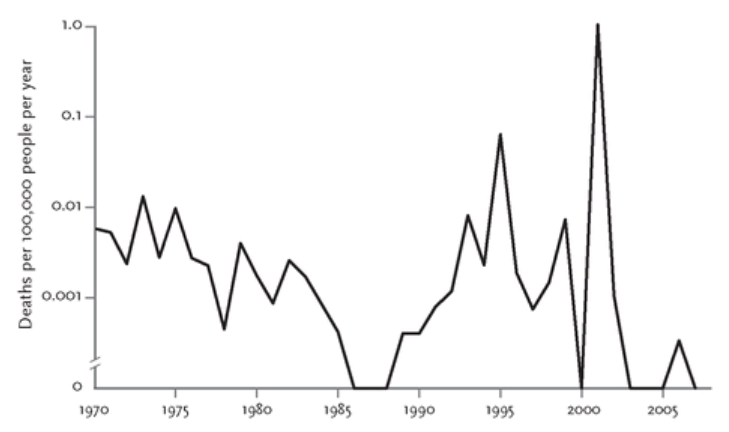
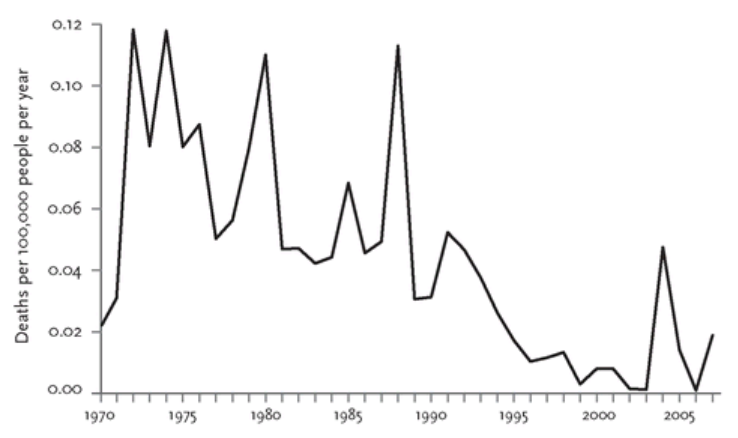
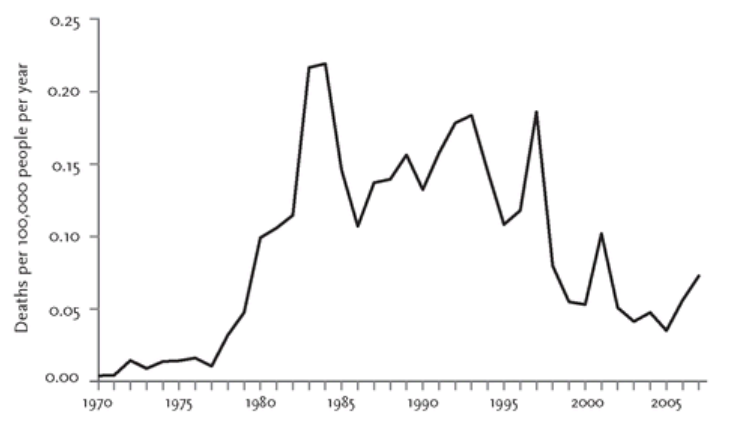
Pinker separates the historic and strategic importance of 9/11 from the ordinary individual risk of terrorism. In the Global Terrorism Database series available to him, the attack’s nearly 3,000 deaths sit far out in the tail; other U.S. terrorist deaths from 1970–2007 were much smaller. He argues that terrorism is asymmetric communication: direct killing is used to produce a far larger return in fear, publicity, policy disruption, repression, or war. That does not make the victims statistically unimportant or security precautions unnecessary; it makes the costs of panic and indiscriminate reaction part of the policy calculation.
Figures 6-9 to 6-11 — Terrorism death rates in the United States, Western Europe, and Pinker’s adjusted worldwide series, 1970–2007. Figure 6-9 uses a logarithmic scale so the pre-9/11 baseline remains visible. Figure 6-11 excludes post-2001 Afghanistan and post-2003 Iraq because Pinker argues that the same deaths would otherwise be coded as civil-war casualties; that choice answers a narrower question and must stay explicit. These historical series do not describe terrorism after 2007. Pinker also relays Gerd Gigerenzer’s estimate that avoidance of flying after 9/11 produced about 1,500 additional U.S. road deaths—an illustrative risk-displacement estimate, not a count of terrorist victims. Chapter 6 synthesis · Terrorism’s fear-to-harm ratio, PDF pp. 481–485 (file not included in this release) · Figure 6-9, PDF p. 491 (file not included in this release) · Figure 6-10, PDF p. 492 (file not included in this release) · Figure 6-11 and coding caveat, PDF pp. 493–494 (file not included in this release)
Interview claim-check: where this account needs correction
The timestamps refer to the supplied transcript, not independently verified direct quotations. “Unsupported” means a striking detail lacks an adequate source here, not that its opposite has been proved.
| Approx. time | Interview claim or impression | Better-supported formulation |
|---|---|---|
| 2–6 min | Flight 93 departed “Maine”; passengers waited to revolt until over open countryside; its cockpit transcript remains secret. | It departed Newark; the rural-delay intention is unestablished; the audio is sealed but the transcript is public. Commission, ch. 1 · NPS recorder. |
| 21–25, 41 min | The 1993 WTC truck plot is narrated as if Mohamed Atta furnished a conspirator’s airline ticket, or as a straightforward al-Qaeda operation. | The 1993 mastermind was Ramzi Yousef; Atta was part of the 2001 plot. KSM’s support in 1993 was limited; do not assume al-Qaeda ordered it. Commission, ch. 5. |
| 29–34 min | CIA backed only what became the Northern Alliance; Arab jihadists/al-Qaeda converted Nuristan from non-Islamic beliefs in the 1980s. | U.S. aid to Afghan rebel factions was routed through Pakistan, while the Arab volunteers received little or no direct U.S. aid. Kafiristan/Nuristan’s forced conversion occurred in 1895–96, generations before al-Qaeda. Commission, ch. 2 · Library of Congress historical map description. |
| 41–42 min | Sudan offered to arrest bin Laden and hand him to the United States. | The Commission found no credible evidence of such a handover offer. Sudan discussed expulsion, potentially to Saudi Arabia; the U.S. lacked an indictment at that time. Commission, ch. 4. |
| 53–70 min | Visa Express largely explains the 19 hijackers’ access; four planes had two trained hijacker pilots each; cockpits were normally unlocked. | These are distinct errors or overstatements. Visa Express did not demonstrably change approval or scrutiny; one trained hijacker piloted each plane; closed and locked cockpit doors were required, though protection failed. Commission staff visa hearing · Commission, ch. 1. |
| 23–25, 90–110 min | Palestine/Israel was merely propaganda; KSM was radicalized by alienation at an American college; personal isolation explains terrorism. | Policy favoring Israel was a grievance KSM himself reported; bin Laden also cited Palestine/Lebanon. Their claims can be propagandistic and politically relevant; KSM specifically denied student experience as his motivating source. Isolation is a hypothesis, not an established general cause. Commission, ch. 5 · bin Laden’s 2004 statement. |
| 71–90 min | The post-attack unity meant there was no significant anti-Muslim hostility. | Unity and hate crimes both occurred; the FBI’s 2001 figures document anti-Islamic victimization. |
Paths through the vault and source trail
- The leader’s stated motives versus responsibility: Osama bin Laden. Read its moral argument alongside the primary declarations and Commission findings; do not treat a post hoc statement as conclusive proof of the counterfactual cause.
- Organization and ideology: Islamism · Terrorism, Violence & War. The latter is a topic page containing advocacy links; use the Commission for precise 9/11 historical claims.
- Two distinct inside-government vantage points: Against All Enemies- Inside America's War on Terror (Richard A. Clarke, intelligence and policy) · Ghost - Confessions of a Counterterrorism Agent (Fred Burton, diplomatic security and embassies). These are memoir/book notes, not substitutes for the investigation.
- The response and its contested extension: Iraq War · parent 60.13 Wars.
- How Palestinians responded in polls: Palestinian attitudes, 2001–2011. In December 2001, only 16% believed bin Laden’s group carried out the attacks and 41% classed them as terrorism.
Primary/institutional reading order: 9/11 Commission executive summary → ch. 2, origin and ideology → ch. 5, KSM and plot → ch. 7, hijackers → ch. 1, four flights → ch. 8, warnings → ch. 9, emergency response. Compare with the 9/11 Memorial’s FAQ and NPS Flight 93 history.
Transcript navigation
2–8 min four flights and Flight 93 · 8–17 min 1979 and al-Qaeda’s origins · 17–29 min 1993 bombing and later attacks · 29–38 min Afghan aid and Taliban · 38–53 min intelligence and KSM · 53–71 min planes operation, visas, and security · 71–91 min aftermath and public reaction · 91–110 min ideological and psychological interpretations. This map lets you revisit the interview while checking its claims against the cited record.