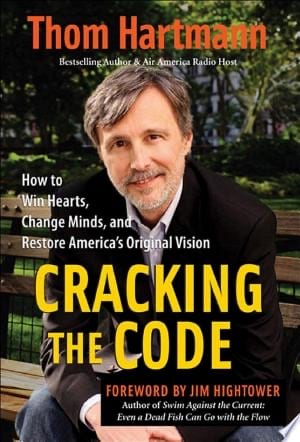
DESCRIPTION
By the bestselling author and XM and Sirius Satellite radio host heard on more than eighty radio stations coast to coast seven days a week Shows progressives how to master the science and technology of persuasive communication and counter the right-wing message machine Offers exercises and examples throughout to help readers put the concepts they’re learning into practice Millions of working Americans talk, act, and vote as if their economic interests match those of the megawealthy, the multinational corporations, and the politicians who do their bidding. How did this happen? According to Air America radio host Thom Hartmann, the apologists of the Right have become masters of the subtle and largely subconscious aspects of political communication. It’s not an escalation in Iraq, it’s a surge; it’s not the inheritance tax, it’s the death tax; it’s not drilling for oil, it’s exploring for energy. Conservatives didn’t intuit the path to persuasive messaging—they learned these techniques. There is no reason why progressives can’t learn them too. In Cracking the Code, Hartmann shows you how. Drawing on his background as a psychotherapist and advertising executive as well as a national radio host, he breaks down the science and technology of effective communication so you can apply it to your own efforts to counter right-wing disinformation. It’s both an art and a science—as Hartmann explains, political persuasion is as much about biology as ideology, about knowing how the brain processes information and how that influences the way people perceive messages, make decisions, and form a worldview. Throughout the book, Hartmann shows you precisely how to master this technology, providing examples dating back to the time of the Founding Fathers. As you read deeply in this book, you’ll see things you hadn’t realized were there—in everything from advertising to political rants—and discover abilities you didn’t know you had. Whether you’re a politician, an activist, a volunteer, or a concerned citizen, you’ll develop a strong sense for how to reach into that part of the collective human psyche where we truly do have the power to create a new world.
My Summary
Main Ideas, Takeaways & Similarities
Questions
I. What is the problem?
A. How is this problem formulated?
B. Why is this problem important?
C. What is the history of this problem?
D. Which prominent personalities have been interested in this problem?
II. What solutions to the problem are there?
A. What are the conclusions reached?
B. By what argument(s) is the conclusion reached?
C. What facts or assumptions serve as premises?
D. When a prominent personality offers a solution, does he also argue for or against other prominent personalities? Does he raise objections to alternative solutions? Does he consider objections to his own solutions?
III. Evaluation
A. What are the advantages and disadvantages of the alternative formulations to the problem?
B. Has the importance or history of the problem ever been misrepresented?
C. Are the solutions logically related to the premises?
D. Are the facts true? Are the assumptions acceptable? Are the objections answerable?
AI Summary
“Cracking the Code: How to Win Hearts, Change Minds, and Restore America’s Original Vision” by Thom Hartmann is a book that addresses the challenges facing American democracy and offers a roadmap for restoring the country’s founding principles. Here’s a comprehensive summary in bullet points:
- Title: Cracking the Code: How to Win Hearts, Change Minds, and Restore America’s Original Vision
- Author: Thom Hartmann
Introduction:
- Sets the stage for the book’s exploration of the challenges to American democracy.
- Discusses the erosion of democratic principles and the influence of corporate interests.
Chapter 1: The American Experiment: A Blueprint for Democracy:
- Explores the ideals and principles on which the United States was founded.
- Discusses the concept of a “We the People” democracy.
Chapter 2: The Hidden History of the American Revolution:
- Provides historical context on the American Revolution and the role of common citizens.
- Highlights the influence of Thomas Paine’s “Common Sense.”
Chapter 3: The Hidden History of the Constitution:
- Examines the debates and compromises that led to the U.S. Constitution.
- Discusses the Framers’ intentions and concerns about concentrated power.
Chapter 4: The Hidden History of American Corporations:
- Traces the history of corporations in the United States.
- Discusses the evolution of corporate power and its impact on democracy.
Chapter 5: The Hidden History of the Supreme Court:
- Analyzes the role of the Supreme Court in interpreting the Constitution.
- Discusses key Supreme Court decisions and their implications.
Chapter 6: The Hidden History of American Healthcare:
- Explores the history of healthcare in the United States.
- Discusses the influence of special interests on healthcare policy.
Chapter 7: The Hidden History of the Media:
- Examines the role of the media in shaping public opinion.
- Discusses media consolidation and the impact on democracy.
Chapter 8: The Hidden History of Globalization:
- Discusses the consequences of globalization for American workers and the economy.
- Explores the impact of trade agreements on domestic policies.
Chapter 9: Cracking the Code: Restoring Democracy:
- Presents a vision for restoring American democracy.
- Discusses strategies for engaging citizens, reforming campaign finance, and protecting democratic values.
Chapter 10: Conclusion: Our Future as We the People:
- Summarizes the key themes and arguments presented in the book.
- Encourages readers to take action to protect and restore American democracy.
Legacy:
- “Cracking the Code” by Thom Hartmann is a call to action for citizens to reclaim the democratic principles on which the United States was founded.
- It addresses the challenges posed by corporate influence, media consolidation, and globalization.
- The book offers a roadmap for restoring democracy through citizen engagement and political reform.