Zibaldone 2024–2025 journal
Journal connection: Negotiation summaries and tactical reminders drawn from the book.
Source boundary: These are captured journal materials; the integration does not independently verify every clipped claim, quotation, or figure.
PDF++ pages: p. 32 (file not included in this release) · p. 54 (file not included in this release)
Embedded previews:
Zibaldone 2024-2025.pdf (file not included in this release)
Zibaldone 2024-2025.pdf (file not included in this release)
Open the complete Zibaldone page index
DESCRIPTION
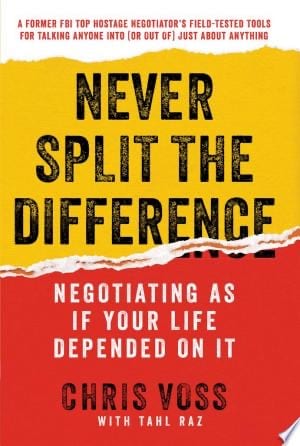
This international bestseller, with more than 3 million copies sold, offers a field-tested approach to high-stakes negotiations—whether in the boardroom, in your community, or at home. Life is a series of negotiations, and negotiation is at the heart of collaboration—whether you are a business executive, a salesperson, a parent , a community leader, or a spouse. As a former FBI hostage negotiator, Chris Voss gives you the tools to be effective in any situation: negotiating a business deal, buying (or selling) a car, negotiating a salary, acquiring a home, renegotiating rent, deliberating with your partner, or communicating with your children. Taking the power of persuasion, empathy, active listening, and intuition to the next level, Never Split the Difference gives you the competitive edge in any difficult conversation or challenging situation. This book is a masterclass in influencing others, no matter the circumstances. After a stint policing the rough streets of Kansas City, Chris Voss joined the FBI, where his career as a hostage negotiator brought him face-to-face with a range of criminals, including bank robbers and terrorists. Reaching the pinnacle of his profession, he became the FBI’s lead international kidnapping negotiator. Never Split the Difference distills the Voss method, revealing the skills that matter most when it comes to achieving your goals in both your professional and personal life. Step-by-step, Voss show you how to: Establish Rapport Create Trust with Tactical Empathy Gain the Permission to Persuade Shape What Is Fair Calibrate Questions Transform Conflict into Collaboration Spot Liars Create Breakthroughs by Revealing the Unknown Unknowns Never Split the Difference is your definitive source for defusing potential crises, winning people over, and achieving your goals at work and at home.
Never_Split_the_Difference_Annotated.pdf (file not included in this release)
- Getting people to do what you want is not from a logically fantastic argument. But it having empathy to understand the person’s situation and circumstance, their motivations and desires, and using those emotions to guide them to make the decision that is best for you.
Creating Rapport
1. Start with tactical empathy
The first move is to focus completely on the other person.
Do this by:
- Listening intensively
- Taking it slow
- Making them feel safe and understood
- Identifying what they need
- Radiating warmth and acceptance
- Keeping a positive frame of mind
- Avoiding the urge to immediately argue, correct, or explain
The principle:
People open up when they feel you are trying to understand them, not overpower them.
2. Mirror them
Mirroring builds rapport by showing that you are tracking their words, rhythm, and emotional state.
Your notes define mirroring as matching:
- Speech patterns
- Body language
- Vocabulary
- Tempo
- Tone of voice
The simplest version:
Repeat the last three words, or the critical one to three words, of what someone said.
Example:
They say:
“I just don’t think this is going to work.”
You say:
“Going to work?”
Then pause.
Mirroring works because it encourages the other person to keep talking, explain themselves, and reveal more information without feeling interrogated.
3. Label their emotions
After listening and mirroring, identify the person’s emotional state and name it.
Use:
“It seems like…”
“It sounds like…”
“It looks like…”Examples:
“It sounds like you’re frustrated by how this was handled.”
“It seems like you feel rushed into this.”
“It looks like something about this doesn’t sit right with you.”Keep the label neutral. Do not say:
“I think you’re angry.”
That makes it about your judgment. Instead say:
“It seems like this has been frustrating.”
If they disagree, your notes give the fallback:
“I didn’t say that was what it was. I just said it seems like that.”
The purpose of labeling is to clear emotional barriers to agreement.
4. Let them say “No”
Your notes frame “No” as the start of negotiation, not the end. “No” gives the other person a feeling of security and control.
Instead of pushing for yes, ask questions that make it safe to say no.
Examples:
“Would it be a bad idea to talk this through?”
“Is now a bad time?”
“Is this completely off the table?”After they say no, ask:
“What about this doesn’t work for you?”
“What would you need to make it work?”
“It seems like there’s something here that bothers you.”This lowers defensiveness because the other person does not feel trapped into agreement.
5. Aim for “That’s right”
The key rapport moment is not when they say:
“You’re right.”
Your notes say that is a disaster because it often means they are dismissing you or trying to end the conversation.
The goal is:
“That’s right.”
“That’s right” happens when the person feels you truly understand their thoughts, feelings, fears, and desires.
To get there, use:
Label + Paraphrase + Summary
Example:
“It sounds like you’re not against the idea itself. You’re worried that if we move too fast, you’ll be stuck dealing with the problems afterward. So the real issue is not resistance—it’s risk.”
If they say:
“That’s right.”
You have rapport.
6. Use calibrated questions
Calibrated questions create rapport because they make the other person feel respected and involved in solving the problem.
Best question starters:
“What…”
“How…”Use “why” carefully because your notes say it can sound accusatory.
Strong examples:
“How does this look to you?”
“What about this works for you?”
“What about this doesn’t work for you?”
“How am I supposed to do that?”
“What would you need to make this work?”The hidden message of a good calibrated question is:
“I want to understand your view, and I need your help solving this.”
That gives the other person the illusion of control, which reduces resistance.
7. Use an accusation audit when tension is high
Before the other person attacks you, name the negative things they may already be thinking.
Example:
“You may feel like I’m pushing this too hard.”
“You may think I haven’t listened closely enough.”
“You may feel like this decision was already made.”This creates rapport because it shows you are not hiding from the tension. You are naming it directly.
The Tight Rapport Script
Use this sequence:
“Tell me how you’re seeing this.”
“It sounds like [emotion/concern].”
“What about this doesn’t work for you?”
“So if I’m hearing you right, [paraphrase their view].”
“That’s right?”
“What would you need to make this work?”The Core Principle
Rapport is not charm. It is tactical empathy plus emotional accuracy.
You create it by slowing down, listening hard, mirroring their words, labeling their emotions, letting them feel in control, and summarizing their view so well that they say:
“That’s right.”
AI Summary of Chapters
Chapter 1: The New Rules
- Introduction to Negotiation Skills: The author, Chris Voss, shares his experiences as an FBI negotiator and the unique challenges he faced, including high-stakes negotiations at Harvard.
- Emphasizing the Emotional Aspect: Voss highlights the importance of understanding emotions in negotiations, contrary to the purely rational approach often taught in academic settings.
- Tactical Empathy: He introduces the concept of ‘tactical empathy’, where listening and understanding the counterpart’s emotions are key.
- Effective Communication Techniques: The book discusses various techniques like mirroring, labeling, and calibrated questions to enhance negotiation skills.
- Real-world Application: Voss relates these techniques to everyday scenarios, showing their effectiveness beyond hostage situations.
- Contrast with Traditional Theories: He contrasts his experiential learning and techniques with traditional negotiation theories, particularly those taught at Harvard.
- Psychology in Negotiation: The book delves into the role of psychological insights in influencing negotiations.
- Negotiation as a Life Skill: Voss argues that negotiation skills are essential in various aspects of life, from professional to personal interactions.
These points provide a foundational understanding of Voss’s approach to negotiation, emphasizing emotional intelligence and tactical empathy.
Chapter 2: Be A Mirror
- Be a Mirror: Emphasize the importance of mirroring the other party in negotiations, which includes mimicking their language and behavior to build rapport and trust.
- Assumptions and Hypotheses: Warns against making assumptions in negotiations and advocates for treating assumptions as hypotheses to be tested during the negotiation process.
- Importance of Listening: Stresses the need to focus on active listening rather than being preoccupied with one’s own arguments. This helps in understanding the counterpart better.
- Calm the Schizophrenic: Discusses the concept that in negotiations, people often have conflicting thoughts and emotions. The goal is to calm these internal conflicts to facilitate better communication.
- Slowing Down: Emphasizes the importance of not rushing the negotiation process. Taking time helps in building rapport and understanding the other party’s needs and interests.
- Voice Tones in Negotiation: Introduces different voice tones (late-night FM DJ voice, positive/playful voice, and direct/assertive voice) and their appropriate use in negotiations.
- Mirroring Technique: Explains the mirroring technique as a powerful tool in negotiations. It involves repeating the last few words spoken by the other party to encourage them to continue talking and reveal more information.
- Building Rapport and Trust: Highlights the importance of establishing rapport and trust in negotiations, which can lead to more open and productive discussions.
These points encapsulate Voss’s strategies for effective negotiation, focusing on psychological insights, active listening, and strategic communication techniques.
Chapter 3: Don’t Feel Their Pain; Label It
- Emotional Intelligence in Negotiation: The book highlights the importance of emotional intelligence in negotiations. Good negotiators identify and influence emotions, using them as tools rather than obstacles.
- Tactical Empathy: This concept involves understanding the feelings and mindset of another person to increase influence in negotiations. It’s about being attentive and genuinely understanding the other party’s perspective.
- Labeling Technique: Labeling involves acknowledging and naming the emotions of the other party in a negotiation. This technique helps in validating their feelings and building rapport.
- Dealing with Negative Dynamics: The book discusses strategies for addressing negative dynamics in negotiations. This includes direct acknowledgment of these dynamics and using them to your advantage.
- Accusation Audit: Voss suggests conducting an “accusation audit” where you list possible negative perceptions or accusations the other party might have against you and address them proactively.
- Use of Empathy and Labels in Practice: The text provides real-life examples of how empathy and labeling techniques can be effectively used in various negotiation scenarios.
These points collectively emphasize the power of emotional intelligence, empathy, and strategic communication in successful negotiation.
Chapter 4: Beware “Yes” - Master “No”
- Embracing “No”: Understanding the power of “No” in negotiations. It’s a safe word that maintains the status quo and offers a way to clarify and refine discussions.
- “No” as a Starting Point: Contrary to popular belief, “No” can start a negotiation process, providing opportunities to explore options and understand objections.
- Different Types of “Yes”: Distinguishing between counterfeit, confirmation, and commitment “Yes”. Understanding these nuances helps in recognizing genuine agreement.
- Persuasion Techniques: Persuasion should focus on the counterpart’s perspective, not on the negotiator’s ego or logic. It involves guiding the counterpart to discover your goals as their own.
- Psychological Dynamics: Negotiations are influenced by psychological factors like the need for safety, security, and control. Recognizing and addressing these needs is crucial.
- Strategic Use of “No”: Using “No” strategically can help in clarifying the other party’s position, creating safety, and leading to more meaningful negotiations.
- Practical Applications: The chapter offers practical advice on applying these principles in everyday negotiations, emphasizing authenticity over niceness and the strategic use of “No” to create opportunities for agreement.
Chapter 5: Trigger the two words that transform any negotiation
- The Behavioral Change Stairway Model (BCSM) in negotiations, based on stages like active listening, empathy, rapport, influence, and behavioral change.
- The importance of “That’s right” over “Yes” in negotiations, signifying true agreement and understanding.
- A real-life application of these principles in the kidnapping case of Jeffrey Schilling by Abu Sayyaf, demonstrating the efficacy of the BCSM.
- Differentiating between “That’s right” and “You’re right,” where the former indicates genuine agreement and the latter is often a dismissal.
- Examples of using “That’s right” effectively in various scenarios, such as in sales, career advancement, and personal development.
- Overall, the significance of truly understanding and empathizing with the other party in a negotiation to achieve successful outcomes.
Chapter 6: Bend Their Reality
- Negotiation Techniques: Explains strategies for effective negotiation, focusing on the psychology behind it.
- Avoiding Compromise: Emphasizes that compromise (splitting the difference) often leads to suboptimal outcomes.
- Using Time as Leverage: Discusses the strategic use of deadlines in negotiations, revealing how time pressure can impact decision-making.
- The Power of Fairness: Analyzes how the concept of fairness influences negotiations and how it can be used strategically.
- Emotional Drivers and Decision Making: Highlights the importance of understanding the emotional factors that drive decisions in negotiations.
- Tactical Approaches: Offers specific tactics for negotiations, including anchoring emotions, letting the other party anchor negotiations, and establishing a range.
- Negotiating Salary: Provides detailed guidance on negotiating salaries, emphasizing the importance of non-monetary terms and the psychological aspects of negotiation.
These points represent the key negotiation strategies and psychological insights that Voss discusses in these pages, aimed at enhancing negotiation skills in various contexts.
Chapter 7: Create the Illusion of Control
- Create the Illusion of Control: Successful negotiation involves making the counterpart do the work and suggest solutions, using calibrated questions to guide the conversation without seeming aggressive.
- Avoid Negotiating in a Firefight: Emphasizes the difficulty of negotiation in hostile or volatile environments, using an example where negotiation attempts failed due to external conflicts.
- Recognize the Team on the Other Side: Understanding that negotiations often involve more than the immediate counterpart and their team dynamics can greatly impact the negotiation outcome.
- Avoid Showdowns: Stresses the importance of moving away from confrontational approaches in negotiations, focusing on more collaborative and less aggressive tactics.
- Suspend Unbelief: Describes the need to shift the negotiation away from confrontational attitudes, using open-ended questions to engage the counterpart constructively.
- Calibrate Your Questions: Highlights the effectiveness of calibrated, open-ended questions in negotiations to guide the conversation and gather useful information without triggering defensiveness.
- Emotional Control in Negotiations: Emphasizes the importance of self-control and emotional regulation in successful negotiations, avoiding knee-jerk reactions and maintaining rationality.
The chapter concludes with key lessons emphasizing the importance of calibrated questions, avoiding aggressive confrontation, and recognizing the dynamics of the opposing team. These principles are illustrated through various negotiation scenarios, demonstrating the practical application of these strategies.
Chapter 8: Guarantee Execution
- Importance of ensuring execution in negotiations, not just reaching an agreement.
- Utilizing calibrated “How” questions to drive and shape negotiations, making the counterpart solve your problems.
- The role of “How” questions in subtly saying “No” and guiding counterparts to develop solutions that align with your interests.
- Techniques for ensuring implementation of agreements by making counterparts articulate implementation in their own words.
- Strategies for dealing with aggressive negotiators or liars, including using calibrated questions and understanding non-verbal cues.
- The concept of influencing players “behind the table,” understanding their motivations, and ensuring their support for successful deal implementation.
- The importance of detecting and manipulating non-obvious signals in negotiations to achieve desirable outcomes.
Chapter 9: Bargain Hard
- Hard Bargaining: Voss shares a personal story about negotiating for a car, emphasizing the importance of staying firm in negotiations.
- Negotiation Styles: He categorizes negotiators into Analysts, Accommodators, and Assertives, each with unique traits. Understanding these styles helps in strategizing negotiations.
- Analysts: Detailed and methodical, prefer working alone, and dislike surprises.
- Accommodators: Value relationships and are cooperative, often focusing on a win-win outcome.
- Assertives: Direct and candid, focusing on winning and achieving their goals.
- Tactical Approaches: Voss discusses various tactics like using strategic umbrage, employing calibrated questions, and utilizing ‘I’ messages to assertively set boundaries.
- Ackerman Bargaining Method: This is a structured negotiation technique involving setting a target price, starting with a low offer (65% of the target), and incrementally increasing the offer in smaller percentages.
- Negotiating Rent: A case study illustrates using the Ackerman model in a real-life scenario of negotiating rent, emphasizing preparation and strategic incrementation in offers.
Throughout the excerpt, Voss emphasizes the importance of preparation, understanding your counterpart’s style, and strategic approaches in successful negotiations.
Chapter 10: Find the Black Swan
- Black Swan Theory: The concept emphasizes the importance of unexpected, significant information in negotiations.
- Leverage Types: Understanding and utilizing three types of leverage: positive, negative, and normative.
- Recognizing Unknown Unknowns: Emphasizing the importance of identifying unknown factors that can dramatically influence negotiation outcomes.
- Uncovering Hidden Information: Strategies for revealing crucial, unknown information in negotiations.
- Religion as a Negotiation Tool: Utilizing an understanding of the counterpart’s belief system or fundamental values to achieve negotiation goals.
- Similarity Principle: Building trust and rapport by finding and highlighting similarities with the counterpart.
- Handling ‘Irrational’ Counterparts: Strategies for dealing with counterparts who seem irrational, by understanding their hidden constraints, interests, or misinformation.
- Importance of Face-to-Face Negotiations: Encouraging direct interaction to uncover valuable information that might not be revealed in indirect communication.
- Overcoming Fear in Negotiations: Encouraging the embrace of conflict and negotiation as a means to achieve desirable outcomes in various aspects of life.
These points focus on understanding and leveraging various aspects of human behavior and communication in negotiation situations.
Appendix: Prepare A Negotiation One Sheet
- Preparation for Negotiation: It emphasizes the importance of psychological preparation for negotiation, advising against rigid scripts but advocating for a strategic approach tailored to each negotiation.
- Setting Goals: The text advises setting specific, optimistic yet realistic goals, and suggests focusing on the best-case scenario rather than a BATNA (Best Alternative To a Negotiated Agreement).
- Understanding BATNA: It critiques the concept of BATNA, arguing that it often limits negotiators by setting too low a target, and suggests focusing on both the best and worst-case outcomes instead.
- Negotiation One Sheet: The concept of a “negotiation one sheet” is introduced, which is a concise summary of negotiation tools and strategies.
- Five Sections of the One Sheet: The one sheet includes sections on the negotiation goal, a summary of known facts, prepared labels and accusation audits, calibrated questions, and noncash offers.
- Tactical Empathy and Calibrated Questions: The text stresses the importance of understanding the counterpart’s perspective through tactical empathy and calibrated questions, which help reveal underlying motivations and deal killers.
- Noncash Offers: It encourages considering noncash items in negotiations, which can provide significant value and create win-win scenarios.
This approach aims to enhance negotiation outcomes by encouraging a flexible, informed, and psychologically savvy approach.
RESOURCES
Never_Split_the_Difference_Annotated 1.pdf (file not included in this release)
Prepare_One_Page_Negotiation_Sheet 1.pdf (file not included in this release)
MasterClass - The Art of a Negotiation
MAIN IDEAS, TAKEAWAYS & SIMILARITIES
-
Step 1: Empathy/Mirroring
- Intensive listening; sole focus is the other person
- Make them feel safe/understood
- Identify what they need
- Take it Slow
- Build Trust and Rapport
- Radiate warmth and acceptance; Smile
- Positive frame of mind
- Mirroring
- Speech patterns, body language, vocabulary, tempo, tone of voice
- Repeat the last three words or the critical one to three words of what someone said.
- Especially useful when a person is incongruent
-
Step 2: Label It
- Identify their emotional state
- What are their emotional obstacles?
- Acknowledge their emotion; Give it a name ^ng2xbf
- Statement or Question
- End sentence downward or upward?
- How to Construct the Sentence:
- It seems like…
- It sounds like…
- It looks like…
- Neutral statement, not “I”
- If they disagree; step back and say, “I didn’t say that was what it was. I just said it seems like that.”
- Clear the barriers to agreement.
- Identify their emotional state
-
Step 3: “No”
- Start of Negotiation; feeling of security and in control
- After they say “No”
- What about this doesn’t work for you?
- What would you need to make it work?
- It seems like there’s something here that bothers you.
- If not listening
- Antagonize with a “No”
- Mislabel emotion or desire
- If won’t say “no”—indecisive, confused or hidden agenda.
-
Step 4: “That’s right”
- ‘you’re right’ is a disaster
- Happens the moment you’ve convinced someone you truly understand their dreams and feelings
- Opens door to changing thoughts and behavior
- Use of summary: Label + Paraphrasing
-
Step 5: Negotiation
- Don’t compromise
- Don’t hide your deadlines; use theirs against them
- No such thing as fair
- “Fair” — Ways of Use
- Defensive
- “We just want what’s fair”
- Triggers defensiveness and discomfort
- Response: Take a deep breath and restrain desire to concede.
- “Ok, I apologize. Let’s stop everything and go back to where I started treating you unfairly and we’ll fix it.”
- “We just want what’s fair”
- Nefarious
- “We’ve given you a fair offer.”
- Mirror the “F”
- “Fair?” … and pause. Follow with a label: “It seems like you’re ready to provide the evidence that supports that.”
- “We’ve given you a fair offer.”
- Positive
- Early in negotiation
- “I want you to feel like you are being treated fairly at all times. So please stop me at any time if you feel I’m being unfair, and we’ll address it.”
- Defensive
- Anchor Their Emotions
- Accusation audit acknowledging all their fears.
- Anchoring their emotions in preparation for a loss, you inflame loss aversion
- Let the other guy go first—Most of the time
- Establish a Range
- Low number in the range is what you want
- Pivot to non-monetary terms
- Anchored them high, you can make offer seem reasonable by offering things that aren’t important to you; but important to them. (or opposite if their offer is low you can ask)
- Use Odd Numbers
- Surprise with a Gift
-
Step 6: Create Illusion of Control
- Avoid a Showdown
- Calibrated Questions
- The implication of any well-designed calibrated question is that you want what the other guy wants but you need his intelligence to overcome the problem. This really appeals to very aggressive or egotistical counterparts.
- “How am I supposed to do that?”
- Delivery: Really asking for help
- “perhaps” “maybe” “I think” “it seems”
- They have a direction: once you figure out where you want a conversation to go, you have to design the questions that will ease the conversation in that direction while letting the other guy think it’s his choice to take you there.
- it’s best to start with “what,” “how,” and sometimes “why.” Nothing else. “Who,” “when,” and “where” will often just get your counterpart to share a fact without thinking. And “why” can backfire. Regardless of what language the word “why” is translated into, it’s accusatory.
- “How does this look to you?”
- “What about this works for you?”
- “What about this doesn’t work for you?”
- “What caused you to do it?”
- What about this is important to you?
- How can I help to make this
better for us? - How would you like me to proceed?
- What is it that brought us into this situation?
- How can we solve this problem?
- What’s the objective? / What are we trying to accomplish here?
-
Step 7: Bargain Hard
- What type?
- Accommodators
- If they’re your counterpart, be sociable and friendly. Listen to them
talk about their ideas and use calibrated questions focused specifically on implementation to nudge them along and find ways to translate their talk into action. Due to their tendency to be the first to activate the reciprocity cycle, they may have agreed to give you something they can’t actually deliver.
- If they’re your counterpart, be sociable and friendly. Listen to them
- Assertive
- When you’re dealing with Assertive types, it’s best to focus on what
they have to say, because once they are convinced you understand them,
then and only then will they listen for your point of view.
- When you’re dealing with Assertive types, it’s best to focus on what
- Analyst
- If you’re an analyst you should be worried about cutting yourself off
from an essential source of data, your counterpart. The single biggest
thing you can do is to smile when you speak. People will be more
forthcoming with information to you as a result. Smiling can also become
a habit that makes it easy for you to mask any moments you’ve been
caught off guard.
- If you’re an analyst you should be worried about cutting yourself off
- Accommodators
- Taking a Punch
- First, deflect the punch in a way that opens up your counterpart.
Successful negotiators often say “No” in one of the many ways we’ve
talked about (“How am I supposed to accept that?”) or deflect the anchor
with questions like “What are we trying to accomplish here?” Responses
like these are great ways to refocus your counterpart when you feel
you’re being pulled into the compromise trap. - You can also respond to a punch-in-the-face anchor by simply pivoting
to terms. What I mean by this is that when you feel you’re being dragged
into a haggle you can detour the conversation to the nonmonetary issues
that make any final price work. - You can do this directly by saying, in an encouraging tone of voice,
“Let’s put price off to the side for a moment and talk about what would
make this a good deal.” Or you could go at it more obliquely by asking,
“What else would you be able to offer to make that a good price for me?” - Letting your counterpart anchor first will give you a tremendous feel
for him. All you need to learn is how to take the first punch.
- First, deflect the punch in a way that opens up your counterpart.
- Punching Back
- And so when someone puts out a ridiculous offer, one that really
pisses you off, take a deep breath, allow little anger, and channel
it—at the proposal, not the person—and say, “I don’t see how that would
ever work.” - Such well-timed offense-taking—known as “strategic umbrage”—can wake
your counterpart to the problem. - Threats delivered without anger but with “poise”—that is, confidence
and self-control—are great tools. Saying, “I’m sorry that just doesn’t
work for me,” with poise, works. - When you want to counteract unproductive statements from your
counterpart, you can say, “I feel when you because ___,” and
that demands a time-out from the other person.
- And so when someone puts out a ridiculous offer, one that really
- Ready-To-Walk Mindset
- The person across the table is never the problem. The unsolved issue
is. So focus on the issue. This is one of the most basic tactics for
avoiding emotional escalations.
- The person across the table is never the problem. The unsolved issue
- Ackerman Bargaining
- Ackerman model is an offer-counteroffer method, at least on the
surface. But it is a very effective system for beating the usual
lackluster bargaining dynamic, which has the predictable result of
meeting in the middle. The systematized and easy-to-remember process has
only four steps:- Set your target price (your goal).
- Set your first
offer at 65 percent of your target price. - Calculate three raises of
decreasing increments (to 85, 95, and 100 percent). - Use lots of empathy and different ways of saying “No” to get the other side to counter before you increase your offer.
- When calculating the final
amount, use precise, nonround numbers like, say, $37,893 rather than
$38,000. It gives the number credibility and weight. - On your final number, throw in a nonmonetary item (that they
probably don’t want) to show you’re at your limit.
- First, the original offer of 65 percent of your target price will set
an extreme anchor, a big slap in the face that might bring your
counterpart right to their price limit. The shock of an extreme anchor
will induce a fight-or-flight reaction in all but the most experienced
negotiators, limiting their cognitive abilities and pushing them into
rash action. - Now look at the progressive offer increases to 85, 95, and 100
percent of the target price. You’re going to drop these in sparingly:
after the counterpart has made another offer on their end, and after
you’ve thrown out a few calibrated questions to see if you can bait them into bidding against themselves. - Second, the diminishing size of the increases—notice that they
decrease by half each time—convinces your counterpart that he’s
squeezing you to the point of breaking. By the time they get to the last
one, they’ll feel that they’ve really gotten every last drop.
- Ackerman model is an offer-counteroffer method, at least on the
- What type?
-
Black Swan
-
every negotiation each side is in possession of at least three Black
Swans, three pieces of information that, were they to be discovered by
the other side, would change everything -
Most people expect that Black Swans are highly proprietary or closely
guarded information, when in fact the information may seem completely
innocuous. Either side may be completely oblivious to its importance.
Your counterpart always has pieces of information whose value they do
not understand. -
So what kind of Black Swans do you look to be aware of as negative
leverage? Effective negotiators look for pieces of information, often
obliquely revealed, that show what is important to their counterpart:
Who is their audience? What signifies status and reputation to them?
What most worries them? To find this information, one method is to go
outside the negotiating table and speak to a third party that knows your
counterpart. The most effective method is to gather it from interactions
with your counterpart. -
But the moment when we’re most ready to throw our hands up and
declare “They’re crazy!” is often the best moment for discovering Black
Swans that transform a negotiation. -
Leverage
- Positive
- Loss Aversion
- Negative
- A more subtle technique is to label your negative leverage and
thereby make it clear without attacking. Sentences like “It seems like you strongly - value the fact that you’ve always paid on time” or “It seems like you don’t care what position you are leaving me in” can really open up the negotiation process.
- A more subtle technique is to label your negative leverage and
- Normative
- Normative leverage is using the other party’s norms and standards to advance your position. If you can show inconsistencies between their beliefs and their actions, you have normative leverage. No one likes to look like a hypocrite.
- Know their religion
- Similarity Principle
- Power of Hopes and Dreams
- Positive
-
-
7-38-55 Percent Rule
- 7%: Words
- 38%: Tone of Voice
- 55%: Body Lanague
- Use Labels to discover incongruence
-
Rule of Three
- Have other agree to same thing three times
- 1st: Agree to something or give commitment
- 2nd: Label or summarize what they said so they answer, “Thats right”
- 3rd: Calibrated “How” or “What” question
-
Pinocchio Effect (Liars)
- more words; third-person pronouns
- him, her, it, one, they, their rather than I
- More complex sentences
- Work harder—to hard to be believable
- more words; third-person pronouns
-
Pronoun use
- More in love they are with I, me, my; less important they are
- Harder it is to get first person pronouns out of negotiator’s mouth—more important they are
-
Chris Discount
- Humanize yourself.
- Use your own name to introduce yourself. Fun and friendly.
-
How to get person to bid against themselves
- Express “No” without saying the word
- “How am I supposed to do that?”
- “Your offer is very generous, I’m sorry, that just doesn’t work for me”
- “I’m sorry but I’m afraid I just can’t do that.”
- “I’m sorry, no”
- Verbally, it should be delivered with a downward inflection and a
tone of regard; it’s not meant to be “NO!”
- Verbally, it should be delivered with a downward inflection and a
- Express “No” without saying the word
-
Common Reasons negotiators mistake their counterparts as crazy
- THEY ARE ILL-INFORMED
- Operating with incomplete information
- They are constrained
- They have other interests
- THEY ARE ILL-INFORMED
-
Real Estate Negotiation Example:
NeverSplit_the_Difference_Annotated_pages_183-_185 1.pdf (file not included in this release)
-
Emotion > Logic
-
Great Negotiator Attributes
- Questions assumptions
- Open to all possibilities
- Intellectually agile
- Voices:
- Deep DJ Voice
- Positive/Playful
- Direct/Assertive
- Never compromise
-
“No” is pure gold. Eliminates what you don’t want.
-
“Is now a bad time to talk?”
-
Email: “Have you given up on ____?”
-
“Yes” is the final goal of a negotiation, but don’t aim for it at the start. Asking someone for “Yes” too quickly in a conversation gets his guard up and paints you as an untrustworthy salesman.
-
Behavioral Change Stairway Model (BCSM). The model proposes five
stages—active listening, empathy, rapport, influence, and behavioral change—that take any negotiator from listening to influencing behavior. -
Active Listening
- Effective Pauses
- Minimal Encouragers
- Mirroring
- Labeling
- Paraphrase
- Summarize
-
==The win-win mindset pushed by so many negotiation experts is usually ineffective and often disastrous. So don’t settle
and—here’s a simple rule—never split the difference.
== -
Negotiate a better salary (pg. 106)
-
Our job as persuaders is easier than we think. It’s not to get others believing what we say. It’s just to stop them unbelieving. Once we achieve that, the game’s half-won. “Unbelief is the friction that keeps persuasion in check,” Dutton says. “Without it, there’d be no limits.”
-
The real beauty of calibrated questions is the fact that they offer no target for attack like statements do. Calibrated questions have the power to educate your counterpart on what the problem is rather than causing conflict by telling them what the problem is.
-
Don’t ask questions that start with “Why” unless you want your counterpart to defend a goal that
serves you. “Why” is always an accusation, in any language. -
Observe unguarded moments
-
Get Face time
-
If this book accomplishes only one thing, I hope it gets you over that fear of conflict and encourages you to navigate it with empathy. If you’re going to be great at anything—a great negotiator, a great manager, a great husband, a great wife—you’re going to have to do that. You’re going to have to ignore that little genie who’s telling you to give up, to just get along—as well as that other genie who’s telling you to lash out and yell.
-
Whether it’s in the office or around the family dinner table, don’t avoid honest, clear conflict. It will get you the best car price, the higher salary, and the largest donation. It will also save your marriage, your friendship, and your family.
-
You can be direct & to the point as long you create safety with tone of voice that says were ok, let’s figure things out.
-
Confronting Someone
- DJ Voice
- Start with “I’m sorry …”
- Mirror
- Silence
-
Negotiation is not a battle; its a process of discovery.
-
You’ll see how a soothing voice, close listening, and a calm repetition of the words of your “patient” can get you a lot further than a cold, rational argument.
-
Labeling is a shortcut to intimacy—its power invites other person to reveal themselves.
-
Labeling negatives diffuses them; labeling positives reinforces them.
-
Apologizing
- Acknowledge the other person’s anger
- “Look, I’m an asshole…”
-
Dealing with negativity
- Observe it, without reaction and without judgement. Then consciously label each negative feeling and replace it with positive, compassionate, and solution baed thoughts.
-
Accusation Audit: Listing every terrible thing your counterpart could say about you.
-
Deadlines
- good negotiators do is force themselves to resist this urge and take advantage of it in others
- Deadlines are often arbitrary, almost always flexible, and hardly ever trigger the consequences we think—or are told they will.
- hiding a deadline means you’re negotiating with yourself, and you always lose when you do so
- by revealing your cutoff you reduce the risk of impasse. And second, when an opponent knows your deadline, he’ll get to the real deal- and concession-making more quickly.
-
Certainty Effect: People are drawn to sure things over probabilities; even when its a better choice
-
Loss Aversion: People will take greater risks to avoid losses than to achieve gains
-
Robert Estabrook once said, “He who has learned to disagree without being disagreeable has discovered the most valuable secret of negotiation.”
-
If you can’t control your own emotions, how can you expect to influence the emotions of another party? The first and most basic rule of keeping your emotional cool is to bite your tongue. Pause. Think. Let the passion dissipate.
-
With enough of the right “How” questions you can read and shape the negotiating environment in such a way that you’ll eventually get to the
answer you want to hear. You just have to have an idea of where you want the conversation to go when you’re devising your questions. The trick to
“How” questions is that, correctly used, they are gentle and graceful ways to say “No” and guide your counterpart to develop a better solution—your solution. A gentle How/No invites collaboration and leaves your counterpart with a feeling of having been treated with respect. -
Remember, pushing hard for what you believe is not selfish. It is not bullying. It is not just helping you. Your amygdala, the part of the brain that processes fear, will try to convince you to give up, to flee, because the other guy is right, or you’re being cruel. But if you are an honest, decent person looking for a reasonable outcome, you can ignore the amygdala.
HIGHLIGHTS
- CHAPTER 1 | THE NEW RULES
That’s not how these folks at Harvard learned it, though. Their
theories and techniques all had to do with intellectual power, logic,
authoritative acronyms like BATNA and ZOPA, rational notions of value,
and a moral concept of what was fair and what was not. And built on top
of this false edifice of rationality was, of course, process. They had a
script to follow, a predetermined sequence of actions, offers, and
counteroffers designed in a specific order to bring about a particular
outcome. It was as if they were dealing with a robot, that if you did a,
b, c, and d in a certain fixed order, you would get x. But in the real
world negotiation is far too unpredictable and complex for that. You may
have to do a then d, and then maybe q. (Page 12) Soon after the Giffe tragedy, the New York City Police Department
(NYPD) became the first police force in the country to put together a
dedicated team of specialists to design a process and handle crisis
negotiations. The FBI and others followed. (Page 13) HEART VS. MIND (Page 14) Harvard Negotiation Project (Page 14) They were the economist Amos Tversky and the psychologist Daniel
Kahneman. Together, the two launched the field of behavioral
economicsand Kahneman won a Nobel Prize—by showing that man is a very
irrational beast. Feeling, they discovered, is a form of thinking. (Page
14) period when the world’s top academic economists declared that we were
all “rational actors.” And so it went in negotiation (Page 14) classes: assuming the other side was acting rationally and selfishly
in trying to maximize its position, the goal was to figure out how to
respond in various scenarios to maximize one’s own value. (Page 15) “[I]t is self-evident that people are neither fully rational nor
completely selfish, and that their tastes are anything but stable.”
(Page 15) Cognitive Bias, that is, unconscious—and irrationalbrain processes
that literally distort the way we see the world. Kahneman and Tversky
discovered more than 150 of them. (Page 15) Framing Effect (Page 15) Prospect Theory (Page 15) Loss Aversion (Page 15) two systems of thought: System 1, our animal mind, is fast,
instinctive, and emotional; System 2 is slow, deliberative, and logical.
And
System 1 is far more influential. In fact, it guides and steers our
rational thoughts. System 1’s inchoate beliefs, feelings, and
impressions are the main sources of the explicit beliefs and deliberate
choices of System 2. They’re the spring that feeds the river. We react
emotionally (System 1) to a suggestion or question. Then that System 1
reaction informs and in effect creates the System 2 answer. (Page
15) Now think about that: under this model, if you know how to affect
your counterpart’s System 1 thinking, his inarticulate feelings, by how
you frame and deliver your questions and statements, then you can guide
his System 2 rationality and therefore modify his responses. (Page
15) ==most hostage negotiations were anything but rational problem-solving
situations.
==(Page 16) Psychotherapy research shows that when individuals feel listened to,
they tend to listen to themselves more carefully and to openly evaluate
and clarify (Page 17) their own thoughts and feelings. In addition, they tend to become
less defensive and oppositional and more willing to listen to other
points of view (Page 18) The whole concept, which you’ll learn as the centerpiece of this
book, is called Tactical Empathy. This is listening as a martial art,
balancing the subtle behaviors of emotional intelligence and the
assertive skills of influence, to gain access to the mind of another
person. Contrary to popular opinion, listening is not a passive
activity. It is the most active thing you can do. (Page 18) experts in empathy (Page 18) Negotiation serves two distinct, vital life functions—information
gathering and behavior influencing—and includes almost any interaction
where each party wants something from the other side. Your career, your
finances, your reputation, your love life, even the fate of your kids—at
some (Page 18) point all of these hinge on your ability to negotiate. (Page 19) Negotiation as you’ll learn it here is nothing more than
communication with results. (Page 19) first step to achieving a mastery of daily negotiation is to get over
your aversion to negotiating (Page 19) to successfully negotiate it is critical to prepare. Which is why in
the Appendix you’ll find an invaluable tool I use with all my students
and clients called the Negotiation One Sheet: a concise primer of nearly
all our (Page 21) tactics and strategies for you to think through and customize for
whatever kind of deal you’re looking to close. (Page 22) Negotiation is the heart of collaboration. (Page 22) - CHAPTER 2 | BE A MIRROR
In negotiation, each new psychological insight or additional piece of
information revealed heralds a step forward and allows one to discard
one hypothesis in favor of another. You should engage the process with a mindset of discovery. Your goal at the outset is to extract and observe
as much information as possible. (Page 24) Great negotiators are able to question the assumptions that the rest
of the involved players accept on faith or in arrogance, and thus remain
more emotionally open to all possibilities, and more intellectually
agile to a fluid situation. (Page 24) For those people who view negotiation as a battle of arguments, it’s
the voices in their own head that are overwhelming them. When they’re
not talking, they’re thinking about their arguments, and when they are
talking, they’re making their arguments. Often those on both sides of
the table are doing the same thing, so you have what I call a state of
schizophrenia: everyone just listening to the voice in their head (and
not well, because they’re doing seven or eight other things at the same
time). It may look like there are only two people in a conversation, but
really it’s more like four people all talking at once. (Page 26) Instead of prioritizing your argument—in fact, instead of doing any
thinking at all in the early goings about what you’re going to say—make
your sole and all-encompassing focus the other person and what they have
to say. (Page 27) You’ll make them feel safe. The voice in their head will begin to
quiet down. (Page 27) The goal is to identify what your counterparts actually need
(monetarily, emotionally, or otherwise) and get them feeling safe enough
to talk and talk and talk some more about what they want. (Page 27) Going too fast is one of the mistakes all negotiators are prone to
making. If we’re too much in a hurry, people can feel as if they’re not
being heard and we risk undermining the rapport and trust we’ve built.
There’s plenty of research that now validates the passage of time as one
of the most important tools for a negotiator. When you slow the process
down, you also calm it down. After all, if someone is talking, they’re
not shooting. (Page 28) When deliberating on a negotiating strategy or approach, people tend
to focus all their energies on what to say or do, but it’s
==how we are
(our general demeanor and delivery) that is both the easiest thing to
enact and the most immediately effective mode of influence.
==(Page
29) When we radiate warmth and acceptance, conversations just seem to
flow. When we enter a room with a level of comfort and enthusiasm, we
attract (Page 29) people toward us. (Page 30) ==There are essentially three voice tones available to negotiators: the ==latenight FM DJ voice==, the positive/playful voice, and
the direct or assertive voice. Forget the assertive voice for now;
except in very rare circumstances, using it is like slapping yourself in
the face while you’re trying to make progress. You’re signaling
dominance onto your counterpart, who will either aggressively, or
passive-aggressively, push back against attempts to be controlled. (Page
30)
== Most of the time, you should be using the positive/playful voice.
It’s the voice of an easygoing, good-natured person. Your attitude is
light and encouraging. The key here is to relax and smile while you’re
talking. A smile, even while talking on the phone, has an impact tonally
that the other person will pick up on. (Page 30) When people are in a positive frame of mind, they think more quickly,
and are more likely to collaborate and problem-solve (instead of fight
and resist). It applies to the smile-er as much as to the smile-ee: a
smile on your face, and in your voice, will increase your own mental
agility. (Page 30) Playful wasn’t the move with Chris Watts. The way the late-night FM DJ voice works is that, when you inflect your voice
in a downward way, you put it out there that you’ve got it covered.
Talking slowly and clearly you convey one idea: I’m in control. When you
inflect in an upward way, you invite a (Page 30) response. (Page 31) If I see a work-for-hire clause, for example, I might say, “We don’t
do work-for-hire.” Just like that, plain, simple, and friendly. I don’t
offer up an alternative, because it would beg further discussion, so I
just make a straightforward declaration. (Page 31) You can be very direct and to the point as long as you create safety
by a tone of voice that says I’m okay, you’re okay, let’s figure things
out. (Page 31) MIRRORING (Page 31) Mirroring, also called isopraxism, is essentially imitation. (Page
32) It can be done with speech patterns, body language, vocabulary,
tempo, and tone of voice. (Page 32) repeat the last three words (or the critical one to three words) of
what someone has just said. Of the entirety of the FBI’s hostage
negotiation skill set, mirroring is the closest one gets to a Jedi mind
trick. Simple, and yet uncannily effective. (Page 32) right isn’t the key to a successful negotiation—having the right
mindset is. (Page 38) HOW TO CONFRONT—AND GET YOUR
WAY
—WITHOUT CONFRONTATION (Page 38) It’s just four simple steps: 1. Use the late-night FM
DJ
voice. 2. Start with “I’m sorry …” 3. Mirror. 4.
Silence. At least four seconds, to let the mirror work its magic on your
counterpart. 5. Repeat. (Page 38) Every time you mirror someone, they will reword what they’ve said.
They will never say it exactly the same way they said it the first time.
Ask someone, “What do you mean by that?” and you’re likely to incite
irritation or defensiveness. A mirror, however, will get you the clarity
you want while signaling respect and concern for what the other person
is saying. (Page 39) When another person’s tone of voice or body language is inconsistent
with his words, a good mirror can be particularly useful. (Page 39) KEY LESSONS Which is why when you think of the greatest negotiators of all time,
I’ve got a surprise for you—think Oprah Winfrey. (Page 40) a conscious smile to ease the tension, use of subtle verbal and
nonverbal language to signal empathy (and thus security), a certain
downward inflection in the voice, embrace of specific kinds of questions
and avoidance of others (Page 40) Here are some of the key lessons from this chapter to remember: ■ A good negotiator prepares, going in, to be ready for possible surprises;
a great negotiator aims to use her skills to reveal the surprises she is
certain to find. ■ Don’t commit to assumptions; instead, view them as hypotheses and use the negotiation to test them rigorously. ■ People who view negotiation as a battle of arguments become overwhelmed by the voices in their head. Negotiation is not an act of battle; it’s a
process of discovery. The goal is to uncover as much information as
possible. ■ To quiet the voices in your head, make your sole and all encompassing focus the other person and what they have to say. (Page 40) ■ Slow. It. Down. Going too fast is one of the mistakes all negotiators
are prone to making. If we’re too much in a hurry, people can feel as if
they’re not being heard. You risk undermining the rapport and trust
you’ve built. ■ Put a smile on your face. When people are in a positive
frame of mind, they think more quickly, and are more likely to
collaborate and problem-solve (instead of fight and resist). Positivity
creates mental agility in both you and your counterpart. (Page 41) - CHAPTER 3 | DON’T FEEL THEIR PAIN, LABEL IT
Emotions are one of the main things that derail communication. Once
people get upset at one another, rational thinking goes out the window.
(Page 42) That’s why, ==instead of denying or ignoring emotions, good negotiators
identify and influence them
==. They are able to precisely label emotions,
those of others and especially their own. And once they label the
emotions they talk about them without getting wound up. For them,
emotion is a tool. Emotions aren’t the obstacles, they are the means.
(Page 42) pokes and prods to understand his patient’s problems, and then turns
the responses back onto the patient to get him to go deeper and change
his behavior. (Page 42) opening up your senses, talking less, and listening more. (Page
42) You’ll see how a soothing voice, close listening, and a calm
repetition of the words of your “patient” can get you a lot further than
a cold, rational argument. (Page 43) TACTICAL EMPATHY (Page 43) Tactical empathy is understanding the feelings and mindset of another
in the moment and also hearing what is behind those feelings so you
increase your influence in all the moments that follow. It’s bringing
our attention to both the emotional obstacles and the potential pathways
to getting an agreement done. (Page 44) If you want to increase your neural resonance skills, take a moment
right now and practice. Turn your attention to someone who’s talking
near you, or watch a person being interviewed on TV. As they talk,
imagine that you are that person. Visualize yourself in the position
they describe and put in as much detail as you can, as if you were
actually there. (Page 45) empathy is not about being nice or agreeing with the other side. It’s
about understanding them. Empathy helps us learn the position the enemy
is in, why their actions make sense (to them), and what might move them.
(Page 45) LABELING (Page 45) Labeling is a way of validating someone’s emotion by acknowledging
it. Give someone’s emotion a name and you show you identify with how
that person feels. It gets you close to someone without asking about
external factors you know nothing about (“How’s your family?”). Think of
labeling as a shortcut to intimacy, a time-saving emotional hack. (Page
46) labeling an emotion—applying rational words to a feardisrupts its raw
intensity. (Page 46) has very specific rules about form and delivery (Page 46) Let me let you in on a secret: people never even notice. (Page
46) first step to labeling is detecting the other person’s emotional
state. (Page 46) Once you’ve spotted an emotion you want to highlight, the next step
is to label it aloud. Labels can be phrased as statements or questions.
The only difference is whether you end the sentence with a downward or
upward inflection. But no matter how they end, labels almost always
begin with roughly the same words: It seems like … It sounds like … It looks like … Notice we said “It sounds like …” and not “I’m hearing that …” That’s because the word “I” gets people’s guard up. When you say “I,” it says you’re more interested in yourself than the other person, and it makes you take personal responsibility for the words that follow—and the offense they might cause. (Page 47) But when you phrase a label as a neutral statement of understanding,
it encourages your counterpart to be responsive. They’ll usually give a
longer answer than just “yes” or “no.” And if they disagree with the
label, that’s okay. You can always step back and say, “I didn’t say that
was what it was. I just said it seems like that.” (Page 47) last rule of labeling is silence. Once you’ve thrown out a label, be
quiet and listen. (Page 47) label’s power is that it invites the other person to reveal himself.
(Page 47) NEUTRALIZE THE NEGATIVE, REINFORCE THE
POSITIVE
(Page 48) it’s how we as negotiators identify and then slowly alter the inner
voices of our counterpart’s consciousness to something more
collaborative and trusting. (Page 48) Labeling negatives diffuses them (or defuses them, in extreme cases);
labeling positives reinforces them. (Page 48) Try this the next time you have to apologize for a bone-headed
mistake. Go right at it. The fastest and most efficient means of
establishing a quick working relationship is to acknowledge the negative
and diffuse it. (Page 49) I always acknowledge the other person’s anger. I’ve found the phrase
“Look, I’m an asshole” to be an amazingly effective way to make problems
go away. (Page 49) Research shows that the best way to deal with negativity is to
observe it, without reaction and without judgment. Then consciously
label each negative feeling and replace it with positive, compassionate,
and solution-based thoughts. (Page 49) CLEAR THE ROAD BEFORE ADVERTISING THE DESTINATION
(Page 51) the faster we can interrupt the amygdala’s reaction to real or
imaginary threats, the faster we can clear the road of obstacles, and
the quicker we can generate feelings of safety, well-being, and trust.
(Page 51) Once they’ve been labeled and brought into the open, the negative
reactions in your counterpart’s amygdala will begin to soften. I promise
it will shock you how suddenly his language turns from worry to
optimism. Empathy is a powerful mood enhancer. (Page 51) The road is not always cleared so easily, so don’t be demoralized if
this process seems to go slowly. (Page 51) That’s why labels are so powerful and so potentially transformative
to the state of any conversation. By digging beneath what seems like a
mountain of quibbles, details, and logistics,
==labels help to uncover and
identify the primary emotion driving almost all of your counterpart’s
behavior, the emotion that, once acknowledged, seems to miraculously
solve everything else.
==(Page 52) DO AN ACCUSATION AUDIT (Page 52) The first step of doing so is listing every terrible thing your
counterpart could say about you, in what I call an accusation audit.
(Page 53) GET A SEAT—AND AN UPGRADE—ON A SOLD-OUT FLIGHT (Page 56) real negotiation the band all plays together. So you’ve got to learn
how to conduct. (Page 56) KEY LESSONS (Page 58) As you try to insert the tools of tactical empathy into your daily
life, I encourage you to think of them as extensions of natural human
interactions and not artificial conversational tics. (Page 58) creating an empathetic relationship and encouraging your counterpart
to expand on their situation is the basis of healthy human interaction.
(Page 58) Imagine yourself in your counterpart’s situation. The beauty of
empathy is that it doesn’t demand that you agree with the other person’s
ideas (you may well find them crazy). But by acknowledging the other
person’s situation, you immediately convey that you are listening. And
once they know that you are listening, they may tell you something that
you can use. ■ The reasons why a counterpart will not make an agreement
with you are often more powerful than why they will make a deal, so ==focus first on clearing the barriers to agreement. Denying barriers or
negative influences gives them credence; get them into the open.
== ■ Pause. After you label a barrier or mirror a statement, let it sink in.
Don’t worry, the other party will fill the silence. ■ Label your counterpart’s fears to diffuse their power. We all want to talk about
the happy stuff, but remember, the faster you interrupt action in your
counterpart’s amygdala, the part of the brain that generates fear, the
faster you can generate feelings of safety, well-being, and trust. ■ ==List the worst things that the other party could say about you and say
them before the other person can.
==Performing an accusation audit in
advance prepares you to head off negative dynamics before they take
root. And because these accusations often sound exaggerated when said
aloud, speaking them will encourage the other person to claim that quite
the opposite is true. ■ Remember you’re dealing with a person who wants
to be appreciated and understood. So use labels to reinforce and encourage positive perceptions and dynamics. (Page 60) - CHAPTER 4 | BEWARE “YES”—MASTER “NO”
But at the end of the day, “Yes” is often a meaningless answer that
hides deeper objections (and “Maybe” is even worse). Pushing hard for
“Yes” doesn’t get a negotiator any closer to a win; it just angers the
other side. (Page 61) For good negotiators, “No” is pure gold. That negative provides a great opportunity for you and the other party to clarify what you really want by eliminating what you don’t want. “No” is a safe choice that maintains the status quo; it provides a temporary oasis of control. (Page 62) “Yes” and “Maybe” are often worthless. But “No” always alters the
conversation. (Page 62) “NO” STARTS THE NEGOTIATION (Page 62) “No” is the start of the negotiation, not the end of it. We’ve been
conditioned to fear the word “No.” But it is a statement of perception
far more often than of fact. It seldom means, “I have considered all the
facts and made a rational choice.” Instead, “No” is often a decision,
frequently temporary, to maintain the status quo. Change is scary, and
“No” provides a little protection from that scariness. (Page 64) It comes down to the deep and universal human need for autonomy. ==People need to feel in control. When you preserve a person’s autonomy by
clearly giving them permission to say “No” to your ideas, the emotions
calm, the effectiveness of the decisions go up, and the other party can
really look at your proposal.
==They’re allowed to hold it in their hands,
to turn it around. And it gives you time to elaborate or pivot in order
to convince your counterpart that the change you’re proposing is more
advantageous than the status quo. (Page 64) your invitation for the other side to say “No” has an amazing power
to bring down barriers and allow for beneficial communication. (Page
64) When someone tells you “No,” you need to rethink the word in one of
its alternative—and much more realmeanings: (Page 64) ■ I am not yet ready to agree; ■ You are making me feel
uncomfortable; ■ I do not understand; ■ I don’t think I can afford it; ■
I want something else; ■ I need more information; or ■ I want to talk it
over with someone else. Then,
==after pausing, ask solution-based
questions or simply label their effect: “What about this doesn’t work
for you?” “What would you need to make it work?” “It seems like there’s
something here that bothers you.” People have a need to say, “No.” So
don’t just hope to hear it at some point; get them to say it early.
(Page 65)
== PERSUADE IN THEIR WORLD (Page 65) Human beings the world over are so used to being pursued for the
commitment “yes” as a condition to find out more that they have become
masters at giving the
counterfeit “yes.” (Page 66) Got it, you say. It’s not about me. We need to persuade from their
perspective, not ours. But how? By starting with their most basic wants.
(Page 68) In every negotiation, in every agreement, the result comes from
someone else’s decision. And sadly, if we believe that we can control or
manage others’ decisions with compromise and logic, we’re leaving
millions on the table. But while we can’t control others’ decisions, we
can influence them by inhabiting their world and seeing and hearing
exactly what they want. (Page 68) Though the intensity may differ from person to person, you can be
sure that everyone you meet is driven by two primal urges: the need to
feel safe and secure, and the need to feel in control. If you satisfy
those drives, you’re in the door. (Page 68) nice alone in the context of negotiation can backfire. Nice, employed
as a ruse, is disingenuous and manipulative. (Page 69) An early “Yes” is often just a cheap, counterfeit dodge. (Page
69) “NO” IS PROTECTION (Page 69) Instead ask, “Is now a bad time to talk?” Either you get “Yes, it is
a bad time” followed by a good time or a request to go away, or you get
“No, it’s not” and total focus. (Page 70) “No” is not failure. Used strategically it’s an answer that opens the
path forward. Getting to the point where you’re no longer horrified by
the word “No” is a liberating moment that every negotiator needs to
reach. Because if your biggest fear is “No,” you can’t negotiate. You’re
the hostage of “Yes.” (Page 71) “No” allows the real issues to be brought forth; ■ “No” protects people from making—and lets them correctineffective decisions; ■ “No” slows things down so that people can freely embrace their decisions and
the agreements they enter into; ■ “No” helps people feel safe, secure, emotionally comfortable, and in control of their decisions; ■ “No” moves everyone’s efforts forward. (Page 72) if you’re talking to somebody who is just not listening, the only way
you can crack their cranium is to antagonize them into “No.” One great
way to do this is to mislabel one of the other party’s emotions or
desires. You say something that you know is totally wrong, like “So it
seems that you really are eager to leave your job” when they clearly
want to stay. That forces them to listen and makes them comfortable
correcting you by saying, “No, that’s not it. This is it.” Another way
to force “No” in a negotiation is to ask the other party what they don’t
want. “Let’s talk about what you would say ‘No’ to,” you’d say. And
people are comfortable saying “No” here because it feels like
self-protection. And once you’ve gotten them to say “No,” people are
much more open to moving forward toward new options and ideas. (Page
74) If despite all your efforts, the other party won’t say “No,” you’re
dealing with people who are indecisive or confused or who have a hidden
agenda. In cases like that you have to end the negotiation and walk
away. (Page 74) EMAIL MAGIC: HOW NEVER TO BE IGNORED
AGAIN
(Page 74) You provoke a “No” with this one-sentence email. Have you given up on
this project? (Page 74) KEY LESSONS (Page 75) As you try to put the chapter’s methods to use, I encourage you to
think of them as the anti–“niceness ruse.” Not in the sense that they
are unkind, but in the sense that they are authentic. Triggering “No”
peels away the plastic falsehood of “Yes” and gets you to what’s really
at stake. (Page 75) Break the habit of attempting to get people to say “yes.” Being
pushed for “yes” makes people defensive. Our love of hearing “yes” makes
us blind to the defensiveness we ourselves feel when someone is pushing
us to say it. (Page 75) ■ “No” is not a failure. We have learned that “No” is the anti-“Yes”
and therefore a word to be avoided at all costs. But it really often
just means “Wait” or “I’m not comfortable with that.” Learn how to hear
it calmly. It is not the end of the negotiation, but the beginning. ■ “Yes” is the final goal of a negotiation, but don’t aim for it at the
start. Asking someone for “Yes” too quickly in a conversation —“Do you
like to drink water, Mr. Smith?”—gets his guard up and paints you as an
untrustworthy salesman. ■ Saying “No” makes the speaker feel safe, secure, and in control, so trigger it. By saying what they don’t want, your counterpart defines their space and gains the confidence and comfort to listen to you. That’s why “Is now a bad time to talk?” is
always better than “Do you have a few minutes to talk?” ■ Sometimes the only way to get your counterpart to listen and engage with you is by forcing them into a “No.” That means intentionally mislabeling one of their emotions or desires or asking a ridiculous question—like, “It
seems like you want this project to fail”—that can only be answered
negatively. ■ Negotiate in their world. Persuasion is not about how
bright or smooth or forceful you are. It’s about the other party
convincing themselves that the solution you want is their own idea. So
don’t beat them with logic or brute force. Ask them questions that open
paths to your goals. It’s not about you. ■ If a potential business partner is ignoring you, contact them with a clear and concise “No”-oriented question that suggests that you are ready to walk away.
“Have you given up on this project?” works wonders. (Page 76) - CHAPTER 5 | TRIGGER THE TWO WORDS THAT IMMEDIATELY TRANSFORM ANY NEGOTIATION
Behavioral Change Stairway Model (BCSM). The model proposes five
stages—active listening, empathy, rapport, influence, and behavioral
change—that take any negotiator from listening to influencing behavior.
(Page 77) CREATE A SUBTLE EPIPHANY (Page 78) The “that’s right” breakthrough usually doesn’t come at the beginning
of a negotiation. It’s invisible to the counterpart when it occurs, and
they embrace what you’ve said. To them, it’s a subtle epiphany. (Page
81) TRIGGER A “THAT’S RIGHT!” WITH A SUMMARY (Page 81) every tactic in the active listening arsenal:-
Effective Pauses: Silence is powerful. We told Benjie to use it for emphasis, to encourage Sabaya to keep talking until eventually, like clearing out a swamp, the
emotions were drained from the dialogue. -
Minimal Encouragers: Besides silence, we instructed using simple phrases, such as “Yes,” “OK,” “Uh-huh,” or “I see,” to effectively convey that Benjie was now paying full attention to Sabaya and all he had to say.
-
Mirroring: Rather than argue with Sabaya and try to separate Schilling from the “war damages,” Benjie would listen and repeat back what Sabaya said.
-
Labeling: Benjie should give Sabaya’s feelings a name and identify with
how he felt. “It all seems so tragically unfair, I can now see why you
sound so angry.” -
Paraphrase: Benjie should repeat what Sabaya is saying back to him in Benjie’s own words. This, we told him, would powerfully show him you really do understand and aren’t merely parroting his concerns.
-
Summarize: A good summary is the combination of rearticulating the meaning of what is said plus the acknowledgment of the emotions underlying that meaning (paraphrasing + labeling = summary). (Page 82)
assessed what you’ve said and pronounced it as correct of their own free
will. They embrace it. (Page 83) “THAT’S RIGHT” IS GREAT, BUT IF “YOU’RE RIGHT,” NOTHING CHANGES (Page 84) Driving toward “that’s right” is a winning strategy in all
negotiations. But hearing “you’re right” is a disaster. (Page 84) Why is “you’re right” the worst answer? Consider this: Whenever
someone is bothering you, and they just won’t let up, and they won’t
listen to anything you have to say, what do you tell them to get them to
shut up and go away? “You’re right.” It works every time. Tell people
“you’re right” and they get a happy smile on their face and leave you
alone for at least twenty-four hours. But you haven’t agreed to their
position. You have used “you’re right” to get them to quit bothering
you. (Page 84) USING “THAT’S RIGHT” TO MAKE THE SALE (Page 85) USING “THAT’S RIGHT” FOR CAREER SUCCESS (Page 86) KEY LESSONS (Page 88) “Sleeping in the same bed and dreaming different dreams” is an old
Chinese expression that describes the intimacy of partnership (whether
in marriage or in business) without the communication necessary to
sustain it. (Page 88) The power of getting to that understanding, and not to some simple
“yes,” is revelatory in the art of negotiation. The moment you’ve
convinced someone that you truly understand her dreams and feelings (the
whole world that she inhabits), mental and behavioral change becomes
possible, and the foundation for a breakthrough has been laid. Use these
lessons to lay that foundation: ■ Creating unconditional positive regard opens the door to changing thoughts and behaviors. Humans have an innate urge toward socially constructive behavior. The more a person feels understood, and positively affirmed in that understanding, the more likely that urge for constructive behavior will take hold. ■ “That’s right” is better than “yes.” Strive for it. Reaching “that’s right” in a
negotiation creates breakthroughs. ■ Use a summary to trigger a “that’s right.” The building blocks of a good summary are a label combined with paraphrasing. Identify, rearticulate, and emotionally affirm “the world according to …” (Page 89) -
- CHAPTER 6 | BEND THEIR REALITY
Once you understand that subterranean world of unspoken needs and
thoughts, you’ll discover a universe of variables that can be leveraged
to change your counterpart’s needs and expectations. From using some
people’s fear of deadlines and the mysterious power of odd numbers, to
our misunderstood relationship to fairness, there are always ways to
bend our counterpart’s reality so it conforms to what we ultimately want
to give them, not to what they initially think they deserve. (Page
91) DON’T COMPROMISE (Page 91) ==The win-win mindset pushed by so many negotiation experts is usually
ineffective and often disastrous.
==At best, it satisfies neither side.
And if you employ it with a counterpart who has a win-lose approach,
you’re setting yourself up to be swindled. (Page 91) you have to get rid of that naïveté. Because compromise—“splitting
the difference”—can lead to terrible outcomes. Compromise is often a
“bad deal” and a key theme we’ll hit in this chapter is that “no deal is
better than a bad deal.” (Page 91) The real problem with compromise is that it has come to be known as
this great concept, in relationships and politics and everything else.
Compromise, we are told quite simply, is a sacred moral good. (Page
92) We don’t compromise because it’s right; we compromise because it is
easy and because it saves face. We compromise in order to say that at
least we got half the pie. Distilled to its essence, we compromise to be
safe. Most people in a negotiation are driven by fear or by the desire
to avoid pain. Too few are driven by their actual goals.
==So don’t settle
and—here’s a simple rule—never split the difference.
==Creative solutions
are almost always preceded by some degree of risk, annoyance, confusion,
and conflict. Accommodation and compromise produce none of that. You’ve
got to embrace the hard stuff. That’s where the great deals are. And
that’s what great negotiators do. (Page 92) DEADLINES: MAKE TIME YOUR ALLY (Page 92) Time is one of the most crucial variables in any negotiation. The
simple passing of time and its sharper cousin, the deadline, are the
screw that pressures every deal to a conclusion. (Page 92) can trick you into believing that doing a deal now is more important
than getting a good deal. Deadlines regularly make people say and do
impulsive things that are against their best interests, because we all
have a natural tendency to rush as a deadline approaches. (Page 92) good negotiators do is force themselves to resist this urge and take
advantage of it in others (Page 93) Deadlines are often arbitrary, almost always flexible, and hardly
ever trigger the consequences we think—or are toldthey will. (Page
93) The mantra we coach our clients on is, “No deal is better than a bad
deal.” (Page 93) Car dealers are prone to give you the best price near the end of the
month, when their transactions are assessed. And corporate salespeople
work on a quarterly basis and are most vulnerable as the quarter comes
to a close. (Page 94) Deadlines cut both ways. (Page 95) hiding your deadlines dramatically increases the risk of an impasse.
That’s because having a deadline pushes you to speed up your
concessions, but the other side, thinking that it has time, will just
hold out for more. (Page 95) hiding a deadline means you’re negotiating with yourself, and you
always lose when you do so (Page 95) by revealing your cutoff you reduce the risk of impasse. And second,
when an opponent knows your deadline, he’ll get to the real deal- and
concession-making more quickly. (Page 95) NO SUCH THING AS FAIR (Page 95) Ultimatum Game, (Page 95) Why, I ask, did none of the proposers offer $1, which is the best
rational offer for them and logically unrejectable for the accepter? And
if they did and they got rejected—which happens—why did the accepter
turn them down? “Anyone who made any offer other than $1 made an
emotional choice” I say. “And for you accepters who turned down $1,
since when is getting $0 better than getting $1? Did the rules of
finance suddenly change?” (Page 96) actual decision making is governed by emotion (Page 96) THE F-WORD: WHY IT’S SO POWERFUL, WHEN TO USE IT, AND HOW (Page 96) People comply with agreements if they feel they’ve been treated
fairly and lash out if they don’t. (Page 97) In fact, of the three ways that people drop this F-bomb, only one is
positive. The most common use is a judo-like defensive move that
destabilizes the other side. This manipulation usually takes the form of
something like,
“We just want what’s fair.” Think back to the last time
someone made this implicit accusation of unfairness to you, and I bet
you’ll have to admit that it
==immediately triggered feelings of
defensiveness and discomfort.
==These feelings are often subconscious and
often lead to an irrational concession. (Page 98) If you’re on the business end of this accusation, you need to realize
that the other side might not be trying to pick your pocket; like my
friend, they might just be overwhelmed by circumstance.
==The best
response either way is to take a deep breath and restrain your desire to
concede. Then say, “Okay, I (Page 98)
== ==apologize. Let’s stop everything and go back to where I started
treating you unfairly and we’ll fix it.”
==(Page 99) ==The second use of the F-bomb is more nefarious. In this one, your
counterpart will basically accuse you of being dense or dishonest by
saying, “We’ve given you a fair offer.” It’s a terrible little jab meant
to distract your attention and manipulate you into giving in. (Page
99)
== ==If you find yourself in this situation, the best reaction is to
simply mirror the “F” that has just been lobbed at you. “Fair?” you’d
respond, pausing to let the word’s power do to them as it was intended
to do to you. Follow that with a label: “It seems like you’re ready to
provide the evidence that supports that,”
==(Page 99) The last use of the F-word is my favorite because it’s positive and
constructive. It sets the stage for honest and empathetic negotiation.
Here’s how I use it: Early on in a negotiation, I say, “I want you to
feel like you are being treated fairly at all times. So please stop me
at any time if you feel I’m being unfair, and we’ll address it.” It’s
simple and clear and sets me up as an honest dealer. With that
statement, I let people know it is okay to use that word with me if they
use it honestly. As a negotiator, you should strive for a reputation of
being fair. Your reputation precedes you. Let it precede you in a way
that paves success. (Page 99) HOW TO DISCOVER THE EMOTIONAL DRIVERS BEHIND WHAT THE OTHER
PARTY VALUES
(Page 99) Know the emotional drivers and you can frame the benefits of any deal
in language that will resonate. (Page 100) BEND THEIR REALITY (Page 100) Let’s say it’s your mug now. (Page 100) What if then you find out that by getting you to run that errand I
made a million dollars. (Page 100) best theory for describing the principles of our irrational decisions
is something called Prospect Theory (Page 100) people are drawn to sure things over probabilities, even when the
probability is a better choice. That’s called the Certainty Effect. And
people will take greater risks to avoid losses than to achieve gains.
That’s called Loss Aversion. (Page 101) The chance for loss incites more risk than the possibility of an
equal gain. (Page 101) In a tough negotiation, it’s not enough to show the other party that
you can deliver the thing they want. To get real leverage, you have to
persuade them that they have something concrete to lose if the deal
falls through. (Page 101)- ANCHOR THEIR EMOTIONS (Page 101)
By anchoring their emotions in preparation for a loss, you inflame the
other side’s loss aversion so that they’ll jump at the chance to avoid
it (Page 101) Suddenly, their call wasn’t about being cut from $2,000 to $500 but
how not to lose $500 to some other guy. (Page 102)- LET THE OTHER GUY GO FIRST … MOST OF
THE TIME
. (Page 102)
negotiating price. (Page 102) The real issue is that neither side has perfect information going to
the table. This often means you don’t know enough to open with
confidence. That’s especially true anytime you don’t know the market
value of what you are buying or selling (Page 102) The tendency to be anchored by extreme numbers is a psychological
quirk known as the “anchor and adjustment” effect. Researchers have
discovered that we tend to make adjustments from our first reference
points. For example, most people glimpsing 8 × 7 × 6 × 5 × 4 × 3 × 2 × 1
estimate that it yields a higher result than the same string in reverse
order. That’s because we focus on the first numbers and extrapolate.
(Page 103) Here’s my personal advice on whether or not you want to be the shark
that eats a rookie counterpart. Just remember, your reputation precedes
you. I’ve run into CEOs whose reputation was to always badly beat their
counterpart and pretty soon no one would deal with them. (Page 103)- ESTABLISH A RANGE (Page 103)
a similar deal which establishes your “ballpark,” albeit the best
possible ballpark you wish to be in. (Page 103) recent study, 4Columbia Business School psychologists found that job
applicants who named a range received significantly higher overall
salaries than those who offered a number, especially if their range was
a “bolstering range,” in which the low number in the range was what they
actually wanted. Understand, if you offer a range (and it’s a good idea
to do so) expect them to come in at the low end. (Page 104)- PIVOT TO NONMONETARY TERMS (Page 104)
point of view is by pivoting to nonmonetary terms. After you’ve anchored
them high, you can make your offer seem reasonable by offering things
that aren’t important to you but could be important to them. Or if their
offer is low you could ask for things that matter more to you than them.
(Page 104)- WHEN YOU DO TALK NUMBERS, USE ODD
ONES
(Page 104)
inevitably feel like temporary placeholders, guesstimates that you can
easily be (Page 104) negotiated off of. (Page 105) $37,263—feels like a figure that you came to as a result of
thoughtful calculation. Such numbers feel serious and permanent to your
counterpart, so use them to fortify your offers. (Page 105)- SURPRISE WITH A GIFT (Page 105)
(Page 106) BE PLEASANTLY PERSISTENT ON NONSALARY TERMS (Page
106) And the more you talk about nonsalary terms, the more likely you are
to hear the full range of their options. If they can’t meet your
nonsalary requests, they may even counter with more money (Page 106) SALARY TERMS WITHOUT SUCCESS TERMS IS RUSSIAN
ROULETTE
(Page 107) SPARK THEIR INTEREST IN YOUR SUCCESS AND GAIN AN UNOFFICIAL
MENTOR
(Page 107) sell yourself as more than a body for a job; sell yourself, and your
success, as a way they can validate their own intelligence and broadcast
it to the rest of the company. Make sure they know you’ll act as a
flesh-and-blood argument for their importance. (Page 107) Ask: “What does it take to be successful here?” (Page 107) KEY LESSONS (Page 109) All negotiations are defined by a network of subterranean desires and
needs. Don’t let yourself be fooled by the surface. Once you know that
the Haitian kidnappers just want party money, you will be miles better
prepared. ■ Splitting the difference is wearing one black and one brown
shoe, so don’t compromise. Meeting halfway often leads to bad deals for
both sides. ■ Approaching deadlines entice people to rush the
negotiating process and do impulsive things that are against their best
interests. ■ The F-word—“Fair”—is an emotional term people usually
exploit to put the other side on the defensive and gain concessions.
When your counterpart drops the F-bomb, don’t get suckered into a
concession. Instead, ask them to explain how you’re mistreating them. ■You can bend your counterpart’s reality by anchoring his starting point.
Before you make an offer, emotionally anchor them by saying how bad it
will be. When you get to numbers, set an (Page 109) extreme anchor to make your “real” offer seem reasonable, or use a
range to seem less aggressive. The real value of anything depends on
what vantage point you’re looking at it from. ■ People will take more
risks to avoid a loss than to realize a gain. Make sure your counterpart
sees that there is something to lose by inaction. (Page 110) - CHAPTER 7 | CREATE THE ILLUSION OF CONTROL
How
to Calibrate Questions to Transform Conflict into Collaboration calibrated, or open-ended, question. What it does is remove
aggression from conversations by acknowledging the other side openly,
without resistance. In doing so, it lets you introduce ideas and
requests without sounding pushy. It allows you to nudge. (Page 112) DON’T TRY TO NEGOTIATE IN A FIREFIGHT (Page 112) THERE IS ALWAYS A TEAM ON THE OTHER
SIDE
(Page 113) AVOID A SHOWDOWN (Page 115) We also needed new ways to get things without asking for them. We
needed to finesse making an “ask” with something more sophisticated than
closed-ended questions with their yes-no dynamic. (Page 116) SUSPEND UNBELIEF (Page 117) Our job as persuaders is easier than we think. It’s not to get others
believing what we say. It’s just to stop them unbelieving. Once we
achieve that, the game’s half-won. “Unbelief is the friction that keeps
persuasion in check,” Dutton says. “Without it, there’d be no limits.”
(Page 118) Giving your counterpart the illusion of control by asking calibrated
questions—by asking for help—is one of the most powerful tools for
suspending unbelief. (Page 118) Robert Estabrook once said, “He who has learned to disagree without
being disagreeable has discovered the most valuable secret of
negotiation.” (Page 119) one of the greatest-of-all-time calibrated questions: “How am I
supposed to do that?” The critical part of this approach is that you
really are asking for help and your delivery must convey that. With this
negotiating scheme, instead of bullying the clerk, you’re asking for
their advice and giving them the illusion of control. (Page 119) Asking for help in this manner, after you’ve already been engaged in
a dialogue, is an incredibly powerful negotiating technique for
transforming encounters from confrontational showdowns into joint
problem-solving sessions. And calibrated questions are the best tool.
(Page 119) CALIBRATE YOUR QUESTIONS (Page 119) Like the softening words and phrases “perhaps,” “maybe,” “I think,”
and “it seems,” the calibrated open-ended question takes the aggression
out of a confrontational statement or close-ended request that might
otherwise anger your counterpart. What makes them work is that they are
subject to interpretation by your counterpart instead of being rigidly
defined. They allow you to introduce ideas and requests without sounding
overbearing or pushy. (Page 120) The real beauty of calibrated questions is the fact that they offer
no target for attack like statements do. Calibrated questions have the
power to educate your counterpart on what the problem is rather than
causing conflict by telling them what the problem is. (Page 120) They have a direction: once you figure out where you want a
conversation to go, you have to design the questions that will ease the
conversation in that direction while letting the other guy think it’s
his choice to take you there. (Page 120) First off, calibrated questions avoid verbs or words like “can,”
“is,” “are,” “do,” or “does.” These are closed-ended questions that can
be answered with a simple “yes” or a “no.” Instead, they start with a
list of words people know as reporter’s questions: “who,” “what,”
“when,” “where,” “why,” and “how.” (Page 120) But let me cut the list even further: it’s best to start with “what,”
“how,” and sometimes “why.” Nothing else. “Who,” “when,” and “where”
will often just get your counterpart to share a fact without thinking.
And “why” can backfire. Regardless of what language the word “why” is
translated into, it’s accusatory. There are very rare moments when this
is to your advantage. (Page 121) Having just two words to start with might not seem like a lot of
ammunition, but trust me, you can use “what” and “how” to calibrate
nearly any question. “Does this look like something you would like?” can
become “How does this look to you?” or “What about this works for you?”
You can even ask, “What about this doesn’t work for you?” and you’ll
probably trigger quite a bit of useful information from your
counterpart. (Page 121) Even something as harsh as “Why did you do it?” can be calibrated to
“What caused you to do it?” which takes away the emotion and makes the
question less accusatory. (Page 121) What about this is important to you? ■ How can I help to make this
better for us? ■ How would you like me to proceed? ■ What is it that
brought us into this situation? ■ How can we solve this problem? ■
What’s the objective? / What are we trying to accomplish here? (Page
121) ■ How am I supposed to do that? (Page 122) The implication of any well-designed calibrated question is that you
want what the other guy wants but you need his intelligence to overcome
the problem. This really appeals to very aggressive or egotistical
counterparts. (Page 122) you’ve engineered a situation in which your formerly recalcitrant
counterpart is now using his mental and emotional resources to overcome
your challenges. It is the first step in your counterpart internalizing
your way—and the obstacles in it—as his own. And that guides the other
party toward designing a solution. (Page 122) secret to gaining the upper hand in a negotiation is giving the other
side the illusion of control. (Page 122) HOW NOT TO GET PAID (Page 122) without selfcontrol and emotional regulation, it doesn’t work. (Page
123) If you can’t control your own emotions, how can you expect to
influence the emotions of another party? (Page 123) The first and most basic rule of keeping your emotional cool is to
bite your tongue. (Page 124) Pause. Think. Let the passion dissipate. (Page 124) when you are verbally assaulted, do not counterattack. Instead,
disarm your counterpart by asking a calibrated question. (Page 125) KEY LESSONS (Page 125) Don’t try to force your opponent to admit that you are right. (Page
125) Aggressive confrontation is the enemy of constructive negotiation. ■ Avoid questions that can be answered with “Yes” or tiny pieces of
information. These require little thought and inspire the human need for
reciprocity; you will be expected to give something back. ■ Ask calibrated questions that start with the words “How” or “What.” By
implicitly asking the other party for help, these questions will give
your counterpart an illusion of control and will inspire them to speak
at length, revealing important information. ■ Don’t ask questions that start with “Why” unless you want your counterpart to defend a goal that
serves you. “Why” is always an accusation, in any language. ■ Calibrate your questions to point your counterpart toward solving your problem.
This will encourage them to expend their energy on devising a solution.
■ Bite your tongue. When you’re attacked in a negotiation, pause and
avoid angry emotional reactions. Instead, ask your counterpart a
calibrated question. ■ There is always a team on the other side. If you
are not influencing those behind the table, you are vulnerable. (Page
126) - CHAPTER 8 | GUARANTEE EXECUTION
How to Spot the Liars and Ensure Follow-Through from Everyone Else
“YES” IS NOTHING WITHOUT “HOW” (Page 128) With enough of the right “How” questions you can read and shape the
negotiating environment in such a way that you’ll eventually get to the
answer you want to hear. You just have to have an idea of where you want
the conversation to go when you’re devising your questions. The trick to
“How” questions is that, correctly used, they are gentle and graceful
ways to say “No” and guide your counterpart to develop a better
solution—your solution. A gentle How/No invites collaboration and leaves
your counterpart with a feeling of having been treated with respect.
(Page 131) Your tone of voice is critical as this phrase can be delivered as
either an accusation or a request for assistance. So pay attention to
your voice. (Page 131) “the art of letting someone else have your way.” (Page 132) “How will we know we’re on track?” (Page 132) “How will we address things if we find we’re off track?” (Page
132) On the flip side, be wary of two telling signs that your counterpart
doesn’t believe the idea is theirs. As I’ve noted, when they say,
“You’re right,” it’s often a good indicator they are not vested in what
is being discussed. And when you push for implementation and they say,
“I’ll try,” you should get a sinking feeling in your stomach. Because
this really means, “I plan to fail.” When you hear either of these, dive
back in with calibrated “How” questions until they define the terms of
successful implementation in their own voice. Follow up by summarizing
what they have said to get a “That’s right.” (Page 132) Let the other side feel victory. Let them think it was their idea.
Subsume your ego. Remember: “Yes” is nothing without “How.” So keep
asking “How?” And succeed. (Page 132) INFLUENCING THOSE BEHIND THE TABLE (Page 132) You have to beware of “behind the table” or “Level II” players—that
is, parties that are not directly involved but who can help implement
agreements they like and block ones they don’t. You can’t disregard them
even when you’re talking to a CEO. (Page 133) (A surprisingly high percentage of negotiations hinge on something
outside dollars and cents, often having more to do with self-esteem,
status, and other nonfinancial needs.) (Page 134) SPOTTING LIARS, DEALING WITH JERKS, AND CHARMING EVERYONE ELSE (Page 134) A repetitive series of “What” and “How” questions can help you
overcome the aggressive tactics of a manipulative adversary. (Page
136) THE 7-38-55 PERCENT RULE (Page 137) 7 percent of a message is based on the words while 38 percent comes
from the tone of voice and 55 percent from the speaker’s body language
and face. (Page 137) When someone’s tone of voice or body language does not align with the
meaning of the words they say, use labels to discover the source of the
incongruence. (Page 137) THE RULE OF THREE (Page 138) The Rule of Three is simply getting the other guy to agree to the
same thing three times in the same conversation. (Page 138) vary your tactics (Page 138) The first time they agree to something or give you a commitment,
that’s No. 1. For No. 2 you might label or summarize what they said so
they answer, “That’s right.” And No. 3 could be a calibrated “How” or
“What” question about implementation that asks them to explain what will
constitute success, something like “What do we do if we get off track?”
(Page 138) THE PINOCCHIO EFFECT (Page 138) liars use more words than truth tellers and use far more third-person
pronouns. They start talking about him, her, it, one, they, and their
rather than I, in order to put some distance between themselves and the
lie. (Page 139) liars tend to speak in more complex sentences in an attempt to win
over their suspicious counterparts. (Page 139) People who are lying are, understandably, more worried about being
believed, so they work harder—too hard, as it were—at being believable.
(Page 139) PAY ATTENTION TO THEIR USAGE OF PRONOUNS (Page
139) The more in love they are with “I,” “me,” and “my” the less important
they are. (Page 139) harder it is to get a first person pronoun out of a negotiator’s
mouth, the more important they are. (Page 139) THE CHRIS DISCOUNT (Page 139) people are often tired of being hammered with their own name (Page
139) Humanize yourself. Use your name to introduce yourself. Say it in a
fun, friendly way. (Page 140) HOW TO GET YOUR COUNTERPARTS TO BID AGAINST
THEMSELVES
(Page 140) We’ve found that you can usually express “No” four times before
actually saying the word. (Page 141) “How am I supposed to do that?” (Page 141) “Your offer is very generous, I’m sorry, that just doesn’t work for
me” (Page 141) “I’m sorry” also softens the “No” and builds empathy. (Page 141) “I’m sorry but I’m afraid I just can’t do that.” (Page 141) “I’m sorry, no” (Page 141) Verbally, it should be delivered with a downward inflection and a
tone of regard; it’s not meant to be “NO!” (Page 141) KEY LESSONS (Page 144) “Yes” is nothing without “How.” Asking “How,” knowing “How,” and
defining “How” are all part of the effective negotiator’s arsenal. (Page
144) Ask calibrated “How” questions, and ask them again and again. Asking
“How” keeps your counterparts engaged but off balance. Answering the
questions will give them the illusion of control. It will also lead them
to contemplate your problems when making their demands. ■ Use “How”questions to shape the negotiating environment. You (Page 144) do this by using “How can I do that?” as a gentle version of “No.”
This will subtly push your counterpart to search for other
solutions—your solutions. And very often it will get them to bid against
themselves. ■ Don’t just pay attention to the people you’re negotiating
with directly; always identify the motivations of the players “behind
the table.” You can do so by asking how a deal will affect everybody
else and how on board they are. ■ Follow the 7-38-55 Percent Rule by paying close attention to tone of voice and body language. Incongruence
between the words and nonverbal signs will show when your counterpart is
lying or uncomfortable with a deal. ■ Is the “Yes” real or counterfeit? Test it with the Rule of Three: use calibrated questions, summaries, and
labels to get your counterpart to reaffirm their agreement at least
three times. It’s really hard to repeatedly lie or fake conviction. ■ A person’s use of pronouns offers deep insights into his or her relative
authority. If you’re hearing a lot of “I,” “me,” and “my,” the real
power to decide probably lies elsewhere. Picking up a lot of “we,”
“they,” and “them,” it’s more likely you’re dealing directly with a
savvy decision maker keeping his options open. ■ Use your own name to make yourself a real person to the other side and even get your own
personal discount. Humor and humanity are the best ways to break the ice
and remove roadblocks. (Page 145) - CHAPTER 9 | BARGAIN HARD
How to Get Your Price
No part of a negotiation induces more anxiety and unfocused
aggression than bargaining, which is why it’s the part that is more
often fumbled and mishandled than any other. It’s simply not a
comfortable dynamic for most people. Even when we have the best-laid
plans, a lot of us wimp out when we get to the moment of exchanging
prices. (Page 148) WHAT TYPE ARE YOU? (Page 148) Negotiation style is a crucial variable in bargaining. If you don’t
know what instinct will tell you or the other side to do in various
circumstances, you’ll have massive trouble gaming out effective
strategies and tactics. You and your counterpart have habits of mind and
behavior, and once you identify them you can leverage them in a
strategic manner. (Page 149) people fall into three broad categories. Some people are
Accommodators; others—like me—are basically Assertive; and the rest are
data-loving Analysts. (Page 149) Blunt assertion is actually counterproductive most of the time. (Page
149) your personal negotiating style is not a straitjacket. No one is
exclusively one style. Most of us have the capacity to throttle up our
nondominant styles should the situation call for it. (Page 149) ANALYST Analysts are methodical and diligent. They are not in a big
rush. Instead, they believe that as long as they are working toward the
best result in a thorough and systematic way, time is of little
consequence. Their self-image is linked to minimizing mistakes. Their
motto: As much time as it takes to get it right. (Page 150) Analysts hate surprises. (Page 150) They are reserved problem solvers, and information aggregators, and
are hypersensitive to reciprocity. They will give you a piece, but if
they don’t get a piece in return within a certain period of time, they
lose trust and will disengage. (Page 150) If you’re an analyst you should be worried about cutting yourself off
from an essential source of data, your counterpart. The single biggest
thing you can do is to smile when you speak. People will be more
forthcoming with information to you as a result. Smiling can also become
a habit that makes it easy for you to mask any moments you’ve been
caught off guard. (Page 151) ACCOMMODATOR The most important thing to this type of negotiator is
the time spent building the relationship. Accommodators think as long as
there is a free-flowing continuous exchange of information time is being
well spent. As long as they’re communicating, they’re happy. Their goal
is to be on great terms with their counterpart. They love the win-win.
(Page 151) If your counterparts are sociable, peace-seeking, optimistic,
distractible, and poor time managers, they’re probably Accommodators.
(Page 151) If they’re your counterpart, be sociable and friendly. Listen to them
talk about their ideas and use calibrated questions focused specifically
on implementation to nudge them along and find ways to translate their
talk into action. Due to their tendency to be the first to activate the
reciprocity cycle, they may have agreed to give you something they can’t
actually deliver. (Page 151) uncovering their objections can be difficult. (Page 151) ASSERTIVE The Assertive type believes time is money; every wasted
minute is a wasted dollar. Their self-image is linked to how many things
they can get accomplished in a period of time. For them, getting the
solution perfect isn’t as important as getting it done. (Page 152) When you’re dealing with Assertive types, it’s best to focus on what
they have to say, because once they are convinced you understand them,
then and only then will they listen for your point of view. (Page
152) To an Assertive, every silence is an opportunity to speak more.
Mirrors are a wonderful tool with this type. So are calibrated
questions, labels, and summaries. The most important thing to get from
an Assertive will be a “that’s right” that may come in the form of a
“that’s it exactly” or “you hit it on the head.” (Page 152) If you are an Assertive, be particularly conscious of your tone. You
will not intend to be overly harsh but you will often come off that way.
Intentionally soften your tone and work to make it more pleasant. Use
calibrated questions and labels with your counterpart since that will
also make you more approachable and increase the chances for
collaboration. (Page 152) From the way they prepare to the way they engage in dialogue, the
three types negotiate differently. So before you can even think about
bargaining effectively, you have to understand your counterpart’s
“normal.” You have to identify their type by opening yourself to their
difference. Because when it comes to negotiating, the Golden Rule is
wrong. The Black Swan rule is don’t treat others the way you want to be
treated; treat them the way they need to be treated. (Page 153) TAKING A PUNCH (Page 154) First, deflect the punch in a way that opens up your counterpart.
Successful negotiators often say “No” in one of the many ways we’ve
talked about (“How am I supposed to accept that?”) or deflect the anchor
with questions like “What are we trying to accomplish here?” Responses
like these are great ways to refocus your counterpart when you feel
you’re being pulled into the compromise trap. (Page 154) You can also respond to a punch-in-the-face anchor by simply pivoting
to terms. What I mean by this is that when you feel you’re being dragged
into a haggle you can detour the conversation to the nonmonetary issues
that make any final price work. (Page 154) You can do this directly by saying, in an encouraging tone of voice,
“Let’s put price off to the side for a moment and talk about what would
make this a good deal.” Or you could go at it more obliquely by asking,
“What else would you be able to offer to make that a good price for me?”
(Page 154) Letting your counterpart anchor first will give you a tremendous feel
for him. All you need to learn is how to take the first punch. (Page
155) PUNCHING BACK: USING ASSERTION WITHOUT
GETTING USED BY IT
(Page 156) When a negotiation is far from resolution and going nowhere fast, you
need to shake things up and get your counterpart out of their rigid
mindset. In times like this, strong moves can be enormously effective
tools. Sometimes a situation simply calls for you to be the aggressor
and punch the other side in the face. (Page 156) Marwan Sinaceur of INSEAD and Stanford University’s Larissa Tiedens
found that expressions of anger increase a negotiator’s advantage and
final take. 2Anger shows passion and conviction that can help sway the
other side to accept less. However, by heightening your counterpart’s
sensitivity to danger and fear, your anger reduces the resources they
have for other cognitive activity, setting them up to make bad
concessions that will likely lead to implementation problems, thus
reducing your gains. (Page 156) And so when someone puts out a ridiculous offer, one that really
pisses you off, take a deep breath, allow little anger, and channel
it—at the proposal, not the person—and say, “I don’t see how that would
ever work.” (Page 156) Such well-timed offense-taking—known as “strategic umbrage”—can wake
your counterpart to the problem. (Page 157) The real lesson here is being aware of how this might be used on you.
Please don’t allow yourself to fall victim to “strategic umbrage.” (Page
157) Threats delivered without anger but with “poise”—that is, confidence
and self-control—are great tools. Saying, “I’m sorry that just doesn’t
work for me,” with poise, works. (Page 157) “WHY” QUESTIONS (Page 157) Across our planet and around the universe, “Why?” makes people
defensive. (Page 157) “Why would you ever do business with me? Why would you ever change
from your existing supplier? They’re great!” In these questions, the
“Why?” coaxes your counterpart into working for you. (Page 157) “I” MESSAGES (Page 157) When you want to counteract unproductive statements from your
counterpart, you can say, “I feel when you because ___,” and
that demands a time-out from the other person. (Page 158) But be careful with the big “I”: You have to be mindful not to use a
tone that is aggressive or creates an argument. It’s got to be cool and
level. (Page 158) NO NEEDINESS: HAVING THE
READY
-TO-WALK MINDSET (Page 158) Once you’re clear on what your bottom line is, you have to be willing
to walk away. Never be needy for a deal. (Page 158) important it is to maintain a collaborative relationship even when
you’re setting boundaries. Your response must always be expressed in the
form of strong, yet empathic, limitsetting boundaries—that is, tough
love—not as hatred or violence. (Page 158) The person across the table is never the problem. The unsolved issue
is. So focus on the issue. This is one of the most basic tactics for
avoiding emotional escalations. (Page 158) ACKERMAN BARGAINING (Page 158) negotiation still comes down to determining who gets which slice of
the pie, and from time to time you’re going to be forced into some real
bareknuckle bargaining with a hard-ass haggler. (Page 159) Ackerman model is an offer-counteroffer method, at least on the
surface. But it is a very effective system for beating the usual
lackluster bargaining dynamic, which has the predictable result of
meeting in the middle. The systematized and easy-to-remember process has
only four steps:-
Set your target price (your goal).
-
Set your first
offer at 65 percent of your target price. -
Calculate three raises of
decreasing increments (to 85, 95, and 100 percent). -
Use lots of
empathy and different ways of saying “No” to get the other side to
counter before you increase your offer. -
When calculating the final
amount, use precise, nonround numbers like, say, $37,893 rather than
$38,000. It gives the number credibility and weight. (Page 159) -
On your final number, throw in a nonmonetary item (that they
probably don’t want) to show you’re at your limit. (Page 160)
an extreme anchor, a big slap in the face that might bring your
counterpart right to their price limit. The shock of an extreme anchor
will induce a fight-or-flight reaction in all but the most experienced
negotiators, limiting their cognitive abilities and pushing them into
rash action. (Page 160) Now look at the progressive offer increases to 85, 95, and 100
percent of the target price. You’re going to drop these in sparingly:
after the counterpart has made another offer on their end, and after
you’ve thrown out a few calibrated questions to see if you can bait them
into bidding against themselves. (Page 160) play on the norm of reciprocity; they inspire your counterpart to
make a concession, too. (Page 160) Second, the diminishing size of the increases—notice that they
decrease by half each time—convinces your counterpart that he’s
squeezing you to the point of breaking. By the time they get to the last
one, they’ll feel that they’ve really gotten every last drop. (Page
160) people getting concessions often feel better about the bargaining
process than those who are given a single firm, “fair” offer. In fact,
they feel better even when they end up paying more—or receiving
less—than they otherwise might (Page 160) NEGOTIATING A RENT CUT AFTER RECEIVING NOTICE OF AN INCREASE (Page 161) KEY LESSONS (Page 163) Identify your counterpart’s negotiating style. Once you know whether
they are Accommodator, Assertive, or Analyst, you’ll know the correct
way to approach them. ■ Prepare, prepare, prepare. When the pressure is
on, you don’t rise to the occasion; you fall to your highest level of
preparation. So design an ambitious but legitimate goal and then game
out the (Page 163) labels, calibrated questions, and responses you’ll use to get there.
That way, once you’re at the bargaining table, you won’t have to wing
it. ■ Get ready to take a punch. Kick-ass negotiators usually lead with
an extreme anchor to knock you off your game. If you’re not ready,
you’ll flee to your maximum without a fight. So prepare your dodging
tactics to avoid getting sucked into the compromise trap. ■ Set
boundaries, and learn to take a punch or punch back, without anger. The
guy across the table is not the problem; the situation is. ■ Prepare an
Ackerman plan. Before you head into the weeds of bargaining, you’ll need
a plan of extreme anchor, calibrated questions, and well-defined offers.
Remember: 65, 85, 95, 100 percent. Decreasing raises and ending on
nonround numbers will get your counterpart to believe that he’s
squeezing you for all you’re worth when you’re really getting to the
number you want. (Page 164) -
- CHAPTER 10 | FIND THE BLACK SWAN
How to Create Breakthroughs by Revealing the Unknown Unknowns
FINDING LEVERAGE IN THE PREDICTABLY UNPREDICTABLE
(Page 166) most important are those things we don’t know that we don’t know,
pieces of information we’ve never imagined but that would be game
changing if uncovered. Maybe our counterpart wants the deal to fail
because he’s leaving for a competitor. These unknown unknowns are Black
Swans (Page 167) UNCOVERING UNKNOWN UNKNOWNS (Page 168) every negotiation each side is in possession of at least three Black
Swans, three pieces of information that, were they to be discovered by
the other side, would change everything. (Page 169) The problem is that conventional questioning and research techniques
are designed to confirm known knowns and reduce uncertainty. They don’t
dig into the unknown. (Page 169) “Why are they communicating what they are communicating right now?”
(Page 170) Most people expect that Black Swans are highly proprietary or closely
guarded information, when in fact the information may seem completely
innocuous. Either side may be completely oblivious to its importance.
Your counterpart always has pieces of information whose value they do
not understand. (Page 170) THE THREE TYPES OF LEVERAGE (Page 170) That’s why I say there’s always leverage: as an essentially emotional
concept, it can be manufactured whether it exists or not. (Page 170) One way to understand leverage is as a fluid that sloshes between the
parties. As a negotiator you should always be aware of which side, at
any given moment, feels they have the most to lose if negotiations
collapse. The party who feels they have more to lose and are the most
afraid of that loss has less leverage, and vice versa. To get leverage,
you have to persuade your counterpart that they have something real to
lose if the deal falls through. (Page 171) POSITIVE LEVERAGE (Page 171) It’s a negotiator’s ability to make his counterpart suffer. And it is
based on threats: (Page 172) This sort of leverage gets people’s attention because of a concept
we’ve discussed: loss aversion (Page 172) potential losses loom larger in the human mind than do similar gains
(Page 172) So what kind of Black Swans do you look to be aware of as negative
leverage? Effective negotiators look for pieces of information, often
obliquely revealed, that show what is important to their counterpart:
Who is their audience? What signifies status and reputation to them?
What most worries them? To find this information, one method is to go
outside the negotiating table and speak to a third party that knows your
counterpart. The most effective method is to gather it from interactions
with your counterpart. (Page 172) I do not believe in making direct threats and am extremely careful
with even subtle ones. Threats can be like nuclear bombs. There will be
a toxic residue that will be difficult to clean up. You have to handle
the potential of negative consequences with care, or you will hurt
yourself and poison or blow up the whole process. (Page 172) A more subtle technique is to label your negative leverage and
thereby make it clear without attacking. Sentences like “It seems like
you strongly (Page 172) value the fact that you’ve always paid on time” or “It seems like you
don’t care what position you are leaving me in” can really open up the
negotiation process. (Page 173) NORMATIVE LEVERAGE (Page 173) Normative leverage is using the other party’s norms and standards to
advance your position. If you can show inconsistencies between their
beliefs and their actions, you have normative leverage. No one likes to
look like a hypocrite. (Page 173) KNOW THEIR RELIGION (Page 173) While the importance of “knowing their religion” should be clear from
Watson’s story, here are two tips for reading religion correctly: ■
Review everything you hear. You will not hear everything the first time,
so double-check. Compare notes with your team members. You will often
discover new information that will help you advance the negotiation. ■
Use backup listeners whose only job is to listen between the lines. They
will hear things you miss. (Page 176) THE SIMILARITY PRINCIPLE (Page 176) we trust people more when we view them as being similar or familiar.
(Page 176) People trust those who are in their in-group. Belonging is a primal
instinct. And if you can trigger that instinct, that sense that, “Oh, we
see the world the same way,” then you immediately gain influence. (Page
177) THE POWER OF HOPES AND DREAMS (Page 177) Once you know your counterpart’s religion and can visualize what he
truly wants out of life, you can employ those aspirations as a way to
get him to follow you. (Page 177) But when someone displays a passion for what we’ve always wanted and
conveys a purposeful plan of how to get there, we allow our perceptions
of what’s possible to change. We’re all hungry for a map to joy, and
when someone is courageous enough to draw it for us, we naturally
follow. (Page 178) So when you ascertain your counterpart’s unattained goals, invoke
your own power and follow-ability by expressing passion for their
goals—and for their ability to achieve them. (Page 178) RELIGION AS A REASON (Page 178) Research studies have shown that people respond favorably to requests
made in a reasonable tone of voice and followed with a “because” reason.
(Page 178) IT’S NOT CRAZY, IT’S A CLUE (Page 178) But the moment when we’re most ready to throw our hands up and
declare “They’re crazy!” is often the best moment for discovering Black
Swans that transform a negotiation. (Page 179) common reasons negotiators mistakenly call their counterparts crazy.
(Page 179) MISTAKE #1: THEY ARE ILL-INFORMED (Page 179) The clear point here is that people operating with incomplete
information appear crazy to those who have different information. Your
job when faced with someone like this in a negotiation is to discover
what they do not know and supply that information. (Page 180) MISTAKE #2: THEY ARE CONSTRAINED (Page 180) In any negotiation where your counterpart is acting wobbly, there
exists a distinct possibility that they have things they can’t do but
aren’t eager to reveal. Such constraints can make the sanest counterpart
seem irrational. The other side might not be able to do something
because of legal advice, or because of promises already made, or even to
avoid setting a precedent. (Page 180) MISTAKE #3: THEY HAVE OTHER INTERESTS (Page 181) The presence of hidden interests isn’t as rare as you might think.
Your counterpart will often reject offers for reasons that have nothing
to do with their merits. (Page 181) ways to unearth these powerful Black Swans (Page 181) GET FACE TIME (Page 181) OBSERVE UNGUARDED MOMENTS (Page 182) During a typical business meeting, the first few minutes, before you
(Page 182) actually get down to business, and the last few moments, as everyone
is leaving, often tell you more about the other side than anything in
between. (Page 183) Also pay close attention to your counterpart during interruptions,
odd exchanges, or anything that interrupts the flow. When someone breaks
ranks, people’s façades crack just a little. Simply noticing whose
cracks and how others respond verbally and nonverbally can reveal a gold
mine. (Page 183) WHEN IT DOESN’T MAKE SENSE, THERE’S CENTS TO BE MADE (Page 183) pivoted to calibrated “How” and “What” questions in order to gather
information and judge the broker’s skills. (Page 183) the use of labels and calibrated questions to the probing of
constraints to unearth a beautiful Black Swan. It also bears noting that
my student did tons of work beforehand and had prepared labels and
questions so that he was ready to jump on the Black Swan when the broker
offered it. (Page 185) OVERCOMING FEAR AND LEARNING TO GET WHAT YOU WANT OUT OF
LIFE
(Page 186) People in close relationships often avoid making their own interests
known and instead compromise across the board to avoid being perceived
as greedy or self-interested. They fold, they grow bitter, and they grow
apart. We’ve all heard of marriages that ended in divorce and the couple
never fought. (Page 186) our innate human desire to get along with other members of the tribe.
It’s not the guy across the table who scares us: it’s conflict itself.
(Page 186) If this book accomplishes only one thing, I hope it gets you over
that fear of conflict and encourages you to navigate it with empathy. If
you’re going to be great at anything—a great negotiator, a great
manager, a great husband, a great wife—you’re going to have to do that.
You’re going to have to ignore that little genie who’s telling you to
give up, to just get along—as well as that other genie who’s telling you
to lash out and yell. (Page 186) You’re going to have to embrace regular, thoughtful conflict as the
basis of effective negotiation—and of life. Please remember that our
emphasis throughout the book is that the adversary is the situation and
that the person that you appear to be in conflict with is actually your
partner. (Page 186) Remember, pushing hard for what you believe is not selfish. It is not
bullying. It is not just helping you. Your amygdala, the part of the
brain that (Page 186) processes fear, will try to convince you to give up, to flee, because
the other guy is right, or you’re being cruel. But if you are an honest,
decent person looking for a reasonable outcome, you can ignore the
amygdala. (Page 187) With the style of negotiation taught in the book—an
informationobsessed, empathic search for the best possible deal—you are
trying to uncover value, period. Not to strong-arm or to humiliate.
(Page 187) Whether it’s in the office or around the family dinner table, don’t
avoid honest, clear conflict. It will get you the best car price, the
higher salary, and the largest donation. It will also save your
marriage, your friendship, and your family. (Page 187) Every negotiation, every conversation, every moment of life, is a
series of small conflicts that, managed well, can rise to creative
beauty. Embrace them. (Page 187) KEY LESSONS (Page 187) some of the best techniques for flushing out the Black Swansand
exploiting them. Remember, your counterpart might not even know how
important the information is, or even that they shouldn’t reveal it. So
keep pushing, probing, and gathering information. (Page 187) Let what you know—your known knowns—guide you but not blind you.
Every case is new, so remain flexible and adaptable. Remember the
Griffin bank crisis: no hostage-taker had killed a hostage on deadline,
until he did. ■ Black Swans are leverage multipliers. Remember the three
types of leverage: positive (the ability to give someone what they
want); negative (the ability to hurt someone); and normative (using your
counterpart’s norms to bring them around). ■ Work to understand the other side’s “religion.” Digging into worldviews inherently implies
moving beyond the negotiating table and into the life, emotional and
otherwise, of your counterpart. That’s where Black Swans live. ■ Review everything you hear from your counterpart. You will not hear everything
the first time, so double-check. Compare notes with team members. Use
backup listeners whose job is to listen between the lines. They will
hear things you miss. ■ Exploit the similarity principle. People are more apt to concede to someone they share a cultural similarity with, so
dig for what makes them tick and show that you share common ground. ■ When someone seems irrational or crazy, they most likely aren’t. Faced
with this situation, search for constraints, hidden desires, and bad
information. ■ Get face time with your counterpart. Ten minutes of face
time often reveals more than days of research. Pay special attention to
your counterpart’s verbal and nonverbal communication at unguarded
moments—at the beginning and the end of the session or when someone says
something out of line. (Page 188)