Attachment (file not included in this release)
DESCRIPTION
‘The authors … are generous with their tips for a successful interrogation’ The Sunday Times Identify the signs Ask the right questions Get to the truth Spy the Lie is a fascinating study of deception and a comprehensive lesson in how to identify and combat it. Featuring case studies based on the authors’ real-life experiences in the field – involving ‘turned’ assets, KGB moles and criminal government officials – it reveals the methodology developed and used by the CIA to detect deception in the realms of counterterrorism and criminal investigation, and shows you how you can apply these techniques in your daily life. Whether hiring a new employee, investing money, knowing whether your boss is being straight with you, or finding out what your kids have been up to, this ingenious book will enable you to identify deceptive behavior in all its forms, and show you the techniques that will help you reach the truth.
My Summary
Main Ideas, Takeaways & Similarities
Questions
I. What is the problem?
A. How is this problem formulated?
B. Why is this problem important?
C. What is the history of this problem?
D. Which prominent personalities have been interested in this problem?
II. What solutions to the problem are there?
A. What are the conclusions reached?
B. By what argument(s) is the conclusion reached?
C. What facts or assumptions serve as premises?
D. When a prominent personality offers a solution, does he also argue for or against other prominent personalities? Does he raise objections to alternative solutions? Does he consider objections to his own solutions?
III. Evaluation
A. What are the advantages and disadvantages of the alternative formulations to the problem?
B. Has the importance or history of the problem ever been misrepresented?
C. Are the solutions logically related to the premises?
D. Are the facts true? Are the assumptions acceptable? Are the objections answerable?
AI Summary
Highlights
If the greatest deception in life is to believe that any significant accomplishment is solely one’s own, then perhaps the greatest treasures in life are the people around us without whom any goal is only a dream. (Page 8)
INTRODUCTION Welcome to Our World (Page 12)
that can ascertain a person’s The deception-detection methodology we will share with you in this book has its roots in the polygraph-examination experience—an experience truthfulness quite effectively when administered by a skilled examiner. Our methodology can be employed with a degree of effectiveness that equates to or even surpasses what is achieved by means of a polygraph. (Page 13)
1. The Difficulty We Have in Calling Someone a Liar (Page 15)
People do not believe lies because they have to, but because they want to. —Malcolm Muggeridge (Page 15)
2. Navigating the Deception-Detection Obstacle Course (Page 21)
The greatest problem in communication is the illusion that it has been accomplished. —Daniel W. Davenport (Page 21)
THE BELIEF THAT PEOPLE WILL NOT LIE TO YOU. (Page 21)
RELIANCE ON BEHAVIORAL MYTHS. (Page 22)
THE COMPLEXITIES OF COMMUNICATION. (Page 23)
OUR INESCAPABLE BIASES. (Page 23)
THE “GLOBAL” INFLUENCE. (Page 25)
3. The Methodology: It All Comes Down to This (Page 29)
Advances are made by answering questions. Discoveries are made by questioning answers. —Bernard Haisch (Page 29)
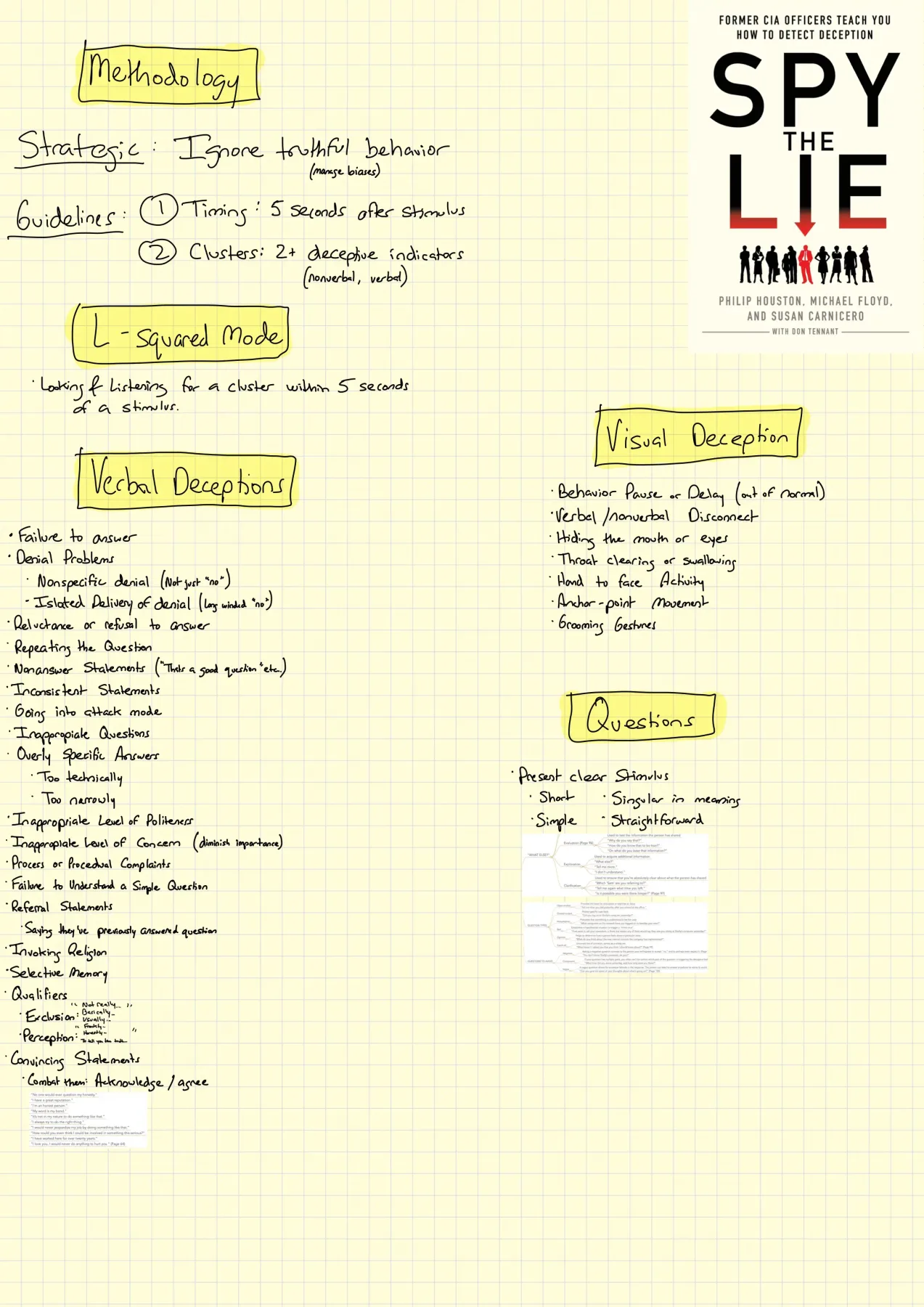
The answer is what has become our detection of deception methodology, or what we refer to simply as “the model.” One of the beauties of the model lies in its simplicity. It has one strategic principle and two simple guidelines. The strategic principle is that if you want to know if someone is lying, you need to ignore, and thereby not process, truthful behavior. We’ll delve into that seemingly paradoxical principle in the next chapter. (Page 31)
For now, let’s focus on the two guidelines, which stem from Phil’s “Aha!” moment when he was analyzing those polygraph charts. The two guidelines are timing and clusters. Although the concepts of timing and clusters were not new to the world of behavior assessment, no one had thought to meld those concepts into a codified behavior assessment model based upon the science of polygraph chart analysis. (Page 31)
Remember we said that the problem with global behavior assessment is that it puts us in the position of having to guess why a person is exhibiting a particular behavior. To make that leap from guessing to actual analysis, we need to focus on those behaviors that we can reasonably associate with a cause, the cause being the question. Think of analysis as identifying a cause, identifying the ramifications of that cause, and then exploring the relationship between the two. When we refer to timing, we begin with the question or statement that’s the stimulus for the potentially deceptive behavior. (Page 31)
In order to determine whether a person is being untruthful, we need to look and listen for the first deceptive behavior to occur within the first five seconds after that stimulus is delivered. To understand why we set that span at five seconds and not, say, thirty seconds or sixty seconds, consider the fact that data from stenographers tells us that on average, we speak at a rate of 125 to 150 words per minute. Cognitive research, meanwhile, suggests that we think at least ten times faster than we speak. What that tells us is the further in time we get away from the stimulus, the higher the likelihood that the brain has gone on to thinking about something else. Our experience has shown that if we can identify the first deceptive behavior within that first five seconds, we can reasonably conclude that the behavior is directly associated with the stimulus. (Page 32)
The trick is to train our brains to go into what we call “L-squared mode”—we have to tell it to look and listen simultaneously. (Page 32)
The other guideline has to do with clusters of deceptive behavior. A cluster is defined simply as any combination of two or more deceptive indicators, which, you’ll remember, can be either verbal or (Page 32)
nonverbal. So a cluster might be one verbal and one nonverbal, or two nonverbals, or two verbals and one nonverbal, and so on. (Page 33)
What do you do if there’s just a single deceptive behavior in response to the stimulus? You ignore it. There are a couple of reasons for that. First, we as individuals do a lot of things for different reasons. We have speech habits and patterns, and we have physical habits and patterns. They don’t have any particular significance, they’re just part of who we are. The process of filtering those out begins with the cluster rule. (Page 33)
You ask your question, and you go immediately into L-squared mode, looking and listening for a cluster of two or more deceptive behaviors. Remember, the first deceptive behavior has to appear within five seconds of the stimulus. The cluster is comprised of that first behavior, be it verbal or nonverbal, and all verbal and nonverbal behaviors that follow it until the stream is broken by another stimulus or identifiable interruption. How long can the stream continue? We don’t want to pick on politicians, but chances are we’ve all seen some long-winded responses in that realm that help provide the answer: pretty long. (Page 33)
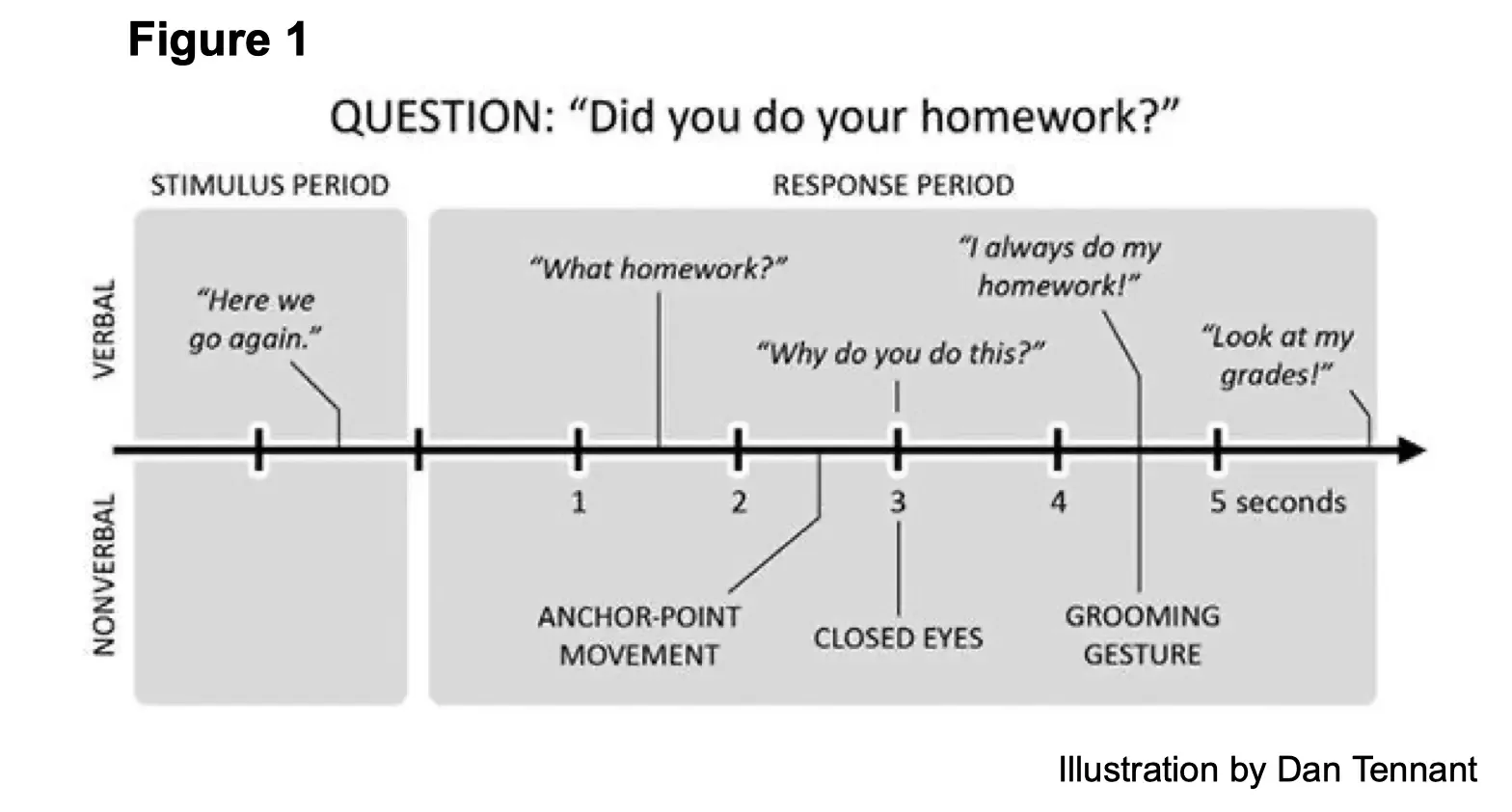
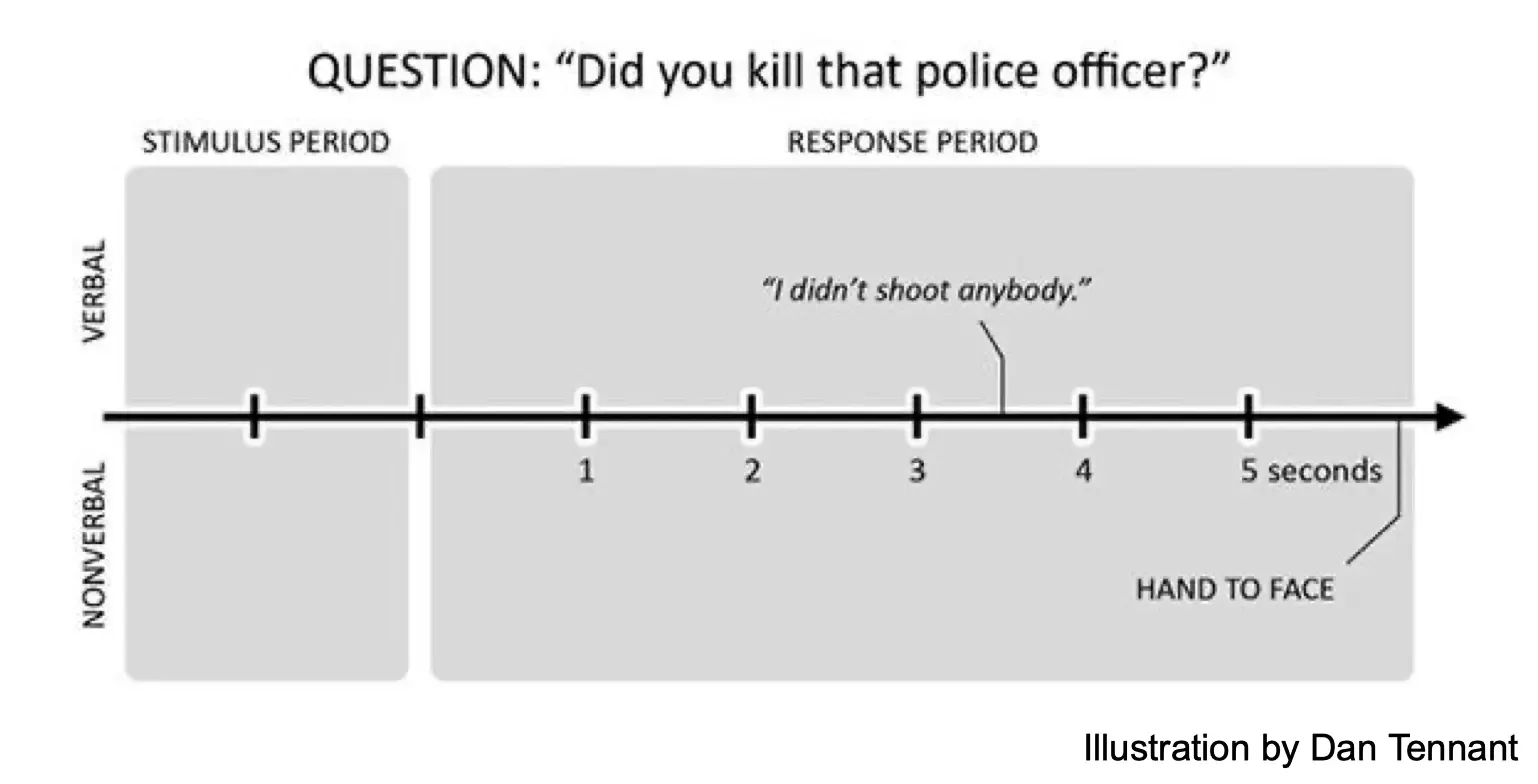
So, let’s say all the conditions are met. You ask a question, and in response you get a cluster of deceptive behaviors, the first of which began within the first five seconds. Can you definitively conclude from that information that the person is lying to you? Nope. Remember, you’re not a human lie detector. What you can conclude is that the question is a potential problem area, and that you have more work to do. There’s a reason we refer to these behaviors as “indicators,” not as “smoking guns.” (Page 35)
Susan once conducted a screening interview with a man who was applying for a sensitive government position. Her final question was a catch-all question that was designed to identify potential problem areas that had not yet surfaced. (We’ll discuss catch-all questions in chapter 10.) “What haven’t I asked you that you think I should know about that might be a concern?” Susan asked. The applicant shifted uneasily. “What do you mean by things that might be a concern?” (Page 36)
effectiveness of the model in obtaining truthful information, but that it’s implemented in a way that’s totally nonconfrontational, with no one feeling belittled, and without putting the interviewer or his organization in harm’s way. The idea is that when the individual walks out, he’s given you what you wanted, and he feels good about what he’s (Page 38)
done, because he doesn’t see you as an adversary. You’ve simply helped him to do the right thing, and he’s maintained his dignity. (Page 39)
4. The Deception Paradox: Ignoring the Truth in Order to Find the Truth (Page 40)
No mask like open truth to cover lies, As to go naked is the best disguise. —William Congreve (Page 40)
Phil had no doubt that Ronald was being truthful about having a trunk brimming with Bibles. But Phil knew that in order to convince his accuser, a deceptive person may respond to an allegation with a truthful statement, often one that casts himself in a highly favorable light. It’s what we call a “convince vs. convey” situation—an attempt to convince the accuser of one’s uprightness, of being the type of person who would never do anything like what he’s been accused of doing, rather than to convey information that addresses the facts of the case. (Page 41)
Anil’s insistence that Michael see the photos before the polygraph exam began told Michael precisely the same thing that Ronald told Phil with the trunk full of Bibles: “I’m guilty as sin, but hopefully I can persuade you otherwise by showing you something that’s truthful and that casts me in a halo-like light that will convince you that someone like me could never do what I’m being accused of doing.” (Page 43)
Ignoring truthful behavior helps us manage our biases, so we don’t even have to think about them when the task at hand is detecting deception. Beyond that, it reduces—often dramatically—the amount of data we have to process in order to make a decision about a person’s veracity. The more extraneous information that can be filtered out, the easier it is to spot behavior that’s deceptive. (Page 43)
Truthful (Page 43)
responses tend to be direct and spontaneous, and a person who is deceptive is generally able to respond that way to many questions, especially if he’s prepared for them. Similarly, a truthful person is typically alert, composed, and attentive. Yet, untruthful people can, to varying degrees, demonstrate that same behavior. The solution is simple: Ignore it. The chances are too high that it will be used as a weapon against you. (Page 44)
5. What Deception Sounds Like (Page 45)
When people talk, listen completely. Most people never listen. —Ernest Hemingway (Page 45)
All the lies that have ever been told or ever will be told fall into three categories, or strategies: lies of commission, lies of omission, and lies of influence. (Page 45)
“… to tell the truth …” covers lies of commission. These are the straightforward, bald-faced lies. (Page 45)
“… the whole truth …” covers lies of omission. In this case, it’s not what a person says, but rather what he doesn’t say, that constitutes the lie—a strategy that tends to be considerably more comfortable to carry out than telling a lie of commission. (Page 45)
“… and nothing but the truth …” covers lies of influence. We’ll be discussing this strategy extensively in the next chapter, because it’s so powerful and because the average person tends not to recognize it. When people lie to you successfully, it’s often because they say things that manage your perception of them as it relates to the issue at hand. (Page 45)
If the facts are not their ally, people have to say something that convinces you, and the best thing they can say is something that’s true or irrefutable. (Page 46)
deceptive verbal behaviors (Page 47)
FAILURE TO ANSWER. (Page 48)
DENIAL PROBLEMS. (Page 48)
- absence of an explicit denial of something in your question that involves an act of wrongdoing, or has consequences associated with it. (Page 48)
- If, for example, you ask a person a yes-or-no question—“Did you do it?”—and the person does not respond with a “no” statement like “It was not me” or “I didn’t do it,” (Page 49)
- that’s significant. When the truth isn’t an ally, the person is psychologically inclined to respond with information he feels more comfortable conveying. (Page 50)
- Denial problems can take a couple of other forms: (Page 50)
Nonspecific denial.
- If the “no” statement is delivered in a way that’s more of a general focus than a specific expression of denial of the matter at hand (“I didn’t do anything,” “I would never do something like that”), that’s also significant. It’s subtle, but if a person says he didn’t do anything, psychologically he’s letting himself off the hook so he doesn’t have to tell the baldfaced lie, “I didn’t do it.” It’s a nuance that’s easily missed by an untrained ear. (Page 50)
Isolated delivery of denial.
- If in response to a question about wrongdoing, a person gives you a “no” response, but buries it in a long-winded answer, that’s important. If the percentage of the answer that relates to the denial is relatively small, that’s a bad thing. Consider it a deceptive indicator. (Page 50)
RELUCTANCE OR REFUSAL TO ANSWER. (Page 50)
REPEATING THE QUESTION. (Page 50)
NONANSWER STATEMENTS. (Page 51)
- We often hear the nonanswer statement, “I knew you were going to ask me that.” Why is that statement made in response to this particular question? Without realizing it, the person may be cluing us in on what he’s thinking or worried about. (Page 51)
- “That’s a good question.”
- “I’m glad you asked that.”
- “I knew you were going to ask me that.”
- “That’s a legitimate concern.” (Page 51)
INCONSISTENT STATEMENTS. (Page 51)
GOING INTO ATTACK MODE. (Page 52)
INAPPROPRIATE QUESTIONS. (Page 53)
- Some schools of thought suggest that answering a question with a question is deceptive, but we would say that’s not necessarily the case. What concerns us is when we ask a question, and the response is a question that doesn’t directly relate to the question we asked. (Page 53)
OVERLY SPECIFIC ANSWERS. (Page 53)
- Deceptive people might be overly specific in two ways, and they’re almost polar opposites. One way is they will answer a question too technically, or too narrowly. (Page 53)
- In addition to being overly specific by limiting the scope of the response, deceptive people might go to the other extreme of in overspecificity and response to your question. inundate you with detailed information (Page 53)
INAPPROPRIATE LEVEL OF POLITENESS. (Page 54)
- person suddenly increases the level of nicety, that’s significant. (Page 54)
INAPPROPRIATE LEVEL OF CONCERN. (Page 54)
- might resort to a strategy of attempting to diminish the importance of the issue. Typically, he’ll focus on either the issue or the process, and try to equalize the exchange by doing the questioning: “Why is this such a big deal?” or “Why is everybody worried about that?” The person might even attempt to joke about the issue, which can be especially inappropriate. (Page 54)
PROCESS OR PROCEDURAL COMPLAINTS. (Page 54)
- Questions like “Why are you asking me?” or “How long is this going (Page 54)
to take?” fall into this category. They may be a delaying tactic, similar to repeating the question or making nonanswer statements, or they may be an attempt at deflection in the hope of steering the proceedings down a different path. (Page 55)
FAILURE TO UNDERSTAND A SIMPLE QUESTION. (Page 55)
- might employ is to get you to change your phrasing or terminology. The aim is to shrink the scope or magnitude of the question, to give him just enough wiggle room to answer it to your satisfaction and to his. (Page 55)
REFERRAL STATEMENTS. (Page 55)
- Sometimes in response to a question, a deceptive person will refer to having previously answered the question. (Page 55)
- The idea here is to build credibility. It’s a subtle tactic, but much more powerful than most people realize. We may not be convinced that the person is being truthful, but repetition is a psychological tool that often can make us more open to that possibility than we otherwise would have been. (Page 55)
- “As I said during our last meeting …”
- “As we explained in our report …”
- “Like I told the last guy who asked that question …” (Page 56)
- In many situations, making a claim one time doesn’t have much of an impact. But each subsequent time the claim is made, it diminishes our resistance or disbelief, to the point where the door is opened to the possibility that the claim actually has credibility. Remember what Franklin D. Roosevelt said in 1939: “Repetition does not transform a lie into a truth.” (Page 56)
INVOKING RELIGION. (Page 56)
- “I swear to God …”
- “As Allah is my witness …”
- “I swear on a stack of Bibles …”
- “God knows I’m telling the truth.” (Page 57)
SELECTIVE MEMORY. (Page 57)
- “Not that I recall …”
- “To the best of my knowledge …”
- “Not that I’m aware of …”
- “As far as I know …” (Page 57)
QUALIFIERS. (Page 57)
- There are two types of qualifiers that are potential deceptive indicators: exclusion qualifiers and perception qualifiers. Exclusion qualifiers enable people who want to withhold certain information to answer your question truthfully without releasing that information. Examples of qualifiers of this type include “basically,” “for the most part,” “fundamentally,” “probably,” and “most often.” Perception qualifiers are used to enhance credibility: “frankly,” “to be perfectly honest,” and “candidly” are examples. Keep in mind that we all have speech habits and patterns that can account for the presence of these qualifiers, so again, remember the cluster rule. Also, we don’t count each qualifier as a separate indicator. Consider the use of multiple qualifiers in response to a question as one indicator. There can be a lot of them in a single response. (Page 58)
- Exclusion Qualifiers
- “Not really …”
- “Fundamentally …”
- “Basically …”
- “For the most part …”
- “Probably …”
- “Usually …”
- “Possibly …”
- “Most often …” (Page 58)
- Perception Qualifiers
- “Frankly …”
- “To tell you the truth …”
- “Honestly …”
- “To be perfectly honest …”
- “Candidly …”
- “Truthfully …” (Page 59)
CONVINCING STATEMENTS. (Page 59)
6. The Most Powerful Lies (Page 60)
Let your lie be even more logical than the truth itself, So the weary travelers may find repose. —Ceslaw Milosz (Page 60)
Suppose someone asked you, “Did you take the missing money?” Since you’re honest and didn’t take any money, your most likely response would be, “No!” The reason is that’s the single fact that’s most important to you to get across. The guilty person may or may not deliver the “no,” but the discomfort of the facts not being his ally will likely compel him to convey other information to convince you. “I would never do that,” he might say. “That would be dishonest, and I’m not that kind of person,” or “Ask anybody around here, look at my record,” or “I have a good reputation,” or “You think I would jeopardize my job by doing that?” (Page 61)
NEUTRALIZE CONVINCING STATEMENTS
- The way to combat convincing statements is to neutralize them—to render them ineffective by acknowledging or agreeing with them. This, of course, needs to be distinguished from agreeing with the action. (Page 61)
The deceptive person will often give you a string of convincing statements, because he has no choice. He has no facts that are his friend. (Page 62)
Convincing Statements
- “No one would ever question my honesty.”
- “I have a great reputation.”
- “I’m an honest person.”
- “My word is my bond.”
- “It’s not in my nature to do something like that.”
- “I always try to do the right thing.”
- “I would never jeopardize my job by doing something like that.”
- “How could you even think I could be involved in something this serious?”
- “I have worked here for over twenty years.”
- “I love you, I would never do anything to hurt you.” (Page 64)
convincing statements usually incorporate emotion. In this case, the officer said that when Ms. Smith made those statements, the investigators could see tears welling up in her eyes —the emotion is what expresses the conviction. Emotion in and of itself isn’t necessarily truthful or deceptive. But untruthful people use it to enhance the deception. (Page 64)
Unlike qualifiers, we consider each convincing statement as a two convincing statements indicator. So, separate deceptive constitute a cluster. They’re that powerful. (Page 64)
7. The Wrath of the Liar (Page 65)
No man lies so boldly as the man who is indignant. —Friedrich Nietzsche (Page 65)
The more desperate a situation is, the more a person will feel prone to attack. So, when we see this behavior in response to a question, it tells us that the person is particularly highly stressed by that question, and that it’s an area that strongly warrants further attention. (Page 66)
8. What Deception Looks Like (Page 72)
He that has eyes to see and ears to hear may convince himself that no mortal can keep a secret. If his lips are silent, he chatters with his fingertips; betrayal oozes out of him at every pore. —Sigmund Freud (Page 72)
BEHAVIORAL PAUSE OR DELAY. (Page 73)
You ask a person a question and you initially get nothing. After a delay, he begins to respond. How long does a delay have to be before it’s meaningful, before you would consider it a deceptive indicator? Well, it depends. (Page 73)
A second variable is whether the delay is appropriate for the person. In the course of an interview, for example, a pattern will naturally develop that gives you a sense of how much time elapses before the person responds to your questions. If we see something that falls outside of that established pattern, then we have a concern. (Page 74)
VERBAL/NONVERBAL DISCONNECT. (Page 74)
Our brains are wired in a way that causes our verbal and nonverbal behaviors to naturally match up. So when there’s a disconnect, we consider that a potential deceptive indicator. (Page 74)
person nods affirmatively while saying, “No,” or turns his head from side to side while saying, “Yes.” (Page 74)
HIDING THE MOUTH OR EYES. (Page 74)
There is a natural tendency to want to cover over a lie, so if a person’s hand goes in front of her mouth while she’s responding to a question, that’s significant. (Page 74)
We’re not referring to blinking here, but if a person closes her eyes while responding to a question that does not require reflection to answer, we consider that a means of hiding the eyes, and a likely deceptive indicator. (Page 75)
THROAT-CLEARING OR SWALLOWING. (Page 75)
If a person clears his throat or performs a significant swallow prior to answering the question, that’s a potential problem. If he does it after he answers, that doesn’t bother us. (Page 75)
HAND-TO-FACE ACTIVITY. (Page 75)
often takes the form of biting or licking the lips, or pulling on the lips or ears. (Page 75)
When the blood rushes away from those regions, it irritates the capillaries, which can create a sensation of cold or itchiness. Without the person even realizing it, his hands are drawn to those areas, or there’s a wringing (Page 75)
or rubbing of the hands. Boom!—you’ve spotted a deceptive indicator. (Page 76)
ANCHOR-POINT MOVEMENT. (Page 76)
A person’s anchor points are those parts of his body that anchor him in a particular spot or position. If a person is standing, his primary anchor points are his feet. His secondary anchor points might be his arms if they’re folded in front of him, or they might be his hands if he’s standing with his hands on his hips or in his pockets. We’re not worried about his posture; we’re only looking at those anchor points. (Page 76)
if there is anchor point movement in response to your question, regardless of how many anchor points move, count that as just one deceptive behavior. (Page 76)
We want the person in a chair that has wheels, that rocks and swivels, that might even have moveable arm rests. That type of chair becomes a behavioral amplifier, magnifying those anchor-point movements and making them particularly easy to spot. (Page 76)
GROOMING GESTURES. (Page 76)
Another way that some people may dissipate anxiety is through physical activity in the form of grooming oneself or the immediate surroundings. (Page 76)
In a more typical setting, when responding to a question, a deceptive man might adjust his tie or shirt cuffs, or maybe his glasses. An untruthful woman might move a few strands of hair behind her ear, or straighten her skirt. We’re also concerned with sweat management. That a person might be sweating doesn’t bother us, but if he takes out his handkerchief (or, perhaps more likely, a hand sans kerchief) and wipes the sweat off his brow when responding to a question, that’s significant. (Page 77)
Tidying up the surroundings is another form of grooming gesture. (Page 77)
9. Truth in the Lie: Spying Unintended Messages (Page 79)
I apologize for lying to you. I promise I won’t deceive you except in matters of this sort. —Spiro T. Agnew (Page 79)
So how can you train yourself to spot this truth in the lie, or unintended messaging? Understand that when you’re dealing with a situation in which truth matters, literalness becomes very important. (Page 83)
A TIP FOR PARENTS
- When you were a kid and your parents found out about something you did that you shouldn’t have done (not that it isn’t next to impossible to think of any such circumstance, of course), did they ever ask you what you thought your punishment should be? It was probably their way of getting you to really think about what you had done and the consequences of your actions. Perhaps they were also trying to give you some sense of the unappealing position you had put them in by forcing them to dole out punishment.
- If you’ve since become a parent yourself, perhaps you’ve posed the same question to a child whose behavior warranted some sort of discipline. But what about a situation in which you’re not certain whether your child was at fault? Could the same question help you to determine your child’s culpability?
- Let’s say you come home from work and there’s a grape-juice stain on the couch. You have two children, both of whom like grape juice, and both of whom know full well that they’re not allowed to eat or drink on the couch. You ask both of them if they know how the grape-juice stain got there, and they both insist they have no idea.
- Try speaking with them individually, and ask them both what they think the punishment should be for whomever had been drinking grape juice on the couch. As always, follow the cluster rule. But also consider the leniency of the suggested punishment. If Tommy says, “No computer for a week,” and Tammy says, “No grape juice for a week,” you probably have more work to do with Tammy. Also, be aware that the culprit will sometimes avoid answering the punishment question altogether. Tammy might not say anything at all, or she might muster that barely audible “I don’t know.” (Page 87)
10. You Don’t Ask, You Don’t Get (Page 89)
People often make decisions on the basis of this viral thinking, and baits take advantage of that fact by posing a hypothetical question. A very effective phrase to use is, “Is there any reason … ?” Bear in mind that the more implicit your language, the stronger the mind virus—when you become more explicit, the person has more of a chance to evaluate it. If you were to ask Simpson if there’s any reason the next-door neighbor will say he saw him there, you’re giving him a better chance of overcoming it. He might happen to know the next-door neighbor is out of town, so he immediately responds, “No.” Broader, then, is better. (Page 94)
PRESENT A CLEAR STIMULUS
- Remember, the model is only as good as the questions you ask in the course of employing it. Since the behavior you’re analyzing is the direct result of a stimulus—your question—it follows that your presentation of the stimulus is critical to the accuracy and usefulness of your analysis. Here are four tips to keep in mind when you formulate your question to ensure that it’s as clear as you can make it:
- Keep it short. When possible, keep your question shorter rather than longer. As we noted in chapter 3, the individual you’re questioning is likely thinking ten times faster than you’re speaking. So if you ask a long, drawn-out, rambling question, that can be problematic if his agenda is to try to avoid answering your question or to provide a response that’s misleading.
- Keep it simple. Some people try to convey their level of intellect by means of complex sentence structure and highbrow vocabulary. Make sure you don’t fall into that trap—if the person doesn’t fully understand your question, his response is less likely to be behaviorally significant. Beyond that, you might see behavior that appears deceptive, when the stimulus of that behavior is nothing more than his confusion.
- Keep it singular in meaning. If your question is ambiguous, you have no way of knowing how the person understood the question. If you observe a deceptive behavior, you don’t know what he’s reacting to. It could be something you care about, or it could be something that’s essentially irrelevant.
- Keep it straightforward. The more up front you are, the more likely the person will trust you, which might increase the likelihood of cooperation. Of course, there will be certain situations in which there will be an inherent lack of trust. In our combined decades of experience as polygraph examiners, we can assure you that we never had a person walk into the room and tell us how happy and excited he was to be there. The best we could hope for was that at some point, the individual would say something like “For a polygraph examiner, you’re not too bad.” Coming across as sincere and straightforward helps a lot in getting to that point. (Page 95)
Now, it’s important to distinguish between a bait and a bluff. Contrary to what we often see from Hollywood, bluffs very rarely work. (Page 95)
A beautiful thing about presumptive and bait questions is that they aren’t in any way contrary to the facts of the situation. They’re fair, because the truthful person can respond without processing them. (Page 95)
Presumptive and bait questions have a couple of things in common, aside from being extremely powerful. First, they both have a limited shelf life in the information collection process. If you overuse them, the person is likely going to figure out what you’re doing. It will trigger his defenses, and he’ll view you as an adversary who’s trying to trick or mislead him in some way. We’ve found that generally, presumptive and bait questions should each be used no (Page 95)
more than two or three times in the course of an hour-long interaction. (Page 96)
Second, while all questions should be delivered as neutrally as possible, neutrality is especially important with presumptive and bait questions—the person needs to feel that you have no preconceived notions about how he’s going to answer each question. This neutrality is conveyed by the words you use to frame the question, and the tone or demeanor you use to deliver it. It needs to be delivered in a very matter-of-fact manner, with no additional emphasis whatsoever placed on the question. (Page 96)
There’s another reason that neutrality is especially important. You want to ensure that if there’s a deceptive response to the question, the deceptive behavior is related to your question, and not to your delivery. If the person has decided to be untruthful, deceptive behavior tends to be amplified in response to presumptive and bait questions. These questions also tend to be effective in compelling the person to think about changing his game plan, and perhaps to provide you with some information. The original game plan might have been to say, “No, I didn’t do it, and I don’t know anything about it.” Now, in response to the question about what happened at Nicole’s last night, Simpson may still want to say he didn’t do it, but he may be thinking about what he could share that might make himself appear to be more cooperative. If the person gets into the mode of wanting to share something, that will often open the door to allow you to explore other pieces of information. (Page 96)
“WHAT ELSE?”
- Possibly the most important phrase in the information-collection process is the simple question, “What else?” Those two words convey to the person you’re interviewing a sense that being selective about the information he shares with you will be no easy task. They also serve as a great example of just how crucial follow-up questions can be. Another great example is asking for a clarification. If the person says anything that you’re not absolutely clear about, don’t proceed to the next question without clarifying it. It might be something as simple as an acronym you’re not familiar with. If you don’t know, ask, because you may not have the opportunity to ask later.
- The ability to recognize when and how to follow up on a question can, in fact, make or break an interview. Here are some key types of follow-up questions that you should always have in your interviewing arsenal:
- Evaluation (Page 96)
- Used to test the information the person has shared
- “Why do you say that?”
- “How do you know that to be true?”
- “On what do you base that information?”
- Exploration
- Used to acquire additional information
- “What else?”
- “Tell me more.”
- “I don’t understand.”
- Clarification
- Used to ensure that you’re absolutely clear about what the person has shared
- “Which ‘Sam’ are you referring to?”
- “Tell me again what time you left.”
- “Is it possible you were there longer?” (Page 97)
As a result, Tom wasn’t offended—there was no umbrage taken. We’ve found that if deceptive people do express anger or indignation in response to a presumptive question, it’s usually feigned as a strategy to get the questioner to back off. Truthful people typically aren’t offended, either, because they recognize that you’re just doing your job. So you shouldn’t be reluctant to ask those questions, as long as you deliver them in a low-key, neutral way. (Page 98)
QUESTION TYPES
- Open-ended
- Provides the basis for discussion or explores an issue
- “Tell me what you did yesterday after you arrived at the office.”
- Closed-ended
- Probes specific case facts
- “Did you log on to Shelly’s computer yesterday?”
- Presumptive
- Presumes that something is understood to be the case
- “What computers on the network have you logged on to besides your own?”
- Bait
- Establishes a hypothetical situation to trigger a “mind virus”
- “If we were to ask your coworkers, is there any reason any of them would say they saw you sitting at Shelly’s computer yesterday?”
- Opinion
- Helps to determine how a person feels about a particular issue
- “What do you think about the new internal controls the company has implemented?”
- Catch-all
- Uncovers lies of omission, serves as a safety net
- “What haven’t I asked you that you think I should know about?” (Page 99)
QUESTIONS TO AVOID
- Negative
- Asking a negative question conveys to the person your willingness to accept “no,” and to perhaps even expect it. (Page 99)
- “You don’t know Shelly’s password, do you?”
- Compound
- If your question has multiple parts, you often can’t be certain which part of the question is triggering the deceptive behavior. Compound questions also give the person the opportunity to answer just one part, so you need to be alert to the fact that at least one of your questions went unanswered. That can be difficult if the person gives you an exhaustive response to just one part of the question.
- “What time did you arrive yesterday, and how long were you there?”
- Vague
- A vague question allows for excessive latitude in the response. The person can take his answer anywhere he wants to avoid being of any help to you.
- “Can you give me some of your thoughts about what’s going on?” (Page 100)
11. Managing Deception to Gain the Advantage (Page 102)
He who permits himself to tell a lie once, finds it much easier to do it a second and third time, till at length it becomes habitual. —Thomas Jefferson (Page 102)
AVOID ASKING NEGATIVE QUESTIONS. (Page 103)
USE PROLOGUES FOR KEY QUESTIONS. (Page 103)
- A prologue is a short, narrative explanation that precedes a question. It’s designed to prime the information pump, so that if the person is on the fence about whether or not he’s going to give you something, it will help to influence him to come down on your side of the fence. (Page 103)
QUESTION PROLOGUE ELEMENTS
- Legitimacy statement
- Rationalization
- Minimization
- Projection of blame (Page 104)
STAY COOL
- Dealing with deceptive behavior can often be frustrating, and depending on the circumstances, it can be downright infuriating. But you need to stay cool, because taking a non-confrontational approach is always the way to go when you’re confronted with deception. Here are some examples of specific behaviors and how we suggest you handle them:
- Convincing statements. As we explained in chapter 6, the best strategy for dealing with convincing statements is to neutralize them—you acknowledge or agree with them, and go right back to where you were in the questioning process.
- Exclusion qualifiers. When a person uses an exclusion qualifier like “not really,” “for the most part,” or “basically,” her aim is to provide you with an answer, but to carve out information that she doesn’t want to share. When you hear one of those qualifiers, your very next question should be targeted at what has potentially been carved out. Let’s say a couple is getting dressed to go out. The husband picks out a shirt and asks his wife if she has any problem with his choice, and she says, “Not really.” If the husband shoots back with “What is ‘not really’ supposed to mean?” aside from the stage being set for a less-than-enjoyable evening, she’s likely to minimize what she otherwise might have shared if he had been more low-key. If he really wants to know what she thinks (granted, the chances of that may be slim), he’s much better off coming back with something like, “If you had to pick out one thing about this shirt that you’re not crazy about, what would it be?”
- Inconsistent statements. If a person’s response to a question is inconsistent with something he said previously, your inclination might be to come back with something like, “Wait a minute! That’s not what you said before!” But if you do that, how cooperative is he likely to be? The person has provided you with information that might be closer to the truth than what he said earlier, and he doesn’t want his nose rubbed in the fact that he didn’t share it with you previously.
- If a person says the amount of money he stole is $500, and later in the interview says the amount is $1,000, you don’t want the next thing out of your mouth to be, “That’s not what you said before.” A better way to resolve the conflict and evaluate the truthfulness of the update often is to follow up with a question about whether there’s another possibility, such as, “Is it possible that it could have been more than $1,000 that you took?” It can also be helpful to follow up with a question that’s preceded by a legitimacy statement: “I just want to make sure—if I understand correctly, we’re talking about $1,000.” If you need to compare and contrast the new statement with the previous statement, do it, but don’t beat the person up over it—your aim is to solicit his cooperation: “Okay, now how does that fit with what you said before? Help me understand how we got from there to here.” Make sure you’re in Lsquared mode, using the model every step of the way. (Page 105)
Rationalization is also valuable in a question prologue. A socially acceptable reason like “Nobody’s perfect,” or “Everyone makes mistakes,” can have a tremendous impact on a person’s willingness to open up in response to a question. for an action, (Page 105)
minimization can be an effective tool in preventing psychological entrenchment, so a statement like “No one wants to blow this out of proportion” might be helpful. At the same time, it’s crucial that the person not be misled with false information. (Page 105)
OVERCOME PSYCHOLOGICAL ALIBIS. (Page 106)
A very effective way to do that is to follow up with a bait question. If we hear an “I don’t remember” in response to a question, say, about whether a person had ever met a particular individual, we might follow up with, “Is there any reason anyone might tell us that he saw the two of you together?” (Page 106)
Another strategy that often works well is the “possibility strategy.” An example might be “I know it was a while ago, but is it possible that the two of you might have met?” (Page 106)
BROADEN YOUR FOCUS. (Page 107)
means of increasing the volume of useful information you collect, and one you should use routinely, is to broaden your focus in a way that makes it more difficult for the person to give you a narrow response. (Page 107)
Once you’ve obtained a series of information pieces, explore them in reverse order. The reason is simple: The last piece of information the person gave you is likely to be the most serious piece, the one he was most reluctant to share. The bottom line is that you don’t accept the first thing someone tells you. It’s almost as if you didn’t hear it. (Page 107)
12. Let’s Be Careful Out There (Page 108)
Truth only reveals itself when one gives up all preconceived ideas. —Japanese proverb (Page 108)
We would put microexpressions in a category of behaviors that have come to be widely viewed as reliable indicators of deception, but that we in our experience have found to more typically be quite unreliable in real situations. (Page 109)
Here are some other behaviors that we advise be used with extreme care, and that we lump into a category we think of as “Behavioral Cautions.” (Page 109)
EYE CONTACT. (Page 109)
Yes, poor eye contact may be bad manners in a lot of situations, depending on the culture. But let’s face it—the leap from there to deception requires a pretty long running start. (Page 109)
CLOSED POSTURE. (Page 110)
You can’t attach significance to a behavior if you don’t know its cause. (Page 110)
GENERAL NERVOUS TENSION. (Page 110)
PREEMPTIVE RESPONSES. (Page 110)
Responding to a question before the questioner has finished asking it is sometimes considered to be indicative of deceptive behavior. We don’t accept that. Our experience has demonstrated that this is a behavior routinely exhibited by both truthful and deceptive people, but they do so for different reasons. (Page 110)
BLUSHING OR TWITCHING. (Page 111)
CLENCHED HANDS. (Page 111)
BASELINING. (Page 111)
13. A Textbook Case of Deception (Page 115)
14. Okay, So Now What? (Page 133)
I never encourage deceit, and falsehood, especially if you have got a bad memory, is the worst enemy a fellow can have. The fact is truth is your truest friend, no matter what the circumstances are. —Abraham Lincoln (Page 133)
There was probably no more important takeaway for anyone who underwent the training. Identifying deceptive behavior doesn’t make you a human lie detector, and it doesn’t suddenly thrust you into the dual role of judge and jury. No question, you now have a very useful and effective tool that can help you resolve everyday situations involving deception. But it must be employed with the understanding that what it yields is information that warrants further examination. (Page 134)
DO: (Page 136)
- Practice—a lot. Watch talk shows, interview shows, news programs, any forum in which people are called upon to respond to questions. To use a golf analogy, we’ve taught you how to grip and swing the club. How good your game gets depends entirely on how much you practice.
- Refrain from practicing on your significant other.
- Use your new skills only for good.
DON’T:
- Do or say anything that makes the person aware that you’re reading him, because it will trigger his defenses. For example, don’t confront the person with your observation that he exhibited a particular deceptive behavior. If you tell him you spotted an anchor-point movement, he’ll do his best to keep still for the remainder of the encounter, and you’ve lost what might have been a very valuable tool.
- Allow yourself to deviate from the cluster rule or from a focus on the behaviors we’ve outlined. Getting overly aggressive doesn’t work—you’ll see an eyelash flutter and you’ll be ready to say, “Book ’em, Danno.”
- Ask the question unless you’re sure you really want to know the answer. (Page 137)
APPENDIX I Suggested Question Lists (Page 141)
I.I. QUESTIONS TO ASK WHEN HIRING A CAREGIVER FOR CHILDREN (Page 142)
There may be no interview experience that’s more critically important to get right than one that involves a search for someone to care for your children. In addition to an in-depth interview (in a two-parent household, both parents should take part), a background investigation should be conducted that, at minimum, includes a criminal history check (including a check of national and local sex offender registries) and a thorough check of references, including at least one developed reference (a reference that is not provided by the interviewee). At some point during the interview, you should introduce the prospective caregiver to your child, even if the child is an infant. Does your child seem uncomfortable around the prospective caregiver? Children seem to be born with an innate sense of whom they feel protected with, so take that into consideration. Always listen to your instincts as you evaluate the manner in which the caregiver engages your child or holds your infant. Are you comfortable with the level of gentleness and care displayed by the caregiver? If your child is an infant, does the interviewee make appropriate adjustments to the baby’s clothing and surroundings? Her willingness to make those adjustments is important, because it reflects a “baby first” mentality. Does she ask questions that appropriately reflect interest in the baby’s welfare and familiarity with the baby’s needs? As you make those observations, consider asking the interviewee these questions: (Page 142)
Why did you become a caregiver for children? How long have you worked as a caregiver? What ages have you cared for? What age children have you enjoyed caring for the most? Why? What ages have you felt or would you feel uncomfortable caring for? Why? Have you cared for both genders? Is there any reason that your name would appear on any sex offender registry? (Page 142)
What do you find most rewarding about being a caregiver? What do you like least about being a caregiver? Tell me about the most difficult child (infant) you have ever cared for. What is the biggest challenge you have faced in caring for a child (infant)? How long should an infant cry before you check on it? Follow-up: Why? (Ask the caregiver to explain why she would handle the situation in the manner she described.) How long should you let an infant cry before you pick it up? Follow-up: Why? (Ask the caregiver to explain why she would handle the situation in the manner she described.) What is your philosophy for disciplining children? What is the harshest discipline you have ever handed out as a caregiver? What is the most significant emergency situation you have handled as a caregiver? What first-aid or emergency training have you had? What was the most difficult family you have ever had to work with? Follow-up: Why were they difficult? Follow-up: In hindsight, what might you have done differently to make that situation a better experience for all involved? What aspects of being a caregiver do you find frustrating? What do children (infants) do that might cause you to lose your temper? When is the last time you recall losing your temper, or coming close, when caring for a child? What type of child do you find is the most difficult to care for? What is the worst experience you’ve had when you were responsible for a child? What will your references say is your biggest strength as a caregiver? What will your references say is your biggest weakness as a caregiver? (Page 143)
Under what circumstances would you give in to a child’s wishes or demands about something that the parents have expressly forbidden? Is there any reason that any of your references will have any hesitation in recommending you as a caregiver? What haven’t I asked you that you think I should know about? (Page 144)
Additional highlights (from Readwise, not in the list above)
-
- (Page 114)