Knowledge 1.pdf (file not included in this release)
Introduction
- Narcissus from Greek mythology.
- fall in love with his own reflection.
- Narcissus simply starves to death as he sits there by the pond, gazing at his reflection.
- Clinical narcissism occurs in somewhere between 1 and 2 percent of the population.
- increased emphasis on the self.
- International research suggests that in Western culture this is exhibited by closer to 10 percent of the population, maybe even more than that. Some have even suggested 15 to 20 percent.
- Little mention is ever given to the fact that parents who encourage their little darlings to believe that they are princesses or world champions from the moment they are born, admittedly with the best of intentions, are inadvertently producing a sluggish armada of egomaniacal underachievers.
- Thinking a little less about ourselves and a little more about one another is the road to true success and happiness.
Part I. Narcissism: A Brief Introduction
1 What Is Narcissism?
- Narcissism is a personality disorder. It’s important to realize this, so that you can immediately lay to rest any ideas you have of curing or treating the condition.
- Self-centered people can certainly be irritating, and it’s definitely one of the signs of narcissism,
- COMMON CHARACTERISTICS OF NARCISSISM
- Unrealistic, grandiose self-image
- Incredibly self-centered
- Speak only about themselves
- Feeling special and unique
- Arrogance and haughtiness
- Quick to criticize and judge others
- Highly sensitive to criticism
- Think the rules don’t apply to them
- Constant self-promotion
- Feeling entitled to the best of everything
- Value power and fame
- Demand constant acknowledgment
- Will respond with aggression when questioned
- Deceitful and manipulative
2 Being a Cut Above the Rest
- Being special is a good thing, of course. On one condition, that is: You have to be genuinely special.
3 The Rest of the Dark Triad
- The dark triad is a disquieting set of three major personality disorders that can each make an individual pose a threat to other people. There are no clear boundaries between these three disorders, and they have some characteristics in common.
PSYCHOPATHY
- They have no inhibitions when it comes to trying to reach their goals. If somebody is in their way, they will stop at nothing to get past them.
- They can be extremely manipulative and can convince almost anybody of almost anything. And yes, that includes you and me. They have a knack for identifying other people’s weaknesses and exploiting them for their own personal benefit.
- ROBERT HARE’S PSYCHOPATHY CHECKLIST, REVISED PCL-R 2016:
- Glib and superficial charm
- Grandiose (exaggerated) estimation of self
- Lack of remorse or guilt
- Callousness and lack of empathy
- Cunning and manipulativeness
- Shallow affect (superficial emotional responsiveness)
- Impulsivity
- Poor behavioral controls
- Need for stimulation
- Irresponsibility
- Early behavior problems
- Antisocial behavior as an adult
- Pathological lying
- Parasitic lifestyle
- Sexual promiscuity
- Lack of realistic long-term goals
- Failure to accept responsibility for own actions
- Juvenile delinquency
- Breaking parole
- Criminal versatility
- Psychopathy can’t be cured. It can’t be treated. Therapy doesn’t work. In fact, it only makes them worse because it teaches them more about how people function. It adds new weapons to their arsenals.
MACHIAVELLIANISM
- Machiavellians usually exhibit the following behaviors:
- Focus only on their own ambitions and interests
- Prioritize power and money over relationships
- Exploit and manipulate others to get ahead
- Frequently use flattery
- Lack principles and values
- Are hard to truly get to know
- Exhibit cynicism, a lack of appreciation for goodness or morals
- Are evasive in terms of commitment and emotional relationships
- Are capable of great patience as a result of their calculating nature
- Seldom reveal their true intentions
- Have frequent new sexual encounters
- Are good at decoding social situations and other people
- Lack warmth in social interactions
- Machiavellians, on the other hand, are always in full control of their actions. They might be incredibly generous to certain people and absolutely ruthless to others. They know exactly what they’re doing, and they are highly skilled at keeping their plans under wraps. Psychopaths will always expose their true nature eventually, but a Machiavellian personality disorder can take many years to detect.
- They don’t trust in human kindness, and they find it frightfully naïve to place faith in others. They prioritize power over love or connections with others.
- Each part of the dark triad—psychopathy, Machiavellianism, and narcissism—can pose complex challenges to the people who encounter it.
- Psychopathy mostly involves being cold, unempathic, and insensitive to the needs of others.
- Machiavellianism mostly involves manipulating people for personal gain.
- Narcissism mostly involves feeling deserving of praise and special treatment that others don’t receive.
4 Is It Normal to Think About Yourself All the Time?
- there’s a difference between focusing on yourself on the one hand and focusing on yourself at the expense of everyone else on the other.
- Most of the people we encounter are ultimately loyal to themselves, but they reflect on and factor in the effects their decisions will have on others in their deliberations.
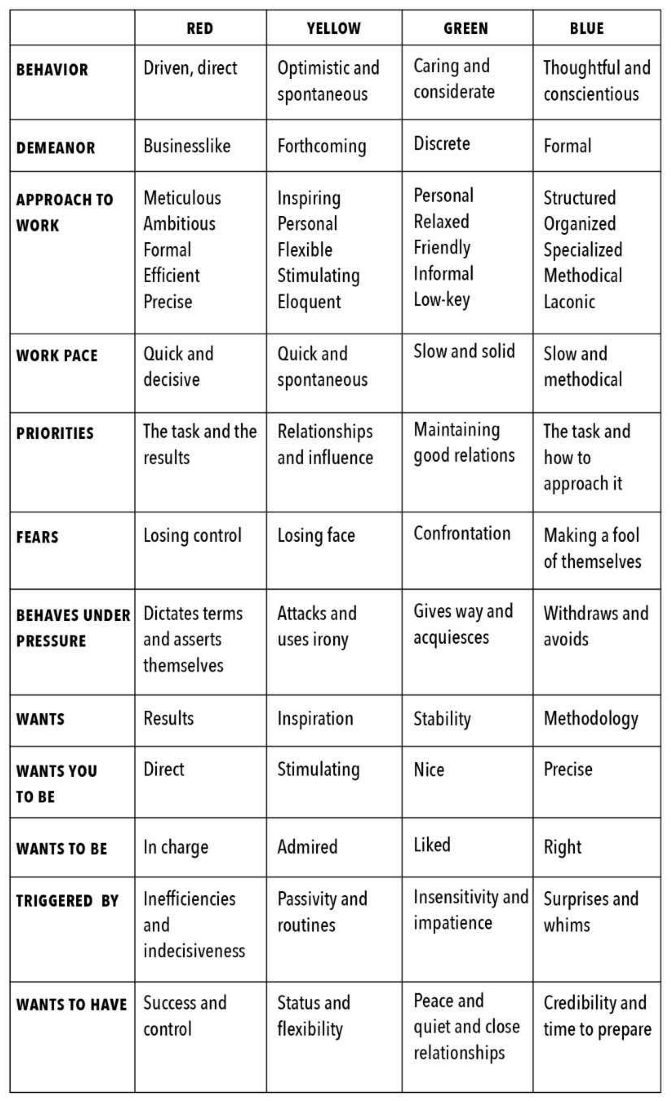
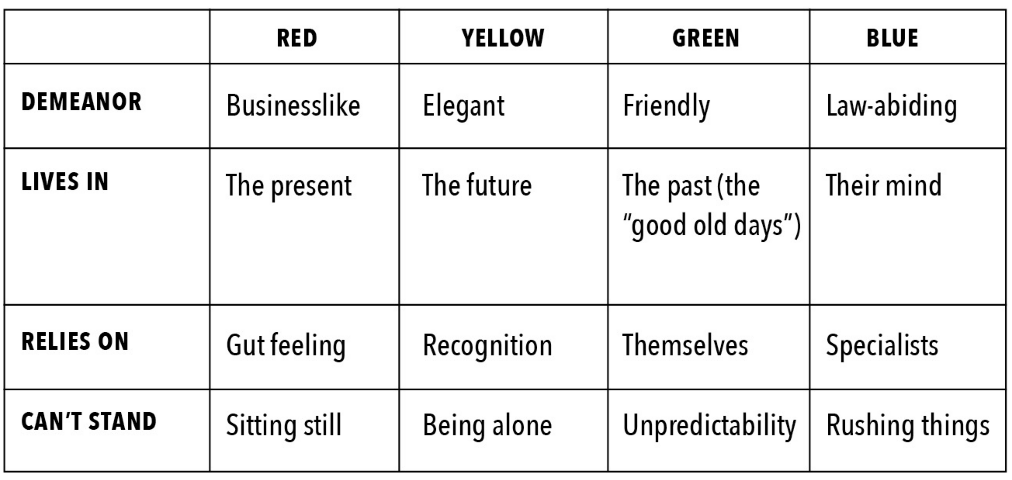
THE BASICS OF HUMAN BEHAVIOR ACCORDING TO THE DISC THEORY
- DISC (Dominance, Influence, Steadiness, Compliance) system of behavior analysis and the four colors associated with it: Red, Yellow, Green, and Blue.
- Reds, who are fact-oriented and extroverted, are driven to solve problems and take on difficult challenges. The more demanding a task is, the better.
- Yellows, who are relationship-oriented extroverts, are all about interaction. These are the people who can’t resist trying to convince everybody else about the validity of their own thoughts and opinions. They can’t leave the room until consensus has been reached. They are optimists, able to see a glimmer of sunshine in the most violent of rainstorms. Yellows, too, enjoy a quick pace.
- Greens, who are relationship-oriented and introverted, are change-averse to the core. A lot of Green in a personality profile signals the person will have no interest in changing anything. Change is viewed with suspicion, even when it is entirely and obviously necessary.
- Blues, who are introverted and fact-oriented, enjoy rules and regulations. They are sticklers for protocol and always know what the correct procedure is.
- Statistically, the most common pattern—which accounts for about 80 percent of the population—is a combination of two colors. Common combinations include: Red-Yellow, Yellow-Green, Green-Blue, and Blue-Red. Less common are: Yellow-Blue and Red-Green.
HISTRIONIC PERSONALITY DISORDER
- characterized by a pattern of excessive attention seeking, uninhibited and seductive behavior, and an exaggerated desire to be accepted. People who have been diagnosed with HPD are often described as lively, dramatic, animated, enthusiastic, and flirtatious. Women are diagnosed with HPD about four times as often as men.
Part II. Narcissism: An In-Depth Look
6 Surveying the Depths of Complex Souls
- Deep down, what narcissists want is control.
- Anything that can produce this feeling of superiority or brilliance will seem desirable to a narcissist.
- Many narcissists are very good at playing the victim, since this is a surefire way to gain a lot of sympathy. Sympathy also happens to be synonymous with attention. If
- Compassion is disturbing to most people; if other people feel compassion for you, that just goes to prove that you must be in a miserable state. However, for a narcissist, it fits in perfectly with the overall pattern.
- Prestige and status.
- Influence
- Service is another important ingredient for narcissists. This could mean anything from being particularly pampered in a restaurant to having a significant other who magics away all the boring household chores.
- Appreciation and praise.
- Submission. Others must obey and ideally surrender all their agency in the face of the greatness of the narcissist.
- Absolute loyalty is the end result.
HOW DO YOU SATISFY A NARCISSIST?
- really is no pleasing them.
- reparations for perceived injustices.
- Anyone seeing a child snort indifferently before tossing incredibly expensive gifts aside at Christmas or on a birthday is bound to think to themself that the child in question is insufferably rude. But this could also be a case of narcissistic tendencies that shouldn’t be encouraged. The same behavior would be absolutely intolerable in an adult.
7 Do I Love Myself? It’s Complicated.
- Psychopaths have a particular knack for tearing people down, piece by piece.
- Teaching an individual like this the value of self-love is absolutely vital. They’ll be starting out from a place of abject self-loathing, and I know from experience how difficult it can be to make somebody like that even attain the most basic degree of self-acceptance.
LOVING YOURSELF
- impossible to draw a clear line between healthy self-appreciation and self-esteem and unsympathetic, self-promoting egotism. Or narcissism, for that matter. But that line must be somewhere.
- In an American study from a few years ago, it was found that self-esteem among college students had increased by more than 80 percent between the 1960s and the 2010s. In primary school children, the increase was 93 percent over the last fifty years.
- self-admiration frequently produces negative effects; the danger of being viewed as a narcissist and all the harmful behavior associated with this is just one of these.
- The trait they have in common is their excessively positive self-images. These people go beyond confidence; they are self-obsessed and smug. They are firmly convinced that they are not only unique but also very, very special. There’s nobody else like them in the world.
- The next time you hear somebody expressing sympathy for a schoolyard bully—or workplace bully, for that matter—you mustn’t let anybody suggest that you need to help build their confidence up even more. If the bully isn’t already a narcissist, they might very well develop narcissistic traits if somebody were to, say, decide to give them self-respect training. It’s not a lack of self-respect that’s the problem; it’s a lack of respect for others.
8 Emotions and Narcissists—Like Oil and Water?
- The same thing happens if narcissists are questioned. They hate to be challenged, and this might sound a little odd when you consider that many narcissists don’t really experience much in the way of fear. Many of them are even outright aggressive. Why wouldn’t they look forward to some verbal sparring, assuming it’s a subject worth debating?
9 The Secret Language of Narcissists
- One way of determining if somebody’s a narcissist is to compare their words with their deeds.
10 When Did a Little Narcissism Ever Hurt Anyone?
- So, what do narcissists do well? Besides lying, deceiving, and defrauding you, they’re also very adept at identifying your weaknesses. They go about it the same way psychopaths do. In the initial stages of your relationship, they will spend a great deal of time figuring out who you are. Basically, they’re studying you.
- They hate apathy. Being overlooked is a narcissist’s kryptonite. They can’t take it when people don’t pay attention to them. They prefer anger or hatred over apathy.
- If the intended victim is able to just move on without so much as a glance in the narcissist’s direction, this can trigger a total breakdown.
- Take a company or a business, for example. When an individual behaves in a way that impairs the company’s functions, they can cause a great deal of damage, of course. The worst-case scenario is when the boss is a narcissist. A person like that could exploit their position to pit their employees against one another—the old divide-and-conquer approach.
11 Manipulation
- When a manipulator uses negative feedback, they stop doing something you dislike when you start doing something they like. As a result, you end up doing what they want.
- You get negative feedback, consistently, until you give in and concede the argument. Then everything returns to normal. It’s an easy way to make you come to heel.
- skilled manipulator, who has learned to optimize the combined use of both positive and negative arbitrary feedback. You won’t be able to make sense of them or predict their behavior.
LOVE BOMBING
- If it sounds too good to be true, it probably is.
SMOKE SCREENS
- A skilled manipulator can say just about anything to get you off guard. The objective here is to shift the focus from the genuine issue to a discussion about some serious flaw of yours. To get there, they’ll have to push some of your emotional buttons.
- focus immediately shifts to something else:
- A manipulator with strong narcissistic tendencies is capable of the most incomprehensible behavior, as long as it promises to shift your focus away from them.
HOW TO PROTECT YOURSELF
- “Of course we can discuss my shortcomings. But right now I am more interested to know why there is lipstick on your collar.”
- “My hearing is fine; there’s no need to shout. It’s not okay. Please stop immediately.”
- When others can see the bad behavior come out, the whole situation tends to change.
- The problem here is that your narcissist is bound to have combined this technique with a whole load of other stuff, so that when they decide to call you out on whatever personality trait you happen to be the most ashamed of, you’ll be quite likely to just back down instinctively.
WHEN YOUR OWN EMOTIONS ARE USED AGAINST YOU
- The benefit for the manipulator here is the horrendous shame the Green will experience afterwards. Devastated, they will offer heartfelt apologies for their actions. The narcissist plays the victim expertly, quickly negotiating their way into further benefits as compensation for all the abuse they just endured. “How could you be so mean? Poor me!” This is going to end up costing the Green; you can count on that.
COUNTERMEASURES
- Emotions are a very messy subject, and there are no surefire solutions. Usually, your main priority is to stay calm. However, this can be quite challenging, particularly for extroverts. Both Reds and Yellows tend to react instinctively, and they may need some time to think things through.
- My best advice, actually, is to call them out. State openly that you feel like they’re trying to manipulate you, and ask how this makes them feel.
- Act Red. Let your true emotions out, and react forcefully and quickly. Save yourself from becoming a mere shadow of your former self. If you don’t, that’s what your partner will turn you into. They will dilute you until you’re just a pale replica of who you used to be. Anytime you feel chronically unhappy, anxious, or hurt, you’ll get caught up in the drama you’re currently going through, and you’ll have a very hard time picking up on the big picture and figuring out the details of the narcissist’s far-reaching plans.
- Don’t forget that whoever is the most anxious to preserve the relationship will be the weakest.
- Gaslighting is all about causing confusion. The narcissist says one thing on Monday, another on Tuesday, and denies ever having said either by the time Wednesday rolls around. You can keep up with this for a while, but a skilled narcissist will apply this approach step by step. They start out small, and then increase the volume gradually. In the end, you won’t have a clue what’s going on.
GENERAL ATTITUDE TO MANIPULATIVE MACHINATIONS
- The advice I usually give to people who wonder how to determine if they can trust somebody is to compare their words to their deeds. If they match up well enough, that’s excellent. You may have a future together! If their words seldom or even never match their actual deeds, there’s no basis for trust. You can’t rely on this person.
THE TERMS OF TRUST
- Trust depends on three things: predictability, reliability, and conviction.
- When somebody’s behavior is highly variable, this might not necessarily be caused by an intention to manipulate you, but it is nonetheless a call for caution.
MORE METHODS OF MANIPULATION
- Unfortunately, there are plenty more of these tricks:
- Feigned intimacy. Early on in the relationship, the narcissist reveals intimate details (which will probably turn out to be fabricated) about themself, which inspires you to share things about yourself—and these admissions will eventually be weaponized and turned against you.
- Guilt-tripping. The narcissist finds ways of blaming everything that isn’t frictionless in your relationship on you.
- Indirect insults. These are more or less subtle disses, concealed beneath a layer of feigned benevolence: “I like it when you wear that dress—it makes you look so slim!”
- Insinuations. This is the use of statements so ambiguous it’s hard to determine what’s being said. For example: “You know, you could make so much money doing white-collar crime!”
- Vacuous statements. Narcissists put no weight on anything they say. They might say anything that seems appropriate to them in the moment. For example: “I love you.” It might give you a moment’s relief, but it won’t really mean anything—narcissists aren’t capable of love!
- Minimization. The narcissist convinces you that what they did wasn’t really so bad: “What? Doesn’t everyone do that? It’s not like anything happened! You’re getting caught up with the minutiae again.”
- Lies. How do you detect a lie in the midst of all this nonsense? If you observe the other behaviors here, you can safely assume the narcissist is lying to you, too. About everything. Constantly. Are their lips moving? Start the recording.
- Condescension. This is a classic gambit, which involves downplaying every opinion, emotion, or experience you give voice to. For example: “You really shouldn’t be feeling that way. You’re kidding, right? Surely that was no big deal.”
- Charm. Narcissists will often seek to win you over with charm first. They don’t often start out insulting you—that approach hasn’t worked too well for them in the past. You’ll be told things nobody has ever said to you before. And honestly, who wouldn’t enjoy being swept off their feet by a load of lovely compliments?
- Deliberate forgetfulness. Narcissists “forget” to go shopping before dinner, even though they promised they would. Or they forget your anniversary. Or they forget to call you from their hotel room …
- Rage. Shouting and screaming to get you to back down if you object somehow to the narcissist’s bizarre behavior.
- The victim card. This is one of the major strategies. Narcissists are capable of some degree of self-pity. And they can play victim with the best of them: “I knew nobody would want me on their team. Of course—why would a bore like myself expect anything else? I’ll go alone then, I suppose.”
- Rationalization. This is a common defense mechanism, only applied deliberately in this context. It involves giving logical reasons for illogical actions. For example: “I’m sorry I hit you—I just got so mad when you provoked me.” Or: “I know I shouldn’t drive when I’ve been drinking, but I wanted so badly to get back home to you quickly.”
- Flattery. Does this one need an explanation? We all know how having somebody express appreciation for our looks, intelligence, or taste can make us feel. It’s not lost on narcissists, either.
12 Who Is in Danger of Falling Victim to a Narcissist?
- Blues might be the hardest people of all to manipulate. Blues recall what you’ve said in the past, and they have a good sense for details. They take notes, save emails and text messages, and know how stuff works.
- Blues may be less dependent on personal relationships than most, but they still tend to form very close private bonds to the people they do engage with.
13 How Are Narcissists Made?
- Sociopaths, on the other hand, have been shaped by their environment. Hence the term, “sociopath,” which explicitly refers to the society around the individual. By making people endure long, difficult childhoods, often rife with abuse at the hand of their caregivers, you can produce people with stunted empathy and emotions. For example, this is how child soldiers are trained. By nature, children know nothing about killing people, but with guidance and a gradual increase of the pressure, their natural compassion can be removed. This is a dreadful procedure, but that doesn’t prevent it from happening in several parts of the world. Those places are practically sociopathy plants. Children who grow up in bad enough conditions can turn into emotionally numb automatons. The process of restoring them to the people they could have been is a difficult process that succeeds far too rarely.
- Can a narcissist be created, like a sociopath can? I suspect this to be the case.
- Some studies suggest that children who grow up to become narcissists are often the children of narcissists. Other studies have failed to find any strong correlations.
- children of highly successful children are also at greater risk, particularly if they lack the talents that made their parents so successful.
- pampered children from well-to-do families.
- Different kinds of childhood trauma could cause a child to “shut down” their empathic abilities. Their aim in doing this is self-defense, and they probably don’t do it consciously. Psychologists refer to this as a narcissistic injury.
- most recent theories about what might happen to children who are overvalued and excessively cherished by their parents. Parents who, with the best of intentions, allow their children to stay children until they’re well past an appropriate age. These parents might be of the opinion that their particular child is God’s gift to creation, even if there is no evidence at all that their child possesses any remarkable abilities in comparison to others. Systematic overvaluation, as opposed to derogation, might very well cause a spoiled child to develop an excessive sense of entitlement to all the good things in life, and will rarely help them learn to be considerate of the emotions of others. Basically, they are taught to think they are better than their peers.
- Several studies reveal that parents who keep telling their children that they are special, more so than other children, are actually producing narcissistic children. In one report, it is stated explicitly: “Narcissism was predicted by parental overvaluation, not by lack of parental warmth. Thus, children seem to acquire narcissism, in part, by internalizing parents’ inflated views of them (e.g., ‘I am superior to others’ and ‘I am entitled to privileges’).”
- Several studies have also revealed that this same sense of being entitled to more than others is common in children of parents who were permissive of bad behavior and who allowed their children to run roughshod over others without even apologizing afterwards.
- The parents who taught their children to think of themselves as inherently amazing and wonderful creatures seemed quite apathetic about the world around them. They spoiled their children rotten, even when they behaved terribly. Nothing the child did ever had any consequences. The parents simply cheered for their children’s efforts, no matter what kind of disaster they might have caused.
- However, parents who set boundaries for acceptable behavior raised children whose attitudes to rules and regulations were much healthier. Transgressing boundaries is a highly typical characteristic of narcissists.
- Another phenomenon that seems to trigger narcissistic tendencies is when parents treat their children like trophies. This downgrades their kids to mere objects to be shown off, like a handbag or car. It also teaches the child to view other people as objects, rather than as individuals made of flesh and blood.
- Convincing the child that they are perfect as they are—better than everybody else, even—while simultaneously treating the child like an object and offering no valuable feedback to help the child explore their true identity has proven to create a complex psychological cocktail. This combination of overvaluation and neglect can produce children who exhibit narcissistic behaviors.
- Constantly being told how perfect and adorable you are, no matter what you get up to, but never being given any genuine feedback about your actual behavior can cause issues. You won’t have the frame of reference when you need to judge what is actually okay and what isn’t. The outcome will be a child who feels entitled to everything they want, regardless of whether they actually deserve it or not. Any connection to one’s own performance has been lost. These children frequently come to focus excessively on a specific thing or another. It could be appearance, material obsessions, or what other people think about them.
- The damage to the amygdala that the victims of narcissistic abusers present can potentially trap them in a permanent state of fear and anxiety, and cause them to respond poorly to any environment that reminds them of their suffering at the hands of the narcissist. In other words, victims of narcissistic abusers are in a state of constant alertness to a danger that is no longer present in their lives. This hypervigilant mind-set will also cause the children of narcissists to suffer panic attacks, phobias, and other mood disorders that can significantly restrict their ability to live full, productive lives.
Part III. How to Handle Narcissists
15 The Challenges of Being Close to a Narcissist
SO, HOW DOES A NARCISSIST BEHAVE IN A RELATIONSHIP?
- You’ll notice a constant state of disappointment. Their partners disappoint them in every way: They don’t make enough money, they aren’t educated enough, they aren’t attractive enough, they’re far too ignorant, they don’t take very good care of the family, or their background is all wrong. Whatever they do, it’ll never be quite good enough. There’s always cause for criticism and dissatisfaction. Life was supposed to be a lot easier. It’s enough to make you wonder why anybody would want to move in with a loser like that.
ALWAYS CHOOSING THE WRONG SIDE
- Another warning sign is when one person in the relationship never sides with their own partner but tends rather to side with anything or anybody against them, whether it be a matter of taking a stand, voicing an opinion, or planning to do something. There is both a stated and an implied mistrust of the person they live with. Other people’s opinions are used as evidence that their significant other is clueless.
WHAT ABOUT EMOTIONS?
- The emotional terrain can get pretty bumpy here. Just like psychopaths, narcissists occasionally shower their partner with terms of endearment, only to be completely dismissive a moment later. None of this happens by chance. It’s all part of a manipulation technique.
ISOLATION FOR ISOLATION’S SAKE
- Any kind of support needs to be cut off, because they want the partner to be isolated from other people. If the narcissist’s partner were to complain about the narcissist’s friends, they would simply be called a control freak.
- Realize this: If it doesn’t feel good, it isn’t good. You owe it to yourself to do something about it. But what?
16 Breaking Free from a Narcissist
- You must under no circumstances accept any kind of abuse from a narcissist (or anybody else, for that matter).
- Being insulted is one thing; suffering psychological abuse is something else entirely. If you’re regularly being put down, called names, made a fool of in front of other people, threatened, or publicly humiliated, there’s no reason to accept it.
LOOK FOR PATTERNS
- A relationship needs a whole number of things in order to function, and some of the nonnegotiable ones are trust and confidence.
- Trust between two adults is the determining factor that gives people the courage to let their guard down and be themselves. The courage to show weakness. The courage to lose their temper. The courage to bring up difficult issues. The courage to ask for help. The courage to cry on somebody’s shoulder. The courage to expose their flaws to somebody else.
- Trust has to be earned anew, every day. That goes for you, too. Perhaps you’re somebody who knows that you’re in danger of being seen as a narcissist by the people in your life. If so, you need to realize this: It’s your most recent behavior that reveals who you are. That’s how you prove yourself worthy of trust. Not by referring to something you did months ago.
- Letting the world know that the narcissist is less of a catch than everybody thinks might seem like a good idea, but the backlash could come swift and hard. Narcissists have a highly vindictive streak. If you burst their bubble, they will simply regroup and come after you. Perhaps they will even muster the troops and turn everybody they can convince against you.
- When the narcissist complains that you’re boring, you’ll know you’re on the right track.
- Limit yourself to commenting on behaviors. Simply come out and say it: “What you’re doing to me is unacceptable, and I want you to stop immediately.”
- Be specific. Avoid bringing up emotions, as this will only give the narcissist more ways to get back at you.
- No emotional outbursts, no threats about doing this or that.
17 A Complete System for Breaking Free Once and for All
- Be consistent. Stay on message. Behave consistently. Don’t change. People who do exactly what they say they will enjoy a great deal of respect from other people. If you can demonstrate that you won’t be caving into pressure in the form of tears, screams, threats, promises, or whatever might work on somebody like yourself, you’ll have reclaimed control of the situation. The power of consistency is astounding.
- “When you complain about everything I do all the time…” “… I feel insufficient and useless.” “If you could give me some positive feedback, too, and even some praise…” “… I would feel that you valued me more and I would be a lot more at ease.”
- Each individual statement conforms to the formula of 1, 2, 3, and 4.
- “It’s up to you if you’re going to continue shouting/ crying/ blaming it all on me, but at least you know now how unhappy/ afraid/ worthless/ insecure/ pissed off it makes me feel.”
- Now you’ve repeated something the manipulator was never expecting to hear from you. On the one hand, you’ve labeled their behavior a conscious choice. On the other hand, you’ve agreed that your emotions are your responsibility. If you had told them that their behavior is the cause of your emotions, that might have invited a discussion, which might have resulted in you being coerced into admitting that you’re imagining things, that you’re wrong, and so on.
- The power of consistency.
18 Is Missing Your Abuser a Thing?
- Strong feelings tend to live on in people. Negative experiences are easy to recall. Neuroscientists have recently figured out why we are more easily controlled by our negative emotions than by our positive ones. It turns out that it’s all a matter of survival. Fear has a greater role to play in your survival than happiness does. If you don’t know fear, you’ll get eaten, because you won’t respect danger. However, if you’re unhappy, that won’t pose any immediate threat to your existence. Everything gets even more complicated when you consider all the negative experiences you’ve shared with your narcissist. In some bizarre way, you’re connected through the pain your relationship has caused you.
Part IV. A Narcissistic Culture
20 When the Problem Affects More than Just a Few Individuals
- In the last few years, the issue of the spread of narcissism has been much discussed. It all began with a book, The Narcissism Epidemic by Jean M. Twenge, PhD, and W. Keith Campbell, PhD, which was first published in 2009. The thesis here was that narcissism has reached beyond the domain of the ordinary clinical diagnosis. Even people who aren’t narcissists in any way have suddenly begun to exhibit behaviors that seem suspiciously narcissistic. Basically, the pathology seems to have been introduced into our culture. Wanting to be seen, to claim more space, to promote oneself in more or less obvious ways.
- Some researchers claim that between 15 and 20 percent of us are narcissists.
- Cultural narcissism is potentially even more dangerous, because it appears to be becoming more common. At least that’s my own opinion, which I’ve arrived at after spending the last two years learning about the problem. Naturally, many of the things I am discussing here occur in most individuals who would be given the regular NPD diagnosis.
21 Expressions of a Narcissistic Culture
- There is no doubt that people who score high for narcissism are masters of self-promotion, making superficial acquaintances, and emphasizing their best qualities, including a few fictional ones. Many of us also see through our friends’ more, shall we say, “solipsistic” tendencies.
- an American university carried out an extensive study of which strategies perform well online. Frequent posters are rewarded. Ideally, you should post several times a day. Just don’t offer anybody any real help or ask any questions—either will be punished immediately. The study concluded that what people wanted to see more of online was superficial exchanges rather than any in-depth discussions.
22 A Literal Look in the Rearview Mirror
- This isn’t an ironclad conclusion, of course, but it does seem to me that society is getting colder. What else can we expect, if even our cars look pissed off? This makes me wonder: Might phenomena like these be generating more aggression?
23 Aggression and Collective Narcissism
- There is a fairly common idea that suggests that people who like themselves have an easier time liking others. Some psychologists I interviewed for this book even claim that you can’t love somebody else if you don’t love yourself first. If you like other people, you’re not going to be aggressive.
COLLECTIVE NARCISSISM
- Who are collective narcissists, then? They are individuals who demand that their group be accepted by others, without any questions. They possess a heightened sensitivity to any indication that this might not be the case.
- collective narcissism? Here are some common examples:
- I wish other groups would be much quicker to recognize my own group.
- My group deserves special treatment. I won’t be satisfied until my group gets the recognition it deserves.
- I demand that my group be given the respect it is due.
- It makes me really angry when others criticize my group.
- If my group had significant influence over the world, it would be a better place.
- It upsets me to see other people overlook the achievements of my group.
- Far too few people properly appreciate how important my group is.
- The true value of my group is often misunderstood.
- Success for another group, or increasing influence for a minority, can both threaten the position of the majority. Collective narcissists seek to protect the privileges of their own group by undermining the motives of other groups. It’s also worth remembering that anybody who seeks recognition for their group is likely to feel that overlooking said group is a serious transgression. According to the logic of collective narcissism, a crime like that must be avenged. I’m using the word “avenged” quite deliberately, here.
- Collective narcissists deliberately provoke hostilities between different groups. There doesn’t even have to be a legitimate threat in the first place. Since they insist on getting to set the agenda, they are free to invent any threat that might help them demonstrate their power to the world. They feel entitled to be deceptive, as it’s for a good purpose.
CHARACTERISTICS OF COLLECTIVE NARCISSISM
- more common for members to be strongly against something than strongly in favor of something.
- Commonly, the group will have singled out a specific issue or problem as their concern. Nothing takes priority over this issue, and everything else is negotiable. They express themselves in incredibly categorical ways. Their views on things are extremely binary, and their arguments lack nuance. You’re either with them or against them.
- rarely encourage free thought.
- Individualism is banned. Groupthink dominates everything. You can hear it in the arguments they use: “They’re such-and-such a group of people.” “Those people are like this, or like that.” The number one objective is for the members to unite behind a single idea rather than unite in harmony. This single idea, whatever it may be, is kept under strict control.
- Within the group, people are expected to adhere to an idealized, whitewashed view of the group itself. They genuinely believe they are the only people to see the world for what it really is, and that their opinion is the only reasonable one. Any objectivity is out the window when it comes to collective narcissism. “We’re better than them.”
24 How Did We End Up Here?
THE HUMAN POTENTIAL MOVEMENT
- Abraham Maslow’s hierarchy of needs:
THE EMERGENCE OF THE SELF-HELP INDUSTRY
- In the end, the goals for collective growth of the 1960s were abandoned in favor of a more alluring emphasis on the self.
- Self-help is so ingrained in society today that it’s hard to say where it begins and ends. School kids are learning yoga. Inmates are taking mindfulness classes. People hire coaches for all kinds of things. To sum the message up in basic terms: You can do it.
25 Self-Esteem: More Trouble Than You’re Worth
- Essentially, of course, self-esteem being on the rise in the world is good news. People who are content with themselves are healthier, suffer from physical and mental illness less often, live longer, are more productive, and cause fewer problems for other people.
- There is a real danger that you might demotivate yourself if you keep comparing yourself with those incredibly successful people. It could stifle your future performance, rather than inspire you to improve it. It’s easy to imagine that you’ll never be as great or successful as them, and if that’s the case, you’d be better off competing with your own past self. That way, with a bit of luck, you’ll see some change for the better.
STRONG SELF-ESTEEM = SUCCESS IN LIFE?
- According to this model, high achievers in most areas tend to be individuals with poor self-esteem, who feel that they have a lot to prove. They’re never satisfied with anything, so they keep working hard. Is this a good or a bad thing? It’s hard to say.
- better performances lead to better self-esteem, rather than the other way around.
- Student achievement is in decline in the West; meanwhile our kids keep growing increasingly confident each year.
- Strong self-esteem, it seems, is something of a double-edged sword. It works very well up to a certain point, after which it can go off the rails.
- can’t stress this enough: I am not in any way claiming that we should be wandering around feeling insecure, disliking ourselves, and tearing our own confidence to shreds. All I’m saying is that paying a less excessive amount of attention to yourself and your thoughts isn’t necessarily a bad thing.
26 Normalizing Narcissism
- One theory might be that parents who have just the one child, rather than five, are more likely to attach a great deal of significance to the well-being of that child—I’m talking about 100 percent of their offspring, after all.
- Consider, then, that many who have been raised by parents who were older than average and tended to their children’s every need have grown accustomed to receiving a great deal of attention. Ever since they saw the light of day, they’ve been surrounded by proof that they are the center of the universe, and there’s no doubting how much they matter to their parents. Now they are adults, ready to make their way in the world and pursue happiness on their own terms.
HOW NARCISSISTIC TENDENCIES ARE NORMALIZED
- How do you give your children everything they need without robbing them of everything in the process?
- What they want to eat. But they aren’t necessarily experts on what they should eat.
- All I can do here is indicate some of the risks involved in handing children too much power. Sometimes the responsibilities we give them can be quite significant. Maybe they should just get to be kids for a while?
HELICOPTER PARENTS!
- One theory suggests that what we ought to do is take care of our children, nurture them, and protect them from obvious dangers—but not at the expense of training them for the challenges in life. They need to be prepared for anything the world throws at them, basically. One small step at a time.
- Parents used to be a lot more authoritarian. Traditional values like punctuality, hard work, loyalty, and protecting your family were still quite important. For better and for worse. Grown-ups respected children far less, physical discipline was still a thing, and kids were in danger of becoming withdrawn and inhibited. Kids were supposed to do as they were told, and when conflicts arose parents weren’t expected to reason with them. People were generally more confident in their roles as parents, and much more aware of the values they wanted to instill in their children.
- Danish study suggests that children who receive excessive helicoptering at home don’t actually fare worse in life, at least not in terms of subjective well-being.
- offering a reasonable degree of help isn’t quite the same thing as eliminating all obstacles. The problem arises when we help our children so much that they never get a chance to learn to take care of themselves. There’s always a middle ground between being overprotective and being neglectful. Should you prepare a sandwich for a two-year-old? Probably. At what age should you expect them to make their own sandwiches? Three? Five? Twelve? You have to draw the line somewhere.
- Should we allow them to cultivate their confidence as far as possible, by encouraging them to take responsibility for themselves? For what it’s worth, I find myself leaning this way.
- teaching them about cooperation and how to function as members of a family.
- The kids know what they need as well as their parents do.
- Who can stand to see or hear a crying child? Our every instinct screams at us to pick them up, hug them, and tell them that whatever is troubling them will soon go away. However, if a child is never told no, there is a danger that their endearing little requests for treats on Tuesday evenings will evolve into an entitled expectation to be gifted a car in just a few years.
- All you have to do is set boundaries for your kid. Make a time investment, at home, over the course of a few months, and then it’ll be smooth sailing from that point on. People have been doing it for millennia; why wouldn’t it work today?
- ultimate form of power: the power of consistency,
- Naturally, you’ll have to consider the details of your decree before announcing it; simply uttering whatever nonsense comes to mind and expecting the kids to obey will only prove futile.
- Since most people’s behavior is glaringly inconsistent, this means that you’ll be giving yourself a very strong card to play in interactions with your kids. Think it over. Give a response. Stick to it. It’s so simple that it’s almost ridiculous. But heaven knows, it isn’t easy!
- There’s no need for any negotiations. You’re the adult. You’re allowed. Maybe you shouldn’t really, but you’re still allowed. It’s always your responsibility.
- The idea that children are somehow harmed or traumatized for life by being refused privileges that adults are afforded seems strange to me. I’ve searched but have not yet found any research to support that idea.
- Stay in control of your parenting. Be the adult. You’re entitled to call the shots in your own home. You’re entitled to use the simple but oh so useful word “no.” It doesn’t mean you love your children any less. It might even mean you love them more.
27 Test Yourself: Are You a Narcissist?
- Good habits are hard to cultivate but easy to live with. Bad habits are easy to cultivate but hard to live with.
- Maybe the opposite of narcissism is exactly that: humility. Genuine humility is a great source of strength. The ability to view and assess yourself objectively and exaggerate neither the positives nor the negatives. Truthfully.
- Humility also means being grateful for what you have. Note: There’s nothing wrong with wanting more from life. I have a long list of things I’d like to have, do, and experience. But I also constantly remind myself of the things I already own or have already experienced or done. This doesn’t make me a better person, but it does help me maintain a realistic outlook on my life, and ensures I always have something to strive for. As I said earlier, very little in life is free.
- Practicing humility, being grateful for what you have, and actively helping others can all be effective ways to counteract any narcissistic tendencies.
- Neuroscience has already taught us that we can get a kick out of helping others. Try doing something friendly and helpful for somebody who has no way to reciprocate. Make note of how you feel afterwards.
28 Being the Change
- It’s more fun to build a beautiful cathedral than to simply cut stones, even if the actual tasks involved are identical.
- We need meaning, purpose, and a goal. We need direction in our lives. When we have that, we’ll suddenly find countless reasons to get off the couch.
- This is precisely why long-term unemployment is such a disastrous fate. It instills a sense of hopelessness. It pacifies the individual, and creates the illusion that they can no longer contribute at all. Somebody who has no purpose and performs no function will soon break down.
- one of Lamborghini’s top executives was asked why Lamborghini never advertises on TV. His response? “Our customers don’t watch TV.” Let that sink in for a moment, and think about what he’s actually saying.
- If you need a role model, pick a wholesome one. But more than anything, make a point of considering your life in comparison to one year ago. Do things look better now? If so, that’s great. Celebrate with a night on the town! If things, unfortunately, seem to have taken a turn for the worse, that’s bad. You should immediately sketch out a plan for addressing the situation. Get to work on that, and as soon as it’s finished start implementing it! But don’t worry too much about comparing yourself to the people you see on Instagram or Facebook.
- There is a simple, physiological explanation. The stress hormone cortisol is suddenly no longer being frantically pumped into your system. You’re finally disengaging from the state of being permanently ready for battle.
- Some people are so happy with the results of giving up social media that they never go back. Ever. It’s quite remarkable.