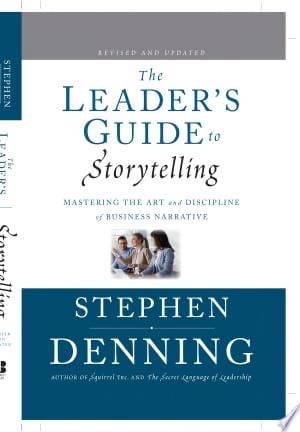
DESCRIPTION
How leaders can use the right story at the right time to inspire change and action This revised and updated edition of the best-selling book A Leader’s Guide to Storytelling shows how storytelling is one of the few ways to handle the most important and difficult challenges of leadership: sparking action, getting people to work together, and leading people into the future. Using myriad illustrative examples and filled with how-to techniques, this book clearly explains how you can learn to tell the right story at the right time. Stephen Denning has won awards from Financial Times, The Innovation Book Club, and 800-CEO-READ The book on leadership storytelling shows how successful leaders use stories to get their ideas across and spark enduring enthusiasm for change Stephen Denning offers a hands-on guide to unleash the power of the business narrative.
The book is Stephen Denning, The Leader’s Guide to Storytelling: Mastering the Art and Discipline of Business Narrative. Its main idea is that leaders should not treat communication as merely transferring information. Facts, charts, and analysis are necessary, but they often do not move people to act. A leader needs the right kind of story for the right leadership purpose: sparking action, building trust, sharing knowledge, transmitting values, taming rumors, branding, or leading people into the future. Wiley’s description of the book frames it exactly this way: it teaches leaders to “tell the right story at the right time” for difficult leadership challenges such as sparking action, getting people to work together, and leading people into the future.
Sources used:
https://www.wiley.com/en-us/The%2BLeader%27s%2BGuide%2Bto%2BStorytelling%3A%2BMastering%2Bthe%2BArt%2Band%2BDiscipline%2Bof%2BBusiness%2BNarrative-p-9780470893906
https://www.oreilly.com/library/view/the-leaders-guide/9780470548677/9780470548677_the_main_elements_of_the_springboard_sto.html
https://sobrief.com/books/the-leaders-guide-to-storytelling
https://www.getabstract.com/en/summary/leaders-guide-to-storytelling/5282
https://www.getabstract.com/en/summary/the-springboard/2767
The Five Whys Framework
The Five Whys is a root-cause technique: when you face a problem, you ask “why?” repeatedly, usually around five times, until you get beneath the surface symptom and reach the deeper cause.
It works like this:
Problem: My team is not responding well in meetings.
Why? Because they seem disengaged.
Why are they disengaged? Because they do not think the meetings matter.
Why don’t they think the meetings matter? Because decisions seem already made before the meeting.
Why do decisions seem already made? Because I present conclusions instead of inviting discussion.
Why do I present conclusions instead of inviting discussion? Because I am trying to look prepared and decisive.
Now the real issue is not “my team is disengaged.” The deeper issue is:
“My communication style makes the meeting feel performative rather than participatory.”
That gives you a much better leadership story to tell.
Instead of saying:
“I need everyone to speak up more.”
You could say:
“I realized I’ve been walking into meetings with conclusions already formed. That probably made it feel like I was asking for agreement, not input. I want to change that. Starting today, I’m going to bring the problem first, not just my proposed answer.”
That is a more effective leadership move because it combines self-awareness, vulnerability, ownership, and a clear behavioral change.
How Five Whys Connects to Storytelling
The Five Whys helps you find the real story underneath the visible problem.
Most weak communication stays at the surface:
“We need better teamwork.”
“We need accountability.”
“We need better communication.”
“We need to be more customer-focused.”
Those are abstractions. They do not move people.
Five Whys forces you to discover the concrete human situation behind the abstraction:
Who was affected?
What went wrong?
What did we misunderstand?
What pattern keeps repeating?
What needs to change?
Once you find that, you can turn the lesson into a story.
Denning’s Most Important Storytelling Techniques
1. Use the right story for the right leadership goal
Denning’s central point is that there is no single generic “good story.” Different leadership goals require different narrative patterns. The story you use to spark change is not the same as the story you use to build trust, teach values, or communicate a brand. The book is built around this practical distinction.
Use this question before speaking:
“What am I trying to make happen?”
Possible answers:
- Spark action.
- Build trust.
- Share knowledge.
- Teach a value.
- Neutralize a rumor.
- Explain who we are.
- Lead people into the future.
- Get people to work together.
That goal determines the kind of story you should tell.
2. The “springboard story” for inspiring change
The springboard story is probably Denning’s most famous technique. It is a short, true story about a successful example of the change you want people to adopt. Its job is not to explain every detail. Its job is to help listeners imagine a new possibility and mentally “spring” from the story to their own situation. O’Reilly’s excerpt lists several elements: the change idea must be clear and worthwhile, the story should be true, told through a single protagonist, involve someone typical of the audience, and include date and place.
Basic formula:
“Someone like us faced a problem like ours.
They tried a different approach.
It worked.
Here is what that could mean for us.”
Example:
“Last month, one of our project managers stopped sending long update emails and started sending a three-line Friday summary: what changed, what’s blocked, and what decision is needed. Within two weeks, clients were responding faster because they could see exactly what mattered. That’s the kind of communication rhythm I want us to adopt.”
The story is short, concrete, and easy to transfer.
3. Keep change stories positive and minimalist
A springboard story should usually be positive, brief, and under-explained. Denning’s logic is that if you over-explain, you leave the listener no room to imagine the application. A good change story gives enough detail to be credible, but not so much detail that it becomes a full case study.
Weak version:
“Let me walk you through the entire 12-step rollout, all the data, and the backstory.”
Stronger version:
“One branch tried this with three customers. The complaints dropped immediately because customers finally knew who owned the issue.”
The point is to activate imagination, not bury people in documentation.
4. Use stories to spark action, not just entertain
Denning is not recommending stories as decoration. He is using story as a leadership instrument. A good leadership story should change what people see as possible, desirable, or necessary.
Before telling a story, ask:
“What action should this story make easier?”
Examples:
- “I want them to try a new process.”
- “I want them to speak more honestly.”
- “I want them to trust me.”
- “I want them to stop repeating a bad habit.”
- “I want them to see the customer differently.”
If you cannot name the action, the story may be interesting but not useful.
5. Tell the story from one person’s point of view
A leadership story works better when it has a human center. “The department improved communication” is abstract. “Maria changed how she handled customer complaints” is concrete.
Weak:
“The organization improved its knowledge-sharing systems.”
Stronger:
“A field manager in Zambia had a problem. He needed an answer quickly, but no one in his local office knew what to do. Instead of waiting weeks for a formal report, he found another team that had already solved the same problem.”
A story needs a protagonist because listeners understand action through people.
6. Make the protagonist similar to the audience
The listener should think:
“That person is like me.”
If the hero is too exceptional, the audience admires the story but does not imitate it.
Weak:
“Elon Musk transformed an industry.”
Better for a team meeting:
“One of our junior account managers changed one small habit and got a better client response.”
For your purpose—interpersonal, small-business, and leadership communication—this is important. Use stories about ordinary people facing recognizable problems.
7. Use specific time and place
Specificity creates credibility.
Weak:
“A while back, someone had a customer issue.”
Stronger:
“Last Tuesday, in our 9 a.m. client call, we had a customer who was ready to cancel.”
Specifics make the story feel real. You do not need many details, but you need enough to ground the listener.
8. Use stories to build trust through vulnerability
To build trust, Denning emphasizes stories that reveal something real about the speaker. A leader who only tells success stories can sound polished but distant. A leader who tells an appropriate story about a mistake, lesson, or formative experience becomes more credible.
Formula:
“I used to think X.
Then I experienced Y.
That taught me Z.
Here is how it affects how I lead now.”
Example:
“Earlier in my career, I thought being decisive meant having the answer quickly. I later realized people were withholding better ideas because I moved too fast. Now I try to state the problem first and leave room for disagreement.”
This kind of story is especially useful in small groups because trust is built through calibrated honesty.
9. Use stories to transmit values
Values are hard to teach through slogans. Saying “we value accountability” is weaker than telling a story where someone practiced accountability under pressure.
Weak:
“We believe in ownership.”
Stronger:
“A client once called us at 6 p.m. on a Friday with a mistake that was partly ours and partly theirs. Instead of arguing over blame, John stayed late, fixed the file, and then sent the client a clean explanation Monday morning. That is what ownership looks like here.”
The story defines the value behaviorally.
10. Use stories to share knowledge
Some knowledge cannot be transferred well through procedures alone. Stories are useful when the lesson involves judgment, context, exceptions, or tacit know-how.
Example:
“The checklist said to escalate the issue after 48 hours. But in this case, the client had a board meeting the next morning. So Lisa escalated it in two hours. The lesson is: the checklist gives the default, but the client’s real-world deadline determines urgency.”
This teaches practical judgment better than a rule alone.
11. Use stories to neutralize rumors
Denning treats informal stories—rumors, jokes, hallway anecdotes—as powerful forces in organizations. A rumor is often a story competing with the official narrative. You cannot defeat a vivid rumor with a bland memo. You need a more credible story.
Bad response:
“There is no basis for concern.”
Better response:
“I understand why people are worried. Here is what actually happened, here is what has not been decided, and here is what we will know by Friday.”
To beat a rumor, your counter-story must be:
- Clear.
- Concrete.
- Credible.
- Timely.
- More useful than the rumor.
12. Do not lead with abstractions
Denning’s method pushes against normal corporate language. Leaders often say things like:
“We need to leverage synergies and improve cross-functional alignment.”
That language is dead on arrival.
Better:
“Last week, sales promised something operations could not deliver. The client heard confidence from one side and hesitation from the other. That is the alignment problem we need to fix.”
Story gives blood and bone to an otherwise abstract point.
13. Move from story to meaning
A story should not be left floating. After telling it, briefly state the lesson.
Formula:
Story → Meaning → Application
Example:
“A customer waited three days for a reply because everyone thought someone else owned the issue. That is the story. The meaning is simple: unclear ownership creates silence. The application is this: every client issue now gets one named owner before the meeting ends.”
This prevents the audience from missing the point.
14. Avoid the heroic-leader story
A common leadership mistake is telling stories where the leader is always the genius, rescuer, or visionary. That may impress people, but it can also create distance or resentment.
Better leadership stories often make the leader:
- The learner.
- The observer.
- The person who changed.
- The person who noticed someone else’s excellence.
- The person who admits a past mistake.
This is more useful for your interpersonal communication goals because it builds connection rather than status distance.
15. Use listener-centered stories
The best leadership story is not primarily about you. It is about what the listener can now see, do, or become.
Before telling a story, ask:
“Where will the listener place themselves in this story?”
If the listener has no role, the story is just performance.
16. Combine story with analysis
Denning is not anti-facts. His argument is closer to this:
Analysis helps people understand. Story helps people care, remember, and act.
Use the sequence:
Story first → analysis second → action third
Example:
“Let me start with what happened to one customer. Then I’ll show you the pattern in the data. Then we’ll decide what to change.”
That is usually stronger than starting with a spreadsheet.
17. Keep the story emotionally disciplined
Leadership storytelling should not become melodrama. The emotion should serve the point.
Good emotional tones:
- Hope.
- Urgency.
- Trust.
- Pride.
- Candor.
- Responsibility.
- Shared purpose.
Avoid:
- Self-pity.
- Manipulation.
- Exaggerated drama.
- Moral grandstanding.
- “Inspirational” clichés.
18. Use stories to lead people into the future
A future story helps people imagine a destination before it fully exists.
Formula:
“Imagine six months from now…”
“Here is what a customer would experience…”
“Here is how our team would operate…”
“Here is what would no longer be happening…”
Example:
“Imagine that six months from now, every client knows exactly who owns their issue, every follow-up happens within 24 hours, and no one has to ask, ‘Who’s handling this?’ That is the operating standard we are building.”
This makes a future state concrete.
The Most Useful Template for You
For interpersonal, small business, and leadership communication, use this structure:
1. Diagnose with Five Whys
Ask:
“What is the visible problem?”
“Why is that happening?”
“Why is that deeper cause happening?”
“What behavior or belief is underneath it?”
2. Find the human story
Ask:
“Where did this show up in real life?”
“Who experienced it?”
“What happened?”
“What changed?”
“What lesson does it reveal?”
3. Tell the story in 60 seconds
Use:
“Recently, [person/team/customer] faced [specific problem].
They tried [specific action].
The result was [specific outcome].
The lesson is [principle].
So now we should [action].”
4. End with the behavioral ask
Do not end with vague inspiration. End with a concrete next move.
Example:
“So in every client meeting, we are going to end by naming one owner, one deadline, and one next action.”
Simple Example
Instead of saying:
“We need better communication.”
Use Five Whys:
Why do we need better communication?
Because clients are confused.
Why are they confused?
Because multiple people give partial answers.
Why does that happen?
Because no one owns the final response.
Why does no one own it?
Because we leave meetings without assigning ownership.
Why?
Because we assume everyone knows who is responsible.
Then tell a story:
“Last week, a client asked a simple question about delivery timing. Three of us had part of the answer, but no one owned the final response. The client waited two days, not because we lacked effort, but because we lacked ownership. The lesson is simple: when everyone is generally responsible, no one is specifically responsible. From now on, every client issue leaves the meeting with one owner, one deadline, and one next step.”
That is Denning-style leadership communication: concrete, narrative, practical, and action-oriented.
“The Leader’s Guide to Storytelling: Mastering the Art and Discipline of Business Narrative” by Stephen Denning is a book that explores the power of storytelling in the business world. It provides guidance on how leaders can effectively use storytelling as a tool for communication, leadership, and organizational change. Here is a comprehensive summary of the book in bullet points:
- The book highlights the importance of storytelling as a strategic tool for leaders to communicate their vision, influence others, and drive organizational change.
- It introduces the concept of “narrative intelligence” and emphasizes its value in making complex ideas understandable and memorable to employees and stakeholders.
- Stephen Denning presents the “Five Whys” framework, which helps leaders identify the underlying reasons for using storytelling in their business context. These reasons include sparking action, sharing knowledge, taming the grapevine, leading people into the future, and transmitting values.
- The book discusses the different types of narratives that leaders can use, such as the springboard story, the challenge story, the visionary story, the teaching story, and the values-in-action story.
- Denning provides practical advice on how to craft and deliver compelling stories, including elements like setting, characters, plot, and emotional engagement.
- The book offers insights into the role of storytelling in organizational change, demonstrating how narratives can create a shared understanding of the change process and inspire commitment from employees.
- Denning explores the concept of the “leadership communication journey,” which involves a progression from “commander” to “storyteller” to “coordinator” as leaders learn to use narrative effectively.
- The book addresses common obstacles and objections to storytelling in business and provides responses and strategies for overcoming them.
- Denning discusses the use of storytelling in different business contexts, including marketing, branding, customer service, knowledge management, and more.
- The book provides numerous real-world examples of organizations and leaders who have successfully used storytelling to achieve their goals.
- Denning offers guidance on measuring the impact of storytelling in business, emphasizing the need to evaluate its effectiveness and adjust strategies accordingly.
- The book underscores the ethical considerations of storytelling, emphasizing the importance of honesty and integrity in narrative communication.
- Denning concludes by encouraging leaders to embrace storytelling as a core competency, enabling them to inspire, engage, and lead their organizations effectively.
“The Leader’s Guide to Storytelling” by Stephen Denning is a practical guide for leaders seeking to harness the power of storytelling in the business world. It offers a comprehensive framework for understanding and using narratives to communicate effectively, inspire change, and lead with impact. Through real-world examples and actionable advice, the book demonstrates how storytelling can be a transformative tool for leaders in various organizational contexts.