Cited by Roger Scruton
In Governing Rightly, Scruton explicitly cites Inventing the Individual for the historical formation of individuality. Attachment (file not included in this release). The companion synthesis separates this documented citation from the further question of how convincing either author’s Christian genealogy is.
DESCRIPTION
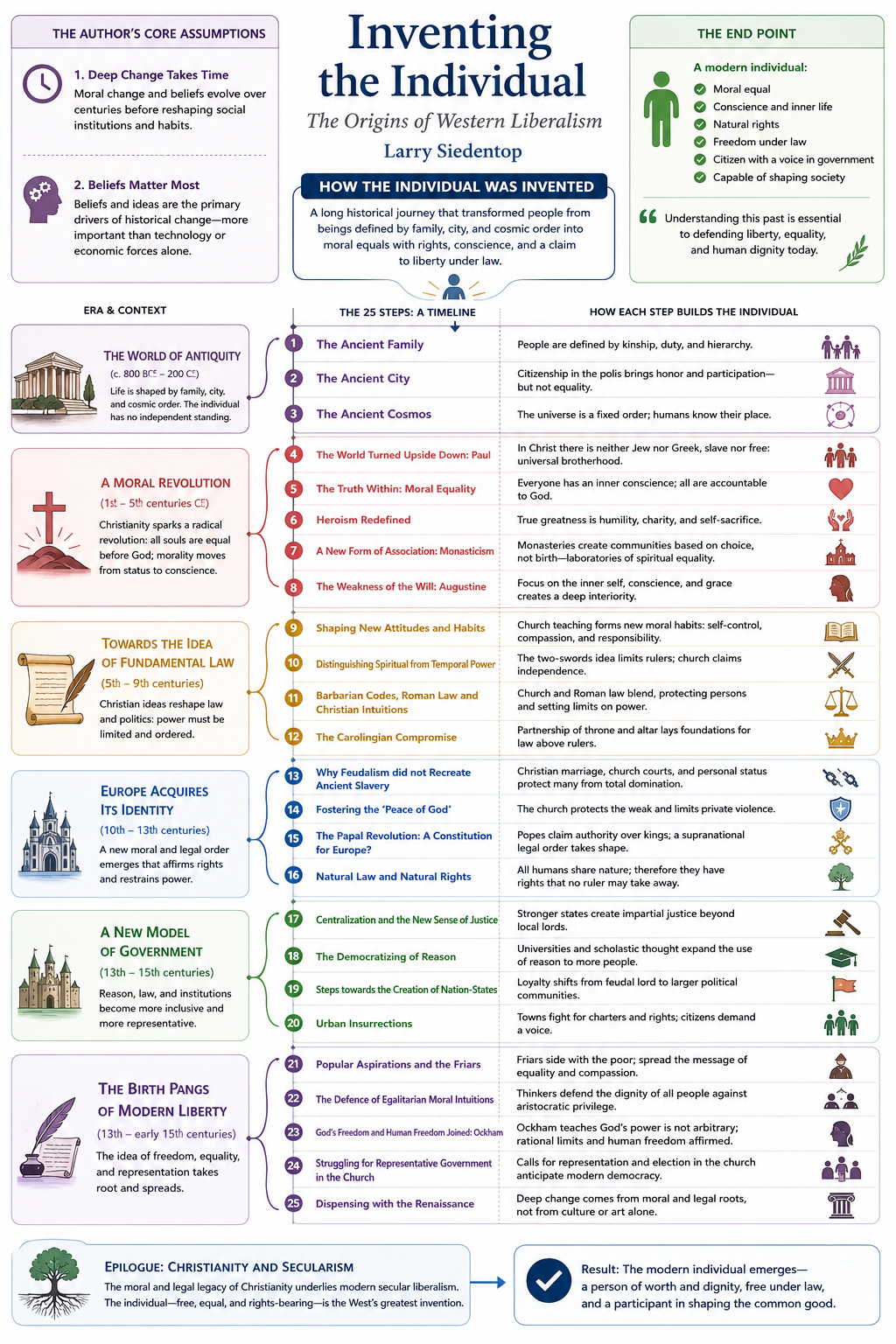
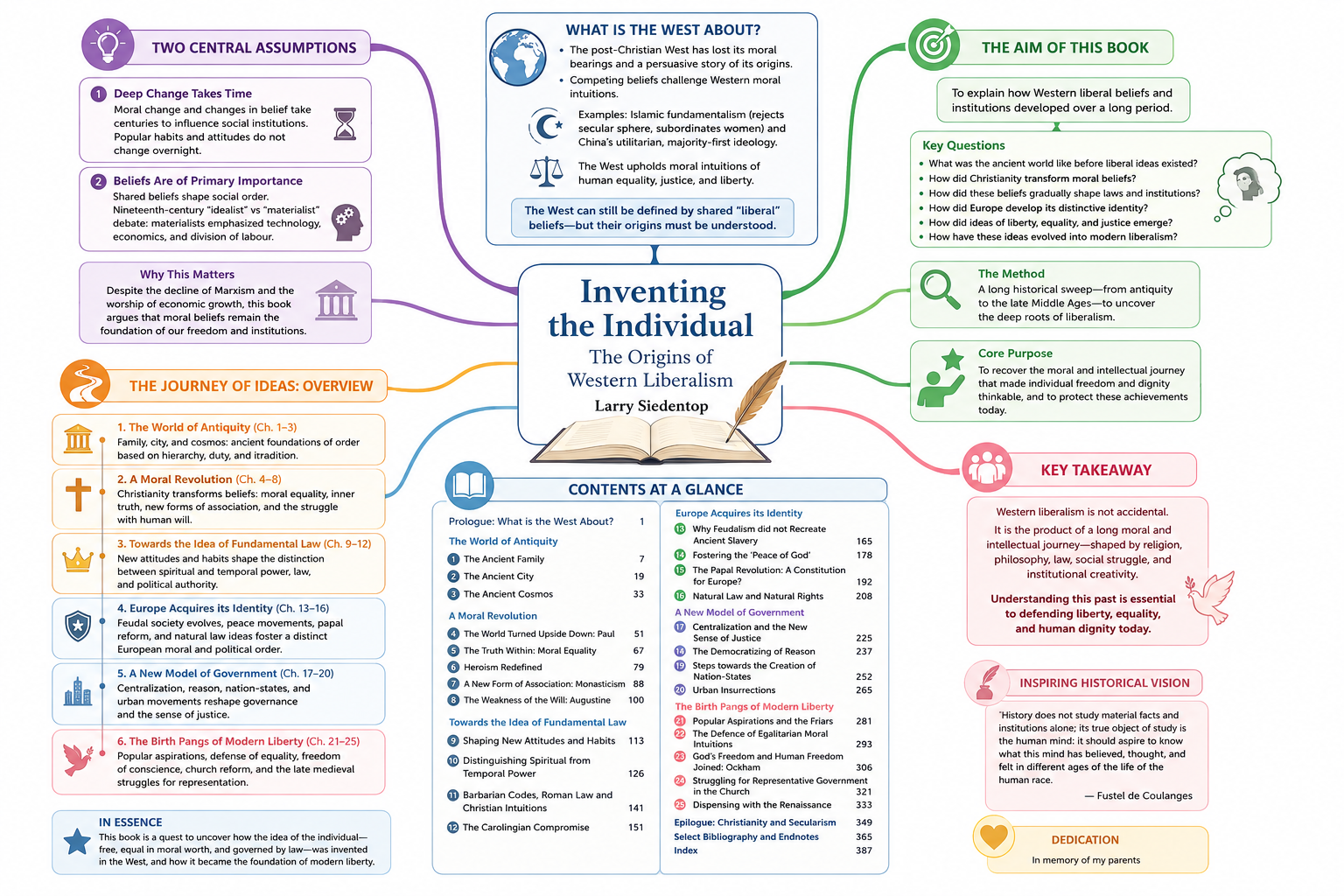
Here, in a grand narrative spanning 1,800 years of European history, a distinguished political philosopher firmly rejects Western liberalism’s usual account of itself: its emergence in opposition to religion in the early modern era. Larry Siedentop argues instead that liberal thought is, in its underlying assumptions, the offspring of the Church. Beginning with a moral revolution in the first centuries CE, when notions about equality and human agency were first formulated by St. Paul, Siedentop follows these concepts in Christianity from Augustine to the philosophers and canon lawyers of the fourteenth and early fifteenth centuries, and ends with their reemergence in secularism—another of Christianity’s gifts to the West. Inventing the Individual tells how a new, equal social role, the individual, arose and gradually displaced the claims of family, tribe, and caste as the basis of social organization. Asking us to rethink the evolution of ideas on which Western societies and government are built, Siedentop contends that the core of what is now the West’s system of beliefs emerged earlier than we commonly think. The roots of liberalism—belief in individual freedom, in the fundamental moral equality of individuals, in a legal system based on equality, and in a representative form of government befitting a society of free people—all these were pioneered by Christian thinkers of the Middle Ages who drew on the moral revolution carried out by the early Church. These philosophers and canon lawyers, not the Renaissance humanists, laid the foundation for liberal democracy in the West.
Attachment (file not included in this release)
Inventing the Individual - Larry Siedentop PDF Extracted
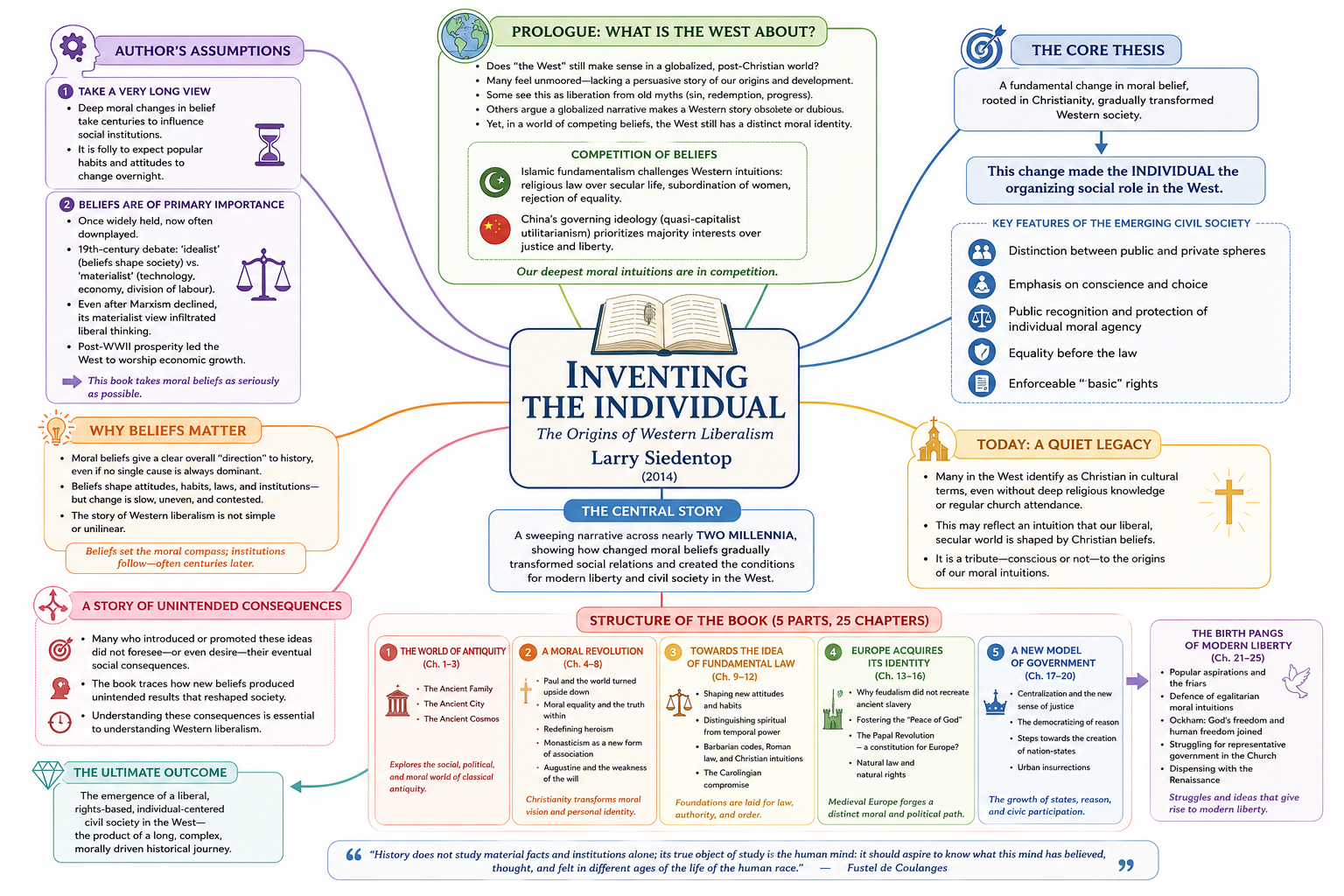
Chapter 1 — The Ancient Family
Chapter Objective
This chapter explains the pre-individualist moral world out of which Western civilization emerged. Larry Siedentop argues that modern Western society is built on the assumption that society is an association of individuals with equal moral status, but this was not the original Western view. In ancient Greece and Rome, society was first understood as an association of families, not individuals. The family was not merely a household or biological unit; it was a religious cult, organized around ancestor worship, sacred fire, male descent, property, and the authority of the paterfamilias.
The chapter fits into the book’s broader argument by establishing the contrast between the ancient world and the later Christian and liberal transformation of the West. Before the emergence of the moral individual, identity was rooted in family religion, inherited status, and domestic hierarchy.
The Need to Understand a Remote Moral World
Siedentop begins by warning that modern Westerners often misunderstand their own historical origins because they assume that the individual is a natural or obvious unit of society.
- Modern Western society tends to treat society as an association of individuals.
- This view has become so familiar that it is easy to mistake it for something universal or inevitable.
- Siedentop argues that this is historically false.
- The ancient world did not begin with individual rights, personal autonomy, or equal moral status.
- Instead, it began with radically unequal identities rooted in family, religion, gender, birth order, and inherited status.
He uses the example of a husband carrying his bride over the threshold. Today this appears to be a harmless romantic custom, but Siedentop says it survives from a world in which marriage involved a woman’s ritual transfer from one sacred family cult to another.
The point is methodological: to understand the ancient world, one must set aside modern assumptions about freedom, equality, and individuality.
Modern Individualism and Historical Complacency
Siedentop argues that globalization, capitalism, democracy, and human rights discourse have made the individualist model of society globally influential. But this success creates a danger: Westerners may forget how historically unusual their own assumptions are.
- The modern West often assumes that every person’s equal moral status is self-evident.
- Siedentop denies that nature alone establishes this equality.
- Human beings may naturally possess bodies and minds, but equal legal and moral status requires a cultural and legal foundation.
- Equality is not merely biological; it depends on institutions, law, and moral convictions.
This matters because ancient assumptions about slavery, women, and hierarchy should not simply be dismissed as “mistakes.” They were embedded in a coherent moral and religious order.
Examples Siedentop gives include:
- Aristotle’s definition of slaves as “living tools.”
- The ancient belief that women could not be fully rational agents.
- The plausibility of radical inequality in societies where literacy was limited and identity was inherited.
The chapter therefore asks the reader to understand ancient inequality from within the ancient worldview rather than treating it as merely irrational prejudice.
Reconsidering Greece, Rome, and Christianity
Siedentop then challenges the common Enlightenment narrative about Western origins.
The usual account says Western civilization comes from three sources:
- Greece
- Rome
- Judaeo-Christianity
But different ages have emphasized different sources.
- In the Middle Ages, Christianity was seen as the decisive source of Western civilization.
- The Reformation preserved this view in many ways.
- The Enlightenment, however, minimized Christianity’s role and presented modernity as a recovery of the freer, more rational spirit of Greece and Rome.
- Thinkers such as Gibbon portrayed the Middle Ages as a dark interruption between classical antiquity and modern progress.
Siedentop questions this Enlightenment view. He asks whether Greece and Rome were really as free, secular, and individualistic as Enlightenment thinkers imagined.
His answer is no. Ancient Greece and Rome were deeply religious societies, and their earliest institutions were shaped by beliefs far older than classical polytheism.
Fustel de Coulanges and
The Ancient City
Siedentop relies heavily on the nineteenth-century French historian Fustel de Coulanges, especially his book The Ancient City.
Fustel’s importance lies in his attempt to reconstruct the earliest religious foundations of Greek and Roman society.
His method was to work backward from:
- Early Greek and Roman law codes.
- Ancient historians.
- Philosophers.
- Playwrights.
- Linguistic evidence.
- Indo-European parallels, including the Vedas.
Fustel argued that before the city-state, the family was the sole form of society. It was not founded primarily on affection, biology, contract, or force. It was founded on religion.
Siedentop admits that Fustel may exaggerate the symmetry and reach of these beliefs, and that the real historical development was messier. But he still treats Fustel as indispensable because Fustel helps modern readers recover how the ancients understood their own institutions.
The Family as a Religious Cult
The central claim of the chapter is that the ancient family was both a domestic institution and a religious cult.
The family existed to preserve the line of ancestors and descendants. It gave human beings a way to overcome death by maintaining continuity across generations.
The core elements of this domestic religion were:
- The family hearth.
- The sacred fire.
- The worship of male ancestors.
- Sacrifices, libations, and prayers.
- The father as priest and magistrate.
- The eldest son as successor to the family cult.
The sacred fire was not merely symbolic. The ancestors were believed to live in or through it. The fire had to be maintained constantly, because an extinguished fire represented an extinguished family.
The dead ancestors required offerings. If they were neglected, they could become wandering, hostile spirits. So family religion imposed strict obligations on the living.
This means the ancient family was not merely a private emotional unit. It was the central religious, social, legal, and moral institution.
The Paterfamilias and Male Authority
Because the father controlled the family worship, he possessed enormous authority.
The paterfamilias was:
- Head of the household.
- Keeper of the sacred fire.
- Priest of the family cult.
- Magistrate over the family.
- Representative of the ancestors.
- Guardian of the family’s continuity.
His authority was not originally based on arbitrary domination alone. It was rooted in religious obligation. The father’s task was to preserve the family cult and prevent the ancestors from being forgotten.
This religious structure also explains why the eldest son had special status. He inherited the duty of maintaining the family worship.
The first-born son therefore differed radically from younger sons, daughters, wives, and slaves. The family was a hierarchy of sacred roles, not an association of morally equal persons.
Marriage and the Transfer of Female Identity
Siedentop uses the bride-threshold custom to explain the ancient meaning of marriage.
In the ancient family system:
- A woman belonged religiously to her father’s family before marriage.
- Marriage required her to renounce her original family cult.
- Once she renounced that cult, she temporarily lost her religious identity.
- She became, in Siedentop’s phrase, a kind of non-person.
- Her husband carried her over the threshold because she could not yet enter his household by right.
- Only after being received into the worship of her husband’s family did she regain identity.
Marriage was therefore not merely a union between individuals. It was a ritual transfer between sacred domestic communities.
This explains the subordinate position of women in ancient law and custom. Women could participate in ancestor worship only through a father or husband. Descent was traced through the male line.
Adoption, Kinship, and Religious Identity
The chapter emphasizes that kinship in this world was defined by religion more than biology.
- An adopted son, once admitted into the family worship, became a true member of the family.
- A biological son who abandoned the family worship ceased to be a true relation.
- Family identity was not primarily sentimental or genetic.
- It was cultic and religious.
This point is crucial because it shows that ancient social identity was not based on individual personality or autonomous choice. It was based on one’s place within a sacred lineage.
Property and the Sacred Domain of the Family
Siedentop explains that ancient property rights originated in domestic religion.
The family hearth fixed the family to a particular piece of land. Because the ancestors were associated with the hearth and the tombs, the family’s land became sacred.
The ancient connection was between:
- Domestic religion
- Family
- Property
Property was not originally understood as the possession of an individual owner. It belonged to the family across generations.
The head of household held the land as a trust for:
- The ancestors.
- The living family.
- Future descendants.
Because property was sacred, it could not be easily sold, divided, or transferred. To disturb the family land was to disturb the family cult.
Siedentop gives the example of Roman houses, which had to be separated by a small sacred space. Even urban architecture reflected the religious boundary between one family cult and another.
The Family Boundary and the Absence of Universal Humanity
The family domain created both a physical and moral boundary.
Inside the family circle were:
- Ancestors.
- Descendants.
- Sacred obligations.
- Identity.
- Protection.
- Piety.
Outside the family circle were:
- Strangers.
- Enemies.
- Foreigners.
- Slaves.
- Those without recognized ancestors or hearths.
Siedentop stresses that ancient society did not begin with a concept of universal humanity. Those outside one’s family or cult were not automatically seen as moral equals.
This helps explain the ancient acceptance of slavery and exclusion. The moral world was not organized around humans as such, but around sacred domestic groups.
From Families to Larger Associations
Siedentop then explains how larger social associations gradually developed.
The sequence was:
- The individual family.
- The gens, or extended family.
- The clan.
- The tribe.
- The city-state.
Each enlargement of society required a corresponding enlargement of religion.
Families could not simply merge their gods. Each family had its own sacred ancestors. Therefore, wider associations required recognition of a higher shared divinity.
This means that the city-state itself emerged from religious development. Political institutions were built upon earlier domestic religious institutions.
The polis was therefore not originally a secular association of citizens. It was the culmination of a long process in which religiously organized families became joined into larger sacred associations.
The Ancient Family as a “Church”
Siedentop sharply criticizes the Enlightenment view that antiquity was fundamentally secular or free from religious authority.
The ancient family was, in effect, a small church.
It constrained its members intensely:
- The father was priest and ruler.
- The wife had identity only through her husband.
- Children were subject to paternal authority.
- Celibacy was a crime because it threatened the continuation of family worship.
- Adultery was a crime because it threatened the purity and continuity of the lineage.
- Property existed to preserve the family cult.
- Women, slaves, and foreigners were excluded from full civic standing.
This religious authority was domestic rather than clerical. The ancient world may not have had a centralized church like medieval Christianity, but it was still deeply governed by religious obligation.
Pietas: Duty, Affection, and Religion
One of the chapter’s key terms is pietas, or piety.
In the ancient family, piety combined:
- Religious obligation.
- Natural affection.
- Duty to one’s role.
- Loyalty to ancestors.
- Preservation of the family line.
Piety did not mean charity toward humanity in general. Siedentop says that concern for humans as such would likely have been unintelligible in this moral world.
Instead, morality was role-based. One was good by fulfilling one’s duties within the family cult.
This differs sharply from later Christian and liberal ideas of moral equality, where every person has dignity as an individual soul or rights-bearing person.
The Aeneid as an Image of Family Piety
Siedentop uses Virgil’s Aeneid as a literary example of ancient piety.
After the fall of Troy, Aeneas carries:
- His father Anchises.
- The household gods.
- His son Ascanius, who carries the household fire.
Siedentop also refers to Bernini’s statue of Aeneas, Anchises, and Ascanius as a visual representation of this same idea.
The scene matters because it shows what ancient piety required. Aeneas saves not merely family members, but the sacred continuity of the family: ancestors, descendants, gods, and fire.
This is one of the chapter’s clearest examples of how family, religion, and identity were inseparable.
Inheritance, Primogeniture, and the Limits of Individual Property
Siedentop explains that ancient inheritance rules also reflected religious belief.
Because property existed to preserve the family worship:
- It passed according to the needs of the cult.
- It normally went to the eldest son.
- If there was no son, it went to the nearest male relative.
- Daughters could not inherit in the same way.
- In Athens, if a man died leaving only a daughter, she was required to marry the heir.
This shows that property was not a matter of free individual choice. The ancient owner was not master of his estate in the modern sense.
Siedentop gives Plato’s Laws as an example. Plato rejects the idea that a dying man should dispose of property however he wishes. The estate belongs not simply to the man, but to the family, ancestors, and posterity.
The Subordination of Women
The ancient family’s religious structure entailed the subordination of women.
A woman was always under male guardianship:
- As a girl, under her father.
- If her father died, under her brothers.
- As a wife, under her husband.
- If her husband died, under her husband’s male kin or sons.
Because marriage transferred her away from her birth family’s worship, she did not simply return to her original family after widowhood.
Her identity was mediated through male-controlled family religion. She had ancestors and descendants only through the male line.
This exclusion was not accidental. It followed directly from the religious logic of ancient domestic life.
Public and Domestic, Not Public and Private
The chapter’s most important theoretical distinction comes near the end.
Siedentop argues that we must abandon the modern distinction between public and private when interpreting ancient Greece and Rome.
For modern liberals:
- The private sphere is often associated with individual liberty.
- The individual has rights against public interference.
- Society is composed of individuals.
But in antiquity, the key distinction was between:
- The public sphere, meaning the city.
- The domestic sphere, meaning the family.
The domestic sphere was not a sphere of individual freedom. It was a sphere of hierarchy, religious obligation, and inequality.
This matters because ancient citizenship was built on the domestic order. Only the paterfamilias, and later his sons, could become citizens. Women, slaves, and foreigners were excluded because they lacked the religious and domestic standing required for public membership.
The Moral Cost of the Ancient Family
Siedentop closes the chapter by noting that the ancient family possessed an intensity of feeling largely unknown to modern people.
The ancient family created powerful bonds among:
- Ancestors.
- Fathers.
- Sons.
- Household gods.
- Land.
- Sacred fire.
- Future descendants.
But this intensity came at a cost. It blocked what Siedentop calls moral transparency: the ability to see human beings simply as human beings.
The family gave meaning and identity, but it also prevented recognition of universal human equality.
Key Concepts for Chapter 1 — The Ancient Family
The Ancient Family
The ancient family was not merely a biological or emotional unit. It was a religious institution organized around ancestor worship, sacred fire, male descent, and inherited obligation.
Domestic Religion
Domestic religion refers to the family-based worship of ancestors and household gods. Each family had its own sacred cult, and outsiders could not participate in it.
Sacred Fire
The sacred fire represented the continuity of the family and the living presence of the ancestors. Keeping it alive was one of the family’s central religious duties.
Ancestor Worship
Ancestor worship was the belief that deceased male ancestors continued to require offerings from the living family. If neglected, they could become hostile spirits.
Paterfamilias
The paterfamilias was the male head of the household. He functioned as father, priest, magistrate, property-holder, and representative of the family’s ancestors.
Primogeniture
Primogeniture is inheritance through the eldest son. In this chapter, it is explained not merely as an economic arrangement but as a religious necessity, because the eldest son inherited responsibility for the family cult.
Pietas
Pietas means piety, but in the ancient context it included religious duty, family loyalty, affection, and role-based obligation. It was not charity toward humanity in general.
Domestic Sphere
The domestic sphere was the family realm. Unlike the modern private sphere, it was not a space of individual liberty. It was a hierarchical religious domain ruled by the father.
Association of Families vs. Association of Individuals
Siedentop’s central contrast is between ancient society as an association of families and modern society as an association of individuals. Ancient people did not begin from individual rights or equal moral status.
Moral Transparency
Moral transparency refers to the ability to see other human beings as moral equals simply because they are human. Siedentop argues that the ancient family’s closed moral world prevented this.
Questions for Reflection for Chapter 1 — The Ancient Family
- How does Siedentop’s account challenge the common idea that modern Western freedom comes mainly from Greece and Rome?
- Why does Siedentop think the ancient family was founded on religion rather than affection, biology, or physical force?
- How did ancestor worship shape ancient ideas of property, inheritance, marriage, and gender hierarchy?
- Why is the distinction between public and domestic more accurate for antiquity than the modern distinction between public and private?
- What was gained and what was lost in a society where identity came from the family rather than from individual moral status?
Chapter 2 — The Ancient City
Chapter Objective
This chapter explains how the ancient world moved from the family as the sole sacred association to the city-state, or polis, as a larger sacred-political order. Siedentop’s main argument is that the ancient city did not emerge as an association of free and equal individuals. It emerged as a confederation of cults: families, gentes, clans, tribes, and city-wide worships layered on top of one another.
The chapter is designed to correct the romantic Enlightenment and republican image of ancient citizenship as the pure model of liberty. Siedentop argues that ancient liberty was not modern liberty. It did not mean individual rights, equality before the law, freedom of conscience, or protection from state power. It meant participation in public power by a restricted class of male citizens whose identity was rooted in religion, ancestry, land, and the gods of the city.
From the Ancient Family to the Ancient City
Siedentop begins with the problem left by the previous chapter: if the earliest social world was built around the family cult, how did larger political institutions arise?
The answer is that ancient society expanded by reproducing the logic of the family at larger scales.
The sequence of association was:
- Family
- Gens, or extended patriarchal family
- Phratry or curia, roughly a clan
- Tribe
- City-state, or polis
Each new level of association required a new common worship.
The city did not abolish the older family cults. It was built on top of them. The city was therefore not a modern state made up of individuals. It was an association superimposed on other associations, all modeled on the sacred family.
Siedentop’s key point is that the ancient city was not secular in origin. It was a religious development.
The Expansion of the Patriarchal Family
Siedentop cautions that the ancient family should not be imagined as a modern nuclear family.
The patriarchal family expanded because:
- Younger sons remained attached to the family hearth.
- Their descendants remained connected to the same sacred fire.
- Subordinate branches developed over generations.
- Dependants became attached to the family.
- Some dependants were admitted into inferior roles within the family worship.
- Slaves might also be attached to the household, though without religious connection.
This expanded family became the gens, a large patriarchal kinship group organized around common ancestors, sacred rites, and inherited hierarchy.
The city’s later political structure grew from these larger family-based associations.
Gentes, Phratries, Curiae, and Tribes
As patriarchal families expanded and came into contact with one another, they formed wider associations by doing what they already understood: creating a shared cult.
To create a wider association, groups would:
- Acknowledge a shared ancestor or heroic founder.
- Raise an altar to a common divinity.
- Establish a ceremonial meal.
- Create a priesthood.
- Hold assemblies and rites.
The phratry in Greece and the curia in Rome functioned as clan-like associations. These then developed into tribes, which also required their own altar and god.
The important point is that each step toward political life was mediated through religion. Larger society was not built by contract between individuals. It was built by expanding sacred associations.
The City as a Confederation of Cults
The ancient city came into being when several tribes associated under a common worship.
This common city worship did not erase older forms of worship. Instead, it supplemented them.
The result was a layered structure:
- Family cults remained.
- Gentes retained their own rites.
- Phratries or curiae retained formal roles.
- Tribes retained their religious identity.
- The city added a higher civic cult.
Siedentop calls attention to the corporate and sacramental character of the ancient city. Civic institutions were organized through groups, not individuals.
This affected:
- Voting procedures.
- Military organization.
- Religious sacrifices.
- Public ceremonies.
- Citizenship rituals.
The city was therefore a confederation of sacred groups, not a liberal association of autonomous persons.
Polytheism and the Enlargement of Religious Ideas
As the scale of human association expanded, religious ideas also expanded.
Earlier family religion centered on domestic ancestors. But larger associations required gods who could be shared more easily. This helps explain the growing importance of polytheistic gods of nature, such as:
- Apollo
- Neptune
- Venus
- Diana
- Jupiter
These gods were connected to broader forces: sea, wind, fertility, light, love, hunting, and so on.
Civic temples to these gods gave visible form to the enlargement of religious association. But even these gods remained particular to each city.
Two cities might both worship Jupiter, but each city’s Jupiter had its own attributes, rites, and relationship to that city. Ancient religion remained local and particular.
Particularism and the Gods of the City
Siedentop stresses that ancient religion remained highly particularist.
The gods of a city were not universal gods. They belonged to that city and protected that city.
This meant:
- Civic gods were tied to specific territories.
- Each city had its own sacred traditions.
- The dead ancestors of founding groups remained spiritually present under the city’s soil.
- The city had to honor the ancestral gods of the groups that founded it.
- Political authority and religious authority were intertwined.
Siedentop uses the example of Solon, the Athenian lawgiver, who was advised by the oracle of Delphi to honor the dead chiefs of the country who lived under the earth.
The city’s authority was continuous with the authority of the family ancestors. The public order did not replace domestic religion; it grew out of it.
Citizenship as Religious Initiation
Siedentop explains ancient citizenship through the ritual progress of a young Athenian or Roman male.
A boy was first initiated into the worship of his family. Later, he was initiated into the cults of larger associations, such as the curia or tribe. Finally, in his late teens, he was accepted into the public worship of the city.
Citizenship was therefore not merely a political status. It was a religious status.
To become a citizen meant:
- To share in the city’s worship.
- To swear loyalty to the city’s religion.
- To participate in the civic cult.
- To be bound by the city’s sacred laws.
- To become part of the city’s moral and political body.
Siedentop quotes Fustel’s argument that a citizen was essentially “a man who had the religion of the city.”
This is crucial for understanding exclusion. Those who did not share the city’s worship could not be full citizens.
No Sphere of Individual Conscience
The ancient city made comprehensive claims over the citizen.
The citizen’s obligations extended into:
- Dress
- Deportment
- Marriage
- Sport
- Education
- Conversation
- Ambition
- Political participation
- Religious worship
There was no protected sphere of individual conscience comparable to modern liberal rights.
The practice of ostracism illustrates this. A citizen could be expelled if he seemed likely to gain excessive influence and threaten the city. No crime or subversive act had to be proven.
The city’s safety and welfare overrode individual claims.
Magistrates, Kingship, and Priesthood
The ancient city’s government was religious in structure.
Originally:
- Magistrates were priests.
- Kings were hereditary high priests.
- Political authority grew out of religious authority.
- Military leadership was attached to sacred knowledge.
- Law was guarded by priests.
Kingship was not initially secular monarchy. The king’s role as magistrate and military leader was secondary to his role as priest of the city’s cult.
Later, when kingship gave way to republican regimes, the chief magistrates still retained priestly duties. In Athens, the archon offered sacrifices. In Rome, the consul had sacred responsibilities.
Siedentop also notes that the crown originated in the circlet of leaves worn by magistrates during sacrifices. Authority retained a sacred symbol.
Law as Sacred Formula
Ancient law was not understood as the product of human sovereignty.
Siedentop argues that laws were originally treated as:
- Sacred formulas.
- Inherited religious endowments.
- Consequences of divine order.
- Texts guarded by priests.
- Ritual words whose form mattered as much as their substance.
There was no modern idea of a sovereign people or legislature freely creating new law. Law was not initially grounded in moral principle or individual rights. Its force came from its sacred form.
Even when laws were written down, they were deposited with priests and were not available to everyone.
Ancient law applied only to those who shared in the city’s worship. Slaves and resident strangers did not receive equal protection under the city’s law.
Patriotism as Religious Identity
Siedentop then explains ancient patriotism.
Modern patriotism often depends on:
- National history.
- Political ideals.
- Constitutional identity.
- Rights and citizenship.
- Shared institutions.
Ancient patriotism was different. It was rooted in religion, ancestry, and land.
The ancient citizen defended the city because:
- His ancestors were buried there.
- His family gods were tied to the soil.
- His identity depended on the city’s sacred rites.
- His moral life existed only within that civic-religious order.
The city was not merely a place of residence. It was the physical and religious ground of the citizen’s existence.
This explains the intensity of ancient patriotism. To lose the city was to lose one’s gods, ancestors, identity, and moral world.
Founding a City and the Meaning of Terra Patria
Siedentop explains that when a new city was founded, its members carried soil from their previous city and placed it in a trench.
This soil represented the land where their ancestors were buried.
This ritual allowed the new city to become terra patria, the land of the fathers.
The example of Romulus founding Rome shows the same logic. The foundation of a city was not merely the construction of houses or walls. It was the establishment of a sacred hereditary identity.
This explains the original meaning of patriotism: service to the fathers’ land, where the ancestors and gods were rooted.
Patriotism, Piety, and the Highest Virtue
For the ancient citizen, patriotism was the highest virtue because the city contained everything that mattered.
The city preserved:
- Ancestors
- Worship
- Property
- Moral identity
- Honor
- Status
- The gods
- Public glory
To serve the city was to serve the gods. Siedentop writes that piety and patriotism were one and the same thing.
This explains the ancient contempt for those who withdrew from public life. The Greek word idiot originally referred to someone who retreated from the life of the city into private concerns.
In the ancient context, such withdrawal was not neutral. It was a failure of civic and religious duty.
Exile as Living Death
Because the city was the whole moral world of the citizen, exile was the severest punishment.
Exile meant separation from:
- The city’s gods.
- The family’s sacred ground.
- Civic worship.
- Ancestral identity.
- Law.
- Social ties.
- Moral life.
Siedentop describes exile as worse than death, or as a kind of living death. A man outside his city was outside the regular structure of religion, law, dignity, and duty.
This explains why Aristotle later argued that the life of the citizen was the only life worth living. In the ancient worldview, full humanity was possible only inside the polis.
Urbs and Civitas
Fustel distinguishes between urbs and civitas.
- Urbs means the physical city: the buildings, walls, and place of assembly.
- Civitas means the moral, religious, and political association of citizens.
This distinction helps explain the story of Aeneas.
When Troy falls, Aeneas preserves the sacred fire and household gods. By preserving the gods, he preserves the moral basis of Troy’s association, even though the physical city has been destroyed.
His later journey is not simply a personal adventure. It is the migration of Troy’s gods toward their new home in Rome.
The story shows that the true city was not merely the physical settlement. It was the sacred association held together by gods, rites, and shared identity.
Divination and the Will of the Gods
Siedentop emphasizes that the gods were believed to guide civic life.
This shaped political practices even in republican regimes.
Examples include:
- In Athens, drawing lots was considered a way of discovering the gods’ choice.
- In Rome, candidates for consulship had to pass through religious auspices.
- Priests observed the skies and interpreted divine signs.
- Unfavorable omens could exclude a candidate.
- Battles and expeditions could be delayed because of omens.
The Greeks and Romans practiced divination because they believed the city’s gods had to authorize public action.
This was not a marginal superstition. It was central to government, war, law, and legitimacy.
The Sixth-Century Crisis and the Rise of Class Conflict
By the sixth century BC, ancient city-states began to experience internal social conflict.
The original citizen body was narrow. In many cities, citizenship was limited to the patres, the fathers of the city.
Excluded or subordinate groups included:
- Younger sons.
- Junior branches of old families.
- Clients.
- Plebeians.
- Slaves.
- Women.
- Foreigners.
The social conflicts took different forms in different cities:
- In Sparta, conflict between equals and inferiors.
- In Athens, conflict between Eupatrids and thetes.
- In Rome, conflict between patricians and plebeians.
These struggles began to erode the original aristocratic structure of the city.
However, Siedentop warns that the change was slow and limited. Ancient beliefs remained tenacious.
The Limits of Social Change
Even when citizenship expanded, the original religious basis of citizenship remained powerful.
The city was still defined by shared worship. This helps explain why Greek city-states found it so difficult to unite into one larger political order.
The problem was not merely geography or technical backwardness. It was religious particularism.
Each city had its own gods, who did not welcome strangers.
Even marriage between citizens of different cities could be viewed as strange or immoral. Temporary alliances between cities were often represented symbolically as two gods holding hands. The gods could cooperate, but they could not simply be merged.
Religion, War, and Public Action
Fear of the gods governed public action in both war and peace.
Examples Siedentop gives include:
- A campaign might be postponed because of unfavorable auspices.
- A comet, eclipse, flight of birds, or sacrificial entrails could alter military plans.
- Spartan campaigns were regulated by the phases of the moon.
- Athenian armies avoided campaigning before the seventh day of the month.
- During the Peloponnesian War, Athenian reliance on omens contributed to the disastrous defeat at Syracuse.
- Certain days were unlucky, and on those days no marriage, assembly, or legal judgment took place.
These examples reinforce the chapter’s central claim: government and religion were not separate spheres in the ancient city.
Ancient Liberty vs. Modern Liberty
This is one of the chapter’s central arguments.
Siedentop argues that ancient liberty was very different from modern liberal freedom.
Ancient liberty meant:
- Having a share in public power.
- Attending the assembly.
- Speaking in debate.
- Voting.
- Serving as magistrate if chosen.
- Serving on juries if required.
- Participating actively in the res publica.
It did not mean:
- Individual rights against the city.
- Freedom of conscience.
- Freedom from politics.
- Legal equality for all persons.
- A private sphere protected from public authority.
- The right to be indifferent to politics.
Ancient liberty was demanding and compulsory. The citizen belonged to the city body and soul.
This is why Siedentop challenges the classical republican tradition that celebrates ancient citizenship as the pure model of liberty. Ancient liberty was participation in collective power, not individual freedom.
Sparta and the Absence of the Private Sphere
Siedentop uses a story from Sparta to show the severity of ancient civic demands.
After the Spartan defeat at Leuctra, relatives of the dead were required to appear cheerful, while the mothers of survivors were expected to mourn.
The story may contain mythic elements, but Siedentop uses it to illustrate the logic of the ancient city:
- The city’s judgment outweighed personal grief.
- Private attachment had no independent moral claim.
- The domestic sphere counted for little when set against civic virtue.
- The city could command emotional life itself.
This demonstrates the absence of a modern private sphere with legitimate claims against public authority.
Citizenship as Status, Performance, and Superiority
Citizenship in the ancient city was not merely an obligation. It was also an elevated status.
Citizens were constantly on display before:
- Younger sons.
- Clients.
- Women.
- Slaves.
- Other inferiors.
Citizenship had an aesthetic dimension: it involved public performance, gravitas, pride, glory, and superiority.
Siedentop argues that even the ancient taste for nudity expressed this status. To appear naked in athletic or civic contexts symbolized superiority over the domestic, material, and servile concerns associated with women, merchants, and slaves.
This point helps explain why excluded groups sought citizenship. They were not seeking modern justice or universal equality. They were seeking entry into a superior status.
Plebeians, Clients, and the Struggle for Inclusion
The plebeians in Rome are especially important in Siedentop’s account.
The plebs were likely later arrivals who had no religious connection with the city’s foundation.
They lacked:
- Domestic altars.
- Recognized ancestors.
- Civic gods.
- A share in the city’s sacred identity.
Clients also began as dependants of aristocratic families and lacked equal standing.
Over time, these groups contested the limits of citizenship. This struggle shaped the history of Greek city-states and Rome from the sixth century BC until the rise of the Roman Empire.
But the struggle remained limited. Women, slaves, and foreigners were not included. They remained confined to the domestic sphere, the sphere of inferiority.
Aristocracy, Kingship, and Tyranny
Siedentop explains that aristocracies gradually stripped kingship of political authority, reducing it to a religious role.
Why?
Because kings often allied with lower classes against aristocratic families.
The aristocracy therefore carried through a political revolution to avoid a social revolution.
But social revolution still slowly came. Underprivileged groups increasingly challenged aristocratic dominance.
Siedentop compares Fustel’s interpretation of this ancient social revolution to the way Guizot and Tocqueville analyzed class conflict in medieval and modern Europe.
The point is that structural social change often proceeds gradually, through incremental erosion of inherited institutions.
The Attack on Primogeniture
The first major social change occurred within the patriarchal family itself.
Primogeniture came under attack and gradually weakened.
This mattered because:
- Younger sons began to inherit property.
- Younger sons became full citizens.
- Junior branches of old families became independent.
- The number of citizens increased.
- The authority of the old family heads declined.
- The priestly power of the paterfamilias weakened.
This was a major step in breaking the old aristocratic order, because the family head was no longer the sole mediator of property, worship, and status.
The Liberation of Clients
The second major change was the gradual liberation of clients.
At first, clients were little better than slaves.
They:
- Could not own property.
- Had no secure tenure.
- Worked land controlled by the paterfamilias.
- Lacked full religious and civic status.
Over time, they became freer and began to acquire property. Siedentop compares this to medieval European developments in which slaves became serfs, serfs gained fixed obligations, and eventually some became peasant proprietors.
The desire for property came before the desire for full citizenship. But once property was gained, exclusion from citizenship became harder to tolerate.
Relative Deprivation and Rising Expectations
Siedentop explains social change through a rise in expectations.
As the family became part of the larger city, subordinates could compare their condition with others.
They could:
- See other dependants.
- Share grievances.
- Compare masters.
- Imagine a better fate.
- Recognize their exclusion.
This produced what Siedentop calls a sense of relative deprivation.
People did not revolt simply because they were poor or subordinate. They challenged their status because the city made comparison possible and revealed that their exclusion was not inevitable.
This process slowly undermined aristocratic control.
Tyrants as Instruments Against Aristocracy
Tyrants played an important role in this process.
The lower classes often supported tyrants because tyrants weakened the old aristocracy.
Siedentop notes that the title tyrant was useful because “king” evoked sacred hereditary authority connected to the old religious order. Tyrants did not claim the same sacred legitimacy. They were political instruments.
They could be supported when useful and discarded afterward.
Tyranny therefore served the ambitions of those who felt excluded from aristocratic privilege.
Social Revolution Without Modern Justice
Siedentop’s conclusion about ancient social revolution is deliberately restrained.
The struggles of younger sons, clients, and plebeians did not create modern equality.
They sought:
- Property.
- Status.
- Citizenship.
- Public honor.
- Access to privilege.
- Participation in civic superiority.
They did not seek universal justice in the modern sense.
The domestic sphere remained a realm of inferiority. Women, slaves, and foreigners remained excluded. The social revolution was therefore not a struggle for equal human dignity. It was a struggle by underprivileged males for a share in the privileges of the citizen class.
The City’s Claims Remained Supreme
Even after class struggles reshaped citizenship, the city remained morally supreme.
There was no concept of rights belonging to enemies of the city.
Siedentop gives the example of a Spartan king who, when asked about the justice of seizing a Theban citadel during peacetime, replied that one should ask only whether it was useful to the country, because whatever is useful to the country is right.
This captures the ancient priority of civic utility over abstract justice.
Conquered cities could be treated brutally:
- Men could be slaughtered.
- Women and children could be enslaved.
- Houses and fields could be destroyed.
- Domestic animals could be taken or killed.
- The gods of the defeated city could be dispossessed.
The Greeks and Romans were implacable when the fate of their city was at stake.
Key Concepts for Chapter 2 — The Ancient City
The Ancient City
The ancient city was not a secular state or an association of individuals. It was a sacred association of associations, built from families, gentes, clans, tribes, and civic worship.
Polis
The polis was the Greek city-state. It was a political, religious, and moral community in which citizenship was tied to participation in the city’s worship and public life.
Classical Republicanism
Classical republicanism is the tradition that celebrates ancient citizenship as a model of liberty, virtue, and devotion to the common good. Siedentop challenges this tradition by showing that ancient liberty did not include modern individual rights.
Ancient Liberty
Ancient liberty meant sharing in public power. It involved participation in assembly, debate, voting, magistracy, and jury service. It did not mean private autonomy, freedom of conscience, or individual rights against the city.
Modern Liberty
Modern liberty means protection of individual rights, freedom of conscience, legal equality, and a protected private sphere. Siedentop contrasts this sharply with ancient liberty.
Gens
The gens was an extended patriarchal family, organized around shared ancestry, worship, and hierarchy.
Phratry / Curia
A phratry in Greece or curia in Rome was a clan-like association made up of multiple family groups united by common worship.
Tribe
The tribe was a larger association formed from clans or curiae. It had its own altar, god, rites, and religious-political identity.
Confederation of Cults
The ancient city was a confederation of cults because it layered city worship over family, clan, and tribal worships without abolishing them.
Patriotism
Ancient patriotism was devotion to the fathers’ land, where one’s ancestors, gods, property, and moral identity were rooted. It was religious rather than merely political.
Pietas and Patriotism
In the ancient city, piety and patriotism were inseparable. To serve the city was to serve the gods and ancestors.
Urbs
Urbs means the physical city: the buildings, walls, and territory.
Civitas
Civitas means the moral, religious, and political association of citizens. It could survive even if the physical city was destroyed.
Ostracism
Ostracism was the expulsion of a citizen considered too powerful or dangerous to the city. It shows that the city’s safety overrode individual rights.
Relative Deprivation
Relative deprivation refers to the sense of exclusion produced when subordinate groups compare their status to others and begin to imagine a better condition.
Tyranny
In this chapter, tyranny is presented as a political instrument used by lower classes to undermine aristocratic dominance, not as a movement for modern equality.
Questions for Reflection for Chapter 2 — The Ancient City
- How does Siedentop’s account challenge the romantic idea that ancient citizenship was the purest form of liberty?
- Why does Siedentop argue that the ancient city was an association of cults rather than an association of individuals?
- What is the difference between ancient liberty and modern liberty, and why does that difference matter for political theory?
- How did religion shape ancient law, citizenship, patriotism, and warfare?
- Why does Siedentop describe the social revolution of the ancient city as a struggle for privilege rather than a struggle for justice?
Chapter 3 — The Ancient Cosmos
Chapter Objective
This chapter explains how the ancient Greek and Roman understanding of reason, society, and the cosmos was shaped by hierarchy. Siedentop argues that ancient rationality was not the modern idea of neutral, individual reasoning. It was bound up with the status of the male citizen, whose public role as magistrate, priest, warrior, speaker, and ruler was treated as evidence of superior rational capacity.
The chapter fits into the book’s larger argument by showing that even the ancient discovery of philosophy, logic, rhetoric, and “nature” did not produce modern individualism or moral equality. Instead, Greek and Roman thought projected the hierarchical structure of the city onto the universe itself. The result was a world-picture in which reason ruled, inferiors obeyed, and every being had a fixed place in a cosmic order.
The Citizen as the Bearer of Reason
Siedentop begins by emphasizing that the Greek and Roman citizen did not merely perform a social role. His actions were understood as expressions of rational superiority.
The citizen’s public roles included:
- Magistrate
- Priest
- Warrior
- Speaker in the assembly
- Defender of the city
- Participant in lawmaking
These roles confirmed his superiority over social subordinates.
Ancient society assumed that women, merchants, slaves, and other dependants had useful functions, but not the kind of rationality required for public life.
Siedentop summarizes the hierarchy:
- Citizens were associated with reason, honor, command, and public action.
- Women were associated with the domestic sphere.
- Merchants were associated with calculation and bargaining.
- Slaves were associated with obedience.
- Animals and “mere humans” lacked the love of honor that marked real citizenship.
He uses Xenophon’s Hiero to illustrate this idea. The love of honor and praise was treated as a mark of the fully developed man, not something shared by all human beings.
The citizen was therefore imagined as a kind of superior human type, almost a “superman,” whose public role proved his rational elevation.
Status as Natural Superiority
Siedentop argues that what modern people might call status was understood in antiquity as natural endowment.
Citizens were seen as superior because they possessed the capacities required for:
- Public speech.
- Deliberation.
- Military courage.
- Religious responsibility.
- Political command.
- Pursuit of honor and glory.
This assumption probably had roots in the early city-state, when citizens were few and often monopolized:
- Priesthood.
- Magistracy.
- Warfare.
- Literacy.
As citizen bodies expanded, this aristocratic prestige changed but did not disappear. New social forces entered public life, especially in Athens and Rome.
Examples of change include:
- In Athens, democratic reforms altered the meaning of tribes, making them more connected to voting and citizenship than to old family cults.
- In Rome, the army came to be organized by centuries, or numerical groupings, rather than purely by family and gens.
- Former clients and plebeians became wealthy and militarily important.
- Heavy infantry, such as Greek hoplites and Roman legionaries, became more important than aristocratic cavalry.
Money, numbers, and military service introduced more abstraction into the citizen class, but they did not produce moral equality. They modified the old religious aristocracy without destroying the assumption that citizens were superior.
Public Debate and the Birth of Logic and Rhetoric
The widening of citizenship made public debate more important.
As assemblies became central to political life, citizens needed new intellectual skills:
- Careful argument.
- Persuasion.
- Coherent speech.
- Refutation.
- Public reasoning.
- The ability to defend proposals before equals.
From this civic setting emerged logic and rhetoric as public disciplines.
Siedentop argues that the habits of argument fostered by the assembly helped create abstract philosophical thinking. By the fifth century BC, Athens became the symbolic center of this development.
But this intellectual achievement had an unintended consequence: reason became identified with the public sphere and with the ruling class.
Reason was not seen as a universal human attribute shared equally by all persons. It was associated with those who spoke, ruled, commanded, and sought glory in the polis.
Logos and Social Command
Siedentop focuses on logos, the Greek term connected to reason, speech, argument, and order.
In the ancient world, logos was linked to:
- Public speaking.
- Political debate.
- Rational order.
- Civic leadership.
- The authority of the citizen class.
Because citizens commanded in society, reason itself came to be imagined as something that commands.
This had two major consequences.
In the social world, reason justified hierarchy:
- Some people were born to command.
- Others were born to obey.
- Rationality belonged most fully to those fitted for public rule.
- Inferiors were expected to act under the direction of superiors.
In the physical world, reason supported a purposive view of nature:
- Everything had a natural end or purpose.
- Processes were governed by final causes.
- The universe was understood as an ordered hierarchy.
- Each being had a proper place in a “great chain of being.”
Ancient reason was therefore not merely a tool for calculation. It was a principle of rule, order, and hierarchy.
Ancient Reason and the Absence of the Will
Siedentop contrasts ancient reason with modern philosophical accounts of reason and will.
In much modern thought, especially empiricism:
- Reason is instrumental.
- Reason calculates means and consequences.
- Reason does not by itself motivate action.
- A separate act of will bridges the gap between thought and action.
Ancient thought often lacked this sharp distinction.
Siedentop notes that:
- It remains debated whether Greek philosophers had a fully distinct concept of the will.
- Homeric Greek did not even have a word for intention.
- Ancient social hierarchy reduced the need for a doctrine of the will.
Why? Because the structure of society seemed to connect thought directly to action.
If a superior reasoned, inferiors obeyed. The gap between deliberation and action was filled by social status. Those who possessed reason also possessed the authority to command action.
This is one of the chapter’s most important claims: the ancient model of agency reflected the structure of ancient society.
Plato’s Republic and the Hierarchical Self
Siedentop uses Plato’s Republic as a major example.
Plato asks what a just society would look like and answers by comparing it to a just person.
In Plato’s account:
- The just soul is governed by reason.
- Reason rules the spirited and appetitive parts.
- The just city mirrors this structure.
- Philosophers rule.
- Warriors enforce and defend.
- Workers produce and obey.
Siedentop argues that Plato appears to move from the just individual to the just society, but the deeper movement may be the reverse. Plato may be imagining the self on the model of a stratified society.
The Platonic soul resembles a city divided into classes:
- Reason = philosopher-rulers.
- Spirit = warrior class.
- Appetite = workers and producers.
The assumption is that harmony requires hierarchy. Each part must occupy its proper place.
Plato’s philosopher-king is not simply the traditional aristocratic citizen, but Plato’s system preserves the deeper ancient assumption: rational superiority entitles some to rule over others.
Labor, Commerce, and the Contempt for the Domestic Sphere
Siedentop then connects ancient rational hierarchy to the ancient contempt for labor and commerce.
Several features of ancient society make sense in this context:
- Admiration for military courage.
- Suspicion of commerce.
- Contempt for manual labor.
- Fear of luxury.
- Association of the domestic sphere with inferiority.
- Association of public life with honor.
The citizen’s proper concern was honor, not pleasure.
The threat to civic virtue was luxury, which was believed to weaken public devotion by drawing citizens into private appetite, comfort, display, and self-indulgence.
Sparta was often praised as the opposite of luxury:
- Austere.
- Militarized.
- Public-spirited.
- Always ready for war.
- Stripped for action.
Athens, Corinth, and later Imperial Rome were often portrayed as vulnerable to luxury and softness.
Siedentop does not treat this image as purely factual. He notes its propagandistic element. But he emphasizes that it became central to the classical republican tradition.
Virtue, Vice, and the Choice of Heracles
Siedentop uses the story of Virtue and Vice addressing the young Heracles to illustrate the ancient contrast between public honor and private pleasure.
In the story:
- Vice offers quick happiness through pleasure.
- Virtue condemns luxury, indulgence, sexual excess, and softness.
- Virtue argues that the highest pleasure is seeing one’s own noble work and receiving praise.
The story dramatizes the ancient citizen’s moral choice:
- Choose pleasure, appetite, and private indulgence.
- Or choose discipline, honor, noble action, and public admiration.
This reinforces the chapter’s point that the highest ancient good for the citizen was not individual happiness in the modern sense. It was public honor earned through service to the city.
Masculine Hardness and Feminine Softness
At the heart of ancient civic rhetoric was a contrast between:
- Masculine hardness
- Feminine softness
Masculine hardness was associated with:
- Sparta.
- Early Republican Rome.
- War.
- Discipline.
- Simplicity.
- Public service.
- Self-control.
- Readiness for sacrifice.
Feminine softness was associated with:
- Luxury.
- Commerce.
- Sensuality.
- Domestic life.
- Weakness.
- Decadence.
- Effeminacy.
Commerce was especially suspect because it was connected with appetite, refinement, and private gain.
Siedentop notes that Cicero liked to cite Archytas of Tarentum on the danger of luxury, especially its tendency to make men unpatriotic.
The citizen was supposed to resist appetite and remain oriented toward glory, discipline, and the public good.
War, Slavery, and the Dishonor of Labor
Siedentop argues that ancient contempt for labor was tied to warfare and slavery.
In antiquity, military and economic activity were not sharply separated.
War could produce:
- Territory.
- Tribute.
- Political power.
- Enslaved labor.
- Wealth.
- Public glory.
Conquest was also a form of labor recruitment. Defeated people could be enslaved and made to work.
This helps explain why labor was dishonorable. It was associated with:
- Defeat.
- Dependency.
- Servility.
- Loss of status.
- Inferiority.
By contrast, the citizen-warrior occupied the superior public role. He did not labor for others; he commanded, fought, deliberated, and pursued honor.
This also explains why the merchant’s use of reason was considered inferior. The merchant calculated for profit. The citizen reasoned about the public good.
The Problem of Disagreement and Civil War
Siedentop notes that logos also created a problem: if reason expresses itself through speech, then it can produce disagreement.
Public argument could become dangerous when:
- Citizens used the language of the common good to mask private interests.
- Honor became vanity.
- Factions used rhetoric to advance partial aims.
- Domestic appetite invaded public life.
- Disagreement escalated into stasis, or civil war.
Siedentop uses Alcibiades as an example of the anti-hero whose ambition and self-indulgence corrupted public life.
Civil war was especially dangerous because it could destroy not only the physical city, the urbs, but also the moral association, the civitas.
A faction appealing to another city for intervention amounted to abandoning the civic world of shared logos. It was like collective exile: the city entered a lawless world outside its own gods and norms.
Conquest as the Force Holding the City Together
The threat of conquest helped restrain civil conflict.
Citizens knew that losing the city could mean:
- Enslavement.
- Loss of status.
- Loss of property.
- Loss of gods.
- Loss of civic identity.
- Loss of moral world.
This external threat helped turn the public weal into social glue.
Citizens might disagree fiercely, but the possibility of conquest reminded them that their privileged identity depended on the survival of the city.
Later, when Greek cities came under Macedonian domination, many citizens reluctantly accepted the loss of full autonomy because Macedonian rule preserved some outward forms of civic life, worship, and citizen status. Subordination to Macedon was preferable to enslavement.
Macedon, Rome, and the Crisis of the Polis
By the late fourth century BC, Philip of Macedon and Alexander the Great had overcome the Greek city-states. Later, Rome extended imperial rule further.
This created a crisis for the ancient citizen.
If the polis no longer possessed full independence, what justified the citizen’s total devotion to public life?
The decline of the polis raised hard questions:
- Was civic life still the only life worth living?
- Could citizens still claim rational superiority if they no longer governed themselves?
- What prevented them from retreating into domestic pleasure?
- What happened to public virtue when the city lost autonomy?
- What became of reason when the political setting that sustained it collapsed?
Siedentop argues that the decline of the city-state threatened an entire conception of society and the rational self.
Law, Justice, and the Greek Sense of Freedom
For Greek citizens, law and justice had often been nearly identical.
Citizens obeyed the law because they had a share in making it. This gave obedience a special dignity.
Siedentop uses Herodotus’s story of Demaratus and Xerxes to illustrate this point.
When Xerxes asked whether the Greeks would resist Persia despite being outnumbered and having no master to compel them, Demaratus replied that the Greeks did have a master: Law.
This was central to Greek pride. Greeks saw themselves as superior to “barbarians” because they obeyed law rather than a personal despot.
But the decline of the polis threatened this pride. If cities lost autonomy, then law no longer expressed the citizen’s self-rule in the same way.
Sophists and the Challenge to Law and Justice
The weakening of the city-state gave plausibility to the Sophists’ challenge.
The Sophists began to ask whether law and justice were anything more than convention, interest, or the rule of the stronger.
Their skepticism was encouraged by:
- Class struggle within cities.
- Warfare between cities.
- The Peloponnesian War.
- The decline of civic autonomy.
- The gap between public claims of justice and actual power politics.
The Sophists challenged the older assumption that nature, law, gods, and social hierarchy formed one continuous moral order.
They began to distinguish between:
- Nature — what exists by natural force or necessity.
- Convention — what exists by custom, law, or agreement.
This distinction disturbed the old world-picture.
The Greek Invention of Nature
Siedentop says that the Greeks “invented nature.”
By this he means that they developed the concept of nature as a rational order.
This was not the Darwinian picture of nature as struggle or survival. Ancient nature was hierarchical, purposive, and ordered.
Its assumptions included:
- Every being has a fixed place.
- Every being has a purpose or end.
- The cosmos is a rational hierarchy.
- Nature and society form a continuum.
- Understanding means grasping each thing’s proper goal.
- Rationality means seeing the order of the whole.
The Greek term physis did not initially stand sharply apart from nomos, or law/custom. Nature and culture were seen as parts of one ordered whole.
This natural order supported social hierarchy. If every being had a natural place, then social ranks could appear natural too.
Teleology and the Great Chain of Being
The ancient concept of nature was teleological.
Teleology means explanation in terms of ends, purposes, or goals.
For Aristotle especially, beings are understood by their telos, or natural end.
This way of thinking supported the idea of a great chain of being, where all things occupy ranked positions in a cosmic hierarchy.
In social life, this supported the belief that:
- Some are naturally fitted to rule.
- Others are naturally fitted to obey.
- Each person or class has a proper role.
- Harmony depends on each part fulfilling its function.
In the cosmos, this supported a hierarchical view of the heavens.
The Hierarchical Cosmos
Greek cosmology projected social hierarchy onto the universe.
Siedentop notes that Aristarchus had proposed a sun-centered model, but this proved uncongenial to the Greek mind. A moving earth seemed inconsistent with the desire for a stable, rational hierarchy.
The preferred model placed the earth at the center, surrounded by heavenly spheres.
In this model:
- The earth was central and heavy.
- The heavens were eternal and incorruptible.
- Planets and stars moved in crystalline spheres.
- Higher spheres were purer and more spiritual.
- Lower spheres were less refined.
- The outermost stars represented the most refined intelligence.
- Matter was distrusted as base and inferior.
Aristotle developed this hierarchical cosmology, and Ptolemy later gave it a sophisticated mathematical form.
The Ptolemaic cosmos dominated ancient and medieval thinking until it was seriously challenged in the late Middle Ages.
Mathematics, Astronomy, and Divination
Siedentop does not deny the intellectual sophistication of Greek and Roman astronomy.
Greek cosmologists and Ptolemy achieved impressive results:
- They drew on Babylonian sources.
- They used advanced mathematical techniques.
- They charted the movements of heavenly bodies.
- They predicted eclipses and solstices.
- They constructed a complex model of the visible cosmos.
But physical events were still treated as meaningful signs.
Natural phenomena could be read as auspices or divine signals, including:
- Thunder.
- Lightning.
- Bird movements.
- Animal behavior.
- Celestial events.
- Omens.
- Astrology.
Divination was the art of identifying divine purposes in nature. Even abstract astronomy did not eliminate the belief that nature was purposive and full of signs.
Neoplatonism and the Imagery of Ascent
Siedentop argues that even mathematical and philosophical abstraction reinforced hierarchy through the imagery of ascent.
In Platonist and later Neoplatonic thought:
- Matter was lower.
- Spirit was higher.
- The body was base.
- The mind could ascend.
- The superior mind could detach from matter.
- The philosopher could hear the “music of the heavenly spheres.”
This imagery supported the philosopher’s claim to rule. The philosopher-king had authority because he could rise above the material world of appearances and grasp the rational order behind it.
Again, rationality was linked to superiority.
The Sophists as Outsiders
The Sophists were disruptive partly because of their social position.
They were:
- Professional teachers.
- Paid intellectuals.
- Often from smaller cities.
- Frequently of modest background.
- Itinerant, moving from city to city.
- Not fully rooted in any one polis.
Because they were not citizens of a specific moral community, traditional Greeks viewed them with suspicion. Siedentop says they appeared almost amoral because morality was still tied to belonging to a polis.
Their method also seemed dangerous. They claimed to be able to argue both sides of a proposition effectively. This raised the suspicion that reason could be used for manipulation rather than truth.
Nature vs. Convention
The Sophists helped introduce the distinction between nature and convention.
They did not all use the distinction in the same way.
Some appealed to nature to defend the rule of the strong.
Others defended convention, custom, or unwritten moral rules as necessary for law and society.
But the broader effect was destabilizing. The Sophists raised questions such as:
- Is justice natural or conventional?
- Is law sacred or man-made?
- Does reason reveal truth or manipulate opinion?
- Is hierarchy natural or merely imposed?
- Does public argument serve the common good or private interest?
- Is force hidden beneath claims of justice?
This skepticism threatened the teleological worldview in which gods, law, nature, and social order formed a single hierarchy.
Plato and Aristotle Restore Teleology
Siedentop argues that Plato and Aristotle responded to Sophistic skepticism by restoring teleology.
They sought to place social and political argument back within a purposive world order.
Their systems differed:
- Plato emphasized mathematical order and eternal Forms.
- Aristotle emphasized causes, purposes, and natural ends.
But both treated rational understanding as the key to harmony.
For them, knowledge of purposes made it possible to understand:
- The cosmos.
- The soul.
- The city.
- Justice.
- Natural hierarchy.
- Proper social order.
Their work defended the idea that reason gives access to the true structure of reality.
This defense preserved the superior status of philosophers and citizens, even as the older polis began to weaken.
Logos Moves from City to Cosmos
Originally, logos was tied to the polis:
- Civic speech.
- Law.
- Public debate.
- Political authority.
- Citizen self-rule.
But as the Greek city-states weakened after the Peloponnesian War and came under Macedonian power, logos began to shift.
It became less attached to the independent city and more attached to a universal rational order.
This shift prepared the way for the idea of natural law.
Natural law began as a universalized logos: a rational order not confined to a single city’s gods, laws, and customs.
This was a major intellectual development, but Siedentop emphasizes that it did not yet produce moral equality or individual rights.
Hellenistic Philosophy and Universal Human Nature
In the Hellenistic period, after the height of the city-state, philosophers began to speculate about a universal human nature beneath different local customs.
This might sound like a step toward moral universalism, but Siedentop is cautious.
He argues that these speculations were often aimed at demonstrating the philosopher’s rational superiority. The philosopher could rise above the local, conventional, and parochial.
This was not yet a democratic or egalitarian breakthrough.
It preserved aristocratic assumptions by relocating them:
- From the city to the cosmos.
- From civic participation to contemplation.
- From local public power to rational superiority.
- From citizen-status to philosophical detachment.
The universal perspective became a new form of distinction.
Stoicism as a New Citadel of Superiority
Siedentop closes with Stoicism.
Stoicism intensified the ancient belief that reason should govern and the passions should be subordinated.
Stoicism offered the ideal of becoming a citizen of the world, but Siedentop does not present this as a full egalitarian revolution.
Instead, he argues that Stoicism preserved an aristocratic model of the self:
- Reason commands.
- Passions obey.
- The wise man rises above local attachments.
- Social superiority is converted into moral and intellectual superiority.
- Withdrawal and contemplation replace civic participation.
Stoicism provided a refuge for pride after the city-state lost its autonomy.
The old citizen could no longer claim superiority through local self-government, but he could still claim superiority through rational self-mastery and cosmic detachment.
Yet this came at a price. It separated superiority from observable public power and weakened the old hold of the citizen class over inferiors. The monuments and games of Hellenistic cities could not conceal the loss of genuine self-government.
Key Concepts for Chapter 3 — The Ancient Cosmos
Ancient Reason
Ancient reason was not understood as a neutral faculty equally shared by all individuals. It was associated with public speech, command, citizenship, and superior social status.
Logos
Logos refers to reason, speech, argument, and rational order. In the polis, logos was tied to public debate and citizenship. Later, it became associated with a universal rational order.
Teleology
Teleology is explanation by reference to purposes or ends. In ancient thought, things were understood by their natural goals, or telos.
Telos
A telos is the end, purpose, or proper fulfillment of a being. Aristotle’s thought depends heavily on the idea that each thing has a natural end.
Great Chain of Being
The great chain of being is a hierarchical vision of reality in which every being has a fixed rank and proper place in the cosmic order.
Natural Hierarchy
Natural hierarchy is the belief that social ranks reflect the rational order of nature. Some are naturally fitted to rule, while others are naturally fitted to obey.
Public Reason
Public reason in this chapter does not mean modern liberal reason. It means the rational speech and deliberation of the citizen class within the assembly and political institutions of the polis.
Ancient Liberty
Ancient liberty remains tied to public participation, honor, and civic rule. It does not include individual rights, moral equality, or freedom from public authority.
Luxury
Luxury represents the pull of appetite, domestic pleasure, softness, and corruption. Classical republican thought treated luxury as a threat to civic virtue.
Civic Virtue
Civic virtue means disciplined devotion to the public good of the city. It required self-control, military readiness, and pursuit of honor rather than private pleasure.
Stasis
Stasis means civil conflict or factional breakdown within the polis. It threatened the destruction of the city’s moral and political unity.
Physis
Physis means nature. In Greek thought, nature was originally understood as a rational, purposive order rather than a morally neutral field of biological struggle.
Nomos
Nomos means law, custom, or convention. The Sophists began to distinguish nomos from physis, unsettling the older assumption that law and nature formed a single order.
Sophists
The Sophists were professional teachers and itinerant intellectuals who taught rhetoric and argument. They challenged traditional assumptions about law, nature, justice, and truth.
Natural Law
Natural law is the idea of a universal rational order underlying particular laws and customs. In this chapter, it begins to emerge as logos detaches from the polis and expands toward the cosmos.
Stoicism
Stoicism is presented as a Hellenistic philosophy that preserved the ancient ideal of rational command by shifting superiority from civic participation to self-mastery and cosmic detachment.
Citizen of the World
The Stoic ideal of becoming a citizen of the world offered a new form of rational superiority after the decline of the city-state. It universalized the citizen’s perspective but did not yet produce modern moral equality.
Questions for Reflection for Chapter 3 — The Ancient Cosmos
- How does Siedentop’s account of reason differ from the modern idea that reason is a faculty shared equally by individuals?
- Why does Siedentop think Plato’s model of the soul reflects the structure of a stratified society?
- How did the ancient contempt for labor, commerce, and luxury reinforce the superiority of the citizen class?
- Why did the decline of the polis create a crisis for ancient ideas of law, justice, and rational superiority?
- In Siedentop’s view, why did Stoicism’s universalism not yet amount to modern moral equality?
A MORAL REVOLUTION
Chapter 4 — The World Turned Upside Down: Paul
Chapter Objective
This chapter explains how Paul’s interpretation of Jesus as “the Christ” overturned the ancient assumption of natural inequality and laid the foundation for a new understanding of the individual. Siedentop argues that Greek and Roman thought assumed hierarchy everywhere: in the household, the city, rationality, social status, and the cosmos. Paul’s moral revolution was to locate the deepest reality not in family, city, status, or cosmic hierarchy, but in the individual soul’s relation to God.
The chapter fits into the broader argument of Inventing the Individual by marking the decisive break between the ancient world and the eventual emergence of Western liberal moral assumptions. Paul does not create modern liberalism directly, but he provides its deepest moral premise: that every human being has equal moral standing because each person is capable of becoming “one in Christ.”
The Ancient Assumption of Natural Inequality
Siedentop begins by summarizing the ancient worldview developed in the earlier chapters.
Greek and Roman society assumed that inequality was natural.
This appeared in several domains:
- In the domestic sphere, the paterfamilias ruled over women, children, dependants, and slaves.
- In the city, the citizen class ruled over inferiors.
- In the cosmos, the universe itself was imagined as a hierarchy of higher and lower beings.
- In philosophy, reason or logos was associated with superior status.
- In social life, some were thought naturally fitted to rule, while others were thought naturally fitted to obey.
The ancient world did not imagine society as a level field of morally equal individuals. It imagined reality as a pyramid.
For Plato, only a few could ascend from sensory illusion to knowledge of the Forms. For Aristotle and his followers, some people could be understood as slaves “by nature.” In both cases, reason and hierarchy were closely joined.
The result was an aristocratic conception of reality: the rational few stood above the less rational many.
The Crisis of the Ancient Aristocratic Model
Siedentop argues that by the first century BC, this aristocratic model came under pressure.
The main cause was the rise of Roman power.
Rome’s expansion transformed the Mediterranean world:
- Local city-states lost autonomy.
- Rome became the center of political life.
- Formerly self-governing citizens became spectators of Roman power.
- Civic gods began to lose their hold.
- The old connection between citizenship, public action, and rational superiority weakened.
The ancient citizen had once acted on his own local stage. Under Roman domination, he became part of an imperial audience.
This created a social and intellectual crisis. If the city no longer governed itself, then the old justification for citizen privilege weakened. The citizen’s identity as a public actor, lawgiver, warrior, and guardian of the city became unstable.
Religious Ferment Under Roman Rule
As local civic identities weakened, new religious movements gained appeal.
Siedentop notes the growing attraction of:
- Mystery cults
- Mithras
- Osiris
- Foreign deities
- Personal salvation movements
- New forms of religious dedication
These cults reflected the displacement of ancient citizenship.
People were no longer anchored as securely in the old structures of:
- Family cult.
- Civic religion.
- Local gods.
- Public citizenship.
- Aristocratic rationalism.
The decline of the polis produced an inward turn. People sought meaning, salvation, and identity beyond the old civic order.
From Reason to Will
Siedentop then describes a major intellectual shift: the movement from reason to will.
In classical Greek rationalism, reality was understood through logos:
- The cosmos had a rational order.
- Nature had purposes.
- Moral rules could be derived from the structure of things.
- Reason gave access to reality.
- The wise or superior mind could grasp the hierarchy of being.
But under the pressure of Roman domination and religious change, philosophers began to worry about something beyond rational order: the Absolute, the first cause of all being.
This turned philosophy in a more mystical direction.
Instead of asking only what reason could deduce from nature, thinkers began to ask whether reality was grounded in an agency beyond reason.
This opened the way to the idea that will, rather than reason, might be the key to things.
Judaism and the Meaning of Law as Command
Siedentop argues that this shift gave Judaism a new intellectual and spiritual advantage.
By the first century BC, Judaism was no longer merely local. The Jewish diaspora had spread through the Mediterranean, and synagogues attracted non-Jewish sympathizers known as God-fearers.
Judaism spoke powerfully to people living under Roman domination because it presented law not as rational deduction from nature, but as divine command.
For the Greeks and Romans:
- Law was associated with logos.
- Law reflected rational order.
- Law was connected to citizenship and public deliberation.
For Jews:
- Law was the will of Yahweh.
- Law came from divine command.
- Law was revealed through scripture.
- Law was not deduced from nature.
- Historical events revealed God’s purposes.
This mattered because many people in the Roman world were now experiencing life as submission to a remote, external will. Judaism made sense of that experience in religious terms.
Jewish Time vs. Greek Cyclical Time
Siedentop also contrasts Jewish and Greco-Roman views of time.
Greek and Roman thought often understood history cyclically:
- Birth.
- Growth.
- Corruption.
- Decline.
- Restoration.
- Repetition.
This cyclical view fit classical republican anxieties about virtue being corrupted by luxury.
Judaism introduced a different view: unilinear time.
In the Jewish view:
- God acts in history.
- Events are directed by divine will.
- Time moves toward fulfillment.
- Nothing simply repeats.
- God’s promises unfold through historical events.
The God of Israel expresses himself in time. History becomes meaningful because it is the medium of God’s will.
This was a major break from ancient rationalism, which sought permanence in cosmic order and cyclical regularity.
Moral Equality Within Jewish Law
Although Jewish law was tied to the chosen people, Siedentop emphasizes that it also contained an important egalitarian element.
The law applied to all of Yahweh’s people.
Even kings could sin against it.
This distinguished Jewish law from Greek and Roman law, where law and reason often carried aristocratic connotations. In the Jewish tradition, divine command stood above social rank.
Important implications:
- Kings were morally accountable.
- Law was not the possession of a citizen elite.
- Obedience mattered more than aristocratic rationality.
- God’s will could not be reduced to a social hierarchy.
- Divine command challenged the idea that superior status guaranteed superior moral standing.
This was not yet Paul’s universalism, but it prepared the way for it.
The Voluntarist Challenge to Ancient Rationalism
Siedentop identifies a growing gap between ancient rationalism and emerging voluntarism.
- Rationalism: reality is governed by reason, order, hierarchy, and intelligible necessity.
- Voluntarism: reality is grounded in will, command, agency, and freedom.
Seneca represents the older rationalist view when he says that the gods do not harm not because they choose not to, but because they cannot. Even the gods are constrained by rational order.
Later Platonism complicated this by speaking of an Absolute beyond rational understanding. If the first cause is beyond reason, then it may not be constrained by rational necessity. It may act freely.
This shift made the idea of divine will more plausible.
It also made obedience prior to understanding. Instead of reason leading to obedience, obedience could become the path to understanding.
That inversion undermined the ancient citizen class’s claim to rational superiority.
Hellenized Judaism and the World of Saul of Tarsus
Siedentop then turns to Palestine and the world of Saul of Tarsus, later known as Paul.
Palestine had been deeply affected by Greek culture after Alexander’s conquests.
Key features of this Hellenized world included:
- Greek as a lingua franca.
- Greek cultural influence in major cities.
- Hellenized Jews.
- Greek influence even in Jerusalem.
- Roman imperial domination layered onto Greek cultural inheritance.
Judaism at this time was volatile because Roman power threatened Jewish nationhood and identity.
This produced various Messianic movements:
- Some expected a national savior.
- Some expected the end of the world.
- Some withdrew from ordinary society.
- Some preached repentance and divine judgment.
The Jesus movement emerged within this context.
Jesus and the Early Jesus Movement
Siedentop gives a cautious account of Jesus.
He says that beyond a few basic facts, little can be asserted with certainty about the historical Jesus.
What can be said:
- Jesus seems to have begun as a disciple of John the Baptist.
- He preached in Galilee.
- He preached repentance.
- He announced the imminent end of the world.
- He spoke of God as Father.
- He emphasized God’s love for his children, especially the socially marginal.
- He taught charity, repentance, trust, and childlike dependence on God’s mercy.
- He was arrested, tried, and crucified in Jerusalem.
- His followers soon became convinced that he had survived death.
- The movement continued in Jerusalem under figures such as James and Simon Peter.
The early Jesus movement was called “the way.”
Jesus’ followers soon interpreted his crucifixion as a moral earthquake: a decisive intervention by God into history.
From Jesus to the Christ
Siedentop emphasizes that Paul transformed the meaning of Jesus.
The earliest surviving Christian writings are Paul’s letters.
Paul translated the Jewish idea of Messiah, meaning the anointed one, into Greek as the Christ.
Originally, Messiah referred to an anointed figure who would deliver Israel from its enemies. Paul gave the title a universal meaning.
For Paul:
- Jesus is the Christ.
- The Christ is the Son of God.
- The Christ died for human sins.
- The resurrection offers hope of eternal life.
- Salvation is not only for Jews.
- The Christ offers salvation to all humanity.
- The Christ represents the presence of God in the world.
Siedentop says it is hardly too much to say that Paul invented Christianity as a religion.
The decisive point is that Paul universalized Jesus. He transformed a Jewish Messianic expectation into a universal doctrine of salvation.
The Individual Replaces the Family as the Focus of Immortality
This is one of Siedentop’s central claims.
In the ancient world, the family was the vehicle of immortality.
Immortality was preserved through:
- Ancestors.
- Descendants.
- Hearth.
- Sacred fire.
- Family cult.
- Male lineage.
Paul’s interpretation of Christ shifted the focus of immortality.
Now immortality was available through:
- Individual faith.
- Inner transformation.
- Union with Christ.
- Forgiveness of sin.
- Resurrection.
- Grace.
The individual soul, not the family line, became the focus of salvation.
This is where Siedentop sees the beginning of the individual’s deep moral and metaphysical importance.
Paul’s Conversion and the Conception of the Christ
Siedentop discusses Paul’s famous conversion on the road to Damascus.
The New Testament account says Paul was struck down by a vision of Jesus while traveling from Jerusalem to Damascus. But Siedentop suggests that Paul’s conversion may not have been instantly complete. It is likely that Paul spent years reflecting on the meaning of Jesus before fully formulating his conception of the Christ.
Paul’s key insight was that Christ reveals God acting through human agency and redeeming it.
In Paul’s vision:
- God is potentially present in every believer.
- Faith allows human agency to become a medium for divine love.
- The believer undergoes an inner crucifixion.
- A new self emerges.
- The believer can say that Christ lives within him.
Paul’s language of being “crucified with Christ” means that the old self dies and a transformed will is born.
Faith Acting Through Love
For Paul, faith is not mere belief in propositions. It is a transformation of agency through love.
The believer is changed inwardly.
This creates:
- A new self.
- A new will.
- A new source of motivation.
- A new moral identity.
- A new relation to God.
- A new relation to others.
Siedentop says Paul’s thought introduces a revised notion of rationality: reason reshaped through faith.
Paul calls this the “foolishness” of God because it contradicts the ancient expectation that wisdom belongs to the socially superior and philosophically trained.
In Paul’s view, the sacrificial love revealed in Christ is open to everyone.
This makes rationality lose its aristocratic meaning. It becomes associated not with pride and status, but with humility and liberation.
Paul’s Wager on Human Equality
Paul’s conception of Christ overturns the ancient assumption of natural inequality.
Instead of assuming a hierarchy of beings, Paul wagers on human equality.
This equality rests on the idea that all persons can recognize themselves in others and others in themselves.
The key claim is that beneath social differences there is a universal human capacity for moral agency.
Paul’s doctrine challenges ancient categories such as:
- Jew and Greek.
- Slave and free.
- Male and female.
- Citizen and non-citizen.
- Superior and inferior.
- Public and domestic.
The famous passage from Galatians expresses this revolution: there is neither Jew nor Greek, slave nor free, male nor female, because all are one in Christ.
Siedentop treats this as a new moral transparency in human relations.
A New Kind of Freedom
Paul’s freedom is not the ancient freedom of the polis.
Ancient freedom meant:
- Public status.
- Participation in government.
- Membership in the citizen class.
- Superiority over inferiors.
- Sharing in public power.
Paul’s freedom means:
- Moral agency.
- Freedom of conscience.
- Inner transformation.
- Liberation from merely inherited roles.
- Access to God as an individual soul.
- The possibility of acting through love.
This freedom is universal in principle. It is available to every individual, not only to a citizen elite.
Siedentop therefore says Paul’s vision amounts to the discovery of human freedom: a moral agency potentially available to each person.
The Fusion of Greek Abstraction and Jewish Will
Siedentop argues that Paul’s achievement depended on combining Greek and Jewish elements.
From Greek and Hellenistic thought, Paul inherited:
- Abstract universal language.
- Speculation about human nature.
- A widening perspective beyond local tribe or city.
- The intellectual ability to think beyond inherited social identities.
From Judaism, Paul inherited:
- Divine will.
- Moral command.
- Historical revelation.
- The fatherhood of God.
- The idea of obedience to God.
- The centrality of scripture and promise.
Paul fused these into something new.
He combined the abstract universalism of Hellenistic philosophy with Judaism’s focus on divine will, but he internalized that will through Christ.
God’s will was no longer merely external command. In Christ, it could become an inward source of transformed agency.
The Body of Christ as a New Community
Paul did not create an atomized individualism.
Siedentop stresses that Paul’s individual freedom does not dissolve social bonds. Instead, Paul creates a new basis for human association.
This new community is the body of Christ.
It is not founded on:
- Birth.
- Family.
- Gender.
- City.
- Tribe.
- Social status.
- Civic rank.
- Ethnicity.
It is founded on:
- Faith.
- Love.
- Conscience.
- Voluntary union.
- Equal relation to God.
- Shared moral transformation.
This is a new form of association: a community of morally equal wills joined by love.
The individual is liberated from inherited roles, but not isolated. The person is rejoined to others on a new moral basis.
Love as the New Moral Bond
Siedentop highlights Paul’s famous passage on love.
For Paul, love is greater than:
- Tongues.
- Prophecy.
- Mysteries.
- Knowledge.
- Faith powerful enough to move mountains.
- Possessions.
- Bodily sacrifice.
- Boasting.
Love becomes the true sign of moral transformation.
It is:
- Patient.
- Kind.
- Not envious.
- Not boastful.
- Not arrogant.
- Not rude.
- Enduring.
- Hopeful.
- Permanent.
Love is the divine force within human agency. It is the new bond that creates the Christian community.
This is radically different from ancient civic virtue, which centered on honor, glory, public status, and devotion to the city.
Christian Liberty and the Critique of Rule-Following
Paul’s message also challenged the idea that salvation required following Jewish ritual law.
Some Jewish Christians wanted Gentile converts to become Jews first, including through circumcision and observance of Jewish law.
Paul rejected this fiercely.
For Paul:
- Christian liberty is open to all humans.
- Faith in Christ supersedes ritual boundary markers.
- Circumcision is not required for Gentiles.
- Rule-following can become a new bondage.
- The spirit matters more than the flesh.
- Love fulfills the law.
This was essential to Paul’s mission to the Gentiles.
If Christianity remained tied to Jewish ritual identity, it would remain tribal or national. Paul’s universalism required that Christ be available directly to all.
The Birth of Conscience
Siedentop argues that Paul’s conception of Christ creates the foundation for conscience.
Before Paul, identity was largely exhausted by social roles:
- Father.
- Son.
- Citizen.
- Slave.
- Woman.
- Priest.
- Magistrate.
- Foreigner.
Paul creates a gap between the person and the role.
A person’s deepest identity is no longer defined by conventional status. Beneath social roles lies an individual soul capable of relation to God.
This produces a new inner standard of action.
The individual now has:
- A primary identity before God.
- A will capable of moral transformation.
- A conscience.
- A freedom deeper than civic status.
- Obligations grounded in the equality of souls.
This is one of the chapter’s most important arguments. Paul does not abolish social roles immediately, but he makes them secondary.
The Equality of Souls
For Paul, the primary role shared equally by all is the role of being a soul before God.
Conventional roles become secondary:
- Father.
- Daughter.
- Official.
- Priest.
- Slave.
- Male.
- Female.
- Jew.
- Greek.
These roles may remain socially real, but they no longer define the deepest identity of the person.
The result is the equality of souls.
This does not yet mean modern political equality, legal equality, or social equality. But it creates the moral premise from which those later ideas can grow.
Paul’s revolution is ontological and moral before it becomes institutional or political.
Human Agency Rooted in Divine Agency
Siedentop says Paul gives individual agency roots in divine agency.
The Christ provides a foundation for a pre-social will.
This means that beneath all social divisions and inherited statuses, there is a human capacity to:
- Think.
- Choose.
- Will.
- Love.
- Repent.
- Believe.
- Act freely.
This is what makes the person more than a social role.
But Siedentop also notes a philosophical dilemma: if thought depends on language, and language is social, how can rational agency have a pre-social foundation?
Paul’s answer is not philosophical proof. It is faith.
Faith in Christ is a wager on human moral equality. It requires seeing oneself in others and others in oneself.
This is why Paul’s solution is paradoxical: human autonomy is realized through submission to God.
Submission as the Beginning of Freedom
Siedentop emphasizes Paul’s paradox.
For Paul, true freedom begins with submission.
This is not submission to:
- The city.
- The family.
- The paterfamilias.
- The emperor.
- The tribe.
- Social status.
- Ritual law.
It is submission to the mind and will of God as revealed in Christ.
This submission liberates because it frees the individual from inherited bondage to social roles, flesh, habit, and hierarchy.
Paul’s freedom is therefore not self-assertion. It is transformed agency through divine love.
Paul’s Apocalyptic Expectation and Its Afterlife
Siedentop acknowledges that Paul expected the imminent return of Christ.
That expectation was disappointed.
By the end of the first century, the Christian church began to move away from the belief that the end of the world was immediately near.
But Siedentop argues that Paul’s vision was more misleading in form than in content.
Paul believed the present form of the world was passing away. Even though the apocalyptic timetable failed, his conception of Christ did lay the foundation for a new kind of society.
That new society would be based on:
- Moral equality.
- Reciprocity.
- Charity.
- Conscience.
- Individual agency.
- Universal human dignity.
- Freedom through love.
A New Sense of Justice
The chapter concludes by identifying Paul’s contribution to justice.
Ancient justice meant each thing or person occupying its proper place in a hierarchy.
Pauline justice means something different.
Justice now addresses an upright will.
It is founded on:
- Moral equality.
- Reciprocity.
- Love of neighbor.
- Freedom of conscience.
- Recognition of others as equal children of God.
- The individual’s capacity for morally responsible action.
This turns the ancient world upside down.
Instead of justice meaning that everything remains in its proper hierarchical place, justice begins to mean that every person possesses a moral standing that transcends status.
Paul lays the foundation for a new universal social role: the morally equal individual before God.
Key Concepts for Chapter 4 — The World Turned Upside Down: Paul
Natural Inequality
Natural inequality is the ancient assumption that hierarchy reflects reality itself. Some beings are naturally superior, others naturally inferior. Siedentop argues that this shaped ancient family life, citizenship, philosophy, and cosmology.
Logos
Logos means reason, speech, rational order, or intelligible structure. In the ancient world, logos was associated with hierarchy and the superiority of the citizen or philosopher.
Voluntarism
Voluntarism is the emphasis on will rather than reason as fundamental. In this chapter, Judaism and later Christian thought challenge Greek rationalism by treating divine will as the source of law and meaning.
Divine Command
Divine command means that law comes from God’s will rather than from nature or rational deduction. Siedentop contrasts Jewish law as command with Greek law as logos.
Unilinear Time
Unilinear time is the Jewish view of history as directed by God’s will toward fulfillment. This contrasts with Greek and Roman cyclical views of political rise, corruption, decline, and restoration.
The Christ
For Paul, the Christ is not merely Jesus’ name but a title and concept. It means the presence of God in the world, revealed through Jesus’ death and resurrection, offering salvation to all humanity.
New Creation
New creation is Paul’s phrase for the transformed self and transformed world made possible through faith in Christ. It means the old identity based on inherited status gives way to a new identity before God.
Faith Acting Through Love
Faith acting through love describes Paul’s idea that true faith transforms human agency by making it a medium of divine love.
Moral Equality
Moral equality is the claim that all human beings share equal standing before God. Paul’s doctrine of being “one in Christ” becomes Siedentop’s central example of this new assumption.
Freedom of Conscience
Freedom of conscience emerges when a gap opens between the individual and inherited social roles. The person becomes responsible before God, not merely defined by family, city, gender, rank, or status.
Equality of Souls
Equality of souls means that the deepest identity of every person is the same: each is a soul capable of relation to God. Social roles become secondary.
Body of Christ
The body of Christ is Paul’s metaphor for the new Christian community. It is a voluntary moral union of believers joined by faith, love, and conscience rather than birth, class, gender, or civic status.
Christian Liberty
Christian liberty means freedom through faith in Christ. It is freedom from ritual bondage, inherited status, fleshly habit, and merely external law. It is not license, but freedom for loving service.
Pre-Social Will
The pre-social will is Siedentop’s term for the individual moral agency Paul discovers beneath social roles. It is the person’s capacity to will, choose, and love before God.
Reciprocity
Reciprocity is the moral principle implied in loving one’s neighbor as oneself. It requires seeing oneself in others and others in oneself.
Questions for Reflection for Chapter 4 — The World Turned Upside Down: Paul
- How does Paul’s idea that all are “one in Christ” overturn the ancient assumption of natural inequality?
- Why does Siedentop think Paul’s conception of Christ provides the foundation for the individual?
- How does Paul combine Greek abstraction with Jewish divine will to create a new moral universalism?
- Why is Paul’s freedom different from the ancient liberty of the citizen in the polis?
- How does the idea of conscience create a gap between the person and inherited social roles?
Chapter 5 — The Truth Within: Moral Equality
Chapter Objective
This chapter explains how early Christianity developed Paul’s moral revolution into a clearer doctrine of moral equality, free will, and conscience. Siedentop argues that Paul’s emphasis on inner transformation — the idea that “the Kingdom of God is within you” — gradually created a new understanding of human agency. The individual was no longer defined entirely by family, city, status, gender, or rank. Instead, each person possessed an interior moral depth where the will could respond freely to God.
The chapter fits into the broader argument of Inventing the Individual by showing how Christianity began to formalize the idea of the individual as a morally equal agent. Early Christian thinkers did not yet produce modern liberalism, but they began to articulate its preconditions: conscience, religious freedom, free choice, moral responsibility, and the claim that coercion cannot create genuine faith.
Paul’s Legacy and the Interior Kingdom
Siedentop begins by explaining that Paul’s teaching was dominated by the imagery of depth.
Paul’s Christianity directed attention inward:
- Beneath social status.
- Beneath ritual law.
- Beneath inherited identity.
- Beneath external conformity.
- Into the realm of will, faith, conscience, and grace.
Despite Paul’s disputes with the Jerusalem church over whether Gentile Christians had to obey Jewish law, his message spread across the Mediterranean.
Early Christian communities increasingly taught that:
- Grace in Christ transforms the person inwardly.
- The Kingdom of God is not merely external or political.
- The deepest religious reality is found within the transformed will.
- Individual agency and divine agency are connected.
This interior emphasis became central to Christianity’s distinct identity.
From Jewish Sect to Christian Church
The early Jesus movement began as a Jewish movement, but Siedentop argues that it gradually became something distinct.
Several developments contributed to this:
- Fierce Jewish opposition to the Jesus movement.
- The destruction of Jerusalem by Rome in AD 70.
- The growing importance of Gentile converts.
- The declining authority of the Jerusalem church.
- The increasing influence of Paul’s interpretation of Christ.
By the late first and early second centuries, what was becoming the Christian church was no longer primarily a Jewish sect.
However, Siedentop stresses that early Christianity was still unsettled:
- There was no fixed New Testament canon.
- There was no final agreement about Christian writings.
- The relationship between Christian texts and Jewish scripture remained contested.
- Orthodoxy was still being defined through disputes.
These disputes are important because they reveal the movement’s inner logic and the emergence of the Christian idea of moral equality.
Apologetics and the New Focus on Disposition
As apocalyptic expectations weakened, Christians had to explain themselves more systematically.
By the middle of the second century, writers such as Justin Martyr and Irenaeus of Lyons began composing major Christian apologetic works.
Siedentop emphasizes Irenaeus’s argument that sacrifice itself does not sanctify a person. What matters is the purity of the offerer’s disposition.
This marks a major shift:
- Religion is not primarily external ritual.
- Moral worth depends on the quality of the will.
- The inward disposition of the person matters most.
- Divine judgment concerns the orientation of the agent.
- Conscience begins to acquire a protected status.
The Christian leitmotif becomes the quality of the individual will.
Alexandria and the Christian Use of Greek Philosophy
Siedentop identifies the church of Alexandria as especially important in the development of Christian thought.
Alexandria was intellectually sophisticated and deeply shaped by Greek philosophy, especially later Platonism.
Christian thinkers there tried to adapt Greek philosophical categories to Christian belief in:
- God’s revelation in Jesus.
- Paul’s concept of the Christ.
- Human freedom.
- Moral equality.
- Divine grace.
- Inner transformation.
This created difficult intellectual tensions.
Christianity had inherited Jewish emphases on:
- Time.
- Will.
- Sin.
- Divine command.
- Historical revelation.
Greek philosophy emphasized:
- Knowledge.
- Rational order.
- Hierarchy.
- Metaphysical ascent.
- Control.
- Fate or cosmic structure.
The early Christian task was to join these traditions without surrendering Paul’s moral revolution.
Descent vs. Ascent
One of Siedentop’s major interpretive contrasts is between the imagery of descent and ascent.
Greek Platonism emphasized ascent:
- The mind rises above the senses.
- Knowledge belongs to the few.
- The philosopher climbs toward intelligible reality.
- Matter and ordinary experience are lower.
- Truth is reached through intellectual elevation.
Pauline Christianity emphasized descent:
- God comes down to humanity.
- Christ reveals God “with us.”
- The incarnation brings divine reality into human life.
- Knowledge is connected to an inward event.
- God is found not by aristocratic ascent but by grace.
Clement of Alexandria illustrates this transition. He uses the language of depth to describe God as inaccessible and incomprehensible, yet also as the one who embraces all things.
The shift from ascent to descent undermines the aristocratic assumption that only a few superior minds can reach divine truth.
Free Will and Divine Foreknowledge
The Christian emphasis on inner freedom raised a difficult question: if God knows everything, how can human beings be free?
Siedentop uses Origen as the key figure here.
Origen argues that God’s foreknowledge does not destroy human freedom.
His reasoning is:
- God is not ignorant of the future.
- But scripture sometimes speaks as if outcomes are open.
- This language is used to preserve the reality of human choice.
- God’s providence includes free action.
- Human beings are rational creatures endowed with free choice.
- Moral diversity comes from creaturely freedom, not arbitrary divine judgment.
For Origen, providence is not the same as fate.
This distinction matters because Christianity needs human beings to be morally responsible. If all actions were fated, there could be no real sin, repentance, guilt, or love.
Providence vs. Fate
Siedentop emphasizes the Christian distinction between providence and fate.
In ancient rationalism, hierarchy and cosmic necessity often leaned toward fatalism. The order of the world placed everything in its proper rank.
Christian providence is different.
Providence means:
- God governs the world.
- Human beings remain morally responsible.
- Choices have real consequences.
- Freedom is part of divine order.
- The individual will matters.
Fate means:
- Outcomes are fixed.
- Human choice is ultimately secondary.
- The person acts out a predetermined role.
- Moral responsibility is weakened.
Christianity therefore had to defend free will against fatalism. Moral equality required that each person be capable of choosing rightly or wrongly.
Simplicity, Demons, and the Rejection of Pagan Multiplicity
Siedentop argues that early Christianity introduced a new emphasis on simplicity.
Christian apologists resisted the ancient tendency to multiply divine beings, intermediate powers, and cosmic entities.
They attacked:
- Local gods.
- Demons.
- Secret rites.
- Magical ceremonies.
- Idolatry.
- Black magic.
- Pretentious religious systems.
- Inflated claims about hidden powers.
Tertullian is Siedentop’s major example. He ridiculed pagan ritual magnificence and insisted that God does not need smells, blood, or sacrifices.
This Christian attack on demons and idolatry had philosophical importance. It helped redefine the sphere of human action.
Instead of seeing the world as full of mysterious agencies to manipulate, Christianity turned attention toward:
- Intention.
- Will.
- Moral responsibility.
- Charity.
- Free choice.
- Inner motivation.
This helped create a clearer distinction between internal reasons for action and external physical causes.
Celsus and the Pagan Critique of Christianity
Siedentop then considers the pagan critic Celsus.
Celsus accused Christianity of separating humanity too sharply from nature. He objected that Christians claimed God made all things for man and neglected the cosmic grandeur of the universe.
Celsus had a serious point: Christianity did elevate human moral agency in a new way.
But Siedentop argues that Celsus failed to see why this mattered.
By focusing on human freedom, Christianity clarified:
- Individual moral responsibility.
- The difference between nature and culture.
- The difference between physical causation and moral agency.
- The dignity of conscience.
- The importance of real choices and works of charity.
The Christian turn inward was not merely anthropocentric arrogance. It was a way of identifying the sphere where moral responsibility exists.
Baptism, Spirit, and Liberation
For early Christians, baptism symbolized receiving the Holy Spirit and becoming “in Christ.”
This meant liberation from:
- Pagan confusion.
- Demonic fears.
- Ritual sacrifice.
- Jewish literalism.
- External rule-following.
- Bondage to sin.
Being “in Christ” redirected attention to:
- Moral choice.
- Charity.
- Conscience.
- Inner transformation.
- The quality of the will.
Sacrifices to local gods and circumcision became unnecessary because the decisive religious event was now inward and moral.
This continues Paul’s emphasis: the person is transformed not by external ritual but by faith, grace, and love.
Basil and the Limits of Reason
Siedentop uses St. Basil to show how Christian thinkers challenged ancient rationalism.
Basil responded to critics who said Christians worship what they do not know.
His reply distinguishes between:
- God’s essence, which remains inaccessible.
- God’s activities, through which humans know him.
Humans do not comprehend God’s essence. They know God through his justice, mercy, and action.
This produces what Siedentop calls a chastened conception of reason.
Reason is useful, but limited.
It can help discover truth, but it cannot:
- Command reality.
- Fully grasp God’s essence.
- Deduce everything from first principles.
- Treat the universe as transparent to elite reason.
- Coerce truth into an aristocratic hierarchy.
Christian humility becomes a safeguard against rational pride.
A More Democratic Conception of Reason
Siedentop argues that early Christianity helped create a less aristocratic conception of reason.
Ancient reason was associated with:
- Hierarchy.
- Philosophical ascent.
- Elite knowledge.
- Social superiority.
- Natural inequality.
Christian reason becomes more democratic because:
- The deepest truth is not possessed only by the educated elite.
- God’s revelation can reach the humble.
- Moral agency belongs to all.
- Faith and charity matter more than speculative mastery.
- The will, not metaphysical rank, becomes central.
Paul’s “foolishness of God” remains a warning against the pride of ancient rationalism.
Reason is demoted from ruler of reality to servant of truth, faith, and charity.
Gregory of Nyssa and the Persistence of Platonic Elitism
Siedentop notes that ancient rationalism did not disappear quickly.
Even major Christian thinkers retained Platonic assumptions.
Gregory of Nyssa describes Moses ascending Mount Sinai in strongly Platonic terms:
- The irrational animals remain below.
- Moses ascends to higher thoughts.
- Sensory knowledge is surpassed.
- Only the spiritually advanced grasp divine truth.
Gregory also applies this hierarchy to the church:
- Not everyone should try to comprehend mysteries.
- The many should select someone capable of grasping divine truth.
- The people should listen to the superior teacher.
Siedentop sees an aristocratic bias here. Gregory’s imagery remains that of Platonic ascent, where higher knowledge belongs to the few.
This shows that Christianity’s moral egalitarianism had to struggle against inherited Greek intellectual hierarchy.
Gnosticism as a Rearguard Action of Ancient Rationalism
Siedentop identifies Gnosticism as a powerful reaction against the Pauline revolution.
Gnosticism revived older Platonic assumptions:
- Salvation comes through knowledge.
- Matter is base or dark.
- The soul must ascend away from the material world.
- Only the elect can receive true enlightenment.
- Reality is organized into hierarchical levels of being.
Christian Gnostics treated Christ as the bringer of saving knowledge, but their framework resembled Plato more than Paul.
They moved away from Paul’s claim that liberation comes through faith and grace.
Instead of the “foolishness of God,” they preferred secret knowledge and spiritual hierarchy.
Gnostic Dualism and Its Problems
Siedentop explains why Gnosticism created major theological problems.
Some Gnostic systems multiplied levels of divine being. One text listed thirty “highest” levels of being or light.
These systems often taught:
- The highest God is pure thought or light.
- The material world is impure.
- Matter results from a fall or defect.
- Yahweh is an inferior god.
- The body traps the soul.
- Christ reveals the true world of light to the elect.
This threatened core Christian beliefs.
Gnosticism undermined:
- The goodness of creation.
- The unity of the Jewish God and Christian God.
- The incarnation.
- The union of God and man in Christ.
- Paul’s assumption of moral equality.
If spirit and matter cannot be joined, then Christ cannot truly be God incarnate. If salvation is only for the spiritually enlightened, then Christianity returns to hierarchy.
Marcion and Radical Pauline Individualism
Siedentop then turns to Marcion, one of the most controversial early Christian figures.
Marcion was:
- Born near the end of the first century.
- The son of a presbyter-bishop on the Black Sea coast.
- A wealthy merchant and shipowner.
- A frustrated intellectual.
- A radical interpreter of Paul.
Marcion believed Paul’s letters and the Gospel of Luke were sufficient for Christianity.
His argument was that the loving God revealed in Christ was not the jealous God of the Old Testament. He wanted to separate Christianity from Jewish scripture and Jewish law.
Siedentop says Marcion fastened onto the universal dimension of Paul’s thought and emphasized the abstract individualism latent in it.
Marcion was influenced by Gnosticism, but he avoided fully turning Christ into a purely spiritual phantom. Still, he focused more on the fate of individual souls than on the Christian community as a loving association.
Marcion’s Significance
Marcion was condemned as a heretic, but Siedentop treats him as important because he reveals one possible direction of Christian thought.
Marcion emphasized:
- The individual soul.
- Liberation from Jewish law.
- The universal God of love.
- The sufficiency of Christ’s revelation.
- A radical break with inherited tradition.
But he neglected:
- Christian community.
- The body of Christ.
- The moral importance of loving association.
- Paul’s balance between individual freedom and communal charity.
Siedentop suggests that Marcion developed the individualist side of Paul so strongly that he could later be viewed as a kind of proto-Protestant.
The Gospel of Thomas and the Liberation of Women
Siedentop next examines the Gospel of Thomas, a text discovered in the Egyptian desert.
The text likely dates in its present form to the mid-second century and contains Gnostic influences, though it may preserve early sayings of Jesus.
Siedentop is especially interested in passages about women’s liberation.
The ancient world generally assumed women could not be fully rational beings. Their subordination, like slavery, was justified by claims about rational inferiority.
The Gospel of Thomas challenges this directly.
It speaks of making male and female “into a single one,” so that the male will not be male nor the female female.
Siedentop interprets this as a radical claim:
- Women should be recognized as rational agents.
- Women and men share the same moral capacities.
- Liberation requires reciprocity.
- Men cannot be truly free unless women are free.
- The old hierarchy of gender is morally unstable.
This shows the subversive potential of Christian moral equality.
Individual Agency Against Family and Status
The Gospel of Thomas also reflects the broader Christian attack on inherited social roles.
Jesus’ sayings often demand that followers be willing to place service to God above:
- Parents.
- Siblings.
- Family ties.
- Inherited obligations.
- Conventional social roles.
This privileged individual conscience over corporate identity.
Siedentop connects this to Paul’s individualism. If faith reveals the foundation of human agency, then inherited status cannot define the whole person.
The Gospel of Thomas shows that Christian moral intuitions were beginning to threaten foundational ancient hierarchies, especially the subordination of women.
Christian Radicalism and Social Containment
Siedentop emphasizes that radical Christian texts such as the Gospel of Thomas were minority reports.
The organized church often tried to reassure Roman authorities that Christianity was not politically subversive.
Paul had already taught that the existing powers were authorized by God.
Early church fathers generally agreed that Christians should not be revolutionaries.
But Siedentop argues that Christian moral premises were difficult to contain. If humans are morally equal and responsible before God, then the claims of public power cannot be unlimited.
The logic of conscience eventually created limits on authority.
Origen and the Country of God
Siedentop uses Origen’s reply to Celsus to show how Christian apologists began to imagine a new kind of society.
Celsus argued that Christians were bad citizens because they refused to:
- Sacrifice to civic gods.
- Accept certain public offices.
- Take up arms when asked.
- Support the religious foundations of the Roman Empire.
Origen replied that Christians were actually better supporters of public order because their prayers and piety helped the empire more deeply than soldiers did.
More importantly, Origen spoke of another kind of country existing in each city, created by the Word of God.
This anticipates Augustine’s later City of God.
It means Christians belonged to a moral community that transcended the city, empire, and civic cult.
Conscience as a Limit on Public Power
Origen’s argument implied a radically different conception of society.
Public power was no longer absolute.
There existed a sphere of responsibility that transcended traditional citizenship.
This sphere was:
- Interior.
- Moral.
- Individual.
- Answerable to God.
- Protected from coercion.
- Higher than civic duty.
Siedentop argues that this claim follows from moral equality.
If all humans are rational agents with free will, then there must be an area where they are free to choose and responsible for their choices.
At first, this was a defensive claim made by persecuted Christians. But it had broader implications: it introduced the idea that public authority has moral limits.
Tertullian and the Claim of Religious Liberty
The chapter culminates with Tertullian, whom Siedentop presents as one of the most remarkable early Church Fathers before Augustine.
Tertullian argues that religion must be practiced freely, not by coercion.
His position includes several major claims:
- Everyone should be free to worship according to conviction.
- Forced sacrifice has no religious value.
- Religion requires a willing heart.
- Coerced worship cannot please God.
- A person’s religion does not help or harm another person in the relevant moral sense.
- The individual conscience has a rightful sphere.
Siedentop treats this as one of the earliest assertions of a basic human right: a rightful power belonging to humans as such, that is, as individuals.
This is a major step toward the later liberal idea of religious freedom.
Authority, Consent, and Coercion
Siedentop suggests that Tertullian’s argument may also imply a distinction between authority and mere power.
- Mere power can coerce outward action.
- True authority must respect conscience.
- Religious action requires consent.
- Coercion cannot produce genuine worship.
- Social order is stronger when rooted in conscience rather than force.
This distinction becomes essential for later Western political thought.
Christian apologists began by defending themselves against persecution, but in doing so they articulated principles that would eventually limit public power and elevate the individual conscience.
The Unanswered Question
The chapter ends with a question.
Would Christian respect for conscience survive after Christianity gained imperial recognition?
In 313, Emperor Constantine recognized Christianity.
Later, Christianity became the official religion of the Roman Empire.
Siedentop leaves the reader with the problem that will shape the next stage of the story:
- Can a persecuted religion’s defense of conscience survive political power?
- Will Christianity preserve moral equality once it becomes allied with empire?
- Can the church defend liberty while becoming an institution of authority?
This question points forward to the tension between Christian moral individualism and Christian institutional power.
Key Concepts for Chapter 5 — The Truth Within: Moral Equality
Moral Equality
Moral equality is the claim that all human beings possess equal standing as moral agents before God. In this chapter, it becomes increasingly tied to free will, conscience, and responsibility.
Innerness
Innerness refers to the Christian emphasis on the interior life: disposition, will, faith, conscience, and moral intention. It contrasts with external ritual and inherited status.
Conscience
Conscience is the inward moral faculty or sphere of responsibility before God. Siedentop treats it as central to the emergence of the individual.
Free Will
Free will is the capacity of rational creatures to choose between good and evil. For Origen, human diversity arises from free choice, not from fixed natural hierarchy.
Providence
Providence means God’s governance of the world. In Christian thought, providence includes human freedom rather than abolishing it.
Fate
Fate is the idea that outcomes are fixed by necessity. Christianity rejects fate because moral responsibility requires genuine choice.
Descent
Descent is the Christian imagery of God coming down to humanity through the incarnation. It contrasts with Platonic ascent and supports the idea that divine truth is accessible through grace, not elite intellectual achievement.
Ascent
Ascent is the Platonic image of the soul rising above sense experience toward higher knowledge. Siedentop associates it with aristocratic rationalism.
Chastened Reason
Chastened reason is reason humbled by the recognition of its limits. It can aid the search for truth but cannot dominate reality or fully comprehend God’s essence.
Democratic Reason
Democratic reason is Siedentop’s implied contrast to ancient aristocratic reason. It treats all persons as morally responsible agents rather than reserving true rationality for a superior class.
Gnosticism
Gnosticism was an early movement that emphasized salvation through secret knowledge, hierarchy of being, and escape from matter. Siedentop treats it as a rearguard action of ancient rationalism inside Christianity.
Dualism
Dualism is the sharp separation of spirit and matter. In Gnosticism, this threatened the Christian doctrine of incarnation and Paul’s moral universalism.
Marcionism
Marcionism was Marcion’s radical interpretation of Christianity, which separated the God of Christ from the God of the Old Testament and emphasized individual salvation through the loving God revealed by Christ.
Body of Christ
The body of Christ is the Christian community understood as a loving association of morally equal believers joined by faith and conscience.
Religious Liberty
Religious liberty is the claim that worship must be free and cannot be coerced. Tertullian’s defense of free worship becomes an early statement of a basic human right.
Authority vs. Power
Authority implies morally legitimate rule that respects conscience. Power is the mere capacity to coerce. Siedentop suggests that early Christian arguments began to distinguish the two.
Questions for Reflection for Chapter 5 — The Truth Within: Moral Equality
- How did Paul’s emphasis on innerness lead early Christians to develop the ideas of free will, conscience, and moral equality?
- Why does Siedentop contrast Christian descent with Platonic ascent, and what does that contrast reveal about equality?
- How did the Christian defense of free will challenge ancient ideas of fate, hierarchy, and natural inequality?
- Why does Siedentop treat Tertullian’s argument for free worship as an early assertion of a basic human right?
- What tensions arise when a movement founded on conscience and moral equality begins to develop institutional authority?
Chapter 6 — Heroism Redefined
Chapter Objective
This chapter explains how Christianity transformed the ancient ideal of heroism. In the Greek and Roman world, the hero was usually aristocratic, male, strong, socially honored, and remembered through family and civic piety. By contrast, Christianity elevated the martyr and later the monk as new heroic types. These figures did not prove greatness through conquest, public honor, noble birth, or civic glory. They proved it through conscience, suffering, self-mastery, and fidelity to God.
The chapter fits into Siedentop’s broader argument by showing how Christian belief made the individual will visible and socially powerful. Martyrs and monks dramatized the idea that moral dignity was not limited by class, gender, civic rank, education, or inherited status. In doing so, Christianity began to translate the equality of souls into new public roles and forms of authority.
Christianity as a Major Force in the Roman Empire
By the second half of the third century, Christianity had become too large to ignore.
Siedentop notes that Roman persecution became more organized under Decius and Valerian after AD 250. These emperors attempted to force Christians to worship the civic gods and the emperor.
But these campaigns were eventually abandoned because Christians had become:
- Too numerous.
- Too wealthy.
- Too socially embedded.
- Too well placed in the eastern empire.
- Too difficult to persecute for long.
Christianity was still not a majority religion, but it had become a major social phenomenon.
This matters because persecution unintentionally strengthened Christianity’s moral appeal. By trying to break Christian resistance, Roman power made visible a new form of moral agency.
The Martyr’s Crown
Siedentop argues that martyrdom helped redefine heroism.
Christians from all social classes endured suffering and death:
- Men and women.
- Slaves and patricians.
- Wealthy and poor.
- Educated and uneducated.
Their suffering often occurred publicly:
- Before hostile crowds.
- In stadiums.
- Before wild animals.
- At executions.
- On pyres.
This became a form of dreadful public theatre.
The phrase “martyr’s crown” captures the Christian inversion of ancient glory. The martyr’s honor did not come from military victory, public office, or aristocratic lineage. It came from faithful suffering.
Even if later Christian writers exaggerated the number of martyrs, Siedentop says the exact numbers are not the central issue. The important fact is that martyrdom changed the public imagination.
Ancient Heroism vs. Christian Martyrdom
Siedentop contrasts the ancient hero with the Christian martyr.
The ancient hero was typically:
- Male.
- Aristocratic.
- Strong.
- Clever or wily.
- Publicly successful.
- Connected to a noble family.
- Associated with city-foundation or civic glory.
- Remembered through fame.
- Preserved by family and civic piety.
The ancient hero was an intensely social figure. His reputation depended on public memory and the honor of the city or family.
The Christian martyr, by contrast, defied society.
The martyr refused to submit to:
- Family piety.
- Civic piety.
- Emperor worship.
- Public pressure.
- Social conformity.
- Fear of suffering.
- Fear of death.
The martyr stood alone against the demands of the ancient social order.
This is why Roman authorities called martyrs “enemies of the human race.” From the Roman perspective, Christians rejected the religious practices that sustained civic and imperial unity.
Martyrdom and the Visibility of Conscience
Siedentop’s deeper point is that martyrdom made conscience visible.
The martyr appeared alone, but claimed to act in the name of a deeper relationship with God.
This revealed that the individual had access to a source of moral authority deeper than:
- Family.
- City.
- Emperor.
- Social status.
- Public opinion.
- Civic ritual.
- Physical coercion.
Martyrdom dramatized the individual will founded on conscience.
It showed that moral conviction could belong equally to people of every class and status. A slave woman could display the same depth of agency as a male aristocrat.
This made Christianity’s claim about moral equality more intelligible to outsiders. The martyrs did not merely preach equality of souls; they embodied it before hostile audiences.
A Democratic Model of Heroism
The martyr created a new, more democratic model of heroism.
Ancient heroism had been socially exclusive. It belonged mainly to those with noble birth, military status, public recognition, or civic importance.
Christian martyrdom was open to all.
Its requirements were not:
- Birth.
- Wealth.
- Education.
- Military strength.
- Political status.
- Public office.
- Masculinity.
- Civic honor.
Its requirements were:
- Faith.
- Conscience.
- Endurance.
- Moral courage.
- Refusal to betray God.
- Willingness to suffer.
Siedentop argues that martyrdom helped the idea of the individual enter the minds of non-Christians. It displayed a depth of motivation that was both individual and universal.
Tertullian’s phrase that the blood of the martyrs was the “seed of the church” captures this dynamic.
Christianity, Women, Slaves, and the Middle Sort
Christianity remained largely an urban phenomenon.
It first attracted many among what Siedentop calls the “middle sort” of people. But women and slaves also played an important role in its spread, including into upper-class households.
Celsus, a pagan critic of Christianity, complained that Christians spread their message through socially inferior people:
- Wool dressers.
- Cobblers.
- Fullers.
- Uneducated workers.
- Women.
- Children.
- Household dependants.
His complaint is revealing. Christianity spread through persuasion and example in domestic and informal spaces, not merely through elite public discourse.
For upper-class pagans, this was demeaning. For Christianity, it was part of its power.
The Christian offer of dignity did not immediately abolish patriarchy or slavery, but it gave socially inferior people a new form of self-respect rooted in relation to Christ.
The Church Organizes Itself
As Christianity grew, the church developed a more formal institutional structure.
Earlier, first-century Christian communities had informal roles such as:
- Apostles.
- Prophets.
- Teachers.
By the third century, these gave way to more stable offices:
- Bishops for each city.
- Presbyters assisting bishops.
- Deacons serving church needs.
This organizational development was partly necessary because Christianity had become a durable social institution.
By the later third century:
- Christians held important positions in Roman administration.
- Christians could be found in the provinces and at the imperial center.
- Some Christians served as high-ranking army officers.
- The church had wealthy benefactors.
- Major episcopal sees developed welfare systems.
- Bishops became important civic figures.
The church was no longer merely a persecuted minority. It was becoming a major component of urban society.
The Church and the Roman State
The penetration of Roman society by Christianity had two major consequences.
First, it changed the rhetoric and behavior of the urban governing classes.
Second, it created anxiety within Christianity itself about worldliness, hierarchy, and compromise.
Siedentop frames the rest of the chapter around these two developments:
- The rise of bishops and Christian elites as public spokesmen.
- The rise of monastic withdrawal as a protest against worldly accommodation.
This creates a tension inside Christianity: it becomes both a public institution and a movement of radical inwardness.
Paideia and the Old Urban Elite
Siedentop draws on Peter Brown to explain the old rhetoric of Roman urban elites.
The traditional urban ruling classes emphasized paideia, meaning culture, education, manners, and elite formation.
Their superiority was expressed through:
- Noble birth.
- Formal speech.
- Dignified bearing.
- Elaborate manners.
- Public decorum.
- Control of anger.
- Display of education.
This elite code had a political function. It was one of the few restraints on arbitrary power in the late Roman world.
In a society where superiors had immense power over inferiors, elite manners served as a fragile check on brutality.
The lives of wives, slaves, courtiers, and dependants could depend on the whims of superiors. Therefore, decorum mattered because it moderated the behavior of those with power.
Anxiety Among Civic Notables
A key marker of elite status in the Roman world was exemption from corporal punishment.
Civic notables were not supposed to be flogged or tortured like lower-class people.
But as the class of notables expanded to improve tax collection, these protections weakened. Flogging and torture began to threaten people who once felt shielded by birth and education.
This created anxiety among urban elites.
Siedentop notes a striking symbolic reversal:
- Nudity had once been a sign of aristocratic superiority.
- It now became nakedness before remote and capricious power.
The old elite culture of paideia was no longer secure. Roman imperial power exposed the vulnerability of even the respectable classes.
Love of the Poor as a New Public Rhetoric
By the end of the third century, some Christian members of the urban elites adopted a new political rhetoric: love of the poor.
This rhetoric drew on Christian themes:
- Social inclusiveness.
- Simplicity.
- Suspicion of aristocratic culture.
- Welfare for the needy.
- The dignity of the humble.
- The church’s care for its members.
It allowed upper-class Christians and bishops to become spokesmen for the lower classes.
This was a kind of Christian populism.
Bishops could claim that they were better able than pagan elites to mobilize and represent urban populations because they cared for the poor and spoke in the name of a universal community.
Siedentop’s point is not that this rhetoric was politically innocent. It helped Christian elites gain urban authority. But it also changed the moral language of public life.
Bishops as Civic Leaders
The rhetoric of the poor made bishops indispensable in urban government.
Bishops claimed authority because they represented not only Christian congregations but the broader vulnerable population.
Their public role expanded through:
- Charity.
- Welfare administration.
- Mediation.
- Moral leadership.
- Advocacy for the poor.
- Influence over public opinion.
Christian bishops increasingly rivaled or displaced traditional civic notables.
This changed the basis of public authority. The older aristocratic rhetoric of piety and paideia was displaced by values Siedentop calls democratic.
Public concern now extended to people previously outside the citizen hierarchy.
The Poor as Those Outside Social Grouping
Siedentop emphasizes Peter Brown’s point that the poor were not merely the economically needy.
They were those without stable standing in the older social hierarchy.
The poor included:
- The servile.
- The destitute.
- The foreign-born.
- Social outsiders.
- Those without civic rank.
- Those without recognized corporate membership.
Ancient urban notables stood at the head of a visible social hierarchy. Christian bishops, by contrast, claimed authority over a social void: people who belonged nowhere.
This was a major development.
The church offered the poor a home.
It extended recognition beyond the privileged citizen class and began to transform moral equality into a visible social role.
Sacraments and the Individual
Siedentop argues that the church began to make the individual socially visible through its sacraments.
Rich and poor alike approached the church as individuals.
They received:
- Baptism
- The Eucharist
They did so not primarily as members of families, cities, tribes, ranks, or guilds, but as individual souls seeking salvation.
This was institutionally significant.
Christian practice began to dissolve the corporate structure of aristocratic society. The equality of souls became visible in repeated ritual action.
The poor, the wealthy, the servile, and the foreign-born could all stand before God through the same sacramental framework.
The Rise of Monastic Withdrawal
At the same time that the church was entering urban society, a protest movement emerged within Christianity.
This movement rejected worldliness and withdrew from the city.
It began in Egypt and Syria in the later third century.
The early monks were called:
- Anchorites
- Monks
- Desert ascetics
Their withdrawal had some Jewish antecedents, such as the Essenes, but Siedentop emphasizes that early Christian withdrawal was more individualist.
These monks withdrew not as organized corporate groups but as individuals seeking salvation.
The Goal of the Early Monks
The monks sought salvation through the formation of a higher will.
Their aim was to overcome:
- Appetite.
- Sexual temptation.
- Comfort.
- Wealth.
- Social ambition.
- Public honor.
- Worldly distraction.
- Demons.
- Dependence on the city.
St. Antony described the goal as gaining control over soul and body so that both might be sanctified.
The monastic movement continued the inner logic of martyrdom after persecution declined.
Once martyrdom became less available, asceticism became a new way to dramatize the depth of Christian conviction.
Asceticism as a New Heroism
The monk became a new heroic type.
The monk’s arena was not:
- The battlefield.
- The assembly.
- The amphitheatre.
- The civic stage.
- The aristocratic household.
The monk’s arena was:
- The desert.
- The cave.
- The cell.
- The body.
- The will.
- The conscience.
- The struggle against temptation.
The monk’s audience was not the crowd. It was God.
This redefined heroism once again. The highest struggle was no longer external conquest but conquest of the will.
The monk became a new kind of athlete: not an athlete of the body seeking glory, but an athlete of the soul seeking mastery over self.
Solitude, Scripture, Prayer, and Self-Mastery
Early monks pursued self-mastery through:
- Celibacy.
- Poverty.
- Fasting.
- Manual labor.
- Study of scripture.
- Meditation.
- Prayer.
- Silence.
- Solitude.
- Obedience.
- Rejection of worldly honors.
Their withdrawal into the self was also a reach toward moral universality.
One monk urged Christians to be equal “from the least to the greatest,” rich or poor, in harmony and humility.
The logic is Pauline: by renouncing selfish desires, the person becomes available to a higher will.
Innerness becomes the central battlefield.
Becoming All Flame
Siedentop includes a story about a young anchorite asking an older monk what more he can do.
The younger monk says he already:
- Says his office.
- Fasts a little.
- Prays.
- Meditates.
- Lives peacefully.
- Purifies his thoughts as much as possible.
The old man stretches his hands toward heaven, and his fingers become like ten lamps of fire. He says: “If you will, you can become all flame.”
This story captures the monastic ideal.
The crucial phrase is “if you will.”
The monk’s task is to transform the will so completely that the self becomes wholly oriented toward God.
This is a vivid expression of Siedentop’s broader theme: Christianity locates moral agency within the individual will.
The Prestige and Ambiguity of Monks
Monks gained great prestige among urban Christians.
Even Christians who did not withdraw to the desert admired ascetic practices. Some practiced austerity at home; “dedicated virgins” were common.
The monks’ prestige came from their visible renunciation.
They seemed to embody:
- Purity.
- Discipline.
- Detachment.
- Divine intimacy.
- Spiritual power.
- Freedom from worldly ambition.
But the movement also had extravagant forms.
Examples include:
- Simeon the Stylite, who lived for years on top of a column near Antioch.
- A disciple said to have lived on a column outside Constantinople for thirty-three years.
- Ascetics wearing heavy iron chains.
- Ascetics feeding on grass.
- Monks who called themselves “fools for Christ’s sake.”
Urban clergy often disliked this theatricality. Still, the monks’ self-image gave them moral authority.
Practical Philosophers
Monks were sometimes called practical philosophers.
This title matters because it contrasts them with the old philosophical elite.
Traditional philosophy had often required:
- Greek education.
- Literacy.
- Paideia.
- Public status.
- Intellectual cultivation.
- Urban schools.
The monk’s wisdom required:
- Prayer.
- Scripture.
- Manual labor.
- Renunciation.
- Solitude.
- Moral discipline.
- Direct struggle with temptation.
This was a more democratic form of wisdom.
The monk did not need aristocratic education to seek God.
St. Antony and the Democratic Meaning of Monasticism
Siedentop uses St. Antony as the key example.
Antony was:
- A wealthy farmer’s son.
- A Copt.
- Not trained in Greek high culture.
- A man who gave away his inheritance.
- A desert ascetic.
- A model of prayer, fasting, labor, and spiritual struggle.
When asked by a philosopher how he could contemplate without books, Antony replied that he had the book of God’s creation, always present whenever he wished to read God’s words.
This answer undermines the aristocratic monopoly of culture.
Antony does not apologize for lacking Greek learning. He claims access to divine truth through creation, scripture, prayer, and discipline.
Augustine later understood the importance of this when he said that the uneducated rise up and take heaven by storm while the learned remain trapped in flesh and blood.
Monasticism and Christian Egalitarianism
Siedentop argues that monasticism reveals Christianity’s egalitarian potential.
As long as churches were small and persecuted, the sense of community restrained some of Christianity’s more radical individualist impulses.
But the monks released those impulses dramatically.
They showed that:
- The individual could seek God outside the city.
- Salvation did not depend on civic role.
- Wisdom did not depend on elite education.
- Moral heroism was open to the unlettered.
- The body and will were the true arena of struggle.
- The poor or socially marginal could become spiritually superior.
Traditional urban spaces were too constricted for this message. The desert gave Christianity a new symbolic geography.
The Desert Instead of the Amphitheatre
The chapter’s concluding contrast is between ancient public heroism and Christian inward heroism.
For the ancient world:
- The amphitheatre, battlefield, and city were stages of glory.
- The audience was the crowd.
- Success came through applause, honor, fame, and victory.
- Heroism was public and social.
For the monk:
- The desert was the setting for victory.
- God was the audience.
- Success came through inner mastery.
- The battle was against appetite, demons, and self-will.
- Heroism was spiritual and inward.
The monk was an athlete, but not of the ancient kind.
He sought not physical perfection or competitive glory, but conquest of the will.
From Solitude to Monastic Community
By the end of the third century, some Egyptian and Syrian regions had become crowded with monks.
Over time, the solitary movement began to form loose communities.
Monks would gather once or twice a week for services, often served by priests from nearby cities.
The urban clergy likely encouraged this regularization because the solitary movement could appear anarchic and undisciplined.
This points toward the future development of organized monasticism.
The chapter ends with the implication that even radical Christian inwardness would eventually require institutional form.
Key Concepts for Chapter 6 — Heroism Redefined
Martyrdom
Martyrdom is Christian witness through suffering and death. In this chapter, martyrdom makes conscience visible and creates a democratic model of heroism open to all classes, genders, and statuses.
Martyr’s Crown
The martyr’s crown is the honor won through faithful suffering. It replaces the ancient crown of civic, military, or aristocratic glory with spiritual victory.
Ancient Heroism
Ancient heroism was aristocratic, male, public, civic, and fame-centered. It depended on noble status, strength, success, and remembrance by family or city.
Christian Heroism
Christian heroism is rooted in conscience, endurance, self-mastery, and fidelity to God. It is available to women, slaves, the poor, and the uneducated as well as elites.
Conscience
Conscience is the inward moral authority by which the individual stands before God, even against family, city, emperor, and society.
Democratic Heroism
Democratic heroism means a model of greatness open to everyone, not only to aristocratic males or public citizens. Martyrs and monks embody this new model.
Paideia
Paideia means elite culture, education, manners, speech, and formation. In late Roman society, it helped mark and defend the superiority of urban elites.
Love of the Poor
Love of the poor is the Christian rhetoric through which bishops and Christian elites claimed moral authority by representing those outside the old civic hierarchy.
The Poor
In this chapter, the poor are not only economically needy. They are those without secure standing in the older social order: the servile, destitute, foreign-born, and socially unattached.
Bishop
A bishop was the leading Christian official in a city. By the third century, bishops were becoming major civic figures through welfare, moral leadership, and advocacy for the poor.
Sacramental Individuality
Sacramental individuality is the idea that rich and poor approached baptism and Eucharist as individual souls seeking salvation, rather than merely as members of a family, class, or civic group.
Monasticism
Monasticism is the Christian movement of withdrawal from ordinary society for prayer, ascetic discipline, and the pursuit of salvation.
Anchorite
An anchorite is an early solitary monk who withdrew into the wilderness to pursue spiritual discipline.
Asceticism
Asceticism is the disciplined renunciation of appetite, comfort, sex, wealth, and worldly ambition in order to purify the will and seek God.
Conquest of the Will
Conquest of the will is the monastic replacement for ancient conquest. The monk’s victory is over appetite, temptation, and self-will rather than external enemies.
Practical Philosopher
A practical philosopher is a monk whose wisdom comes from discipline, prayer, labor, and spiritual struggle rather than elite Greek education.
Questions for Reflection for Chapter 6 — Heroism Redefined
- How did the Christian martyr redefine heroism compared with the ancient aristocratic hero?
- Why did martyrdom make the idea of the individual and moral equality more visible to non-Christians?
- How did the rhetoric of love of the poor allow bishops to challenge the older authority of urban elites?
- Why does Siedentop treat monastic withdrawal as both individualist and egalitarian?
- How did the monk become a new kind of athlete, and what does this reveal about Christianity’s transformation of moral ambition?
Chapter 7 — A New Form of Association: Monasticism
Chapter Objective
This chapter explains how monasticism transformed Christian moral intuitions into a new model of society. Siedentop argues that Christianity’s central moral premise — the equality of souls seeking salvation — eventually required new forms of association beyond the ancient family, the polis, and imperial hierarchy. Monastic communities became one of the first sustained attempts to organize social life around individual conscience, voluntary association, shared work, self-regulation, moral equality, and obedience freely accepted.
The chapter fits into the broader argument of Inventing the Individual by showing how Christian ideas began to create institutional forms. The individual was no longer merely a soul before God in theory; in monastic life, individuals entered communities by acts of will, worked as equals, submitted to rules through conscience, and modeled a society no longer founded on birth, civic rank, family cult, or coercive status hierarchy.
The Problem After the Delay of the Second Coming
Siedentop begins by explaining that early Christianity was originally shaped by expectation of the last days.
Paul and many early Christians believed that Christ’s return would soon inaugurate a new creation. But as the expected second coming did not arrive, Christians had to rethink their place in the world.
The major questions became:
- If Christ is already present in the world, what should Christians do now?
- If believers can become “one in Christ,” what should they bring to society?
- How should Christians relate to the Roman Empire?
- How should Christian moral equality reshape social life?
- What kind of society follows from the belief that all souls are equal before God?
Siedentop argues that historians have often focused on Christian attitudes toward Roman government, but have paid less attention to how Christians began to imagine society itself differently.
Why Historians Have Missed Christianity’s Social Implications
Siedentop gives two reasons historians have often failed to see early Christianity’s social creativity.
First, historians have emphasized the early church’s desire not to appear subversive.
- Christians wanted to reassure Roman authorities.
- They tried to show that they were not conspirators.
- The Gospels themselves sometimes appear careful to avoid blaming Roman authority too directly, as in the portrayal of Pilate finding no crime in Jesus.
Second, historians have been influenced by Augustine’s City of God.
After the sack of Rome by Alaric’s Goths in AD 410, Augustine argued that Christianity was not responsible for Rome’s disaster. He also insisted that the City of God could not be identified with any earthly institution, not even the church.
Siedentop argues that Augustine’s position can misleadingly suggest that Christianity had little interest in social reform. But this is mistaken. Christian beliefs had already begun to reshape ideas of society before Augustine.
Julian’s Attempt to Christianize Paganism
Siedentop uses the Emperor Julian as evidence that Christian moral ideas had already begun to transform the ancient world.
Julian tried to restore paganism as the official religion of the empire, but his version of paganism was already influenced by Christian moral assumptions.
He wanted pagan priests to be marked by:
- Love of God
- Love of fellow men
- Charity
- Benevolence to strangers
- Care for the dead
- Moral seriousness
Julian complained that Christianity spread because Christians cared for strangers, honored the dead, and appeared morally holy.
Siedentop’s point is that Julian recognized Christianity’s egalitarian moral force. He tried to purge paganism of its old association with hierarchy and natural inequality, but that project was unstable. Paganism’s identity had been deeply bound to hierarchy, civic gods, external ritual, and status distinctions.
From External Ritual to Inner Conviction
Christianity turned attention from outward forms to inward conviction.
Siedentop uses architecture as a symbol of this shift.
Ancient pagan temples emphasized the exterior:
- Columns.
- Decorations.
- Public visibility.
- Splendid outward form.
- External ritual conformity.
Christian basilicas built under Constantine reversed this emphasis:
- Simple brick exterior.
- Decoration reserved for the interior.
- Focus on inward space.
This architectural contrast symbolizes a larger moral shift.
Paganism cared primarily about external conformity to civic ritual. Christianity cared increasingly about inner conviction, faith, will, and conscience.
Christological Controversies and the Question of Society
The fourth and fifth centuries were marked by major theological controversies.
Important councils included:
- Nicaea in 325
- Chalcedon in 451
Major controversies included:
- Arianism
- Docetism
- Sabellianism
- Donatism
- Debates over the Trinity
- Debates over the relationship between Father, Son, and Holy Spirit
Siedentop says most of these technical disputes do not need to be examined in detail. But one issue is essential: the Christological question.
The Christological question asks:
- What was the relationship between the human and divine in Christ?
- In what sense did God become human?
- What does it mean to say that God became “flesh of our flesh”?
- How is God active in the world?
- What does it mean that God is “with us”?
For Siedentop, these were not merely abstract theological questions. They carried hidden social and political implications.
If God became human, then human nature has a new dignity. If divine agency and human agency are connected, then society and government must be reimagined around that fact.
Theology in the Streets
Siedentop notes that theological debates became popular issues in cities such as Alexandria and Constantinople.
Gregory of Nyssa famously complained that ordinary exchanges in Constantinople turned into theological arguments:
- Ask for change, and someone discusses whether the Son is begotten or unbegotten.
- Ask about bread, and someone answers that the Father is greater and the Son is less.
- Mention a bath, and someone replies about whether the Son was created.
Siedentop argues that this popular interest was not just fashion. It showed that ordinary people sensed that these debates mattered.
The deeper issue was how society should be conceived.
The fact that ordinary people, even slaves, could form theological opinions suggested the spread of the idea of shared human nature. The demos was no longer simply the privileged citizen class. The people now included broader humanity.
Two Political Conclusions from Moral Equality
Siedentop argues that Christian moral equality generated two opposed political conclusions.
The first conclusion was equal subjection to imperial authority.
The second conclusion was authority arising from below through consent and conscience.
Both conclusions drew from Christian assumptions, but they pointed in different directions.
This is one of the chapter’s central tensions.
Christianity could support:
- A stronger centralized imperial authority, because every individual stands equally under one ruler.
- Or a more participatory moral order, because authority must respect conscience and the equality of believers.
The same premise — moral equality — could justify different political forms.
Equal Subjection to Christian Empire
The first political conclusion linked monotheism with imperial rule.
If there is one God ruling the universe, then one emperor could appear as God’s earthly analogue.
This view distrusted intermediaries.
Older social intermediaries included:
- The ancient family.
- The paterfamilias.
- The polis.
- Local civic elites.
- Traditional urban notables.
- Aristocratic paideia.
Christian imperial ideology weakened these intermediaries by imagining each person as directly related to the font of authority.
The emperor’s role was increasingly modeled on divine majesty. Every subject stood equally under imperial authority.
This helped transform the older Roman idea of imperium into a later idea closer to sovereignty, where the individual rather than the family becomes the unit of subjection.
The Emperor as Christ-Like Authority
Siedentop draws on Peter Brown to explain how Christological debates reshaped imperial authority.
The emperor no longer needed to justify himself by sharing elite culture with upper-class subjects. Instead, he could be imagined as Christ-like because Christ had humbled himself and become human.
The emperor’s majesty now included a paradox:
- He was exalted above others.
- Yet he shared common humanity with all Christians.
- His role reflected both majesty and condescension.
Eusebius of Caesarea, a contemporary of Constantine, helped articulate this analogy between divine majesty and imperial majesty.
In this view:
- God becomes the emperor of heaven.
- The emperor becomes something like God’s representative on earth.
- The emperor stands in direct relation to every subject.
- The emperor’s authority bypasses older aristocratic intermediaries.
This Christian imperial model helped erode the ancient social hierarchy, even as it strengthened centralized power.
The Individual as the Unit of Subjection
Siedentop argues that Christian imperial rule began to substitute the individual for the family as the basic unit of subjection.
This matters because ancient society was organized through corporate groups:
- Families.
- Households.
- Gentes.
- Civic bodies.
- Status groups.
- Local notables.
Christianity weakened that corporate structure by treating every person as a soul before God and, politically, as a subject before imperial authority.
Siedentop connects this to “individualist” trends in later Roman law, including:
- Weakening of paterfamilias.
- Improved status for women.
- Changes in inheritance rules.
- Increasing recognition of individuals rather than only family heads.
These legal developments both reflected and reinforced the Christian moral imagination.
The Alternative: Authority From Within or Below
The second political conclusion from Christianity emphasized humility rather than majesty.
If Christ revealed divine humility, then authority could be understood as arising from within the community rather than descending from above.
This view emphasized:
- Consent.
- Humility.
- Election.
- Moral worth.
- Conscience.
- Shared equality among believers.
- Authority as service.
The early church partially illustrated this alternative.
After the age of apostles and prophets, bishops and presbyters were often chosen by the general consent of believers.
The laying on of hands and popular acclamation expressed the idea that spiritual authority required recognition from the community.
This practice created a compromise between older elite culture and emerging Christian egalitarianism.
The Choosing of Superiors by Inferiors
Siedentop emphasizes that early church practice often involved “inferiors” choosing “superiors.”
This was significant because ancient authority usually worked the other way.
In the older aristocratic world:
- Authority was inherited.
- Magistrates ruled by birthright.
- Social superiors chose inferiors.
- Leadership was not usually delegated upward from below.
- Authority was personal, not representative.
In the church:
- Bishops could be chosen by popular acclamation.
- Presbyters emerged through communal recognition.
- Spiritual authority depended partly on consent.
- The community had a role in recognizing holiness or suitability.
This was not systematic democracy. It remained mixed with paideia, wealth, and elite influence. But it preserved a different principle: authority could be grounded in the moral recognition of equals.
The Church’s Compromise With Aristocratic Society
As Christianity became more closely joined to the Roman Empire, church hierarchy increasingly resembled older civic structures.
Several factors contributed:
- Bishops became spokesmen for cities.
- Wealthy Christians gained influence.
- Clergy became more autonomous.
- Church offices became self-perpetuating.
- Bishops resembled traditional civic magistrates.
- The church became entangled with imperial administration.
This aristocratic turn compromised the primitive egalitarian norms of the early church.
But Siedentop argues that another movement preserved those norms more vividly: monasticism.
Monasticism as a New Form of Community
The chaotic movement of monks preserved the moral thrust of Christianity more clearly than the increasingly imperial church did.
As hermits and anchorites became cenobites, or communal monks, Christian beliefs began to generate a new conception of community.
This was not the ancient family.
It was not the polis.
It was not a civic hierarchy.
It was not an association imposed by birth or force.
It was a voluntary association of individuals seeking salvation through shared discipline, conscience, work, prayer, and moral equality.
Siedentop calls this an utterly new form of social organization.
Nitria and the Scale of Monastic Organization
Siedentop uses the mountain of Nitria in Egypt as an example of monastic growth.
By the fourth century, Nitria had thousands of monks.
It included:
- Around five thousand men living in different ways.
- Anchorites living alone.
- Monks living with one or several others.
- Bakeries.
- A church.
- A guest house.
- Doctors.
- Confectioners.
- Wine sellers.
- Linen manufacturing.
- Manual labor.
- Regular worship on Saturdays and Sundays.
This was not mere solitary withdrawal. It required organization, production, hospitality, exchange, and mutual support.
Some monastic communities even developed proto-hospitals.
Monasticism had become a recognizable social form.
Voluntary Association
The first striking feature of monastic identity was that it rested on voluntary association.
This was a radical break from ancient society.
Ancient social identity was usually assigned by:
- Birth.
- Family cult.
- Civic status.
- Gender.
- Servitude.
- Force.
- Inherited rank.
Monastic identity came through an individual act of will.
Mystery cults had involved individual adhesion, and early Christianity had grown through conversion, but both were often hidden or semi-secret under social pressure.
Monasticism was different. It openly announced a new way of living.
Monks physically and morally separated themselves from the ancient family and polis. They offered a visible model of society founded on different principles.
Individual Conscience as the Foundation of Social Life
Monasticism showed how individual conscience could constrain and reshape social relationships.
The monk’s struggle for self-mastery was not merely private. It implied a new social foundation.
A society could be organized not around:
- Honor.
- Birth.
- Civic rank.
- Patriarchal authority.
- External force.
- Status hierarchy.
But around:
- Conscience.
- Shared moral law.
- Voluntary obedience.
- Equality.
- Self-discipline.
- Reciprocal service.
- Common work.
The move from hermits to communal monks confirmed a new kind of sociability: one grounded in the conscience of individuals who freely accepted a shared moral law.
Women, Virginity, and Freedom From the Ancient Family
Siedentop argues that monasticism had especially important consequences for women.
Women had already played a major role in the early church. By the third century, dedicated virgins had gained prestige in Christian communities and upper-class families.
In the Christian moral world, sexual renunciation became one of the clearest signs of a woman’s freedom.
Why?
Because ancient women were normally defined by:
- Marriage.
- Sexual availability.
- Childbearing.
- Family continuity.
- Male guardianship.
- The domestic sphere.
A woman who renounced sex and marriage demonstrated an individual will independent of the ancient family structure.
The creation of women’s ascetic communities, later convents, marked the emergence of women from the permanent subordinations of the domestic sphere.
Upper-class women led the way because they had more resources and social room to act.
The Rehabilitation of Work
Monasticism also transformed the meaning of work.
In the ancient world, manual labor had been associated with servile status and slavery. Free citizens sought honor through public life, not labor.
Monasticism separated work from slavery.
Work became:
- A discipline of the will.
- A guard against idleness.
- A means of self-respect.
- A form of mutual support.
- A contribution to community.
- Eventually, almost a form of prayer.
Basil of Caesarea argued that piety should not become an excuse for idleness or escape from toil.
Idleness left room for demons, fantasies, appetites, and disordered desires. Work helped form an upright will.
Personal salvation became a lifelong labor, not a sudden ecstasy or mystical initiation.
From Anchorites to Cenobites
As solitary asceticism gave way to communal monasticism, the meaning of Christian life shifted.
The earliest monks often viewed solitary life as the highest form of spirituality.
But figures such as Pachomius helped develop communal monasticism.
Pachomius argued that cenobites could be superior to anchorites because they lived in the “obligingness of the Apostle.”
That is, communal life better reflected the New Testament model of mutual service.
Communal monasticism emphasized:
- Shared labor.
- Shared worship.
- Shared discipline.
- Shared values.
- Mutual correction.
- Equality.
- Reciprocity.
- Formation of souls.
The goal was to create a community like the early believers in Acts: “one heart and one soul.”
Koinonia: Community of Shared Values
Siedentop uses the term koinonia to describe the monastic ideal of community.
This was not community based on blood, city, ethnicity, rank, or inherited legal status.
It was a community based on:
- Shared faith.
- Shared moral discipline.
- Shared work.
- Shared prayer.
- Equality of souls.
- Love of neighbor.
- Formation of the will.
- Voluntary obedience.
This form of community reflected the Christian idea that the person is first an individual soul before God and only secondarily a member of inherited social roles.
Monastic koinonia was therefore a concrete social expression of Christian moral equality.
Work as Prayer
Under Basil, work and prayer were reconciled.
Work was not a distraction from spiritual life. It was part of spiritual life.
Basil argued that God’s will requires Christians to:
- Feed the hungry.
- Give drink to the thirsty.
- Clothe the naked.
- Serve the neighbor.
This meant that monastic life could not be pure withdrawal. It had to include service.
Basil’s model joined:
- Solitude and society.
- Prayer and labor.
- Personal salvation and social obligation.
- Love of God and love of neighbor.
This would shape both Eastern and Western monasticism.
Basil’s Rule and the New Model of Authority
Siedentop gives special importance to Basil of Caesarea.
Basil’s conception of monastic life rested on the two great commandments:
- Love God with all your heart, soul, and mind.
- Love your neighbor as yourself.
These commandments joined equality and reciprocity.
From this, Basil developed a new model of authority.
In the monastic community, the superior should be marked by:
- Meekness.
- Lowliness of heart.
- Compassion.
- Patience.
- Kindness.
- Willingness to serve.
- Correction without cruelty.
- Humility before equals.
This was an unprecedented model of authority.
In the ancient world, authority had been associated with honor, command, superior status, and public power. In Basil’s model, to be in authority was to be humble.
Authority became service.
From Basil to Benedict
Siedentop notes that Basil’s model would later be elaborated in the sixth-century Rule of St. Benedict, which shaped Western monasticism.
Benedict’s Rule reinforced the democratization of authority.
It emphasized:
- Listening.
- Moral equality.
- Respect for individual needs.
- Tempered government.
- Shared discipline.
- Movement toward the “fellow citizenship of the heavenly kingdom.”
- Reduction of social distinctions within the monastery.
The monastery became a school for a new kind of social order.
It aimed to eliminate distinctions between higher and lower class, slave and free-born, at least in principle.
Governance of Monastic Communities
Early monastic governance developed gradually.
Figures such as Pachomius and Shenoute organized houses of monks, standardized dress, established routines of worship, and introduced vows or probationary periods.
Basil refined the model.
He insisted that monasteries should:
- Be relatively small.
- Sometimes be located in cities.
- Share property.
- Divide time between work and prayer.
- Hold regular services.
- Avoid exaggerated asceticism.
- Found schools and hospitals.
- Remain under the local bishop’s final authority.
- Govern themselves ordinarily through an abbot.
The ideal was self-regulation.
Monks should be of one heart and one mind, reducing the need for external sanctions.
Moral Equality and Limited Government
Siedentop makes an important political claim: monasticism linked moral equality with limited government.
Because individuals were treated as morally responsible agents, social order could not rest merely on force.
Ancient society required outward conformity. The family and polis enforced roles from the outside.
Monasticism sought something different:
- Hard-won individual intention.
- Self-imposed discipline.
- Conscience.
- Mutual obedience.
- Shared law.
- Internalized rule.
- Minimal coercion.
This does not mean monastic practice always lived up to the ideal. But the ideal itself mattered.
Monasticism imagined social order as something grounded in conscience rather than status hierarchy.
Christian Liberty and Monastic Obedience
Siedentop highlights a paradox.
Paul celebrated Christian liberty, but monasticism emphasized obedience.
The two are joined because monastic obedience was supposed to be self-imposed.
Liberty consisted not in doing whatever one wanted, but in freely submitting to rules that conscience accepted.
In this model:
- The individual chooses discipline.
- The will imposes law on itself.
- Obedience becomes a form of freedom.
- The abbot acts like an external image of a rightly formed conscience.
- Rules help train the will toward God.
This is not modern autonomy, but it is an important step toward the idea that legitimate order requires inward consent.
Compromise and Historical Limits
Siedentop acknowledges that monastic principles were often compromised.
As the Western Roman Empire weakened under Germanic invasions, families increasingly gave children to monasteries and convents.
In theory, these children’s vocation had to be confirmed freely when they reached maturity. In practice, that freedom was often limited.
Because many novices were young and social conditions were chaotic, the authority of abbots became stronger.
Western monasteries increasingly became schools themselves rather than founding schools for the laity, as Basil had envisioned in the East.
So monasticism did not perfectly realize voluntary equality. But Siedentop argues that its ideals survived the compromises.
Monasticism as a New Image of Social Order
At the end of antiquity, monasticism offered a powerful image of a new kind of society.
It was attractive because it modeled:
- Equality.
- Law.
- Obedience.
- Work.
- Charity.
- Prayer.
- Self-restraint.
- Limited force.
- Moral discipline.
- Community by consent.
- Social order grounded in conscience.
This became especially important as the pax romana weakened.
The Western Empire fell in 476, and later Muslim conquests transformed the eastern Mediterranean world. Amid instability, monasticism preserved the image of a regular society.
But it was not the society of the ancient world. It suggested a new foundation for social order.
Monasticism and the Erosion of the Ancient World
The chapter closes by stressing monasticism’s long-term significance.
Despite its failures and compromises, monasticism associated law and obedience with:
- Individual consent.
- Conscience.
- Moral equality.
- Interior discipline.
- Communal responsibility.
This was radically different from ancient society, where law and obedience were tied to:
- Custom.
- Birth.
- Family.
- External force.
- Civic status.
- Natural hierarchy.
Monasticism gave the world a glimpse of another kind of society, one approximating Christian moral intuitions.
Over time, that glimpse helped erode the inherited beliefs and practices of the ancient world.
Key Concepts for Chapter 7 — A New Form of Association: Monasticism
Equality of Souls
Equality of souls is the Christian belief that all persons stand equally before God as souls seeking salvation. It is the moral foundation behind the new forms of association discussed in the chapter.
New Creation
New creation refers to the transformed world expected by early Christians. As apocalyptic expectations weakened, Christians had to reinterpret what the new creation meant within history.
Christological Question
The Christological question concerns the relationship between the human and divine in Christ. Siedentop argues that this issue had major implications for how Christians understood society, authority, and human dignity.
Moral Equality
Moral equality is the claim that all human beings share equal moral status before God. In this chapter, it generates both imperial and communal models of authority.
Equal Subjection
Equal subjection is the idea that all individuals stand equally under a single central authority, modeled on the relationship between God and humanity. It helped reshape imperial authority and later ideas of sovereignty.
Sovereignty
Sovereignty is the later political idea of supreme authority over individuals. Siedentop suggests that Christianized imperial rule helped transform Roman imperium toward sovereignty by making the individual, not the family, the unit of subjection.
Authority From Below
Authority from below refers to the idea that authority can arise through consent, acclamation, and communal recognition, rather than simply descending from social superiors.
Voluntary Association
Voluntary association is a community formed by individual acts of will rather than birth, force, civic status, or inherited rank. Monasticism becomes a major Christian example.
Cenobitism
Cenobitism is communal monastic life. It developed when solitary monks began living together under shared rules, worship, work, and leadership.
Anchorite
An anchorite is a solitary monk or hermit who withdraws from society for prayer, asceticism, and spiritual struggle.
Koinonia
Koinonia means fellowship or shared community. In this chapter, it refers to a Christian community of shared values, mutual service, equality, and common spiritual purpose.
Dedicated Virgins
Dedicated virgins were women who renounced marriage and sexual life for religious reasons. Siedentop treats them as evidence of women emerging from the ancient family’s permanent subordination.
Rehabilitation of Work
The rehabilitation of work is the Christian monastic transformation of labor from a servile mark of inferiority into a discipline of self-respect, prayer, service, and moral formation.
Work as Prayer
Work as prayer means that manual labor becomes part of spiritual discipline and service to neighbor, not merely an economic necessity.
Self-Regulation
Self-regulation is the monastic ideal that a community of morally responsible individuals should govern itself through conscience, shared rules, and internal discipline rather than external force.
Christian Liberty
Christian liberty is freedom through conscience and obedience to God. In monasticism, liberty is paradoxically expressed through self-imposed obedience to a rule.
Obedience by Consent
Obedience by consent is the idea that legitimate discipline arises when the individual freely submits to a rule accepted by conscience.
Limited Government
Limited government here means social order that minimizes coercion because individuals internalize moral law through conscience and self-discipline.
Questions for Reflection for Chapter 7 — A New Form of Association: Monasticism
- How did the delay of Christ’s expected return force Christians to rethink their role in society?
- Why does Siedentop think monasticism offered a radically new form of social organization?
- How did monasticism transform the meaning of work, especially in contrast with ancient contempt for labor?
- Why does Siedentop connect moral equality with limited government in monastic life?
- How can monastic obedience be understood as an expression of Christian liberty rather than its denial?
Chapter 8 — The Weakness of the Will: Augustine
Chapter Objective
This chapter explains how Augustine gave philosophical depth and psychological precision to Paul’s moral revolution. Paul had called for a reconstruction of the self through Christ; Augustine systematized that project by focusing on the will, its weakness, its dependence on grace, and its central place in human agency. Siedentop argues that Augustine completed the Christian demolition of ancient rationalism: reason alone cannot command action, human beings cannot perfect themselves by intellect or discipline alone, and all people share a common moral frailty before God.
The chapter fits into the broader argument of Inventing the Individual by showing how Augustine deepened the Christian idea of the individual self. The individual is not merely a rational chooser or social role-bearer. The individual is an inward, conflicted, morally responsible being whose will is shaped by memory, habit, desire, weakness, conscience, and grace. Augustine’s account becomes one of the decisive foundations for later Western ideas of moral equality, conscience, and personhood.
Augustine as Paul’s Successor
Siedentop presents Augustine as Paul’s greatest successor in the late ancient world.
Augustine was born in Thagaste in Roman North Africa in 354. His mother, Monica, raised him as a Christian, but Augustine’s intellectual and spiritual path was complex.
His early influences included:
- Christian upbringing through Monica.
- Manichaeism, a dualist religion that sharply contrasted spirit and matter.
- Neoplatonism, especially its imagery of intellectual ascent from matter to higher being.
- Classical Latin literature and rhetoric.
- Paul’s letters, which became decisive in his conversion.
Augustine’s conversion in 386 came after an intense confrontation with his own conscience. In the Confessions, he describes opening Paul’s letters and reading a passage urging him to abandon drunkenness, lust, rivalry, and the appetites of nature, and to “arm” himself with Christ.
Siedentop treats this moment as the turning point that reoriented Augustine’s mind. Paul became the lens through which Augustine understood the self, grace, freedom, and moral transformation.
The Confessions and the Birth of Inward Self-Consciousness
Augustine’s Confessions is central to Siedentop’s argument.
It is not simply an autobiography. It is a long prayer addressed to God, an intense exploration of the self in relation to divine grace.
Siedentop notes that some have attributed the birth of the individual to Augustine because the Confessions contains an extraordinary level of self-consciousness.
Augustine portrays the self as:
- Inward.
- Divided.
- Dependent.
- Responsible.
- Shaped by memory.
- Torn between reason and appetite.
- In need of grace.
- Capable of self-examination.
- Equal to others in moral frailty.
Augustine embeds the will inside the conception of the self. The will becomes the middle term between reason and appetite.
This is crucial because ancient thought often assumed that reason could motivate action directly. Augustine denies this. Human action depends on the will, and the will is weak, divided, and dependent on grace.
Augustine’s Debt to Ancient Thought
Siedentop emphasizes that Augustine did not reject ancient thought from ignorance. He knew it deeply.
Augustine had:
- A love of Latin classics.
- Training in rhetoric.
- Experience with philosophical argument.
- Exposure to Manichaean dualism.
- Attraction to Neoplatonic ascent.
- Familiarity with the elite intellectual culture of Milan.
He knew the appeal of philosophical elitism.
Neoplatonism especially offered Augustine a seductive image:
- The soul ascends beyond the material world.
- The intellect rises toward purity.
- Higher minds move toward perfection.
- Matter and bodily desire are lower.
- Intellectual cultivation becomes a path to spiritual superiority.
But Augustine’s conversion shattered this confidence. He came to see the imagery of ascent as insufficient and even delusive. Paul’s imagery of depth became more compelling.
From Ascent to Depth
Siedentop contrasts Augustine’s earlier attraction to Neoplatonic ascent with his later Pauline focus on depth.
The older Platonic model emphasized:
- Rising above the senses.
- Escaping the material world.
- Achieving intellectual purification.
- Reaching higher realms of thought.
- Approaching perfection through cultivated reason.
Augustine’s Christian model emphasized:
- Looking inward.
- Inspecting conscience.
- Discovering dependence on God.
- Recognizing weakness.
- Seeking grace.
- Letting God reveal the self to itself.
Augustine’s prayer — “show my full self to myself” — captures the shift.
The self cannot save itself by intellectual elevation. It must descend inward, confront its weakness, and open itself to grace.
Autonomy and Dependence
Augustine’s conception of the self is a mixture of autonomy and dependence.
He does not deny free will. But he denies that the will is self-sufficient.
For Augustine:
- Human beings are responsible for their choices.
- The will is real.
- The will can seek good or evil.
- But the will is weakened by habit, appetite, memory, and sin.
- The will needs grace to become rightly ordered.
- Human beings cannot fully trust their own self-report.
- The mind cannot save itself by its own powers.
This undermines the ancient assumption that superior reason can command life.
Augustine insists that the rational self is dependent on the source of its being. The person must recognize that God works within both willing and acting.
Delight as the Spring of Action
One of Augustine’s central insights is that human action is moved by delight.
Siedentop highlights Augustine’s question: who can wholeheartedly embrace what gives him no delight?
This means that action is not produced by reason alone. We act toward what attracts, delights, moves, or grips us.
But Augustine also asks: who can determine for himself what will delight him?
This creates the problem:
- The will matters.
- But the will does not fully control what it loves.
- Desire shapes action.
- Delight motivates.
- Human beings are not transparent to themselves.
- Grace is needed to redirect love.
This is Augustine’s deepening of Paul’s problem: even when we know the good, we often fail to do it.
The Weakness of the Will
The chapter’s central theme is weakness of the will.
Augustine is overwhelmed by Paul’s insight that human beings often do what they hate and fail to do what they know is right.
For Augustine, this weakness reveals that moral failure is not merely ignorance.
The problem is not simply that people lack knowledge. The problem is that:
- The will is divided.
- Habits become chains.
- Desire overpowers judgment.
- Memory reinforces past pleasures.
- The self cannot simply command itself into goodness.
- Good intentions are not enough.
This is why Augustine rejects any simple perfectionist ethic.
Human beings are morally equal not because they are equally strong, but because all share a common frailty before God.
The Demolition of Ancient Rationalism
Siedentop argues that Augustine completes Paul’s demolition of ancient rationalism.
Ancient rationalism assumed that:
- Reason can rule.
- Superior minds can govern themselves and others.
- Social hierarchy reflects natural hierarchy.
- Intellectual ascent can lead toward perfection.
- Some souls are naturally superior.
Augustine undermines these assumptions.
He argues that:
- Reason cannot motivate action by itself.
- No one can claim moral success by natural superiority.
- Grace, not status or intellect, is decisive.
- God’s love is available to all.
- Human beings share the same need for divine help.
- The wise and educated are not morally privileged before God.
Augustine even says that if he were choosing who should be saved, he would instinctively choose the intelligent, less sinful, or well educated — and God would laugh him to scorn.
This is a powerful rejection of aristocratic moral hierarchy.
Grace and Human Equality
For Augustine, God’s love is available to all, but why some respond and others do not remains mysterious.
The right response to this mystery is not speculation or pride, but humility.
This reinforces moral equality:
- No one can claim salvation as personal achievement.
- No one can claim superiority by intellect.
- No one can presume mastery over grace.
- All stand equally dependent before God.
- All must examine conscience.
- All require mercy.
The equality of human beings lies partly in the equality of their need.
Augustine’s pastoral work as bishop of Hippo reinforced this. He saw daily the diversity and complexity of human motivation, which made any simple theory of moral achievement implausible.
The Inner World
Siedentop calls the Confessions a manifesto of the inner world.
Augustine argues that people marvel at mountains, seas, rivers, oceans, and stars, yet fail to marvel at themselves.
The search for God requires the search inward.
For Augustine:
- God is deeper than the self’s deepest interior.
- The experience of God becomes better the more inward it becomes.
- The tragedy of the human being is to flee outward.
- Sin involves wandering away from one’s own heart.
- Self-knowledge is a precondition for knowing God.
This is not isolation. It is inward dialogue.
The individual self is discovered as a being addressed by God, dependent on God, and capable of responding.
The Heart, Feelings, and Motivation
Siedentop emphasizes that Augustine’s Confessions is not mainly the story of the development of his intellect. It is the story of the development of his heart.
For Augustine, conscious action is a mysterious union of:
- Intellect.
- Feeling.
- Desire.
- Intention.
- Delight.
- Memory.
- Grace.
This repudiates the ancient belief that reason can motivate from its own resources.
The decisive question becomes: what does the self love?
The search for God is the search for the only delight that is not precarious, deceptive, or ultimately destructive.
Grace and the Limits of Choice
Augustine does not deny choice, but he gives a more realistic account of its limits.
Human beings are responsible not only for isolated choices but also for how they respond to ignorance, weakness, and the offer of healing.
Siedentop quotes Augustine’s idea that people are not condemned simply for being ignorant against their will, but for neglecting to seek what removes ignorance, and for rejecting the one who would heal them.
This means:
- Human freedom is real.
- Human weakness is real.
- Responsibility remains.
- Grace is necessary.
- Humility is required.
- Moral growth depends on seeking help.
The will is not abolished by grace. It is made capable of true freedom through grace.
Prayer Instead of Deductive Confidence
Because the will is weak, Augustine replaces confidence in deduction with prayer.
Ancient rationalism trusted the mind’s power to grasp order and command action.
Augustine insists that the person must pray for support, healing, and grace.
Prayer becomes the proper posture of the morally serious person because:
- The self cannot fully heal itself.
- Good intentions are unstable.
- Habits resist reform.
- Memory can bind the person to past pleasures.
- The will needs help.
- Confessing weakness is true piety.
The Christian self is not a self-sufficient rational agent. It is an agent who must ask for aid.
Memory, Habit, and the Corruption of the Will
One of Augustine’s most important contributions is his analysis of habit.
Siedentop argues that Augustine identifies previous actions, rather than matter itself, as the source of the will’s corruption.
The process works like this:
- A person freely chooses an action.
- The action produces pleasure.
- The pleasure is stored in memory.
- Recollection intensifies the pleasure.
- Repetition creates habit.
- Habit constrains future freedom.
- The will becomes trapped by what it once chose.
This is Augustine’s explanation of how freedom becomes bondage.
People forge shackles for themselves through repeated acts. The will becomes less free because past choices shape present desire.
This helps explain Paul’s dilemma: “that which you wish not, that you do.”
The Inward Self as Dialogue
For Augustine, inwardness is not silence. It is dialogue with God.
The self is not isolated inside itself. It is addressed, judged, healed, and sustained by God.
The Confessions therefore takes the form of prayer because Augustine’s self-understanding is relational.
The individual is discovered not as an autonomous atom, but as a being in conversation with God.
This undercuts social identities based merely on:
- Rank.
- Birth.
- Education.
- Office.
- Family.
- Public honor.
- Conventional language.
The deepest struggles of the self are prior to social status. They are struggles to find words adequate to freedom, dependence, desire, and grace.
True Freedom and the Need for Grace
Augustine clarifies the conditions of true freedom.
Freedom is not merely the ability to choose. A person may choose badly and become enslaved to habit.
True freedom requires:
- A healed will.
- Rightly ordered love.
- Grace.
- Self-knowledge.
- Humility.
- Release from destructive habits.
- Dependence on God.
Augustine’s example of swearing illustrates habit’s power: try not to swear, and one discovers how habit runs on by itself.
The transformation of the will requires more than judgment. It requires a deeper reorientation of the self.
Against Perfectionism
Augustine becomes an opponent of perfectionist ethics.
He denies that:
- Conversion instantly perfects a person.
- Human intentions alone can guarantee right action.
- Reason can command love.
- Moral perfection is achievable by human discipline alone.
- The church can become a visibly perfect society.
This becomes central to Augustine’s dispute with Pelagius.
For Augustine, the moral life is a continuing struggle. The person may experience intervals of relief, delight, and serenity, but habits and temptations return.
The faithful remain dependent on grace.
Augustine and Pelagius
The greatest philosophical dispute of Augustine’s later years was with Pelagius.
Pelagius came from the British Isles and became influential in Rome. He was a gifted layman and reformer influenced by Eastern monasticism.
Both Augustine and Pelagius were inspired by Paul, but they interpreted him differently.
Pelagius argued:
- God is a lawgiver.
- God gives obligations humans can satisfy.
- Full obedience is within human power.
- Perfection is possible.
- If perfection is possible, it is obligatory.
- Christians should visibly change society by living up to Christian law.
Augustine objected that this exaggerated the power of the will and endangered the doctrine of grace.
Pelagian Moral Reform
Siedentop does not reduce Pelagius to a villain.
He presents Pelagius as a serious reformer who wanted to make official Christianity into real Christianity.
Pelagius and his followers were concerned that Roman society remained saturated with pagan habits despite being officially Christian.
They criticized:
- Rich Christians using charity as a vehicle for pride.
- Persistence of the paterfamilias.
- Survival of family cult assumptions.
- Slavery.
- Torture.
- Moral double standards.
- Governors acting cruelly while claiming Christian identity.
- Social status determining expectations of behavior.
Pelagians insisted that Christian law applied to everyone. There could be no double standard between monks, clergy, governors, and ordinary believers.
This gave Pelagianism a radical social edge.
Augustine’s Critique of Pelagianism
Augustine believed Pelagianism risked turning Christianity into a more sophisticated version of law.
For Augustine, Pelagius underestimated:
- The complexity of motivation.
- The weakness of the will.
- The force of habit.
- The dependence of love on grace.
- The impossibility of moral perfection by command.
- The danger of spiritual pride.
Pelagius wanted Christians to become visibly perfect. Augustine insisted that grace does not work that way.
Reason cannot simply command love. Intention cannot produce holiness by decree.
This dispute sharpened Augustine’s account of the will as a distinct power of the soul, neither identical with intellect nor appetite.
The Will as a Distinct Power of the Soul
Siedentop argues that Augustine’s thought permanently changed Christian thinking about agency.
The ancient view often treated the will too simply as a desire, rational or irrational.
Augustine developed a more complex concept of the will as a distinct power of the soul.
The will is shaped by:
- Intellect.
- Appetite.
- Feeling.
- Memory.
- Habit.
- Grace.
- Love.
- Self-deception.
- Conscience.
This complexity made Augustine skeptical of naïve claims about the transformative power of institutions, reform movements, or even the church itself.
The individual is morally responsible, but also morally fragile.
The City of God and the Sack of Rome
After the sack of Rome by Alaric’s Goths in 410, pagans claimed that abandoning the old gods had caused Rome’s disaster.
Augustine responded in The City of God.
His argument was that all earthly societies are subject to weakness, decay, and catastrophe because all are marked by human vice.
The church itself is not exempt.
The City of God cannot be identified with:
- Rome.
- Any earthly empire.
- Any political institution.
- Even the organized church.
The church can help open souls to grace, but it cannot create the perfect society on earth.
This was Augustine’s answer both to pagan critics and to Christian perfectionists.
The Church as a School for Conscience
Although Augustine denied that the church could become the perfect city of God, he still gave it an important role.
The church is a kind of school for conscience.
It teaches all ranks of society:
- Men and women.
- Young and old.
- Rich and poor.
- High and low.
The church teaches humility, continence, prayer, forgiveness, and charity.
Its appeal is universal, but its success depends on God’s grace. Conscience cannot be manufactured by institutional command.
The church tends consciences rather than perfecting society.
The Faithful as Sojourners
Augustine describes the faithful as sojourners on earth.
They do not abandon public life or refuse to improve the world. But they do not identify themselves entirely with earthly ambitions, pleasures, conventions, or governments.
The faithful possess:
- Moral perspective.
- Hope beyond the earthly city.
- Charity toward others.
- Sternness toward themselves.
- Awareness of their own disgrace.
- Dependence on God’s glory rather than self-glory.
They are, in Peter Brown’s phrase, resident aliens.
They live in the world without belonging wholly to it.
Otherworldly in the World
Siedentop closes by emphasizing that Augustine’s City of God is not a book about fleeing the world.
Rather, it is about living otherworldly in the world.
Christians should bring their heavenly orientation into ordinary mortal life.
This means:
- Acting within society.
- Practicing charity.
- Judging oneself honestly.
- Resisting worldly ambition.
- Accepting human frailty.
- Avoiding utopian perfectionism.
- Seeking grace amid ordinary life.
Augustine thus moves beyond Neoplatonic escape from the material world. The faithful soul is not isolated, nor is it called to abandon earthly responsibilities.
It must live within the world under the discipline of conscience and hope.
Augustine’s Long-Term Influence
Siedentop concludes that Augustine became the greatest influence on Western theology for the next thousand years.
His writings were copied, studied, and venerated in:
- Monasteries.
- Cathedrals.
- Latin-speaking clerical culture.
- The lands that became Europe.
Before Augustine, theology had largely been shaped by Greek thinkers. Augustine gave the Latin church intellectual confidence and a deeply subtle account of human agency.
His significance lies in his account of:
- The will.
- Grace.
- Conscience.
- Inwardness.
- Moral equality.
- Human frailty.
- The limits of reason.
- The impossibility of earthly perfection.
Augustine made the Christian individual psychologically and philosophically intelligible.
Key Concepts for Chapter 8 — The Weakness of the Will: Augustine
Weakness of the Will
Weakness of the will is the condition in which a person knows or desires the good but fails to do it. Augustine treats this as central to human moral experience.
Grace
Grace is divine assistance that heals and strengthens the will. For Augustine, true freedom requires grace because the will cannot perfect itself.
The Will
The will is the power of the soul between reason and appetite. Augustine makes it central to the self, showing that action depends not simply on knowledge but on desire, habit, and grace.
Delight
Delight is what moves human action. Augustine argues that people act toward what attracts or delights them, but they cannot fully control what will delight them.
Habit
Habit is the bondage created by repeated choices. Past actions shape memory and desire, making future freedom more difficult.
Memory
Memory stores and intensifies past pleasures. For Augustine, memory helps explain why previous choices continue to bind the will.
Inwardness
Inwardness is Augustine’s turn toward the interior self, where conscience, desire, memory, weakness, and grace are encountered.
Confession
Confession is the act of exposing the self before God. It is not merely admission of guilt but a mode of self-knowledge and dependence.
Moral Equality
Moral equality is reinforced by Augustine’s claim that all human beings share frailty and dependence on grace. No one can claim moral superiority by birth, education, status, or intellect.
Ancient Rationalism
Ancient rationalism is the belief that reason can grasp order and motivate action from its own resources. Augustine undermines this by showing reason’s dependence on the will, delight, and grace.
Neoplatonic Ascent
Neoplatonic ascent is the philosophical image of the mind rising above the material world toward higher reality. Augustine rejects this as insufficient after his conversion.
Pauline Depth
Pauline depth is the Christian inward movement into conscience, motivation, grace, and the hidden life of the will. Augustine adopts this over Platonic ascent.
Pelagianism
Pelagianism is the view associated with Pelagius that humans can fulfill God’s commands by their own will and that moral perfection is possible and obligatory.
Perfectionism
Perfectionism is the belief that human beings, or the church, can become morally perfect through will, law, discipline, or reform. Augustine rejects this as naïve.
City of God
The City of God is Augustine’s term for the heavenly community of those oriented toward God. It cannot be identified with any earthly society or institution.
Earthly City
The earthly city refers to human societies marked by mixed motives, vice, weakness, pride, and mortality. All earthly cities are unstable and imperfect.
Resident Alien
A resident alien is Peter Brown’s phrase for Augustine’s Christian: someone who lives responsibly in the world while belonging ultimately to another, heavenly city.
Questions for Reflection for Chapter 8 — The Weakness of the Will: Augustine
- How does Augustine’s account of the will challenge the ancient assumption that reason can command action?
- Why does Siedentop treat Augustine’s emphasis on weakness and grace as a source of moral equality?
- How does Augustine’s analysis of habit and memory explain why good intentions are often insufficient?
- What is the core disagreement between Augustine and Pelagius over freedom, grace, and moral reform?
- How does Augustine’s idea of being “otherworldly in the world” differ from both political utopianism and withdrawal from society?
Towards the Idea of Fundamental Law
Chapter 9 — Shaping New Attitudes and Habits
Chapter Objective
This chapter explains how Christianity moved from transforming beliefs to reshaping social attitudes, habits, and institutions. Siedentop argues that Christian thinkers had already transformed Greek philosophy by undermining its assumptions about natural inequality, aristocratic reason, and hierarchy. But the deeper question is how these new beliefs gradually changed ordinary life: family authority, women’s status, slavery, urban leadership, public space, charity, and the meaning of membership in society.
The chapter fits into the broader argument of Inventing the Individual by showing how the Christian premise of the equality of souls began to alter concrete social practices. Christianity did not immediately abolish ancient inequalities, but it reversed the moral presumption: hierarchy now required justification, while equality began to appear as the deeper truth about human beings.
From Belief to Habit
Siedentop begins by summarizing the earlier movement of the book.
Christian thinkers had drawn on Greek philosophy to give Christian convictions systematic form. This required compromise:
- Christian beliefs were submitted to logic, metaphysics, and disciplined argument.
- Greek philosophy was transformed by Christian moral assumptions.
- Ancient assumptions about natural inequality weakened.
- The idea that reason could command action by itself was abandoned.
- The individual soul’s relation to God became fundamental.
Christianity did not destroy argument. It preserved and redirected it.
From the fourth century onward, the church became intensely argumentative through:
- Local councils.
- Provincial councils.
- Universal councils.
- Debates over doctrine.
- Debates over discipline.
- Disputes over heresy.
Siedentop suggests that these councils may have introduced something like a representative habit into an increasingly centralized Roman world. Even when councils sought to define truth, they displayed the multiplicity of opinion within the church.
Christianity and the Survival of Philosophical Argument
Siedentop rejects the simple narrative that the Christian age merely replaced reason with faith.
Historians often emphasize that Justinian closed the philosophical schools of Athens in the sixth century. But Siedentop argues that Greek philosophical argument had already entered the church and helped shape its doctrines.
The church continued to debate major philosophical-theological issues:
- The nature of Christ.
- The Trinity.
- Free will.
- Good works.
- Grace.
- Predestination.
- Heresy.
- Doctrine and discipline.
Argument now rested on new assumptions:
- Individual souls stand in relation to God.
- Human reason is limited and fallible.
- Polytheism is morally dangerous.
- Human equality is rooted in the soul.
- The will and conscience matter more than inherited status.
Siedentop contrasts this with ancient philosophy, which had also rested on assumptions — especially the priority of family and polis over the individual, the belief that some people were slaves by nature, and the idea that higher minds could escape the physical world into pure ideas.
His point is that every intellectual tradition has assumptions. Christian assumptions opened new lines of thought and action, even as they closed others.
The Slow Transformation of Mindset
Siedentop emphasizes that such deep changes could not happen quickly.
Christian moral beliefs had individualist implications, but these implications required centuries to become clear.
The transformation involved:
- A new view of society.
- A new view of nature.
- A new view of time.
- A new view of human agency.
- A new view of work.
- A new view of conscience.
- A new view of the family.
Christianity’s belief in the incarnation — God “with us” — changed the meaning of time and hope. It challenged older cyclical views of growth, decay, and decline.
But practices and institutions lagged behind beliefs. Long-established habits survived even after their religious foundations weakened.
Paganism in Retreat
Siedentop describes paganism as retreating but not disappearing.
Christian emperors prohibited public sacrifices, which had been central to the ancient city as a religious association. Pagan temples were closed, and rural shrines connected to animistic cults came under attack.
These attacks were carried out in the name of monotheism.
Christian monotheism opposed the multiplication of divine or moral agencies because such multiplication distracted from the central relationship between the individual soul and God.
Yet older beliefs persisted, especially in rural areas.
Pagan practices survived by being reprocessed as Christian:
- Local cults were sometimes absorbed into Christian practice.
- Festivals tied to natural generation and regeneration were Christianized.
- The date of Christ’s birth near the winter solstice is one example.
- Christian buildings and altars were often built on the ruins of pagan temples.
- San Clemente in Rome is given as an example, with a Mithraic temple beneath the fourth-century church.
Christianization was therefore both rupture and continuity.
Saints, Relics, and the Afterlife of Polytheism
Siedentop notes that Christianity did not eliminate all polytheistic habits immediately.
The cult of saints and relics, which grew out of martyr stories, gave polytheism a benign afterlife.
The saints repopulated the religious imagination with approachable figures.
This had a double effect:
- It made Christianity more accessible to ordinary people.
- It limited the immediate intellectual impact of strict monotheism on the less educated.
The veneration of saints and relics preserved familiar patterns of devotion, even while Christianity gradually redirected them toward a different moral universe.
Christianity and the Destruction of the Ancient Family
Siedentop argues that Christianity reshaped one area from an early date: the ancient family.
More precisely, Christianity destroyed the family as a cult or religious association.
In the ancient world:
- The family was the basic religious unit.
- The paterfamilias acted as priest.
- The sacred flame represented the ancestors.
- Family rites created authority.
- The father’s religious role grounded his power over wives, children, and dependants.
- The family, not the individual, was the fundamental social unit.
Christianity transferred religious authority away from the father and to a separate priesthood.
This weakened the religious basis of the paterfamilias.
As a result:
- The family head’s authority was curtailed.
- Subordinate members gained moral space.
- Women could appeal outside the family.
- Younger sons may also have benefited.
- The family no longer defined the person’s ultimate religious identity.
This is one of the chapter’s central institutional claims: the Christian church weakened the sacred foundations of patriarchal domestic authority.
Women and the New Moral Space
The changed role of women was an early symptom of Christianity’s impact.
The church insisted on the equal obligations imposed by marriage. Husbands were increasingly expected to treat wives as spiritual equals.
Important changes included:
- Women were harder to view as mere chattels.
- Marriage became morally reciprocal.
- Adultery was condemned in husbands as well as wives.
- Women could seek guidance from priests outside the family.
- Clergy became a kind of moral court of appeal.
- Dedicated virgins gained prestige.
- Women could claim a mind and will of their own.
The role of the dedicated virgin was especially important. It made no sense unless women were assumed to possess individual agency.
Such women were not simply daughters, wives, or mothers within the ancient family. They were individual souls making religious choices.
Upper-Class Christian Women
Siedentop notes that declarations of independence by women were especially common among upper-class Christian families.
This may seem paradoxical, but it makes sense in his account.
Upper-class women had:
- Social confidence.
- Financial resources.
- Access to education.
- Connections to Christian intellectuals.
- Greater ability to travel.
- Greater room to adopt new roles.
Christian belief in the equality of souls gave these women a new language and moral foundation for independence.
They became:
- Patronesses.
- Disciples.
- Travellers.
- Supporters of Christian learning.
- Participants in Christian intellectual networks.
Jerome and Pious Matrons
Siedentop uses St. Jerome as an example of the new role of aristocratic Christian women.
Jerome translated the Bible into Latin, producing the famous Vulgate.
In Rome, he attracted the attention of wealthy Christian women. A rich woman named Paula hosted a salon that became a major center of Christian learning, debate, and devotion.
Later, when Jerome moved to Bethlehem, Roman matrons continued to visit him.
This reveals a new Christian social pattern:
- Women sought theological education.
- Women supported Christian intellectuals.
- Women used religious networks to pursue learning.
- Women travelled to ascetic and monastic sites.
- Christian devotion gave women new public and semi-public roles.
Siedentop also mentions Etheria, an aristocratic Spanish woman who travelled through the Egyptian desert, Sinai, Palestine, Jerusalem, and Constantinople to visit Christian holy sites and monastic communities.
Marriage, Adultery, and Family Authority
Siedentop says it is difficult to trace all the changes Christianity brought to the family, but some are clear.
Christian teaching required husbands to treat wives, at least spiritually, as equals.
This changed the moral logic of marriage.
Examples include:
- Adultery came to be condemned for husbands as well as wives.
- Debates over divorce and remarriage became serious moral questions.
- Fathers’ power over sons was reduced in later Roman law.
- The older power of life and death over wives and children became increasingly remote.
The important point is that the family was no longer immune from moral criticism. The church’s authority over conscience could challenge domestic power.
Humanitarian Changes in Roman Law
Siedentop notes several legal changes that may reflect Christian influence, though he presents them cautiously.
In 316, Constantine decreed that criminals should not be branded on the face because man is made in God’s image.
Other changes included:
- Increased protection for slaves.
- Legal prohibition of excessive or causeless harshness against slaves.
- Easier manumission.
- Constantine allowing slaves to be freed before a bishop as well as a magistrate.
These reforms did not abolish slavery or hierarchy. But they suggest a new moral atmosphere in which the human person was harder to treat as merely an object.
Christianity and Slavery
Siedentop treats Christianity’s relationship to slavery carefully.
He rejects simplistic claims that the early church directly abolished or openly attacked slavery.
The early church was cautious for at least two reasons:
- It wanted to avoid confrontation with Roman law and authorities.
- Christians themselves inherited the habits of a radically stratified society.
Many Christians continued to tolerate slavery. Some, including Augustine, explained it as a consequence of sin. They often emphasized spiritual slavery more than legal slavery.
Still, Christian norms made a real difference.
Within churches:
- Masters and slaves were counted as brothers.
- Slaves could become bishops.
- Manumission was praised as a virtue.
- Paul’s letter about Onesimus could be cited in favor of freeing slaves.
- The equality of souls weakened the assumption that slavery was natural.
Christianity did not immediately abolish slavery, but it reversed the burden of justification.
Reversing the Presumption About Slavery
In ancient thought, especially Aristotle’s, the presumption favored inequality.
Aristotle argued that some are slaves by nature. Others, like Seneca, criticized harsh treatment of slaves, but often for prudential reasons rather than from a full doctrine of equality.
Some ancient critics objected to unjust enslavement, especially when war enslaved someone not “naturally” servile. But they did not reject hierarchy as such.
Christianity changed the starting point.
Because all souls are equal before God:
- Slavery required justification.
- The slave could no longer be seen simply as naturally inferior.
- The master’s moral superiority became doubtful.
- Spiritual equality put pressure on legal inequality.
- The image of God in human beings challenged ownership of persons.
This did not immediately destroy slavery, but it made slavery morally unstable.
Gregory of Nyssa Against Slaveholding
Siedentop gives special attention to Gregory of Nyssa, who delivered a fierce fourth-century sermon against slave-owning.
Gregory meditates on the phrase: “I bought male and female slaves.”
He argues that slave ownership denies God’s jurisdiction because only God has authority over human nature.
Gregory’s logic is:
- Human beings are made in the image of God.
- Rationality cannot be priced.
- No human being can own another human being.
- God gave human beings freedom.
- God himself would not reduce humanity to slavery.
- Slaveholders pretend to be masters of the image of God.
Gregory also emphasizes the shared human condition of master and slave:
- Same ancestry.
- Same life.
- Same sufferings.
- Same pleasures.
- Same pains.
- Same sickness.
- Same death.
- Same air.
- Same sun.
This is one of the clearest examples in the chapter of Christian equality becoming a direct critique of ancient hierarchy.
Gregory was not the dominant voice of the church, but he was not completely isolated either. His sermon shows the radical potential of Christian assumptions.
Body, Soul, and Social Reality
Siedentop argues that Christian practice made it harder to separate body and soul in the Stoic way.
Stoics and some Christians could say that the soul is free even if the body is enslaved. But Christian urban practice complicated this.
Why?
Because Christians of all social conditions met together in the same spaces and shared the same sacraments.
This made legal and bodily conditions harder to ignore.
When slaves and masters shared worship as Christians, the old contrast between spiritual freedom and social bondage became morally strained.
The Christian Basilica as a New Social Space
The Christian basilica was a crucial new social form.
Architecturally, the basilica was adapted from the Roman rectangular meeting hall. But in Christian use, it acquired a new social meaning.
The ancient city’s spaces were marked by unequal status. In the Christian basilica, however, people assembled as souls.
In principle, no one was excluded.
The basilica brought together:
- Men and women.
- Rich and poor.
- Slaves and masters.
- Citizens and foreigners.
- Social elites and the humble.
There was still some segregation, but the older pride of citizenship and indignity of inferiority had less place.
From the pulpit, people heard that:
- God’s judgment falls equally on all.
- God’s love is available to each.
- All are children of God.
- The horizon of the church extends beyond the city.
This made moral equality visible and felt.
Processions and Democratic Sociability
Christian processions also promoted a more democratic form of sociability.
People joined processions:
- Inside churches.
- To churches.
- Into cities.
- To the tombs of martyrs and local saints.
These processions mixed social strata and sexes more than ancient civic life had done.
They created a shared Christian public identity that did not depend on the old citizen hierarchy.
The ceremonies of the church gave ordinary people a new sense of belonging to the city.
The Bishop and the Birth of the Medieval City
Siedentop argues that the Christian basilica helped give birth to the medieval city.
The early medieval city in Western Europe differed significantly from ancient cities.
The key figure was the local bishop.
As the Western Roman Empire weakened, bishops became de facto rulers of cities.
They took over functions formerly provided by imperial administration, including:
- Administration.
- Defense.
- Representation.
- Welfare.
- Moral leadership.
- Urban coordination.
The Theodosian Code and Justinian Code testify to this new role. Justinian even required city defenders to be chosen with the involvement of bishops, priests, and notables.
The bishop’s authority differed from that of ancient urban elites. It rested on a faith shared with much of the urban population and on an inclusive rhetoric of love of the poor.
The Democratic Appeal of Bishops
Although bishops often came from traditional urban elites, their authority had a new basis.
It was not simply:
- Birth.
- Paideia.
- Civic status.
- Aristocratic culture.
- Roman office.
It was based on:
- Shared faith.
- Charity.
- Sacramental community.
- Love of the poor.
- Moral inclusiveness.
- Representation of the vulnerable.
This rhetoric encouraged women, the poor, and even slaves to feel part of the city in a way previously impossible.
Bishops addressed a wider urban public than the old civic elites had done.
Their leadership translated Christian moral equality into an emerging social role.
The Sacraments and the End of Antiquity
Siedentop argues that the sacraments helped prefigure the end of antiquity.
Through baptism, mass, funerals, and processions, Christians shared the same rites.
The old hierarchical order of the polis faded.
Remnants remained:
- Deference to notables.
- Partial segregation of men and women.
- Aristocratic habits among bishops.
- Social inequality in practice.
But these mattered less than the new sense of sharing something equally.
The equality of souls began to be seen, felt, and practiced.
Moral equality was being translated into a primary social role: the individual soul before God.
This gradually destroyed the aristocratic character of the ancient city.
Bishops Between Two Worlds
Siedentop emphasizes that bishops often did not intend to destroy ancient aristocratic society.
Many bishops came from aristocratic families and lived between two worlds:
- Their instincts and habits belonged to Roman aristocratic culture.
- Their Christian convictions belonged to a more egalitarian moral order.
They often moved between these worlds without fully noticing the tension.
François Guizot’s analysis helps Siedentop describe this transitional class.
Some Christian notables lived much like Roman aristocrats. Others lived lives of pious austerity and public service. Most combined elements of both.
Aristocratic Christian Notables
At one extreme were Christianized Roman aristocrats in places such as southern Gaul.
They lived on country estates and enjoyed:
- Hunting.
- Fishing.
- Libraries.
- Theatre.
- Literary conversation.
- Intellectual games.
- Poetry.
- Elegant leisure.
Guizot describes their life as agreeable but also soft, egoistical, sterile, and detached from urgent public concerns.
These notables had become Christian, but their Christianity may often have been nominal or only partially transformative.
They had not fully left the old aristocratic world.
Hilaire of Arles: The Bishop as Public Servant
At the other extreme was Hilaire, bishop of Arles in the fifth century.
Siedentop presents him as a model of the bishop whose life was absorbed in public service.
Hilaire’s day included:
- Receiving anyone who wanted to see him.
- Hearing complaints.
- Mediating disputes.
- Acting like a justice of the peace.
- Celebrating mass.
- Preaching.
- Teaching for hours.
- Listening to edifying readings.
- Dictating.
- Working with his hands.
- Spinning cloth for the poor.
- Working in church fields.
His life was spent “in the midst of his people.”
This model of episcopal life reflects a new conception of the public good. The bishop’s public concern was not the public good of the ancient stratified polis. It was a Christian public good shaped by charity, moral equality, and service.
Sidonius Apollinaris and the Transitional Aristocrat
Siedentop then examines Sidonius Apollinaris, bishop of Clermont.
Sidonius came from a wealthy senatorial family and retained aristocratic tastes. Yet he adapted to the Christian age.
A letter from Sidonius describes a procession to the sepulchre of St. Just outside Lyons.
The scene includes:
- An enormous crowd of both sexes.
- A basilica too small to contain everyone.
- Matins with choirs of priests and monks.
- Different classes of society gathering.
- Principal citizens withdrawing to a pleasant lawn.
- Conversation among elites.
- Tennis, tables, and dice.
- Literary improvisation.
- Eventually, the bishop of Lyons appearing.
- The group rising and moving toward mass.
This story captures an age of transition.
The old elite still enjoyed leisure, wit, games, and literary performance. But it now had to “catch up” with a popular Christian movement. Aristocratic culture was being drawn into a more inclusive religious public.
Processions as Solidarity
Christian processions were an important part of early Christian solidarity.
They could be:
- Inside churches.
- Toward churches.
- Into cities.
- Toward martyrs’ tombs.
- Connected with local saints.
Siedentop admits we do not know exactly how they were organized. They may still have reflected older hierarchies to some extent.
But the larger significance is clear: processions placed different social groups into shared religious movement.
They helped create a new Christian urban public.
Even if aristocrats joined partly from fashion, caution, or opportunism, the practice pointed toward a different social future.
New Convictions and a Different Future
The chapter closes by stressing the transitional character of late antiquity.
Many Christian elites retained old habits:
- Fear of boredom.
- Literary games.
- Aristocratic leisure.
- Social exclusiveness.
- Comfort with hierarchy.
But new Christian convictions opened a different future.
Those convictions included:
- Equality of souls.
- Shared sacraments.
- Love of the poor.
- Human dignity.
- Critique of slavery.
- Conscience over status.
- Bishops as public servants.
- A more inclusive city.
These ideas and practices did not instantly create liberal society. But they continued to erode the ancient world and prepare the ground for a new social order.
Key Concepts for Chapter 9 — Shaping New Attitudes and Habits
Christian Moral Assumptions
Christian moral assumptions are the new premises that reshaped late antiquity: individual souls relate directly to God, all souls are equal before God, human reason is limited, conscience matters, and inherited status is morally secondary.
Natural Inequality
Natural inequality is the ancient belief that hierarchy reflects reality itself. Christianity gradually weakened this assumption by emphasizing the equality of souls.
Disputation
Disputation is disciplined argument over doctrine and discipline. The church preserved Greek habits of argument through councils and theological controversy.
Council
A council is a formal church gathering to deliberate on doctrine, discipline, and heresy. Siedentop suggests councils may have preserved habits resembling representative government.
Monotheism
Monotheism is belief in one God. In this chapter, monotheism reduces the religious legitimacy of multiple local agencies and focuses attention on the relation between the individual soul and God.
Christianization of Paganism
Christianization of paganism refers to the reprocessing of older pagan festivals, shrines, dates, and devotional patterns into Christian forms.
Cult of Saints
The cult of saints is the veneration of saints and relics. Siedentop describes it as giving polytheism a benign afterlife while also making Christianity more accessible.
Ancient Family as Cult
The ancient family as cult refers to the family’s role as a religious association centered on the paterfamilias, sacred fire, ancestors, and domestic rites.
Paterfamilias
The paterfamilias was the male head of the ancient family. Christianity weakened his religious authority by transferring spiritual authority to the priesthood.
Dedicated Virgin
A dedicated virgin was a woman who renounced marriage and sexual life for religious reasons. This role expressed women’s individual agency and spiritual equality.
Equality of Souls
Equality of souls means that all persons stand equally before God. This doctrine put pressure on gender hierarchy, slavery, civic exclusion, and aristocratic status.
Manumission
Manumission is the freeing of slaves. Christianity did not abolish slavery immediately, but it encouraged manumission and made slavery harder to justify morally.
Image of God
The image of God is the Christian claim that human beings bear divine likeness. This became a basis for opposing brutal punishment and, in Gregory of Nyssa’s case, slaveholding itself.
Christian Basilica
The Christian basilica was a new social space where different ranks gathered as souls before God. It helped make moral equality visible and socially experienced.
Sacramental Equality
Sacramental equality is the equal standing implied when all Christians approach baptism, mass, and funerals as souls before God, despite social differences.
Bishop
The bishop became the central figure of the early medieval city, combining religious authority, civic leadership, welfare, mediation, and representation.
Love of the Poor
Love of the poor was the Christian rhetoric by which bishops claimed authority as representatives of the vulnerable, socially unattached, and excluded.
Medieval City
The medieval city emerged from the Christian transformation of urban life, especially through the basilica, bishop, shared sacraments, processions, and inclusive Christian rhetoric.
Democratic Sociability
Democratic sociability refers to new forms of shared religious participation that crossed older divisions of class, sex, rank, and civic status.
Questions for Reflection for Chapter 9 — Shaping New Attitudes and Habits
- How did Christianity transform Greek philosophy while preserving the habit of disciplined argument?
- Why does Siedentop argue that Christianity destroyed the ancient family as a religious cult?
- How did Christian beliefs begin to change the status of women, slaves, and the poor without immediately abolishing ancient social hierarchies?
- Why was the Christian basilica such an important new social space for making moral equality visible?
- How did bishops help transform the ancient city into something closer to the medieval city?
Chapter 10 — Distinguishing Spiritual from Temporal Power
Chapter Objective
This chapter explains how Christianity began to reshape law, government, and authority in Western Europe after the collapse of the Western Roman Empire in 476. Siedentop argues that the disorder of the post-Roman world forced the clergy to assume civic, diplomatic, administrative, and legal responsibilities. In doing so, they helped create new distinctions between spiritual power and temporal power, between moral law and custom, and between authority grounded in conscience and authority grounded in force.
The chapter fits into the broader argument of Inventing the Individual by showing how Christian assumptions about the equality of souls began to enter legal and political institutions. The clergy did not fully understand the long-term implications of what they were doing, but their defense of a spiritual realm beyond brute force helped lay the groundwork for liberty of conscience, representative government, territorial law, and the idea that subjects are not merely bodies to be ruled but souls to be morally governed.
The Post-Roman World and the Need for Innovation
Siedentop begins by describing the centuries after the fall of the Western Roman Empire as a period of severe disorder.
The period was marked by:
- The decline of cities.
- The rise of Germanic “barbarian” kingdoms.
- The shift of power from urban centers to rural military leaders.
- The collapse of imperial administration.
- Legal uncertainty over persons and property.
- Conflict between orthodox Christians and Arian Christians.
- The church’s struggle to convert the Germanic newcomers.
- Attempts by Germanic kings to imitate Roman forms of rule.
Yet Siedentop stresses that disorder also created space for institutional innovation.
By the ninth and tenth centuries, these innovations began to give Western Europe a distinct identity, different from both:
- The surrounding Islamic world.
- The Eastern or Byzantine Empire.
The chapter’s central concern is how Christian beliefs produced new legal and political habits in this unstable setting.
Bishops as Defenders, Diplomats, and Administrators
The first major innovation arose unintentionally from the new urban role of bishops.
As imperial authority weakened, bishops often became the de facto rulers of cities.
They assumed practical responsibilities such as:
- Defending cities.
- Negotiating with invaders.
- Administering urban life.
- Acting as judges.
- Representing local populations.
- Preserving the church’s future.
- Mediating between Romans and Germanic rulers.
Siedentop gives the example of Pope Leo the Great, who helped dissuade Attila and the Huns from sacking Rome in 452, possibly with the assistance of gold.
This new public role confirmed the ascendancy of clergy over traditional urban magistrates. Bishops were no longer only spiritual leaders. They became diplomats and administrators in a world where old Roman civic structures were collapsing.
The Undermining of Traditional Urban Government
The rise of the clergy undermined the foundation of traditional urban government.
The ancient city had been built on:
- Privileges of birth.
- Hereditary magistracies.
- Family status.
- The old fusion of civic and religious authority.
- The ancient family as both religious and civic unit.
In the Roman municipality, leading families held offices as a kind of birthright.
The curiales, members of the urban governing senate or curia, occupied hereditary positions. Even in the late empire, when wealth as well as birth shaped membership, the position could become a burden that one could not easily abandon.
Laws even tried to prevent curiales from escaping their status by joining:
- The army.
- The clergy.
- The civil service.
Siedentop notes that curiales began almost to revolt against their own status because their birthright had become financially and politically burdensome.
The Christian transfer of religious authority from family heads to clergy weakened not only the father’s authority in the household but also hereditary claims to urban rule.
The Clergy and a Broader Conception of the City
When the clergy assumed civic functions, they approached urban government with a different moral imagination.
The clergy’s worldview was centered on:
- Salvation of souls.
- The whole human race.
- The equality of souls.
- A concern not limited to the old citizen class.
- The claims of individuals rather than families or hereditary ranks.
This did not mean bishops were free from deference to wealth or inherited status. Many came from aristocratic families. But the foundation of their authority was increasingly different.
The church had become a refuge for those excluded from the old citizen class.
The clergy’s rhetoric — what Siedentop calls “the rhetoric of the Christian people” — rested on the belief that all souls had equal value before God.
This changed urban government because the city could no longer be imagined only as the possession of hereditary elites.
From Birthright to Representation
Siedentop argues that Christian assumptions began to raise a new political question:
If no one is born with a natural right to rule, then what can legitimate rule?
One answer emerged in urban government: magistrates could be understood as representatives of the curia, and the curia could be understood as representing the broader urban community.
This was a major shift.
In the ancient Roman municipality:
- Magistrates exercised power as a personal right.
- Authority belonged to them by status.
- They did not act as delegates.
- The system was aristocratic rather than democratic.
In the post-Roman legal development described by Guizot:
- Magistrates increasingly acted in the name of the curia.
- The curia as a whole possessed jurisdiction.
- Authority became more representative.
- Urban government began moving toward the medieval commune.
Siedentop treats this as the emergence of a principled basis for representative government.
The Visigothic Code and the Democratic Principle
Siedentop gives special importance to the Visigothic Code, or Breviarium, because it formalized a shift in municipal authority.
In the Visigothic kingdom, the clergy had unusually strong influence. This helps explain why the legal transformation appeared there so clearly.
According to Guizot, the Visigothic code changed the basis of municipal power:
- Authority no longer belonged personally to the magistrate.
- The magistrate acted as delegate of the curia.
- Jurisdiction belonged to the curia collectively.
- The organization became more democratic in principle.
Siedentop adds that this was not only a change in government; it revealed a deeper change in society.
The older conception of society as founded on natural inequality was giving way to a conception of society as founded on moral equality.
Society was beginning to be imagined as an association of individuals rather than an association of families.
Election, Acclamation, and Consent
The clergy’s own practices also contributed to this change.
Even though clergy had become distinct from laity, the early practice of electing bishops, abbots, and sometimes popes survived.
Underlying this practice was the principle that superiors should be chosen by those who would be subordinate to them.
This appeared in several forms:
- Local clergy often elected bishops.
- The urban populace could take part.
- Popular acclamation mattered.
- Election involved more than symbolic ratification.
- Consent remained a living principle.
Siedentop does not claim this was modern democracy. Acclamation could include deference and disorder. But it preserved a crucial principle: authority was not merely imposed from above; it required recognition from below.
Ambrose of Milan as an Example of Acclamation
Siedentop uses the election of Ambrose as bishop of Milan in 374 as an example.
Ambrose had recently been sent to Milan as governor. After the local bishop died, Catholics and Arians disputed who should succeed him.
Ambrose went to the cathedral to observe the conflict. Then someone in the crowd, possibly a child according to some accounts, cried out that Ambrose should be bishop.
The acclamation took hold, and Ambrose became bishop.
This episode shows how popular religious sentiment could intervene directly in leadership selection.
A man who entered the cathedral as a Roman governor left on the path to becoming St. Ambrose.
The Election at Châlons
A later example comes from Sidonius Apollinaris, who described the election of a new bishop at Châlons.
The city was divided between factions supporting rival candidates:
- One candidate relied on noble descent.
- Another relied on loud supporters won over by hospitality and gifts.
- A third had secretly promised to divide church lands among his backers.
A group of bishops overseeing the election recognized the corruption of the situation. They suddenly proposed a modest, virtuous deacon named John.
Although John was not yet a priest, he was proclaimed bishop to the astonishment of the intriguers.
This story captures the new instability and openness of post-Roman society. Old aristocratic claims still existed, but virtue, acclamation, and ecclesiastical judgment could override them.
The Christian People Replaces the Roman People
Siedentop follows Guizot in arguing that “the Roman people” had become “the Christian people.”
The old institutions had weakened:
- The Roman army had withdrawn.
- Imperial administration had collapsed.
- The curiales had lost vigor.
- Traditional civic structures were hollowed out.
The energy of social life was now concentrated in the church.
Within the church, two principles competed:
- Superiors chosen by inferiors, based on consent.
- Inferiors chosen by superiors, based on hierarchy.
The first principle had roots in early church practice. The second gained strength after Christianity became aligned with empire.
Siedentop argues that even when the church later came to be dominated by hierarchical selection from above, the first principle survived in the medieval commune.
Clerical Urban Rule Was Not Theocracy
Siedentop anticipates an objection: if bishops dominated cities, did this not pave the way for theocracy?
He says no.
The clergy did not initially seek supremacy. They sought survival.
After the collapse of empire, clergy faced Germanic rulers who:
- Did not initially share their beliefs.
- Controlled material force.
- Threatened cities and churches.
- Needed conversion and instruction.
The clergy had to gain access to the minds of the invaders. They did this by claiming authority over a sphere where force could not prevail: the spiritual realm.
They distinguished between:
- Sacred and profane.
- God’s law and human custom.
- Eternal concerns and temporal concerns.
- Spiritual power and material force.
- Salvation of souls and worldly rule.
This distinction became crucial for Western political development.
The Moral Sword of Spiritual Power
The clergy claimed to speak for an invisible king: Christ, who offers salvation to individuals.
This gave them what Siedentop calls a moral sword.
They could confront rulers not by military force, but by invoking:
- Judgment after death.
- Heaven and hell.
- The salvation of souls.
- Divine law.
- The individual conscience.
- The inner life where God judges thoughts as well as deeds.
Pope Gregory the Great spread this message through widely copied homilies, emphasizing that the coming judge would judge not only deeds but thoughts.
The clergy used analogies such as “medicine for souls” and “doctors of the soul,” but the realm they claimed was essentially unseen and inward.
This spiritual realm reinforced the idea that the individual possesses an inner moral life beyond political coercion.
Columbanus and the God Within
Siedentop uses the Irish missionary Columbanus to illustrate this inward spiritual emphasis.
Columbanus told converts that the God Christians seek is not far away. God resides within, like the soul in the body.
This reflects the Christian emphasis on:
- Innerness.
- Conscience.
- The soul.
- The unseen moral realm.
- God’s presence within the individual.
The clergy’s authority was not merely institutional. It drew power from the claim that each person stands before God inwardly.
Relics, Saints, and Clerical Self-Interest
Siedentop does not idealize the clergy.
He acknowledges that clerical self-interest played a role.
Bishops used:
- Relics.
- Tombs of saints.
- Martyr cults.
- Miracles.
- Episcopal cities.
- Wealth.
- Ceremonial authority.
These could become bargaining tools in dealings with invaders.
The situation was also complicated by doctrinal divisions. The Goths had been converted to Arian Christianity, while the Franks under Clovis converted to orthodox Catholic Christianity around AD 506.
In practice, immediate survival sometimes mattered more than doctrinal precision.
Still, Siedentop argues that Christian beliefs pushed clergy beyond mere self-interest because their moral framework universalized concern and introduced charity into public policy.
Charity and Public Policy
Under the Merovingian Franks, sixth- and seventh-century church councils focused heavily on public morality and welfare.
The clergy did not claim the right to settle every secular matter. But they did introduce the norm of charity into legislation and public policy.
This was new.
Public law began to be imagined within an overarching moral framework.
Guizot, whom Siedentop follows closely, argues that without the church the post-Roman world would have been abandoned to material force. The church preserved the idea of a law above human laws.
This higher law could be called:
- Reason.
- Divine law.
- Moral law.
- Spiritual law.
The name varied by period, but the principle remained: human law is not ultimate.
Separation of Spiritual and Temporal Power
This is the chapter’s central theoretical claim.
Siedentop argues, through Guizot, that the church originated the great fact of Western liberty: the distinction between spiritual power and temporal power.
This distinction rests on the idea that physical force has no rightful authority over:
- Souls.
- Conviction.
- Truth.
- Conscience.
- Thought.
- Inner belief.
Spiritual-temporal separation distinguishes:
- The world of thought from the world of action.
- Internal facts from external facts.
- Conscience from coercion.
- Moral truth from political force.
This distinction became the foundation of liberty of conscience.
Siedentop acknowledges the irony: later anti-clericals saw the church as oppressive, and often rightly criticized clerical power. But the original principle of separating spiritual and temporal authority emerged from the church’s struggle to defend conscience against brute force.
The Church Did Not Fully Understand Its Own Principle
Siedentop is careful not to idealize the church’s intentions.
The clergy did not initially understand that the principle of spiritual freedom might later be used to limit the church itself.
They defended the spiritual realm because it protected the church’s mission.
Few fifth-century clergy would have accepted that freedom of conscience could defend dissenters against ecclesiastical authority.
Yet the logic of their belief in the equality of souls pointed in that direction.
If every individual has a conscience before God, then there must be some sphere in which each person governs his or her own actions.
Some early Christian thinkers had moved toward this view, including:
- Tertullian
- Ambrose
- Martin of Tours
- Augustine, at least for much of his life
But they remained a liberal minority for a long time.
Christianity and Learning
Another major innovation was Christianity’s alliance with learning.
Siedentop argues against the idea that Christianity simply destroyed ancient learning.
It is true that many surviving grammarians, rhetoricians, and philosophers were sympathetic to paganism and hostile to Christianity. But ancient schools had already declined intellectually.
Their weaknesses included:
- Dependence on imperial favor.
- Regulation of students.
- Servility.
- Devalued curricula.
- Repetition of inherited forms.
- Abridgment rather than innovation.
- Attachment to a dissolving privileged class.
- Learning as display rather than serious inquiry.
At the courts of Visigothic and Frankish kings, old Latin rhetoric and poetry were still appreciated, but often as ornament rather than living intellectual substance.
The Church as the Afterlife of Ancient Philosophy
Siedentop argues that intellectual life was more vigorous in the Christian world than in the remaining pagan schools.
Two factors made the church intellectually active.
First, bishops were immersed in practical affairs.
They had to respond to:
- Political crises.
- Legal disputes.
- Social disorder.
- Invasions.
- Doctrinal controversies.
- Administrative problems.
- Moral questions.
They could not indulge in purely abstract speculation.
Second, Christian doctrine was still unsettled.
This created a wide field of debate over:
- The soul.
- Free will.
- Grace.
- Necessity.
- Church discipline.
- Scriptural interpretation.
- Doctrine.
- Heresy.
In Gaul alone, at least thirteen church councils met in the sixth and seventh centuries.
The church gave ancient philosophy an afterlife, but under new assumptions centered on conscience, salvation, and equality of souls.
Monasteries as Schools of Christianity
Because there were no inherited Christian schools in the West, learning took refuge in monasteries.
Western monasticism developed differently from Eastern monasticism.
Eastern monks had originally fled to the desert to escape temptation.
Western monasteries, facing invasion and the fall of empire, became:
- Refuges for community.
- Refuges for learning.
- Schools for clerics.
- Centers of debate.
- Centers of instruction.
- Preservers of classical texts.
- Places where Christian intellectual formation took place.
Siedentop emphasizes Lérins, near Marseilles, as an example. Noble young men gathered there not primarily for isolation but for deeper instruction in Christianity.
Guizot called the monasteries of southern Gaul the philosophical schools of Christianity.
Formation of an Educated Clerical Class
Historians often emphasize that monasteries preserved classical culture by copying ancient texts.
Siedentop adds another point: monasteries formed an educated clerical class.
This class often came from old notable families, but monastic discipline reshaped them.
At Lérins, young men from aristocratic families learned to:
- Use rhetoric for Christian purposes.
- Govern in a new manner.
- Serve a higher cause.
- Submit the body to discipline.
- Replace aristocratic ease with humility.
- Redirect inherited skills away from privilege.
The transformation began with the body:
- Luxuriant hair cut short.
- High living replaced by fasting.
- Proud manners restrained.
- The “natural born” leader humbled by monastic discipline.
Monasteries helped convert aristocratic talent into clerical leadership.
Western Europe vs. Byzantium
Siedentop argues that the fall of the Western Empire created a crucial difference between Western Europe and the Byzantine East.
In the Eastern Empire:
- Imperial administration survived.
- The church remained deferential to the state.
- The post-Constantinian relationship of church and empire continued.
- The clergy did not need to reshape the state.
In the West:
- Imperial administration collapsed.
- Germanic kingdoms replaced Roman rule.
- The clergy converted the newcomers.
- The clergy retained intellectual superiority over the rulers.
- Bishops became advisers, tutors, confessors, and critics.
- The church helped create the new kingdoms.
This gave the Western clergy far greater political and cultural independence.
That independence was essential to the later distinction between spiritual and temporal power.
Bishops and the Germanic Kingdoms
In the new Western kingdoms, bishops became the only broadly educated class.
They advised rulers who lacked Roman administrative and intellectual training.
They introduced Germanic kings to:
- Roman law.
- Public administration.
- Christian doctrine.
- Christian morality.
- Latin rhetoric.
- Moral limits on rule.
Frankish kings complained about episcopal power. Gregory of Tours reports King Chilperic lamenting that no one respected him as king because all respect had passed to bishops in their cities.
This reflects the immense authority bishops acquired in the post-Roman West.
Roman Law and Germanic Custom
The clergy also influenced the development of law in the Germanic kingdoms.
At first, law was personal, not territorial.
That means:
- Franks were governed by Frankish law.
- Romans were governed by Roman law.
- Law followed ethnicity or people-group.
- Law did not apply uniformly to everyone in a territory.
The Salic law applied only to the Franks. Roman populations continued under their own laws.
This system of personal law remained common for two centuries or more.
But over time, Germanic and Roman societies fused.
As Germanic peoples acquired fixed property and settled life, they adopted more Roman legal ideas.
Guizot’s sequence is:
- Salic law was most Germanic.
- Ripuarian law was less Germanic.
- Burgundian law was still less Germanic.
- Visigothic law was least Germanic and most Romanized.
From Personal Law to Territorial Law
The most important legal development occurred in the Visigothic kingdom.
The clergy played a leading role in the Council of Toledo, which shaped Visigothic legislation.
Under clerical influence, Visigothic kings abandoned personal law and adopted territorial law.
This meant:
- Roman and Germanic law were fused.
- The same law applied to all people in the territory.
- The formal distinction between Roman and Germanic populations was abolished.
- The two peoples became one legal community.
The resulting code, the Forum Judicum, was more sophisticated than earlier Germanic codes and owed much to Roman law.
But it was Roman law altered by Christian moral assumptions.
Equal Value Before the Law
Siedentop argues that the Visigothic code introduced a stronger commitment to equality.
Earlier Germanic law assigned different values to different people.
A person’s legal worth could vary depending on whether he was:
- Barbarian.
- Roman.
- Freeman.
- Vassal.
- Of higher or lower status.
There was, in effect, a tariff of lives.
The Visigothic code began to leave this behind by introducing the principle that all men have equal value in the eyes of the law.
Siedentop acknowledges that ambiguities and remnants of the past remained. But he treats this as a major step toward a legal order shaped by the equality of souls.
Benedict’s Rule and Monastic Equality
Siedentop then turns to Benedict of Nursia, whose Rule, written around 540, became the blueprint for Western monastic reform.
Benedict’s Rule emphasized:
- Simplicity.
- Self-discipline.
- Innerness.
- Equality.
- Listening.
- Shared life.
- Obedience.
- Moral authority.
- Community governed by conscience.
Unlike some extreme ascetic practices, Benedict’s Rule was not focused on self-mortification. It aimed to form a stable community of morally equal souls.
Benedict appealed to the “ears of the heart”, emphasizing inward moral listening.
Mutual Listening and the Youngest Monk
Benedict’s Rule democratized authority by requiring the abbot to consult the community.
Siedentop highlights Benedict’s instruction that all should be called to council because God often reveals what is better to the youngest.
This is important because it undermines the aristocratic assumption that wisdom naturally belongs to the high-born, old, or socially superior.
In Benedict’s community:
- The youngest monk can speak truth.
- Authority must listen.
- Spiritual insight is not tied to status.
- Governance requires consultation.
- Moral equality shapes institutional practice.
This is a concrete expression of Christian innerness and equality.
Eliminating Social Distinctions in the Monastery
Benedict tried to shield monastic communities from the social distinctions of the outside world.
He forbade:
- Patronage.
- Favoritism.
- Special treatment for particular monks.
- Importing worldly rank into the monastery.
Monks were to:
- Wear the same clothes.
- Eat the same food.
- Do the same tasks.
- Live under common discipline.
- Share one moral goal.
Siedentop gives the story of a local notable’s son who became a monk and resented having to hold a lamp while Benedict ate. The young man thought: who is this that I should act like his slave?
The story reveals how stubborn worldly status could be.
Benedict’s Rule was designed to break precisely that pride and form a more egalitarian community.
The Abbot’s Authority as Moral Stewardship
Benedict gave the abbot great authority, but Siedentop emphasizes that this authority was fundamentally moral.
It was:
- Founded on the community’s shared goal.
- Constrained by the consent of the community.
- Directed toward care of souls.
- Governed by humility.
- Connected to mutual listening.
- Exercised for moral formation, not self-glory.
This model of authority passed into Gregory the Great’s Regula Pastoralis, or Pastoral Care.
Gregory’s work shaped the Western idea of rule for centuries.
Gregory the Great and Pastoral Rule
Gregory the Great expanded Benedict’s monastic model of authority into a broader theory of governance.
His Pastoral Care focused on the responsibilities of exercising spiritual power.
The ruler or pastor must guide souls through:
- Encouragement.
- Correction.
- Moral discernment.
- Soft words and threats.
- Sternness like a schoolmaster.
- Tenderness like a father.
- Attention to different needs.
- Concern irrespective of social standing.
This language extended beyond bishops to lay rulers.
From the seventh century onward, Gregory’s emphasis on the ruler’s responsibility for the souls of subjects spread throughout Western Europe.
The ruler was no longer merely a commander of bodies or protector of order. He was responsible, in some sense, for the moral and spiritual welfare of those under him.
This was another step in inventing the individual.
The Subject as a Soul
The chapter ends with Siedentop’s central conclusion.
A political subject was increasingly understood not merely as:
- A body.
- A member of a tribe.
- A legal status.
- A family dependent.
- A taxable person.
- A military subordinate.
But as a soul.
Once rulers acknowledged that subjects had souls, governance had to change.
Proper government now had to consider:
- Conscience.
- Moral responsibility.
- Spiritual welfare.
- Justice before God.
- Equality before law.
- The limits of force.
- The difference between coercion and genuine authority.
This was a further stage in the invention of the individual.
Key Concepts for Chapter 10 — Distinguishing Spiritual from Temporal Power
Spiritual Power
Spiritual power is authority over souls, conscience, conviction, truth, and salvation. It is not based on physical force but on moral and religious claims.
Temporal Power
Temporal power is worldly authority over external affairs, political order, property, bodies, administration, and coercive force.
Separation of Spiritual and Temporal Power
The separation of spiritual and temporal power is the distinction between the realm of conscience and the realm of coercive action. Siedentop, following Guizot, treats this distinction as the foundation of liberty of conscience in the West.
Liberty of Conscience
Liberty of conscience is the principle that physical force has no rightful authority over inner conviction, truth, belief, or the soul.
The Rhetoric of the Christian People
The rhetoric of the Christian people is the clergy’s inclusive public language rooted in the equality of souls, replacing older civic rhetoric based on birth, class, and hereditary status.
Representative Government
Representative government emerges when magistrates are understood as delegates of a broader community rather than rulers by personal birthright. Siedentop sees early signs of this in post-Roman urban government and the Visigothic code.
Curia
The curia was the municipal governing body or senate. In the post-Roman period, its authority began to be interpreted as representing the broader urban community.
Curiales
Curiales were members of the urban governing class. Their hereditary civic responsibilities became burdensome in the late empire and were gradually undermined by clerical authority.
Acclamation
Acclamation was popular recognition or approval, often involved in the selection of bishops. It preserved the principle that authority should be recognized from below.
Consent
Consent is the principle that superiors should be chosen by those who will be subordinate to them. Siedentop sees this principle surviving in church practice and later influencing communal government.
Moral Law
Moral law is a law higher than human custom or command. It derives from divine or spiritual authority and provides a standard for judging temporal power.
Higher Law
Higher law is the idea that human laws are not ultimate and must answer to a superior moral order.
Doctors of the Soul
Doctors of the soul is a clerical metaphor used by figures such as Gregory the Great. It describes clergy as healers of inward moral disorder.
Personal Law
Personal law is law that applies according to one’s people or ethnicity, such as Frankish law for Franks and Roman law for Romans.
Territorial Law
Territorial law is law that applies to everyone in a territory. The Visigothic move from personal to territorial law marks an important step toward legal equality.
Forum Judicum
The Forum Judicum was the Visigothic territorial law code that fused Roman and Germanic law and introduced stronger assumptions of equal legal value.
Equal Value Before the Law
Equal value before the law is the principle that persons should not have different legal worth based on ethnic or status category. Siedentop sees this emerging in Visigothic law under Christian influence.
Benedict’s Rule
Benedict’s Rule was the monastic rule of Benedict of Nursia, emphasizing simplicity, discipline, listening, moral equality, and shared life under an abbot.
Mutual Listening
Mutual listening is the Benedictine practice of consultation, including listening to the youngest monk because God may reveal truth through the lowly.
Pastoral Care
Pastoral Care is Gregory the Great’s work on the duties of spiritual leadership. It shaped Western ideas of authority as responsibility for souls.
Care of Souls
Care of souls is the responsibility to guide, correct, and morally form individuals irrespective of social rank. It expanded from clergy to lay rulers in Western Europe.
Questions for Reflection for Chapter 10 — Distinguishing Spiritual from Temporal Power
- How did the collapse of Roman civic authority force bishops and clergy into new political and administrative roles?
- Why does Siedentop think the distinction between spiritual and temporal power became the foundation for liberty of conscience?
- How did Christian practices of election and acclamation preserve the principle that authority should depend on consent?
- Why was the shift from personal law to territorial law important for the emergence of legal equality?
- How did Benedict’s Rule and Gregory’s Pastoral Care transform authority from domination into responsibility for souls?
Chapter 11 — Barbarian Codes, Roman Law and Christian Intuitions
Chapter Objective
This chapter explains how Christian moral assumptions began to reshape law, language, inheritance, family structure, criminal responsibility, and the idea of the individual soul during the so-called “dark ages” of the sixth, seventh, and early eighth centuries. Siedentop argues that the post-Roman world was not simply a collapse into barbarism. It was also a period in which Roman law, Germanic custom, and Christian intuitions were gradually fused into new legal and social forms.
The chapter fits into the broader argument of Inventing the Individual by showing how Christian belief in the equality of souls continued to erode ancient corporate identities. The individual soul, rather than the family, tribe, ethnic group, or status category, increasingly became the moral focus of law and religious concern. This process was uneven and incomplete, but it helped prepare the later Western idea of fundamental law: a law above custom, force, ethnicity, and inherited hierarchy.
Language as Evidence of Social Change
Siedentop begins by arguing that language itself reveals the transformation of society.
The sixth, seventh, and early eighth centuries have often been called the dark ages, but Siedentop warns against imagining urban life as nearly extinguished.
Urban life changed rather than simply vanished:
- In the south, recognizably Roman life survived.
- Churches and markets became more central than temples and amphitheatres.
- Amphitheatres often became quarries for building material.
- In the north, where Roman cities had been smaller, new religious buildings were often constructed outside the old Roman walls, in the suburbs.
The vocabulary of city life changed as well. Two terms that had once been distinct began to blur:
- Urbs: the physical city and its walls.
- Civitas: the larger association of citizens.
Isidore of Seville tried to preserve the older distinction, saying that an urbs is made of walls, while a civitas is made of inhabitants.
But Siedentop argues that this very distinction reveals change. The word civitas was becoming more inclusive. It no longer referred primarily to the ancient citizen class. It increasingly referred to the inhabitants as a whole, understood as souls under episcopal care.
From Citizens to Inhabitants
The confusion between urbs and civitas reflects the erosion of ancient civic hierarchy.
In the ancient world, “citizens” were only one privileged class among the broader population. But as ancient civic government decayed and bishops became more important, the population began to be viewed less through status categories and more as a whole community.
This shift mattered because:
- The old citizen class lost its exclusive significance.
- The bishop’s diocese helped redefine urban identity.
- The city came to include town and surrounding territory.
- The inhabitants were increasingly imagined as souls, not merely civic ranks.
- The language of urban life became more territorial and inclusive.
In Merovingian Latin, Siedentop notes that there was no unambiguous word for “town” as such. Both urbs and civitas could mean the town along with its rural surroundings.
The old formal classifications were eroding. Sidonius Apollinaris recognized this as early as 478, shortly after the fall of the Western Empire, when he remarked that old ranks had been abolished and that culture would now have to become the criterion of nobility.
Germanic Family Customs and Christian Pressure
Siedentop then turns from urban language to Germanic family customs.
The clergy’s beliefs did not only challenge Roman civic structures. They also challenged Germanic household and inheritance customs.
Germanic family structures resembled early Greek and Roman patterns in important ways:
- Strong paternal authority.
- Subordination of women.
- Inflexible inheritance rules.
- Family-based identity.
- Social hierarchy rooted in kinship.
- Corporate control over property.
Germanic paternal authority was less priestly than the old Roman paterfamilias, and younger sons or even women sometimes had more freedom than in ancient Rome. But the basic structure remained strongly patriarchal and corporate.
Christian doctrine and late Roman law began to alter this.
The new Germanic kings, inspired by Roman imperium, did more than preserve custom. They began to legislate like emperors.
Salic Law, Lex Ribuaria, and Female Inheritance
Siedentop uses Frankish law as an example of legal change.
The Salic law, compiled around 510, prohibited women from inheriting ancestral land.
The later Lex Ribuaria, compiled after 600, relaxed some of these restrictions.
This indicates the influence of:
- Christian teaching.
- Late Roman law.
- Clerical pressure.
- Changing assumptions about women.
- A weakening of rigid family control over property.
Siedentop does not exaggerate the pace of change. Germanic customs remained violent, patriarchal, and resistant. But the law codes show that Christian moral pressure was beginning to change inherited practice.
The Limits of Change Among the Franks
Siedentop stresses that Germanic manners did not change quickly.
Gregory of Tours’s History of the Franks shows a world marked by:
- Betrayal.
- Murder.
- Violence within ruling families.
- Lack of foresight.
- Pleasure in unregulated life.
- Suspicion of Roman influence.
The Franks were especially suspicious of the Visigoths, whom they saw as too submissive to Roman ways. Opposition to Brunhild, the Visigothic princess and widow of King Sigibert, partly reflected this suspicion.
Christian and Roman influence therefore advanced unevenly. The clergy often suffered reverses in their attempt to reshape Germanic manners.
Chilperic and Equality of Children Before God
Siedentop gives a striking example from a seventh-century collection of legal formulas edited by Marculf.
In this formula, King Chilperic, who reigned from 561 to 584, rejects the old custom that denied sisters inheritance alongside brothers.
He declares that the custom is wicked because his children came equally from God. He then makes his daughter an equal and legitimate heir with her brothers.
This example matters because it shows Christian equality entering family law.
The logic is:
- Children share a common origin in God.
- Daughters cannot simply be excluded by ancestral custom.
- Inherited practice can be morally judged.
- Family property is no longer purely governed by patriarchal custom.
- The individual child begins to appear as morally significant.
Siedentop notes that the church benefited materially from the weakening of family control over property, especially through wills and donations. Cathedral churches and monasteries soon became major landowners.
But he insists that the deeper point is not clerical self-interest. It is that Christian moral assumptions were changing the image of reality.
Equality of Souls Against Corporate Hierarchy
Christian belief in the equality of souls began to undermine the corporate, hierarchical worldview.
The older worldview emphasized:
- Family continuity.
- Kinship.
- Tribe.
- Status.
- Custom.
- Local gods.
- Polytheistic agencies.
- Inherited rank.
Christianity emphasized:
- The individual soul.
- Judgment before God.
- Moral responsibility.
- Salvation.
- Equality before divine law.
- The danger of multiplying moral agencies.
Concern for the fate of the individual soul slowly ate away at the corporate image of society.
This shift was not merely legal or institutional. It was also metaphysical: Christianity was creating a new image of what is most real.
Attacks on Pagan Survivals
From the fifth to the seventh centuries, church councils and missionaries repeatedly attacked pagan survivals.
They condemned the multiplication of spiritual or moral agencies, which they treated as demons or idolatry.
Siedentop gives the example of Martin of Braga, a Visigothic priest who condemned practices such as:
- Observing the first days of the month.
- Burning candles at trees and springs.
- Marrying on Friday, the day of Venus.
- Invoking the names of demons.
- Worshipping local spirits.
- Combining Christian rites with older practices.
Church councils also condemned the cult of angels, including prayers and amulets invoking names such as:
- Uriel
- Michael
- Raguel
The reason was not merely doctrinal fussiness. Such practices threatened the central Christian relation between God and the individual soul.
The Problem of Mixed Pagan-Christian Practice
Siedentop emphasizes that the clergy fought not only paganism but also syncretism: the willingness to combine pagan and Christian practices.
Merovingian councils condemned practices such as:
- Dressing as calves or stags during the Kalends of January.
- Giving diabolical gifts.
- Making vows in woods.
- Making vows at sacred trees or springs.
- Making wooden feet or images.
- Turning to soothsayers.
- Turning to augurs.
- Consulting those who claimed to know the future.
These prohibitions probably had little immediate effect because the Merovingian church remained mostly urban. Rural Christianization was still limited.
A comprehensive rural church, with educated priests capable of preaching and modeling Christian behavior, emerged more fully only later under the Carolingians from the late eighth century onward.
The Mass and the Feeding of the Dead
Siedentop uses Peter Brown’s work to show how ancient family religion survived inside Christian practice.
In the sixth century, many Christians understood the Mass in terms similar to older sacred meals offered to ancestors.
Families brought:
- Food.
- Wine.
- Money.
They offered these at the Eucharist so that their dead would be remembered as part of the church.
This continued the older habit of “feeding the dead.”
But in the seventh century, a major change occurred. The Mass lost its character as a meal passed from the family to the dead. It became a sacrifice offered only by a priest.
This change transferred moral authority further away from the family and toward the clergy.
The focus shifted from family continuity to the fate of the individual soul.
The Christianization of Death
One of the chapter’s most important themes is what Peter Brown calls the Christianization of death.
In the seventh century, Christians became increasingly fascinated with the day of judgment and the fate of the individual soul after death.
Earlier Christians had often imagined salvation more communally, with paradise as a general state of blessedness. But by the seventh century, anxiety sharpened around the individual’s final destiny.
The emphasis shifted toward:
- The individual soul’s last journey.
- Personal sins.
- Purgation.
- Judgment.
- Heaven or hell.
- The survival of the individual self beyond death.
- Moral accounting.
Siedentop uses Brown’s story of Barontus, a late seventh-century nobleman turned monk at Bourges.
Barontus dreamed of his soul suspended above his native city, with angels calling him upward and clawed, toothed demons trying to drag him downward. His fate depended on whether his sins could be purged before death.
This story illustrates a new self-consciousness. Barontus sees himself as built out of his own sins and virtues. His identity is individualized through moral accounting.
Sin, Selfhood, and Individual Moral Identity
The Barontus story shows how Christianity sharpened the idea of individual selfhood.
The person is no longer swallowed up in family, tribe, status, or even a vague paradise.
The person appears as a unique moral history.
The individual is composed of:
- Particular sins.
- Particular virtues.
- Particular choices.
- Particular failures.
- Particular hopes.
- A particular destiny before God.
This is a more individualized picture of reality.
Siedentop argues that even bizarre-seeming visions of judgment addressed a serious question: how much of the present self survives beyond the grave?
This concern deepened Christian self-consciousness and strengthened the moral importance of the individual.
From Superstition to Moral Intentionality
Despite reverses, the church continued its attack on superstition.
Siedentop argues that this attack helped create a clearer distinction between moral and physical phenomena.
Christianity’s focus on the struggle within the self — especially Augustine’s account of forming an upright will — sharpened the sense that not every event is intentional.
This was important because polytheism and animism often treated physical events as expressions of spirits, demons, or local powers.
Christianity gradually stripped intentionality from the physical world.
The logic was:
- God alone fully knows the reasons for things.
- Humans should not multiply hidden agencies.
- Physical events should not automatically be treated as acts of local spirits.
- The real moral drama is within the soul.
- The human will, not trees, springs, stars, or demons, is the central site of moral responsibility.
This process eventually helped distinguish:
- Reasons for human action.
- Causes of external events.
Siedentop connects this long-term development to later medieval debates about logic and categories in the eleventh century.
The Limits of Deductive Reason
Siedentop argues that Christian belief also weakened confidence in purely deductive reasoning.
The God of Christianity acts through time, history, grace, and judgment, not merely through syllogisms.
Augustine’s reflections on grace reinforced the idea that humans cannot fully grasp God’s reasons.
This produced a sense of:
- The limits of human reason.
- The fallibility of deduction.
- The need to attend to experience.
- The difference between human intention and external causation.
- The danger of claiming too much certainty.
These assumptions would matter later when logical studies re-emerged and thinkers debated the status of general terms and categories.
Intentionality in Criminal Law
The clergy also tried to bring Christian concern with intention into criminal law.
In the seventh century, the clergy-dominated Council of Toledo, drawing on Roman law, attempted to replace older Germanic procedures such as:
- Trial by physical combat.
- Oaths sworn by kinsmen.
- Verdicts based on status or force.
Instead, it promoted:
- Careful search for evidence.
- Attention to intention.
- Distinctions between types of homicide.
- Proportional punishments.
- Moral culpability rather than mere physical damage.
This was a major development.
Earlier Germanic law often treated the damage done as the crime and sought material or monetary compensation. Visigothic legislation began to define crime by its moral element: intention.
Homicide, Premeditation, and Moral Culpability
Siedentop highlights the Visigothic legal chapter De coede et morte hominum, on killing and death.
This legislation distinguished between:
- Completely involuntary homicide.
- Homicide by inadvertence.
- Homicide without premeditation.
- Homicide with premeditation.
Punishment varied according to culpability.
This is important because it shows law becoming concerned with the inner moral condition of the agent.
The question is no longer only: what damage occurred?
The question becomes: what did the person intend?
This reflects Christian concern with conscience, will, and moral responsibility.
Equal Legal Value and the Rejection of Tariffs of Life
The clergy also challenged the Germanic custom of assigning different legal values to different lives.
In many barbarian codes, a person’s compensation value varied by status, origin, or rank.
Visigothic legislation began to reject this.
For free men, punishment no longer varied according to:
- Ethnic origin.
- Social rank.
- Status category.
Instead, punishment varied according to the murderer’s degree of culpability.
This was a legal expression of the belief that souls have equal value before God.
The only major distinction the law still retained was between free persons and slaves. But even here, Christian moral pressure pushed toward restraint.
Protection of Slaves in Visigothic Law
The Visigothic code also tried to limit masters’ power over slaves.
The law condemned masters who killed slaves lightly, maliciously, or without fault.
It declared that no master or mistress could put a male or female slave, or any dependent person, to death without public trial.
This did not abolish slavery.
But it did challenge one of the deepest assumptions of patriarchal and slaveholding society: the private power of the master.
The law’s language condemns the pride of masters. That term reveals the impact of Christian moral intuitions.
Masters were no longer simply private rulers over dependants. Their authority had to answer to public law and moral judgment.
From Merovingians to Carolingians
Siedentop then shifts to the rise of the Carolingians.
The Merovingian dynasty presided over a decentralized and disorganized Frankish kingdom. Civitates and dioceses enjoyed significant autonomy. Roman senatorial families continued to dominate local life as counts and bishops.
The Carolingians were different.
They were more:
- Controlling.
- Ambitious.
- Centralizing.
- Reform-minded.
- Militarily effective.
The dynasty rose after Charles Martel defeated Muslim forces at Poitiers in 733.
His grandson, Charlemagne, became king of the Franks in 768 and ruled for nearly fifty years.
Charlemagne’s Christian Empire
Charlemagne expanded Frankish control over much of Western Europe, from northern Italy to the Baltic Sea.
His reign included:
- Campaigns against pagan Saxons.
- Consolidation of Frankish rule over Lombard territory.
- The beginning of reconquest in Spain from Muslims.
- Close ties with the papacy.
- Coronation as Western emperor by the pope in Rome on Christmas Day, AD 800.
Siedentop argues that Charlemagne partly dreamed of restoring Roman imperium, but his ambition was not only Roman. He wanted to create a Christian empire.
His aims included:
- Reestablishing order.
- Creating defensible frontiers.
- Suppressing barbarism.
- Reforming clergy.
- Improving education.
- Propagating correct belief and practice.
- Creating religious and administrative unity.
Renovatio and the Reforming Will
Charlemagne’s reform program was called renovatio, or renewal.
He brought gifted clergy to his court, including Alcuin of York, to assist in reform.
His project involved:
- Improving clerical education.
- Reforming church discipline.
- Supporting monastic reform.
- Promoting Benedict of Aniane.
- Intervening in doctrine.
- Strengthening royal control over church affairs.
Siedentop says Charlemagne dominated the church in a way that resembled Byzantine imperial relations with the Eastern church.
This shows both the power and the ambiguity of Charlemagne’s project: he wanted Christian order, but he often imposed it through royal will.
Charlemagne and the Iconoclastic Controversy
Siedentop includes a story about Charlemagne’s reaction to the Byzantine iconoclastic controversy.
Theodulf, a Frankish cleric, prepared a report criticizing the Greek church for trying to settle the dispute over images without consulting other churches.
Charlemagne’s marginal comments show his decisive, commanding temperament.
When Theodulf says the Greek church was impudent, Charlemagne writes: “That’s it.”
When Theodulf says bishops’ primary duty is to teach the Christian people, Charlemagne adds: “Of course!”
The story reveals Charlemagne’s combination of:
- Moral aspiration.
- Dominating will.
- Interest in doctrine.
- Desire for correct order.
- Confidence in his own judgment.
The Limits of Charlemagne’s Statecraft
Siedentop warns that Charlemagne did not create a state in the modern sense.
His empire depended heavily on his personal will and energy.
He attempted to govern through:
- Missi dominici, royal envoys sent into regions to inspect and reform.
- General assemblies of important persons.
- Regular consultation.
- Efforts to gather information.
- Attempts to impose order and unity.
But these assemblies were not free deliberative bodies in the modern sense. They were instruments for Charlemagne to understand conditions and impose direction.
Guizot’s judgment is that Charlemagne wanted a society more extended and regular than the distribution of power and state of minds could sustain.
His achievement was therefore precarious and ambiguous.
Charlemagne Between Antiquity and Europe
The chapter closes by portraying Charlemagne as a transitional figure.
He presided over both:
- The last gasps of antiquity.
- The foundation of Europe.
His empire still relied on:
- Personal domination.
- Coercion.
- Roman imperial ambition.
- The ruler’s will.
- The legacy of command.
But it also pointed toward the future through:
- Christian reform.
- Education.
- Clerical culture.
- Concern with correct belief.
- Legal and moral ordering.
- The effort to build a Christian society.
This duality sets up the next stage of Siedentop’s argument.
Key Concepts for Chapter 11 — Barbarian Codes, Roman Law and Christian Intuitions
Urbs
Urbs originally meant the physical city, especially its walls and built environment. In the post-Roman period, its meaning began to blur with civitas.
Civitas
Civitas originally meant the association of citizens. In the Merovingian period, it became more territorial and inclusive, increasingly referring to inhabitants or souls under episcopal care.
Diocese
A diocese was the bishop’s territorial jurisdiction. Its growing importance helped redefine the city as a Christian community rather than an ancient citizen body.
Paterfamilias
The paterfamilias was the patriarchal head of the household. Germanic family structures retained similar patriarchal assumptions, though less priestly than in ancient Rome.
Salic Law
Salic law was an early Frankish legal code, around 510, that preserved Germanic custom and famously excluded women from inheriting ancestral land.
Lex Ribuaria
Lex Ribuaria was a later Frankish legal compilation, after 600, that relaxed some inheritance restrictions and showed the influence of Roman law and Christian assumptions.
Equality of Souls
Equality of souls is the Christian premise that all persons stand equally before God. In this chapter it affects inheritance, death, criminal law, slavery, and the idea of legal equality.
Christianization of Death
Christianization of death refers to the growing focus on the individual soul’s fate after death, judgment, sin, purgation, and personal moral identity.
Day of Judgment
The day of judgment is the moment when the individual soul is judged by God. Its increasing importance sharpened self-consciousness and individual moral accounting.
Intentionality
Intentionality refers to the moral intention behind an act. Christian concern with the will helped law distinguish intentional wrongdoing from accident or inadvertence.
Moral Culpability
Moral culpability is guilt measured by intention, responsibility, and degree of fault rather than merely by physical damage done.
Personal Law
Personal law is law applied according to ethnic or group identity rather than territory. Earlier Germanic kingdoms often used personal law.
Territorial Law
Territorial law is law applied to everyone within a territory. Siedentop previously emphasized its importance in the Visigothic move toward legal unity.
Council of Toledo
The Council of Toledo was a clergy-dominated Visigothic institution that shaped legislation and helped introduce Roman-Christian legal principles into Visigothic law.
Visigothic Legislation
Visigothic legislation fused Roman law, Germanic custom, and Christian moral assumptions, especially in its attention to intention, equality among free persons, and restraint on masters’ power over slaves.
Renovatio
Renovatio means renewal. Charlemagne used this idea to describe his program of Christian reform, education, discipline, and imperial restoration.
Missi Dominici
Missi dominici were Charlemagne’s royal envoys, sent throughout the empire to inspect local conditions, reform abuses, and report back.
Christian Empire
A Christian empire is Charlemagne’s attempted fusion of imperial order with Christian reform, education, doctrine, and moral discipline.
Fundamental Law
Fundamental law is the emerging idea that law is not merely custom, ethnic practice, or royal will, but must answer to deeper moral principles rooted in Christian assumptions about souls, conscience, and equality.
Questions for Reflection for Chapter 11 — Barbarian Codes, Roman Law and Christian Intuitions
- How does the changing meaning of urbs and civitas reveal the erosion of ancient civic hierarchy?
- Why did Christian belief in the equality of souls put pressure on Germanic inheritance customs and patriarchal family authority?
- How did the Christianization of death deepen the sense of individual moral identity?
- Why was the Visigothic concern with intention in criminal law such an important development?
- How does Charlemagne’s empire represent both the survival of ancient imperial ambition and the beginning of a distinctively European Christian order?
Chapter 12 — The Carolingian Compromise
Chapter Objective
This chapter explains how Charlemagne’s empire tried to combine two competing models of social order: older ideas of lordship and hierarchy, and Christian ideas of conscience, moral equality, and the care of souls. Siedentop argues that Charlemagne did not simply restore Roman imperial power. He and his clerical advisers grafted Christian moral intuitions onto inherited Roman and Germanic legal concepts, producing a compromise that was unstable but historically decisive.
The chapter fits into the broader argument of Inventing the Individual by showing how the Christian idea of the morally responsible individual began to reshape political obligation. Oaths, baptism, godparenthood, slavery, lordship, parish life, education, monastic reform, and rulership were increasingly interpreted through the language of will, understanding, conscience, and salvation. Charlemagne’s empire still relied on hierarchy and coercion, but it also helped produce a more educated clerical elite that would later challenge feudal violence and develop a stronger sense of justice.
Charlemagne’s Mixed Achievement
Siedentop begins with a paradox: Charlemagne achieved less than he hoped for and more than he intended.
He failed to create a stable restoration of Roman imperial order. His empire depended too much on his own will, personality, military power, and administrative energy.
But he also achieved something he did not fully intend: he helped create the conditions for a new European social order.
His reign became a struggle over the meaning of lordship, or dominium.
This struggle mattered because lordship was not merely a legal technicality. It concerned:
- Who had authority over whom.
- Whether authority was rooted in property, birth, command, or conscience.
- Whether the family or the individual was the basic unit of subjection.
- Whether Christian moral equality could modify inherited hierarchy.
- Whether rulers ruled merely bodies or also had responsibility for souls.
Dominium and the Aristocratic Model of Society
Siedentop argues that in late antiquity and the early medieval period, dominium still meant control, power, lordship, or domination.
It did not yet mean subjective individual rights.
Dominium protected a sphere of inequality and subordination, especially the domestic sphere.
It covered:
- Family authority.
- Inheritance.
- Women and children.
- Servants.
- Slaves.
- Property.
- Household control.
- The authority of the paterfamilias.
In Roman society, imperium and dominium complemented each other.
- Imperium referred to public authority or command.
- Dominium referred to private lordship or domestic control.
Public authority generally accepted the household as a sphere ruled by the father. The unit of subjection was primarily the family, not the individual.
This preserved an aristocratic model of society. Wealth, household authority, inheritance, and patriarchal control were protected from public intervention.
Charlemagne Disturbs the Old Balance
Charlemagne strongly believed in lordship, but his reign disturbed the older relationship between imperium and dominium.
Why?
Because Charlemagne wanted to restore the Western Empire while also making it a thoroughly Christian empire.
This required more than military order or Roman administrative imitation. It required moral reform.
Charlemagne and his advisers began to attach Christian moral assumptions to older legal concepts.
This changed the meaning of public authority.
The old model said:
- Public power should not intrude too far into domestic lordship.
- The paterfamilias rules the family.
- Society is organized through hierarchy.
- Social order depends on inherited domination.
The new Christianized model increasingly implied:
- Rulers must care for souls.
- Every Christian person has moral standing.
- Public authority can intervene in the domestic sphere.
- Oaths require understanding and will.
- Baptism and religious office require conscience.
- Slaves and women are morally accountable persons.
Charlemagne did not formulate this as a theory of rights. But his policies brought Christian intuitions into social and political life.
The Rhetoric of the Christian People
Siedentop identifies the rhetoric of the Christian people as the key to understanding the Carolingian compromise.
This rhetoric came especially from Gregory the Great, whose writings circulated widely in monastic and cathedral libraries.
It emphasized:
- Care of souls.
- Equality before God’s judgment.
- The ruler’s moral responsibility.
- The inward life of each person.
- The need to guide consciences.
- The Christian people as a moral community.
- The idea that every soul matters before God.
This rhetoric was morally subversive because it did not treat people only according to their inherited roles.
Instead, it spoke to humans as souls.
Since Paul, Christian thought had treated human beings as such, apart from their social status. Siedentop says Paul’s conception of God gave the individual a “freehold in reality” — a secure metaphysical place for individual conscience and moral responsibility.
By the ninth century, this moral universalism began to affect Carolingian government.
Charlemagne’s Oaths and the Expansion of Moral Agency
One of the chapter’s most important examples is Charlemagne’s use of oaths.
In 792, Charlemagne required an oath of allegiance from every man in order to secure loyalty and restore stability among the Christian people.
What was startling was that this oath was required not only of freemen, but also of slaves on royal and church estates.
In 802, he required another oath from all men over the age of twelve.
Some later edicts used phrases such as:
- “Every Christian person”
- “Absolutely everyone, without exception”
This matters because oath-taking implies moral agency.
A person who swears an oath must be capable of:
- Understanding.
- Willing.
- Promising.
- Loyalty.
- Responsibility.
- Guilt if the oath is broken.
In antiquity, a slave could be described as a “living tool.” Charlemagne’s oath policy implicitly treated slaves as persons with wills and moral responsibility.
Will, Understanding, and Vernacular Oaths
Charlemagne insisted that those who took oaths had to understand them.
The oaths were administered in the vernacular of each region so that people could not later say they did not understand what they had sworn.
Each person was bound to serve Charlemagne with all his will and with the understanding God had given him.
Siedentop treats this as a major moral development.
It placed emphasis on:
- Individual comprehension.
- Personal will.
- Moral accountability.
- Self-assumed obligation.
- The need for inward consent.
This opened the way toward a new understanding of social order. Obligation was no longer simply imposed from outside by status, force, or birth. It had to involve the will and understanding of the person obligated.
Baptism and the Role of Godparents
Charlemagne also tried to reform Christian rites by restoring their moral meaning.
He was concerned that baptism and godparenthood had become mixed with older Roman and Frankish social customs.
In Roman and Frankish practice, sponsors might “lift up” infants in order to create useful family alliances or patronage ties.
Charlemagne wanted godparenthood to become a conscientious role.
In a letter from Aachen in 802 or 806, he describes examining baptismal sponsors to see whether they knew the Lord’s Prayer and the Creed.
Many did not. He ordered those who lacked this knowledge to stand back, leaving them embarrassed.
The point was clear: religious roles must be taken seriously as matters of conscience and understanding, not merely as social networking or family strategy.
Christian Moral Norms and the Domestic Sphere
Siedentop argues that the rhetoric of the Christian people began to work a revolution in minds.
One of its effects was to weaken the idea that the domestic sphere was beyond public control.
Carolingian legislation preserved the Visigothic rule that masters could not execute slaves without a public trial.
It also declared that married slaves could not be separated, even if they belonged to different masters.
This matters because the old domestic sphere had been protected by dominium.
The master’s household authority had previously shielded him from public interference.
Carolingian Christian legislation suggested something different:
- Slaves have morally significant relationships.
- Marriage among slaves deserves recognition.
- Masters cannot treat dependants purely as property.
- Public authority may intervene in household domination.
- The individual begins to emerge as the unit of subjection.
This did not abolish slavery, but it weakened the logic that treated slaves simply as domestic property.
Germanic Oaths and Christian Universality
Siedentop acknowledges that oath-taking had Germanic roots.
Germanic war-bands had long been organized by oaths of loyalty to a leader.
But these oaths were not universal. They created aristocratic military groups.
Those outside the war-band — farmers, women, and slaves — were not oath-takers.
Charlemagne’s innovation was to expand the practice under the rhetoric of the Christian people.
Germanic oath-taking was particular and aristocratic.
Carolingian oath-taking became more universal and moralized.
This did not produce full equality, but it carried a message of moral equality because it treated many more people as responsible agents.
The Limits of Carolingian Universalism
Siedentop is careful to emphasize the limits of Charlemagne’s Christian universalism.
The rhetoric of the Christian people applied mainly inside the baptized Christian community.
Those outside the church were not treated as fully included in the same moral sphere.
This is especially clear in Charlemagne’s campaigns against:
- Pagan Saxons in the north.
- Muslims in the south.
Charlemagne could be ruthless.
In 782, he had 4,500 Saxons beheaded outside Bremen.
He also relocated entire populations.
Siedentop argues that an appeal to universal humanity in the treatment of enemies would likely have seemed unintelligible or dangerously soft to Charlemagne.
The Christian moral community remained bounded by baptism.
Alcuin’s Protest Against Forced Conversion
Yet even within Charlemagne’s own circle, Christian conscience created resistance to coercion.
Alcuin of York objected to forced conversions in Saxony.
His argument was simple and important:
- People can be coerced into baptism.
- But they cannot be coerced into faith.
- Faith must be voluntary.
- Converts must be drawn, not forced.
- A person may say the words outwardly and still not believe.
- False conversion cannot bring salvation.
For Alcuin, forced belief is a contradiction.
This is one of the clearest expressions in the chapter of the Christian principle that conscience cannot be compelled.
Charlemagne’s empire was coercive, but Christian moral logic still created internal limits and criticism.
Consultation, Not Yet Free Assembly
Siedentop then considers Charlemagne’s governmental practice.
Charlemagne used:
- Missi dominici, inspectors sent into the regions.
- Assemblies of leading figures from across the realm.
- Court education for sons of leading families.
- Clerical advisers.
- Communication with notables and clergy.
These were not free assemblies in the modern sense.
But Siedentop warns against dismissing them as merely authoritarian.
Charlemagne wanted to keep in close contact with regional elites, clergy, and notables. He wanted to carry them with him and create a unity of will around public interests.
This was partly prudential, but it also reflected the Carolingian effort to create a morally unified Christian people.
Lordship Modified by Christian Moral Intuitions
Charlemagne still relied on lordship to govern his vast empire.
He did not imagine society without hierarchy or a permanent governing class.
But the key question became: how should that governing class relate to the rest of the Christian people?
Charlemagne’s answer combined:
- Germanic oath-bound loyalty.
- Land grants or benefices.
- Protection by lords.
- Services owed by followers.
- Christian moral concern for justice and conscience.
Benefices had often become hereditary, and Charlemagne complained that counts and others treated royal benefices as if they were private possessions.
The office of count itself increasingly became hereditary by the end of his reign.
So Charlemagne’s attempt to preserve public order through lordship remained compromised by aristocratic appropriation.
Consent Within Subordination
Charlemagne tried to create hierarchy with at least nominal consent.
He recommended that all free men place themselves under a superior or lord in exchange for benefits and protection.
This was often a practical necessity in a dangerous world. But by presenting the relation as an act of will, Charlemagne introduced a new element into social relations.
In the General Capitulary of 806, Charlemagne said that a free man who received even a modest benefit from his lord should not leave him unless the lord:
- Tried to kill him.
- Struck him with a baton.
- Dishonored his wife or daughter.
- Stole his property.
This does not create modern freedom.
But it does modify subordination by exchange, obligation, and limited reciprocal claims.
The subordinate is not simply absorbed into the lord’s power. The lord has duties too.
Two Visions of Social Order
Siedentop identifies the central tension of the Carolingian period as a movement between two visions of social order.
The first vision was inherited from antiquity and Germanic hierarchy:
- Natural inequality.
- Fixed social rank.
- Lordship.
- Domestic domination.
- Hereditary authority.
- Custom.
- Status.
The second vision came from Christianity:
- Equality of souls.
- Care of consciences.
- Moral responsibility.
- Voluntary faith.
- Judgment before God.
- Reciprocal obligation.
- Christian love and peace.
Charlemagne’s General Capitulary of 802 tries to reconcile these visions.
It commands all people to live justly according to God’s commands, but also to remain in their appointed place or profession:
- Clergy should live according to canons.
- Monks should maintain disciplined lives.
- Lay people should follow their laws.
- All should avoid deceit and ill will.
- All should live together in love and peace.
This is the Carolingian compromise: hierarchy remains, but it is moralized by Christian universalism.
Otherworldliness and Anxiety About the Soul
Siedentop argues that the tension between hierarchy and moral equality made Christianity appear increasingly otherworldly.
The older collective confidence of the Christian people weakened. By the eighth and ninth centuries, Christians were increasingly preoccupied with the fate of the individual soul.
The question was no longer simply whether the Christian people would be saved.
The question became: what will happen to my soul?
Siedentop gives the example of Dhuoda, wife of the palace chamberlain under Louis the Pious, Charlemagne’s son.
In an anxious letter to her son, she asks for prayers now and especially after her death. She worries about her sins in thought and speech and fears the future judgment.
This example shows how Christian concern for equality and conscience carried a cost: intensified self-examination and fear for the individual soul.
Gregory the Great and the Horror of Self-Examination
Gregory the Great’s writings helped deepen this inward anxiety.
He encouraged Christians to make a strict accounting of themselves.
Siedentop highlights Gregory’s use of the word horror.
This did not simply mean fear of hell. It meant a kind of spiritual vertigo caused by seeing:
- The persistence of sin.
- The subtlety of self-deception.
- The minute particularity of one’s failures.
- The tenacity of bad motives.
- The soul as God sees it.
This desire for transparency goes back to Paul and Augustine, but Gregory’s prose gave Carolingians a language suited to their age.
Christian identity now required intense self-consciousness.
Correct Belief, Correct Practice, and the Populus Dei
Charlemagne’s reform project aimed to correct ignorance and backsliding among the populus Dei, the people of God.
He believed the clergy’s duty was to lead the people of God to eternal life.
This explains his emphasis on:
- Correct texts.
- Correct speech.
- Correct doctrine.
- Correct baptismal practice.
- Clerical education.
- Inspection by missi dominici.
- Moral reform.
- Parish life.
- Christian instruction.
In his later years, Charlemagne required that missi dominici be sent in pairs: one layman and one cleric.
This symbolized the union of public order and care of souls.
The Ruler as Pastor
Charlemagne tried to follow Gregory the Great’s model of rulership.
Gregory’s Pastoral Care, drawing on Benedict’s Rule, taught that the care of souls was the primary duty of those who led the Christian people.
For Gregory, rulers should exercise not only physical power but moral authority.
They should speak to the conscience of every person, regardless of social condition.
This ideal required:
- Compassion.
- Humility.
- Moral instruction.
- Knowledge of individual needs.
- Concern for salvation.
- Attention to interior motives.
- Correction of ignorance and vice.
Siedentop emphasizes that this model has Pauline roots. Moral authority imitates the condescension of God by entering the depths of the human condition.
Moral Authority and Distrust of the Self
The Carolingian focus on conscience made justice more egalitarian, but it also created a stronger distrust of the self.
Gregory argued that the mind often lies to itself about itself.
Therefore, spiritual guidance required selflessness and discernment.
The ideal ruler should be:
- Close to each person through compassion.
- Above all through contemplation.
- Able to guide diverse souls differently.
- A caretaker of consciences.
- A ruler of both public order and spiritual welfare.
This made rulership a heavier responsibility than mere command.
Christian Law as the Guarantee of Universality
Charlemagne’s empire contained many laws and customs.
Public order required tolerating different mixtures of:
- Roman law.
- Germanic custom.
- Local practice.
- Regional traditions.
But the empire’s universality was to be secured by Christian law.
Christian law depended on:
- Correct doctrine.
- Correct texts.
- Correct liturgy.
- Correct Latin.
- Clerical education.
- Shared beliefs.
- A common moral framework.
Charlemagne and his advisers promoted a purified Latin and a revised script, often associated with the Carolingian hand or Carolingian minuscule.
This was not merely antiquarian. Correct language was meant to support the universal mission of a Christian empire caring for souls.
Agobard and the Defense of Reason
Siedentop rejects the idea that the Carolingian project was backward-looking.
Carolingian leaders believed they were doing something original: promoting correct belief among the whole Christian people.
They did not separate Christian reform from reason and learning.
The example of Agobard, sent from Aachen to become archbishop of Lyons in 806, illustrates this.
Agobard encountered widespread belief that demons in the lower atmosphere caused:
- Thunder.
- Lightning.
- Hailstorms.
- Weather damage.
He rejected this sharply.
Agobard argued that:
- God alone has supernatural power.
- Demons do not control the weather.
- Those who believe this are only “half-believers.”
- Superstition blocks correct belief.
- Underdeveloped reason obstructs salvation.
This shows that, for Carolingian reformers, conscience required the development of reason. Correct belief was not anti-intellectual; it demanded disciplined thought.
Monasticism and the Prestige of Salvation
As anxiety over individual salvation increased, monastic life gained prestige.
Monks were now considered part of the clergy, though a distinctive part.
The monastic life seemed to many Christians to be the most authentic Christian life because it most closely reflected the moral demands of the faith.
Western monasticism emphasized:
- Community.
- Solitude in company.
- Study.
- Work.
- Prayer.
- Discipline.
- Contemplation.
- Self-government.
- Equality of souls.
In principle, monasteries represented a world where human association had a conscientious basis. The abbot or abbess symbolized the higher self toward which the community aimed.
The monastery offered a foretaste of the other world.
Election of Abbots and Social Mobility
The election of an abbot by monks could have significant social consequences.
When local nobles did not corrupt canon law by turning monasteries into aristocratic enclaves, an abbot could rise from modest origins to one of the commanding positions in the empire.
Well-endowed monasteries controlled enormous estates.
This meant that an elected abbot could become less intimidated by lay aristocrats.
Siedentop gives Alcuin as an example. Charlemagne made him abbot of Tours in 797.
Alcuin used monastic resources to support education, textual reform, punctuation, clerical training, and the formation of an educated elite for the empire.
He also aimed to spread literacy and understanding among local clergy and congregations, which could promote social order and restrain local lords.
Monasteries Replacing the Ancient City as Model of Association
Siedentop argues that monastic foundations began to displace the ancient city as the primary model of human association.
This is a major claim.
The ancient city had been based on:
- Civic hierarchy.
- Citizen privilege.
- Public honor.
- Patriarchal family structures.
- Local gods.
- Status distinctions.
The monastery modeled a different order:
- Equality of souls.
- Shared discipline.
- Self-government.
- Common work.
- Spiritual purpose.
- Care of conscience.
- Educated authority.
- A foretaste of paradise.
By the ninth century, bishops were increasingly appointed from monasteries rather than rewarded from lay bureaucracy or countship.
This gave bishops a more rigorous and idealistic attitude.
Otherworldliness as an Instrument of Social Reform
Siedentop identifies a paradox.
As Christianity became more otherworldly, it became more powerful as an instrument of social reform.
The clearer the image of another world became, the sharper its critique of this world became.
The monastic vision of moral equality, discipline, and conscience gained a new edge against:
- Violence.
- Disorder.
- Hereditary lordship.
- Local domination.
- Ignorance.
- Superstition.
- Feudal fragmentation.
What were still intuitions and images in the ninth century would, two centuries later, contribute to a new sense of justice.
The Breakdown of the Carolingian Empire
The chapter ends by noting that Charlemagne’s empire eventually decayed.
But his reforms created a more educated and cohesive higher clergy.
This clergy survived the empire’s political collapse.
In the late ninth and tenth centuries, the higher clergy tried to preserve unity through the vision of the care of souls.
They struggled against:
- Increasingly hereditary local lordships.
- The destruction of centralized government.
- The assimilation of spiritual and secular power.
- The tendency of bishops to become local warriors.
- The localizing forces that would become feudalism.
Some bishops succumbed and acted like feudal lords, even hunting and leading armed followers into battle.
But the reformed clerical elite also began to create a new world by resisting these developments.
From Ancient Urban Christianity to Individualist Faith
Siedentop closes by saying that this was no longer the ancient urban church of Augustine, Gregory of Tours, or Gregory the Great.
The old solidarities of urban Christianity were giving way to a faith with an increasingly individualist bias.
Several forces reinforced this shift:
- Population spread into the countryside.
- Rural life became more important.
- Public power fragmented.
- Local lordships became hereditary.
- Feudalism began to emerge.
- The church focused more intensely on individual souls.
- Monasteries became central models of order.
The Carolingian compromise therefore set up the next phase of Western development: a conflict between feudal lordship and the church’s universal care of souls.
Key Concepts for Chapter 12 — The Carolingian Compromise
Carolingian Compromise
The Carolingian compromise is Siedentop’s account of Charlemagne’s attempt to combine older hierarchy and lordship with Christian moral assumptions about conscience, equality of souls, and the care of souls.
Dominium
Dominium means lordship, control, or domination. In this chapter, it protects domestic hierarchy, property, inheritance, and the authority of the paterfamilias.
Imperium
Imperium means public command or imperial authority. In the Roman world, it coexisted with dominium by leaving much domestic control outside public jurisdiction.
Lordship
Lordship is the personal relation of command and protection linking superiors and inferiors. Under Charlemagne, it was modified by oath, consent, and Christian moral obligation.
Rhetoric of the Christian People
The rhetoric of the Christian people is the moral language of rulership shaped by Gregory the Great and Carolingian reformers. It treats the ruler’s subjects as souls requiring care, instruction, and moral guidance.
Care of Souls
Care of souls is the responsibility of rulers, bishops, abbots, and clergy to guide people toward salvation by forming conscience, correcting error, and teaching Christian truth.
Oath of Allegiance
The oath of allegiance is Charlemagne’s tool for binding subjects to his rule through personal will and understanding. Its expansion to slaves and boys over twelve widened the scope of recognized moral agency.
Innerness
Innerness is the Christian focus on the will, conscience, understanding, and inward belief rather than merely outward conformity.
Conscience
Conscience is the inner moral faculty by which individuals become responsible before God. It cannot be genuinely coerced, as Alcuin’s criticism of forced conversion shows.
Vernacular Oath
A vernacular oath is an oath administered in the local language so that the swearer understands the obligation. This links political obedience to individual comprehension.
Godparenthood
Godparenthood became, under Charlemagne’s reforms, a conscientious Christian office rather than merely a social alliance or patronage tie.
Benefice
A benefice is land or support granted by a lord or ruler in exchange for service. Under the Carolingians, benefices helped structure lordship but often became hereditary.
Missi Dominici
Missi dominici were royal inspectors sent by Charlemagne to supervise regions, gather information, and enforce reform. In his later years, they were sent as lay-clerical pairs.
Populus Dei
Populus Dei means the people of God. Charlemagne’s reform project aimed to correct and morally educate the Christian people as a unified spiritual-political community.
Renovatio
Renovatio means renewal or reform. In the Carolingian context, it refers to the effort to restore order, correct belief, improve education, reform clergy, and build a Christian empire.
Carolingian Hand
The Carolingian hand refers to the revised script promoted in the Carolingian Renaissance. It supported textual correctness, education, and the universalizing aims of Christian law.
Monastic Self-Government
Monastic self-government is the communal discipline of monasteries based on elected authority, shared rule, conscience, and the equality of souls.
Otherworldliness
Otherworldliness is the Christian focus on the soul’s destiny beyond this world. In Siedentop’s account, it paradoxically strengthened social reform by giving Christians a standard from which to judge earthly disorder.
Feudalism
Feudalism is the emerging order of fragmented local lordship that followed the breakdown of Carolingian central authority. It threatened to absorb spiritual authority into hereditary local power.
Questions for Reflection for Chapter 12 — The Carolingian Compromise
- How did Charlemagne’s use of oaths expand the recognition of individual will and moral responsibility?
- Why does Siedentop argue that the Carolingian empire was not simply a restoration of Rome, but a Christianized transformation of older authority?
- How did the rhetoric of the Christian people modify older ideas of lordship and domestic domination?
- Why did Christianity’s increasing otherworldliness make it more, rather than less, powerful as a force for social reform?
- How did the Carolingian compromise prepare the later conflict between feudal lordship and the church’s universal care of souls?
Europe Acquires its Identity
Chapter 13 — Why Feudalism Did Not Recreate Ancient Slavery
Chapter Objective
This chapter explains why the transition to feudalism did not simply restore the ancient world’s harshest forms of domination, especially ancient slavery. Siedentop argues that the collapse of Carolingian central authority could easily have reduced rural laborers to something like Aristotle’s “living tools.” Local lords acquired power over land, taxation, justice, and punishment. Yet Christianity had already introduced a moral obstacle: the belief that all persons possess souls, consciences, and a shared standing before God.
The chapter fits into the broader argument of Inventing the Individual by showing how Christian moral norms gradually made inherited social statuses unstable. Feudalism remained deeply unequal, but it was not a mere return to antiquity. The spread of rural churches, Christian marriage, universal oaths, baptism, tithes, pastoral care, and the church’s claim to judge rulers helped generate a new sense of social justice. This new moral world made medieval serfdom more fragile, more contested, and less absolute than ancient slavery.
Charlemagne’s Oaths and the Subversive Potential of Christian Moral Norms
Siedentop begins by returning to Charlemagne’s universal oath of allegiance.
Charlemagne had intended the oath to stabilize inherited social roles. By requiring all subjects to swear allegiance, he hoped to bind society together through a shared Christian obligation.
But Siedentop argues that the oath did something more subversive.
It implied that each person possessed:
- A self.
- A soul.
- A will.
- A conscience.
- A capacity for moral responsibility.
This began to distance the person from inherited status.
Instead of simply being a slave, peasant, lord, woman, child, or dependent, the person appeared as a moral agent capable of obligation before God.
In the century and a half after Charlemagne’s death, this Christian moral logic began to undermine the very hierarchy it had originally been used to support.
Feudalism as Prelude to Modernity
Siedentop notes that feudalism is usually treated as the opposite of modern Europe.
It is often seen as a system based on:
- Radical inequality.
- Landed domination.
- Serfs tied to the soil.
- Local lordship.
- Weak central government.
- Hereditary privilege.
- Private jurisdiction.
But Siedentop argues that feudalism should also be understood as a prelude to modernity.
Why?
Because the transition to feudalism also helped lay the foundations for:
- The individual as the organizing social role.
- The state as a distinctive form of government.
- An exchange or market economy.
- A new language of social justice.
- Appeals against arbitrary lordship.
- A church increasingly capable of challenging temporal domination.
Feudalism was not modern freedom. But it created the conditions in which older assumptions of natural hierarchy could be challenged more effectively.
The Problem of Defining Feudalism
Siedentop acknowledges that feudalism is a difficult and contested term.
Some historians argue that the term should be abandoned because the relations it describes:
- Were not entirely new.
- Did not form a complete social system.
- Varied widely by region.
- Developed unevenly.
- Combined older Roman, Germanic, and Christian elements.
Late Roman law already contained many categories of tied labor, including:
- Coloni
- Rustici
- Tributarii
Their meanings are difficult to distinguish consistently, especially amid the disorder following the Germanic invasions and the fall of the Western Empire.
Still, Siedentop says one distinction is clear: coloni were not slaves.
Slaves and Coloni
Siedentop distinguishes servi, or slaves, from coloni, or tied rural laborers.
Slaves could originally be:
- Sold by their master.
- Separated from family.
- Denied marriage.
- Denied property.
- Subject to arbitrary punishment.
- Treated as chattel.
Coloni, by contrast:
- Were tied to the land.
- Could not be sold apart from the land.
- Could marry.
- Could hold some property.
- Could not be separated from their families.
- Could not be subjected to non-customary payments in kind.
- Could make legal complaints under Roman law.
Coloni were subordinate, but they possessed a limited public standing. Siedentop calls this a kind of quasi-citizenship.
This difference matters because medieval serfdom emerged from the convergence of statuses — slaves, coloni, and free allod-holders — rather than simply from the continuation of ancient slavery.
Guizot’s Account of Rural Labor
Siedentop relies on François Guizot’s interpretation of rural labor.
Guizot denies that the condition of tied rural laborers was simply produced by Roman conquest, Germanic conquest, or aristocratic oppression of free peasants.
Instead, he suggests that this condition predated both Roman and Germanic rule in Gaul.
It may have been characteristic of earlier clan or tribal society across Western Europe.
In this model:
- Rural laborers were tied to the land.
- They had hereditary rights to cultivate land.
- They did not fully own the land.
- They owed rents in kind to a chieftain.
- They followed the chieftain into battle when required.
- They could not abandon their inherited status.
This suggests that the rural condition inherited by the Carolingians was very old and durable.
The Durability of Tied Rural Labor
The striking feature of tied rural labor was its persistence.
Over centuries:
- Gallic chieftains were replaced by Roman proprietors.
- Roman proprietors were later replaced by Germanic chieftains.
- Yet the basic condition of many rural laborers changed little.
The Carolingians inherited a rural world made up of:
- Remaining ancient slaves.
- Coloni.
- Small free allod-holders.
- Former Roman estates.
- Germanic landed power.
- Ecclesiastical estates.
The Germanic invaders had little experience with large-scale rural slavery like that of Roman patrician estates. They were more familiar with laborers tied to land.
As a result, they tended to assimilate slaves to the condition of coloni.
This helped weaken ancient slavery.
Slaves Gain, Coloni Lose
The assimilation of slaves and coloni had mixed effects.
Former slaves gained because they were increasingly settled on land with families, resembling coloni rather than chattel slaves.
But coloni lost because the Roman public jurisdiction that had protected their quasi-citizenship weakened.
Under Roman law, coloni could complain publicly against proprietors if:
- Rents were unjustly increased.
- Crimes were committed against them.
- Customary obligations were violated.
After the fall of Roman authority, access to public justice became more difficult.
Merovingian and Carolingian rulers tried to preserve public jurisdiction through counts, but often failed.
Thus, the distinction between slaves and coloni blurred from both directions:
- Slaves rose somewhat.
- Coloni fell somewhat.
- Both became ancestors of medieval serfs.
Charlemagne’s Attempt to Restore Public Justice
Charlemagne tried to reassert public authority.
He ordered counts not to neglect or shorten court sessions in order to hunt or pursue pleasures.
This shows that public justice was under pressure from local aristocratic habits.
Charlemagne’s oaths demanded from coloni may have been partly intended to reaffirm their public status and restrict landed proprietors’ power.
But Siedentop calls this a rearguard action.
Charlemagne had some temporary success, but the older form of quasi-citizenship was doomed as centralized power weakened.
The Disappearance of Ancient Slavery on Large Estates
In the ninth and tenth centuries, ancient slavery virtually disappeared from royal and ecclesiastical estates.
Several changes contributed:
- Smaller-scale family farming became widespread.
- Former slaves were settled on family holdings.
- Coloni and slaves lived side by side.
- Intermarriage between slaves and coloni became common.
- Allod-holders sought protection by recommending land to patrons.
- Many received their land back as hereditary tenure with rents attached.
By the late tenth century, ancient slavery survived mostly on smaller estates.
Medieval serfdom emerged from the convergence of:
- Former slaves.
- Coloni.
- Free allod-holders who became dependent.
- Tenants on ecclesiastical and royal estates.
- Rural laborers seeking protection.
Serfdom was unequal, but it was not the same as ancient slavery.
The Moral Instability of Medieval Serfdom
Siedentop argues that medieval serfdom differed from Roman colonate in one decisive respect: it contained a new moral instability.
This instability came from Christian belief.
The old system of rural dependency had been durable because it was embedded in inherited hierarchy. But Christian ideas introduced a universal moral status that made subordination more contestable.
Serfs were not merely laboring bodies. They were Christians:
- Baptized.
- Married.
- Hearing sermons.
- Receiving sacraments.
- Paying tithes.
- Standing under God’s judgment.
- Possessing souls.
- Having consciences.
- Capable of oaths and obligations.
This made it increasingly difficult to reduce them to mere property.
The Political Collapse of Carolingian Authority
The main external change was political.
After the later ninth century, Carolingian central authority weakened rapidly.
This produced:
- Erosion of centralized administration.
- Decline of royal supervision over local justice.
- Increasing heredity of benefices.
- Counts negotiating with kings rather than obeying them.
- Decline in imperial edicts.
- Fragmentation of authority.
- Rise of local lordship.
In 876, Charles the Bald granted benefices that explicitly recognized hereditary possession for a man and his son.
This marked a shift from royal authority to hereditary local power.
Bannus and the Devolution of Command
Siedentop explains that the royal right to command was called the bannus.
Originally royal, the bannus passed:
- From king to counts.
- From counts to local landowners.
- From public authority into private lordship.
By the end of the tenth century, many local proprietors, or seigneurs, had become effective rulers of people attached to the land.
They could:
- Tax.
- Judge.
- Punish.
- Command military service.
- Exercise high justice.
- Control local life.
The mallus, or public court presided over by the count, declined in importance.
Power fragmented into hereditary fiefs.
This created the danger that lordship would absorb public authority entirely.
The Risk of a New Slavery
The collapse of public justice created a serious danger.
If local lords acquired both:
- Landlord rights over rents and labor.
- Public rights over taxation, punishment, and justice.
Then rural laborers might sink toward a condition resembling ancient slavery.
Without centralized justice or universal moral status, laborers could become mere instruments of lordly power.
Siedentop’s key question is: why did this not happen completely?
His answer: because the church and Christian beliefs prevented it.
The Church as Obstacle to Total Lordship
The church adapted to feudalism, but it could not fully endorse it.
The church’s doctrine insisted on:
- The equal subjection of souls to God.
- The care of souls as the church’s responsibility.
- The distinction between spiritual and temporal power.
- The moral accountability of rulers.
- The sanctity of marriage.
- The Christian standing of peasants and serfs.
- A universal law beyond local custom.
Siedentop cites Archbishop Hincmar, who warned a Carolingian ruler that bishops were not like ordinary laymen who could become vassals or swear feudal oaths. Bishops fought for the heavenly ruler and for the whole people entrusted to them.
This mattered because the church resisted being absorbed into the feudal order.
It claimed a sphere of authority independent of local lordship.
The Church’s Indirect Role in Ending Ancient Slavery
Siedentop warns against exaggerated claims about the church abolishing slavery.
The church did not directly and systematically end ancient slavery.
Its contribution was indirect.
Slavery weakened because of many factors:
- Germanic invasions.
- Collapse of large Roman estates.
- Smaller family farming.
- Technical changes.
- Watermills.
- Improved crop rotation.
- Settlement of former slaves on land.
- Practical advantages of dependent family labor.
But Christian belief also mattered.
Christianity altered the moral meaning of laborers, marriage, family, and souls.
Its impact was not mechanical or immediate, but it helped make ancient slavery increasingly difficult to sustain.
Rural Churches and the Christianization of the Countryside
Charlemagne and Louis the Pious made a major effort to spread Christianity into the countryside.
Earlier Christianity had been primarily urban. The word pagan originally meant “country folk.”
The church now sought to cover rural areas with a network of churches and priests.
The aim was:
- To instruct the rural population.
- To serve all social conditions.
- To preach Christian doctrine.
- To provide sacraments.
- To bring peasants into the Christian people.
- To extend moral discipline beyond cities.
Progress was easiest on royal and ecclesiastical estates.
This rural church network was crucial because it brought Christian moral universalism to the laboring countryside.
Marriage and the Protection of the Conjugal Bond
One of the church’s most important contributions was its emphasis on marriage.
In the ninth century, Archbishop Hincmar was among the first to proclaim marriage a sacrament.
He defined marriage as:
- Voluntary.
- Permanent.
- A union between two individuals or souls.
- Blessed by the church.
This emphasis helped diminish the contrast between slaves and coloni.
If slaves had valid marriages, then they could not simply be treated as chattel.
The church’s protection of marriage encouraged the settling of slaves with families on plots of land, where they could benefit from cultivation.
This weakened ancient slavery because it recognized the slave as part of a morally significant family union.
Marriage Against Dominium
The sanctity of marriage challenged the ancient idea of dominium.
Dominium had allowed masters to treat slaves as property.
But Christian marriage implied:
- Wives and husbands have a sacred bond.
- Families should not be casually separated.
- Children should not be separated from parents.
- Slaves are not mere instruments.
- The conjugal bond has moral authority.
- Public and ecclesiastical power may intervene against masters.
Siedentop traces this concern back to Justinian’s law code, which objected to separating children from parents, sisters from brothers, and wives from husbands.
Christian marriage therefore helped change the moral status of dependent laborers.
Universal and Personal Legislation Under Charlemagne
Charlemagne’s legislation had a dual character.
Some capitularies were personal or tribal, addressing different peoples according to their customs:
- Franks.
- Romans.
- Burgundians.
- Saxons.
- Lombards.
But other capitularies were universal, especially those concerning:
- Religion.
- Political order.
- Oaths.
- Christian practice.
- Public morality.
- The Christian people.
In civil and penal matters, ethnic diversity often remained.
In religious matters, unity was stronger.
The universal law of Charlemagne’s empire was Christian law, because it applied to every baptized Christian.
This means the church provided a unity that political and ethnic law could not.
Theodulf of Orléans and the Equality of the Poor
Siedentop uses Bishop Theodulf of Orléans to show how clergy addressed the Carolingian elite.
Theodulf reminded the rich that their wealth came from the sweat and toil of the poor.
His argument was that rich and poor share the same Christian condition:
- Nature subjects them to the same laws.
- Birth and death make them alike.
- The same holy water blesses them.
- The same oils anoint them.
- The same flesh and blood of Christ nourishes them.
This is a direct use of sacramental equality against social arrogance.
It shows how Christian rites created a moral argument for the equal worth of persons despite social hierarchy.
Tithing and the Fusion of Public Obligation With Christian Equality
Charlemagne made tithing legally binding.
Tithing required payment of a tenth of the fruits of the earth, such as:
- Grain.
- Wine.
- Hay.
- Young animals.
This obligation applied universally, regardless of social status.
It resembled the old Roman capitation tax, but with a new feature: failure to pay could lead to excommunication, meaning exclusion from the sacraments and loss of standing among the Christian people.
This fused:
- Public law.
- Religious obligation.
- Social membership.
- Sacramental participation.
- Moral equality.
Everyone owed the tithe because everyone belonged to the Christian people.
Baptism and the Death of Ancient Slavery
Siedentop argues that baptism helped undermine ancient slavery.
Baptism is administered to individuals. It recognizes each person as a soul before God.
Only God can “own” souls.
This made it increasingly difficult to sustain the old moral frontier between free person and slave.
Christian rural churches brought slaves and coloni into shared spaces and shared rites.
By the later tenth century, servi and coloni were often used almost interchangeably.
Ancient slavery had not been abolished by decree, but its moral basis had eroded.
The Challenge After Charlemagne’s Death
After Charlemagne died in 814, the universal moral vision of the Christian people faced severe danger.
As centralized government disintegrated, power became local, hereditary, and unpredictable.
This threatened to erase the unity Charlemagne and the clergy had tried to create.
The church therefore began to forge a new role for itself.
Under Louis the Pious, church councils became more assertive.
They declared that secular laws had no legitimacy when they contradicted God’s law.
They also told Louis that he held power not because of his ancestors, but from God.
This marked an important shift. The church was no longer merely cooperating with rulers. It was beginning to judge them.
Hincmar and the Accountability of Kings
Hincmar, archbishop of Reims, became one of the clearest voices of this new ecclesiastical confidence.
He rejected the claim that kings are subject only to God and not to bishops or ecclesiastical judgment.
For Hincmar, kings must submit to those who anoint them and care for their souls.
He invoked Pope Gelasius’s doctrine of two powers:
- Pontifical authority.
- Royal dignity.
Pontifical authority is greater in spiritual matters because priests must render account to God for the souls of kings.
This is a decisive development.
The king is no longer simply the highest earthly power. He is also a soul under spiritual authority.
Hincmar’s Warning to Louis III
In 881, Hincmar wrote to Louis III in a more forceful tone than would have been heard under Charlemagne.
He warned the king:
- Remember where your ancestors died and now lie.
- Do not let your heart become puffed up.
- Christ died and rose for you and all.
- You too will die.
- You do not know the day or hour.
- You must be ready for the Lord’s call.
- You will pass away soon.
- The holy church will remain eternally.
This letter shows the church using the individual mortality of the ruler as a political argument.
The king’s power is temporary. The church’s spiritual mission is enduring.
The ruler is judged as an individual soul.
The Church’s Passion for Unity
Siedentop argues that the late ninth-century clergy were driven less by mere arrogance than by a passion for unity.
The disintegration of the Carolingian Empire threatened:
- Political unity.
- Legal order.
- Ecclesiastical unity.
- The universality of the church’s mission.
- The care of souls.
- The church’s independence from local lordship.
As local power fractured, the church risked being absorbed into feudal structures.
The clergy therefore began to develop a stronger corporate will.
This was the beginning of a more militant reforming church.
Christian Universalism and Peasant Protest
Siedentop argues that Christian beliefs helped make medieval serfdom turbulent and relatively short-lived.
The church did not encourage peasant rebellion, but by preaching another world ruled by God’s justice, it unintentionally gave peasants a basis for self-respect.
This basis was different from ancient slave revolt.
It was not merely desperation or resentment. It could appeal to a moral order above custom.
Siedentop gives the example of a peasant uprising in Normandy in 997.
According to the hostile account, peasants assembled in groups and resolved to live according to their own wills. They rejected established law concerning their share of wood and water, wanted to govern themselves by their own laws, and elected deputies to assemble and enact those laws.
The chronicler despised this “rustic assembly,” but Siedentop stresses its significance.
The peasants displayed self-respect and a sense of legitimate moral agency.
The Birth of a New Sense of Social Justice
The chapter closes by arguing that a new sense of social justice was being born.
Among clergy, it was nourished by memories of Carolingian reform and the vision of caring for souls.
Among ordinary people, it was still confused, inconsistent, and intuitive.
But its emergence marked the death of the ancient assumption of human inequality.
The ancient world had been built on that assumption:
- Ancient religious belief.
- The patriarchal family.
- Slavery.
- City government.
- Natural hierarchy.
- Aristocratic citizenship.
By the tenth century, religious belief and the family had changed. Government was about to be challenged by the church as well.
Siedentop’s larger point is that feudalism did not recreate ancient slavery because Christian universalism had made domination morally unstable.
Key Concepts for Chapter 13 — Why Feudalism Did Not Recreate Ancient Slavery
Feudalism
Feudalism refers to the emerging order of local lordship, hereditary fiefs, serfdom, and fragmented authority after the Carolingian Empire. Siedentop treats it not only as inequality, but also as a transitional stage toward modern European institutions.
Serfdom
Serfdom was the medieval condition of peasants tied to land and subject to local lords. It emerged from the convergence of slaves, coloni, and dependent freeholders, but was morally less stable than ancient slavery.
Ancient Slavery
Ancient slavery treated slaves as chattel or “living tools,” subject to sale, separation, and arbitrary domination. Siedentop argues that feudalism did not fully restore this because Christian norms recognized souls, marriage, and conscience.
Coloni
Coloni were tied rural laborers in late Roman law. They were bound to the land but could marry, hold some property, and had limited access to legal complaint.
Quasi-Citizenship
Quasi-citizenship refers to the limited public standing enjoyed by coloni under Roman law. They were subordinate but not entirely without legal protection.
Allod-Holders
Allod-holders were small free landholders. Many later commended their property to patrons for protection and received it back as hereditary tenure with rents attached.
Dominium
Dominium means lordship, control, or ownership. In this chapter, it refers to the danger that local lords might absorb both property rights and public authority, reducing dependants to near-slaves.
Bannus
Bannus was the royal right to command. As Carolingian authority weakened, it devolved to counts and then local lords, giving them powers of taxation, judgment, and punishment.
Benefice
A benefice was land granted for service. As benefices became hereditary, they helped transform public authority into local lordship.
Fief
A fief was a hereditary or quasi-hereditary landholding tied to lordship and service. The fragmentation of power into fiefs marked the emergence of feudalism.
Seigneur
A seigneur was a local lord who exercised control over land and, increasingly, over the people attached to it.
Mallus
The mallus was a public court presided over by a count. Its decline signaled the weakening of public justice and the rise of local lordly jurisdiction.
Christian People
The Christian people refers to the baptized community understood as sharing moral standing before God. This rhetoric gave peasants and dependants a dignity not available in ancient slavery.
Care of Souls
Care of souls is the church’s responsibility to guide all persons toward salvation. It gave the church a universal mission that resisted absorption into local feudal lordship.
Marriage as Sacrament
Marriage as sacrament means marriage is a voluntary and permanent union of two souls blessed by the church. This protected the conjugal bond and weakened the treatment of slaves as mere property.
Tithe
A tithe was a legally required tenth of agricultural produce given to support local churches. Its universality fused public obligation with Christian membership.
Excommunication
Excommunication is exclusion from the sacraments and the Christian community. In this chapter, it becomes the sanction for failure to meet universal religious obligations such as tithing.
Two Powers
The two powers doctrine distinguishes spiritual authority from royal power. Hincmar invokes it to argue that kings are accountable to those who care for their souls.
Social Justice
Social justice here means the emerging sense that domination and inherited inequality can be morally challenged by appeal to God’s justice and the equality of souls.
Questions for Reflection for Chapter 13 — Why Feudalism Did Not Recreate Ancient Slavery
- Why does Siedentop argue that feudalism should be seen as a prelude to modernity rather than simply as modernity’s opposite?
- How did the condition of coloni differ from ancient slavery, and why did that distinction matter for the emergence of serfdom?
- Why did the collapse of Carolingian public authority risk recreating a form of ancient slavery?
- How did Christian marriage, baptism, rural churches, and the care of souls make it harder to treat rural laborers as mere property?
- Why does Siedentop see late tenth-century peasant uprisings as evidence of a new sense of social justice?
Chapter 14 — Fostering the Peace of God
Chapter Objective
This chapter explains how the tenth-century collapse of Carolingian public authority forced the church to search for a new basis of social order. Siedentop argues that as royal power weakened, local lords, castle-holders, and knights filled the vacuum with violence, predation, and private warfare. In response, reform-minded monks and bishops began to appeal more directly to God’s law, the liberty of the church, and the protection of the powerless.
The chapter fits into the broader argument of Inventing the Individual by showing how Christian moral assumptions began to move from clerical doctrine into popular social action. The Peace of God movement made “the people” visible as moral actors and helped translate the equality of souls into a new sense of social justice, public peace, and protection for individuals rather than merely families, clans, or status groups.
The Collapse of Carolingian Order
Siedentop begins by describing the tenth century as a period in which centralized Carolingian power withered away.
The breakup of the empire produced:
- Fragmented political authority.
- Localized power.
- Rival lords fighting one another.
- Unruly armed retainers.
- A mania for castle-building.
- A new military class of milites, or knights.
- Rural plunder.
- Attacks on peasants.
- Attacks on church property.
- Widespread unpunished violence.
These armed horsemen often came from small landholding backgrounds and attached themselves to lords competing for military support.
The result was a world in which local force increasingly replaced public law. Charles the Bald had ordered counts to destroy unauthorized castles, but the order had little effect.
East and West After the Carolingians
Siedentop distinguishes between developments east and west of the Rhine.
In the east, a new German dynasty limited disorder more effectively.
The German rulers:
- Tried to preserve the Carolingian ideal of a Christian Roman empire.
- Gave bishops an even larger role in government.
- Promoted ecclesiastical reform.
- Acquired influence over the papacy after the coronation of Otto I as emperor in 962.
But west of the Rhine, in Francia, the tenth century produced a different dynamic.
There, the church struggled internally to restore order without strong central monarchy. Since it could no longer rely on imperial power, it increasingly fell back on its own beliefs.
This led to new appeals to defend the liberty of the church.
The Church Under Threat
The reform movement began as a response to serious threats to church independence and moral authority.
The church was losing control of its own affairs.
In Rome:
- The papacy had become a plaything of local aristocratic families.
In West Francia:
- Princes and counts appointed bishops and abbots.
- Church offices that should have been filled by election were controlled by lay magnates.
- Church property was given away as fiefs to secular followers.
- Local lords treated parish churches on their lands as private property.
- Landowners sometimes appointed their own servants as priests.
- Monasteries risked becoming aristocratic preserves.
The clergy’s prestige declined because bishops and abbots themselves often behaved like secular lords.
Some indulged in:
- Hunting.
- Drinking.
- Military expeditions.
- Feudal politics.
- Secular lordship.
At the same time, lay lords increasingly claimed authority over clerics, violating the principle that clerics should be judged by ecclesiastical tribunals.
The Erosion of Ecclesiastical Election
Earlier church practice had preserved the idea that bishops should be chosen with the consent of clergy and people.
A sixth-century council at Orléans had stated that no one should be consecrated bishop unless the clergy and people of the diocese had been called together and given consent.
But by the tenth century this principle had weakened.
In practice:
- The laity often merely acclaimed a candidate already chosen.
- Nobles had increasing influence in deliberations.
- Princes and magnates pushed beyond older limits.
- Bishops and abbots were appointed through secular pressure.
- Canonical election was often bypassed.
This threatened the church’s universal mission because spiritual offices began to resemble hereditary or feudal offices.
If a bishopric became hereditary like a county, the church would lose its identity as a community grounded in the equality of souls and conscience.
Simony, Clerical Marriage, and the Hereditary Threat
Siedentop identifies simony and clerical marriage as major dangers.
Simony means the buying and selling of church offices.
The problems included:
- Church offices were sometimes purchased.
- New clergy were often poorly educated.
- Priests and bishops might be married or sexually compromised.
- Church property risked becoming hereditary family property.
- The bishop’s office risked becoming hereditary like that of the count.
This mattered because the church had originally challenged the ancient family’s claim to religious authority.
If church offices and properties became hereditary, the church would be absorbed back into a family-based and lordship-based social order.
That would reverse one of Christianity’s central historical achievements.
The Threat From Within Christian Society
The threat in the tenth century was different from the threat posed by pagan or barbarian invaders.
This time the danger came from inside a nominally Christian society.
The danger was an inward perversion of Christianity itself:
- Bishops behaving like lords.
- Lords controlling churches.
- Clerical offices becoming hereditary.
- Church property becoming family property.
- Spiritual authority being absorbed into feudal lordship.
- The sovereignty of God being displaced by local domination.
In response, churchmen emphasized moral law derived from the sovereignty of God.
This moral law applied to all souls equally and allowed the church to judge rulers and lords by a standard higher than custom, inheritance, or power.
Hincmar and the Moral Limits of Kingship
Siedentop returns to Hincmar, who had already articulated a stronger view of church authority in the ninth century.
Hincmar argued that a king is not subject to human judgment only if he is truly a king in the proper moral sense.
A king must:
- Govern himself according to God’s will.
- Direct others onto the right path.
- Correct wrongdoers.
- Rule justly.
But if a king becomes:
- An adulterer.
- A murderer.
- Depraved.
- A rapist.
Then he must be judged by bishops, who sit on the “thrones of God.”
This was a major redefinition of rulership. Kingship was no longer mere power or hereditary status. It was conditional on justice.
The church claimed to be the spokesman of that justice.
The Liberty of the Church
The emerging issue became the liberty of the church.
This meant the church’s right to:
- Govern itself.
- Choose its own leaders.
- Invest its own officeholders.
- Protect its property from lay seizure.
- Judge clerics in ecclesiastical courts.
- Speak freely on moral matters.
- Appeal to God’s law above secular law.
Siedentop stresses that the church’s defense of its own liberty had wider consequences.
By defending its institutional independence, the church also preserved the idea that there is a moral law above temporal power.
This moral law eventually helped place limits on lordship, property, and political authority.
Pseudo-Isidorian Forgeries and Higher Law
The reforming clergy made use of the Pseudo-Isidorian Forgeries, a mid-ninth-century collection of documents that combined authentic earlier materials with fabricated or altered texts.
These documents strengthened the church’s claim to be a court of final appeal.
A typical claim attributed to Benedict Levita was that the law of empires is not above the law of God, but under it.
Siedentop does not defend the forgeries as honest documents. His point is that their use reveals the direction of clerical thought:
- God’s law is higher than imperial law.
- Secular law must answer to moral law.
- The church claims authority to interpret that moral law.
- The clergy increasingly saw themselves as defenders of justice.
The idea of a basic moral law was reshaping the church’s self-understanding.
God’s Claims and Property Rights
Siedentop argues that the church’s growing assertion of God’s law slowly entered the understanding of property rights.
Feudal property and lordship could not be treated as absolute.
The emerging condition of labor under feudalism was marked by a belief that there were limits to the rightful power of one person over another.
This created a slight but important opening for:
- A private sphere.
- Freedom.
- Limits on domination.
- Appeals against arbitrary exactions.
- Moral criticism of lordship.
The church’s idea of God-given human status began to challenge the assumption that property automatically carried unrestricted rule over persons.
Feudalism, Markets, and Rural Resistance
Siedentop notes that the tenth century also saw stirrings of a market economy.
As towns became more like marketplaces than administrative centers, new exchange relations developed between countryside and town.
The localizing of feudal power may have helped make this possible by weakening older centralized structures.
At the same time, the confusion of coloni and slaves produced unstable expectations.
This instability caused rural resistance.
- Villeins feared losing their old status.
- Former slaves glimpsed a better status.
- Both groups resisted arbitrary lordship.
- Rural uprisings became frequent from the tenth century onward.
Feudal jurisprudence eventually recognized the principle that a lord did not have full power over his villeins according to God.
If a lord took more than lawful rent, he sinned against God and endangered his soul.
This shows that property rights were beginning to be morally limited.
Rural Clergy and the Poor
The rural clergy were often barely literate and socially close to the peasantry.
Local lords regarded many rural priests as little better than villeins.
This may have made it easier for them to identify with the rural poor.
Siedentop does not claim the rural clergy were consciously revolutionary. But their basic religious teaching conveyed new moral resources:
- Shared sacraments.
- Church images.
- Saints’ lives.
- Sermons.
- The idea of judgment.
- The equality of souls.
- The dignity of the poor.
These teachings gave ordinary people a basis for self-respect and resistance that had not existed in the ancient world.
Marriage and the Status of Women
Siedentop then turns to marriage as another example of Christian moral reform.
The Carolingian clergy had defended a more refined conception of marriage and women’s status.
Hincmar, with the support of Pope Nicholas I, rejected the attempt by Lothar, king of Lorraine, to set aside his childless wife in favor of an earlier woman who had borne him children.
The earlier union rested on Germanic custom, but the church declared that woman a concubine.
The church’s conception of marriage was different from the Germanic view.
The older Germanic view treated marriage as:
- A union of bodies.
- A matter of convenience.
- Linked to fertility, heirs, and family interest.
- Governed by custom.
The Christian view treated marriage as:
- An indissoluble union of souls.
- Based on personal volition.
- Sanctioned by God.
- Morally binding in conscience.
This gave the wife a new status. She was not merely a chattel or reproductive instrument. The marriage bond had moral force because it involved two souls.
Marriage as Moral Agency
The Lothar episode mattered because it emphasized moral agency.
Marriage was not merely a bodily arrangement or dynastic convenience. It was a vow involving conscience.
This had implications for women.
The wife became:
- A moral person.
- A participant in a sacramental bond.
- Someone whose consent and status mattered.
- Not disposable by male convenience.
- Equal at least in the core spiritual meaning of marriage.
Siedentop argues that Hincmar invoked the equality of souls to reject arguments based only on custom and convenience.
This challenged ancient assumptions about women’s inferiority and subordination.
Monastic Reform and a Rival Model of Government
The disappearance of political unity led some monastic leaders to draw on their own experience of monastic government.
Siedentop argues that monastic reform offered a rival to the Roman model of imperium resting on lordship and paterfamilias.
Under Charlemagne, Benedictine reform had already begun.
He had objected to monasteries being treated as family property and failing to observe the Rule of Benedict.
Under Louis the Pious, Benedict of Aniane was placed over all monasteries to enforce the Benedictine Rule more regularly.
The Rule emphasized:
- Free election of abbots.
- Resistance to social distinctions.
- Common discipline.
- Moral equality of monks.
- Self-government.
- Protection of monastic life from aristocratic capture.
Although Viking raids and imperial collapse disrupted reform, isolated centers at Abingdon, Aurillac, and Gorze continued to seek stricter observance.
From Monastic Reform to Political Ambition
Siedentop argues that monastic reform unintentionally generated a new political ambition within the church.
Reformers began by purifying monastic life.
But the logic of reform pushed outward.
If monasteries should be free from lay domination, then perhaps the broader church should also be free from secular rule.
This gradually recast government in terms of the needs of souls rather than the traditional claims of:
- Lordship.
- Property.
- Family.
- Inheritance.
- Paterfamilias.
- Secular command.
Tenth-century reformers developed attitudes that would later allow Pope Gregory VII to advance something like a constitution for Europe.
The movement was more uncompromising than Charlemagne’s mixed vision because it no longer tried to balance ancient hierarchy with Christian equality. It pressed Christian moral logic more aggressively.
The Church’s New Concern for Peace
By the late tenth century, reform-minded clergy began to address disorder directly.
Their concern was not only institutional liberty but also peace and protection for everyone.
They acted in the name of:
- Care of souls.
- God’s law.
- Protection of the weak.
- Restraint of violence.
- Defense of churches.
- Defense of laborers.
- Defense of the powerless.
The proper subject of justice was increasingly the individual soul rather than the lordship, family, or clan.
This was a new basis for social order.
Papal Sovereignty and the Road to Reform
Siedentop notes that the papacy had been degraded in the tenth century, but earlier Carolingian developments had also revived papal ambitions.
The restoration of a Western Roman empire under Charlemagne had revived claims to universal papal jurisdiction.
The pontificate of Nicholas I in the mid-ninth century was a sign of what would later come. His claims to papal sovereignty created precedents that survived even the scandalous era of papal weakness.
In the eleventh century, papal sovereignty would be dramatically reasserted.
German emperors helped prepare this by introducing reform-minded clerics into the papal court. But Siedentop argues that the deeper transforming force came from Frankish monasticism, especially Cluny.
Cluny and the Reform of Monasticism
The foundation of the abbey of Cluny in 910 marked a turning point.
Its founder, Duke William of Aquitaine, allowed the monks to elect their own abbots.
Cluny was free from interference by:
- The duke’s descendants.
- Local secular lords.
- The local bishop.
It was subordinate only to the papacy.
This independence mattered because it gave monastic reform institutional protection.
The second abbot, Odo, spread the reform by founding other monastic houses that became priories subject to Cluny’s discipline.
A network of reformed monasteries spread across Frankish territories.
This network avoided many of the corrupting pressures affecting the episcopacy.
The Influence of Cluny
Siedentop says Cluny’s influence is difficult to exaggerate.
Its direct influence included:
- Older monasteries submitting to Cluny’s discipline.
- Cluniac monks becoming bishops.
- Reformed bishops defending the church’s right to choose its own leaders.
- Attacks on simony.
- Attacks on clerical immorality.
- Efforts to recover alienated church property.
- Resistance to secular lords.
Its indirect influence was even greater.
Cluny restored the prestige of monasticism as a truly Christian life.
It presented monastic life as:
- Ordered.
- Dignified.
- Self-governing.
- Rooted in work.
- Rooted in prayer.
- Rooted in learning.
- Free from aristocratic domination.
Cluny raised the church’s expectations of itself in a world dominated by private warfare and force.
The Church as the Only Coherent Source of Right Rule
As the year 1000 approached, many experienced West Francia as a society dissolving into violence.
The old idea of Roman imperium no longer corresponded to social reality.
Local lords and knights seemed to rule through force, castle power, banditry, and protection rackets.
The church increasingly appeared as the only institution with a coherent idea of right rule.
It now felt an urgent need to impose its own moral image on society.
This led to the Peace of God movement.
The Peace of God Begins
The Peace of God emerged through church councils and public assemblies in the late tenth century.
In 975, the bishop of Le Puy gathered knights and peasants and required them to swear an oath to respect the property of:
- The church.
- The poor.
- The powerless.
In 989, a council in Burgundy went further. It excommunicated those who:
- Attacked bishops.
- Attacked priests.
- Attacked deacons.
- Attacked clerks.
- Robbed churches.
- Stole animals from the poor.
- Stole from tillers of the soil.
This was a direct attempt to restrain violence by religious sanction.
The church used excommunication to protect the defenseless.
Expansion of the Peace of God
By the end of the tenth century, many councils and public meetings extended the Peace of God.
Protected groups and places included:
- Pilgrims.
- Women.
- Children.
- Laborers.
- Tools and instruments of work.
- Monasteries.
- Cemeteries.
- Churches.
- Clergy.
- The poor.
- The powerless.
These were to be left undisturbed and in perpetual peace.
This is a major development in Siedentop’s argument.
The church was defending people not because they were citizens, nobles, or members of a privileged class, but because they were vulnerable souls.
This protection was far more individualizing and egalitarian than ancient public order.
The Truce of God
The movement became popular and powerful.
Peasants of many ranks attended the councils, from prosperous peasants to the poorest.
By 1017, the movement compelled nobles and knights to accept the Truce of God.
They swore to stop private warfare from noon on Saturday until prime on Monday, so that the Lord’s Day could be honored.
Those who violated the truce would be:
- Cut off from the sacraments.
- Excluded from the society of the faithful.
- Denied priestly burial.
- Denied prayers for their souls.
Those who kept the truce were promised absolution.
This shows how the church used spiritual sanctions to regulate temporal violence.
Religious and Secular at Once
Siedentop emphasizes that the Peace of God movement was both religious and secular.
It was religious because it invoked:
- God’s law.
- Excommunication.
- Sacraments.
- Miracles.
- Saints.
- Fear of judgment.
- Christian fervor.
It was secular because it addressed:
- Violence.
- Property.
- War.
- Public safety.
- Protection of labor.
- Social order.
- Security for the weak.
Contemporaries greeted the movement almost as if it were the Second Coming. They sensed that Christian moral beliefs were finally shaping society at large.
The church was defending the defenseless.
Popular Fervor and the Cry of Peace
Siedentop describes the emotional intensity of the movement.
Regional assemblies convoked by bishops became expressions of a new public opinion.
They often included:
- Religious enthusiasm.
- Reports of miraculous healing.
- Bishops lifting crosses toward heaven.
- Crowds stretching their hands to God.
- People crying together: “Peace, peace, peace!”
The movement gave public form to Christian moral expectations.
It suggested that society could be reorganized around God’s peace rather than aristocratic violence.
Peace, Security, and the Protection of Souls
Siedentop asks whether it is fanciful to see in the Peace of God the beginnings of a new idea of social justice.
His answer is no.
The movement sought to protect individual souls through peace and security for all.
It rested on the Christian claim that all souls matter before God.
It translated this claim into demands for:
- Restraint of violence.
- Protection of the weak.
- Security of laborers.
- Respect for churches.
- Protection of women and children.
- Protection of pilgrims and the poor.
- Moral limits on private war.
This was a “touch of heaven on earth” — an attempt to bring minimal respect between souls into social life.
The Feast of All Souls
Siedentop notes that Odilo, abbot of Cluny from 994, introduced the Feast of All Souls around this time.
The timing matters.
Odilo had played an important role in the Peace of God movement.
The Feast of All Souls expressed the same moral focus:
- Every soul matters.
- The dead remain spiritually significant.
- Individual sins require purgation.
- Christian concern extends beyond rank and status.
- The fate of souls is a universal concern.
The feast reinforced the growing individualization of Christian belief.
Monasteries as Models, Not Merely Refuges
Earlier, during the Germanic invasions, monasteries had impressed people as refuges from disorder.
By the year 1000, monasteries had become models for society.
They offered:
- Disciplined order.
- Self-government.
- Prayer.
- Learning.
- Agricultural labor.
- Dignity of work.
- Moral equality.
- Consent.
- Peaceful association.
Monastic communities also helped shape the European landscape.
Monastic labor cleared and reclaimed enormous tracts of land, contributing to the agricultural landscape of Europe.
But their greatest significance was moral and social: they modeled a community based on willing service rather than inherited domination.
Monasticism as a Model of Equality
Siedentop argues that monasticism offered people a glimpse of equality.
The monastery was, in principle, a self-governing society founded on:
- Consent.
- Shared rule.
- Moral equality of brothers.
- Work.
- Prayer.
- Obedience freely accepted.
- Common discipline.
This contrasted sharply with dominium, where some were born to command and others were born to obey.
Reformed monasticism therefore made the old model of lordship look less natural.
It suggested that human association could be based on conscience rather than hereditary domination.
The People Appear Onstage
Siedentop treats the late tenth century as a formative moment for Europe.
One of the most important changes was the appearance of “the people” as public actors.
During the Carolingian period, the people were mostly offstage.
In the Peace of God movement, they became visible.
They appeared as:
- Participants in assemblies.
- Swearers of oaths.
- Supporters of peace.
- Bearers of religious fervor.
- Moral actors.
- A public force.
This reflected the internalization of Christianity after two centuries of rural parish expansion.
The people now had a purpose shaped by Christian belief.
The Weakening of Fate and the Opening of the Future
Siedentop argues that the Peace of God also shows the weakening of older attitudes about fate.
Ancient social order had been bound to the assumption of natural inequality. People were born into status, and their social destiny seemed fixed.
Christianity introduced a more open future.
Why?
Because each soul faced judgment and salvation individually.
The future of the soul was uncertain. That uncertainty produced fear, but also hope.
It implied:
- Moral choice.
- Personal responsibility.
- Possibility of repentance.
- Possibility of transformation.
- Hope beyond inherited status.
- Judgment that applied to all equally.
The future was no longer simply determined by family, caste, lordship, or fate.
Church Building and the White Robe of Churches
The Peace of God movement coincided with a great expansion of church building.
Ralph Glaber described the French countryside as being covered by a “white robe of churches.”
Siedentop interprets this as the physical expression of new hope.
The new churches embodied:
- Lay piety.
- Popular religious energy.
- Hope for order.
- Rural Christianization.
- A shared moral world.
- The internalization of Christian faith.
This architectural expansion showed that the Peace of God was not merely clerical policy. It expressed a broader social and religious movement.
Judgment, Purgatory, and Individual Salvation
By the late tenth century, Christian belief in the other world had become more individualized.
The older collective confidence of the early persecuted Christian communities had faded.
In its place came:
- Individual hopes.
- Individual fears.
- Personal judgment.
- Moral accounting.
- Anxiety over sin.
- Concern for purgation.
- The doctrine of purgatory.
- Individual confession.
The doctrine of purgatory emerged around this period, emphasizing the purging of individual sins.
This reflected and reinforced the weakening of family, clan, and caste.
The immortal soul, not the immortal family, became the primary constituent of reality.
Images, Saints’ Lives, and Moral Imagination
Illiterate congregations learned Christian moral meanings through:
- Biblical wall paintings.
- Images of Christ’s passion.
- Images of resurrection.
- Stories of saints.
- Relics.
- Pilgrimages.
- Feast days.
- Liturgical drama.
The Lives of the saints were especially important.
They showed that salvation did not depend on:
- Birth.
- Gender.
- Physical strength.
- Social status.
- Cunning.
- Family rank.
The saints democratized the ancient cult of the hero.
Their moral triumph was open to everyone.
Siedentop compares the genre to a mixture of Westerns, crime novels, science fiction, and morality tales. Saints’ lives offered imagined mobility: a moral standing that could be achieved rather than inherited.
Relics, Pilgrimage, and Democratic Sociability
The tenth century saw an intense obsession with relics.
This sometimes involved:
- Theft.
- Competition.
- Violence.
- Wealthy reliquaries.
- Pilgrimage networks.
From a modern perspective, this may appear superstitious or corrupt. But Siedentop emphasizes its social meaning.
Pilgrimages to shrines such as St. James at Compostela created important economic and social routes.
They produced a more democratic sociability by bringing believers of different origins into shared movement and devotion.
Relics physically connected believers to hope because Christianity was a religion of God become flesh.
Clerical Celibacy and Social Mobility
The chapter ends by noting that the church’s emphasis on celibacy also reinforced social change.
By resisting clerical marriage, the church prevented the clergy from becoming a hereditary caste.
This mattered because clerical careers could offer social advancement.
Even though birth still mattered, the church allowed some mobility that weakened the sense that social standing was entirely governed by fate.
This gave the church influence over opinion, which it would need in the next century when it sought to free itself from secular power and feudalism.
The Beginnings of the Modern Western World
Siedentop closes by arguing that the tenth century gives us only fragments of identity, but those fragments are historically decisive.
They include:
- The equality of souls.
- The protection of the powerless.
- Limits on lordship.
- Individual confession.
- Purgatory.
- Popular assemblies.
- Saints’ lives.
- Pilgrimage.
- Church building.
- Monastic reform.
- The liberty of the church.
- The emergence of “the people.”
- A new meaning of authority and public order.
These fragments prevented feudalism from achieving the staying power of ancient society.
Ancient society had rested on permanent inequalities:
- Lordship.
- Paterfamilias.
- Slavery.
- Fate.
- Status.
- Natural hierarchy.
By contrast, the new Christian image of society and government began to see rule as rule over individuals, not families, clans, or castes.
This was one of the beginnings of the modern Western world.
Key Concepts for Chapter 14 — Fostering the Peace of God
Peace of God
The Peace of God was a late tenth-century church-led movement to restrain violence and protect churches, clergy, peasants, women, children, pilgrims, laborers, and the powerless through oaths, councils, and excommunication.
Truce of God
The Truce of God restricted private warfare during sacred times, especially from Saturday noon to Monday morning, in honor of the Lord’s Day.
Milites
Milites were armed horsemen or knights who emerged as a new military class in the tenth century. Many contributed to rural violence and local disorder.
Liberty of the Church
Liberty of the church means the church’s freedom from secular domination, especially in electing leaders, controlling property, judging clerics, and speaking on moral law.
Simony
Simony is the buying and selling of church offices. It threatened to turn spiritual offices into property and compromised clerical reform.
Clerical Marriage
Clerical marriage was opposed by reformers because it risked making church offices and property hereditary, thereby turning clergy into a caste or family-based order.
Moral Law
Moral law is the law of God that applies above secular custom, lordship, royal law, and inherited privilege. It gives the church grounds for judging rulers and lords.
Pseudo-Isidorian Forgeries
The Pseudo-Isidorian Forgeries were mid-ninth-century documents that strengthened claims for ecclesiastical independence and final church appeal, especially by asserting the superiority of God’s law over imperial law.
Dominium
Dominium means lordship or domination. In this chapter it refers to inherited power over persons and property, increasingly challenged by Christian ideas of moral limits.
Villein
A villein was a dependent peasant under lordship. Siedentop emphasizes that Christian teaching helped establish limits on what lords could rightfully demand from villeins.
Cluny
Cluny was the reformed monastery founded in 910 by Duke William of Aquitaine. It became the center of a major monastic reform movement and was subordinate only to the papacy.
Cluniac Reform
Cluniac reform was the movement to restore monastic discipline, free monasteries from secular control, defend church liberty, and raise the moral ambitions of the church.
Odo of Cluny
Odo was the second abbot of Cluny. He expanded Cluniac reform by founding priories subject to Cluny’s discipline.
Odilo of Cluny
Odilo was abbot of Cluny from 994 and helped promote the Peace of God. He also introduced the Feast of All Souls.
Feast of All Souls
The Feast of All Souls is a Christian festival focused on the fate and purification of all individual souls. It reflects the growing individualization of Christian belief.
Purgatory
Purgatory is the doctrine of postmortem purification of individual sins. Its emergence reflects the growing concern with individual judgment and moral accounting.
Democratic Sociability
Democratic sociability refers to shared religious participation across social boundaries, seen in peace assemblies, pilgrimages, relic devotion, and popular church life.
The People
The people refers to ordinary Christians becoming visible as public moral actors through assemblies, oaths, piety, peace movements, pilgrimage, and church building.
Social Justice
Social justice in this chapter means the emerging Christian conviction that social order must protect the weak and respect souls, rather than merely preserve lordship, rank, or inherited privilege.
Authority Over Individuals
Authority over individuals is the emerging idea that government rules persons as moral agents, not merely families, clans, or castes. This marks a decisive step toward the modern Western political imagination.
Questions for Reflection for Chapter 14 — Fostering the Peace of God
- Why did the collapse of Carolingian authority make the church’s claim to liberty more urgent?
- How did the Peace of God movement transform Christian belief in the equality of souls into a public social movement?
- Why does Siedentop treat Cluny as more than a monastery, and instead as a model for a new kind of social order?
- How did saints’ lives, relics, pilgrimage, purgatory, and church building help ordinary people imagine moral standing beyond inherited status?
- Why does Siedentop argue that the tenth century contains the beginnings of the modern Western world?
Chapter 15 — The Papal Revolution: A Constitution for Europe?
Chapter Objective
This chapter explains how the eleventh-century papal reform movement transformed the church from a morally influential institution into a more coherent legal and constitutional order. Siedentop argues that Christian moral intuitions — especially the equality of souls, the care of souls, and the claim that God’s law stands above human power — had already begun reshaping attitudes toward the poor, marriage, violence, and authority. But these intuitions needed an institutional center if they were to become durable. That center became the papacy.
The chapter fits into the broader argument of Inventing the Individual by showing how the church’s claim to govern souls helped create a new model of authority: a unified legal order whose subjects were individuals, not families, clans, castes, or lordships. In trying to secure the church’s liberty from secular control, the papacy helped create the conceptual foundations of constitutionalism, sovereignty, canon law, and eventually the modern state.
A New Christian Sensibility by the Year 1000
Siedentop begins by arguing that by the end of the tenth century, Christian moral intuitions had produced a new social sensibility.
This sensibility expressed concern for:
- The safety of everyone.
- The well-being of the Christian people.
- Protection of the poor.
- Limits on violence.
- Moral restraint among rulers and knights.
- The sanctity of marriage.
- The dignity of the individual soul.
It would be too early to call this public opinion in the modern sense. Its expression was still local and clergy-led. But it did reflect a growing moral awareness shaped by Christianity.
The church’s emphasis on the day of judgment remained one of its most powerful instruments. Frescoes of judgment in churches impressed on ordinary people the idea that all souls would be judged equally, regardless of social rank.
This belief encouraged a form of self-respect unavailable in antiquity, where status was often treated as destiny.
Christianity Against Feudal Stratification
The basic terms of Christian belief did not map neatly onto feudal hierarchy.
Feudal society distinguished sharply between:
- Lords.
- Knights.
- Peasants.
- Serfs.
- Clergy.
- Women.
- Dependants.
But the church’s doctrine of the soul cut across these ranks.
The church’s care of souls treated people according to their eternal moral condition, not merely their social location.
This created tension with older assumptions of natural inequality.
Siedentop notes several signs of changing attitudes:
- The Council of Reims in 1049 decreed that no one should injure poor men by theft or fraud.
- The church increasingly insisted that marriage partners were equal before God.
- Divorce became more difficult.
- The church worried about consanguinity, or prohibited degrees of kinship.
- Clergy struggled to limit the authority of the paterfamilias.
The church was not yet creating modern equality, but it was challenging the inherited assumption that hierarchy was simply natural.
Three Signs of a New European Moral Identity
By the second half of the eleventh century, Siedentop argues that Europe was acquiring a moral identity under the church’s influence.
The old idea of a Christian empire was receding.
In its place emerged the idea of Christian Europe.
Siedentop identifies three developments connected to the earlier Peace of God movement:
- Courtly love, which idealized relations between the sexes.
- Chivalry, which attempted to moralize the conduct of knights.
- The Crusades, which created a new identity among European Christians.
Each development involved new aspirations shaped by the church’s emphasis on the relation between God and individual souls.
Courtly Love and the Moralization of Desire
The first development was courtly love, which emerged in southern France.
It was associated with:
- Troubadours.
- Song.
- Poetry.
- Romance.
- Idealized devotion to “the lady.”
- Chaste admiration.
- Emotional elevation.
- Longing rather than mere possession.
Courtly love portrayed love not as merely carnal, reproductive, or utilitarian, but as something refined and spiritually charged.
The church’s influence was indirect but real.
The ideal of chaste love reflected a Christianized revaluation of women and marriage. It flattered both the admirer and the admired by treating desire as something capable of moral elevation.
Chivalry and the Conversion of Knighthood
The second development was the effort to moralize the role of knights.
Knights had emerged from the violence of the castle-building age. At first, Siedentop describes them as little more than armed thugs, often drawn from small landowners and given to pillaging local communities.
The code of chivalry attempted to transform this role.
It emphasized:
- Loyalty to one’s lord.
- Courtesy.
- Honor.
- Protection of the weak.
- Restraint in violence.
- Service to religion.
- The knight as miles Christi, or soldier of Christ.
This was another effort to Christianize and moralize a violent feudal role.
The church did not abolish knighthood. It tried to redirect its energy.
From the Council of Clermont and the start of the Crusades onward, the church sought to capture feudal knighthood for the service of religion.
The Crusades and the Birth of Christian Europe
The third development was connected not with peace, but with war: the Crusades.
Siedentop argues that Pope Urban II’s appeal at Clermont in 1095 helped create a new consciousness of Christian Europe.
Urban called for volunteers to halt Islamic expansion after a disastrous Byzantine defeat and soon extended the goal toward liberating the Holy Land.
The response was extraordinary.
Crowds cried “Deus le volt” — “God wills it.”
Siedentop’s point is not to romanticize the Crusades. Rather, he argues that the papal summons revealed something historically new: Europe could be stirred by one sentiment and act in one cause.
Before the Crusades, “Europe” had not yet existed as a unified moral actor.
The Crusades revealed Christian Europe.
The Crusades as a Popular Event
The First Crusade was not merely an aristocratic military expedition.
It was a universal social event involving many strata of the population.
The earliest crusaders included:
- Popular crowds.
- Poorer people.
- Obscure knights.
- Followers of Peter the Hermit.
- People without careful preparation.
- People without strong leadership.
This popular character eventually shamed European rulers into leading later crusades.
The papal summons appealed to individuals across social ranks as Christians.
It allowed a shared identity to break through the skin of feudal stratification.
Siedentop argues that this identity was intensified by conflict with Islam and by the lure of adventure and plunder, but it also drew on the yearning for Christian solidarity already visible in the Peace of God.
No Christian Should Kill Another Christian
Siedentop cites a statement from the Council of Narbonne in 1054 as evidence of the new moral mood:
- No Christian should kill another Christian.
- Whoever kills a Christian sheds the blood of Christ.
This statement ignores feudal rank.
It does not distinguish noble from peasant, lord from serf, or knight from laborer.
It appeals to Christian identity as a shared moral status.
This shows the church extending the logic of the Peace of God into a broader Christian moral community.
Thomas Becket and the Popular Defense of Church Liberty
Siedentop uses the murder of Thomas Becket, archbishop of Canterbury, in 1170 as later evidence that the idea of God’s law had entered popular consciousness.
Becket was murdered in Canterbury Cathedral by courtiers of Henry II.
According to tradition, he died saying he was ready to die for his Lord so that through his blood the church might receive peace and liberty.
The murder provoked strong emotions across Europe.
Pilgrims soon came from many countries to the site of Becket’s martyrdom, and images of the event spread widely.
Siedentop’s point is that people increasingly understood violence against the church as an attack on a moral order grounded in God’s law.
The popular response to Becket shows that the church’s claim to liberty had become emotionally and symbolically powerful.
The Need for an Institutional Center
The new Christian European identity raised a question: could the church institutionalize what it had helped create?
The Peace of God and Truce of God were powerful but episodic.
If appeals to God’s law were to become durable, the reform movement had to act outside the monastery.
It needed a central agency.
The only available center was the papacy.
Siedentop frames the history of Western Europe from the mid-eleventh to the thirteenth century as the story of the papacy being recruited and transformed by the reform movement.
The papacy became the institutional fulcrum for general reform.
The Papacy Liberated From Roman Aristocracy
The papacy had long been compromised by local Roman aristocratic families.
In the eleventh century, German emperors began to free the papacy from this local domination.
This was partly because German emperors had renewed the Carolingian ideal of a Christian empire and wanted moral reform within the church.
But this liberation had unintended consequences.
Once the papacy was freed from Roman aristocratic control, it became receptive to the more uncompromising ideals of the monastic reform movement, especially Cluny.
These ideals eventually turned the papacy against the old Carolingian alliance of church and empire.
Cluny and the Reforming Atmosphere
Siedentop emphasizes the role of Cluny and its affiliated monasteries.
The Cluniac movement had:
- Purified monastic life.
- Raised the prestige of monasticism.
- Produced reform-minded clergy.
- Encouraged discipline.
- Defended church liberty.
- Created networks of trained clerics.
- Helped foster the moral sensibility behind the Peace of God.
By the mid-eleventh century, this monastic reform atmosphere reached Rome.
Pope Leo IX gathered reform-minded clergy around him and worked with Henry III, the German emperor and friend of Hugh of Cluny.
Leo appointed talented reformers as cardinals and advisers in the curia.
These included:
- Hildebrand, later Pope Gregory VII.
- Cardinal Humbert, a legalistic reformer.
- Peter Damian, a moralizing reformer.
All had monastic backgrounds and shared dissatisfaction with the state of the church.
Leo IX and the First Stage of Papal Reform
Pope Leo IX took major steps toward what Siedentop calls the papal revolution.
He:
- Convened synods in Rome.
- Condemned abuses in the church.
- Encouraged reforming bishops.
- Appointed men from Cluniac circles.
- Sent papal legates into France, Germany, and England.
- Personally traveled north of the Alps to promote reform.
By the end of the century, Urban II, the pope who called the First Crusade, came from Cluny.
This shows how the reform movement gradually transformed the papacy from a weak symbolic office into an active governing center.
Papacy and Empire: The Great Jurisdictional Struggle
Between 1050 and 1300, a fierce struggle developed between the papacy and the German Empire over competing claims to jurisdiction.
Siedentop argues that the significance of this conflict is enormous.
It forced both church and secular rulers to rethink:
- What law is.
- What authority is.
- Who has jurisdiction.
- What makes rule legitimate.
- Whether spiritual and temporal powers are distinct.
- Whether government is grounded in custom, command, morality, or law.
- Whether subjects are families, estates, lordships, or individuals.
In the long run, the struggle contributed to constitutionalism.
More immediately, it generated the idea of the state as an authority with sovereign legal power.
The Problem of Church Abuses
At first, the reform issues were the same as earlier concerns about church liberty.
The church faced lay domination at every level:
- German emperors saw the papal office as theirs to influence.
- Kings treated bishoprics as rewards for loyal followers.
- Feudal lords treated parish churches as their property.
- Church offices were sold.
- Clergy married or lived with concubines.
- Clerical offices risked becoming hereditary.
- The clergy risked becoming a caste.
- The church risked being submerged in feudalism.
The fundamental danger was that the distinction between sacred and secular would disappear.
If church offices became family property, the church would lose its independence and universal mission.
The Need for Canon Law
To combat these threats, the church needed its own legal system.
Existing church law was scattered and incoherent.
It consisted of:
- Biblical citations.
- Opinions of church fathers.
- Decisions of some councils.
- Papal letters.
- Local traditions.
- Disciplinary rules.
This was not enough to govern the church as a distinct body.
The church needed:
- Its own legislation.
- Its own courts.
- Its own discipline.
- Its own jurisdiction.
- A clear distinction between sacred and secular authority.
The effort to create coherent canon law forced the church to define its relation to lay rulers.
Lay Investiture
The central controversy became lay investiture.
Lay investiture was the practice by which secular rulers appointed bishops and invested them with symbols of office, especially the pastoral staff and ring.
The key question was:
- Can a lay ruler confer symbols of rule over souls?
- Or does rule over souls belong only to the church?
For reformers, lay investiture was intolerable because it blurred the line between temporal and spiritual authority.
The bishop’s office was not merely property or political office. It concerned the care of souls.
Therefore, secular rulers could not legitimately bestow it.
The Older Duality of Sacred and Secular
Siedentop explains that Christianity had always contained a distinction between sacred and secular power.
Jesus’ command to give to Caesar what is Caesar’s and to God what is God’s helped establish this duality.
Before Constantine, the church grew outside pagan civic institutions and developed its own:
- Organization.
- Discipline.
- Self-help.
- Moral community.
- Leadership structures.
After Constantine, this duality was blurred by the church’s gratitude for imperial support.
Emperors gained considerable influence over church affairs.
In the East, especially after the rise of Constantinople as a “new Rome,” the church became more submissive to imperial authority.
In the West, imperial weakness and papal rivalry with Constantinople eventually allowed the papacy to assert a stronger voice.
Ambrose, Theodosius, and Gelasius
Siedentop recalls earlier precedents for church authority over rulers.
Ambrose of Milan insisted that in matters of faith, bishops judge Christian emperors, not emperors bishops.
In 390, Ambrose excommunicated Emperor Theodosius for ordering a massacre in Greece.
Theodosius did public penance in Milan Cathedral.
This episode became a memorable precedent in Rome.
Later, Pope Gelasius wrote to the Eastern emperor that the world is ruled chiefly by two powers:
- The sacred authority of priests.
- The royal power.
Gelasius claimed priestly responsibility was weightier because priests must answer to God for the souls of kings.
These precedents did not immediately transform medieval government, but they remained available as memories and arguments for later reformers.
From Carolingian Entente to Papal Independence
Under the Carolingians, the relationship between church and empire remained close and aristocratic.
It depended on:
- Personal ties.
- Shared reform goals.
- Mutual need.
- Fragile control over events.
- Cooperation between rulers and bishops.
- Alliance between empire and papacy.
There was no full doctrinal clash.
Even the Donation of Constantine, a forged text claiming papal sovereignty over the Western Empire, had little practical effect before the eleventh century.
The papacy remained more an observer than a promoter of change.
Its authority was mostly symbolic, preserved through a thin chain of metropolitan authority, professions of faith, and the idea of Rome as final arbiter.
Before the eleventh century, papal rule was more a wistful dream than a functioning government.
The Constitutional Turn of 1059
The second half of the eleventh century brought dramatic change.
If the church was to become an autonomous legal body, reformers needed two constitutional steps:
- A procedure for identifying the legitimate holder of supreme church authority.
- A clear account of the substance and scope of that authority.
The first step came in 1059, when papal election was reformed.
A college of cardinal bishops was created as the body responsible for electing the pope, with subsequent consent from other clergy and the people.
This was designed to free the papacy from:
- German imperial appointment.
- Roman aristocratic manipulation.
- Secular control.
- Irregular succession.
Siedentop treats this as a declaration of independence.
It marked the emergence of constitutional order within the church because it supplied a rule for self-government.
Plenitude of Power
The second step was the claim that the pope possessed supreme legal authority within the church.
This would later be called plenitudo potestatis, or plenitude of power.
The papacy claimed the authority to:
- Legislate.
- Judge.
- Discipline.
- Define church law.
- Govern the church as a unified body.
- Serve as final court of appeal.
- Protect the care of souls from secular interference.
This transformed the church into a more coherent legal system.
The papal reformers borrowed from Roman ideas of imperium, but they fused them with the Christian mission of caring for individual souls.
Cardinal Humbert and the Superiority of Spiritual Authority
Before Gregory VII, Cardinal Humbert helped sharpen the argument.
Humbert compared:
- Priesthood to the soul.
- Kingship to the body.
Just as the soul excels and commands the body, priestly dignity excels royal dignity.
This analogy expressed the reformers’ view that spiritual authority is morally superior to temporal authority.
Humbert also took a hard line against lay investiture.
He rejected the idea that one could distinguish between:
- Investiture as a grant of property.
- Investiture as the conferring of spiritual office.
For Humbert, lay investiture was a usurpation of sacramental authority by unqualified lay rulers.
Gregory VII and the Dictatus Papae
The papal revolution reached its most dramatic expression under Pope Gregory VII, formerly Hildebrand.
Gregory VII became pope in 1073.
He set out his vision in the Dictatus Papae, a document that presents the papacy as the supreme legal and moral authority within the church.
The document asserts that:
- The Roman pontiff alone is rightly called universal.
- The pope alone can depose and reinstate bishops.
- Papal legates outrank others in councils.
- Christians should not stay in the same house as those excommunicated by the pope.
- The pope alone may enact new laws according to the needs of the time.
- The pope may depose emperors.
- No general synod may be called without papal order.
- Important church cases must be submitted to Rome.
- No one is Catholic unless in conformity with the Roman church.
- The pope may absolve subjects of unjust rulers from their fealty.
This is an extraordinary vision of papal authority.
The church is presented as a self-contained legal order with the papacy as its supreme legislator and judge.
Gregory’s Originality
Siedentop argues that Gregory was more original than he realized.
Gregory merged two things:
- The Roman law idea of imperium, or supreme legal authority.
- The Christian idea of the care of souls.
This produced a new model of legal order.
In this model, the basic unit of subjection is the individual.
Gregory’s papacy claimed authority over individuals because each individual is a soul under God.
His legal vision followed from Christian belief in the sovereignty of God over souls.
This means Gregory did not merely defend church liberty. He asserted the church’s moral primacy over Christian society.
The Charge of Papal Usurpation
Gregory’s opponents, especially Emperor Henry IV, accused him of usurpation.
They argued that God had ordained kingship and priesthood as two distinct powers, not as one entity under papal domination.
These criticisms were not baseless.
Gregory sometimes seemed to reduce temporal government to an instrument of papal supremacy.
In 1080, when excommunicating Henry IV for the second time, Gregory forbade all Christians to obey him as king.
This language could suggest papal theocracy.
But Siedentop argues that Gregory’s actual goal was not full theocracy.
Gregory’s Aim: Moral Supervision, Not Direct Theocracy
Gregory did not claim that royal authority was delegated to kings by the pope.
Nor did he claim the right to choose kings arbitrarily.
He acknowledged that royal election belonged primarily to princes.
What Gregory sought was moral supervision of secular rulers.
He wanted authority over the consciences of subjects and the ability to judge rulers according to God’s law.
His power over rulers was indirect but formidable:
- Excommunication.
- Release of subjects from fealty.
- Moral condemnation.
- Judgment over sin.
- Appeal to conscience.
- Claim to care for souls.
Gregory’s project was therefore not simply to rule Europe directly. It was to make temporal government answerable to fundamental moral claims.
Justice as Natural Equality
Siedentop argues that Gregory’s conception of justice reveals a reversal of ancient assumptions.
Ancient justice had often been tied to natural inequality:
- Some rule by nature.
- Others obey by nature.
- Hierarchy reflects cosmic order.
- Government rests on families, lordships, and status.
Gregory’s justice is rooted in natural equality.
This follows from the sovereignty of God over souls.
Gregory’s letters repeatedly emphasize that rulers must govern in fear of God and for the benefit of souls, not for pride or self-glory.
For Gregory, rulers who act without piety are ruled by demons and enslaved by their own lust for power.
Good Christians as Kings
Gregory’s egalitarianism produces a striking inversion.
He says that all good Christians, whoever they are, are more properly called kings than evil princes.
Why?
Because good Christians rule themselves rigorously for God’s glory, while evil princes tyrannize over others because they cannot govern themselves.
This reverses ordinary status hierarchy.
True kingship becomes moral self-rule, not inherited office.
The lowly Christian who governs himself is more royal than the prince enslaved by pride.
Augustine, Gregory the Great, and Equality
To support his argument, Gregory VII drew on earlier Christian authorities.
From Augustine, he cited the idea that someone who tries to rule over men who are by nature equal to him acts with intolerable pride.
From Gregory the Great, he cited the idea that when a person refuses to be equal to fellow men, he becomes like an apostate angel.
These citations show that Gregory VII was drawing out deep Christian moral intuitions rather than simply inventing personal absolutism.
The Gospel principle was clear: whoever would be first must be servant of all.
Authority should be based on humility and service, not pride and domination.
Rulers Accountable for Souls
Gregory’s deepest argument is that rulers will render account to God for all the people subject to their rule.
If it is difficult for one person to guard his own soul, how much heavier is the burden of rulers responsible for thousands?
Siedentop emphasizes the radical inversion here.
Ancient pagan values identified political morality with:
- Strength.
- Glory.
- The polis.
- Citizen privilege.
- Military success.
- Aristocratic honor.
Gregory’s monastic vision subordinates government to the moral requirements of caring for individual souls.
This is the decisive break.
Government exists under fundamental moral claims.
From Papal Sovereignty to the Modern State
The chapter ends by identifying the revolutionary consequence of the papal reform movement.
The church’s transformation into a unified legal system did not happen instantly. Its full development awaited the thirteenth century.
But its implications were enormous.
The papacy was the first institution to claim sovereign authority within its own sphere.
Soon, secular rulers would understand their own authority in similar terms.
The church as a unified legal order, founded on the equal subjection of individuals, helped give birth to the idea of the modern state.
This was unintended.
By trying to secure the church’s liberty and its care of souls, the papacy created a model of legal sovereignty that secular rulers would later adopt.
Key Concepts for Chapter 15 — The Papal Revolution: A Constitution for Europe?
Papal Revolution
The Papal Revolution refers to the eleventh-century transformation of the papacy into the center of a unified legal and reforming church. It asserted papal jurisdiction, church liberty, and moral authority over Christian society.
Christian Europe
Christian Europe is the emerging identity that replaced the older idea of a Christian empire. It was formed through papal appeals, reform movements, crusading enthusiasm, and shared Christian moral consciousness.
Courtly Love
Courtly love was an idealized form of chaste romantic devotion associated with troubadours in southern France. It reflected a new moralization of relations between the sexes.
Chivalry
Chivalry was the moral code developed to discipline and elevate knighthood. It emphasized honor, courtesy, loyalty, protection of the weak, and service to religion.
Milites Christi
Milites Christi means “soldiers of Christ.” It refers to Christian knights whose martial role was redirected toward religious service.
Crusades
The Crusades were papally summoned military-religious movements beginning after Urban II’s appeal at Clermont in 1095. Siedentop treats them as revealing the identity of Christian Europe.
Liberty of the Church
Liberty of the church means the church’s freedom from secular control in appointments, property, discipline, law, and moral judgment.
Canon Law
Canon law is the church’s own legal system, developed to govern the church as a distinct body with its own courts, legislation, discipline, and jurisdiction.
Lay Investiture
Lay investiture was the practice of secular rulers appointing bishops and investing them with symbols of spiritual office. Reformers opposed it as a usurpation of the church’s care of souls.
Sacred and Secular
The sacred and secular distinction separates spiritual authority over souls and conscience from temporal authority over external order. The papal revolution sharpened this distinction.
College of Cardinals
The College of Cardinals was established as the body responsible for papal elections in the 1059 reform, protecting the papacy from secular and aristocratic control.
Plenitudo Potestatis
Plenitudo potestatis, or plenitude of power, refers to the pope’s claimed supreme legal authority within the church.
Dictatus Papae
The Dictatus Papae was Gregory VII’s statement of papal authority, asserting papal jurisdiction over bishops, synods, church law, excommunication, and even emperors.
Papal Sovereignty
Papal sovereignty is the claim that the pope possesses supreme legal authority within the church. Siedentop argues that this became the first model of sovereignty later imitated by secular rulers.
Moral Supervision
Moral supervision is Gregory VII’s claim that the church may judge rulers according to God’s law and the care of souls, without necessarily exercising direct temporal rule.
Natural Equality
Natural equality is the Christian claim that humans are equal before God. Gregory VII’s conception of justice rests on this premise rather than ancient natural inequality.
Care of Souls
Care of souls is the church’s responsibility to guide individuals toward salvation. In Gregory VII’s legal vision, this responsibility becomes the basis for papal authority.
Constitutionalism
Constitutionalism is the idea that authority is structured and limited by law. Siedentop argues that the papal-imperial struggle contributed to constitutional thinking by forcing clarification of jurisdiction and law.
Sovereign State
The sovereign state is the later secular form of unified legal authority. Siedentop argues that the church’s papal legal order helped generate this model.
Questions for Reflection for Chapter 15 — The Papal Revolution: A Constitution for Europe?
- How did the Peace of God and Truce of God prepare the way for the papal reform movement?
- Why does Siedentop argue that the idea of Christian Europe replaced the older idea of a Christian empire?
- How did the struggle over lay investiture force Europeans to rethink the relationship between sacred and secular authority?
- Why does Siedentop treat Gregory VII’s papal claims as both dangerous and historically creative?
- How did the church’s effort to govern souls help produce the legal model later adopted by the modern state?
Chapter 16 — Natural Law and Natural Rights
Chapter Objective
This chapter explains how the papal reform movement, the revival of Roman law, and the creation of canon law helped transform Christian moral intuitions into a more systematic theory of natural law, natural rights, sovereignty, and the individual. Siedentop argues that the church’s attempt to defend its own liberty and create a coherent legal order unintentionally reshaped Western political thought. By making individual souls the basic units of legal subjection, canon law moved society away from ancient assumptions of natural hierarchy and toward the idea that all persons share an underlying moral status.
The chapter fits into the broader argument of Inventing the Individual by showing how Christian moral equality became juridical. Earlier chapters traced the rise of conscience, moral equality, monastic self-government, and papal sovereignty. This chapter shows how those developments entered legal theory through canon law, natural law, Gratian’s Decretum, and the papal claim to plenitudo potestatis. The result was not yet modern liberalism, but it created the conceptual machinery later used by both church and state to govern individuals directly.
Gregory VII’s Monastic Vision
Siedentop begins by connecting Gregory VII’s papal vision to its monastic origins.
Western monasticism had developed a distinctive combination of:
- Solitary contemplation.
- Communal discipline.
- Social responsibility.
- Self-government.
- Equality among brothers.
- Moral formation through work, prayer, and rule.
Unlike some Eastern monastic traditions that sharply contrasted the desert and the city, the Western monastic tradition — especially after Augustine and later Cluny — treated self-discipline as something that might reshape society itself.
The Cluniac reform movement suggested that the moral discipline of the monastery could be extended outward to the broader Christian people.
This created the seed of a social revolution: a vision of society founded not on brute force, inherited deference, or ancient status hierarchy, but on individual , self-discipline, and care of souls.
The Investiture Compromise
The papacy’s struggle with secular rulers over investiture continued for decades.
Secular rulers resisted abandoning control over bishoprics because bishops were not only spiritual figures. They were also wealthy and powerful feudal lords whose lands and jurisdictions were important instruments of royal government.
The eventual compromise distinguished between two aspects of the bishop:
- The bishop as holder of spiritual office within the sacramental order of the church.
- The bishop as feudal lord holding temporal possessions from the king.
This compromise appeared first in England and then in Germany and France. The Concordat of Worms in 1122 became its symbolic expression.
Under the compromise:
- Bishops were to be canonically elected.
- The church conferred the spiritual symbols of office: the pastoral staff and ring.
- Kings retained influence over temporal possessions and jurisdictions.
- The bishop’s spiritual office was distinguished from his feudal holdings.
This was not a complete papal victory. Kings retained considerable power. But by renouncing the right to confer spiritual symbols, rulers effectively acknowledged the autonomy of the church and the moral sphere.
The Papacy as Court of Final Appeal
After the investiture compromise, the larger issue became whether the papacy could function as a kind of constitutional authority for Europe.
The papacy resisted any claim by secular rulers to be the sole source of law.
It presented itself as:
- A final court of appeal.
- A guardian of God’s law.
- A protector of ecclesiastical liberty.
- A defender of moral claims against secular power.
- A transnational authority within Christendom.
Siedentop says this amounted to an attempt to create something like a constitution for Europe, though it was never written or fully accepted.
Feudal nobles, national monarchies, and independent communes often distrusted papal ambitions. Yet ambitious medieval popes, especially Innocent III and Innocent IV, did understand themselves as trying to create a legitimate pan-European order.
Innocent III, Innocent IV, and Papal Jurisdiction
Under Innocent III and Innocent IV, papal claims to universal jurisdiction reached their high point.
These popes were not merely trying to defend the church from secular control. They were claiming a broader moral authority over secular affairs.
Their claims were sharpened by conflict with the Hohenstaufen emperors, especially:
- Frederick Barbarossa
- Frederick II
The papacy had an old precedent for asserting authority over the empire: the pope had crowned Charlemagne emperor in 800.
By the late twelfth and thirteenth centuries, popes pressed that precedent more strongly.
But Siedentop argues that their claims went beyond political opportunism. They reflected a new model of Christian society, one in which moral law could judge temporal power.
This model helped generate new ideas about secular government, especially the later idea of the state.
Roman Law and Christian Moral Intuitions
Siedentop identifies two sources behind this legal transformation:
- The egalitarian moral intuitions generated by 60.11.2 Christianity.
- A revived knowledge of Roman law.
He cautions against saying Roman law caused the papal revolution. That would reverse the actual order.
The need to create a coherent system of canon law was the catalyst that revived interest in Roman law.
The church wanted to protect and reform itself. To do so, it needed:
- Legal coherence.
- Jurisdiction.
- Courts.
- Appeals.
- Procedures.
- A supreme legal authority.
- A legal system distinct from feudal custom.
Roman law supplied a sophisticated model of legal order. Christian moral intuition supplied the purpose and direction.
Bologna and the Revival of Roman Law
The revival of Roman law began in the late eleventh century.
Siedentop notes that Gregory VII may have encouraged Countess Matilda of Tuscany to establish law lectures at Bologna.
Within a few decades, Bologna became famous across Europe.
The jurist Irnerius lectured there on Justinian’s Corpus Juris Civilis.
The revival of Roman law gave medieval jurists access to:
- A sophisticated body of legal rules.
- A model of an autonomous legal system.
- Concepts of jurisdiction.
- Ideas of legal hierarchy.
- Techniques of legal reasoning.
- A conception of supreme authority as the source of law.
Roman law did not merely provide rules. It stimulated jurisprudence — reflection on what a legal system is and what it requires.
The Inadequacy of Existing Church Canons
The renewed study of Roman law made existing church law seem inadequate.
Church law before systematic canon law consisted of scattered and uneven materials:
- Biblical passages.
- Opinions of church fathers.
- Decisions of councils.
- Papal letters.
- Older canonical collections.
- Local customs.
- Incomplete precedents.
Compared with Justinian’s Corpus, this appeared fragmented and incoherent.
The church needed a more unified legal system if it was to govern itself independently and resist secular domination.
The Roman law principle that “the emperor is not bound by statutes” suggested one way forward: every legal system required a supreme source of legal validity.
For the church, that source would become the papacy.
Canon Law as a New Legal System
During the twelfth century, a new class of lawyers, the canonists, created a coherent legal system for the church.
Canon law had a different institutional position from revived Roman civil law.
Roman law was usually applied only when local customary law was insufficient.
Canon law, by contrast, applied directly in ecclesiastical jurisdictions throughout Europe.
Canon lawyers dealt with matters such as:
- Marriage.
- Testaments.
- Adultery.
- Divorce.
- Perjury.
- Usury.
- Homicide.
- Clerical discipline.
- Church offices.
- Appeals.
- Excommunication.
Canon law invaded important areas of private and criminal law because the church understood these matters as involving sin, conscience, and the care of souls.
The Papacy as the Fulcrum of Canon Law
The papacy became the central point of the new legal system.
Canonists increasingly referred to papal authority as plenitudo potestatis, or plenitude of power.
This became a synonym for legislative sovereignty within the church.
The papacy was also treated as the court of final appeal.
Legal appeals to Rome expanded rapidly, creating new papal bureaucracy.
Siedentop notes that critics such as Bernard of Clairvaux worried that the pope was becoming consumed by legal business, especially the “law of Justinian,” instead of prayer, instruction, and pastoral care.
Bernard’s criticism was not entirely fair, because canon law was not simply Roman law. It was Roman legal technique modified by Christian moral aims.
But his complaint shows the scale of the intellectual revolution underway.
Natural Law Above Human Law
Canonists and popes argued that there is a moral or natural law superior to all human law.
This was central to the church’s claim that spiritual authority could not be subordinated to secular power.
The reasoning was:
- All humans are souls before God.
- Moral claims precede political claims.
- Conscience cannot be erased by public power.
- Secular law must answer to higher law.
- The church exists to guard the care of souls.
- Therefore, the church must be autonomous from secular jurisdiction.
The popes and canonists also assumed that the church uniquely represented conscience and moral law. Siedentop notes that this was questionable.
But he emphasizes that the principles they developed could later be turned against the church itself, as well as against secular rulers.
This is one of the chapter’s crucial points: the church created arguments that exceeded its own institutional intentions.
Gratian’s Decretum
Around 1140, the monk Gratian produced the Decretum, a systematic study of canon law.
The Decretum was a landmark.
It:
- Collected disputed legal authorities.
- Presented arguments on both sides.
- Tried to reconcile contradictions.
- Offered judgments where reconciliation failed.
- Created a systematic basis for canon law.
- Became rapidly authoritative across Europe.
Hundreds of commentaries on the Decretum appeared during the twelfth century.
This produced an extraordinary outburst of legal and intellectual activity.
The Decretists, those who commented on Gratian, developed sophisticated thought on problems of church and state.
From Decretum to Decretales
Papal legislation continued to accumulate after Gratian.
These papal rulings, called decretals, increasingly shaped canon law.
By 1234, a new compilation called the Decretales was needed.
Many later popes were not only theologians but also trained canon lawyers.
Some had taught in universities such as:
- Bologna.
- Paris.
- Oxford.
Innocent IV, for example, had lectured on canon law at Bologna before becoming pope and wrote a major commentary on the Decretales while in office.
This joined legal theory and papal practice. Popes created canon law and were themselves shaped by canon law.
Innocent III and the Height of Papal Sovereignty
Papal claims to sovereignty reached their climax under Innocent III and Innocent IV.
Innocent III described the pope as:
- The vicar of Jesus Christ.
- Set between God and man.
- Lower than God but higher than man.
- Judge of all and judged by no one.
Innocent III did not deny the ordinary jurisdiction of secular courts.
But he claimed that the papacy could intervene as court of final appeal when:
- A matter was difficult or ambiguous.
- The judge was suspect.
- There was no superior judge.
- A moral issue required papal judgment.
- Sin was involved.
This principle was called ratione peccati, “by reason of sin.”
It gave the papacy a broad moral jurisdiction over secular affairs.
From Vicar of Peter to Vicar of Christ
Siedentop highlights a change in papal self-description.
For centuries, popes had called themselves vicars of St. Peter.
This title emphasized the pope’s physical and devotional connection to Peter’s tomb in Rome.
That connection mattered because:
- Pilgrims came to Peter’s shrine.
- Oaths and agreements were sworn in the apostle’s presence.
- Rome’s authority was tied to the apostolic body.
- The papacy’s prestige rested partly on guardianship of Peter’s tomb.
In the twelfth century, popes increasingly called themselves vicars of Christ.
This shift reflected a more abstract and legalistic conception of papal authority.
The pope’s authority was no longer grounded primarily in physical proximity to Peter’s remains, but in legal jurisdiction conferred by Christ.
This change signaled the papacy’s development into an effective agency of government.
Equal Subjection and the Government of Individuals
Siedentop argues that papal sovereignty was tied to equal subjection.
The papacy claimed jurisdiction over all Christian souls equally.
This completed a process begun under the Carolingians, when the rhetoric of the care of souls began reshaping the language of government.
Now there was no equivocation about the unit of legal subjection.
The church governed:
- Not families.
- Not clans.
- Not castes.
- Not only lordships.
- Not only corporate bodies.
It governed individual souls.
The moral status of persons as children of God gave each an equal claim to concern and respect.
Gratian’s Natural Law and the Golden Rule
Siedentop treats Gratian’s definition of natural law as revolutionary.
Gratian opens the Decretum by identifying natural law with what is contained in the Law and the Gospel: each person should do to another what he wants done to himself, and should not do to another what he does not want done to himself.
This places the biblical Golden Rule at the center of natural law.
The result is a fusion of:
- Christian morality.
- Biblical revelation.
- Roman legal theory.
- Greek philosophical vocabulary.
Ancient natural law had often meant that everything had its proper place in a hierarchy.
Gratian’s natural law means equality and reciprocity.
This gives natural law an egalitarian and potentially subversive meaning utterly foreign to the ancient world.
Reversal of Ancient Status Assumptions
Siedentop contrasts Gratian with the Roman jurist Gaius.
Gaius used three tests to determine a person’s legal status:
- Is the person free or unfree?
- Is the person citizen or foreign-born?
- Is the person a paterfamilias or under another’s power?
This did not assume moral equality. “Person” was descriptive and physical, not morally loaded.
Gratian’s view reverses that assumption.
All persons are now treated as individuals because they share an underlying equality as children of God.
This means traditional inequalities are no longer simply natural.
They must be judged.
The authority of the paterfamilias, lordship, and inherited hierarchy can now be placed under the scrutiny of justice.
No Difference of Persons
Papal language reinforced this reversal.
Nicholas II emphasized that papal authority must be solicitous for all men and each person’s salvation.
Gregory VII spoke of the Christian people rendering obedience to the pope as Christ’s representative, with power to bind and loose souls.
Innocent III insisted that kings are not exempt from judgment, citing the principle that the great and the small must be judged alike, with no difference of persons.
This altered the classical formula of justice — giving every man his due.
Under ancient assumptions, “due” could depend on natural hierarchy, birthright, slavery, or citizenship.
Under canon law, those inherited statuses were no longer ultimate. The person’s moral equality came first.
The Foundation of Democratic Society
Siedentop is careful: canonists were not social revolutionaries.
They did not foresee all the implications of what they were doing.
But they laid the foundation for a move from an aristocratic society to a more democratic society.
The reason is that they reversed the burden of justification.
Ancient thought assumed inequality unless equality was specially justified.
Canon law increasingly assumed equality at the most fundamental moral level.
This reversal:
- Freed analysis from inherited status categories.
- Made social roles secondary.
- Created a more general concept of the person.
- Allowed law to consider how rules affect all souls.
- Made critique of custom and status possible.
- Began the “take off” of the Western mind.
Moral Equality and Generalization
Siedentop argues that canon law created a new habit of generalization.
Canonists asked how rules affected all souls.
This was unknown to antiquity, where law and status were often compartmentalized by class, citizenship, gender, family, or slavery.
The canonists’ assumption of human agency prior to social role allowed them to distinguish between:
- The person and the person’s social roles.
- What is and what ought to be.
- Description and moral prescription.
- Custom and justice.
- Status and moral agency.
This conceptual distinction sharpened Western legal and philosophical reasoning.
Realism, Nominalism, and the Individual
Siedentop connects this legal revolution to later logical and metaphysical debates.
As the individual became more important, the status of general terms came into question.
Thinkers increasingly asked whether categories such as society, class, corporation, or universal terms have independent reality.
The debate between realists and nominalists developed from Abelard in the twelfth century to Ockham in the fourteenth.
- Realists defended the objective, extra-mental reality of universal terms.
- Nominalists argued that universals exist only in individual things and through individual things.
Siedentop suggests that this debate was encouraged by the same shift that made individuals rather than corporate categories central.
The move toward individual agency weakened the older corporate image of society.
Papal Sovereignty and the Birth of the State
Canon lawyers were deeply influenced by Roman imperium, but they transformed it.
Roman imperium had been bound to ancient hierarchy, status, and social categories.
Papal sovereignty made individuals the unit of legal subjection.
This shift gave birth to the idea of sovereignty.
But sovereignty had a double edge:
- Equal subjection is necessary for the state.
- Moral equality also limits the state.
The same logic that lets a sovereign rule individuals directly also implies that the sovereign must respect their underlying moral status.
This is why Siedentop calls the papal intellectual sword two-edged.
It created both the modern state and the moral resources to limit the state.
The Individual as a Meta-Role
Siedentop argues that papal sovereignty helped translate moral status into an organizing social role.
The key concept is the individual as a primary or meta-role.
In ancient society, a person’s role could largely exhaust his or her identity:
- Father.
- Slave.
- Citizen.
- Foreigner.
- Wife.
- Son.
- Paterfamilias.
- Lord.
- Dependent.
Under the new Christian-legal model, the individual soul remains beneath and beyond all roles.
Other roles may be added or removed:
- Seigneur.
- Serf.
- Burgher.
- Cleric.
- Layperson.
- Noble.
- Peasant.
But the individual remains.
This is the heart of Siedentop’s account of the invention of the individual.
Sovereignty as the Keystone of the New Society
Siedentop argues that sovereignty provided the keystone for the new conception of society.
Only through equal subjection to a sovereign authority could a society imagine a primary role shared equally by all persons.
This transformed the ancient idea of imperium.
The papacy’s plenitudo potestatis gave a new meaning to supreme authority because it governed individual souls equally.
This would soon affect secular rulers.
They learned from the papacy’s model of sovereignty.
The Moral Transaction Between Church and Kings
The investiture controversy weakened the old idea of sacral kingship.
Before the controversy, kings could be treated almost as high priests or vicars of Christ.
After the compromise:
- Kings retained religious symbolism.
- But they were no longer direct agents of spiritual government.
- The church gained recognition as an independent spiritual jurisdiction.
- The papacy acknowledged the autonomous jurisdiction of temporal powers.
- Two structures of authority stood side by side.
This created a gap between church and state.
Siedentop argues that much of Europe’s later liberty would be lodged in that gap.
Neither side fully absorbed the other.
Secular Rulers Learn From Papal Sovereignty
Secular rulers were not merely defeated by papal claims.
They learned from them.
The papacy’s legal model suggested that rulers could extend their own jurisdiction by ruling individuals directly rather than indirectly through feudal intermediaries.
This meant rulers could begin to move beyond:
- Families.
- Clans.
- Estates.
- Feudal lords.
- Corporations.
- Local customs.
They could imagine themselves as sovereign rulers over individual subjects.
This was the beginning of the project of building nation-states.
The End of Feudalism’s Long-Term Viability
Siedentop concludes that feudalism seemed triumphant at the very moment developments were emerging that would doom it.
Feudalism involved:
- Fragmented public authority.
- Local lordship.
- Serfdom.
- Corporate identities.
- Customary rights.
- Hereditary power.
But the papal legal order and Christian moral equality undermined its foundation.
Feudalism could not revive the ancient assumption of natural inequality.
The new ideas of:
- Equal souls.
- Natural law.
- Reciprocity.
- Sovereignty.
- Individual subjection.
- Legal uniformity.
- State authority.
made feudal domination increasingly unstable.
The lawyer-popes failed to create a papal constitution for Europe, but in failing they laid the foundations of modern Europe.
Key Concepts for Chapter 16 — Natural Law and Natural Rights
Natural Law
Natural law is the moral law superior to human law. In Gratian’s formulation, it is identified with the Golden Rule and grounded in equality and reciprocity, not ancient hierarchy.
Natural Rights
Natural rights are rights belonging to persons as such. Siedentop argues that late Roman dominium did not yet create subjective rights, but canon law helped prepare that possibility by treating individuals as morally equal.
Canon Law
Canon law is the church’s legal system. It developed in the twelfth century as a coherent body of law governing ecclesiastical jurisdictions and many moral matters, including marriage, wills, perjury, usury, and homicide.
Roman Law
Roman law, especially Justinian’s Corpus Juris Civilis, supplied the medieval church with a model of a systematic legal order, supreme authority, jurisdiction, and legal reasoning.
Corpus Juris Civilis
The Corpus Juris Civilis was Justinian’s body of Roman law. Its revival at Bologna helped stimulate the creation of canon law and medieval jurisprudence.
Bologna
Bologna became the major center for the revival of Roman law in the late eleventh and twelfth centuries, attracting students across Europe.
Irnerius
Irnerius was a jurist at Bologna who lectured on Justinian’s Corpus and helped launch the medieval revival of Roman legal studies.
Gratian’s Decretum
Gratian’s Decretum, composed around 1140, was the foundational systematic work of canon law. It reconciled conflicting authorities and defined natural law in terms of the Golden Rule.
Decretists
Decretists were commentators on Gratian’s Decretum. Their writings developed sophisticated medieval thought on church, state, law, and jurisdiction.
Decretales
The Decretales were the 1234 compilation of papal decretals, reflecting the rapid growth of papal legislation and canon law.
Decretals
Decretals were papal legal rulings that became part of canon law. They joined legal theory and papal practice.
Plenitudo Potestatis
Plenitudo potestatis, or plenitude of power, means the pope’s claimed supreme legislative and judicial authority within the church.
Papal Sovereignty
Papal sovereignty is the papal claim to supreme legal authority within the church, founded on the care of souls and equal subjection of individual Christians.
Court of Final Appeal
The papacy claimed to be the final court of appeal in Christendom, especially where moral law, sin, ambiguity, or lack of superior jurisdiction was involved.
Ratione Peccati
Ratione peccati means “by reason of sin.” It was the principle by which the papacy claimed authority to intervene in secular matters when moral wrongdoing was involved.
Vicar of Christ
Vicar of Christ became a papal title emphasizing universal jurisdiction derived from Christ, replacing the more physical and apostolic title vicar of St. Peter.
Equal Subjection
Equal subjection is the idea that all individual souls stand equally under the church’s authority. It makes the individual, rather than the family or caste, the unit of legal subjection.
Golden Rule
The Golden Rule is the principle of doing to others what one would want done to oneself. Gratian made it the core of natural law, giving natural law an egalitarian meaning.
Moral Equality
Moral equality is the underlying equality of all persons as children of God. In this chapter, it becomes the basis of legal generalization and critique of inherited status.
Meta-Role
A meta-role is Siedentop’s idea of the individual as a primary identity beneath all social roles. One may be a serf, lord, burgher, or cleric, but first one is an individual soul.
Sovereignty
Sovereignty is supreme legal authority over individuals. Siedentop argues that papal sovereignty prepared the way for secular sovereignty and the modern state.
Nominalism
Nominalism is the view that universals exist only in individual things and through individual things, not as independent realities. Siedentop links its rise to the growing focus on individuals.
Realism
Realism is the view that universal terms or general categories have objective reality outside the mind. It opposed nominalism in medieval debates.
Nation-State
The nation-state is the later secular form of sovereignty in which rulers govern individuals directly rather than only through families, corporations, estates, or feudal intermediaries.
Questions for Reflection for Chapter 16 — Natural Law and Natural Rights
- How did the church’s effort to create canon law transform Christian moral intuitions into legal principles?
- Why does Siedentop treat Gratian’s definition of natural law as a reversal of ancient assumptions about hierarchy and justice?
- How did the papal claim to equal subjection make the individual, rather than the family or lordship, the basic unit of legal order?
- Why does Siedentop describe papal sovereignty as a two-edged sword?
- How did the papal legal model unintentionally help secular rulers create the modern state?
A New Model of Government
Chapter 17 — Centralization and the New Sense of Justice
Chapter Objective
This chapter explains how the centralization of church government and the development of canon law reshaped European ideas of justice, authority, legal procedure, punishment, intention, marriage, and corporate association. Siedentop argues that early feudalism had nearly dissolved public authority into private property rights, but this very fragmentation allowed the church to redefine public authority around a new subject: the individual soul.
The chapter fits into the broader argument of Inventing the Individual by showing how Christian moral equality became institutionalized through the papacy, canon law, church courts, legal procedure, and corporation theory. The church’s legal revolution did not merely organize ecclesiastical affairs. It created a new model of government in which authority was centralized, legal, procedural, and increasingly concerned with the individual, intention, consent, and moral responsibility. This helped undermine feudal hierarchy and prepared the way for modern ideas of law, sovereignty, voluntary association, and justice.
The Opposing Tendencies of the Eleventh and Twelfth Centuries
Siedentop begins by identifying two opposing tendencies in the eleventh and twelfth centuries.
The first tendency was feudal fragmentation.
Public authority had been parceled out so extremely that public jurisdiction nearly disappeared into private property rights. Local lords, castles, families, and feudal jurisdictions threatened to absorb what remained of public law.
The second tendency was ecclesiastical centralization.
Because secular power fragmented in the Frankish West after the collapse of Carolingian authority, the experience of centralized government passed increasingly to the church.
The church, especially under the papacy, began insisting that the basic unit of concern and subjection was not:
- The family.
- The tribe.
- The caste.
- The lordship.
- The corporate estate.
But the individual.
This was the deeper significance of the monastic reform movement that radiated from Cluny.
Cluny and the Rehabilitation of Centralized Government
The Cluniac reform movement did more than reform monasteries.
By freeing monasteries from local secular influence and disciplining affiliated houses, Cluny rehabilitated the idea of centralized government inside the church.
Cluny created:
- New administrative confidence.
- A model of coordinated reform.
- A network of disciplined religious houses.
- An ideal of liberty from local lordship.
- A new reforming elite.
- A renewed belief that centralized authority could serve moral order.
This centralizing energy eventually moved from monasteries to the papacy.
Siedentop identifies three necessary developments:
- The recruitment of a reformist elite in Rome under Leo IX.
- Gregory VII’s assertion of papal legislative supremacy through papal decrees.
- The creation of a systematic body of canon law drawing on and transforming Roman civil law.
Together, these developments shifted the meaning of ancient imperium into papal sovereignty.
From Monk-Popes to Lawyer-Popes
Siedentop notes that the papacy itself reflected this transition.
From Hildebrand, who became Gregory VII in 1073, to 1119, the papacy was occupied by a series of former monks.
These “monkish popes” embodied the monastic reform spirit.
Later, they gave way to lawyer-popes.
This shift matters because the papal revolution moved from moral and monastic reform into legal centralization and administrative government.
The church’s reforming energy became juridical.
Canon Law as the Original Vehicle of Modernity
Siedentop calls canon law the original vehicle of modernity, following Harold Berman’s description of it as the first modern Western legal system.
Canon law was central because it:
- Created a coherent legal order.
- Established a hierarchy of courts.
- Made Rome the apex of appeal.
- Developed systematic procedures.
- Applied across Western Europe.
- Offered more predictable legal remedies.
- Centralized jurisdiction.
- Treated individuals as legal and moral subjects.
Canon law transformed the papacy from a passive symbolic authority into an active power between 1050 and 1300.
It shaped not only church affairs but ordinary social life across Europe.
The Means of Papal Government
Reformist popes promoted legal reform through several mechanisms.
They used:
- General councils called and presided over by popes.
- Papal decrees and decretals.
- Papal settlement of disputes.
- The pope’s role as legislator.
- The pope’s role as supreme court of appeal.
- Papal legates sent to enforce council decisions and papal decrees.
- Local councils convened by legates.
Siedentop draws on Richard Southern’s statistical evidence to show the rapid expansion of papal activity.
Before 1123, only three councils had been recognized as general or ecumenical in the previous five centuries, and all were held in the Byzantine Empire.
From 1123 to 1312, there were seven such councils, all called and presided over by a pope.
This marks a major shift toward centralized ecclesiastical government.
The Growth of Papal Correspondence
Siedentop uses papal correspondence as evidence of administrative expansion.
The surviving letters increase dramatically:
- Under Benedict IX: about one surviving letter per year.
- Under Leo IX: about thirty-five per year.
- Under Innocent II: about seventy-two per year.
- Under Adrian IV: about one hundred thirty per year.
- Under Alexander III: about one hundred seventy-nine per year.
- Under Innocent III: about two hundred eighty per year.
- Under Innocent IV: about seven hundred thirty per year.
- Under John XXII: about three thousand six hundred forty-six per year.
This growth shows that the papacy became an active administrative and judicial center.
Reformist popes did not foresee how quickly papal government and church courts would draw business to Rome. But once canon law created a coherent and centralized system, litigants had strong incentives to use it.
Litigation and the Appeal of Papal Justice
Siedentop explains why papal courts became attractive.
Compared with secular courts, canon law offered:
- Written procedures.
- Greater coherence.
- Relative predictability.
- A wider jurisdiction.
- Appeal beyond local pressure.
- Protection from local magnates.
- Protection from bishops in some cases.
- A legal system less dependent on custom or feudal power.
Monasteries and convents were among the first to use papal jurisdiction extensively.
They sought confirmation of:
- Charters.
- Privileges.
- Exemptions from local bishops.
- Freedom from secular interference.
- Property rights.
Rome also had incentives to accept such petitions. Gifts often accompanied appeals, and every appeal tacitly strengthened papal claims to plenitude of power.
Rome as Court of First Instance
By the mid-twelfth century, the papacy was not only a final court of appeal. In some matters, it functioned almost as a court of first instance.
Siedentop gives the example of a mid-twelfth-century dispute over rights to an English church in the diocese of Lichfield.
The dispute involved:
- Canons of Evreux in Normandy.
- The earl of Worcester.
- The archdeacon of Chester.
- The bishop of Worcester.
- The bishop of Hereford.
- Representatives crossing between Normandy, England, and Rome.
In 1144, Pope Lucius II instructed the bishop of Worcester to decide the matter with the bishop of Hereford.
The example is striking because England was in civil war and local power was strong, yet the pope could still expect his order to be carried out across enormous distance over a minor property dispute.
This shows that papal legal authority had become practically effective.
Canon Law and Secular Life
Canon law did not remain confined to purely ecclesiastical matters.
The church was involved in the principal moments of life:
- Birth.
- Baptism.
- Marriage.
- Sexual morality.
- Oaths.
- Contracts.
- Wills.
- Crime.
- Confession.
- Death.
- Burial.
Because of this, canon law left a permanent mark on emerging European social order.
Canon lawyers increasingly entered areas also claimed by civil lawyers.
This was inevitable because the church’s care of souls required concern with intention, obligation, family formation, wrongdoing, and conscience.
Canon Law and the Analytical Mind
Siedentop argues that canon law helped give the European mind a new direction.
Its systematic character and procedures encouraged:
- Precise argument.
- Legal analysis.
- Distinctions between types of authority.
- Distinctions between intention and action.
- Distinctions between sin and crime.
- Distinctions between fact and moral prescription.
- Philosophical analysis independent of theology.
The egalitarian foundation of canon law raised questions that challenged ancient corporate assumptions.
This contributed to the emergence of philosophy as a distinct discipline.
Realists, Nominalists, and the Challenge to Corporate Society
Siedentop connects canon law to the rapid development of logic in the twelfth century.
Canon law’s egalitarian premise raised the question of how general terms relate to individual experience.
The key debate was between:
- Realists, who held that general terms correspond to something with independent reality.
- Nominalists, who held that general terms are convenient linguistic tools for organizing individual experiences.
This had social implications.
If general categories such as family, caste, corporation, or estate are treated as more real than individuals, then corporate hierarchy remains powerful.
If individuals are treated as more fundamental, then the older corporate society begins to lose its metaphysical support.
Under the banner of nominalism, Siedentop says, the assumption of moral equality was advancing.
What Secular Rulers Learned From Canon Law
Secular rulers learned two major lessons from the church’s centralized legal system.
First, they learned that centralized justice could transform law from custom into the expression of sovereign will.
Law was no longer merely the discovery or clarification of inherited custom.
It could become the articulated will of a central authority.
Second, rulers learned that sovereignty could help them undermine feudal jurisdictions.
If kings could govern individuals directly, they could bypass:
- Local lords.
- Feudal courts.
- Hereditary jurisdictions.
- Regional customs.
- Corporate privileges.
This made sovereignty politically attractive to secular rulers.
The papal model helped secular kings imagine centralized states.
Canon Law as a Humane and Equitable Standard
Siedentop warns against interpreting canon law through simple eighteenth-century anti-clerical prejudice.
He argues that many standards introduced by canon law were more humane and equitable than earlier customary and feudal norms.
Canon law generally rejected the idea that different human lives should have different legal values based on social status.
It also improved legal procedure by replacing tribal and feudal methods with more rational forms of proof.
Customary and feudal law often relied on:
- Trial by ordeal.
- Hand-to-hand combat.
- Submersion in water.
- Weight of family testimony.
- Oaths backed by kinship.
- Status-based valuation of persons.
Canon law encouraged:
- Sifting evidence.
- Examining witnesses.
- Using written records.
- Judicial investigation.
- Procedural regularity.
- More equal consideration of persons.
The Fourth Lateran Council of 1215 effectively abolished trial by ordeal by forbidding clerical participation.
Intention and the Moral Element in Crime
The church had long tried to distinguish the moral element of crime from its physical consequences.
This had appeared as early as the Visigothic law codes, where intention became central to distinguishing kinds of homicide.
Canon law brought this concern to fuller development in the twelfth century.
The focus shifted from merely asking what physical harm occurred to asking:
- What did the accused intend?
- Was the act deliberate?
- Was there negligence?
- Was there diminished responsibility?
- Was the wrong internal or external?
- Was there moral culpability?
This concern with intention is one of the clearest ways canon law made the individual will legally visible.
The Proper Attitude of the Judge
Canon law also reshaped attitudes toward judgment itself.
A late eleventh-century tract, Concerning True and False Penance, argued that judges must take the Golden Rule seriously.
A judge should:
- Know himself.
- Purge himself of faults he sees in others.
- Remember that all are guilty of sin.
- Avoid pride.
- Put himself in the place of the accused.
- Understand motives and circumstances.
- Fortify himself with knowledge.
- Avoid committing injustice through ignorance.
This reflects a new moral standard of equality and reciprocity.
The judge is not a superior being standing outside human weakness. He is a fellow sinner judging another person.
This moral humility distinguished canon law from harsher customary, feudal, and Roman legal norms.
Punishment, Penance, and Deterrence
Canon law also developed a different theory of punishment.
Earlier forms of punishment often centered on:
- Retaliation.
- Compensation.
- Revenge.
- Status injury.
- Public humiliation.
- Reassertion of hierarchy.
Canon law increasingly emphasized:
- Penance.
- Repentance.
- Deterrence.
- Stirring conscience.
- Moral reform.
- Example for others.
- Discipline of the soul.
Siedentop compares this to later modern ideas of penal reform and the penitentiary system.
The church’s goal was not simply to inflict suffering. It aimed to awaken conscience in the offender and moral seriousness in the community.
The Distinction Between Sin and Crime
Another major development was the sharper procedural distinction between sin and crime.
This distinction emerged in the late eleventh and twelfth centuries.
A crime was an act punishable by royal or lay authority because it violated secular law, public peace, property, or social order.
A sin was a violation of God’s law, properly under church concern.
This distinction gave new meanings to both:
- Secular jurisdiction.
- Ecclesiastical jurisdiction.
It became possible to distinguish:
- Social claims from religious duties.
- External acts from inner states.
- Public harm from inward guilt.
- Courts of law from forums of conscience.
This helped create separate spheres of authority.
Internal and External Sins
Canonists further distinguished between two types of sin.
Internal sins were hidden thoughts, desires, and intentions contrary to God’s will.
For these, the church could offer:
- Confession.
- Penance.
- Absolution.
- Sacraments.
- Spiritual consolation.
But hidden matters could not be adjudicated in court.
External sins were actions that offended both God and the discipline of the church as a corporate body.
These could fall under church court jurisdiction.
This distinction protected a sphere of inward conscience.
Abelard and the Heavenly Forum
The philosopher Peter Abelard reinforced this distinction.
He distinguished between:
- The heavenly forum, where God alone judges hearts and minds.
- The earthly forum, where ecclesiastical courts can judge external acts.
Canon law adopted the principle that the church does not adjudicate hidden matters.
Abelard even doubted whether preparation for a crime should be punished if the crime was never executed.
Peter Lombard, Abelard’s pupil and author of The Book of Sentences, formulated the principle that there is no sin if there was no prohibition.
This protected the sphere of intention by requiring a pre-existing law before punishment.
Choice, Responsibility, and Personal Autonomy
Siedentop emphasizes that canon law joined choice and responsibility.
By clarifying the sphere of personal responsibility, canon lawyers also created a sphere of personal autonomy.
This appears in several areas.
In marriage law:
- Consent became central.
- By the end of the twelfth century, simple consent of the two parties could create a valid sacramental marriage.
- The Fourth Lateran Council adopted measures to ensure marriage was based on consent rather than coercion.
- Family pressure was increasingly treated as morally problematic.
In contract law:
- A mere promise could create a binding obligation.
- The promisor’s intention mattered.
In criminal law:
- Guilt and punishment depended on intention.
- Negligence and diminished responsibility became important.
- Moral culpability became more refined.
The result was a more individual-centered legal order.
Marriage, Women, and Natural Children
Canon law had major effects on marriage and family.
The church’s defense of consent challenged the authority of families, especially fathers.
Canon law:
- Required consent for marriage.
- Restricted marriage within degrees of cousinhood.
- Made divorce more difficult.
- Protected women as wives and mothers.
- Made it harder for fathers to manipulate inheritance.
- Limited the ability to legitimate natural children.
Siedentop gives the example of the last count of Montpellier, who in 1202 sought permission from Pope Innocent III to legitimate a natural son so the son could inherit. Innocent denied the request.
This shows canon law challenging dynastic convenience and paternal power in the name of moral and sacramental order.
Canon Law and the Nature of Association
Siedentop then turns to corporation law.
Canon lawyers transformed the nature and grounds of association.
Earlier Roman law had treated corporations in a more aristocratic way. Authority flowed from above, and corporations depended on public recognition.
Canon law changed this by introducing a more democratic and voluntary model.
The source of this change was the substitution of Christian moral equality for ancient natural inequality.
This generated four major transformations in corporation law.
First Change: Voluntary Association
The first change was that canonists rejected the Roman view that only associations recognized by public authority could possess corporate privileges and liberties.
In canon law, any group of persons organizing themselves for a shared goal could become a legitimate corporation.
Examples included:
- Guilds.
- Hospitals.
- Universities.
- Religious communities.
- Other voluntary associations.
This model traces back to monastic communities.
Authority begins with individuals associating by will.
This implies that authority flows upward rather than downward.
Second Change: Self-Government
The second change was that corporations could have legislative and judicial jurisdiction over their own members.
This differed from the Roman view that only public authority could create law or exercise jurisdiction.
In canon law, individuals who joined a corporation were understood to have accepted its rules.
This again reflects the monastic model:
- Members consent to a rule.
- Members elect superiors.
- Superiors represent the community.
- Authority is delegated.
- Governance is self-government.
The corporation becomes a voluntary and self-regulating association of individuals.
Third Change: Consent of Members
The third change was that canonists rejected the Roman view that a corporation acts only through its officers.
Instead, they argued that in some decisions corporations must seek the consent of members.
This was a rejection of aristocratic authority.
In Roman law, officers often derived authority from birthright or imperial appointment, not from members.
Canon law moved toward a representative principle:
- Officers are not simply rulers from above.
- Members retain significance.
- Consent matters.
- Collective decision-making has moral force.
This helped prepare later constitutional and representative ideas.
Fourth Change: Common Property
The fourth change concerned corporate property.
Roman law held that what pertains to a corporation does not pertain to its members.
Canon law rejected this.
Canonists argued that corporate property is the common property of its members, with corresponding benefits and liabilities.
This prevented officers from treating corporate property as their private possession.
The shift mattered because it challenged the lordly or aristocratic assumption that officeholders owned or controlled corporate goods by right of status.
Corporations became communities of members, not possessions of rulers.
A New Model of Association
Taken together, these four changes created a new model of association.
Canon law treated a corporation as:
- A voluntary association.
- Formed by individuals.
- Directed toward a shared purpose.
- Capable of self-government.
- Governed by consent.
- Possessing common property.
- Acting through delegated authority.
- Not merely created from above.
This presaged a new world.
It challenged the inherited corporate society of antiquity and feudalism.
It also helped make universities, guilds, towns, and other medieval corporations possible as more self-governing associations.
The Moral Equality Behind Legal Innovation
Siedentop emphasizes that these corporation-law changes were not merely technical.
They followed from the replacement of natural inequality by moral equality.
In the ancient model:
- Authority descends from above.
- Some are born to command.
- Others are born to obey.
- Corporations are constituted by superior authority.
- Officers rule by status, birthright, or appointment.
In the canon law model:
- Individuals associate by will.
- Authority is delegated upward.
- Rules are accepted by members.
- Superiors represent the community.
- Property is common.
- Consent has legal importance.
This was a profound change in the theory of society.
Nominalism and Self-Government
The chapter ends by returning to the debate between realists and nominalists.
Siedentop argues that this philosophical debate had deep social implications.
The realist view treated general categories as having superior reality, much like Platonic Forms.
The nominalist view treated general categories as human constructions or tools.
The practical question behind the debate was whether people should be governed by superior guardians who claim insight into higher realities, or whether they should govern themselves.
Under nominalism, the assumption of moral equality was advancing.
The individual was becoming more fundamental than inherited corporate categories.
This is one of the chapter’s closing claims: canon law and the papal revolution did not only change institutions. They changed how Europeans thought about reality, society, and government.
Key Concepts for Chapter 17 — Centralization and the New Sense of Justice
Centralization
Centralization is the consolidation of authority in a single governing center. In this chapter, the church, not the secular state, first rehabilitates centralization through Cluny, Rome, canon law, papal councils, legates, courts, and appeals.
Papal Government
Papal government refers to the transformation of the papacy from a passive symbolic authority into an active administrative, judicial, and legislative power between 1050 and 1300.
Canon Law
Canon law is the church’s legal system. Siedentop treats it as the first modern Western legal system because of its coherence, procedures, courts, appeals, and individual-centered assumptions.
Papal Revolution
The papal revolution is the transformation of the church into a centralized legal order under papal authority, reshaping European government and law.
Decretals
Decretals are papal decrees or legal rulings. They became a principal instrument of papal legislative authority.
Papal Legates
Papal legates were papal representatives sent to supervise reform, convene councils, enforce decisions, and extend Rome’s authority locally.
Plenitude of Power
Plenitude of power refers to the pope’s claimed supreme legislative and judicial authority within the church.
Court of Final Appeal
The papacy became the highest appellate authority in the church and sometimes acted almost as a court of first instance.
Romano-Canonical Procedure
Romano-canonical procedure was the legal procedure developed by canon lawyers drawing on Roman law. It emphasized investigation, written records, witness examination, and rational proof.
Jus Commune
Jus commune was the common legal culture of later medieval Europe, fusing elements of civil law, canon law, and customary law.
Rational Proof
Rational proof means judgment based on evidence, witnesses, written records, and investigation rather than ordeal, combat, or kinship oath.
Trial by Ordeal
Trial by ordeal was a method of determining guilt through physical tests such as combat or water. The Fourth Lateran Council weakened it by forbidding clerical participation.
Intention
Intention is the inward aim or will behind an act. Canon law made intention central to guilt, responsibility, marriage, contract, and punishment.
Sin and Crime
Sin is a violation of God’s law. Crime is a violation of secular law or social peace. Canon law helped distinguish the two procedurally.
Internal Sin
Internal sin refers to hidden thoughts or desires contrary to God’s will. These belong to confession, penance, and God’s judgment rather than public court adjudication.
External Sin
External sin refers to acts that offend both God and the discipline of the church as a corporate body, making them subject to ecclesiastical courts.
Heavenly Forum
The heavenly forum is Abelard’s term for God’s judgment of hearts and minds.
Earthly Forum
The earthly forum is the domain of ecclesiastical or legal courts, which can judge external actions but not hidden intentions.
Consent
Consent is the individual act of will that becomes central to marriage, contracts, association, and self-government.
Personal Autonomy
Personal autonomy is the legal and moral sphere created when choice and responsibility are joined, especially through consent and intention.
Corporation
A corporation is a recognized association of persons. Canon law transformed corporations from bodies constituted from above into voluntary associations grounded in member consent.
Voluntary Association
Voluntary association is a group formed by individuals pursuing a shared goal. Canon law allowed such groups to possess corporate rights and self-government.
Self-Government
Self-government is the capacity of a community or corporation to make rules and exercise jurisdiction over its members by consent.
Delegated Authority
Delegated authority is authority flowing upward from members to elected or recognized superiors, rather than downward from birthright or imperial appointment.
Common Property
Common property is property belonging to the members of a corporation collectively, rather than to its officers personally.
Realism
Realism is the view that general terms or universals correspond to realities independent of the mind.
Nominalism
Nominalism is the view that general terms are concepts or linguistic tools grounded in individual things, not superior realities. Siedentop connects nominalism to moral equality and self-government.
Questions for Reflection for Chapter 17 — Centralization and the New Sense of Justice
- How did feudal fragmentation create the conditions for the church to redefine public authority around the individual?
- Why does Siedentop call canon law the original vehicle of modernity?
- How did papal courts and appeals to Rome reshape legal habits across Europe?
- Why was canon law’s emphasis on intention, consent, and rational proof such a major break from customary and feudal law?
- How did canon law’s new theory of corporations help prepare later ideas of voluntary association, self-government, and representative authority?
Chapter 18 — The Democratizing of Reason
Chapter Objective
This chapter explains how the papal revolution, canon law, and the Christian doctrine of moral equality transformed not only institutions but reason itself. Siedentop argues that from roughly 1000 to 1300, the church’s legal and theological reforms introduced a new image of society: not an association of families, castes, tribes, or feudal ranks, but an association of individuals. This new social role — the individual — weakened inherited assumptions about natural hierarchy and allowed a more general, analytical, and egalitarian form of reasoning to emerge.
The chapter fits into the broader argument of Inventing the Individual by showing that Western reason became “democratized” when it was detached from aristocratic hierarchy and attached instead to the conscience, will, and moral agency of individual persons. Canon law, natural rights, consent-based marriage, legal generalization, social contract reasoning, and Abelard’s nominalist logic all reveal the same underlying transformation: reason ceased to be the possession of a superior class and became a faculty used by morally equal individuals.
Why the Papal Revolution Was Underestimated
Siedentop opens by asking why the changes initiated by the papacy between 1000 and 1300 were so long underestimated.
Several labels have obscured the depth of the transformation.
The term Gregorian reforms is inadequate because:
- It gives too much credit to Gregory VII alone.
- It ignores the fact that reform began before Gregory.
- It ignores the fact that reform continued long after Gregory.
- It underplays the effect of church reform on secular government.
The term twelfth-century renaissance is also limited because:
- It emphasizes cultural revival more than institutional transformation.
- It suggests a rebirth of classical antiquity.
- It gives too much credit to classical sources.
- It underestimates the originality of the church’s legal and moral revolution.
The term papal revolution, borrowed from Harold Berman, is better because it captures the institutional scale of the transformation. But even this term does not fully identify the deeper source of change.
For Siedentop, the real source was the invention of the individual: the creation of a primary social role shared equally by all persons.
The Individual as the New Primary Social Role
Siedentop argues that the papal revolution became dynamic because it translated the Christian moral status of the soul into a social and legal role: the individual.
This role undercut traditional identities based on:
- Family.
- Tribe.
- Caste.
- Feudal rank.
- Lordship.
- Corporate status.
- Birth.
- Custom.
The new role did not abolish those identities immediately. But it made them secondary.
A person could still be:
- Lord.
- Serf.
- Husband.
- Wife.
- Cleric.
- Layperson.
- Noble.
- Peasant.
But beneath these roles stood the individual soul, possessing equal moral status before God.
This was revolutionary because it introduced equality into the basic structure of social thought.
Reconstruction of the Self
The papal reforms helped reconstruct the self along lines more consistent with Christian moral intuitions.
The new sense of justice privileged:
- Equality.
- Reciprocity.
- Conscience.
- Free will.
- Consent.
- Responsibility.
- The Golden Rule.
This threatened feudalism from within.
Feudalism was based on inherited statuses and obligations. Canon law introduced a more universal role: the individual person as a bearer of conscience and will.
Siedentop says that what eventually superseded feudalism was not merely royal power or economic change, but a new social role shared equally by all: the individual.
Papal Sovereignty and Equal Subjection
The claim of papal sovereignty made this transformation possible.
Papal sovereignty rested on the idea of equal subjection: all Christian souls stand equally under a single spiritual jurisdiction.
This had a remarkable implication.
If everyone is equally subject to a sovereign authority, then no person has an intrinsic obligation to obey another person merely because of hereditary or customary role.
This weakened roles such as:
- Lord over serf.
- Father over household.
- Noble over peasant.
- Feudal superior over inferior.
- Family head over dependants.
The right to command and the duty to obey were no longer simply built into inherited social roles.
Instead, individuals became role-bearers: persons whose identity is not exhausted by their assigned roles.
This invited people to develop wills of their own and to think of themselves as individuals.
Equality as a New Presumption
Ancient and feudal societies tended to assume natural inequality.
That meant differences of status and treatment did not need much justification. They were treated as natural, inherited, and unavoidable.
Canon law reversed this presumption.
It introduced a general presumption in favor of moral equality.
This did not mean that all social differences immediately disappeared. But it meant that inequality now required justification.
This reversal created the conditions for:
- More open comparison between persons.
- Criticism of inherited privilege.
- Hope for social change.
- Resentment against arbitrary domination.
- New ambition.
- New insecurity.
- A more restless and progressive society.
Siedentop emphasizes that the church did not foresee all these consequences. The same logic that challenged feudal privileges would later challenge the church’s own privileges.
Moral Transparency and Social Comparison
Siedentop uses the idea of moral transparency to describe the new pattern of social thought.
In societies based on natural inequality, comparison across status boundaries is blocked. A slave, woman, foreigner, peasant, or lord is treated as belonging to a different kind of social being.
Canon law weakened those barriers.
It encouraged people to understand:
- Themselves through others.
- Others through themselves.
- The motives of those they judged.
- The claims of those below them.
- The moral equality beneath social differences.
This made comparison socially powerful.
Once comparison became legitimate, it became a source of both moral progress and social unrest.
Marriage, Consent, and Free Will
Canon law promoted moral transparency through its rules on marriage.
In marriage, consent became required at every stage:
- Betrothal.
- Formal marriage.
- Physical consummation.
The church made careful provision for annulment when marriage rested on:
- Mistaken identity.
- Fraud.
- Coercion.
This challenged the feudal and patriarchal habit of treating marriage as a family arrangement, property transaction, or dynastic tool.
The church insisted that before God, husband and wife were equal parties to the marriage bond.
This meant:
- Fidelity was mutual.
- Consent mattered.
- Coercion undermined marriage.
- Women gained moral standing as wives.
- Feudal magnates could not treat wards merely as valuable property.
Marriage law made the individual will legally visible.
Testament Becomes Will
Siedentop also discusses inheritance.
In Germanic custom and Roman law, inheritance often centered on preserving the family as a unit.
Canon law modified this by paying closer attention to the individual testator’s wishes, especially for the protection of the testator’s soul.
As a result, the testament increasingly became a will.
The vocabulary matters.
“Will” evokes:
- Individual intention.
- Personal agency.
- Moral responsibility.
- Concern for salvation.
- The soul’s disposition.
This is another example of the individual emerging beneath older family and corporate structures.
Nature Becomes Associated With Equality
Siedentop argues that the doctrine of papal sovereignty changed the meaning of nature.
In the ancient world, appeals to nature often supported hierarchy.
Nature meant:
- Each thing in its proper place.
- Some born to rule.
- Others born to obey.
- Social hierarchy reflecting cosmic order.
By the thirteenth century, nature increasingly became associated with equality and the basic claims of individuals.
Siedentop cites Innocent III, who noted that the father of a family may once have had full jurisdiction over his household by the law of nature, but now had it only in minor matters.
Innocent also insisted that kings should not be treated differently from others in judgment, because divine law requires judging the great and the small alike.
This marks a major shift: inherited status no longer appears to reflect objective natural order.
Judgment, Freedom, and Purgatory
The church’s teaching on the Last Judgment reinforced the reality of individual freedom.
If every soul is judged, then every person is morally responsible.
This also explains the church’s resistance to vulgar determinism, such as astrology and the belief that the stars govern human destiny.
During the twelfth and thirteenth centuries, belief in purgatory developed more fully.
Purgatory intensified the individualization of the afterlife.
It implied that:
- Individual sins require purging.
- The soul’s destiny is not merely collective.
- Moral growth can continue after death.
- The soul remains accountable.
- Even the afterlife contains a “touch of freedom.”
The future of each soul became morally open, not fixed by status, fate, or family identity.
Canon Law and the Habit of Generalization
Siedentop argues that canon law transformed thought by making generalization more plausible and important.
Societies based on natural inequality discourage generalization across persons because persons are locked into different statuses.
But once society is imagined as an association of individuals, shared traits become more important.
Canon lawyers therefore developed a habit of abstraction:
- Searching for common features across cases.
- Identifying general principles.
- Comparing rules.
- Resolving contradictions.
- Synthesizing doctrines.
- Moving from individual cases to concepts.
This was a major departure from older Roman legal practice.
Roman Law and Canonist Abstraction
Siedentop contrasts Roman law with canon law.
Roman jurists were often case-bound.
They:
- Avoided broad abstractions.
- Derived rules from particular cases.
- Resisted systematic jurisprudence.
- Did not usually construct general principles into an integrated whole.
- Worked within a society that assumed radical status differences.
Canonists had a different intellectual impulse.
They tried to:
- Identify shared features in legal decisions.
- Raise them to the level of concepts.
- Organize rules into principles.
- Synthesize principles into a system.
- Understand law as applying to all souls equally.
This is why formal equality made generalization and abstraction seem natural.
The new legal mind was shaped by Christian moral equality.
Theology and Dialectical Reasoning
Theology led the way in developing this new kind of reasoning.
Two major works were crucial:
- Peter Abelard’s Sic et Non.
- Peter Lombard’s Sentences.
Both promoted a dialectical method.
This method involved:
- Comparing arguments for and against a proposition.
- Gathering authorities.
- Identifying contradictions.
- Testing assumptions.
- Seeking reconciliation.
- Formulating coherent principles.
Gratian’s Decretum, whose full title was A Concordance of Discordant Canons, exemplified the same method in law.
Theological and legal reasoning shaped each other.
This method became the foundation of the scholastic method.
Faith and the New Role of Reason
Christian faith changed the role of reason.
In ancient philosophy, reason often claimed to command reality from its own resources. It was associated with hierarchy, superior minds, and metaphysical mastery.
In Christian theology, revelation was given.
Reason’s task was not to dictate the content of faith but to explore, interpret, compare, and understand it.
This made reason:
- More tentative.
- More analytical.
- More experimental.
- More self-limiting.
- More open to correction.
- More concerned with definitions and assumptions.
Because canonists had to reconcile Christian moral intuitions with Germanic custom, Roman law, and Greek philosophy, they had to specify assumptions carefully.
This produced a shared intellectual conversation across Europe, centered in universities such as:
- Bologna.
- Paris.
- Montpellier.
- Oxford.
The Scholastic Method
The scholastic method emerged from the interaction of theology and law.
It developed a disciplined form of reasoning that moved in two directions:
- From cases and authorities upward to general principles.
- From principles downward to cases and applications.
It emphasized:
- Logical analysis.
- Textual interpretation.
- Definition.
- Distinction.
- Objection and reply.
- Testing arguments.
- Synthesizing authorities.
- Clarifying inconsistencies.
This method made reasoning more precise, but also more tentative, because arguments had to be tested rather than simply asserted.
The Democratizing of Reason
This is the chapter’s central concept.
Siedentop argues that the twelfth century witnessed a transition from one meaning of reason to another.
In the ancient and aristocratic model:
- Reason was ontologically privileged.
- Reason belonged unequally to superior persons.
- Reason commanded reality.
- Reason justified hierarchy.
- Some people were naturally more rational than others.
- The philosopher, ruler, or superior mind stood above others.
In the Christian and canonist model:
- Reason became an attribute of individual moral agents.
- Reason was open to scrutiny.
- Reason operated within shared faith.
- Reason was used by persons rather than using persons.
- Reason was connected to conscience and will.
- Rationality no longer justified inherited hierarchy.
Siedentop summarizes the transformation: reason ceased to be something that used people and became something people used.
This democratization of reason depended on the image of society as an association of individuals.
Three Debates Showing the Democratizing of Reason
Siedentop identifies three major debates that reveal the new, more analytical, less status-governed intelligence of Europe:
- The meaning of natural law.
- The grounds of political obligation.
- The status of abstract ideas.
Each debate shows the same underlying shift.
Reason was being detached from aristocratic hierarchy and attached to individual agency.
Natural Law Becomes Natural Rights
The canonists frequently appealed to natural law, or jus naturale, as the foundation of justice.
They used natural law to defend new forms of legal procedure, such as fair trial standards.
But this was no longer the ancient Stoic idea of nature.
The canonists’ concern for:
- Individual conscience.
- Free will.
- Equal moral status.
- Reciprocity.
- Personal responsibility.
gradually transformed natural law into a system of natural rights.
This meant that individuals possessed pre-social or moral claims that existed prior to custom and positive law.
Siedentop says this conversion of Christian innerness into legal language laid the foundation of modern liberalism.
The Golden Rule and Equal Liberty
Canonists drew on the Stoic language of natural law, but they filled it with Christian moral urgency.
They made the Golden Rule central.
Natural law became marked by:
- Equality.
- Reciprocity.
- Concern for individuals.
- Moral agency.
- Conscience.
- Liberty.
The assumption of moral equality led to the claim for equal liberty.
Siedentop’s logic is:
- If humans have equal moral standing, they must have a sphere where their choices matter.
- If no sphere of choice is respected, moral capacity becomes meaningless.
- Therefore, moral equality implies some form of liberty.
This was the beginning of a legal conception of individual rights.
Gratian, Christian Liberty, and Inalienable Liberty
The Decretists, commentators on Gratian’s Decretum, perceived a connection between Gratian’s concern for conscience and Paul’s idea of Christian liberty.
Gratian argued that the rights of liberty could never be renounced, even if a person were enslaved.
This is an extraordinary claim.
It means that slavery may restrict external status, but it cannot erase the person’s underlying moral liberty.
The canonists increasingly argued that all humans possess an intrinsic moral nature conferring licit pre-social claims.
These claims are prior to custom and positive law.
Natural right now meant something rooted in human personality, not in external hierarchy.
From Objective Order to Subjective Right
Ancient natural law often described an objective, external order: everything in its place.
Canonists moved toward subjective right.
Natural law became associated with:
- A force or power within human personality.
- Individual agency.
- Free will.
- Conscience.
- Moral discernment.
- A sphere of rightful choice.
This was a decisive shift.
Nature was no longer mainly a cosmic hierarchy outside the person. It became a moral power within the person.
This privileged human freedom.
Paul, Augustine, and Democratic Rationality
Siedentop roots this development in Paul and Augustine.
Paul and Augustine had transformed Jewish belief in divine will.
They:
- Universalized divine will beyond the chosen people.
- Internalized divine will within the self.
- Associated God’s command with conscience.
- Rejected aristocratic rational hierarchy.
- Connected rationality to the moralized will.
- Made freedom a gift and burden of the individual.
This produced a more democratic vision of rationality.
Reason no longer belonged primarily to a ruling class or philosophical elite. It belonged to human beings as morally responsible agents.
The twelfth-century canonists translated this vision into a formal legal system.
Brian Tierney and the Origins of Natural Rights
Siedentop notes that the origins of natural rights were long assigned to the late Middle Ages or early modern period.
But historian Brian Tierney showed that the idea originated in twelfth-century canon law.
Gratian’s commentators debated the meaning of jus naturale.
They were dissatisfied with:
- The Stoic idea of natural law as external order.
- Gratian’s definition of natural law as moral precepts from scripture and reason.
They wanted to anchor natural law more clearly in individual agency.
This led them to define natural law as a subjective force, power, or faculty intrinsic to human beings.
Rufinus and Natural Jus as Rightful Power
Around 1160, the canonist Rufinus defined natural jus as a force instilled in every creature by nature to do good.
This definition turned natural law toward human agency.
Rufinus distinguished among:
- Commands of nature.
- Prohibitions of nature.
- Demonstrations of nature.
Commands and prohibitions could not be altered.
But demonstrations were areas where nature did not command or forbid one unique conclusion.
This created a sphere of lawful variability.
Such a sphere protected liberty because it identified actions that were permitted, not commanded or forbidden.
This was the space in which rights could be exercised.
Odo of Dover and Free Will
Around 1170, Odo of Dover described natural jus as a divinely inspired force in human beings by which they are led to choose what is right and equitable.
An English work called In nomine went even further.
It defined natural jus as:
- An ability.
- A faculty.
- The power to discern good and evil.
- Free will.
By this point, natural law was increasingly grounded in individual choice.
Natural jus was no longer just an external order to obey. It was an internal faculty for moral discernment.
Huguccio and Natural Jus as Reason of the Soul
By the later twelfth century, Huguccio developed the most important definition.
He argued that the primary meaning of natural jus is reason, understood as a natural force of the soul.
This was a major turn against Gratian.
For Huguccio, moral precepts do not define natural jus itself. Instead, moral precepts are effects of natural jus or derive from it.
This means natural law is rooted in the agent’s rational and moral power, not simply in external commands.
The ultimate ground is the person’s God-given moral agency.
Incarnation and the Transformation of Natural Law
Siedentop explains the deeper theological background.
The ancient doctrine of natural law was being revised in light of the incarnation.
The incarnation means God is with us.
This removed the radical divide between divine agency and human agency.
The divine logos was no longer merely an external order constraining human beings. It became a source of human liberation.
This is the theological root of Christian egalitarianism.
If God enters human life, then rightful human agency has a divine dignity.
This helped turn ancient natural law into a theory of natural rights.
Identifying Specific Natural Rights
The canonists did not develop natural rights all at once or consistently.
But by 1300, several particular rights were regularly defended in terms of natural jus.
These included:
- Rights to property.
- Rights of consent to government.
- Rights of self-defense.
- Rights of infidels.
- Marriage rights.
- Procedural rights.
The first steps were also taken toward making these rights enforceable against positive law.
This was an early form of what later resembles judicial review.
Self-Preservation and the Rights of the Poor
One key right was the right of self-preservation.
Canonists argued that self-preservation could override ordinary property rights.
Huguccio redefined theft in this context.
A poor person was not guilty of theft if he took something from an owner while believing that the owner would accept his genuine need.
Huguccio also reinterpreted the idea that all things are common by natural law.
He did not mean that private property must be abolished.
He meant that property is common in the sense that it should be shared with the poor in time of need.
Reason teaches that people should keep what is necessary and distribute surplus to the needy.
This treated property as both private and public: an individual entitlement carrying obligations to others.
Evangelical Denunciation and Enforceable Natural Rights
At first, even Huguccio doubted whether such claims could be judicially enforced.
He thought alms might be owed mercifully for God’s sake, but not necessarily recoverable in court.
Later canonists went further.
In the thirteenth century, they created a procedure called evangelical denunciation.
This allowed a person in extreme need to appeal to the bishop’s jurisdiction for help as a matter of natural right.
The bishop could require the rich to give alms on pain of excommunication.
This created a judicial sanction for the rights of the poor.
Siedentop notes that this development looks like an ancestor of the modern welfare state.
Political Obligation and the Early Social Contract
The second major debate concerned the grounds of political obligation.
Once obligation centered on the individual soul or conscience, it seemed to require some element of choice or election.
Siedentop gives the example of Manegold of Lautenbach, writing in defense of Gregory VII’s deposition of Emperor Henry IV.
Manegold argued that royal authority is conditional.
The people do not exalt a king over themselves so that he may tyrannize over them. They choose him to defend them against tyranny and wickedness.
If the king becomes a tyrant, oppresses good men, and practices the evil he was chosen to prevent, he breaks the compact by which he was appointed.
The people are then free from his lordship.
This is an early contractual model of political obligation.
It is not merely a feudal contract between lord and vassal. It concerns the ruler’s obligation to the people as a whole.
Monastic Election as a Model for Political Obligation
Siedentop suggests that Manegold’s model may have drawn on monastic practice.
Monks elected an abbot who was expected to act both as:
- Father.
- Servant.
- Moral guide.
- Representative of the community.
This model helped shape the idea that political authority depends on election, obligation, and service.
It contributed to the emerging image of society as an association of individuals who can consent to authority and withdraw obedience when authority violates its purpose.
Abelard and the Reexamination of Knowledge
The third debate concerned the status of abstract ideas.
The dominant figure here was Peter Abelard.
Abelard insisted that all knowledge is open to reexamination.
His method was to collect conflicting authorities in order to provoke investigation.
His famous principle was that by doubting we come to investigate, and by investigating we recognize truth.
He also provoked traditionalists by saying that Christ said “I am truth,” not “I am custom.”
This expressed the new intellectual mood: inherited custom is not immune from reasoned critique.
Words and Things
Abelard probed the relationship between words and things.
Canonists were trying to derive principles or maxims from legal decisions in order to build systems of law. This raised the question: what is the status of such general principles?
Abelard asked whether universal propositions merely summarize meanings or whether they are real things in themselves.
He rejected the realist idea that universals exist as external realities.
For Abelard:
- Universals are names.
- They are invented by the mind.
- They express similarities or relationships among individual things.
- They are common to all and proper to none.
- They abridge the world but do not exist as independent things.
This was a major step toward nominalism.
Innerness, Agency, and Logical Analysis
Siedentop argues that Abelard’s logic was not an accident.
The Christian focus on innerness and human agency intensified awareness of the difference between:
- Inner and outer experience.
- Will and senses.
- Words and things.
- Concepts and external reality.
- Intentions and actions.
- Logical entailment and factual observation.
This helped produce the great outburst of logical studies in the twelfth and thirteenth centuries.
The growing distrust of coercive general concepts reflected the same moral shift that made individuals primary.
If general categories are treated as more real than individuals, they can justify domination.
If categories are treated as tools of individual minds, they lose their coercive power.
Abelard and the Future of Reason
Abelard’s analysis of universals helped change the claims of reason.
He distinguished between:
- Definitions imposed by reason, which create concepts and logical entailment.
- Knowledge of the external world, which is contingent and based on individual things.
This helped move Western thought away from ancient explanations based on final causes and hierarchical forms.
It also reinforced the democratizing of reason.
Reason became an analytical instrument used by individual minds, not a cosmic hierarchy that assigned people their places.
Key Concepts for Chapter 18 — The Democratizing of Reason
Papal Revolution
The papal revolution was the transformation of the medieval church into a centralized legal and governmental system. Siedentop argues that its deeper significance was the translation of the soul into the social role of the individual.
Gregorian Reforms
The Gregorian reforms refer to the eleventh-century reform movement associated with Gregory VII. Siedentop considers the term too narrow because the reforms began before Gregory and continued after him.
Twelfth-Century Renaissance
The twelfth-century renaissance refers to the cultural and intellectual revival of the twelfth century. Siedentop sees the term as incomplete because it overemphasizes classical rebirth and underplays the church’s institutional originality.
Individual
The individual is the primary social role created by translating the Christian moral status of the soul into social and legal life. It is shared equally by all persons and makes other roles secondary.
Moral Equality
Moral equality is the Christian premise that all souls have equal standing before God. In this chapter, it becomes the basis for legal generalization, natural rights, and democratized reason.
Natural Inequality
Natural inequality is the ancient assumption that hierarchy reflects the natural order. Canon law reversed this by making equality the basic presumption.
Papal Sovereignty
Papal sovereignty is the papacy’s claim to supreme jurisdiction over individual souls. It created the model of equal subjection that allowed the individual to emerge as a meta-role.
Equal Subjection
Equal subjection means that all persons stand equally under one sovereign authority. This weakens the intrinsic authority of inherited roles and creates distance between the individual and social status.
Moral Transparency
Moral transparency is the ability to see oneself in others and others in oneself. Canon law fostered this through equality, reciprocity, and the Golden Rule.
Golden Rule
The Golden Rule is the principle of doing to others what one would want done to oneself. It became central to canon law’s new sense of justice.
Consent
Consent is the act of will required for valid moral and legal relations. In this chapter, it is central to marriage, contracts, political obligation, and association.
Purgatory
Purgatory is the transitional postmortem purification of individual sins. It reflects the growing individualization of Christian belief and the moral openness of each soul’s future.
Generalization
Generalization is the intellectual habit of identifying common features across cases and persons. Siedentop argues that moral equality made generalization more plausible and important.
Abstraction
Abstraction is the act of forming concepts by identifying shared features across particulars. Canon law and theology strengthened abstraction by treating all souls as equal subjects.
Scholastic Method
The scholastic method is the disciplined method of comparing authorities, raising objections, resolving contradictions, and synthesizing principles. It emerged from theology and law.
Democratizing of Reason
The democratizing of reason is the shift from reason as an aristocratic faculty commanding reality to reason as a tool used by morally equal individual agents.
Natural Law
Natural law is the moral foundation of justice. In canon law it was recast from an external cosmic order into a basis for individual freedom and natural rights.
Natural Rights
Natural rights are pre-social moral claims inhering in individuals. Siedentop argues that twelfth-century canonists were central to their development.
Jus Naturale
Jus naturale means natural law or natural right. Canonists reinterpreted it as a force, faculty, or rightful power intrinsic to human agency.
Subjective Right
Subjective right is a right understood as belonging to an individual person, rather than as an objective external order.
Christian Liberty
Christian liberty is the Pauline idea of spiritual freedom before God. Canonists translated it into legal claims about conscience, liberty, and natural right.
Free Will
Free will is the individual faculty of moral choice. Canonists increasingly identified natural jus with free will and moral discernment.
Rufinus
Rufinus was a twelfth-century canonist who defined natural jus as a force instilled in creatures by nature to do good and distinguished commands, prohibitions, and demonstrations of nature.
Odo of Dover
Odo of Dover was a canonist who described natural jus as a divinely inspired force by which humans choose what is right and equitable.
Huguccio
Huguccio was a major canonist who defined natural jus as reason, a natural force of the soul, and helped ground natural law in individual agency.
Evangelical Denunciation
Evangelical denunciation was a canon law procedure allowing someone in extreme need to appeal to the bishop’s court for help as a natural right.
Social Contract
Social contract refers to the idea that political authority rests on a compact between ruler and people. Manegold of Lautenbach gives an early example by arguing that tyrannical rulers lose authority.
Manegold of Lautenbach
Manegold of Lautenbach was an eleventh-century writer who defended Gregory VII’s deposition of Henry IV by arguing that kingship is conditional on defending the people.
Peter Abelard
Peter Abelard was a twelfth-century philosopher and logician who promoted critical inquiry, dialectical reasoning, and a nominalist account of universals.
Nominalism
Nominalism is the view that universal terms are names or concepts formed by the mind to organize individual things, not independent realities.
Realism
Realism is the view that universal terms correspond to realities existing independently of individual things.
Words and Things
Words and things refers to Abelard’s problem of how concepts relate to individual realities. His answer helped weaken the coercive power of abstract categories.
Questions for Reflection for Chapter 18 — The Democratizing of Reason
- Why does Siedentop think labels like Gregorian reforms and twelfth-century renaissance understate the depth of the transformation from 1000 to 1300?
- How did papal sovereignty and equal subjection make the individual a primary social role?
- Why did canon law’s emphasis on consent, free will, and the Golden Rule threaten feudal society?
- How did the canonists transform ancient natural law into a theory of natural rights?
- Why does Siedentop connect Abelard’s nominalism with the democratizing of reason and the decline of corporate society?
Chapter 19 — Steps towards the Creation of Nation-States
Chapter Objective
This chapter explains how the papal revolution unintentionally helped create the conditions for the rise of European nation-states. By turning the church into a self-governing legal corporation — almost a quasi-state — the papacy created a model of centralized authority, legal administration, courts, bureaucracy, and sovereign jurisdiction. Secular rulers then began to imitate and compete with that model.
Siedentop’s central argument is that the church, by claiming exclusive authority over the spiritual realm, helped define a separate secular realm. Once kings were no longer responsible for governing the sacred, their role increasingly became the maintenance of peace, property, public order, and territorial justice. The chapter fits into the broader argument by showing how Christian ideas of the individual, moral equality, and jurisdiction over souls moved from canon law into secular government, helping transform kings from feudal overlords into sovereign rulers of territories inhabited by individual subjects.
The Church as a Self-Governing Corporation
Siedentop begins by arguing that the papal revolution transformed the church into a distinct legal and institutional body.
The church became:
- A self-governing corporation.
- A legal order with its own courts.
- A centralized administration under the papacy.
- A body governed by canon law.
- A quasi-state with its own jurisdiction.
- A defender of its own rightful domain: the government of souls.
This transformation was originally defensive. The church feared being absorbed into feudal society.
Dukes, counts, and local magnates had treated:
- Church land as part of their own domains.
- Church offices as rewards or possessions.
- Bishops and abbots as feudal dependants.
- Spiritual offices as if they were secular lordships.
To protect itself, the church clarified its own domain: spiritual authority over souls, conscience, doctrine, sacraments, and moral discipline.
But in defining its own domain, the church also helped define another domain: the secular.
The Creation of the Secular Realm
By claiming a monopoly over spiritual matters, the church withdrew religious responsibility from kings and secular rulers.
This redefined secular government.
The central task of secular rulers became:
- Keeping the peace.
- Protecting property.
- Administering justice.
- Restraining violence.
- Governing territory.
- Maintaining public order.
The distinction between spiritual and temporal authority had always been implicit in 60.11.2 Christianity. But canon law made it explicit, institutional, and practical.
Christian dualism was no longer merely a contrast between:
- This world and the next.
- Earthly goods and heavenly goods.
- Body and soul.
- Temporal life and eternal life.
It became embodied in institutions:
- The church governed souls.
- Secular rulers governed peace, property, and external order.
- Church courts handled spiritual and moral jurisdiction.
- Secular courts increasingly handled temporal jurisdiction.
Siedentop’s important claim is that the church created the secular realm by withdrawing sacred responsibility from secular government.
Papal Centralization as a Challenge to Secular Rulers
The papal system became strikingly more coherent than secular government.
The church had:
- A centralized papacy.
- A hierarchy of courts.
- Canon law.
- Trained lawyers.
- Written records.
- Papal delegates.
- A bureaucracy.
- A concept of sovereign jurisdiction.
- A clearer legal identity.
By contrast, secular government remained fragmented, local, and incoherent.
Secular rulers saw the church’s centralized system and began to ask whether they should imitate it.
Many kings and princes were advised by clerics trained in canon law. These advisers had direct knowledge of papal administration and could see its effectiveness.
This produced a new ambition among secular rulers: to centralize their own governments and claim something like papal sovereignty.
The Secular Sphere’s Problem: Pluralism
The church had a latent unity because it was united by:
- Shared faith.
- Sacraments.
- Clerical hierarchy.
- Canon law.
- Papal authority.
- A universal mission.
The secular sphere had no comparable unity.
It was marked by extreme pluralism.
It included:
- Kingship.
- Feudal magnates.
- Minor lords.
- Manorial customs.
- Towns and boroughs.
- Urban communes.
- Trade rules.
- Local courts.
- Feudal law.
- Customary law.
- Roman law.
- Canon law.
- Tribal memories.
- Property jurisdictions.
This made secular centralization far more difficult.
Different institutions all claimed legitimacy in the name of law, but “law” still meant a confused mixture of:
- Moral precept.
- Custom.
- Feudal obligation.
- Local privilege.
- Legal innovation.
- Royal command.
- Urban charter.
The papal revolution forced secular thinkers and rulers to clarify what law meant.
The De-Sacralizing of Kingship
Before the papal revolution, spiritual and temporal authority had been deeply mixed.
Kings often understood themselves in sacred terms.
Emperors had frequently made and unmade popes.
The older Gelasian formula of “two powers” — priestly authority and royal power — existed, but it had remained vague in practice.
The papal revolution changed that.
By asserting exclusive spiritual authority, the church began to de-sacralize kingship.
Kings were no longer quasi-priests or sacred rulers in the older sense. Their role became more secular and administrative.
This did not make secular rule less powerful. In the long run, it made secular rule more clearly defined.
Kings could now claim sovereignty over a secular domain precisely because the church had separated that domain from the sacred.
The Secular Sphere’s Competing Legal Orders
Siedentop emphasizes that secular rulers faced a difficult problem because the secular sphere contained many rival legal orders.
These included:
- Royal claims to authority.
- Feudal custom.
- Manorial jurisdiction.
- Urban self-government.
- Borough privileges.
- Commercial conventions.
- Church immunities.
- Local property rights.
- Noble liberties.
Feudalism had failed to organize these into a coherent legal system.
Instead, feudal society remained marked by:
- Incoherence.
- Disorder.
- Local violence.
- Customary privilege.
- Overlapping jurisdictions.
- Weak central authority.
If secular rulers wanted to imitate the church’s unified legal system, they had to impose order on this pluralism.
The most plausible candidates for this task were kings, because their traditional identity was already the most inclusive.
Kings could draw on memories of:
- Roman imperium.
- Carolingian empire.
- Feudal overlordship.
- Patronage of towns and boroughs.
- Public peace.
- Territorial defense.
From Feudal Kingship to Sovereign Kingship
The papal model encouraged kings to rethink their own authority.
Feudal kingship had been mediated through layers of lordship.
The king ruled indirectly through:
- Feudal magnates.
- Vassals.
- Bishops.
- Local lords.
- Families.
- Manorial jurisdictions.
- Urban privileges.
- Customary courts.
The papal model suggested something different: direct jurisdiction over individuals.
This transformed kingship.
The king was no longer merely:
- Chief warrior of a people.
- First lord among feudal lords.
- Head of a federation of clans.
- Chief baron in a feudal hierarchy.
He began to become a sovereign ruler of a territory.
Siedentop expresses this shift as the move from “king of the Franks” to “king of France.”
This is a major step toward the nation-state.
Territory and Individual Subjects
The papal model gave kingship a more territorial basis.
In earlier society, a kingdom was often defined by a chain of intermediaries.
The king’s authority passed through:
- Feudal lords.
- Ecclesiastical lords.
- Tribal identities.
- Paternal authority.
- Corporate groups.
- Local jurisdictions.
The kingdom was not yet primarily a bounded territory inhabited by individual subjects.
The new model broke the chain of intermediaries.
The king became sovereign over:
- A defined territory.
- Inhabitants within that territory.
- Individuals increasingly understood as subjects.
- Public justice that could override local custom.
This was not modern statehood yet, but it was a decisive step toward it.
The French Monarchy as Example
Siedentop uses the development of the French monarchy in the twelfth and thirteenth centuries as a major example.
At the turn of the millennium, the first Capetian kings were weak. Their authority was nearly eclipsed by powerful feudatories.
But royal power gradually expanded from the Île-de-France across the territory that became France.
By the reign of Louis VII, royal jurisdiction was growing under a new title and claim.
Capetian kings increased their influence by presenting themselves as:
- Intermediaries.
- Defenders of the public weal.
- Arbiters between feudal rivals.
- Protectors of towns.
- Sponsors of urban resistance against local lords.
- Creators of general legislation.
- Guardians of justice.
Their claim to justice had a new, more individuated character because it appealed over the heads of local intermediaries.
Kings as Justices of the Peace
Siedentop follows François Guizot in describing emerging monarchs as “justices of the peace.”
They did not impose sovereignty all at once.
They advanced step by step by:
- Mediating disputes.
- Limiting private violence.
- Hearing complaints.
- Playing feudatories against each other.
- Supporting towns against local lords.
- Extending royal courts.
- Creating general legislation.
- Presenting themselves as arbiters.
This strategy allowed kings to profit from the new Christian-canonist sense of justice.
They did not merely conquer feudalism by force. They used the language of peace and justice to weaken feudal intermediaries.
In imitating the papal legal model, kings helped propagate the same egalitarian sense of justice that canon law had introduced.
The Difficulty of Creating Commonality
Siedentop emphasizes how hard it is for modern readers to imagine the fragmented mental world of the twelfth century.
Different groups lived in different social worlds:
- Feudatories.
- Serfs.
- Townspeople.
- Merchants.
- Clergy.
- Knights.
- Local lords.
- Peasants.
They did not naturally locate themselves in a world of commonality.
Christianity provided a common denominator, but everyday legal and social life remained divided by custom, status, and locality.
This posed the deepest challenge to the moral revolution carried by canon law.
The new idea of society as an association of individuals had to fight against a world still organized through inherited groups and local privileges.
Papal Universal Jurisdiction and Secular Sovereignty
Secular rulers had to come to terms with papal claims to universal jurisdiction.
The papacy claimed authority over moral and spiritual matters everywhere.
Could secular kings also be sovereign in their own right?
This question became increasingly important, especially as thinkers such as Thomas Aquinas defended the legitimacy of secular government.
The papacy had to clarify what universal jurisdiction meant.
Was it direct rule over all matters?
Or was it authority over conscience and morality, leaving secular rulers legitimate jurisdiction in temporal affairs?
This tension became central to medieval political thought.
Innocent IV and the Rights of Infidels
Siedentop uses Pope Innocent IV to show how canon law clarified universal jurisdiction.
The issue was whether non-Christians, or infidels, had rightful lordship, property, and jurisdiction.
Earlier Christian rulers had often acted as if moral claims applied mainly to baptized Christians. Charlemagne’s massacre of pagan Saxons had apparently not troubled his conscience in this way.
Innocent IV approached the question through the language of natural law and natural rights.
He concluded that infidels can licitly possess:
- Lordship.
- Property.
- Jurisdiction.
- Belongings.
- Political authority.
Why?
Because these things belong not only to Christians, but to every rational creature.
Innocent appealed to the biblical idea that God makes the sun rise on both the just and the wicked.
This was a major universalizing move.
It extended natural rights beyond the baptized Christian community.
Papal Jurisdiction De Jure and De Facto
Innocent IV did not abandon papal universal jurisdiction.
He distinguished between:
- De jure jurisdiction: rightful authority in principle.
- De facto jurisdiction: actual practical control.
Innocent argued that the pope, as vicar of Christ, has power over all human beings de jure, because all humans are Christ’s sheep by creation.
But non-Christians are not all members of the church de facto.
This distinction allowed Innocent to maintain papal universal moral authority while still recognizing the legitimate property and jurisdiction of infidels.
The significance is that universal justice began to separate itself from existing social and religious facts.
The papal claim to universal authority became a claim to speak with authority about morality and conscience, not necessarily to administer every society directly.
Natural Rights and the Seeds of Secularism
Siedentop argues that Innocent IV’s reasoning had consequences beyond his intentions.
If natural rights protect the possessions and jurisdictions of infidels outside Christian society, could they not also protect non-believers and dissenters inside Christian society?
This was not Innocent’s aim.
But his argument relied on a conception of moral claims grounded in human agency rather than baptism alone.
This created a basis for later claims about:
- Rights of conscience.
- Dissent.
- Religious liberty.
- Limits on church privilege.
- Secular political order.
Siedentop says this may be one of the seeds of modern secularism.
The church’s own legal reasoning created principles that could later be turned against the church.
Emulation and Competition with the Papacy
Secular rulers distrusted papal pretensions, but they also learned from them.
They took two lessons from the papal revolution.
First, papal claims eventually accepted that secular jurisdictions had their own origin and validity.
Second, the papal model helped detach society from older corporate categories.
By confirming the individual as the basic unit of legal subjection, papal authority gave kings a tool for asserting sovereign rights.
Kings could imitate papal sovereignty by claiming direct jurisdiction over individual subjects.
This meant the secular relationship to the papacy was double:
- Competition, because kings resisted papal supremacy.
- Emulation, because kings borrowed papal models of law, administration, and sovereignty.
Canon Law and Civil Law in Conversation
Canon law and Roman civil law increasingly influenced each other.
Lawyers often trained in both systems.
Many canon lawyers were laymen.
When canon law was silent, canonists borrowed from Roman civil law.
When civil and canon law conflicted, resolving the conflict forced lawyers to clarify the values behind each system.
Siedentop gives the example of an oath not to change a will:
- Canonists emphasized the moral obligation created by the oath.
- Civil lawyers defended testamentary freedom.
This interaction sharpened legal thought and helped develop a new sense of justice.
What Touches All Should Be Approved by All
One of the most important legal transformations was the canonist use of a private-law maxim as a public-law principle:
“What touches all should be approved by all.”
This principle would later have profound political consequences.
It implied that when a decision affects everyone, those affected should have some role in approving it.
The maxim does not yet create modern democracy, but it points toward:
- Consent.
- Representation.
- Corporate self-government.
- Parliamentary principles.
- Limits on unilateral authority.
- A more participatory conception of legitimacy.
It shows how canon law transformed private legal reasoning into public political theory.
Secular Rulers Learn Bureaucracy from the Papacy
Secular rulers were especially impressed by the efficiency of papal government.
The papal curia developed separate sections for:
- Legislation.
- Judicial decisions.
- Administration.
The papacy used:
- Written records.
- Lawyers.
- Courts.
- Papal legates.
- Revenue systems.
- Centralized appeals.
- A hierarchy of offices.
- Delegated administration across distance.
This provided a visible model for kings trying to impose authority over powerful feudal vassals.
Lawyers began distinguishing between:
- Authority: the inherent right to direct affairs.
- Administration: the actual exercise of power.
This distinction helped rulers think more systematically about government.
Lawyers and the New Royal Government
Kings increasingly consulted, employed, and patronized lawyers.
They did so because lawyers offered tools for overcoming feudal fragmentation.
Civil and canon law gave rulers:
- Concepts of jurisdiction.
- Legal procedures.
- Written administration.
- Trained personnel.
- The idea of sovereign legislation.
- Means to bypass feudal custom.
- Ways to centralize royal courts.
Royal councils began to change.
Instead of consisting only of tribal chiefs or feudal magnates, they increasingly included:
- Lawyers.
- Clerks.
- Administrators.
- “New men” of modest origin.
- Trained specialists.
This weakened feudal aristocracy.
Like the church, kings found that celibate or non-hereditary officeholding elites were easier to discipline than hereditary nobles.
The New Pattern of Kingship
By the twelfth and thirteenth centuries, feudal kingship began giving way to a new form of kingship.
This new kingship involved:
- Centralized authority.
- Bureaucratic administration.
- Royal courts.
- Written records.
- Taxation systems.
- Trained officials.
- Separation of functions.
- Royal legislation.
- Direct jurisdiction over subjects.
Royal councils were reorganized along lines resembling the papal curia.
Different agencies increasingly handled:
- Legislative work.
- Administrative work.
- Judicial work.
- Fiscal work.
This was the early architecture of the nation-state.
Norman Sicily and the First Modern Royal Law
Siedentop gives special attention to Norman Sicily and southern Italy.
The Norman rulers there created what Siedentop calls the first modern system of royal law.
Two factors helped:
- Proximity to Rome and contact with papal government.
- The need for legitimacy from the papacy.
The Normans were outsiders and conquerors. Like Duke William of Normandy before the conquest of England, they sought papal recognition to legitimate their rule.
Their kingdom included diverse legal traditions:
- Byzantine.
- Papal.
- Arab.
- Lombard.
- Norman.
- Romano-canonical.
Because custom was so complex and incoherent, Norman kings had more room to assert sovereign legislation.
Institutions of Norman Royal Government
The Norman rulers created institutions resembling the reformed papal curia.
These included:
- A system of civil service examinations.
- A chancery to prepare and issue royal decrees.
- A treasury, the dogana, to organize taxation.
- A high court for serious cases.
- Itinerant judges for lesser cases outside Palermo.
- A centralized bureaucracy.
- Written administration.
This was not merely feudal government.
It was royal government organized around trained officials and central jurisdiction.
Roger II and the Assizes of Ariano
Roger II asserted royal sovereignty directly.
He styled himself king of Sicily and claimed the king was a maker of laws.
His Assizes of Ariano were the first modern code of royal law in the West because they did not merely collect customs.
They presented:
- A systematic legal order.
- Positive law enacted by a king as legislator.
- A unified body of law.
- Royal legal supremacy.
- Jurisdiction over feudal nobility.
- Jurisdiction over urban communes.
- Jurisdiction over the population.
- Some claims even over the church.
The Assizes fused many sources:
- Customary law.
- Natural law.
- Divine law.
- Byzantine law.
- Muslim law.
- Lombard law.
- Norman law.
- Romano-canonical legal traditions.
But Roger recast them as royal legislation.
This is the key novelty: law became the expression of sovereign will.
Frederick II and the Extension of Royal Sovereignty
In the next century, Frederick II carried the Sicilian model further.
He strengthened:
- Central bureaucracy.
- Legal training.
- Written records.
- Administrative consistency.
- Provincial government.
- Urban government.
- Royal legislation.
He avoided using feudal magnates as local agents when possible because they were often obstinate and poorly educated.
Instead, he recruited new men as:
- Royal vicars for provinces.
- Potestates for cities.
Frederick issued a revised code for Sicily and insisted that royal legislation had priority over feudal and customary law.
Judges were instructed:
- First, apply royal legislation.
- Only if royal legislation is silent, turn to feudal or customary law.
This placed sovereign law above custom.
France: Royal Power Through Towns and Complaints
France followed a similar pattern, but with a distinctive feature.
French kings expanded royal power through a tacit alliance with new boroughs and towns.
Kings such as Louis IX and Philip Augustus supported urban uprisings against bishops and secular lords.
This was known as “swearing the commune.”
The crown used towns to weaken local powers.
French kings also:
- Changed the royal council.
- Recruited new men.
- Created fiscal agencies.
- Extended royal legal oversight.
- Developed the Parlement of Paris.
- Intervened by hearing complaints.
- Presented themselves as arbiters.
Royal power grew from the crown’s ability to listen to complaints and intervene as a higher justice.
This is another example of monarchy using the new sense of justice to centralize power.
Lawyers, Law Schools, and Sovereign Right
The new kingship depended heavily on lawyers.
Siedentop includes the story of Frederick Barbarossa asking two leading jurists at Bologna whether he was lord of the world.
- Bulgarus answered that imperial power was limited by private property.
- Martinus answered that the emperor’s power had no limits.
- Barbarossa rewarded Martinus with a horse; Bulgarus received nothing.
The story shows that the question of sovereign right was becoming urgent.
Royal patronage of law schools became widespread because rulers needed legal expertise to overcome customary and feudal pluralism.
Law schools taught:
- Roman civil law.
- Canon law.
They did not teach feudal or customary law.
This educational pattern helped produce advisers committed to centralized sovereign law rather than local custom.
England, Castile, and the Spread of Legal Kingship
Siedentop notes that England and Castile followed variations of the same pattern.
In England:
- Edward I was interested in legal reform.
- He was later called “the English Justinian.”
- He recruited the son of the great Bolognese jurist Accursius to advise him.
In Castile:
- Alfonso the Wise encountered Roman law through his tutor, who had studied at Bologna.
- Roman and canon law influenced his legal reforms.
In Paris:
- Legal studies grew so rapidly that one pope tried to forbid them because they were undermining interest in theology.
This shows how the legal revolution spread across Europe.
The Omnipresence of Litigation
Siedentop mentions a Byzantine visitor to Western Europe in the early fourteenth century who was struck by the sheer presence of:
- Litigation.
- Courts.
- Lawyers.
- Legal procedure.
- Legal argument.
This had no real counterpart further east.
What the visitor encountered was the attempt to create the rule of law on a new individualist basis.
This rule of law had moved from church government into secular government.
Progress was uneven because secular rulers faced more entrenched obstacles than the papacy had faced:
- Local custom.
- Feudal law.
- Noble resistance.
- Municipal liberties.
- Entrenched jurisdictions.
Still, the direction was clear.
The Trial of Satan and Popular Legal Culture
The chapter closes with a striking example of popular culture: fourteenth-century vernacular tracts about the trial of Satan.
In these stories:
- Christ presides over a court.
- Satan brings an action against mankind.
- Satan claims humanity as his property because of sin.
- He uses legal procedures and substantive claims.
- The Virgin Mary appears as advocate for the defense.
- Mary argues that Satan caused humanity’s fall and should not profit from his own crime.
- Satan loses the case.
These tracts are amusing but historically important.
They show that religion and law had fused in popular imagination.
They taught basic legal procedure while also conveying that the moral guarantees of Christianity should become a matter of social justice.
This fusion of Christian morality and legal reasoning helped lay one of the foundations of modern secularism.
Key Concepts for Chapter 19 — Steps towards the Creation of Nation-States
Nation-State
A nation-state is the later form of political authority in which a sovereign governs a defined territory inhabited by individual subjects. Siedentop argues that this emerged partly from secular rulers imitating papal sovereignty and centralized canon law.
Self-Governing Corporation
A self-governing corporation is a body that governs itself through its own laws, offices, courts, and jurisdiction. The papal revolution made the church such a corporation.
Quasi-State
The church became a quasi-state because it developed centralized government, courts, legislation, bureaucracy, jurisdiction, and an institutional identity independent of secular rulers.
Spiritual Realm
The spiritual realm is the church’s domain of souls, sacraments, conscience, doctrine, and moral discipline.
Secular Realm
The secular realm is the domain of temporal government: peace, property, external order, territory, and public justice. Siedentop argues that the church helped create this realm by monopolizing spiritual authority.
Christian Dualism
Christian dualism is the distinction between spiritual and temporal claims. In this chapter, it becomes institutionalized through canon law and church courts.
Canon Law
Canon law is the church’s legal system. Its centralization, courts, appeals, procedures, and papal sovereignty supplied the model secular rulers imitated.
Papal Sovereignty
Papal sovereignty is the pope’s supreme jurisdiction within the spiritual domain. It became a model for secular sovereignty.
Secular Sovereignty
Secular sovereignty is the king’s claim to supreme jurisdiction over temporal matters within a defined territory and over individual subjects.
De-Sacralization of Kingship
De-sacralization of kingship is the process by which kings lost their older sacred role and became more clearly temporal rulers responsible for peace, property, and justice.
Imperium
Imperium is the Roman idea of supreme command. Medieval kings drew on memories of imperium but transformed it through the papal model of sovereignty.
Positive Law
Positive law is law enacted by a sovereign legislator. In this chapter, royal law increasingly becomes positive law rather than merely discovered custom.
Customary Law
Customary law is inherited local practice treated as legally binding. Secular rulers had to overcome or subordinate it to create unified legal systems.
Legislative Fiat
Legislative fiat is the sovereign act of making law by command. The papal model encouraged kings to see law as enacted will rather than rediscovered custom.
Public Weal
The public weal is the common good or public welfare. Capetian kings used defense of the public weal to justify extending royal jurisdiction.
Justice of the Peace
Guizot’s description of kings as justices of the peace means that monarchs expanded power by arbitrating disputes, hearing complaints, and limiting private violence.
Universal Jurisdiction
Universal jurisdiction is the papal claim to moral authority over all human beings. Innocent IV refined it by distinguishing jurisdiction de jure from actual jurisdiction de facto.
De Jure
De jure means in law or by right. Innocent IV claimed papal jurisdiction over all humans de jure because all are Christ’s sheep by creation.
De Facto
De facto means in fact or in practice. Innocent IV recognized that the papacy did not actually govern all people de facto.
Natural Rights
Natural rights are rights belonging to persons by nature as rational creatures. Innocent IV used this concept to defend the property and jurisdiction of infidels.
Rights of Infidels
The rights of infidels are the natural rights of non-Christians to property, lordship, and jurisdiction. Innocent IV’s defense of these rights broadened Christian moral universalism.
What Touches All Should Be Approved by All
What touches all should be approved by all is a canonist principle adapted from private law into public law. It implies that those affected by a decision should have some role in approving it.
Papal Curia
The papal curia was the central administrative apparatus of the papacy. Its organization influenced royal councils and secular bureaucracies.
Authority vs. Administration
Authority means the inherent right to direct affairs. Administration means the actual exercise of power through offices, procedures, and officials.
New Men
New men were trained officials, often of modest origin, used by kings to staff bureaucracies and bypass feudal magnates.
Assizes of Ariano
The Assizes of Ariano were Roger II’s royal law code in Sicily. Siedentop treats them as the first modern code of royal law because they presented law as systematic positive legislation enacted by a sovereign king.
Roger II
Roger II was the Norman king of Sicily who asserted royal legal supremacy and claimed the king was a maker of laws.
Frederick II
Frederick II expanded the Sicilian model of centralized royal bureaucracy and gave royal legislation priority over feudal and customary law.
Parlement of Paris
The Parlement of Paris developed as a central royal legal institution in France, helping extend royal jurisdiction and oversight.
Rule of Law
The rule of law is the attempt to subject government and society to legal procedure, courts, records, and general principles rather than arbitrary force or local custom.
Trial of Satan
The trial of Satan was a popular medieval legal-religious genre in which Satan sues humanity and loses through legal argument. It shows the fusion of Christian moral guarantees with legal imagination.
Modern Secularism
Modern secularism emerges partly from the institutional separation of spiritual and temporal spheres and the translation of Christian moral claims into legal and social justice.
Questions for Reflection for Chapter 19 — Steps towards the Creation of Nation-States
- How did the church’s claim to exclusive authority over spiritual matters help create the secular realm?
- Why did papal centralization become both a model and a rival for secular rulers?
- How did the move from king of the Franks to king of France reflect the transition from feudal kingship to territorial sovereignty?
- Why was Innocent IV’s defense of the rights of infidels important for the development of natural rights and secularism?
- How did royal law codes such as Roger II’s Assizes of Ariano transform law from inherited custom into sovereign legislation?
Chapter 20 — Urban Insurrections
Chapter Objective
This chapter explains how the revival of towns and boroughs in eleventh- and twelfth-century Europe created one of the earliest genuinely secular forms of government in the West. Siedentop argues that the papal revolution and canon law had already established the individual as the basic unit of moral and legal concern. That new assumption then entered the towns, where artisans, merchants, refugees, and former dependants formed self-governing urban communities based on oaths, brotherhood, mutual aid, legal equality, commerce, and personal liberty.
The chapter fits into the broader argument of Inventing the Individual by showing how the Christian idea of moral equality moved beyond church doctrine, papal law, and royal administration into ordinary social life. The medieval borough became an association of individuals, not families, clans, castes, or sacred cults. Its charters, assemblies, guilds, courts, and liberties helped create the burgher, the bourgeoisie, and eventually the modern ideal of equal civil liberty.
Sovereignty, Kingship, and the Less Privileged
Siedentop begins by noting that kings were the first secular rulers to recognize the political advantages of the new idea of sovereignty.
For kings, sovereignty promised:
- Jurisdiction over individuals.
- Escape from the constraints of feudal kingship.
- Greater administrative power.
- A way to bypass feudal intermediaries.
- A new conception of society beyond lordship and caste.
But this idea did not remain limited to kings.
The church’s development into a self-governing legal corporation gave Christian moral intuitions a new reach. The assumption of moral equality, given institutional form by canon law, could now affect less privileged groups.
Siedentop therefore turns to the towns, where the papal revolution’s moral logic became socially explosive.
The Revival of Urban Life
The rise of towns and boroughs was one of the major developments of eleventh- and twelfth-century Europe.
It occurred alongside:
- The papal revolution.
- The new ambitions of kingship.
- The growth of commerce.
- The decline of purely rural feudalism.
- The emergence of self-governing urban communities.
The ancient city had not completely disappeared after the Germanic invasions.
Some approximations of Roman urban life survived in:
- Italy.
- Southern France.
- Catalonia.
In the post-Roman world, bishops often became the de facto leaders of cities, many of them drawn from the old senatorial class. But the old hereditary civic magistracies gradually lost their legitimacy.
Civic officials were no longer viewed as hereditary rulers. They were increasingly understood as representatives of the people.
The Decline of the Ancient City
Siedentop explains that older forms of urban liberty gradually decayed after the invasions.
Urban life suffered from:
- Barbarian disorder.
- Depopulation.
- The movement of landholding masters into rural districts.
- The growing importance of agricultural life.
- Bishops entering the framework of feudalism.
- Towns being absorbed into fiefs.
- Loss of municipal independence.
By the ninth and tenth centuries, towns were neither fully free nor fully servile.
Their condition was:
- Marginal.
- Insecure.
- Poorly regulated.
- Dependent on local bishops, counts, or lords.
- Economically modest.
- Often agricultural in character.
Most inhabitants farmed to survive, except for servants of the bishop or count.
Yet this insecure condition would soon become the basis for a new urban transformation.
Feudalism Gives Towns a New Life
Paradoxically, the same feudal order that reduced urban independence eventually gave towns new life.
Feudalism created a different relationship between town and countryside.
The key change was that serfs attached to plots of land produced agricultural surplus on a lord’s domain. This surplus created demand for other goods.
Nearby towns could supply:
- Tools.
- Cloth.
- Household goods.
- Trade goods.
- Specialized crafts.
- Market services.
As feudal lords became more sedentary, they needed artisans and merchants nearby.
Thus towns ceased to be primarily:
- Administrative centers.
- Leisure spaces for elites.
- Roman-style municipal centers.
- Imperial extraction points.
They became marketplaces.
This was a major break from the ancient city.
The Birth of a Commercial Class
The growing towns were populated mainly by:
- Artisans.
- Merchants.
- Refugees from the countryside.
- Former dependants.
- People seeking security.
- People seeking work.
- People seeking movement and trade.
This produced the seeds of a new social class.
Unlike the feudal nobility, this class was not devoted to:
- War.
- Hunting.
- Landed status.
- Hereditary lordship.
It was devoted to:
- Work.
- Commerce.
- Mobility.
- Buying and selling.
- Mutual protection.
- Security for trade.
- Local self-government.
This new class wanted a jurisdiction that could provide peace for trading.
Siedentop suggests that this commercial class would eventually provide the model for a new type of society.
The Religious Question Was Already Settled
Siedentop contrasts the founders of medieval towns with the founders of ancient cities.
Ancient city-founders had to create religious institutions alongside political ones. The ancient city fused:
- Family cults.
- Civic gods.
- Political authority.
- Priesthood.
- Magistracy.
- Sacred rites.
Medieval towns were different.
For medieval townspeople, the religious question was already settled.
There already existed:
- A church.
- A priesthood.
- Canon law.
- Religious authority.
- A separate sacred sphere.
- A Christian moral framework.
The towns did not need to create a new religion or claim religious authority.
This is one reason they could become the first secular governments.
They acknowledged the church’s authority over sacred matters but governed their own temporal affairs.
The First Secular Governments
Siedentop argues that medieval towns or boroughs became the first secular governments in Europe.
They were secular because:
- They did not claim religious authority.
- They did not perform civic religious rites.
- They did not administer religious rules.
- They accepted the church as an external spiritual authority.
- They governed temporal affairs: trade, peace, taxation, defense, legal disputes, and urban order.
They were also new because they were founded on an implicit equality among inhabitants.
Unlike kingship, towns were not deeply tainted by old theocratic claims.
Unlike feudalism, their defining feature was not inherited inequality.
Townspeople were creating a new form of society with a kind of practical innocence.
Swearing the Commune
The earliest form of urban self-government was the oath of mutual assistance known as swearing the commune.
This meant that inhabitants swore to support and defend one another.
The oath created:
- Mutual aid.
- Solidarity.
- Brotherhood.
- Collective defense.
- Shared responsibility.
- A civic body.
- A self-governing association.
The oath appealed to individual conscience, drawing on moral intuitions fostered by the church.
Yet the church did not directly govern the new towns. Its influence was indirect.
The towns used Christian ideas of conscience, brotherhood, and reciprocity to form secular institutions.
Brotherhood and Moral Transparency
The language of the communes was the language of brotherhood.
Siedentop cites a twelfth-century Flemish borough charter that instructed each person to help another “like a brother.”
This language mattered because it expressed:
- Equality.
- Reciprocity.
- Mutual recognition.
- Moral transparency.
- Shared personal standing.
- A social bond between individuals.
Siedentop emphasizes that this was not the language of the ancient polis. It was closer to the language of St. Paul.
The boroughs did not yet have a formal theory of natural rights. But they acted from an instinct shaped by Christian equality:
- If all men are equal before God, should they not also be equal before the law?
This was the inchoate birth of the ideal of equal liberty.
Liberty for the Borough and for the Individual
Ancient liberty was often liberty for the city as a corporate whole, not liberty for every individual within it.
Medieval borough liberty was different.
It involved liberty for:
- The borough as a self-governing corporation.
- The individual burghers who lived and worked in it.
Personal liberty became part of the very meaning of burgher.
To struggle for the franchise of a borough was also to struggle for a new personal status.
A striking statement from the citizens of Marseilles in 1219 declared that they owed the development of their city’s laws and advantages to Jesus Christ.
This shows that burghers themselves connected their legal liberties with Christian moral assumptions.
The Church Both Present and Absent
Siedentop highlights a paradox: the church was both present and absent at the birth of the medieval borough.
The church was present because Christian beliefs provided:
- A sanction for the individual.
- A moral basis for equality.
- A language of brotherhood.
- The idea of conscience.
- The idea of reciprocal obligation.
- A framework for oaths.
- A view of justice beyond inherited status.
The church was absent because it did not usually shape urban institutions directly.
Borough governments developed separately from the church.
They were not religious governments. They did not form cults or claim priestly functions.
This paradox has confused later discussions of secularism.
Siedentop’s claim is that secularism was not the rejection of Christianity at its origin. It was made possible by Christianity’s separation of spiritual and temporal authority.
The Medieval Borough vs. the Ancient City
Siedentop draws a sharp contrast between the medieval borough and the ancient city.
The ancient city:
- Was founded through a religious act.
- United family and tribal cults.
- Fused religious and political functions.
- Made magistrates into priests.
- Had an aristocratic mold.
- Gave hereditary authority to heads of leading families.
- Rested on family cult, sacred land, and paternal authority.
The medieval borough:
- Did not claim religious authority.
- Was not founded as a cult.
- Did not depend on paterfamilias.
- Was not governed by hereditary family heads.
- Was an association of individuals.
- Treated land increasingly as a commodity.
- Allowed movement, buying, selling, and work.
- Created formal equality among burghers.
This contrast is central to Siedentop’s broader argument.
The medieval town helped shift Western society from family-based and status-based association toward individual-based association.
Land as Commodity
In the ancient and feudal worlds, land was often tied to:
- Sacred inheritance.
- Family status.
- Permanent privilege.
- Local domination.
- Subjection.
- Lordship.
- Serfdom.
In the towns, land increasingly became a commodity.
Burghers were no longer tied to the land as serfs or slaves.
They were free to:
- Move.
- Buy.
- Sell.
- Trade.
- Work.
- Join guilds.
- Participate in urban life.
This transformed property and personal status.
A German proverb captured the new social reality:
“The air of the city makes free.”
Guilds and Hanses
Townspeople formed self-governing trade associations such as guilds and hanses.
These organizations helped merchants:
- Trade at a distance.
- Protect goods.
- Enforce rules.
- Create trust.
- Organize work.
- Defend reciprocal rights.
- Strengthen bargaining power.
- Contribute to urban government.
These associations provided the nucleus for new urban institutions.
They also embodied the new logic of voluntary association.
People organized around common interests and mutual obligation, not inherited caste or religious cult.
Urban Insurrections Against Feudal Lords
Urban uprisings spread across Western Europe in the eleventh and twelfth centuries.
They were not centrally coordinated, though stories of successful uprisings encouraged others.
The underlying causes were similar:
- Growing trade.
- Rising merchant wealth.
- Lordly exploitation.
- Arbitrary taxes.
- Confiscations.
- Tolls.
- Feudal violence.
- Desire for urban peace.
- Desire for predictable law.
- Desire for self-government.
Local lords saw urban wealth as something to plunder.
Siedentop quotes the idea that lords no longer needed to pillage at a distance; they pillaged at home.
This provoked fury among townsmen and led to armed resistance.
Commerce and Civic Courage
Siedentop challenges the ancient republican prejudice that commerce corrupts manners by producing softness, luxury, and cowardice.
In the towns, commerce produced the opposite.
Because townspeople worked for their livelihood, interference with their work made them militant.
They banded together to defend:
- Their labor.
- Their goods.
- Their profits.
- Their legal status.
- Their personal liberty.
- Their communal peace.
The experience of social equality in boroughs helped produce resistance.
Town militias emerged.
Popular assemblies made decisions.
Citizens fortified houses and sometimes turned whole towns into defensive communities.
Work, commerce, and equality became sources of civic energy.
The Commune as Insurrectionary Corporation
Before borough liberties were legally recognized, townspeople created virtual corporations in fact.
They did this through:
- Oaths of mutual aid.
- Popular assemblies.
- Militias.
- Urban fortifications.
- Collective decision-making.
- Resistance to feudal agents.
- Defense of houses and walls.
Assemblies were summoned by:
- Church bells.
- Town criers.
These assemblies began to exercise powers resembling sovereignty.
Feudalism itself contributed to this because feudal relations contained a right of resistance. Vassals could resist a lord who violated obligations.
Townspeople learned this principle from their social superiors and turned it against them.
Violence and the Birth of the Commons
Siedentop stresses that the enfranchisement of towns was often the result of war.
Urban liberty was not granted peacefully in most cases.
It often involved:
- Armed burgesses.
- Expulsion of a lord’s agents.
- Attacks on castles.
- Destruction of fortifications after failed uprisings.
- Rebuilding and renewed resistance.
- House-by-house fortification.
- Repeated struggles.
- Bloody defeats.
- Eventual concessions.
The medieval borough acquired its identity through insurrection.
Urban freedom was born from collective resistance to feudal domination.
Royal Support for Boroughs
Many boroughs eventually succeeded partly because kings supported them.
This was especially true in France.
Kings saw urban uprisings as useful because they could weaken:
- Feudal lords.
- Local bishops acting as feudal rulers.
- Territorial magnates.
- Castles and private jurisdictions.
By supporting towns, kings could extend their own influence as arbiters and protectors of public justice.
Thus urban liberty and royal centralization were often allied against feudal lordship.
This alliance was unstable, but historically important.
Borough Charters as Peace Treaties
When urban insurrections succeeded, towns often received charters.
Siedentop treats these charters as both peace treaties and constitutional documents.
They turned citizens de facto into citizens de jure.
A typical charter, such as that of Beauvais, required all men within the city walls and suburbs to swear the commune.
Charters:
- Recognized the borough as a legal entity.
- Defined rights and privileges of burghers.
- Created a self-governing corporation.
- Established a local jurisdiction.
- Defined relations with king, bishop, or lord.
- Limited arbitrary feudal claims.
- Specified immunities.
- Created the basis for an urban legal system.
They did not give full sovereignty, but they created a legally protected sphere of self-government.
Limits on Borough Sovereignty
Borough sovereignty was real but limited.
Kings or local lords often retained some rights, such as:
- High justice over capital crimes.
- Appointment of judges.
- Collection of specific taxes.
- Certain feudal claims.
- Some reserved jurisdiction.
But charters set limits on such claims.
They excluded new arbitrary impositions.
This was crucial. It meant the borough acquired a sphere of rights that survived even when lords later regretted the concessions.
The claim of right could outlast violations of right.
This helped institutionalize a new legal consciousness.
Boroughs as Self-Governing Corporations
The chartered borough became a self-governing corporation.
This model had roots in the church and canon law.
It assumed:
- The individual as the fundamental unit of legal subjection.
- Formal equality among citizens.
- Collective capacity to make rules.
- A defined jurisdiction.
- Common privileges and obligations.
- A corporate identity formed by members.
- Legal personality independent of lordship.
Siedentop emphasizes that this development should not be treated as natural or inevitable.
It was a distinctively European development.
Comparison With Islamic Cities
Siedentop contrasts European boroughs with Islamic cities.
Islamic cities certainly developed and grew, but they were not legally constituted as autonomous corporations.
They did not become self-governing legal entities in the same way.
European boroughs, by contrast, were founded through charters that recognized them as legal bodies.
This distinction matters because the European borough became a site of secular corporate self-government.
That legal personality was central to the emergence of Western civil society.
Urban Law and Commercial Reciprocity
Urban law differed from both feudal law and canon law.
It developed from a mixture of:
- Local custom.
- Improvisation.
- Commercial rules.
- Merchant guild practices.
- Long-distance trading conventions.
- Reciprocal protections.
Borough charters devoted extensive attention to protecting foreign merchants.
This was important because commerce required predictable treatment of strangers.
Urban law therefore emphasized:
- Reciprocal rights.
- Security of trade.
- Fair dealing.
- Peace for exchange.
- Legal equality among merchants.
- Protection across local boundaries.
This was a secular application of principles that had roots in canon law: equality and reciprocity.
Boroughs as the First Secular States of Europe
Siedentop argues that enfranchised boroughs were among the first examples of secularism.
They were wholly separate from the church in institutional terms.
They governed:
- Markets.
- Taxes.
- Local justice.
- Defense.
- Guilds.
- Trade rules.
- Urban peace.
- Property.
- Civic assemblies.
They did not govern souls.
In that sense, they were the first secular states of Europe.
This is a major claim. For Siedentop, secularism begins not as atheism or anti-clericalism, but as a political space made possible by the church’s own separation of spiritual and temporal spheres.
Charters and Constitutionalism
Siedentop then connects borough charters to the later development of constitutionalism.
Charters were not full modern written constitutions.
They did not establish every branch of government or provide a complete framework.
But they had constitutional features.
They:
- Secured self-government.
- Defined immunities.
- Specified citizens’ rights.
- Identified who held authority.
- Limited arbitrary power.
- Established legal relations between borough and lord.
- Created a contractual basis for public order.
Siedentop says they were closer to an original social contract than a full constitution.
They became one source of later social contract theory.
Popular Assemblies and Formal Equality
The first feature of borough charters was the lodging of final authority in the assembly of all citizens.
This introduced formal equality of status among citizens.
Citizens had the right to:
- Participate in assemblies.
- Legislate.
- Levy taxes.
- Make war.
- Choose magistrates.
- Share in collective government.
Boroughs were usually exempt from many feudal services, feudal dues, and some royal taxes except those agreed in advance.
This reinforced the idea that obligation required prior agreement.
The absence of obligation except by consent was one of the clearest signs of urban liberty.
Sovereignty, Representation, and Moral Equality
Once authority was lodged in the body of citizens, boroughs faced problems similar to those faced by the church.
If all citizens are formally equal, then several questions arise:
- Can sovereign authority be limited?
- Can it be shared?
- Can it be delegated?
- How should magistrates be chosen?
- How should magistrates be held accountable?
- How should dissent be treated?
- How should intermediate associations be governed?
- What role should assemblies play?
- Does self-government require representation?
These questions followed from the assumption of moral equality.
If people are not naturally sorted into rulers and ruled, authority must be justified through procedure, consent, and representation.
Anarchical Democracy in Early Boroughs
In their first phase, boroughs often displayed a volatile and almost anarchical democracy.
Their government was marked by:
- Popular assemblies.
- Annual magistrates.
- Short terms.
- Frequent elections.
- Popular pressure.
- Threats of riot.
- Direct participation.
- Limited administrative continuity.
This created problems.
Popular assemblies could be unstable, impulsive, and unable to deal consistently with kings or lords.
Their volatility provided pretexts for outside intervention.
The need for stable government pushed boroughs toward more oligarchic forms.
The Rise of Merchant Oligarchy
As trade developed, richer merchants became more influential.
Guilds and hanses had already organized work and trade.
Their leaders increasingly shaped urban government.
This produced:
- Councils or senates.
- Representative bodies claiming to act for the whole community.
- Selection of magistrates by councils.
- Magistrates often chosen from council members.
- Councils elected at first for fixed terms.
- Later councils that renewed their own membership.
- Declining frequency of full citizen assemblies.
- Increased references to “leading citizens.”
This marked a shift from direct urban democracy to oligarchic republicanism.
Yet the underlying principle of equal citizenship remained a counterweight to oligarchy.
Separation of Powers Within Boroughs
Boroughs also began to develop a rudimentary separation of powers.
A more permanent judiciary emerged.
Judges were increasingly:
- Professional.
- More independent.
- Less dependent on short-term popular election.
- Guided by published law rather than custom.
- Separate from executive magistrates.
This was important because appeals to custom often meant deference to elders or local oligarchs.
Published laws made judgment more public, stable, and reviewable.
Urban government began to develop constitutional features: legislation, administration, and adjudication became more distinct.
Urban Civil Rights
Urban law increasingly protected civil rights.
Siedentop lists several rights associated with boroughs:
- Rational trial procedure.
- Judgment by peers.
- Rejection of ordeal.
- Rejection of trial by combat.
- No arbitrary arrests.
- No imprisonment without legal process.
- No body attachment for debt.
- Limits on types of punishment.
- Rich and poor judged alike in theory.
- Right to bear arms.
- Right to vote.
- Rights for immigrants after residence for a year and a day.
- Equal rights for foreign merchants and citizen merchants.
Siedentop notes that this account may be somewhat idealized. Still, urban law clearly contained seeds of a modern constitutional order.
The influence of canon law is visible in the emphasis on rational procedure, equality, and due process.
The Birth of the Middle Class
Through these legal and social innovations, boroughs created a new social class.
This was the middle class, or bourgeoisie.
Siedentop emphasizes that we call it a class, not a caste, for an important reason.
Feudal society was organized around castelike distinctions:
- Nobles.
- Serfs.
- Clergy.
- Warriors.
- Dependants.
The bourgeoisie was different because it rested on formal equality of status among citizens.
The burgher class was intermediate between nobles and serfs.
It emerged from:
- Artisans.
- Merchants.
- Guild members.
- Urban citizens.
- Later lawyers, bankers, physicians, and scholars.
Its defining principle was not inherited natural inequality, but civil equality within the borough.
Equality as Counterweight to Oligarchy
Siedentop does not idealize the boroughs.
Urban governments often became oligarchic.
Wealthy merchants dominated.
Popular assemblies declined.
Leading citizens monopolized offices.
Yet formal equality of citizenship remained significant.
It functioned as a counterweight to inequalities of:
- Wealth.
- Status.
- Power.
- Influence.
- Guild rank.
- Political control.
The idea that burghers shared a common status was deeply subversive.
Over centuries, Siedentop argues, this equality would help collapse the original feudal castes into a broader middling social condition.
The Bourgeoisie’s Early Limitations
Siedentop warns against projecting the later early modern bourgeoisie back into the twelfth century.
At first, the burgher class remained socially modest.
It was made up largely of:
- Artisans.
- Merchants.
- Traders.
- Guild members.
Even after borough enfranchisement, burghers often remained humble and submissive in relation to:
- Kings.
- Feudal nobility.
- Bishops.
- Great lords.
They usually resisted only when defending their borough’s immunities.
Only later, when lawyers, bankers, physicians, and scholars joined their ranks, did the bourgeoisie become conscious of itself as a class with a wider political role.
The Challenge of a Democratic Will
Siedentop ends with Guizot’s insight that a true political will had historically depended on aristocracy.
Aristocrats possessed political will because they assumed social superiority.
The new middle class faced a different challenge.
It had to create a democratic will based not on superiority, but on:
- Equal rights.
- Civil liberty.
- Political liberty.
- Legal equality.
- Consent.
- Shared citizenship.
- Corporate self-government.
This is one of the chapter’s key conclusions.
The medieval borough began the long process of replacing aristocratic political will with democratic political will.
Key Concepts for Chapter 20 — Urban Insurrections
Urban Insurrections
Urban insurrections were the eleventh- and twelfth-century uprisings by townspeople against feudal lords, bishops, and local powers in order to secure liberties, immunities, charters, and self-government.
Borough
A borough was a medieval town that gained a recognized legal identity, often through a charter, and exercised some degree of self-government.
Commune
A commune was an oath-bound urban association formed by townspeople for mutual aid, defense, and self-government.
Swearing the Commune
Swearing the commune was the act by which townspeople pledged mutual assistance and solidarity, creating the basis for urban self-government.
Burgher
A burgher was a legally recognized inhabitant of a borough. The status implied personal liberty, participation in urban law, and freedom from many feudal obligations.
Franchise
Franchise refers to the liberties, rights, and immunities granted to a borough and its citizens, especially through a charter.
Charter
A charter was a legal document recognizing a borough’s rights, privileges, immunities, and self-governing jurisdiction.
Self-Governing Corporation
A self-governing corporation is a legally recognized association that governs itself through its own rules, assemblies, magistrates, courts, and jurisdiction.
Secular Government
Secular government refers to government over temporal affairs rather than souls. Medieval boroughs were secular because they did not claim religious authority and left sacred matters to the church.
Secularism
Secularism, in Siedentop’s account, begins as the institutional separation of temporal self-government from spiritual authority, not as hostility to Christianity.
Moral Equality
Moral equality is the Christian premise that all souls stand equal before God. In the boroughs, it became an instinctive basis for legal equality and personal liberty.
Moral Transparency
Moral transparency means recognizing oneself in others and others in oneself. The borough language of brotherhood expressed this Pauline moral logic.
Equal Liberty
Equal liberty is the emerging ideal that individuals should enjoy freedom under law because they share equal moral status. The boroughs gave this ideal early social form.
Guild
A guild was a self-governing trade or craft association that regulated work, protected members, and helped structure urban life.
Hanse
A hanse was a merchant association formed for trade, protection, and mutual advantage, especially in long-distance commerce.
Urban Law
Urban law was the law of boroughs, shaped by custom, commercial practice, guild rules, charters, and principles of reciprocity.
Foreign Merchant Rights
Foreign merchant rights were protections given to non-local merchants. Their inclusion in charters shows the importance of reciprocity and legal equality for commerce.
Constitutionalism
Constitutionalism is the idea that authority is organized and limited by recognized rules. Borough charters had constitutional features because they defined rights, immunities, and structures of self-government.
Social Contract
Social contract refers to the idea that political order rests on agreement. Borough charters were not full modern constitutions, but they resembled original social contracts.
Popular Assembly
A popular assembly was the gathering of citizens who held final authority in early borough government, especially in the first phase after insurrection.
Merchant Oligarchy
Merchant oligarchy refers to the later domination of borough governments by wealthy merchants and guild elites.
Separation of Powers
Separation of powers refers to the emerging distinction within borough government between legislative, administrative, and judicial functions.
Civil Rights
Civil rights are legal protections attached to citizenship, including due process, judgment by peers, protection from arbitrary arrest, voting rights, and equal treatment in law.
Bourgeoisie
The bourgeoisie was the emerging middle class of burghers, merchants, artisans, and later lawyers, bankers, physicians, and scholars. It rested on formal legal equality rather than caste hierarchy.
Middle Class
The middle class was the intermediate social class created by urban life, between nobles and serfs. Its emergence began the long weakening of feudal caste distinctions.
Democratic Will
Democratic will is Guizot’s term, as used by Siedentop, for a political will based on equal rights, civil liberty, and political liberty rather than aristocratic superiority.
Questions for Reflection for Chapter 20 — Urban Insurrections
- How did the papal revolution and canon law indirectly shape the rise of self-governing towns?
- Why does Siedentop call the medieval borough one of the first secular forms of government in Europe?
- How did the language of brotherhood used in communes reflect Christian moral equality rather than ancient civic hierarchy?
- Why were borough charters important for the development of constitutionalism and social contract thinking?
- How did the burgher class begin to create a new political model based on equal liberty rather than aristocratic superiority?
The Birth Pangs of Modern Liberty
Chapter 21 — Popular Aspirations and the Friars
Chapter Objective
This chapter explains how the Christian doctrine of moral equality began to shape popular religious movements among the rural and urban poor, and how the church responded through the rise of the mendicant orders, especially the Dominicans and Franciscans. Siedentop argues that Christianity had long taught ordinary people that they possessed a soul, will, and conscience, and that they would be judged by God. These teachings gave even poor and illiterate people a basis for comparison, self-respect, and critique of clerical corruption.
The chapter fits into the broader argument of Inventing the Individual by showing how the church’s own egalitarian moral intuitions began to escape elite control. The poor increasingly imagined Christianity as a life of simplicity, brotherhood, poverty, reciprocity, and apostolic purity. The church tried to channel this energy through the friars, but the especially radical implications of Franciscan poverty helped generate a new language of natural rights, individual liberty, and eventually a critique of the church’s coercive authority itself.
Egalitarian Moral Intuitions and the Golden Rule
Siedentop begins by returning to a central theme of the book: Christianity generated egalitarian moral intuitions.
These intuitions can be traced back to Paul’s vision of believers becoming “as one” in Christ. In simpler form, they were made accessible through the biblical Golden Rule.
The Golden Rule taught ordinary Christians to think in terms of:
- Equality.
- Reciprocity.
- Mutual recognition.
- Moral transparency.
- The claims of conscience.
- The shared accountability of all souls before God.
This mattered especially for the poor and illiterate.
Former serfs and rural refugees may not have had a theory of natural rights, but they heard sermons telling them that:
- They had a will.
- They had a conscience.
- They possessed a soul.
- Their thoughts and actions would be judged.
- Their lords also accepted the church’s language, at least outwardly.
Siedentop emphasizes that this was not the language used to address ancient slaves. Christianity created a new vocabulary for moral agency among the lower orders.
Comparison as Evidence of Equality
Siedentop asks how we can find evidence that egalitarian intuitions had spread among the poor.
His answer is to look at comparison.
In societies based on natural inequality, comparison across ranks is blocked. The slave, serf, peasant, noble, priest, and lord are treated as different kinds of beings with different natural places.
But once equality is assumed, comparison becomes possible.
The rural poor could begin asking:
- If all souls are equal before God, why are we treated as lesser beings?
- If priests are corrupt, why should they command spiritual obedience?
- If Christians are brothers, why should lordship be so violent?
- If Christ and the apostles lived simply, why is the church wealthy and worldly?
- If salvation depends on conscience, why should outward hierarchy define religious truth?
Siedentop argues that medieval rural radicalism reveals more than desperation. It reveals conviction: a desire to transform society along what the poor imagined to be original Christian lines.
Rural Radicalism and the Dream of Original Christianity
Popular medieval movements often imagined reform as a return to an original Christian condition.
That imagined condition included:
- Simplicity.
- Brotherhood.
- Sharing.
- Poverty.
- Apostolic life.
- Equality.
- Love of neighbor.
- Rejection of clerical corruption.
But Siedentop warns against oversimplifying these movements.
They were often mixed with:
- Millenarian beliefs.
- Dualism.
- Superstition.
- Omens and portents.
- The cult of saints and relics.
- Excitement over wandering preachers.
- Distrust of clerical authority.
- Popular enthusiasm and volatility.
The point is not that the rural poor had a coherent liberal theory. They did not.
The point is that Christian moral assumptions had given them new criteria by which to judge clergy, lords, and social order.
The Rural Poor and the Limits of Class Consciousness
Siedentop contrasts the rural poor with the bourgeoisie.
The bourgeoisie acquired a consciousness of themselves as a class by struggling against feudal oppression in towns.
The rural poor did not acquire such a class consciousness.
Why?
Because serfs were:
- Dispersed.
- Poor.
- Illiterate.
- Locally confined.
- Without a national imagination.
- Without developed political language.
- Often still inclined to see their condition as fate or lot.
They could not yet think in terms of country, nation, or broad political class.
Yet the rural church mattered because it taught them not merely about fate, but about salvation and damnation.
The existence of rural parishes, especially from the Carolingian period onward, had already helped distinguish medieval serfdom from ancient slavery.
The church told the rural poor that their souls mattered. That teaching had long-term social consequences.
Monastic Reform and the Poor
Siedentop then asks how the monastic reform movement affected the countryside.
Monks had long enjoyed special standing among the poor.
They were respected because they seemed to embody the Christian life more fully than other clergy.
The Benedictine monastic life appealed because it involved:
- Chastity.
- Prayer.
- Obedience.
- Poverty or simplicity.
- Community.
- Labor.
- Discipline.
- A refusal to despise work.
This last point mattered especially to the poor. Monasticism did not treat labor as degrading in the way ancient aristocratic culture had.
By contrast, many bishops and priests appeared compromised.
The poor saw clergy who:
- Bought offices.
- Lived like feudal lords.
- Kept concubines.
- Promoted the interests of natural children.
- Pursued wealth.
- Drank.
- Fought.
- Behaved greedily.
- Even committed sacrilege.
This contrast threatened the church’s legitimacy.
Cluniac Reform and the Image of a Purified Church
The Cluniac reform movement created a powerful image of what the church ought to be.
Cluniac reformers attacked:
- Simony, or buying church offices.
- Clerical sexual immorality.
- Clerical drunkenness.
- Greed.
- Theft.
- Fighting.
- Sacrilege.
- Worldliness among bishops and priests.
They portrayed the church as in danger of merging completely with the secular world.
This reform rhetoric had unintended consequences.
By holding up an image of a pure church, reformers created a thirst for legitimacy among ordinary Christians.
People began asking:
- Are sacraments administered by corrupt priests valid?
- Is the tithe holy support for the church, or exploitation?
- Does a simoniac bishop have legitimate authority?
- Why should Christians obey clergy whose lives contradict Christ?
- What is the true church?
These questions were especially explosive among the rural poor.
Henry of Le Mans and Apostolic Simplicity
Siedentop gives the example of Henry, a former monk who became an itinerant preacher.
In 1116, Henry arrived in Le Mans with disciples. At first, the local bishop tolerated him.
But when the bishop left for Rome, Henry began denouncing the local clergy.
His preaching was intense and theatrical:
- He had a powerful voice.
- He wore only a hair shirt.
- He attacked clerical corruption.
- He inspired popular hostility to priests.
The result was social disorder. After a short period of Henry’s preaching, the people were beating priests in the streets and rolling them in mud.
Later, in southern France and Italy, Henry’s message became more extreme.
He taught that:
- Baptism should be only an external sign of belief.
- Church buildings and religious ornaments were useless.
- A person could pray anywhere.
- The true church consisted of those living the apostolic life.
- True Christianity required poverty and simplicity.
- Love of neighbor was the essence of religion.
Siedentop sees in Henry’s message the moral logic of equality and reciprocity.
The Pattern of Wandering Preachers
Siedentop identifies a recurring pattern in rural religious radicalism.
An obscure man appears, often from the forests or margins of settled society.
He is rumored to be:
- A monk.
- A noble.
- A holy man.
- A solitary ascetic.
- A man transformed through meditation or withdrawal.
He begins preaching with greater eloquence than village priests.
His followers grow quickly.
As his following expands, his claims often become more extreme.
He may move from:
- Denouncing corrupt clergy.
- To rejecting the authority of the church.
- To claiming apostolic status.
- To claiming saintly or Christ-like status.
- To founding a rival religious community.
This pattern shows the mixture of genuine moral aspiration and dangerous charismatic excess.
Tanchelm and the Rejection of the Church
Siedentop uses Tanchelm as a major example.
Tanchelm preached in Flanders and the southern Netherlands in the early twelfth century.
According to the cathedral chapter of Utrecht, he began preaching in open fields dressed as a monk. His eloquence was extraordinary, and crowds listened to him as if he were an angel of the Lord.
He began by condemning corrupt clerics, especially priests living in open concubinage.
Then he broadened his attack to the church as a whole.
He taught that:
- Sacraments administered by unworthy priests were invalid.
- Holy orders had lost meaning.
- Sacraments were no better than pollution.
- Churches were no better than brothels.
- Despising the church became a mark of holiness.
His followers even accepted his inflated claims about himself. Tanchelm eventually presented himself in Christ-like terms and allegedly betrothed himself to the Virgin Mary.
Some followers bound themselves together as his twelve “apostles.”
The movement alarmed Utrecht’s clergy because they feared the whole diocese might be lost to the church.
Eon of Brittany and Rival Sacred Authority
Another example is Eon, or Eudes de l’Étoile, a Breton layman active in the mid-twelfth century.
Eon led a movement that challenged the established church in Brittany.
He:
- Celebrated mass despite being a layman.
- Claimed to be the Son of God.
- Organized followers into a new church.
- Created archbishops and bishops.
- Gave followers symbolic names such as Wisdom, Knowledge, and Judgment.
- Used names of the original apostles.
Siedentop treats Eon’s movement as another example of the new thirst for legitimacy.
Popular movements were not merely anti-clerical. They were trying to identify the true source of spiritual authority.
The established church understood the threat. Eon was captured and summoned before a special synod in Reims Cathedral by Pope Eugenius himself.
The Church’s Initial Response
At first, the church responded to popular radical movements piecemeal.
It used:
- Local repression.
- Synods.
- Episcopal intervention.
- Orthodox preachers.
- The capture and trial of charismatic leaders.
- Efforts to defend sacramental authority.
But the growth, scale, and popularity of these movements forced the church to create a more permanent response.
That response was the rise of the mendicant orders:
- The Dominicans.
- The Franciscans.
These orders represented an almost revolutionary development inside the church.
They discarded much of the pomp of the established clergy and reached out to the poor through:
- Preaching.
- Poverty.
- Charity.
- Dependence on alms.
- Urban ministry.
- A more accessible form of Christian life.
The mendicants both responded to popular aspirations and strengthened them.
The Difference Between Dominicans and Franciscans
Although both orders responded to the same religious crisis, Siedentop stresses that they differed deeply.
The Dominicans represented reform from above.
Their emphasis was on:
- Correct doctrine.
- Refutation of heresy.
- Education.
- Preaching.
- Obedience to the papacy.
- Defense of orthodoxy.
The Franciscans represented reform from below.
Their emphasis was on:
- Poverty.
- Humility.
- Imitation of Christ.
- Apostolic simplicity.
- Popular appeal.
- Charity.
- Grass-roots religious energy.
- Suspicion of wealth and hierarchy.
The contrast is central to the chapter.
Dominicans expressed equal submission.
Franciscans pointed toward equal liberty.
Dominic and the Threat of Catharism
Dominic was an educated Spanish canon.
Returning from Rome through Languedoc, he became alarmed by Catharism.
Catharism had allegedly spread from eastern Europe into Italy and southern France, though Siedentop notes that domestic roots were also important.
Catharism appealed to those dissatisfied with:
- Church ritual.
- Clerical privilege.
- Church wealth.
- Clerical worldliness.
- The gap between official religion and apostolic austerity.
Cathar leaders, called perfecti, claimed to have liberated themselves from the material world.
They called themselves “the good Christians.”
Dominic concluded that Catharism could only be answered if orthodox preachers themselves adopted an apostolic style of life.
This meant preaching true doctrine while shunning privilege and display.
Dominic also emphasized education, and his followers soon developed ties with the universities of Paris and Bologna.
The Dominican Order and Papal Orthodoxy
By Dominic’s death in 1221, the Dominicans were formally established as a new order.
Their close ties with the papacy allowed Dominican houses to spread across Western Europe.
The Dominicans became an instrument of papal reform because they combined:
- Mobility.
- Preaching.
- Education.
- Orthodoxy.
- Obedience.
- Anti-heretical mission.
- Intellectual discipline.
Rome had long wanted to root out heresy, but earlier popes lacked effective administrative means.
By the thirteenth century, papal centralization had changed this.
The papacy had become almost imperial.
Dominican preaching became part of a larger papal war against heresy.
Catharism and the Limits of Papal Coercion
The papacy treated Catharism as a grave threat.
Cathars were accused of:
- Reviving Manichaean dualism.
- Denying or weakening the incarnation.
- Despising matter.
- Rejecting sacraments.
- Practicing spiritual elitism under the perfecti.
- Rejecting the established church.
Siedentop is cautious because most evidence for Cathar belief comes from enemies.
But he emphasizes that Cathars shared the new sensibility: they saw clerical ostentation and worldliness as an affront to true religion.
The papacy responded harshly.
It sponsored a crusade of northern feudatories, led by Simon de Montfort, against Cathars in Languedoc.
This crusade produced the infamous massacre at Béziers, where nearly twenty thousand inhabitants were killed.
Equal Subjection and the Coercion of Belief
The campaign against Catharism revealed the danger in papal sovereignty.
The principle of equal subjection could be used to demand universal obedience to church authority.
But this raised a question:
- Can belief be enforced?
- Or is enforced belief a contradiction?
Christianity had long emphasized conscience, but papal policy now risked denying the very moral intuitions that had made reform possible.
The papacy had earlier used the distinction between spiritual and temporal power to defend conscience against secular rulers.
Now, in suppressing heresy, the papacy seemed to ignore the claims of conscience.
Siedentop treats this as one of the great contradictions of the papal revolution.
The Inquisition
Gregory IX created a papal court of inquiry: the Inquisition.
It extended and increasingly replaced the older episcopal right of inquiry into threats to the purity of the faith.
The Inquisition was designed to defend orthodoxy and suppress heresy.
But Siedentop notes that even pro-papal writers concede that its procedure bore little resemblance to the legal principles the papacy usually advocated.
This is a crucial irony.
Canon lawyers were developing theories of natural rights, fair procedure, conscience, and individual moral agency.
At the same time, papal sovereignty was being used coercively against dissent.
This tension would eventually force new questions about the limits of papal authority.
Natural Rights and the Limits of Papal Sovereignty
The thirteenth century saw new questions about papal power.
If emperors and kings are limited by the natural rights of their subjects, is the pope also limited?
If God gave the pope plenitude of power, did God also give individuals rights that limit that power?
Were some individual rights expressions of divine will formulated in natural law?
These questions became increasingly important.
Siedentop suggests that canon lawyers may have been cautious in emphasizing specific natural rights rather than a general right to freedom.
But the logic of natural rights was beginning to enter public argument.
The papacy’s own legal revolution had created tools that could be used to criticize the papacy.
Francis and the Imitation of Christ
The second great mendicant order, the Franciscans, pushed these issues in a different direction.
Francis of Assisi was the son of a well-to-do merchant.
He abandoned a life of pleasure after an intense religious experience in an abandoned chapel.
He felt called to live according to the Gospel by:
- Selling everything.
- Giving everything to the poor.
- Renouncing worldly glory.
- Renouncing wealth.
- Renouncing comfort.
- Renouncing organizational security.
- Imitating Christ as closely as possible.
Francis made a powerful impression on contemporaries.
It seemed almost as if Christ were present again.
His ideal of renunciation and poverty struck a deep popular chord.
The Grass-Roots Appeal of Franciscan Poverty
The Franciscan movement grew with astonishing speed.
Within a few years, Francis and eleven followers went to Rome to explain the movement.
But unlike the Dominicans, the Franciscans were not primarily about doctrine and institutional obedience.
They were about:
- Spirit rather than letter.
- Poverty.
- Humility.
- Charity.
- Simplicity.
- Grass-roots appeal.
- Living like Christ and the apostles.
This made their relationship with the papacy more complex and uneasy.
The Franciscans had thousands of followers across Europe and resembled some earlier popular movements more than the carefully regulated Dominicans.
In 1218, Dominic still led only a small group of preachers, while Francis reluctantly headed a movement with branches in nearly every country of Western Europe.
Equal Submission vs. Equal Liberty
Siedentop frames the contrast between the two orders this way:
- The Dominican subtext was equal submission.
- The Franciscan subtext was equal liberty.
The Dominicans strengthened papal orthodoxy.
The Franciscans embodied the aspiration for a freer, poorer, more Christ-like life.
This distinction does not mean the Franciscans rejected the church. But their movement was less easily controlled.
Their resistance to hierarchy and popular appeal had an unintended consequence: they stimulated arguments about natural rights.
Franciscan Poverty and Legal Reasoning
Francis himself had little interest in law.
But his followers eventually used the distinctions of civil and canon law to define the Franciscan way of life.
They came to believe that Christ and the apostles, like good Franciscans, had renounced:
- Property.
- Possessions.
- Usufruct.
- Right of use.
They retained only a simple use of fact.
This meant that the Franciscan debate over poverty became a debate over the legal meaning of property, ownership, use, and rights.
The attempt to imitate Christ forced Franciscans to make legal arguments.
Bonagratio of Bergamo and the State of Innocence
Bonagratio of Bergamo helped initiate a major early fourteenth-century debate over Franciscan poverty.
He argued that Francis sought to renew the state of innocence, meaning the condition before Adam’s sin and fall.
In that state, Bonagratio argued:
- There was no property.
- There was no “mine” and “yours.”
- All things were common.
- Christ had no property, either individually or in common.
- Franciscan poverty therefore followed the true Gospel model.
The Franciscans claimed that Christ had only simple use of fact, not legal ownership.
This was a radical claim because it separated human use from legal property.
Natural Use and the Right to Renounce Property
Critics replied that consumption itself implies ownership. If someone eats food, wears clothing, or uses shelter, that use must involve some kind of property.
Bonagratio answered by distinguishing:
- The natural instinct to preserve life.
- The legal rights governing ownership and property use.
Every living creature seeks to preserve its life. This natural impulse justifies the use of necessities such as:
- Food.
- Clothing.
- Shelter.
But legal property rights are created by human law and can therefore be renounced voluntarily.
Siedentop says this argument had a major unintended consequence.
By claiming that legal rights can be renounced, Bonagratio implied a more fundamental natural right: the right to freedom.
A person must be free enough to renounce property.
John XXII and the Defense of Property
Pope John XXII rejected the Franciscan argument in the late 1320s.
He regarded the claim that Christ and the apostles owned nothing as subversive of order in church and state.
His reply was paradoxically just as individualist as the Franciscan position.
John XXII argued that property existed even in the state of innocence.
His argument had two steps.
First:
- After Adam and Eve’s sin, property was divided.
- This implies that before the fall, there must have been common property.
- Therefore the Franciscans were wrong to claim there was only factual use without ownership.
Second:
- Before Eve was created, there could be no common property.
- When God gave Adam dominion over the earth, he made Adam, as an individual, owner of the earth.
- Therefore individual property existed at the beginning of creation.
John XXII’s conclusion was that property is not merely a human legal invention. It is rooted in God’s original grant to Adam.
Property and human agency are intimately joined.
The Individualist Framework of Both Sides
Siedentop emphasizes that the most important feature of the Franciscan property debate is not the disagreement, but the shared framework.
Both sides argued in individualist terms.
The Franciscans stressed:
- The natural right to freedom.
- The right to renounce property.
- The voluntary poverty of Christ.
- Human agency as capable of rejecting legal entitlement.
John XXII stressed:
- God-given individual ownership.
- Adam as individual owner.
- Property rooted in divine creation.
- Human agency as inseparable from dominion and use.
Both positions assumed that the individual will was fundamental.
This shows how deeply Christian moral equality and canon law had transformed thinking.
Voluntarism and Individual Will
Both Franciscan and papal arguments were strongly voluntarist.
They emphasized:
- The individual will.
- Choice.
- Agency.
- Dominion.
- Renunciation.
- Freedom.
- God-given moral capacity.
This voluntarist framework marks a major break from ancient assumptions.
The debate was no longer primarily about fixed hierarchy or natural status.
It was about what individuals can rightfully choose, possess, renounce, or control.
John of Paris and Individual Dominion
Siedentop introduces John of Paris, a Dominican, to show that even members of the papally obedient Dominican order could reject extreme theocratic claims.
John of Paris denied that all dominium — property ownership or political authority — belongs ultimately to the pope.
He insisted that individuals as individuals possess:
- Right.
- Power.
- True dominion.
- Property acquired through skill.
- Property acquired through labor.
- Property acquired through industry.
These rights do not come from pope or king.
According to John:
- The pope is only administrator of church property.
- The king is only judge of disputes over lay possessions.
- Neither pope nor king is the source of individual property rights.
This is a striking statement of individual natural right.
Mendicants and the Turn Toward Natural Rights
Siedentop argues that the mendicant orders, especially the Franciscans, helped push natural rights into prominence.
They did so unintentionally.
The papacy approved mendicant orders in order to:
- Reach the poor.
- Preserve orthodoxy.
- Counter heresy.
- Reform preaching.
- Prevent popular movements from leaving the church.
But the mendicants developed ideas that exceeded papal control.
The Franciscan commitment to poverty created legal arguments about property, use, renunciation, and freedom.
These arguments laid foundations for later critiques of the church’s role in society.
Christian Liberty Turned Against the Church
The chapter closes with one of Siedentop’s central claims.
Through the idea of natural rights, Paul’s emphasis on Christian liberty gained renewed life.
The egalitarian intuitions generated by the church began to be turned against the church itself.
This produced doubts about:
- Coerced belief.
- Privileged ecclesiastical authority.
- Papal sovereignty.
- The church’s role in society.
- The legitimacy of spiritual coercion.
- The relation between conscience and authority.
These doubts would later contribute to secularism.
Siedentop does not define secularism as hostility to Christianity. He defines its central project as identifying a sphere based on the rightful claims of individual conscience and choice, protected by law.
A commitment to equal liberty was emerging from Christian moral intuitions.
Key Concepts for Chapter 21 — Popular Aspirations and the Friars
Egalitarian Moral Intuitions
Egalitarian moral intuitions are the Christian-derived assumptions that all souls possess equal standing before God and that each person has conscience, will, and moral accountability.
Golden Rule
The Golden Rule is the biblical principle of treating others as one would want to be treated. In this chapter, it provides a simple and accessible form of Christian moral equality.
Moral Transparency
Moral transparency is the ability to compare oneself with others morally: to see oneself in others and others in oneself. It is made possible by the assumption of equality.
Rural Radicalism
Rural radicalism refers to popular religious movements among the rural poor that sought apostolic simplicity, brotherhood, poverty, and a purer church.
Original Christianity
Original Christianity is the popular ideal of a return to simplicity, sharing, brotherhood, poverty, and apostolic life.
Monastic Reform
Monastic reform was the effort, especially associated with Cluny, to purify the church from simony, clerical immorality, secular lordship, and corruption.
Thirst for Legitimacy
Thirst for legitimacy refers to the popular demand for a church whose sacraments, clergy, authority, and practices visibly matched Christian ideals.
Simony
Simony is the buying or selling of church office. Reformers treated it as a corruption that undermined legitimate spiritual authority.
Apostolic Life
Apostolic life means a way of life modeled on Christ and the apostles: poverty, simplicity, preaching, charity, and love of neighbor.
Itinerant Preacher
An itinerant preacher was a wandering religious figure who preached outside normal parish structures, often criticizing clergy and attracting popular followings.
Henry of Le Mans
Henry of Le Mans was a former monk and itinerant preacher whose denunciations of clerical corruption helped provoke popular violence against priests.
Tanchelm
Tanchelm was a popular preacher in Flanders and the southern Netherlands who attacked corrupt clergy and eventually rejected the established church’s sacramental authority.
Eon of Brittany
Eon, or Eudes de l’Étoile, was a Breton lay preacher who claimed divine status and organized a rival church with his own bishops and apostles.
Mendicant Orders
Mendicant orders were religious orders dependent on alms and devoted to preaching, poverty, and service among the people. The Dominicans and Franciscans are the key examples.
Dominicans
The Dominicans were a mendicant order founded by Dominic. They emphasized education, orthodox preaching, refutation of heresy, and obedience to papal authority.
Franciscans
The Franciscans were a mendicant order inspired by Francis of Assisi. They emphasized poverty, humility, charity, imitation of Christ, and grass-roots religious life.
Catharism
Catharism was a religious movement in southern France and Italy that rejected aspects of the established church and was accused by opponents of extreme dualism and contempt for matter.
Perfecti
Perfecti were Cathar spiritual elites who claimed to have liberated themselves from the material world.
Equal Submission
Equal submission is Siedentop’s way of describing the Dominican-papal emphasis on common obedience to correct doctrine and church authority.
Equal Liberty
Equal liberty is the emerging idea, especially associated with Franciscan implications, that all persons possess a rightful sphere of conscience, choice, and freedom.
Inquisition
The Inquisition was the papal court of inquiry created by Gregory IX to investigate and suppress heresy.
Natural Rights
Natural rights are rights grounded in human nature and individual moral agency, not merely in positive law, custom, pope, or king.
Plenitude of Power
Plenitude of power refers to the pope’s claimed supreme authority. In this chapter, natural rights begin to raise questions about whether papal authority itself has limits.
Francis of Assisi
Francis of Assisi was the founder of the Franciscan movement. His radical desire to imitate Christ through poverty and humility gave popular Christian aspirations a powerful institutional form.
State of Innocence
The state of innocence refers to the condition before Adam’s fall, invoked in Franciscan debates about whether property existed before sin.
Simple Use of Fact
Simple use of fact was the Franciscan claim that Christ, the apostles, and true Franciscans could use things without possessing legal rights of ownership, usufruct, or use.
Bonagratio of Bergamo
Bonagratio of Bergamo was a Franciscan thinker who argued that Christ and Francis renounced property rights and that legal entitlements could be voluntarily abandoned.
John XXII
John XXII was the pope who opposed the Franciscan poverty argument by claiming that property existed even in the state of innocence and was rooted in God’s grant to Adam.
Dominium
Dominium means ownership, lordship, or dominion. In this chapter, debates over dominium become debates over individual agency, property, papal power, and natural rights.
Voluntarism
Voluntarism is the emphasis on will, choice, and individual agency. Both Franciscan and papal arguments over property are voluntarist in Siedentop’s account.
John of Paris
John of Paris was a Dominican who rejected the theocratic claim that all property and authority belong ultimately to the pope, insisting instead that individuals possess true dominion through their own skill, labor, and industry.
Christian Liberty
Christian liberty is Paul’s idea of freedom in Christ. Through natural rights theory, it reemerged as a basis for limiting church authority and defending conscience.
Secularism
Secularism in this chapter means the emergence of a protected sphere of individual conscience and choice, grounded in equal liberty and eventually shielded from coercive ecclesiastical privilege.
Questions for Reflection for Chapter 21 — Popular Aspirations and the Friars
- How did Christian teaching about the soul, conscience, and judgment give the rural poor a new basis for comparing themselves with clergy and lords?
- Why did popular religious movements often begin as calls for apostolic purity but slide into anti-clericalism or messianic excess?
- How did the Dominicans and Franciscans represent two different responses to popular religious aspirations?
- Why did the papacy’s suppression of Catharism expose a contradiction within the church’s own defense of conscience and natural rights?
- How did Franciscan poverty debates help turn Christian liberty into a theory of natural rights and equal liberty?
Chapter 22 — The Defence of Egalitarian Moral Intuitions
Chapter Objective
This chapter explains how fourteenth-century debates about church authority, property, natural rights, liberty, dominium, reason, and will increasingly assumed a new image of society: society as an association of individuals. Siedentop argues that the Christian idea of the soul had already become a legal and social concept through canon law, papal sovereignty, natural rights theory, and urban institutions. By the fourteenth century, this individualist framework was shaping debates not only about government, but also about theology, philosophy, universities, mendicant orders, and the limits of both church and state.
The chapter fits into the broader argument of Inventing the Individual by showing how Christian egalitarian moral intuitions were now being consciously defended against the possible return of ancient hierarchy through Aristotelian rationalism. The Franciscan tradition, especially Duns Scotus and William of Ockham, defended the centrality of will, freedom, conscience, and moral equality against what they saw as the danger of making reason into an aristocratic master. This prepared the ground for later Western secularism: a protected sphere of individual conscience and choice against coercive authority.
Society as an Association of Individuals
Siedentop begins by arguing that the Franciscan debate over property rights was not an isolated development.
By the fourteenth century, writers on both church and government increasingly assumed that society is made up primarily of individuals.
This image had spread from the Christian rhetoric of the care of souls into:
- Canon law.
- Civil law.
- Papal claims to sovereignty.
- Secular claims to sovereignty.
- Debates about the origin of authority.
- Debates about property and liberty.
- Debates about the limits of church and state.
The central change was that the individual had become the primary unit of subjection to authority.
Older corporate identities were weakening:
- Family.
- Tribe.
- Caste.
- Feudal rank.
- Lordship.
- Guild or corporation.
- Aristocratic household.
These did not disappear, but they were no longer treated as the deepest basis of social identity.
Reinterpreting Ancient Terms
A major sign of this transformation was the reinterpretation of inherited ancient terms.
Siedentop highlights the changing meanings of:
- Natural law.
- Liberty.
- Dominium.
- Right.
- Property.
- Authority.
In antiquity, natural law had often referred to an objective order of duties and hierarchy.
Canon lawyers and theologians increasingly reinterpreted it in terms of subjective rights, meaning rights attached to individuals as moral agents.
This shift reflected the need to think on a new basis:
- Humans are moral agents.
- Humans are free choosers.
- Humans possess will and conscience.
- Humans have claims that precede positive law.
- Authority must be justified by reference to right, not merely power.
These conceptual changes helped lay the groundwork for distinguishing:
- Private sphere from public sphere.
- Civil society from the state.
- Ownership from rule.
- Rightful authority from mere power.
Duns Scotus and Freedom as a Condition of Morality
Siedentop then turns to the Franciscan theologian and philosopher John Duns Scotus.
Duns Scotus argues that an act cannot be morally praiseworthy or blameworthy unless it proceeds from free will.
This is important because it separates two elements in Paul’s idea of Christian liberty.
For Paul:
- True freedom meant union with Christ.
- Freedom was moralized through love.
- The will was liberated from mere rule-following.
- Christian liberty meant freely choosing brotherly love, equality, and reciprocity.
Duns Scotus separates this into two claims:
- Freedom is necessary for moral action.
- But freedom alone is not sufficient for moral goodness.
A free act may be either praiseworthy or blameworthy.
For an act to be morally good, it must also conform to right reason and be done with the right intention.
Freedom and Justice
Duns Scotus’s key move is to distinguish freedom from justice while insisting that both are necessary for moral conduct.
For him, a morally good act requires:
- Freedom.
- A good object.
- Right intention.
- Proper circumstances.
- Conformity to right reason.
- A good end pursued by proper means.
This means the end does not justify the means.
Even a good goal cannot make an act morally good if one of the necessary moral circumstances is defective.
Siedentop treats this as a major clarification.
Freedom is not identical with morality. It is the condition that makes morality possible.
This distinction helped create a more modern moral framework in which individual liberty matters, but must still be judged by standards of justice.
Ockham and the Two Meanings of Dominium
Siedentop then turns to William of Ockham, the greatest Franciscan theologian and philosopher in this chapter.
Ockham distinguishes two meanings of dominium that had often been fused in antiquity and early medieval society:
- The right to rule.
- The right to own.
This distinction matters because ancient society often treated ownership and rule as inseparable.
In the ancient world:
- The master’s ownership of slaves was also a power to rule them.
- The paterfamilias governed and, in a sense, owned his family.
- Lordship implied mastery over persons and property.
- Dominium expressed superior status.
- Power and ownership were fused by the assumption of natural inequality.
Ockham’s distinction reflects the new assumption of moral equality.
If all persons are moral agents, then ownership cannot automatically imply political or personal rule over others.
From Mere Power to Rightful Power
Ockham insists on the difference between mere power and licit, or rightful, power.
A person may have de facto power.
But that does not make the power rightful.
To call power a right means that it must answer to a higher norm:
- Justice.
- Right reason.
- Moral equality.
- Freedom of the will.
- Individual moral agency.
- Reciprocity.
This is the decisive conceptual move.
Authority can no longer be justified merely by possession, force, rank, office, inheritance, or custom.
It must be justified as a rightful power.
This shift helped move European thought from an aristocratic conception of authority toward a more democratic one.
The State and Civil Society
Siedentop argues that the Franciscan distinctions helped prepare the later separation between state and civil society.
By distinguishing:
- Ownership from rule.
- Freedom from justice.
- Power from right.
- Private claims from public authority.
- Individual agency from institutional command.
Franciscans such as Duns Scotus and Ockham laid down conceptual building blocks of modern secularism.
They did not formulate modern liberalism directly.
But they helped create the idea that there is a sphere of individual action, ownership, conscience, and choice that is not simply absorbed into political or ecclesiastical command.
This is one of the chapter’s major contributions to Siedentop’s broader thesis.
The University as a New Form of Association
The chapter then shifts to the rise of the European university.
Siedentop presents the university as a new form of association that gave public space to:
- Individual reason.
- Dissent.
- Disputation.
- Intellectual traditions.
- Schools of thought.
- The social role of the intellectual.
The university emerged alongside:
- Urban growth.
- Expanding trade.
- A more complex division of labor.
- Demand for trained lawyers, theologians, doctors, and administrators.
- The decline of older cathedral and monastic schools.
The university was almost unprecedented because it created an institutional home for disciplined argument.
It allowed thinkers to navigate between the claims of:
- Church.
- Secular government.
- Law.
- Theology.
- Philosophy.
- Reason.
- Revelation.
Neither popes nor princes fully mastered the universities, though both tried to encourage and benefit from them.
Bologna, Paris, Oxford, and Montpellier
Different universities developed around different leading disciplines.
Siedentop identifies the oldest and most important centers:
- Bologna — law.
- Paris — theology.
- Oxford — natural philosophy.
- Montpellier — medicine.
Their internal structures differed.
At Bologna, students were organized into “nations” and employed their teachers.
At Paris, the teachers joined together and shaped the university corporation.
During the thirteenth century, universities received charters from popes or secular rulers.
These charters granted:
- Privileges for students and masters.
- Protection from local policing.
- Exemption from some feudal services.
- Exemption from some taxation.
- Independent jurisdiction.
- Authority to confer degrees.
- Formalized courses of study.
The university thus became another example of the new corporate forms created by canon law: a self-governing association built around individuals and rules.
Disputation and the Discipline of Reason
University teaching intensified the method of formal argument.
The central tools were:
- Lectures on required texts.
- Disputations.
- Arguments for and against a proposition.
- Defenders.
- Objectors.
- Professorial judgment.
- Ordered assessment of arguments.
This method drew on earlier developments:
- Abelard’s dialectical method.
- Gratian’s Decretum.
- Canon law’s effort to reconcile conflicting authorities.
- Scholastic habits of objection and reply.
The university gave a public, institutional structure to reasoned disagreement.
This mattered because the individual exercise of reason now had a recognized social place.
Aristotle’s Recovery and the Challenge to Christian Thought
The recovery of Aristotle’s major works in the twelfth century raised intellectual ambitions.
Important works included:
- Physics.
- Metaphysics.
- Ethics.
These texts were often translated from Arabic versions rather than directly from Greek.
Aristotle offered Christian thinkers both a model and a challenge.
Could Christianity explain itself with the same rigor, precision, and systematic range?
This question drove the great thirteenth-century efforts to synthesize faith and reason.
The goal was to create a natural theology compatible with Christian revelation.
Bonaventure, Albert the Great, and Thomas Aquinas
The greatest thinkers pursuing this synthesis were later remembered as saints:
- Bonaventure.
- Albert the Great.
- Thomas Aquinas.
All rejected pagan philosophy when it contradicted revelation, but they used Aristotle differently.
Bonaventure remained closer to the Augustinian tradition.
He emphasized:
- The individual will.
- The relation between human will and God’s will.
- Spiritual ascent or pilgrimage.
- Humility.
- The limits of reason.
Albert the Great and Thomas Aquinas integrated much more of Aristotle into Christian theology.
Aquinas especially sought to show that Christian doctrine could be strengthened through Aristotelian philosophy.
This produced the great Dominican synthesis.
Mendicants and the Universities
Siedentop notes that the leading thirteenth- and fourteenth-century thinkers were overwhelmingly Franciscans or Dominicans.
The mendicant orders initially faced opposition when they sought to establish houses of study within the universities.
They were regular clergy, meaning members of religious orders, while many university teachers were secular clergy, meaning clergy not attached to monastic or mendicant rule.
By the mid-thirteenth century, however, mendicants succeeded in establishing chairs at Paris and gaining recognition for their houses at Oxford and Bologna.
This mattered because the great debate over reason and will unfolded inside institutions shaped by the mendicant orders.
Dominican and Franciscan Traditions
By the fourteenth century, the two mendicant traditions had developed distinct intellectual tendencies.
The Dominican tradition increasingly revered Thomas Aquinas as its great “Doctor.”
It tended toward:
- Aristotelian synthesis.
- Confidence in reason.
- Natural theology.
- Doctrinal system.
- The idea that reason can demonstrate many truths.
- A stronger link between reason and the moral order.
The Franciscan tradition looked more to Duns Scotus and William of Ockham.
It tended toward:
- Augustinianism.
- Emphasis on will.
- Suspicion of excessive Aristotelianism.
- Humility about reason.
- Attention to grace.
- Attention to human weakness.
- Defense of individual agency.
- Defense of conscience.
Siedentop says this difference had extraordinary influence on Europe’s later thought and institutions.
Reason and Will
The contrast is often described as:
- Augustinians vs. Aristotelians.
- Conservatives vs. radicals.
- Will vs. reason.
Siedentop argues that the last description comes closest but still does not go deep enough.
The real issue was whether borrowing heavily from pagan philosophy endangered the Christian belief in moral equality.
The Franciscan worry was that Aristotelian rationalism might reintroduce the ancient assumption that reason belongs unequally to different people and that hierarchy is built into nature.
In their eyes, this threatened the Christian discovery of the individual.
The Franciscan Suspicion of Ancient Rationalism
Franciscans were suspicious of Aristotle’s theory of knowledge and metaphysics of nature.
They worried about:
- Essences.
- Final causes.
- Teleology.
- Hierarchical nature.
- Reason as commanding reality.
- Reason as demonstrating ultimate truths from itself.
- The unequal distribution of rational capacity.
- Intellectual pride.
Aquinas’s claim that freedom has the will as its subject but reason as its cause seemed to Franciscans to give reason too much authority.
To them, this risked returning to ancient rationalism, where superior reason justified superior social status.
Franciscans believed Christian moral equality required humility in the use of reason.
If humans are equal, they are also equally fallible.
Reason as Companion of the Will
The Franciscan tradition did not reject reason.
It revised reason’s role.
Reason should be:
- A companion of the will.
- A servant of moral law.
- Humble before revelation.
- Aware of its limits.
- Guided by brotherly love.
- Corrected by grace.
- Suspicious of pride.
- Open to the complexity of motivation.
Reason alone cannot guarantee an upright will.
The will needs:
- Revelation.
- Prayer.
- Humility.
- Grace.
- Spiritual formation.
- Union with a higher will.
Reason becomes right reason only when it submits to the moral law revealed in Christ.
The Originality of Christianity
Siedentop argues that Franciscan suspicion of Aristotle was rooted in a desire to preserve the originality of Christianity.
Christianity had gone deeper than:
- Pagan philosophy.
- Stoic ethics.
- Judaism.
Stoicism had a tentative universalism, but it did not reach the interior depth of the self in the Christian way.
Judaism emphasized God’s will, but remained tribal.
Christianity universalized and internalized the relation to God.
It offered:
- An individual relation to divinity.
- A pre-social basis for personal identity.
- A link between human agency and divine agency.
- Moral equality before God.
- Liberation from conventional social roles.
- Humility through the incarnation.
The incarnation — God with us — linked human agency to a higher agency.
This is why Franciscan thinkers worried that Aristotelianism could obscure what made Christianity unique.
Augustine as the Franciscan Source
Siedentop argues that Augustine is the key source for the Franciscan tradition.
Augustine, drawing on Paul, “invented” or at least gave decisive shape to the idea of the will.
For Augustine:
- The individual is not exhausted by social roles.
- The will is the threshold of divinity.
- The person is a pre-social moral agent.
- Human freedom is real.
- Human weakness is also real.
- Grace is necessary for upright action.
- Conscience matters more deeply than status.
- Human equality is seen in shared dependence on grace.
This Augustinian anthropology strongly influenced Franciscan thinkers such as Ockham.
The Will and the Primary Role of the Individual
The Christian assumption of moral equality made the idea of the will indispensable.
Why?
Because moral equality distanced individuals from their social roles.
A person’s identity was no longer exhausted by being:
- Lord.
- Serf.
- Father.
- Wife.
- Cleric.
- Layperson.
- King.
- Subject.
The individual became the primary role.
Other roles became attributes of the subject, not the subject’s deepest identity.
The will therefore acquired a privileged status because it marked the inward agency of the individual before God.
This is one of Siedentop’s clearest explanations of how Christianity generated the modern individual.
Augustine Against Pelagius
Siedentop then returns to Augustine’s dispute with Pelagius to clarify Franciscan egalitarianism.
At first, Pelagius might look more egalitarian because he strongly defended free will.
Pelagius argued that:
- God gave humans free will.
- Baptism removes evil habits.
- Every Christian can choose perfection.
- Every Christian is obliged to become perfect.
- Each believer is the master craftsman of his or her own soul.
Augustine objected because this oversimplified the will.
Pelagius assumed that humans can simply decide to be good.
For Augustine, this was still infected by ancient rationalism.
It assumed that reason and choice alone could motivate moral transformation.
Augustine insisted that habits, weakness, self-deception, and desire make reform far more difficult.
Augustine’s Egalitarianism of Weakness
Augustine’s egalitarianism is rooted in the shared weakness of the will.
All humans equally need grace.
This means Christianity must not divide believers into:
- Perfect spiritual elites.
- Ordinary inferior Christians.
Augustine’s attack on Pelagianism and his critique of early monastic elitism were both aimed at preventing a new hierarchy inside Christianity.
For Augustine:
- Grace is needed by all.
- Humility is required of all.
- No one can claim natural spiritual superiority.
- The moral life cannot become the possession of an ascetic elite.
- Human weakness is universal.
This is why Augustine’s doctrine of grace, despite appearing less “free” than Pelagianism, preserves a deeper moral equality.
Against Spiritual Elitism
Siedentop emphasizes that Augustine distrusted any attempt to create a spiritual elite.
A Christianity that separates people into more perfect and less perfect types risks restoring the ancient assumption of natural inequality.
This could happen through:
- Ascetic superiority.
- Intellectual superiority.
- Monastic perfectionism.
- Claims to higher reason.
- Moral pride.
- Doctrinal arrogance.
For Augustine and later Franciscans, Christian humility must resist all these forms.
Grace is a comfort to the humble and a warning to the proud.
This Augustinian insight underlies Franciscan resistance to Aristotelian hierarchy.
Ancient Rationalism and Natural Inequality
Ancient philosophers lived in societies founded on human inequality, and they projected that hierarchy onto nature.
They tended to assume that:
- Nature is hierarchical.
- Reason is unequally distributed.
- Some are fitted to rule.
- Others are fitted to obey.
- Social hierarchy reflects metaphysical order.
- The rational few properly command the many.
Siedentop argues that ancient thinkers confused reason with superior social position.
Christianity dispelled that confusion by grounding moral equality in the individual soul’s relation to God.
For Franciscans, too much enthusiasm for Aristotle risked reviving this old confusion.
The Danger of Making God Subject to Ancient Rationality
The central Franciscan worry was that Aristotelian synthesis might make the Christian God subject to reason as understood by the ancients.
This would endanger Christianity’s Jewish roots:
- Creation.
- God acting in history.
- Divine will.
- Distrust of human pride.
- Dependence on grace.
- Moral humility.
Aristotle’s account of humans as social beings could make society’s norms seem ultimate.
That would eliminate appeal beyond society’s standards.
For Siedentop, this is why the Franciscan tradition matters politically.
It defended the idea that there is something in every person that goes beyond social role and social norm.
That “something” is conscience.
Conscience Against Social Norms
Siedentop closes the chapter by identifying the great question emerging in fourteenth-century Europe.
If every individual has a conscience and will before God, then what kind of society and church can satisfy that truth?
This question had enormous subversive potential.
It challenged:
- Feudal hierarchy.
- Papal coercion.
- Royal absolutism.
- Aristocratic reason.
- Spiritual elitism.
- Theocratic privilege.
- Social definitions of identity.
- Any authority that denied individual conscience.
The ancient Greeks called someone who stood outside the norms of the city an idiot.
Siedentop uses this contrast sharply: was Christ, or Francis, an “idiot” in that sense?
The Christian answer was no. The conscience that stands beyond social norms may be the bearer of truth.
This was one of the decisive steps toward the modern idea of liberty.
Christian Moral Intuitions Turned Against Authority
The chapter ends by showing how Christian moral intuitions were now being turned against authoritarian forms of both church and state.
The same beliefs that had helped the church transform Europe now generated pressure for reform of the church itself.
Those beliefs included:
- Moral equality.
- Individual conscience.
- Free will.
- Rightful authority.
- Natural rights.
- Humility before God.
- Suspicion of domination.
- A sphere of choice beyond social role.
This opened what Siedentop calls a kind of Pandora’s Box.
The Christian discovery of the individual could not be contained by feudal status, papal sovereignty, or royal authority.
It would create growing demands for reform and help usher in a new world.
Key Concepts for Chapter 22 — The Defence of Egalitarian Moral Intuitions
Egalitarian Moral Intuitions
Egalitarian moral intuitions are the Christian-derived assumptions that all persons possess equal moral standing before God because each has a soul, will, conscience, and responsibility.
Association of Individuals
An association of individuals is Siedentop’s description of the emerging medieval image of society. Society is no longer primarily a hierarchy of families, castes, estates, or corporate groups, but an order composed of individual moral agents.
Subjective Rights
Subjective rights are rights understood as belonging to individual persons. Siedentop contrasts this with older natural law language focused mainly on objective duties or cosmic order.
Natural Law
Natural law is the moral law that stands above positive law. In this chapter, it is increasingly reinterpreted in terms of individual rights, freedom, and moral agency.
Christian Liberty
Christian liberty is Paul’s idea of freedom in Christ. Duns Scotus and Ockham refine this idea by distinguishing freedom, justice, will, and right reason.
Free Will
Free will is the individual capacity for morally responsible choice. Duns Scotus makes freedom necessary for praise or blame.
Right Reason
Right reason is reason conformed to justice and moral truth. For Duns Scotus, moral goodness requires not only freedom but conformity to right reason and proper intention.
Justice
Justice is the moral standard that makes freedom rightly ordered. Siedentop stresses that Duns Scotus separates freedom from justice while making both necessary for morality.
Dominium
Dominium means lordship, ownership, dominion, or mastery. Ockham distinguishes between the right to rule and the right to own, breaking apart meanings fused in ancient hierarchy.
Jus Dominii
Jus dominii means the right of dominium. Canon lawyers’ use of this language turned domination or lordship into a question of right rather than mere superior status.
Rightful Power
Rightful power is power justified by moral norms such as justice, reciprocity, and moral equality. It differs from mere de facto power.
Civil Society
Civil society is the later term for the sphere of private association, ownership, action, and social life distinct from the state. Siedentop sees its conceptual groundwork in Franciscan distinctions between ownership and rule.
State
The state is the later public authority distinguished from civil society. Ockham’s separation of rule from ownership helped prepare this distinction.
University
The university was a new corporate association of masters and scholars. It created a public space for individual reason, disputation, dissent, and intellectual traditions.
Universitas
Universitas is the legal term for a corporation or association. Medieval universities were recognized as corporate bodies with privileges, jurisdiction, and authority to grant degrees.
Disputation
Disputation was a formal university exercise in which arguments for and against a proposition were presented, challenged, and judged.
Scholastic Method
The scholastic method is the disciplined method of using objections, replies, distinctions, authorities, and arguments to clarify truth.
Aristotelianism
Aristotelianism refers to the influence of Aristotle’s works on medieval philosophy and theology, especially his logic, metaphysics, ethics, and theory of nature.
Natural Theology
Natural theology is the attempt to use reason to show truths about God and creation that are compatible with Christian revelation.
Dominican Tradition
The Dominican tradition is associated with Aristotelian synthesis, correct doctrine, confidence in reason, and the theology of Thomas Aquinas.
Franciscan Tradition
The Franciscan tradition is associated with Augustine, the primacy of will, humility about reason, grace, individual agency, and defense of moral equality.
Ancient Rationalism
Ancient rationalism is the pagan philosophical tendency to treat reason as capable of commanding reality and grounding hierarchy through nature, essences, and final causes.
Teleology
Teleology is explanation in terms of ends or purposes. Franciscans worried that Aristotelian teleology could smuggle ancient hierarchy back into Christian thought.
Essences
Essences are fixed natures defining what things are. Franciscan suspicion of Aristotelian essences reflected concern that fixed natural categories might support social hierarchy.
Final Causes
Final causes are purposes toward which things naturally move. Franciscans worried that final-cause metaphysics could make hierarchy appear built into nature.
Will
The will is the power of individual moral agency. In the Franciscan-Augustinian tradition, it marks the depth of the person beyond social roles.
Grace
Grace is divine assistance needed to support and heal the will. Augustine and the Franciscans emphasize that humans are equal partly in their need for grace.
Pelagianism
Pelagianism is the view that humans can choose moral perfection through free will. Augustine rejected it as an oversimplification of human agency and a path toward spiritual elitism.
Spiritual Elitism
Spiritual elitism is the belief that some Christians possess a higher natural or spiritual status than others. Augustine and the Franciscans resist this as a return of natural inequality.
Conscience
Conscience is the inward moral domain that stands before God and beyond merely social norms. Siedentop treats it as the key to the rightful sphere of individual choice.
Moral Equality
Moral equality is the claim that all individuals are equal as souls before God. It underlies the Franciscan critique of aristocratic reason and authoritarian power.
Questions for Reflection for Chapter 22 — The Defence of Egalitarian Moral Intuitions
- How did fourteenth-century debates over natural law, liberty, and dominium show that society was increasingly being imagined as an association of individuals?
- Why was Duns Scotus’s distinction between freedom and justice important for later ideas of moral responsibility and liberty?
- How did Ockham’s separation of the right to rule from the right to own help prepare the distinction between state and civil society?
- Why did the Franciscan tradition view excessive reliance on Aristotle as a threat to Christian moral equality?
- How did Augustine’s account of will, weakness, and grace help the Franciscans defend conscience against both spiritual elitism and authoritarian power?
Chapter 23 — God’s Freedom and Human Freedom Joined: Ockham
Chapter Objective
This chapter explains why William of Ockham became one of the decisive figures in the transition from medieval Christian thought to modern Western liberty. Siedentop argues that Ockham’s apparently technical debates about God’s attributes, divine freedom, nominalism, causation, and natural rights were not academic distractions. They were part of a deeper Franciscan effort to defend Christian moral equality, human freedom, and individual conscience against the return of ancient rationalism through Aristotelian philosophy.
The chapter fits into the broader argument of Inventing the Individual by showing how the Christian idea of the individual soul became both a theory of natural rights and a new theory of knowledge. Ockham joined God’s freedom and human freedom: because God freely created the world and human beings with free will, no system of essences, final causes, or rational necessity can imprison either God or the individual. This helped lay foundations for liberal secularism, civil liberty, government by consent, empirical science, and the distinction between culture and nature.
The Fourteenth Century as the Gateway to Modern Europe
Siedentop begins by warning that the fourteenth century is misleading at first glance.
It can appear to be dominated by arid theological debates about:
- God’s attributes.
- The relation of theology and philosophy.
- The role of reason.
- The role of divine will.
- The status of universals.
- The nature of moral obligation.
But underneath these debates were themes that became central to modern Europe:
- The rightful claims of conscience.
- The importance of civil liberty.
- The idea of government by consent.
- The distinction between nature and culture.
- The defense of individual rights.
- The rejection of inherited status as destiny.
Siedentop’s point is that these theological and philosophical disputes had unexpected political and social consequences because they concerned the basic nature of agency, authority, and freedom.
The Franciscan Attack on Ancient Rationalism
The deeper issue was the Franciscan effort to purge Christian thought of remaining elements of ancient rationalism.
Franciscans believed that Christian theology had been contaminated by Greek and Aristotelian assumptions, especially the assumption of natural inequality.
This contamination appeared whenever theologians explained the world through:
- Rational necessity.
- Eternal ideas.
- Essences.
- Final causes.
- Teleological hierarchy.
- A priori knowledge of nature.
- The claim that reason can command reality from its own resources.
For Franciscans, this was dangerous because it made the universe appear governed by necessary rational structures rather than by God’s free creative will.
It also risked making human social hierarchy appear natural and unavoidable.
Ockham and the Modern Way
Siedentop identifies William of Ockham as the leading thinker of Franciscan nominalism, increasingly called “the modern way.”
Ockham had studied and taught at Oxford.
In 1324, he was summoned to Avignon to defend his ideas.
He came under papal censure because he defended the Franciscan claim that the order could renounce property rights. He eventually took refuge with the German emperor and was excommunicated.
Despite papal condemnation, Ockham’s influence spread widely.
His nominalism became associated with the Spiritual Franciscans, whose moral radicalism the papacy distrusted.
For Siedentop, Ockham matters because his thought brought Franciscan criticism of ancient rationalism to a climax.
The Central Question: God’s Rationality or God’s Freedom
The central issue between Aquinas and Ockham concerned the relation between God’s rationality and God’s freedom.
Aquinas sought to integrate much of Aristotle into Christian theology.
This meant using concepts such as:
- Nature.
- Essence.
- Final cause.
- Rational order.
- Eternal ideas.
- Natural theology.
Ockham, by contrast, wanted above all to defend God’s freedom.
For Ockham:
- The world is the result of God’s free choice.
- Moral duties are the result of God’s free choice.
- Creation cannot be deduced a priori.
- God is not constrained by essences.
- God is not subject to eternal forms outside his will.
- Reality is contingent, not rationally necessary.
- Human beings are created with free will, which gives a clue to the nature of creation itself.
Ockham’s nominalism therefore celebrates contingency rather than rational necessity.
Plato, Aristotle, and Eternal Ideas
Siedentop explains the ancient background Ockham opposed.
Plato had postulated Forms, eternal archetypes more real than ordinary experience.
Aristotle differed from Plato, but he preserved a related idea through essences and final causes.
For Aristotle, things have natural ends or purposes toward which they tend.
Early Christian thinkers had absorbed this framework by placing eternal ideas in the mind of God.
The idea was that God created the world according to eternal forms.
Some theologians then argued that these forms constrained even God:
- Human nature has a fixed essence.
- Moral law is dictated by that essence.
- Not even God can alter what follows from human nature.
- Reason can grasp these structures a priori.
Ockham rejected this. In his view, it compromised the freedom of God as creator.
Augustine as an Opening Toward Ockham
Siedentop notes that Augustine had also spoken of eternal ideas in God’s mind.
But Augustine’s deeper emphasis pointed elsewhere.
Augustine stressed:
- God’s will.
- The individual will.
- Grace.
- The soul’s direct relation to God.
- Freedom.
- The inward life.
- The weakness of human reason.
- The need for humility.
This Augustinian emphasis created a path beyond the doctrine of essences.
Ockham moved further down that path.
He treated God’s will and individual human will as mutually illuminating.
The freedom of human beings reflects the freedom of God.
God’s Freedom and Human Freedom Mutually Reinforce Each Other
Siedentop gives two possible explanations for why Ockham insisted so strongly on God’s freedom.
First, there is a biblical argument:
- Humans are made in the image of God.
- Human freedom reflects divine freedom.
- Therefore, freedom reveals something about both God and human nature.
Second, there is a legal and moral-historical argument:
- Canon law had converted natural law into natural rights.
- Natural rights were grounded in individual moral agency.
- This emphasis on human will fed back into the conception of God.
- Human freedom and God’s freedom became mutually reinforcing.
Thus, Ockham’s theology and his theory of rights are connected.
He defends God’s sovereignty and individual freedom against the same enemy: rational necessity.
Deductive and Inductive Reasoning
To defend God’s sovereignty, Ockham distinguishes two kinds of reasoning.
Deductive reasoning concerns:
- Relations between words.
- Definitions.
- Logical entailment.
- Consistency.
- Necessary truth.
- What follows from meanings.
Inductive reasoning concerns:
- Relations between words and things.
- Sense experience.
- Observation.
- External reality.
- Probable knowledge.
- Verification by experience.
For Ockham, necessary truth belongs only to deduction.
It does not apply to the world of experienced things.
The physical world is contingent because it is created freely by God. Therefore, knowledge of it must come through experience rather than a priori metaphysics.
The Attack on A Priori Knowledge
Ockham believed that a priori claims about the external world exaggerate the power of human reason.
The doctrine of necessary knowledge misleads the mind because it privileges definition over experience.
It assumes that universal categories, such as man, are more real than individual men.
For Ockham, this is false and dangerous.
It threatens:
- God’s freedom.
- Human freedom.
- Individual moral agency.
- The direct relationship between God and souls.
- The reality of individual experience.
Siedentop says philosophical realism risks creating the illusion of a corporate human mind, where universal concepts are treated as more real than individuals.
Ockham rejects this in favor of nominalism.
Nominalism and the Defense of Individual Freedom
Ockham’s nominalism denies that universals are independently existing things.
For him:
- Only individual things exist.
- General concepts are tools of the mind.
- Words organize experience.
- Universals do not possess superior reality.
- Knowledge of the world must be checked by experience.
This is not merely a technical metaphysical position.
For Siedentop, it has moral and political significance.
If universals or corporate categories are treated as more real than individuals, they can justify domination.
If individuals are primary, then moral agency, freedom, and rights become primary.
Nominalism therefore supports the Christian idea of equal individual souls.
Human Agency as a Unity
Ockham does not make the will purely arbitrary or unconstrained.
The self is a gift of God and is bound by:
- Equality.
- Reciprocity.
- Right reason.
- Moral responsibility.
- The Golden Rule.
Ockham can distinguish reason from will for analytic purposes, but he does not treat them as entirely separate faculties.
Like Augustine, he sees human agency as a unity.
Acts spring from the whole self or soul.
Reason and will are companions, not master and servant.
This is important because Ockham is not irrationalist. He limits reason in order to make it serve freedom, humility, and moral agency more properly.
Ockham’s Razor and Economy in Explanation
Siedentop then explains the principle associated with Ockham’s name: Ockham’s Razor.
The principle says that one should not multiply entities beyond necessity.
Ockham uses it against Aristotle’s final causes.
He argues that final causes often project human categories such as purpose, intention, and goal into the physical world.
This is a kind of anthropomorphism.
It mislocates moral agency by treating non-human physical processes as if they act for human-like ends.
For Ockham, explanations should be economical. They should not invent unnecessary entities such as hidden purposes, essences, or final causes when observable relations are enough.
The Continuation of the War Against Polytheism
Siedentop suggests that Ockham’s attack on essences and final causes resembles Christianity’s older war against polytheism.
The early church had attacked belief in demons, local spirits, and intermediary agencies.
Ockham attacks another kind of intermediary: metaphysical entities that stand between God and created individuals.
These include:
- Essences.
- Eternal ideas.
- Final causes.
- Natural purposes treated as quasi-agencies.
- Universal forms.
In both cases, Christianity resists populating the world with agencies between God and human beings.
Ockham’s razor preserves this monotheistic impulse.
Ockham Against Aquinas
The fourteenth century saw a bitter contest between doctrines associated with Aquinas and Ockham.
The conflict was also a conflict between:
- Dominicans and Franciscans.
- Aristotelian synthesis and nominalist critique.
- Natural law and natural rights.
- Rational necessity and divine freedom.
- Hierarchy and equal liberty.
- Ancient rationalism and Christian voluntarism.
For Ockham, Aquinas’s attempt to create natural theology was doomed because it asked reason to prove more than reason can prove.
Aquinas’s synthesis risked preserving the ancient idea that rationality is linked with hierarchy.
Ockham’s alternative was to ground freedom and responsibility in the direct relation between God and individual souls.
Equal Liberty Against Ancient Hierarchy
Siedentop argues that Ockham transformed the Christian understanding of the soul into a claim for equal liberty.
Ancient rationalism did not grant freedom and responsibility to individuals as such.
Its moral world emphasized:
- Fate.
- Pride.
- Shame.
- Civic status.
- Social rank.
- The privileged citizen.
- The few who achieve wisdom.
- Virtue as proud self-control.
Christianity changed this.
For Ockham, rational agency became a birthright shared equally by all humans.
Freedom was no longer a privilege of social rank.
It was grounded in the individual’s created nature and relation to God.
Ancient Virtue vs. Christian Freedom
Siedentop contrasts ancient virtue with Christian freedom.
Ancient virtue often meant:
- Moderation.
- Self-command.
- Public honor.
- The noble citizen’s self-control.
- The superiority of the rational few.
Christian freedom means something different.
It involves:
- Humility.
- Moral equality.
- Grace.
- Regeneration of the will.
- Individual responsibility.
- Conscience.
- Freedom before God.
The contrast is not merely between two ethical systems. It is between two conceptions of the human person.
Social Change and the Decline of Fixed Status
Siedentop argues that Ockham’s thought also drew strength from social changes in fourteenth-century Europe.
By this period, permanent status differences were increasingly under pressure.
Several developments contributed:
- Papal sovereignty.
- Royal sovereignty.
- Canon law.
- Civil law.
- Growth of towns.
- Growth of commerce.
- A rising middling class.
- Decline of serfdom.
- Increased relations based on choice rather than inherited status.
The Black Death later reinforced this by creating labor scarcity.
But even before the Black Death, the change in mindset was visible.
Louis X and the Freedom of the French
Siedentop gives an important example from Louis le Hutin, or Louis X of France.
In 1315, Louis declared his intention to end serfdom and make all French people free.
His decree appealed to the law of nature, stating that each person should be born free.
The decree complained that many common people had fallen into servitude through ancient customs.
Louis wanted the name of the kingdom of the Franks, or free men, to match reality.
Siedentop acknowledges that rulers could use this language strategically against feudal lords.
But the decree still reveals a revolution in moral imagination.
Personal identity was increasingly being joined to the idea of freedom.
Even the world of serfs was beginning to look open-ended.
Ockham as Harbinger of Modernity
For Siedentop, Ockham and the nominalists became harbingers of modernity because they did two revolutionary things:
- They reconstructed the idea of justice around individual rights.
- They revised the test for scientific truth around empirical verification.
These developments laid foundations for:
- Liberal secularism.
- Natural rights.
- A private sphere of choice.
- Experimental science.
- Empirical method.
- The distinction between culture and nature.
- A new understanding of causation.
They broke through assumptions that had tied both society and knowledge to hierarchy.
Natural Rights and Equal Liberty
Ockham’s understanding of justice centered on equal liberty.
Freedom became a birthright founded on the nature of human agency.
Canon lawyers had already spent two centuries converting natural law into natural rights.
Ockham and his followers took the final step by asserting a general right to freedom.
The Franciscan poverty debate was crucial because it forced Ockham to defend the natural right to renounce property.
This defense led directly to conflict with the papacy and to Ockham’s excommunication.
Ockham’s Definition of Freedom
Ockham defines freedom as the power by which a person can produce or not produce an effect contingently, without a change in the power itself.
In simpler terms:
- Freedom means the power to do or not do.
- The will is not compelled by necessity.
- The person experiences himself as capable of alternative action.
- Moral responsibility depends on this freedom.
Ockham insists that we know freedom not by abstract proof but by experience of ourselves as agents.
This knowledge underpins blame and praise.
A person is not blameworthy for blindness by nature, but is blameworthy for blindness caused by his own act.
Freedom and Conformity
Ockham radicalizes the distinction between acting from conviction and merely conforming outwardly.
For Paul, Christian liberty had been fully moralized: to be truly free was to be transformed in Christ.
The nominalists revise this.
Freedom is necessary for morality, but it is not identical with morality.
This allows Ockham to distinguish:
- Outward conformity.
- Genuine conviction.
- Forced behavior.
- Conscientious action.
- Moral responsibility.
An act has moral significance only if it proceeds from freedom.
This is why enforced morality becomes incoherent.
Conscientious Mistakes
One of Ockham’s most important contributions is his defense of conscientious mistakes.
He argues that if a person sincerely and non-blameworthily believes that his action accords with justice, he is obligated to follow that conscience.
Even if the judgment is mistaken, acting against one’s invincibly erroneous conscience would be sinful.
This has major implications.
It means society must protect a sphere of conscience where people may make good-faith mistakes.
Justice must not be enforced in such a way that it destroys freedom, because freedom is necessary for moral conduct.
This is one of the clearest steps toward liberal secularism.
Rights as Protection for Conscience
Ockham argues that a system of individual rights is necessary to protect conscience.
This is because moral action requires:
- Freedom of judgment.
- Freedom of conduct within limits.
- Room for good-faith error.
- Personal autonomy.
- Self-respect.
- Acting from conviction.
Rights protect the difference between genuine morality and mere compliance.
Siedentop identifies this as a key moment in the birth of liberal secularism.
The church’s own egalitarian moral intuitions were now being turned against doctrines and institutions that confused enforced conformity with moral conviction.
Ockham’s Three Types of Natural Rights
Ockham distinguishes three types of natural rights.
The first type consists of rights that free and equal individuals carry into associations but can modify by agreement.
Examples include:
- The right to choose rulers in church.
- The right to choose rulers in state.
- The people’s residual right to reclaim authority if representative bodies fail.
This supports consent-based government.
The second type consists of rights that would be operative only if humans were fully moralized agents, as in Eden.
For example:
- The right to take whatever one needs.
Because humans are morally imperfect, this right is generally inoperative.
The third type concerns natural rights tied to moral principles in an imperfect world.
The key example is:
- The right of self-preservation.
Some such rights cannot be renounced. Others, such as property rights, can be renounced for just and reasonable cause.
Self-Preservation and Renouncing Property
Ockham argues that the duty to preserve one’s life creates a right to preserve it.
This right cannot be renounced.
But property rights are different.
A person may renounce them voluntarily.
This is central to the Franciscan claim to apostolic poverty.
The Franciscans argued that they renounced:
- Property ownership.
- Rights of use.
- Legal entitlements to temporal things.
They retained only a precarious use dependent on the permission of others.
For Ockham, the key requirement is that this renunciation be voluntary.
His defense of voluntary poverty again places personal autonomy at the center.
The Birth of Liberal Secularism
Siedentop explicitly identifies Ockham’s argument as a birth moment of liberal secularism.
Why?
Because Ockham defends the individual’s sphere of conscience and choice even against institutional church authority.
He does not reject Christianity.
Rather, he uses Christian moral intuitions to criticize ecclesiastical coercion.
The logic is:
- Moral action requires freedom.
- Freedom requires room for conscience.
- Conscience may err in good faith.
- Rights protect conscience.
- Authority must respect rights.
- Enforced morality is not true morality.
This creates a secular sphere: not anti-religious, but protected from coercive religious authority.
Ockham Against Exaggerated Papal Claims
Ockham’s own excommunication sharpened his critique of papal authority.
He argued that the power of rulers is limited by the rights of their subjects.
This applies to:
- Popes.
- Kings.
- Emperors.
- Ecclesiastical authorities.
- Secular rulers.
Ockham especially used evangelical liberty from Scripture to limit papal power.
The pope cannot legitimately override the natural and civil rights of his subjects.
Even the emperor who protected Ockham was limited by the same principle.
No ruler can demand the alienation of moral autonomy, because moral autonomy is God-given.
God’s Will, the Golden Rule, and Right Reason
Critics accused Ockham of authoritarianism because he emphasized God’s freedom over God’s rationality.
They asked: if Ockham rejects eternal ideas and essences, how can he still appeal to right reason?
Siedentop answers that Ockham’s right reason is not ancient rationalism.
Ockham’s right reason is shaped by the biblical Golden Rule:
- Equality.
- Reciprocity.
- Mutual recognition.
- Respect for moral agency.
The Golden Rule overthrows the assumption of natural inequality.
For Ockham, this is not merely rational necessity. It is God’s will revealed in Christianity.
Human autonomy is authorized by God and nature.
Ockham’s Radical Claim About God’s Freedom
Ockham argues that God could have created a different moral order.
God could, in pure logical terms, have commanded:
- Moral inequality.
- Hatred of himself.
- A different moral imperative.
Logic cannot rule out those possibilities.
But God did not do so.
For Ockham, this proves that the moral order rests on God’s free will, not rational necessity.
The equality and reciprocity revealed in Christian moral law are not deduced from eternal essences. They are willed by God.
This protects both divine freedom and human freedom.
Reasons and Causes
Ockham’s second step into modernity concerns his distinction between reasons and causes.
Reasons explain human action.
They concern:
- Intentions.
- Motives.
- Purposes.
- Choices.
- Conscience.
- Culture.
Causes explain external events.
They concern:
- Physical processes.
- Observable regularities.
- Efficient causes.
- Empirical relations.
- Nature.
Ockham insists these should not be confused.
This distinction helped separate the study of human culture from the study of physical nature.
From Rational Science to Experimental Science
Ockham and his followers shifted causal explanation from rational science to experimental science.
They rejected the idea that reason could prescribe the roles of physical processes by assigning them places in a great chain of being.
Instead, they emphasized:
- Observation.
- Experience.
- Efficient causes.
- Repeated conjunction.
- Testable explanation.
- Probable knowledge.
- Revision in light of new evidence.
Ockham focused on one of Aristotle’s causes, the efficient cause, and made it the model of empirical explanation.
This helped bridge the gap between Aristotelian physics and modern physics.
Ockham and Causation as Constant Conjunction
Siedentop notes that Ockham seems to anticipate David Hume’s later view of causation as constant conjunction.
For Ockham, something is an immediate cause if:
- When it is present, the effect follows.
- When it is absent, all else being equal, the effect does not follow.
This is a strikingly empirical account of causation.
It treats knowledge of the external world as:
- Probable.
- Hypothetical.
- Dependent on repeated experience.
- Always open to revision.
This stands against claims of necessary knowledge about sense experience.
Demonstrative Knowledge and Probable Knowledge
Ockham distinguishes between:
- Demonstrative knowledge.
- Probable knowledge.
Demonstrative knowledge gives certitude because it arises from meanings and logical entailments.
Probable knowledge concerns empirical reality.
It is always subject to further experience.
For Ockham, it is a category mistake to treat empirical knowledge as necessary truth.
This sharpens the boundary between deduction and induction.
It also weakens the ancient rationalist belief that reason can deduce the structure of reality from metaphysical principles.
Human Fallibility and Empirical Modesty
Siedentop emphasizes that Ockham’s defense of natural rights and his theory of empirical knowledge are connected by one principle: freedom under God.
Both involve humility before contingency.
Ockham defends:
- The right to make conscientious mistakes.
- The probable nature of empirical knowledge.
- The limits of deductive reasoning.
- The fallibility of human judgment.
- The freedom of God’s creation.
- The freedom of human action.
This is why Ockham is not rejecting reason.
He is refining reason’s proper uses.
Reason must not pretend to contain God’s freedom inside human definitions.
Christian Positivism and the Disenchantment of Nature
Siedentop calls Ockham’s achievement a kind of Christian positivism.
Ockham helps strip the physical world of projected purposes and hidden agencies.
This contributes to the disenchantment of nature.
Nature is no longer understood through:
- Essences.
- Final causes.
- Hidden purposes.
- Demonic agencies.
- Quasi-spiritual goals.
- A great chain of being.
Instead, nature is studied through observable relations and efficient causes.
Yet Ockham is not a materialist.
His rejection of teleology in nature rests on faith in God’s free activity, not on denial of God.
Ockham’s Non-Materialist Modernity
Siedentop stresses that Ockham would have rejected later materialist uses of his thought.
Ockham was not trying to eliminate God.
He was trying to protect:
- God’s freedom.
- Human freedom.
- The limits of human reason.
- The contingency of creation.
- The reality of individual conscience.
- The need for empirical humility.
He would have seen later materialist certainty as another form of rationalist arrogance.
For Ockham, freedom lies beneath both moral life and the physical world.
Looking Backward and Forward
Siedentop closes by saying Ockham must be understood both backward and forward.
Looking backward:
- Ockham’s nominalism completes Christianity’s war against polytheism.
- His razor removes unnecessary metaphysical agencies.
- He defends the direct relation between God and individual souls.
Looking forward:
- His theory of natural rights points toward liberal secularism.
- His defense of conscience points toward civil liberty.
- His distinction between reasons and causes points toward modern empirical science.
- His critique of final causes helps prepare modern physics.
- His stress on contingency anticipates a less mechanistic view of the universe.
Ockham thus stands at the threshold of modernity.
Key Concepts for Chapter 23 — God’s Freedom and Human Freedom Joined: Ockham
William of Ockham
William of Ockham was a Franciscan theologian and philosopher whose nominalism, defense of natural rights, critique of papal authority, and empirical theory of knowledge helped lay foundations for modern liberty and science.
Nominalism
Nominalism is the view that universals are not independently existing realities. General concepts are mental or linguistic tools for organizing individual experience.
The Modern Way
The modern way refers to fourteenth-century nominalism, especially associated with Ockham and the Franciscans, in contrast to older scholastic realism and Aristotelian synthesis.
Ancient Rationalism
Ancient rationalism is the Greek philosophical tendency to treat reason as capable of grasping necessary structures of reality, often linked to hierarchy, essences, final causes, and natural inequality.
Rational Necessity
Rational necessity is the idea that reality and morality follow from necessary rational structures or essences. Ockham rejects it as a threat to divine and human freedom.
God’s Freedom
God’s freedom means that creation and moral order are the result of God’s free will, not constraints imposed by eternal essences or rational necessity.
Human Freedom
Human freedom is the created power of the individual will to act or not act. For Ockham, it is known through experience of oneself as an agent and is necessary for moral responsibility.
Voluntarism
Voluntarism is the emphasis on will, choice, and freedom in both divine and human agency. Ockham’s thought is strongly voluntarist.
Eternal Ideas
Eternal ideas are supposed forms or essences in the mind of God according to which the world is created. Ockham rejects their use when they appear to constrain God’s freedom.
Essences
Essences are fixed natures or forms defining what things are. Ockham attacks the belief that essences provide necessary a priori knowledge of reality.
Final Causes
Final causes are purposes or ends toward which things supposedly tend by nature. Ockham rejects their use in physical explanation as unnecessary and anthropomorphic.
Ockham’s Razor
Ockham’s Razor is the principle that unnecessary entities should not be multiplied in explanation. Ockham uses it to remove essences, final causes, and other unnecessary metaphysical agencies.
Deductive Reasoning
Deductive reasoning concerns logical entailment among meanings and propositions. It can yield necessary truth because it operates within language and definitions.
Inductive Reasoning
Inductive reasoning concerns empirical reality and relations between words and things. It yields probable knowledge that must be tested by experience.
Demonstrative Knowledge
Demonstrative knowledge is certain knowledge based on logical necessity and meanings.
Probable Knowledge
Probable knowledge is empirical knowledge based on observation and repeated experience. It remains open to revision.
Efficient Cause
Efficient cause is the kind of cause in which one event produces or is regularly followed by another. Ockham makes it central to empirical explanation.
Constant Conjunction
Constant conjunction is the idea that causation is known through repeated observation of one event following another. Siedentop compares Ockham’s account to Hume’s later theory of causation.
Reasons and Causes
Reasons explain human actions by reference to intention, motive, and conscience. Causes explain external events by reference to observable relations. Ockham insists they must not be confused.
Culture and Nature
Culture is the human world of reasons, intentions, choices, institutions, and meanings. Nature is the physical world of observable causes. Ockham helps distinguish the two.
Equal Liberty
Equal liberty is the claim that freedom belongs equally to all humans as rational agents created by God. Siedentop treats it as Ockham’s central contribution to justice.
Natural Rights
Natural rights are rights grounded in human agency and moral equality, not merely in custom, law, pope, king, or social status.
Christian Liberty
Christian liberty is Paul’s idea of freedom in Christ. Ockham revises it by separating freedom from full moral perfection and using it to defend conscience and rights.
Conscientious Mistakes
Conscientious mistakes are sincere, non-blameworthy errors of moral judgment. Ockham argues that a person must follow even an invincibly erroneous conscience.
Invincibly Erroneous Conscience
An invincibly erroneous conscience is a conscience mistaken through no blameworthy fault of the agent. Ockham says acting against it is sinful.
Right Reason
Right reason is the moral standard of justice, shaped by equality, reciprocity, and the Golden Rule. Ockham limits it by insisting that conscience and freedom must still be protected.
Golden Rule
The Golden Rule is the principle of treating others as one would wish to be treated. Siedentop presents it as the biblical distributive principle that overturns natural inequality.
Apostolic Poverty
Apostolic poverty is the Franciscan ideal of renouncing property and living like Christ and the apostles in dependence on alms.
Precarious Use
Precarious use is the Franciscan idea of using temporal goods only by permission of others, without ownership or enforceable rights of use.
Liberal Secularism
Liberal secularism is the emerging order in which individual conscience and choice are protected by rights against coercive church or state authority.
Civil Liberty
Civil liberty is the protected sphere of individual freedom within society, grounded in natural rights and moral autonomy.
Government by Consent
Government by consent is the idea that legitimate authority depends on the rights and agreement of free and equal individuals, who retain residual rights if institutions fail.
Christian Positivism
Christian positivism is Siedentop’s phrase for Ockham’s empirically modest approach to nature: physical explanation should rely on observable causes rather than metaphysical purposes, while still presupposing God’s freedom.
Disenchantment of Nature
Disenchantment of nature is the stripping away of hidden purposes, essences, and spiritual agencies from physical explanation, making nature available to empirical inquiry.
Questions for Reflection for Chapter 23 — God’s Freedom and Human Freedom Joined: Ockham
- Why did Ockham see rational necessity, essences, and final causes as threats to both God’s freedom and human freedom?
- How does Ockham’s defense of conscientious mistakes help explain the emergence of liberal secularism?
- Why does Siedentop connect Ockham’s theory of natural rights with the Franciscan poverty debate?
- How does Ockham’s distinction between reasons and causes help separate the study of culture from the study of nature?
- In what sense does Ockham’s nominalism complete Christianity’s older attack on polytheism while also preparing the way for modern empirical science?
Chapter 24 — Struggling for Representative Government in the Church
Chapter Objective
This chapter explains how the same Christian egalitarianism that created papal sovereignty also generated resistance to papal absolutism. Siedentop argues that the papal revolution had been necessary to create a coherent system of canon law and establish the equal subjection of all Christians to church authority. But once sovereignty was concentrated in the papacy, a new danger appeared: would equal subjection destroy equal liberty?
The chapter fits into the broader argument of Inventing the Individual by showing how Christian moral assumptions began to generate constitutional limits inside the church itself. Canon lawyers, Franciscans, university doctors, bishops, cardinals, and reformers increasingly argued that authority in the church could not be treated as papal ownership or domination. Because the church was a community of morally equal souls, authority had to be understood as delegated, representative, and constrained by the good of the whole ecclesia christiana. This struggle helped lay foundations for representative government, constitutionalism, and later liberal secularism.
From Equal Subjection to the Problem of Papal Absolutism
Siedentop begins by reviewing the earlier stages of the argument.
Christian egalitarianism, expressed as the care of souls, had first helped distinguish spiritual from temporal authority. This distinction created space for individual conscience.
Then, during the Carolingian period, Christian egalitarianism slowly penetrated inherited social and political beliefs, though in an incomplete and conflicted way.
Finally, during the papal revolution of the twelfth century, Christian egalitarianism gained institutional force through the creation of a sovereign papacy and a coherent legal system.
This was historically powerful because the papacy could address Christians directly as individuals, not merely through:
- Families.
- Feudal lords.
- Diocesan structures.
- Monasteries.
- Local jurisdictions.
- Customary authorities.
But sovereignty created a new problem.
The same power that could liberate people from inherited status might also become a monopoly of power.
The chapter’s central question is:
- Would equal subjection under papal sovereignty protect equal liberty, or crush it?
The Growth of Papal Claims
By the fourteenth century, many Christians were disturbed by the growth of papal absolutism.
The papal revolution had identified the pope as:
- Final judge of the church.
- Supreme legislator.
- Sovereign pontiff.
- Center of canon law.
- Final arbiter in disputes.
- Head of the ecclesia christiana.
This was necessary for building a unified system of canon law.
But the result was escalating papal power.
Papal control increased over:
- Dioceses.
- Monasteries.
- Religious orders.
- Benefices.
- Appeals.
- Church courts.
- Ecclesiastical appointments.
The papacy’s claim to plenitudo potestatis, or plenitude of power, grew increasingly expansive.
Innocent III declared in 1198 that he was “lower than God, but higher than man.”
Later papal claims implied that the pope stood:
- Above other prelates.
- Above ordinary law.
- Potentially above temporal rulers.
- In possession of a nearly unlimited sovereignty.
This raised the fear that the papacy had become the very kind of domination that the church’s moral revolution was supposed to resist.
Secular Conflicts and Internal Church Resistance
Extreme papal claims created conflicts with secular rulers.
Siedentop highlights major disputes between:
- Innocent IV and Emperor Frederick II.
- Boniface VIII and Philip the Fair of France.
Secular rulers charged that the papacy was endangering the distinction between sacred and secular authority.
But opposition to papal absolutism did not come only from kings.
It also developed inside the church itself.
The church had existed for more than a thousand years and had developed many older jurisdictions, including:
- Bishops.
- Dioceses.
- Cathedral chapters.
- Monasteries.
- Religious orders.
- Universities.
- Local church courts.
These bodies had long-standing customs, rights, privileges, and legal identities.
Recognizing the pope as final legal arbiter was one thing. Surrendering all traditional claims to papal centralization was another.
Bishops, Cardinals, and the Limits of Papal Power
Papal ambition ran into resistance from two important groups.
First, diocesan bishops defended older forms of autonomy.
Bishops had long governed dioceses and claimed jurisdiction over clergy, property, discipline, and pastoral administration.
Second, the college of cardinals became increasingly important.
Cardinals had acquired a special role in papal election and church governance. As papal power grew, cardinals began to see themselves not merely as papal servants, but as a corporate body with some stake in the governance of the church.
Both bishops and cardinals contributed to the reaction against extreme papal claims.
But Siedentop emphasizes that this reaction had been prepared intellectually by the canonists.
Canonists and the Question of Papal Limits
Canon lawyers accepted papal primacy.
They cited Gospel texts in which Christ describes Peter as the rock of the church and gives him the keys to the kingdom.
But as lawyers, the canonists also wanted to know the limits of papal authority.
They asked questions such as:
- Could a heretical pope be removed?
- Could a pope be judged for scandalous conduct?
- Could a pope redefine the articles of faith?
- Did a heretical pope automatically cease to be pope?
- Could a pope be judged or deposed by a general council?
- What happens to papal authority when a pope dies?
- What happens if a pope resigns?
- What happens if rival popes claim legitimacy?
- Does ultimate authority reside in the whole church?
These questions became urgent because canon law itself had created a more precise understanding of authority, jurisdiction, rights, and procedure.
Natural Rights as Limits on Authority
Siedentop suggests that anxiety about papal centralization may have helped canonists translate ancient natural law into a theory of natural rights.
The papacy had been given sovereign authority to protect moral agency and the care of souls.
But if moral agency is the justification for papal sovereignty, then papal authority must be constrained by the requirements of moral agency.
This means:
- Authority must not destroy conscience.
- Legitimate authority must differ from coercion.
- Obedience must not be mere forced conformity.
- Moral conduct requires freedom.
- Natural rights protect the conditions of moral responsibility.
- The church’s authority exists for the good of souls, not for domination.
Thus, canonists began to argue that natural rights formed a framework limiting authority inside the church.
The Whole Church as Unerring in Faith
Canonists increasingly fell back on the idea of the whole church.
They argued that only the whole congregation of the faithful could be considered unerring in faith.
Siedentop notes that William of Ockham later expressed the point with typical irony: even if the entire church hierarchy became corrupt, the faith might be preserved by “women, children and idiots.”
This is an important democratic implication.
The truth of the church cannot be identified simply with hierarchy.
The whole people of God — not only pope, bishops, or theologians — remains part of the church’s moral and doctrinal reality.
This draws directly on Christian egalitarianism.
The Decretists and the Early Limits on Papal Authority
Siedentop relies on Brian Tierney to describe the development of canonistic thought.
The Decretists, twelfth-century commentators on Gratian’s Decretum, generally accepted papal primacy.
But they also assumed that papal authority had limits.
One major limit was doctrine.
The pope was supreme judge in cases involving articles of faith, but he had to judge according to the canons of the early general councils.
The articles of faith had been defined by the first four universal councils.
Therefore, a pope could not simply redefine the faith by private authority.
A second limit was the general well-being of the church.
Canonists commonly held that the pope could not dispense against a council’s decree if the matter affected the welfare of the whole church.
This shows that papal sovereignty was never uncontested in canonistic thought.
The Decretists’ Unsolved Problem
The Decretists identified limits on papal authority, but they did not solve the practical problem.
They could say:
- The pope must not alter articles of faith.
- The pope must respect general councils.
- The pope must serve the church’s welfare.
- The pope is not owner of the church.
But they had no clear mechanism for restraining an abusive pope.
They acknowledged that a pope could not normally be judged by his legal inferiors.
The problem remained:
- Who can judge the supreme judge?
- Who can depose a pope?
- Who acts when papal sovereignty becomes destructive?
- How can the church defend itself from its own head?
These questions would become more urgent in the thirteenth and fourteenth centuries.
The Decretalists and Plenitude of Power
The thirteenth century introduced a new phase of canon law commentary.
As papal legislation accumulated, the Decretalists commented on papal decretals rather than only Gratian’s Decretum.
At first, this seemed to favor extreme papal sovereignty.
Popes such as Innocent III and Innocent IV were themselves canon lawyers and emphasized plenitudo potestatis.
This appeared to make the pope’s authority nearly unlimited.
But at the same time, canonists were developing a new theory of corporations that would ultimately restrict absolutist interpretations of papal power.
Corporation Theory as a Check on Sovereignty
The new canonist theory of corporations was one of the chapter’s most important developments.
Canonists argued that authority in a corporation is not concentrated entirely in the head.
Instead, authority resides in all the members.
This theory applied first to parts of the church, such as:
- Dioceses.
- Cathedral chapters.
- Monasteries.
- Religious orders.
- Universities.
But it had broader implications for the church as a whole.
A corporation was no longer treated as an entity with reality apart from its members.
Medieval lawyers described corporations as fictions of law because actual reality belonged to the individual persons composing them.
This was a fundamental shift.
It reflected the deeper movement from corporate hierarchy toward individual moral agency.
From Personification to Representation
Siedentop stresses that corporation theory changed the meaning of representation.
In older thinking, representation often meant personification.
The “head” of a body represented the body as a metaphor. Just as the head rules the body, the bishop, abbot, or pope ruled the community.
Canonists began moving beyond that metaphor.
Representation came to mean delegation of authority from the members of the community to the head.
This meant:
- Authority is not inherent in the head.
- Authority is granted for a purpose.
- Authority is limited by that purpose.
- The representative must act for the good of the represented.
- The members retain moral significance.
- Consent matters.
Representation ceased to be a metaphor and became a legal-political relationship.
Practical Questions Behind Corporation Theory
Corporation theory emerged from practical litigation inside the church.
Canonists had to answer concrete questions:
- Does authority in a church reside in the bishop or all members?
- Who counts as a member of a church?
- Can a bishop act without consulting his cathedral canons?
- Does the bishop need consent or only counsel?
- Can an abbot take an oath on behalf of his whole convent?
- Does he need the monks’ consent?
- What is the source of a prelate’s jurisdiction?
- How can a bishop be stopped from harming his church?
- Do a bishop’s rights devolve to canons during an episcopal vacancy?
- Do they devolve if the bishop is negligent?
These technical questions forced canonists to clarify the nature of authority.
They increasingly concluded that ecclesiastical authority is delegated, conditional, and tied to the interests of the community.
Bishops as Proctors
Canonists began to reject the idea that a bishop’s authority was a kind of dominium.
A bishop did not own his diocese.
He was not the master of the church in the ancient sense.
Instead, the bishop was increasingly described as an agent or proctor.
The term came from Roman law, but canonists reinterpreted it.
Hostiensis, a major canon lawyer and cardinal, argued that the bishop needed the express consent of his canons for the most important transactions.
In other decisions, the bishop had a mandate to act on behalf of the community, but only for the purposes for which authority had been granted.
This turned ecclesiastical office from ownership into representative agency.
Election, Not Consecration, as the Source of Jurisdiction
Siedentop highlights a crucial canonist idea: a bishop’s jurisdiction and administrative authority derived from election, not consecration.
This matters because consecration is sacramental and hierarchical.
Election implies delegation from the community.
If jurisdiction derives from election, then authority does not simply descend from above.
It has a representative basis.
This is one of the bridges between earlier medieval ideas of office and later representative government.
A bishop is not merely a sacred superior. He is also an elected representative with delegated authority.
The Problem of Intermediate Associations
Canonists now faced a problem that would later trouble modern liberalism.
If society is imagined as an association of individuals under one sovereign authority, what happens to intermediate associations?
A universal sovereign claims to speak for all equally.
This can threaten the autonomy of smaller bodies such as:
- Dioceses.
- Monasteries.
- Cathedral chapters.
- Religious orders.
- Universities.
- Guilds.
- Towns.
- Local churches.
The danger is that sovereignty might flatten all intermediate communities.
Siedentop argues that canonists had to reconcile two commitments:
- The egalitarian logic of sovereignty.
- The legitimate autonomy of intermediate associations.
Their answer was corporation theory.
Corporation Theory and Representative Government
Canonists defended intermediate associations by grounding them in the moral agency of their members.
A corporation could be legitimate because:
- It is composed of individual persons.
- Members share a purpose.
- Authority is delegated by members.
- The head represents the members.
- Consent limits authority.
- The corporation’s goods belong in some sense to the community.
- The representative must serve the interests of those represented.
This provided a general case for representative government in the church.
It turned the same moral intuitions that had created papal sovereignty against papal absolutism.
Siedentop sees this as a foundation of modern liberal thought.
Constitutionalism in the Church
The canonists’ work created the deep moral foundation for constitutionalism in the church.
The logic was:
- All Christians possess moral agency.
- Authority exists to serve souls.
- Authority is not ownership.
- The community of the faithful has ultimate significance.
- Human authority must be limited.
- Consent and representation are necessary.
- Power should be formally dispersed.
This did not yet create modern constitutional government.
But it generated the principle that no human agency, not even the pope, possesses unlimited authority.
Authority must be structured, delegated, and accountable.
Calls for General Councils
By the fourteenth century, more voices called for representative government in the church through general councils.
The key questions were:
- Is a general council the supreme authority in matters concerning faith?
- Is a general council the supreme authority in matters concerning the church’s well-being?
- Does a council constrain the pope’s ordinary jurisdiction?
- Can a council judge or depose a pope?
- Does the church as a whole possess authority above the pope?
These questions became central during conflicts between the papacy and secular rulers, especially the struggle between Boniface VIII and Philip the Fair.
Boniface VIII and Philip the Fair
The conflict between Boniface VIII and Philip the Fair began in 1297.
Philip, encouraged by many cardinals and Franciscans, appealed to a general council.
He claimed that Boniface was:
- A usurper.
- Possibly illegitimate because Celestine V’s resignation had been forced and invalid.
- A heretic.
Both sides used corporation theory in their arguments.
The conflict drew Europe’s attention to constitutional questions.
Boniface’s bull Unam Sanctam made sweeping theocratic claims, asserting strong papal authority over all temporal power.
Philip’s resistance delivered a serious blow to papal attempts to impose sovereign authority over all nations.
Inside the church, critics of the papacy gained confidence.
The Rise of Conciliarism
The movement for reform increasingly centered on conciliarism.
Conciliarism is the view that a general council of the church can possess authority superior to the pope, especially in matters concerning the faith and general welfare of the church.
Support for conciliarism came from:
- Canonists.
- Bishops.
- Cardinals.
- Franciscans.
- University doctors.
- Reform-minded clergy.
- Some secular rulers.
Conciliarism did not simply reject papal authority.
It sought to constitutionalize it.
The pope would remain important, but the whole church, represented through a general council, would possess ultimate authority in certain matters.
The Great Western Schism
A crisis made conciliar theory unavoidable.
In April 1378, the cardinals elected the archbishop of Bari as pope. He took the name Urban VI.
His conduct soon alienated many cardinals.
A few months later, they declared his election invalid and elected another pope, Clement VII.
Urban refused to resign.
Clement established a rival papal court at Avignon.
Europe split.
Different rulers supported different popes, partly because of national rivalries.
The result was the Great Western Schism.
The constitutional problem became urgent:
- Who decides who the true pope is?
- Can cardinals undo their own election?
- Can a council depose rival popes?
- Where does ultimate church authority reside?
The Council of Pisa
In 1409, a council met at Pisa.
It attempted to solve the schism by deposing both rival popes and electing a new one, Alexander V.
But the result was worse.
The two existing claimants refused to accept deposition.
Now there were three papal claimants.
Pisa showed that a council might claim authority over popes, but it also showed that authority without universal recognition could deepen the crisis.
The need for a more authoritative council became obvious.
The Council of Constance
Five years later, Emperor Sigismund summoned the Council of Constance.
Its goals were broader than ending the schism.
It aimed to:
- End the rival papacies.
- Reform the whole church.
- Give the church something like a constitution.
- Disperse authority and power more clearly.
- Establish the superiority of general councils in certain matters.
- Restrain papal exactions and centralization.
The council included:
- Secular clergy.
- Monastic representatives.
- Doctors from the universities.
- Representatives of church orders.
- Delegates organized by nations.
The university doctors gave powerful support to conciliarism.
The council proclaimed the superiority of the general council over papal power.
It appointed a reform commission drawing members from different orders and nations.
The Failure of Conciliar Reform
Despite its ambitious claims, the Council of Constance failed to complete its reform program.
The papal party argued that comprehensive reform could not be carried out without a legitimate pope.
Eventually the rivals were induced to resign or give way, and Martin V was elected.
But Martin’s reform proposals dissatisfied the council.
The council dissolved without achieving the constitutional reform it had envisioned.
A later council at Basle in 1431 also failed.
The papal party split the council by moving it to Italy, while unreconciled reformers stayed at Basle.
By the mid-fifteenth century, the papacy had regained control, relying on the centralized administration built since the twelfth century.
The dream of conciliar constitutional government in the church failed institutionally.
National Church Reforms
The failure of general councils did not end the reform impulse.
Secular rulers now took up the cause of church reform.
Examples include:
- The Pragmatic Sanction of Bourges in 1438 by the French king.
- The Diet of Mayence in 1439 in the German Empire.
These measures tried to give national churches:
- Greater autonomy.
- More collegiate government.
- Less dependence on Rome.
- Some limitation on papal exactions.
- More control over local church affairs.
But these reforms were also eventually weakened or abandoned under papal pressure and diplomacy.
The appearance of papal absolutism returned.
But only the appearance.
The reform impulse had now taken root more widely among the people.
Reform Takes Root Among the People
Siedentop argues that the failure of conciliar reform transferred reform energy downward.
The fourteenth and fifteenth centuries saw widespread popular religious agitation, including:
- Pietist movements in the Netherlands and Germany.
- Lollardy in England.
- Hussitism in Prague.
- Anti-clerical preaching.
- Suspicion of ecclesiastical hierarchy.
- Calls for scripture in the vernacular.
- Criticism of papal wealth and legalism.
These movements combined individual devotion with anti-clericalism.
They believed that authority had to become intelligible and acceptable to individual consciences.
This was a dramatic democratization of authority.
Wycliffe and the Lollards
John Wycliffe, leader of the Lollards, argued that the church had lost its proper role.
Instead of caring for souls, it had become preoccupied with:
- Legal supremacy.
- Wealth.
- Institutional power.
- Papal authority.
- Clerical privilege.
Wycliffe called for translation of the Scriptures into popular languages.
His aim was to allow ordinary people to read and understand Scripture, so that they could judge clerical claims for themselves.
This directly extended the logic of Christian moral equality.
If every individual has a conscience before God, then every individual must have some access to the truth by which authority is judged.
Huss and the Conciliar Paradox
John Huss and his associates were condemned as heretics at the Council of Constance.
Siedentop notes the irony.
The conciliarists and Hussites shared a deep affinity.
Both criticized corrupt ecclesiastical authority.
Both wanted reform.
Both believed church authority must answer to a deeper Christian truth.
Both were part of the same long process by which authority was being forced to justify itself to conscience.
The council condemned Huss, but it could not stop the impulse that had produced him.
Guizot’s point is that if conciliar reform had succeeded, the later Reformation might have been prevented.
But since the councils failed, popular reform continued to ferment until the sixteenth century.
The Counterfactual: Could Conciliarism Have Prevented the Reformation?
Siedentop briefly raises a historical counterfactual.
What if the conciliar movement had succeeded?
Would it have:
- Preserved the unity of European Christianity?
- Created a decentralized church with stronger national churches?
- Allowed secularism to develop in a less anti-clerical form?
- Reduced the violence of the Reformation?
- Prevented the fragmentation of Western Christendom?
Siedentop says these questions are fascinating but ultimately unanswerable.
His central claim remains: liberal thought is the offspring of Christianity.
It emerged when Christian moral intuitions were turned against the authoritarian model of the church.
The Roots of Liberalism by the Fifteenth Century
Siedentop closes by summarizing the liberal roots already established by the fourteenth and early fifteenth centuries.
These roots included:
- Belief in a fundamental equality of status as the proper basis for a legal system.
- Belief that enforcing moral conduct is a contradiction in terms.
- Defense of individual liberty through natural rights.
- The claim that representative government is appropriate for a society based on moral equality.
- The idea that authority must be intelligible and acceptable to individual conscience.
- The distinction between coercive conformity and genuine moral conviction.
- The notion that no human authority should be unlimited.
These elements were not yet unified into modern liberal secularism.
They were dispersed across philosophers, canon lawyers, councils, reformers, and popular movements.
The synthesis would come later through the Renaissance, Reformation, religious wars, and the seventeenth-century search for peace.
From Church Reform to Secularism
The chapter ends by connecting failed church reform to later secularism.
After the fragmentation of Christianity in the sixteenth century, both Catholic and Protestant churches resorted to force to restore unity.
This coercion led sensitive minds to assemble the creed of secularism out of earlier medieval insights.
Those insights included:
- Natural rights.
- Conscience.
- Consent.
- Representative authority.
- Limits on sovereignty.
- Equal moral status.
- The contradiction of enforced morality.
Thus, secularism did not arise simply against Christianity from outside.
It emerged from Christian moral commitments turned against authoritarian churches.
Siedentop ends by noting that the term barbarous, once applied by churchmen to invading tribes, would increasingly be applied to the churches themselves when they relied on coercion.
Key Concepts for Chapter 24 — Struggling for Representative Government in the Church
Equal Subjection
Equal subjection is the idea that all Christians are equally subject to a sovereign authority, originally papal authority. It helped liberate individuals from inherited intermediary status, but also risked creating centralized absolutism.
Equal Liberty
Equal liberty is the claim that all individuals possess moral freedom and rights because of their equal standing before God. It becomes the counterweight to equal subjection.
Papal Absolutism
Papal absolutism refers to the expansion of papal sovereignty into claims of nearly unlimited power over church and even temporal affairs.
Plenitudo Potestatis
Plenitudo potestatis, or plenitude of power, is the pope’s claimed fullness of authority. In this chapter, it becomes the focus of anxiety about unlimited papal sovereignty.
Ecclesia Christiana
Ecclesia christiana means the Christian church or Christian community. Siedentop treats it as the collective body whose welfare ultimately limits papal authority.
Canonists
Canonists were church lawyers who developed canon law and debated the limits of papal authority, the rights of corporations, and the representative structure of the church.
Decretists
Decretists were twelfth-century commentators on Gratian’s Decretum. They accepted papal primacy but also recognized limits on papal authority, especially concerning articles of faith and the general welfare of the church.
Decretalists
Decretalists were thirteenth-century commentators on papal decretals. They worked in a context of growing papal legislation and increasingly explicit claims to papal plenitude of power.
Natural Rights
Natural rights are rights grounded in moral agency and equality. In this chapter, they function as limits on papal and ecclesiastical authority.
Congregation of the Faithful
The congregation of the faithful is the whole body of Christians. Canonists increasingly treated it as the ultimate bearer of the church’s indefectibility in faith.
Corporation Theory
Corporation theory is the canonist theory that a corporation is composed of individual members and that authority resides not simply in the head, but in the community of members.
Corporation as Fiction of Law
A corporation as fiction of law means that the corporate body has legal personality, but actual reality belongs to the individual persons who compose it.
Representation
Representation is authority delegated by a community to its head or agent. Canonists transformed representation from metaphorical personification into actual delegation.
Personification
Personification is the older metaphorical view that the head represents the body simply by standing for it. Canonists increasingly replaced this with delegated representation.
Delegated Authority
Delegated authority is authority granted by members of a community for specific purposes and limited by the interests of those represented.
Proctor
A proctor is an agent or representative authorized to act on behalf of others. Canonists reinterpreted bishops and other heads as proctors of their communities.
Hostiensis
Hostiensis was a major canon lawyer and cardinal who helped reinterpret ecclesiastical authority through proctorship and consent.
Dominium
Dominium means ownership, lordship, or domination. Canonists rejected the idea that bishops or popes exercised dominium over the church in the ancient sense.
Intermediate Associations
Intermediate associations are bodies between the individual and universal sovereign authority, such as dioceses, monasteries, universities, religious orders, towns, and guilds.
Constitutionalism
Constitutionalism is the idea that authority must be structured, limited, and accountable through rules, representation, and dispersal of power.
General Council
A general council is a representative assembly of the church. Conciliarists argued that such councils could possess authority superior to the pope in matters of faith and church welfare.
Conciliarism
Conciliarism is the theory that a general council represents the whole church and can limit, judge, or even depose a pope in exceptional circumstances.
Boniface VIII
Boniface VIII was the pope whose conflict with Philip the Fair and bull Unam Sanctam intensified European debate over papal absolutism.
Philip the Fair
Philip the Fair was the French king who resisted Boniface VIII’s theocratic claims and appealed to a general council.
Unam Sanctam
Unam Sanctam was Boniface VIII’s bull asserting sweeping papal claims over spiritual and temporal authority.
Great Western Schism
The Great Western Schism was the crisis beginning in 1378 when rival popes claimed legitimacy, dividing Europe and forcing constitutional questions about ultimate church authority.
Council of Pisa
The Council of Pisa in 1409 attempted to end the schism by deposing two rival popes and electing a third, but it worsened the crisis.
Council of Constance
The Council of Constance sought to end the schism and reform the church through conciliar authority. It proclaimed the superiority of general councils but failed to achieve full constitutional reform.
Council of Basle
The Council of Basle in 1431 continued conciliar reform efforts but failed after conflict with the papal party.
Pragmatic Sanction of Bourges
The Pragmatic Sanction of Bourges in 1438 was a French attempt to introduce greater autonomy and more collegiate government into the national church.
Diet of Mayence
The Diet of Mayence in 1439 was a German imperial effort to introduce similar reforms limiting papal control and increasing local ecclesiastical autonomy.
Lollards
The Lollards were followers of John Wycliffe in England. They criticized church hierarchy, papal authority, wealth, and called for vernacular Scripture.
John Wycliffe
John Wycliffe was an English reformer who argued that the church had abandoned the care of souls and called for Scripture in popular languages.
Hussites
The Hussites were followers of John Huss in Bohemia. They criticized church corruption and helped continue the popular reform impulse after the failure of conciliar reform.
John Huss
John Huss was a reformer condemned by the Council of Constance. Siedentop treats his movement as closely related to the same reform impulse that animated conciliarism.
Liberal Secularism
Liberal secularism is the later synthesis of medieval insights about natural rights, conscience, consent, representative government, and limits on coercive authority.
Questions for Reflection for Chapter 24 — Struggling for Representative Government in the Church
- Why did the same idea of sovereignty that helped liberate individuals from inherited status also threaten to become a new form of domination?
- How did canonist corporation theory transform representation from metaphorical personification into delegated authority?
- Why did the problem of a heretical or rival pope force Christians to ask where ultimate authority in the church really resides?
- How did the failure of the conciliar movement help transfer the reform impulse from church elites to popular movements such as the Lollards and Hussites?
- Why does Siedentop argue that liberalism is not simply a rejection of Christianity, but the result of Christian moral intuitions being turned against authoritarian church structures?
Chapter 25 — Dispensing with the Renaissance
Chapter Objective
This chapter argues that the standard story of modern liberalism is misleading because it gives too much credit to the Renaissance and too little credit to the medieval Christian, canon-law, and philosophical developments that had already created the moral foundations of liberalism. Siedentop does not deny that the Renaissance mattered for art, taste, self-expression, and the cultivation of individuality. His narrower claim is that the Renaissance did not invent the individual in the deeper moral and social sense.
The chapter fits into the broader argument of Inventing the Individual by defending the book’s central thesis: liberalism is the offspring of 60.11.2 Christianity. The decisive foundations of liberalism — moral equality, natural rights, representative government, freedom of conscience, the contradiction of enforced belief, and the idea of society as an association of individuals — had already been developed by medieval theologians, canon lawyers, philosophers, and reform movements before the Renaissance became central to later historical narratives.
Liberalism as the Child of Christianity
Siedentop opens with a provocative question: if liberalism is the child of Christianity, should it be called a natural child rather than a legitimate child?
His point is that liberalism was not deliberately created by the church.
In fact:
- The church never set out to create liberalism as a political doctrine.
- Liberalism emerged against the resistance of Catholic authorities.
- It also emerged against the resistance of many Protestant churches.
- It developed through conflict over whether belief could be enforced.
- It arose when Christian moral intuitions were turned against authoritarian church structures.
Siedentop describes early modern Europe as a kind of civil war in which Christian moral principles were used against Christian institutions.
The conflict distorted later understanding. Because liberalism arose in opposition to church coercion, many later thinkers assumed that liberalism must have originated outside Christianity or against Christianity itself.
Siedentop argues the opposite: the liberal critique of enforced belief depended on moral principles Christianity had generated.
Proto-Liberal Beliefs Before the Reformation
By the fifteenth century, several proto-liberal beliefs had already developed within the church.
These included:
- Moral equality.
- Natural rights.
- The importance of representative government.
- A growing defense of freer inquiry.
- A distinction between outward conformity and inward belief.
- A belief that legitimate authority must respect conscience.
- A growing suspicion of coercion in matters of belief.
These beliefs did not yet form a coherent liberal doctrine.
They were dispersed across:
- Canon law.
- Natural rights theory.
- Conciliarism.
- Scholastic philosophy.
- University culture.
- Popular reform movements.
- Anti-clerical religious movements.
They came together only later, especially after the Reformation destroyed confessional unity in Europe and intensified debates over coercion, toleration, church authority, and conscience.
Liberal Secularism and the Private Sphere
Siedentop defines liberal secularism as a doctrine that limits government by protecting a sphere of individual freedom.
This sphere is secured through:
- Fundamental rights.
- Constitutional arrangements.
- Dispersal of power.
- Balance of powers.
- Protection of conscience.
- Separation of church and state.
In liberal secularism, religion becomes primarily a matter of the private sphere, because belief must be inwardly accepted rather than externally imposed.
This does not mean religion becomes unimportant. It means religion is no longer to be governed by coercive public authority.
For Siedentop, the key moral principle is:
- Freedom is a prerequisite of moral conduct.
- Moral obligation requires a sphere of choice.
- Therefore, enforced belief is a contradiction.
This principle grew out of medieval Christian reflection on the soul, will, conscience, and natural rights.
The Standard Story of Liberalism
Siedentop summarizes the familiar historical narrative.
The standard story says:
- The Renaissance rediscovered ancient humanism.
- Renaissance humanism broke the grip of medieval religious authority.
- The Reformation and religious wars produced skepticism.
- Thinkers such as Montaigne promoted toleration.
- Natural rights language emerged.
- Anti-clericalism expanded.
- By the eighteenth century, liberal secularism became increasingly anti-religious.
This story usually presents liberalism as a liberation from Christianity.
The Renaissance becomes the supposed starting point of modernity, a rebirth after the darkness of the Middle Ages.
Siedentop argues that this framework is misleading because it mistakes a later cultural and aesthetic development for the deeper moral invention of the individual.
Burckhardt and the Renaissance Myth
Siedentop identifies Jacob Burckhardt as one of the most influential historians behind the Renaissance-centered narrative.
In Burckhardt’s account, the Italian Renaissance produced the re-emergence of the individual.
The Renaissance supposedly involved:
- The pursuit of fame.
- The pursuit of wealth.
- The pursuit of beauty.
- Rehabilitation of self-assertion.
- Enjoyment of this world.
- Freedom from religious guilt.
- New interest in sculpture, painting, architecture, and classical literature.
- Admiration for ancient city-states.
- A more worldly and aesthetic sensibility.
Siedentop acknowledges that the Renaissance did channel thought, feeling, art, and expression into new forms.
But he rejects the claim that it marks the decisive invention of the individual in the moral and social sense.
The Renaissance cultivated individuality; it did not invent the individual.
Renaissance Humanism and Its Limits
Renaissance humanists often admired classical antiquity.
They looked to ancient models of:
- Civic patriotism.
- Taste.
- Eloquence.
- Sculpture.
- Architecture.
- Painting.
- Literary refinement.
- Urban sociability.
Some humanists tried to reconcile Christian and ancient values.
Others, especially by the late fifteenth century, showed increasing contempt for the church and impatience with scholastic philosophy.
They disliked scholastic debates over:
- Logic.
- Natural law.
- Theology.
- Universals.
- Canon law.
- Metaphysics.
Their preferred ancient philosopher was often Plato, whose dialogues seemed more urban, literary, and civilized than Aristotelian scholastic disputations.
Siedentop’s criticism is that humanists often used antiquity as a quarry. They took artistic and literary materials from the ancient world without seriously confronting the ancient world’s deeper social structure.
Ancient Humanism Was Built on Natural Inequality
Siedentop’s central objection to Renaissance-centered history is that it overlooks the social foundations of antiquity.
Ancient thought, feeling, and artistic expression came from a society built on:
- Citizens and slaves.
- Families rather than souls.
- Patriarchal households.
- Caste-like status.
- Civic hierarchy.
- Natural inequality.
- The subordination of women, slaves, foreigners, and dependants.
The humanists often admired ancient forms without asking what assumptions those forms originally expressed.
This matters because modern liberalism depends on a radically different assumption: moral equality.
Ancient humanism did not provide that foundation.
The medieval Christian tradition did.
Renaissance Art and Christian Moral Intuitions
Siedentop does not deny that the Renaissance produced new forms of beauty and self-expression.
But he suggests that Renaissance artists themselves were still shaped by Christian moral intuitions.
For example, ancient male nudity often celebrated civic superiority, bodily mastery, and the citizen’s fitness to dominate inferiors.
Renaissance painters transformed this into something different.
In artists such as Botticelli, bodies become graceful, vulnerable, individualized, and inwardly suggestive.
Siedentop’s memorable observation is that Botticelli’s figures look as if they might have a conscience.
This shows that even when Renaissance artists borrowed ancient forms, they often reworked them through a Christianized vision of persons as inward moral beings.
Individuality Versus the Individual
Siedentop’s key distinction in this chapter is between individuality and the individual.
Individuality is aesthetic and expressive.
It involves:
- Self-cultivation.
- Taste.
- Self-expression.
- Fame.
- Personal style.
- Resistance to social pressure.
- Artistic or heroic uniqueness.
The individual, in Siedentop’s deeper sense, is moral and ontological.
It involves:
- Equal moral status.
- Conscience.
- Will.
- Natural rights.
- Legal personhood.
- The soul as the basic unit of concern.
- The individual as the primary social role.
- Society as an association of individuals rather than families, clans, castes, or estates.
The Renaissance advanced the cult of individuality, but medieval Christianity and canon law invented the individual.
The Problem of Atomized Individualism
Siedentop argues that later liberal thought sometimes became distorted by a too-atomized picture of the individual.
This happened especially in seventeenth- and eighteenth-century moral philosophy and political theory.
Several developments encouraged this distortion:
- Renaissance emphasis on self-expression.
- Growth of physical science.
- A tendency to place the individual mind in nature rather than culture.
- The rise of utilitarian thinking.
- Treating individual wants and preferences as given.
- Neglect of social norms and moral formation.
This produced what Siedentop calls a kind of liberal heresy.
Why?
Because it cut liberalism off from its moral roots.
Liberalism was not originally based on isolated preference-satisfaction. It was based on Christian moral assumptions about conscience, equality, natural rights, and moral agency.
Christian Ontology Without the Metaphysics of Salvation
Siedentop’s sharp formulation is that liberalism preserves Christian ontology without the metaphysics of salvation.
That means liberalism retains Christianity’s deep assumptions about the person:
- The individual has moral depth.
- The individual conscience matters.
- Human beings possess equal moral status.
- Authority must answer to moral agency.
- Coercion cannot create true belief.
- The person is not reducible to social role.
- Institutions must be judged by how they treat individuals.
But liberalism no longer necessarily retains Christian doctrines of:
- Salvation.
- Grace.
- Christ.
- The church.
- Sacraments.
- Eschatology.
- Divine judgment.
Liberalism secularized Christian assumptions about the person.
That is the central thesis of this chapter.
Medieval Foundations of Modernity
Siedentop argues that the foundations of modern Europe had already been laid by the fifteenth century.
Medieval canon lawyers, theologians, and philosophers had already asserted that:
- Experience is essentially the experience of individuals.
- Fundamental rights should protect individual agency.
- The final authority of an association lies in its members.
- Corporations are associations of individuals.
- Authority is delegated, not owned.
- Reason used to understand physical nature differs from normative or a priori reasoning.
- Moral conduct requires inner acceptance.
- Coercion cannot produce genuine belief.
These are, for Siedentop, the real materials of modernity.
They were not Renaissance inventions.
They came from medieval Christian debate.
Corporations as Associations of Individuals
Siedentop returns to a key earlier argument: the thirteenth-century transformation of corporation law.
Canon lawyers increasingly understood corporations as associations of individuals rather than entities with a superior reality over their members.
This mattered because it weakened older reified corporate identities.
It implied that:
- Institutions are made by persons.
- Associations serve their members.
- Authority is delegated by members.
- The head does not own the body.
- Members retain moral and legal significance.
- Corporations can be reshaped.
This was not atomized individualism.
It joined:
- Self-reliance.
- Association.
- Moral equality.
- Institutional reform.
Modern liberalism, properly understood, does not require isolated individuals. It requires morally equal individuals capable of forming and reforming associations.
Equal Liberty as the Defining Liberal Principle
Siedentop says the foundation of modern Europe lay in converting a moral claim into a social status.
The moral claim was the equality of souls.
The social status was the individual.
Once the individual became the organizing social role, a commitment to individual liberty followed.
When equality and liberty were combined, they produced the defining principle of modern liberalism:
- Equal liberty.
Siedentop argues that the Italian Renaissance did little to develop this principle.
The principle emerged instead from centuries of Christian moral argument, canon law, natural rights theory, and reflection on conscience.
The Private Rights-Based Sphere
By the fourteenth and fifteenth centuries, medieval thinkers had laid the foundation for a stronger separation of spiritual and temporal spheres.
They had also laid the foundation for a private, rights-based sphere where freedom and conscience prevailed.
This sphere had consequences for both church and state.
For the church:
- Authority ultimately rested in the congregation of the faithful.
- General councils could represent the whole church.
- Papal absolutism could be challenged.
- Conscience placed limits on coercion.
For the state:
- Government should become sovereign over individuals rather than families or castes.
- Secular authority should respond to individuals.
- Law should become more general and equal.
- Authority should not be confused with ownership.
This was the institutional direction that later became secular liberalism.
Marsiglio of Padua and the State
Siedentop briefly discusses Marsiglio of Padua as an important fourteenth-century thinker.
Marsiglio argued that the church, as an institution, must be subject to the laws of the state.
His argument depended on a new conception of law.
For Marsiglio:
- Law properly so called must be backed by visible sanctions in this world.
- Moral precepts are not laws in the strict sense.
- Rulers should be guided by morality.
- But clergy should not interfere in secular affairs.
- Papal ambition had extended and perverted church jurisdiction.
- Papal interference created wars and civil discord.
- The state must preserve peaceful and orderly association among individuals.
Marsiglio’s thought shows that the secular state was beginning to be understood as legally autonomous.
The New Image of Society by the Fifteenth Century
By the fifteenth century, Siedentop argues, the image of society as an association of individuals was breaking through European life.
It was not equally developed everywhere.
It was clearer in:
- Commercial areas.
- Urbanized regions.
- Northern Europe.
- Places where markets and mobility were stronger.
It was less clear in:
- Rural areas.
- Southern Europe.
- More traditional regions.
But even backward rural areas were changing because of:
- The decline of serfdom.
- Market growth.
- Increased social mobility.
- Labor scarcity after the Black Death.
- Centralizing monarchies in France, England, and Spain.
The fifteenth-century world was becoming recognizably more modern because social identity was no longer as fully fixed by inherited role.
Innerness and Popular Religious Movements
Siedentop identifies the first major sign of the new individualist society: the rise of innerness in popular religion.
Across Europe, popular religious movements stressed:
- Inner light.
- Personal devotion.
- Mystical union with God.
- Individual conscience.
- Emotional transformation.
- Scripture reading.
- Self-discipline.
- A personal relationship with God.
This was visible among:
- German pietists.
- Dutch pietists.
- Followers of Wycliffe in England.
- Followers of Huss in Prague.
- The Brethren of the Common Life.
The core concern was that religion must transform the feelings, motives, and will of the individual.
Ritual practice alone was no longer enough.
Meister Eckhart and Mystical Innerness
Siedentop cites Meister Eckhart as an example of the new emphasis on the mystical union between God and the individual soul.
For Eckhart, the creature exists only by and through God as creator.
This reflects a deepened focus on the individual soul’s relation to God.
The same emphasis appeared in pietist movements, where people sought an inner light that would give a more secure moral foundation than changing social roles.
The key question was:
- If personal identity is not exhausted by social status, where does the individual find support?
The answer was increasingly sought in an inward relation to God.
Thomas à Kempis and the Practice of Virtue
Siedentop also cites Thomas à Kempis, author of The Imitation of Christ and member of the Brethren of the Common Life.
Thomas expressed the new inward piety memorably: he wanted to feel compunction rather than merely know its definition.
This emphasizes:
- Practice over definition.
- Transformation over theory.
- Self-discipline over intellectual pride.
- Humility over philosophical display.
- Devotion over ritual formalism.
Siedentop does not call this anti-intellectual.
These movements valued:
- Education.
- Scripture reading.
- Study.
- Work.
- Daily discipline.
But they insisted that reason alone cannot transform the will.
Virtue becomes a matter of practice, not merely knowledge.
Jean Gerson and the Critique of Thomist Rationalism
Jean Gerson, chancellor of the University of Paris in 1395, also emphasized individual moral agency.
Gerson criticized theologians such as Aquinas for constructing a concept of God too dependent on Aristotle.
For Gerson, the true God was the biblical God:
- The God of Paul.
- The God of Abraham and the prophets.
- The God who took human form in Christ.
- The God who transforms motives and action.
- The God encountered by faith.
The experience of motives transformed by God is, for Gerson, as real as experience of the physical world.
This reinforces Siedentop’s larger point: the individual will and conscience had become central to late medieval religious thought.
The Will and the Freedom of God
Siedentop connects popular innerness with philosophical developments in Duns Scotus and Ockham.
Both criticized Aquinas’s account of natural law.
For Aquinas, natural law consisted of rational principles that governed both God’s will and human will.
For Duns Scotus and Ockham, this threatened divine omnipotence.
They argued instead:
- God’s will is limited only by God’s free nature.
- God freely created the world.
- God willed humans to be equal and free agents.
- Freedom is the bond between God and man.
- Reason is part of creation, but it is not creator.
This was a decisive shift away from ancient rationalism.
Reason could not be allowed to command God.
Nor could reason be used to justify fixed human hierarchy.
The New View of the Natural World
The second major sign of the new image of society was a changed attitude toward the natural world.
The revised view of reason helped distinguish:
- The inner moral life, where the will wrestles with motives.
- The external physical world, where causes must be investigated.
This distinction became clearer through the spread of Ockham’s nominalism.
Nominalism spread widely in universities such as:
- Paris.
- Oxford.
- Heidelberg.
- Prague.
- Cracow.
It competed with official Thomism.
Nominalists insisted that empirical knowledge must be based on individual experience and observation, not a priori metaphysical reasoning.
Ockham and the Separation of Two Forms of Knowledge
Ockham distinguished:
- Demonstrative truth, which follows from definitions, assumptions, and deductive reasoning.
- Probable knowledge, which concerns the empirical world and depends on observation.
This separated formal truth from contingent truth.
The external world could not be known by pure deduction.
It had to be investigated.
This freed inquiry into nature.
For Siedentop, this intellectual shift was connected to the same rejection of natural hierarchy that underlay moral equality.
If general categories are not more real than individuals, then physical phenomena should be studied through observation of particulars.
Ockham’s Razor and the Critique of Teleology
Ockham attacked the misuse of definitions, especially terms such as final cause that could not be empirically verified.
His principle, later called Ockham’s Razor, discouraged multiplying assumptions needlessly.
This undermined Aristotelian teleology, especially the idea that everything has a rightful natural place.
Aristotle had distinguished:
- Natural motion.
- Unnatural motion.
- Earthly bodies.
- Heavenly bodies.
- Lower elements.
- Higher celestial substance.
Ockham’s critique weakened the assumption that physical nature is hierarchical in the way ancient society was hierarchical.
The rejection of teleology made nature more open to empirical study.
Buridan, Oresme, and Motion
Siedentop gives examples of how Ockhamite criticism affected physics.
Jean Buridan developed the theory of impetus.
He argued that a moving object receives energy from its mover.
This could explain both:
- Motion on earth.
- Motion in the heavens.
This challenged the ancient belief that heavenly bodies were made of a superior substance or moved by higher intelligences.
In Siedentop’s formulation, it is as if the moral intuitions of social leveling were applied to the heavens: there was no need to postulate an aristocracy in nature.
Nicholas Oresme went further by questioning whether experience could prove that the heavens move daily while the earth remains still.
These developments show how abandoning natural inequality reshaped the study of the physical world.
The Political Problem of the Fifteenth Century
The third major sign of the new image of society was political.
By the fifteenth century, Europe faced a question:
- How should political order be organized as feudal institutions erode?
Four institutions could have provided models:
- Feudalism.
- The church.
- The boroughs.
- Monarchy.
Feudalism was too incoherent and dependent on force.
The church’s theocratic ambitions had been frustrated.
The boroughs had real self-government, but their burghers lacked broader political ambitions and often felt inferior before nobles.
That left monarchy.
Siedentop argues that monarchy succeeded because it could best express the new image of society as an association of individuals under a single sovereign authority.
The Failure of Estates and Representative Assemblies
Before monarchy triumphed, there were quasi-feudal attempts to organize Europe through representative assemblies.
These included:
- The Estates-General in France.
- The English Parliament.
- The Cortes in Spain.
- The Imperial Diet in Germany.
These assemblies brought together different social orders:
- Nobility.
- Clergy.
- Burghers.
But most failed to become effective instruments of government.
The exception was England’s Parliament, which benefited from a stronger crown.
The deeper problem was that these assemblies remained tied to a traditional corporate model of society.
They represented orders and ranks rather than individuals.
The new image of society required something more general and sovereign.
The Triumph of Monarchy
The fifteenth century’s outstanding political fact was the centralization of authority by monarchs.
Examples include:
- Louis XI in France.
- Henry VII in England.
- Ferdinand and Isabella in Spain.
These monarchs sought to become true sovereigns.
Their rise was not only a story of royal ambition.
It also reflected popular resonance with equal subjection.
Many people saw royal sovereignty as a way to escape feudal privilege.
Royal power appeared to promise:
- More equal law.
- Peace.
- Central justice.
- Abolition of arbitrary feudal domination.
- A wider public order.
- A national society.
- Relief from fragmented lordship.
This is why royal centralization had an idealistic appeal.
The Third Estate in France and the Commons in England sometimes accepted limits on local self-government in exchange for destroying feudal privilege.
The Church Prepared the Way for Monarchy
Siedentop argues that monarchy’s path had been prepared by the church.
The church had projected the image of society as an association of individuals.
The papal revolution had already modeled:
- Sovereign authority.
- Centralized jurisdiction.
- Direct address to individuals.
- Legal uniformity.
- A claim to represent all equally.
Monarchs borrowed this model.
They were not disinterested moral reformers. They wanted power.
But unintended consequences overtook them.
By centralizing laws, manners, and ideas, monarchs helped create:
- States.
- National societies.
- Public opinion.
- National opinion.
- Direct relations between sovereign and subject.
- A sphere of freedom where law did not command.
Sovereignty contained tyrannical potential, but also seeds of individual liberty.
Sovereignty and the Sphere of Choice
Siedentop makes a subtle point about the liberating potential of sovereign power.
By monopolizing legal authority, sovereigns deprived many older customs of legal force.
This meant that what royal law did not command or forbid could become a sphere of personal choice.
In other words:
- Feudal custom once governed much of life.
- Sovereign law centralized command.
- Old local obligations lost legal authority.
- The unregulated space became potentially private freedom.
This is not full liberal liberty yet.
But it shows how equal subjection to a sovereign could indirectly create a space for individual liberty.
Individual and State
Siedentop closes with linguistic evidence.
The words individual and state became current in English and French in the fifteenth century.
This is not accidental.
Their meanings depend on each other.
The state is a sovereign authority over individuals.
The individual becomes the primary social role through the creation of states.
The emergence of these words shows that a new structure of society was becoming conscious of itself.
This is the secular translation of the Christian idea of the soul.
Literature and the New Human Character
Siedentop ends with literary examples.
By the early modern period, it became possible for Cervantes to parody the motives and behaviors of a hierarchical society that no longer fully existed.
Similarly, Shakespeare could create characters by exploring depths beneath the social roles they happened to occupy.
This reflects the triumph of the individual as a moral and psychological reality.
Social positions could no longer be regarded as fated or inescapable.
The modern person had begun to appear.
Key Concepts for Chapter 25 — Dispensing with the Renaissance
Liberalism as the Child of Christianity
Liberalism as the child of Christianity is Siedentop’s thesis that liberalism developed from Christian moral assumptions about equality, conscience, natural rights, and the individual, even though it emerged politically against church authority.
Natural Child
A natural child is Siedentop’s metaphor for liberalism’s relationship to Christianity: liberalism comes from Christianity but was not intentionally or institutionally legitimated by the church.
Liberal Secularism
Liberal secularism is a rights-based order that protects a private sphere of conscience and individual freedom while limiting government through constitutional arrangements and separation of church and state.
Private Sphere
The private sphere is the protected area of conscience, belief, religion, personal freedom, and individual choice secured by fundamental rights.
Enforced Belief
Enforced belief is the attempt to compel religious conviction through coercion. Siedentop treats it as a contradiction because genuine moral belief requires inner acceptance.
Internal Acceptance
Internal acceptance is the inward consent of conscience. It is the condition that makes belief and moral obligation legitimate rather than mere outward conformity.
Renaissance Myth
The Renaissance myth is the historiographical claim that modern individualism and liberal freedom began primarily with the rediscovery of ancient humanism in Italy.
Jacob Burckhardt
Jacob Burckhardt was the historian whose influential account presented the Renaissance as the moment when the individual re-emerged in Europe.
Humanism
Humanism refers here to Renaissance admiration for classical antiquity, taste, eloquence, civic culture, art, and self-expression. Siedentop argues that it cultivated individuality but did not invent the individual.
Individuality
Individuality is the aesthetic and expressive cultivation of selfhood, taste, personal distinction, style, and self-assertion.
The Individual
The individual is the moral and social role created by Christianity: the person as a bearer of conscience, will, equal status, natural rights, and legal agency.
Natural Inequality
Natural inequality is the ancient assumption that hierarchy reflects nature and that some persons are fitted by status or essence to rule while others obey.
Moral Equality
Moral equality is the Christian assumption that all souls have equal standing before God. It is the moral foundation of liberalism in Siedentop’s account.
Equal Liberty
Equal liberty is the defining principle of liberalism: the joining of moral equality with individual freedom.
Atomized Individualism
Atomized individualism is a later distortion of liberalism that treats individuals as isolated bearers of wants or preferences, detached from moral formation, social norms, and associations.
Liberal Heresy
Liberal heresy is Siedentop’s term for the tendency in later liberal thought to forget liberalism’s Christian moral roots and reduce the individual to preference, utility, or isolated self-interest.
Christian Ontology Without the Metaphysics of Salvation
Christian ontology without the metaphysics of salvation means that liberalism preserves Christianity’s view of the person as morally equal, inward, and conscience-bearing, while abandoning specifically theological doctrines of salvation.
Corporation Law
Corporation law is the medieval legal development that treated corporations as associations of individuals rather than superior entities that absorbed their members.
Private Rights-Based Sphere
A private rights-based sphere is the legally protected sphere in which individual conscience and freedom prevail against coercive authority.
Marsiglio of Padua
Marsiglio of Padua was a fourteenth-century thinker who argued that the church as an institution should be subject to the state and that law properly so called must have visible worldly sanctions.
Innerness
Innerness is the emphasis on the inward relation between God and the individual soul, especially in late medieval pietism, mysticism, and reform movements.
Meister Eckhart
Meister Eckhart was a mystic who emphasized the union of God and the individual soul and helped express late medieval inward spirituality.
Brethren of the Common Life
The Brethren of the Common Life was a Dutch movement emphasizing devotion, education, reading, humility, work, and inward transformation.
Thomas à Kempis
Thomas à Kempis was author of The Imitation of Christ. He expressed the late medieval preference for inward compunction and practiced virtue over mere intellectual definition.
Jean Gerson
Jean Gerson was chancellor of the University of Paris who emphasized individual moral agency and criticized overly Aristotelian theology.
Nominalism
Nominalism is the view that universals are not independent realities, and that knowledge of the empirical world must begin from individual experience and observation.
The Modern Way
The modern way refers to Ockhamite nominalism, which spread across universities and challenged older realist and Thomist assumptions.
Demonstrative Truth
Demonstrative truth is deductive certainty based on definitions and assumptions, not direct knowledge of empirical reality.
Probable Knowledge
Probable knowledge is empirical knowledge based on observation of individual things and causal sequences.
Teleology
Teleology is explanation by natural ends or purposes. Siedentop argues that Ockhamite critique weakened Aristotelian teleology and the ancient assumption of natural hierarchy.
Ockham’s Razor
Ockham’s Razor is the principle that explanations should not multiply assumptions unnecessarily. It helped undermine Aristotelian final causes and hierarchical physics.
Impetus
Impetus is the theory developed by Buridan and others that motion continues because energy is imparted by the mover, challenging Aristotelian physics.
Jean Buridan
Jean Buridan was an Ockham-influenced philosopher who developed impetus theory and applied it to both earthly and heavenly motion.
Nicholas Oresme
Nicholas Oresme questioned Aristotelian cosmology and argued that experience could not prove that the heavens move while the earth remains still.
Sovereignty
Sovereignty is supreme legal authority over individuals. Monarchs borrowed the model from papal sovereignty and used it to centralize states.
State
The state is the sovereign political form that emerged as monarchs centralized law and authority over individuals rather than families, castes, or feudal jurisdictions.
Estates-General
The Estates-General was the French representative assembly organized by social orders: clergy, nobility, and burghers.
English Parliament
The English Parliament was the representative assembly that, unlike most continental estates, became an effective institution partly because of England’s stronger crown.
Cortes
The Cortes were representative assemblies in Spain, organized by orders or estates.
Imperial Diet
The Imperial Diet was the representative assembly of the German Empire, organized around corporate and territorial interests.
National Opinion
National opinion is the emerging public consciousness created as monarchs centralized law, manners, and authority into a single society.
Equal Subjection
Equal subjection is the condition of all persons being subject to one sovereign law. It could become absolutist, but it also undermined feudal privilege and opened space for individual liberty.
Questions for Reflection for Chapter 25 — Dispensing with the Renaissance
- Why does Siedentop think the Renaissance has been overvalued as an explanation for the origins of liberalism?
- What is the difference between individuality and the individual, and why is that distinction central to Siedentop’s argument?
- How does Siedentop explain the relationship between Christianity, liberal secularism, and the contradiction of enforced belief?
- Why does Siedentop describe later atomized individualism as a liberal heresy rather than the true foundation of liberalism?
- How did late medieval developments in innerness, nominalism, natural science, and monarchy show that the individual had already been invented before the Renaissance narrative took over?
Epilogue — Christianity and Secularism
Chapter Objective
The epilogue explains the central conclusion of Inventing the Individual: Western liberal secularism is not simply a revolt against Christianity, but a development from Christianity’s deepest moral intuitions. Siedentop argues that Western culture is distinctive because it privileges moral equality, and that this premise underlies both the secular state and the doctrine of natural rights. The liberal tradition recognizes only one true birthright: individual freedom.
The epilogue fits into the book’s broader argument by drawing together the historical sequence traced throughout the text: Christianity broke the ancient world’s moral enclosure of family, tribe, caste, and city; canon law transformed Christian equality into natural rights; medieval debates created a space for conscience; and modern secularism emerged as the institutional form that protects authentic belief by separating inner conviction from external coercion. Siedentop’s final claim is that secularism, properly understood, is Christianity’s gift to the world, not its enemy.
The West’s Distinctive Commitment to Equality
Siedentop begins by arguing that every culture rests on shared beliefs, but Western culture is unusual because its deepest shared belief is equality.
This belief excludes the idea that some persons or groups possess permanent authoritative status by nature.
It underpins:
- The secular state.
- Natural rights.
- Liberal democracy.
- The idea of individual freedom.
- The rejection of permanent inequalities of inherited status.
- The claim that no person or group has a natural right to command the conscience of others.
Christianity played a decisive role in producing this moral premise.
Yet this relationship is often misunderstood because modern secularism is usually seen as anti-religious or non-religious.
Siedentop argues that this is historically and philosophically wrong.
Europe’s Civil War Between Christianity and Secularism
Siedentop describes Europe as having suffered a long civil war between religious belief and “godless” secularism.
This conflict was shaped by historical memories such as:
- The burning of Protestant martyrs in sixteenth-century England.
- The legend and memory of the Spanish Inquisition.
- The alliance between churches and conservative social forces after the French Revolution.
- Anti-clerical hostility to the privileged church.
- Church hostility to liberalism and secularism.
This civil war distorted Europe’s self-understanding.
It made Europeans think of Christianity and secularism as irreconcilable enemies.
Siedentop argues that they are not enemies in principle. They share a common moral root: the Christian conviction that humans are morally equal and that belief must involve conscience rather than mere external conformity.
Islam, Immigration, and the Return of the Question
Siedentop argues that questions about religion and secularism have re-entered public debate because Western Europe now contains large non-Christian minorities, especially Muslim minorities.
He notes that many Muslims are encouraged to imagine replacing the laws of the nation-state with shariah.
This has made the relation between religious belief and secular law urgent again.
For Siedentop, Islam’s apparent tension with secularism reveals Europe’s own uncertainty.
When Europeans debated whether to mention Christianity in the proposed European Union constitution in 2001–2002, reactions divided sharply:
- Some, such as voices from Poland, supported acknowledging Christian roots.
- Others, especially from France, opposed it.
- The most common reaction was embarrassment.
Siedentop treats this embarrassment as revealing. Europe has difficulty explaining its own moral identity because it misunderstands the relationship between Christianity, liberal democracy, market economics, and the secular state.
Europe as Victim of Its Own Historiography
Siedentop argues that Europeans have become victims of a misleading historiography.
Modern historical writing has often done two things:
- Minimized the moral distance between modern Europe and the ancient world.
- Maximized the moral distance between modern Europe and the Middle Ages.
This tendency began in the Italian Renaissance and intensified among the eighteenth-century French philosophes.
The result was a distorted picture:
- Antiquity was imagined as “secular.”
- The Middle Ages were imagined as priest-ridden, superstitious, and anti-rational.
- The modern world was imagined as a rebirth of classical freedom.
- Christianity was treated as an obstacle to secular liberty.
Siedentop argues that this picture is misleading because it misunderstands both antiquity and Christianity.
Antiquity Was Not Secular
Siedentop rejects the idea that the ancient Greek and Roman world was secular in the modern sense.
He draws on Fustel de Coulanges’s The Ancient City to argue that ancient religion was not primarily located in centralized churches or priestly institutions.
Instead, ancient religion was embedded in:
- The family.
- The tribe.
- The city.
- Ancestor worship.
- Household ritual.
- Civic cult.
- The authority of the paterfamilias.
The ancient family was itself a religious cult.
The father was its high priest, tending the family altar and sacred flame.
The city was also religious. It was an association of families and tribes united by a civic cult, a founder-hero, and protecting deities.
Thus, ancient society was not secular. It was saturated with religion, but the religion was organized through family, tribe, and city rather than through individual conscience.
Moral Enclosure in the Ancient World
Siedentop’s key phrase for antiquity is moral enclosure.
In the ancient world, personal identity was enclosed within inherited social roles and physical associations.
A person’s moral identity was defined by:
- Family.
- Tribe.
- City.
- Paternal authority.
- Ritual membership.
- Citizen status.
- Gender.
- Slavery or freedom.
- Local gods and ancestral cults.
The ancient world did not treat the individual conscience as the primary moral unit.
Someone who tried to live outside the city’s roles and associations was described by the Greek term idiot.
This is central to Siedentop’s contrast.
Ancient society gave no foundational role to the individual as a bearer of equal moral standing.
Christianity changed that.
Christianity Breaks Moral Enclosure
Siedentop argues that Christianity changed the ground of human identity.
It did so by combining:
- Jewish monotheism.
- Greek philosophical universalism.
- The Christian doctrine of the soul.
- The idea of moral equality before God.
- The claim that social roles are secondary to God-given identity.
Christianity taught that human beings live in two cities at once:
- The earthly city of social roles, law, family, and political order.
- The spiritual city of conscience, soul, and relation to God.
This dualism made it possible to judge social roles from outside.
Family, caste, tribe, and state were no longer ultimate.
The soul’s relation to God became more fundamental than inherited social status.
Paul and the Invention of the Individual
Siedentop gives St. Paul a central role.
Paul’s conception of Christ universalized conscience.
For Paul:
- Christ reveals God’s love for all.
- This love imposes obligations on the individual as such.
- The individual conscience becomes the site of moral responsibility.
- Humanity is transformed through Christ.
- Social distinctions lose ultimate significance before God.
Siedentop asks whether Paul may have been the greatest revolutionary in human history.
The point is that Paul’s Christianity gave conscience a universal dimension.
The individual emerged because the soul stood before God apart from family, tribe, city, or rank.
Christian Liberty and Reciprocity
Siedentop argues that Christian liberty did not mean mere freedom from Jewish law.
It meant the discovery of a deeper ground of existence prior to inherited roles.
This new liberty implied responsibility.
The New Testament did not merely strip away social convention. It called for a moral response to the freedom implied by equal standing before God.
That moral response is summarized in the command:
- Love your neighbor as yourself.
This added reciprocity to equality.
The Christian person is not an isolated individual. He or she is a morally equal person obligated to recognize others as equally real.
This is the seed of later liberal moral reasoning.
Christianity as the Ontological Foundation of the Individual
Siedentop restates a claim he made in Democracy in Europe: Christianity provided an ontological foundation for the individual.
That means Christianity changed what counted as most real in social life.
In ancient society, the most real social facts were:
- Family.
- City.
- Rank.
- Ritual status.
- Citizenship.
- Slavery.
- Paternal authority.
In Christianity, the deepest reality became:
- The individual soul.
- Conscience.
- Moral intention.
- Relation to God.
- Equal standing before divine judgment.
Christianity downgraded rule-following in favor of action governed by conscience.
This made possible an unprecedented form of human society.
Humanity as a Species for Itself
Siedentop uses an analogy from Marx.
Marx distinguished between:
- A class in itself: a group that exists objectively but lacks self-consciousness.
- A class for itself: a group conscious of itself and capable of acting as a class.
Siedentop applies this to Christianity.
Christianity took humanity as a species in itself and sought to make it a species for itself.
That is, Christianity attempted to make human beings conscious of their shared moral status.
This explains Christianity’s universalism.
Its aim was to create a single human society composed of individuals rather than tribes, clans, castes, or closed communities.
The deep individualism of Christianity is the reverse side of its universalism.
The Original Constitution of Europe
Siedentop argues that Christian moral beliefs provided something like Europe’s original constitution.
This framework appears in Augustine’s City of God.
Following Paul, Augustine argued that:
- Moral equality gives conscience a role.
- Conscience limits social organization.
- Sacred and secular authority must be distinguished.
- Inner conviction differs from external conformity.
- Earthly institutions cannot claim ultimate authority over the soul.
This dualism is the source of the Western distinction between sacred and secular spheres.
It rests on the idea that inner conviction and external conformity are not the same thing.
That distinction would have been unintelligible in much of antiquity.
Why the Individual Took Centuries to Develop
Siedentop asks why, if Christianity created the moral foundation of the individual, it took more than a millennium for the individual to become the primary social role.
His answer is that moral intuitions do not instantly change institutions.
Christian equality had to work against:
- Ancient prejudices.
- Patriarchal family structures.
- Slavery.
- Feudal hierarchy.
- Local custom.
- Tribal law.
- Social division of labor.
- Institutional self-interest.
- Clerical inconsistency.
The process required centuries of conceptual development, controversy, backtracking, and reform.
It involved creating a public role for conscience and a legal vocabulary capable of criticizing existing social arrangements.
That vocabulary developed especially through canon law and natural rights theory.
Agobard and the Carolingian Framework
Siedentop cites Agobard, archbishop of Lyons, as an early example of Christian universalism challenging legal fragmentation.
Agobard objected that in one country, one city, or even one house, multiple people could live under different terrestrial laws, even though all belonged equally to Christ.
His complaint expressed the Christian desire for unity grounded in moral equality.
It challenged the legal pluralism of the Carolingian world, where law often differed according to ethnic identity.
Agobard’s voice shows the “moral heart of Christianity” beating beneath social convention.
Natural Rights as the Key Medieval Development
Siedentop then returns to one of the book’s central claims: historians have usually located natural rights theory in the sixteenth and seventeenth centuries, but its true origins lie earlier.
The decisive medieval development was the transformation of natural law into natural rights.
This occurred through canon lawyers from the twelfth century onward.
The process took place in universities such as:
- Bologna.
- Padua.
- Paris.
- Oxford.
The doctrine of natural law had ancient roots, but Christianity reshaped it through the Golden Rule and the assumption of moral equality.
Natural law no longer meant primarily a cosmic hierarchy.
It came to mean the moral claims of individuals as free agents.
Gratian and the Golden Rule
Siedentop again gives special importance to Gratian’s Decretum.
Gratian began by saying that the human race is ruled by natural law and usages, and that natural law is contained in the Law and the Gospel: each person should do to another what he wants done to himself and should not do to another what he does not want done to himself.
This placed the Golden Rule at the center of natural law.
The consequences were large:
- Natural law became egalitarian.
- Reciprocity became foundational.
- Individual conscience mattered.
- Moral agency became central.
- Legal theory began to focus on what is owed to persons as persons.
This was the point at which natural law began becoming a theory of natural rights.
Brian Tierney and Subjective Rights
Siedentop cites historian Brian Tierney to explain the development of subjective rights.
Tierney argued that the decisive shift occurred in the twelfth century among canonists.
Earlier Stoics and Cicero had imagined a force in man that could discern objective natural law in the cosmos.
Canonists went further.
They began to define jus naturale itself as a subjective force, faculty, power, or ability inherent in human persons.
This meant that natural law came to include an area of licit choice for individuals.
This is close to the modern idea of a right.
The right belongs to the person, not merely to an external order.
Canon Law Got There First
Siedentop argues that the sequence of argument later found in modern liberal thought had already appeared in medieval canon law.
The sequence is:
- First, insistence on equality of status.
- Second, assertion of basic human rights.
- Third, argument for self-government.
Modern political thought later repeated this pattern:
- Hobbes began with basic human equality and defined sovereignty through equal subjection.
- Locke defended human freedom through natural rights.
- Rousseau argued for popular sovereignty and self-government.
Siedentop’s striking claim is that the canonists “got there first.”
Modern liberalism did not simply arise from secular philosophy. It followed paths already prepared by medieval Christian legal thought.
Humanism, Anti-Clericalism, and the Misreading of Origins
Siedentop argues that the origins of natural rights have been obscured by humanist hostility to scholasticism.
Fifteenth- and sixteenth-century humanists dismissed university debates as sterile and obscure.
They lumped together:
- Theology.
- Civil law.
- Canon law.
- Logic.
- Physical theory.
- Scholastic metaphysics.
This dismissal later became common in eighteenth-century historical writing.
As a result, modern historians missed the fact that medieval universities had produced:
- Natural rights theory.
- Critique of Aristotelian physics.
- Empirical approaches to nature.
- The conceptual basis of individual freedom.
- The distinction between internal belief and external conformity.
The Renaissance narrative hid these medieval achievements.
The Fifteenth-Century Breakthrough of the Individual
By the fifteenth century, the individual had broken through the surface of social life.
This meant:
- Individual judgment gained legitimacy.
- The will became morally significant.
- Personal conscience acquired public relevance.
- Equality was no longer confined to the afterlife.
- Social status became less fated.
- Existing institutions came under moral criticism.
- Popular religious movements anticipated the Reformation.
The papacy had not intended this outcome.
By creating a legal order based on moral equality, papal sovereignty generated a new conception of society.
That conception created unprecedented moral needs among the population.
People increasingly wanted authority to become intelligible to conscience.
Authority Turned Upside Down
Siedentop argues that Christian moral intuitions transformed the idea of authority.
In the older model, authority came from above:
- Eternal ideas.
- Cosmic hierarchy.
- Anointed rulers.
- Priesthood.
- Aristocratic status.
- Patriarchal command.
- Custom.
In the emerging model, authority increasingly came from below:
- Human agency.
- Conscience.
- Consent.
- Membership.
- Representation.
- Natural rights.
- Moral equality.
This did not mean authority disappeared.
It meant authority had to justify itself before morally equal individuals.
This reversal is one of the core achievements of Western liberalism.
The Civil War Over Secularism
Siedentop then returns to Europe’s civil war between religion and secularism.
The conflict was intensified by the French Revolution.
Two hostile camps emerged:
- Followers of Voltaire, who wanted to crush the authoritarian church of the ancien régime.
- Followers of figures such as Joseph de Maistre, who saw separation of church and state as rebellion against God.
Over time, both sides moderated:
- Most religious thinkers eventually accepted civil liberty and religious pluralism.
- Most anti-clericals abandoned the effort to eliminate religion entirely.
Yet the old antagonism remained.
Many secular Europeans still treat religion as backward or dangerous.
Many religious Europeans still treat secularism as godless.
Siedentop calls this tragic and unnecessary.
Secularism as Christianity’s Gift to the World
Siedentop’s most important claim in the epilogue is that secularism is Christianity’s gift to the world.
Properly understood, secularism is not:
- Non-belief.
- Indifference.
- Materialism.
- Amoral consumerism.
- Hostility to religion.
Rather, secularism identifies the conditions in which authentic belief can exist.
It protects:
- Conscience.
- Free inquiry.
- Inner conviction.
- Moral agency.
- Equal liberty.
- The right not to be coerced in belief.
Secularism therefore makes belief more meaningful, not less.
It distinguishes genuine conviction from external conformity.
The Crux of Secularism
The crux of secularism is the belief that moral equality implies a sphere of personal decision.
Because humans are free and morally responsible agents, each person needs a protected sphere of conscience and action.
This is the core value of classical liberalism: equal liberty.
Equal liberty is not empty neutrality.
It rests on the belief that humans are:
- Rational agents.
- Moral agents.
- Free choosers.
- Responsible for their actions.
- Bearers of conscience.
- Owed reciprocal respect.
This links rights with duties.
The duty is to see ourselves in others and others in ourselves.
The United States and Christian Secularism
Siedentop argues that the United States has traditionally understood secularism more correctly than Europe.
In America, secularism has often been understood as a condition for authentic belief.
This was possible because the United States lacked:
- A monolithic established church.
- A deeply entrenched aristocratic order.
- A long memory of clerical privilege tied to social hierarchy.
As a result, Americans more easily saw the moral symmetry between:
- Christianity.
- Civil liberty.
- Religious pluralism.
- Freedom of conscience.
- Secular government.
Some Muslim commentators, Siedentop notes, recognize this when they speak of Christian secularism.
Europe’s Incoherence
Europe, especially Catholic Europe, developed an intellectual incoherence.
Religious people often opposed civil liberty because they saw it as hostile to the church.
Defenders of liberty often saw the church as their enemy because the church was tied to hierarchy, aristocracy, and coercion.
Both sides misunderstood the deeper relationship.
Promoting secularism in Europe was often actually the process of turning Christian moral intuitions against the church’s privileged and coercive social role.
But because this was not understood, secularism came to be misidentified with godlessness.
This weakened Europe’s moral voice.
The Challenge of Islam
Siedentop raises the challenge of Islam as a test of Western self-understanding.
If Europeans understand secularism as mere consumerism, materialism, or unbelief, they cannot defend it convincingly.
They lose contact with the moral reasons they value freedom.
To respond to religious critiques of secularism, Europe must understand that secularism is morally serious.
It is grounded in:
- Equal liberty.
- Conscience.
- Human moral agency.
- Refusal of coercive belief.
- Reciprocal respect.
Without this understanding, Europe risks appearing spiritually empty.
The Risk of American Fundamentalism
Siedentop also warns that the United States faces its own danger.
The growth of Christian fundamentalism, especially in parts of the South and West, risks undermining America’s traditional understanding of secularism as a companion of Christianity.
Some born-again Christians increasingly view secularism as an enemy.
In struggles over issues such as:
- Abortion.
- Homosexuality.
- Public morality.
they risk losing touch with the deepest moral insights of Christianity.
If good and evil are contrasted too simply in a Manichaean way, charity suffers.
The principle of equal liberty is placed at risk.
Two Liberal Heresies
Siedentop ends by identifying two modern liberal heresies that arise when the West forgets the moral depth of liberal secularism.
The first heresy is reducing liberalism to market economics.
This treats liberalism as:
- Satisfaction of current wants.
- Preference maximization.
- Consumer choice.
- Economic freedom without moral formation.
- A narrowed concept of justice.
This collapses liberalism into crude utilitarianism.
The second heresy is reducing liberalism to individualism in the narrow sense.
This means:
- Retreat into private life.
- Focus on family and friends only.
- Withdrawal from civic responsibility.
- Weakening of association.
- Decline of political participation.
- Loss of self-reliance required by citizenship.
Both heresies overemphasize liberty and neglect equality.
They forget reciprocity.
Reciprocity and the Moral Depth of Liberalism
Siedentop’s final warning is that liberalism depends on reciprocity.
The invention of the individual was never the invention of isolated selfishness.
It required seeing:
- Ourselves in others.
- Others in ourselves.
- Our freedom as linked to the freedom of others.
- Rights as joined to duties.
- Liberty as inseparable from equality.
This reciprocity gives liberalism its lasting moral value.
If the West forgets this, it will not understand its own tradition and will not be able to contribute meaningfully to the “conversation of mankind.”
Key Concepts for Epilogue — Christianity and Secularism
Christianity and Secularism
Christianity and secularism are not, for Siedentop, natural enemies. Secularism arose from Christian moral intuitions about conscience, moral equality, and authentic belief.
Moral Equality
Moral equality is the premise that all humans have equal moral standing. It underlies natural rights, secular government, liberal democracy, and individual freedom.
Individual Freedom
Individual freedom is the only birthright recognized by liberalism. It follows from the Christian premise that each soul has equal standing before God.
Civil War
The civil war is Siedentop’s term for the European conflict between religious belief and secularism, in which both sides forgot their shared moral roots.
Secular State
The secular state is a state that does not enforce religious belief and protects a sphere of conscience and free action.
Natural Rights
Natural rights are rights belonging to persons as persons, grounded in moral equality and human agency rather than status, custom, or positive law.
Moral Enclosure
Moral enclosure describes ancient society, where identity was enclosed within family, tribe, city, inherited status, and ritual role.
Paterfamilias
The paterfamilias was the father as head and priest of the ancient family cult. His authority illustrates the fusion of religion, family, and hierarchy in antiquity.
Christian Liberty
Christian liberty is Paul’s idea that the believer has a moral identity before God prior to inherited social roles and rule-following.
Ontological Foundation of the Individual
The ontological foundation of the individual is Christianity’s redefinition of reality so that the individual soul, conscience, and moral intention become foundational.
Two Cities
The two cities refers to the Christian distinction between earthly social order and the deeper spiritual order of conscience and God.
Species for Itself
Species for itself is Siedentop’s adaptation of Marx’s language. Christianity sought to make humanity conscious of itself as one morally equal species.
Agobard
Agobard was the Carolingian archbishop of Lyons whose complaint about different laws for Christians in one society expressed the Christian drive toward moral unity.
Natural Law
Natural law is the doctrine of moral law above human custom. Christianity transformed it through the Golden Rule into a basis for natural rights.
Subjective Rights
Subjective rights are rights inhering in individual persons. Canonists helped develop this concept from natural law.
Jus Naturale
Jus naturale means natural law or natural right. Canonists redefined it as a subjective power or faculty within human persons.
Gratian’s Decretum
Gratian’s Decretum was the foundational canon-law text that identified natural law with the Golden Rule and helped launch the development of natural rights theory.
Brian Tierney
Brian Tierney was the historian who emphasized the twelfth-century canon-law origins of subjective natural rights.
Canon Law
Canon law is the church’s legal system. Siedentop treats it as the first major institutional vehicle for moral equality, natural rights, and self-government.
Authority From Below
Authority from below means authority grounded in human agency, conscience, consent, membership, and representation rather than imposed from a superior cosmic or social hierarchy.
Liberal Secularism
Liberal secularism is the political and moral order that protects equal liberty, conscience, free inquiry, and a private sphere of belief and action.
Equal Liberty
Equal liberty is the central liberal value: each person’s freedom must be protected because all persons have equal moral standing.
Authentic Belief
Authentic belief is inward conviction freely held, as opposed to outward conformity produced by coercion.
External Conformity
External conformity is outward obedience without inward conviction. Secularism protects the distinction between external conformity and true belief.
Christian Secularism
Christian secularism is the idea that secular government protects the conditions for authentic belief and therefore expresses Christian moral intuitions.
Manichaean Thinking
Manichaean thinking is the oversimplified division of the world into good and evil camps. Siedentop warns that it threatens charity and equal liberty.
Liberal Heresy
A liberal heresy is a distortion of liberalism that forgets its moral roots. Siedentop identifies crude market utilitarianism and privatized individualism as the two main heresies.
Market Reductionism
Market reductionism is the reduction of liberalism to consumer preference, market economics, and the satisfaction of current wants.
Privatized Individualism
Privatized individualism is retreat into private life at the expense of civic responsibility, political participation, and the habit of association.
Reciprocity
Reciprocity is the moral habit of seeing ourselves in others and others in ourselves. It is the moral core of equal liberty.
Questions for Reflection for Epilogue — Christianity and Secularism
- Why does Siedentop argue that secularism is not the enemy of Christianity, but one of Christianity’s historical achievements?
- How does the ancient world’s moral enclosure differ from Christianity’s universalism and doctrine of conscience?
- Why does Siedentop think the development of natural rights in medieval canon law is more important than the Renaissance for understanding liberalism?
- How does the principle of equal liberty depend on both individual freedom and moral equality?
- What are the two “liberal heresies” Siedentop identifies, and why do they weaken the moral depth of liberalism?
Distilled Knowledge
Source contribution
Siedentop supplies the cluster’s most systematic genealogy from Pauline moral equality to conscience, individual agency, canon law, corporate representation, natural rights, and secular liberalism. His central correction is chronological: liberal individualism did not first appear when modern reason defeated medieval religion.
Reusable routes
- Christianity's Moral Revolution — compares Siedentop’s institutional genealogy with Holland’s cultural history of the cross and victim-centered morality.
- Moral Genealogy Is Not Moral Ownership — separates Siedentop’s historical thesis from claims of exclusive Christian justification or permanent ownership.
- — full argument map, including civilizational, secular, global-connectivity, and material counter-cases.
Claims to carry forward carefully
- Equal moral standing before God can erode inherited status as the ultimate measure of a person.
- Conscience, voluntary association, canon law, and corporate representation supplied institutional pathways from theology toward legal and political individuality.
- Secularism can be interpreted as a development within Christian moral history rather than simply its negation.
- The genealogy does not by itself show that Christianity was sufficient or necessary, that medieval institutions were liberal, or that every modern form of individualism descends from the same mechanism.
Evidence boundary
Siedentop offers a large interpretive synthesis. His sequence should be tested against specialist histories of Roman law, canon law, medieval corporations, natural rights, and representative institutions, as well as non-Christian and classical universalist traditions. Equal souls, equal legal persons, equal citizens, and expressive individuals must not be treated as identical categories.