The Young Turks, 1908–1918
A comparison of Simon Sebag Montefiore’s The Cauldron and Eugene Rogan’s The Fall of the Ottomans on the constitutional revolution, CUP rule, war and genocide. It was first written as a focused study inside the Cauldron book note (Part II), and the discussion of Rogan here covers only the relevant passages, not his whole book.
What I Should Retain
Period image — How the 1908 revolution presented itself
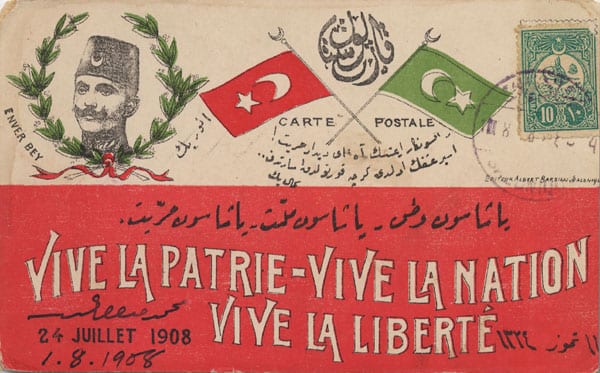
Read this image: Enver’s portrait and the multilingual celebration of fatherland, nation, and liberty belong to the revolutionary moment. Compare that promise with the later centralization, coup, wartime rule, and violence traced below. It is evidence of public political messaging, not proof that the revolution delivered its promises.
Source: Anonymous Ottoman postcard, 1908, Commons source record, public domain. Compare Attachment (file not included in this release) and the detailed page references in this study.

Three main points: The Young Turks began as a broad opposition to Abdülhamid II’s personal rule, not as a single, already unified dictatorship. The Committee of Union and Progress (CUP) became the dominant organization within that movement and consolidated power through several distinct stages after 1908. Its project of saving the empire increasingly subordinated constitutional rights, regional autonomy, and minority security to centralized control, culminating in wartime dictatorship and genocide.
Three anchors: The restoration of the constitution in July 1908; the January coup and subsequent suppression of opposition in 1913; and the organized destruction of the Armenian population in 1915.
Qualification: External invasion, Muslim displacement, and genuine fears of partition help explain radicalization. They neither made genocide inevitable nor justified treating civilian populations as collective enemies.
Question to retain: How did an opposition that promised to restrain arbitrary government come to claim that the state’s survival required still fewer restraints on its own power?
Sources and page-number key
This focused study draws on relevant passages from two book PDFs already in the vault. It supplements the Montefiore summary above; the discussion of Rogan here is not a summary of his whole book.
- Simon Sebag Montefiore, The Cauldron: Attachment (file not included in this release) for the revolution and Arab responses; Attachment (file not included in this release) for war, the coup, and genocide; Attachment (file not included in this release) for repression in the Arab provinces; and Attachment (file not included in this release) for the regime’s collapse. All numbers are PDF viewer pages, because this supplied draft does not provide reliable final-edition pagination.
- Eugene Rogan, The Fall of the Ottomans (2015): Chapter 1, Attachment (file not included in this release), supplemented by passages on entry into war, genocide, and the postwar reckoning. References show printed pages first and PDF viewer pages second. For example, printed p. 4 is PDF p. 31 in this file.
Who were the Young Turks?
The Young Turks were an umbrella movement, bringing together opponents of the sultan’s absolutism who wanted constitutional government and a parliament. The CUP was an organization within that wider movement. “Young Turks,” “CUP,” and “the Three Pashas” therefore refer to overlapping but different things: a broad political opposition, a particular party and network, and the leadership that eventually dominated wartime government. Rogan makes the umbrella-versus-organization distinction explicitly. Attachment (file not included in this release)
Their immediate political precedent was the 1876 Ottoman constitution, suspended under Abdülhamid during the crisis of the 1877–1878 war with Russia. They initially sought its restoration, not the abolition of monarchy or immediate creation of Atatürk’s later republic. Modern military schools, professional training, bureaucracy, and communications helped produce the educated officers and officials who opposed the ruler whose modernizing institutions had trained them. Montefiore locates the movement’s decisive revolutionary network in Salonika and Ottoman Macedonia. Attachment (file not included in this release) Attachment (file not included in this release)
The movement was not initially exclusively Turkish in membership or uniformly committed to one political outcome. Montefiore describes a coalition involving several ethnic and religious backgrounds; Rogan emphasizes the wider hopes of Turks, Arabs, Armenians, Kurds, Christians, Jews, and Muslims for equal Ottoman citizenship. This matters because the later dictatorship should not be projected backward as the complete program of everyone who supported the revolution. Attachment (file not included in this release) Attachment (file not included in this release)
1. The 1908 revolution: restoring the constitution to save the empire
The revolution developed within the army in Macedonia, where fear of discovery pushed CUP conspirators into action. Rogan identifies Ahmed Niyazi’s July 1908 revolt, followed by wider military and civilian support, as a decisive beginning. Enver became another celebrated revolutionary officer. Once the Third Army threatened intervention and the sultan could no longer rely on the armed forces to suppress the movement, Abdülhamid agreed to restore constitutional government on 23 July 1908; public celebrations followed on the 24th. Attachment (file not included in this release)
The promise was an Ottoman political community in which different groups possessed equal rights and duties. The practical hope was also defensive: reformers believed constitutional government might strengthen the state and win European respect for its territorial integrity. Equal citizenship and imperial survival appeared compatible, perhaps mutually necessary.
Yet the revolution initially left much of the old government intact. Abdülhamid remained sultan, experienced ministers continued governing, and the CUP largely supervised rather than immediately taking every major office. Elections strengthened CUP influence, but the new order contained rival liberals, conservative religious forces, the palace, and divisions within the army. The failure to solve inflation and labor grievances further weakened early optimism. Rogan’s account therefore cautions against saying that a finished Three Pashas dictatorship began in July 1908. Attachment (file not included in this release)
2. The 1909 counter-revolution: the sultan falls, but political division remains
In April 1909, mutinous soldiers and religious opponents of the CUP challenged the constitutional leadership in Istanbul. The palace used the crisis to reassert influence. Constitutional supporters mobilized the Action Army from Macedonia, which suppressed the revolt. Parliament deposed Abdülhamid on 27 April, replacing him with Mehmed V. The monarchy survived; the old sultan’s personal rule did not. Attachment (file not included in this release)
The crisis exposed the distance between a constitutional formula and institutions capable of protecting citizens. Massacres of Armenians in Adana shattered confidence in the new order’s promises. Rogan also describes Cemal’s subsequent efforts to restore order and the CUP’s attempt to preserve cooperation with Armenian political representatives. That combination is important: neither a story of uninterrupted harmony nor a simple claim that all cooperation ended in 1908 accurately represents the sequence. Attachment (file not included in this release)
Montefiore stresses the increasingly Turkish-centered and coercive direction of the leadership. Rogan gives more space to the intervening political struggles and efforts to recover legitimacy. Together, they show a narrowing of the original coalition rather than one instantaneous transition from freedom to total dictatorship. Attachment (file not included in this release)
3. Libya and the Balkan Wars: why the leadership radicalized
Between 1911 and 1913, war transformed the movement’s political environment. Italy attacked Ottoman Libya; the Balkan states then captured much of the empire’s remaining European territory. These were not remote possessions in the leadership’s imagination: Macedonia and Thrace contained important economic, administrative, and personal roots of the Ottoman ruling world. The loss of Salonika, birthplace of the revolution, made the crisis especially acute. Attachment (file not included in this release)
The wars changed both methods and convictions. In Libya, Enver and other officers organized resistance with Arab fighters and religious networks. Rogan shows that a comparatively secular officer could still use the sultan’s caliphal status and Islamic solidarity as powerful tools of mobilization. Turkish nationalism, imperial loyalty, and religious politics were not mutually exclusive instruments. The Libyan experience also helped develop the networks and practices associated with the Special Organization. Attachment (file not included in this release)
The Balkan defeats brought refugees, disease, financial strain, humiliation, and fear of further partition. Montefiore stresses the leadership’s growing language of revenge, its use of Social Darwinist ideas, and its increasing identification of minorities with external enemies. Rogan explains how territorial emergency encouraged centralization and the abandonment of liberal commitments. Neither account requires the conclusion that repression was the only available response. These conditions explain the leaders’ fears; their decisions explain how those fears became policy. Attachment (file not included in this release) Attachment (file not included in this release)
4. The 1913 coup: when the CUP became a governing dictatorship
On 23 January 1913, Enver and armed supporters raided the Sublime Porte, the Ottoman government’s headquarters, and forced Grand Vizier Kamil Pasha to resign. They justified their action through opposition to concessions in the Balkan War, especially the threatened loss of Edirne. The war minister was killed during the coup. Attachment (file not included in this release) Attachment (file not included in this release)
The consolidation still occurred in stages. Rogan distinguishes the January coup from the later monopoly of power: the immediate replacement government under Mahmud Şevket Pasha was not simply a cabinet of the future triumvirs. After Şevket’s assassination in June, the CUP used arrests, executions, and exile to break its liberal opponents. Said Halim Pasha then headed a government in which the Unionist leadership gained much greater authority. The recovery of Edirne boosted its prestige; Enver became war minister in January 1914. Attachment (file not included in this release)
This sequence explains why the 1908 revolution, January 1913 coup, and wartime Three Pashas regime should be distinguished. Montefiore compresses the path to dictatorship; Rogan supplies the intermediate changes in office and power. The institutional result is the opposite of the original constitutional aim: fewer effective competitors and fewer restraints on those claiming to safeguard the empire.
5. The principal leaders
| Figure | Position in the story | Why the distinction matters |
|---|---|---|
| Talaat / Talat Pasha | CUP organizer and interior minister; later grand vizier. | Civil administration and party networks were central to coercion and the Armenian genocide; this was not solely an army dictatorship. |
| Enver Pasha | Revolutionary officer, wartime minister of war, and advocate of military recovery. | His career connects revolutionary prestige, military ambition, the German alliance, and irregular operations. |
| Jemal / Cemal Pasha | Senior CUP leader, naval minister, and wartime ruler and commander in Syria. | His command in the Arab provinces demonstrates how the regime’s policies affected populations beyond Anatolia. |
| Mustafa Kemal, later Atatürk | Officer within the wider reformist military world, a veteran of Libya, and a successful Ottoman commander. | He was not one of the Three Pashas. His later republic followed the defeat of their wartime government and the struggle over the postwar settlement. |
The spelling pairs identify the same people across these editions, not separate figures. Sources: Attachment (file not included in this release), Attachment (file not included in this release), and Attachment (file not included in this release).
6. Centralization and Arab opposition
The CUP sought a more uniform state through taxation, conscription, administration, and the expanded use of Turkish. Rogan describes Arabic losing ground in schools, courts, and government offices, while Arab officials saw important posts favor Turkish appointees. Policies intended to prevent separatism helped generate opposition to Turkification. Attachment (file not included in this release)
However, early Arabist demands were often for equality, recognition of Arabic, decentralization, or a Turco-Arab partnership within the empire, rather than immediate independence. Al-Fatat and the Ottoman Decentralization Party proposed different ways to preserve a reformed political union. The First Arab Congress in Paris in 1913 pressed such demands. The CUP negotiated concessions but failed to implement the expected reform, deepening mistrust. Attachment (file not included in this release)
During the First World War, Cemal’s executions, arrests, and deportations in the Arab provinces made that breach more severe. Montefiore links the repression to the experience of Faisal and other potential Ottoman loyalists who moved toward revolt. A policy intended to preserve imperial unity could destroy reasons for remaining loyal to the empire. This did not mean that every Arab rebelled: many continued to serve in Ottoman forces. Attachment (file not included in this release) Attachment (file not included in this release)
7. The First World War and the Armenian genocide
Rogan presents the German alliance as a response to the leadership’s search for protection, particularly against Russia. Ottoman leaders had also explored other relationships; Cemal sought French support, unsuccessfully. The secret alliance with Germany was signed on 2 August 1914, but alliance did not mean immediate entry into the war. The government hesitated before German pressure, Ottoman ambitions, financing, and naval decisions ended neutrality. Attachment (file not included in this release)
Attacks on Russian Black Sea targets on 29 October 1914 brought the empire into hostilities. The regime also used the sultan-caliph’s religious authority to mobilize support. Rogan distinguishes the formal sanction of jihad on 11 November from its public proclamation on 14 November. This is further evidence that modern nationalist leaders could deploy religious institutions when strategically useful. Attachment (file not included in this release)
The war did not create a legitimate basis for the collective punishment of Armenians. Rogan traces the escalation from earlier population expulsions and fears of Russian-backed partition to decisions by Talaat and other CUP officials in early 1915. He describes a two-track system: public deportation orders through the state and instructions for mass killing through party and associated networks. The Special Organization, compliant officials, armed gangs, and others helped implement the destruction. He also identifies officials who resisted and faced removal or worse, evidence that participation was not automatic. Attachment (file not included in this release) Attachment (file not included in this release)
Montefiore likewise presents the Armenian genocide as organized state violence, alongside mass violence against Assyrians and Greeks. Rogan’s particularly important conclusion is that annihilating minorities did not save the empire or solve its military problems. The defeat at Gallipoli was averted by soldiers’ resistance, not by genocide; Russian advances elsewhere continued. Explanation of the leadership’s insecurity is therefore distinct from accepting its claim that destroying civilians served a necessary defensive purpose. Attachment (file not included in this release) Attachment (file not included in this release)
8. Defeat, flight, and the postwar reckoning
The government’s project failed to preserve the empire. Following the 1918 armistice, the leading CUP figures fled with German assistance. Rogan describes their departure on 1 November 1918, followed by public anger and Ottoman debate over responsibility for the war and Armenian massacres. Attachment (file not included in this release)
Postwar Ottoman military tribunals assembled testimony and documents concerning the genocide and sentenced leading figures in absentia. Because the principal defendants were abroad, only a few lower-ranking officials were executed. The trials’ limited enforcement should not be confused with an absence of Ottoman evidence or contemporary acknowledgment of organized mass killing. Attachment (file not included in this release)
Armenian assassins subsequently killed Talaat in Berlin and Cemal in Tbilisi; Enver died fighting the Bolsheviks in Central Asia. There is a source discrepancy: the supplied Montefiore draft places Talaat and Jemal’s assassinations together in Berlin on PDF p. 97, while Rogan gives Cemal’s location as Tbilisi and date as 25 July 1922. This section follows Rogan’s more specific account and records the difference rather than silently treating both texts as identical. Attachment (file not included in this release) Attachment (file not included in this release)
The later Turkish Republic belongs to a connected but different phase. It is misleading to identify Atatürk’s government with the Three Pashas simply because all emerged from the late Ottoman military-political world. The wartime leadership collapsed; Mustafa Kemal then built a nationalist resistance to occupation and partition and established a new state. This distinction does not by itself settle every question about continuities of personnel, nationalism, or coercion. Attachment (file not included in this release) Attachment (file not included in this release)
The historical argument in one paragraph
The Young Turks’ history is a transformation in the meaning of saving the state. In 1908, many supporters believed that equal citizenship and constitutional limits would make the empire stronger. After military defeat, territorial loss, factional struggle, and displacement, the dominant CUP leadership increasingly treated political competition and communal difference as threats to survival. The January coup and later purges secured its power; the war then expanded the reach of coercion and enabled genocide. The outcome was neither the freedom originally promised nor the imperial security claimed to justify repression. Both books make the reversal visible; Rogan supplies particularly useful detail on its intermediate political stages and institutional mechanisms.
Closed-book retrieval questions
- What is the difference between the Young Turks, the CUP, and the Three Pashas?
- Reconstruct the separate political changes of July 1908, April 1909, January 1913, and June 1913.
- How did losses in Libya and the Balkans change both the leadership’s worldview and its methods?
- Why did some Arab reformers initially favor a changed Ottoman Empire rather than independence, and how did CUP policy affect that position?
- How do the books distinguish explaining the regime’s fears from justifying its genocide, and what evidence challenges the claim that mass killing enhanced security?