
Source: Open the supplied book PDF (file not included in this release) · Reading record: Current reading record · Future selection: Annual-plan record
About this copy and these notes
The supplied PDF has a complete narrative through early 2026, although its title page says 1900–2025. It contains production instructions, an unfilled maps/family-trees placeholder on PDF p. 20, and empty bibliography and index headings on pp. 397–398. The contents repeats Part XII; the narrative correctly labels the final Part XIII. Part XII’s date range also differs between contents and body. These notes use the actual section titles, chronological context, and PDF viewer pages. They summarize Montefiore’s account; they do not independently verify its statistics, quotations, intelligence claims, legal characterizations, or recent-event judgments.
Source status: Supplied 398-page PDF with production placeholders; narrative read in full; final published edition not verified. Page links are PDF viewer pages, not final-edition pagination.
Notebook pages (B5)
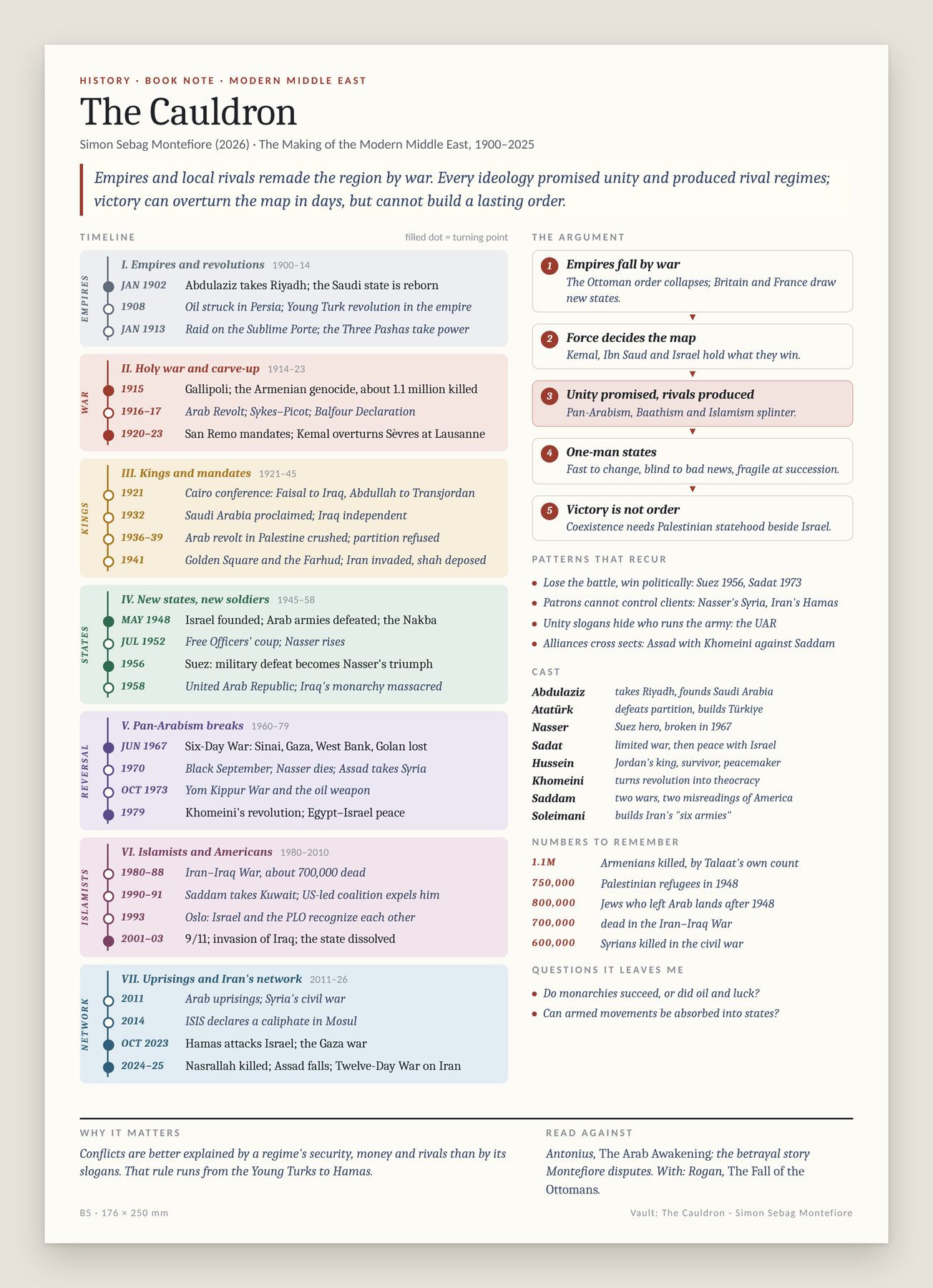
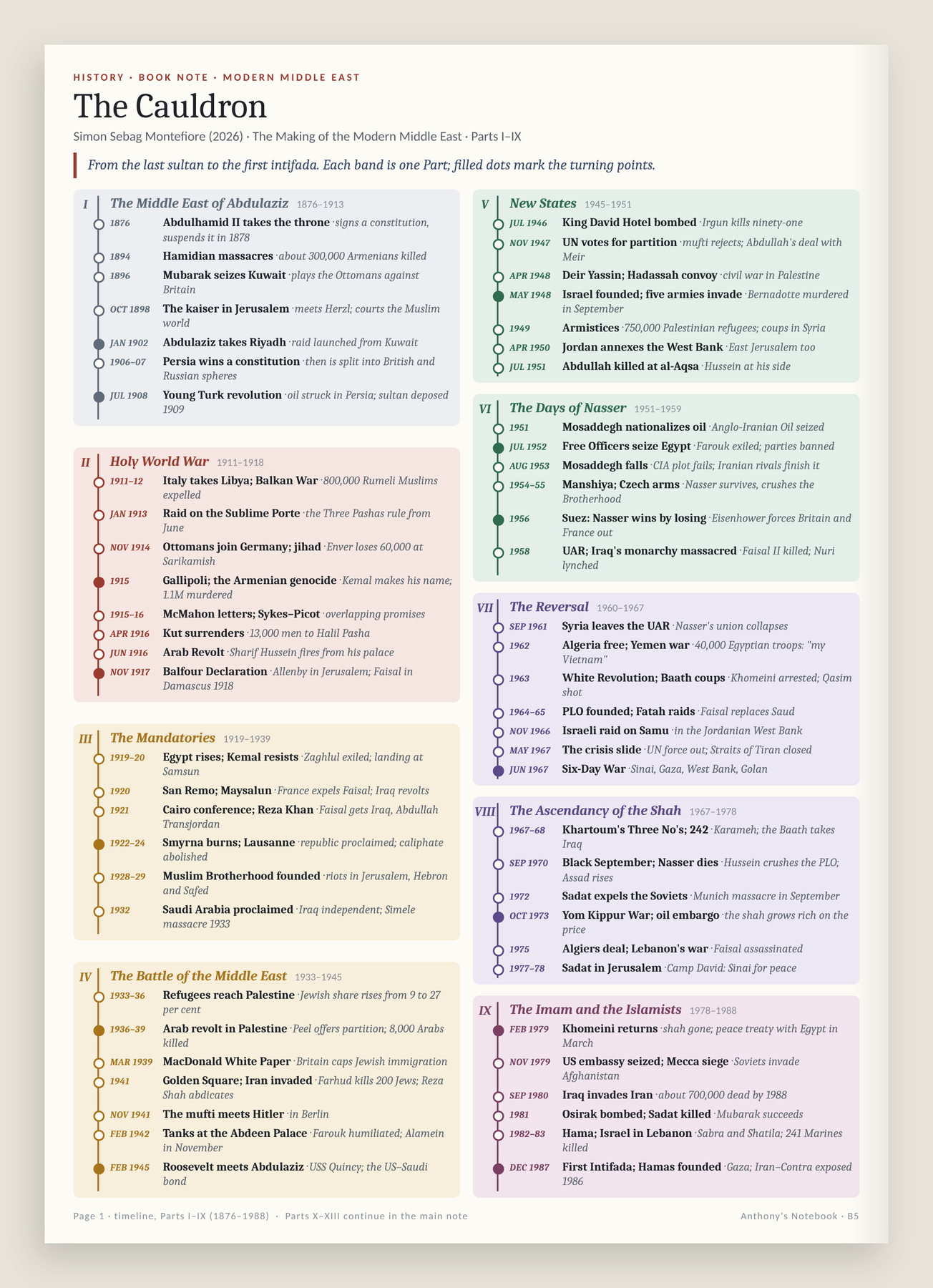
One-page book note: thesis, a timeline of the main events in seven phases, the argument as a five-step chain, recurring patterns, key numbers, cast, and why it matters. Source: HTML (file not included in this release).Two-page note (B5), page 1:
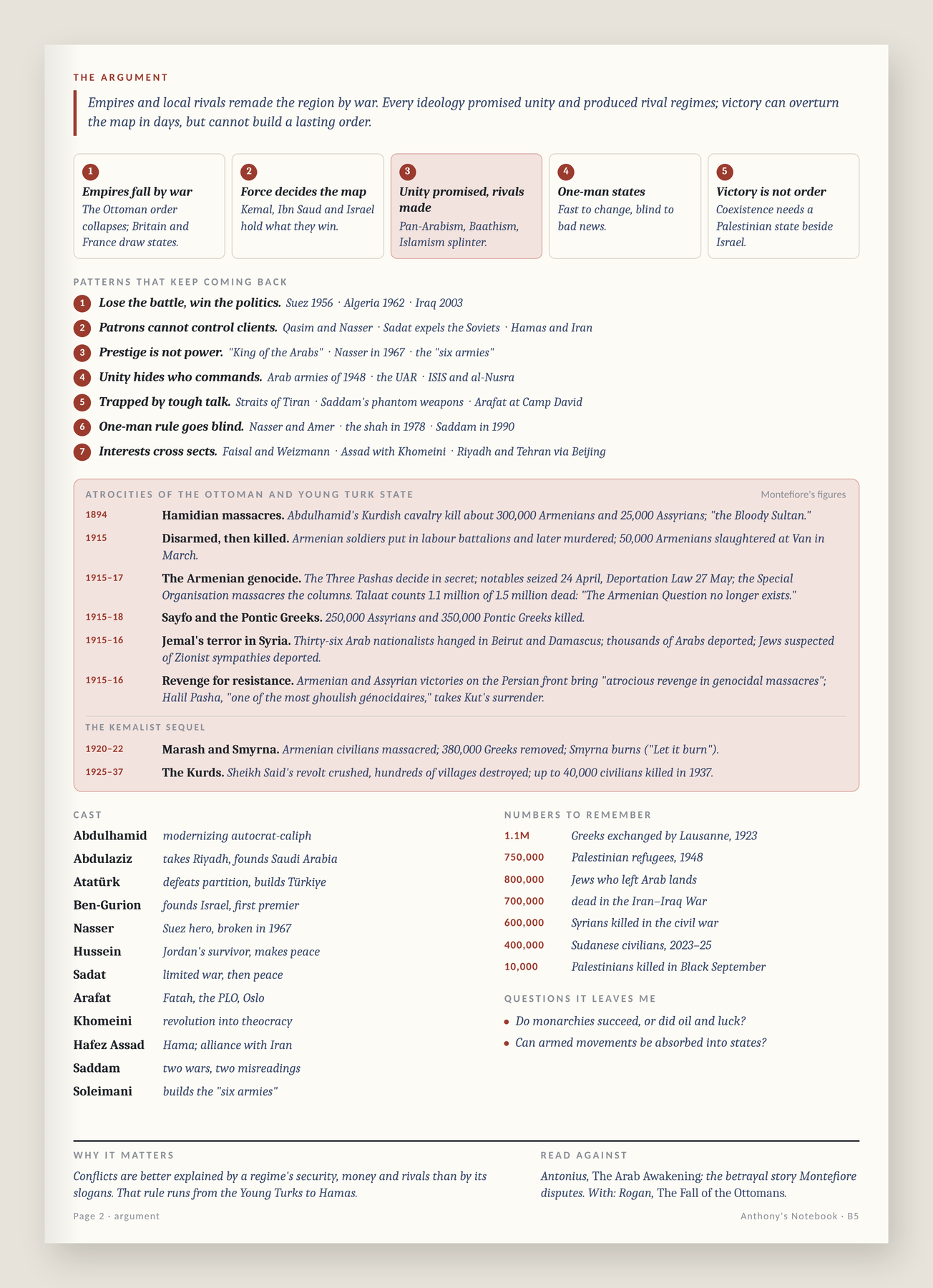
A detailed timeline of Parts I–IX (1876–1988), one band per Part, with turning points marked. Source: HTML (file not included in this release).Page 2:
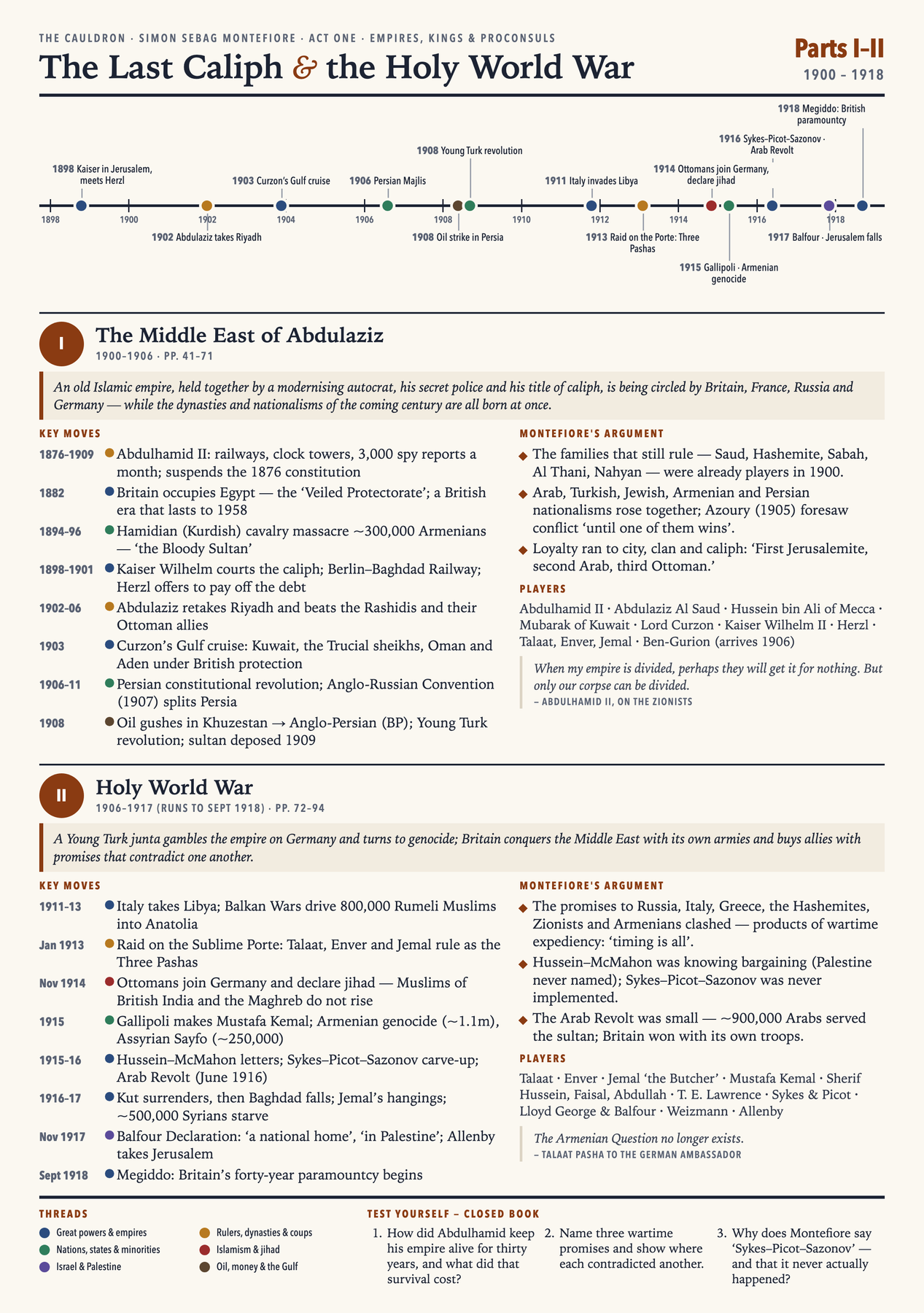
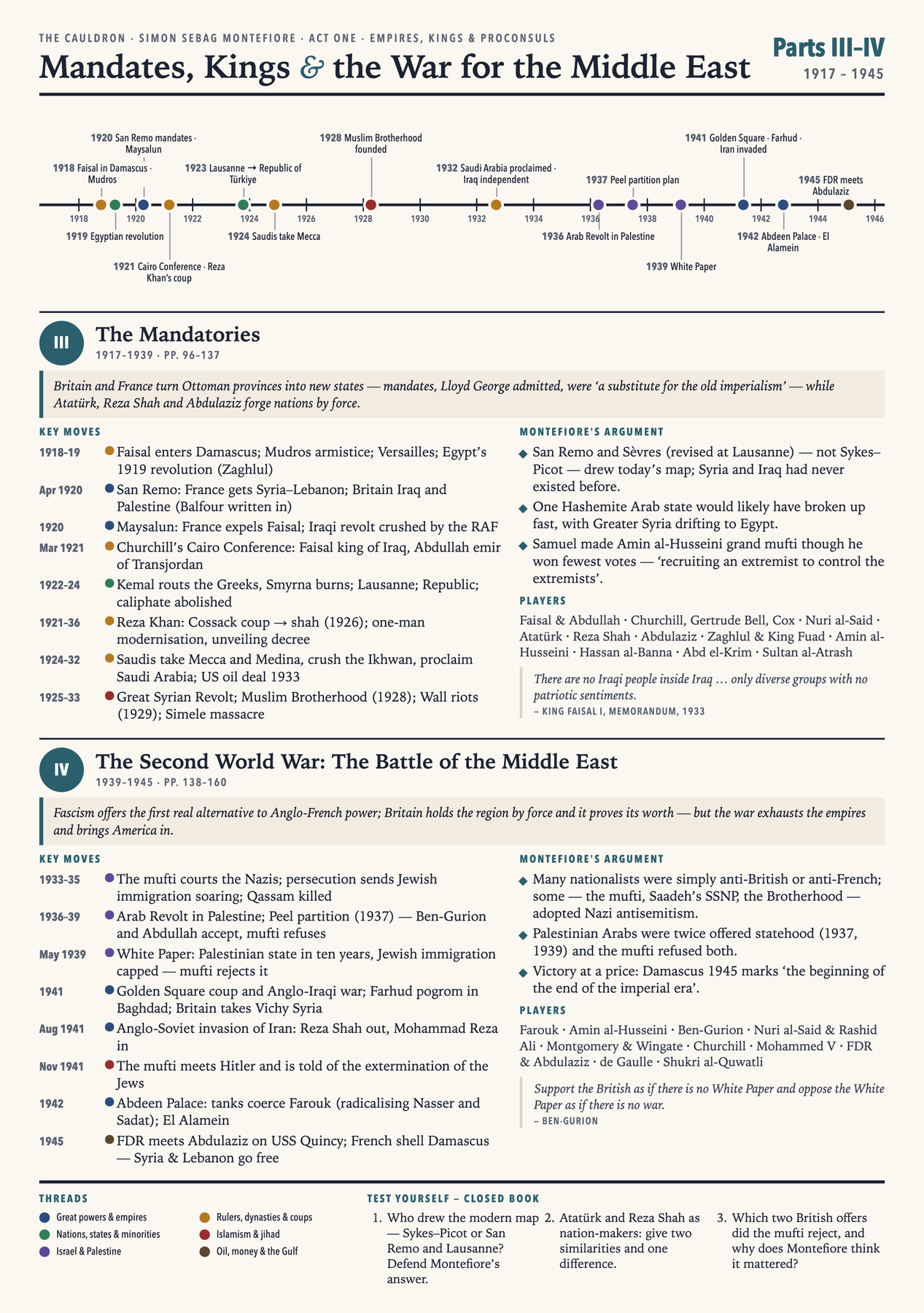
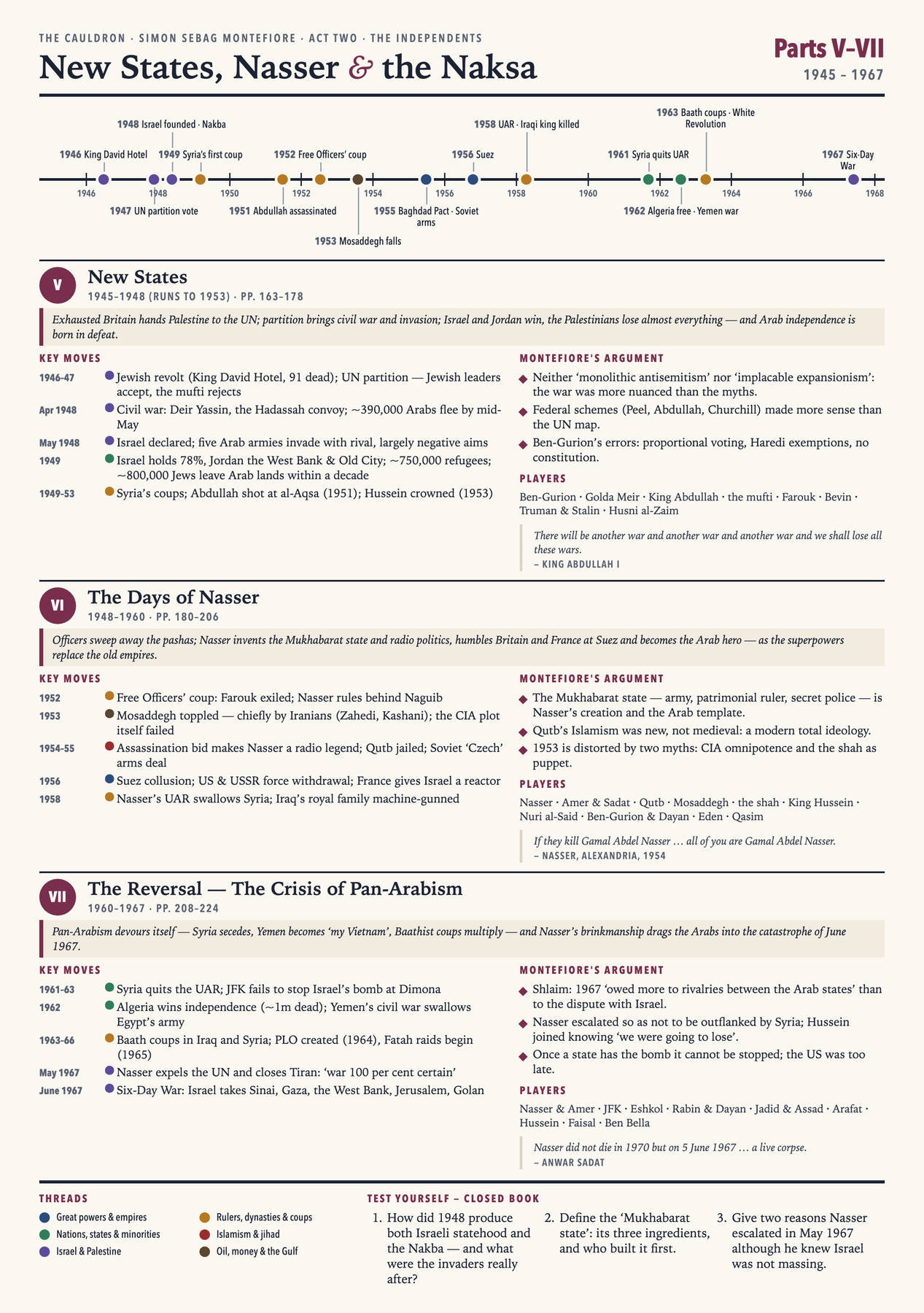
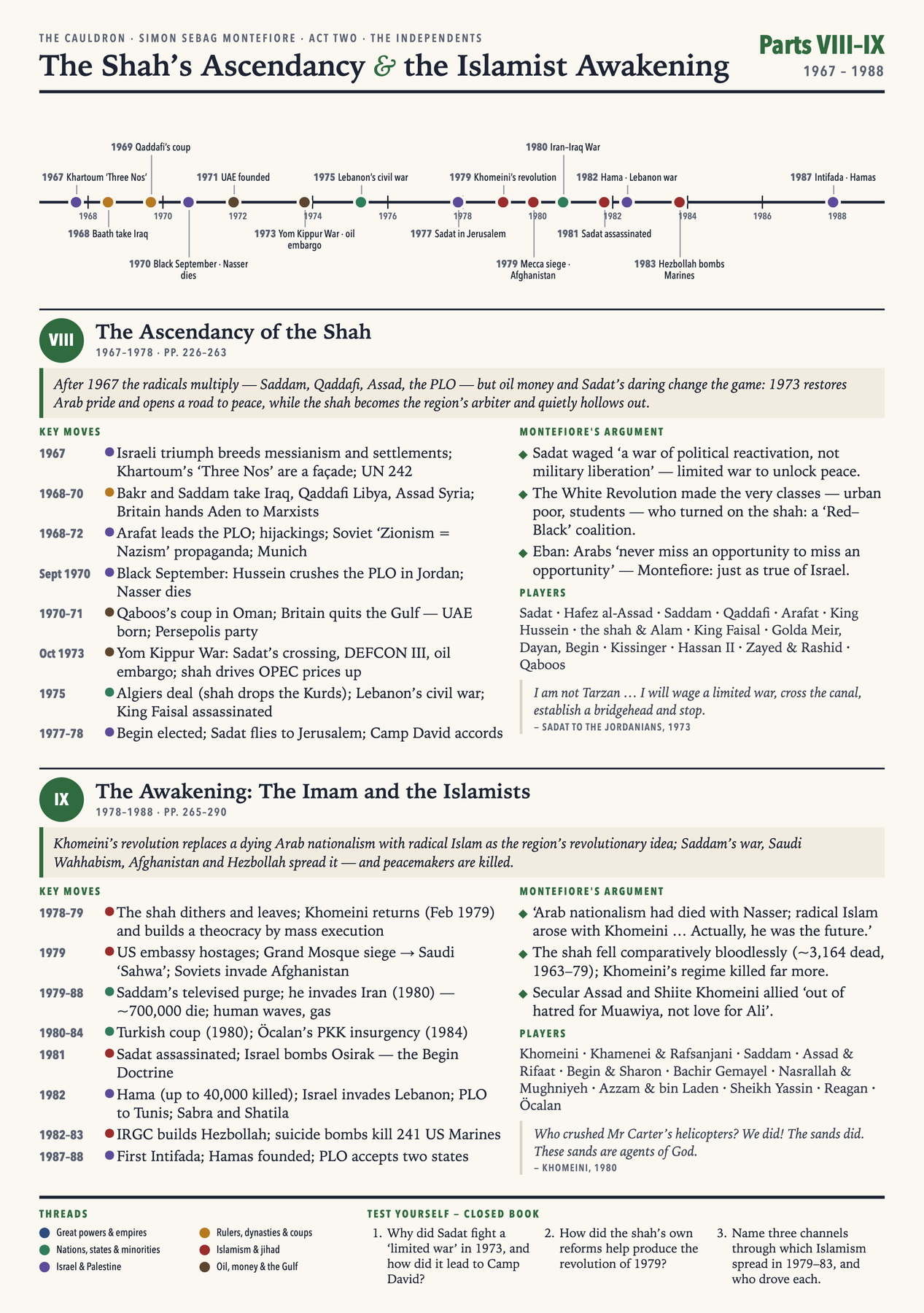
The argument, the seven recurring patterns, the atrocities of the Ottoman and Young Turk state (with the Kemalist sequel), cast, key numbers and open questions. Source: HTML (file not included in this release).Part summaries (B5), six pages: each page covers two or three Parts with a colour-coded timeline, then for each Part a one-sentence summary, dated key moves, three of Montefiore’s arguments, the main players, a quote and PDF page range, plus three closed-book questions. Made 2 November 2026 after a full read of Parts I–XIII; the Conclusion is not included.
Parts I–II, 1900–1918: the last caliph, the Young Turks, the Holy World War and the wartime promises.
Parts III–IV, 1917–1945: the mandates, the nation-makers and the Second World War in the Middle East.
Parts V–VII, 1945–1967: 1948, the days of Nasser and the Six-Day War.
Parts VIII–IX, 1967–1988: the shah’s ascendancy, 1973, Khomeini and the Islamist awakening.
Parts X–XI, 1988–2013: the American era, Oslo, Iraq and the Arab Spring.
Parts XII–XIII, 2012–2026: Iran’s crescent, ISIS, MBS and the October 7 wars.Whole-book ledger (B5): assassinations where Muslims or Arabs killed Muslims or Arabs.
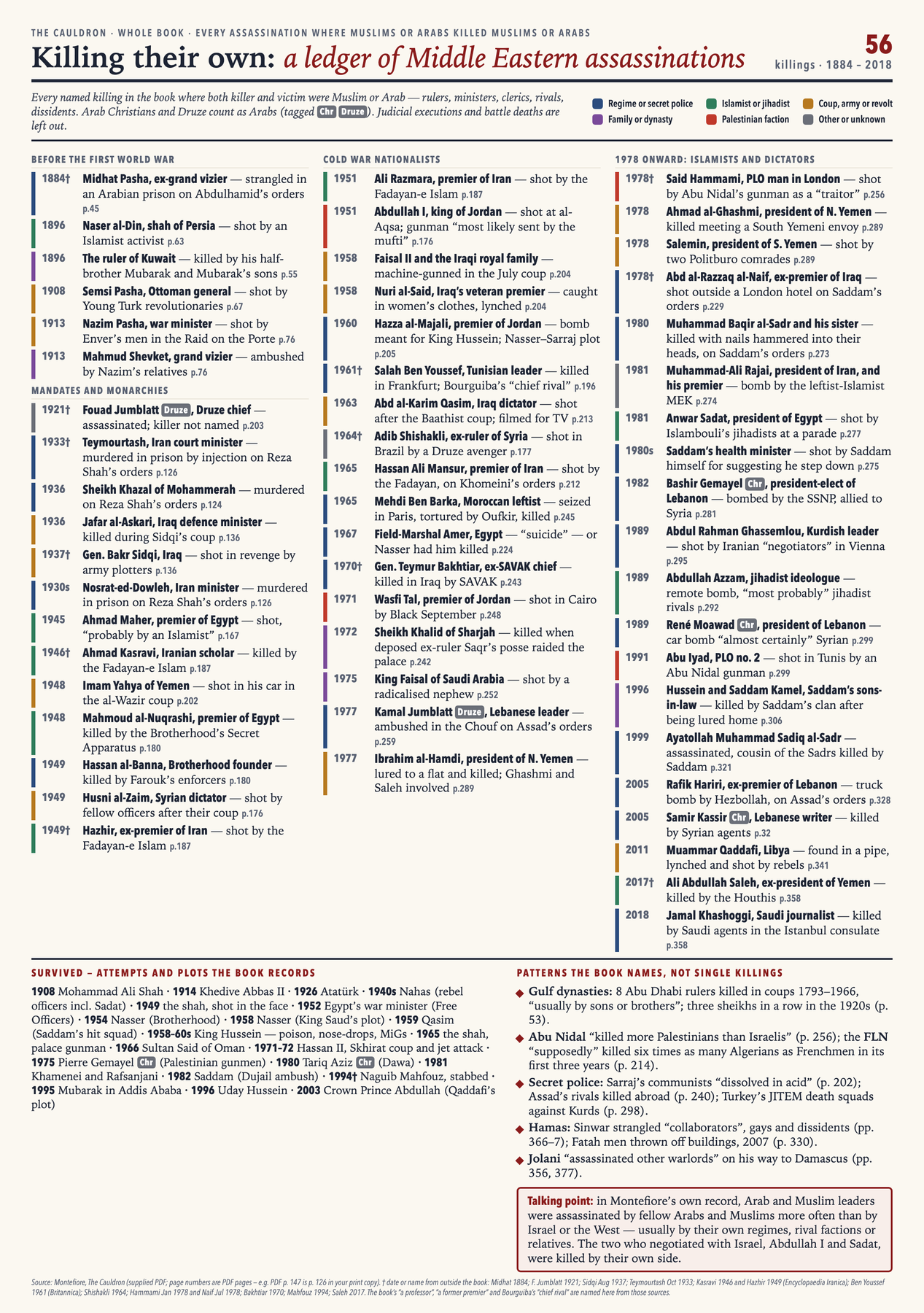
What the ledger contains:
- 56 named killings, 1884–2018, in three eras, colour-coded by the type of killer: regime or secret police, Islamist, coup or army, family or dynasty, Palestinian faction, or other.
- 21 attempts and plots that the victims survived.
- Five recurring patterns: Gulf dynastic killings, Abu Nidal and the FLN, secret police, Hamas, and Jolani.
- A debate talking point.
Made 3 November 2026 from two keyword passes over the full text of the book.
Scope: Arab Christians and Druze count as Arabs, and Turks, Iranians and Kurds count as Muslims. Judicial executions, battle deaths and killings by outsiders are left out. Page numbers on the card are PDF pages.
Some details come from outside the book and are marked †:
- Dates for Midhat, Sidqi, Teymourtash, Shishakli, Hammami, Naif, Bakhtiar, Mahfouz and Saleh.
- Names for three victims the book leaves unnamed: Kasravi and Hazhir (from Encyclopaedia Iranica) and Ben Youssef (from Britannica).
Nosrat-ed-Dowleh’s date is left as “1930s”, following the book.
Whole-book page (B5): violent statements against Jews, and Arab-against-Arab conflict, 1945–1967.
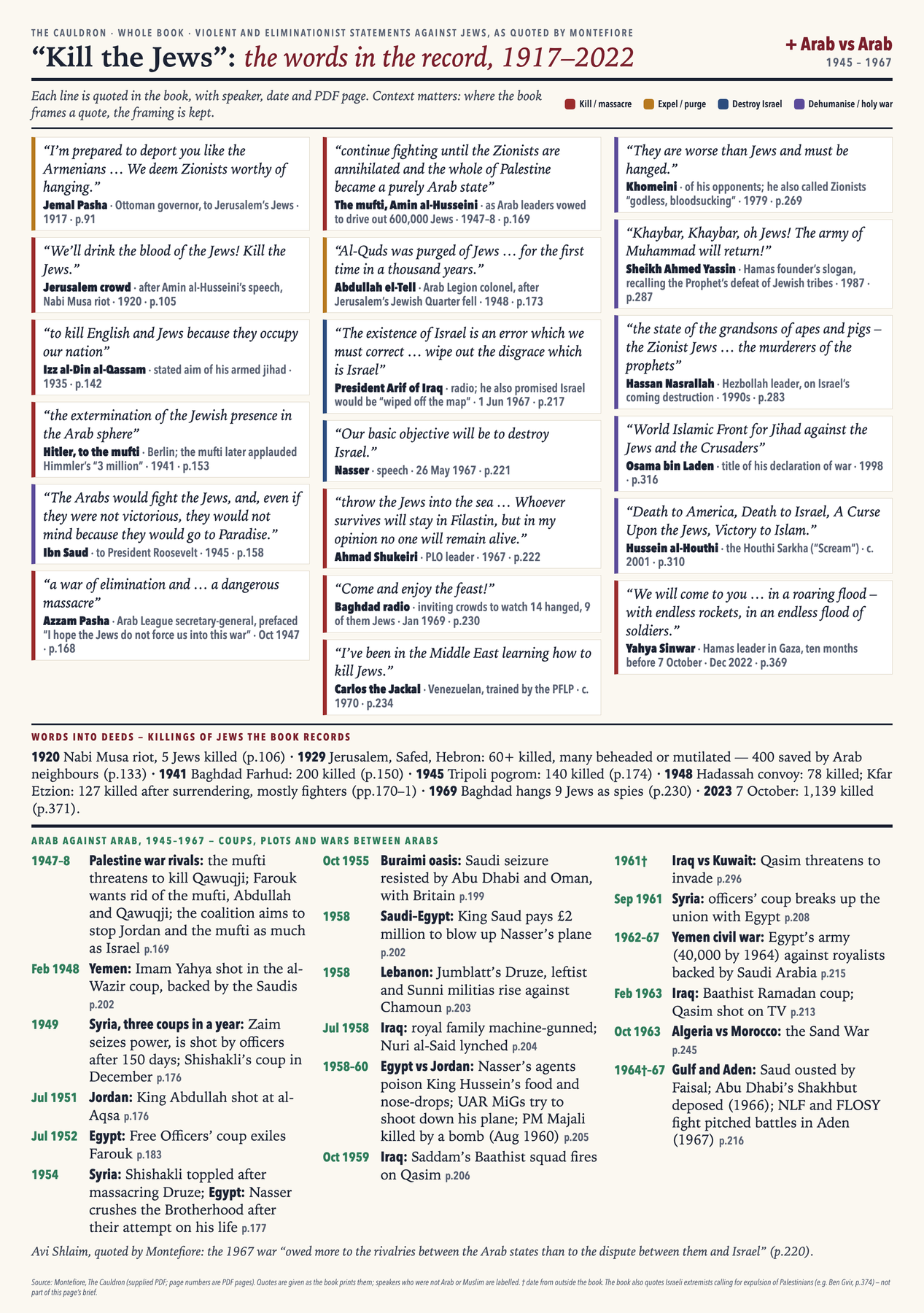
The page has three sections:
- Quotes: 19 violent or eliminationist statements against Jews quoted in the book, 1917–2022, from Jemal Pasha to Sinwar. Each gives the speaker, date and PDF page, and is colour-coded as kill or massacre, expel or purge, destroy Israel, or dehumanise or holy war.
- Words into deeds: a strip of the killings of Jews the book records, from 1920 to 7 October.
- Timeline: 18 coups, plots and wars between Arabs, 1945–1967, ending with Avi Shlaim’s line that the 1967 war owed more to rivalries among the Arab states than to their dispute with Israel (PDF p. 220).
Notes:
- Quotes keep the book’s framing. Azzam Pasha’s line keeps its “I hope the Jews do not force us” preface, and the 1929 entry records the 400 Jews saved by Arab neighbours.
- Speakers who were not Arab or Muslim are labelled: Hitler, speaking to the mufti, and Carlos.
- Two dates come from outside the book (†): Qasim’s threat to Kuwait in 1961 and Faisal ousting Saud in 1964.
- The book also quotes Israeli extremists calling for the expulsion of Palestinians (e.g. Ben Gvir, PDF p. 374). They are outside this page’s brief but available for a matching page.
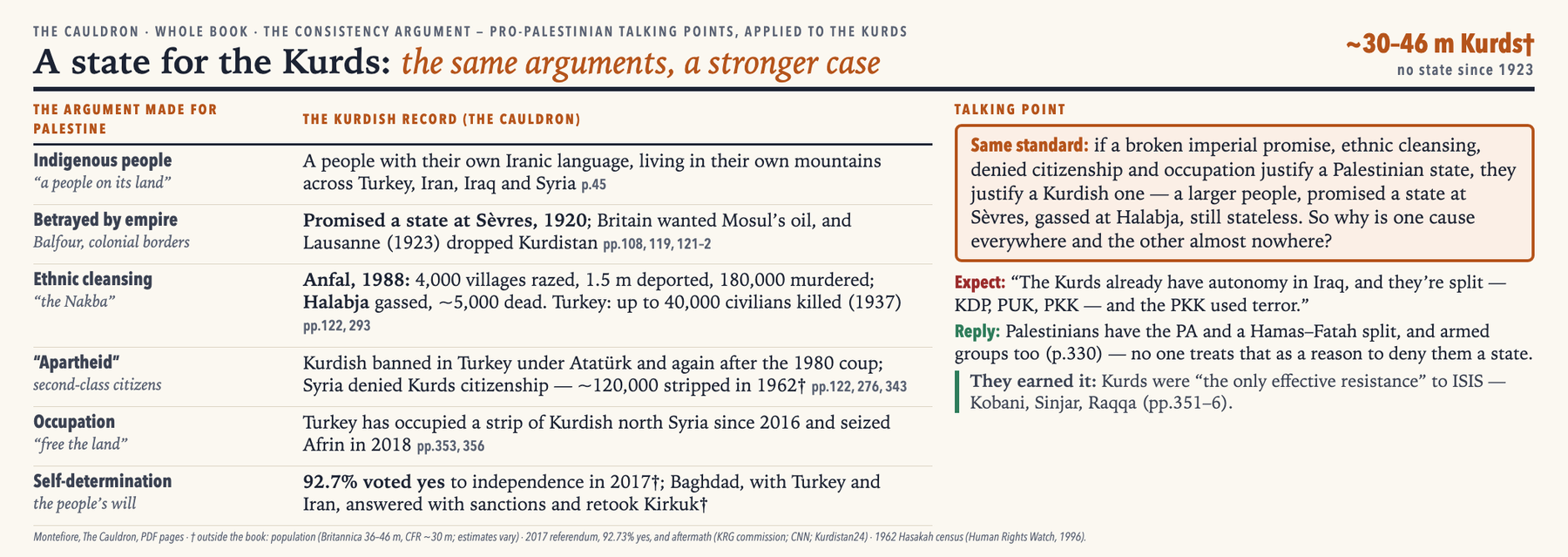
Debate strip (quarter B5, horizontal): the case for a Kurdish state.
This is a consistency argument: six pro-Palestinian arguments set against the Kurdish record in the book.
- Indigeneity: PDF p. 45.
- Imperial betrayal: Sèvres to Lausanne, PDF pp. 108, 119, 121–2.
- Ethnic cleansing: Anfal, Halabja and Dersim, PDF pp. 122, 293.
- Second-class citizenship: language bans and Syrian statelessness, PDF pp. 122, 276, 343.
- Occupation: Turkey in northern Syria, PDF pp. 353, 356.
- Self-determination: the 2017 referendum.
The strip ends with a talking point, the expected rebuttal (autonomy, Kurdish divisions, the PKK) and a reply, plus the Kurds’ role against ISIS (PDF pp. 351–6).
Notes:
- The Anfal deportation figure is 1.5 million, as on the printed page; the PDF’s text layer drops the “1.”.
- Outside the book (†): the population estimate (Britannica 36–46 m, CFR ~30 m), the 2017 referendum result and its aftermath, and the 1962 Hasakah census (Human Rights Watch).
- The argument is weakest against pro-Palestinian advocates who already back Kurdish independence.
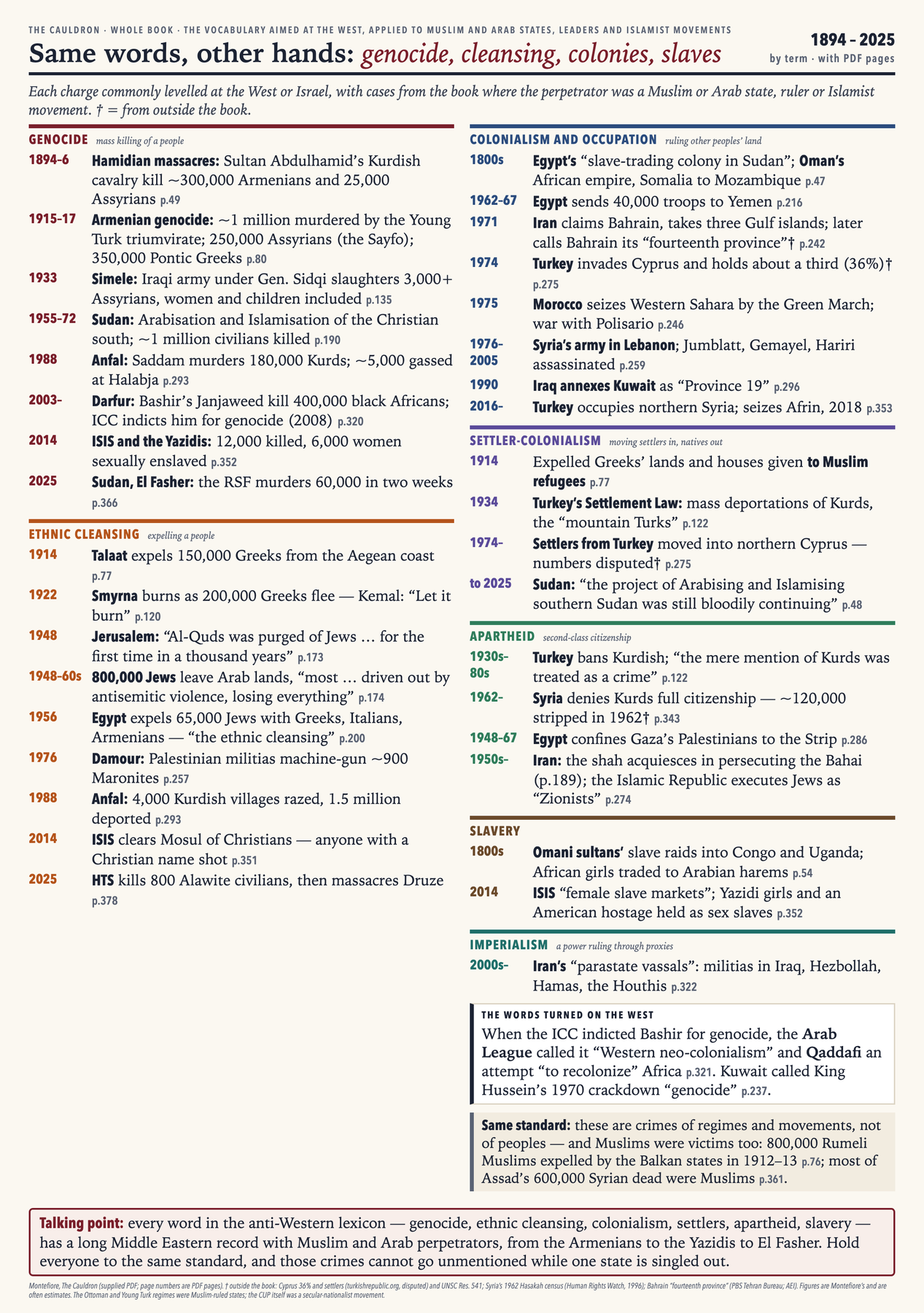
Whole-book page (B5): “Same words, other hands”. It takes the vocabulary usually aimed at the West or Israel and applies it to Muslim and Arab states, rulers and Islamist movements, using cases from the book.
The page groups 38 dated cases under seven terms:
- Genocide: from the Hamidian massacres and 1915 to Anfal, Darfur, the Yazidis and El Fasher.
- Ethnic cleansing: from Talaat’s 1914 expulsions and Smyrna to the Jewish exodus from Arab lands, Damour, Anfal, Mosul and the Alawites.
- Colonialism and occupation.
- Settler-colonialism.
- Apartheid.
- Slavery.
- Imperialism.
Two boxes sit alongside the cases. One shows the same words turned on the West: the Arab League called the ICC’s genocide warrant for Bashir “Western neo-colonialism” (PDF p. 321). The other is a same-standard note: these are crimes of regimes and movements, not peoples, and Muslims were victims too (PDF pp. 76, 361). The page ends with a talking point.
Notes:
- Page numbers on the card are PDF pages.
- Outside the book (†): Cyprus’s 36% and its settlers (settler numbers disputed), UNSC Resolution 541, Syria’s 1962 Hasakah census (Human Rights Watch) and Bahrain as Iran’s “fourteenth province” (PBS Tehran Bureau, AEI).
- The Bahai persecution is dated to the shah’s era, as the book places it (PDF p. 189).
- The Young Turks ran a Muslim-ruled state but were a secular-nationalist movement.
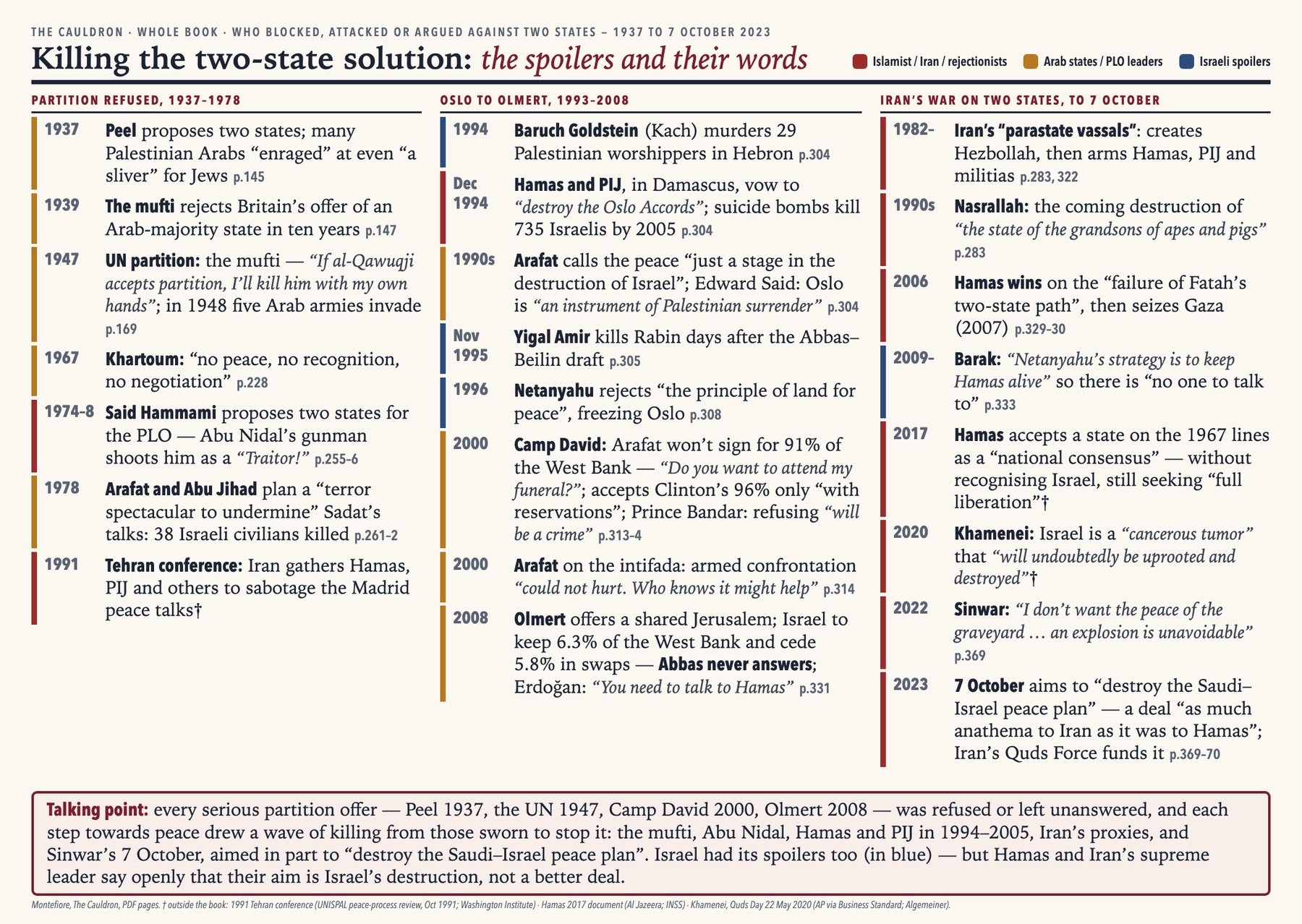
Whole-book card (half B5): killing the two-state solution, 1937 to 7 October.
The card has 23 dated entries in three eras, colour-coded by who blocked, attacked or argued against two states (Islamist, Iranian or rejectionist; Arab states or PLO leaders; Israeli spoilers):
- Partition refused, 1937–1978: from Peel and the mufti to Khartoum, Abu Nidal’s killing of Hammami, and Iran’s 1991 Tehran conference.
- Oslo to Olmert, 1993–2008: Hamas and PIJ vowing to “destroy the Oslo Accords”, Camp David 2000, and Abbas leaving Olmert’s 2008 offer unanswered.
- Iran’s war on two states: Nasrallah, Khamenei’s “cancerous tumor”, Sinwar, and 7 October’s aim to “destroy the Saudi–Israel peace plan” (PDF pp. 369–370).
Israeli spoilers are included: Goldstein, Yigal Amir, Netanyahu rejecting “the principle of land for peace”, and Barak’s “keep Hamas alive” line. So is the nuance of Hamas’s 2017 document, which accepted a state on the 1967 lines without recognising Israel. The card ends with a talking point. Page numbers on the card are PDF pages.
Sources outside the book (†):
- The 1991 Tehran conference: UNISPAL and Washington Institute.
- The 2017 Hamas document.
- Khamenei, Quds Day 2020.
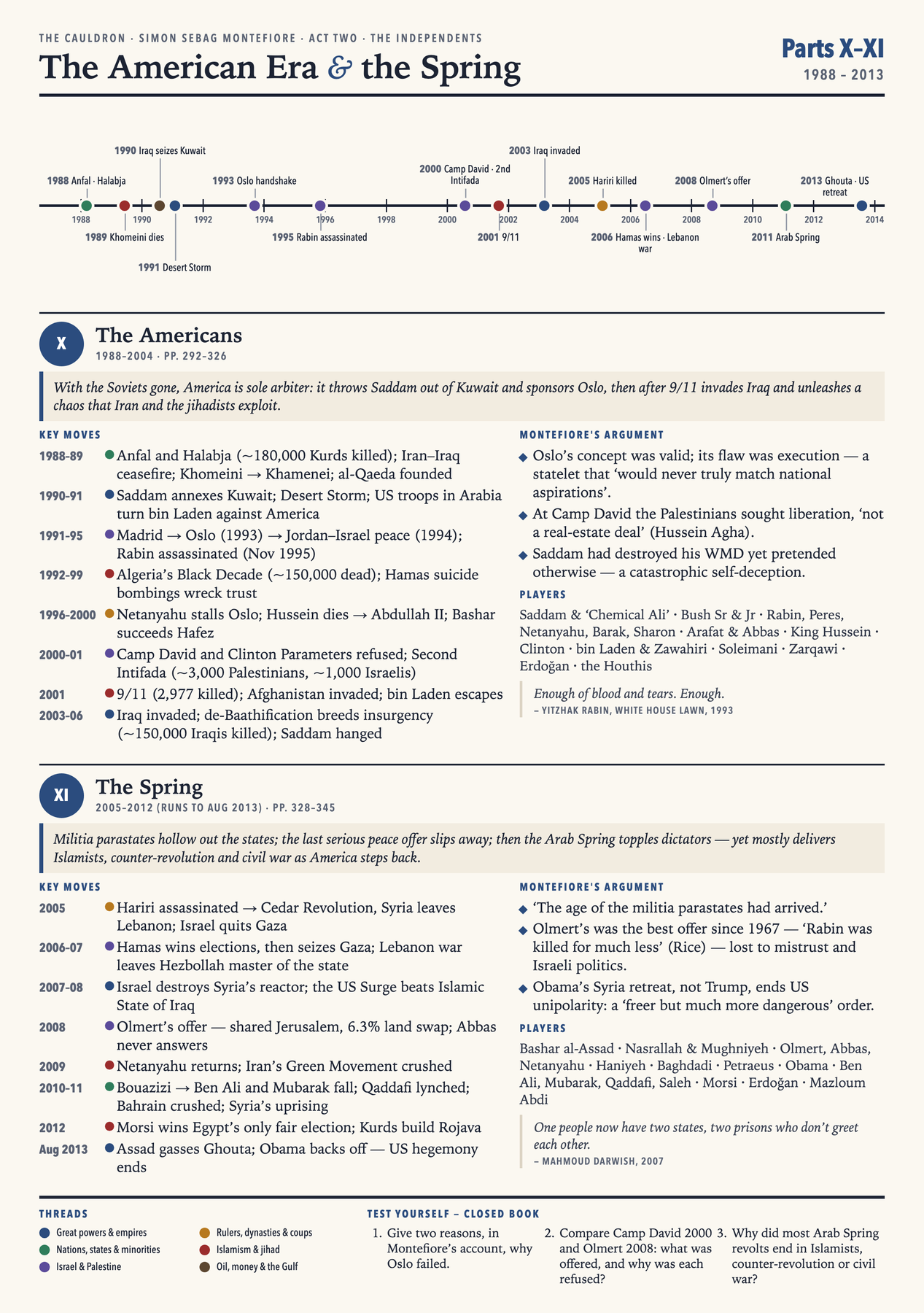
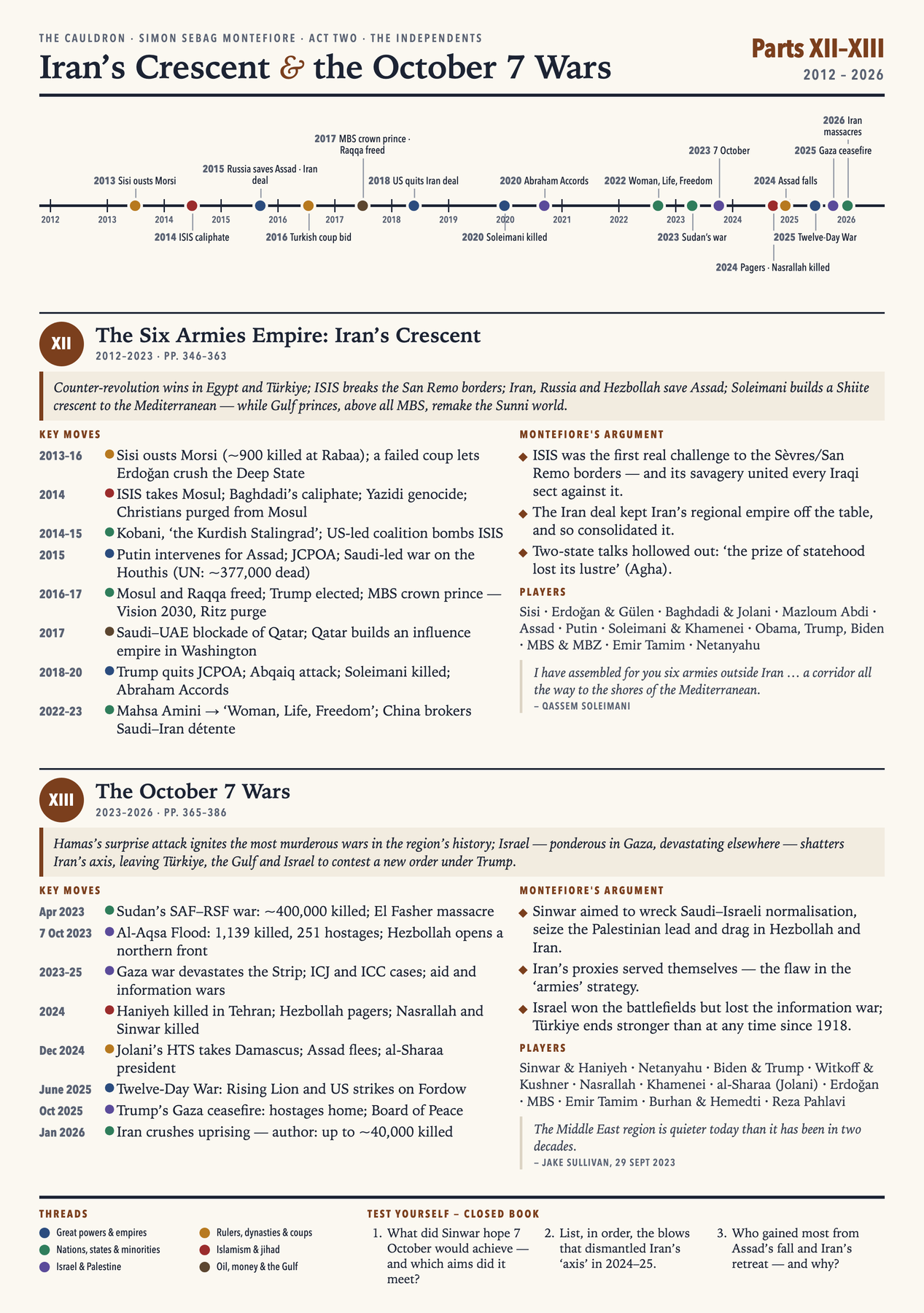
How to review: Start with the whole-book layer: the thirteen-Part table, the selective timeline and the key people. Then review one Part at a time. Each Part has a folded timeline, the argument section by section, key concepts, essential evidence with page links, a short Cautions list, and ten questions (five to reason through, five quick recall) with a folded answer key. Try each question before opening the key. For the parallel story by region, open the Centres of Power canvas (file not included in this release). For spaced repetition, use The Cauldron - Cards: 160 fact cards, 30 cause-and-effect cards and a monthly essay rotation, also available as an Anki deck.
Focused timeline and diplomacy: From Ottoman rule to Israel, 1876–1948 — the connected chronology, negotiations, PDF references and primary-document supplements.
Color maps, animation, and lineage charts
The visuals below are color companions selected for the relevant passages. Online maps retain their dates, legends, credits, and source links; the three family charts are selective study reconstructions with book-page references. They are not scans of the book’s back matter. The supplied PDF reserves space for maps and family trees on p. 20 (file not included in this release), so an exact one-for-one match to the published back-of-book plates has not been verified. Click an image to inspect it at full size; the ISIS map is animated.
Two-minute visual recall
After a Part, hide its map or chart and sketch the main change or family branches in Goodnotes. Add one cause and one consequence, then reopen the visual and correct your sketch. For the ISIS GIF, compare two dated frames and explain what changed; for family trees, distinguish parentage from succession.
What I Should Retain — Whole Book
- Three arguments: The modern Middle East emerged through interactions between foreign empires and local competitors; its peoples were participants in state-making, not passive objects. Nationalist and Islamist projects repeatedly promised unity while producing rival regimes, exclusions, and armed factions. Military success can overturn a regional hierarchy quickly, but it cannot by itself create legitimate government or lasting coexistence.
- Three anchors: The post-Ottoman settlement was revised by war after Sykes–Picot. Nasser’s rise after Suez and collapse in 1967 distinguish political prestige from effective power. Iran’s network of armed partners illustrates both the reach of indirect influence and the danger that a partner’s decisions can expose the whole system.
- Cautions: This is a strongly argued history of rulers, wars, diplomacy, and political movements. Its admiration for some modernizing monarchs and criticism of Western ideological frameworks are interpretations requiring comparison, not neutral measures of every society’s success.
- Two author disagreements, as represented here: Montefiore challenges the British-betrayal narrative associated with George Antonius; he also judges Oslo a real opportunity, whereas he reports Edward Said describing it as Palestinian surrender. These are comparisons within this book, not independent readings of those authors.
- Implication to reconsider: Ask whether a conflict is better explained by its declared ideology or by the regime’s security, resources, and rivals. No change in your own beliefs is presumed.
The book’s argument in one connected account
Montefiore begins with a region whose political map scarcely resembles today’s. The Ottoman state still governs much of the central Middle East; European powers dominate other territories; Iran and Morocco retain older monarchies; and Abdulaziz’s recovery of Riyadh seems a minor dynastic episode. Over the following century, imperial retreat, warfare, oil, nationalism, and revolution create a changing system of states and armed movements. His essential move is to narrate these developments together. Egypt’s choices affect Syria and Yemen; Iraqi upheavals affect Iran and the Gulf; Palestinian movements become actors inside Jordan and Lebanon; and international wars reshape local possibilities.
The recurring mechanism is the interaction of ambition, insecurity, and institutional weakness. Leaders who speak in universal terms—Arab unity, Islamic revolution, national liberation—also defend particular governments, families, territories, and careers. Their alliances frequently cross the religious or ideological divisions that supposedly explain the region. Those contradictions are central evidence, not exceptions to a simple sectarian rule. Meanwhile, regimes that concentrate decision-making in one person can transform society rapidly but become vulnerable to bad information, succession crises, and the ruler’s declining judgment.
The narrative’s darkest continuity is the destruction of plural societies. War, state repression, forced migration, exclusionary nationalism, and militant religion reduce the security of minorities and civilians. Nevertheless, the book rejects an exclusively catastrophic picture: poetry, music, commerce, mixed cities, and political pragmatism belong to the region’s history too. Its conclusion turns this into a normative argument for coexistence, including Palestinian statehood alongside Israel. That prescription follows Montefiore’s interpretation of the history; it is not an outcome the narrative proves inevitable. See PDF pp. 25–35 (file not included in this release) and 387–394 (file not included in this release).
The thirteen Parts at a glance
Learn this table first. Each Part ends at a turning point, and those years form the book’s chronology.
| Part | Years | One-line hook | Ends with |
|---|---|---|---|
| I | 1900–1906 | A sultan, a Saudi raid and two constitutional revolutions | The Young Turks in power |
| II | 1906–1917 | Balkan losses, genocide, and Britain’s overlapping promises | Allenby in Jerusalem |
| III | 1917–1939 | Mandates, Hashemite kings, Atatürk and Reza Shah | The world war approaches |
| IV | 1939–1945 | Palestine revolt, Axis temptation, British coercion | France shells Damascus |
| V | 1945–1948 | Partition, Israel’s war, the Nakba | Hussein and Faisal II crowned (1953) |
| VI | 1948–1960 | Free Officers, Mosaddegh, Suez, the UAR | Iraqi revolution (1958) |
| VII | 1960–1967 | Algeria, Yemen, the road to war | The Six-Day War |
| VIII | 1967–1978 | Black September, oil power, Sadat’s war and peace | Camp David |
| IX | 1978–1988 | Khomeini, Iran–Iraq war, Lebanon, Hezbollah, Hamas | First Intifada |
| X | 1988–2004 | Kuwait, Oslo, 9/11, Iraq invaded | Arafat dies |
| XI | 2005–2012 | Parastates and the Arab uprisings | Ghouta and Obama’s retreat (2013) |
| XII | 2012–2023 | Sisi, the caliphate, Soleimani, MBS | China brokers Saudi–Iran ties |
| XIII | 2023–2026 | Sudan, October 7, Israel against Iran’s network | Massacres in Iran (Jan 2026) |
Memory chain: Abdulaziz → Holy War → Mandates → World War → New States → Nasser → Reversal → Shah → Imam → Americans → Spring → Iran’s Crescent → October 7.
Patterns that keep coming back
Seven mechanisms recur across the century. Each comes with three cases from different Parts; when you review a Part, ask which pattern it shows.
- Lose the battle, win the politics (and the reverse). Military results and political outcomes often diverge. Nasser is beaten at Suez but emerges the victor (1956, PDF p. 198 (file not included in this release)); France wins the Battle of Algiers but loses Algeria (1957–62, PDF p. 214 (file not included in this release)); America takes Baghdad in three weeks, then loses control of Iraq (2003, PDF pp. 319–320 (file not included in this release)).
- Patrons cannot control their clients. Money and arms buy influence, not obedience. Qasim’s Iraq refuses to join Nasser’s union (1958, PDF pp. 205–206 (file not included in this release)); Sadat expels his Soviet advisers (1972, PDF p. 239 (file not included in this release)); Hamas launches October 7 without telling Iran or Hezbollah (2023, PDF p. 370 (file not included in this release) · PDF p. 372 (file not included in this release)).
- Prestige is not power. Fame and claims outrun real capacity. Hussein of Mecca claims to be “King of the Arabs” with a few thousand men (1916, PDF pp. 86–88 (file not included in this release)); Nasser’s standing collapses in six days (1967, PDF pp. 221–224 (file not included in this release)); Soleimani’s “six armies” fall apart within months (2024, PDF p. 355 (file not included in this release) · PDF pp. 375–378 (file not included in this release)).
- Unity slogans hide the question of who commands. Shared identity does not settle who controls the army and the money. The five Arab armies of 1948 serve rival governments (1948, PDF pp. 168–172 (file not included in this release)); the United Arab Republic breaks over Egyptian control of Syria (1958–61, PDF pp. 201–202 (file not included in this release) · PDF p. 208 (file not included in this release)); ISIS and al-Nusra share a doctrine and fight over leadership (2013–14, PDF pp. 350–351 (file not included in this release)).
- Leaders get trapped by their own tough talk. Fear of looking weak closes off retreat. Nasser closes the Straits of Tiran knowing it means war (1967, PDF p. 221 (file not included in this release)); Saddam pretends to have weapons he has destroyed (2002–03, PDF p. 318 (file not included in this release)); Arafat fears any concession on Jerusalem will cost him his life (2000, PDF p. 314 (file not included in this release)).
- One-man rule goes blind. Concentrated power moves fast but stops hearing bad news. Nasser cannot control Amer’s army before 1967 (PDF p. 218 (file not included in this release) · PDF p. 221 (file not included in this release)); the ailing shah drifts while the revolution builds (1978, PDF p. 253 (file not included in this release) · PDF p. 265 (file not included in this release)); Saddam’s circle assures him America will not fight (1990, PDF p. 297 (file not included in this release)).
- Alliances cross the sectarian line. Interests beat identity. Faisal signs an agreement with Weizmann (1919, PDF p. 99 (file not included in this release)); Alawite-led Syria allies with Khomeini’s Iran against Baathist Iraq (1980s, PDF p. 280 (file not included in this release)); Saudi Arabia restores relations with Iran through China (2023, PDF p. 363 (file not included in this release)).
Selective Timeline
The core dates to know before anything else. Each Part’s folded timeline adds the detail.
| Year | Event | Part | Page |
|---|---|---|---|
| 1876 | Abdulhamid II takes the throne | I | PDF p. 44 (file not included in this release) |
| 1902 | Abdulaziz takes Riyadh | Prologue | PDF p. 36 (file not included in this release) |
| 1908 | Oil struck in Persia; Young Turk revolution | I | PDF pp. 66–67 (file not included in this release) |
| 1913 | Raid on the Sublime Porte; Three Pashas in power | II | PDF p. 76 (file not included in this release) |
| 1915 | Gallipoli; Armenian genocide; McMahon letter | II | PDF pp. 79–83 (file not included in this release) |
| 1916 | Sykes–Picot–Sazonov; Arab Revolt | II | PDF pp. 84–85 (file not included in this release) |
| 1917 | Balfour Declaration; British take Jerusalem | II | PDF pp. 92–93 (file not included in this release) |
| 1920 | San Remo mandates; Faisal expelled from Syria; Iraqi revolt | III | PDF pp. 106–112 (file not included in this release) |
| 1921 | Cairo conference; Reza Khan’s coup | III | PDF p. 114 (file not included in this release) · PDF p. 123 (file not included in this release) |
| 1923 | Lausanne; Turkish Republic | III | PDF pp. 121–122 (file not included in this release) |
| 1932 | Saudi Arabia proclaimed; Iraq independent | III | PDF p. 127 (file not included in this release) · PDF p. 135 (file not included in this release) |
| 1936–39 | Arab Revolt in Palestine | IV | PDF pp. 144–146 (file not included in this release) |
| 1941 | Golden Square and Farhud; Iran invaded | IV | PDF pp. 149–153 (file not included in this release) |
| 1945 | Roosevelt meets Abdulaziz; Arab League | IV | PDF p. 158 (file not included in this release) · PDF p. 168 (file not included in this release) |
| 1948 | Israel founded; first Arab–Israeli war; Nakba | V | PDF pp. 171–173 (file not included in this release) |
| 1952 | Free Officers’ coup in Egypt | VI | PDF p. 183 (file not included in this release) |
| 1953 | Mosaddegh overthrown | VI | PDF p. 188 (file not included in this release) |
| 1956 | Suez | VI | PDF pp. 197–198 (file not included in this release) |
| 1958 | United Arab Republic; Iraqi revolution | VI | PDF p. 201 (file not included in this release) · PDF p. 204 (file not included in this release) |
| 1962 | Algerian independence; Yemen war | VII | PDF pp. 214–215 (file not included in this release) |
| 1967 | Six-Day War | VII | PDF pp. 222–223 (file not included in this release) |
| 1970 | Black September; Nasser dies; Assad seizes power | VIII | PDF pp. 236–240 (file not included in this release) |
| 1973 | Yom Kippur War; oil embargo | VIII | PDF pp. 249–251 (file not included in this release) |
| 1975 | Lebanese civil war begins | VIII | PDF p. 257 (file not included in this release) |
| 1979 | Iranian revolution; Egypt–Israel peace; Mecca siege; Afghanistan | IX | PDF pp. 267–271 (file not included in this release) |
| 1980 | Iran–Iraq War begins | IX | PDF p. 273 (file not included in this release) |
| 1982 | Hama; Israel invades Lebanon | IX | PDF p. 278 (file not included in this release) · PDF p. 281 (file not included in this release) |
| 1987 | First Intifada; Hamas founded | IX | PDF pp. 286–287 (file not included in this release) |
| 1990–91 | Kuwait invaded and liberated | X | PDF pp. 296–297 (file not included in this release) |
| 1993 | Oslo Accords | X | PDF p. 301 (file not included in this release) |
| 2001 | 9/11 | X | PDF p. 317 (file not included in this release) |
| 2003 | Invasion of Iraq | X | PDF p. 319 (file not included in this release) |
| 2011 | Arab uprisings; Syrian civil war | XI | PDF pp. 337–343 (file not included in this release) |
| 2014 | ISIS caliphate | XII | PDF p. 351 (file not included in this release) |
| 2020 | Soleimani killed; Abraham Accords | XII | PDF p. 361 (file not included in this release) |
| 2023 | Sudan war; October 7 | XIII | PDF p. 365 (file not included in this release) · PDF p. 371 (file not included in this release) |
| 2024 | Nasrallah killed; Assad falls | XIII | PDF pp. 376–378 (file not included in this release) |
| 2025 | Twelve-Day War; Gaza ceasefire | XIII | PDF pp. 382–384 (file not included in this release) |
Key People
About fifty figures, grouped by where they held power. Dates are the years they ruled or mattered most in the book.
Ottoman Empire and Türkiye
| Person | Years | Role in the book |
|---|---|---|
| Abdulhamid II | r. 1876–1909 | Modernizing autocrat-caliph; Hamidian massacres PDF pp. 41–49 (file not included in this release) |
| Talaat, Enver, Jemal | 1913–18 | The Three Pashas; war, genocide, terror in Syria PDF pp. 76–81 (file not included in this release) |
| Mustafa Kemal (Atatürk) | 1919–38 | Gallipoli commander, founder of the republic; not one of the Pashas PDF p. 103 (file not included in this release) · PDF pp. 120–122 (file not included in this release) |
| Recep Tayyip Erdoğan | 2003– | Islamist premier then president; neo-Ottoman reach into Syria PDF pp. 323–325 (file not included in this release) · PDF p. 380 (file not included in this release) |
Arabia and the Gulf
| Person | Years | Role in the book |
|---|---|---|
| Abdulaziz (Ibn Saud) | 1902–53 | Takes Riyadh, conquers Hijaz, founds Saudi Arabia PDF p. 36 (file not included in this release) · PDF p. 127 (file not included in this release) |
| Sharif Hussein | 1908–24 | Emir of Mecca, launches the Arab Revolt, loses Hijaz PDF p. 51 (file not included in this release) · PDF p. 85 (file not included in this release) · PDF p. 127 (file not included in this release) |
| Faisal (Saudi king) | r. 1964–75 | Ousts Saud, wields the oil weapon, assassinated PDF p. 216 (file not included in this release) · PDF pp. 251–252 (file not included in this release) |
| Mohammed bin Salman (MBS) | 2017– | Crown prince; reform, repression, Yemen war PDF pp. 357–361 (file not included in this release) |
| Zayed Al Nahyan | 1966–2004 | Founder of the UAE PDF p. 242 (file not included in this release) |
| Qaboos | r. 1970–2020 | Deposes his father, modernizes Oman PDF p. 241 (file not included in this release) |
| Hamad and Tamim Al Thani | 1995– | Qatar’s rulers; Al-Jazeera, the Brotherhood, influence in Washington PDF pp. 359–360 (file not included in this release) |
The Hashemites (Iraq and Jordan)
| Person | Years | Role in the book |
|---|---|---|
| Faisal I | Syria 1920, Iraq 1921–33 | Arab Revolt commander, king of Syria then Iraq PDF p. 96 (file not included in this release) · PDF p. 118 (file not included in this release) · PDF p. 136 (file not included in this release) |
| Abdullah I | 1921–51 | Founder of Transjordan, negotiates with Zionists, assassinated PDF p. 113 (file not included in this release) · PDF p. 176 (file not included in this release) |
| Nuri al-Said | 1930s–58 | Iraq’s perennial premier, lynched in 1958 PDF p. 118 (file not included in this release) · PDF p. 204 (file not included in this release) |
| Hussein of Jordan | r. 1953–99 | Survivor; Black September; peace with Israel PDF p. 178 (file not included in this release) · PDF p. 236 (file not included in this release) · PDF p. 302 (file not included in this release) |
Egypt
| Person | Years | Role in the book |
|---|---|---|
| Saad Zaghlul | 1919–27 | Leader of the 1919 revolution and the Wafd PDF p. 101 (file not included in this release) |
| Farouk | r. 1936–52 | Last effective king; humiliated at Abdeen, exiled 1952 PDF p. 139 (file not included in this release) · PDF p. 154 (file not included in this release) · PDF p. 183 (file not included in this release) |
| Gamal Abdel Nasser | 1952–70 | Free Officer, Suez, UAR, defeated in 1967 PDF pp. 180–224 (file not included in this release) |
| Anwar Sadat | 1970–81 | Yom Kippur War, Jerusalem visit, Camp David, assassinated PDF pp. 238–277 (file not included in this release) |
| Hosni Mubarak | 1981–2011 | Sadat’s successor, toppled in 2011 PDF p. 277 (file not included in this release) · PDF p. 339 (file not included in this release) |
| Abdel Fattah el-Sisi | 2013– | General who removed Morsi PDF p. 347 (file not included in this release) |
| Hassan al-Banna, Sayyid Qutb | 1928–66 | Founder and chief ideologue of the Muslim Brotherhood PDF p. 133 (file not included in this release) · PDF pp. 184–191 (file not included in this release) |
Iran
| Person | Years | Role in the book |
|---|---|---|
| Reza Shah | 1921–41 | Cossack officer turned founder of the Pahlavi dynasty PDF pp. 123–126 (file not included in this release) |
| Mohammad Mosaddegh | 1951–53 | Nationalizes oil, overthrown in 1953 PDF pp. 187–188 (file not included in this release) |
| Mohammad Reza Shah | r. 1941–79 | White Revolution, oil power, overthrown PDF p. 153 (file not included in this release) · PDF pp. 210–267 (file not included in this release) |
| Ruhollah Khomeini | 1963–89 | Revolutionary cleric, Supreme Leader PDF p. 211 (file not included in this release) · PDF p. 254 (file not included in this release) · PDF pp. 265–295 (file not included in this release) |
| Ali Khamenei | 1989– | Supreme Leader, architect of the “axis” with Soleimani PDF p. 295 (file not included in this release) · PDF pp. 354–362 (file not included in this release) |
| Qassem Soleimani | 1998–2020 | Quds Force commander, builder of the “six armies” PDF p. 322 (file not included in this release) · PDF p. 355 (file not included in this release) · PDF p. 361 (file not included in this release) |
Syria and Iraq
| Person | Years | Role in the book |
|---|---|---|
| Hafez al-Assad | 1970–2000 | Alawite dictator; Hama; alliance with Iran PDF pp. 239–240 (file not included in this release) · PDF p. 278 (file not included in this release) |
| Bashar al-Assad | 2000–24 | Civil war, chemical weapons, fled to Moscow PDF p. 312 (file not included in this release) · PDF pp. 340–345 (file not included in this release) · PDF p. 378 (file not included in this release) |
| Saddam Hussein | 1979–2003 | Iran–Iraq War, Anfal, Kuwait, hanged 2006 PDF p. 229 (file not included in this release) · PDF pp. 272–323 (file not included in this release) |
| Abu Bakr al-Baghdadi | 2010–19 | ISIS caliph PDF p. 333 (file not included in this release) · PDF p. 351 (file not included in this release) · PDF p. 356 (file not included in this release) |
| Ahmed al-Sharaa (al-Jolani) | 2011– | Jihadist turned president of Syria PDF p. 350 (file not included in this release) · PDF p. 378 (file not included in this release) |
Palestinians and Israelis
| Person | Years | Role in the book |
|---|---|---|
| Amin al-Husseini | 1921–48 | Grand mufti; Palestine revolt; Nazi collaboration PDF p. 116 (file not included in this release) · PDF p. 141 (file not included in this release) · PDF p. 153 (file not included in this release) |
| David Ben-Gurion | 1935–63 | Jewish Agency leader, Israel’s first prime minister PDF p. 142 (file not included in this release) · PDF p. 171 (file not included in this release) |
| Yasser Arafat | 1959–2004 | Fatah founder, PLO chairman, Oslo PDF p. 219 (file not included in this release) · PDF p. 232 (file not included in this release) · PDF p. 301 (file not included in this release) · PDF p. 325 (file not included in this release) |
| Yitzhak Rabin | 1948–95 | Palmach officer, 1967 chief of staff, Oslo, assassinated PDF p. 170 (file not included in this release) · PDF pp. 300–305 (file not included in this release) |
| Menachem Begin | 1977–83 | Irgun leader, then prime minister; Camp David, Lebanon PDF p. 157 (file not included in this release) · PDF p. 259 (file not included in this release) · PDF p. 281 (file not included in this release) |
| Ahmed Yassin | 1987–2004 | Founder of Hamas PDF p. 287 (file not included in this release) |
| Benjamin Netanyahu | 1996– | Prime minister through October 7 and the Iran war PDF p. 307 (file not included in this release) · PDF p. 332 (file not included in this release) · PDF pp. 372–384 (file not included in this release) |
| Yahya Sinwar | 2017–24 | Hamas’s Gaza leader, planner of October 7 PDF pp. 366–376 (file not included in this release) |
North Africa and Sudan
| Person | Years | Role in the book |
|---|---|---|
| Mohammed V | r. 1927–61 | Sultan, then king; protected Jews from Vichy; independence PDF p. 155 (file not included in this release) · PDF pp. 194–196 (file not included in this release) |
| Hassan II | r. 1961–99 | Survives two coups; Green March PDF pp. 244–246 (file not included in this release) |
| Muammar Qaddafi | 1969–2011 | Libyan dictator, Lockerbie, lynched in 2011 PDF pp. 230–231 (file not included in this release) · PDF p. 288 (file not included in this release) · PDF p. 341 (file not included in this release) |
| Omar al-Bashir, Hemedti | 1989– | Sudan’s dictator and his Janjaweed/RSF commander PDF p. 315 (file not included in this release) · PDF p. 320 (file not included in this release) · PDF p. 365 (file not included in this release) |
Outsiders who shaped the region
| Person | Years | Role in the book |
|---|---|---|
| Lord Curzon | 1899–1924 | Viceroy, then foreign secretary; architect of British supremacy PDF p. 53 (file not included in this release) · PDF p. 98 (file not included in this release) |
| Winston Churchill | 1913–55 | Oil, Gallipoli, the 1921 settlement, wartime coercion PDF p. 82 (file not included in this release) · PDF p. 114 (file not included in this release) · PDF p. 148 (file not included in this release) |
| T. E. Lawrence | 1916–21 | Faisal’s adviser and myth-maker of the Arab Revolt PDF p. 88 (file not included in this release) · PDF p. 111 (file not included in this release) |
| Henry Kissinger | 1973–77 | Shuttle diplomacy after 1973 PDF pp. 250–252 (file not included in this release) |
| Donald Trump | 2017–21, 2025– | Abraham Accords, Soleimani strike, Iran strikes, Gaza ceasefire PDF pp. 360–361 (file not included in this release) · PDF pp. 379–384 (file not included in this release) |
Review route
- Part I — The Middle East of Abdulaziz, 1900–1906
- Part II — Holy World War, 1906–1917
- Part III — The Mandatories, 1917–1939
- Part IV — The Second World War — The Battle of the Middle East, 1939–1945
- Part V — New States, 1945–1948
- Part VI — The Days of Nasser, 1948–1960
- Part VII — The Reversal — The Crisis of Pan-Arabism, 1960–1967
- Part VIII — The Ascendancy of the Shah, 1967–1978
- Part IX — The Awakening — The Imam and the Islamists, 1978–1988
- Part X — The Americans, 1988–2004
- Part XI — The Spring, 2005–2012
- Part XII — The Six Armies Empire — Iran's Crescent, 2012–2023
- Part XIII — The October 7 Wars, 2023–2026
- Conclusion — The Garden amidst the Flames · Connections and questions for the vault
- Whole-book review: The thirteen Parts at a glance · Patterns that keep coming back · Selective Timeline · Key People
- Flashcards and monthly essay prompts: The Cauldron - Cards
Related study: The Young Turks, 1908–1918 compares Montefiore and Rogan on the constitutional revolution, CUP rule, war and genocide. It now lives in its own note.
From Ottoman Rule to Israel, 1876–1948
Study question: How did Ottoman-ruled Palestine become a British mandate, why did successive arrangements fail to reconcile Arab and Jewish national claims, and how did Israel emerge in 1948?
Scope and sources
This is a connected timeline of the major political, military and diplomatic steps covered in Parts I–V of The Cauldron, followed by a negotiation-by-negotiation breakdown. It covers the Ottoman collapse as well as Palestine; it is not an inventory of every diplomatic exchange in the period. References are PDF viewer pages in the supplied 398-page draft. Items marked Supplement fill a compressed or missing step using the primary documents listed at the end. Montefiore’s judgments and counterfactuals are distinguished from the terms of agreements. The existing Part summaries below remain intact.
What I should retain about the road to 1948
- Three connected arguments: Ottoman defeat created the opening, but did not determine a single successor map. Britain and France bargained over mandates while Turkish and Arab actors fought or negotiated to change them. Within Palestine, incompatible aspirations concerning sovereignty, immigration and security defeated successive proposals; by 1948, armed organization and war determined which parts of the UN recommendation became reality.
- Three concrete anchors: The 1916 Sykes–Picot arrangement was substantially revised after the war (PDF pp. 84–85 (file not included in this release); PDF pp. 98–109 (file not included in this release)). Faisal’s 1919 agreement with Weizmann depended on Arab independence and was not an unconditional Palestinian endorsement of Zionism (PDF p. 99 (file not included in this release)). Abdullah negotiated with Jewish leaders in 1947–48 even as rival Arab governments prepared for war (PDF p. 165 (file not included in this release); PDF pp. 168–172 (file not included in this release)).
- Interpretive comparison: Montefiore challenges the betrayal-centered narrative associated with George Antonius by emphasizing Hashemite ambitions, ambiguous promises and local rivalries. His claim that a larger federation might have prevented war is a counterfactual, not a demonstrated result. Open comparison: how do focused Palestinian histories weigh British policy and institutional design against the leadership choices emphasized here?
- Question that could change my understanding: Was the decisive obstacle an absence of workable proposals, disagreement about who should be sovereign, or the inability of any leadership to secure acceptance of a compromise? Different episodes support different answers; no change in Anthony’s own beliefs is presumed.
The sequence at a glance
Ottoman rule and competing national movements → world war and overlapping promises → military defeat and mandate government → repeated constitutional, federal and partition proposals → British withdrawal and civil war → declaration of Israel and interstate war.
Keep three meanings of creation separate: proposing a national home, authorizing or recommending a constitutional settlement, and establishing a functioning sovereign state. Balfour, the Mandate, UN Resolution 181 and Israel’s declaration were different steps, with different authors and legal or political effects.
1. Before the collapse, 1876–1914
| Date | Step | Why it matters | Book source |
|---|---|---|---|
| 1876–78 | Abdulhamid II becomes sultan; war with Russia and the Berlin settlement bring territorial losses; constitutional government is suspended. | Ottoman weakness predates the First World War. The monarchy attempts to preserve the empire through centralized rule, modernization and Islamic legitimacy. | PDF pp. 41–45 (file not included in this release) |
| 1880s–1900s | Jewish immigration and land purchase expand alongside existing Arab and Jewish communities. | Zionism develops before British rule. Local farming settlements, migration and land disputes precede any British commitment to a national home. | PDF pp. 49–50 (file not included in this release); PDF pp. 70–71 (file not included in this release) |
| 1896–1901 | Herzl promotes Jewish statehood, approaches Kaiser Wilhelm II in 1898, and meets Abdulhamid in 1901. | His immediate diplomatic strategy seeks a charter and great-power backing within the Ottoman framework; neither Germany nor the sultan delivers a state. | PDF pp. 57–59 (file not included in this release) |
| 1908–09 | The Young Turk revolution restores the constitution; Abdulhamid is subsequently deposed. | Initial hopes of a shared constitutional Ottoman citizenship give way to increasingly coercive centralization and conflict over identity and autonomy. | PDF pp. 67–71 (file not included in this release) |
| 1911–13 | The Italo-Ottoman and Balkan wars strip away further territories. | Defeat and Muslim refugee flight radicalize CUP leaders and weaken confidence in a multiethnic imperial settlement. | PDF pp. 74–77 (file not included in this release) |
| January–June 1913 | The coup at the Sublime Porte and its aftermath consolidate the rule of Enver, Talaat and Jemal. | The Three Pashas become the decisive wartime rulers. Mustafa Kemal belongs to this broader political generation but is not one of the triumvirate. | PDF pp. 76–77 (file not included in this release) |
| February 1914 | Abdullah sounds out Kitchener about British support if his father Hussein clashes with the Ottomans. | Hashemite approaches to Britain begin before the war; Britain initially declines to commit. | PDF pp. 81–82 (file not included in this release) |
Starting position: Most of the central Arab lands remain Ottoman, though Egypt and parts of the Gulf already lie under British control or protection. Arab nationalism is developing, but loyalty to town, family, religion and empire remains powerful. Jewish nationalists also initially explore Ottoman solutions. Neither a unified Arab nation-state nor an independent Jewish state already exists in Palestine. This describes political institutions, not the antiquity or legitimacy of either people’s attachment to the land. PDF pp. 45–50 (file not included in this release); PDF pp. 68–71 (file not included in this release); PDF p. 91 (file not included in this release)
2. World war and overlapping promises, 1914–1918
| Date | Step | Why it matters | Book source |
|---|---|---|---|
| Autumn 1914 | Ottoman attacks on Russian ports bring the empire into the war on Germany’s side; the sultan proclaims jihad. | Britain and France are now fighting the empire whose Arab territories they will bargain over. British-Indian forces occupy Basra. | PDF p. 78 (file not included in this release); PDF p. 82 (file not included in this release) |
| 1915 | Ottoman defeats, Gallipoli and the Armenian genocide transform the war. Jemal’s repression targets Arab nationalists and suspected Jewish opponents. | Military strain and mass violence undermine possibilities of imperial coexistence, although many Arabs continue serving in Ottoman forces. | PDF pp. 79–81 (file not included in this release); PDF p. 88 (file not included in this release) |
| Spring 1915 | The Constantinople Agreement and Treaty of London promise rewards to Russia and Italy. | The intended Ottoman partition is a multi-power bargain, broader than an Anglo-Arab or Arab-Jewish dispute. | PDF pp. 82–85 (file not included in this release) |
| July 1915–March 1916 | Hussein and McMahon exchange letters about revolt and Arab independence. | Britain encourages a Hashemite alliance but reserves French interests and leaves disputed territorial language. Palestine is not expressly named. | PDF pp. 82–84 (file not included in this release) |
| May 1916 | Britain, France and Russia approve the Sykes–Picot–Sazonov arrangements. | They envisage direct-rule areas, spheres of influence and an international arrangement for much of Palestine. This is a wartime plan, not the final map. | PDF pp. 84–85 (file not included in this release) |
| June 1916 | Hussein launches the Arab Revolt. | Britain gains an ally; Hussein seeks dynastic sovereignty. The revolt helps the Allied campaign but does not represent all Arabs or single-handedly defeat the Ottomans. | PDF pp. 85–90 (file not included in this release) |
| 1916–18 | Hussein and later Faisal also explore arrangements with the Ottoman leadership. | Bargaining runs in several directions. A hereditary Hashemite realm or Arab kingdom inside a surviving Ottoman structure remains conceivable to its participants. | PDF p. 85 (file not included in this release); PDF p. 94 (file not included in this release) |
| March–November 1917 | Britain takes Baghdad; the Gaza campaign eventually breaks Ottoman defenses in Palestine. | Military occupation increasingly gives Britain the power to decide which promises can be implemented. | PDF p. 86 (file not included in this release); PDF pp. 89–90 (file not included in this release) |
| 2 November 1917 | The Balfour Declaration endorses a Jewish national home in Palestine, subject to safeguards. | British support becomes public, but the declaration neither specifies borders nor immediately establishes a Jewish sovereign state. | PDF pp. 90–93 (file not included in this release) |
| November–December 1917 | The Bolsheviks publish the secret partition arrangements; Britain captures Jerusalem. | Hussein demands explanations, while British occupation makes the dispute over Palestine’s future immediate. | PDF p. 93 (file not included in this release) |
| June 1918 | Faisal and Weizmann meet near Aqaba. | They explore Arab-Jewish cooperation while attaching different meanings to the sovereignty that would contain it. | PDF pp. 93–94 (file not included in this release) |
| September–October 1918 | Allenby’s victory at Megiddo breaks Ottoman control of Palestine and Syria; Faisal enters Damascus; the Mudros armistice is signed on 30 October. | Ottoman government in the Arab lands ends through military defeat. The Ottoman dynasty itself survives for several more years. | PDF p. 94 (file not included in this release); PDF pp. 96–98 (file not included in this release) |
3. Making the successor order, 1918–1931
| Date | Step | Why it matters | Book source |
|---|---|---|---|
| December 1918 | Lloyd George and Clemenceau bargain over Mosul, Palestine and French Syria. | The postwar deal revises the 1916 allocation: Britain secures Palestine and Mosul while accepting French predominance in Syria. | PDF p. 98 (file not included in this release) |
| January 1919 | Faisal and Weizmann conclude their conditional agreement. | Cooperation on Jewish immigration and development is tied to Faisal’s expectations of Arab independence. The document is dated 3 January; the supplied book narrates the meeting on 4 January. See the source check below. | PDF p. 99 (file not included in this release); primary document [P1] |
| January–August 1919 | The Paris Peace Conference hears rival claims; Faisal advocates Arab independence; the King–Crane Commission investigates local preferences. | Self-determination is invoked by groups whose claims overlap. The inquiry favors a united Syria under American supervision, but lacks the power to implement it. | PDF pp. 99–104 (file not included in this release) |
| November 1919–July 1920 | Britain withdraws from Syria; Faisal is proclaimed king; France defeats his forces at Maysalun and takes Damascus. | The Greater Syrian kingdom that might have encompassed Palestine is defeated. Palestinian politics increasingly develops within a separate British-governed territory. | PDF pp. 104–111 (file not included in this release) |
| April 1920 | San Remo assigns the mandates: France in Syria–Lebanon, Britain in Iraq and Palestine. | This allocation, later embodied in mandate instruments, is a more direct institutional ancestor of the post-Ottoman map than Sykes–Picot alone. | PDF pp. 106–109 (file not included in this release) |
| April 1920; May 1921 | Nabi Musa violence, the creation of the Haganah, and the Jaffa violence deepen insecurity. | Communal leadership and armed organization develop while Britain struggles to manage both national movements. These are events in 1920 and 1921, not one continuous incident. | PDF pp. 105–106 (file not included in this release); PDF pp. 115–116 (file not included in this release) |
| August 1920 | The sultan’s government signs the Treaty of Sèvres. | The Allies envisage a drastically reduced Turkish state and Armenian and Kurdish arrangements, alongside the loss of Arab territories. Kemal rejects the settlement. | PDF pp. 108–110 (file not included in this release) |
| 1920–21 | Revolt in Iraq makes direct occupation costly; Abdullah establishes himself east of the Jordan. | Armed resistance and local initiatives force Britain to revise its governing arrangements. | PDF pp. 111–114 (file not included in this release) |
| March 1921 | Churchill’s Cairo conference and subsequent Jerusalem talks settle on Faisal for Iraq and Abdullah for Transjordan. | Britain replaces expensive direct rule with allied rulers. Abdullah agrees not to attack French Syria; Palestine west of the Jordan remains separately administered. | PDF pp. 113–115 (file not included in this release) |
| 1921–23 | Samuel elevates Amin al-Husseini; British plans for representative government fail to secure Arab participation. | The British help concentrate Palestinian Arab leadership while the contradiction between majority rule and protecting the Jewish national home remains unresolved. | PDF pp. 115–116 (file not included in this release) |
| 1922–23 | Churchill’s White Paper defines policy; the League approves the Palestine Mandate on 24 July 1922, with entry into force on 29 September 1923. | Distinguish policy, allocation, legal approval and commencement. The national-home provisions are not applied to Transjordan. | PDF pp. 114–116 (file not included in this release); Supplement [P2–P3] |
| 1922–24 | Turkish military victory is followed by abolition of the sultanate, the Lausanne settlement, the republic and abolition of the caliphate. | The Ottoman state’s end has several dates. Turkish national sovereignty replaces the dynasty; its former Arab provinces are not recovered. | PDF pp. 120–122 (file not included in this release) |
| 1929–31 | Violence over the Western Wall and attacks on Jewish communities prompt the Passfield White Paper; Weizmann lobbies against restrictions. | Immigration and land policy become instruments of constitutional struggle. Supplement: distinguish the 1930 White Paper from the 1931 MacDonald clarification. | PDF pp. 133–134 (file not included in this release); Supplement [P6] |
4. Competing solutions and the Second World War, 1930s–1945
| Date | Step | Why it matters | Book source |
|---|---|---|---|
| Early–mid 1930s | Faisal, Abdullah, Nuri al-Said and Philby circulate regional or federal solutions. | A Jewish national home need not, in these schemes, mean a separate sovereign state; the wider Arab framework is also a prize sought by rival rulers. | PDF p. 134 (file not included in this release); PDF p. 143 (file not included in this release) |
| 1933–36 | Nazi persecution accelerates Jewish immigration. Ben-Gurion holds exploratory talks with Musa Alami and George Antonius. | The humanitarian urgency and demographic stakes increase, while joint government, cantons and regional partition remain subjects of negotiation. | PDF pp. 141–143 (file not included in this release) |
| 1936–39 | The Palestinian Arab Revolt targets British rule and Zionism; Britain crushes it. | Palestinian Arab society and leadership are severely weakened. Jewish military capacity develops through self-organization and some cooperation with Britain, while Irgun pursues its own violence. | PDF pp. 144–147 (file not included in this release) |
| 1936–37 | The Peel Commission investigates and recommends partition. | A separate Jewish state, an Arab area joined to Transjordan, and a continuing British holy-places zone become a formal British proposal. No partition is implemented. | PDF pp. 144–145 (file not included in this release) |
| 1938 | Supplement: the Woodhead Commission examines partition’s practicalities; Britain concludes that the examined schemes are impracticable. | Peel does not become a signed, ready-to-implement settlement. Boundary, population and financial problems help explain the policy reversal. | [P6] |
| February–March 1939 | St James’s Palace talks bring British, Jewish, Palestinian Arab and neighboring Arab-state representatives into negotiations. | The delegations do not reach agreement on sovereignty, immigration or the constitutional transition. | PDF p. 147 (file not included in this release); Supplement [P6] |
| 17 May 1939 | The White Paper proposes independence within ten years and restricts further Jewish immigration. | Britain moves away from a prospective Jewish state. This is a conditional program for future independence, not the establishment of an Arab state in 1939. The supplied draft’s March date is incorrect. | PDF p. 147 (file not included in this release); correction [P4–P5] |
| 1939–45 | World war and the Holocaust transform the stakes. The Jewish Agency supports Britain’s war against the Axis while opposing restrictions; the mufti aligns with Nazi Germany. | Wartime alignments and refugee survival intensify the conflict. The mufti’s choices must not be treated as the choices of every Palestinian Arab or all Arabs. | PDF pp. 149–157 (file not included in this release) |
| May 1942 | The Biltmore program makes a Jewish commonwealth an explicit Zionist demand. | Mainstream Zionist policy is increasingly directed toward statehood, not simply a national home inside another state. | PDF p. 157 (file not included in this release) |
| 1943–45 | Churchill, Morrison and Nuri al-Said explore Levantine federations or regional combinations. | Federal alternatives survive alongside proposals for partition; none becomes an agreed settlement. | PDF pp. 156–159 (file not included in this release) |
| February 1945 | Roosevelt meets Abdulaziz; Churchill separately seeks Saudi support for a federation containing a self-governing Jewish entity. | Saudi and American involvement adds another diplomatic level. Consultation does not produce Arab acceptance of Jewish statehood or a binding settlement of Palestine. | PDF pp. 157–159 (file not included in this release) |
| 1945–46 | The Arab League emerges; Syria and Lebanon escape French control; British influence remains substantial but strained. | Palestine’s unresolved status increasingly contrasts with neighboring Arab independence. Those states also have rival regional ambitions. | PDF pp. 159–160 (file not included in this release); PDF p. 168 (file not included in this release) |
5. Failed postwar diplomacy and the UN, 1945–1947
| Date | Step | Why it matters | Source |
|---|---|---|---|
| 1945–46 | Attlee and Bevin retain immigration restrictions while displaced Jewish survivors seek entry. Jewish armed resistance intensifies. | Britain’s strategic interests and the refugees’ need for refuge come into sharper conflict. | PDF pp. 163–164 (file not included in this release) |
| April 1946 | Supplement: the Anglo-American Committee recommends admitting 100,000 Jews and a constitutional order in which neither community dominates the other. | This is an inquiry and recommendation, not recognition of a Jewish state or an agreed implementation plan. | [P7–P8] |
| July 1946 | Supplement: the Morrison–Grady scheme proposes provincial autonomy under a central administration. | Arab and Jewish provinces differ from sovereign states; London and Washington do not carry it through as a shared settlement. | [P7–P8] |
| July 1946 | Irgun bombs the King David Hotel, killing British, Jewish and Arab victims. | Violence adds to the political, military and financial costs of British rule. It is one pressure on withdrawal, not a complete explanation by itself. | PDF pp. 163–164 (file not included in this release) |
| September 1946–February 1947 | London negotiations fail; Bevin’s final proposal envisages five years of trusteeship, local autonomy and a route to independence. | Supplement: both Arab delegations and Jewish Agency representatives reject the final proposal. Montefiore compresses this into a last rejected British offer. | PDF p. 164 (file not included in this release); [P9] |
| February 1947 | Britain refers the problem to the UN. | Britain abandons the attempt to negotiate or impose its own settlement; referral is not yet departure from Palestine. | PDF p. 164 (file not included in this release); [P9] |
| August–September 1947 | UNSCOP recommends partition, with a minority favoring a federal alternative. | The majority plan seeks Arab and Jewish states and a special international regime for Jerusalem. The committee report and the later General Assembly resolution are separate steps. | PDF p. 165 (file not included in this release); Supplement [P10] |
| November 1947 | Abdullah and Golda Myerson discuss a division in which he would take the Arab-designated territory. | This is a secret bilateral understanding, not a public settlement accepted by Palestinian Arabs or the other Arab states. | PDF p. 165 (file not included in this release) |
| 29 November 1947 | The General Assembly adopts Resolution 181, recommending partition with economic union and an international Jerusalem. | Jewish leaders accept the framework; Palestinian Arab leaders and Arab states reject partition. Adoption does not put the proposed states or their borders into effective operation. | PDF pp. 165–166 (file not included in this release); Supplement [P10] |
| Late November–December 1947 | Attacks and reprisals escalate into civil war while the British Mandate still exists. | The fighting begins before Israel’s declaration and the entry of regular Arab-state armies in May 1948. | PDF pp. 167–170 (file not included in this release) |
6. From civil war to statehood and interstate war, 1948
| Date | Step | Why it matters | Book source |
|---|---|---|---|
| Winter 1947–48 | Arab irregular forces attack Jewish settlements and transport routes; Jerusalem’s Jewish community faces siege. Rival Arab commands compete. | Military control of roads, supplies and towns becomes decisive. The Arab Liberation Army and the Husseini forces are different organizations. | PDF pp. 168–170 (file not included in this release) |
| February 1948 | Bevin privately signals acceptance of Abdullah taking Arab-designated areas while warning him against invading Jewish-designated areas. | British policy is divided between the UN framework, relations with Arab allies and managing withdrawal. | PDF p. 165 (file not included in this release) |
| March–April 1948 | The Haganah prepares Plan Dalet and shifts to major offensives; the struggle for the Jerusalem road intensifies. | Statehood requires effective territorial control. Montefiore describes conditional expulsions rather than a blanket expulsion order; that interpretation is not the last word in the historiographical dispute. | PDF pp. 169–170 (file not included in this release) |
| April 1948 | Abd al-Qadir al-Husseini dies at al-Qastal; Deir Yassin is attacked on 9 April; a Jewish medical convoy is attacked on 13 April. | Leadership loss, massacres and fear accelerate displacement and make cooperation harder. The refugee crisis is already substantial before 15 May. | PDF p. 170 (file not included in this release) |
| 10 May 1948 | Golda Myerson meets Abdullah again. He urges postponing independence and accepting his federal kingdom. | The earlier understanding no longer offers a reliable way to avert armed conflict. Jewish leaders refuse to abandon the declaration. | PDF pp. 170–171 (file not included in this release) |
| 14–15 May 1948 | Ben-Gurion declares the State of Israel on 14 May as British rule ends; US recognition follows the declaration. | Israel is proclaimed by its own leadership. The Mandate ends at midnight; UN partition was a recommendation preceding statehood, not the declaration itself. | PDF p. 171 (file not included in this release); date clarification [P11] |
| 15 May 1948 onward | Regular armies from neighboring Arab states enter the conflict. | The civil war becomes an interstate war as well. Different armies pursue different territorial and political aims; not every operation targets territory assigned to the Jewish state. | PDF pp. 171–172 (file not included in this release) |
| June–July 1948 | UN-mediated truces interrupt fighting; Israeli forces expand and acquire arms; Lydda and Ramla fall. | The relative military balance changes, and displacement continues. A ceasefire suspends fighting; it is not recognition, peace or a final border agreement. | PDF pp. 172–173 (file not included in this release) |
| June–September 1948 | UN mediator Folke Bernadotte seeks a revised territorial settlement; Lehi assassins kill him on 17 September. | International mediation continues after Israel’s foundation, but produces no accepted final peace. Do not conflate his changing proposals with the November 1947 plan. | PDF p. 172 (file not included in this release) |
| Autumn–December 1948 | Further Israeli offensives defeat opposing forces in several theaters; Jordan retains the West Bank and East Jerusalem and Egypt retains Gaza as the war reaches its final phase. | Military control diverges from the UN map. Israel survives, Palestinian displacement becomes the Nakba, and no independent Palestinian Arab state emerges. Final armistices follow in 1949. | PDF pp. 172–175 (file not included in this release) |
End-of-1948 boundary: The state has been proclaimed and survived major fighting, but the war and diplomatic settlement are unfinished. The 1949 armistice lines, the approximate 78% Israeli share of former Mandate Palestine west of the Jordan, Jordan’s 1950 annexation and UNRWA’s establishment in 1949 are later outcomes. Montefiore narrates them nearby, but they should not be moved backward into 14 May 1948. PDF pp. 173–175 (file not included in this release)
Negotiations explained: who wanted what, what was offered, and why it did not settle the issue
A. Herzl, Germany and the sultan, 1898–1901
Participants and aims: Herzl wants an internationally protected Jewish national project; Wilhelm wants influence in the Ottoman world and sees Jewish migration through his own prejudices; Abdulhamid wants to preserve the empire, manage foreign intervention and relieve financial pressure. Herzl proposes a chartered development project and offers help with Ottoman debt.
Outcome and significance: There is no charter creating Jewish sovereignty. The episode matters because Zionist diplomacy initially works through the empire and its possible patrons. British sponsorship is a later route produced by the war, not the original or only conceivable one. PDF pp. 57–59 (file not included in this release)
B. Hussein–McMahon and the other wartime bargains, 1915–1917
The Hashemite bargain: Hussein wants a large, family-led Arab realm. Britain wants rebellion against an enemy empire, security for Egypt and access across the region, while preserving its alliance with France. McMahon’s exclusions and reservation of French interests leave room for conflicting territorial readings. Hussein’s interests are also dynastic; he cannot simply be equated with every Arab population or with a separately authorized Palestinian delegation.
The great-power bargain: Russia seeks Constantinople, the Straits and eastern territories; France seeks Syrian and Mediterranean possessions; Britain seeks Mesopotamian and Mediterranean strategic advantages; Italy and Greece seek Anatolian rewards. Sykes–Picot–Sazonov translates part of this into influence zones and an international Palestine arrangement. Additional Greek and Italian promises overlap. These bargains allocate prospective power among outsiders without securing the consent of the inhabitants. PDF pp. 82–85 (file not included in this release)
What remains disputed: Montefiore argues that the McMahon language can be read as excluding Palestine and stresses that Hussein understood the bargaining context. That is his interpretation. The letters’ failure to name Palestine explicitly does not by itself prove either that it was promised or that it was excluded. Keep the disputed interpretation separate from the undisputed fact that Britain made multiple commitments that were difficult to reconcile. PDF pp. 83–84 (file not included in this release)
C. Balfour, 1917: a national home is not yet a state
Weizmann secures access to British leaders while Lloyd George and Balfour combine sympathy for Jewish national aspirations with wartime and imperial calculations. Montefiore emphasizes British hopes of influencing opinion in Russia and America, competing with possible German initiatives and limiting French influence in Palestine.
The declaration supports a Jewish national home in Palestine while safeguarding the civil and religious rights of its existing non-Jewish communities and the rights of Jews elsewhere. It does not define borders, set a timetable for sovereignty or secure Palestinian Arab consent. Its asymmetry is politically consequential: it names Jewish national aspirations while describing the Arab majority through civil and religious safeguards rather than a parallel national claim. Support for a national home therefore opens a diplomatic path but leaves the constitutional conflict unresolved. PDF pp. 90–93 (file not included in this release)
D. Faisal, Weizmann and the Paris settlement, 1918–1920
Cooperation: Faisal seeks British backing and Arab independence, particularly in Syria; Weizmann seeks acceptance of immigration, development and the national home. Their June 1918 conversations and January 1919 agreement offer cooperation and protection of Arab cultivators, with Faisal attaching an Arab-independence condition.
Why it does not settle Palestine: The bargain is conditional, Faisal is not a Palestinian elected representative, and France’s claims to Syria defeat the political setting on which he relies. The King–Crane inquiry and Syrian Congress show competing local preferences, including opposition to separating Palestine from Syria and opposition to a Jewish commonwealth. Those preferences are not implemented by the Allied settlement. PDF pp. 93–94 (file not included in this release); PDF pp. 98–105 (file not included in this release); [P1]
Critical distinction: A willingness to contemplate a Jewish community or autonomous territory inside a larger Arab realm is not unconditional acceptance of a sovereign Jewish state. Nor is the failure of this agreement proof that all Arab-Jewish cooperation was impossible.
E. San Remo, Sèvres, Cairo and Lausanne: four different jobs, 1920–1923
| Settlement | Main participants | What it principally addresses | Result |
|---|---|---|---|
| San Remo, 1920 | Britain, France and the Allied Supreme Council | Allocation of mandates over former Ottoman Arab lands | Britain receives Palestine and Iraq; France receives Syria–Lebanon. The Palestine settlement incorporates the national-home commitment. |
| Sèvres, 1920 | The Allies and the sultan’s government | The defeated Ottoman state’s territories and obligations, including partition in Anatolia | Signed but resisted by Turkish nationalists; its intended Turkish settlement is not implemented as envisaged. |
| Cairo/Jerusalem arrangements, 1921 | Churchill, British officials, Hashemite princes and other interlocutors | A cheaper British regional system and the placement of allied rulers | Faisal is placed in Iraq; Abdullah is established in Transjordan; British Palestine remains distinct. |
| Lausanne, 1923 | Turkish nationalist representatives and the Allied powers | A replacement peace after Turkish military victory | Recognition of Turkish sovereignty replaces the Sèvres project. Arab territories remain outside Türkiye; Armenian and Kurdish state projects are not realized. |
Sources: PDF pp. 106–116 (file not included in this release); PDF pp. 120–122 (file not included in this release). The Mandate instrument’s approval in 1922 and commencement in 1923 are separate legal steps [P2–P3].
These arrangements matter to Israel’s eventual creation because they establish the territorial and administrative arena in which Zionist and Palestinian Arab politics develop. They do not make 1948 inevitable. British government, institutional development, immigration, opposition and subsequent war still intervene.
F. Representative government, immigration policy and regional federation, 1920s–1936
Britain tries to combine the Jewish national home with representative institutions in a country whose population is majority Arab. Arab leaders seek independence and majority control, while Jewish leaders fear that an unrestricted majority could close immigration and reverse the national-home project. Participation and boycott therefore concern the future distribution of power, not merely the design of a council. Montefiore judges that cooperation could have advanced Palestinian independence; this is a counterfactual about a foreclosed route, not an accomplished offer of immediate sovereignty. PDF pp. 115–116 (file not included in this release)
After 1929, immigration restrictions and Weizmann’s lobbying expose the same contradiction. Meanwhile, Faisal envisages an Iraq–Syria–Palestine federation containing a Jewish national home; Abdullah offers Jewish autonomy inside his expanded kingdom; Philby considers a Saudi-led framework; Nuri al-Said favors a larger Arab combination. These proposals share a regional approach but differ over which ruler and state would dominate. PDF pp. 133–134 (file not included in this release); PDF p. 143 (file not included in this release)
Ben-Gurion’s talks with Alami in 1933–34 and Antonius in 1936 explore shared government, a Jewish autonomous enclave, and territorial division inside a wider Syrian or Arab framework. They demonstrate that alternatives existed, but exploratory talks are not signed agreements, authorized concessions by every party, or proof that a proposal could have been enforced. PDF pp. 142–143 (file not included in this release)
G. Peel and Woodhead, 1936–1938
Peel responds to revolt and the apparent incompatibility of the Mandate’s commitments by recommending partition. The Arab portion would be joined to Transjordan, a Jewish state would occupy a smaller area, and Britain would retain a holy-places zone. The proposal also confronts the problem that large populations would remain on the other side of a proposed national border; population transfer is part of its disturbing historical context.
Montefiore emphasizes Ben-Gurion’s willingness to accept statehood and Abdullah’s and some Arab moderates’ interest in compromise. Do not turn that into unanimous Jewish acceptance of Peel’s exact map, or a uniform Arab response. The contemporary inquiry record says Zionist bodies authorized negotiations while rejecting the scheme’s details; it also records opposition by both Husseini and Nashashibi organizations. Leadership positions, timing and the distinction between exploring partition and accepting its terms matter. Woodhead’s subsequent examination failed to produce an agreed practical partition, and Britain abandoned that route at this stage. PDF pp. 144–146 (file not included in this release); Supplement [P6]
H. St James’s and the 1939 White Paper
Britain negotiates with Jewish and Arab delegations, including representatives of neighboring Arab governments, as another European war approaches. The talks fail. The subsequent White Paper proposes an independent Palestine within ten years, with Arab and Jewish participation, continued British strategic arrangements, safeguards and a transition whose completion could be postponed. It permits 75,000 Jewish immigrants over five years, subject to conditions, and makes further immigration dependent on Arab acquiescence. [P4–P5]
Why the sides object: Zionist leaders see the restriction of refuge and the foreclosure of a Jewish state as a betrayal. Montefiore stresses the mufti’s rejection of a conditional state with British influence and a continuing Jewish community, while noting that other Arab interlocutors seek acceptance. The precise proposition is that a conditional British program was rejected, not that an already independent Palestinian state was handed over and refused. British obligations to protect the Jewish national home and accommodate the Arab majority remain unresolved. PDF pp. 147–148 (file not included in this release)
I. Wartime federation proposals and the Saudi conversations, 1942–1945
Biltmore gives Jewish statehood a clearer public place in mainstream Zionist policy. Yet Churchill still considers a Levantine arrangement combining a Jewish state or entity, special treatment for Jerusalem and larger Arab units; Morrison and Nuri al-Said explore related configurations. These are distinct schemes, not one negotiated and accepted federation. PDF pp. 156–157 (file not included in this release)
Roosevelt’s February 1945 meeting with Abdulaziz produces a promise of consultation, not a treaty settling Palestine. Churchill’s separate appeal for Saudi leadership of a federation containing Jewish self-government gets no acceptance. Saudi opposition and Arab rulers’ competing ambitions mean that a regional sponsor cannot simply supply the consent of Palestinian Arabs. PDF pp. 158–159 (file not included in this release)
J. The postwar proposals before partition, 1946–February 1947
Supplement to a compressed passage
Montefiore moves quickly from British restrictions and the Jewish revolt to Bevin’s failed conference and UN referral (PDF pp. 163–164 (file not included in this release)). The three distinct proposals below restore the intermediate diplomatic steps using contemporary official records; they are not additional detailed claims attributed to the book.
- Anglo-American Committee, April 1946: recommends admitting 100,000 Jewish displaced persons and rejects domination of one community by the other. Immediate humanitarian relief and the long-term constitution are related but separate issues. [P7–P8]
- Morrison–Grady, July 1946: proposes autonomous Arab and Jewish provinces with a central authority and separately administered Jerusalem and Negev districts. It is a provincial-autonomy plan rather than two sovereign states. Truman does not endorse it as a final US policy. [P7–P8]
- Bevin’s final proposals, February 1947: offer a five-year trusteeship, autonomous local areas and constitutional development toward independence. Both the Arab delegations and Jewish Agency representatives reject the plan. Britain then refers the question to the UN. Bevin’s account is a British minister’s explanation of his own policy and failure, not a neutral account of every participant’s motives. [P9]
K. UNSCOP and Resolution 181, 1947
UNSCOP investigates after Britain refers the dispute. Its majority recommends partition; a minority proposes a federal state. The General Assembly then adopts a partition recommendation, including economic union and an international regime for Jerusalem. The committee’s report, the resolution, recognition of a state and military implementation are different acts. PDF pp. 164–166 (file not included in this release); [P10]
Jewish leaders accept the partition framework because it offers sovereignty despite unwelcome borders and an international Jerusalem. Palestinian Arab leaders and Arab states reject division of the country and Jewish sovereignty over territory inhabited partly by Arabs. Their objections include majority rights and the distribution of land; ownership of privately held land and jurisdiction over a state are nevertheless different measures, so one cannot be substituted for the other. Montefiore is highly critical of rejection and of the plan’s territorial and security design. His belief that a federation would have prevented the wars remains a hypothetical argument. PDF pp. 165–166 (file not included in this release)
L. Abdullah, Golda Myerson and Britain, November 1947–May 1948
Abdullah wants to extend his kingdom into Arab Palestine and oppose the mufti’s independent power. Jewish leaders want to prevent the best-trained neighboring army, the Arab Legion, from destroying their prospective state. In Montefiore’s account they reach an understanding that Abdullah can take the Arab-designated areas; Bevin privately accepts that prospect while warning against intrusion into Jewish-designated areas. PDF p. 165 (file not included in this release)
This is not an agreement to establish a separate Palestinian Arab state. It can conflict with that goal and alarm Egypt and Syria as much as it helps the Jewish leadership. By the 10 May meeting, Abdullah urges a different outcome: postponement of independence and incorporation in his federal kingdom. The Jewish side rejects that solution. Subsequent fighting, particularly over Jerusalem and the territory west of the Jordan, shows that the earlier contacts did not amount to a dependable, comprehensive peace treaty. PDF pp. 168–172 (file not included in this release)
M. Bernadotte and the difference between founding a state and making peace, 1948
After independence and the entry of regular Arab armies, the UN seeks truces and a revised territorial settlement through Bernadotte. Montefiore describes proposals involving an enlarged Jordan, a changed Israeli territory and international treatment of Jerusalem. Bernadotte is assassinated by Lehi in September; the war resumes through successive phases rather than ending in a negotiated final partition. PDF p. 172 (file not included in this release)
The outcome is a surviving Israeli state, a Palestinian refugee catastrophe, Jordanian and Egyptian territorial control, and no independent Palestinian Arab state. Armistices in 1949 limit fighting but do not produce final borders or comprehensive peace. This is why 1948 can be the founding date of Israel without being a settled endpoint to the sovereignty, refugee and territorial disputes. PDF pp. 173–175 (file not included in this release)
How the Ottoman Empire actually fell
Do not compress the fall into a single event or treat the creation of Israel as its immediate sequel. The stages are:
- Long weakening and territorial contraction: debt, European intervention, nationalist challenges and military defeats reduce the empire before 1914. Ottoman leaders nevertheless modernize institutions, communications and armies; decline does not mean the state is already absent. PDF pp. 41–45 (file not included in this release); PDF pp. 57–59 (file not included in this release); PDF pp. 67–77 (file not included in this release)
- A wartime gamble and catastrophic violence: the CUP leadership enters the world war; campaigns stretch resources, while genocide and repression transform relations among populations. The Arab Revolt contributes to the Allied campaign, but most Arabs do not join it. PDF pp. 78–90 (file not included in this release)
- Loss of the Arab provinces, 1917–18: British-led armies take Baghdad, Jerusalem and then Syria. Mudros ends Ottoman participation in the war. Occupation creates the immediate power vacuum and transfer of control. PDF p. 86 (file not included in this release); PDF pp. 93–98 (file not included in this release)
- Attempted Allied partition, 1919–20: occupation and the Paris, San Remo and Sèvres decisions seek to distribute territory and authority. Arab sovereignty is constrained; even the Turkish heartland is threatened. PDF pp. 98–110 (file not included in this release)
- Turkish national resistance, 1919–22: Mustafa Kemal builds a rival center of authority in Ankara and defeats the project of partition in Anatolia. Success there contrasts with Faisal’s defeat in Syria. The final map is therefore also the result of different military capacities. PDF pp. 103–110 (file not included in this release); PDF pp. 120–121 (file not included in this release)
- Institutional end, 1922–24: the sultanate is abolished in November 1922, Lausanne replaces Sèvres in 1923, the republic is proclaimed that October and the caliphate is abolished in March 1924. A Turkish republic survives; Ottoman rule over Palestine does not return. PDF pp. 121–122 (file not included in this release)
Connection to 1948: Ottoman collapse removes the previous sovereign; Britain then governs Palestine for roughly three decades. The national home, immigration, institution-building, Palestinian opposition, failed negotiations, the Holocaust, British withdrawal and war are the intervening history. The sequence is not simply Ottoman collapse → Israel, and the Ottoman defeat did not itself award Palestine to either national movement.
Accuracy checks and limits specific to this supplied copy
- Faisal–Weizmann date: the agreement bears 3 January 1919, while Montefiore places the encounter on 4 January. A US documentary footnote also records Antonius’s argument that the signing occurred no earlier than 4 January. Use “January 1919” in causal explanation and the document’s dated heading when identifying it; do not describe the discrepancy as conclusively resolved. PDF p. 99 (file not included in this release); [P1]
- Mandate chronology: San Remo’s 1920 allocation, civil administration, the League’s 24 July 1922 approval, the Transjordan arrangements and 29 September 1923 commencement are distinct. A national-home commitment is not a declaration of Israeli independence. [P2–P3]
- Peel proportions and acceptance: p. 144 contains an editorial query about percentages and omits a coherent Jewish share. This timeline therefore does not reproduce those figures. The primary inquiry record qualifies the book’s simplified acceptance narrative; authorization to negotiate does not equal acceptance of the precise map. PDF pp. 144–145 (file not included in this release); [P6]
- 1939 White Paper: the supplied narrative gives 17 March, but the policy was issued on 17 May 1939. March belongs to the failed conference’s closing phase. The proposal also allowed postponement of independence and included communal safeguards; describing it simply as an unconditional Palestinian state obscures its terms. PDF p. 147 (file not included in this release); [P4–P6]
- 1946–47 talks: the contemporary British explanation records rejection of the final proposal by both sides. The book’s emphasis on the mufti alone is not a complete negotiation record. PDF p. 164 (file not included in this release); [P9]
- UNSCOP dates: the committee’s report was signed on 31 August 1947 and circulated as the September report; this is distinct from the 29 November Assembly vote. The book gives 3 September for its recommendation. PDF p. 165 (file not included in this release); [P10]
- Nakba and Plan Dalet: Montefiore rejects a general expulsion policy while describing actual expulsions, flight and fear. That is an authorial position in a contested historical debate, not a finding established by this summary. Do not reduce displacement to a single cause or imply that it began only after the Arab-state intervention. PDF pp. 169–174 (file not included in this release)
- Statehood and aftermath: declaration is 14 May, the Mandate ends at midnight into 15 May, and interstate fighting follows. Keep the 1949 armistices and later annexation and refugee institutions outside the strict 1948 endpoint. PDF pp. 171–175 (file not included in this release); [P11]
Primary-document supplements and checks
These are supporting checks and explicitly identified additions, not substitutes for Montefiore’s narrative. Official archival publication identifies the origin of a document; it does not make every participant’s claims impartial.
- [P1] Faisal–Weizmann: Agreement text, dated 3 January 1919. US documentary note on the date and Faisal’s reservation.
- [P2] Palestine Mandate: League of Nations instrument, 24 July 1922, especially the national-home provisions, self-government obligation and Article 25 on territories east of the Jordan.
- [P3] Commencement: League Council minutes, 29 September 1923. US treaty record confirming both approval and commencement dates.
- [P4] White Paper terms: British Statement of Policy, May 1939.
- [P5] White Paper date and conditions: US memorandum, 15 May 1939, describing publication on 17 May and the proposed transition.
- [P6] Intermediate mandate diplomacy: Anglo-American Committee of Inquiry, Appendix IV: historical review, including the Passfield–MacDonald sequence, Peel responses, Woodhead and the 1939 conference. This is a contemporary official retrospective, not a neutral account of all motives.
- [P7] Anglo-American inquiry and US response: Truman’s statement reviewing the inquiry and London proposals, 4 October 1946.
- [P8] Provincial autonomy: Morrison–Grady plan in the US diplomatic record, July 1946.
- [P9] Final British proposals and referral: Bevin’s statement to Parliament, 18 February 1947.
- [P10] UN stages: UNSCOP report: majority partition and minority federal plans. UN Yearbook 1947–48: the partition resolution and subsequent events.
- [P11] Declaration and recognition: US Office of the Historian, creation of Israel in 1948, used only to check the declaration and same-day US recognition dates.
Five closed-book questions
- Why did Sykes–Picot not become the final map, and which later settlements and wars changed it?
- What did Balfour promise, and what constitutional questions did it leave unanswered?
- What condition limited Faisal’s agreement with Weizmann, and why was Faisal’s acceptance not Palestinian national consent?
- How did the proposed solutions differ in 1937, 1939, 1946–47 and November 1947? Identify partition, a unitary state, provincial autonomy and trusteeship.
- Explain the difference between the civil war, Israel’s declaration, interstate intervention and the 1949 armistices. Where do Palestinian displacement and Abdullah’s negotiations fit?
Next learning step
Reconstruct the negotiations in about ten minutes. On one notebook page, make four columns: date, proposer, location of sovereignty, and unresolved objection. Fill in Hussein–McMahon, Balfour, Faisal–Weizmann, Peel, the 1939 White Paper, Morrison–Grady and UN partition from memory. Then check this section and correct only what you missed. Use the existing Cauldron cards for follow-up rather than making a second deck.
Introduction
Objective and Through Line
The introduction establishes the scale and adversaries of Montefiore’s interpretation. He wants a connected history from Morocco to Iran rather than another account in which Israel–Palestine stands for the whole region. His cast includes Arabs, Jews, Turks, Iranians, Kurds, Armenians, Assyrians, and numerous religious communities. He argues that overlapping identities and contingent alliances make simple binaries misleading: Arab against Jew, Muslim against Christian, Sunni against Shia, or indigenous victim against foreign ruler.
He identifies two forms of external intervention. Foreign governments invade, occupy, sponsor clients, and negotiate borders; ideas and institutions also travel, especially nationalism, socialism, fascism, and the centralized nation-state. Local leaders adapt these imports to their own ambitions. Islamism, in this account, similarly presents itself as a recovery of origins while using modern forms of organization and political mobilization. The history therefore needs to explain both external constraints and local decisions.
Essential distinctions
- Shared culture is not political unity. Arabic, Islam, literature, and historical memory connect societies without eliminating their competing interests. The book also emphasizes major non-Arab powers.
- Pluralism is not equal citizenship. Montefiore rejects nostalgia for uniformly tolerant imperial rule: coexistence could depend on hierarchy, submission, and a ruler’s protection.
- Recognizing colonial violence does not explain every later failure. He insists that local repression, imperial aspirations, and avoidable decisions deserve causal weight.
- Interpretive argument is not settled measurement. His comparative death tolls, sweeping diversity claims, and judgments about Western attention are assertions in the introduction. The empty bibliography in this copy prevents using its back matter to trace those claims fully.
The important qualification is that his chosen lens is itself selective. He gives agency back to regional rulers and movements, but a narrative centered on potentates can underrepresent economic structures, ordinary institutions, and sustained social change. That is a question about explanatory balance, not a reason to discard the political narrative. Source: PDF pp. 25–35 (file not included in this release).
Prologue — Dawn in Riyadh
Abdulaziz’s capture of Riyadh in January 1902 supplies the book’s opening experiment in historical scale. A small force restores a defeated family’s foothold; the action attracts Ottoman and British attention without initially resembling a world-historical event. Montefiore then moves forward to the Saudi kingdom’s later importance. The contrast asks how a precarious local success became the foundation of an internationally influential state.
Color map — From Riyadh to a kingdom, 1902–1934
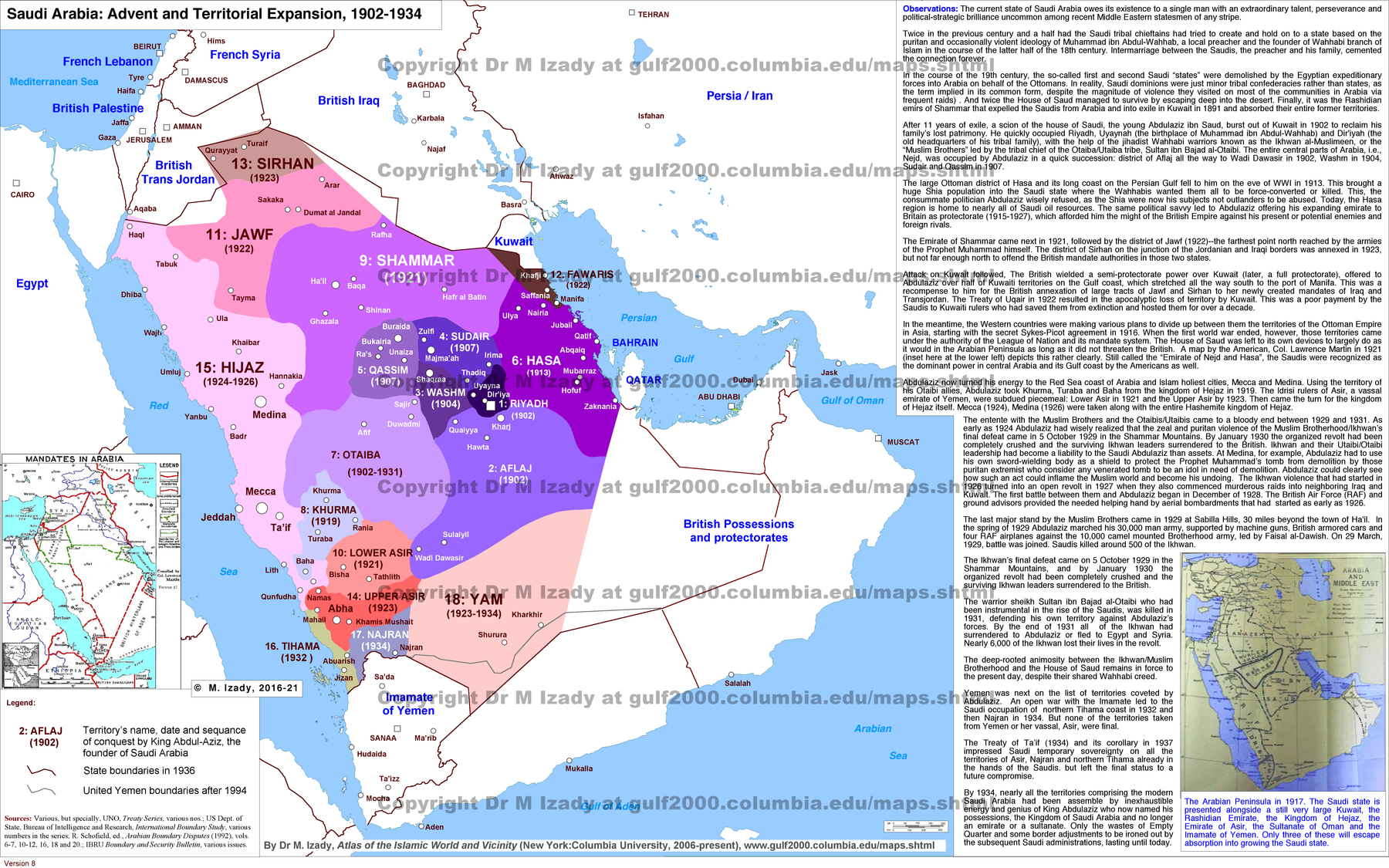
Read this map: Start at Riyadh in 1902, then locate al-Hasa, Ha’il/Shammar, the Hejaz, and the southwestern frontier. The dated colors make Abdulaziz’s state-building a sequence of conquests and settlements, rather than a kingdom that already existed at the opening of the book. This is a preview of developments followed through Parts I–III; the legend also distinguishes later boundary lines.
Source: Dr. Michael Izady, Saudi Arabia: Advent and Territorial Expansion, 1902–1934, © 2016–21, Gulf/2000 original. Historical reconstruction; personal reference use with attribution. See map-reading qualifications.
The answer begins with inherited resources rather than oil alone. Abdulaziz draws on a dynastic claim, an earlier Saudi–religious alliance, personal military leadership, and regional connections through Kuwait. He must still defeat rivals, manage religious warriors, and negotiate with stronger powers. Oil later transforms the scale of his achievement; it does not explain why his dynasty recovered political control in the first place.
Retain: Separate the acquisition of power from the resources that later magnify it. The prologue also establishes the narrative’s recurring irony: a ruler who survives one phase of the regional contest cannot assume that the next phase will reward the same methods. Source: PDF pp. 36–38 (file not included in this release).
Part I — The Middle East of Abdulaziz, 1900–1906
What I Should Retain
Three takeaways: The region around 1900 is a layered imperial order, not a collection of today’s nation-states. Modernization and autocracy develop together: railways, schools, constitutions, policing, and religious legitimacy can all strengthen or challenge a ruler. New national movements arise within those imperial structures before they become projects for separate states.
Three anchors: Abdulhamid combines a modernizing caliphate with surveillance and coercion. British influence in the Gulf operates through treaties and local dynasties rather than one uniform colonial administration. The Persian and Young Turk constitutional movements expose how reform coalitions can divide once they confront the distribution of real power.
Connection to test: Compare a railway, oil concession, and constitutional assembly as three different ways to redistribute power. Who gains leverage, and who can block the change?
Part I timeline — The imperial order and its first revolutions (1876–1913)
Source status: Dates and figures follow Montefiore’s draft; they are not independently fact-checked. Each entry links to the page where he discusses it.
- 31 Aug 1876 — Abdulhamid II takes the throne: He signs a parliamentary constitution, then dismisses Midhat and suspends it in February 1878, ruling as a modernizing Islamic autocrat. PDF pp. 44–45 (file not included in this release)
- 1894 — The Hamidian massacres: Kurdish Hamidian cavalry kill around 300,000 Armenians and 25,000 Assyrians, earning Abdulhamid the name “the Bloody Sultan.” PDF p. 49 (file not included in this release)
- 1896 — Mubarak seizes Kuwait: He kills his half-brother, later plays the Ottomans against Britain, and backs the Saudi bid for Riyadh. PDF pp. 55–56 (file not included in this release)
- Oct 1898 — The kaiser in Istanbul and Jerusalem: Wilhelm II meets Herzl on 18 October and promises friendship to “three hundred million Mohammedans.” PDF pp. 57–58 (file not included in this release)
- 1901 — D’Arcy’s oil concession: Mozaffar al-Din sells the right to explore for oil in Khuzestan; the strike comes in May 1908. PDF p. 63 (file not included in this release) · PDF p. 66 (file not included in this release)
- 15 Jan 1902 — Abdulaziz takes Riyadh: A raid launched from Kuwait refounds the Saudi emirate; in September 1904 he beats a combined Ottoman–Rashidi force at Shinanah. PDF p. 36 (file not included in this release) · PDF p. 52 (file not included in this release)
- Nov 1903 — Curzon’s Gulf cruise: The viceroy of India tells the sheikhs that “the British government must remain supreme.” PDF p. 53 (file not included in this release)
- Aug 1906 — Persia’s Constitutional Decree: The Majlis meets in October; in August 1907 Britain and Russia divide Persia into spheres, and in June 1908 royal troops storm the Majlis. PDF pp. 65–66 (file not included in this release)
- 23 Jul 1908 — The Young Turk revolution: Abdulhamid restores the constitution (“I will follow the current”); a failed counter-coup in April 1909 ends with his deposition. PDF pp. 67–68 (file not included in this release)
- Nov 1909–Jun 1913 — Arab societies organize: Al-Fatat is founded and the First Arab Congress meets in Paris, still asking for reform within the empire rather than independence. PDF p. 69 (file not included in this release)
Causal arc: Territorial loss pushes Abdulhamid toward modernized autocracy → British, German and Russian rivalry raises the stakes in Arabia, the Gulf and Persia → constitutional revolutions in Persia and the empire unite opponents → the new governments centralize, and their insecurity feeds rival national movements.
Objective and Through Line
The first Part reconstructs the world that the later wars will overturn. It connects the Ottoman capital, British Egypt and the Gulf, German ambitions, and constitutional conflict in Persia. Montefiore’s purpose is to prevent readers from projecting the present map backward. Political authority is distributed among imperial governments, local rulers, religious authorities, and communal elites, with different combinations in different territories.
Its chronology extends beyond the date label: the narrative follows the revolutions and their consequences into the years before the First World War. The causal sequence is consistent even when the draft’s headings are not. Reform expands communication, education, and political expectation; foreign competition raises the stakes; threatened rulers respond with a mixture of accommodation and repression. Movements that initially promise equality then confront demands for centralized national power. This establishes the ingredients of the wartime catastrophe without making that catastrophe inevitable.
Structure at a Glance
- Explain how the Ottoman monarchy tries to survive territorial loss.
- Show that European influence works through different local political arrangements.
- Connect German strategy and early Zionism to competition inside the imperial system.
- Follow constitutional hopes into coercion, nationalism, and disappointment.
Section-by-Section Argument
The Last Great Sultan and his Empire
Abdulhamid’s project answers an existential problem: how can an empire losing territory and facing European intervention retain authority? His response combines technological and administrative development with a stronger caliphal identity and personal autocracy. Montefiore treats these features as compatible. New schools and communications do not necessarily produce liberal government; they can give an autocrat better instruments of control.
Color map — The imperial order around 1900
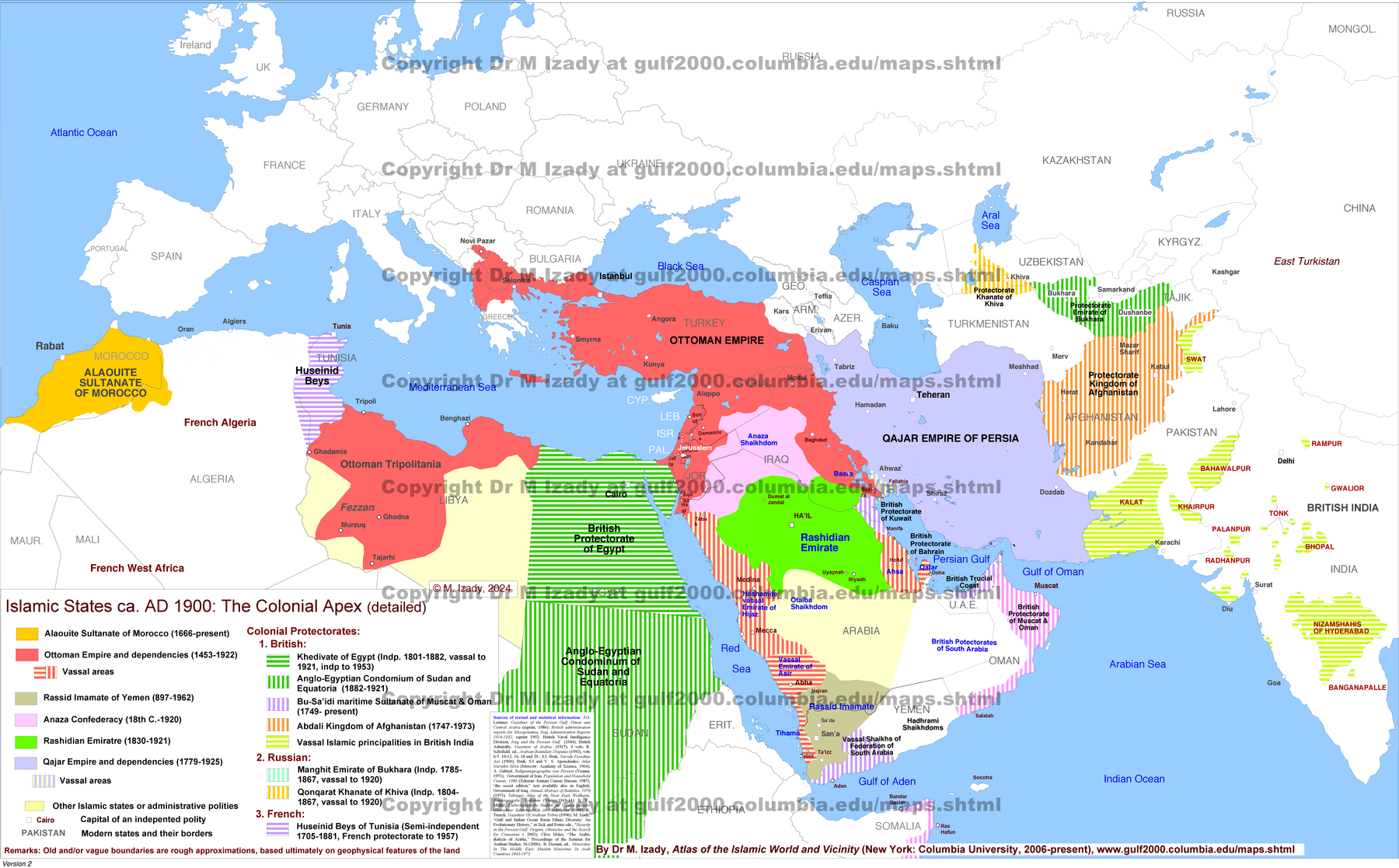
Read this map: Compare Ottoman territory, Qajar Persia, European possessions, and the competing authorities in Arabia. Modern country names and outlines are reference overlays. The hatching marks different kinds of dependency; they are not interchangeable forms of colonial rule. In particular, Egypt in 1900 was British-occupied and nominally Ottoman: the map’s “British Protectorate” label anticipates the formal change in 1914.
Source: Dr. Michael Izady, Islamic States ca. AD 1900: The Colonial Apex, © 2024, Gulf/2000 original. Later historical reconstruction, retained with its legend and attribution.
- The Tanzimat attempted a broader Ottoman citizenship and greater legal equality. Such changes created opportunities for minorities while provoking resistance to the loss of Muslim privilege.
- The Nahda supplies an Arab literary and intellectual revival. Christian and Muslim writers participate, while local loyalties and Ottoman commitments remain important. Cultural revival does not yet prescribe one political settlement.
- British occupation makes Egypt’s nominal and effective authority different. Sudan further complicates the picture: imperialism is also Egyptian, and the Mahdist challenge is both local and religious.
- The Hamidian massacres demonstrate that imperial diversity can coexist with state-supported mass violence. This undermines the idea that the pre-national order was uniformly peaceful or tolerant.
The chapter therefore supplies both the richness of the old order and reasons many of its inhabitants sought change. Source: PDF pp. 41–50 (file not included in this release).
Tournament of Empires
The Arabian story illustrates local agency within unequal relationships. Hashemite custodianship of the holy cities, Saudi military expansion, Kuwaiti maneuvering, and the Gulf rulers’ British treaties create competing sources of legitimacy and protection. Britain wants secure maritime routes and its Indian empire protected; local rulers want survival against neighbors and imperial annexation. Their bargains can serve both objectives while preserving an obvious inequality of power.
The Omani and Zanzibar history also broadens the meaning of empire. Arabian powers have their own overseas conquests and involvement in slavery. European dominance is decisive in this period but is not the origin of every hierarchy or expansionist project. The important evidence is the variety of arrangements: indirect influence, protectorates, personal relationships, and nominal Ottoman allegiance cannot be collapsed into the same category. Source: PDF pp. 51–56 (file not included in this release).
The German Gambit
German involvement offers Abdulhamid a counterweight to other European powers. Railways promise development and rapid military movement while extending German strategic influence. Herzl similarly seeks support from an existing great power and the Ottoman ruler rather than acting outside the imperial diplomatic world.
Montefiore distinguishes motivations that temporarily converge: Herzl seeks Jewish security and a homeland; the kaiser sees strategic advantage and expresses antisemitic reasons for encouraging emigration; the sultan seeks financial and political benefits while resisting separatist claims. No participant shares the others’ whole project. The resulting failure of agreement shows why sponsorship and sympathy should not be mistaken for identical interests. Source: PDF pp. 57–62 (file not included in this release).
The Revolutions
Persia’s constitutional movement challenges concessions, arbitrary rule, and foreign dependence. Yet the settlement between Britain and Russia undercuts British sympathy for constitutionalism, while factional conflict weakens the movement internally. The discovery of oil changes Persia’s strategic value and gives foreign governments an additional reason to intervene.
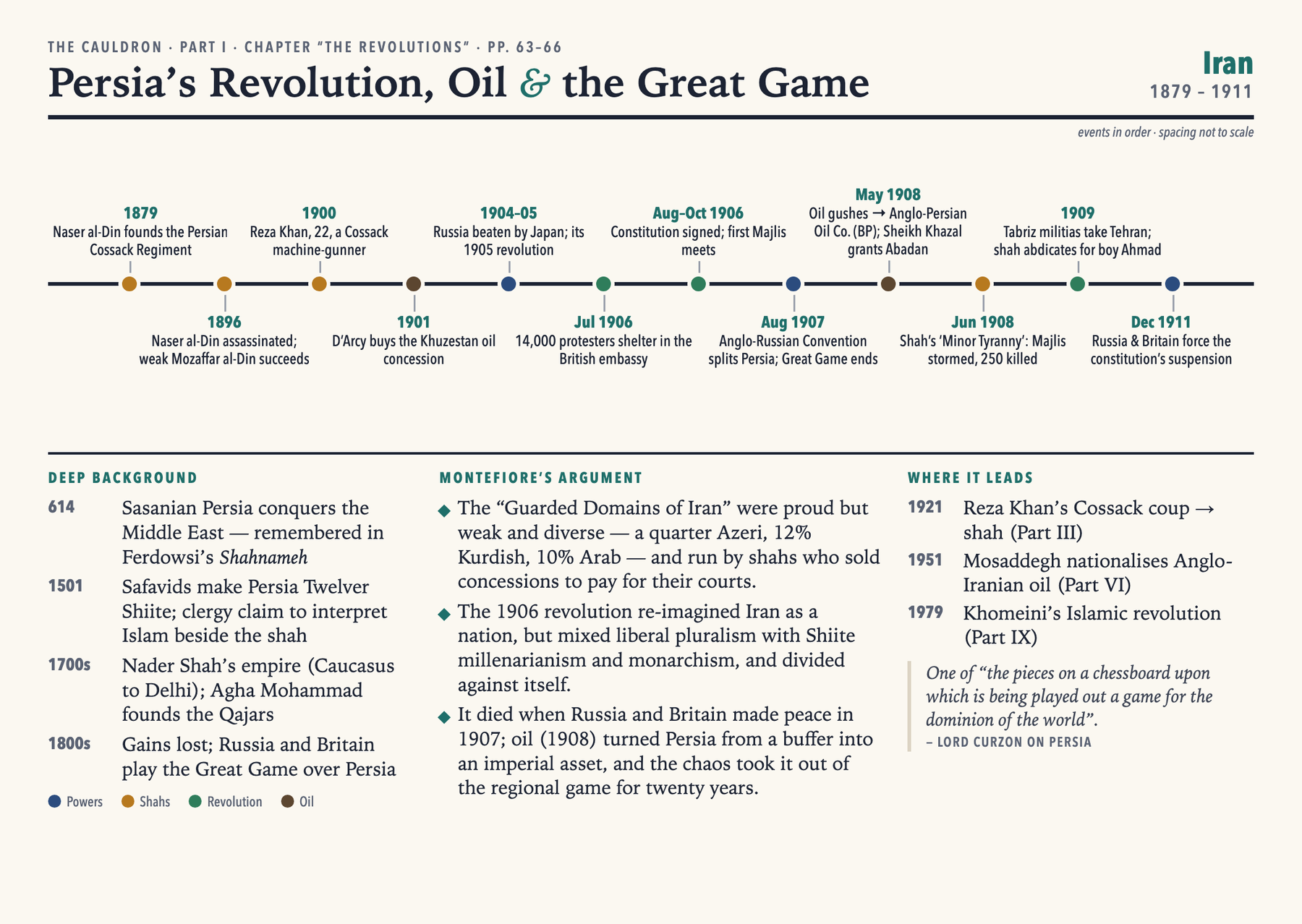
Notebook card (half B5): Iran in this chapter, 1879–1911 — twelve events in order (spacing not to scale), the deep background from the Sasanians to the Qajars, Montefiore’s argument, and where it leads (1921, 1951, 1979). Source: PDF pp. 63–66 (file not included in this release). The 1909 date for the shah’s abdication is added; the chapter does not date it.
The Young Turks also unite diverse opponents around constitutional restoration. Their victory raises hopes among Arabs and minorities, but the demand for a stronger, increasingly Turkish-centered state strains those alliances. Montefiore links the new government’s insecurity and centralization to the growth of alternative national projects, including Arab and Jewish movements. The mechanism is reciprocal: one group’s program for securing the state can intensify another’s fear of exclusion. Source: PDF pp. 63–71 (file not included in this release).
Key Concepts and Distinctions
- Modernizing autocracy: Railways, schools, telegraphs and secret police can make a ruler stronger without making his government more liberal. Abdulhamid read 3,000 police reports a month while building clock towers and railways.
- Indirect empire: Britain ruled the Gulf through treaties, subsidies and protected dynasties rather than direct administration. Influence and colonial rule are different things.
- Layered identity: People could be Jerusalemite, Arab and Ottoman at once. A political identity that did not yet have a state was not therefore absent.
Essential Evidence and Examples
- The scale of the empire: Abdulhamid still ruled 18 million people, 13 million of them Muslim; Arabs made up 40 per cent of his subjects. PDF p. 45 (file not included in this release)
- Layered loyalties: Yusuf Diya al-Khalidi, mayor of Jerusalem, described himself as “First Jerusalemite, second Arab, third Ottoman.” PDF p. 46 (file not included in this release)
- British supremacy in the Gulf: Curzon in 1903: “We found strife, and we have created order … your independence will continue; the British government must remain supreme.” PDF p. 53 (file not included in this release)
- Converging but different motives: The kaiser backed Zionist emigration partly for antisemitic reasons (“The sooner they clear off the better”), while Abdulhamid answered Herzl that “only our corpse can be divided.” PDF p. 58 (file not included in this release) · PDF p. 61 (file not included in this release)
- A forecast of conflict: In 1905 the Maronite nationalist Naguib Azoury predicted that Zionist and Arab national aspirations “are likely to come seriously into conflict … until one of them wins.” PDF p. 70 (file not included in this release)
- A plural revolution: The 1908 parliament held sixty Arabs, twenty-six Greeks, fourteen Armenians and four Jews. PDF p. 68 (file not included in this release)
Cautions
- Arab identities already existed, but their political expression was neither uniform nor fixed. Local, religious, Ottoman and Arab loyalties could overlap; the lack of a later state does not mean the lack of a people or of attachment to place.
- The Part’s date label (1900–1906) is narrower than its narrative, which runs to the eve of the Balkan Wars.
Conclusion and Significance
The prewar region contains constitutional possibilities and coercive alternatives, commercial networks and territorial ambitions. None points automatically to the later borders. The Part’s contribution is to make the coming collapse intelligible as a transformation of an existing political world, with local actors already pursuing distinct goals.
Questions for Reflection
- Reconstruct the different forms of authority operating in Ottoman lands, Egypt, Persia, and the Gulf.
- How could modernization strengthen autocracy and generate its opponents simultaneously?
- Use one Gulf example to explain local agency without denying imperial inequality.
- What evidence complicates both Ottoman nostalgia and the idea of a fully formed pan-Arab state-in-waiting?
- Apply the distinction between shared interests and shared objectives to the kaiser, Herzl, and Abdulhamid.
Quick recall
- When did Abdulaziz take Riyadh, and from where did the raid set out?
- Who signed Persia’s first oil concession, and to whom?
- What happened on 23 July 1908?
- Which ruler seized Kuwait in 1896, and how did he use the two empires?
- Roughly how many Armenians died in the Hamidian massacres of the 1890s?
Answer key
- The Ottoman sultan ruled directly but leaned on the caliphate, Hashemite custodians of Mecca, and Kurdish irregulars. Egypt was nominally Ottoman but run by Britain’s consul-general. Persia had a weak Qajar shah pressed by Britain and Russia. The Gulf sheikhs ruled their own towns under British treaty protection. PDF pp. 45–56 (file not included in this release)
- New schools, railways and telegraphs gave Abdulhamid better surveillance and faster troops, but the same military academies and schools trained the officers and intellectuals of the Young Turk movement and the Nahda. PDF p. 67 (file not included in this release)
- Mubarak of Kuwait used Britain to block Ottoman annexation and backed the Saudi raid on Riyadh for his own reasons, yet his independence depended on accepting British protection. PDF pp. 55–56 (file not included in this release)
- The Hamidian massacres undercut nostalgia for a tolerant empire; Khalidi’s layered identity and the Arab congresses’ requests for reform within the empire undercut the idea of a ready-made Arab state. PDF p. 46 (file not included in this release) · PDF p. 49 (file not included in this release) · PDF p. 69 (file not included in this release)
- All three wanted Herzl’s plan to move, but for different ends: Herzl sought Jewish security, the kaiser German influence and fewer German Jews, Abdulhamid money and good press without any separatist claim. With no shared objective, the scheme failed. PDF pp. 57–61 (file not included in this release)
- 15 January 1902; the raid left Kuwait in November 1901. PDF p. 36 (file not included in this release)
- Shah Mozaffar al-Din, in 1901, to William Knox D’Arcy. PDF p. 63 (file not included in this release)
- Abdulhamid restored the 1876 constitution under pressure from the Young Turks in Macedonia. PDF p. 67 (file not included in this release)
- Mubarak al-Sabah; he played the Ottomans against Britain and ended up under British protection. PDF pp. 55–56 (file not included in this release)
- About 300,000 (with around 25,000 Assyrians). PDF p. 49 (file not included in this release)
Part II — Holy World War, 1906–1917
What I Should Retain
Three takeaways: The Ottoman catastrophe develops through interconnected wars before 1914. Wartime insecurity enables radical leaders to treat whole populations as enemies. Allied promises are overlapping instruments of strategy whose implementation depends on the military outcome and later bargaining.
Three anchors: The Balkan defeats and the Three Pashas’ seizure of power narrow the constitutional opening. The Armenian genocide and Jemal’s repression show different forms of state violence against supposed internal threats. British conquest, supported by imperial troops and some Arab forces, supplies the power behind postwar arrangements.
Connection to test: Distinguish a diplomatic document’s wording, its strategic purpose, its recipients’ expectations, and its later execution. These four questions are not interchangeable.
Part II timeline — From peripheral wars to British conquest (1905–1918)
Source status: Dates and figures follow Montefiore’s draft; they are not independently fact-checked.
- 1905–12 — Morocco becomes a French protectorate: The kaiser’s Tangier visit (1905) and the Algeciras conference (1906) end in a formal protectorate in March 1912. PDF pp. 73–74 (file not included in this release)
- 29 Sep 1911 — Italy attacks Ottoman Libya: Enver, Mustafa Kemal and Nuri al-Said fight alongside the Senussi; Libya is ceded in October 1912. PDF pp. 74–75 (file not included in this release)
- 8 Oct 1912 — The First Balkan War: The Balkan states take Salonika and expel some 800,000 Rumeli Muslims. PDF pp. 75–76 (file not included in this release)
- 23 Jan 1913 — Raid on the Sublime Porte: Enver’s men kill the war minister and force out the grand vizier; after Shevket’s assassination on 11 June the Three Pashas hold power. PDF p. 76 (file not included in this release)
- 1 Aug 1914 — Secret alliance with Germany: On 29 October the Ottoman fleet bombards Russian ports; on 11 November the sultan declares jihad. PDF pp. 77–78 (file not included in this release)
- Winter 1914–15 — Sarikamish and Suez: Enver loses around 60,000 men in the Caucasus; Jemal’s attack on the Suez Canal fails. PDF pp. 78–79 (file not included in this release)
- 25 Apr 1915–Jan 1916 — Gallipoli: Mustafa Kemal’s defence makes his reputation; each side loses around 60,000 dead. PDF pp. 79–80 (file not included in this release)
- Apr–May 1915 — The Armenian genocide begins: Armenian notables are arrested on 24 April; the Deportation Law follows on 27 May. Talaat’s own figures imply about 1.1 million killed. PDF pp. 79–80 (file not included in this release)
- Oct 1915 — McMahon’s letter to Hussein: It promises an Arab kingdom with deliberately vague exclusions. PDF p. 83 (file not included in this release)
- Jan–May 1916 — Sykes–Picot–Sazonov: Britain, France and Russia agree a carve-up that never takes effect in that form. PDF pp. 84–85 (file not included in this release)
- 29 Apr 1916 — Townshend surrenders at Kut: 13,000 men go into captivity; Maude takes Baghdad in March 1917. PDF p. 86 (file not included in this release)
- 10 Jun 1916 — The Arab Revolt begins: Hussein fires a rifle from his palace in Mecca. PDF p. 85 (file not included in this release)
- 2 Nov 1917 — The Balfour Declaration: Britain views “with favour” a Jewish national home in Palestine; Allenby enters Jerusalem on 11 December. PDF pp. 92–93 (file not included in this release)
- Sep 1918 — Megiddo: Allenby’s breakthrough opens Syria; Faisal enters Damascus on 2 October. PDF p. 94 (file not included in this release) · PDF p. 96 (file not included in this release)
Causal arc: Losses in Libya and the Balkans radicalize the CUP → the Three Pashas seize power and join Germany → war becomes cover for genocide and terror → Britain buys allies with overlapping promises → British armies, not documents, decide who holds the land in 1918.
Objective and Through Line
This Part turns imperial competition into a sequence of military crises. Morocco, Libya, Yemen, and the Balkans belong to the same story because one government’s distraction or defeat changes opportunities elsewhere. Ottoman losses help radicalize the Young Turk leadership; the resulting wartime regime pursues both external recovery and internal purification.
Montefiore then follows British, French, Russian, Hashemite, and Zionist projects as they intersect. His central revision concerns explanatory scale. The Arab Revolt matters, but he disputes its elevation into the decisive military liberation of the whole Arab region. Sykes–Picot matters, but it is neither the sole wartime agreement nor the final map. The narrative asks readers to replace a single betrayal story with a reconstruction of military power, incompatible promises, and multiple parties’ ambitions.
Structure at a Glance
- Trace how peripheral wars destabilize the Ottoman center.
- Explain the Three Pashas’ consolidation and radicalization.
- Follow wartime offensives alongside genocide and repression.
- Compare Allied promises before following the conquest that makes a settlement possible.
Section-by-Section Argument
Balkan Wars
For the Young Turks in more detail, compared with Rogan, see The Young Turks, 1908–1918.
French expansion in Morocco and Italian attack on Ottoman Libya expose the costs of imperial weakness. The Ottoman government must also negotiate with the Yemeni imam while fighting elsewhere. The overlapping crises make distant theaters materially connected: troops committed to one front cannot protect another.
The Balkan defeats intensify this pressure. Refugees, territorial loss, and fears of dismemberment undermine confidence in an inclusive Ottoman political identity. The 1913 coup brings Talaat, Enver, and Jemal to effective supremacy. Their regime interprets insecurity through an increasingly exclusionary nationalism and Social Darwinist ideas.
Montefiore presents the repression as a political choice: leaders could have pursued constitutional equality but instead adopted dictatorship, expulsion, and violent homogenization. This distinction matters because causal explanation must leave room for responsibility. The later genocide is prepared by decisions that redefine neighbors and fellow citizens as collective threats. Source: PDF pp. 73–77 (file not included in this release).
Ottoman Offensive
Ottoman entry into the First World War transforms that radicalization into a struggle for survival. Enver’s disastrous Caucasian campaign contrasts with the successful defense of Gallipoli, where Mustafa Kemal establishes his reputation. Jemal’s attacks toward Suez fail. The caliph’s declaration of jihad does not mobilize Muslims uniformly: many serve the opposing empires, illustrating the gap between a universal religious appeal and particular political allegiances.
Historical color map — The Ottoman war’s connected theaters
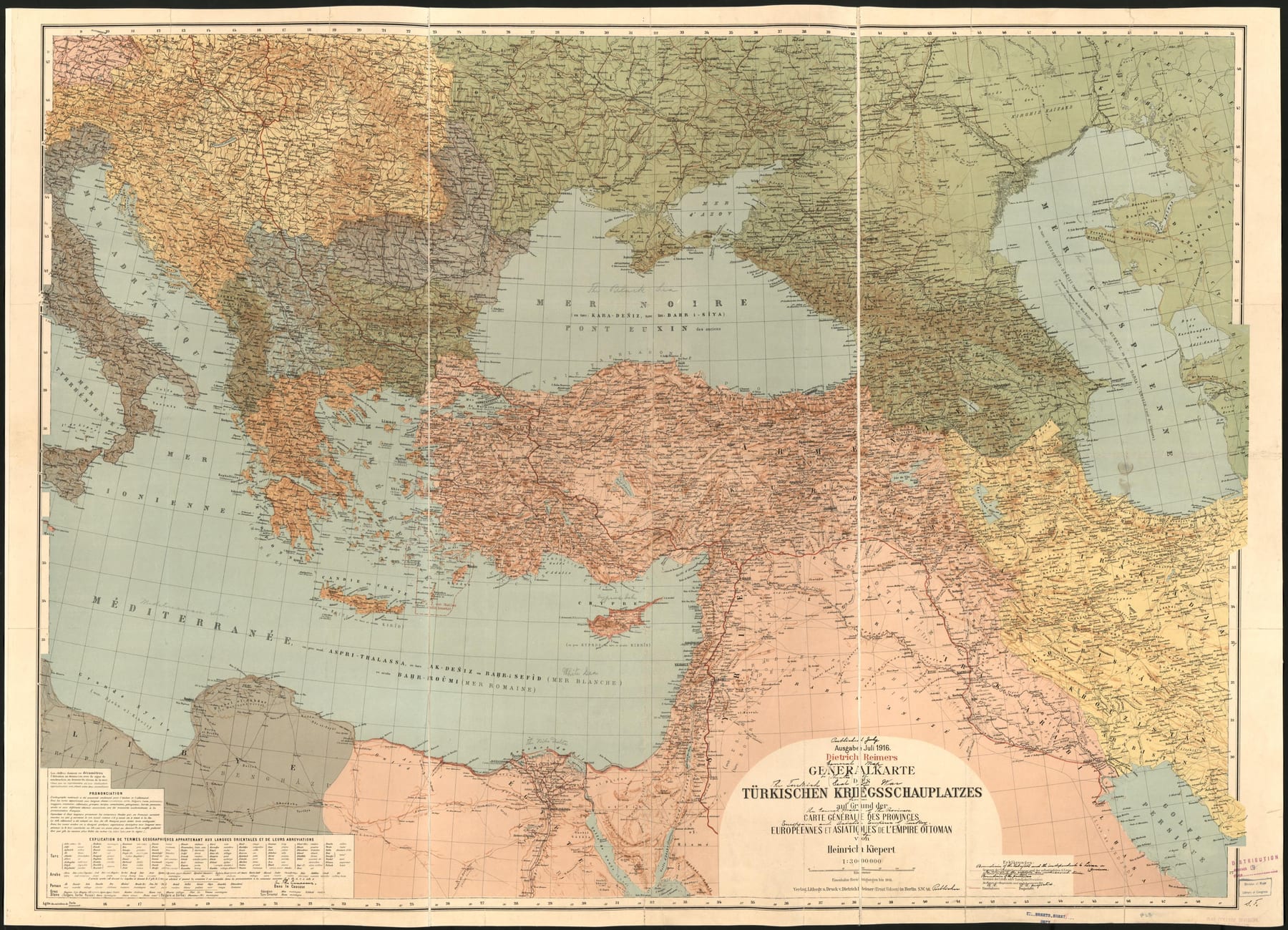
Read this map: Find the Caucasus, the Dardanelles, Mesopotamia, and the eastern Mediterranean before following the campaigns. Distances and routes help explain why the Ottoman war cannot be understood through Gallipoli alone. This period atlas depicts older imperial geography, not front lines or effective control on a single day in 1916; open the image to inspect its small labels.
Source: Dietrich Reimer’s Generalkarte des Türkischen Kriegsschauplatzes, July 1916, using Heinrich Kiepert’s cartography; Library of Congress, item 2013593013.
- The Armenian genocide is narrated as an organized destruction involving disarmament, deportation, and mass killing. Assyrians and Greeks also suffer extensive violence. These were acts of state policy.
- Jemal’s Arab repression uses executions and deportations to prevent disloyalty but helps turn some former Ottoman supporters toward revolt. Fear can preserve control briefly while destroying its legitimacy.
- The Hashemite negotiations emerge from ambition and danger. Hussein seeks a vast kingdom; Britain wants military assistance and a counter to Ottoman religious claims. Their expectations exceed what either can securely deliver.
- Sykes–Picot–Sazonov belongs to a broader web of promises involving Russia, France, Britain, Italy, Greece, Armenians, and Arabs. Its envisaged zones are not today’s boundaries.
The Mesopotamian campaign adds another corrective: Britain can be defeated, as at Kut, before reorganizing and taking Baghdad. Persia suffers occupation, fighting, requisitioning, and famine despite not being a principal belligerent. The war’s regional effects reach well beyond its official fronts. Source: PDF pp. 78–87 (file not included in this release).
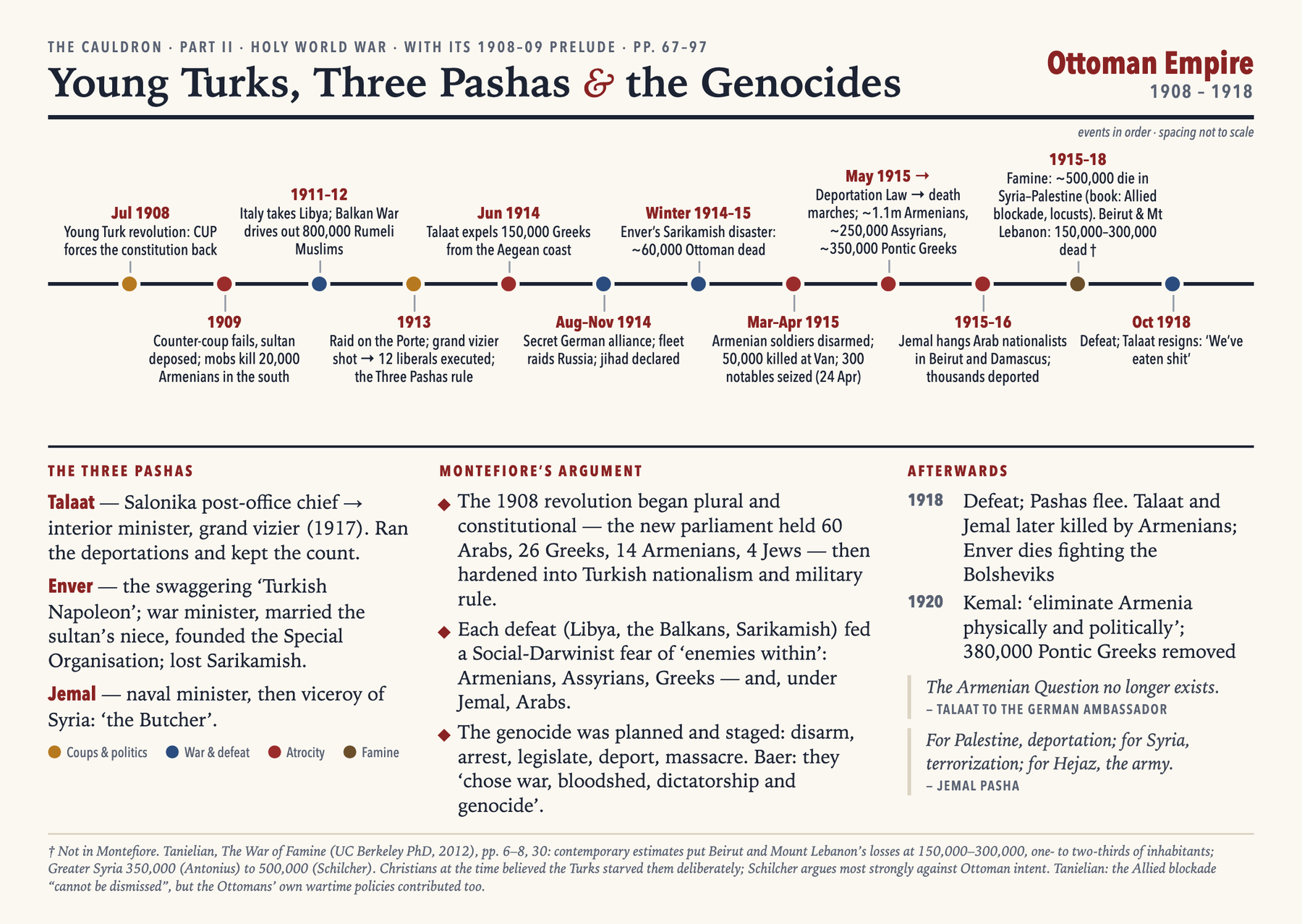
Notebook card (half B5): the Young Turks, the Three Pashas and the Ottoman atrocities, July 1908 to October 1918 — twelve events in order (spacing not to scale), profiles of Talaat, Enver and Jemal, Montefiore’s argument, and the aftermath to 1920. Source: PDF pp. 67–97 (file not included in this release). The “Winter 1914–15” date for Sarikamish is added; the book does not date it. The book places both Talaat’s and Jemal’s assassinations in Berlin, but Jemal was killed in Tiflis in 1922, so the card says only that both were later killed by Armenians.
Famine figures on the card (revised 3 November 2026)
In the book: Montefiore gives about 500,000 deaths from starvation across Syria and Palestine and blames the Allied blockade and the 1915 locusts (PDF p. 90 (file not included in this release)). He does not discuss the Great Famine of Mount Lebanon.
Added from outside the book: Melanie Tanielian, The War of Famine: Everyday Life in Wartime Beirut and Mount Lebanon (1914–1918) (PhD diss., UC Berkeley, 2012), pp. 6–8 and 30, eScholarship. Contemporary estimates put the losses in Beirut and Mount Lebanon at 150,000–300,000, between one- and two-thirds of the inhabitants. For Greater Syria the estimates run from 350,000 (George Antonius) to 500,000 (Linda Schilcher, from German records). Christians at the time believed the Turks had deliberately starved Mount Lebanon by cutting off its supplies; Schilcher has argued most strongly against Ottoman intent. Tanielian holds that the Allied naval blockade “cannot be dismissed”, but that the Ottomans’ own wartime policies also contributed. The often-quoted figure of 200,000 falls inside her range, but I have not traced it to a single source.
British Conquest
Montefiore juxtaposes two Arab revolts: the Hashemite revolt supported by Britain and the Senussi effort backed by the Ottomans and Germany. This comparison breaks the assumption that Arab interests or allegiances are already unified. Many Arabs remain in Ottoman service, while other groups oppose the Hashemites. He attributes the central military breakthrough to the much larger British-led imperial armies, with Arab forces contributing on their flanks.
Color map — Sykes–Picot was a proposed arrangement
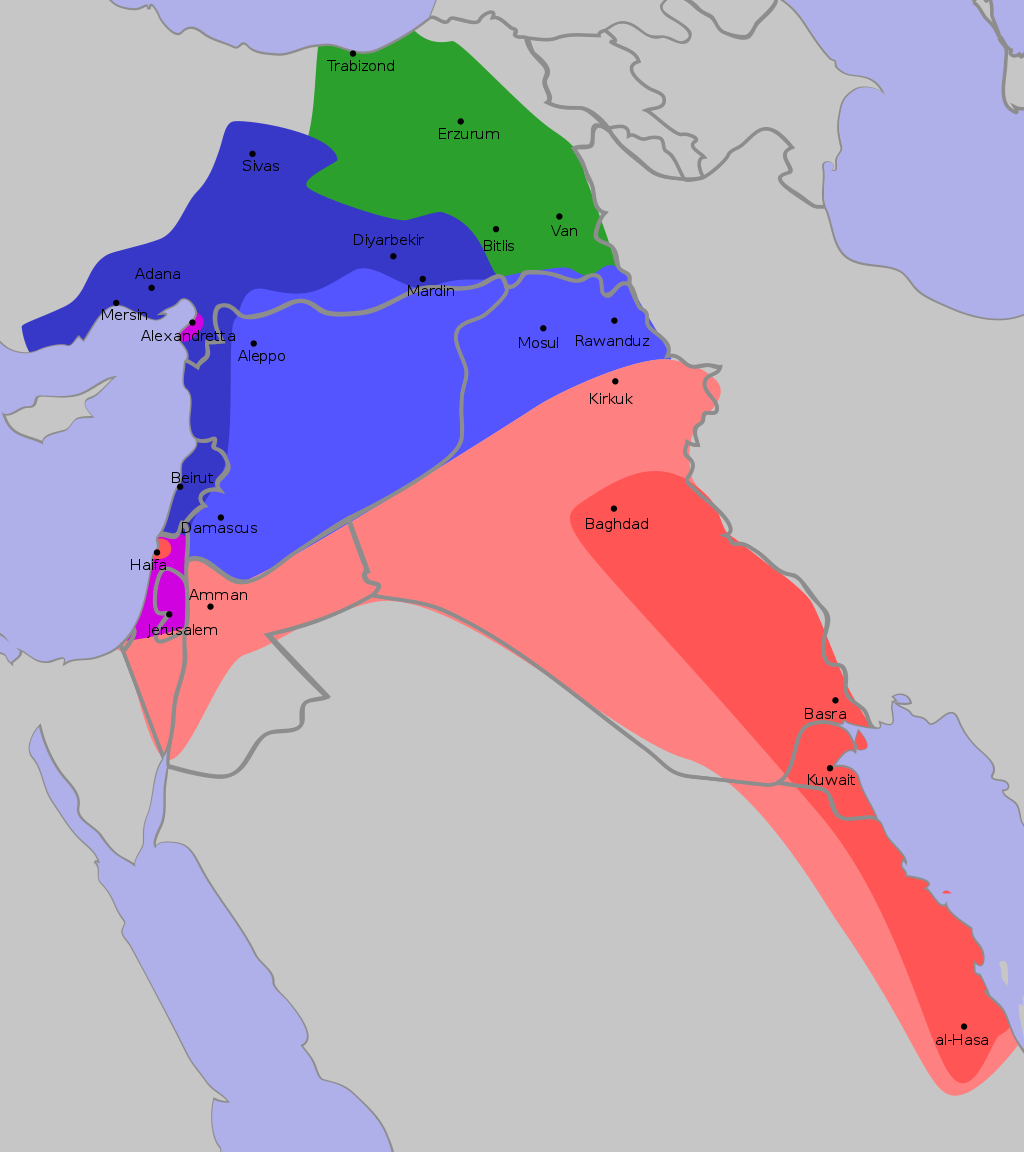
Read this map: Dark blue/red indicate proposed direct French/British control; lighter blue/red indicate their respective influence zones, green the associated Russian claims, and purple international arrangements. These are planned wartime allocations, not a map of realized occupation or today’s borders. Compare Mosul, Palestine, and Anatolia with the later settlement in Part III.
Source: Rafy, 2011, Commons file and color legend, CC BY-SA 3.0; saved PNG rendering. For the primary document, open the signed 8 May 1916 map and the agreement text.
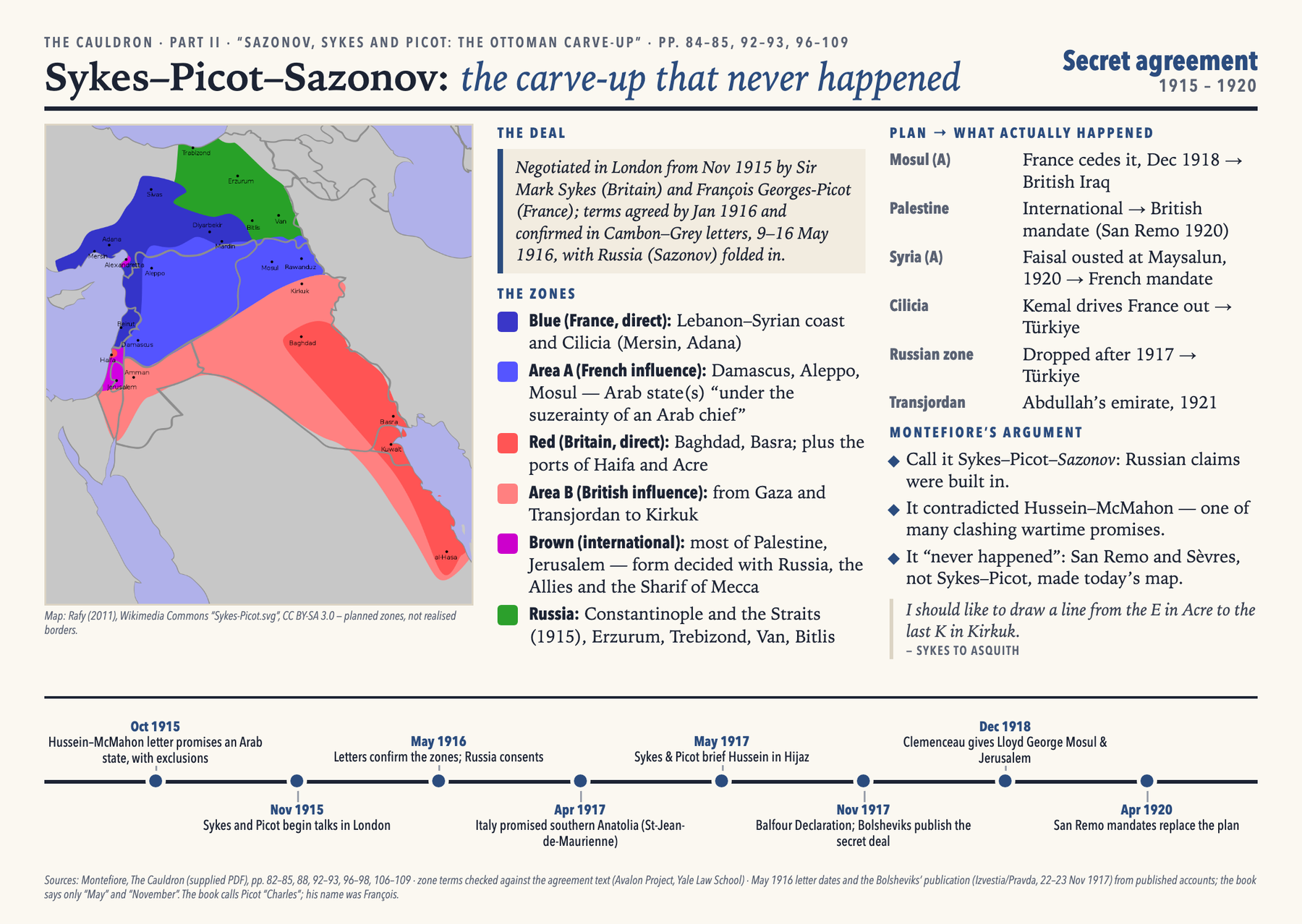
Notebook card (half B5): Sykes–Picot–Sazonov on one page — the zone map above with a colour key of what each power was to get, the plan set against what happened to Mosul, Palestine, Syria, Cilicia, the Russian zone and Transjordan, Montefiore’s argument, and a timeline from Hussein–McMahon (Oct 1915) to San Remo (Apr 1920). Book: PDF pp. 84–85 (file not included in this release), 88, 92–93, 96–98, 106–109. Zone terms checked against the Avalon Project text. The May 1916 letter dates (9–16 May) and the Bolsheviks’ publication of the deal (22–23 Nov 1917, Marx Memorial Library) come from outside the book, which gives only the months. The book calls Picot “Charles”; his name was François.
The Balfour Declaration is explained through wartime calculation as well as sympathy for Jewish restoration. British leaders seek support in America and Russia, advantage over France, and influence in a strategically important Palestine. Zionists themselves have explored different patrons; Ben-Gurion’s earlier Ottoman orientation changes after Ottoman repression.
The declaration’s careful wording promises a Jewish national home in Palestine, without specifying a state, while protecting the civil and religious rights of existing non-Jewish communities. Montefiore stresses the failure even to name the Arab majority. Its ambiguities differ from those of the Hussein–McMahon correspondence, but both make future conflict harder to resolve.
Russian revolution removes one imperial claimant; British victories at Jerusalem and Megiddo change the balance further. The Part therefore ends with conquest: armies, more than documents, decided the outcome. Source: PDF pp. 88–94 (file not included in this release).
Key Concepts and Distinctions
- Promise versus settlement: A wartime undertaking creates expectations; an enforceable territorial arrangement requires later decisions and power.
- Jihad versus allegiance: Religious language can mobilize without determining every Muslim population’s behavior.
- National liberation narrative versus military contribution: A movement’s later symbolic importance can exceed its wartime numbers or territorial achievements.
Essential Evidence and Examples
- The road not taken: Marc David Baer, quoted by Montefiore: “The CUP could have chosen peace, liberalism, constitutionalism, equality. Instead, they chose war, bloodshed, dictatorship and genocide.” PDF p. 77 (file not included in this release)
- The genocide in the perpetrator’s numbers: Talaat’s notebook counted 900,000 deported and only 400,000 of 1.5 million Armenians still alive; 250,000 Assyrians and 350,000 Pontic Greeks were also killed. Talaat told the German ambassador, “The Armenian Question no longer exists.” PDF p. 80 (file not included in this release)
- Jemal’s terror: “For Palestine, deportation; for Syria, terrorization; for Hejaz, the army.” Thirty-six Arab nationalists were hanged in Beirut (August 1915) and Damascus (May 1916). PDF p. 81 (file not included in this release)
- The scale of the Arab Revolt: About 900,000 of 3 million Ottoman soldiers were Arabs, and 30 per cent of Ottoman officers; the Hashemite armies fielded barely 6,000 men each. PDF p. 88 (file not included in this release)
- Deliberate vagueness: McMahon excluded “those portions of Syria to the west of Damascus, Homs, Hama and Aleppo” after Grey ordered a studied “vagueness”; Palestine is not named in the letters. PDF p. 83 (file not included in this release)
- Imperial insouciance: Sykes told Asquith, “I should like to draw a line from the E in Acre to the last K in Kirkuk.” PDF p. 84 (file not included in this release)
Cautions
- Explaining wartime decisions does not excuse genocide or collapse civilian populations into armed factions.
- The contingent nature of British promises does not erase their consequences for people excluded from the negotiations.
- Montefiore’s scepticism toward the nationalist legend of the Arab Revolt is an interpretation; his narrower factual claims would need documentary comparison before they settle the dispute.
Conclusion and Significance
The First World War destroys the Ottoman framework while leaving no agreed replacement. Its legacies include murdered and displaced populations, rival national expectations, and military leaders whose careers carry into the next order. The postwar struggle will decide which projects become states and which remain unfulfilled claims.
Questions for Reflection
- Reconstruct the chain from the prewar imperial crises to the Three Pashas’ wartime government.
- How did the treatment of internal populations become part of the regime’s war strategy?
- Which evidence limits an account of the Arab Revolt as a unified region-wide uprising?
- Why is Sykes–Picot an inadequate stand-in for the entire postwar settlement?
- Compare the Balfour and Hussein–McMahon promises using wording, purpose, expectation, and enforcement.
Quick recall
- Who were the Three Pashas, and what posts did they hold?
- What happened at Kut in April 1916?
- On what date did the Arab Revolt begin, and who launched it?
- What does the Balfour Declaration promise, and what does it leave out?
- Who commanded the key Ottoman division at Gallipoli?
Answer key
- Italian and Balkan wars stripped the empire of Libya and most of Europe, flooded Anatolia with refugees and humiliated the government; the CUP used the threatened loss of Adrianople to justify the 1913 raid on the Porte, then purged its rivals after Shevket’s murder. PDF pp. 74–77 (file not included in this release)
- The Pashas treated Armenians, Assyrians and Greeks as an enemy within: Talaat would “destroy the enemy within” while Enver and Jemal fought abroad, and Jemal used executions and deportations to hold Syria. PDF pp. 78–81 (file not included in this release)
- Most Arab soldiers stayed loyal to the sultan, the Senussi ran a rival Ottoman-backed revolt, Abdulaziz stood aside, Transjordan’s tribes resisted the Hashemites, and the decisive fighting was done by Allenby’s imperial armies. PDF pp. 88–89 (file not included in this release)
- It was one of many overlapping wartime deals, it was never implemented, and the real map came from San Remo, Sèvres and later wars. PDF pp. 84–85 (file not included in this release) · PDF pp. 108–109 (file not included in this release)
- Balfour promised a national home “in” Palestine, protected non-Jewish rights without naming Arabs, and was meant to win American and Russian support and keep France out. McMahon promised a vast Arab kingdom with vague exclusions to buy a revolt. Neither could be enforced without British military power. PDF p. 83 (file not included in this release) · PDF pp. 91–92 (file not included in this release)
- Talaat (interior, later grand vizier), Enver (war) and Jemal (navy, then viceroy in Syria). PDF p. 76 (file not included in this release)
- General Townshend surrendered with 13,000 mostly Indian troops to Halil Pasha. PDF p. 86 (file not included in this release)
- 10 June 1916, by Sharif Hussein of Mecca. PDF p. 85 (file not included in this release)
- A “national home for the Jewish people” in Palestine, without prejudice to the rights of “existing non-Jewish communities”; it does not name the Arab majority or promise a state. PDF p. 92 (file not included in this release)
- Mustafa Kemal, commanding the 19th Division. PDF p. 79 (file not included in this release)
Part III — The Mandatories, 1917–1939
What I Should Retain
Three takeaways: The settlement is repeatedly remade by imperial negotiation and armed resistance. New states inherit unequal and divided structures rather than emerging as homogeneous nations. Local nation-builders can resist foreign dominance while enforcing their own authoritarian exclusions.
Three anchors: Faisal’s Syrian kingdom falls, while British bargaining installs Hashemites in Iraq and Transjordan. Mustafa Kemal overturns much of Sèvres, demonstrating that international promises without military support can collapse. Abdulaziz defeats the Ikhwan after using their military power, subordinating religious expansion to the requirements of his kingdom.
Connection to test: Compare international recognition with effective control. Which is decisive for a ruler’s survival, and when does dependence on foreign protection undermine domestic legitimacy?
Next learning step — Part III overview
Status: Planned, not started. Saved 25 October 2026 for later notebook or Goodnotes study.
Purpose: See simultaneous regional stories and explain how competing claims become actual government. Keep asking: Who claims power, who can enforce it, and what arrangement survives?
- First session, about 15 minutes: copy the parallel-timeline layout below onto a two-page spread. Use the periods 1917–1920 / 1921–1923 / 1924–1939 and start with six lanes: Türkiye, Syria–Lebanon, Iraq–Transjordan, Palestine, Iran and Arabia. Add only two or three anchors per lane; add Egypt and the Maghreb on a later pass. These are broad organizing periods, not a timeline drawn to scale.
- Next session: use the second mockup to organize people by person / place / aim, distinguish Hussein’s sons, and identify the different jobs done by San Remo, Sèvres, Cairo and Lausanne. Explain three connections: Faisal’s loss of Syria and later placement in Iraq; the Iraqi revolt and Britain’s turn toward cheaper indirect rule; Kemal’s victory and replacement of Sèvres. Arrows require an explanation of the mechanism, not merely chronological sequence.
- Recall check: cover the reference material and explain each lane aloud: “The proposed arrangement was . It encountered . The arrangement that survived was ___.” Check against the Part III text and correct gaps in a second color. This exercise is not marked complete merely because its mockups exist.
Source check: use the Part III narrative and PDF pp. 96–136 (file not included in this release). The Mandate’s approval and commencement dates are clarified in the focused Ottoman-to-Israel study. Use the existing Centres of Power canvas (file not included in this release) for whole-book orientation.The two mockups below are generated study layouts, not reproductions of pages or maps from the book.
Mockup 1 — Parallel regional timeline
Read across to reconstruct one regional story; read down to compare simultaneous developments. Use the filled layout as a reference, then attempt a blank version from memory.
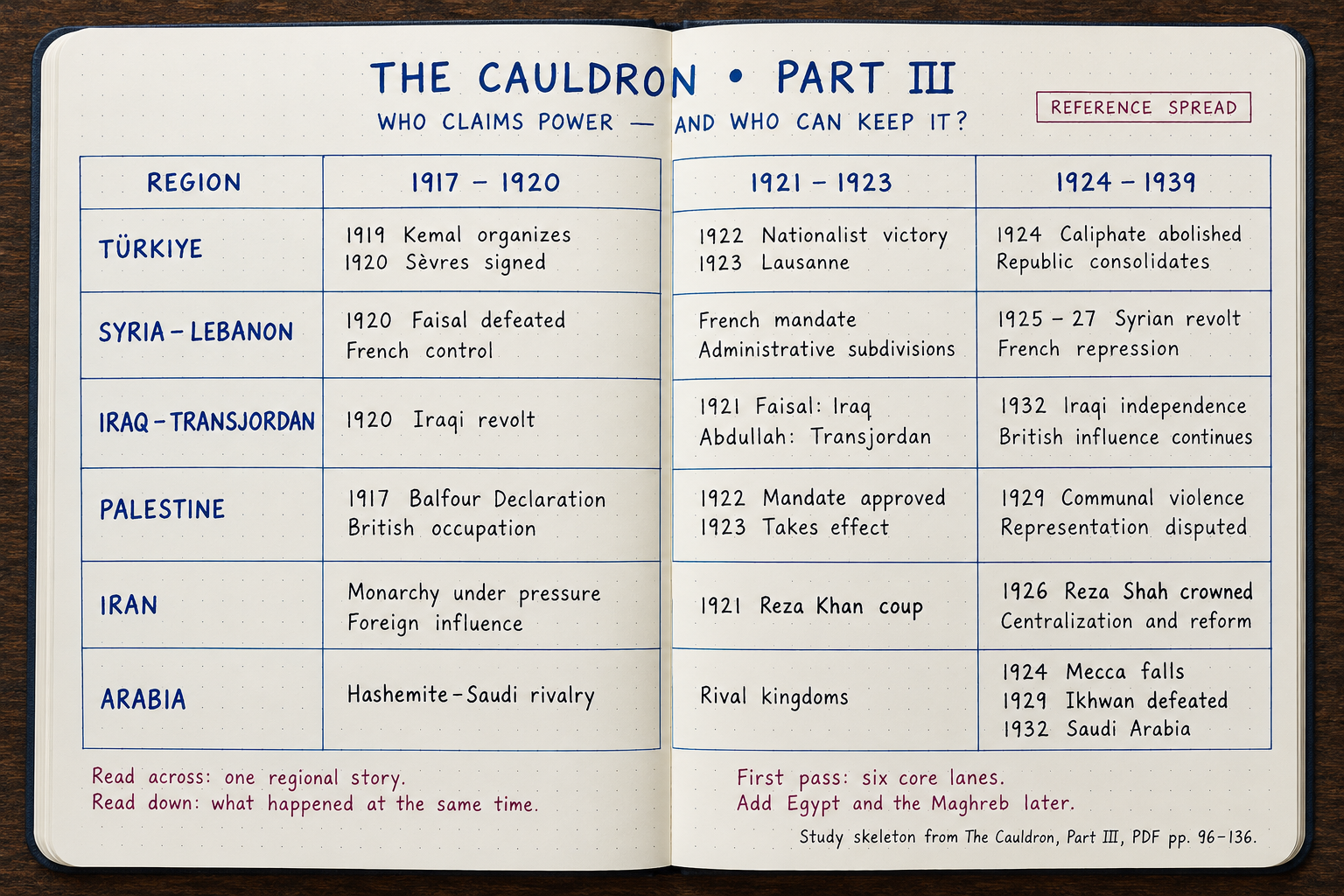
Mockup 2 — People, settlements and connections
Copy the reference material and fill the empty connection prompts in your own words. Distinguish a treaty’s proposed settlement, military control, and the government that actually survives.
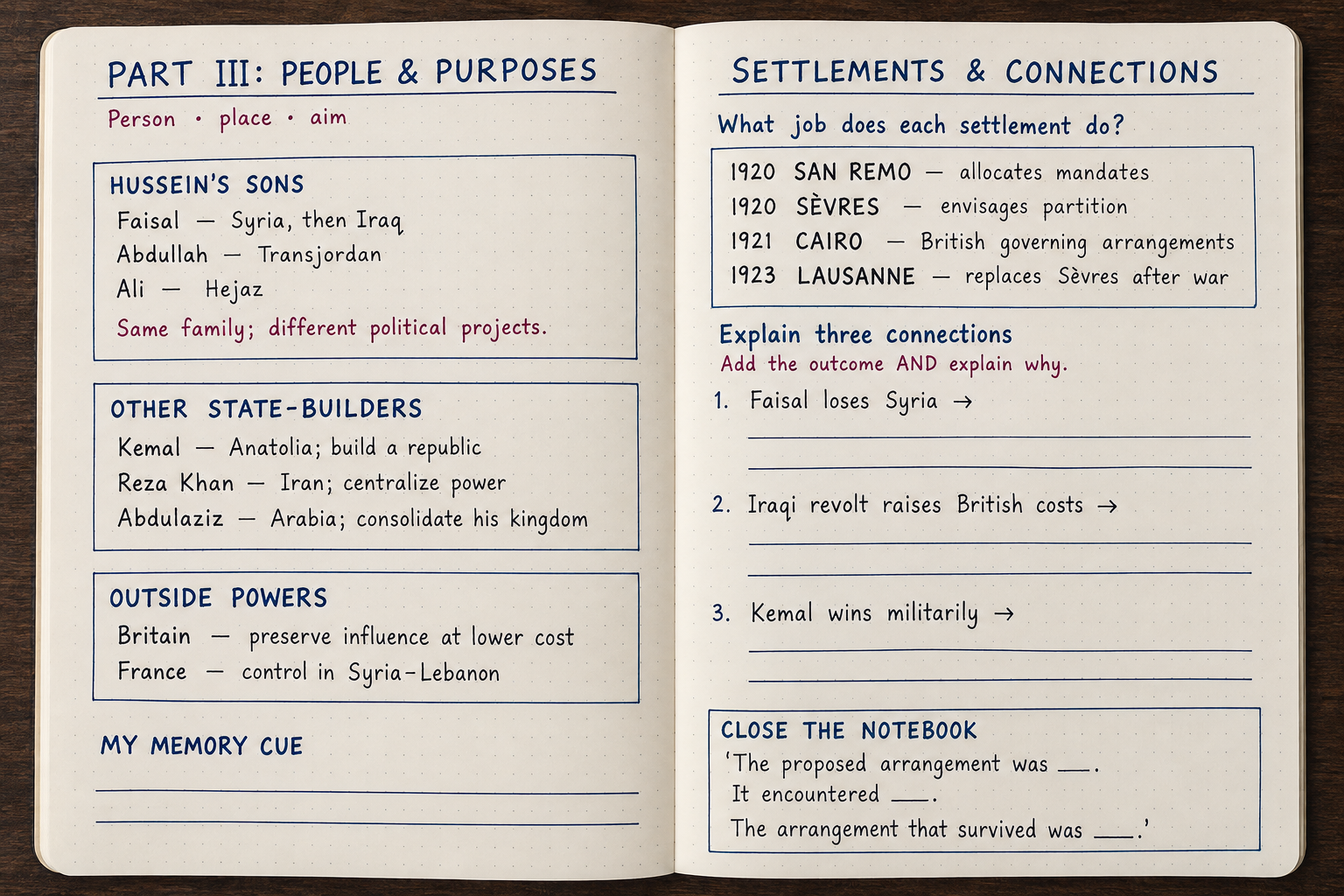


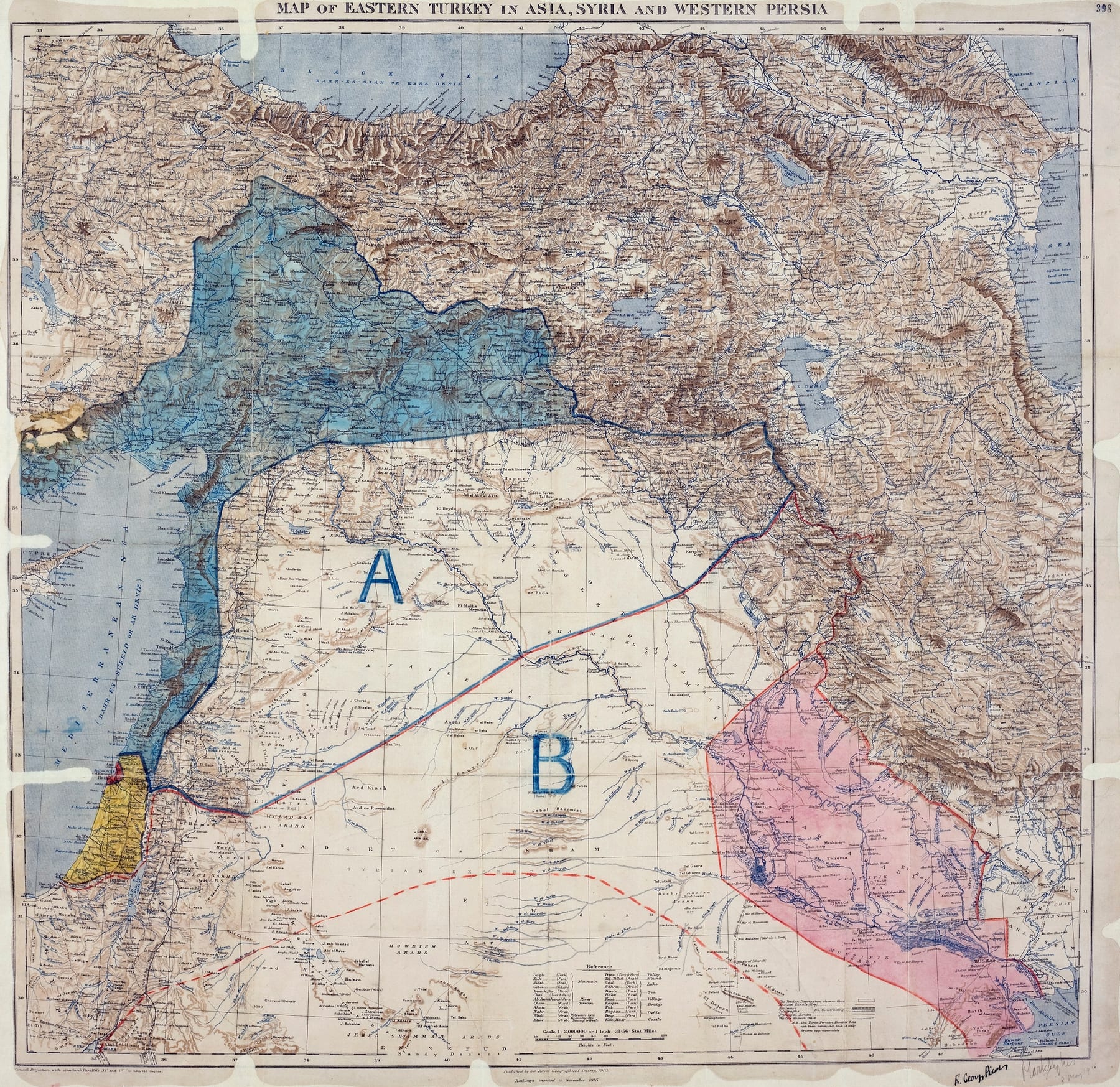
Part III timeline — Mandates, kingdoms and nation-makers (1918–1939)
Source status: Dates and figures follow Montefiore’s draft; they are not independently fact-checked.
- 30 Oct 1918 — Armistice of Mudros: The Three Pashas flee; Allied fleets anchor at Constantinople. PDF p. 97 (file not included in this release)
- Mar 1919 — Egypt’s revolution: The British exile Zaghlul; about a thousand Egyptians are killed in two weeks of protests. PDF p. 101 (file not included in this release)
- 19 May 1919 — Mustafa Kemal lands at Samsun: The nationalist resistance to partition begins; the Ankara assembly opens on 23 April 1920. PDF p. 103 (file not included in this release)
- 8 Mar 1920 — Faisal proclaimed king of Syria: The French destroy his army at Maysalun on 24 July. PDF p. 104 (file not included in this release) · PDF p. 110 (file not included in this release)
- Apr 1920 — San Remo: Britain receives Iraq and Palestine, France Syria and Lebanon. Sèvres follows on 10 August. PDF pp. 106–108 (file not included in this release)
- Jun–Oct 1920 — The Iraqi revolt: Crushing it costs Britain £40 million and 2,200 troops; over 8,000 Iraqis die. PDF p. 112 (file not included in this release)
- Mar 1921 — Churchill’s Cairo conference: Faisal is given Iraq (crowned 23 August) and Abdullah Transjordan. PDF p. 114 (file not included in this release) · PDF p. 118 (file not included in this release)
- Feb 1921 — Reza Khan’s coup in Tehran: He is crowned shah on 25 April 1926. PDF p. 123 (file not included in this release) · PDF p. 125 (file not included in this release)
- Sep 1922 — Smyrna burns: Kemal’s victory leads to Lausanne (1923) and a population exchange of 1.1 million Greeks and 380,000 Muslims. PDF pp. 120–121 (file not included in this release)
- Oct 1923–Mar 1924 — Turkish Republic, end of the caliphate: Kemal becomes president, then abolishes the caliphate. PDF p. 122 (file not included in this release)
- Dec 1924 — The Saudis take Mecca: Abdulaziz becomes king of Najd and Hijaz in 1926, crushes the Ikhwan at Sabila in 1929 and proclaims Saudi Arabia on 23 September 1932. PDF p. 127 (file not included in this release)
- 1925–27 — The Great Syrian Revolt: French bombardment of Damascus kills around 10,000 civilians. PDF pp. 130–131 (file not included in this release)
- 1928 — Hassan al-Banna founds the Muslim Brotherhood: Its slogan is “Islam is the solution.” PDF p. 133 (file not included in this release)
- Aug 1929 — Riots in Jerusalem, Hebron and Safed: More than sixty Jews are killed; over 400 are sheltered by Arab neighbours. PDF pp. 133–134 (file not included in this release)
- Oct 1932 — Iraqi independence: Within a year, Bakr Sidqi massacres over 3,000 Assyrians; Faisal dies in September 1933. PDF pp. 135–136 (file not included in this release)
Causal arc: Victory gives Britain and France the right to draw lines → armed resistance (Kemal, the Iraqi revolt) shows which lines will hold → client monarchies prove cheaper than direct rule → successful nation-makers centralize power and turn on minorities → Palestine’s communal politics drift toward violence.
Objective and Through Line
The Mandate era is the book’s largest demonstration that mapmaking is a process rather than a single meeting. Great-power bargains select possible arrangements, but resistance, fiscal limits, armed force, and local rivalries determine what survives. Montefiore moves between Versailles, San Remo, Sèvres, Lausanne, the Iraqi revolt, the Hashemite kingdoms, and the new Turkish and Iranian regimes to reconstruct that process.
The common problem is how to convert a claim into government. Some leaders possess ancestry or nationalist prestige without military capacity. Others command effective armies but need a new legitimacy. Imperial powers discover that direct administration is expensive and that client rulers can be cheaper. These solutions produce durable states, yet durability does not settle whether their institutions represent their populations fairly. The Part repeatedly links success at consolidating the state with violence against groups whose aspirations do not fit its national project.
Structure at a Glance
- Follow the victors’ competing postwar schemes.
- Show why the Hashemite and imperial plans encounter resistance.
- Explain indirect rule and the construction of new monarchies.
- Compare the coercive nation-building projects that survive the settlement.
Section-by-Section Argument
The Imperial Carve-up
Faisal’s entry into Damascus creates the appearance of Arab sovereignty while British and French power remains decisive. The exchange between Lloyd George and Clemenceau over Mosul and Jerusalem illustrates how strategic resources and imperial bargaining shape outcomes. Wilsonian language of self-determination raises expectations but does not overcome the European powers’ plans, American withdrawal, or incompatible claims by multiple peoples.
Color map — France’s subdivision of Syria and Lebanon, 1922
Read this map: Locate Greater Lebanon, Aleppo, Damascus, the Alawite State, and Jabal al-Druze. Compare this administrative partition with the broad influence zone in the 1916 proposal above. The units and their boundaries changed over time; the dashed modern borders are supplied for orientation.
Source: Don-kun, TUBS, and NordNordWest, with English-label correction by AnonMoos, 2013, Commons source record, CC BY 3.0. External historical reconstruction, saved as a scalable SVG.

The King–Crane inquiry captures competing preferences, including demands for a united Syria and different communities’ choices of outside patron. It does not have the political backing to implement its recommendations. In Egypt, the Wafd’s campaign and the 1919 revolution show nationalism taking organizational form in an already established country; women participate as political actors, not simply spectators.
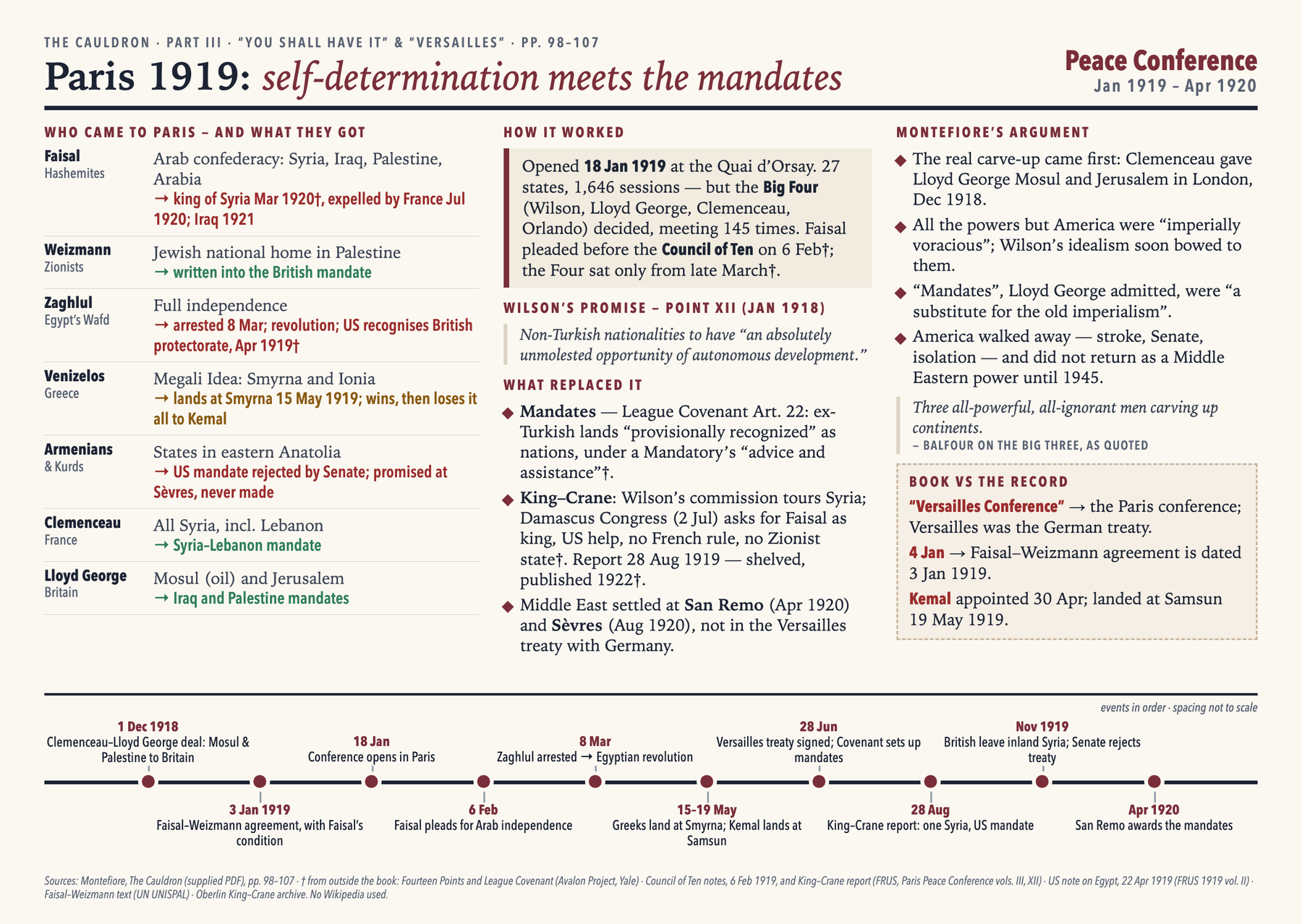
Notebook card (half B5): The Paris Peace Conference on one page. It covers what seven delegations asked for and what they got, how the conference worked, Wilson’s Point XII set against the mandate system, Montefiore’s argument, a “book vs the record” box, and a timeline from the Clemenceau–Lloyd George deal (1 Dec 1918) to San Remo (Apr 1920). Book: PDF pp. 98–107 (file not included in this release). Items marked † come from outside the book:
- Point XII and Covenant Art. 22: Avalon Project.
- Faisal before the Council of Ten, 6 Feb 1919: FRUS Paris 1919 vol. III, doc. 61.
- The King–Crane report: FRUS vol. XII and the Oberlin archive.
- The US recognition of the British protectorate in Egypt: FRUS 1919 vol. II.
- The Faisal–Weizmann text: UNISPAL.
Three corrections to the book:
- It calls the meeting the “Versailles Conference”; it was the Paris conference, and Versailles was the treaty with Germany.
- It dates the Faisal–Weizmann agreement 4 January; the agreement is dated 3 January 1919.
- It has Kemal leave Constantinople on 30 April. He was appointed that day and landed at Samsun on 19 May 1919.
San Remo assigns Mandates, while Sèvres envisages a drastically reduced Ottoman heartland. Montefiore’s key distinction is between these later arrangements and the earlier Sykes–Picot plan. Neither can be understood without following what happens next. He also sketches counterfactual alternatives: a larger Arab kingdom, different provincial borders, or regional annexations. Source: PDF pp. 96–109 (file not included in this release).
Period map — the Middle East after the peace settlements, 1922
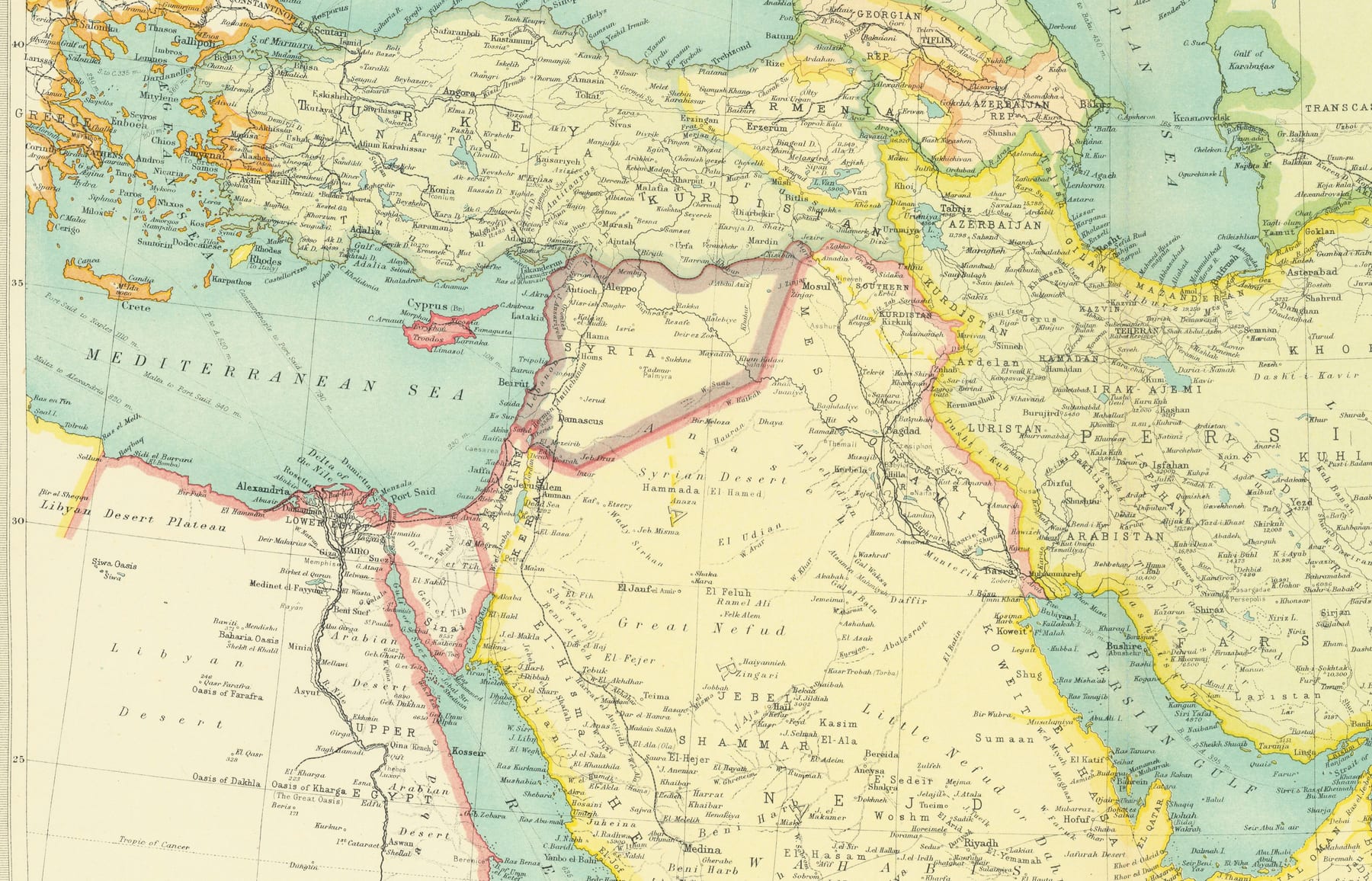
Read this map: The map’s key colours British territory red, French mauve and Turkish grey-green. Look for:
- French Syria with Lebanon.
- British Palestine, with Kerak east of the Jordan.
- British Mesopotamia, which includes Mosul and “Southern Kurdistan”.
- Cyprus and Egypt under Britain.
- The Syria–Turkey border along the Baghdad railway, from the Franco-Turkish agreement of October 1921, with Alexandretta inside Syria.
Compare it with the Sykes–Picot zones and the San Remo awards above. The map was drawn before the Treaty of Lausanne (1923), so it still marks Smyrna “To Greece” and shows an Armenian republic. Both were reversed by 1923.
Source: John Bartholomew & Son (Edinburgh Geographical Institute), “South-Western Asia”, plate 50, The Times Atlas, London: The Times, 1922, at 1:10,000,000. Scanned by Barry Lawrence Ruderman Antique Maps (stock 67341) and held on Wikimedia Commons as public domain. The date and scale are confirmed by the David Rumsey record of the same plate. The saved file is cropped to the Middle East and resized to 4200 px; the full scan is 13521×10537 px.

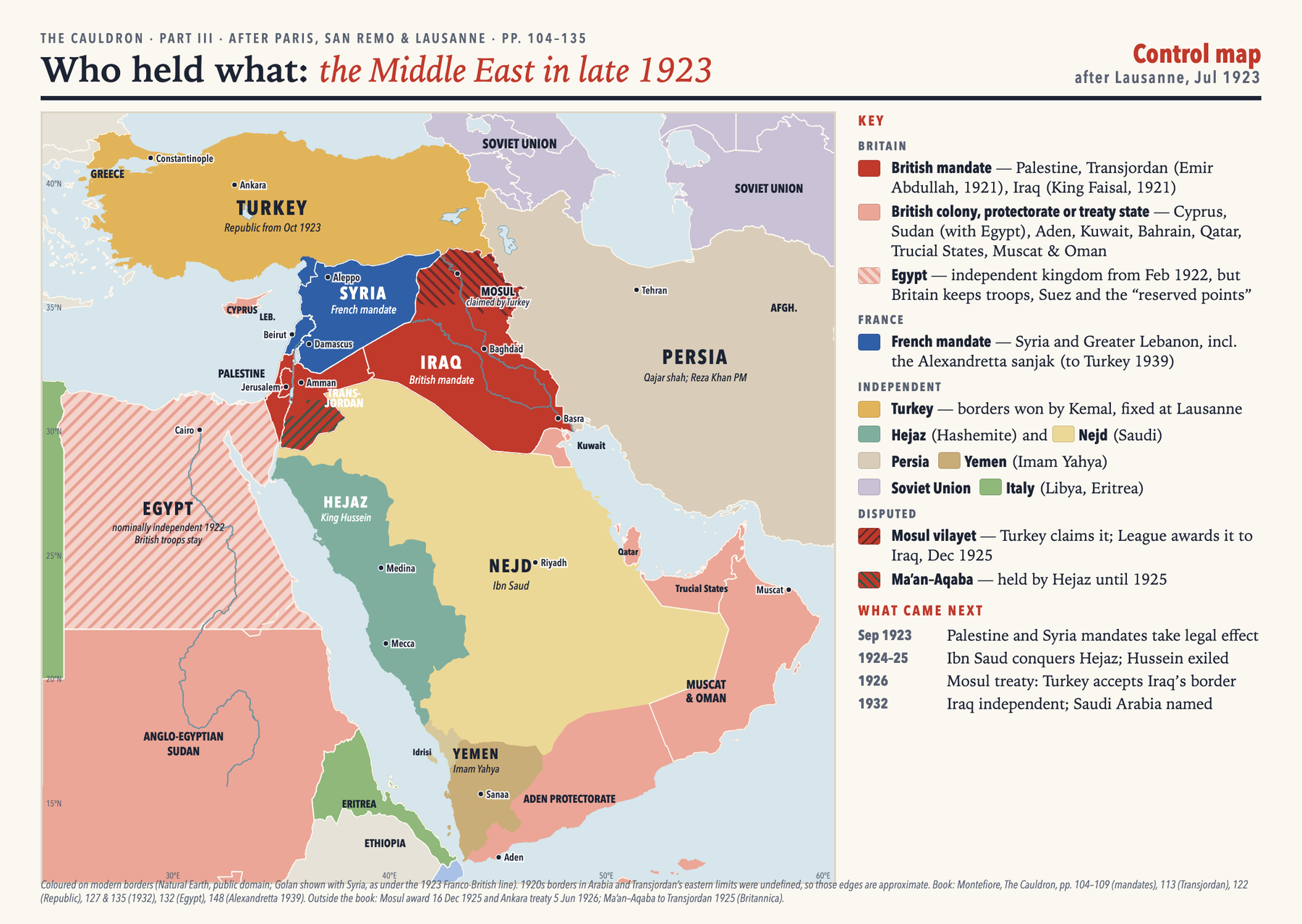
Notebook card (half B5): A modern redrawing of the 1922 map above, showing who held what in late 1923 after the Treaty of Lausanne:
- British: mandates in strong red; colonies, protectorates and treaty states in light red; Egypt hatched, independent since 1922 but still under British reserved powers.
- French: the mandate for Syria and Lebanon, including Alexandretta.
- Independent: Turkey, Hejaz, Nejd, Persia and Yemen.
- Disputed, hatched: Mosul (awarded to Iraq in December 1925) and Ma’an–Aqaba (held by the Hejaz until 1925).
Book: PDF pp. 104–109 (file not included in this release), 113, 122, 127, 132, 135 and 148. From outside the book: the Mosul award of 16 December 1925, the Ankara treaty of 5 June 1926, and the transfer of Ma’an–Aqaba to Transjordan in 1925 (Britannica, encyclopedia.com).
The colours are laid over modern borders from Natural Earth (public domain). I used the British version of that data, which puts the Golan with Syria as under the 1923 Franco-British line. Some boundaries are approximate:
- Arabia’s borders and Transjordan’s eastern edge were undefined in 1923.
- The Hejaz is drawn as the modern Saudi provinces of Tabuk, Medina, Mecca and Al Bahah.
- The Idrisi emirate is drawn as modern Jizan.
The Game of Kings
Armed resistance changes the settlement in different directions. Mustafa Kemal defeats or outlasts forces implementing partition in Anatolia; France defeats Faisal’s much weaker Syrian forces. In Iraq, revolt makes British direct rule expensive and dangerous. These outcomes demonstrate why prestige and legal designation are insufficient without organization and military strength.
Churchill’s 1921 arrangements answer Britain’s fiscal and strategic problem through local monarchy. Faisal receives Iraq; Abdullah receives Transjordan while being restrained from attacking French Syria. These are imperial decisions, but the Hashemites bargain, maneuver, and pursue their own larger ambitions.
Lineage chart — One Hashemite family, several different political projects
flowchart TD
  SH["Sharif Hussein bin Ali"]
  SH --> ALI["Ali — Hejaz"]
  SH --> AI["Abdullah I — Transjordan / Jordan"]
  SH --> FI["Faisal I — Syria, then Iraq"]
  ALI --> REG["Abd al-Ilah — regent of Iraq"]
  AI --> TAL["Talal — Jordan"]
  TAL --> HUS["Hussein — Jordan"]
  HUS --> AII["Abdullah II — Jordan"]
  FI --> GHA["Ghazi — Iraq"]
  GHA --> FII["Faisal II — Iraq"]
  classDef hejaz fill:#fff0ce,stroke:#996515,color:#302000;
  classDef jordan fill:#ddf2e8,stroke:#257352,color:#123d2c;
  classDef iraq fill:#e3edff,stroke:#385e9b,color:#1a3155;
  class SH,ALI hejaz;
  class AI,TAL,HUS,AII jordan;
  class FI,GHA,FII,REG iraq;
Read this chart: Arrows mean parent → child, not automatic succession to the same throne. Abd al-Ilah was Ali’s son and Iraq’s regent, not a king or Faisal II’s father. The Iraqi monarchy ended in 1958; the Jordanian branch followed a different course. Zeid and other relatives are omitted to keep the main narrative usable.
Book references: PDF p. 51: Hussein and his family (file not included in this release), pp. 114–118: the allocation of thrones (file not included in this release), p. 136: Ghazi (file not included in this release), p. 149: Faisal II and the regent (file not included in this release), pp. 177–178: Talal and Hussein (file not included in this release), and pp. 308–309: Abdullah II (file not included in this release). New study reconstruction, not a reproduction of the book’s chart.
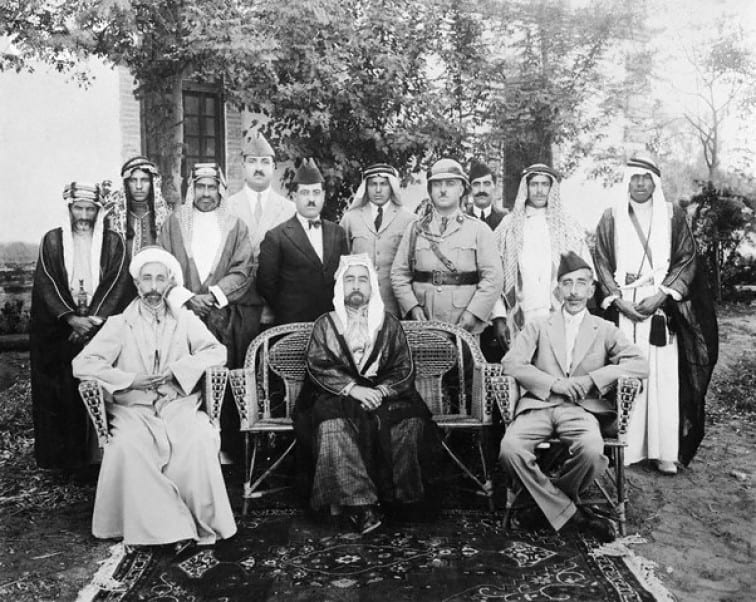
Identify the brothers: Seated, left to right: Ali, Abdullah, Faisal. Pair their faces with the three branches above; their shared ancestry did not give them identical interests or identical relationships with Britain. Photo dated between 1924 and 1933 in the Commons source record, via the Online Museum of Syrian History; photographer unknown, public domain according to that record.

- Iraq’s monarchy depends on British support and a predominantly Sunni governing circle while ruling a much more diverse population. Faisal must appear independent without losing the external power that sustains him.
- Transjordan emerges through Abdullah’s initiative followed by British accommodation, combining imported dynastic authority with agreements among local forces.
- Palestine’s communal politics are shaped by British attempts to manage representation. Montefiore treats the empowerment of Amin al-Husseini as an especially consequential choice that centralizes authority within a divided Arab community.
- Kurdish aspirations repeatedly lose out when British oil interests, Turkish ambitions, and Iraqi state-building converge against an independent settlement.
The resulting order was negotiated under sharply unequal conditions. Source: PDF pp. 110–119 (file not included in this release).
Nation-Makers: Father of Turks and Reza Shah the Great
Mustafa Kemal’s victory destroys the Greek imperial project in Anatolia and overturns the settlement envisaged at Sèvres. Lausanne recognizes the new balance. Population expulsion and compulsory exchange demonstrate the human cost of matching national claims to territory. The Turkish Republic then seeks a secular, linguistically unified citizenry through state-led cultural reform and coercion, especially against Kurdish identity.
Reza Khan’s rise in Persia follows a comparable search for central power after disorder and foreign interference. British support assists his opening, but he develops his own monarchy and program. Administration, railways, education, dress, secular institutions, and women’s public roles become instruments of national reconstruction. Reform also produces conflict with religious authorities; personal dictatorship becomes more suspicious and murderous as power concentrates.
Lineage chart — Keep the two shahs and the later crown prince distinct
flowchart TD
  R["Reza Shah — founder of the Pahlavi dynasty"]
  R --> MR["Mohammad Reza Shah — his son"]
  R --> AS["Ashraf — Mohammad Reza's twin sister"]
  MR ---|"married in 1959"| FA["Farah Diba"]
  MR --> CP["Crown Prince Reza — their son"]
  FA --> CP
  classDef ruler fill:#e3edff,stroke:#385e9b,color:#1a3155;
  classDef family fill:#f2e6fa,stroke:#84549e,color:#442451;
  class R,MR ruler;
  class AS,FA,CP family;
Read this chart: Reza Shah’s state-making in the 1920s–30s, his son’s accession in 1941 and fall in 1979, and the son’s heir are three different generations. Arrows show parentage; the labeled line shows marriage. This is a selective family chart: other spouses, children, and relatives are omitted.
Book references: PDF pp. 124–126: the dynasty and the twins (file not included in this release), p. 153: the 1941 succession (file not included in this release), p. 210: Farah and Crown Prince Reza (file not included in this release), and p. 243: Farah’s position (file not included in this release). New study reconstruction; revisit it in Parts VI, VIII, and IX.
Abdulaziz offers a different route. His kingdom uses religious warfare and dynastic alliances but survives by restraining its own expansionist warriors when their actions threaten recognized borders and royal authority. Early oil concessions later supply a new economic base. Dynastic interest, not doctrine alone, steered Saudi expansion.
The rest of the chapter tests nation-building across Morocco, Syria–Lebanon, Egypt, Palestine, and Iraq. The Rif and Syrian revolts expose colonial coercion; French arrangements privilege some communities while generating resistance from others. Egyptian parliamentary politics remains constrained by palace and British power. The 1929 violence in Palestine weakens cooperation, although Arab neighbors also protect Jews. Iraq’s independence does not protect Assyrians from massacre or prevent military intervention in politics.
State-building defines insiders and outsiders, distributes power unevenly, and can destroy the plural world it claims to organize. Source: PDF pp. 120–136 (file not included in this release).
Key Concepts and Distinctions
- Mandate: A League of Nations licence to govern “peoples not yet able to stand by themselves.” Lloyd George admitted it was “a substitute for the old imperialism.”
- Client monarchy: A local dynasty installed and protected by an empire because it costs less than direct rule. Faisal in Iraq and Abdullah in Transjordan bargained hard, but their thrones rested on British power.
- Nation-making by coercion: Atatürk, Reza Shah and Abdulaziz each built a durable state by imposing one identity or authority and crushing those who did not fit, such as Kurds, Arab sheikhs and the Ikhwan.
Essential Evidence and Examples
- The carve-up as theatre: Clemenceau to Lloyd George: “Tell me what you want.” “I want Mosul.” “You shall have it.” Balfour watched “three all-powerful, all-ignorant men carving up continents.” PDF pp. 98–99 (file not included in this release)
- Force decides: Kemal on the Armenian frontier: “Poor Wilson didn’t understand that a frontier which is not defended with bayonets, force and honour cannot be secured.” PDF p. 110 (file not included in this release)
- Empire on a budget: Churchill in 1921: “we are paying £8 million a year for the privilege of sitting on an ungrateful volcano.” PDF p. 114 (file not included in this release)
- A kingdom without a nation: Faisal’s last memorandum: “there are no Iraq people in Iraq … only diverse groups with no patriotic sentiments.” PDF p. 136 (file not included in this release)
- One-man states: Reza Shah: “Every country has its own system, and ours is a one-man system.” Atatürk: “Bloody revolutions are solid; bloodless ones are not permanent.” PDF p. 122 (file not included in this release) · PDF p. 125 (file not included in this release)
- The price of homogeneity: The 1923 exchange moved 1.1 million Greeks and 380,000 Muslims; the 1937 Dersim repression killed as many as 40,000 Kurdish civilians. PDF pp. 121–122 (file not included in this release)
Cautions
- New borders did not create new societies from nothing. Older cities, provincial institutions, communities and regional identities shaped both the opportunities and the resistance.
- Montefiore’s imagined alternatives (a larger Arab kingdom, different provincial borders, regional annexations) are counterfactual arguments, not evidence that another arrangement would have succeeded.
- The draft gives two different years (1921 and 1922) for Reza Khan’s coup on p. 123; the timeline follows the coup’s usual date of February 1921.
Conclusion and Significance
The Mandate order creates institutions and states that endure, but leaves representation, minority protection, borders, and legitimacy contested. Meanwhile, locally consolidated regimes demonstrate that escaping European control does not remove domination. The next world war will test both the new states’ autonomy and the remaining empires’ ability to command them.
Questions for Reflection
- Reconstruct why the Sèvres settlement and Faisal’s Syrian kingdom have different fates.
- Why does the Iraqi revolt encourage Britain to prefer a client monarchy?
- Use Turkish, Iranian, or Saudi evidence to distinguish modernization from liberalization.
- What qualifications are needed when describing Syria or Iraq as newly created states?
- Compare a minority’s position under imperial protection and under a consolidating national government.
Quick recall
- Where and when did the French defeat Faisal’s Syrian army?
- Who received which thrones at Churchill’s 1921 Cairo conference?
- What did the 1923 Treaty of Lausanne overturn?
- In what year was Saudi Arabia proclaimed, and what did Abdulaziz have to defeat first?
- Who founded the Muslim Brotherhood, when, and where?
Answer key
- Kemal had armies, a national assembly and Soviet help, and he beat the Greeks and French in the field; Faisal had a small, motley army and no great-power backer once Wilson’s America withdrew. PDF pp. 103–104 (file not included in this release) · PDF p. 110 (file not included in this release) · PDF pp. 120–121 (file not included in this release)
- The revolt cost £40 million and thousands of soldiers; Churchill concluded that a Hashemite king guided by British advisers would be cheaper and more palatable. PDF p. 112 (file not included in this release) · PDF p. 114 (file not included in this release)
- Atatürk emancipated women and imposed a Latin script but crushed Kurds; Reza Shah built railways and universities and unveiled women by decree while murdering ministers; Abdulaziz imported cars and telegraphs but ruled as an absolute monarch. Each modernized without opening politics. PDF p. 122 (file not included in this release) · PDF pp. 125–127 (file not included in this release)
- The provinces were Ottoman vilayets with old cities and institutions, so the states were new but the societies were not; Syria’s borders also shrank and shifted under French subdivision. PDF p. 108 (file not included in this release) · PDF p. 130 (file not included in this release)
- Assyrians served Britain as Levies, but after Iraqi independence the national army massacred over 3,000 of them at Simele; Armenians, Greeks and Kurds fared worse as Turkey consolidated. PDF pp. 121–122 (file not included in this release) · PDF p. 135 (file not included in this release)
- At Maysalun, on 24 July 1920; Damascus fell the next day. PDF p. 110 (file not included in this release)
- Faisal received Iraq and Abdullah Transjordan. PDF p. 114 (file not included in this release)
- The Treaty of Sèvres: it recognized Kemal’s Turkey and abandoned Armenian and Kurdish states and Greek gains in Anatolia. PDF p. 121 (file not included in this release)
- 1932; he had to break the Ikhwan, his own religious warriors, at Sabila in 1929. PDF p. 127 (file not included in this release)
- Hassan al-Banna, a schoolteacher, in Ismailia in 1928. PDF p. 133 (file not included in this release)
Part IV — The Second World War — The Battle of the Middle East, 1939–1945
What I Should Retain
Three takeaways: The Second World War turns demands for greater independence into choices among dangerous external patrons. Britain’s network of bases, client states, and imperial forces becomes essential to its war effort. Allied victory preserves that network briefly while accelerating the political and material exhaustion that will end formal imperial rule.
Three anchors: The 1936–1939 Palestine revolt weakens Arab Palestinian organization while strengthening Jewish military preparation. The 1941 Iraqi coup and British intervention connect local nationalism, Axis strategy, and the Farhud against Baghdad’s Jews. The 1942 Abdeen Palace confrontation discredits both British control and Farouk’s monarchy among young Egyptian officers.
Connection to test: How can an external intervention succeed militarily while undermining the local government through which the intervener expects to rule?
Part IV timeline — The Palestine revolt and the Second World War (1933–1946)
Source status: Dates and figures follow Montefiore’s draft; they are not independently fact-checked.
- Mar 1933 — The mufti approaches Nazi Germany: Days after Hitler takes office, Amin al-Husseini tells the German consul that Muslims welcome the new regime. PDF p. 141 (file not included in this release)
- 1933–36 — Refugee immigration surges: 174,000 Jews arrive; the Jewish share of Palestine’s population rises from 9 per cent (1922) to 27 per cent (1935). PDF p. 142 (file not included in this release)
- 12 Nov 1935 — Qassam killed: The jihadist imam dies in a shoot-out near Jenin; Hamas later names its brigades after him. PDF p. 142 (file not included in this release)
- Apr 1936 — Farouk becomes king; the Arab Revolt begins: The Arab Higher Committee calls a general strike on 25 April. PDF p. 139 (file not included in this release) · PDF p. 144 (file not included in this release)
- 1937 — The Peel Commission proposes partition: Ben-Gurion and Nashashibi accept; the mufti refuses. PDF pp. 144–145 (file not included in this release)
- 1936–39 — The revolt is crushed: About 8,000 Palestinians, 200 Britons and 500 Jews are killed. PDF p. 146 (file not included in this release)
- 17 Mar 1939 — The MacDonald White Paper: Britain promises an independent Palestine within ten years and limits Jewish immigration. PDF p. 147 (file not included in this release)
- 1 Apr 1941 — Golden Square coup in Iraq: Britain wins the short war in May; the Farhud kills about 200 Baghdadi Jews. PDF pp. 149–150 (file not included in this release)
- Jun–Jul 1941 — Britain conquers Vichy Syria and Lebanon: Dayan loses his eye crossing the Litani. PDF p. 152 (file not included in this release)
- 25 Aug 1941 — Anglo-Soviet invasion of Iran: Reza Shah abdicates; Mohammad Reza becomes shah at twenty-two. PDF p. 153 (file not included in this release)
- Nov 1941 — The mufti meets Hitler in Berlin. PDF p. 153 (file not included in this release)
- 4 Feb 1942 — The Abdeen Palace incident: British tanks force Farouk to appoint a Wafd government. PDF p. 154 (file not included in this release)
- Nov 1942 — Alamein and the US landings in Morocco: In January 1943 Roosevelt dines with Mohammed V at Casablanca. PDF pp. 155–156 (file not included in this release)
- 14 Feb 1945 — Roosevelt meets Abdulaziz on USS Quincy: The start of the US–Saudi relationship. PDF p. 158 (file not included in this release)
- 29 May 1945 — France shells Damascus: Over 1,000 die; Lebanon becomes independent in 1945 and French troops leave Syria in April 1946. PDF pp. 159–160 (file not included in this release)
Causal arc: Nazi persecution drives Jewish immigration → the Palestine revolt breaks Arab Palestinian organization and trains Jewish forces → Britain turns against partition to secure the Arabs before war → Axis pressure forces Britain to occupy or coerce Iraq, Syria, Iran and Egypt → victory leaves the empires holding territory they can no longer govern.
Objective and Through Line
This Part begins before 1939 because the region’s wartime alignments develop through the Palestine revolt, Hitler’s persecution of Jews, and the crisis of Anglo-French authority. Montefiore links Jewish refugee immigration, Palestinian resistance, Arab leaders’ ambitions, and European strategic calculation. Neither local politics nor the world war can be understood in isolation.
Britain faces a stark problem: preserve control of the routes, oil, and territories required to defeat the Axis while managing nationalist governments and communities that resent its authority. It responds with concessions, occupation, forced changes of leadership, and military campaigns. Such actions can secure a front but destroy a monarch’s credibility or a constitutional compromise. The Part concludes with the French bombardment of Damascus and British intervention in 1945: military victory has not restored the empires’ legitimacy, and the contest is shifting toward independent states and American involvement.
Structure at a Glance
- Connect fascism and refugee movement to the region’s political polarization.
- Follow the Palestine revolt and Britain’s reversal of its Jewish national-home policy.
- Trace the wartime struggle across Iraq, Syria–Lebanon, Iran, Egypt, and North Africa.
- Show how victory prepares imperial withdrawal rather than a durable restoration.
Section-by-Section Argument
Fascists and Democracies
Farouk’s accession captures the problem of nominal independence. He inherits wealth and prestige but operates among competing palace factions, parties, British officials, and new ideological movements. The Axis offers regional opponents of Britain and France a possible counterweight. Montefiore distinguishes opportunistic anti-imperial alignment from ideological attraction, while documenting cases where they combine.
In Palestine, Nazi persecution accelerates Jewish immigration and makes the conflict’s demographic stakes more urgent. Ben-Gurion’s organization and the Yishuv’s institutions matter because they provide a political and military capacity that a later state can use. On the Arab side, Qassam’s militancy and the mufti’s leadership contribute to a turn toward armed struggle.
Yet alternative arrangements remain under discussion. Alami, Antonius, Abdullah, and other regional actors consider federations, autonomous Jewish areas, or shared structures. Their proposals differ substantially, but they show that compromise was still being imagined. Source: PDF pp. 139–143 (file not included in this release).
The Arab Revolt of Palestine
The revolt emerges from popular anger that established Arab elites must organize or follow. It becomes a struggle against British rule and Zionism, but also an internal contest over who can speak for Palestinian Arabs. The mufti’s supporters fight moderates and rivals as well as external opponents. British repression uses collective punishment, torture, detention, and military force, while Jewish forces gain training and experience. Irgun also attacks civilians.
Montefiore emphasizes the resulting asymmetry: Arab Palestinian society suffers severe organizational damage before 1948, whereas Jewish institutions and forces become stronger.
The Peel proposals and the 1939 White Paper offer different paths. Britain’s policy shifts toward an independent Palestine with restrictions on Jewish immigration as London prepares for war. Montefiore places heavy responsibility on Husseini’s rejection of compromise.
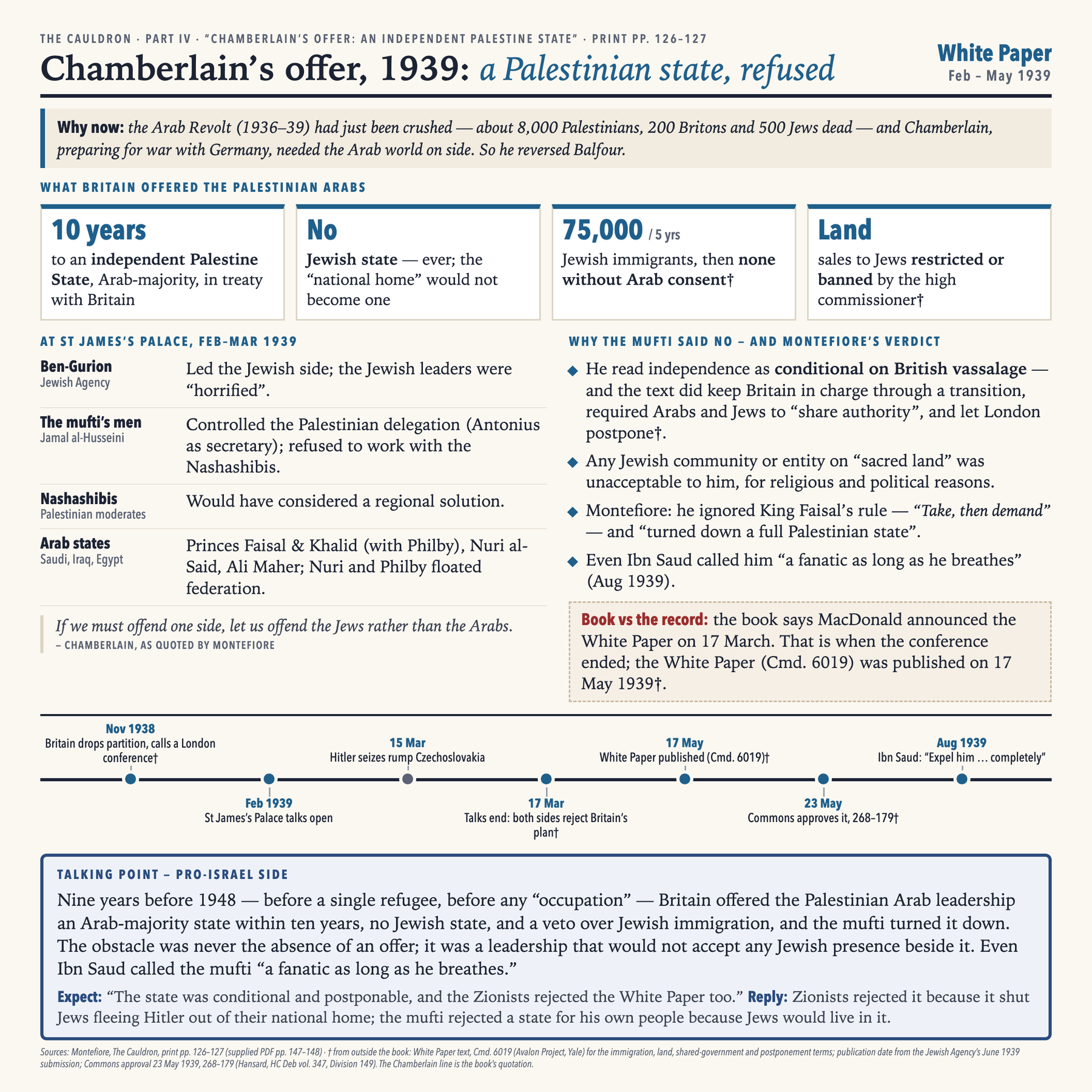
Notebook card (square, B5 width): Chamberlain’s offer of 1939 on one page.
- Why now: the revolt had been crushed and war with Germany was coming.
- The four terms of the White Paper: an independent Palestine within 10 years, no Jewish state, 75,000 Jewish immigrants over five years and then none without Arab consent, and restrictions on land sales to Jews.
- The St James’s Palace delegations, with Chamberlain’s line about which side to offend.
- Why the mufti refused, and Montefiore’s verdict (“Take, then demand”).
- A timeline from November 1938 to August 1939.
- A pro-Israel debate talking point, with the rebuttal to expect and a reply.
Book: print pp. 126–127, PDF pp. 147–148 (file not included in this release).
Items marked † on the card come from outside the book:
- the immigration, land, shared-government and postponement terms, from the White Paper text, Cmd. 6019 on the Avalon Project;
- the Commons approval on 23 May 1939, by 268 votes to 179, from Hansard, HC Deb vol. 347.
Correction: the book says MacDonald announced the White Paper on 17 March. That is the day the conference ended; the White Paper was published on 17 May 1939.
The 1941 Iraqi coup then extends these conflicts into the world war. The mufti and pro-Axis officers hope external victory will end British power. Britain defeats the challenge; the Farhud demonstrates the vulnerability of Iraqi Jews amid propaganda, political collapse, and communal violence. Source: PDF pp. 144–151 (file not included in this release).
The Anglo-French War
Britain invades Vichy-controlled Syria and Lebanon to prevent Axis use of their bases. It also occupies Iran with the Soviet Union, forcing Reza Shah’s abdication. These operations demonstrate the limits of neutrality when a territory is strategically indispensable to stronger powers.
In Egypt, British tanks at the Abdeen Palace force Farouk to accept a government. The immediate result serves British security; the longer result is humiliation shared by the king, parliamentary politicians, and the national army. Young officers including Nasser and Sadat draw conclusions that later undermine the monarchy itself.
North Africa shows how varied wartime Arab responses were. Montefiore describes antisemitic Vichy measures alongside the resistance of Moroccan and Tunisian rulers to those measures, though their power to prevent them is limited. American arrival and Roosevelt’s encounter with Mohammed V encourage expectations of independence.
The wartime meetings also establish the opening of a sustained US–Saudi relationship. Oil and security increase American interest without producing agreement over Palestine. Finally, France’s attempt to enforce control in Syria meets both local resistance and British pressure. The withdrawal that follows marks a transition: the empires retain formidable weapons but can no longer make their old arrangements politically durable. Source: PDF pp. 152–160 (file not included in this release).
Key Concepts and Distinctions
- Anti-imperial alliance versus ideological agreement: Seeking Axis help does not prove every nationalist shares Nazi doctrine; documented collaboration still requires direct examination.
- Immediate security versus legitimacy: A coerced government can obey while losing the support necessary for survival.
- Refugee movement versus abstract demographics: Jewish immigration is linked to persecution and closed escape routes, while Palestinian fears concern their political future in their own country.
Essential Evidence and Examples
- Refugees, not abstract demographics: Immigration rose from about 10,000 a year to 62,000 in 1935, just as other countries closed their doors; by 1940 Jews were a third of Palestine’s population. PDF p. 142 (file not included in this release)
- Partition offered and refused: Ben-Gurion accepted Peel’s partition, which Montefiore calls the first offer of a Jewish state in 2,000 years; the mufti told Peel that Palestine was a “holy Arab land.” PDF pp. 144–145 (file not included in this release)
- Britain reverses Balfour: Chamberlain: “If we must offend one side, let us offend the Jews rather than the Arabs.” The White Paper promised “an independent Palestine State” within ten years. PDF p. 147 (file not included in this release)
- Arab judgements of the mufti: Abdulaziz called him “a fanatic as long as he breathes” and advised, “Expel him.” PDF p. 147 (file not included in this release)
- Different wartime choices: Mohammed V told Vichy officials, “There are no Jews in Morocco. Just Moroccans,” while in Baghdad the Futwa militia led the Farhud. PDF p. 150 (file not included in this release) · PDF p. 155 (file not included in this release)
- The cost of coercion: Lampson wanted to “kick the boy out”; the Abdeen humiliation radicalized young officers including Nasser and Sadat. PDF pp. 154–155 (file not included in this release)
Cautions
- Arab responses to the Axis were not uniform. Some nationalists saw an anti-imperial opportunity, some embraced Nazi antisemitism, others resisted or protected Jewish subjects; individual leaders’ commitments cannot stand for whole populations.
- Montefiore’s point that the revolt weakened Arab Palestinian society before 1948 is a causal argument about preparation and leadership, not a claim that later displacement was deserved.
- He places heavy responsibility on Husseini’s rejections, but the British offers were conditional, preserved British influence and lacked communal consent.
- The draft’s Peel partition percentages carry an unresolved editorial query on p. 144; do not cite those figures.
Conclusion and Significance
The war closes off an Axis outcome but does not settle the region’s political future. Local societies emerge with stronger demands, damaged compromises, and unequal organizational resources. Britain’s and France’s ability to occupy territory increasingly exceeds their ability to govern it acceptably.
Questions for Reflection
- Explain why this Part’s causal story begins before the formal outbreak of the world war.
- How does the Palestine revolt change the relative preparation of the two communities?
- Use Abdeen Palace to distinguish military effectiveness from political consequences.
- Which cases prevent treating Arab wartime alignments as a single response?
- Compare Iran’s forced wartime transition with Britain’s management of Farouk.
Quick recall
- What did the 1939 White Paper promise?
- What was the Farhud, and when did it happen?
- Why did Britain and the Soviet Union invade Iran in August 1941?
- Where did Roosevelt meet Abdulaziz, and when?
- Which Moroccan ruler refused to apply Vichy’s antisemitic laws?
Answer key
- The wartime alignments grew out of Hitler’s rise in 1933, the refugee wave it caused, and the Palestine revolt of 1936–39, which together shaped British policy before 1939. PDF pp. 139–147 (file not included in this release)
- Arab Palestinian society lost about 8,000 dead, its leaders fled or were feuding, and its elite was divided; the Yishuv gained trained fighters through Wingate’s Night Squads and stronger institutions under Ben-Gurion. PDF p. 146 (file not included in this release)
- British tanks got Lampson the government he wanted in 1942, but the humiliation discredited Farouk and the parliamentary parties and inspired the Free Officers. PDF pp. 154–155 (file not included in this release)
- The Golden Square and the mufti backed the Axis, but Abdullah’s Arab Legion fought for Britain, and Mohammed V and the bey of Tunis protected Jews from Vichy. PDF pp. 149–156 (file not included in this release)
- In Iran the Allies simply removed Reza Shah and installed his son; in Egypt Britain kept Farouk but forced his ministers on him. Both secured the war effort and damaged the monarchy’s standing. PDF pp. 153–154 (file not included in this release)
- An independent Palestinian state within ten years, strict limits on Jewish immigration, and no Jewish state. PDF p. 147 (file not included in this release)
- The pogrom against Baghdad’s Jews in June 1941, after the collapse of Rashid Ali’s pro-Axis government; about 200 were killed. PDF p. 150 (file not included in this release)
- To secure the supply route to the USSR and the oilfields, since Reza Shah’s neutrality and his asylum for Axis sympathizers seemed too risky. PDF p. 153 (file not included in this release)
- On USS Quincy, after Yalta, on 14 February 1945. PDF p. 158 (file not included in this release)
- Sultan Mohammed V. PDF pp. 155–156 (file not included in this release)
Part V — New States, 1945–1948
What I Should Retain
Three takeaways: British withdrawal leaves rival projects without an agreed enforcement mechanism. Arab governments enter the Palestine war with conflicting objectives rather than one unified command. Israel’s independence and Palestinian dispossession occur through the same war, while Jordan and Egypt prevent the emergence of the proposed Arab Palestinian state.
Three anchors: The UN partition plan creates a proposed legal framework but fragmented territories and no adequate means of enforcement. Abdullah’s negotiations with Jewish leaders reveal a territorial agenda distinct from the mufti’s. The 1949 armistices leave Israel and Jordan with major territorial gains, Gaza under Egypt, and Palestinians dispersed or under other governments.
Connection to test: Why can the same event be national liberation for one population and catastrophe for another without either experience being reducible to propaganda?
Part V timeline — Partition, war and the new states (1945–1954)
Source status: Dates and figures follow Montefiore’s draft; they are not independently fact-checked.
- Mar 1945 — The Arab League is founded in Cairo: It quickly becomes an arena for the rivalry between Farouk and Nuri al-Said. PDF p. 168 (file not included in this release)
- Jul 1946 — The King David Hotel bombing: Irgun kills ninety-one people at British headquarters in Jerusalem. PDF pp. 163–164 (file not included in this release)
- Feb 1947 — Britain hands Palestine to the UN: India is partitioned on 14 August. PDF p. 164 (file not included in this release)
- 29 Nov 1947 — The UN partition vote: Jewish leaders accept; the mufti rejects. Abdullah and Golda Meir secretly agree he will take the Arab areas. PDF p. 165 (file not included in this release)
- 9 Apr 1948 — Deir Yassin: About 110 Arabs are killed; four days later Arab fighters kill seventy-eight on the Hadassah convoy. PDF p. 170 (file not included in this release)
- 13 May 1948 — Kfar Etzion: 127 Jews are killed after surrendering. PDF p. 171 (file not included in this release)
- 14 May 1948 — Israel declares independence: Egypt, Syria, Jordan, Lebanon and Iraq invade the next day. PDF p. 171 (file not included in this release)
- 17 Sep 1948 — Lehi assassinates Bernadotte, the UN mediator. PDF p. 172 (file not included in this release)
- 1949 — The armistices: Israel holds 78 per cent of Mandate Palestine, Jordan the West Bank and East Jerusalem, Egypt Gaza; about 750,000 Palestinians are refugees. PDF p. 173 (file not included in this release)
- Mar 1949 — Syria’s first coup: Husni al-Zaim lasts 150 days; Shishakli seizes power in December. PDF pp. 175–177 (file not included in this release)
- Apr 1950 — Jordan annexes the West Bank. PDF p. 175 (file not included in this release)
- 20 Jul 1951 — Abdullah is assassinated at al-Aqsa; his grandson Hussein is beside him. PDF p. 176 (file not included in this release)
- 2 May 1953 — Hussein of Jordan and Faisal II of Iraq take their oaths on the same day. PDF p. 178 (file not included in this release)
Causal arc: Exhausted Britain withdraws → the UN offers a plan with no enforcement → civil war becomes interstate war → Israel and Jordan win, no Palestinian state appears, refugees on both sides lose their homes → defeat discredits Arab regimes and opens the door to soldiers.
Objective and Through Line
The transition to independence is not a clean passage from empire to national self-rule. Britain is exhausted, the Holocaust has transformed the urgency of Jewish statehood, Arab governments are newly autonomous and competitive, and Palestinian political organization is damaged. Montefiore reconstructs the war as a sequence: revolt against Britain, proposed partition, intercommunal civil war, state declaration, invasion by neighboring governments, and armistice.
The explanatory center is the difference between coalition appearance and actual objectives. Shared opposition to a Jewish state does not give Arab governments a shared command, an agreed Palestinian leadership, or the same territorial ambitions. Jewish forces have internal divisions too, but Ben-Gurion’s organization and military consolidation provide a crucial advantage. The Part then follows the political consequences beyond the nominal date range, showing how defeat destabilizes Arab governments and shapes the next generation of rulers.
Structure at a Glance
- Explain why Britain abandons the attempt to settle Palestine itself.
- Distinguish the UN proposal from the political and military arrangements on the ground.
- Follow civil war into interstate war without treating them as the same phase.
- Connect the outcome to refugees, new borders, and crises of Arab legitimacy.
Section-by-Section Argument
State of Independence
Jewish resistance to British restrictions intensifies after the Holocaust. Haganah, Irgun, and Lehi pursue different strategies and sometimes cooperate. The King David Hotel bombing kills British, Jewish, and Arab victims and contributes to Britain’s loss of willingness to continue governing. Montefiore treats it as terrorism while placing it within a wider anti-imperial struggle.
The partition of British India illustrates a larger imperial retreat and offers a grim comparison: the creation of national states can produce mass displacement and killing rather than resolve communal antagonism. The transfer of Gulf responsibilities from the Indian imperial system to London also changes Arabian arrangements.
The UN Palestine plan recognizes Arab and Jewish claims in two proposed states and an international Jerusalem. Its proposed territories are fragmented, enforcement is weak, and the parties’ expectations diverge. Jewish leaders accept statehood; Husseini rejects partition; Abdullah explores division of the Arab areas with Jewish leaders. Approval of a plan is not effective implementation, and the prospect of settlement becomes a trigger for conflict rather than a guarantee against it. Source: PDF pp. 163–166 (file not included in this release).
Color comparison — The 1947 partition proposal and the 1949 armistice lines
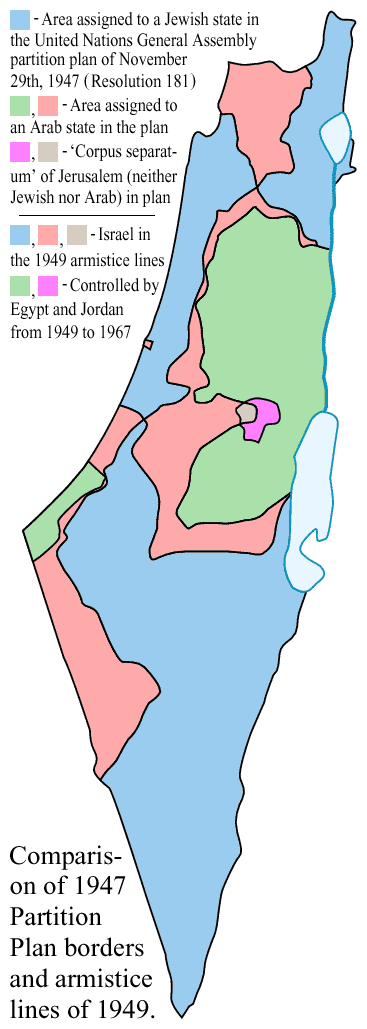
Read this map: First distinguish proposed Jewish-state, Arab-state, and international-Jerusalem areas in 1947; then follow the different territorial outcomes after the war. Green and pink both originate in the proposed Arab-state area but represent different postwar control. The map compares a proposal with armistice lines, not two successive, fully implemented sovereign states. It does not depict the movement or fate of refugees.
Source: AnonMoos, 2005, Commons original and legend, public-domain explanatory reconstruction. Compare the UN historical-map record. Jerusalem, Latrun, and demilitarized-zone details are simplified.

Arab Paladins – Two Kings
Farouk seeks regional leadership; Abdullah seeks territory and a larger monarchy; Syrian leaders fear Hashemite expansion; the mufti insists on controlling Palestinian representation. Their rival military organizations embody these differences. The Arab Liberation Army and the Husseini forces are competitors.
The civil war places roads, settlements, and Jerusalem’s access at the center of military strategy. Montefiore interprets Plan Dalet as permitting expulsions in specified circumstances without constituting a universal expulsion order.
His narrative includes the deliberate killing of civilians at Deir Yassin, the massacre of the Jewish medical convoy, Kfar Etzion, and the widening flight of Arab civilians. Such episodes matter because fear, revenge, military defeat, and atrocity reports can change behavior beyond the place where violence occurs. The diarist Wasif Jawhariyyeh supplies a civilian perspective on departure, uncertainty, and the belief that exile might be brief.
After Israeli independence, neighboring armies intervene but retain divergent goals. Montefiore emphasizes Jewish military organization, outside arms supply, and the failure of Arab coordination. Organization, available forces, logistics, objectives, and changing troop strengths decide the war: by July Israel fields about 65,000 troops against roughly 35,000. Source: PDF pp. 167–172 (file not included in this release).
After Palestine
The armistices leave neither the UN map nor a settled peace. Israel controls more territory than the partition proposal; Jordan annexes the West Bank and East Jerusalem; Egypt holds Gaza. No independent Arab Palestinian state emerges. Palestinian refugees cannot return, while Jewish residents are expelled from areas taken by Arab forces. Montefiore also follows persecution and departures of Jews from Arab countries, distinguishing coercion from the attraction of Zionism where his account allows it.
These movements transform societies and memories, and each loss stands on its own.
Israel’s early institutional choices also matter to the later narrative. Montefiore identifies postponed constitutional settlement, coalition incentives, and concessions to religious groups as problems with long consequences. The new republic’s Arab citizens have formal citizenship but live under military rule.
Arab defeat discredits rulers and provides openings for soldiers. Syria’s coups and failed peace approaches demonstrate the instability of governments without durable authority. Abdullah’s assassination and Hussein’s accession show that negotiation with Israel is entangled with domestic legitimacy and personal danger. The most useful question is not only whether an offer exists, but whether the leader proposing or accepting it can carry a constituency and implement it. Source: PDF pp. 173–178 (file not included in this release).
Key Concepts and Distinctions
- Plan versus implementation: A UN vote created legal claims but no force to carry them out; the borders came from the fighting.
- Coalition versus command: Five Arab armies invaded together but with separate aims, and most feared each other’s gains as much as Israel’s.
- Two displacements: About 750,000 Palestinians became refugees, and about 800,000 Jews left Arab countries over the next decade. Each loss is real, and neither cancels the other.
Essential Evidence and Examples
- An unequal plan: The UN gave the Jewish state 55 per cent of the territory although Jews were under half the population and owned about 6 per cent of the land. PDF p. 165 (file not included in this release)
- Bravado before the war: Azzam Pasha warned of “a war of elimination”; Glubb said Arab armies “regarded Jews as a nation of shopkeepers.” PDF p. 168 (file not included in this release)
- Negative goals: Rogan, quoted by Montefiore: the Arab coalition fought “to prevent the establishment of an alien Jewish state … to prevent Jordan expanding into Palestine and to keep the Mufti from forming a viable Palestinian state.” PDF pp. 171–172 (file not included in this release)
- Forces on the ground: By July 1948 Israel fielded about 65,000 troops against roughly 35,000 Arab troops. PDF p. 172 (file not included in this release)
- Nasser’s lesson: Nasser told Yitzhak Rabin the Egyptians were “fighting the wrong war against the wrong enemy at the wrong time.” PDF p. 172 (file not included in this release)
- Abdullah’s realism: “There will be another war and another war and another war and we shall lose all these wars. Hence it is in the supreme interest of the Arab nation to make peace with you.” PDF p. 175 (file not included in this release)
- A civilian voice: Wasif Jawhariyyeh’s diary records leaving home thinking it would be “only a few weeks.” PDF p. 170 (file not included in this release)
Cautions
- A history of leadership failure cannot substitute for a history of refugee experience. Montefiore records expulsions, atrocities, fear, flight and the refusal of return; causes and responsibility have to be examined case by case.
- His reading of Plan Dalet (expulsions permitted in specific circumstances, with no general expulsion order) is his interpretation of a disputed question, not a settled verdict.
- His claim that a federal solution “would have prevented the Arab–Israeli wars” is counterfactual. PDF p. 165 (file not included in this release)
Conclusion and Significance
1948 creates Israel and entrenches Palestinian statelessness rather than delivering the two states envisaged by the UN. The unresolved outcome also destabilizes the regional governments that fought the war. The next Part follows the officers and ideological movements that turn that discredit into claims to rule.
Questions for Reflection
- Reconstruct the separate phases from British withdrawal to the armistices.
- How do divergent Arab objectives affect military coordination and Palestinian statehood?
- Which civilian examples show how local violence can produce wider displacement?
- What does Montefiore claim about Plan Dalet, and what remains beyond this summary’s verification?
- Explain why an armistice, state declaration, and durable peace are three different achievements.
Quick recall
- When did the UN vote for partition, and what did it propose for Jerusalem?
- Which Arab states invaded on 15 May 1948?
- Roughly how many Palestinians became refugees, and how many Jews later left Arab countries?
- Who killed Count Bernadotte?
- Where and when was King Abdullah assassinated?
Answer key
- Jewish revolt against Britain (1945–47), referral to the UN (February 1947), partition vote (November 1947), intercommunal civil war (winter 1947 to May 1948), Israel’s declaration and the Arab invasion (May 1948), then the 1949 armistices. PDF pp. 163–173 (file not included in this release)
- Each army served its own government: Abdullah wanted the West Bank, Farouk regional leadership, Syria to stop Hashemite expansion, the mufti control of Palestinian funds. No one commanded the whole, and Jordan and Egypt absorbed the land meant for a Palestinian state. PDF pp. 168–173 (file not included in this release)
- Deir Yassin and reports of it accelerated flight; the Hadassah convoy and Kfar Etzion hardened Jewish attitudes; Jawhariyyeh’s departure shows ordinary families leaving in fear, expecting to return. PDF pp. 170–171 (file not included in this release)
- That Plan Dalet allowed officers to drive out villagers who resisted but contained no general expulsion order; the wider dispute about intent needs other sources. PDF pp. 169–170 (file not included in this release)
- The armistices ended fighting but fixed no agreed borders; the 1948 declaration created a state recognized by the powers; a durable peace required treaties that came only in 1979 and 1994. PDF pp. 171–175 (file not included in this release)
- 29 November 1947; Jerusalem would be an international corpus separatum. PDF p. 165 (file not included in this release)
- Egypt, Syria, Jordan, Lebanon and Iraq. PDF p. 171 (file not included in this release)
- About 750,000 Palestinians; about 800,000 Jews left Arab countries in the following decade. PDF pp. 173–174 (file not included in this release)
- The Lehi group, on 17 September 1948. PDF p. 172 (file not included in this release)
- At al-Aqsa on the Haram al-Sharif in Jerusalem, 20 July 1951. PDF p. 176 (file not included in this release)
Part VI — The Days of Nasser, 1948–1960
What I Should Retain
Three takeaways: Military revolution promises to overcome discredited elites but can produce a more pervasive police state. Cold War patrons compete for influence without fully controlling their clients. Nasser’s regional prestige rises faster than the institutions or alliances needed to realize Arab unity.
Three anchors: The Free Officers replace Farouk and Nasser marginalizes Naguib and independent political forces. The 1953 Iran coup combines foreign intervention with a domestic struggle whose relative causal weights Montefiore contests. Suez turns an Egyptian military setback into a political triumph, while the United Arab Republic exposes the coercive terms behind unity.
Connection to test: Compare a leader’s popularity across borders with his ability to govern another society. Why are these different forms of power?
Part VI timeline — Nasser’s rise and the officers’ revolutions (1949–1960)
Source status: Dates and figures follow Montefiore’s draft; they are not independently fact-checked.
- Feb 1949 — Hassan al-Banna is assassinated, two months after the Brotherhood kills prime minister Nuqrashi. PDF p. 180 (file not included in this release)
- Mar–May 1951 — Mosaddegh’s moment: The Majlis nationalizes Anglo-Iranian Oil and Mosaddegh becomes prime minister after Razmara’s assassination. PDF p. 187 (file not included in this release)
- 26 Jan 1952 — Black Saturday: Arsonists burn central Cairo. PDF p. 182 (file not included in this release)
- 23 Jul 1952 — The Free Officers’ coup: Farouk is exiled; the monarchy is abolished, parties banned in January 1953. PDF pp. 183–184 (file not included in this release)
- Aug 1953 — Mosaddegh falls: The CIA’s plot fails, the shah flees to Rome, then Zahedi and Kashani’s supporters remove Mosaddegh. PDF p. 188 (file not included in this release)
- Nov 1953 — Abdulaziz dies; Saud succeeds. PDF p. 199 (file not included in this release)
- 26 Oct 1954 — Nasser survives the Manshiya shooting and soon becomes president. PDF pp. 191–192 (file not included in this release)
- 24 Feb 1955 — The Baghdad Pact; in September Nasser signs the Czech arms deal. PDF p. 193 (file not included in this release)
- Mar 1956 — Morocco independent; Tunisia follows, with Bourguiba premier in April. PDF p. 196 (file not included in this release)
- 26 Jul 1956 — Nasser nationalizes the Suez Canal. PDF p. 197 (file not included in this release)
- 29 Oct–Nov 1956 — The Suez war: Israel invades Sinai under the Protocol of Sèvres; Eisenhower forces Britain and France out. PDF p. 198 (file not included in this release)
- 1 Feb 1958 — The United Arab Republic: Syria merges with Egypt under Nasser. PDF p. 201 (file not included in this release)
- 14 Jul 1958 — Revolution in Iraq: Faisal II and his family are killed; Nuri al-Said is lynched the next day. PDF p. 204 (file not included in this release)
- Oct 1959 — Saddam’s failed attempt on Qasim. PDF p. 206 (file not included in this release)
Causal arc: The 1948 defeat discredits the old elites → officers take power in Egypt and remove rivals → Suez turns military defeat into Nasser’s political triumph → his prestige inspires union with Syria and revolution in Iraq → the new revolutionaries prove unwilling to obey him.
Objective and Through Line
The age of independence shifts the main struggle from obtaining sovereignty to deciding who will govern. Montefiore connects Farouk’s collapse, Nasser’s consolidation, Iran’s oil crisis, decolonization in North Africa, and the regional competition between nationalist republics and monarchies. These are linked by a crisis of legitimacy among older elites and by the opportunities provided by superpower rivalry.
Nasser emerges as a leader able to turn personal courage, nationalist rhetoric, radio, and anti-imperial confrontation into extraordinary regional authority. Yet the same narrative follows his suppression of independent organization and his inability to tolerate rival centers of power. The Part’s dramatic movement is therefore double: Egyptian and Arab political confidence expands while the possibilities for plural politics contract. His success also inspires imitators who will not necessarily accept Egyptian command once they gain power themselves.
Structure at a Glance
- Trace the monarchy’s failure and the officers’ seizure of power.
- Follow the conversion of a revolutionary coalition into personal rule.
- Compare Egyptian and Iranian struggles within the Cold War.
- Explain Suez prestige, regional union, and the proliferation of competing revolutions.
Section-by-Section Argument
Nationalists, Cold Warriors and Secret Agents
Farouk loses legitimacy through corruption, dependence, conspicuous privilege, and the military’s experience of defeat. The Free Officers’ opposition begins without a fully settled ideological program. Their coalition includes different social backgrounds and tactical relationships with Islamists, communists, and civilians. This diversity helps them reach power but makes the distribution of authority afterward contentious.
Nasser resolves that contention by excluding alternatives. Parties are banned, Naguib is removed, independent allies are disciplined, and competing security organizations strengthen the ruler. The mukhabarat state links military command, personal leadership, and intelligence repression. The treatment of the writer Ihsan Abdel Kouddous shows how a former revolutionary ally can be forced into dependence rather than simply eliminated.
The Muslim Brotherhood first overlaps with the officers’ coalition and then becomes a target. Qutb’s ideological trajectory is presented as modern and revolutionary: his response to Western society and supposedly corrupt Muslim rule promotes an all-encompassing alternative political order. The contest is over authority within the state as well as religion in society.
Iran supplies a parallel struggle with different outcomes. Mosaddegh’s oil nationalization challenges British power, while disputes with the shah, army, religious forces, and other factions weaken his position. Montefiore argues that the CIA’s failed initial operation has been allowed to eclipse the domestic forces behind his eventual removal.
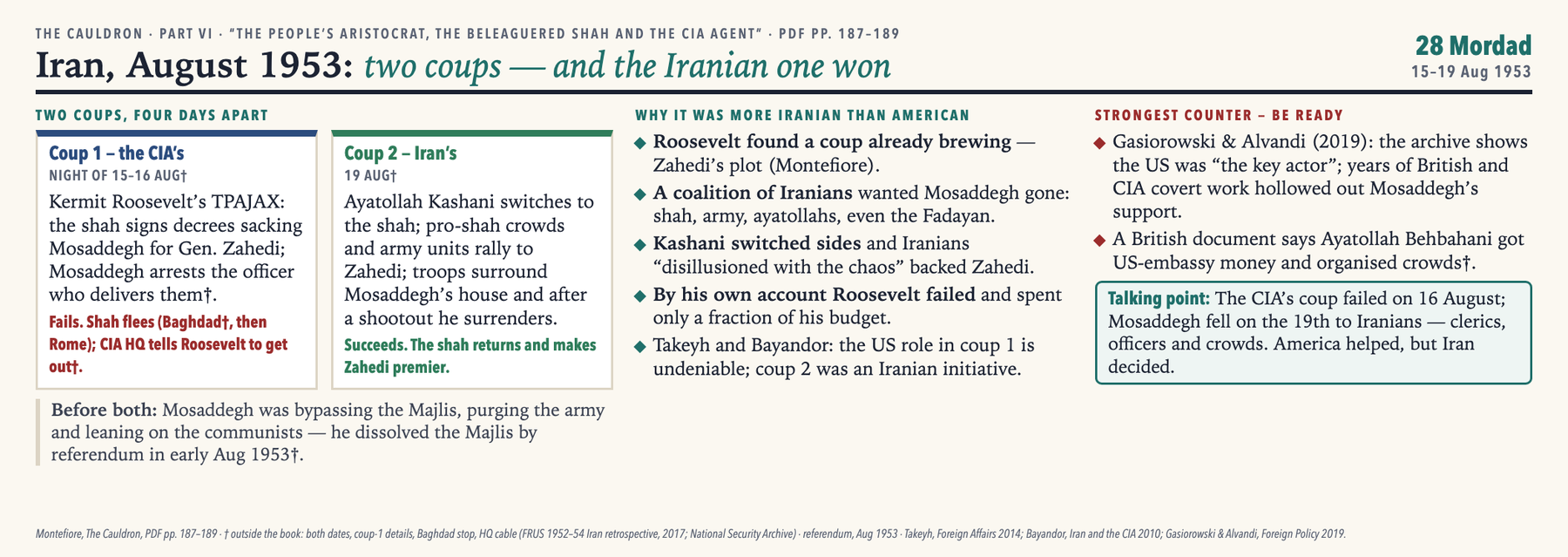
Notebook strip (quarter B5, horizontal): August 1953 shown as two coups.
- Coup 1, 15–16 August: the CIA’s TPAJAX. It failed, and the shah fled.
- Coup 2, 19 August: Kashani, the crowds, the army and Zahedi. It succeeded.
The strip also covers Mosaddegh’s own extra-constitutional moves beforehand, the case that the outcome was decided by Iranians (Montefiore, Takeyh and Bayandor), the strongest counter-case (Gasiorowski and Alvandi), and a talking point.
Book: PDF pp. 187–189 (file not included in this release).
Items marked † come from outside the book:
- the two dates, the details of the first coup, the shah’s stop in Baghdad and the CIA headquarters cable, from the FRUS 1952–54 Iran retrospective volume (2017);
- the case for the coup being Iranian-made: Takeyh, Foreign Affairs 2014 and Bayandor, Foreign Policy 2019;
- the counter-case and the Behbahani money: Gasiorowski and Alvandi, Foreign Policy 2019.
The August 1953 referendum dissolving the Majlis is standard history, but it was not checked against a specific source in this session. The relative weight of Iranian and American agency is still disputed among historians.
The shah subsequently consolidates his own authority rather than remaining a compliant instrument. In Egypt, Nasser’s survival of an assassination attempt becomes a radio event that magnifies his national stature. Voice of the Arabs and Umm Kulthum connect culture with political mobilization: the audience experiences a shared Arab public even without a common state.
Cold War alignments then diverge. The Baghdad Pact seeks a Western security system; Nasser’s Soviet-backed arms deal breaks the Western monopoly. Morocco and Tunisia gain independence through distinct nationalist and monarchical trajectories, while France fights to retain Algeria. Decolonization takes several institutional forms. Source: PDF pp. 180–196 (file not included in this release).
Nasser Meteoric
Nasser’s nationalization of Suez provokes the British–French–Israeli operation. Their military advantage cannot overcome opposition from the United States and Soviet Union. Britain and France retreat, and Nasser emerges as the political victor. This is the clearest early example of the book’s distinction between battlefield performance and strategic outcome.
Israel’s French partnership also contributes to its nuclear program, connecting a conventional war to a longer-term transformation of deterrence. Meanwhile, Nasser uses his triumph to intensify nationalization, repression, and the exclusion of Egypt’s cosmopolitan communities. Montefiore treats those losses as damage to the country’s social and cultural capacity, not incidental scenery.
The United Arab Republic appears to fulfill the promise of Arab unity. Its creation is driven partly by Syrian actors fearful of domestic rivals, but Nasser insists on full merger and the dissolution of separate parties. Egyptian domination and Sarraj’s policing turn shared enthusiasm into resentment. A union’s symbolic appeal does not settle who will control its army, administration, and resources.
The surrounding revolutions also escape Nasser’s command. Iraq’s monarchy is murdered in 1958, but Qasim refuses immediate absorption into Nasser’s project. His rivalry with Arif and the Baathists produces new conspiracies, including Saddam’s failed assassination attempt. Jordan’s Hussein survives by reorganizing alliances and coercive institutions. In Saudi Arabia, rivalry between Saud and Faisal demonstrates that monarchies have their own internal contests rather than forming a frictionless conservative bloc.
The effect is paradoxical: Nasser’s example multiplies nationalist revolutions while multiplying autonomous leaders. Each claims liberation and unity; each also wants to govern. Source: PDF pp. 197–206 (file not included in this release).
Key Concepts and Distinctions
- Mukhabarat state: Security institutions help preserve personal rule and police political participation; state capacity is not the same as accountability.
- Pan-Arab audience versus pan-Arab government: Common emotional identification can coexist with incompatible institutional interests.
- Patronage versus control: A superpower’s arms or money do not make its client reliably obedient.
Essential Evidence and Examples
- Dictatorship by acclamation: Sadat on the RCC vote: “seven for dictatorship, one for democracy, the one being Nasser of course.” Nasser then threatened to resign and “had won.” PDF p. 184 (file not included in this release)
- Nasser’s charisma: At Manshiya, under fire, he shouted, “all of you are Gamal Abdel Nasser.” PDF p. 191 (file not included in this release)
- Montefiore’s 1953 revision: Kermit Roosevelt “by his own account failed in his coup”; Zahedi, Kashani and disillusioned Iranians finished the job. PDF pp. 188–189 (file not included in this release)
- Suez outrage: Eden: “I want him destroyed, dammit, I want him murdered.” Eisenhower: “Nothing justifies double-crossing us.” PDF pp. 197–198 (file not included in this release)
- The nuclear by-product: Bourgès-Maunoury told the Israelis, “I gave you the bomb.” PDF p. 199 (file not included in this release)
- Unity on Egyptian terms: Quwatli warned Nasser that “Fifty per cent of Syrians consider themselves national leaders, 25 per cent think they are prophets and 10 per cent imagine they are gods.” PDF p. 201 (file not included in this release)
- The end of a cosmopolitan Egypt: About 65,000 Jews were expelled after Suez, along with Greeks, Italians and others. PDF p. 200 (file not included in this release)
Cautions
- Montefiore’s account of the 1953 coup stresses Iranian agency and mocks CIA self-mythology. That causal weighting needs comparison with documentary histories, and it is not a claim that foreign intervention was absent: he records British and American intent and participation.
Conclusion and Significance
Nasser displaces the older political elite and changes what regional leadership looks like. His success also lays the groundwork for failure: repression weakens correction, prestige invites overreach, and revolutionary followers become competitors. The next Part tests the distance between his public authority and his actual capacity.
Questions for Reflection
- Reconstruct the steps by which the Free Officers’ coalition becomes Nasser’s personal regime.
- Why does Suez increase Nasser’s stature despite Egypt’s military losses?
- Use the UAR to explain the institutional problems hidden by a slogan of unity.
- What is distinctive about Montefiore’s interpretation of 1953 Iran, and what does it not establish?
- Compare the functions of radio prestige, an intelligence service, and a superpower arms agreement.
Quick recall
- When did the Free Officers seize power, and who was their public figurehead?
- When did Nasser nationalize the Suez Canal?
- What was the Protocol of Sèvres?
- Which two countries formed the United Arab Republic, and when?
- What happened in Baghdad on 14 July 1958?
Answer key
- The officers banned parties, confiscated estates, tried old politicians, sidelined Naguib, crushed the Brotherhood after Manshiya, and built the mukhabarat to control even former friends such as Kouddous. PDF pp. 183–186 (file not included in this release) · PDF pp. 191–192 (file not included in this release)
- America and the USSR forced Britain, France and Israel to withdraw, so Nasser kept the canal and appeared to have defeated two empires. PDF p. 198 (file not included in this release)
- Nasser demanded “total union or nothing,” dissolved Syrian parties and sent Amer and Sarraj to rule; shared Arab feeling could not settle who controlled the army, police and money. PDF pp. 201–202 (file not included in this release)
- He argues that the domestic coalition against Mosaddegh did most of the work after the CIA plot failed; it does not show that British and American intervention was unimportant. PDF pp. 188–189 (file not included in this release)
- Voice of the Arabs gave Nasser an audience beyond Egypt, the mukhabarat kept him in power at home, and the Czech arms deal broke the Western monopoly on arms. Each was a different kind of power. PDF p. 185 (file not included in this release) · PDF p. 191 (file not included in this release) · PDF p. 193 (file not included in this release)
- 23 July 1952; General Mohamed Naguib. PDF p. 183 (file not included in this release)
- 26 July 1956. PDF p. 197 (file not included in this release)
- The secret October 1956 agreement under which Israel would invade Sinai and Britain and France would intervene to “separate” the sides and seize the canal. PDF pp. 197–198 (file not included in this release)
- Egypt and Syria, in February 1958. PDF p. 201 (file not included in this release)
- Iraqi officers under Qasim and Arif overthrew the monarchy, killing Faisal II and his family; Nuri al-Said was lynched the next day. PDF p. 204 (file not included in this release)
Part VII — The Reversal — The Crisis of Pan-Arabism, 1960–1967
What I Should Retain
Three takeaways: The collapse of the UAR reveals the limits of unity under Egyptian command. Nasser’s intervention in Yemen exposes an anti-imperial leader’s own expansionist project and drains his resources. The road to 1967 is a crisis of rivalries, reputation, false information, and escalation, not simply the execution of one coherent regional plan.
Three anchors: Syrian officers end the union in 1961. The Algerian war shows that tactical military success can fail to preserve a colonial political order. The Six-Day War overturns the regional map and discredits Nasser’s promise of national revival.
Connection to test: When leaders compete to sound more resolute than their rivals, how can public rhetoric reduce their freedom to de-escalate?
Part VII timeline — The crisis of pan-Arabism (1960–1967)
Source status: Dates and figures follow Montefiore’s draft; they are not independently fact-checked.
- 27 May 1960 — Military coup in Türkiye: Menderes is later hanged. PDF p. 209 (file not included in this release)
- Sep 1961 — Syria secedes from the UAR. PDF p. 208 (file not included in this release)
- Mar 1962 — De Gaulle concedes Algerian independence: Ben Bella becomes president in September. PDF pp. 214–215 (file not included in this release)
- 26 Sep 1962 — Revolution in Yemen: Nasser sends troops; by 1964 he has 40,000 there. PDF pp. 215–216 (file not included in this release)
- 26 Jan 1963 — The shah’s White Revolution approved by referendum; in June Khomeini’s protest leads to his arrest and about 200 deaths. PDF pp. 211–212 (file not included in this release)
- 8 Feb 1963 — Ramadan coup in Iraq: Qasim is shot; in March the Baath takes power in Syria. PDF p. 213 (file not included in this release)
- 5 Apr 1963 — Kennedy confronts Peres over Dimona. PDF p. 209 (file not included in this release)
- Jan 1964 — The PLO is created under Nasser’s patronage; Fatah launches its first raids in January 1965. PDF p. 219 (file not included in this release)
- 4 Apr 1964 — Faisal replaces Saud as king of Saudi Arabia. PDF p. 216 (file not included in this release)
- Feb 1966 — Jadid and Assad take power in Syria. PDF p. 220 (file not included in this release)
- 13 Nov 1966 — Israel’s raid on Samu in Jordan. PDF p. 220 (file not included in this release)
- 13–30 May 1967 — The crisis slide: A false Soviet warning, troops into Sinai, UN forces out, the Straits of Tiran closed on 22 May, Hussein joins Nasser on 30 May. PDF pp. 221–222 (file not included in this release)
- 5–10 Jun 1967 — The Six-Day War: Israel destroys the Egyptian air force and takes Sinai, Gaza, the West Bank, East Jerusalem and the Golan. PDF pp. 222–223 (file not included in this release)
- 25 Sep 1967 — Amer dies after a power struggle with Nasser. PDF p. 224 (file not included in this release)
Causal arc: The UAR collapses → Yemen drains Egypt → Syria’s radicals and the new Palestinian movements outbid Nasser → bluster and false intelligence narrow the choices → June 1967 destroys pan-Arabism’s claim to deliver victory.
Objective and Through Line
This Part explains a reversal of reputation through failures of institutions and judgment. Nasser remains the region’s most commanding public figure, but Egyptian control of Syria, the Yemeni intervention, and competitive radicalism reveal the weakness behind the prestige. Elsewhere, the shah pursues reform through autocracy, Turkish politics oscillates between electoral competition and military guardianship, and Baathist governments grow more coercive.
The culmination is 1967. Montefiore reconstructs the sequence as a slide in which actions intended to deter, display leadership, or manage a domestic rival increase the perceived need for war. The major interpretive distinction is between claiming readiness and possessing it. Egyptian command and intelligence fail; Israeli leaders are frightened and divided before the strike; Jordan faces a choice between dangerous participation and dangerous isolation. The resulting Israeli victory is decisive militarily but opens political problems that the next Parts will follow.
Structure at a Glance
- Show how the UAR and revolutionary coalitions fracture.
- Compare coercive modernization and anti-colonial struggle elsewhere.
- Trace Yemen’s cost and the competition for Arab leadership.
- Reconstruct the escalation, war, and consequences of June 1967.
Section-by-Section Argument
The Battle of Algiers
The chapter’s scope is wider than its title. Syria’s secession demonstrates that common Arab identification does not make Egyptian command acceptable. The conflict between Amer and Sarraj combines personal rivalry with a deeper question: whether Syrian institutions exist for Syrian political purposes or as instruments of Nasser’s central government.
Kennedy’s efforts to restrain Israeli nuclear development and influence Iranian reform show the limits of American leverage even over close partners. Israel delays and evades; the shah adopts and redirects reforms while resenting pressure. Turkish nuclear arrangements also reveal unequal alliance management when Washington makes a concession involving Turkish security to resolve the Cuban crisis.
The shah’s White Revolution expands education, land ownership, and women’s political participation while challenging established interests. Montefiore credits its achievements and follows the coercion and social tensions it generates. Khomeini emerges as a determined opponent whose project goes well beyond resisting foreign influence.
Iraq and Syria supply another failure of unity. Baathist seizures of power lead to purges and competition rather than an enduring regional merger. The governing claim is universal; the machinery of rule becomes factional and violent.
The Algerian war offers the Part’s clearest distinction between tactical and political victory. France can disrupt the FLN, use torture, and win particular battles without restoring consent to French rule. The conflict also destabilizes France itself. Independence brings immense displacement and reprisals, qualifying any account that ends at the liberation celebration.
Finally, Yemen exposes the imperial behavior of a proclaimed anti-imperialist. Nasser supports republican forces, becomes heavily committed, uses chemical warfare, and struggles to withdraw. Saudi Arabia, Jordan, Britain, and Israel support opposing interests in different ways. A religious or anti-colonial binary cannot explain that configuration. The war weakens Egyptian capacity while Nasser’s prestige makes retreat difficult. Source: PDF pp. 208–217 (file not included in this release).
Nasser’s Eclipse
Egypt’s internal command problem is central to the approaching disaster. Nasser cannot easily control Amer, whose authority over the military and security system undermines the president’s own supremacy. A highly centralized regime can still contain competing personal networks that prevent reliable planning.
The Palestinian movement also changes. Fatah seeks an independent Palestinian initiative; Nasser-sponsored PLO structures attempt to channel it; Syrian leaders use militant action to pressure Israel and challenge Egypt’s claim to leadership. Jordan’s Hussein has secret contacts with Israel while ruling a population deeply affected by the Palestinian conflict. The Israeli raid on Jordan in response to attacks connected to Syria damages that relationship and illustrates the costs of misdirected retaliation.
Montefiore follows several escalatory decisions rather than one inevitable route to war:
- Soviet warning of an imminent Israeli attack on Syria proves false, but Nasser acts despite contrary information.
- Troops move into Sinai, UN forces are withdrawn, and the Straits of Tiran are closed. Each move increases the political cost of backing down.
- Hussein enters the Egyptian alliance and places forces under its command, despite grave doubts about the outcome.
- Israeli leaders experience a real fear of defeat; they also debate a preemptive strike and eventually concentrate command under Dayan.
The air strike destroys Egypt’s air force on the ground and permits rapid advances. Egyptian misinformation then worsens Jordan’s decisions, while military collapse opens the route to Israeli control of East Jerusalem, the West Bank, Gaza, Sinai, and the Golan. Montefiore emphasizes that Arab governments initially try to coordinate a false account of Anglo-American participation. Information failure operates before the war, during command, and in the explanation offered afterward.
Color map — What changed geographically in June 1967
Read this map: Locate Sinai, Gaza, the West Bank including East Jerusalem, and the Golan Heights. The contrast between Israel and the territories occupied in the war explains the later disputes over security, occupation, settlements, withdrawal, and peace. This is a historical snapshot of territorial control, not a map of present borders or a determination of lawful sovereignty. Sinai’s subsequent return to Egypt belongs to the later diplomatic story.
Source: Ling.Nut; SVG derivative by Rafy, 2011, Commons file, CC BY-SA 3.0. Saved original SVG.

The ending returns from grand strategy to personal rule. Nasser remains president after public demonstrations; Amer becomes an intolerable rival and dies in circumstances the book leaves uncertain. Political responsibility does not translate into a transparent institutional reckoning. Palestinians again experience displacement and, for those who remain in the newly occupied territories, a different sovereign power. Source: PDF pp. 218–224 (file not included in this release).
Key Concepts and Distinctions
- Crisis slide: Interacting decisions progressively narrow choices, even when no actor has designed the entire sequence.
- Reputational trap: The fear of appearing weak can encourage actions that reveal actual weakness.
- Military guardianship: An army claiming to preserve the state can limit the meaning of electoral government, as in Türkiye.
Essential Evidence and Examples
- Yemen as Nasser’s Vietnam: He called it “my Vietnam” yet told his generals “withdrawal is impossible”; by 1964 it cost $1 million a day, and he used chemical weapons. PDF p. 216 (file not included in this release)
- The cost of Algeria: About a million Algerians, 25,000 French soldiers and 6,000 French civilians died; 900,000 colons left. De Gaulle: “in decolonisation, the victory is to leave.” PDF pp. 214–215 (file not included in this release)
- A crisis slide: Avi Shlaim, quoted by Montefiore: “the war resulted from a crisis slide that neither Israel nor her enemies were able to control.” PDF p. 220 (file not included in this release)
- The fatal exchange: Nasser: “If we close the Straits, war will be 100 per cent certain. Are the armed forces ready?” Amer: “Everything’s in tiptop shape.” PDF p. 221 (file not included in this release)
- The scale of defeat: On 5 June, 188 Israeli jets destroyed 388 Egyptian aircraft; Nasser admitted, “We’ve been purely and simply crushed by the enemy.” PDF pp. 222–223 (file not included in this release)
- The aftermath: Sadat said Nasser “did not die in 1970 but on 5 June 1967.” PDF p. 224 (file not included in this release)
Cautions
- Contingency does not mean all actors had the same aims or responsibility. Montefiore names particular decisions (closing the Straits, defective command, retaliatory raids, misread intelligence) rather than treating the war as an impersonal accident.
Conclusion and Significance
The defeat undermines pan-Arabism’s promise that mobilized unity under revolutionary leadership will restore power. It also gives Israel territory and a sense of military invulnerability. The Part therefore creates two future dangers at once: radical alternatives among the defeated and overconfidence among the victors.
Questions for Reflection
- Reconstruct the sequence from Syrian secession and Yemen to the 1967 crisis.
- How do domestic and inter-Arab rivalries make de-escalation harder?
- What does Algeria show about the difference between winning battles and maintaining a political order?
- Which parts of the 1967 outcome were contingent rather than predetermined by ideology?
- Apply the idea of a reputational trap to one Egyptian, Jordanian, or Israeli decision.
Quick recall
- When did Syria leave the UAR?
- Who founded Fatah, where and when?
- What three steps did Nasser take in May 1967 that made war likely?
- Which territories did Israel take in June 1967?
- What was the White Revolution?
Answer key
- Syria left the UAR in 1961, Nasser sank troops into Yemen from 1962, the Syrian Baath and new Palestinian groups accused him of avoiding war, Israeli–Syrian clashes and the Samu raid raised tension, and a false Soviet warning in May 1967 set off the final escalation. PDF p. 208 (file not included in this release) · PDF pp. 215–222 (file not included in this release)
- Each leader feared looking weaker than his rivals: Nasser could not be outflanked by Syria, Hussein could not stand aside from Arab unity, and Israeli leaders faced pressure to strike first. PDF pp. 218–222 (file not included in this release)
- France won the Battle of Algiers through torture and reprisal but lost the war, because the colonial order had lost all consent and the conflict destabilized France itself. PDF p. 214 (file not included in this release)
- The Soviet false report, Nasser’s escalation, Amer’s incompetence, Hussein’s decision to join, and the success of Israel’s first air strike; none was dictated by ideology. PDF pp. 221–223 (file not included in this release)
- Closing the Straits of Tiran: Nasser knew it made war “100 per cent certain” but could not back down after the UAR’s collapse and Yemen without seeming weak. PDF p. 221 (file not included in this release)
- September 1961, after a coup by Syrian officers. PDF p. 208 (file not included in this release)
- Yasser Arafat and fellow exiles in Kuwait, in 1959. PDF p. 219 (file not included in this release)
- He moved troops into Sinai, demanded the withdrawal of the UN force, and closed the Straits of Tiran. PDF p. 221 (file not included in this release)
- Sinai, Gaza, the West Bank including East Jerusalem, and the Golan Heights. PDF p. 223 (file not included in this release)
- The shah’s 1963 reform programme: land reform, votes for women, literacy and industrialization, approved in a referendum and opposed by Khomeini. PDF p. 211 (file not included in this release)
Part VIII — The Ascendancy of the Shah, 1967–1978
What I Should Retain
Three takeaways: Israel’s victory produces both strategic opportunity and the long-term costs of occupation and settlement. Oil gives regional rulers much greater autonomy, while the shah’s success conceals a brittle political order. Sadat uses limited war to reopen diplomacy, demonstrating that war aims can differ sharply even between allies.
Three anchors: Black September preserves Hussein’s state and pushes the PLO toward Lebanon. The 1973 war restores Egyptian bargaining power without destroying Israel. Camp David exchanges Sinai for Egyptian–Israeli peace while leaving Palestinian self-government unresolved.
Connection to test: Compare the military means used in 1973 with the political objectives sought. Why could the same campaign be a strategic success for Sadat and a disappointment for Assad?
Part VIII timeline — Oil, the shah’s ascendancy and Sadat’s turn (1967–1978)
Source status: Dates and figures follow Montefiore’s draft; they are not independently fact-checked.
- 29 Aug 1967 — The Khartoum summit: “no peace, no recognition and no negotiation with Israel,” while Nasser privately leaves room for land for peace. PDF pp. 227–228 (file not included in this release)
- 22 Nov 1967 — UN Security Council Resolution 242: Peace in return for land. PDF p. 229 (file not included in this release)
- Mar 1968 — Karameh: Fatah’s stand against an Israeli raid sweeps Arafat to the PLO chairmanship in February 1969. PDF p. 232 (file not included in this release)
- 17 Jul 1968 — The Baath takes power in Iraq: Saddam stages a coup within the coup two weeks later. PDF p. 229 (file not included in this release)
- 1 Sep 1969 — Qaddafi overthrows King Idris. PDF p. 230 (file not included in this release)
- 6–15 Sep 1970 — Dawson’s Field and Black September: Hussein’s army crushes the PLO; about 10,000 Palestinians die. PDF pp. 236–237 (file not included in this release)
- 28 Sep 1970 — Nasser dies; Sadat succeeds. In November Hafez al-Assad seizes power in Syria. PDF pp. 237–240 (file not included in this release)
- 23 Jul 1970 — Qaboos deposes his father in Oman. PDF p. 241 (file not included in this release)
- 2 Dec 1971 — The United Arab Emirates is founded under Zayed. PDF p. 242 (file not included in this release)
- Jul 1972 — Sadat expels the Soviet advisers; in September Black September kills eleven Israeli athletes at Munich. PDF p. 239 (file not included in this release) · PDF p. 248 (file not included in this release)
- 6 Oct 1973 — The Yom Kippur War: Egypt crosses the canal with 100,000 troops; Israel recovers, and DEFCON III ends in a UN ceasefire. PDF pp. 249–251 (file not included in this release)
- Oct 1973–1974 — The oil embargo and price rises: Iran’s oil income rises from $4.6 billion (1973–74) to $17.8 billion (1975). PDF pp. 251–252 (file not included in this release)
- 6 Mar 1975 — The Algiers Agreement: The shah abandons the Kurds in return for half of the Shatt al-Arab; on 25 March King Faisal is assassinated. PDF p. 252 (file not included in this release)
- 13 Apr 1975 — Lebanon’s civil war begins. PDF p. 257 (file not included in this release)
- 17 May 1977 — Begin wins Israel’s election; on 19 November Sadat flies to Jerusalem. PDF p. 259 (file not included in this release) · PDF p. 261 (file not included in this release)
- 5–17 Sep 1978 — Camp David. PDF p. 262 (file not included in this release)
Causal arc: Defeat in 1967 frees the PLO and empowers new radicals → Black September pushes the PLO into Lebanon → oil money makes the shah and the Gulf rulers powerful → Sadat fights a limited war to reopen diplomacy → peace with Israel splits the Arab world while Lebanon collapses.
Objective and Through Line
After 1967, the region does not move along a single victorious or defeated trajectory. Palestinian national organization becomes more independent, revolutionary regimes consolidate, Gulf states emerge, and Iran acquires extraordinary resources and confidence. Montefiore uses this multiplicity to show the inadequacy of treating Arab–Israeli war as the only regional engine.
The Part develops a contrast between power that expands and legitimacy that does not. Israel’s triumph leaves its leaders divided over the use of occupied territory. The shah gains oil income and strategic reach while losing contact with groups transformed by his own reforms. Lebanon’s prosperous plural society lacks institutions able to contain armed factions and outside intervention. Sadat, by contrast, changes his objective and methods: limited military success becomes a bridge to a diplomatic settlement. It creates a durable interstate result while leaving the Palestinian question unsolved.
Structure at a Glance
- Trace the political effects of Israeli victory and Arab defeat.
- Follow Palestinian militancy and the rise of stronger personal regimes.
- Explain oil power, the shah’s ascendancy, and the 1973 war.
- Connect Lebanon’s breakdown with Sadat’s turn toward peace.
Section-by-Section Argument
The Blessing: Israel’s Miracle and the New Arab Radicals
Israel’s victory strengthens its American relationship but does not produce an agreed territorial strategy. Land-for-peace proposals compete with strategic retention and religious nationalism. Montefiore treats the settlement project as a danger to Israeli democracy as well as to Palestinian self-determination. Victory changes what Israelis think possible while making compromise politically harder.
The Arab response is also less uniform than the Khartoum “Three No’s” suggest. Public refusal can coexist with private permission to explore negotiation. Meanwhile, British withdrawal from Aden leaves a radical South Yemeni state; the Iraqi Baath consolidates through a coup within a coup; Qaddafi and Nimeiry imitate Nasser without becoming his obedient instruments.
Palestinian national politics moves toward Arafat’s independent leadership. Karameh supplies symbolic momentum; Fatah, the PFLP, and other groups pursue different strategies and patrons. International hijackings and attacks turn the conflict into a global spectacle, linking Palestinian militants with foreign radicals and intelligence services. Montefiore connects Soviet “Zionology” to antisemitic propaganda.
Black September illustrates the conflict between a national liberation movement’s freedom of action and the host state’s sovereignty. Hussein will not accept a rival armed authority in his capital. His victory preserves the monarchy, inflicts severe Palestinian losses, and moves the center of PLO activity toward Lebanon. Nasser’s last intervention mediates that confrontation before his death. Source: PDF pp. 226–237 (file not included in this release).
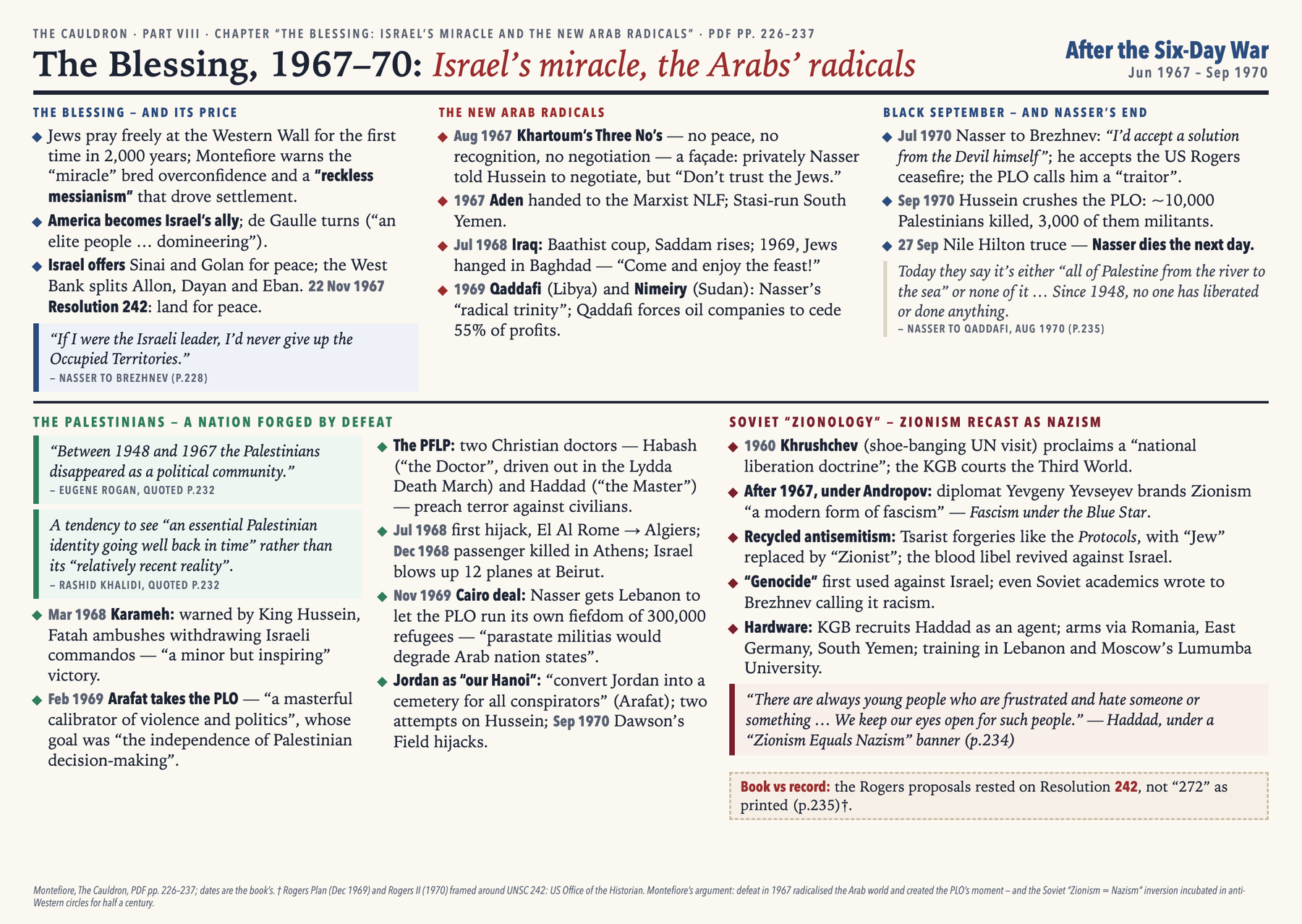
Notebook card (half B5): the chapter on one page.
The top row gives the overview in three columns:
- The blessing and its price: with Nasser to Brezhnev, “If I were the Israeli leader, I’d never give up the Occupied Territories” (PDF p. 228 (file not included in this release)).
- The new Arab radicals.
- Black September and Nasser’s end: with his “solution from the Devil himself” line and his “river to the sea” remark to Qaddafi (PDF p. 235 (file not included in this release)).
The bottom half goes into more depth:
- The Palestinians: the Rogan and Khalidi quotes on identity, Karameh, Arafat’s takeover of the PLO, the PFLP doctors and the first hijackings, the 1969 Cairo deal, and Jordan as “our Hanoi” (PDF pp. 232–236 (file not included in this release)).
- Soviet “Zionology”: Khrushchev’s doctrine, Yevseyev under Andropov, the Protocols recycled with “Zionist” for “Jew”, “genocide”, the KGB’s recruitment of Haddad, and Haddad’s recruiting quote (PDF pp. 233–234 (file not included in this release)).
Correction: the book says the Rogers Plan rested on “UNSC 272”; it was Resolution 242, according to the US Office of the Historian.
Petroleum Kings – Empowerment and Atonement
Sadat first secures his position by removing rivals and reducing Soviet leverage. His openness to Islamist organization is a tactical response to other opponents with consequences beyond his immediate intention. Assad consolidates a different personal regime in Syria, combining an Alawite core with selected Sunni partners, family security forces, and Soviet support.
Oman’s Qaboos and the new UAE demonstrate additional paths to consolidation. Their development depends on oil, dynastic authority, external connections, and the defeat or accommodation of rivals. The end of British protection produces several Arab political models.
The shah’s regional ascendancy combines increased oil control, military intervention, and relationships with Israel, the United States, and monarchies. His abandonment of Kurdish allies in the 1975 agreement with Saddam illustrates the limited security a patron can provide when its own interests change. Modernization also creates new urban populations, educated critics, inflation, and demands that the monarchy cannot absorb through accountable politics. Khomeini supplies an alternative whose published theory of juristic authority is more radical than many temporary allies acknowledge.
The 1973 war is the key case of limited military action for political effect. Sadat seeks to cross the Canal, break the humiliation of 1967, and reactivate diplomacy. Assad’s ambitions are different. Israeli assumptions of superiority and discounted warnings enable surprise; Israel then recovers, while superpower resupply and nuclear danger impose limits on the conflict. The war restores Egyptian prestige and makes negotiation possible without delivering an unqualified Arab military victory.
The oil embargo and price increases transform the producers’ leverage. Yet the shah does not simply follow an Arab line: his own revenue and strategic interests guide his actions. Oil strengthens multiple competing rulers rather than a unified bloc. Source: PDF pp. 238–254 (file not included in this release).
Lineage chart — Saudi succession across brothers, then a new generation
flowchart LR
  AZ["Abdulaziz / Ibn Saud — founder"]
  AZ --> SA["Saud — king"]
  AZ --> FI["Faisal — king"]
  AZ --> KH["Khalid — king"]
  AZ --> FH["Fahd — king"]
  AZ --> AB["Abdullah — king"]
  AZ --> SL["Salman — king"]
  SL --> MBS["Mohammed bin Salman — crown prince"]
  classDef founder fill:#fff0ce,stroke:#996515,color:#302000;
  classDef sons fill:#ddf2e8,stroke:#257352,color:#123d2c;
  classDef grandson fill:#e3edff,stroke:#385e9b,color:#1a3155;
  class AZ founder;
  class SA,FI,KH,FH,AB,SL sons;
  class MBS grandson;
Read this chart: Arrows mean father → son. The six kings in the middle are brothers or half-brothers, not six successive generations. Their succession order is Saud → Faisal → Khalid → Fahd → Abdullah → Salman; MBS belongs to the next generation and is labeled crown prince as discussed in the book. This chart selects the rulers central to the narrative, not every child or succession contender.
Book references: PDF pp. 199–200: Saud and Faisal (file not included in this release), p. 216: the brothers and the Sudairis (file not included in this release), p. 252: Khalid succeeds Faisal (file not included in this release), and p. 357: Abdullah, Salman, and MBS (file not included in this release). New study reconstruction; reuse when reading “Kings and Princelings” and “The Crown Prince.”
The War of the Camps, War of the Hotels, War of the Mountains: Lebanon
Lebanon’s civil war arises from interacting causes: an unequal confessional settlement, demographic and social change, rival Lebanese militias, Palestinian armed autonomy, and outside intervention. Montefiore’s narrative includes massacres by Christian and Palestinian forces and shows how Syria intervenes against supposed ideological allies. Assad’s interest in control and fear of an unfavorable outcome outweigh a simple anti-Israel alignment.
Color map — Lebanon’s communities and the geography behind the civil war
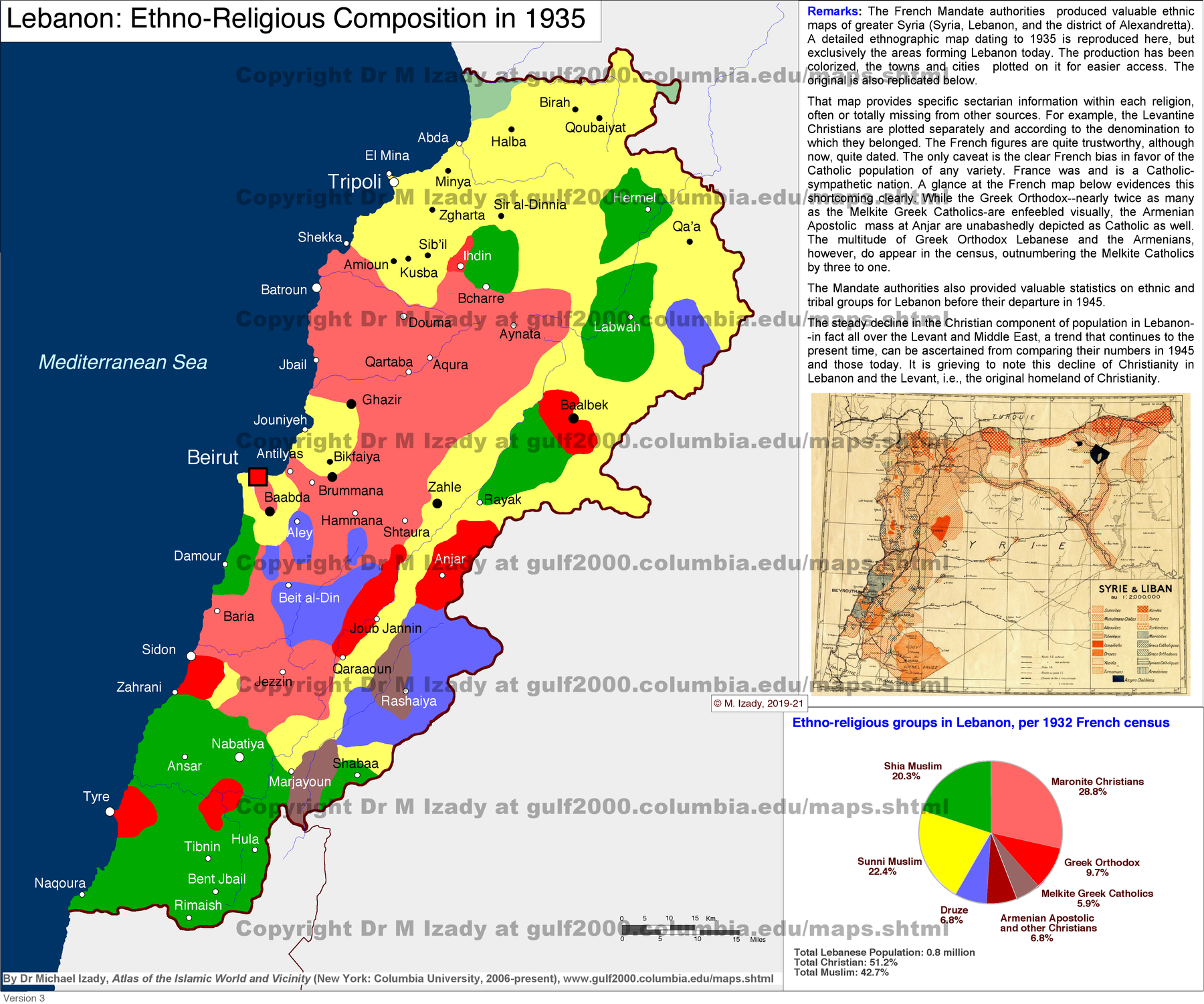
Read this map: Find Beirut, Mount Lebanon, the Chouf, the Bekaa, and southern Lebanon. The map provides a 1935 baseline, with a separate 1932 census chart; it does not show the population or militia front lines of 1975–90. The geographical overlap helps locate the actors, but communal identity does not establish an individual’s political allegiance.
Source: Dr. Michael Izady’s color reconstruction of mandate-era cartography, © 2019–21, Gulf/2000 original. Its own commentary discusses bias in the French classifications. Use alongside the narrative, not as a timeless map of sectarian blocs.

Begin’s election changes Israeli domestic politics and accelerates settlements, while also creating a partner willing to return Sinai. Sadat needs a peace dividend for a distressed economy and recognizes that psychological recognition matters. His Jerusalem visit changes the negotiating environment in a way routine indirect contacts have not.
Camp David produces a concrete territorial bargain and a proposed process for Palestinian autonomy. Montefiore emphasizes the limits of Begin’s willingness to implement the latter. A durable Egyptian–Israeli settlement therefore coexists with an unresolved wider conflict, while regional opponents of Sadat use his diplomacy to compete for leadership. Source: PDF pp. 255–263 (file not included in this release).
Key Concepts and Distinctions
- Limited war for political ends: Sadat fought to cross the canal and restart diplomacy, not to destroy Israel. Military success for a day was enough.
- Oil as leverage: The 1973 embargo and price rises gave producers real power, but each used it for its own ends; the shah refused the embargo and profited from the price.
- State within a state: The PLO’s armed autonomy in Jordan and then Lebanon challenged the host government’s sovereignty, with different results in each.
Essential Evidence and Examples
- Nasser’s private realism: “If I were the Israeli leader, I’d never give up the Occupied Territories,” he told Brezhnev; to Qaddafi in 1970, “We just want Sinai.” PDF p. 228 (file not included in this release) · PDF p. 236 (file not included in this release)
- Hussein’s warning to Israel: “You may win many victories but you cannot afford to lose a single battle.” PDF p. 236 (file not included in this release)
- Sadat’s strategy in his own words: “I am not Tarzan … I will fight a war of political reactivation not military liberation.” PDF p. 249 (file not included in this release)
- Israeli complacency: Golda Meir told Nixon, “We have never had it so good”; days into the war Dayan asked, “Is it the end of the Third Temple?” PDF p. 248 (file not included in this release) · PDF p. 250 (file not included in this release)
- The shah’s hubris: “Thank God we in Iran have neither the desire nor the need to suffer from democracy.” His court minister Alam admitted, “we can’t even guarantee water in the capital.” PDF p. 253 (file not included in this release)
- Lebanon’s massacres: Karantina (about 1,000 killed), Damour (about 900) and Tal al-Zaatar (3,000) in 1976; over 30,000 civilians died in eighteen months. PDF p. 257 (file not included in this release)
- Sadat’s gamble: “90 per cent of the Arab–Israeli conflict is psychological.” PDF p. 261 (file not included in this release)
Cautions
- Montefiore admires Sadat and credits several monarchs. Their repression and the limits of their political inclusion are part of his narrative and should stay part of the summary.
- His link between Soviet “Zionology” and antisemitic propaganda is a specific historical argument. It should not be stretched into a claim that all criticism of Israel comes from that source.
Conclusion and Significance
This period rewards political adaptation more than fidelity to old alignments. Yet it ends with major vulnerabilities: Lebanon is shattered, the shah’s strongest moment is close to his collapse, and Sadat’s peace isolates him. The apparent stability of a ruler or alliance remains a poor guide to its resilience.
Questions for Reflection
- Explain how 1967 changes both Israeli politics and independent Palestinian organization.
- Why does Black September transfer a state-sovereignty problem from Jordan toward Lebanon?
- Reconstruct Sadat’s connection between limited war, prestige, American engagement, and peace.
- Which evidence complicates a uniform account of the oil producers’ strategy?
- Compare the shah’s modernization with his inability to accommodate the groups it helps create.
Quick recall
- What were the Three No’s, and where were they declared?
- What happened in Jordan in September 1970?
- When did the Yom Kippur War start, and who launched it?
- What did the shah give up in the 1975 Algiers Agreement, and what did he get?
- What did Camp David deliver for Egypt, and what did it leave unresolved?
Answer key
- Victory brought a new religious nationalism and the settlement debate inside Israel, while defeat freed Palestinians from dependence on Arab states and brought Fatah and the PFLP to the fore. PDF pp. 226–233 (file not included in this release)
- Hussein would not tolerate a rival armed authority in Amman and crushed it; the expelled PLO rebuilt its fiefdom in Lebanon, whose weaker state could not resist it. PDF pp. 235–237 (file not included in this release) · PDF p. 257 (file not included in this release)
- A limited crossing restored Egyptian prestige, which made it possible for Sadat to negotiate without humiliation, draw in Kissinger, and trade peace for Sinai. PDF pp. 247–251 (file not included in this release) · PDF pp. 261–262 (file not included in this release)
- Faisal used the embargo; the shah refused to join it but pushed through the price rises and became OPEC’s leading figure; Qaddafi talked of destroying the Temple. PDF pp. 251–252 (file not included in this release)
- Land reform and education created urban migrants and an educated middle class, but he gave them no political voice, so many turned to Marxism or Khomeini’s Islamism. PDF pp. 253–254 (file not included in this release)
- “No peace, no recognition and no negotiation with Israel,” at the Arab League summit in Khartoum, August 1967. PDF p. 228 (file not included in this release)
- Black September: Hussein’s army crushed the PLO after the Dawson’s Field hijackings; about 10,000 Palestinians died. PDF pp. 236–237 (file not included in this release)
- 6 October 1973 (Yom Kippur), by Egypt and Syria. PDF p. 249 (file not included in this release)
- He abandoned his support for the Iraqi Kurds and got control of half the Shatt al-Arab. PDF p. 252 (file not included in this release)
- Israel would return all of Sinai; Palestinian self-government was promised through a transition process that Begin had no intention of delivering. PDF p. 262 (file not included in this release)
Part IX — The Awakening — The Imam and the Islamists, 1978–1988
What I Should Retain
Three takeaways: Iran’s revolution is won by a broad opposition but consolidated by a much narrower clerical regime. War and foreign confrontation help revolutionary leaders eliminate domestic alternatives. Militant networks develop across state and sectarian boundaries, while their interventions generate new enemies and new forms of resistance.
Three anchors: Khomeini’s juristic theory becomes an actual governing order after the shah’s collapse. Saddam’s invasion helps Khomeini mobilize patriotism and suppress opponents. Israel’s Lebanon invasion expels the PLO but fails to secure the intended friendly order and accompanies Hezbollah’s emergence.
Connection to test: Why can destroying an existing adversary’s organization create space for a successor that is harder to deter or dislodge?
Part IX timeline — The Iranian revolution and the Islamist decade (1978–1989)
Source status: Dates and figures follow Montefiore’s draft; they are not independently fact-checked.
- Jan–Sep 1978 — The revolution builds: Qom riots in January; the Cinema Rex fire (about 400 dead) in August; Black Friday on 8 September. PDF pp. 265–266 (file not included in this release)
- 16 Jan 1979 — The shah leaves Iran; Khomeini returns on 1 February. PDF p. 267 (file not included in this release)
- 26 Mar 1979 — The Egypt–Israel peace treaty is signed at the White House. PDF p. 268 (file not included in this release)
- 16 Jul 1979 — Saddam becomes president of Iraq and purges the Baath leadership. PDF p. 272 (file not included in this release)
- 4 Nov 1979 — Students seize the US embassy in Tehran. PDF p. 269 (file not included in this release)
- 20 Nov 1979 — Extremists seize the Grand Mosque in Mecca; in December the Soviets invade Afghanistan. PDF pp. 270–271 (file not included in this release)
- 22 Sep 1980 — Iraq invades Iran: The war kills around 700,000 people by 1988. PDF p. 273 (file not included in this release) · PDF p. 275 (file not included in this release)
- 7 Sep 1980 — Military coup in Türkiye under Kenan Evren. PDF p. 275 (file not included in this release)
- 7 Jun 1981 — Israel destroys Iraq’s Osirak reactor: The Begin Doctrine. PDF p. 284 (file not included in this release)
- 6 Oct 1981 — Sadat is assassinated; Mubarak succeeds. PDF p. 277 (file not included in this release)
- Feb 1982 — Hama: Rifaat al-Assad’s forces kill as many as 40,000. PDF p. 278 (file not included in this release)
- 6 Jun 1982 — Israel invades Lebanon: The PLO leaves Beirut for Tunis in August; Bachir Gemayel is assassinated on 14 September, followed by Sabra and Shatila. PDF pp. 281–282 (file not included in this release)
- Oct 1983 — Hezbollah’s suicide bombers kill 241 US Marines and 58 French paratroopers. PDF p. 283 (file not included in this release)
- Nov 1986 — Iran–Contra is exposed. PDF p. 285 (file not included in this release)
- 8 Dec 1987 — The First Intifada begins; Hamas is founded the same night. PDF pp. 286–287 (file not included in this release)
Causal arc: The shah’s isolated regime collapses → Khomeini turns a broad revolution into a theocracy → Saddam’s invasion lets Khomeini consolidate → Islamism spreads through Mecca, Afghanistan, Lebanon and Gaza → secular regimes answer with mass repression (Hama, Türkiye) and the new militant networks outlast their sponsors.
Objective and Through Line
The Iranian Revolution changes the region’s ideological center of gravity. Montefiore follows a coalition’s victory over the shah into Khomeini’s concentration of authority, then connects that new regime to the Iran–Iraq War and Lebanese Shiite mobilization. Alongside these developments, Saudi religious policy hardens after the Mecca seizure, Afghan jihad builds international networks, and secular governments respond through repression.
The governing mechanism is the conversion of emergency into power. Revolution, war, assassination, and foreign occupation allow rulers and movements to claim extraordinary authority. They also create organizations that survive the original emergency: the IRGC, Basij, Hezbollah, and expanding jihadist networks. The Part resists the idea that secularism, religious identity, or shared doctrine alone determines alliances. Syria can ally with Iran against Iraq; the United States can support Iraq while participating in a secret arms channel to Iran; and Palestinian, Shiite, and other militants can share training before becoming rivals.
Structure at a Glance
- Explain the shah’s collapse and Khomeini’s capture of the revolutionary coalition.
- Follow the regional shocks of 1979 and the Iran–Iraq War.
- Trace state repression and armed opposition in Egypt, Syria, and Türkiye.
- Connect the Lebanon war to Hezbollah and the Palestinian uprising to Hamas.
Section-by-Section Argument
Khomeini and Saddam: ‘Persian Cowards and Dwarfs’ versus ‘Camel-grazers and Barbarians’
The shah’s final crisis combines illness, overcentralization, conflicting responses to protest, and lost legitimacy. Concessions do not produce a stable compromise, while repression produces martyrs without recovering political control. Khomeini allows different allies to imagine different futures behind a shared demand to remove the monarchy. His theory of the guardian jurist, however, already implies an authority above ordinary elected government.
After his return, revolutionary committees, courts, and new armed organizations transform that theory into practice. Liberals, leftists, former officials, minorities, and rival Islamists lose the autonomy they expected from revolution. The hostage crisis sustains confrontation with America and helps discredit moderation.
The same year brings the seizure of the Grand Mosque and the Soviet invasion of Afghanistan. Saudi rulers protect their religious legitimacy partly by empowering a stricter domestic religious establishment and supporting religious influence abroad. Afghan jihad links organizers, donors, volunteers, and future movements whose later objectives will diverge from those of their wartime patrons.
Saddam’s invasion of Iran is intended to exploit revolutionary disorder and secure territory and regional leadership. Instead, it gives Khomeini an opportunity to rally a threatened nation and displace rival political actors. The IRGC and Basij acquire greater importance through combat. Banisadr’s removal and the crushing of the MEK illustrate how a revolutionary coalition becomes a hierarchy enforced by violence.
The chapter also follows Turkish military rule, the PKK insurgency, Sadat’s assassination, and the Assad regime’s destruction of the Hama uprising. These cases differ, but all connect the state’s claim to order with the coercive elimination of challengers. Source: PDF pp. 265–278 (file not included in this release).
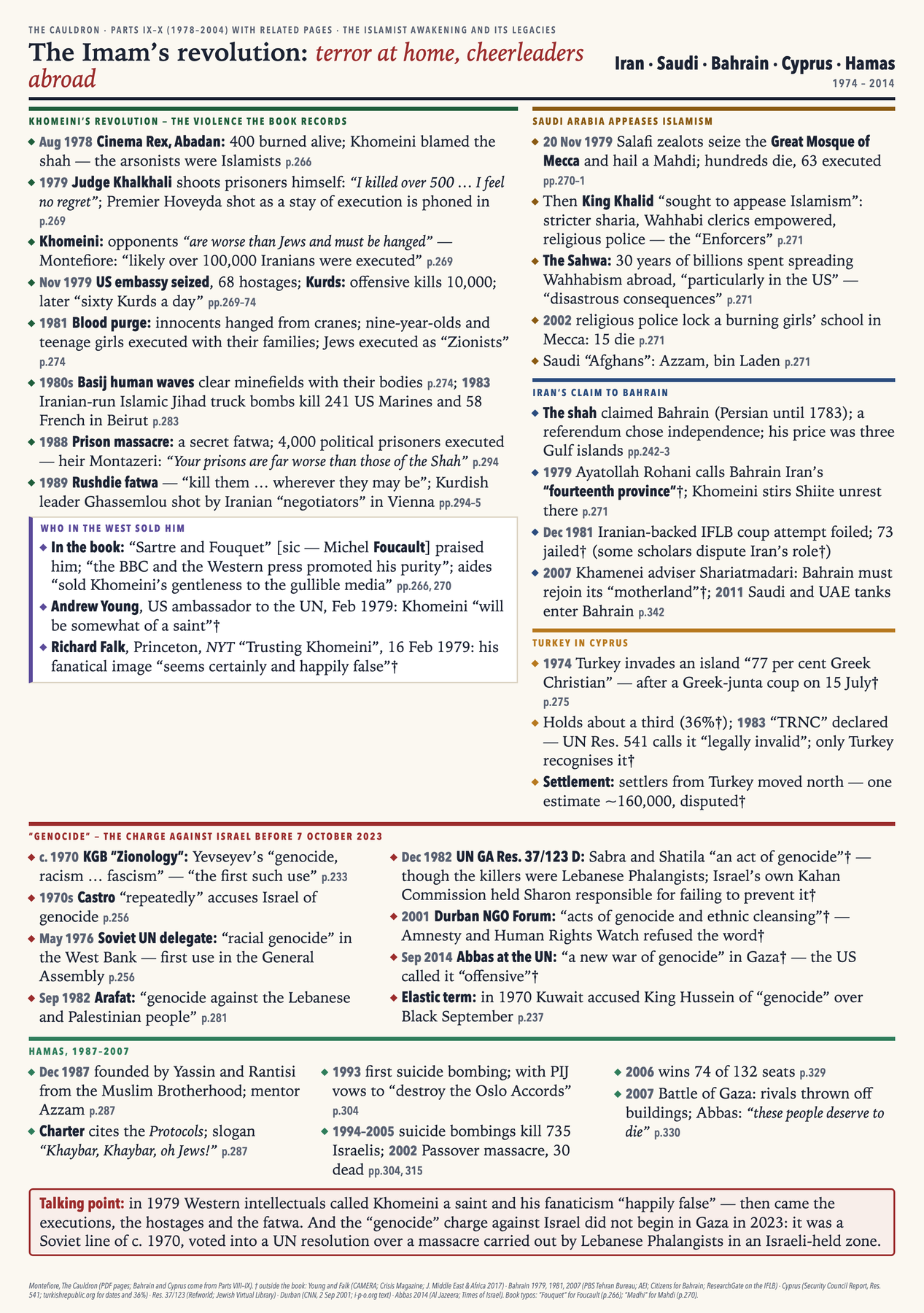
Notebook page (B5): the Islamist awakening and its legacies. The page draws mainly on Part IX, with related pages from Parts VIII and X. It covers:
- Khomeini’s violence, from the Cinema Rex fire to the 1988 prison massacre and the Rushdie fatwa (PDF pp. 266–295 (file not included in this release)).
- Who in the West sold him.
- Saudi appeasement of Islamism after the Grand Mosque seizure (PDF pp. 270–271 (file not included in this release)).
- Iran’s claim to Bahrain (PDF pp. 242–243 (file not included in this release), 271, 342).
- Turkey in Cyprus (PDF p. 275 (file not included in this release)).
- “Genocide” charges against Israel before 7 October 2023, PDF pp. 233, 237, 256, 281.
- Hamas, 1987–2007, PDF pp. 287–330.
- A talking point.
Items marked † come from outside the book:
- Andrew Young’s “saint” remark and Richard Falk’s “Trusting Khomeini” (CAMERA). Check both against the originals before quoting.
- The Bahrain “fourteenth province” claims and the 1981 coup attempt (PBS Tehran Bureau, AEI). Iran’s role in the coup is disputed.
- The 1974 coup trigger, the 36% figure, and UNSC Resolution 541 on Cyprus. Settler numbers are disputed.
- UNGA Resolution 37/123 D, the Durban NGO Forum, and Abbas at the UN, 2014.
Book typos noted on the page: “Fouquet” for Foucault (PDF p. 266) and “Madhi” for Mahdi (PDF p. 270).
The Siege and the Uprising
Assad’s alliance with Iran crosses the supposed division between secular Arab nationalism and Iranian theocracy because the governments share enemies and strategic interests. Lebanon becomes the place where that alignment gains an armed social base. Meanwhile, Israel and the Gemayel faction attempt their own restructuring: defeat the PLO, remove Syrian dominance, install a friendly presidency, and make peace.
Israel succeeds in forcing the PLO’s evacuation but not in securing the intended political order. Gemayel’s assassination overturns the plan. Christian militiamen massacre civilians at Sabra and Shatila while Israeli forces fail to stop them; Montefiore emphasizes Israeli responsibility and the domestic inquiry and protests that follow. Tactical superiority cannot substitute for control of allies or the legitimacy of the postwar settlement.
Iranian training and support help turn Lebanese Shiite militancy into Hezbollah. Bombings, hostage-taking, and attacks on foreign forces generate prestige and organizational power. The movement is rooted in local grievances and networks as well as external sponsorship; reducing it to either dimension loses the mechanism by which it becomes durable.
The Iran–Iraq War also reveals intersecting interests that public rhetoric hides. Israel’s strike on Iraq’s reactor establishes the Begin Doctrine; American support shifts toward Iraq as Iran advances; Iran–Contra exposes simultaneous US dealings with Iran. These are not stable ideological camps.
The First Intifada returns initiative to Palestinians living under occupation. Montefiore explains the uprising through humiliation and blocked political expectations as well as the immediate traffic collision. The PLO tries to assert leadership while moving toward recognition and negotiation. Hamas emerges from a different organizational tradition, combining Brotherhood Islamism, Palestinian nationalism, and antisemitic ideas in its founding charter. Finally, Soviet retreat removes a major patronage structure and prepares the next era of American predominance. Source: PDF pp. 280–290 (file not included in this release).
Key Concepts and Distinctions
- Guardian jurist: A claim to supreme religious-political authority above ordinary electoral government, not simply clerical advice to rulers.
- Revolutionary coalition versus governing coalition: Agreement on removing a ruler can conceal incompatible plans for who rules next.
- Military removal versus political replacement: Expelling an armed organization does not establish a workable government in its place.
Essential Evidence and Examples
- A comparatively bloodless monarchy: Ali Ansari, quoted by Montefiore: 3,164 people died in all forms of resistance between 1963 and the shah’s departure, 2,781 of them in 1978. PDF p. 267 (file not included in this release)
- Khomeini’s coldness: Asked how he felt on returning, he said “Hichi — nothing”; then, “I shall kick their teeth in. I appoint the government.” PDF p. 267 (file not included in this release)
- The terror: Montefiore estimates that over 100,000 Iranians were executed; Khalkhali boasted, “I killed over 500 criminals close to the royal family.” PDF p. 269 (file not included in this release)
- War as opportunity: Khomeini called Saddam’s invasion “a gift from heaven.” PDF p. 274 (file not included in this release)
- Alliances across the sectarian line: Syria’s alliance with Iran was made “out of hatred for Muawiya, not love for Ali.” PDF p. 280 (file not included in this release)
- The Begin Doctrine: “On no account shall we permit an enemy to develop weapons of mass destruction against the people of Israel.” PDF p. 284 (file not included in this release)
- Hamas’s founding charter names the Protocols of the Elders of Zion as the Zionist plan. PDF p. 287 (file not included in this release)
Cautions
- The book distinguishes Islam as a varied religious civilization from Islamism as a modern political project. Its strongly evaluative language should not erase differences among movements, ordinary believers or sects.
- Montefiore’s execution estimates and detailed intelligence anecdotes are claims of this draft, not independently established totals.
- The draft’s subheading calls the 1982 massacre “The Slaughter of Homs,” but the narrative clearly describes Hama. Use the prose and page reference, not the label.
Conclusion and Significance
The period creates institutions and networks that outlast its wars. Iran survives the conflict and gains an ideological mission; Iraq emerges armed but exhausted; Hezbollah and Hamas enter the regional system. The end of the Cold War changes their external environment without dissolving the conflicts that sustain them.
Questions for Reflection
- Reconstruct how Khomeini converts a diverse opposition into a clerically dominated regime.
- Why does Saddam’s attempted exploitation of Iranian weakness strengthen Khomeini politically?
- What evidence from Lebanon shows the limits of remaking a country through a military campaign?
- Which alliances challenge an exclusively sectarian explanation of this period?
- Compare the organizational opportunities created by occupation, imprisonment, and foreign-sponsored warfare.
Quick recall
- When did Khomeini return to Iran?
- What happened at the Grand Mosque in Mecca in November 1979?
- When did Iraq invade Iran, and roughly how many died in the war?
- Who killed Sadat, and when?
- Which event in December 1987 started the First Intifada?
Answer key
- He let liberals, leftists and moderate Islamists believe he wanted only “the constitution,” appointed a façade government, then ruled through revolutionary committees and courts, sacked Bazargan, impeached Banisadr, and crushed the MEK and the Kurds. PDF pp. 265–274 (file not included in this release)
- The invasion let Khomeini rally Iranians around Islam and the nation, build the IRGC and Basij, and eliminate rivals as traitors in wartime. PDF pp. 273–274 (file not included in this release)
- Israel expelled the PLO but could not keep Bachir Gemayel alive, prevent Sabra and Shatila, or get its treaty with Lebanon ratified; Hezbollah emerged in the vacuum. PDF pp. 281–283 (file not included in this release)
- Alawite-led Syria with Shiite Iran against Baathist Iraq; the US arming both Iraq and, through Iran–Contra, Iran; Israel supplying Iran against Saddam. PDF p. 280 (file not included in this release) · PDF pp. 284–285 (file not included in this release)
- Occupation in Gaza bred Hamas; prisons like Saddam’s and Assad’s taught militants and built networks; the Afghan war trained Arab volunteers who became al-Qaeda. PDF p. 271 (file not included in this release) · PDF pp. 286–287 (file not included in this release)
- 1 February 1979. PDF p. 267 (file not included in this release)
- Salafi extremists seized it and hailed a Mahdi; the National Guard retook it with hundreds dead and sixty-three executions. PDF pp. 270–271 (file not included in this release)
- 22 September 1980; around 700,000 died. PDF p. 273 (file not included in this release) · PDF p. 275 (file not included in this release)
- Lieutenant Khalid al-Islambouli and fellow jihadists, at the parade on 6 October 1981. PDF p. 277 (file not included in this release)
- An Israeli army truck collided with minivans carrying Gazan workers and killed four. PDF p. 286 (file not included in this release)
Part X — The Americans, 1988–2004
What I Should Retain
Three takeaways: American predominance changes the available choices but does not eliminate local agency or political complexity. The Gulf War demonstrates overwhelming military capacity within a limited objective; the 2003 invasion shows the different burden of replacing a state. Oslo opens a real possibility in Montefiore’s judgment, but deferred final questions, violence, occupation, distrust, and domestic politics erode its constituency.
Three anchors: Saddam’s invasion of Kuwait turns his financial and political crisis into a confrontation with a global coalition. Rabin and Arafat’s recognition agreements establish a political relationship without settling borders, Jerusalem, or refugees. De-Baathification and the dissolution of Iraqi institutions help turn defeat into insurgency and expand Iran’s opportunities.
Connection to test: What additional political responsibilities arise when a government’s objective changes from reversing an invasion to replacing an entire regime?
Part X timeline — American predominance, Oslo and the 9/11 wars (1988–2005)
Source status: Dates and figures follow Montefiore’s draft; they are not independently fact-checked.
- 1988 — The Anfal campaign: Saddam’s forces destroy 4,000 Kurdish villages and murder about 180,000; Halabja is gassed on 16 March. PDF p. 293 (file not included in this release)
- Aug 1988 — Iran–Iraq ceasefire; Khomeini dies in June 1989 and Khamenei succeeds. PDF pp. 294–295 (file not included in this release)
- Nov 1989 — Azzam is killed; bin Laden and Zawahiri build al-Qaeda. PDF p. 292 (file not included in this release)
- 2 Aug 1990 — Iraq invades Kuwait and declares it “Province 19.” PDF p. 296 (file not included in this release)
- 16 Jan–28 Feb 1991 — The Gulf War: Forty-two days of air attack, a ground offensive from 24 February, Kuwait liberated; the uprisings that follow are crushed. PDF pp. 297–298 (file not included in this release)
- 30 Oct 1991 — The Madrid Conference. PDF p. 300 (file not included in this release)
- Jan 1992 — Algeria cancels its election: The “Black Decade” kills about 150,000. PDF pp. 303–304 (file not included in this release)
- 13 Sep 1993 — The Oslo Declaration of Principles is signed at the White House. PDF p. 301 (file not included in this release)
- Oct 1994 — Jordan–Israel peace. PDF p. 302 (file not included in this release)
- 4 Nov 1995 — Rabin is assassinated. PDF p. 305 (file not included in this release)
- May 1996 — Netanyahu elected; the Mashal poisoning fiasco follows in September 1997. PDF p. 307 (file not included in this release)
- 7 Feb 1999 — King Hussein dies; Abdullah II succeeds. PDF p. 309 (file not included in this release)
- 10 Jun 2000 — Hafez al-Assad dies; Bashar succeeds. PDF p. 312 (file not included in this release)
- Jul 2000 — Camp David fails; the Second Intifada begins after Sharon’s visit to the Temple Mount on 28 September. PDF pp. 313–314 (file not included in this release)
- 11 Sep 2001 — Al-Qaeda kills 2,977 people in the US; America invades Afghanistan on 7 October. PDF p. 317 (file not included in this release)
- 20 Mar 2003 — The invasion of Iraq: Baghdad falls on 9 April; de-Baathification follows on 23 May. PDF pp. 319–320 (file not included in this release)
- 11 Nov 2004 — Arafat dies; Sharon withdraws from Gaza in August 2005. PDF pp. 325–326 (file not included in this release)
Causal arc: The Cold War ends with America paramount → Saddam’s Kuwait gamble brings a coalition but leaves him in power → American credibility produces Madrid and Oslo → terror and assassination wreck Oslo → 9/11 leads to wars that topple Saddam but dissolve the Iraqi state and open the way for Iran.
Objective and Through Line
The end of the Cold War makes America the paramount external power. Montefiore explores the temptation to mistake that military and diplomatic advantage for the ability to redesign local politics. Kuwait, Madrid, Oslo, Afghanistan, and Iraq form a sequence of expanding ambition and recurring limits. Regional leaders still miscalculate, bargain, resist, and redirect external power toward their own objectives.
The Part’s second line concerns the relationship between diplomacy and violence. Negotiations depend on domestic legitimacy, but spectacular attacks and assassinations can destroy that legitimacy faster than agreements build it. Neither military restraint nor a written framework automatically creates trust. The narrative therefore compares the capacities required for war, liberation movements, negotiation, and ordinary government. A leader skilled in one does not necessarily possess the skills or incentives needed for another; Arafat, Saddam, Rabin, and the American administration each illustrate a different version of that problem.
Structure at a Glance
- Follow the end of the Iran–Iraq War and Saddam’s turn toward Kuwait.
- Distinguish coalition victory from the unresolved future of Iraq.
- Trace recognition and negotiated peace alongside their armed and political opponents.
- Explain how 9/11 and the invasion of Iraq reorganize regional power.
Section-by-Section Argument
Saddam’s Province 19
The aftermath of the Iran–Iraq War exposes the costs of dictatorship even when the ruler survives. Saddam’s Anfal campaign and chemical attacks destroy Kurdish communities; his family politics make succession and loyalty violent problems. In Iran, Khomeini’s final purges and management of succession preserve the system beyond its founder. Neither state’s survival is evidence that its population has escaped catastrophe.
Saddam then seeks a solution to debt, oil-price pressure, and frustrated ambition by annexing Kuwait. Earlier Iraqi claims provide a vocabulary, but the timing arises from his immediate predicament. His inner circle mistakes threats and negotiation for evidence that the United States will not fight. Hussein and Arafat’s attempts at mediation do not overcome that self-contained decision-making world.
The coalition’s victory is swift once ground operations begin. Yet the agreed objective—liberating Kuwait—is narrower than creating a new Iraqi order. Washington fears Iranian gains and Iraqi fragmentation, and leaves Saddam in place while uprisings face repression. Kurdish protection develops unevenly into an autonomous northern space. This creates opportunities for Kurdish self-government and new security fears in Türkiye, illustrating how a humanitarian or strategic solution in one territory can alter a neighboring state’s threat assessment.
The war also changes the Palestinian diplomatic position. Support for Saddam damages the PLO’s funding and Gulf relationships, while American credibility helps convene Madrid. The shift toward negotiation arises from a changed balance of weakness and opportunity, not the disappearance of national aspirations. Source: PDF pp. 292–300 (file not included in this release).
The Handshake: A New Era
Oslo begins through unofficial contacts that become authorized negotiations. Israel and the PLO take different risks: Israel seeks security and recognition while giving up control gradually; Arafat expects limited self-government to become full statehood. Mutual recognition is a major achievement, but the interim framework postpones the hardest questions. That postponement allows cooperation to start while also leaving expectations vulnerable to divergent interpretations.
Rabin’s peace with Jordan supplies a more complete interstate result. His relationship with Hussein depends on reciprocal credibility and recognition of the other leader’s constraints. Montefiore contrasts this with the inability of Israeli and Palestinian leaders to build comparable confidence across their wider constituencies.
Violence then attacks the process from several directions. Goldstein’s massacre of Muslim worshippers, Hamas and PIJ suicide bombings, and Rabin’s assassination target different victims but all help destroy the conditions for compromise. Israeli settlement policy and humiliations of Palestinian self-rule also undercut the expectation that negotiation will lead to meaningful independence. Montefiore judges Oslo valid in concept while criticizing execution and acknowledging that limited autonomy may not match Palestinian aspirations.
Netanyahu’s election brings a different approach, though agreements such as Hebron and Wye still occur. The failed attempt to assassinate Mashal in Jordan demonstrates how a security operation can jeopardize a peace treaty and strengthen the opponent it intended to remove. Hussein’s final efforts reveal the difference between signing another increment and restoring an effective political process.
The chapter also returns to neglected regional histories: Algeria’s civil war follows the cancellation of an Islamist electoral advance and involves atrocities by insurgents and state forces; Yemen’s Houthi movement develops through local religious revival, political exclusion, and regional influences. These histories prevent the peace-process narrative from monopolizing the decade. Source: PDF pp. 301–311 (file not included in this release).
The 9/11 Wars
Camp David and the later negotiations expose incompatible ways of evaluating a settlement. Maps and percentages do not exhaust questions of sovereignty, recognition, justice, Jerusalem, security, and political authority. Montefiore presents the increasing scope of Israeli offers alongside Hussein Agha’s explanation of Palestinian distrust and resistance to a forced binary outcome. Arafat fears making concessions he cannot survive politically. This account is more complex than either “no offer existed” or “a complete agreed state was simply refused.”
The Second Intifada, suicide attacks, Israeli incursions, and the separation barrier then transform everyday contact and strategic calculation. Israel improves protection from attacks while deepening restrictions and humiliation for Palestinians. The distinction between tactical security and a political settlement becomes increasingly stark.
Al-Qaeda’s strategy seeks to provoke the United States as well as kill civilians. After 9/11, America removes the Taliban but fails to capture bin Laden immediately. The turn toward Iraq rests on allegations and assumptions that the book rejects: a reliable Saddam–al-Qaeda partnership and the claimed WMD arsenal. Saddam’s own deterrent ambiguity contributes to his ruin, but does not validate those allegations.
The rapid invasion does not supply a viable postwar order. Montefiore identifies de-Baathification and the removal of the army and bureaucracy as decisions that convert large parts of the former establishment into disaffected enemies. Sectarian government, insurgency, jihadist organization, and Iranian intervention interact. Soleimani exploits the vacuum to expand influence; minorities and ordinary Iraqis bear the greatest costs.
The final movements trace Erdoğan’s rise, Arafat’s death, Abbas’s accession, and Sharon’s unilateral Gaza withdrawal. Each raises the question of whether electoral victory, military prestige, or territorial departure can establish a legitimate political framework. The Part ends with weakened states and increasingly powerful armed organizations positioned to fill the gaps. Source: PDF pp. 312–326 (file not included in this release).
Key Concepts and Distinctions
- Liberation versus regime change: The 1991 coalition had a limited aim and kept it; the 2003 invasion took on the burden of replacing a state.
- Interim versus final status: Oslo deferred borders, Jerusalem and refugees, which let cooperation start but left each side free to expect a different end.
- De-Baathification: Dissolving the Baath Party and the army turned about 150,000 members of the old establishment into unemployed enemies.
Essential Evidence and Examples
- Genocide in Kurdistan: Ali Hassan al-Majid ordered that “Those aged between 15 and 70 must be executed”; about 180,000 Kurds died in the Anfal. PDF p. 293 (file not included in this release)
- Saddam’s misreading: He told an American envoy that intervention would mean “the spilling of the blood of ten thousand Americans”; 650,000 US troops then joined 185,000 Arab troops. PDF pp. 296–297 (file not included in this release)
- Montefiore on Oslo: “the concept of Oslo was valid, the achievement historic, the opportunity real,” though limited autonomy would “never truly match national aspirations.” Edward Said called it “an instrument of Palestinian surrender.” PDF pp. 304–305 (file not included in this release)
- The violence that undid it: Suicide bombings killed 735 Israelis between 1994 and 2005; Goldstein murdered twenty-nine worshippers in Hebron. PDF p. 304 (file not included in this release)
- The offers: Barak offered 91 per cent of the West Bank at Camp David, and the Clinton Parameters 96 per cent; Arafat asked Clinton, “Do you want to attend my funeral?” Bandar: “it won’t be a tragedy; it will be a crime.” PDF pp. 313–314 (file not included in this release)
- The Pottery Barn rule: Powell warned Bush that in Iraq “You’ll own it all.” PDF p. 318 (file not included in this release)
- The toll in Iraq: About 4,500 Americans, 170 Britons and 150,000 Iraqis were killed. PDF pp. 321–322 (file not included in this release)
Cautions
- The Part’s label ends in 2004, but its narrative follows consequences into 2006 and beyond.
- The accounts of failed peace negotiations contain competing participants’ interpretations, especially Hussein Agha’s, rather than a single self-evident explanation of rejection.
Conclusion and Significance
American power can defeat armies and convene leaders, but the political results depend on institutions, credible commitments, and local constituencies. The contrast between 1991 and 2003 is therefore a contrast of objectives and aftermath as much as military performance. The next Part follows the political spaces that state failure and incomplete settlements leave open.
Questions for Reflection
- Reconstruct the different objectives of the 1991 coalition and the 2003 invasion.
- Why does Saddam repeatedly misread American intentions despite having experienced defeat?
- Which evidence explains how Oslo could be a real opportunity and a structurally vulnerable process?
- What qualifications are needed before reducing Camp David to a dispute over land percentages?
- Apply the distinction between defeating a regime and governing its former territory to Iraq.
Quick recall
- When did Iraq invade Kuwait, and when was Kuwait liberated?
- What did the September 1993 Oslo agreements establish?
- Who killed Rabin, and when?
- What was CPA Order 1?
- Who succeeded Hafez al-Assad, and why was he not the first choice?
Answer key
- 1991: reverse the conquest of Kuwait, with UN backing and Arab partners, leaving Saddam in power. 2003: remove Saddam, disarm supposed WMD and build an Iraqi democracy, which meant taking responsibility for the whole state. PDF pp. 296–299 (file not included in this release) · PDF pp. 318–320 (file not included in this release)
- He lived in a closed world of flatterers, believed America would not fight or would collapse under casualties, and later pretended to have WMD to deter Iran and internal enemies. PDF pp. 296–297 (file not included in this release) · PDF p. 318 (file not included in this release)
- Mutual recognition was a breakthrough and majorities backed it, but the interim design postponed the core issues, and extremists on both sides (Goldstein, Hamas bombers, Yigal Amir) destroyed the trust it needed. PDF pp. 301–306 (file not included in this release)
- Palestinians saw the talks as about sovereignty, justice and Jerusalem, not real estate; Arafat feared he could not survive concessions on the holy sites; and he wanted other Arab states involved. PDF pp. 313–314 (file not included in this release)
- The army reached Baghdad in three weeks, but de-Baathification and disbanding the army created an insurgency, sectarian war and an opening for Iran. PDF pp. 319–322 (file not included in this release)
- 2 August 1990; 28 February 1991. PDF pp. 296–297 (file not included in this release)
- Mutual recognition between Israel and the PLO, a Palestinian Authority, and a five-year interim period of Israeli withdrawals and self-rule before final-status talks. PDF p. 301 (file not included in this release)
- Yigal Amir, a Jewish extremist, on 4 November 1995. PDF p. 305 (file not included in this release)
- Paul Bremer’s May 2003 order outlawing the Baath Party and purging its members, followed by the dissolution of the army. PDF p. 320 (file not included in this release)
- Bashar; his elder brother Bassel, the intended heir, died in a car crash in 1994. PDF p. 312 (file not included in this release)
Part XI — The Spring, 2005–2012
What I Should Retain
Three takeaways: Elections and withdrawals do not secure state authority when armed organizations retain independent coercive power. The Arab uprisings share demands for dignity but encounter very different institutions and social structures. Removing a ruler is easier than agreeing on the rules and forces that govern afterward.
Three anchors: Syria withdraws troops from Lebanon while Hezbollah increases its influence. Hamas’s electoral success and the subsequent Gaza fighting split Palestinian government between Gaza and the West Bank. The uprisings topple Ben Ali and Mubarak but produce civil war in Libya and Syria and a different political contest in Egypt.
Connection to test: Compare the power to assemble a protest, win an election, command soldiers, and administer a state. Which actors possess each capacity after an uprising?
Part XI timeline — Parastates and the Arab uprisings (2005–2013)
Source status: Dates and figures follow Montefiore’s draft; they are not independently fact-checked.
- 14 Feb 2005 — Rafik Hariri is assassinated: The Cedar Revolution forces Syrian troops out of Lebanon by April. PDF p. 328 (file not included in this release)
- 25 Jan 2006 — Hamas wins the Palestinian elections with 74 of 132 seats. PDF p. 329 (file not included in this release)
- Jul–Aug 2006 — The thirty-four-day Israel–Hezbollah war; UN Resolution 1701 calls for Hezbollah’s disarmament, which never happens. PDF pp. 328–329 (file not included in this release)
- Jan 2007 — Petraeus and the Surge defeat Islamic State of Iraq with Sunni tribal help. PDF p. 334 (file not included in this release)
- Jun 2007 — The Battle of Gaza: Hamas seizes the Strip from Fatah. PDF p. 330 (file not included in this release)
- Sep 2007 — Israel destroys Syria’s secret reactor; Mughniyeh is killed in Damascus in February 2008. PDF p. 329 (file not included in this release)
- Sep 2008 — Olmert’s final offer to Abbas: the “Napkin Map.” PDF p. 331 (file not included in this release)
- Jun 2009 — Iran’s disputed election and the Green Movement. PDF pp. 336–337 (file not included in this release)
- 17 Dec 2010 — Bouazizi sets himself on fire; Ben Ali flees on 14 January 2011. PDF pp. 337–338 (file not included in this release)
- 25 Jan–11 Feb 2011 — Tahrir Square: Mubarak resigns after eighteen days. PDF pp. 338–340 (file not included in this release)
- 14 Mar 2011 — Saudi and Emirati troops enter Bahrain. PDF p. 342 (file not included in this release)
- Mar 2011 — Daraa: The Syrian uprising begins and turns into civil war. PDF p. 340 (file not included in this release) · PDF p. 343 (file not included in this release)
- 2 May 2011 — Bin Laden is killed in Abbottabad. PDF p. 344 (file not included in this release)
- 20 Oct 2011 — Qaddafi is killed at Sirte. PDF p. 341 (file not included in this release)
- 24 Jun 2012 — Morsi is elected president of Egypt with 51.7 per cent. PDF p. 344 (file not included in this release)
- 21 Aug 2013 — Assad’s sarin attack on Ghouta kills 1,400; Obama does not strike. PDF p. 345 (file not included in this release)
Causal arc: Formal states coexist with armed parties stronger than they are → elections and withdrawals fail to settle who holds the guns → long-ruling autocrats face a cascade of protests → outcomes depend on armies, Islamist organization and foreign patrons → America’s retreat over Syria opens a multi-player Middle East.
Objective and Through Line
The Part begins by showing the coexistence of formal state institutions and stronger armed organizations. Lebanon and the Palestinian territories demonstrate how a government can have elections, ministries, and international recognition without monopolizing force. Meanwhile, a series of peace initiatives fails to convert diplomacy into a settled political order.
The uprisings then expose the fragility of regimes that appear permanent. Police brutality, corruption, blocked opportunity, and dynastic succession plans become immediate objects of protest. Social media helps people organize and publicize abuses, but it does not settle the institutional questions of the transition. Montefiore’s corrective is directed at the belief that digitally connected protest automatically points toward liberal democracy. Outcomes depend on what organized forces remain after a president leaves: armies, Islamist parties, local militias, existing elites, and external patrons. The narrative extends into 2013 to establish the conditions for the following counter-revolution and wars.
Structure at a Glance
- Explain the persistence of armed power alongside formal governments.
- Follow the Palestinian split and the failure to secure a final agreement.
- Trace how separate domestic grievances become a connected wave of protest.
- Compare the institutions that determine each transition’s outcome.
Section-by-Section Argument
The Parastates
Hariri’s assassination triggers a Lebanese movement strong enough to secure Syrian troop withdrawal, but not the disarmament of Hezbollah. The distinction matters: an external army can leave while its local ally retains political and military leverage. Israel’s 2006 campaign inflicts costs without creating a settled state monopoly of arms. Montefiore interprets this as the development of a parastate, an armed authority operating within and partly above formal government.
Color comparison — Baghdad before and during the sectarian war
2003
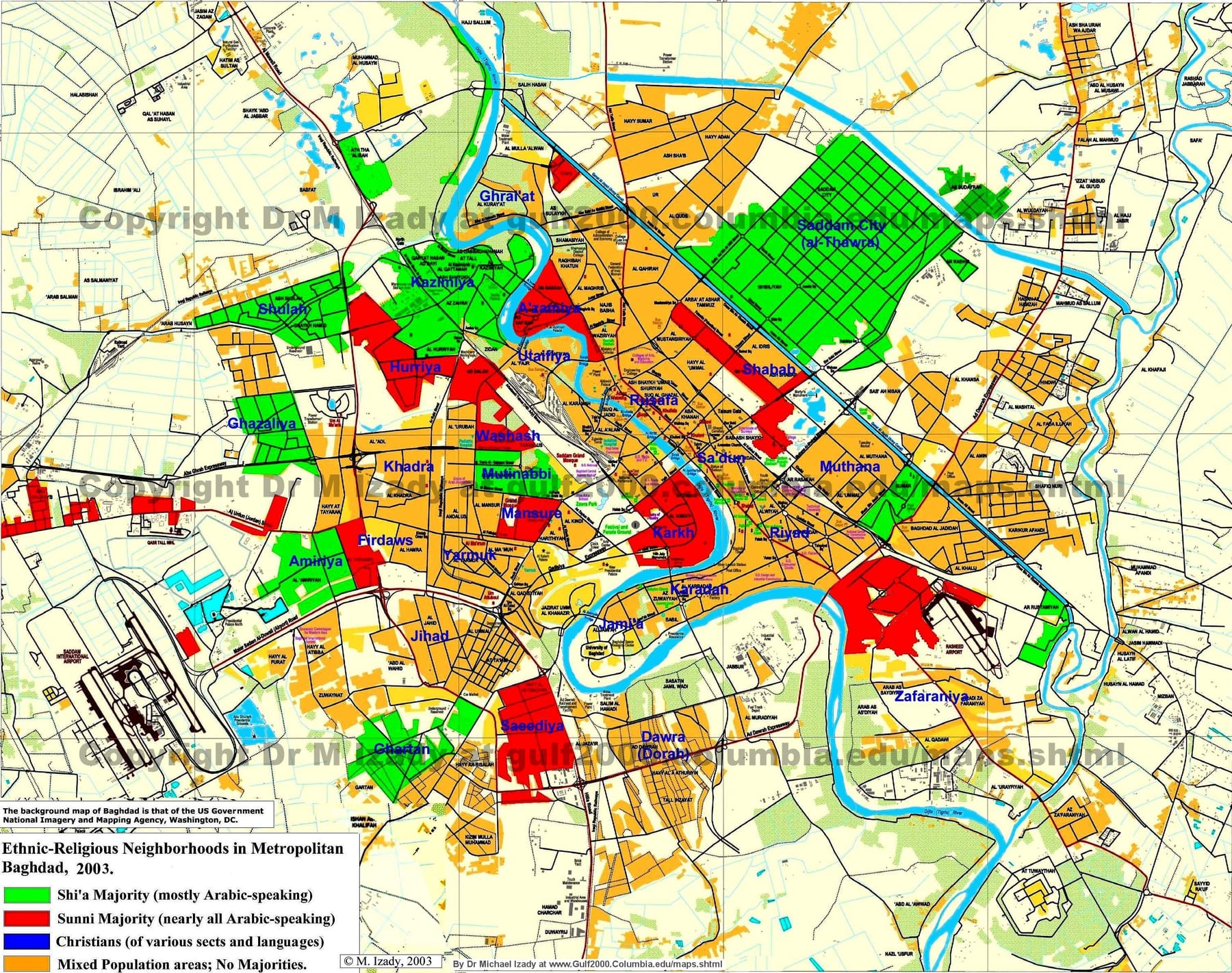
Late 2007
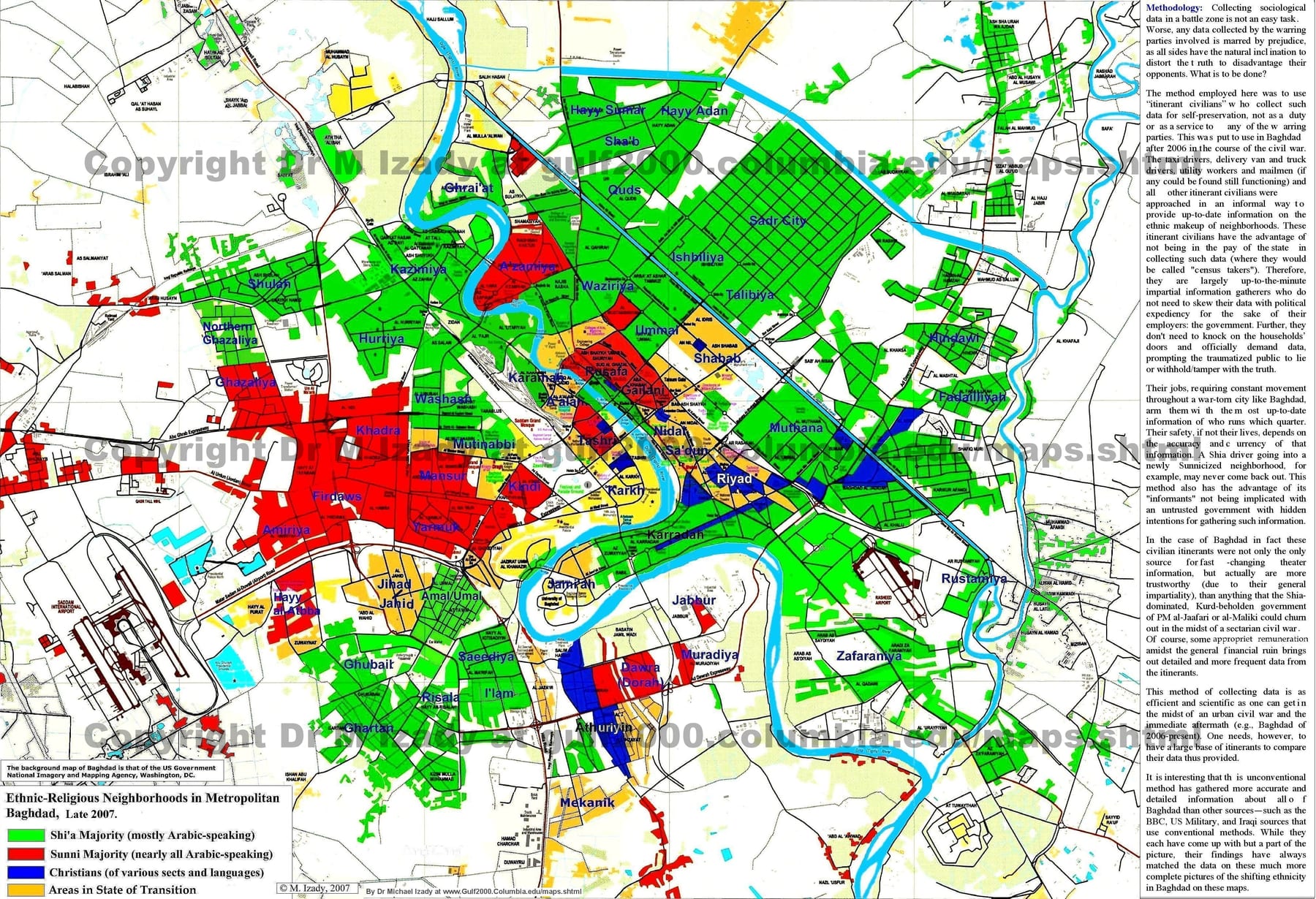
Read these together: Use the Tigris and the same named neighborhoods as anchors. In the first legend orange marks mixed areas; in the second, yellow marks areas in transition, so those colors cannot be counted as the same category. The comparison helps make the book’s account of fragmentation and displacement spatially concrete. These are the author’s estimates of neighborhood composition, not a unified census, maps of every household, or proof of responsibility for particular acts of violence.
Source: Dr. Michael Izady, 2003 map and late-2007 map, Gulf/2000, © 2003 and 2007. The second image retains the author’s account of his informant-based methodology.


The Palestinian elections reveal a related contradiction. Hamas wins legislative seats, while Fatah retains the presidency and its own forces. International expectations, rival claims of legitimacy, and armed conflict prevent the vote from becoming an accepted transfer of authority. Hamas’s seizure of Gaza creates two Palestinian centers of rule and undermines plans for connected administration and investment. Electoral legitimacy does not resolve the question of how political rivals share or surrender coercive power.
Olmert’s negotiations with Abbas approach a much more extensive territorial settlement. Montefiore stresses their seriousness but also the leaders’ diminishing authority. Abbas fears committing without an adequate text and map; Olmert is leaving office under corruption allegations; other Israeli leaders send different signals; Hamas has already taken Gaza. The failure is not explained by territorial generosity alone. An offer requires a credible negotiating partner and a constituency capable of implementing it.
Netanyahu’s return produces an alternative strategy: contain the Palestinian question, expand settlements, and treat Hamas’s Gaza as manageable. Montefiore argues that divided Palestinian authority helps make negotiations easier to avoid.
Iraq provides the corresponding military case. The surge and Sunni tribal opposition to jihadist brutality reduce insurgent power, but Baghdadi’s prison connections and militant networks survive. A tactical defeat does not erase the organizational relationships from which a later offensive can grow. Obama’s more cautious approach responds to the costs of earlier intervention, while his ambitions for an Iranian agreement introduce another regional calculation. Source: PDF pp. 328–335 (file not included in this release).
Kings and Princelings
The opening juxtaposes hereditary plans in nominal republics with Iran’s contested election and repression. The similarity is the exclusion of meaningful political alternatives; the institutions through which it happens differ. In Iran, the loyalty of coercive organizations preserves the ruling order despite mass protest.
Bouazizi’s self-immolation becomes a regional catalyst because his humiliation resonates with wider grievances. Tunisia’s uprising demonstrates that a long-serving ruler can fall quickly. Egypt follows its own path through the killing of Khaled Said, mass protest, attempts at accommodation and intimidation, and military intervention in the transition. Mubarak’s removal does not remove the army or create an equally organized liberal alternative. The Brotherhood possesses networks that many youth activists lack.
Syria and Libya lead in another direction. Assad’s response to protest is violent repression, followed by militarization, sectarian fear, and the multiplication of armed actors. The release of jihadists serves his attempt to frame every opponent as an extremist. Kurdish organization creates another territorial and political project rather than fitting neatly into regime-versus-opposition categories.
In Libya, outside air power helps remove Qaddafi without creating a sufficiently coherent postwar state. Montefiore connects this outcome to the weakness of institutions beyond the ruler’s court and to foreign governments’ lack of an adequate plan. Yemen’s Saleh bargains, retreats, and realigns with former enemies, while Bahrain’s monarchy receives direct Gulf support to suppress protest.
Morsi’s election in Egypt then shows how one uprising’s liberal hopes can yield a government from a very different political tradition. Erdoğan welcomes the opportunity for a Brotherhood-aligned regional order. Finally, the chemical-weapons crisis and Obama’s decision against a direct strike become, for Montefiore, a sign of weakening American predominance. Source: PDF pp. 336–345 (file not included in this release).
Key Concepts and Distinctions
- Parastate: An organization with autonomous armed and governing power within or across a formal state’s territory.
- Mobilization versus organization: The ability to gather a crowd does not supply an enduring party, bureaucracy, or chain of military command.
- Transition versus replacement: A departing ruler may leave most of the institutions and interests that sustained the old system.
Essential Evidence and Examples
- A threat that became a death sentence: Assad told Hariri, “Lahoud is me … I will break Lebanon.” Jumblatt: “I knew it was his condemnation to death.” PDF p. 328 (file not included in this release)
- Two Palestinian statelets: Mahmoud Darwish: “One people now have two states, two prisons who don’t greet each other.” PDF p. 330 (file not included in this release)
- The nearest miss: Olmert proposed keeping 6.3 per cent of the West Bank and ceding 5.8 per cent of Israeli land; “We were inches away.” Abbas: “We’ve never gotten an offer as serious as this.” Rice: “Rabin was killed for much less.” PDF p. 331 (file not included in this release)
- Qaddafi’s candour: “We all hate one another … Any of you might be next!” PDF p. 332 (file not included in this release)
- Netanyahu’s management of Hamas: Barak: “Netanyahu’s strategy is to keep Hamas alive … Because it is easier … to explain to Israelis why there is no one to talk to.” PDF p. 333 (file not included in this release)
- Libya without a plan: Obama privately: “despite all that, Libya is a shit show.” PDF p. 341 (file not included in this release)
- The slogan of 2011: “The people want the fall of the regime.” PDF p. 338 (file not included in this release)
Cautions
- A common trigger or slogan does not mean identical causes, participants or outcomes. Montefiore gives different roles to parties, militaries, sectarian fears, foreign governments and militant networks in each country.
- His argument that divided Palestinian rule made negotiations easier for Netanyahu to avoid is a causal interpretation, not proof that every participant intended the later consequences.
- His view of Obama’s decision not to strike Syria as a sign of waning American power belongs to his wider criticism of US policy; it is not a self-proving consequence of restraint.
Conclusion and Significance
The uprisings transform political possibilities without prescribing their outcome. Their most durable consequences depend on institutions and organized force, not the optimism accompanying the first demonstrations. The next Part follows military restoration, jihadist territorial expansion, and the external interventions that exploit those openings.
Questions for Reflection
- Explain how Syrian withdrawal from Lebanon can coexist with increased Hezbollah power.
- Why does the Palestinian election fail to produce an accepted governing settlement?
- Which evidence from Olmert–Abbas negotiations shows why a map alone cannot deliver peace?
- Compare the transition mechanisms in Tunisia, Egypt, Bahrain, Libya, and Syria without assuming identical causes.
- Apply the mobilization–organization distinction to the political aftermath of a successful protest.
Quick recall
- Who was killed on 14 February 2005, and what followed?
- When did Hamas take control of Gaza?
- What triggered the Tunisian uprising?
- Who won Egypt’s 2012 presidential election, and by what margin?
- What happened at Ghouta in August 2013?
Answer key
- Syria’s army left, but Hezbollah kept its weapons, won seats, survived the 2006 war, and filled the space, becoming stronger than the Lebanese army. PDF pp. 328–329 (file not included in this release)
- Hamas won the legislature while Fatah held the presidency and its own forces; neither would give up control of the gunmen, and the dispute ended in the 2007 Battle of Gaza. PDF pp. 329–330 (file not included in this release)
- Olmert’s map was the best offer since 1967, but he was facing indictment, Livni undercut him, and Abbas, weakened by losing Gaza, dared not concede on Jerusalem. PDF pp. 331–332 (file not included in this release)
- Tunisia: the ruler fled and elections followed. Egypt: the army removed Mubarak and the Brotherhood won. Bahrain: Gulf troops crushed protest. Libya: NATO air power toppled Qaddafi without a successor state. Syria: Assad’s repression produced civil war. PDF pp. 337–344 (file not included in this release)
- Facebook-organized crowds removed Mubarak, but the Brotherhood had the networks to win elections, and the army had the guns to take power back. PDF pp. 339–340 (file not included in this release) · PDF p. 344 (file not included in this release)
- Former Lebanese prime minister Rafik Hariri; mass protests (the Cedar Revolution) forced Syrian troops out by April. PDF p. 328 (file not included in this release)
- June 2007, after the Battle of Gaza. PDF p. 330 (file not included in this release)
- Mohamed Bouazizi, a vegetable seller in Sidi Bouzid, set himself on fire on 17 December 2010. PDF p. 337 (file not included in this release)
- Mohamed Morsi of the Muslim Brotherhood, with 51.7 per cent. PDF p. 344 (file not included in this release)
- Assad’s forces used sarin gas on the rebel-held suburb, killing about 1,400 civilians. PDF p. 345 (file not included in this release)
Part XII — The Six Armies Empire — Iran’s Crescent, 2012–2023
What I Should Retain
Three takeaways: The aftermath of the uprisings includes both authoritarian restoration and new armed territorial projects. ISIS briefly challenges the state map but provokes a coalition through its expansion and extreme violence. Iran and the Gulf powers build influence through different combinations of local partners, military resources, money, diplomacy, and ideological connections.
Three anchors: Sisi’s rise restores military government in Egypt. The battles for Kobani, Mosul, and Raqqa depend on local ground forces and external air power with different longer-term objectives. The Abraham Accords normalize relations with several Arab governments without resolving Palestinian statehood.
Connection to test: Compare the map of military deployments with a map of dependable political obedience. Where would they differ, and why?
Part XII timeline — Counter-revolution, the caliphate and Iran’s network (2013–2023)
Source status: Dates and figures follow Montefiore’s draft; they are not independently fact-checked.
- Jul 2013 — Sisi removes Morsi: In August security forces kill about 900 Brotherhood protesters; Sisi wins 97 per cent in May 2014. PDF p. 347 (file not included in this release)
- Jan 2014 — ISIS takes Raqqa and expels Jolani’s al-Nusra Front. PDF p. 350 (file not included in this release)
- Jun 2014 — Mosul falls: About 1,500 jihadists rout 120,000 Iraqi troops; on 29 June Baghdadi proclaims the caliphate. PDF p. 351 (file not included in this release)
- Aug 2014 — Sinjar: ISIS kills about 12,000 Yazidis and enslaves 6,000 Yazidi women. PDF p. 352 (file not included in this release)
- Sep 2014 — Obama’s anti-ISIS coalition; the Kurds hold Kobani through the winter. PDF pp. 352–353 (file not included in this release)
- Mar 2015 — The Saudi-led war in Yemen begins after the Houthis take Sanaa. PDF p. 358 (file not included in this release)
- Jul 2015 — The Iran nuclear agreement (JCPOA). PDF p. 355 (file not included in this release)
- Sep 2015 — Russia intervenes to save Assad. PDF p. 353 (file not included in this release)
- 15 Jul 2016 — Failed coup in Türkiye: Erdoğan arrests 77,000 and dismisses 150,000. PDF p. 348 (file not included in this release)
- Oct 2016–2017 — Mosul and Raqqa retaken; Raqqa falls to the Kurds in October 2017. PDF pp. 355–356 (file not included in this release)
- Jun 2017 — MBS becomes crown prince; the blockade of Qatar begins the same month. PDF p. 357 (file not included in this release) · PDF p. 360 (file not included in this release)
- Oct 2018 — Khashoggi is murdered in the Saudi consulate in Istanbul. PDF p. 358 (file not included in this release)
- May 2018 — Trump leaves the JCPOA; Iranian drones hit Abqaiq in September 2019. PDF pp. 360–361 (file not included in this release)
- 3 Jan 2020 — Soleimani is killed by an American drone in Baghdad. PDF p. 361 (file not included in this release)
- Sep 2020 — The Abraham Accords: Israel normalizes relations with the UAE, Bahrain and Morocco. PDF p. 361 (file not included in this release)
- Sep 2022 — Mahsa Amini’s death sparks the “Woman, Life, Freedom” protests. PDF p. 362 (file not included in this release)
- Mar 2023 — China brokers Saudi–Iranian relations. PDF p. 363 (file not included in this release)
Causal arc: The uprisings end in military restoration or civil war → ISIS seizes territory across Syria and Iraq → its cruelty unites enemies against it → Russia and Iran save Assad under cover of the anti-ISIS war → Soleimani builds a network of armed partners while the Gulf states and Israel align against Iran.
Objective and Through Line
The Part explains how the breakdown of older arrangements creates several competing orders. Egypt restores military rule; Erdoğan centralizes his own power; ISIS seeks a transnational caliphate; Iran supports a corridor of armed partners; Russia returns militarily; and Gulf governments pursue more assertive projects. No single ideological or superpower division can contain all these relationships.
Montefiore’s account connects the battles on the ground to the costs and limits of the resulting power. Defeating ISIS does not mean that the victorious coalition agrees on Syria’s future. A nuclear agreement does not necessarily constrain Iran’s regional interventions. Saudi and Emirati assertiveness can coexist with costly military failures and rivalry with Qatar. The endpoint is a region in which the state system survives some challenges but sovereign control remains fragmented. Apparent stability rests on bargains that leave major grievances and autonomous armed forces unresolved.
Structure at a Glance
- Trace the consolidation of military and personal rule after the uprisings.
- Explain ISIS’s territorial opportunity and the coalition that defeats it.
- Follow Iranian influence alongside US nuclear diplomacy and Russian intervention.
- Compare Gulf modernization, intervention, rivalry, and normalization with Israel.
Section-by-Section Argument
Spring to Winter: Counter-revolution
Morsi’s attempt to expand presidential powers deepens opposition among state institutions and the public. Sisi’s intervention removes an elected government, followed by mass repression of its supporters and tightly controlled presidential rule. Montefiore keeps opposition to Morsi’s decisions separate from the military’s authoritarian response.
In Türkiye, Erdoğan’s struggle with Gülenist former allies exposes another coalition breaking after it has weakened a shared enemy. The 2016 coup attempt provides the occasion for purges far beyond the officers directly involved and helps consolidate presidential authority.
Assad’s survival strategy then connects the domestic struggle to a wider jihadist threat. By repressing peaceful opponents and facilitating extremist opportunities, he seeks to make his government appear indispensable against terrorism. The resulting dynamics are not under his complete control. Baghdadi and Jolani possess their own projects and will not remain tools of another actor’s strategy. Source: PDF pp. 347–349 (file not included in this release).
The Caliphate
Jolani’s mission to establish a Syrian organization produces a split with Baghdadi rather than a unified jihadist campaign. Al-Nusra and ISIS compete for allegiance, territory, and authority. This is another version of the book’s recurring pattern: movements sharing a doctrine still fight over who commands.
Animated color map — ISIS and changing territorial control, 2014–2016
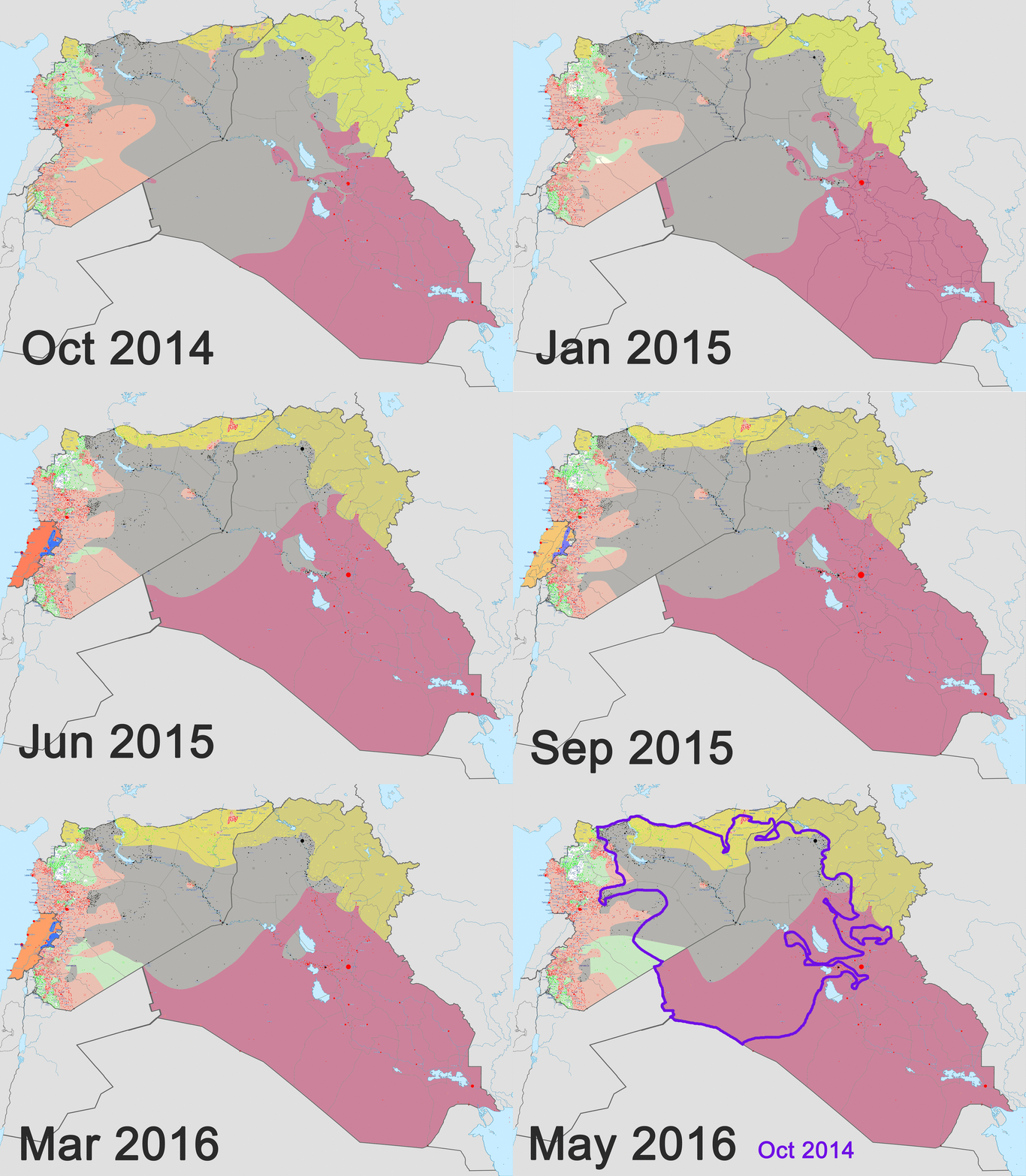
Read the animation: Watch the frame dates and follow Mosul, Raqqa, the Euphrates corridor, and the territory spanning the Syrian–Iraqi border. Gray = ISIS; yellow shades = Kurdish forces; dark red = Iraqi government; light red = Syrian government; green = Syrian rebels. The changing patches show why the movement threatened several states at once. This ten-frame community-made reconstruction ends in 2016: it does not show the full later loss of the territorial caliphate, and broad desert shading is not a measure of population or uniform control.
Source: Aumannd, 20 May 2016, Commons original, legend, and revision record, CC BY-SA 4.0. Saved animated original, not a static preview.

Color map — The population consequences are a different kind of change
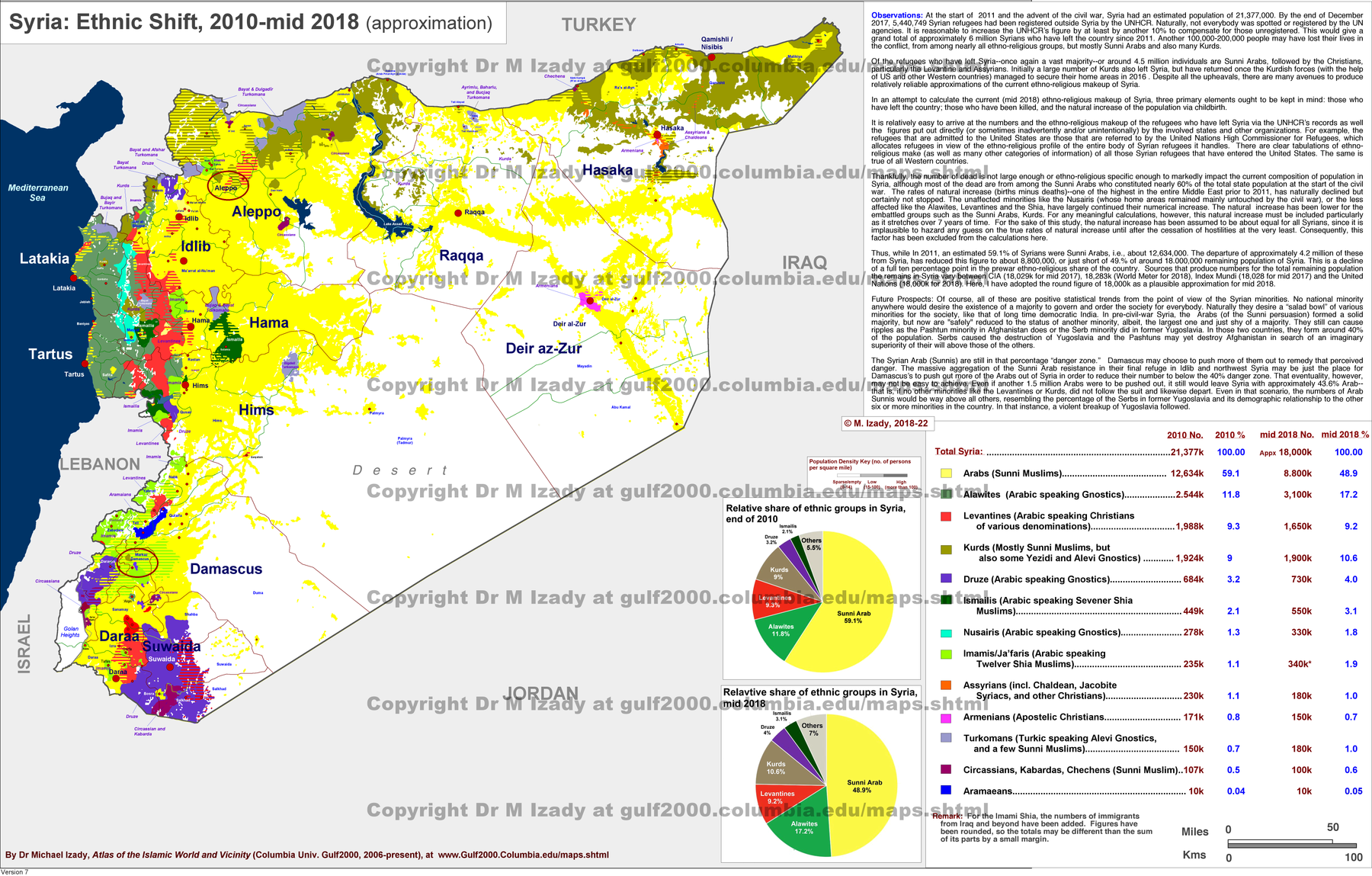
Read this separately: The Syria image compares the author’s estimates for 2010 and mid-2018; it is not another battle-front map. Relate displacement to the book’s account of civil war while keeping the estimates, classifications, and the source’s political commentary distinct from established measurements or your own conclusions. It does not establish that a community supports a particular armed force.
Source: Dr. Michael Izady, Syria: Ethnic Shift, 2010–mid 2018 (approximation), © 2018–22, Gulf/2000 original. See classification and demographic caveats.
ISIS exploits excluded Sunni populations, weak armies, experienced militant networks, and the dissolution of effective borders. Its capture of major cities and declaration of a caliphate challenge more than individual governments: they propose an alternative territorial order. Yet its atrocities against Yazidis, Christians, Shiites, opponents, and captives help unite otherwise hostile actors against it. Civilian testimony, including Ruqia Hasan’s defiance, prevents the story from becoming only a chronology of military organizations.
The response combines Kurdish and Iraqi forces, American and allied air power, Iranian-backed militias, and other participants. Their immediate interest in defeating ISIS does not establish agreement about Kurdish autonomy, Assad, or Iranian influence. Kobani demonstrates the effectiveness of a specific ground–air partnership; Türkiye’s concern about Kurdish gains shows the limits of any supposedly uniform anti-ISIS camp.
Russia intervenes to save Assad, invoking the fight against terrorism while also attacking other opposition and civilians. Iran supplies fighters and coordination. Montefiore interprets these actions as an opportunistic use of the anti-ISIS campaign to preserve a client government. Military victory can therefore strengthen an oppressive regime even when some coalition participants pursue a more limited objective.
The nuclear agreement with Iran is evaluated through this regional lens. Montefiore argues that negotiating nuclear limits separately from Iran’s external interventions leaves its armed network unconstrained.
Mosul and Raqqa are retaken at immense civilian and urban cost. ISIS loses its territorial core, but the victory leaves Kurdish vulnerability, militia power, and the governance of ruined areas unresolved. The author follows Jolani’s consolidation in Idlib as a separate trajectory that will become crucial later. Source: PDF pp. 350–356 (file not included in this release).
The Crown Prince
MBS combines social and economic reform with more concentrated coercive authority. He weakens the religious establishment, expands some freedoms, and seeks diversification while imprisoning rivals and dissidents. The Khashoggi killing belongs to the same political system as the reform program; neither cancels the other.
The Saudi–Emirati intervention in Yemen exposes the limits of wealth and air power against a rooted armed movement. Civilian suffering and the failure to destroy the Houthis qualify the image of a newly decisive Gulf order. UAE power also serves separate ambitions, making Saudi–Emirati cooperation conditional rather than permanent.
Qatar illustrates a different strategy: gas wealth, media, international investment, American connections, and relationships with Islamist organizations permit a small state to exercise disproportionate influence. Montefiore is sharply critical of its policies.
The Trump administration leaves the Iran nuclear agreement, while attacks on Saudi oil facilities expose doubts about US protection. These developments encourage Gulf rulers to diversify their relationships. Soleimani’s assassination damages Iran’s network without dissolving its local organizations.
The Abraham Accords normalize relations between Israel and several Arab governments through overlapping strategic and commercial interests. Their importance lies partly in separating state-to-state relations from a prior comprehensive Palestinian settlement. Their limit lies in the same separation: Palestinian grievances remain unresolved. Iran’s repression of the “Woman, Life, Freedom” protests then reveals a gap between regional influence and domestic legitimacy. Saudi–Iranian diplomatic restoration, mediated by China, supplies another reminder that governments can hedge across supposedly fixed camps. Source: PDF pp. 357–363 (file not included in this release).
Key Concepts and Distinctions
- Territorial caliphate: ISIS was the first movement to try to erase the post-1918 borders by holding land, not only by terror.
- Informal empire: Iran projected power through partner militias in Iraq, Syria, Lebanon, Yemen and Gaza rather than through its own army. Reach and control are not the same.
- Normalization without settlement: The Abraham Accords separated Arab states’ relations with Israel from a prior Palestinian deal, which was both their strength and their limit.
Essential Evidence and Examples
- The caliphate’s reach: At its height ISIS ruled about 40 per cent of Iraq and 30 per cent of Syria, some 10 million people; Iraq’s Christian population fell from 2.2 million to as few as 130,000. PDF pp. 351–352 (file not included in this release)
- A witness: Ruqia Hasan, who ran Raqqa Is Being Slaughtered Silently: “they’ll be cutting off a head full of dignity.” She was later executed. PDF p. 350 (file not included in this release)
- Who did the fighting: About 80 per cent of Russian strikes in Syria hit anti-Assad militias rather than ISIS. PDF p. 353 (file not included in this release)
- Soleimani’s boast: “I have assembled for you six armies outside Iran … all the way to the shores of the Mediterranean.” PDF p. 355 (file not included in this release)
- The cost of the counter-campaign: Mosul lost about 40,000 civilians and was 80 per cent destroyed; coalition strikes killed around 80,000 ISIS fighters. PDF pp. 355–356 (file not included in this release)
- Saudi revolution from above: MBS’s anti-corruption sweep at the Ritz-Carlton recovered $107 billion; the UN put Yemen’s death toll at 377,000. PDF pp. 358–359 (file not included in this release)
- Syria’s dead: About 600,000 Syrians were killed, overwhelmingly by the Assad regime and its allies. PDF p. 361 (file not included in this release)
Cautions
- A network’s geographical reach is not uniform control. “Six armies” is Soleimani’s boast as reported in the book and Montefiore’s organizing metaphor; it should not erase the partners’ local roots and separate interests.
- Montefiore entertains the possibility that the 2016 Turkish coup was a provocation; that is speculation, not an established account.
- His criticism of the Iran deal concerns its regional scope (it left Iran’s network untouched). It does not show that the deal imposed no nuclear limits.
- His superlative claims about Qatari influence on American universities and politics need evidence and comparison beyond this draft.
Conclusion and Significance
By 2023 the region contains powerful states, fragmented states, and armed movements that can impose costs far beyond their size. Iran’s network appears formidable, while Gulf normalization offers a competing alignment. Neither apparent success removes the unresolved political conflicts that can overturn the balance.
Questions for Reflection
- Reconstruct why post-uprising politics produces different orders in Egypt, Türkiye, Iraq, and Syria.
- How does ISIS’s conduct help create the coalition that destroys its territorial project?
- Use Kobani or Mosul to explain cooperation without a shared long-term political aim.
- Distinguish Montefiore’s criticism of the Iran agreement’s regional scope from a claim about its nuclear provisions.
- Compare Iranian militia networks and Gulf financial-diplomatic networks as forms of influence with different vulnerabilities.
Quick recall
- Where and when did Baghdadi declare the caliphate?
- Which city’s defence was called “the Kurdish Stalingrad”?
- When did Russia intervene in Syria, and on whose side?
- Who was killed by an American drone at Baghdad airport in January 2020?
- Which states signed the Abraham Accords in 2020?
Answer key
- Egypt: the army removed the elected Brotherhood president. Türkiye: Erdoğan used a failed coup to purge the state. Iraq: Iranian-backed militias and the US both rescued the government from ISIS. Syria: Assad survived through Russian and Iranian intervention. PDF pp. 347–353 (file not included in this release)
- Its massacres of Yazidis, Christians and Shiites and its threat to every state brought the US, Iran, the Kurds, Iraq and Gulf states into action against it. PDF pp. 351–353 (file not included in this release)
- At Kobani, Kurdish fighters and American air power cooperated against ISIS while Türkiye feared the Kurdish gains; at Mosul, Iranian-backed militias, Kurds and Iraqi troops fought together with opposing plans for the future. PDF p. 353 (file not included in this release) · PDF p. 355 (file not included in this release)
- He argues the deal let Iran keep and fund its regional network; that is a point about strategy, not proof that it failed to restrict enrichment. PDF p. 355 (file not included in this release)
- Iran’s militias give reach on the ground but act on their own interests and can drag Iran into wars; Gulf money and diplomacy buy influence but proved weak against the Houthis and depend on outside protection. PDF p. 355 (file not included in this release) · PDF pp. 358–361 (file not included in this release)
- In the Grand Mosque of Mosul, 29 June 2014. PDF p. 351 (file not included in this release)
- Kobani, in 2014–15. PDF p. 353 (file not included in this release)
- September 2015, to save Assad. PDF p. 353 (file not included in this release)
- Qassem Soleimani, commander of the Quds Force. PDF p. 361 (file not included in this release)
- Israel with the UAE, Bahrain and Morocco. PDF p. 361 (file not included in this release)
Part XIII — The October 7 Wars, 2023–2026
What I Should Retain
Three takeaways: A peripheral or contained conflict can overturn the wider regional balance when leaders misread their opponents. Armed partners can draw sponsors into risks those sponsors would not choose themselves. Military dominance and the removal of leaders do not settle civilian protection, legitimate government, or the political future of a devastated territory.
Three anchors: Sudan’s war connects competing armed institutions with regional patrons and economic interests. October 7 exposes Israel’s security and political failures and initiates a catastrophic Gaza war. The later weakening of Hezbollah and Assad’s fall reveal the vulnerability behind Iran’s apparent regional reach.
Connection to test: What survives on a map after battlefield success, and what must still be built through institutions, protection of civilians, and political agreement?
Part XIII timeline — The October 7 wars (2023–early 2026)
Source status: This is the draft’s most provisional section. Dates and figures follow Montefiore and are not independently checked; casualty totals especially need verification.
- 15 Apr 2023 — Sudan’s civil war begins between Burhan’s army and Hemedti’s RSF. PDF p. 365 (file not included in this release)
- 29 Sep 2023 — Jake Sullivan: “The Middle East region is quieter today than it has been in two decades.” PDF p. 370 (file not included in this release)
- 7 Oct 2023 — Hamas’s attack on Israel: About 1,139 killed and 251 taken hostage. PDF p. 371 (file not included in this release)
- 8 Oct 2023 — Hezbollah opens a “war of support” from Lebanon. PDF p. 372 (file not included in this release)
- 27 Oct 2023 — Israel’s ground invasion of Gaza. PDF p. 372 (file not included in this release)
- 29 Dec 2023 — South Africa’s genocide case at the ICJ. PDF p. 374 (file not included in this release)
- Apr 2024 — Israel strikes Iranian generals in Damascus; Iran’s first direct drone and missile attack follows. PDF pp. 374–375 (file not included in this release)
- 31 Jul 2024 — Haniyeh is killed in Tehran. PDF p. 375 (file not included in this release)
- 17 Sep 2024 — The pager attack on Hezbollah; Nasrallah is killed on 27 September. PDF pp. 375–376 (file not included in this release)
- 16 Oct 2024 — Sinwar is killed in Rafah. PDF p. 376 (file not included in this release)
- 26 Nov 2024 — Israel–Lebanon ceasefire. PDF p. 376 (file not included in this release)
- 8 Dec 2024 — Damascus falls to Sharaa’s HTS; Assad flees to Moscow. PDF p. 378 (file not included in this release)
- 13–24 Jun 2025 — The Twelve-Day War: Israel’s Rising Lion strikes Iran; on 22 June US B-2s hit Fordow, Natanz and Isfahan. PDF pp. 382–383 (file not included in this release)
- 9 Sep 2025 — Israel strikes Hamas leaders in Doha. PDF p. 383 (file not included in this release)
- 9–13 Oct 2025 — Gaza ceasefire: The last twenty living hostages are freed; 1,718 Palestinian prisoners are released. PDF p. 384 (file not included in this release)
- 8–9 Jan 2026 — Massacres in Iran: Montefiore estimates that over 30,000 protesters were killed in two days. PDF p. 386 (file not included in this release)
Causal arc: Sudan shows the new regional powers fighting through proxies → Hamas’s surprise attack exposes Israel’s complacency and starts the longest Gaza war → Iran’s partners join piecemeal → Israel decapitates Hezbollah, Hamas and Iran’s command → Assad falls → America imposes ceasefires, but Gaza’s government and Iran’s future remain unresolved.
Objective and Through Line
The final Part tests the whole book against the most recent upheaval. Sudan demonstrates regional states’ competing interests beyond the Levant. October 7 destroys assumptions that Hamas can be managed indefinitely and that Palestinian politics can be bypassed without consequences. The subsequent wars expose both Israel’s military advantages and the immense limits and costs of applying them.
Montefiore then follows a reversal in Iran’s position and the opportunities that open for Türkiye, Gulf governments, and the United States. His preferred explanatory pattern is recognizable: prestige and apparent stability conceal vulnerabilities; a gamble by one actor forces decisions on others; military adaptation changes the balance quickly; and success risks producing fresh overreach. The conclusion remains conditional because replacing a military threat with a legitimate political order is a different undertaking.
Structure at a Glance
- Restore Sudan to the regional picture and identify its external connections.
- Explain Hamas’s gamble and Israel’s failure to anticipate it.
- Follow the Gaza war alongside the widening confrontation with Iran and its partners.
- Distinguish the new military balance from unresolved political and humanitarian outcomes.
Section-by-Section Argument
The Sudan Slaughter
Sudan’s competing military institutions grow from earlier state violence and patronage. The RSF’s origins in the Janjaweed connect the current conflict to Darfur, while money, gold, foreign deployments, and relationships with Gulf powers help give commanders independent resources. The problem is not merely that two generals dislike each other: the state contains rival armed structures with their own economic and external foundations.
The book interprets the war through Saudi, Emirati, Egyptian, Turkish, Iranian, and other interests, demonstrating that partners in one theater may support different sides in another.
The chapter then turns to Gaza. Hamas combines a coercive internal order with outside funding and a military organization designed around tunnels, rockets, and hostages. Montefiore includes Gazan opponents of Hamas, particularly Moumen al-Natour and the “We Want to Live” protests, to distinguish the population from the movement claiming to represent it.
Israel’s governing crisis, technological confidence, and discounted warnings create an opening. Sinwar’s motives are presented as several overlapping objectives: seize Palestinian leadership, obtain prisoners, break regional normalization, force the conflict back onto the international agenda, and potentially trigger a wider war. Source: PDF pp. 365–370 (file not included in this release).
The Flood
The October 7 attacks involve mass killing of civilians and hostage-taking alongside attacks on military targets. Israel’s delayed response exposes failures of preparation and command. Montefiore’s explanation emphasizes complacency, inadequate human intelligence, ignored border warnings, and political priorities that draw attention elsewhere. Montefiore counts about 1,139 dead and 251 hostages.
The ensuing Israeli campaign faces objectives that do not fit easily together: destroy Hamas’s military capacity, recover hostages, protect civilians, and decide who can govern Gaza. The narrative records devastating civilian deaths, repeated displacement, destruction of homes and institutions, unsafe supposed refuge areas, and severe aid failures. It also describes Hamas’s military use of civilian areas and its prioritization of organizational survival over civilian shelter. These are distinct responsibilities; citing one does not remove the other.
Montefiore gives particular weight to the information war and argues that Hamas gains diplomatically from civilian suffering. His treatment of extremist Israeli ministers also connects their statements and settler violence to damage to Israel’s legitimacy and to legal scrutiny. The book also discusses the ICJ proceedings and the ICC warrants.
The later operations against Hezbollah and Iranian targets contrast with the slow, destructive Gaza campaign. Intelligence penetration, assassinations, and attacks on command systems weaken a network that had appeared robust. Montefiore connects that reversal to the patron–partner problem: Hamas chooses its own timing, while sponsors and allies must respond to a crisis they do not fully control. Their shared hostility to Israel does not produce a unified chain of command. Source: PDF pp. 371–377 (file not included in this release).
The Lions War and the Iranian Massacres
Assad’s fall demonstrates the fragility of a government dependent on exhausted or distracted external protectors. Sharaa’s advance succeeds in a changed environment, but the removal of the regime does not guarantee plural government. His past, the interests of his armed supporters, violence against minorities, relations with Kurdish forces, and Turkish and Qatari backing shape an uncertain transition.
Montefiore’s account of Trump’s renewed diplomacy emphasizes transactional pressure and Gulf relationships, while criticizing coercive visions for displacing Gazans. The Houthis supply another limit to overwhelming force: relatively small armed organizations can exploit geography and modern weapons to impose continuing costs on stronger states.
The narrative then follows the 2025 Israeli and American attacks on Iran’s nuclear and military infrastructure, subsequent diplomacy, and a Gaza ceasefire framework.
Color reference map — The surrounding US military network in mid-2024
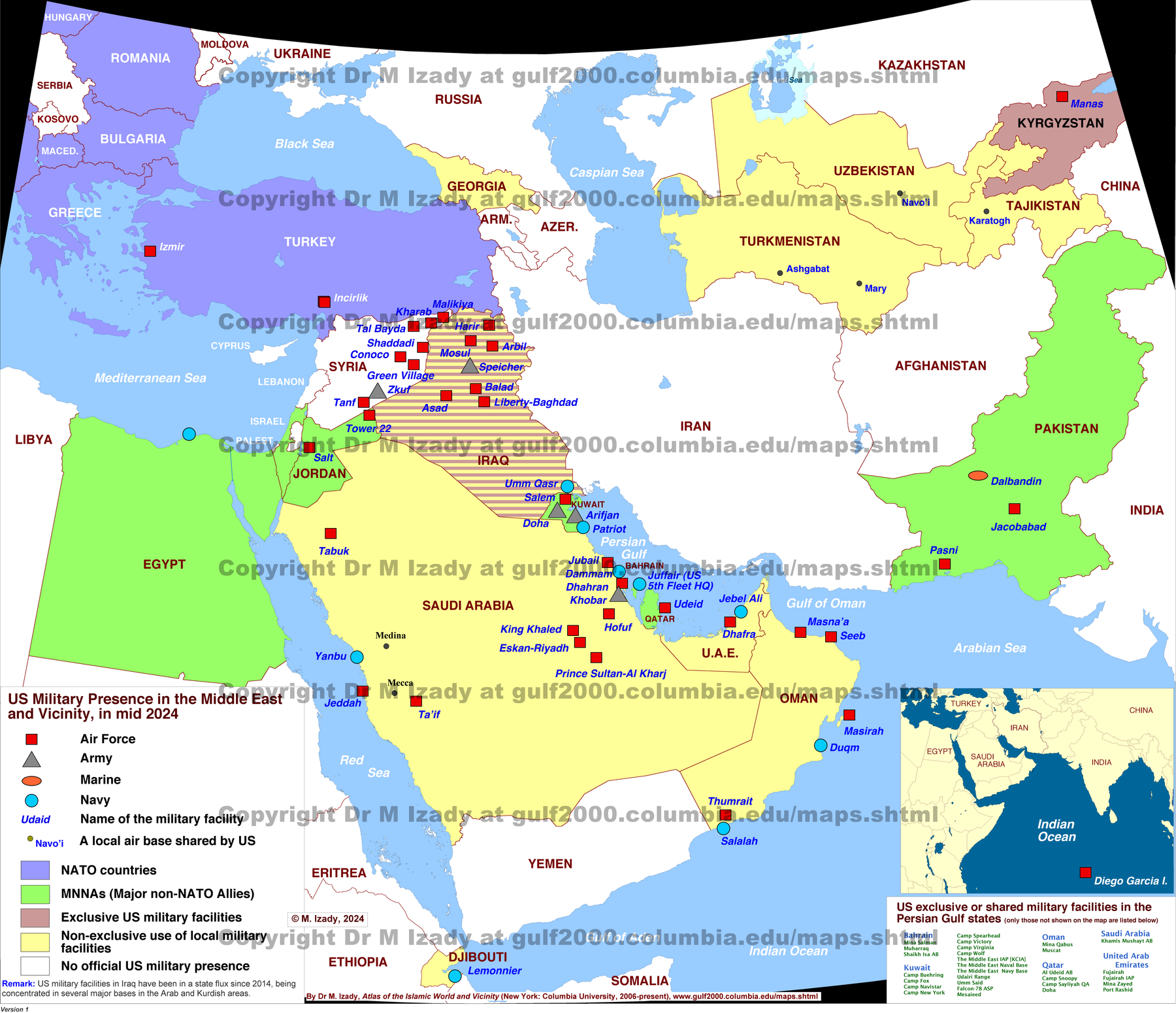
Read this map: Locate Iran between the Gulf, Iraq, Afghanistan, and the Caucasus, then identify the surrounding air, army, and naval facilities in the legend. This makes the geography of regional deterrence and vulnerability easier to follow. Mid-2024 is the map’s date: it is background for this Part, not a verified inventory for the book’s 2025–26 events. A facility symbol does not demonstrate that it participated in a specific operation.
Source: Dr. Michael Izady, US Military Presence in the Middle East and Vicinity, mid 2024, © 2024, Gulf/2000 original.

Its final account of Iranian protests and repression in early 2026 makes domestic legitimacy the unresolved counterpart to military power. Montefiore puts the January 2026 death toll in the tens of thousands; his argument is that external defeat and domestic repression can go together.
The final regional picture is unsettled: weakened Iranian partners, stronger Turkish influence, competing Gulf interests, unfinished Palestinian government, and renewed possibilities for American involvement. The ending is a balance of risks and opportunities, not a completed new order. Source: PDF pp. 378–386 (file not included in this release).
Key Concepts and Distinctions
- The patron–partner problem: A sponsor’s armed partners choose their own timing; Hamas’s attack forced Iran and Hezbollah into a war on terms they did not set.
- Ultra-war: Small armed movements with missiles, drones and tunnels can inflict costs on states with far larger armies.
- Military victory versus political order: Killing leaders and destroying facilities does not create a legitimate government in Gaza or Syria, or end Iran’s nuclear knowledge.
Essential Evidence and Examples
- Sudan’s scale: Within two years about 400,000 civilians were killed, 9 million displaced and 4 million made refugees; at El Fasher the RSF killed about 60,000 in two weeks. PDF p. 366 (file not included in this release)
- Sinwar’s intent: “I don’t want the peace of the graveyard … an explosion is unavoidable.” He later said of possible Gazan deaths, “Let it be 20,000 as long as we are steadfast.” PDF p. 369 (file not included in this release) · PDF p. 373 (file not included in this release)
- October 7 in the draft’s figures: About 7,000 attackers; 1,139 killed (695 Israeli civilians, 71 foreigners, 373 soldiers and police), 364 of them at the Nova festival; 251 hostages, including 30 children. PDF p. 371 (file not included in this release)
- Extremist ministers: Ben Gvir and Smotrich called for collective punishment and “total annihilation,” feeding legal cases against Israel. PDF p. 374 (file not included in this release)
- The decapitation campaign: Pagers, the killing of Nasrallah (“the axis of the axis of evil,” in Netanyahu’s words), and Rising Lion’s strike on Iran’s high command. PDF pp. 375–376 (file not included in this release) · PDF p. 382 (file not included in this release)
- Gaza’s toll as each side reports it: Israel claims 25,000 Hamas fighters killed; Hamas reports 70,000 dead without distinguishing fighters. If both are plausible, about 45,000 civilians died. Israel lost about 900 soldiers. PDF p. 384 (file not included in this release)
Cautions
- This is the most provisional section. The draft reaches early 2026 and contains fast-changing claims, unverified intelligence detail, casualty estimates and forecasts. It records the author’s interpretation at the draft’s endpoint, not a current-events reference or a resolved legal judgement.
- The book’s claims about external backing in Sudan and its very large casualty totals need separate verification before reuse.
- Sinwar’s motives, especially where they rest on covert communications, are Montefiore’s reconstruction.
- Montefiore’s argument that Hamas gained from civilian suffering is separate from the factual and legal questions about what happened to civilians, which remain serious whatever the propaganda use.
- The ICJ and ICC passages are summaries within a history, not substitutes for the decisions themselves.
- A claim that facilities were destroyed is not proof that Iran’s nuclear programme was permanently ended; proposed demilitarization and reconstruction in Gaza are plans, not achievements.
- The January 2026 massacre estimates in Iran are given without the bibliography needed to audit them.
Conclusion and Significance
The final wars demonstrate the book’s central claim that no one wins permanently. Yet repeating that pattern does not explain every event by itself. The stronger explanatory work lies in specifying the institutions that fail, warnings ignored, partner relationships misread, and political responsibilities left unresolved after military success.
Questions for Reflection
- Reconstruct the connection between Sudan’s rival armed institutions and their external economic relationships.
- How does the patron–partner problem help explain the widening consequences of October 7?
- Which evidence distinguishes Israel’s military successes from an agreed political future for Gaza?
- What kinds of claims in this final Part require renewed verification before use in an argument note?
- Apply the difference between destroying a command structure and establishing legitimate government to post-Assad Syria.
Quick recall
- Who are the two sides in Sudan’s war, and who leads each?
- How many hostages did Hamas take on 7 October 2023?
- Which Hezbollah leader was killed on 27 September 2024?
- When did Damascus fall, and to whom?
- What were Rising Lion and the 22 June 2025 American strikes aimed at?
Answer key
- The RSF grew out of Bashir’s Janjaweed and got gold mines and Gulf connections; both the army and the RSF earned money and patrons by fighting in Yemen for the Saudi–UAE coalition, so each had its own foreign backers (the UAE for the RSF; Saudi Arabia, Egypt, Türkiye, Iran and Russia for the army). PDF pp. 365–366 (file not included in this release)
- Hamas chose the date without telling Iran or Hezbollah, so they were dragged into a limited “war of support” that exposed them to Israel’s counter-strikes and destroyed much of the network. PDF p. 370 (file not included in this release) · PDF p. 372 (file not included in this release) · PDF pp. 375–376 (file not included in this release)
- Israel killed Hamas’s leaders and destroyed tunnels, but Hamas re-emerged after each withdrawal, and the 2025 ceasefire left governance to a plan and a Board of Peace rather than an agreed authority. PDF pp. 374–375 (file not included in this release) · PDF p. 384 (file not included in this release)
- Casualty totals, claims about covert motives and intelligence, the legal status of court proceedings, and forecasts about Iran, Gaza and Syria. PDF pp. 371–386 (file not included in this release)
- HTS removed Assad in days, but Sharaa must govern through his own jihadists while Alawite and Druze civilians were massacred and the Kurds were absorbed by force. PDF p. 378 (file not included in this release) · PDF p. 385 (file not included in this release)
- The Sudanese Armed Forces under General Abdel Fattah al-Burhan and the Rapid Support Forces under Hemedti (Mohamed Hamdan Dagalo). PDF p. 365 (file not included in this release)
- 251, including 30 children. PDF p. 371 (file not included in this release)
- Hassan Nasrallah, killed by a bunker-busting strike in Beirut. PDF p. 376 (file not included in this release)
- 8 December 2024, to Ahmed al-Sharaa’s HTS. PDF p. 378 (file not included in this release)
- Iran’s nuclear programme and military leadership; the US B-2 strikes hit Fordow, Natanz and Isfahan. PDF pp. 382–383 (file not included in this release)
Conclusion — The Garden amidst the Flames
What I Should Retain
Montefiore closes with three connected judgments. Regional states are increasingly projecting their own power rather than acting only as clients. The centralized nation-state and informal armed networks remain unstable ways of governing diverse societies. The region’s inherited resources for coexistence—culture, commerce, mixed identities, and religious openness—are as authentic as its traditions of exclusion.
Three anchors organize his ending: Ibn Arabi’s openness supplies a moral counterpoint to fanaticism; Gulf commercial and diplomatic reach illustrates growing regional agency; and the unresolved Palestinian question illustrates why neither occupation nor military victory can establish a durable political settlement.
Question to carry forward: Which arrangements allow people to correct destructive decisions before those decisions become a ruler’s existential test?
Objective and Through Line
The conclusion shifts from chronological narration to a judgment about the region’s possibilities. Ibn Arabi’s journey supplies a model of intellectual and religious openness across the same geography the book has traversed. Montefiore uses it to reject the claim that intolerance has a uniquely authentic claim on Middle Eastern life.
He also argues that the geographical meaning of the Middle East is expanding. Gulf investment, Turkish and Israeli military connections, Iranian networks, and interests across Africa and Asia draw formerly peripheral territories into the same contests. The region is no longer adequately imagined as an isolated theater in which outside empires manipulate local clients. America remains exceptionally powerful, while Russia, China, and regional states pursue different combinations of direct and indirect influence. The historical continuity is competition; the change is the number, reach, and autonomy of the competitors.
The conclusion’s reasoning — analytical divisions
Regional agency does not mean the end of empire
Montefiore describes regional states building informal domains through military partnerships, finance, ports, investments, and client organizations. The capacity to project influence is a genuine change, but he does not equate it with benign conduct. Sudan, Yemen, and other contested territories can become arenas for their competition. Regional autonomy redistributes agency without guaranteeing freedom for vulnerable populations.
Institutional variety complicates ideological certainty
He finds the Gulf monarchies and Morocco more successful than several revolutionary republics in combining stability, commerce, and international reach. His explanation includes dynastic skill, pragmatism, oil, openness, and the ability to move quickly. The same narrative records coercion, personalization, and dangerous interventions. It supports a comparison of particular institutions and outcomes, not an isolated declaration that monarchy itself causes prosperity.
His broader criticism targets inflexible ideologies imposed on heterogeneous societies. Nationalism, socialism, and militant Islamism repeatedly fail to accommodate the people they claim to redeem. But his own warning against rigid categories also cautions against treating all national belonging, religious politics, or Western influence as equivalent.
Coexistence requires more than winning
The conclusion explicitly argues that Palestinian statehood alongside Israel is necessary for durable integration. It also rejects the rule of violent Islamist movements and Jewish supremacist extremists. This is a political and ethical conclusion about mutual life, not a denial of security needs or an assertion that implementation is easy.
The final image of a garden among flames leaves room for uncertainty. The history includes repeated catastrophe, but also cultural creation and choices that alter supposedly permanent hostility. Hope depends on recognizing those possibilities while confronting the institutions and incentives that keep violence reproducible. Source: PDF pp. 387–394 (file not included in this release).
Essential Evidence and Examples
- Ibn Arabi’s alternative: “My heart can be a pasture for gazelles and a convent for Christian monks … I follow the religion of Love.” PDF p. 387 (file not included in this release)
- Monarchy’s record: “the most successful Arab powers are not the nation-states created by Western empires and Arab nationalists but the absolute monarchies of the Kingdom, the Gulf and Morocco.” PDF p. 391 (file not included in this release)
- Hilm as a style of rule: Muawiya: “I never apply the sword when the lash suffices, nor the lash when my tongue is enough.” PDF p. 392 (file not included in this release)
- The balance of risks: “lame tigers are the most dangerous beasts: an Iran that is both wounded and over-armed remains a menace.” PDF p. 390 (file not included in this release)
- The political conclusion: “neither occupation nor victory can ever build a stable society … Only a version of Palestinian statehood – alongside the Jewish republic – can achieve that.” PDF p. 393 (file not included in this release)
Cautions
- The historical narrative supports attention to these alternatives, but it does not prove that absolute monarchy is generally superior or that pluralism will prevail. Montefiore’s admiration for particular rulers and his confidence in some recent diplomatic methods must be assessed separately from his chronological reconstruction.
Questions for Reflection
- Reconstruct the distinction between greater regional agency and a more peaceful regional order.
- What mechanisms does Montefiore propose for the success of particular monarchies, beyond the label “monarchy”?
- How does Ibn Arabi’s example challenge the idea that extremism is uniquely authentic?
- Which recent outcomes does the author explicitly leave uncertain?
- What institutional evidence would strengthen or weaken the book’s preference for pragmatic coexistence?
Answer key
- Regional states now project power through money, ports, militias and alliances from Africa to South Asia, but that autonomy has brought new proxy wars (Sudan, Yemen, Libya), not peace. PDF pp. 388–389 (file not included in this release)
- Dynastic skill and patience, pragmatism (Muawiya’s hilm), oil wealth, mercantile openness and the ability to decide quickly. PDF pp. 391–392 (file not included in this release)
- A medieval Sufi who travelled the same lands embraced other faiths and sources of wisdom; openness has roots as deep as intolerance. PDF pp. 387–388 (file not included in this release)
- Whether the Gaza and Iran ceasefires hold, whether Syria, Iraq and Lebanon recover, what happens to Sudan, Libya and Yemen, and whether Iran’s regime survives. PDF pp. 389–390 (file not included in this release)
- Durable institutions that absorb armed movements, protect minorities and survive changes of ruler would strengthen it; continued dependence on one ruler’s judgement, or new massacres, would weaken it. PDF pp. 390–394 (file not included in this release)
Connections and questions for the vault
These are study connections, not additional evidence silently imported into the book summary.
- Young Turks study: The Young Turks, 1908–1918 sets Montefiore beside Rogan, with printed-page and PDF-page references, and records a source discrepancy over where Jemal was assassinated.
- Regional foundation: Your Middle East and Israel reading track places Cleveland/Bunton, Rogan, Ottoman history, the wartime settlement, and focused Israel–Palestine histories before this broad synthesis. Use this note to identify a question for those books, rather than treating overlapping coverage as independent corroboration.
- Same author, different source: Montefiore interview notes provide a companion account and existing maps. Ask what the book adds, qualifies, or explains differently. Agreement between an author and his interview is not two-source confirmation.
- Culture and political unity: Arabs — Tim Mackintosh-Smith offers an existing route into language, shared culture, and political fragmentation. Compare explanatory emphasis; do not assume disagreement where both describe a gap between cultural connection and political unity.
- Longer chronology: The Middle East — Bernard Lewis supplies an existing longer-period review resource. Ask which institutions predate 1900 and which modern movements claim an ancient continuity that the evidence complicates.
- Maps and alliances: Middle East regional note contains historical-map orientation. Use it to locate places, then test any fixed religious grouping against the book’s changing alliances. Identity is not evidence of a population’s political allegiance.
- Conflict-specific reading: Sources, Books & Media is the route for comparing this regional synthesis with focused accounts of displacement, diplomacy, occupation, and armed movements. A new book link does not establish the book’s claims inside those argument notes.
Two author disagreements to preserve
- Antonius and the story of British betrayal. Montefiore presents The Arab Awakening as influential in constructing a nationalist account of British betrayal and Arab awakening (PDF p. 143). His own treatment emphasizes the Arab Revolt’s limited military scale, continued Arab service to the Ottomans, Hashemite ambitions, and multiple conflicting promises (pp. 83–94). The disagreement concerns causal weight and narrative framing. These notes establish how Montefiore positions the issue; assessing Antonius fairly requires reading his own argument and evidence.
- Said and Oslo. Montefiore reports Edward Said’s judgment that Oslo amounted to Palestinian surrender (p. 304), then argues that the concept was valid, the achievement historic, and the opportunity real, while recognizing failures of execution and the inadequacy of limited self-rule to national aspirations (p. 305). The useful comparison concerns the standard of success: whether an interim process created a credible route to sovereignty or entrenched an unequal order. The book’s representation of Said is not a substitute for his full analysis.
What would need checking before citing this as evidence
Use the PDF for Montefiore’s argument, with a page link. For a factual dispute, locate independent documentation before transferring a claim into a topic or argument note. Priorities are precise casualty and population figures; covert-operation and motive claims; the wording and status of peace proposals; legal proceedings; and the latest chapters’ outcomes and predictions.
Internal draft issues reinforce that distinction. Besides missing back matter and maps, p. 123 gives conflicting years for Reza Khan’s coup within the same discussion; p. 144 retains an editorial query about partition proportions; the Syrian massacre subsection’s heading and narrative name different cities; and the title/date labels do not consistently match coverage. These are documented limitations of this copy, not an independent judgment about a final edition.
Next learning step
Exercise: Open the Centres of Power canvas (file not included in this release), which lays out Egypt, Iran, the Gulf, Israel–Palestine, Syria–Iraq and Türkiye in parallel lanes across the thirteen Parts. Copy the lane headings onto a blank Goodnotes page, fill in as much as you can from memory, then check against the canvas.
Why it helps: Reconstructing events in parallel tests whether you can explain an alliance or reversal, rather than only recognize a ruler’s name. It also keeps the regional story wider than a single conflict.