📓 In your handwritten notebooks
- Feb – March 21 2026, pp. 54–55 — Plutarch’s Lives → open PDF p60 (file not included in this release)
Index: Personal Journal
⬅️ Hub: 60.25 Literature
DESCRIPTION
Plutarch’s Lives, written at the beginning of the second century A.D., is a brilliant social history of the ancient world by one of the greatest biographers and moralists of all time. In what is by far his most famous and influential work, Plutarch reveals the character and personality of his subjects and how they led ultimately to tragedy or victory. Richly anecdotal and full of detail, Volume I contains profiles and comparisons of Romulus and Theseus, Numa and Lycurgus, Fabius and Pericles, and many more powerful figures of ancient Greece and Rome. The present translation, originally published in 1683 in conjunction with a life of Plutarch by John Dryden, was revised in 1864 by the poet and scholar Arthur Hugh Clough, whose notes and preface are also included in this edition.
Consolation To His Wife On The Death Of Their Child by Plutarch.pdf (file not included in this release)
AI Summary
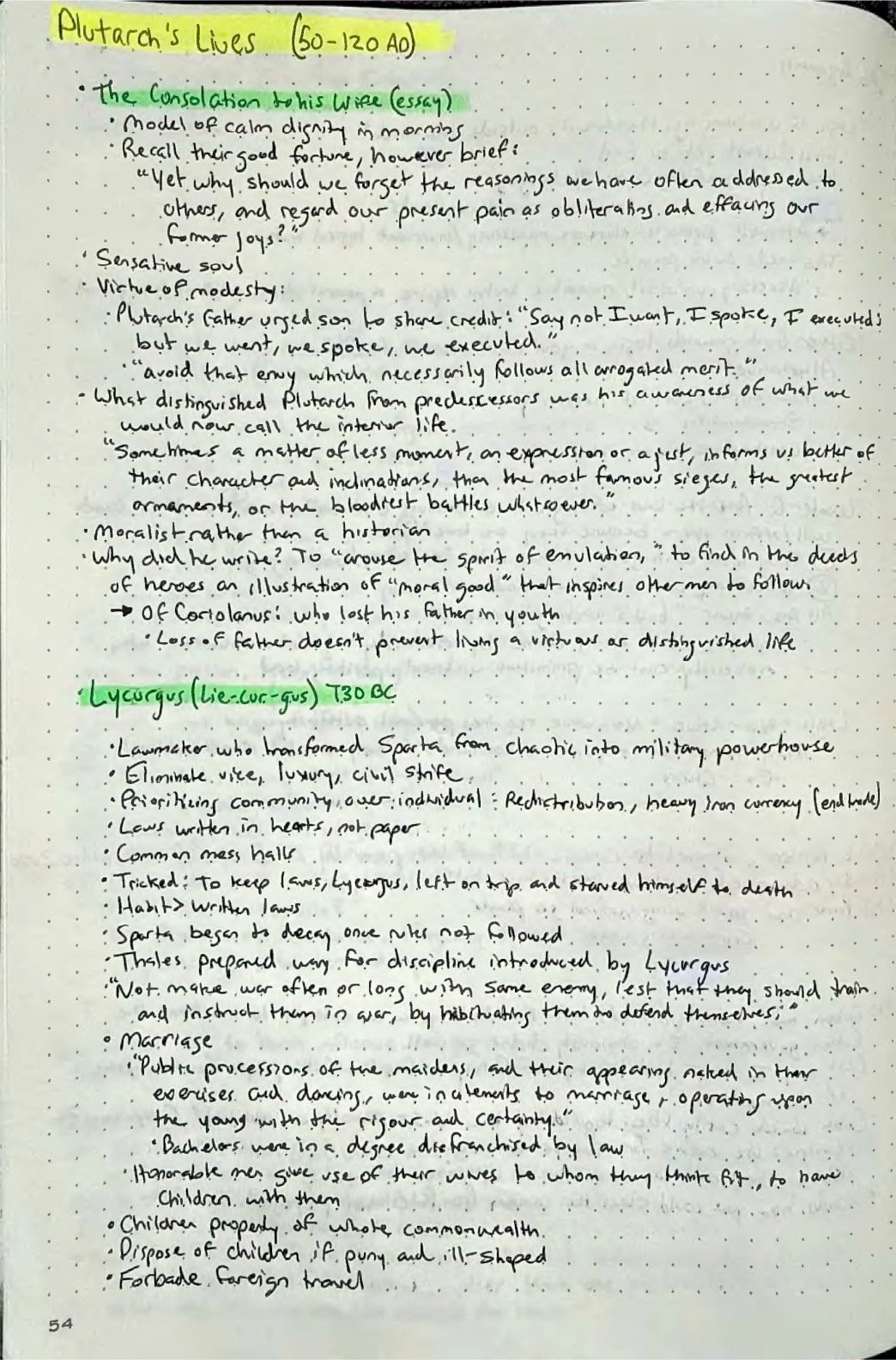
Lycurgus
In Plutarch’s Lives, Lycurgus is the legendary (and perhaps mythical) lawgiver who transformed Sparta from a chaotic society into the most disciplined military powerhouse of ancient Greece. Plutarch treats him not just as a politician, but as a master architect of human nature.
The Vision of Lycurgus
Lycurgus’s primary goal was to eliminate vice, luxury, and civil strife. He believed that a stable state required total devotion to the common good, prioritizing the community over the individual.
1. The Great Rhetra (The Constitution)
After consulting the Oracle at Delphi, Lycurgus established the Gerousia (a council of 28 elders and two kings). This created a “mixed” government, balancing the power of the monarchy with the influence of the aristocracy to prevent either tyranny or anarchy.
2. Economic Equalization
To destroy greed and the “distinction between rich and poor,” Lycurgus implemented radical reforms:
- Redistribution of Land: He divided the Laconian territory into equal plots for every citizen.
- The Iron Currency: He banned gold and silver, replacing them with heavy iron spits of little value. This effectively ended foreign trade and luxury imports because the “money” was too cumbersome to carry and worthless elsewhere.
3. The Social Innovations
Lycurgus believed that laws should be written in the hearts of citizens, not on paper.
- Common Mess Halls (Syssitia): Men were required to eat together in public. This prevented private luxury and ensured everyone ate the same simple fare (notably the famous “Black Broth”).
- The Agoge: A rigorous, state-run education system for boys starting at age seven, designed to build endurance, courage, and absolute obedience.
- Status of Women: Unlike other Greek cities, Spartan women were encouraged to exercise and compete in athletics to ensure they would produce strong, healthy children for the state.
The “Perfect” Sacrifice
According to Plutarch, once Lycurgus felt his laws were perfect, he tricked the Spartans into keeping them forever. He told the citizens he needed to travel to Delphi to consult the gods one last time. Before leaving, he made the kings and the people take a solemn oath to maintain his laws until he returned.
To ensure the laws remained unchanged, he starved himself to death in exile. Since he never returned to Sparta, the citizens remained bound by their oath for centuries.
Key Themes in Plutarch’s Analysis
- Education over Legislation: Lycurgus focused on upbringing because he believed habit was more powerful than written law.
- Totalitarianism vs. Virtue: While modern readers might see a police state, Plutarch views Lycurgus as a man who turned a whole city into a “philosophical community.”
- The Fragility of Success: Plutarch notes that Sparta flourished as long as it followed Lycurgus’s rules, but began to decay once gold, silver, and foreign ambition crept back in.
“He did not intend to lead a city that was great in the sense of ruling over many others… he thought that the happiness of a whole city, like that of an individual, results from the practice of virtue and at harmony within itself.”
Solon
If Lycurgus was the “Hard Reset” of Sparta, Solon was the “Great Mediator” of Athens.
While Lycurgus used a sledgehammer to rebuild society, Solon used a scale. When he took power in 594 BCE, Athens was on the brink of a bloody civil war between the rich (who owned everything) and the poor (who were being sold into slavery for their debts).
Here is the breakdown of how Solon saved Athens from itself.
The “Seisachtheia” (The Shaking Off of Burdens)
Solon’s first move was his most famous. He didn’t redistribute land like Lycurgus (which would have started a war with the nobles), but he did something equally radical:
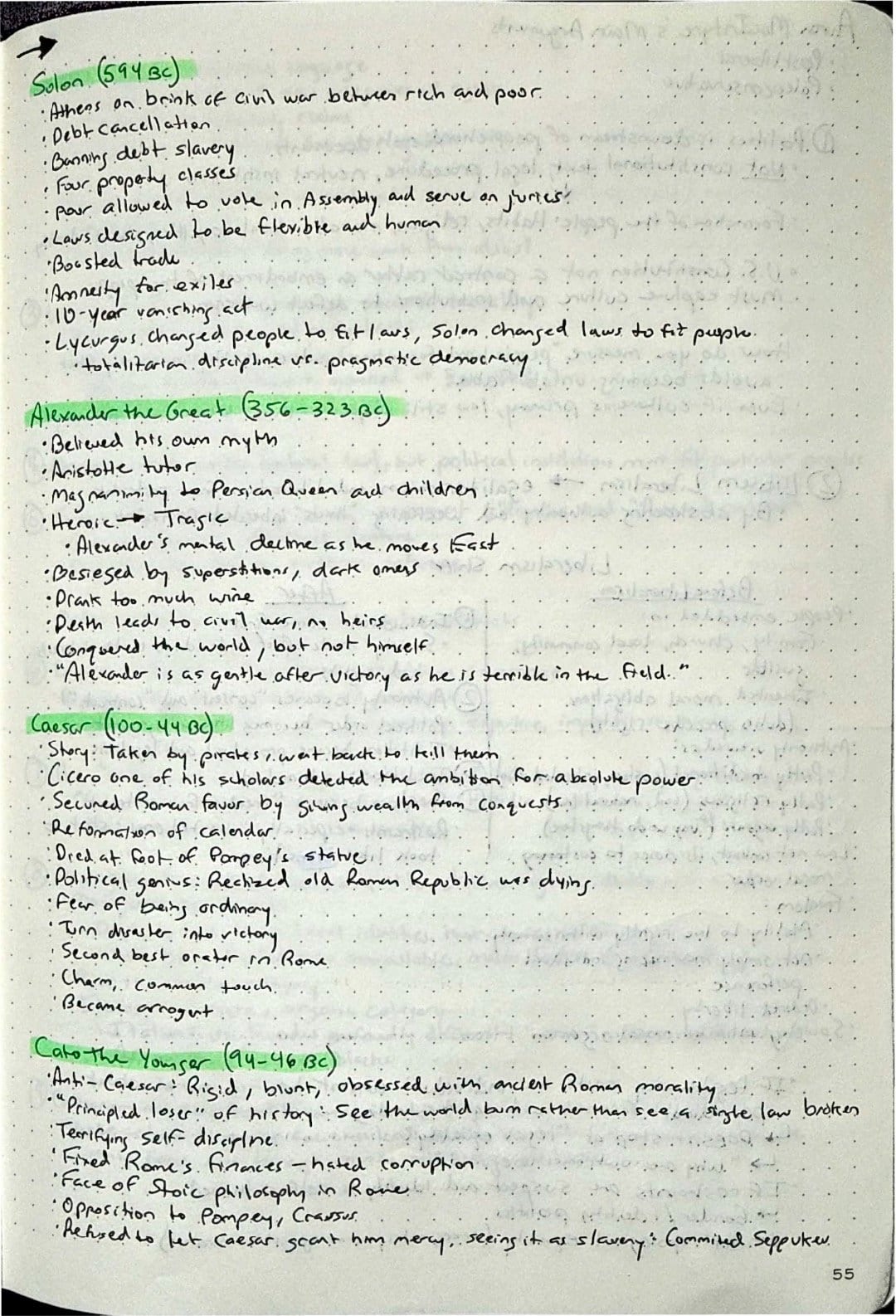
- Debt Cancellation: He cancelled all outstanding debts, public and private.
- Banning Debt-Slavery: He made it illegal to use a person’s body as collateral for a loan. He even tracked down Athenians who had been sold abroad as slaves and used state funds to buy them back.
The Four Property Classes (The “Timocracy”)
Solon realized that the problem wasn’t just money; it was political access. Before him, your family name determined your power. Solon changed the “Source Code” of Athenian power from Birth to Wealth. He divided the citizens into four classes based on their annual harvest yield:
- Pentakosiomedimnoi: The “500-bushel men” (The elite).
- Hippeis: The “Knights” (Could afford a horse).
- Zeugitai: The “Yoke-men” (Farmers who owned a pair of oxen).
- Thetes: The “Manual Laborers” (The poorest).
The Genius Move: Only the top three classes could hold office, but for the first time, the Thetes (the poor) were allowed to vote in the Assembly and serve on juries. Solon knew that giving the poor a voice in the courts meant the rich couldn’t just bully them with legal jargon anymore.
Laws for the “Middle Way”
Plutarch notes that Solon was a philosopher and a poet, not a soldier. His laws were designed to be flexible and human, unlike the “draconian” laws that came before him (which literally prescribed death for almost every crime).
- Standardized Weights and Measures: He boosted trade by making sure everyone used the same scales.
- The “Neutrality” Law: In one of his weirdest rules, Solon decreed that if the city was split into factions, any citizen who refused to take a side would lose their citizenship. He hated “playing it safe” while the city burned.
- The Amnesty: He cleared the records of almost everyone who had been exiled, allowing a fresh start for the city.
The 10-Year Vanishing Act
Just like Lycurgus, Solon knew that as long as he was in Athens, people would constantly harass him to change the laws.
- He made the Athenians swear to keep his laws for 100 years.
- Then, he pulled a “Lycurgus Lite”: He bought a ship and left for 10 years of travel (visiting Egypt and Cyprus), essentially forcing the Athenians to figure out how to live under his laws without him holding their hands.
Solon vs. Lycurgus: The Contrast
Plutarch loves comparing these two because they represent two different philosophies of government:
- Lycurgus changed the people to fit the laws (totalitarian discipline).
- Solon changed the laws to fit the people (pragmatic democracy).
Solon famously said he didn’t give the Athenians the best laws possible, but the “best they were capable of receiving.”
Alexander
Plutarch’s Life of Alexander is arguably the “crown jewel” of his biographies. If Lycurgus was about the state and Solon was about the law, Alexander is about the soul of a conqueror.
Plutarch famously clarifies at the start that he isn’t writing a “History,” but a “Life.” He’s looking for the small gestures and anecdotes that reveal Alexander’s character—what he calls the “signs of the soul.”
The Nature of the “God-Man”
From the beginning, Plutarch paints Alexander as someone who believed his own myth.
- The Divine Birth: Legend suggested Alexander wasn’t just the son of King Philip II, but of Zeus himself, who supposedly impregnated Queen Olympias in the form of a lightning bolt or a snake.
- Bucephalus: The famous story of the “untameable” horse. While others saw a wild beast, a young Alexander noticed the horse was just afraid of its own shadow. He turned it toward the sun and rode it. His father, Philip, allegedly wept and said, “My son, seek thee out a kingdom equal to thyself; Macedonia has not room for thee.”
The “Philosopher in Armor”
One of Plutarch’s favorite themes is Alexander’s relationship with his tutor, Aristotle.
- Alexander didn’t just love war; he loved medicine, philosophy, and literature. He famously slept with a copy of Homer’s Iliad (annotated by Aristotle) and a dagger under his pillow.
- When he met Diogenes the Cynic—a philosopher living in a tub—and asked if he could do anything for him, Diogenes replied, “Yes, stand a little out of my sun.” Alexander was so impressed by this lack of ego that he said, “If I were not Alexander, I would be Diogenes.”
The Great Conquests (A Blitz of Fate)
Plutarch skips a lot of the dry military logistics to focus on the psychological turning points:
- The Gordian Knot: Faced with an impossible puzzle (whoever untied the knot would rule Asia), Alexander didn’t pick at the strings; he drew his sword and hacked it in half.
- Magnanimity: After defeating the Persian King Darius III at the Battle of Issus, Alexander treated Darius’s captured mother, wife, and daughters with the utmost respect and protection, famously saying that the “Persian women were a torment to the eyes” because of their beauty, yet he refused to even look at them to preserve his discipline.
The Descent: Ambition and Paranoia
As the book progresses, the tone shifts from heroic to tragic. Plutarch tracks Alexander’s slow mental decline as he moves further East.
- The “Orientalizing” Conflict: Alexander began wearing Persian clothes and demanding proskynesis (the Persian act of bowing to the ground). His Macedonian soldiers, who valued their rugged equality, hated this. It led to conspiracies, executions of his closest friends (like Philotas), and the accidental murder of his friend Cleitus the Black in a drunken rage.
- The Omens: Toward the end in Babylon, Plutarch describes a man besieged by superstitions, strange deaths, and dark omens.
The End of the World
Alexander died at age 32 in Babylon after a long bout of fever (and perhaps a bit too much wine). Plutarch notes that at the time of his death, Alexander was planning even more conquests. He died without a clear heir, leaving his empire “to the strongest,” which immediately triggered decades of civil war.
“He was more frustrated by the lack of worlds to conquer than by the enemies he faced.”
Why it’s a masterpiece
Plutarch shows us a man who conquered the world but could never quite conquer himself. He possessed “limitless ambition,” but it was that very fire that eventually burned him out.
Since Alexander’s story is so epic, would you like me to dive into his rivalry with King Darius or perhaps the specific “Laconic” way he spoke to his generals?
Caesar
If you’ve just finished the Life of Alexander, reading Plutarch’s Life of Caesar is the perfect next step. Plutarch actually paired them together in his Parallel Lives because both men were driven by a “superhuman” ambition that eventually made the world too small for them.
In Plutarch’s eyes, Caesar wasn’t just a general; he was a political genius who realized that the old Roman Republic was dying and decided he was the only one capable of performing the surgery.
The “Alexander” Complex
Plutarch records a famous moment where a young Caesar was reading the history of Alexander the Great and burst into tears. When his friends asked why, he replied:
“Do you not think it is matter for sorrow that while Alexander, at my age, was already king of so many peoples, I have as yet achieved no brilliant success?”
This “fear of being ordinary” is the engine that drives every action Caesar takes in the book.
The Master of “The Pivot”
Plutarch highlights Caesar’s incredible ability to turn a disaster into a victory.
- The Pirates: Early in his career, Caesar was captured by Cilician pirates. Instead of being afraid, he told them they were asking for too little ransom and promised to return and crucify them all once he was free. He joked with them, wrote poems for them, and called them “illiterate barbarians” when they didn’t applaud. As soon as he was ransomed, he raised a fleet, caught them, and—true to his word—crucified them.
- The Orator: Plutarch notes that Caesar was the second-best orator in Rome (after Cicero). He used his charm and “the common touch” to win over the Roman masses, spending enormous amounts of money on public games and feasts to ensure the people loved him more than the law.
The Conquest of Gaul (and the Rubicon)
Plutarch treats the Gallic Wars as Caesar’s “training ground.” He describes Caesar as a leader who slept in chariots, rode at the front of his army, and shared every hardship with his men.
- The Crossing: The climax of the book is the crossing of the Rubicon. Plutarch describes Caesar hesitating at the riverbank, realizing that crossing it meant civil war. He famously uttered, “The die is cast,” and plunged Rome into a conflict against his former friend and rival, Pompey the Great.
The Tragedy of the Dictator
Once Caesar won the civil war and became “Dictator for Life,” the tone of the biography shifts from adventure to political thriller.
- The Arrogance: Caesar began to treat the Senate with contempt. He sat while they stood; he accepted divine honors; he toyed with the idea of being called “King” (a title Romans hated).
- The Omens: Plutarch leans heavily into the supernatural leading up to the end. He mentions the “Ides of March,” strange lights in the sky, and Caesar’s wife, Calpurnia, having a nightmare that her husband was murdered in her arms.
The Assassination
The death scene in Plutarch is cinematic. He describes the conspirators (including Brutus, whom Caesar had treated like a son) surrounding him under the guise of a petition.
- When the first dagger struck, Caesar fought back like a cornered animal.
- But when he saw Brutus—his protégé—drawing a sword, Plutarch says Caesar pulled his toga over his head and gave up. He fell at the base of a statue of his old rival, Pompey, so that it looked as if Pompey himself was presiding over the vengeance.
The Final Verdict
Plutarch’s takeaway is bittersweet: Caesar achieved the absolute power he spent his whole life chasing, but he only enjoyed it for a “momentary and fragile” period before it led to his destruction. He gained the “Empire,” but lost his life and the Republic in the process.
Cato the Younger
If Lycurgus was a legend and Caesar was a storm, Cato the Younger was a rock.
In Plutarch’s Life of Cato, we meet a man who was essentially the “Anti-Caesar.” While Caesar was flexible, charming, and ambitious, Cato was rigid, blunt, and obsessed with ancient Roman morality. He is the ultimate “principled loser” of history—a man who would rather see the world burn than see a single law broken.
The Child of Iron
Plutarch notes that even as a child, Cato was “slow to learn but hard to forget.” He was immune to flattery and possessed a terrifying level of self-discipline.
- The Hardened Body: To prepare himself for service, he walked bareheaded in the heat and rain, ate the simplest food, and practiced speaking in a way that was “not witty or charming, but inevitable.”
- The Moral Police: When he was elected as a Quaestor (a financial official), he treated the public treasury with such strict honesty that the career bureaucrats—who were used to corruption—hated him. He made it impossible to steal, effectively fixing Rome’s finances through sheer willpower.
The Stoic Wall
Cato was the face of the Stoic philosophy in Rome. Plutarch portrays him as a man who lived outside of his time.
- The Simple Toga: He famously walked the streets of Rome barefoot and without the usual undergarments to show his contempt for fashion and luxury.
- The Opposition: Cato spent his entire career trying to block the “Great Men” of his era (Pompey, Crassus, and Caesar). He saw their pursuit of power as a cancer on the Republic. He didn’t just disagree with them; he insulted them to their faces in the Senate.
The Rivalry with Caesar
The core of this biography is the psychological war between Cato and Caesar. Plutarch records a famous moment in the Senate during the Catiline Conspiracy:
- Caesar was caught reading a secret note. Cato, suspicious, demanded Caesar read it aloud, hoping it was proof of treason.
- Caesar handed it over; it was actually a steamy love letter from Cato’s own sister, Servilia, to Caesar.
- Cato threw the letter back at him, snarling, “Take it, you drunkard,” and went right back to his speech. It’s a perfect example of how Caesar’s charisma constantly frustrated Cato’s rigid morality.
The Last Stand at Utica
When Caesar crossed the Rubicon and won the Civil War, Cato retreated to Utica (in modern-day Tunisia) to organize the final resistance. When it became clear that Caesar was going to win, Cato refused to let Caesar “grant him mercy.” To Cato, accepting a pardon from a dictator was a form of slavery.
The Final Night
The end of Cato’s life is one of the most famous scenes in Plutarch:
- Cato spent his final evening at dinner, calmly discussing Stoic philosophy.
- He went to his room and read Plato’s Phaedo (on the immortality of the soul).
- Finding his sword had been removed by his worried son, he fell into a rage until it was returned.
- He stabbed himself in the stomach. He didn’t die immediately; his physician tried to sew up the wound, but Cato, regaining consciousness, tore the stitches open with his bare hands to ensure his death.
Plutarch’s Verdict: The Tragic Saint
Plutarch views Cato with immense respect but also a touch of “was this necessary?” He portrays Cato as a man who was “too good” for his age. His refusal to compromise made him a hero to the Stoics, but it also made him a political failure. By refusing to bend, he left the Republic with no choice but to break.
“He was a man who acted as if he lived in Plato’s Republic, rather than in the dregs of Romulus.” — Cicero, as quoted by Plutarch.
Cicero
If the other figures you’ve read about were the “men of action,” Cicero was the “man of the word.” In Plutarch’s Life of Cicero, we see a man who didn’t come from a noble military family but rose to the very top of Rome through the sheer power of his intellect and his tongue.
He is perhaps the most “human” of Plutarch’s subjects—brilliant, witty, and heroic, but also vain, indecisive, and prone to panic.
The New Man (Novus Homo)
Cicero was an outsider. He was a “New Man,” meaning no one in his family had ever held high office.
- The Lawyer: He made his name in the courtrooms. Plutarch emphasizes that Cicero didn’t just speak; he performed. He used logic, emotion, and devastating wit to destroy his opponents.
- The Philosopher: Like you’ve seen with his interest in the soul, Cicero was obsessed with Greek philosophy. He believed that a true statesman must be a philosopher first.
The “Savior of Rome” (The Catiline Conspiracy)
The peak of Cicero’s career was his consulship in 63 BCE. A nobleman named Catiline hatched a bloody plot to burn Rome and overthrow the government.
- The Detective: Cicero used a network of spies to uncover the plot.
- The Orator: He delivered a series of speeches so powerful that Catiline was forced to flee the city.
- The Executioner: Cicero ordered the conspirators to be strangled in prison without a trial. When he stepped out to the crowd, he uttered a single word: “Vixerunt” (“They have lived”—meaning, they are dead). The people hailed him as the “Father of his Country.”
The Fall: Between Two Fires
Plutarch portrays the rest of Cicero’s life as a tragic struggle to find a “middle way” in a world of extremes.
- The Exile: His enemies eventually used the fact that he executed citizens without a trial to kick him out of Rome. Plutarch describes Cicero’s exile as a period of deep depression—he didn’t handle “not being famous” very well.
- The Choice: When the Civil War broke out between Caesar and Pompey, Cicero was torn. He respected the Republic (Pompey) but was fascinated by the genius of Caesar. He eventually joined Pompey, but after Pompey lost, Caesar—knowing Cicero’s value—forgave him and brought him back.
The Final Rivalry: Cicero vs. Antony
After Caesar’s assassination (which Cicero supported in spirit but wasn’t invited to join), he found a new enemy: Mark Antony.
- The Philippics: Cicero delivered a series of 14 savage speeches against Antony, calling him a “dissipated” drunkard and a threat to liberty.
- The Proscription: When Antony, Octavian, and Lepidus formed the Second Triumvirate, Antony demanded one thing: Cicero’s head.
The Death of an Orator
The end of Cicero is one of the most moving scenes in all of Plutarch. Cicero was fleeing in a litter (a portable bed) toward the sea when Antony’s soldiers caught up to him.
- Seeing the soldiers, Cicero ordered his servants to set the litter down.
- He leaned his head out, stroked his chin (a famous habit of his), and looked his executioners in the eye with “steadfastness.”
- The Irony: Antony ordered that not only his head be cut off, but also his hands—the hands that had written the speeches against him.
Antony then had the head and hands nailed to the Rostra (the speaker’s platform) in the Roman Forum, where Cicero had once moved the world with his voice.
Plutarch’s Verdict: The Tragic Intellectual
Plutarch admires Cicero’s genius but critiques his vanity. Cicero loved himself as much as he loved Rome. He was a man who wanted to be a Stoic (like Cato) but had the sensitive heart of a poet.
“He was a man who loved his country dearly, and one who was more than a match for any of his contemporaries in eloquence, but he could never resist a joke, even at the cost of his own dignity.”