⬅️ Hub: 60.25 Literature · War: 60.13 Wars · Philosophy: Free Will · Comparisons: Candide - Voltaire · Adventures of Huckleberry Finn
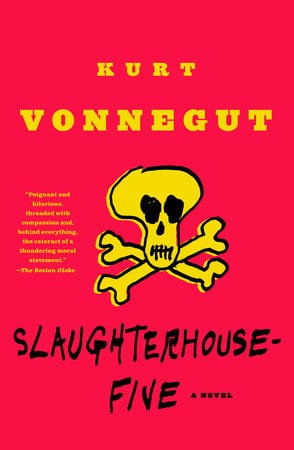
Slaughterhouse-Five - Kurt Vonnegut.png (image unavailable)
DESCRIPTION
Kurt Vonnegut’s 1969 novel follows Billy Pilgrim, an American prisoner of war who survives the firebombing of Dresden and later claims to have become “unstuck in time” and abducted by aliens from Tralfamadore. The book mixes autobiography, war testimony, science fiction, black comedy, and metafiction. Its fractured form refuses the orderly rise, climax, and resolution expected of a conventional war story. Instead it asks what honest storytelling can do after mass death, whether fatalism comforts or disables the traumatized, and how one can look directly at suffering without converting it into heroic entertainment.
Local book
Open Slaughterhouse-Five PDF (file not included in this release) · 171 PDF pages · chapter links appear throughout this note.
Review
Handwrite First
Preserve this section for your own closed-book retrieval
Complete these prompts after reading, before consulting the filled analysis below. The value comes from reconstructing the book rather than recognizing a summary.
1. Before Reading
- Prediction:
- Question I want answered:
- What I already think about war stories:
- What I expect the science-fiction device to accomplish:
2. Closed-Book Recall Dump
-
Main events I remember:
-
Images, symbols, and refrains I remember:
-
Characters and what they represent:
-
What feels fuzzy or incomplete:
3. Core Argument From Memory
- The novel in one sentence:
- Main moral claim:
- Problem Vonnegut is responding to:
- Why the nonlinear form matters:
- Best scene or image I remember:
- What Vonnegut wants the reader to resist:
4. Argument Map From Memory
5. Feynman Check
- Explain the novel to someone unfamiliar with it:
- Explain Tralfamadorian time without jargon:
- Explain why the book is funny without calling it lighthearted:
- Where a reader might misunderstand Billy’s passivity:
6. Pushback From Memory
- Strongest objection or weakness:
- Does the novel criticize fatalism or rely on it?
- What a defender of heroic war literature might say:
- My current judgment:
7. Personal Takeaway
- What changed, clarified, or challenged my thinking?
- What am I less certain about now?
- Which image will stay with me?
- One question I need to keep investigating:
Type Into Obsidian
1. Correction After Checking Notes
- I forgot:
- I misunderstood:
- I overemphasized:
- I underemphasized:
- This needs review:
2. Clean Core Argument
- The book in one sentence: A traumatized survivor moves involuntarily among moments of his life while Vonnegut dismantles the heroic war story, showing that massacre fractures time, language, causality, and the very idea of a satisfying ending.
- Main claim: War turns children into instruments, people into objects, and death into a statistic; the morally honest response is not to impose providential meaning or glamorous heroism on the result, but to remember the victims, resist the machinery of massacre, and preserve small acts of attention and mercy.
- Problem the author is responding to: How can a survivor narrate Dresden without exploiting it as spectacle, claiming mastery over trauma, inventing villains simple enough to explain mass death, or pretending that a massacre yields an intelligible climax?
- Why Vonnegut thinks this matters:
- Conventional chronology implies that events form a controllable causal sequence; trauma does not feel that way.
- Heroic characterization makes war appear to be a stage for mature agency; the soldiers are frightened, hungry young people moved by forces beyond them.
- Historical and military language can rationalize civilian death while hiding the individual bodies beneath aggregate numbers.
- Fatalism can reduce terror, but it can also make preventable violence seem necessary.
- Fiction cannot restore the dead, yet it can refuse triumphalism and train attention toward suffering.
- Best example: Billy’s breakdown at the barbershop quartet does not begin as a deliberate recollection. The singers’ faces unconsciously return him to the German guards emerging from the Dresden shelter. The novel thus shows trauma as an involuntary pattern before Billy can explain it as time travel.
- Conclusion: The book cannot provide redemption adequate to Dresden. Its achievement is the refusal to lie about that inadequacy.
3. What Actually Matters?
- Most important idea: The form is part of the argument. Billy’s broken chronology makes the reader experience recurrence, helplessness, foreknowledge without control, and the collapse of ordinary narrative time.
- Best short passage: “So it goes.” Its repetition becomes prayer, shrug, wound, comic beat, and anesthetic at once.
- Term worth remembering: Tralfamadorian time — every moment exists permanently; death is only one bad moment among others; free will is an Earthling illusion.
- Most useful example: Billy watches a war film backward: bombers repair cities, weapons are dismantled, and dangerous materials are returned harmlessly to the earth. The reversal reveals the reparative wish concealed inside the nonlinear form.
- Most surprising point: The bombing itself is not staged as a conventional climax. Billy sleeps below it; the narrative approaches and leaves it repeatedly; the decisive experience returns later through sound, faces, animals, and involuntary memory.
- One sentence to remember: Vonnegut makes a war novel that distrusts nearly everything a war novel usually promises—heroes, villains, causality, climax, consolation, and closure.
4. Connections
- Connects to:
- Candide - Voltaire — black comedy, catastrophe, philosophical systems that explain suffering too neatly, and the search for a livable response after optimism collapses.
- Adventures of Huckleberry Finn — satire that exposes the moral insanity of what respectable society calls normal.
- Free Will — Tralfamadorian determinism versus the novel’s own ethical appeals to choose differently.
- Existentialism — meaning, mortality, absurdity, action, and the danger of using cosmic explanations to escape responsibility.
- 60.13 Wars — industrial war, civilian bombing, military bureaucracy, memory, and the ethics of representation.
- Supports:
- The claim that traumatic memory is associative and recurrent rather than neatly chronological.
- The claim that humor can disclose horror without resolving it.
- Challenges:
- Heroic narratives in which war reveals mature character and meaningful sacrifice.
- Providential histories in which every catastrophe serves an intelligible greater good.
- Purely detached fatalism as an adequate ethics.
- Reminds me of:
- The absurdity and bureaucratic circularity of Catch-22.
- The damaged veteran’s voice and anti-romantic combat perspective of All Quiet on the Western Front.
- Trauma narratives in which chronology is reconstructed only indirectly.
- Possible future notes:
- So It Goes - Refrain Grief and Moral Numbing
- Tralfamadorian Time - Consolation and Fatalism
- How Antiwar Fiction Avoids Making War Beautiful
5. Clean Pushback
- Strongest objection: By making Billy radically passive and repeatedly saying events are structured in advance, the novel risks reproducing the fatalism it seems to diagnose. Readers can leave with resignation rather than opposition to war.
- What would weaken the interpretation offered here: Clear evidence that the narrator unreservedly endorses Tralfamadorian philosophy rather than staging it as Billy’s coping system and an ethically dangerous temptation.
- What Vonnegut might say: No conventional display of agency could undo Dresden. The book’s small ethical commands—do not celebrate massacres, do not build massacre machinery, do not glamorize children at war—matter precisely because cosmic explanations do not save anyone.
- What a rival war novelist might say: By refusing sustained realism and interior development, Vonnegut turns historically situated suffering into a universal absurdity and may blur differences among perpetrators, victims, purposes, and kinds of war.
- My current judgment: The fatalist language is deliberately double-edged. It accurately renders helplessness and offers Billy psychic shelter, but the narrator’s anger, Mary O’Hare’s accusation, Derby’s refusal, the suffering horses, and the act of writing all preserve a countercurrent of moral agency.
AI Summary and Literary Analysis
The novel at a glance
Billy Pilgrim is an awkward, passive American soldier captured during the Battle of the Bulge and transported to Dresden. He survives the city’s destruction because he is housed in an underground meat locker beneath a slaughterhouse. After the war he becomes a prosperous optometrist, marries Valencia, raises two children, experiences a breakdown, survives a plane crash, and begins publicly claiming that aliens from Tralfamadore abducted him and taught him the true structure of time.
The plot does not unfold in that order. Billy jumps among childhood, combat, captivity, marriage, the veterans’ hospital, Tralfamadore, the plane crash, his predicted assassination, and Dresden. The reader knows many deaths before encountering them. Events arrive as returns rather than surprises. This structure makes suspense almost irrelevant: the question is not what will happen, but why this moment keeps returning and what kind of moral attention it demands.
The interpretive center
Billy’s time travel works simultaneously as science fiction inside the novel, a formal principle organizing the narrative, and a plausible metaphor for traumatic recurrence. The book never requires the reader to reduce it to only one of those functions.
Chronology beneath the fractured narrative
| Period | Event | Why it matters |
|---|---|---|
| 1922 onward | Billy’s childhood and education | Establishes a physically awkward, emotionally passive protagonist poorly suited to the heroic-war template. |
| 1944–1945 | Battle of the Bulge, capture, POW transport, Dresden, bombing, corpse recovery, liberation | The traumatic center to which the rest of the life repeatedly returns. |
| Postwar | Optometry school, breakdown, treatment, marriage to Valencia, prosperity | Material success does not integrate the war experience. Normal life overlays rather than resolves trauma. |
| 1964–1967 | Friendship with Kilgore Trout; claimed abduction by Tralfamadorians; zoo life with Montana | Science fiction provides Billy with a vocabulary that makes helplessness and death bearable. |
| 1968 | Plane crash, brain injury, Valencia’s death, hospital encounter with Rumfoord, public preaching | A second catastrophe loosens Billy’s private coping system into public revelation. |
| 1976, as predicted | Billy announces that Lazzaro will arrange his assassination | Foreknowledge without prevention crystallizes the problem of fatalism. |
Chapter-by-chapter analysis
Chapter 1 — The author’s problem: how not to beautify a massacre
Chapter 1 — PDF pp. 8–23
Open Chapter 1 (file not included in this release)
Summary
Vonnegut appears directly as a veteran and writer unable to complete his Dresden book. He recounts returning to Dresden with Bernard O’Hare, describes years of failed outlines, and admits that the subject has consumed time, money, and emotional stability without yielding the masterpiece he imagined. A filmmaker calls an antiwar book as futile as an anti-glacier book: war appears permanent, inevitable, and beyond artistic intervention.
Vonnegut visits O’Hare to recover memories, but Mary O’Hare becomes angry. She accuses war books and films of transforming frightened young soldiers into glamorous adult heroes played by movie stars. Vonnegut promises to call his book The Children’s Crusade and not to romanticize the men they were. The chapter moves through the historical Children’s Crusade, an earlier destruction of Dresden, Lot’s wife looking back, the narrator’s reading, drinking, telephone calls, and failed attempts to make linear sense of the past.
It ends by declaring the book necessarily short, jumbled, and unsuccessful because nothing intelligent can make a massacre meaningful. The narrator nevertheless looks back, like Lot’s wife, and gives the coming Billy Pilgrim narrative its opening and closing in advance.
Themes, metaphors, and purpose
- Metafictional contract: The novel begins by exposing its construction. It promises no authoritative, seamless historical reconstruction.
- Lot’s wife: Looking back is forbidden, destructive, and irreducibly human. The narrator becomes a “pillar of salt” because witness requires turning toward what one cannot repair.
- Children’s Crusade: The subtitle strips soldiers of masculine glamour and restores their vulnerability.
- Anti-glacier paradox: If war is inevitable, antiwar art seems useless. The completed book is Vonnegut’s refusal to accept the implication that uselessness cancels moral obligation.
- Wallpaper outline: The neat colored lines parody the fantasy that plot can master massacre.
- Purpose: Establish the ethical rules of narration: no glamorous casting, no meaningful climax, no satisfaction in enemy deaths, and no concealment of the author’s failure.
Chapter question
If no book can stop war or explain massacre, is bearing witness still a meaningful action—or only a ritual of helplessness?
Chapter 2 — Billy becomes unstuck: biography as traumatic recurrence
Chapter 2 — PDF pp. 24–44
Open Chapter 2 (file not included in this release)
Summary
Billy Pilgrim is introduced as “unstuck in time.” His entire biography is disclosed almost immediately: birth, military service, capture, postwar breakdown, marriage, professional success, children, a plane crash, Valencia’s accidental death, Tralfamadorian abduction, and his later campaign to teach the public about time. Revealing this much at once eliminates conventional suspense and places every moment under the shadow of events already known.
The wartime narrative begins after Billy, an untrained chaplain’s assistant without proper boots or weapon, becomes separated behind German lines. Two competent scouts and Roland Weary drag him through the snow. Weary imagines himself as one of “The Three Musketeers,” turning survival into a heroic friendship story that the other scouts do not share. Billy’s weakness ruins this fantasy. When the scouts abandon Weary and Billy, Weary beats Billy; German soldiers then capture them.
Billy’s first experience of temporal dislocation occurs in the forest. He jumps among later scenes—his mother’s illness, optometry events, a drunken infidelity, and other moments—before returning to Weary’s violence and German capture.
Themes, metaphors, and purpose
- A pilgrim without direction: Billy’s surname suggests a meaningful spiritual journey, but he does not choose the route or control its sequence.
- Stage fright: Life becomes a role Billy must repeatedly perform without rehearsal or agency.
- The antiheroic body: His missing boot, civilian shoe, lanky frame, and lack of equipment expose the absurdity of imagining war as a test reserved for prepared heroes.
- Weary’s Three Musketeers: Heroic narrative is shown as possessive fantasy. Weary wants comradeship as a story about himself, not as care for actual companions.
- Time travel as form: The reader experiences Billy’s life as he does—through involuntary association rather than ordered recollection.
- Purpose: Replace the adult warrior with the exposed child and introduce the narrative mechanism through which Dresden can be approached obliquely.
Chapter question
Does Billy’s lack of agency make him an inadequate protagonist, or is inadequacy precisely the truthful center of Vonnegut’s war story?
Chapter 3 — Capture, spectacle, and the machinery of normal life
Chapter 3 — PDF pp. 45–59
Open Chapter 3 (file not included in this release)
Summary
German soldiers take Billy and Weary. Billy looks into a corporal’s polished boots and imagines Adam and Eve—naked, innocent, vulnerable, and eager to behave decently. Weary loses his boots to a better-equipped German boy and is forced into painful wooden clogs. The prisoners become a humiliating propaganda spectacle: a photographer documents their miserable footwear as evidence of American military weakness.
The narrative jumps to Billy’s prosperous optometry practice and comfortable postwar life. He drives through urban renewal that resembles the lunar ruins of Dresden, attends a Lions Club meeting, and encounters public rhetoric about bombing Vietnam back into the Stone Age. A framed serenity prayer asks for the wisdom to distinguish what can be changed from what cannot; Billy’s central difficulty is that he cannot make the distinction.
Back in 1944, the prisoners are marched, sorted, and packed into boxcars. Men die during transport. Roland Weary’s feet decay, and he tells Paul Lazzaro that Billy is responsible for his death. Lazzaro accepts the grievance as a future duty of revenge.
Themes, metaphors, and purpose
- Adam and Eve in the boots: Human beings appear fundamentally innocent and defenseless beneath military costumes.
- Propaganda photography: The suffering body becomes material for a national story rather than an object of care.
- Optometry and moral sight: Billy professionally corrects vision but cannot integrate what he has seen.
- Urban renewal as Dresden: Peaceful modernization and wartime destruction share a visual vocabulary of erased neighborhoods, complicating easy distinctions between progress and ruin.
- Serenity prayer: The novel’s moral fulcrum is not acceptance alone but the missing wisdom needed to separate necessity from preventable evil.
- Boxcars: People are converted into freight, counted and moved by systems whose efficiency is indifferent to individual survival.
- Purpose: Connect wartime dehumanization to postwar institutions, public language, and Billy’s prosperous but emotionally detached normality.
Chapter question
When does acceptance protect a person from what cannot be changed, and when does it excuse a system that should be resisted?
Chapter 4 — Abduction, backward war, and the seduction of determinism
Chapter 4 — PDF pp. 60–70
Open Chapter 4 (file not included in this release)
Summary
On the night of his daughter’s wedding, Billy waits for the flying saucer he says will abduct him. Before it arrives, he watches an American war film. Because he is moving backward through time, the film reverses: bombers draw fire and destruction out of a German city, return weapons to factories, dismantle them into harmless minerals, and ultimately return humanity toward innocence. The sequence is one of the novel’s clearest expressions of an impossible wish—to make history run backward and heal what happened.
The Tralfamadorians take Billy aboard their ship. They tell him that time is not a sequence but a permanent structure. Every moment always exists, no event can be altered, and only Earthlings believe in free will. Billy’s wartime consciousness then returns to the POW train. Roland Weary dies after naming Billy as his murderer, and Paul Lazzaro commits himself to revenge. The train reaches the prison camp.
Themes, metaphors, and purpose
- Backward film: Narrative cannot reverse history, but imagination exposes the moral direction that real history violated—from repair and harmlessness toward manufacture and destruction.
- Flying saucer as rescue: Abduction paradoxically gives Billy a system in which nothing must be confronted as contingent or preventable.
- Four-dimensional time: Determinism abolishes regret and fear by abolishing meaningful choice.
- Weary’s false causal story: A complex wartime death is simplified into one guilty person, giving Lazzaro a purpose that the impersonal war cannot provide.
- Purpose: Present Tralfamadorian fatalism at its most consoling while placing beside it a humanly invented chain of blame and revenge.
Chapter question
Is Tralfamadorian time a truth that liberates Billy, or a psychological system that makes unbearable helplessness feel cosmically necessary?
Chapter 5 — Competing fictions: Tralfamadore, Christianity, fairy tale, and science fiction
Chapter 5 — PDF pp. 71–107
Open Chapter 5 (file not included in this release)
Summary
The Tralfamadorians explain how they perceive time and books. Their novels do not progress through suspense or causal development; brief clusters of symbols are viewed all at once, producing an image of life without beginning, middle, climax, or moral explanation. They insist that the universe ends because one of their own pilots presses a button; nothing can prevent it because the moment is permanently structured that way.
Billy is placed naked in a zoo and later paired with the actress Montana Wildhack. Their artificial domestic life offers intimacy without ordinary history, social conflict, or responsibility. The zoo can be read as paradise, prison, fantasy, or trauma shelter.
The wartime narrative moves through the POW camp. British officers, long imprisoned and extraordinarily well supplied, welcome the starving Americans with food, theater, cleanliness, and performance. The abundance overwhelms the Americans physically. Billy acquires silver boots from a Cinderella production and wears a curtain as a toga, turning him into a comic fairy-tale figure rather than a soldier.
The chapter also visits Billy’s postwar psychiatric hospitalization with Eliot Rosewater. Both survive through the science-fiction books of Kilgore Trout. One Trout story imagines a Gospel in which God adopts the powerless Jesus only after the crucifixion, warning humanity never again to harm a person without connections. Billy becomes engaged to Valencia and later returns to the train journey. The chapter ends with the prisoners arriving at Dresden, still beautiful and apparently safe—an Oz whose destruction the reader already knows.
Themes, metaphors, and purpose
- Tralfamadorian books: They provide the model for Vonnegut’s own mosaic form, but lack his moral protest. Form is borrowed without necessarily endorsing the philosophy.
- The zoo: Billy’s ideal refuge is also captivity. Safety purchased through complete powerlessness is one of the novel’s central bargains.
- Montana Wildhack: She functions partly as a consoling domestic fantasy, which raises questions about women being used as containers for male escape.
- Cinderella boots and toga: The costume turns military suffering into grotesque theater. Billy is transformed not into a hero but into an absurd innocent.
- British theater: Performance preserves order and morale, yet its plenty also shows how differently war distributes suffering.
- Kilgore Trout: Bad science fiction becomes a survival technology. Its ideas matter even when the literary institution ignores their author.
- The revised Gospel: The sacredness of the well-connected is reversed; the powerless victim becomes the person God retroactively protects.
- Oz/Dresden: Fairy-tale beauty appears at the moment the reader knows annihilation is coming.
- Purpose: Fill the novel with competing narrative systems—Christian, military, fairy-tale, psychiatric, science-fictional—and ask which ones console, deceive, or preserve humane perception.
Chapter question
If stories are necessary for survival, how can one distinguish a life-preserving fiction from a fiction that excuses evil?
Chapter 6 — Revenge, foretold death, and arrival at Slaughterhouse-Five
Chapter 6 — PDF pp. 108–120
Open Chapter 6 (file not included in this release)
Summary
Billy wakes after morphine and hears Paul Lazzaro describe revenge as the sweetest thing in life. Lazzaro boasts that he arranges elaborate murders and repeats Weary’s accusation that Billy caused his death. Billy already knows, through time travel, that Lazzaro will have him assassinated after a public speech in Chicago in 1976. Billy calmly narrates the death because he believes he remains alive in other moments.
The Americans prepare to leave the British compound. Edgar Derby is nominally elected their leader and promises to get everyone home. Billy finds the silver Cinderella boots, wraps himself in a curtain, and leads the prisoners in a costume that makes the parade look less like an army than a troupe of exhausted children.
They arrive in Dresden. The city seems untouched, animated, elegant, and safe. German civilians laugh at Billy’s appearance. The prisoners are taken to the slaughterhouse complex and lodged in building number five—the literal source of the title.
Themes, metaphors, and purpose
- Lazzaro’s revenge: Personal vengeance offers the illusion of agency inside impersonal slaughter. His certainty mirrors Tralfamadorian certainty but directs it toward chosen harm.
- Foretold assassination: Billy’s philosophy relieves fear while disabling prevention. Knowing the future becomes another form of powerlessness.
- Derby’s leadership: Conventional dignity briefly appears, already marked as doomed and inadequate to the forces surrounding it.
- Billy’s costume: The silver boots promise fairy-tale transformation, but only transform a soldier into a clown.
- Slaughterhouse: The prisoners are sheltered where animals are killed, identifying industrial war with the processing of bodies.
- Purpose: Bring prophecy, revenge, performance, and industrial killing together immediately before the novel enters its central physical location.
Chapter question
Why does Billy accept his predicted murder while the novel treats Lazzaro’s decision to cause it as morally grotesque?
Chapter 7 — Recurring catastrophe and bodily mercy
Chapter 7 — PDF pp. 121–126
Open Chapter 7 (file not included in this release)
Summary
Twenty-five years after Dresden, Billy boards a charter plane with fellow optometrists, knowing it will crash but saying nothing. The accident kills nearly everyone, including his father-in-law. German-speaking ski instructors rescue Billy, and the language and uniforms collapse the present into the war. Semi-conscious, he gives the rescuers the address Slaughterhouse-Five.
During surgery and unconsciousness, Billy returns to his first days in Dresden. He, Edgar Derby, and the very young guard Werner Gluck accidentally enter a shower room full of naked refugee girls. Their embarrassment makes all of them children rather than erotic conquerors. At the communal kitchen, a war widow looks at the young guard, the old Derby, and the absurd Billy and concludes that all the real soldiers are already dead.
Billy and Derby work at a factory producing vitamin-enriched malt syrup for pregnant women. Starving workers secretly eat it. Billy gives Derby a spoonful; Derby’s body responds with tears. Nourishment becomes one of the novel’s smallest and most concrete acts of communion.
Themes, metaphors, and purpose
- Plane crash as traumatic repetition: A peacetime disaster immediately takes Billy back to war; German speech becomes a trigger rather than neutral information.
- Machines: Tralfamadorians call all beings machines, and Billy behaves like one programmed not to warn the passengers. The metaphor tests whether determinism erases responsibility.
- Young, old, and clown: The war is being carried by people who do not fit the image of the real soldier because the image itself is already dead.
- Pregnancy syrup: Food designed to build future bodies keeps prisoners alive. The war economy inadvertently supplies a sacrament of care.
- Derby’s tears: The body recognizes mercy before language or philosophy does.
- Purpose: Counter cosmic fatalism with embodied need. Food, warmth, and a spoon passed through a window matter more immediately than any explanation of time.
Chapter question
Does foreknowledge create a duty to warn others, even if Billy believes the warning cannot change the structured moment?
Chapter 8 — Ideology, the firestorm, and the return of repressed memory
Chapter 8 — PDF pp. 127–142
Open Chapter 8 (file not included in this release)
Summary
The American Nazi propagandist Howard W. Campbell Jr. visits the POWs to recruit them into a Free American Corps. His costume combines cowboy mythology, Lincoln, racial nationalism, and the swastika. Edgar Derby rises and condemns him, defending democratic ideals and solidarity against Nazism. Vonnegut notes that war usually prevents people from becoming characters, but Derby briefly becomes one through refusal.
The chapter jumps to Billy’s postwar friendship with Kilgore Trout. Trout’s invented stories include a money tree fertilized by people killing one another for wealth and a humanlike robot accepted despite dropping burning fuel on people but rejected for bad breath. The stories satirize a society more offended by manners and appearance than mechanized killing.
At Billy and Valencia’s anniversary party, a barbershop quartet triggers a severe physical reaction. Billy does not initially know why. He later recognizes the singers’ faces as those of the German guards after the Dresden bombing. The memory unfolds: the POWs survive in the meat locker while the city above becomes a firestorm; they emerge into a mineral moonscape where movement itself seems like an error in a design meant to kill everyone.
Billy later tells Montana the story. The survivors cross the ruins and find shelter with a blind innkeeper’s family, who maintain hospitality at the edge of the destroyed city.
Themes, metaphors, and purpose
- Campbell’s costume: Political myth is assembled from marketable symbols whose contradictions disappear inside spectacle.
- Derby’s speech: Moral agency exists, but it is fragile, belated, and unable to control the larger machinery of war.
- Money tree: Wealth generated by competitive killing literalizes an economy in which corpses become fertilizer.
- Napalm robot: Institutional violence becomes morally invisible when performed by obedient, polite machines.
- Barbershop harmony: Sweet and sour chords reproduce faces trying and failing to compose an adequate response to catastrophe.
- Moon: Dresden is stripped of the organic world. The metaphor makes civilization look geologically dead and the survivors alien.
- Blind innkeeper: A person without sight perceives the survivors’ need and restores hospitality; moral vision does not depend on visual mastery.
- Purpose: Allow the bombing to surface through involuntary memory rather than spectacle. The emotional climax is a delayed bodily recognition, not the explosion itself.
Chapter question
Why can Billy tell Montana about Dresden but cannot initially tell himself what the quartet has made him remember?
Chapter 9 — Official history, unheard witnesses, and the suffering horses
Chapter 9 — PDF pp. 143–162
Open Chapter 9 (file not included in this release)
Summary
Valencia rushes to Billy’s hospital after the plane crash. A collision destroys her exhaust system, but she continues driving. The car reaches the hospital sounding like a damaged bomber; she dies of carbon-monoxide poisoning. Billy, unconscious, shares a room with the historian Bertram Copeland Rumfoord, who is writing an official history of the Army Air Force.
Rumfoord discusses Dresden while refusing to believe Billy was there. Billy’s problem is not only memory but recognition: he must persuade a powerful interpreter of history that the powerless witness is worth seeing and hearing. Rumfoord eventually accepts Billy’s presence but answers with military necessity. Billy responds through Tralfamadorian resignation.
Billy returns to Dresden after the war. Riding a coffin-shaped wagon, he remains numb until two German obstetricians show him the bleeding, broken mouths of the horses pulling it. He finally weeps. The suffering of animals penetrates defenses that the mass death of a city could not.
After leaving the hospital, Billy travels to New York to publicize Tralfamadore. He wanders through a pornographic bookstore, encounters more Kilgore Trout books, and joins a radio discussion about the death of the novel. He is expelled after describing the aliens and Montana Wildhack, then returns in time to the Tralfamadorian zoo.
Themes, metaphors, and purpose
- Valencia’s Cadillac as bomber: Domestic love, consumer abundance, and wartime machinery collapse into one lethal image.
- Rumfoord: Official history hears only what fits institutional necessity. His disbelief reenacts the witness’s original powerlessness.
- Coffin-shaped wagon: The survivors travel through a city-sized grave while treating the vehicle as ordinary transport.
- Horses: Innocent bodily suffering restores Billy’s capacity to grieve. Their wounds defeat abstraction.
- Obstetricians: Doctors devoted to birth confront abused animals in a dead city; care for life survives among ruins.
- Pornographic bookstore: Sex, violence, consumer novelty, and speculative revelation are commodified on the same shelves.
- Death of the novel discussion: Literary authorities miss the damaged man carrying the very question they are discussing—what fiction can still do.
- Purpose: Contrast authorized history with embodied witness and show that grief returns through concrete suffering rather than numerical scale.
Chapter question
Why do the horses move Billy to visible grief when the deaths in Dresden generally produce silence and refrain?
Chapter 10 — Corpse mines, springtime, and the refusal of closure
Chapter 10 — PDF pp. 163–170
Open Chapter 10 (file not included in this release)
Summary
The autobiographical narrator returns. Robert Kennedy and Martin Luther King Jr. have been assassinated; the Vietnam War produces daily corpse counts; private and public deaths merge under the repeated refrain. The narrator considers Tralfamadorian immortality but does not find it entirely consoling. On his later trip to Dresden with O’Hare, ordinary pleasures coexist with the knowledge of what happened below.
The narrative returns to Billy in Dresden after the bombing. POWs dig through the ruins and discover shelters full of bodies. As decomposition advances, the shelters become corpse mines; flamethrowers are used to cremate the dead where they sit. A Maori prisoner dies from the bodily horror of the work. Edgar Derby is arrested for taking a teapot, formally tried, and executed amid destruction on a scale beyond ordinary law.
Spring arrives. The war ends. Billy and the remaining prisoners find the stable unlocked and walk outside. The city offers no final speech, moral accounting, or redemptive climax. A bird asks the meaningless, living question that closes the novel.
Themes, metaphors, and purpose
- Contemporary assassinations and Vietnam: Dresden is not sealed in 1945. The machinery of death continues in new political settings.
- Corpse mines: Industrial vocabulary turns recovery of the dead into extraction work, as if destroyed bodies were another buried resource.
- Flamethrowers: Machinery designed to kill is repurposed to dispose of those already killed; the system completes its own logic.
- Derby’s teapot: Petty legality survives the annihilation of a city. The disproportion exposes rule-bound justice detached from moral scale.
- Springtime: Natural renewal occurs without compensating for the dead. Continuation is not redemption.
- Birdsong: “Poo-tee-weet?” refuses a humanly satisfying conclusion. Life continues, but language has no adequate verdict.
- Purpose: End without mastery. The reader is returned to the silence promised in Chapter 1, broken only by a creature incapable of turning massacre into ideology.
Chapter question
Is the bird’s final sound meaningless, or is its refusal to explain the massacre the book’s most truthful possible ending?
Narrative structure: why the book is “jumbled”
flowchart LR
    A["Dresden memory"] --> B["Billy's wartime capture"]
    B --> C["Postwar breakdown and prosperity"]
    C --> D["Tralfamadorian explanation"]
    D --> E["Plane crash and renewed trauma"]
    E --> A
    A --> F["Narrator's struggle to write"]
    F --> A
The circular structure performs several functions:
- Traumatic recurrence: Billy does not remember at will; sensory and emotional patterns seize him.
- Anti-suspense: Deaths are announced early, preventing the reader from treating them as thrilling plot twists.
- Moral simultaneity: Comfortable postwar life and wartime suffering occupy the same consciousness.
- Resistance to climax: Dresden cannot become the exciting payoff of an adventure plot.
- Formal imitation of Tralfamadore: Scenes behave like the aliens’ clusters of symbols—brief moments arranged to be perceived together.
- Unresolved tension: The form can embody a humane understanding of trauma while the philosophy attached to it can encourage resignation.
Core themes
1. Trauma and nonlinear time
Billy’s consciousness treats the past as present. He is not simply remembering earlier events; he is returned to them without control. The narrative makes this recurrence literal, but also supplies recognizable triggers: German speech after the plane crash, the barbershop quartet, ruined urban landscapes, bodily helplessness, and institutional disbelief.
The trauma reading should not erase the science fiction. Within the story, Tralfamadore has narrative reality. The richer interpretation holds both levels together: aliens give Billy a vocabulary for what traumatic life already feels like—every bad moment still exists, recurrence is involuntary, and ordinary chronology cannot contain experience.
2. Fatalism versus moral agency
The Tralfamadorians teach that moments cannot be changed. Their advice is to look away from bad moments and concentrate on good ones. This helps Billy survive death anxiety, but it cannot ground moral resistance. If every event is structurally necessary, warning passengers, opposing massacre, condemning Lazzaro, or refusing military work becomes conceptually incoherent.
The novel never completely resolves this contradiction. Its existence is itself an act of agency: Mary O’Hare changes how Vonnegut writes; Derby refuses Campbell; the narrator instructs his sons; hospitality, food, and care remain choices. The book’s ethics therefore arise less from Billy’s doctrine than from the compassionate attention surrounding it.
3. War as a children’s crusade
The soldiers are young, badly prepared, hungry, costumed, frightened, and manipulated by stories made by older adults. Weary wants to inhabit a masculine adventure; Campbell assembles patriotic symbols into fascist theater; movie casting converts children into John Wayne. Vonnegut’s antiwar strategy is to restore the soldiers’ childish bodies and puncture the adult romance imposed upon them.
4. Death, repetition, and moral numbing
The death refrain democratizes mortality: major and minor figures, humans and animals, civilians and soldiers receive the same words. That equality can be compassionate—a miniature funeral bell rung for everyone. It can also become anesthetic. Repetition makes death normal, mirroring a culture in which corpse counts become routine information.
5. The inadequacy of language after massacre
Vonnegut alternates between excessive talk and radical silence. Military historians justify, propagandists decorate, novelists outline, and philosophers explain. Yet the book’s final claim is that no sentence can supply a proportionate meaning for mass death. The bird’s sound does not explain; it marks the continuation of life after explanatory language fails.
6. Seeing, blindness, and recognition
Billy is an optometrist surrounded by lenses, eyes, visual instruments, and people who will not see. Tralfamadorians possess a wider visual dimension but a narrower moral one. Rumfoord has historical access but refuses to recognize the witness beside him. The blind innkeeper cannot survey Dresden yet sees the survivors’ need. Moral vision is thus separated from optical or institutional vision.
7. Human beings as machines
War depends on converting persons into reliable functions: soldier, prisoner, propagandist, bomber crew, historian, corpse remover. Tralfamadorian determinism describes living beings as machines, while Trout’s napalm robot shows how moral responsibility disappears when killing is treated as programmed output. The novel repeatedly asks whether mechanistic description explains behavior or merely excuses it.
8. Storytelling as survival and danger
Weary’s Three Musketeers story, Campbell’s patriotic costume, Rumfoord’s official history, Trout’s science fiction, Billy’s aliens, and Vonnegut’s failed Dresden book all organize reality differently. Stories help people endure, but they also manufacture necessity, innocence, revenge, and glory. The ethical difference lies in whether a story increases attention to the vulnerable or converts them into instruments of someone else’s meaning.
9. Innocence, animals, and embodied compassion
Adam and Eve, children, refugee girls, horses, dogs, birds, and unborn babies recur because they stand outside the grand explanations adults build around war. The novel’s deepest emotional responses attach to immediate bodily vulnerability: feet, hunger, cold, wounds, breath, animal pain, and food. Compassion begins where abstraction ends.
10. Prosperity without integration
Billy becomes wealthy, professionally successful, and domestically secure. Consumer abundance does not heal him. His large home, Cadillac, jewelry, optometry practice, Magic Fingers bed, and anniversary party form an ordinary American success story under which Dresden remains active. The contrast challenges the idea that postwar prosperity is equivalent to psychological or moral recovery.
Symbols and metaphors
| Image or device | Literal role | Interpretive meaning |
|---|---|---|
| Slaughterhouse-Five | The POWs’ lodging and bomb shelter | Humans processed like livestock; industrial killing; a place of death that paradoxically preserves life; tomb and womb at once. |
| Billy Pilgrim’s name | The protagonist’s name | A spiritual journey without chosen direction; passive wandering; a pilgrimage whose revelation may be consolation or delusion. |
| Being unstuck in time | Billy’s temporal condition | Traumatic recurrence, dissociation, loss of causal control, and the novel’s nonlinear method. |
| Tralfamadore | Alien world and philosophy | A coping system that removes fear by removing contingency; a critique of fatalism; a formal model for the novel. |
| Death refrain | Repeated response to death | Mourning ritual, comic punctuation, equality of deaths, emotional anesthesia, and normalization of corpse counts. |
| Lot’s wife | Biblical figure invoked by the narrator | The human need to look back despite pain, danger, prohibition, and the impossibility of changing what is seen. |
| Backward war film | Movie viewed in reverse | Fantasy of repair; exposure of war’s actual moral direction; desire to return destructive materials to innocence. |
| Silver boots and toga | Billy’s POW clothing | Fairy-tale transformation inverted; antiheroic costume; soldier as clown, child, and theatrical object. |
| Moon/Dresden | Description of the burned city | Organic and civic life reduced to mineral matter; survivors rendered alien; modern civilization returned to lifeless geology. |
| Mustard gas and roses | Smell associated with memory, breath, and corpses | Beauty and atrocity inseparably mixed; domestic sentiment contaminated by war; memory as sweetness plus poison. |
| Optometry and lenses | Billy’s profession | Corrected eyesight without moral understanding; desire to give people a lens through which death feels bearable. |
| Serenity prayer | Plaque on Billy’s wall | The moral need to distinguish necessity from changeable evil—and Billy’s inability to do so. |
| Coffin-shaped wagon | Transport through postwar Dresden | Survivors riding inside the form of burial; ordinary movement through a graveyard; unrecognized damage to the horses pulling history. |
| Horses | Animals used after the bombing | Innocent suffering that breaks through abstraction and finally allows Billy to cry. |
| Malt syrup | Nutrition for pregnant women | Future life, bodily need, illicit nourishment, and a small communion between Billy and Derby. |
| Kilgore Trout’s novels | Cheap, neglected science fiction | Disreputable stories that contain powerful conceptual tools; the source material from which Billy builds a survivable cosmology. |
| Barbershop quartet | Anniversary entertainment and memory trigger | Attempt to make harmony after horror; the guards’ silent faces; trauma encoded in sound and facial pattern. |
| Birdsong | Final sound after liberation | Life continuing without explanation; anti-climax; language purified of ideology but also incapable of judgment. |
Character functions
| Character | Narrative function | What the character reveals |
|---|---|---|
| Kurt Vonnegut / the narrator | Witness, author, and self-confessed failed craftsman | The ethical difficulty of turning real massacre into fiction. |
| Billy Pilgrim | Passive survivor, time traveler, optometrist, prophet | Trauma, dissociation, fatalist consolation, and antiheroic vulnerability. |
| Roland Weary | Failed heroic fantasist | How masculine war stories produce possessiveness, resentment, and false comradeship. |
| Paul Lazzaro | Apostle of revenge | Personal causality and chosen cruelty inside impersonal mass violence. |
| Edgar Derby | Ordinary decency and doomed civic virtue | Character can briefly resist ideology, but conventional justice becomes absurd when he is executed for a teapot after Dresden. |
| Valencia Pilgrim | Loving spouse and emblem of postwar abundance | Affection without comprehension; consumer normality; innocent death echoing wartime machinery. |
| Barbara Pilgrim | Frustrated caretaker | The ordinary family’s attempt to restore linear sanity and social responsibility. |
| Robert Pilgrim | Troubled son turned Green Beret | War’s reproduction across generations and the ambiguous social power of military discipline. |
| Eliot Rosewater | Fellow damaged veteran and reader | Science fiction as a tool for inventing reasons to remain alive. |
| Kilgore Trout | Neglected speculative writer and cracked prophet | Fiction’s power can be independent of prestige or polish; ideas can save and distort simultaneously. |
| Montana Wildhack | Companion in the alien zoo | Billy’s domestic refuge and the novel’s problematic use of female fantasy as therapeutic enclosure. |
| Tralfamadorians | Teachers of four-dimensional fatalism | The appeal and moral cost of abolishing contingency, grief, and free will. |
| Mary O’Hare | Moral editor of the book before it exists | Forces Vonnegut to recognize soldiers as children and refuse glamorous representation. |
| Bertram Rumfoord | Official historian | Institutional deafness, rationalization, and the power to decide which witnesses count. |
| Howard W. Campbell Jr. | American Nazi propagandist | Ideology as costume, spectacle, and opportunistic recombination of national symbols. |
Style and technique
Metafiction
Vonnegut tells the reader that he was in Dresden, that the book is constructed, and that he appears briefly among the prisoners. This prevents Billy’s story from posing as transparent history and keeps responsibility for representation visible.
Nonlinear montage
The text cuts among moments rather than building scenes in causal order. Juxtaposition becomes argument: a civilian car sounds like a bomber; urban renewal resembles Dresden; a postwar quartet becomes four stunned guards; an optometrist who corrects sight cannot see his own trauma.
Black humor
Jokes do not make death trivial. They expose the obscenity of treating organized killing as normal, dignified, efficient, or heroic. Laughter is frequently defensive—the only available response when solemn rhetoric would become false grandeur.
Flat diction and repetition
Deaths, atrocities, and absurdities are reported in nearly the same calm tone. Emotional restraint denies the reader melodramatic consumption while also reproducing numbness.
Foreshadowing without suspense
The narrator announces deaths and outcomes long before dramatizing them. The technique prevents death from becoming a surprise engineered for entertainment.
Science fiction as interpretive device
Aliens, time travel, and Trout’s pulp novels create conceptual distance from realistic war narrative. That distance makes trauma legible, but also tests the temptation to escape history into cosmology.
Anti-climax
The bombing is slept through, Derby’s execution is summarized, and liberation ends with a bird. The denial of climax is an ethical refusal to transform destruction into narrative pleasure.
What is the purpose of the book?
1. To oppose the glamorization of war
The novel does not claim it can abolish war. It can refuse to recruit the imagination on war’s behalf. Soldiers remain children, bodies remain awkward and hungry, and heroism never organizes the whole event into moral beauty.
2. To represent trauma without pretending to cure it
The book gives formal shape to recurrence, dissociation, numbing, and delayed grief. It does not produce a completed psychological recovery for Billy.
3. To expose explanatory systems
Military necessity, revenge, providence, Darwinian improvement, free-market success, patriotic symbolism, and alien determinism all turn suffering into part of a larger design. Vonnegut repeatedly returns to the individual body that the design overlooks.
4. To test whether fiction can preserve compassion
The book openly doubts literature’s usefulness, yet records small mercies: a spoonful of syrup, care for wounded horses, shelter from a blind innkeeper, a wife’s protection of children, a veteran’s refusal to glorify war.
5. To refuse a final word over the dead
The bird’s question is not an answer. It denies the author the authority to make massacre conclude in wisdom, victory, providence, or artistic perfection.
Major interpretive tensions
Are the aliens real?
- Literal reading: The novel is science fiction; Billy truly travels through time and is abducted.
- Trauma reading: Billy’s beliefs organize symptoms of war trauma, psychiatric collapse, brain injury, and ideas borrowed from Trout.
- Formal reading: Whether factually real is secondary; Tralfamadore externalizes the novel’s structure and Billy’s moral psychology.
- Best synthesis: The text keeps literal and psychological realities active simultaneously. Reducing the aliens to only delusion makes the science-fiction form disposable; accepting their philosophy without criticism makes the novel’s moral protest unintelligible.
Does the novel endorse fatalism?
- Billy adopts it.
- The Tralfamadorians state it confidently.
- The narrative form imitates their view of time.
- Yet the narrator writes an antiwar book, changes his plan because of Mary, gives instructions to his sons, condemns massacre machinery, and repeatedly directs attention toward avoidable cruelty.
Fatalism is therefore both medicine and poison: it reduces Billy’s terror but cannot support the ethical labor the novel itself performs.
Is the repeated death phrase compassionate or numbing?
It is both. Each repetition registers a death and refuses to reserve ceremonial language for prestigious victims. But its automatic quality also models how repeated exposure turns catastrophe into punctuation. The reader should notice when the phrase ceases to shock.
Is Billy wise or damaged?
Billy has seen something that ordinary chronological people deny: the past remains present in human consciousness, death cannot erase the reality of a lived moment, and control is limited. But his calm includes failures of protection, warning, intimacy, anger, and judgment. The novel grants insight without making him a reliable moral teacher.
Critical evaluation
Strengths
- Form and subject are inseparable. The nonlinear structure does not decorate a conventional war story; it is the novel’s account of what war does to memory.
- It blocks easy consumption. Announced deaths, flat diction, and anti-climax prevent the reader from treating atrocity as suspenseful entertainment.
- It preserves moral ambiguity without moral indifference. No single villain explains Dresden, yet vulnerable bodies continue to command attention.
- Its comedy is diagnostic. Jokes expose language and institutions that have normalized grotesque acts.
- Its images remain retrievable. Silver boots, the moon, syrup, horses, the quartet, the slaughterhouse, and the bird carry philosophical problems in memorable form.
Limitations and objections
- Fatalism can overwhelm resistance. Some readers will hear resignation more clearly than the countercurrent of ethical agency.
- Women are often functional. Valencia and Montana frequently serve Billy’s domestic, comic, sexual, or therapeutic needs more than they exist as equally developed consciousnesses.
- Universal absurdity can flatten historical differences. The novel’s anthropological view of massacre can blur distinctions among aggression, resistance, genocide, strategic bombing, and individual culpability if treated as complete history.
- The Dresden material is literary testimony, not a current casualty study. The novel reproduces historical sources and estimates available to Vonnegut; its figures and cited works should not be treated as independent present-day verification.
- Science fiction creates both access and escape. Tralfamadore makes trauma thinkable but can allow Billy—and readers—to leave political causation too quickly.
Final judgment
Slaughterhouse-Five succeeds not because it explains Dresden but because it dramatizes the moral danger of explanation becoming consolation, spectacle, or excuse. Its final position is less “nothing matters” than: no cosmic pattern relieves us of the obligation to notice the suffering person in front of us.
Retrieval Questions
Answer these without looking during future reviews.
Basic recall
- Why does Vonnegut place an autobiographical chapter before introducing Billy?
- What does it mean for Billy to be unstuck in time?
- Why is the subtitle The Children’s Crusade?
- How does Billy survive the Dresden bombing?
- What philosophy do the Tralfamadorians teach?
- What causes Billy’s breakdown at the anniversary party?
- Why do the horses finally make Billy cry?
- What happens to Edgar Derby, and why is the manner of his death important?
- What does the bird contribute to the ending?
Argument reconstruction
- How does nonlinear form function as an argument about trauma?
- How does the backward war film reveal the novel’s moral wish?
- Why is Billy’s optometry profession symbolically appropriate?
- How does the serenity prayer expose the problem in Billy’s fatalism?
- What ethical distinction separates Vonnegut’s fragmented form from Tralfamadorian indifference?
- How do Weary, Lazzaro, Campbell, and Rumfoord construct different explanatory stories around violence?
Comparison
- How does Tralfamadorian fatalism compare with Pangloss’s optimism in Candide - Voltaire?
- How does Vonnegut’s satire of respectable institutions compare with Twain’s in Adventures of Huckleberry Finn?
- Would an existentialist accept the Tralfamadorian denial of Free Will?
Criticism
- Does the novel give readers enough reason to resist war rather than merely accept it?
- What is lost when Billy’s time travel is explained only as PTSD?
- What is lost when Tralfamadore is accepted only as literal truth?
- Does Vonnegut’s black humor protect the victims from sentimentality or distance readers from their suffering?
- Does the novel’s universal antiwar posture obscure morally relevant differences among wars?
Synthesis
- What would an antiwar story look like if it completely avoided making war aesthetically compelling?
- Which moments of freely chosen care survive inside the novel’s deterministic structure?
- What should a reader do after accepting that no explanation can repair a massacre?
Flashcards / Atomic Recall
- Q: What are the book’s full title and subtitle?
- A: Slaughterhouse-Five, or The Children’s Crusade: A Duty-Dance with Death.
- Q: Why is Billy in Dresden?
- A: He is an American POW transported there after capture during the Battle of the Bulge.
- Q: Why does Slaughterhouse-Five save Billy?
- A: Its underground meat locker functions as an air-raid shelter during the firebombing.
- Q: What is Tralfamadorian time?
- A: All moments permanently coexist; linear change and free will are treated as perceptual illusions.
- Q: What does the backward war film symbolize?
- A: The impossible desire to reverse destruction into repair and return weapons to harmless matter.
- Q: What does Roland Weary’s Three Musketeers fantasy represent?
- A: Heroic self-mythologizing that mistakes possessive fantasy for real comradeship.
- Q: Why is Billy’s profession symbolic?
- A: He corrects eyesight while remaining unable to integrate or morally interpret what he has witnessed.
- Q: What triggers Billy’s recovered memory of Dresden?
- A: The faces and harmonies of a barbershop quartet at his anniversary party.
- Q: Why is Edgar Derby’s death absurd?
- A: After the destruction of an entire city, he is formally executed for taking a teapot from the ruins.
- Q: What do the wounded horses reveal?
- A: Concrete innocent suffering can penetrate Billy’s numbness more effectively than abstract mass death.
- Q: What is Kilgore Trout’s function?
- A: His neglected science fiction supplies imaginative models that help damaged people survive while also enabling escape from responsibility.
- Q: What does the final bird sound mean?
- A: Life continues after massacre, but no adequate human explanation or redemptive conclusion is available.
Retention Check
24 Hours Later
- I can explain the novel’s structure without notes.
- I remember why Billy is an optometrist.
- I can state both the consoling and dangerous sides of Tralfamadorian time.
- I can explain the significance of Derby, the horses, and the bird.
24-hour recall notes:
- What I remembered:
- What I forgot:
- What needs another review:
1 Week Later
- I can summarize all ten chapters in ten sentences.
- I can reconstruct the fatalism-versus-agency tension.
- I can compare the novel with Candide - Voltaire.
- I can distinguish the literal, trauma, and formal readings of time travel.
1-week recall notes:
- What I remembered:
- What I forgot:
- New connection:
- Revised judgment:
1 Month Later
- I still remember the central images without prompts.
- I can explain why the bombing is not narrated as a conventional climax.
- I know whether the novel changed my view of antiwar art.
- I can state one criticism that does not simply reject the book’s style.
1-month recall notes:
- What endured:
- What disappeared:
- What this changed:
- Next action:
Scratchpad
- Is Tralfamadorian fatalism closer to Stoic attention, traumatic avoidance, or theological providence—and where does each comparison break down?
- Does refusing climax protect the dead from spectacle, or does any beautifully designed antiwar novel inevitably aestheticize war?
- Why can Billy offer a metaphysics of death to strangers but cannot offer ordinary emotional presence to his family?
- Compare the horses with the bird: one restores grief; the other refuses explanation.
- Examine every use of seeing, lenses, blindness, eyes, photographs, and windows.
Notes
Source and pagination
- Primary text: Slaughterhouse-Five - Kurt Vonnegut.pdf (file not included in this release).
- The page references in this note use PDF page numbers, not a separate printed-page sequence.
- This edition identifies Dial Press, carries 2007 edition copyright material, and lists eISBN 978-0-440-33906-9. The novel was originally published in 1969.
- The PDF’s later front matter cites historical works and casualty figures used within the novel. Those embedded claims belong to the book’s historical and literary context and should be independently checked before use as present-day historical statistics.