🧠 Course background
Intro to Metaphysics & Epistemology - Peterson Academy covers the regress-of-justification structure — written up from your handwritten notes (March notebook pp. 58–71).
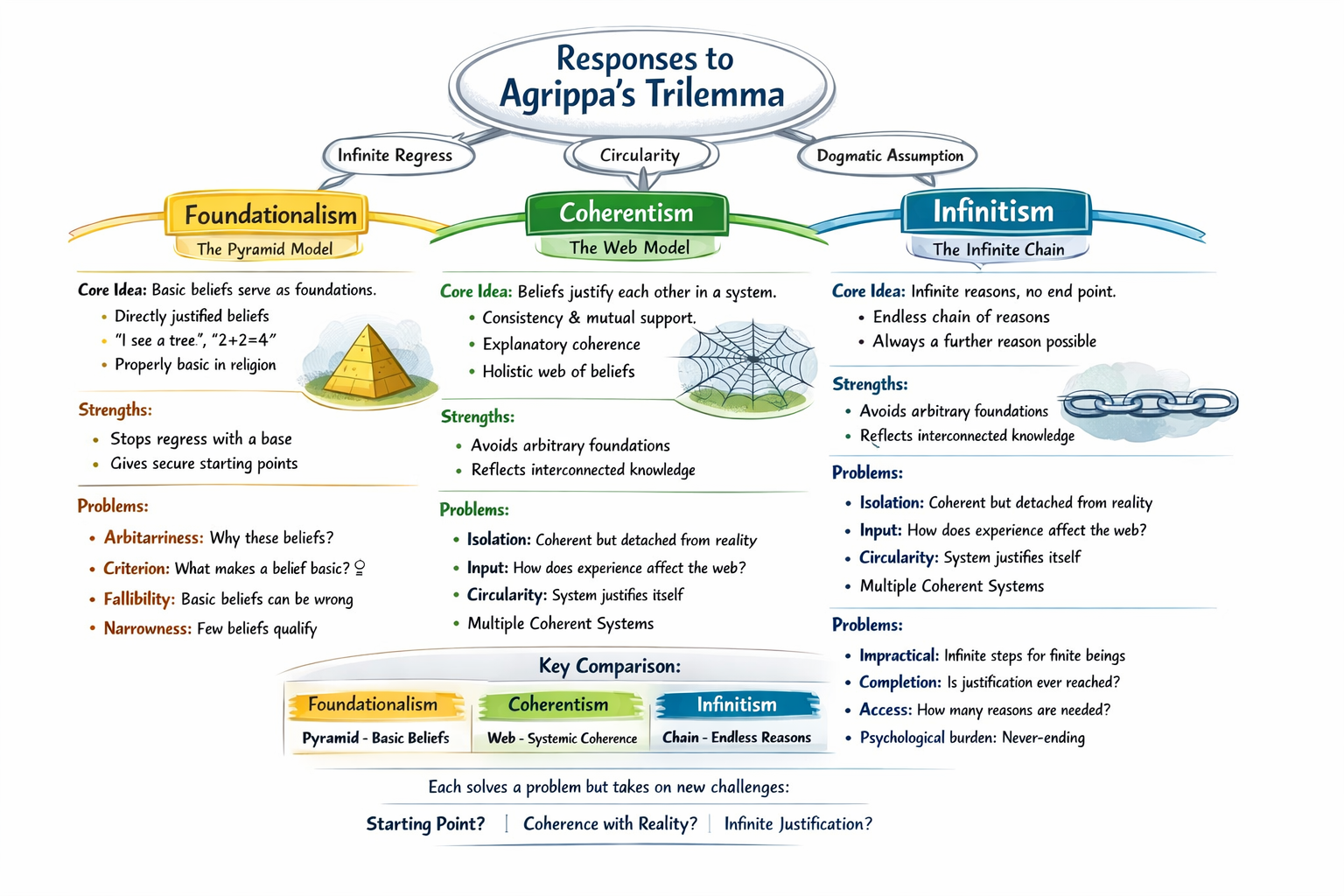
The Münchhausen Trilemma, also known as Agrippa’s Trilemma, is a philosophical problem that addresses the issue of the foundations of knowledge, particularly in epistemology (the study of knowledge). The trilemma poses a challenge to the idea of finding a secure and ultimately justifiable foundation for all knowledge. It was named after Baron Münchhausen, a fictional character known for his extraordinary tall tales.
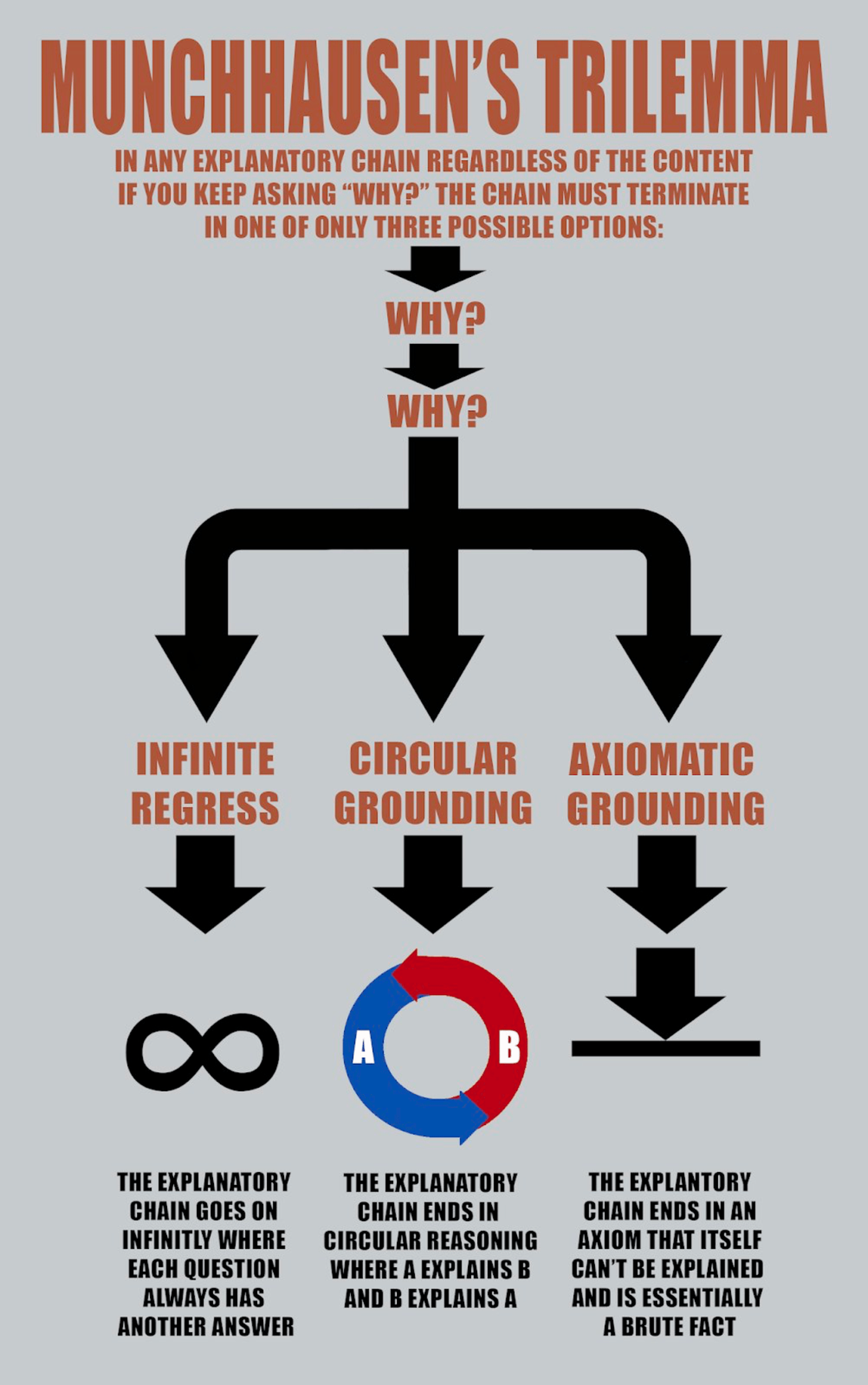
The Münchhausen Trilemma asserts that when attempting to justify knowledge claims, one faces a trilemma, or three-way dilemma, in which each option has its own problems. These three options are:
Infinite Regress: To justify a belief, you provide another belief as its justification. However, this can lead to an infinite chain of beliefs, where each belief is justified by another. This doesn’t offer a foundational or ultimate justification for knowledge and is often seen as unsatisfactory.
Circular Reasoning: In this option, you try to justify a belief by referring back to the same belief or a set of beliefs that rely on the original belief. This is known as circular reasoning or begging the question and doesn’t offer a solid foundation for knowledge either.
Dogmatism: Dogmatism involves asserting a belief without providing any further justification. This approach assumes that some beliefs are self-evident or foundational, and we must start with these beliefs as unquestionable. However, it doesn’t offer a satisfactory way to establish why these beliefs are valid.
The Münchhausen Trilemma essentially suggests that there is no foolproof way to establish a secure foundation for knowledge without encountering one of these three issues. Philosophers have debated how to address this trilemma and have proposed various solutions, but it remains a challenging problem in epistemology. Some philosophers argue that the trilemma implies that a certain level of foundationalism or dogmatism is necessary for any system of knowledge, while others advocate for coherentist or contextualist approaches to understanding knowledge.
Is it true that the Agrippa Trilemma shows that all objective facts/moral facts at the very foundation are assumptions?
Not exactly.
Agrippa’s trilemma supports a narrower claim:
- Any attempt to fully justify a belief seems to end in:
- regress,
- circularity,
- or a stopping point.
That means at some level, justification hits a limit (unless you accept infinitism).
What it does show (in a broad sense)
It puts pressure on the idea that every claim can be justified by a complete, non-circular chain of reasons.
So yes, in many frameworks, it suggests that at the bottom level you often get:
- basic beliefs
- axioms
- first principles
- hinge commitments
- or starting points that are not justified in the same way as downstream claims
What it does
not
show
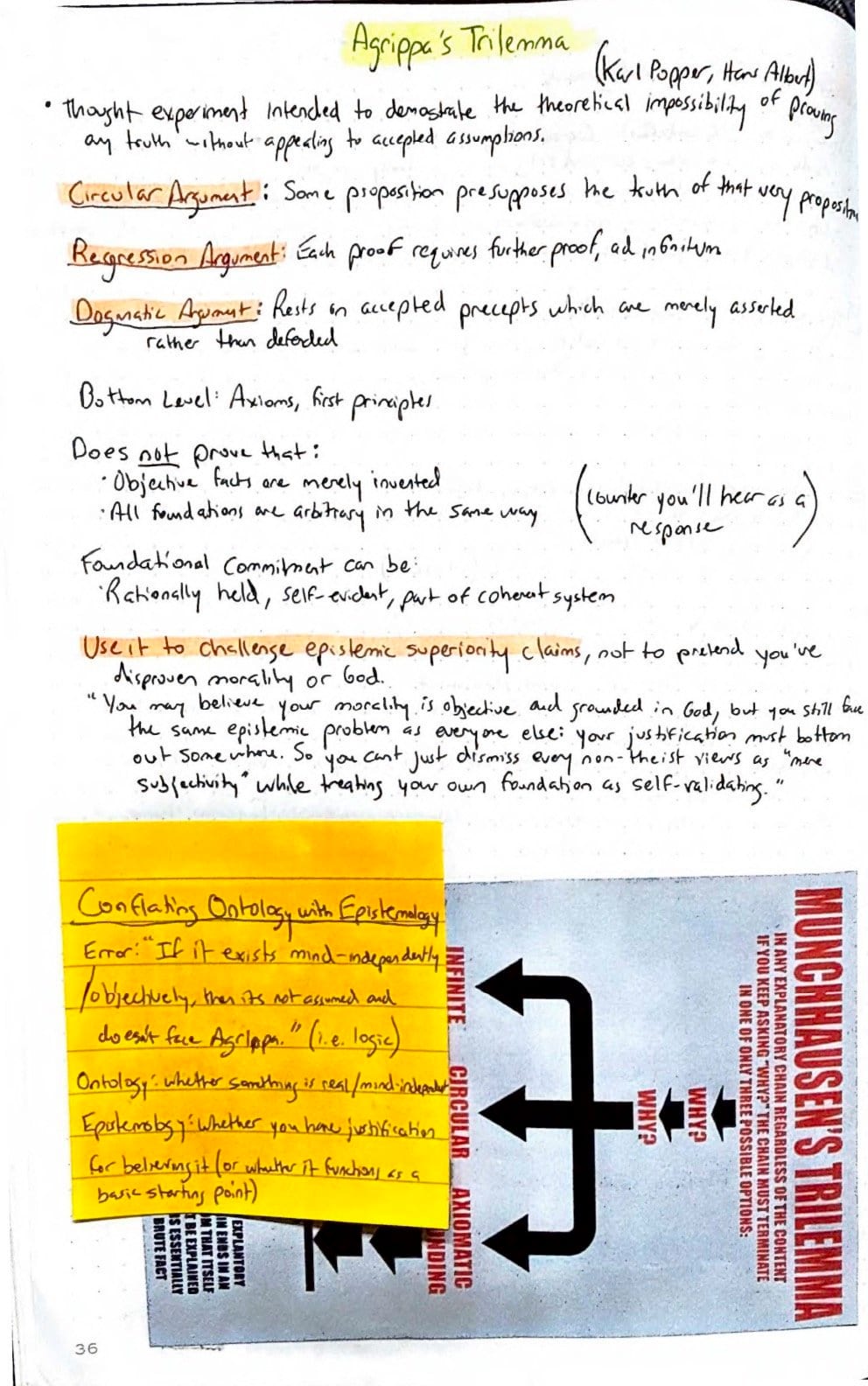
It does not prove that:
- objective facts are merely invented
- moral facts are false
- all foundations are arbitrary in the same way
- “assumption” = “groundless guess”
That’s the key distinction.
A foundational commitment can be: - assumed in one sense (not further inferentially justified),
while still being - rationally held, self-evident, properly basic, phenomenologically given, pragmatically unavoidable, or part of a coherent system
For moral facts specifically
Agrippa pressures moral justification, but it doesn’t settle whether moral facts are objective.
Different metaethical views respond differently:
- Moral realism (foundationalist): some moral truths are basic (e.g., cruelty is wrong)
- Coherentism: moral beliefs are justified by fit within a larger moral web
- Constructivism: objectivity comes from rational procedure, not “brute” foundations
- Skepticism/error theory: uses the trilemma as pressure, but still needs extra arguments
Clean way to phrase it in debate
A more accurate statement would be:
- “Agrippa’s trilemma suggests that ultimate justification bottoms out in assumptions, circular support, or regress; it challenges foundational certainty, but it does not by itself disprove objective facts or moral facts.”
Useful for challenging Objective vs Subjective Arguments
Yes, it can be a proper response, but only if you use it carefully.
What Agrippa can legitimately do in that exchange
If someone says:
- “My morality is objective because it comes from God,” and
- “Yours is subjective because you don’t believe in God,”
then Agrippa is a valid way to challenge the justification structure of their claim.
You can ask: - How do you justify that God exists?
- How do you justify that this God is the source of morality?
- How do you justify your interpretation of God’s moral will?
- Where does your chain of justification stop?
That forces them into one of the trilemma horns (or a response strategy like foundationalism/coherentism/infinitism).
What Agrippa does not prove in that exchange**
It does not prove:
- that the theist is wrong
- that morality is subjective
- that your alternative view is automatically better
- that “no one can know anything”
It only shows that their claim to a uniquely unquestionable foundation is not as simple as they are making it sound.
Best use of Agrippa in this context
Use it to challenge epistemic superiority claims, not to pretend you’ve disproven morality or God.
A strong version is:
- “You may believe your morality is objective and grounded in God, but you still face the same epistemic problem as everyone else: your justification must bottom out somewhere. So you can’t just dismiss every non-theist view as ‘mere subjectivity’ while treating your own foundation as self-validating.”
That is a strong, fair point. Andrew Wilson
Even stronger (and cleaner) way to frame it
Separate these two questions:
- Metaphysical question
- What grounds morality? (God, reason, human flourishing, brute moral facts, etc.)
- Epistemic question
- How do you know your grounding account is true?
Agrippa is strongest against #2.
So if the person is making a triumphalist claim like:
- How do you know your grounding account is true?
- “Mine is objectively true because God,”
you can respond: - “That may be your metaphysical account, but you still owe an epistemic justification for why that account is correct.”
Debate caveat (important)
If you use Agrippa, be ready for the comeback:
- “Fine, everyone bottoms out somewhere. Why is your stopping point better than mine?”
That’s a fair response.
At that point, the debate moves beyond Agrippa into comparative worldview arguments: - explanatory power
- coherence
- moral experience
- practical reasoning
- internal consistency
- ability to condemn real evils without contradiction
Practical verdict
- Yes — Agrippa is a proper response to someone using “God = objective morality” as an automatic debate win.
- No — Agrippa is not a standalone proof that their view is false or that your view is true.
- Best use — to puncture claims of epistemic arrogance and force a more honest comparison of foundations.
References
Münchhausen trilemma - Wikipedia
Skepticism (Stanford Encyclopedia of Philosophy)
Foundationalism | Internet Encyclopedia of Philosophy
Epistemology, Infinitism in | Internet Encyclopedia of Philosophy
Epistemic Justification: What is Rational Belief? - 1000-Word Philosophy: An Introductory Anthology