Overview
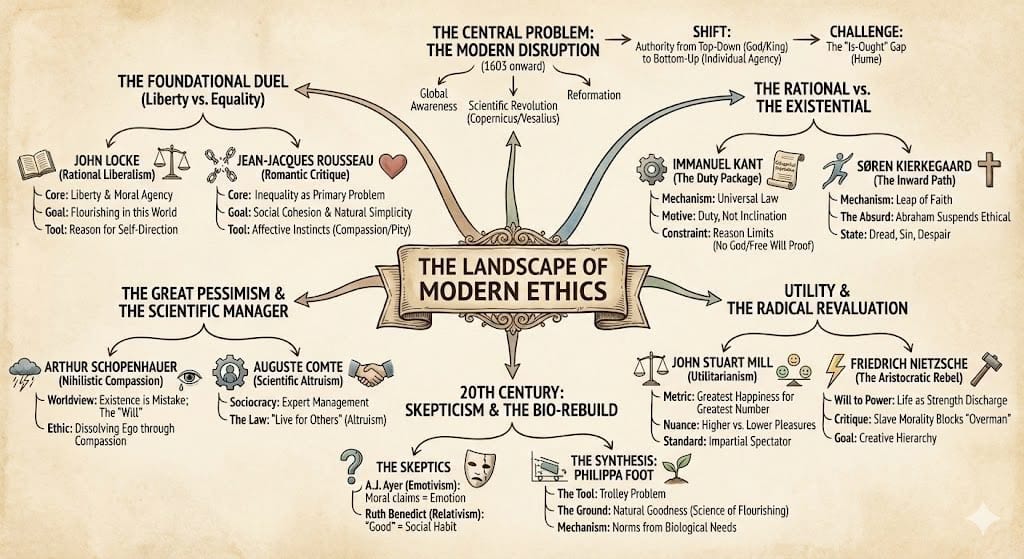
Complete overview of the lecture series (as reflected in this lecture and its framing)
- Big goal of the series
- Treat modern ethics as a set of competing “packages” that answer a common set of meta-ethical questions:
- Where do moral standards come from?
- Are they objective or subjective?
- Universal or culturally relative?
- How do they guide real decisions (not just abstract talk)?
- Why should anyone comply with them?
- Show how, over the last ~500 years, Western moral thought becomes more pluralistic: fewer shared assumptions, more rival frameworks, more pressure on individuals to “work it out for themselves.”
- Treat modern ethics as a set of competing “packages” that answer a common set of meta-ethical questions:
- Why the series keeps returning to lived cases
- Moral philosophy is presented as valuable only if it can inform action under pressure, not merely analyze language.
- The lecture uses Philippa Foot’s trolley problem as the emblem of this: a forced-choice scenario that makes hidden moral commitments visible.
The series’ narrative arc (problem → fragmentation → attempted rebuild)
- 1) The motivating problem: modern moral disagreement
- Modern societies no longer assume one shared moral authority (religion/tradition) settles disputes.
- Diversity of moral worldviews forces the question: what could make morality rationally grounded rather than just preference, power, or convention?
- 2) A mid-century “crisis” diagnosis
- The lecture cites a 1960s sense that moral philosophy had hit dead ends:
- Ethical statements get treated as meaningless, emotive, or mere commands (linked here to A. J. Ayer-style emotivism).
- Classical theories get taught in a way that leaves students convinced none reliably guides life-decisions.
- Result: skepticism (“ethics can’t be grounded”) or relativism (“ethics is just culture/choice”).
- The lecture cites a 1960s sense that moral philosophy had hit dead ends:
- 3) The series as a tour of major modern answers
- Across the philosophers, the series contrasts:
- Duty-based ethics vs consequence-based ethics vs virtue/flourishing ethics
- Individual autonomy vs collective authority vs cultural formation
- Naturalistic grounding vs religious/supernatural grounding vs anti-foundational skepticism
- The concluding lecture positions Foot as a serious attempt to re-ground ethics without religion and without collapsing into relativism.
- Across the philosophers, the series contrasts:
“Trolley problem” as the series’ gateway into ethical theory
- The setup
- A runaway trolley will kill five unless you pull a lever diverting it to a track where it kills one.
- The case forces an “either/or” decision that demands a moral principle.
- What the case is meant to expose
- Agency and responsibility
- You didn’t create the problem, but once you recognize your power to affect outcomes, your choice seems to make you morally accountable.
- Utilitarian reasoning (Mill as the example)
- “Save the greater number” appears straightforward.
- But pulling the lever also creates discomfort: you become the causal agent in the one person’s death.
- Complicating variables
- If the one person is your spouse/child, many people’s intuitions flip—showing that moral judgment isn’t only arithmetic; it also involves special obligations, partiality, and relational duties.
- Agency and responsibility
- Why Foot’s paper mattered
- It generated a long-running philosophical industry around trolley-style dilemmas because it made moral theory feel operational: it tests principles by pushing them into concrete choice.
The “is–ought” barrier as the central modern obstacle (Hume)
- The problem the series treats as decisive
- The “naturalistic fallacy” / “is–ought gap” is presented as the widely taught lesson:
- You can describe facts (“is”), but you can’t validly derive moral obligations (“ought”) from them.
- The “naturalistic fallacy” / “is–ought gap” is presented as the widely taught lesson:
- Hume’s challenge (as framed here)
- Moral systems slide from descriptive claims into “ought” claims without explaining the extra normative step.
- If ethics can’t be grounded in facts, then it either becomes:
- subjective feeling,
- social conditioning,
- religious command (which modern philosophy also treats as problematic),
- or power/choice.
Philippa Foot’s “Natural Goodness” project as the series’ capstone
- Foot’s core move
- Start ethics not with sociology/religion/anthropology, but with biology.
- Look at living things the way a biologist does and notice:
- organisms have needs
- environments contain resources
- organisms have capacities/dispositions
- organisms take actions
- actions have life-consequences (survival, development, reproduction, rearing)
- How she bridges “is” to “ought”
- For living things, evaluative language seems built into factual description:
- “Plants need water” implies “lack of water is bad for the plant.”
- “Birds build nests” implies failure to do so is a defect relative to that life form.
- Norms arise from what enables a thing of that kind to flourish (or at least not die prematurely).
- For living things, evaluative language seems built into factual description:
- Extending the logic to humans
- Human “good” is anchored in facts about human life:
- objective evaluations of sight, hearing, memory, concentration, etc.
- “Gouging out eyes is bad” not because of convention, but because it destroys a basic human capacity needed for human life.
- Human distinctiveness:
- humans recognize reasons for action
- humans pursue not just what looks good, but what they judge as good
- virtues become stable dispositions that help humans live well as the kind of beings they are (especially rational, conceptual beings).
- Human “good” is anchored in facts about human life:
- What this is meant to achieve
- An objective, naturalistic ethics that avoids:
- pure subjectivism/emotivism,
- mere cultural relativism,
- and reliance on supernatural authority.
- Ethics becomes (in principle) a kind of science of human flourishing—though extraordinarily complex.
- An objective, naturalistic ethics that avoids:
How the lecture positions other modern frameworks (as foils around Foot)
- Kant-style duty ethics
- Duties presented as coming from an “unknowable” realm (in the lecturer’s framing), leaving a gap between the moral law and human nature.
- Kierkegaard-style religious existentialism
- A deep resistance to reducing meaning to natural life-and-death terms; insists on something beyond nature.
- Comte-style positivism / collectivist moral authority
- A model where social “experts” or collective structures dictate moral direction (and the worry is authoritarian drift).
- Mill-style utilitarianism
- Morality as maximizing happiness/minimizing suffering, but trolley cases expose tensions about intention, complicity, and the moral difference between doing vs allowing.
- Nietzsche-style critique
- Morality reframed as instinct, power, domination, or life-assertion—undercutting “objective” moral constraints.
- Ruth Benedict-style cultural relativism
- Morality as culturally produced; the individual’s “autonomy” is heavily questioned.
- Raises a determinism/enculturation objection to Foot’s individual-rational-flourishing picture.
- Schopenhauer-style pessimism
- A gravitational pull toward nihilism: if nothing has ultimate value, moral systems may be elaborate veneers over suffering.
The series’ “exercise” takeaway: compare packages systematically
- The lecturer recommends building a comparison chart for each thinker:
- source of ethics (reason, God, nature, society, feelings, power, consequences)
- method of justification (logic, faith, science, tradition, utility calculation)
- universal vs relative
- motivation/why comply
- how it handles hard cases (conflicts of duties, tradeoffs, social coercion, etc.)
What comes next (as the lecture’s practical ending)
- Start personal, then expand
- Apply Foot’s approach first to your own:
- physical needs (nutrition, health)
- psychological/cognitive development (learning, rationality, attention)
- Then test it against criticisms to locate the real “sticking points.”
- Apply Foot’s approach first to your own:
- Then apply through division of labor
- In a complex society, no individual can work out ethics for every domain (food systems, pharma, law, economics).
- The ideal is philosophically informed specialists working out domain applications within a shared meta-ethical framework.
Note on completeness
You asked for a complete overview of the whole lecture series. The only lecture text I can summarize with full fidelity is what you pasted here (the Foot lecture plus its references to the rest). If you paste (or upload) the other lecture transcripts, I can produce a genuinely comprehensive series-wide overview that tracks each lecture’s arguments, examples, and terminology—not just the series’ “map” as described from this final session.
John Locke vs. Jean-Jacques Rousseau
Attachment (file not included in this release)
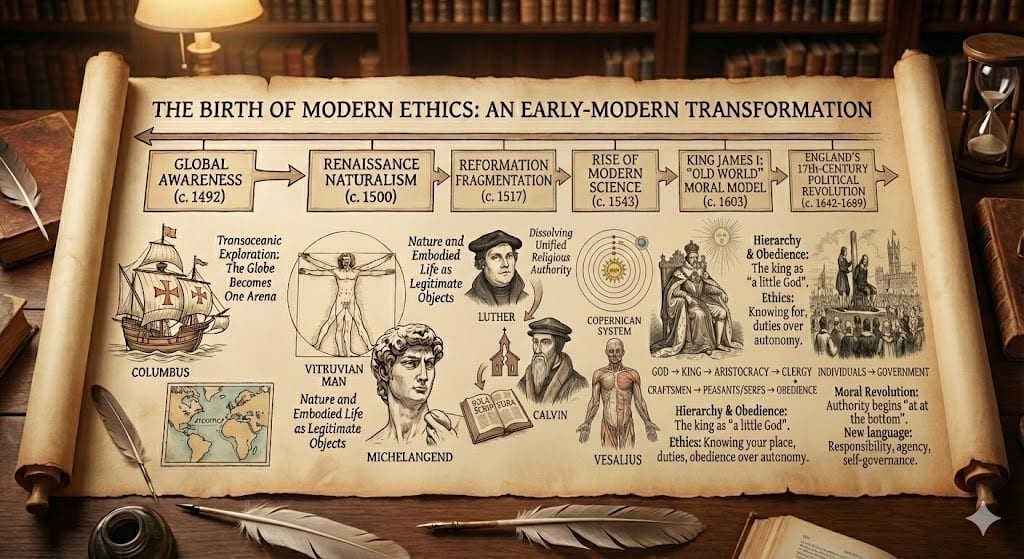
1) Why the course starts in 1603: the “modern” world arrives
- The lecture frames “modern ethics” as inseparable from the broader early-modern transformation in Europe:
- Global awareness after transoceanic exploration (Columbus as a symbol of the globe becoming one arena).
- Renaissance naturalism in art (Leonardo, Michelangelo) as a sign that nature and embodied life are becoming legitimate objects of attention.
- Reformation fragmentation (Luther, Calvin) dissolving Europe’s prior sense of a single, unified religious authority.
- The rise of modern science (Copernicus, Vesalius) shifting intellectual authority toward observation, experiment, and anatomy-based medicine.
- The moral point: when the world changes this much, inherited medieval moral frameworks (built for a hierarchical, religiously unified society) come under pressure, and ethics has to be rebuilt.
2) King James I as the “old world” moral model: hierarchy and obedience
- King James I is presented as articulating a traditional moral-political doctrine:
- The king is “a little God,” ruling over other men.
- Political legitimacy flows downward: God → king → ranked social orders (peasants/serfs/craftsmen/clergy/aristocracy) → obedience.
- The king is responsible to God, not to the people.
- Ethics under this model:
- The meaning of life and the “good life” are defined by knowing your place and fulfilling duties tied to your rank.
- Moral excellence is strongly linked to obedience rather than autonomy.
3) England’s 17th-century political revolution as the background moral revolution
- The lecture uses English history as the “laboratory” where the moral shift becomes visible:
- Civil war over politics and religion.
- The symbolic execution of a king (a radical break with divine-right hierarchy).
- A back-and-forth century: monarchy restored but weakened; parliament increasingly asserts power; the “Glorious Revolution” (1688–1689) settles the new order.
- The key ethical transformation:
- Authority now begins “at the bottom” with individuals.
- A new moral language rises: responsibility, agency, self-governance.
- Government becomes a delegated instrument: rulers are servants of the people, not God’s unquestionable representatives.
4) John Locke as the paradigm of modern ethics: liberty, reason, happiness, and tolerance
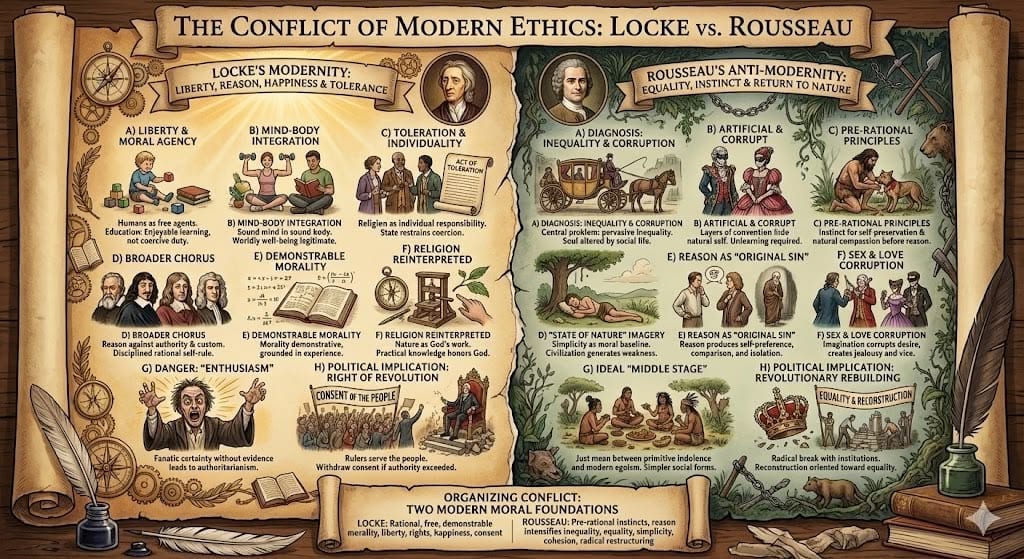
A) The new moral center: liberty and moral agency
- Locke is introduced as a foundational modern thinker (the lecturer calls him the most influential modern philosopher).
- The core shift in moral anthropology:
- Humans are free agents with agency and responsibility.
- Education must treat children as liberty-loving from the cradle: coercive “obedience training” misunderstands human nature.
- Learning should be enjoyable (“play and recreation”), fitting a life oriented toward self-directed flourishing rather than duty-first submission.
B) Mind-body integration and the legitimacy of worldly well-being
- Locke’s “sound mind in a sound body” marks a break from older dualist-moral frameworks:
- The body is not merely a low prison to be denied for spiritual purity.
- Human excellence involves integrated development of mind and body.
- “Happy in this world” signals a moral reorientation: life is not primarily about submitting to obligations for an afterlife; it’s about flourishing here.
C) Toleration as a political expression of moral agency
- The “Act of Toleration” becomes a case study in modern moral-political logic:
- Religion is treated as an individual responsibility rather than a state-imposed duty.
- The state restrains itself from coercing conscience.
- The rationale: people must think for themselves; the moral life requires space for error, development, and disagreement.
D) A broader European chorus: reason against authority, custom, and fanaticism
The lecture situates Locke inside a larger 17th-century intellectual movement:
- Galileo: God gave humans senses and reason; we are meant to use them, not suspend them in obedience to authority.
- Descartes: writing in the vernacular so ordinary people can judge with “natural reason,” not rely on elite gatekeepers.
- Milton: resist the “double tyranny” of external custom and internal blind passion; reason should govern.
- Newton: intellectual integrity means not pretending to know what you cannot justify by evidence; “hypotheses” without experimental support don’t belong in proper philosophy.
The unifying theme: the moral virtue of modernity is disciplined rational self-rule rather than deference.
E) Locke on as demonstrable and naturalistic
- Locke’s central meta-ethical claim in the lecture:
- Morality is “capable of demonstration,” like mathematics.
- What that implies:
- Moral knowledge is not grounded primarily in inherited authority (parents), institutional faith (priests/church), or private mystical “insight.”
- It is grounded in experience and reasoning about human nature.
- His picture of the human being:
- A “corporeal rational creature”: morality must address embodied needs and rational capacities together.
- His starting point:
- Nature (and human nature) rather than a purely supernatural command structure.
- Morality becomes “the proper science and business of mankind,” aimed at surviving and thriving in this world.
F) Religion reinterpreted, not removed
- Locke is portrayed as arguing that studying nature can be religious:
- Nature is God’s work; rational inquiry honors God.
- The most authentically religious posture is to use the faculties God gave us.
- He praises practical knowledge that improves life:
- Printing, the compass, quinine, and other discoveries save lives and expand well-being—these are profound moral achievements.
G) The moral danger: “enthusiasm” (fanatic certainty without rational warrant)
- The lecture highlights Locke’s critique of people who:
- Overclaim knowledge they don’t have.
- Replace evidence with certainty driven by desire, ideology, status, or laziness.
- Try to override others’ rational agency via intimidation or authority rather than persuasion.
- Social consequence:
- Fanatic “enthusiasm” becomes a root of authoritarianism.
- A rational society must cultivate tolerance because independent thinking produces error and disagreement—and that is part of moral development.
H) Political implication: the right of revolution
- Locke’s ethics culminates politically:
- Government’s legitimacy comes from the people.
- If rulers exceed their delegated authority, people may withdraw consent and rebel.
- The lecture frames this as the direct inversion of King James’s model:
- From “obey the divinely appointed ruler” to “rulers serve the rational, rights-bearing individual.”
5) Jean-Jacques Rousseau as the anti-Locke: equality, instinct, suspicion of reason, and “return” toward nature
A) Rousseau’s moral starting point: inequality, not liberty
- Rousseau is introduced as fundamentally contesting Locke:
- The central moral problem of modern society is not constraint on liberty but pervasive inequality.
- He distinguishes:
- Natural/physical inequalities (strength, size, speed): morally neutral facts of nature.
- Moral/political inequalities: socially constructed privileges that benefit some “to the prejudice of others.”
B) Diagnosing modern life as artificial and corrupting
- Rousseau argues that modern people are poor evidence of human nature:
- The soul has been altered by “a thousand causes” of social life.
- Layers of convention, technology, status, and institutions hide what humans are “naturally.”
- Methodological posture:
- He urges a kind of unlearning: set aside “scientific books” and look for the simplest operations of the soul.
C) Two pre-rational principles: self-preservation and compassion
- Against Locke’s “humans are fundamentally rational,” Rousseau claims:
- Before reason, humans have:
- an instinct for self-preservation
- a natural repugnance at seeing others suffer (pity/compassion)
- Before reason, humans have:
- Moral implication:
- Our ethical core is affective and instinctual, not primarily rational and demonstrative.
D) “State of nature” imagery: simplicity as the moral baseline
- Rousseau’s primitive human:
- Eats, drinks, sleeps easily in nature; minimal technology; hardy body; fewer artificial needs.
- Modernity’s critique:
- Technology and “civilization” generate weakness, dependence, and hierarchy.
- Even medicine is treated skeptically (in context of 18th-century medicine’s limits).
E) Reason as the “original sin” of social life
- Rousseau portrays reason as producing:
- self-respect that becomes self-preference
- comparison, status consciousness, separation from others
- moral insulation: the attitude of “Perish, if you will, I am secure”
- The deeper charge:
- Philosophy (rational reflection) isolates individuals, undermines compassion, and accelerates inequality.
F) Sex and love as a case study in corruption by imagination
- In the state of nature, sex is simple and instinctual.
- With reason and imagination:
- desire becomes selective, status-laden, and socially strategic
- jealousy, vengeance, adultery, violence, duels, and “worse crimes” proliferate
- social codes of honor/continence paradoxically intensify dysfunction
- Rousseau uses this as evidence that “civilized” refinement produces misery rather than improvement.
G) The best achievable human condition: a middle stage
- Rousseau concedes we cannot return fully to earliest nature.
- His ideal becomes a “just mean”:
- between primitive indolence and modern egoistic hyperactivity
- often pictured as smaller-scale, tribal or quasi-tribal social forms (limited inequality, more cohesion)
- Normative conclusion:
- The moral standard is greater equality and simpler social organization than modern civilization.
H) Political implication: revolutionary rebuilding toward equality
- Since modern society is deeply unequal and pathological, Rousseau points toward:
- a revolutionary break with existing institutions
- reconstruction oriented toward equality as the organizing principle
6) The lecture’s organizing conflict: two modern moral foundations
The lecture ends by setting up the course’s core dialectic:
Locke’s modernity
- Human nature: rational, free, self-governing
- Moral method: demonstrable knowledge grounded in experience and reason
- Highest values: liberty, tolerance, rights, happiness in this world
- Politics: consent, limited authority, right of revolution
Rousseau’s modernity
- Human nature: pre-rational instincts (self-preservation, compassion) are primary
- Moral diagnosis: reason and civilization intensify comparison, egoism, and inequality
- Highest values: equality, simplicity, social cohesion
- Politics: radical restructuring to undo entrenched privilege and reduce inequality
Immanuel Kant
Attachment (file not included in this release)
1) 1788 setting: Enlightenment achievements and Counter-Enlightenment alarm
- The lecture frames 1788 as a century after England’s Glorious Revolution and as the high Enlightenment moment across Europe:
- Naturalistic approaches in art and religion; mature modern sciences (physics, math, chemistry, early biology).
- New moral-political movements: organized anti- societies and early feminist arguments (women as rational, educable, self-governing, and deserving freedom/equality in key respects).
- Alongside this, a Counter-Enlightenment reaction arises immediately (Rousseau as a prominent example): suspicion toward rationality, freedom, science, technology, and modern individualism.
2) Kant’s “two-world” position: Enlightenment and Counter-Enlightenment elements
- Kant is introduced as a philosopher many rank at or near the top of the modern canon, regardless of agreement.
- His legacy is described as mixed:
- Sometimes Enlightenment (autonomy, rational lawgiving, universalism).
- Sometimes Counter-Enlightenment (skepticism about what reason can know, stricter view of duty/discipline, darker view of human nature, political deference to state authority).
- The lecturer’s stance: Kant contains substantial elements of both.
3) Prussia’s religious crackdown and Kant’s problem
A) Frederick William II’s proclamation against “unbridled liberty”
- In Prussia (Kant’s home base as a professor in Königsberg), the king fears Enlightenment religion has:
- Fractured orthodoxy and weakened religious authority.
- Encouraged naturalistic explanations that sideline God.
- Undermined traditional faith by demanding rigorous argument for doctrines.
- The proclamation condemns clergy and intellectuals for reviving “refuted errors” under the “banner of Enlightenment,” naming:
- Socinians: Christian but anti-Trinitarian (Jesus as great teacher/prophet rather than God).
- Deists: God as designer of a lawful “clockwork” world, with minimal intervention and no miracles.
- Naturalists: collapsing God into nature (nature as all there is, or nature as “God”).
- The political goal is censorship and renewed control: re-bridle speech, rein in heterodoxy, restore religion as an instrument of state stability.
B) Kant’s dilemma
- Kant is pulled between:
- Enlightenment ideals of free inquiry and public reason.
- Loyalty to the state and sympathy for concerns about religion’s social role.
- The lecture frames Kant’s project as an attempted philosophical “compromise”: preserve what is valuable in religious morality (duty, law, universality) while modernizing it so it doesn’t depend on claims modern philosophy can’t prove.
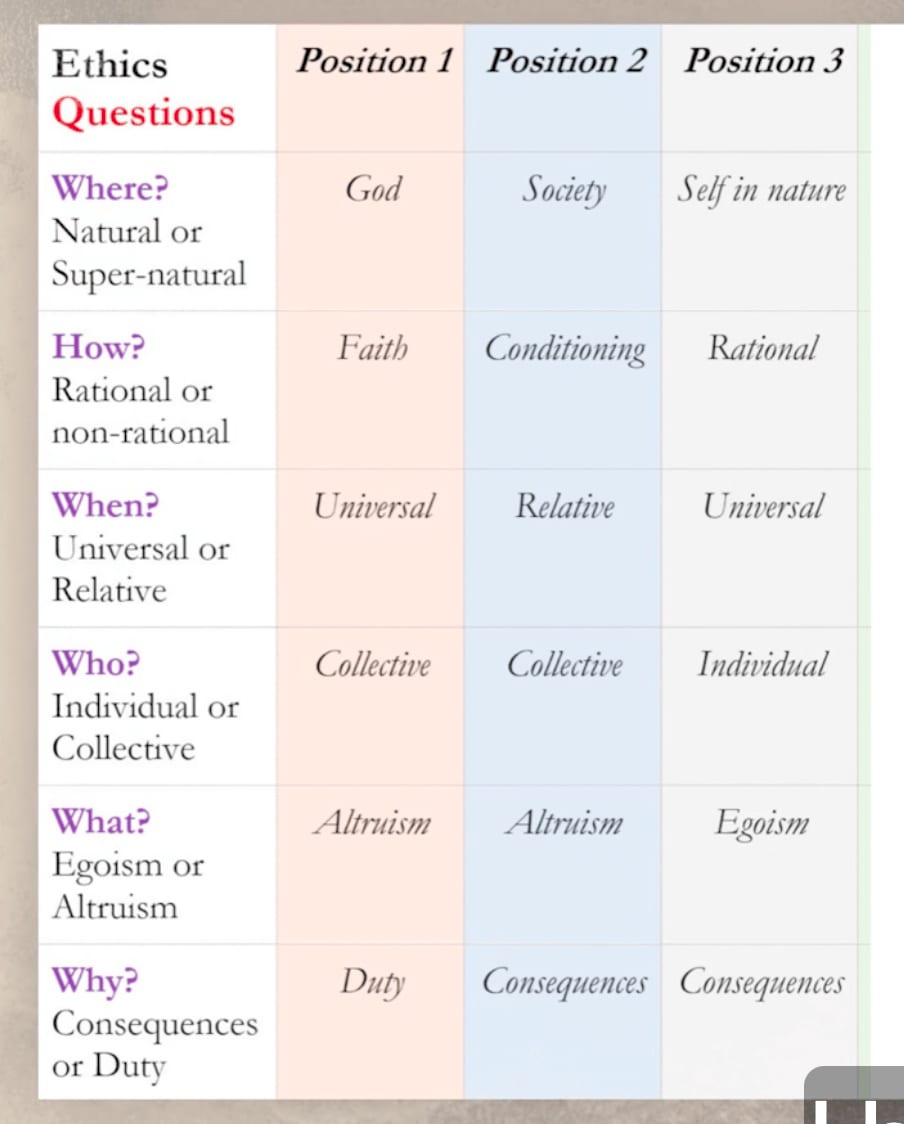
4) A framework for the whole course: six organizing questions for any ethical system
The lecturer pauses here to give a simple but powerful “comparison engine”: any full ethical theory is really a bundle of answers to a small set of recurring questions. If you don’t separate these questions, debates become confused because people argue as if they disagree about “morality,” when they actually disagree about different layers of it (source, method, scope, content, motivation).
Why this framework is useful
- It prevents talking past each other
- Two people can agree on what to do in a case (e.g., “pull the lever”) while disagreeing on why (utility vs duty vs virtue).
- Or they can agree on why (e.g., “reduce harm”) while disagreeing on who counts (family first vs impartial universalism).
- It forces “hidden assumptions” into the open
- Many positions smuggle in answers (e.g., “human rights are self-evident,” “culture determines values,” “God grounds morality”) without defending them.
- It clarifies what kind of disagreement you actually have
- Is it metaphysical (nature vs God), epistemic (reason vs faith), political (individual vs collective), or evaluative (happiness vs equality vs power)?
The six questions, expanded
1) Where do ethics come from? (source of moral authority)
This asks what makes a moral claim authoritative rather than mere preference.
- Nature / human nature / facts about life
- Morality is grounded in what humans are (needs, capacities, flourishing, functioning).
- Natural-law and virtue traditions often live here; Foot’s later “natural goodness” is explicitly here.
- Supernatural / divine command / revelation
- Morality is grounded in God’s will, sacred order, or transcendent purposes.
- This gives a strong sense of binding authority, but creates disputes about access (whose revelation?) and justification (can it be shown?).
- Society / history / culture
- Morality is produced by social practices, institutions, enculturation, power structures, traditions.
- Can range from “morality is basically convention” to “morality expresses a people’s form of life.”
Diagnostic tip: when someone says “that’s objectively wrong,” ask what they think makes it objective: nature, God, rational law, social necessity, etc.
2) How do we know moral truths? (method of justification)
This is about moral epistemology: how moral claims are defended, tested, or discovered.
- Reason (often with experience)
- Deduction, consistency tests, conceptual analysis, universalization (Kant-style), argument from human nature (Locke/Aristotelian lines), reflective equilibrium.
- Empirical grounding
- Moral conclusions inferred from psychology, biology, social science, history (especially for applied ethics: incentives, harms, unintended consequences).
- Faith / revelation
- Moral knowledge comes from sacred texts, divine encounter, religious authority.
- Feelings / moral sentiments / intuition
- Sympathy, conscience, disgust, moral perception—sometimes treated as evidence, sometimes as the foundation.
- Social conditioning
- What you call “moral knowledge” is largely the internalization of norms.
Diagnostic tip: the same “value” (say, compassion) can be defended as (a) rationally required, (b) natural to humans, (c) commanded by God, or (d) a cultural product.
- What you call “moral knowledge” is largely the internalization of norms.
3) To whom does morality apply / who is primary? (individual vs collective)
This asks what the moral system takes as the basic unit of moral concern and moral authority.
- Individuals-first
- Persons are primary; society exists (at least partly) to serve individuals’ lives, rights, flourishing, freedom.
- Moral responsibility is located heavily in personal agency.
- Collectives-first
- Family, tribe, nation, class, church, or “humanity” as a collective is primary.
- Individuals may be instrumentally valuable or valuable mainly as members of a whole.
- Two different “who” questions often get mixed
- Moral agents: who must follow the rules (individuals, institutions, states)?
- Moral patients: who counts morally (all humans, citizens, family members, rational beings, even animals)?
Diagnostic tip: lots of applied disputes are really fights about priority: special obligations vs impartiality; nation-first vs humanity-first; parent-child duties vs equal concern.
4) Universalism vs relativism (scope and stability)
This asks whether morality is “one size fits all” or varies by context.
- Strong universalism
- Same standards bind all rational beings (or all humans), regardless of culture/time.
- Context-sensitive universalism
- Core principles are universal, but application varies with circumstances (institutions, information, scarcity, roles).
- Relativism
- Standards are indexed to cultures, traditions, or historical epochs; “right” means “right-for-us.”
- Pluralism
- Multiple genuine values can conflict without a single master ranking (so tragedy and tradeoffs are sometimes unavoidable).
Diagnostic tip: if someone says “you can’t judge other cultures,” they’re taking at least a methodological relativist posture—even if they still hold some universal limits (e.g., against cruelty).
- Multiple genuine values can conflict without a single master ranking (so tragedy and tradeoffs are sometimes unavoidable).
5) What is “the good”? (value theory: what ultimately matters)
This is the core picture of what counts as a successful human life or desirable outcome. The lecture gives some broad options (flourishing, sacrifice/altruism, struggle).
You can expand it into a menu of “goods” that theories elevate:
- Flourishing / virtue / excellence
- The good is living well as the kind of being you are (developing capacities, stable virtues, practical wisdom).
- Happiness / pleasure / preference satisfaction
- The good is maximizing well-being (often measured impartially across persons).
- Equality / solidarity / justice-as-fairness
- The good is a certain social arrangement: less domination, fewer arbitrary hierarchies, greater equal standing.
- Duty / rightness
- The good life is fundamentally about acting rightly, not about “getting” happiness.
- Holiness / salvation / union with God
- The good is a transcendent end that may re-rank worldly goods.
- Power / self-overcoming / authenticity
- The good is strength, creative self-assertion, or forging values rather than receiving them.
Diagnostic tip: ask whether the theory treats “the good” as primarily a state of the world (outcomes) or a way of being (character, will, relation to God).
- The good is strength, creative self-assertion, or forging values rather than receiving them.
6) Why be moral? (motivation and bindingness)
The lecture flags a big divide: consequences vs duty. But you can unpack this question more fully because it asks two different things:
- What motivates people psychologically?
- Sympathy, shame, pride, fear, love, identity, habit, social pressure, faith, rational consistency.
- What justifies ’s authority? (why it binds)
- Consequentialist answer: because it produces better results (less suffering, more flourishing).
- Deontological answer: because it is right in itself; rational agency requires it.
- Virtue answer: because it’s constitutive of living well as a human being.
- Religious answer: because of God, judgment, salvation, obedience, love of God.
- Political/social answer: because stable cooperation requires it; without it we get disorder or tyranny.
Diagnostic tip: when someone says “but why should I care?”, they’re testing whether the system can address the amoralist, the cynic, or the tempted person—not just the already-decent person.
How to use the six questions as a practical tool (what the professor is aiming at)
When you’re comparing philosophers (or building your own view), use a consistent template:
- Source: nature, God, society, reason itself?
- Method: deduction, universalization, utility calculus, sentiment, anthropology/biology?
- Primary unit: individual or collective (and who counts)?
- Scope: universal, relative, pluralist?
- Good: flourishing, happiness, equality, duty, salvation, power?
- Bindingness: consequences, duty, virtue, God, social stability?
Then test the “package” on hard cases (like trolley scenarios) to see what breaks first: the method, the scope, the motivation, or the account of the good.
5) Kant vs Locke (and why Kant admired Rousseau)
A) Rousseau’s influence on Kant’s moral attitude
- Kant reportedly credits Rousseau with teaching him to “honor man”:
- Before Rousseau, Kant says he was contemptuous/elitist.
- Rousseau dissolves that prejudice and shifts Kant toward respect for ordinary persons.
B) Major contrasts with Locke (as presented in the lecture)
- Human nature: blank slate vs natural evil
- Locke: humans are morally neutral at birth, highly shaped by education (a “white paper/wax” model; roughly “9/10” shaped by upbringing).
- Kant: “the human being is by nature evil” ( as overcoming an innate propensity).
- Education: inclination/play vs duty
- Locke: education should be enjoyable; learning as “play,” aligned with liberty and happiness.
- Kant: children must be taught to act from duty, not inclination; the duty-model is more foundational.
- Punishment
- Locke: severe punishment does little good; harshly chastised children “seldom make the best men.”
- Kant: transgression is disobedience and “brings punishment with it,” reflecting a stricter disciplinary model consistent with the “born evil” premise.
- Virtue and the sensuous
- Locke: integrated mind-body development; happiness in this world; the bodily/material side is part of flourishing.
- Kant: virtue must be “stripped” of sensuous admixture and of “reward or self-love”; morality is purified of self-interest and pleasure.
6) Kant’s moral theory in the Groundwork (1785): purity, duty, universal law
A) “Pure moral philosophy” excludes empirical anthropology
- Kant insists ethics must be pure:
- Not derived from empirical observation.
- Not grounded in anthropology (human psychological tendencies, cultural habits, or contingent facts about us).
- The point: if morality is universal and unconditional, it can’t rest on variable human feelings, social norms, or empirical circumstances.
B) The center: a good will and acting from duty
- A will is morally good not because of what it accomplishes, but because of how it wills.
- A person with good intentions but no power to achieve results still has a good will “sparkling like a jewel.”
- Moral worth requires the motive of duty:
- Acting according to duty (doing the right act for some other reason) is not enough.
- Acting from duty (because it is right) is what counts.
C) Why consequences don’t ground morality
- Kant denies that results make an act moral:
- If you do the right thing for outcome-based reasons, your conformity to moral law is “chancy and unstable.”
- Moral reliability requires respect for law itself, not strategic calculation.
D) Core test: universalizability and consistency
- Kant’s guiding principle:
- Act only on a maxim you can will as a universal law.
- The lecture uses lying/promising to show the contradiction:
- Successful lying depends on the general expectation of truth-telling.
- If you universalize lying, trust collapses and lying becomes self-defeating.
- Wanting the benefits of truth while making an exception for yourself is inconsistency—irrationality.
E) Categorical vs hypothetical imperatives
- Categorical imperative: unconditional command binding on all rational agents (no exceptions).
- Hypothetical imperative: “If you want X, do Y” (goal-driven, consequence-based).
- Example: “Be honest because it’s good for business” is hypothetical, not moral in Kant’s strict sense.
- Moral honesty is categorical: be honest because it’s right, regardless of advantage.
F) Key examples used to isolate “from duty” motivation
- Preserving one’s life
- Most people preserve life because they want to (inclination), so no special moral credit.
- True moral worth appears when someone wants to die (hopeless sorrow) but preserves life from duty.
- Charity
- Helping others because you enjoy it or feel sympathy is inclination-driven.
- True moral worth appears when sympathy is “extinguished” (personal sorrow) but you help purely from duty.
7) Kant’s modern problem: grounding duty without proving God, free will, or immortality
A) The Critique of Pure Reason background (1781)
- Kant’s epistemology divides:
- Noumenal world (things as they are in themselves).
- Phenomenal world (things as structured by the mind’s built-in forms/categories).
- Result: we can’t know ultimate metaphysical realities “as they are”:
- No proof of God.
- No proof of free will (especially under mechanistic science).
- No proof of immortality/soul’s destiny.
B) The grounding gap
- Kant can articulate universal duties and show how rational consistency supports them.
- But when asked: Why must I obey the moral law at all?
- He says no fully satisfactory answer is available.
- Any attempt to justify it risks circularity or overstepping the limits of reason.
- His famous stance here is effectively:
- We understand the moral imperative’s structure,
- but we cannot fully explain its unconditional necessity—only “comprehend its incomprehensibility.”
8) Political sting: Kant endorses obedience to the state (even under injustice)
- In practice, Kant chooses to comply with Prussian censorship.
- He argues:
- Subjects have no right to disobey supreme state authority, even if commands are unjust.
- The people may not pass judgment other than what the head of state wills.
- This creates a tension the lecture highlights:
- Kant’s morality elevates autonomy and rational lawgiving,
- yet his political stance subordinates public judgment to state authority.
9) The lecture’s “takeaway” list for Kant
- Duty as the core moral concept; moral worth comes from acting from duty, not inclination.
- Selflessness / impersonality: morality purified of self-love, reward, and sensuous motivation.
- Rational consistency and universality: moral laws must be universalizable; exceptions signal irrationality.
- Categorical imperative as Kant’s signature tool.
- Anti-empiricism in ethics: morality not derived from anthropology, science, or observation.
- Kingdom of ends (introduced as the ideal of rational agents converging on shared moral law).
- Limits of reason: cannot prove God/free will/immortality, and cannot fully justify why the moral law binds—yet the moral law remains central.
- Obedience in political life: strong deference to state authority, even against unjust commands.
Søren Kierkegaard
Attachment (file not included in this release)
1) The opening problem: guilt that won’t go away
- The lecture begins with an 1845 short story: a man visits a prostitute, later becomes haunted by the encounter.
- The torment isn’t just what happened, but what might have happened (e.g., unknowingly fathering a child) and the impossibility of certainty.
- The moral weight is internal: he feels “unclean,” burdened by possible irresponsibility, and disturbed by the idea that his act has changed what kind of person he is.
- The instructor flags an autobiographical question: Kierkegaard’s earlier student-life excesses might be indirectly revisited through fiction.
2) Kierkegaard as a personal philosopher: biography matters because the method is inward
- Kierkegaard’s broken engagement to Regine Olsen is treated as a key lens:
- Why would he end an engagement with a “perfectly lovely” woman?
- Possible self-judgment: he felt unworthy of an honorable marriage because of who he believed himself to be.
- This sets up Kierkegaard’s contrast with “impersonal” philosophy:
- Instead of abstract treatises, he uses narrative, diaries, letters, and fictional voices.
- Philosophy is presented as first-person exploration of lived psychological and moral alternatives.
3) The emotional core: sin, despair, dread, fear
- Kierkegaard’s dominant themes are described as intensely affective and often dark:
- Sin: not merely rule-breaking, but a God-revealed condition that throws the self into conflict (“despair not to want to be oneself” / “despair to want to be oneself”).
- Dread (anxiety): an “alien power” that both repels and attracts; it renders the person powerless.
- Fear: existence itself is experienced as frightening and unintelligible, including the self; the world feels “poisoned,” especially one’s own inner life.
- The lecture’s broad claim: rationality is weak in the face of these forces; human beings are not primarily rational, self-transparent agents in the Enlightenment sense.
4) Kierkegaard and modernity: the spiritual crisis of a godless world
- The lecture places Kierkegaard in a 19th-century atmosphere where Enlightenment critique has made the “death of God” a serious possibility (even before Nietzsche popularized the phrase).
- The modern world appears mechanistic and cold: cause-and-effect laws, diminished providence, and uncertainty about meaning.
- This raises existential questions:
- Can a person be happy in a godless, mechanistic world?
- If dread, fear, and sin dominate, is happiness even plausible as life’s telos?
- Maybe meaning is found not in comfort but in confronting suffering honestly.
5) Either/Or (1843): the inherited moral “either-or” and why it’s unstable
A) Why Kierkegaard writes through masks
- The book is staged through layers of personas:
- Victor Eremita as editor who “finds” manuscripts.
- Two letter-writers: A (anonymous) and B (later identified as Judge Wilhelm/William).
- Inside A’s materials: “The Diary of a Seducer” (about the seducer and Cordelia).
- At the end: an additional moral voice (a parson’s letter).
- The point of the form: philosophy is best done by inhabiting perspectives, not by issuing detached systems.
B) The two stages: Aesthetic vs Ethical
- Aesthetic life (A)
- Oriented around sensuous immediacy: art, music (Mozart), pleasure, food/drink, beauty, sex, seduction.
- The “Diary of a Seducer” introduces the darker underside:
- Seduction becomes not just pleasure but a power-game.
- The seducer enjoys manipulating Cordelia’s emotions—drawing her close, pushing her away—watching her responses.
- This exposes the aesthetic life’s tendency toward voyeurism, domination, and the erosion of genuine commitment.
- Ethical life (B / Judge Wilhelm)
- Oriented around commitment, duty, and stable selfhood.
- Marriage is the paradigm: choosing one person, binding oneself, accepting obligations, finding satisfaction within moral limits.
- B’s argument: the aesthetic life is short-range and culminates in emptiness; ethical commitment yields deeper fulfillment.
C) The decision problem: how can I choose without certainty?
- The lecture emphasizes a modern predicament:
- You can’t “prove” in advance which life is best.
- Relying on tradition/authority feels illegitimate; you still must choose.
- You have to commit without full information and discover the meaning (or hollowness) from within lived experience.
- This sets up Kierkegaard’s claim that the either/or is incomplete: it misses a third alternative.
6) Fear and Trembling (1843): the “third” stage and the Abraham shock
A) Kierkegaard’s turn: beyond aesthetic and ethical
- The follow-up claim:
- The aesthetic can be thrilling but shallow and ultimately meaningless.
- The ethical can be stable but can feel dull, constraining, or spiritually inadequate.
- Kierkegaard proposes a deeper “ancient” framework: faith—not as a mild comfort, but as an existential confrontation.
B) The Genesis arc that makes Abraham’s test intelligible as a crisis
- The lecture retells the Abraham story in stages:
- Abram/Abraham (age 99) receives a covenant: he will father nations; name changes (Abram→Abraham, Sarai→Sarah).
- Sarah is promised a son (Isaac) despite extreme improbability; Isaac is born; Sarah’s joy is “laughter.”
- Ishmael is sent away; Isaac grows.
- Then comes the command: sacrifice Isaac on Moriah.
C) The key demand: inhabit Abraham’s terror without “explaining it away”
- Kierkegaard’s method is to force first-person identification:
- Is the voice God or hallucination?
- If it is God, is God cruel, deceptive, or unjust?
- How can a command to kill an innocent child be reconciled with morality?
- What does Abraham tell Sarah—what could he possibly say?
- Crucially: Abraham cannot obtain rational answers that would domesticate the command.
D) Faith as “believing the preposterous”
- The lecture’s central Kierkegaardian thesis:
- Abraham believes the absurd/preposterous—what appears contradictory to reason and morality.
- Modern readers try to soften this by saying Abraham had evidence God is trustworthy (past track record).
- Kierkegaard rejects that interpretation: that would reduce faith to prudent inference.
- True faith, as presented here, is commitment beyond rational assurance.
E) Heroism redefined: paradox as the structure of religious greatness
- The panegyric insists life without eternity collapses into despair (generations like leaves; ship through sea; wind through desert).
- Kierkegaard ranks forms of greatness by what one loves:
- Loving oneself (self-cultivation), loving others (devotion), loving God (greater than all).
- Abraham’s greatness is rendered in paradoxes:
- strength as impotence, wisdom as foolishness, hope as madness, love as self-hatred.
- The “hero of faith” acts in solitude:
- Abraham cannot make himself intelligible to others.
- He rises “as though to a festival,” says “Here I am,” and proceeds without public justification.
F) The signature claim: teleological suspension of the ethical
- The lecture frames Kierkegaard’s most famous move:
- In the Abraham case, the ethical (universal moral norms like “do not murder the innocent”) is suspendedfor a higher end (obedience to God).
- Therefore faith is not simply ethics intensified; it can require stepping outside ethics.
- This “third stage” is thus neither:
- Aesthetic pleasure-seeking
- Nor ethical duty/commitment as such
- But religious faith rooted in fear and trembling, paradox, and inward commitment without rational vindication.
7) What Kierkegaard is opposing in the course’s running debate
- Against Enlightenment confidence (Locke/Kant-style):
- The self is not transparently rational; dread and despair can dominate.
- Meaning may not be attainable through universal principles alone.
- Against Kantian universality in particular:
- Kant’s ethics requires public universalizability and rational consistency.
- Abraham’s act cannot be universalized without horror; it can’t be justified publicly.
- Faith, in this portrayal, is singular, inward, and not capturable as a general moral law.
8) Final takeaway concepts from this lecture
- Existential inwardness: philosophy begins in the self’s lived conflict, not abstract system.
- Despair / sin / dread / fear: the dominant emotions that reveal the human condition.
- Stages of life:
- Aesthetic (pleasure, seduction, power-games; tends toward emptiness)
- Ethical (commitment, marriage, duty; can feel stifling or insufficient)
- Religious (faith; paradox; solitary inward commitment)
- Faith as the absurd: believing without rational proof, even against reason’s demand for coherence.
- Teleological suspension of the ethical: the religious can override universal ethics.
- Leap of faith: choice under radical uncertainty, with no guaranteed rational bridge.
Arthur Schopenhauer & Auguste Comte
1) The historical setup: 1848 as a crisis of modernity
- The lecture opens in 1848 Europe, marked by widespread political upheaval, factional conflict, and street violence:
- Frankfurt killings (a general and a prince) bring the turmoil directly to Arthur Schopenhauer, who is living nearby and is personally distressed by the breakdown of order.
- Across Europe: riots in Paris, liberal and nationalist uprisings in other regions, and the publication of Marx & Engels’ Communist Manifesto.
- The broader interpretive frame: the modern world no longer has a single shared structure (political, social, religious). Instead it has competing value-systems and factions that increasingly treat each other as enemies.
2) The course’s running “menu” of moral foundations—and the next possibility
- The lecture situates today’s thinkers against the course’s prior candidates for the “core value” around which life/society should be organized:
- liberty/agency (individual freedom)
- equality/collectivism (social leveling)
- duty (universal rational moral law)
- faith (commitment beyond reason)
- plus, in the background, a “restore hierarchy” position
- Then it introduces another option: maybe the whole hope for positive value is a delusion.
- This becomes Schopenhauer’s role: a modern, philosophically sophisticated pessimism/nihilism that doubts whether existence is good at all.
Part I — Arthur Schopenhauer
3) Schopenhauer’s starting point: existence is a mistake
- Schopenhauer is presented as a major figure who nonetheless sounds shocking to modern ears because he pushes pessimism very far.
- His core judgment (from The World as Will and Representation):
- The world is populated by “needy creatures” sustaining themselves by devouring one another, living in anxiety, want, suffering, and finally death.
- The blunt conclusion: non-existence would be preferable to existence; the “aim” of life becomes recognizing that it would be better not to exist.
- The lecture frames this as a kind of principled nothingism (nihilism): there is no positive good that ultimately justifies the world as it is.
4) Kant is right about knowledge—so what do we do with that?
- Schopenhauer is portrayed as sharply critical of Kant’s ethics but deeply admiring of Kant’s epistemology/metaphysics:
- Kant’s key result (as Schopenhauer reads it): the human mind cannot know reality “as it is in itself.”
- We experience a world structured by our own cognitive forms—an apparent world that blocks direct access to ultimate reality.
- Where Schopenhauer breaks with Kant:
- Kant: accept limits; work within the phenomenal world and rational structure.
- Schopenhauer: that acceptance is a kind of cowardly retreat—philosophy should be about reality, not mental tidiness.
- So the problem becomes: if reason can’t reach reality, is there another route?
5) The central metaphysical move: Will is more fundamental than reason
- Schopenhauer’s solution is to demote intellect and elevate **Will (capital-W)**:
- Reason and “the intellectual faculty as a whole” are secondary.
- The “self” is fundamentally a willing being—driven energy/desire/striving—rather than a primarily rational agent.
- This reframes the human condition:
- The intellect is a surface-level tool.
- The deep engine of life is will—restless, desiring, pushing—often indifferent to rational ideals.
6) Music as a hint of metaphysics: bypassing reason
- A sidebar becomes a key illustration: Schopenhauer’s famous view of music.
- Music seems to “operate on us” more directly than narrative or imagery.
- It engages passions and mood in a way that bypasses rational conceptualization.
- Hence the striking line: music is an unconscious exercise in metaphysics—the mind “philosophizes” without knowing it.
- Function in the lecture: music exemplifies how one might “get behind” reason to touch something deeper than conceptual thought.
7) The moral problem: egoism as the natural default
- Turning to On the Basis of Morality (1841), the lecture shifts from metaphysics to the grounding of ethics.
- Schopenhauer’s diagnosis:
- Most people historically ground morality theologically (“God’s will”).
- Philosophers increasingly reject that—especially after Kant “destroys” speculative theology.
- The bleak anthropological claim:
- Human beings are naturally dominated by egoism: “all things for me, nothing for others.”
- Without social checks, egoism yields a war of all against all.
- Moral systems often look like “artificial products” designed to restrain selfishness—useful fictions more than discovered truths.
8) The “great mystery of ethics”: how could altruism be possible?
- Schopenhauer frames ethics as a battle: the moral motive must contend with egoism.
- For genuine morality to occur, something extraordinary must happen:
- I must become, in some sense, identified with the other.
- The barrier between ego and non-ego must temporarily break down.
- He calls this identification astonishing and ultimately mysterious:
- Reason can’t fully account for it.
- Its causes seem “outside the field of experience.”
- This is where Eastern religion enters as philosophical support:
- Schopenhauer praises Hinduism (“Brahmanism”) and Buddhism as especially deep traditions for confronting illusion and dissolving individuality.
- If individuality is partly illusion (veil of Maya), then the separation between selves is not ultimate.
- Compassion becomes intelligible as arising from a deeper “oneness” beneath phenomenal plurality.
- But he refuses to oversell it:
- Even if compassion is the only plausible foundation for morality, it remains a “dark enigma,” almost a lived mysticism.
9) Schopenhauer’s bottom line (as the lecture frames it)
- Egoism is the basic human tendency and the main moral problem.
- Compassion is the only credible basis for morality—but it requires loosening the grip of individuality.
- The stark alternative persists:
- Either we discover/experience a way beyond egoism (altruism through compassion),
- Or we face the nihilistic possibility that nothing ultimately has value.
Part II — Auguste Comte
10) Comte’s 1848 diagnosis: chaos is a moral problem that demands “order”
- The lecture moves from Frankfurt to Paris, focusing on Auguste Comte, who is disgusted by riots and fears Europe sliding into anarchy.
- Comte’s premise: political turmoil is downstream from moral-philosophical disintegration.
- You can’t stabilize institutions until you reconstruct “principles and morals.”
- Attempts to “organize” society without moral reconstruction either regress to obsolete doctrines or intensify disorder.
11) Positivism and sociology: replacing metaphysics with social science
- Comte is introduced as:
- the coiner of positivism: reject metaphysical speculation; build knowledge rigorously on scientific methods.
- the coiner of sociology: society should be studied with law-like regularities, not reduced to atomized individuals.
- the coiner of altruism (and the lecture notes its spread/influence).
- A key theme: he attacks modern individualism as moral degeneracy.
- The “real life” is the life of the collective; individual life is an abstraction.
- Moral health requires subordinating personality to sociability.
12) A third political alternative: “sociocracy”
- Comte frames the political landscape as a false binary:
- anarchical democracy (mass opinion, selfish interests, destabilization)
- retrograde aristocracy (return to hierarchy and worn-out authority)
- His “third way” is sociocracy:
- power should be guided by those with social-scientific knowledge and moral training—effectively a class of expert moral-scientific governors.
- “We sociocrats are no more democrats than aristocrats.”
13) The “Religion of Humanity”: keeping religious form, replacing supernatural content
- A striking feature: Comte rejects God yet explicitly builds a religion—a secularized one.
- The text used is Catechism of Positive Religion (1852), structured as a dialogue between:
- a “priest” of the new system (teacher/governor of moral truth),
- and a woman (given a central, distinct social role).
- Comte redefines religion functionally:
- religion is the state of unified existence where all parts of life converge toward a common purpose, individually and socially.
- there is ultimately “one” universal and final religion (pluralism is treated as disorder to be overcome).
14) Altruism as the moral law: “live for others”
- Comte’s basic moral formula is explicit and uncompromising:
- The modern “rights-and-happiness” focus (Lockean individualism) is condemned as egoism and a source of political chaos.
- Positivism condenses morality into: live for others.
- He acknowledges the difficulty:
- personal instincts are stronger than sympathetic ones.
- the “grand problem” is making sociability predominate over personality.
- His confidence rests on a premise of scientific governance:
- with mature social science, society can be organized and educated to reshape egoistic labor and motives into altruistic ones.
15) Hierarchy and role-structure: priests and women as “moderating power”
- Despite the egalitarian sound of “humanity,” Comte’s program is highly structured:
- A positivist clergy with long training; priesthood restricted (male-only; minimum age; intellectual/moral formation).
- A strong role for women in the domestic sphere; priests dominate civic/public guidance.
- He attacks universal suffrage as harmful (the people’s reason has suffered from it), reinforcing his anti-democratic stance.
16) The existential pushback inside the dialogue: the fear of personal erasure
- The woman voices a deep worry that becomes one of the lecture’s most revealing moments:
- The immensity of “humanity” reduces her to insignificance—almost to nothing.
- She compares it to old religion: even before God’s majesty, she felt a “direct relation”; in Comte’s system she fears becoming merely a negligible unit.
- The priest’s response:
- Humanity is the principal motor, but it can act only through individual “instruments.”
- Individual significance is reinterpreted as functional indispensability: you matter as an organ matters to an organism.
17) Comte’s influence and symbolic legacy
- The lecture notes real-world echoes:
- “temples of humanity” emerged in various places.
- Brazil’s flag motto “Order and Progress” is linked to Comtean influence (order as the anti-anarchy principle; progress as moral-social development toward altruistic collectivism).
Synthesis: why these two belong together in one lecture
- Shared enemy: modern egoism/individualism (often implicitly Lockean).
- Shared theme: the “individual self” is not the proper moral center:
- Schopenhauer: individuality is partly illusion; morality depends on compassionate identification that dissolves ego boundaries.
- Comte: individuality is an abstraction; real life is the collective; morality is living for others under social-scientific order.
- Deep difference in tone and strategy:
- Schopenhauer is tragic and skeptical: compassion is real but mysterious; nihilism looms.
- Comte is architectonic and managerial: a planned moral regime can be built via positivism, education, and sociocratic governance.
Key concepts to retain from this lecture
- Schopenhauer: pessimism/nihilism; Kantian limits on knowledge; Will over reason; egoism as default; compassion as the only moral basis; Eastern “illusion/plurality” metaphysics as a route to altruism.
- Comte: positivism; sociology; altruism (“live for others”); order; sociocracy; “religion of humanity”; anti-democratic suspicion of mass opinion; retooling religious form for secular governance.
John Stuart Mill
1) Why start in 1841: Mill, Comte, and the liberal anti-authoritarian contrast
- The lecture opens in England, 1841, when John Stuart Mill (age 35) writes to Auguste Comte.
- Mill remains interested in Comte for decades (he later publishes an essay on Comte in 1865), but the relationship is largely critical:
- Mill is a major liberal thinker and is horrified by Comte’s authoritarian “sociocracy” and quasi-religious social engineering.
- Comte functions for Mill as a cautionary foil: intellectually significant, politically dangerous.
2) Mill as the 19th-century liberal: free speech, individuality, and commerce
A) Free speech and education (On Liberty, 1859)
- Mill’s most famous contribution to modern debates: the defense of liberty of conscience and robust public argument, especially in education.
- Students should encounter the strongest versions of major viewpoints so they can form informed, self-directed judgments.
- Free speech isn’t just tolerance; it’s a method for sharpening truth-seeking and intellectual development.
B) Individuality and nonconformity - Mill celebrates diverse life plans and even eccentricity.
- Nonconformity is socially valuable: the “refusal to bend the knee to custom” is itself a public service.
- Creativity and innovation often come from those who don’t fit the mold; he worries about modern trends toward conformity and enforced unity.
C) Markets and the “capitalist peace” idea - Against rising socialist/communist and Comtean planning impulses, Mill argues that free commerce helps make Europe more peaceful:
- Trade turns foreign peoples into partners and customers; war disrupts mutual prosperity.
- He cites the thought that commerce renders war obsolete—a liberal peace thesis grounded in interdependence and property rights.
Mill’s ethics: Utilitarianism (1863) as an empiricist, anti-“abstract rights” foundation
3) Mill’s methodological stance: no “abstract right” beyond utility
- Mill frames himself as more empiricist than Locke: he won’t ground ethics in deductive, universal “natural rights.”
- He explicitly says he won’t take advantage of “abstract right” independent of utility.
- Utility is the ultimate appeal: moral claims must be defended by what can be shown (practically, empirically) to work.
4) The ancient base he “updates”: hedonism (pleasure/pain as the basic moral data)
- Mill revives an older tradition (Epicurean-style hedonism): the most basic evaluative distinction is pleasure vs pain.
- Pain is experienced as intrinsically bad; pleasure as intrinsically good—no deeper proof seems possible because they function as ultimate ends.
5) A key philosophical obstacle: you can’t directly “prove” an ultimate end
- Mill emphasizes that ultimate ends aren’t provable the way means are:
- You can prove medicine is good by showing it leads to health.
- But proving health is “good” seems to run into the problem that ultimate goods are not derived from something else.
- So he loosens what “proof” can mean at the foundations—leaning on what humans actually desire/experience as good.
Utilitarianism’s core standard and its common objections
6) The principle: “greatest happiness of the greatest number”
- Utilitarianism is defined as:
- Happiness = pleasure and absence of pain
- Unhappiness = pain and privation of pleasure
- The moral aim becomes maximizing happiness in the relevant social group: the famous formula “the greatest happiness of the greatest number.”
- It is explicitly not a guarantee that everyone gets a perfect outcome—Mill frames it as pragmatic and majoritarian.
7) The “swine” objection and Mill’s reply: human pleasures include higher faculties
- Critics mock hedonism as a “doctrine worthy only of swine” (pig-pleasures: food, drink, sex, lounging).
- Mill’s response:
- That insult assumes humans are only capable of pig-pleasures.
- Humans have “higher faculties,” and once aware of them, they won’t count a life as happy without their gratification.
8) Quality, not just quantity: some pleasures are “higher” than others
- Mill’s upgrade to older hedonism:
- Pleasure isn’t merely counted; it is ranked.
- Some pleasures are more valuable “merely as pleasures” because they engage higher capacities (intellect, imagination, moral sentiment).
- The test of higher pleasure:
- If people who have experienced both kinds tend strongly to prefer one (not from moral duty but from informed preference), that pleasure is higher.
- Mill’s famous verdict:
- “Better to be a human being dissatisfied than a pig satisfied; better to be Socrates dissatisfied than a fool satisfied.”
The scope of concern: not just “my happiness,” but everyone’s
9) Not egoistic: utilitarianism demands impartiality and sometimes self-sacrifice
- Mill attacks selfish individualism:
- No one should be a “selfish egotist” centered only on “miserable individuality.”
- Utilitarian morality is not the agent’s happiness but the happiness of all concerned.
- It demands impartiality:
- You weigh your pleasure/pain no more heavily than anyone else’s—like a disinterested, benevolent spectator.
- Self-sacrifice can be virtuous, but it must be for an end (greater overall happiness), not valued as a spiritual achievement in itself.
10) Relationship to 60.11.2 Christianity (selective compatibility)
- Mill claims the spirit of utilitarianism aligns with the moral core of Christianity’s “golden rule”:
- do as you would be done by; love your neighbor as yourself
- He’s not endorsing theology as proof, but arguing utilitarian morality can fit a benevolent conception of God (a God who wants human happiness), not a punitive one.
11) The “sanction” problem: if morality is grounded in feeling, what binds anyone?
- Mill admits the ultimate sanction is a subjective feeling—the conscientious sentiments of mankind.
- This won’t bind people who simply lack those feelings (a problem that threatens any moral theory), but Mill’s fallback is:
- broad shared human capacities and social sentiments are the best anchor available within an empiricist framework.
The pressure points the lecture highlights
12) Minorities vs majorities: does utilitarianism systematically sacrifice the few?
- The lecture surfaces a persistent objection:
- If morality is “greatest happiness of the greatest number,” minorities can be repeatedly overruled.
- The simple example: the group always chooses what 8/10 prefer; the 2/10 repeatedly lose.
- Politically, this becomes sharper:
- If law is based on majority happiness, what protects legitimate minority interests from being routinely traded away?
- The lecture flags that utilitarians have responses, but treats the tension as structurally built into the principle.
13) Dostoevsky as a dramatic critic: Crime and Punishment as a utilitarian stress-test
- The lecture introduces Dostoevsky as a novelist who probes utilitarian reasoning with vivid scenarios.
- Crime and Punishment thought-experiment framing:
- Raskolnikov, a poor student, reasons that stealing (and then killing) a useless, hated pawnbroker could be justified if it enables him to become a doctor who benefits many.
- The utilitarian arithmetic temptation:
- one life lost vs many lives improved/saved.
- The punch: if you still feel “no, that’s wrong,” the lecture suggests utilitarianism struggles to explain where that absolute moral constraint comes from—since Mill rejects abstract rights as foundational.
Political extension: women’s equality
14) The Subjection of Women and liberal utility
- Mill later argues for women’s equal liberty and rights (and credits Harriet Taylor’s influence).
- The utilitarian-liberal link:
- expanding equal rights increases the well-being and opportunities of a huge portion of society, aligning with “greatest happiness” logic.
Mill’s takeaways (as the lecture frames them)
- Ethical foundation: pleasure is the basic good; pain the basic bad.
- Method: empiricist, anti-“abstract right”; utility is the final appeal.
- Standard: greatest happiness of the greatest number.
- Refinements: higher vs lower pleasures; quality matters, judged by experienced comparers.
- Social demand: impartial concern for all; self-sacrifice only as a means to greater aggregate happiness.
- Major vulnerability: majoritarian aggregation can threaten minorities; extreme cases (Dostoevsky-style) challenge whether utility alone can rule out “useful” injustice.
Nietzsche
1) Why 1844 matters: Darwin, abolition, and Nietzsche’s birth
- Darwin (1844): after the Beagle voyage, Darwin drafts an early sketch of evolution (struggle, extinction, adaptation, long time scales), but keeps it private to avoid controversy.
- Abolitionist moment (1844): anti-slavery campaigns are mature; the British navy devotes resources to suppressing the slave trade; the lecture quotes an officer manual: the slave trade is condemned by “all the civilized world” as repugnant to justice and humanity.
- Nietzsche (born 1844): portrayed as a prodigy—languages, classical culture, especially Greece/Rome; appointed professor in Switzerland in his early 20s even before completing the PhD (a marker of exceptional esteem).
Nietzsche’s early intellectual frame: Greek tragedy, music, and culture
2) The Birth of Tragedy (1872): why Greek tragedy is world-historical
- Nietzsche asks why a “small” Greek culture produced tragedies that still grip readers 2,000+ years later.
- He links tragedy to something metaphysically deep about music (with Schopenhauer in the background): music/tragedy disclose something fundamental about existence.
3) “The Greek State” (written for Birth of Tragedy, removed for being too political)
- Nietzsche originally planned to include The Greek State but cut it to keep the book focused on art rather than politics.
- The lecture uses it to extract Nietzsche’s political-moral conclusions: greatness requires harsh social structures.
Nietzsche’s polemic against modern moral “slogans”
4) Nietzsche’s caricature of prior : duty, selflessness, equality, collectivism
- He treats much moral philosophy as preaching:
- “Be obedient,” “Do your duty”
- “Be selfless,” “Think less of yourself”
- “Live for others”
- “Everyone is equal”
- “Greatest happiness of the greatest number”
- His tone is contemptuous: why should a self-respecting person live for “the greatest number,” i.e., the mediocre crowd?
5) Greatness is not produced by committees or majorities
- Nietzsche’s guiding empirical-historical prompt: look at who actually moves history.
- Great works (art, empire, discovery) come from rare individuals: Alexander, Caesar, Napoleon, Michelangelo, Beethoven—not from egalitarian committees or herd consensus.
- His implication: moral systems that glorify self-erasure and majority welfare are hostile to the conditions that produce greatness.
Power as the root: from Greek conquest to “master morality”
6) The pre-Christian lesson Nietzsche claims to learn from the Greeks
- The lecture highlights Nietzsche’s “brazen” Greek maxim: victor claims vanquished (including family, property).
- The key formula extracted: “Power gives the first right.”
- Behind “rights,” Nietzsche sees “presumption, usurpation, violence” as the real historical foundations of dominance.
7) The “cruel truth”: slavery as the essence of culture
- Nietzsche argues that high culture historically requires a supporting class doing necessary labor so the exceptional can create.
- This produces the provocative thesis: “slavery is of the essence of culture.”
- The lecture frames this as the first emergence of Nietzsche’s later core distinction: master morality vs slave morality.
Darwinized psychology: predator/prey as moral types
8) Darwin as conceptual scaffolding: survival strategies mapped onto humans
- Evolutionary background supplies a naturalistic template:
- Predators: aggressive, powerful, guiltless about killing prey.
- Prey/herd animals: cautious, conformist, safety-seeking, numbers-dependent.
- Nietzsche maps this onto human psychology:
- Many humans are “herd-like” (security, conformity, comfort).
- Some are “predator-like” (energy, dominance, self-direction, risk-taking).
- Moralities are then explained as rationalizations of underlying psycho-biological types:
- Herd types moralize safety and equality; condemn dangerous excellence.
- Master types moralize ambition, dominance, hierarchy.
Beyond Good and Evil: style, religion critique, and “will to power”
9) Why Nietzsche writes in aphorisms
- He rejects treatise-style “scientific” moral proofs.
- Aphorisms force the reader to become a creator of connections—philosophy as self-mastery rather than being spoon-fed.
10) “Christianity is Platonism for the people”
- Christianity is cast as a popularized version of Plato’s otherworldly idealism.
- Both are framed as evasions of harsh reality: consoling metaphysics instead of facing life as it is.
11) Philosophy as autobiography: morality reveals the person
- Nietzsche claims every great philosophy is the author’s “personal confession.”
- So the key interpretive question shifts:
- Not “Is it true?”
- But “What kind of person needs this to be true?”
- Morality becomes psychological evidence: selflessness doctrines reflect self-contempt or weakness; collectivism reflects fear of individuality.
12) Life as will to power
- Central metaphysical-psychological thesis: living things seek to discharge strength; life itself is “will to power.”
- Strong vs weak wills structure “real life.”
- Psychology becomes “the path to fundamental problems”: the new master science grounding philosophy.
Anti-universalism: against “common good,” equality, pity
13) The “common good” is a contradiction
- Nietzsche mocks the idea of a universal good fit for everyone.
- His alternative: what is genuinely great is rare, and therefore not for the many:
- “Great things for the great… all that is rare for the rare.”
14) Equality and mass politics as self-destruction
- He attacks the premise that uninformed masses should decide high-stakes matters.
- Democracy, equal rights, socialism/communism are framed as mechanisms that:
- drag the exceptional into mediocrity,
- allocate honor and reward indiscriminately,
- waste high potential on herd-serving tasks.
15) Compassion/pity as species-weakening
- He opposes “sympathy for all that suffers” as a governing ethic.
- The lecture’s blunt evolutionary version: suffering is intrinsic to life; predator/prey dynamics are basic; turning pity into morality makes humans more like herd animals.
Religion as consolation for the ordinary
16) Christianity as sacrifice and control
- Nietzsche describes Christian faith as sacrificing freedom, pride, self-confidence—producing obedience and self-mutilation.
- It’s also interpreted as a political-psychological tool: “God” mediates obedience to institutions and their agendas.
17) But Christianity “works” for the herd
- For the “vast majority” who exist for service, religion provides contentment with their station.
- It offers dignity-by-proxy and compensation narratives (including otherworldly hope) for lives that feel insignificant.
The political endpoint: aristocratic culture, “,” and philosopher-legislators
18) Society as nature’s detour to produce a few great individuals
- A people exists to generate “six or seven great men” (rare creators/commanders).
- Many must serve so that a few can create.
19) “Genuine philosophers are commanders and legislators”
- Philosophers don’t discover moral truth; they create it.
- “Will to truth” is reinterpreted as another expression of will to power: knowing as world-making.
20) Self-interest depends on who the self is
- Nietzsche rejects blanket condemnation of egoism.
- Egoism is good for those “made to command”; self-denial in such people is “waste of virtue.”
- Conversely, the herd should not be encouraged to impose its “self-interest” as a moral standard.
Late-stage synthesis hint: The Will to Power and “Caesar with the soul of Christ”
21) Caution about The Will to Power
- The lecture flags scholarly caution: Nietzsche did not publish it himself; it is posthumous and editorially complex.
22) A dialectical-sounding twist: integrating opposites
- Despite the master/slave polarity, Nietzsche (as presented here) gestures toward a future type:
- “Caesar, but with the soul of Christ.”
- The suggestion: the next human advance may integrate:
- outward mastery (discipline of conquest/creation),
- inward mastery (spiritual/psychological discipline associated with religious types),
into the overman (Übermensch) as a higher evolutionary-cultural form.
Key takeaways the lecture wants you to retain
- Biology → psychology → morality: moral codes are projections/rationalizations of evolved psycho-biological types.
- Power as “first right”: history and culture are driven by dominance, conquest, and creative force—not egalitarian norms.
- Master vs herd morality: competing moralities reflect competing human types and their survival strategies.
- Will to power: a fundamental explanatory principle for life, knowledge, and value-creation.
- Anti-egalitarian politics: democracy, equality, socialism, universal pity = “herd animal morality” that blocks human enhancement.
- Goal: species-level improvement beyond current humanity → overman; rare greatness justifies the social order that produces it.
- Late hint: possible future integration of Caesar-like power with Christ-like inward discipline.
Ruth Benedict & A. J. Ayer
1) Framing move: Congo (1908) as a moral shock backdrop
- The lecture opens with Central Africa (the Congo) as a case of extreme human cruelty: tribal conflict, enslavement (including Africans selling other Africans), torture, and mass violence.
- Two emblematic “outsider” exploiters are named:
- Tippu Tip (Arab slaver; dies 1905): described as a major slave-network figure moving captives toward East Africa and across the Sahara.
- King Leopold II (dies 1909; Congo Free State legacy): depicted as running the Congo as a personal fiefdom with forced labor and brutal quota enforcement on rubber.
- The point of the setup is not only historical horror but a transition: by the early 20th century, anti-slavery norms are dominant in liberal Western culture, and new intellectual generations are emerging.
Part I — Ayer (1936): emotivism + verificationism = “ethics isn’t truth-apt”
2) The cannibal-heart story as the entry to metaethics
- The lecturer’s autobiographical anecdote (1980, Zaire/Congo) introduces a visceral moral reaction:
- A Congolese man tells a Canadian colleague he is “in the will”: at the funeral, recipients will eat pieces of the deceased’s heart.
- This is used to force the metaethical question:
- If you feel revulsion (“disgusting, wrong”), is that reaction discovering an objective moral fact?
- Or is it culturally conditioned, such that a local participant might feel honor rather than revulsion?
- The lecturer primes the conclusion: “no right or wrong here” in the objective sense, only culturally shaped response.
3) Ayer’s project in Language, Truth, and Logic (1936): eliminate metaphysics
- Ayer is presented as a young Oxford philosopher whose book “took the English-speaking world by storm” for its ruthlessness.
- Core method: verificationism (meaning is tied to verifiability, ultimately anchored in sense experience).
- Metaphysical claims about “transcendent reality” are treated as nonsense (not false, but meaningless), because:
- You cannot deduce them from sensory evidence.
- There is no test that could verify them.
4) Ayer moves beyond Kant (as the lecture frames it)
- The lecture uses Kant as a stepping-stone:
- Kant: we can’t know the noumenal “thing-in-itself,” but something must exist.
- Ayer (as presented): even that “outside vs inside” talk becomes suspect if you can’t verify “outside.”
- If you can’t ground the distinction, the terms become empty; you should drop them.
5) Ethics as emotive language: value judgments are neither true nor false
- Ayer’s metaethical thesis is stated explicitly:
- Judgments of value are expressions of emotion (“ew” / “yay”), not assertions of fact.
- Therefore they are neither true nor false.
- Crucial distinction:
- Descriptive statement: “This society finds eating hearts repugnant” (truth-apt, empirically checkable).
- Normative statement: “Eating hearts is wrong” (not truth-apt; no criterion of validity).
- Result:
- Ethical concepts are “pseudo-concepts” if treated as objective properties.
- Moral debate becomes frustrated because people mistakenly treat emoting as if it were fact-based reasoning.
- What replaces moral philosophy:
- A “science of ethics” becomes social science: describe moral habits and their causes (conditioning).
Part II — Benedict (1934): anthropology and cultural relativity
6) Why modernity pressures morality toward relativism
- The lecture situates the problem historically:
- From ~1500 onward, globalization forces Europeans to encounter functional, sophisticated cultures with radically different norms.
- This undermines the assumption that “our code is universal.”
- It also creates pressure on Christianity: how can non-Christian cultures flourish if one divine law is supposed to bind all?
- In parallel, renewed admiration for pre-Christian Greece/Rome intensifies the question: greatness without Christianity.
7) Benedict’s Patterns of Culture (1934): humans as “creatures of society”
- Anthropology is defined as studying humans as socially formed beings.
- Methodological stance:
- The anthropologist should avoid “weighting” one culture over another while doing descriptive science.
- Earlier anthropology is criticized for letting native biases seep into description.
8) The deeper thesis: you can’t see with “pristine eyes”
- Benedict is presented as arguing that cognition itself is culturally filtered:
- You see “edited” by customs, institutions, stereotypes.
- Even “true/false” concepts track tradition.
- This yields a strong form of social conditioning:
- The individual’s life-history is “first and foremost” accommodation to inherited patterns.
- By adulthood, habits/beliefs/impossibilities are those of the culture.
- Moving fully into another culture is practically impossible.
Part III — Benedict’s empirical barrage: norms vary wildly across cultures
The lecture uses Benedict’s survey method: pick “human universals” (puberty, sex, marriage, killing, religion) and show the norms diverge dramatically, so moral certainty looks parochial.
9) Coming-of-age and honor: war rituals and self-torture
- Plains cultures (e.g., Sioux): honor as the defining male ideal; war readiness central.
- Initiation includes self-inflicted ordeals (cutting skin, finger mutilation, suspension by straps, dragging weights): what looks horrific to outsiders can be a badge of honor inside.
10) Female puberty and beauty: “fatting houses” in Central Africa
- In some settings, feminine beauty is associated with obesity.
- Puberty rites involve seclusion, fatty foods, restricted activity, oils—producing the culturally valued body.
11) Homicide: moral permission structures differ radically
- Benedict’s point is that “don’t kill” is not universal in application:
- Killing can become permissible once relations sever.
- Some norms include infanticide, spousal rights of life/death, even duties toward elders (e.g., killing parents before they are old) in some traditions.
- The lesson: the moral map of “when killing is allowed” varies enormously.
12) Religion: pain, sacrifice, and the “mirror” move back onto Christianity
- Vision quests involving extreme self-torture appear in some cultures.
- Benedict (as the lecturer presents her) then flips the gaze:
- Christian narratives involve sacrifice/martyrdom; some Christian practices include self-flagellation.
- So what looks “weird” in others has analogues in the familiar.
13) Sex, marriage, and adultery: Dobu as a culture of expected infidelity dramas
- Marriage exists, but fidelity is not assumed to be the norm.
- Adultery becomes a socially dramatized pastime: performative outrage, community gossip, ritualized retaliation.
14) Cannibalism: Kwakiutl “cannibal society” as ritual honor
- Cannibalism appears as ritualized status behavior: high honor seats; others wait until the cannibals begin.
- Sometimes it is symbolic; sometimes it involves eating slaves killed for the purpose.
- Again the “mirror” move: Christianity’s Eucharistic language (“body and blood”) is invoked as a cultural parallel (literal vs symbolic disputes included).
15) Homosexuality and gender variance: “abnormal” vs honored roles
- 1930s Western culture is described as treating homosexuality as abnormal/pathological.
- Counterexample: ancient Greece/Plato portrayed as treating certain male-male relations as honorable.
- “Berdache”/two-spirit-type roles (terminology used in the lecture): men adopting women’s dress/occupations; sometimes marrying men; sometimes not sexually oriented that way.
- Siberian analogues are described as spiritually elevated rather than mocked—again highlighting variation.
Part IV — Benedict’s normative endpoint: “cultural relativity” and tolerance
16) Benedict’s stated conclusion (as presented)
- “Cultural relativity” becomes the central task of modern social thought.
- Two layers:
- Moral relativism: good/bad is culturally conditioned; no culture has privileged access to universal moral truth.
- Cognitive relativism: even perception and true/false concepts are shaped by culture; full objectivity is unreachable.
- Practical hope:
- If people become culture-conscious, they may become less chauvinistic, more tolerant, less fearful/recriminatory, and cross-cultural conflict may diminish.
Part V — The big problem the lecture ends on: can relativism justify tolerance?
17) The “tolerance” tension
- If all values are culturally conditioned, what is the status of “tolerance”?
- Is tolerance itself just a Western value preference?
- If yes, then insisting other cultures ought to be tolerant looks inconsistent—smuggling in a universal norm.
18) “Maybe it’s only internal”: the multicultural society argument
- One attempted escape: tolerance is a policy for managing diversity within a pluralistic society (e.g., immigrant democracies).
- The lecturer’s challenge: even then, why should one subculture’s tolerance norm govern other subcultures?
- The enforcement starts to look like power, not neutral truth.
19) “Maybe it’s global”: international peace and the same problem
- Another escape: tolerance is a pragmatic global necessity.
- But if some cultures value war/honor/conflict, why is peace/tolerance authoritative rather than parochial preference?
20) The imperialism dilemma: exporting “peaceful order”
- If a dominant power enforces peace/tolerance through coercion, is that:
- a principled moral intervention (there really is something wrong with some practices), or
- a rebranded imperialism (imposing one culture’s values with force)?
21) The “sati” case as a stress test
- British in India confront widow-burning (sati): local defense = “this is our tradition; don’t be imperialistic.”
- The Napier anecdote crystallizes the clash:
- Indians: “We burn widows; it’s our custom.”
- British: “We hang men who burn women alive; it’s our custom.”
- “Build your pyre; we’ll build a gallows beside it.”
- This is used to force the tri-lemma:
- Full relativism: tolerate sati as “their way” (but many find this morally unacceptable).
- Power politics: stop it because you can (imperialism by force).
- Objective morality: stop it because it’s truly wrong (but then you need a non-relativist grounding).
Core takeaways the lecture wants you to leave with
- Ayer: moral language is emotive; ethical claims aren’t true/false; philosophy should drop unverifiable metaphysics and treat ethics as social-scientific description of attitudes.
- Benedict: humans are culturally formed; norms differ radically across societies; cognitive neutrality is hard; anthropology pushes toward cultural relativism and (aspirationally) tolerance.
- Central unresolved issue: cultural relativism seems to undermine any universal demand for tolerance or human rights; when you confront practices like sati, you either reintroduce objective morality or fall back on power.
Philippa Foot
- Foot’s 1967 impact
- Philippa Foot publishes a 1967 article that becomes famous for the “trolley problem,” later popularized widely (including memes).
- The trolley case is used to force moral theory into concrete decision-making.
- The trolley problem setup
- A runaway trolley is headed toward five people on the main track.
- You stand by a lever that can divert the trolley onto a side track where one person will die instead.
- Core question: What is the right thing to do—do nothing, or pull the lever?
- Why the trolley case matters philosophically
- It puts you in the first-person position: moral theory is tested through action under pressure.
- It highlights agency and responsibility:
- You can try to refuse involvement (“I didn’t cause this; not my responsibility”).
- But once you recognize you can change outcomes, your choice makes you responsible for at least part of what happens.
- Utilitarian reasoning vs moral complicity
- A Mill-style “greatest happiness for the greatest number” argument suggests:
- Pull the lever to save five and sacrifice one.
- But the case also raises the feeling of complications:
- If you pull the lever, you become causally involved in the death of the one person (moral culpability/complicity concerns).
- A Mill-style “greatest happiness for the greatest number” argument suggests:
- Adding real-world variables makes it harder
- If the “one” is someone you love (spouse/child), many people would privilege the one over the five.
- The scenario exposes conflicts between:
- Impartial calculation (numbers)
- Partiality (special obligations/attachments)
- Responsibility for action vs inaction
- The 1960s moral-philosophy “dead end” context
- The lecture claims moral philosophy in the 1960s was widely viewed as stalled or dismal.
- Ernest Moody (APA president) is quoted to capture the mood:
- Ethics courses often argued moral judgments are:
- Cognitively meaningless
- Equivalent to imperatives (“do this”)
- Or just emotional reports
- Students were led to conclude classical ethical theories weren’t dependable guides for life decisions.
- Ethics courses often argued moral judgments are:
- The result: moral philosophy seemed unable to help with real problems.
- Why Foot is presented as a “revival”
- Foot is framed as reintroducing serious, practical moral reasoning:
- How to decide in real dilemmas (trolley-like cases)
- She helps shift ethics away from pure skepticism/emotivism toward substantive moral argument again.
- Foot is framed as reintroducing serious, practical moral reasoning:
- Foot’s later project: Natural Goodness (2001)
- Near the end of her life, Foot publishes Natural Goodness (OUP, 2001).
- The provocative claim: goodness and badness are “natural” (not merely subjective, socially constructed, or purely faith-based).
- This challenges a common philosophical assumption that grounding values in nature commits the “naturalistic fallacy.”
- The “naturalistic fallacy” / Hume’s is–ought gap
- The lecture links the problem mainly to David Hume:
- Meaningful claims must connect to sensory experience; moral “oughts” don’t appear in sensory facts.
- You can describe the world (“is”), but you can’t deduce moral prescriptions (“ought”) from those descriptions.
- Hume’s famous complaint:
- Moral theories often shift from “is” statements to “ought” statements without explaining the new normative step.
- The lecture links the problem mainly to David Hume:
- Foot’s strategy: ==begin with biology, not sociology/religion==
- Foot’s approach is to adopt the stance of a biologist studying living organisms.
- Start with increasingly complex life forms:
- Plants → birds → wolves → lions → humans
- Biological descriptions naturally involve “needs,” “functions,” and “success/failure” in living.
- Necessity, function, and the life/death baseline
- Examples of “necessities”:
- Plants need water; birds need nests; wolves hunt in packs; lionesses teach cubs.
- Why “necessary”?
- Because failure to perform these functions leads toward death or inability to flourish.
- This introduces the lecture’s key move:
- Normative language (“good/bad,” “should/should not”) can be tied to factual biological realities about survival and flourishing.
- Examples of “necessities”:
- Foot’s key bridge claim (as presented)
- A species’ “life form” helps determine how an individual should be.
- Evaluations of living things have a built-in standard:
- What is needed for development, self-maintenance, reproduction, defense, rearing young, etc.
- Therefore:
- “Bad for a plant not to have water” is both factual and evaluative, without “magic dust.”
- Needs, resources, capacities, actions, consequences
- The lecture spells out a framework:
- Need (what the organism requires)
- Resource (what in the environment satisfies the need)
- Capacity/disposition (structures/abilities enabling use of resources)
- Action (exercise of capacities)
- Consequence (needs satisfied → survival/flourishing)
- Calling something a “resource” is relational:
- It matters because it fits the organism’s needs (e.g., water for plants, nectar for hummingbirds).
- The lecture spells out a framework:
- Applying the same “logical grammar” to humans
- Foot’s claim (as explained): evaluating human action works like evaluating other organisms, but humans are more complex.
- Humans have objective, factual evaluations of capacities:
- Sight, hearing, memory, concentration, etc.
- Example used:
- Gouging out eyes is “bad” because it destroys a human capacity essential to human life.
- Distinctive human flourishing
- Human survival/flourishing is more complex than animal survival.
- The lecture emphasizes the human “big brain” and rational capacity:
- Humans recognize reasons for action and act on them.
- Humans pursue not just “what looks good,” but “what they see as good.”
- Virtues are framed as:
- Dispositions that improve the functioning of human capacities (especially rationality), helping humans live well.
- Handling cultural diversity
- The lecture acknowledges diversity of human goods and cultures.
- Foot’s response (as presented):
- Don’t start with messy top-level cultural differences.
- Start with basic biological foundations, then build up to complex human flourishing.
- Historical lineage and comparisons
- Foot is placed in an Aristotelian tradition:
- Aristotle as philosopher-biologist; ethics grounded in human function and flourishing.
- Ayn Rand is mentioned as structurally similar:
- A modern Aristotelian, naturalistic, functional approach to ethics.
- Foot is placed in an Aristotelian tradition:
- Course-level takeaway
- The course compares multiple philosophers’ answers to questions like:
- Where ethics comes from
- How we justify moral conclusions
- Universal vs relative morality
- Why we should be moral
- Modernity is described as:
- Increased diversity of moral frameworks
- Less expectation of one shared moral outlook
- Greater pressure on individuals to think for themselves
- The course compares multiple philosophers’ answers to questions like:
- “What are the critics saying?” (Q&A direction)
- Suggested method: critique Foot by “channeling” other philosophers:
- Kierkegaard: resists naturalism; wants meaning beyond mortality (naturalism vs supernaturalism).
- Ruth Benedict: resists individualism; stresses cultural shaping (autonomy vs cultural determinism).
- Idea: doing this reveals where Foot’s biggest vulnerabilities and philosophical disagreements lie.
- Suggested method: critique Foot by “channeling” other philosophers:
- Practical application question (food/pharma)
- Suggested “best step forward”:
- Start with oneself: identify personal physical and psychological needs, apply Foot’s framework.
- Then read criticisms to find the sticking points in meta-ethics.
- Recognize division of labor in society:
- Individuals work on their moral framework
- Specialists apply the framework to domains like nutrition, law, economics, pharma, etc.
- Suggested “best step forward”: