Distilled Knowledge
Source contribution
Steven B. Smith presents political philosophy as inquiry into regimes: the durable forms of rule, citizenship, education, character, and political responsibility through which a society answers who should govern and toward what end.
- Political philosophy evaluates regimes and ways of life rather than only describing behavior or institutions.
- Canonical texts remain live because questions of justice, authority, law, citizenship, and statesmanship recur under new conditions.
- A regime is broader than a constitution: it includes offices, habits, loyalties, and the kind of citizen a political order cultivates.
- Judgment moves between universal claims and the historical circumstances in which political action occurs.
Routes into the permanent notes
- Political Philosophy Allocates Power and Goods captures the course’s questions of rule and legitimacy.
- Liberty, Equality, Authority, and the Common Good compares regime ideals.
- is the writing route.
Evidence boundary
This is a selective history of a largely Western canon. Supplement it for global claims, and do not treat compressed lecture paraphrases as exact primary-text language.
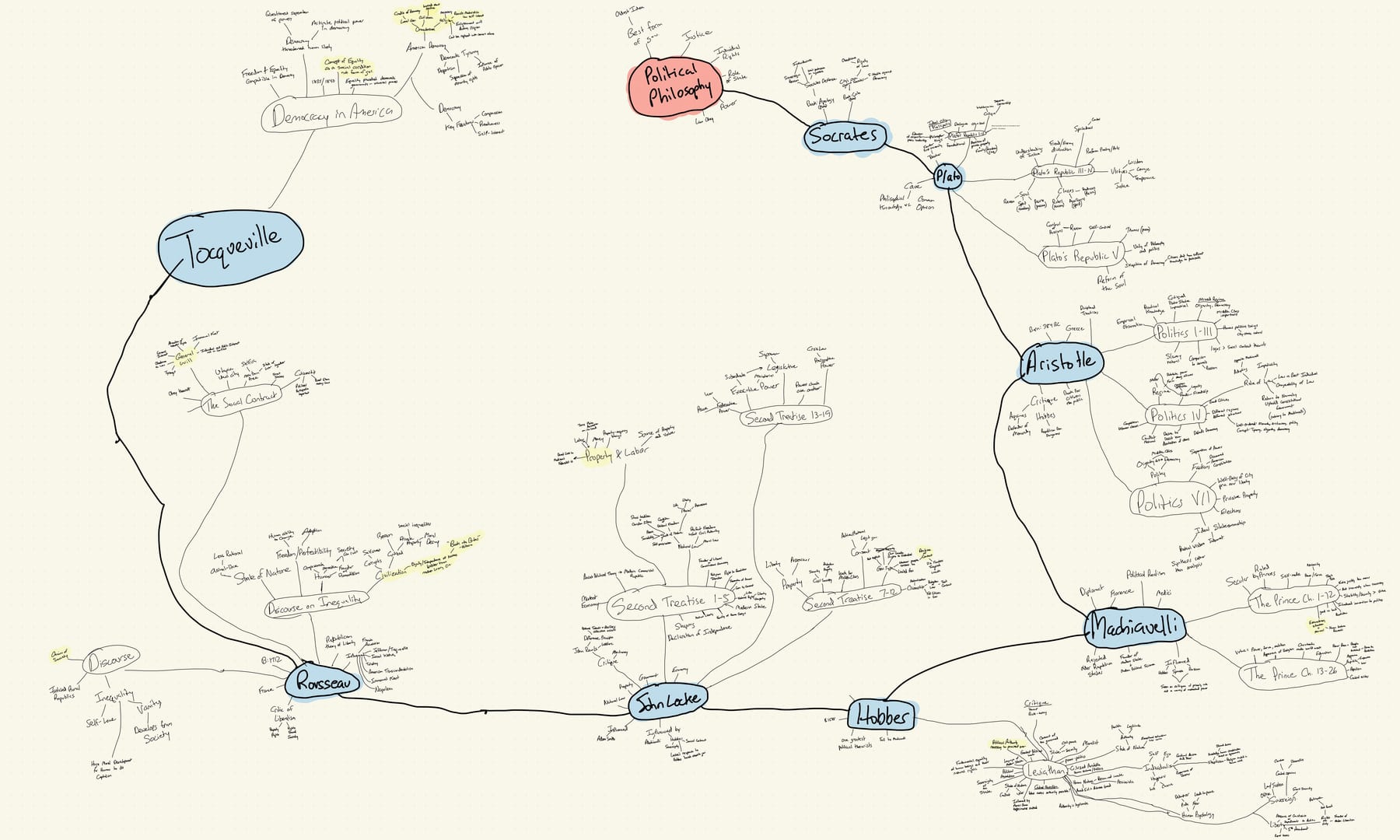
Attachment (file not included in this release)
Attachment (file not included in this release)
1. Introduction: What is Political Philosophy? (link)
1. Definition and Scope of Political Philosophy
- Political philosophy is defined as the study of fundamental questions about the state, government, politics, liberty, justice, and the enforcement of a legal code by authority.
- It examines the nature of political relationships and the ethical implications of political actions.
- Subfield of Political Science but its more
2. Historical Context
- The video provides a historical overview of political philosophy, tracing its origins from ancient thinkers like Plato and Aristotle to modern philosophers such as John Locke, Jean-Jacques Rousseau, and Karl Marx.
- It highlights how political philosophy has evolved over time and how different eras have influenced the development of political thought.
- Political Philosophy is the oldest of the social sciences
- Mentions how economists don’t still read Adam Smith or Psychologists don’t read Freud, so why do Pol. Phil still read old books?
- Because the same questions are being asked
3. Key Questions in Political Philosophy
- The lecture identifies several central questions that political philosophers seek to answer:
- What is the best form of government?
- What is justice?
- What rights do individuals have?
- What is the role of the state?
- How should power be distributed?
- What are goals of a decent society?
- How should a citizen be educated?
- Why should I obey the law and what are the limits if any to my obligation?
- What constitutes the ground of human dignity? Is it freedom, virtue, love, friendship?
- What is God?
- No final authorities in philosophy
- Most important question of the course: What is a regime? Is there a single best regime?
- Oldest and most fundamental of Political ideas
- Plato’s Republic
- Book about the regime
- All later political philosophy is a series of footnotes to Plato
- A regime is a form of government
- You can only understand a regime when you understand what they look up to. What they stand for.
- What is a best regime?
- Pol Phil is immersed in a variety of regimes
- Ancients
- Aristocratic republic
- Moderns
- Democratic
- Small and closed, going to perfection?
- Large and cosmopolitan, globalist?
- Aristotle’s Good Man and Good Citizen
- Good human being is good everywhere
- Philosophers can be truly loyal to any country
4. Major Theories and Concepts
- The video discusses major theories and concepts in political philosophy, including:
- Social contract theory
- Utilitarianism
- Libertarianism
- Communitarianism
- Each theory is briefly explained, highlighting its key proponents and main arguments.
5. Importance of Political Philosophy
- The video emphasizes the importance of political philosophy in understanding and addressing contemporary political issues.
- It argues that political philosophy provides the tools to critically analyze political systems and to advocate for social and political change.
6. Methodology
- The lecture outlines the methodological approaches used in political philosophy, such as normative analysis, conceptual analysis, and critical theory.
- It explains how these methods help philosophers to construct and evaluate political arguments.
7. Practical Applications
- The video concludes by discussing the practical applications of political philosophy in real-world politics.
- It shows how philosophical ideas have influenced political movements, policy-making, and legal frameworks.
2. Socratic Citizenship: Plato’s Apology (link)
-
Introduction to the Apology:
- The Apology is considered an essential text for understanding political philosophy.
- It showcases Socrates defending his way of life and the value of philosophy before a jury.
- Plato founder of Pol. Phil.
- Symbol as a violation of free expression
-
Conflict Between Philosophy and the City:
- The Apology highlights the tension between the freedom of the mind (philosophy) and the demands of political life.
- Socrates is charged with corrupting the youth and impiety towards the gods, which are seen as acts of treason.
- Freedom of mind and political life; their at odds
-
Socrates as a Symbol:
- Over time, Socrates has been viewed as a martyr for free speech and has been compared to figures like Jesus and Galileo.
- However, Socrates himself did not explicitly defend the doctrine of unlimited free speech. Instead, he emphasized that the examined life is the only life worth living.
- John Stuart Mill, On Liberty: “Mankind can hardly be too often reminded that there was once a man named Socrates between whom and the legal authorities of his time there took place a memorable collision.”
- Symbol as resistance to unchecked political power
-
Political Context:
- The trial of Socrates occurred in 399 BCE, shortly after the Peloponnesian War and the brief rule of the Thirty Tyrants in Athens.
- 30 year war
- Athens lost and Sparta put in the Thirty Tyrants — after a year a democratic government was established
- 3 years later, Socrates got charges
- The charges against Socrates were brought by democratic resistance fighters who had opposed the oligarchy.
- “We throw our city open to the world. Never exclude foreigners from any opportunity of learning and observing. Even though the eyes of an enemy may profit from out liberality.” -Pericles
- Socrates was 70 years of age during trial.
- Plato rejected joining the Thirty Tyrants government of Sparta
- The trial of Socrates occurred in 399 BCE, shortly after the Peloponnesian War and the brief rule of the Thirty Tyrants in Athens.
-
Accusations Against Socrates:
- Socrates faced two sets of accusations: one from his contemporaries (Anytus and Meletus) and another from earlier accusers like the comic poet Aristophanes.
- Aristophanes’ play Clouds mocked Socrates and contributed to the negative perception of him.
- Philosophy vs. Poetry
- Deeply political
- Who is best to equip to education future generations of citizens?
- Greeks has centuries long tradition of poetic education at this point, Homer etc..
- Ultimate authority of the Gods, virtues
- Socrates manor of teaching is different from the poets
- Poets call on the Gods, storytelling
- Socrates is not storytelling, it’s argumentative, dialectical, rational scrutiny
- Wants to replace the warrior citizen
- Replace military combat with verbal combat
- New model of citizenship
- Suspicion of helping Thirty Tyrants government
-
Socrates’ Intellectual Turn:
- Socrates recounts an incident involving the Delphic Oracle, which led him to shift his focus from natural philosophy to moral and political questions.
- This shift marks the famous “Socratic turn” towards examining virtues and the human condition.
- Find someone who was wiser than himself
- Turn to founder of Political Science
-
Philosophy vs. Civic Piety:
- Socrates’ philosophical inquiries often put him at odds with the prevailing beliefs and pieties of Athenian society.
- Philosophy seeks to replace opinion with knowledge, which can conflict with the faith-based beliefs that hold a society together.
- Socrates charged with impiety; blasphemy towards what the citizens of Athens cares about the most
- What does Socrates care about?
- Every society operates within the medium of belief or faith of some kind
- Forms national creed
- Most hold these as beliefs, but who can explain how these beliefs are true?
- Piety is a natural condition of society
- Philosophy grows out of a desire to replace opinion with reason and knowledge
- Can’t just hold a belief on faith
- Replace civic faith for knowledge
- Knowledge > Civic Piety
- Every society operates within the medium of belief or faith of some kind
- Socrates was guilty of impiety
- State of ones soul
-
Socrates’ Defense:
- Socrates argues that his pursuit of truth and virtue is a noble endeavor, even if it leads to his persecution.
- He claims that genuine pursuit of justice requires focusing on private virtue rather than public life.
Key Themes
-
The Role of Philosophy: The Apology explores the role of philosophy in society and its potential conflicts with political power.
-
Free Speech and Censorship: The text is often interpreted as a defense of free speech and a critique of censorship.
-
Education and Governance: A central question is who has the right to educate and govern—philosophers or the democratic majority.
-
Moral Integrity: Socrates’ commitment to the examined life and moral integrity is a key theme, highlighting the importance of self-reflection and ethical living.
-
Socrates
- Examined life is alone worth living.
- Highly personal request of self-perfection
-
Who has the right to educate the citizens?
- Most fundamental question to Socrates
-
Athens the most famous Democracy until USA
-
Who has the right to rule? The people or Socrates, the philosopher king?
3. Socratic Citizenship: Plato’s Crito (link)
- Socrates says his way of life has been private; didn’t participate in the collective actions of the city
- Do no harm principle
- Abstainer
- Refused to condemn 10 Athen Generals to death
- Refused to Leon’s arrest
- Principled Disobedience
- Conscious above the Law (Hobbes talks about this)
- Principled Disobedience to the Law
- Hagel, “A beautiful soul” (Comparison to Socrates defense of he claims he is)
- Said Ironically
- Person that puts their own private moral incorruptibility over everyone else
- “So I, men of Athens, am now far from making a defense speech on my own behalf, as someone might suppose. I do it rather on your behalf, so that you do not do something wrong concerning the gift of the god to you by voting to condemn me. For if you kill e me, you will not easily discover another of my sort, who—even if it is rather ridiculous to say—has simply been set upon the city by the god, as though upon a great and well-born horse who is rather sluggish because of his great size and needs to be awakened by some gadfly. Just so, in fact, the god seems to me to have set me upon the city as someone of this sort: I awaken and persuade and reproach each one of you, and I do not stop settling down everywhere 31a upon you the whole day.” -Socrates (link)
- No choice in the matters; gift from the God
- Ironic in religious tone?
- to counter impiety charge?
- Devine command
- Sincere? Or Rhetoric?
- Claims himself pious
- Socrates cares deeply about soul instead of money
- Hagel, “A beautiful soul” (Comparison to Socrates defense of he claims he is)
- Socrates demands Athenians revolutionary change, tells them their lives are not worth living, their lives are not examined
- Crito’s Apology: “Companion Dialogue”
- Is Plato asking us to consider Socrates as a man of high principle, standing up for what he believes in the face of death? Or as some kind of revolutionary agitator who cannot and should not be tolerated by a society whos basic laws and values he will not accept.
- Both.
- Crito presents the City’s case against Socrates
- While the Apology seems to denigrate the political life as requiring complicity in injustice and Socrates says he will have no part of laws or policies that entail injustice, the Crito makes the case for the dignity of the laws, the dignity or majesty of the city and its laws. While the Apology defends, again, a politics of principled abstinence or disobedience to the political life, the Crito makes the most complete and far-reaching case for obligation and obedience to the law that has perhaps ever been made.
- Crito is a conversation between Socrates and one person in a prison cell
- Socrates counter-argument against himself
- No state can exist without rules. The first rule of any state is the rule that citizens are not free to set aside the rules, to choose among them which ones to obey and to disobey. To engage in civil disobedience of any kind is not only to call this or that rule into question but it is to call into question the very nature of law, the very question of the rules. To question or disobey the law is tantamount to destroying the authority of the law. The breaking of so much as a single law constitutes the essence of anarchy, constitutes the essence of lawlessness, it is a far-reaching argument for obedience to the law. The breaking of even a single law calls into question the authority of law as such. It’s a very powerful argument that, in a way, Socrates makes against himself, putting that speech in the mouth of the laws. But he goes even further than this. The citizen, he says, owes his very existence to the laws. We are what we are because of the power and authority of the laws, the customs, the traditions, the culture that has shaped us. The laws, he says, have begat us and the use of the term “begat” in our translation is clearly intended to resonate with something you might say we might think of as something biblical about it. The citizen is, in a word, created, begat by the laws themselves, they exercise a kind of paternal authority over us such that disobedience to any law constitutes an act of impiety or disrespect of the oldest things around us. The laws are not only like our parents, they are like our ancestors, the founding fathers, as we might say, who are owed respect and piety.
- Why is Socrates all of a sudden so humble and acquiescent?
- The Apology and the Crito represent a tension, they represent even a conflict between two more or less permanent and irreconcilable moral codes. The one represented by Socrates regards reason, that is to say, the sovereign reason of the individual as the highest possible authority. It is the philosopher’s reliance on his own reason that frees him from the dangerous authority of the state and safeguards the individual from complicity in the injustice and evils that seem to be a necessary part of political life. Here is Socrates, the principled abstainer, but the other moral code is represented by the speech of the laws where it is the laws of the community, its oldest and deepest beliefs and institutions, its constitution, its regime as we would say, its politea, that are fundamentally obligatory on the individual and even take priority over the individual. The one point of view takes the philosophic life, the examined life, to be the one most worth living; the other takes the political life, the life of the citizen engaged in the business of deliberating, legislating, making war and peace as the highest calling for a human being. These constitute two irreconcilable alternatives, two different callings, so to speak, and any attempt, I think, to reconcile or to synthesize these two can only lead to a deep injustice to each.
- Is Plato asking us to consider Socrates as a man of high principle, standing up for what he believes in the face of death? Or as some kind of revolutionary agitator who cannot and should not be tolerated by a society whos basic laws and values he will not accept.
- Socrates death was intended as an act of philosophical martyrdom
- Applying Lessons from Fourth-Century Athens to Our World Today
- Most agree Socrates was a victim
- Most overlook how Socrates facts about him
- Hostility against Democracy
- Claims the lives of fellow citizens are not worth living
- Claims his way of life has been commanded by a God
- What should the body of citizens have done?
- Greater toleration to civil dissidents like Socrate; stimulate different thinking
- Promoted by Milton, John Locke, Voltaire
- Plato doesn’t argue that Socrates should just be tolerated
- Tolerate it would trivialize it
- Trial asks us to think about the limits of toleration
- Is society open to any point of view?
- Should it trump all other goods or does toleration reach a point when it ceases to be toleration and becomes in fact a kind of soft nihilism that can extend liberty to everything precisely because it takes nothing very seriously. And by nihilism, I mean the view that every preference, however squalid, base or sordid, must be regarded as the legitimate equal of every other. Is this really tolerance or is it rather a form of moral decay that has simply decided to abandon the search for truth and standards of judgment? There’s a danger, I think, that endless tolerance leads to intellectual passivity and the kind of uncritical acceptance of all points of view.
- Greater toleration to civil dissidents like Socrate; stimulate different thinking
Setting and Characters
- The dialogue takes place in Socrates’ prison cell, where he is awaiting execution for charges of impiety and corrupting the youth.
- The only characters in the dialogue are Socrates and his friend Crito.
Crito’s Argument for Escape
- Crito visits Socrates and urges him to escape from prison.
- He argues that it is unjust for Socrates to be put to death as he has committed no real crimes.
- Crito believes that Socrates’ death would be a loss to his friends and family and would also harm Crito’s reputation.
Socrates’ Refusal to Escape
- Socrates refuses to escape, citing his duty to the state and the laws of Athens.
- He believes that escaping would be an act of injustice and would harm the city-state’s legal system.
Imaginary Dialogue with the Laws
- Socrates imagines a dialogue between himself and the personified Laws of Athens.
- The Laws argue that Socrates has benefited from the city and its laws all his life.
- By choosing to live in Athens and not leaving when he had the chance, Socrates has implicitly agreed to obey the city’s laws, even if they result in his death.
Themes Explored
- Justice: The dialogue explores what it means to act justly. Socrates argues that escaping would be unjust, as it would violate the laws he has agreed to follow.
- Friendship: The dialogue examines the nature of true friendship. Socrates contends that true friends help each other become better people, and aiding in an escape would not be in his or Crito’s best interest.
- Individual vs. State: The tension between individual autonomy and the obligations of citizenship is a central theme. Socrates believes that his duty to the state and its laws supersedes his personal desires.
Social Contract
- The concept of a social contract is introduced, where Socrates suggests that by living in Athens, he has entered into an implicit agreement to obey its laws.
- This idea of a social contract has influenced later political philosophy, notably in the works of Thomas Hobbes, John Locke, and Jean-Jacques Rousseau.
Key Passage
- One of the most significant passages involves the personified Laws addressing Socrates:
- They remind him of the benefits he has received from the city.
- They argue that if he disagreed with the laws, he had the option to leave Athens.
- By choosing to stay, he has agreed to abide by the laws, including accepting the consequences of his trial and sentencing.
Philosophical Influence
- The dialogue has had a lasting impact on political philosophy, particularly the idea of the social contract.
- It underscores the moral obligation of individuals to follow the laws of their society as a foundational principle for a civilized society.
4. Philosophers and Kings: Plato’s Republic, I-II (link)
00:00 - Chapter 1. Introduction
- Significance of the Republic: The Republic is a foundational text in political philosophy, influencing works from Aristotle’s Politics to modern political thought. The class focuses on the first five books, which discuss Plato’s ideal city, Kallipolis, ruled by philosopher-kings.
- Complexity and Reading Approach: The Republic is complex and requires multiple readings to understand its depth. It should be approached as a dialogue and a work of literature, not just a philosophical treatise. Approach as literature.
- Long Book
- Perplexing book, meaning not evident
- Surface of the book is a dialogue
03:04 - Chapter 2. What Is Plato’s Republic About?
- Themes: The Republic addresses justice, moral psychology, the power of culture, and metaphysics. It is a utopian vision that seeks to harmonize the city and the soul.
- Philosopher-Kings: The central thesis is that a just city requires rulers who are philosophers. This involves censorship, the abolition of private property and family among the guardian class, and the use of myths and propaganda.
- Criticism: Modern critics, like Karl Popper, have interpreted Plato’s vision as a precursor to totalitarianism. However, Plato’s focus was on the education of citizens for public leadership
- Extreme version of politics
- Asks us, “What would a city look like if it was ruled by someone like Socrates?”
- This city would require
- Severe censorship of poetry, theology, abolition of private property and family (among guardians), selected lies and myths
- Much of modern political science is against Plato’s legacy
- Plato’s Republic recognizes no such separation between private and public life
- Plato is a harbinger for the totalitarian state
- Plato+Hagel+Marx
- Is this true?
- Important to remember, Plato, was above all, a teacher
- Founder of the first University, The Academy
- Platonic Academy
- Men and women selected early age, living together, study together, physical training—similar to University structure
- All modern Universities are heirs to Plato
- Rousseau wrote in his Emile, “To get a good idea of public education,” he says, “read Plato’s Republic “It is not a political treatise, as those who merely judge books by their title think, but it is the finest, most beautiful work on education ever written.” Rousseau.
17:38 - Chapter 3. I Went Down to the Piraeus
- Dramatic Structure: The dialogue begins with Socrates and Glaucon descending to the Piraeus, symbolizing a philosophical journey. This setting introduces themes of conflict between reason and force.
- Characters and Setting: Socrates and Glaucon encounter various characters, including Polemarchus and his friends, who represent different aspects of the soul and society. The setting at the Piraeus, a seedy harbor, raises questions about their purpose and the nature of their journey.
22:05 - Chapter 4. The Seventh Letter
- Plato’s Life and Motivations: Plato’s Republic reflects his disillusionment with Athenian politics and his experiences, including the execution of Socrates and his failed attempts to establish a philosophical kingship in Syracuse.
- Autobiographical Elements: Plato’s Seventh Letter provides insight into his motivations for writing the Republic. He expresses despair over the state of existing political institutions and advocates for philosopher-kings as a solution.
- The dominant feature of Plato’s political theory, David Grene, a great reader of Plato, has said is “the root and branch character of the change it advocates and existing institutions.” Plato’s desire for a kind of radical makeover, of Athenian and Greek political institutions and cultures, grew out of his experience of political defeat and despair. The utopianism of the book is, in many ways, the reverse side of the sense of profound disillusionment that he felt at the actual experience of the Athenian polis. This was not only true of his experience at home, but of his failed efforts to turn Dionysius’ kingship in Sicily into a successful example of philosophical rule.
- Intellectual autobiography
30:00 - Chapter 5. Analyzing the Beginning of Republic and the Hierarchy of Characters
- Opening Scene Analysis: The dialogue’s opening scene raises questions about the legitimacy of rule by force versus reason. Socrates and Glaucon’s encounter with Polemarchus and his friends sets the stage for exploring these themes.
- Why does the book begin with this, let’s say, opening gambit? Is it simply a ruse to get the reader’s attention in some sense or to rope you in with some promise of what’s to follow? Already from the very opening lines we see in this a clue to the theme that is going to follow. Who has the title to rule? Is it Polemarchus and his friends who claim to rule by strength of numbers? “Can we persuade you?” “Not if we don’t listen,” he says. Or Socrates and Glaucon, who hope to rule by the powers of reason, speech, and argument? Can we convince you? Can we persuade you? Can democracy that expresses the will of the majority, the will of the greater number be rendered compatible with the needs of philosophy and the claims to respect only reason and a better argument? That seems to be the question already posed in this opening scene. Can a compromise be reached between the two? Can the strength of numbers, as well as respect for reason and a better argument be, in some sense, harmonized? Can they be brought together? Is the just city, perhaps, that Socrates will later consider, a combination of these two—of both force and persuasion? That will be something left to see. But I think you can see the big themes of the book already very present in the opening scene of the dialogue. The first book is really a kind of preamble to everything that follows.
- Character Hierarchy: The characters represent different parts of the soul and society. Cephalus represents tradition and conventional opinion, Polemarchus represents honor and loyalty, and Thrasymachus represents cynical intellectualism. Glaucon and Adeimantus, Plato’s brothers, represent the spirited and rational parts of the soul, respectively.
38:13 - Chapter 6. Cephalus
- Cephalus’ Role: Cephalus embodies conventional opinion and tradition. His conversation with Socrates about justice and piety sets the stage for deeper philosophical inquiries.
- Socrates’ Challenge: Socrates challenges Cephalus’ conventional views, leading to Cephalus’ departure from the dialogue. This symbolizes the rejection of traditional authority and the beginning of a more profound philosophical exploration.
5. Philosophers and Kings: Plato’s Republic, III-IV (link)
00:00 - Chapter 1. Polemarchus
- Definition of Justice: Polemarchus initially defines justice as helping friends and harming enemies.
- Socratic Challenge: Socrates questions the reliability of distinguishing friends from enemies, suggesting that such perceptions can be flawed.
- Deeper Reflection: Socrates pushes for a deeper understanding of justice beyond conventional wisdom.
- And we might want to think about this because it is an argument that is very important to contemporary twentieth century—important twentieth- century political theorist by the name of Schmitt who made the distinction between what he called the friend and the enemy, you remember, are central to his understanding of politics. This is an argument that comes from Polemarchus in Book I of the Republic.
08:25 - Chapter 2. Thrasymachus
- Justice as the Advantage of the Stronger: Thrasymachus argues that justice is the advantage of the stronger, implying that might makes right.
- Justice is only respected by the weak.
- Self-interest for the ruling class
- Just person is a fool
- Refutation by Socrates: Socrates refutes this by demonstrating that such a view supports tyranny and an unjust way of life.
- Justice is not power alone, needs reflection and knowledge as their basis. But what kind of knowledge?
- Unresolved Definition: The discussion ends with the definition of justice still unresolved, highlighting the complexity of the concept.
- Longest and most memorable
- Similar to Thomas Hobbes
- Thrasymachus blushes. He blushes when he realized that he has been defending the claim not that justice is a virtue, but that justice is something that is really a form of weakness. Thrasymachus himself seems to be embarrassed by his defense of the tyrannical life, of the unjust life.
- The suggestion Plato seems to be making by making Thrasymachus blush is, despite all of his tough talk, that he’s not as tough as he appears to be, as he wants to think of himself to be. He’s shamed by the fact that he has been defending injustice and the tyrannical way of life.
- Book I ends with uncertainty about what justice is. We have had three views of Cephalus, Polemarchus, and Thrasymachus. They have all been refuted, but no clear alternative seems to have emerged. Certainly Socrates has not really proposed an alternative to Thrasymachus in his exchange with him; he has only, as it were, forced Thrasymachus to see that the logic of his ideas, the logic of his argument that justice is in the interest of the stronger, is a defense of tyranny, and is a defense of the unjust way of life.
18:59 - Chapter 3. Glaucon
- Thought Experiment: Socrates proposes constructing an ideal city in speech to understand justice by observing its emergence.
- Principle of Specialization: The city is built on the principle that each individual should perform the role they are naturally suited for.
- Role of Guardians: The qualities and education of the guardians, who will rule and protect the city, are discussed, emphasizing wisdom, courage, and temperance.
- Glaucon tells Socrates that he is dissatisfied with the refutation of Thrasymachus, and so should we. Thrasymachus has been shamed, he has been forced to see where the logic of his argument takes him, but that is not the same thing as being refuted. Thrasymachus is really, as it turns out, a kind of girly-man who is ashamed to be seen defending the unjust life.
- “But why should we be ashamed to praise injustice?” Glaucon challenges Socrates. “It’s not enough to show that justice is wrong,” Glaucon says. “What we need is to hear why justice is good,” or more precisely to hear justice praised for itself. “Is there, in your opinion,” Glaucon asks Socrates, “a kind of good that we would choose because we delight in it for its own sake?” 358A. Is there a kind of good that we delight in for its own sake? And this is where the rubber hits the road.
- Who has not wondered what we would do if we had this power, the power of invisibility? Gyges, in Glaucon’s retelling of the story, Gyges uses this ring to murder the king and to sleep with his wife, and to set himself up as king. What would you do if you had this power, the power of this magic ring, where you could commit any crime, indulge any vice, commit any outrage and be sure you could always get away with it? Why if you could do that would you wish to be just at the same time, or wish to be just instead of that? This is the challenge that Glaucon poses to Socrates. Why would someone with absolute power and complete immunity to punishment, why would they prefer justice to injustice? “Tell me that Socrates,” Glaucon asks. “If justice truly is something praiseworthy for itself alone, then Socrates should be able to provide an answer that will satisfy Glaucon’s retelling of the story of Gyges, that is certainly a very tall order.
26:09 - Chapter 4. Adeimantus
- Tripartite Soul: Socrates outlines the tripartite nature of the soul, consisting of reason, spirit (emotions), and desire (passions).
- Corresponding Classes: Each part of the soul corresponds to a class within the city: rulers (reason), auxiliaries (spirit), and producers (desire).
- Four Cardinal Virtues: The virtues of wisdom, courage, temperance, and justice are discussed in relation to both the individual and the city.
- City is like the soul of an individual
- How regimes produces distinct individuals which have the dominate character traits of the regime.
- Reform of Poetry and the Arts
37:28 - Chapter 5. Spiritedness and the Establishment of the Just City
- Justice in the Soul and City: Justice is achieved when the rational part of the soul rules over the spirited and desirous parts, creating harmony.
- Harmonious Structure: In the city, justice results from each class performing its designated role without overstepping its bounds.
- Establishment of Justice: The discussion emphasizes the importance of a balanced and well-ordered soul and city to achieve true justice.
- Spiritedness is the central, psychological quality of the Republic. The entire thrust of the book is devoted to the taming of spiritedness, and to the control of spiritedness. Spiritedness is that quality of soul that is most closely associated with the desires for honors, fame and prestige. It is a higher order psychological quality. It seeks distinction, the desire to be first in the race of life and lead us to seek to dominate others. We all know people of this sort, do we not? And we all to some degree embody this quality in ourselves. It is the quality that we associate with being a kind of alpha personality. This is the issue for Socrates, how to channel this wild and untamed passion of spirit or heart, how to channel this to some kind of common good. Can it be done? How can we begin the domestication of the spirited Glaucon? The rest of the book is to some degree about taming, asking the question whether Glaucon can be tamed.
- Socrates’ argument seems to be something like this: it is from the poets and I mean that in the broadest sense of the term, myth makers, storytellers, artist, musicians, today we might say film and television producers, it is from these people that we receive our earliest and most vivid impressions of heroes and villains, gods and the afterlife. These stories, the stories we hear from earliest childhood on, shape us in some very meaningful sense for the rest of our lives. And the Homeric epics were of course for the Greeks what the Bible was for us. Maybe even is in some communities. The names of Achilles, Priam, Hector, Odysseus, Ajax, these would have been just as familiar and important to the contemporaries of Plato as the names of Abraham, Isaac, Joshua and Jesus are for us.
- Plato’s critique of Homeric poetry in the Republic is two-fold; it is both theological and political. Maybe you might even say following Spinoza, that this is the core of Plato’s theological political treatise here. The theological critique is that Homer simply depicts the gods as false, as fickle, and inconstant. He presents them as beings who are unworthy of our worship. More importantly, the Homeric heroes are said to be bad role models for those who follow them, they are shown to be intemperate in sex, overly fond of money, into these vices Socrates adds cruelty and disregard for the dead bodies of one’s opponents. The Homeric heroes are ignorant and passionate men full of blind anger and desire for retribution. How could such figures possibly serve as good role models for citizens of a just city?
- But it’s important to remember that the question of education and the question of the reform and censorship and the control of poetry is introduced in the context of taming the war-like passions of Glaucon and others like him. The question of censorship and the telling of lies is introduced, in other words, as a question of military necessity, controlling the guards or the auxiliaries of the city, its warrior class. Nothing is said here about the education of farmers, artisans, merchants, laborers, the economic class. Maybe, to speak bluntly, Socrates just doesn’t care that much about them. It’s okay what they listen too. Nor has anything really been said up to this point about the education of the philosopher. His interest here is in the creation of a tight, and highly disciplined cadre of young warriors who will protect the city much as watchdogs protect their own home
- It would seem far from being unrealistic, Socrates engages what we might call maybe a kind of Socratic realism. Far more unrealistic would be the belief of those who argue, and I’m thinking here of names like Immanuel Kant and others from the eighteenth and nineteenth century, that one day we can abolish war altogether, and therefore abolish the passions that give rise to conflict and war. So far Plato believes, is a passionate or spirited aspect of nature remains strong so long will be necessary to educate the warriors of society who defend it.
6. Philosophers and Kings: Plato’s Republic, V (link)
00:00 - Chapter 1. The Control of Passions
-
Adeimantus’ Speech: Emphasizes self-control and Socrates’ focus on controlling poetry and the arts.
-
Concept of Thumos:
- Dual nature: Can lead to heroism and self-sacrifice or domination and tyranny.
- Story of Leontius: Illustrates internal conflict between desires and rational control.
-
Justice in the Soul and City:
- Justice as reason controlling appetites and desires.
- Question of whether thumos can be redirected for the public good.
-
grand themes of the Republic, it is indicated in Book II by Adeimantus’ speech about self-control. It is introduced further by the claims of Socrates to control, to censor, to control the poetry and the arts of the city. And this is the big theme of what one might call “the control of the passions.” This is the theme of every great moralist from Spinoza to Kant to Freud. How do we control the passions? And it is certainly a large theme of Plato’s theory of justice in the Republic.
-
Every great moral philosopher has a strategy for helping us submit our passions to some kind of control, to some kind of supervening moral power. And again, recall this is the theme raised at the beginning of Book II by Adeimantus, who puts forward an idea of self-control, or what he calls self-guardianship as his goal. How can we protect ourselves from the passion for injustice? And one of the things
-
Socrates emphasizes is that the most powerful of those passions, the most powerful passion is that Socratic passion that he calls thumos, or what our translator has as spiritedness, anger, maybe what biblical translators call heart, having a big heart, having thumos and all of that implies. This is for Plato, the political passion par excellence. It is a kind of fiery love of fame, love of distinction that leads men and women of a certain type to pursue their ambitions in public life, in the public space. It is clearly connected this notion of spiritedness or this thumotic quality to our capacities for heroism and for self-sacrifice.
-
Thumos
Plato’s [Phaedrus](https://en.wikipedia.org/wiki/Phaedrus(dialogue) “Phaedrus (dialogue)”) and his later work The Republic discuss _thumos as one of the three constituent parts of the human psyche. In the Phaedrus, Plato depicts logos as a charioteer driving the two horses [eros](https://en.wikipedia.org/wiki/Eros(concept) “Eros (concept)”) and _thumos (erotic love and spiritedness are to be guided by logos). In the Republic (Book IV) soul becomes divided into (See Plato’s tripartite theory of soul):(https://en.wikipedia.org/wiki/Thumos#cite_note-dictionary-1)- nous (“intellect”, “reason”), which is or should be the controlling part which subjugates the appetites with the help of thumos.
- thumos (“passion”), the emotional element in virtue of which we feel joy, amusement, etc. (the Republic IV, 439e);
- epithumia (“appetite”, “affection”), to which are ascribed bodily desires;
Plato suggested we have three parts of our soul, which in combination makes us better in our destined vocation, and is a hidden basis for developing our innate ideas. Thumos may draw from this to strengthen man with our reasoning, this tripartite division is as follows:
- Reason (thoughts, reflections, questioning)
- Spiritedness (ego, glory, honor) and
- Desires (natural e.g. food, drink, sex vs unnatural e.g. money, power).
08:53 - Chapter 2. A Proposal for the Construction of Kallipolis
- Three Waves of Reform:
- Restrictions on Private Property: Abolition to eliminate wealth as a source of division.
- Abolition of the Family: Communal child-rearing to foster unity.
- No child should know their parents
- No parent should know their children
- Aristotle Rejects this idea: We can’t show love to common ownership, only things that are ours.
- Establishment of Philosopher-Kings: Philosophers should rule due to their possession of true knowledge.
- Co-Education of Men and Women:
- Equal education and roles in society.
- Implications for societal roles and objections from Aristotle.
- Rewriting the Laws of War:
- Children as spectators of war to habituate them.
- Erotic rewards for bravery.
- 468c, “and I add to the laws of war,” Socrates writes, “that as long as they, the guardians, are on campaign, no one whom he wants to kiss should be permitted to refuse. So that if a man happens to love someone, either male of female, he would be more eager to win the rewards of valor.”
- Recreational sex for self-control
17:34 - Chapter 3. Justice
- Definition of Justice: Harmony in the city and the soul; everyone performing their best-suited functions.
- Division of Labor:
- One man, one job.
- Objections from Aristotle about unity destroying natural diversity.
- Harmony in the City and Soul:
- Cooperation of reason, spirit, and appetite.
- Question of whether the structure of the city is identical to the structure of the soul.
- Adeimantus’ Objection: Concerns about the happiness of citizens deprived of pleasures.
- Three Classes of the City
- Workers
- Auxiliaries
- Guardians
- Adeimantus, you remember, at the beginning of Book IV. “What would your apology be Socrates,” Adeimantus says, “if it were objected that you’re hardly making these men happy, these people just,” he says at 419a. Adeimantus is concerned that Socrates is being unfair to the auxiliaries and the guardians, giving them all the responsibilities but none of the rewards, none of the pleasures that would seem to be the reward of responsibility. How can a citizen of Kallipolis live a just or happy life if he or she is deprived of most of the goods or pleasures that we seek? Socrates gives a rather lame response. In founding the city, he says, we are not looking to the exceptional happiness of any one individual or any group but rather to the city as a whole. And Adeimantus appears to accept that response, oh yes, I forgot we are concerned with the happiness, the justice of the whole. But his question is still one that lingers and one that Plato includes for a purpose.
- Adeimantus object was never answered.
26:28 - Chapter 4. The Philosopher-King
-
Concept of the Philosopher-King:
- Unity of philosophy and politics.
- Historical attempts to unite philosophy and politics (e.g., Hobbes’ Leviathan).
- Thomas Hobbes’ Leviathan, chapter 31 of Leviathan, where Hobbes gives us a very personal statement about his intention in writing this book.Hobbes wrote, “I am at the point of believing that my labors will be as useless as the commonwealth of Plato.” He seems to be rather despairing about whether this book is actually going to have any affect. “I’m in the point of believing it will be as useless as the commonwealth of Plato,” for he also is of the opinion that it is impossible for the disorders of state and change of government by civil war ever to be taken away until sovereigns be philosophers. But after admitting his despair about the possibility of realizing his ideas and practice, Hobbes continues as follows, “I recover some hope,” he says, “that one time or other, this writing of mine may still fall into the hands of a sovereign who will consider himself without the help of any interested or envious interpreter. And by the exercise of entire sovereignty in protecting the public teaching of it, convert this truth of speculation into the utility of practice.”
-
Challenges and Criticisms:
- Practicality of philosophers ruling.
- Potential for philosophers to abuse power.
- Tension between philosophical inquiry and political administration.
-
Philosopher-King as an Ideal:
- Socrates’ proposal seen as both serious and potentially ironical.
- Examples of thinkers who sought to influence political leaders.
-
Ambition to unite philosophy and politics a recurring dream of Pol Phil since Plato
- Rousseau, or Marx, or Nietzsche, or Machiavelli all of whom sought to gain the ear of political leaders and convert their ideas into some kind of practice.
-
It would seem that the needs of philosophy are quite different from the demands or requirements of political rule.
33:26 - Chapter 5. What Are Plato’s Views on Modern America?
-
Comparison with Modern American Democracy:
- Plato’s skepticism of democracy.
- In one sense, the Republic, and I’ve given some indications of this today, seems to be the most anti-democratic book ever written. Its defense of philosophic kingship is itself a direct repudiation of Athenian democracy. Its conception of justice, minding one’s own business, is a rejection of the democratic belief that citizens have sufficient knowledge to participate in the offices of government. To be sure, Athenian democracy is not American democracy. Plato thought of democracy as a kind of rule by the many that he associated with the unrestricted freedom to do everything that one likes. This seems in many ways to be quite far from the American democracy based on constitutional government, systems of checks and balances, protection of individual rights, and so on. The differences between Athens and Washington seem to be very far. And yet, in many ways, Socrates diagnoses very powerfully an important condition of modern democratic life with which we are all familiar.
- Socrates writes in Book VIII, 561c, “speaking of the democratic soul, the democratic man, he also lives along day by day gratifying the desire that occurs to him, at one time, drinking and listening to the flute.” Today we have different kinds of music to substitute for the flute but you get the point. “Drinking and listening to the flute, at another time downing water and dieting, now practicing gymnastics and again idling and neglecting everything, and sometimes spending his time as though he were occupied with philosophizing. Often, he engages in politics and jumping up, says and does whatever chances to come to his mind. And if he ever admires any soldiers, he turns in that direction. And if money-makers in that one and there is neither order nor necessity in this life but calling this life sweet, free, and blessed, he follows it throughout.” Is that image of life at all familiar to us? Doing anything you like, it seems to be the opposite of the platonic understanding of justice as each one doing a special function or fulfilling or doing a special craft. Just doing whatever you like and calling that sweet, free, and blessed throughout.
- Plato’s views on democracy were not all negative, to be sure. He wasn’t only a critic of democracy. It was, after all, a democracy that produced Socrates and allowed him to philosophize freely until his seventieth year. Would this have been permitted in any other city of the ancient world? And he surely would not be allowed to philosophize in many cities and countries today.
- Concerns about instability, anarchy, and tyranny.
- Role of philosophy in political reform.
- Plato’s skepticism of democracy.
-
Benefits of Democracy:
- Freedom for philosophical inquiry.
- Plato’s acknowledgment of democracy’s advantages.
-
Reform of the Soul:
- Importance of self-control and individual reform.
- Critique of misuse of philosophical ideas by tyrants.
-
Philosophy as Therapy:
- Philosophy as a means to control passions and set limits to desires.
- Distinction between philosopher and tyrant.
-
This is a point that is often lost in the Republic, that it is first of all a work on the reform of the soul.
-
That is not to say at all that it teaches withdrawal from political responsibilities, it does not. Philosophy and certainly Socratic philosophy requires friends, comrades, conversations. It is not something that can simply be pursued in isolation. Socrates understands that those who want to reform others must reform themselves, but many who’ve tried to imitate him have been less careful. It is easy to confuse, as many people have done, the Republic, with a recipe for tyranny.
-
The twentieth century, and even the beginnings of our own, is littered with the corpses of those who have set themselves up as philosopher-kings, Lenin, Stalin, Hitler, Mao, Khamenei, to name just some of the most obvious. But these men are not philosophers. Their professions to justice are just that, they are professions or pretensions expressing their vanity and their ambition.
-
For Plato, philosophy was in the first instance, a therapy for our passions in a way of setting limits to our desires. And this is precisely the opposite of the tyrant who Plato describes as a person of limitless desires who lacks the most rudimentary kind of governance, namely self-control. The difference between the philosopher and the tyrant illustrate two very different conceptions of philosophy. For some, philosophy represents a form of liberation from confusion, from unruly passions and prejudices, from incoherence. Again, a therapy of the soul that brings peace and contentment and a kind of justice. And yet for others, philosophy is the source of the desire to dominate. It is the basis of tyranny in the great age of ideologies through which we are still passing.
7. The Mixed Regime and the Rule of Law: Aristotle’s Politics, I, III
00:00 - Chapter 1. Aristotle: Plato’s Adopted Son
-
Introduction to Aristotle’s Background
- Born in 384 BC in Stagira, a city in northern Greece.
- Studied under Plato at the Academy in Athens for 20 years.
- Developed a close relationship with Plato, often considered his intellectual heir.
- Diverged from Plato’s philosophy, particularly on the theory of forms.
-
Aristotle’s Contributions to Philosophy
- Emphasized empirical observation and practical knowledge.
- Founded the Lyceum, a school in Athens, where he taught and conducted research.
- Wrote extensively on various subjects, including politics, ethics, metaphysics, and natural sciences.
-
Aristotle’s Political Philosophy
- Critiqued Plato’s ideal state as impractical.
- Advocated for a mixed regime combining elements of oligarchy and democracy.
- Believed in the importance of the middle class for political stability.
-
Socrates, who wrote nothing but conversed endlessly, and unlike his own teacher, Plato, who wrote imitations of those endless Socratic conversations, Aristotle wrote disciplined and thematic treatises on virtually every topic, from biology to ethics to metaphysics to literary criticism and politics.
-
Political scientist
-
Aristotle shows how philosophy is useful for citizens, common people.
-
End of the Greek gold age during his life.
-
Silent on the issues of his time. He was not Athenian and its protection
-
Became THE authority on everything for those Philosophers to come
-
The attack on Aristotle, 17th Century spearheaded by Thomas Hobbes
- In the forty-sixth chapter of Leviathan, a chapter we will read later, Hobbes wrote, “I believe that scarce anything can be more repugnant to government than much of what Aristotle has said in his Politics, nor more ignorantly than a great part of his Ethics.”
-
Aquinas read Aristotle as a defender of monarchy.
-
Dante, in his book, De Monarchia on monarchy, saw Aristotle as giving credence to the idea of a universal monarchy under the leadership of a Christian prince. But Hobbes saw Aristotle quite differently.
-
For Hobbes, Aristotle taught the dangerous doctrine of republican government that was seen to be practiced particularly during the Cromwellian Period in England, during the civil war. Aristotle’s doctrine that man is a political animal, Hobbes believed, could only result and did result, in fact, in regicide, the murder of kings. There are certainly echoes of this reading of Aristotle as a teacher of participatory republican government in the later writings of democratic thinkers from Tocqueville to Hannah Arendt.
12:45 - Chapter 2. Man Is, by Nature, the Political Animal
-
Aristotle’s Definition of Human Nature
- Asserted that humans are inherently political beings.
- Argued that living in a polis (city-state) is natural for humans.
- Stressed the importance of community and social interaction for human fulfillment.
- His claim that man is, by nature, the political animal. That’s his famous claim.
- “That man” he says “is much more a political animal than any kind of bee or herd animal is clear.” Why is it clear? “For we assert,” he says, “nature does nothing in vain and man alone among the animals has speech. While other species,” he notes, “may have voice, may have sounds and be able to distinguish pleasure and pain, speech”—logos is his word for it. Man has logos—reason or speech. The word can mean either.— “is more than the ability simply to distinguish pleasure and pain.” He goes on. “But logos,” he writes, “serves to reveal the advantageous and the harmful. And hence,” he writes, “the just and the unjust. For it is peculiar to man as compared to other animals that he alone has a perception of good and bad, just and unjust and other things.” In other words, he seems to be saying that it is speech or reason, logos, that is able to both distinguish and create certain moral categories, certain important moral categories that we live by—the advantageous, the harmful, the just and unjust, and things of this sort that constitute, as he says, a family and a polis.
-
The Role of the Polis
- Described the polis as the highest form of community.
- Believed the polis exists to achieve the highest good.
- Emphasized the role of citizens in governance and the pursuit of virtue.
- In the literal opening, he gives what looks like a kind of natural history of the polis. He seems there to be a kind of anthropologist writing a natural history. The polis is natural in the sense that it has grown out of smaller and lesser forms of human association. First comes the family, then an association of families in a tribe, then a further association in a village, and then you might say an association of villages that create a polis or a city. The polis is natural in the sense that it is an outgrowth, the most developed form of human association, in the way that one used to see in natural history museums, these kind of biological charts of human development from these lesser forms of life all the way up to civilization in some way. That is part of Aristotle’s argument. But there is a second sense for him and, in some ways, a more important sense in which he says the polis is by nature. It is natural.
- Not biological, but possessed by the power of speech/reason.
- Aristotle believes our social and political nature is not the result of calculation, as we will see in Hobbes, Locke, and other social contract theorists, but such things as love, affection, friendship, and sympathy are the grounds of political life and are rooted in our logos. It is speech that allows a sharing in these qualities that make us fully human.
- A society that leads to our perfection that leads us to complete and perfect our telos must be held together by bonds of trust, of friendship, of camaraderie. A society based simply on the mutual calculation of interests could not be a real political society for Aristotle. We cannot trust all people, Aristotle seems to say. Trust can only be extended to a fairly small circle of friends and fellow citizens. Only a small city, small enough to be governed by relations of trust, can be political, in Aristotle’s sense of the term. The alternative to the city, the empire, can only be ruled despotically. There can be no relations of trust in a large, imperial despotism.
- It can never be something that incorporates all of humankind. It can never be a kind of cosmopolis, a world state or even a league of states or nations. The universal state will never allow for or does not allow for the kind of self-perfection that a small, self-governing polis will have. The city, as Aristotle understands, will always exist in a world with other cities or other states, based on different principles that might be hostile to one’s own. That is to say not even the best city on Aristotle’s account can afford to be without a foreign policy.
- Just as we cannot be friends with all persons, so the city cannot be friends with all other cities or the state with all other states. War and the virtues necessary for war are as natural to the city as are the virtues of friendship, trust, and camaraderie that are also necessary.
- At this point we know only the most general features of what a polis is. It must be small enough to be governed by a common language of justice. It is not enough merely to speak the same words, but in a sense, citizens must have certain common experiences, certain common memory and experience that shape a city and the people. The large polyglot, multiethnic communities of today would not, on Aristotle’s account, allow for sufficient mutual trust and friendship to count as a healthy political community. So Aristotle seems to be offering, in some respects, a kind of criticism of the kind of states with which we are most familiar.
-
Comparison with Other Animals
- Highlighted that unlike other animals, humans possess logos (reason and speech).
- Argued that this capacity for reason enables humans to discern justice and injustice.
- Suggested that political organization is a natural extension of human rationality.
- We are political animals, he says, because participation in the life of the city is necessary for the achievement of human excellence, for the achievement of our well-being. A person who is without a city, he says, who is apolis—without a city—must either be a beast or a god. That is to say, below humanity or above it. Our political nature is our essential characteristic. Because only by participating in political life do we achieve, can we acquire the excellences or the virtues, as he says, that make us what we are, that fulfill our telos or fulfill our perfection.
- It follows, for him, that freedom does not mean living as we like, but freedom is informed by a certain sense of restraint and awareness that not all things are permitted, that the good society will be one that promotes a sense of moderation, restraint and self-control, self-governance, as Adeimantus says, that are inseparable from the experience of freedom. In many ways Aristotle there offers, as does Plato, a certain kind of critique of the modern or even the ancient democratic theory of freedom, which is living as one likes.
30:15 - Chapter 3. The Naturalness of Slavery
-
Aristotle’s Justification of Slavery
- Claimed that some individuals are naturally suited to be slaves.
- Argued that natural slaves lack the rational capacity to govern themselves.
- Believed that slavery is beneficial for both the master and the slave.
- Aristotle and Thomas Jefferson seem to disagree over the basic fact of human experience, whether it’s equality or inequality.
-
Critique of Aristotle’s View
- Acknowledged that Aristotle’s justification of slavery is controversial and widely criticized.
- Noted that modern interpretations reject the notion of natural slavery.
- Emphasized the historical context of Aristotle’s views and the evolution of ethical standards.
- “There are some,” he says, indicating this is an opinion held by many people. “There are some who believe that slavery is natural, because ruling and being ruled is a pervasive distinction that one sees all societies practice.” But he says, “Others believe that the distinction between master and slave is not natural, but is based on force or coercion.” Even in Aristotle’s time, it appears slavery was a controversial institution and elicited very different kinds of opinions and responses.
-
Implications for Aristotle’s Political Theory
- Discussed how Aristotle’s views on slavery reflect his broader understanding of hierarchy and order.
- Examined the impact of these views on his conception of the ideal state.
- Considered the tension between Aristotle’s advocacy for rational governance and his acceptance of slavery.
-
He begins his Metaphysics, his great book the Metaphysics, with the famous opening statement, “All men have a desire to know.” If we all have a desire to know, doesn’t this connote something universal, that all should be free, that all should participate in ruling and being ruled as citizens of a city? Yet, at the same time, Aristotle seems to regard education as the preserve of the few. The kind of discipline and self-restraint necessary for an educated mind appears, for him, to be unequally divided among human beings. It follows, I think, that the regime according to nature, that is to say the best regime, would be what we might think of as an aristocracy of the educated, an aristocracy of education and training, an aristocratic republic of some sort where an educated elite governs for the good of all. Aristotle’s republic, and I use that term to remind you of Plato as well, is devoted to cultivating a high level of citizen virtue where this means those qualities of mind and heart necessary for self-government. These qualities, he believes, are the preserve of the few, of a minority capable of sharing in the administration of justice and in the offices of a city. It seems to be a very elite teaching. Would you agree? Unappealing to us, perhaps, for that reason, very contrary to our intuitions and the way we have been brought up.
- Compares this to Yale at the present moment in class.
8. The Mixed Regime and the Rule of Law: Aristotle’s Politics, IV
00:00 - Chapter 1. Introduction: Aristotle’s Comparative Politics and the Idea of the Regime
- Regime Definition: A regime is both the formal enumeration of rights and duties within a community and the way of life or culture of a people, including customs, manners, laws, habits, moral dispositions, and sentiments.
- Identity of a City: The regime gives a city its identity and enduring existence over time.
- Matter and Form of the Regime:
- Matter: Concerns the citizen body, rejecting definitions based on territory, defensive alliances, or commercial relations.
- Held together by common affection (1280A)
- Form: Refers to the structures and institutions that distribute power among citizens.
- Matter: Concerns the citizen body, rejecting definitions based on territory, defensive alliances, or commercial relations.
01:45 - Chapter 2. What Is a Regime?
-
Citizen Body: Citizens are held together by bonds of common affection, loyalty, and friendship (philia), which are essential for a regime.
-
Civic Friendship: Political friendships are not personal intimacies but bonds of loyalty and camaraderie, similar to members of a team or club.
-
Participation in Governance: A citizen is defined by their participation in decision-making and holding office.
-
Good Citizen vs. Good Human Being: The good citizen is relative to the regime, and only in the best regime will the good citizen and good human being be the same.
-
Formal Structures: Regimes are also defined by their formal structures, which determine how power is shared and distributed among citizens.
-
Book III, chapter 6, famous definition: “The regime,” he says, “is an arrangement of a city with respect to its offices, particularly the one who has the authority over all matters. For what has authority in the city is everywhere that governing body, and the governing body is the regime.” The regime is an arrangement of a city, he says, with respect to its offices and every city will have a governing body, that governing body being a regime. The second definition appears at the beginning of Book IV, chapter 1. “For a regime,” he writes, “is an arrangement in cities connected with offices, establishing the manner in which they have been distributed, what the authoritative element of the regime is, and what the end of the partnership is in each case, a similar but slightly different definition of what constitutes the formal structure of regime politics.”
13:58 - Chapter 3. What Are the Structures and Institutions of the Regime?
-
Regime Typology:
- Well-Ordered Regimes: Monarchy, aristocracy, and polity (rule of the one, the few, and the many).
- Corrupt Regimes: Tyranny, oligarchy, and democracy (also rule of the one, the few, and the many).
-
Distribution of Power: Every regime is based on a judgment of how power should be distributed among the one, the few, or the many.
-
Normative Component: Aristotle’s distinction between well-ordered and corrupt regimes includes a normative judgment about their quality.
-
Flexibility and Relativism: Aristotle acknowledges that different regimes may be appropriate for different situations, showing a degree of flexibility in his political theory.
-
Aristotle’s analysis gets, in some ways, maddeningly tricky because in many ways, of his general reluctance, to condemn any regime out of hand.
20:30 - Chapter 4. The Democratic Regime
-
Defense of Democracy:
- Collective Wisdom: The multitude can collectively have greater wisdom than a single ruler.
- Ostracism: The practice of banishing pre-eminent individuals to maintain balance.
- Democratic Deliberation: Compared to a potluck dinner where collective contributions result in a better outcome.
- Incorruptibility: The many are less susceptible to corruption than the few.
-
Critique of Democracy: While Aristotle defends democracy, he also provides arguments for other regimes, including kingship and the rule of the one.
-
“The nations in cold locations, particularly in Europe, are filled with spiritedness.” There is that platonic word again, thumos, are filled with thumos,“but lacking in discursive thought,” lacking in the deliberative element in other words. Hence, they remain free because they’re thumotic, but they lack political governance. “Those in Asia, on the other hand,” he writes, thinking probably here of Persia, places like Egypt and Persia, “have souls endowed with discursive thought but lack spiritedness, lack thumos, hence they remain ruled and enslaved.”
- But then he goes on to say, “The stock of Greeks share in both, just as it holds,” he says, “the middle in terms of location. For it,” that is to say the Greeks, “are both spirited, are both thumotic and endowed with deliberative thought, and hence, remained free and governed itself in the best manner.” “And,” he writes and he concludes, “at the same time is capable of ruling all should it obtain a single regime.”
- This passage I read at length, is important for a number of reasons, let me just try to explain. In the first place, it provides us with crucial information about Aristotle’s thinking about the relations of impulse and reason, of thumos and reason, as you might say the determinants of human behavior or the crucial pet term in that passage is this, again this platonic term spiritedness which is both a cause of the human desire to rule and at the same time a cause of our desire to resist the domination of others. It is the unique source of human assertiveness and aggressiveness, as well as the source of resistance to the aggression of others. It’s a very important psychological concept in understanding politics. And second, the passage tells us something about certain additional factors. Extra, in many ways, extra-political factors such as climate and geography as components in the development of political society. Apparently, quality such as thumos and reason, thumos and deliberation, are not distributed equally and universally. He says, he distinguishes, between the people’s of the north, he calls them the Europeans, spirited and war-like but lacking thumos; those of Persia and Egypt containing highly developed forms of intellectual knowledge, no doubt thinking about the development of things like science and mathematics in Egypt but lacking this quality of thumos which is so important for self-government, for self-rule. These are, one might think about this, these things, he says, are at least in part determined by certain kinds of natural or geographic and climatic qualities
- A modern reader of this passage that comes to mind is Montesquieu, in his famous book, the Spirit of the Laws, with its emphasis upon the way in which geography and climate, and environment become in part determinants of the kind of political culture and political behavior exhibited by different peoples.
34:35 - Chapter 5. Law, Conflict, and the Regime
-
Political Conflict: Aristotle acknowledges that conflict is inherent in the nature of regimes, both between and within regimes.
-
Class Struggle: Politics involves competition between classes (the rich and the poor) for positions of honor and status.
-
Role of Law:
- Impartiality: Law ensures equal treatment and prevents arbitrary rule.
- Law vs. Best Individual: Debate on whether the rule of law is preferable to the rule of the best individual.
- Changeability of Law: Laws should be adaptable but changing laws can be dangerous as it may lead to lawlessness.
- Desire is a thing of this sort, and spiritedness,” he writes again, “thumos, spiritedness perverts rulers and the best men, hence law is intellect without appetite. Even the best men,” he says, “can be perverted by spiritedness. Law is the best hedge we have against the domination of partiality and desire.”
- Book II, chapter 8, he compares law to other arts and sciences and suggests why sciences such as medicine and has exhibited progress, this should be true for law. The antiquity of a law alone is no justification for its usage. Aristotle seems to reject, you might say, Burkean conservatism long before the time. Antiquity or tradition alone is no justification, yet at the same time he seems to recognize that changes in law, even when the result is improvement, are dangerous.
-
it was not Karl Marx but rather it was Aristotle who first identified the importance of what we would call class struggle, in politics. Every regime is in many ways a competition between classes. But where he differs from Marx, is not that he believes that the fundamental form of competition between classes is not just for resources, it is not a struggle over who controls what Marx calls the means of production, it is a struggle over positions of honor, of status and position, of positions of rule. Struggle is, in short, political struggle not economic struggle
43:07 - Chapter 6. The Aristotelian Standard of Natural Right or Natural Justice
- Natural Right: All natural right is mutable and revealed in the concrete decisions of a community or its leaders.
- Nicomachean Ethics, Book V, chapter 7, he says there that, ” all natural right is mutable or changeable, all standards of natural justice are changeable.” And by this he means that natural right is revealed not in general propositions or universal maxims, as for example, Immanuel Kant would argue later on, but in the concrete decisions of a community or its leaders about what is right or wrong. Natural right is mutable because different circumstances will require different kinds of decisions. So does this mean then that for Aristotle there are no universally valid standards of justice or right? That all that ends in circumstances that justice, like the good citizen is, as it were, regime dependent? Is this not to fall into the boundless field of Machiavelianism that declares right and wrong to be entirely relative to circumstance, context dependent, is that what Aristotle is saying? Not at all
- Aristotle emphasizes the mutable character of natural right in part to preserve the latitude, the freedom of action required by the statesmen. Every statesman must confront new and sometimes extreme situations that require inventiveness and creative action. And in such situations where the very survival of the community may be at stake, we might call these emergency situations, the conscientious statesmen must be able to respond appropriately.
- Nicomachean Ethics, Book V, chapter 7, he says there that, ” all natural right is mutable or changeable, all standards of natural justice are changeable.” And by this he means that natural right is revealed not in general propositions or universal maxims, as for example, Immanuel Kant would argue later on, but in the concrete decisions of a community or its leaders about what is right or wrong. Natural right is mutable because different circumstances will require different kinds of decisions. So does this mean then that for Aristotle there are no universally valid standards of justice or right? That all that ends in circumstances that justice, like the good citizen is, as it were, regime dependent? Is this not to fall into the boundless field of Machiavelianism that declares right and wrong to be entirely relative to circumstance, context dependent, is that what Aristotle is saying? Not at all
- Circumstantial Justice: Different circumstances require different decisions, and what is right in one situation may not be right in another.
- Statesmanship: The goal of the statesman is to restore normal conditions and constitutional government as quickly as possible after crises.
- Distinction from Machiavelli: Unlike Machiavelli, Aristotle’s statesman seeks to return to normalcy and uphold constitutional government, even if extreme measures are occasionally necessary.
- What is naturally right, what is right by nature in peace time, will not be the same as what is naturally right or right by nature in times of war. What is right in normal situations will not be the same as what is right in states of emergency. The statesmen in the Aristotelian sense is the one who seeks to return as quickly and efficiently as possible to the normal situation. This is what distinguishes Aristotle from Machiavelli, and all those later thinkers who take their bearings from Machiavelli. I’m thinking of thinkers like Hobbes, like Carl Schmitt, and Max Weber in the twentieth century. All of these thinkers take their bearings from the extreme situation, situations of civil war, of social collapse, of national crisis. The Aristotelian statesman will not be unduly affected by the occasional need to depart from the norm, whether this means this is spent in the case, to take an American case, the suspension of habeas Corpus, as Abraham Lincoln did in the, during the Civil War, or the regrettable need to engage in domestic espionage. But in any case, the Aristotelian statesman’s goal will be restoration of the conditions of constitutional government and rule of law as quickly and again as efficiently as possible.
Aristotle’s Concept of the Regime
Definition and Importance
- Aristotle’s idea of a regime (politeia) is the central theme in books III through VI of Politics.
- A regime defines the identity and enduring existence of a city, encompassing both the formal enumeration of rights and duties and the way of life or culture of a people.
Components of a Regime
- Matter (Substance): The citizen body, characterized by common affection, loyalty, and friendship (philia). Aristotle rejects the notion that a regime is merely a geographical, defensive, or commercial alliance.
- Form (Structure): The formal structures and institutions that distribute power and offices among citizens. This includes the arrangement of a city with respect to its offices and the governing body.
Types of Regimes
- Aristotle classifies regimes based on who governs (the one, the few, or the many) and distinguishes between well-ordered and corrupt regimes:
- Well-Ordered: Monarchy, aristocracy, polity.
- Corrupt: Tyranny, oligarchy, democracy.
Civic Friendship and Political Partnership
- Civic friendship involves bonds of loyalty and camaraderie, essential for the stability of a regime.
- Political partnerships are for the sake of noble actions and the good life, not merely for living together.
Citizen Participation
- A citizen is defined by their participation in decision-making and office, not just by enjoying legal protections.
- The good citizen is relative to the regime, and only in the best regime will the good citizen and the good human being be the same.
Democracy and Kingship
- Aristotle defends democracy by arguing that collective wisdom can surpass that of a single ruler and praises democratic deliberation.
- He also entertains the idea of a pambasileia (universal king) who rules based on superior virtue, though this is more theoretical.
Conflict and Mediation
- Aristotle acknowledges the inevitability of conflict within regimes, often driven by competing claims to justice and political rule.
- The rule of law is crucial for ensuring equal treatment and preventing arbitrary rule.
Law and Change
- Aristotle debates whether the rule of law is preferable to the rule of the best individual.
- He recognizes that while laws should be adaptable, frequent changes can undermine respect for the law.
Natural Right and Justice
- Aristotle’s concept of natural right is mutable, adapting to different circumstances and decisions of the statesmen.
- This flexibility distinguishes Aristotle from later thinkers like Machiavelli, emphasizing the restoration of normal constitutional governance after crises.
9. The Mixed Regime and the Rule of Law: Aristotle’s Politics, VII
Introduction
- Professor Steven Smith discusses Aristotle’s views on political regimes, particularly focusing on the concept of the mixed regime as a balance between oligarchy and democracy.
Key Concepts in Aristotle’s Politics
- Polity (Politea): A regime that combines elements of oligarchy and democracy, characterized by the dominance of the middle class.
- Factions: Aristotle addresses the problem of factional conflict and how the polity can control it.
- So Aristotle, in a way, has discovered long before James Madison’s famous article in Federalist Number 10, the remedy for the control and containment, so to speak, of faction. You remember, many of you if not all of you who have read the Tenth Federalist Paper, that Madison outlines a scheme for an extended republic, he says, where numerous factions, in many ways, check and balance one another, compete with one another and therefore, avoid the dominance of a single faction leading to the kind of tyranny of the majority, the tyranny of the majority class.
- Aristotle’s proposal for a mixture of oligarchy and democracy seems, in many ways, to anticipate, 2,000 years before the fact, Madison’s call for a government where powers must be separated and where, he says in Federalist Number 51, ambition must be made to counteract ambition in order to avoid, in other words, the extremes of both tyranny and civil war. The inevitable conclusion that I reach and I believe any sensible reader of Aristotle would reach is that Aristotle, in fact, discovered the American Constitution 1,500 or 2,000 years before it was written. This may seem surprising to you, since of course Aristotle lived long before. But that may simply be our own prejudice to think that my friend at the CUNY Graduate Center, Peter Simpson, has argued in a paper that I found quite convincing, that Aristotle had, in fact, discovered the American Constitution.
- Aristotle’s Regime of the Americans: Simpson, Peter L P: 9781468151091: Amazon.com: Books
- Middle Class: Seen as a stabilizing force that avoids extremes of wealth and poverty, reducing factional conflict.
Comparison with American Constitution
- Federalist Papers: Aristotle’s ideas anticipated Madison’s views on controlling factions and separation of powers.
- Separation of Powers: Aristotle’s mixed constitution focuses more on class balance rather than the separation of governmental functions.
- Aristotle understands the mixed constitution as a balance of classes—the one, the few, and the many. He doesn’t so much insist, as you will see in your reading, on the actual separation of functions of government, putting them into separate hands. It is enough for him, he says, if each class shares in some aspect of the governing power. But that leads to a further difference.
- I suggest you contrast or compare Aristotle’s account of mixed government to Book XI of Montesquieu’s Spirit of the Laws or to some of the central Federalist papers to see the way in which Mr. Aristotle revised, in some ways, the wisdom of Madison. You could compare them in some way that I think would be valuable.
- Liberty and Security: For Aristotle, the well-being of the city is prioritized over individual liberty, contrasting with modern views.
Property and Commerce
- Private Property: Aristotle criticizes Plato’s idea of common ownership and emphasizes the importance of private property and commerce.
- Purpose of the City: The aim is not wealth but virtue, differentiating Aristotle’s views from those of Adam Smith.
Critique of American Political Practices
- Political Parties: Aristotle would criticize American political parties for exacerbating conflict.
- Elections: He would view elections as promoting demagoguery.
- Oligarchy: Despite its democratic principles, Aristotle might see the American regime as an oligarchy due to the influence of wealth.
The Best Regime
- Aristocracy: The best regime is one where the best men rule, characterized by aristocracy or an aristocratic republic.
- Peace and Leisure: The purpose of the best regime is peace and leisure, not war.
- Liberal Education: Emphasizes the role of education and philosophy in achieving a noble life.
The Ideal Statesman
- Megalopsychos: The great-souled person, embodying practical wisdom and judgment.
- Phronimos: Practical wisdom or judgment, essential for statesmanship.
- Characteristics: Includes practical intelligence, a sense of what is appropriate, and the ability to act well in specific situations.
- Aristotle’s Politics is a book about the kind of knowledge requisite for that kind of skill. This quality of practical judgment phronimos, practical wisdom, was developed, I think, in a beautiful essay, without any explicit reference to Aristotle, by the English political philosopher Isaiah Berlin. he wrote a wonderful essay called Political Judgment. In it he asks, “What is the intellectual quality that successful statesmen possess that distinguishes their knowledge from all other forms of rationality and knowledge?"
"The quality that I am attempting to describe is that special understanding of public life, which successful statesmen have, whether they are wicked or virtuous. That which Bismark had or Talleyrand or Franklin Roosevelt or, for that matter, men such as Cavour or Disraeli, Gladstone or Ataturk in common with the great psychological novelists, and something which is conspicuously lacking in men of more purely theoretical genius, such as Newton or Einstein or Bertrand Russell or even Freud.”
So there, too, like Aristotle, he distinguishes a kind of practical skill possessed by the greatest minds, political minds at least, and says it’s quite different and from what he calls the great psychological novelists, from that possessed of the greatest philosophers and scientists. “What are we to call this capacity?” Berlin continues. He writes, again, as follows.
”Practical reason, perhaps is a sense of what will work and what will not. It is a capacity for synthesis rather than analysis, for knowledge in the sense in which trainers know their animals or parents their children or conductors their orchestras, as opposed to that in which chemists know the contents of their test tubes or mathematicians know the rules their symbols obey. Those who lack this quality of practical wisdom, whatever other qualities they may possess, no matter how clever, learned, imaginative, kind, noble, attractive, gifted in other ways they may be, are correctly regarded as politically inept.”
It is a quality, as I agree with Berlin, possessed by some of the great psychological novelists. I mention the names of Tolstoy, Henry James, and perhaps the greatest of all, Jane Austen, if you want to know a novelist who employs this great skill of judgment, discrimination and practical reason. It is also a virtue of great statesmen. Principally, Berlin mentions Bismark, Disraeli, Franklin Roosevelt. I would also add the names of Pericles, Lincoln, and Churchill.
- Aristotle’s Politics is a book about the kind of knowledge requisite for that kind of skill. This quality of practical judgment phronimos, practical wisdom, was developed, I think, in a beautiful essay, without any explicit reference to Aristotle, by the English political philosopher Isaiah Berlin. he wrote a wonderful essay called Political Judgment. In it he asks, “What is the intellectual quality that successful statesmen possess that distinguishes their knowledge from all other forms of rationality and knowledge?"
Aristotle’s Political Science
- Master Science: Politics is the master science that determines the rank and place of all other sciences.
- Study of Regimes: Focuses on the underlying constitutional principles that govern each order.
- Purpose: The study of politics aims at action for the sake of the human good, not just theoretical knowledge.
- Statesmanship
Methods of Political Science
- Practical Science: Political science is aimed at guiding action and decision-making.
- Common Questions: Aristotle proposes four key questions for political scientists to address regarding regimes and their stability.
- Language: Uses ordinary language to address citizens and statesmen, avoiding technical jargon.
- So what is the distinctive method of Aristotle’s Politics? To some degree, Aristotle refuses to play the methodologist’s game. In a well-known passage from the Ethics, he says that our discussion will be adequate if it achieves clarity within the limits of its subject. If it achieves clarity within the limits of its subject. In other words, he seems to be saying it is wrong to demand methodological purity in a subject like politics where there is always great variety and unpredictability. It is the mark, he says, of an educated person, presumably a liberally educated person, not to demand more precision than the subject matter allows. But that formulation seems, in many ways, to be question begging. How much precision does the subject allow? How do we know? There will always, he suggests, appear to be something ad hoc about the methods used in the study of politics. We will have to let the method fit the subject, rather than demanding the subject matter fit a kind of apriori method. To insist on that kind of methodological purity, he implies, would be to impose a false sense of unity, a false sense of certainty or absoluteness on the study of politics, which is variable and contingent and always subject to flux and change.
- The political scientist, he says, must have a grasp of the best regime, given the most favorable circumstances. Second, he tells us, the political scientist must consider what kind of regime will be best under less than optimal circumstances. Third, the political scientist must have some knowledge of how to render any regime, no matter how imperfect it may be, more stable and coherent. Finally, the political scientist must know something about the techniques of reform and persuasion, what we might call the area of political rhetoric by which existing regimes can be brought closer to the best.
Conclusion
- Comparison with Modern Political Science: Aristotle’s political science is explicitly evaluative and concerned with the common good, contrasting with the claimed neutrality of contemporary political science.
- The language of Aristotelian political science is the language of man, the political animal. You will never hear him speaking in terms of dependent or independent variables. You will never hear him using technical jargon, artificially imported into the science of politics or the study of politics from the outside.
- What most distinguishes Aristotle is that his language is addressed emphatically to citizens and statesmen, not to other political scientists or philosophers. It has a public orientation. It is publicly directed. It is public spirited. It is concerned with the common good. Contrast that with today’s political science. Today, it seems, political scientists are more concerned with advancing the abstract truths of science and claims about creating a methodologically rigorous and pure science of politics, where Aristotle is more concerned with the regime. Modern political science, in many ways, claims to stand above or apart from the regime, to be objective, to be disinterested, as if it were viewing human affairs from a distant planet. Aristotle takes his stand from within politics and the regime of which he is a part. Of course, we all know contemporary political scientists are not neutral. They frequently insert their views, values we call them, value judgments we call them. They insert them into their discussions. These values are regarded by them as purely subjective, again, their own value judgment so to speak, and not strictly speaking a part of the science of politics.
- One might do well to ponder which political science is really more scientific—Aristotle’s, which is explicitly and necessarily evaluative and that offers advice and exhortation to the statesmen and citizens about how to care for their regime, or contemporary political science that claims to be neutral and nonpartisan, but which smuggles its values and preferences in always through the back door.
10. New Modes and Orders: Machiavelli’s The Prince (chaps. 1-12)
00:00 - Chapter 1. Introduction: Video of “The Third Man”
- The course opens with a video clip from “The Third Man.”
- Themes explored in the film include:
- Moral ambiguity
- Complexities of human nature
- Sets the tone for understanding Machiavelli’s perspective on power and ethics.
- Highlights the blurred lines between right and wrong in political decision-making.
02:20 - Chapter 2. Introduction: Who Was Machiavelli?
- Niccolò Machiavelli:
- Diplomat and political philosopher from Florence, Italy.
- City state
- Lived during the Renaissance period.
- Diplomat and political philosopher from Florence, Italy.
- Best known for his political treatises, especially The Prince.
- Deceptive book
- Key influences on his work:
- Diplomatic missions.
- Observations of the Medici family’s rise to power.
- Associated with political realism:
- Emphasizes effective exercise of power over moral or ethical considerations.
- He grew up under the rule of the Medici. That is to say, the first family of Florence, and lived to see them deposed by a Dominican friar by the name of Savonarola. Savonarola attempted to impose a kind of theocracy in Florence, a sort of Christian republic of virtue. But the Florentines, being what they were, rejected this idea and the rule of Savonarola was short-lived. In its place, a republic was re-established where Machiavelli occupied the office of secretary to the second chancery, a kind of diplomatic post which he held for 14 years from 1498 to 1512. After the fall of the republic and the return of the Medici to princely rule there, Machiavelli was exiled from the city, from politics to a small estate that he owned on the out skirts of the city. You can visit it today. It was here, from a place of political exile, that he wrote his major works—The Prince, the Discourses on Livy, and The Art of War. It was from here, also, that he wrote voluminous letters to friends seeking knowledge about politics. Machiavelli was a kind of political junkie, you could say, in things happening in Italy and else where.
- Revolutionary
- Compares himself to Columbus
- Wrote during the time of The Christian Empire, the Holy Roman Empire
- Rejected it
- Rejected older Republican state
- “I depart from the orders of others. I depart from their modes,” he says. “But since it is my intent to write something useful to whoever understands it, it has appeared to me more fitting to go directly to the effectual truth of things than to the imagination of it. And many have imagined,” —one thinks here of Plato, perhaps, but also to Christianity—“Many have imagined republics and principalities that have never been seen or known to exist in truth. For it is far from how one lives to how one should live. That he who lets go of what is done for what should be done learns his ruin rather than his preservation.”
- Realpolitik
- Machiavelli is the founder, the discoverer, the inventor of the modern state. This modern, secular, sovereign state was refined and developed in the decades and centuries after Machiavelli in the writing of Hobbes, of Locke, of Rousseau, to say nothing of contemporary twentieth-century writers from both the right and the left—Max Weber, Karl Schmidt, to a man, an Italian philosopher named Antonio Gramsci, who was the author of a book interestingly calledThe Modern Prince, based on Machiavelli himself.
- Machiavelli’s state itself has universalist ambitions, in many ways, much like its Christian and Roman predecessors. But this is a state, he believes, that has now been liberated or emancipated from Christian and classical conceptions of virtue. The management of affairs is left to those people who he calls princes, which in the Machiavellian usage designates a new kind of political founder or leader endowed with a new species of ambition, love of glory, and elements of prophetic authority that we might call charisma.
- Founder of Modern Political Science
15:33 - Chapter 3. “The Prince”: Title and Dedication of the Book
- The Prince is dedicated to Lorenzo de’ Medici:
- Member of the ruling family in Florence.
- Dedication highlights:
- Machiavelli’s humble offering of his book.
- Hope to gain favor and a position within the Medici court.
- Reflects the importance of patronage and strategic self-presentation.
- Principalities
- Hereditary
- New Principalities
- Their own guile, force
- Self-made
- Virtue
- New Prince
- “A prudent man,” he writes, “should always enter upon the paths beaten by great men and imitate those who have been most excellent, so that if his own virtue does not reach that far, it at least is in the odor of it.” We at least come within, you might say, sniffing distance of their greatness. “One should do,” he says, “what archers do when attempting to reach a distant target, namely, aim your bow high, knowing that the force of gravity will bring the arrow down.” In other words, set your sights high, knowing you will probably fall short. “So who are the greatest examples,” he says, “of princely rule that the prudent man”—interesting choice of words, “the prudent man”—“should imitate?” And here, Machiavelli gives a list of those heroic founders of peoples and states—Moses, Cyrus, Romulus, Theseus, and so on. “As one examines their actions and lives,” he writes, “one does not see that they had anything else from fortune than the opportunity which gave them the matter enabling them to introduce any form they please. Notice in that sentence, he uses those Aristotelian terms, “form” and “matter” that we spoke about in relation to the Aristotelian regime. “They had nothing else from fortune,” he says, again, “than the opportunity,” the occasion, that “gave them the matter enabling them to introduce any form they please.” In short, Machiavelli claims these were founders who created, in a way, ex nihilo, out of nothing.
21:52 - Chapter 4. The Distinction between Armed and Unarmed Prophets
- Distinction between “armed” and “unarmed” prophets:
- Armed prophets have the means to enforce their vision.
- Unarmed prophets lack the means and often fail.
- Historical examples of armed prophets:
- Moses
- Cyrus
- Romulus
- Theseus
- Emphasizes the necessity of power and force in achieving and maintaining political authority.
- Likes tough talk
- Jesus not mentioned
- Machiavelli himself is trying to conquer with words
26:10 - Chapter 5. Good and Evil, Virtue and Vice
- Challenges traditional moral frameworks:
- Suggests that the ends justify the means in political leadership.
- Key arguments:
- A successful prince must be willing to act immorally when necessary.
- Prioritizes the stability and security of the state over conventional notions of virtue.
- Central to Machiavelli’s political theory:
- Advocates for flexibility and adaptability in a ruler’s actions.
- Concept of “virtù”:
- Refers to a ruler’s ability to shape circumstances to their advantage.
- Demonstrates strength, cunning, and decisiveness.
- Introduced immoralism into politics
- Questions of good and bad, virtue and vice, appear on virtually every page of The Prince. He is not simply a teacher of political pragmatism, of how to adjust means to fit the ends. He seems to be offering nothing short of a comprehensive revolution, transformation. If you want to use the Nietzschean language, “transvaluation” of our most basic vocabulary about good and evil.
- Machiavelli doesn’t reject the idea of the good. Rather, he redefines it. He is continually speaking, and in fact I would suggest on virtually every page of the book, he is continually speaking the language of virtue.
- What distinguishes Machiavelli from his predecessors, in many ways, is his attempt to take the extraordinary situation, the extreme situation, again, the extremes of political founding, conspiracies, wars, coups, as the normal situation and then makes morality fit that extreme.
- Machiavelli takes his bearings from these extreme states of emergency and in his own way, seeks to normalize them, to present them as the normal condition of politics.
- Machiavelli’s preference for these extreme situations expresses his belief that only in moments of great crisis, where the very existence of a state is at risk, does human nature truly reveal itself. We finally or fully understand what people are only in the most extreme situations. The paradox that, you might say, runs throughout all of Machiavelli’s morality is that the very possibility of virtue grows out of and, in fact, is even dependent upon the context of chaos, violence, and disorder that always threatens the political world.
- What would the Duke of Marlborough have been without Louis XIV? What would Washington have been without George III? What would Lincoln have been without the slave interest? What would Churchill have been without Hitler? In other words, his point is that good is only possible because of the prior existence of bad. Good is founded upon evil. And even the greatest goods, the founding and preservation of cities, often require murder. What was Romulus’ murder of Remus or Cain’s murder of Abel, but the kind of murder that founded, at the basis of the founding of cities and civilizations?
- It requires, for Machiavelli, the founding of regimes requires that kind of cold and cruel calculation.
11. New Modes and Orders: Machiavelli’s The Prince (chaps. 13-26)
-
Machiavelli’s Transformation of Virtue:
- Machiavelli seeks to replace the older vocabulary of virtue associated with Plato and biblical sources.
- He transforms the language of virtue to emphasize worldly power, manliness, force, and ambition.
- Virtue (virtù) is related to the quest for worldly glory and success[1].
-
The Problem of “Dirty Hands”:
- Machiavelli argues that political life requires getting one’s hands dirty.
- He advises the prince to cultivate the appearance of religion while not necessarily practicing it.
- The prince must know how to use religion to encourage subjects to rely on their own arms rather than divine promises[1].
-
Machiavelli’s Views on Religion:
- Machiavelli contrasts Christian and pagan moral codes.
- He believes Christianity has made the world weak by promoting humility and self-abnegation.
- He argues that the ancient moral code, which emphasized magnanimity and bodily strength, is more conducive to political liberty[1].
- Machiavelli advises the prince always to cultivate the appearance of religion. The prince, he writes, should appear all mercy, all faith, all honesty, all humanity and all religion, he writes, adding nothing is more necessary to appear to have this last quality. The point is clear. The appearance of religion, by which he clearly means Christianity, is good while the actual practice of it is harmful. Think about the way in which that transforms what Plato says about justice in his answer to Glaucon in Book II of the Republic where Glucon or Thrasymachus where they both say it is more important, is it not more important to have the appearance of being just than the reality of it? And here, you see Machiavelli in a way adding his voice to that chorus. It is much better to have the appearance than the reality of religion.
- “Our religion,” he writes, obviously thinking of the Catholic Christianity of his time. “Our religion,” he writes, “has glorified humble and contemplative men, monks, priests, humble and contemplative men, rather than men of action. It is assigned as man’s highest good humility, abnegation, and contempt for mundane things,” whereas the other, that is to say the ancient moral code, “whereas the other identified it with magnanimity, bodily strength, and everything that conduces to make men very bold. And if our religion,” he says, “demands that in you there be strength what it asks for is the strength to suffer rather than to do bold things.” In other words, he says Christian strength, the strength of the Christian, is the strength to suffer, thinking of Jesus on the Cross rather than to, as he puts it, do bold things.
- This pattern of life, Machiavelli continues, appears to have made the world weak and to have handed it over to the prey of the wicked. This pattern of life, this pattern of education, of moral education, introduced by the Bible and scripture and Christianity, has made the world weak.
- But Machiavelli uses Livy and in the story about Rome’s second founding to bring home an important lesson about the utility of religion. “Religion,” he tells the reader, “is not to be evaluated by its truth content but for its consequences for society.” But the story of Numa or his use of that story tell us more than just a lesson about the social utility of religion. At the time of the founding of Rome, Machiavelli writes, religion was necessary to temper and control the warlike character of the Romans. Religion had to bring a softening effect upon against the violent and bestial character of the early Romans. But for us today, Machiavelli writes, religion has to serve the opposite purpose. It must instill something of a fighting spirit into people who have lost their instinct to resist encroachments on their liberty.
- You remember how Machiavelli retells and also rewrites that story. He writes the story saying that David went armed, went into battle with Goliath armed only, he says, with a sling and a knife, and those of you who know the story and checked against the biblical account of the story know that David only went into battle against Goliath armed with Saul’s armor and his sling. Machiavelli gives him a knife. Where did this come from? Why does he add this? His subtle alteration of the biblical story is hugely revealing. Its moral seems to be “trust in God’s promises, yes, but bring a knife just in case.”
-
The Role of Education:
- Machiavelli emphasizes the importance of education in shaping moral and political values.
- He believes that education can supplement nature’s deficiencies and make people strong and independent through war[1].
-
The Prince and the People:
- Machiavelli advises the prince to build his power base on the people rather than the nobles.
- He argues that the people are more reliable and less dangerous than the nobles, who are driven by ambition and a desire to dominate[1].
-
Machiavelli’s Political Philosophy:
- Machiavelli challenges classical conceptions by advocating for a republic where power is redirected from the nobles to the people.
- He imagines a new kind of republic that is aggressive, expansive, and imperialistic, feeding on conflict and war[1].
- Don’t seem to impose, don’t seek to impose your own high-minded innocence, sometimes called justice, your own high-minded innocence on the requirements of statecraft because it will only lead to ruin. In the modern era, the presidency of Jimmy Carter, for example, is usually taken as exhibit A of the confusion between Christian humanitarianism and the necessities of reason of state. If you can’t do the tough thing, if you can’t do the harsh thing, Machiavelli says, then stay out of politics and don’t attempt to impose your high-minded morality on the state.
-
Machiavelli’s Legacy:
- Machiavelli sought to liberate politics from ecclesiastical control and introduce a new kind of populism.
- His political science emphasizes the use of religion for political purposes and the necessity of moral flexibility in political life[1].
-
Influence on Later Thinkers:
- Machiavelli’s ideas influenced later political philosophers such as Thomas Hobbes, Spinoza, and Rousseau.
- His work is seen as a critique of princely rule and a warning to the people about the dangers of unchecked power[1].
-
Government
- chapter 9 of The Prince, “two diverse humors are found from which this arise, that the people desire neither to be commanded nor oppressed by the great and the great desire to command and oppress the people.” These are the two great political psychological dispositions, the popular desire not to be oppressed and the disposition of what he calls the great to command and oppress. Machiavelli uses these two psychological and even in some ways quasi-medical terms, humors, to designate two classes of people on which every society is based.
- His theory of the humors in chapter 9 seems in some ways to be reminiscent of Plato’s account of the three classes of the soul or the three parts of the soul with one vivid exception. “Each class of the city,” he says, “is bound or determined by a humor but neither humor is anchored in reason or rationality.” Every state is divided into two classes expressing these two qualities, these two psychological qualities, the grandi, the rich and powerful who wish to dominate, and the popolo, the common people who wish merely to be left alone, who wish neither to rule nor be ruled.
- Machiavelli proceeds to deprecate the virtues of the nobility, perhaps to our surprise. The ends of the people, the ends, the purposes of the people, is more decent than that of the great since the great want to oppress and the people want not to be oppressed, he says. His advice is that the prince should seek to build his power base on the people rather than on the nobles. Because of their ambition for power, the nobles will always be a threat to the prince and, in an interesting reversal of the Platonic and Aristotelian conception of politics, it is the nobles here who are said to be the more fickle and unpredictable and the people are more constant and reliable. Remember in the Platonic and Aristotelian view of politics the democracy, the rule of the people, the demos, was always criticized for it being fickle and unstable and subject to whim and passion and so on.
- So the main business of government consists in knowing how to control the elites because they are always a potential source of conflict and ambition.
- major theme in the philosophy of Thomas Hobbes, humbling or chastening the pride of the few.
- The rule of the prince or sovereign requires the ability to control the ambition and to do so through selective policies of executions, of public accusations and political trials.
- The desire not to oppress others may be decent but at the same time the people have to be taught or educated how to defend their liberty. Fifteen hundred years of Christianity, he says, have left people weak, have left the people weak without their capacities to exercise political responsibility and the resources to defend themselves from attack
- The Political Treatise, Spinoza wrote: “Machiavelli wished to show how careful a people should be before entrusting its welfare to a single prince. I am led,” Spinoza continues, “to this opinion concerning that most far-seeing man because it is known that he was favorable to liberty.” That’s Spinoza on Machiavelli, because “he was favorable to liberty” and that the book, he says, is kind of a satire on princely rule. Or, if you don’t believe Spinoza, if you don’t believe his authority is sufficient, consider someone who you’ll be reading in a couple of weeks, Jean-Jacques Rousseau, from the Social Contract. “Machiavelli was an honorable man and a good citizen,” Rousseau says, “an honorable man and a good citizen who, being attached to the House of Medici, was forced, during the oppression of his homeland, to disguise his love of freedom.” So, The Prince was written in a way that disguised the real teaching of the book, which is the love of freedom and presumably the freedom of the people, something of the type that Rousseau himself spoke about. Maybe these comments go too far. Maybe they are exaggerations and I think to some degree they are but it’s revealing that both of these very serious readers of Machiavelli took him to be an apostle of freedom. Spinoza taking him, taking his book to be a warning to the people about the dangers of princely rule, Rousseau believing that he had deliberately disguised his love of freedom because he had to appeal to the tyrannical nature of the Medici family. In either case, they regard him as surreptitiously taking the side of the people against the nobles.
- In the classical republic, for the ancient republic of Plato and Aristotle, these republics were ruled by nobilities, gentlemen possessed of wealth and leisure, who were therefore capable of forming sound political judgment, who will dominate, while in Machiavelli’s state it is the people who are going to be the dominant social and political power. Machiavelli wants to redirect power to some degree away from the nobles and toward the people. One wants to know why, why does he want to do that? In the first place, he judges the people to be more reliable, as he tells us, than the great. Once the people have been taught to value their liberty, have learned to oppose encroachments on their freedom, to be fierce and vigilant watchdogs rather than humble and subservient underlings, they will serve as a reliable basis for the greatness and power of a state. With the people on his side, the prince is more likely to achieve his goals of a robust civil life for his people and eternal glory for himself.
-
Accomplishments
- one should not and cannot underestimate his unprecedented break with both classical and biblical antiquity. More than anyone else before him, and perhaps more than anyone else since, he sought to liberate politics from ecclesiastical control. The new prince, as we’ve seen, must know how to use religion but needs to learn how not to be used by religion, must not become a dupe of the religious.
- Machiavelli’s warning, we might say today, to the religious right, or his critique of the religious right, cannot make politics conform to transcendent moral law.
- Populism
- Plato and Aristotle imagined aristocratic republics that would invest power in an aristocracy of education and virtue. Machiavelli deliberately seeks to enlist the power of the people against aristocracies of education and virtue
- Amoral Realism
- Machiavelli is the author of a new amoral realism. “By whatever means necessary” I think is his motto or should be his motto, “by whatever means necessary,” and oddly he claims to be merely stating out loud, merely stating aloud what all writers have known all along.
- It is necessary, he says, for the prince to know well how to use the beast and the man, he writes. “This role,” he says, “was taught covertly by ancient writers. It was taught covertly by ancient writers,” he says in chapter 18. The idea then that Machiavelli is doing no more than saying openly and overtly what ancient writers had wrapped in parable and enigma and myth says something about Machiavelli’s new political science. What was previously taught only subtly and in private will now be taught openly and in public.
- Machiavelli’s greatest and most profound disciples in the modern world, a man by the name of Thomas Hobbes.
12. The Sovereign State: Hobbes’ Leviathan
-
Introduction to Thomas Hobbes:
- Hobbes is considered one of the greatest political theorists in the English language.
- His work, Leviathan, is a seminal piece in political theory, comparable to Milton’s Paradise Lost in epic poetry.
- Hobbes is seen as a foil to Machiavelli, building upon Machiavelli’s ideas to create a more structured and institutional framework for the modern state.
- Leviathan is the greatest political work
- Hobbes built the houses and institutions. Hobbes provided us with the definitive language in which even today we continue to speak about the modern state.
-
Hobbes’ Life and Works:
- Born in 1588, the year the English naval forces repelled the Spanish Armada.
- Grew up during the Elizabethan era and was a contemporary of Shakespeare.
- Studied at Oxford and became a tutor to the Cavandish family.
- Translated Thucydides’ History of the Peloponnesian War in 1629.
- Met influential figures like Galileo and Rene Descartes during his time in Europe.
- Left England during the civil wars and returned in 1651, the year Leviathan was published.
- Wrote De Cive in 1642, a precursor to Leviathan.
- Spent his later years working on political and scientific problems, including translating Homer’s Iliad and Odyssey.
-
Hobbes was deeply controversial, as you might suspect, during his lifetime. Leviathan was excoriated by almost every reader of the text. To the churchmen, he was a godless atheist. To the republicans, he was tainted with monarchy, or monarchism. And to the monarchists, he was a dangerous skeptic and free thinker.
-
What Makes Authority Possible?
- In the case of Leviathan, I would suggest to you, Hobbes’ central question is, what makes authority possible?
- How can individuals who are biologically autonomous, who judge and see matters very differently from one another, who can never be sure whether they trust one another, how can such individuals accept a common authority? And, again, that is not just what constitutes authority, but what makes authority legitimate. That remains not only the fundamental question for Hobbes, but for the entire, at least for the entire social contract tradition that he helped to establish.
- The state of nature for Hobbes is a condition of conflict and war. And by a “state of nature” he means, or by a state of war, he means a condition where there is no recognized authority in his language to keep us in awe, no authority to awe us. Such a condition, a state of war, may mean a condition of open warfare, but not necessarily. It can signify battle, but Hobbes says it can also signify the will to contend, simply the desire or the will to engage in conflict, renders something like a state of nature. A state of war can include, in other words, what we might call a “cold war,” two hostile sides looking at each other across a barrier of some type, not clear or not certain what the other will do.
- Now, his claim that the state of nature is the condition that we are naturally—the state of war, rather, is a condition that we are naturally in, is to say, among other things, that nature does not unite us in peace, in harmony, in friendship, or in solidarity. If nature is a norm, it does not, again, mandate or incline us to peace, friendship and solidarity with others. Only human art or science or art, human contrivance, can bring about peace. Conflict and war are primary. Peace is derivative. In other words, for Hobbes, authority and relations of authority do not arise naturally among us, but are rather, again, like civil science itself, the product of contrivance or art. So the question for us remains, which deeply challenged readers in Hobbes’ own time, what makes Hobbes’ story, as I am calling it, his story about the state of nature being a condition of war, what makes it plausible?
- In the case of Leviathan, I would suggest to you, Hobbes’ central question is, what makes authority possible?
-
Hobbes’ Political Philosophy:
- Advocated for political absolutism and the sovereignty of the state.
- Believed in the complete control of the sovereign over all institutions.
- Insisted on the fundamental equality of human beings and their natural rights.
- Argued that the state is a product of a covenant between individuals.
- The sovereign’s authority comes from the consent of the governed and is tasked with maintaining civil peace and security.
- Sovereign: Kind of impersonal, artificial power created out of a contract
- scientific
-
Hobbes vs. Machiavelli
- Hobbes speaks of the sovereign, M. speaks of the prince
- H: Scientific, formal, analytical M: historical commentary, reflection from personal experience
- H: Pedestrian language, power-politics, goal of self-preservation M: Cruelty of men
- H: Emphasis on laws M: Emphasis upon arms
- Hobbes, in other words, tried to render acceptable, tried to render palatable, what Machiavelli had done by providing a more precise and more legal and institutional framework for the modern state.
-
Paradox in Hobbes’ Thought:
- Seen as both a defender of royalism and an opponent of it.
- His work was controversial, criticized by churchmen, republicans, and monarchists alike.
-
Influence of the Treaty of Westphalia:
- The Treaty of Westphalia (1648) established the sovereignty of individual states and the right of each state to determine its religion.
- Hobbes’ work reflected these principles, emphasizing the autonomy and authority of the sovereign state.
-
Hobbes vs. Aristotle:
- Hobbes criticized Aristotle’s views on human nature and politics.
- He argued that human behavior is driven by the desire to avoid evil rather than achieve good.
- Politics, for Hobbes, is about avoiding death and fear rather than achieving human flourishing.
- chapter 46, Hobbes writes: “There is nothing so absurd that the old philosophers have not some of them maintained. And I believe that scarce anything could be more absurdly said in natural philosophy than that which is now called Aristotle’s Metaphysics, nor more repugnant to government than much that he had said in his Politics, nor more ignorantly than a great part of his Ethics.”
- Hobbes not only criticized, you might say, the foundations, the motivational and psychological foundations, of Aristotle’s theory of politics and human nature, he blamed the influence of Aristotle for much of the civil conflict of his age.
-
Hobbes’ Methodology:
- Advocated for a scientific approach to political science, modeled after the scientific revolution.
- Believed in the power of human art and science to transform nature and create a new, artificial nature.
- Reason, for Hobbes, is not innate but developed through industry and methodical study.
-
The State of Nature:
- Hobbes described the state of nature as a condition of war and conflict, where life is “solitary, poor, nasty, brutish, and short.”
- This state is not necessarily one of actual fighting but a condition of maximum insecurity and a disposition to fight.
- Peace is achieved through human contrivance and art, not naturally.
-
Legitimacy of Authority:
- Hobbes’ central question is what makes authority possible and legitimate.
- He argues that authority is legitimate when it is accepted by individuals who are biologically autonomous and can never be sure if they trust one another.
-
Experimental Method in Social Science:
- Hobbes was influenced by Francis Bacon’s experimental method.
- He applied this method to politics, imagining human beings in their natural condition through a process of abstraction, stripping away historical and social relations to understand their fundamental behavior.
-
“Art” here is not to be understood also as the antithesis of science, as when we speak of the arts and the sciences. Rather, science is the highest form of art. Science is the highest kind of human making. Science, or what Hobbes simply calls by the name “reason,” is simply the fullest expression of human artfulness. “Reason,” he says in chapter 5, “reason is not a sense and memory born with us, reason is not born with us, nor gotten by experience only,” he says, “but is attained by industry, first in the act imposing of names and secondly, by getting a good and orderly method.” Think of those terms. “Reason,” and again, he uses this synonymously with other terms, like science or art, is not simply born with us. It is not simply a genetic endowment, nor is it simply the product of experience, which Hobbes calls by the name “prudence.” But rather reason, he says, is attained by industry, by work, and it is developed first, he says, by the imposing of names on things, the correct names on things, and second by getting a good and orderly method of study. Reason consists in the imposition of a method for the conquest of nature. By science, Hobbes tells us, he means the knowledge of consequences, and especially, he goes on to say, “when we see how anything comes about, upon what causes and by what manner, when like causes come into our power, we can see how to make it produce like effect.” We can see how to make it produce like effects. Reason, science, art is the capacity to transform nature by making it, imposing on it, a method that will produce like effects after similar consequences. There is, in other words, a kind of a radically transformative view of reason and knowledge and science, political science, civil science, running throughout Hobbes’ work. Reason is not about simple observation, but rather, it is about making, production, or as he says, “making like consequences produce the desired effects.”
-
We can have a science of politics, Hobbes believes. We can have a civil science, because politics is a matter of human making, of human doing, of human goings on. We can know the political world. We can create a science of politics because we make it. It is something constructed by us. Hobbes’ goal here, as it were, is to liberate knowledge, to liberate science from subservience or dependence upon nature or by chance, by fortuna, by turning science into a tool for remaking nature to fit our needs, to impose our needs or satisfy our needs through our science.
- This is Hobbes’ answer to Machiavelli’s famous call in chapter 25 to master fortuna, to master chance or luck, fortune.
- Hobbes believes that armed with the proper method, with the proper art, or scientific doctrine, that we might eventually become the masters and possessors of nature. And I use that term “masters and possessors of nature,” a term not of Hobbes’ making, but of Descartes from the sixth part of the Discourse on Method, because I think it perfectly expresses Hobbes’ aspirations, not only to create a science of politics, but to create a kind of immortal commonwealth, which is based on science and therefore based on the proper civil science, and therefore will be impervious to fluctuation, decay, and war and conflict, which all other previous societies have experienced.
13. The Sovereign State: Hobbes’ Leviathan
-
Hobbes’ State of Nature
- Hobbes’ central problem: What makes authority possible and legitimate?
- State of nature: A condition of human life without authority, rules, or law.
- Unlike Aristotle’s natural end, Hobbes’ state of nature is not a condition of human perfection.
- Imagined as a laboratory test: Stripping humans of social ties and customs to see their natural behavior.
- Underlying moral conception: Hobbes as a moralist, emphasizing individuality and moral agency.
-
Hobbes’ Individualism
- Concept of individuality: Introduced by Hobbes, emphasizing self and ego.
- Human beings as willing and choosing entities, with happiness dependent on exercising will and choice.
- Life as continual desire and fear, with no perpetual tranquility.
- Diversity of human desires and moral terms as expressions of individual likes and dislikes.
- These are the characteristics of human life, sense, fear and desire, continual desire for one thing after another, and for Hobbes this fact is not simply a physical or factual description of human behavior but it is a moral condition because we are each of us bundles of activity and initiative, of likes and dislikes, of desires and aversions. Life for Hobbes is competition or struggle not just over scarce resources, although that might be part of the struggle, but for honors, for anything else that a person might value or esteem.
- Hobbes is fascinated and, is again like Montaigne and a number of others, he is fascinated with the diversity, the sheer diversity, multiplicity of human desires. What leads one person to laughter, leads another person to tears, what leads one person to piety and prayer, leads another person to ridicule and so on and so on. Even moral terms, Hobbes says, terms like “good” and “evil,” he says are expressions of our individual likes and dislikes. We like something, he says, not because it is good but we call something good because we like it and the same with other moral qualities and attributes. They are expressions for him of our psychological states and aspirations and it is this individualism that is the ground of the general competition that we all experience for the objects of our desires that he says the—or from this he infers that the natural condition is one of competition, of struggle, of enmity and of war.
- In a famous passage from chapter 11 he posits, as he puts it, “a general inclination of all mankind, a perpetual and restless desire of power after power that ceaseth only in death.” This is, as he puts it, “a general inclination of all mankind,” this constant restlessness and motion and expression of our individuality and what I have been calling Hobbes’ individualism is connected, in fact even is underwritten by another attribute that is central to Hobbes. It is his skepticism. Like many of the great early modern philosophers, Montaigne, Descartes, Spinoza, Hobbes was obsessed with the question about what can I know or, maybe put a different way, what am I entitled to believe, and there are many passages in Leviathan that testify to Hobbes’ fundamentally skeptical view of knowledge.
-
Hobbes’ Skepticism
- Skepticism about knowledge foundations: No transcendent or nonhuman foundations.
- Importance of naming and definitions: Knowledge as a human construction based on agreements.
- Provisional certainty based on experience and subject to revision.
- Implications for religion: No signs of religion but in man; causes of religion rooted in human mind’s search for causes.
- Knowledge, in other words, is for Hobbes a human construction and it is always subject to what human beings can be made to agree upon and that skeptical view of knowledge or at least skeptical view of the foundation of knowledge has far reaching consequences for him. If all knowledge, according to Hobbes, ultimately rests on agreement about shared terms, he infers from that that our reason, our rationality, has no share in what Plato or Aristotle would have called the divine Noos, the divine intelligence. Our reason has within it no spark of divinity. Our reason does not testify to some kind of inner voice of conscience or anything that would purport to give it some kind of indubitable foundation. Such certainty as we have about anything is for Hobbes always provisional, discovered on the basis of experience and subject to continual revision in the light of further experience, and that again experiential conception of knowledge. That kind of skepticism about the foundations of knowledge has further implications for Hobbes’ views on such things as religion and religious toleration.
- “There are no signs or fruit of religion,” he says, “but in man only,” he says in chapter 12. That is to say, the causes of religion can be traced back and are rooted in the restlessness of the human mind in its search for causes.
- Not an atheist, he’s a skeptic of religion
-
State of Nature and Civil Society
- State of nature: A condition of maximum insecurity, unregulated by law or authority.
- Relations in the state of nature are unregulated, leading to a condition of war (“all against all”).
- State of nature exists whenever authority is not enforced, even within civil society.
- Fear and anxiety are constant, even in civil society.
- But Hobbes, like Machiavelli, as we saw, likes to take the exceptional situation and turn it into the norm. It becomes the normal condition, state of security, insecurity, fear, conflict and the like.
- “Let him, the reader, therefore ask himself,” Hobbes writes, “when taking a journey he arms himself and seeks to go well accompanied. When going to sleep, he locks his doors even when in his house, and even when in his house he locks his chests and this, when he knows, he says, there be laws and public officers armed to avenge all injuries shall be done to him. What opinion, Hobbes asks, he has of his fellow subjects when he rides armed? What does that say about your thinking about your fellow citizens when you arm yourselves going for a trip, of his fellow citizens when he locks his doors at night or of his children and servants when he locks his chests? Does he not therefore as much accuse mankind by his action as I do by my words?” You can see the mischievousness of Hobbes in that delightful passage.
- For Hobbes, the state of nature exists, he says, whenever authority is not enforced. The state of nature fully continues, in many ways, oddly even in civil society, he says, whenever we have reason to believe that our lives or our properties or ourselves are not secure. In fact, we can never be fully free of the fear and of the anxiety and uncertainty of the state of nature, even within to some degree of fully constituted civil society.
-
Passions and Human Psychology
- Dominant passions: Pride and fear. (Similar to Machiavelli’s two humors)
- Pride: Desire for preeminence, equivalent to vanity or vainglory.
- Fear: Desire to avoid death and shame, leading to peace.
- Fear as the basis for laws of nature, leading to civil society.
- Far from having a sort of rational actor model of politics, he operates with an irrational actor model. He assumes that it is not reason but our passions that are the dominant force of human psychology, our desires, our aversions, our passions.
- Hobbes great debunker of human pride
- But if pride for him is one of his great universal passions so is its opposite, fear. Hobbes makes the fear of death that may come to us at any time in the state of nature, perhaps he exaggerates this, by making it appear that the state of nature is a kind of existential condition in which death can come to you at almost any moment. But there is more to fear than this, simply fear of death, although Hobbes emphasizes and dramatically perhaps overemphasizes this. Fear is not just the desire to avoid death but to avoid losing, you might say again, in the great race of life, to avoid losing and to be seen as a loser. It is the desire to avoid the shame of being seen by others as losing out somehow. There is a social quality clearly to both of these passions, pride and fear, one again the desire to have one’s preeminence esteemed by others, fear, the desire to avoid shame and dishonor.
- Fear leads to peace.
-
Laws of Nature
- Laws of nature: Precepts or general rules of reason for securing well-being.
- First law: Seek peace and follow it.
- 19 laws of nature: Framework for establishing civil society, comparable to the Golden Rule.
- The Right of Nature: Every man has the right to everything, even to one another’s body.
- The Law of Nature: Seek peace, and follow it.
- The Third Law of Nature: Men perform their covenants made.
- The Fourth Law of Nature: Gratitude.
- The Fifth Law of Nature: Complaisance.
- The Sixth Law of Nature: Pardon.
- The Seventh Law of Nature: In revenge (that is, retribution), men look not at the greatness of the evil past, but the greatness of the good to follow.
- The Eighth Law of Nature: Against contumely.
- The Ninth Law of Nature: Against pride.
- The Tenth Law of Nature: Against arrogance.
- The Eleventh Law of Nature: Equity.
- The Twelfth Law of Nature: Equal use of things common.
- The Thirteenth Law of Nature: Lot.
- The Fourteenth Law of Nature: Primogeniture.
- The Fifteenth Law of Nature: Mediators of peace.
- The Sixteenth Law of Nature: Submission to arbitration.
- The Seventeenth Law of Nature: No man is a fit arbitrator in his own cause.
- The Eighteenth Law of Nature: No man ought to be judge in his own cause.
- The Nineteenth Law of Nature: In controversies of fact, the judge shall hear the witnesses and consider all the evidence and arguments presented, and then give the verdict based on the evidence.
- Moral status of laws of nature: Hypothetical rules for achieving peace, not categorical commands.
- Hobbes, more than anyone else, wants us to value the virtues of civility. Those, you might say, summed up in a word are what the 19 laws of nature command. The civility entails the virtues of peace, equity, fairness, playing by the rules.
-
Critique and Implications
- Peace as the highest good: Means to life and self-preservation.
- Natural right to life: Moral entitlement to preserve oneself.
- Human dignity: Value of life as a moral right.
- Materialism and mechanistic theory: Potential detraction from inherent worth.
- Humanitarianism: Appreciation for life’s value, but potential aversion to risk and conflict.
-
Courage and Civic Virtues
- Courage: Omitted from Hobbes’ moral virtues, seen as rashness or vanity.
- Military conscription: Allowance for cowards, no intrinsic virtue in courage.
- Question: Can a Hobbesian society do without civic virtues like pride and love of honor?
- Example: Ralph Esposito, a fireman who risks his life, highlighting the need for thumos (pride, courage) in society.
- You could say is this constant fear that Hobbes harps on fear of death and the value of life, to put it rather rudely, is this not another word for cowardice? Does Hobbes’ emphasis on the preservation of life as the supreme moral value, does this turn his mighty Leviathan into a kind of commonwealth of cowards? Where Aristotle made the courage of men in combat a central virtue of his ethics, Hobbes pointedly omits courage from his list of the moral virtues. At one point, he even suggests that courage is really just a species of rashness and his example of courage comes from duels and duel fighting which he says will be always honorable but are unlawful. “For duels,” he says, “are many times effects of courage and the ground of courage is always strength or skill though for the most part,” he says, “they be effects of rash speaking and the fear of dishonor in one or both of the combatants.” In other words, courage for him again is a form of vanity or pride, the desire not to appear less than another. It is a form of rashness, he says.
-
Conclusion
- Societal requirements: More men of natural timorousness or more Ralph Espositos?
- To be continued in the next lecture.
14. The Sovereign State: Hobbes’ Leviathan
-
Introduction: The lecture discusses Hobbes’ theory of sovereignty, focusing on the concept of the sovereign state and its creation.
-
Hobbes’ Sovereign: Described as a “mortal god,” the sovereign is an artificial person created by the contract or covenant of the people. The sovereign represents the people and is endowed with absolute power to ensure peace and security.
- Formal Features of Sovereignty:
- The sovereign is an office, not a person.
- The sovereign is the creation of the people’s consent.
- The sovereign is the source of law and justice.
- Comparison with Louis XIV: Unlike Louis XIV’s personal ownership of the state, Hobbes’ sovereign does not own the state but is authorized to secure peace and security for the people.
- Modern Executive Power: The sovereign has characteristics similar to a modern CEO, with a focus on anonymity and impersonality.
- Tension between Absolutism and Liberalism: Hobbes’ theory contains elements of both secular absolutism and modern liberalism, with the sovereign’s power being unlimited but derived from the people.
- Powers of the Sovereign: Includes control over laws, property, war and peace, criminal law, and censorship.
- Legal Positivism: Law is what the sovereign commands, with no higher court of appeal than the sovereign’s will.
- Example of David and Uriah: Hobbes argues that the sovereign can never act unjustly because they are the source of law, using the biblical story of David and Uriah as an example.
- Preverse idea.
- Formal Features of Sovereignty:
-
Distinction between Just and Good Laws: All laws are just by definition, but not all laws are good. A good law is needful for the good of the people.
-
Purpose of Law: To facilitate human agency and keep people on the right path, not to control for its own sake.
- “For the use of laws, which are but rules authorized,” he says, “is not to bind the people from all voluntary actions. It is not to bind them from voluntary actions but to direct and keep them in such motion as not to hurt themselves by their own impetuous desires, rashness or indiscretion as hedges are set not to stop travelers but to keep them on their way.” (chapter 30, section 21)
-
Control of Opinions: The sovereign has the right to control opinions and ideas to maintain peace and security.
-
Institutions under Sovereign Control: The Church and universities are seen as centers of seditious opinion that need to be regulated.
- By the churches, Hobbes is speaking of the reformed church but, in particular, he is concerned with those radical puritan sects of the type that later came and founded America, these radical sects that elevate matters of conscience and private belief over and above the law, that is to say arrogating to themselves, to the rights of conscience and the private belief, the powers to judge the sovereign. It was these dissenting Protestants, it was these dissenting sects, that formed the rank and file of Cromwell’s armies during the Civil War in England. They formed the rank and file of the republican armies in England against the rule of the king. And, Hobbes tell us he would banish all doctrines that profess to make the individual or the sect, more importantly in some ways the sect, the judge of the sovereign. It is only in the state of nature, he tells us, that individuals have the right to determine just and unjust, right and wrong for themselves. Once we enter society, once we engage or conclude the social compact, we transfer our power to do this to the sovereign to determine these matters for us.
- In particular, Hobbes faults the universities for teaching what, for teaching the radical doctrines of Aristotleanism in the seventeenth century. Aristotle in this period was the source of modern republican ideas, ideas about self government, ideas about in some ways what we might call direct democracy or participatory democracy, people who believe that the only legitimate form of government is one where Aristotle says citizens take turns ruling and being ruled in turn. It was, above all, the influence of the classics, Aristotle and Cicero in particular, that Hobbes regards as an important cause for the recent civil war and the regicide of Charles I.
- “As to rebellion against monarchy, one of the most frequent causes is the reading of the books of policy and history of the ancient Greeks and Romans. Reading of those books leads people to rebel against monarchy, for which young men like yourselves,” he says, or young women too, “for which young men and all others that are unprovided by the antidote of solid reason,” who are susceptible that is to reading these stories and reading these books, “receive a strong and delightful impression of the great exploits of war.” “From reading of such books,” Hobbes continues, “men have undertaken to kill their kings because the Greek and Latin writers in their books and discourses of policy make it lawful and laudable for any man to do so provided before he do it he call him a tyrant.”
-
Hobbesian Liberalism: Despite the absolutist nature of the sovereign, Hobbes allows for individual liberty and sets limits on sovereign power.
-
Liberty in Hobbes’ Philosophy:
- Distinguishes between the liberty of the ancients (collective liberty) and the liberty of the moderns (individual liberty).
- unprecedented teaching about liberty in chapter 21, a very famous and important chapter. And here he distinguishes the liberty of, what he calls the liberty of the ancients, or what he doesn’t exactly call but I’ll call the liberty of the ancients and the liberty of the moderns.
- Liberty, in other words, for the ancients was not just a property of the individual. It was an attribute of the regime of which one was a member. “The Athenians and the Romans,” he says, “were free, that is they were free commonwealths, not that any particular man had the liberty to resist his own representative but that his representative had the liberty to resist or invade other people.” In other words, liberty for the ancients was a collective good, the liberty, as he says, to resist or invade other people. It was a property of the commonwealth not of the individuals who inhabited it. But that sense of collective liberty, the freedom to resist or invade is, in fact, even opposed to the modern idea of liberty that Hobbes proposes. And by liberty Hobbes means something that sounds very familiar to us. Liberty means the absence of constraints or impediments to action. We are free to the extent that we can act in an unimpeded manner. And, it follows from him that political liberty means the freedom to act where the law is silent, as he says. Think of that, that where the law is silent, we have the freedom to do or not to do as we choose, very important to the way we think of liberty today in a modern and you might say liberal democracy.
- Modern liberty means the absence of constraints on action where the law is silent.
- You can’t be forced to accuse yourself, what we could call the Fifth Amendment.
- chapter called, “Of the Office of the Sovereign Representative,” Hobbes argues that justice be equally administered to all classes of people, rich, as well as poor, equal application of justice.
- Equal justice, he tells us, requires equal taxation policy and he seems to be proposing a kind of consumption tax so that the rich, who consume more will have to pay their fair share.
- indigent citizens, who are unable to provide for themselves, should not be forced to rely simply upon the private charity of individuals but should be maintained at public expense. He seems, in this way, to anticipate what we might think of as the modern welfare state that public assistance be provided, and the poor, not simply depend on the private goodwill of the others.
- purpose of the sovereign is really to safeguard the natural right of each individual but to regulate this right so that it becomes consistent with the right of others and not simply again a kind of open war against all. What is significant about this, I think, is the priority that Hobbes gives to rights over duties. This, in many ways arguably, makes him the founding father or maybe we should say godfather of modern liberalism, the importance given to rights over duties, of the individual over in many ways the collective or common good.
- A regime is to be judged for Hobbes on how much private liberty, how much immunity it grants each of its citizens, an idea of individual liberty in many ways unknown and unprecedented in the modern world. And, in this respect, one can say that Hobbes has some connection to the creation of what we think of as the modern liberal state with its conception of private freedom as immunity from forced participation or forced participation in politics, very different from the ancients.
- Distinguishes between the liberty of the ancients (collective liberty) and the liberty of the moderns (individual liberty).
-
Modern State and Hobbes’ Influence: Hobbes’ ideas have shaped the modern state, emphasizing security and the fear of death over honor and glory.
-
Hobbesian Man: Described as careful, self-interested, and risk-averse, reflecting the dominant ethos of modern civilization.
-
Paradox of Hobbesian Society: A Hobbesian society requires individuals willing to risk life and limb for honor or duty, despite the emphasis on self-interest and fear.
-
International Relations: The Hobbesian state exists in a world of hostile states, mirroring the state of nature, and requires citizens willing to defend it.
- This is a problem that a profound political scientist by the name of Pierre Hassner, a French student of international politics, has described as the dialectic of the bourgeois and the barbarian, a struggle that is to say between the modern Hobbesian state with its largely pacified and satisfied citizen bodies and those pre-modern states or maybe in some ways even post-modern states that are prepared to use the instruments of violence, terror and suicide bombings to achieve their goals. A Hobbesian state, paradoxically, still requires from its citizens, men and women prepared to fight to risk everything in the defense of their way of life. But the Hobbesian point, the paradox being that the Hobbesian bourgeois cannot entirely dispense with the barbarian, even in its own midst. Can Hobbes explain this paradox? He seems to avoid it.
- This problem has been brought out I think brilliantly in a recent book by a man named James Bowman, a book called Honor: a History. He wrote a history of honor. And here he points out that while affairs of honor, as they are quaintly called, have largely disappeared from advanced societies but honor still remains a consuming passion in many parts of the world today including for him most importantly the Middle East. Honor, in most societies, is thought to be not merely a personal quality, something like medieval chivalry but is above all group honor, the honor that surrounds the family, the extended clan, or the religious sect. An assault on one is an assault on all. This helps us to explain, for instance, why in so many cultures the concept of saving face is so important, even if to most modern Americans it seems relatively trivial. And one reason Bowman believes this is that we have such a difficult time in understanding other peoples and other cultures is that the very idea of defending one’s honor has largely been devalued in the modern west. We tend to look at human behavior as a matter of providing rational incentives for human action while most people, in fact, are driven by a need for esteem and a desire to avoid humiliation.
-
Conclusion: Hobbes’ philosophy has influenced modern political thought, but his views on honor and risk-taking remain contested.
- Hobbesian civilization that conceals from us a very uncomfortable truth. Peace, the peace, security, and safety, what we might call our bourgeois freedoms that we enjoy, rest on the fact, on the uncomfortable fact, that there are still people who are willing to risk their lives for the sake of higher goals like honor or duty. Is that irrational for them to do so? Hobbes would believe it is. I think he would say yes. It doesn’t make sense from a purely Hobbesian point of view that encourages us to think like rational actors interested mainly in safety and beating the odds.
-
Let me talk about what Hobbes has to say for us today, we who have in many ways become Hobbes’ children. Hobbes gives us the definitive language of the modern state. Yet, he remains in many ways as contested for us as he was in his own time. For many today, Hobbes’ conception of the Leviathan state is synonymous with anti-liberal absolutism. And yet for others, he opened the door to John Locke and the liberal theory of government. He taught the priority of rights over duties and he argued that the sovereign should serve the lowly interest or the lowly ends of providing peace and security, leaving it to individuals to determine for themselves how best to live their lives. Nonetheless, the liberty that subjects enjoy in Hobbes’ plan falls in that area that he says the sovereign omits to regulate. Hobbes does not praise vigilance in defense of liberty and he denounces all efforts to resist the government. At best, one could say Hobbes is a kind of part-time liberal at best.
-
Hobbes took Machiavelli’s idea of The Prince and, in effect, turned it into a theory or doctrine of sovereignty. The Hobbesian sovereign is at the basis of our ideas of impersonal, or what we might call representative, government. He transforms princely rule, Hobbes does, into an office called the sovereign. And this office is, for Hobbes, the creation of a social contract, or covenant, as he calls it, responsible to the agents or persons who have created the contract. Hobbes had taught that the sovereign is representative of the people who create his office in order to ensure peace, justice, and order. Without the power of the sovereign, we would find ourselves in a condition of nature, a state of nature, a term coined by Hobbes to indicate a world without civil authority or at least with only weak civil authority, unable to enforce common rules and laws. Hobbes gave voice to the doctrine of secular absolutism, one that invests the sovereign with absolute power to do whatever is necessary to ensure, again, the rule of law, justice, and political stability.
15. Constitutional Government: Locke’s Second Treatise (1-5)
-
John Locke
- Influence: Locke’s ideas have had significant world-shaping effects, particularly in the Declaration of Independence.
- Tiny book with world shaping effects.
- Gives us the modern state.
- Key Concepts:
- Natural liberty and equality of human beings
- Natural rights to life, liberty, and property
- Legitimate government by consent
- Limited government with separation of powers
- Right to revolution against abusive governments
- Advocate of religious toleration
- Founder of liberal or constitutional democracy
- Influence: Locke’s ideas have had significant world-shaping effects, particularly in the Declaration of Independence.
-
Historical Context
- Influenced by Machiavelli and Thomas Hobbes
- Hobbesian theory of sovereignty and the social contract
- Locke’s work as a response to Hobbes’s harsh theory of absolute government
- And out of these rather harsh and formidable premises, Locke created a different, what we would think of as a more liberal constitutional theory of the state, while being still, in many ways, very dependent on the premises that Hobbes, again, modifying Machiavelli, had undertaken. Locke set out a process of domestication. He set out to tame or to domesticate Hobbes’s fierce or harsh theory of absolute government, which had found few defenders in his own day.
-
Major Works
- Two Treatises of Civil Government
- First Treatise: Critique of the divine right of kings
- Locke’s First Treatise is a very important, but also, I have to say, extremely tedious work
- biblical criticism and exposition
- Second Treatise: Locke’s positive theory of government, written before the Whig Revolution of 1688
- Locke was in his day, to some degree, what Aristotle was to his. The Second Treatise is intended as a practical book. It was a book addressed not so much to the philosophers of his age, but to Englishmen, written to them in the everyday language of their time. He wrote to capture, in a way, the common sense of his time, although this is not to say Locke was not, at the same time, a deeply controversial figure. Locke had the ability, and it’s a very desirable ability, to take, in many ways, radical or even revolutionary ideas and express them in a kind of language that makes people believe that this is what they had thought all along. And that is, to some degree, the genius of the Second Treatise. In many ways, that is easier for us, because Locke’s language has become, for us, the kind of I would almost say common sense, or shorthand language, for the way we think about politics. And it was, again, a mark of his genius to be able to create that language and give it a stamp that seemed to make people believe that this is what they had simply been thinking all along.
- First Treatise: Critique of the divine right of kings
- Two Treatises of Civil Government
-
Theory of Natural Law
- Natural law as a moral law governing the state of nature
- State of nature as a condition of perfect freedom without civil authority
- The state of nature, for Locke, in many ways, as for Hobbes, is not a condition of ruling and being ruled, as it is for Aristotle. The state of nature is not a political condition. Locke describes the state of nature as a condition of perfect freedom. While Aristotle said that we were, by nature, members of a family, a polis, a moral community of some kind, bound by ties of civic or family obligation, Locke understands, by the state of nature, a condition without civil authority or civil obligations. The state of nature is not, for him, an historical condition, although he does occasionally refer to the vast tracts of North America as suggesting a condition of nature, but the state of nature is a kind of thought experiment.
- The state of nature, Locke suggests to us, is not an amoral condition, as it was for Hobbes. It is not simply a condition of war, of all against all. The state of nature, he tells us, is in fact a moral condition. It is governed by a moral law, or a natural law, that dictates peace and sociability. There is a moral law of nature that determines that no one should harm another person in their life, liberty, or possessions. This natural law, Locke affirms, “willeth the peace and preservation of all mankind.”
- Natural law dictates peace and sociability, not a war of all against all
- Right of self-preservation and the power to punish offenders
- Natural law tradition, going back to Cicero, the Roman Stoics, St. Thomas Aquinas, and in Locke’s own day, an important Anglican divine by the name of Richard Hooker.
- All civil authority has its foundation in a law of reason that is knowable, by virtue of our rational capacities alone. The law of nature declares, according to Locke, that we are, in his famous term, the “workmanship of one omnipotent and infinitely wise maker.” And as products of divine workmanship, we ought never to harm anyone in their lives, liberties, or possessions. Locke, again, seems to effortlessly weave together the Stoic tradition of natural law with these Christian ideas of divine workmanship into one seamless whole. You can see the way in which Locke’s rhetoric here, in his writing, brings together different strands of the philosophical and theological tradition, weaving them together in a kind of effortless whole almost.
- Locke’s natural law, the law that, again, mandates or dictates “peace and preservation of all mankind,” turns into a right of self-preservation.
- The fundamental law of nature, Locke says here, is the right of self-preservation. And this states that each person is empowered to do, again, whatever is in his power, to preserve him or herself. Again, consider the following in section 16: “And one may destroy a man who makes war upon him.” May destroy another who makes war upon you. “Or has discovered an enmity to his being, for the same reason that he may kill a wolf or a lion,” because such men “are not under the ties of the common law of reason.” They “have no other rule but that of force and violence,” so also, they may be treated as beasts of prey, “those dangerous or noxious creatures that will be sure to destroy him whenever he falls into their power.” Listen to that language. From an original moral condition, where we are under a natural law not to harm others, a law to preserve and protect the well-being of others of our kind, we have become like lions and wolves to each other, beasts of prey and other noxious creatures. What is the state of nature, but, in the words of Dorothy Gale, “lions, tigers, and bears, oh my!” This is what we are to one another.
- is whether the natural condition, as Locke understands it, is one overseen by a moral law of justifying or sanctifying peace and security, or whether Locke’s state of nature is simply a thinly veiled description, a thinly papered-over description, of the Hobbesian war of all against all. Was Locke simply Hobbes, in some way, in sheep’s clothing?
- Locke seems to be speaking two very different languages, in other words, one of traditional natural law that holds out duties to others as primary and the other, in some ways, a modern Hobbesian conception of natural rights that maintains the priority of right and each individual’s right to self-preservation.
-
Is Locke, in other words—and this is perhaps more of an historical than a theoretical question—is Locke a member of the ancient, in some ways, Ciceronian and Thomistic tradition of natural law or a modern Hobbesian? Do his politics derive from a theological conception of divine workmanship or an ultimately, you might say, naturalistic conception or account of the human passions and the struggle for survival? Do his priorities go to duties or to rights? Or is Locke simply confused? Is he confusing two different languages or is he being intentionally ambiguous in his account?
-
Locke’s idea of equality in the state of nature specifically relies upon a certain kind of Christian theological context of argument. Locke’s statement in paragraph four of the Second Treatise, his statement that “there being nothing more evident than that creatures of the same species and rank, promiscuously born to all the same advantages of Nature, should also be equal to one another.” That Locke’s statement that creatures of the same species and rank should be equal to one another, this is said to rely upon and depend upon a very specific religious argument. What it means to belong to a species and why belonging to the same species confers a special rank or dignity on each of its members only makes sense, according to this recent interpretation, if you believe or if it is believed that the species in question has a specifically moral relation to God. The question, I think, is whether Locke’s idea of equality in the state of nature, or his idea of the moral law in the state of nature, relies upon this belief, or whether it can be inferred from such things as the basic principles of freedom, whether this can be inferred, as it were, from purely non theological, naturalistic premises or grounds.
-
Property and Labor
- Labor as the source of property and value
- Original state of common ownership, with private property emerging through labor
- Unlimited property acquisition and the introduction of money
- Labor enhances the value of nature, leading to significant wealth inequalities
- If you remember anything about Locke after this class, remember chapter 5. It is, by all accounts—maybe chapter 19 as well, “The Theory of Revolution,” but chapter 5, account of property; certainly, in many ways, one of the most characteristic doctrines of Lockean political thought.
- Aristotle had said we were political by nature; Locke says we are property-acquiring beings.
- The state of nature is a condition, he tells us, of communal ownership, what Karl Marx would have called “primitive communism.” The state of nature is given to all men in common, Locke says. Parts of it become private property only when we add our labor to something.
- famous formula from sections 27 and 28. “Every man,” Locke says, “has property in his person: this no body has any right to but himself.” We all, in other words, come into the world with a certain private property, property in our person. No one else has a right to that. “The labour of his body,” Locke continues, “and the work of his hands, we may say, are properly his for labour being the unquestionable property of the labourer, no man but he can have a right to what is once joined to, at least where there is enough, as good left in common for others.” “That labour,” Locke says, “puts a distinction between him and the common: that added something to them more than nature, the common mother of all, had done; and so they become his private right.”
- Ancient political theory, Plato, Aristotle, regarded commerce, regarded property, as in many ways subordinate to the life of a citizen. Plato would have instituted a kind of communism of property among the guardians of his Kalipolis. Aristotle thought of the necessity of private property, but simply as a means to allow a few of those citizens, to engage in political life. Economy, you might say, was always subordinate to the polity. Locke turns this ancient and medieval doctrine, as well, on its head in many ways. The world belongs to the industrious and the rational, those who, through their own efforts, through their labor and work, increase and enhance the plenty of all. It is only a relatively short step from John Locke to Adam Smith, in that respect, the great author of The Wealth of Nations, again, just under a century after Locke’s Second Treatise.
- the introduction of money makes unlimited capital accumulation not only possible, but even a kind of moral duty. It becomes our duty to enhance and work upon the raw materials of the natural world around us. By enriching ourselves, we unintentionally work for the benefit of others.
- “A king of a large and fruitful territory in America,” he says, “feeds, lodges, and is clad worse than a day labourer in England.” Because, of course, our work, Locke thinks, has enhanced the plenty of all in some way. The creation of a general plenty, the common wealth—and think of the way in which the revealing use of that term “common wealth,” the wealth of all—is due, in many ways, to the emancipation of labor from the previous kinds of moral and political restrictions imposed upon it by the ancient philosophical, as well as religious, traditions. Labor becomes, for Locke, his source of all value and our title to common ownership and in a remarkable rhetorical series of shifts, he makes not nature, but rather human labor and acquisition the source of property and of unlimited material possessions.
- what began as a fairly rudimentary discussion of the origins of private property at the beginning of chapter 5, limited by the extent of our use and spoilage, has, by the end of that same chapter, you might say, morphed into an account of large scale ownership with considerable inequalities of wealth and possession. By the end of chapter 5, there appears to be almost a direct link between Locke’s dynamic theory of property in chapter 5 and James Madison’s famous statement in Federalist No. 10
- As Madison says, “the protection of different and unequal faculties of acquiring property is the first object of Government.” Seems a very Lockean proposition in The Federalist. Locke gives, in other words, to commerce, to money-making, to acquisitiveness, a kind of pride of place and a sort of moral status, you might even call it, that it never enjoyed in the ancient and medieval worlds.
-
Political and Social Implications
- Locke’s influence on the American regime and the Declaration of Independence
- Debate on whether Locke’s ideas are rooted in theological or naturalistic premises
- It becomes part of a contemporary public argument whether those foundations owe their authority to some kind of theological doctrine, as Jefferson calls it in the opening of the Declaration, “the Laws of Nature and Nature’s God,” seems in some way to have Lockean overtones to it. Do our founding documents imply a theology of some kind, “the Laws of Nature and Nature’s God,” or are those principles, again, purely of a naturalistic secular kind that can do without theology altogether?
- The natural law, as Locke seems to be saying, dictates a right to private property and it is to secure that right that governments are ultimately established. In a striking formulation, Locke tells us that the world was created in order to be cultivated and improved. Those who work to improve and develop nature, who add to nature through the labor of their body and the work of their hands, those who develop and improve nature are the true benefactors of humanity, of humankind. “God gave the world to men in common,” he says, section 34, “God gave the world to men in common, but since He gave it to them for their benefit and the greatest conveniences of life that they were capable to draw from it,” he writes; the world was given for our convenience, he says, to be drawn from, “it cannot be supposed He meant it should always remain common and uncultivated.” And then he adds, “He gave it to the use of the industrious and the rational and not to the fancy or covetousness of the quarrelsome and contentious.” God gave the world for our improvement of it and therefore, He gave it to the industrious and the rational. Locke seems to suggest in that very phrase that the state will be a commercial state, that the Lockean republic or the Lockean state will be a commercial republic.
- Role of religion in public life and the separation of church and state
-
Legacy
- Transition from ancient political theory to modern commercial republic
- Influence on Adam Smith and the concept of the wealth of nations
- Commerce as a civilizing force, softening manners and promoting peace
-
Conclusion
- Locke’s ideas on natural law, property, and government continue to influence contemporary political debates.
-
Locke is the author of the doctrine that commerce softens manners, that it makes us less warlike, that it makes us civilized, something that reaches its, you might say, highest expression in the twentieth chapter or the twentieth book of Montesquieu’s Spirit of the Laws. Commerce does not require us, for Locke, to spill blood or risk life. It is solid, reliable, thoroughly middle class in some ways. Locke is, again, the great author of the idea that the task of government is to protect not just the rights of property, but the right to acquire and build upon the property that we already own.
16. Constitutional Government: Locke’s Second Treatise (7-12)
-
And by the end of the fifth chapter, we have the creation of really a kind of full-scale, sophisticated market economy replete with various inequalities, perhaps even some large-scale inequalities of wealth and property, all within the state of nature. How did this occur and most importantly for Locke, what makes this legitimate? What legitimizes this transition, so to speak, from the original state of nature governed by nothing more than the law of nature to the emergence of property and in a way, a kind of market economy?
-
In many ways, what Locke is doing in the first five chapters of the Second Treatise is re-telling or maybe better re-writing the account of human beginnings that had originally belonged to scripture.
-
Locke’s Philosophical Anthropology:
- Locke presents a story of human beginnings, transitioning from the state of nature to civil society.
- The state of nature is governed by natural law, where individuals create and enjoy property through labor.
- The state of nature is unstable, with no civil authority to resolve disputes, leading to the need for government to protect property rights.
- cardinal doctrine of what I suppose we would call today libertarianism, the philosophy of libertarianism, so important in a lot of American thought.
- “the great and chief end of man’s uniting into commonwealth is the protection of their property.” No one prior to Locke, at least to my knowledge, I think, had ever said in quite such a bold and straightforward way that the purpose of politics was the protection of property rights.
- Property, for him, implies more than simply real estate, but everything that encompasses our lives, liberties, and possessions. These are all property in the original, and in many ways, most revealing sense of the term “property,” that is to say things proper to us.
-
Property and Its Legitimization:
- Property is rooted in one’s person and includes liberties and possessions.
- Locke emphasizes the uncertainty and unease of the state of nature, contrasting with Hobbes’ more fearful depiction.
- The transition to civil society is driven by the need for security and the protection of property.
- Do we ever hear Plato or Aristotle discussing the fearful or anxious or restless character of human psychology? I think not. Was this simply a function of Locke’s nervous disposition? Was the fact that he was simply prone to reticence and a kind of fearfulness in the same way that Hobbes himself said? Or does Locke’s emphasis on the uneasiness of our condition in the natural condition really represent the qualities of a new class, the new commercial classes as it were seeking to establish their legitimacy?
- Locke’s Second Treatise in many respects is a work of middle class or as the Marxist would like to say, perhaps the bourgeois ascendancy. When Locke writes, as he does, that the world is intended for the use of the industrious and the rational, who was he talking about there? Who are the industrious and the rational? He is speaking about a new middle class ethos whose title to rule rests not on heredity or on tradition; he is not referring to a customary ruling class, a class whose title to rule comes from its claims to nobility. But he’s referring to people whose title to rule or potential title to rule rests on their capacities for hard work, thrift, and opportunity. As a former student of mine who took this class once said, Locke’s Second Treatise could well be called the Capitalist Manifesto, or the Anti-Communist Manifesto maybe, one could put it.
- Does Lockeanism represent in some ways the tranquilization of Machiavelli, turning Machiavelli’s fierce warlike ethic, the ethic of conquest and domination to, in fact, the ethic of work and as it were, the conquest and domination of nature through labor and our hard work? Is this, again, simply Machiavellianism with a human face?
- Weber argued that the capitalist ethic made a high duty, a moral duty, turned it into a moral calling, a religious calling, the duty of limitless accumulation of capital and this was, in Weber’s terms, the outgrowth of the Puritan and Calvinist movements of the sixteenth and seventeenth centuries. For Weber it was the Protestant reformation that had taken root in the countries of Northern Europe and particularly where the roots of this capitalistic ethos first developed and again adopted a wholly new moral attitude to such things as property, property acquisition and moneymaking.
-
Doctrine of Consent:
- Locke argues that legitimate government derives from the consent of the governed.
- Consent is not just a passive agreement but an active and rational decision.
- The majority has the right to act and conclude for the rest, forming a body politic.
- Locke’s idea of consent, the idea that the origin of all government, or at least all legitimate government is said to derive from consent, the consent of the governed, an idea that was implicit in some respects in Hobbes’ theory of the covenant that creates the sovereign, to which Locke gives, in many ways, much greater pride of place.
- The Second Treatise, in some way, specifies only that governments derive their just power from the consent of the governed. It does not seem to say very explicitly about what form of government people might wish to consent to. In many ways, the Second Treatise, one wants to say, is even rather neutral to forms of government. The only form of government that seems to be absolutely ruled out on Locke’s account is some kind of absolute monarchy. We cannot cede our rights entirely to another individual. But he seems to be relatively open to whatever it is people may wish to consent to. The act of consent alone does not create a government. It is merely an act to form a society. In many ways, he accepts Pope’s famous dictum, Alexander Pope’s famous dictum: “…for forms of government let fools contest, whate’re is best administered is best.” In other words, you have the best thing that administers government that protects your rights to property and what form it is, whether it’s monarchic, aristocratic, republican or whatever, is not so important. What is important, and for Locke about the only thing that is important, is that that form of government receive the consent of the governed.
- Locke’s Doctrine of Consent is what captured the imagination of the American founders. When Jefferson wrote about the ends of government, he said the ends of government are to protect life, liberty, and the pursuit of happiness. He seems to have modified Locke’s statement about life, liberty, and estate. Why did he do that? We could talk about that and of course, what is meant by the pursuit of happiness certainly is intended to entail, among other things, the acquisition of property. But Jefferson in some ways sort of elevates Locke’s language, Lockean language; it is not simply focused on property but the pursuit of happiness in many ways however construed consistent with the rights of others.
- Locke’s language of consent that just powers of governments derive from consent that seems to have most inspired Jefferson and the founders. And through that doctrine it, of course, had a huge effect on America’s greatest second founder, Abraham Lincoln. Consider the following passage from Lincoln. This is Lincoln in 1854 in his first major speech, first most important speech, sometimes called the Peoria Speech, where he was already debating Stephan A. Douglas. It was for the Senate campaign in Illinois, appropriate in our time of the year, where they were then arguing, as they would again for the presidential campaign, argue over slavery and here is what Lincoln writes: “When the white man governs himself, that is self-government; but when he governs himself, and also governs another man, that is more than self-government, that is despotism,” Lincoln says. “My ancient faith,” no doubt thinking about the Declaration and Jefferson’s ideals, “My ancient faith teaches me that there can be no moral right with one man making a slave of another.” “What I do say,” Lincoln continues here, “is that no man is good enough to govern another without that other’s consent.” “This,” he concludes, “is the leading principle, the sheet anchor of American republicanism.” So there is Abraham Lincoln referring to the Doctrine of Consent by which he says that no man is good enough to govern another without that other’s consent, calling this the leading principle or the sheet anchor of American republicanism.
-
Forms of Government:
- Locke does not specify a particular form of government but emphasizes that it must be by consent.
- Absolute monarchy is ruled out, but other forms like monarchy, aristocracy, or republicanism are acceptable if they receive consent.
- The key is that the government must protect property rights and be limited by constitutional restraints.
- He writes in section 95, “The only way whereby anyone divests himself of his natural liberty and puts on the bonds of civil society, is by agreeing with all others to join and unite in a community for their comfortable, safe, and peaceful living.” Locke tells us there is something about the legitimate ends of society, the ends that civil society serves, comfortable, safe, and peaceful living. And he goes on to affirm that whenever a sufficient number of people have consented to make a single community, and I quote him again, “they are thereby presently incorporated and make one body politic,” they make one body politic, “wherein the majority have a right to act and conclude for the rest.” That short statement, section 95 of chapter 8, seems to make maybe the first and most powerful case for democracy.
- Locke’s philosophy provides the faith of the majority rule Democrat, largely focusing on sections 95, 96 as sort of the key to Locke’s political teaching in the Second Treatise.
- Locke gives, in many ways, the importance of law and constitutional restraint; what we would today call, I suppose, limited government. He gives this far greater expression, far more powerful expression than any of his predecessors; certainly not Hobbes, who had attributed absolute power to government or even to Aristotle who, in many ways, shares some resemblances with Locke, but even Aristotle had severe doubts about rule of law.
- Locke is absolutely confident that limited government, restraints on power—whether that power be from the one, the few or the many—restraints on power is the only kind of government that can be trusted to protect rights. And in one of the few jokes that appears in the Second Treatise — you might have missed it because Locke is a subtle jokester; he’s not like Machiavelli or Plato. Locke is a very understated jokester; he was an Englishman after all. He writes in section 93, referring to Hobbes, but you’ll also see his wonderful animal references. He writes: “If men quitting the state of nature entered into society, they agreed that all of them but one should be under the restraint of laws,” thinking about Hobbes’ Leviathan. “But that he should still retain all the liberty of the state of nature increased with power and made licentious by impunity.” He goes on to say, “This is to think that men are so foolish that they take care to avoid what mischiefs be done to them by polecats and foxes but are content, nay think it safety to be devoured by lions,” the lion being the Leviathan sovereign; whereas in the Lockean state of nature, human beings are like polecats and foxes. They’re noxious creatures, he says, but they’re not truly dangerous to you and when one leaves the state of nature to enter civil society, one is certainly not doing so to empower a sovereign with lion-like powers over you, as he says. Who would do this? It’s better to have some kind of theory of restrained government, a limited government to do this for you.
-
Citizenship and Consent:
- Citizenship is not conferred by birth but by active consent, typically through a naturalization process.
- Tacit consent is also considered, where individuals who enjoy the protection of the law are deemed to have consented.
- The distinction between expressed and tacit consent raises questions about the privileges and responsibilities of different classes of citizens.
- To give voice or consent to government is not an act to be entered into lightly, he says, or implies but it is a kind of lifetime commitment and it also shows us how different Locke’s view of the citizen is from ours. In other words, it would seem, for Locke, the only people who are full citizens in our country would be people who have given their active consent and the only people who have given their active consent are people who have undergone what we interestingly call a kind of a naturalization process.
-
Influence on American Political Thought:
- Locke’s ideas significantly influenced American founders, particularly Jefferson and Lincoln.
- Lincoln’s Peoria Speech emphasizes the importance of consent in governance, arguing that no man is good enough to govern another without that other’s consent.
- Without John Locke, there would be no modern discipline called economics because he was the one, again, a century before Smith and the rise of the school of political economy, who made the first and decisive move which was to, in many ways, make respectable and even more than respectable, turn into a high moral calling and dignity the acquisition of property and turn government, turn politics into a tool for the protection of property and property rights.
-
Limitations and Critiques:
- Locke’s theory faces challenges regarding the moral limits of consent and the potential for a tyranny of the majority.
- The lecture concludes by highlighting Locke’s emphasis on limited government and the importance of constitutional restraints, with a preview of the next lecture on prerogative power and its implications.
17. Constitutional Government: Locke’s Second Treatise (13-19)
-
Role of Executive Power in Locke’s Theory
- Locke’s theory of government emphasizes limited government and constitutional government.
- He advocates for the separation of powers, with legislative power being supreme.
- Executive power is seen as ministerial and subordinate to the legislative branch.
- Locke also discusses the federative power, which deals with war and peace and requires discretion and prudence.
- One feature of this form of government that he thinks is very important, is that it must in some sense embody a separation of powers, powers must be made to check one another, what he calls in the book the subordination of powers. This is Locke’s doctrine and you will see it there. We often associate it with Montesquieu or sometimes with the federalist authors but, in fact, Locke himself is a strong advocate of what he calls the subordination or separation of powers, not exactly the same as we’ll see between our understanding of executive legislative and judicial, but nevertheless a separation nonetheless.
- The first act, after the completion of the social contract, he says, is establishing the legislative power. It is the lawmaking authority of government that is supreme, he wishes to emphasize. This seems to push Locke, you might, say more in the small ‘d’ democratic direction. It is not so much executive power, the power of a prince, but rather the legislature, the parliament that is supreme.
- Locke here is not altogether consistent, one has to say, because he understands in every community there is a need for a distinctive branch of government dealing with matters of war and peace. Locke calls this the federative power. Every community, he says, like Hobbes, is to every other community what every individual is to every other individual in the state of nature and a distinctive federative or war-making power within the government is necessary for dealing with matters of international conflict, conflict between states. And in a remarkable passage, Locke notes that this power, he says, cannot be bound by antecedent standing positive laws but it must be left to, quote, “the prudence and wisdom of those whose hands it is in to be managed for the public good.” In other words, Locke seems to suggest that this particular kind, this branch of government, this federative branch which falls to some degree under the executive, must have a certain latitude even apart from the law that relies, he says, on the prudence and wisdom of those whose hands it is in to manage it for the public good.
-
Prerogative Power and Its Implications
- Locke introduces the concept of prerogative power, which allows the executive to act outside the law in times of crisis.
- This power is necessary because laws cannot foresee all contingencies.
- Examples include Lincoln’s suspension of habeas corpus and the use of eminent domain.
- The question of how to balance this power with constitutional government is raised.
- How to balance his argument for constitutional government and legislative supremacy with this doctrine of prerogative power and what seems to be a kind of power of what he calls in no uncertain term the god-like princes and their need to exercise this power? Locke’s prerogative is, in many ways, the result of simply the inability of law to foresee all possible circumstances, all possible contingencies. That’s an argument that goes as far back as Aristotle, we’ve seen.
- There are in fact political theorists, one name comes to mind, a twentieth-century German legal philosopher by the name of Carl Schmitt who argued that the state of emergency or the exceptional situation is the essence of politics and that the person or body who has the power to declare the exception is none other than the sovereign. So from Schmitt’s point of view you might say this idea of prerogative is a kind of extra constitutional power that the statesman must of necessity utilize when ordinary constitutional operations, like the rule of law, prove to be inadequate.
-
Locke’s Influence on American Political Philosophy
- Locke’s ideas are foundational to American political philosophy, particularly in the areas of natural law, consent, and the right to revolution.
- His influence is seen in the founding documents of the United States.
- One of the best sources for thinking about many of these constitutional issues today, regarding privacy rights and other kinds of citizen rights, can be found in, I would say the last five chapters or so of Locke’s Second Treatise.
- His beliefs about limited government, the rights of property should make him a hero to in some ways constitutional conservatives and even libertarians. In the end, I think Locke was neither or both. Like all of the great thinkers in some ways, he defines—he defies, excuse me, simple classification but there is no doubt that Locke gave the modern constitutional state its definitive form of expression. And the problems of our state, the problems, the legal, the constitutional and political problems that we experience are very much problems rooted in the philosophy of John Locke and are unthinkable without the influence of Locke.
- In the 1950s, a book written by a famous political theorist and historian, named Louis Hartz, a book called The Liberal Tradition in America, complained of America’s, what he called “irrational Lockeanism.” That was Hartz’s line, that was Hartz’s quote, “irrational Lockeanism,” by which he meant a kind of closed commitment to Lockean principles and ideals that shut off all other political alternatives and possibilities. Hartz was someone very much interested in the question, as many political theorists have been since, why has there been no socialism in America, why did America not evolve or develop along European lines with social democratic parties and socialist parties like the English Labor Party and other kinds of labor movements. And Hartz’s argument was that we were sort of arrested in this Lockean phase of development, what he called our irrational Lockeanism that closed off in many ways other principles.
- And for still others, in many ways more recently, thinkers of a more sort of communitarian direction or bent, Locke’s emphasis upon rights and the protection, that government should protect natural or certain unalienable rights, suggests a purely or overly legalistic conception of politics that has no language for talking about the common good, the public good or other sort of collective goods or benefit.
-
Criticism and Alternatives to Lockeanism
- Some critics argue that Locke’s emphasis on property rights and individualism has led to an “irrational Lockeanism” that prevents other political alternatives.
- Others see Locke’s focus on individual rights as overly legalistic and neglecting the common good.
-
Comparison with John Rawls’ Theory
- Rawls’ theory of justice, as outlined in A Theory of Justice, differs significantly from Locke’s.
- Rawls’ “difference principle” suggests that natural talents and abilities are collective assets to be shared for the benefit of the least advantaged.
- This contrasts with Locke’s theory of self-ownership, which supports a meritocracy and individual rights.
- John Rawls who wrote a book in 1973 called A Theory of Justice. In many ways, Rawls’ book was an attempt to update the liberal theory of the state. He invokes the idea of a state of nature, an original condition, as he calls it, a theory of rights although he does so in many ways through the techniques of contemporary philosophy and game theory and Rawls’ book is probably the single most important contribution to Anglo-American political philosophy in the last generation. It is a book that situates itself within the liberal tradition beginning with Locke, developed by people like Immanuel Kant and John Stuart Mill in which Rawls himself hoped to, in many ways, bring to completion in his book. A theory of justice, as he calls it, stands or falls on its theory of rights from which all else is derived
- And what I want to do for a few minutes is to contrast Rawls’ general theory, so powerful and influential today, from that of John Locke’s, the original founder of the liberal theory of the state, and see how they have diverged. Consider the following propositions, if you will. Here is John Locke, section 27 of the Second Treatise. “Every man has property in his own person. This nobody has any right to but himself and where there is property,” he writes, “there can be justice and injustice.” Here is John Rawls, one of the opening pages of his Theory of Justice. “Each person,” Rawls writes, “possesses an inviolability founded on justice that even the welfare of society as a whole cannot override. For this reason,” he continues, “justice denies that the loss of freedom for some is made right by a greater good shared to others.” Okay. So far, so good, in other words. Both of them present their theories of justice as justified in terms of the liberal principles of equality, freedom and the sanctity of the individual and individual rights. Both regard the purpose of government, in many ways, as securing the conditions of justice as deriving from the consent, or the informed consent, of the governed but both it seems to me go on to differ profoundly about the source of rights and therefore the role that government has in securing the conditions of justice.
- For Locke, going back to chapter 5 of the Second Treatise, rights derived from a theory of self-ownership. According to his view, you will remember, everybody has a property in his or her own person. That is to say, no one has a claim on our bodies other than ourselves. It is on the rock of self-ownership, the fact that we have property in ourselves, it is on the rock of self-ownership that Locke builds his edifice of natural rights, justice, and limited government. To put it in a slightly different way perhaps, a person has an identity, what we might call today a moral personality or an identity by the fact that we alone are responsible for making ourselves. He uses this metaphor of the work of the body and the labor of our hands but we are literally the products of our own making. We create ourselves through our activity and our most characteristic activity is our work. Locke’s fundamental doctrine is that the world is the product of our own free creativity, not nature but the self, the individual is the source of all value for Locke. It is this self, the I, the me, the ego that is the unique source of rights and the task of government is to secure the conditions of our property in the broadest sense of the term, namely, everything that is proper to us.
- Rawls adds to his idea of justice something that he calls the “difference principle,” the DP as it’s sometimes referred to in the literature on Rawls. What is the difference principle? This principle maintains that our natural endowments, our talents, our abilities, our family backgrounds, our history, our unique histories, our place, so to speak, in the social hierarchy, all of these things are from a moral point of view something completely arbitrary. None of these are ours in any strong sense of the term. They do not belong to us but are the result of a more or less kind of random or arbitrary genetic lottery or social lottery of which I or you happen to be the unique beneficiaries. The result of this, in other words, is that no longer can I be regarded as the sole proprietor of my assets or the unique recipient of the advantages or disadvantages I may accrue from them. Fortune, luck, Machiavellian fortuna, in that way, is utterly arbitrary and therefore, Rawls concludes, I should not be regarded as the possessor but merely the recipient of what talents, capacities and abilities that I may, again, purely arbitrarily happen to possess.
- The result of Rawls’ difference principle and its fundamental difference with that of John Locke could not be more striking from this point of view. The Lockean theory of justice, broadly speaking, supports a meritocracy sometimes referred to as “equality of opportunity,” that is, what a person does with his or her natural assets belongs exclusively to them, the right to rise or fall belongs exclusively to them. No one has the moral right to interfere with the products of our labor, the products of—which may also include not just in a primitive sense what we do with our hands and bodies but what we do with our intelligence and our natural endowments. For Rawls, again, on the other hand, our endowments are never really our own to begin with. They are part of a common or collective possession to be shared by society as a whole, the capacities of hard work, ambition, intelligence and just good luck that, for example, got you to a place like Yale, on Rawls’ account, do not really belong to you or at least the fruits of those ambitions and intelligence and good luck do not belong to you. collective possession that can be or should be the fruits of which distributed to society as a whole.
- Rawls. “The difference principle,” he writes, “represents in effect an agreement to regard the distribution of natural talents as a common asset and to share in the benefits of this distribution whatever it turns out to be.” Your intelligence or your drive or your endowments are, again, what he calls a collective asset.
- Rawls’ theory of distributive justice and the welfare state, just as Locke’s theory of self-ownership justifies his conception of limited government in the constitutional state.
- So redistributing our common assets does not violate, on Rawls’ account, the sanctity of the individual because again the fruits of our labor were never really ours to begin with. Unlike Locke, whose theory of self-ownership provides a moral justification for the individual, for the self, for our moral personality, Rawls’ difference principle maintains that we never again belong to ourselves at all. We never really have ownership in ourselves but are always part of a larger social “we,” a social collective, a collective consciousness whose common assets can be redistributed for the benefit of the whole.
- Locke’s theory of self-ownership regards the political community in largely negative terms as protecting our antecedent individual selves and individual rights. Rawls’ theory of common assets regards the community in a far more positive sense as taking an active role in reshaping and redistributing the products of our individual endeavors for the common interests.
- Rawls is certainly attentive to the moral ills of inequality, he seems very naïve about the mechanisms, the actual political mechanisms, by which inequalities will be rectified. Rawls wants government to work for the benefit of the least advantaged but this will require the extensive and often arbitrary use of judicial power to determine who has a right to what, far in excess of the powers of the court. The result would be, I think if we follow Rawls’ teachings to their letter, the result would be not a class of philosopher-kings, but rather a class of chief justices endowed with the power to rearrange and redistribute our collective assets for the sake of achieving the maximum degree of social equality. It is no surprise that the warmest reception that Rawls’ writing gets today is in the schools of law, is in the law schools where he has had an enormous influence on shaping the education of the current and the next generation of lawyers, judges and possibly chief justices who may be looking to again, looking not to the Constitution but to Rawls’ theory of justice as a litmus or a tool for bringing about social redistribution.
-
Implications and Criticisms of Rawls’ Theory
- Rawls’ theory is seen as more welfarist and redistributive, while Locke’s is more libertarian.
- Rawls’ approach is criticized for its potential to lead to extensive judicial power and social redistribution.
-
Conclusion and Reflections
- The lecture concludes by reflecting on the ongoing relevance of Locke’s ideas and the challenges they pose.
- It also touches on the broader implications of Lockeanism in American political culture and its limitations in addressing deeper human needs.
- Locke’s effort to build a kind of modern republican government on the low but solid foundations of self-interest and self-ownership and the desire for comfortable preservation could not help but generate its own forms of dissatisfaction.
- Can a regime, devoted to the rational accumulation of property answer those higher order needs or higher order virtues, like honor, nobility and sacrifice? Can a regime, devoted to the avoidance of pain, discomfort and anxiety, produce anything more than contemporary forms of Epicureanism and Nihilism?
18. Democracy and Participation: Rousseau’s Discourse on Inequality
-
Introduction and Context:
- The lecture discusses Jean-Jacques Rousseau, a Swiss philosopher born in 1712, who lived during the waning years of the age of absolutism in France.
- Rousseau’s life was marked by varied experiences, including being an engraver, music instructor, and secretary to the French Ambassador in Venice.
- He gained literary fame with his Discourse on the Arts and Sciences in 1750, followed by Discourse on the Origins of Inequality in 1755 and Social Contract in 1762.
- Abandoned his five children to an orphanage
- So my suggestion is Rousseau’s writings are varied and his influence has been manifold, to say the least. He both helps to bring to fruition and completion the political and intellectual movement that we know as the Enlightenment. He brings this to its highest phase of perfection, in many ways, and at the same time he was a severe critic of the Enlightenment.
-
Philosophical Contributions:
- Rousseau is often seen as a critic of liberalism, particularly the property-owning, rights-based society advocated by John Locke.
- He believed in the concept of the “state of nature,” which he thought his predecessors, Hobbes and Locke, did not fully understand.
- Rousseau’s Second Discourse is a conjectural history, aiming to understand human nature by stripping away the influences of history and society.
- Rousseau seems to lay the basis for the kind of romantic individualism that would be associated with people like Wordsworth in England or Henry David Thoreau in America. Rousseau’s direct appeals to Nature as well as his celebration of the simplicity of peasant life and rural life seemed to open the door later on to writers like Tolstoy as well as to various kinds of social experiments in rural communal utopianism such as, for example, the Israeli kibbutz movement, which is in its own way a direct descendant of Rousseau.
-
The philosophers,” he writes, “who have examined the foundations of society have all felt the necessity of returning to the state of nature but none of them has reached it,” Rousseau says. He believes that he alone has finally, as it were, struck gold. “Oh, man,” he exclaims, “oh, man, whatever country you may be from, whatever your opinions may be, listen. Here is your history as I have thought to read it, not in the books of your fellow men who are liars but in nature who never lies.” That’s a remarkable sentence. For the first time, Rousseau says, human nature will be revealed and the history of civil society explained to us.
-
Key Concepts:
- State of Nature: Rousseau believed that natural man was more animal-like and less rational than Hobbes and Locke suggested.
- In many ways, he praises and follows Hobbes and Locke in doing this but suggests that they never really took the problem of nature seriously enough. What does it mean, Rousseau seems to ask us, to take nature, human nature, the state of nature, what does it mean to take nature seriously? Again to understand it, to understand human nature, what it originally is, is to conduct a sort of thought experiment where we peel away almost like the layers of an onion, everything that we have acquired through the influence of time, of history, of custom and tradition, in order to discover what is naturally there. So when Hobbes tells us or when he attributes to natural man certain warlike propensities, Rousseau figures that this cannot be right.
- When Locke attributes to us in the state of nature certain qualities of rationality, of industry, of acquisitiveness. These too, Rousseau complains, are only qualities that we can acquire in the light of society. Property entails social relations between persons, relations of justice and injustice, and man in a state of nature is not a social animal. So it is clear for Rousseau that human nature is something infinitely more remote and strange than any of his predecessors had ever imagined. What was the condition of natural man? Rousseau’s captivated readers, in his time and since, by showing that the original condition of human nature was far more like an animal than anything identifiably or recognizably human. Rousseau takes great delight in animalizing human nature, animalizing us.
- Freedom and Perfectibility: Rousseau connected freedom with perfectibility, meaning humans have the capacity to change and adapt over time.
- In many ways, the whole science of evolutionary biology is already, in many ways, implicit here and yet for all of our features, our common features with other species, Rousseau specifies two qualities that set us apart. The first is the quality of freedom or what he calls free agency although he understands this in a very specific way. Let me read a relevant or crucial passage. “In any animal,” Rousseau writes, “in any animal I see nothing but an ingenious machine to which nature has given senses in order for it to renew its strength and to protect itself to a certain point from all that tends to disturb it. I am aware of precisely the same thing in the human machine.” In other words, he says animals are just simply little machines that operate by mechanical or physical impulses and needs and desires and the same is true, he says, in the human machine with this difference, “that nature alone does everything in the operations of an animal whereas man contributes as a free agent to his own operations.”
- This idea of free agency in many ways sounds similar, and indeed it is similar, to Hobbes and Locke, both of whom who said freedom of will, some kind of freedom is a characteristic of natural man or natural pre social man. But Rousseau seems to add to this something different. Freedom for Hobbes or Locke simply means the freedom to choose to do this or that, the freedom to exercise the will and not to be interfered with by others around us. Rousseau also believes that but in many ways he adds something else to it. He connects freedom, in this same passage, to what he calls the phenomenon or the quality, the faculty of perfectibility, perfectibilité. What does he mean in connecting freedom with what he calls perfectibility? Perfectibility, for Rousseau, suggests an openness, a sort of virtually unlimited openness to change. We are the species who not only have the freedom to do this or that but we are the species who have the freedom, as it were, to become this or that. And it is our very openness to change that accounts for our mutability over time. As a species, in other words, we are you might say, uniquely undetermined, meaning that our nature is not confined in advance to what it may become; rather, our nature, for Rousseau, is uniquely suited to alter and transform itself as circumstances change and as we adapt and adopt to new and unforeseen situations. Perfectibility for Rousseau is not so much a feature of the individual as it is of the species.
- Pity and Compassion: He emphasized that humans are naturally compassionate and sensitive, qualities that are lost in civilized society.
- He defended what he called the savage, sauvage, against the civilized man. He took the side of the poor and the dispossessed against the elites and he adopted the posture of the loyal son and citizen of Geneva against the sophisticated Parisian intellectuals of his time.
- Rousseau at his most characteristic. You could say, here is Rousseau, the founder of Romanticism. Man is not the rational animal, the thinking being, the being with logos, but we are the sensitive creature. Rousseau finds all kinds of evidence for assuming that compassion is part of our original nature. He notes, in other species, a reluctance to witness the pain or suffering of another of its own kind, how an animal will not wish to walk near a dead member of its own species. That seems to indicate to Rousseau, even in the other species, a kind of natural core of compassion or pity. The fact that we cry at the misfortunes of others who have nothing to do with us is evidence of our original sensitivity.
- Rousseau taught us to get in touch with our feelings. While natural man may be compassionate and kind, however, that sentiment, he tells us, is easily overpowered by more powerful passions once we enter society, once we become civilized or socialized. We cease, once we are in society, to care about others and we become calculating and mercenary in other motives. Selfishness and egoism are in fact reinforced for him by the development of reason. Reason, he writes, is what engenders egoism and reflection strengthens it. The development of rationality, he thinks, simply hastens our corruption by the assisting in the development of different vices and the task of the Second Discourse, at least its rhetorical task, is in many ways to recover our natural selves, compassionate, gentle, kind, from the artificial, corrupt and calculating selves we have all become in civil society.
- State of Nature: Rousseau believed that natural man was more animal-like and less rational than Hobbes and Locke suggested.
-
Critique of Civilization:
- Rousseau argued that civilization corrupts natural man, leading to selfishness and egoism.
- He criticized the development of reason and the effects of private property, which he believed led to social inequalities and moral decay.
- He preferred the dignity and independence of native peoples over the luxuries of modern civilization.
- When Voltaire wrote—read, rather, the Second Discourse, he said, “never has so much intelligence been expended in the attempt to turn us back into brutes” and that is clever but it’s not really right. Voltaire surely knew that 150 years before Rousseau, there was a French writer by the name of Montaigne, Michel de Montaigne, who had written an important essay called On Cannibals in which he described Indian tribes off the coast of Brazil whom he praised against the true savagery and barbarism of their European conquers. When he calls that essay, that famous essay, Michel called—Montaigne calls it Of Cannibals, it is an open question of who the cannibals are. Are they the natives of the Brazilian coast or are they again the European conquerors? And Montaigne, like Rousseau but a century or more before, praised, in many ways, the qualities and the capacities of these sauvage that he discovered and contrasted them to the bloodthirsty cruelty of the Europeans of his own day. Rousseau was deeply influenced by this particular essay and it’s a short essay and I would suggest at some point when you have a chance you read it.
- Rousseau’s account of this story can be given in a single word: Property. The first sentence of Part II of the Discourse reads as follows: “The first person who having enclosed a piece of land, took it into his head to say this is mine and found people simple enough to believe him was the true founder of civil society.” Locke would certainly agree, in some respects, but Rousseau continues as follows. “What crimes, wars, murders, what miseries and horrors would the human race have been spared had someone pulled up the stakes or filled in the ditch and cried out to his fellow men do not listen to this impostor. You are lost if you forget that the fruits of the earth belong to all and the earth to no one.”
- There you see, in a germ, in many ways, his repudiation of Locke. Rousseau was not a communist although this sounds very much in some respects like Karl Marx. He was not a communist. He did not feel it was either again possible or desirable to do away with private property or to collectivize property in the manner of a Plato or a Marx but there is no one of whom I am aware who is a more acute observer of the ills of class and the effects of private property than Rousseau. He believed that there was something deeply wrong with the conception of government as the protector of private property that intervenes as little as necessary with the affairs of individuals leaving them simply free to pursue life, liberty and estate as they would see fit. Rousseau, in many ways, points back to an older, you might say classical conception of government of the ancient polis and ancient republic, one for which politics had the task, among other things, of supervising the pursuit and acquisition of property, mitigating the harshest effects of economic inequalities. And a single sentence from Rousseau’s first discourse, The Discourse on the Arts and Sciences, in many ways, says it all. “Ancient politicians,” he wrote, “spoke only about morals and virtues. Ours speak only of commerce and money.” That was Rousseau’s complaint, no talk any longer of civic virtue and citizenship.
-
Political and Social Views:
- Rousseau was not a communist but believed that the conception of government as a protector of private property was flawed.
- He advocated for a more classical conception of government, focusing on civic virtue and mitigating economic inequalities.
- He saw modern society as transforming natural man into a calculating, mercenary bourgeois.
- Rousseau is far more impressed, you might say, by the proud dignity and independence of the native American king than with all the luxuries and conveniences that have made European kings and even some European day laborers soft and dependent, in his word. Rousseau was deeply impressed, and again you see this in his footnotes, with the kind of inassimilable character of native peoples, Icelanders, Greenlanders, Hottentots, he writes, all of their refusal to assimilate in many ways to European religion and custom. They prefer their “personal independence,” he writes, “to the comforts and luxuries of modern civilization.”
- He says, “savages have often been brought to Paris, London and other cities. People have been eager to display our luxury, our wealth and all our most useful and curious arts to them. None of this has ever excited in them anything but a stupid admiration without the least stirring of covetousness. I recall, among others, the story of a chief of some North Americans who was brought to the court of England about 30 years ago,” he writes. “A thousand things were made to pass before his eyes in an attempt to give him some present that could please him but nothing was found about which he seemed to care. Our weapons seemed heavy and cumbersome to him. Our shoes hurt his feet. Our clothes restricted him. He rejected everything. Finally, it was noticed that having taken a wool blanket, he seemed to take some pleasure in wrapping it around his shoulders. ‘You will agree at least,’ someone immediately said to him, ‘on the usefulness of this furnishing.’ ‘Yes,’ he replies, ‘this seems to be nearly as good as an animal skin.’ However,” Rousseau says, “he would not have said that had he worn both of them in the rain.” And there’s kind of Rousseau’s sense of the virtue, again. The proud independence, of the native of the sauvage, as he calls him, to the decadence, the corruptness, the softness of the modern European.
- He was not only impressed with what was gained by the progress of civilization but more impressed, so to speak, by what was lost. Its inequalities increase, we are forced to become greedy, calculating, acquisitive, again our natural pity or compassion is easily overcome by these more powerful passions. What becomes of our original goodness and natural decency? Natural man, for Rousseau, thought of himself but only of himself whereas civilized man is forced to think of others but we do only in a calculating and mercenary way, thinking of them as means to our own ends. Even the social bond itself, even the social contract, is simply an agreement among business partners, so to speak, the most bourgeois of institutions, the contract. The fact is Rousseau believes under modern conditions natural man is transformed into a bourgeois. Rousseau is one of the first to use that term in quite that way.
- Locke’s rational and industrious man was, for Rousseau, simply the calculating bourgeois and unlike the natural man, who thinks only of himself, or of the classical citizen of Rome or Sparta, who thinks only of the common good and his public duties, the bourgeois inhabits a kind of halfway house, neither capable of original or spontaneous goodness nor of political heroism or self-sacrifice.
-
Influence and Legacy:
- Rousseau’s ideas influenced the French Revolution and later thinkers like Wordsworth, Thoreau, and Tolstoy.
- His work laid the groundwork for romantic individualism and social experiments in communal utopianism.
-
Conclusion:
- The lecture concludes with an emphasis on Rousseau’s complex and multifaceted contributions to political philosophy, highlighting his critique of civilization and his vision for a more virtuous society.
19. Democracy and Participation: Rousseau’s Discourse
-
Rousseau’s Account of Inequality:
- Rousseau argues that the establishment of private property is not the sole cause of inequality.
- He distinguishes between amour de soi-meme (self-love) and amour-propre (vanity).
- “Amour-propre,” he says, “is what moves every individual to value” him—or herself—“more than any other, which inspires all of the evils in society and,” he says, “is the true source of honor, both evil and honor, the desire to be recognized and esteemed by others.”
- For Hobbes, recall, and this idea of pride, vanity, what Hobbes called vainglory, you remember, a very important part of Hobbes’ political and moral psychology in Leviathan, pride is seen as something natural to us, Hobbes writes, you remember, it is part of our natural—pride is part of our natural desire to dominate over others, but for Rousseau by contrast amour-propre is something that could only come about after the state of nature, a state that Hobbes, you remember, had called solitary, poor, nasty, brutish, and short, after the state of nature had already begun to give way to society.
- Rousseau uses Hobbes in a way to prove his own point, that amour-propre, vanity, is not a natural sentiment but, as he says in that passage I just read, a sentiment that is relative and artificial, could only have come into being once we enter society in some ways.
- Amour de soi-meme is a natural sentiment for self-preservation, while amour-propre is a societal construct that leads to the desire for recognition and esteem.
- If Rousseau were only interested in issues of class and economic inequality, there would be very little difference between him and materialist theorists of society like Karl Marx although Marx was in fact a very appreciative reader of Rousseau and got most of his best lines against capitalist society from him. Nevertheless, Rousseau understands that even for institutions like property and civil society to be possible there must be huge and important developments that go on or take place even prior to this, moral and psychological transformations of human beings. And it is for Rousseau far more what we might call “the moral and psychological injuries of inequality” than the material aspects of the phenomenon that is of concern to him. Rousseau very much takes the side of the poor and the dispossessed but it isn’t property, or it isn’t poverty rather, that really rouses Rousseau’s anger as it is the attitudes and beliefs shaped by inequalities and of wealth and power. It is Rousseau the moral psychologist where his voice truly comes out. In many ways, Rousseau like Plato finds his voice when discussing the various complexities of the human soul.
-
Development of Amour-propre:
- Amour-propre arises when people gather and become conscious of the gaze of others.
- It leads to the desire to be seen as superior, causing pride, vanity, shame, and envy.
- This passion is both positive (driving social recognition) and negative (leading to societal evils).
- He speculates that amour-propre began to arise and develop as soon as people began to gather around a hut or a tree and to look at one another, as soon as we became conscious of the gaze of another, and it is from that gaze, from the look or gaze of another, that the passion of vanity was born. Listen to the way in which he speculates how this arose. “Each one,” he says, “began to look at the others and to want to be looked at himself and public esteem had a value. The one who sang or danced the best, the handsomest, the strongest, the most adroit or the most eloquent became the most highly regarded and this was the first step toward inequality and at the same time toward vice. From these first preferences were born vanity and contempt on the one hand and shame and envy on the other and the fermentation caused by this new leavens eventually produced compounds fatal to happiness and innocence.” So the rise of this passion to be seen, to be seen to be best at something, produced in many—for many people again, as he puts it, pride and vanity from some shame and envy on the part of others and from this fatal compound grew tendencies that were, as he says, fatal to our happiness and innocence, and Rousseau, I think is very much onto something here.
- Amour-propre, as Rousseau I think himself recognizes, is this very volatile passion. It contains the desire to be respected again and acknowledged that is at the root of justice and virtue and yet at the same time this passion, as we know, is easily manipulable by those who wish to convince others that their basic entitlements or views are not being respected.
-
The task of government, according to Locke or the liberal view, is to ensure the security of person and property, to protect you from harm and of course to provide you the freedom to practice what religion you like, consistent with the freedom of others to do so too. It is not the business of government to ensure that your beliefs are being respected.
-
Lockean liberal thought was addressed in many ways to people who had experienced the crucible of civil war, a century of religious conflict and were looking for a way to settle their religious and political differences. Toleration in many ways is a liberal virtue because it requires us to distinguish between beliefs that we may take with the utmost seriousness in private life and yet nevertheless bracket them in some way once we enter the public world. This, in many ways, is the peculiar liberal virtue of self-restraint or self-denial, that we refuse to allow our own moral point of view to, in many ways, dominate in the public space. But it is one thing, you might say, to tolerate other views and another thing to accord them respect and esteem. That seems to be something very different from what Locke talked about. To tolerate simply means not to persecute, to leave alone, while respect for something requires that we esteem it. You might ask yourself, “Must we esteem and respect values and points of view that we do not share?” This seems very different, again, from the sort of liberal understanding of toleration that means only extending acceptance to views again that are very different from our own. It doesn’t require us to, as it were, censor, self-censor, our own views on the ground that they may be—our views may be in some ways disrespectful or hurtful to others.
-
Comparison with Hobbes:
- Hobbes sees pride as natural, while Rousseau argues it arises in society.
- Rousseau uses Hobbes to prove that amour-propre is not natural but a product of societal interactions.
-
Civilization and Its Discontents:
- Rousseau critiques the development of civilization, particularly the emergence of the bourgeoisie.
- The bourgeoisie is Rousseau’s invention and most striking about this human type for him is the necessity to appear to be one thing where actually being something else.
- The bourgeoisie lives in the opinions of others, leading to hypocrisy and societal vices.
- And in the penultimate paragraph of the Second Discourse Rousseau describes the dilemma of the bourgeoisie in the following way. He says, “The savage lives within himself. The man accustomed to the ways of society, the bourgeoisie, is always outside of himself and knows only how to live in the opinions of others and it is, as it were, from their judgment alone that he draws the sentiment of his own existence.”
- The establishment of government is seen as a swindle that legitimizes inequalities.
- Rousseau wants us to be miserable. He wants us to feel just how bad things are, how bad we are, how bad off we are. The only exception to this general human misery is, as he tells us at one point, kind of early primitive society. These societies described by him, not quite the state of nature to be sure, maintained a kind of middling position between the pure state of nature and the development of modern conditions. He says these were the happiest and most durable societies and the best for man. It was primitive man, not the pure savage of the state of nature, where Rousseau finds a happy equilibrium between our powers and our needs that he says is the recipe for happiness, bringing our powers and our needs into equilibrium, but the end of that happy state came with two inventions, two discoveries: agriculture and metallurgy.
- With agriculture came, here we see the division of land, the division of property, and the subsequent inequalities that came with it. With metallurgy came the art of war and conquest. With these two developments, he tells us, humanity entered a new stage, one where laws and political institutions became necessary to adjudicate conflicts over rights, and the establishment of governments that this entailed rather than bringing peace, as it would for Hobbes or Locke, the establishment of governments had the effect simply of sanctioning the existing inequalities that had begun to develop.
- The establishment of government is a kind of swindle that the rich and the powerful use to control the poor and the dispossessed. Again, rather than instituting justice, this compact merely legitimizes past usurpations. Government is a con game that the rich play upon the poor. Political power simply helps to legitimize economic inequalities. Governments, he tells us, may operate by consent but the consent they are granted is based on falsehoods and lies. How else can one explain why the rich live lives that are so much freer, so much easier, so much more open to enjoyment, than the poor? That is Rousseau’s real critique and real question.
- Rousseau critiques the development of civilization, particularly the emergence of the bourgeoisie.
-
Possible Solutions:
- Rousseau suggests that small, isolated rural republics like Geneva might preserve some natural equality.
- He also hints at returning to a natural state of existence, though this is not a practical solution.
- The book ends on a note of utmost despair. It offers no positive answer to cure the problem of civilization but only hints at best at two possible solutions.
- Democracy for him, this kind of simple rural democracy like that of Geneva, is the social condition that most closely approximates the equality of the state of nature and that of course is a theme that Rousseau will take up powerfully in his book the Social Contract.
- The Second Discourse leaves us to believe that all society is a state of bondage and alienation from nature, from our true being. We have lost our true humanity that he describes in the state of nature, our state of—our capacities for pity and compassion and the like, and the answer to the problem of society is, in many ways, to return to the root of society and this root of society is not just the need for self-preservation but a kind of primordial, as he calls it in that passage I read a minute ago, sentiment of existence, the sentiment of our own existence. By giving oneself over to this feeling of existence without a thought for the future, without care or fear, the individual somehow psychologically returns to the natural state.
- His claim to superiority is not based on a higher understanding but a superior sensitivity, less on wisdom than on compassion.
- The progress of civilization is responsible for all of our miseries. Yes, it is society’s fault. It’s not your fault. It’s society’s, he wants to tell us, and yet he also leaves us with no real apparent way out. He denies that we can, as a practical solution, return to simpler, more natural forms of political association but how then do we resolve the problem that he leaves us with? And his answer to it, his political answer to it, his most famous political answer to it is contained in his book, yes, called the Social Contract, Du Contrat Social, published in 1762, seven years after the Second Discourse.
-
Transition to The Social Contract:
- The Social Contract aims to provide a moral legitimacy to societal bonds.
- It begins with the famous sentence, “Man is born free and is everywhere in chains.”
- In the state of nature, we are born free, equal and independent. Only in society do we become weak, dependent, and enslaved.
- Rousseau seeks to reconcile the natural state of freedom with the chains of society through the concept of the social contract.
-
Key Concepts in The Social Contract:
- The book is written in a legal and abstract style, contrasting with the vivid language of the Second Discourse.
- It presents a utopian vision of an ideal city, similar to Plato’s Republic.
- Rousseau follows Machiavelli’s approach, taking men as they are and laws as they might be.
- The basic premise is that man is born free, and all social relations are based on convention rather than nature.
- The Principles of Political Right, again is the subtitle, suggests that are appropriate to human beings conceived as free agents responsible to themselves alone. But how do you do that? How can you do that? Rousseau’s political philosophy begins, at least he believes I think, with the realistic or even empirical assumption that each individual has a deep rooted interest in securing the conditions of their own liberty.
- He doesn’t make the assumption that we act for the interests of others. We are selfishly concerned with our own freedom and the best means of preserving it and protecting it. Each of us has a desire to preserve his or her own freedom and that social order will be rational or just, that allows us to preserve that freedom. The problem, of course, is that in the state of nature the desire to preserve my freedom comes into conflict with the selfish desire of everybody else to preserve their freedom. The state of nature quickly becomes a state of war based on conflicting desires and conflicting again means of liberty preservation. So how do we preserve our liberty without lapsing into anarchy, that is the state of war? This is the question that the Social Contract sets out to answer and to which his formulation, his famous formulation of what he calls the general will, is the solution.
-
Rousseau’s Political Philosophy:
- Individuals are primarily concerned with securing their own liberty.
- The state of nature is a state of war due to conflicting desires for liberty.
- The general will is proposed as a collective solution to secure individual liberty without lapsing into anarchy.
20. Democracy and Participation: Rousseau’s Social Contract, I-II
-
General Will and Rousseau’s Philosophy
- Rousseau’s most important contribution to political science is the concept of the general will.
- The general will is his answer to the problems of civilization, inequality, amour-propre, and general discontent.
- Rousseau’s social contract is his solution to the problem of natural freedom, emphasizing the primacy of the will over natural or transcendent standards.
- Social contract is his answer to the problem of natural freedom. This is so, in a way, because for Rousseau nature, he tells us, provides no standards or guidelines for determining who should rule. Unlike Aristotle, man is not here a political animal, and notice that when Rousseau speaks of the social contract in the general will as the foundation of all legitimate authority, he means, literally, that all standards of justice and right have their origins in the will in this unique human property of the will or free agency.
- It is this liberation of the will from all transcendent sources or standards, whether those be found in nature, in custom, in revelation, in any other source. The liberation of the will from all of these sources that is the true, as it were, center of gravity of Rousseau’s philosophy. It is a world that begins to emphasize the primacy and the priority of the will, a moral point of view that I want to indicate a little later, finds its, in many ways, very powerful expression in the philosophy of Immanuel Kant.
-
Mechanism of the Social Contract
- The social contract aims to protect and defend each member’s person and goods while ensuring each member obeys only themselves and remains free.
- The problem, to which the formula of the general will is the answer, is stated succinctly by Rousseau in Book I, chapter 6 of the Social Contract. “Find a form of association,” he writes, “which defends and protects with all the common force, the person and goods of each associate and by means of which each one while uniting with all obeys only himself and remains as free as before.” This, he calls, the fundamental problem for which the social contract is the solution
- This involves the total alienation of each associate’s rights to the entire community, ensuring equal terms for all and preventing dependence on private wills.
- The general will is the only legitimate sovereign, not kings, parliaments, or presidents.
- The social contract aims to protect and defend each member’s person and goods while ensuring each member obeys only themselves and remains free.
-
Freedom and the General Will
- Rousseau’s concept of freedom is different from Hobbes and Locke’s; for Rousseau, freedom means acting in conformity with self-imposed law.
- The general will is not the sum of individual wills but the general interest or rational will of the community.
- Obedience to the law one prescribes for oneself is freedom, which is moral liberty.
- Now, you might suggest that there is something deeply amiss here. That is to say, from a highly individualistic set of premises where each person is concerned only in the state of nature, or in the pre-contract tradition, only with the protection of their lives, persons and property, Rousseau seems to be leading us to a highly regimented and collectivized conclusion, where the individual has given over virtually his or her entire being to the will of the community. In what way does this render us as free as we were before? In what way do we remain free and obey only ourselves? That seems to be the problem. Is Rousseau’s formula for the general will, a recipe or a formula for freedom, or is it a recipe for the tyranny of the majority of the type later analyzed by Tocqueville that we’ll be seeing after the break?
- “What man loses through the social contract is his natural liberty and unmitigated right to everything that tempts him and he can acquire. What he gains is civil liberty and proprietary ownership of all he possesses, but—and here I think is the crucial argument or the crucial clause, but he writes—to the preceding acquisitions,” that is to say civil liberty, “could be added the acquisition of moral liberty which alone,” he says, “makes man truly the master of himself. For it to be driven by appetite alone is slavery and obedience to the law one has prescribed for oneself is freedom.”
- For Hobbes and Locke, liberty meant that sphere of human conduct which is unregulated by the law. Remember chapter 21 of Leviathan, where Hobbes says, “where the law is silent” praetermitted in his term, “where the law is silent, the citizen is free to do what ever he or she chooses to do.” Freedom begins, so to speak, where the law is silent. But for Rousseau, law is the very beginning of our freedom. Where the law is silent, we may have a kind of natural freedom, but our moral freedom, we are free to the extent that we are participants in the laws that we in turn obey. Freedom means acting in conformity with self-imposed law. A radically different understanding of what freedom consists and it seems underlying the difference between, one could say Hobbes and Locke on the one side, and Rousseau on the other; it’s a difference between two very different conceptions of liberty. One might call them liberal and republican respectively, small “r” republican of course or democratic even, if you like. For liberals, following in the tradition of Hobbes and Locke, again, freedom has always meant a sphere of privacy where the law does not intrude or where other people do not intrude. This is why the separation of the public and the private sphere has always been so sacred to liberals, because only in the private sphere, only in that area of civil society where the state does not intrude is the individual really and truly free. But for the republican theory of liberty of which Rousseau is a most powerful modern exponent, this separation of public and private is only an exercise in what might be thought of as private selfishness. The task is rather to create a community where the individual and the public interest are not in conflict with one another, where the individual does not think of him or herself as a being apart from the social body. This is the freedom of the citizen, for Rousseau, who takes an active role in the determination of the laws of one’s own community.
-
Citizenship and Political Participation
- Rousseau emphasizes the importance of citizenship and political participation, drawing examples from ancient Rome and Sparta.
- He argues that laws are legitimate only if everyone has a direct share in making them, rejecting representative government.
- The general will can only operate in small states with minimal social inequality and without the temptations of commerce and luxury.
- “Most modern men,” he writes, “mistake a town for a city, and a bourgeois for a citizen.”
- “A Spartan woman,” he writes, “had five sons in the army and was awaiting news of the battle,” had five sons in the army and was awaiting news of the battle. “A helot, slave arrives trembling she asks him for news. ‘Your five sons were killed,’ the helot replies. ‘Base slave, did I ask you this?’ We won the victory,’ he says. The mother runs to the temple and gives thanks to the gods.” Here, for Rousseau, was the ancient citizen. An example that is both terrible and sublime, which of course he wants it to be, he intends it to be.
- The question, when you consider this possibility, is whether Rousseau’s idea of the freedom of the citizen, freedom to live under self-imposed law, leads to a higher form of nobility, higher than the kind of low minded pursuit of one’s self-interest as Rousseau wants. He wants to dignify politics again by leading to a higher form of nobility or does it result in a new kind of despotism, the despotism of law, the despotism of obedience to the general will and of course underlying that sinister reading of Rousseau is the famous or maybe infamous statement that not only that the general will is the source of freedom, but that anyone who obeys, who refuses to obey, the general will may be in his famous formulation, may be forced to be free.
- Hobbes striking contrast to Rousseau
- Again, in chapter 21 of Leviathan Hobbes writes, “The Athenians and the Romans were free, that is, they were free commonwealths. Not that any particular men had liberty to resist their own representatives, but their representatives had the liberty to resist or invade other people.” Hobbes clearly says that the ancient freedom was the freedom of the collective; it wasn’t the freedom of the individual. “The freedom of the authorities,” as he says, “to resist or invade other people.” There is written, on the turrets of the city of Lucca, remember that, in the great characters at this day the word libertas and yet, he goes on to say, “no man can thence infer that a particular man has more liberty or immunity from service to the commonwealth there than in Constantinople.” That is to say, freedom for Hobbes consists of, as he puts it, immunity from service, immunity from service and for this reason there is no reason to believe that anyone is freer in the republican city of Lucca, which has libertas on the wall than in Constantinople. That seems to, already a 100 or so years before Rousseau, suggest a powerful alternative to his view of freedom.
- Hobbes’ point, like Rousseau’s, is extreme and that in many ways is the power of these two views. Hobbes’ view of freedom is immunity from service, Rousseau’s view is that freedom consists, you might say, only in service. Our freedom starts where the law begins.
- For Rousseau, again, laws are legitimate only if everyone has a direct share in making them. It doesn’t mean we all agree with the outcome but only if we have some kind of share or voice in making them. For Hobbes, for Locke, for the authors of the federalist papers, on the other hand, the direct involvement of the citizen in lawmaking is clearly a subordinate or a secondary good. Legislation is better handled by persons chosen from the electorate who are, so to speak, the agents or representatives of the people. This was what the federalist authors argued was the great advance of modern political science, the doctrine of representation. What is far more important for the federalist authors, as well as for Locke, Hobbes and that tradition is that laws be generally known, that they be applied by impartial judges, rather than they be the direct expression of the general will. In many ways underlying the, again, liberal conception of law is a certain distrust of the collective wisdom or the collective sovereignty of the people. It is too cumbersome, in many ways, and also too dangerous a mechanism to call people together to decide on matters over public concern. This is better left according to this tradition to representatives.
- But Rousseau will tell you he is not being idealistic at all. He is starting from the assumption of men as they are, he says. Unless everyone he wants to say is engaged in the process of legislation, there is no way for you know that the laws will be an expression of your will rather than simply the private will or corporate will of some individual or intermediary body.
- Rousseau’s appeal is not to our altruism, but rather, to our selfishness, in some way. Our desire, our private or selfish desire to preserve our freedom and resist the willful domination of others upon it. So far, this all, in many ways, is very abstract and Rousseau deliberately sets out his plan for the general will in a highly abstract and semi-technical language.
- The modern nation-state, as we have come to think of it, is far too large and diffuse to determine the general will. Such a state, such large states will necessarily entail considerable degrees of social inequality of wealth, of status and with such inequalities, there can be no general will. His ideal city seems to be a kind of agrarian democracy, a small-scale agrarian society.
- Yet, at the same time, we might get the impression that only a direct democracy would satisfy Rousseau’s requirements for the general will and yet we find out this is not quite the case. In Book III, which I hope you will look at with some care, he shows surprising flexibility about the forms of government that may be appropriate to different physical and different climates and different topographies and so on. In the chapter on democracy, he remarks even, “were there a people of God’s that would govern itself democratically,” and then he adds, “so perfect a government is not suited to men.” So he is skeptical about the possibility of a direct democracy and by that he means a democracy not only where the people legislate, bring, create law but where they are in charge also with the administration of law as well, the execution or enforcement of the law. He is very skeptical about that kind of democracy. Again, democracies are only possible under very, very special unique circumstances; otherwise, aristocracy, monarchy, some kind of even mixed government is possible or even desirable.
- He insists on the separation of powers for much the same reasons that one finds in Locke. The people who make the law should not be charged with, responsible for executing and enforcing them, and throughout this part of the book Rousseau seems to be in dialogue with an unnamed rival whom he sometimes simply refers to as a famous author. That author is of course, Montesquieu, the author of The Spirit of the Laws. That came out in 1755 and Montesquieu was, of course, famous for arguing that different forms of government must be tailored to different climates, different geographies, different circumstances.
- In many ways, in Book III, Rousseau seems to indicate or to introduce a very, very almost un-Rousseauian emphasis on prudence, moderation, flexibility that seems at odds with the dogmatic claims of the first two books with its emphasis upon the absolute inviolability of sovereignty. But most important for Rousseau, it is important that legislative authority, in whatever kind of constitution and under whatever kind of government, that legislative authority is only, is always held by the people in their collective capacity. This is why, in a very powerful chapter, Book III, chapter 15, Rousseau rejects altogether the legitimacy of representative government. That passage or that chapter could be taken already as a kind of repudiation, not just of Locke, Locke’s theory of the representative but also twenty years or so before the fact of the federalist argument for representation.
-
Legacies of Rousseau
- Rousseau’s ideas influenced the French Revolution, particularly the concept of creating a new nation and popular sovereignty.
- He was approached to write constitutions for Poland and Corsica, and his influence extended to Napoleon Bonaparte’s political ambitions.
- His ideas also influenced American thinkers like Jefferson and Tocqueville, as well as later movements like the Israeli kibbutz and American transcendentalism. Tolstoy
- Rousseau’s philosophical legacy extends to Immanuel Kant, who was deeply influenced by Rousseau’s concept of the general will.
- the legacies of Rousseau, because there is virtually no part of modern life, political, cultural, intellectual, moral that does not in some sense bear the stamp or fingerprints of Jean-Jacque Rousseau.
- Napoleon Bonaparte was born who attempted to, you might say in some way, extend Rousseau’s teaching, not just to France but to all of Europe at the point of a gun to bring democracy to all of Europe at the point of a gun.
- In many ways, although Rousseau’s attack on representative government would seem to put him strongly at odds with the AmericanConstitution, his glorification of the rural republic based on equality, moral simplicity, skepticism of commerce and luxury, this was to be re-echoed in the writings of Jefferson, with his ideal of a nation of small Yeoman farmers and certainly any reader of Tocqueville’s depiction in celebration of the independent townships of New England. Tocqueville’s account of this was directly dependent on his reading of Rousseau, the small-scale experiment in direct democracy that Tocqueville saw was a real world example of a kind of politics governed by the general will. And when you read those early chapters from Tocqueville’s democracy in America about the New England township you will very much see Tocqueville looking at America through the lenses that were in some ways crafted or shaped by Rousseau.
- Immanuel Kant, who claimed that it was his reading of Rousseau that led him to learn respect for the dignity and the rights of man; that’s what Kant said. He called Rousseau “the Newton of the moral universal.” Kant’s entire philosophy and I hope you also have a chance to read Kant’s critique of practical reason in some later philosophy course, Kant’s entire moral philosophy is a kind of deepened and radicalized Rousseauianism where what Rousseau called the general will is transmuted into what Kant calls the rational will and the categorical imperative.
-
Cultural and Intellectual Impact
- Rousseau’s influence is seen in various cultural and intellectual movements, including Romanticism and the celebration of nature.
- His later work, The Reveries of a Solitary Walker, set the stage for later American classics like Walden Pond and generations of nature writers.
- His radical individualism and emphasis on moral sensitivity have had a lasting impact on modern thought.
- .Jane Austin, he became both an advocate of sense and sensibility. Emerson, Thoreau, American transcendentalism with its worship of nature and its protests against the kind of deadening and corrupting influence of society, all of these people were the direct heirs of Rousseau.
21. Democratic Statecraft: Tocqueville’s Democracy in America
-
In the 17th and 18th centuries, freedom and equality were seen as mutually reinforcing.
-
By the 19th century, political thinkers like Tocqueville questioned whether freedom and equality were compatible in democratic societies.
-
In the seventeenth and eighteenth centuries, the ideas of freedom and equality seemed to walk confidently hand in hand. Hobbes, Locke, Rousseau, who we’ve been reading, all believed that in the state of nature, remember, we were all born free and equal. As long as the enemy appeared to be the entrenched hierarchies of power and privilege of the old regime, of the old monarchical societies, freedom and equality were taken to be mutually reinforcing aspects of the emerging democratic order. But it was not until the beginning of the nineteenth century, with the emergence of the democracies or proto-democracies of Europe and the new world, that political philosophers, political thinkers began to wonder whether freedom and equality did not in fact pull in different directions. Tocqueville in particular, although you could add the names like Benjamin Constant or John Stuart Mill, but Tocqueville in particular saw the new democratic societies as creating new forms of social power, new types of rule that represented, in some ways, organized threats to human liberty. What were these new forms of social power? These were, for Tocqueville, the new middle class or what we might call bourgeois democracies, the new middle class democracies emerging in countries like France, England and of course the United States.
-
Tocqueville’s Problem:
- Tocqueville saw new democratic societies creating new forms of social power that threatened human liberty.
- The new middle class democracies in France, England, and the United States were of particular concern.
- Tocqueville’s question was how to mitigate political power in a democratic age.
- And the problem for Tocqueville or his question, as it was for Locke and others before him, was how to mitigate the effects of political power. How does one control or mitigate for political power? Yes? Right? You can see that. Locke’s answer, you recall, to this problem was to divide and separate the powers, separated powers, a theme clearly taken up and endorsed by the American constitutional framers. But Tocqueville was less certain that this kind of institutional device, so to speak, of checks and balances or separated powers, could be an effective or truly effective check in a democratic age where you might say the people as a whole had become king. He was less certain that institutional remedies alone could work.
- So here you have Tocqueville’s view that this Rousseauian concept of popular sovereignty has become an existent reality. And for Tocqueville, there was no reason to believe that the new democratic states emerging, again, in America and in Europe, these new democratic states, ruled by the people—there was no reason to believe that they will be more just or less arbitrary than any other previous kind of regime. For Tocqueville no one, no person or body of persons, can be safely entrusted with political power and the united power of the people, the united sovereignty of the people, is no more for him a reliable guarantor of freedom than any other kind of regime. So the problem of politics, you might say, in age of democracy, is the problem of how to control the sovereignty of the people. For Rousseau, you remember, that was never really seriously a problem. The general will, he says, cannot err, the people when they are ruling in their collective capacities cannot be wrong but Tocqueville was less certain about this, whether or not the people, in their collective capacity as sovereign, are an infallible guide.
- We are all disciples of Tocqueville insofar as our political science continues to deal with the problem of the guidance and control of democratic government, how to, you might say, combine popular government with political wisdom. How to do that remains a problem, you might say, akin to squaring the circle but it remains the fundamental problem for democracies, how to combine popular rule with political wisdom. That was really what Tocqueville was concerned about.
-
Historical Context:
- Tocqueville was born in 1805 into a Norman family with an ancient lineage.
- His parents were arrested during the French Revolution and saved by the fall of Robespierre.
- Tocqueville studied law in Paris and befriended Gustave de Beaumont.
- In 1830, they received a commission to study the American prison system, leading to Tocqueville’s journey to the United States from May 1831 to February 1832.
-
“Democracy in America”:
- The result of his trip was the two-volume book Democracy in America, published in 1835 and 1840.
- Tocqueville’s book was hailed as a masterpiece and remains influential in political science.
- The book was written for Frenchmen to persuade them about the future of democracy in France.
- “In the United States,” Tocqueville writes, “the dogma,” he says, he calls it the dogma, “of the sovereignty of the people is not an isolated doctrine that is joined neither to habits nor to the sum of dominant ideas. On the contrary,” he says, “one can view it as the last link in a chain of opinions that envelops the Anglo American world as a whole.” And he goes on to say that extended to the entirety of the nation it becomes, it, this opinion, becomes the dogma of the sovereignty of the people.
-
Tocqueville’s Purpose:
- Tocqueville aimed to understand the democratic revolution and its implications.
- He sought to educate future European statesmen on how to navigate between revolution and reaction.
- His central idea was the concept of equality as a social condition, not a form of government.
- central idea is the idea of equality. The opening sentence of the book reads: “Among the new objects that attracted my attention during my stay in the United States, none struck my eye more vividly than the equality of conditions. The equality of conditions.
- for Tocqueville what Hobbes and Rousseau believed that we are by nature free and equal and only over time they believed were social hierarchies and inequalities introduced, Tocqueville argues exactly the opposite point of view. The historical process, so to speak, has been moving away from inequality and towards greater and greater equality of social conditions. The historical process, at least as Tocqueville traces it out here, has been a process of gradual equalization of social conditions. His equality is something like an historical force, something that has been working itself out in history over a vast stretch of time, and he often writes as if equality is not just one fact among others but is what he calls a generative fact from which everything else derives. “As I studied America more and more,” he writes, “I saw in the equality of conditions the generative fact from which each particular fact seems to issue,” he says in the second paragraph of his introduction, “the generative fact from which each particular fact seemed to issue.”
-
Equality of Conditions:
- Tocqueville traced the historical process of equality back to the medieval world.
- He argued that equality was an irresistible force, a generative fact shaping society.
- Equality of conditions preceded democratic government and was a universal, providential process.
- He frames the book within you might say a very large-scale sort of philosophy of history in which democracy, equality, and the gradual equalization of social conditions are the sort of central motifs.
-
American Democracy:
- Tocqueville studied America to understand the democratic revolution.
- He noted that American democracy was characterized by local government, civil associations, and the spirit of religion.
- Local government was seen as the cradle of democracy, with townships being essential to freedom.
- The first and, in many respects, most fundamental feature of American democracy is the importance that Tocqueville attributes to local government and local institutions, the importance of localism, local democracies, and you might say, the spirit that emanates from it is the spirit—is the key to the whole. The cradle of democracy is to be found in what Tocqueville calls the commune or what in our translation is called the township, the township democracy. “It is nonetheless in the township,” he writes, “that the force of free peoples resides. The institutions of a township are to freedom what primary schools are to science. They put it within the reach of the people.” Does that sound at all familiar? I think it should, in some respects. Tocqueville’s description of the New England township, put within the reach of all the people, clearly demonstrates the influence on Tocqueville of Rousseau’s account of the general will in the Social Contract. Right? It is the people organizing, legislating, and deliberating over their common interests that is the core of liberty. Tocqueville very much views the American experience of local democracy through the lenses shaped or crafted by Rousseau and this is hardly fortuitous. In a famous letter to his friend Kergolay, Tocqueville admits that Rousseau was one of three writers with whom he spent some time every day. He read Rousseau every day, the other two, Montesquieu and Pascal, but it was Rousseau more than any other figure who, again, helped him understand the democratic experience and particularly this experience of the township.
- Yet, in some ways, Rousseau—Tocqueville combines Rousseau—his reading of the township, his Rousseauian reading of the township, with a kind of Aristotelian twist. The township, he writes, he continues in that same passage, is the sole association that is so much in nature, he says, that everywhere men are gathered, a township forms of itself. That term “in nature,” it is the sole association so much in nature, should alert you to a kind of Aristotelianism in what Tocqueville is saying. The township is here said to be a product of nature. It eludes, he writes, the effort of man. The township exists by nature but its existence is far from being guaranteed. It is fragile and it is uncertain. It is continually threatened by invasions, not necessarily by foreign powers but from larger forms of government, state and federal government. The township is continually threatened by federal and national authority. And Tocqueville adds, with a definite hint of Rousseau, that the more enlightened the people are, the more difficult it is for them to retain the spirit of the township. Think of that. The more enlightened they are. The township relies on a certain kind of spirit of local sturdy and steady habits, not necessarily enlightened opinion. That spirit of local freedom, again, goes hand in hand with a kind of rustic, even primitive manners and customs that clearly Rousseau would have admired and for this reason he laments that the spirit of the township no longer exists in Europe where the process of political centralization and the progress of enlightenment have virtually destroyed the conditions for local self-government.
-
Influence of Rousseau and Aristotle:
- Tocqueville was influenced by Rousseau’s concept of the general will and Aristotle’s naturalism.
- He believed that the township was a natural association, essential for local self-government.
-
Challenges to Local Democracy:
- Tocqueville noted that local democracy was threatened by political centralization and enlightenment.
- He lamented the decline of local self-government in Europe due to these factors.
-
Conclusion:
- Tocqueville’s work remains relevant in understanding the challenges of democratic governance.
- His observations on the elasticity and openness of democracy continue to influence political thought.
22. Democratic Statecraft: Tocqueville’s Democracy in America
-
Tocqueville’s Features of American Democracy:
- Importance of local government (township, commune)
- Role of civil associations (intermediary groups, voluntary organizations)
- Influence of religion
-
Local Government:
- Tocqueville emphasizes the significance of local government in sustaining democracy
- Connected to the “spirit of the city” (polis-like character in New England townships)
-
Civil Associations:
- Tocqueville praises the variety and multiplicity of civic associations in America
- These associations are seen as essential for developing habits of initiative, cooperation, and responsibility
- They resist centralized authority and serve as a locus for democratic learning
- Influence of Robert Putnam’s Bowling Alone on the importance of social capital
-
Decline of Civic Associations:
- Concerns about the decline of civic associations in contemporary America
- Example of bowling leagues as a metaphor for civic engagement
- This argument about the importance of civic association—I say it has become, in a way, the most talked about passage or part of the book in recent years—is due in large part to the influence of political scientist, Robert Putnam, a man who teaches at another university, a book called Bowling Alone. You’ve probably maybe heard of that. Here, Putnam speaks about what he calls “human capital,” what Tocqueville, in less social scientific jargon, calls “habits of the heart,” mores, habits of the mind and heart. But Putnam argues that it is this social capital that is developed through civic association and his chief example, as the title of the book and the article from which it draws suggest, is that the bowling league is a kind of model of civic association. Particularly, he is concerned with the decline of these associations in contemporary American life. Hence the title of the book, Bowling Alone.
- Joining with others in voluntary associations is a learned activity. It is something that requires a certain kind of culture and is a learned activity. It is something also, it is an art, it’s a skill, it is a craft that can also be lost.
-
Spirit of Religion:
- Religion’s role in American democracy is highlighted
- Tocqueville was impressed by the religious aspect of American society
- Religion is seen as a necessary component for human action and belief in freedom
- It resists materialism and low self-interest inherent in democratic societies
-
Tocqueville vs. Enlightenment:
- Tocqueville argues against the Enlightenment’s belief that religion will disappear with modernity
- Religion is essential for public morality and cannot be replaced by reason alone
- influenced by Rousseau in the chapter on civil religion at the end of the Social Contract that free societies rest on public morality and that morality cannot be effective without religion. It may be true that individuals can derive moral guidance from reason alone, but societies can’t. The danger of attempting to eliminate religion from public life is that the need or desire to believe will therefore be transferred to other and far more dangerous outlooks. “Despotism,” he says, “can do without faith, but freedom cannot.” A very arresting sentence. “Despotism can do without faith, but freedom cannot.” “Religion is more necessary in a republic and in a democratic country than any other,” he says.
- One persistent theme running throughout his book as a whole is that only religion can resist the tendency toward materialism and a kind of low self-interest that he believes is intrinsic to democratic ages and societies.
-
Tocqueville’s Views on Religion:
- Religion is not just a social function but has a deeper, metaphysical dimension
- Influence of Blaise Pascal on Tocqueville’s views on the incompleteness of life and the need for faith
- “When religion is destroyed in a people,” this is Tocqueville. “When religion is destroyed in a people, doubt takes hold of the higher portion of the intellect and half paralyzes all the others.”
- As he said in that letter to Louis de Kergolay that I mentioned last time, his other two great sources of inspiration were Montesquieu and a seventeenth-century French philosopher named Blaise Pascal. Pascal was a religious philosopher, who more than any other, emphasized the emptiness of knowledge without faith. Man may be the rational animal, but reason is somehow unable to plumb or reason is unable to grasp the unfathomable depths of the universe. In one of his most famous statements, Pascal said, “A vapor,” a drop of water is enough to kill him, speaking of us, humans. “A drop of water is enough to kill us. Man is a reed, a reed, the weakest in nature, but he is a thinking reed.” We are weak. We think, but it is our weakness. It is our dependence, sense of dependence that struck Pascal. Tocqueville, you can find this in several passages throughout the Democracy. Tocqueville, I think discovered in Pascal a sense of kind of existential emptiness, an incompleteness of life that cannot be explained in terms of reason alone. There is also, he felt, something deeply hubristic about the way in which conditions of equality foster this idea of rational self-sufficiency.
-
Tyranny of the Majority:
- Tocqueville discusses the potential for democratic tyranny
- The majority’s power can lead to a form of despotism
- Examples of majority tyranny include the suppression of minority rights and the influence of public opinion on thought and discussion
- In Volume 1, he treats what he calls the “tyranny of the majority” largely in terms, you might say, that are derived or inherited from Aristotle and even the authors of The Federalist Papers. As you remember in Aristotle’s Politics, Aristotle associated democracy with the rule of the many. “Rule of the many,” for all kinds of purposes, generally means rule of the poor and rule of the poor for their own interest. The danger with democracy for Aristotle was that it still represented the tyranny of one class of society over the society of a whole, the largest class ruling in its interests over the minority. Democracy for the ancients was always a form of class struggle between the rich and the poor. That was, in many respects, the way in which democracy came to be viewed even by The Federalist’s authors who came up with their own solution to the problem of democracy or what they called “republican government.” The problem of republican government was this problem of, you might say, majority faction and their answer to the problem of majority faction was in Madison’s term, “to enlarge the orbit of government,” to make societies and polities much larger in order not to try to eliminate faction, but to increase them. By increasing the number of factions, you decrease the possibility that any one of them will be able to represent or exercise a kind of permanent majority control, a kind of permanent tyranny of the majority. The greater the number of factions, the less likelihood that any one of them will be able to exercise despotic power over national politics.
-
Institutional Checks:
- Tocqueville is skeptical about the effectiveness of institutional checks like separation of powers and representation in preventing majority tyranny
- The power of the majority can dominate legislatures and public opinion
-
Subtle Forms of Tyranny:
- Tocqueville notes that democratic tyranny can manifest in subtle forms, such as ostracism and political correctness
- “I know of no other country where, in general, less independence of mind and genuine freedom of discussion reign than in America.” There’s no country where there is less independence of mind and freedom of discussion. He is, I suspect, overstating the case, but his argument here is that the dangers to freedom of thought in a democracy do not come from the threat of an inquisition. They do not come from something like that, but they are exercised in more subtle forms of exclusion and ostracism. Tocqueville is, perhaps, in that passage, one of the first and most perceptive analysts of what today might be called the power of political correctness, to control and to eliminate certain kinds of ideas and opinions from being thought.
- Examples include the suppression of anti-war journalists and the disenfranchisement of black voters
- Tocqueville notes that democratic tyranny can manifest in subtle forms, such as ostracism and political correctness
-
Conclusion:
- Tocqueville’s views on democracy are complex and nuanced, highlighting both its strengths and potential dangers
- The lecture concludes with a note on the need to continue exploring these themes in future discussions.
23. Democratic Statecraft: Tocqueville’s Democracy in America
-
Volume 1 vs. Volume 2:
- Volume 1: Focuses on the social and political institutions of democratic society.
- Volume 2: Explores the moral and psychological components of the democratic individual, making it a philosophically richer discussion.
-
Key Features of Democratic Society:
- Compassion: Democracy has made people gentler and more compassionate towards each other. This is a moral progress, but it comes at the price of generalized sympathy that is soft and does not require significant action.
- Compassion is a virtue but it carries with us—with it, like every virtue, its own particular forms of misuse, for example, when compassion becomes a standard by which to express our forms of moral superiority to others. Consider the following. To be accused today, particularly in places like college campuses, to be accused of insensitivity to others, to some kind of moral insensitivity, is among many of us considered one of the worst moral crimes imaginable. We must all care or at least we must all pretend as if we care, yes, or must be seen to care about the plight of others much worse off than ourselves and the result of this, and I think this is Tocqueville’s point, seems to be to create new moral hierarchies of compassion where one’s superiority is demonstrated by our heightened sensitivity and feeling for others. And it is precisely this kind of misplaced compassion, asking the question who is the most sensitive among us, a very Rousseauian type question, this kind of misplaced compassion that is, I think, one of the psychological determinants of what we would call today “political correctness,” obviously a term Tocqueville does not use, but you might think of the way in which the language of pity, compassion, sensitivity, has so much shaped our moral vocabulary, ways of thinking about ourselves and judging others
- Restiveness: Democratic individuals are characterized by a perpetual sense of unease and anxiety, driven by the pursuit of material well-being and happiness.
- Self-Interest: Tocqueville’s concept of self-interest well understood is distinct from egoism and is connected to the desire for well-being and improvement. It is seen as a democratic and egalitarian impulse that contrasts with the aristocratic virtues of honor and glory.
- Compassion: Democracy has made people gentler and more compassionate towards each other. This is a moral progress, but it comes at the price of generalized sympathy that is soft and does not require significant action.
-
Impact of Democratic Values:
- Compassion has led to the elimination of cruel practices and the expansion of moral sympathies.
- Restiveness is tied to the constant pursuit of happiness, which can lead to frustration and anxiety.
- Self-interest well understood promotes cooperation and is seen as a reliable and predictable virtue, though it may not be heroic or extraordinary.
-
Role of Statesmanship:
- Tocqueville emphasizes the importance of understanding the relationship between historical forces and human agency.
- He argues that while historical forces are powerful, human initiative and statecraft are not entirely powerless.
- The statesman must navigate between historical determinism and individual agency to shape the future of democratic societies.
-
Tocqueville’s Political Science:
- Tocqueville’s political science is based on a novel understanding of the relationship between history and human agency.
- He attributes a providential power to history, suggesting that the transition from aristocracy to democracy is irreversible and part of a divine will.
- Despite this, he opposes systems of historical determinism that deny human agency and emphasizes the role of individual initiative in shaping democracy.
-
Conclusion:
- Tocqueville leaves readers with a paradox: while historical forces are powerful, human beings are still capable of shaping their future through intelligent and virtuous actions.
- The future of democracy depends on the active virtue and intelligence of individuals, and Tocqueville provides a language to shape this future.
24. In Defense of Politics
-
Lecture Overview:
- The final lecture focuses on “defending politics” or “in defense of politics.”
- It revisits Bernard Crick’s 1962 book In Defense of Politics, which argues that politics is a human activity where conflicts are resolved through discussion, persuasion, and debate rather than force or fraud.
-
Crick’s Understanding of Politics:
- Politics involves individuals and groups adhering to agreed-upon rules to resolve conflicts.
- Crick’s book defends politics against various distortions, including ideological styles in the Soviet Union, nationalist politics in developing countries, and conservative politics in Britain.
-
Patriotism and Loyalty:
- Patriotism has fallen out of favor among philosophers but remains strong in popular culture.
- Examples of patriotic expressions from Cicero, Burke, Machiavelli, Rousseau, and Lincoln are discussed.
- The lecture critiques E.M. Forster’s statement that he would betray his country over his friend, suggesting that loyalty and betrayal are interconnected moral habits.
-
Carl Schmitt’s View:
- Schmitt’s The Concept of the Political (1921) emphasizes the friend-enemy distinction as central to political life.
- Schmitt sees politics as a perpetual struggle for power and survival, often leading to war.
- The lecture argues that Schmitt’s view, while rooted in human truth, is self-defeating and could lead to ongoing civil conflicts.
-
Immanuel Kant’s Cosmopolitanism:
- Kant’s cosmopolitanism advocates for a universal moral law and a league of nations to achieve perpetual peace.
- Kant’s view is criticized for being naive and anti-political, as it seeks to transcend the state and replace it with international rules of justice.
- The lecture argues that Kant’s vision of a world state would be a soulless despotism and lead to moral decay.
-
Balancing Nationalism and Cosmopolitanism:
- Both nationalism and cosmopolitanism contain partial truths but are incomplete on their own.
- Nationalism emphasizes particular states, nations, and traditions, while cosmopolitanism stresses universal moral obligations.
- The American regime is seen as a balance between these two, founded on universal principles like equality and rights while also valuing particular traditions and history.
-
American Political Philosophy:
- The American regime is rooted in modern philosophy, particularly John Locke’s ideas.
- The founding documents, such as the Declaration of Independence, emphasize universal principles.
- The lecture highlights the importance of understanding both the philosophical and historical contexts of American politics.
-
Political History and Philosophy:
- Political history and philosophy are interconnected, with history examining the application of principles in practice.
- Great political historians like Thucydides and Henry Adams are mentioned as examples of those who studied the implementation of political principles.
-
Civic Education and Political Science:
- The lecture criticizes modern political science for focusing on game theory and neglecting civic education.
- In my own field, political science, that once designated the skill or art possessed by the most excellent statesmen or politician, civic education has been replaced by something called “game theory” that regards politics as a marketplace where individual preferences are formed and utilities are maximized. Rather than teaching students to think of themselves as citizens as these members—individuals did, the new political science treats us as something called rational actors who exercise our preferences, but the question is, what should we have a preference for, how should rational choice be exercised? On these questions, that is to say the most fundamental questions, our political science is sadly silent. It has nothing to offer and nothing to say.
By reducing all politics to choice and all choice to preference, the new political science is forced to accord legitimacy to every preference however vile, base or indecent it may be. That kind of value neutrality towards preferences is akin to the philosophic disposition that we know as nihilism, that is to say the belief that our deepest principles and convictions are nothing more than blind preferences. So the purpose of political science is not to stand above or outside the political community as an entomologist observing the ant behavior but rather to serve as a civic-minded arbiter and guardian of disputes in order to restore peace and stability to conflict ridden situations. We are in danger today of losing touch with those questions and those insights that are the original motivation for understanding politics. In place of these questions has arisen a kind of narrow-minded focus on methodology often at the expense of the life and death issues that make up the substance of the political.
- In my own field, political science, that once designated the skill or art possessed by the most excellent statesmen or politician, civic education has been replaced by something called “game theory” that regards politics as a marketplace where individual preferences are formed and utilities are maximized. Rather than teaching students to think of themselves as citizens as these members—individuals did, the new political science treats us as something called rational actors who exercise our preferences, but the question is, what should we have a preference for, how should rational choice be exercised? On these questions, that is to say the most fundamental questions, our political science is sadly silent. It has nothing to offer and nothing to say.
- It argues that political science should serve as a guardian of disputes and promote peace and stability.
- The importance of reading old books to acquire political responsibility is emphasized.
- The lecture criticizes modern political science for focusing on game theory and neglecting civic education.
-
Conclusion:
- The lecture concludes by encouraging students to read foundational political texts and study the deeds of important statesmen to gain a comprehensive understanding of political responsibility.
-
In addition to what you have read here, I would include front and center in your future reading books like Plato’s Laws, Machiavelli’s Discourses on Livy, and Montesquieu’s incomparable Spirit of the Laws, and of course, The Federalist Papers. To read these books in the spirit in which they were written is to acquire an education in political responsibility. This, of course, or these should be supplemented by a study of the deeds and writings of the most important American statesmen from Jefferson, Madison, Lincoln through Wilson and Roosevelt. And these, in turn, should be supported by the study of our leading jurisprudential thinkers from Marshall, Holmes, Brandeis, and Frankfurter. And finally, this should be completed by an examination of the most important statesmen and leaders from world history from around the world, from Pericles to Churchill.