Filed with Metaphysics & Mind (MOC) · Related: Ethics & Metaethics (MOC) · 60.9 Philosophy
Henrich, Chapter 4 — belief in free will as a cultural technology, not a metaphysical proof
Henrich places free will inside a historical account of universalizing religions. By tying an individual’s chosen conduct to salvation or punishment, these traditions made personal agency and responsibility more portable beyond local kin norms. He then cites laboratory studies—mostly with WEIRD participants—in which stronger belief in free will was associated with less cheating and greater self-control, helping, independence from group opinion, and dispositional explanations of behavior.
This does not decide whether metaphysical free will exists, whether determinism is true, or which philosophical account of responsibility is correct. Henrich’s own endnote calls the behavioral evidence “tantalizing” but in need of scrutiny: some replications failed, and studies with children in Singapore, China, and Peru did not reproduce the American pattern. In some non-WEIRD settings, free-will beliefs may instead help people override personal desires in order to follow social norms or defer to the in-group. Treat the passage as a hypothesis about the social effects and cultural meanings of agency beliefs, not as evidence for libertarian free will or a universal moral consequence of disbelief. free will and behavior, PDF p. 155 (file not included in this release) · replication and cross-cultural qualifications, PDF p. 539 (file not included in this release) · Chapter 4 source audit
🧭 Core Positions in the Free Will vs. Determinism Debate
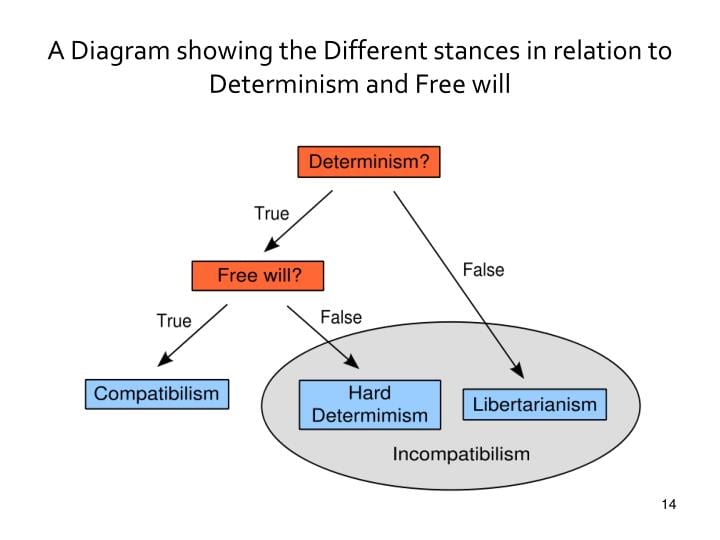
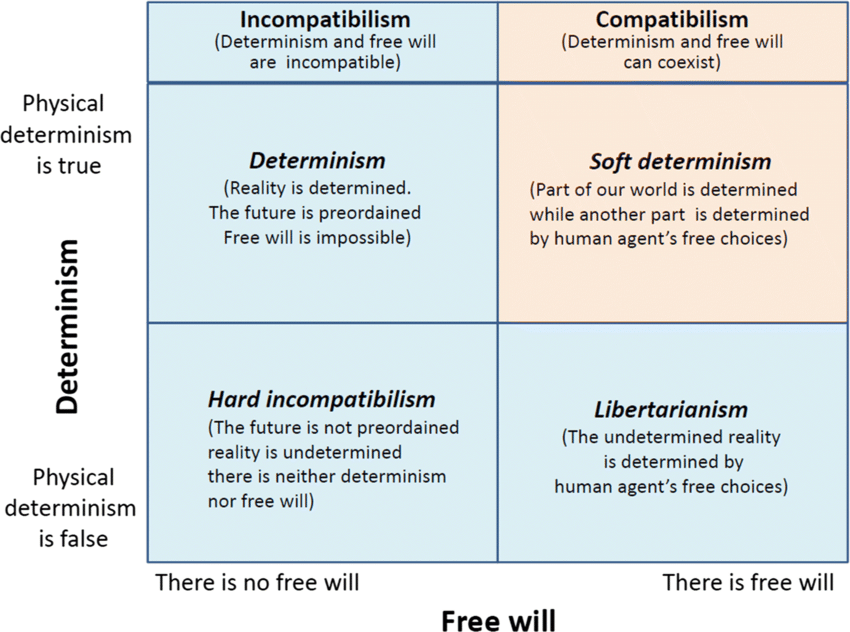
1. Hard Determinism (Incompatibilism)
-
Thesis: Determinism is true, and free will does not exist.
-
Key Arguments:
- Causal Determinism: Every event, including human actions, is determined by preceding events and natural laws.
- Moral Responsibility: If actions are predetermined, individuals cannot be held morally responsible.
-
Notable Philosophers:
2. Libertarianism (Incompatibilism)
-
Thesis: Free will exists, and determinism is false.
-
Key Arguments:
- Agent Causation: Individuals can initiate actions independent of deterministic causes.
- Moral Responsibility: Free will is necessary for genuine moral accountability.
-
Notable Philosophers:
- Peter van Inwagen
- Roderick Chisholm
- Robert Kane(Stanford Encyclopedia of Philosophy, Wikipedia, Wikipedia)
3. Compatibilism (Soft Determinism)
-
Thesis: Free will and determinism are compatible.
-
Key Arguments:
- Freedom as Volition: Free will is the ability to act according to one’s desires and intentions, even if those desires are determined.
- Moral Responsibility: Individuals can be held accountable if their actions align with their internal states, regardless of determinism.
-
Notable Philosophers:
- Thomas Hobbes
- David Hume
- Daniel Dennett
- Harry Frankfurt(Wikipedia)
4. Hard Incompatibilism
-
Thesis: Free will is incompatible with both determinism and indeterminism; thus, free will does not exist.
-
Key Arguments:
- Randomness Problem: Indeterminism introduces randomness, which undermines control and responsibility.
- Determinism Problem: Determinism precludes alternative possibilities, negating free will.
-
Notable Philosophers:
- Derk Pereboom(Wikipedia, The New Yorker)
🧠 Comparative Table of Philosophers and Their Positions
| Philosopher | Position | Key Contributions |
|---|---|---|
| Baron d’Holbach | Hard Determinism | Advocated for a mechanistic view of human behavior, denying free will. |
| Ted Honderich | Hard Determinism | Explored the implications of determinism on consciousness and moral responsibility. |
| Galen Strawson | Hard Determinism | Argued that true moral responsibility is impossible due to the lack of ultimate control. |
| Peter van Inwagen | Libertarianism | Developed the “Consequence Argument” against compatibilism. |
| Roderick Chisholm | Libertarianism | Introduced the concept of agent causation to support free will. |
| Robert Kane | Libertarianism | Proposed that indeterminism is necessary for free will and moral responsibility. |
| Thomas Hobbes | Compatibilism | Defined freedom as the absence of external impediments to action. |
| David Hume | Compatibilism | Suggested that free will is compatible with determinism through internal motivations. |
| Daniel Dennett | Compatibilism | Argued for a naturalistic understanding of free will within a deterministic framework. |
| Harry Frankfurt | Compatibilism | Presented cases challenging the principle that moral responsibility requires alternative possibilities. |
| Derk Pereboom | Hard Incompatibilism | Contended that neither determinism nor indeterminism allows for free will. |
🔄 Key Arguments and Counterarguments
Hard Determinism
- Argument: If determinism is true, every action is the result of preceding causes; thus, free will is an illusion.
- Counterargument: Compatibilists argue that freedom can exist as the ability to act according to one’s motivations, even if those motivations are determined.(Wikipedia)
Libertarianism
- Argument: Free will requires that individuals can choose differently in identical situations, which is only possible if determinism is false.
- Counterargument: Critics claim that introducing indeterminism leads to randomness, which undermines control and responsibility.
Compatibilism
- Argument: Free will is the capacity to act in accordance with one’s desires and reasoning, which can exist even in a deterministic framework.
- Counterargument: Incompatibilists argue that if actions are predetermined, individuals lack genuine freedom to choose otherwise.
Hard Incompatibilism
- Argument: Both determinism and indeterminism fail to provide the control necessary for free will; therefore, free will does not exist.
- Counterargument: Some suggest that redefining free will or focusing on practical implications can preserve meaningful discussions about responsibility.(Wikipedia)
📌 Conclusion
The free will versus determinism debate presents complex challenges, with each position offering distinct perspectives on human agency and moral responsibility. While hard determinists and hard incompatibilists deny the existence of free will, libertarians and compatibilists offer frameworks to reconcile human freedom with the nature of the universe. The discussion continues to evolve, incorporating insights from philosophy, neuroscience, and physics.
For a visual and accessible overview of these concepts, you might find the following video helpful:
Determinism vs Free Will: Crash Course Philosophy #24