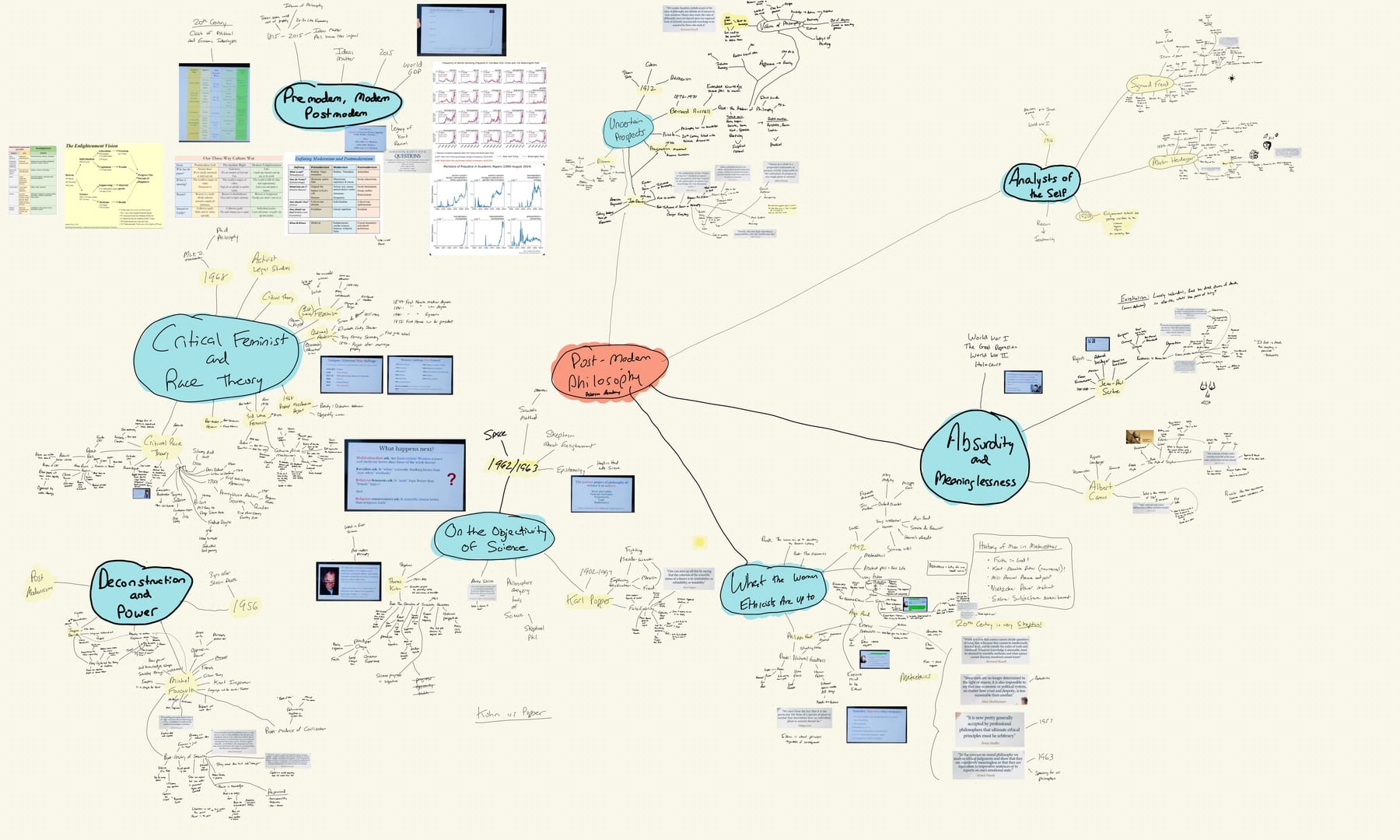
Here’s a structured bullet point breakdown of your mind map on Post-Modern Philosophy, following the visual clusters and connections:
Summary
1. Uncertain Prospects
The lecture provides an introduction to postmodern philosophy, beginning with the year 1912 as a symbolic starting point, highlighting significant cultural and historical events, such as the Titanic sinking, the rise of Cubism, and revolutionary splits in Russia. These events reflect uncertainty, fragmentation, and revolutionary changes shaping the philosophical landscape of the early 20th century.
Bertrand Russell’s work, The Problems of Philosophy (1912), exemplifies the skepticism and uncertainty of philosophy during this period. Russell emphasizes a philosophical heritage rooted in skepticism and rationalism, identifying influential thinkers such as Plato, Descartes, Spinoza, Leibniz, Berkeley, Hume, and Kant. Notably, Aristotle, Bacon, and Locke—philosophers oriented toward empirical, practical philosophy—are excluded from his recommended list, indicating Russell’s preference for abstract, rationalistic traditions.
Russell explores philosophical problems such as the distinction between appearance and reality, the uncertainty of matter’s existence, limits of induction, and skepticism about a priori knowledge. He concludes that philosophy provides no definite knowledge or practical guidance. Philosophy’s value lies exclusively in the intellectual realm, expanding the mind by questioning certainty, challenging dogmatism, and liberating individuals from narrow, practical concerns. Philosophy, according to Russell, helps people escape petty personal interests and confront universal, timeless questions without yielding practical answers or certainties.
In contrast, American philosopher John Dewey presents pragmatism, a philosophy emphasizing practical outcomes, real-world problem-solving, and adaptability. Dewey was influenced significantly by Darwin’s evolutionary theory, published in On the Origin of Species (1859). Darwin’s idea of evolution dramatically shifted philosophical thought away from fixed, eternal truths toward a dynamic, evolving view of reality. Dewey argues that Darwin’s insights undermine traditional notions of teleology—the idea that life and the universe have predetermined goals or purposes set by a divine or transcendent intelligence.
According to Dewey, Darwinian theory eliminates the need for absolute origins and purposes, shifting attention toward specific, practical problems and immediate solutions. Dewey criticizes traditional philosophical and religious thought, viewing them as conservative, backward-looking, and resistant to change. He argues that new ideas and innovations come not from religious thought but from scientific and practical approaches to understanding the world.
With Darwin’s evolutionary thinking, the world is perceived as constantly changing without any inherent direction or purpose. This rejects the traditional teleological perspective that views changes as indicative of imperfection or decay from an ideal state. Instead, Dewey emphasizes adapting to changing circumstances, fostering practical problem-solving, and abandoning absolute truths in favor of pragmatism and experimentation. Human beings must take responsibility for creating their own purposes and goals, rather than relying on divine or metaphysical guidance.
Despite apparent differences, Russell and Dewey share significant conclusions. Both philosophers discard the possibility of absolute knowledge, certainty, and fixed truths. Russell retreats into abstract intellectual contemplation, emphasizing philosophy’s indirect intellectual value. Dewey, in contrast, moves toward pragmatic, practical problem-solving, emphasizing real-world results. Yet both ultimately converge in their rejection of traditional philosophical certainties, setting the stage for the broader postmodern philosophical perspective.
Thus, early 20th-century philosophy starts with skepticism, uncertainty, and the rejection of absolute knowledge and eternal truths, opening philosophical inquiry toward practical, changing conditions, or retreating into abstract contemplation.
2. The Analysts of the Self
Overview
The lecture explores the crisis of philosophy and human self-understanding in the wake of World War I, focusing on two pivotal 20th-century thinkers—Sigmund Freud and Martin Heidegger. Both responded to the devastation of the war by challenging Enlightenment ideals of reason, progress, and human perfectibility. Freud presented a bleak vision of human nature grounded in instinctual aggression and sexuality, while Heidegger argued for a radical reorientation of philosophy away from rationalism and toward an emotional, experiential engagement with “Being” and “Nothing.”
Historical Context: World War I as a Turning Point
- The Great War shattered Europe’s belief in moral and civilizational progress that had prevailed since 1815, when the Napoleonic Wars ended.
- Nearly a century of relative peace, coupled with progress in science, trade, women’s rights, and abolition, had fostered illusions of inevitable improvement.
- The catastrophic slaughter, exemplified by 650,000 casualties at the Battle of the Somme, revealed the fragility of these ideals and forced intellectuals to reassess human nature and the foundations of civilization.
Freud: Human Nature and Civilization
Human Instincts and Aggression
- Drawing from Civilization and Its Discontents (1930), Freud claimed that humans are not gentle beings seeking love but apex predators whose instincts center on aggression and sexuality.
- Aggression manifests in exploitation, enslavement, rape, theft, humiliation, torture, and murder—desires that persist despite civilization’s restraining mechanisms.
- Civilization represses these instincts through parental discipline, education, and social norms, forcing desires into the unconscious. This repression fosters neuroses and psychological distress.
The Structure of the Psyche - Id: The unconscious reservoir of instinctual drives—primarily aggression and sexuality—demanding immediate satisfaction.
- Ego: The conscious self that mediates between id, reality, and social constraints, suppressing instincts when unsafe or socially impermissible.
- Superego: Internalized societal norms and parental authority, further repressing instincts.
- Because repression is deeply internalized, people often remain unaware of their true desires, which emerge in dreams, slips of the tongue, hallucinations, or under hypnosis and drugs—techniques Freud used to access the unconscious.
Civilization as Repression and Palliative Illusion - Freud viewed civilization as a fragile construct for managing instinctual violence.
- Despite Enlightenment hopes, rationality and progress are weak against humanity’s irrational drives, ensuring recurring conflict and war.
- To endure life’s pain and inevitable death, people rely on “palliative measures”:
- Art: Escaping reality by creating imaginative worlds.
- Science: Retreating into ordered, controlled environments that offer the illusion of mastery.
- Religion: A substitute for infantile dependence, projecting God as a protective father figure to compensate for the hardships and finality of life.
- While Freud regarded religion as a childish illusion, he acknowledged its necessity for the majority, as few can face life independently through art or science.
Freud on Religion and the “Oceanic Feeling”
- Freud analyzed a claim by a friend that religion stems from a “sensation of eternity,” a limitless, unbounded “oceanic feeling” of unity with the universe.
- Freud admitted the feeling may be real but rejected its religious interpretation, offering a developmental explanation:
- Infants initially experience no separation between self and world, living in undifferentiated unity.
- Mature adults develop a distinct, autonomous ego, but some retain elements of this infantile state, seeking parental (or divine) protection.
- Religion satisfies this lingering dependence, with God as the ultimate father figure.
- While Freud considered outgrowing religion an ideal, he believed most humans lack the psychological strength to do so.
Heidegger: Beyond Enlightenment Rationalism
Post-War Disillusionment and Spengler’s Influence
- Germany’s defeat in World War I devastated Heidegger, who, like many Germans, saw it as a sign of cultural decline.
- Influenced by Oswald Spengler’s The Decline of the West (1918), which portrayed civilizations as organic entities destined to rise and fall, Heidegger interpreted the war as a signal of not just German decline, but the exhaustion of a 2,000-year philosophical tradition originating with Plato and Aristotle.
The “Destruktion” of Greek Humanism - Heidegger argued that the Greek exaltation of human reason, agency, and mastery over the world had run its course.
- Reality (“Being”) now “claims” humanity, demanding sacrifice rather than exploitation. Human projects of progress and rational control must give way to a deeper attunement to Being.
Rejection of Rationality: Toward Being and Nothing - In Being and Time (1927) and his 1929 lecture What is Metaphysics?, Heidegger rejected Enlightenment rationalism and logic, favoring an emotional, experiential approach.
- He questioned science’s avoidance of metaphysics, arguing that science depends on unexamined metaphysical foundations and cannot escape engaging with “nothing.”
- Through rhetorical emphasis on “beings and nothing,” Heidegger suggested that exploring “nothing” requires abandoning logic and engaging with moods and emotions.
Boredom, Anxiety, and the Revelation of Nothing - Heidegger identified profound boredom as a gateway to metaphysical insight:
- In boredom, we disengage from specific beings, lose interest in ourselves, and enter a state of “nothing in particular.”
- This leads to anxiety—a generalized, objectless unease distinct from fear—which dissolves individuality and reveals the “nothing.”
- Embracing these moods allows access to truths about Being beyond rational comprehension.
- Drawing on Hegel, Heidegger claimed that “pure being and pure nothing are the same,” an insight accessible only through non-rational experience.
Broader Philosophical Shift
- By the late 1920s, represented by Freud’s Civilization and Its Discontents (1930) and Heidegger’s Being and Time (1927) and lectures, major strands of philosophy had shifted away from Enlightenment ideals.
- Both thinkers emphasized the dominance of irrational forces—whether biological drives or existential moods—over reason.
- Freud captured this ethos with his claim: “The irrational forces in man’s nature are so strong that the rational forces have little chance of success against them.”
- Heidegger echoed it, asserting, “Thinking begins only when we have come to know that reason, glorified for centuries, is the most stiff-necked adversary of thought.”
3. Absurdity and Meaninglessness?
Historical and Philosophical Context: Absurdity and Meaninglessness
- The lecture situates existentialism within the cataclysmic events of the early 20th century, particularly World War II and the Holocaust.
- The Wannsee Conference (1942) and Auschwitz-Birkenau epitomize the Holocaust’s systematic, industrial-scale extermination of Jews, Roma, and others deemed undesirable by the Nazis.
- For intellectuals like Jean-Paul Sartre (1905–1980) and Albert Camus (1913–1960), who grew up amid World War I, the Great Depression, World War II, and revelations of the Holocaust, these events destroyed confidence in humanity’s moral progress and rational order.
- Camus captured the despair: “Something in us has been destroyed by the spectacle of the years just past… the eternal confidence of man… has just ended.”
- These events prompted deep questions about theodicy (how a good, omnipotent God could allow such horrors) and human purpose in an apparently indifferent, brutal world.
Sartre: Existence, Freedom, and Responsibility
Influence and Departure from Heidegger
- Sartre, influenced by Heidegger’s Being and Time (1927), adopted the existentialist focus on being and nothingness but diverged in two ways:
- Existence Precedes Essence: Sartre’s central claim, contrasting both religious conceptions of humanity (where God creates humans with predefined essence) and Heidegger’s emphasis on sacrificing humanity for Being.
- Humanism: Sartre centered human beings as agents of meaning-making, defending existentialism as a philosophy of empowerment, not despair.
Existence Precedes Essence
- Using the metaphor of a paper knife (crafted according to a pre-existing conception), Sartre contrasts humans:
- Tools and traditionally conceived humans have essence before existence (designed by an artisan or God).
- Humans in Sartre’s atheistic existentialism exist first as pure potential and must define themselves through choices and commitments.
- There is no predetermined purpose or nature; “Man is nothing else but that which he makes of himself.”
Freedom and “Condemnation to be Free”
- Without divine or natural moral laws, humans must choose and create values, bearing total responsibility for themselves.
- This radical freedom produces anguish, abandonment, and despair:
- Anguish: Realizing choices implicitly legislate for all humanity (a puzzling universalization Sartre insists upon).
- Abandonment: The death or uncertainty of God leaves humans alone in a value-less world.
- Despair: No guarantees that choices are “correct,” yet action is unavoidable.
- Sartre emphasizes that shirking responsibility—blaming God, society, or circumstance—is “bad faith.” Authenticity requires embracing freedom and responsibility even amid uncertainty.
Individual vs. Collective Dimension - Sartre universalizes responsibility: every choice creates an image of what humanity ought to be, as if legislating for all.
- This tension between radical individualism and implicit collectivism complicates existentialist ethics.
- Despite this, Sartre’s later politics veered toward far-left collectivism, aligning with Marxist and revolutionary movements, raising questions about the coherence between his philosophy and politics.
Camus: Absurdity, Rebellion, and Joy
The Myth of Sisyphus (1942)
- Camus uses the Greek myth of Sisyphus (condemned to roll a boulder uphill only for it to roll back down endlessly) as a metaphor for human existence.
- Sisyphus embodies futile, repetitive labor, conscious of its pointlessness—a punishment more dreadful than physical suffering.
- Modern workers mirror this condition: endless routines, ambitions, and achievements ultimately erased by death and obscurity.
Responding to the Absurd - The absurd arises from the conflict between humanity’s search for meaning and the universe’s indifference.
- Camus rejects both religious consolation and nihilistic despair, urging acceptance of life’s futility with defiant affirmation.
- Humans cannot change fate, but they can control their attitude:
- Embracing existence as “my rock, my fate” allows for dignity and even joy.
- Camus concludes: “One must imagine Sisyphus happy.” This is both a counsel of resilience and a willed refusal to succumb to despair.
The Question of Suicide
- In another essay, Camus reframes the meaning-of-life question negatively: “There is but one truly serious philosophical problem, and that is suicide.”
- Choosing not to commit suicide implies affirming life through self-chosen commitments, even without ultimate meaning.
Shared Existentialist Themes
- Rejection of Preordained Meaning: Both deny intrinsic purposes given by God or nature; meaning is humanly created.
- Centrality of Choice and Commitment: Existence as potential becomes essence through deliberate choices.
- Confronting the Absurd: Life’s futility is acknowledged, but resignation is rejected in favor of active engagement.
- Emotional Depth over Rational Certainty: Both emphasize lived experience, mood, and resilience over abstract reason.
- Individual vs. Collective Tension: Though framed as philosophies of radical freedom, both Sartre and Camus engaged in collectivist politics, a tension left unresolved.
4. What the Women Ethicists Are Up To
Historical and Intellectual Context: Women Ethicists in the 1940s–1960s
- Timeframe: Focus on 1942, during World War II, when a remarkable group of women philosophers began shaping mid-20th-century thought.
- Key Figures:
- Oxford Quartet: Elizabeth Anscombe, Philippa Foot, Mary Midgley, Iris Murdoch – studying at Oxford, forging connections and challenging prevailing moral theories.
- Expatriate Voices: Ayn Rand (in America after leaving Soviet Russia), Simone de Beauvoir (in France, shifting to full-time writing), Hannah Arendt (fleeing Nazi Germany), Simone Weil (ailing, shortly before her death in 1943).
- Cultural Moment: These women integrated abstract philosophy with literature, culture, and lived experience, reviving debates on ethics at a time when mainstream philosophy largely dismissed moral discourse as subjective, emotive, or meaningless.
The Dominant Philosophical Climate They Confronted
- By the early 20th century, leading philosophers regarded ethics as non-cognitive, arbitrary, and disconnected from reason:
- Bertrand Russell: Science can’t decide values; value judgments are “outside the realm of truth and falsehood.”
- Rudolf Carnap: Value statements are “entirely meaningless”—not true, false, or conceptually valid.
- Max Horkheimer: Since reason can’t determine ends, no system (however despotic) can be called more reasonable than another.
- Brian Medlin (1957) and Ernest Moody (1963): Most professional philosophers accepted that ultimate ethical principles are arbitrary, moral claims are equivalent to emotions or commands, and historical moral theories are undependable guides to life.
This intellectual backdrop left ethics viewed as either subjective preference, emotional expression, or social convention, with no grounding in reality.
Ayn Rand: Naturalizing and Objectifying Ethics
Central Project: Rebuild ethics as a scientific, reality-based discipline, rejecting both divine command and subjectivism.
- Rand grounds values in facts about living organisms, beginning with the fundamental alternative of life or death.
- Values are relational facts:
- Not intrinsic properties of objects alone, nor mere subjective preferences.
- Arise from the relationship between an organism’s needs and the environmental conditions/resourcesthat sustain life.
- Ethical judgments are tied to action and purpose: “Value is that which one acts to gain and/or keep,” presupposing alternatives (choices) and an entity capable of goal-directed action.
Core Principles:
- Life as the Standard of Value: What furthers life is good; what threatens it is bad.
- Ethics as a Science: Uses biology as its “mother science,” treating organisms (including humans) as entities with needs, capacities, and survival-driven goals.
- Human Distinctiveness: Our primary survival tool is reason. Unlike other animals, human beings must volitionally develop knowledge, conceptualize values, and act deliberately to flourish.
- Rejection of Hume’s Is-Ought Divide: Rand argues that facts about organisms inherently generate “oughts”: “The fact that a living entity is, determines what it ought to do.”
- Anti-Relativism: Values are objective necessities, not whims or divine decrees.
Philippa Foot: Natural Goodness and Virtue Ethics
Focus: Ground moral evaluation in human nature and flourishing, reviving an Aristotelian, biological frameworkfor ethics.
- Moral evaluation (“good” or “defective”) depends on the essential features of a species’ life:
- Plants need water, birds build nests, wolves hunt in packs; their success or failure to fulfill species-specific functions grounds evaluative judgments.
- Likewise, humans—given their capacities and needs—can be judged good or defective in how they develop, sustain, and reproduce their form of life.
- Introduces flourishing as a normative standard (especially when “good” and “bad” seem anthropocentric).
- Human virtues (honesty, courage, justice, etc.) are functional traits necessary for human flourishing, akin to a bee’s sting serving its survival.
- For example, guilt when lying acts like a “sting,” encouraging honesty because truth-telling sustains cooperative, rational human life.
- Reason as a Human Function: Humans act not merely on instincts but on recognized reasons, abstract standards, and long-term considerations.
- Virtue and flourishing parallel the structure of biological evaluation in other species, though more conceptually complex.
Shared Themes and Aristotelian Roots
- Both Rand and Foot reject the fact-value dichotomy and the view that morality is arbitrary or non-cognitive.
- Both draw heavily on Aristotle’s naturalism, updated with modern biology and psychology, seeing ethics as continuous with the sciences.
- They emphasize:
- Objective needs, capacities, and environmental conditions as the basis for value.
- Species-specific flourishing as the measure of good and bad.
- Integration of principles, consequences, resources, actions, and character traits for a full ethical theory.
The Debate Reignited
By the 1960s, thanks to thinkers like Rand and Foot, philosophy had new objectivist and naturalist responses to:
- Subjectivism (values as whims/emotions),
- Non-cognitivism (ethics as non-rational),
- Relativism (all moral systems equally groundless).
They reframed ethics as a scientific, fact-based discipline—though still debated and developed within professional philosophy.
5. On the Objectivity of Science
Historical Context: The Objectivity of Science (1962–1963)
- Backdrop:
- Early 1960s marked by extraordinary scientific and technological achievements: human spaceflight (Yuri Gagarin, John Glenn) fueled by Cold War rivalry.
- Science seen as humanity’s triumph, yet philosophers debated whether science was objective, progressive, and truth-seeking—or just another subjective, social practice.
- Philosophical Divide:
- Some upheld the Enlightenment vision of science as progressive, rational, and world-transforming.
- Others, increasingly dominant, questioned science’s claims to objectivity, truth, and progress, moving toward skepticism and relativism.
Karl Popper: Defending Science Through Falsifiability (1963)
Goal: Distinguish science from pseudoscience and protect science’s credibility amid rising skepticism.
- Core Principle – Falsifiability:
- A theory is scientific if it can be tested and potentially refuted by observation or experiment.
- Science is not defined by certainty, nor by truth, but by willingness to risk being proven wrong.
- Example: Einstein’s 1919 solar eclipse prediction—a risky test that could confirm or refute his theory.
- Contrast with Pseudoscience:
- Marxism and Freudianism (Freud & Adler): Seen as pseudoscientific because they explain everything, interpret every event as confirmation, and avoid risky tests.
- Astrology: Empirical data is used, but its claims are too elastic and unfalsifiable.
- Scientific Method as Risk-Taking:
- Genuine science issues precise prohibitions—statements about what should not happen.
- Confirmation matters only when based on risky predictions.
- Scientists must train themselves to seek disconfirmation, not just confirmation, and avoid ad hoc adjustments to save failed theories.
- Science as an Objective Practice:
- Unlike faith, politics, or pseudoscience, science’s defining trait is its commitment to testability and self-correction.
- Falsifiability, not social consensus or personal conviction, is the foundation of scientific objectivity.
Thomas Kuhn: Paradigms and the Subjectivity of Science (1962)
Goal: Reinterpret science as a historical and sociological practice rather than a purely logical or objective pursuit.
- Paradigm Concept:
- A paradigm is a shared framework—concepts, methods, norms—adopted by a scientific community.
- Paradigms shape what scientists study, how they interpret data, and what counts as a valid problem or solution.
- Science is largely communal and conservative, not individualistic or radically open-minded.
- Normal Science:
- Most scientists do “mop-up work”: solving puzzles, fitting observations into the existing paradigm, and ignoring or suppressing anomalies.
- Scientists are indoctrinated during education; they rarely question foundational assumptions.
- Paradigm Shifts as Revolutions:
- Anomalies accumulate until the old paradigm collapses.
- Adopting a new paradigm resembles a political conversion or religious conversion—a leap of faith, not an objective decision.
- Competing paradigms are incommensurable: their concepts, definitions, and standards are so different that rational comparison is impossible.
- Rejection of Progress, Truth, and Objectivity:
- Paradigm changes do not bring scientists closer to truth; they simply create new worlds for scientists.
- Scientific “progress” is subjective, a matter of preference, not objective improvement.
- Kuhn dissolves distinctions between science and other human practices (politics, religion, myth), reducing science’s privileged status.
Popper vs. Kuhn: Opposing Views on Science
| Popper (Objectivist) | Kuhn (Relativist) |
|---|---|
| Science is progressive and self-correcting. | Science is historically contingent and socially constructed. |
| Falsifiability distinguishes science from pseudoscience. | Paradigms dominate science; no objective method for choosing between them. |
| Scientists should seek risky tests and potential refutation. | Scientists do mop-up work and suppress anomalies to protect paradigms. |
| Paradigm shifts reflect evidence and rationality. | Paradigm shifts are conversion experiences, driven by faith, sociology, and psychology. |
| Science aspires to truth and objectivity. | Science offers no cumulative progress or ultimate truths. |
Implications and Postmodern Turn
- By the 1970s, post-Kuhnian philosophy of science fostered widespread skepticism about science’s special authority:
- Myth, religion, magic, and witchcraft seen as potentially no less legitimate than “Western science.”
- Critics questioned whether Eurocentric, male-dominated science is superior to non-Western or non-rational traditions.
- Religious conservatives used Kuhn to defend faith as a valid cognitive framework alongside science.
- Truth, objectivity, and progress became optional, subjective, and de-centered as guiding ideals.
6. Deconstruction and Power
Here’s a comprehensive summary of the lecture on Michel Foucault and Jacques Derrida, their core ideas of power and deconstruction, and their post-modern critique of modernity:
1. Historical Context (1956 and the Post-War Intellectual Climate)
- In 1956, three years after Stalin’s death, Nikita Khrushchev publicly admitted Stalin’s crimes—mass executions, gulags, and repression—confirming Marxism’s complicity in atrocities.
- Both Foucault and Derrida had prior sympathies with Marxism; Foucault had even joined the French Communist Party in the early 1950s before distancing himself.
- This disillusionment with authoritarian Marxism informs their philosophies, which attack traditional Western values—reason, truth, knowledge, and justice—as veils for oppressive power structures.
2. Michel Foucault: Power as the Core of Reality
- Intellectual Roots:
- Draws heavily from Nietzsche (will to power, perspectivism), Heidegger (anti-rationalism, decentering of the self), and to a degree Kant and Critical Theory (Adorno, Horkheimer).
- Rejects Enlightenment optimism, rationality, and the human subject as the center of thought.
- Power, not Man, as the Substrate:
- Inverts Francis Bacon’s “Knowledge is Power” into “Power is Knowledge.”
- Knowledge isn’t an objective pursuit; it is a manifestation of underlying power, which is the metaphysical substrate of existence.
- Individuals are not autonomous agents wielding power but are constructed and used by power as it manifests through them.
- Power is omnipresent, local, unstable, and always in struggle, with stronger centers attempting to co-opt weaker ones.
3. Foucault on Sexuality and Discourse
- Challenges the “Victorian Hypothesis” (the idea that sexuality was repressed and silenced).
- Argues modern society has not silenced sex but proliferated discourse about it—transforming raw sexual energy into regulated, categorized, and controlled speech.
- Sexuality is studied, medicalized, and legislated not for liberation but to discipline bodies and enforce norms for a power agenda.
- Sexuality as a Power Mechanism:
- From 1600 onward, coinciding with capitalism, sexuality is harnessed like labor—organized, categorized (normal vs. perverse), and controlled.
- Psychiatry, law, and science classify and pathologize deviations (homosexuality, pederasty, hermaphroditism) to enforce social order.
- Modern society is “perverse” not because it represses sex, but because it obsessively multiplies discoursesabout it to manage and exploit desire.
- Goal:
- Not liberation—Foucault sees all sexual regimes as power regimes.
- The task is to unmask the machinery of power and knowledge behind sexual norms so it can be contested or replaced.
4. Derrida: Deconstruction and the Critique of Reason
- Language and Text as Traps:
- Argues that all human thought is confined within linguistic systems that predate and shape individuals.
- Grammar, semantics, and meaning are not universal or tied to objective reality—they are social constructs.
- “There is nothing outside the text”: we cannot step outside language to reach objective truth; our perceptions and reasoning are entirely mediated by texts and symbols.
- Deconstruction as a Method:
- Uses contradictions, ambiguities, and dialectics (influenced by Hegel, Nietzsche, Heidegger) to destabilize meaning.
- Any text can be unraveled to reveal it is self-undermining or meaningless; logic and consistency are tools of the dominant power structure and can be subverted.
- Political Turn:
- Late in life, Derrida revealed deconstruction was always, for him, a Marxist-inspired revolutionary tool(Specters of Marx).
- By dismantling Western linguistic and conceptual systems, deconstruction destabilizes the frameworks upholding capitalism, rationalism, and liberalism.
5. Derrida vs. Foucault on Madness and Reason
- Both target René Descartes, seen as a founder of modern rationalism and the Enlightenment project.
- Descartes’ Meditations excludes the insane to secure rational certainty (“Cogito, ergo sum”), marginalizing unreason as unworthy of philosophical dignity.
- Foucault (Madness and Civilization) critiques this as a power play: reason asserts dominance by ostracizing madness.
- Derrida critiques Foucault: argues that writing a history of “madness itself” is nearly impossible because all available language is the language of reason, the very structure that silences the insane.
- Proposes using reason’s own tools (deconstruction) to undermine itself from within and allow madness a “voice,” even if that voice is fractured and paradoxical.
6. Shared Post-Modern Project
- Both philosophers aim to subvert the modern Western project—its commitments to reason, truth, objectivity, progress, science, and liberalism.
- They target foundational binaries:
- Reason vs. Madness (to erode rationalist epistemology).
- Normal vs. Perverse Sexuality (to undermine social and moral order).
- Both frame philosophy as political struggle: language, reason, and “knowledge” are weapons of power, not neutral tools.
- Post-modernity, as they envision it, does not offer liberation or new universals but a continual play of power and discourse, where every regime is temporary, contingent, and contestable.
7. Critical Feminist and Race Theory
1. 1968 as a Turning Point
- The assassination of Martin Luther King Jr. symbolizes not just the loss of a civil rights leader but also a perceived death of Enlightenment liberal ideals (equal liberty, rational progress, universal human dignity).
- The lecture focuses on two legal scholars—Catherine MacKinnon (feminist theory) and figures like Derrick Bell, Richard Delgado, and Kimberlé Crenshaw (race theory)—who integrate postmodern philosophy (Foucault, Derrida) with legal activism, rejecting Enlightenment-based civil rights frameworks.
2. Evolution of Feminist Thought
- Pre-modern era: Women were legally and culturally subordinated; witch trials symbolized their oppression, grounded in superstition and metaphysics.
- First-wave feminism (18th–early 20th centuries):
- Grounded in Enlightenment liberalism—women as rational, autonomous individuals deserving equal rights (Mary Wollstonecraft, Olympe de Gouges).
- Focused on liberty, property, education, suffrage, and legal equality, mirroring the universalism applied to men.
- Achievements: property rights reforms (1848 NY), access to higher education and professions, suffrage (spreading across NW Europe and British colonies).
- Second-wave feminism (mid-20th century):
- Influenced by existentialism (Simone de Beauvoir) and Marxism.
- Less about individual liberty, more about egalitarianism, socialism, and collective struggle.
- Protest movements (e.g., 1968 Miss America protest) questioned normative standards (beauty, sexuality) as political constructs used to oppress.
- Third-wave/postmodern feminism (1970s–1990s): Catherine MacKinnon
- Rejects both Enlightenment individualism and modern egalitarianism; focuses on systemic conditioning, social determinism, and collective victimhood.
- Pornography as central case:
- Portrays women as conditioned, not autonomous—their “consent” is socially constructed by male-dominated culture.
- Argues pornography is not just speech but a performative act—it conditions men (like stimulus-response) and subordinates women in reality.
- Challenges the First Amendment as a tool protecting male power rather than free speech, reframing censorship as protecting the powerless.
- With Andrea Dworkin, proposes a legal definition: pornography as any sexually explicit material that subordinates women, calling for its censorship as a postmodern legal remedy.
3. Philosophical Themes in Critical Feminist Theory
- Shift from individual autonomy to collective identity and social conditioning.
- Sees gender relations as inherently adversarial, not cooperative.
- Rejects claims of historical progress; views supposed gains as masks for ongoing subordination.
- Embraces postmodern skepticism: subjectivity over objectivity, rejection of universal norms, focus on power structures shaping identity.
4. Evolution of Race Theories
- Early modern abolitionist/liberal tradition (1500s–1960s):
- Enlightenment thinkers and activists (Benjamin Franklin, Benjamin Rush, Wilberforce, Diderot, Jefferson, Frederick Douglass) advanced universal liberty and equality through intellectual argument, activism, legislation, and military intervention.
- Culminated in achievements like the Civil Rights Act of 1964 and Martin Luther King’s movement, emphasizing incremental progress, rational argument, and shared humanity.
- Post-1968 shift: King’s assassination galvanized a rejection of liberal civil rights ideals as failures or frauds.
- Legal scholars influenced by existentialism, Freud, Foucault, Derrida, and Frankfurt School critical theory begin developing Critical Race Theory (CRT).
5. Core Ideas of Critical Race Theory (Delgado, Crenshaw, Bell)
- Explicit rejection of the Enlightenment and liberal order:
- Equality theory, legal reasoning, rationalism, and constitutional neutrality are viewed as masks for white dominance.
- Legal Realism:
- Law is not objective but shaped by judges’ value-laden, socially conditioned biases.
- All moral values are relative; no universal norms exist.
- Property rights and formal principles serve as tools for the powerful to perpetuate subordination.
- Derrick Bell’s “Racial Realism” (1992):
- Declares racial equality is unattainable; blacks will remain a permanent subordinate caste.
- Advocates abandoning ideals like equality or liberty as goals.
- Activism should focus not on change but on harassing and resisting the dominant group (symbolized by Mrs. Biona MacDonald’s mantra: “I lives to harass white folks”), as a means of asserting dignity rather than achieving progress.
6. Shared Postmodern Traits of Critical Feminist and Race Theories
- Rejection of universalism, rationalism, and objectivity.
- Focus on power, conditioning, and collective identity over individual agency.
- View progress narratives as false “cover stories.”
- Seek to explode or deconstruct the liberal Enlightenment framework (rights, equality, neutrality) as tools of oppression.
- Philosophy and law become explicitly political weapons—not to reform but to destabilize and replace existing systems.
8. Premodern, Modern, and Postmodern
1. Core Theme: Philosophy Shapes History and Society
- Philosophy is a do-it-yourself discipline, but understanding past thinkers’ integrated systems helps individuals make informed judgments.
- Despite the stereotype of philosophers as detached, abstract, and impractical, ideas have measurable influence—shaping societies, institutions, and material progress.
- The lecture argues that the trajectory of world history—including economic, political, and social change—can be partly explained by which philosophical frameworks were adopted and institutionalized.
2. 2015 as a Focal Point
- Examines global economic and social data up to 2015:
- Economic productivity was stagnant for millennia but exploded after 1500, particularly in northwestern Europe, the Americas, and former British colonies.
- Life expectancy and wealth rose dramatically, especially in regions where modern Enlightenment ideaswere institutionalized (reason, science, individual rights, free markets).
- Contrasts regions without such revolutions (Asia, Africa until late 20th century), which lagged in progress.
3. Influence of Philosophy on Culture and Media
- Charts show a sharp rise (post-2013, peaking around 2015) in media usage of terms like racism, sexism, misogyny, transphobia, and white privilege.
- Hypothesis:
- Many journalists and editors driving these discussions were educated in the 1990s, when critical race and feminist theory (MacKinnon, Bell, Delgado, Crenshaw) dominated academia.
- These theories, grounded in postmodernism and critical theory, permeated media and popular culture decades later.
4. The Legacy of Kant and the Three Historical Eras
- Contemporary philosophy still operates, in large part, within Kant’s legacy, as noted by historians Christopher Janaway and John Passmore.
- Intellectual history is framed in three archetypal eras:
- Pre-modern (500–1500):
- Metaphysics centered on God as ultimate reality.
- Epistemology grounded in revelation and faith.
- Humans as sinful, dualistic (body and soul), non-autonomous beings.
- Hierarchical, service-oriented ethics; feudal politics.
- Modern (1500–1900):
- Natural world prioritized; knowledge via reason, senses, and science.
- Humans as autonomous, rational, self-shaping agents.
- Rise of individualism, liberal democracy, capitalism, scientific and industrial revolutions.
- Enlightenment optimism: reason leads to progress, prosperity, and freedom.
- Post-modern (1900–present):
- Skepticism toward metaphysical and epistemological certainty.
- Humans viewed as socially constructed and conditioned; groups locked in conflict.
- Power, not truth, dominates; reason itself is treated as a “meta-narrative” or tool of domination(Foucault, Lyotard).
- Emphasis on equality of groups (often via socialism) over individual liberty.
- Pre-modern (500–1500):
5. Philosophy as a Driver of Conflict and Progress
- The 20th century’s wars are framed as battles between ideologies rooted in opposing philosophical traditions:
- Liberal, individualist, capitalist democracies (John LockeLocke, Adam Smith, John Stuart Mill; rooted in British Enlightenment).
- Collectivist, authoritarian systems (Georg Wilhelm Friedrich Hegel, Karl Marx, Nietzsche; rooted in German philosophy).
- World War I, World War II, the Cold War, Korea, and Vietnam all reflect this clash of ideas embedded in nations and regimes.
6. Philosophy, Progress, and Measurable Outcomes
- Data from Gapminder and long-term economic charts illustrate:
- In 1815, even the richest nation (Britain) had ~$5,000 income per capita and ~41-year life expectancy.
- By 1915, Enlightenment nations saw incomes triple and life expectancy rise by 50%.
- By 2015, all nations had exited historical poverty; life expectancy and income more than doubled globally, with the most dramatic gains in nations that adopted Enlightenment-based frameworks.
- Suggests a direct link between the spread of modern philosophical ideas and unprecedented human progress.
7. The Postmodern Counter-Enlightenment
- Postmodern thinkers like Foucault (“Reason is the ultimate language of madness”) and Lyotard (reason as a meta-narrative masking power) explicitly reject Enlightenment reason and optimism.
- Their frameworks emphasize power struggles, skepticism, and group conflict over universal truth or harmony, influencing contemporary academic and cultural narratives.
8. Concluding Insight: Why Philosophy Matters
- Quoting Lord Bolingbroke: “History is philosophy teaching by example.”
- The ideas societies choose to live by—true or false—have profound, measurable impacts on:
- Material conditions (wealth, health, productivity).
- Political systems (liberal democracies vs. authoritarian regimes).
- Cultural narratives (media, social debates, activism).
- Philosophy is not abstract; it is the blueprint for historical and personal trajectories.
Old Summary
🟥 Central Node: Post-Modern Philosophy
(Core theme connecting all branches)
🔵 Absurdity and Meaninglessness
- Albert Camus
- The Absurd: conflict between human tendency to seek meaning and the silent universe
- Myth of Sisyphus: Embrace the absurd
- Rebellion as a response to absurdity
- Existentialism
- Meaning made, not found
- Influenced by WWII and disillusionment with Enlightenment values
- Freedom and Responsibility
- Suicide as philosophical problem
- Choosing life without appeal to objective meaning
- 20th-century context emphasized
- Collapse of faith in progress
- Displacement of metaphysical certainties
🔵 Deconstruction and Power
- Jacques Derrida
- Deconstruction: challenge binary oppositions and hierarchies in texts
- Language is unstable
- No privileged center of meaning
- Michel Foucault
- Power/Knowledge nexus
- Disciplinary societies
- Genealogy method: histories of systems (e.g., prisons, madness)
- Post-structuralism
- Distrust of grand narratives
- Truth is a function of discourse and power relations
- Critique of Enlightenment rationality
🔵 Critical Feminist and Race Theory
- Postmodern Feminism
- Judith Butler: gender as performance
- Challenges essentialist identity
- Race Theory
- Intersectionality
- Power structures and social construction of race
- Crenshaw, hooks, Davis
- Experience, identity, and standpoint theory
- Challenging objectivity in philosophy
- Relativism and situated knowledge
- Feminist epistemology
🔵 On the Objectivity of Science
- Thomas Kuhn
- Structure of Scientific Revolutions
- Paradigm shifts vs. linear progress
- Karl Popper
- Falsifiability, not verifiability
- Science as social construct?
- Science embedded in language and society
- Postmodern critique of “objectivity”
🔵 Pre-modern, Modern, Postmodern
- Comparison Table
- Truth: Divine / Reason / Contingent
- Self: Stable / Rational / Fragmented
- History: Providential / Progressive / Discontinuous
- Postmodernism
- Rejection of universal reason
- Suspicion of meta-narratives (Lyotard)
- Emphasis on difference and multiplicity
🔵 Uncertain Prospects
- Globalization & pluralism
- Loss of shared narratives
- Post-ideological society?
- Critiques of relativism
- Search for ethics after postmodernism
🔵 Analyses of the Self
- Freud
- Unconscious motives
- Nietzsche
- Will to power
- Critique of morality and truth
- Foucault
- Technologies of the self
- Self shaped by social discourse
- Postmodern View of the Self
- De-centered
- Constructed via language and power
- Fragmented rather than unified
🔵 What the Woman Ethicists Are Up To
- Focus on embodiment, care, emotion
- Alternative moral frameworks
- Feminist critiques of Kantian/autonomous ethics
- Relational autonomy
- Epistemic justice and inclusion
Transcript
1. Uncertain Prospects
Well, welcome to this course on postmodern philosophy. Our theme for this first session is Uncertain Prospects. I want to start with this year, this date, 1912, which is a significant date for philosophy and the world. Philosophy both shapes and responds to what’s going on in the world. The world of 1912 is interesting.
This is the year the Titanic sinks. A great marvel of science and technology on its maiden voyage goes down, and there’s a symbolism there beyond the devastation of life, limb, and happiness. 1912, Cubism in the art world is on the rise, an unsettling approach to art where we take the world apart and put it back together in fractured, unsettling form. This is a portrait of Picasso by one of his friends. Also in 1912, in Russia, a split, a revolutionary Marx-inspired socialist movement. And the Bolsheviks split from that movement because it is not revolutionary enough. And we know in a few short years what that will imply for Russia and its revolution.
Now, the world of philosophy, where we’re going to start, is with Bertrand Russell and a short book meant to be an introductory book called The Problems of Philosophy, published in 1912. And Russell is a world-famous philosopher already, and arguably is going to go on to become the most famous public intellectual and philosopher in the world. And as we want to do in this course, we will talk about the big picture, what’s going on in philosophy, and how philosophy is reacting to and influencing the world. But we also want to spend time with each of the important philosophers, the philosophers who develop the new arguments, the important arguments. And the best way always to do that is to go to the text and let them speak in their own words.
So let’s go to this short book, The Problems of Philosophy, published by the reputable Oxford University Press, and put things in context. Obviously, philosophy has had many, many centuries of development, and all of the major philosophers of the 20th century are going to reflect on what has happened in philosophy, what the decisive moves have been, what they are taking from earlier developments, what they are rejecting from earlier developments. Russell makes a point of that, saying, since this is a relatively introductory book, if you want more or if you want to know where this is coming from, he has his recommended list.
So these are the giants of philosophy from Russell’s perspective at the turn the 20th century. And these will be familiar names or not, depending on how much background philosophy you have. And if they are not familiar yet to you, Russell’s point will be, “After you read my book, go here for more.” So we have Plato, Descartes, Spinoza, Leibniz, Berkeley, Hume, and Kant. Now, I’ve highlighted in yellow three of the names. These are names we covered in the previous course in this series, Modern Philosophy—Descartes often argued as the founder of modern philosophy, but leaving an unintended skepticism that many philosophers after him did not seem to be able to dig their way out of.
Hume, explicitly skeptical across the board, arguing that philosophy leads to dead ends and raising even the question of whether philosophy has any point or whether we should simply set philosophy aside and go with our natural feelings in order to live one’s life. Kant, perhaps the giant of the modern philosophy era, arguing in principle, there’s a distinction between the world as it appears to us, the phenomenal world, and the real world. And there is no way for our rational minds to get from this phenomenal world as it appears to come to know reality as it really is.
Now, in blue, I highlighted the name Plato, going back to the Greeks as philosophers need to do, and Russell is signaling, if you want, again, to do serious philosophy, read Plato. Now, all of these are worthy additions to anyone’s philosophy curriculum, but it’s also worth noticing what names are not on the list. So we get Plato, with his more otherworldly direction to philosophy. We do not get Russell recommending Aristotle, with his more naturalistic, realistic, practically oriented philosophy, and that is interesting. Also, we get a series of important modern and early modern philosophers, but we do not get Francis Bacon. We do not get John Locke, also important in the more empirical, hands-on, practically oriented philosophy tradition.
Instead, what we have is a list of philosophers who are skeptical and in the more rationalist direction. Rationalist here, using it technically to mean that we think the foundations of knowledge are not to be found in the senses, in perceiving the world, but rather the mind has its own internal resources, perhaps innate ideas or innate principles that it can study on its own, independently of any empirical sources and generate knowledge. Now, with that by way of a frame, let’s have a look at Russell’s table of contents, and he marches us through having a nice descriptive chapter on each of these issues in philosophy.
What about the difference between appearance and reality? Many philosophers had made this. Kant certainly had hardened this. Can we get beyond appearance to reality? Russell is going to say no. Out there in reality, do we know and can we prove that there is matter just existing? Russell is going to say no. Can we know what that material world is like? No. Can we know that beyond the ideas that we have in our world, that there is a reality beyond this ideal realm? No. What about induction? Starting with basic discrete principles and generalizing to broader generalizations about the nature of the world? Negative with respect to that. The world of universals, a priori knowledge, there is something there, but it is going to be internal and disconnected from the rest of the world.
So we have a march through very sophisticated arguments that have been developed by philosophers over the century. At the turn of the 20th century, Russell is saying, “This is where we are.” That said, we get to the final chapter, The Value of Philosophy. What is the point of philosophy? What is the value of philosophy? It has, in some sense, this exalted reputation. But what is that exalted reputation, based on given where we think we are early in the 20th century?
So in Russell’s words, “Having now come to the end of our brief and very incomplete review of the problems of philosophy, it will be well to consider in conclusion, what is the value of philosophy?” Then he wants to immediately dismiss a certain kind of answer to this question. That what we do is we pursue knowledge because we want to know the way the world is so that we can then act successfully in the world. There should be an integration between theory and practice, knowledge and reality, and that human beings, as a certain kind of being, we pursue philosophy as a certain kind of knowledge in order to be able to exist well in the world. So knowledge leads to practicality, and that’s going to be the value of philosophy.
Russell is going to be skeptical about this. “Many men under the influence of science or of practical affairs are inclined to doubt whether philosophy is anything better than innocent but useless, trifling hair-splitting distinctions and controversies on matters concerning which knowledge is impossible.” So philosophers, head in the clouds, pointless, right, and so forth. That’s the perspective of many practical people with respect to that discipline. And often, of course, philosophers return the favor saying, “Yes, we’re doing the important abstract general truths, and you people with your hands down in the grubby world, you are beneath our dignity in some fundamental sense.”
Now, what Russell was wanting to do is to say, well, of course, we have to attend to practical affairs, but really the philosophers are more on the right here. “If the study of philosophy has any value at all for others than students of philosophy, it must be only indirectly through its effect upon the lives of those who study it.” It’s not going to be this practical, direct effect. It’s going to be something more indirect, not how you are out in the world, but something with respect to you, all by yourself. “We must first free our minds from the prejudices of what are wrongly called practical men.” Practicality is not going to be our guiding force here.
Then we have the positive statement. “It is exclusively among the goods of the mind that the value of philosophy is to be found.” There’s the practical world, there’s the world of the mind. It is in the world of the mind that you find philosophy’s value, not any connection to what’s out there. And he adds, notice the word exclusively. That’s a very strong word. It’s not that it’s good for your mind and it’s good for your action out there in the world. It is exclusively something to do with the mind. So philosophy distanced itself from those practical results.
Now, what are these goods of the mind? The usual answer is to say, well, knowledge, really important knowledge. If philosophy is about anything, it is about the quest for knowledge, and hopefully the successful quest for knowledge. Enlarge your mind, stock your mind with truth, certainties, etc. Then Russell says, well, then we have a problem. “It cannot be maintained that philosophy has had any very great measure of success in its attempts to provide definite answers to its questions.” We have lots of questions, but we don’t have any answers to them. That’s the lesson of philosophy up to my generation. If philosophy is about knowledge, then it’s not going to be valuable, because there is no such thing as knowledge.
He makes this claim very strongly. It’s not just that, well, you know, we’ve been working at these problems for a long time, and they’re really complicated, they’re really hard, but we just need to keep working at it, and eventually we’ll get these things figured out and so on. Russell wants to put a hard stop to that way of thinking. “There are many questions which, so far as we can see, must remain insoluble to the human intellect.” Can’t be solved, “unless its powers become of a quite different order from what they are now.” We have to be just a whole lot smarter than we are, in principle, in order for us to have a chance at answering any of these questions. Human beings with the capacities that we know they have right now, not solvable, not answerable, can’t do it.
So philosophy is not about success in the practical world. It has something to do with the mind, but it’s not about knowledge and acquiring knowledge in the mind. So what then is it going to be? And again, the answer suggested by philosophy—none of them are demonstrably true. No knowledge, no truth whatsoever in philosophy. “We cannot, therefore, include, as part of the value of philosophy, any definite set of answers to such questions. Hence, once more, the value of philosophy must not depend upon any supposed body of definitely ascertainable knowledge.” OK. That sounds bad. But Russell then wants to turn that into a positive.
The value of philosophy is, in fact, to be sought largely in its very uncertainty. Because what has been one of the big problems we have had as human beings? Thinking they know stuff, and becoming arrogant and domineering, and “I have the truth” or lock on the truth, and then a willingness not only just to turn myself into a jerk in social circumstances, but to try to impose my knowledge, my truth, on the rest of the world. If we can puncture those balloons, deflate those pretentious minds, then that will be a measure of progress. But beyond that, Russell wants to say there are positive values here.
“Philosophy, though unable to tell us with certainty what is the true answer to the doubts which it raises, is able to suggest many possibilities. So it enlarges our thoughts and it frees them from the tyranny of custom.” It makes your mind expanded to consider a wider range of possibilities than you probably would have thought if you’d been caught up in day-to-day life or, as he suggested here, custom —stuck in the customs of your family, your neighborhood, your village, your town, or whatever. Philosophy puts you in contact with the radically different ways of thinking about all of these questions and issues that the great minds have come up with. And that is an enlargement.
It also helps you escape this practical world, your small private world. And here, Russell has a pessimism about the prospects of individual life. The private world, your life, your social circle, your circle of interests and hobbies, right and so forth. It’s small, it’s narrow, it can be a kind of trap. Not only that, it’s not only a small one, but it’s “set in the midst of a great and powerful world which must, sooner or later, lay our private world in ruins.” There’s my world, there’s the bigger world. The big world is going to get me and just destroy me eventually. That is a fact about the world.
So how do you live knowing that? How do you live in that kind of life? “In such a life, there is no peace but a constant strife between the insistence of desire and the powerlessness of will. In one way or another, if our life is to be great and free, we must escape this prison and this strife.” That’s another value that philosophy will give to you. It will get you out of the world of conflict, the world of narrowness, the world of dogma, the world that is petty and small, but yours, and you know is ultimately going to go nowhere and connect you with something larger, greater, more eternal. Philosophical contemplation enables you to view the world impartially, not in terms of your partial interests, your partial agendas, and so forth. It’s a kind of escape from the world as it is.
You go from the self with a small S, as he highlights here, to the Self with a large S. And philosophers and others typically capitalize proper nouns in order to augment their significance. It’s a clue that we’re not talking about the individual, we’re talking about a larger kind of self that we are going to realize, perhaps a communion. Don’t want to overstate the metaphysics here, what a communion of some sort with the great minds of all time. Philosophy will give us that. Contemplated as it enlarges us, it makes us citizens not of our little village, of our little family, of our own little narrow private circle—it makes us citizens of the universe. And that’s the value of philosophy.
Thus, to sum up, this is the closing of the book, our discussion of the value of philosophy: “Philosophy is to be studied not for the sake of any definite answers to its questions.” The skeptical point. No definite answers can, as a rule, be known. At the same time, we have a puzzle because while philosophers, the great philosophers of the early 20th century, are telling us we have no knowledge, no truths, no certainty, it does seem, if we survey the world outside of philosophy, that we do indeed have a lot of knowledge, truths that are reliable, and we can put them into practice.
So if we consider, for example, the progress just in the sciences and the technology since the early modern world, the impressive developments in physics, in chemistry, in biology, in applied disciplines, metallurgy, industrial revolution, all of the technologies that have come along, based on very sophisticated philosophical and scientific workings out of the way the world works, and then using that to guide our actions successfully in the world. So how do we put this together? So if we just consider medical advances, early modern philosophy had said we can apply the experimental method not only to the universe, but also to ourselves as human beings, increasingly learn about who we are, what our identity is, how the anatomy and the physiology of the human body works, get inside and understand microbiology and the various causes of diseases.
We can do biochemistry and understand the interactions of anesthesiology with human physiology to lessen the shock of surgeries, for example. Then we can figure out, again, at a microbiological level, what microorganisms cause damage to the human body once they’re exposed to them and learn how to kill them, at the same time preserving the healthy tissue of the body. And so all of this enormous edifice of knowledge, that we are absolutely certain we need to wash our hands and sterilize instruments before we do any surgery—it’s not just a probabilistic hypothesis and we throw our hands up and don’t have any knowledge. And partly the proof of the pudding is going to be in a short period of time, a more than doubling of life expectancy. And those trends are well aware to everyone by the time we get to the early part of the 20th century.
So what are these philosophers all going on about? If we think about developments in communications and transportation, enormous railroads linking people together across thousands of miles, automobiles, air flight, electricity, telegraph, telephone, etc. So maybe, though, one way to think about this then is to say Russell represents a certain style of philosophy, a very head-in-the-clouds, rationalistic, distant from practical concerns, and maybe that approach to philosophy has reached a certain dead end. But what we need to do, perhaps, is not so much focus on maybe philosophy in general, or more particularly, that approach to philosophy, and concern ourselves first and foremost with the practical, the very thing that Russell seemed to want to distance ourselves.
And so we have a reintroduction of this concept of the pragmatic, again from the Greek. But here’s a standard definition. We’re going to deal with things sensibly, on the basis of the sense that there is a real world, and we are interested in dealing with it practically, rather than what philosophers often do—separate out their minds, separate out their theoretical considerations, and then somehow try, unsuccessfully, to get back to the real world.
So I want now to turn to another turn-of-the-century philosopher, John Dewey. He’s an American, and there’s an interesting historical connection, just as America is becoming the leading, or one of the leading, nations around the world, flexing its economic, political, and other muscle around the world, American philosophy is also coming into its own. And pragmatism is often billed as the uniquely or signal American contribution to philosophy, partly reflecting on those stereotypical attributes that we think of Americans, as very sensible, practical, can-do, get out there and get things done in an entrepreneurial way. Maybe we need a philosophy that approaches the world that way, rather than these ancient European traditions of philosophy that are head in the clouds and ultimately not able to connect to the real world.
I put John Dewey’s birth date here, 1859, because in a very nice coincidence, John Dewey was born in the same year that Charles Darwin published On the Origin of Species. 1859. What this means is that John Dewey is the first of a new generation of intellectuals born into a world shaped by serious thinking about evolution and its implications for basically everything. Evolutionary ideas had been in the air for quite a while. But once we get a Darwinian theory, a well-worked-out account, then we have to reflect upon that. And what we want to find in Dewey is the idea that obviously Darwin’s theory is rooted in biology, but it integrates a lot of data from geology and other disciplines. But the implications for this scientific theory are not confined to narrow biological understandings of what the nature of life is.
Interestingly, Darwin did not mention humans in Origin of Species, intentionally. He wanted to stay away from that hot topic. He turns to humans later in his work, but obviously everybody else says, “Wait, this has implications for humans, for what we think about religion, for about politics, for just about everything.” Dewey is one of the first-rate minds who takes up that issue. What does Darwin imply for our understanding of reality, ourselves, knowledge, and then more specifically, our philosophical conception of the world?
And work that was published in 1910 takes up precisely this issue. And what Dewey is going to do is to say, “We take these concepts of change and see them as not merely physical change, biological change, but as indicating a more elevated universal understanding of everything.” Much of philosophy has been preoccupied with the idea of, ultimately, everything, for example, came from a God, and God is conceived of as a perfect, eternal, unchanging being, that he created the world according to fixed, unchanging laws. And human beings have a certain nature, and all of the other creatures have a certain nature, that is fixed, and moral principles that are then laid upon us that are also themselves, certain absolute and fixed.
And that tradition of philosophy is deeply rooted, particularly in the religious schools of philosophy. But then if we carry that over even to the more secular, they don’t believe perhaps in a personal God or a deity that has a personality in any sort, s o we have a more perhaps Platonic understanding of the world, as just Being, with a capital B. But we also are thinking of the world in terms of abstract forms, universal principles, unchanging truths. What Dewey is going to argue—that Darwin changes everything. He’s focusing on biology, but we see the implications of this shift in biological thinking, how we think about species in particular to everything, away from the fixed, the eternal, to the changing and the evolving. And philosophy needs to capture that language.
“The publication of Origin of Species marked an epoch. The conceptions that had reigned in the philosophy of nature and knowledge for 2,000 years”—let’s pause on that timeline here. So 1900, 2000 years takes us back to 100 BCE. So this is Roman Republic on its way to becoming Roman Imperial. This is just before the lifetime of Jesus and the changes of religion there. The Hellenistic schools of Greek philosophy, many of them are circulating widely in the now Roman Empire. And all of the main moves have largely been worked out. And what Dewey is going to argue is that, common to all of them, nonetheless, are a certain shared principles, shared set of principles, sometimes explicit, sometimes implicit. Those are the ones we need to bring to light.
“The conceptions that had become, rather, the familiar furniture of the mind rested on the assumption of the superiority of the fixed and the final. They rested upon treating change and origins as signs of defect and unreality.” If something is perfect, it doesn’t need to change. If it changes, it can only be for the worst, from a state of perfection. Then when we look at changes in the natural world, of course, many of them are going from a relatively healthy state when you’re a young adult, to change for the worse, for the worse, for the worse, and so on. Wouldn’t it be nice if we could be immortal? Then in cognitive, wouldn’t it be nice if we have fixed and absolute truths? Wouldn’t it be nice if there were a perfect being overseeing all of the world and governing it? That’s the ideal. This world is an imperfect world of change and imperfection and corruption and so forth, and we deal with it, but we see it as a lesser order.
“Origin of Species introduced a mode of thinking.” So it’s not going to be the specific doctrines about biology and geology and species and their formation. It’s how we think about the world is impacted by Darwin. “In the end was bound to transform the logic of knowledge and hence the treatment of morals, politics, and religion.” This is, obviously there was a huge religious controversy. “You’re just saying we’re a bunch of monkeys and no better than the apes,” and so forth. Darwin says, “Yes, OK, that’s obviously an issue, how we have to grapple with it, but that’s not the deepest point. That’s not the true, the true controversy.”
As a modern, Dewey now is also rather suspicious of the religious mindset. And he’s taking the evolution of 2,000 years of thinking and the experience of religious thinking and the tradition of modern philosophy questioning increasingly all of the religious claims to truth—that there is a God, that we know his nature, that we can rest on his authority, epistemologically believing things on faith, and so forth—all of the social institutions based on religion are increasingly questioned until we get to religion, fighting a series of rear-guard actions against the onslaught of modern philosophy and modern science, and becoming increasingly emotionalist in its reaction to yet another scientific claim that’s going to come along and put another dagger in the heart of the hopes of religious aspiration.
Religious considerations lent fervor to the controversy, but they did not provoke it. A general claim here about the nature of religion from Dewey. “Religious emotions are not creative, but conservative. They attach themselves readily to the current view of the world and consecrate it.” That’s an interesting claim for a philosopher to make. He’s saying new ideas never come from religion. They come from something outside of religion. Then once they win the day, so to speak, religious people eventually make their peace with it, and then they will, in many cases, co-opt it and then put their stamp of religious approval on it. They will consecrate it, but they are never generative. Religion is an essentially conservative and after-the-fact, emotion-based way of thinking.
And then this is an interesting claim we can check independently for ourselves at another time. “There is not, I think, an instance of any large idea about the world being independently generated by religion.” So religion is old, it’s after-the-fact, it’s conservative. We’re going to set it aside. The new ideas, the new impetuses, are going to come from other sources. Now, this concept of a species, which is fundamental to modern biology, what Dewey now wants to say is, we need to understand what has happened to this word, because in many cases, philosophical debates get obscured by people who are using a similar vocabulary but mean something different by it. They talk past each other.
And so the core concept here is going to be the word species. He says the Greeks came up with it first. Aristotle is a great philosopher, and of his 40 or so books that we know, something like 30 of them were devoted to biology, empirical biology, taxonomical schemes, function analyses of all of the different organs of the life forms that he was studying. And so it’s going to be Greek biology, especially as initiated by Aristotle, that is fundamental here. “The Greek formulation of the aim and standard of knowledge, which in the course of time, embodied in the word species.” And what did they mean by a species? And that’s what this point is.
Well, obviously, if we look at living things, they differ from non-living things. Non-living things kind of just are what they are until something just comes along and obliterates them. You have a rock, it’s a rock, and then you could smash the rock, and then the rock goes out of existence. But the rock doesn’t really change. It doesn’t grow or shrink. It doesn’t go through developmental stages from perhaps an embryo status to being a young infant to a youth to adult form and so forth. But all living things do go through this. There is a very interesting change process that biology is uniquely going to study.
“There are changes in the living things. They are orderly and they are cumulative, and they tend constantly in one direction.” So you take a male and a female human being. They have sex. They give birth in a regular fashion, not to a banana milkshake or to a baby elephant. They give birth to an infant human being, and it has its own developmental life course. It’s cumulative. Its body grows in stature and in power, and the child, so to speak, is the father of the man. It’s ultimately going in a certain direction, toward a full mature human life form, and then into decline and decay. There is a natural progression built into life, and each life form has its own. So there’s the human species, and there are the other species, and this is what we are studying.
But when we look at all such organisms, there is this additional concept of a telos, an end, or a telos, depending on the pronunciation here. There is a final form. If you take a seed of a given kind of plant, it has an end toward which it is growing. It’s going to grow into a mature plant of a certain point, and then it’s going to reproduce itself in some way, and that is its purpose or its end or its function in life. The same thing holds for human beings. But we have this notion of, then, all of nature, every species in it, has its own identity and its change processes, but they are fixed for the species, and they all go toward a given end.
Then in many cases, the Greek philosophers would generalize that to all of reality. It has its necessary changing processes toward an ultimate end. The whole world is teleological and all of the individual species in it are teleological. “Aristotle gave the name eidos, and the term the scholastics translated that into is a species.” Then what we have is this generalization that comes down. It can be in religious form, maybe that God has these eidos in his mind, and he makes all of the world according to certain species’ nature and gives them a purpose. Perhaps it’s going to be in Platonic form, where there are these general ideas up in another realm. They form the existence of particular things that have their own particular trajectory. And the same thing in Aristotelian form, so we find this in many forms.
Nature as a whole is a progressive realization of a purpose, strictly comparable to the realization of purpose in any plant or animal. And that this is precisely what Darwin is going to overthrow decisively by 1859. Marching through our history of philosophy, the early modern world with big names—Galileo, great philosopher, philosopher of science and scientists, Descartes, great philosopher and great scientist of the early era—we see the beginnings of the change. We have all of these processes, but are they necessarily going somewhere? Is there an ultimate end to the universe? And it starts to be undermined.
So what Darwin is doing, though, two centuries after the beginning of modern philosophy, “resides the influence of Darwin upon philosophy, resides in his having conquered the phenomena of life for the principle of transition and thereby freed the new logic for the application to mind and the morals.” Darwin is the decisive transformation on that point of telos. It’s gone after Darwin. Now, the contrast here is to say, and this is the big intellectual breakthrough, because if we’re trying to understand the world, and we still are having this debate to the day, when we look at things that are extraordinarily complicated, there is a natural move that we make.
It’s so complicated. It couldn’t have arisen by just chance or random forces. There must be an intelligence behind this order and this progression. And since the universe is so complicated and so orderly on such a massive scale, only a massive mind could understand and bring into existence a plan and an order on such a massive scale. Anything that is complicated requires an intelligence that has a purpose, that has a telos to make it go the way that it’s going to go. And what Darwin then is doing is providing the first theory that says we can explain all of the complexity, complex forms of life and so forth, without an appeal to to such a being. Give us enough time, give us all of these slow changes, none of which is intentional, but what will happen is, you will have an evolution change, and it’s not going in any particular direction. The telos increasingly drops out.
So, “the design argument, or what is sometimes called the teleological argument, thus operated in two directions. Purposefulness accounted for the intelligibility of nature and the possibility of science.” Why does the lion have sharp teeth? Well, because God, when he designed the lion, made the lion a certain way and wanted it to function a certain way. If it was going to function as the predator, it was, it needed to have sharp teeth in order to be able to rip and tear on its prey. So we explain that particular thing in terms of a consciously imposed telos, or purpose, on the lion by an intelligence.
But if we then reconceive of that as, well, there are some proto lion types of beings, and the lion, a prototype of lion that has a slightly sharper tooth is going to be more successful at ripping and tearing on the flesh of its animals and eating better, being able to puncture the tough hides of its prey, the lion or the proto lion that has slightly less sharp teeth is not going to be quite as successful at doing so. It will die out. The sharper tooth lion will evolve into the actual lion, not just the proto lion. There’s no intentionality, there’s no consciousness. Instead, it is purely responsive to changing conditions and the particular adaptations of the organism.
The other direction, though, is that the design argument gives us a telos that is also a purpose that we then can adopt as a set of moral guidelines. Where are we supposed to be going? We look to the future. There is a goal that we are supposed to realize to help God’s plan or be vehicles, say, of God’s plans for the realization of that good purpose. But if that telos is gone, and if the God is gone, then we are left not obviously as moral beings. We are amoral beings without purpose, without any guidelines about how to direct our action by reference to some future standard.
“The Darwinian principle of natural selection cuts straight under this philosophy. There’s no God that explains the order in the universe. There’s no God that is giving us a telos or a purpose that serves as a standard for us to strive to. We are left only with the natural world as it is. “If all organic adaptations are due simply to constant variation and the elimination of those variations which are harmful in the struggle for existence that is brought about by excess of reproduction, then there is no call for a prior intelligent causal force to plan and preordain them.”
So we are left then, and this is what is so shocking from the traditional theological perspective or the traditional philosophical perspective, is in a world that has no principle of intelligence behind it. We are left in a world without any standards to guide us. We are in the world that we human beings think of as the jungle, perhaps. It just goes above its own course, conflicts, and what happens, happens. What we are then abandoning is this idea that there’s an absolute origin and an absolute finality. It didn’t all begin with God and that there’s beginning of the story, and then we’re going to the end of the story, and then when God’s plan is fully realized, so to speak, history will end.
Instead, we have no absolute origin. We just keep pushing the universe back in time as far as we study, and then the universe, as far as we can project, is just going to carry on into an unteleological, or a non-teleological, future. So all we can do then is say there is no grand plan, there is no grand intelligence and power overseeing everything. All we are left with is our particularity. We are here now in certain circumstances, and we’re trying to figure out what we are going to do. But that’s what all other species are trying to do from their particular natures, in their particular circumstances. There’s no grand story that fits all of the different species under a general umbrella. They’re all doing their own particular thing, and in most cases, conflicting with each other as they are doing so.
We get away from any inquiry “after absolute origins and absolute finalities in order to explore specific values and specific conditions.” We don’t ask of this species, how does it fit into the grand plan of the universe and realize what’s its part to play in God’s plan? It just is a specific species, in specific circumstances, that probably came into existence a specific amount of time ago, and it will likely go out of existence at a specific time in the future as well. We get away from the big picture and start focusing much more specifically. There’s no absolute plan. There are just particular adaptations that seem to have worked for this species for a certain amount of time. As circumstances change, those adaptations are going to have to change, and the species’ behavior is also going to have to change. Change, change, change, specific, specific, specific.
“Interests shift from the wholesale essence back of special changes to the question of how special changes serve and defeat concrete purposes. Shifts from an intelligence that shaped things once for all to the particular intelligence which things are even now shaping. Shifts from an ultimate goal of good to the direct increments of justice and happiness that intelligent administration of existing conditions may beget. We reject the deep hold”—and this is the hard part for us —“the habit of seeking justification for ideal values in the remote and the transcendent.”
Now, he wants to say that we should, as moderns, and here he starts to get somewhat harsher in his language toward those who are still stuck in the old ways of thinking, particularly the religious ways of thinking or conservative religious ways of thinking, and their close siblings, even among the secular thinkers, the people who want to get to the transcendent, who want to go to the past, who still want there to be eternal and fixed truth, and some being to tell us what we are supposed to be doing with our lives. Darwinian biology, generalized to evolutionary philosophy, “this new logic introduces responsibility into the intellectual life.”
If there is not a God who has his plan, and we’re just supposed to realize his plan, if there’s not a God, for example, telling us what to do, then who comes up with the plan? Who comes up with the decision about what to do and makes it happen? That responsibility is going to shift to us. But of course, some people don’t want to take that responsibility. “To idealize and rationalize the universe at large is, after all, a confession of an inability to master the course of things that specifically concern us. As long as mankind suffered from this impotency, it naturally shifted a burden of responsibility that it could not carry over to the more competent shoulders of the transcendent cause.”
The world is too much for me to handle and master, so what do I want? I want someone else to take responsibility for that. In God, I trust, rather than trusting in me or trusting in us. So that comforting illusion, that there is such a being that we can turn to, is now outmoded, outdated by the time we get to early 20th-century philosophy. “Old ideas give way slowly. Old questions are solved simply by disappearing and evaporating.” New questions, new methods, new intentions, new problems. Out with the old, in with the new, out with the fixed, in with the evolving, out with the idea of absolute certainties, and in with what works in the practical world for now. We’re open to changing our conception of that tomorrow, the next day, and so on.
Now, we’ve looked at Bertrand Russell in this opening lecture. We’ve now looked at John Dewey. In one sense, they are opposed to each other. Russell is about distancing ourselves from the hurly-burly of practical affairs and merging with the universe in some larger intellectual sense, the life of the mind. Dewey seems much more engaged with practicality, with the here and now, what’s going to enable us successfully to live in the real world. Let’s forget all of these old theoretical notions that have been holding us back.
But at the same time, there is a shared set of conclusions, perhaps that are going to function now as premises for future development. But if we take what we learned from Russell, it seems like we don’t have any certainties, we don’t have any knowledge, we don’t have any truth, and we’re not interested in practical effects. That’s a skeptical position to be in, a strongly skeptical position. But what he sees that as doing is saving the possibility that we can go up into the mind, into the abstract mind, to find general principles. We can, as Russell loved to do, do pure logic and pure mathematics and consider the foundations of those completely independently of any connection to the practical results.
So if you want to go into that world, the requirement seems to be, though, that you give up, as philosophy teaches us, the idea that you’re going to get any knowledge, any truths, any certainties. It will simply be a subjective enlargement of the mind, and it will have its own exclusive mind-oriented values. Then Dewey comes along and says, “No, it’s not that. That’s the wrong conception of the mind. We need to be practical. We need to be problem-solvers. We need to be engaged with the real world. We want the practical results.” But that also seems to come at a price. If we want those, then again, we have to give up on the idea of knowledge, certainty, and truth.
Instead, what we have is what seems to work now, to solve these particular problems. We’re not going to generalize those to any universal principles, much less take them as absolute certainties that hold for all time. So both adopt a kind of skepticism about philosophy’s answers. Both want to say we need to set aside knowledge, certainty, and truth. And with that, the 20th-century world of philosophy is underway.
2. The Analysts of the Self
Welcome back in this session, where we want to turn to the self and to analysts of the self, but I want to integrate, as always, philosophy with the larger world that it is shaping and responding to, and focus on this date, 1916. And the signal event that is occurring at this point is the Great War. And as we now unfortunately call it, with later retrospect, World War I. All of the great powers and minor powers together, and enormous slaughter and devastation, all of the civilized, or allegedly civilized nations of the world, engaging in that most uncivilized behavior possible.
This is an image of a young German soldier likely killed at the Battle of the Somme, one of the slugfests that lasted for 4 months. Slaughter on both sides, probably 650,000 casualties. It’s hard to just wrap our minds around it, and in this hollowed-out eyes of this young man, we can see the horror and emptiness of this world. World War I was influential on the thinking of both of our figures for this session. Sigmund Freud, Martin Heidegger, both broadly speaking, part of Germanic culture, Austrian German and German German, in the case of Heidegger.
And not only for these two, but for all thinking and feeling people, the Great War was a shock. And it was a shock not because, you know, if we’re educated, we know that people have had conflicts and war in the past, but it came at the end of almost an entire century of relative peace for Europe. International war—there were some small-scale, short-lived wars, relatively few casualties in the historical scale of things, essentially from the end of Napoleon, when he was finally contained in 1815. For the next 99 years, it seems like we were making steps toward peace, trade, toleration. We’re making progress on so many fronts. Science, technological, slavery is starting to be put behind us. We are elevating the status of women. We are becoming more civilized, more worthy of the aspiration that we want to have when we assign the name human being to who we are.
But the Great War erupts, and all of those illusions and aspirations are shattered. And Freud wants to come in and say it was precisely an illusion that there is such a thing as human nature. It is fixed. We have learned from Darwin and Darwinian biology. This is not Darwin’s formulation, but it is nature, red in tooth and claw. And this extends to human being. Tooth and claw is red blood, the symbolic of it. That is the true essence of human nature. We might go through episodes of apparent progress and civilization, but ultimately human nature will out.
From the work, we’re going to read a little more closely—Civilization and Its Discontents, where there’s this very strong claim. “Men are not gentle creatures who want to be loved. They are, on the contrary, creatures among whose instinctual endowments is to be reckoned a powerful share of aggressiveness.” We are continuous with the animal kingdom. And it is aggression. Aggression. Aggression. The most successful predators are the ones that eat and survive to reproduce and pass on their instincts to the next generation. Human beings are apex predators, and we need to relearn that lesson, apparently.
What is the essence of human nature? “As a result, their neighbor is for them not only a potential helper or sexual object, but also someone who tempts them to satisfy their aggressiveness on him, to exploit his capacity for work without compensation,” that’s slavery. “To use him sexually without his consent,” that’s rape. “To seize his possessions, to humiliate him, to cause him pain, to torture and kill him.” This is part of the furniture of human instinct. We always and constantly, fundamentally, want to rape, torture, humiliate, dominate, and kill other human beings. And that won’t change.
Now, there’s a theory of human nature, a theory of the self that Freud is, of course, famous for developing. And his language of id, ego, and superego is relevant here, borrow that from his psychological writings. But he uses it in the course of making his grander historical and philosophical claims about the world. Basically, the id is the unconscious aspect of our psyche. We’re not aware of it. It is where the instincts reside, churn, develop, and then manifest themselves. It is the id that just wants. And essentially, it has two primary drives. The drive for aggressiveness, destruction, killing. That’s built into being a predator. And then necessarily for the reproduction of the species, sex, another strong drive. Virtually all of human activity is a manifestation of one or the other or both in combination of those two drives. We are creatures of strong aggression and strong sexuality.
But those instincts, as long as we are alive, functioning being, they always want to manifest themselves. But of course, social life would be impossible if they were just constantly manifesting themselves. So part of our psyche also has developed mechanisms of control. This is our conscious self, which he calls the ego, or the I, or the self. And it has some regulatory function, some cognitive function. And basically, what it does is it observes the external world. It observes the internal psyche. What does the id want? What is the current circumstance out in the external world? Is it now safe for me to satisfy one of my instincts, or should I try to suppress the id and its instinctual realization until a better moment?
So let’s read. “The instincts of the id press for immediate satisfaction at all costs.” I want, I want, I want, I want. It is the task of the ego to guard against such mishaps, to mediate between the claims of the id and the objections of the external world. On the one hand, it observes the external world so as to catch the favorable moment for harmless satisfaction. And on the other hand, it influences the id, bridles its passions. So, fundamentally, we are creatures of instinct, passion, drive, desire, and we are just looking for moments when we can satisfy our desires without, of course, the external world objecting and perhaps putting an end to our ability to desire, satisfy, in the future.
Now, as we grow up, of course, we are taught by our parents that we can’t just satisfy our id all of the time. Parents spend a lot of time saying no, no, no, no, no, and punishing children who don’t obey the nos. And so what we all need to learn as part of civilizing ourselves and growing to maturity is how to stifle our desires. And so we stifle a lot. We bridle ourselves, we repress, we drive underground in our unconsciousness all of our strongest desires until we know it’s safe and it’s allowable for us to satisfy those desires. But this ongoing repression that goes on means that we ultimately automate what our instincts want to do and the suppression of those awarenesses, or the awareness of those instincts, until the point where we are no longer even aware, often as conscious adults, what we really want to do.
We have been taught that certain sorts of aggressive behaviors—we still want them, but we’ve driven our wanting underground. Certain kind of sexual desires that we have—we still want them, but we’ve driven underground our knowledge, even though to ourselves, that we really want those things, and we’ve become civilized adults. But they are still operative. And Freud’s theory then says this is the cause of various neuroses that human beings have. All of that instinctual energy is still going on underneath the surface, but we don’t let it out because we’re trying to be civilized, we’re trying to behave, but it does come out in ugly form, psychologically, neuroses and in some cases even psychoses.
But because the repression that our parents, our education, that society, civilization in general, exerts upon us and that we ourselves internalize, suppressing it and repressing it ourselves, is so effective, that is very difficult for psychologists then, to figure out what’s really going on in this particular person’s id. So Freud then emphasizes in his psychotherapy that if we really want to know what’s going on, the id itself is irrational. But we need to have various non-rational methods that bypass these repressive mechanisms. The ego is very good at shutting down the id in some cases. So what the psychologist needs to do is find a way to put the ego to sleep or to trick it in various ways. And then an important part of Freudian psychotherapy is to use these sorts of mechanisms in order to get at what’s really going on.
So when we dream, our conscious ego goes into passivity and what’s really going on in our unconscious mind can then come out. So we study dreams very carefully and we interpret it according to the trained analyst’s method. Or when we hallucinate, our normal ego functioning is not operating the way it typically does. And so what’s really going on in our mind and all the weird things. We can study those slips of the tongue. I mean to say this, but really underneath the surface there’s various things that are going on and out slips a certain word that sort of fits but doesn’t really quite fit, and that can be symbolic of what’s really going on in the id. Or hypnosis, as a process of putting the ego to sleep and letting the id out. And of course drugs or another. So lively experimentation with these as the royal road, so to speak, to the unconscious—what’s really going on in human nature.
Basically everything that people tell you consciously is going to be a product of rationalization, their ego telling you the story about themselves that they want. But it’s never going to be the real story, the darker story, the truer story, that is repressed and underneath the surface. The irrational forces, the id, compared to the ego, though, are ultimately stronger. And this is going to be his explanation not only for why so many people are neurotic, but why socially, we end up in neuroses like major conflicts, war, and so on. “I feel the irrational forces in man’s nature are so strong that the rational forces have little chance of success against them. Every individual is virtually an enemy of civilization.”
So this Enlightenment concept that had been developed in the 1600s and on into the 1700s, that human beings are rational, reasonable creatures, that they are more tabula rasa, they can shape their character by their beliefs, by developing good individual habits, benevolence, social encouragement, that we can learn to plan our lives long-term and not to want things that we know are damaging for ourselves, that socially we can become peaceful traders and friends and so forth with us—all of that is a myth from the Freudian perspective and destroyed in theory and empirically by the war. We seem to have made some progress in civilization, obviously, but not very much. “In spite of every effort, these endeavors of civilization have not so far achieved very much.”
Now, the book I want us to focus on for a little is called Civilization and Its Discontents, published in 1930. Freud was working on it in the late 1920s. And in part, it is a reflection on World War I, and bringing Freud’s philosophical understanding of human nature to account for that particular war and civilization in general. And what he does in this book—it’s a relatively short book, though, is he goes through all of the major institutions of civilization. What do we mean by a civilization? There are lots of cultures that are out there, but cultures that have achievements, significant achievements, in all of the domains of culture, we then call civilizations. And a mature civilization is going to have accomplishments in science, technology, art, ethics, family structure, politics and religion.
And I’ve put religion at the bottom in red and with a question mark, because in this book, Freud discusses all of those institutions of civilization and their role in controlling the id and making it possible for us, at least temporarily, to get along with each other and deal with our normal neuroses. But religion he singles out for special treatment at the beginning of this work. So let’s turn to the text, as I like to do, and have some of Freud’s words in his own first person here. Civilization and Its Discontents.
And what’s interesting about this is that civilization is paired with a negative concept here. Typically, as we get into the modern world, the Enlightenment, the notion of civilization as progressive, as ameliorative, as problem-solving—those are the dominant themes anytime we talk about civilization. Here, a note of disquiet. He mentions that he sent an earlier book, they published in 1927, Future of an Illusion, to one of his friends. And his friend had written back saying, “You know, I get your arguments, Freud, right. You’re an atheist. Arguments for the existence of God don’t work very well, and it’s all just an illusion, a sort of certain psychological and sometimes social functions and so on. But really, Sigmund, you’ve missed the point about what religion really is.”
And then his friend has a hypothesis. “He answered that he entirely agreed with my judgment upon religion, but he was sorry I had not properly appreciated the true source of religious sentiments. This, he says, consists in a peculiar feeling which he himself is never without, which he finds confirmed by many others, and which he may suppose is present in millions of people. Is a feeling which he would like to call a sensation of eternity, a feeling as of something limitless, unbounded, as it were, oceanic.”
So this is interesting. What is religion? Of course, that’s one of our big questions. One thing we can do is to say, well, religion is a set of propositions. We have these dogmas, these truths, that we want you to believe, and you’re supposed to believe these things and act on the basis of them. And that is to conceive of religion then in more cognitive, rationalistic terms. Religion is a set of beliefs that you read, you understand, you believe, and you act on the basis of that. The function is to appeal to your reason.
Of course, other people will appeal to religion and say that religion is a matter of conventions. You’re born into a religious community, and it shapes everything about your identity. And being religious is a matter of going along with your social conditioning and accepting your social conditioning. And it’s partly rational, but it’s not always rational. And it’s revealed when you ask many people, “Why do you believe the religion that you do?” And they will say things like, “Well, that’s how I was raised.”
It’s not an intellectual assent to a set of propositions. It’s following the customs. Now, this is to say, it’s neither of those. It’s not a rational set of propositions, it’s not a matter of social acculturation, but it’s a feeling that you have that is unique to you, and we can give a description of it. “This feeling, he adds, is a purely subjective fact, not an article of faith. It brings with it no assurance of personal immortality, but is the source of the religious energy which is seized upon by the various churches and religious systems directed by them,” etc., etc. If you have this feeling, according to this interlocutor, you are a religious person, no matter what apparatus and dogma and social customs you might put on the top of it. So religion is a feeling.
Now, Freud has says, you know, I don’t want to call the guy a liar, and I’m not going to call the guy a liar, because I know people have all sorts of feelings about all sorts of things, and I know that a lot of people, when they are talking about religious, they will talk about standing at the edge of the ocean and sensing the immensity of the ocean or out in the desert or up in the mountains. And this notion of “I am one with the universe” in some sense, and it’s a feeling, and you can’t really describe the feeling to other people. It’s a purely subjective state that you are in. You can’t put it into words. You can’t argue someone into it. It is subjective and feeling.
And Freud says, “Well, I cannot discover this oceanic feeling in myself. I don’t have that feeling. It’s not easy to deal scientifically with feelings.” So what I would want to do is, if I’m going to be a scientist, a psychotherapist, is the best I can do is to try to explain this feeling. The feelings are real. And no doubt people do have this sort of feeling, along with lots of other feelings. But does it follow that you’re having certain feelings, that it’s a religious feeling, and that any sort of apparatus and further beliefs that typically get packaged with religion, follow from the fact that you are having a feeling of a certain sort? And Freud wants to argue, “Well, no.”
And he wants to say, I can give a better explanation of what this feeling is all about. “From my own experience, I could not convince myself of the primary nature of such a feeling, this feeling of oceanic connection with the universe. This gives me no right to deny that it does in fact occur in other people. But the only question is whether it is being correctly interpreted.” We all have feelings, but how do I interpret the feelings that I have? And what is the proper interpretation of these feelings? “Should it be regarded as the fons et origo, or the foundation and origin, of the whole need for religion?”
And Freud then wants to say, “No, it’s not. I will give you a better scientific, early 20th-century understanding of where this particular feeling comes from.” Now, “attempting to discover a psychoanalytic, that is to say, a genetic, explanation of such a feeling, the following line of thought suggests itself. Normally there is nothing of which we are more certain than the feeling of our own self, of our own ego.” Those who are familiar with early modern philosophy might think of Rene Descartes here. “I think, therefore I am.” That is the most certain indubitable truth. So an echo, some centuries later, in Freud. We start with the self, an awareness of the self, as a certainty.
Well, what do we think about that? “This ego appears to us as something autonomous and unitary, marked off distinctly from everything else.” There’s me, myself, and there’s the rest of the world. And I have a sharply developed understanding of the difference between subject and object, self and other. But Freud wants to argue, “I don’t think this is the beginning of human psychological development.” We don’t start with a sense of the self, an awareness of the I, demarcated off from the rest of the world. If we go back to the infant, the freshly born infant, he does not think it has any such notion of itself as a being. Instead, it is simply a locus through which there’s lots of experiences that are going on. And those experiences are largely not demarcated from each other.
It is, to borrow a phrase from William James and other early psychology, “A bloomin’, buzzin’ confusion.” And what then has to happen over the course of the infant’s development is learning what goes with what, and coming to have an understanding there’s this thing out there in the world, this thing out in the world, and they are different and distinct from each other. And then eventually you will be able to distinguish yourself from the rest of the world. Have a sense of yourself as a being, with your own ideas, independently of what’s going on out there. Your own feelings, independently of what’s going on out there. Your own sense of agency. I can make things happen, or initiate actions that cause things to happen out there, instead of simply being a passive subject to which things happen.
So he wants to say, the idea of the self develops through infancy on into adulthood. And so, just as we might say, species develop. There is the normal biological development of an individual organism. There’s also a psychological development of the individual organism. And I’m going to trace that. “An infant at the breast does not as yet distinguish his ego from the external world. Instead, the infant at the breast is kind of one with the external world.” And has this feeling, if we might put later words on it, of being at one with the universe. But it’s not going to use those words because it doesn’t have words yet. And it doesn’t even have the feeling of separation yet to describe itself in that particular direction.
Later, though, the ego detaches itself from the external world. “Our present ego feeling is therefore only a shrunken residue of a much more inclusive, indeed, all-embracing feeling, which corresponded to a more intimate bond between the ego and the world about it.” Now, that’s fancy for saying that this developmental process is involving the ego starting, not being self-aware at all. It is totally other-aware. And even whatever internal feelings are going on, those experiences—it’s not saying, “I am having those feelings.” It’s just all of these feelings and experiences going on. So it then goes from that all-immersive, experiential state to a state, by the time it is an adult, where everything is demarcated. We have a vocabulary, for example, of 10, 20,000 words. And each of those words picks out a particular kind of thing, a particular kind of action, a particular kind of property.
So we’ve got the world all parceled into discrete individuals. I’ve got a very rich vocabulary for describing all of my thoughts, all of my feelings, all of my desires, my body. Everything is again parceled into particular things. And I have my sense of my ego as able to control some things, and some things that I cannot control. So I’m very far away from that initial merge with the universe experience of the infant. And Freud wants to say, “This is normal development,” to develop yourself into a fully mature ego, as we’ve just described it.
But “if we may assume that there are many people in whose mental life this primary ego feeling has persisted to a greater or lesser degree”—that is to say, that initial oceanic feeling, if we describe it that way—“like a counterpart to it, in that case, the ideational contents appropriate to it would be precisely those of limitless and of a bond with the universe, the same ideas with which my friend elucidated the organic feeling.” Now, that then is to say, not everybody develops psychologically. We could probably just progress from infancy to maturity as going from undifferentiated merging with the universe to highly structured understanding of yourself and the universe. That’s a developmental process to maturity.
But what if people don’t go through that process and reach maturity? Instead they retain a significant portion of the infant state in their adult psychology. So they sort of have the universe parceled out and understood, and all of the demarcations. But they are still psychologically to some extent like the infant. And here we get moralizing. What are you supposed to do as an adult? You’re supposed to eventually separate yourself, even from your family, from your parents, from your mothers. And this is a long developmental process. From the infant, going from being completely helpless and dependent on the parents, to being completely independent and self-help, independent of the parents and able to go out into the world.
But what do we know, just on that notion of going from dependence to independence? Many so-called adults want and feel, even though biologically they are all mature and grown-up, psychologically they have not made that full development. They still want to go back and remain in that childlike or perhaps even infant state, where the mom and the dad, Mommy and Daddy, are looking after them. They can remain merged in the family. And it’s not simply an economic dependence. It’s a psychological dependence. “I am still my mommy’s little boy. I am still my daddy’s little boy. And I feel comfortable when I can release all of that adult responsibility. I need to think about all of these things and do all of these particular things. And just be in that childlike state where the world goes along, and Mom and Dad are looking after everything.”
Now, I’m putting it in sarcastic, moralistic terms, and that is very close to Freud’s language here. “The derivation of religious needs from the infant’s helplessness and the longing for the father aroused by it seems to me incontrovertible, especially since the feeling is not simply prolonged from childhood days, but is permanently sustained by fear of the superior power of faith. I cannot think of any need in childhood as strong as the need for a father’s protection.” But if you don’t grow up, you always need the father’s protection.
And then he makes the easy connection. What is the language most religions use? God is the father. He’s the protector. He is the provider. He is the one who provides guidance. Sometimes he’s stern, but in the background you know that he loves you. So God is for those individuals who don’t get out of that individual or infant helplessness and dependence and reach full independence and maturity and “I can take on the world for myself.” It’s a substitute for the feeling that children have. But that feeling has remained with the infants until adulthood.
So we take this feeling idea, recognize that it’s real, but give what is now a psychoanalytical explanation of it. Now, it sounds then that Freud would go on naturally, because this is somewhat sarcastic and a rather demeaning interpretation of many people’s religion. And he does want to universalize it, to say, well, what we all then need to do is grow up and grow up past the need for religion. And that’s how we are going to make progress as a society. And what’s interesting about chapter two, this next chapter, is that Freud rejects that interpretation. It’s a very common move made by agnostic and atheistic philosophers as modern world develops. He’s going to argue, though, that human beings, many of them, are never going to be able to reach maturity and independence. It’s too hard a project.
So there’s always going to be a need for religion among the large majority of the population. So we need to grow to maturity. We need to take the world on as it really is. There’s lots of ways that we can do it. He wants to go on and argue that most people are never going to get there. This conception of religion I just gave you, “the whole thing is so patently infantile, so foreign to reality, that to anyone with a friendly attitude to humanity, it’s painful to think”—and this is the important conclusion—“the great majority of mortals will never be able to rise above this view of life.”
Very few people will be able to say, “I am responsible for my existence, my knowledge, my identity, robustly, without some sort of a psychological crutch, a father figure of some sort.” Freud takes that as a realistic assessment of human nature. “It is still more humiliating to discover how large a number of people living today who cannot but see that this religion is not tenable, nevertheless try to defend it by piece by piece in a series of pitiful rear-guard actions.” So they know better, but they try to defend religion in a defensive way. They just get backed into a corner and so forth.
So what shall we do about those people? That’s going to be the question. And Freud is going to say, “Some people, of course, are smart, they are creative, they have strong wills and strong personalities. Perhaps they had good upbringing. They can reach the state of being able to live as atheists. Artists is going to be one possible move. Artists don’t need to believe that the world they live in was created by a God, and they’re following God’s plans. They have enough independence and vitality to say, “I can create my own world,” and that creating of their own worlds in art can fulfill their needs for getting along in the world. But how many people really have what it takes to become artists? Again, not very many.
Or many people we know can also become scientists. And science also can give you an understanding of the reality, a reality the way the world works, that you are competent to figure it out, that you don’t need just to have a religion to give you a bunch of dogmas, a bunch of truths, a ready-made understanding of the way the world works, and you just accept that and live according to it, that you have the strength of mind to say, “I can figure out the way the world works and then govern my actions based on my coming to know the way the world works.” So science is another possible way of getting through life.
So we have art, we have science, and those, of course, are two great achievements of civilization, but those are going to be for a tiny minority of the population, those who are creative enough to be artists, those who are intelligent. Think of all the math you have to do, intelligent enough to become scientists. The vast majority of people, the common man, still need something to get him through life, and that has to be religion. “Let us return to the common man and to his religion. Right, the only religion which ought to bear that name.” And here he has a quotation from Goethe. “He who possesses science and art also has religion, but he who possesses neither of those two, let him have religion.”
So what we have is three possible ways of dealing with the hardships of life. The uncertainties of life. The need we have to function in the day-to-day world after mom and dad kick us out. One is, we will go forth full of creative energy and be artists. Another is we will go forth full of a sense of a power of our intellects and become scientists. And if we are neither of those two, we will have traditional religion. “Regards their value in life, and their achievements and religion can represent or replace each other.” That is simply to say, these three ways of living that civilized society offers, they can replace each other. They’re all serving the same fundamental values. Even though in form and in method they differ from each other.
“Why do we need something, though? Life as we find it is too hard for us. It brings to us too many pains, disappointments, impossible tasks.” This is Freud the pessimist now coming out. Why do we even need art, science, or religion? “We cannot do without palliative measures.” And that’s an interesting word. We use palliative care for people toward the end of life who are perhaps dying of cancer or some incurable disease. And what we are just doing is managing their pain until the inevitable end comes. That’s life. Life is managing pain and disappointment until the inevitable end comes.
And civilization then, if we’re not, solves the problem of us saying, “Look, life sucks, and then we all die, right? Or we get killed in great wars. Or our friends disappoint us. Our kids grow up and leave, and they never call. Maybe only on Mother’s Day or whatever. And then I realize my body is getting old. My childhood dreams are dying and decaying. Why don’t I just commit suicide right now and get it over?” If we’re not going to go down that pessimistic route, which is the realistic route according to Freud, we need something, an auxiliary understanding. And it’s going to be a mythic understanding to get us through the day. So that’s why these three are the candidates.
And what do they do? Well, scientists, according to Freud, they put on their white coats. They go into a lab. They go into this very artificial environment that enables them to shut out all of the messiness and the nastiness and horribleness of the world. And they go into this world that they feel that they can control. “I have all of my test tubes lined up very nice. I’ve got my graph paper. I can make charts.” And they have then this illusion that everything that they have charted and put into their graphs, and they come up with nice, tidy explanations for things, gives them a sense. It’s an illusory sense that they are in control of the world. And that’s going to get them through the day, it will get them through the weeks, it will get them through the rest of their life, until nature has its way with them.
What do artists do? Artists leave reality behind and they go off into their imaginations and they create a fantasy world, many fantasy worlds, with made-up characters and made-up scenarios, and they live in that imaginary world. But it’s their world as they would like that world to be. And again, that gets them through the day, it gets them through the months, it gets them through their life. It’s an illusion. Art is an illusion, but it solves the problem of not ending it prematurely.
What does religion do? Well, it’s another illusion, an imagination of a God or the gods, and that the gods really are on your side and there is ultimate justice. And if you’re a good person, you will go to heaven, or God is providing for you and looking for you in the here and now. And when you die, there will be an afterlife so that your terrible, painful disappointment in life right now, you have a consolation prize. You get another chance or someplace you can go where the world is nothing like the world is. And again, it’s an illusion, but it gets people through the day.
So civilization is necessary, religion is going to be necessary, given large portions of human nature. But these other two apparatus of civilization can fill in the void as well. So that is Freud in a nutshell, his analysis of civilization’s prospects —why we need civilization, why we really can’t get away from the fact that we are going to have wars on a fairly regular basis, that we’re never going to get past these pathetic childhood illusions that he think religion is. It’s not a pretty picture.
I want to move on now to Martin Heidegger, a younger contemporary of Freud’s. And by many estimations, Heidegger will be thought of as the greatest of the continental philosophers and his style of doing philosophy. One of the things developing in the early 20th centuries is a fairly sharp break between the Anglo -American way of doing philosophy, as represented by Bertrand Russell and by John Dewey, and the continental traditions that we’re going to give the label “existentialism” to. Different in their conceptions of philosophy, different in their conceptions of what it is to be human being, difference in their epistemologies, and then fairly often different in their ethics as well.
But I want to go back to World War I, when Heidegger was a younger man coming to his intellectual powers in his 30s. But the war was devastating to him, and it was devastating him not simply as an intellectual exercise, as we might say it was for Freud. Human beings think they’re making progress, and we need to rethink our understanding of human nature in order to account for this bizarre, terrible phenomenon that has occurred. For Heidegger, as a German, this was a devastating personal loss, and it was a shock to him and most Germans that Germany lost the war. How is this possible? Particularly since the Germans had a rather elevated sense of themselves as a world historical nation, hearkening back to that language from Hegel, that they had a special destiny to lead the world forward, and that the nations of the West, the English, are inferior in various ways, in terms of their philosophy, their culture, their politics, their economics, and so forth.
And when you read the literature of many of the German intellectuals and poets and philosophers, the expectation is that Germany will triumph, that it must triumph, and then the world will be led into a great future. But we lose. We lost. We are humiliated. Why did we lose? And there are the usual explanations. “Well, they just had better technology than we did. Maybe we underestimated the productive capacity of all those new American factories and so forth. The generals just —we had bad generals, and their strategy wasn’t up to it.” Very common was there was internal betrayal at the highest level. That’s the only thing that is possible.
Heidegger, though, wants to argue that the loss of the war is a philosophical lesson. That is, a philosophical signal that the universe is trying to tell us something. Now, he and others were strongly influenced by a bestseller work that came out in 1918, that had been written toward the beginning of the war. But publication was delayed. And when it was published in 1918, which was when World War I ended, it was a bombshell bestseller, translated into multiple languages. And Spengler, writing as a German, The Decline of the West, was making the point that the war, this lost war, is a signal that German culture, which he and many others believe was the highest culture in the world, has reached its downward slope, is necessarily going to decline into insignificance.
Spengler operates on a theory of history, that history goes in organic cycles. It’s not a story of great beginnings, and then everything is just going to hell. Decline, decline. It’s also not the modern, liberal, progressive story, that we’re starting from humble beginnings and things are getting better and better. Instead, he wants to argue in his analysis of history, that civilizations rise up. They have an organic vitality, they have a natural life cycle, and then at a certain point, they reach the tipping point. They go into a design, the decline cycle, and they then fade into insignificance. The loss of World War I is the signal that Germany has entered into its fatal decline phase, a pessimistic conclusion, but it fit the mood of Germans after World War I and seemed to offer broader lessons as well.
Heidegger is going to agree that there is a metaphysical lesson for philosophy, and philosophy is the mother discipline that we need to understand then World War I in terms of it. But he pushes things back even further. It’s not simply German culture is going through an organic phase. What Heidegger is going to argue is, philosophy has been on a 2,000, 2,400-year perhaps quest, a certain way of doing philosophy that was inaugurated by Plato and then followed by Aristotle. That way of doing philosophy has reached its organic end. And not only philosophically does that approach need “destruktion”, with the K, putting that in there, because that’s a word that starts to resonate in the 21st century, later forms deconstruction and so forth, but that the Greek way of doing philosophy has now reached its two millennia end. And the great war is being, reality, the world telling us that we need to commit that way of philosophy to “destruktion” and move beyond it.
And the big formulation here is to say that the place of human beings in the world shifted for the Greeks. Human beings stop being mere fragments of and mere playthings of the God. Human beings came to be noble, powerful, majestic beings in their own right, who can take command of their destinies and make their mark on the world. That Greek exaltation of the human carried out over the course of 2,000 years has come to an end. We need to realize its falseness and its futility and replace it with something else. And there is a formulation here. “Being is not for man.” That’s the Greek idea that the world is there for us to understand and to do with what we will. Rather, we exist for the world. The world makes claims on us, and it is now claiming us for its purposes.
I’ll read a quotation here. “The need is to preserve the truth of being, no matter what may happen to man”—being has its truth. Man and the consequences to man is not the point—“and everything that ‘is’. Freed from all constraint because born of the abyss of freedom, this sacrifice is the expense of our human being for the preservation of the truth of being in respect of what is.”
Now putting that language out there, because we have to get into the Heideggerian language to experience his philosophy, but what he is saying here is, human beings have wanted to use the world for their purposes. We think in terms of investment, we think in terms of profit. We think in terms of improving the human condition and becoming better and better as human beings. The truth is going to be that we need to sacrifice as human beings for the world, and that the World War I is Beings, Being with a capital B, signal, so to speak, that it’s not going to take it anymore. That’s putting it in too flip language, but it is reclaiming us for its truth, for its agenda. And that’s what we need to realize.
The Great War, obviously an emotional event as well as an intellectual event—and what Heidegger wants us to do is to stop being too intellectual about it. The development of reason and rationality and Enlightenment. That’s the wrong way to use our self faculties. Instead, what we need to do is put our passions and emotions to the fore. As a metaphysical lecture, if we reflect on and immerse ourselves in the feelings generated by the war—guilt, the sense of inauthenticity, dread, anxiety, the experience of death, dissolution, resoluteness, sacrifice—bring those to the emotional core, to the emotional form, dwell in those, and that will be our pathway toward understanding the world.
Now, a lot of darkness there. I did want to say it wasn’t all darkness for Heidegger. When he was a relatively young professor, he attracted some very intelligent students, among them Hannah Arendt, who went on to become one of the great political philosophers of the 20th century. They had an on-again, off-again affair, but nonetheless there was great intellectual commerce that was satisfying to both of them. He publishes his most famous and most important work in 1927. It’s called Being and Time. There is the cover of it. On the basis of that publication, he is then appointed to professorship at the University of Freiburg. And what I want us to jump into for our remaining time in this session is a shorter essay that he published. He delivered first as a lecturer, it was an inaugural lecture, as assuming his professorship at Freiburg, and it is a nice digest of the massive Being in Time, published two earlier [inaudible].
What is metaphysics? But in the background, keep World War I in mind. What is the metaphysical lesson going to be? Three. What is metaphysics? I actually want to skip to the very end of this essay. We will cheat a little bit and address this question here. “Why are there beings at all? And why not, rather, nothing?” That is a question. It’s a metaphysical question Heidegger puts to us. “Why does anything exist? Why isn’t there nothing?” That’s a hard question to wrap ourselves around. But we’re interest, immediately thinking of existence and nothing. We start to say, “Well, could Being have come from nothing? Will all of existence go back into nothing?” And to answer that question, we have to know what being is and what nothing is. How do we think about those things? And this takes us into very difficult metaphysical territory.
“First, every metaphysical question always encompasses the whole range of metaphysical problems.” It’s hard to separate out one metaphysical problem, work it out in isolation from others. You have to deal with the whole shebang altogether. Each question is itself always the whole. But it’s even more complicated because there’s a metaphysical question, but there’s also the self. There’s me, who’s asking this metaphysical question. So there’s the question, and there’s the me, and we have to have the whole complex, articulated and present.
“Every metaphysical question can only be asked in such a way that the questioner as such is present together with question that is placed in question.” Questions come from somewhere, from some being, from something, but are also at the same time about being and something that is out there. Now, Heidegger introduces a piece of terminology called Dasein, Dasein, Dasein. Depending on where in Germany you are, the pronunciation is slightly different, but it’s a form of “to be” and being. And what he wants to do is talk about human beings without all of the baggage that is typically associated with the notion of human being.
So we say, what is a human being? What is human nature? And immediately we have thousands of years of thinking about that and all of these conflicting interpretations about what it is and all of these different assertions. And so we don’t even know what we’re talking about or if we’re talking about the same sort of thing. So the self, the I, the ego, the human nature, human identity, etc., etc. I’m going to set all of that aside and just talk about Dasein. And that’s essentially “to be”, the being that is there, or just being present, being, but referring to the self, but trying to strip away all of that.
“We are questioning here and now for ourselves.” Now, what is the relation between science and metaphysics? In the modern world, we’re prizing ourselves and patting ourselves on the back for all of the progress that we are making in sciences and so forth. And Heidegger wants to say that science has tried to do a lot of its progress now without reference to philosophy, without reference to metaphysics. And there’s a strong grain of truth in this. Much of philosophy in the Anglo and American tradition is what we call positivistic, which is to say, we’re not going to do metaphysics. We’re not really going to try to do philosophy. All of that’s just wordplay, and all of that has been exploded. We scientists are just going to study the world with the tools that we have developed, and we’re not going to get into all of this weird philosophical stuff. We have outgrown that. We can cut the apron strings and move on.
Heidegger wants to make first a claim that you can’t do science without some sort of metaphysics. You can try to ignore metaphysics, but it’s always going to be there, and sooner or later it’s going to come back in. “The rootedness of the science in their essential ground has atrophy.” Science is a special application of something deeper. That is philosophy. You do philosophy in a certain way, you get science. You do philosophy in a different way, you don’t get science. But that deeper way is what we are interested in. Now, when we try to do science, we are doing science. So what we have is the world, and we’re putting ourselves in relation to the world. So the science—the world with common-sense language, we’ll use that temporarily, it acts upon us, and it changes us as the scientist or the scientist-to-be. And then stuff happens in the scientist, and then we act on the world.
We make special observations, we start doing experiments. So it’s not simply that the scientists are just studying the world, or that the world is revealing itself as it is. Instead, there is this process and this interaction, this relationship that’s going on between being and Dasein in the world. So what we have then is a relation to the world, an attitude, and an eruption. That’s this movement. We go into the world to do something as science. And Heidegger wants to come up typically with new words for things that we have been talking about, because he wants to get past the baggage that many of those words have.
So world, me with an attitude, and then some sort of interaction that is going to go on. And then how do we try to describe what we are doing? Well, “when we are scientists, that to which the relationship to the world refers are beings themselves.” We’re studying beings, all of the beings that are out there in the world, and nothing else. We’re only studying that. Now often in that case, the nothing else means—we’re not talking about, you know, demons and angels and spirits and all of that pre-modern stuff. We’re talking about real world, beings as they really are, and nothing else.
“That from which every attitude takes its guidance are beings themselves and nothing else. Nothing further.” So we’re trying to be objective, we might say. We’re taking guidance from beings, not my personal feelings or traditions and so forth. Nothing else. ” That with which the scientific confrontation and the eruption occurs are beings themselves, and beyond that, nothing.” Now, we’re trying to get to an agenda here, right? “What should be examined are beings only, and besides that, nothing. Beings alone, and further, nothing. Solely beings, and beyond that, nothing.” Right?
So this is an exercise in rhetoric to highlight a certain word. As a scientist, I say, “I’m about being. I’m about reality. I’m about what is. I’m—and I’m not about nothing.” And then Heidegger’s question is, “When you say you’re not about nothing, what are you talking about?” Because you seem very insistent that you are not about nothing, and we’re supposed to know what that means. And this is an interesting and deep point. We have being and nothing. Science is about this and not this. But what is this thing that we are not about? Can we just totally set it aside and leave it aside? What about this nothing? The nothing is rejected precisely by science. They just want to get away from the nothing. If science is right, then only one thing is sure. Science wishes to know nothing about the nothing. What a formulation. I want to know nothing about the nothing. So I’m rejecting the nothing. It’s an attitude. It’s a feeling. I just don’t want to get involved in this nothing. Science wants to know nothing of the nothing.
And so what we then have is an attitude that often operates as an implicit attitude, that is rejecting something that maybe should be attended to. You can’t just focus on being and ignore nothing. If that’s a meaningful formulation, we, as philosophers, have to capture what that is. So, “interrogating the nothing, asking what and how it—the nothing—is, turns what is interrogated into its opposite. The question deprives itself of its own object. Accordingly, every answer to this question is also impossible from the start.”
OK, so let’s get into paradox now. Being and nothing. So what do I say the nothing is? Then we say, well, we have various theories, which was to say, well, being didn’t come from the nothing. So why is being being? They would say, well, there’s no reason why being is. It just is. That’s the bottom line. But isn’t that an absurdity? If we say something exists for no reason or there’s no explanation for it? It’s an absurdity. On the other hand, we might say, no, no, being doesn’t just exist. Instead, we say something like, maybe being came from nothing. Maybe the being was created out of nothing. We’ve heard that formulation, but we try to wrap our minds around that, and that seems kind of paradoxical, right?
If you have a whole bunch of nothing, you can’t get anything out of it. You can’t create something from nothing. So that also seems like an absurd formulation. So either we say being just is for no reason, which is an absurdity, or we say being came out of nothing, which is another kind of absurdity. So then what we might say is, well, anytime you have an absurdity, that tells you that there’s something wrong with your reasoning or there’s something wrong with the question you are asking. So if we have this question, “Why is there being?”, and any answer we try to give to it just leads us to absurdity, then we don’t ask that question anymore. We say, well, just logically, we’re just going to set that question aside because logic rules out contradiction.
So, yes, every answer logically seems impossible. But there’s another point here. What if we say, hmm, “This rule of thinking, the proposition that contradiction is to be avoided, universal ‘logic’ itself, lays low this question.” Notice we put the word logic in quotation marks, and when we do that, we want to highlight it, we want to distance ourself, we want to question it, and the suggestion is going to be, “This is not the real deal.” So logic doesn’t want us to think about the nothing, or to propose, or to try to get into the nothing, and do that kind of metaphysical integration.
But then that presupposes that we’re supposed to follow logic. And where does that come from? We are assuming that in this question, logic is of supreme importance, that the intellectual is the means, the thought, the way to conceive the nothing, etc., etc. So somehow, ahead of time, we are assuming logic is the be-all and end-all. And any question that doesn’t make logical sense, we’re just going to set it aside. And that’s what we can do as scientists. We can then set aside all the inquiry into the nothing and just go ahead and focus on being.
And Heidegger is going to say, “Ha, maybe we can set aside logic and do our metaphysical inquiry in a non-logical, a different kind of way, whatever that would be.” And so we’re clearly indicating an anti-rationalistic, anti-logic turn in our epistemology. ” What? Are we allowed to tamper with the rule of logic?” Now, there had been some tampering in the 1800s. Aristotelian logic tampered with, shall we say, rejected, avoided, by Hegelian dialectical logic, Marxist dialectical logic. So more contradiction-friendly understanding of logic. And so there’s going to be some traditional connection here, and we will find Hegel mentioned by Heidegger a little bit later.
“If we do not let ourselves be misled by the formal impossibility of the question of the nothing.” So the question about nothing seems logically impossible. But we’re not going to let that stop us. That’s the point. So how are we going to do this if we’re not going to do logic and be rational about this? Where shall we seek the nothing? Where will we find the nothing? And what Heidegger is going to argue is we need to explore our feelings. If we think back to the example of World War I as a metaphysical event, it was a totally emotional experience. Emotions erupted in me, and they gave me a lens through which I felt something metaphysically occurring.
What Heidegger then does is to say, “We need to take an emotional exploration of the question of nothing—how we can get to the nothing—even if logically and rationally, we cannot get there.” And he focuses first on this concept of boredom. And it’s a concept that we all know about. And the idea here is that, when we are not bored, we’re alert, we’re attentive, we’re focused on particular things. We are energized. Our actions are coordinated with each other. We have a plan, and we have all of our ducks in a row, right? And so forth. What happens when we are bored? What happens is, we lose interest in any of the particular things, the particular beings, that are out there. “I’m not cognitively engaged with any of these things. And I just feel nothing in particular is on my mind.”
Also, evaluatively. “That doesn’t interest me. That doesn’t interest me. That doesn’t interest. Everything is boring, right? It’s uninteresting.” So I am not emotionally engaged with any beings that are out there. I am just in a nothing in particular emotional state. So notice the language we are using. All of those beings that are out there, I disengage from them, and I become in this nothing in particular cognitive emotional state. That’s what we’re interested. We’re interested in the nothing in particular.
Now, it’s very unsettling. Most of us experience boredom as painful. Right? I can’t stand this, right? But Heidegger is going to say, this is where you can’t be afraid of a little pain. Let yourself go into the boredom state, and it’s going to be revelatory in a metaphysical way. It’s hard, it’s painful, it’s going to require some sacrifice of your connection to beings and so on. But this is the emotional state. “Profound boredom, drifting here and there in the abysses of our existence like a muffling fog, removes all things and men and oneself along with it in a remarkable indifference. This boredom reveals beings as a whole.
Now we add another element here. It’s not just that I become disconnected from everything out there. I kind of become disconnected from myself, with all of my particular ideas and hopes and aspirations and feelings. And I stop being a me and start becoming a one, a kind of one, which is a more neutral thing. Rather than Stephen, I am a being of some sort in a nothing engaged state.
“What we call a feeling is neither a transitory epiphenomenon of our thinking and willing behavior, nor simply an impulse that provokes such behavior, nor merely a present condition we have to put up with.” These feelings are deeper. Our moods take us to deeper and deeper, all the way to these most original moods that we want. Once we find ourselves disconnecting from all of reality, we are so bored with everything and we are so bored with ourselves, we lose any sense of the world. We lose any sense of ourselves. We start to feel then, he says, anxious. Anxiety. Who am I? What is the world? And I feel disconnected from all of it. And this mood of anxiety is going to be then metaphysically revelatory.
Anxiety is different from fear. We fear particular things. Anxiety is more generalized. “I’m just anxious, and I don’t know why. There’s nothing in particular making me anxious. I just, I’m in this state.” Stay with it. Go for it. Don’t try to solve your anxiety. Explore it. Let it teach you what you need to know. “Anxiety is indeed anxiety in the face of, but not in the face of this or that thing. Anxiety in the face of is always anxiety for, but not for this or that. It’s an indeterminate feeling. All things, and we ourselves, sink into indifference.” Anxiety reveals the nothing. The world goes away, myself goes away.
But what do we call the self going away? It’s a kind of death. I’m going into death. I’m retreating from the world. So boredom, anxiety, going toward death, going toward dissolution, going toward the nothingness. “This implies that we ourselves, we who are in being, in the midst of being, slip away from ourselves. At bottom therefore, it is not as though you or I feel ill at ease. Rather, it is this way for some one.” You lose all of your individuality and become one again. Pure Dasein, pure being of whatever you are, is there, and the nothing is then revealed.
OK, now, this is Heideggerian language, but I want to signal it as foundational for an approach to philosophy that came to be very prominent in continental schools of philosophy. Heidegger is sometimes labeled the first existentialist, or the greatest existentialist, and he’s going to be influential on the next generation of existentialists. For some of the later post-modernists, Heidegger, with his deconstruction of being and the distinction between being and nothing, and this more emotionalist, non -rational, non-logical exploration of the world, is also going to be important for it.
And when we get to the big question of all, “Why is there being and not rather nothing?”, the ultimate claim is going to be—I’ll just telegraph the conclusion here. We’ve totally set aside the idea that logic matters instead, that old religious truth, that from nothing, nothing comes, but rather, out of being comes everything, and that being and nothing is ultimately identical. That language sounds bizarre if you are still using your logical brain, but if you get into the right metaphysical, emotionalist state, it then has a kind of sense.
And so this language here, where he quotes approvingly from Hegel, “Pure being and pure nothing are therefore the same.” What we will then be able to do is take that older religious language, when religious thinkers are grappling with creation out of nothing, on through Hegel’s form in the 19th century, on into the 20th century. Now, this is difficult. It’s complicated. It requires, from Heidegger’s perspective, not a 20- or 30-minute exploration in a lecture, but rather a personal experience over a significant amount of time. But this is a direction philosophy is going.
What we find then, by the time we get into the 1920s, and this lecture is given in 1927, Being in Time—sorry, 1929—Being in Time, published in ‘27. Civilization and Its Discontents by Freud, published in 1930, is that the Enlightenment project in philosophy is in terms of the major schools that are now starting to develop. There are still lots of Enlightenment-inspired philosophers and scientists and so on, but they are being overtaken by philosophers for whom the irrational, the negative, the illogical are coming to dominate.
So, “the irrational forces in man’s nature are so strong that the rational forces have little chance against them.” That Freudian quote is an anthem. And we know Freud’s influence not only in psychology, philosophy, art, history, culture, more broadly, is extraordinarily prominent. In the case of Heidegger, from another work, “Thinking begins only when we have come to know that reason, glorified for centuries, is the most stiff -necked adversary of thought.” Reason out, irrationality in. Twentieth-century philosophy marches on.
Absurdity and Meaninglessness?
Our theme is absurdity and meaninglessness. Big philosophical words. Negative, of course, but let’s put them in context. 1941, World War II. What’s going on? But I want to focus on a particular event versus an estate just outside Berlin. Wannsee. This is where the Nazi leadership, significant members of them, met in conference to plan and inaugurate the final solution—the projected extermination of an entire religion and peoples, if possible.
That was the theory. The practice was carried out in concentration camps throughout much of Europe. But the most notorious is this Auschwitz Birkenau camp. And this is the entrance to the now expanded from the original Auschwitz location because they needed larger quarters to fulfill the plan. Now we all learn about the final solution. We all learn about the Holocaust. But this is also real for actual human beings, for whom these concepts become central and foundational concepts in their philosophy.
Jean-Paul Sartre and Albert Camus both did philosophy, both did literature, and integrated both of those, nonfiction and fiction. But I also want to focus on their dates. Sartre, born in 1905, Camus, 8 years younger, born in 1913. And then for us to imagine what life was like for you as a young Frenchman or French person growing up. And in your backyard, World War 1, 1914 to 1918. This is part of your childhood. The Great Depression, devastating all around the world. Very devastating in Europe.
On the heels of that, just a few years later, all of the world is added again. World War II. Greater death and destruction. And then out of the tail end of World War II comes awareness, increasing awareness, of this singular event, the Holocaust. Planned, systematic extermination of mostly Jews, but also blacks, gypsies, other people considered to be inappropriate from the Nazi perspective. And this is what you grew up with. These are the formative events of you as a thoughtful, sensitive young person.
Now, it’s absurd in one sense, to think of our aspirations of human beings and to put that together with this absolute brutality. And if there’s ever the event that has made more religious people question their understanding of the meaning of life, it’s the Holocaust that asks, “How it is possible that a good, all-knowing, all-powerful God would let something like this happen?” Obviously, he knows about it. Obviously he could do something about it. He’s a good person, good being. He should want to do something about it. Yet it happened. He let it happen. And these are not just ordinary, run-of-the-mill bad things and evils that humans do to each other. This is blatant, large-scale evil.
Camus, writing right after World War II in 1946, now in his early 30s: “Something in us has been destroyed by the spectacle of the years just past.” Destroyed. “And this something is the eternal confidence of man. The long conversation of man has just ended.” For centuries, we thought we were making progress, becoming more civilized. We were confident in our cognitive capacities, our moral capacities, our social capacities, to solve problems. That’s destroyed. And it’s not even worth talking about anymore. The conversation is over. Pointlessness.
Now, Jean-Paul Sartre, slightly older. Not all was pointless. He had a fascinating intellectual relationship with Simone de Beauvoir. They were on-again, off-again lovers as well. Good things happening for both of them. Also for Camus. Sartre, whom I want to plunge into in more detail first, during World War II, managed to finish his most famous, most ambitious work, Being and Nothingness, published in 1943. And we find those concepts that we explored in Heidegger, of being and nothingness. That’s not accidental.
Sartre was influenced by Heidegger and other existentialist and proto-existentialist philosophers. And he is probably now the most famous of the existential philosophers. But a couple of points of contrast. The influence was one-way, from Heidegger to Sartre. Sartre was the younger person. There was some plans for them to meet, but the war messed those things up. And they did not meet actually in person until 1952. The war was over. But also Sartre had gone from admiring Heidegger and seeing himself as largely in agreement, to an awareness that there were deep disagreements between the two, even though they are both under the existentialist rubric.
I’m just going to highlight two of them here that we’ll explore a little further. This language from Being in Time, that 1927 magnum opus of Heidegger, “The essence of Dasein lies in its existence.” What does that mean? We have the concepts essence and existence. What is the relationship between those two? So I might say I exist. And that can be just a brute fact. I am made up of certain materials. The foods I ate, they existed before, but somehow they have been transformed in their existence and become part of my existence. And I will transform.
But I also exist, not just as a random lump of matter. I have a me. I am a human existence. And I have the human essence, the way, say, you have the human essence in you. So we share perhaps the same essence, even though we are different existence. And that’s one way of talking about it. And philosophers have used this language. What makes me exist? What makes me exist as the thing, uniquely, that I am? My essence. And what Heidegger is suggesting in this quotation is that there’s a very tight relationship between. The essence of Dasein lies in its existence, and that’s worth thinking about and talking about and reading more Heidegger.
But Sartre is going to have a different relationship. His famous formulation that “existence precedes essence,” and that might be a temporal precedence, it might be a causal precedence, but there’s a deep metaphysical difference between the two, and that will need to be teased out, and we will talk more about that. On the value side of things, one of the things we find when we read Heidegger is his wanting to claim human beings for being, wanting to sacrifice human beings for being. This idea of being humanistic and man-centered, he sees that as a great hubris, as a fatal moral flaw, and a wrong approach to philosophy for 2,000 years.
So there’s a kind of anti-humanism at work in Heidegger, or everything is controversial, at least a decentered understanding of what it is, taking human beings out of the center of our explanation. But for Heidegger, human beings—sorry, Sartre—humans are front and center. And the title of his most famous essay is “Existentialism Is a Humanism,” and that’s the work I want to turn to now.
World War II has ended. It’s 1946. Sartre has some reputation as an intellectual philosopher and as a playwright, but he’s now stepping forth as France and the rest of Europe is regrouping after World War II, as a philosopher, as a representative of this new movement called existentialism that is already enough, or large enough, to have a large number of people who call themselves existentialists, but also to have received fairly sustained criticism from other philosophical currents. And so in this public lecture, as Sartre says, “My purpose here is to offer a defense of existentialism against several reproaches that have been laid against it.”
Now, existentialism, in terms of its reputation, has this idea that you are a lonely individual. You realize that God has died. The death of God. There is no wise, benevolent figure that created the world and is giving us guidance. And we are aware that we are going to die. And all of living is but a rush toward death, and there is no hereafter, and we don’t have anybody to tell us what’s the right thing to do. So we are living in this empty universe that doesn’t have any inbuilt meaning into it, and what is the point of living? That’s existentialism, popular press version.
So first: “It—existentialism—has been reproached as an invitation to people to dwell in quietism of despair.” So what’s wrong with existentialism is that you’re supposed to be out there living your life. But existentialism teaches you that it’s all pointless and meaningless, and that’s just going to make people depressed and not actually live their life. It’s a contemplative philosophy. It’s a bourgeois philosophy. You just become an existentialist philosopher. You retreat to your cafe and smoke a lot of cigarettes and contemplate the meaninglessness of everything, and navel-gazing, and meanwhile, the rest of the world is going by. How very bourgeois to be able to afford to go to cafes and smoke cigarettes and so forth.
And he puts out here, this is the criticism that comes from the communists. The communists say, “Look, we know what the meaning of life is. We know what the purpose of life is. It’s to rise up and revolt against our oppressors. This is a time for action, not cafe chain-smoking contemplation.” Existentialism is a bad philosophy from that perspective. “From another quarter, we are reproached for having underlined all that is ignominious in the human situation.”
We’ve forgotten how a baby smiles, to use that metaphor. We’re so dark and gloomy, we’re not able to connect with the ordinary pleasures of life. We’re willing to set aside values and goodness and just focus on the dark and the seamy side of life. We’ve forgotten—this is from the Christian perspective now, this criticism that there is a God who is loving, who has given us positive values to live by and aspire to. And instead we are not only rejecting that, we seem to be spitting in the face of that and setting human beings up for immorality in life.
“Since we ignore the commandments of God and all values prescribed as eternal, nothing remains but what is strictly voluntary. Everyone can do what he likes and will be incapable, from such a point of view, of condemning either the point of view or the action of anyone else.” So we abandon God. There are no truths. You can believe whatever you want. You can’t say that anybody else is correct or incorrect. So there’s a kind of cognitive relativism at work here. And of course, all moral values are just whatever. And so we can’t condemn even really bad people because we don’t have a moral standard from which to condemn them from.
“So these reproaches that I shall endeavor to reply,” and I want to argue now, me speaking as Sartre, that existentialism is a humanism. So that then is still going to be some positive answer to these kinds of questions. Now, what do we mean by existentialism? Existentialism is a humanism. We need to unpack both of those labels. Now, what’s interesting is that, while existentialism’s most, biggest reputation and probably the biggest demographic group within existentialism is going to be atheistic existentialists, Sartre does point out that there are several theistic existentialists. And this is interesting because typically we think about existentialism as the death of God. God has been disproven. God has been set aside. As modern individuals, as modern rational and scientific people, we don’t need that hypothesis anymore. And so we are confronted with this empty, perhaps observed universe, and the existentialist project is what to do about that.
And Sartre says, “Absolutely right.” That is one possible line to the death of God. But you don’t need to take it quite so harshly, this notion of the death of God. What it could simply mean is that we don’t know for sure anymore that there really is a God, that what has been shaken and put to death is that perhaps simple-minded, easy dogmatism of centuries past, before the modern world, where it was an unquestioned dogma that there was a God who was existing and made the world and is providing for us and so on. But now, as modern people, we can’t be so sure of that. And dwelling on the possibility that God really has died and that we are alone in an absurd universe, whether I take the atheist option or the theistic option, that is the proper starting point for being a human being.
And you might opt for a kind of religious meaningfulness, just as atheists might opt for certain other kinds of meaningfulness. But that is the choice. And it’s got to be a fully aware, self-reflective choice that all human beings make in full awareness. So the issue of theism or atheism is a derivative issue. The first issue is something else. And what is that something else, that makes all of the existentialists existentialists? “What they have in common is simply the fact that they believe that existence comes before essence, or, if you will, that we must begin from the subjective.” Now this terminology, again, has a long philosophical history. Here is Sartre’s take on it.
He says, consider a tool, something that’s made by human beings for a purpose. And he uses here the example of a paper knife. Think of like an envelope, letter opener-type of thing. So you look at this paper knife. One sees it has been made by an artisan who had a conception of it, and he has paid attention equally to the conception of that paper knife. And to the pre-existent technique of production, which is a part of that conception and is, at bottom, a formula. So we have an artisan, a paper knife maker, and he has an idea, a conception. “I’m going to make a paper knife, and I have a formula in my head for what this paper knife is going to look like, be like, how it is going to be made. And then once it’s made, what it will be used for.”
And all of that conception exists in the mind of the paper knife maker before the paper knife comes into existence. The conception in the mind of the artisan, the paper knife maker, is the essence of what it is to be a paper knife. The existence of the paper knife is going to come later. Some raw materials will become shaped by the artisan, according to his essentialized conception of it. Then the paper knife will come into existence with an essence built into it. It has a design, it has a purpose, it has a function.
So let us say, then, of the paper knife, that its essence precedes its existence. First, the conception exists. The essence. This is what a paper knife is going to be defined as, the formula of a paper knife. But there is no paper knife yet. So the essence precedes the existence. Then the paper knife comes into existence with a built-in essence. Essence precedes existence.
Now, we’re not really interested in paper knives. We’re interested in us. We’re interested in human beings. Who are we? Why are we here? How did we come to be? All of those deep questions about the human being. And the traditional religious story that the death of God is going to shake, shape, rather, is precisely the paper knife story written large. God is the grand artisan. And the story is, to put it in anthropomorphic terms, God has an idea, he has a conception. “I am going to make human beings, and I’m going to make them have these properties. I’m going to make them in this way, and they’re going to do these sorts of things.”
So prior to there being any human beings, God has the essence of human beings, the conception of human beings, already worked out in his mind. And then, according to the traditional religious story, God takes some raw material, fashions it into the shape of a human being, adds the essence—we might call it the soul or the inner being, of what it is to be a human being—to this, and now we have a human being. So according to that story, the essence of human exists before, or precedes, rather, any existing human beings. But it also then means that human beings come into existence with a built-in essence. Their identity, their function, their purpose is already set. That’s the essence precedes existence model.
Now, what if you’re an atheist? You’re not going to buy that model. So what you’re going to say is, somehow there is no God to have an essence of us and to make us according to that essence. We were made, but without any such essence. Instead, the fact is, for human beings, that they just come into existence without such a God-implanted essence in them. They exist. And whatever essence or conception of what the point of their existence is going to be, that has to come later. So, words: “Atheistic existentialism, of which I am a representative, declares with greater consistency, if God does not exist, there is at least one being whose existence comes before its essence. A being which exists before it can be defined by any conception of it.”
So what do we mean by saying that existence precedes essence? We mean that man first of all exists, encounters himself, surges up in the world, and defines himself afterwards. If man is the existentialist, sees him as not definable, it is because, to begin with, he is nothing. So what we need to imagine then, is a newborn baby. I would say it’s a human baby. But what is its purpose in life? What are its goals, dreams? What is it going to become? The baby is basically pure potential. We can use this language, potential that could be actualized in any number of ways. And if it becomes actualized in this direction, then that baby will grow into a human being that says, “This is who I am. I am this kind of human being.” But that potential could develop in a very different fashion. That baby grown to adulthood would then say, “This is essentially who I am, a very different kind of human being.”
So we start as potential, it becomes actualized, or we start as nothing in particular that becomes something in particular later. We exist. Essence comes along later. There is no human nature because there is no God to have a conception of it. Man simply is. Going up a little bit. “He will not be anything until later, and then he will be what he makes of himself.” I am a philosopher. When I was born, there was no philosopher essence. In the one-day -old me, there was a bunch of potentiality that could have become engineer, could have become poet, could have become philosopher, could become serial killer. But there’s no essential serial killer in the adults. You become, and you are what you make of yourself over the course of your time.
So the idea is you’re not then born with a pre-existing “this is what you ought to do. This is who you are. And it’s just your inner essence needs to manifest itself in some sense.” Rather, you are potentiality. You will choose what you become. “Man is nothing else but that which he makes of himself.” That is the first principle of existentialism.
OK. Now we go to work. What does this then imply? What am I supposed to do? Because the other model says you come prepackaged with a built-in instruction manual, or an externally written instruction manual given for who you are, what you are supposed to do. There is no God to tell you what you are supposed to do. “If, however, it is true that existence is prior to essence, then man is responsible for what he is.” So we introduce now a moral concept. The potential can be realized in various ways. You are the one that will realize it. That is your responsibility. “Thus, the first effect of existentialism is that it puts every man in possession of himself as he is, and places the entire responsibility for his existence squarely upon his own shoulders.”
And this is a heavy moralistic point that Sartre and the other existentialists come back to repeatedly in various formulations. Being willing to accept full responsibility for who you are— that is what an authentic human being will do. But what so many human beings do is they want to shift that responsibility elsewhere. “God made me this way. Society made me this way. Circumstances made me this way. I couldn’t help it.” All of that is then a violation of this first commandment, ironically, of existentialism. You are responsible, and you step up to that responsibility, or you don’t.
Now, this is where one of the criticisms then comes in. We, perhaps as moderns, like the idea that we are free and responsible for our lives. We are freed up from having to obey all of these commands from authorities and institutions and so on. But does this then mean, if there is no God to tell us what’s right and wrong, if I’m responsible, there’s no society. Because society is just a bunch of their individuals who have made their own choices about what their potentials are going to be realized as. Does this then mean I can do whatever I feel like? And what if I do things that are stereotypically bad things? I jaywalk or don’t pay all of my taxes or hit my wife or kill people when I think I can get away with it? What’s wrong with that?
And Sartre’s aware of this problem. And here is his first run at a solution there. “When we say that a man is responsible for himself, we do not mean that he is responsible only for his own individuality, but that he is responsible for all men.” I want to highlight this, just as often existentialism has a reputation for being an individualistic philosophy. That’s a lonely individual making his or her own choices. But right in this foundational essay, Sartre is collectivizing the notion of what your self is, what your subject, or what the subject is, what your responsibility is.
“The word subjectivism is to be understood in two senses, and our adversaries play upon only one of them.” So there’s the individual subject, but there’s a more collective subject. There’s I as a human being, but then there is humanity. And Sartre wants to argue that when we are choosing, we are choosing as a member of humanity, a representative of humanity, a vehicle of humanity, something like that. You’re not just you, an individual, choosing for you and yourself alone. Now, this is the claim.
“Subjectivism means, on the one hand, the freedom of the individual, and on the other, that man cannot pass beyond human subjectivity. It is the latter which is the deeper meaning of existentialism.” That is to say, the deeper meaning is not the individual existentialist or the individual subject. “When we say a man chooses himself, we do not mean that every one of us must choose himself. But by that we also mean that in choosing for himself, he chooses for all men.”
This is a very important passage and a very hard passage. What does it mean to say that when I make a choice, I am choosing for all men? So if I choose to wear a gray suit today, so that was an individual choice. It doesn’t seem like I’m choosing for all of humanity, that everyone should wear a gray suit today. Seems like I could say, “I choose a gray suit for me. You choose whatever you want for you.” When I choose to have this meal or to drive this kind of car, to live in this particular house or to take this particular pressure, how do we get from the individual subject who is doing the choosing, to somehow built into that is a choice for all of mankind?
That’s a hard question. It’s a puzzling question. There’s a lot of literature in the Sartrean corpus dealing with exactly this transition. Sartre wants to make this transition, that it’s a universalized, collectivized choice, and he asserts it repeatedly. What is the argument to be made for it? Now, we get one sense of it here. “All of the actions a man may take in order to create himself as he wills to be, there is not one which is not creative at the same time of an image of man such as he believes he ought to be.” He goes on to give us some examples here. “Our responsibility is much greater than we had supposed, for it concerns mankind as a whole.” So there is a kind of universalization that goes on even in any particular discrete choice. I am choosing for me. But at the same time, I am buying into this notion that this is what it is to be a human being, in the sense that we are all human beings. So I’m, in a way, legislating or deciding for all.
One example he gives is, suppose you are a worker and you are going to join a trade union. You say, “OK, I as an individual, I am going to join this trade union because I’ve got my job and it’s going to give me certain benefits and protections, and maybe I have to in order to get that job, right, or whatever, given my particular circumstances, but this is just me, making my choice in my life.” And Sartre says, “No, it’s not just you making that choice in your life. If you choose to join a Christian trade union, then you are buying into an entire philosophy of which union membership is just an element.”
And you know what you are doing by the time you are an adult that you are making that choice, because equally open to you is, you could join a communist trade union and you would know what you are committing to. So you are then saying, “I think this is the right kind of trade union to join. But it’s not just a unique idiosyncratic choice that I am making. I am making a commitment to Christianity is the right approach, or I am committing to communism is the right approach.”
So this is an important point, but it’s partly directed toward, therefore, if you are making the kinds of choices that we think of being bad choices—you want to be a serial killer? Well, is that the kind of choice that you can make that can be universalizable for all of human beings? And it probably doesn’t seem like it, because if we all choose to be serial killers, then we’re all dead and the whole human project goes out of existence. So there’s some sort of impossibility or contradiction built into that. So maybe we can rule out all of the weird idiosyncratic choices that people will make and what we’re left with is, are the ones that really can be universalizable. That’s where Sartre wants to get to us, so we can get some sort of ethics off the ground by collectivizing the choices here.
Now, existentialism also, though, has that reputation of being emotion-centered and not so reason-centered. And Sartre goes on to develop that particular point. If it is the case that there is no God, that we can prove the existence of God, and that God has issued these commandments, therefore, I know what I ought to do. Instead, what I have is me in the world, and the world is not telling me of its metaphysical nature—what is right or wrong. I see lots of particular things, in particular emotion, but I don’t see moral standards flashing in any sort of lighting or signage to tell me what’s right and wrong. So I need to make these choices. I am responsible for my existence, but there’s no one to tell me what the right answers are.
“This may enable us to understand what is meant by such terms, perhaps a little grandiloquent, as anguish, abandonment and despair. The existentialist frankly states that man is in anguish.” There’s another very interesting fork in the road, because as we know in the modern world, as the existence of God and traditional religion comes under scrutiny, attack, rejection, in some cases, the death of God is greeted by many as a joyful liberation. “Finally, I’m a free agent, right? I don’t have God watching every moment and keeping a list of all of my sins, petty and large, and he’s going to punish me. And that’s all gone. I am free to be me, and I’m going to go forth. And I don’t need perhaps a God to tell me what I’m supposed to be doing with my life. I can figure things out for myself. I can take on this project.”
So the existentialists, though, are going to say, “The atheism does not take you in that positive direction. Instead, you are left with the sense of abandonment. God was supposed to be looking out for us, protecting us, telling us what to do. And now my realization, the rational part of my brain is, I can’t believe that anymore. God has gone away. I am abandoned to this cold, indifferent, valueless, empty world. But I am responsible for doing something with myself, and I have to make choices, and I have to make choices not knowing ahead of time if I’m making the right choices or not.” That’s hard to do. As a weight of responsibility, man is anguish.
“When a man commits himself to anything, fully realizing that he is not only choosing what he will be, but is thereby at the same time a legislator deciding for the whole of mankind, in such a moment a man cannot escape from the sense of complete and profound responsibility. There are many indeed, who show no such anxiety, but we affirm that they are merely disguising their anguish or are in flight from it.”
Now sometimes think of an example of military. You are a leader of soldiers and you have the option to fight or flee. And there’s no one who’s going to tell you you should fight or flee. You have to make that decision. And at the same time, you are a leader of 1,000 troops. Their fate is wrapped up in your decision. How do you feel? Anxious. And there’s a temptation there to wait for someone higher up to take that weight of responsibility off your shoulders and make the decision for you. But no one is coming. They’ve gone on somewhere else. You’re abandoned. You’re on your own. That’s a narrow circumstance.
Now a more elevated metaphysical is Sartre’s reference here to the story of Abraham and the commandment that came down via an angel for him to sacrifice his son Isaac. And for religious existentialists or atheistic existentialists, Sartre wants us to reflect on this story for a couple of reasons. One is to say that often the story of Abraham is that he is calm. God made some promises. God has now given him a command to kill his son. He gets up in the morning. He takes his son Isaac up to Mount Moriah, lies him on the altar where sacrifices of animals often occurred, takes the knife and plans to kill his son. For the existentialist, that’s a shallow reading of the story.
Put yourself in Abraham’s sandals. A voice has told you, “Take your son and kill him.” How do you interpret that voice? The voice says, “I am the voice of God or God’s representative.” Do you know that? Did you perhaps eat some mushrooms that were a little off the night before? Are you a little over-rested? So you can interpret this voice in a lot of different ways. But you have to make an interpretation. And no one’s going to tell you that your interpretation is the right interpretation. “If I ignore God, there are consequences. If I do what God says, there also are consequences. And I am responsible for those consequences. I make those choices.” Abraham has a tormented, sleepless night. That’s anguish. And that’s the situation we all are in, in all of the lesser decisions we need to make in our life. That’s the first existentialist point.
Now, Abraham, though, according to standard religious interpretation, is a hero because he has all of these questions for God. “Why do you want me to do this? This kid’s an innocent. Why should I kill this innocent? You’re asking a father to kill his own child? That seems rather sadistic. And my wife, Sarah—what am I going to tell her when I get home? ‘Hey, dear. I killed our son.’ This is going to be destruction. So what makes sense of this? There was this promise that through my seed, my son, the future generations of Israel will arise if I kill him. Now, that’s not going to happen. Did you change your mind?” All of these questions. Abraham does not ask a single question, according to scripture.
He obeys without understanding why he’s doing what he’s doing. And this is the second part of the agenda for the existentialists. Abraham is a profoundly immoral individual. Because suppose he kills Isaac, and you come to Isaac and you say, “Why did you kill Isaac?” What is his answer going to be? “Somebody told me to. God told me to. Don’t look at me. I shift responsibility to someone else.” And that’s the bad faith religious move in this case. But it’s a bad faith move in lots of contexts that human beings will do. And we always have the possibility of that bad faith shifting of responsibility to someone else.
But we are in that circumstance. We don’t know what the right thing to do is, but we have to do something and we have to take full responsibility for—that’s what we need to do. “When we speak of abandonment,” it’s a favorite word of Heidegger, “we mean only to say that God does not exist. There can no longer be any good a priori, since there is no infinite and perfect consciousness to think.” Quoting Dostoevsky shortly: “It is nowhere written that the good exists, not in the mind of God, not in the Platonic forms, not built into the intrinsic structure of nature, the standard of good and bad, that one must be honest or must not lie. Since we are now upon the plane where there are only men, Dostoevsky wrote once, if God did not exist, everything would be permitted.”
OK, and Sartre —we’ll close with this point—wants to say it’s actually stronger than that. Even if God does exist, everything is still permitted. Because if God appeared before you right now and said, “Do this,” you still have a choice. Are you going to obey or not obey? Listen or not listen? And you still are responsible for the choice you make. ” Thus, man is free, man is freedom. Thus we have neither behind us nor before us in a luminous realm of values, any means of justification or excuse. We are left alone without excuse. That is what I mean when I say that man is condemned to be free.” That wonderfully, rhetorically, paradoxical formulation—we are free and we cannot escape the fact that we are free. That is what it is to be a human, a choosing being, pure potential that can go anywhere, and any attempt to escape that is an irresponsibility. You have to accept it.
All right. Now that is a flavor of Sartrean existentialism. To turn now to Albert Camus, his younger contemporary. And like Sartre, Camus offers a more humanistic understanding. Obviously, with Sartre, the human being as a choosing responsible agent is fundamental. It is a humanism, a rejection of a decentered or anti -humanistic Heidegger approach to existentialism. Camus is going to be much closer to Sartre on that point. He wrote a number of novels, all of which are philosophical. And what I want us to do is focus, though, on this short essay called The Myth of Sisyphus, which is Camus’ taking of an ancient Greek myth.
So many of the Greek myths are philosophically pregnant and have generated centuries of fruitful discussion. The myth of Sisyphus, as we might recall, is of a mortal human being who ran afoul of the gods and then was sentenced to a kind of punishment. But the gods, being clever and fiendish in their punishment, decided that his punishment would be to have to roll a boulder up to the top of a hill, such that it would take all of his strength, all of his focus and concentration in order to be able to do so. Once he succeeded in getting the boulder to the top of the hill, in the moment that he pauses and takes a break and rests, the gods make the boulder roll back down to the bottom of the hill, and Sisyphus has to, as part of his punishment, go back down the hill and roll it up the hill again, at which point it will roll down again, onwards and upwards and downwards and upwards forever.
This is a punishment. It’s a cruel punishment. It’s also an unusual punishment. And why does this myth resonate so much with the Greeks and on down through the ages? So this is Camus, also midst of World War II, reflection on the myth of Sisyphus and what it teaches us, modern or post-modern, human beings.
“The gods had condemned Sisyphus to ceaselessly rolling a rock to the top of a mountain, whence the stone would fall back of its own weight. They had thought, with some reason, there is no more dreadful punishment than futile or hopeless labor.” That’s worth pausing on. What is the most dreadful thing? I’ll have lots of things that are dreadful. This is a strong claim. Whatever I do is pointless, futile, hopeless labor.
Autobiographically, I always think back in the early days of computers, in graduate school, I got my first computer. PCs were coming into existence and affordable for people then. But autosave did not exist, and you would type and type and type and put your mind and soul into an essay, and something would happen. Some demonic thing in the universe would cause your computer to crash, and it’s all gone. And you realize that dreadful feeling, everything you just did was completely a waste, and you have to go back and do it all over again. And you do, because the professor is the professor, and you have to get that thing in on time.
Now, why did he receive such a terrible punishment? Not simply because the gods are sadistic, but there was some reason that he made them irritated. We have, since it’s so ancient, different versions of the story that comes down to us, but that’s not particularly interesting to Camus. Whatever the reason, he has this absurd fate. He’s supposed to commit himself and exert himself on behalf of something that he knows is going to be pointless. Exertion has to have a point. Why do anything? Well, you have to have a goal, and it has to be a meaningful goal. But in this case, we have exertion toward a meaningless goal because it’s all going to come to nothing. We’re put in a position of existential contradiction, according to this punishment.
“This is the price that must be paid for the passions of this earth, this realization that it’s all going to come to nothing.” And he dwells on this, and he asks us to focus on the language here, to really get into the moment. “One sees merely the whole effort of a body straining to raise the huge stone, to roll it, push it up a slope 100 times over. One sees the face screwed up, the cheek tight against the stone, the shoulder bracing, the clay-covered moss, the foot wedging it, the fresh start with arms outstretched, et cetera, et cetera, et cetera. And then the purpose is achieved. And then you watch the stone rush down.”
Now, it is during that return, that pause, that Sisyphus interests me. He’s gotten it up. Now it’s gone down, and he’s turning to go back down again. What’s going on inside Sisyphus in that moment? How do you do that? How do you make yourself go down and take up this task that you know is going to be futile? How do you not just sink into quietude and inaction? This is profoundly dispiriting, demoralizing, de -energizing. How does Sisyphus do this? Now we get some strong language here. He says, “Well, he does.” OK. “In some sense, he is superior to his fate. He is stronger than his rock.” I can do it again. I’m not going to let fate get the better of me. I am stronger than his rock. This is a psychological, moral strength that he has within it. Somehow he has the resources to go back down and do it again.
“If this myth is tragic, that is because its hero is conscious.” He knows what’s going on. So we can think of other animals going through their daily routines, doing all sorts of things, and they don’t necessarily realize that it’s futile. Human beings are different in that we are going through all of these motions, and we realize that many of those motions, and perhaps all of them, are going to be futile. And now we get to our concern, because we’re not really concerned with Greek gods and Sisyphus. We’re concerned with us, actual human beings.
“The workman of today works every day in his life at the same tasks, and his fate is no less absurd.” So think about that. You get up in the morning, you being the workman of today. Alarm clock goes off, quick food. You go to work, and you do at work what you’ve done every single other day at work. At the end of the day, you come home, you have some food, you’re tired, you relax, you have some pleasures. Hopefully, you go to sleep, you wake up, and you go to the exact same routine again. Weeks, years. And then you retire, and they forget about you after a month or two at work, and you die. What was it all for?
Well, my kids. What are your kids doing? Get up in the morning, go to work, go home, fall asleep, get up, go to work. They die, and you are forgotten. And they are forgotten. And we realize this as human beings. So we’re not rolling maybe just one boulder up the hill. We’re rolling up three or four boulders because we’re ambitious human beings. But every one of those boulders will roll back down again and sink into nothingness. It’s absurd. And then our question is, “How do we get out of bed in the morning?” That’s Sisyphus at the turn. How does he go back down and start again? How do you get yourself out of bed and go forward?
“Now, there is no fate, though, that cannot be surmounted by scorn. If the descent is sometimes performed in sorrow, it can also take place in joy.” All right, so, I am Sisyphus again at the top of the hill. The boulder has gone down. I have a choice. And the existentialists always come to the choice. Not about the fact that I exist, that I now have a certain essence. I have to do certain things. In this case, a God-assigned essence. I am a boulder -up-the-hill, rolling-guy forever. But what is under my control? My attitude toward my fate, toward my existence, toward my circumstance.
I can let it get the better of me. I can say, “Oh, the gods have punished me, this is pointless, this is futile, and I’ll drag myself down the hill and roll the boulder up again.” I can of course do that. Or I can say, “I am a boulder roller, I’m a boulder pusher. This is my fate. I can do this, and I can commit to doing it joyfully. This is my rock. This is my function. I do it.” The parallel then would be to say, “Yes, this is my job, but I talk about my job perhaps in the abstract, and I can drag myself off to work in sorrow. I have to work,” et cetera, et cetera, and have that whole attitude. Or I can say, “This is my career. I commit to this. I’m going to make something of myself. This is my family. I commit to them. This is my lifestyle. I commit to it. That’s under my control.”
“If the dissenter sometimes performed in sorrow, again, it can also take place in joy. There’s but one world, however. Happiness and the absurd are two sons of the same earth.” That yes, if we abstract out of our circumstance, we look at Sisyphus from the third-person perspective. We look at the worker getting up and going off to work, from a third person perspective. We get all philosophical when we say, “That seems pointless, that seems absurd. That’s not the right perspective. It’s the therein perspective.” Put yourself in Sisyphus’s place. Put yourself in the place of the worker. That person is committed to his career, his family. It’s a first-person commitment, not a third-person abstract read off what’s good, true, right, and wrong.
“All Sisyphus’s silent joy is contained therein. His fate belongs to him.” His rock is his thing. It’s yours. Own it. Make it yours. And that can only happen from the inner commitment, the taking on a responsibility, that you do. ” One must imagine Sisyphus happy.” I’m often struck by this final sentence of the essay. “One must imagine Sisyphus happy,” because we could say, look, if you just look at it the right way, you’re an individual. You have this life, you have potential before you. There’s nothing that’s the right answer, preordained. You make a commitment, and by making a commitment to something, you create your essence, you create your identity, and then that’s who you are, and that’s your fate. You make it, and you can be happy knowing that you made the fate that you made, even though you know it’s all going to come to nothing in the end. Therefore it’s possible to be happy in an absurd universe.
Another way of looking at this, though, is that one must imagine Sisyphus happy, that you kind of have to will yourself into imagining Sisyphus happy. Because what is the alternative? Imagining him in sorrow? And can we bear imagining Sisyphus in sorrow? No, because then we have to imagine our whole lives as one of sorrow and pointlessness, and that’s too demoralizing to bear. So we have to will ourselves into it. And for that I just want to tack just one line from another essay from Camus. It’s often collected in the same book of essays. But this question of absurdity and suicide.
We often think of the question, what is the meaning of life? And we’re looking for a positive answer to that question. What are the great values, the important truths that make life worth pursuing, that can be our purposes in life? One of the interesting things that Camus does in another essay is he puts that in a negative formulation with this arresting line. “There is but one truly serious philosophical problem, and that is suicide.”
Now, this is partly why existentialism has the gloomy reputation, right? It’s contemplating absurdity and meaningless. And why not commit suicide? You’re going to be dead for a billion, trillion years. You know, what is another 30, 40, 50 years? It doesn’t make a big difference in the grand scheme of things. Why not end it now instead of it ending whenever it happens in the future? And—
But Camus wants to say the question of suicide really is just the flipside of the “why live?” question. If you have an answer to the question why you don’t commit suicide, you’re saying, “This is what I think is worth it. This is what I commit to, and I am the one making the worth and commitment legislation that makes suicide not an option for me.” And it’s the positive answer to the negatively formulated question, “Why live? Why not commit suicide? Same question.”
All right, let’s go back here. I want to end this lecture with a puzzle. The puzzle is that, in existentialism, aside from the gloominess and hoping to pull some happiness and joy out of what seems to be an absurd, gloomy starting point, there is this issue of individualism versus collectivism that is a puzzle in existentialist thought as well. We saw that in the Existentialism Is a Humanism essay from Sartre, where he says, “The proper agent of choosing is indeed the individual.” Each of us has the locus of control, the locus of choice, the locus of agency within us, but as agents of choice, when we choose, we are not only choosing for ourselves. We are also legislating for all of mankind.” So he makes that collectivizing or communalizing move. How he does that is, I think, still an intellectual puzzle but well worth spending your time on.
At the same time, in a full understanding of both Camus and Sartre, however you interpret their underlying understanding of human nature, their metaphysics, their value theory and so on, it is a biographical fact that both of them were in their politics significantly of the far left and to the point where Camus for a while joined the Communist party and Sartre in the late 50s and on into the 60s, after Khrushchev assumed control in the Soviet Union, after Mao Zedong had his revolution in China.
It is part of their understanding of how properly to interpret their existentialism that it includes some sort of collectivized, pretty far left wing politics. How that fits with the underlying radical individualism as it seems philosophically is an ongoing puzzle.
What the Women Ethicists Are Up To
Welcome to this session on post-modern philosophy, broadly conceived, with some dissenting voices along the way. And our title today is What the Women Ethicists Are Up To. Now I want to integrate what’s going on in abstract philosophy with the surrounding historical, social, cultural context as well. And in this session, draw our attention to the year 1942.
Now the dominating event of the time is World War II is undergoing. We’re halfway through that, but at the same time, something remarkable is happening in the world of ideas, a remarkable confluence, perhaps coincidence, of younger women. First-rate intellectual women, as it is turning out, are coming onto the scene and making themselves known. The first group, Anscombe, Foot, Midgley and Murdoch, are students at Oxford University getting their education, first-rate education, and getting to know each other.
The other is a more expatriate group. Ayn Rand having left Soviet Russia for America. Simone de Beauvoir in 1942, she’s still in France, but has decided to leave her teaching career to focus on writing novels. Hannah Arendt, we mentioned her in connection with Martin Heidegger in Germany. As a Jew, she is also strongly affected by the war and gets out. Simone Weil, another French woman, is also out of France, spent a little bit of time in America, but in 1942, her health is failing, and she will die in the subsequent year.
Now, I want to also just draw your attention to two recent books that are picking up on this striking phenomenon of first-rate women academics and intellectuals, coming on board middle part of the 20th century and going to have a great impact on philosophy over the course of the next decades. Visionaries just came out recently, focusing on the upper left corner, Hannah Arendt and Simone de Beauvoir, Ayn Rand and Simone Weil. Well worth having a look. And then the book from which I stole my title for this lecture, a recent book focusing on the Oxford Quartet, The Women Are Up to Something.
So what are they up to? We’re going to focus our attention primarily on Ayn Rand and Philippa Foot. What all of these women have in common is not only the first-rate nature of their work, but also that they are integrating abstract philosophy with real life. Many of them are combining formal philosophy with writing fiction, where we’re concerned with character and action and interaction and values as they play out. But on the issues of metaethics, where we’re going to focus, that is to say, not so much your beliefs on what is right and wrong, per se, but where do we get the ideas of right and wrong, good and bad, off the ground, so to speak, or out of the sky?
What is the foundation of our ethics? Whatever our ethics turns out to be. What these two especially have in common is foundational work in naturalizing ethics again, that is to say, bringing ethics either just out of social subjectivist commitments or divine commandments, and seeing ethics as part of a naturalistic understanding of human beings in the world. And that is, in the context of philosophy, a minority position, and one that, by the turn of the 20th century, had largely been abandoned.
Now, of course, we can ask, well, what have the men been up to in the history of ethics and metaethics? And we can say, well, we can imagine ethics and conceive of ethics as requiring a non-rational faith commitment in God. God the Father—we might even emphasize the gender—lays down the law. And our job is to just follow obediently what God the father has told us to do. And there’s that long tradition. We might try to secularize that tradition to some extent, as Immanuel Kant does. And we covered this in our previous course in modern philosophy, that we should see ethics as a series of absolute duties that we are to obey, irrespective of any consequences to us personally or to other people.
But what do these duties, these absolute duties that we are to obey, rely upon? Well, it’s some sort of signal, perhaps, that comes from this unknowable noumenal realm beyond us. Or if we don’t want to go quite that far, at least to say if we’re going to even make sense of the idea of ethics, we have to posit them as regulative principles for our thinking. But nonetheless, still we have these absolute duties, irrespective of consequences to follow.
We might try to say, well, we’re looking for a distinction between the good and the bad and the right and the wrong, and say that, well, maybe nature provides it to us in the form of pain signals and pleasure signals. And so we’re just going to conceive of ethics as based on the pleasure -pain distinction, maximize pleasure, minimize pain. And ethics comes down to a kind of hedonic calculation, as utilitarians will want to do.
Or we might say that there’s nothing particularly rational about ethics. Ethics really comes down to a bunch of instincts that animals and human beings have. And we’re coming out of this evolutionary tradition. And certain strong impulses and instincts well up in us. And those serve as our standard of good. And ethics is simply a matter of adjudicating conflicts between different power instincts playing out.
Or we might, as we now get into the 20th century, as the existentialists want to do, to say, well, we can’t know anything about God. Religion doesn’t really provide standards. Science and the natural world don’t provide any standards. Instead, it’s all just a subjective commitment to whatever it is that you want to make a commitment to. Now, that is a very potted history of ethics bringing us up to the 20th century. Sartre is a contemporary of Rand’s, born in the same year. But if we turn to what is going on in formal, academic, professional philosophy in the first part of the 20th century, let me give you a survey, because this is precisely going to be the set of principles and ideas that Rand, Foot, and the others are going to be reacting against.
Philosophy in general is at a very skeptical place by the time we get to the early part of the 20th century. And here is Bertrand Russell, the most famous philosopher in the world, saying this about the nature of ethics and metaethics. “While it is true that science cannot decide questions of value,” so we’ll pause there for a moment. We have then this dichotomy. There are scientific claims and there are value claims, and those are in two different categories from this perspective here. We have “is” claims and we have “ought” claims, or we have descriptive claims and we have normative claims. And things on this side cannot decide anything on this side. There’s a dichotomy there.
“That is because they cannot be intellectually decided at all.” So it’s not just that science can’t decide questions of value. Questions of value, good, bad, right, wrong, are not intellectual matters at all. So we take the entire intellectuality of human beings and we say, that is to the side of value questions, right and wrong. Those are non-intellectual matters, whatever that means. And then he goes on to say, “They lie outside of the realm of truth and falsehood.” So to say, “this is good,” that’s not a true statement. It’s also not a false statement. Questions of truth and falsity are completely irrelevant to questions of value. Something else is going on there.
So it’s not scientific, it’s not rational, it’s not intellectual at all—ethics, whatever we take ethics to be. Here’s Rudolf Carnap, leading logical positivist philosopher, a major school of philosophy in the early part of the 20th century. Some polls have Rudolf Carnap as the most important and influential philosopher of science of the 20th century. He’s a big name, but notice what he says here about value questions in particular. “In the domain of metaphysics, including all philosophy of value and normative theory”—so anything that’s value, valuable, unvaluable, disvalue, good, bad, right, wrong, anything to do about norms—“logical analysis yields the negative result, rather, that the alleged statements”—notice they’re not even really statements, they are alleged statements—“in this domain are entirely meaningless.”
So it’s not that they’re not merely true nor false. So when we make any sort of an ethics claim, a moral claim, we’re just, you know, our mouths are moving and sounds are coming out. But it’s meaninglessness. It doesn’t have any conceptual content that we can make sense of. Just meaningless as—don’t talk about them. You don’t talk about meaningless things. So we’re just not even going to talk about that, because that’s just a meaningless domain.
Max Horkheimer, famous as one of the founders of the critical theory Frankfurt school approach to philosophy that’s going to be influential in philosophy, social theory, political philosophy, and so on, drawing out an implication in a slightly different direction. If we want to say, “since ends are no longer determined in the light of reason.” So he’s taking it for granted that when we are reasoning, when we’re thinking, anything to do with moral ends, moral goals, moral purposes, moral standards, reason does not determine those. Wherever we get those things, it’s not anything to do with reason. It then follows a kind of relativism.
“It is also impossible to say that one economic or political system, no matter how cruel and despotic, is less reasonable than another.” Now, we can abstract from our, you know, whatever your particular politics are, but just imagine what you think of as the most evil, disgusting, repulsive political system, and someone else has a different conception of what the most evil, repulsive political system is. Reason has nothing to do with saying that one of you is more right or more wrong, one is view is more reasonable or less reasonable. Reason has nothing to do with all of this, and even your own decision—this is more good, and this is less good politically —that’s not a rational position that you can take. You cannot defend that on the basis of reason.
Going on now, 1930s, 1940s, on into the 1950s, a continuing trend. This is Professor Brian Medlin writing in a highly regarded professional philosophy journal in 1957. “I believe it’s now pretty much accepted by professional philosophers that ultimate ethical principles must be arbitrary.” OK, so good, bad, right, wrong, just arbitrary. Just make your commitment to right, right, whatever. Everybody’s going to make their own arbitrary commitments. And we philosophers, we have nothing to say about arbitrary commitments. We can’t say one is right, one is wrong, one is true, one is false, even that one is more meaningful. One is less meaningful. We abandon that as a non-philosophical kind of commitment that is being made, an arbitrary one.
Now, jumping to 1963 into the next decade, and our dates are important here. Notice the 1963. This is Professor Ernest Moody, who has been elected president of the American Philosophical Association, main professional organization, high honor to be elected as the president. At the big annual meeting, he delivers a lecture, and what he is doing in this lecture is assessing the state of the profession, particularly with respect to ethics. Where are we? “In the courses on moral philosophy, we”—and this is, again, speaking for the profession, we professors of philosophy—“analyze ethical judgments and show that they are cognitively meaningless.”
So Carnap is not just some weirdo guy or idiosyncratic. This is all of us now. Ethical judgments are cognitively meaningless. “Or that they are equivalent to imperative sentences,” just commands. Do this, do that. “Or to reports on one’s emotional states.” So when I say this is good, bad, this is just how I happen to feel about it. I get into a certain emotional state, and the circumstances where I get into another emotional state in these other circumstances, I’m not saying it’s rational, right, wrong, true or false. I’m just telling you how I feel. Yay or boo. And that’s ethics.
“And if we take up the classical ethical theories, all of the ones that have been worked out in the entire history of moral philosophy, we convince the student by the time he has finished the course that none of them is dependable as a guide to the decisions that we have to make in life.” So the entire history of philosophy, we have come up with nothing that is dependable. Philosophy of ethics, whatever it is we do, completely divorced from life and real life, not at all dependable.
Now, this is precisely the time, 1963, when Ayn Rand and Philippa Foot start to enter into the scene, and Rand, the essay we’re going to have a look at, The Objectivist Ethics, is published in a book form in 1963. It’s based on a lecture she gave two years earlier at the University of Wisconsin in 1961. Philippa Foot is now a young, promising academic starting to publish in ethics. You’ve heard of trolley problems in applied ethics. Philippa Foot is the one who came up with trolley problems as a device. They’re kind of fun to think your way through. But she’s going to be writing a series of academic articles, culminating in a treatise that she publishes in 2001.
But both of them are starting to react to the traditional moral philosophy. And if you look at the titles, ethics, in contrast to everything we’ve been talking about so far, is not merely subjective or meaningless. It is objective, whatever that is going to mean. And ethics and goodness are natural, part of nature, that we can discover in nature again. They’re not divinely ordained or subjectively committed. So this is the direction that we now want to go in.
And the question that they are raising, both of them explicitly, is to say, what facts, actual facts about the world, give rise to this discipline that we call ethics? And that is a shocking question, even to be posing in the context of mid-20th-century philosophy, according to the professors, because the professional philosophers are all saying, we have facts over here, we have values over here. They are two completely different domains. There is no connection to them.
What both of them are suggesting, rather, is that we start with facts, and that value statements are going to be a subset of fact statements of some sort. And this is going to require a certain kind of conceptualization. When we start talking about facts, we’re talking about things that are meaningful, verifiable, true and false. And if we then are going to say that value statements are based on facts, then by implication, they also are going to be meaningful or not, true or false, and become something that is cognitive as well. So all of that is programmatic. Let’s get into the weeds.
The essay I want to first focus on is from Ayn Rand. She titles it The Objectivist Ethics, and the title is taken from the name of her philosophy in general. But in particular, she’s focusing on this concept of objectivity and reintroducing the concept of objectivity in to ethics. She makes mention here of Atlas Shrugged. That was her great magnum opus novel that had been published four years earlier when she gave this lecture at U of Wisconsin in 1957. So she’s saying, she’s drawing on, which was a work of philosophical fiction, but she is presenting now, in more treatise form or essay form, a systematic presentation of the ethics that is involved there.
Now, this concept of objectivity is an important one. I want to just flag the way this term is differently used. Every important concept in philosophy is used differently by different people, so you always have to clarify what is meant there. Now, our core issue is always, what’s the relationship between reality and us? What is the place of human beings in the world? And so we’re interested in this relation. There’s the objective world that is out there as we use the concept metaphysically.
But at the same time, we are subjects, and we also have an inner life and an inner reality. And sometimes we ask the question about the ideas that are inside our minds. And the subject—what connection do they have to the objective world? What’s the subject-object relation, cognitively? Or in ethics, if we have values, and sometimes we have strong emotional ties to our values, what’s the relationship between the values that we as subjects hold and the external objective world?
Now, to boil things down to the simplest possibility, there are three positions that have come down. One is to say, if we’re talking about goodness, rightness, or whatever, and the opposite, badness, wrongness, that we should conceive of the good as out there in reality. It is intrinsic in reality, such that even if we’re not aware of it, it still is good. And that’s an intrinsicist theory of value. So just as things are heavy and light, differently colored, all various features of texture and shape and so forth, some of them are good and some of them are bad. And even if we’re not aware of them, even if we didn’t exist, those good things would still be good out there in the world.
Now, the opposite theory, then, is to say that, no, no, goodness and badness have nothing to do with anything out there in the world. They are subjective. I might just make them up, or my mind just might make them up. My emotions might just legislate them. My body and its reactions might tell me that certain things are good or bad. But ethics is a subjective phenomenon and has no source in any sort of intrinsic or objective reality. I might try to impose them, but the source is ultimately objective.
So that is to then say we have two theories. One is to say that the good is out there independently of us. Or we can say that the good is in us and independently of whatever it is out there. Now, the third theory is to say that the good is a relational property between what’s out there and what is in here. So it’s a relationship between what is intrinsic in reality and whatever the constitution or the needs of the subject are. And this is a relational theory of good. And that is what Rand means by the objective.
So we think, for example, of a professor grading students’ papers. A professor can be subjective. I can just have my, independently of the quality of the student’s paper, and just put a grade on it. That’s subjective grading. On the other hand, we might then say the paper has certain qualities all by itself, and the qualities of those paper, when I attend to them, should just stamp themselves on my mind. This is obviously an A paper, or this is obviously a failing paper. So the paper has its intrinsic qualities. An objective theory is going to say, the paper does have its intrinsic qualities. But it requires the professor to have a certain perspective on those qualities, to identify those qualities and make sure that his or her evaluation of the qualities of the paper is tied to that.
So it’s a relationship between the subject and the object. So independent of us in reality, in us independent of reality, or a relational trait. So that’s high-level characterization. Let’s get into the weeds. When we do ethics, how do we get this off the ground? “What is, right, morality or ethics?” Rand asks. “It’s a code of value.” So it’s a code. Values. And the values are “supposed to guide one’s choices and actions.” So already we have three significant concepts. We need to make choices. We need to act on the basis of those choices, and those are in the pursuit of values. And then a mature ethical theory is going to be a code of values, which always involves some conceptualization of the values, usually an ordinal ranking or some way of integrating your values into a code.
And then notice early on this very striking sentence, “ethics as a science.” So we are to think about ethics as scientists think about whatever their theories are. And as we get into it, both Rand and Foot are going to say the mother science for ethics is biology. We need to think about ethics as biologists think about the organisms and life forms that they study. There are facts that we identify about all of the organisms that we study, and some of those facts about them are value facts.
So we can say, sunlight is good for plants, right? Having sharp claws is good for lions. Taking a bird that needs to fly and plucking all of its feathers off it, that is bad. So we’re going to biologize, so to speak, concepts of good and bad based on facts about the organisms, and it’s going to be a scientific investigation. Now, she goes on to say that, a lot of times, when we are doing ethics, we immediately plunge into what’s good and bad, what’s right and wrong. And often we’ll argue about our different opinions, about what’s right and wrong. And, you know, in politics or economics or whatever it is.
Rand wants to say, before you do any of that, the first question you need to ask is, why are we doing ethics at all in the first place? Where does it come from, this metaethics? So, a setting back from particular virtues and values, goods and bads, to say, why are we needing to do this at all in the first place? “The first question that has to be answered as a precondition of any attempt to define or judge or to accept any specific system of ethics is, why does man need a code of values?” Not what’s the right answer, but why do we even need to think about why there are such things as right?
“Let me stress this,” she goes on to say. “The first question is not, ‘What particular code of value should man accept?’” Should I be a deontologist? Should I be a utilitarian? Should I be a Christian? Should I be of this or that? “The first question is, ‘Why does man need values at all—and why?’” And then, in sharp contrast to all of the philosophers we quoted early on, the concept of value—she’s thinking exactly about those people. “Is the concept of value, good or evil, an arbitrary human invention, unrelated to or underived or unsupported by any facts of reality?” Or, and this is the option she’s going to take, “Is it based on a metaphysical fact, on an unalterable condition of man’s existence?”
So what we will be looking for, if we’re going to say there’s good and there’s bad, that we need some sort of a fact out there, metaphysically in reality, that gives rise to a distinction between good and bad, right and wrong. So can we find any such fact? Is, again, going after all of the philosophers, the professional philosophers who are skeptical, emotionalist, and so forth. “Is ethics the province of whims, personal emotions, social edicts, mystic revelations? Or is it the province of reason?” She’s going to suggest, yes, it is.
Is ethics a merely subjective luxury or an objective necessity? “The sorry record of the history of mankind’s ethics”—just plug in all of the philosophers we quoted early on. That’s the sorry history that she is now wanting to react against, with a few exceptions. She does acknowledge that Aristotle, ancient Greek philosopher, 2,300+ years ago, had gotten on the right track. And one of the things that we do know about Aristotle is that he is very naturalistic, fact -based, and he wants to make ethics a kind of science with as much precision as it is possible for a science. And there have been some neo-Aristotelians throughout the history, but they have been a minority tradition, and they are a tiny minority tradition by the time we get to the middle part of the 20th century. So Aristotle was on the right track.
So when we are talking about values, let’s take this concept. What do we mean by the concept of values? Define our terms. Not just a meaningless concept. “Value is that which one acts to gain and/or keep.” So value is tied to action. “The concept of value is not a primary. It presupposes an answer to the question: of value to whom and for what?” So it’s a relational concept, actions in relations, right? To whom, for what? The subject, for whom and for what? What, perhaps, out there is one trying to achieve? “It presupposes an entity capable of acting to achieve a goal in the face of an alternative.” Pausing, unpacking that.
There has to be a real alternative out there in reality. And we know that ethics is about alternatives. There have to be genuine forks in the road. I could go this way, I could go that way. I could opt for this, or I could opt for that. If there are no genuine options actually out there in reality, then ethics is not going to make any sense. So there has to be both options, and we have to have an entity capable of going down different roads, so to speak. And these are facts that are going to give rise to the concept of value. “Where no alternative exists, no goals and no values are possible.”
So just imagine yourself in a situation where you don’t have any options. It doesn’t make any sense to talk about what should I do? What ought I to do? What’s better or worse? What’s right or wrong? It’s, what’s going to happen is going to happen. There are no options, values. Ethics doesn’t make any sense. OK, so what we have then is relational concepts, actions, alternatives, and let’s look at the world.
So much of philosophy, particularly academic philosophy, is philosophers looking at words, right? I’ve got all of these words over here, and I try to figure out what they mean, and I have these words over here. What do they mean? And I don’t see any connection. Therefore I set it all out. Words are important, but words have to be based on looking at reality. Look at the facts and derive these more complex, excuse me, concepts.
Now, what is then this alternative? Because if we’re going to say there’s a distinction between good and bad, right and wrong, there has to be something in reality that grounds that fact. And this is her answer to that question. “There is only one fundamental alternative in the universe: existence or non-existence —and it pertains to a single class of entities: to living organisms.” Living organisms, right? They can exist as living organisms, or they can go out of existence. They can die. And that’s a fundamental alternative, the distinction between life and death.
And notice, this is then a scientific claim about the world. She is looking at the world as a biologist. There are facts about organisms. They face an alternative. Living or dying. And it’s not anything subjective. We’re not just making this up. It doesn’t matter how we feel about it. That alternative is real. And it also is not just supernaturally legislated. This is a natural scientific fact about the world. We’re looking at ethics first in a biological context.
“It is only a living organism that faces a constant alternative: the issue of life or death.” So that’s the alternative. But in order to not die, in order to maintain life, then as a matter of objective necessity, the organism has to engage in certain actions. And those actions then, in the maintenance of its life, are good actions. We’re going to then be naturalizing that concept. “Life is a process of self-sustaining and self-generated action.”
When we look at organisms, they face an alternative of life or death. Not necessarily consciously yet, but nonetheless that alternative for them. And then they need to engage in actions. And what those actions do, if performed well, is maintain it alive. If it does not perform those actions well, then it will approach death or actually die. But now we’re using this word “well” already. It acts well, or it doesn’t act well. And that’s already to introduce a normative concept. And we’ll say, well, it makes perfectly good sense in this context.
“An organism’s life depends on two factors. The material or fuel, which it needs from the outside, from its physical background.” So part of ethics, then, is about intrinsic or external objective facts about the world. There are some things that are out there. Material, fuel, food, whatever, oxygen, which it needs from the outside. But those things that are outside aren’t just good in and of themselves. So if I’m, for example, a certain kind of organism, I might say oxygen is good for me. But it’s not that oxygen is good in and of itself intrinsically. It’s good in relation to me as a particular kind of organism, with the needs that I have. Relative to other kinds of organisms, that oxygen might be irrelevant to its existence. It’s not going to be good for those ones.
Now, the other side of this, then, is “the action of its own body, the action of using that fuel properly.” So, to unpack this and use the example, if I am an organism that has certain needs, there are certain facts about me. And you might say that these are facts about the subject. But they’re not subjective in the sense that I just made them up. I need oxygen as an organism of a certain type. That’s a relevant fact. It’s also the case that, out there in the world, there are gases that have certain intrinsic properties and so forth. Among them is oxygen, which is part of the mix that is out there.
And it is then the relationship between what’s out there, the oxygen with its factual properties, and my physiological needs, in this case, that the concept of good arises. Oxygen is good for me, this organism, and I’m not making that up. It’s not divinely legislated. It’s a purely natural fact about the world. And what we have done is naturalized the concept of goodness.
“What standard determines what is proper in this context? The standard is the organism’s life, or that which is required for the organism’s survival.” And again, this is then going to be a perfectly scientific, natural, objective statement. If I then want to say, oxygen is good for this kind of organism because it enables the organism to live. And so staying alive, or maintaining its life, provides the standard by which we evaluate what is good or bad for the organism, and then the organism engaging in certain actions. If I then, in this case, simply breathe, that’s an action that the organism engages in, that is extracting the resource from the environment so that it can perform its physiological function.
So we can then say, the oxygen is good in relation to my physiological needs. The action that I engage in—breathing—is good because it enables me to maintain my life. So we have life, resources, needs, action. All of these are objectively grounded, according to this concept, and in relationship to each other. So the concept of good and bad are relative concepts. So we take another organism, say, that needs oxygen, and we could then say, take a fish— it needs oxygen, it has physiological needs—but its actions are going to be different because the oxygen it needs is outside of it in the water.
But we can then say, given the constitution of the fish with its needs, it has certain capacities. It has gills that enable it to extract oxygen from the water. The fish swimming through the water, that particular action is a good thing for the fish to do, because that means the water rushes over its gills. That capacity is exercised. The oxygen that it needs is extracted, and it then enables the fish to continue living as a fish, and that’s good for the fish. And then we, quite common-sensibly, would then say, if you grab that fish out of the water and throw it on the land, and you see it flopping around and gasping, right, and so on, it makes perfectly good sense to say, that is bad for the fish. It is objectively bad for the fish to be in that circumstance, because given its needs and the resources that are out there in the environment, it is not able to act in such a way as to fulfill its needs. It’s going on toward death, as opposed to going toward life.
OK, examples drawn again from the animal world. “If an amoeba’s protoplasm stops assimilating food, or if a man’s heart stops beating, the organism dies. Life can be kept in existence only by a constant process of self-sustaining action. The goal of that action, the ultimate value, which to be kept, must be gained through its every moment, is the organism’s life.” And then all through this, again, we have biological concepts of needs, capacities, resources, actions, etc. And all of that in relation is what we mean by value.
“An organism’s life is its standard of value. That which furthers its life is the good. That which threatens it is the evil.” So life and death provide the alternative and objective standard by which we are going to evaluate good and bad. “Metaphysically,” then, once again, “life is the only phenomenon that is an end in itself, a value gained and kept by a constant process of action. Epistemologically, the concept of value is genetically dependent upon and derived from the antecedent concept of life.” So we do our ethical theory. It’s going to depend on a certain metaethical theory that depends on a certain metaphysics and an epistemology. We have an entire philosophy of ethics here.
Now, “in answer then,” to all of the other philosophers whom we quoted earlier, “to those philosophers who claim that no relation can be established between ultimate ends or facts, values and the facts of reality, let me stress that the fact that living entities exist and function necessitates the existence of value.” Living entities exist and function. Those are the facts. And it is those facts that give rise to the concept of value. Value is a subset concept or a derived concept from certain facts about reality. And what she is thinking about here explicitly are the “is-ought” distinction, or the fact-value dichotomy, famously articulated by David Hume, whom we covered in the earlier course on modern philosophy, picked up in a different form by Immanuel Kant, whom we also covered earlier.
And if you take as a deep divide between is statements and ought statements, then you’re going to say, we’re just not going to be able to get ethics connected in any separate, in any way. If we were just to refresh, Hume’s argument was to say, when we look at derivations, when we’re trying to just talk factually about the world, we say, this is the way the world is, this is the way the world is, this is a fact about the world, and so on—all of these descriptive statements. What he wants to say is, as a matter of semantics or as a matter of logic, there is no way to get from pure “is” statements to “ought” statements. Logic does not allow you just to import new content when they’re making the move from your premises to your conclusion.
And so if we say “ought” statements have more, more content than “is” statements in them, just as a matter of logic, the argument is, we’re going to have to rule out the idea ever of going from fact statements to values statements. And what Rand is arguing is that we are unpacking “is” statements of a certain kind when we are talking about organisms. They are complicated creatures. And value statements are not just this important semantic thing that we are doing in our own minds. We are identifying complicated relational facts out there in the world. It’s a subset of facts, rather than a dichotomy of is and ought.
Now, all of that by way of background, and of course, generations of philosophers work that out in technical detail. But she’s taking on precisely that tradition. And the big claim then, is this part at the bottom. “The fact that a living entity is, determines what it ought to do.” And then, dismissively, “so much for the issue of the relation between is and ought.” So an amoeba is a certain kind of organism, therefore the amoeba ought to do certain things. A lion is a certain kind of organism, therefore it ought to hunt. Fish is a certain kind of organism, therefore it ought to swim. Blinding an eagle is bad for the eagle, because it ought to have good vision in order to be able to identify its prey and so forth. So oughts are derived from ises.
Now, those are big claims. Now, we’re just still at the foundations of metaethics. And what we notice is, Rand is talking about animals in general, or even more broadly speaking, life forms in general, and trying to naturalize the concept of value scientifically, subset, biologically. We talk about human beings, and human beings are a much more complicated kind of animal. We can say that, you know, an eagle needs to fly, a fish needs to swim, a lion needs to hunt. So there are different particular actions that organisms need to engage in because they have different constitutions and different needs.
What is distinctive about human beings? And again, Rand is going to carry on in naturalistic form. It’s the fact about human beings that we have a big brain. We have a big consciousness with a lot of potential. And when we do our acting in the environment, given our constitution, we need to exercise our reason. We don’t have the sharp claws of the lion. We can’t fly like an eagle. What our unique capacities are that we need to learn and develop in order to survive and flourish as human beings is our conceptual faculty.
And so this essay carries on then to say human beings have a particular kind of consciousness. We talk about our cognitive growth, from sensation to perception, to forming concepts, to learning to put sentences together, to understand the world in more theoretical and sometimes narrative form, all the way up to doing science. That is the distinctively human capacity, the distinctively human way of living. And what then makes us moral valuing agents is that that faculty, she argues, is a volitional capacity. Most animals and plants, they act more or less automatically to achieve their values.
In the case of human beings, it’s not automatic that they are going to do so. They have to exercise their mind, continue to exercise their mind, to learn, make certain decisions, identify their values in conceptual form, and act on the basis of that. So this is the beginning of the story for Rand. And she goes on then, constructively, to build a more complicated understanding of human beings as biological and psychological beings. And so a full theory of ethics requires a robust biology, a robust psychology, worked out in the form of a theory. Sorry, a full moral theory.
Now, I want to turn next to Philippa Foot, who did a significant amount of work in applied ethics, but also in the foundations of ethics, culminating in this 2001 book, Natural Goodness. And again, the title is meant to be shocking for many professional philosophers and other people interested in moral philosophy, who will argue that goodness, whatever it is that we mean by that, even if we accept that goodness is not just meaningless mouth-flapping, has anything to do with nature. It might just be subjective whims, right? Or if we are religious, we might say, it doesn’t really have anything to do with nature. It’s about super-natural commandments that might need us to require us, rather, to act in opposition to natural requirements. So the idea that we’re going to naturalize goodness is an arresting claim.
Now, pulling out some significant quotations from Foot’s book, “The evaluation of human action depends”—so, human action. We are moral agents. We have the capacity for agency to act, and we’re going to evaluate some actions as good as bad—“depends on the essential features of specifically human life.” So once again, we have this idea that we are talking about life, and we’re putting ethics in a biological context. And in our case, it’s not that life in general has certain standards of goodness and badness. Depends on what kind of living organism you are. You are a human being, and as a human being, there are certain things about you that give rise to specific moral concepts, specifically human life.
And here the concept of specific is used in the biological sense. Different biological species have different needs, capacities, values as a result. “It is necessary for plants to have water, for birds to build nests, for wolves to hunt in packs, and for lionesses to teach their cubs to kill.” Every organism has certain needs, and these are objective facts about the organisms. On the basis of those needs, which we can objectively rather identify, there are certain actions that are necessary. Also, that we can objectively identify that will satisfy those needs. And there are different actions depending on the species we are talking about.
And then introducing a moral concept: “Like lionesses, human parents are defective if they do not teach the young the skills that they need to survive.” And notice that we have this defective word. So you take a baby human being or a baby lioness in order to stick with the mothers for now—what objectively should the mother lion, the lioness, rather, do with respect to her young? She needs to, and it’s good for her, to teach the lion cub the actions necessary for it to be able to survive as an adult lion. And if she does that, and she does that well, then she is a good mother. She is a good lioness. And if she doesn’t do that, then she is a bad mother, a bad lioness.
So this would be counterfactual, but we imagine the mother lion says, “Well, let’s try to be friends with the zebras. And any time a zebra dies, let’s feel sorry for the zebra. And let’s not worry about learning how to run fast and leap and so forth. All of those, I’m not interested in doing so.” What you would say is, “Terrible mother, terrible lioness,” as an objective fact about the lioness. The same thing for human beings.
Human beings, given the kind of life form they are, they have certain needs, physical needs and psychological needs. These are developmental. We need to learn them. In our case, our minds are very plastic and require a lot of investment of energy and learning before, as adult human beings, we’re ready to go out and act as adult human beings. So the education process has to be a long, complicated process by parents and others. And there are good and bad standards there.
And then this interesting formulation here is to say, if you look at the “logical grammar,” so to speak, and what she means by this is the concepts that we build up when we’re studying any species biologically. We look at the lion, to take the example. We say the lion has certain needs. There are certain resources out in the environment, zebras and other animals. There are certain threats that are out there in the environment as well—hyenas, for example, and so on. There are certain then actions that the lion needs to engage in, relative to the resources and relative to the threats that are out there. We identify all of those.
So we’re talking about needs and resources and threats and actions. And that’s our grammar, right? Our logical grammar. And we have them all in relationship to each other. That’s our value framework for the lion. And she’s making the claim, then, is, it’s the same logical grammar at that level of abstraction as it is for human beings.
Now, Foot and several of the other Oxford women philosophers are noted for their reintroduction of the importance of virtue ethics, by which we talk about our character, our habits, our dispositions to think and act and feel in certain ways. And that all of these need to be trained but understood in the context of—being good character means you are going to act appropriately in the circumstance, whatever it is. And what she then wants to say is, virtue theory, which often is conceived of as an arbitrary “just be whatever kind of person you want,” or a number of unnatural or anti-natural things that you are supposed to do, naturalizing it.
So there’s this very interesting analogy here that she borrows from Peter Geach. “Virtues play a necessary part in the life of human beings, as do stings in the life of bees.” So a bee that is ready to sting any threat, well, that’s a good thing for the bee. It’s good for it to have that capacity and that disposition to sting because it serves a function in the life of the bee. So we might then say, telling lies, in the case of human beings, and feeling, say, a twinge of guilt whenever you tell a lie, and that twinge of guilt, which is a feeling, of course, but it is serving the same sort of function. It’s a little internal sting, telling you that you’re doing something wrong, because—then we would have to make a longer argument.
In order to function as a human being, you need to recognize facts for the way they are. Communicating with other human beings enables us to live better. And so commitment to truth and to honesty then becomes an important dispositional trait. And so anytime I violate that as a principle, once I know it, I get this little sting in my conscience. That’s serving a good function. But it’s not just an arbitrary invention or anything. It’s based on an elaborated understanding of what it is to live well as a human being.
Now, a longer quotation here, and this is worth spending a little time in unpacking. “We start from the fact”—we’re basing ethics on fact—“that it is the particular life form of a species of plant or animal that determines how an individual plant or animal should be.” So we have fact and should. Should is the normative concept. But that normative concept is tied to facts about the plant or whatever particular life form we are talking about. “All the truths about what this or that characteristic does, what its purpose or point is, or in suitable cases, its function, must be related to this life cycle. The way an individual should be is determined by what is needed for development, self -maintenance, and reproduction.”
And that language is echoing Rand’s language from 40 years earlier, the same general approach. But notice what we have linked life, particular life in general, a particular species, and then a concept of what it is to live well and properly as that kind of species. Purpose. Why, what is the purpose of action? What is the function, functional analysis? And then the idea of a life cycle,all biological language. “The distinctive features of our species then”—if we turn our attention to human beings, what makes us virtuous or viceful? Pursuing good or not pursuing good? Well, human beings are a lot more complex, as Rand’s argument. “Human beings are creatures with the power to recognize reasons.” We have a conceptual consciousness. We think about things. We can evaluate things in abstract terms, big picture, long-term cause and effects, understanding history in relation to the present, in relation to the future.
So human goodness and the exercise of our rational capacity is the essential function that we need to engage in as human beings in order to guide our actions. “We are creatures with the power to recognize reasons for action and to act upon them.” And this is a very interesting formulation at the bottom here. “Animals go for the good thing that they see.” So I’m the lion, I see the zebra, I go for it. Human beings can’t, of course, do that. “Human beings,” though, “go for what they see as good.” So we then conceptualize and we have certain standards that we have derived as good. Then when we see that something matches that out there in the world, we see that it fits our standard, then we go for it. So emphasizing a distinctively human mode.
“In spite of the diversity of human goods, the elements that can make up good human lives, it is therefore possible that the concept of good human life play the same part in determining the goodness of human characteristics. The concept of flourishing plays in the determination of goodness in plants and animals. The conceptual structure seems to be intact.” Now we have this concept of good, and she’s aware that one objection might be that we say, well, if we say, you know, having sharp claws is good for the lion, that maybe we’re engaging in some anthropomorphizing, that we’re taking what is really just a human construct, or something that applies to human beings, and applying it to the, to the Animal.
And whether you then say, well, you know, losing all of the claws in some terrible accident would be bad for the lion, but having strong sharp claws is good for the lion, that that’s perfectly legitimate language for biologists to use. Or we want to say, no, we’re going to reserve good and bad language for when we’re talking about human valuing. But then we would need some other concept. And the concept for the case of animals, what she’s suggesting here is maybe the concept of flourishing. So we have this idea then, when we look at other animals, of what it is to flourish as a certain kind of plant. “Wow, that rose bush is flourishing, or that lion is flourishing as a lion.” And that’s a kind of normative concept. But maybe it’s not as strong as good or bad moralistic language.
But nonetheless, if we use the concept of flourishing, it’s still going to be a normative standard that we are applying. So if we, for example, use the disquiet that many of us feel when we go to old-fashioned zoos, and you see a lion, for example, in the zoo, and you might say, the lion is living, and maybe it’s in a zoo enclosure that’s not much bigger than this studio space here. And it has food provided for it, and it has water provided for it, and it can sleep and rest, and it has good veterinary care and so forth. So by some level, minimally, the lion is living. And it is, of course, living as a lion, because it is a lion, and it can’t live as anything else.
But nonetheless, we want to say there’s something wrong here, because to live as a lion and to flourish as a lion means engaging in certain actions in the world. Hunting, being vigilant, being defensive, reproducing with other lions, fighting the younger generation of lions that are coming up and trying to take the leadership of the pack and so forth. And to the extent that we take away the lion’s being able to do any of those actions, the lion remains alive, but it is not flourishing as a lion. So it has certain capacities that need to be acted upon in order to function and flourish as a lion. So we have this conception of what the good lion is, and we’re measuring the lion in the zoo by reference to that standard of flourishing.
And the same thing is going to hold for human beings. When we think through all of our moral philosophy, we will come up with a conception of human flourishing—what it is to live as a human being the best possible way. That requires a lot of work, a lot of conceptual apparatus, based on our understanding of everything about human life, everything about the environment and so forth. But we will have a standard. “This is how a man ought to live.” And I put in color differentiation. This is. It’s a fact, how a man ought to live. Or this is how a human being ought to live. A lion can’t live as a human being, can’t live as an amoeba. A plant can’t live as an eagle. But for each of them, there is an “ought” way for it to function as the being that it is.
Now, Aristotle, mentioned explicitly by Rand, and in Foot’s work, as well. I think the safest thing is to say that, after long being banished from ethics in early modern philosophy, on through modern philosophy, on through early 20th century, what we find in Rand and Foot is Aristotle being introduced—and introduced with some vigor. So I recommend, as part of the background, if you’re interested in these issues, go back and look at Aristotle’s Nicomachean Ethics, which is a standard part of most courses in classical philosophy or ancient philosophy. And what we have in Rand and Foot and the others in this, their respective schools of talent that they attracted, is saying, “We take basically Aristotelian insights, but we are updating them with modern biology as a science, and increasingly, modern psychology as a science.” And that’s what a proper ethics is going to look like.
So what we then have is, why ethics has been so hard, so difficult, is that it is, in fact, a very complicated science. And we can see, if we look at the history of science, it took a long time for people who are interested in the stars and the heavens, many centuries of groping around, before astronomy becomes a science. The same thing in physics—a lot of groping around, because physics is very complicated, before physics gets its act together and becomes a science. The same thing for chemistry, the same thing for then more complicatedly, biology than for psychology.
And now the argument here is that it’s time for ethics to science up, so to speak, and get on board. But if we’re going to science up, this is what we need to be doing. There’s at least 6 things that we need to attend to. And many times what we will find in the history of moral philosophy is that philosophers will latch onto one part of ethics that is indeed a very important part of ethics, but have it out of connection to any of the other parts of ethics. So ethics is about principles, being a principled human being, and sticking by your principles no matter what the consequences are, for example. That is to say, we’re looking at principles in abstraction from consequences.
And other philosophers will come along and say, “No, no, it’s the results, the consequences of actions that we’re looking at.” And they have some compelling examples about bad consequences we want to avoid, good consequences we want to avoid. But that is out of context to any sense that there can be universal principles that govern how we evaluate the context. Or they might say, “There are certain things that are resources that we identify out there in reality. You know, food is food, air is air. These are good. They are intrinsically good values.” But then that is out of relationship to the particular capacities and needs of the organisms. They want to have an intrinsic understanding.
Or people will say, “It’s about character. You need to have a good character, stick by your virtues, avoid vices. And ethics is all about character training.” But then again, that’s often seen as out of connection to anything involving results in the world and so forth. So the idea then is that, if we’re going to have a robust ethics, we will identify needs objectively that organisms have. We will identify the capacities that those organisms have that can be exercised, the actions that they will engage in using those capacities, with respect to resources that are out there in the environment. And then the consumption of those which are the hopefully good consequences. And a full statement of value and a full statement of ethics will integrate all of those.
All right, so ethics now is—the debate is rejoined as we get into the middle part of the 20th century. Those who want to argue that ethics is purely subjective now have some objectivist respondents to engage with. Those who want to argue that ethics is non-cognitive—reason has nothing to do with it—now have cognitivists to engage with. And the debate takes a different direction in the professional literature. Those who wanted to say that ethics is perhaps an esthetic or an emotionalist commitment now have those who want to argue that ethics is a scientific discipline. And the debate on all of those fronts is engaged. And we’re into the 1960s.
On the Objectivity of Science
Our theme is the objectivity of science. In our previous lecture, we looked at ethics and arguments that we should understand ethics as a science and as an objective science, but largely focused on biological considerations. Now, we’re looking at the status of science and what philosophers are saying about science in general. We’re going to be turning our attention, of course, to two of the great philosophers of science of the 20th century, Karl Popper and Thomas Kuhn. But I want to put them in historical context also, by focusing on these two dates, 1962 and 1963.
Both men are mature philosophers, but what’s going on in the world is also very exciting in the world of science and technology. All of the developments, theoretically, at the beginning of the modern world, the grounding of all of the major sciences as they continue to mature, the Industrial Revolution and various other technological revolutions that occur in the 1700s, 1800s, and 1900s. Then we get these two dates and human beings are leaving the Earth and starting to explore the system beyond the Earth.
Now, this is in large part scientific and technological advances in the context of Cold War politics. National pride is also, an ideological pride is at stake. The Soviet Russians get into space first with Yuri Gagarin exiting the Earth’s atmosphere and doing an orbit around the Earth, shortly followed by the Americans who send John Glenn up to space, and he does 3 orbits around the Earth. The one-upmanship goes on, but within a short period of time, both countries have succeeded in putting human beings into space for multiple origins. This is amazing. This is science, this is technology, this is human aspiration made real.
What do the philosophers, though, have to say about this? What we find is a deep divide between those philosophers who continue to be optimistic about the Enlightenment project, that we are making progress. We are discovering new knowledge that is going to be able to not only enlighten us, but transform and improve the human condition, against the many philosophers who are now perhaps in the majority who are skeptical about the claims of the Enlightenment, wanting to moderate or water them down significantly or even abandon entirely the claims of the Enlightenment for a more skeptical, cynical understanding of humanity, and in this case, the sciences.
Now, we talk about scientific method, and this is applied epistemology. This is philosophers working with scientists, and this is an ongoing process that is, of course, quite complicated because human cognition is a complicated thing. But here we have one flowchart possibility that, as human beings, we all start observing the world. We then conceptualize it. We learn words and concepts and increasingly have abstract vocabulary that we can use to describe the world. As we are lifelong learners, we’re continually observing and getting more and more concepts. We then start to have beliefs about the world, a large number of them. Some of them are in our background of our mind, the ones that we are attending to in the forefront of our mind, and there’s a lot of shuttling back and forth between all of those.
When we start to become more focused, we are trying to account for certain observations, for things that are happening, or to explain certain things that we may believe or have as belief candidates. And so we start to generate hypotheses about the way the world works, or candidate more general principles and so on. If we are more sophisticated, we will then think, well, if my hypothesis is true, then I can predict that this should happen and this should not happen. I will attend to those logical predictions. And then, if I’m even more ambitious, I will experiment and I will see, if I set the conditions up the right way, if my predictions come true or don’t come true.
I’ll get experimental data, I collect it, I pay attention to it, I organize it, I analyze it in various ways, and then I evaluate, logically, whether my experimental data fits with the original prediction or not. If it does, then I take that as a confirmation of my hypothesis, and I’m more likely to believe my hypothesis. I might integrate that now-confirmed hypothesis with other hypotheses and ideas that I have, to have more complicated theories about the way the world works, so I can explain more and more stuff about the world. Of course, if my experimental data disconfirms my hypothesis, it’s not what I predicted or what I expected, then as a matter of my intellectual honesty, I will say, “Well, I guess there’s something wrong with my hypothesis, and I will go back to the drawing board and rework and start again.”
What we have then is observation and conceptualization and hypothesis formation and deriving predictions, experiment design—all of the analytical tools of logic and mathematics that we use, all working together in a fairly robust form. Then if we are interested in the philosophy of science, we are interested in epistemology issues, what counts really as knowledge or as truth or as certainty, or since not everything that we know can be certain, what is the difference between things that are mere possibilities and probabilities and have a spectrum understanding? Working all of these things out. What are the foundations of observation? How do we do conceptualization to come up with all these abstracted ideas that nonetheless we think are grounded in facts?
What is it to learn grammar? How to put propositions together? How do we construct logical sequences of propositions? How do we do all of that? Difficult, increasingly difficult mathematics and so on. The job of the philosophers here then is, and we call this now a positive project, to work with the scientists who are doing increasingly impressive and sophisticated things, but they need sophisticated epistemology to ground what it is that they are doing. And various schools of philosophy, as science develops during and after the historical Enlightenment, then are optimistic about and on board with the scientific project, and they see themselves as working with the scientists to help them better understand all of these things.
And some of the names of the various schools—positivism. So we’re not just going to abstractly speculate about the world. We’re hard-headed scientific philosophers, and we’re focused positively on those things. Or we are heavily analytical in developing all of these tools. And one of those tools that we especially love is logic. So not only are we positivists, we are logical positivists. And we are then a working hand with the scientists on their great and amazing project.
So we take an example here. This is one I like to think in terms of because I remember in one of my uncle’s barns, he was a farmer, but he had tools and equipment for everything. And there was a chunk of a natural magnet. And I remember stumbling across that and being fascinated with. So iron magnet and electricity. And so I just imagine as I was, a little kid, as a kind of proto-scientist. But this, of course, is duplicated millions and millions of times all over the world because we’re all proto-scientists when we are little kids. In this case, I noticed these two things move together without being pushed. Ordinarily, you have to bring things together, but these two things happen.
But I’ve got my classification scheme. I recognize this nail is made out of iron. I know that this is a magnet, and what’s going on there is attraction. That’s the verb word that we use to describe, so I bring that to bear. Then I engage in a certain amount of experimenting with this thing. Does it work on this? Does it work on that? Does it work close? Does it work at a distance? I’m keeping track of all of that data. Then I might come up with a generalization on the basis of that—all iron, not just the iron that I’m playing around within my great-uncle’s barn, is attracted to magnets that are of this structure. I’ve got this big now generalization.
Then I might then use that generalization in logical fashion to explain new instances. I take that generalization. All magnets attract iron. Then in a new case, I observe something, I categorize it as iron, and I say this is now a magnet, and I can make a prediction. The iron will be attracting the magnet, or attracted to the magnet, and so on. So that’s a simplified example that we can all relate to in dozens and hundreds of little forms. As little children, we are learning about the world, and science is an increasingly sophisticated version of doing that.
Now, Karl Popper is fascinated by the scientific project and one of the great defenders of the objectivity of science in the modern world, and particularly in the increasingly post-modern world, as more schools of philosophy become increasingly skeptical. He is seen as one of the rear-guard defenders against philosophical skepticism as the 20th century goes on. The piece I want to have us look at is a piece that he published in 1963. That date comes up once again for us. What he’s interested in this piece is the distinction between science and pseudoscience, because with the great prestige of science in the modern world, as it grows, there are lots of non-scientific theories that nonetheless want to ride on the coattails, or capture of the glory, of science and to use apparently scientific prestige for non-scientific ends.
Of course, sometimes these are just intellectual curiosities or parlor games that people play, but sometimes they have more serious implications. People can be misled into dangerous things for their health or defrauded out of money, if, conceptually, we do not know what science is, what makes it work, and we can distinguish it from the non-science or the anti -science things that are out there in the world.
The usual candidates are astrology and palm-reading and psychics and alchemy and telekinesis and so on. Those can be fun and interesting, but those are not serious science. Popper is taking that for granted. But nonetheless, it’s not conceptually obvious what the distinction between those and real science is. But it also has an interesting agenda about some more serious candidates because, in his view, Marxism, which is now, by the time we get to the middle part of the 20th century, everywhere, intellectually around the world, and more than half of the world’s population now lives in regimes inspired by Marxist philosophy, and Popper is convinced that it is not a scientific theory. It’s a pseudoscientific theory, even though many of the Marxists will self-describe as scientific socialists. He’s skeptical about that.
Also, when we turn to psychology as an emerging science, Freud is, again, everywhere, all over the intellectual world. And Popper is convinced or close to convinced that Freudianism is not really a scientific understanding of psychology. It’s perhaps a pseudoscientific one. And he focuses on both on Freud and one of Freud’s semi-disciples, Adler. So I want us to have a look at the text and see Karl Popper in his own words, grappling with this distinction that he thinks is a foundational distinction and important for defending science against its detractors, but then also enabling it to continue its impressive process. And I want to flag this concept of falsifiability. You have just one takeaway, or at least, the top-of-your-list takeaway in the case of Popper, the word falsibility—falsifiability, rather—is going to be it. So how do we get there?
“Science as falsification.” We have a general idea of what science is. He’s going to argue the distinct thing, distinguishing our most important trait, is going to be this falsification thing. He says earlier in his career, he had been concerned with this issue about what science was and what wasn’t. We understand that science goes in developmental stages. We start in a pre-scientific mode, and then we have proto-scientific. But at some point, this really is science. It’s got in its act together. It’s a mature intellectual discipline that we can consider scientific.
“When should a theory be ranked as scientific?” That is the question. “Is there a criterion for the scientific character or a status of a theory?” So can we objectively identify in principle what that criterion is? So then we can go on to construct a definition to keep our concepts clear. Then also we can say something about what essential features of scientific practice need to be maintained for science to carry on. It will be a philosopher then giving guidance to practicing scientists. So he wants to distinguish between science and pseudoscience.
And he says the issue here is a categorization issue. I’m not going to say whether a theory is true or whether a theory is false, but is it scientific or not? And as he points out here, lots of times we can be scientific but end up with falsehood. The fact that you end up making a mistake doesn’t mean that you were not a scientist. At the same time, we know people who are doing pseudoscience, sometimes they can make true predictions, or part of their theory can involve truths. But even though they have some truth mixed into their system, it’s still not a scientific truth, or they didn’t arrive at it scientifically. So the distinction between truth and falsehood is not what he’s going for. He’s going for the distinction between science and not science.
So is it an empirical method? And we know, yes, science has to do something with being empirical, observing the world, keeping track of the data always, no matter how sophisticated and abstract our idea is, trying to get them connected to and tied to the data and so on. And so we can’t simply say, though, that science reduces to being committed to being empirical, because as he points out, lots of pseudosciences are committed to being empirical. So he uses the example of astrology here. Astrology will largely involve knowing lots of empirical fact. Where are all of the stars and the planets in relationship to each other? And if I’m interested in you personally, I want to know all of the facts about your biography. When were you born? Where were you born? Who your parents are? So there’s lots and lots of empirical stuff that’s built into astrology, but it’s still, his conclusion going to be, it’s not scientific. So it can’t simply be empirical as a law.
I want to say, I want to use these famous theories as my working examples. Einstein’s theory is going to be the success case. This is genuine science. And Marx’s theory, and Freud and Adler’s theory, are going to be the suspect cases. Can I convincingly distinguish between these two? And even though all of them will say, in their self-described fashion, “We are scientific. We are scientific socialists. We are scientific psychologists,” and Karl wants to say no.
So, an example. In 1919, Einstein had developed his theory of gravitation and his theory of special relativity earlier, and there was an experiment that could finally be done that would bear on the truth or not of Einstein’s theory in 1919. This is Edison’s eclipse observations. The theory has something to do with the relationship between light, mass, and energy, and the convertibility of those things, but then also with respect to gravity as a force. But the differences are so tiny and involved such long distances that, in order to be able to measure it, it required light coming from some imaginably far distant, passing in front of an object that had enough gravitational force to be able to interact with the light from the distant object, but then also to us to be in a position to observe all of this that’s going on.
And so it required a special time when there was light from some distant galaxy coming, and it was going to pass by the sun, which, of course, is a huge gravitational field, and we were going to be on Earth in a certain position to be able to observe what happened to this light. It was a very famous experiment in the history of science, and just a cool thing in itself, this eclipse that was going on. But nonetheless, it bore on one of the most exciting early 20th-century scientific theories.
Now, by contrast, he says at the same time that this is going on—he’s been reading Marxism, he’s been reading Freudianism, and he’s getting dubious about their claims to scientific status. Again, he wants to say, it’s not that I don’t know that there might be some truths in Freud or some truths in Marx, but whether they are getting to those truths and establishing those truths by scientific means. “I felt that these other three theories,” that’s to say, Marx, Freud, and Adler, “had more in common with primitive myths than with science, that they resembled astrology rather than astronomy.”
Then he says, OK, can I unpack this suspicion that I have in standard form? Another thing we want to say is, not only does science involve a commitment to empiricism, that a mark of a good scientific theory is its explanatory power. Can you take these principles and then, when you have new observations, explain what’s going on in those new observations? So that’s the idea. I want to have a theory that explains not only this particular set of data, but more generally, as much as possible, a really robust explanatory hypothesis.
The problem then, he says, is—and this was his first clue—was that these other theories could explain practically everything that happened within the fields with which they referred. He says, initially, this seems like it should be a virtue. We want our explanatory theories to be able to explain everything in their field. But there’s a difference between being able to explain and to explain too much or to explain everything too easily. Whatever is going on in those latter phrases, that’s where the suspicion comes in. And he starts to use this language that’s closer to religious language. If you start to study Marxism, you start to study Freudianism, he wants to say, the way it seems to go is that, at some point, you have a conversion experience. You buy into those theories, and then you start to see the world only in terms of what those theories tell you to see.
And so maybe this psychological move is different from the move that we want scientists to engage in, which is not “I’m observing, I’m learning,” and instead I have this whole conversion leap into the theory that I am nonetheless still cautious and skeptical and building my way up slowly before I buy into the theory as a whole.
But then once you are a Marxist or once you’re a Freudian, the claim here is, every time you now look at the world, you only see confirmations of your theory in the world, and you are only looking to the world to find confirmations of your theory. “The world was full of verifications of the theory. Whatever happened always confirmed it.” Then he gives an example here that, if you look at the Marxists of his generation, every time they read the newspaper, he points out, Marxism says, “The revolution is coming, the revolution is coming, the revolution is coming.” Every single event that is happening, politically and economically in the world, is then taken as a sign that the revolution is coming soon. It’s going to happen soon.
The Freudians are doing the same thing. Every single patient they see is taken as a confirmation of their pre-existing theories. So something is problematic here. Now, it gives an example. This is Adler and Freud’s theory about trying to explain why people do what they do. “I may illustrate this by two very different examples of human behavior—that of a man who pushes a child into the water with the intention of drowning it.” We have to pause on just, this is a bad man, but imagine this case. “And that of a man who sacrifices his life in an attempt to save the child.” How would we explain these two examples?
You’re a Freudian or an Adlerian therapist, and you have this guy who pushed a child into the water in order to try to drown it. What does my theory say so? I’ve got this other man who sacrificed, or was willing to, say, to sacrifice, his life in order to save a child. Why would he do something like that? We have two extreme examples of human behavior. Here are the explanations. According to Adler, “The first man suffered from feelings of inferiority.” The claim is going to be, everybody has feelings of inferiority, and the distinctive actions that they engage in are either expressions of the feelings of inferiority or ways to try to avoid expressing your feeling of inferiority.
Why does the first man, the guy who pushed the kid into the water to try to drown it? Well, he was trying to “prove to himself that he dared to commit some crime.” I, as the psychotherapist, knows that this guy does not feel like he’s very manly or that he’s not very courageous or not very daring. To overcome that feeling of inferiority, I need to do something really out there. Pushing a child into the water is the way that I can do so. This is just a confirmation of the Adlerian theory that action is driven by feelings of inferiority. It’s a confirming example.
But at the same time, we could say, well, what about the guy who saved the child? Well, also, his need was to prove to himself that he dared to rescue the child because that’s a risky thing to do, to dive into water to save the child. So he had feelings of inferiority as well, but he wants to prove that he is the kind of man who can step up when is necessary, and that’s why he was willing to take that great risk. It’s all, again, about feelings of inferiority, but it doesn’t matter what anybody is doing, it’s always about inferiority and just taking all of those examples as confirming your pre-existing commitment to this particular hypothesis.
So Karl Popper then goes on to say, “I don’t think there’s a single action that anybody can do that could not be interpreted in some way as having something to do with a feeling of inferiority.” And then he says, aha, “It began to dawn on me that this apparent strength, the fact that we can explain everything with our theory, was in fact their weakness.” They confirmed too much or they confirmed too easily. And the contrast here then is going to be between those are looking at the world, always looking for confirmations of their previously held theoretical commitments, and those who have a slightly different —they are willing to put their theories to the test. They are willing to look for disconfirming instances.
This is what he says is one of the signal achievements of Einstein’s, not only his theory, but also his commitment as a scientist. “With Einstein’s theory, the situation was strikingly different. Take one typical instance, Einstein’s prediction, just then confirmed by the finding of Eddington’s expedition.” The point here was that Einstein, ahead of time, was willing to say, “My theory predicts that this will happen when Eddington does his experiment. If that happens, that confirms my theory. If it doesn’t happen, then I will consider my theory disconfirmed.” He says that explicitly, and he makes that commitment.
Instead of what many people, scientists will do is to say, “If this happens, my theory is confirmed.” But if it doesn’t happen, they’ll do some rigmarole, some ad hoc thing, to say, “Well, my theory was misapplied or misinterpreted in this particular way,” and jiggle the theory a little bit in order to make it fit with that new set of experimental data. That intellectual difference between those who only want confirmations and those who are willing to put the theory to the test, that’s the important objective commitment that makes you a real scientist.
“The impressive thing about this case,” that is to say, Einstein’s case, “is the risk involved in a prediction of this kind. If observation shows that the predictive effect is definitely absent, then the theory is simply refuted,” and I’m willing to have my theory refuted. “The theory is incompatible with certain possible results of observation. In fact, with results with everybody before Einstein would have expected.” He says it’s an interesting thing that the majority of people thought that Einstein would, in fact, be disconfirmed by the result. Einstein was in the minority of people who thought he would get a confirmation there. That’s exciting. That’s good science. That’s what scientific methodology should involve.
As a result of that, Popper, rather, then about science, wants to say, if we want to distinguish science from pseudoscience, these are the things that we should be looking for. We should be aware, of course, it’s easy to look for confirmations, and it is easy to find confirmations. Almost any basic theory is going to be compatible with some confirmations, and you can find them, particularly if you’re looking for the confirmations of your data. But that will then be a self-note in the training of your mind as a scientist, if you find yourself only looking for confirmations. Let that be a red flag and attend to the fact that you are doing that.
But of course, it’s fine to look for confirmations, and we do want confirmations, but don’t go for easy confirmations. Instead, be willing to put your theory to the test. Confirmations should only count if they are the result of risky predictions. Try to think of the bounds or the edges or the most robust thing that your scientific theory is going to make a commitment to, and try to identify the things that are most likely to disconfirm your science. Don’t go for the easy, go for the risky one. The scientist is a intellectual entrepreneur. As an entrepreneur, you are a risk-embracing person. You’re not just doing standard, easy sorts of thing.
“Every good scientific theory is a prohibition” is the next point. Your scientific theory should not be so vague and so general that almost anything could fit into it. Make your theory precise. Make your predictions as precise as you possibly can. “This will be included, this is not included. My theory says this, it does not say that.” In many cases, we know that the vagueness, either in formulation or in prediction, is a kind of self-protection mechanism that people do when they’re doing their thinking because they precisely want to have some wiggle room to get out of trouble if the predictions go against them.
“Every general test or genuine test of a theory is an attempt to falsify.” If you’re just trying to confirm your theory, that’s lower order, that’s not really scientific. What we should be doing is coming up with hypotheses, coming up with theories, and trying to prove them false as much as possible, because we do know that it’s easy to come up with ideas if you’re a creative-minded person and you know a lot about your discipline. So generate lots and lots of ideas and set yourself to eliminating the false ones. Sometimes, again, the connections to the entrepreneurship literature is interesting as well. Fail fast and fail faster is the process here. Try things that are not going to work, try something else, and so on.
I skipped over number 4. “If it’s in fact not something that’s in principle refutable, then you don’t have a scientific theory.” One prior test that Popperians will often insist upon when you are arguing about a scientific theory is to get the person, your interlocutor, to make a commitment, to be able to say ahead of time, can you imagine some fact about the world that, if that fact were true, you would be willing to say your theory is wrong? Can you imagine an experiment that we could do? That if the experimental results went this way, you would consider that a disconfirming result for your theory. If the person cannot do that, if the person is not willing to try to do that, you’re not dealing with a scientist. You’re dealing with someone with a different psychology of belief at work.
“Some genuine testable theories, when they are found false, are still upheld by their admirers—for example, by introducing ad hoc some auxiliary assumptions.” It’s another evasive maneuver. Your theory makes a definite prediction. The prediction fails, and then you don’t consider that as refuting your theory or even as a serious challenge to your theory. You add some new element that enables you to say, “Well, really, it still works if you add this other ad hoc element.” You can’t just add stuff along the way. It has to be identified ahead of time.
Now, it is, of course, the case that sometimes our theories are rough and ready approximations, and our hypotheses, given our knowledge, are rough approximations, and we can only make vague predictions. If we go in recognizing that that’s our cognitive status at that point, and we get a disconfirming instance, it doesn’t mean that we necessarily have to abandon the hypothesis, the theory, and so forth. It could just be we need to fine-tune it in some appropriate way, but that needs to be recognized explicitly and upfront, that that’s going on.
The test, therefore, the final point is going to be “the criterion of the scientific status of a theory is its falsifiability, rather, or its refutability, or its testability.” This is an interesting offered definition of what makes scientific method unique. It’s not a faith commitment. It’s not just a believing on a social convention commitment. It’s not going with your feelings. There’s an objectivity. There is truth and falsehood out there. Whatever ideas that I have out there, I, of course, want ultimately to believe that they are true, to get as much confirmation as I possibly can for them, possibly even striving for certainty. But built into it is this cognitive method of falsifiability. You have to be willing to put your theories out there and willing to be subject to criticism, subject to testing, subject to falsifiability. The difference between the scientific mind and the non-scientific mind is precisely that.
It is then also an aspirational document. Now that we understand what it is to be a scientist, and we understand all of the ways in which people will have defense mechanisms and so forth that will get in the way of them being good scientists, as part of our scientific training for ourselves and for the next generation, we can make them alert to these methodological principles and train ourselves and train them to be good falsifiers along the scientific project.
Now, next I want to go to the rest of philosophy of science, which started off in the 20th century with high aspirations, as perhaps a handmaiden to science, or at least as a colleague of science. The philosophers and the scientists were to work together. The scientists are doing the science. The philosophers are analyzing all of the tools of science—concept formation, logic, and mathematics to make those better able. But what is happening at the same time in the early decades of the 20th century is that philosophers in the various schools—positivism, logical positivism, analytic philosophy, and so on—are reaching increasingly skeptical results about all of those things.
Observations are perhaps illusory, not to be trusted. Perhaps they just built in theories that are subjective. And so we can’t be sure that our empirical basis really is all that much. Our concepts are perhaps just arbitrary, nominalistic conventions that we are, again, subjectively making up. They’re not capturing actual objective divides among things and processes out in the world. That perhaps logic is based on just arbitrary definitions, or mathematics is based on subjective conventions that we have agreed to, and that logic and mathematics then tell you a lot about our perhaps psychological aspirations, but they don’t tell us anything objectively about the nature of the world.
And almost all of those philosophically skeptical conclusions are reached by the philosophers. The philosophers of science are starting to be increasingly skeptical about the claims of scientific progress, scientific truth, scientific objectivity. Just one quotation here from Moritz Schlick, who’s an early logical positivist, one of the big names of the early 20th century. Noticing that he is reaching a skeptical conclusion that’s a whopper from the perspective of science—if we think of science as studying nature, studying the objective world, and reaching, hopefully, objective truths or verifiable truths about the external world. We have this startling conclusion.
“‘Does the external world exist?’ is a meaningless proposition. Positivism neither asserts nor denies that there is an external world.” If you reach that conclusion, then what is science? If science is a claim that it’s studying an external world, we’re starting to pull the rug out from under the entire scientific project. The point is for Karl Popper that he is of this generation, and arguing with the increasing skepticism as it develops in the ’20s, ’30s, ’40s, ’50s, and on into the 1960s, of the piece that we have just read.
The next person we want to turn to, though, is Thomas Kuhn, also writing in the early 1960s, publishing The Structure of Scientific Revolutions. In my judgment, Karl Popper’s work and Thomas Kuhn’s work are the two most influential philosophers of science in the 20th century as a whole. But I wanted to pair them not only because of the importance of their stature, but because they are reaching diametrically opposite conclusions about the scientific projects. For Popper, science is progressive. Kuhn is skeptical about that. For Popper, science is an attempt at objectivity. For Kuhn, it is an increasing skeptical subjectivity that he’s going to be arguing for. It’s interesting that they are both publishing these diametrically opposed assessments of the scientific project at the same time and both aware of each other.
Let’s read Thomas Kuhn in some of his own words. First edition of this work, 1962, second edition, 1970. It’s read everywhere. It’s interesting that, aside from his influence on the practice of science, philosophy of science, and history of science, Kuhn is widely cited, perhaps one of the most cited—top three, I believe it is, in social science in general. He’s in anthropology, in psychology, in historiography, in economics, literature, and so on—one of those writings that transcends disciplinary boundaries. It’s also interesting that he approaches it, having an education background in the hard sciences, but practicing as an historian of science. He is fascinated by the Copernican revolution, by the Darwinian Revolution, all these great landmark moments in the history of science.
And what he wants to argue is that, if we approach science and the study of science from a historical perspective instead of from a philosophical perspective, a very different account of the way science actually works emerges. And what he wants to argue is that the philosophers of science, and in many cases, the scientists themselves, when they step back from what they are doing and are reflecting more philosophically on what they’ve done, tend to present to us a very tidied up, clean account of what is going on in the science, or they pitch it at a level of abstraction that pays not very much attention to a lot of the messiness and details that are in the day-to-day working of science.
And of course, they are often in self-congratulatory mode. “I have achieved something or I want to see science as this progressive, heroic discipline.” And so they will write about science as progressing. “We know this, we know this, and now we know this greater thing,” and the trajectory is more and more. Whereas in the case of the history of science, it’s a much dirtier, messier, uglier process that in fact is going on. And which of these two stories one accepts is going to be decisive.
A rule then for history is what we’re interested in. “What aspects of science will emerge to prominence in the course of this effort?” We start as historians and tell the story of science from this perspective. “First, at least in the order of presentation, is the insufficient policy of methodological directives by themselves to dictate a unique substantive conclusion to many sorts of scientific questions.” When we’re talking about the development of a scientist, a young scientific mind, how does the young scientific mind develop?
And what he wants to say is, if we start by doing just abstract philosophy of science and say, “You young scientists, here are all of the methodological things that you need to do. Learn your math, learn your logic, learn your experiment design,” and so we have all of these abstracted experimental designs—what he wants to say is that is not sufficient to explain what the individual young scientist is going to come to believe as a matter of scientific practice, scientific content. On the content side of things, a lot of these methodological directives are compatible with radically different scientific content theories. A lot of them can claim to be following scientific method, even though they are all over the map.
If we consider any particular scientific hypothesis and where it comes from, the way he puts it is this way is, “The particular conclusions he does arrive at are probably determined by his prior experience in other fields.” What scientists do and young scientists do is, I’m focusing on this area, but I studied the Egyptians, or I studied the ancient Chinese, or I was interested in astrology or whatever, all of this other stuff—and all of that influences how that person will think in this particular area. That’s introducing an element of arbitrariness about what all of those other areas are. “By the accidents of his investigation and by his own individual makeup.”
So scientists are not monolithically tabula rasa individuals who are molded by the data that they experience. They bring their own subjectivity, their personalities, their moral characters, their political commitments, their religious beliefs. All of that in their individual makeup affects and shapes their scientific theories. So that is the personal history of each in the particular scientists. When we look at the development of any science, biology, chemistry, physics, or whatever, “these early developmental stages of these sciences have been characterized by a continual competition between a number of distinct views of nature, each partially derived from, and all roughly compatible with, the dictates of scientific observation and methods.”
So go to the early days of any science, whatever one you want to talk about. There will be a body of observational data that they’re all aware of, but these guys will interpret it in this way. These guys will take that exact same body of observational data and interpret it in this way. What Kuhn then wants to say, as a matter of historical claim, this way is completely incompatible with this way. The definitions of all of the key terms, the ideas of what counts as a legitimate prediction, the directions for further investigations, are taking them in completely different directions, even though they are all saying that they are compatible with the same empirical data. So the empirical project is going to be questioned at this point here.
It’s not that one of these is more or less scientific. Instead, they have, and this is a technical term for Kuhn, “incommensurable ways of seeing the world and practicing science in it.” This term incommensurable means that you cannot translate one into the other. The key terms are defined, the key methodological principles are stated differently. And so you can’t just think of the world this way and even compare it, one for one, to the other one. Instead, it’s just you people are looking at the world in a completely different way, and they’re saying the same thing about us. So there’s a radical relativity, a cognitive relativity, Kuhn wants to argue, is built into science right from the beginning.
“An apparently arbitrary element, compounded of personal and historical accident, is always a formative ingredient of the beliefs espoused by a given scientific community.” Arbitrary personal historical accident. We can’t think of scientists in some sense as heroically objective, non-prejudiced beings who are studying the data and following purely logical and mathematical methods to get at the truth. It is a subjectivity and, again, a lot of relativity. “In the mature sciences,” now we talk about the education. We talk about the beginnings of science. Now the science becomes more mature, and then it starts to attract younger people who want to become scientists in that tradition. How does this training of the next generation of scientists go?
“In the mature sciences, answers or substitutes for answers to questions like these are firmly embedded in the educational initiation that prepares and licenses the student for professional practice.” You go to science school. I’m going to be a scientist. There’s already a pre-existing scientific establishment there with its beliefs and its methodological principles. You are the young person. What do you know? You come in, you take a bunch of courses, and you are indoctrinated. And that language is exactly the language that Kuhn is going to use, into that particular way of looking at the world.
“Because that education is both rigorous and rigid, these answers come to exert a deep hold on the scientific mind.” So they get into your mind when they are young, they put a particular theory into your mind, and for the vast majority then of mature practicing scientists, they’re never going to be able to think outside of the framework of that theory that is put into their mind.
Now, we then get into normal science. We’ve got students, and we don’t think of the students as observing the world and thinking independently for themselves. Instead, they buy into a certain theory and are indoctrinated into that theory. Then they become practicing scientists. What Kuhn calls ordinary day-to-day science is normal science. This is when most of the scientists in a given field are on the same page. They’re accepting the same theory or the same paradigm, as he is now going to call it. You are a newly minted professional scientist. You are accepted into the club. You go to work in the lab. What do you do?
We have this heroic understanding, “Well, I am following Karl Popper, and I am trying to falsify my theory. I’m trying to come up with new data. I’m trying to look for logical inconsistencies in my theory.” Kuhn says, “No.” Normal science, “we shall want, finally, to describe that research as a strenuous and devoted attempt to force nature into the conceptual boxes supplied by professional education.” I have my education. It gives me a bunch of conceptual boxes. This is how the world should be organized, according to this theory. My job as a practicing scientist is not to challenge that conceptual structure. It’s not to look for observations that are going to contradict it. Instead, what I do is, any new observation that comes along, I have to find some way to make sure it fits into the theory. The theory is sacrosanct. New observations have to fit into the theory.
“Normal science, for example, often suppresses fundamental novelties because they are necessarily subversive of its basic commitments.” He says, if you look at the history of science, what most scientists are doing, there are novel observations that come along, things that are going to upset the apple cart. They don’t fit into the box. After we try to fit it into the box, what do we do with it? Well, what we don’t do is say, “Well, therefore, our hypothesis or our theory is in trouble and we need to do something else.” Instead, what we do is, we take this troublesome observation and suppress it. We ignore it. We put it to the side. Anybody who comes along and wants to publish it, if we have any position of prestige at a journal, we won’t let that get published because we recognize the threat that it is to our science.
“Suppress fundamental novelty.” Sometimes, though, despite the fact that we’re trying to make everything fit into the boxes, we’ve suppressed all of the problem cases—sometimes, though, nature is too recalcitrant, and we just can’t do that anymore. We recognize the problems pile up, the problems pile up more and more. Our theory is in greater trouble. And then a revolution scientifically is going to occur, and we will all, not all of us, a lot of us, will just die out, but the next generation will abandon the old theory and some new paradigm or new hypothesis is going to come along. This revolutionary part of science is also very interesting here.
So sometimes a normal problem, one that ought to be solvable by the known rules and procedures, resists the reiterated onslaught of the ableist members of the group within whose competence it fails. These are anomalies, and an anomaly is just a thing that doesn’t fit into the system. A “nomos” is a law or a principle. A-nomos is something that doesn’t fit the law or doesn’t fit the principle. So disconforming instances perhaps seem to pile up. Problems, logical puzzles, paradoxes, and so forth arise. All of these anomonals come along, and we’ve tried and tried, and it’s just not going to fit. At that point, science recognizes that it’s in trouble and some revolution occurs.
We’ll come back and say a little bit more about the nature of those scientific revolutions. What we mean by normal science then. An interesting point is that Kuhn will consistently more communalize science. We have to also stop thinking about science as something an individual mind is doing, that “I’m trying to figure out the way the world works and thinking for myself.” Kuhn’s understanding of scientific practice is increasingly that it is a social practice, that it is a community, that you join as a young scientist, a community of people who have a certain set of beliefs, certain norms that are internal to the community, and to be accepted, you need to accept those norms.
“Normal science means research firmly based upon one or more past scientific achievements.” It’s not innovation. “Achievements that supply, that some particular scientific community, a group of people, acknowledges for a time as supplying the foundation for its future practice.” I’ll give some examples. Aristotle’s theory did this for a while. Ptolemy, Newton, Franklin, Lavoisier, Lyell, and so on.
What makes these robust theories, scientific theories, is that they did two things that others could not do or couldn’t do as well. They were able to attract a large number of people to them and away from various other ones. A lot of it is a matter of scientists voting with their feet or voting with their association willingness with this group of people. We make this theory because of the social community that we’ve been able to build up for. It seems that that theory is able to solve various problems that we think are problems, given the way we think about the world. We recognize certain problems. These theories, because theory is another word that has a lot of baggage associated with it throughout the history of science and the history of philosophy, Kuhn wants to substitute a new concept paradigm.
Now, partly it’s an issue of baggage, but also a theory. It’s almost inescapable for us in the modern world, with the achievements of science as we understand them, not to think of a theory as a success concept, that theories contain true propositions and that some theories are more progressive than other theories, that there are older, outdated theories and better, more modern theories. Theory has all of this more positive normative stuff that’s built into it, and Kuhn is going to be skeptical about that. So he wants to start with a neutral term. It’s a paradigm. It’s a story that we tell, or increasingly, it’s a narrative that scientists tell without presupposing that it’s going to be true, certain, objective, progressive, and so on.
“The study of paradigms”—again, we go back to the students—“prepares the student for membership in a particular scientific community. Because he there joins men who learn the basis of their field from the same concrete models, his subsequent practice will seldom evoke overt disagreement over fundamentals.” Again, students come in, they accept what the mature members of a scientific community expect them to do. They get their certification. They’re never going to challenge the fundamentals, the vast majority of them.
What about the commitment to empiricism and the objectivity? Many accounts of scientific method will start with that Francis Bacon commitment or that John Locke commitment, that we need to look at the world and we use our own eyes, we use our own ears, so that each of us individually has objective access to the world the way it really is. Of course, we learn from our teachers, but we can think independently of our teachers, and we can question our teachers, and good teachers will encourage us to do so.
What about the empirical basis of science? Isn’t that where science begins, but also an ongoing part of science, being an empiricist? What we want here, for Kuhn, is to set that aside. From a historical perspective, “fact-collecting has seemed to be essential to the origin of many significant sciences,” and he gives some examples here. But from Kuhn’s perspective, one somehow hesitates to call the literature, the results, scientific. So observation, empirical, fact -collecting, and so forth—a bit of a wave of the hand here. We’re going to set that aside. That’s not really part of science or scientific.
All right, more. The key phrase here, mop-up work. Most of what science is, and most of what science does, is nothing heroic, nothing special. You’re a young person, you go into the lab. The senior people in that discipline have set the paradigm’s agenda. They’ve raised the grant money, they’ve decided what all the projects are going to be, what all the experiments are going to be. They’ve told you what you are looking for, or what you’re supposed to be looking for, and what they hope that you will find. It’s a matter then of just routinely following the recipe, following orders, doing mop-up work. That, again, sociologically, is a huge amount of what science is. Mopping up operations, tidying things up, are what engage most scientists throughout their careers.
Science pedagogy, we come back to that. Science students never or rarely even think to think outside of the box of whatever their given paradigm. It’s not only that they don’t have enough time, you have to master all these formulas, master all of these theories, because the exam is coming up at a certain point and you’re just trying to cram all of this stuff into your head. You don’t have time for deep and independent thinking. Of course, if you’re too much of a troublemaker, you’re not going to pass the course, you’re not going to get your diploma, you’re not going to get the job in the first place. All of that science pressure is put on you. “Science students accept theories on the authority of teacher and text.” Professor so-and-so said so. It’s right there in the book. Who am I to question this? Not because of evidence. “What alternatives have they or what competence?” And they recognize themselves as, I don’t have the authority, I don’t have the competence. And so they operate on the basis of accepting authority.
Now, skipping over quite a bit, but continuing in this vein, we do want to get to this point where—and this is one of the distinctive theses of Kuhn’s book—in fact, revolutions do occur, and how we can understand revolutions because they are exciting. They’re interesting. They’re also obviously important in the history of science, in contrast to many other kinds of human institutions that prize stability in the same thing, generation after generation. Scientists typically pride themselves on, “We are willing to change our minds and come up with new theories and new paradigms and so forth.” So how does this happen?
The problem, though, from Kuhn’s perspective, is epistemological because we have scientists who are, by and large, indoctrinated as students into an existing practice, and they might be indoctrinated into different scientific practices. They don’t talk with each other, and they can’t even understand each other because they are, all the terms are defined differently in the different scientific theories. How are we to explain the fact that somehow significant numbers of people drop an old paradigm and adopt a new paradigm?
What we find is Kuhn consistently starts to appeal to the language of politics and the language of religion to explain what is going there, undermining this more heroic notion that scientists, what they do is, they have their theory that’s based on objective assessment of the evidence and the experimental results. But when the logic shows me that I can’t do this, I’m open-minded and I’m willing to reinterpret all the data in light of some new hypothesis. It’s not that kind of a psychological or social process at all for Kuhn.
“Paradigm change reveals very similar characteristics in the evolution of the sciences. Like the choice between competing political institutions, that between competing paradigms proves to be a choice between incompatible modes of community life.” If we think then of this analogy to politics, how does someone switch from being a liberal to being a conservative, from being a fascist to being a communist? It’s not that the person objectively rethinks everything through to its objective foundations and logically builds up to the other. Instead, there’s some sort of conversion that goes on, that “I’m a part of this community, I abandon this community, and I go for this other social community.” It’s sociology at work and social psychology, not this objective understanding of science.
“The choice is not and cannot be determined by merely, rather, by the evaluative procedures characteristic of normal science, for these depend in part upon a particular paradigm.” When we have these debates about what the right paradigm is, each has defined its own terms, and then they only evaluate evidence in terms of their own definitions of the terms, and these guys are doing the same, so we’re talking past each other and just arguing in circles. We probably all can have some experience of that in the debates that we have over various things.
“Each group uses its own paradigm to argue in that paradigm’s defense.” So we self-seal and we are locked into the community. So how do we get out? It has to be some sort of conversion experience. He then wants to say that this happens. People do make this switch, but what they find is they look at the world very differently. And he uses the famous perceptual illusion case, sometimes called the boring drawing, where there’s an image, and you can look at it and you can see a rabbit, and then you can switch your focus and you see a duck, and the same lines are there. I see it as a duck, now I see it as a rabbit. The same thing happens on a larger scale, Kuhn wants to say. When I make this conversion to another scientific hypothesis, what I used to call a duck, I now call a rabbit, and I define it completely differently, and the world is in different places.
“When paradigms change, the world itself changes with them.” It’s a very strong formulation. It’s not the case that the world is what it is and carries on as it is, and I change my theoretical understanding of the world. Instead, this is a subjective term. My subjective theory, or my subjective paradigm, changes the world, and so the world for me becomes something different. It’s the theories or the paradigms that make the world what it is. In contrast strongly to the objectivist approach, that it is our theories that are shaped by and driven by the nature of the objective world itself. Dramatics, which from any objectivity in the sciences, to a subjectivity and, in this case, a social subjectivity.
“The competition between paradigms is not the sort of battle that can be resolved by proofs.” Logic, mathematics, not relevant to it. They can’t understand it. They’re functioning and practicing their trade in different worlds, literally in different worlds. It’s not that they have different interpretations of the same world. They are living in different worlds because the world is this subjective creation that we live in. “When they switch, it is a conversion experience.” Now we stop talking so much about the political analogy and start talking about religious analogies. How do I convert from one religion to another, or from being not religious to religious, or vice versa? This language of conversion and a little bit language of faith.
Again, the language of conversion. “The man who embraces a new paradigm at an early stage must often do so in defiance of the evidence provided by the problem solving. He must, that is, have faith that the new paradigm will succeed.” It’s not a matter of I become logically or rationally convinced, it is a faith commitment. What we are then suggesting is, the scientists and the way people, most of them, do their politics, and the way people, most of them, do their religion, it’s all the same social psychology. Those scientists who have a more heroic model to say, “Look, we are much more objective. We are much more fact-based. We are much more empirical than those guys.” They are wrong. We will set them aside. Again, these decisions have to be based on faith.
What about the concept of progress? The idea that somehow over the century, science has made progress, from a pre-scientific time to early science to more mature sciences, that we are getting better and better. What we will find is that Kuhn says, “We can’t say that science has made progress. All we have is new paradigms, and we reinterpret the world in terms of those paradigms.” But we run into the problem, well, that earlier paradigm, its way of defining its terms and its success labels, are defined completely differently. There’s no way to compare the two paradigms in terms of one as being better than the other. They’re just different from each other. And so any notion that we’re making progress has to be set aside.
If we try to make sense of progress in the sciences, this is his conclusion of a long argument. “Why is progress a prerequisite reserved almost exclusively for the activities we call science?” And he goes on to say, well, after you read my book, the most usual answer to that question have been denied in the body of this essay. There’s no good reason to think science has made progress. “The phrases scientific progress, even scientific objectivity, have come to be seen in part redundant.” And if it’s a redundant concept, just don’t use it. So we’re not going to say that science is objective or that science is progressive. It’s just science, non-progressively accounted for, non-objectively.
“With respect to normal science, then, part of the answer to the problem of progress simply lies in this eye of the beholder.” That is to say, progress is a subjective concept. I happen to like this paradigm better than that paradigm. For me, this is a better theory. I’ve made some progress, but it’s not objective claim at all. Somebody else can come up with a different sense of what’s a better hypothesis and so on. It’s just going to be competing subjectivities. Going back to the political indoctrination model, people who are scientists are like the typical character of George Orwell’s 1984, that politically authoritarian indoctrination dystopian novel that is famous from the middle part of the 20th century. That’s exactly what it is to be a scientist. You are just an indoctrinated member of a semi-police state social institution.
Further, what about the idea of truth? That scientists have something to do with truth, that they have a lot of truths, that acquired a lot of truths. We can expect to achieve more truths, or at least we’re making progress toward better and better approximations of the truth. No, forget that. We have to drop the concept of truth as well. “We may, to be more precise, have to relinquish the notion, explicit or implicit, that changes in paradigm carry scientists and those who learn from them closer and closer to the truth.” Objectivity is out, progress is out, truth is out, from the Kuhnian perspective.
So Popper versus Kuhn. Now I want to go here. 1962 and 1963, Kuhn and Popper juxtaposed that once again to practicing science and practicing technology and the accomplishments of the scientific project. We have a puzzle here. Have we, in fact, made progress? That —we have to understand what’s going on here is, scientists did figure some things out, increasingly large bodies of knowledge and all of the science and all the technology that had to happen before we could put human beings in space and bring them back successfully. We got some things right, and this counts as a scientific progress.
And outside of the discipline of philosophy of science, most people will say yes, and that’s the Enlightenment understanding of science carrying on. Increasingly, though, inside the professional philosopher’s discipline, there’s a divorce between the applied and the theoretical, and the theoretical is increasingly skeptical. I want to mention Paul Feyerabend in the next decade, another major philosopher of science, but one who is consistently critical of Kuhn, or sorry, of Popper, and increasingly influenced by Kuhn, and one of those who spread the word about this new philosophy of science outside the disciplines of academic philosophy of science and history as well.
But notice the implication here. If we take Kuhn seriously, and this where philosophy of science has reached now, “It is therefore necessary to reimagine our attitude toward myth, religion, magic, witchcraft, and towards all those ideas which rationalists would like to see forever removed from the surface of the Earth.” The beginning of the modern era in science, the philosophers were on board with the project of saying, if we are going to make progress, if we are going be objective, if we are really interested in getting at the truth, we can’t be myth. We have to get past this magical understanding of the world, and particularly those faith-based, mysticism-based, institutional, authoritarian-based versions of religion, and be rational, be scientific.
And that philosophical shift then involved over the course of the next century, a decertification and marginalization of all of these non-scientific and anti-scientific disciplines. And that was seen as progress in modern philosophy. What we find is that post-modern philosophy, now that we are into that territory, is reexamining entirely that commitment and saying, look, all of the alleged aspirations of modern Enlightenment science —we have undercut them, and therefore, science, myth, magic, religion, they’re all more or less at the same level. And we need to perhaps rehabilitate the social standing of all of those other ones against the claims of the scientists.
As for truth, “it is, of course, not true that we have to follow the truth. Human life is guided by many ideas. Truth is one of them.” The suggestion here is, well, of course, you might decide the truth matters to you, but you might decide the truth doesn’t matter to you. You might decide, I’ve got these other 8 things that I am interested in, and truth is in the mix, but sometimes it’s only sixth on my list of important values. Sometimes it’s third. All of that is arbitrary and subjective. The idea that the truth matters, that the truth matters fundamentally, and that being a human being in the full cognitive and moral sense means an overarching commitment to the truth. We set that entirely aside.
This is where academic philosophy of science is in the 1970s. What happens next? We will carry on the story in the subsequent lectures here, but a variety of questions that we recognize as front-and-center questions for our generation of intellectuals, multiculturalists then will formulate the question in post-Kuhnian terms. Well, Eurocentric Western science and medicine, are they better than those of the witch doctor? We have science and medicine coming out of various witch doctor practices still in other parts of the world. Why would we think that Western science is any better than those other traditions? And that’s just applied Feyerabend, saying, “Well, we need to rehabilitate witchcraft and so forth.”
Racialists will then say, “If science seems to be a product of mostly white people, as a historical faction, is it then something just unique to the white way of thinking, and that there are other races with very different ways of thinking that are not objective, not logical, not scientific, not about the truth?” And can we say that one is better than the other? We might say, as relativistic feminists do, there are many schools of feminism out there, but some of them will explicitly embrace the Kuhnian relativity. Science is a product of the male way of thinking, and the female way of thinking is not logical, not rational, not scientific. We can’t say that one is any better than the other.
Then a resurgence of religious conservatives who will also appeal to Kuhn in many senses. Religion has often felt rather beaten up on by science over the course of the previous centuries. Science comes along and says, “We can’t believe those old religious things anymore. We have to be scientific and proof-oriented and so on.” Well, if Kuhn is right, then religious conservatives can simply say, “Well, this concern with observational data, logic, experiment, and so forth, that’s just a different way of thinking.” Faith, and a faith-subjective commitment, is perhaps equally legitimate and just an option for us to pursue. We’ll stop there with the now-skeptical state of philosophy of science in the 1970s.
Deconstruction and Power
We turn now to Michel Foucault and Jacques Derrida, the two most giant names in post-modern philosophy. Our themes are power and deconstruction. Power being the central preoccupation and core concept of Michel Foucault’s philosophy, deconstruction being the core concept and central focus of Jacques Derrida’s philosophy and methodology.
To integrate the philosophy with the surrounding rest of the world, as philosophy shapes the world and is in turn shaped by the world, I want to go to the year 1956, which is significant in philosophical history and also in political history. 1956 is three years after the death of Joseph Stalin in the Soviet Union, and by the time we get to 1956, Nikita Khrushchev, his successor, has consolidated power and is the now-ruling person in the Soviet Union.
In 1956, though, Khrushchev makes a so-called secret speech to an official organization within the Soviet Union, but knowing that this would become worldwide news, in which he granted or admitted that all of the alleged crimes and genocides under the regime of Joseph Stalin and his version of Marxism were in fact not merely allegations, they were true. We are talking about thousands and tens of thousands of people subject to psychiatric torture, sent to various gulags, summary executions, show trials, to the tune of tens of millions of human beings. It wasn’t just CIA propaganda or Western liberalism. This was Marxism in practice—or perhaps not Marxism in practice, perverted Marxism in practice. But nonetheless, he is recognizing. That’s part of his consolidation of power.
Now, a direct relevance of this to Derrida and Foucault is that, for both of them, the philosophical is the personal, and the personal is the political. There’s a tight connection, and all of them, both of them, in this case, were true believers to a significant extent, to the Marxist understanding and had high hopes for the revolution in Russia. Foucault had gone so far as to join the French Communist Party in the early 1950s. He left after a few years for various reasons, and went his own way. But obviously that’s a significant move.
Also in 1956, Foucault is now 30 years old. He has moved up to Sweden to work on his doctoral dissertation in philosophy. And for those interested in the history of philosophy, it’s always interesting and sometimes very important to realize what earlier philosophers they are making central to their way of thinking. So for Foucault’s research, these two important work—Kant’s Critique of Pure Reason and his work on anthropology—are preoccupying and forming a central place in Foucault’s thinking.
We, in the previous course on modern philosophy, had an entire session devoted to Immanuel Kant, especially his Critique, rather, of Pure Reason, one of the most, if perhaps not the most important work in early modern philosophy. This is a work that was then published in France some years later under the title Madness and Civilization, and that is the topic of our session today. We’re going to have some excerpts from that work, but also from his work on the history of sexuality. And the connection to Derrida is going to be that he makes his first major mark on French intellectual life by critiquing, in some ways agreeing with, but also critiquing, Foucault’s work on Madness and Civilization.
But these guys, both of them, wrote voluminously, and I want to give you a flavor of their thinking by some excerpts from each of them, to frame the particular text that we’re going to zero in on. What we find is, in the case of Foucault, a carrying on of what increasingly developing anti- or dehumanizing tradition in Western philosophy. He hearkens back to Rousseau, in some cases, Kant, as we have seen, other philosophers we’ll come to in just a moment. The idea that man is not at the center. In some sense, man is to be be decentered, marginalized, or perhaps even erased from existence.
Part of this, then, is that when we think about the modern world and the increasing secularism and the death of God, it’s not that we then step up to take God’s place in the world, according to Foucault. God is dead. Man is also going to be dead in some way. “It’s not man who takes the place of God, but anonymous thinking, thinking without a subject.” There’s not a self or an I or an ego that also is going to be replaced.
We spent some time with Heidegger in an earlier lecture, and at one point Foucault, looking back on his intellectual genealogy, says this. “Heidegger has always been, for me, the essential philosopher.” You want to understand Foucault, you need to understand Heidegger. Again, marginalizing logic, marginalizing rationality, featuring emotional exploration and investigation at the fore. Heidegger is taken over by Foucault. In another interview, Foucault says, “I am simply a Nietzschean, and I try as far as possible, on a certain number of issues, to see with the help of Nietzsche’s texts.” In the previous course on modern philosophy, we had a session devoted to Friedrich Nietzsche. You want to understand Foucault, you need to understand Nietzsche, the claim is going to be.
In this case, there are epistemological perspectivalisms and relativisms. Again, a decentering of human reason. And this concept of power and the will to power—a core Nietzschean concept—is taken over by Foucault and adapted. So already so far, a very complicated thinker. We need to know some Kant, we need to know some Heidegger, we need to know some Nietzsche, to see Foucault was the continuation of that intellectual tradition. He also says, though, about the Frankfurt School—Adorno, Horkheimer, a little bit later, Marcuse, this complimentary point. “If I had known the Frankfurt School at the right time, I would have been spared a lot of work.” So all that critical theory that has a huge influence in sociology, social psychology, political theory, and so forth, coming out of the Frankfurt School. Foucault was here signaling he was not aware of their work, but that their work was developed in parallel. And there’s a lot of simpatico developments here.
Also, language like this. “These investigations”—he was the lead author on a particular project—“are not intended to improve, soften, or render more bearable and oppressive power.” Pausing there for a moment, we live in a regime of power. It’s a regime of oppressive power. The good news story coming out of the Enlightenment, that we are making progress, liberalism, capitalism, free markets, international democracy, and so forth, that is a cover story for a new form of oppressive regime. “They are intended to attack it where it is exercised under a different name, that of justice, technique, knowledge, objectivity.”
Those concepts. Is justice an objective concept? Are we really interested in justice in the modern world? The claims that we are acquiring knowledge, that we are becoming more objective and concerned with objectivity. We are attacking those very notions and seeing those as a mask for an underlying oppressive agenda. “Each should therefore be a political act.” Our philosophy is an act of politics against an oppressive power. And we’re not trying to fix the situation. We are trying to attack.
A strong claim. “All knowledge rests upon injustice.” An interesting reversal there. Rather than saying knowledge is objective, perhaps object knowledge is neutral, and we use it to decide what is justice or not justice in any particular case, rather, we start from a commitment to injustice in some way. And what we call knowledge is just going to be an after-the-fact rationalization of a prior commitment to some dark, unjust value commitment.
“There is no right, not even in the act of knowing, to truth or a foundation for truth.” The foundations for truth, knowledge, have been undercut. Drawing on those philosophical traditions, “the instinct for knowledge is malicious.” You say you want to know knowledge, truth, objectivity. You are self-confessing that you are a bad person, full of malice, claims to knowledge, truth, and objectivity are a mask for an underlying badness.
“I claim, with respect to reason”—the founding commitment of modern philosophy and the Enlightenment—“is a long narrative.” It’s not a theory. Theory brings with this idea about truth and objectivity. A narrative is just a story. The story of reason is just another story that some people have made up, “which ends today and makes room for another and makes no sense.” So reason, rationality, logic—it makes no sense. Just another story and so forth.
Why do we use language then, if we’re not trying to communicate meaningfully and objectively with each other? Can we use language as this neutral court with clear definitions, make sure we’re on the same page? You present your data, your interpretation, I’ll do the same, and hopefully we will arrive at the truth together. We’ll be able to sort it out. No, the why we use language is to further our agendas. We have a value agenda, and we make up language in order to advance our side in that battle against your side in that battle. “Discourses”—that is to say, collections of language marshaled for a particular purpose. And notice the martial or warlike language here—“Discourses are tactical elements or blocks, operating in the field of force relations.”
Life, social life, is a struggle, a competition, an adversarial, where all of us are trying to conquer the others. And language is just one more tool that we use in that field of force relations. And sometimes we use them to block, sometimes we use them for tactical purposes, not for truth and communication and so forth. “There can exist different and even contradictory discourses within the same strategy.” The idea that, when I am talking or when you are talking, that we should strive for consistency, not to contradict ourselves. We set that aside. If using this rhetorical strategy works, but now this rhetorical strategy works to advance my ends, even if those two contradict each other, that’s fine. That’s part of the overall strategy. Logic, and the need for logical consistency, we are setting that aside. So the language out of Nietzsche, the language out of Heidegger, and also some of the language now out of Kuhn, bearing fruit in this next generation.
This language here, even from a famous debate Foucault did with Noam Chomsky, just notice the kind of rhetoric that Foucault is appealing to. “The proletariat”—and when we hear proletariat, we think Karl Marx—“doesn’t wage war against the ruling class because it considers such a war to be just. The proletariat makes war against the ruling class because, for the first time in history, it wants to take power.” So it is proletariat versus bourgeoisie. There is that conflict, but it’s not that the proletariat want to usher in an era of justice and peace and prosperity and beautifulness and so forth. It’s about power, but it’s just a different power narrative. And maybe I happen to be on the side of that particular power.
“When the proletariat takes power, it may be that the proletariat will exert toward the classes over which it has triumphed, a violent, dictatorial, and even bloody power.” And he’s on board with that. So here again, some Marxism coming in, and that needs to be integrated into our understanding of Foucault. Why? What’s it all about? Well, “one can and must make man a negative experience, lived in the form of hate and aggression.”
Now, let’s go to some text from Foucault. Text first. We’ll save that from Derrida. What I want to do is take a book called the History of Sexuality. It was first volume of what Foucault intended to be a multi-volume investigation, but he did not get beyond or complete the project. So this is an introduction to this much larger project, History of Sexuality. Full disclosure, this is a much less sexy book than you otherwise might think of from the title. But let’s plunge in.
How do we think about sex in the modern world? The modern world now being the middle part of the 20th century, 1960s, 1970s. And we understand ourselves as having come out of a certain history of sex and sexuality. And one story that we tell has to do with the Victorians, and the Victorians and their famous attitudes toward sexuality, which is pretty much straight and narrow and somewhat socially and individually repressive with respect to sex and sexuality. So that’s what we are going to start with, we other Victorians, whatever that is.
“For a long time, the story goes, we supported a Victorian regime.” That’s we, being modern civilization or modern society. We were victims, and “we continue to be dominated by it, even today.” And the story goes something like this. Now, the Victorians have this reputation for being prudes, about being very shy about sexuality issues, and you don’t talk about certain things, and children should be seen and not heard with respect to sexual matters and so forth. But that was a historical development.
“At the beginning of the 17th century,” so if we go back to the 1600s, it wasn’t like that. Instead, the story is that “a certain frankness was still common, it would seem. The codes regulating the coarse and the obscene and the indecent were quite lax compared to those of the 19th century. It was a time of direct gesture, shameless discourse, open transgressions where anatomies were shown and intermingled at will, and knowing children hung about amid the laughter of adults. It was a period when bodies made display of themselves.”
So the story here is, if we go before the modern world, before the 1600s, people were pretty relaxed and open and free with respect to matters of sexuality. But then the modern world came along, and somehow we ended up in the Victorian era a couple of hundred years later. “Twilight soon fell upon this bright day, followed by the monotonous nights of the Victorian bourgeoisie.” On the subject of sex, silence became the rule. Don’t talk about it. “The legitimate and procreative couple laid down the law.” Sex, yes, is allowed, but only under certain circumstances. Man, woman, married, in the bedroom, door shut, for the purpose of making babies. Everything else, no. And we don’t talk about it. That’s the regime. Children have no sexuality, and we have to repress anything that doesn’t fit that procreative model within ourselves, and socially, we have lots of laws that we create against any sort of sexuality that doesn’t fit with that.
So this was the hypocrisy. But of course, human beings were still sexy and sexual beings, but the Victorians made it very narrow and private. He says, well, according still to the same story, we made some progress, maybe under Freud, right? Freud started to talk about sex and repressed sexuality and saying that that’s unhealthy, and let’s open things up, and even admit that maybe we’re more bisexual than we think, and so forth. So maybe Freud is an advancement over this earlier, hypocritical, repressive era. And Foucault says, you know, there is something to be said for this story. There’s a kind of logic here that we can say makes sense.
“By placing modern sexual repression at the beginning of the 17th century”— why then?—“after hundreds of years of open spaces and free expression, one adjusts it to coincide with the development of capitalism.” So capitalism is coming along at the beginning of the 17th century, and these other developments, with respect to sexuality, are coming along with respect to that same time period. So maybe there’s a connection between the logic of the development of capitalism and its needs and what’s going on with respect to sex and sexuality. And the claim here is, we now plug in a Marxist understanding of capitalism. Capitalism is a repressive system. It wants to bring everybody into the factories or into the fields. It wants to organize them, it wants to control them. It wants to take all of their economic energy and use it for the benefit of the powers that be.
Maybe, then, what’s going on here is all of that sexual energy—what capitalism and the like-minded people in that era are doing is taking all of that sexual energy, bringing it into a certain place where it can be controlled and modeled and harnessed for the purposes of the powers that be. So we take the Marxist analysis of economics and apply it to sexuality, and we get the same logic. “At the time when labor capacity is being systematically exploited”—how could we then let sexuality be free? We also need to control and exploit sexuality, the logic is. All right, so now Foucault sounds like a good traditional Marxist.
“But”—and now he indicates a dissension—“it appears to me that the essential thing is not this economic factor.” Marxists want to reduce everything to economics. There’s oppression and alienation and rulers versus ruled and so forth, with economics being fundamental. Foucault is now going to indicate that economics is just one of many social dimensions within which the battle between oppressor and oppressed is possible. And we need to take the Marxist template and broaden it, or generalize it, to other dimensions of social analysis, of which the economic is only one and not necessarily the most important one. “It’s not this economic factor, but rather the existence in our era of a discourse about sex,” about words, about talking about sex in a certain way, and what that is we need to do.
Now, the repression is very firmly anchored, but there is a power at work here, and it’s a power that is trying to take sexual energy, which is itself a form of power, and co-opt for its own other power agenda. And the assumption is that, in our society, even though we talk a lot about freedom and liberty and making progress, etc., etc., that again is going to be a match. “The kind of power that operates in our society is a repressive power.” That’s the truer underlying reality.
What he wants to go on to say, though, is that it’s—rather than suppressing discourse about sex and confining it in various ways, the right way is to actually look at the history and see that we are now talking more and more about sex, and we are enabling, through that talking more and more about sex, to bring it out in the open in a way that it can be controlled and directed in certain ways.
So, “I do not mean that the prohibition of sex is a ruse, but it is a ruse to make the prohibition into the basic and constituent element from which we would be, or one would be able to write the history of what has been said concerning sex, starting from the modern epoch. All of these negative elements”—there is a lot of censorship and defense and isolation of sex that’s going on in the modern world. That’s true. But those are a partial strategy for limited purposes. In a broader sense, that is not at all what we are doing. They are “only component parts that have a local and tactical role to play in a transformation of discourse, a technology of power, and a will to knowledge.”
Now, I’ll just pause on those, because that’s big words, and we need to unpack it. “Transformation into discourse.” What we want to do is take all of the sexual energy and turn it into sexual talk, transform it into discourse. Once we turn it into talk, then we can control it in ways that we can’t if it is just unverbalized, inchoate sexual energy. Then, along with all of the technologies that we are developing in the modern world, industrial revolution, we can develop technologies to able to control that talk and direct that talk in ways that we want, in terms of a given will to knowledge.
And the technology, or the idea here of this particular formulation, is that what we call knowledge, and of course, the modern world, is all about saying we are increasing technological knowledge and scientific knowledge and so forth, though, that behind any particular form of knowledge or any claims of knowledge, there is an agenda at work, a will at work, that I want certain discourses to have pride of place and to be considered as objective and true and so forth. But that is all part of the battle strategy. And he goes on then to say, this is the better historical claim. This is the essential thing.
“Western man has been drawn for three centuries to the task of telling everything concerning his sex.” Then he puts after a question mark. “A censorship of sex?” No, not really. We talk. We talk. “There was installed, rather, an apparatus for producing an ever greater quantity of discourse about sex, capable of functioning and taking effect on the very—” Now, what does all of that mean? At this point, Foucault has got a lot of vocabulary out there, some suggestions. Let’s take an example of exactly what we are talking about. So he takes us to 1867, in France.
OK, so this is the middle part of the Victorian era, but across the channel in France, many of the same developments are carrying on. So here’s the anecdote. “A farmhand”—so a man who’s working on a farm—“in the village of Lapcourt, who is somewhat simple-minded, employed there, here and there, depending on the season, living hand-to -mouth from a little charity or in exchange from the worst sort of labor, sleeping in barns.” So a man hangs out, does odd jobs here and there. “At the border of a field, he had obtained a few caresses from a little girl.” Now that’s euphemistic for “the little girl and he were off on their own, and she caressed him sexually”—“just as he had done before and seen done by the village urchins around him. For at the edge of the wood or in a ditch by the road leading to St. Nicholas, they would play the familiar game called ‘curdled milk.’”
Now, your delicate sensibilities, I hope, are not offended here, but we have to imagine a cow which gives us milk, and the process by which a cow has its milk taken from it by the person who is milking the cow, the gesture of milking the cow. And the result is you have milk. And we can imagine milk left out, turning curdled. So we transform all of that euphemistically to what the little girl was doing with the man at the edge of the fields in the village of Lapcourt. OK, so this happened. And Foucault says, well, this happened quite a lot back then, out in farm country.
“So he was pointed out by the girl’s parents to the mayor of the village, reported by the mayor, to the gendarmes” —it’s the French police—“and led by the gendarmes to the judge, who indicted him and turned him over first to a doctor, then to two other experts who not only wrote their report, but also had it published.” So we have then the full apparatus of the state with all of its power, the police, the judge, and then also we bring in the psychiatrist and the psychologist to evaluate this person. And there are lots of police reports about this incident. There are lots of judicial reports then about this incident. There are now lots of psychiatrist reports about this incident, and they are published in journals about all of this one incident.
So what we then have is a multiplication of discourses, lots and lots of talking about this sort of sexual activity, when before, Foucault was suggesting, we wouldn’t really talk about it. It would just happen. And notice his evaluative comment here. “The pettiness of it all.” Little girls and grown men have been doing this all the time, just no big deal. “The fact that this everyday occurrence in the life of village sexuality, these inconsequential bucolic pleasures, could become, from a certain time, the object not only of a collective intolerance, but of a judicial action, a medical intervention, a careful clinical examination, and an entire theoretical elaboration.”
That’s what we do in the modern world. We take a few simple sexual pleasures that are no problem. It’s just a small, petty, everyday occurrence. And we talk and talk and talk about it, and we bring the full apparatus of the law and science to bear upon this simple farmhand in the village. “This village halfwit who would give a few pennies to the little girls”—so he would pay them, apparently, for favors—“the older girls would refuse to him. But then, through various discourses, legal sanctions against minor provision were multiplied. Sexual irregularity was annexed to mental illness. From childhood to old age, a norm of sexual development was defined, and all the possible deviations were carefully described,” and so forth.
So what we then are doing in the modern world is we are treating the human being as a developmental creature. What’s appropriate for infancy, for childhood, for puberty, for the teen years, for early adulthood, for middle age, for old age—we array that all out there, we study it scientifically, and we develop norms that are appropriate for each of those. And we then start to enforce those norms through the legal and the political process. Are we repressing, or are we talking and talking and talking? Or are we trying to take sexuality, which was free and everywhere, and bringing it increasingly under the control of a certain regime, a certain power, a certain way of thinking about sex and sexuality, for whatever agenda is going on there?
And what we are then also doing is bringing in this distinction between what we think is normal sexuality and then all of these perversions. But we take a lot of time studying all of these perversions and writing them up and coming up with big taxonomical schemes about what is healthy and what is perversion, and all of the different fetishes and so on, and a whole legal apparatus based on all of that, and penalties appropriate for what we think are the wrong perversions and so on—all of this is the modern. It’s a certain understanding of sexuality, driven by a power agenda. And embedded right in the middle of that is a distinction between the normal and the perverse. And we become increasingly intolerant toward any perversion from how we have defined the normal with respect to sexuality.
So children and sex, we rule that out. And “the medicalization of the sexually peculiar was both the effect and the instrument of this.” We then say, not only is this normal sex, this is perverted sex, and we have the whole apparatus of the law against all of the perverted forms of sex. We have the entire apparatus of psychiatry that is brought to bear on everybody who is considered to be perverted. And we try to change them or isolate them or control them in various ways and so forth.
But this itself is a perversion, Foucault argues. Modern society is perverse. It is, in fact, actual fact and directly perverse. So we have to reject that Victorian hypothesis, that somehow the Victorians came along and made us not talk about sex, just blank it out, pretend that it doesn’t exist, except for the few normal. Instead, we’re just all about talking about sex. In science and in politics and the law, we are multiplying discourses all over the place. “Never have there existed more centers of power, never more attention manifested and verbalized, never more circular contacts and—never more sites where the intensity of pleasures and the persistency of power catch hold, spread elsewhere.”
So now we have a new hypothesis, or an improved hypothesis, Foucault wants to put forward here. Let us put forward a general working hypothesis. ” The society that emerged in the 19th century—bourgeois, capitalist, or industrial society, call it what you will—did not confront sex with a fundamental refusal of recognition.” The Victorian hypothesis is wrong. “On the contrary, it put into operation an entire machinery,” industrial revolution machinery, “for producing true discourses concerning it. Not only did it speak of sex and compel everybody to do so, it also set out to formulate the uniform truth of sex, as if it suspected sex of harboring a fundamental secret, as if this needed a production of truth, as if it was essential that a sex be inscribed not only in an economy of pleasure, but in an ordered system of knowledge.”
So the portrait we have here is that the modern mind, the uniquely modern mind, for some reason, is obsessed with knowledge. That’s its particular will. It wants to know things. But we don’t think that knowledge really is about truth and objectivity. And so this is a subjective need that is going to be manifested in the world. And its particular form of knowledge is going to use the language of reason and objectivity, but it is going to be an imperialistic form of knowledge. It wants to bring under its domain, everything, not only the economy, not only the law, not only all of the disciplines of science, but also other areas that traditionally have been zones of freedom, sexuality, bring it into the system, co-opt for its own purposes. So that’s why what we are trying to do is to constitute the political economy of a will to knowledge.
Now, this concept of power. And in this next section, he turns directly to his concept of power. We’ve kind of alluded to there, this being this behind-the-scenes power manifesting itself, that everything is a struggle for power in various ways, and so on. What do we mean by power? Now, Foucault is famous, in the early post-modern world, for reversing a famous formulation that goes back to the early modern, the very first philosopher we looked at in the previous modern philosophy course, Francis Bacon. And Bacon, his importance in the early modern era was for arguing that knowledge is a value, knowledge is important. But he had this aphoristic formulation that said, “Knowledge is power.” Knowledge is power.
And what he was reacting against was that more traditional or a pre-modern understanding of knowledge, that knowledge was meant to be an end in itself. Sometimes that was tied into a notion that there’s the material, physical, practical world, and we want to be more effective in that world. But really, if we want to have knowledge, true knowledge, eternal knowledge, we need to leave the physical world behind and ascend to a higher world that is the source of all knowledge and the source of all truths that are ultimate and eternal. And we leave this world behind. We try to ascend to the higher world to gain knowledge of it.
And then what do we do once we’ve acquired knowledge of all of these higher truths? We contemplate them. We just enjoy these higher truths, where we bask in the glory of this higher reality that we have come to know. And we’re not really very interested in the practical world. The big modern world is to say, knowledge may involve some notion of higher truths in a number of dimensions, but more importantly, whatever knowledge is, it is meant to be used in the service of this world, the natural world, to make us more effective and powerful beings at acting in the world, so that we can change ourselves and change the society, change the world around us, in a way that enables us to live a better life.
And so Bacon’s aphorism, “Knowledge is power,” is meant in that direction. There also is the notion of, “Who is the agent who is acquiring this knowledge and this power?” There’s an individuality at work in Francis Bacon’s formulation. The idea is that “I have my own mind, and I can come to know the world and then use that knowledge to act in the world, and so can you, and so can everybody, if they train their minds.” So we all individually become empowered to live better and fuller lives if we have the right kind of knowledge. Knowledge is power.
Instead, Foucault is reversing that notion and saying, “Power is knowledge,” in this case. Power is knowledge. And that takes a little wrapping of your mind around it, that what we call knowledge is not something that individuals objectively acquire in some way and then use to act, that it empowers them. Instead, what we call knowledge is itself a manifestation of power. Power is the more fundamental thing. Knowledge, or a particular knowledge, or set of discourses, is itself a function of power. The suggestion is going to be that power is the substrate, ontologically, and different discourses or different knowledges are manifestations of it, not the other way around. So with that, by way of preamble, let’s jump in here.
What do I mean by power? The word power. “By power, I do not mean ‘Power’ as a group of institutions and mechanisms that ensure the subservience of the citizens of a given state.” So it’s not just political power, where we have some people who have some power and they’re trying to control other people under them. That’s not what I mean by power. “I do not mean either a mode of subjugation in which, in contrast to violence, has the form of a rule. Finally, I do not have in mind a general system of domination exerted by one group over another, a system whose effects, through successive derivations, pervade the entire social body.”
Instead, what do I mean by power? “Power’s condition of possibility”—this is the definition—“is the moving substrate of force relations, which, by virtue of their inequality, constantly engender states of power, but the latter are always local and unstable.” Now, the important point, philosophically and metaphysically, is that first part. “Power is the moving substrate of force relations.” We human beings, individuals, including everything that we do, are not the substrate. We are the super-strate. We’re a higher stratum. When you reduce everything in the world, all of its energies, all of its social relations, everything to the bottom, metaphysical reality, that reality is power.
Power is an energy. I’m starting to speak—an energy, a force, a something or other that is going about. And then sometimes it throws up this formulation, sometimes it throws up that formulation. That formulation gets dissolved into the substrate of power and then will be reformulated in the next generation. So we have to think of a sea of power, an ocean of power. The entire universe as power that is going through and manifesting itself in various forms. The human being happens to be a localized collection of power. But power works through us. Power makes us into what we are and then uses us in a certain direction. And that’s the important formulation. It’s not that we have our identity and we make ourselves more powerful and use power. It’s the other way around. We are made by power, we are constituted by power, and power uses us.
The historical source of this is Friedrich Nietzsche. And if you want to go and read Friedrich Nietzsche and The Will to Power, this is a straight Nietzschean metaphysical move. And that is when Foucault says, “I am simply a Nietzschean,” this is exactly what he’s referring to. It’s a Nietzschean metaphysics or a Nietzschean ontology. Now, as it happens, these power relations sometimes get concentrated in greater centers of power, sometimes in lesser centers of power. That’s the inequalities of power that are out there.
They are—as centers of power, of course, they want more power, and the only way you can do that is by co-opting other centers of power. So the stronger centers of power are trying to struggle against and take over the weaker centers of power, and the weaker centers of power are trying to resist that or try to organize themselves into stronger centers so that they can better take over the other competing sense of powers and so on.
“Power is everywhere, not because it embraces everything, but because it comes from everywhere.” OK? Now, with that understanding of power, what we then want to say is, when we start focusing on issues of sexuality and, of course, common-sensibly, say, well, sex is a very powerful force, it’s a very powerful energy. But it’s not the case that you, as an individual, have sexual energy and you want to achieve some individual sexual goals. Instead, it is power manifesting through you, in some cases in a sexual form. And other centers of power want to co-opt your sexual power for their own knowledge agenda, which is why it’s important then, to have this discourse that says there’s a right kind of sexuality, and there are all these wrong kinds of sexualities. That’s just a power play, one form of sexuality wanting to control and manifest its power over the other power.
So when we then say there’s normal sex, whatever we take that to be, we define that against. And then the examples are going to be here. “Consider, for example, the history of what was once ‘the’ great sin against nature,” and how much time and energy has been spent against the great sin against nature, which, of course, historically, means homosexuality, to try to control it, co-opt it, force sexuality into other channels, and, of course, develop the entire apparatus of psychiatry and law against that. “Against pederasty”—the idea that adults and children can and shouldn’t have sex. How much time we have spent trying to repress child sexuality, prohibit relations of sexuality between children and adults. That is just a modern, totalitarian, or semi-totalitarian agenda.
“Hermaphrodism,” the idea that somehow you have to be either male or female. And we try to force everybody into one of those two categories instead of letting blendings of various sorts occur. And we know where that comes out in our generation as well. So this is the place where we get, that point about discourses. We have to understand, all of this talk about sex, about good sex, bad sex, normal sex, proper sex, all of the laws and all of the prohibitions—it is a machinery of power, driven by a certain understanding of knowledge. And that is the regime that means to be overthrown.
“One of the essential traits of Western society is that the force relationships, which for a long time had found expression in war, in every form of warfare, gradually became invested in the order of political power.” And so what we then have is this extension of language, and warlike language, becoming central to Western societies and recognizing that we are just engaged in power plays. It is a war.
So what we can, though, and do, if we have this unmasking, that Foucault believes that he is engaging, and we get away from the notions that there is a true sexuality, or there’s an objective standard for normal versus not normal—if we recognize that what’s been going on is a power play, over the course of some centuries, we can be better armed to ourselves into the debate against that, to overthrow that sexuality regime and introduce another sexuality regime.
“Moreover, we need to consider the possibility that one day, perhaps in a different economy “—not a capitalist, not a bourgeois, not a liberal democratic economy—“a different kind of economy of bodies and pleasures, people will no longer quite understand how the ruses of sexuality and the power that sustains its organization were able to subject us to that austere monarchy of sex, so that we became dedicated to the endless task of forcing it secret,” etc., etc.
And then a final point where he puts the word liberation in quotation marks. That’s an important one. Sometimes it’s sometimes overlooked. It’s not that Foucault then says, now we have this modern regime, and it’s very repressive. And what we need to do is liberate sexuality so that we can become free sexual agents again. Liberation is not the point, and liberation is never the point. Power is the point. All we would be doing is overthrowing a certain regime of talking about sexuality and replacing it with another regime about sexuality. This is one power regime. That would simply be a different power regime, without any liberation language attached to it.
Now I want to make a transition to Jacques Derrida, his route to post-modernism, as he’s typically, or post-structuralism, comes through language and the philosophy of language. And what he typically argues is, when we study words and language, we hollow them out and realize that they don’t have any objective connection. They are not about truth, they are not about knowledge. All of that inheritance from earlier generations of modern philosophy, as we now get into the ’60s, are taken more or less for granted.
The idea, for example, in language, that there is a universal grammar, for example, that is universal to the species, and that perhaps all of the languages are just variations on that—any claim to universality needs to be subject to skepticism. And there are going to be multiple different grammars that are out there, that are fundamentally—but how the grammar of a language is, shapes how our thinking goes.
And so that means people with different languages and different grammars are not able to see the world and even talk to each other about that same world in any way. That notion of incommensurability that we saw in Kuhn, with respect to scientific paradigms, carries over here. And so this is then to say, all of us are ultimately trapped in a certain linguistic regime. Prior to our existence, other people made decisions about grammar, about semantics and so forth. We were born into a linguistic community. We learn that language before we are too young to defend ourselves or think for ourselves. And then the structure of our thinking is determined by that group membership.
But there’s no objectivity to the rules of grammar. It’s not that language is mapping onto the world. There is no universality. Instead, it can be anything that we want. We can change the rules of grammar because there is no such thing as an object of value. But once we are inside a language system, there is no way for us to get outside of that. And that is why a formulation like this is important. “There is nothing outside the text.” Instead, we use words, we use language. Images can be seen as a kind of symbolic text and so forth, that our minds are inside a language system and we can’t get outside of it. We can’t take these words and ask, “Do they correspond to reality?” We’ve abandoned that already, philosophically speaking.
Hegel, Heidegger, playing around with contradiction and logic, that’s also in the background. A formulation like this. “It is thus not simply false to say that Mallarmé is a Platonist”— Mallarmé being a symbolist poet and literary critic of an earlier generation. “It’s not simply false to say that Mallarmé is a Platonist or a Hegelian. But it is, above all, not true, and vice versa.” I try to wrap your mind around that, which, it’s not false, but it’s also not true, and vice versa. Kind of dialectic at some sort that embraces contradiction. And we are meant to try to enter into that and realize that we’re not going to make sense of a logical contradiction, and that will deconstruct certain attempts to understand language.
We can take any text and interpret it this way, interpret it that way, and turn it into contradictions. And there’s not a problem there. Now this is a more provocative claim here, because for much of his career, Derrida did hang out in far-left circles sympathetic to Marxists, published in Marxist and neo-Marxist journals, and so forth. He never did go so far as to join the French Communist party. But much of his career and his reputation seemed distant from political concerns. He’s doing linguistics, he’s analyzing grammar, he’s analyzing languages, he’s doing literary criticism. And much of it seems to be apolitical.
But toward the end of his life, he does, in this work called Specters of Marxism, say that his entire method of deconstruction, that you can take any text, break it down, find ultimately that it’s a meaningless formulation, or turn it into its opposite. The text is just a zone of clever playfulness. But he says, actually, I did have a serious purpose all through. “Deconstruction never had any meaning or interest, at least in my eyes, than as a radicalization. That is to say, also within the tradition of a certain Marxism, in a certain spirit of Marxism.”
Interpreters have tried to puzzle over exactly what that means, because it does seem, on the one hand, you can just do philosophy of language and epistemology straight up and eschew entirely any political connections. But Derrida is indicating that, motivationally, for him at least, that’s not what his process was. What, then, the connection is between the politics and this apparently esoteric method of literary deconstruction is ongoing project.
Now we can say, though, that Marxism, we know, is about revolution and overthrowing everything. So if there is a linguistic regime that has been built up in the West that is not Marxist, that will need to be destroyed and deconstructed to make room for a different kind of regime. If the current system requires certain definitions, certain meanings to be established, then in order to destabilize and undermine the system, deconstruction then might be a very useful tool of political action. Who controls language, ultimately controls the world. Or politics requires certain languages and discourse. So if you have your politics, you want this discourse to displace that other discourse over there. Whatever that is, we will have to see. Now let’s go to the text.
So a little time with this essay, also 1963. And this is Derrida stepping up in a very competitive French intellectual sphere. Foucault has made a big splash with his book, Madness and Civilization, where he is deconstructing this notion of sanity versus insanity, that what we call all of the apparatus of civilization and the marginalization of the insane is just another power agenda. And that fundamentally, there is no distinction between the sane and the insane, except from within the framework of a given power discourse.
And what Derrida is doing then, two years later, is, after he has read this book, doing a very clever analysis, agreeing in part with Foucault, but also wanting to show that he’s not merely going to be a disciple, that he’s got something clever to say and to take on and challenge—someone who is now seen as a master in a certain discipline. So I’m going to take on this book, Madness and Civilization, as it’s usually translated into English. And that’s the History of Madness part. There’s also the Cogito part. And this requires that we go back to René Descartes, right at the beginning of the modern era.
And what both Foucault and Derrida are doing is recognizing, if we are going to challenge the Western scientific project, the Western Enlightenment project, the Western liberal democracy project, as it has developed over the course of these centuries, we have to go back to the foundation of the modern philosophical project. That takes us back to René Descartes, who is typically cited as the founder of modern philosophy, sometimes with competition from Francis Bacon. But both of them are advocates, and give pride of place epistemologically, to reason.
Reason in a more empirical form, in the case of Francis Bacon. Reason in a more rationalistic form, in the case of René Descartes. If we are going to overthrow modernity, the Enlightenment, capitalism, liberalism, science, we have to overthrow reason. And so, as you were suggesting earlier, reason and irrational, sane and insane, we have to overthrow that binary in order to make progress. So Descartes is the target here.
Descartes famously says, “The only thing that we can know for certain as a foundation for knowledge is, ‘I exist.’” I can doubt that my senses are giving me accurate input, information about the way the world is, right? I can doubt that I am actually awake right now and not merely having a particularly vivid dream. I can doubt, even when I am doing mathematics and trying to think very carefully, that I am not making a mistake, or I can doubt that I’m getting the right answer. I can entertain the possibility that I’m making a mistake, or even that there’s some sort of malicious spirit that’s messing with my mind, even when I think I am very clearly.
So, I don’t know for sure. What I think I see is real, that it’s not just a figment of my dreams, that I’m not being manipulated by malicious forces that be. But I cannot doubt that I exist, that I exist as a thinking being. So even if my senses are misleading me, there still has to be a “me” to be misled by my senses. Even if I’m in a dream state, there still has to be a “me” that’s having that dream. Even if I’m being manipulated by some evil demons or wicked scientists with brain chemicals, there still has to be a “me” that is being manipulated by these beings. So, “I think.” That’s the “cogito” in the Latin formulation. “Therefore, I exist,” as a foundational point. And on the basis of that, having logically and rationally established that, Descartes then goes on to build an entire edifice of philosophy and science. So that is what is our target.
In the first of Descartes’ Meditations, he notices that Descartes says, “Sometimes I can doubt whether I am sane or not. I can doubt my senses. I can doubt whether I’m awake, but I can also doubt that I am insane. So how do I know that I’m not?” When I think I have my hands before me and I have a body that is a certain composition, that I’m writing some words on some paper, that I’m not one of those crazy people who thinks that he is the reincarnation of Charlemagne, right? Or that various wicked forces are persecuting and chasing him, or that his hands are on fire, or whatever it is. Those people are clearly crazy. I am sane, and given my sanity, I can go on and continue to do my Meditations. So this distinction between the sane and the insane is fundamental to Descartes’ project.
The first of Descartes’ Meditations, “in this passage, madness, folly, dementia, insanity, seem, I emphasize, seem, dismissed, excluded, and ostracized from the circle of philosophical dignity.” And this is Foucault’s taking off point in his History of Madness. There’s a foundational distinction between the two. If we are rational, we have to define ourselves in contradistinction to the fundamentally irrational, the mad. And then we can go ahead and build the whole rest of it.
But what that means—and this is where the agenda language starts to come in—that we have to marginalize the mad. We have to assume from the very beginning that my estimation of myself as sane in contradiction, distinction, to those people who think they are the reincarnation of Charlemagne, that that’s an insane belief. And if I am just marginalizing or assuming them away, then that’s a power play. I want to think of myself as a sane person and my way of thinking as the right way of thinking. I’m going to be instantiating that at the beginning of modern philosophy.
But what about all of those alternative ways of thinking, being, using one’s minds, believing, fantasizing, and so on, that we are dismissing as insane? We’re not letting them into the game. Only rational philosophy is going to be allowed. Now, that’s a power play. We’re going to say those are beneath our dignity. Philosophers have to be sane, according to our rational definition. So Foucault then wants to say, “Descartes made this move, and everybody’s going along with this move.” But if we’re going to be more open-minded and not immediately repressive and dismissive, we have to be open to the mad, we have to be open to the sane. And how are we going to do that? And there’s a problem here.
“In writing a history of madness, Foucault has attempted—and this is the greatest merit, but also the very infeasibility of his book—to write a history of madness itself.” So I’m not interested in writing a history of rationality, a history of logic, a history of any science that is rational and objective and orderly. I recognize that the mad have been excluded, and I want to now bring them into history and write a history of madness. Itself. “Of madness itself.” And Derrida emphasizes this because this is its entry point.
How on earth would you do that? Because if you’re going to write a history of madness, you have to use words. And what words are you going to use? What words are available to you? Well, the words that are available to us and the language that we have available to us is the entire language that has been built up for the last three and a half centuries by a philosophical project that commits itself only to reason, rationality, logic, order. And can it be a legitimate project to take that language and use it when we’re trying to write the history of madness? And it seems that’s inappropriate, because we would then be taking the mad, which is by definition irrational and illogical, and trying to force it into the language and structures of logic and rationality.
So how do we do that? That’s the question that Derrida is asking here. “Foucault wanted to write a history of madness itself, that is, madness speaking on the basis of its own experience and under its own authority, and not a history of madness described from within the language of reason, the language of psychiatry on madness.” That would be a different project. Madness itself has to speak in its own voice, whatever that voice is going to be. So what we then have is a project here. We only have certain linguistic tools available to it, but they are already co-opted by a certain power agenda.
So there’s a question, therefore, of “escaping the trap of objectivist naivete, that would consist in writing a history of untamed madness, of madness as it carries itself and breathes before being caught and paralyzed in nets of classical reason” —so we can’t try to capture it in classical reason—“from within the very language of classical reason itself. The restraining and restrained, or restraining, language of reason sets a trap for us.” We would be writing only a history of madness from the perspective of reason. We wouldn’t be writing a history of madness itself. But if we have no other tools available to us, then we have to be silent.
And this then is to say, Western reason silences the insane. And one way that it silences it is co-opting all of language and not letting it have any, its own language, with which to speak. And so the option then is either shut up and don’t write this history of the mad, because there’s no language available to them, or describe them only in the language of those who want to keep them silent and oppressed by this different vocabulary. “The history of madness itself is therefore the archeology of a silence.” We silence the mad, we don’t let them talk, we put them in institutions and so forth.
“All of our European languages, the language of everything that has participated from near or far, in the adventure of Western reason, all this immense, is the immense delegation of a project defined by Foucault under the rubric of the capture or objectification of madness. Nothing within this language, and no one among it who can speak, can escape this historical guilt, if there is one.”
So this is now moralizing language. If you have been participating in the idea of saying, some people are crazy, some people are mad, some people are insane, get them out of society, don’t let them infect the rest of us—you are complicit in the guilt of silencing that marginalized group. You are privileging the language of reason against the potential language of unreason. And that is an oppressive power play. Guilt.
“So what we need to do then, if we’re going to do this project, is total disengagement from the totality of the historical language responsible for the exile of madness.” Somehow we have to take the entire Western philosophical, scientific, political, economic project, all of that, and disengage from it in totality. Once we do that, then we can enter into the madness, whatever that is, and find potential speaking, externalizing possibilities. “The revolution against reason,” as he puts it, and requires that we try to do this.
But we have a problem, because I, Derrida, can only use the French language. Maybe if I’m educated, I could use the Latin language, or I could speak in some other language as well. But I already have a language that is co-opted with a particular power agenda. So I’m either silent or I use the language. My strategy, then, has to be to use the language of reason against itself. Go into the system and subvert the system from within. That’s my revolutionary move. That’s how I am going to liberate the mad, the insane, so that they can speak their voice.
“A revolution against reason can be made only within it.” That’s the only option Derrida sees as possible. “The necessity of speaking, which must escape the objectivist project of classical reason.” Hence, Marx’s dialectical logic, Nietzschean power strata, Heidegger’s setting aside of logic in various ways—all of the deconstructive tools of language that enable us to be skeptical and see language as ultimately arbitrary and to be manipulated at will. All of those are the tools we are going to use to subvert Western philosophy, particularly modern Western philosophy, from within. That’s how we will achieve the revolution.
Now, what we then have is post-modernism, and these are the two most famous advocates of post-modernism, and justifiably so, because both of them are recognizing that the post-modern requires a recognition of what the entire modern project is, and what the fundamentals of the modern project are, an identification of those and a subversion of all of those, a destruction of them, in order to bring about the alternative, whatever the post-modern alternative is. And certainly in the case of the two individuals we’ve just been considering, these fundamental dualities that the modern philosophical project wants to say are fundamental distinctions objectively built into the order of things. And that can serve as objective distinctions in our normative thinking.
Both of those need to be undercut, the distinction between so-called healthy sex and perversions, and then, more fundamentally, a distinction between reason and insanity. If we subvert both of those, we are on the way to post-modernity. Thanks for your attention.
Critical Feminist and Race Theory
All right, welcome to this session, titled Critical Feminist and Race Theory. I want to start with this date, integrating philosophy with the broader surroundings. 1968, significant date in philosophical history, but also in American and European history for cultural and political events occurring in large dramatic fashion. Perhaps the most, or one of the most, significant things that occurred in 1968 was the assassination of this man, Martin Luther King Jr.
This is significant in a number of ways. It’s not simply that a vital active human individual was killed in the prime of his life. He was also the leader of a vigorous social and political movement, and it’s an attack on that social and political movement dedicated to equal liberty for all human beings and a certain attitude with respect to racism, that it is an avatistic belief from the past and that we moderns should transcend that. But perhaps even more significantly, or more abstractly and symbolically, Martin Luther King Jr. was a philosopher. His PhD was in philosophy, and given many of the anti-philosophical movements and the death of philosophy, largely being announced in many quarters, we could see this also as an attack on philosophy in general.
Now, at that time, in 1968, the two individuals we will be focusing on today are young. They are young, academically-minded individuals, both of them philosophers of law, getting philosophical training, as well as legal training, and both will go on to become prominent philosophy of law scholars in the academic world. Our focus will be on the philosophy that they are bringing to bear to the law in particular, and the new schools that then they are at the forefront of developing are variously called critical theories—critical theory integrated with feminism, or critical theory integrated with racial studies.
To a large extent, also, both of them are schooled in the post-modern theories. They are aware of Foucault, they are aware of Derrida, and those more general schools. We’re going to add post-modern as an adjective to some elements of the philosophies that are developing as well. What they both represent is a philosophical and activist transformation of legal studies in particular directions, depending on what their focus is, on feminist issues or on racialist issues.
Now, I want to take the issues of the status of women and talk through the story. The story of the development of the changing status of women in Western culture first and then more broadly around the world, I think, goes through three philosophical stages. Now, the pre-modern stage is obviously the long history of women having a second, third, or lower-class status, subordinated in various ways. This is a symbolic representation of women who are different, women who get too uppity. There are philosophical, cultural, and legal ways of dealing with them. One of them is, you accuse them of being a witch, and you can bring legal sanctions against them in order to hang them as witches.
Now, partly there are metaphysical issues. Do we really believe that there are supernatural powers operative in the world? Do we really believe that, cognitively, some women have special powers to manipulate and know the secrets of the universe and use formulas to change various things? Do we really believe that human nature is such that some women are, by nature, evil and just want to do nasty things to other human beings? All of the stereotypes we have about witches. As we get into the modern world, we stop believing in those things. And so we stop hanging women for being witches. As we discussed in the previous course in modern philosophy, at least in England, the last witch was executed in the early 1700s. Then since then, no witches have been persecuted or tortured. So that is an achievement of modern civilization.
What we then find is, more systematically, a development of first-wave feminism. And I’m using these labels philosophically. The idea here that, as modern people, we should see women the same way that we see men. They are human beings, and they have the same basic human nature. Of course, there are secondary differences between males and females, but fundamentally, women are rational beings. Of course, they are emotional beings, as well as are both men and women, but they are capable of using their own minds to shape their own character, to understand the world, to become self-responsible and self-governing individuals, just as men are.
And so all of those liberty rights and equal protection under the law that men have been arguing for, by the time we get to the end of the 1700s, the Age of Enlightenment, the extension of all of that to women is a very easy intellectual move, and most people are starting to make that move. So Mary Wollstonecraft, for example, writing a book, A Vindication of the Rights of Women. And what we find is that it’s the same set of Enlightenment, liberal, individualistic, liberty and equality rights, just applied to men, and making the case that they should be applied to women. That’s in 1792.
We might make the argument that a little bit earlier across the channel in France, Olympe de Gouges, when the French Revolution is early, in its more liberal Enlightenment phase, she publishes a manifesto that is arguably the very first feminist manifesto. You’ll notice the principles that are embodied in this Declaration of the Rights of Woman. “Woman is born free and remains equal to man in rights.” So liberty is first, freedom is first, and that freedom should be equal to the freedom of men. “Any social distinctions between men and women should just be based on secondary social utility principles.”
And if we look at what these rights are, and according to the Enlightenment, these are universal, general, absolute rights. It’s a strong epistemological and metaphysical claim about the nature of those rights—the rights to liberty, property, security, and especially, resistance to oppression. So at the height of the Enlightenment, we have the first wave of feminism articulated by some very well-educated and socially connected women. But many other men who are Enlightenment philosophers are adopting these same principles, and the first wave of feminist movement is underway.
An example of this, the statue, if we jump a century later, though, is the Statue of Liberty. It’s interesting that liberty is significant here. We’re all about liberty. This is designed by a French sculptor. It was a gift by the French government to that new country across the pond, America, which is also a nation conceived in liberty. And it is a woman, a strong female character, who is the personification of liberty, and that is also symbolic. As we go across, we find also Enlightenment liberalism is tied to the increasing naturalism and secularism of the modern world.
So Elizabeth Cady Stanton, mid-19th-century American feminist, carrying on to say, yes, women should have these same liberties, and they should be equal to those of men. But she’s putting it in a larger context that it requires that we get past all of that pre-modern thinking that has supported and justified the subordinate status of women, and she is citing various forms of intellectual authoritarianism. In this case, the Bible—you read the Bible, it subordinates women. The church, as an institution, has bought into that and kept women in a subordinate place. To the extent that those pre-modern forms of religion, we abandon them as we become more modern. We can then emancipate women more fully.
When we find once the intellectual achievement has been reached, we are by and large on board with the idea that women should have the same liberties and legal protections, then it’s a matter of institutionalizing that. We find the first institution of higher education for women in the United States opened in 1821. Women need to be educated so that they can become fully self-responsible individuals and various other careers can be opened to them.
On the economic side of the equation, one way, of course, of controlling people is through their wallets, through their pocket books, through their property. 1848 in New York, first move to say that a woman who gets married retains rights to her own property. It isn’t the case that when she becomes married, any of her property automatically becomes the property of the male, her husband, who can control it as he wishes. The bottom line, it will continue her sole and separate property. She is an individual with her own rights, including her property rights, and we will protect those by law, overturning centuries or millennia of pre-modern common practice with respect to property.
We then find women are increasingly becoming educated, double standards in the law are being eliminated, and women are taking opportunity then to pursue careers that are traditionally not careers open to women. The first woman to graduate from medical school in the United States was in 1849. A woman graduates from law school in 1869, becomes the first woman to be admitted to the bar, and the first woman to graduate with an engineering degree a little bit later in 1905. There’s a progressive development as this first wave of feminism stops being simply an intellectual matter, but also becomes a social activist matter, and then a matter of ordinary cultural practice.
There’s even a woman who runs for the presidency of the United States as early as 1872. If we’re interested in the purely political issues, this is an advancement as well. And then it starts to become not only a phenomenon of a few countries in northwestern Europe, it starts to become a worldwide phenomenon, a worldwide movement, as these ideas spread. And here we have an array of dates when, at the national level, women are first granted the vote, to vote in national elections. It’s interesting at more local levels or provincial levels or state levels, all through the 1800s, women were getting the vote. But at the national level—these are the nations here.
It’s interesting to note that these are all European nations, and then more specifically, they are northwestern European nations, the nations that first adopted modern philosophical approaches and were the nations of the Enlightenment. If they are not European nations, they are outside of Europe. All of them are former British colonies. It’s British philosophy was the first to adopt modernity, and it was the first height of the Enlightenment. And so partly what the British were doing with their empire is exporting that philosophical approach in the nations that then became separate and retained many of those same philosophical principles.
Now, it’s interesting to note these dates here and say, in one respect, this seems relatively late, but if we ask the same question about men, when did universal male suffrage come into existence? In most cases, it’s a generation or two generations earlier. So the achievement of universal male suffrage took a long time and is another accomplishment of modern philosophy. The extension then to women is a generation or two later, for perhaps obvious reasons. Now, carrying on with this story. I’m going to say from the 1700s on through about the middle part of the 20th century, as the first wave of feminism theory, activism, and cultural institutionalization.
But there’s a major shift that occurs in feminist theorizing, starting with, in my judgment, Simone de Beauvoir, the French thinker, a kind of existentialist in her own philosophical approach, closely associated with Jean-Paul Sartre and his existentialism. They were both intellectual and personal colleagues, in deep intimacy on both sides of the divide. And her publication in 1949, rather, of The Second Sex, which was a bestseller in France, and then quickly translated and became enormously influential on both sides of the Atlantic and other parts of the world.
But it also signals a philosophical shift because existentialism, and the extent to which de Beauvoir is existentialist, is a not a modern Enlightenment, liberal, individualist philosophical approach. It is a different metaphysics. It is a different epistemology. It’s a different understanding of the human condition, and it is a very different value theory. The indication of that is, here is Simone de Beauvoir and Jean-Paul Sartre in Beijing. Beijing, China, visiting in 1949, celebrating the victory of Mao’s Communist revolution there in China. Both de Beauvoir and Jean-Paul Sartre were admirers of Marxism as a theoretical system and had great hopes for the Marxist revolutions in Russia, the Marxist revolution in China.
And so what we have is an indication that, philosophically, feminist concerns are going to be less concerned with liberal individualist freedom and equality, and more about an egalitarian and some sort of socialist value framework within which we’re going to conceptualize women’s status and act on the basis of that.
We get into second-wave feminism. Then for the next two decades, that starts to organize itself, make its mark on the discussion. The big turning point, again, I think, to third wave, is going to happen in this year, 1968. This is the year Martin Luther King is assassinated. But it’s also interestingly, symbolically, the year in which feminists, a significant movement of feminists, decide they’re going to protest the Miss America pageant. Partly, the protest here is not on that women should be free to express their humanity, their sexuality, as they want, that we’re going to celebrate sexiness, and we’re going to celebrate beauty in a certain way, and that men like to look at women, and women sometimes like to be looked at by men. We’re going to have fun in this environment. This is now seen as a moral stain on human existence, something that we need to protest.
Part of it is this idea that, in elevating beauty, what we are doing is saying there is an objective distinction between the beautiful and the not -beautiful. Philosophically, that has been largely undercut by certain philosophical movements. Normative standards are merely subjective. In many cases, normative standards are a cover for certain kinds of political plays, certain kinds of oppression. So what we have here is men organizing the pageant and urging women to go into the pageant so that they can objectify them and, for their own pleasure, at the expense of the women, admire their certain standards of beauty. And we are elevating a certain standard of beauty above other possible standards, esthetic standards, that we might apply to human being, thereby privileging those standards. All of this language is in place by 1968 and activists, within feminism, some of them, continue to or start to deploy it.
Now, it’s not to say then that this becomes a mono-position. All of the traditional first-wave feminists are still actively involved in continuing to operate as movements, but they are now joined by an equally significant and organized second-wave feminism. There are debates within feminist movements, and of course, there are ways of mixing and matching. There’s lots of subgroups as well. 1968, then we return to Catherine MacKinnon, who is now a young scholar entering into her professional life. I want to use her as a representative of the new wave of feminist thinking, and then particularly as things develop the 1970s, on into the 1980s, on into the early 1990s.
Feminism is going to enter into a third wave, a more explicitly post-modern wave, where it’s not that there are liberty, individual principles fundamental. It’s not that we’re going to have group equality as our fundamental principle, but it’s going to be something else beyond even that, something more explicitly post-modern. What I like to do is to go to the text. This is a short book published by Harvard University Press, but it was based on a series of lectures that MacKinnon gave at Harvard. It’s three lectures, and I’m going to give you some excerpts from them, and we’ll read, as we like to do. Let the philosopher speak in her own words, to get a sense for their thinking and the style of their thinking. Here’s how the book opens, and we will read a little bit.
“Imagine that for hundreds of years, your most formative traumas, your daily suffering and pain, the abuse you live through, the terror you live with, are unspeakable. You grow up with your father holding you down and covering your mouth, so another man can make a horrible searing pain between your legs. When you are older, your husband ties you to the bed and drips hot wax on your nipples and brings in other men to watch and makes you smile through it. Your doctor will not give you drugs he has addicted you to, unless you suck his penis.”
Now, initial question here is, who is the you in this case? We’ll come back to that in a moment. “You cannot tell anyone. When you try to speak of these things, you were told it didn’t happen, you imagined it, you wanted it, you enjoyed it. In this thousand years of silence, the camera is invented and pictures are made of you while these things are being done.” Now, thousand years of silence, this is what has happened to you. Who is the you? What MacKinnon is indicating by this rhetorical voice is that this is not the individual that we are concerned. This is the collective experience of woman, over the course of 1,000 years and perhaps more.
It is not an individualistic analysis that some women are subjected to this, but other women are not. This is what it is to be a woman, if we take the proper historical perspective on the status of women on into the late part of the 20th century. But then the camera is invented, motion pictures are invented, and so all of the normal traditional things with respect to sexuality are now recorded and more easily disseminated to other men. But then you realize, maybe I have evidence here of what has happened to me, these subjugations, and I can use these evidence to get past my traditional silence. It’s not just “he said, she said” now. Here is the evidence of the oppression that has happened to me and us by extension.
“They’re evidence of rape. Those who use you through the pictures feel their own pleasure. They do not feel your pain, but the pictures are evidence of this. But even the pictures then get dismissed and they get set aside. People will say things like, ‘Well, that was just a secret event. They’re surrounded by this special halo of false secrecy and false taboo.’” Yes, we think pornography is of a lower order and we’re not going to talk about it. But that’s a false stance, and it’s false because the pictures really are public and widely, and it’s not really against the rules. So there’s a pretense that’s involved, by those who want to maintain the pornography. It’s a mask these apparent type use.
“In a very real way, though, they have made sex be what it is to the people who use you and the pictures of you interchangeably.” So sometimes we say there’s a distinction between sex and pictures about sex, or there’s sex and there’s words about sex. What she’s going to indicate here is that that distinction is a non-distinction. In a very real way, sex is what is represented in those pictures. We can interchange them. Now, on the other side of the equation, we normally want to think that we can have benevolent relations between fathers and their daughters, between husbands and wives, between those whom we consult in intimate professional practice, doctors and their patients.
MacKinnon’s argument is that is not the case. Men are men, and men in relationship to women is also a secret dark story. “Their fathers, husbands, and doctors saw the pictures, liked them, and did the same things to them, things they had never done or said they wanted before.” That’s interesting. So the pornography, the argument here, is making women do certain things and adopt a certain role. But the pornography in turn is consumed by men, and it makes them into a certain kind of being. It conditions them into being a certain kind of being. Maybe they never wanted to do certain dark sexual things before, but they live in a world in which there’s much pornography in circulation. It changes them. It conditions them to to do certain things.
Now, philosophically, then what we have is a suggestion that human autonomy and our control over our own beliefs, our feelings, our agency, is lesser than the Enlightenment liberals want us to believe. We are susceptible to conditioning by social stimuli. In this case, we’re focusing on pornography. Now, as a legal scholar, particularly a legal scholar in the United States, and in the United States, we have the First Amendment, and the First Amendment, it protects liberty of the press, and then more broadly, freedom of speech. We have an obstacle here. She believes pornography is an instrument of oppression, but it is, according to American legal philosophy, protected free speech. So the old liberal idea, that we should have prioritized freedom, is then an obstacle to this interpretation, and we take up that attack.
“They are just an expression of ideas, a discussion, a debate, a discourse. How could repressed and repressive can you be?”, if you start suggesting maybe we need to put guidelines or even censor pornography? What an old-fashioned, censoring, authoritarian person you might be. “They are constitutionally protected speech.” We introduce the note of sarcasm at this point. Then not only are they constitutionally protected speech, at a certain point, when you try to show the pornography and what it’s done to you and what’s done to other women like you, they start to play mind games with you, such that they try to convince you, and they convince you largely successfully, that maybe your interpretation of these terrible things is just a wrong interpretation.
“Soon, your own experience is not real to you anymore, like a movie you watch but cannot stop.” This is the woman’s version of life imitating art, your life as the pornographer’s text. So you can’t get them to believe you. You can’t make it stop. So in order to survive in this society, you adopt a false self, an overlay self. You put on a mask yourself and you start to pretend that you like it, that you can go along with it as well. “To survive, you learn shame and how to cover it with sexual bravado, inefficacy, and how to make it seductive, secrecy and the habit,” etc., etc. So, “you develop a self who is ingratiating and obsequious and imitative and aggressively passive and silent. You learn, in a word, femininity.”
So femininity is not a natural thing. There’s not a natural masculinity, a natural femininity. Instead, the femininity that has developed in the modern world under the guise of liberal free speech and so forth is one that constructs a certain version of masculinity. It constructs a certain version of femininity. And of course, it’s a version of both of those that men want because they are the ones who have the power. Then using that power, they condition women to accept that version of femininity. The women get to the point where they even believe it themselves, that that is who they really are and what they really want.
Legally, First Amendment speech in the United States was a matter of saying, “The government cannot suppress any sort of speech.” The idea is, the government is very powerful, and in many cases, the speech that they want to suppress and control is of those who have less power than the government. That’s basically everybody who has less power than the government. Having an explicit prohibition against government censorship is meant then to protect all of us who are less powerful than the government in our liberty zone, so that we can say whatever we want without worrying that the government is going to come down upon us.
What MacKinnon is saying, that’s the cover story, but the reality is the opposite. What the First Amendment does is protect the powerful in the country, and those are men who hold most of the reins of power. The powerless are the women, by and large, in the country. And so the First Amendment protects the power of men to make the women do what they want sexually. It’s a reversal of the actual story. “Protecting pornography means protecting sexual abuse as speech.” Say, “Oh, no, it’s just talk. It’s just words. It’s just text and just images.” The operative definition of censorship, accordingly, on MacKinnon’s analysis, then shifts from government silencing what powerless people say, to powerful people violating powerless people into silence and hiding behind state power to do it.
Free speech is a tool used by the powerful to silence and suppress and condition into action relatively powerless people. That’s women. So pornography is protected by the state. And then MacKinnon goes on to argue, this is something that is universal, particularly in the American political landscape. We pretend that liberals and conservatives have these deep divides among themselves. The libertarians want to say, sometimes a plague on both of your houses. But what MacKinnon goes on to argue is, you talk to libertarians, they’re all about the first amendment. You talk to liberals, they’re all about the first amendment. You talk to conservatives, they’re all about the first amendment.
She mentions here top legal philosophers in the American political context—the libertarian Frank Easterbook, the liberal Ronald Dworkin, and the conservative Richard Posner, and all of them are giant names in the legal philosophy landscape of that generation. They posture as being different politically, but really, they are variations on the same theme of all of them males, all of them hiding behind the First Amendment in order to maintain a regime that keeps women subordinate.
Now, there’s an argument, though, that wants to make a distinction between words and speech and thoughts, all of which, of course, can be sexual, erotic, and pornographic, and deeds and action. There’s a legal distinction between thought and—sorry, there’s a philosophical distinction between thought and practice, or in legal terms, between speech and act. One of the bases for the First Amendment is to say that words are just words, or texts are just texts, or images are just images. They operate in the head. Putting those into practice or acting on the basis of them is another thing altogether. It’s a different ontological move that we will make.
So I can say certain things, but I can’t do certain things in some cases. I can say nasty things, but I can’t do nasty things. The law protects your freedom to say those nasty things in many cases, but not to do the nasty things. So in this case, there could be a simulated rape in the pornography. That’s just words. And we will tolerate that, but we will not, in action, allow rape to occur. We put those in different metaphysical categories. One is protected, one is not protected. So what goes on in the head or what goes on only in the word or text regime is differentiated from what goes on in the bodily or practical regime.
MacKinnon’s next stage of argument is to break down this distinction between speech and act, wanting to argue that that is ontologically a false distinction. There’s a very interesting then passage here where she uses a series of words or phrases that philosophers and people who study linguistics call performatives, that it’s in the act of saying something that you are also doing something. So if I say, for example, “Should I go out for a drink tonight? I’m going to go out for a drink tonight,” well, that’s just words, and I’m not yet necessarily making a commitment. Whether I actually go out for a drink based on that thought tonight is going to require separate willing, a commitment to something that was just a bunch of words in my head to actual action. And MacKinnon then wants to give examples of words that don’t do that, but rather are at the same time, speech and action.
So example number one here. You have a trained attack dog, and someone is there, and you say to the trained attack dog, “Kill.” What does the trained attack dog do? It attacks the person. Now, at that point, you’d want to say, “I didn’t kill the person. The dog killed the person. All I did was say a word. It’s only a word.” Then the word is a different thing from the action. MacKinnon rightly points out, and the legal scholarship bears this out, that no, in that case, we hold you, the owner or the master or the controller of the trained attack dog, as complicit in, that you are part of the action causal chain. The words came out, the dog is a certain kind of being, it’s automatically, given its training, going to go and kill. So there’s not a big distinction between speech and act in this case. Your speech is a kind of action.
When you are, another example, in a firing squad, you’re the captain of the firing squad, and you say to them, “Ready, aim, fire.” It wasn’t just words that came out of your mouth. It was words embedded in a certain context that led to certain actions. You are responsible for the execution and you should take. In a marriage circumstance, when you say, “I do,” it’s not just words. You are making a commitment to action. What we want to do then is break down the traditional speech-act distinction. There’s lots and lots of discussion of this in the legal philosophy literature, and lots of precedents on one side or the other, and say that that applies to pornography.
Pornography is not only words, it is also action. It’s not only just in the head, it also is in the body. It is in reality. “In pornography, women are gang-raped so that they can be filmed.” We might say, well, many women will choose to be gang-raped in films, so they have their voluntary consent. Behind all of that is the earlier argument that says women have been conditioned to accept certain things, to think that they want certain sorts of things. So their voluntary consent really is socially conditioned and socially constructed. They don’t even realize what they are doing in this sense. But on the other side, on the consumption end, “it is not the ideas in pornography that assault women. Men do.” This is an important section here. “Men who are made, changed, impelled by it.”
So even on the man side, men are socially constructed by living in a regime in which pornography is out there. It’s not the case that I can consume pornography. It’s just in my mind and then say, “Well, I’m not actually going ever to act on that. The pornography changes me. It makes me think a certain way. It makes me feel a certain way and to want to act a certain way. I am much more conditioned. I am much less autonomous as a human being.”
“It is a process that is largely unconscious and works as primitive conditioning.” So you’re not a conscious, rational being, deciding your own thoughts and feelings and actions. You are unconsciously conditioned. It’s not decision, it’s stimulus response. You become like the trained attack dog to go out and do certain things, in this case in a sexual context. “Sooner or later, in one way or another, the consumers,” that is to say, the men, “want to live out the pornography, not just in two dimensions, but in three dimensions, that is to say, in reality. Sooner or later, in one way or another, they do. It makes them want to. When they believe they can, when they feel they can get away with it, they do.” A very different understanding of human nature, human agency, human autonomy versus conditioning, in this case, a kind of social determinism.
All right, now, what we then reach is a conclusion that MacKinnon is going to argue for a kind of censorship of pornography. This is not an argument over censorship that we are familiar with, that in the pre-modern time, we think sex and things, physicality are of a lower order, perhaps dirty, an affront to various moral principles that tell us we shouldn’t be interested in those things. So for the good of people, we are going to censor pornography so that they can remain better individuals. That old-fashioned argument is not here.
The liberal individual argument that says human beings are in control of themselves, they should be able to pursue pleasure, including sexual pleasure without guilt, and we should leave it up to individuals to decide what they are going to consume, whether that’s pornography or not—but we are definitely going to hold them responsible for their actions in the world, but free speech with respect to the ideational and pictorial content, that modern argument, we also are going to reject, and we have a new philosophically based argument for censorship.
“On the basis of its reality, the argument that we have developed so far, Andrea Dworkin,” another colleague with whom MacKinnon has close intellectual ties, “and I have proposed a law against pornography that defines it as graphically, or sorry, graphic, sexually explicit materials that subordinate women through pictures or words.” And as a legal scholar, endorsing that the governments take this definition and then enact censorship in the modern world, or now the post-modern intellectual world. Now, this is a very interesting definition, and there’s a certain ambiguity at work here. Are we saying that pornography is and only that which subordinates women? It seems like this is a fairly general claim. “Pornography always and only subordinates women.”
Are we then saying, perhaps, what we might call soft-core pornography that doesn’t seem to involve subordination—that’s not really pornography? That’s not what we’re talking about. What about pornography that is, say, made by women for women who are lesbian? In the pornography, it’s just two women. There are no men that are involved. Are we saying that that also is something that subordinates women? What about if it seems to be pornography that involves just two men? There are no women at all. Are we saying that that’s also a pornography that in some indirect way is still subordinating women? Or are we just saying that’s not actually pornography because it doesn’t involve women? What about pornography that seems to involve, say, a man and a woman, but it’s not the man dominating the woman, it’s the woman dominating the man? Are we saying that that’s not pornography?
This is a very rich definition for discussion. Nonetheless, though, what Dworkin and MacKinnon want to do is censor, at least at a minimum, the vast majority of pornography that involves women, and it might be a subset of the pornography that involves women. And the important point here philosophically, though, is that this definition of pornography and the call for pornography is not pre-modern, it’s also not modern. It is hearkening to a lot of post-modern themes—the idea that we are not individuals, we are members of collectives, that those collectives are not harmonious, but rather they are adversarial, that we don’t have autonomy, but rather that we are conditioned.
Let me go to this chart just for a few minutes where I’ve got a number of levels here. Modern liberal approaches to feminism will say that we are focusing on the individual. By the time we are getting into the post-modern, we’re less individualistic, more group, collective-focused. We stop seeing individuals as autonomous and powerful, able to create their own identities and their habits of action. Instead, we find a more deterministic social conditioning that’s going on. Rather than seeing human beings, males and females, as ultimately the same under the obvious differences and having secondary humanistic differences, and that basically men and women want the same thing, and they want positive relationships with each other, to a view that males and females are fundamentally different and in an adversarial, conflictual relationship, and so on and so forth.
Do we look at the history of women in the last three to 400 years and say, “We have made a lot of progress, a significant progress. Perhaps there’s a few more things that we need to work out,” or do we deny that we have made progress, all of the progress is apparent and only a mask, and really, women still are as victimized as they always have been? There’s a fundamental opposition in these kinds of feminism all the way down the list.
Next, I want to shift to critical race theory, or race theories that start to incorporate significantly more post-modern themes and rejecting more early modern understandings of race relations and so on. On the issue of slavery, it is interesting, historically. Slavery, of course, has been a universal phenomenon across the globe as far back as we know. Pretty much every culture has practiced it in some form or other. Europe is exceptional in that by 1500, within Europe, it had largely been eliminated and died out as a practice. Europeans, for various reasons, started to think, “This is not something that we as human beings should do.” And so this is coinciding with the beginning of the modern era in the world. This is an old practice that we need to start to get rid of.
We find by the time we get into the 1700s, it’s not only just more and more individuals here and there in Europe, in North America, and other places who are starting to question whether slavery is legitimate and starting to develop moral objections to it and say that we ought to do it. The next decisive move is the formation of actual societies to say, just not only as an intellectual matter, there’s something wrong with slavery. We ought to start acting on the basis of this belief and start to do things to get rid of this age-old institution. So the very first anti-slavery society in the world ever was formed in the United States in 1775. This is on the cusp of the American Revolution. Benjamin Rush, a cofounder, Benjamin Franklin, an early president of the Association. And these are both Enlightenment intellectuals and activists, and also they’re going to be political activists as well.
And there’s an interesting historical progression that can be traced here, that first, the idea that there’s something wrong with slavery has to be an intellectual move. I believe human beings are human beings, and that as human beings, they should be self-governing individuals. They should have certain liberties. We should treat everybody more or less equally as a matter of political practice and cultural practice. And for people to come to believe that seems to be an intellectual achievement, given that not many people anywhere in the world for its long history ever really believe that.
Then the next phase is, once you have a critical mass of people who believe that, they start to formulate movements. The very first movements are formed in the United States in 1775, shortly thereafter in Great Britain and in France. It’s also then interesting that these are the three leading nations of the Enlightenment of the 1700s, or the first place where that was significant. Then once the social activism, the educational processes, the lobbying of government, takes a certain amount of time, you start to see legislation passed by various governments to lessen, ameliorate, or get rid of altogether slavery, and different nations at different times are trying to—the most obvious first thing to do is to get rid of it in your home country, to get rid of it in your colonies, if you have colonies.
Say things like, “All right, we can’t do much about the current people who are slaves, but children who are born of those slaves are not themselves going to be slaves,” or to try to police the international waters and say, “There’s all of the slave trade that’s going on, ships all over the world. We’re going to intervene and stop the slave trade in those international waters.” We see this starting to happen in the late 1700s and then more significantly on through the early 1800s. In many cases, it is simply a matter of legislation and social education, but sometimes there are recalcitrant individuals within your own country or in other nations. Sometimes it requires military interventions. The British naval patrols all up and down the African coast, trying to disrupt the slave trade, the US Civil War are examples of all of this.
Now, the point is, all of this progression from a few people in the 1500s and 1600s, starting to think there’s something wrong with slavery, to the formation of movements in the 1700s, to legislation in the early 1800s, and in some case, war, 1800s. That is modern, liberal, individualist, anti-slavery movement. We find this in Britain. Jefferson, at least intellectually, was consistently trying to lessen or get rid of slavery in the United States, not so much in his own personal practice because he did continue to own slaves. But here he is in 1776 saying, “At least nobody coming into the United States anymore shall be a slave,” and proposing that as a constitutional matter.
It’s international. Here is Denis Diderot, whom we discussed in the last course in the context of the French Enlightenment, expressing moral outrage at the continued practice of slavery in other countries and the fact that French citizens are benefiting from the slave trade and slave production in various other parts of the world. And the same thing also in England. William Wilberforce, one of the great abolitionist heroes in 1789, once he was a member of Parliament, giving a rousing activist speech that “we British, as civilized human beings, need to get acting on abolishing slavery.” It took him decades of activism before he was finally succeeding.
We find this movement carried on intellectually in the case of Frederick Douglass, the American who was born in slavery, escaped from slavery, was captured and taken back into slavery and beaten terribly, but he escaped again, and then became an extraordinarily intellectual and activist, independent-minded person, thoroughly imbued with Enlightenment liberal ideals, largely self-taught. This letter from 1848, when he’s now a well-known public intellectual and activist, he writes a public letter to his former master meant to be read widely. The argument, he says, well, “why I think it was moral for me to escape from liberty is because I am an individual. I am self-governing. You are an individual. You should be self-governing. We have the same capacities intellectually, morally, and we should have the same freedoms and so forth.” So he is carrying on that tradition in the Americas.
The British, using their navy after the Napoleonic Wars, go devoting huge resources to try to eliminate the slave trade coming and going from Africa, and trying to push various international treaties to get other governments involved. And then the Emancipation Proclamation in the United States, going faster now, 100 years of history, continuing to make progress with respect to eliminating slavery internationally and getting people to be more tolerant at a minimum and then accepting of no race-based distinctions internally as well. Of course, there were exceptions in the United States, especially in the South. Then a great piece of legislation in 1964, eliminating by law, arbitrary racial distinctions, and to say that every human being shall have the same freedom and liberty rights in the United States.
And Martin Luther King is significantly involved in this. This is the Civil Rights Act of 1964. And then four years later, the man is assassinated. That symbolically brings the end of another era in race relations and racial theory in the United States. The Civil Rights Act seems like it has been an accomplishment, but the reaction seems to be that we’re going to kill the very person who is most philosophically and intellectually and politically activist associated with that. Darker things are afoot. And among race theorists, this is a revolutionizing, galvanizing moment. What it teaches them is that, socially and politically, that old movement that Martin Luther King embodied is a failure, that it is ultimately a fraud, and we need a new way of thinking about race and race relations.
And again, we have a number of legal scholars, philosophers of law, who are now well-read in a different philosophical tradition. They have read the existentialists. They have read Freud, they have read Foucault, they have read Derrida. Then we take those notions and all of the critical theory of Horkheimer and Adorno and Marcuse, and we will apply it to race issues. Now, here is Richard Delgado, usually cited as one of the fathers of, or one of the founders of, critical race theory. And critical race theory is a fundamentally different approach to race relations, a fundamentally philosophically different approach to race relations.
Here is Delgado speaking with his co-author, saying, “Unlike traditional civil rights,” and traditional civil rights here, we mean precisely Frederick Douglass and that whole tradition onto Martin Luther King. That’s the traditional now civil rights movement. This is now in the 1990s. Delgado is now a mature legal philosopher. He’s not just a young man galvanized by the assassination of Martin Luther King. “Unlike traditional civil rights, which embraces incrementalism and step-by-step progress”—so we’re going to do this, and we’re going to do this, we’re going to do this. We’re not just going to solve all of the world’s race problems overnight, but we are making progress. That’s the aspiration of traditional civil rights —“critical race theory questions the very foundations of the liberal order.”
Wherever you take the foundations of the liberal order to be, modern liberalism, we are questioning that, and that is shorthand for saying, rejecting that. We question it and say it is wrong, “including equality theory.” We’re not interested anymore in racial equality, or equality as a governing principle to strive for. We’re rejecting that. “Legal reasoning,” the idea that what we do in the law is reason our way to various conclusions, and we pay attention to arguments and counterarguments and standards of evidence and so forth—all of that apparatus, we are questioning and going to reject that. “Enlightenment rationalism,” the entire Enlightenment reason-based project.
“Neutral principles of constitutional laws,” the idea that the government should not take sides among different races, but rather should have an abstract set of general principles that it applies in a neutral, attempted objective side that don’t have biases, don’t have value orientation for one group or the other, that that’s what we are trying to do in the law. We reject that as well. This is going to be anti-modern. It is going to be post-modern in some way.
Another example, another cofounder, Kimberlé Crenshaw, talking about the foundation of the new movement, critical race theory, saying it was a group of 35 likeminded legal philosophers who came together. “We want to synthesize a theory that, while grounded in critical theory, was responsive to the realities of racial politics in America. Indeed, the organization coined the term critical race theory to make it clear that our work locates itself at the intersection of critical theory and race.” And by critical theory, we mean Frankfurt School, Horkheimer, Adorno, Marcuse, and a close colleague, Michel Foucault, who at various points said that he admired very much the work of critical theory and saw a compatibility of that with his post-modernism. We’re taking all of that philosophical background, and now we are going to apply it to race.
The text I want to turn to for our remaining time is by the individual, another philosopher of law, who is cited as sometimes the intellectual godfather of critical race theory or as the intellectual founder of critical race theory, who’d been laboring in the trenches of academia, so to speak, from the ’70s, ’80s, on into the ’90s. He is the one who then birthed the movement that Delgado, Crenshaw, and the others are going to, in the next generation, instantiate in further practice. Now, I wanted to spend some time with this piece published in 1992, and we’re getting toward the end of the 20th century. It’s a mature piece written by Derrick Bell, published in the Connecticut Law Review. The title of it is Racial Realism. Right off the bat, we have a suggestion that we’re not going to be interested in racial idealism, that we have some ideals that we’re going to strive for, and we think that we can achieve those ideals. We need to now be realistic, and the suggestion is that we will abandon some ideals.
“The struggle by black people to obtain freedom, justice, and dignity is as old as this nation.” At various points, inspiring leaders rose to try to inspire us to be idealistic and to bring into practice various ideals. Equality between the races was the great ideal. We’re not interested in that anymore. We get that suggestion here. “Racial equality is, in fact, not a realistic goal for black people.” We have to abandon the idea of equality. Now, he then goes into the philosophy of law that is going to support a new approach to understanding racial relations and racial activism in the United States. He hearkens back to earlier legal realists, and say that blacks of his generation should refine the work of these earlier legal realists. What is the philosophy of legal realism?
“The realists adopted a critical and empirical attitude towards the law, in contrast to the formalists.” So then we have the critical theorists and we have the formalists. What do the formalists believe? “They insist that the law is logically self-evident.” There’s going to be self-evident principles. Maybe we take these principles to be self-evident, life, liberty, pursuit of happiness, or whatever they are. Something like that is our foundational principle, that we are going to be objective, that the law is about judges, especially, and jurors, attempting to be objective in assessing the evidence and the arguments for and against in order to reach a true verdict. “That is the basis for their judicial decision, a priori valid, and internally consistent.” We’re not going to be contradictory. We need to be consistent in our thinking. All of the pieces have to fit together if we think we have a true account of whatever it is legally that we are sorting out.
So the formalists are interested in evidence, objectivity, legal reasoning, and internal consistency. The realists reject that. Instead, and now we cite Oliver Wendell Holmes, a Supreme Court justice from the early part of the 20th century, “How do judges actually decide cases? Well, not by reasoning, but reliance on value-laden, personal beliefs.” The law is subjective. It’s not objective. I am a judge. I have my personal beliefs, my political beliefs, my religious beliefs, my beliefs about race relations, all sorts of things. I can’t get past that. Nobody can get past that, not even judges who are pretending to be neutral and objective.
I have my value ideology, and I decide on the basis of my value ideology. Of course, I’m part of the state apparatus. I’m then using [inaudible] and the state to enforce it on other people. “All moral values are relative.” There is no universal value set. Different groups have different groups have different value sets, and there’s no way to compare. They’re all incommensurable with each other and in conflict with each other. So all of that subjectivism comes down, and they are determined by one’s social environment. We are all conditioned by our social environment to believe that certain things are true and good. There’s no objectivity. There is no universality. This is legal realism.
The notion of property rights, also important in the Western legal tradition, is a mask for the powerful to control the less powerful. The property people against the unproperty people. And so this is another obstacle that is then overturned by the legal realist school, and we are going to take that over. All right, now, “judges choose.” They have this formal apparatus. They’ve got lots of evidence that is presented to them, but they can just choose according to whatever their bias is and whatever their value preconceptions are, and find some way to make it seem like they’re coming up with a neutral, objective decision, but really, it is not.
“All legal decisions are merely subjective judgments made to reach a particular result.” So all of the skeptical, relativistic philosophy developed in the 20th century is now being taken over and applied to the law. “The whole liberal worldview,” coming out of the Enlightenment, of private rights and public sovereignty, “needs to be exploded.” That’s obviously a very strong word here. Not just questioned now, we are exploding that entire legal project. All right. “Abstract principles lead to legal results that harm blacks and perpetuate their inferior status.”
He cites the very important Regents of University of California versus Bakke, involving the University of California at Davis Medical School, where a white applicant to medical school who seemed to have much stronger grades and much stronger MCAT scores was denied admission, while members of racial minorities who had much, much, much, much lower scores were admitted into the medical school. The argument was that this violates the 14th Amendment, where people are supposed to be treated equally according to equal standards. This is a form of race discrimination, but race discrimination is illegal in the United States. And so that affirmative action program was largely set aside in the case of Bakke.
What Bell was then arguing is that what we have is this formal, abstract, allegedly universal principle that then says, “We have to let this white person into the medical school instead of racial minorities who are poorer, haven’t had the same advantages, are in a more powerless circumstance.” We have white, powerful person, racial minority, less powerful people. This formal abstract principle just allows the judges to perpetuate the ongoing superiority of whites in the United States.
Discussion of the appointment of Clarence Thomas to the Court, to the Supreme Court. Outrage from Derek Bell about this. The analysis here is Clarence Thomas is a black man, and he says he believes in the Constitution of the United States—liberty and equal principles and constitutional principles. He’s not with the program of other black activists who want to have a certain ideological and activist agenda. He believes in that old Enlightenment liberal order. This is not an honest man from this perspective. Instead, “Clarence Thomas simply replicates the slave masters’ practice of elevating to overseer positions of quasi-power, those slaves willing to mimic the masters’ views and carry out their orders.”
So Clarence Thomas is a black man who really doesn’t know his own racial identity. Instead, he has been co-opted and conditioned by the powers that be. And in order to get a certain position and let him have certain privileges and so on, he is willing, so to speak, to sell out his own people in order to gain those values as well.
The decline of black people is continually borne out by statistics. It’s a source of frustration for everyone, including black people. But what we need to do is be realistic. Bell then argues, “Black people will never gain full equality in this country.” They are not free, they are oppressed. They never will gain equality. The ideology that says that those are universal values is to be exploded. Any legal principles that say we are impartially trying to apply those principles is also to be exploded. Racial realism then is “the mindset or the philosophy that requires us to acknowledge the permanence of our subordinate status.” It’s not the fault of black people. They don’t have the power. Instead, what we have is, they are oppressed by their masters, in this case, the white race, who have all of the economic power, all of the political power, and all of this ideology that they use as a mask to prop up and mask their underlying agendas.
All right, so in conclusion, I want to get here. We need to do something else. It’s not about liberty, it’s not about equality. “We need a mechanism to make life bearable in a society where blacks are a permanent, subordinate caste.” And he makes us to get to an example of a woman, when he was a younger man back in the 1960s, who was a powerless black woman, becoming older, and nonetheless, she was still active in protesting and involved in various activist organizations. This is Mrs. Biona MacDonald.
“I asked where she found the courage to continue working for civil rights in the face of intimidation. ‘Derek,’ she said slowly, seriously. ‘I am an old woman. I lives to harass white folks.’ And that’s the strategy. She is powerless,” Derek goes on to say. She has words, she has actions. They’re not going to change anything. We’re not going to achieve liberty and equality. Instead, I’m going to use them as weapons to harass white folks. That’s the activist strategy. “Mrs. MacDonald did not even hint that her harassment would topple whites’ well-entrenched power.” We’re not going to make progress on this. But the alternative is, either we just lie down and die and just accept it, or we recognize whites hate us, we hate whites, and all we can do is harass them, make trouble for them, cause problems for them—not that it’s going to change or improve anything, just to maintain some shred of our humanity in this oppressive environment.
“Mrs. McDonald understood, 25 years ago, the theory that I am espousing in the 1990s for black leaders and civil rights lawyers to adopt. If you remember her story, you will understand my message.” It’s a power struggle. We’re going to lose. We’re going to continue to lose, but at least we can harass them. That’s what we, legal scholars, with critical race theory, can and should be doing.
All right, with that, I draw to a conclusion our discussion of critical feminist theory and critical racial theory. These are now intellectual and activist movements. These are ideas leaving the ivory tower, so to speak, and again, trying to transform the world, just as earlier Enlightenment ideals started in the ivory tower, so to speak, and then left the world. But a very different philosophical culture has developed over the course of the 20th century. By the time we get to the end of the 20th century, the critical theorists in various form, and the post-modern theorists, are taking that philosophical framework as their operating set of principles, rejecting explicitly the pre-modern and modern Enlightenment principles and wanting to remake the world in the light of it. OK.
Premodern, Modern, and Postmodern
Ideas matter. So far in this course, in this series, of course, I’ve not said what I think about any of these ideas or any of these philosophies, and that’s intentional. Philosophy is first and foremost a do-it-yourself enterprise. But in order to decide for yourself in an informed manner, it’s extraordinarily helpful to reflect on what the smart and most influential people before you have thought about all of these issues, to be aware of their arguments, their internal integration into an overall system, and the alternatives that are out there that constitute the debate. But I will say this one thing. Ideas matter. Philosophy is more influential than ordinary reputation of philosophy would suggest.
Now, in this session, I want to use the year 2015 as our focus date. So keep that in mind. But at the same time, I want to lead up to 2015 by talking about the reputation of some of the philosophers we have looked at and what their possible connection is, not only to internal philosophical debates, but on the world, the actual world. So keep that date in mind, partly because I have this chart of the world that takes us up to 2015. And it is largely an economic chart, integrating huge amounts of economic data about productivity in the world.
And what it does on the vertical axis is takes us back a little over 2,000 years to the year zero. That’s Roman Empire is replacing the Roman Republic. And the life span of Jesus. So essentially the last 2 millennia in the world. The vertical axis is a dollar amount, everything normalized to 2015 American dollars, using that as a benchmark against all other currencies and ways of measuring economic productivity,—20 trillion, 40 trillion, and so on.
So what this tells us, if we try to then measure economic productivity around the world as a total, if we go back 2,000 years ago, it was very modest. Humans were not very productive, and life was a matter largely of being close to starvation line, having enough calories and a roof over your head to stay alive, and luxuries were rare and not very widely available. What’s interesting about that number is that, if you go 500 years later, not much has changed. 1000 years later, not much has changed. 500 more years later, not much has changed. If you were to extend that line back in history another 2,000 years, it would be flat and close to zero, 10, 20, 100,000 years.
But something remarkable starts to happen around 1500. Now, the scale of this doesn’t show it, but between 1500 and 1600, there’s an increase of about 20%. And a 20% increase in productivity means a 20% increase in consumption. And for most of that, that’s a significant amount. And 1500 coincides with the beginning of the modern era and where we began the previous course on modern philosophy that leads into our current post-modern philosophy. And that upward trend continues, on through the 1600s, the 1700s, the 1800s, the 1900s. And then, remarkably, it goes almost vertical in the 1900s to our generation, 2015.
Now, why did that happen? Important question, and this chart doesn’t show it. But if we were to drill down to different parts of the world, many parts of the world are remaining flatline, while some parts of the world are starting to develop explicitly. And those parts of the world are Europe, and then more specifically, western Europe. More specifically, northwestern Europe. Later, the Americas, especially North America. And there is at least a coincidence between the developments in modern ideas and modern institutions shaped by those new modern ideas and economic productivity. But that’s a hypothesis. We’ll come back to that.
The people we’ve looked at, brilliant philosophers, all of them. Bertrand Russell. Notice the claims made about him. Now, this is in an Oxford series reflecting on the great philosophers: “Arguably the most important philosopher of the 20th century.” That is to say, then, his influence with his particular ideas, which we looked at, have been perhaps immeasurable on the course of future philosophy. Martin Heidegger. This is from his obituary in the New York Times when he died in 1976. ” Widely regarded as the most influential continental philosopher of the 20th century.” Another hugely influential thinker.
Ayn Rand. This is results published in New York Times of a survey of the reading public. The United States government has the Library of Congress. They teamed up with the Book of the Month Club to survey their tens of thousands, hundreds of thousands of readers. What books most influenced your thinking? Bible, number one. We might expect that, but number two, perhaps a surprise, a book by philosopher-novelist Ayn Rand, Atlas Shrugged. Hugely influential again.
Eminent psychologists. This is published by the American Psychological Association. Number three on this list, Sigmund Freud, whom we spent time with, but not only a huge influence on psychology as a discipline, but we know Freud had huge influence on philosophy, the arts, the humanities and related sciences more broadly. OK, philosophers of science, Thomas Kuhn and Karl Popper, whom we spent time with, number two and three on the list. And we did give passing mention to number one, Rudolf Carnap, and number eight, Paul Feyerabend. Again, giants in the field.
Philippa Foot, another Oxford University Press encomium : “Widely regarded as one of the most distinctive and influential moral philosophers of the 20th century,” et cetera. John Dewey. We look at philosophy of education. “The preeminent philosopher of education through much of the 20th century.” So if we think of all of the brilliant, brilliant people who are ideas, who argue in all of these disciplines, these are the standout individuals of the best of the best in terms of their influence.
But there’s a question here, and the question is, when we say influence, that philosophy is influential what does that mean? Particularly when we have the sometimes stereotypical understanding of philosophers as, you know, head in the clouds, abstract, distant from practical good concerns, that it’s a very otherworldly, perhaps doesn’t have any influence, really. It’s just ideas spinning by sometimes strange individuals. Now we can think of philosophy as a series of ideas and internal debates and say, well, it’s influential upon thinking people who are interested in thinking about the big ideas. And that’s one way of thinking about the influence of philosophers.
Another way of thinking about and trying to understand influence is in terms of taking those ideas and putting them into practice. And there it’s easier to measure results. What are the ideas, however abstract, when they are made more concrete, turned into action items, and then convince a certain number of people to do certain things? Can we see the influence? So what I want to do is suggest a number of ways in which we can, in fact, see and measure that influence. So let me give you an example.
One of the wonderful things of our generation is, with all of the computers and the hardware and the software that we have, we can do a lot of data crunching. And so this is a data scientist named David Rozado. He works out of New Zealand. I think he’s Spanish by birth, publishing data, measuring all of the major US newspapers, New York Times, Washington Post and others. But then just having the software go through and count every word that appears in those newspapers over a certain amount of time, and then measuring the popularity of whatever word you are interested in.
So in this case, let’s take the words racist, racists and racism, and talk about important newspapers using those terms. And then what we find, of course, these are important words that we have lots of discussion. But through the 1970s, 1980s, bit of a peak in the 1990s, down a little bit in the year 2000, up a bit in the late, before 2010, down again. And then it just takes off around 2013, 2014, perhaps 2015. Why the sudden takeoff? If we try a different word, sexism and sexist, plus misogyny. Up, down, up, down, up, down, up, down. And then again, around the same time, 2015 or so, takes off. Transphobia, transphobic, in our debates over sex and gender and so forth, flatline through about 2010, a little bit of a blip, and then through the 20-teens again, it takes off. White privilege, exact same trend.
So we look at all four of these together, and we know, in much of the popular press, the debates that we’re having, right, over race, sex, gender issues and so forth, is now largely in adversarial form, with a lot of nastiness on both sides, on the other side arguing in some respects for tolerance and progress and so forth. But the hypothesis then is this, what we are seeing, is the influence of academic theory now going out into the popular culture. And people who are journalists and editorial writers and publishers of newspapers are college-educated people who are thoughtful people, and of course, they have their ideas and their interests. And that is reflected in what seemed to happen sometime around 2010 to 2015, a major shift in the major people who are involved in newspaper production. And these are the terms that they are thinking in terms of.
And these then would perhaps be—this would be a hypothesis—younger people now mid-career in positions of power, but they were educated in the 1990s when critical race theory and critical feminist theory, MacKinnon, Bell, and the others, is becoming current in academic circles. So a hypothesis—is there a connection between academic theory and journalistic practice from the 1990s? Because it’s 20 years, it takes us to 2015. That came from somewhere. That’s a hypothesis.
Influence. What can influence mean? We think bigger picture. I read a lot in the history of philosophy, and I read contemporary philosophers who are trying to assess the influence of various important philosophers. So here are two recent historians of philosophy, widely read. Christopher Janaway, writing in a book published by Cambridge University Press, saying, here we are, at the turn of the 21st century. We’re trying to assess how we are, what’s going on in the philosophy world now. “One feature uniting many kinds of recent philosophy is an increasing recognition that we are working within the legacy of Kant.” So all of the earlier philosophers, three, 400 years. It is the Kantian philosophy that Janaway is suggesting, that is now the dominant operative framework within which much or most of contemporary philosophy is done. Now, that’s a hugely audacious claim. What does that mean? But it is a claim about influence.
And then supported by another historian of philosophy, John Passmore. “The Kantian revival,” latter part of the 20th century, “so widespread as scarcely to lend itself to illustration.” So it’s one thing to say there’s possible influence from the 1990s academic world to what’s happening in practice 20 years later. Now we have a much bigger claim that we need to go back 200 years to a certain giant of philosophy to see how his legacy is being worked out and applied. And what would that mean if we start to think, not in terms of a generation, but multiples of generations and multiples of centuries of influence?
So what I want to do now, then, is introduce big picture framing labels. These are partly historical, partly philosophical labels, pre-modern, modern, and post-modern. And we can have lots of arguments about where the dates for each of these should be. Where does modernity begin, what’s pre-modern, what’s post-modern, and so on? But this is my suggestion, and this is how I have organized the labeling for this two-course series.
We can take everything, so to speak, up until 500 in the common era. Roman Empire collapsing, Christianity becoming ascendant as the dominant framework, religiously and intellectually. We’ll just say all of that and say, that’s the ancient world, that’s the classical world. But then we take the next millennium, from 500 to 1500, a thousand years, and we will call that the pre-modern era and ask, “What is characteristically, intellectually, of that era, as philosophers?” Then from 1500, we’ll take that as the beginning of the modern era, historically, to about 1900, and then from 1900 until now. Intellectually, what we call post-modern ideas become increasingly ascendant and dominant. So the big picture framer of history of the biggest ideas.
Now, what do we mean, then, by this? Well, when we do philosophy, we standardly divide philosophy into four, or depending on how you want to, five important questions. What’s the nature of reality? What’s really real? And those are metaphysical questions. Is there a God or not a God? Are space and time real? Is there cause and effect operative in the world? And so forth. Metaphysical questions.
Questions about knowledge. How do I know for sure, or at least probabilistically, what’s the difference between truth and falsity? Wishful thinking and well-argued judgment, epistemological issues. So what’s real, and how do I know that? Ourselves, human nature. What is it to be me and the kind of being that I am? I’m a human being. I have a mind, but I have a body. I am rational, potentially, but I’m also emotional. Do I have agency and control over my thoughts, feelings, and actions? Or am I influenced and manipulated, even perhaps by forces beyond our control? What is our core understanding of human being?
What is the good? What is the bad? What is the right? What is the wrong? How should I live my life? Questions of ethics. And then, since we do that largely in a social context, how should we organize ourselves socially? What, philosophically, is the best kind of social organization, and political organization, as well? So that is five sets of questions, and a full philosophy will work out answers to all of the issues in hopefully an integrated fashion.
Now, the suggestion here is as an archetype. If we think about the reigning intellectual framework, from 500 to 1500 or so, of course, lots of internal disagreements and so forth. But the dominant assumption was, out there in the real world, there is a God, and we understand God first and foremost as the source of all reality, the source of all being, and all understandings and accounts of the world start with God and see God in action, in everything in the world.
How fundamentally do we know God? Do we perceive God? Can we argue for the existence of God? The dominant answer is to say, ultimately, we know God because God revealed himself to certain prophets, and those are mystical experiences or revelatory experiences, and those have pride of place epistemologically. Those individuals have special cognitive access that’s usually denied to the rest of people. And the rest of the people will accept on faith what comes, what has been revealed to the prophet. That is the dominant, then, epistemology.
We understand human beings in dualistic terms. We have a body, but we also have a soul. The creation of human beings as God took the dust of the earth, metaphorical for physical stuff, and breathed into it. That is to say, he imparted some of his soul or spiritual essence into each human being. So we have both of them that come together, they are different, and then upon death, they come apart. That dualistic understanding of human nature. Human beings are not primarily autonomous. They are subject, subject to higher authority, the highest authority being God. And you should understand yourself that way, as well as the dominant view that you are a sinful creature, that we all are born in sin, that we inherit the sin of previous generations, going all the way back to Adam and Eve.
You should live a life of altruistic service. Everyone should know their positions. Wives serve their husbands. Depending on our place in the feudal hierarchy, we serve our betters and we serve the community beyond. Everyone serves God. Service, service, service, all of the way through. And the political organization that best reflects this, or is dominating, is various forms of feudalism. Now, this is an idealized type. There are lots of variations, lots of disagreements and sentiments and so forth. But nonetheless, this is a dominant framework at a level of interactions.
When the modern world comes along in the early modern, we find systematically each of those starting to be challenged in the early moderns. Francis Bacon, René Descartes, John Locke, Galileo, and the others are not necessarily challenging that there is an existence of God. Maybe there isn’t a God. That question starts to creep into consciousness. But primarily our focus is on the natural world, the physical world. We are interested in studying it and knowing it as a perhaps self -contained nation. We can know it by using our senses. We’re not going to appeal to mystical revelations or just take things on faith. We observe the world and we start to make arguments and do scientific method. And we see, as the modern world goes along, that increasing methodology.
Human beings are autonomous, increasing the sense that they can control their own thinking, control their emotions, control their actions, and should be treated as autonomous agents. A lot of variation on the moral assessment of human beings. But are we born good, are we born evil? Are we born neutral? Or we become good or evil by the choices and actions that we habitually acquire? All of those are represented. But the most prominent and rising position is some sort of tabula rasa, that we are born without ideas. We acquire ideas. We’re born without a moral status. We become good or bad. And that, of course, is debated.
Mind and body work together. They’re seen as an integrate, rather than a dualism. Increasing individualism. Individuals can think for themselves, should think for themselves, should take control of their own shaping of their identity, and see themselves existentially as individuals operating in the world. And increasingly, the political and economic system goes in the direction of liberalism, freeing people from their class-based membership to be able to do whatever they want with their lives, including their economic lives. And the idea that you have to do what your position in the feudal hierarchy says. You’re not allowed to do that. That goes away and is replaced by increasingly free market, capitalist-types of economy. That’s the dominant then intellectual framework. Again, lots of debates, lots of variations. But this is an archetype.
When we look at the two in contrast with each other, we can say that there does seem to be, at the very least, on all of the major philosophical issues, attention and perhaps an outright contradiction between the two. And that’s going to be a judgment call we all make, whether they can be blended or not in various ways, that’s also going to be a judgment call that we make. But we do at least have these two idealized types that are quite different.
When we now move on to post-modernism, well, we find some seeds of this in the 1800s, but increasingly in the 1900s. The idea that we can be realist, metaphysically, that we can say or learn what really is out there in reality, whether it’s a God or just the world of nature, that we are skeptical about any such claims, that we just can’t know anything beyond what really is out there, whether it’s material or ideal, real or so forth. So we have to say, metaphysical issues are unsolvable. Metaphysical issues are metaphysical, and just set that aside as a branch of philosophy.
Instead of saying we can know the world through mystical experience, there’s a really know through faith, or really know through using our senses and scientific method. The idea that we can really know anything is also increasingly subject to attack. We don’t know anything. We might have beliefs, but they are subjective beliefs that I might just have committed to as an individual, or might have been conditioned in me, but I do not have anything that we can call knowledge. Everything is subjective.
The human being, under more post-modern influence, is seen as socially constructed, not individually developed. And different groups are increasingly seen as being in conflict with each other, irresolvable conflict. And this then spills out into the social and value sphere, where instead of prizing individual liberty in various dimensions, we see groups should be variously equal, or that what we just see is that all of these unequal groups are going to have an unceasing power struggle and jockeying for dominance.
It is also interesting that, with the increasing group orientation, as the post-modern era comes along, various forms of socialism, which of course are prizing not liberty, but equality, but also not equality of individuals, equality of groups, comes to be a more dominant intellectual framework. And again, this is an archetype, many versions, many disagreements within, but as idealized types, we then have three different ones.
Now we come back to this chart. We can say, is there then an accident? Starting around 1500, when the modernist ideas, when we started to say, let’s primarily be focused on the natural world, let’s say that we can know the natural world by using our senses and our reason and developing scientific methodology, that we’re going to treat individuals as autonomous free agents and eliminate all of the social barriers and unequal statuses before the law, free human beings, that that idea framework then led to a great deal of economic productivity and explains, as the modern world goes on, the dramatic shifts.
That free individuals in an economic context are going to be more creative and innovative. You’re going to trade with more people to mutual benefit. That if you tell more people that you can take charge of your own life and be what you want, women included, former slaves included, you’re going to unleash huge amounts of economic productive energy. Can we make those argument influence? So, does modern philosophy translate into economic results, such as this hypothesis?
Now here is that spelled out a little bit more. By the time we get to the 1700s, modern philosophy for two centuries has been arguing against pre-modernism on all sorts of issues. But a dominant intellectual framework comes into being and an overall integrated sense of what this new modern world is going to look like. And this is historically and philosophically called the era of the Enlightenment. And it’s a self-descriptive label where the intellectuals of the time say, “Finally, we have figured out some things. We have become enlightened, and all of the things that held us down and held us back in the past—short life expectancies, grinding poverty, religious hatreds, political hatreds—we’re in a position now to put all of that behind us because we have a new framework that enables us to do so.”
So if we go back to the beginnings of modern philosophy. Francis Bacon, publishing in 1620. John Locke, publishing in the later part of the 1600s, to empiricist advocates of reason, and then between them, Francis Bacon publishing on behalf of reason, but in a more rationalistic form. But what all of those have in common is the idea that reason is first and fundamental for human beings, and that has huge implications for everything else.
This is triumphant in the 1600s. What does that mean, when that becomes triumphant among intellectuals? Well, they start to apply that very general set of understandings about human cognition to other areas of life. If you say reason is competent to know the world, then you start to take science more seriously as a discipline. And so what we do find then, is, toward the end of the 1600s, developments in mathematics. There have been developments in anatomy, there are developments in physics, and these, in their modern form, become recognizable disciplines. Perhaps the capstone and most famous one is the 1680s, Isaac Newton’s Principia Mathematica—an achievement that required, in his own words, building on earlier philosophical discoveries.
And in mathematics, the development of the calculus. And with the new physical system and the new mathematical tools, all of which are very applied products of empirical reason and rationalistic reason, we can go on and do lots and lots of cool things and exciting new things. That then, in the 1600s, paves the way for the industrial revolution, the technological revolution of the 1700s, late 1600s, on into the 1700s. We have all of these new ideas, these new mathematical tools, these new physical sciences, in various ways. How can we take them and apply them to the betterment of human life in all of these ways? And an enormous burst of inventiveness that occurs, culminating in what we now think of as the Industrial Revolution that took place starting in 1750, 1769 or so, with James Watt’s steam engine.
So the engineering revolution and the inventiveness revolution—why did that happen, where and when it did? And was it presupposing developments in epistemology formally, and then more applied scientifically? So if we take that same understanding that we are part of the natural world, that we are physical systems ourselves, and it’s a causal process, and using the new scientific methodologies, apply it to human beings, can we revolutionize the practice of medicine? And we see medicine in its modern scientific form coming into existence as the 1700s goes along as well.
So the idea then is, we start saying, reason has pride of place, then we’re going to do science, then we are going to have an industrial revolution, we’re going to revolutionize medicine, and human life will improve. We’ll have a lot more stuff available to us, and we are going to live healthier and longer lives. And we start to see increases in life expectancy, the availability of goods, by the time we get to the end of the 1700s.
If we start in a different direction, we say reason is fundamental, and every individual has reason and can learn how to use it, and use it well, then we’re going to take the individual more seriously, and we’re going to say, “For individuals to learn how to reason well, they need to be able to think for themselves.” But that means they need to, say, be able to read for themselves. So if we take universal, reason, seriously as a universal capacity that individuals have, one activist thing is going to be to embark on literacy projects. Everybody needs to learn how to read. Everybody needs to learn how to do basic math. And we see those social campaigns taking off through the 1700s.
But also we start to think, individuals thinking for themselves—if that’s the most fundamental thing, then we need to respect that in every individual. People should be free to think for themselves and reach their own conclusions. And so free speech, tolerance of differences of opinion, becomes an important moral social principle. And we see that precisely happening in the early part of the 1700s.
If we think that people are rational, that they can learn to become self-governing individuals and to figure out their world, then we’re going to respect their freedom socially to do so, that people should be free to make their own decisions in their economic lives, rather than being ordered around and told what to do by feudal powers that be. And in political, if we think that human beings are rational, that they can learn all of the important things about the world, we’re more likely then to say democracy matters. We’re not going to think democracy or any sort of democratic republicanism matters if we think that people are stupid, irrational, and incompetent. It’s only if we think everybody has the potential to become educated, intelligent, that we’re going to say they should have a say in all of the important political matters.
And it’s then precisely then, as the 1700s go on, that we see reason translated into the importance of the individual and democracy and republican forms of government reintroduced in the modern world. And the idea there is then we’re going to have a lot more freedom. And because of the early capitalism, people in control of their own economic lives, we’re going to be more productive. Now, I’m calling this a vision. And the next lines are all in dotted form, because from the perspective of the 1700s, this is a bunch of ideas. But they are ideas that are integrated. And the idea is that if we then remake society on the basis of these ideas, this will happen.
We will become freer, we will become wealthier, we will have more stuff available to us at lower cost and better quality, and we will be a lot healthier, that we will make progress and we can live happy lives. And we should believe that happiness is the natural lot of human beings, not suffering and pain and death. That enormous optimism comes out then of the modernity.
Now, that is a vision. And what we know then is that reason, if that’s the fundamental for the Enlightenment vision, is precisely what the post-moderns attack. And they’re attacking it in an intelligent fashion, recognizing it precisely that it is the foundation of the modern project. And so we have Foucault’s language: “Reason is the ultimate language of madness.” This distinction between the rational and the crazy. Well, reason is just another crazy language that some people have adopted, so we are attacking it. So we are anti-Enlightenment or we are counter-Enlightenment. We are counter the entire modern project. And if that’s the fundamental, then we need to be post-modern.
Another post-modern thinker, Jean-Francois Lyotard, whom we are mentioning for the first time here. But he’s worth a mention in part because he was a brilliant post-modern philosopher, extraordinarily influential. He’s also the one who gives us the label post-modern. Or we have a certain analysis of what’s gone on intellectually and in terms of cultural practice that the modern world and the Enlightenment stand for. We are rejecting all of that, and we are post it. So the post-modern label, and the idea that reason is just another meta-narrative, but we are skeptical about all meta-narratives. That comes from Lyotard.
But then it’s not only that reason is just another language of madness, but rather, “reason and power are one and the same.” That life is about power struggles and power agendas, and reason is just a cover story that some people in the power struggle give for themselves. That post-modern language is significant.
Now, in that case, another way of thinking about this question of influence. What if we take this notion about reason and power and the relationship between the two of them, different philosophical understandings of both, and take a question of war and peace? Now, those are both important parts of human history, and whether we are in favor of war, as many philosophers are, whether we are in favor of peace, as many philosophers are, that’s an important value judgment. And we do, of course, find that the moderns wanted to argue that human beings should see themselves ultimately in harmony with each other, that they should work out win-win relationships, and if they can’t, then just tolerate their differences and go their separate ways, and that, socially, we can make progress toward a more peaceful, cosmopolitan regime.
The post-moderns are much more cynical about that. Life is war, life is a power struggle, and that we’re always engaged in war on multiple social fronts, even if we have cover stories that try to tell us that we’re not at war. How do we understand war and its place in human history? Let’s try another analysis here on this influence point. We spent our time in the 20th-century intellectual world for the most part in this course. But let’s consider the major wars, and here I have a list of them in 20th -century history.
World War I, from 1914 to 1918. Enormously devastating. Something on the order of 60 to 70 million people killed and then multiple more casualties. World War II, 1939 to 1945. Even worse. The Cold War between the United States and its allies, Soviet Russia and its allies, dominating the middle, the latter part of the 20th century until the collapse of the Soviet Union. The Korean War, which certainly looms large in American consciousness, 1950s. The Vietnam War, also looming large in American consciousness from the late 50s on through early 1970s, a war to some extent inherited from French colonialism.
So there’s a list of wars. Suppose we then want to say, “Why has the 20th century been so warlike?” Just war, war, war, war, war, and also wars of a certain kind that are unprecedented in the number of people who are killed in the course of those wars. That is certainly something worth trying to figure out why. Now we might, as Freud argues, “Well, that’s the natural human condition.” Or we might, as the modernists argue, the Enlightenment philosophers say, “Well, no, war is a problem that we can and should be able to solve and get past.” And that’s going to be two fundamentally different attitudes.
But let’s first try to explain it. Here’s the death tolls. That’s a lot of people. Let’s ask who is involved in these wars, perhaps as the next step. So World War I. On the one side, we have some empires—Germany, Austro-Hungarian empire, and they’re allied with the Ottoman Turks. On the other side, we have France, Britain, Canada, United States, Australia and so forth. I’ve got Russia in brackets there, because Russia was in the war, reluctantly, at the beginning of the war, but it had its own internal communist revolution in 1917 and then withdrew from the war, leaving it to the rest of the world. So those are the participants.
Let’s go on to the next war, World War II. On one side, we have Germany, Italy, and Japan. On the other side, France, Britain, Canada, Australia, New Zealand, the United States, and so on. Lots of other countries—just don’t have enough room on the chart. And we have got Russia on one side, Russia on the other side. Interesting. Russia initially was allied with Nazi Germany to jointly invade and occupy Poland. But then a couple of years in, the Nazi Germans turned on and started to attack Soviet Russia, their allies, at which point the Soviets switched sides and became allies on the other side. So it’s a split case there, but we’re looking for commonalities and patterns here.
Next, the Cold War, essentially Soviet Russia against the United States, each with a lot of allies. Vietnam War and the Korean War. North Korea, with support from Russia and China, both of which operating behind the scenes to a significant extent. South Korea, with support from the United States. North Vietnam, again with support from Russia and China. And then on the other side, South Vietnam, with support from the United States. All right, so those are the wars. Those are the nations that are involved.
Now, let’s ask follow-up question. What kind of regimes are we talking about, politically and economically, are going on? An important point is Germany, Austria-Hungarian Empire, and Turkey—they are all authoritarian regimes of various sorts. They’re not at all liberal, not at all democratic, not at all republican. By contrast, the nations on the other side are all democratic, republican, and largely committed to free-market capitalism of some sort or other. So that’s an opposition in ideological terms.
If we go on to the Second World War, Germany is now national socialist, Italy is fascist, and Japan is a militaristic, authoritarian regime, and they are all formally allied with each other. All of the nations on the other side are democratic, republican, of various sorts, and still by and large capitalist nations. Cold War, communist Russia, United States, democratic republican capitalists. Vietnam War and Korean War. Both North Korea and North Vietnam wanted to become communist, and both South Korea and South Vietnam wanted to become more democratic, republican, and capitalist.
So what we then seem to have is a fairly consistent ideological opposition between the nations on one side of the war and on the other side of the war. Why are they pointing their guns and weapons at each other? Why are they making alliances with certain nations but not making alliance with certain other nations? Perhaps it’s the ideologies, the political and economic ideologies, that is the key explanatory point.
Next question, then, will be asked, “Where do these ideologies come from, these political and economic ideologies?” We should be capitalists, we should be fascists, we should be communists, we should be democratic, or whatever. And here’s where philosophy starts to have some bite, because if we ask, philosophically, who was the most influential philosopher and philosophers in the creation of the idea of modern, individualistic, liberal, democratic separation of church and state and so forth, the first name we have to mention is John Locke, whom we looked at systematically in the last course, in one of our lectures.
The most influential philosopher on British political philosophy and Lockean ideas, when they transferred across the channel to the French Enlightenment, when they transferred across the Atlantic to all of the founding fathers, eventually of the United States, all of them, to a large extent, were imbued with John Lockean ideas. We also have to mention Adam Smith, this book, On the Wealth of Nations, published in 1776, the very year of the American Revolution, and Enlightenment Scottish philosophy, or Enlightenment British philosophy more generally, writing arguably the first free -market capitalist manifesto and putting economics on a modern foundation in that direction.
On into the 19th century, John Stuart Mill, with his influential book On Liberty, published in 1859. So the point is, from the 1600s on through the 1700s, on through the 1800s, we have a tradition of liberal, individualistic, Enlightenment philosophy, all pointing in the direction of liberalism, democratic capitalism, republicanism of various sorts. And if we ask what all three of these individuals have in common is that all three of them are philosophers by profession, and all of them are British—British philosophy as developed in the early through late modern era.
Now, suppose we try to do the same thing on the other side of the divide, and we say, where does this nationalism, this collectivism, this communism, this idea of authoritarian political regimes that are clearly anti-individualistic, anti-liberal? Most important name has to be George Hegel, writing in the early part of the 1800s and explicitly collectivized authoritarian philosophy that came to dominate. And Hegel was arguably the most influential philosopher of the 19th century. And we had a unit devoted to him in the previous course as well.
Where does modern socialism, modern communism, come from? Who are the big names here? Well, we have to mention Karl Marx as the most influential on all of the Marxist and neo-Marxist ideologies and communist revolutions that occurred in the 20th century. Lenin, Stalin, Trotsky, Mao, Zedong, Ho Chi Minh—the whole battery of them are directly and explicitly inspired by Karl Marx to enact that kind of program. And then, toward the end of the 20th century, Friedrich Nietzsche, explicitly elitist, aristocratic, war-celebrating, slavery-endorsing, anti-liberal philosopher, brilliant intellectual, enormously influential on many currents of 20th -century ideology and thinking.
Now, we put all three of these individuals together—Hegel, early 1800s, Marx, mid- 1800s, Nietzsche, late 1800s—all of them are German. Germany was the leading intellectual nation of the 1800s, having supplanted the British and the French, who were dominant in the previous centuries. And all of them were philosophers. Hegel, PhD in philosophy. Marx, PhD in philosophy. Nietzsche, PhD in classical philology, the love of languages. But in his published writings is a philosopher, and that’s exactly where his influence is.
So is it then fair to say, as another hypothesis, if we are talking about the influence of philosophy across centuries, that the right way to understand the 20th century, which was a very warlike century, with certain nations lining up against each other consistently as the century went on, that what we have is competing ideological political and economic systems in collision consistently? But behind those are philosophical systems, that there were developments in British philosophy in the 1600s, coming to fruition in the 1700s, on into the 1800s. That in the 1800s, by contrast, there is resurgent Germany with its intellectual life. They become the most vigorous philosophies, developing an entirely different philosophy of life to be translated into ideologies.
When we get to the 20th century, both of them are culturally embedded in different nations, and that’s why those nations are in conflict with each other. They point their guns at each other. They can’t resolve their differences through normal diplomatic channels. War is the only recourse. Another influence hypothesis.
Now, one more way of looking at the data here and the history. This is a chart from the Gapminder site, which is a Swedish think tank. And they collect beautiful data and give you tools to make your own beautiful, pretty charts about all sorts of things that you might be interested, whatever social dimensions you are interested in. So I like this one, for example. What it shows along the horizontal axis is income, and it is an exponential scale, starts at 500, then it doubles to 1000, then to 2000 to 4000, and so on. So we have income, and it’s also adjusted for PPP, which is purchasing power parity, on the consumption side. On the vertical axis, we have life expectancy at birth, 20, 30, 40, 50 years, and so on. So we’re charting income against life expectancy.
Each of the circles is a nation, a country around the world. And there’s about 190 dots there, or 190 circles. Small circle means small population, big circle means big population. They are also color-coded by part of the world. So the Asian nations are in red, European nations are in the yellow, American nations are in the green, African nations in blue, and so forth.
The point is that this is the year 1815, now, over 200 years ago for us, but this is the age of Enlightenment. Having realized itself as an intellectual framework, but starting to remake society across all sorts of dimensions, fighting against slavery, advancing the interests of women, mass literacy, putting huge amounts of money into scientific and technological research and development and so on. All of that Enlightenment vision is now becoming reality. And this is the state of the world, according to these two dimensions in 1815. The richest nation in the world. If we look at it here, it will be that yellowish dot. And what that tells us is that the richest nation of the world, people on average, are making perhaps $5,000 per year, US dollars. Everything translated into US dollars. On average, life expectancy at birth is about 41 or 42 years.
That’s the best country in the world. That nation is Great Britain. And it is the nation that is the first philosophical nation to get to modernity. Francis Bacon and John Locke, the first to enact separation of church and state. Limited, democratic, republican kind of government. The first to adopt international global trade and a free-market orientation to the world, the home of the industrial revolution. So England is ahead of the pack. France, starting to come on board. Some of the other northwestern European nations, like the Netherlands, are also in there. The green dot is the United States. Very small population and doing pretty well. Largely inheritance of British culture, British ideas, British institutions. But it’s starting from zero, and it hasn’t caught up yet.
If we look at, say, the center of gravity of all of that, the biggest circle in there, that’s China. And that is to say, the average person in China is making, on average, $1,200 per year and living for, what would we say, 32 years or so? And if we were to go back 1000 years, this is modest improvement, but not significant improvement. If we were to go back 10,000 years, life expectancy was actually in the 20s at birth, not up in the 30s, and income would be below $1,000. So already, we’re making some progress. What I want to do now, though, is jump one century, go to 1915, and what has happened in just 100 years. Now, 100 years can seem like a long time, given our life spans. In philosophical history and in historical history, that’s a blink of an eye.
And what we start to see is some countries are just breaking out. Now income, and this is where the exponential scale along the bottom starts to become important. So what we have is Britain is over there, but income is now, what would that be? 14, 13,000? More than tripled in 100 years. Life expectancy has gone from low 30s to now high 40s. Almost 50. People are getting, on average, half as much more life. That’s a huge improvement. You look at the United States, the big green circle, hugely expanding population, and it’s the leading nation now in terms of income, and not quite the leading nation in terms of life expectancy. We’re now still only two generations out of slavery, and slavery’s devastating effects on the slave life expectancy are still felt in the United States nonetheless.
But what’s happening outside of the European nations, where the Enlightenment has had bite, outside of the North American nations, outside of Australia and New Zealand, where modern Enlightenment ideas have had bite, where there hasn’t been any philosophical revolution, hasn’t been an Enlightenment. In Asia, things are pretty much the same. In Africa, things are pretty much the same, and so forth.
2015, we come back to our date. This is the world in 2015. United States, we’d use that one. The big green circle has gotten even bigger. Now average income is in the low $60,000 per person. Life expectancy approaching 80. And actually for females in America, it’s a little over 80. For males in America, it’s a little under 80. For some reason, across cultures and all times, there seems to be a 3-year age gap in life expectancy for males and females, despite the fact that maternal mortality, giving birth to children, was a huge killer of women throughout all of history, up until the 20th century, at which point maternal death rates plummeted. And for men, the things that kill them the most have been war, hunting, and just guys doing guy things. But also those things also plummeting as we get into the modern era.
But look what’s happened to China. The next big red circle is India. And look at the now African nations in the blue. Life expectancy for all of them, more than doubling. Most of the countries have had significant increases economically, although some still seem to be not advancing economically very much. But the interesting thing is, when you put all three of these together—and this is 200 years of history—all of those intellectual changes, institutional changes, measurable in terms of life expectancy and wealth productivity.
200 years ago, every single country was in the lower left quadrant of the chart. We jump two centuries later, to 2015, that part of the chart is completely empty. We have taken the entire world out of poverty, by historical standards. The entire world doubled, in some cases, almost tripled, average life expectancy. Neither of those things has ever happened before in human history. It happened first in places where certain philosophies were adopted, came to widespread belief, and were institutionalized. So the question is, again, can we measure the influence of philosophy this way?
Now, this has been a course on the history of philosophy, looking at all of the major philosophers, first in a modern sequence, now in a post-modern sequence. And I think there is a lesson here. Philosophy, no matter how abstract and distant from practical concerns you think it is, matters. When those ideas are taken seriously, whether they are true or false, whether they are good ideas or bad ideas, they do make a practical influence, not only in our individual lives, but socially. These are measurable things, given especially our modern analytical tools, software, and hardware.
I like this quotation from Lord Bolingbroke. “History, ” if we want to understand history, “it really is philosophy teaching by example.” And the history is both our own individual history, our own individual lives. The course we embark upon and the results that we achieve depends on the personal philosophies that we adopt. But it also matters socially, collectively, what ideas we decide we are going to live by and put into practice. Ideas matter. All right, we’ll stop there.