⬅️ Key Arguments (MOC) · Related: Gaza · Blockade in Gaza · Settlements · West Bank · Colonizers · International Law & Aid Organizations
One-line rebuttal
“Occupation” has a specific legal test — effective control (1907 Hague Regulations, Art. 42). After Israel’s 2005 withdrawal, Hamas — not Israel — governed Gaza and launched years of attacks against Israel. A power that has to fight its way in is, by definition, not in effective control. Gaza was not occupied.
Keep the two theatres distinct
- Gaza (post-2005): no Israeli forces, settlers, or civil administration → not an occupation under the effective-control test (below).
- West Bank: a genuinely disputed-territory question governed by Oslo (Areas A/B/C), belligerent-occupation law, and unresolved final-status talks — argue it on its own terms, not Gaza’s. → West Bank · Settlements
🤫 “Break the silence on the occupation” — Wilf’s rebuttal
From We Should All be Zionists - Einat Wilf (pp.75–78), reviewing Yuli Novak’s memoir of running Breaking the Silence. Aimed at the premise, not the testimonies.
Two things worth separating
- The empirical claim is false. The premise is that Israelis don’t know what maintaining military control involves, and would end it if they did. But almost every non-Haredi Israeli Jew serves in the military, most who serve contributed to that control in some form, and Israelis are famously not reticent. “The last thing surrounding Israel’s military control of the West Bank since 1967 is silence” — articles, reports, documentaries, UN resolutions, NGOs, endless argument. “There is no silence to be broken.” Israeli ignorance is not the variable.
- So the real question is the one never asked: compared to what? If Israelis know and still don’t end it, the live possibility is that they judge it “a dirty business” but the least bad of their real-world alternatives. Wilf’s charge is that the moral-binary framing (continue = immoral, end = moral) never engages policy alternatives or their risks — including Micah Goodman’s “conflict reduction,” or her own position, which decouples the military necessity (while the war on Jewish sovereignty continues) from unnecessary settlements, which she opposes. → Settlements · Solutions (Two-State, One-State & Beyond)
The deeper flaw: “Jewish agency and Palestinian passivity”
“Jews are perpetrators. Palestinians are victims. Jews act. Palestinians respond. Jews provoke. Palestinians are provoked.” Wilf calls this a neo-colonial frame, because it deprives Palestinians of agency: the possibility that Palestinians act deliberately in pursuit of an openly stated “from the river to the sea” goal is absent from the book, though it is available everywhere in Palestinian sources. The corollary she keeps returning to — the occupation is the outcome of the refusal, not its cause. → Zionism · Right of Return
She also names the psychology she thinks is really driving it: the pursuit of moral purity through powerlessness — “a desire to free the Jewish soul from the Jewish body” — captured in Shany Mor’s line that on this view the last time Jews behaved morally was in the lines to the gas showers at Auschwitz. → Antisemitism
⚖️ The Legal Test — Effective Control
Israel – Hamas 2023 Symposium - The Legal Context of Operations Al-Aqsa Flood and Swords of Iron - Lieber Institute West Point
Whether Israel is occupying Gaza remains a contentious question, one with which the Israeli Supreme Court and the International Court of Justice have struggled (Benvenisti, p. 205-09). The accepted definition of occupation appears in Article 42 of the Regulations annexed to the 1907 Hague Convention IV: “A territory is considered occupied when it is actually placed under the authority of the hostile army. The occupation extends only to the territory where such authority has been established and can be exercised.” Thus, to be occupied, the territory must be under the opposing belligerent’s “effective control” (Ferraro, p. 139-155). This is the nub of the issue.
Whatever the correct characterization of the situation in Gaza before 2005 (a somewhat contentious issue), the facts on the ground changed dramatically that year when Israel unilaterally withdrew from the area. It retained access control along the Israeli border and by sea and air, while Egypt controlled (and continues to control) its border with Sinai. The question is whether Israel remained in effective control of the area. If not, it was no longer an occupying power regardless of whether occupation law applies in a non-international armed conflict or the status of Palestine as a State (see below).
Reasonable minds differ. Yoram Dinstein has argued that “although effective control cannot initially be established by air or sea alone, when an Occupying Power withdraws its land forces from part of an occupied territory but retains control over the airspace and the maritime areas, effective control need not automatically be looked upon as relinquished” (p. 301-02). He further adds that some of the control lost by Israel was “due to the consensual transfer by Israel to the Palestinians of specific government functions” (p. 302).
Others disagree (see., e.g., Milanovic and Shany). While I accept Professor Dinstein’s general premise that the degree of control necessary to establish a state of occupation is not necessarily the exact degree required to maintain it, I find the contention that Israel has not been in occupation of Gaza since it withdrew to be more convincing. To begin with, effective control suggests some degree of power over the daily governance of the area in question. In Gaza, however, Hamas often governs in a manner that is contrary to Israel’s interests and desires. Moreover, when an area is used regularly as a base of significant military operations against a party to the conflict, the latter cannot be said to control the territory effectively. Since the departure of Israeli forces from Gaza, there have been regular armed exchanges between Hamas (and other organized armed groups) and Israel, sometimes lasting for an extended period and with hundreds of casualties. The scale of the most recent attacks alone demonstrates a lack of effective control over Gaza. This is not to say that Israel bore no obligations to the people of Gaza, a point beyond the scope of this post that the Israeli Supreme Court considered in its 2005 Al-Bassiouni case (see also Shany).
This begs the question of whether reentry into Gaza by the IDF would establish an occupation. Merely conducting boots-on-the-ground operations in Gaza against Hamas would not. As noted by the International Criminal Tribunal for the former Yugoslavia, each case must be evaluated on its merits considering such guidelines as (Naletilic Judgment para. 217):
The occupying power must be in a position to substitute its own authority for that of the occupied authorities, which must have been rendered incapable of functioning publicly;
The enemy’s forces have surrendered, been defeated or withdrawn. In this respect, battle areas may not be considered as occupied territory. However, sporadic local resistance, even successful, does not affect the reality of occupation;
The occupying power has a sufficient force present, or the capacity to send troops within a reasonable time to make the authority of the occupying power felt;
A temporary administration has been established over the territory; [and]
The occupying power has issued and enforced directions to the civilian population.
Therefore, only if Israel enters the territory and stays for a period not necessitated by immediate combat operations should it be considered as occupying Gaza. Simply put, a State is not in effective control if it must fight its way into the territory concerned at high cost. But if it does stay and exert its authority, Israel will be seen as occupying the area. Although this begs the question of whether occupation can even exist in a non-international armed conflict in the first place, Israeli courts applied occupation law to Gaza before the withdrawal of its forces despite early attempts by the government to avoid its de jure applicability (see Kretzmer, p. 210; Dinstein, p. 27). They, and much of the international community, would likely do so again.
Misc
Using humanitarian aid bags of rice to smuggle in ammo
Statistics on administrative detention in the Occupied Territories | B’Tselem
Israel-Palestine Occupation Notes
- Blockade on Gaza → Blockade in Gaza
- “Occupation justifies Oct 7th” — rebuttal: there was no Israeli presence in Gaza to resist; the target was Israeli civilians inside the 1948 lines, and the stated goal was elimination, not liberation of a territory. → Radicalization · Oct 7th Hostages
Israel-Palestine Occupation Notes
- “Israel Does NOT Want To End This War” Deadly Gaza Hostage Raid - YouTube
- Claim: Israel has been occupying West Bank and Gaza since 1967
- Subjugation
- Claim: Palestine was an official state
- Unenlightenment way of thinking to say there wasn’t a P. state
- Read Declaration of Independence
- Natural rights
- No rights under Israeli rule since 1967
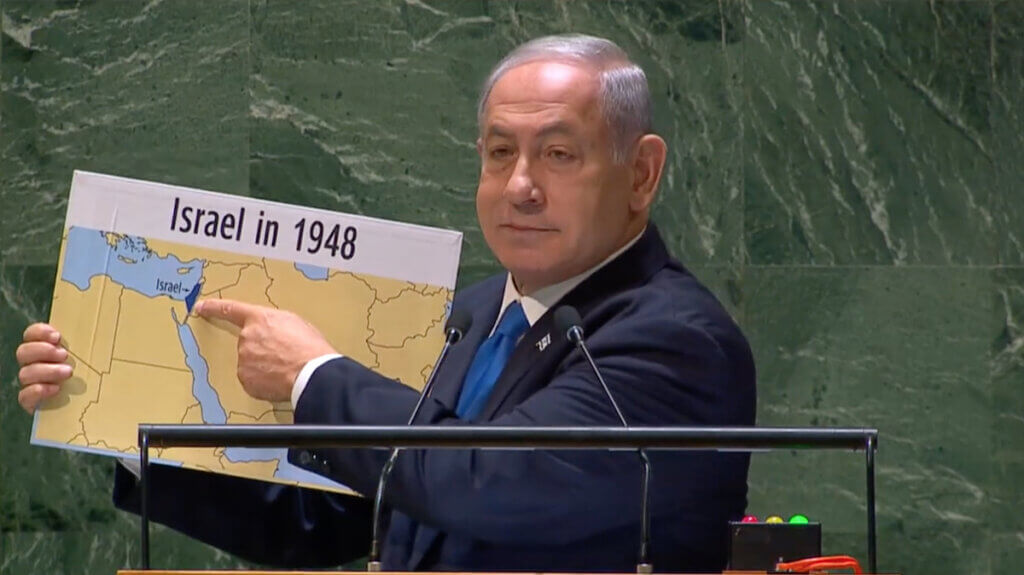
- Netanyahu under fire for using Greater Land of Israel map at UN - Israel Politics - The Jerusalem Post
- Claim: Israel has been occupying West Bank and Gaza since 1967